Pattern Change Discovery Between High Dimensional Data Sets
Abstract
The general problem of pattern change discovery between high-dimensional data sets is addressed by considering the notion of the principal angles between the subspaces is introduced to measure the subspace difference between two high-dimensional data sets. Current methods either mainly focus on magnitude change detection of low-dimensional data sets or are under supervised frameworks. Principal angles bear a property to isolate subspace change from the magnitude change. To address the challenge of directly computing the principal angles, matrix factorization is used to serve as a statistical framework and develop the principle of the dominant subspace mapping to transfer the principal angle based detection to a matrix factorization problem. Matrix factorization can be naturally embedded into the likelihood ratio test based on the linear models. The method may be unsupervised and addresses the statistical significance of the pattern changes between high-dimensional data sets.
Claims (18)
1 . A method for distinguishing statistical significance of changes between first semantic data representing at least one of multimedia data, social network data, and news data at a first time and second semantic data representing at least one of multimedia data, social network data, and news data at a second time, the second semantic data being different from the first semantic data, comprising: linearly modelling at least a dominant subspace of the first semantic data and the second semantic data in a linear model defining a respective matrix; factoring each matrix into a feature basis matrix and an indicator matrix; determining principal angles which are independent of respective magnitudes of the changes, dependent on at least the feature basis matrices and the indicator matrices; adaptively determining a threshold of statistical significance based on the linear model; determining a statistical significance of the changes based on at least the principal angles and the threshold; and selectively outputting a subset of at least one of the first semantic data, and the second semantic data through a computer communication network interface associated with a prediction of a change in trajectory of the at least one of multimedia data, social network data, and news data, dependent on the statistical significance of the changes.
8 . A non-transitory computer readable medium storing instructions for controlling an automated processor to determine a statistical significance of changes over time in semantic data representing at least one of multimedia data, social network data, and news data having a dimensionality scale which is of at least thousands, comprising: steps for linearly modelling at least a dominant subspace of the semantic data over time to produce a linear model comprising a matrix; steps for factoring the matrix into a feature basis matrix and an indicator matrix; steps for determining a set of principal angles dependent on at least the feature basis matrices and the indicator matrices; steps for adaptively determining a threshold of statistical significance based on the linear model; steps for determining a statistical significance of changes of the semantic data over time based on an analysis of at least the principal angles and the threshold; and steps for outputting a subset of the semantic data associated with a prediction of a change in trajectory of the at least one of multimedia data, social network data, and news data, through a computer communication network interface dependent on the determined statistical significance of the changes.
15 . A system for determining a statistical significance of changes over time in a semantic data set representing at least one of multimedia data, social network data, and news data, having a dimensionality scale which is of at least thousands, comprising: a memory configured store the changes over time in the semantic data set; and at least one automated processor configured to: linearly model at least a dominant subspace of the semantic data set, to produce respective linear models of the semantic data set at different times, each comprising a respective matrix; factor each respective matrix into a respective feature basis matrix and a respective indicator matrix; determine a set of principal angles between the linear model of the semantic data set at the different times, dependent on at least the respective feature basis matrices and the respective indicator matrices; and adaptively determine a threshold of statistical significance based on the linear model; and determine a statistical significance of changes over time based on an analysis of at least the principal angles; and a computer communication network interface configured to communicate a subset of the semantic data set associated with a prediction of a change in trajectory of the at least one of multimedia data, social network data, and news data, dependent on the determined statistical significance of the changes.
Show 15 dependent claims
2 . The method according to claim 1 , further comprising ranking a set of objects comprising the second semantic data in dependence on at least the principal angles.
3 . The method according to claim 1 , further comprising ranking the subset of objects comprising the second semantic data in dependence on at least the determined statistical significance of the changes.
4 . The method according to claim 1 , wherein the first semantic data has a dimensionality scale which is of at least thousands.
5 . The method according to claim 4 , wherein said factoring comprises iteratively optimizing a factorization of the respective matrix into an estimated feature basis matrix and an estimated indicator matrix corresponding to a set of principal angles representing the changes, with at least one automated processor.
6 . The method according to claim 5 , wherein said determining the statistical significance of the changes comprises determining a statistical likelihood ratio with respect to alternate hypotheses regarding a statistical significance of the changes based on sets of basis vectors determined dependent on the set of principal angles from the optimized factorization of the matrix.
7 . The method according to claim 1 , wherein the first semantic data comprises equity market data and a news feed at a first time, and the second semantic data comprises equity market data and a news feed at a second time.
9 . The non-transitory computer readable medium according to claim 8 , further comprising steps for adapting a process for factoring the matrix into the feature basis matrix and the indicator matrix.
10 . The non-transitory computer readable medium according to claim 8 , further comprising instructions for ranking a set of objects comprising the semantic data in dependence on at least the principal angles.
11 . The non-transitory computer readable medium according to claim 8 , further comprising instructions for ranking a set of objects comprising the semantic data in dependence on at least the determined statistical significance of the changes of the semantic data over time.
12 . The non-transitory computer readable medium according to claim 8 , wherein said instructions for factoring comprise instructions for iteratively optimizing a factorization of the respective matrix into an estimated feature basis matrix and an estimated indicator matrix corresponding to a set of principal angles representing the changes of the semantic data over time, with at least one automated processor.
13 . The non-transitory computer readable medium according to claim 12 , wherein said instructions for determining the statistical significance of the changes of the semantic data over time comprise instructions for determining a statistical likelihood ratio with respect to alternate hypotheses regarding a statistical significance of the of changes of the semantic data over time based on sets of basis vectors determined dependent on the set of principal angles from the optimized factorization of the matrix.
14 . The non-transitory computer readable medium according to claim 8 , wherein the semantic data comprises equity market data and a news feed, further comprising instructions for predicting whether a statistically significant change in an equity market trajectory is about to occur based on at least the determined statistical significance of the changes of the semantic data over time.
16 . The system according to claim 15 , wherein the at least one automated processor is further configured to rank at least a portion of the determined significant changes over time, and the computer communication network interface is further configured to communicate the ranking of the portion of the determined significant changes over time.
17 . The system according to claim 15 , wherein said factoring comprises iteratively optimizing the factorization of the respective matrix into the respective feature basis matrix and the respective indicator matrix.
18 . The system according to claim 15 , wherein the semantic data set comprises equity market data and a news feed, and the information comprises a prediction of whether a statistically significant change in equity market trajectory is about to occur.
Full Description
Show full text →
CROSS REFERENCE TO RELATED APPLICATION
The present application is a Continuation of U.S. patent application Ser. No. 17/114,484, filed Dec. 7, 2020, Issue Fee paid, which is a Continuation of U.S. patent application Ser. No. 14/060,743, filed Oct. 23, 2013, now U.S. Pat. No. 10,860,683, issued Dec. 8, 2020, which is a non-provisional of, and claims benefit of priority under 35 U.S.C. § 119 (e) from U.S. Provisional Patent Application Ser. No. 61/718,367, filed Oct. 25, 2012, the entirety of which are expressly incorporated herein by reference in their entirety.
STATEMENT OF GOVERNMENT SUPPORT
This invention was made with Government support under IIS-0535162, IIS-0812114, IIS-0905215, and CCF-1017828 awarded by the National Science Foundation. The Government has certain rights in this invention.
1. BACKGROUND OF THE INVENTION
High dimensional data exist everywhere in our life and in all the sectors of our society in every modality of the data we live with today, including text, imagery, audio, video, and graphics. Pattern change discovery from high dimensional data sets is a general problem that arises in almost every application in the real-world; examples of such applications include concept drift mining in text data, event discovery in surveillance video data, event discovery in news data, hot topic discovery in the literature, image pattern change detection, as well as genome sequence change detection in bioinformatics, to just name a few.
In each of the above applications, we formulate the problem as follows. Given two typically high-dimensional data sets, we intend to determine whether there is a significant pattern change between the two data sets. In different applications, the physical interpretation of the two data sets may be different. For example, in detecting any topic change between two text documents, the two high-dimensional data sets may be the two text documents; in detecting any concept drift among a text stream, any pair of two neighboring snapshots of the text collections in the timeline may be considered as the two high-dimensional data sets; in detecting any pattern change between two images or two collections of images, the two high dimensional data sets may be the two corresponding images or the two collections of the images; in detecting any event occurred in a surveillance video camera, the two high-dimensional data sets may be any pair of two neighboring video frames or groups of video frames in the video stream; in detecting any hot topics in a news data stream, the two high-dimensional data sets may be two neighboring sample windows of the news text data within the stream.
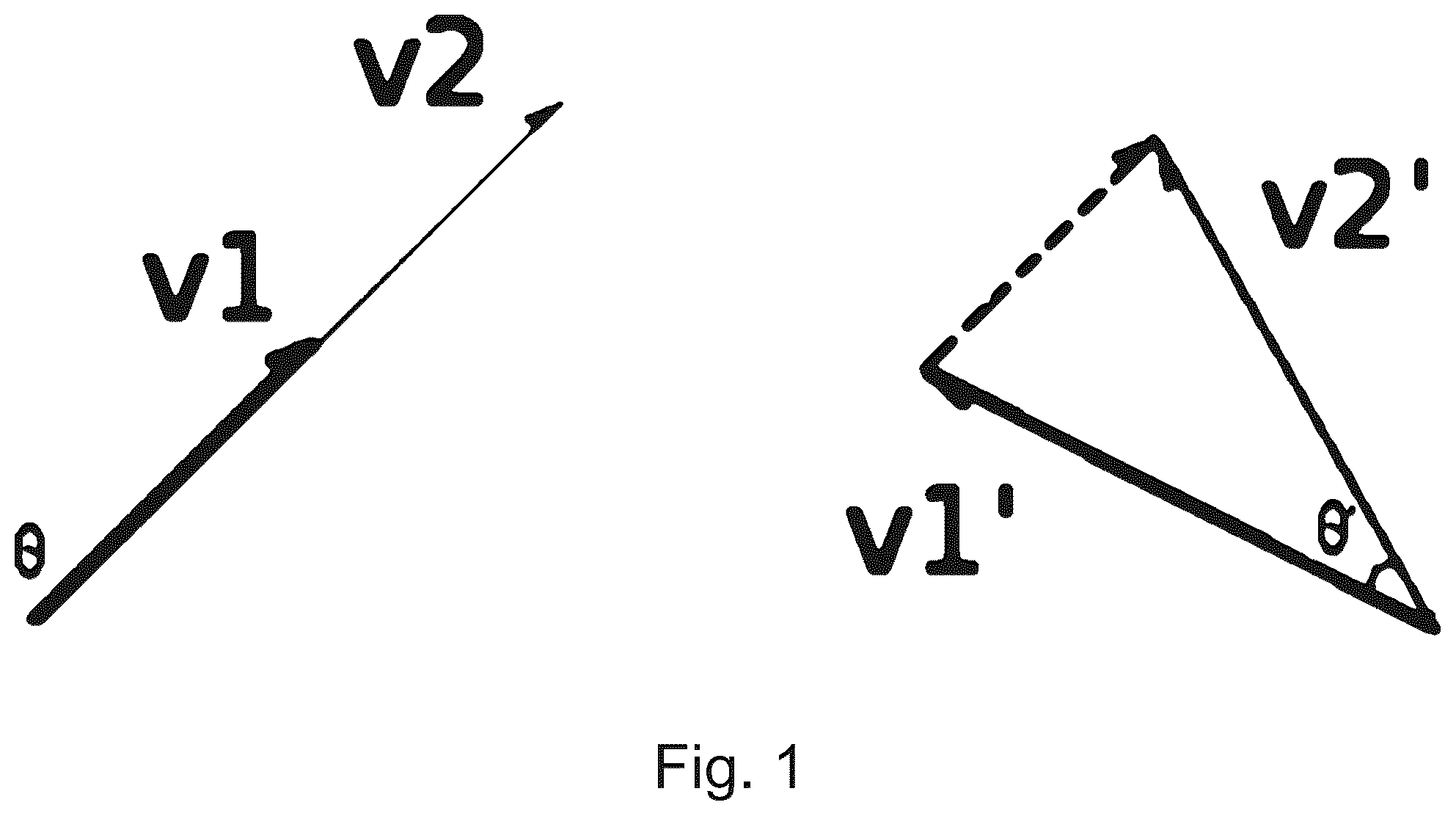
One may wonder what makes high-dimensional data different when it comes to change detection. For almost all the magnitude change detection methods, an invisible pitfall arises with the increase of data's dimensionality. The tricky conflict between Euclidean distance and dimensionality is illustrated in . Here we use Euclidean distance because it is the most intuitive and popular metric. Moreover, many commonly used metrics, such as L-norms, K-L divergence, or more generally, Bregman divergence, are defined based on the Euclidean distance. gives two pairs of vectors (v 1 , v 2 ) and (v′ 1 , v′ 2 ), and the angles, θ, θ′ between each pair, respectively. Under Euclidean distance, |v 1 -v 2 |, and |v 1 ′-v 2 ′| are the same. In other words, Euclidean distance fails to detect θ≠θ′, and therefore, is unable to differentiate the length difference from the direction difference introduced by the dimensionality.
In fact, in quite a few real-world applications, high dimensional data per se do not contribute to the data vectors' magnitude change, but to a new combination of a certain subset of the features. For example, we do not intend to conclude that the difference between a human baby and an adult is the same as that between the baby and a little monkey; a banker is not interested in the volume of the financial news but the newly emerged key words; to examine the mutation of a DNA sequence, a biologist needs to find the new combination of Adenine and Guanine instead of the DNA data size change. In these cases, the change of feature subspace should not be confused with the change of data's magnitude. One may argue that we still could round up all the vectors into the same length and then apply the Euclidean distance to avoid the confusion with the magnitude. Such a manipulation theoretically works only when the subspace dimension spanned by data is one (to compare only two vectors). Moreover, the round-up errors and the change of the original data structure may lead to unmanageable consequences.
Based on the above fact, our first motivation is to find a metric that is invariant under the data's magnitude change and only characterize the subspace change introduced by dimensionality. Further, we require that such a metric is in a form suitable for computation and manipulation. Thus, while detection of data's magnitude change may be significant, other measures may also be significant.
The classic paradigm for magnitude-based change detection between two data sets is through parameter estimations based on established distribution models. More recent work in this direction [Song 2007, Kifer 2004, Leeuwen 2008] attempts to avoid the parametric dependency and to define alternative distance measures between the two distributions. Song et al. (2007) developed a Monte-Carlo framework to detect distribution changes for low dimensional data. In Kifer et al. (2004) defined the Adistance to measure the non-parametric distribution change. In Leeuwen and Siebes (2008) described the data distributions using their compressed code table and defined the Code-Table-Difference to capture the distribution difference between data sets. The limitation of the low-dimensional distribution models, as Vapnik ( 1998 ) pointed out at the beginning of his book, is that they do not reflect the singularities of the high-dimensional cases, and consequently cannot grasp the change of the subspace.
Based on Vapnik's statistic supervised learning theory, the pattern change detection problem, also called concept drift in several specific applications, has been attracted great effort [Tsymbal (2004), Zhang (2008), Wang 2003), Vreeken (2007), Nishida 2007)]. Classifiers are trained to capture the subspace structures of the high-dimensional data sets via support vectors. The pattern changes can be indirectly reflected through evaluating the classification errors on the data sets. Tsymbal (2004) provides an overview of the important literature on this topic. The main categories of the methods to address the concept drift analysis problem include the instance selection and weighting [Klinkenberg (2004), Hulten (2001)], the ensemble learning [Wang (2003), Zhang 2008), Bifet (2009)], and the two-samples hypothesis test [Dries (2009), Hido (2008), Nishida (2007)]. Although supervised learning techniques have the capacity to detect structural changes between high-dimensional data sets, they require labels to train and validate the classifiers. Most of the real-world data sets, however, typically lack sufficient labels that can be used to train the classifiers. Dries and Rückert (2009) proposed a trade-off strategy. Without using real labels, they constructed two virtual classifiers by giving two different types of the labels to the two data sets, respectively, and then proposed three two-sample test methods based on the quality of the classifiers; a good quality indicates a concept drift between the two data sets. Using one classifier to describe the whole dataset, however, oversimplifies the mixture structures of the data sets, and the detection performance is expected to be impaired (see Section 7).
As an unsupervised paradigm, matrix factorization is recently considered for subspace analysis of high-dimensional data sets. The theory and applications of matrix factorization have been intensively developed during the last decade. Lee and Seung (1999) developed the breakthrough of the multiplicative updating rules for solving matrix factorization, extending the classical vector quantization and principal components analysis to a new horizon. Gordon (2002) unified the matrix factorization literature with the generalized linear models, strengthening the statistical foundation for matrix factorization. As for the applications, Ding et al. (2008) applied non-negative matrix factorization to spectral clustering, graph matching, and clique finding. Long et al. (2005) and Long et al. (2006) used matrix factorization for relational clustering. Miettinen (2009) developed factorization algorithms for binary data sets. In this paper, we use matrix factorization and the notion of the principal angles between subspaces to capture the structural difference between the high-dimensional data sets.
Other recent efforts on the magnitude-based change detection for specific applications include the event detection from time series data [Chen (2009), Preston (2009)] focusing on discovering a significant magnitude change and its duration on a particular feature, word bursts tracking [Gec (2008), He 2010)], and trend analysis in blogosphere by tracking singular values [Chi (2006)].
See, U.S. Pat. Nos. 8,116,566; 8,032,209; 7,949,186; 7,917,540; 7,890,842; 6,240,218, 2011/0179327; 2010/0002797; 2008/0256130; 2008/0175446; 2008/0123900; 2007/0217676; 2007/0016837; 2006/0251303; 2006/0020924; 2006/0020923; 2006/0020866; and 2005/0278703, each of which is expressly incorporated herein by reference in its entirety.
2. SUMMARY OF THE INVENTION
The general problem of pattern change discovery between high-dimensional data sets is an interesting one. Current methods either mainly focus on magnitude change detection of low-dimensional data sets or are under supervised frameworks. The notion of the principal angles between the subspaces is introduced according to aspects of the present technology to measure the subspace difference between two high-dimensional data sets. Principal angles bear a property to isolate subspace change from the magnitude change. That is, the principal angles are invariant under magnitude change. To address the challenge of directly computing the principal angles, matrix factorization may be used to serve as a statistical framework and develop the principle of the dominant subspace mapping to transfer the principal angle-based detection to a matrix factorization problem. Matrix factorization can be naturally embedded into the likelihood ratio test based on the linear models. The proposed method is of an unsupervised nature and addresses the statistical significance of the pattern changes between high-dimensional data sets. Different applications of this solution have various specific real-world applications, demonstrating the power and effectiveness of this method.
Detection of the subspace change between high-dimensional data sets solely through a magnitude-based metric is inaccurate and conceptually confusing. As discussed below, pattern change between high-dimensional data sets is employed to mean the subspace change, not the magnitude change.
In order to identify the appropriate subspace for discovering the pattern change between the data sets, the concept of dominant subspace based on the principal angles [Golub (1996)] is introduced. The notion of principal angels between two subspace has an advantageous property of invariance under an isomorphism, thus is independent of data's magnitude change. The challenge then is to compute the principal angles. To address this challenge, matrix factorization is used to serve as a statistical framework for computing the principal angles. The principle of dominant subspace mapping is used to show how matrix factorization can be naturally embedded into the likelihood ratio test based on the principle. The proposed method is of an unsupervised nature and addresses the statistical significance of the pattern changes between represented in the linear models.
The statistical significance of the difference is preferably addressed according to the present technology through a likelihood hypothesis test based on the linear model. This provides a technique which employs matrix factorization to develop a statistical framework for the pattern change detection.
The choice of the threshold value h in the likelihood ratio test depends on the characteristics of the specific application. In many cases, ranking can be applied instead of thresholding. More specifically, when detecting an event from the news streams and video streams, one can rank the likelihood ratio sequence A in a descent order; the top-ranked data segments correspond to the most significant pattern changes in the given data streams (See ).
In cases when a threshold is necessary, choosing an appropriate threshold value depends upon the potential follow-up actions based on the detection results, and usually is formulated as a decision-making problem [Janeys (1996)]. In general, a threshold is determined by the relative consequences of different actions representing one of the four possible scenarios: true positive, true negative, false positive, and false negative [Nicoll (2012)]. An overall assessment of the cost associated with any of the four consequences in a specific application needs to be conducted before we are able to give an appropriate threshold value. For example, if the specific application is earthquake detection in a densely populated area, a few false positives are allowed but no false negatives are acceptable. Utility functions need to be evaluated from the four possible outcomes; a threshold comes as a trade-off among the utilities of the four outcomes. Determining the utility function is application specific, depending possibly on the budget, and the cost of the hazard, etc.
For time evolving data streams, self-adaptive algorithms can be further applied. There is abundant literature on this topic [See Brietgand (2005), Singh (20100), Yan (2005), Jiang (2003)). This technology can be applied to many important areas. For example, in financial applications, if we consider the customer daily transactional data as the time-series data, we may apply this invention to detect any abnormal transactional patterns that may indicate potential crimes such as money laundering. When the invention is used to daily sales data on the other hand, we are able to identify new customer interests. As yet another example, if we consider the daily online transactional data, we may be able to use this technology to discover new business models.
The present technology may be applied to large data sets of various types, for example, video, audio, semantic, financial data (e.g., markets, transactions), social networks and data feeds, and the like. In general, an advantage of various embodiments according to the present technology is that a segmentation, parsing, clustering or other significant pre-processing of the data is not required. Likewise, an actual understanding or modeling of the data content is not required. Certainly, processing the data using such techniques may eliminate noise or otherwise accentuate features of interest, and thus facilitate the underlying process. However, the extraction of principal angles, similar to the extraction of principal components, may be applied to data sets which are relatively raw, and the statistical processes themselves extract the distinguishing features. Likewise, in a preferred embodiment, the technology is used to determine existence of a significant pattern change, without directly addressing what features are most significant in that determination. For example, one might seek to monitor equity market data and news data feeds in real time to determine whether a significant change in market trajectory is about to occur. In that case, the models to be compared are a high dimensional model of historical performance of equity markets with respect to news feeds, and a model of current market conditions with a relatively short tail. The system then seeks to determine the set of principal angles of the dominant subspace representing differences between the respective linear models using matrix factorization. This may be conducted with a massively parallel processor system, such as the IBM Netezza Puredata System for Analytics N1001-010 (on one or multiple racks). A statistical test is established to qualify the statistical significance of differences, based on a set of basis vectors. The threshold for a determination of significance may be manually set, or static or adaptive dependent on the model of the data itself. In this case, there is no “intelligence” applied to identify an event or object which particularly contributes to a determination of the significance of changes, but rather a statistical process.
The decision threshold may be adaptive to type 1 (false positive) errors, type 2 (false negative) errors, a relationship between type 1 and type 2 errors, or other factors, which may be intrinsic or extrinsic to the data sets.
Another example of the use of this technology is a collaborative filter. In such a filter, affinity groups of people with common interest are created to predict future preferences for other group members.
The underlying assumption of the collaborative filtering approach is that if a person A has the same opinion as a person B on an issue, A is more likely to have B's opinion on a different issue x than to have the opinion on x of a person chosen randomly. Note that these predictions are specific to the user, but use information gleaned from many users. See en.wikipedia.org/wiki/Collaborative_filtering, expressly incorporated herein by reference. Some collaborative filters rely on principal component analysis. However, this technique relies on time invariance. That is, old data is used to predict future preferences, without considering the time lapse effects on user preferences. Therefore, the present technology may be used on all or selected portions of the data set to determine significant changes over time; when those changes occur, reliance on the past data is suspect, and therefore an alternate approach adopted. For example, a statistically similar subpopulation may be selected for use in the collaborative filter. Likewise, suspect data for users may be removed from an updated model, to the point necessary to avoid significant pattern changes. Therefore, the magnitude and angle of differences between datasets, represented by the principal components and the principal angles, may both be employed. According to the preferred embodiment, the principal angles are produced using a matrix factorization of the linear model of the dominant subspace, which are then statistically tested.
In some cases, a further analysis of the principal angles may be employed alternately or in addition to the statistical significance analysis.
It is therefore an object of the technology to introduce the notion of principal angles between subspaces as a metric for pattern change.
It is another object of the technology to employ the principle of the dominant subspace mapping to transfer the principal angle-based detection to a matrix factorization problem.
It is a still further object to employ the different applications of this solution in several specific real-world applications to demonstrate the power and effectiveness of this method.
It is another object to provide a method for pattern change discovery between high-dimensional data sets, comprising: determining a linear model of a dominant subspace for each pair of high dimensional data sets using at least one automated processor, and using matrix factorization to produce a set of principal angles representing differences between the linear models; defining a set of basis vectors under a null hypothesis of no statistically significant pattern change and under an alternative hypothesis of a statistically significant pattern change; performing a statistical test on the basis vectors with respect to the null hypothesis and the alternate hypothesis to automatically determine whether a statistically significant difference is present; and producing an output selectively dependent on whether the statistically significant difference is present.
A further object provides a nontransitory computer readable medium, comprising instructions for controlling a programmable processor to perform a method comprising: determining a linear model of a dominant subspace for each pair of high dimensional data sets using at least one automated processor, and using matrix factorization to produce a set of principal angles representing differences between the linear models; defining a set of basis vectors under a null hypothesis of no statistically significant pattern change and under an alternative hypothesis of a statistically significant pattern change; performing a statistical test on the basis vectors with respect to the null hypothesis and the alternate hypothesis to automatically determine whether a statistically significant difference is present; and producing an output selectively dependent on whether the statistically significant difference is present.
It is also an object to provide a system for determining pattern change discovery between high-dimensional data sets, comprising: an input configured to receive a pair of high dimensional data sets; at least one automated processor, configured to: determine a linear model of a dominant subspace for each pair of high dimensional data sets; factoring at least one matrix to produce a set of principal angles representing differences between the linear models; define a set of basis vectors under a null hypothesis of no statistically significant pattern change and under an alternative hypothesis of a statistically significant pattern change; and perform a statistical test on the basis vectors with respect to the null hypothesis and the alternate hypothesis to determine whether a statistically significant difference is present; and an output configured to communicate data selectively dependent on whether the statistically significant difference is present.
The statistical test may comprise a likelihood ratio test.
The automatically determining step is preferably unsupervised.
The method may further comprise determining a statistical significance of pattern changes between the dominant subspaces.
The high-dimensional data sets comprise semantic data, video data, and/or multimedia data. The high-dimensional data sets may comprise data representing a common source or location acquired at different times.
3. BRIEF DESCRIPTION OF THE DRAWINGS
shows the Euclidean metric fails to differentiate the length difference from the direction difference;
A- 2 H show the detection performance of LRatio and 4 comparison methods. For each pair of W and B, a smaller overlap between W and B indicates a better performance;
shows test sequences for Google political news stream;
A, 4 B, and 4 C show pattern changes detected by LRatio vs. Clusters found by KM. ‘x’ marks the old news topics that have been detected in the previous days. Boxes with the same colors are related to the same news topics;
A and 5 B show detection result for video 1; A rank 1 event: a man is running towards a cart; B the test sequence; the star marks the time when this man begins running;
A and 6 B show detection results for video 2; A rank 1 event: an earthquake occurs and people are running out; B shows the test sequence; the star marks the time when the earthquake occurs;
A, 7 B and 7 C show detection results for video 3; A rank 2 event: the car collision occurs; B rank 1 event: a man is running towards the accident scene; and C the test sequence; the star marks the time of the collision.
represents a prior art hardware system.
4. DETAILED DESCRIPTION OF THE PREFERRED EMBODIMENTS
Pattern change discovery between high-dimensional data sets may therefore be detected, by, for example, determining a linear model of a dominant subspace for each pair of high dimensional data sets, and using matrix factorization to produce a set of principal angles representing differences between the linear models. A set of basis vectors is defined under a null hypothesis of no statistically significant pattern change, and under an alternative hypothesis of a statistically significant pattern change. A statistical test is performed on the basis vectors with respect to the null hypothesis and the alternate hypothesis to determine whether a statistically significant difference is present.
The statistical test may employ a likelihood ratio statistic given by
Λ = X - P ^ S ^ T 2 X - P ^ H S ^ H T 2 based on {circumflex over (P)}, Ŝ and {circumflex over (P)} H , Ŝ H , wherein {circumflex over ( )}P and {circumflex over ( )}S represent estimates of P m×k and S n×k which are lower dimension factors whose product approximates the high dimensional data set matrix X m×n , k□min(m,n), and {circumflex over ( )}P H and {circumflex over ( )}S H represent estimates of feature basis matrix P H and indicator matrix S H , the statistical test comprising a standard likelihood ratio test performed by estimating P only based on linear model G with additive Gaussian noise, and then estimating P under constraint H 0 : P′ T P=0, and computing a likelihood ratio between the two cases, wherein on linear model G: X=PST+ε, where ε·j˜N m×1 (0, σ 2 I m×m ), the likelihood function for G is
L ( P , S ) = ( 2 πσ 2 ) - mn exp [ - 1 2 σ 2 X - PS T 2 ] .
The maximum likelihood estimates subject to the null hypothesis constraint H 0 : P′ T P=0
ℒ ( P , S ) = - log L ( P , S ) + λ P T P ′ 2 = constant + np 2 + 1 2 σ 2 X - PS T 2 + λ P T P ′ 2 may be found by iteratively minimizing
ℒ ( P , S ) = X - PS T 2 + λ P T P ′ 2 , wherein:
λ = 1 mk ∑ ij ( XS - PS T S ) ij ( P ′ P ′T P ) ij .
5. PRELIMINARIES
5.1 Notations
As used herein, a matrix is denoted as a capital letter in boldface such as X. X ij is the entry in the ith row and the jth column. X i . stands for the ith row of X and X .j stands for the jth column of X. A vector is a lowercase letter in boldface such as x. A scalar variable is denoted as a lowercase letter such as x. U T stands for the transpose of the matrix U. X m×n stands for a matrix X∈□ m×n . span(A) stands for the subspace spanned by the column vectors of the matrix A. □·□ by default is the Frobenius norm for a matrix; □·□ 2 is the 2-norm [Golub (1996)] for a matrix. diag({x i }) stands for a diagonal matrix with x i as its ith diagonal entry.
5.2 Principal Angles and Dominant Subspace
The principal angles between subspaces are used to measure the subspace difference between data sets of high dimensions. Discussed above are pitfalls of the popular distance metrics. Starting with the same example in , the Euclidean distance fails to detect θ≠θ′, and therefore, is unable to differentiate the length difference from the direction difference introduced by the dimensionality. On the other hand, in this specific example, the principal angle between span(v 1 ) and span(v 2 ) is actually 0, and that between span(v 1 ′) and span(v 2 ′) is θ′. One may notice that we here use span(v) instead of just v. This indicates that θ and θ ′ are invariant under the length shrinking or stretching for the corresponding vectors. Now one can reasonably understand the notion of principal angles between two subspaces as a generalization of an angle between two vectors as the dimensionality goes from one (as for span(v 1 )) to n where n≥1. The principal angles have a very important property that all the Euclidean-based metrics do not have—Invariance under an isomorphism and thus independent of the magnitude change (e.g., invariant under scalar multiplication when the dimensionality is one).
Without loss of generality, assume two vector sets
{ x i } i = 1 m and
{ y i } i = 1 l , x i , y i ∈ ▯ n . Golub and Loan proposed in [Golub (1996)] the definition of principal angles as to measure the structural difference between the two subspaces
S 1 = span ( { x i } i = 1 m ) and
S 2 = span ( { y i } i = 1 l ) : An increasing sequence of principal angles
{ θ k } k = 1 q is defined between two arbitrary subspaces S 1 and S 2 using their orthonormal basis: (Golub (1996) Page 602):
Definition 1. Let S 1 and S 2 be subspaces in □ n whose dimensions satisfy
p = dim ( S 1 ) ≥ dim ( S 2 ) = q ≥ 1 The principal angles θ k ∈[0, π/2], k=1, . . . , q, between S1 and S 2 are defined recursively as
cos ( θ k ) = max u ∈ S 1 , v ∈ S s u T v = u k T v k when k=1, □u l □=□v 1 □=1; when k≥2, □u k □=□v k □=1;
u k T u i = 0 ; V k T v i = 0 where i=1, . . . , k−1.
In this definition, vectors
{ u k } k = 1 q and
{ v k } k = 1 q are actually part of the orthonormal basis for S 1 and S 2 ; the inner products of each pair u k and v k form a unique increasing sequence of angles. These angles explicitly give the difference of the subspace structure between S 1 and S 2 . The algorithm given in [Golub (1996)] to compute the principal angles takes O(4n(q 2 +2p 2 )+2pq(n+q)+12q 3 ) in time complexity.
The leading largest principal angles depict the most noticeable structural difference between S 1 and S 2 . The corresponding dimensions responsible for the largest principal angles are of great interest as they reflect the major pattern change. The subspace formed by these dimensions is called the dominant subspace. Now in order to measure the structural difference between
{ x i } i = 1 m and
{ y i } i = 1 l , one may resort to directly computing the principal angles between S 1 and S 2 , and then obtain the dominant subspace based on the largest principal angles. In practice, however, this is not an optimal solution. First, the values of n, p, and q in Definition 1 can be very large in real-world data sets, resulting in a high complexity to compute the principal angles. Second, since the real-world data sets typically contain noise and outliers, the principal angles directly computed from the raw data may not reflect the true situation. Third, in many applications, given a large number of samples, one is only interested in the most frequent pattern changes in the majority of the data set and does not care about the principal angles for all the samples. All these issues require to developing an alternative solution to directly computing the principal angles. On the other hand, matrix factorization [Lee (1999), Banerjee (2005), Ding (2008), Singh (2008)] has been used extensively for reducing dimensionality and extracting collective patterns from noisy data in a form of a linear model.
Below, the principle of dominant subspace mapping through matrix factorization is developed as the alternative to obtain the dominant subspace.
6. MODEL FORMULATION
Given two data sets
X ′ = { x i ′ } i = 1 n ′ and
X = { x i } i = 1 , a model is presented to detect the pattern changes between X′ and X. Instead of computing the principal angles directly, a more practical strategy is provided involving three steps: To establish a null-hypothesis on pattern change, to extract a set of basis vectors from span
span ( { x i } i = 1 n ) under a null and its alternative hypothesis, and a statistical test to confirm these changes. Principal angles, matrix factorization and linear models can work together to serve this purpose. 6.1 Matrix Factorization
Learning mixture patterns from data can be formulated as generalized 2 linear 2 models [Gordon (2002), Singh (2008)] using the following matrix factorization term:
X ≈ PS T ( 1 ) where the matrix X m×n =[x 1 , x 2 . . . x n ], x∈□ m , consist of n data samples represented as the n column vectors. Matrices P m×k and S n×k , k□min(m, n), are two lower-dimension factors whose product approximates the original data set X. The k column vectors of P are prototype patterns learned from X; the ith row of S is a soft indicator using k prototypes to restore the ith sample. Thus, the columns of P can also be considered as an approximate generating set for the subspace containing samples
{ x i } i = 1 n . In this modeling, we concentrate on P, the prototype patterns, and its changing behavior. S describes how the k prototypes are distributed among the n samples and may also contain useful information to characterize the dataset.
Another advantage for matrix factorization is its form as a linear model under which a hypothesis test can be developed. More specifically, given a linear model with additive Gaussian noise G: X=PS T +ε, where ε .j ˜N m×1 (0, σ 2 I m×m ), the preferred strategy is to check the pattern change in P by properly constructing a hypothesis on P and then applying the standard likelihood ratio test.
6.2 Principle of Dominant Subspace Mapping
In order to extract the plausible pattern changes, instead of directly computing the principal angles, the principle of dominant subspace mapping is developed by constructing and testing a hypothesis as follows. First, a hypothesis on the pattern matrix P is established. Assuming P′ and P from the two data sets X′ and X, since the principal angles
{ θ i } i = 1 k between span(P′) and span(P) indicate the scale of pattern changes, it is straightforward to set up the hypothesis on the principal angles to begin with. Now two options are available for the null-hypothesis: To assume no pattern change or to assume an obvious pattern change. If the former is chosen, there are two concerns. First, the possibility that two data sets obtained from different times or locations share the same subspace is almost zero, resulting in a hypothesis on an almost impossible event. Second, as shown in definition 1, the principal angles are computed via cos; the null-hypothesis of no pattern change gives
H 0 : diag ( { cos θ i } i = 1 k = k , indicating that every principal angle is zero; such a setting is vulnerable due to different k value in different applications and no prior knowledge is available about the specific value of k. On the other hand, if the hypothesis is set as an obvious pattern change, it serves both purposes of detecting pattern change and a convenient form of
H 0 : diag ( { cos θ i } i = 1 k = 0. If the hypothesis is true, the values of
{ θ i } i = 1 k are large, indicating the large pattern change between span
span ( P ) ⊆ { x i } i = 1 n and span
span ( P ′ ) ⊆ { x i ′ } i = 1 n ′ . More importantly, this hypothesis is independent of the value k, making the detection more robust despite the possible information loss caused by matrix factorization.
While the hypothesis
H 0 : diag ( { cos θ i } i = 1 k = 0 is straightforward, in order to construct a simple statistic test, a hypothesis is cast directly on P and P′. For this purpose, the following lemma is introduced:
Lemma 1. Given that P′∈□ m×p and P∈□ m×q , each with linearly independent columns, and that each column is normalized into the same 2-norm length L, and further given the QR factorizations P=QR and P′=Q′R′, the principal angles {cos θ i } i=1 k , between span(P) and span(P′) satisfy inequality:
1 p q L 2 P ′ T P ≤ diag ( { cos θ i } i = 1 k ) ≤ a ❘ "\[LeftBracketingBar]" σ 1 σ 2 ❘ "\[RightBracketingBar]" P ′ T P ( 2 ) here a≤pq is a constant, and σ 1 and σ 2 are the smallest eigenvalues of R′ and R, respectively.
The proof of Lemma 1 uses the method in [Golub (1996)] for computing the principal angles.
Given A∈□ n×p and B∈□ m×q (p≥q), each with linearly independent columns, the principal angles between subspaces span(A) and span(B) can be computed as follows. First, compute the QR factorizations for A and B, respectively
A = Q A R A Q A T Q A = I p , R A ∈ ▯ p × p B = Q B R B Q B T Q B = I p , R B ∈ ▯ q × q
Then, let C=Q A T Q B and compute the SVD (singular value decomposition) of C such that Y T CZ=diag(cos θ), where diag(cos θ) is short for the diagonal matrix with the cosines of the principal angles {cos θ 1 , cos θ 2 . . . cos θ q } as the diagonal elements.
Since
diag ( cos θ ) 2 = Y ( Q T Q ′ ) Z 2 = Q T Q ′ 2 where diag(cos θ)=Y(Q T Q′)Z is the SVD of Q T Q′. The inequality can now be re-written as:
1 p q L 2 P ′ T P ≤ Q T Q ′ 2 ≤ a ❘ "\[LeftBracketingBar]" σ 1 σ 2 ❘ "\[RightBracketingBar]" P ′ T P ( 9 )
For the left hand side inequality, since □P□=□QR□=□R□=pL and similarly □P′□=□R′□=qL, then
P T P ′ = R T Q T Q ′ R ′ ≤ R Q T Q ′ R ′ = pq L 2 Q T Q ′
For the right hand side inequality,
Q T Q ′ = ( RR - 1 ) Q T Q ′ ( R ′ R ′ - 1 = R - 1 P T P ′ R ′ - 1 ≤ R - 1 P T P ′ R ′ - 1 ( 10 )
Since R and R′ are upper triangular, the inverses R −1 and R′ −1 are also upper triangular. Therefore, the eigenvalues of R are {(R) ii |i=1, . . . , p}, the diagonal entries of R. Hence, the eigenvalues of R −1 are {1/(R) ii }, the inverse of the diagonal entries of R. The same conclusion also holds true for R′ −1 . Thus,
R - 1 ≤ diag ( ( R ) i i - 1 ≤ p ❘ "\[LeftBracketingBar]" σ ❘ "\[RightBracketingBar]" R ′ - 1 ≤ diag ( ( R ′ ) i i - 1 ≤ p ❘ "\[LeftBracketingBar]" σ ′ ❘ "\[RightBracketingBar]" ( 11 )
Combining (10) and (11)
Q T Q ′ ≤ a ❘ "\[LeftBracketingBar]" σσ ′ ❘ "\[RightBracketingBar]" P T P ′ where a≤pq.
Lemma 1 gives the upper and lower bounds of
diag ( { cos θ i } i = 1 k in terms of □P′ T P□. More importantly, due to the Sandwich Theorem, □P′ T P□ and
diag ( { cos θ i } i = 1 k are asymptotically equivalent as
diag ( { cos θ i } i = 1 k is close to zero. Therefore, a hypothesis using P and P′ directly is established, as shown in the following Corollary 1:
The null-hypothesis
H 0 : diag ( { cos θ i } i = 1 k = 0 has its equivalent form of
H 0 : P ′ T P = 0 ( 3 ) 6.3 Likelihood Ratio Test
Given the simple form of null-hypothesis Ho: P′ T P=0 on linear model G: X=PST+ε, where ε.j˜N m×1 (0, σ 2 I m×m ), one can use the standard likelihood ratio test for verification (Seeber (2003) Page 98): First, estimate P only based on linear model G. Second, estimate P under constraint H 0 . Finally, compute the likelihood ratio between the two cases.
To estimate P only based on the given linear model G: X=PST+ε, where ε.j˜N m×1 (0, σ 2 I m×m ), the likelihood function for G is [Seeber (2003)]
L ( P , S ) = ( 2 πσ 2 ) - mn exp [ - 1 2 σ 2 X - P S T 2 ] . ( 4 )
Maximizing the likelihood function (4) is equivalent to estimating the factors P and S that minimize □X−PS T □ 2 . This normal-distribution-based matrix factorization can be efficiently solved via the multiplicative iteration algorithm proposed by Lee and Seung (1999) and Lee and Sung (2000):
P ij update = P ij ( P T X ) ij ( P S T S ) ij ; ( 5 ) S ij update = S ij ( X T P ) ij ( S P T P ) ij
The proof of the convergence of the updating rule can be found in Lee and Sung (2000). This updating rule generates the estimation {circumflex over (P)} and Ŝ.
Algorithm 1 LRatio
Input: data sets X, X′, and threshold h.
Output: Feature basis P H , indicator matrix S H , the likelihood ratio test
statistic Λ, and the testing result.
Method:
1: Initialize P′, S′, {circumflex over (P)}, Ŝ, {circumflex over (P)} H and Ŝ H , and λ randomly.
2: Iteratively update P′ and S′ using (5) until convergence
3: Iteratively update {circumflex over (P)} and Ŝ using (5) until convergence
4: Iteratively update {circumflex over (P)} H and Ŝ H using (7) until convergence
5: Compute Λ using (8)
6: Reject H o if Λ is smaller than h.
Finding the maximum likelihood estimates subject to the constraint (3) gives the following log likelihood function (Seber (2003) Page 98):
ℒ ( P , S ) = - log L ( P , S ) + λ P T P ′ 2 = constant + n p 2 + 1 2 σ 2 X - P S T 2 + λ P T P ′ 2 which is equivalent to minimizing:
ℒ ( P , S ) = X - P S T 2 + λ P T P ′ 2 ( 6 ) where λ>0 is the Lagrange multiplier. To solve this constrained optimization problem, the non-increasing updating rule is given through the following Lemma: Lemma 2. The loss function (6) is non-increasing under the updating rule:
P ij update = P ij ( X S ) ij ( P S T S + λ P ′ P ′ T P ) ij S i j update = S i j ( X T P ) ij ( S P T P ) ij λ update = 1 m k ∑ ij ( X S - P S T S ) ij ( P ′ P ′ T P ) ij ( 7 )
The loss function (6) is invariant under this rule if and only if P and S are at a stationary point of the loss function.
The proof of lemma 2 proceeds by first proving the convergence of the updating rules for P and S, then determining the value of λ. To prove the updating rules for P and S, an auxiliary function similar to that used in the Expectation-Maximization algorithm [Lee and Sung (2000)} is used.
Definition 2. G(u, u′) is an auxiliary function for F(u) if the conditions
G ( u , u ′ ) ≥ F ( u ) , G ( u , u ) = F ( u ) ( 12 ) are satisfied.
The auxiliary function is a useful concept due to the following lemma:
Lemma 3. If G is an auxiliary function, then F is nonincreasing under the update:
u t + 1 = arg min u G ( u , u t ) Proof . F ( u t + 1 ) ≤ G ( u t + 1 , u t ) ≤ G ( u t , u t ) = F ( u t ) ( 13 ) By defining the appropriate auxiliary function G(u, u′) for (6), the update rule in Lemma 2 easily follows from (13). Now let
u = P i ⋃ T , u t = P i ⋂ ′ T Lemma 4. Function
G ( u , u t ) = F ( u t ) + ( u - u t ) T ∇ F ( u t ) 1 / 2 ( u - u t ) T K ( u T ) ( u - u t ) ( 14 ) is an auxiliary function for
F ( u ) = 1 2 ∑ i ( x i - ∑ a S ia u a ) 2 + 1 2 ∑ a ( u a ′ u a ) 2 ( 15 ) where K(u t ) is a diagonal matrix defined as
K ab ( u t ) = δ ab ( S T Su + λ u ′ T u ′ Iu ) a / u a t ( 16 )
Proof. Since G(u, u)=F(u) is obvious, we only need to show that G(u, u t )≥F(u). To do this, we compare
F ( u ) = F ( u t ) + ( u - u t ) T ∇ F ( u t ) + 1 / 2 ( u - u t ) T ( S T S + λ u ′ T u ′ I ) ( u - u t ) ( 17 ) with (14) to find that G(u, u t )≥F(u) is equivalent to
0 ≤ ( u - u t ) T [ K ( u t ) - ( S T S + λ u ′ T u ′ I ) ] ( u - u t ) ( 18 ) To prove the positive semidefiniteness, consider the matrix
M ab ( u t ) = u a t ( K ( u t ) - ( S T S + λ u ′ T u ′ I ) ) ab u b t ( 19 ) which is a rescaling of the components of K(u t )−(S T S+λu′ T u′I). Then, K(u t )−(S T S+λu′ T u′I) is positive semidefinite if and only if M is, and
v T Mv = ∑ ab v a M ab v = ∑ ab u a t ( S T S + λ u ′ T u ′ I ) ab u b t v a 2 - v a v a t ( S T S + λ u ′ T u ′ I ) ab u b t v b = 1 2 ∑ ab ( S T S + λ u ′ T u ′ I ) ab u a t u b 2 [ v a 2 + v b 2 - 2 v a v b ] = 1 2 ∑ ab ( S T S + λ u ′ T u ′ I ) ab u a t u b t ( v a - v b ) 2 ≥ 0 ( 20 )
This leads to the proof of the updating rule for P in Lemma 2.
Proof. Applying update rule (13) to the auxiliary function (14) results in:
u t + 1 = u t - K ( u t ) - 1 ∇ F ( u t ) ( 21 )
Lemma 3 guarantees that F is non-increasing under this update rule. Writing the component of this equation explicitly,
P ij t + 1 = P ij t ( XS ) ij ( PS T S + λ P ′ P ′ T P ) ij ( 22 )
The proof of update rule for S is the same as that in Lee and Sung (2000).
The approach to determine λ is more straightforward. Since λ only controls the convergence rate of P and S, theoretically its value does not influence the final convergence of P and S. The course is set to regularize λ by using standard Lagrange multiplier procedure. Let
δℒ ( P , S ) δ P = PS T S - XS + λ P ′ P ′ T P = 0 We then get
λ = ( XS - PS T S ) ij ( P ′ P ′ T P ) ij . During the update, each entry of P and S may have different gradient speed, so λ is set to be the average
λ = 1 mk ∑ ij ( XS - PS T S ) ij ( P ′ P ′ T P ) ij as given in Lemma 2.
Using updating rule (7), we obtain estimation {circumflex over (P)} H and Ŝ H under the null hypothesis. The time complexity of the updating rule (7) for each iteration is O(mnk+k 2 m), where m, n, and k are defined at the beginning of Section 6.1.
After we obtain the estimation of {circumflex over (P)}, Ŝ and {circumflex over (P)} H , Ŝ H , the likelihood ratio statistic is given by (Seber (2003) Page 99):
Λ = X - P ^ S ^ T 2 X - P ^ H S ^ H T 2 ( 8 )
According to the likelihood principle, a small Λ indicates a bad estimation of {circumflex over (P)} H , and Ŝ H , and H o is rejected. On the other hand, a large value of Λ suggests a pattern change detected in {circumflex over (P)} H . The algorithm, called LRatio, is summarized in Algorithm 1.
The time complexity of the updating rule (5) is O(mnk) in each iteration, and that of (7) is O(mnk+k 2 m) in each iteration; the complexity to compute Λ is O(mnk), where m, n, and k are defined in Section 6.1. Thus, the total time complexity is O(mnk+k 2 m) for each iteration, which is much lower than that of directly computing the principal angles between X and X′.
TABLE 1
Configuration of the pattem change data sets.
Sample
Name Part 1 Part 2 no. Dim.
sys comp.sys.ibm.pc comp.sys.mac 400 × 1558
2
ossys comp.os.ms- comp.sys.mac 200 × 2261
windows.misc, comp.windows.x 4
comp.sys.ibm.pc
computer comp.graphics, comp.sys.ibm.pc, 100 × 1606
comp.os.ms- comp.sys.mac, 6
windows.misc, sci.electronics
comp.sys.ibm.pc
socialtalk talk.politics.guns, alt.atheism, 100 × 3312
talk.politics.mideast, soc.religion.christian, 8
talk.politics.misc, talk.politics.misc,
talk.religion.misc talk.religion.misc,
sci sci.crypt sci.med 400 × 2870
2
rec-sci rec.sport.baseball sci.electronics, 200 × 2800
rec.sport.hockey sci.space 4
comp- comp.graphics, sci.electronics, 100 × 1864
sci comp.os.ms- sci.med, 6
windows.misc, sci.space
comp.sys.ibm.pc
rec-talk rec.autos, talk.politics.guns, 100 × 2992
rec.motorcycles, talk.politics.mideas, 8
rec.sport.baseball talk.politics.misc,
rec.sport.hockey talk.religion.misc
7. EXPERIMENTS
In order to demonstrate the power and promise of LRatio as well as its superiority to the existing literature in discovering significant pattern changes in different applications in the real-world, the LRatio is applied to several different real-world problems in comparison with the existing methods in the related literature in these different applications.
7.1 Topic Change Detection Among Documents
The goal of the first application is to verify the performance of LRatio test using collections of text documents. In this application, the standard 20-newsgroup data sets [Lang (2008)] are used, the dimension scale of which is of thousands. As listed in Table 1, eight scenarios are constructed using different topic combinations. For each scenario, two parts are set up (Part 1 and Part 2). Each part contains articles evenly mixed from one or more topics. Under each scenario, if the two data sets are sampled from the same part, they should bear similar subspace structure; while if the two data sets are from different parts, their subspace structures are different and LRatio test should be able to reflect this difference through the testing statistic. These eight scenarios are constructed to showcase data sets with different structural complexities and/or pattern change strengths. The first four scenarios intend to imitate moderate pattern change by electing similar topics between the two parts. The next four scenarios imitate strong pattern change by setting different topics between the two parts. The performance of LRatio is compared with the following methods.
Baseline. The standard K-means is applied to each of the two data sets to obtain the data matrices composed of the K centroids, respectively, and then the subspaces distance computed between the pair of the K centroids based on Definition (1). Intuitively, a pattern change results in a large distance. This distance is used as a statistic to indicate the pattern change, and its sensitivity compared with LRatio test. For the reference purpose, this baseline method is called KM.
Peers. Three different concept drift detection methods are used in Dries and Rückert (2009) for a peer comparison. They are PCA-Bayesian Margin Test and two other error rate-based test methods. For the reference purpose, they are referred to as SVM-margin, SVMsigmoid, and SVM−(0,1), respectively. The reasons these comparing methods are selected are the following. First, under the framework of support vector machine (SVM), their methods are suitable for high-dimensional data sets. Second, although based on supervised techniques, the model does not require real labels and therefore can be used in unsupervised applications. Third, these methods are in a similar two-sample statistical test framework to that of LRatio, resulting in a fair comparison environment. In order to verify the detection sensitivity, the testing statistics of the data set pair having no pattern change in between are compared with the testing statistics of the data set pair involving a pattern change in between. The evaluation protocol is defined as follows.
For each scenario,
Obtain testing statistic from data set pair with no pattern change in between:
i). Constructing two data sets by randomly sampling 200 articles, each dataset with 100 samples, only from Part 1 (or Part 2).
ii). Applying LRatio and the four comparison methods on the two data sets.
iii). Repeating i) and ii) 20 times.
Obtain testing statistic from data set pair with pattern changes in between:
i). Constructing the first data set by randomly sampling 100 articles form Part 1; constructing the second data set by randomly sampling 100 articles from Part 2.
ii). Applying LRatio and the four comparison methods on the two data sets.
iii). Repeating i) and ii) 20 times.
For each method, normalize the 40 testing statistics to the range of [0, 1] for easy comparison.
Ideally, there should be a big gap between the first 20 testing statistics and the last 20 testing statistics, because the first 20 tests are from the dataset pair that has no pattern change, and the last 20 tests are from the data set pair with pattern changes. A- 2 H show the detection performance of LRatio and 4 comparison methods. For each pair of W and B, a smaller overlap between W and B indicates a better performance.: 1 shows the LRatio; 2 shows SVM-(0,1); 3 shows SVM-sigmoid; 4 shows the SVM-margin; and 5 shows KM W Sampling. Within each part; B shows Sampling Between two Parts.
A- 2 H document all the results of this experiment, where a boxplot is used to represent the numerical distribution of the statistics obtained from the sampling within each part (red boxplots) and sampling between two parts (blue boxplots). In each boxplot, the median (in □), the 25th percentile (in bars), the 75 th percentiles (in whiskers) and the outliers (in º) of the distribution are drawn. Consequently, for each method and for each of the eight collections, there is a corresponding pair of boxplots representing the statistic distributions for sampling within each part (red boxplot labeled with letter W) and for sampling between two parts (blue boxplot labeled with letter B), respectively. Clearly, more overlap between the pair of boxplots indicates the worse performance in discovering the pattern change for the method. From the figure, all the four comparing methods have the overlaps in the majority of the eight collections; in comparison, LRatio is the only method that has no overlap at all for all the eight collections; further, for the first four scenarios where there expects to be only moderate topic changes between the two parts, LRatio still clearly stands out with no overlap at all between the two boxplots. This demonstrates that LRatio is not only powerful in discovering pattern changes, but also very sensitive to the pattern changes.
7.2 Event Detection from News Streams
While the 20 newsgroups data experiment is for systematic evaluations of the pattern change discovery capabilities and sensitivities, the next experiment is an application scenario of event detection in a news stream data set. Google news data was manually collected everyday from October 23 to November 22 for the year of 2008 for four specific tracks: political news, financial news, sports news, and entertainment news. To form the news stream data for each of the four tracks, the news documents are grouped and time-stamped in a unit of every three neighboring days. Since all the five methods used in the previous experiments are for pattern change discovery between two data sets, each of them is applied to each pair of the neighboring units of the news stream in each track to obtain the statistic value. Consequently, for the whole month news data in each track, each method generates a statistic sequence, which is called the test sequence for the track of the news for the corresponding method.
documents the political news test sequences within the window between Oct. 23, 2008, and Nov. 22, 2008, for LRatio, KM, and SVM-margin. Since the three methods from [Dries (2009)] are very close in performance, for the clarity purpose in the figure, only the test sequence of SVM-margin in this figure is shown. Presumably in the figure for each method a significant peak in the test sequence means a significant pattern change, indicating that significant news events are detected by this method on that day. Everyday's news data within this whole month was manually examined to provide the ground truth regarding whether there are any significant news events on everyday of the month, and annotated the specific events.
A- 4 C show pattern changes detected by LRatio v.s. Clusters found by KM. ‘×’ marks the old news topics that have been detected in the previous days. Boxes with the same colors are related to the same news topics
Since both LRatio and KM conduct the pattern change discovery through the clustering manner, they are both further able to detect the specific events through key words in each cluster, and are able to rank the “significance” of each detected event based on the number of samples in each cluster. A- 4 C document the top five detected significant events on November 7, November 13, and November 19 for both methods, respectively, where each event is represented using a bar with the length proportional to the significance of the event, and the same event is ground-truthed with the same color. From these figures, there are three observations. First, for each of the three days, all the five detected events by LRatio are unique and distinct, while there are many duplications of the five top events detected by KM when compared with the ground truth; this is particularly true for November 7 where all the five top events detected by KM are about the Election Campaign. Second, as is also observed in , for many events KM is unable to detect them “in time” but rather with a delay; in other words, for many of the news events KM detected are actually old news events. For example, the event that Obama was elected as the US President occurred on November 7 (which LRatio correctly detected in real time) is declared as the number one detected event for KM both on November 13 and on November 19, but not on November 7. In fact, for all the three days' top five events detected by KM, only the event Senator Clinton Became Secretary of State on November 13 and the event North Korea Nuclear Crisis on November 19 are caught by KM in time, whereas all others are actually old news events. Third, the specific event data reported in A- 4 C coincide with the holistic event detection results reported in very well. Of all the three days, KM essentially only detected old news events, and that is why in on these three days there is no peak in the KM test sequence curve, indicating KM fails to detect any significant events for these three days. While SVM-margin does not have the capability to do the clustering analysis to report the specific events detected on each day as LRatio and KM do, it detects the events based on a holistic analysis reported in the test sequence shown in , from which it is clear that SVM-margin still fails to detect any significant events on November 13 and November 19 with an exception on November 7 because the event Obama Became US President was such an obvious significant event that SVM-margin did not miss.
The difference in performance between LRatio and the comparing methods is obvious. LRatio aims at discovering pattern changes regardless of whether the pattern changes come from a completely new topic or a new direction of an existing topic. KM, on the other hand, aims at discovering major clusters from the data; thus, new topics need time to “accumulate” to form clusters in order to become significant topics, while new directions of an existing topic are likely to be absorbed into the clusters and would never show up until they eventually dominate the clusters. That is why KM always misses many significant events and often detects an event with a delay in time. For SVM-margin, SVM-(0,1), and SVM-(sigmoid), although they also aim at discovering pattern changes, they work well only when the data have a simple structure and the majority of the samples bear a similar pattern change, which also explains why they only provide a holistic statistic on event detection with no capability for the specific pattern changes.
7.3 Event Detection in Surveillance Video
Finally, the application of LRatio is applied to the surveillance video stream data to detect events. In this context, each frame of the video stream is considered as a sample vector. Like the news data stream in the previous experiment, here again LRatio is applied to each pair of neighboring video segments (each segment has 100 frames) to see whether there is any event occurred. To demonstrate the power of the surveillance event detection capability, LRatio is applied to several different video surveillance data sets collected at different specific surveillance applications. to 7 showcase three different tests of using LRatio for surveillance event detection, where in each of the figures the left panel is a snapshot of the surveillance video stream and the right panel indicates the test sequence of LRatio along the timeline.
A and 5 B show the detection result for video 1; (a) rank 1 event: a man is running towards a cart; and (b) the test sequence; the star marks the time when this man begins running.
A and 6 B show the detection result for video 2; (a) rank 1 event: an earthquake occurs and people are running out; and (b) the test sequence; the star marks the time when the earthquake occurs.
A- 7 C show the detection result for video 3: (a) rank 2 event: the car collision occurs; (b) rank 1 event: a man is running towards the accident scene; and (c) the test sequence; the star marks the time of the collision.
8. HARDWARE OVERVIEW
(see U.S. Pat. No. 7,702,660, issued to Chan, expressly incorporated herein by reference), shows a block diagram that illustrates a computer system 400 upon which an embodiment of the invention may be implemented. Computer system 400 includes a bus 402 or other communication mechanism for communicating information, and a processor 404 coupled with bus 402 for processing information. Computer system 400 also includes a main memory 406 , such as a random access memory (RAM) or other dynamic storage device, coupled to bus 402 for storing information and instructions to be executed by processor 404 . Main memory 406 also may be used for storing temporary variables or other intermediate information during execution of instructions to be executed by processor 404 . Computer system 400 further includes a read only memory (ROM) 408 or other static storage device coupled to bus 402 for storing static information and instructions for processor 404 . A storage device 410 , such as a magnetic disk or optical disk, is provided and coupled to bus 402 for storing information and instructions.
Computer system 400 may be coupled via bus 402 to a display 412 , such as a cathode ray tube (CRT), for displaying information to a computer user. An input device 414 , including alphanumeric and other keys, is coupled to bus 402 for communicating information and command selections to processor 404 . Another type of user input device is cursor control 416 , such as a mouse, a trackball, or cursor direction keys for communicating direction information and command selections to processor 404 and for controlling cursor movement on display 412 . This input device typically has two degrees of freedom in two axes, a first axis (e.g., x) and a second axis (e.g., y), that allows the device to specify positions in a plane.
The invention is related to the use of computer system 400 for implementing the techniques described herein. According to one embodiment of the invention, those techniques are performed by computer system 400 in response to processor 404 executing one or more sequences of one or more instructions contained in main memory 406 . Such instructions may be read into main memory 406 from another machine-readable medium, such as storage device 410 . Execution of the sequences of instructions contained in main memory 406 causes processor 404 to perform the process steps described herein. In alternative embodiments, hard-wired circuitry may be used in place of or in combination with software instructions to implement the invention. Thus, embodiments of the invention are not limited to any specific combination of hardware circuitry and software.
The term “machine-readable medium” as used herein refers to any medium that participates in providing data that causes a machine to operation in a specific fashion. In an embodiment implemented using computer system 400 , various machine-readable media are involved, for example, in providing instructions to processor 404 for execution. Such a medium may take many forms, including but not limited to, non-volatile media, volatile media, and transmission media. Non-volatile media includes, for example, optical or magnetic disks, such as storage device 410 . Volatile media includes dynamic memory, such as main memory 406 . Transmission media includes coaxial cables, copper wire and fiber optics, including the wires that comprise bus 402 . Transmission media can also take the form of acoustic or light waves, such as those generated during radio-wave and infra-red data communications. All such media must be tangible to enable the instructions carried by the media to be detected by a physical mechanism that reads the instructions into a machine.
Common forms of machine-readable media include, for example, a floppy disk, a flexible disk, hard disk, magnetic tape, or any other magnetic medium, a CD-ROM, any other optical medium, punchcards, papertape, any other physical medium with patterns of holes, a RAM, a PROM, and EPROM, a FLASH-EPROM, any other memory chip or cartridge, a carrier wave as described hereinafter, or any other medium from which a computer can read.
Various forms of machine-readable media may be involved in carrying one or more sequences of one or more instructions to processor 404 for execution. For example, the instructions may initially be carried on a magnetic disk of a remote computer. The remote computer can load the instructions into its dynamic memory and send the instructions over a telephone line using a modem. A modem local to computer system 400 can receive the data on the telephone line and use an infra-red transmitter to convert the data to an infra-red signal. An infra-red detector can receive the data carried in the infra-red signal and appropriate circuitry can place the data on bus 402 . Bus 402 carries the data to main memory 406 , from which processor 404 retrieves and executes the instructions. The instructions received by main memory 406 may optionally be stored on storage device 410 either before or after execution by processor 404 .
Computer system 400 also includes a communication interface 418 coupled to bus 402 . Communication interface 418 provides a two-way data communication coupling to a network link 420 that is connected to a local network 422 . For example, communication interface 418 may be an integrated services digital network (ISDN) card or a modem to provide a data communication connection to a corresponding type of telephone line. As another example, communication interface 418 may be a local area network (LAN) card to provide a data communication connection to a compatible LAN. Wireless links may also be implemented. In any such implementation, communication interface 418 sends and receives electrical, electromagnetic or optical signals that carry digital data streams representing various types of information.
Network link 420 typically provides data communication through one or more networks to other data devices. For example, network link 420 may provide a connection through local network 422 to a host computer 424 or to data equipment operated by an Internet Service Provider (ISP) 426 . ISP 426 in turn provides data communication services through the world wide packet data communication network now commonly referred to as the “Internet” 428 . Local network 422 and Internet 428 both use electrical, electromagnetic or optical signals that carry digital data streams. The signals through the various networks and the signals on network link 420 and through communication interface 418 , which carry the digital data to and from computer system 400 , are exemplary forms of carrier waves transporting the information.
Computer system 400 can send messages and receive data, including program code, through the network(s), network link 420 and communication interface 418 . In the Internet example, a server 430 might transmit a requested code for an application program through Internet 428 , ISP 426 , local network 422 and communication interface 418 .
The received code may be executed by processor 404 as it is received, and/or stored in storage device 410 , or other non-volatile storage for later execution.
U.S. 2012/0173732, expressly incorporated herein by reference, discloses various embodiments of computer systems, the elements of which may be combined or subcombined according to the various permutations.
9. CONCLUSION
The very general problem of pattern change discovery among different high dimensional data sets which exist everywhere in almost every application in the real-world was studied, and an approach identified based on the principal angles to discover the pattern change. The principle of the dominant subspace mapping to transfer the principal angle based detection to a matrix factorization problem through a hypothesis testing is introduced. Finally, the different applications of this solution in several specific real-world applications are considered to demonstrate the power and effectiveness of this method.
It is understood that this broad invention is not limited to the embodiments discussed herein, but rather is composed of the various combinations, subcombinations and permutations thereof of the elements disclosed herein, including aspects disclosed within the incorporated references. The invention is limited only by the following claims.
10. REFERENCES
(Each of which is expressly incorporated herein by reference in its entirety)
• Arindam Banerjee, Srujana Merugu, Inderjit S. Dhillon, Joydeep Ghosh, Clustering with Bregman Divergences, The Journal of Machine Learning Research, 6, p. 1705-1749, Dec. 1, 2005 • Albert Bifet, Geoff Holmes, Bernhard Pfahringer, Richard Kirkby, Ricard Gavalda, New ensemble methods for evolving data streams, Proceedings of the 15th ACM SIGKDD international conference on Knowledge discovery and data mining, Jun. 28-Jul. 1, 2009, Paris, France [doi>10.1145/1557019.1557041] • Yun Chi, Belle L. Tseng, Junichi Tatemura, Eigen-trend: trend analysis in the blogosphere based on singular value decompositions, Proceedings of the 15th ACM international conference on Information and knowledge management, Nov. 6-11, 2006, Arlington, Virginia, USA [doi>10.1145/1183614.1183628] • Chris Ding, Tao Li, Michael I. Jordan, Nonnegative Matrix Factorization for Combinatorial Optimization: Spectral Clustering, Graph Matching, and Clique Finding, Proceedings of the 2008 Eighth IEEE International Conference on Data Mining, p. 183-192, Dec. 15-19, 2008 [doi>10.1109/ICDM.2008.130] • Anton Dries, Ulrich Rückert, Adaptive concept drift detection, Statistical Analysis and Data Mining, v.2 n.5‐6, p. 311-327, December 2009 [doi>10.1002/sam.v2:5/6] • Rong Ge, Martin Ester, Byron J. Gao, Zengjian Hu, Binay Bhattacharya, Boaz Ben-Moshe, Joint cluster analysis of attribute data and relationship data: The connected k-center problem, algorithms and applications, ACM Transactions on Knowledge Discovery from Data (TKDD), v.2 n.2, p. 1-35, July 2008 [doi>10.1145/1376815.1376816] • G. H. Golub and C. F. V. Loan. Matrix computation. The Johns Hopkins University Press, Baltimore and London, 1996. • G. Gordon. Generalized2 linear2 models. In NIPS, 2002. • Dan He, D. Stott Parker, Topic dynamics: an alternative model of bursts in streams of topics, Proceedings of the 16th ACM SIGKDD international conference on Knowledge discovery and data mining, Jul. 25-28, 2010, Washington, DC, USA [doi>10.1145/1835804.1835862] • Shohei Hido, Tsuyoshi Idé, Hisashi Kashima, Harunobu Kubo, Hirofumi Matsuzawa, Unsupervised change analysis using supervised learning, Proceedings of the 12th Pacific-Asia conference on Advances in knowledge discovery and data mining, May 20-23, 2008, Osaka, Japan • Geoff Hulten, Laurie Spencer, Pedro Domingos, Mining time-changing data streams, Proceedings of the seventh ACM SIGKDD international conference on Knowledge discovery and data mining, p. 97-106, Aug. 26-29, 2001, San Francisco, California [doi>10.1145/502512.502529] • Daniel Kifer, Shai Ben-David, Johannes Gehrke, Detecting change in data streams, Proceedings of the Thirtieth international conference on Very large data bases, p. 180-191, Aug. 31-Sep. 3, 2004, Toronto, Canada • Ralf Klinkenberg, Learning drifting concepts: Example selection vs. example weighting, Intelligent Data Analysis, v.8 n.3, p. 281-300, August 2004 • Ling Chen, Abhishek Roy, Event detection from flickr data through wavelet-based spatial analysis, Proceedings of the 18th ACM conference on Information and knowledge management, Nov. 2-6, 2009, Hong Kong, China [doi>10.1145/1645953.1646021] • K. Lang. people.csail.mit.edu/jrennie/20newsgroups/(2008). • D. Lee and H. Seung. Learning the parts of objects by non-negative matrix factorization. Nature, 401:788-791, 1999. • D. Lee and H. Seung. Algorithms for non-negative matrix factorization. In NIPS, pages 556-562, 2000. • Bo Long, Zhongfei (Mark) Zhang, Philip S. Yu, Co-clustering by block value decomposition, Proceedings of the eleventh ACM SIGKDD international conference on Knowledge discovery in data mining, Aug. 21-24, 2005, Chicago, Illinois, USA [doi>10.1145/1081870.1081949] • Bo Long, Xiaoyun Wu, Zhongfei (Mark) Zhang, Philip S. Yu, Unsupervised learning on k-partite graphs, Proceedings of the 12th ACM SIGKDD international conference on Knowledge discovery and data mining, Aug. 20-23, 2006, Philadelphia, PA, USA [doi>10.1145/1150402.1150439] • P. Miettinen. Matrix Decomposition Methods for Data Mining: Computational Complexity and Algorithms. Helsinki University Print, 2009. • Kyosuke Nishida, Koichiro Yamauchi, Detecting concept drift using statistical testing, Proceedings of the 10th international conference on Discovery science, Oct. 1-4, 2007, Sendai, Japan • D. Preston, P. Protopapas, and C. Brodley. Event discovery in time series. In SDM, pages 61-72, 2009. • G. Seber and A. Lee. Linear Regression Analysis. Wiley, 2003. • Ajit P. Singh, Geoffrey J. Gordon, A Unified View of Matrix Factorization Models, Proceedings of the European conference on Machine Learning and Knowledge Discovery in Databases-Part II, Sep. 15-19, 2008, Antwerp, Belgium [doi>10.1007/978-3-540-87481-2_24] • Xiuyao Song, Mingxi Wu, Christopher Jermaine, Sanjay Ranka, Statistical change detection for multi-dimensional data, Proceedings of the 13th ACM SIGKDD international conference on Knowledge discovery and data mining, Aug. 12-15, 2007, San Jose, California, USA [doi>10.1145/1281192.1281264] • A. Tsymbal. The problem of concept drift: Definitions and related work. Technical report, 2004. • Matthijs Leeuwen, Arno Siebes, StreamKrimp: Detecting Change in Data Streams, Proceedings of the 2008 European Conference on Machine Learning and Knowledge Discovery in Databases—Part I, Sep. 15-19, 2008, Antwerp, Belgium [doi>10.1007/978-3-540-87479-9_62] • V. N. Vapnik. Statistical Learning Theory. John Wiley & sons, 1998. • Jilles Vreeken, Matthijs van Leeuwen, Arno Siebes, Characterising the difference, Proceedings of the 13th ACM SIGKDD international conference on Knowledge discovery and data mining, Aug. 12-15, 2007, San Jose, California, USA [doi>10.1145/1281192.1281274] • Haixun Wang, Wei Fan, Philip S. Yu, Jiawei Han, Mining concept-drifting data streams using ensemble classifiers, Proceedings of the ninth ACM SIGKDD international conference on Knowledge discovery and data mining, Aug. 24-27, 2003, Washington, D.C. [doi>10.1145/956750.956778] • Peng Zhang, Xingquan Zhu, Yong Shi, Categorizing and mining concept drifting data streams, Proceedings of the 14th ACM SIGKDD international conference on Knowledge discovery and data mining, Aug. 24-27, 2008, Las Vegas, Nevada, USA [doi>10.1145/1401890.1401987] • Yi Xu, Zhongfei Zhang, Philips Yu, and Bo Long. 2011. Pattern change discovery between high dimensional data sets. In Proceedings of the 20th ACM international conference on Information and knowledge management (CIKM '11), Bettina Berendt, Arjen de Vries, Wenfei Fan, Craig Macdonald, Iadh Ounis, and Ian Ruthven (Eds.). ACM, New York, NY, USA, 1097-1106. (2011) DOI=10.1145/2063576.2063735 doi.acm.org/10.1145/2063576.2063735 • Tae-Kyun Kim, Arandjelovi, O., and Cipolla, R., “Learning over Sets using Boosted Manifold Principal Angles (BoMPA),” Department of Engineering, University of Cambridge, Cambridge, UK, In Proc. British Machine Vision Conference, 2:779-788 (2005). • Wolf, L., and Shashua, A., “Learning over Sets using Kernel Principal Angles,” Journal of Machine Learning Research 4, published October 2003, pp. 913-931, Copyright Lior Wolf and Amnon Shashua. • Absil, P. A., Edelman, A., & Koev, P. (2006). On the largest principal angle between random subspaces. Linear algebra and its applications, 414(1), 288-294. • Kate Okikiolu, “The multiplicative anomaly for determinants of elliptic operators”, Duke Math. J. Volume 79, Number 3 (1995), 723-750. • Miao, J., & Ben-Israel, A. (1992). On principal angles between subspaces in Rn. Linear algebra and its applications, 171, 81-98. • Mortari, D. (2000). Second estimator of the optimal quaternion. Journal of Guidance Control and Dynamics, 23(5), 885-887. • Rheinboldt, Werner C. “On the computation of multi-dimensional solution manifolds of parametrized equations.” Numerische Mathematik 53.1 (1988): 165-181. • Badeau, Roland, Bertrand David, and Gaël Richard. “Fast approximated power iteration subspace tracking.” Signal Processing, IEEE Transactions on 53.8 (2005): 2931-2941. • Kim, Tae-Kyun, Ognjen Arandjelović, and Roberto Cipolla. “Boosted manifold principal angles for image set-based recognition.” Pattern Recognition 40.9 (2007): 2475-2484. • Ash, Joshua N., and Randolph L. Moses. “On optimal anchor node placement in sensor localization by optimization of subspace principal angles.” Acoustics, Speech and Signal Processing, 2008. ICASSP 2008. IEEE International Conference on. IEEE, 2008. • Burghelea, Dan, L. Friedlander, and T. Kappeler. “On the determination of elliptic differential and finite difference operators in vector bundles over S 1.” Communications in Mathematical Physics 138.1 (1991): 1-18. • Burghelea, D., L. Friedlander, and T. Kappeler. “On the determinant of elliptic boundary value problems on a line segment.” Proceedings of the American Mathematical Society 123.10 (1995): 3027-3038. • Silva, J., J. Marques, and J. Lemos. “Selecting landmark points for sparse manifold learning.” Advances in neural information processing systems 18 (2006): 1241. • Tsiotras, Panagiotis, John L. Junkins, and Hanspeter Schaub. “Higher-order cayley transforms with applications to attitude representations.” Journal of Guidance, Control, and Dynamics 20.3 (1997): 528-534. • Lesch, Matthias, and Jürgen Tolksdorf. “On the determinant of one-dimensional elliptic boundary value problems.” Communications in mathematical physics 193.3 (1998): 643-660. • Huynh, Du Q., and Anders Heyden. “Outlier detection in video sequences under affine projection.” Computer Vision and Pattern Recognition, 2001. CVPR 2001. Proceedings of the 2001 IEEE Computer Society Conference on. Vol. 1. IEEE, 2001. • Eisenstat, Stanley C., and I. CF Ipsen. “Relative perturbation results for eigenvalues and eigenvectors of diagonalisable matrices.” BIT Numerical Mathematics 38.3 (1998): 502-509. • Drmač, Zlatko. “On relative residual bounds for the eigenvalues of a Hermitian matrix.” Linear algebra and its applications 244 (1996): 155-163. • Hochwald, Bertrand M., and Wim Sweldens. “Differential unitary space-time modulation.” Communications, IEEE Transactions on 48.12 (2000): 2041-2052. • Teixeira, André, et al. “Cyber security analysis of state estimators in electric power systems.” Decision and Control (CDC), 2010 49th IEEE Conference on. IEEE, 2010. • Scott, Simon. “The residue determinant.” Communications in Partial Differential Equations 30.4 (2005): 483-507. • Taulu, Samu, Juha Simola, and Matti Kajola. “Applications of the signal space separation method.” Signal Processing, IEEE Transactions on 53.9 (2005): 3359-3372. • Gluck, Herman. “Higher curvatures of curves in Euclidean space, II.” The American Mathematical Monthly 74.9 (1967): 1049-1056. • Gutmann, S., and L. Shepp. “Orthogonal bases for two subspaces with all mutual angles acute.” Indiana University Mathematics Journal 27.1 (1978): 79-90. • Todorov, Emanuel, and Zoubin Ghahramani. “Analysis of the synergies underlying complex hand manipulation.” Engineering in Medicine and Biology Society, 2004. IEMBS′04. 26th Annual International Conference of the IEEE. Vol. 2. IEEE, 2004. • Burghelea, Dan, L. Friedlander, and T. Kappeler. “Regularized determinants for pseudodifferential operators in vector bundles overS 1.” Integral Equations and Operator Theory 16.4 (1993): 496-513. • Burghelea, Dan, L. Friedlander, and T. Kappeler. “On the determination of elliptic differential and finite difference operators in vector bundles overS 1.” Communications in Mathematical Physics 138.1 (1991): 1-18. • Friedlander, Leonid. “Determinant of the Schrodinger Operator on a Metric Graph.” Contemporary Mathematics 415 (2006): 151-160. • Park, Jinsung, and Krzysztof P. Wojciechowski. “Adiabatic decomposition of the ζ-determinant and Dirichlet to Neumann operator.” Journal of Geometry and Physics 55.3 (2005): 241-266. • Wolf, L., and Amnon Shashua. “Kernel principal angles for classification machines with applications to image sequence interpretation.” Computer Vision and Pattern Recognition, 2003. Proceedings. 2003 IEEE Computer Society Conference on. Vol. 1. IEEE, 2003. • Mosher, John C., and Richard M. Leahy. “Source localization using recursively applied and projected (RAP) MUSIC.” Signal Processing, IEEE Transactions on 47.2 (1999): 332-340. • Absil, P. A., Ishteva, M., De Lathauwer, L., & Van Huffel, S. (2009). A geometric Newton method for Oja's vector field. Neural computation, 21(5), 1415-1433. • Boskovic, Dejan M., and Miroslav Krstic. “Global attitude/position regulation for underwater vehicles.” International Journal of Systems Science 30.9 (1999): 939-946. • Elhamifar, Ehsan, and Rene Vidal. “Clustering disjoint subspaces via sparse representation.” Acoustics Speech and Signal Processing (ICASSP), 2010 IEEE International Conference on. IEEE, 2010. • Scharf, Louis L., and Clifford T. Mullis. “Canonical coordinates and the geometry of inference, rate, and capacity.” Signal Processing, IEEE Transactions on 48.3 (2000): 824-831. • Behrens, Richard T., and Louis L. Scharf. “Signal processing applications of oblique projection operators.” Signal Processing, IEEE Transactions on 42.6 (1994): 1413-1424. • Shakhnarovich, Gregory, John Fisher, and Trevor Darrell. “Face recognition from long-term observations.” Computer Vision-ECCV 2002 (2002): 851-865. • Hua, Yingbo, et al. “A new look at the power method for fast subspace tracking.” Digital Signal Processing 9.4 (1999): 297-314. • Stewart, Gilbert W. “An updating algorithm for subspace tracking.” Signal Processing, IEEE Transactions on 40.6 (1992): 1535-1541. • Verhaegen, M. H. “The use of the QR factorization in the partial realization problem.” (1987). • Yang, A. Kavcicand B. “A New Efficient Subspace Tracking Algorithm Based On Singular Value Decomposition.” Proceedings IEEE ICASSP. Vol. 94. • Champagne, Benoît. “Adaptive Subspace Tracking Using A Constrained Linearization Approach.” • Champagne, Benoît. “SVD-updating via constrained perturbations with application to subspace tracking.” Signals, Systems and Computers, 1996. Conference Record of the Thirtieth Asilomar Conference on. IEEE, 1996. • Champagne, Benoît, and Qing-Guang Liu. “Plane rotation-based EVD updating schemes for efficient subspace tracking.” Signal Processing, IEEE Transactions on 46.7 (1998): 1886-1900. • Mattheij, R. M. M., and S. J. Wright. “Parallel algorithms for parameter identification in odes”, Eindhoven University of Technology (1996). • Miao, Yongfeng, and Yingbo Hua. “Fast subspace tracking and neural network learning by a novel information criterion.” Signal Processing, IEEE Transactions on 46.7 (1998): 1967-1979. • Badeau, Roland, et al. “Approximated power iterations for fast subspace tracking.” Signal Processing and Its Applications, 2003. Proceedings. Seventh International Symposium on. Vol. 2. IEEE, 2003. • Mathew, G., Vellenki U. Reddy, and Soura Dasgupta. “Adaptive estimation of eigensubspace.” Signal Processing, IEEE Transactions on 43.2 (1995): 401-411. • Luk, Franklin T. “A triangular processor array for computing the singular value decomposition.” (1984). • Vanpoucke, Filiep, and Marc Moonen. “Parallel and stable spherical subspace tracking.” Acoustics, Speech, and Signal Processing, 1995. ICASSP-95., 1995 International Conference on. Vol. 3. IEEE, 1995. • Ouyang, Shan, and Yingbo Hua. “Bi-iterative least-square method for subspace tracking.” Signal Processing, IEEE Transactions on 53.8 (2005): 2984-2996. • Chandrasekaran, Shivkumar, and Ilse CF Ipsen. “Analysis of a QR algorithm for computing singular values.” SIAM Journal on Matrix Analysis and Applications 16.2 (1995): 520-535. • Strobach, Peter. “Bi-iteration multiple invariance subspace tracking and adaptive ESPRIT.” Signal Processing, IEEE Transactions on 48.2 (2000): 442-456. • Li, Xi, Kazuhiro Fukui, and Nanning Zheng. “Image-set based face recognition using boosted global and local principal angles.” Computer Vision-ACCV 2009 (2010): 323-332. • Bissacco, Alessandro, et al. “Recognition of human gaits.” Computer Vision and Pattern Recognition, 2001. CVPR 2001. Proceedings of the 2001 IEEE Computer Society Conference on. Vol. 2. IEEE, 2001. • Schaub, Hanspeter, Panagiotis Tsiotras, and John L. Junkins. “Principal rotation representations of proper N×N orthogonal matrices.” International Journal of Engineering Science 33.15 (1995): 2277-2295. • Van Overschee, Peter, and Bart De Moor. “Subspace algorithms for the stochastic identification problem.” Automatica 29.3 (1993): 649-660. • Bonde, Ujwal, Tae-Kyun Kim, and K. Ramakrishnan. “Randomised manifold forests for principal angle-based face recognition.” Computer Vision-ACCV 2010 (2011): 228-242. • Wang, Tiesheng, and Pengfei Shi. “Kernel Grassmannian distances and discriminant analysis for face recognition from image sets.” Pattern Recognition Letters 30.13 (2009): 1161-1165. • Beveridge, J. Ross, et al. “Principal angles separate subject illumination spaces in YDB and CMU-PIE.” Pattern Analysis and Machine Intelligence, IEEE Transactions on 31.2 (2009): 351-363. • Harandi, Mehrtash T., et al. “Graph embedding discriminant analysis on Grassmannian manifolds for improved image set matching.” Computer Vision and Pattern Recognition (CVPR), 2011 IEEE Conference on. IEEE, 2011. • Nishiyama, Masashi, et al. “Recognizing faces of moving people by hierarchical image-set matching.” Computer Vision and Pattern Recognition, 2007. CVPR '07. IEEE Conference on. IEEE, 2007. • Cevikalp, Hakan, and Bill Triggs. “Face recognition based on image sets.” Computer Vision and Pattern Recognition (CVPR), 2010 IEEE Conference on. IEEE, 2010. • Hamm, Jihun, and Daniel D. Lee. “Grassmann discriminant analysis: a unifying view on subspace-based learning.” Proceedings of the 25th international conference on Machine learning. ACM, 2008. • Kim, Tae-Kyun, Josef Kittler, and Roberto Cipolla. “On-line learning of mutually orthogonal subspaces for face recognition by image sets.” Image Processing, IEEE Transactions on 19.4 (2010): 1067-1074. • Hamm, Jihun, and Daniel D. Lee. “Extended Grassmann kernels for subspace-based learning.” Neural Information Processing Systems (NIPS). 2009. • Li, Xi, Kazuhiro Fukui, and Nanning Zheng. “Boosting constrained mutual subspace method for robust image-set based object recognition.” Proceedings of the 21st international joint conference on Artificial intelligence. Morgan Kaufmann Publishers Inc., 2009. • Fukui, Kazuhiro, and Osamu Yamaguchi. “The kernel orthogonal mutual subspace method and its application to 3D object recognition.” Computer Vision-ACCV 2007 (2007): 467-476. • Hu, Yiqun, Ajmal S. Mian, and Robyn Owens. “Sparse approximated nearest points for image set classification.” Computer Vision and Pattern Recognition (CVPR), 2011 IEEE Conference on. IEEE, 2011. • Kim, Tac-Kyun, Josef Kittler, and Roberto Cipolla. “Incremental learning of locally orthogonal subspaces for set-based object recognition.” Proc. IAPR British Machine Vision Conf. 2006. • Arandjelović, Ognjen, and Roberto Cipolla. “A pose-wise linear illumination manifold model for face recognition using video.” Computer vision and image understanding 113.1 (2009): 113-125. • Nishiyama, Masashi, Osamu Yamaguchi, and Kazuhiro Fukui. “Face recognition with the multiple constrained mutual subspace method.” Audio- and Video-Based Biometric Person Authentication. Springer Berlin/Heidelberg, 2005. • Wang, Ruiping, et al. “Manifold-manifold distance with application to face recognition based on image set.” Computer Vision and Pattern Recognition, 2008. CVPR 2008. IEEE Conference on. IEEE, 2008. • Chang, Jen-Mei, Michael Kirby, and Chris Peterson. “Set-to-set face recognition under variations in pose and illumination.” Biometrics Symposium, 2007. IEEE, 2007. • Wang, Ruiping, and Xilin Chen. “Manifold discriminant analysis.” Computer Vision and Pattern Recognition, 2009. CVPR 2009. IEEE Conference on. IEEE, 2009. • Lui, Yui Man, et al. “Image-set matching using a geodesic distance and cohort normalization.” Automatic Face & Gesture Recognition, 2008. FG'08. 8th IEEE International Conference on. IEEE, 2008. • Kim, Tae-Kyun, Josef Kittler, and Roberto Cipolla. “Learning discriminative canonical correlations for object recognition with image sets.” Computer Vision-ECCV 2006 (2006): 251-262. • Wang, Ruiping, et al. “Covariance discriminative learning: A natural and efficient approach to image set classification.” Computer Vision and Pattern Recognition (CVPR), 2012 IEEE Conference on. IEEE, 2012. • Kawahara, Tomokazu, et al. “Face recognition based on whitening transformation of distribution of subspaces.” Workshop on Asian Conference on Computer Vision, Subspace. 2007. • Kim, Tae-Kyun, Josef Kittler, and Roberto Cipolla. “Discriminative learning and recognition of image set classes using canonical correlations.” Pattern Analysis and Machine Intelligence, IEEE Transactions on 29.6 (2007): 1005-1018. • Wolf, Lior, and Amnon Shashua. “Learning over sets using kernel principal angles.” The Journal of Machine Learning Research 4 (2003): 913-931. • Conway, John H., Ronald H. Hardin, and Neil JA Sloane. “Packing lines, planes, etc.: Packings in Grassmannian spaces.” Experimental Mathematics 5.2 (1996): 139-159. • Knyazev, Andrew V., and Merico E. Argentati. “Principal angles between subspaces in an A-based scalar product: algorithms and perturbation estimates.” SIAM Journal on Scientific Computing 23.6 (2002): 2008-2040. • Drmac, Zlatko. “On principal angles between subspaces of Euclidean space.” SIAM Journal on Matrix Analysis and Applications 22.1 (2000): 173-194. • Wesolkowski, Slawo, Robert D. Dony, and M. E. Jernigan. “Global color image segmentation strategies: Euclidean distance vs. vector angle.” Neural Networks for Signal Processing IX, 1999. Proceedings of the 1999 IEEE Signal Processing Society Workshop. IEEE, 1999. • Wesolkowski, Slawomir Bogumil. Color image edge detection and segmentation: a comparison of the vector angle and the euclidean distance color similarity measures. Diss. University of Waterloo, 1999. • Dony, R. D., and S. Haykin. “Image segmentation using a mixture of principal components representation.” IEE proceedings. Vision, image and signal processing 144.2 (1997): 73-80. • Wesolkowski, Slawo. “Clustering with a mixture of self-organizing maps.” Neural Networks, 2002. IJCNN′02. Proceedings of the 2002 International Joint Conference on. Vol. 3. IEEE, 2002. • Chen, Wen-Sheng, et al. “Incremental nonnegative matrix factorization for face recognition.” Mathematical Problems in Engineering 2008 (2008). • Teh, C-H., and Roland T. Chin. “On the detection of dominant points on digital curves.” Pattern Analysis and Machine Intelligence, IEEE Transactions on 11.8 (1989): 859-872. • Chandrasekaran, Shivkumar, and Ilse CF Ipsen. “On the singular value decomposition of triangular matrices.” Xiong Jiang [xJ94]: 85-9. • Ding, Chris, et al. “R 1-PCA: rotational invariant L 1-norm principal component analysis for robust subspace factorization.” Proceedings of the 23rd international conference on Machine learning. ACM, 2006. • Aggarwal, Gaurav, Amit K. Roy Chowdhury, and Rama Chellappa. “A system identification approach for video-based face recognition.” Pattern Recognition, 2004. ICPR 2004. Proceedings of the 17th International Conference on. Vol. 4. IEEE, 2004. • Absil, P-A., A. Edelman, and P. Koev. “On the largest principal angle between random subspaces.” (2004) (Submitted to LAA). • Watkins, David S., and Ludwig Elsner. “Convergence of algorithms of decomposition type for the eigenvalue problem.” Linear Algebra and Its Applications 143 (1991): 19-47. • De Cock, Katrien, and Bart De Moor. “Subspace angles between ARMA models.” Systems & control letters 46.4 (2002): 265-270. • Badeau, Roland, Gaël Richard, and Bertrand David. “Fast and stable YAST algorithm for principal and minor subspace tracking.” Signal Processing, IEEE Transactions on 56.8 (2008): 3437-3446. • Amir, Valizadeh, and Karimi Mahmood. “Fast subspace tracking algorithm based on the constrained projection approximation.” EURASIP Journal on Advances in Signal Processing 2009 (2009). • Morton, Harold S., John L. Junkins, and Jeffrey N. Blanton. “Analytical solutions for Euler parameters.” Celestial Mechanics and Dynamical Astronomy 10.3 (1974): 287-301. • Chang, Jen-Mei, et al. “Recognition of digital images of the human face at ultra low resolution via illumination spaces.” Computer Vision-ACCV 2007 (2007): 733-743. • Zhao, Shi Jian, Yong Mao Xu, and J. Zhang. “A Multiple PCA Model based Technique for the Monitoring of Processes with Multiple Operating Modes.” • Ye, Jieping. “Generalized low rank approximations of matrices.” Machine Learning 61.1 (2005): 167-191. • Mortari, Daniele. “On the Rigid Rotation Conept in n-Dimensional Spaces.” Journal of the Astronautical Sciences 49.3 (2001): 401-420. • I Bengtsson, W Bruzda, Å Ericsson, JÅ Larsson, “Mutually unbiased bases and Hadamard matrices of order six”, Journal of mathematical . . . , 2007-link.aip.org • C. H. Chien, J. K. Aggarwal, “A Normalized Quadtree Representation”, TR-84-2-23 (February 1984), University of Texas. • GNU Octave Manual, section 18.3 (Matrix factorization) www.gnu.org/software/octave/; www.gnu.org/software/octave/doc/interpreter/Matrix-Factorizations.html. • Merico Edward Argentati; “Principal Angles Between Subspaces As Related To Rayleigh Quotient And Rayleigh Ritz Inequalities With Applications To Eigenvalue Accuracy And An Eigenvalue Solver”, University of Colorado at Denver (Ph.D. Thesis 2003). • Roland Badeau, Bertrand David, Gaël Richard, “Yet Another Subspace Tracker”, Télécom Paris-Département TSI (2005). • Peter Van Overschec, Bart De Moor, Subspace Identification For Linear Systems, Kluwer Academic Publishers (1996) (sce, e.g., sect. 1.4.3). • Ilse Ipsen, “A Overview of relative sin θ Theorems For Invariant Subspaces of Complex Matrices”, www.ncsu.edu/crsc/reports/ftp/pdf/crsc-tr99-18.pdf (1999). • Haoran Yi, Decpu Rajan, Liang-Tien Chia, “A ZGPCA Algorithm For Subspace Estimation”, ICME 2007. • Martin Haardt, Florian Roemer, Giovanni Del Galdo, “Higher-Order SVD-Based Subspace Estimation to Improve the Parameter Estimation Accuracy in Multidimensional Harmonic Retrieval Problems” IEEE Transactions On Signal Processing, Vol. 56, No. 7, July 2008. • Mahdi Soltanolkotabi, Emmanuel J. Candes, “A Geometric Analysis of Subspace Clustering with Outliers”, Department of Electrical Engineering, Stanford University (2012). • Andrew V. Knyazev, Merico E. Argentati, “Principal Angles Between Subspaces In An A-Based Scalar Product: Algorithms And Perturbation Estimates”, SIAM J. Sci. Comput. Vol. 23, No. 6, pp. 2009-2041 (2002). • Austin Adams And Amy Mulgrew, “Cats And Dogs: What's The Difference?”, Department of Mathematics and Statistics, California State University, Long Beach (2010). • A. Hot, G. Kerschen, E. Foltete, S. Cogan, “Detection and quantification of non-linear structural behavior using principal component analysis”, Mechanical Systems and Signal Processing 26:104-116 (2012). • Rene Vidal, “A Tutorial On Subspace Clustering”, Johns Hopkins University, IEEE Signal Processing Magazine, (2010). • Xiaotong Yuan, “Low-Rank Representation with Positive SemiDefinite Constraint (LRR-PSD)—A Robust Approach for Subspace Segmentation”, www.columbia.edu/˜js4038/docs/LRRPSD.pdf (2010). • W. Zhao, R. J. Allemang, “A Low Order Frequency Domain Approach for Structural Damage Detection” sem-proceedings.com/sem.org-IMAC-XXVI-Conf-s24p02-A-Low-Order-Frequency-Domain-Approach-Structural-Damage-Detection.pdf • A. K. Motovilov, “Comment on ‘The tan θ theorem with relaxed conditions’, by Y. Nakatsukasa” arxiv.org/abs/1204.4441v1 (2012). • E. T. Janeys. Probability Theory: The logic of science. Chapter 13. Unpublished manuscript. 1996. • C. Diana Nicoll, Michael Pignone, Chuanyi Mark Lu. Current Medical Diagnosis & Treatment 2013 Chapter e3. The McGraw-Hill Companies. 2012. • David Breitgand, Ealan Henis, Onn Shehory. Automated and Adaptive Threshold Setting: Enabling Technology for Autonomy and Self-Management. Proceedings of the Second International Conference on Autonomic Computing (ICAC '05) (2005). • T. Romen Singh, Sudipta Roy, O. Imocha Singh, Tejmani Sinam, Kh. Manglem Singh. A New Local Adaptive Thresholding Technique in Binarization. IJCSI International Journal of Computer Science Issues, Vol. 8, Issue 6, No 2, (2011) 271-277. • Feixiang Yan, Hong Zhang, C. Ronald Kube. A multistage adaptive thresholding method. Pattern Recognition Letters 26 (2005) 1183-1191. • Xiaoyi Jiang. Adaptive local thresholding by verification-based multithreshold probing with application to vessel detection in retinal images. Pattern Analysis and Machine Intelligence, IEEE Transactions on. Vol. 25, Issue 1 (2003) 131-137.
Figures (12)
Citations
This patent cites (380)
- US5581634
- US5774576
- US5809499
- US5832182
- US6240218
- US6292797
- US6466685
- US6584413
- US6587590
- US6640227
- US6675106
- US6678413
- US6687696
- US6757343
- US6757646
- US6816743
- US6856945
- US6906714
- US6915009
- US6919889
- US6999074
- US7028325
- US7043500
- US7062415
- US7092452
- US7103225
- US7137098
- US7158983
- US7171339
- US7184595
- US7197485
- US7218665
- US7269598
- US7271747
- US7328216
- US7403894
- US7409321
- US7424150
- US7430321
- US7451173
- US7493324
- US7511643
- US7519200
- US7561975
- US7581434
- US7620552
- US7702660
- US7715928
- US7716167
- US7720644
- US7725517
- US7734652
- US7783135
- US7788264
- US7809192
- US7809722
- US7831538
- US7840626
- US7844646
- US7870083
- US7873127
- US7885819
- US7890842
- US7912140
- US7917540
- US7949186
- US8032209
- US8046214
- US8064662
- US8073963
- US8116566
- US8139900
- US8185481
- US8195730
- US8204842
- US8211634
- US8218880
- US8255229
- US8265778
- US8266197
- US8275384
- US8285719
- US8290961
- US8315442
- US8321147
- US8345982
- US8346692
- US8406525
- US8417650
- US8443080
- US8458115
- US8542781
- US8577653
- US8583586
- US8630513
- US8630975
- US8645146
- US8649572
- US8654742
- US8676805
- US8682824
- US8700544
- US8700547
- US8712862
- US8719198
- US8719257
- US8732025
- US8732030
- US8822153
- US8831754
- US8867806
- US8877445
- US8880439
- US8897505
- US8902423
- US8913121
- US8924230
- US8930212
- US8930304
- US8935308
- US8948488
- US8954425
- US8966277
- US8996350
- US8996528
- US9008202
- US9008435
- US9026452
- US9060113
- US9082162
- US9092850
- US9093056
- US9110461
- US9147245
- US9171013
- US9191831
- US9202178
- US9207237
- US9269051
- US9309564
- US9311897
- US9317786
- US9326698
- US9330332
- US9336315
- US9349376
- US9355167
- US9367819
- US9367958
- US9384272
- US9420368
- US9424337
- US9430719
- US9430842
- US9495617
- US9507913
- US9518103
- US9519826
- US9519966
- US9576023
- US9589357
- US9589565
- US9593982
- US9594075
- US9594946
- US9600568
- US9600775
- US9607014
- US9607374
- US2001/0047137
- US2002/0039446
- US2002/0080347
- US2002/0156763
- US2003/0048946
- US2003/0144947
- US2003/0172043
- US2003/0198305
- US2003/0234783
- US2003/0234784
- US2004/0030534
- US2004/0059736
- US2004/0103108
- US2004/0126016
- US2004/0213360
- US2005/0015205
- US2005/0021517
- US2005/0021528
- US2005/0060295
- US2005/0123053
- US2005/0234686
- US2005/0246354
- US2005/0278703
- US2006/0020866
- US2006/0020923
- US2006/0020924
- US2006/0045353
- US2006/0047485
- US2006/0059452
- US2006/0251292
- US2006/0251303
- US2006/0251338
- US2006/0251339
- US2006/0253491
- US2006/0282178
- US2007/0005391
- US2007/0016837
- US2007/0027656
- US2007/0067167
- US2007/0067378
- US2007/0217676
- US2008/0012855
- US2008/0015871
- US2008/0069437
- US2008/0075722
- US2008/0109454
- US2008/0123900
- US2008/0129560
- US2008/0175446
- US2008/0240277
- US2008/0256130
- US2008/0287164
- US2008/0294686
- US2008/0319739
- US2009/0001262
- US2009/0006103
- US2009/0018891
- US2009/0099984
- US2009/0196510
- US2010/0002797
- US2010/0095394
- US2010/0138377
- US2010/0233695
- US2010/0257117
- US2011/0004631
- US2011/0015942
- US2011/0026853
- US2011/0064302
- US2011/0082671
- US2011/0086349
- US2011/0099026
- US2011/0179327
- US2011/0184778
- US2011/0196684
- US2011/0213655
- US2011/0230229
- US2011/0235729
- US2011/0236903
- US2011/0246409
- US2011/0276565
- US2011/0276682
- US2011/0313548
- US2012/0028907
- US2012/0041769
- US2012/0051467
- US2012/0069170
- US2012/0150500
- US2012/0173732
- US2012/0209847
- US2012/0226723
- US2012/0290505
- US2012/0290879
- US2012/0296891
- US2012/0296907
- US2012/0303504
- US2012/0304125
- US2012/0323584
- US2012/0323828
- US2013/0006900
- US2013/0034276
- US2013/0064379
- US2013/0072392
- US2013/0073221
- US2013/0117878
- US2013/0121589
- US2013/0162999
- US2013/0173042
- US2013/0191425
- US2013/0226839
- US2013/0226850
- US2013/0243046
- US2013/0331281
- US2013/0336091
- US2014/0011861
- US2014/0039834
- US2014/0099033
- US2014/0114636
- US2014/0121985
- US2014/0122039
- US2014/0156287
- US2014/0181171
- US2014/0188780
- US2014/0195184
- US2014/0272914
- US2014/0279727
- US2014/0279795
- US2014/0281567
- US2014/0295413
- US2014/0314301
- US2014/0329274
- US2014/0369626
- US2015/0024399
- US2015/0036901
- US2015/0052003
- US2015/0086038
- US2015/0089524
- US2015/0112812
- US2015/0120760
- US2015/0127454
- US2015/0127455
- US2015/0170536
- US2015/0178631
- US2015/0186789
- US2015/0191793
- US2015/0206060
- US2015/0213604
- US2015/0213804
- US2015/0216413
- US2015/0226058
- US2015/0234053
- US2015/0278441
- US2015/0290207
- US2015/0301028
- US2015/0301029
- US2015/0301030
- US2015/0324631
- US2015/0354009
- US2015/0374237
- US2016/0012044
- US2016/0012045
- US2016/0012054
- US2016/0012057
- US2016/0012058
- US2016/0012092
- US2016/0012106
- US2016/0012119
- US2016/0012122
- US2016/0012125
- US2016/0012126
- US2016/0012316
- US2016/0012336
- US2016/0013773
- US2016/0040236
- US2016/0055369
- US2016/0060704
- US2016/0069876
- US2016/0071526
- US2016/0073198
- US2016/0090638
- US2016/0093033
- US2016/0098840
- US2016/0099787
- US2016/0117285
- US2016/0125270
- US2016/0171228
- US2016/0171391
- US2016/0171398
- US2016/0178439
- US2016/0188792
- US2016/0232281
- US2016/0239084
- US2016/0239611
- US2016/0239969
- US2016/0247515
- US2016/0282327
- US2016/0314579
- US2016/0328508
- US2016/0328654
- US2016/0372128
- US2016/0379309
- US2017/0011256
- US2017/0011280
- US2017/0023482
- US2017/0053185
- US2017/0061817
- US2017/0071496
- US2017/0088900
- US2017/0103194
- US2018/0284758
- US2019/0041835
- US2022/0121816