Cartridge and Image Forming Apparatus
Abstract
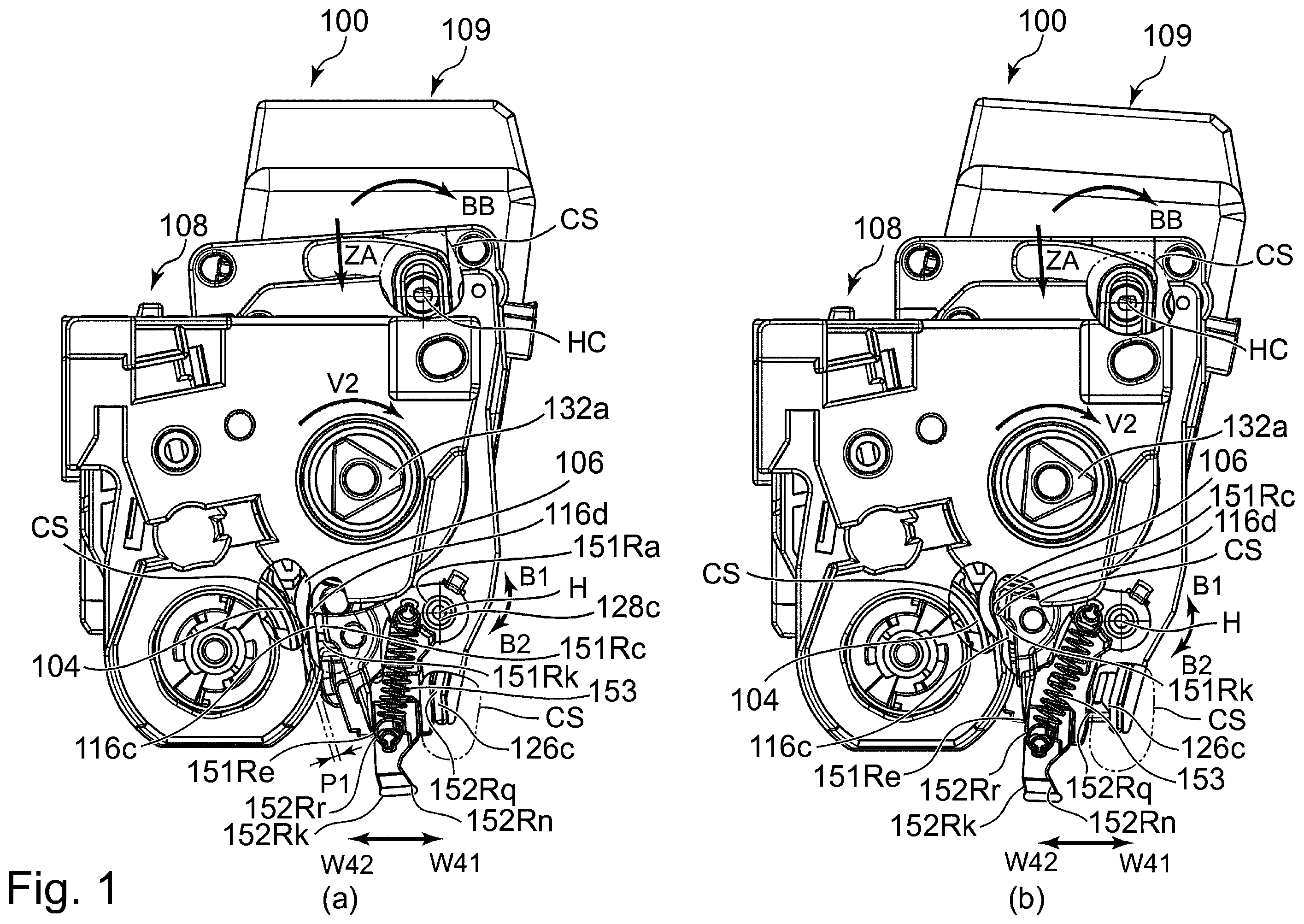
A cartridge includes a first unit including a photosensitive member and a first frame; a second unit including a developing member and a second frame; a holding portion movable between a first position for holding the second unit at the separated position and a second position for holding the second unit at the developing position; a movable member; and an urging portion. the movable member is movable to a contact force receiving position, a separating force receiving position separating force receiving portion, a first retracted position, and a second retracted position. The urging portion urges the movable member placed at the first retracted position in a direction of moving the movable member toward the contact force receiving position, and urges the movable member placed at the second retracted position in a direction of moving the movable member toward the separating force receiving position.
Claims (14)
1 . A cartridge comprising: a first unit including a photosensitive member, and a first frame rotatably supporting the photosensitive member; a second unit including a developing member for depositing toner onto the photosensitive member, and a second frame rotatably supporting the developing member, wherein the second unit is movable between a developing position in which toner can be deposited onto the photosensitive member from the developing member, and a separated position in which at least a part of the developing member is spaced from the photosensitive member; a holding portion, movably supported by the first unit or the second unit, for restricting a relative position between the first unit and the second unit, wherein the holding portion is movable between a first position for holding the second unit at the separated position by the first unit and a second position for holding the second unit at the developing position; a movable member movably supported by the first frame or the second frame and including a contact force receiving portion capable of receiving a contact force for moving the holding portion from the first position toward the second position to move the second unit to the developing position when the second unit is at the separated position, and a separating force receiving portion capable of receiving a separating force for moving the holding portion from the second position toward the first position to move the second unit to the separated position when the second unit is at the developing position; and an urging portion for urging the movable member, wherein the movable member is movable to a contact force receiving position for receiving the contact force by the contact force receiving portion, a separating force receiving position for receiving the separating force by the separating force receiving portion, a first retracted position away from the contact force receiving position in a direction of being away from the separating force receiving position, a second retracted position away from the separating force receiving position in a direction of being away from the contact force receiving position, and wherein the urging portion urges the movable member placed at the first retracted position in a direction of moving the movable member toward the contact force receiving position, and urges the movable member placed at the second retracted position in a direction of moving the movable member toward the separating force receiving position.
Show 13 dependent claims
2 . A cartridge according to claim 1 , wherein the holding portion is capable of restricting, when it is at the first position, movement of the second unit from the separated position to the developing position, and permits, when the holding portion is at the second position, movement of the second unit from the separated position to the developing position.
3 . A cartridge according to claim 2 , wherein the holding portion restricts, when it is at the first position, movement of the second unit from the separated position to the developing position by contact with the first frame and with the second frame.
4 . A cartridge according to claim 1 , wherein the movable member is provided with the holding portion.
5 . A cartridge according to claim 1 , wherein the movable member is rotatably supported by a supporting portion provided on the first frame or the second frame, and moves between the first retracted position and the second retracted position.
6 . A cartridge according to claim 5 , wherein the movable member is rotatable by not less than 95° with respect to the supporting portion to move between the first retracted position and the second retracted position.
7 . A cartridge according to claim 5 , wherein the movable member is rotatable by not less than 100° with respect to the supporting portion to move between the first retracted position and the second retracted position.
8 . A cartridge according to claim 5 , wherein the supporting portion is provided on the second frame.
9 . A cartridge according to claim 8 , wherein the holding portion is provided with a contact portion which contacts the first frame when the holding portion is at the first position.
10 . A cartridge according to claim 5 , wherein the supporting portion is provided on the first frame.
11 . A cartridge according to claim 1 , wherein the urging portion includes an elastic member.
12 . A cartridge according to claim 11 , wherein the elastic member has one end portion connected with the first frame or the second frame and the other end portion connected with the movable member.
13 . A cartridge according to claim 12 , wherein the elastic member includes a spring.
14 . A cartridge according to claim 1 , wherein the movable member is provided with a projected portion capable of projecting out beyond the first frame and the second frame at least in a direction away from a rotational axis of the developing member, and the contact force receiving portion and the separating force receiving portion are provided on the projected portion.
Full Description
Show full text →
TECHNICAL FIELD
The disclosure relates to a cartridge detachably mountable to an image forming apparatus such as a copying machine or a printer which uses an electrophotographic process, and the image forming apparatus provided with the cartridge.
Here, the electrophotographic image forming apparatus (hereinafter, also referred to as “image forming apparatus”) is an apparatus which forms an image on a sheet-like recording material such as paper using an electrophotographic image forming process. Examples of the image forming apparatus include a copying machine, a facsimile machine, a printer (laser beam printer, LED printer, and so on, a multifunction printer thereof, and the like).
The cartridge is a unit which can be mounted to and dismounted from the image forming apparatus described above, and is a unit including a photosensitive member and/or a process means (a charging member, a developing member, a cleaning member, and so on, for example) which is actable on the photosensitive member.
BACKGROUND OF INVENTION
An image forming apparatus which uses an electrophotographic image forming process includes an image forming apparatus which forms an image by a contact developing method which forms an image by performing a developing process in a state in which a developing member (developing roller) is in contact with a photosensitive drum. In such an image forming apparatus, the developing roller is urged toward the photosensitive drum at a predetermined pressure, and is in contact with the surface of the photosensitive drum at a predetermined pressure, during the development process.
In the case that a developing roller including an elastic layer on the surface is used, the following can be considered, for example. That is, if the period during which the image is not formed (the developing roller is not rotating) with the elastic layer kept in contact with the surface of the photosensitive drum is long, the elastic layer of the developing roller is may be deformed by the contact with the surface of the photosensitive drum. By this, image defects such as unintended unevenness of the developer image may occur when the developing process is performed.
Further, as another example, when the developing roller is in contact with the photosensitive drum during the period when the developing process is not performed, the developer carried on the developing roller is unnecessarily deposited to the photosensitive drum, and such a developer is deposited on the recording material with the result of contamination of the recording material. This problem may occur irrespective of the provision of an elastic layer on the surface of the developing roller.
Further, as another example, when the photosensitive drum and the developing roller are in contact with each other for a long period of time other than the period during which the developing process is performed, the photosensitive drum and the developing roller are rubbed against each other for a long period of time. Deterioration of the developing roller or the developer may be accelerated. This may occur with or without an elastic layer on the surface of the developing roller.
In order to avoid the above-mentioned problem, JP-A-2007-213024 and JP-A-2014-67005 discloses an image forming apparatus and a cartridge having a structure for spacing a developing roller from a surface of a photosensitive drum during a period in which developing process is not performed.
SUMMARY OF INVENTION
Problem to be Solved
However, there is still room for further improvement in the conventional techniques described in Patent Documents. Therefore, it is an object of the present disclosure to further develop the conventional technique.
Means for Solving the Problem
According to a first aspect of the present invention, there is provided a cartridge comprising a first unit including a photosensitive member, and a first frame rotatably supporting the photosensitive member; a second unit including a developing member for depositing toner onto the photosensitive member, and a second frame rotatably supporting the developing member, wherein the second unit is movable between a developing position in which toner can be deposited onto the photosensitive member from the developing member, and a separated position in which at least a part of the developing member is spaced from the photosensitive member; a holding portion, movably supported by the first unit or the second unit, for restricting a relative position between the first unit and the second unit, wherein the holding portion is movable between a first position for holding the second unit at the separated position by the first unit and a second position for holding the second unit at the developing position; a movable member movably supported by the first frame or the second frame and including (i) a contact force receiving portion capable of receiving a contact force for moving the holding portion from the first position toward the second position to move the second unit to the developing position when the second unit is at the separated position, and a separating force receiving portion capable of receiving a separating force for moving the holding portion from the second position toward the first position to move the second unit to the separated position when the second unit is at the developing position; and an urging portion for urging the movable member, wherein the movable member is movable to a contact force receiving position for receiving the contact force by the contact force receiving portion, a separating force receiving position for receiving the separating force by the separating force receiving portion, a first retracted position away from the contact force receiving position in a direction of being away from the separating force receiving position, a second retracted position away from the separating force receiving position in a direction of being away from the contact force receiving position, and wherein the urging portion urges the movable member placed at the first retracted position in a direction of moving the movable member toward the contact force receiving position, and urges the movable member placed at the second retracted position in a direction of moving the movable member toward the separating force receiving position.
According to a second aspect of the present invention, there is provided a cartridge comprising a first unit including a photosensitive member, and a first frame rotatably supporting the photosensitive member; a second unit including a developing member for depositing toner onto the photosensitive member, and a second frame rotatably supporting the developing member, wherein the second unit is movable between a developing position in which toner can be deposited onto the photosensitive member from the developing member, and a separated position in which at least a part of the developing member is spaced from the photosensitive member; a holding portion, movably supported by the first unit or the second unit, for restricting a relative position between the first unit and the second unit, wherein the holding portion is movable between a first position for holding the second unit at the separated position by the first unit and a second position for holding the second unit at the developing position; a movable member movably supported by the first frame or the second frame and including (i) a contact force receiving portion capable of receiving a contact force for moving the holding portion from the first position toward the second position to move the second unit to the developing position when the second unit is at the separated position, and a separating force receiving portion capable of receiving a separating force for moving the holding portion from the second position toward the first position to move the second unit to the separated position when the second unit is at the developing position; and an elastic member having one end portion connected with the first frame or the second frame and the other end portion connected with the movable member, wherein the movable member is movable to a contact force receiving position for receiving the contact force by the contact force receiving portion, a separating force receiving position for receiving the separating force by the separating force receiving portion, a first retracted position away from the contact force receiving position in a direction of being away from the separating force receiving position, a second retracted position away from the separating force receiving position in a direction of being away from the contact force receiving position, and wherein the elastic member urges the movable member placed at the second retracted position in a direction toward the separating force receiving position.
According to a third aspect of the present invention, there is provided a cartridge comprising a first unit including a photosensitive member, and a first frame rotatably supporting the photosensitive member; a second unit including a developing member for depositing toner onto the photosensitive member, and a second frame rotatably supporting the developing member, wherein the second unit is movable between a developing position in which toner can be deposited onto the photosensitive member from the developing member, and a separated position in which at least a part of the developing member is spaced from the photosensitive member; a holding portion, movably supported by the first unit or the second unit, for restricting a relative position between the first unit and the second unit, wherein the holding portion is movable between a first position for holding the second unit at the separated position by the first unit and a second position for holding the second unit at the developing position; a movable member movably supported by the first frame or the second frame and including (i) a contact force receiving portion capable of receiving a contact force for moving the holding portion from the first position toward the second position to move the second unit to the developing position when the second unit is at the separated position, and a separating force receiving portion capable of receiving a separating force for moving the holding portion from the second position toward the first position to move the second unit to the separated position when the second unit is at the developing position; and an elastic member having one end portion connected with the first frame or the second frame and the other end portion connected with the movable member, wherein the movable member is movable to a contact force receiving position for receiving the contact force by the contact force receiving portion, a separating force receiving position for receiving the separating force by the separating force receiving portion, a first retracted position away from the contact force receiving position in a direction of being away from the separating force receiving position, a second retracted position away from the separating force receiving position in a direction of being away from the contact force receiving position, and wherein the elastic member urges the movable member placed at the first retracted position in a direction toward the contact force receiving position.
According to a fourth aspect of the present invention, there is provided a cartridge comprising a first unit including a photosensitive member, and a first frame rotatably supporting the photosensitive member; a second unit including a developing member for depositing toner onto the photosensitive member, and a second frame rotatably supporting the developing member, wherein the second unit is movable between a developing position in which toner can be deposited onto the photosensitive member from the developing member, and a separated position in which at least a part of the developing member is spaced from the photosensitive member; a holding portion, movably supported by the first unit or the second unit, for restricting a relative position between the first unit and the second unit, wherein the holding portion is movable between a first position for holding the second unit at the separated position by the first unit and a second position for holding the second unit at the developing position; and a movable member movably supported by a supporting portion provided on the first frame or the second frame and including (i) a contact force receiving portion capable of receiving a contact force for moving the holding portion from the first position toward the second position to move the second unit to the developing position when the second unit is at the separated position, and a separating force receiving portion capable of receiving a separating force for moving the holding portion from the second position toward the first position to move the second unit to the separated position when the second unit is at the developing position, wherein the movable member is provided with a projected portion capable of projecting out beyond the first frame and the second frame at least in a direction away from a rotational axis of the developing member, and the movable member is rotatably with respect to the supporting portion by not less than 95°, and wherein the contact force receiving portion and the separating force receiving portion are provided on the projected portion.
According to a fifth aspect of the present invention, there is provided a cartridge mountable to a main assembly of an image forming apparatus, the main assembly including a contact force applying portion, said cartridge comprising a first unit including a photosensitive member, and a first frame rotatably supporting the photosensitive member; a second unit including a developing member for depositing toner onto the photosensitive member, and a second frame rotatably supporting the developing member, wherein the second unit is movable between a developing position in which toner can be deposited onto the photosensitive member from the developing member, and a separated position in which at least a part of the developing member is spaced from the photosensitive member; a holding portion, movably supported by the first unit or the second unit, for restricting a relative position between the first unit and the second unit, wherein the holding portion is movable between a first position for holding the second unit at the separated position by the first unit and a second position for holding the second unit at the developing position; and a movable member movably supported by a supporting portion provided on the first frame or the second frame and including (i) a contact force receiving portion capable of receiving, from the contact force applying portion, a contact force for moving the holding portion from the first position toward the second position to move the second unit to the developing position when the second unit is at the separated position, and a separating force receiving portion capable of receiving a separating force for moving the holding portion from the second position toward the first position to move the second unit to the separated position when the second unit is at the developing position, wherein the movable member is provided with a projected portion capable of projecting out beyond the first frame and the second frame at least in a direction away from a rotational axis of the developing member, and is rotatably supported by the supporting portion, wherein the contact force receiving portion and the separating force receiving portion are provided on the projected portion, and wherein the movable member is rotatable, with respect to the supporting portion, by not less than 70°, from a state in which the holding portion is at the first position where the contact force receiving portion is capable of receiving the contact force in a direction of moving the holding portion toward the second position.
Effect of the Invention
According to the present disclosure, the prior art cartridge and so on can be further developed.
BRIEF DESCRIPTION OF THE DRAWINGS
is a side view of a process cartridge.
is a sectional view of an image forming apparatus.
is a sectional view of the process cartridge.
is a sectional view of the image forming apparatus.
is a sectional view of the image forming apparatus.
is a sectional view of the image forming apparatus.
is a partially enlarged view of a tray.
is a perspective view of a storing element pressing unit and a cartridge pressing unit.
is a perspective view of the image forming apparatus.
is a side view (partial sectional view) of the process cartridge.
is a sectional view of the image forming apparatus.
is a perspective view of a development separation control unit.
is an exploded perspective view of the process cartridge.
is a perspective view of the process cartridge.
is an exploded perspective view of the process cartridge.
is an exploded perspective view of the process cartridge.
illustrates a spacer.
is an illustration of a movable member.
is a perspective view of the process cartridge.
is a partially enlarged view of a side surface of the process cartridge.
is a partially enlarged view of the side surface of the process cartridge.
is a bottom view of a drive-side of the process cartridge.
is a side view of the process cartridge in the image forming apparatus main assembly.
is a side view of the process cartridge in the image forming apparatus main assembly.
is a side view of the process cartridge in the image forming apparatus main assembly.
is a side view of the process cartridge in the image forming apparatus main assembly.
is a side view of the process cartridge in the image forming apparatus main assembly.
is an illustration of a spacer.
is an illustration of a movable member.
is a perspective view of the process cartridge.
is a side view (partial sectional view) of the process cartridge.
is a partially enlarged view of the side surface of the process cartridge.
is a partially enlarged view of the side surface of the process cartridge.
is a side view (partial sectional view) of the process cartridge.
is a side view (partial sectional view) of the process cartridge in the image forming apparatus main assembly.
is a side view (partial sectional view) of the process cartridge in the image forming apparatus main assembly.
is a side view (partial sectional view) of the process cartridge in the image forming apparatus main assembly.
is a side view (partial sectional view) of the process cartridge in the image forming apparatus main assembly.
is a side view (partial sectional view) of the process cartridge in the image forming apparatus main assembly.
is a partially enlarged view of the side surface of the process cartridge.
is a partially enlarged view of the side surface of the process cartridge.
is a perspective view of a process cartridge and a schematic view illustrating an amount of spacing of a developing roller from a photosensitive drum.
is a perspective view of the process cartridge and a schematic view illustrating the amount of spacing of the developing roller from the photosensitive drum.
is a perspective view of the process cartridge and a schematic view illustrating the amount of spacing of the developing roller from the photosensitive drum.
is a perspective view of the process cartridge and a schematic view illustrating the amount of spacing of the developing roller from the photosensitive drum.
is a perspective view of the process cartridge and a schematic view illustrating the amount of spacing of the developing roller from the photosensitive drum.
is an illustration of a movable member.
is an illustration showing a relationship between a movable member, a spacer, and a non-drive-side bearing.
is a side view of the process cartridge in the main assembly of the image forming apparatus and a view illustrating the relationship between the movable member and the spacer.
is a side view of the process cartridge in the image forming apparatus main assembly.
is a partial perspective view of the process cartridge in the image forming apparatus main assembly.
is a side view of the process cartridge in the image forming apparatus main assembly.
is a side view of the process cartridge in the main assembly of the image forming apparatus and a view illustrating the relationship between the movable member and the spacer.
is a perspective view of the developing unit.
is a perspective view of the process cartridge.
is a partially enlarged view of a side surface of the process cartridge.
is an illustration showing the relationship between the movable member and the non-drive-side bearing.
is an illustration of a movable member.
is an illustration of a movable member.
is an illustration of operation of the movable member.
is an illustration of the operation of the movable member.
is an illustration of the operation of the movable member.
is an illustration of the operation of the movable member.
is an illustration of the operation of the movable member.
is a perspective view of a developing unit portion of the process cartridge.
is a perspective view of the process cartridge.
is an exploded perspective view of a process cartridge.
is an exploded perspective view of the process cartridge.
is a side view of the process cartridge.
is a side view of the process cartridge.
is a side view of the process cartridge in the image forming apparatus main assembly.
is a side view of the process cartridge in the image forming apparatus main assembly.
is a side view of the process cartridge.
is an illustration of mounting of the process cartridge onto a tray.
is a side view of the process cartridge in the image forming apparatus main assembly.
is a side view of the process cartridge in the image forming apparatus main assembly.
is a side view of the process cartridge in the image forming apparatus main assembly.
is a side view of the process cartridge in the image forming apparatus main assembly.
is a side view of a process cartridge.
is an exploded perspective view of the process cartridge.
is an exploded perspective view of the process cartridge.
is a side view of the process cartridge in the image forming apparatus main assembly.
is a side view of the process cartridge in the image forming apparatus main assembly.
is a side view of the process cartridge in the image forming apparatus main assembly.
is a side view of the process cartridge in the image forming apparatus main assembly.
is a side view of the process cartridge in the image forming apparatus main assembly.
is a side view of the process cartridge in the image forming apparatus main assembly.
is a side view of the process cartridge in the image forming apparatus main assembly.
is a side view of the process cartridge in the image forming apparatus main assembly.
is a side view of the process cartridge in the image forming apparatus main assembly.
is a side view of the process cartridge in the image forming apparatus main assembly.
is a side view of the process cartridge in the image forming apparatus main assembly.
is a side view of the process cartridge in the image forming apparatus main assembly.
is a side view of the process cartridge in the image forming apparatus main assembly.
is a side view of the process cartridge in the image forming apparatus main assembly.
is a side view of the process cartridge inside the image forming apparatus main assembly.
is a side view of the process cartridge inside the image forming apparatus main assembly.
is a side view of the process cartridge inside the image forming apparatus main assembly.
is a side view of the process cartridge in the image forming apparatus main assembly.
is a side view of the process cartridge in the image forming apparatus main assembly.
is a side view of the process cartridge in the image forming apparatus main assembly.
is an exploded perspective view of a process cartridge.
is a sectional view of the process cartridge inside an image forming apparatus main assembly.
is a sectional view of the process cartridge inside the image forming apparatus main assembly.
is a sectional view of the process cartridge inside the image forming apparatus main assembly.
is a sectional view of the process cartridge inside the image forming apparatus main assembly.
is a sectional view of the process cartridge inside the image forming apparatus main assembly.
is an exploded perspective view of a development drive input gear unit.
is a sectional view of the development drive input gear unit.
is a sectional view of the development drive input gear unit.
is a sectional view of the process cartridge.
is a perspective view of the process cartridge.
is a sectional view of the process cartridge.
is a side view of the process cartridge as viewed along a lateral direction.
is a side view of the process cartridge as viewed along the lateral direction.
is an exploded perspective view of a process cartridge.
is an illustration showing a movable member.
is a perspective view of a development cover member and the movable member.
is an illustration of the development cover member and a separation/contact mechanism.
is a side view of the process cartridge in the image forming apparatus main assembly and a side view as seen along the lateral direction.
is a side view of the process cartridge in the image forming apparatus main assembly and a side view as seen along the lateral direction.
is a side view of the process cartridge in the image forming apparatus main assembly.
is a side view of the process cartridge in the image forming apparatus main assembly.
is a side view of the process cartridge in the image forming apparatus main assembly.
is a side view of the process cartridge in the image forming apparatus main assembly.
is an exploded perspective view of the process cartridge.
is a side view of the process cartridge in the image forming apparatus main assembly as viewed along the lateral direction.
is a side view of the process cartridge in the image forming apparatus main assembly as viewed along the lateral direction.
is a sectional view of the process cartridge.
is a schematic sectional view of an image forming apparatus.
is a schematic sectional view of the process cartridge.
is an exploded perspective view of the process cartridge.
is a schematic sectional view of the image forming apparatus.
is a schematic sectional view of the image forming apparatus.
illustrates a spacer.
is an exploded perspective view of the process cartridge.
is a perspective view of the process cartridge.
is a sectional view of the process cartridge inside the image forming apparatus main assembly.
is a sectional view of the process cartridge inside the image forming apparatus main assembly.
is a sectional view of the process cartridge inside the image forming apparatus main assembly.
is a sectional view of the process cartridge inside the image forming apparatus main assembly.
is an illustration of an arrangement of a separation control member.
is a sectional view of the process cartridge in the image forming apparatus main assembly.
is a sectional view of the process cartridge inside the image forming apparatus main assembly.
is an illustration of a drive-side cartridge cover member and a spacer.
is an illustration of a positional relationship between a photosensitive drum and a developing roller.
is a sectional view of the process cartridge.
is a sectional view of the process cartridge.
is a sectional view of the process cartridge in the image forming apparatus main assembly.
is an illustration of a driving relationship between a photosensitive drum and a developing roller.
is an illustration showing a driving relationship between the photosensitive drum and the developing roller.
is a sectional view of a process cartridge inside an image forming apparatus main assembly.
is a sectional view (XX cross-section) of the process cartridge in the main assembly of the image forming apparatus.
is a sectional view of a process cartridge inside an image forming apparatus main assembly.
is a sectional view of the process cartridge in the image forming apparatus main assembly.
is a sectional view of a process cartridge inside an image forming apparatus main assembly.
is a sectional view of the process cartridge inside the image forming apparatus main assembly.
is a perspective view illustrating a drive-side cartridge cover member and a spacer.
is a sectional view of the process cartridge in the image forming apparatus main assembly.
is a sectional view of the process cartridge inside the image forming apparatus main assembly.
is an illustration of a relationship between a movable member and a spacer.
is a cross-sectional view of a process cartridge.
is an illustration of the relationship between the movable member and the spacer.
is a sectional view of the process cartridge.
is a side view of a process cartridge.
is an exploded perspective view of the process cartridge.
is an exploded perspective view of the process cartridge.
is a perspective view of a developing side engaging portion.
is a perspective view of a drum side engaging portion.
is a perspective view of the process cartridge.
is a side view of the process cartridge in the image forming apparatus main assembly.
is a partial top view of the process cartridge.
is a perspective view of the process cartridge.
is a side view of the process cartridge in the image forming apparatus main assembly.
is a side view of the process cartridge in the image forming apparatus main assembly.
is a partial top view of the process cartridge.
is a perspective view of the process cartridge.
is a side view of the process cartridge in the image forming apparatus main assembly.
is a sectional view of a process cartridge inside an image forming apparatus main assembly.
is a sectional view of the process cartridge inside the image forming apparatus main assembly.
is a perspective view of a drive-side cartridge cover.
is a sectional view of a process cartridge in an image forming apparatus main assembly.
is a sectional view of a process cartridge inside an image forming apparatus main assembly.
is a sectional view of the process cartridge inside the image forming apparatus main assembly.
is a sectional view of the process cartridge in the image forming apparatus main assembly.
is a sectional view of the process cartridge inside the image forming apparatus main assembly.
is a cross-sectional view of the process cartridge inside the image forming apparatus main assembly.
is a sectional view of the process cartridge inside the image forming apparatus main assembly.
is a sectional view of the process cartridge inside the image forming apparatus main assembly.
is a sectional view of the process cartridge inside the image forming apparatus main assembly.
is a sectional view of the process cartridge inside the image forming apparatus main assembly.
is a sectional view of the process cartridge inside the image forming apparatus main assembly.
is an illustration of an operation of an urging member.
is a sectional view of a process cartridge inside an image forming apparatus main assembly.
is a sectional view of a process cartridge inside an image forming apparatus main assembly.
is a sectional view of the process cartridge inside the image forming apparatus main assembly.
is a sectional view of a process cartridge inside an image forming apparatus main assembly.
is a cross-sectional view of the process cartridge inside the image forming apparatus main assembly.
is a cross-sectional view of the process cartridge inside the image forming apparatus main assembly.
is a sectional view of the process cartridge inside the image forming apparatus main assembly.
is an illustration of an operation of a holding member.
is an illustration of the operation of the holding member.
is an illustration showing the operation of the holding member.
is a partial perspective view of the process cartridge and a tray.
is a partial perspective view of the process cartridge and the tray.
is a perspective view of the tray.
is a sectional view of the process cartridge.
is a cross-sectional view of a process cartridge inside an image forming apparatus main assembly.
is a cross-sectional view of a process cartridge inside an image forming apparatus main assembly.
is an illustration showing a relationship between a force receiving portion of the process cartridge and a separation control member.
is a sectional view of the process cartridge in the image forming apparatus main assembly.
is an illustration showing a relationship between the force receiving portion of the process cartridge and the separation control member.
is an illustration showing the relationship between the force receiving portion of the process cartridge and the separation control member.
is an illustration showing the relationship between the force receiving portion of the process cartridge and the separation control member.
is a perspective view of a tray.
is a perspective view of the tray.
is an exploded perspective view of a process cartridge.
is an exploded perspective view of the process cartridge.
is a perspective view of the process cartridge.
is a perspective view of the process cartridge.
is an illustration of an operation of mounting the developing cartridge on the tray.
is an illustration of an operation of mounting the developing cartridge on the tray.
is a perspective view of the tray on which the developing cartridge is mounted.
is a perspective view of the tray on which the developing cartridge is mounted.
is a side view of the tray and the developing cartridge in the image forming apparatus main assembly.
is a side view of the developing cartridge in the image forming apparatus main assembly.
is a side view of the developing cartridge in the image forming apparatus main assembly.
is a side view of the developing cartridge in the image forming apparatus main assembly.
is a side view of the developing cartridge in the image forming apparatus main assembly.
is an illustration of an operation of mounting a drum cartridge and the developing cartridge on the tray.
is an illustration of an operation of mounting the drum cartridge and the developing cartridge on the tray.
is an illustration showing an operation of mounting the drum cartridge and the developing cartridge on the tray.
is a side view of the tray on which the drum cartridge and the developing cartridge are mounted.
is a side view of a tray on which the drum cartridge and the developing cartridge are mounted.
is a side view (partial sectional view) of the process cartridge.
is a schematic sectional view of the process cartridge.
is a schematic sectional view of the process cartridge.
is a schematic sectional view of the process cartridge.
is a schematic sectional view of the process cartridge.
is a schematic sectional view of the process cartridge.
is a schematic sectional view of the process cartridge.
is a side view of the developing cartridge in the image forming apparatus main assembly.
is a side view of the developing cartridge in the image forming apparatus main assembly.
is a side view of the developing cartridge in the image forming apparatus main assembly.
is a side view of the developing cartridge in the image forming apparatus main assembly.
is a perspective view illustrating a process cartridge according to Embodiment 27.
is an exploded perspective view illustrating a non-drive side of the process cartridge.
is a perspective view illustrating the non-drive side of the process cartridge.
is a front view illustrating the non-drive side of the process cartridge.
is a cross-sectional view illustrating the non-drive side of the process cartridge.
is a perspective view illustrating a pressing unit assembled to a non-drive-side bearing.
is a cross-sectional view illustrating the non-drive-side bearing and the pressing unit.
is a sectional view illustrating a state in which the process cartridge is mounted on the tray.
is an enlarged cross-sectional view illustrating the pressing unit.
is a perspective view illustrating a process cartridge and a cartridge pressing unit according to Embodiment 28.
is a cross-sectional view illustrating the process cartridge.
is a perspective view illustrating the process cartridge and a cartridge pressing unit.
is a cross-sectional view illustrating the process cartridge.
is a perspective view illustrating a process cartridge and a cartridge pressing unit according to Embodiment 29.
is a cross-sectional view illustrating the process cartridge.
is a perspective view illustrating the process cartridge and the cartridge pressing unit.
is a perspective view illustrating a process cartridge and a cartridge pressing unit according to Embodiment 29.
is a view illustrating a drive side of a developing unit according to Example 30.
is a perspective view illustrating a drive-side cartridge cover member, a developing cover member, a moving member, and a link unit.
is a perspective view illustrating the developing cover member and the moving member.
is a perspective view illustrating the developing cover member.
is a perspective view illustrating the moving member.
is a side view illustrating the developing cover member.
is a perspective view illustrating the drive-side cartridge cover member, the link unit, and the cam unit.
is a perspective view illustrating the drive-side cartridge cover member.
is an enlarged perspective view illustrating a broken line portion in part (b) of .
is a view illustrating a link cam and a stopper.
is an exploded perspective view illustrating a cam unit.
is an exploded perspective view illustrating the cam unit.
is a sectional view illustrating the cam unit.
is a perspective view illustrating the cam unit.
is a cross-sectional view illustrating the link unit and the cam unit when the developing unit is located at the contact position.
is cross-sectional views illustrating the link unit and the cam unit immediately before the developing unit starts to move from the contact position to the separation position.
is cross-sectional views illustrating the link unit and the cam unit when the developing unit is in the separated position.
is cross-sectional views illustrating the link unit and the cam unit immediately before the developing unit starts to move from the separation position to the contact position.
is a perspective view illustrating a holding member and a separation spring of the process cartridge according to Embodiment 31.
is a cross-sectional view taken along a line 265 A- 265 A of .
is an exploded perspective view illustrating a drive-side cartridge cover member, a developing cover member, a holding member, and a separation spring.
is an exploded perspective view illustrating the drive-side cartridge cover member, the developing cover member, the holding member, and the separation spring.
is a side view illustrating a force acting on the holding member.
is a side view illustrating a force applied on the holding member.
is an exploded perspective view illustrating a delaying mechanism.
is an exploded perspective view illustrating the delaying mechanism.
is a sectional view illustrating a delaying mechanism.
is a perspective view illustrating the delaying mechanism in a state in which no drive is input to the developing coupling portion.
is a perspective view illustrating the delaying mechanism in a drive transmission state.
is a perspective view illustrating an arrangement relationship between the lever, the drive-side cartridge cover member, and the developing cover member.
is a perspective view illustrating the position of the lever.
is an illustration of the operation of the delaying mechanism.
is an illustration of the operation of the delaying mechanism.
is an illustration of the operation of the delaying mechanism.
is a perspective view illustrating a process cartridge and a development separation control unit.
is an exploded perspective view illustrating the process cartridge.
is a rear view illustrating the process cartridge and the development separation control unit.
is an enlarged cross-sectional view illustrating the separation contact mechanism and the separation control member.
is a perspective view illustrating assembling of the separation and contact mechanism.
is a perspective view illustrating the assembling of the separation and contact mechanism.
is a cross-sectional view illustrating the separation contact mechanism and the separation control member.
is an enlarged cross-sectional view illustrating the separation contact mechanism and the separation control member.
is a side view and a cross-sectional view illustrating the process cartridge.
is a side view and a partial sectional view of the process cartridge and the development separation control unit.
is a side view and a partial sectional view of the process cartridge and the development separation control unit.
is a side view and a partial sectional view of the process cartridge and the development separation control unit.
is a side view and a partial sectional view of the process cartridge and the development separation control unit.
is a side view and a partial sectional view of the process cartridge and the development separation control unit.
is a side view and a partial sectional view of the process cartridge and the development separation control unit.
is a side view and a partial sectional view of the process cartridge and the development separation control unit.
is a side view and a partial sectional view of the process cartridge and the development separation control unit.
is a side view and a partial sectional view of the process cartridge and the development separation control unit.
is a side view and a partial sectional view of the process cartridge and the development separation control unit.
is a side view and a partial sectional view of the process cartridge and the development separation control unit.
is a side view and a partial sectional view of the process cartridge and the development separation control unit.
is a side view and a partial sectional view of the process cartridge and the development separation control unit.
is a side view and a partial sectional view of the process cartridge and the development separation control unit.
is a side view and a partial sectional view of the process cartridge and the development separation control unit.
is a side view and a partial sectional view of the process cartridge and the development separation control unit.
is a side view and a partial sectional view of the process cartridge and the development separation control unit.
is a side view and a partial sectional view of the process cartridge and the development separation control unit.
DESCRIPTION OF THE EMBODIMENTS
In the following, examples in this disclosure will be described. The structures disclosed in the following examples, namely the functions, materials, shapes of parts, and their relative arrangements are examples of the structures related to the scope of claims, and it is not intended to limit the present invention to the structure disclosed in the examples. In addition, the problem solved by the structure disclosed in the following examples or the function or effect provided by the disclosed structure is not intended to limit the scope of claims.
Embodiment 1
In the following, Embodiment 1 will be described in conjunction with the accompanying drawings. In the following embodiment, a laser beam printer which four process cartridges (cartridges) can be mounted to and dismounted from is illustrated as an image forming apparatus. The number of process cartridges mounted in the image forming apparatus is not limited to this example.
It may be selected as appropriate if necessary.
[Outline of Structure of Image Forming Apparatus]
is a schematic sectional view of the image forming apparatus M. is a sectional view of the process cartridge 100 . The image forming apparatus M is a four-color full-color laser printer using an electrophotographic process, and forms a color image on a recording material S. The image forming apparatus M is a process cartridge type, in which the process cartridge is dismountably mounted to the image forming apparatus main assembly (apparatus main assembly) 170 to form a color image on the recording material S.
Here, regarding the image forming apparatus M, a side where a front door 11 is provided is a front surface (front surface), and a side opposite to the front surface is a back surface (rear side). Further, a right side of the image forming apparatus M as viewed from the front is referred to as a drive-side, and a left side is referred to as a non-drive-side. In addition, as the image forming apparatus M is viewed from the front, a upper side is a upper surface part, and a lower side is a lower surface part. is a sectional view of the image forming apparatus M as viewed from the non-drive-side; the front side of the sheet of the drawing is the non-drive-side of the image forming apparatus M; the right side of the sheet of the drawing is the front side; and the rear side of the sheet of the drawing is the drive-side of the image forming apparatus.
The drive-side of the process cartridge 100 is the side on which the drum coupling member (photosensitive member coupling member) which will be described hereinafter is provided with respect to an axial direction of the photosensitive drum (the axial direction of the rotation axis of the photosensitive drum). In addition, the drive-side of the process cartridge 100 is the side on which a development coupling portion 132 a , which will be described hereinafter, is provided with respect to the axis direction of the developing roller (development member) (the axial direction of the rotation axis of the developing roller). The axial direction of the photosensitive drum and the axial direction of the developing roller are parallel with each other, and the longitudinal direction of the process cartridge 100 is also parallel to these directions.
The image forming apparatus main assembly 170 is provided with four process cartridges 100 ( 100 Y, 100 M, 100 C, 100 K), i.e. A first process cartridge 100 Y, a second process cartridge 100 M, a third process cartridge 100 C, and a fourth process cartridge 100 K. It is arranged substantially horizontally.
Each of the first to fourth process cartridges 100 ( 100 Y, 100 M, 100 C, 100 K) have the same electrophotographic process mechanisms, but the colors of the developers (hereinafter referred to as toner) are different from each other. Rotational driving forces are transmitted to the first to fourth process cartridges 100 ( 100 Y, 100 M, 100 C, 100 K) from the drive output portion (details will be described hereinafter) of the image forming apparatus main assembly 170 , respectively. Further, bias voltages (charging bias, development bias, and so on) are supplied from the image forming apparatus main assembly 170 to the first to fourth process cartridges 100 ( 100 Y, 100 M, 100 C, 100 K), respectively.
As shown in , each of the first to fourth process cartridges 100 ( 100 Y, 100 M, 100 C, 100 K) of this embodiment includes a drum unit 108 having a photosensitive drum 104 and a charging means as a process means acting on the photosensitive drum 104 . Here, the drum unit may have a cleaning means as well as the charging means as the process means. Further, each of the first to fourth process cartridges 100 ( 100 Y, 100 M, 100 C, 100 K) includes a developing unit 109 having developing means for developing an electrostatic latent image on the photosensitive drum 104 . The layout of the electrophotographic image forming apparatus in which a plurality of photosensitive drums are arranged substantially in line in this manner is sometimes called an in-line layout or a tandem layout.
In each of the first to fourth process cartridges 100 , the drum unit 108 and the developing unit 109 are coupled with each other. A more specific structure of the process cartridge will be described hereinafter.
The first process cartridge 100 Y contains yellow (Y) toner in a developing container 125 , and forms a yellow toner image on the surface of the photosensitive drum 104 . The second process cartridge 100 M contains magenta (M) toner in a developing container 125 , and forms a magenta toner image on the surface of the photosensitive drum 104 . The third process cartridge 100 C contains cyan (C) toner in a developing container 125 , and forms a cyan toner image on the surface of the photosensitive drum 104 . The fourth process cartridge 100 K contains black (K) toner in a developing container 125 , and forms a black toner image on the surface of the photosensitive drum 104 .
As shown in , a laser scanner unit 14 as an exposure means is provided above the first to fourth process cartridges 100 ( 100 Y, 100 M, 100 C, 100 K). The laser scanner unit 14 outputs the laser beam U in accordance with image information. Then, the laser beam U passes through an exposure window 110 of the process cartridge 100 to scan and expose the surface of the photosensitive drum 104 .
An intermediary transfer unit 12 as a transfer member is provided below the first to fourth process cartridges 100 ( 100 Y, 100 M, 100 C, 100 K). The intermediary transfer unit 12 includes a drive roller 12 e , a turn roller 12 c , and a tension roller 12 b , and a flexible transfer belt 12 a extended around them. The lower surface of the photosensitive drum of each of the first to fourth process cartridges 100 ( 100 Y, 100 M, 100 C, 100 K) is in contact with the upper surface of the transfer belt 12 a . The contact portion between them is a primary transfer portion. Inside the transfer belt 12 a , a primary transfer roller 12 d is provided so as to oppose the photosensitive drum 104 . A secondary transfer roller 6 is contacted with the turn roller 12 c by way of the transfer belt 12 a . The contact portion between the transfer belt 12 a and the secondary transfer roller 6 is a secondary transfer portion.
A feeding unit 4 is provided below the intermediary transfer unit 12 . The feeding unit 4 includes a sheet feed tray 4 a on which the recording material S is loaded and accommodated, and a sheet feed roller 4 b.
A fixing device 7 and a sheet discharging device 8 are provided on the upper left side of the image forming apparatus main assembly 170 in . The upper surface of the image forming apparatus main assembly 170 is a sheet discharge tray 13 . The recording material S is heated and pressed by fixing means provided in the fixing device 7 , so that the toner image is fixed and discharged to the sheet discharge tray 13 .
[Image Forming Operation]
The operation for forming a full-color image is as follows. The photosensitive drum 104 of each of the first to fourth process cartridges 100 ( 100 Y, 100 M, 100 C, 100 K) is rotationally driven at a predetermined speed (in the direction of arrow A in ). The transfer belt 12 a is also rotationally driven in a forward direction (direction of an arrow C in ) codirectionally, at the peripheries, with the rotation of the photosensitive drum at a speed corresponding to the speed of the photosensitive drum 104 .
The laser scanner unit 14 is also driven. In synchronism with the drive of the laser scanner unit 14 , the charging roller 105 uniformly charges the surface of the photosensitive drum 104 to a predetermined polarity and potential in each process cartridge. The laser scanner unit 14 scans and exposes the surface of each photosensitive drum 104 with laser beam U in accordance with the image signals of each color. By this, an electrostatic latent image corresponding to the image signal of the corresponding color is formed on the surface of each photosensitive drum 104 . The formed electrostatic latent image is developed by a developing roller 106 that is rotationally driven at a predetermined speed. By the electrophotographic image forming process operation described above, a yellow toner image corresponding to a yellow component of the full-color image is formed on the photosensitive drum 104 of the first process cartridge 100 Y. Then, the toner image is primary-transferred onto the transfer belt 12 a.
Similarly, a magenta color toner image corresponding to a magenta component of the full color image is formed on the photosensitive drum 104 of the second process cartridge 100 M. Then, the toner image is primary-transferred and superimposed on the yellow toner image already transferred on the transfer belt 12 a . Similarly, a cyan toner image corresponding to a cyan component of the full-color image is formed on the photosensitive drum 104 of the third process cartridge 100 C. Then, the toner image is primary-transferred and superimposed on the yellow-colored and magenta-colored toner images already transferred on the transfer belt 12 a . Similarly, a black toner image corresponding to a black component of the full-color image is formed on the photosensitive drum 104 of the fourth process cartridge 100 K. Then, the toner image is primary-transferred and superimposed on the yellow, magenta, and cyan toner images already transferred on the transfer belt 12 a . In this manner, an unfixed four-color full-color toner image of yellow, magenta, cyan, and black is formed on the transfer belt 12 a.
On the other hand, the recording material S is separated and fed one by one at a predetermined control timing. The recording material S is introduced into the secondary transfer portion, which is a contact portion between the secondary transfer roller 6 and the transfer belt 12 a , at a predetermined control timing. By this, in the process of transporting the recording material S toward the secondary transfer unit, the four-color superimposed toner image on the transfer belt 12 a is sequentially and collectively transferred onto the surface of the recording material S. Thereafter, the recording material S is fed to the fixing device 7 to fix the toner image on the recording material S, and then is discharged onto the sheet discharge tray 13 .
[Outline of Process Cartridge Mounting/Dismounting Structure]
Referring to to 7 , the tray (hereinafter referred to as a tray) 171 which supports the process cartridge will be described in more detail. is a sectional view of the image forming apparatus M in which the tray 171 is inside the image forming apparatus main assembly 170 with the front door 11 open. is a sectional view of the image forming apparatus M in a state where the tray 171 is outside the image forming apparatus main assembly 170 with the front door 11 open and the process cartridge 100 mounted on the tray. is a sectional view of the image forming apparatus M in a state where the tray 171 is outside the image forming apparatus main assembly 170 with the front door 11 open and the process cartridge 100 is not mounted on the tray. Part (a) of is a partial detailed view of the tray 171 as viewed from the drive-side in the state of . Part (b) of is a partial detailed view of the tray 171 as viewed from the non-drive-side in the state of .
As shown in , the tray 171 is movable in a direction indicated by an arrow (pushing direction) and the direction indicated by an arrow X 2 (pulling direction) with respect to the image forming apparatus main assembly 170 . That is, the tray 171 is provided so as to be retractable and insertable relative to the image forming apparatus main assembly 170 , and the tray 171 is structured to be movable in a substantially horizontal direction in a state where the image forming apparatus main assembly 170 is installed on a horizontal surface. Here, the state in which the tray 171 is outside the image forming apparatus main assembly 170 (the state shown in ) is referred to as an outside position. Further, a state in which the tray is inside the image forming apparatus main assembly 170 with the front door 11 open and the photosensitive drum 104 and the transfer belt 12 a being separated from each other (state in ) is referred to as an inner position.
Further, the tray 171 includes a mounting portion 171 a in which the process cartridge 100 can be dismountably mounted as shown in in the outer position. Then, each process cartridge 100 mounted on the mounting portion 171 a in the outer position of the tray 171 is supported on the tray 171 by a drive-side cartridge cover member 116 and a non-drive-side cartridge cover member 117 as shown in . The process cartridge moves into the image forming apparatus main assembly 170 by the movement of the tray 171 in a state of being mounted in the mounting portion 171 a . At this time, during this movement, the transfer belt 12 a and the photosensitive drum 104 are spaced with a gap. Therefore, the tray 171 can move the process cartridge 100 into the image forming apparatus main assembly 170 without the photosensitive drum 104 contacting the transfer belt 12 a (details will be described hereinafter).
As described above, the tray 171 is capable of moving the plurality of process cartridges 100 collectively to a position where image formation is possible inside the image forming apparatus main assembly 170 , and is collectively moved to the outside of the image forming apparatus main assembly 170 .
[Positioning of Process Cartridge]
More specifically, referring to , the positioning of the process cartridge 100 with respect to the image forming apparatus main assembly 170 will be described. As shown in , the tray 171 is provided with positioning portions 171 VR and 171 VL for holding the cartridge 100 , respectively. The positioning portion 171 VR has straight portions 171 VR 1 and 171 VR 2 , respectively. The center of the photosensitive drum is determined by arc portions 116 VR 1 and 116 VR 2 of the cartridge cover member 116 shown in contacting to the straight portions 171 VR 1 and 171 VR 2 . Further, the tray 171 shown in is provided with a rotational direction position setting projection 171 KR. The attitude of the process cartridge 100 is determined with respect to the apparatus main assembly 170 by the rotational positioning projection 171 KR fitting in the rotational direction position setting recess 116 KR of the cartridge cover member 116 shown in .
The positioning portion 171 VL and the rotational direction position setting projection 171 KL are arranged at positions (non-drive-side) opposing each other across the intermediary transfer belt 12 a in the longitudinal direction of the process cartridge 100 from the positioning portion 171 VR. That is, on the non-drive-side as well, the position of the process cartridge is determined by engaging the arc portions 117 VL 1 and 117 VL 2 of the cartridge cover member 117 with the positioning portion 171 VL and the rotational direction position setting recess 117 KL with the rotational direction position setting projection 171 KL. By doing so, the position of the process cartridge 100 with respect to the tray 171 is correctly determined.
As shown in , the process cartridge 100 integral with the tray 171 is moved in the direction of the arrow X 1 and inserted to the position shown in . Then, by closing the front door 11 in the direction of the arrow R, the process carriage 100 is pressed by a cartridge pressing mechanism (not shown) described hereinafter, and is fixed to the image forming apparatus main assembly 170 together with the tray 171 . Further, the transfer belt 12 a comes into contact with the photosensitive member 4 in interrelation with the operation of the cartridge pressing mechanism. In this state, an image can be formed ( ).
In this embodiment, the positioning portion 171 VR and the positioning portion 171 VL also function as reinforcements for maintaining stiffness in a pull-out operation of the tray 171 , and for this reason, a sheet metal is used, but the present invention is not limited to this example.
[Cartridge Pressing Mechanism]
Next, the details of the cartridge pressing mechanism will be described with reference to part (a) of . Part (a) of shows only the process cartridge 100 , the tray 171 and cartridge pressing mechanisms 190 and 191 and the intermediary transfer unit 12 in the state of . Part (b) of shows only the process cartridge 100 , the tray 171 and the cartridge pressing mechanisms and 191 and the intermediary transfer unit 12 in the state of .
Here, the process cartridge 100 receives a driving force during image formation, and further receives a reaction force from the primary transfer roller 12 d ( ) in the direction of arrow Z 1 . Therefore, it is necessary to press the process cartridge in the Z 2 direction in order to maintain a stable attitude during the image forming operation to prevent the process cartridge from separating from the positioning portions 171 VR and 171 VL.
In order to achieve these, in this embodiment, the image forming apparatus main assembly 170 is provided with cartridge pressing mechanisms ( 190 , 191 ). In the cartridge pressing mechanism ( 190 , 191 ), a storing element pressing unit 190 works for the non-drive-side, and a cartridge pressing unit 191 works for the drive-side. This will be described in more detail below.
By closing the front door 11 shown in , the storing element pressing unit 190 and the cartridge pressing unit 191 shown in lowers in the direction of arrow Z 2 . The storing element pressing unit 190 mainly comprises a main assembly side electric contact (not shown) contactable to the electric contact of the storing element (not shown) provided in the process cartridge 100 . By interrelating with the front door 11 by a link mechanism (not shown), the storing element 140 and the electric contact on the main assembly side can be brought into and out of contact with each other. That is, the contacts are brought into contact with each other by closing the front door 11 , and the contacts are disconnected by opening the front door 11 .
By doing so, when the process cartridge 100 moves inside the image forming apparatus main assembly together with the tray 171 , the electric contacts are not rubbed, and the contacts are retracted from the insertion/removal locus of the process cartridge 100 , by which the tray 171 can be inserted/removed without hindering by them. The storing element pressing unit 190 also function to press the process cartridge 100 against the positioning portion 171 VR described above. Further, similarly to the storing element pressing unit 190 , the cartridge pressing unit 191 also lowers in the direction of arrow Z 2 in interrelation with the operation of closing the front door 11 and function to press the process cartridge 100 against the positioning portion 171 VL described above. Further, although the details will be described hereinafter, the cartridge pressing mechanism ( 190 , 191 ) also functions to push down movable members 152 L and 152 R of the process cartridge 100 which will be described hereinafter.
[Drive Transmission Mechanism]
Next, referring to (for convenience, the tray 171 is omitted), the drive transmission mechanism of the main assembly in this embodiment will be described. Part (a) of is a perspective view in which the process cartridge 100 and the tray 171 are omitted in the state of or . Part (b) of is a perspective view in which the process cartridge 100 , the front door 11 and the tray 171 are omitted in the state of . is a side view of the process cartridge 100 as viewed from the drive-side.
As shown in , the process cartridge in this embodiment has a development coupling portion (rotational driving force receiving portion) 132 a and a drum coupling member (photosensitive member coupling member) 143 . By closing the front door 11 (state of part (b) of , the main assembly side drum drive coupling 180 and the main assembly side development drive coupling 185 for transmitting the driving forces to the process cartridge 100 project in the arrow Y 1 direction by a link mechanism (not shown). Further, by opening the front door 11 (state of part (a) of , the drum drive coupling 180 and a development drive coupling 185 are retracted in the direction of arrow Y 2 . By retracting each coupling from the insertion/removal locus of the process cartridge (X 1 direction, X 2 direction), the insertion/removal of the tray 171 is not hindered.
By closing the front door 11 and starting to drive the image forming apparatus main assembly 170 , the drum drive coupling 180 described above engages with the drum coupling member 143 . Further, the development drive coupling 185 on the main assembly side engages with the development coupling portion 132 a to transmit the drive to the process cartridge 100 . The drive transmission to the process cartridge 100 is not limitedly effected at two places as described above, and a mechanism for inputting the drive only to the drum coupling to transmit the drive to the developing roller may be provided.
[Intermediary Transfer Unit Structure]
Next, referring to , the intermediary transfer unit 12 of the image forming apparatus main assembly in this embodiment will be described. In this embodiment, the intermediary transfer unit 12 is raised in the direction of arrow R 2 by a link mechanism (not shown) by closing the front door 11 to the position at the time of image formation (the position where the photosensitive drum 104 and the intermediary transfer belt 12 a are in contact with each other). Further, by opening the front door 11 , the intermediary transfer unit 12 lowers in the direction of arrow R 1 , and the photosensitive drum 2 and the intermediary transfer belt 12 a are spaced from each other. That is, in the state where the process cartridge 100 is set on the tray 171 , the photosensitive drum 104 and the intermediary transfer belt 12 a are brought into and out of contact with each other by the opening and closing operations of the front door 11 .
The contact/separation operation uses rising and lowering of the intermediary transfer unit with a rotational locus around the center point PV 1 shown in . The intermediary transfer belt 12 a is driven by receiving a force from a gear (not shown) arranged coaxially with the center PV 1 . Therefore, by setting the above-mentioned position PV 1 as the rotation center, the intermediary transfer unit 12 can be raised and lowered without moving the gear center. By doing so, it is unnecessary to move the center of the gear, and the position of the gear can be maintained with high accuracy.
With the above-described structure, when the process cartridge 100 is set in the tray 171 and the tray 11 is inserted or removed, the photosensitive drum 104 does not slide on the intermediary transfer belt 12 a , and therefore, image deterioration which may otherwise be caused by the damaged photosensitive drum 104 and/or the charge memory.
[Development Separation Control Unit]
Next, referring to , 11 , and 12 , a spacing mechanism of the image forming apparatus main assembly in this embodiment will be described. is a sectional view of the image forming apparatus M taken at a drive-side end portion of the process cartridge 100 . is a perspective view of the development separation control unit as viewed obliquely from the top. In this embodiment, a development separation control unit 195 controls spacing and contact operations of the developing unit 109 with respect to the photosensitive drum 104 by engaging with a portion of the developing unit 109 . The development separation control unit 195 is disposed below the image forming apparatus main assembly 170 as shown in .
Specifically, the development separation control unit 195 is arranged below the development coupling portion 132 a and the drum coupling member 143 in the vertical direction (downward in the arrow Z 2 direction).
Further, the development separation control unit 195 is arranged adjacent each of opposite ends, in the longitudinal direction (Y 1 , Y 2 direction) of the photosensitive drum, of the intermediary transfer belt 12 . That is, the development separation control unit 195 includes a development separation control unit 195 R on the drive-side and a development separation control unit 195 L on the non-drive-side. By arranging the development separation control unit 195 in dead space of the image forming apparatus main assembly as described above, the main assembly can be downsized.
The development separation control unit 195 R includes four separation control members (force applying members) 196 R corresponding to the process cartridge 100 ( 100 Y, 100 M, 100 C, 100 K). The four separation control members have substantially the same shape. The development separation control unit 195 R is always fixed to the image forming apparatus main assembly. However, the separation control member 196 R is structured to be movable in the W 41 and W 42 directions by a control mechanism (not shown). The directions W 41 and W 42 are substantially parallel to an arrangement direction of the process cartridges set in the image forming apparatus main assembly 170 . The detailed structure will be described hereinafter.
The development separation control unit 195 L has four separation control members (force applying members) 196 L corresponding to the process cartridge 100 ( 100 Y, 100 M, 100 C, 100 K). The four separation control members have substantially the same shape. The development separation control unit 195 L is always fixed to the image forming apparatus main assembly. However, the separation control member 196 L is structured to be movable in the W 41 and W 42 directions by a control mechanism (not shown). The detailed structure will be described hereinafter.
Further, in order for the development separation control unit 195 to engage with a portion of the developing unit 109 and control the separation/contact operation of the developing unit 109 , it is necessary that a portion of a development control unit 196 and a portion of the developing unit are overlapped in the vertical direction (Z 1 , Z 2 direction). Therefore, after the process cartridge 100 is inserted in the X 1 direction, a portion of the developing unit (movable member 152 in the case of this embodiment) is required to project in the vertical direction (Z 1 , Z 2 direction) as described above (details will be described hereinafter). When a development separation control unit 195 itself is raised in the same manner as the above-mentioned intermediary transfer unit 12 for the purpose of such engagement, there are problems such as an increase in the operating force of the interrelated front door 11 and complication of the drive train.
It is in consideration of these problems, this embodiment employs a method in which the development separation control unit 195 is fixed to the image forming apparatus main assembly 170 , and a portion (movable member 152 ) of the developing unit 109 is projected downward (Z 2 ) in the image forming apparatus main assembly 170 . Further, as for the mechanism for projecting the movable member 152 , the mechanisms of the storing element pressing unit 190 and the cartridge pressing unit 191 described above are used as they are, and therefore, there is no problem as described above and no problem of increase in the cost of the apparatus main assembly can be suppressed.
The unit of the development separation control unit 195 as a whole is fixed to the image forming apparatus main assembly 170 . However, in order to engage with the movable member 152 to operate so that the developing unit 109 is spaced (spaced position, retracted position) and contacted (contact position) relative to the photosensitive drum 104 , a portion of the development separation control unit 195 has a movable structure. Details will be described hereinafter.
[Overall Structure of Process Cartridge]
Referring to , 13 and 14 T , the structure of the process cartridge will be described. is an assembly perspective view of the process cartridge 100 as viewed from the drive-side, which is one end side in the axial direction of the photosensitive drum 104 . is a perspective view of the process cartridge 100 as viewed from the drive-side.
In this embodiment, the first to fourth process cartridges 100 ( 100 Y, 100 M, 100 C, 100 K) may differ in the color of the contained toner, the toner filling amount, and the control by the image forming apparatus main assembly 170 . However, although these four process cartridges may be different in dimensions and the like, they have the same basic structures and functions, and can perform the same functions. Therefore, one process cartridge 100 will be described as a representative in the following.
The process cartridge 100 includes the photosensitive drum (photosensitive member) 104 and the process means for acting on the photosensitive drum 104 , respectively. Here, the process means includes the charging roller 105 as the charging means (charging member) for charging the photosensitive drum 104 , and a developing means (development member as the developing roller 106 for developing the latent image formed on the photosensitive drum 104 by depositing toner onto the photosensitive drum 104 . The developing roller 106 carries the toner on the surface thereof. The process cartridge 100 may be provided further with a cleaning blade, a brush, or the like which contacts with the photosensitive drum 104 , as the cleaning means (cleaning member) for removing residual toner remaining on the surface of the photosensitive drum 104 . Further, as a further process means, as the discharging means for removing electric charge from the surface of the photosensitive drum 104 , the light guide member such as a light guide or a lens for irradiating the photosensitive drum 104 with light, a light source, or the like may be provided. The process cartridge 100 is divided into a drum unit (first unit) 108 ( 108 Y, 108 M, 108 C, 108 K) and the developing unit (second unit) 109 ( 109 Y, 109 M, 109 C, 109 K).
[Drum Unit Structure]
As shown in , the drum unit 108 includes the photosensitive drum 104 , the charging roller 105 , a first drum frame portion 115 , a drive-side cartridge cover member 116 and a non-drive-side cartridge cover member 117 as the second drum frame mounted to the first drum frame portion 115 . The photosensitive drum 104 is rotatably supported about the rotation axis (rotation center) M 1 by the drive-side cartridge cover member 116 and the non-drive-side cartridge cover member 117 provided at both ends in the longitudinal direction of the process cartridge 100 . The drum frame (first frame) in which the first drum frame portion 115 , the drive-side cartridge cover member 116 and the non-drive-side cartridge cover member as the second drum frame portion 117 constitutes the drum frame (first frame or second frame) rotatably supporting the photosensitive drum 104 .
The drive-side cartridge cover member 116 and the non-drive-side cartridge cover member 117 will be described hereinafter. As shown in , a coupling member 143 for transmitting a driving force to the photosensitive drum 104 is provided on one end side of the photosensitive drum 104 in the longitudinal direction. As described above, the coupling member 143 engages with the main assembly side drum drive coupling (see ) as a drum drive output portion of the image forming apparatus main assembly 170 . Then, the driving force of the driving motor (not shown) of the image forming apparatus main assembly 170 is transmitted to the photosensitive drum 104 to rotate it in a direction of arrow A. Further, the photosensitive drum 104 is provided with a drum flange 142 on the other end side in the longitudinal direction. The charging roller 105 is supported by the drum frame 115 in contact with the photosensitive drum 104 and is driven thereby to rotate. The rotation axis M 1 is parallel to the longitudinal direction of the process cartridge 100 and the longitudinal direction of the drum unit 108 .
[Structure of Developing Unit]
As shown in , the developing unit 109 includes the developing roller 106 , a toner feeding roller (developer agent supply member) 107 , a developing blade 130 , the developing container 125 , and so on. The developing container 125 includes a lower frame 125 a and a lid member 125 b . The lower frame 125 a and a lid member 125 b are connected by ultrasonic welding or the like. The developing container 125 , which is the second frame, has a toner accommodating portion 129 for accommodating toner to be supplied to the developing roller 106 . A drive-side bearing 126 and a non-drive-side bearing are mounted and fixed to respective ends of the developing container 125 in the longitudinal direction. The developing container 125 rotatably supports the developing roller 106 , a toner feeding roller 107 , and a stirring member 129 a by way of the drive-side bearing and the non-drive-side bearing 127 , and holds the developing blade 130 . In this manner, the developing container 125 , the drive-side bearing 126 , and the non-drive-side bearing 127 constitute the developing frame (second frame) that rotatably supports the developing roller 106 about the rotation axis (rotation center) M 2 .
The stirring member 129 a rotates to stir the toner in the toner accommodating portion 129 . The toner feeding roller (developer material supply member) 107 contacts the developing roller 106 , supplies toner to the surface of the developing roller 106 , and also strips the toner off the surface of the developing roller 106 . The developing blade 130 is formed by mounting an elastic member 130 b , which is a sheet-like metal including a thickness of about 0.1 mm, to a supporting member 130 a , which is a metal material including an L-shaped cross-section, by welding or the like. The developing blade 130 regulates the toner layer thickness (thickness of the toner layer) on the peripheral surface of the developing roller 106 to form a toner layer having a predetermined thickness between the elastic member 130 b and the developing roller 106 . The developing blade 130 is mounted to the developing container 125 with fixing screws 130 c at two positions in one end side and the other end side in the longitudinal direction. The developing roller 106 comprises a metal core metal 106 c and a rubber portion 106 d.
Further, as shown in , the development coupling portion 132 a for transmitting the driving force to the developing unit 109 is provided on one end side of the developing unit in the longitudinal direction. The development coupling portion 132 a engages with the development drive coupling 185 (see ) on the main assembly side as a development drive output portion of the image forming apparatus main assembly 170 to receive the driving force, thereby to rotate the drive motor (not shown) of the image forming apparatus main assembly 170 . The driving force received by the development coupling portion 132 a is transmitted by a driving train (not shown) provided in the developing unit 109 , so that the developing roller 106 can be rotated in the direction of arrow D in . A development cover member 128 which supports and covers a development coupling portion 132 a and a driving train (not shown) is provided on one end side of the developing unit 109 in the longitudinal direction. An outer diameter of the developing roller 106 is selected to be smaller than the outer diameter of the photosensitive drum 104 . The outer diameter of the photosensitive drum 104 in this embodiment is in the range of Φ18 to Φ22 (mm), and the outer diameter of the developing roller 106 is in the range of Φ8 to Φ14 (mm). By selecting the outer diameters in this way, efficient arrangement is accomplished. The rotation axis M 2 is parallel to the longitudinal direction of the process cartridge 100 and to the longitudinal direction of the developing unit 109 .
[Assembly of Drum Unit and Developing Unit]
Referring to , the assembly of the drum unit 108 and the developing unit 109 will be described. The drum unit 108 and the developing unit 109 are connected by a drive-side cartridge cover member 116 and a non-drive-side cartridge cover member 117 provided at opposite ends in the longitudinal direction of the process cartridge 100 . The drive-side cartridge cover member 116 provided on one end side of the process cartridge 100 in the longitudinal direction is provided with a developing unit supporting hole 116 a for swinging (moving) of the developing unit 109 . Similarly, the non-drive-side cartridge cover member 117 provided on the other end side of the process cartridge 100 in the longitudinal direction is provided with a developing unit supporting hole 117 a for swingably supporting the developing unit 109 . Further, the drive-side cartridge cover member 116 and the non-drive-side cartridge cover member 117 are provided with drum supporting holes 116 b and 117 b for rotatably supporting the photosensitive drum 104 . Here, on one end side, the outer diameter portion of a cylindrical portion 128 b of the development cover member 128 is fitted into the developing unit supporting hole 116 a of the drive-side cartridge cover member 116 . On the other end side, the outer diameter portion of the cylindrical portion (not shown) of the non-drive-side bearing 127 is fitted into the developing unit supporting hole 117 a of the non-drive-side cartridge cover member 117 . Further, the opposite ends of the photosensitive drum 104 in the longitudinal direction are fitted into the drum supporting holes 116 b of the drive-side cartridge cover member 116 and drum supporting holes 117 b of the non-drive-side cartridge cover member 117 . The drive-side cartridge cover member 116 and the non-drive-side cartridge cover member are fixed to the drum unit 108 with screws or adhesives (not shown). By this, the developing unit 109 is rotatably supported by the drive-side cartridge cover member 116 and the non-drive-side cartridge cover member 117 with respect to the drum unit 108 (photosensitive drum 104 ). In such a structure, the developing roller 106 can be positioned at a place for acting on the photosensitive drum 104 during image formation.
shows a state in which the drum unit 108 and the developing unit 109 are assembled by the above-described steps and integrated into the process cartridge 100 .
The axis connecting the center of the developing unit supporting hole 116 a of the drive-side cartridge cover member 116 and the center of the developing unit supporting hole 117 a of the non-drive-side cartridge cover member 117 is called a swing axis (rotation axis, rotation center) K. Here, the cylindrical portion 128 b of the development cover member on one end side is coaxial with the development coupling portion 132 a . That is, the rotation axis of the development coupling portion 132 a is coaxial with the swing axis K. In other words, the swing axis K is also the rotation axis K of the development coupling portion 132 a . Further, the developing unit 109 is supported rotatably about the swing shaft K. In a state where the drum unit 108 and the developing unit 109 are assembled and integrated as the process cartridge 100 , the rotation axis M 1 , the rotation axis M 2 , and the swing axis K are substantially parallel to each other. Further, in this state, the rotation axis M 1 , the rotation axis M 2 , and the swing axis K are substantially parallel to the longitudinal direction of the process cartridge 100 , respectively.
[Structure of Separation/Contact Mechanism 150 ]
The structure in which the photosensitive drum 104 of the process cartridge 100 and the developing roller 106 of the developing unit 109 are spaced (separated) and contacted with each other in this embodiment will be described in detail. The process cartridge is provided with a separation/contact mechanism 150 R on the drive-side and a separation/contact mechanism 150 L on the non-drive-side. shows an assembly perspective view of the drive-side of the developing unit 109 including the separation/contact mechanism 150 R. shows an assembly perspective view of the developing unit including the separation/contact mechanism 150 L on the non-drive-side. Regarding the separation/contact mechanism, the details of the separation/contact mechanism 150 R on the drive-side will first be described, and then the separation/contact mechanism 150 L on the non-drive-side will be described. The separation/contact mechanism has almost the same functions on the drive-side and the non-drive-side, and therefore, R is added to the reference numeral of each member on the drive-side. For the non-drive-side, the reference numeral of each member is the same as that of the drive-side, and L is added.
The separation/contact mechanism 150 R includes a spacer R (spacer 151 R) which is a restriction member (holding member), a movable member 152 R which is a pressing member (force applying member), and a tension spring 153 . The separation/contact mechanism 150 L includes a spacer L (spacer 151 L) which is a restricting member, a movable member 152 L which is a pressing member (force applying member), and a tension spring 153 .
[Detailed Description of Spacer 151 R]
Here, the spacer (holding member) 151 R will be described in detail with reference to . Part (a) of is a front view of the process cartridge 100 of the spacer 151 R per se as viewed from the drive-side longitudinal direction. Part (b) of and part (c) of are perspective views of the spacer 151 R, and part (d) of is a view of the spacer 151 R as viewed in the direction of arrow Z 2 in part (a) of (vertically upward in the image forming state). The spacer 151 R includes an annular supported portion 151 Ra, and includes a separation holding portion (holding portion) 151 Rb projecting from the supported portion 151 Ra in the radial direction of the supported portion 151 Ra. The free end of the separation holding portion 151 Rb includes a contact surface (contact portion) 151 Rc having an arc shape centered on the swing axis H of the spacer 151 R and having an inclination of an angle θ1 with respect to the line HA substantially parallel to the swing axis H. The angle θ1 is selected so as to satisfy the following inequality (1):
0 ° ≦ θ1 ≦ 45 ° ( 1 )
The separation holding portion (holding portion) 151 Rb is a portion which connects the supported portion 151 Ra and the contact surface 151 Rc, and is sandwiched between the drum unit 108 and the developing unit 109 and has sufficient rigidity to maintain the spaced position.
Further, the spacer 151 R has a restricted surface (restricted portion) 151 Rk adjacent to the contact surface 151 Rc. Further, the spacer 151 R has a restricted surface (restricted portion) 151 Rd projecting in the Z 2 direction beyond the supported portion 151 Ra, and has an arc shape pressed surface (at-contact pressed portion) 151 Re projecting from the restricted surface 151 Rd in the swing axis H direction of the supported portion 151 Ra.
Further, the spacer 151 R includes a main body portion 151 Rf connected to the supported portion 151 Ra, and the main body portion 151 Rf includes a spring-hooked portion 151 Rg projecting in the swing axis H direction of the supported portion 151 Ra. Further, the main body portion 151 Rf has a rotation prevention portion 151 Rm projecting in the Z 2 direction, and the rotation prevention surface 151 Rn is provided in a direction of opposing the pressed surface 151 Re.
[Detailed Description of Movable Member 152 R]
Here, the movable member 152 R will be described in detail with reference to . Part (a) of is a front view of the movable member 152 R as viewed in the longitudinal direction of the process cartridge 100 , and B and 18 C are perspective views of the movable member 152 R per se.
The movable member 152 R has an oblong-shaped oblong supported portion 152 Ra. Here, the longitudinal direction of the oblong shape of the oblong supported portion 152 Ra is indicated by an arrow LH, the upper portion is indicated by an arrow LH 1 , and the lower portion is referred to as an arrow LH 2 . Further, the direction in which the oblong round supported portion 152 Ra is formed is indicated by HB. The movable member 152 R has a projecting portion (force receiving portion) 152 Rh formed on the downstream side in the arrow LH 2 direction of the oblong supported portion 152 Ra. The oblong supported portion 152 Ra and the projecting portion 152 Rh are connected by a main body portion 152 Rb. On the other hand, the movable member 152 R includes a pressed portion 152 Re projecting in the direction of the arrow LH 1 direction and the direction substantially perpendicular to the direction of arrow LH 1 , an arc-shaped pressed surface 152 Rf (moving force receiving portion, operating force receiving portion) on the downstream side in the arrow LH 1 direction, and a pressing-restricting surface 152 Rg on the upstream side. Further, the movable member 152 R has a first restricted surface (first restricted portion) 152 Rv extending from the main body portion 152 Rb toward the upstream side in the arrow LH 2 direction with respect to the projecting portion 152 Rh. Further, the movable member 152 R has a second restricted surface 152 Rw adjacent to the first restricted surface 152 Rv and substantially parallel to the developing frame pressing surface (developing frame pressing portion, second frame pressing portion) 152 Rq.
The projecting portion 152 Rh includes a first force receiving portion (retracting force receiving portion, separating force receiving portion) 152 Rk and a second force receiving portion (contact force receiving portion) 152 Rn) arranged at the end in the arrow LH 2 direction and in a direction substantially perpendicular to the arrow LH 2 direction. The first force receiving portion 152 Rk and the second force receiving portion 152 Rn includes an arc shape first force receiving surface (retracting force receiving surface and the separating force receiving surface) 152 Rm and a second force receiving surface (contact force receiving surface 152 Rp) extending in the HB direction. Further, the projecting portion 152 Rh has a spring-hooked portion 152 Rs projecting in the H direction and a locking portion 152 Rt, and the locking portion 152 Rt has a locking surface 152 Ru opposing in the same direction as the second force receiving surface 152 Rp.
Further, the movable member 152 R is a part of the main body portion 152 Rb, is arranged on the upstream side in the arrow LH 2 direction with respect to the second force receiving portion 152 Rn, and has a developing frame pressing surface 152 Rq facing the same direction as the second force receiving surface 152 Rp. Further, the movable member 152 R has a spacer pressing surface (pressing portion) 152 Rr which is perpendicular to the first restricted surface 152 Rv and is arranged to oppose the developing frame pressing surface 152 Rq.
When the process cartridge 100 is mounted on the image forming apparatus main assembly 170 , the LH 1 direction is substantially the same as the Z 1 direction, and the LH 2 direction is substantially the same as the Z 2 direction. Further, the HB direction is substantially the same as the longitudinal direction of the process cartridge 100 .
[Assembly of Separation/Contact Mechanism 150 R]
Referring to , 15 to 19 , the assembly of the separation/contact mechanism 150 R will be described. is a perspective view of the process cartridge 100 after assembling the spacer 151 R as viewed from the drive-side.
As described above, as shown in , in the developing unit 109 , the outer diameter portion of the cylindrical portion 128 b of the development cover member 128 is fitted into a developing unit supporting hole portion 116 a of the drive-side cartridge cover member 116 . By this, the developing unit 109 is supported rotatably about the swing axis K relative to the photosensitive drum 104 . Further, the development cover member is provided with a cylindrical first supporting portion 128 c and a second supporting portion 128 k projecting in the direction of the swing axis K.
The outer diameter of the first supporting portion 128 c fits with an inner diameter of the supported portion 151 Ra of the spacer 151 R, and rotatably supports the spacer 151 R. Here, a swing center of the spacer 151 R assembled to the development cover member 128 is defined as the swing axis H. The development cover member 128 is provided with a first retaining portion 128 d which projects in the direction of the swing axis H. As shown in , the movement of the spacer 151 R assembled to the development cover member 128 in the swing axis H direction is restricted by the contact of the first retaining portion 128 d to the spacer 151 R.
Further, the outer diameter of the second supporting portion 128 k fits with an inner wall of the oblong supported portion 152 Ra of the movable member 152 R, and supports the movable member 152 R so as to be rotatable and movable in the length direction of the oblong direction. Here, the swing center of the movable member 152 R assembled to the development cover member 128 is referred to as a movable member swing axis HC of the movable member. As shown in , the movement of the movable member 152 R assembled to the development cover member 128 in the swing axis HC direction is restricted by the contact of a second retaining portion 128 m to the spacer 151 R.
is a sectional view in which a portion of the drive-side cartridge cover member 116 and a portion of the development cover member 128 are omitted in a sectional line CS so that the fitting portion between the oblong supported portion 151 Ra of the movable member 152 R and the cylindrical portion 128 b of the development cover member 128 can be seen. The separation/contact mechanism 150 R includes the tension spring 153 provided with a spacer portion urging portion (holding portion urging portion) which urges the spacer 151 R to rotate in the direction of arrow B 1 in the drawing about the swing shaft H, and provided with a force receiving portion urging portion (projecting portion urging portion) for urging the movable member 152 R is in the B 3 direction indicated by an arrow. The tension spring 153 is a coil spring which is an elastic member. The arrow B 3 direction is a direction substantially parallel to the long circle extending longitudinal direction LH 2 (see ) of the oblong round supported portion 152 Ra of the movable member 152 R. The tension spring 153 is engaged with and connected with the spring-hooked portion 151 Rg provided on the spacer 151 R and the spring-hooked portion 152 Rs provided on the movable member 152 R, and is assembled between them. The tension spring 153 applies a force to the spring-hooked portion 151 Rg of the spacer 151 R in the direction of arrow F 2 in to apply an urging force to rotate the spacer 151 R in the direction of arrow B 1 . Further, the tension spring 153 applies a force to the spring-hooked portion 152 Rs of the movable member 152 R in the direction of the arrow F 1 to move the movable member 152 R in the direction of the arrow B 3 (direction toward the accommodating position (reference position, stand-by position)).
The line GS is a line connecting the spring-hooked portion 151 Rg of the spacer 151 R and a spring-hooked portion 152 Rs of the force holding member 152 R, and the line HS is a line connecting the spring-hooked portion 152 Rs of the movable member 152 R and the movable member swinging axis HC. An angle θ2 formed by the line GS and the line HS is selected so as to satisfy the following inequality (2) with the clockwise direction centered on the spring-hooked portion 152 Rs of the movable member 152 R as positive. By this, the movable member 152 R is urged to rotate in the direction of arrow BA with the movable member swing axis HC as the center of rotation.
θ° ≦ θ 2 ≦ 90 ° ( 2 )
As shown in , in the development drive input gear (development coupling member) 132 provided with the development coupling portion 132 a , an inner diameter portion of the cylindrical portion 128 b of the development cover member 128 and an outer circumference of a cylindrical portion 32 b of the development drive input gear 132 are fitted, and in addition, a support portion 126 a of the drive-side bearing 126 and the cylindrical portion (not shown) of the development drive input gear 132 are fitted. By this, the development drive input gear 132 is rotatably supported around the rotation axis K. The developing roller gear 131 is fixed to the drive-side end of the developing roller 106 , and a toner feeding roller gear 133 is fixed to the drive-side end of the toner feeding roller (developer supply member) 107 . The development drive input gear (development coupling member) 132 is provided with a gear portion on an outer peripheral surface of the cylinder, and this gear portion meshes with the developing roller gear 131 , the toner feeding roller gear 133 , and other gears to transmit the received rotational driving force to these gears.
In this embodiment, the arrangement of the spacer 151 R and the movable member 152 R in the direction of the swing axis K will be described. As shown in , in the direction of the swing axis K, the spacer 151 R is provided on the side where the drive-side cartridge cover member 116 is disposed (outside in the longitudinal direction) with respect to with the development cover member 128 , and the movable member 152 R is provided on the side (inside in the longitudinal direction) where the development drive input gear 132 is disposed. However, the positional arrangement is not limited to this example, and the positions of the spacer 151 R and the movable member 152 R may be interchanged, or the spacer 151 R and the movable member 152 R may be arranged on one side with respect to the development cover member 128 in the swing axis K direction. Further, the arrangement order of the spacer 151 R and the movable member 152 R may be exchanged.
The development cover member 128 is fixed to the developing container 125 by way of the drive-side bearing 126 to form the developing unit 109 . As shown in , the fixing method in this embodiment uses a fixing screw 145 and an adhesive (not shown), but the fixing method is not limited to this example, and welding such as welding by heating or pouring and hardening of resin may be used.
Here, is a sectional view in which a periphery of the separation holding portion 151 R in is enlarged, and a part of the tension spring 153 and the spacer 151 R is partially omitted on the partial sectional line CS 4 for the sake of better illustration. In the movable member 152 R, the first restricted surface 152 Rv of the movable member 152 R comes into contact with a first restricted surface 128 h of the development cover member 128 by the urging force of the tension spring 153 in the F 1 direction in the drawing. Further, the second restricted surface 152 Rw of the movable member 152 R comes into contact with a second restricted surface 128 q of the development cover member 128 and is positioned. This position is referred to as an accommodated position for the movable member 152 R and the projecting portion 152 Rh. The accommodated position can also be referred to as a reference position or a stand-by position. Further, the spacer 151 R is rotated in the B 1 direction about the swing axis H by the urging force of the tension spring 153 in the F 2 direction, and the restricted surface 151 Rd of the spacer 151 R is brought into contact with the spacer pressing surface 152 Rr of the movable member 152 R to stop the rotation. This position is referred to as a separation holding position (restriction position, first position) of the spacer 151 R.
Further, is an illustration in which the periphery of the separation holding portion 151 R in is enlarged, and the tension spring 153 is omitted for better illustration. Here, the case will be considered in which the process cartridge 100 including the separation/contact mechanism 150 R of this embodiment is dropped in the JA direction in when the process cartridge 100 is transported. At this time, the spacer 151 R receives a force tending to rotate in the direction of arrow B 2 due to its weight around the separation holding swing shaft H. When the spacer 151 R starts to rotate in the B 2 direction for this reason, the rotation prevention surface 151 Rn of the spacer 151 R comes into contact with the locking surface 152 Ru of the movable member 152 R, and the spacer 151 R receives a force in the F 3 direction in the drawing so as to suppress the rotation in the B 2 direction. By this, it is possible to prevent the spacer 151 R from rotating in the B 2 direction during transportation, and it is possible to prevent the separation state between the photosensitive drum 104 and the developing unit 109 from being broken.
In this embodiment, the tension spring 153 is used as the urging means for urging the spacer 151 R to the separation holding position and the movable member 152 R to the accommodated position, but the urging means is not limited to this example. For example, a torsion coil spring, a leaf spring, or the like may be used as an urging means to urge the movable member 152 R to the accommodated position and the spacer 151 R to the separation holding position. Further, the material of the urging means may be metal, a mold, or the like, if it has elasticity and can urge the spacer 151 R and the movable member 152 R.
As described above, the developing unit 109 provided with the separation/contact mechanism 150 R is integrally coupled with the drum unit 108 by the drive-side cartridge cover member 116 as described above (state in ).
is a view as seen in the direction of arrow J in . As shown in , the drive-side cartridge cover member 116 of this embodiment has a contacted surface (contact portion) 116 c . As shown in , the contacted surface 116 c is formed with an inclination of an angle θ3 with respect to the swing axis K. The angle θ3 is preferably the same as the angle θ1 forming the contact surface 151 Rc of the spacer 151 R, but is not limited to such. Further, as shown in , the contacted surface 116 c is opposed to the contact surface 151 Rc of the spacer 151 R placed at the separation holding position when the drive-side cartridge cover 116 is assembled to the developing unit 109 and the drum unit 108 . Further, the contacted surface 116 c contacts the contact surface 151 Rc by the urging force of the development pressure spring 134 which will be described hereinafter. When the contacted surface 116 Rc and the contact surface 151 Rc are brought into contact with each other, the attitude of the developing unit 109 is determined so that the developing roller 106 of the developing unit 109 and the photosensitive drum 104 are separated by a gap P 1 . The state in which the developing roller 106 (developing member) is spaced from the photosensitive drum 104 by the gap P 1 by the spacer 151 R is referred to as a spaced position (retracted position) of the developing unit 109 (see part (a) of ).
[Separation State and Contact State of Process Cartridge 100 (Drive-Side)]
Referring to , the spaced state and the contact state of the process cartridge 100 will be described in detail. is a side view of the process cartridge 100 as viewed from the drive-side with the process cartridge 100 mounted inside the image forming apparatus main assembly 170 . Part (a) of shows a state in which the developing unit 109 is separated from the photosensitive drum 104 . Part (b) of shows a state in which the developing unit 109 is in contact with the photosensitive drum 104 .
First, a state in which the spacer 151 R is in the separation holding position (first position) and the developing unit 109 is in the separation position (retracted position) will be described. In this state, the supported portion 151 Ra which is one end of the separation holding portion 151 Rb contacts the first supporting portion 128 c of the development cover member 128 , and the contact portion 151 Rc which is the other end contacts the contacted surface 116 c of the drive-side cartridge cover member 116 . Further, the first supporting portion 128 c is pressed toward the supported portion 151 Ra by the action of the development pressure spring 134 , and the contact portion 151 Rc is pressed toward the contacted surface 116 c . Therefore, it can be said that this state is a state in which the drive-side cartridge cover member 116 positions the development cover member 128 by way of (sandwiching) the separation holding portion 151 Rb of the spacer 151 R and stably holds the development cover member 128 . That is, it can be said that the drum unit 108 is positioned and stably hold it by the developing unit 109 by way of the spacer 151 R.
From this state, the pressed portion 152 Re of the movable member 152 R is pushed in the ZA direction. By this, the movable member 152 R and the projecting portion 152 Rh move linearly from the stand-by position in the ZA direction (operating direction, predetermined direction) to reach the projecting position. The ZA direction is parallel to the rotation axis M 2 of the developing roller 106 or the rotation axis M 1 of the photosensitive drum 108 . Therefore, the projecting portion 152 Rh when in the projecting position is arranged downstream in the ZA direction from the projecting portion 152 Rh when in the stand-by position. Therefore, the projecting portion 152 Rh placed in the projecting position is located more remote from the swing axis K than the projecting portion 152 Rh placed in the stand-by position. Further, the projecting portion 152 Rh placed at the projecting position projects in the ZA direction from the drum frame and the developing frame (arranged downstream in the ZA direction). In this embodiment, as described above, the drum frame includes the first drum frame portion 115 , the drive-side cartridge cover member 116 , and the non-drive-side cartridge cover member 117 , and the developing frame includes the developing container 125 and the drive-side bearing 126 and the non-drive-side bearing 127 . The ZA direction is the direction crossing with the direction in which the four process cartridges 100 are arranged, the W 41 direction, and the W 42 direction.
It can be said that the attitude shown in is also the attitude in which the rotation axis M 1 of the photosensitive drum 104 is horizontal and the photosensitive drum 104 is arranged at the lower portion in the process cartridge 100 when the vertical direction in the Figure is the vertical direction. In this attitude, it can be said that the projecting portion 152 Rh projects downward by projecting in the ZA direction.
Further, show the attitude of the process cartridge 100 in a state of being mounted in the image forming apparatus main assembly 170 , and the vertical direction in the drawing is the vertical direction (Z 1 direction, Z 2 direction) when the image forming apparatus main assembly 170 is installed on a horizontal surface. The ZA direction vector in this attitude is a vector including at least a vertical component. Therefore, even in this attitude, it can be said that the projecting portion 152 Rh projects downward by projecting in the ZA direction.
The movable member 152 R can move in the ZA direction and the direction opposite thereto while maintaining the state that the spacer 151 R is in the separation holding position (first position). Therefore, even when the movable member 152 R and the projecting portion 152 Rh are in the operating position, the spacer 151 R is located in the separation holding position (first position). At this time, the pressed surface 151 Re of the spacer 151 R is in contact with the spacer pressing surface 152 Rr of the movable member 152 R by the tension spring 153 as described above. Therefore, when the second force receiving portion 152 Rn is pressed in the arrow W 42 direction, the movable member 152 R rotates in the direction of the arrow BB about the movable member swing axis HC, and the spacer pressing surface 152 Rr presses the restricted portion 151 Rd, by which the spacer 151 R is rotated in the direction of arrow B 2 . When the spacer 151 R rotates in the direction of arrow B 2 , the contact surface 151 Rc separates from the contacted surface 116 c , and the developing unit 109 can rotate in the direction of arrow V 2 about the swing axis K from the separated position. That is, the developing unit 109 rotates in the V 2 direction from the separated position, and the developing roller 106 of the developing unit 109 is brought into contact with the photosensitive drum 104 . More specifically, the developing roller 106 includes a metal shaft (core metal), a rubber layer covering the metal shaft (core metal), and a roller mounted to the metal shaft at an axial end more than the rubber layer, and the surface of the rubber layer and the roller is contacted with the photosensitive drum 104 . Since the rubber layer is deformed, the distance between the rotating axis M 2 of the developing roller 106 and the rotating axis M 1 of the photosensitive drum 104 can be accurately maintained by determining the distance between the rotating axis M 2 of the developing roller 109 and the rotating axis M 1 of the photosensitive drum 104 .
Here, the position of the developing unit 109 in which the developing roller 106 and the photosensitive drum 104 are in contact with each other is referred to as a contact position (development position) (state of part (b) of . The contact position (development position) in which the developing roller 106 is in contact with the photosensitive drum 104 is not only the position where the surface of the developing roller 106 is in contact with the surface of the photosensitive drum 104 , but the position where the toner carried on the surface of the photosensitive drum 104 can contact the surface of the photosensitive drum 104 when the developing roller 106 rotates is also included. That is, it can be said that the contact position is a developing position where the toner carried on the surface of the developing roller 106 can be transferred (deposited) to the surface of the photosensitive drum 104 when the developing roller 106 rotates. The position where the contact surface 151 Rc of the spacer 151 R is spaced from the contacted surface 116 c is referred to as a separation release position (permitted position, second position). When the developing unit 109 is in contact position, the restriction surface 151 Rk of the spacer 151 R is in contact with the spacer restriction surface (spacer portion restriction portion) 116 d of the drive-side cartridge cover 116 . By this, the spacer 151 R is constrained from moving to the separation holding position and is maintained at the separation release position.
Further, the drive-side bearing 126 has a first pressed surface (at-separation pressed portion) 126 c which is a surface perpendicular to the swing axis K. The drive-side bearing is fixed to the developing unit 109 . Therefore, when the developing unit 109 presses the first force receiving portion 152 Rk of the movable member 152 R in the direction of an arrow 41 when the developing unit 109 is in the contact position, the developing frame pressing surface 152 Rq comes into contact with the first pressed surface 126 c . By this, the developing unit 109 rotates about the swing axis K in the direction of the arrow V 1 to move to the separated position (retracted position) (state of part (a) of . Here, when the developing unit 109 moves from the contact position to the separated position, the direction in which the first force receiving surface 126 c moves is shown by arrow W 41 in part (a) of and part (b) of . Further, the direction opposite to the arrow W 41 is indicated by arrow W 42 , and the direction of the arrow W 41 and the direction of the arrow W 42 are substantially horizontal directions (X 1 , X 2 directions). The second force receiving surface 152 Rp of the movable member 152 R assembled to the developing unit 109 as described above is placed on the upstream side of the first force receiving surface 126 c of the drive-side bearing 126 in the arrow W 41 direction. Further, the first force receiving surface 126 c and the pressed surface 151 Re of the spacer 151 R are arranged at positions where at least a portion of them overlap in the W 1 and W 2 directions. The detailed operation of the separation/contact mechanism 150 R in the image forming apparatus main assembly 170 will be described below.
[Mounting of Process Cartridge 100 to Image Forming Apparatus Main Assembly 170 (Drive-Side)]
Next, referring to , 23 , and 24 , engaging operation of 195 will be described between the separation/contact mechanism 150 R of the process cartridge 100 and the development separation control unit 195 of the image forming apparatus main assembly 170 at the time when the process cartridge 100 is mounted on the image forming apparatus main assembly 170 . For better illustration, these Figures are cross-sectional views in which a portion of the development cover member 128 and a portion of the drive-side cartridge cover member 116 are partially omitted along the partial cross-sectional lines CS 1 and CS 2 , respectively.
is a view as seen from the drive-side of the process cartridge 100 when the process cartridge 100 is mounted on the cartridge tray 171 (not shown) of the image forming apparatus M, and the cartridge tray 171 is inserted into the first mounting position. In this Figure, portions other than the process cartridge 100 , the cartridge pressing unit 191 and the separation control member 196 R are omitted.
As described above, the image forming apparatus main assembly 170 of this embodiment has separation control members 196 R corresponding to respective process cartridge 100 as described above. The separation control member 196 R is disposed on the lower surface side of the image forming apparatus main assembly 170 with respect to the spacer 151 R when the process cartridge 100 is placed at a first inner position and a second inner position. The separation control member 196 R includes a first force application surface (force applying portion, contact force applying portion) 196 Ra and a second force application surface (retracting force applying portion, separating force applying portion) 196 Rb which project toward the process cartridge 100 and face each other through the space 196 Rd. The first force application surface 196 Ra and the second force application surface 196 Rb are connected with each other by a connecting portion 196 Rc on the lower surface side of the image forming apparatus main assembly 170 . Further, the separation control member 196 R is rotatably supported by the control sheet metal 197 with the rotation center 196 Re as the center of rotation. The separating member 196 R is normally urged in the E 1 direction by an urging member 196 R. Further, by the control sheet metal 197 being structured to be movable in the W 41 and W 42 directions by a control mechanism (not shown), the separation control member 196 R is structured to be movable in the W 41 and W 42 directions.
As described above, the cartridge pressing unit 191 lowers in the direction of arrow ZA in interrelation with the transition of the front door 11 of the image forming apparatus main assembly 170 from the open state to the closed state, and a first force applying portion 191 a comes into contact with the pressed surface 152 Rf of the movable member 152 R. Thereafter, when the cartridge pressing unit 191 is lowered to a predetermined position which is the second mounting position, the projecting portion 152 Rh of the movable member 152 R moves in the ZA direction (operating direction, predetermined direction) and projects downward in the Z 2 direction of the process cartridge 100 (state of ). The ZA direction is a direction intersecting (orthogonally in this embodiment) the rotation axis M 2 of the developing roller 106 , the rotation axis M 1 of the photosensitive drum 108 and the swing axis HC. This position is referred to as projecting positions of the movable member 152 R and the projecting portion 152 Rh. The projecting position can also be referred to as a force receiving position or an operating position. The projecting portion 152 Rh projects more from the developing frame when it is in the projecting position than when it is in the stand-by position. When this operation is completed, as shown in , a gap T 4 is formed between the first force application surface 196 Ra of the separation control member 196 R and the second force receiving surface 152 Rp of the movable member 152 R, and a gap T 3 is formed between the second force application surface 196 Rb and the first force receiving surface 152 Rm. Then, it is located at the second mounting position where the separation control member 196 R does not act on the movable member 152 R. It can be said that this position of the separation control member 196 R is a home position. At this time, the second force receiving surface 152 Rp of the movable member 152 R and the first force application surface 196 Ra of the separation control member 196 R are arranged so as to partially overlap with each other in the W 41 and W 42 directions. Similarly, the first force receiving surface 152 Rm of the movable member 152 R and the second force application surface 196 Rb of the separation control member 196 R are arranged so as to partially overlap in the W 41 and W 42 directions.
[Contact Operation of Developing Unit (Drive-Side)]
Next, the contacting operation between the photosensitive drum 104 and the developing roller 106 by the separation/contact mechanism 150 R will be described in detail referring to to 26 . For better illustration, in these Figures, a portion of the development cover member 128 , a portion of the drive-side cartridge cover member 116 , and a portion of the drive-side bearing 126 are partly omitted along partial cross-sectional lines CS 1 , CS 2 , and CS 3 , respectively.
In the structure of this embodiment, the development coupling 32 receives a driving force from the image forming apparatus main assembly 170 in the direction of arrow V 2 in , so that the developing roller 106 rotates. That is, the developing unit 109 including the development coupling 32 receives torque (driving torque) in the arrow V 2 direction about the swing axis K from the image forming apparatus main assembly 170 . The case where the developing unit 109 shown in is in the separated position and the spacer 151 R is in the separation holding position will be described. In such a case, even if the developing unit receives this driving torque and the urging force of the development pressure spring which will be described hereinafter, the attitude of the developing unit 109 is maintained at the separated position because the contact surface 151 Rc of the spacer 151 R contacts the contacted surface 116 c of the drive-side cartridge cover member 116 .
The separation control member 196 R of this embodiment is structured to be movable in the arrow W 42 direction of in from the home position. When the separation control member 196 R moves in the W 42 direction, the second force application surface 196 Ra of the separation control member 196 R and the second force receiving surface 152 Rp of the second force receiving portion 152 Rn of the movable member 152 R come into contact with each other, so that the movable member 152 R rotates in the BB direction with the movable member swing axis HC as the center of rotation. The contact between the first force application surface 196 Ra and the second force receiving surface 152 Rp is not necessarily surface contact, and may be line contact or point contact. In this manner, the first force application surface 196 Ra applies a contact force to the second force receiving surface 152 Rp. The moving direction of the projecting portion 152 Rh when the movable member 152 R is rotated in the BB direction is referred to as a first direction. Further, as the movable member 152 R rotates in the BB direction, the spacer 151 R is rotated in the B 2 direction while the spacer pressing surface 152 Rr of the movable member 152 R is in contact with the pressed surface 151 Re of the spacer 151 R. The spacer 151 R is rotated by the movable member 152 R to the separation release position (second position) where the contact surface 151 Rc and the contacted surface 116 c are separated from each other. Here, the position of the separation control member 196 R for moving the spacer 151 R to the separation release position (second position) shown in is referred to as a first position.
When the spacer 151 R is moved to the separation release position (second position) by the separation control member 196 R in this manner, the developing unit 109 rotates in the V 2 direction by the drive torque received from the image forming apparatus main assembly 170 and the development pressure spring (biased portion) 134 which will be described hereinafter. Then, the developing unit 109 moves to the contact position where the developing roller 106 and the photosensitive drum 104 contact each other (state in ). At this time, the spacer 151 R urged in the direction of arrow B 1 by the tension spring 153 is maintained at the separation release position (second position) by the restricted surface 151 Rk contacting to the spacer restriction surface 116 d of the drive-side cartridge cover member 116 . After that, the separation control member 196 R moves in the direction of W 41 and returns to the home position. At this time, the movable member 152 R is rotated in the BA direction by the tension spring 153 , and the state is shifted such that the developing frame pressing surface 152 Rq of the movable member 152 R and the first pressing surface 126 c of the drive-side bearing 126 are in contact with each other is reached (state shown in ). At this time, it can be said that the movable member 152 R and the projecting portion 152 Rh are in the operating position.
By this, the above-mentioned gaps T 3 and T 4 are formed again, and are located at positions where the separation control member 196 R does not act on the movable member 152 R. The change from the state of to the state of is performed without delay.
As described above, in the structure of this embodiment, by the movement of the separation control member 196 R from the home position to the first position, the force is applied to the movable member 152 R, so as to rotate the movable member 152 R and move the spacer 151 R to the separation release position (second position) from the separation holding position (first position). This makes it possible for the developing unit to move from the separated position to the contacting position where the developing roller 9 and the photosensitive drum 104 are in contact with each other. That is, the contact force applied from the separation control member 196 R is transmitted to the spacer 151 R by way of the movable member 152 R to move the spacer 151 R from the separation holding position (first position) to the separation release position (second position), by which the developing unit 109 is moved from the spaced position (retracted position) to the contact position (developed position).
When the developing unit 109 is in the contact position (development position), it is urged in the V 2 direction by the driving torque received from the image forming apparatus main assembly 170 and the development pressure spring 134 , and the position of the developing unit relative to the drum unit 108 is determined by the roller 106 contacting to the photosensitive drum 104 . Therefore, the photosensitive drum can be said to be a positioning portion (second positioning portion) which determines the position of the developing unit 109 at the developing position relative to the drum unit 108 . Further, at this time, it can be said that the developing unit 109 is stably held by the drum unit 108 . At this time, the spacer 151 R in the separation release position is not directly contributable to the positioning of the developing unit 109 . However, the spacer 151 R does not prevent (permits) the developing roller 106 from contacting the photosensitive drum 104 and determining the position of the developing unit 109 relative to the drum unit 108 by moving from the separation holding position to the separation release position. That is, it can be said that the spacer 151 R at the separation release position (second position) creates a situation in which the drum unit 108 can stably hold the developing unit 109 at the contact position (development position).
When the spacer 151 R is in the separation release position (second position), the position of the developing unit 109 with respect to the drum unit 108 may be determined by way of the spacer 151 R as long as the developing roller 106 is in contact with the photosensitive drum 104 . In such a case, a surface different from the contact portion 151 Rc of the spacer 151 R may be brought into contact with the drive-side cartridge cover member 116 , and the development cover member 128 may be positioned by the drive-side cartridge cover member 116 by way of the spacer 151 R (sandwiched), for example.
The position of the separation control member 196 R in is the same as that in .
Further, when the front door 11 of the image forming apparatus main assembly 170 shifts from the closed state to the open state in this state, the first force applying portion 191 a rises in the direction opposite to the arrow ZA direction. Along with this operation, the movable member 152 R moves in the direction opposite to the arrow ZA direction by the action of the urging member 153 . However, the spacer 151 R still maintains the separation release position, and the developing unit 109 also maintains the developing position.
[Separation Operation of Developing Unit (Drive-Side)]
Next, referring to , the description will be made as to the operation of moving the developing unit 109 from the contact position to the spaced position by the separation/contact mechanism 150 R. For better illustration, these Figures are cross-sectional views in which a portion of the development cover member 128 , a portion of the drive-side cartridge cover member 116 , and a portion of the drive-side bearing 126 are partially omitted in the partial cross-sectional line CS, respectively.
As described above, in the state shown in , it can be said that the movable member 152 R and the projecting portion 152 Rh are in the operating position. The separation control member 196 R in this embodiment is structured to be movable from the home position in the W 41 direction in . When the separation control member 196 R moves in the W 41 direction, the second force application surface 196 Rb and the first force receiving surface 152 Rm of the first force receiving portion 152 Rk of the movable member 152 R come into contact with each other, and the movable member 152 R rotates in the direction of arrow BA about the swing axis HC for the movable member. The contact between the second force application surface 196 Rb and the first force receiving surface 152 Rm is not necessarily surface contact, but may be line contact or point contact. In this manner, the second force application surface 196 Rb applies a separating force (retracting force) to the first force receiving surface 152 Rm. The moving direction of the projecting portion 152 Rh at the time when the movable member 152 R is rotated in the BA direction is referred to as a second direction. Then, by the developing frame pressing surface 152 Rq of the movable member 152 R being brought into contact with the first pressed surface 126 c of the drive-side bearing 126 , the developing unit 109 rotates from the contact position in the direction of the arrow V 1 about the swing axis K (State of ). Here, the pressed surface 152 Rf of the movable member 152 R forms an arc shape, and the center of the arc is disposed so as to be aligned with the swing axis K. By doing so, when the developing unit 109 moves from the contact position to the spaced position, the force received by the pressed surface 152 Rf of the movable member 152 R from the pressing unit 191 is directed in the direction of the swing axis K. Therefore, the rotation of the developing unit 109 in the arrow V 1 direction is not hindered. In the spacer 151 R, the restricted surface 151 Rk of the spacer 151 R and the spacer restriction surface 116 d of the drive-side cartridge cover member 116 are separated, and the spacer 151 R rotates in the direction of arrow B 1 (direction from the separation release position to the separation holding position) by the urging force of the tension spring 153 . By this, the spacer 151 R rotates until the pressed surface 151 Re contacts spacer pressing surface 152 Rr of the movable member 152 R, and by this contacting, it shifts to the separation holding position (first position). When the developing unit 109 is moved from the contact position to the separation position by the separation control member 196 R and the spacer 151 R is at the separation holding position (first position), A gap T 5 is formed between the contact surface 151 Rc and the contacted surface 116 Rc as shown in . Here, the position shown in in which the developing unit 109 is rotated from the contact position toward the separation position, and the spacer 151 R can move to the separation holding position is referred to as a second position of the separation control member 196 R.
Thereafter, the separation control member 196 R moves in the arrow W 42 direction and returns from the second position to the home position. Then, while the spacer 151 R is maintained in the separation holding position, the developing unit 109 is rotated in the arrow V 2 direction by the driving torque received from the image forming apparatus main assembly 170 and the development pressure spring 134 described hereinafter, and the contact surface 151 Rc contacts the contacted surface 116 c . That is, the developing unit 109 is in a state where the separated position is maintained by the spacer 151 R, and the developing roller 106 and the photosensitive drum 104 are spaced by the gap P 1 (states in and part (a) of . That is, the developing unit 109 is constrained by the spacer 151 R from moving to the contact position against the driving torque received from the image forming apparatus main assembly 170 and the urging force in the arrow V 2 direction due to the urging of the development pressure spring 134 , and the developing unit 109 is maintained in a separated position. At this time, it can be said that the developing unit 109 is stably held in a separated position (retracted position) by the drum unit 108 . By this, the above-mentioned gaps T 3 and T 4 are formed again, and are located at positions where the separation control member 196 R does not act on the movable member 152 R (state shown in ). The transition from the state of to the state of is executed without a delay.
As described above, in this embodiment, the spacer 151 R moves from the separation release position to the separation holding position by moving the separation control member 196 R from the home position to the second position. Then, by the separation control member 196 R returning from the second position to the home position, the developing unit 109 becomes in a state of maintaining the separation position by the spacer 151 R. In this manner, the separation force applied from the separation control member 196 R is transmitted to the first pressed surface 126 c of the drive-side bearing (portion of the development frame) 126 by way of the movable member 152 R, so that the developing unit is moved from the contact position to the separation position (retracted position), and the spacer 151 R is moved from the separation release position to the separation holding position.
In the state that the developing unit 109 is in the separated position (retracted position), the position of the developing unit 109 with respect to the drum unit 108 is determined by being urged in the V 2 direction by the driving torque received from the image forming apparatus main assembly 170 and the development pressure spring 134 in the state that the supported portion 151 Ra is in contact with the first supported portion 128 c , and the contact portion 151 Rc is in contact with the contacted surface 116 c , as described above. Therefore, the contacted surface 116 c can be said to be a positioning portion (first positioning portion) for positioning the developing unit 109 at the separated position (retracted position). At this time, it can be said that the developing unit 109 is stably held by the drum unit 108 . Further, it can be said that the spacer 151 R at the separation holding position (first position) establishes a situation in which the drum unit 108 can stably hold the developing unit at the separation position (retracted position).
Further, when the front door 11 of the image forming apparatus main assembly 170 shifts from the closed state to the open state in this state, the first force applying portion 191 a rises in the direction opposite to the arrow ZA direction. Along with this, the movable member 152 R moves in the direction opposite to the arrow ZA direction by the action of the urging member 153 . However, the spacer 151 R still maintains the separation holding position, and the developing unit 109 also maintains the separation position.
[Detailed Description of Spacer L]
Here, the spacer 151 L will be described in detail referring to . Part (a) of is a front view of the spacer 151 L of as viewed in the longitudinal direction of the drive-side of the process cartridge 100 , and part (b) of and part (c) of are perspective views of the spacer 151 L per se. The spacer 151 L is provided with the annular supported portion 151 La, and is provided with a separation holding portion (holding portion) 151 Lb projecting from the supported portion 151 La in the radial direction of the supported portion 151 La. The free end of the separation holding portion 151 Lb has an arc-shaped contact surface (contact portion) 151 Lc centered on the swing shaft H of the spacer 151 L. The swing shaft H of the spacer 151 L is the same as the swing shaft H of the spacer 151 R.
The separation holding portion (holding portion) 151 Lb is a portion which connects the supported portion 151 La and the contact surface 151 Lc with each other, and is sandwiched between the drum unit 108 and the developing unit 109 and has sufficient rigidity to maintain the separating position.
Further, the spacer 151 L has a restricted surface (restricted portion) 151 Lk adjacent to the contact surface 151 Lc. Further, the spacer 151 L has a restricted portion 151 Ld projecting in the Z 2 direction from the supported portion 151 La, and has an arc-shaped pressed portion 151 Le (at-contact pressed portion) projecting from the restricted portion 151 Ld in the direction of the swing axis H of the supported portion 151 La.
Further, the spacer 151 L has a main body portion 151 Lf connected to the supported portion 151 La, and the main body portion 151 Lf is provided with a spring-hooked portion 151 Lg projecting in the swing axis H direction of the supported portion 151 La. Further, the main body portion 151 Lf has a rotation prevention portion 151 m projecting in the Z 2 direction, and a rotation prevention surface 151 Ln is provided in a direction opposing the pressed portion 151 Le.
[Detailed Description of Movable Member L]
Here, referring to , the movable member 152 L will be described in detail. Part (a) of is a front view of the movable member 152 L per se as viewed from the longitudinal direction of the process cartridge 100 , and part (b) of and part (c) of are perspective views of the movable member 152 L.
The movable member 152 L is provided with the oblong supported portion 152 La. Here, the longitudinal direction of the oblong shape of the oblong supported portion 152 La is referred to as an arrow LH, the upward direction is referred to as an arrow LH 1 , and the downward direction is referred to as an arrow LH 2 . Further, the direction in which the oblong supported portion 152 La is formed is defined as HD. The movable member 152 L is provided with the projecting portion (force receiving portion) 152 Lh formed on the downstream side, in the arrow LH 2 direction, of the oblong supported portion 152 La. The oblong supported portion 152 La and the projecting portion 152 Lh are connected with each other by the main body portion 152 Lb. On the other hand, the movable member 152 L is provided with a pressed portion 152 Le projecting in the direction substantially perpendicular to the direction of arrow LH 1 , and an arc-shaped pressed surface (moving force receiving portion, operating force receiving portion) 152 Lf at a position downstream in the arrow LH 1 direction, a push-restricting surface 152 Lg on the upstream side. Further, the movable member 152 L has a first restricted surface (first restricted portion) 152 Lv which is a portion of the oblong supported portion 152 La and which is located on the downstream side in the arrow LH 2 direction.
The projecting portion 152 Lh is a first force receiving portion (retracting force receiving portion, separating force receiving portion) 152 Lk and a second force receiving portion (contact force receiving portion) 152 Ln which are provided opposed to each other in a direction substantially perpendicular to the arrow LH 2 direction, at the end in the arrow LH 2 direction. The first force receiving portion 152 Lk and the second force receiving portion 152 Ln are provided with a first force receiving surface (retracting force receiving surface, a separating force receiving surface) 152 Lm and a second force receiving surface (contact force receiving surface) 152 L Page which extend in the HD direction and which have arc shapes, respectively. Further, the projecting portion 152 Lh is provided with a spring-hooked portion 152 Ls projecting in the HB direction and a locking portion 152 Lt, and the locking portion 152 Lt is provided with a locking surface 152 Lu facing in the same direction as the second force receiving surface 152 Lp.
Further, the movable member 152 L is a part of the main body portion 152 Lb, is disposed on the upstream side in the arrow LH 2 direction from the second force receiving portion 152 Ln, and has a developing frame pressing surface (developing frame pressing portion, at-separation pressing portion) 152 Lq facing in the same direction as the second force receiving surface 152 Lp. Further, the movable member 152 L is a part of the main body portion 152 Lb and is disposed on the upstream side in the arrow LH 2 direction from the first force receiving portion 152 Lk, and has a spacer pressing surface (spacer portion pressing portion, at-contact pressing portion) 152 Lr facing in the same direction as the first force receiving surface 152 Lm.
When the process cartridge 100 is mounted on the image forming apparatus main assembly 170 , the LH 1 direction is substantially the same as the Z 1 direction, and the LH 2 direction is substantially the same as the Z 2 direction. Further, the HB direction is substantially the same as the longitudinal direction of the process cartridge 100 .
[Assembly of Separation/Contact Mechanism 150 L]
Next, referring to to 35 the assembling of the separation mechanism will be described. is a perspective view of the process cartridge 100 after the spacer 151 L is assembled thereto as viewed from the drive-side. As described above, as shown in , the developing unit 109 is supported so as to rotatable relative to the photosensitive drum 104 about the swing axis K by fitting the outer diameter portion of the cylindrical portion 127 a into the developing unit supporting hole 117 a . Further, the non-drive-side bearing 127 is provided with a first cylindrical support portion 127 b and a second cylindrical support portion 127 e projecting in the direction of the swing axis K.
The outer diameter of the first supporting portion 127 b fits with the inner diameter of the supported portion 151 La of the spacer 151 L, and the spacer 151 L is rotatably supported. Here, the swing axis of the spacer 151 L assembled to the non-drive-side bearing 127 is the swing axis H. The non-drive-side bearing 127 is provided with a first retaining portion 127 c projecting in the direction of the swing axis H. As shown in , the movement of the spacer 151 L assembled to the non-drive-side bearing 127 in the swing axis H direction is restricted by the contact of the first retaining portion 127 c with the spacer 151 L.
Further, the outer diameter of the second supporting portion 127 e fits with the inner wall of the oblong supported portion 152 La of the movable member 152 L, and supports the movable member 152 L so as to be rotatable and movable in the oblong direction. Here, the swing axis of the movable member 152 L assembled to the non-drive-side bearing 127 is referred to as the movable member swing axis HC. As shown in , the movement of the movable member 152 L assembled to the non-drive-side bearing 127 in the movable member swing axis HE direction is restricted by the contact of the second retaining portion 127 f with the spacer 151 L.
is a view of the process cartridge 100 after assembling the spacer 151 L as viewed in the developing unit swing axis H direction. It is a cross-sectional view in which a portion of the non-drive-side cartridge cover member 117 is partially omitted by the partial cross-sectional line CS so that the fitting portion between the oblong supported portion 151 La of the movable member 152 L and the cylindrical portion 127 e of the non-drive-side bearing 127 can be seen. Here, the separation/contact mechanism 150 L is provided with a tension spring 153 as an urging member (holding portion urging member) a spacer portion urging portion (holding portion urging portion) which urges the spacer 151 L to rotate in the direction of the arrow B 1 about the swing axis H, and provided with a force receiving portion urging portion (projecting portion urging portion) urging the movable member 152 L in the B 3 direction indicated by the arrow. The tension spring 153 is a coil spring and an elastic member. The arrow B 3 direction is a direction substantially parallel to the longitudinal direction LH 2 ( ) of the oblong supported portion 152 La of the movable member 152 L. The tension spring 153 is engaged and connected to the spring-hooked portion 151 Lg provided on the spacer 151 L and the spring-hooked portion 152 Ls provided on the movable member 152 L, and is assembled between them. The tension spring 153 applies a force to the spring-hooked portion 151 Lg of the spacer 151 L in the direction of arrow F 2 in to impart an urging force to rotate the spacer 151 L in the direction of arrow B 1 . Further, the tension spring applies a force to the spring-hooked portion 152 Ls of the movable member 152 L in the direction of the arrow F 1 to move the movable member 152 L in the direction of the arrow B 3 (direction toward the accommodating position (reference position, stand-by position).
A line GS connects the spring-hooked portion 151 Lg of the spacer 151 L and the spring-hooked portion 152 Ls of the force holding member 152 L, and a line HS connects the spring-hooked portion 152 Ls of the movable member 152 L and the movable member swinging axis HE. Then, an angle θ3 formed by the line GS and the line HS is set so as to satisfy the following equation (3) with the counterclockwise direction being positive about the spring-hooked portion 152 Ls of the movable member 152 L. By this, the movable member 152 L is urged to rotate in the BA direction in the drawing with the movable member swinging axis HE as the center of rotation.
0 ° ≦ θ3 ≦ 90 ° ( 3 )
As shown in , the spacer 151 L and the movable member 152 L are mounted to the spacer on the side (longitudinal outside) of the non-drive side bearing 127 on which the non-driving cartridge cover member 117 is arranged in the direction of the swing axis K. However, the positions to be arranged are not limited to this example, and they may be arranged on the developing container 125 side (inside in the longitudinal direction) of the non-drive-side bearing 127 , respectively, and the spacer 151 L and the movable member 152 L may be arranged with the non-drive-side bearing interposed therebetween. Further, the order of the arrangement of the spacer 151 L and the movable member 152 L may be exchanged.
The non-drive-side bearing 127 is fixed to the developing container 125 to form the developing unit 109 . As shown in , the fixing method in this embodiment is fixed by a fixing screw 145 and an adhesive (not shown), but the fixing method is not limited to this, and welding such as welding by heating or pouring and hardening of resin may be used.
Here, part (a) of and part (b) of are enlarged cross-sectional views of the movable member rocking axis HE and the distance holding portion 151 L of the movable member 152 L in for better illustration. Further, part (a) of and part (b) of are cross-sectional views in which the non-drive-side cartridge cover member 117 , the tension spring 153 , and the spacer 151 L are partially omitted by the partial cross-sectional line CS. In the movable member 152 L, the first restricted surface 152 Lv of the movable member 152 L is brought into contact with the second supporting portion 127 e of the non-drive-side bearing 127 by the urging force of the tension spring 153 in the arrow F 1 direction. Further, as shown in part (b) of , the developing frame pressing surface 152 Lq of the movable member 152 L is brought into contact with the pressed surface 127 h of the non-drive-side bearing 127 and is thereby positioned. This position is referred to as an accommodated position of the movable member 152 L. The accommodated position can also be referred to as a reference position or a stand-by position. Further, the spacer 151 L is rotated in the direction of the arrow B 4 about the swing axis H by the urging force of the tension spring 153 in the arrow F 2 direction, and the contact surface 151 Lp of the spacer 151 L is positioned by contacting to the spacer pressing surface 152 Lr of the movable member 152 L. This position is referred to as a separation holding position (restriction position) of the spacer 151 L. When the movable member 152 L moves to the projecting position which will be described hereinafter, the pressed portion 151 Le of the spacer 151 L contacts the spacer pressing surface 152 Lr of the movable member 152 L, so that the movable member 152 L can be positioned at the separation holding position.
Further, is an illustration in which the periphery of the separation holding portion 151 L in is enlarged, and the tension spring 153 is omitted, for better illustration. Here, a case is considered in which the process cartridge 100 including the separation/contact mechanism 150 L drops in the direction of an arrow JA in when the process cartridge 100 is transported. At this time, the spacer 151 L receives a force of rotating in the direction of arrow B 2 due to its own weight about the separation holding swing axis H. When the spacer 151 L starts to rotate in the arrow B 2 direction for this reason, the rotation prevention surface 151 Ln of the spacer 151 L comes into contact with the locking surface 152 Lu of the movable member 152 L, and the spacer 151 L receives a force in the arrow F 4 direction so as to suppress the rotation in the arrow B 2 direction. By this, it is possible to constrain the spacer 151 L from rotating in the arrow B 2 direction during transportation, and it is possible to prevent impairment of the spaced state between the photosensitive drum 104 and the developing unit 109 .
In this embodiment, the tension spring 153 is mentioned as an urging means for urging the spacer 151 L to the separation holding position and the movable member 152 L to the accommodated position, but the urging means is not limited to this example. For example, a torsion coil spring, a leaf spring, or the like may be used as an urging means to urge the movable member 152 L to the accommodated position and the spacer 151 L to the separation holding position. Further, the material of the urging means may be metal, a mold, or the like, which has elasticity and can urge the spacer 151 L and the movable member 152 L.
As described above, the developing unit 109 provided with the separation/contact mechanism 150 L is integrally coupled with the drum unit 108 by the non-drive-side cartridge cover member 117 as described above (state of ). As shown in , the non-drive-side cartridge cover 117 of this embodiment has the contact surface (contact portion) 117 c . The contacted surface 117 c is substantially parallel to the swing axis K. Further, as shown in , the contacted surface 117 c opposes the surface 151 Lc of the spacer 151 L located at the separation holding position when the non-drive-side cartridge cover member 117 is assembled to the developing unit 109 and the drum unit 108 . Here, the process cartridge 100 has a development pressure spring 134 as a developing unit urging member (a second unit urging member) for urging the developing unit 109 from the spaced position toward the contact position to bring the developing roller 106 into contact with the photosensitive drum 104 . The development pressure spring 134 is a coil spring assembled between the spring-hooked portion 117 e of the non-drive-side cartridge cover member 117 and the spring-hooked portion 127 k of the non-drive-side bearing 127 , and is an elastic member. The urging force of the development pressing spring 134 brings the contact surface 151 Lc of the spacer 151 L into contact with the contacted surface 117 c of the non-drive-side cartridge cover member 117 . Then, when the contacted surface 117 cc and the contact surface 151 Lc come into contact with each other, the attitude of the developing unit 109 is determined with a gap P 1 between the developing roller 106 of the developing unit 109 and the photosensitive drum 104 . The state in which the developing roller 106 is spaced from the photosensitive drum 104 by the gap P 1 by the spacer 151 L in this manner is referred to as a separating position (retracted position) of the developing unit 109 (part (a) of .
[Separation State and Contact State of Process Cartridge 100 (Non-Drive-Side)]
Here, referring to , the separated state and the contact state of the process cartridge 100 will be described in detail. is a side view of the process cartridge 100 as viewed from the non-drive-side with the process cartridge 100 mounted inside the image forming apparatus main assembly 170 . Part (a) of shows a state in which the developing unit is separated from the photosensitive drum 104 . Part (b) of shows a state in which the developing unit 109 is in contact with the photosensitive drum 104 .
First, the description will be made as to the state in which the spacer 151 L is located at the separation holding position (first position) and the developing unit 109 is placed at the separation position (retracted position) will be described. In this state, the supported portion 151 La, which is one end of the separation holding portion 151 Lb, is in contact with the first supporting portion 127 b of the non-drive-side bearing 127 , and the contact portion 151 Lc, which is the other end, is in contact with the contacted surface 117 c of the non-drive-side cartridge cover member 117 . Further, the first supporting portion 127 b is pressed toward the supported portion 151 La by the action of the development pressure spring 134 , and the contact portion 151 Lc is pressed toward the contacted surface 117 c . Therefore, in this state, the non-drive-side cartridge cover member 117 (which constitutes a portion of the drum unit 108 ) determines the position of the non-drive-side bearing 127 (which constitutes a portion of the developing unit 109 ) by way of the separation holding portion 151 Lb of the spacer 151 L.
From this state, the pressed portion 152 Le of the movable member 152 L is pushed in the direction of arrow ZA. By this, the movable member 152 L and the projecting portion 152 Lh move linearly from the stand-by position in the ZA direction (operating direction) to reach the projecting position. The ZA direction is a direction which intersects (orthogonally in this embodiment) the rotation axis M 2 of the developing roller 106 , the rotation axis M 1 of the photosensitive drum 108 , and the swing axis HE. Therefore, the projecting portion 152 Lh at the time when it is in the projecting position is placed downstream in the ZA direction from the projecting portion 152 Lh when it is in the stand-by position. Therefore, the projecting portion 152 Lh when it is in the projecting position is placed more remote from the swing axis K than the projecting portion 152 Lh when it is in the stand-by position. Further, the projecting portion 152 Lh when it is at the projecting position projects in the ZA direction beyond the drum frame and the developing frame (placed downstream in the ZA direction). In this embodiment, the drum frame includes the first drum frame portion 115 , the drive-side cartridge cover member 116 , and the non-drive-side cartridge cover member 117 , and the developing frame includes the developing container 125 , the drive-side bearing 126 , and the non-drive-side bearing 127 . The projecting position can also be referred to as a force receiving position or an operating position.
The movable member 152 L is movable in the ZA direction and the opposite direction while maintaining the state in which the spacer 151 L is in the separation holding position (first position). Therefore, also when the movable member 152 L and the projecting portion 152 Lh are in the operating positions, the spacer 151 L is in the separation holding position (first position). The pressed portion 151 Le of the spacer 151 L is in contact with the spacer pressing surface 152 Lr of the movable member 152 L by the tension spring 153 as described above. Therefore, when the second force receiving portion 152 Ln (second force receiving surface 152 Lp) is pressed in the arrow W 42 direction, the movable member 152 L rotates in the direction of the arrow BD about the movable member swing axis HE, so that the spacer pressing surface 152 Lr urges the pressed portion 151 Le, the spacer 151 L is rotated in the direction of arrow B 5 . When the spacer 151 L rotates in the direction of arrow B 5 , the contact surface 151 Lc separates from the contacted surface 117 c , and the developing unit 109 becomes rotatable in the direction of arrow V 2 about the swing axis K from the spaced position. That is, the developing unit 109 rotates in the V 2 direction from the spaced position, and the developing roller 106 of the developing unit comes into contact with the photosensitive drum 104 . Here, the position of the developing unit 109 in which the developing roller 106 and the photosensitive drum 104 contact with each other is referred to as a contact position (development position) (state in part (b) of . The position where the contact surface 151 Lc of the spacer 151 L is separated from the contacted surface 117 c is referred to as a separation release position (permission position, second position). When the developing unit 109 is placed at the contact position, the restriction surface 151 Lk of the spacer 151 L contacts the spacer restriction surface (spacer portion restriction portion) 117 d of the drive-side cartridge cover 116 , so that the spacer 151 L is maintained at the separation release position.
Further, the non-drive-side bearing 127 of this embodiment is provided with a pressed surface (pressed portion at the time of separation) 127 h which is a surface perpendicular to the swing axis K. The non-drive-side bearing 127 is fixed to the developing unit 109 . Therefore, when the first force receiving portion 152 Lk (first force receiving surface 152 Lm) of the movable member 152 L is urged in the direction of the arrow 41 while the developing unit 109 is in the contact position, the developing frame pressing surface 152 Lq comes into contact with the pressed surface 127 h . By this, the developing unit 109 rotates about the swing axis K in the direction of the arrow V 1 to move to the separated position (state of part (a) of . Here, when the developing unit 109 moves from the contact position to the separated position, the direction in which the pressed surface 127 h moves is indicated by arrow W 41 in part (a) of and part (b) of . Further, the direction opposite to the W 41 direction is indicated by the arrow W 42 , and the arrow W 41 direction and the arrow W 42 direction are substantially horizontal directions (X 1 , X 2 directions). The second force receiving surface 152 Lp of the movable member 152 L assembled to the developing unit 109 as described above is placed on the upstream side of the pressed surface 127 h of the non-drive-side bearing 127 in the direction of the arrow W 41 direction. Further, the pressed surface 127 h and the pressed portion 151 Le of the spacer 151 L are placed at positions where at least parts of them overlap in the W 1 and W 2 directions. The operation of the separation/contact mechanism 150 L in the image forming apparatus main assembly 170 will be described hereinafter.
[Mounting of Process Cartridge 100 to Image Forming Apparatus Main Assembly 170 (Non-Drive-Side)]
Next, referring to , the description will be made as to the engaging operation between the separation/contact mechanism 150 L of the process cartridge 100 and the development separation control unit 196 L of the image forming apparatus main assembly 170 when the process cartridge 100 is mounted in the image forming apparatus main assembly 170 . These Figures are cross-sectional views in which a part of the development cover member 128 and a part of the non-drive-side cartridge cover member are omitted by the partial cross-sectional line CS, respectively, for better illustration. is a view as seen from the drive-side of the process cartridge 100 when the process cartridge 100 is mounted on the cartridge tray 171 (not shown) of the image forming apparatus M and the cartridge tray 171 is inserted to the first mounting position. In , portions other than the process cartridge 100 , the cartridge pressing unit 190 , and the separation control member 196 L are omitted.
As described above, the image forming apparatus main assembly 170 of this embodiment is provided with a separation control member 196 L corresponding to each process cartridge 100 as described above. The separation control member 196 L is disposed on the lower surface side of the image forming apparatus main assembly 170 with respect to the spacer 151 L when the process cartridge 100 is placed at the first inner position and the second inner position. The separation control member 196 L has the first force application surface (force applying portion) 196 La and the second force application surface (retracting force applying portion) 196 Lb which project toward the process cartridge 100 and face each other across the space 196 Rd. The first force application surface 196 Ra and the second force application surface 196 Rb are connected by a connecting portion 196 Rc on the lower surface side of the image forming apparatus main assembly 170 . Further, the separation control member 196 R is supported by the control sheet metal 197 so as to be rotatable about the rotation center 196 Re. The separating member 196 R is normally urged in the E 1 direction by the urging spring. Further, the control sheet metal 197 is structured to be movable in the W 41 and W 42 directions by a control mechanism (not shown), so that the separation control member 196 R is movable in the W 41 and W 42 directions.
The cartridge pressing unit 190 lowers in the direction of arrow ZA in interrelation with the transition of the front door 11 of the image forming apparatus main assembly 170 from the open state to the closed state, as described above, and the first force applying portion 190 a is brought into contact with the pressed surface 152 Lf of the movable member 152 L. Thereafter, when the cartridge pressing unit 190 is lowered to a predetermined position which is the second mounting position, the projecting portion 152 Lh of the movable member 152 L moves to a projecting position where it projects downward of the process cartridge 100 in the Z 2 direction (state in ). When this operation is completed, the gap T 4 is formed between the first force application surface 196 La of the separation control member 196 L and the second force receiving surface 152 Lp of the movable member 152 L, and the gap T 3 is formed between the second force application surface 196 Lb and the first force receiving surface 152 Lm, as shown in . Then, it is placed at the second mounting position where the separation control member 196 L does not act on the movable member 152 L. This position of the separation control member 196 L is referred to as a home position. At this time, the second force receiving surface 152 Lp of the movable member 152 L and the first force application surface 196 La of the separation control member 196 L are arranged so as to partially overlap in the W 1 and W 2 directions. Similarly, the first force receiving surface 152 Lm of the movable member 152 L and the second force application surface 196 Lb of the separation control member 196 L are arranged so as to partially overlap in the W 1 and W 2 directions.
[Contact Operation of Developing Unit (Non-Drive-Side)]
Next, referring to to 38 , the description will be made as to the operation in which the photosensitive drum 104 and the developing roller 106 are brought into contact with each other by the separation/contact mechanism 150 L. For better illustration, a part of the development cover member 128 , a part of the non-drive-side cartridge cover member 117 , and a part of the non-drive-side bearing 127 are omitted by the partial cross-sectional line CS, respectively in the sectional view.
As described above, the development coupling 32 receives a driving force from the image forming apparatus main assembly 170 in the direction of arrow V 2 in , and the developing roller 106 rotates. That is, the developing unit 109 including the development coupling 32 receives the driving torque in the arrow V 2 direction about the swing axis K from the image forming apparatus main assembly 170 . Further, the developing unit 109 also receives an urging force in the arrow V 2 direction due to the urging force of the development pressure spring 134 described above. As shown in , a state in which the developing unit 109 is in the separated position and the spacer 151 L is in the separation holding position (first position) will be described. In this state, even if the developing unit 109 receives this driving torque and the urging force of the development pressure spring 134 , the contact surface 151 Lc of the spacer 151 L contacts the contacted surface 117 c of the non-drive-side cartridge cover member 117 . Therefore, the attitude of the developing unit 109 is maintained in the separated position.
The separation control member 196 L of this embodiment is structured to be movable from the home position in the W 41 direction in . When the separation control member 196 L moves in the W 41 direction, the first force application surface 196 La of the separation control member 196 L and the second force receiving surface 152 Lp of the second force receiving portion 152 Ln of the movable member 152 L come into contact with each other, and the movable member 152 L rotates in the BD direction about the swing axis HD. The contact between the first force application surface 196 La and the second force receiving surface 152 Lp is not necessarily surface contact, and may be line contact or point contact. In this manner, the first force application surface 196 La applies a contact force to the second force receiving surface 152 Lp by moving in the W 41 direction. The moving direction of the projecting portion 152 Lh when the movable member 152 L is rotated in the BD direction is referred to as the first direction. Further, as the movable member 152 L rotates, while the spacer pressing surface 152 Lr of the movable member 152 L is in contact with the pressed portion 151 Le of the spacer 151 L, the spacer 151 L is rotated in the B 5 direction. Then, the spacer 151 L is rotated by the movable member 152 L to the separation release position (second position) where the contact surface 151 Lc and the contacted surface 117 c are spaced from each other. Here, the position of the separation control member 196 L for moving the spacer 151 L to the separation release position (second position) shown in is referred to as a first position.
When the spacer 151 L is moved to the separation release position by the separation control member 196 L in this manner, the developing unit 109 rotates in the V 2 direction by the driving torque received from the image forming apparatus main assembly 170 and the urging force of the development pressure spring 134 . By this, the developing unit 109 moves to the contact position where the developing roller 106 and the photosensitive drum 104 contact each other (state in ). At this time, the spacer 151 L urged in the direction of arrow B 4 by the tension spring 153 is maintained at the separation release position (second position) by the contact of the restricted surface 151 Lk with the spacer restriction surface 117 d of the non-drive-side cartridge cover member 117 . Thereafter, the separation control member 196 L moves in the direction of W 42 and returns to the home position. At this time, the movable member 152 L is rotated in the BC direction by the tension spring 153 , to establish the state in which the developing frame pressing surface 152 Lq of the movable member 152 L and the pressed surface 127 h of the non-drive-side bearing 127 are in contact with each other (state of ). At this time, it can be said that the movable member 152 L and the projecting portion 152 Lh are in the operating positions.
By this, the above-mentioned gaps T 3 and T 4 are formed again, and the separation control member 196 L is placed at the position where it does not act on the movable member 152 L. The transition from the state of to the state of is performed without a delay. The position of the separation control member 196 L in is the same as that in .
Further, in the above description, it is assumed that the second force receiving surface 152 Lp is subjected to the contact force from the first force application surface 196 La. In this regard, the contact force is a force applied from the first force application surface 196 La moving in the W 41 direction, and this is a force applied to the process cartridge 100 to move it in a direction (contact direction, approaching direction, or V 2 direction) in which the developing roller 106 comes closer and contacts to the photosensitive drum 104 . Therefore, it is sufficient if the developing unit 109 moves from the retracted position to the developing position triggered by receiving the contact force, and it is not necessary that the process cartridge continues to receive the contact force until the developing unit 109 reaches the developing position. As described above, it is unnecessary that when the developing unit shifts from the retracted position to the developing position by the contact force, the developing roller 106 and the photosensitive drum 104 are in contact with each other at the developing position.
As described above, in the structure of this embodiment, the separation control member 196 L moves from the home position to the first position to apply a contact force to the movable member 152 L, rotate the movable member 152 L, and hold the spacer 151 L in the separation holding position. It can be moved from the (first position) to the separation release position (second position). By doing so, it is possible for the developing unit 109 to move from the separated position to the contacting position where the developing roller 9 and the photosensitive drum 104 come into contact with each other. That is, it can be said that the contact force applied from the separation control member 196 L is transmitted to the spacer 151 L by way of the movable member 152 L, so that the developing unit 109 moves from the separated position (retract position) to the contact position (development position).
In the state that the developing unit 109 is in the contact position (development position), the position of the developing unit 109 relative to the drum unit 108 is determined by the developing unit 109 being urged in the V 2 direction by the driving torque received from the image forming apparatus main assembly 170 and the development pressure spring 134 by which the developing roller 106 is in contact with the photosensitive drum 104 . Therefore, the photosensitive drum 104 can be said to be a positioning portion (second positioning portion) for positioning the developing roller 6 of the developing unit 109 at the developing position. At this time, it can be said that the developing unit 109 is stably held by the drum unit 108 . At this time, the spacer 151 L in the separation release position is not directly contributable to the positioning of the developing unit 109 . However, it can be said that the spacer 151 L creates the situation in which the drum unit 108 can stably hold the developing unit 109 at the contact position (development position) by moving from the separation holding position to the separation release position.
Further, when the front door 11 of the image forming apparatus main assembly 170 shifts from the closed state to the open state in this state, the first force applying portion 190 a rises in the direction opposite to the arrow ZA direction. Along with this, the movable member 152 R moves in the direction opposite to the arrow ZA direction by the action of the urging member 153 . However, the spacer 151 R still maintains the separation release position, and the developing unit 109 also maintains the developing position.
[Separation Operation of Developing Unit (Non-Drive-Side)]
Referring to , the operation of moving the developing unit 109 from the contact position to the separation position will be described in detail. is a cross-section in which a part of the development cover member 128 , a part of the non-drive-side cartridge cover member 117 , and a part of the non-drive-side bearing are partially omitted by the partial cross-section line CS, respectively.
As described above, in the state shown in , it can be said that the movable member 152 L and the projecting portion 152 Lh are in the operating position. The separation control member 196 L in this embodiment is structured to be movable from the home position in the direction of W 42 in . When the separation control member 196 L moves in the W 42 direction, the second force application surface 196 Lb and the first force receiving surface 152 Lm of the first force receiving portion 152 Lk of the movable member 152 L are brought into contact with each other, and the movable member swings 152 L about the swing axis HD in the direction of arrow BC. The contact between the second force application surface 196 Lb and the first force receiving surface 152 Lm is not necessarily surface contact, and may be line contact or point contact. In this manner, the second force application surface 196 Lb applies a separating force (retracting force) to the first force receiving surface 152 Lm. The moving direction of the projecting portion 152 Lh when the movable member 152 L is rotated in the BC direction is referred to as a second direction. Since the developing frame pressing surface 152 Lq of the movable member 152 L is in contact with the pressed surface 127 h of the non-drive-side bearing 127 , the developing unit 109 rotates from the contact position in the arrow V 1 direction about the swing axis K (state in ). At this time, the pressed surface 152 Lf of the movable member 152 L has an arc shape, and the center of the arc is positioned so as to be the same as the swing axis K.
By this, when the developing unit 109 moves from the contact position to the separating position, the force received by the pressed surface 152 Lf of the movable member 152 L from the cartridge pressing unit 190 is directed in the swing axis K direction. Therefore, the developing unit 109 can be operated so as not to hinder the rotation in the arrow V 1 direction. In the spacer 151 L, the restricted surface 151 Lk of the spacer 151 L and the spacer restriction surface 117 d of the non-drive-side cartridge cover member 117 are separated from each other, and the spacer 151 L rotates in the arrow B 4 direction (the direction from the separation release position to the separation holding position) by the urging force of the tension spring 153 . By this, the spacer 151 L rotates until the pressed portion 151 Le contacts to the spacer pressing surface 152 LR of the movable member 152 L, and by the contacting, it shifts to the separation holding position (first position).
When the developing unit 109 is moved from the contact position to the separation position by the separation control member 196 L, and the spacer 151 L is located at the separation holding position, a gap T 5 is formed between the contact surface 151 Lc and the contacted surface 117 c as shown in . Here, the position where the developing unit 109 is rotated from the contact position toward the separation position, and the spacer 151 L can move to the separation holding position is referred to as a second position of the separation control member 196 L.
Thereafter, the separation control member 196 L moves in the W 41 direction and returns from the second position to the home position. Then, while the spacer 151 L is maintained in the separation holding position, the developing unit 109 rotates in the arrow V 2 direction by the driving torque received from the image forming apparatus main assembly and the urging force of the development pressure spring 134 , so that the contact surface 151 Lc is brought into contact with the contacted surface 117 c . That is, the developing unit 109 becomes in the state that the separated position is maintained by the spacer 151 L, and the developing roller 106 and the photosensitive drum 104 are spaced from each other by the gap P 1 (states in and part (a) of . By this, the above-mentioned gaps T 3 and T 4 are formed again, and the state is reached in which the separation control member 196 L does not act on the movable member 152 L (state in ). The transition from the state of to the state of is executed without a delay.
Further, in the above-described example, the first force receiving surface 152 Lm receives a separation force (retracting force) from the second force application surface 196 Lb. In this regard, the separation force is a force applied from the second force application surface 196 Lb which moves in the W 42 direction, and is for moving the developing roller 106 in the direction away from the photosensitive drum 104 (separation direction, retracting direction, or V 1 direction). This is the force applied to the process cartridge 100 . Therefore, it suffices if the developing unit 109 moves from the developing position to the retracted position triggered by receiving the separating force as a trigger, and the process cartridge 100 does not necessarily continues receiving the separating force until the developing unit 109 reaches the retracting position.
As described above, in the structure of this embodiment, by the separation control member 196 L moving from the home position to the second position, the spacer 151 L moves from the separation release position to the separation holding position. Then, the separation control member 196 L returning from the second position to the home position, the developing unit 109 becomes in a state of maintaining the separation position by the spacer 151 L. That is, the developing unit 109 is constrained by the spacer 151 L from moving to the contact position against the driving torque received from the image forming apparatus main assembly 170 and the urging force in the arrow V 2 direction by the urging of the development pressure spring 134 , and therefore is maintained in a separated position.
In this manner, the separation force applied from the separation control member 196 L is transmitted to the pressed surface 127 h of the non-drive-side bearing (a part of the developing frame) 127 by way of the movable member 152 L, so that the developing unit 109 is moved from the contact position to the separation position (retracted position), and the spacer 151 R is moved from the separation release position to the separation holding position.
With the developing unit 109 in the separated position (retracted position), the position of the developing unit 109 with respect to the drum unit 108 is determined by the urging in the V 2 direction by the driving torque received from the image forming apparatus main assembly 170 and the development pressure spring 134 , the contacting of the supported portion 151 La to the first supporting portion 127 b as described above, and the contacting of the contact portion 151 Lc to the contacted surface 117 c . Therefore, the contacted surface 117 c can be said to be a positioning portion (first positioning portion) for positioning the developing unit 109 at the separated position (retracted position) of the photosensitive drum 104 . At this time, it can be said that the developing unit 109 is stably held by the drum unit 108 . Further, it can be said that the spacer 151 L at the separation holding position (first position) creates a state in which the drum unit 108 can stably hold the developing unit at the separation position (retracted position).
Further, when the front door 11 of the image forming apparatus main assembly 170 shifts from the closed state to the open state in this state, the first force applying portion 190 a rises in the direction opposite to the arrow ZA direction. Along with this, the movable member 152 L moves in the direction opposite to the arrow ZA direction by the action of the urging member 153 . However, the spacer 151 L still maintains the separation holding position, and the developing unit 109 also maintains the separation position.
So far, the operation of the separation mechanism located on the drive-side of the process cartridge 100 and the operation of the separation mechanism located on the non-drive-side have been described separately, but in this embodiment, they operate in interrelation with each other. That is, when the developing unit 109 is positioned at the separated position by the spacer 151 R, the developing unit 109 is positioned at the separated position by the spacer 151 L at substantially the same time, and the same is true at the contact position. Specifically, the movements of the separation control member 196 R and the separation control member 196 L described in to 27 and to 39 are integrally moved by a connecting mechanism (not shown). By this, the timing at which the spacer 151 R located on the drive-side is placed at the separation holding position and the timing at which the spacer 151 L located on the non-drive-side is placed at the separation holding position are substantially simultaneous. Further, the timing at which the spacer 151 R is placed at the separation release position and the timing at which the spacer 151 L is placed at the separation release position are substantially the same. Note that these timings may be different between the drive-side and the non-drive-side, but in order to shorten the time from the start of the print job by the user until the printed matter is discharged, it is desirable that at least the timing at which it is positioned at the separation release position is the same. In this embodiment, the swing axis H of the spacer 151 R and the spacer 151 L are coaxial, but the present invention is not limited to this example, and it will suffice if the timings of the spacers 151 R and the spacers 151 L may be substantially the same as those at the separation release position as described above. Similarly, the swing axis HC of the movable member 152 R and the movable member swinging axis HE of the movable member 152 L are not coaxial, but the present invention is not limited to such an example, and it is sufficient that the timings of being located at the separation release positions are substantially the same as described above. In order to perform the above-mentioned contact operation and separation operation, the width of the projecting portion 152 Rh of the movable member 152 R or the distance between the first force receiving surface 152 Rm and the first force receiving surface 152 Rp measured in the W 41 direction or the W 42 direction is determined is preferably 10 mm or less, and more preferably 6 mm or less. With such a dimensional relationship, it is possible to perform an appropriate contact operation and separation operation. The same applies to the movable member 152 L on the non-drive-side.
As described above, in this embodiment, the drive-side and the non-drive-side have similar separation/contact mechanisms 150 R and 150 L, and they operate substantially at the same time. By this, even when the process cartridge 100 is twisted or deformed in the longitudinal direction, the amount of separation between the photosensitive drum 104 and the developing roller 9 can be controlled at both ends in the longitudinal direction. Therefore, it is possible to suppress variations in the amount of separation along the longitudinal direction.
Further, according to this embodiment, by moving the separation control member 196 R ( 196 L) between the home position, the first position, and the second position in one direction (arrows W 41 and W 42 directions), it is possible to control the contact state and the separation state between the developing roller 106 and the photosensitive the drum 104 . Therefore, the developing roller 106 can be contacted with the photosensitive drum 104 only when the image is formed, and the developing roller 4 can be maintained in the spaced state from the photosensitive drum 104 when the image is not formed. Therefore, even if the apparatus is unoperated left for a long time without forming an image, the developing roller 106 and the photosensitive drum 104 are prevented from being deformed, and a stable image formation can be formed.
Further, according to this embodiment, the movable member 152 R ( 152 L) which acts on the spacer 151 R ( 151 L) to rotationally move can be positioned at the accommodated position by the urging force of the tension spring 153 or the like. Therefore, when the process cartridge 100 is outside of the image forming apparatus main assembly 170 , the process cartridge 100 can be downsized as a single unit without projecting from the outermost shape of the process cartridge 100 .
Similarly, the movable member 152 R ( 152 L) can be positioned at the accommodated position by the urging force of the tension spring 153 or the like. Therefore, when the process cartridge is mounted on the image forming apparatus main assembly 170 , the process cartridge 100 can be mounted by moving only in one direction. Therefore, it is not necessary to move the process cartridge 100 (tray 171 ) both in the upward and downward directions. For this reason, the image forming apparatus main assembly 170 does not require an extra space, and the main assembly can be downsized.
In addition, according to this embodiment, when the separation control member 196 R ( 196 L) is located at the home position, the separation control member 196 R ( 196 L) is free of load thereto from the process cartridge 100 . Therefore, the rigidity required for the mechanism for operating the separation control member 196 R ( 196 L) and the separation control member 196 R ( 196 L) can be reduced, and the size thereof can be reduced. Further, the load on the sliding portion of the mechanism for operating the separation control member 196 R ( 196 L) is also reduced, and therefore, wearing of the sliding portion and generation of abnormal noise can be suppressed.
Further, according to this embodiment, the developing unit 109 can maintain the separated position only by the spacer 151 R ( 151 L) of the process cartridge 100 . Therefore, the total component tolerance can be eased and the spacing amount can be minimized by reducing the number of portions which may cause variations in the spacing amount between the developing roller 106 and the photosensitive drum 104 . Since the amount of separation can be reduced, when the process cartridge 100 is placed in the image forming apparatus main assembly 170 , the occupying space of the developing unit 109 at the time when the developing unit 109 is moved between the contact position and the separated position becomes smaller, and therefore, the image forming apparatus can be downsized. In addition, since the space of the developer accommodating portion 29 of the developing unit 109 in which the movement between the contact position and the separation position occurs can be increased, a downsized and large-capacity process cartridge 100 can be placed in the image forming apparatus main assembly 170 .
Further, according to this embodiment, the movable member 152 R ( 152 L) is located at the accommodated position when the process cartridge 100 is mounted, and the developing unit can maintain the spaced position by the spacer 151 R ( 151 L) of the process cartridge 100 . Therefore, when the process cartridge 100 is mounted in the image forming apparatus main assembly 170 , the mounting of the process cartridge 100 can be completed by moving only in one direction. Therefore, it is not necessary to move the process cartridge (tray 171 ) both in the upward and downward directions. In addition, the image forming apparatus main assembly does not require an extra space, and the main assembly can be downsized. Further, since the spacing amount can be reduced, when the process cartridge 100 is arranged in the image forming apparatus main assembly 170 , the occupying zone of the developing unit 109 at the time when the developing unit 109 moves between the contact position and the separated position can be reduced, so that the image forming apparatus can be downsized. In addition, since the space of the developer accommodating portion 29 of the developing unit 109 which moves between the contact position and the separated position can be increased, the downsized and large-capacity process cartridge 100 can be placed in the image forming apparatus main assembly 170 .
In this embodiment, the structure is such that the developing unit 109 is moved in the arrow V 2 direction (direction of movement from the separated position to the development position) by the driving torque of the development coupling portion 132 a received from the image forming apparatus main assembly 170 and the urging force of the development pressure spring 134 . However, as a structure for urging the developing unit in the V 2 direction, it is also possible to utilize the gravity applied to the developing unit 109 . That is, the structure may be such that the gravity applied to the developing unit 109 is produce a moment which rotates the developing unit 109 in the V 2 direction. In the case of employing such an urging structure in the V 2 direction by its own weight, the urging structure using the development pressure spring 134 may not be provided, or may be used in combination with the urging structure using the development pressure spring 134 .
[Details of Arrangement of Separation/Contact Mechanisms 150 R and 150 L]
Subsequently, referring to , the arrangement of the separation/contact mechanisms 150 R and 150 L in this embodiment will be described in detail. is an enlarged view of the periphery of the spacer 151 R as the process cartridge 100 is viewed from the drive-side along the swing axis K (photosensitive drum axis direction) of the developing unit 109 . In addition, for better illustration, it is a sectional view in which a portion of the development cover member 128 and a portion of the drive-side cartridge cover member 116 are partially omitted by the partial cross-sectional line CS. is an enlarged view of the periphery of the spacer 151 R as the process cartridge 100 is viewed from the non-drive-side along the swing axis K (photosensitive drum axis direction) of the developing unit 109 . In addition, for better illustration, it is a sectional view in which a portion of the development cover member 128 and a portion of the drive-side cartridge cover member 116 are partially omitted by the partial cross-sectional line CS. Regarding the arrangement of the spacer and the movable member, which will be described below, there is no distinction between the drive-side and the non-drive-side except for the part which will be described in detail hereinafter, and the description of the non-drive-side ( ) is omitted, because the non-drive-side has a similar structure.
As shown in , a straight line passing through the rotation axis M 1 of the photosensitive drum 104 (point M 1 in ) and the rotation axis M 2 of the developing roller 106 (point M 2 in ) is line N. In addition, the contact region between the contact surface 151 Rc of the spacer 151 R and the contacted surface 116 c of the drive-side cartridge cover member 116 is M 3 , and the contact region between the pressed surface 151 Re of the spacer 151 R and the spacer pressing surface 152 Rr of the movable member 152 R is M 4 . Further, the distance between the swing axis K and the point M 2 of the developing unit 109 is distance e 1 , the distance between the swing axis K and the region M 3 is distance e 2 , and the distance between the swing axis K and the point M 4 is distance e 3 .
In the structure of this embodiment, when the developing unit 109 is in the separated position and the movable member 152 R ( 152 L) is in the projecting position, the positional relationship is as follows, as the developing unit 109 is viewed along the swing axis K (or the rotation axis M 1 or the rotation axis M 2 ). That is, as viewed along the swing axis K as shown in , at least a part of the contact region M 3 is disposed in an region AD 1 which is opposite to an region AU 1 in which the center (swing axis K) of the development coupling portion 132 a exists, when the region is divided with the line N as a boundary. In other words, the contact surface 151 Rc of the spacer 151 R is placed such that the distance e 2 is longer than the distance e 1 . Further, as shown in , when the region is divided with the line N as a boundary, at least a portion of the projecting portion 152 Rh is placed in the region AD 1 opposite to the region AU 1 in which the center of the development coupling portion 132 a (swing axis K) exist, as viewed along the swing axis K. The vertical direction in the attitude shown in ( ), is the vertical direction in the actual attitude at the time when it is mounted to the image forming apparatus main assembly 170 . This attitude can be said to be an attitude in which the rotation axis M 1 of the photosensitive drum 104 is horizontal and the photosensitive drum 104 is placed at the lower portion in the process cartridge 100 . In such an attitude, the region AD 1 corresponds to the lower portion of the process cartridge 100 , and is also the region including the lower portion of the process cartridge 100 .
By arranging the spacer 151 R and the contact surface 151 Rc in this manner, it is possible to suppress variations in the attitudes of the separation positions of the developing unit 109 , even when the positions of the contact surface 151 Rc vary due to component tolerances and the like. That is, the influence of the variation of the contact surface 151 Rc on the spacing amount (gap) P 1 (see part (a) of between the developing roller 106 and the photosensitive drum 104 can be minimized, and the developing roller 106 and the photosensitive drum 104 can be spaced from each other with high precision. Further, it is not necessary to provide an extra space for retraction when the developing unit 109 is moved for the spacing, which leads to the of the downsizing of image forming apparatus main assembly 170 .
Further, the first force receiving portion 152 Rk ( 152 Lk) and the second force receiving portion 152 Rn ( 152 Ln), which are the force receiving portions of the movable member 152 R ( 152 L), are disposed on the opposite side of the side including the rotation center (rotation axis) of the development coupling portion 132 a with respect to line N and. That is, at least a portion of each of the force receiving portions 152 Rk ( 152 Lk) and 152 Rn ( 152 Ln) is arranged in the region AD 1 opposite to the region AU 1 in which the rotation center (rotation axis) K of the development coupling 132 a is placed.
As described above, the projecting portion (force receiving portion) 152 Rh ( 152 Lh) is disposed at the end portion in the longitudinal direction. Further, as shown in ( ), a cylindrical portion 128 b ( 127 a ), which is a support portion of the developing unit 109 , is disposed at the end portion in the longitudinal direction. Therefore, the force receiving portion 152 Rh ( 152 Lh) including the first force receiving portion 152 Rk ( 152 Lk) and the second force receiving portion 152 Rn ( 152 Ln) is disposed on the opposite side of the side including the cylindrical portion 128 b ( 127 a ) (that is, the swing axis K) of the developing unit 109 with respect to the line N, so that the functional portions can be arranged efficiently. That is, it leads to downsizing of the process cartridge 100 and the image forming apparatus M. More specifically, when the region is divided by the straight line N as viewed in the direction along the rotation axis M 2 , the structure such as the cylindrical portion 128 b ( 127 a ) for movably (relative to the developing unit 109 ) supporting the drum unit 108 is placed in the region AU 1 where the swing axis K is placed. Therefore, at least a portion of each of the force receiving portions 152 Rk ( 152 Lk) and 152 Rn ( 152 Ln) is arranged in the region AD 1 in which the development coupling portion 132 a is not arranged in the region AU 1 in which the swing axis K is arranged. It is possible to obtain an efficient layout that avoids interference between the members. This is contributable to downsizing of the process cartridge 100 and the image forming apparatus M.
In addition, the force receiving portion 152 Rh ( 152 Lh) is disposed at the end portion on the drive-side in the longitudinal direction. Further, as shown in , a development drive input gear 132 (or a development coupling portion 132 a ) which receives a drive from the image forming apparatus main assembly 170 and drives the developing roller 106 is provided at the end (with respect to the longitudinal direction) portion on the drive-side. As shown in , the first force receiving portion 152 Rk and the second force receiving portion 152 Rn of the movable member is placed on the side opposite from the side in which the rotation axis K of the development drive input gear 132 (development coupling portion 132 a ) shown by the broken line, with respect to extension line of the line N With this arrangement, the functional portions can be efficiently arranged. That is, it leads to downsizing of the process cartridge and the image forming apparatus M. More specifically, when the region is divided by a straight line N as viewed in the direction along the rotation axis M 2 , in the region AU 1 where the development coupling portion 132 a exist, the driving member for driving a member included in the developing unit 109 , such as the developing roller 106 such as a development drive input gear 132 is provided. Therefore, at least a portion of the force receiving portion 152 Rh is better disposed in the region AD 1 in which the development coupling portion 132 a is not placed than in the region AU 1 in which the development coupling portion 132 a is placed, from the standpoint of an efficient layout to avoid interference between the members. This is contributable to downsizing of the process cartridge and the image forming apparatus M.
In the above description, the region AU 1 and the region AD 1 are defined as regions where the swing axis K or the development coupling portion 132 a is placed and the region where it is not placed, when the region is divided by the straight line N, as viewed in the direction along the rotation axis M 2 . However, it is possible to use another definition. For example, the regions AU 1 and AD 1 may be the region where the charging roller 105 or rotation axis (center of rotation) M 5 thereof is provided and the region where it is not provided, when the region is divided by the straight line N, as viewed in the direction along the rotation axis M 2 .
Further, is a schematic cross-sectional view of the process cartridge 100 in the separated state as viewed in the direction along the rotation axis M 2 . Referring to , as a further definition, when the region is divided by a straight line N as viewed in the direction along the rotation axis M 2 , the regions AU 1 and AD 1 may be defined as the region in which the developing blade 130 , the proximity point 130 d , or the stirring member 129 a and the rotation axis M 7 of the stirring member 129 a , or the pressed surface 152 Rf are provided, and the reason in which it is not provided. The proximity point 130 d is the position closest to the surface of the developing roller 106 of the developing blade 130 .
In a general electrophotographic cartridge, particularly a cartridge usable with an in-line layout image forming apparatus, it is relatively difficult to arrange other members of the cartridge in the region AD 1 . Further, if at least a portion of each of the force receiving portions 152 Rk ( 152 Lk) and 152 Rn ( 152 Ln) is placed in the region AD 1 , the apparatus main assembly 170 also has the following advantage. That is, the separation control member 196 R ( 196 L) of the apparatus main assembly 170 is placed on the lower side of the cartridge and moves in the substantially horizontal direction (W 41 and W 42 directions, and the arrangement direction of the photosensitive drum 104 or the cartridge 100 , in this embodiment) to urge the force receiving portion 152 Rh ( 152 Lh). With such a structure, the separation control member 196 R ( 196 L) and driving mechanism therefor can be formed in a relatively simple structure or a compact structure. This is particularly remarkable in the in-line layout image forming devices. As described above, arranging at least a portion of each of the force receiving portions 152 Rk ( 152 Lk) and 152 Rn ( 152 Ln) in the region AD 1 can be expected to contribute to the downsizing and cost reduction of the apparatus main assembly 170 .
Further, the contact portion between the spacer 151 R and the movable member 152 R is placed such that the distance e 3 is longer than the distance e 1 . By this, the spacer 151 R and the drive-side cartridge cover member 116 can be contacted with each other with a lighter force. That is, the developing roller 106 and the photosensitive drum 104 can be stably spaced from each other.
The arrangement of the separation/contact mechanisms 150 R and L described above has been described referring to showing the process cartridge 100 in the separation state, but as is apparent in the other Figures, the same relationship applies in the process cartridge 100 in the contact state. is a side view (partial cross-sectional view) of the process cartridge 100 in the contact state as viewed in the direction along the rotation axis M 2 . The arrangement of the force receiving portions 152 Rk ( 152 Lk) and 152 Rn ( 152 Ln) is the same as that described above.
Further, the direction perpendicular to the straight line N is VD 1 . On the drive-side, the movable member 152 R and the force receiving portions 152 Rk and 152 Rn move between the stand-by position and the operating position by moving in the ZA direction and the opposite direction thereto relative to the drum frame and the developing frame. By the movement in the ZA direction and the opposite direction, the movable member 152 R and the force receiving portions 152 Rk and 152 Rn are moved at least in the VD 1 direction. That is, the movable member 152 R and the force receiving portions 152 Rk and 152 Rn are moved at least in the VD 1 direction between the stand-by position and the operating position. According to this structure, when the movable member 152 R is in the operating position, the developing unit 109 can be moved between the developing position and the retracted position by receiving a force from the separation control member 196 R at each of the force receiving portions 152 Rk and 152 Rn. When the movable member 152 R is in the stand-by position, the movable member 152 R and the force receiving portions 152 Rk and 152 Rn interfere with the separation control member 196 R so that it can be avoided that the process cartridge 100 cannot be inserted or removed from the apparatus main assembly 170 . The same applies to the structure on the non-drive-side.
Further, when the movable member 152 R is in the operating position, the projecting portion 152 Rh provided with the respective force receiving portions 152 Rk and 152 Rn is disposed at a position such that they are projected from the developing unit 109 in at least the VD 1 direction. Therefore, it is possible to arrange the projecting portion 152 Rh in the space 196 Rd between the first force application surface 196 Ra and the second force application surface 196 Rb of the separation control member 196 R. The same applies to the structure on the non-drive-side.
[Details of Arrangement of Separation Contact Mechanisms 150 R and 150 L (Part 2)]
Referring to , a concept similar to the concept of placing at least a portion of each of the force receiving portions 152 Rk ( 152 Lk) and 152 Rn ( 152 Ln) in the region AD 1 as described above will be described.
are schematic cross-sectional views of the process cartridge 100 as viewed from the drive-side along the rotation axis M 1 , the rotation axis K, or the rotation axis M 2 of the developing unit 109 , shows a separated state, and shows a contact state. Regarding the arrangement of the spacer 151 and the movable member 152 described below, there is no difference between the drive-side and the non-drive-side, that is, both are common, and the contact state and the separation state are almost common, and therefore, only the separated state on the drive-side will be described referring to , and the description on the non-drive-side and the description on the contact state will be omitted.
The rotation axis of the toner feeding roller (developer supply member) 107 is the rotation axis (rotation center) M 6 . Further, the process cartridge 100 is provided with a stirring member 108 for rotating and stirring the developer contained in the developing unit 109 , and the rotation axis thereof is the rotation axis (rotation center) M 7 .
In , the one, which is farther from the rotation axis M 5 , of the intersections of the straight line N 10 connecting the rotation axis M 1 and the rotation axis M 5 and the surface of the photosensitive drum 104 is the intersection MX 1 . The tangent line to the surface of the photosensitive drum 104 passing through the intersection MX 1 is a tangent line (predetermined tangent line) N 11 . The region is divided by the tangent line N 11 as a boundary, and a region containing the rotation axis M 1 , the charging roller 105 , the rotation axis M 5 , the developing roller 106 , the rotation axis M 2 , the development coupling portion 132 a , the rotation axis K, the developing blade 130 , the proximity point 130 d , and the toner feeding roller 107 , the rotating axis M 6 , the stirring member 129 a , the rotating axis M 7 , or the pressed surface 152 Rf is an region AU 2 , and the region not containing it is an region (predetermined region) AD 2 . Further, the regions AU 2 and AD 2 may be defined in another way as follows. That is, assuming that the direction parallel to the direction from the rotation axis M 5 to the rotation axis M 1 and orientating the same is a VD 10 direction, the most downstream portion of the photosensitive drum 104 in the VD 10 direction is the intersection MX 1 . Then, with respect to the direction VD 10 , the region on the upstream side of the most downstream portion MX 1 is the region AU 2 , and the region on the downstream side is the region (predetermined region) AD 2 . Regardless of the expression, the defined regions AU 2 are the same, and the regions AD 2 are the same.
Then, at least parts of each force receiving portion 152 Rk and 152 Rn are arranged in the region AD 2 . As described above, arranging at least parts of each of the force receiving portions 152 Rk and 152 Rn in the region AD 2 can be expected to contribute to the downsizing and cost reduction of the process cartridge 100 and the apparatus main assembly 170 . This is for the same reason as in the case that at least a part of each of the force receiving portions 152 Rk and 152 Rn is arranged in the region AD 1 . The same applies to the structure on the non-drive-side.
Further, the movable member 152 R and the force receiving portions 152 Rk and 152 Rn are displaced at least in the VD 10 direction by moving in the ZA direction and the opposite direction. That is, the movable member 152 R and the force receiving portions 152 Rk and 152 Rn are displaced at least in the VD 10 direction between the stand-by position and the operating position. According to this structure, when the movable member 152 R is in the operating position, the developing unit 109 can be moved between the developing position and the retracting position by receiving a force from the separation control member 196 R at each of the force receiving portions 152 Rk and 152 Rn. When the movable member 152 R is in the stand-by position, it can be avoided that the movable member 152 R and the force receiving portions 152 Rk and 152 Rn interfere with the separation control member 196 R so that the process cartridge 100 cannot be inserted or removed from the apparatus main assembly 170 . The same applies to the structure on the non-drive-side.
Further, the projecting portion 152 Rh provided with the respective force receiving portions 152 Rk and 152 Rn is disposed at a position such that it is projected from the developing unit 109 in at least the VD 10 direction, when the movable member 152 R is in the operating position. Therefore, it is possible to dispose the projecting portion 152 Rh in the space 196 Rd between the first force application surface 196 Ra and the second force application surface 196 Rb of the separation control member 196 R. The same applies to the structure on the non-drive-side.
[Details of Arrangement of Separation/Contact Mechanisms 150 R and 150 L (Part 3)]
A concept similar to the concept of arranging at least a portion of each of the force receiving portions 152 Rk ( 152 Lk) and 152 Rn ( 152 Ln) in the region AD 1 as described above will be described referring to .
is a schematic sectional view of the process cartridge 100 in the separated state as viewed from the drive-side along the rotation axis M 1 , the rotation axis K, or the rotation axis M 2 of the developing unit 109 . Regarding the arrangement of the spacer 151 and the movable member 152 described below, there is no difference between the drive-side and the non-drive-side, and both are common, and the contact state and the separated state are substantially the common. Therefore, only the separated state on the drive-side will be described referring to , and the description on the non-drive-side and the description in the contact state will be omitted.
In , of the intersection of the straight line N 12 connecting the rotation axis K and the rotation axis M 2 and the surface of the developing roller 106 , the one farther from the rotation axis K, is defined as the intersection MX 2 . The tangent line to the surface of the developing roller 106 passing through the intersection MX 2 is a tangent line (predetermined tangent line) N 13 . The region is divided with the tangent line N 13 as a boundary, and the part in which the development coupling portion 132 a , the rotation axis K, the rotation axis M 2 , the charging roller 105 , the rotation axis M 5 , the developing blade 130 , the proximity point 130 d , the toner feeding roller 107 , the rotation axis M 6 , the stirring member 129 a , the rotation axis M 7 , or the pressed surface 152 Rf exists is a region AU 3 , and the region it does not exist is a region (predetermined region) AD 3 . Further, the regions AU 3 and AD 3 may be defined in another way as follows. That is, the direction parallel to the direction from the rotation axis K to the rotation axis M 2 and orientating the same is a VD 12 direction, the most downstream portion of the developing roller 106 in the VD 12 direction is the intersection MX 2 . Then, in the VD 12 direction, the region on the upstream side of the most downstream portion MX 2 is the region AU 3 , and the region on the downstream side is the region (predetermined region) AD 3 . The regions AU 3 and AD 3 defined in any of the above expressions are the same, respectively.
Then, at least a part of each force receiving portion 152 Rk and 152 Rn is arranged in the region AD 3 . As described above, arranging at least a part of each of the force receiving portions 152 Rk and 152 Rn in the region AD 3 can be expected to contribute to the downsizing and cost reduction of the process cartridge 100 and the apparatus main assembly 170 . This is for the same reason as when at least a part of each of the force receiving portions 152 Rk and 152 Rn is arranged in the region AD 1 . The same applies to the structure on the non-drive-side.
Further, the movable member 152 R and the force receiving portions 152 Rk and 152 Rn are displaced at least in the VD 12 direction by moving in the ZA direction and the opposite direction thereto. That is, the movable member 152 R and the force receiving portions 152 Rk and 152 Rn are displaced at least in the VD 12 direction to move between the stand-by position and the operating position. According to this structure, when the movable member 152 R is in the operating position, the developing unit 109 can be moved between the developing position and the retracting position by receiving a force from the separation control member 196 R at each of the force receiving portions 152 Rk and 152 Rn. When the movable member 152 R is in the stand-by position, it can be avoided that the movable member 152 R and the force receiving portions 152 Rk and 152 Rn interfere with the separation control member 196 R with the result that the process cartridge 100 cannot be inserted or removed from the apparatus main assembly 170 . The same applies to the structure on the non-drive-side.
Further, the projecting portion 152 Rh provided with the respective force receiving portions 152 Rk and 152 Rn is disposed at a position such that it is projected from the developing unit 109 in at least the VD 12 direction, when the movable member 152 R is in the operating position. Therefore, it is possible to place the projecting portion 152 Rh in the space 196 Rd between the first force application surface 196 Ra and the second force application surface 196 Rb of the separation control member 196 R. The same applies to the structure on the non-drive-side.
[Details of Arrangement of Separation/Contact Mechanisms 150 R and 150 L (Part 4)]
A concept similar to the concept of placing at least a part of each of the force receiving portions 152 Rk ( 152 Lk) and 152 Rn ( 152 Ln) in the region AD 1 as described above will be described referring to .
is a schematic cross-sectional view of the process cartridge 100 in the separated state as viewed from the drive-side along the rotation axis M 1 , the rotation axis K, or the rotation axis M 2 of the developing unit 109 . Regarding the arrangement of the spacer 151 and the movable member 152 described below, there is no distinction between the drive-side and the non-drive-side, and both are common, and the contact state and the separated state are substantially common, and therefore, in the following description, only the separated state on the drive-side will be described referring to , and the description on the non-drive-side and the description in the contact state will be omitted.
In , of the intersection of the straight line N 14 connecting the rotation axis M 2 and the rotation axis M 6 and the surface of the developing roller 106 , the one which is more remote from the rotation axis K, is the intersection MX 2 . The tangent line to the surface of the developing roller 106 passing through the intersection MX 2 is a tangent line (predetermined tangent line) N 14 . When the region is divided by the tangent line N 14 as the boundary, the region in which the development coupling portion 132 a , the rotation axis K, the charging roller 105 , the rotation axis M 5 , the developing blade 130 , the proximity point 130 d , the stirring member 129 a , the rotation axis M 7 , or the pressed surface exists is the region AU 4 , and the region in which it does not exist is the region (predetermined region) AD 4 .
At least a portion of each force receiving portion 152 Rk and 152 Rn is arranged in the region AD 4 . As described above, arranging at least a part of each of the force receiving portions 152 Rk and 152 Rn in the region AD 4 can be expected to contribute to the downsizing and cost reduction of the process cartridge 100 and the apparatus main assembly 170 . This is for the same reason as when at least a part of each of the force receiving portions 152 Rk and 152 Rn is arranged in the region AD 1 . The same applies to the structure on the non-drive-side.
Further, the movable member 152 R and the force receiving portions 152 Rk and 152 Rn are displaced at least in the VD 14 direction perpendicular to the straight line N 14 by the movement in the ZA direction and the opposite direction. That is, the movable member 152 R and the force receiving portions 152 Rk and 152 Rn are displaced at least in the VD 14 direction to move between the stand-by position and the operating position. According to this structure, when the movable member 152 R is in the operating position, the developing unit 109 can be moved between the developing position and the retracted position by receiving a force from the separation control member 196 R at each of the force receiving portions 152 Rk and 152 Rn. When the movable member 152 R is in the stand-by position, it can be avoided the movable member 152 R and the force receiving portions 152 Rk and 152 Rn interfere with the separation control member 196 R with the result that the process cartridge cannot be inserted or removed from the apparatus main assembly 170 . The same applies to the structure on the non-drive-side.
Further, when the movable member 152 R is in the operating position, the projecting portions 152 Rh provided on the respective force receiving portions 152 Rk and 152 Rn are disposed at positions such that they are projected from the developing unit 109 in at least the VD 14 direction. Therefore, it is possible to arrange the projecting portion 152 Rh in the space 196 Rd between the first force application surface 196 Ra and the second force application surface 196 Rb of the separation control member 196 R. The same applies to the structure on the non-drive-side.
The arrangement relationship of each force receiving portion described above has the same relationship in all the examples described below.
[Holding Mechanism]
In the above-described embodiment, the structure for the drum unit 108 to stably hold the developing unit 109 at the retracted position and the developing position is a holding member holding the spacer 151 R capable of taking the first position and the second position or a holding portion holding the separation holding portion 151 Rb which is a part thereof. However, it is also possible to deem the structure of this embodiment as follows. That is, as a holding mechanism in which the drum unit 108 stably holds the developing unit 109 at the retracted position and the developing position, at least the spacer 151 R, it is possible to raise the first supporting portion 128 c of the development cover member 128 , and the contacted surface 116 c of the drive-side cartridge cover member 116 and the development pressure spring 134 . In such a case, it can be said that the holding mechanism is in the first state when the spacer 151 R is in the first position and the developing unit 109 is in the retracted position, and the holding mechanism is in the second position when the spacer 151 R is in the second position and the developing unit 109 is in the developing position.
Embodiment 2
Next, referring to to 46 , the Embodiment 2 will be described. In this embodiment, structures and operations different from those in the above-described embodiment will be described, and members including the same structures and functions will be assigned the same reference numbers, and the description thereof will be omitted. In an Embodiment 1, the separation/contact mechanism 150 R and the separation/contact mechanism 150 L are provided as the separation/contact mechanism on the drive-side and the non-drive-side, respectively. On the other hand, in the embodiment, a structure in which the separation/contact mechanism is provided only on one side of the process cartridge will be described.
to 46 are illustrations showing a state when the developing unit 109 is in the separated position and the movable member of the separation/contact mechanism is in the projecting position. Part (a) of is a perspective view of the process cartridge 100 of the Embodiment 1 as viewed from below on the drive-side. Part (b) of is a schematic view illustrating the amount of spacing of the developing roller 106 from the photosensitive drum 104 of the process cartridge 100 of Embodiment 1.
As shown in , the spacing amount P 1 of the Embodiment 1 is set to be the same amount on the drive-side and the non-drive-side. The spacing amount P 1 can be changed by changing the distance n 1 from the swing axis H of the spacer 151 to the contact surface 151 Rc. In this embodiment shown below, the spacing amount is changed with the same structure.
In the embodiment shown in of this embodiment, the separation/contact mechanism 250 - 1 of the process cartridge 200 - 1 is arranged only on the drive-side, and the separation/contact mechanism is not provided on the non-drive-side. Part (a) of is a perspective view of the process cartridge 200 - 1 as viewed from below on the drive-side. Part (b) of is a schematic view illustrating the amount of spacing of the developing roller 106 from the photosensitive drum 104 of the process cartridge 200 - 1 .
As shown in , since the separation/contact mechanism 250 - 1 is arranged only on the drive-side, the spacing amount P 2 - 1 L on the non-drive-side is smaller than the amount P 2 - 1 R on the drive-side because of the influence of the development pressure spring (not shown in , see 134 in ). Here, the spacing amount P 2 - 1 R on the drive-side is selected so as to be larger than the spacing amount P 1 (see part (b) of ) in Embodiment 1 so that the spacing amount P 2 - 1 L on the non-drive-side does not become 0, that is, the developing roller 106 and the photosensitive drum 104 do not contact each other on the non-drive-side.
By doing so, the same effect as in Example 1 can be provided. In addition, since there is no separation/contact mechanism on the non-drive-side, the process cartridge and the image forming apparatus main assembly can be downsized and the cost can be reduced accordingly.
shows another example 1 of this embodiment. In this example, the separation/contact mechanism 250 - 2 of the process cartridge 200 - 2 is provided only on the drive-side, and there is not provided separation/contact mechanism on the non-drive-side. In this example, when the developing unit 109 is in a separated position, the end of the developing roller 106 on the non-drive-side is in contact with the photosensitive drum 104 . Part (a) of is a perspective view of the process cartridge 200 - 2 as viewed from below on the drive-side. Part (b) of is a schematic view illustrating the amount of spacing of the developing roller 106 from the photosensitive drum 104 of the process cartridge 200 - 2 .
As contrasted to the example shown in , in the example of , the spacing amount P 2 - 2 R on the drive-side is selected so as to be equal to or smaller than the spacing amount P 1 of Embodiment 1. In this case, the developing roller 106 and the photosensitive drum are in contact with each other on the non-drive-side due to the urging force of the development pressure spring (not shown in , see 134 in ). However, if the contact range m 2 on the non-drive-side is set out of the range of the image forming region m 4 , the image is not affected adversely. Nevertheless, if the effect on the image is so small that it can be ignored, or in the case of the usage in which the affect, if any, on the image can be ignored, the contact range m 2 is not necessarily set out of the image forming range m 4 . That is, in such a case, the contact range m 2 may be set within the image forming range m 4 .
As described above, in this example, by reducing the spacing amount as compared with the embodiment shown in , it is possible to the downsizing of the image forming apparatus as described in the Embodiment 1. In addition, since there is no separation/contact mechanism on the non-drive-side, the process cartridge and the image forming apparatus main assembly can be downsized and the cost can be reduced.
shows another example 2 of this embodiment. In this embodiment, the separation/contact mechanism 250 - 1 of the process cartridge 200 - 3 is provided only on the non-drive-side, and there is no separation/contact mechanism on the drive-side. Part (a) of is a perspective view of the process cartridge 200 - 3 as viewed from below on the non-drive-side. Part (b) of is a schematic view illustrating the amount of spacing of the developing roller 106 from the photosensitive drum 104 of the process cartridge 200 - 3 .
As shown in , since the separation/contact mechanism 250 - 3 is provided only on the non-drive-side, the spacing amount P 2 - 3 R on the drive-side is smaller than the spacing amount P 2 - 3 L on the non-drive-side by the influence of the drive input gear (not shown in , see 132 a in ). Here, the spacing amount P 2 - 3 L on the non-drive-side is selected so as to be large than the spacing amount P 1 in Embodiment 1 so that the spacing amount P 2 - 3 R on the drive-side does not become 0, that is, the developing roller 106 and the photosensitive drum 104 do not contact each other on the drive-side.
By doing so, the same effect as in Example 1 can be provided. In addition, since there is no separation/contact mechanism on the drive-side, the process cartridge and the image forming apparatus main assembly can be downsized and the cost can be reduced.
shows further example 3 of this embodiment. In this embodiment, the separation/contact mechanism 250 - 4 of the process cartridge 200 - 4 is provided only on the non-drive-side, and no separation/contact mechanism is provided the drive-side. Further, when the developing unit 109 is in a separated position, the end portion of the developing roller 106 on the drive-side and the photosensitive drum 104 are provided. Part (a) of is a perspective view of the process cartridge 200 - 4 as viewed from below on the drive-side. Part (b) of is a schematic view illustrating the amount of spacing of the developing roller 106 from the photosensitive drum 104 of the process cartridge 200 - 4 .
Unlike the example of , in the example of , the spacing amount P 2 - 4 L on the non-drive-side is selected so as to be equal to or smaller than the spacing amount P 1 of the Embodiment 1. In this case, due to the influence of the drive input gear (not shown in , 132 a in ), the developing roller 106 and the photosensitive drum 104 contact each other on the drive-side. However, if the contact range m 5 on the drive-side is set within a range which does not fall within the image forming region m 4 , the image is not affected. The amount of separation at the drive-side and the non-drive-side can be arbitrarily set within a range that does not affect the image.
As described above, by reducing the spacing amount as compared with the example of , it is possible to downsize the image forming apparatus as described in the Embodiment 1, and also to reduce the cost of the process cartridge.
In the four examples described above in this embodiment, the amount of spacing at the drive-side and the non-drive-side can be arbitrarily set within a range which does not affect the image.
Embodiment 3
Next, referring to to 55 , Embodiment 3 of the present invention will be described.
In this embodiment, structures and operations different from those of the above-described embodiment will be mainly described, and description of similar structures and operations will be omitted. For the structure corresponding to that in the above-described embodiments, the same reference numerals and characters are assigned, or the reference numerals in the first part is changed while the reference numerals and characters in the second part are the same. In this embodiment, the structure and operation of the movable member are mainly different from those in the Embodiment 1. The spacer 351 L has the similar structure as the spacer 151 L.
[Structure of Movable Member]
First, the structure of the movable member will be described by taking the non-drive-side as an example. is an illustration of disassembly and assembly of the movable member 352 L on the non-drive-side. In Embodiment 3, the movable member corresponding to the movable member 152 L in the Embodiment 1 is divided into two parts and they are connected together. Specifically, as shown in , the movable member 352 L is divided into two parts, namely, an upper movable member 352 L 1 and a lower movable member 352 L 2 . A shaft 352 L 2 a is provided on the lower movable member 352 L 2 . Further, as shown in part (a) of , the lower movable member 352 L 2 is provided with a projecting portion 352 Lh capable of projecting from the developing unit in the ZA direction, and the projecting portion 352 Lh includes a first force receiving portion (retracting force receiving portion, separating force receiving portion) 352 Lk and a second force receiving portion (contact force receiving portion) 352 Ln. The upper movable member 352 L 1 has an opening portion 352 L 1 d in a surface opposing the lower movable member 352 L 2 . In addition, the upper movable member 352 L 1 has an at-separation pressing portion 352 L 1 q for pressing the non-drive-side bearing 327 .
Further, the upper movable member 352 L 1 is provided with a pair of oblong round holes 352 L 1 h with an open portion 352 L 1 d interposed therebetween. The lower movable member 352 L 2 is provided with a spring holding portion 352 L 2 b . One end of the compression spring 352 Lsp is fitted to the spring holding portion 352 L 2 b , the other end is inserted from the opening portion 352 L 1 d to be supported by the holding portion (not shown) at the back thereof, and then shafts 352 L 2 a are inserted into the respective oblong round holes 352 L 1 h . At that time, the free end portion 352 L 1 a is assembled while being expanded, and therefore, a plastic material is preferable for the element 352 L. In the case that the 352 L is made of a hard material, the shafts 352 L 2 a and 352 L 2 may be formed separately. For example, the shaft 352 L 2 a may be finally press-fitted into the shaft 352 L 2 for the assembling.
By doing so, the upper movable member 352 L 1 and the lower movable member 352 L 2 are connected with each other by the oblong round hole 352 L 1 h and the pair of shafts 352 L 2 a , and the upper movable member 352 L 1 is urged away from the lower movable member 352 L 2 by the compression spring 352 Lsp. Further, the lower movable member 352 L 2 is rotatably structured about the shaft 352 L 2 a relative to the upper movable member 352 L 1 . In addition, it is structured to be relatively movable in the direction along the oblong round hole 352 L 1 h 2 relative to the upper movable member 352 L 1 .
[Description of Operation of Movable Member]
Next, referring to part (a) of to part (d) of , the operation of the movable member 352 L will be described. As described in the Embodiment 1, after the process cartridge 300 is completely inserted into the image forming apparatus main assembly 170 , the movable member 352 L is pressed by the cartridge pressing unit 190 in interrelation with the operation of closing the front door 11 . The operation of the movable member 352 L at that time will be described.
Part (a) of and part (b) of show a state in which the movable member 352 L is not urged by the cartridge pressing mechanism 190 (free state), and part (c) of and part (d) of show a state (locked state) in which the movable member 352 L is urged by the cartridge pressing mechanism 190 .
First, referring to part (a) of and part (b) of , the description will be made as to a state in which the movable member 352 L is not urged by the cartridge pressing mechanism 190 (free state). As shown in part (b) of , a groove is formed between the arcuate guide ribs 327 g 1 and 327 g 2 extending arcuately about the swing axis HE of the non-drive-side bearing 327 , and the shaft 352 L 2 a fits in the groove.
The upper movable member 352 L 1 is movable in the longitudinal direction and the ZA direction of the oblong round hole and swingable around the axis HE, by fitting the oblong round hole 352 L 1 h 2 into the axis HE of the bearing 327 . As described above, the lower movable member 352 L 2 can swing about the shaft portion 352 L 2 a relative to the upper movable member 352 L 1 . The cartridge pressing mechanism 190 urging the upper movable member 352 L 1 , the upper movable member 352 L 1 can approach to the lower movable member 352 L 2 .
With the above structure, in the state where the movable member 352 L is not urged by the cartridge pressing mechanism 190 (free state) a, the lower movable member 352 L 2 can swing in the directions of arrows θu and θu′ with a radius Rx about the shaft portion 352 L 2 a as the center of rotation, as shown in part (a) of . Therefore, even if the first force receiving portion (retracting force receiving portion, the separating force receiving portion) 352 Lk and the second force receiving portion (contact force receiving portion) 352 Ln of the lower movable member 352 L 2 receive the force to swing in the directions of arrows θu and θu′, the force urging the non-drive-side bearing 327 of the upper movable member 352 L 1 is not transmitted to the at-separation pressing portion 352 L 1 q.
Next, referring to part (c) of and part (d) of , the operation of the movable member 352 L in the state of being urged by the cartridge pressing mechanism 190 (locked state) will be described. By pushing down the upper movable member 352 L 1 by the cartridge pressing mechanism 190 , the upper movable member 352 L 1 moves toward the lower movable member 352 L 2 against the urging force of the spring 352 Lsp, and as shown in part (c) of , part (d) of and , the engaging portion (square shaft portion) 352 L 1 a is fitted into the engaged portion (square hole portion) 352 L 2 h , and the upper movable member 352 L 1 and the lower movable member 352 L 2 are made integral. That is, the lower movable member 352 L 2 becomes in a state in which the swinging around the shaft portion 352 L 2 a relative to the upper movable member 352 L 1 is restricted. In this state, as shown in part (c) of , the integrated movable member 352 L can swing in the directions of arrows Ow and Ow with the turning radius Ry shown in part (c) of , while the shaft 352 L 2 a moves about the movable member swinging axis HE along the formed groove formed between the arcuate guide ribs 327 g 1 and 327 g 2 shown in part (d) of . Although the details will be described hereinafter, in the state of being pushed by the cartridge pressing mechanism 190 , the movable member 352 L can make the same movement as the movable member 152 L in Embodiment 1.
Further, in a state where it is not urged by the pressing mechanism 190 , the lower movable member 352 L 2 can swing with a turning radius Rx (see part (a) of smaller than the turning radius Ry described above.
The spacer (holding member) 351 L is urged to rotate clockwise to the portion 351 Lf by the urging member 153 (not shown for simplicity in this embodiment) by the same structure as that of the Embodiment 1.
[Mounting of Process Cartridge to Image Forming Apparatus Main Assembly]
Next, referring to part (a) of to part (d) of , the operation of the movable member 352 L when the process cartridge is inserted in the Embodiment 3 will be described. Part (a) of shows a state in which the process cartridge 300 is being inserted into the image forming apparatus main assembly 170 . Part (b) of shows a state in which the process cartridge 300 is being taken out of the image forming apparatus main assembly 170 . Part (c) of shows a state immediately after the process cartridge 300 is completely inserted into the image forming apparatus main assembly 170 .
As described above, in the state where the upper movable member 352 L 1 is not pushed (free state), the lower movable member 352 L 2 can swing around the shaft portion 352 L 2 a as shown in part (e) of . In this embodiment, the lower movable member 352 L 2 is in the same position as the constantly projecting position (see ) of the movable member in the Embodiment 1. Therefore, when the process cartridge 300 mounted on the cartridge tray 171 (not shown) is inserted into the image forming apparatus main assembly 170 in the direction of the arrow X 1 as in the Embodiment 1, the separation control member 196 L and the lower movable member 352 L 2 interfere with each other.
However, because of the above-described structure, as shown in part (a) of , it can be avoided that the lower movable member 352 L 2 swings in the direction of arrow θu about the shaft portion 352 L 2 a as the center of rotation, with the result that the separation control member 196 L and the lower movable member 352 L 2 interfere with each other, thus preventing it from being inserted into the main assembly 170 .
At this time, the lower movable member 352 L 2 presses the spacer 351 L by swinging in the direction of the arrow θu to move the spacer 351 L from the separation holding position to the separation release position, so that the developing unit 109 moves to the developing position (contact position). However, after that, when the power of the image forming apparatus main assembly 170 is turned on, the separation control member 196 L reciprocates in the W 42 direction and the W 41 direction, and therefore, the developing unit 109 returns to the separating position (retracted position) again when the preparation for the image formation preparation is completed.
Further, as shown in part (a) of , the lower movable member 352 L 2 comes into contact with the separation control member 196 L in a state where the cartridge tray 171 is completely inserted into the apparatus main assembly 170 , with the result that the state shown in part (b) of is not reached and it stops at a position partway. Referring to , a method for surely avoiding such a state will be described.
First, as shown in part (a) of , the upper movable member 352 L 1 is provided with a projection 352 L 1 p functioning as a rotation assisting portion. Further, the lower movable member 352 L 2 is provided with a slope 352 L 2 s . When the upper movable member 352 L 1 descends, the projection 352 L 1 p comes into contact with the slope 352 L 2 s to rotate the lower movable member 352 L 2 in the direction of the arrow θu. By doing so, as shown in part (a) of , the lower movable member 352 L 2 rotates in the direction of arrow θu, and while pushing down the separation control member 196 L in the direction of arrow θu, it rotates to the position shown in part (b) of .
Next, when the process cartridge 300 is inserted into the image forming apparatus main assembly 170 and the front door 11 is closed, the movable member 352 L is pushed down in the direction of ZA by the cartridge pressing mechanism 190 ( and the like) as described in the foregoing by the arrow shown in part (a) of . Then, as shown in part (b) of , the engaging portion (square shaft portion) 352 L 1 a fits into the engaged portion (square hole portion) 352 L 2 h . That is, the upper movable member 352 L 1 and the lower movable member 352 L 2 are made integral, and play the substantially same role as the movable member 152 L of the Embodiment 1.
[Dismounting of Process Cartridge from Image Forming Apparatus Main Assembly]
On the contrary, as shown in part (b) of , when the process cartridge 300 is taken out of the main assembly of the image forming apparatus in the direction of the arrow X 2 , the separation control member 196 L and the lower movable member 352 L 2 interfere with each other.
However, as described above, since the movable member 352 L 1 is in a free state, when receiving the force by the first force receiving portion (retracting force receiving portion, the spacing force receiving portion) 352 Lk, the lower movable member 352 L 2 rotates about the shaft portion 352 L 2 a as the center of rotation in the direction of arrow θu. However, the force received by the first force receiving portion (retracting force receiving portion, separating force receiving portion) 352 Lk is not transmitted to the at-separation pressing portion 352 L 1 q which presses the non-drive-side bearing 327 of the developing unit 109 of the upper movable member 352 L 1 . That is, the movable member 352 L 1 cannot move the developing unit 109 . This state is the transmission disabled state in which the transmission of the pressing force does not occur. Therefore, it is possible to prevent occurrence of the state that the separation control member 196 L and the lower movable member 352 L 2 interfere with each other with the result of incapability of removing the it from the apparatus main assembly 170 . In this embodiment, the process cartridge is usable with the color image forming apparatus. Therefore, there are four process cartridges and four separation control members. And, depending on the station, the operation shown in may be repeated four times at the maximum.
The lower movable member 352 L 2 is structured to return from the position shown in part (c) of , for example, to the neutral position shown in part (d) of (the position in which the upper movable member 352 L 1 shown in and the lower movable member 352 L 2 form an angle θt (=θ°) by the restoring force of the compression spring 352 Lsp.
[Contact/Separation Operations of Developing Unit]
Part (a) of shows the moment of contact between the developing roller 106 and the photosensitive drum 104 , part (b) of shows the separating operation of the developing unit 109 , and part (c) of shows the details of the movable member 352 . The movable member 352 L is in a locked state and can play substantially the same role as the movable member 152 L shown in the Embodiment 1. Therefore, the movable member 352 L receives the force from the separation control member 196 L and acts on the spacer 351 L to release the separation. The member to be contacted with the spacer 351 L may either be the upper movable member 352 L 1 or the lower movable member 352 L 2 . That is, the at-contact pressing portion which presses the spacer 351 L upon the contact operation may be provided on at least one of the upper movable member 352 L 1 and the lower movable member 352 L 2 . Further, in the separating operation, a force is received from the separation control member 196 L, and the at-separation pressing portion 352 L 1 q of the upper movable member 352 L 1 integrated with the lower movable member 352 L 2 is brought into contact with the shaft portion 327 a , so that the entire developing frame 325 swings. This state is a transmission state in which the force received by the first force receiving portion 352 Lk can be transmitted to the at-separation pressing portion 352 L 1 q , to move the non-drive-side bearing 237 so as to move the developing unit 109 from the developing position to the retracted position. And, the spacer 351 L moves through the same operation as in the Embodiment 1 to maintain the separated state.
[Structure of Drive-Side Separation/Contact Mechanism]
is an external view illustrating the structure of the drive-side of the developing unit portion of the process cartridge 300 . In this embodiment, the structure has been described using the separation/contact mechanism on the non-drive-side, but since the structure on the drive-side is analogous, and therefore detailed description is omitted. The movable member 352 R on the drive-side is a member corresponding to the movable member 152 R in the Embodiment 1, and has a structure in which the upper movable member 352 R 1 and the lower movable member 352 R 2 are connected with each other in the same manner as with the movable member 352 L on the non-drive-side.
[Driving Side and Non-Drive-Side Separation/Contact Mechanisms]
is a perspective view of the process cartridge 300 as viewed from the developer side. In this embodiment, as shown in part (a) of , the movable member 352 L is provided on the non-drive-side, and the movable member 352 R is provided on the drive-side. As another example, as shown in part (b) of , the movable member 352 L may be provided only on the non-drive-side. Further, as shown in part (c) of , the movable member 352 R may be provided only on the drive-side.
According to the structure of this embodiment described above, the same effect as that in the Embodiment 1 can be provided.
Further, in this embodiment, the lower movable member 352 L 2 including the first force receiving portion (retracting force receiving portion, the separating force receiving portion) 352 Lk and the second force receiving portion (contact force receiving portion) 352 Ln is movable relative to the upper movable member 352 L 1 and other portions of the process cartridge 300 . In this embodiment, by this movement, the first force receiving portion 352 Lk and the second force receiving portion 352 Ln are displaced in the ZA direction, by which it is displaced at least in the direction VD 1 ( , and so on), the direction VD 10 ( , and so on), and the direction VD 12 ( ), and in direction VD 14 ( ). Then, the movable member 352 L 2 can be switched between a movable state (free state) and a state fixed to the upper movable member 352 L 1 (locked state), depending on the position of the upper movable member 352 L 1 . By this, it can be avoided that when the process cartridge 300 is inserted into or removed from the apparatus main assembly 170 , the lower movable member 352 L 2 and the apparatus main assembly 170 , particularly the separation control member 196 L, interfere with each other with the result of incapability of insertion and removal of the process cartridge.
Embodiment 4
Next, referring to to , Embodiment 4 will be described.
In this embodiment, structures and operations different from those of the above-described embodiment will be mainly described, and description of similar structures and operations will be omitted. For the structure corresponding to that in the above-described embodiments, the same reference numerals and characters are assigned, or the reference numerals in the first part is changed while the reference numerals and characters in the second part are the same. The spacer 651 L has the same structure as the spacer 151 L.
[Structure of Movable Member]
First, the structure of the movable member will be described by taking the non-drive-side as an example. is an illustration of disassembly and assembly of the movable member 652 L on the non-drive-side which will be described in Embodiment 6. In Embodiment 6, as shown in , the movable member corresponding to the movable member 152 L in the Embodiment 1 avoids the interference with the separation control member 196 L in the longitudinal direction (Y 1 , Y 2 ), in the process of inserting and removing the process cartridge 600 into the image forming apparatus main assembly 170 . The directions Y 1 and Y 2 are parallel to the rotation axis M 1 of the photosensitive drum 104 and the rotation axis M 2 of the developing roller 106 of the Embodiment 1. The insertion/removal of the movable member while avoiding the separation control member 196 L will be described hereinafter.
As shown in , the specific structure of the movable member 652 L is a two-divided structure of an upper movable member 652 L 1 and a lower movable member 652 L 2 . Part (a) of shows a state before assembling the upper movable member 652 L 1 and the lower movable member 652 L 2 . Part (b) of and part (c) of show the state after the upper movable member 652 L 1 and the lower movable member 652 L 2 are assembled. In the upper movable member 652 L 1 , a pair of oblong round holes 652 L 1 h are provided so as to oppose each other in the X 1 and X 2 directions, at the position overlapping with the lower movable member 652 L 2 in the direction of inserting and removing the process cartridge relative to the image forming apparatus main assembly (X 1 , X 2 directions, ). The lower movable member 652 L 2 is provided with the shaft 652 L 2 a . Further, as shown in part (a) of , the lower movable member 652 L 2 is provided with a projecting portion 652 Lh capable of projecting from the developing unit in the ZA direction, and the projecting portion 652 Lh includes a first force receiving portion (retracting force receiving portion, separating force receiving portion) 652 Lk and a second force receiving portion (contact force receiving portion) 652 Ln. A compression spring 652 Lsp is provided between the upper movable member 652 L 1 and the lower movable member 652 L 2 . One end of the compression spring 652 Lsp is supported by the upper holding portion 652 L 1 d of the upper movable member 652 L 1 , the other end is seated on the seating surface 652 L 2 c of the lower holding portion 652 L 2 b , and then the shaft 652 L 2 a is engaged with the oblong round hole 652 L 1 h.
When assembling the movable member 652 L in this manner so that the shaft 652 L 2 a fits into the oblong round hole 652 L 1 h , the free end portion 652 L 1 a of the upper movable member 652 L 1 is expanded and assembled, so that it is preferably made of a plastic material. In the case that the movable member 652 L is made of a hard material, the shaft 652 L 2 a and the lower movable member 652 L 2 may be formed separately. For example, the shaft 652 L 2 a may be finally press-fitted into the lower movable member 652 L 2 .
is a perspective view of the upper movable member 652 L 1 and the lower movable member 652 L 2 of a two-divided structure (compression spring 652 Lsp is not shown).
The upper movable member 652 L 1 and the lower movable member 652 L 2 of the assembled movable member 652 L can take the following two states. One of them is a state in which the shaft 652 L 2 a of the lower movable member 652 L 2 is located at a position away from the upper holding portion 652 L 1 d relative to the center of the oblong round hole 652 L 1 h of the upper holding portion 652 L 1 d , as shown in part (b) of and part (a) of . The other is in a state where the shaft 652 L 2 a of the lower movable member 652 L 2 is located close to the upper holding portion 652 L 1 d relative to the center of the oblong round hole 652 L 1 h of the upper holding portion 652 L 1 d as shown in part (c) of and part (b) of .
In a state where the shaft 652 L 2 a shown in part (b) of and part (a) of is located away from the upper holding portion 652 L 1 d relative to the center of the oblong round hole 652 L 1 h , the lower movable member 652 L 2 supports only the shaft 652 L 2 a and can swing in the directions of arrows Y 3 and Y 4 about the shaft 652 L 2 a (free state), with respect to the upper movable member 652 L 1 . In this free state, the lower movable member 652 L 2 supports only the shaft 652 L 2 a and is kept swingable with respect to the upper movable member 652 L 1 by the force of the compression spring 652 Lsp provided between the upper holding portion 652 L 1 d of the upper movable member 652 L 1 and the seating surface 652 L 2 c of the lower holding portion 652 L 2 b.
In a state where the shaft 652 L 2 a shown in part (c) of and part (b) of is located close to the upper holding portion 652 L 1 d relative to the center of the oblong round hole 652 L 1 h , the free end portion 652 L 1 a of the upper movable member 652 L 1 is in the square hole portion 652 L 2 h , so that the lower movable member 652 L 2 is restricted from swinging about the shaft 652 L 2 a (locked state). This locked state is the state when the upper movable member 652 L 1 which will be described hereinafter is pressed by the image forming apparatus main assembly, and the upper movable member 652 L 1 is integral with the lower movable member 652 L 2 .
[Description of Operation of Movable Member]
Next, the operation of the movable member 652 L will be described referring to part (a) of to part (d) of . As described in the Embodiment 1, after the process cartridge 600 is completely inserted into the image forming apparatus main assembly 170 , the movable member 652 L is urged by the cartridge pressing unit 190 in interrelation with the operation of closing the front door 11 . The operation of the movable member 652 L at that time will be described. Part (a) of and part (b) of are in the free state as described referring to part (b) of and part (a) of , in which the movable member 652 L is not urged by the cartridge pressing mechanism in the image forming apparatus main assembly. Part (c) of , Figure (d) and part (b) of are in the locked state shown in part (c) of and part (b) of , in which the movable member 652 L is pushed by the mechanism 190 in the image forming apparatus main assembly.
Referring to part (a) of and part (b) of first, a state in which the imparting member 652 L is not pressed by the cartridge pressing mechanism 190 (free state) will be described. In the process cartridge 600 , the upper movable member 652 L 1 can move in the longitudinal direction and the ZA direction of the oblong round hole and can swing around the swing shaft HE by the oblong round hole 652 L 1 h 2 fitting around the swinging shaft HE of the bearing 627 . At this time, the lower movable member 652 L 2 is in a state where it can swing about the shaft portion 652 L 2 a relative to the upper movable member 652 L 1 as described above.
In this swingable state (free state), the lower movable member 652 L 2 avoids engagement with the separation control member 196 L which engages with the movable member described in the Embodiment 1 when it is inserted into and removed from the image forming apparatus main assembly as will be described hereinafter. For example, as shown in in which the seating surface 652 L 2 c portion shown in part (b) of and part (b) of is enlarged, the lower movable member 652 L 2 receives the urging force of the compression spring 652 Lsp by which the state of having swung relative to the upper movable member 652 L 1 in the Y 3 direction is maintained to effect the avoidance. To accomplish this, the seating surface 652 L 2 c of the lower movable member 652 L 2 faces the upper holding portion 652 L 1 d of the upper movable member 652 L 1 in a state where the lower movable member 652 L 2 swings in the Y 3 direction. By this, the swung state is maintained by the moment acting on the lower movable member 652 L 2 about the shaft portion 652 L 2 a in the Y 3 direction so that the seating surface 652 L 2 c faces the upper holding portion 652 L 1 d by the elastic force of the compression spring 652 Lsp provided between the upper movable member 652 L 1 and the lower movable member 652 L 2 .
Next, referring to part (c) of and part (d) of , the operation of the movable member 652 L in a state of being urged by the cartridge pressing mechanism 190 (locked state) will be described.
By pushing down the cartridge pressing mechanism 190 , the upper movable member 652 L 1 moves toward the lower movable member 652 L 2 against the spring 652 Lsp. The lower movable member 652 L 2 is urged in the direction in which the cartridge pressing mechanism is urged down by the shaft 652 L 2 a coming into contact with the arcuate guide rib 627 g of the bearing 627 . Then, as shown in part (c) of part (d) of and part (b) of , the free end portion 652 L 1 a of the upper movable member 652 L 1 which has moved toward the lower movable member 652 L 2 enters the square hole portion 652 L 2 h , by which the movable member 652 L 2 swings around the shaft 652 L 2 a , and the upper movable member 652 L 1 and the lower movable member 652 L 2 are integrated as described above. In this state, as shown in part (c) of , the integrated movable member 652 L swings in the X 4 direction and the X 5 direction with the turning radius Rx about the movable member swinging axis HE as the center of rotation. In this state, when a force is received by the first force receiving portion (retracting force receiving portion, separating force receiving portion) 652 Lk, the movable member 652 L rotates in the X 4 direction so that the at-separation pressing portion 652 Lq urges the arcuate guide rib 627 g which is the at-separation urged portion of the bearing 627 . By this, the developing unit 109 can be moved in the direction from the development position to the retracted position. In this state, when a force is received by the second force receiving portion (contact force receiving portion) 652 Ln, the movable member 652 L rotates in the X 5 direction, and the at-contact pressing portion 652 Lr urges the at-contact urging portion 621 Le of the spacer 651 L. By this, the spacer 651 L can be moved from the restriction position (first position) to the permission position (second position). When the movable member 652 L is locked in this manner, it is in a transmittable state in which the forces received by the first force receiving portion (retracting force receiving portion, separating force receiving portion) 652 Lk and the second force receiving portion (contact force receiving portion) 652 Ln can be transmitted to the at-separation urging portion 652 Lq and the at-contact urging portion and the at-contact pressing portion 652 Lr.
Although the details will be described hereinafter, in the state of being urged by the cartridge pressing mechanism 190 , the movable member 652 L can make the same movement as the movable member 152 L in the Embodiment 1. The spacer (holding member) 651 L is urged to rotate clockwise by the urging member 153 (not shown for simplicity in this embodiment) on the 651 Lf portion in the same structure as in the Embodiment 1.
[Mounting of Process Cartridge to Image Forming Apparatus Main Assembly]
Next, referring to part (a) of to part (d) of , the operation of the movable member 652 L at the time of inserting the process cartridge in the Embodiment 6 will be described. Part (a) of is an illustration showing a state in the process of inserting and removing the process cartridge 600 into the image forming apparatus main assembly 170 , as viewed in the longitudinal direction. Part (b) of is an illustration showing a state in which the process cartridge 600 is being inserted and removed from the image forming apparatus main assembly 170 , is viewed in the inserting direction. Part (c) of is a view illustrating a state in which the process cartridge 600 is inserted into the image forming apparatus main assembly 170 and the front door 11 is closed, as viewed in the longitudinal direction. Part (d) of is a view illustrating a state in which the process cartridge 600 is inserted into the image forming apparatus main assembly 170 and the front door 11 is closed, as viewed in the inserting direction. As described above, in the state where the upper movable member 652 L 1 is not pushed (free state), the lower movable member 652 L 2 can swing around the shaft portion 652 L 2 a as shown in part (b) of .
As shown in part (a) of and part (b) of , when the cartridge tray 171 (not shown) loaded with the process cartridge 600 is inserted into the image forming apparatus main assembly 170 in the direction of arrow X 1 or taken out in the direction of arrow X 2 , it is inserted and removed in a state that the portion on the free end side of the lower movable member 652 L 2 with respect to the control member 196 L is in the retraction state in the longitudinal direction (Y 1 direction). This is because the lower movable member 652 L 2 is held in the state shown in part (b) of and part (a) of by the action of the compression spring 652 Lsp.
However, it is not always necessary that the portion of the lower movable member 652 L 2 on the free end side is held in a state of being retracted in the longitudinal direction (Y 1 direction). Another structure is shown in . Part (a) of is an illustration showing a state in the process of inserting and removing the process cartridge 600 relative to the image forming apparatus main assembly 170 in the longitudinal direction. Part (b) of is an illustration showing a state in which the process cartridge 600 is being inserted and removed from the image forming apparatus main assembly 170 in the inserting direction. Part (c) of is a cross-sectional view taken along the line Q-Q of part (b) of . Part (d) of is a Q-Q cross-sectional view of a state in which the process cartridge 600 is further inserted in the X 1 direction from the state of part (c) of .
In an alternative structure shown in , the slope 653 L 2 d of the lower movable member 653 L 2 is brought into contact with the separation control member 196 L, thereby to cause to change the state from the state in which the lower movable member 196 L and the lower movable member 653 L 2 are overlapped with each other is viewed in the Y 1 and Y 2 directions by the force in the insertion/removal directions (X 1 and X 2 directions) as shown in part (c) of to the state in which the portion on the free end side of the lower movable member 652 L 2 is retracted in the longitudinal direction (Y 1 direction), by the lower movable member 653 L 2 is brought into contact with the separation control member 196 L shown in part (d) of . In this manner, when the process cartridge 600 is inserted into and removed from the image forming apparatus main assembly 170 , the movable member 652 L is in a free state.
In this embodiment, the process cartridge usable with the color image forming apparatus is described. Therefore, there are four process cartridges and four separation control members. Therefore, depending on the station, the operation shown in may be repeated four times at the maximum.
Next, as shown in part (c) of and part (d) of , when the process cartridge 600 is inserted into the image forming apparatus main assembly 170 and the front door 11 is closed, the movable member 652 L is lower by the cartridge pressing mechanism 190 as described above in the direction of arrow Z 2 . By this, the lower movable member 652 L 2 , which has been swingable, cannot swing relative to the upper movable member 652 L 1 , so that these are integrated (interlocked state). The movable member in this state performs substantially the same functions as the movable member 152 in the Embodiment 1.
[Structure of Drive-Side Separation/Contact Mechanism]
is an external view illustrating the structure of the drive-side of the developing unit portion of the process cartridge 600 . is a perspective view of the process cartridge 600 . In this embodiment, the structure has been described using the separation/contact mechanism on the non-drive-side, but since the structure on the drive-side is similar thereto, detailed description thereof is omitted. The movable member 652 R on the drive-side is a member corresponding to the movable member 152 R in the Embodiment 1, and has a structure in which the upper movable member 652 R 1 and the lower movable member 652 R 2 are connected in the same manner as the movable member 652 L on the non-drive-side.
[Driving Side, Non-Drive-Side Separation/Contact Mechanism]
In this embodiment, the movable member 652 L is provided in on the non-drive-side, and the movable member 652 R is Provided on the drive-side. As another example, the movable member 652 L may be provided only on the non-drive-side. Furthermore, the movable member 652 R may be provided only on the drive-side.
According to the structure of this embodiment described above, the same effects the gap that as those of the Embodiment 1 can be provided.
Further, in this embodiment, the lower movable member 652 L 2 provided with the first force receiving portion (retracting force receiving portion, separating force receiving portion) 652 Lk and the second force receiving portion (contact force receiving portion) 652 Ln is made movable relative to, the upper movable member 652 L 1 and other portions of the process cartridge 600 . In this embodiment, by the movement, the first force receiving portion 652 Lk and the second force receiving portion 652 Ln is displaced at least in the Y 1 direction (the direction parallel to the rotation axis M 1 and the rotation axis M 2 of the Embodiment 1). Then, the lower portion movable member 652 L 2 can be switched between a movable state (free state) and a state fixed to the upper movable member 652 L 1 (locked state) depending on the position of the upper movable member 652 L 1 . By this, it can be avoided that when the process cartridge 600 is inserted or removed into the apparatus main assembly 170 , the lower movable member 652 L 2 and the apparatus main assembly 170 , particularly the separation control member 196 L, interfere with each other with the result of incapability of insertion or removal.
Embodiment 5
Next, referring to to 72 , Embodiment 5 of the present invention will be described.
In this embodiment, structures and operations different from those of the above-described embodiment will be mainly described, and description of similar structures and operations will be omitted. For the structure corresponding to that in the above-described embodiments, the same reference numerals and characters are assigned, or the reference numerals in the first part is changed while the reference numerals and characters in the second part are the same.
In this embodiment, a structure will be described in which the movable member 452 of the separation/contact mechanism of the process cartridge 400 operates in the developing unit 109 without moving from the accommodated position to the projecting position. The movable member does not move from the accommodated position to the projecting position, but performs the same action by moving the developing unit 109 or the process cartridge 400 up and down. When the image forming apparatus main assembly 170 is installed on a horizontal surface, the vertical directions are the Z 1 direction and the Z 2 direction.
[Structure of Process Cartridge 400 ]
The process cartridge 400 includes a separation/contact mechanism 450 R on the drive-side and a separation/contact mechanism 450 L on the non-drive-side. Regarding the separation/contact mechanism, the details of the separation/contact mechanism 450 R on the drive-side will first be described, and then the separation/contact mechanism 450 L on the non-drive-side will be described. Further, the separation/contact mechanism has almost the same function on the drive-side and the non-drive-side, and therefore, R is added to the end of the code of each member on the drive-side. For the non-drive-side, the reference numerals and characters of each member are the same as that of the drive-side, but L is added at the end.
is an assembly perspective view of the drive-side of the process cartridge 400 including the separation/contact mechanism 450 R. The separation/contact mechanism 450 R has a spacer 151 R which is a restricting member (holding member), a movable member 452 R which is an urging member, and a tension spring 153 . The movable member 452 R is provided with a support receiving portion 452 Ra which is a round through hole. Further, as shown in , the movable member 452 R is provided with a projecting portion 452 Rh capable of projecting from the developing unit in the ZA direction, and the projecting portion 452 Rh includes a first force receiving portion (retracting force receiving portion, separating force receiving portion) 452 Rk, and a second force receiving portion (contact force receiving portion) 452 Rn. The movable member 452 R is swingably mounted to the second retaining portion 428 m of the development cover member 428 .
The development supporting member 401 R is mounted to the end surface of the development cover member 428 . The developing supporting member 401 R is provided with a supporting cylinder 410 Ra, a supporting spring receiving portion 401 b , and a positioning receiving portion 401 Rc. The development supporting member 401 R is mounted so that the inner surface of the supporting cylinder 401 Ra is fitted with the cylindrical portion 428 b of the development cover member 428 . Further, the outer surface of the supporting cylinder 401 Ra is supported movably in the ZA direction by the developing unit supporting hole 416 a of the drive-side cartridge cover member 416 forming a portion of the drum frame of the drum unit 408 . Further, the development supporting member 401 R is provided with a slide guide 401 Re. The slide guide 401 Re is positioned in the proper attitude by engaging with the guide projection 416 e provided on the drive-side cartridge cover member 416 and restricting the movement so as to be movable in the groove direction. The slide guide 401 Re in the form of a groove parallel to the ZA direction in which the developing unit 409 , which will be described hereinafter, moves up and down. The support method will be described hereinafter.
One end of the development supporting spring 402 is mounted to the drive-side cartridge cover member 416 . The other end side of the development supporting spring 402 is placed at a position in contact with the supporting spring receiving portion 401 Rb of the assembled development supporting member 401 R. By this, the development supporting spring 402 applies a force to the drive-side cartridge cover member 416 to lift the development supporting member 401 R in the direction opposite to the ZA direction.
shows an assembly perspective view of the non-drive-side of the process cartridge including the separation/contact mechanism 450 L. The assembled state of the separation/contact mechanism 450 L will be described.
The non-drive-side bearing member 427 is fixed to the developing frame 125 and rotatably supports the developing roller 106 and the toner feeding roller 107 . The non-drive-side bearing member 427 includes a support cylindrical portion 427 a for supporting the development supporting member 401 L, a support portion 427 b for supporting the spacer 151 L, and a support portion 427 f for supporting the movable member 452 L. Further, as shown in , the movable member 452 R includes a projecting portion 452 Lh capable of projecting from the developing unit in the ZA direction, and the projecting portion 452 Rh includes a first force receiving portion (retracting force receiving portion, separating force receiving portion) 452 Lk, a second force receiving portion (contact force receiving portion) 452 Ln is provided.
The development supporting member 401 L is supported by fitting the oblong round hole 401 Lb into the support cylindrical portion 427 a of the non-drive-side bearing member 427 . This oblong round hole is provided in the support portion 401 Lb on the non-drive-side in order to allow a deviation due to a manufacturing error between the drive-side and the non-drive-side of the portion supporting the developing unit 409 .
The development supporting member 401 L is provided with a cylindrical portion 401 La so as to cover the oblong round hole 401 Lb. The cylindrical portion 401 La is supported by the developing unit supporting hole 417 a of the non-drive-side cartridge cover member 417 .
Further, the development supporting member 401 L is provided with a guide projection 401 Le. The guide projection 401 Le is fitted with the groove-shaped slide guide 417 e provided on the non-drive-side cartridge cover member 417 , and the movement is restricted so as to be movable in the longitudinal direction (ZA direction) of the groove, so as to be positioned in the proper attitude. The slide guide 417 e includes a groove parallel to the ZA direction in which the developing unit 409 , which will be described hereinafter, moves up and down. The support method will be described hereinafter.
The development supporting member 401 L obtains a force by the development supporting spring to lift the cartridge cover member 417 on the non-drive-side in the direction of arrow Z 1 which is upward.
is side view of the process cartridge 400 as viewed from the drive-side, and shows a side view of the process cartridge 400 as viewed from the non-drive-side.
Referring to , the mechanism on the drive-side in the assemblage completed state will be described.
In the developing unit 409 , the supporting cylinder 401 Ra of the development supporting member 401 R is supported by the developing unit supporting hole 416 a of the drive-side cartridge cover member 416 . The developing unit supporting hole 416 a is an oblong round hole oblong in the direction of arrow ZA. By this, the development supporting member 401 R can move in the developing unit supporting hole 416 a in the ZA direction and the opposite direction. The development supporting spring 402 is shown by a broken line as a perspective view. The development supporting spring 402 pushes up the supporting spring receiving portion 401 b of the development supporting member 401 R in the direction opposite to the ZA direction. Since the development supporting member 401 R supporting the developing unit 409 is pushed up in the direction opposite to the ZA direction, the developing unit 409 is lifted in the drive-side cartridge cover member 416 in the direction opposite to the ZA direction.
In this Figure, the photosensitive member drum and the developing roller are spaced from each other in the state that the process cartridge 400 is outside the apparatus main assembly 170 . Similar to the other embodiments, the spacer 151 R contacts with the contact surface 416 c of the drive-side cartridge cover member 416 to prevent the developing unit 109 from approaching to the photosensitive member drum.
Referring to , the mechanism on the non-drive-side in the assemblage completed state will be described. A supporting cylinder 401 La of the development supporting member 401 L is supported by the developing unit supporting hole 417 a of the non-drive-side cartridge cover member 417 . The developing unit supporting hole 417 a movably supports the supporting cylinder 402 La by two surfaces 417 a 1 and 417 a 2 parallel to the ZA direction which is the same direction in which the oblong round hole the supporting hole 416 a on the drive-side extends. Further, the movement amount of the development supporting member 401 L is restricted by the lower restriction surface 417 a 3 . The non-drive-side cartridge cover member 417 movably supports the developing supporting member 410 L in the ZA direction and the opposite direction by the developing unit supporting hole 417 a.
The development supporting spring 402 L is pushed up the supporting spring receiving portion 401 Lb of the development supporting member 401 L in the direction opposite to ZA direction. Since the development supporting member 401 L supporting the developing unit 409 is pushed up in the opposite direction in the ZA direction, the developing unit 409 is lifted in the non-drive-side cartridge cover member 417 in the direction opposite to the ZA direction.
[Operation when Process Cartridge is Mounted to Main Assembly of Apparatus]
Next, referring to , the operation when the process cartridge 400 is mounted on the apparatus main assembly will be described. is a side view of the process cartridge 400 and the portions of the apparatus main assembly 170 related to mounting as viewed from the drive-side. Part (a) of shows the process cartridge 400 which is being mounted while moving in the direction of the arrow X 1 between the pressing mechanism 191 of the apparatus main assembly 170 on the upper side and the development separation control unit 195 on the lower side. The operation mechanism of the pressing mechanism 191 (the mechanism that moves in the Z 1 and Z 2 directions in interrelation with the opening and closing of the front door 11 ) is the same as that of the Embodiment 1, and therefore, detailed description thereof will be omitted. The movable member 452 R is in a state of having been advanced to the front of the separation control member 196 R. The process cartridge 400 moves while kept carried on the tray 171 shown in , but for simplification of the drawing, the entire tray 171 is not illustrated, and only the portion supporting the drive-side cartridge cover member 416 is shown by broken lines.
Part (b) of shows a state in which the process cartridge 400 advances in the X 1 direction and the movable member 452 R is above the separation control member 196 . In the steps from part (a) of to part (b) of , the movable member 452 R has been lifted together with the developing unit in the direction of arrow Z 1 and is in the accommodated position (stand-by position), so that it does not interfere with the separation control member 196 R.
Part (c) of shows a state in which the process cartridge 400 has advanced to the mounting position relative to the image forming apparatus main assembly 170 in the X 1 direction. It shows the state in which the pressing mechanism 191 starts to push the pressed portion 401 Rc of the developing supporting member 401 in the direction of arrow Z 2 . When the development supporting member 401 is pushed in at least the Z 2 direction by the pressing mechanism 191 , the entire developing unit 409 moves in the ZA direction (predetermined direction), and the movable member 452 R also moves in the ZA direction (predetermined direction) to the projecting position (operating position) inside the space 196 Rd of the separation control member 196 . At this time, the development supporting spring 402 having been described referring to is compressed by the force from the pressing mechanism 191 . Then, the developing supporting member 401 moves in the ZA direction along the oblong round hole of the developing unit supporting hole 416 a . The ZA direction is a direction perpendicular to the X 1 direction.
Part (d) of shows a state after the pressing mechanism 191 is further moved from the state of part (c) of in the direction of arrow Z 2 . The pressing mechanism 191 presses the positioning receiving portion 410 Rc of the developing supporting member 401 in the direction of arrow Z 2 and pushes it down. By this, the entire developing unit 409 is pushed down in the direction of arrow ZA, and the movable member 452 R enters the space 196 Rd of the separation control member 196 . In this state, the mounting of the process cartridge 400 to the apparatus main assembly 170 is completed.
At this time, the spring force of the developing supporting spring 402 in the direction opposite to the ZA direction is set to be lower than the pressing force of the pressing mechanism 191 . Further, it is desirable that the developing supporting spring 402 is placed so as to expand and contract in the ZA direction, but if the spring force is selected appropriately, it may be placed so as to expand and contract in another direction including the ZA direction component.
The operation when the process cartridge 400 is removed from the apparatus main assembly 170 is the reverse of the above-mentioned operation when the process cartridge 400 is mounted, and therefore, the description thereof will be omitted.
[Contact Operation and Separation Operation of Developing Unit]
Referring to , the operation in which the developing unit 109 of the mounted process cartridge 400 contacts and separates from the photosensitive member drum will be described.
is a side view seen from the drive-side, and the pressing mechanism 191 shown in is not shown.
Part (a) of is an illustration of an operation for bringing the developing unit 109 into contact with the photosensitive member drum. When the separation control member 196 R moves in the arrow W 42 direction, the movable member 452 R is pushed and moves. At this time, the movable member 452 R swings in the direction of arrow BC about the support receiving portion 452 Ra which is a round hole. The spacer 151 R is pushed by the movable member 452 R and swings in the direction of arrow B 2 . The spacer 151 R moves from the contact surface 416 c and enters the second restriction surface 416 d to disable the distance restriction between the photosensitive member drum and the developing unit 109 to bring the developing unit 409 into contact state.
Part (b) of is an illustration in which the developing unit 109 is maintained in contact with the photosensitive member drum. The separation control member 196 R which has moved in the W 42 direction in part (a) of returns to the W 41 direction again. Since the space 196 Rd is wide enough such that the separation control member 196 R and the movable member 452 R do not come into contact with each other. The movable member 452 R maintains the above-described contact state.
Part (c) of is an illustration of an operation when the developing unit 109 is separated again. When the separation control member 196 R further moves in the direction of W 41 from the state of part (b) of , the separation control member 196 R and the movable member 452 R is brought into contact with each other. Then, the movable member 452 R swings in the direction of the arrow BD and comes into contact with the development cover member 428 . When the movable member 452 R comes into contact with the development cover member and then is further rotated in the BD direction, the developing unit 109 swings to establish the spaced state. At this time, the movable member 452 R and the spacer 151 R are connected by a tension spring 153 and rotate in the direction of arrow B 1 . The rotated spacer 151 R contacts to the contact surface 416 c to restrict the developing unit 109 in the spaced state. Thereafter, when the separation control member 196 R moves in the direction of W 42 and returns to the position shown in part (d) of , the developing unit 109 maintains the spaced state without receiving the force of the separation control member 196 R.
According to the structure of this embodiment described above, the same effect as that of an Embodiment 1 can be obtained.
Further, in this embodiment, the movable member 425 including the first force receiving portions 452 Rk and 452 Lk and the second force receiving portions 452 Rn and 452 Ln moves integrally with the developing unit 409 between the accommodated position (stand-by position) and the projecting position (operating position). By this movement, the first force receiving portions 452 Rk and 452 Lk are displaced at least in the directions VD 1 ( , and so on), the direction VD 10 ( , and so on), the direction VD 12 ( ), and the direction VD 14 ( ). With such a structure, it is possible to prevent the movable member 42 from interfering with the apparatus main assembly 170 , particularly the separation control member 196 L, when the process cartridge 400 is inserted into or removed from the apparatus main assembly 170 .
Another Example of Embodiment 5
Using another structure shown in to , the description will be made as to the example in which in the separation/contact mechanism of the process cartridge 430 , the movable member, which is a pressing member, operates in the developing unit 109 without moving from the accommodated position (stand-by position) to the projecting position (operating position). The structure.
In the structure described here, when the process cartridge is mounted on the apparatus main assembly 170 , the process cartridge 430 retracts in a direction perpendicular to the mounting direction and finally engages with the separation control member 196 .
Referring to , a characteristic structure will be described. Part (a) of shows a side view of the process cartridge 430 in this structure, as viewed from the drive-side. The support structure for the developing unit 439 is the same as that described with Embodiment 1. That is, the cylindrical portion 428 b of the development cover member 428 is rotatably supported by the developing unit supporting hole 431 Ra of the drive-side cartridge cover member 431 R. Here, the developing unit supporting hole 431 Ra has a cylindrical shape. Therefore, in the present alternative example, unlike the structure of the Embodiment 5, the developing unit 439 is unable to move in the Z 2 direction relative to the drive-side cartridge cover member (drum frame) 431 R and the drum unit 438 , except for the movement due to play.
Compression coil springs (elastic members) are mounted to the drive-side cartridge cover member 431 R at two locations. One of them is the first drive-side supporting spring 435 R provided in the rotational direction position setting recess 431 KR of the drive-side cartridge cover member 431 R. The spring 435 R has a free end portion 435 Ra on the lower end side thereof. The other of them is a second drive-side supporting spring 434 R mounted to the drive-side supporting spring attachment portion 431 MR. The spring 434 R has a free end portion 434 Ra on the lower end side thereof.
Part (b) of shows a side view of the process cartridge 430 as viewed from the non-drive-side. The cartridge cover member 431 L on the non-drive-side rotatably supports the developing unit 409 as in of the Embodiment 1. Compression coil springs (elastic members) are mounted to a non-drive-side cartridge cover member 431 L at two locations. One of them is a first non-drive-side supporting spring 435 L provided in the rotational direction position setting recess 431 KL of the non-drive-side cartridge cover member 431 L. The spring 435 L has a free end portion 435 La on the lower end side thereof. The other of them is a second non-drive-side supporting spring 434 L mounted to the non-drive-side supporting spring mounting portion 431 ML. The spring 434 L has a free end portion 434 La on the lower end side thereof.
These free end portions 434 Ra, 435 Ra, 434 La, and 435 La are supported portions which are supported in contact with the tray 171 . Further, these free end portions 434 Ra, 435 Ra, 434 La, and 435 La are also supporting portions to support, so as to be movable in the Z 2 direction, the drive-side cartridge cover member 431 R and the non-drive-side cartridge cover member 431 L which form a portion of the drum frame (first frame). Here, the developing unit 409 (or developing frame) (second frame) is supported by the drum frame. Therefore, it can be said that these free end portions 434 Ra, 435 Ra, 434 La, and 435 La support the developing unit 409 (or the developing frame) movably in the Z 2 direction by way of the drum frame.
Next, referring to , the relative positions of the first drive-side supporting spring 435 R and the second drive-side supporting spring 434 R and the tray 171 when the process cartridge 430 is mounted on the tray 171 will be described. shows the process cartridge 430 which is being moved in the direction of arrow Z 2 in order to be mounted on the tray 171 . In this state, the process cartridge 430 is still movable in the Z 2 direction and is not positioned on the tray 171 .
When the process cartridge 430 is further advanced in the Z 2 direction, the first drive-side supporting spring 435 R provided on the drive-side cartridge cover member 431 R is brought into contact with and supported by the rotational direction position setting projection (first spring support portion) 171 KR of the rotation of the tray 171 at the free end portion 435 Ra thereof. Further, when the process cartridge is advanced in the Z 2 direction, the free end portion 434 Ra of the second drive-side supporting spring 434 R brought into contact with and supported by the spring receiving portion (second spring support portion) 471 MR of the tray 171 .
On the other hand, also on the non-drive-side, the free end portion 435 La of the first non-drive-side supporting spring 435 L is brought into contact with and supported by the rotational direction position setting projection (third spring supporting portion) of the tray 17 . Further, the free end portion 434 La of the second non-drive-side supporting spring 434 L is brought into contact with to and is supported by a spring receiving portion (fourth spring supporting portion) (not shown) of the tray 17 .
[Operation Upon Mounting of Process Cartridge to Apparatus Main Assembly]
Next, referring to to 78 , a process from the state in which the process cartridge 430 is placed on the tray 171 to the state in which it is positioned in the image forming apparatus main assembly 170 at the position where the image is formed will be described. to show side views as viewed from the drive-side. In these Figures, for the sake of simplicity, all but the relevant structures are not shown to illustrate the states. Since the non-drive-side has the same structure as the drive-side and operates in the same manner, the description thereof will be omitted.
shows a state in which the process cartridge 430 placed on the tray 171 advances in the direction of arrow X 1 together with the tray 171 . As described referring to , the free end portion 435 Ra of the first drive-side supporting spring 435 R is in contact with the rotational direction position setting projection 171 KR of the tray 171 . Further, the free end portion 434 Ra of the second drive-side supporting spring 434 R is in contact with the spring receiving portion 471 MR of the tray 171 .
The first drive-side supporting spring 435 R and the second drive-side supporting spring 434 R are supported by the tray 171 to support the drum frame and the developing frame portion of the process cartridge 430 against the gravity. By this, the arc 431 VR, which is a positioned portion provided on the drive-side cartridge cover member 431 R of the process cartridge 430 , is not in contact with the straight portions 171 VR 1 and 171 VR 2 which are the positioning portions of the tray 171 , with the gap G 4 maintained. That is, the process cartridge 430 is supported in the Z 1 direction with respect to the positioning portion of the tray 171 by the first drive-side supporting spring 435 R and the second drive-side supporting spring 434 R. Therefore, when the process cartridge 430 moves to the arrow X 1 by the tray 171 being inserted into the apparatus main assembly 170 , the movable member 452 R can pass through without colliding with the separation control member 196 R. It can be said that the movable member 452 R is in the accommodated position (stand-by position). At this time, the cartridge pressing mechanism 191 is in a state of standing by with the gap G 5 relative to a top surface 431 Rc of the drive-side cartridge cover member 431 R.
shows a state in which the cartridge pressing mechanism 191 moves in the direction of arrow Z 2 in interrelation with closing the front door 11 and contacts the top surface 431 Rc of the drive-side cartridge cover member 431 R. The first drive-side supporting spring 435 R and the second drive-side supporting spring 434 R have not yet received a force from the cartridge pressing mechanism 191 , and the process cartridge 430 has not yet moved. shows a state in which the cartridge pressing mechanism 191 further moves in the direction of arrow Z 2 and starts pushing the top surface 431 Rc of the drive-side cartridge cover member 431 R in the Z 2 direction. The process cartridge 430 moves in the ZA direction, and the first drive-side supporting spring 435 R and the second drive-side supporting spring 434 R are compressed. The arc 431 VR, which is the positioning portion of the process cartridge 430 with the tray 171 , approaches, but does not come into contact with the straight portions 171 VR 1 and 171 VR 2 of the tray, with the gap G 6 maintained. The movable member 452 R enters the space 196 Rd of the separation control member 196 R because the process cartridge 430 moves in the ZA direction.
shows a state in which the cartridge pressing mechanism 191 is further moved in the direction of arrow Z 2 , and the process cartridge 430 is positioned on the tray 171 .
By the movement of the cartridge pressing mechanism 191 in the Z 2 direction, the process cartridge is moved in the ZA direction, and finally the arc 431 VR comes into contact with the straight portions 171 VR 1 and 171 VR 2 of the tray 171 . By this, the position of the process cartridge 430 is determined relative to relative to the tray 171 in the Z 2 direction. The movable member 452 R is inserted into the space 196 Rd of the separation control member 196 R to the final position by the movement of the process cartridge 430 in the Z 2 direction. At this time, it can be said that the movable member 425 R is in the projecting position (operating position). Therefore, by the movement of the separation control member 196 R, the movable member 452 R can be moved to switch between the contact state and the separation state of the process cartridge 430 .
The ZA direction (the direction in which the movable member 425 R moves from the stand-by position to the operating position) in which the process cartridge 430 is moved by being pressed by the cartridge pressing mechanism 191 moving in the arrow Z 2 direction does not have to be parallel to the arrow Z 2 direction. That is, it will suffice if the ZA direction includes at least a component in the direction perpendicular to the X 1 direction.
The spring force (power) of the first drive-side supporting spring 435 R and the second drive-side supporting spring 434 R in the state that the arc 431 VR is in contact with the straight portions 171 VR 1 and 171 VR 2 is selected to be smaller than the force of the cartridge pressing mechanism 191 . Therefore, the process cartridge 430 can be reliably positioned relative to the tray 171 .
After the mounting is completed, the operation is the same as that described referring to , and therefore, the description thereof will be omitted.
The operation when the process cartridge 430 is removed from the apparatus main assembly is the reverse of the above-mentioned operation when the process cartridge 430 is mounted, and thus the description thereof will be omitted.
According to the structure of the present alternative embodiment described above, the same effect as that of the Embodiment 1 can be provided.
Further, in this alternative example, the movable member 425 including the first force receiving portions 452 Rk and 452 Lk and the second force receiving portions 452 Rn and 452 Ln is moved between the (stand-by position) and the projecting position (operating position) integrally with the drum unit 438 and the developing unit 439 (drum frame and developing frame). By this movement, the first force receiving portions 452 Rk and 452 Lk and the second force receiving portions 452 Rn and 452 Ln are displaced at least in the direction VD 1 ( , and so on), the direction VD 10 ( , and so on), the direction VD 12 ( ), and the direction VD 14 ( ). With such a structure, it can be avoided that when the process cartridge 430 is inserted or removed into the apparatus main assembly 170 , the movable member 42 interferes with the apparatus main assembly 170 , particularly the separation control member 196 L.
Embodiment 6
In this embodiment, the structures and operations different from those in the above-described embodiment will be mainly described, and description of similar structures and operations will be omitted. Further, for the structure corresponding to the above-described embodiment, the same reference numerals and characters are assigned, or the reference numerals in the first part is changed while the reference numerals and characters in the second part are the same. In this embodiment, a structure will be described in which the movable member applies a force to the spacer in the process cartridge separation/contact mechanism without being pressed by a part of the main assembly side.
The structure of the separation/contact mechanism, the contact operation of the developing unit, the separation operation of the developing unit, and the mounting/dismounting of process cartridge relative to the image forming apparatus main assembly in this embodiment will be specifically described. Since the structures of other process cartridges are the same as those in the above-described embodiment, they are omitted here.
[Structure of Separation/Contact Mechanism]
The structure in which the photosensitive member drum 104 of the process cartridge 1400 and the developing roller 106 of the developing unit 1409 are brought into and out of contact with each other in this embodiment will be described in detail. The process cartridge has a separation/contact mechanism 1450 R on the drive-side and a separation/contact mechanism 1450 L on the non-drive-side ( ). shows an assembly perspective view of the drive-side of the developing unit 1409 including the separation/contact mechanism 1450 R. shows an assembly perspective view of the developing unit 1409 including the separation/contact mechanism 550 L on the non-drive-side. Here, the details of the separation/contact mechanism 1450 R on the drive-side will be described. Since the separation/contact mechanism has almost the same functions as the drive-side and the non-drive-side, R is included in the reference sign for each member in the drive-side. For the non-drive-side, the reference sign of each member is the same as that of the drive-side, but L is included instead of R. Then, the structure and operation of the drive-side will be described as a representative, and the description of the structure and operation of the non-drive-side will be omitted.
The separation/contact mechanism 1450 R has a spacer 1451 R which is a restricting member (holding member), a movable member 1452 R which is a pressing member, and a tension spring 1453 .
The spacer 1451 R has an annular supported portion 1451 Ra, a contact surface (contacted portion) 1451 Rc which contacts the contact surface (contact portion) 1416 c of the cartridge cover 1416 , and a spring-hooked portion 1451 Rg which engages with the tension spring 1453 , and a second pressed surface 1451 Re which engages with the movable member 1452 R. Further, it is rotatably supported by the first supporting portion 1428 c of the development cover member 1428 . Other structures are the same as those of an Embodiment 1 described above.
The movable member 1452 R is rotatably held by engaging the support receiving portion 1452 Ra of the movable member 1452 R with the third support portion 1428 m of the development cover member 1428 . Further, the movable member 1452 R has a first force receiving surface 1452 Rm and a second force receiving surface 1452 Rp which can be engaged with the separation control member 196 R provided in the apparatus main assembly 170 , the spring-hooked portion 1452 Rs which engages with the tension spring 1453 , and a second pressing surface 1452 Rr that engages the spacer 1451 R. The first force receiving surface 1452 Rm and the second force receiving surface 1452 Rp constitute the first force receiving portion (retracting force receiving portion, separating force receiving portion), and the second force receiving portion (force applying part) as in the Embodiment 1.
Further, as shown in , the tension spring 1453 urges the spacer 1451 R in the B 1 direction with the first supporting portion 1428 c of the development cover member 1428 as the center of rotation, as in an Embodiment 1 described above. Further, the movable member 1452 R is urged in the CA direction with the third support portion 1428 m of the development cover member 1428 as the center of rotation.
[Contact Operation of Developing Unit]
Next, referring to to , the contacting operation between the photosensitive member drum 104 and the developing roller 106 by the separation/contact mechanism 1450 R will be described in detail. For better illustration, these Figures are cross-sectional views in which the development cover member 1428 is partially omitted.
With the structure of this embodiment, a development input coupling 132 receives a driving force from the image forming apparatus main assembly 170 in the direction of arrow V 2 in to rotate the developing roller 106 . That is, the developing unit 1409 including the development input coupling 132 receives the torque in the arrow V 2 direction from the image forming apparatus main assembly 170 . As shown in , in the case that the developing unit 1409 is in the separated position and the spacer 1451 R is in the separation holding position (restriction position, first position), even if the developing unit 1409 receives this torque and the urging force of the development pressure spring 134 which will be described hereinafter, the contact surface 1451 Rc of the spacer 1451 R contacts the contacted surface 1416 c of the drive-side cartridge cover member 1416 , so that the attitude of the developing unit 1409 is maintained at a separated position.
Similar to the Embodiment 1 described above, in this embodiment, the image forming apparatus main assembly 170 has a separation control member 196 R corresponding to each process cartridge 1400 as described above. The separation control member 196 R is provided with a first force application surface 196 Ra and a second force application surface 196 Rb which project toward the process cartridge 1400 and face each other through the space 196 Rd. The first force application surface 196 Ra and the second force application surface 196 Rb are connected with each other by way of the connecting portion 196 Rc on the lower surface side of the image forming apparatus main assembly 170 . Further, the separation control member 196 R is rotatably supported by a control sheet metal (not shown) around the rotation center 196 Re. The separation control member 196 R is urged in the E 1 direction by an urging spring (not shown), and the rotational direction is restricted by a holder (not shown). Further, since the control sheet metal (not shown) is structured to be movable in the W 41 and W 42 directions from the home position by a control mechanism (not shown), the separation control member 196 R is structured to be movable in the W 41 and W 42 directions.
When the separation control member 196 R moves in the W 42 direction, the second force application surface 196 Ra of the separation control member 196 R and the second force receiving surface 1452 Rp of the movable member 1452 R come into contact with each other, so that the movable member 1452 R rotates in the CB direction with the support receiving portion 1452 Ra as the center of rotation. Further, as the movable member 1452 R rotates, the spacer 1451 R is rotated in the B 2 direction while the second pressing surface 1452 Rr of the movable member 1452 R is in contact with the second pressed surface 1451 Re of the spacer 1451 R. Then, the spacer 1451 R is rotated by the movable member 1452 R to the separation release position (permission position, second position) where the contact surface 1451 Rc and the contacted surface 1416 c are separated, and becomes in the state shown in . Here, the position of the separation control member 196 R for moving the spacer 1451 R to the separation release position shown in is referred to as a first position.
When the spacer 1451 R is moved to the separation release position by the separation control member 196 R in this manner, the developing unit 1409 is rotated in the V 2 direction by the torque received from the image forming apparatus main assembly 170 and the development pressure spring 134 , to move to the contact position where the developing roller 106 and the photosensitive member drum 104 are in contact with each other (state in ). At this time, the spacer 1451 R urged in the direction of arrow B 1 by the tension spring 1453 is maintained at the separation release position by the second restricted surface 1451 Rk contacting the second restriction surface 1416 d of the drive-side cartridge cover member 1416 . Thereafter, the separation control member 196 R moves in the direction of W 41 and returns to the home position. At this time, the movable member 1452 R is rotated in the CB direction by the tension spring 1453 , and as shown in , the first pressing surface 1452 Rq of the movable member 1452 R and the first pressing surface 1428 k of the development cover member 1428 become in contact with each other (See also ).
By this, gaps T 3 and T 4 are provided, and the distance control member 196 R is placed at a position where the movable member 1452 R does not act. The transition from the state of to the state of is effected without a delay.
As described above, in the structure of this embodiment, by moving the separation control member 196 R from the home position to the first position, the movable member 1452 R can be rotated and the spacer 1451 R can be moved from the separation holding position to the separation release position. This makes it possible for the developing unit 1409 to move from the separated position to the contacting position where the developing roller 106 and the photosensitive member drum 104 contact with each other. The position of the separation control member 196 R in is the same as that in .
[Separation Operation of Developing Unit]
Next, referring to , the operation of moving the developing unit 1409 from the contact position to the separated position by the separation/contact mechanism 1450 R will be described in detail. For better illustration, these Figures are cross-sectional views in which a part of the development cover member 1428 is partially omitted.
The separation control member 196 R in this embodiment is structured to be movable from the home position in the direction of arrow W 41 in . When the separation control member 196 R moves in the W 41 direction, the first force application surface 196 Rb and the first force receiving surface 1452 Rm of the movable member 1452 R come into contact with each other, so that the movable member 1452 R rotates in the CA direction with the support receiving portion 1452 Ra as the rotation center. Then, by the contacting of the first pressing surface 1452 Rq of the movable member 1452 R to the a first pressing surface 1428 k of the development cover member 1428 , the developing unit 1409 rotates in the V 1 direction from the contact position (state in ).
In the spacer 1451 R, the second restricted surface 1451 Rk of the spacer 1451 R and the second restriction surface 1416 d of the drive-side cartridge cover member 1416 are separated from each other, and the spacer 1451 R is rotated in the arrow B 1 direction by the urging force of the tension spring 1453 . By this, the spacer 1451 R rotates until the second pressed surface 1451 Re comes into contact with the second pressing surface 1452 Rr of the movable member 1452 R, and by the contact, the separation holding position is reached. When the developing unit 1409 is moved from the contact position to the separation position by the separation control member 196 R and the spacer 1451 R is located at the separation holding position, the gap T 5 is formed between the contact surface 1451 Rc and the contacted surface 1416 c as shown in . Here, the position shown in in which the developing unit 1409 is rotated from the contact position toward the separation position and the spacer 1451 R can move to the separation holding position is referred to as a second position of the separation control member 196 R.
Thereafter, when the separation control member 196 R moves in the W 42 direction and returns from the second position to the home position, the developing unit 1409 rotates in the direction of arrow V 2 , and the contact surface 1451 Rc and the contacted surface 1416 c come into contact with each other by the torque received from the image forming apparatus main assembly 170 and the development pressure spring 134 , while maintaining the separation holding position of the spacer 1451 R. That is, the developing unit 1409 becomes in a state that the separated position is maintained by the spacer 1451 R, and the developing roller 106 and the photosensitive member drum 104 are spaced from each other (states in ). By this, gaps T 3 and T 4 are formed, and it is placed at the positions where the separation control member 196 R does not act on the movable member 1452 R (state in ). The transition from the state of to the state of is executed without a delay.
As described above, in this embodiment, the spacer 1451 R moves from the separation release position to the separation holding position by movement of the separation control member 196 R from the home position to the second position. Then, the separation control member 196 R returns from the second position to the home position, the developing unit 1409 becomes in a state of maintaining the separation position by the spacer 1451 R.
[Mounting/Dismounting of Process Cartridge Relative to Image Forming Apparatus Main Assembly]
Next, referring to to 101 , the description will be made as to the engagement operation of the separation/contact mechanism 1450 R of the process cartridge 1400 and the development separation control unit 196 R of the image forming apparatus main assembly 170 when the process cartridge 1400 is mounted to and dismounted from the image forming apparatus main assembly 170 . For the sake of explanation, these Figures are cross-sectional views in which the development cover member 1428 is partially omitted.
to are illustrations of the process cartridge 1400 in the process of inserting the cartridge tray 171 from the outside of the image forming apparatus main assembly 170 to the image forming position from the drive-side. Further, the parts except for the process cartridge 1400 and the separation control member 196 R are omitted. to are illustrations of the process cartridge 1400 as viewed from the non-drive-side at the same time points as those in to 89 .
to 92 are illustrations after the tray 171 is inserted until the process cartridge 1400 is separated and kept separated by the initial operation of the image forming apparatus described later. is a view seen from the drive-side of the process cartridge 1400 , omitting all but the process cartridge 1400 and the separation control member 196 R in the process of pulling out the cartridge tray 171 from the image forming position to the outside of the image forming apparatus main assembly 170 . to 101 are the views of the process cartridge 1400 as viewed from the non-drive-side at the same time point as that of in to 92 .
Since the image forming apparatus main assembly 170 is equipped with a plurality of process cartridges 1400 to form an image, the corresponding numbers of the separation control members 196 R are provided. Therefore, in this embodiment, for convenience, the separation control members 196 R ( 196 L) are distinguished by adding a numeral to the end of the separation control member 196 R ( 196 L).
When the process cartridge 1400 carried on the tray 171 (not shown) as shown in is inserted in the direction of X 2 , which is the internal direction of the image forming apparatus main assembly 170 , the second force receiving surface 1452 Rp of the movable member 1452 R comes into contact with the upstream side surface 196 R- 1 p of a separation control member 196 R- 1 in the inserting direction. When the tray 171 is further inserted, as shown in , the cartridge insertion operation is performed while the second force receiving surface 1452 Rp of the movable member 1452 R is in contact with the upstream side surface 196 R- 1 q of the separation control member in the inserting direction. Here, the force due to the tension spring 1453 is set to be weaker than the force due to the urging spring (not shown) that urges the separation control member 196 R in the E 1 direction, and when the movable member 1452 R and the separation control member 196 R come into contact with each other, the movable member 1452 R rotates to escape. Further, the movable member 1452 R and the spacer 1451 R are structured to rotate in the B 2 direction (the direction from the separation holding position to the separation release position) and the CB direction, which is larger than that in the state shown in .
Therefore, the second force receiving surface 1452 Rp of the movable member 1452 R rides on the upper surface 196 R- 1 q of the separation control member 196 R- 1 . Therefore, the movable member 1452 R moves from the separation holding position to the separation release position, and the process cartridge 1400 shifts from the separated state to the contact state.
When the tray 171 (not shown) is further inserted from this state, it comes into contact with the separation control member 196 R- 2 adjacent to the separation control member 196 R- 1 as shown in . Similarly to the separation control member 196 R- 1 , the separation control member 196 R- 2 is inserted while being in contact with the upstream side surface 196 R- 1 p and the upper surface 196 R- 2 q in the inserting direction. At this time, the process cartridge 1400 is still in the contact state. The process cartridge 1400 is maintained in contact even after passing through the separation control member 196 R- 1 . When it comes into contact with the upper surface 196 R- 2 q , the movable member 1452 R and the spacer 1451 R rotate in the B 2 direction (the direction from the separation holding position to the separation release position) and the CB direction more than before the contact with the upper surface, and therefore, it passes by 196 R- 2 q . Therefore, after passing through the upper surface 196 R- 2 q , the movable member 1452 R and the spacer 1451 R rotate slightly in the B 1 direction and the CA direction while maintaining the contact state of the process cartridge 1400 . The same applies when passing through the other two separation control members 196 R- 3 and 196 R- 4 .
is an illustration in which the tray 171 (not shown) is inserted to a position where an image can be formed. In this state, the second force receiving surface 1452 Rp of the movable member 1452 R rides on the upper surface 196 R- 2 s of the separation control member 196 R.
With this state, the process cartridge 1400 cannot effect the contact operation and separation operation. However, the image forming apparatus main assembly 170 executes an initial operation after closing the front door and before performing image forming (printing on a recording material such as paper). In this initial operation, the separation control member 196 R performs the above-mentioned contact operation and separation operation (operations in the W 41 and W 42 directions). At that time, by entering the contact operation (operation in the W 42 direction) as shown in , the second force receiving surface 1452 Rp of the movable member 1452 R and the first force application surface 196 Ra of the separation control member 196 R come into contact with each other. Next, by performing the separation operation (operation in the W 41 direction), as shown in , the second force application surface 196 Rb of the separation control member 196 R comes into contact with the first force receiving surface 1452 Rm of the movable member 1452 R, so that the process cartridge 1400 rotates in the direction indicated by V 1 until the spacer 1451 R comes into contact with the movable member 1452 R. When the separation control member 196 R returns to the home position in this state, the process cartridge 1400 can be separated and kept separated as shown in , and the same image process operation as in the above-described embodiment is enabled.
Next, the description will be made as to the behavior of the process cartridge 1400 when the tray 171 (not shown) is pulled out from the image forming position to the outside of the image forming apparatus main assembly 170 . When the process cartridge 1400 is pulled out in the direction X 1 which is an outward direction of the image forming apparatus main assembly 170 as shown in , the first force receiving surface 1452 Rm of the movable member 1452 R contacts the separation control member 196 R, and the surface 1452 Rq of the movable member 1452 R contact with the first pressing surface 1428 k of the development cover member 1428 , so that the developing unit 1409 rotates in the V 1 direction. When the tray 171 is pulled out, it is further rotated in the V 1 direction from the separated state shown in , and the state shown in results. That is, the developing unit is structured such that the developing roller 106 is more remote away from the photosensitive member drum 104 than in the state shown in . At this time, the process cartridge 1400 is pulled out while the first force receiving surface 1452 Rm of the movable member 1452 R is in contact with the upper surface 196 R- 2 r of the separation control member 196 R. In this manner, when the process cartridge 1400 is pulled out from the image forming apparatus main assembly 170 , the developing unit 1409 is pulled out while being separated. When the tray 171 (not shown) is pulled out to the outside of the image forming apparatus main assembly 170 , the process cartridge 1400 becomes in the same state as the separated process cartridge 1400 shown in . In this manner, even if the developing unit 1409 rotates in the V 1 direction by contacting the separation control member 196 R, the process cartridge 1400 remains in the separated state.
In the foregoing description of this embodiment, only the drive-side has been dealt with. Since the non-drive-side has the same structure and operation as the drive-side, the description thereof will be omitted in this embodiment.
According to the structure of this embodiment described above, the same effect as that of Embodiment 1 can be obtained.
Further, in this embodiment, the movable member 1452 R, the first force receiving surface 1452 Rm constituting the first force receiving portion (retracting force receiving portion, separating force receiving portion), and the second force receiving surface 1452 R Page constituting the second force receiving portion (contact force receiving portion) are made movable relative to the drum unit. In this embodiment, by this movement, the first force receiving surface 1452 Rm and the second force receiving surface 1452 Rp displaced at least the direction VD 1 ( , and so on), the direction VD 10 ( , and so on), the direction VD 12 ( ), and the direction VD 14 ( ). In particular, when the tray 171 is inserted into the image forming apparatus main assembly 170 , the process cartridge 1400 is inserted, and the process cartridge 1400 is passed by the upper surface 196 R-q of the separation control member 196 R, the first force receiving surface 1452 Rm and the second force receiving surface 1452 Rp can be displaced in these directions, while maintaining the contact state of the developing unit. Further, when the tray is drawn out from the image forming apparatus main assembly 170 and the process cartridge 1400 is drawn out, the first force receiving surface 1452 Rm and the second force receiving surface 1452 Rp can be displaced in these directions while maintaining the separated state of the developing unit.
By this, when the process cartridge 1400 is inserted into or removed from the apparatus main assembly 170 , it can be avoided that the movable member 1452 R (particularly the first force receiving surface 1452 Rm and the second force receiving surface 1452 Rp) and the apparatus main assembly 170 , particularly the separation control member 196 L interfere with each other with the result of incapability of the insertion or the removal.
Embodiment 7
Next, referring to to 115 , Embodiment 7 of the present invention will be described. In this embodiment, structures and operations different from those of the above-described embodiment will be mainly described, and description of similar structures and operations will be omitted.
For the structure corresponding to that in the above-described embodiments, the same reference numerals and characters are assigned, or the reference numerals in the first part is changed while the reference numerals and characters in the second part are the same. In this embodiment, the structure will be described in which the movable member, which is a pressing member in the separation/contact mechanism of the process cartridge 1600 , is projected from the accommodated position (stand-by position) to the operating position by the driving force transmitted by the drive transmission mechanism of the image forming apparatus main assembly 170 .
The process cartridge 1600 includes a separation/contact mechanism 1650 R on the drive-side and a separation/contact mechanism 1650 L on the non-drive-side. Regarding the separation/contact mechanism, the details of the separation/contact mechanism 150 R on the drive-side will first be described, and then the separation/contact mechanism 150 L on the non-drive-side will be described. Further, since the separation/contact mechanism has almost the same function on the drive-side and the non-drive-side, R is added to the reference signs for the drive-side. For the non-drive-side, the reference sign of each member is the same as that of the drive-side but L is added.
shows an assembly perspective view of the drive-side of the developing unit 1609 including the separation/contact mechanism 1650 R. The separation/contact mechanism 1650 R includes a spacer 151 R which is a restricting member, a movable member 1652 R which is a pressing member, and a tension spring 153 . Further, as shown in , the movable member 1652 R includes a first force receiving portion (retracting force receiving portion, separating force receiving portion) 1652 Rk and a second force receiving portion (contact force receiving portion) 1652 Rn, as in the Embodiment 1.
The movable member 1652 R is provided with a rack portion 1652 Rx, and the outer diameter of the second supporting portion 1628 k of the development cover member 1628 and the inner wall of the oblong support receiving portion 1652 Ra are engaged with each other, and the movable member 1652 R is supported so as to be linearly movable and rotatable ( ). The rack portion 1652 Rx engages with the gear portion 1632 - 15 b of the movable member drive gear 1632 - 15 , and is structured to be movable in interrelation with the rotation of the movable member drive gear 1632 - 15 . The movable member drive gear 1632 - 15 is structured as a portion of the development drive input gear unit 1632 - 1 . In the development drive input gear unit 1632 - 1 , the inner diameter portion of the cylindrical portion 1628 b of the development cover member 1628 and the outer diameter portion of the cylindrical portion 1632 - 11 b of the development coupling gear 1632 - 11 are engaged with each other, and in addition, the supporting portion 1626 a of the drive-side bearing 1626 and the cylindrical portion (not shown) of the transmission gear 1632 - 16 are engaged with each other, By which the driving force can be transmitted to various gears. Further, similarly to Embodiment 1, the first supporting portion 1628 c of the development cover member 1628 is fitted with the inner diameter of a support receiving portion 151 Ra of the spacer 151 R, the spacer 151 R is rotatably supported, and the movable member 1652 R and the spacers 151 R are urged by the tension spring 153 to each other. In addition, the outer diameter of the cylindrical portion 1628 b of the development cover member 1628 is fitted into the developing unit supporting hole 1616 a of the drive-side cartridge cover member 1616 , so that the developing unit 1609 is supported so as to be rotatable about the swing axis K.
Next, referring to to 107 , the contacting and separating operations of the separation/contact mechanism on the drive-side in this embodiment will be described in detail.
is a view as seen from the non-drive-side of a process cartridge 1600 , when the process cartridge 1600 is mounted on a cartridge tray (not shown) of the image forming apparatus main assembly 170 and the cartridge tray 1161 is inserted at the first mounting position, in which the members are omitted except for the drive-side cartridge cover member 1616 , the development cover member 1628 , and the development drive input gear unit 1632 - 1 , the movable member 1652 R, and the spacer 151 R. In this state, the movable member 1652 R is in the stand-by position. From this state, the development drive coupling 185 in the main assembly side moves in interrelation with the transition from the open state to the closed state of the front door 11 of the image forming apparatus main assembly 170 to engage with the development coupling (rotational drive force receiving portion) 1632 - 11 , as in the Embodiment 1. Thereafter, when the development coupling 1632 - 11 is rotated by the driving force of the main assembly and the development drive input gear unit 1632 - 1 is rotated in the direction of the arrow D 1 , the movable member drive gear 1632 - 15 is rotated in the direction of the arrow D 1 in interrelation therewith. At this time, the rack portion 1652 Rx of the movable member 1652 R meshes with the gear portion 1632 - 15 b of the movable member drive gear 1632 - 15 , and therefore, it projects downward in the arrow Z 2 direction (state in ). At this time, since the movable member 1652 R is urged by the tension spring 153 substantially parallel to the arrow Z 1 direction, the terminal portion 1652 Ry of the rack portion 1652 Rx and the gear portion 1632 - 15 b of the movable member drive gear 1632 - 15 intermittently repeats the contact with each other, and by the internal mechanism of the development drive input gear unit 1632 - 1 which will be which will be described hereinafter, the movable member drive gear 1632 - 15 to stops rotating and the movable member 1652 R stops at the projecting position (operating position). When this operation is completed, as shown in , the movable member 1652 R is placed in the projected position (operating position) between the first force application surface 196 Ra and the second force application surface 196 Rb of the separation control member 196 R the separation control member 196 R. At this time, as in the Embodiment 1, there is a gap between the projecting portion 1652 Rh and the first force application surface 196 Ra and the second force application surface 196 Rb. As described above, in this embodiment, by the development coupling 1632 - 11 receiving the driving force, the movable member 1652 R moves in the Z 2 direction (predetermined direction) and shifts from the stand-by position to the operating position.
Next, referring to to 107 , the operation of contact and the operation of separation between the photosensitive member drum 104 and the developing roller 106 by the separation/contact mechanism 1650 R will be described. However, since the subsequent operations are the same as those described in the Embodiment 1, an operation different from that of the Embodiment 1 will be described. The separation/contact mechanism 1650 R comprises the spacer 151 R, the movable member 1652 R, and the tension spring 153 . As shown in , by the separation control member 196 R moving from the home position to the first position, the movable member 1652 R rotates in the direction of arrow BB about the second supporting portion 1628 k of the development cover member 1628 . At this time, the spacer 151 R also rotates in the direction of arrow B 2 in interrelation therewith, by which the developing unit 1609 moves to the contact position. Thereafter, as shown in , when the separation control member 196 R moves in the W 41 direction and returns to the home position, the movable member 1652 R is rotated in the arrow BA direction by the urging member (not shown) to move the position not operated by the separation control member 196 R, as in embodiment 1. As the urging member (not shown), a tension spring 153 may be used as in the Embodiment 1.
Next, when the separation control member 196 R moves in the direction of W 41 for the separation operation, the movable member 1652 R further rotates in the direction of arrow BA from the state of , and the first pressing surface 1652 Rq of the movable member 1652 R is brought into contact with the first pressed surface 1626 c of the drive-side bearing 1626 , by which the developing unit 109 rotates from the contact position to the separated position. At this time, the rack portion 1652 Rx comes into contact with and meshes with the gear portion 1632 - 15 b of the movable member drive gear 1632 - 15 (state in ). Thereafter, when the separation control member 196 R moves in the W 42 direction and returns from the second position to the home position, the separation holding surface 151 Rc of the spacer 151 R and the contact surface 1616 c are brought into contact with each other, so that the developing roller 106 and the photosensitive member drum 104 are spaced from each other (state shown in ).
Next, referring to part (a) of and part (b) of , the internal mechanism of the drive input gear unit 1632 - 1 will be described. The drive input gear unit 1632 - 1 includes the development coupling gear 1632 - 11 , a compression spring 1632 - 12 , a clutch plate 1632 - 13 , a torque limiter 1632 - 14 , a movable member drive gear 1632 - 15 , and a transmission gear 1632 - 16 . Only the movable member drive gear 1632 - 15 is shown as a detailed view of the gear portion 1632 - 15 b of the gear, and the other gears are shown with the tooth shape omitted. In the development coupling gear 1632 - 11 , a coupling portion (development coupling member) 1632 - 11 a which engages with the development drive coupling 185 on the main assembly side and a developing roller drive gear 1632 - 11 c which engages with the developing roller gear 131 are provided with the cylindrical portion 1632 - 11 b therebetween. Further, the development coupling gear 1632 - 11 is provided with a projecting portion 1632 - 11 d projecting from a side opposite to the side on which the coupling portion 1632 - 11 a is provided so as to engage with the plurality of first projections 1632 - 13 a of the clutch plate 1632 - 13 to transmit the drive. In addition, a driving shaft 1632 - 11 e for transmitting the drive force to the transmission gear 1632 - 16 is provided extended in the same direction as the projecting portion 1632 - 11 d , and a storage space 1632 - 11 f is formed in the developing roller gear 1632 - 11 c and the cylindrical portion 1632 - 11 b . The clutch plate 1632 - 13 is provided with a second projecting portion 1632 - 13 c projecting by way of a flange portion 1632 - 13 b on the side opposite to the side on which a first projecting portion 1632 - 11 a is provided, and is engageable with the recess 1632 - 14 a of the torque limiter. The torque limiter 1632 - 14 is provided with a projecting portion 1632 - 14 b which projects on the side opposite to the side on which the recess 1632 - 14 a is provided so as to be engageable with the recess 1632 - 15 a of the movable member drive gear 1632 - 15 . The clutch plate 1632 - 13 and the torque limiter 1632 - 14 are structured to always rotate integrally. That is, they may be integrally molded. The transmission gear 1632 - 16 is provided with a recess 1632 - 16 a which engages with a driving shaft 1632 - 11 e extending from the development coupling gear 1632 - 11 , and is structured to rotate always in interrelated with the development coupling gear 1632 - 11 . Further, a transfer roller drive gear 1632 - 16 b which engages with the toner feeding roller gear 133 (see ) and a stirring drive gear 1632 - 16 c which engages with a stirring gear that drives a toner stirring unit (not shown) are provided. The compression spring 1632 - 12 is placed in the accommodating space 1632 - 11 f of the development coupling gear 1632 - 11 and between the clutch plate 1632 - 13 , and urges the development coupling gear 1632 - 11 in the direction of arrow Y 2 , and urges the clutch plate 1632 - 13 in the direction of arrow Y 1 .
Further, referring to , a mechanism for stopping the above-mentioned movable member 1652 R at the projecting position when it moves to the projecting position will be described. Part (a) of is a schematic cross-sectional view of the drive input gear unit 1632 - 1 when the process cartridge 1600 is mounted on the cartridge tray 1161 and the cartridge tray 1161 is inserted in the first mounting position. When the process cartridge 1600 is placed in the first mounting position, the projecting portion 1632 - 11 d of the development coupling gear 1632 - 11 and the first projecting portion 1632 - 13 a of the clutch plate 1632 - 13 are not engaged with each other by the urging force of the compression springs 1632 - 12 , so that the rotational driving force of the development coupling gear 1632 - 11 is not transmitted to the clutch plate. On the other hand, the transmission gear 1632 - 16 is connected to the connecting shaft 1632 - 11 e of the development coupling gear 1632 - 11 at the recess 1632 - 16 a , and the rotational driving force of the development coupling gear 1632 - 11 is transmitted to the transmission gear 1632 - 16 . Thereafter, the development drive coupling 185 on the main assembly side moves in the arrow Y 1 direction in interrelation with the transition of the front door 11 of the image forming apparatus main assembly 170 from the open state to the closed state. Here, because the spring force of the compression spring 1632 - 12 is selected to be smaller than the pressing force of the development drive coupling 185 on the main assembly side, the development drive input gear 1632 - 11 moves in the direction of the arrow Y 1 . By the development drive input gear 1632 - 11 moving in the direction of the arrow Y 1 , the projection 1632 - 11 d and the first projection 1632 - 13 a of the clutch plate 1632 - 13 engage with each other so that rotational driving force is transmitted of the development coupling gear 1632 - 11 to the clutch plate 1632 - 13 (see part (b) of ). As the clutch plate 1632 - 13 rotates, the torque limiter 1632 - 14 connected to the clutch plate 1632 - 13 also rotates, and the movable member drive gear 1632 - 15 connected to the torque limiter 1632 - 14 also rotates. As described above, by the rotation of the movable member, the movable member drive 1652 R is moved to the projecting position. When moved to a predetermined projecting position, the movable member 1652 R receives a predetermined urging force FT by the tension spring 153 (see ). Here, the set value of the torque at which the torque limiter 1632 - 14 idles without transmitting the rotational driving force is set and so on as to be equivalent to the load torque generated by the urging force FT of the tension spring about the center of the drive input gear unit 1634 - 1 when the movable member 1652 R is in the projecting position. By this, when the movable member 1652 R receives a driving force from the movable member drive gear 1632 - 15 to move from the accommodated position (stand-by position) to the projecting position (operating position), the torque limiter 1632 - 14 slips, so that any more driving force is not received, by which the movable member 1652 R stops at the projecting position.
With the above structure, the vertical movement of the movable member 1652 R which may occur when the rack portion 1652 Rx end of the movable member 1652 R and the gear portion 1632 - 15 b of the movable member drive gear 1632 - 15 make the intermittent contact is suppressed, and therefore, the projecting position of the movable member 1652 R can be stabilized and noise can be suppressed.
Next, the operation of moving the movable member 1652 R from the projecting position to the accommodated position will be described. As shown in , in a state where the movable member 1652 R is located at the projecting position, in interrelation with the shifting of the front door 11 of the image forming apparatus main assembly 170 described above from the closed state to the open state, the development drive coupling 185 on the main assembly side moves in the direction of arrow Y 2 in . Along with this, by the development coupling gear 1632 - 11 moving in the direction of arrow Y 2 by the urging force of the compression spring 1632 - 12 , the clutch plate 1632 - 13 is disengaged (state in part (a) of ). That is, the movable member drive gear 1632 - 15 is in an independent state in which it does not rotate integrally with the other gears of the drive input gear unit 1632 - 1 . By this, since the rack portion 1652 Rx of the movable member 652 R meshes with the independent movable member driving gear 1632 - 15 , it can move substantially parallel to the direction of arrow Z 1 in by the urging force of the tension spring 153 . When this operation is completed, the movable member 1652 R does not project from the developing unit 1609 and is placed at the accommodated position (stand-by position) (state in ).
In this embodiment, the torque limiter 1632 - 14 is provided in the development drive input gear unit 1632 - 1 as a mechanism for moving the movable member 1652 R, but by allowing the above-mentioned movable member to move up and down, the cost reduction may be accomplished (see ). is a schematic cross-sectional view of the development drive input gear 1632 - 2 in which various functional portions of the development drive input gear unit 1632 - 1 are integrally molded. In , the coupling portion 1632 - 11 a , the cylindrical portion 1632 - 11 b , the developing roller drive gear 1632 - 11 c , the movable member drive gear 1632 - 15 , the transfer roller drive gear 1632 - 16 b , the stirring drive gear 1632 - 16 c are integrated as a coupling portion 1632 - 2 a , a cylindrical portion 1632 - 2 b , a developing roller drive gear 1632 - 2 c , a movable member drive gear 1632 - 2 d , a feed roller drive gear 1632 - 2 e , and a stirring drive gear 1632 - 2 f , respectively. With such a structure, the movable member 1652 R may be structured so as to be moved to the accommodated position by backlash in each of the development drive input gear 1632 - 2 , the main assembly side development coupling 185 , and a plurality of gears (not shown) which drive the main assembly side development coupling 185 . Also, in the structure using the above-mentioned torque limiter 1632 - 14 , the movement to the accommodated position may be effected by the backlash.
Further, in this embodiment, as a mechanism for moving the movable member 1652 R between the projecting position and the accommodated position, the movable member drive gear 1632 - 15 for driving the movable member 1652 R is provided on the driving shaft (same as the swinging shaft K) for transmitting the rotational driving force from the image forming apparatus main assembly 170 to the developing unit 1609 , but the present invention is not limited to such an example. Such an example thereof is shown in . Part (a) of and part (b) of is a view of the process cartridge 1600 as viewed from the non-drive-side thereof when the movable member 1632 R- 3 is located at the accommodated position, omitting the members except for the drive-side cartridge cover member 1616 , the development cover member 1628 , the development coupling gear 1632 - 11 , the movable member drive gear unit 1652 R- 3 , the movable member 1652 R- 3 and the spacer 151 R The movable member drive gear unit 1632 - 3 is structured such that the movable member drive gear 1632 - 33 is arranged by way of the first intermediate gear 1632 - 31 and the second intermediate gear 1632 - 32 . The movable member drive gear 1632 - 33 is arranged so as to engage with the rack portion 1652 Rx- 3 of the movable member 1652 R- 3 . With the above structure, the first intermediate gear 1632 - 31 , the second intermediate gear 1632 - 32 and the rotatable member drive gear 1632 - 33 rotate in interrelation with the development coupling gear 1632 - 11 rotating in the arrow D 1 direction to move the movable member drive 1652 R- 3 to the projecting position (see part (b) of ), as described above. Further, the movement from the projecting position to the accommodated position is the same as described above. As described above, the movable member drive gear for moving the movable member does not have to be provided on the swing axis K.
In addition, in this embodiment, the developing roller drive gear 1632 - 11 c ( 1632 - 2 c ), the movable member drive gear 1632 - 15 ( 1632 - 2 d ), the transfer roller drive gear 1632 - 16 b ( 1632 - 2 e ), and the stirring drive gear 1632 - 16 c ( 1632 - 2 f ) are arranged in the order named in the direction from the upstream side toward the downstream side direction of the arrow Y 1 in the from the drive-side end of the process cartridge 1600 upstream direction to the downstream, but the arrangement of various gears is not limited to this example, and the number of gear teeth and the tooth profile are not limited to such an example. Further, various gears may share a function, and for example, the developing roller drive gear 1632 - 2 c may be given the function of the movable member drive gear 1632 - 2 d , and the rack portion 1652 Rx of the movable member 1652 R is engaged with the developing roller drive gear 1632 - 2 c so that the movable member 1652 R is moved.
Next, referring to to 113 , the separation/contact mechanism 1650 L on the non-drive-side of the process cartridge 1600 in this embodiment will be described. Similarly to the drive-side separation/contact mechanism 1650 R, the separation/contact mechanism 1650 L includes a spacer 151 L which is a restricting member, a movable member 1652 L which is a pressing member, and a tension spring 153 (see ). The movable member 1652 L is provided with a rack portion 1652 Lx, and is supported by a non-drive-side bearing so as to be linearly movable and rotatable. The rack portion 1652 Lx is structured to engage with the non-drive-side movable member drive gear 1635 and is movable in interrelation with the rotation of the non-drive-side movable member driving gear 1635 . The non-drive-side movable member drive gear 1635 is connected with the penetrating shaft (see ), and the penetrating shaft 1636 is connected with the development drive input gear unit 1632 - 1 by way of a penetrating shaft gear (not shown). By this, when the development drive input gear unit 1632 - 1 receives a driving force from the main assembly side development coupling 185 and rotates, and in interrelation with this, the penetrating shaft 1636 rotates, and the non-drive-side movable member drive gear 1635 rotates, I which the movable member 1652 L moves. As long as the penetrating shaft 1636 has the shaft which communicates between the drive-side and the non-drive-side of the process cartridge 1600 , a toner feeding roller 1016 or a developing roller 106 , for example, may be used, or may be further added.
The operation of contacting and separating the photosensitive member drum 104 and the developing roller 106 by the separation/contact mechanism 1650 L is the same as those of the above-mentioned separation/contact mechanism 1650 R on the drive-side.
As for the separation/contact mechanism in this embodiment, the separation/contact mechanism of the process cartridge 1600 may be provided on only one side as in the Embodiment 2. are perspective views of the process cartridge 1600 in a state where the movable member 1652 is projected to the projecting position by receiving the rotational driving force from the development coupling 185 on the main assembly side, and is a view in which the separation/contact mechanism 1650 R is provided only on the drive-side, and is a view in which the separation/contact mechanism 1650 L is provided only on the non-drive-side.
According to the structure of this embodiment described above, the same effect as that of the Embodiment 1 can be provided.
Further, in this embodiment, the movable member 1652 R is moved by rotating the coupling portion (coupling member) 1632 - 11 a by inputting a driving force. By the movement of the movable member 1652 R, the first force receiving portion (retracting force receiving portion, separating force receiving portion) 1652 Rk and the second force receiving portion (contact force receiving portion) 1652 Rn are moved between the accommodated position (stand-by position) and the projecting position (operating position). With such a structure, it is possible to control the movement of the movable member 1652 R depending on whether or not a driving force is input to the coupling portion (coupling member) 1632 - 11 a.
Embodiment 8
Next, referring to to 128 , Embodiment 8 will be described.
In this embodiment, structures and operations different from those of the above-described embodiment will be mainly described, and description of similar structures and operations will be omitted. Further, for the structure corresponding to the above-described embodiment, the same reference numerals and characters are assigned, or the reference numerals in the first part is changed while the reference numerals and characters in the second part are the same.
The process cartridge 1900 includes a separation/contact mechanism 1950 R (see ) on the drive-side and a separation/contact mechanism 1950 L (see ) on the non-drive-side. Regarding the separation/contact mechanism, the details of the separation/contact mechanism 1950 R on the drive-side will first be described, and then the separation/contact mechanism 1950 L on the non-drive-side will be described. Further, since the separation/contact mechanism has almost the same function on the drive-side and the non-drive-side, R is added to the reference sign of each member on the drive-side, and L is added to the reference sign of each member is driven on the non-drive-side.
In this embodiment, the movable member 1952 R corresponding to the movable member 152 R in the Embodiment 1 avoids the separation control member 196 R in the longitudinal direction (arrow Y 2 direction) in the process of insertion and removal of the process cartridge 1900 into and from the image forming apparatus main assembly 170 , as shown in . Further, when the mounting is completed, the movable member 1952 R is in the same longitudinal position as the separation control member 196 R, so that the contact separation operation can be performed as in the Embodiment 1. The insertion and removal while the movable member avoids the separation control member 196 R will be described hereinafter.
[Drive-Side Process Cartridge Structure]
shows an assembly perspective view of the drive-side of the developing unit 1909 including the separation/contact mechanism 1950 R. The separation/contact mechanism 1950 R includes a spacer 1951 R which is a restricting member (holding member), a movable member 1952 R which is a pressing member, and a tension spring 1953 . In this embodiment, the movable member 1952 R is provided with a first oblong round hole 1952 Rx and a second oblong round hole 1952 Ry (see part (c) of ), and an outer diameter of a second supporting portion 1928 k of the development cover member 1928 is fitted with the inner walls of the oblong round hole 1952 Rx and the second oblong round hole 1952 Ry, so that the movable member 1952 R is swingably supported about two swing axes which will be described hereinafter.
Further, similarly to the Embodiment 1, the inner diameter portion of the support receiving portion 1951 Ra of the spacer 1951 R is fitted with the first supporting portion 1928 c of the development cover member 1928 , the spacer 1951 R is rotatably supported, and the movable member 1952 R and the spacer 1951 R are urged to attract each other by the tension spring 1953 . Further, the outer diameter portion of the cylindrical portion 1928 b of the development cover member 1928 is fitted into the developing unit supporting hole 1916 a of the drive-side cartridge cover member 1916 , the developing unit 1909 is supported so as to be rotatable about the swing axis K.
[Structure and Operation of Movable Member]
Next, referring to to 119 , the structure of the movable member 1952 R on the drive-side in this embodiment will be described in detail.
Part (a) of is a front view of the movable member 1952 R per se as viewed from the longitudinal direction of the process cartridge 1900 (in the direction of arrow Y 1 in ), and part (b) of and part (c) of is a perspective view of the movable member 1952 R per se. The movable member 1952 R is provided with a first oblong round hole 1952 Rx and a second oblong round hole 1952 Ry. Here, the longitudinal directions (LH) of the oblong round hole shapes of the first oblong round hole 1952 Rx and the second oblong round hole 1952 Ry are the same, the upward direction (approximately Z 1 direction) is the arrow LH 1 , and the downward direction (approximately Z 2 direction) is the arrow LH 2 . In addition, the axis perpendicular to the LH direction and perpendicular to the depth direction (Y 1 direction) of the oblong round hole forming the first oblong round hole 1952 Rx is axis HXR. The movable member 1952 R has a cylindrical surface 1952 Rz extending around an axis HXR. The Y 1 direction is parallel to the rotation axis M 2 of the developing roller 106 and the rotation axis M 1 of the photosensitive drum 104 described in the Embodiment 1. In this embodiment, the first oblong round hole 1952 Rx and the second oblong round hole 1952 Ry are arranged so as to have a common apex in the direction of arrow LH 1 . Further, the first oblong round hole 1952 Rx and the second oblong round hole 1952 Ry communicate with each other, and the diameter of the first oblong round hole 1952 Rx is selected to be larger than that of the second oblong round hole 1952 Ry. In addition, the length of the first oblong round hole 1952 Rx is selected to be larger than the length of the second oblong round hole 1952 Ry.
Further, in the movable member 1952 R, as in the Embodiment 1, a projecting portion 1952 Rh is formed on the downstream side of the first oblong round hole 1952 Rx in the arrow LH 2 direction. A first force receiving surface 1952 Rm and a second force receiving surface 1952 Rp having an arc shape are provided on the projecting portion 1952 Rh. The first force receiving surface 1952 Rm and the second force receiving surface 1952 Rp are the first force receiving portion (retracting force receiving portion, separating force receiving portion) and the second force receiving portion (contacting force applying portion) as in the Embodiment 1. On the other hand, the movable member 1952 R has an arc-shaped pressed surface 1952 Rf on the downstream side in the direction of the arrow LH 1 . Further, the movable member 1952 R is provided with a spring-hooked portion 1952 Rs to which the tension spring 1953 is mounted, a first pressing surface 1952 Rq, and a second pressing surface 1952 Rr, as in the Embodiment 1.
Part (a) of is a perspective view illustrating only the development cover member 1928 , and part (b) of is a perspective view illustrating the development cover member 1928 and the movable member 1952 R. The second supporting portion 1928 k of the development cover member 1928 is formed by a first cylindrical portion 1928 kb , a second swing portion 1928 ka having a spherical surface, and a second cylindrical portion 1928 kc having a diameter smaller than that of the first cylindrical portion 1928 kb . Here, the axis passing through the center of the first cylindrical portion 1923 kb and the second cylindrical portion 1928 kc is HYR. The axis perpendicular to this HYR and passing through the spherical center of the second swingable portion 1928 ka is the same as the above-mentioned HXR. In this embodiment, the second swingable portion 1928 ka has the spherical surface, but this is not limiting and it will suffice if swinging of the movable member 1952 R in the directions of arrows YA and YB (see ) and swinging in the directions of arrows BA and BB (see ) as will be described hereinafter are not hindered. It is not limited to this as long as it is a surface that is set within a range that does not interfere with. In addition, the diameters of the first oblong round hole 1952 Rx and the second oblong round hole 1952 Ry of the movable member 1952 R and the positional relation in the direction of LH is not limited to this example, and it will suffice if the swinging in the directions of the arrows YA, YB and in the directions of arrows BA, BB with respect to the first cylindrical portion 1928 kb and the second cylindrical portion 1928 kc are not hindered.
shows a state in which the separation/contact mechanism 1950 R is mounted on the development cover member 1928 . Part (a) of is a view as seen in the longitudinal direction of the process cartridge 1900 (in the direction of arrow Y 2 in ). The longitudinal direction of the process cartridge 1900 is a direction parallel to the rotation axes M 1 , M 2 , and K described in the previous embodiment. The movable member 1952 R is supported by the second supporting portion 1928 k of the development cover member 1928 so as to be swingable in the directions of arrows BA and BB about HYR as in the Embodiment 1.
A cross-section taken along a line passing through the center (HYR) of the second supporting portion 1928 k and parallel to the above-mentioned LH direction is shown in part (b) of as a QQ cross-section. The movable member 1952 R receives a force in the F 1 direction by the tension spring 1953 in a state that the second swingable portion 1928 ka and the inner wall of the first oblong round hole 1952 Rx are in contact with each other. Here, the spring-hooked portion 1952 Rs of the movable member 1952 R is placed downstream, in the Y 2 direction, of the contact point between the second swingable portion 1928 ka and the first oblong round hole 1952 Rx, and therefore, the spring force produces a moment about the axis HXR by the spring force in the arrow YA direction about on the axis HXR. The attitude of the movable member 1952 R swinging in the direction of arrow YA is determined by contacting to the movable member restriction portion 1928 s of the development cover member 1928 , and the projecting portion 1952 Rh projects in the Y 2 direction. This position is a stand-by position of the movable member 1952 R.
Next, when the pressed surface 1952 Rf is pushed in the direction of arrow ZA from the state shown in part (b) of , it is placed downstream, in the Y 2 direction, of the contact point between the second swingable portion 1928 ka and the first oblong round hole 1952 Rx, and therefore, a moment is produced in the direction of the arrow YB about the axis HXR. The projecting portion 1952 Rh of the movable member 1952 R moves in the Y 1 direction so as to take the attitude shown in part (c) of . This position is an operating position of the movable member 1952 R. The amount of pushing in the ZA direction is determined by the amount of movement of the cartridge pressing unit 191 of the image forming apparatus main assembly (not shown) in the ZA direction.
In order to restrict the movable member 1952 R in rotating around the axis HYR and the axis HZR perpendicular to the axis HXR, the cylindrical surface 1952 Rz contacts the regulation surface 1926 d (see ) of the drive-side bearing 1926 (not shown). In addition, the contact between the second cylindrical portion kc and the second oblong round hole 1952 Ry has the same rotation restricting effect.
With the above structure, the movable member 1952 R is supported so as to be swingable in two directions about the shaft HYR and the shaft HXR.
[Mounting of Process Cartridge to Image Forming Apparatus Main Assembly]
Next, referring to , the description will be made as to the engaging operation of the separation/contact mechanism 1950 R of the process cartridge 1900 and the development separation control unit 195 of the image forming apparatus main assembly 170 at the time when the process cartridge 1900 is mounted on the image forming apparatus main assembly 170 (not shown).
is a view (part (a) of ) of the image forming apparatus M as viewed from the front door side, and a view (part (b) of ) of the process cartridge 1900 as viewed from the drive-side of the process cartridge 1900 with omission except for the process cartridge 1900 , the cartridge pressing unit 191 and the separation control member 196 R, at the time when the process cartridge 1900 is mounted on the cartridge tray 171 (not shown) of the image forming apparatus main assembly 170 and the cartridge tray is inserted into the first mounting position. The projecting portion 1952 Rh of the movable member 1952 R is placed at the stand-by position in which it has swung in the YA direction as described above when the cartridge tray 171 is inserted into the first mounting position. Therefore, the separation control member 196 R can be inserted into the first mounting position as in the Embodiment 1 because it is retracted from the separation control member 196 R in the direction of the arrow Y 2 . Further, at the first mounting position, the movable member 1952 R is provided so that the projecting portion 1952 Rh is accommodated in the space 196 Rd of the separation control member 196 R as viewed from the drive-side of the process cartridge as shown in part (b) of .
As in Embodiment 1, in interrelation with the transition of the front door 11 of the image forming apparatus main assembly 170 from the open state to the closed state, the cartridge pressing unit 191 lowers in the direction of arrow ZA and the first force applying portion 191 a is brought into contact with the pressed surface 1952 Rf of the movable member 1952 R. Thereafter, when the cartridge pressing unit 191 is lowered to a predetermined position which is the second mounting position, the projecting portion 1952 Rh of the movable member 1952 R swings in the YB direction by the above-mentioned swing mechanism and reaches the operating position (state of ). When this operation is completed, the first force application surface 196 Ra of the separation control member 196 R and the first force receiving surface 1952 Rp of the movable member 1952 R oppose each other as in the Embodiment 1, and the second force application surface 196 Rb and the second force receiving surface 1952 Rm oppose each other. That is, in the directions of arrows Y 1 and Y 2 , the projecting portion 1952 Rh of the movable member 1952 R and a portion of the separation control member 196 R are overlapped each other.
When the process cartridge 1900 is removed from the image forming apparatus main assembly 170 , the operation is opposite to the operation at the time of mounting, and the projecting portion 1952 Rh of the movable member 1952 R moves from the operating position to the stand-by position.
[Contact/Separation Operation of Developing Unit]
The contact/separation operation in this embodiment is the same as that in the Embodiment 1 as will be described below.
shows a state in which the developing unit 1909 is placed at a separated position. When the separation control member 196 R moves in the W 42 direction from this state, the second force application surface 196 Ra of the separation control member 196 R and the second force receiving surface 1952 Rp of the movable member 1952 R come into contact with each other, and the movable member 1952 R swings in the direction BB about the HYR. Further, as the movable member 1952 R rotates, the spacer 1951 R is rotated in the B 2 direction while the second pressing surface 1952 Rr of the movable member 1952 R is in contact with the second pressed surface 1951 Re of the spacer 1951 R. Then, the spacer 1951 R is rotated by the movable member 1952 R to the separation release position (second position) where the contact surface (contact portion) 1951 Rc (not shown) and the contact surface (non-contact portion) 116 c are separated from each other. By this, the developing unit 1909 can move from the separated position to the contacting position where the developing roller 9 and the photosensitive member drum 104 contact each other (state in ).
Thereafter, the separation control member 196 R moves in the direction of W 41 and returns to the home position (state in ).
When the image forming operation is completed and the separation control member 196 R moves in the W 41 direction, the first force application surface 196 Rb and the first force receiving surface 1952 Rm come into contact with each other, and the first pressing surface 1952 Rq of the movable member 1952 R contacts the pressed surface 1926 c of the drive-side bearing 1926 , by which the developing unit rotates from the contact position in the direction of arrow V 1 about the swing axis K (state in ).
Thereafter, the separation control member 196 R moves in the direction of W 42 and returns to the home position, so that the spacer 1951 R shifts to the separation holding position (first position) (state in ).
[Non-Drive-Side Process Cartridge Structure]
Next, referring to , the separation/contact mechanism 1950 L on the non-drive-side of the process cartridge 1900 in this embodiment will be described. shows an assembly perspective view of the non-drive-side of the developing unit 1909 including the separation/contact mechanism 1950 L. Similarly to the drive-side separation/contact mechanism 1950 R, the separation/contact mechanism 1950 L includes a spacer 1951 L which is a restricting member, a movable member 1952 L which is a pressing member, and a tension spring 1953 . Further, the movable member 1952 L is provided with a first oblong round hole 1952 Lx and a second oblong round hole 1952 Ly (not shown), and an outer diameter portion of the second supporting portion 1927 e of the non-drive-side bearing 1927 and the inner walls of the first oblong round hole 1952 Lx and the first oblong round hole 1952 Ly are fitted with each other. In addition, it is supported so as to be swingable about the two swinging shafts, namely, the shaft HXRL and the shaft HYRL.
Further, as in the Embodiment 1, the inner diameter portion of the support receiving portion 1951 La of the spacer 1951 L is fitted with the inner diameter portion of the first supporting portion 1927 b of the non-drive-side bearing 1927 , so that the spacer 1951 L is rotatably supported, and the movable member 1952 R and the spacer 1951 L are urged to attract each other by the tension spring 1953 . Further, the outer diameter portion of the cylindrical portion 1927 a of the non-drive-side bearing 1927 is fitted into the developing unit supporting hole 1917 a of the non-drive-side cartridge cover member 1917 , so that the developing unit 1909 rotates about the swing axis K.
[Contact/Separation Operations of Developing Unit]
The operation of contacting and separating the photosensitive member drum 104 and the developing roller 106 by the separation/contact mechanism 1950 L is the same as that of the above-mentioned separation/contact mechanism 1950 R on the drive-side.
As for the separation/contact mechanism in this embodiment, the separation/contact mechanism of the process cartridge 1900 may be disposed on only one side as in the Embodiment 2. shows a structure in which the separation/contact mechanism 1950 R is provided only on the drive-side, and shows a structure in which the separation/contact mechanism 1950 L is provided only on the non-drive-side. However, it is necessary to appropriately set the spacing amount within a range of not affecting the image formation.
According to the structure of this embodiment described above, the same effect as that of the Embodiment 1 can be provided.
Further, in this embodiment, the projecting portion 1952 Rh including the first force receiving surface 1952 Rm constituting the first force receiving portion (retracting force receiving portion, separation force receiving portion) and the second force receiving surface 1952 R constituting the second force receiving portion (contact force receiving portion) is movable in the YA direction. In this embodiment, by the movement thereof, the projection 1952 Rh, the first force receiving surface 1952 Rm, and the second force receiving surface 1952 Rp are displaced at least in the Y 2 direction (direction parallel to the rotation axis M 1 and the rotation axis M 2 of the Embodiment 1). By this, when the process cartridge 600 is inserted or removed into the apparatus main assembly 170 , it can be avoided that the projecting portion 1952 Rh, particularly the first force receiving surface 1952 Rm and the second force receiving surface 1952 Rp, and the apparatus main assembly 170 , particularly the separation control member 196 R interfere with each other, are engaged.
Further, in this embodiment, the amount of movement of the projecting portion 1952 Rh in the pressing direction (ZA direction) of the pressing unit 191 at the time when the projecting portion 1952 Rh moves from the stand-by position to the operating position, is small. Therefore, it is possible to set a small amount of movement of the pressing unit 191 required for the projecting portion 1952 Rh to move from the stand-by position to the operating position, and further downsizing of the image forming apparatus main assembly 170 can be realized.
Embodiment 9
Hereinafter, Embodiment 9 disclosure will be described with reference to the drawings. In this embodiment, for the structure corresponding to the above-described Embodiment 1, the same reference numerals and characters are assigned, or the reference numerals in the first part is changed while the reference numerals and characters in the second part are the same.
In the following embodiment, an image forming apparatus in which four cartridges (hereinafter referred to as process cartridges) can be mounted and dismounted is illustrated as an image forming apparatus. The number of process cartridges mounted on the image forming apparatus is not limited to this example. It is selectable appropriately as needed. Further, in the embodiment described below, a laser beam printer is exemplified as one aspect of the image forming apparatus.
[Outline of Structure of Image Forming Apparatus]
is a schematic sectional view of the image forming apparatus 500 . is a cross-sectional view of the process cartridge P. Further, is an exploded perspective view of the process cartridge P as viewed from the drive-side, which is one end side in the direction of the rotation axis of the photosensitive drum 4 (hereinafter referred to as the longitudinal direction).
The image forming apparatus 500 is a four-color full-color laser printer using an electrophotographic process, and forms a color image on the recording material S. The image forming apparatus 500 is a process cartridge type, and the process cartridge is dismountably mounted to the image forming apparatus main assembly 502 to form a color image on the recording material S.
Here, regarding the image forming apparatus 500 , the side where the front door 111 is provided is the front surface (front surface), and the surface opposite to the front surface is the back surface (rear surface). Further, the right side of the image forming apparatus 500 as viewed from the front is referred to as a drive-side, and the left side is referred to as a non-drive-side. Further, as the image forming apparatus 500 is viewed from the front, the upper side is the upper surface and the lower side is the lower surface. is a cross-sectional view of the image forming apparatus 500 as viewed from the non-drive-side, wherein the front side of the sheet of the drawing is the non-drive-side, the right side of the sheet of the drawing is the front side of the image forming apparatus 500 , and the rear side of the sheet of the drawing is the drive-side of the image forming apparatus 500 .
In the image forming apparatus main assembly (apparatus main assembly) 502 , four process cartridges P (PY, PM, PC, PK)) namely, a first process cartridge PY, a second process cartridge PM, a third process cartridge PC, and a fourth process cartridge PK are arranged in a substantially horizontal direction.
Each of the first to fourth process cartridges P (PY, PM, PC, PK) includes the same electrophotographic process mechanism, but the color of the developer (hereinafter referred to as toner) is different. Rotational driving forces are transmitted to the first to fourth process cartridges P (PY, PM, PC, PK) from the drive output portion (not shown) of the image forming apparatus main assembly 502 .
Further, a bias voltage (charging bias voltage, development bias voltage, and so on) is supplied from the image forming apparatus main assembly 502 to each of the first to fourth process cartridges P (PY, PM, PC, PK).
As shown in , each of the first to fourth process cartridges P (PY, PM, PC, PK) of this embodiment includes a drum unit (photosensitive member unit, first unit) 8 . The drum unit 8 rotatably supports the photosensitive drum 4 , and includes a charging member and a cleaning member as process means acting on the photosensitive drum 4 . The photosensitive drum 4 is a tubular photosensitive member having a photosensitive layer on the outer peripheral surface.
Further, each of the first to fourth process cartridges P (PY, PM, PC, PK) includes a developing unit (second unit) 9 provided with a developing member for developing an electrostatic latent image on the photosensitive drum 4 . The drum unit 8 and the developing unit 9 are coupled to each other. A more specific structure of the process cartridge P which will be described hereinafter.
The first process cartridge PY contains yellow (Y) toner in the developing container 25 , and forms a yellow toner image on the surface of the photosensitive drum 4 . The second process cartridge PM contains magenta (M) toner in the developing container 25 , and forms a magenta-colored toner image on the surface of the photosensitive drum 4 . The third process cartridge PC contains the cyan (C) toner in the developing container 25 , and forms a cyan-colored toner image on the surface of the photosensitive drum 4 . The fourth process cartridge PK contains black (K) toner in the developing container 25 , and forms a black toner image on the surface of the photosensitive drum 4 .
A laser scanner unit 114 as an exposure means is provided above the first to fourth process cartridges P (PY, PM, PC, PK). The laser scanner unit 114 outputs the laser beam U corresponding to the image information. The laser beam U passes through the exposure window 10 of the process cartridge P and scans and exposes the surface of the photosensitive drum 4 .
An intermediary transfer belt unit 112 as a transfer member is provided below the first to fourth process cartridges P (PY, PM, PC, PK). The intermediary transfer belt unit 112 includes a drive roller 112 e , a turn roller 112 c , a tension roller 112 b , and a flexible transfer belt 112 a extended around.
The lower surface of the photosensitive drum 4 of each of the first to fourth process cartridges P (PY, PM, PC, PK) is in contact with the upper surface of the transfer belt 112 a . The contact portion is the primary transfer portion. Inside the transfer belt 112 a , a primary transfer roller 112 d is provided so as to oppose the photosensitive drum 4 . The secondary transfer roller 106 a contacts the turn roller 112 c with the transfer belt 112 a therebetween. The contact portion between the transfer belt 112 a and the secondary transfer roller 106 a is the secondary transfer portion.
A feeding unit 104 is provided below the intermediary transfer belt unit 112 . The feeding unit 104 includes a sheet feed tray 104 a on which the recording material S is loaded and accommodated, and includes a sheet feed roller 104 b.
A fixing device 107 and a paper discharge device 108 are provided on the upper left side of the image forming apparatus main assembly 502 in . The upper surface of the image forming apparatus main assembly 502 functions as a paper discharge tray 113 .
The toner image of the recording material S is fixed by the fixing means provided in the fixing device 107 , and the toner image is discharged to the paper discharge tray 113 .
[Image Forming Operation]
The operation for forming a full-color image is as follows. The photosensitive drum 4 of each of the first to fourth process cartridges P (PY, PM, PC, PK) is rotationally driven at a predetermined speed (in the direction of arrow A in ). The transfer belt 112 a is also rotationally driven in the forward direction (direction of arrow C in ) relative to the rotation of the photosensitive drum at a speed corresponding to the speed of the photosensitive drum 4 .
The laser scanner unit 114 is also actuated. In synchronization with the operation of the laser scanner unit 114 , the charging roller 5 uniformly charges the surface of the photosensitive drum 4 to a predetermined polarity and potential in each process cartridge. The laser scanner unit 114 scans and exposes the surface of each photosensitive drum 4 with laser beam U in accordance with the image signals of corresponding color. By this, an electrostatic latent image corresponding to the image signal of the corresponding color is formed on the surface of each photosensitive drum 4 . The formed electrostatic latent image is developed by a developing roller 6 which is rotationally driven at a predetermined speed (in the direction of arrow D in ).
By the electrophotographic image forming process operation as described above, a yellow toner image corresponding to the yellow component of the full-color image is formed on the photosensitive drum 4 of the first process cartridge PY. Then, the toner image is first transferred onto the transfer belt 112 a . Similarly, a magenta color toner image corresponding to the magenta component of the full color image is formed on the photosensitive drum 4 of the second process cartridge PM. Then, the toner image is superimposed on the yellow toner image already transferred on the transfer belt 112 a and first transferred. Similarly, a cyan toner image corresponding to the cyan component of the full-color image is formed on the photosensitive drum 4 of the third process cartridge PC. Then, the toner image is superimposed on the yellow-colored and magenta-colored toner images already transferred on the transfer belt 112 a and first transferred. Similarly, a black toner image corresponding to the black component of the full-color image is formed on the photosensitive drum 4 of the fourth process cartridge PK. Then, the toner image is superimposed on the yellow, magenta, and cyan toner images already transferred on the transfer belt 112 a and first transferred. In this manner, a four-color full-color unfixed toner image of yellow, magenta, cyan, and black is formed on the transfer belt 112 a.
On the other hand, the recording materials S are separated and fed one by one at a predetermined control timing. The recording material S is introduced into the secondary transfer portion, which is the contact portion between the secondary transfer roller 106 a and the transfer belt 112 a , at a predetermined control timing. By this, in the process of transporting the recording material S to the secondary transfer portion, the four-color superimposed toner image on the transfer belt 112 a is collectively transferred onto the surface of the recording material S.
[Overall Structure of Process Cartridge]
In this embodiment, the first to fourth process cartridges P (PY, PM, PC, PK) have the equivalent structure, but the colors of the contained toners are different. The process cartridge P includes a photosensitive drum 4 ( 4 Y, 4 M, 4 C, 4 K) and a process means which actable on the photosensitive drum 4 . Here, examples of the process means are the charging means for charging the photosensitive drum 4 , the developing means for developing the latent image formed on the photosensitive drum 4 by adhering toner to the photosensitive drum 4 , and the cleaning means for removing residual toner remaining on the surface of the photosensitive drum 4 . In this embodiment, the charging means (charging member) is a charging roller 5 , the developing means (developing member) is a developing roller 6 , and the cleaning means (cleaning member) is a cleaning blade 7 . The process cartridge P is divided into a drum unit 8 ( 8 Y, 8 M, 8 C, 8 K) and a developing unit 9 ( 9 Y, 9 M, 9 C, 9 K). The developing roller 6 carries the toner on the surface thereof.
[Drum Unit Structure]
As shown in , the drum unit 8 includes the photosensitive drum 4 , the charging roller 5 , the cleaning blade 7 , a waste toner container 15 , aa waste toner storing portion 15 a , a drive-side cartridge cover member 520 , and a non-drive-side cartridge cover member 521 . The photosensitive drum 4 is supported, so as to be rotatable about the axis (rotational axis) M 1 , by a drive-side cartridge cover member 520 and a non-drive side cartridge cover member 521 provided at both ends in the longitudinal direction of the process cartridge P. Further, as shown in , one longitudinal end side of the photosensitive drum 4 is provided with a photosensitive member coupling member 43 (fixed thereto) for receiving a driving force for rotating said photosensitive drum. The photosensitive member coupling member 43 is engaged with the coupling (not shown) as the drum drive output portion of the image forming apparatus main assembly 502 to be rotated by the driving force of the driving motor (not shown) of the image forming apparatus main assembly 502 about the rotational axis which is coaxial with the axis M 1 The charging roller 5 is supported by the waste toner container 15 so that it is rotated by the photosensitive drum 4 in contact therewith. Further, the cleaning blade 7 is supported by the waste toner container 15 so as to contact the peripheral surface of the photosensitive drum 4 at a predetermined pressure. The untransferred residual toner removed from the peripheral surface of the photosensitive drum 4 by the cleaning blade 7 is stored in the waste toner storing portion 15 a in the waste toner container 15 . Of the drum unit (first unit) 8 , the waste toner container 15 , the drive-side cartridge cover member 520 , and the non-drive-side cartridge cover member 521 constitute a drum frame (first frame).
[Developing Unit Structure]
As shown in , the developing unit 9 includes the developing roller (developing member) 6 , a developing blade 30 , the developing container 25 , the development cover member 533 , a stirring member 29 a (not shown), a toner feeding roller 70 (not shown), and so on. The developing container 25 includes a toner accommodating portion 29 for storing toner to be supplied to the developing roller 6 , and supports a developing blade 30 for regulating the toner layer thickness (thickness of the toner layer) on the peripheral surface of the developing roller 6 . The developing blade 30 includes an elastic member 30 b which is a sheet-like metal having a thickness of about 0.1 mm, and a member 30 a which is a metal material having and an L-shaped cross-section to which the elastic member 30 b is mounted by welding or the like and which is supported by the developing container 25 . The developing blade 30 forms a toner layer having a predetermined thickness between the elastic member 130 b and the developing roller 106 . The developing blade 30 is mounted on the developing container 25 with fixing screws 30 c at two locations at each of one end side and the other end side in the longitudinal direction. The developing roller 6 includes a core metal 6 c and a rubber portion 6 d . The developing roller 6 is supported rotatably about the axis (rotating axis) M 2 by the drive-side bearing 526 and the non-drive-side bearing 27 mounted to the opposite ends in the longitudinal direction of the developing container 25 . The stirring member 29 a rotates to stir the toner in the toner accommodating portion 29 . The toner feed roller (developer agent supply member) 70 contacts the developing roller 6 and supplies toner to the surface of the developing roller 6 while also scraping the toner off the surface of the developing roller 6 .
Further, as shown in , a development coupling member 74 for receiving a driving force for rotating the developing roller 6 is provided on one end side of the developing unit 9 in the longitudinal direction. The development coupling member 74 engages with a main assembly side coupling member (not shown) as a development drive output portion of the image forming apparatus main assembly 502 to receive a rotational driving force of the drive motor (not shown) of the image forming apparatus main assembly 502 , thus rotating about a rotation axis substantially parallel to the axis M 2 . The driving force input to the development coupling member 74 is transmitted by a driving train (not shown) provided in the developing unit 9 , so that the developing roller 6 can be rotated in the direction of arrow D in . The development cover member 533 which supports and covers the development coupling member 74 and a gear train (not shown) is mounted to one end side of the developing container 25 in the longitudinal direction. Of the developing unit (second unit) 9 , the developing container 25 , the drive-side bearing 526 , the non-drive-side bearing 27 , and the development cover member 533 constitute the developing frame (second frame).
[Assembly of Drum Unit and Developing Unit]
Referring to , the assembling of the drum unit 8 and the developing unit 9 will be described. The drum unit 8 and the developing unit 9 are connected with each other by a drive-side cartridge cover member 520 and a non-drive-side cartridge cover member 521 provided at both ends in the longitudinal direction of the process cartridge P. The drive-side cartridge cover member 520 provided on one end side in the longitudinal direction of the process cartridge P is provided with a supporting hole 520 a for permitting swinging (moving) the developing unit 9 . Further, the non-drive-side cartridge cover member 521 provided on the other end side in the longitudinal direction of the process cartridge P is provided with a cylindrical support portion 521 a for swingably supporting the developing unit 9 . Further, the drive-side cartridge cover member 520 and the non-drive-side cartridge cover member 521 are provided with supporting holes 520 b and 521 b for rotatably supporting the photosensitive drum 4 .
Here, on one end side, the outer peripheral surface of the cylindrical portion 533 b of the development cover member 533 is fitted into the supporting hole 520 a of the drive-side cartridge cover member 520 . On the other end side, the support portion 521 a of the non-drive-side cartridge cover member 521 is fitted into the hole of the non-drive-side bearing 27 . Further, the end portions of the photosensitive drum 4 in the longitudinal direction are fitted in the supporting hole 520 b of the drive-side cartridge cover member 520 and the supporting hole portion 521 b of the non-drive-side cartridge cover member 521 , respectively. And, the drive-side cartridge cover member 520 and the non-drive-side cartridge cover member are fixed to the waste toner container 15 by screws or adhesives (not shown). That is, the drive-side cartridge cover member 520 and the non-drive-side cartridge cover member 521 are integrated with the waste toner container 15 to constitute the drum unit 8 .
By this, the developing unit 9 is supported by the drive-side cartridge cover member 520 and the non-drive-side cartridge cover member 521 so as to be movable (rotatable) relative to the drum unit 8 (photosensitive drum 4 ). Here, an axis connecting the supporting hole 520 a of the drive-side cartridge cover member 520 and the support portion 521 a of the non-drive-side cartridge cover member 521 , that is, the rotation center of the developing unit 9 relative to the drum unit 8 is a swing axis (rotation axis, rotation axis) K. Further, the center line of the cylindrical portion 533 b of the development cover member 533 is coaxial with the rotation axis of the development coupling member 74 , and the developing unit 9 receives the driving force, at the swing axis K, from the image forming apparatus main assembly by way of the development coupling member 74 . That is, the rotation axis of the development coupling member 74 is also the rotation axis K (swing axis K). When the assembly of the process cartridge P is completed, the swing axis K, the axis M 1 , and the axis M 2 are substantially parallel to each other.
Further, a developing unit urging spring (second unit urging member) 134 is provided between the developing unit 9 and the drum unit 8 . The development pressure spring 134 (see ) urges the developing unit 9 to rotate it relative to the drum unit 8 in the direction of arrow V 2 (see part (a) of and part (b) of ) about the swing axis K. The development pressure spring 134 urges the developing unit 9 in the direction of moving it from the separated position toward the developing position. The developing unit urging spring 134 is a coil spring and is an elastic member.
[Process Cartridge Mounting/Dismounting Structure]
Referring to , 133 and 134 , the cartridge tray (hereinafter referred to as a tray) 110 which supports the process cartridge will be described in more detail. is a sectional view of the image forming apparatus 500 in which the tray 110 is inside the image forming apparatus main assembly 502 with the front door 111 open. is a sectional view of the image forming apparatus 500 in which the tray 110 is outside the image forming apparatus main assembly 502 with the front door 111 open. As shown in , the tray 110 is movable relative to the image forming apparatus main assembly 502 in the arrow X 1 direction (pushing direction) and the arrow X 2 direction (pulling direction). That is, the tray 110 is provided so as to be retractable and insertable with respect to the image forming apparatus main assembly 502 , and the tray 110 is structured to be movable in a substantially horizontal direction when the image forming apparatus main assembly 502 is installed on a horizontal surface. Here, the state in which the tray 110 is outside the image forming apparatus main assembly 502 (state in ) is referred to as an outside position. Further, a state in which the tray 110 is inside the image forming apparatus main assembly 502 with the front door open and the photosensitive drum 4 and the transfer belt 112 a are spaced by a gap T 1 (state in ) is referred to as a first inner position.
The tray 110 is provided with a mounting portion 110 a to which the process cartridge P can be dismountably mounted at the outer position shown in . Then, each process cartridge P mounted on the mounting portion 110 a at the outer position of the tray 110 is supported by the tray 110 by the drive-side cartridge cover member 520 and the non-drive-side cartridge cover member 521 contacting the mounting portion 110 a . Then, in the state where each process cartridge P is placed in the mounting portion 110 a , the tray 110 is moved toward the inside the image forming apparatus main assembly 502 , that is, the tray 110 is moved from the outer position to the first inner position. At this time, as shown in , each process cartridge P moves while maintaining a gap T 1 between the transfer belt 112 a and the photosensitive drum 4 . Therefore, the tray 110 can move the process cartridge P inside the image forming apparatus main assembly 502 without contact of the photosensitive drum 4 to the transfer belt 112 a . When the tray 110 is placed in the first inner position, the photosensitive drum 4 and the transfer belt 112 a maintain a gap T 1 .
Here, the direction perpendicular to the X direction (X 1 , X 2 ) of the arrow in and perpendicular to the axis of the photosensitive drum 4 is referred to as the Z direction (arrows Z 1 , Z 2 in ). The tray 110 can be moved from the first inner position in the direction of arrow Z 2 in to the second inner position (state in ) where the photosensitive drum 4 and the transfer belt 112 a are in contact with each other to form an image. In this embodiment, the tray 110 placed at the first inner position moves in the direction of the arrow Z 2 to the second inner position in in interrelation with the operation of closing the front door 111 in the direction of the arrow R in from the state where the front door 111 is open.
As described above, by using the tray 110 , a plurality of process cartridges P can be collectively set at a position inside the image forming apparatus main assembly 502 where image formation is possible.
[Spacer]
Subsequently, referring to , the structure for contacting and separating the developing roller 6 included in the developing unit 9 relative to photosensitive drum 4 and will be described in detail. In the Embodiment 1, the spacers 51 R and 51 L are structured to be moved by receiving a force by way of the movable members 52 R and 52 L, but in the structure of this embodiment, the spacer is capable of receiving the force not through the movable member.
Part (a) of and part (b) of are perspective views of the spacer 510 per se. The spacer (spacer portion) 510 is a space-holding member for holding the space between the photosensitive drum 4 and the developing roller 6 with a predetermined space, and is a regulating member for regulating the position of the developing unit 9 relative to the drum unit 8 .
The spacer (holding member) 510 has an annular shape and is provided with a supported hole (supported portion) 510 a which is contacted by and is supported by the supporting portion 533 c of the developing frame. The free end of the projecting portion (holding portion) 510 b projecting from the supported hole 510 a in the radial direction is provided with a contact surface 510 c as a contacting contact portion having an arc surface extending about the axis of the supported hole 510 a , the contact portion being a part of the drum unit 8 .
The projecting portion (holding portion) 510 b is a portion which connects the supported portion 510 a and the contact surface 510 c with each other, and has stiffness sufficient to maintain the spaced position of the developing unit 9 while being sandwiched between the drum unit 8 and the developing unit 9 .
Further, it has a restricted surface (restricted portion) 510 k adjacent to the contact surface 510 c . Furthermore, the spacer 510 is provided with a projecting portion 510 d projecting in the radial direction of the supported hole 510 a and a force receiving portion (first force receiving portion, contact force receiving portion or a pressed portion) 510 e ) projecting from the projecting portion 510 d along the axial direction of the supported hole 510 a . Further, the spacer 510 includes a main body portion 510 f connected to the supported hole 510 a , and the main body portion 510 f is provided with a spring-hooked portion 510 g projecting in the axial direction of the supported hole 510 a and has a first restricted surface 510 h which is a surface perpendicular to the axial direction of the supported hole 510 a.
[Spacer Assembly]
Next, referring to , 137 , and 129 , the assembling of the spacer 510 will be described. is a perspective view of the process cartridge P before assembling the spacer 510 as viewed from the drive-side, and is a perspective view of the process cartridge P after assembling the spacer 510 as viewed from the drive-side. is a view of the process cartridge P after assembling the spacer 510 , as viewed from the drive-side along the swing axis K. Part (a) of shows the developing unit 9 and the developing frame in the retracted position (separated position), and part (b) of shows a state in which the developing unit 9 and the developing frame are in the developing position. A detailed description of the retracted position (separated position) and the developed position will be made hereinafter. In , for the sake of explanation, the portions other than the contacted portion 520 c and the spacer restricting surface (spacer restriction portion) 520 d of the drive-side cartridge cover member 520 are omitted.
As described above, the developing unit 9 is supported so as to be rotatable about the swing axis K relative to the photosensitive drum 4 by fitting the outer diameter portion of the cylindrical portion 533 b of the development cover member 533 into the supporting hole portion 520 a of the drive-side cartridge cover member 520 . Further, the development cover member 533 is provided with a cylindrical support portion 533 c which projects in the longitudinal direction along the swing axis K. Then, the outer peripheral surface of the support portion 533 c is fitted with the inner peripheral surface of the supported hole 510 a of the spacer 510 , and the support portion 533 c rotatably supports the spacer 510 . Here, the swing axis (rotation shaft) of the spacer 510 assembled to the development cover member 533 is referred to as a swing axis H. The swing axis H is substantially parallel to the swing axis K.
Further, the development cover member 533 is provided with a retaining portion 533 d which projects in the longitudinal direction along the swing axis H. The retaining portion 533 d can be elastically deformed in a direction away from the support portion 533 c when the spacer is assembled to the development cover member 533 . As shown in , the movement of the spacer 510 assembled to the development cover member 533 in the swing axis H direction is restricted by the retaining portion 533 d being abutted by to the spacer 510 . Further, even if the spacer 510 assembled to the development cover member rotates and changes its attitude, the retaining portion 533 d contacts the spacer 510 to restrict the movement of the spacer 510 .
As described above, the spacer 510 is rotatably supported by the development cover member of the developing unit 9 so as to be rotatable about the swing axis H.
Further, in this embodiment, there is provided a tension spring 530 which is an elastic member as an urging member (holding portion urging member) provided with a spacer portion urging portion (holding portion urging portion) which urges the spacer 510 in the direction of arrow B 1 in . The tension spring is a coil spring. The tension spring 530 is assembled to a spring-hooked portion 533 g provided on the development cover member 533 and projecting in the swing axis K direction, and a spring-hooked portion 510 g of the spacer assembled to the development cover member 533 . The spring-hooked portion 510 g corresponds to the point of action of the tension spring 530 , and the tension spring 530 moves the spacer (spacing holding member, holding member) in the direction of arrow B 1 in by applying a force to the spring-hooked portion 510 g in the direction of the arrow F. Here, the direction of the arrow F in is substantially parallel to the line connecting the spring-hooked portion 533 g and the spring-hooked portion 510 g . Then, as shown in part (a) of , a first restricted surface 510 h of the spacer 510 urged by the tension spring 530 is brought into engagement with a first restriction surface 533 h provided on the development cover member 533 . By this, the movement of the spacer 510 in the direction of arrow B 1 in is restricted. That is, the position of the spacer 510 relative to the development cover member 533 in the rotational direction (arrow B 1 direction) about the swing axis H is determined. Here, the state in which the first restricted surface 510 h and the first restriction surface 533 h are engaged with each other is referred to as a restriction position (first position) of the spacer 510 .
In this embodiment, the tension spring 530 is used as an example of the urging member which urges the spacer 510 to the restriction position (first position), but the present invention is not limited to this. For example, the spacer 510 may be urged to the restriction position by using a torsion coil spring, a leaf spring, or the like as an urging member. Further, the material of the urging means may be metal, a mold or the like, which is elastic and can urge the spacer 510 .
In this manner, the developing unit 9 provided with the spacer 510 and the tension spring 530 is coupled with the drum unit 8 by the drive-side cartridge cover 520 as described above.
As shown in , the force receiving portion 510 e of the assembled spacer 510 is on the same side as the side where the development coupling member 74 or the photosensitive member coupling member 43 is placed with respect to the direction of the rotation axis M 2 of the developing roller 6 .
Further, as shown in , the drive-side cartridge cover 520 includes a contacted portion 520 c . The contacted portion 520 c is a ridge line portion formed at a corner where two surfaces perpendicular to the axis of the supporting hole 520 a intersect, and is a ridge line portion extending substantially parallel to the axis of the supporting hole 520 a . The ridge line portion as the contacted portion 520 c may be a portion formed by chamfering, into a flat surface or a curved surface, a corner portion where two surfaces perpendicular to the axis of the supporting hole 520 a intersect with each other. Further, as shown in , the contacted portion 520 c is opposed to the contact surface 510 c of the spacer 510 located at the restriction position so as to be contactable thereto when the drive-side cartridge cover 520 is assembled to the developing unit 9 and the drum unit 8 . Further, as described above, the developing unit 9 is rotatable about the swing axis K relative to the drum unit 8 and is subjected to the urging force by the developing unit urging spring (not shown). Then, when the contact surface 510 c of the spacer 510 located at the restriction position and the contacted portion 520 c come into contact with each other, the position of the developing unit 9 with respect to the drum unit 8 in the rotational direction about the swing axis K is determined. When the position is determined in this manner, the developing roller 6 and the photosensitive drum 4 of the developing unit 9 are spaced by a gap T 2 . Here, the state in which the developing roller is spaced from the photosensitive drum 4 by the gap T 2 by the spacer 510 is referred to as the retracted position (spacing position) of the developing unit 9 (state in part (a) of ). When the developing unit 9 is in the retracted position (separated position), it can be said that the developing frame is also in the retracted position (spaced position).
Further, when the developing unit 9 is in the retracted position, the force received by the contact surface 510 c of the spacer 510 from the contacted portion 520 c and the force received by the inner peripheral surface of the supported hole 510 a from the supporting portion 533 c are forces having vectors passing through the swing axis H (see part (a) of ) Furthermore, these forces are orientated in opposite directions, and therefore, these forces are balanced. Therefore, when the developing unit 9 is in the retracted position, the force received by the contact surface 510 c from the first contacted portion 520 c does not produce a moment around the swing axis H on the spacer 510 . The contacted portion 520 c may be formed so as to form an arc surface centered on the axis of the supporting hole 520 a when the developing unit 9 is in the retracted position. Even with such a structure, when the developing unit 9 is in the retracted position, the force received by the contact surface 510 c from the first contacted portion 520 c does not produce a moment around the swing axis H on the spacer 510 .
Further, as shown in the showing the positional relationship between the photosensitive drum 4 and the developing roller 6 , when the developing unit 9 is placed at the retracted position, the axis M 2 of the developing unit 9 may not parallel with the axis M 1 of the photosensitive drum 4 . Specifically, for example, the developing roller 6 may be partially spaced from the photosensitive drum 4 in the direction of the axis M 1 of the photosensitive drum 4 .
As described above, in the state that the spacer 510 is placed at the restriction position and the developing unit 9 is placed at the retracted position, when a force is applied to the force receiving portion 510 e of the spacer 510 in the direction of the arrow B 2 in part (a) of , the spacer 510 rotates from the restriction position in the direction of the arrow B 2 in part (a) of . When the spacer 510 rotates in the direction of arrow B 2 , the contact surface 510 c separates from the contacted portion 520 c , and the developing unit can rotate in the direction of arrow V 2 in part (a) of from the retracted position. That is, the developing unit 9 rotates in the V 2 direction from the retracted position, and the developing roller 6 included in the developing unit 9 becomes contactable to the photosensitive drum 4 . Here, the position of the developing unit 9 in which the developing roller 6 and the photosensitive drum 4 contact with each other is referred to as a developing position (contact position) (state of part (b) of ). When the developing unit 9 is in the developing position, it can be said that the developing frame is also in the developing position (contact position).
In addition, the position in which the spacer 510 rotates from the restriction position in the direction of the arrow B 2 in part (a) of , the contact surface 510 c separates from the contacted portion 520 c , and the developing unit 9 is permitted to move from the retracted position (separated position) to the developing position (the contact position) is referred to an permission position (second position) (part (b) of ). When the developing unit 9 is at the developing position, the restricted surface 510 k of the spacer 510 contacts the spacer restricting surface (spacer restriction portion) 520 d of the drive-side cartridge cover 520 , so that the spacer 510 is maintained in the permission position (second position).
Further, the development cover member 533 is provided with a retracting force receiving portion (another force receiving portion, a second force receiving portion, a separating force receiving portion) 533 a projecting in the radial direction of the cylindrical portion 533 b . Similarly to the force receiving portion 510 e , the retracting force receiving portion 533 a is also arranged on the same side as the development coupling member 74 or the photosensitive member coupling member 43 with respect to the direction of the rotation axis of the developing roller 6 . Since the development cover member 533 is fixed to the developing unit 9 , when the developing unit 9 is in the developing position and a force is applied to the retracting force receiving portion 533 a in the arrow W 51 direction in part (b) of , the developing unit is rotated about the moving axis K in the direction of the arrow V 1 in part (b) of to the retracted position. Here, in part (a) of and ( b ) , the direction in which the retracting force receiving portion 533 a moves when the developing unit 9 moves from the developing position to the retracting position is indicated by W 51 direction, and the direction opposite to the arrow W 51 direction is indicated by arrow W 52 direction. The arrow W 51 direction and the arrow W 52 direction are substantially horizontal directions, and are substantially parallel with the direction in which at least two of the first to fourth process cartridges PY, PM, PC, and PK mounted on the image forming apparatus main assembly 502 are arranged. Further, the W 51 direction and the W 52 direction are substantially parallel to the moving direction of the separation control member 540 which will be described hereinafter.
The force receiving portion 510 e included in the spacer 510 assembled to the developing unit 9 is placed on the upstream side of the retracting force receiving portion 533 a in the direction of W 51 in part (a) of and part (b) of . Further, as shown in part (a) of and ( b ) , as viewed from the drive-side along the swing axis K, the force receiving portion 510 e and the retracting force receiving portion 533 a are substantially opposed to each other, and the force receiving portion 510 e and the retracting force receiving portion define a space Q surrounded by a two-dot chain line. The space Q is a space opened in the direction of gravity when the process cartridge P is mounted to the image forming apparatus main assembly 502 . Further, the space Q is formed both in a state in which the developing unit 9 is placed in the retracted position and the spacer 510 is placed in the restriction position (part (a) of ) and in a state in which the developing unit is placed in the developing position and the spacer 510 is placed in the permission position (part (b) of ).
[Mounting to Main Assembly]
Next, referring to , the operation when the process cartridge P is mounted on the image forming apparatus main assembly 502 will be described. Part (a) of is a view, as viewed from the drive-side, of a state in which the process cartridge P is placed at the first inner position where the photosensitive drum 4 and the transfer belt 112 a are spaced from each other. Further, part (b) of is a view, as viewed from the drive-side, of a state in which the process cartridge P is placed at the second inner position where the photosensitive drum 4 and the transfer belt 112 a are in contact with each other. For the sake of explanation, in part (a) of and part (b) of , parts are omitted except for the contacted portion 520 c and the spacer restriction surface 520 d of the drive-side cartridge cover 520 .
The image forming apparatus main assembly 502 includes the separation control members (force applying member) 540 corresponding to respective process cartridges P (PY, PM, PC, PK). The separation control member 540 is disposed below the spacer 510 of the process cartridge P placed at the first inner position and the second inner position (in the Z 1 direction in ). The separation control member 540 includes a control portion (projecting portion) 540 a projecting toward the process cartridge P, and the control portion 540 a has a first force application surface (retracting force applying portion, separation force applying portion) 540 b and a second force application surface (force applying portion, contact force applying portion) 540 c . The control portion 540 a of the separation control member 540 is provided below the lower surface of the space Q of the process cartridge P placed at the first inner position (in the Z 1 direction in ). Further, the separation control member 540 is placed so that a gap T 5 is provided between the process cartridge P and the spacer 510 when the process cartridge P is at the first inner position (part (a) of ). That is, as described above, the spacer 510 of the process cartridge P inserted into the inside of the image forming apparatus main assembly 502 by the tray 110 moving from the outer position to the first inner position enters into the main assembly 502 without contacting the separation control member 540 . Then, when the process cartridge P is moved from the first inner position to the second inner position by closing the front door 111 as described above, the control portion 540 a enters the space Q as shown in part (b) of .
Further, shows a view of the process cartridge P set in the image forming apparatus 502 as viewed in the direction of arrow J in part (b) of . For better illustration, shows the separation control member 540 with omission of portions other than the control portion 540 a . In addition, some of the portions constituting the process cartridge P are omitted. The retracting force receiving portion 533 a is disposed downstream of the force receiving portion 510 e in the W 51 direction (retraction direction, separation direction), and a space Q is formed between the force receiving portion 510 e and the retracting force receiving portion 533 a in the W 51 direction. The W 51 direction will be described in detail hereinafter.
As shown in , the force receiving portion 510 e of the spacer 510 and the retracting force receiving portion 533 a of the development cover member 533 are arranged so as to partially overlap each other in the direction along the swing axis K of the developing unit 9 to define the space Q. Further, when the process cartridge P is mounted at the second inner position (image formable position) and the control portion 540 a enters the space Q, the control portion 540 a is arranged such that the force receiving unit 510 e and the retracting force receiving portion 533 a overlap with each other in the direction along the swing axis K. Here, as shown in part (b) of , the description will be made as to a state in which the process cartridge P is mounted at the second inner position of the image forming apparatus main assembly 502 and the developing unit 9 is in the retracted position. In this state, there is a gap T 3 between the force receiving portion 510 e and the second force application surface 540 c , and the position of the separation control member 540 providing a gap T 4 between the retracting force receiving portion 533 a and the first force application surface 540 b is called the home position.
[Contact Operation]
Subsequently, referring to , the description will be made as to the operation of moving the developing unit 9 from the retracted position (separation position) to the developing position (contact position) inside the image forming apparatus main assembly 502 . is a view of the process cartridge P located at the second inner position inside the image forming apparatus main assembly 502 , as viewed from the drive-side. For better illustration, the drive-side cartridge cover 520 is shown with omission of portions other than the contacted portion 520 c and the spacer restriction surface 520 d . Part (a) of shows a state in which the developing unit 9 is in the retracted position (separated position) and the separation control member 540 is in the home position. Part (b) of shows a state in which the developing unit 9 is moving from the retracted position to the developing position. Part (c) of shows a state in which the developing unit 9 is placed at the developing position and the separation control member 540 is placed at the first position. Part (d) of shows a state in which the developing unit 9 is placed at the developing position and the separation control member 540 is placed at the home position. Here, as described above, at the home position of the separation control member 540 , there is a gap T 3 between the second force application surface 540 c and the force receiving portion 510 e of the process cartridge P mounted at the second inner position, and there is a gap T 4 between the first force application surface 540 b and the retracting force receiving portion 533 a . The first position will be described hereinafter.
The development coupling member 74 receives a driving force from the image forming apparatus main assembly 502 in the direction of the arrow V 2 in part (a) of , so that the developing roller 6 rotates. That is, the developing unit 9 including the development coupling member 74 receives a moment in the arrow V 2 direction about the swing axis K, from the image forming apparatus main assembly 502 . When the developing unit 9 shown in part (a) of is in the retracted position (separated position) and the spacer 510 is in the restriction position (first position), even if the developing unit 9 receives this moment, the contact surface 510 c of the spacer 510 contacts the contacted portion 520 c , the attitude of the developing unit 9 remains restricted to the retracted position (separated position) (held at the retracted position). The separation control member 540 of this embodiment is structured to be movable from the home position in the arrow W 52 direction in part (a) of . When the separation control member 540 moves in the W 52 direction, the second force application surface (contact force applying portion) 540 c of the control portion 540 a and the force receiving portion (contact force receiving portion) 510 e of the spacer 510 are brought into contact with each other, and the spacer 510 is moved in the direction B 2 in part (a) of . The spacer 510 that rotates in this manner moves to the permission position (second position) where the contact surface 510 c and the contacted portion 520 c are separated from each other. Here, the position of the separation control member 540 which moves the spacer 510 to the permission position shown in part (b) of is referred to as a first position.
When the spacer 510 is moved to the permission position by the separation control member 540 , the developing unit 9 rotates in the V 2 direction by the moment received from the image forming apparatus main assembly 502 and the urging force of the developing unit urging spring 134 , and moves to the developing position (contact position) where the developing roller 6 and the photosensitive drum 4 are in contact (part (c) of ) with each other. Then, the separation control member 540 moves from the first position in the W 51 direction and returns to the home position (part (d) of ). The spacer 510 is urged by the tension spring in the direction of the arrow B 1 (direction from the permission position (second position) to the restriction position (first position)) in the part (d) of . However, by the restricted surface 510 k of the spacer 510 contacting the spacer restriction surface 520 d of the drive-side cartridge cover 520 , the movement of the spacer 510 toward the restriction position (first position) is restricted, and the spacer 510 is maintained in the permission position (second position).
As shown in part (d) of , also when the separation control member 540 returns to the home position with the developing unit 9 in the developing position and the spacer 510 in the permission position, the gap T 3 is formed between the force receiving portion 510 e (contact force receiving portion) of the spacer 510 and the second force application surface (contact force applying portion) 540 c of the separation control member 540 . Similarly, the gap T 4 is formed between the retracting force receiving portion (separation force receiving portion) 533 a and the first force application surface (separation force applying portion) 540 b . That is, the separation control member 540 becomes in a non-contact state with the process cartridge P and is not subjected to a load.
By moving the separation control member 540 from the home position to the first position in this manner, the spacer 510 is moved from the restriction position to the permission position, and the developing unit 9 is moved from the retracted position to the development position in which the developing roller 9 and the photosensitive drum 4 contact with each other.
The force receiving portion 510 e is a force for moving the spacer 510 from the restriction position (first position) to the permission position (second position), it can be said that the force (contact force) for moving the developing unit 9 and the developing frame from the retracted position (separation position) to the developing position is received from the separation control member 540 .
With the developing unit 9 in the contact position (development position), the position of the developing unit 9 relative to the drum unit 8 is determined by being urged in the V 2 direction by the drive torque received from the image forming apparatus main assembly 502 and the developing unit urging spring 134 and by the developing roller 6 contacting the photosensitive drum 4 . Therefore, the photosensitive drum 4 can be said to be a positioning portion (second positioning portion) for positioning the developing roller of the developing unit 9 at the developing position. At this time, it can be said that the developing unit 9 is stably held by the drum unit 8 . At this time, the spacer 151 R in the separation release position is not directly concerned in the positioning of the developing unit 109 . However, it can be said that the spacer 510 creates a situation in which the drum unit 8 can stably hold the developing unit 9 at the contact position (development position) by moving from the separation holding position to the separation release position.
[Separation Operation]
Subsequently, the operation of moving the developing unit 9 from the developing position to the retracting position will be described referring to . is a view of the process cartridge P placed at the second inner position inside the image forming apparatus main assembly 502 , as viewed from the drive-side, as in . For better illustration, the drive-side cartridge cover 520 is with the omission of parts other than the contacted portion 520 c and the spacer restriction surface 520 d . Part (a) of shows a state in which the developing unit 9 is in the developing position and the separation control member 540 is in the home position. Part (b) of shows a state in which the developing unit 9 is moving from the developing position to the retracted position. Part (c) of shows a state in which the developing unit 9 is in the retracted position.
The separation control member 540 of this embodiment is structured to be movable from the home position in the W 51 direction in part (a) of . When the separation control member 540 moves in the W 51 direction, the first force application surface 540 b and the retracting force receiving portion (separation force receiving portion) 533 a of the development cover member 533 come into contact with each other, and the retracting force receiving portion 533 a moves at least in the W 51 direction, and therefore, the developing unit 9 rotates in the direction of arrow V 1 in . That is, the developing unit 9 moves from the developing position toward the retracted position (separated position) against the urging force of the developing unit urging spring 134 . Thus, the W 51 direction is a direction in which the retracting force receiving portion 533 a at least moves by receiving a force from the first force application surface 540 b in order to move the developing unit 9 from the developing position to the retracting position, and it can be called a retracting direction (separation direction). Then, as the developing unit 9 rotates in the direction of the arrow V 1 in part (a) of , the restricted surface 510 k of the spacer 510 and the spacer restriction surface 520 d of the drive-side cartridge cover 520 are separated from each other. Therefore, the spacer 510 is rotated in the direction of the arrow B 1 (direction from the permission position to the restriction position) in part (a) of by the urging force of the tension spring 530 . The spacer 510 rotates until the first restricted surface 510 h comes into contact with the first restriction surface 533 h of the development cover member 533 , and moves to the restriction position (first position). When the developing unit 9 is moved from the developing position to the retracted position by the separation control member 540 and the spacer 510 is placed at the restriction position (first position), the gap T 5 is formed between the contact surface 510 c and the contacted surface 520 c , as shown in part (b) of . Here, the position of the separation control member 540 shown in part (b) of in which the developing unit 9 is rotated from the developing position toward the retracted position and the spacer 510 can be moved to the restriction position is referred to as a second position.
Further, when the separation control member 540 moves from the second position in the W 52 direction W 52 in part (b) of and returns to the home position, the developing unit 9 rotates in the direction of the arrow V 2 in by the moment in the arrow V 2 direction shown in so that the contact surface 510 c and the contacted portion 520 c come into contact with each other. At this time, the spacer 510 is still maintained in the restriction position by the urging force of the tension spring 530 . Therefore, the developing unit 9 is in a state where the retracting position is restricted by the spacer 510 , and the developing roller 6 and the photosensitive drum 4 are spaced by the gap T 2 (part (c) of ). The moment in the V 2 direction is produced by the urging force of the developing unit urging spring 134 and the driving force received by the development coupling member 74 from the image forming apparatus main assembly 502 . That is, the developing unit 9 is restricted by the spacer 510 in the movement to the contact position against the driving force received from the image forming apparatus main assembly 502 and against the moment (urging force) in the arrow V 2 direction by the urging of the development pressure spring 134 , and is maintained in the separation position.
As described above, it can be said that the retracting force receiving portion (separation force receiving portion) 533 a receives, from the separation control member 540 , a force (retracting force, separation force) for moving the spacer 510 from the permission position (second position) to the restriction position (first position), for moving the developing unit 9 and the developing frame from the developing position to the retracting position (spaced position).
Further, as shown in part (c) of , when the separation control member 540 returns to the home position while the developing unit 9 is in the retracted position and the spacer 510 is in the restriction position, the gap T 3 is formed between the force receiving portion (contact force receiving portion) 510 e of the spacer 510 and the second force application surface (contact force applying portion) 540 c of the separation control member 540 . Similarly, the gap T 4 is formed between the retracting force receiving portion (separating force receiving portion) 533 a and the first force application surface (spacing force applying portion) 540 b . That is, the separation control member 540 becomes in a non-contact state relative to the process cartridge P and is not subjected to a load.
As described above, in this embodiment, the spacer 510 moves from the permission position to the restriction position by moving the separation control member 540 from the home position to the second position. Then, by the separation control member 540 returning from the second position to the home position, the developing unit 9 becomes in a state of maintaining the retracted position by the spacer 510 . That is, in this embodiment, the spacer 510 is in the restriction position, and the contact surface 510 c and the contacted portion 520 c are in contact with each other even when the retracting force receiving portion (separation force receiving portion) 533 a and the first force application surface (separating force applying portion) 540 b are separated from each other. Therefore, it is possible to restrict the developing unit 9 in moving to the developing position and maintain it in the retracted position (separated position).
In order to perform the above-mentioned contact operation and separation operation, the width between the force receiving portion 510 e and the retracting force receiving portion 533 a in the W 51 direction or the W 52 direction when the developing unit 9 is in the separated position is preferably 3.5 mm or more, and is further preferably 18.5 mm or less, even further preferably 10 mm or less. With such a dimensional relationship, it is possible to perform an appropriate contact operation and separation operation.
With the developing unit 9 in the separated position (retracted position), the position of the developing unit 9 relative to the drum unit 8 is determined by being urged in the V 2 direction by the driving torque received from the image forming apparatus main assembly 502 and the developing unit urging spring 134 , by the contact between the supported portion 510 a and the supporting portion 533 c and by the contact between the contact portion 510 c and the contacted portion 520 c . Therefore, the contacted portion 520 c can be said to be a positioning portion (first positioning portion) for positioning the developing unit 9 when the photosensitive drum 4 is in the spaced position (retracted position). At this time, it can be said that the developing unit 9 is stably held by the drum unit 8 . Further, it can be said that the spacer 510 at the restriction position (first position) creates a situation in which the drum unit 8 can stably hold the developing unit 9 at the spaced position (retracted position).
In this embodiment, by moving the separation control member 540 between the home position, the first position, and the second position in one direction (W 51 , W 52 ), the contact/separation state between the developing roller 6 and the photosensitive drum 4 can be controlled. Therefore, the developing roller 6 can be brought into contact with the photosensitive drum 4 only when the image is formed, and the developing roller 6 can be maintained in a state of being spaced from the photosensitive drum 4 when the image is not formed. Therefore, even if the image is left for a long time without forming an image, the developing roller 6 and the photosensitive drum 4 are not deformed, and therefore, a stable image forming operation can be accomplished.
Further, in the process cartridge P, as viewed along the rotation axis M 1 of the photosensitive drum 4 or the rotation axis M 2 of the developing roller 6 , the retracting force receiving portion (separation force receiving portion) 533 a and the force receiving portion (contact force receiving portion) 510 e are opposed to each other with a space formed therebetween. That is, in the W 51 direction (or W 52 direction), the retracting force receiving portion (separation force receiving portion) 533 a and the force receiving portion (contact force receiving portion) 510 e are arranged so as to form a gap therebetween. Further, regardless of whether the developing unit 9 is in the developing position or the retracting position, the retracting force receiving portion (separation force receiving portion) 533 a is closer to the rotation axis M 1 of the photosensitive drum 4 than the force receiving portion (contact force receiving portion) 510 e , as viewed along the rotation axis M 1 of the photosensitive drum 4 or the rotation axis M 2 of the developing roller 6 .
With such an arrangement, in the separation control member 540 , one control portion 540 a which is one projection projecting toward the process cartridge P is enough, the control portion 540 a having the first force application surface (separation force applying portion) 540 b and the second force application surface (contact force applying portion) 540 c . For this reason, the stiffness required for the first force application surface 540 b and the second force application surface 540 c to act on the process cartridge P can be provided in one place of the control portion 540 a , and the entire separation control member 540 or the control can be provided can be downsized. By this, the apparatus main assembly 502 can be downsized. Further, the cost can be reduced by reducing the volume of the separation control member 540 itself.
In addition, when the separation control member 540 is in the home position, no load is applied to the control portion 540 a from the process cartridge P, so that the rigidity required for the mechanism for operating the separation control member 540 and the separation control member 540 can be reduced, and therefore, the downsizing can be accomplished correspondingly. Further, the load on the sliding portion of the mechanism for operating the separation control member 540 is also reduced, and therefore, wearing of the sliding portion and generation of abnormal noise can be suppressed.
Further, the first force application surface 540 b of the control portion 540 a directly presses the retracting force receiving portion 533 a of the developing member b-member 533 fixed to the developing unit 9 , so that the developing unit 9 is moved from the developing position to the retracting position. Therefore, the sliding friction at the time when moving the developing unit 9 from the developing position to the retracted position can be minimized, and therefore, the load applied to the control portion 540 a can be further reduced.
Further, conventionally, the developing unit has a structure in which the developing unit is positioned at the retracted position by contact between the developing unit and the separation control member of the apparatus main assembly, and a positional error between the developing unit and the separation control member at the retracted position occurs by a position error due to a component tolerance or the like. Then, the position error of the retracted position causes a variation in the amount of separation between the developing roller and the photosensitive drum. In preparation for such a positional error in the retracted position of the developing unit, it is necessary to design the spacing amount so that the developing roller and the photosensitive drum can be sufficiently spaced even if the positional error occurs. Further, it is necessary to design a large gap or the like between the developing unit at the retracted position and another member in preparation for the positional error of the retracted position.
On the other hand, in this embodiment, the retracted position of the developing unit 9 is determined by the spacer 510 , and therefore, the positional error between the separation control member 540 and the developing unit 9 is not influential. Therefore, since the position error at the retracted position of the developing unit 9 is reduced, the variation in the spacing amount between the developing roller 6 and the photosensitive drum 4 is also reduced correspondingly, and the spacing amount can be designed to be smaller. Since the amount of spacing can be reduced, the amount of movement of the developing unit 9 from the developing position to the retracted position is also small, and the process cartridge can be downsized. Further, the space for placing the process cartridge P in the main assembly can be reduced, and the image forming apparatus can be downsized. Alternatively, the space of the developing material accommodating portion 29 of the developing unit 9 can be increased, and the large-capacity process cartridge P can be placed in the image forming apparatus main assembly 502 . Further, the gap between the developing unit 9 at the retracted position and another member (the drum unit 8 , for example) can be designed to be smaller as the positional error at the retracted position is reduced.
Further, the spacer 510 is disposed on the same side with respect to the rotation axis direction of the development coupling 74 and the developing roller 6 . By this, in the case that the developing unit 9 is restricted to the retracted position, the amount of deformation of the developing unit 9 by the moment received from the image forming apparatus main assembly 502 when the driving force is transmitted to the development coupling 74 can be reduced.
Further, the force receiving portion 510 e of the spacer 510 is disposed on the same side as the photosensitive member coupling member 43 with respect to the rotation axis of the photosensitive member coupling member 43 . By this, the timing at which the spacer 510 is moved from the regulated position to the permission position and the developing roller 6 is brought into contact with the photosensitive drum 4 which is rotating can be performed more accurately.
In this embodiment, the urging force of the tension spring 530 is used as a means for moving the spacer 510 from the permission position to the restriction position, but this disclosure is not limited to such an example. In another embodiment, as shown in , there is no spring 530 provided which urges the spacer 510 from the permission position towards the restriction position. In this embodiment, a spacer 710 moves from the permission position to the restriction position by rotation due to its own weight. When the developing unit 9 is moved from the developing position to the retracted position, the spacer 710 of rotates in the direction B 1 in part (a) of due to its own weight, and moves from the permission position to the regulated position.
[Arrangement Details—Part 1]
Subsequently, referring to , the arrangement of the spacer 510 will be described in detail. is a view of the process cartridge P as viewed from the drive-side along the direction of the rotation axis of the photosensitive drum 4 . The developing unit 9 is placed at the retracted position, and the spacer 510 is placed at the restriction position. Further, for better illustration, the drive-side cartridge cover 520 is shown by omitting portions other than the contacted portion 520 c and the spacer restriction surface 520 d.
As shown in , the rotation axis (rotation center) of the photosensitive drum 4 is M 1 , the rotation axis (rotation center) of the developing roller 6 is M 2 , and the straight line connecting the rotation axis M 1 of the photosensitive drum 4 the axis (center of rotation) K of the development coupling member 74 is line N 1 . In this embodiment, the rotation axis of the photosensitive member coupling member 43 is coaxial with the rotation axis M 1 . When the region is divided with the line N 1 as the boundary, the rotation axis M 2 of the developing roller 6 and the force receiving portion 510 e are in the same side with respect to the line N 1 as the boundary. Further, the distance between the rotating axis K of the development coupling member 74 and the rotating axis M 2 of the developing roller 6 is e 1 , and the distance between the rotating axis K of the development coupling member 74 and the force receiving portion 510 e is e 2 . In this case, the force receiving portion 510 e is disposed so that the distance e 2 is larger than the distance e 1 .
By disposing the force receiving portion 510 e in this manner, the force, received from the image forming apparatus main assembly 502 by the force receiving portion 510 e , for moving the spacer 510 from the restriction position to the permission position can be converted into a force for bringing the developing roller 6 into contact with the photosensitive drum 4 . That is, when the spacer 510 is moved from the restriction position to the permission position, the developing roller 6 can be brought into contact with the photosensitive drum 4 more quickly, so that the timing at which the developing roller 6 is brought into contact with the rotating photosensitive drum 4 can be controlled with higher accuracy.
[Arrangement Details—Part 2]
Subsequently, referring to , the arrangement of the spacer 510 will be described in detail. is a view of the process cartridge P as viewed from the drive-side along the direction of the rotation axis M 1 of the photosensitive drum 4 or the rotation axis M 2 of the developing roller. The developing unit 9 is placed at the developing position, and the spacer 510 is placed at the permission position. Further, for better illustration, the drive-side cartridge cover 520 is shown by omitting portions other than the contacted portion 520 c and the spacer restriction surface 520 d.
As shown in , the straight line connecting the rotation axis M 1 of the photosensitive drum 4 and the rotation axis M 2 of the developing roller 6 is line N 2 . When the region is divided by the line N 2 (the upper side is a region AU 1 and the lower side is a region AD 1 ), at least a part of the force receiving portion 510 e and at least a part of the retracting force receiving portion 533 a are disposed in the region AD 1 which is opposite to the region in which the rotation axis K of the development coupling member 74 exists. That is, at least a part of the force receiving portion 510 e and at least a part of the retracting force receiving portion 533 a are disposed in the region AD 1 which is opposite to the region AU 1 in which the rotation center K of the development coupling member 74 is provided. As described in the Embodiment 1, in the region AU 1 , the structure for movably supporting the developing unit 9 relative to the drum unit 8 and a driving member for driving the members provided in the developing unit 9 are provided. Therefore, it is possible to provide an efficient layout that avoids interference between the members by disposing at least a part of the force receiving portion 510 e and at least a part of the retracting force receiving portion 533 a in the region AD 1 rather than in the region AU 1 . This is contributable to downsizing of the process cartridge 100 and the image forming apparatus M.
Further, a line perpendicular to the line N 2 and passing through the contact point between the developing roller 6 and the photosensitive drum 4 is a line N 3 . When the region is divided by the line N 3 , at least a part of the force receiving portion 510 e and at least a part of the retracting force receiving portion 533 a are disposed in the region which is opposite to the region in which the rotation axis M 1 of the photosensitive drum 4 exists, with respect to the line N 3 as a boundary.
In the foregoing description, when the region is divided by the straight line N 2 as viewed in the direction along the rotation axis M 2 , the regions AU 1 and AD 1 are the regions where the rotation axis K or the development coupling 32 is disposed, and the regions where the development coupling is not arranged, respectively. However, as another definition, when the region is divided by the straight line N 2 as viewed in the direction along the rotation axis M 2 , the regions AU 1 and the region AD 1 may be defined as region where the charging roller 5 or the rotation axis M 5 of the charging roller 5 or is disposed, and the region where it is not disposed.
As yet another definition, as the region is divided by the straight line N 2 as viewed in the direction along the rotation axis M 2 , the region AU 1 and the region AD 1 may be defined as a region in which the developing blade 30 , the proximity point 30 d (see ), and the stirring member 29 a ( ) are provided and the region in which it is not provided. The proximity point 30 d is the position closest to the surface of the developing roller 6 of the developing blade 30 .
In an ordinary electrophotographic cartridge, particularly a cartridge usable with an in-line layout image forming apparatus, it is relatively difficult to arrange other members of the cartridge in the region AD 1 . Further, if the force receiving portion 510 e and the retracting force receiving portion 533 a are arranged in the region AD 1 , the apparatus main assembly 502 also has the following advantage. That is, the separation control member 540 of the apparatus main assembly 502 is arranged under the cartridge P and moved in the substantially horizontal direction (in this embodiment, the W 51 and W 52 directions and the arrangement direction of the photosensitive drum 4 or the cartridge P) to press the force receiving portion 510 e and the retracting force receiving portion 533 a . With such a structure, the separation control member 540 and the drive mechanism therefor can be of a relatively simple and small size structure. This is particularly remarkable in the in-line layout image forming apparatus. In this manner, disposing the force receiving portion 510 e and the retracting force receiving portion 533 a in the region AD 1 can be expected to contribute to the downsizing and cost reduction of the apparatus main assembly 502 .
The arrangement of the force receiving portion 510 e and the retracting force receiving portion 533 a has been described referring to showing the cartridge P in the contact state, but the same relationship also applies to the cartridge P in the separated state as will be apparent from other Figures. Although Figure shows the cartridge P in the contact state, the arrangement of the force receiving portion 510 e and the retracting force receiving portion 533 a is the same as that described above.
Further, assuming that the direction perpendicular to the straight line N 2 is the VD 1 direction, the projecting portion 510 d provided with the force receiving portion 510 e and the retracting force receiving portion 533 a in the form of the projecting portion are disposed at positions such that they are projected from the developing unit 9 at least in the direction VD 1 , when the movable member 152 R is in the operating position. Therefore, the force receiving portion 510 e and the retracting force receiving portion 533 a can be arranged so that the first force application surface 540 b of the separation control member 540 is contactable to the retracting force receiving portion 533 a and so that the second force application surface 540 c is contactable to the force receiving portion 510 e . The same applies to the structure on the non-drive-side.
Further, the diameter of the developing roller 6 of this structure is smaller than the diameter of the photosensitive drum 4 . By arranging the force receiving portion 510 e in this manner, it can be disposed in a small space so that the drive transmitting portion (not shown) and the photosensitive drum 4 including the gear trains and the like for transmitting the driving force from the development coupling member 74 to the developing roller 6 are avoided. By this, the process car cartridge P can be downsized.
In the contact operation shown in part (b) of , the force receiving portion 510 e receives a force (external force) from the second force application surface 540 c of the separation control member 540 in a region opposite to the region in which the rotation axis M 1 of the photosensitive drum 4 exists, with the line N 3 as a boundary. The direction of the force received by the force receiving portion 510 e from the second force application surface 540 c (W 52 direction) is the direction in which the developing unit 9 moves from the retracted position to the developing position. Therefore, the developing unit 9 can be moved more reliably from the retracted position to the developing position by the force received by the force receiving portion 510 e from the second force application surface 540 c.
[Arrangement Details—Part 3]
Referring to , a concept similar to the concept of arranging at least a part of each of the force receiving portion 510 e and the retracting force receiving portion 533 a in the region AD 1 as described above will be described.
are illustrations of the process cartridge P as viewed from the drive-side along the rotation axis M 1 of the developing unit 9 , the rotation axis K, or the rotation axis M 2 , Figure shows a separated state, and shows a contact state. Since the arrangement of the spacer 510 described in the following is almost the same in the contact state and the separation state, only the separation state will be described referring to , and the description in the contact state will be omitted.
The rotation axis of the toner feeding roller (developer supply member) 107 is a rotation axis (rotation center) M 6 . Further, the process cartridge 100 includes a stirring member 108 which rotates and stirs the developer contained in the developing unit 109 , and the rotation axis thereof is a rotation axis (rotation center) M 7 .
In , the intersection of the straight line N 10 connecting the rotation axis M 5 and the rotation axis M 5 and the surface of the photosensitive drum 104 , whichever is more remote from the rotation axis M 5 , is an intersection MX 1 . The tangent line to the surface of the photosensitive drum 104 passing through the intersection MX 1 is a tangent line (predetermined tangent line) N 11 . The region is divided by the tangent line N 11 as a boundary, and the region containing the rotation axis M 1 , the charging roller 105 , the rotation axis M 5 , the development coupling portion 132 a , the rotation axis K, the developing blade 130 , the proximity point 130 d , the toner feeding roller 107 , the rotation axis M 6 , and the stirring member 129 a , the rotation axis M 7 , or the pressed surface 152 Rf is arranged is a region AU 2 , and the region where they do not exist is a region (predetermined region) AD 2 . Further, the regions AU 2 and AD 2 may be defined in another way as follows. That is, assuming that the direction parallel to the direction from the rotation axis M 5 to the rotation axis M 1 and orientating the same is VD 10 , the most downstream portion of the photosensitive drum 104 with respect to the direction VD 10 is the intersection MX 1 . Then, with respect to the direction VD 10 , the region on the upstream side of the most downstream portion MX 1 is the region AU 2 , and the region on the downstream side is the region (predetermined region) AD 2 . Regardless of such expression, the defined regions AU 2 and AD 2 are the same.
Then, at least a part of each force receiving portion 152 Rk and 152 Rn is disposed in the region AD 2 . As described above, arranging at least a part of each of the force receiving portions 152 Rk and 152 Rn in the region AD 2 can be expected to contribute to the downsizing and cost reduction of the process cartridge 100 and the apparatus main assembly 170 . This is for the same reason as when at least a part of each of the force receiving portions 152 Rk and 152 Rn is arranged in the region AD 1 . The same applies to the structure on the non-drive-side.
Further, the movable member 152 R and the force receiving portions 152 Rk and 152 Rn are displaced at least in the VD 10 direction by moving in the ZA direction and the opposite direction. By such displacement in the VD 10 direction, when the process cartridge is inserted into or removed from the apparatus main assembly 170 , it is possible to avoid that the movable member 152 R and the force receiving portions 152 Rk and 152 Rn interfere with the separation control member 196 R with the result of incapability of insertion and removal of the process cartridge 100 . The same applies to the structure on the non-drive-side.
Further, let the direction perpendicular to the straight line N 11 be VD 10 , the projecting portion 510 d provided with the force receiving portion 510 e and the retracting force receiving portion 533 a in the form of the projecting portion are disposed at a position such that they are projected from the developing unit 9 at least in the VD 10 direction, when the movable member 152 R is in the operating position. Therefore, the force receiving portion 510 e and the retracting force receiving portion 533 a can be disposed so that the first force application surface 540 b of the separation control member 540 is contactable with the retracting force apply surface 533 a and so that the second force application surface 540 c is contactable with the force receiving portion 510 e . The same applies to the structure on the non-drive-side.
The arrangement relationship of each force receiving portion described above has the same relationship in all the examples described in the following.
Another Example 1 of Embodiment 9
In this embodiment, the spacer 510 is supported by the developing unit 9 , but this disclosure is not limited to such an example. As another example 1, as shown in , the spacer 910 is supported by providing the drive-side cartridge cover member 920 of the drum unit 8 with a boss (support portion) 920 a and inserting it into the hole (supported portion) of the spacer 910 . In this example, when the spacer 910 is in the restriction position (first position), the contact portion 910 c of the spacer 910 can contact the contacted portion provided on the developing frame (second frame) of the developing unit (second unit) 9 (not shown). When the contact portion 910 c and the contacted portion (not shown) are in contact with each other, the developing unit 9 is positioned with the attitude in which the developing roller 6 and the photosensitive drum 4 are separated by a gap T 2 (the developing unit 9 is in the retracted position). When the separation control member 540 moves in the W 52 direction from the state where the developing unit 9 is in the retracted position (separated position), the second force application surface 540 c of the control portion 540 a and the force receiving portion 910 e of the spacer 910 brought into contact with each other, so that the spacer 510 rotates in the direction of arrow B 2 in . The spacer 910 which rotates in this manner moves to a permission position (second position) where the contact surface 910 c and the contacted portion (not shown) of the developing unit 9 are spaced from each other. When the spacer 910 is moved to the permission position by the separation control member 540 , the developing unit 9 is rotated by the moment received from the image forming apparatus main assembly 502 and the urging force of the developing unit urging spring 134 , so that the developing unit 9 is moved to the developing position (contact position) in which the developing roller 6 and the photosensitive drum 4 are in contact with each other.
Further, the developing unit 9 in said another example 1 has the same structure as in embodiment 1 shown in and so on, except for the structure of the spacer 910 and the structures contacting it, for example, the developing unit 9 includes the retracting force receiving portion 533 a at the same position as that of the retracting force receiving portion 533 a of embodiment 1 shown in and so on.
Therefore, also in said another example 1, the straight line connecting the rotation axis M 1 of the photosensitive drum 4 and the rotation axis M 2 of the developing roller 6 is the line N 2 . When the region is divided by the line N 2 , at least a part of the force receiving portion 910 e and at least a part of the retracting force receiving portion 533 a are disposed in the region opposite to the region having the rotation axis K of the development coupling member 74 with the line N 2 as the boundary. Further, a line perpendicular to the line N 2 and passing through the contact point between the developing roller 6 and the photosensitive drum 4 is the line N 3 . When the region is divided by the line N 3 , at least a part of the force receiving portion 910 e and at least a part of the retracting force receiving portion 533 a are disposed in the region opposite to region having the rotation axis M 1 of the photosensitive drum 4 with the line N 3 as a boundary.
Another Example 2 of Embodiment 9
In Embodiment 9, the swing axis of the developing unit 9 and the rotation axis K of the development coupling member 74 are arranged coaxially, but the present invention is not limited to such an example. As another Example 2, as shown in , a supported hole 1333 f may be provided in the development cover member 1333 , a supporting portion 1315 b may be provided on the drum frame 1315 , the developing unit 9 may be made rotatable relative to the drum unit about the supporting portion 1315 b . The engaging portion 74 a is engageable with the main assembly side coupling member (not shown) of the development coupling member 74 . In this example, the engaging portion 74 a is provided with an axis eccentricity mechanism (Oldham coupling mechanism) for permitting axis eccentricity toward a circumference of a circle having a center on the support portion 1315 b , relative to the other portion of the developing unit 9 (particularly the portion arranged on the downstream side in the drive transmission path) by this, the engagement between the development coupling member 74 and the main assembly side coupling member can be maintained regardless of whether the developing unit 9 is in the retracted position or the developing position.
Further, in place of the above-mentioned axis eccentricity mechanism (Oldham joint mechanism), the structure may be the one with which the engaging portion 74 a of the development coupling member 74 allows the axis eccentricity with respect to the main assembly side coupling member and the driving force is transmitted at that time at the time when the axis eccentricity is eliminated (coaxial state is established). Alternatively, a mechanism may be employed in which when the engaging portion 74 a is deviated with respect to the main assembly side coupling member, at least one of the engaging portion 74 a and the main assembly side coupling member retracts in the axial direction with respect to the other, and when the axial deviation is eliminated (coaxial state is reestablished), the retraction is eliminated.
Another Example 3 of Embodiment 9
In the Embodiment 9 described above, the developing unit 9 swings about the swing axis K with respect to the drum unit 8 to move between the developing position (contact position) and the retracted position (separation position). However, the movement of the developing unit 9 between the developing position and the retracted position is not limited to swinging or rotating with respect to the drum unit 8 . That is, in Embodiment 9, the developing unit 9 moves in a predetermined direction with respect to the drum unit 8 (for example, linear movement), by which the developing unit 9 moves between the development position and the retracted position, in modified example 3. Specifically, as shown in , it is possible that the supporting hole 1320 a of the drive-side cartridge cover member 1320 has an oblong round hole shape with longitudinal direction thereof being the X 1 direction (or X 2 direction), so that the developing unit 9 is translated in the directions indicated by arrows X 1 and X 2 in , by which it is moved between the development position (contact position) and the retracted position (separation). Also in this modified example, as in alternative example 2 of the Embodiment 9, the engaging portion 74 a includes an axis eccentricity mechanism (Oldham joint mechanism) which allows axis eccentricity in in the X 2 direction (or the X 1 direction) direction relative to the other portion of the developing unit (particularly the portion on the downstream side in the drive transmission path).
Further, in place of the above-mentioned axis eccentricity mechanism (Oldham joint mechanism), such a structure may be such that while the engaging portion 74 a of the development coupling member 74 permits the axial eccentricity relative to the main assembly side coupling member, the driving force is transmitted at that time when the axis eccentricity is eliminated (becomes coaxial). Alternatively, a mechanism may be provided so that in the case that the engaging portion 74 a is deviated relative to the main assembly side coupling member, at least one of the engaging portion 74 a and the main assembly side coupling member retracts in the axial direction relative to the other, and when the eccentricity is eliminated (when they become coaxial), the retraction is released.
Embodiment 10
Referring to , the process cartridge and the image forming apparatus according to Embodiment 10 of the present disclosure will be described. Members having the same functions or structures as in Embodiment 9 are assigned by the same reference numerals, and detailed description thereof will be omitted. The process cartridge of this embodiment differs from that of Embodiment 9 only in the structure of the spacer and its surroundings, and the other portions are the same. The image forming apparatus is also the same as that of Embodiment 9.
In this embodiment, the spacer 610 is supported by the development cover member 533 as in Embodiment 9. On the other hand, the spacer 610 includes not only the force receiving portion (contact force receiving portion) 610 e but also includes the retracting force receiving portion (separation force receiving portion) 610 m as another force receiving portion which receives the force from the first force application surface 540 b . is a view of the process cartridge P placed at the second inner position inside the image forming apparatus main assembly 502 , as viewed from the drive-side. For better illustration, the drive-side cartridge cover 520 is shown by omitting portions other than the contacted portion 520 c and the spacer restriction surface 520 d . Part (a) of shows a state in which the developing unit 9 is in the developing position and the separation control member 540 is in the home position. Part (b) of shows a state in which the developing unit 9 is in the process of moving from the developing position to the retracted position. Part (c) of shows a state in which the developing unit 9 is in the retracted position.
The separation control member 540 is structured to be movable from the home position in the arrow W 51 direction in part (a) of . When the separation control member 540 moves in the W 51 direction, the first force application surface 540 b and the retracting force receiving portion 610 m of the spacer 610 are brought into contact with each other, and the spacer 610 rotates in the direction of the arrow B 1 in part (a) of . During this rotation, the spacer 610 remains in contact with the spacer restriction surface 520 d or the contacted portion 520 c . Therefore, as the spacer 610 rotates, the distance between the spacer restricting surface 520 d of the spacer 610 or the contact portion with the contacted portion 520 c and the swing axis H of the spacer 610 increases. Therefore, the developing unit 9 rotates in the direction of arrow V 1 in , and the developing unit 9 moves from the developing position to the retracted position. Further, as the developing unit 9 rotates in the direction of the arrow V 1 in part (a) of , the spacer 610 separates from the spacer restriction surface 520 d and the contacted portion 520 c of the drive-side cartridge cover 520 , and the spacer 610 is further rotates in the direction of the arrow B 1 in shown in part (a) of . The spacer 610 rotates until the first restricted surface 610 h comes into contact with the first restriction surface 533 h of the development cover member 533 , and reaches the restriction position. After the spacer reaches the restriction position, the first restricted surface 610 h presses the first restriction surface 533 h , so that the developing unit 9 rotates in the direction of arrow V 1 in . Then, after the separation control member 540 moves to the second position, when it moves in the W 52 direction in part (b) of and returns to the home position, the developing unit 9 maintains the separation position as in embodiment 9 by the spacer 610 placed at the restriction position.
Further, similarly to Embodiment 9, the straight line connecting the rotation axis M 1 of the photosensitive drum 4 and the rotation axis of the developing roller 6 to M 2 is a line N 2 . When the region is divided by the line N 2 , at least a part of the force receiving portion 610 e and at least a part of the retracting force receiving portion 610 m are disposed in the region opposite to the region including the rotation axis K of the development coupling member 74 with the line N 2 as the boundary. Further, a line perpendicular to the line N 2 and passing through the contact point between the developing roller 6 and the photosensitive drum 4 is the line N 3 . When the region is divided by the line N 3 , at least a part of the force receiving portion 610 e and at least a part of the retracting force receiving portion 610 m are disposed in the region opposite to the region having the rotation axis M 1 of the photosensitive drum 4 with the line N 3 as a boundary.
According to the structure of this embodiment described above, the same effects as those of the first and Embodiment 9s can be provided.
Further, in this embodiment, since the force receiving portion 610 e and the retracting force receiving portion 610 m are the integral spacer 610 , the distance between the force receiving portion 610 e and the retracting force receiving portion 610 m can be disposed more accurately. Therefore, the switching timing between the developing position and the retracting position of the developing unit 9 can be made accurate.
Further, in this embodiment, the spacer 610 can be moved from the permitting position to the restriction position by receiving a force for the retracting force receiving portion 610 m to rotate in the direction of arrow B 1 from the first force application surface 540 b , the tension spring 530 used in embodiment 9 is not provided. Therefore, in the structure of this embodiment, the cost of the process cartridge can be reduced or the size can be reduced by the amount occupied by the tension spring 530 in the structure as compared with the Embodiment 9. However, similarly to the tension spring 530 , a spring which is an elastic member may be provided as a developing frame urging member which urges the spacer 610 to rotate in the direction of arrow B 1 .
Embodiment 11
Referring to Figures and 151 , an image forming apparatus according to the Embodiment 11 of the present disclosure will be described. Members including the same structure and function as in the Embodiment 9 are designated by the same reference numerals, and detailed description thereof will be omitted.
The process cartridge P of the Embodiment 9 is provided with two input portions including the development coupling member 74 which receives a driving force from the image forming apparatus main assembly 502 and transmits the driving force to the developing roller and the photosensitive member coupling member 43 which transmits the driving force to the photosensitive drum 4 . In this embodiment, one input portion receives a driving force from the image forming apparatus main assembly 502 , and the driving force is branched in the process cartridge P to rotate the photosensitive drum 4 and the developing roller 6 . Other than these points, the process cartridge and image forming apparatus of this embodiment are the same as those of Embodiment 9. In this embodiment, the example 1 and example 2 will be described.
Example 1
is a perspective view of the structure of Example 1 of this Embodiment in which the developing unit 9 is provided with a coupling member 174 . For better illustration, some members are omitted. The coupling member 174 is arranged on the drive-side and engages with a coupling (not shown) of the image forming apparatus main assembly 502 to receive a driving force. The coupling member 174 is rotatably supported by a development cover member 533 (a portion of the developing frame) similarly to the development coupling member of the Embodiment 9. The coupling member 174 transmits the driving force to the gear 801 , the gear 801 transmits the driving force to the gear 802 , and the gear 802 transmits the driving force to the developing roller 6 . Further, the developing roller 6 transmits the driving force to the gear 803 , and the gear 803 transmits the driving force to the gear 804 . The gear 804 transmits a driving force to the photosensitive drum 4 , by which the photosensitive drum 4 rotates. That is, the driving force received from the image forming apparatus main assembly 502 by the coupling member 174 is branched in the process cartridge to rotate the developing roller 6 and the photosensitive drum 4 . Therefore, the coupling member 174 is a coupling member for receiving the driving force for rotationally driving the photosensitive drum 4 .
As shown in , the spacer 510 and the force receiving portion 510 e thereof is provided on the same side as the side on which the coupling member 174 is disposed with respect to the rotation axis direction of the developing roller 6 . By arranging the spacer 510 and the force receiving portion 510 e of the spacer 510 in this manner, the spacer 510 receives the moment produced by the driving force received by the coupling member 174 from the image forming apparatus main assembly 502 , in the neighborhood. Therefore, the deformation of the developing unit 9 can be made smaller, and the distance between the developing roller 6 and the photosensitive drum 4 can be controlled with high accuracy.
Example 2
is a perspective view of the structure of the Example 2 in which the drum unit 8 is provided with the coupling member 143 . For better illustration, some members are omitted. The coupling member 143 is disposed on the drive-side (fixed to the end of the photosensitive drum on the drive-side) and receives a driving force from the image forming apparatus main assembly 502 . The coupling member 143 is rotatably supported by a non-drive-side cartridge cover member 521 (a portion of the drum frame) similarly to the photosensitive member coupling member 43 of the Embodiment 9. The coupling member 143 transmits a driving force to the photosensitive drum 4 , by which the photosensitive drum 4 rotates. Further, the photosensitive drum 4 transmits the driving force to the gear 804 , and the gear 804 transmits the driving force to the gear 803 . The gear 803 transmits a driving force to the developing roller 6 , by which the developing roller 6 rotates. That is, the driving force received from the image forming apparatus main assembly by the coupling member 143 is branched in the process cartridge to rotate the developing roller 6 and the photosensitive drum 4 . Therefore, the coupling member 143 is a coupling member for receiving a driving force for rotationally driving the developing roller 6 .
As shown in , the spacer 510 and the force receiving portion 510 e thereof is provided on the same side as the side on which the coupling member 143 is disposed with respect to the rotation axis direction of the developing roller 6 . In this manner, the spacer 510 and the force receiving portion 510 e of the spacer 510 are arranged. By this, the spacer 510 can be switched between the restriction position and the permission position with higher accuracy relative to the photosensitive drum 4 rotated by the driving force received from the image forming apparatus main assembly 502 . Therefore, the timing at which the developing roller 6 is brought into contact with the photosensitive drum 4 and the timing at which it is spaced from the photosensitive drum 4 can be controlled with high accuracy.
According to the structure of this embodiment described above, the same effect as that of the Embodiment 9 can be provided.
Embodiment 12
Referring to , an embodiment of the process cartridge and the image forming apparatus according to the Embodiment 12 of the present invention will be described. In this embodiment, structures and operations different from those of the above-described embodiments will be mainly described, and description of similar structures and operations will be omitted. Further, for the structure corresponding to the above-described embodiment, the same reference numerals and characters are assigned, or the reference numerals in the first part is changed while the reference numerals and characters in the second part are the same. This embodiment is the same as embodiment 9 except for the structure and operation of the spacer.
is a view of the process cartridge P placed at the second inner position inside the image forming apparatus main assembly 502 as viewed from the drive-side. For better illustration, the drive-side cartridge cover member 820 is shown by omitting portions other than the first contacted surface 820 c . Part (a) of shows a state in which the developing unit is placed at the retracted position. Part (b) of shows a state in which the developing unit is moving from the retracted position to the developing position. Part (c) of shows a state in which the developing unit 9 is placed at the developing position. is a partial cross-sectional view taken along a plane passing through the line XX shown in Figure (c), and shows the spacer 810 from below the development cover member 833 . Part (a) of shows a state in which the developing unit 9 is in the retracted position. Part (b) of shows a state in which the developing unit 9 is moving from the retracted position to the developing position. Part (c) of shows the state in which the developing unit 9 is in the developing position. Part (d) of shows a state in which the developing unit 9 is moving from the developing position to the retracted position.
The spacer (holding member, spacing member, restricting member) 810 is provided with a supported hole (supported portion) 810 a which is a second contact portion, and a projecting portion (supporting portion) 810 b projecting from the supported hole 810 a in the radial direction of the supported hole 810 a . Further, the spacer 810 is provided at the free end of the projecting portion (holding portion) 810 b , and has a first contact surface (contact surface) 810 c as a first contact portion that contacts the first contacted surface 820 c of the drum unit 8 . It has a third contact surface 810 k adjacent to the contact surface 810 c , a force receiving portion (contact force receiving portion) 810 e , a spring-hooked portion 810 g , and a first restricted surface 810 h.
Further, the development cover member 833 is provided with a support portion 833 c and a first restriction surface 833 h as shown in . In the Embodiment 9, the spacer 510 has been described as being disposed on the side surface of the development cover member 533 , whereas in this embodiment, the spacer 810 is disposed below the development cover member 833 . The outer diameter portion of the support portion 833 c fits with the inner diameter portion of the supported hole 810 a of the spacer 810 , and the support portion 833 c rotatably supports the spacer 810 .
Further, a retracting force receiving portion (separation force receiving portion) 826 a which engages with the first force application surface 540 b of the separation control member 540 is provided on the drive-side bearing 826 . Further, a torsion coil spring 830 as an urging means is provided on the drive-side bearing 826 , and one end of the torsion coil spring 830 is engaged with the spring-hooked portion 810 g . Therefore, the spacer 810 is urged by the torsion coil spring 830 in the direction of arrow B 81 in with the swing axis 8 H as the center.
[Separation Operation]
First, referring to , the operation of moving the developing unit 9 from the development position (contact position) to the retracted position (separation position) will be described.
As shown in part (c) of , when the developing unit 9 is at the developing position, the torsion coil spring 830 urges the spacer 810 in the direction of arrow B 81 about the supported hole 810 a as the center of rotation. When the developing unit 9 is at the developing position (contact position), the third contact surface 810 k of the spacer engages with the drive-side cartridge cover 820 , so that the spacer 810 is restricted from moving in the direction of the arrow B 81 in part (c) of . The position of the spacer 810 shown in part (c) of is a permission position (second position) of the spacer 810 .
When the separation control member 540 moves in the direction of W 51 in part (d) of from the position shown in part (c) of , the first force application surface 540 b and the retracting force receiving portion 826 a of the drive-side bearing 826 come into contact with each other. Further, when the separation control member 540 moves in the W 51 direction and moves to the second position, the developing unit 9 rotates in the direction of the arrow V 1 in part (a) of and moves in the direction from the developing position to the retracted position.
Then, when the developing unit 9 rotates in the direction of the arrow V 1 in , the spacer 810 mounted to the developing unit 9 also moves in the direction toward the retracted position, and the third contact surface 810 k of the spacer 810 and the drive-side cartridge cover 820 separate from each other.
As shown in part (d) of , when the first contact surface (contact portion) 810 c and the first contacted surface (contacted portion) 820 c are separated from each other with the result that a gap T 5 is formed, the spacer 810 is rotated in the direction of the arrow B 81 in part (d) of by the urging force of the torsion coil spring 830 . The spacer 810 rotates until the first restricted surface 810 h provided on the same surface as the first contact surface 810 c comes into contact with the first restriction surface 833 h of the development cover member 833 . The position of the spacer 810 shown in part (d) of is a restriction position (first position).
Then, when the separation control member 540 moves from the second position in the direction of the arrow W 52 in part (d) of and returns to the home position, the developing unit 9 moves in the direction of the arrow V 2 in part (b) of and the first contact surface (contact portion) 810 c of the spacer 810 placed in in the restriction position and the first contacted surface (contacted portion) 820 c are brought into contact with each other, and the developing unit 9 is maintained at the retracted position (separated position), as shown in part (a) of and part (a) of . At this time, as in Embodiment 9, the separation control member 540 is separated from the retracting force receiving portion 826 a , and therefore, the developing unit 9 placed at the retracted position does not impart a load on the separation control member 540 .
[Contact Operation]
Next, the operation of the developing unit 9 moving from the retracted position to the developing position will be described.
When the separation control member 540 moves from the home position in the W 52 direction in part (b) of , as shown in part (b) of , the second force application surface 540 c of the separation control member 540 and the force receiving portion 810 e of the spacer 810 are brought into contact with each other.
The force receiving portion 810 e has a cam shape in which a plurality of surfaces are continuously connected. In this embodiment, the force receiving surface 810 e 1 and the force receiving surface 810 e 2 are continuously connected with each other. When the separation control member 540 moves in the arrow W 52 direction, the separation control member 540 comes into contact with the force receiving surface 810 e 1 to rotate the spacer 810 in the B 82 direction against the urging of the torsion coil spring 830 in the direction of the arrow B 81 . The cam shape is profiled such that in the region where the separation control member 540 contacts the force receiving surface 810 e 1 , the spacer 810 rotates in the direction of the arrow B 82 as the separation control member 540 moves in the arrow W 52 direction.
Further, in the region where the separation control member 540 contacts the force receiving surface 810 e 2 , the amount of rotation of the spacer 810 in the direction of arrow B 82 is set to be small with respect to the movement of the separation control member 540 in the arrow W 52 direction. By setting a region where the rotation amount of the spacer 810 is small, the spacer 810 is surely moved to an permission position by the movement of the separation control member 540 , and the amount of rotation of the spacer 810 in the direction of arrow B 82 by variation of the movement amount of the separation control member 540 is suppressed. Part (d) of shows a state in which the separation control member 540 is in contact with the force receiving surface 810 e 2 .
By the way, when the spacer 810 rotates in the direction of arrow B 82 , the region where the first contact surface 810 c and the first contacted surface 820 c come into contact with each other gradually decreases. Then, when the spacer 810 rotates in the direction of arrow B 82 to an permission position where the first contact surface 810 c and the first contacted surface 820 c are separated from each other, the developing unit 9 rotates in the V 2 direction in part (b) of to move to the developing position where the developing roller 6 and the photosensitive drum 4 are in contact with each other as shown in part (c) of .
At this time, the spacer 810 urged in the direction of arrow B 81 by the torsion coil spring is maintained in the permission position (second position) by the third contact surface 810 k contacting the side surface side of the drive-side cartridge cover 820 as shown in part (c) of .
As shown in part (c) of and ( c ) , after the developing unit 9 moves to the contact position, the separation control member 540 returns to the home position and separates from the spacer 810 as in the Embodiment 9, and therefore, the developing unit 9 placed at the developing position does not impart a load on the separation control member 540 .
As described above, in this embodiment, the spacer 810 is disposed below the development cover member 833 and is rotated in the direction of arrow B 82 to move the first contact surface (contact portion) 810 c relative to the first contacted surface 520 c in the longitudinal direction of the process cartridge P. That is, by moving the first contact surface 810 c relative to the first contacted surface 520 c at least in the longitudinal direction of the process cartridge P (in the direction of the rotation axis M 1 or the rotation axis M 2 ), the spacer 810 is moved between the permission position (second position) and the restriction position (first position) in the longitudinal direction of the process cartridge P (the direction of the rotation axis M 1 or the rotation axis M 2 ).
According to the structure of this embodiment described above, the same effects as those of the first and Embodiment 9s can be provided.
Further, as has been described referring to , the straight line connecting the rotation axis M 1 of the photosensitive drum 4 and the rotation axis M 2 of the developing roller 6 is line N 2 . Also in this embodiment, when the region is divided by the line N 2 , at least a part of the force receiving portion 810 e and at least a part of the retracting force receiving portion 826 a are disposed in a region opposite to the region in which the rotation axis K of the development coupling member 74 , with the line N 2 as a boundary. Further, when the region is divided by the line N 3 perpendicular to the line N 2 and passing through the contact point between the developing roller 6 and the photosensitive drum 4 , at least a part of the force receiving portion 810 e and at least a part of the retracting force receiving portion 826 a is disposed in the region opposite to the region in which the rotation axis M 1 of the photosensitive drum 4 exists, with the line N 3 as a boundary.
In this region, the force receiving portion 810 e receives a force from the separation control member 540 provided in the main assembly as an external force. The direction (W 52 ) of the force received by the force receiving portion 810 e as an external force is the direction in which the developing unit 9 switches from the spaced state to the contacted state. Therefore, the developing unit 9 can be more reliably switched from the separated state to the contacted state by the external force received by the force receiving unit 810 e.
Embodiment 13
Referring to , an embodiment of the process cartridge and the image forming apparatus according to Embodiment 13 of the present invention will be described. In this embodiment, structures and operations different from those of the above-described embodiment will be mainly described, and description of similar structures and operations will be omitted. For the structure corresponding to that in the above-described embodiment, the same reference numerals and characters are assigned, or the reference numerals in the first part is changed while the reference numerals and characters in the second part are the same. This embodiment is the same as in embodiment 9 except for the structure and operation of the spacer.
is a view of the process cartridge P located at the second inner position inside the image forming apparatus main assembly 502 as viewed from the drive-side. For better illustration, the drive-side cartridge cover member 920 is shown by omitting portions other than the support portion 920 a and the first contacted surface 920 c . Part (a) of shows a state in which the developing unit 9 is moving from the retracted position to the developing position. Part (b) of shows a state in which the developing unit 9 is placed at the retracted position. Part (c) of shows a state in which the developing unit 9 is placed at the developing position. Part (d) of shows a state in which the developing unit 9 is moving from the developing position to the retracted position.
In this embodiment as well, as in the Embodiment 9, the spacer (restriction member, holding member) 910 is movable between the permission position (second position) at which the developing unit 9 can move to the developing position (contact position) and the restriction position (first position) in which the developing unit 9 is maintained at the retracted position (separated position). The spacer 910 is provided with a supported hole (supported portion) 910 a and a projecting portion (holding portion) 910 b projecting from the supported hole 910 a in the radial direction of the supported hole 910 a . Further, the spacer 910 is provided with the first contact surface (contact portion) 910 c as the first contact portion which contacts the first contacted surface 920 c of the drum unit 8 and which is provided at the free end of the projecting portion (holding portion) 910 b , a retraction control surface (at-separation pressed portion) 910 d and a contact control surface (at-contact pressed portion) 910 e . The first contact surface 910 c has an arc shape, and the center of the arc shape is substantially the same as the center of the supported hole 910 a . Further, the retraction control surface 910 d and the contact control surface 910 e are opposed surfaces, and a space 910 s exists between the retraction control surface 910 d and the contact control surface 910 e.
In this embodiment, the spacer 910 is arranged coaxially with the developing roller 6 . That is, it can rotate about the rotation axis M 2 which is the same as that of the developing roller 6 . It is provided with a spacer support portion 96 formed by extending the core metal of the developing roller 6 in the longitudinal direction, and by the supported hole 910 a of the spacer 910 engaging with the spacer support portion 96 , the spacer 910 is rotatably supported by the developing roller 6 .
The movable member 950 includes a supported hole 950 a , a switching control portion 950 b , a force receiving portion (contact force receiving portion) 950 e , and a retracting force receiving portion (separation force receiving portion) 950 m.
The movable member 950 is arranged on the drive-side cartridge cover 920 , and by the supported hole 950 a engaging with the support portion 920 a provided on the drive-side cartridge cover 920 , the movable member 950 is rotatably supported by the drive-side cartridge cover 920 .
The movable member 950 is adjacent to the spacer 910 , and the switching control portion 950 b is disposed in the space 910 s between the retraction control surface 910 d and the contact control surface 910 e . Further, a space 950 s is provided between the force receiving portion 950 e of the movable member 950 and the retracting force receiving portion 950 m.
[Separation Operation]
Hereinafter, referring to , the operation in this embodiment will be described.
First, the operation of the developing unit 9 moving from the developing position to the retracted position will be described. As shown in part (c) of , when the developing unit 9 is placed at the developing position (contact position), the spacer 910 is in the permission position (second position) in which the first contact surface (contact portion) 910 c and the first contacted surface (contacted surface) 920 c are separated from each other.
When the separation control member 540 moves in the W 51 direction as shown in part (d) of from the position shown in part (c) of , the first force application surface 540 b and the retracting force receiving portion 950 m of the movable member 950 come into contact with each other. Further, when the separation control member 540 moves in the W 51 direction, the movable member 950 rotatably supported by the drive-side cartridge cover 920 receives a force from the first force application surface 540 b and is rotated in the direction indicated by the arrow B 1 in part (d) of .
When the movable member 950 rotates in the direction of arrow B 1 , the at-separation contact portion of the switching control portion 950 b contacts the retraction control surface (at-separation contacted portion) 910 d , and the spacer 910 is rotated in the arrow B 3 in part (d) of . By this, the spacer 910 rotates and moves to the restriction position (first position) where the first contact surface (contact portion) 910 c contacts the first contacted surface (contacted portion) 920 c , and the developing unit 9 moves to the retracted position (separated position) shown in part (a) of .
At this time, since the first contact surface 910 c has an arc shape, the direction of the reaction force from the first contacted surface 920 c is toward the center of the arc shape. The arcuate center of the first contact surface 910 c is substantially the same as the center of the supported hole 910 a and the center of the developing roller 6 . The first contact surface 910 c directs the reaction force direction from the first contacted surface 920 c toward the rotation center of the spacer 910 , so that the rotation moment of the spacer generated from the reaction force from the first contacted surface 920 c is suppressed. As a result, the spacer 910 can stably maintain the restriction position (first position) at the retracted position, and the developing unit 9 can stably maintain the retracted position. The shapes of the contact surface 910 c and the first contacted surface 920 c are selected such that the developing roller 6 and the photosensitive drum 4 are spaced by the gap T 2 in part (a) of , at the retracted position where the first contact surface 910 c contacts the first contacted surface 920 c.
When the separation control member 540 moves from the second position in the W 52 direction in part (b) of and moves to the home position, the portion having the first force application surface 540 b and the second force application surface 540 c of the separation control member 540 moves in the space 950 s of the movable member 950 are applied. That is, the first force application surface 540 b and the second force application surface 540 c located at the home position are in a state of being separated from the movable member 950 , and therefore, the developing unit 9 placed at the retracted position does not impart a load on the separation control member 540 .
[Contact Operation]
Next, the operation of the developing unit 9 moving from the retracted position to the developing position will be described. When the separation control member 540 moves from the home position in the arrow W 52 direction in part (a) of , as shown in part (b) of , the second force application surface 540 c of the separation control member 540 and the force receiving portion 950 e of the movable member 950 come into contact with each other, and the movable member 950 rotates in the arrow B 2 direction in part (b) of . When the separation control member 540 moves to the first position and the movable member 950 rotates, the at-contact pressing portion of the switching control portion 950 b contacts the contact control surface (contact pressed portion) 910 e provided on the spacer 910 , and the spacer 910 is rotationally moved in the B 4 direction in part (b) of . As a result, the first contact surface 910 c and the first contacted surface 920 c are separated from each other, and the spacer 910 moves to the permission position.
When the spacer 910 moves to the permission position, the developing unit 9 rotates in the V 2 direction in part (b) of , and moves to the developing position where the developing roller 6 and the photosensitive drum 4 contact each other (state in part (c) of ). Then, when the separation control member 540 moves from the first position to the home position, the portion of the separation control member 540 having the first force application surface 540 b and the second force application surface 540 c moves in the space 950 s of the movable member 950 and develops to maintain the state away from the developing unit 9 .
In this embodiment, the separation control member 540 moves in the space 950 s of the movable member 950 when moving from the first position to the home position and when moving from the second position to the home position, and the state in which the separation control member 540 and the movable member 950 are separated from each other is maintained. The structure for preventing the separation control member 540 from receiving a load from the developing unit 9 at the home position is not limited to described examples, and the structure as shown in may be employed.
That is, the structure may be such that the space 950 s of the movable member 950 is reduced, and the force receiving portion (contact force receiving portion) 950 e and the retracting force receiving portion (separation force receiving portion) 950 m of the movable member 950 are brought into contact with the first force application surface 540 b and the second force application surface 540 c of the separation control member 540 , at the same time. Further, the structure may be such that when the process cartridge P is mounted to the image forming apparatus main assembly 502 , the receiving portion 950 e and the retracting force receiving portion 950 m sandwich the first force application surface 540 b and the second force application surface 540 c of the separation control member 540 and are made integral, or they may be integrated by bonding using double-sided tape or the like. However, when the movable member 950 and the separation control member 540 are structured in this manner, the space 910 s between the switching control portion 950 b and the retraction control surface 910 d and the contact control surface 910 e is structured as follows. As shown in , the space 910 s in which the switching control portion 950 b is provided is expanded, and when the separation control member 540 is placed at the home position, the switching control portion 950 b is in a state of being separated from the retraction control surface 910 d and the contact control surface 910 e . That is, when the developing unit 9 is placed at the retracted position, the switching control portion 950 b and the retraction control surface 910 d are separated from each other, and therefore, the developing unit 9 can suppress the load applied to the separation control member 540 .
Further, also when the developing unit 9 is placed at the developing position, the switching control portion 950 b and the contact control surface 910 e are separated from each other, and therefore, the developing unit 9 suppresses the load applied to the separation control member 540 .
According to the structure of this embodiment described above, the same effects as those of the first and Embodiment 9s can be provided.
In the structure shown in , the force receiving portion 950 e of the movable member 950 of the developing unit 9 receives the force from the separation control member 540 mounted in the main assembly as an external force, as in the embodiments described in the foregoing. The direction (W 52 ) of the force received by the force receiving portion 950 e as an external force is the direction in which the developing unit 9 switches from the separation state to the contacted state. Therefore, the developing unit 9 can be more reliably switched from the separated state to the contacted state by the external force received by the force receiving unit 950 e.
Embodiment 14
Referring to , an embodiment of the process cartridge and the image forming apparatus according to the 14th embodiment of the present invention will be described. In this embodiment, structures and operations different from those of the above-described embodiment will be mainly described, and description of similar structures and operations will be omitted. Further, for the structure corresponding to the above-described embodiment, the same reference numerals and characters are assigned, or the reference numerals in the first part is changed while the reference numerals and characters in the second part are the same. This embodiment is the same as embodiment 9 except for the structure and operation of the spacer.
are illustrations of the process cartridge P placed at the second inner position inside the image forming apparatus main assembly 502 as viewed from the drive-side. For better illustration, the drive-side cartridge cover 1120 is shown with the omission of the portions other than the first contacted surface 1120 c and the spring-hooked portion 1120 e.
First, referring to , the operation of the developing unit 9 moving from the developing position (contact position) to the retracting position (separated position) will be described.
Also, in this embodiment, similarly to the Embodiment 9, the spacer 1110 can move the permission position where the developing unit 9 can move to the developing position and the restriction position where the developing unit 9 is maintained in the retracted position.
Further, the separation control member 540 mounted in the image forming apparatus main assembly 502 is capable of moving the first position for moving the spacer (restriction member holding member) to a permission position (second position) and the second position for moving the spacer 1110 to the restriction position (first position). Further, the separation control member 540 is structured to be movable between the first position and the second position to the home position where the separation control member 540 does not contact the force receiving portion 1110 e or the retracting force receiving portion 1133 a.
Part (a) of shows a state in which the developing unit 9 is in the developing position and the separation control member 540 is in the first position. Part (b) of and ( c ) show a state in which the separation control member 540 is moving from the first position to the second position and the developing unit 9 is moving from the developing position to the retracted position. Part (d) of shows a state in which the developing unit 9 is in the retracted position and the separation control member 540 is in the home position.
As shown in part (a) of , the spacer 1110 provided with a retracting force receiving portion 1110 m is arranged on the development cover member 1133 as in the Embodiment 9. That is, the spacer 1110 is rotatably supported by the development cover member 1133 by engaging the supported hole (supported portion) 1110 a , which is the second contact portion, with the supporting portion 1133 c.
Further, the spacer 1110 is provided with a spring-hooked portion 1110 g projecting in the axial direction of a supported hole 1110 a . The drive-side cartridge cover 1120 also has a spring-hooked portion 1120 e projecting from the first contacted surface 1120 c in the axial direction of the supported hole 1110 a , and the tension spring 1130 as a holding portion urging member is assembled to a spring-hooked portion 1110 g and the spring-hooked portion 1120 e.
The spring-hooked portion 1110 g corresponds to the point of action of the tension spring 1130 , and the tension spring 1130 applies a force to the spring-hooked portion 1110 g in the direction of the arrow F 5 in part (a) of . Here, the direction of the arrow F 5 in part (a) of is substantially parallel to the line connecting the spring-hooked portion 1110 g and the spring-hooked portion 1120 e . That is, as shown in part (a) of , when the developing unit 9 is placed at the developing position, the tension spring 1130 applies the force to the spacer 1110 in the direction of the arrow F 5 in part (a) of to urge the spacer 1110 about the supported hole 1110 a in the direction of the arrow B 2 in part (a) of .
[Separation Operation]
The separation control member 540 is structured to be movable from the first position shown in part (a) of in the arrow W 51 direction in part (a) of . When the separation control member 540 moves in the W 51 direction, the first force application surface 540 b and the retracting force receiving portion 1110 m of the spacer 1110 come into contact with each other, and the third contact surface 1110 k of the spacer 1110 rotates in the direction of the arrow B 1 until it comes in contact with the spring-hooked portion 1120 e . (State shown in part (b) of )
Further, when the separation control member 540 moves in the direction of W 51 to the second position shown in part (c) of , the developing unit 9 rotates in the direction of the arrow V 1 in part (b) of and moves from the developed position to the retracted position. Further, the third contact surface 1110 k of the spacer is separated from the spring-hooked portion 1120 e and rotates in the direction of the arrow B 1 in part (b) of until the first restricted surface 1110 h comes into contact with the first restriction surface 1133 h , and to the restriction position (1st position). (State shown in part (c) of ) At this time, the spring-hooked portion 1110 g moves in the direction of the arrow B 1 in part (b) of with the rotation of the spacer 1110 , and therefore, the action direction of the tension spring 1130 switches from the direction of the arrow F 5 in part (a) of to the direction of the arrow F 6 in part (c) of . That is, as shown in part (c) of , the tension spring 1130 applies a force to the spacer 1110 in the direction of the arrow F 6 in part (c) of , and the spacer 1110 is urged in the direction of the arrow B 1 in part (c) of about the supported hole 1110 a.
By switching the direction in which the tension spring 1130 acts on the spacer in this manner, the direction in which the tension spring 1130 urges the spacer 1110 is the same as the direction in which the spacer 1110 moves by the movement of the separation control member 540 in the W 51 direction, and therefore, the spacer 1110 can be stably moved from the permission position (second position) to the restriction position (first position).
Then, when the separation control member 540 moves from the second position in the W 52 direction in part (c) of to the home position, the developing unit 9 moves in the direction of the arrow V 2 in ( c ) , by which the first contact surface (contact portion) 1110 c of the spacer 1110 placed at the restriction position (first position) and the first contacted surface (contacted portion) 1120 c of the drive-side cartridge cover 1120 are brought into contact with each other. At this time, in the spacer 1110 , the supported hole (supported portion) 1110 a is in contact with the supporting portion 1133 c of the development cover member 1133 . Therefore, the portion connecting the supported hole 1110 a of the spacer 1110 and the first contact surface 1110 c functions as a holding portion for holding the development cover member 1133 , similarly to the projecting portion (holding portion) 510 b of the Embodiment 9. Function. As a result, the developing unit 9 is maintained in the retracted position (separated position) (the state shown in part (d) of ). At this time, as in the Embodiment 9, the separation control member 540 placed at the home position is separated from the spacer 1110 , so that the developing unit 9 placed at the retracted position does not impart a load on the separation control member 540 .
Further, in the state where the developing unit 9 shown in part (d) of is placed at the retracted position, the tension spring 1130 applies a force in the direction of the arrow F 6 in part (d) of to the spacer 1110 to urge the spacer 1110 in the direction of the arrow B 1 , and therefore, the spacer 1110 can stably maintain the restriction position (first position), and the developing unit 9 can stably maintain the retracted position (separated position).
[Contact Operation]
Next, referring to , the operation of moving the developing unit 9 from the retracted position (separated position) to the developing position (contact position) will be described. Part (a) of shows a state in which the developing unit 9 is in the retracted position and the separation control member 540 is in the home position. Part (b) of shows a state in which the separation control member 540 is moving from the home position toward the first position and the developing unit 9 is moving from the retracted position to the developing position. Part (c) of shows a state in which the developing unit is in the developing position and the separation control member 540 is in the first position.
When the separation control member 540 moves from the home position in the arrow W 52 direction in part (a) of , the second force application surface 540 c of the separation control member 540 and the force receiving portion 1110 e of the spacer 1110 are brought into contact with each other to rotate the spacer 1110 in the direction of the arrow B 2 in part (b) of . When the separation control member 540 moves to the first position and the spacer 1110 rotates, the first contact surface 1110 c and the first contacted surface 1120 c of the drive-side cartridge cover 1120 are separated from each other, and the spacer 1110 is moved to the permission position (second position). When the spacer 1110 moves to the permission position, the developing unit 9 rotates in the V 2 direction in part (b) of and moves to the developing position (contact position) in which the developing roller 6 and the photosensitive drum 4 contact with each other (contact position) (state shown part (c) of ). Since the separation control member 540 moved to the first position is separated from the spacer 1110 of the developing unit 9 moved to the developing position, the separation control member 540 is not subjected to a loaded from the developing unit 9 .
Further, when the developing unit 9 moves from the retracted position to the developing position in this manner, the spring-hooked portion 1110 g of the spacer 1110 moves in the direction of the arrow B 2 in part (b) of with the rotation of the spacer 1110 . The direction of action of the tension spring 1130 is switched from the direction of the arrow F 6 in part (a) of to the direction of the arrow F 5 in part (c) of , and the direction in which the tension spring 1130 urges the spacer 1110 is switched from the direction of the arrow B 1 in part (a) of to the direction of the arrow B 2 . That is, the urging direction of the spacer 1110 by the tension spring 1130 becomes the same as the rotational direction of the spacer 1110 by the movement of the separation control member 540 in the W 52 direction, and therefore, the spacer 1110 can be stably moved from the restriction position (first position) to the permission position (second position).
According to the structure of this embodiment described above, the same effects as those of the first and Embodiment 9s can be provided.
Further, in this embodiment, the urging direction of the spacer 1110 by the tension spring can be made to be the same as the rotational direction of the spacer by the separation control member 540 , so that the movement of the spacer 1110 between the permission position and the restriction position can be stabilized. That is, the control of the attitude of the developing unit 9 can be stabilized.
Further, in this embodiment, when the developing unit 9 is in the developing position, the separation control member 540 is stopped at the first position, but the present invention is not limited to this Example. As in the Embodiment 9, the structure may be such that the separation control member 540 moved from the second position to the first position may be returned from the first position to the home position and then it is stopped.
Embodiment 15
Referring to , 159 and 160 , the process cartridge and the image forming apparatus according to the Embodiment 15 of the present invention will be described. In this embodiment, structures and operations different from those of the above-described embodiment will be mainly described, and description of similar structures and operations will be omitted.
Further, for the structure corresponding to the above-described embodiment, the same reference numerals and characters are assigned, or the reference numerals in the first part is changed while the reference numerals and characters in the second part are the same. This embodiment is the same as in Embodiment 9 except for the structure and operation of the spacer. In the Embodiment 9, the spacer 510 is structured to move between the restriction position and the permission position by rotating relative to the developing unit (or developing frame) or the drum unit (or drum frame), but the movement of the spacer 510 relative to the developing frame is not limited to rotation. That is, referring to the Embodiment 9, the spacer 510 is modified to have a structure in which the spacer 510 moves in a predetermined direction relative to the developing frame (linear movement, for example) between the restriction position and the permission position. Further, in this embodiment, the spacer 1210 is supported by the drum unit (or the drum frame) as in the other Example 1 of Embodiment 9.
In this embodiment as well as in the Embodiment 9, the spacer 1210 is movable between the permission position (second position) in which the developing unit 9 can move to the developing position and the restriction position (first position) in which the developing unit 9 is maintained in the retracted position.
Further, the separation control member 540 mounted in the image forming apparatus main assembly 502 can move between the first position for moving the spacer 1210 to the permission position and the second position for moving the spacer 1210 to the restriction position. Further, the separation control member 540 is structured to be movable to a home in which the separation control member 540 does not contact the force receiving portion (contact force receiving portion) 1210 e and the retracting force receiving portion (separation force receiving portion) 1233 a between the first position and the second position.
In Embodiment 9, the spacer 510 is mounted on the developing unit 9 , but in this embodiment, the spacer 1210 is mounted on the drive-side cartridge cover member 1220 . is a perspective view illustrating the spacer 1210 mounted on the drive-side cartridge cover member 1220 . As shown in , a support portion 1220 f is provided on the drive-side cartridge cover member 1220 , and the supported hole (supported portion) 1210 a of the spacer 1210 engages with the support portion 1220 f , by which the spacer 1210 is supported by the drive-side cartridge cover member 1220 . The supported hole 1210 a has an oblong round hole shape, and the spacer 1210 is supported movably in the directions of arrows B 3 and B 4 in . The directions of arrows B 3 and B 4 in are substantially parallel to the directions of arrows Z 1 and Z 2 in .
The spacer 1210 is provided with a projecting portion 1210 b projecting from the supported hole 1210 a . Further, the spacer 1210 is provided with a first contact surface (contact portion) 1210 c corresponding to the first contact portion, at the free end of the projection 1210 b , and is provided with a first restricted surface 1210 h connecting with a first contact surface 1210 c on the side surface of the projection 1210 b . Further, the spacer 1210 is provided with a force receiving portion (contact force receiving portion) 1210 e in the direction of arrow B 4 of the supported hole 1210 a in .
[Separation Operation]
Referring first to , the operation of the developing unit 9 moving from the developing position (contact position) to the retracting position (separated position) will be described. is a view of the process cartridge P int the second inner position inside the image forming apparatus main assembly 502 as viewed from the drive-side. For better illustration, the drive-side cartridge cover 1220 is shown by omitting portions other than the support portion 1220 f . Part (a) of shows a state of the developing position of the developing unit 9 . Part (b) of shows a state in which the developing unit is moving from the developing position to the retracted position. Part (c) of shows a state in which the developing unit 9 is in the retracted position.
As shown in part (a) of , the development cover member 1233 is provided with a restriction portion 1233 e projecting in the swing axis K direction (outside in the longitudinal direction) of the developing unit 9 . When the developing unit 9 is located at the developing position, the first restricted surface 1210 h of the spacer 1210 engages with the restriction portion 1233 e , so that the movement of the spacer 1210 in the direction of the arrow B 4 in part (a) of is restricted. The position of the spacer 1210 shown in part (a) of is a permission position (second position) of the spacer 1210 .
The separation control member 540 moves in the arrow W 51 direction in Figure (a), and the first force application surface 540 b comes into contact with the retracting force receiving portion (separation force receiving portion) 1233 a of the development cover member 1233 . Further, when the separation control member 540 moves in the W 51 direction and moves to the second position, the developing unit 9 rotates in the direction of the arrow V 1 in part (b) of and moves from the developing position to the retracted position. At this time, the restriction portion 1233 e of the development cover member 1233 moves with the rotation of the developing unit 9 , and therefore, the first restricted surface 1210 h is separated from the restriction portion 1233 e , and the spacer 1210 is moved in the direction of the arrow B 4 in part (b) of by its own weight. The position of the spacer 1210 shown in part (b) of is the restriction position (first position).
Then, when the separation control member 540 moves from the second position in the arrow W 52 direction in part (b) of to returns to the home position, the developing unit 9 moves in the direction of the arrow V 2 in part (b) of , and the first contact surface 1210 c of the positioned spacer placed in the restriction position and the restriction portion 1233 e are brought into contact with each other, and the developing unit 9 is maintained in the retracted position (state shown in part (c) of ). At this time, as in the Embodiment 9, the separation control member 540 is separated from the spacer 1210 , so that the developing unit 9 located at the retracted position does not apply a load on the separation control member 540 .
[Contact Operation]
Next, referring to , the operation of moving the developing unit 9 from the retracted position (separation position) to the developing position (contact position) will be described. is a view of the process cartridge P placed at the second inner position inside the image forming apparatus main assembly 502 as viewed from the drive-side. For better illustration, the drive-side cartridge cover 1220 is shown by omitting portions other than the support portion 1220 f.
Part (a) of shows a state in which the developing unit 9 is placed at the retracted position. Part (b) of and part (c) of show a state in which the developing unit 9 is moving from the retracted position to the developing position. Part (c) of shows a state in which the developing unit 9 is placed at the developing position.
When the separation control member 540 moves from the home position in the arrow W 52 direction in part (a) of , the second force application surface 540 c of the separation control member 540 and the force receiving portion (contact force receiving portion) 1210 e of the spacer 1210 come into contact with each other (part (b) of ). Further, when the separation control member 540 moves in the arrow W 52 direction in part (b) of , the spacer 1210 urged by the separation control member moves in the direction of B 3 in part (b) of , and the spacer 1210 moves to the permission position (second position) where the first contact surface 1210 c and the restriction portion 1233 e are separated from each other (part (c) of ). When the spacer moves to the permission position, the developing unit 9 rotates in the V 2 direction in part (c) of and moves to the developing position where the developing roller 6 and the photosensitive drum 4 are in contact with each other (part (d) of ). After the developing unit 9 moves to the developing position, the separation control member 540 returns to the home position and separates from the spacer 1210 , as in the Embodiment 9, and therefore, the developing unit 9 placed at the developing position does not impart a load on the separation control member 540 .
According to the structure of this embodiment described above, the same effects as those of the first and Embodiment 9s can be provided.
As described above, in this embodiment, the spacer 1210 supported by the drive-side cartridge cover member 1220 (drum unit 8 ) is linearly moved between the permission position (second position) and the restriction position (first position), by which the position of the developing unit 9 relative to the drum unit 8 can be changed.
Embodiment 16
Next, referring to to 164 , Embodiment 16 will be described. In this embodiment, structures and operations different from those of the above-described embodiment will be mainly described, and description of similar structures and operations will be omitted. Further, for the structure corresponding to the above-described embodiment, the same reference numerals and characters are assigned, or the reference numerals in the first part is changed while the reference numerals and characters in the second part are the same. In this embodiment, a case where the process cartridge separation/contact mechanism is arranged only on the drive-side will be described.
[Upper Placement of Spacer]
In Embodiments 1 to 15, the spacers are disposed in the neighborhood of the photosensitive drum and the developing roller, but the present invention is not limited to such examples, and the spacers are placed at arbitrary positions on the drive-side cartridge cover member according to the applied condition of structure. Here, referring to , as an example thereof, a case where the spacer is provided above the swing axis K of the developing unit will be described.
is an exploded perspective view of the drive-side cartridge cover member 1716 , the tension spring 1753 , the spacer 1751 A, the movable member 1752 A, and the development cover member (a part of the developing frame) 1728 , and part (b) of shows a view as seen from the non-drive-side direction. is a cross-sectional view of the process cartridge 1700 A, and is a view illustrating the operation relating to the separation/contact mechanism. Part (a) of shows a state of separation of the developing unit 1709 A, and part (b) of shows a state of contact of the developing unit 1709 A.
First, referring to , the spacer (holding member, restricting member) 1751 A will be described. The supported hole 1751 Aa is rotatably supported by the first supporting portion (support portion) 1728 Ac of the development cover member 1728 A provided on the side opposite to the developing roller 1706 with respect to the swing axis K of the developing unit 1709 A. The separation holding portion (holding portion) 1751 Ab projects from the supported hole 1751 Aa in the downstream direction of V 2 , which is the rotational direction when the developing unit is in the contact position, and is provided with a contact surface (contact portion) 1751 Ac at its free end. Further, it is provided with a second restricted surface 1751 Ak adjacent to the contact surface 1751 Ac. The second pressed portion 1751 Ad projects from the supported hole 1751 Aa in the direction opposite to the swing axis K. Further, the free end of the second pressed portion 1751 Ad has a second pressed surface 1751 Ae on the surface on the counterclockwise B 1 direction side about the supported hole 1751 Aa. A spring-hooked portion 1751 Ag is provided on a downstream side of the second pressed surface 1751 Ae with respect to the counterclockwise B 1 direction about the supported hole 1751 Aa. Further, the spring-hooked portion 1751 Ag is disposed on a downstream side of the straight line connecting the supported hole 1751 Aa and the spring-hooked portion 1752 As of the movable member 1752 A which will be described hereinafter in the counterclockwise direction about the spring-hooked portion 1752 As.
Next, the movable member 1752 A will be described. The oblong supported hole 1752 Aa is rotatably supported by the second supporting portion 1728 Ak of the development cover member 1728 A provided at substantially the center of the movable member 1752 A. The second pressing surface (at-contact pressing portion) 1752 Ar is opposed to the second pressed portion (at-contact pressed portion) 1751 Ae of the spacer 1751 A in the counterclockwise direction B 1 about the first supporting portion 1728 Ac of the development cover member 1728 A. The spring-hooked portion 1752 As is provided between the oblong supported hole 1752 Aa and the second pressing surface 1752 Ar. The other structures of the movable member 1752 A are the same as those in the Embodiment 1, and therefore, the description thereof will be omitted.
Next, the drive-side cartridge cover member 1716 A will be described. The drive-side cartridge cover member 1716 A is provided with a contact surface (contacted portion) 1716 Ac which contacts the contact surface 1751 Ac of the spacer 1751 A in a state in which the developing unit 1709 A is separated (part (a) of ). Further, it is provided with a second restriction surface 1716 Ac adjacent to the contact surface 1716 Ac on the swing axis K side.
Next, the tension spring 1753 is mounted to the spring-hooked portion 1751 Ag of the spacer 1751 A and to the spring-hooked portion 1752 As of the movable member 1752 A. Then, the tension spring 1753 applies an urging force in the counterclockwise direction B 1 about the supported hole 1751 Aa of the spacer 1751 A.
[Contact and Separation Operations]
Next, the operation of the contact separation mechanism will be described. First, as shown in part (a) of , when the developing unit 1709 A is in the development spaced state in the retracted position (spaced position), the contact surface 1751 Ac of the spacer 1751 A is in contact with the contact surface 1751 Ac of the drive-side cartridge cover member 1716 A. By this, the spacing amount P 1 between the photosensitive drum 1704 and the developing roller 1706 is maintained. At this time, the spacer 1751 A is in the restriction position (first position).
Next, the operation of changing from the state of development separation to the state of development contact shown in part (b) of will be described. By the separation control member 196 R (not shown) of the main assembly 170 moving in the W 42 direction and contacting and pressing against the second force receiving portion (contact force receiving portion) 1752 An, the movable member 1752 A is rotated about the second supporting portion 1728 Ak in the BB direction (clockwise direction). Then, by the second pressing surface 1752 Ar coming into contact with the second pressed surface 1751 Ae, the spacer 1751 A is rotated clockwise around the first supporting portion 1728 Ac in the B 2 direction to move from the restriction position (first position) to the permission position (second position). By this, the developing unit 1709 A rotates around the swing axis K and moves to the developing position (contact position), so that the developing roller 1706 and the photosensitive drum 1704 come into contact with each other (development contact state).
Next, the operation of changing from the development contact state shown in part (b) of to the development separation state shown in part (a) of will be described. From the state shown in part (b) of , the separation control member 196 R (shown) of the apparatus main assembly 170 moves in the direction of W 41 to contact to the first force receiving portion (retracting force receiving portion, separating force receiving portion) 1752 Ak. By this, the movable member 1752 A is rotated about 1728 Ak in the opposite direction (counterclockwise direction), that is, in the BB direction. Then, the developing frame pressing surface (at-separation pressing portion) 1752 Aq presses the pressed surface (at-separation pressed portion) 1728 Ah of the development cover member 1728 , by which the developing unit 1709 A is rotated about the swing axis K. At this time, the spacer 1751 A rotates in the counterclockwise direction B 1 about the first supporting portion 1728 Ac by the action of the tension spring 1753 . By this, the contact surface 1751 Ac of the spacer 1751 A comes into contact with the contact surface 1751 Ac of the drive-side cartridge cover member 1716 A, so that the separated state of the developing unit 1709 A is maintained.
As described above, according to this embodiment, the arrangement can be such that the spacer 1751 A is disposed on the side opposite to the side in which the second force receiving portion (contact force receiving portion) 1752 An and the first force receiving portion (retracting force receiving portion, separating force receiving portion) are disposed, with respect to the swing axis 1752 Ak (or above the swing axis K).
Further, the spacer 1751 A of this embodiment has a structure in which it can move between the first position and the second position by receiving a force from the separation control member 196 R of the apparatus main assembly 170 by way of the movable member 1752 A. However, the spacer 1751 A of this embodiment may receive the force directly from the separation control member 196 R of the apparatus main assembly 170 without using the movable member as shown in the Embodiment 9, and may move between the first position and the second position.
Another Example of Embodiment 16
In this alternative embodiment, referring to , a structure in which the developing unit is held in a spaced state by hooking the spacer on the drum unit will be described. is an exploded perspective view of the tension spring 1753 , the spacer 1751 A, the movable member 1752 A, and the development cover member 1728 , wherein part (a) of is a view as seen from the drive-side and part (b) of is a view as seen from the non-drive-side. is a sectional view of the process cartridge 1700 B, and illustrates the operation relating to the separation/contact mechanism, in which (a) shows the state of separation of the developing unit 1709 A, and (b) shows the state of contact of the developing unit 1709 A.
First, referring to , the drum frame 1715 B will be described. The drum frame 1715 B has an engaging portion (drum unit (drum frame) side engaging portion) 1715 Bb on the side opposite to the side in which the developing roller 1706 with respect to a line connecting the swing axis K of the developing unit 1709 B and the photosensitive drum 1704 axis. The engaging portion 1715 Bb extends toward the developing unit 1709 B, and a contacted surface 1715 Bc facing the drum unit 1708 B direction is provided at the free end thereof. Then, the engaging portion 1715 Bb is provided with a second restriction surface 1715 Bd, adjacent to the contacted surface 1715 Bc, which faces in the direction away from the photosensitive drum 1704 .
Next, the spacer 1751 B will be described. The supported hole (supported portion) 1751 Ba is rotatably supported by the first supporting portion 1728 Bc of the development cover member (part of the developing frame) 1728 B. That is, the supported hole (supported portion) 1751 Ba is in contact with the first supporting portion 1728 Bc. Further, the first supporting portion 1728 Bc is disposed on the side opposite, with respect to the swing axis K of the developing unit 1709 B, to the side having the developing roller 1706 , the second force receiving portion (contact force receiving portion) 1752 Bn, and the first force receiving portion (retracting force receiving portion, separation) 1752 Bk. The separation holding portion (holding portion, spacer side engaging portion) 1751 Bb is provided so as to project (extend) from the supported hole 1751 Ba toward the engaging portion 1715 Bb of the drum frame 1715 B. In other words, the separation holding portion 1751 Bb is provided so as to project from the supported hole 1751 Ba in the direction from the downstream to the upstream in the V 2 direction in which the developing unit 1709 rotates from the separated state to the contact state. At the free end of the separation holding portion 1751 Bb, a contact surface (contact portion) 1751 Bc facing the direction of the developing unit 1709 B is provided. The contact surface 1751 Bc is disposed so as to abut to the contacted surface 1715 Bc of the drum frame 1715 in the state that the developing unit 1709 A is separated. Further, the separation holding portion 1751 Bb is provided with a second restricted surface 1751 Bk which is adjacent to the contact surface 1751 Bc and which faces toward the photosensitive drum 1704 (the direction opposite to the direction toward the second restriction surface 1715 Bd). The second pressed portion 1751 Bd projects from the supported hole 1751 Ba in the direction opposite to the swing axis K. Further, the free end of the second pressed portion 1751 Bd has a second pressed surface (at-contact force receiving portion) 1751 Be on the surface on the downstream side in the counterclockwise B 1 about the supported hole 1751 Ba. The spring-hooked portion 1751 Bg is provided on the separation holding portion 1751 Bb at a position between the supported hole 1751 Aa and the contact surface 1751 Bc. Further, the spring-hooked portion 1751 Bg is disposed on the downstream side in the counterclockwise direction about the spring-hooked portion 1752 Bs with respect to the straight line connecting the supported hole 1751 Ba and the spring-hooked portion 1752 Bs of the movable member 1752 B which will be described hereinafter.
Next, the movable member 1752 B will be described. The oblong supported hole 1752 Ba is rotatably supported by the second supporting portion 1728 Bk of the development cover member 1728 B provided at substantially the center of the movable member 1752 B. The second pressing surface (at-contact pressing portion) 175 Br is provided so as to oppose the second pressed portion 1751 Be of the spacer 1751 B in the counterclockwise B 1 direction about the first supporting portion 1728 Bc of the development cover member 1728 B. The spring-hooked portion 1752 Bs is provided between the oblong supported hole 1752 Ba and the second pressing surface 1752 Br. Further, the movable member 1752 B is provided with the second force receiving portion (contact force receiving portion) 1752 Bn and the first force receiving portion (retracting force receiving portion, separating force receiving portion) 1752 Bk which receive a force from the separation control member 196 R (not shown) of the apparatus main assembly 170 . The other structures of the movable member 1752 B are the same as those in the Embodiment 1, and therefore, the description thereof will be omitted.
The tension spring 1753 is mounted to the spring-hooked portion 1751 Bg of the spacer 1751 B and the spring-hooked portion 1752 Bs of the movable member 1752 B. Then, the tension spring 1753 urges the spacer 1751 A in a direction of rotating in the B 1 direction (counterclockwise in the drawing) about the supported hole 1751 Aa of the spacer 1751 A.
[Contact and Separation Operations]
Next, the contact operation and the separation operation will be described. First, when the developing unit 1709 B is in the separated state as shown in part (a) of , the contact surface 1751 Bc of the spacer 1751 B is in contact (engagement) with the contacted surface 1715 Bc of the drum frame 1715 B, and the supported hole (supported portion) 1751 Ba is in contact with the first supporting portion 1728 Bc. Therefore, the movement (rotation) in the V 2 direction from the retracted position (separation position) of the developing unit 1709 B to the developing position (contact position) is restricted so that the developing roller 1706 maintains the spacing amount P 1 from the photosensitive drum 1704 . The position of the spacer 1751 B at this time is the restriction position (first position).
Next, the operation of shifting the developing unit 1709 B from the separated state to the contacted state as shown in part (b) of will be described. The separation control member 196 R (not shown) moves in the W 42 direction and presses the second force receiving portion (contact force receiving portion) 1752 Bn in the W 42 direction, so that the movable member 1752 B rotates clockwise (in the BB direction) about the second supporting portion 1728 Bk. Then, by the second pressing surface (at-contact pressing portion) 1752 Br being brought into contact with the second pressed surface (at-contact pressed portion) 1751 Be, the spacer 1751 B is rotated about the first supporting portion 1728 Bc in the B 2 direction (clockwise direction in the Figure). By this, the contact surface 1751 Bc moves in the B 2 direction with respect to the contacted surface 1715 Bc, and is separated from the contacted surface 1715 Bc, so that the engagement between the engaging portion 1715 Bb and the separation holding portion 1751 Bb is released. The position of the spacer 1751 B at this time is the permission position (second position). By the movement of the spacer 1751 B from the restriction position to the permission position in this manner, the restriction on the movement of the developing unit 1709 B in the V 2 direction (the direction from the retracted position to the developing position) is released. Therefore, the developing unit 1709 B rotates in the V 2 direction about the swing axis K until the developing roller 1706 and the photosensitive drum 1704 come into contact with each other, and the movement to the developing position (contacting position) is completed.
Finally, the operation of changing from the development contact state as shown in part (b) of to the spaced state shown in part (a) of will be described. From the contact state shown in part (b) of , the separation control member 196 R (shown) moves in the W 41 direction and presses the first force receiving portion (retracting force receiving portion, separating force receiving portion) 1752 Bk in the W 41 direction. By this, the movable member 1752 B is rotated about 1728 Bk in the opposite direction (counterclockwise direction) in the BB direction. Then, by the developing frame pressing surface (at-separation pressing portion) 1752 Bq urging the pressed surface (at-separation pressed portion) 1728 Bh of the development cover member 1728 B, the developing unit 1709 B is rotated about the swing axis K in the V 2 (counterclockwise) direction. At this time, the spacer 1751 B rotates in the counterclockwise direction B 1 about the first supporting portion 1728 Bc by the action of the tension spring 1753 . By this, as shown in part (a) of , the contact surface 1751 Bc of the spacer 1751 B comes into contact with the contacted surface 1715 Bc of the drum frame 1715 B, and the engaging portion 1715 Bb and the separation holding portion 1751 Bb engage with each other, so that the separated state of the developing unit 1709 B is maintained.
The spacer 1751 B of this embodiment has been described as having a structure in which it can move between the first position and the second position by receiving a force from the separation control member 196 R of the apparatus main assembly 170 by way of the movable member 1752 B. However, the spacer 1751 B of this embodiment may be modified to have a movable structure for receiving a force directly from the separation control member 196 R of the apparatus main assembly 170 without using the movable member as shown in the Embodiment 9 to move between the first position and the second position.
According to the structure of this embodiment described above, the same effects as those of Embodiments 1 and 9 can be provided.
Further, according to this embodiment, the spacer 1751 B can be disposed on a side opposite to the side having the second force receiving portion (contact force receiving portion) 1752 Bn and the first force receiving portion (retracting force receiving portion, separating force receiving portion) 1752 Bk with respect to the swing axis K (or above the swing axis K).
Embodiment 17
In this embodiment, structures and operations different from those of the above-described embodiment will be mainly described, and description of similar structures and operations will be omitted. Further, for the structures corresponding to those of the above-described embodiment, the same reference numerals and characters are assigned, or the reference numerals in the first part is changed while the reference numerals and characters in the second part are the same. In this embodiment, in the process cartridge separation/contact mechanism, a structure will be described in which the separation is released by the moment when the spacer holds the separation is greater than the moment when the separation control member of the main assembly releases the separation by way of the movable member. In addition, the specific description will be made in the sections [Structure of separation/contact mechanism], [Contact operation of developing unit], and [Separation operation of developing unit]. Since the structures of other process cartridges are the same as those in the Embodiment 1, they are omitted here. Further, since the non-drive-side has the same structure as the drive-side and operates in the same manner, the description of this embodiment will be described on the drive-side, and the description of the non-drive-side will be omitted.
[Structure of Separation/Contact Mechanism]
The structure in which the photosensitive drum 104 of the process cartridge 1800 and the developing roller 106 of the developing unit 1809 are spaced from and contacted with each other in this embodiment will be described in detail. Part (a) of is a side view of the drive-side of the process cartridge alone, and part (b) of shows a side view of the non-drive-side of the process cartridge alone. The drive-side has a separation/contact mechanism 1850 R, and the non-drive-side has a separation/contact mechanism 1850 L. shows an assembly perspective view of the drive-side of the developing unit 1809 including the separation/contact mechanism 1850 R. shows an assembly perspective view of the non-drive-side of the developing unit 1809 including the separation/contact mechanism 1850 L. Here, the details of the separation/contact mechanism 1850 R on the drive-side will be described. Since the separation/contact mechanism has almost the same functions at the drive-side and the non-drive-side, R is added to the numerals of each member for the drive-side. For the non-drive-side, the reference signs are the same as that of the drive-side, and L is added in place of R.
The separation/contact mechanism 1850 R includes a spacer (separation holding member, restriction member), a movable member 1852 R, and a tension spring 1853 , and the spacer includes a drum side engaging portion 1855 R for engagement with the developing side engaging portion 1854 R and the developing side engaging portion 1854 R.
is an enlarged view of the developing side engaging portion 1854 R. The developing side engaging portion 1854 R is provided on the developing unit 1809 . The developing side engaging portion 1854 R is integrally molded using resin material, together with the development cover member 1828 . Further, as viewed in the direction of , the developing side engaging portion 1854 R is disposed such that an angle formed between a line connecting the first force receiving surface 1852 Rm (see ) and the swing axis K, which will be described later, and the swing axis K, and a line connecting the developing side engaging portion 1854 R and the swing axis K is obtuse. Further, the developing side engaging portion 1854 R is provided with a developing side engaging claw 1854 Ra which contacts the drum side engaging portion 1855 R in the separation state and a plate-shaped developing side holding portion 1854 Rb which connects the development cover member 1828 that is a portion of the developing frame and the developing side engaging claw 1854 Ra. The developing side engaging claw 1854 Ra has a developing side engaging surface (contacting portion) 1854 Rc which contacts the drum side engaging portion 1855 R in the separation state, and a developing side engagement return surface 1854 Rd which contacts the drum side engaging portion 1855 R in the process of transition from the contact state to the separation state. For the reason which will be described hereinafter, it is preferable that the amount of movement of the developing side spacer is large when the developing unit rotates about the swing axis K. Therefore, in this embodiment, the developing side spacer is provided at the position described above where the distance between the developing side spacer and the swing axis K can be made larger, but this feature is not restrictive.
In this embodiment, the developing side engaging portion 1854 R is provided on the development cover member 1828 which is a part of the developing frame, but the present invention is not limited to such an example, and the developing side engaging portion 1854 R may be provided on another member constituting a part of the developing frame.
shows an enlarged view of the drum side engaging portion 1855 R. The drum side engaging portion 1855 R is provided on the drum unit 1808 so as to engage with a developing-side engaging portion 1854 R and hold the developing unit 1809 in a spaced state. The drum side engaging portion 1855 R is integrally molded with resin on the first drum frame portion 1815 . Further, the drum side engaging portion 1855 R includes a drum side engaging claw 1855 Ra which engages with the developing-side engaging claw 1854 Ra in the separation state, and a plate-shaped drum side holding portion 1855 Rb which connects the first drum frame portion 1815 , and the drum side engaging claw 1855 Ra. Further, the drum side engaging claw 1855 Ra includes a drum side engaging surface (contacted portion) 1855 Rc which contacts the developing-side engaging surface 1854 Rc in the separation state, and a drum side engagement return surface 1854 Rd which is contacted with the development side return surface 1854 Rd in the process of transition from the contact state to the separation state. In this embodiment, the drum side engaging portion 1855 R is provided on the first drum frame portion 1815 which is a part of the drum frame, but the present invention is not limited to such an example, and it may be provided on another member constituting a part of the drum frame such as the drive-side cartridge cover member 1816 .
is a perspective view in which the developing side engaging portion 1854 R and the drum side engaging portion 1855 R are engaged with each other, that is, the developing unit 1809 is in the separated state. In the state in which the developing side engaging portion 1854 R and the drum side engaging portion 1855 R are engaged with each other, the developing side holding portion 1854 Rb is substantially parallel to the drum side holding portion 1855 Rb. In this state, it can be said that the developing side engaging portion 1854 R and the drum side engaging portion 1855 R which constitute the spacer are in the restriction positions (first position, engaging position), respectively.
As shown in , the movable member 1852 R is held rotatably about the third support portion 1828 m by engaging the support receiving portion 1852 Ra of the movable member 1852 R with the third support portion 1828 m . Further, the movable member 1852 R has a first force receiving surface (retracting force receiving portion, separating force receiving portion) 1852 Rm and a second force receiving surface (contact force receiving portion) 1852 Rp (see ) which can be engaged with the separation control member 196 R ( ) mounted in the apparatus main assembly, and it includes a spring-hooked portion 1852 Rs which engages with the tension spring 1853 .
Further, as shown in , the ends of the tension spring 1853 are engaged with the spring-hooked portion 1852 Rs of the movable member 1852 and the spring-hooked portion 1828 g of the development cover member 1828 , respectively. Therefore, the movable member 1852 is urged by the tension spring 1853 in the upward direction CA about the third support portion 1828 m as the center of rotation.
[Contact Operation of Developing Unit]
Next, referring to to 175 , the operation of bringing the photosensitive drum 104 and the developing roller 106 into contact with each other by the separation/contact mechanism 1850 R will be described in detail. , 173 , and 177 are perspective views of the drive-side of the process cartridge 1800 . , 174 , 175 , and 178 are side views of the process cartridge 1800 mounted in the main assembly and the separation control member which will be described hereinafter. In , 175 and 178 , parts (a) is a side view of the drive-side, and parts (b) is a side view of the non-drive-side. are illustrations of the process cartridge 180 as viewed from above along the directions perpendicular to the rotation axes M 2 of the developing roller 106 and U 1 and U 2 . The U 1 and U 2 directions are perpendicular to the rotation axis M 2 of the developing roller 106 and are parallel to the W 41 and W 42 directions.
In the structure of this embodiment, the development input coupling 132 receives a driving force from the image forming apparatus main assembly 170 in the direction of arrow V 2 in to rotate the developing roller 106 . That is, the developing unit 1809 including the development input coupling 132 receives the torque in the arrow V 2 direction from the image forming apparatus main assembly 170 . As shown in , when the developing unit 1809 is in a separated position and the developing side engaging portion 1854 R and the drum side engaging portion 1855 R engage with each other, the developing unit 1809 is subjected to the above torque and the development pressure spring described later, so that the developing unit 1809 is held in the separated position against the urging force. Let Tr1 be the torque produced in the developing unit by the torque from the apparatus main assembly 170 and the urging force of the development pressure spring 134 , in the V 2 direction.
Similarly, to an Embodiment 1, the image forming apparatus main assembly 170 of this embodiment includes the separation control member 196 R and the cartridge pressing unit 121 corresponding to each process cartridge 1800 as described above. The separation control member 196 R projects toward the process cartridge 1800 and has a space of 196 Rd. Further, as in the Embodiment 1 described above, the cartridge pressing unit 121 presses the pressed surface 1852 Rf of the movable member 1852 R in interrelation with the transition of the front door 111 from the open state to the closed state, and the movable member 1852 R moves downward. When it projects to a predetermined position, a part of the movable member enters the space 196 Rd of the separation control member 196 R, and the separation control member 196 R, and the separation control member 196 R has a first force application surface 196 Ra and a second force application surface 196 Rb which are opposed to the first force receiving surface 1852 Rm and the second force receiving surface 1852 Rp of the movable member 1852 R with the space 196 Rd therebetween. The first force application surface 196 Ra and the second force application surface 196 Rb are connected by way of a connecting portion 196 Rc on the lower surface side of the image forming apparatus main assembly 170 . Further, the separation control member 196 R is supported by a control sheet metal (not shown) rotatably about the rotation center 196 Re. The separation control member 196 R is normally urged in the E 1 direction by an urging spring (not shown), and it is restricted in rotation in the rotational direction by a holder (not shown). Further, the control sheet metal (not shown) is structured to be movable in the W 41 and W 42 directions from the home position by a control mechanism (not shown), and therefore, the separation control member 196 R is structured to be movable in the W 41 and W 42 directions.
When the separation control member 196 R moves in the W 42 direction, the second force application surface 196 Ra of the separation control member 196 R and the second force receiving surface 1852 Rp of the movable member 1852 R come into contact with each other, and the movable member 1852 R rotates in the direction CA about the support receiving portion 1852 Ra until the development cover pressing surface 1852 Rr of the movable member 1852 R contacts the movable member locking portion 1828 h provided on the development cover member 1828 . Further, when the separation control member 196 R moves in the W 42 direction, the movable member 1852 R presses the movable member locking portion 1828 h of the development cover member 1828 , so that torque in the V 2 direction is produced in the developing unit 1809 . Let this torque be Tr2, and the maximum value that can be generated by the main assembly be Tr2 MAX.
Next, referring to , the description will be made as to the forces produced in the developing side engaging portion 1854 R and the drum side engaging portion 1855 R and the behavior of each component at the time when the separation control member 196 R described above moves in the W 42 direction and a torque in the V 2 direction is produced in the developing unit 1809 . First, a state in which the developing side engaging surface 1844 Rc and the drum side engaging surface 1855 Rc are in contact with each other is an engaging state (state in ). At this time, of the directions of the normal forces N 1 and between the developing side engaging surface 1854 Rc and the drum side engaging surface 1855 Rc shown in , the short side component of the process cartridge is an axis U ( ). Further, the direction which is parallel to the axis U and in which the developing side engaging portion 1854 R moves when the developing unit 1809 rotates in the V 2 direction is U 1 , and the opposite direction is U 2 . When the developing unit 1809 receives torque in the V 2 direction, the developing side engaging portion 1854 R receives a force in the U 1 direction. The direction from the non-drive-side to the drive-side parallel to the longitudinal direction of the process cartridge 1800 is the direction J 1 , and the opposite direction is the direction J 2 . At this time, as shown in , of the normal force produced between the developing side engaging surface 1854 Rc and the drum side engaging surface 1855 Rc, the normal force applied to the developing side engaging surface 1854 Rc is the normal force N 1 , and the normal force applied to the drum side engaging surface 1854 Rc is the normal force N 1 ′. The normal force N 1 is produced so that the developing side holding portion 1854 Rb bends (elastically deforms) so that the developing side engaging claw 1854 Ra rotates counterclockwise in about the fulcrum S. The normal force N 1 is produced so that the drum side engaging claw 1855 Ra bends (elastically deforms) the drum side holding portion 1855 Rb so as to rotate counterclockwise in about the fulcrum S′. That is, the developing side holding portion 1854 Rb bends in the J 1 direction, and the drum side holding portion 1855 Rb bends in the J 2 direction. Then, when the developing side engaging portion 1854 R receives a predetermined force in the U 2 direction and moves in the U 2 direction, the developing side holding portion 1854 Rb and the drum side holding surface 1855 Rb are bent until the developing side engaging surface 1854 Rc and the drum side engaging surface 1855 Rc do not contact each other, by which the engagement is broken. In this manner, the state in which the developing side holding portion 1854 Rb and the drum side holding portion 1855 Rb are bent until the developing side engaging surface 1854 Rc and the drum side engaging surface 1855 Rc do not contact with each other, can be said that the developing side engaging portion 1854 R and the drum side engaging portion 1855 R constituting the spacer is in the permission position (second position, disengaging position), respectively. Further, the magnitude of the force required to disengage this engagement is Fa.
After the engagement is released, the developing side engaging portion 1854 R and the drum side engaging portion 1855 R are flexed by restoring the elastic deformation of the developing side holding portion 1854 Rb and the drum side engaging portion 1855 Rb as shown in , by which the deformation is released. Then, the development side engagement return surface 1854 Rd and the drum side engagement return surface 1855 Rd become in a state of facing each other. At the same time, the developing unit 1809 rotates in the V 2 direction and moves to the contact position (development position) where the developing roller 106 and the photosensitive drum 104 are in contact with each other (state in ). At this time, the separation control member 196 R has moved in the W 42 direction by a sufficient amount to disengage the developing side engaging portion 1854 R and the drum side engaging portion 1855 R from each other, and this position after the movement ( ) is the first position. It is preferable that the distance between the home position and the first position is small because the main assembly mechanism for driving the separation control member 196 R can be downsized and the load can be reduced. Further, by increasing the distance between the developing side engaging portion 1854 R and the swing axis K, the amount of movement of the developing side engaging portion 1854 R can be increased, and the amount of rotation of the developing unit 1809 required to disengage the developing side engaging portion 1854 R and the drum side engaging portion 1855 R from each other can be reduced. After moving to the first position, the separation control member 196 R moves in the W 41 direction and returns to the home position. At this time, the movable member 1852 R is rotated in the CB direction by the tension spring 1853 , and the first pressing surface 1852 Rq of the movable member 1852 R and the first pressing surface 1828 k of the development cover member 1828 come into contact with each other (state of ). By this, gaps T 3 and T 4 are formed, and the separation control member 196 R is placed at a position not acting on the movable member 1852 R. The transition from the state of to the state of is performed without a delay.
As described above, in the structure of this embodiment, the movable member 1852 R is rotated by the movement of the separation control member 196 R from the home position to the first position, and further, by the movable member coming into contact with the development cover member to cause the developing unit 1809 , the developing side engaging portion 1854 R and the drum side engaging portion 1855 R are moved to a permission position (second position), thus these engagements are released. This makes it possible for the developing unit 1809 to move from the spaced position to the contacting position where the developing roller 106 and the photosensitive drum 104 are in contact with each other. The position of the separation control member 196 R in is the same as that in .
Here, it will be described how the magnitudes of torque and force produced in the process of transitioning the developing unit 1809 from the spaced state to the contacted state are selected. As shown in , let L be the length of the line segment Y connecting the swing axis K and the contact points between the developing side engaging surface 1854 Rc and the drum side engaging surface 1855 Rc as the process cartridge 1800 is viewed from the longitudinal drive-side, and let θ be the angle formed by the line segment Y and the above-mentioned direction U. When the relationship between Tr1, Tr2, and Fa described above is expressed using L and θ, the selection is made to satisfy the following formulas (1) and (2):
Tr 1 / L sin θ < Fa ( 1 ) ( Tr 1 + Tr 2 MAX ) / L sin θ > Fa ( 2 ) [Separation Operation of Development Unit]
Next, referring to to 178 , the operation of moving the developing unit 1809 from the contact position to the separated position by the separation/contact mechanism 1850 R will be described in detail.
The separation control member 196 R in this embodiment is structured to be movable from the home position in the W 41 direction in . When the separation control member 196 R moves in the W 41 direction, the first force application surface 196 Rb and the first force receiving surface 1852 Rm of the movable member 1852 R are brought into contact with each other, and the movable member 1852 R rotates in the CB direction about the support receiving portion 1852 Ra in the direction of CB. By the first pressing surface (not shown) of the movable member 1852 R contacting the first pressing surface (not shown) of the development cover member 1828 , the developing unit rotates in the V 1 direction from the contact position. By the developing unit rotating in the V 1 direction, the developing side engaging portion 1854 R moves in the U 2 direction, and the developing side re-engagement assisting surface 1855 Rd and the drum side re-engagement assisting surface 1854 Rd are brought into contact with each other. Further, by the separation control member 196 R moving in the 41 direction, torque in the V 1 direction is generated in the developing unit 1809 about the swing axis K. The magnitude of the torque in the V 1 direction is Tr3, and the maximum value which can be produced by the main assembly is Tr3 MAX. Since Tr3 MAX is designed to satisfy Tr3 MAX>Tr1, the developing unit 1809 rotates in the V 1 direction.
Next, referring to to 178 , the description will be made as to the forces to the developing side engaging portion 1854 R and the drum side engaging portion 1855 R and the behavior of each component at the time when the separation control member 196 R described above moves in the W 41 direction and the developing unit 1809 rotates in the V 1 direction. When the developing unit 1809 rotates in the V 1 direction, the developing side engaging portion 1854 R moves in the U 2 direction. When the developing side engaging portion 1854 R moves in the U 2 direction, the developing side re-engagement assisting surface 1854 Rd and the drum side re-engagement assisting surface 1855 Rd are brought into contact with each other. At this time, as shown in , of the normal force produced between the development side engagement return surface 1854 Rd and the drum side engagement return surface 1855 Rd, the normal force applied to the development side engagement return surface 1854 Rd is the normal force N 2 , and the normal force applied to the drum side engaging surface 1854 Rd is the normal force N 2 ′. The normal force N 2 is produced so that the developing side holding portion 1854 Rb bends (elastically deforms) so as to rotate the developing side engaging claw 1854 Ra counterclockwise in about the fulcrum S. The normal force N 2 ′ is produced so that the drum side engaging claw 1855 Ra bends (elastically deforms) the drum side holding portion 1855 Rb in the direction of rotating counterclockwise in about the fulcrum S′. That is, the developing side holding portion 1854 Rb bends in the direction J 1 , and the drum side holding portion 1855 Rb bends in the direction J 2 . Then, when the developing side engaging portion 1854 R receives a predetermined force in the U 1 direction and moves in the U 2 direction, the developing side holding portion 1854 Rb and the developing side holding portion 1854 Rb deform until the developing side re-engagement assisting surface 1854 Rd and the drum side re-engagement assisting surface 1855 Rd become out of contact with each other. In this state, it can be said that the developing side engaging portion 1854 R and the drum side engaging portion 1855 R constituting the spacer are in the permission positions (second position, disengagement position), respectively. The constant force that the developing side engaging portion 1854 R receives in the U 2 direction is Fb.
Further, as the developing side engaging portion 1854 R advances in the U 2 direction, the bending of the developing side holding portion 1854 Rb and the drum side engaging portion 1855 Rb is released as shown in , and the developing side engaging surface 1854 Rc and a drum side engaging portion 1855 Rc becomes in a state of facing each other. That is, the developing side engaging portion 1854 R and the drum side engaging portion 1855 R are engaged.
At this time, by the movement of the separation control member 196 R in the W 41 direction until a gap is formed between the developing side engaging surface 1854 Rc and the drum side engaging surface 1855 Rc in the W 42 direction, the developing side engaging portion 1854 R and the drum side engaging portion 1855 R are securely engaged with each other. The position ( ) of the separation control member 196 R after the movement is the second position. After moving to the second position, the separation control member 196 R moves in the W 42 direction and returns to the home position. At this time, the developing unit 1809 R is rotated in the V 2 direction by the development pressure spring 134 , so that the developing side engaging surface 1854 Rc and the drum side engaging surface 1855 Rc are brought into contact with each other (state in ). At this time, it can be said that the developing side engaging portion 1854 R and the drum side engaging portion 1855 R constituting the spacer are at the restriction positions (first position, engaging position), respectively. At this time, the gap T 3 and the gap T 4 are formed, and the separation control member 196 R is placed at a position of not acting on the movable member 1852 R. The transition from the state of to the state of is performed without a delay.
As described above, in this embodiment, by the separation control member 196 R moving from the home position to the second position, the developing side engaging portion 1854 R moves in the U 2 direction, and the developing side engaging portion 1854 R engages with the drum side engaging portion 1855 R. Then, by the separation control member 196 R returning from the second position to the home position, the developing side engaging surface 1854 Rc and the drum side engaging surface 1855 Rc are brought into contact with each other, and the developing unit 1809 is maintained at the separated position (retracted position) by the spacer (developing side engaging portion 1854 R and the developing side engaging portion 1854 R)
Here, it will be described how the magnitudes of the torque and the force generated in the process of transitioning from the contacted state to the spaced state of the developing unit 1809 described above are determined. As shown in , Let L′ be the length of the line segment Y′ connecting the swing axis K and the contact points between the developing side engaging surface 1854 Rc and the drum side engaging surface 1855 Rc as the process cartridge 1800 is viewed from the longitudinal drive-side, and let θ′ be the angle formed by the line segment Y′ and the above-mentioned direction U. The relationship between Tr1, Tr3, and Fb are determined to satisfy the following, using L′ and θ′:
( Tr 3 MAX - Tr 1 ) / L ′ sin θ ′ ≧ Fb … . ( 3 )
In this embodiment, when the developing unit 1809 is moved from the retracted position (separation position) to the development position (contact position) and when it is moved from the development position (contact position) to the retracted position (separation position), both the side holding portion 1854 Rb and the drum side holding portion 1855 Rb elastically deform, but at least one of them may be flexed (elastically deformed). Even when only one of the developing side holding portion 1854 Rb and the drum side holding portion 1855 Rb bends (elastic deformation), it can be said that in this bent state, the developing side engaging portion 1854 R and the developing side engaging portion 1854 R constituting the spacer are in the permission position (second position, disengagement position).
Further, in this embodiment, the developing side engaging portion 1854 R and the developing side engaging portion 1854 R are structured to engage and disengage by a snap-fit structure, but use may be made to a magnetic force such as a magnet or a hook-and-loop fastener to engage and disengage them.
As described above, according to this embodiment, the same effects as those of Examples 1 and 9 can be provided.
Further, in the Embodiment 1 and so on, it is necessary that the spacer is be movably supported by either the developing frame or the drum frame, but in this embodiment, the members constituting the spacer are bent (elastically deformed), and therefore, the structure can be simplified accordingly. Further, by integrally forming it on the developing frame and the members constituting the drum frame as in this embodiment, the cost of the process cartridge 1800 can be reduced by improving the assembling property and reducing the number of parts.
Embodiment 18
Referring to , 180 , and 181 , an embodiment of the process cartridge and the image forming apparatus according to the eighteenth embodiment of the present invention will be described. In this embodiment, structures and operations different from those of the above-described embodiment will be mainly described, and description of similar structures and operations will be omitted. Further, for the structure corresponding to the above-described embodiments, the same reference numerals and characters are assigned, or the reference numerals in the first part is changed while the reference numerals and characters in the second part are the same.
In this embodiment, the development cover member 2033 has a force receiving portion (first force receiving portion, contact force receiving portion) 2033 e , and the spacer 2010 has a retracting force receiving portion (second force receiving portion, separating force receiving portion) 2010 m.
is a perspective view of the drive-side cartridge cover 2020 per se. The drive-side cartridge cover 2020 of this embodiment has a deformation portion 2020 f . The deformation portion 2020 f comprises an arm portion 2020 e , a first contacted surface 2020 c , and a third contacted surface 2020 d . One end of the arm 2020 e is fixed to the outer peripheral surface of the cylindrical portion forming the supporting hole 2020 b which supports the photosensitive drum 4 , and extends toward the supporting hole 2020 a in which the developing unit 9 is supported. A first contacted surface 2020 c and a third contacted surface 2020 d are arranged at the other end. That is, the deformation portion 2020 f has a cantilever shape in which one end is fixed, and when the arm 2020 e is deformed, the first contacted surface 2020 c and the third contacted surface 2020 d on the other end side can move up and down substantially in the direction of arrow Z 2 in which is the direction of gravity. Here, as shown in part (a) of , the state in which the arm 2020 e is not deformed is a the maintaining state of the deformation portion 2020 f . Further, as shown in part (b) of , the state in which the arm 2020 e is deformed, and the first contacted surface 2020 c and the third contacted surface 2020 d are moved from the maintaining state in the direction of arrow Z 2 in Figure (downward in the direction of gravity) is the permission state of the deformation portion 2020 f . Details of the maintaining state and the permission state of the deformation portion 2020 f will be described in detail hereinafter.
are illustrations of the process cartridge P placed in the second inner position inside the image forming apparatus main assembly 502 as in concerned with Embodiment 9 as viewed from the drive-side. For better illustration, the drive-side cartridge cover is shown with omission of the parts other than the arm 2020 e of the deformation portion 2020 f , the first contacted surface 2020 c , and the third contacted surface 2020 d.
Part (a) of shows a state in which the spacer 2010 is in the permission position (second position), the developing unit 9 is in the developing position (contact position), and the separation control member 540 is in the home position. In part (b) of and part (c) of show a state in the process of the separation control member 540 moving from the home position to the second position, the spacer 2010 moving from the permission position (second position) to the regulated position (first position), and the developing unit 9 moving from the developing position (contact position) to the retracting position (separation position). Part (d) of shows a state in which the spacer 2010 is in the restriction position (first position), the developing unit 9 is in the retracted position (separation position), and the separation control member 540 is in the home position.
The spacers (restriction member, spacing member, holding member) 2010 of this embodiment are similar to those of the Embodiment 9, and as shown in part (a) of , there are provided the supported hole (second contact portion) 2010 a and the projecting portion (holding portion) Part) 2010 b , the first contact surface (contact part) 2010 c . The supported hole (second contact portion) 2010 a is rotatably supported by a support portion 2033 c , which is the shaft of the development cover member 2033 . Further, the spacer 2010 is urged by a tension spring 530 (an urging means) in the direction of arrow B 1 in part (a) of . Further, the spacer 2010 is provided with a retracting force receiving portion (second force receiving portion, separating force receiving portion) 2010 m similar to Embodiment 10. The retracting force receiving portion 2010 m has a shape projecting in the direction of arrow Z 2 in part (a) of .
The development cover member 2033 of this embodiment is fixed to the developing unit 9 in the same manner as in the Embodiment 9. The force receiving portion 2033 e provided on the development cover member 2033 has a shape projecting in the direction of arrow Z 2 in part (a) of , similarly to the retracting force receiving portion 2010 m.
The separation control member 540 of this embodiment is provided in the image forming apparatus main assembly 502 as in the Embodiment 9. As shown in part (a) of , the force receiving portion 2033 e , the separation control member 540 , and the retracting force receiving portion 2010 m are arranged in this order in the arrow W 51 in part (a) of . Similarly to Embodiment 9, the separation control member 540 is movable. Further, the separation control member 540 is structured to be movable between the first position and the second position to the home position where the force receiving portion 2033 e and the retracting force receiving portion 2010 m do not contact with each other, between the first position and the second position.
[Separation Operation]
Referring first to , the operation of moving the developing unit 9 from the developing position (contact position) to the retracted position (separation position) will be described. When the separation control member 540 moves in the arrow W 51 direction in part (a) of which is the direction toward the second position from the home position shown in part (a) of , the first force application surface 540 b and the retracting force receiving portions 2010 m of the spacer 2010 are brought into contact with each other so that the first force application surface 540 b presses the portion 2010 m . The spacer 2010 of which the retracting force receiving portion 2010 m is pressed presses the third contacted surface 2020 d of the deformation portion 2020 f at the third contact surface 2010 k in the direction of the arrow N 6 in part (b) of , while rotating in the direction of the arrow B 1 in part (b) of , which is the direction from the permission position to the restriction position. Then, in the deformation portion 2020 f pressed at the third contacted surface 2020 d , the arm 2020 e is deformed, and the first contacted surface 2020 c and the third contacted surface 2020 d are moved in the direction of the Z 2 in part (b) of , and it changes from the maintaining state to the permission state in which the cantilever is bent (elastically deformed) (state in part (b) of ). As shown in part (b) of , when the deformed portion changes from the maintaining state to the permission state, the developing unit 9 rotates in the direction of the arrow V 1 in part (b) of and can move from the developed position to the retracted position.
Further, as shown in part (c) of , when the separation control member 540 moves to the second position, the spacer 2010 and the deformation portion 2020 f are separated from each other, by which the deformation portion 2020 f returns from the permission state to the maintaining state by the elastic force.
Further, when the separation control member 540 moves from the second position in the arrow W 52 direction in part (c) of back to the home position again, the separation control member 540 and the spacer 2010 are separated from each other, and the developing unit 9 is rotated in the direction of the arrow V 2 in part (c) of by the driving force received by the development coupling member 74 . Then, the first contact surface (contact portion) 2010 c of the spacer 2010 placed at the restriction position (first position) and the first contact surface (contact portion) 2020 c of the deformation portion 2020 f contact with each other, and the attitude of the developing unit 9 is maintained at the retracted position (separated position) (state shown in part (d) of ).
As shown in part (d) of , since the separation control member 540 placed at the home position is separated from the spacer 2010 , the separation control member 540 is not loaded by the developing unit 9 .
As described above, the developing unit 9 can be moved from the development position (contact position) to the retracted position (separation position) by the operation of the separation control member 540 moving from the home position to the second position and returning to the home position again.
[Contact Operation]
Next, referring to , the operation of moving the developing unit 9 from the retracted position (separation position) to the developing position (contact position) will be described.
Part (a) of shows a state in which the spacer 2010 is in the restriction position (first position), the developing unit 9 is in the retracted position (separation position), and the separation control member 540 is in the home position. Part (b) of ( c ) show a state in which the separation control member 540 is moving from the home position toward the first position and the developing unit 9 is moving from the retracted position to the developing position. Part (d) of shows a state in which the spacer 2010 is in the permission position (second position), the developing unit 9 is in the developing position (contact position), and the separation control member 540 is in the home position.
When the separation control member 540 moves from the home position in the arrow W 52 direction in part (a) of , which is the first position direction, the second force application surface 540 c of the separation control member 540 and the force receiving portion 2033 e of the development cover member 2033 are brought into contact with each other (state in part (b) of ). Further, when the separation control member 540 moves in the first position direction, the force exerted by the first contact surface 2010 c on the first contacted surface 2020 c in the direction of arrow N 7 in part (b) of increases. Then, the arm 2020 e is deformed by this force, and the first contacted surface 2020 c and the third contacted surface 2020 d move in the direction of arrow Z 2 in part (b) of . That is, the deformation portion 2020 f bends (elastically deforms) and shifts from the maintaining state to the permission state (State of part (c) of ).
When the separation control member 540 further moves in the arrow W 52 direction in part (c) of from the state shown in part (c) of , the developing unit 9 rotates in the direction of the arrow V 2 in part (c) of and moves from the retracted position to the developed position by a force received from the second force application surface 540 c by the force receiving portion 2033 e . At this time, while the third contacted surface 2020 d is in contact with the third contact surface 2010 k of the spacer 2010 , the deformation portion 2020 f returns from the permission state to the maintaining state by the elastic force. At the same time, the spacer 2010 , which receives a reaction force on the third contact surface 2010 k , rotates in the direction of arrow B 2 in part (c) of relative to the developing unit 9 , and the phase of the spacer 2010 changes from the restriction position (first position) to the permissible position (second position).
The separation control member 540 moves from the home position to the second position, moves the attitude of the developing unit 9 from the retracted position to the developing position, and then moves in the arrow W 52 direction in part (d) of to return to the home position again.
As shown in part (d) of , the separation control member 540 placed at the home position is separated from the force receiving portion 2033 e , and therefore, the separation control member 540 is not loaded by the developing unit 9 .
As described above, the developing unit 9 can be moved from the retracted position to the developed position by the operation of the separation control member 540 moving from the home position to the first position and returning to the home position.
Further, in this embodiment, the deformation portion 2020 f has been described as having a beam shape, but the present invention is not limited to such an example. The structure may be such that a shape different from the beam shape may be deformed, so that the first contacted surface 2020 c and the third contacted surface 2020 d are movable between the permission state in which the developing unit 9 can rotate, the maintaining state in which the attitude thereof is maintained with the developing unit 9 being in the retracted position and the developing position. The deformation portion 2020 f is structured to move between the permission state and the maintaining state relative to the drive-side cartridge cover 2020 so that the spacer 2010 can move between the restriction position and the permission position. Therefore, it can be said that the deformation portion 2020 f is a spacer on the drum unit side.
According to the structure of this embodiment described above, the same effects as those of the first and Embodiment 9s can be provided.
Further, in this embodiment, the development cover member 2033 fixed to the developing unit 9 is provided with the force receiving portion 2033 e , and the spacer 2010 is provided with the retracting force receiving portion 2010 m , by which the attitude of the developing unit 9 can be controlled stably.
Embodiment 19
Referring to , an embodiment of the process cartridge and the image forming apparatus according to the nineteenth embodiment of the present invention will be described. In this embodiment, structures and operations different from those of the above-described embodiment will be mainly described, and description of similar structures and operations will be omitted. For the structure corresponding to that in the above-described embodiment, the same reference numerals and characters are assigned, or the reference numerals in the first part is changed while the reference numerals and characters in the second part are the same.
In this embodiment, the force receiving portion (first force receiving portion, contact force receiving portion) 2133 e and the retracting force receiving portion (second force receiving portion, separating force receiving portion) 2133 m are provided on the cover member 2133 fixed to the developing unit 9 .
Further, the drive-side cartridge cover 2020 of this embodiment is the same as that of the 18th embodiment, and has a structure having a deformation portion 2020 f.
is a view of the process cartridge P placed at the second inner position inside the image forming apparatus main assembly 502 as viewed from the drive-side, as in of the Embodiment 9. For better illustration, the drive-side cartridge cover 2020 is shown with the parts being omitted with the exception of the arm 2020 e of the deformation portion 2020 f , the first contacted surface 2020 c , and the third contacted surface 2020 d.
Part (a) of shows a state in which the spacer 2110 is in the permission position (second position), the developing unit 9 is in the developing position (contact position), and the separation control member 540 is in the home position. Part (b) of and part (c) of , shows the state in which the separation control member 540 is moving from the home position to the second position, and the developing unit 9 is moving from the developing position (contact position) to the retracting position (separation position). Part (d) of shows a state in which the spacer 2110 is in the restriction position (first position), the developing unit 9 is in the retracted position (separation position), and the separation control member 540 is in the home position.
As shown in part (a) of , the spacer (restriction member, holding member, separation holding member) 2110 of this embodiment includes a supported hole (second contact portion) 2110 a , a projecting portion (holding portion) 2110 b , and a first contact surface (contact part) 2110 c , as in the Embodiment 9. The supported hole 2110 a is rotatably supported by the support portion 2133 c , which is the shaft of the development cover member 2133 , and the spacer 2110 is urged in the direction of the arrow B 1 in part (a) of by the tension spring 530 (biasing means).
Further, the development cover member 2133 of this embodiment is fixed to the developing unit 9 in the same manner as in the Embodiment 9. The development cover member is provided with the force receiving portion 2133 e which is the same as in embodiment 21, and further is provided further with a retracting force receiving portion 2133 m . Similar to the force receiving portion 2133 e , the retracting force receiving portion 2133 m has a shape projecting in the direction of arrow Z 2 in part (a) of .
The separation control member 540 of this embodiment is included in the image forming apparatus main assembly 502 as in the Embodiment 9. As shown in part (a) of , the separation control member 540 is disposed between the projecting force receiving portion 2133 e and the retracting force receiving portion 2133 m (in the arrows W 51 and W 52 directions in part (a) of ).
Similarly to the Embodiment 9, the separation control member 540 can move between the first position and the second position. Further, the separation control member 540 is structured to be movable to the position not contacting the force receiving portion 2133 e and the retracting force receiving portion 2133 m , between the first position and the second position to a home position.
[Separation Operation]
Referring to , the operation of moving the developing unit 9 from the development position (contact position) to the retracted position (separation position) will be described.
When the separation control member 540 moves from the home position shown in part (a) of to the arrow W 51 direction in part (a) of , which is the second position direction, the first force application surface 540 b and the retracting force receiving portion 2133 m come into contact with each other, and the first force application surface 540 b presses the retracting force receiving portion 2133 m . When the retracting force receiving portion 2133 m is pressed, the developing unit 9 rotates from the developing position to the retracting position in the direction of the arrow V 1 in part (a) of . At this time, the attitude of the spacer 2110 is restricted by the contact between the third contact surface 2110 k of the spacer 2110 and the third contacted surface 2020 d.
Further, when the separation control member 540 moves in the arrow W 51 direction in part (b) of to the second position, the third contact surface 2110 k and the third contacted surface 2020 d are separated from each other, and the spacer 2110 is rotated from the permission position (second position) to the restriction position (first position) by the urging force of a tension spring 530 (State of part (c) of ). When the separation control member 540 moves from the second position in the arrow W 52 direction in part (c) of and returns to the home position again, the developing unit 9 is rotated in the V 2 direction by the driving force received by the development coupling member as shown by the arrow in part (c) of . Then, the first contact surface (contact portion) 2110 c of the spacer 2110 located at the restriction position and the first contacted surface (contacted portion) 2020 c of the deformation portion 2020 f which is in the maintaining state come into contact with each other, and the attitude of the developing unit 9 is maintained in the retracted position (state shown in part (d) of ).
As shown in part (d) of , since the separation control member 540 located at the home position is separated from the spacer 2110 , the separation control member 540 is not loaded by the developing unit 9 .
In the manner described above, the developing unit 9 can be moved from the development position to the retracted position by the operation of the separation control member 540 moving from the home position to the second position and returning to the home position again.
In this embodiment, when the developing unit 9 moves from the developing position to the retracted position, the deformation portion 2020 f does not change from the maintaining state to the permission state. On the other hand, when the developing unit 9 moves from the retracted position to the developing position, the deformation portion 2020 f is changed to the maintaining state and the permission state as in above-described Embodiment 18.
In this embodiment, the deformation portion 2020 f has been described as having a beam shape, but the present invention is not limited to such an example. The structure may be such that the shape different from the beam shape is deformed, and the first contacted surface 2020 c and the third contacted surface 2020 d are movable between an permission state in which the developing unit 9 can rotate, and the maintaining state in which the attitude is maintained with the developing unit 9 being in the retracted position and the developing position.
The deformation portion 2020 f is structured to move between the permission state and the maintaining state relative to the drive-side cartridge cover 2020 so that the spacer can move between the restriction position and the permission position. Therefore, it can be said that the deformation portion 2020 f is a spacer on the drum unit side.
According to the structure of this embodiment described above, the same effects as those of the first and Embodiment 1 and 9 can be provided.
Further, in this embodiment, the attitude of the developing unit 9 can be stably controlled with the structure in which the development cover member 2133 fixed to the developing unit 9 has the force receiving portion (first force receiving portion, contact force receiving portion) 2133 e and the retracting force receiving portion (second force receiving portion, separating force) 2133 m.
Embodiment 20
Referring to to 191 , Embodiments of the process cartridge and the image forming apparatus according to embodiment 22 of the present invention will be described.
In this embodiment, structures and operations different from those of the above-described embodiment will be mainly described, and description of similar structures and operations will be omitted. For the structure corresponding to that in the above-described embodiment, the same reference numerals and characters are assigned, or the reference numerals in the first part is changed while the reference numerals and characters in the second part are the same.
[Constituent Parts]
First, the structure of each component in this embodiment will be described.
The lever 22510 is provided with a force receiving portion (first force receiving portion, contact force receiving portion) 22510 e and a retracting force receiving portion (second force receiving portion, separating force receiving portion) 22510 a . Further, the lever 22510 is supported, at the supported hole 22510 d thereof, by a supporting shaft 2233 b provided in the development cover member 2233 which is a portion of the development frame and is rotatably mounted. Further, the lever 22510 is provided with an abutting portion 22510 b.
A stopper portion 2233 a is integrally provided on the development cover member 2233 . By abutting against the abutting portion 22510 b , the clockwise (V 4 direction) and counterclockwise (V 3 direction) rotation of the lever 22510 is restricted.
[Spring]
A tension spring (separation direction urging member) 22541 and a tension spring (contact direction urging member) 22542 are mounted between the drum unit 2208 and the developing unit 2209 . The hook portion 22541 b on one end side of the tension spring is mounted to the boss 2208 b which is a portion of the drum frame of the drum unit 2208 , and the other end hook portion 22541 a of the tension spring 22541 is mounted to a boss 2209 a which is a portion of the developing frame of the developing unit 2209 . A counterclockwise moment (in the V 1 direction) about the swing axis K acts on the developing unit 2209 by the tension spring 22541 . Next, the tension spring 22542 will be described.
One end side hook portion 22542 b of the tension spring 22542 is mounted to a boss 2208 c which is a portion of the drum frame of the drum unit 2208 . The other end hook portion 22542 a of the tension spring 22542 is mounted to a shaft member 22511 which can slide in the oblong round hole 22510 c of the lever 22510 . The shaft member 22511 is constrained from moving in a direction parallel to the direction of the developing roller rotation axis M 2 , and can slide only in the longitudinal direction of the oblong round hole 22510 c . By this tension spring 22542 , it is possible to apply a clockwise moment (in the V 2 direction) about the swing axis K to the developing unit 2209 .
[Outline of Operation]
Next, referring to part (a) of and part (b) of , the outline of the operation of this embodiment will be described. In the state of part (a) of , the developing unit 2209 is in the retracted position (separated position) with respect to the drum unit 2208 by the urging force of the tension spring 22541 , in the free state of the process cartridge. At this time, the moment M 2 ′ produced by the tension spring 22542 is smaller than the moment M 1 ′ produced by the tension spring 22541 . Further, the abutting portion 2209 b of the developing unit 2209 and the abutting portion 2208 d of the drum unit 2208 are in contact with each other, and the rotation of the developing unit 2209 in the arrow V 1 direction is restricted. Therefore, it can be said that the drum unit 2208 stably maintains the developing unit 2209 in the retracted position (separated position). At this time, it is assumed that the lever 22510 and the tension spring 22542 constituting the holding portion are in the first positions for the drum unit 2208 to stably hold the developing unit in the retracted position (separation position).
As having been described in Embodiment 1, the separation control member 22540 moves from the home position to the first position (arrow W 52 direction) and returns to the home position. By this, the lever 22510 rotates about the rotation center 22510 d to move to the second position (part (b) of ). By this operation, the relative position of the other end hook 22542 a of the tension spring 22542 to the oblong round hole 22510 c of the shaft member 2251 changes, such that the distance from the swing axis center K to the shaft member 22511 increases (L 1 and L 2 ′). At this time, the moment M 2 produced by the tension spring 22542 is larger than the moment M 1 produced by the tension spring 22541 . By this, the developing unit 2209 moves from the retracted position (part (a) of ) to the developing position (part (b) of ). At this time, the developing roller 106 and the photosensitive member drum 104 are in contact with each other, and the rotation of the developing unit 2209 in the arrow V 2 direction is restricted. Therefore, it can be said that the drum unit 2208 stably maintains the developing unit 2209 at the developing position (contact position). At this time, it is assumed that the lever 22510 and the tension spring constituting the holding portion are in the second positions for the drum unit 2208 to stably maintains the developing unit 2209 at the developing position (contact position).
[Contact Operation]
Next, referring to to 187 , the details of the operation of the developing unit 2209 moving from the retracted position (separated position) to the developing position (contact position) will be described. First, as shown in part (a) of , the separation control member 22540 moves in the arrow W 52 direction. Next, the separation control member 22540 further moves in the arrow W 52 direction while contacting and pressing the force receiving portion (first force receiving portion, contact force receiving portion) 22510 e , and the developing unit 2209 is rotated about the swing axis K in the direction of arrow V 2 (direction from the retracted position to the developed position). Then, by contacting of the developing roller 106 to the photosensitive drum 104 , the position of the developing unit 2209 is determined at the developing position, and the rotation is stopped.
Further, when the separation control member 22540 continues to move in the arrow W 52 direction, and the lever 22510 is rotated in the V 4 direction (from the first position to the second position) about the rotation center 22510 d the lever 22510 with the movement of the force receiving portion 22510 e in the direction of W 52 . When the angle (θ shown in part (a) of ) formed by the central axis of the oblong round hole 22510 c and the coil central axis of the tension spring 22542 exceeds 90°, The shaft member 22511 connected to the other end of the tension spring 22542 slides in the oblong round hole 22510 c of the lever 22510 in the arrow W 53 direction. Then, when the line connecting the center of the shaft member 22511 and the center of the boss 2208 c exceeds the neutral point (in this case, the rotation center 2510 d ), the lever is rotated in the arrow V 4 direction by the tensile force of the tension spring 22542 . Finally, as shown in part (b) of , the first abutting portion 22510 b 1 of the abutting portion 22510 b of the lever 22510 abuts against the first stopper portion 2233 a 1 of the stopper portion 2233 a . By this, the rotation of the lever 22510 in the arrow V 4 direction is stopped, and the position is determined at the second position. Further, the position of the shaft member 22511 is determined by abutting at the end portion 22510 f of the oblong round hole 22510 c , and the tension force of the tension spring 22542 acts on the developing unit 2209 . Although the details will be described hereinafter, in this state, as to the rotational moment around the rotation axis K, the rotational moment M 2 produced by the tension spring 22542 is larger than the rotational moment M 1 produced by the tension spring 22541 , and therefore, the developing unit 2209 can be maintained at the developing position (contact position).
Next, the separation control member 22540 moves in the arrow W 51 direction. And, it returns to the position (home position) in which the separation control member and the lever 22510 are not in contact with each other, and the movement of the developing unit 2209 from the retracted position to the developing position is completed.
[Separation Operation]
Next, the operation from the developing position (contact position) to the retracting position (separation position) will be described. As shown in part (a) of , when the developing unit is in the developing position, the separation control member 22540 starts moving in the direction of arrow W 51 .
Then, the first force application surface 22540 b of the control member 22540 abuts and presses the retracting force receiving portion (second force receiving portion, separating force receiving portion) 22510 a of the lever 22510 , by which the developing unit 2209 starts to rotate in the arrow V 1 direction (direction from the development position to the retracted position). When the abutting portion 2209 b of the developing unit 2209 and the abutting portion 2208 d of the drum unit 2208 come into contact with each other as shown in part (b) of , the rotation of the developing unit 2209 in the arrow V 1 direction is restricted, and the position of the developing unit is determined at the retracted position.
Then, as shown in part (a) of , when the separation control member 22510 continues further to move in the arrow W 51 direction, the retracting force receiving portion 22510 a is further pressed and the lever 22510 is rotated in the direction of the arrow V 3 (direction from the second position to the first position) about the rotation center 22510 d . Then, the shaft member 2251 to which the other end hook 22542 a is connected slides in the oblong round hole 22510 c in the arrow W 53 direction. Further, when the separation control member 22510 moves in the arrow W 51 direction, the line connecting the position of the tension spring 22542 with the center of the shaft member 22511 and the center of the boss 2208 c goes beyond the neutral point (in this case, the rotation center 2510 d ). As shown in part (b) of , after passing through the neutral point, the shaft member 22511 further moves in the oblong round hole 22510 c in the arrow W 53 direction by the tension force of the tension spring 22542 . When the shaft member 22511 abuts to the upper end of the oblong round hole 22510 c so that the movement in the W 53 direction is stopped, the lever 22510 is rotated in the arrow V 3 direction by the force of the tension spring 22542 .
Then, as shown in part (a) of , the lever 22510 abuts finally against the second stopper portion 2233 a 2 of the stopper portion 2233 a at the second abutting portion 22510 b 2 of the abutting portion 22510 b . By this, the rotation of the lever 22510 relative to the development cover member 2233 is stopped, and the position is determined at the first position. Although the details will be described hereinafter, in this state, the distance between the tension spring 22542 and the swing axis K is shorter than the distance between the tension spring 22541 and the swing axis K, so that the rotation moment M 2 ′ in the arrow V 2 direction is less than the moment at the developed position. Then, since it is smaller than the rotational moment M 1 ′ in the V 1 direction generated by the tension spring 22541 , it is possible to maintain the attitude of the retracted position (separation position). Then, as shown in part (b) of , the separation control member moves in the arrow W 52 direction, returns to a position (home position) not in contact with the separation control member 22540 and the lever 22510 , and the movement operation to the retracted position is completed.
[Relationship of Forces]
Next, referring to part (a) of and ( b ) , the relationship between the forces acting on the developing unit when the developing unit 2209 is in the developing position and the retracted position will be described. Part (a) of is an illustration showing the force acting on the developing unit 2209 at the developing position, and part (b) of is an illustration showing the force acting on the developing unit 2209 at the retracted position. Here, the moments acting in the directions of arrows V 1 and V 2 at the development position are M 1 and M 2 , respectively, and the moments acting in the directions of arrows V 1 and V 2 around the swing axis K at the retracted position are M 1 ′ and M 2 ′, respectively. And, the distance from the swing center K to the boss 2209 a at the developing position is L 1 , the distance from the swing center K to the shaft member 22511 is L 2 , and the distance from the swing axis K to the shaft member 22511 at the retracted position is L 2 ′.
First, referring to part (a) of , the relationship of forces at the developing position will be described. When the balance of moments is considered about the swing axis K, the moment M 1 generated by the tension spring 22541 is expressed by M 1 =F 1 ·L 1 . The moment M 2 produced by the tension spring 22542 is expressed by M 2 =F 2 ·L 2 . The distance between the rotation center K and the boss 2209 a at the development position is L 1 , and the distance between the rotation center K and the boss 2208 c and F 1 is L 2 . Further, of the forces received by the boss 2209 a from the tension spring 22541 , the force in a tangential direction of a circle passing through the boss 2209 a about the rotation center K is F 1 , and of the force received by the boss 2208 c from the tension spring 22542 , the force in a tangential direction of a circle passing through the boss 2208 c about the rotation center K is F 2 .
Here, in order to maintain the attitude (stable holding) at the developing position, M 2 and M 1 are set so as to satisfy the following formula (1).
M 2 > M 1 ( 1 )
Next, referring to part (b) of , the relationship of forces at the retracted position will be described.
Assuming that the moments acting in the directions of the arrows V 1 and V 2 are M 1 ′ and M 2 ′, respectively, the moment produced by the tension spring 22541 is, when considering the balance of the moments about the swing axis K as described above, satisfy M 1 ′=F 1 ′·L 1 . The moment M 2 ′ produced by the tension spring 22542 is expressed by M 2 ′=F 2 ′·L 2 ′. Here, the distance between the rotation center K and the boss 2209 a at the retracted position is L 1 ′, and the distance between the rotation center K and the boss 2208 c and F 1 is L 2 ′. Further, of the forces received by the boss 2209 a from the tension spring 22541 , the force in the tangential direction of a circle passing through the boss 2209 a about the rotation center K is F 1 ′, and the force received by the boss 2208 c from the tension spring 22542 in the tangential direction of a circle passing through the boss 2208 c about the rotation center K is F 2 ′.
Here, in order to maintain the attitude (stable holding) at the retracted position, M 1 ′ and M 2 ′ are set so as to satisfy the following formula (2).
M 2 ′ < M 1 ′ ( 2 )
Further, in the retracted position, the urging force F 2 ′ of the tension spring 22542 may be 0 (zero) because the equation 2 may be satisfied.
[Holding Mechanism]
In the above-described embodiment, the structure for the drum unit 2208 to stably hold the developing unit 2209 at the retracted position and the developing position is the lever 22510 and the tension spring 22542 capable of taking the first position and the second position, respectively. However, it is also possible to see the structure of this embodiment as follows. That is, as a holding mechanism in which the drum unit 2208 stably holds the developing unit 2209 at the retracted position and the developing position, at least the lever 22510 , the tension spring 22542 , the boss 2208 c , the shaft member 22511 , the tension spring 22541 , the boss 2208 b , and the boss 2209 a may be considered. In this case, it can be said that when the lever 22510 and the tension spring 22542 are in the first positions and the developing unit 2209 is in the retracted position, the holding mechanism is in the first state, and when the lever 22510 and the tension spring 22542 are in the second positions and the developing unit 2209 is in the developing position, the holding mechanism is in the second state.
As described above, in this embodiment, the developing unit 2209 is constantly urged by the tension spring 22541 in the direction from the developing position to the retracted position. Then, by changing the positions of the lever 22510 and the tension spring 22542 as the holding portion, the magnitude of the moment produced in the developing unit 2209 by the urging force of the tension spring 22542 is changed, and the movement between the developing position and the retracting position is carried out. With such a structure as well, the drum unit can stably hold the developing unit at each of the developing position and the retracting position. Therefore, the same effect as in Embodiments 1 and 9 can be provided.
Further, in this embodiment, the developing unit 2209 is urged toward the retracted position by the moment of the tension spring 22541 even when it is in the developing position, but the developing roller 106 is urged toward the photosensitive drum 104 by the moment of the tension spring 22542 so that the position of the developing unit 2209 can be determined. Therefore, the developing roller 106 can be contacted with the photosensitive drum 104 with an appropriate pressure.
Embodiment 21
Referring to to 194 , a process cartridge and an image forming apparatus according to Embodiment 21 of the present invention will be described. In this embodiment, structures and operations different from those of the above-described embodiment will be mainly described, and description of similar structures and operations will be omitted. For the structure corresponding to that in the above-described embodiments, the same reference numerals and characters are assigned, or the reference numerals in the first part is changed while the reference numerals and characters in the second part are the same.
are illustrations of the process cartridge P as viewed from the drive-side inside the image forming apparatus main assembly 502 . An urging member 2410 a holding portion that can be moved between a development holding position (first position) for the developing unit 9 to stably hold at the developing position and a separation holding position (second position) for stably holding the developing unit 9 at the retracted position.
In this embodiment, the urging member (restriction member, holding member, separation holding member) 2410 is a compression coil spring provided between the drum unit 8 and the developing unit 9 . One end of the urging member 2410 is an end coil shape portion 2410 b , and the other end is a hook shape portion 2410 c.
The drum unit 8 is provided with an urging member supporting portion 2481 as a portion of a drum frame for supporting the end coil shape portion 2410 b which is one end portion of the urging member 2410 . The urging member supporting portion 2484 includes an urging member seating portion 2481 b for receiving the end coil shape portion 2410 b and an urging member outer diameter supporting portion 2481 c for supporting the coil portion outer diameter side of the urging member 2410 . One end side of the urging member is supported by the urging member seating portion 2481 b and the urging member outer diameter supporting portion 2481 c , so that the urging member seating portion 2481 b is supported substantially linearly in the normal line direction.
Here, a straight line L 80 is a line normal to the urging member seating portion 2484 b on which the end coil shape portion 2410 b which is one end of the urging member 2410 is seated, and passes through the swing axis K of the developing unit 9 .
Next, the development cover member (a portion of the developing frame) 2433 of the developing unit 9 is provided with a spring-hooked portion 2433 c having a cylindrical shape for supporting the hook shape portion 2410 c . One end side of the urging member 2410 is supported by the drum unit 8 , and the hook shape portion 2410 c on the other end side is supported by engaging with the spring-hooked portion 2433 c of the developing unit 9 . The urging member 2410 is a compression coil spring, and is compressed between the drum unit 8 and the developing unit 9 .
In this embodiment, the development cover member 2433 is provided with a force receiving portion (first force receiving portion, contact force receiving portion) 2433 e for engaging with the separation control member 2440 provided in the image forming apparatus main assembly 502 , and a retracting force receiving portion (second force receiving portion, separating force receiving portion) 2433 m.
The separation control member 2440 is movable between a first position for moving the urging member 2410 to the contact holding position and a second position for moving the urging member 2410 to the separation holding position. Further, the separation control member 2440 is structured to be movable to a home position where the separation control member 2440 does not contact the force receiving portion 2433 e and the retracting force receiving portion 2433 m , between the first position and the second position.
Next, the description will be made as to behavior in which the urging member 2410 moves between the contact holding position (second position) for holding the developing unit 9 at the developing position (contacting position) and the separation holding position (first position) for holding the developing unit 9 at the retracting position (separating position). In part (a) of , the developing unit 9 is in the developing position, and the separation control member 2440 is in the first position. In part (c) of , the developing unit 9 is in the separated position, and the separation control member 2440 is in the second position. Part (b) of shows a state in which the developing unit 9 is in the process of switching from the developing position shown in part (a) of to the spaced position shown in part (c) of . In part (d) of , the developing unit 9 is in the spaced position, and the separation control member 2440 is in the home position.
In part (a) of , the developing unit 9 is in the developing position, and the spring-hooked portion 2433 c is placed on the downstream side in the arrow V 2 direction from the straight line L 80 . When the separation control member 2440 moves from the first position in the W 51 direction, the first force application surface 2440 b and the retracting force receiving portion 2433 m are brought into contact with each other, and the developing unit is rotated about the swing axis K in the V 1 direction in part (b) of .
In part (b) of , as a result of the developing unit 9 rotating in the V 1 direction from part (a) of , the spring-hooked portion 2433 c is placed on the straight line L 80 .
Further, when the separation control member 2440 moves in the direction of W 51 to the second position shown in part (c) of , the developing unit 9 rotates in the direction of the arrow V 1 in part (b) of , and the spring-hooked portion 2433 c becomes downstream of the straight line L 80 in the V 1 direction.
Here, part (a) of to part (c) of show the engagement state between the hook shape portion 2410 c and the spring-hooked portion 2433 c in part (a) of to part (c) of , respectively. Referring to part (a) of to part (c) of , the direction of the force received from the urging member 2410 to the spring-hooked portion 2433 c in each engaged state will be described.
First, part (a) of will be explained. In part (a) of and part (a) of , the developing unit 9 is in the developing position, and the spring-hooked portion 2433 c is placed on the downstream side in the arrow V 2 direction from the straight line L 80 .
As described above, several turns of the coil on one end side of the urging member 2410 are supported by the urging member seating portion 2481 b and the urging member outer diameter supporting portion 2488 c , so that is supported substantially linearly in the direction substantially normal to the urging member seating portion 2481 b.
On the other hand, the hook shape portion 2410 c of the urging member 2410 is engaged with the spring-hooked portion 2433 c placed on the downstream side in the arrow V 2 direction from the straight line L 80 . Therefore, the urging member 2410 is arranged between the urging member supporting portion 2481 and the spring-hooked portion 2433 c in an inclined state relative to the straight line L 80 .
The hook shape portion 2410 c is engaged with the cylindrical spring-hooked portion 2433 c . The inner diameter of the hook shape portion 2410 c is larger than the outer diameter of the cylindrical portion of the spring-hooked portion 2433 c , and therefore, the hook shape portion 2410 c is rotatable relative to the spring-hooked portion 2433 c.
Here, the intersection of the line L 81 connecting the swing axis K of the developing unit 9 and the center of the spring-hooked portion 2433 c and the cylindrical shape of the spring-hooked portion 2433 c is a position P 24 b . Next, the position P 24 a of the hook shape portion 2410 c and the spring-hooked portion 2433 c when the developing unit 9 shown in part (a) of is in the developing position is located on the downstream side in the arrow V 1 direction from the position P 24 b.
The urging member 2410 is a compression coil spring compressed between the urging member supporting portion 2481 and the spring-hooked portion 2433 c . At position P 24 a , the columnar portion of the spring-hooked portion 2433 c contacts the coil-side (one end side) portion of the hook shape portion 2410 c . As a result, the force received by the cylindrical portion of the spring-hooked portion 2433 c is directed toward the center of the spring-hooked portion 2433 c cylindrical portion. That is, the spring-hooked portion 2433 c receives a force from the urging member 2410 in the direction of the arrow F 85 in part (a) of and part (a) of .
The directions of the arrow F 85 in part (a) of ( a ) are inclined toward the arrow V 2 in part (a) of with respect to the straight line L 80 . By doing so, the developing unit 9 which receives the force in the direction of arrow F 85 from the urging member 2410 is urged to rotate in the direction of V 2 (from the retracted position to the developing position). That is, as shown in part (a) of , when the developing unit 9 is placed at the developing position, the urging member 2410 is at the contact holding position (second position) in which the developing unit 9 can move to the developing position.
[Separation Operation]
Subsequently, the process of moving from the state shown in part (a) of to the state shown in part (c) of by way of the state shown in part (b) of will be described. Part (b) of and (c) show the state in which the separation control member 2440 is moving from the first position to the second position, and the developing unit 9 is moving from the developing position (contact position) to the retracting position (separation position).
When the separation control member 2440 moves from the first position shown in part (a) of in the W 51 direction in part (a) of , the first force application surface 2440 b and the retracting force receiving portion 2433 m come into contact with each other, so that the developing unit 9 rotates about the swing axis K in the direction of the arrow V 1 in part (b) of (state shown in part (b) of ). In part (b) of , as a result of the developing unit 9 rotating in the V 1 direction from part (a) of , the spring-hooked portion 2433 c is on the straight line L 80 . As the spring-hooked portion 2433 c moves, the hook shape portion 2410 c rotates with respect to the spring-hooked portion 2433 c from the state shown in part (a) of , and is brought into contact with the spring-hooked portion 2433 c at the position P 24 b in part (b) of . In this state, the urging member 2410 is placed in a compressed state between the urging member supporting portion 2481 and the spring-hooked portion 2433 c substantially in parallel with the straight line L 80 .
At position P 24 b , the spring-hooked portion 2433 c receives a force from the urging member 2410 in the direction of the arrow F 86 in part (b) of ( b ), which is substantially the same direction as the straight line L 80 . That is, the force in the direction of the arrow F 86 is directed toward the center of the swing axis K of the developing unit 9 , and therefore, the moment for rotating the developing unit 9 is unlikely to be produced.
Next, with the movement from the position shown in part (b) of to that shown in part (c) of , the spring-hooked portion 2433 c moves toward downstream of the straight line L 80 in the arrow V 1 direction. As described above, since the inner diameter of the hook shape portion 2410 c is larger than the outer diameter of the cylindrical portion of the spring-hooked portion 2433 c , the hook shape portion 2410 c is rotatable with respect to the spring-hooked portion 2433 c . Therefore, as the spring-hooked portion 2433 c moves, the hook shape portion 2410 c rotates relative to the spring-hooked portion 2433 c from the state shown in part (b) of , and it is brought into contact with the spring-hooked portion 2433 c at the position P 24 c in part (c) of .
In this state, the spring-hooked portion 2433 c receives a force at the position P 24 c in the direction of the arrow F 87 in part (c) of toward the center of a columnar portion of the spring-hooked portion 2433 c.
As shown in the direction of the arrow F 87 in part (c) of , it is inclined with respect to the straight line L 80 toward the downstream side of the arrow V 1 in part (b) of , and is placed in a compressed state between the urging member supporting member 2481 and the spring-hooked portion 2433 c . By this, the developing unit 9 which receives the force in the direction of arrow F 87 from the urging member 2410 is urged by a moment in the V 1 direction (direction from the developing position to the retracted position).
In this manner, the spring-hooked portion 2433 c moves as the developing unit 9 rotates, so that the direction of the force acting on the spring-hooked portion 2433 c by the urging member 2410 is switched. By this, the urging direction of the urging member 2410 on the spring-hooked portion 2433 c is the same as the direction in which the developing unit moves from the contact holding position to the separation holding position, and therefore, the urging member 2410 can be stably moved from the holding position (second position) to the separation holding position (first position). The developing unit 9 rotates until the developing frame comes into contact with a rotation stop portion (positioning portion at the time of retraction) (not shown) provided on the drum frame of the drum unit 8 , and is positioned in contact with the rotation stop portion and is maintained at the retracted position (separation position). At this time, it can be said that the developing unit 9 is stably held in the retracted position (separated position) by the drum unit 8 .
Part (d) of shows a state in which the developing unit 9 is in the retracted position and the separation control member 2440 is in the home position. Similarly, to the Embodiment 9, even when the separation control member 2440 is at the home position, the developing unit 9 is maintained at the retracted position, and the separation control member 2440 can be maintained in the state not contacting the force receiving portion 2433 e and the retracting force receiving portion 2433 m . Therefore, the developing unit 9 placed at the retracted position does not apply a load on the separation control member 2440 (state shown in part (d) of ).
[Contact Operation]
Next, referring to , the operation of moving the developing unit 9 from the retracted position to the developed position will be described. Part (a) of shows a state in which the developing unit 9 is in the retracted position and the separation control member 2440 is in the home position. Part (b) of shows a state in which the separation control member 2440 is moving from the home position to the first position in the W 52 direction in part (b) of and the developing unit 9 is moving from the retracted position to the developing position. Part (c) of shows a state in which the developing unit 9 is placed at the developing position and the separation control member 2440 is placed at the first position.
When the separation control member 2440 moves from the home position in the arrow W 52 direction in part (a) of , the second force application surface 2440 c of the separation control member 2440 and the force receiving portion 2433 e of the development cover member 2433 come into contact with each other, and the developing unit 9 rotates in the V 2 direction in part (b) of . As the developing unit 9 rotates in the V 2 direction in part (b) of , the spring-hooked portion 2433 c changes from the state of part (c) of to the state of part (b) of by way of the state of part (a) of . In the state of part (a) of , the urging member 2410 is in the contact holding position (second position) for applying a moment in the V 2 direction to the developing unit 9 .
When the urging member 2410 moves to the contact holding position, the developing unit rotates in the V 2 direction in part (b) of and moves to the developing position in which the developing roller 6 and the photosensitive drum 4 are in contact with each other (state shown in part (c) of ). The separation control member 2440 moved to the first position is separated from the force receiving portion 2433 e of the developing unit 9 moved to the developing position, so that no load is applied to the separation control member 2440 from the developing unit 9 . At this time, it can be said that the developing unit 9 is stably held at the developing position (contact position) by the drum unit 8 .
As described above, the acting direction of the urging member 2410 is switched from the direction of the arrow F 85 in part (a) of to the direction of the arrow F 87 in part (c) of , and the direction of the moment for rotating the developing unit 9 by the urging member 2410 switches from the direction of the arrow V 1 in part (c) of to the direction of the arrow V 2 in part (b) of . That is, since the urging direction of the urging member 2410 to the developing unit 9 is the same as the rotational direction of the developing unit 9 by the movement of the separation control member 2440 , the urging member 2410 can be stably moved from the separation holding position (first position) to the contact holding position (second position).
In this embodiment, the urging member 2410 comprises a compression coil spring, but the present invention is not limited to such an example. That is, the urging member 2410 may include a tension spring. However, in order to align the moving direction of the separation control member 2440 with the urging direction of the urging member to the developing unit 9 , it is necessary that a movable member 950 for switching the rotational direction as shown in the Embodiment 13 is additionally provided.
[Holding Mechanism]
In the above-described embodiment, the structure for the drum unit 8 to stably hold the developing unit 9 at the retracted position and the developed position is the urging member 2410 capable of taking the first position and the second position is the holding portion. However, it is also possible to see the structure of this embodiment as follows. That is, as a holding mechanism with which the drum unit 8 stably holds the developing unit 9 at the retracted position and the developing position, at least the urging member 2410 , the urging member supporting portion 2488 , and the spring-hooked portion 2433 c can be mentioned. In this case, it can be said that when the urging member takes the first position and the developing unit 9 takes the retracted position, the holding mechanism is in the first state, and when the urging member 2410 takes the second position and the developing unit 9 takes the developing position, the holding mechanism is in the second state.
According to the structure of this embodiment described above, the same effects as those of Embodiment 1 and 9 can be provided.
Further, according to this embodiment, since the direction in which the developing unit 9 is urged by the urging member 2410 can be changed to match the direction in which the developing unit 9 is urged by the separation control member 2440 , the movement of the urging member 2410 between the contact holding position (second position) and the separation holding position (first position) can be stabilized. That is, the control of the attitude of the developing unit 9 can be stabilized.
Embodiment 22
Referring to , an embodiment of the process cartridge and the image forming apparatus according to embodiment 22 of the present invention will be described.
In this embodiment, structures and operations different from those of the Embodiment 9 will be mainly described, and description of similar structures and operations will be omitted. For the structure corresponding to that in above-described Embodiment 9, the same reference numerals and characters are assigned, or the reference numerals in the first part is changed while the reference numerals and characters in the second part are the same.
In this embodiment, the developing unit 9 maintains the retracted position by engaging between the tray 110 which supports the process cartridge P and the holding member 2510 of the image forming apparatus main assembly 502 described in the Embodiment 9. The details will be described below.
The mounting portion 110 a for mounting the process cartridge of the tray 110 shown in is provided with a plurality of partitions 110 b ( 110 b M, 110 b C, in ) corresponding to the process cartridges PY, PM, PC, and PK, respectively. By these partitions 110 b , four spaces for accommodating the four process cartridges PY, PM, PC, and PK are formed the mounting portion 110 a.
are illustrations of the second process cartridge PM placed in the second inner position inside the image forming apparatus main assembly 502 shown in of an Embodiment 9, as viewed from the drive-side.
Referring first to , an operation in which the developing unit 9 of the process cartridge PM carried between the partitions 110 b M and 110 b C moves from the developing position to the retracted position will be described.
Part (a) of shows a state in which the developing unit 9 is in the developing position and the separation control member 540 is in the home position. Part (b) of and part (c) of show a state in which the separation control member 540 is moving from the home position to the second position and the developing unit 9 is moving from the developing position to the retracting position. Part (d) of shows a state in which the developing unit is in the retracted position and the separation control member 540 is in the home position.
The holding member 2510 of this embodiment is the same as that of the Embodiment 9, and as shown in part (a) of , the supported hole (second contact portion, contact portion) 2510 a is rotatably supported by the supporting shaft 2533 c of the development cover member 2533 , and is urged by a tension spring 530 (a urging means) in the direction of the arrow B 1 in part (a) of . Further, by the first restricted surface 2510 h of the holding member 2510 being brought into contact with the first restriction surface 2533 h of the development cover member 2533 , the rotation of the holding member 2510 urged by the tension spring 530 is restricted. The holding member 2510 is provided with a projecting portion (holding portion) 2501 b projecting from the supported hole 2510 a in the direction opposite to that of the photosensitive drum 4 , and is provided with a partition contact portion (engaging portion) 2510 s at the free end of the projecting shape. Further, the holding member 2510 is provided with the force receiving portion (first force receiving portion, contact force receiving portion) 2510 e projecting in the direction of arrow Z 2 in part (a) of , similarly to the Embodiment 9.
The development cover member 2533 is fixed to the developing unit 9 as in the Embodiment 9, and is provided with a retracting force receiving portion (second force receiving portion, separating force receiving portion) 2533 m projecting in the direction of arrow Z 2 in part (a) of .
The separation control member 540 of this embodiment is provided in the image forming apparatus main assembly 502 as in the Embodiment 9. As shown in part (a) of , the force receiving portion 2510 e , the separation control member 540 , and the retracting force receiving portion 2533 m are arranged in this order in the arrow W 51 direction in part (a) of . Similarly to the Embodiment 9, the separation control member 540 can move between the first position and the second position. Further, the separation control member 540 is structured to be movable to a home position at which it does not contact the force receiving portion 2510 e and the retracting force receiving portion 2533 m between the first position and the second position.
[Separation Operation]
When the separation control member 540 moves in the direction which is from the home position shown in part (a) of toward the second position (arrow W 51 direction), the first force application surface 540 b and the retracting force receiving portion 2533 m of the development cover member 2533 are brought into contact with each other, and the first force application surface 540 b urges the retracting force receiving portion 2533 m . As shown in part (b) of , when the retracting force receiving portion 2533 m is urged, the developing unit 9 is rotated in the V 1 direction which is the direction from the developing position to the retracting position around the swing axis K. At this time, the holding member 2510 supported by the development cover member 2533 also rotates about the swing axis K in the direction of the arrow V 1 in part (b) of , and the partition contact portion 2510 s of the holding member 2510 is brought into contact with the partition 110 b M. Then, the partition contact portion 2510 s receives a reaction force from the partition 110 b M in the direction of the arrow N 8 in part (b) of . By this, the holding member 2510 rotates in the direction of the arrow B 2 in part (b) of about the supported hole (second contact portion) 2510 a and the support portion 2533 c , and the partition contact portion 2510 s rotates and moves. Therefore, the partition contact portion 2510 s moves in the direction of arrow Z 2 in part (b) of beyond the lower end portion 110 b Ma of the partition 110 b M.
When the separation control member 540 moves from the state shown in part (b) of in the arrow W 51 direction in part (b) of and moves to the second position shown in part (c) of , the partition contact portion 2510 s moves in the arrow W 51 direction in part (b) of beyond the partition 110 b M. When the partition contact portion 2510 s is separated from the partition 110 b M, the holding member 2510 is rotated by the tension spring 530 in the direction of the arrow B 1 in part (c) of about the supported hole (second contact portion) 2510 a and the support portion 2533 c . Then, the attitude of the holding member 2510 is restricted by the second restricted surface 2510 t of the holding member 2510 contacting the lower end portion 110 b Ma of the partition 110 b M (state of part (c) of ). The position of the holding member 2510 at this time is a position circumventing the partition 110 b M in order to engage with the partition 110 b M.
When the separation control member 540 moves in the arrow W 52 direction in part (c) of and returns to the home position from the second position from the state shown in part (c) of , the developing unit 9 is rotated in the direction of arrow V 2 in part (c) of by the driving force received by the development coupling member 74 . Then, the holding member 2510 supported by the development cover member 2533 also rotates and moves in the direction of the arrow V 2 in part (c) of , and the partition contact portion 2510 s is brought into contact with the contact portion 110 b Mb of the partition 110 b M. When the partition contact portion 2510 s contacts the contact portion (contacted portion, engaging portion) 110 b Mb of the partition 110 b M, the rotation of the developing unit 9 stops (state shown in part (d) of ). At this time, the holding member 2510 is in the restriction position (separation holding position, first position) in which, one end of the projecting portion (holding portion) 2501 b contacts (engages) the contact portion (contacted portion, engaging portion) 110 b Mb of the partition 110 b M, and at the other end, the supported hole 2510 a contacts the support portion 2533 c . That is, the holding member 2510 is engaged with the partition 110 b M. Therefore, the developing unit 9 is maintained (stably held) at the retracted position (separated position).
As shown in part (d) of , the separation control member 540 placed at the home position is separated from the holding member 2510 and the development cover member 2533 , and therefore, no load is applied thereto from the developing unit 9 .
As described above, the developing unit 9 can be moved from the development position (contact position) to the retracted position (separation operation) by the operation of the separation control member 540 moving from the home position to the second position and returning to the home position again.
[Contact Operation]
Next, referring to , the operation of moving the developing unit 9 from the retracted position to the developed position will be described. Part (a) of shows a state in which the developing unit 9 is in the retracted position and the separation control member 540 is in the home position. Part (b) of and part (c) of show a state in which the separation control member 540 is moving from the home position in the W 52 direction, and the developing unit 9 is moving from the retracted position to the developing position. Part (d) of shows a state in which the developing unit 9 is located at the developing position and the separation control member 540 is located at the home position.
As shown in part (b) of , when the separation control member 540 moves in the direction which is from the home position toward the first position (arrow W 52 direction), the second force application surface 540 c of the separation control member 540 and the force receiving portion 2510 e of the holding member 2510 are brought into contact with each other, and the second force application surface 540 c urges the force receiving portion 2510 e . The holding member 2510 thus urged by the force receiving portion 2510 e is rotated about the supported hole (second contact portion) 2510 a and the supporting portion 2533 c in the direction of the arrow B 2 in part (b) of . When the holding member 2510 rotates, the partition contact portion 2510 s rotationally moves in the direction of the arrow B 2 in part (b) of , and therefore, the partition contact portion 2510 s is moved beyond the lower end portion 110 b Ma of the partition 110 b M in the arrow Z 2 direction in part (b) of , so that the contact portion (contacted portion, engaging portion) 110 b Mb and the partition contact portion 2510 s are separated from each other, and the engagement between the holding member 2510 and the partition 110 b M is broken. The position of the holding member 2510 at this time is a position which circumvents the partition 110 b M in order to release the engagement with the partition 110 b M, and is also a position for allowing the developing unit 9 to move to the developing position (contact position).
When the partition contact portion 2510 s is separated from the partition 110 b M, the partition contact portion 2510 s comes into contact with the contact portion 110 b Mb of the partition 110 b M, so that the developing unit 9 maintained in the retracted position is rotated in the arrow V 2 direction by the driving force received by the development coupling member 74 and the urging force of the developing unit urging spring 134 (see , and so on) and is moved to the developing position (contact position) (state in part (c) of ).
When the separation control member 540 shown in part (c) of moves from the first position in the direction of the arrow W 51 in part (c) of toward the home position, the holding member 2510 is rotated by the tension spring 530 in the B 1 direction. Then, the attitude of the holding member 2510 is restricted by the first restricted surface 2510 h of the holding member 2510 coming into contact with the first restriction surface 2533 h of the development cover member 2533 . (State of part (d) of )
As shown in part (d) of , the separation control member 540 placed at the home position is separated from the holding member 2510 and the development cover member 2533 , so that no load is applied thereto from the developing unit 9 .
As described above, the developing unit 9 can be moved from the retracted position to the developed position by the operation of the separation control member 540 moving from the home position to the first position and returning to the home position again.
As described above, the holding member 2510 is provided with a portion (projecting portion 2501 b ) projecting from the developing unit 9 (or the developing frame) in the direction crossing the rotation axis M 2 of the developing roller (in this embodiment, the direction perpendicular to each other). Further, the projecting portion is provided with an engaging portion 2510 s . Therefore, the engaging portion 2510 s can be engaged with the tray 110 to hold the developing unit 9 at a predetermined position (retracted position (separated position) in this embodiment).
The direction in which the holding member 2510 projects from the developing unit 9 (or the developing frame) is not limited to the direction crossing the rotation axis M 2 of the developing roller (the direction perpendicular to each other in this embodiment).
Further, in this embodiment, the holding member 2510 is structured to engage with the partition 110 b of the tray 110 , but the present invention is not limited to such an example. For example, the holding member 2510 may be engaged with another portion of the tray 110 or another portion of the image forming apparatus main assembly 502 to hold the developing unit 9 at a predetermined position. Further, in this embodiment, the position of the developing unit 9 when the holding member 2510 is engaged with the ray 110 or the like is the retracted position (separation position), but the developing unit 9 may be held at the developing position (contact position). In this case, in place of the developing unit urging spring 134 , a tension spring (separation direction urging member) 22541 or the like as described in the 20th embodiment may be used so that the developing unit 9 is urged in the direction from the developing position to the retracted position.
According to the structure of this embodiment described above, the same effects as those of Embodiment 1 and 9 can be provided.
Embodiment 23
Referring to to 200 , a process cartridge and an image forming apparatus according to the embodiment 23 of the present invention will be described. In this embodiment, structures and operations different from those of the above-described embodiment 22 will be mainly described, and description of similar structures and operations will be omitted. For the structure corresponding to that in above-described Embodiment 22, the same reference numerals and characters are assigned, or the reference numerals in the first part is changed while the reference numerals and characters in the second part are the same.
In this embodiment, a part of the tray 110 of the image forming apparatus main assembly 502 described in the 22nd embodiment and supporting the process cartridge P and the slope 2633 b 2 of the holding member 2633 b which is a portion of the developing unit 2690 are brought into contact with each other, so that the developing unit 2609 is maintained at the retracted position. The details will be described below.
As shown in , the mounting portion 110 a for mounting the process cartridge of the tray 110 includes a plurality of partitions 110 b ( 110 b M, 110 b C, and so on) corresponding to the process cartridges PY, PM, PC, and PK, respectively. By these partitions 110 b , four spaces for accommodating the four process cartridges PY, PM, PC, and PK are formed in the mounting portion 110 a.
to 200 are illustrations of the second process cartridge PM placed at the second inner position inside the image forming apparatus main assembly 502 shown in of the Embodiment 9, as viewed from the drive-side. For better illustration, to 200 are illustrations in which the tray 110 is partially cut so that the separation control member and the partition 110 b can be seen. to 203 are partially enlarged views of the holding member portion in each embodiment, in which (a) shows a state of a retracted position, and (b) shows a state of a developed position.
[Movement to Development Position]
First, referring to to 198 , the operation of the developing unit 2609 of the process cartridge PM installed between the partitions 110 b M and 110 b C from the retracted position to the developing position will be described. Part (a) of shows a state in which the developing unit 2609 is in the retracted position and the separation control member 26540 is in the home position. Part (b) of and part (a) of show a state in which the separation control member 26540 is moving from the home position to the first position and the developing unit 2609 is moving from the retracted position to the developing position.
Part (b) of shows a state in which the developing unit 2609 is in the developing position and the separation control member 26540 is in the home position.
The separation control member 26540 of this embodiment is provided in the image forming apparatus main assembly 502 as in the Embodiment 9. As shown in part (a) of , the force receiving portion 2633 e , the separation control member 26540 , and the retracting force receiving portion 2633 a are arranged in this order in the arrow W 51 direction. Similarly to an Embodiment 9, the separation control member 26540 can move between the first position and the second position. Further, the separation control member is structured to be movable to the home position in which the force receiving portion 2633 e and the retracting force receiving portion 2633 a do not contact each other, between the first position and the second position.
The development cover member 2633 , which is a portion of the developing frame, is provided with a force receiving portion 2633 e and a retracting force receiving portion 2633 a . Further, the development cover member 2633 is provided integrally with a holding member 2633 b . The holding member 2633 b is provided with an elastic portion 2633 f which flexes when a force is applied, a curved surface 2633 b 1 , and a slope 2633 b 2 . In this embodiment, elasticity is provided by a molded leaf spring made of resin mold. However, as another example, the holding member 2633 s may have a metal spring 2633 s 1 as shown in , or the holding member 2633 t itself may be a metal leaf spring as shown in .
[Contact Operation]
When the separation control member 26540 moves from the home position shown in part (a) of in the arrow W 52 direction, which is the direction toward the first position, the first force application surface 26540 c and the force receiving portion provided on the development cover member 2633 (first force receiving portion, contact force receiving portion) 2633 e are brought into contact with each other, so that the first force application surface 26540 c urges the force receiving portion 2633 e . As shown in part (b) of , when the force receiving portion 2633 e urges the first force application surface 26540 c , the developing unit 2609 is rotated from the retracted position (separated position) about the swing axis K toward the developing position (direction of arrow V 2 in part (b) of .
At this time, the holding member 2633 b provided on the development cover member 2633 also rotates about the swing axis K in the direction of the arrow V 2 , and the slope 2633 b 2 of the holding member 2633 b abuts against the partition 110 b C due to the component force of the slope, and the elastic portion 2633 f flexes (elastically deforms).
Then, as shown in part (a) of and part (b) of , the surface 110 b C 2 of the partition 110 b C and the curved surface 2633 b 1 come into contact with each other, and the holding member 2633 b is placed in the gap between the partition 110 b C and the developing frame of the developing unit 2609 . In this state, the developing unit 2609 is in the developing position (contact position), and the developing unit is maintained in the developing position by the driving torque of the developing roller from the image forming apparatus main assembly and the urging by the developing unit urging spring (see and the like).
The curved surface 2633 b 1 has an arc shape (see part (b) of ) in which the center of the arc is the same as the swing axis K at the time when it is bent, and the reaction force produced when the developing unit 2609 is in the developing position does not act as a moment to rotate the developing unit 2609 in the V 1 direction or the V 2 direction.
As shown in part (b) of , the separation control member 26540 placed at the home position is separated from the force receiving portion 2633 e , and therefore, the no load is applied from the developing unit 9 .
As described above, the developing unit 9 is moved from the retracting position (separation position) to the developing position (contact position) By the separation control member 26540 moving from the home position to the first position and returning to the home position again.
[Separation Operation]
Next, referring to to 200 , the operation will be described in which the developing unit 2609 of the process cartridge PM installed between the partition 110 b M and the partition 110 b C moves from the development position (contact position) to the retracted position (separation position). Part (a) of shows a state in which the developing unit 2609 is in the developing position and the separation control member 26540 is in the home position. Part (b) of and part (a) of show a state in which the separation control member is moving from the home position to the second position and the developing unit 9 is moving from the developing position to the retracted position. Part (b) of shows a state in which the developing unit 9 is in the retracted position and the separation control member 26540 is in the home position.
When the separation control member 26540 moves from the home position shown in part (a) of in the arrow W 51 direction, which is the direction toward the second position, the first force application surface 26540 b is brought into contact with and urges force receiving portion (second force receiving portion, separating force receiving portion) 2633 a provided on the development cover member 2633 .
As shown in part (b) of , when the retracting force receiving portion 2633 a is urged against the first force application surface 26540 b , the developing unit 2609 is rotated about the swing axis K in the direction which is a direction from the developing position to the retracting position (arrow V 1 direction). With further rotation, the elastic deformation of the elastic portion 2633 f is restored, and the contact point between the corner portion 110 b C 1 of the partition 110 b C and the holding member 2633 b moves from the curved surface 2633 b 1 to the slope 2633 b 2 . Then, it receives the reaction force F 26 from the corner of the partition 110 b C on the slope 2633 b 2 (See part (a) of ). By the slope 2633 b 2 , a moment for rotating the developing unit 2609 in the arrow V 1 direction is produced, and the moment balances with the moment in the V 2 direction (gravity of the developing unit 2609 , driving torque received from the apparatus main assembly, and so on), so that the position (separation position) is maintained (held). That is, in this embodiment, the slope 2633 b 2 of the holding member (holding portion) 2633 b is an engaging portion which engages with the corner portion (engaged portion) of the partition 110 b C.
Then, as shown in part (b) of , the separation control member 26540 located at the home position is separated from the retracting force receiving portion 2633 a , so that no load is applied thereto from the developing unit 9 .
As described above, by the separation control member 540 moving from the home position to the second position and returning to the home position again, the developing unit can be moved from the contact position (contact position) to the retracted position (separation position), the retracted position can be maintained.
In this embodiment, when the developing unit 2609 is in the developing position, the curved surface 2633 b 1 and the partition 110 b C are in contact with each other, but they may be separated from each other. In addition, the holding member is a projecting portion projecting from the developing unit (or development frame). And, the projecting direction thereof crosses (perpendicular to) with the rotation axis M 2 of the developing roller in a direction from the developing unit 2609 toward the drum unit 2608 (or photosensitive drum). However, the direction in which the holding member 2510 projects from the developing unit 9 (or development frame) is not limited to such an example, as will be described with a modification which will be described hereinafter.
Further, in this embodiment, the holding member 2633 b of the developing unit 2609 is brought into contact with the partition 110 b C of the tray 110 to hold the developing unit at a predetermined position (retracted position), but this is not limiting to the present invention. That is, the holding member 2633 b may be contacted with a part of the tray 110 other than the partition bC or a part of the image forming apparatus main assembly 502 other than the tray 110 to hold the developing unit 2609 at a predetermined position (retracted position).
Further, in this embodiment, the force receiving portion (contact force receiving portion) 2633 e and the retracting force receiving portion (separation force receiving portion) 2633 a are provided on the development cover member 2633 constituting the developing frame of the developing unit 2609 , but the present invention is not limited to such an example.
That is, the developing unit is provided with movable members ( 152 R, 152 L, and so on) which are pressed by the cartridge pressing unit 191 or the like and move from the stand-by position to the operating position in the ZA direction as shown in Embodiments 1 to 8 and the like. Further, a force receiving portion (contact force receiving portion) 2633 e and a retracting force receiving portion (separation force receiving portion) 2633 a are provided at positions where a force can be received from the separation control member ( 196 ) when the movable member is in the operating position. As a specific example, the retracting force receiving portion (separation force receiving portion) 2633 a is disposed at the position where the first force receiving portion 152 Rk is provided, and the force receiving portion (contact force receiving portion) 2633 e is disposed at the position where the second force receiving portion 152 Rn is provided.
When the force receiving portion (contact force receiving portion) 2633 e receives a force in the W 42 direction, the developing unit moves in the direction which is from the separation position to the contact position, and when the retracting force receiving portion (contact force receiving portion) 2633 a receives a force in the W 41 direction, the force is transmitted from the movable member to the developing frame so that the developing unit moves in the direction which is from the contact position to the separation position.
With such a structure, the above-mentioned contact operation is carried out, by the developing unit moving in the direction which is a direction from the separation position to the contact position, and the separation operation described above is carried out, by the developing unit moving in the direction which is a direction from the contact position to the separation position.
Another Example of Embodiment 23
Another embodiment, that is, embodiment 23 will be described. In this embodiment, as shown in , the holding member 2633 ′ b is provided so as to project at least in the direction of the rotation axis M 2 of the developing roller. The holding member 2633 ′ b is brought into contact with a side surface portion 110 b CS and an almost horizontal surface portion 110 b C 3 of the tray 110 to maintain (hold) the developing unit 2609 in the retracted position (separated position).
A hole (opening, cut-away portion) 520 ′H is provided in the drive-side cartridge cover member 520 ′, which is a part of the drum frame. The holding member 2633 ′ b provided integrally with the development cover member 2633 ′ which is a part of the developing frame penetrates the hole 520 ′H to contact the almost horizontal surface portion 110 b C 3 .
The relationship between the holding member 2633 ′ of the developing unit 2609 , the side surface portion 110 b CS, and the almost horizontal surface portion 110 b C 3 is similar to the relationship between the holding member 2633 , the partition 110 b C, the corner portion 110 b C 1 , or the surface 110 b C 2 in the above-described embodiment 26.
is a view illustrating the movement of the holding member 2633 ′ in which the drive-side cartridge cover member 520 ′ is not shown for better illustration.
Part (a) of is an illustration showing a state in which the developing unit 2609 is in the retracted position (separated position). At this time, the slope 2633 ′ b 2 and the almost horizontal surface portion 110 b C 3 are in contact with the holding member 2633 ′ b , and therefore, the developing unit 2609 is maintained (held) at the retracted position.
Part (b) of is an illustration showing a state in which the developing unit 2609 is in the developing position (contact position). At this time, the holding member 2633 ′ b is in a state where at least a portion of the flat surface 2633 ′ b 1 is submerged below the almost horizontal surface portion 110 b C 3 (see part (c) of ), and the developing unit 2609 is maintained (held) in the developing position (contact position).
According to the structure of this embodiment described above, the same effects as those of the first and Embodiment 9s can be provided.
Embodiment 24
In this embodiment, structures and operations different from those of the Embodiment 1 described above will be mainly described, and description of similar structures and operations will be omitted. For the structure corresponding to that in above-described Embodiment 1, the same reference numerals and characters are assigned, or the reference numerals in the first part is changed while the reference numerals and characters in the second part are the same.
is a perspective view of the cartridge tray 1771 . is a cross-sectional view of a process cartridge 1700 C and a cartridge tray 1771 , and is a view illustrating the operation related to the separation/contact mechanism, wherein (a) shows a separation state, and (b) shows a contact state.
First, the cartridge tray 1771 will be described. As shown in , a contacted portion 1771 b (M, C, K (Y is unillustrated)) extending inward in the longitudinal direction is provided at the longitudinal end of the cartridge tray 1771 . Since all Y, M, C and K parts have the same structure, the suffix YMCK will be omitted in the following. The contacted portion 1771 is provided with a contacted surface 1771 c facing the arrow X 1 direction (the pushing direction of the cartridge tray 1771 ). Further, a second restriction surface 1771 d adjacent to the contacted surface 1771 c on the upper side (Z 1 direction) is provided.
Next, referring to , the structure of the process cartridge 1700 C will be described. The drive-side cartridge cover member 1716 C, which is a portion of the drum frame, does not have a portion corresponding to the contacted surface 116 c of the process cartridge 100 , and instead, a space portion 1716 Ce is provided to permit insertion of the contacted portion 1771 b of the cartridge tray 1771 . In the other respects, the structure of the process cartridge 1700 C is the same as that of the process cartridge 100 . Particularly, the process cartridge 1700 C is similar to the process cartridge 100 in that it has a movable member 1752 R and a spacer (restriction member, holding member) 1751 R.
Next, the arrangement when the process cartridge 1700 C is mounted on the cartridge tray will be described. The main difference between the Embodiment 1 and this embodiment is that the portion corresponding to the contacted surface 116 c of the drive-side cartridge cover member 116 of Embodiment 1 is the contacted surface 1771 c of the cartridge tray 1771 . Therefore, in the spaced state of the developing unit 1709 shown in part (a) of , the contact portion 1751 Rc of the spacer 1751 R contacts the contacted surface 1771 c . Further, in the contacted state of the developing unit 1709 shown in part (b) of , the contact portion 1751 Rc of the spacer 1751 R is separated from the contacted surface 1771 c , and the restricted surface (restricted portion) 1751 Rk contacts the second restriction surface 1771 d.
By applying the above structure, it is possible to provide the contacted surface on the cartridge tray 1771 . The description of the operation of the separation/contact mechanism is the same as that in the Embodiment 1, and therefore, the description thereof will be omitted.
Further, in this embodiment, the contact/separation mechanism is provided only on the drive-side, but it may be provided only on the non-drive-side or may be provided on both of the drive-side and the non-drive-side. It can be appropriately selected according to the structure to which the invention is applied.
According to the structure of this embodiment described above, the same effects as those of the first and Embodiment 9s can be provided.
Embodiment 25
Referring to to 211 , Embodiment 25 of the present invention will be described. In this embodiment, structures and operations different from those of the above-described embodiment 14 will be mainly described, and description of similar structures and operations will be omitted. For the structure corresponding to that in above-described Embodiment 14, the same reference numerals and characters are assigned, or the reference numerals in the first part is changed while the reference numerals and characters in the second part are the same.
is an illustration showing a state before the process cartridge P and the spacer 1110 are engaged. is an illustration showing a state in which the process cartridge P and the spacer 1110 have been engaged. is a partially enlarged view sequentially illustrating the process in which the process cartridge P and the spacer 1110 are being engaged with each other.
In this embodiment, there is no space between the force receiving portion (separation force receiving portion) 1110 m and the force receiving portion (first force receiving portion, contact force receiving portion) 1110 e of the retracting force receiving portion (second force receiving portion) of the spacer 1110 , when the process cartridge P is in a free state (natural state not mounted to the image forming apparatus 502 ) and in the state before the tray 110 is lowered.
As shown in , an elastic member 1110 SG 1 (see ) and an elastic member 1110 SG 2 are integrally mounted to the spacer 1110 between the retracting force receiving portion 1110 m and the force receiving portion 1110 e . The elastic members 1110 SG 1 and 1110 SG 2 are made of cushioning material such as urethane foam, but elastic members such as low-hardness rubber members and silicone members may also be used. Further, the elastic members 1110 SG 1 and 1110 SG 2 may be mounted to the retracting force receiving portion 1110 m and the force receiving portion 1110 e by using double-sided tape or an adhesive.
As shown in part (a) of ( a ), a slit portion 110 SL is provided between the elastic members 1110 SG 1 and 1110 SG 2 , and in the free state of the process cartridge, the elastic members 1110 SG 1 and the elastic members 1110 SG 2 are in close contact with each other without a gap therebetween. In this example, two elastic members are used, but a structure in which a slit portion is provided in single elastic member may be used.
As shown in part (b) of , when the process cartridge is lowered in the main assembly, the first force application surface 540 b and the second force application surface 540 c enter the slit portion 1110 SL, and finally, the state shown in and part (c) of results. In this state, the retracting force receiving portion 1110 m and the force receiving portion 1110 e can receive the separation force and the contact force from the separation control member 540 by way of the elastic members 1110 SG 1 or 1110 SG 2 provided between the force application portions 540 b and 540 c.
is an illustration showing an operation in which the developing unit 9 moves between the developing position (contact position) and the retracting position (separation position). Part (a) of shows a state in which the developing unit 9 is in the developing position and the separation control member 540 is in the home position. When the developing unit 9 is moved to the retracted position, the separation control member 540 moves in the direction of W 51 , so that the state shown in part (b) of is changed to the state shown in part (c) of . When the separation control member 540 moves from there in the W 52 direction and returns to the home position, the developing unit 9 is placed in the retracted position as shown in part (d) of . When the developing unit 9 is moved to the developing position, the separation control member 540 moves in the direction of W 52 from the state shown in part (d) of to move the developing unit 9 to the developing position, and then the separation control member 540 moves in the direction W 51 to return to the home position, and the state shown in part (a) of results.
Such movement between the developing position (contact position) and the retracting position (separation position) of the developing unit 9 is the same operation as that in the Embodiment 11 described above, and therefore, the details thereof will be omitted. In this embodiment, even when the separation control member 540 is in the home position, the separation control member 540 and the elastic members 1110 SG 1 and 1110 SG 2 are in contact with each other. Therefore, the elastic force of the elastic members 1110 SG 1 and 1110 SG 2 is relatively small so that a high load is not applied to the separation control member 540 .
According to the structure of this embodiment described above, the same effects as those of the first and Embodiment 9s can be provided.
Further, according to this embodiment, in the space between the retracting force receiving portion (second force receiving portion, separation force receiving portion) 1110 m and the force receiving portion (first force receiving portion, contact force receiving portion) 1110 e , the elastic members 1110 SG 1 and 1110 SG 2 are provided. By providing the elastic members 1110 SG 1 and 1110 SG 2 in this manner, it is possible to prevent foreign matter from entering the space between the two force receiving portions with the result of incapability of receiving the force from the separation control member 540 .
Another Example of Embodiment 25
Referring to , another Example of Embodiment 25 will be described. In this other example, only the points different from those of the 25th embodiment will be described. In this example, the space between the retracting force receiving portion (second force receiving portion, separating force receiving portion) 2810 m and the force receiving portion (first force receiving portion, contact force receiving portion) 2810 e of the spacer 2810 can be closed.
are partially enlarged views showing behavior in which the retracting force receiving portion 2810 m and the force receiving portion 2810 e engage with the separation control member. Part (a) of is a partially enlarged view illustrating a state in which the developing unit 9 is in the developing position, and part (b) of is a partially enlarged view illustrating a state in which the developing unit 9 is in the retracted position.
The retracting force receiving portion 2810 m and the force receiving portion 2810 e are rotatably supported by the spacer 2810 , and both are structured to be attracted to each other by the spring member 2810 SP. Further, the spacer 2810 is provided with a rotation stop portion 2810 STP 1 and a 2810 STP 2 to restrict the rotations of the force receiving portion 2810 e and the retracting force receiving portion 2810 m , respectively. Slopes 2810 m 1 and 2810 e 1 are provided at the lower ends of the retracting force receiving portion 2810 m and the force receiving portion 2810 e.
In the free state of the process cartridge P (natural state in which the process cartridge P is not mounted to the image forming apparatus 502 ) before the tray 110 is lowered, the retracting force receiving portion 2810 m and the force receiving portion 2810 e are in close contact with each other and no space is formed therebetween, as shown in .
Next, as shown in part (a) of , when the process cartridge P supported by the tray 110 in the image forming apparatus 502 begins to lower, the first force application surface 540 b and the second force application surface 540 c comes into contact with slopes 2810 m 1 and 2810 e 1 , and opens between the retracting force receiving portion 2810 m and the force receiving portion 2810 e against the urging force of the spring member 2810 SP. Further, as the process cartridge P lowers, the first force application surface 540 b and the second force application surface 540 c enter between the retracting force receiving portion 2810 m and the force receiving portion 2810 e to further open between the retracting force receiving portion 2810 m and the force receiving portion 2810 e . Finally, the state shown in part (b) of results, in which the first force application surface 540 b and the second force application surface of the separation control member 540 are in the space formed between the retracting force receiving portion 2810 m and the force receiving portion 2810 e.
Part (a) of is a partially enlarged view illustrating the relationship between the separation control member 540 and the spacer 2810 when the developing unit 9 is in the developing position, and part (b) of is a partially enlarged view for illustrating the separation control member and the spacer 2810 in the state in which the developing unit 9 in the retracted position. Both part (a) of and ( b ) show a state in which the separation control member 540 is in the home position. When moving the developing unit 9 from the developing position to the retracting position, the separation control member 540 moves in the direction of W 51 from the state shown in part (a) of , presses the retracting force receiving portion 2810 m to rotate it in the counterclockwise direction and bring it into contact with the rotation stop portion 2810 STP 2 . By the separation control member 540 further moving in the direction of W 51 , the retracting force receiving portion 2810 m in contact with the rotation stop portion 2810 STP 2 is further pressed, and the spacer 2810 itself is pressed by way of the rotation stop portion 2810 STP 2 to rotate it in the counterclockwise direction. By this, the spacer 2810 is moves to the restriction position (first position), and the developing unit 9 moves to the retracted position. Further, the separation control member 540 returns to the home position while maintaining the developing unit 9 in the retracted position, by moving in the direction of W 52 , and the state shown in part (b) of results.
When moving the developing unit 9 from the retracted position to the developing position, the separation control member 540 moves in the W 52 direction from the state shown in part (b) of , presses the force receiving portion 2810 e to rotate it in the clockwise direction and bring it into contact with the rotation stop 2810 STP 2 . Further, by the separation control member 540 moving in the W 52 direction, the force receiving portion 2810 e in contact with the rotation stop portion 2810 STP 1 is further pressed, and the spacer 2810 itself is pressed by way of the rotation stop portion 2810 STP 1 to rotate it clockwisely. By this, the spacer 2810 moves to the permission position (second position), and the developing unit 9 moves to the developing position. Further, the separation control member 540 returns to the home position while maintaining the developing unit 9 at the developing position by moving in the direction of W 51 , and the state shown in part (a) of result.
Further, only one of the retracting force receiving portion 2810 m and the force receiving portion 2810 may be structured to be rotatable (movable) relative to the spacer 2810 .
In this example, in the state shown in part (a) of and ( b ) , between the retracting force receiving portion 2810 m and the rotation stop portion 2810 STP 2 , and between the force receiving portion 2810 e and the rotation stop portion 2810 STP 1 , there is a slight gap. By providing this gap, a positional error between the separation control member 540 at the home position and the rotation stop 2810 STP 2 and the rotation stop 2810 STP 1 of the developing unit 9 at the development position and the retracted position is permission position, and it can be avoided that the separation control member 540 is subjected to a high load.
According to the structure of the present alternative embodiment described above, the same effects as those of Embodiments 1 and 9 can be provided.
According to this example, the space between the retracting force receiving portion (second force receiving portion, separation force receiving portion) 2810 m and the force receiving portion (first force receiving portion, contact force receiving portion) 2810 e can be closed. By closing the space in this manner, it is possible to prevent foreign matter from entering the space between these two force receiving portions with the result of incapability of receiving the force from the separation control member 540 .
Embodiment 26
Next, referring to to 224 , Embodiment 26 will be described. In this embodiment, structures and operations different from those of the Embodiment 1 described above will be mainly described, and description of similar structures and operations will be omitted. For the structure corresponding to that in above-described Embodiment 1, the same reference numerals and characters are assigned, or the reference numerals in the first part is changed while the reference numerals and characters in the second part are the same.
The process cartridges 100 of Embodiments 1 to 25 have been described as including a drum unit 108 and a developing unit 109 , but the cartridge of this embodiment (developing cartridge 2311 ) does not include a drum unit 108 . In this embodiment, the tray 2371 is provided with a photosensitive drum 2304 and a charging roller 2305 , which are rotatably supported thereon. The developing unit 2309 is structured as a developing cartridge 2311 which is removable from the tray 2371 . The structure of the tray 2371 and the mounting of the developing cartridge 2311 onto the tray 2371 will be described hereinafter. Similarly to the Embodiment 1, in the developing cartridge 2311 , the side on which the development coupling portion 2332 a of the development drive input gear is provided is the drive-side, and the opposite side with respect to the axial direction of the rotating axis M 2 of the developing roller 2306 (parallel to the Y 1 and Y 2 directions in ) is the non-drive-side.
Similarly to Embodiment 1, is provided with a separation/contact mechanism 2350 R (see ) is provided on the drive-side of the developing cartridge 2311 , and a separation/contact mechanism 2350 L (see ) is provided on the non-drive-side. Further, since the separation/contact mechanism has almost the same function on the drive-side and the non-drive-side, R is added to the reference sign of each member on the drive-side, and L is added to the reference sign of each member on the non-drive-side with the same reference signs except for R and L.
[Tray Structure of Image Forming Apparatus]
Referring to to 216 , the tray 2371 which supports the developing cartridge 2311 will be described in detail. are perspective views of the tray 2371 in an image forming apparatus (not shown). The tray 2371 is provided with a drive-side plate 2371 a at the end in the arrow Y 2 direction, a non-drive-side plate 2371 b at the end in the arrow Y 1 direction, and a drum holding member 2371 c between them, they are formed integrally.
The drive-side side plate 2371 a includes a positioning portion 2371 Rv having straight portions 2371 Rv 1 and 2371 Rv 2 , and has a positioning function for supporting and positioning the arc portion 2316 e (see ) of the drive-side supporting member 2316 of the developing cartridge 2311 as will be described hereinafter. Further, the straight portion 2371 Rv 1 and the straight portion 2371 Rv 2 form a substantially V-shape, and the angle θR formed between them is larger than 0° and smaller than 180°.
The non-drive-side plate 2371 b is provided with a positioning portion 2371 Lv comprising straight portions 2371 Lv 1 and 2371 Lv 2 , and has a positioning function for supporting and positioning the arc portion 2317 e (see ) of the non-drive-side supporting member of the developing cartridge 2311 which will be described hereinafter. Further, the straight portion 2371 Lv 1 and the straight portion 2371 Lv 2 form a substantially V-shape, and the angle θL formed between them is larger than 0° and smaller than 180°.
The drum holding member 2371 c rotatably supports the photosensitive drum 2304 . The photosensitive drum 2304 is provided with a drum coupling member 2343 at the end in the Y 2 direction of the arrow, and is structured to receive a driving force and rotate by engaging with a drum drive coupling on the main assembly side (not shown). Further, the drum holding member 2371 c rotatably supports the charging roller 2305 on the photosensitive drum by way of a supporting member (not shown), the peripheral surface of the charging roller 2305 is contacted with the photosensitive drum 23041 to make the charging roller 2305 to be rotated by the photosensitive drum 2304 .
Further, the drum holding member 2371 c has a contacted surface (contact portion) is provided with 2371 Rd which faces the separated holding surface (contact portion) 2351 Rc (see ) of the spacer 2351 R, and which keeps the developing unit 2309 in a separated state, as in the Embodiment 1. Similarly, on the non-drive-side, the drum holding member 2371 c has a contacted surface (contacting portion) 2371 Ld facing the separation holding surface (contacting portion) 2351 Lc of the spacer 2351 L. Further, the drum holding member 2371 c has a longitudinal positioning recess 2371 e for determining the positions of the developing cartridge 2311 in the directions of arrows Y 1 and Y 2 .
In addition, the drum holding member 2371 c has rotation stop projections 2371 Rk and 2371 Lk for rotating and positioning the developing cartridge 2311 as will be described hereinafter. However, in this embodiment, only at the position where the developing unit accommodating the yellow (Y) toner is inserted (hereinafter, the insertion position of each color developing unit is referred to as a station), the rotation stop projections 2371 Rk and 2371 Lk for the yellow developing unit is provided not on the drum holding member 2371 c but on the side plate connecting member 2371 w . Further, in this embodiment, the rotation stop projections 2371 Rk and 2371 Lk are structured to stop the rotation of the developing cartridge of the adjacent station in the direction of arrow X 1 instead of the developing cartridge of the station. The rotation stopper projections 2371 Rk and 2371 Lk may be provided on the drum holding member 2371 c which holds the photosensitive drum of the same station so as to restrict the rotation of the developing unit of the same station. However, with respect to one developing unit, it is preferable that the positioning portions 2371 Rv, 2371 Lv and the rotation stop projections 2371 Rk, 2371 Lk are disposed at positions as remote as possible from each other in the same XZ cross-section (cross portion consisting of the arrow X direction and the Z direction) on the drive-side and the non-drive-side, respectively.
[Developing Cartridge Structure]
Next, referring to , the developing cartridge 2311 to be mounted on the tray 2371 will be described in detail. is an assembly perspective view of the drive-side of the developing cartridge 2311 including the separation/contact mechanism 2350 R. In this embodiment, in order that the developing roller 2306 placed in the developing unit is capable of taking the developing position and the retracting position by moving relative to the photosensitive drum 2304 (see ) supported by the tray 2371 , there is provided a drive-side supporting member 2316 which rotatably supports 2309 . When the developing cartridge 2311 is mounted on the tray 2371 , the drive-side supporting member is fixed to the tray 2371 .
The drive-side supporting member 2316 is provided with a cylindrical support portion 2316 a which fits with the outer diameter portion of the cylindrical portion 2328 b of the development cover member 2328 and supports it rotatably. Here, the central axis of the cylindrical support portion 2316 a of the development cover member 2328 is the same as the swing axis K described in the Embodiment 1, and is the rotation center of the developing unit and the development drive input gear 2332 . Hereinafter, this central axis is referred to as a swing axis K. The development cover member 2328 is provided with supporting member locking portions 2328 m and 2328 n extending in the arrow Y 2 direction on the radial outer side of the cylindrical portion 2328 b.
The supporting member locking portions 2328 m and 2328 n have supporting member locking surfaces 2328 m 1 and 2328 n 1 which extend toward the cylindrical portion 2328 b of the development cover member 2328 at the end in the Y 2 direction of the arrow and engage with the locked surface 2316 h of the drive-side supporting member 2316 to restrict the movement of the drive-side supporting member 2316 in the arrow Y 2 direction. A gap (not shown) is provided between the locked surface 2316 h and the supporting member locking surfaces 2328 m 1 and 2328 n 1 so as not to hinder the rotation of the developing unit 2309 integrated with the development cover member 2328 . Further, the drive-side supporting member 2316 has an arc portion 2316 e centered on a swing axis K which contacts the straight portions 2371 Rv 1 and 2371 Rv 2 of the positioning portion 2371 Rv of the tray 2371 . Further, substantially right above the arc portion 2316 e in the arrow Z 1 direction, there is provided a pressed portion 2316 g pressed by the supporting member pressing portion 2391 b which will be described hereinafter. However, the arc portion 2316 e does not have to be an arc centered on the center of rotation of the developing unit, and the arrangement and shape are not limited to those of this example. In addition, the drive-side supporting member 2316 is provided with a rotation stop projection 2316 f which engages with the rotation stop projection 2371 Rk of the tray 2371 in the directions of arrows X 1 and X 2 . The positioning of the drive-side supporting member 2316 relative to the tray 2371 will be described hereinafter.
The separation/contact mechanism 2350 R includes a spacer 2351 R which is a restriction member (separation holding member), a movable member 2352 R which is a pressing member, and a tension spring 2353 . Similarly to the Embodiment 1, the development cover member 2328 is provided with a first supporting portion 2328 c and a second supporting portion 2328 k . The first supporting portion 2328 c is fitted with the support receiving portion 2351 Ra of the spacer 2351 R and is rotatably supported thereby. Further, the second supporting portion 2328 k is fitted with the oblong support receiving portion 2352 Ra of the movable member 2352 R and is rotatably supported. Further, the tension spring 2353 urges the movable member 2352 R and the spacer 2351 R to attract each other.
In the foregoing, the structure of the developing unit 2309 on the drive-side is described, and the developing cartridge 2311 on the drive-side after assembly is shown in .
is an assembly perspective view of the non-drive-side of the developing cartridge 2311 including the separation/contact mechanism 2350 L. The developing cartridge includes a non-drive-side supporting member 2317 as a member having the same function as the drive-side supporting member 2316 .
The non-drive-side supporting member 2317 includes a cylindrical support portion (not shown) which fits with the outer diameter portion of the cylindrical portion 2327 a of the non-drive-side bearing 2327 and supports it rotatably. The non-drive-side bearing 2327 is provided with supporting member locking portions 2327 m and 2327 n extending in the direction of arrow Y 1 . The supporting member locking portions 2327 m and 2327 n has, at the end in the arrow Y 1 direction, supporting member locking surfaces 2327 m 1 and 2327 n 1 which engage with the locked surfaces 2317 h and 2317 k of the non-drive-side supporting member 2317 to restrict the movement, in the direction of the arrow Y 1 , of the non-drive-side supporting member 2317 . A gap (not shown) is provided between the locked surfaces 2317 h and 2317 k and the supporting member locking surfaces 2317 m 1 and 2317 n 1 to prevent interference when the developing unit 2309 integrated with the non-drive-side bearing rotates. Here, the central axis of the cylindrical portion 2327 a of the non-drive-side bearing 2327 is the same as the swing axis K described above, and is also the rotation center of the developing unit 2309 . Further, the non-drive-side supporting member 2317 has an arc portion 2317 e centered on a swing axis K which contacts the straight portions 2371 Lv 1 and 2371 Lv 2 of the positioning portion 2371 Lv of the tray 2371 . In addition, substantially right above the arc portion 2317 e in the arrow Z 1 direction, there is provided a pressed portion 2317 g pressed by the supporting member pressing portion 2390 b which will be described hereinafter. However, the arc portion 2317 e does not have to be an arc centered on the center of rotation of the developing unit, and the arrangement and shape are not limited to those of this example. In addition, the non-drive-side supporting member 2317 is provided with a rotation stop recess 2317 f which engages with the rotation stop projection 2371 Lk of the tray 2371 in the directions of arrows X 1 and X 2 . The positioning of the non-drive-side supporting member 2317 with respect to the tray will be described hereinafter.
Similarly to the Embodiment 1, the non-drive-side is provided with a development pressure spring 2334 as an urging member for producing an urging force for bringing the developing roller into contact with the photosensitive drum 2304 . The development pressure spring 2334 is assembled between the spring-hooked portion 2327 k of the non-drive-side bearing 2327 and the spring-hooked portion 2317 m of the non-drive-side supporting member 2327 . In this embodiment, the spring-hooked portion 2317 m of the non-drive-side supporting member 2327 is disposed on the downstream side in the arrow BB direction (same as the BB direction described in Example 1) with respect to the spring-hooked portion 2327 k of the non-drive-side bearing 2327 , and the development pressure spring 2334 is used as a tension spring, but the development pressure spring 2334 may be used as a compression spring by disposing the spring-hooked portion 2317 m on the upstream side in the arrow BB direction. Further, an urging member or the like having the same function as the development pressure spring 2334 which brings the developing roller 2306 into contact with the photosensitive drum 2304 may be provided on the tray 2371 , and the structure for applying the urging force is not limited to such examples. The separation/contact mechanism 2350 L includes a spacer 2351 L which is a restriction member, a movable member 2352 L which is a pressing member, and a tension spring 2353 . Similarly to the Embodiment 1, the non-drive-side bearing 2327 is provided with a first supporting portion 2327 b and a second supporting portion 2327 e . The first supporting portion 2327 b is fitted with the support receiving portion 2351 La of the spacer 2351 L and is rotatably supported thereby. Further, the second supporting portion 2327 e is fitted with the oblong support receiving portion 2352 La of the movable member 2352 L and is rotatably supported thereby. Further, the tension spring 2353 urges the movable member 2352 L and the spacer 2351 L to attract each other.
Further, the non-drive-side end of the developing frame 2325 is provided with a longitudinal positioning projection 2325 a which is integral with the developing frame and projects in the direction of arrow X 2 ( 73 in ).
The structure of the non-drive-side developing unit 2309 has been described in the foregoing, and the non-drive-side developing cartridge 2311 after assembly is shown in .
With the above-described structure, when the developing unit 2309 is mounted on the tray 2371 , the drive-side supporting member 2316 and the non-drive-side supporting member 2317 are fixed to the tray 2371 , by which the developing unit 2309 is rotatable about the swing axis K.
[Positioning of Developing Cartridge]
Next, a structure in which the developing cartridge 2311 is mounted on the tray 2371 and the position of the developing cartridge 2311 is determined will be described in detail.
are a drive-side perspective view and a non-drive-side perspective view illustrating a process of mounting the developing cartridge 2311 on the tray 2371 for four colors ( 2311 Y, 2311 M, 2311 C, 2311 K). First, on the drive-side, the position in the arrow Z direction is determined by the contact of the arc portion 2316 e of the drive-side supporting member 2316 with the straight portions 2371 Rv 1 and 2371 Rv 2 of the positioning portion 2371 Rv of the tray 2371 ( , ). Further, by engaging the rotation stop projection 2371 Rk of the rotation stop projection 2371 with the rotation stop recess 2316 f of the drive-side supporting member 2316 , the rotation in the XZ cross-section including the arrow X and the arrow Z is restricted (see ). Similarly, on the non-drive-side, the position in the arrow Z direction is determined by the contact of the arc portion 2317 e of the non-drive-side supporting member 2317 with the straight portions 2371 Lv 1 and 2371 Lv 2 of the positioning portion 2371 Lv of the tray described above (see ). Further, by engaging the rotation stop projection 2371 Lk of the tray 2371 with the rotation stop recess 2317 f of the non-drive-side supporting member 2317 , rotation in the XZ cross-section including the arrow X and the arrow Z is restricted ( , ). Further, the longitudinal positioning projection 2325 a disposed on the non-drive-side of the developing frame 2325 engages with the longitudinal positioning recess 2371 e of the tray 2371 , so that the movement in the arrow Y direction is restricted ( 72 and 73 in ). With the above positioning structure, the developing unit 2309 can be positioned with respect to the tray 2371 in the developing unit mounting complete attitude shown in (drive-side perspective view) and (non-drive-side perspective view).
Referring to , a structure in which the tray 2371 is mounted on the main assembly of the image forming apparatus (not shown) and the attitude of the developing unit 2309 is maintained will be described. Here, for simplification of the description, the Y station among the four color stations will be described as a representative example. The structures which will be described in the in the following are the same for other stations. shows a drive-side ( (part (a) of ) and the non-drive-side (part (b) of ) as viewed in their respective directions when the tray 2371 is mounted in the main assembly of the image forming apparatus and the front door (synonymous with the front door 11 described in the Embodiment 1) (not shown) is moved to the closed state. In part (a) of and ( b ) , a part of the supporting member pressing portions 2391 b and 2390 b is deleted by the partial cross-sectional line CS, and the details will be described hereinafter.
Cartridge pressing units 2390 and 2391 include first force application portions 2391 a and 2390 a which have a function of pushing down the movable members 2352 R and 2352 L of the developing unit 2309 as in the Embodiment 1. In addition, they also include the supporting member pressing portion 2391 b , 2390 b which press the drive-side supporting member 2316 and the non-drive-side supporting member 2317 against the straight portions ( 2371 Rv 1 and 2371 Rv 2 , 2371 Lv 1 and 2371 Lv 2 ) of the positioning portions 2371 Rv and 2371 Lv of the tray 2371 by an urging member (not shown). The supporting member pressing portions 2391 b and 2390 b contact the pressed portions 2316 g and 2317 g , respectively, and press the drive-side supporting member 2316 and the non-drive-side supporting member 2317 in the direction of arrow ZA with a predetermined urging force. By this, the positions and orientations of the drive-side supporting member 2316 and the non-drive-side supporting member 2317 in the XZ cross-section can be stably maintained in the image forming apparatus main assembly. Also in the Y direction of the arrow, the position of the developing cartridge 2311 is determined in the image forming apparatus main assembly by the longitudinal position restriction portion (not shown).
Here, with the structure of this embodiment, it is desirable that the positioning portion 2371 Rv and the rotation stop projection 2371 Rk of the tray 2371 , the cylindrical support portion 2316 a of the drive-side supporting member 2316 , and the supporting member pressing portion 2391 b of the cartridge pressing unit 2391 are arranged substantially at the same position in the direction of the arrows Y. Similarly, on the non-drive-side, it is desirable that the positioning portion 2371 Lv and the rotation stop projection 2371 Lk of the tray 2371 , the cylindrical support portion 2317 a of the non-drive-side supporting member 2317 , and the supporting member pressing portion 2390 b of the cartridge pressing unit are arranged substantially at the same position in the direction of the arrow Y. By arranging in this manner, the drive-side supporting member 2316 and the non-drive-side supporting member 2317 are constrained from tilting in the image forming apparatus main assembly, so that unnecessary increase in sliding resistance when the developing unit 2309 is rotated is suppressed.
[Contact/Separation Operation of Developing Unit]
Since the contact/separation operation in this embodiment is the same as that in the Embodiment 1 as described hereinafter, the separation/contact mechanism 2350 R on the drive-side will be briefly described, and the description about the non-drive-side will be omitted because it is the same as the drive-side. Referring to to 229 , the description will be made. The tray 2371 and the supporting member pressing portion 2391 b are omitted.
shows a state in which the developing unit 2309 is placed at a separated position (retracted position). When the separation control member 2396 R moves in the W 42 direction from this state, the second force application surface 2396 Ra of the separation control member 2396 R and the second force receiving surface 2352 Rp of the movable member 2352 R come into contact with each other, and the movable member 2352 R swings in the BB direction about the support portion 2328 k (see ) of the development cover member 2328 . Further, as the movable member 2352 R rotates, the spacer 2351 R is rotated in the B 2 direction while the second pressing surface 2352 Rr of the movable member 2352 R is in contact with the second pressed surface 2351 Re of the spacer 2351 R. Then, the spacer 2351 R is rotated by the movable member 2352 R to the separation release position (permission position, second position) where the separation holding surface (contact portion) 2351 Rc and the contacted surface (contacted portion) 2371 d of the tray 2371 are separated. By this, the developing unit 2309 can move from the separated position to the contact position (development position) where the developing roller 2306 and the photosensitive drum 2304 are in contact with each other (state in ).
Thereafter, the separation control member 2396 R moves in the direction of W 41 and returns to the home position (state of ).
When the image forming operation is completed and the separation control member 2396 R moves in the W 41 direction, the first force application surface 2396 Rb and the first force receiving surface 2352 Rm are brought into contact with each other, and by the first pressing surface 2352 Rq of the movable member 2352 R contacting the pressed surface 2326 c (see ) of the second bearing 2326 on the drive-side, the developing unit is rotated from the contact position in the direction of arrow V 1 about the swing axis K (state in ).
Thereafter, the separation control member 2396 R moves in the W 42 direction and returns to the home position, by which the spacer 2351 R contacts the contact surface 2371 d of the tray 2371 again, and shifts to the restriction position (separation holding position, first position). By this, the state is established in which the separation control member 2396 R does not act on the movable member 2352 R (state in ).
According to the structure of this embodiment described above, the same effects as those of the first and Embodiment 9s can be obtained.
According to this embodiment, the structure of moving the developing unit between the developing position and the retracting position as described in Embodiments 1 to 25 can be also applied to a developing cartridge not including a photosensitive drum or the like.
Another Example 1 of Embodiment 26
In embodiment 26, the tray 2371 is provided with a contacted surface (contacted portion) 2371 d which contacts the separation holding surface (contact portion) 2351 Rc of the spacer 2351 R. In this Example, a contacted surface (contacted portion) 2316 c is provided on the drive-side supporting member 2316 of the developing unit. In this Example, the structure and operation different from those of the above-described 26 will be mainly described, and the description of the same structure and operation will be omitted. The same reference numerals are assigned to the structures corresponding to the above-described Embodiment 26.
[Developing Cartridge Structure]
Similarly to the 26th embodiment, when the developing cartridge 2311 is mounted on the tray 2371 , the drive-side supporting member 2316 is fixed to the tray 2371 , and the developing unit 2309 swings relative to the drive-side supporting member 2316 in the V 1 and V 2 directions about the swing axis K.
As shown in , the drive-side supporting member 2316 has a contact surface (contact portion) 2316 c which contacts the separation holding surface (contact portion) 2351 Rc of the spacer 2351 R. Further, the developing cartridge 2311 is provided with a development pressure spring (biasing member) 2334 having one end which is connected to the drive-side supporting member 2316 and the other end which is connected to the drive-side bearing 2326 . The development pressure spring 2334 urges the drive-side bearing 2326 so that the developing unit 2309 rotates relative to the drive-side supporting member 2316 in the V 2 direction. The V 2 direction is a direction in which the developing unit 2309 is moved from the retracted position (separation position) to the developing position (contact position) when the developing cartridge 2311 is mounted on the tray 2371 .
The non-drive-side of the developing cartridge 2311 has the same structure as the drive-side.
[Contact/Separation Operation of Developing Unit]
Since the contact separation operation in this embodiment is the same as in Embodiments 1 and 26, as will be described hereinafter, the separation/contact mechanism 2350 R on the drive-side will be briefly described, and the description about the non-drive-side will be the same as that the drive-side, and therefore, it is omitted. The description will be made, referring to to 245 . The tray 2371 and the supporting member pressing portion 2391 b are omitted.
shows a state in which the developing unit 2309 is located at a separated position (retracted position). When the separation control member 2396 R moves in the W 42 direction from this state, the second force application surface 2396 Ra of the separation control member 2396 R and the second force receiving surface 2352 Rp of the movable member 2352 R come into contact with each other, and the movable member 2352 R swings in the BB direction about the second supporting portion 2328 k (see ) of the development cover member 2328 . As the movable member 2352 R further rotates, the spacer 2351 R is rotated in the B 2 direction while the second pressing surface 2352 Rr of the movable member 2352 R is in contact with the second pressed surface 2351 Re of the spacer 2351 R. Then, the spacer 2351 R is rotated by the movable member 2352 R to the separation release position (permission position, second position) where the separation holding surface (contact portion) 2351 Rc and the contacted surface 2316 c of the drive-side supporting member 2316 are separated. By this, the developing unit 2309 is enabled to move from the separated position to the contact position (development position) where the developing roller 2306 and the photosensitive drum 2304 are in contact with each other (state shown in ).
Thereafter, the separation control member 2396 R moves in the direction of W 41 and returns to the home position (state shown in ).
When the image forming operation is completed and the separation control member 2396 R moves in the W 41 direction, the first force application surface 2396 Rb and the first force receiving surface 2352 Rm come into contact with each other, and by the first pressing surface 2352 Rq of the movable member 2352 R coming into contact with the first pressed surface 2326 c (see ) of the drive-side bearing 2326 , the developing unit 2309 is rotated from the contact position in the direction of arrow V 1 about the swing axis K (state shown in ).
Thereafter, the separation control member 2396 R moves in the direction of W 42 and returns to the home position, so that the spacer 2351 R comes into contact with the contacted surface 2316 c of the drive-side supporting member 2316 again and shifts to the restriction position (separation holding position, first position). By this, the state is established in which the separation control member 2396 R does not act on the movable member 2352 R (the state shown in ).
[Mounting and Dismounting of Developing Cartridge Relative to Tray]
In this alternative embodiment, when the developing cartridge 2311 in the state where the developing unit 2309 is in the retracted position as shown in is mounted on the tray 2371 , the developing unit 2309 is maintained in the retracted position. This is because the spacer 2351 R contacts the contacted surface 2316 c of the drive-side supporting member 2316 to maintain the state of being in the restriction position (separation holding position, first position). For the same reason, also when the developing cartridge 2311 with the developing unit 2309 in the retracted position is removed from the tray 2371 as shown in , the developing unit 2309 maintains the retracted position.
According to the structure of this embodiment described above, the same effects as those of the first and Embodiment 9s can be provided.
According to this alternative embodiment, the structure of moving the developing unit between the developing position and the retracting position as described in Embodiments 1 to 25 can be applied to the developing cartridge not including a photosensitive drum or the like.
Further, according to this embodiment, since the retracted position of the developing unit 2309 can be determined in the developing cartridge 2311 , the position accuracy of the retracted position can be improved as compared with the Embodiment 26. In addition, the developing cartridge 2311 can be mounted to or removed from the tray 2371 while maintaining the retracted position of the developing unit 2309 . Therefore, it is possible to prevent the developing roller 2306 and the photosensitive drum 2304 from coming into contact with each other when the developing cartridge is being mounted to or removed from the tray 2371 .
Another Example 2 of Embodiment 26
In the 26th embodiment and the other embodiment 1 of the 26th embodiment, the drum holding member 2371 c which supports the photosensitive drum 2304 is integrally structured on the tray 2371 . In this alternative Example, the drum holding member which supports the photosensitive drum and the charging roller is structured as a drum cartridge which can be mounted to and dismounted from the tray. Referring to to 234 , the description will be made. In this other embodiment, the structure and operation different from those of the above-described will be mainly described, and the description of the same structure and operation will be omitted. Further, the same reference numerals are assigned to the structures corresponding to the above-described Embodiment 26.
is a perspective view of the drive-side showing a process of mounting the developing cartridge 2311 and the drum cartridge 2308 on the tray 2372 for four colors. The tray 2372 is provided with a drive-side plate 2372 a at the end in the arrow Y 2 direction and a non-drive-side plate 2372 b at the end in the arrow Y 1 direction, and is integrally structured by way of a side plate connecting member 2372 w (Y, M, C, K).
The drive-side plate 2372 a is provided with a drum cartridge positioning portion 2372 Rx which determines the position and orientation of the drum cartridge 2308 , and a drum cartridge rotation stop projection 2372 Rm. Similarly, it is provided further with a developing cartridge positioning portion 2372 Rv which determines the position and orientation of the developing cartridge 2311 , and a developing cartridge rotation stop projection 2372 Rk.
The non-drive-side plate 2372 b is provided with a drum cartridge positioning portion 2372 Lx which determines the position and orientation of the drum cartridge 2308 , and a drum cartridge rotation stop projection 2372 Lm. Similarly, it is provided further with a developing cartridge positioning portion 2372 Lv which determines the position and orientation of the developing cartridge 2311 , and a developing cartridge rotation stop projection 2372 Lk.
The drum cartridge 2308 includes a drive-side drum supporting member 2318 and a non-drive-side drum supporting member 2319 which rotatably support the photosensitive drum 2304 , and a drum frame portion 2315 which rotatably supports the charging roller 2305 , and they are formed integrally. The drive-side drum supporting member 2318 has an arc portion 2318 e centered on a swing axis K which is in contact with the straight portions 2372 Rv 1 and 2372 Rv 2 of the positioning portion 2372 Rv of the tray 2372 . Further, substantially right above the arc portion 2318 e in the arrow Z 1 direction, there is provided a pressed portion 2318 g pressed by a drum cartridge pressing portion (not shown) provided on the image forming apparatus main assembly 170 . In addition, the drive-side drum supporting member 2318 is provided with a rotation stop projection 2317 f which engages with the rotation stop projection 2372 Rk of the tray 2372 in the directions of arrows X 1 and X 2 . Further, the drive-side drum supporting member 2318 is provided with contacted surface (contacted portion) 2318 c in contact with the separation holding surface (contact portion) 2351 Rc of the spacer 2351 R to hold the developing unit 2309 in the retracted position (separation position).
The positioning of the drive-side drum supporting member 2318 with respect to the tray 2372 is the same as the above-described structure (structure of the developing cartridge 2311 and the tray 2371 ), and therefore, the description thereof will be omitted. Similarly, the non-drive-side drum supporting member 2319 also has an arc portion 2319 e centered on a swing axis K which contacts the straight portions 2372 Lv 1 and 2372 Lv 2 of the positioning portion 2372 Lv of the tray 2372 . Further, substantially right above the arc portion 2319 e in the arrow Z 1 direction, there is provided a pressed portion 2319 g pressed by a drum cartridge pressing portion (not shown). In addition, the non-drive-side drum supporting member 2319 is provided with a rotation stop projection 2317 f for engagement with the rotation stop projection 2372 Lk of the tray 2372 in the directions of arrows X 1 and X 2 . Since the positioning of the non-drive-side drum supporting member relative to the tray 2372 is the same as the above-described structure, the description thereof will be omitted.
Next, positioning of the drum cartridge 2308 on the tray 2372 will be described. First, as shown in , the drum cartridge 2308 is pressed toward the positioning portions 2372 Rv and 2372 Lv of the tray 2372 in the Z 2 direction by the main assembly drum cartridge pressing portion (not shown). By this, as shown in , the arc portions 2318 e and 2319 e are pressed against the straight portions 2372 Rv 1 , 2372 Rv 2 , 2372 Lv 1 and 2372 Lv 2 in the Z 2 direction. By this, the position of the drum cartridge in the Z 2 direction is determined. Further, the drum cartridge rotation stop projections 2372 Rm and 2372 Lm of the tray 2372 engage with the drum cartridge rotation stop recesses 2318 f and 2319 f of the drive-side drum supporting member 2319 and the non-drive-side drum supporting member 2319 , by which the rotation of the drum cartridge rotation in the XZ plane is restricted. Further, the movement in the arrow Y direction is restricted by the abutment between an unshown longitudinal direction abutment portion of the non-drive-side drum supporting member 2319 and an unshown longitudinal direction restricting portion of the tray 2372 . With the above positioning structure, the drum cartridge 2308 can be positioned relative to the tray 2372 in the drum cartridge mounting complete attitude shown in .
Since the mounting of the developing cartridge 2311 on the tray 2372 is the same as the above-described structure (structure of the developing cartridge 2311 and the tray 2371 ), the description thereof will be omitted.
The separation/contact mechanism in this embodiment may be provided on only one side of the developing unit 2309 on the drive-side or the non-drive-side, as in the Embodiment 2.
According to the structure of this embodiment described above, the same effects as those of the first and Embodiment 9s can be provided.
According to this alternative embodiment, a structure with which the developing unit is moved between the developing position and the retracted position as described in Embodiments 1 to 25 can be used with the structure in which the drum cartridge and the developing cartridge can be mounted to and dismounted from the image forming apparatus.
Embodiment 27
Embodiment 27 will be described. In this embodiment, structures and operations different from those of Embodiment 1 described above will be described, and members including similar structures and functions are assigned the same reference numerals, and description thereof will be omitted.
In Embodiment 1, the development pressing spring 134 is provided on the non-drive side of the process cartridge, and the developing unit 109 is urged toward the drum unit 108 by the driving torque (drive side) of the development coupling 32 and the urging force (non-drive-side) of the development pressing spring 134 . In contrast, in Embodiment 27, the development pressing spring 134 of Embodiment 1 is omitted, and the pressing unit 2780 is provided on the non-drive side of the process cartridge 2700 .
[Overall Structure]
First, the overall structure of a process cartridge 2700 as a cartridge according to Embodiment 27 will be described. Part (a) of is a perspective view illustrating the process cartridge 2700 as viewed from the drive side, and part (b) of is a perspective view illustrating the process cartridge 2700 as viewed from the non-drive side. is an exploded perspective view of a developing unit 2709 including a separation/contact mechanism 150 L on the non-drive side.
As shown in part (a) of to , the process cartridge 2700 includes a drum unit 108 including a photosensitive drum 104 and a charging roller 105 (see ), and a developing unit 2709 including a developing roller 106 (see ). The photosensitive drum 104 , the charging roller 105 , the developing roller 106 , the drum unit 108 , and the developing unit 2709 constitute a photosensitive member, a charging member, a developing member, a first unit, and a second unit, respectively. The assembly structure of the drum unit 108 and the developing unit 2709 and the structure of the contact and separation mechanism 150 ( 150 L, 150 R) are the same as those of Embodiment 1.
That is, the developing unit 2709 is movable between a developing position and a separation position relative to the drum unit 108 , and the developing roller 106 can deposit toner to the photosensitive drum 104 at the developing position in the process cartridge 2700 . In a state where the process cartridge 2700 takes the separation position, at least a portion of the developing roller 106 is placed spaced from the photosensitive drum 104 . The spacers 151 L and 151 R as holding portions regulate the relative positions between the drum unit 108 and the developing unit 2709 , and are movable between a separation holding position as a first position for holding the developing unit 2709 in the separation position and a separation release position as a second position for holding the developing unit 2709 in the developing position.
Further, the structure on the drive side of the developing unit 2709 is the same as that of Embodiment 1, and therefore, the structure of the non-drive side of the developing unit 2709 will be mainly described below. A non-drive-side bearing 2727 fixed to a developing container 125 by a fixing screw 145 and an adhesive not shown, on the non-drive side of the developing unit 2709 . The non-drive-side bearing 2727 as a bearing member rotatably supports the developing roller 106 , and the separation/contact mechanism 150 L is assembled to the non-drive-side bearing 2727 as described in Embodiment 1.
The process cartridge 2700 is supported at opposite end portions in a longitudinal direction (axial direction of the photosensitive drum 104 ) by a drive-side cartridge cover member 116 and a non-drive-side cartridge cover member 2717 , respectively. For example, the outer diameter portion of the cylindrical portion 127 a of the non-drive-side bearing 2727 is fitted into the developing unit support hole 117 a of the non-drive-side cartridge cover member 2717 . The photosensitive drum 104 is fitted into the drum support hole 117 b of the non-drive-side cartridge cover member 2717 . By this arrangement, the developing unit 2709 is supported by the drum unit 108 so as to be swingable about a swing axis K passing through the center of the developing unit support hole 117 a.
Part (a) of is a perspective view illustrating a non-drive side of the process cartridge 2700 in a state in which the moving member 152 L is placed at a standby position, and part (b) of is a perspective view illustrating a non-drive side of the process cartridge 2700 in a state in which the moving member 152 L is located at a projecting position. Part (a) of is a front view illustrating the non-drive side of the process cartridge 2700 in a state in which the moving member 152 L is placed at the standby position, and part (b) of is a front view illustrating the non-drive side of the process cartridge 2700 in a state in which the moving member 152 L is placed at the projecting position. is a cross-sectional view illustrating the non-drive side of the process cartridge 2700 in a state in which the moving member 152 L is placed at the projecting position.
As shown in part (a) of to , a pressing unit 2780 is mounted to the non-drive-side bearing 2727 . The pressing unit 2780 is a unit for urging the developing unit 2709 toward the drum unit 108 when the process cartridge 2700 is mounted (supported) on the tray 171 . In other words, the pressing unit 2780 can urge the developing unit 2709 from the separation position to the developing position (contact position) to cause the developing roller 106 to contact the photosensitive drum 104 . In a state in which the process cartridge 2700 is not mounted on the tray 171 and the process cartridge 2700 is in a free state, the pressing unit 2780 does not urge the developing unit 2709 from the separated position to the developing position.
That is, in Embodiment 27, the process cartridge 2700 is not provided with the development pressing spring 134 which has been provided in Embodiment 1, but the pressing unit 2780 performs the same function as the development pressing spring 134 at the time when the process cartridge is mounted on the tray 171 . In Embodiment 1, the development pressing spring 134 shown in and part (a) of is assembled between the spring-hooked portion 117 e of the non-drive-side cartridge cover member 117 and the spring-hooked portion 127 k of the non-drive-side bearing 127 . However, since the development pressing spring 134 is not provided in Embodiment 27, the spring-hooked portion 117 e and 127 k are not formed in the non-drive-side cartridge cover member 2717 and the non-drive-side bearing 2727 , as shown in to part (b) of .
[Pressing Unit]
Next, the pressing unit 2780 and the peripheral structure thereof will be described. is a perspective view illustrating a pressing unit 2780 assembled to the non-drive-side bearing 2727 . As shown in , the pressing unit 2780 as an urging portion includes a pressing member 2781 as a moving member and a pressing spring 2782 as an elastic member. The pressing member 2781 is movable to a stand-by position (position shown in ) as a third position and a push-in position (position shown in ) as a fourth position. The pressing member 2781 includes a shaft portion 2781 a extending in an axial direction M 28 along an axis M 27 , a contact surface 2781 b provided at one end of the shaft portion 2781 a in the axial direction M 28 , and a flange portion 2781 c provided at the other end of the shaft portion 2781 a in the axial direction M 28 and extending radially outward of the shaft portion 2781 a.
The contact surface 2781 b functioning as a force receiving portion is structured to contact a partition 110 b functioning as a force applying portion for an urging portion of the tray 171 in a state in which the process cartridge 2700 is mounted on the tray 171 . The non-drive-side bearing 2727 includes a spring seat 2727 a and a locking portion 2727 b provided to face the spring seat 2727 a with a gap therebetween in the axial direction M 28 . The locking portion 2727 b includes a shaft support portion 2727 c which supports the shaft portion 2781 a of the pressing member 2781 slidably in the axial direction M 28 , and an abutment surface 2727 d which is abutted to by the flange portion 2781 c.
A pressing spring 2782 , which is a compression spring, is compressed between the flange portion 2781 c of the pressing member 2781 supported by the shaft support portion 2727 c and the spring seat 2727 a . The pressing member 2781 is urged in an urging direction M 29 parallel to the axial direction M 28 by the pressing spring 2782 , and the flange portion 2781 c of the pressing member 2781 abuts against the abutment surface 2727 d.
is a cross-sectional view illustrating the non-drive-side bearing 2727 and the pressing unit 2780 . As shown in , in a state of the flange portion 2781 c being in abutment to the abutment surface 2727 d , the contact surface 2781 b of the pressing member 2781 projects in the urging direction M 29 beyond the outer surface 2727 e of the non-drive-side bearing 2727 . That is, in a state where no external force is applied to the pressing member 2781 , the contact surface 2781 b of the pressing member 2781 placed at the stand-by position is outside the non-drive-side bearing 2727 .
[Mounting of Process Cartridge to Tray]
Next, a state in which the process cartridge 2700 is mounted on the tray 171 will be described. is a cross-sectional view illustrating a state in which the process cartridge 2700 is mounted on the tray 171 . is an enlarged cross-sectional view illustrating the pressing unit 2780 . As shown in , the tray 171 has four mounting portions 110 a in which process cartridges 2700 corresponding to respective colors can be mounted. The mounting portions 110 a are partitioned by partitions 110 b , respectively. The partition 110 b is provided so as to be inclined with respect to the axial direction M 28 of the pressing member 2781 .
When the process cartridge 2700 is mounted on the mounting portion 110 a of the tray 171 , the contact surface 2781 b of the pressing member 2781 provided in the process cartridge 2700 is pressed by the partition 110 b , as shown in . The partition 110 b extends in a direction inclined with respect to the axial direction M 28 of the pressing member 2781 , and therefore, the pressing member 2781 is pressed in the axial direction M 28 by the partition 110 b against the urging force of the pressing spring 2782 in the process of mounting the process cartridge 2700 to the mounting portion 110 a . In other words, the contact surface 2781 b of the pressing member 2781 receives a pressing force F 27 as an external force from the partition 110 b . The pressing force F 27 imparted from the partition 110 b to the contact surface 2781 b of the pressing member 2781 is produced by the self-weight of the process cartridge 2700 even when the process cartridge 2700 is simply mounted on the mounting portion 110 a , but a stronger pressing force F 27 is produced by pressing the process cartridge 2700 by the cartridge pressing unit 190 .
By the pressing force F 27 , the pressing member 2781 retracts toward the inside of the non-drive-side bearing 2727 along the axial direction M 28 . By this, the pressing member 2781 is moved from the stand-by position to the pressing position. At this time, the flange portion 2781 c of the pressing member 2781 is separated from the abutment surface 2727 d of the non-drive-side bearing 2727 . And, the pressing member 2781 is pressed and moved by the partition 110 b , by which the pressing spring 2782 is further compressed in the axial direction M 28 .
Therefore, the pressing force F 28 acts on the spring seat 2727 a of the non-drive-side bearing 2727 from the pressing spring 2782 . The pressing force F 28 acts as a moment (urging force) which rotates the developing unit 2709 in the direction of the arrow V 2 about the swing axis K of the developing unit 2709 . That is, the developing unit 2709 is urged toward the developing position. In other words, the pressing unit 2780 can apply an urging force to the developing unit 2709 to urge the developing unit 2709 toward the developing position while receiving the pressing force F 27 by the contact surface 2781 b of the pressing member 2781 .
[Arrangement of Pressure Unit]
Here, referring to , the arrangement of the pressing unit 2780 will be described in detail. illustrates a state in which the process cartridge 2700 is viewed in the direction of the rotation axis M 2 of the developing roller 106 when the developing unit 2709 is in the separated position. As shown in , a straight line passing through the rotation axis M 2 as the rotation center of the developing roller 106 and the rotation axis M 1 as the rotation center of the photosensitive drum 104 is referred to as a first straight line L 31 .
And, a direction parallel to the first straight line L 31 is referred to as an arrow D 31 direction. Furthermore, with respect to the first straight line L 31 , a region on the side where the rotation axis M 5 as the rotation center of the charging roller 105 is not provided is referred to as a first region AD 31 , and a region on the side where the rotation axis M 5 of the charging roller 105 is provided is referred to as a second region AD 32 .
At this time, the pressing spring 2782 of the pressing unit 2780 is located at a position more remote from the photosensitive drum 104 than the developing roller 106 in the direction of the arrow D 31 and is disposed in the first region AD 31 . The pressing member 2781 of the pressing unit 2780 is placed at a position more remote from the photosensitive drum 104 than the developing roller 106 in the direction of arrow D 31 . Furthermore, entirety of the pressing members 2781 is in the first region AD 31 .
In this manner, the pressing unit 2780 is placed at a relatively lower portion of the process cartridge 2700 . Therefore, when the process cartridge 2700 is mounted to the first mounting position of the mounting portion 110 a of the tray 171 , the pressing member 2781 moves from the standby position to the pushed-in position immediately before the process cartridge 2700 reaches the first mounting position. By this, the load produced on the process cartridge 2700 can be reduced.
Further, the pressing unit 2780 is placed at a position relatively remote from the swing axis K, and therefore, even if the pressing force F 28 is relatively small, a moment for rotating the developing unit 2709 in the direction of the arrow V 2 about the swing axis K can be sufficiently assured. Therefore, the pressing spring 2782 can be reduced in size and cost. As illustrated in , a distance DS 1 from the swing shaft K to the spring seat 2727 a is longer than a distance DS 2 from the swing shaft K to the rotation axis M 2 of the developing roller 106 .
As described above, in this embodiment, by the process cartridge 2700 being mounted on the mounting portion 110 a of the tray 171 , the developing unit 2709 is urged toward the developing position. In this embodiment, the pressing unit 2780 is provided only on the non-drive side of the process cartridge 2700 , but the drive side of the process cartridge 2700 is urged toward the developing position by the driving torque imparted by the image forming apparatus main assembly 170 to the development coupling 32 as described in Embodiment 1. Therefore, during image forming operation, the developing unit 2709 can be stably held at the developing position, and therefore, the printing precision can be improved.
In a state in which the spacers 151 L and 151 R are located at the separation holding position and the developing unit 2709 is located at the separated position, the spacers 151 L and 151 R are abutted against the drive-side cartridge cover member 116 and the non-drive-side cartridge cover member 2717 by the pressing force F 28 of the pressing unit 2780 and the above-described driving torque. Therefore, the drive-side cartridge cover member 116 and the non-drive-side cartridge cover member 2717 can position the developing unit 2709 by way of (sandwiching) the spacers 151 L and 151 R, and stably hold the developing unit 2709 .
In addition, in a state in which the process cartridge 2700 is not mounted on the mounting portion 110 a of the tray 171 , no pressing force F 28 of the pressing unit 2780 and no driving torque is produced, and therefore, the developing unit 2709 is not urged toward the developing position. This can prolong the life of the process cartridge 2700 . In addition, since no urging force for urging the developing unit 2709 toward the developing position is produced, the load produced in the process cartridge 2700 can be reduced, and therefore, deformation of the process cartridge 2700 can be suppressed.
Even in the state in which the process cartridge 2700 is not mounted on the mounting portion 110 a of the tray 171 (the state illustrated in ), an urging force slightly acts on the spring seat 2727 a of the non-drive-side bearing 2727 by the pressing spring 2782 , but this urging force is much smaller than the pressing force F 28 , and therefore, no influence results on the extension of the service life of the process cartridge 2700 .
Next, referring to to 258 , Embodiment 28 will be described. In this embodiment, the structures and operations different from those of Embodiment 27 described above will be described, and the members having the same structures and functions will be assigned the same reference numerals, and description thereof will be omitted.
In Embodiment 27, the pressing unit 2780 is provided in the non-drive-side bearing 2727 , and by the process cartridge 2700 being mounted on the mounting portion 110 a of the tray 171 , the pressing force F 28 is imparted on the developing unit 2709 . As is different, in Embodiment 28, a pressure spring 2882 is provided between the moving member 152 L and the non-drive-side bearing 2827 as the bearing member. The moving member 152 L and the pressing spring 2882 as an elastic member constitute an urging portion 2880 . As in Embodiment 1, the moving member 152 L is movable to a standby position (position shown in ) as a third position and a projecting position (position shown in ) as a fourth position. Hereinafter, the structure and operation of the pressing spring 2882 will be described in detail.
is a perspective view illustrating the process cartridge 2800 in the state that the moving member 152 L is not pushed by the cartridge pressing unit 190 .
is a cross-sectional view illustrating the process cartridge 2800 in the state that the moving member 152 L is not pushed by the cartridge pressing unit 190 . is a perspective view illustrating the process cartridge 2800 in the state that the moving member 152 L is pushed by the cartridge pressing unit 190 . is a cross-sectional view illustrating the process cartridge 2800 in the state that the moving member 152 L is pushed by the cartridge pressing unit 190 .
As shown in , the process cartridge 2800 as a cartridge according to Embodiment 28 includes a drum unit 108 and a developing unit 2809 as a second unit. The developing unit 2809 is swingable about a swing axis K between a developing position (contact position) in which the developing roller 106 (see ) is in contact with the photosensitive drum 104 and a separation position in which the developing roller 106 is spaced from the photosensitive drum 104 .
As described in Embodiment 1, the cartridge pressing unit 190 as an urging member force applying unit is provided above the non-drive side of the process cartridge 2800 . The cartridge pressing unit 190 is structured so as to move downward in the direction of the arrow ZA in interrelation with transition of a front door 11 (see ) of the image forming apparatus main assembly 170 from an open state to a closed state.
Spring seats 152 Lj and 2827 j are formed on the moving member 152 L and the non-drive-side bearing 2827 , respectively, and a pressing spring 2882 which is a compressed spring is compressed between these spring seats 152 Lj and 2827 j.
show a state in which the process cartridge 2800 is mounted on the mounting portion 110 a of the tray 171 (see ), and the front door 11 is in the open state. Therefore, the cartridge pressing unit 190 has not yet lowered in the direction of an arrow ZA, and a first force applying portion 190 a of the cartridge pressing unit 190 and a pressed surface 152 Lf as a force receiving portion of the moving member 152 L are separated from each other.
illustrate a state in which the process cartridge 2800 is mounted on the mounting portion 110 a of the tray 171 (see ), and the front door 11 is in the closed state. When the front door 11 is brought from the open state to the closed state and the cartridge pressing unit 190 is lowered in the direction of the arrow ZA, the first force applying portion 190 a of the cartridge pressing unit 190 pushes the pressed surface 152 Lf of the moving member 152 L. In other words, the pressed surface 152 Lf receives a pressing force F 29 as an external force from the first force applying portion 190 a . Accordingly, the moving member 152 L moves from the standby position to a projecting position in which a projecting portion 152 Lh projects in the direction of the arrow ZA of the process cartridge 2800 .
Similarly to Embodiment 1, the projecting portion 152 Lh includes a first force receiving portion 152 Lk as a separation force receiving portion and a second force receiving portion 152 Ln as a contact force receiving portion (see ). A first force applying surface 196 La as a contact force applying portion of a separation control member 196 L (see ) pushes the second force receiving portion 152 Ln of the moving member 152 L, by which a force for moving the developing unit 2809 from the separation position to the developing position is applied to the process cartridge 2800 . A second force applying surface 196 Lb as a separation force applying portion of the separation control member 196 L pushes the first force receiving portion 152 Lk of the moving member 152 L, by which a force for moving the developing unit 2809 from the developing position to the separation position is applied to the process cartridge 2800 . When the moving member 152 L is in the projecting position (the position illustrated in ), the second force receiving portion 152 Ln and the first force receiving portion 152 Lk can receive forces from the first force applying surface 196 La and the second force applying surface 196 Lb of the separation control member 196 L, respectively.
By movement of the moving member 152 L to the projecting position, the spring seat 152 Lj of the moving member 152 L approaches the spring seat 2827 j of the non-drive-side bearing 2827 , so that the pressing spring 2882 is further compressed. Therefore, a pressing force F 30 acts from the pressing spring 2882 to the spring seat 2827 j of the non-drive-side bearing 2827 . The pressing force F 30 acts as a moment (urging force) effective to rotate the developing unit 2809 in a direction of an arrow V 2 about the swing axis K of the developing unit 2809 . That is, the developing unit 2809 is urged toward the developing position. In other words, the urging portion 2880 can apply an urging force to the developing unit 2809 to urge the developing unit 2809 toward the developing position while receiving the pressing force F 29 at the pressed surface 152 Lf of the moving member 152 L.
[Arrangement of Urging Unit]
Here, referring to , the arrangement of the urging portion 2880 will be described in detail. illustrates a state of the process cartridge 2800 as viewed in the direction of the rotation axis M 2 of the developing roller 106 when the developing unit 2809 is in the separated position. As shown in , a straight line passing through a rotation axis M 2 as the rotation center of the developing roller 106 and a rotation axis M 1 as the rotation center of the photosensitive drum 104 is referred to as a first straight line L 31 .
A direction parallel to the first straight line L 31 is referred to as an arrow D 31 direction. Furthermore, with respect to the first straight line L 31 , the region on the side where a rotation axis M 5 as the rotation center of a charging roller 105 does not exist is a first region AD 31 , and the region on the side where the rotation axis M 5 of the charging roller 105 exists is a second region AD 32 .
At this time, the pressing spring 2882 of the urging portion 2880 is at a position more remote from the photosensitive drum 104 than the developing roller 106 in the direction of the arrow D 31 and is in the second region AD 32 . The entirety of the pressing spring 2882 is provided so as to overlap the non-drive-side bearing 2827 . Therefore, the process cartridge 2800 can be downsized.
As described above, in this embodiment, the developing unit 2809 is urged toward the developing position, by the process cartridge 2800 being mounted on the mounting portion 110 a of the tray 171 , and the front door 11 being brought from the open state to the closed state. By this, the same effects as those of Embodiment 27 are provided.
Further, even if the process cartridge 2800 is mounted on the mounting portion 110 a of the tray 171 , the developing unit 2809 is not urged to the developing position because the pressing force F 30 is not produced in the developing unit 2809 before the front door 11 is closed. Accordingly, the service life of the process cartridge 2800 can be further prolonged as compared with Embodiment 27. In addition, the load produced in the process cartridge 2800 is reduced, and deformation of the process cartridge 2800 can be suppressed.
Further, even if the process cartridge 2800 is mounted on the tray 171 , the process cartridge 2800 does not receive the above-described pressing force F 27 from the partition 110 b of the tray 171 . Therefore, the force required to mount the process cartridge 2800 to the mounting portion 110 a of the tray 171 can be reduced, and the operability can be improved.
Next, referring to to 262 , Embodiment 29 will be described. In this embodiment, the structures and operations different from those of Embodiment 28 described above will be described, and members having the same structure and function will be assigned the same reference numerals and description thereof will be omitted.
In Embodiment 28, the pressing spring 2882 is provided between the moving member 152 L and the non-drive-side bearing 2827 . In Embodiment 29, the arrangement of the pressure spring is changed. Hereinafter, the structure and operation of the pressing spring 2982 will be described in detail.
is a perspective view illustrating the process cartridge 2900 in a state that the moving member 152 L is not pushed in by the cartridge pressing unit 190 . is a cross-sectional view illustrating the process cartridge 2900 in a state that the moving member 152 L is not pushed by the cartridge pressing unit 190 . is a perspective view illustrating the process cartridge 2900 in a state that the moving member 152 L is pushed by the cartridge pressing unit 190 . is a cross-sectional view illustrating the process cartridge 2900 in a state that the moving member 152 L is pushed by the cartridge pressing unit 190 .
As shown in , the process cartridge 2900 as a cartridge according to Embodiment 29 includes a drum unit 108 and a developing unit 2909 as a second unit. The developing unit 2909 is swingable about a swing axis K between a developing position (contacting position) at which the developing roller 106 (see ) is in contact with the photosensitive drum 104 and a separation position at which the developing roller 106 is separated from the photosensitive drum 104 .
A spring seat 2990 is supported by the non-drive-side bearing 2927 as a bearing member so as to be movable in the arrow ZA direction, and a spring seat 2927 j is formed so as to face the spring seat 2990 in the arrow ZA direction. Between the spring seats 2990 and 2927 j , a pressing spring 2982 , which is a compressed spring, is compressed. The spring seat 2990 and the pressing spring 2982 as an elastic member constitute an urging portion 2980 . The spring seat 2990 is movable to a standby position (position shown in ) as a third position and a lowered position (position shown in ) as a fourth position.
show a state in which the process cartridge 2900 is mounted on the mounting portion 110 a of the tray 171 (see ), and the front door 11 is in the open state. Therefore, the cartridge pressing unit 190 has not yet lowered in the direction of the arrow ZA, so that the first force applying portion 190 a of the cartridge pressing unit 190 and the pressed surface 152 Lf of the moving member 152 L are separated from each other. The cartridge pressing unit 190 is formed with a pressing portion 190 h which faces a pressed surface 2990 a as a force receiving portion of the spring seat 2990 in the direction of the arrow ZA and which is capable of pressing the spring seat 2990 .
show a state in which the process cartridge 2900 is mounted on the mounting portion 110 a of the tray 171 (see ), and the front door 11 is in the closed state. When the front door 11 is brought from the open state to the closed state so that the cartridge pressing unit 190 is lowered in the direction of the arrow ZA, the first force applying portion 190 a of the cartridge pressing unit 190 pushes the pressed surface 152 Lf of the moving member 152 L. Then, the moving member 152 L moves to a projecting position in which the projecting portion 152 Lh projects in the arrow ZA direction (downward) of the process cartridge 2900 .
Simultaneously therewith, the pressing portion 190 h of the cartridge pressing unit 190 pushes the pressed surface 2990 a of the spring seat 2990 in the direction of the arrow ZA. In other words, the pressed surface 2990 a of the spring seat 2990 receives the pressing force F 31 as an external force from the pressing portion 190 h . By this, the spring seat 2990 is lowered from the standby position to the lowered position to approach to the spring seat 2927 j of the non-drive-side bearing 2927 with the result that the pressing spring 2982 is further compressed. Therefore, a pressing force F 32 is applied to the spring seat 2927 j of the non-drive-side bearing 2927 from the pressing spring 2982 . The pressing force F 32 acts as a moment (urging force) which rotates the developing unit 2909 in the direction of the arrow V 2 about the swing axis K of the developing unit 2909 . Thus, the developing unit 2909 is urged toward the developing position. In other words, the urging portion 2980 can apply the urging force to the developing unit 2909 to urge the developing unit 2909 toward the developing position while receiving the pressing force F 31 by the pressed surface 2990 a of the spring seat 2990 .
[Arrangement of Urging Portion]
Here, referring to , the arrangement of the urging portion 2980 will be described in detail. illustrates a state in which the process cartridge 2900 is viewed in the direction of a rotation axis M 2 of the developing roller 106 when the developing unit 2909 is in the separated position. As shown in , a straight line passing through the rotation axis M 2 as the rotation center of the developing roller 106 and a rotation axis M 1 as the rotation center of the photosensitive drum 104 is referred to as a first straight line L 31 . In addition, a straight line passing through a rotation axis M 5 as the rotation center of the charging roller 105 and the rotation axis M 1 of the photosensitive drum 104 is referred to as a third straight line L 33 , and a tangent line to the surface of the photosensitive drum 104 at an intersection closer to the rotation axis M 5 of the charging roller 105 of intersections of the third straight line L 33 and the outer peripheral surface of the photosensitive drum 104 is referred to as a second straight line L 32 .
And, a direction parallel to the first straight line L 31 is referred to as an arrow D 31 direction. Further, with respect to the 1st straight line L 31 , a region on the side where the rotation axis M 5 of the charging roller 105 exists is referred to as a first region AD 31 , and a region on the side where the rotation axis M 5 of the charging roller 105 exists is referred to as a second region AD 32 . A region on the side where the rotation axis M 5 of the charging roller 105 exists with respect to the second straight line L 32 is referred to as a third region AD 33 .
At this time, the pressing spring 2982 of the urging portion 2980 is located at a position more remote from the photosensitive drum 104 than the developing roller 106 in the direction of the arrow D 31 and is disposed in the third region AD 33 .
As described above, in this embodiment, by the front door 11 being brought from the open state to the closed state after the process cartridge 2900 is mounted on the mounting portion 110 a of the tray 171 , the developing unit 2909 is urged toward the developing position. Thus, the same effects as those of Embodiment 28 can be provided.
Other Modification Examples of Embodiments 27 to 29
In Embodiments 27 to 29, the spacers 151 L and 151 R are rotatably supported by the developing unit, but the present invention is not limited to such an example. For example, the spacers 151 L and 151 R may be rotatably supported by the drum unit.
In Embodiment 27, the pressing unit 2780 is provided only on the non-drive side of the developing unit 2709 , but it may be provided also on the drive side of the developing unit 2709 . In this case, the urging force of the pressing unit provided on the drive side may be set to be lower than the urging force of the pressing unit provided on the non-drive side in consideration of the driving torque inputted from the image forming apparatus main assembly 170 to the drive side of the process cartridge 2700 . The pressing unit 2780 may be provided at a position between the drive side and the non-drive side of the developing unit 2709 in the axial direction of the swing shaft K. Similarly, the urging portions 2880 and 2980 of Embodiments 28 and 29 may be provided on the drive side of the developing unit or at positions between the drive side and the non-drive side of the developing unit.
The above-described embodiments may be combined as is appropriate. For example, the pressing unit 2780 of Embodiment 27 may be applied to the process cartridge of Embodiment 9.
The arrangements of the pressing unit 2780 of Embodiment 27 and the urging portions 2880 and 2980 of Embodiments 28 and 29 are not limited to the arrangement described in each Embodiment, and the arrangement may be changed as is appropriate.
The pressing springs 2782 , 2882 , 2982 are not limited to compression springs, and other urging means for urging the developing unit toward the developing position may be applied. For example, other types of springs such as a disc spring and a leaf spring, and other elastic members such as rubber and sponge may be used.
Next, referring to to 280 , Embodiment 30 will be described. In this embodiment, structures and operations different from those of Embodiment 1 described in the foregoing will be described, and members having similar structures and functions are assigned the same reference numerals, and description thereof will be omitted.
In Embodiment 1, the spacer 151 R is pushed by the movable member 152 R which rotates in the direction of the arrow BB (see ) to rotate from the separation holding position to the separation release position against the urging force of the tension spring 153 . In addition, the spacer 151 R is rotated from the separation release position to the separation holding position by the urging force of the tension spring 153 by the movable member 152 R, which rotates in the direction of the arrow BA (see ), pressing the drive-side bearing 125 . In this manner, the spacer 151 R which holds the developing unit 109 at the contact position or the separation position is rotated by receiving the pressing force provided by the movable member 152 R or is rotated by the urging force of the tension spring 153 .
As is different, in this embodiment, a cam 3065 which holds the developing unit 3009 at the developing position or the separation position is rotated by using a driving force for driving the developing roller 106 of the developing unit 3009 . The structure of this embodiment will be described in detail.
[Overall Structure Arrangement]
First, the overall structure of a process cartridge 3000 as a cartridge according to Embodiment 30 will be described. Part (a) of is a side view illustrating a drive side of the developing unit 3009 placed in the developing position (contact position). Part (b) of is a side view illustrating a drive side of the developing unit 3009 placed in the separated position.
As shown in part (a) of to , the process cartridge 3000 according to this embodiment includes a drum unit 108 including a photosensitive drum 104 and a charging roller 105 (see ), a developing unit 3009 including a developing roller 106 , a movable member 152 R, a link unit 3040 , and a cam unit 3060 . The photosensitive drum 104 , the charging roller 105 , the developing roller 106 , the drum unit 108 , and the developing unit 2709 constitute a photosensitive member, a charging member, a developing member, a first unit, and a second unit, respectively.
The cam unit 3060 has a rotatable cam 3065 , which has a cam surface 3065 a which can contact a contact portion 3028 d provided on the development cover member 3028 of the developing unit 3009 . As described in Embodiment 1, the developing unit 3009 is provided so as to be swingable relative to the drum unit 108 about the swing axis K which is concentric with the rotation center of the development coupling portion 132 a . The developing unit 3009 is urged so that the developing roller 106 approaches the photosensitive drum 104 by the urging force of the development pressing spring 134 (see ) and the driving torque received by the development coupling portion 132 a from the image forming apparatus main assembly 170 .
The developing unit 3009 is movable between the developing position and the separated position relative to the drum unit 108 , and the developing roller 106 of the process cartridge 3000 can deposit the toner onto the photosensitive drum 104 in the developing position. In a state in which the process cartridge 3000 is placed at the separated position, at least a portion of the developing roller 106 is placed away from the photosensitive drum 104 .
As shown in part (a) of , in a state in which the cam surface 3065 a of the cam 3065 is out of contact from the contact portion 3028 d of the development cover member 3028 , the developing roller 106 is in contact with the photosensitive drum 104 , and the developing unit 3009 is placed at the development position. Then, as shown in part (b) of , by the cam 3065 rotating to such and extension that the contact portion 3028 d of the development cover member 3028 is pressed by the cam surface 3065 a , the developing unit 3009 moves to the separated position. In the state that the developing unit 3009 is at the separated position, the developing roller 106 is separated from the photosensitive drum 104 .
is the perspective view illustrating a drive-side cartridge cover member 3016 , the developing cover member 3028 , the movable member 152 R, and the link unit 3040 . is a perspective view illustrating the development cover member 3028 and the movable member 152 R. is a perspective view illustrating the development cover member 3028 . Parts (a) and (b) of are perspective views illustrating the movable member 152 R. is a side view illustrating the development cover member 3028 .
As shown in , the process cartridge 3000 is supported so as to be sandwiched between the drive-side cartridge cover member 3016 and the non-drive-side cartridge cover member 117 (see ). The link unit 3040 is supported between the drive-side cartridge cover member 3016 and the movable member 152 R, as will be described hereinafter.
As shown in to 268 , the development drive input gear 132 provided with the development coupling portion 132 a (see ) is rotatably engaged with the cylindrical portion 128 b of the development cover member 3028 . The development drive input gear 132 is in meshing engagement with a developing roller gear 131 fixed to the drive-side end portion of the developing roller 106 (see ), and the developing roller 106 is rotated by the rotation of the development drive input gear 132 .
The movable member 152 R is provided with a link engaging portion 152 Ri and a spring hooked portion 152 Rj which project parallel to an axial direction of the swing shaft K outwardly in the longitudinal direction of the developing unit 3009 . The developing cover member 3028 is also provided with a spring hooked portion 3028 g which projects in the axial direction of the swing shaft K. A tension spring 3053 is stretched between the spring hooked portion 152 Rj of the movable member 152 R and the spring hooked portion 3028 g of the developing cover member 3028 , and the movable member 152 R is urged in the direction of the arrow BA and the direction opposite to the direction of the arrow Z 1 by the urging force of the tension spring 3053 .
[Structure of Link Unit]
Next, a structure of the link unit 3040 will be mainly described. is a perspective view illustrating the drive-side cartridge cover member 3016 , the link unit 3040 , and the cam unit 3060 . Part (a) of and part (b) of are perspective views illustrating the drive-side cartridge cover member 3016 . Part (a) of is an enlarged perspective view illustrating a broken line portion in part (b) of . Part (b) of is an enlarged perspective view illustrating a stopper 3044 and the peripheral structure thereof. Part (a) of is a front view illustrating a link cam 3042 . Part (b) of and part (c) of are perspective views illustrating the stopper 3044 .
As shown in , the drive-side cartridge cover member 3016 covers the cam unit 3060 , and the cam unit 3060 includes a cam drive gear 3061 that is engaged with the development drive input gear 132 (see ). The cam drive gear 3061 is supported on one end side (drive side) of the drive transmission shaft 3064 so as to be capable of movement relative to the drive transmission shaft 3064 . A link unit and a cam unit similar to those on the drive side are provided on the other end side (non-drive side) of the drive transmission shaft 3064 , and the cam unit on the non-drive side is driven by the driving force transmitted from the drive transmission shaft 3064 . In this embodiment, the link unit 3040 and the cam unit 3060 are provided on each of the drive side and the non-drive side of the process cartridge 3000 , but the link unit 3040 and the cam unit 3060 may be provided on only one of the drive side and the non-drive side.
As shown in , the link unit 3040 includes a stopper link 3041 , a link cam 3042 , a link spring 3043 , and a stopper 3044 . The stopper link 3041 is provided with an oblong hole 3041 a , a round hole 3041 b , and a boss portion 3041 c projecting in the axial direction of the swing shaft K. A shaft portion 3016 d provided on the drive-side cartridge cover member 3016 passes through the round hole 3041 b , and the stopper link 3041 is supported so as to be rotatable around the shaft portion 3016 d.
A link engaging portion 152 Ri formed on the movable member 152 R is loosely fitted into the oblong hole 3041 a of the stopper link 3041 . When the movable member 152 R swings in the direction of arrow BA or in the direction of arrow BB about a second support portion 127 e (see ), the link engaging portion 152 Ri presses the inner peripheral surface of the oblong hole 3041 a , so that the stopper link 3041 rotates around the shaft portion 3016 d.
As shown in , to part (b) of , and part (a) of , the drive-side cartridge cover member 3016 is provided with a shaft portion 3016 e projecting in a direction away from the shaft portion 3016 d . The link cam 3042 is formed with a round hole 3042 a and an oblong hole 3042 b extending in a radial direction perpendicular to the axial direction of the round hole 3042 a . The round hole 3042 a is loosely fitted around the large diameter portion 3016 f of the shaft portion 3016 e , and the link cam 3042 is supported rotatably about the large diameter portion 3016 f . The boss portion 3041 c of the stopper link 3041 penetrates the oblong hole 3042 b . Since the boss portion 3041 c of the stopper link 3041 and the oblong hole 3042 b of the link cam 3042 are coupled in this manner, the link cam 3042 rotates about the large diameter portion 3016 f in interrelation with the stopper link 3041 rotating about the shaft portion 3016 d.
Further, as shown in part (a) of , the link cam 3042 has a substantially arc-shaped contact surface 3042 c , slip preventing portions 3042 d and 3042 e provided at opposite end portions of the contact surface 3042 c and projecting in a direction away from the round hole 3042 a beyond the contact surface 3042 c , and a first clearance surface 3042 f and a second clearance surface 3042 g . The first clearance 3042 f surface and the second clearance 3042 g surface are each formed in a substantially arc shape, and are disposed in the position closer to the round hole 3042 a in the radial direction than the contact surface 3042 c . The first clearance surface 3042 f is provided on the opposite side of the contact surface 3042 c with the slip preventing portion 3042 d interposed in the rotational direction of the link cam 3042 . The second clearance surface 3042 g is provided on the opposite side of the contact surface 3042 c with the slip preventing portion 3042 e interposed in the rotational direction of the link cam 3042 .
As shown in part (a) of to part (b) of , the drive-side cartridge cover member 3016 is provided with a stopper support portion 3016 h which slidably supports the stopper 3044 . The stopper support portion 3016 h is provided with a first support portion 3016 h 1 and a second support portion 3016 h 2 , and the first support portion 3016 h 1 and the second support portion 3016 h 2 provided a support hole 3016 i which extends in a movement direction D 30 which is substantially parallel to the line connecting the rotation center of the cam unit 3060 and the rotation center of the link cam 3042 . The support hole 3016 i penetrates in the axial direction of the swing shaft K (see ). In addition, the drive-side cartridge cover member 3016 is formed with a receiving portion 3016 j which extends continuously with the first support portion 3016 h 1 toward the cam unit 3060 side.
As shown in part (b) of and part (c) of , stopper 3044 is provided with a first supported portion 3044 a , a second supported portion 3044 b , an abutment portion 3044 c , a cam locking portion 3044 d , a spring hooked portion 3044 e , and main body portion 3044 f . The main body portion 3044 f is structured to penetrate through the support hole 3016 i , and the first supported portion 3044 a projects from the body portion 3044 f so as to sandwich the second support portion 3016 h 2 of the drive-side cartridge cover member 3016 . The second supported portion 3044 b projects from the main body portion 3044 f so as to sandwich that the first support portion 3016 h 1 . In this manner, the second support portion 3016 h 2 and the first support portion 3016 h 1 are inserted into between the first supported portions 3044 a of the stopper 3044 and into between the second supported portions 3044 b of the stopper 3044 , respectively, by which the stopper 3044 is slidably movable in the movement direction D 30 .
The abutment portion 3044 c projects from the main body portion 3044 f toward one side in the movement direction D 30 , and the cam locking portion 3044 d projects from the main body portion 3044 f toward the other side in the movement direction D 30 . The abutment portion 3044 c is provided to be slidable relative to the contact surface 3042 c of the link cam 3042 , the slip preventing portions 3042 d and 3042 e , the first clearance surface 3042 f , and the second clearance surface 3042 g.
The cam locking portion 3044 d includes a cam contact surface 3044 g which can contact the cam 3065 of the cam unit 3060 , and a force receiving surface 3044 h which is provided on the opposite side of the cam contact surface 3044 g . The force receiving surface 3044 h is structured to be capable of contacting the receiving portion 3016 j of the drive-side cartridge cover member 3016 . The cam contact surface 3044 g and the force receiving surface 3044 h are surfaces extending in a direction parallel to the movement direction D 30 and the axial direction of the swing shaft K, respectively.
As shown in and part (b) of and part (c) of , a link spring 3043 which is a tension spring is stretched between the spring hooked portion 3044 e of the stopper 3044 and the small diameter portion 3016 g of the shaft portion 3016 e . The stopper 3044 is urged in a direction of approaching the link cam 3042 by the urging force of the link spring 3043 , so that the abutment portion 3044 c of the stopper 3044 moves following the contact surface 3042 c , the slip preventing portions 3042 d , 3042 e , the first clearance surface 3042 f , and the second clearance surface 3042 g of the link cam 3042 .
[Structure of Cam Unit]
Next, the structure of the cam unit 3060 will be described. are exploded perspective views illustrating the cam unit 3060 . is a sectional view illustrating the cam unit 3060 . is a perspective view illustrating the cam unit 3060 .
As shown in to 276 , the cam unit 3060 includes the cam drive gear 3061 , a clutch portion 3062 , a coil spring 3063 , a cam 3065 , and a lid portion 3066 . The cam drive gear 3061 includes a support hole 3061 a into which the drive transmission shaft 3064 is fitted, and recesses 3061 b and 3061 c which are provided continuously with the support hole 3061 a and which extend in the radial direction with 180 degrees of phase different from each other.
The clutch portion 3062 includes a through hole 3062 a penetrated by the drive transmission shaft 3064 , engaging portions 3062 b and 3062 c which can be engaged with the recesses 3061 b and 3061 c , respectively, a cylindrical portion 3062 d extending in the axial direction, and a cam engaging portion 3062 e with which the cam 3065 engages. The coil spring 3063 includes a coil portion 3063 a fitted by tightening the cylindrical portion 3062 d of the clutch portion 3062 , one end portion 3063 b provided at one end in the axial direction of the coil portion 3063 a , and the other end portion 3063 c provided at the other end in the axial direction of the coil portion 3063 a.
The cam 3065 as a holding portion is structured to regulate the relative position between the drum unit 108 and the developing unit 3009 so as to be rotatable between a second rotational position (position shown in part (b) of ) as a first position for holding the developing unit 3009 at a separation position by the drum unit 108 and a first rotational position (position shown in part (a) of ) as a second position for holding the developing unit 3009 at the developing position by the drum unit 108 . The cam 3065 includes a cylindrical portion 3065 b extending in the axial direction, a cam portion 3065 c projecting outward in the radial direction from the outer peripheral surface of the cylindrical portion 3065 b , and stopper contact portions 3065 d and 3065 e which extend outward in the radial direction from an outer peripheral surface of the cylindrical portion 3065 b at respective positions with phases different from each other by 180 degrees. The cam surface 3065 a which can press the contact portion 3028 d (see part (b) of ) of the developing cover member 3028 is formed on the cam portion 3065 c . A groove-shaped spring hooked portion 3065 f to which one end portion 3063 b of the coil spring 3063 is locked is formed in the cylindrical portion 3065 b.
The lid portion 3066 includes a small diameter portion 3066 b , a medium diameter portion 3066 c having an outer diameter larger than that of the small diameter portion 3066 b , and a large diameter portion 3066 d having an outer diameter larger than that of the medium diameter portion 3066 c . The small diameter portion 3066 b , the medium diameter portion 3066 c , and the large diameter portion 3066 d are provided coaxially and integrally, and have a through hole 3066 a which is penetrated by the drive transmission shaft 3064 . The middle diameter portion 3066 c is provided with a groove-shaped spring hooked portion 3066 e with which the other end portion 3063 c of the coil spring 3063 is locked. The large diameter portion 3066 d is provided with a groove-shaped pin engaging portion 3066 f provided in the drive transmission shaft 3064 and engaged with a parallel pin 3067 which rotates integrally with the drive transmission shaft 3064 . The parallel pin 3067 and the pin engaging portion 3066 f are engaged with each other, so that the cam unit 3060 is prevented from disengaging out of the drive transmission shaft 3064 .
[Operation of Cam Unit]
Next, referring to part (a) of to part (b) of , the operation of the cam unit 3060 will be described. Part (a) of is a cross-sectional view illustrating the link unit 3040 and the cam unit 3060 when the developing unit 3009 is placed at the developing position. Part (b) of is a cross-sectional view illustrating an engaged state between the stopper 3044 and the cam 3065 . Part (a) of is a cross-sectional view illustrating the link unit 3040 and the cam unit 3060 immediately before the developing unit 3009 starts to move from the developing position to the separation position. Part (b) of is a cross-sectional view illustrating the separated state of the stopper 3044 and the cam 3065 . Part (a) of is a cross-sectional view illustrating the link unit 3040 and the cam unit 3060 when the developing unit 3009 is placed at the separation position. Part (b) of is a cross-sectional view illustrating an engaged state between the stopper 3044 and the cam 3065 . Part (a) of is a cross-sectional view illustrating the link unit 3040 and the cam unit 3060 immediately before the developing unit 3009 starts to move from the separation position to the developing position. Part (b) of is a cross-sectional view illustrating the separated state of the stopper 3044 and the cam 3065 .
As shown in part (a) of and part (a) of and part (b) of , in the state where the developing unit 3009 is placed at the developing position, the cam 3065 is at the first rotation position where the cam portion 3065 c is placed on the opposite side of the contact portion 3028 d of the developing cover member 3028 . In the state in which the cam 3065 is placed at the first rotation position, the cam surface 3065 a is separated from the contact portion 3028 d of the developing cover member 3028 . At this time, the abutment portion 3044 c of the stopper 3044 is pressed by the contact surface 3042 c of the link cam 3042 , and the stopper 3044 is pushed toward the cam 3065 against the urging force of the link spring 3043 . The abutment portion 3044 c stably abuts on the contact surface 3042 c by the slip preventing portions 3042 d and 3042 e provided at both end portions of the contact surface 3042 c , even if vibration or the like happens.
The stopper contact portion 3065 e of the cam 3065 is engaged with the stopper 3044 . More specifically, the stopper contact portion 3065 e of the cam 3065 has an abutment surface 3065 g , and the abutment surface 3065 g is in contact with the cam contact surface 3044 g of the stopper 3044 as a positioning portion. Thus, the cam 3065 is positioned at the first rotational position.
In the state that the developing unit 3009 is located at the developing position, the driving force is inputted from the image forming apparatus main assembly 170 to the development coupling portion 132 a of the development drive input gear 132 during printing operation. More specifically, the development coupling portion 132 a (see part (a) of ) as the driving force receiving portion is rotatable in the direction of the arrow V 2 as a predetermined direction, by receiving a driving force for rotationally driving the developing roller 106 . By this, the development drive input gear 132 rotates, and the cam drive gear 3061 which is meshing engagement with the development drive input gear 132 rotates. As shown in , parts (a) and (b) of , the cam drive gear 3061 is engaged with the engagement portions 3062 b and 3062 c of the clutch portion 3062 , and therefore, the clutch portion 3062 rotates in the direction of the arrow R 10 integrally with the cam drive gear 3061 .
Since the cam 3065 is engaged with the stopper 3044 , rotation in the direction of the arrow R 10 is restricted. At this time, the coil portion 3063 a of the coil spring 3063 tightening the cylindrical portion 3062 d of the clutch portion and the small diameter portion 3066 b of the lid portion 3066 , so that the lid portion 3066 is slightly rotated relative to the cam 3065 in the direction of the arrow R 10 . Then, the coil spring 3063 in which the one end portion 3063 b is locked to the spring-hooked portion 3065 f of the cam 3065 and the other end portion 3063 c is locked to the spring hooked portion 3066 e of the lid portion 3066 rotates by a predetermined amount in a direction of loosening the coil portion 3063 a . Therefore, the driving force is no longer transmitted from the clutch portion 3062 to the cam 3065 , the coil spring 3063 , and the lid portion 3066 , with the result that the cam 3065 , the coil spring 3063 , and the lid portion 3066 stop, that is, no longer rotate. As shown in , a gap SP 30 is provided between the coil portion 3063 a and the inner diameter surface of the cylindrical portion 3065 b of the cam 3065 , so that the coil portion 3063 a can be loosened by a predetermined amount and expanded radially outward.
As described above, by the coil portion 3063 a being loosened, the tightening force of the clutch portion 3062 to the cylindrical portion 3062 d by the coil portion 3063 a is weakened, so that the frictional force between the coil portion 3063 a and the cylindrical portion 3062 d and the small diameter portion 3066 b is reduced. By this, the driving force is no longer transmitted from the clutch portion 3062 to the cam 3065 , the coil spring 3063 , and the lid portion 3066 , and the cam driving gear 3061 and the clutch portion 3062 rotate idly in the direction of the arrow R 10 with respect to the coil spring 3063 . The cam 3065 , the coil spring 3063 , and the lid portion 3066 stop and does not rotate. That is, the clutch portion 3062 , the coil spring 3063 , and the lid portion 3066 constitute a clutch 3090 (see ) capable of interrupting the driving from the development coupling portion 132 a to the cam 3065 when the cam 3065 is positioned at the first rotational position or the second rotational position by the stopper 3044 .
When the development drive input gear 132 starts to rotate, the cam contact surface 3044 g of the stopper 3044 receives a rotational force at the abutment surface 3065 g , but the force receiving surface 3044 h formed on the side of the stopper 3044 opposite from the cam contact surface 3044 g is in contact with the receiving portion 3016 j . The receiving portion 3016 j extends in a direction substantially perpendicular to the arrow R 10 direction, which is the rotational direction of the cam 3065 , and is placed downstream of the cam contact surface 3044 g and the force receiving surface 3044 h of the stopper 3044 in the arrow R 10 direction. Accordingly, the rotational force received by the stopper 3044 from the cam 3065 is transmitted to the receiving portion 3016 j of the drive-side cartridge cover member 3016 by way of the stopper 3044 , and therefore, it is possible to suppress the positional displacement and deformation of the stopper 3044 , thus improving an operation stability of the cam 3065 .
When the developing unit 3009 is to be swung from the developing position to the separated position (as shown in part (a) of and part (b) of ), the separation control member 196 R (see ) moves from the home position in the direction of the arrow W 41 , and the movable member 152 R is rotated in the direction of the arrow BA by being pressed by the separation control member 196 R. Then, in interrelation with the rotation of the movable member 152 R, the stopper link 3041 and the link cam 3042 rotate, and at the same time, the stopper 3044 moves in a direction away from the cam 3065 by the urging force of the link spring 3043 . At this time, the abutment portion 3044 c of the stopper 3044 slides on the contact surface 3042 c and the slip preventing portion 3042 d of the link cam 3042 to abut on the first clearance surface 3042 f.
When the stopper 3044 moves in a direction away from the cam 3065 , the stopper 3044 and the cam 3065 is disengaged from each other, and the rotation restriction of the cam 3065 in the direction of the arrow R 10 is lifted. When the rotation restriction of the cam 3065 is ceased, the coil portion 3063 a of the coil spring 3063 is tightened (reduced in diameter), so that the tightening force of the coil portion 3063 a to the cylindrical portion 3062 d of the clutch portion 3062 and the small diameter portion 3066 b of the lid portion 3066 is recovered. Therefore, the frictional force between the coil portion 3063 a and the cylindrical portion 3062 d and the frictional force between the coil portion 3063 a and the small diameter portion 3066 b increase, so that the clutch portion 3062 , the coil spring 3063 , and the lid portion 3066 rotate integrally. The cam 3065 also rotates integrally with the clutch portion 3062 and the lid portion 3066 by way of the coil spring 3063 . For this reason, the entire cam unit 3060 is integrally rotated in the direction of the arrow R 10 by the driving force of the development drive input gear 132 .
The separation control member 196 R (see ) temporarily moves from the home position in the arrow W 41 direction, and then immediately moves in the direction of the arrow 42 to return to the home position. Then, as shown in part (a) of and part (b) of , the movable member 152 R is pressed by the separation control member 196 R to rotate in the direction of the arrow BB. Then, in interrelation with the rotation of the movable member 152 R, the stopper link 3041 and the link cam 3042 rotate, and at the same time, the stopper 3044 moves in a direction of approaching the cam 3065 against the urging force of the link spring 3043 . This is because the abutment portion 3044 c of the stopper 3044 slides on the first clearance surface 3042 f and the slip preventing portion 3042 d of the link cam 3042 and abuts to the contact surface 3042 c.
The cam 3065 rotated in the direction of arrow R 10 by the driving force of the development drive input gear 132 rotates 180 degrees from the first rotational position shown in part (a) of —part (b) of to reach the second rotational position, and abuts to the stopper 3044 . More specifically, the stopper contact portion 3065 d of the cam 3065 has an abutment surface 3065 h , and the abutment surface 3065 h is in abutment with the cam contact surface 3044 g of the stopper 3044 . Thus, the cam 3065 is positioned at the second rotational position.
As shown in part (b) of and part (a) of and part (b) of , the cam surface 3065 a is in contact with the contact portion 3028 d of the developing cover member 3028 when the cam 3065 is located at the second rotational position. When the cam 3065 rotates from the first rotational position to the second rotational position, the contact portion 3028 d is pressed by the cam surface 3065 a . By this, the developing unit 3009 swings from the developing position to the separated position against the urging force of the development pressing spring 134 (see ) and the driving torque received by the development coupling portion 132 a from the image forming apparatus main assembly 170 . The operation of the cam unit 3060 in a state that the abutment surface 3065 h abuts against the cam contact surface 3044 g is similar to that having been described referring to part (a) of and part (b) of , and therefore, the description thereof will be omitted.
When the developing unit 3009 is to be swung from the separation position to the developing position, as shown in part (a) of and part (b) of , the separation control member 196 R (see ) moves from the home position in the arrow W 42 direction, and is pressed by the separation control member 196 R, so that the movable member 152 R rotates in the direction of the arrow BB. Then, in interrelation with the rotation of the movable member 152 R, the stopper link 3041 and the link cam 3042 rotate, and at the same time, the stopper 3044 moves in a direction away from the cam 3065 by the urging force of the link spring 3043 . At this time, the abutment portion 3044 c of the stopper 3044 slides on the contact surface 3042 c and the slip preventing portion 3042 e of the link cam 3042 , and abuts to the second flank surface 3042 g.
By movement of the stopper 3044 in a direction away from the cam 3065 , the engagement state between the stopper 3044 and the cam 3065 is broken, and the rotation restriction of the cam 3065 in the direction of the arrow R 10 is stopped. The operation of the cam unit 3060 when the engagement state between the stopper 3044 and the cam 3065 is broken is the same as that described referring to part (a) of and part (b) of , and therefore, the description thereof will be omitted. That is, the entire cam unit 3060 is integrally rotated in the direction of arrow R 10 by the driving force of the development drive input gear 132 .
The separation control member 196 R (see ) temporarily moves from the home position in the arrow W 42 direction, and then immediately moves in the arrow W 41 direction to return to the home position. Then, as shown in part (a) of and part (b) of , the movable member 152 R is pressed by the separation control member 196 R to rotate in the direction of the arrow BA. Then, in interrelation with the rotation of the movable member 152 R, the stopper link 3041 and the link cam 3042 rotate, and at the same time, the stopper 3044 moves in a direction of approaching to the cam 3065 against the urging force of the link spring 3043 . This is because the abutment portion 3044 c of the stopper 3044 slides on the second flank surface 3042 g and on the slip preventing portion 3042 e of the link cam 3042 to abut to the contact surface 3042 c.
The cam 3065 having rotated in the direction of arrow R 10 by the driving force of the development drive input gear 132 rotates through 180 degrees from the second rotational position shown in part (a) of and part (b) of to reach the first rotational position to abut to the stopper 3044 . As shown in part (a) of , when the cam 3065 rotates from the second rotational position to the first rotational position, the cam surface 3065 a is separated from the contact portion 3028 d of the development cover member 3028 . By this, the developing unit 3009 swings from the separated position to the developing position by the urging force of the development pressing spring 134 (see ) and the driving torque received by the development coupling portion 132 a from the image forming apparatus main assembly 170 .
As described above, in this embodiment, the driving force for rotating the cam 3065 in the direction of the arrow R 10 is obtained from the driving force of the development coupling portion 132 a which rotates only in one direction. In other words, the cam 3065 is rotatable from the second rotational position to the first rotational position by such a received force that the development coupling portion 132 a is rotated in the arrow V 2 direction, and also it is rotatable from the first rotational position to the second rotational position by such a received force that the development coupling portion 132 a is rotated in the arrow V 2 direction. The cam 3065 rotates only in one direction, that is, in the direction of the arrow R 10 , by such a received force that the development coupling portion 132 a is rotated in the direction of the arrow V 2 . And, the separation control member 196 R moving to rotate the movable member 152 R, the stopper 3044 of the link unit 3040 is engaged with or is separated from the cam 3065 to position the cam 3065 at the first rotational position or the second rotational position. Therefore, a drive source exclusively for rotating the cam 3065 is not necessary, and the cost can be reduced accordingly. In addition, since the cam 3065 is rotated by using the driving of the development drive input gear 132 which rotates unidirectionally, the structure can be simplified as compared with a structure which requires forward rotation driving and reverse rotation driving mechanisms.
The cam 3065 stably holds, in the first rotation position (the position shown in part (a) of ), the developing unit 3009 at the developing position, and stably holds, in the second rotation position (the position shown in part (b) of ), the developing unit 3009 at the separation position. In this manner, the developing unit 3009 is swung between the developing position and the separation position by the cam 3065 , and thus mechanical reliability is high and the durability can be improved.
Further, since the cam 3065 is driven by the driving force of the development drive input gear 132 and the separation control member 196 R is moved to switch the position of the stopper 3044 , the torque required for the movement of the separation control member 196 R can be reduced. Therefore, the drive source such as a motor for driving the separation control member 196 R can be downsized and the cost can be reduced, and in addition, the rigidity required for the separation control member 196 R and the movable member 152 R can be reduced.
Next, Embodiment 31 will be described, referring to to part (c) of . In this embodiment, structures and operations different from those of Embodiment 1 described above will be described, and members including similar structures and functions are assigned the same reference numerals, and the description thereof will be omitted. In this embodiment, in place of the spacer 151 R of Embodiment 1, the developing unit 3109 is held at the developing position or the separation position by a holding member 3120 . In this embodiment, the movable member 152 R is also provided in the developing unit 3109 .
[Overall Structure]
First, an overall structure of the process cartridge 3100 as a cartridge will be described. is a perspective view illustrating the holding member 3120 and the separation spring 3140 . is a cross-sectional view taken along a line 265 A- 265 A of . are exploded perspective views illustrating a drive-side cartridge cover member 116 , a development cover member 128 , a holding member 3120 and a separation spring 3140 .
As shown in , the process cartridge 3100 according to this embodiment includes a drum unit 108 and a developing unit 3109 which is rotatable with respect to the drum unit 108 . The developing unit 3109 as a second unit includes a developing roller 106 , and the developing roller 106 has a metal core 106 c made of a metal material and a rubber portion 106 d fixed to the outer peripheral surface of the metal core 106 c . A holding member 3120 is rotatably supported at an end portion 106 e of the metal core 106 c.
As shown in , the drive-side cartridge cover member 116 covers the drive-side surface of the developing unit 3109 , and supports the development cover member 128 rotatably about the swing axis K of the developing unit 3109 . The developing roller 106 rotates in a direction of arrow R 21 . The metal core 106 c of the developing roller 106 is rotatably supported by the drive-side bearing 126 of the developing unit 3109 , and the developing roller gear 131 is fixed to the metal core 106 c . The developing roller gear 131 is in meshing engagement with a development drive input gear 132 (see ) which receives a driving torque from the image forming apparatus main assembly 170 by the development coupling portion 132 a . The development coupling portion 132 a (see part (a) of ) as a driving force receiving portion of the development drive input gear 132 is rotatable in the direction of the arrow V 2 as a predetermined direction by receiving a driving force for rotationally driving the developing roller 106 .
[Structure of Holding Member and Separation Spring]
Next, the structures of the holding member 3120 and the separation spring 3140 will be described in detail. The holding member 3120 as a holding portion regulates the relative position between the drum unit 108 and the developing unit 3109 , and is structured to be rotatable between a separation holding position (position shown in ) a 1st position for holding the developing unit 3109 at the separation position by the drum unit 108 and an abutment holding position (position shown in part (a) of ) as a second position for holding the developing unit 3109 at the developing position by the drum unit 108 . The holding member 3120 is provided with a hole portion 3120 a having an oblong hole shape, a projection 3120 b projecting outward in the radial direction, and a cylindrical portion 3120 c extending in the axial direction. The end portion 106 e of the metal core 106 c penetrates through the hole portion 3120 a . The hole portion 3120 a has a friction surface 3120 d and an opposing surface 3120 e at an inner peripheral surface thereof. The friction surface 3120 d and the opposing surface 3120 e face each other in the extending direction of the oblong hole-shaped hole portion 3120 a , and the friction surface 3120 d is closer to the projection 3120 b than the opposing surface 3120 e.
A coil-shaped support portion 3140 a of the separation spring 3140 is rotatably supported by the cylindrical portion 3120 c , and a fixing portion 3140 b projecting outward in the radial direction from the support portion 3140 a is fixed to a spring fixing portion 3120 f provided in the projection 3120 b of the holding member 3120 . A support portion 3140 c projecting outward in the radial direction from the support portion 3140 a is supported by a spring support portion 128 f provided in the development cover member 128 . The separation spring 3140 as an urging portion urges the holding member 3120 .
As shown in , the projection 3120 b of the holding member 3120 has a holding surface 3120 g provided at an end portion in the extending direction of the hole portion 3120 a , a locking surface 3120 h on the downstream side in the arrow R 21 direction of the projection 3120 b , and a locking surface 3120 i on the upstream side in the arrow R 21 direction of the projection 3120 b . The development cover member 128 is formed with a locking surface 128 i which can be contacted by the locking surface 3120 i.
The drive-side cartridge cover member 116 includes a held portion 116 g which can contact the holding surface 3120 g , a locked portion 116 h which faces the locking surface 3120 h , and a locked portion 116 i which can face the locking surface 3120 i . The locked portions 116 h and 116 i face each other with a gap equal to or larger than the width of the projection 3120 b in the circumferential direction.
The angle formed by the fixing portion 3140 b and the support portion 3140 c of the separation spring 3140 is approximately 90 to 120°. In the state that the separation spring 3140 is assembled to the holding member 3120 and the development cover member 128 , the support portion 3140 c of the separation spring 3140 is charged in a state of being urged in the direction of the arrow R 21 .
[Operations of the Holding Member and the Separation Spring]
Next, the operations of the holding member 3120 and the separation spring 3140 will be described. Part (a) of is a side view illustrating the force acting on the holding member 3120 and the separation spring 3140 in the state that the driving force is not imparted to the development drive input gear 132 from the image forming apparatus main assembly 170 .
As shown in part (a) of , the separation spring 3140 is charged such that the fixing portion 3140 b is urged in the direction of arrow R 22 , and the support portion 3140 c is urged in the direction of arrow R 21 . Therefore, a force F 41 acts from the fixing portion 3140 b to the spring fixing portion 3120 f of the holding member 3120 . In addition, the support portion 3140 c receives a force pressing the spring support portion 128 f , so that a force F 42 acts on the cylindrical portion 3120 c of the holding member 3120 from the support portion 3140 a . Further, a pressing force F 40 is applied to the metal core 106 c of the developing roller 106 by the urging force of the development pressing spring 134 (see ).
The force F 41 acts on the holding member 3120 to rotate in the direction of the arrow R 22 , but the holding member 3120 is constrained from rotating in the direction of the arrow R 22 by the locking surface 3120 i abutting against the locking surface 128 i of the development cover member 128 . In addition, the force F 42 and the pressing force F 40 act as forces in a direction in which the holding member 3120 approaches to the held portion 116 g of the drive-side cartridge cover member 116 , but the movement of the holding member 3120 is restricted by the holding surface 3120 g abutting against the held portion 116 g . In this manner, the holding member 3120 is in a state of holding back against the held portion 116 g of the drive-side cartridge cover member 116 , by which the developing roller 106 and the photosensitive drum 104 are separated from each other, and the developing unit 3109 is held at the separated position.
Part (b) of is a side view illustrating a state in which the driving force is inputted to the development drive input gear 132 in a state in which the developing unit 3109 is placed at the separation position. The holding surface 3120 g of the holding member 3120 receives the reaction force NN 1 from the held portion 116 g . Here, the holding member 3120 receives a force F 42 in a direction opposite to the reaction force NN 1 from the separation spring 3140 , but the force F 42 is sufficiently smaller than the reaction force NN 1 .
The reaction force NN 1 produces a reaction force-NN 1 from the metal core 106 c against the friction surface 3120 d of the holding member 3120 . When the driving force is inputted to the development drive input gear 132 in a state that the developing unit 3109 is placed at the separation position, the metal core 106 c rotates in the direction of arrow R 21 . Then, a frictional force F 43 due to the reaction force −NN 1 is generated between the metal core 106 c as the rotation shaft and the friction surface 3120 d of the holding member 3120 . The frictional force F 43 produces a rotational force C 43 that rotates in the direction of the arrow R 21 in the holding member 3120 . In addition, a force F 41 resulting from the urging force of the separation spring 3140 described above acts on the holding member 3120 , and the force F 41 acts on the holding member 3120 as a force for rotating in the direction of the arrow R 22 . That is, the holding member 3120 receives the rotational force C 43 as a first moment in the first direction (arrow R 21 direction) which urges the holding member 3120 from a separation holding position toward an abutment holding position, and receives the force F 41 as the second moment in the second direction (arrow R 22 direction) opposite to the first direction.
Therefore, when the rotational force C 43 becomes larger than the force F 41 , the holding member 3120 begins to rotate in the direction of the arrow R 21 . In this embodiment, a friction coefficient of the friction surface 3120 d , a spring pressure of the development pressing spring 134 , and a spring pressure of the separation spring 3140 are selected such that the holding member 3120 starts to rotate in the direction of the arrow R 21 by the inputting of the driving force to the development drive input gear 132 .
Part (a) of is a side view illustrating the action of the holding member 3120 and the separation spring 3140 in a state in which the developing unit 3109 is at the developing position. By the holding member 3120 rotating in the direction of the arrow R 21 , the contact between the holding surface 3120 g of the holding member 3120 and the held portion 116 g is broken. The holding member 3120 can restrict rotation in the direction of the arrow R 21 by the locking surface 3120 h abutting against the locked portion 116 h.
In addition, the holding member 3120 moves toward the second held portion 116 j of the drive-side cartridge cover member 116 by the pressing forces F 40 and the force F 42 . By this, the holding surface 3120 g of the holding member 3120 is bought into abutment against the second held portion 116 j . At this time, the holding member 3120 moves so that the metal core 106 c is positioned substantially at a central portion of the hole portion 3120 a . In this manner, the state in which the holding member 3120 is held back against the held portion 116 g of the drive-side cartridge cover member 116 is released, by which the developing roller 106 is brought into contact with the photosensitive drum 104 , so that the developing unit 3109 is held at the developing position.
In a state in which the metal core 106 c is placed substantially at the center portion of the hole portion 3120 a , the metal core 106 c and the friction surface 3120 d of the hole portion 3120 a are separated from each other, and therefore, the frictional force F 43 described with reference to part (b) of is zero. The metal core 106 c and the hole portion 3120 a are slightly in contact with each other, that is, at the surfaces other than the friction surface 3120 d and the opposing surface 3120 e , and therefore, the rotational force C 43 of the holding member 3120 decreases to C 43 ′ (<C 43 ). By this, the rotational force C 43 ′ becomes smaller than the force F 41 tending to rotate the holding member 3120 in the direction of the arrow R 22 , with the result that the holding member 3120 rotates in the direction of the arrow R 22 . Then, the holding member 3120 is constrained from rotating in the direction of the arrow R 22 by the locking surface 3120 i abutting against the locked portion 116 i.
Part (b) of is a perspective view illustrating the action of the holding member 3120 and the separation spring 3140 in a state in which the developing unit 3109 is placed at a position further away from the drum unit 108 than in the separation position (hereinafter, referred to as a second separation position). The developing unit 3109 is placed at the second separation position by the separation control member 196 R pressing the movable member 152 R. And, by the force F 42 caused by the spring force of the separation spring 3140 acting on the holding member 3120 , the holding member 3120 is moved in a direction of approaching to the held portion 116 g of the drive-side cartridge cover member 116 . Then, the metal core 106 c is brought into contact to the opposing surface 3120 e of the holding member 3120 .
A reaction force NN 2 from the metal core 106 c acts on the holding member 3120 , and the metal core 106 c rotates, thereby generating a frictional force F 44 . The frictional force F 44 generates a rotational force C 44 in the direction of the arrow R 21 in the holding member 3120 . The force F 41 described above acts on the holding member 3120 and the force F 41 acts on the holding member 3120 as a force for rotation in the direction of the arrow R 22 . That is, the holding member 3120 receives the rotational force C 44 as a third moment in the first direction (arrow R 21 direction) and the force F 41 as a moment in the second direction (arrow R 22 direction) opposite to the first direction.
In this embodiment, the force F 41 is set to be larger than the rotational force C 44 , and the holding member 3120 rotates in the direction of the arrow R 22 . Here, in a state that the developing unit 3109 is moved from the developing position to the second separation position, that is, toward the separation position, and the development coupling portion 132 a receives the driving force, the force F 41 is larger than the rotational force C 44 . And, by the locking surface 3120 i of the holding member 3120 abutting against the locking surface 128 i of the development cover member 128 , the rotation of the holding member 3120 in the direction of the arrow R 22 is restricted. At this time, the holding surface 3120 g faces the held portion 116 g.
Thereafter, when the movable member 152 R is released from the separation control member 196 R, the holding surface 3120 g of the holding member 3120 is brought into abutment to the held portion 116 g by the action of the urging force of the development pressing spring 134 and the driving force of the development drive input gear 132 , and the state returns to that shown in part (a) of .
As described above, in this embodiment, the driving force for rotating the holding member 3120 in the direction of the arrow R 21 is obtained from the driving force of the development drive input gear 132 which rotates only in one direction. That is, the holding member 3120 is rotated from the separation holding position where the developing unit 3109 is held at the separation position to the contact holding position where the developing unit 3109 is held at the developing position, by the driving force of the development drive input gear 132 . For this reason, a drive source exclusively for rotating the holding member 3120 is not necessary, and the cost can be reduced, accordingly.
When the developing unit 3109 is to be swung from the separation position to the developing position, the holding member 3120 is automatically rotated from the separation holding position to the contact holding position only by driving the development drive input gear 132 . Therefore, a driving force for driving the separation control member 196 R is not necessary, and energy saving can be achieved. In addition, when the developing unit 3109 is to be swung from the developing position to the separation position, the holding member 3120 is rotated from the contact holding position to the separation holding position by the spring force of the separation spring 3140 , so that energy saving can be achieved. Further, since the holding member 3120 is rotated by using the driving of the development drive input gear 132 that rotates only in one direction, the structure can be simplified as compared with a structure which requires both of forward rotation driving and reverse rotation driving mechanism.
[Structure of Delaying Mechanism]
When the drive is inputted to the development drive input gear 132 , the holding member 3120 quickly rotates from the separation holding position to the contact holding position. Therefore, the developing roller 106 of the developing unit 3109 comes into contact with the photosensitive drum 104 immediately after the drive is inputted to the development drive input gear 132 .
A service life of the developing roller 106 is longer if it is separated from the photosensitive drum 104 as much as possible except for the duration in which the electrostatic latent image on the photosensitive drum 104 is developed. In view of this, in this embodiment, a delaying mechanism 3200 for delaying the instance at which the developing roller 106 starts to rotate after the input of the drive to the development driving input gear 132 is provided, and the service life of the developing roller 106 is further extended.
Hereinafter, the structure of the delaying mechanism 3200 will be described in detail. are exploded perspective views illustrating the delaying mechanism 3200 . is a sectional view illustrating the delaying mechanism 3200 . As shown in to 289 , the development drive input gear 132 includes a development coupling portion 132 a to which drive is inputted from the image forming apparatus main assembly 170 , and an output gear 132 b which meshes with the developing roller gear 131 . The delaying mechanism 3200 is disposed between the development coupling portion 132 a and the output gear 132 b , and is structured to transmit or shut the driving force of the development coupling portion 132 a to the output gear 132 b.
The delaying mechanism 3200 is provided in a drive transmission path extending from the development coupling portion 132 a to the developing roller 106 . The delaying mechanism 3200 includes a lever 3210 , a clutch 3220 , and a spring 3230 . The development coupling portion 132 a includes a cylindrical portion 132 c extending in the axial direction D 40 , and a projecting portion 132 d and a shaft portion 132 e provided on one end surface of the cylindrical portion 132 c in the axial direction D 40 and projecting toward the output gear 132 b . The projecting portion 132 d extends in the radial direction, and the shaft portion 132 e extends in the axial direction D 40 . The shaft portion 132 e is rotatably supported by the output gear 132 b . The position of the development coupling portion 132 a in the axial direction D 40 is regulated by the development cover member 128 .
The lever 3210 includes a cylindrical support portion 3211 rotatably supported by the cylindrical portion 132 c of the development coupling portion 132 a , and a locking portion 3212 projecting radially outward from an outer peripheral surface of the support portion 3211 . The clutch 3220 includes a recess 3221 rotatably supported by the cylindrical portion 132 c of the development coupling portion 132 a , an engagement groove 3222 formed in a bottom surface of the recess 3221 , and a through hole 3223 formed in a central portion of the engagement groove 3222 . The shaft portion 132 e of the development coupling portion 132 a penetrates the through hole 3223 . The clutch 3220 has projecting portions 3224 and 3225 projecting outward in the radial direction, and the projecting portions 3224 and 3225 are disposed at positions of 180-degree phase difference.
The spring 3230 is a compression coil spring, and is compressed in the axial direction D 40 between the clutch 3220 and the output gear 132 b . The spring 3230 is fixed to the clutch 3220 and the output gear 132 b . The output gear 132 b is provided with groove portions 132 f and 132 g having sector shapes into which the projecting portions 3224 and 3225 of the clutch 3220 can enter, respectively. The projections 3224 and 3225 are provided so as to be rotatable by a predetermined angle in the state that they are in the groove portions 132 f and 132 g , respectively.
Part (a) of is a perspective view illustrating the delaying mechanism 3200 in a state in which no drive is inputted to the development coupling unit 132 a . Part (b) of is a perspective view illustrating the clutch 3220 , the spring 3230 , and the output gear 132 b in the state that no drive is inputted to the developing coupling unit 132 a . is a perspective view illustrating a drive transmission state in which drive is inputted to the development coupling portion 132 a and the drive of the development coupling portion 132 a is transmitted to the output gear 132 b.
As shown in part (a) of and part (b) of , in the state that no drive is input to the development coupling portion 132 a , the projecting portion 132 d of the development coupling portion 132 a is not engaged with the engagement groove 3222 of the clutch 3220 . In other words, the projecting portion 132 d is out of phase with respect to the engagement groove 3222 in the rotational direction and is offset with respect to the engagement groove 3222 in the axial direction D 40 of the delaying mechanism 3200 .
The projecting portions 3224 of the clutch 3220 is spaced, in the direction of the arrow R 31 , from the one end surface 132 f 1 of the groove portion 132 f . Similarly, the projecting portions 3225 of the clutch 3220 h is spaced, in the direction of the arrow R 31 , from the one end surface 132 g 1 of the groove portion 132 g.
When the development coupling portion 132 a rotates in the direction of arrow R 31 until the projecting portion 132 d and the engagement groove 3222 are in phase, the clutch 3220 slides toward the development coupling portion 132 a in the axial direction D 40 by the urging force of the spring 3230 . Then, the projecting portion 132 d and the engagement groove 3222 are brought into engagement with each other. And, by the engagement between the projecting portion 132 d and the engagement groove 3222 , the development coupling portion 132 a and the clutch 3220 rotate integrally. At this time, the lever 3210 remains at rest, that is, does not rotate.
By rotation of the clutch 3220 in the direction of the arrow R 31 , the projection portion 3224 is brought into contact with the one end surface 132 f 1 , as illustrated in , and the projection portion 3225 is brought into contact with the one end surface 132 g 1 . By this, the driving force of the development coupling portion 132 a is transmitted to the output gear 132 b by way of the clutch 3220 , and the delaying mechanism 3200 becomes in the driving transmission state.
is a perspective view illustrating an arrangement relationship between the lever 3210 and the drive-side cartridge cover member 116 and the development cover member 128 . Part (a) of is a perspective view illustrating the position of the lever 3210 when the developing unit 3109 is placed in the developing position. Part (b) of is a perspective view illustrating the position of the lever 3210 when the developing unit 3109 is placed in the separation position.
As shown in to 288 and , the development cover member 128 is provided with a cut-away portion 128 r into which the locking portion 3212 of the lever 3210 is inserted. The cut-away portion 128 r includes a first locking portion 128 s , a second locking portion 128 u , and has an inclined surface 128 t which connects these first locking portion 128 s and second locking portion 128 u . The first locking portion 128 s and the second locking portion 128 u are provided so that the locking portion 3212 of the lever 3210 can be locked, and the second locking portion 128 u is provided on the side closer to the development coupling portion 132 a in the axial direction D 40 than the first locking portion 128 s.
The inclined surface 128 t is provided so as to incline with respect to the axial direction D 40 , and smoothly guides the locking portion 3212 of the lever 3210 between the first locking portion 128 s and the second locking portion 128 u.
The drive-side cartridge cover member 116 is provided with a locking groove 116 s for locking the locking portion 3212 of the lever 3210 . When the locking portion 3212 is locked in the locking groove 116 s in the directions of the arrows R 31 and R 32 , the relative position of the lever 3210 in the directions of the arrows R 31 and R 32 with respect to the drive-side cartridge cover member 116 does not change. The locking portion 3212 is slidable in the axial direction D 40 with respect to the locking groove 116 s.
Since the development cover member 128 swings integrally with the developing unit 3209 , the development cover member 128 rotates in the directions of arrows R 31 and R 32 relative to the lever 3210 when the developing unit 3209 swings between the developing position and the separation position.
[Operation of Delaying Mechanism]
Next, the operation of the delaying mechanism 3200 will be described in detail. Part (a) of is a sectional view illustrating the delaying mechanism 3200 in a state in which no drive is inputted to the development coupling unit 132 a . Part (b) of is perspective views illustrating the delaying mechanism 3200 in a state in which no drive is inputted to the development coupling unit 132 a . Part (c) of is a perspective view illustrating a state in which the phases of the projecting portion 132 d and the engagement groove 3222 of the development coupling portion 132 a are aligned. Part (d) of is a perspective view illustrating a state in which the clutch 3220 is slid in the axial direction D 40 .
As shown in part (a) of and part (b) of , in the state that no drive is inputted to the development coupling portion 132 a , the projecting portion 132 d of the development coupling portion 132 a is out of engagement with the engagement groove 3222 of the clutch 3220 . As shown in part (b) of and part (c) of , when the drive is input to the development coupling portion 132 a and the phases of the projecting portion 132 d and the engagement groove 3222 are aligned, the clutch 3220 is slid toward the development coupling portion 132 a in the axial direction D 40 by the urging force of the spring 3230 . Then, as shown in part (d) of , the projecting portion 132 d and the engagement groove 3222 engage with each other. And, the clutch 3220 is brought into contact with the lever 3210 in the axial direction D 40 .
Part (a) of is a perspective view illustrating a state immediately before the clutch 3220 starts to rotate. Part (b) of is a perspective view illustrating the delaying mechanism 3200 in the drive transmission state. As shown in part (a) of and part (b) of , before the clutch 3220 starts to rotate, the projections 3224 and 3225 of the clutch 3220 are spaced, in the direction of the arrow R 31 , from one end surfaces 132 f 1 and 132 g 1 , respectively.
By the rotation of the clutch 3220 in the direction of the arrow R 31 , as shown in part (c) of , the projection portion 3224 is brought into contact with the one end surface 132 f 1 , and the projection portion 3225 is brought into contact with the one end surface 132 g 1 . By this, the driving force of the development coupling portion 132 a is transmitted to the output gear 132 b by way of the clutch 3220 , so that the delaying mechanism 3200 is brought into the driving transmission state. Here, the clutch 3220 rotates relative to the output gear 132 b in the direction of the arrow R 31 by a predetermined angle by the time at which the projections 3224 and 3225 come into contact with the end surfaces 132 f 1 and 132 g 1 , respectively. Since the spring 3230 is fixed to the clutch 3220 and the output gear 132 b , the clutch 3220 rotates by a predetermined angle in the direction of the arrow R 31 , by which the spring 3230 is twisted and the elastic force is charged.
When the delaying mechanism 3200 becomes in the drive transmission state, the developing roller 106 is rotated by the output gear 132 b , and the holding member 3120 is rotated from the separation holding position to the contact holding position (see ). By this, the developing unit 3109 swings from the separated position to the developing position. At this time, since the lever 3210 is locked by the locking groove 116 s of the drive-side cartridge cover member 116 , the attitude does not change. On the other hand, since the development cover member 128 that swings integrally with the developing unit 3109 swings with respect to the drive-side cartridge cover member 116 , the lever 3210 rotates relative to the development cover member 128 . Thus, the locking portion 3212 of the lever 3210 is locked with the second locking portion 128 u as shown in part (a) of .
When the developing unit 3109 swings from the developing position to the separation position, the separation control member 196 R first presses the movable member 152 R to position the developing unit 3109 at the second separation position. At this time, the lever 3210 is locked by the locking groove 116 s of the drive-side cartridge cover member 116 , and therefore, the attitude thereof does not change. On the other hand, since the development cover member 128 which swings integrally with the developing unit 3109 swings with respect to the drive-side cartridge cover member 116 , the lever 3210 rotates relative to the development cover member 128 . Thus, as shown in part (b) of , the locking portion 3212 of the lever 3210 is locked with the first locking portion 128 s by ascending the inclined surface 128 t from the second locking portion 128 u.
Therefore, the lever 3210 moves away from the development coupling portion 132 a in the axial direction D 40 . Then, as illustrated in part (b) of , by the lever 3210 pressing the clutch 3220 , the clutch 3220 also moves in a direction away from the development coupling portion 132 a in the axial direction D 40 . By this, the engagement between the projecting portion 132 d of the development coupling portion 132 a and the engagement groove 3222 of the clutch 3220 is broken, and as illustrated in part (c) of , the clutch 3220 is rotated in the direction of arrow R 32 by the elastic force charged by the spring 3230 . Then, the phases of the projecting portion 132 d and the engagement groove 3222 of the clutch 3220 become out of phase, and the delaying mechanism 3200 returns to the initial state as illustrated in part (b) of .
As described above, the delaying mechanism 3200 can extend the time duration from the inputting of the drive from the image forming apparatus main assembly 170 to the development coupling portion 132 a to the rotation of the holding member 3120 from the separation holding position to the contact holding position. In other words, the delaying mechanism 3200 as a transmission mechanism transmits the driving force received by the development coupling unit 132 a to the developing roller 106 after a predetermined time elapses. The holding member 3120 does not start rotating until at least a time duration obtained by adding the time duration from the time at which the drive is inputted to the development coupling portion 132 a to the time at which the projecting portion 132 d of the development coupling portion 132 a and the engagement groove 3222 of the clutch 3220 are in phase with each other and the time until the projecting portions 3224 and 3225 of the clutch 3220 are brought into contact with the one end surfaces 132 f 1 and 132 g 1 of the output gear 132 b . This can shorten the time in which the developing roller 106 is in contact with the photosensitive drum 104 , and can increase the service life of the developing roller 106 .
Modification of Embodiments 30 to 31
In Embodiment 30, the cam drive gear 3061 rotates in the direction of the arrow R 10 by receiving the driving force of the development coupling portion 132 a to rotationally drive the developing roller 106 , but the present invention is not limited to such an example. For example, the cam drive gear 3061 may be structured to rotate in the direction of the arrow R 10 by receiving a driving force for rotationally driving the photosensitive drum 104 of the coupling member 143 .
In addition, in Embodiment 30, the stopper 3044 is structured to move in interrelation with the movable member 152 R, but the present invention is not limited to such an example. For example, the stopper 3044 may be structured to be moved by another member or actuator.
In Embodiment 30, the used clutch 3090 is a spring clutch including the coil spring 3063 , but the present invention is not limited to such an example. For example, other clutches such as a meshing clutch and an electromagnetic clutch may be applied instead of the clutch 3090 .
In Embodiment 31, the holding member 3120 is rotated in the direction of the arrow R 21 by receiving the driving force for rotationally driving the developing roller 106 of the development coupling portion 132 a , but the present invention is not limited to such an example. For example, the holding member 3120 may be structured to be rotated in the direction of the arrow R 21 by receiving a driving force for rotationally driving the photosensitive drum 104 of the coupling member 143 .
The delaying mechanism 3200 of Embodiment 31 can delay a time by the duration obtained by adding the time period until the projecting portion 132 d of the development coupling portion 132 a and the engagement groove 3222 of the clutch 3220 are in phase with each other and the time period until the projections 3224 and 3225 of the clutch 3220 come into contact with the one end surfaces 132 f 1 , 132 g 1 of the output gear 132 b , respectively, but the duration may be provided by only one of them. The delay time may be changed as appropriate by the structure.
In Embodiments 30 to 28, the cam 3065 and the holding member 3120 are rotatably supported by the developing unit, but the present invention is not limited to such an example. For example, the cam 3065 and the holding member 3120 may be rotatably supported by the drum unit.
The above-described embodiments may be combined as appropriate. For example, the pressing unit 2780 of Embodiment 30 may be applied to the process cartridge of Embodiment 9.
Embodiment 32
In this embodiment, the structure and operation different from those of Embodiment 1 will be described, and the same reference numerals are assigned to the members having the similar structures and functions, and the description for them will be omitted.
[Structure of Separation/Contact Mechanism 5150 ]
A process cartridge 100 as a cartridge in this embodiment includes a drum unit 108 as a first unit including a photosensitive drum 104 , and a developing unit 109 as a second unit including a developing roller 106 . The structure in which the developing roller 106 spaces from or contact with the photosensitive drum 104 will be described in detail below. The process cartridge 100 has a separation/contact mechanism 5150 R on the drive side and a separation/contact mechanism 5150 L on the non-drive side.
is a perspective view illustrating the process cartridge 100 including the separation/contact mechanism 5150 R and 5150 L, and the development separation control unit 195 of the image forming apparatus main assembly 170 . Regarding the separation contact mechanism, the drive side separation/contact mechanism 5150 R will be described in detail, but the non-drive side separation/contact mechanism 5150 L also has a similar mechanism. In addition, the separation and contact mechanism has almost the same functions on the drive side and non-drive side, and therefore, the reference numerals of the members on the drive side include “R”. On the non-drive side, the reference numerals of respective members are the same as those on the drive side, and “L” is added to them instead of “R”.
The separation/contact mechanism 5150 R is provided with a spacer (moving member) 5151 R including a restricting portion (holding portion) and a pressing portion (force application portion) which will be described hereinafter and which are supported by a development cover member 5128 on the drive side, and is provided with a spring which will be described hereinafter, and they are prevented from disengagement by a spacer cover 5127 on the drive side. The separation/contact mechanism 5150 L is provided with a spacer (moving member) 5151 L including a restricting portion (holding portion) and a pressing portion (force application portion) supported by a non-drive side development cover member 5128 (not shown), and is provided with a spring, and they are prevented from disengagement by a non-drive side spacer cover (not shown).
[Detailed Description of Spacer 5151 R]
Referring to , an outline of the arrangement of the spacer 5151 R will be described. is an exploded perspective view of the components of the separation/contact mechanism 5150 R described above on the drive side of the process cartridge of this embodiment. The separation/contact mechanism 5150 R is mainly comprises the spacer 5151 R (moving member), the spring (elastic member) 5153 , the developing device covering member 5128 , the spacer cover 5127 , and a contacted surface 5116 c of the drive side cartridge cover member 5116 .
Referring to to 300 , the spacer (holding member) 5151 R will be described in detail. is a rear view of the drive side of the process cartridge 100 and the development separation control unit 195 shown in , as viewed in the W 42 direction (see ) from the front (front side) of the image forming apparatus M shown in , which side is the side where the front door 11 is provided.
is a cross-sectional view taken along a line A-A in , and is a cross-sectional view of the spacer 5151 R, which is one of the components of the separation/contact mechanism 5150 R, and the separation control member 196 R, as viewed in the longitudinal direction from the drive side of the process cartridge 100 .
As shown in , the spacer 5151 R includes a cylindrical rotation shaft (supported portion) 5151 Ra extending in the longitudinal direction of the photosensitive drum 104 . The rotation shaft (supported portion) 5151 Ra includes supported portions 5151 Ra 1 and 5151 Ra 2 which project in opposite directions to each other in the longitudinal direction of the photosensitive drum 104 .
As shown in , the spacer 5151 R has a separation holding portion (retaining portion) 5151 Rb projecting from the rotation shaft 5151 Ra in the radial direction of the rotation shaft 5151 Ra. The separation holding portion 5151 Rb is provided with a contact surface (contact portion) 5151 Rc at the free end thereof.
The separation holding portion (retaining portion) 5151 Rb is a part which connects the rotating shaft 5151 Ra and the contact surface 5151 Rc with each other, is sandwiched between the drum unit 108 and the developing unit 109 , and has sufficient rigidity to maintain the developing unit 109 in the separated position (retracted position).
In addition, the spacer 5151 R has a restricted surface (restricted portion) 5151 Rk adjacent to the contact surface 5151 Rc. Furthermore, the spacer 5151 R has a restricted surface (restricted portion) 5151 Rd which projects in the −ZA direction beyond the rotation shaft 5151 Ra, and a free end portion 5151 Re is provided at the free end of the restricted surface 5151 Rd which is most remote from the rotation shaft 5151 Ra. The free end portion 5151 Re as a projecting portion can pop out from the first frame of the drum unit 108 and the second frame of the developing unit 109 at least in a direction away from the rotation axis of the developing roller 106 . The free end portion 5151 Re is formed with a first force receiving surface (first force receiving portion) 5151 Rm which receives a force in the direction of the arrow W 41 in the Figure, and a second force receiving surface (second force receiving portion) 5151 Rn which receives a force in the direction of the arrow W 42 in the Figure.
The second force receiving surface 5151 Rn as a contact force receiving portion is capable of receiving a contact force for moving the spacer 5151 R including the separation holding portion 5151 Rb from the separation holding position (first position) toward the separation releasing position (second position) in order to move the developing unit 109 to the development position when the developing unit 109 is in the separated position. The first force receiving surface 5151 Rm as a separation force receiving portion is capable of receiving a separating force for moving the spacer 5151 R including the separation holding portion 5151 Rb from the separation release position (second position) toward the separation holding position (first position) in order to move the developing unit 109 to the separated position when the developing unit 109 is in the contact position.
Furthermore, the spacer 5151 R includes a main body portion 5151 Rf connected to the restricted surface (restricted portion) 5151 Rd, and the main body portion 5151 Rf is provided with a spring hook portion 5151 Rg which projects in the axial direction of the rotation shaft 5151 Ra.
[Assembly of Separation/Contact Mechanism 5150 R]
Next, referring to part (a) of to part (b) of , the assembly of the separation/contact mechanism 5150 R will be described, and part (a) of shows a state in which the spring 5153 is assembled to the spacer 5151 R. Part (b) of is a perspective view illustrating the structure around the development cover member 5128 in a state in which the spacer 5151 R and the spring 5153 are assembled to the drive side bearing. Part (c) of is a perspective view illustrating the state in which the spacer cover 5127 is assembled to the development cover member 5128 .
First, as shown in part (a) of , a spring (torsion coil spring) 5153 is mounted to the spacer 5151 R. A spring 5153 serving as an urging portion and an elastic member includes a fixed arm 5153 a and an operating arm 5153 b , and urges the spacer 5151 R. The spring 5153 is assembled to the spacer 5151 R such that the operating arm 5153 b is engaged with the spring hook portion (groove-shaped) 5151 Rg of the spacer 5151 R and the inner diameter portion of the spring 5153 is fitted around the cylindrical shaft-shaped supported portion 5151 Ra 1 .
As shown in part (b) of , a fixed arm 5153 a of the spring 5153 which is united with the spacer 5151 R is inserted into a fixing hole 5128 b of the development cover member 5128 . In this state, the supported portion 5151 Ra 1 of the spacer 5151 R is rotatably supported by the support portion 5128 a of the development cover member 5128 . That is, the fixed arm 5153 a as one end of the spring 5153 is connected to a development cover member 5128 which is a part of the second frame of the developing unit 109 , and an operating arm 5153 b as the other end of the spring 5153 is connected to the spacer 5151 R.
Next, as shown in part (c) of a fitting hole 5127 b of the spacer cover 5127 is fitted around a fitting shaft 5128 c of the development cover member 5128 . At the same time, the supported portion (outer side) 5151 Ra 2 of the spacer 5151 R is fitted into the support hole 5127 a of the spacer cover 5127 .
The development cover member 5128 is provided with a locking claw 5128 d . The spacer cover 5127 is mounted to the development cover member 5128 with the locking claws 5128 d flexed. When the mounting of the spacer cover 5127 to the development cover member 5128 is completed, the flexed locking claw 5128 d restores to its original state. The locking claw 5128 d functions to prevent the spacer cover 5127 from disengaging to the outside. By this, the spacer 5151 R can be prevented from disengaging to the outside.
In addition, by supporting the outer supported portion 5151 Ra 2 of the spacer 5151 R by the support hole 5127 a of the spacer cover 5127 , the spacer 5151 R is supported for rotation at opposite end portions and can rotate stably relative to the development cover member 5128 .
Part (a) of and part (b) of are perspective views as seen from the drive side, illustrating process of assembling the drive side cartridge cover member 5116 in order to combine the drum unit 108 and the developing unit 109 which is provided with the spacer 5151 R mounted thereon. Part (a) of shows the state before the drive side cartridge cover member 5116 is mounted, and part (b) of shows the state after the drive side cartridge cover member 5116 is been mounted.
As shown in part (a) of and part (b) of , the outer diameter portion of the fixing hole 5128 b of the development cover member 5128 fits into the developing unit support hole portion 5116 a of the drive side cartridge cover member 5116 . By doing so, the developing unit 109 is supported rotatably about the swing axis K relative to the photosensitive drum 104 . The drive side cartridge cover member 5116 is fixed to the frame (first frame) of the drum unit 108 by screws 5145 .
The separation holding portion (retaining portion) 5151 Rb of the spacer 5151 R connects the rotating shaft 5151 Ra and the contact surface 5151 Rc with each other, and is sandwiched between the drum unit 108 and the developing unit 109 , so that the developing unit 109 maintains the separated position (retracted position), when the printing operation is not carried out. In other words, when the separation holding portion (retaining portion) 5151 Rb of the spacer (movable member) 5151 R is in the separation holding position (first position), the separation holding portion 5151 Rb contacts the drive side cartridge cover member 5116 which is part of the first frame of the drum unit 108 , and contacts the development cover member 5128 which is part of the second frame of the developing unit 109 , thereby restricting the developing unit 109 from moving from the separated position to the developing position.
Therefore, when the drive side cartridge cover member 5116 is mounted to the drum unit 108 and the developing unit 109 , the contact surface (contact portion) 5151 Rc of the spacer 5151 R is in contact with the contacted surface 5116 c of the drive side cartridge cover member 5116 . In the state shown in and part (b) of , the spring 5153 is in a state where it applies no urging force in the directions of the arrows C 1 or C 2 in the Figures (neutral state).
[Separated State and Contact State of Process Cartridge 100 (Drive Side)]
Part (a) of and part (b) of are cross-sectional views taken along a line A-A in , and are cross-sectional views of the spacer 5151 R which is one of the components of the separation/contact mechanism 5150 R, and the separation control member 196 R, as viewed from the drive side in the longitudinal direction of the process cartridge 100 .
Here, referring to part (a) of to , the separated state and the contacted state of the process cartridge 100 will be described in more detail. Part (a) of shows a state in which the developing unit 109 is separated from the photosensitive drum 104 . Part (b) of shows a state in which the developing unit 109 contacts the photosensitive drum 104 . is an enlarged view of the neighborhood of the spacer 5151 R in part (a) of .
First, referring to part (a) of and , the description will be made as to the state in which the spacer 5151 R is placed in the separation holding position (first position) so that the developing unit 109 is placed in the separated position (retracted position).
is also an enlarged view of part (a) of , and shows a state (neutral state) in which the spring 5153 applies no urging force to the spacer 5151 R in the direction of the arrows C 1 or C 2 in the Figure, about the axis of the rotation shaft 5151 Ra.
As shown in , the outer circumferential surface of the cylindrical rotation shaft 5151 Ra provided at one end of the separation holding portion 5151 Rb contacts the inner circumferential surface of a cylindrical-hole shaped support portion 5128 a of the development cover member 5128 . And, the contact surface 5151 Rc provided on the other end of the separation holding portion 5151 Rb is in contact with the contacted surface 5116 c of the drive side cartridge cover member 5116 .
In addition, due to the action of the developing pressure spring 134 (shown in ), the support portion 5128 a presses the rotation shaft 5151 Ra with a pressing force F 1 , so that the contact surface 5151 Rc is in the state of being pushed toward the contacted surface 5116 c . Therefore, in this state, as shown in , the drive side cartridge cover member 5116 positions the development cover member 5128 through (sandwiching) the separation holding portion 5151 Rb of the spacer 5151 R, and holds the developing unit 109 integrated with the development cover member 5128 .
In the neutral state shown in , if the direction of the pressing force F 2 with which the contact surface 5151 Rc presses against the contacted surface 5116 c is aligned with a straight line connecting the axis of the rotation shaft 5151 Ra and the contact surface 5151 Rc, no force to rotate the spacer 5151 R is produced by the pressing force F 2 . In addition, by the pressing force F 2 , a frictional force is produced between the contact surface 5151 Rc and the contacted surface 5116 c , so that the position of the spacer 5151 R is maintained. Therefore, the developing unit 109 is maintained in the separated position (retracted position) shown in part (a) of .
Furthermore, as shown in , by flat portions 5151 Rc 1 , 5116 cl of the contact surface 5151 Rc of the spacer 5151 R and the contacted surface 5116 c of the drive side cartridge cover member 5116 which faces the contact surface 5151 Rc, the spacer 5151 R can be further prevented from rotating, so that the separated position (retracted position) of the developing unit 109 can be maintained more stably.
Moreover, as shown in , by providing a projection 5116 e at the boundary between the contacted surface 5116 c and the spacer restricting surface (spacer portion restricting portion) 5116 d , it is possible to prevent the spacer 5151 R from rotating from the separation holding position (first position) to the separation releasing position (permissible position, second position) which may be caused by vibration of or impact to the process cartridge. As a result, the developing unit 109 can be more stably maintained in the separated position (retracted position).
Next, referring to Figure, a state in which the spacer 5151 R is in the separation release position (permissible position, second position) and the developing unit 109 is in the contact position (developing position) will be described.
In this structure, the rotation angle of the spacer 5151 R, about the axis of the rotation shaft 5151 Ra, when rotating from the separation holding position (first position) to the separation releasing position (permitting position, second position) is approximately 14° in the direction of arrow C 1 in the Figure. However, the angle may be changed slightly for design changes.
Here, the position of the developing unit 109 when the developing roller 106 and the photosensitive drum 104 are in contact with each other is called the contact position (developing position) (the state shown in part (b) of ). The contact position (developing position) in which the developing roller 106 contacts the photosensitive drum 104 includes not only the position in which the surface of the developing roller 106 contacts the surface of the photosensitive drum 104 , but also the position in which the toner carried on the surface of the developing roller 106 can contact the surface of the photosensitive drum 104 when the developing roller 106 rotates. In other words, the contact position (developing position) can be said to be the developing position where the toner carried on the surface of the developing roller 106 can be transferred (deposited) onto the surface of the photosensitive drum 104 when the developing roller 106 rotates.
In other words, the developing unit 109 is movable between a developing position and a separated position relative to the drum unit 108 , and the process cartridge 100 is capable of causing the developing roller 106 to deposit the toner onto the photosensitive drum 104 in the developing position. When the process cartridge 100 is in the separated position, at least a part of the developing roller 106 is placed away from the photosensitive drum 104 . In addition, the separation holding portion (retaining portion) 5151 Rb of the spacer (movable member) 5151 R restricts the relative position between the drum unit 108 and the developing unit 109 , and is movable between a separation holding position as a first position for holding the developing unit 109 in the separated position, and a separation releasing position as a second position for holding the developing unit 109 in the developing position. That is, when the separation holding portion (retaining portion) 5151 Rb of the spacer (movable member) 5151 R is in the separation holding position, it can prevent the developing unit 109 from moving from the separated position to the development position, and when it is in the separation releasing position, it allows the developing unit 109 to move from the separated position to the developing position.
As shown in part (b) of , the position where the surface 5151 Rc of the spacer 5151 R moves away from the contacted surface 5116 c in the direction of arrow C 1 in the Figure about the axis of the rotation shaft 5151 Ra is referred to as the separation release position (permitting position, second position). When the spacer 5151 R is placed in the separation release position, the developing unit 109 is placed in the contact position (developing position). By rotation of the operating arm 5153 b of the spring 5153 from the neutral position in the direction of the arrow C 1 in the Figure about the axis of the rotation shaft 5151 Ra, an urging force is produced which tends to return the spacer 5151 R in the direction of the arrow C 2 in the Figure about the axis of the rotation shaft 5151 Ra.
By the urging force in the direction of the arrow C 2 in the Figure, the restricting surface 5151 Rk of the spacer 5151 R is brought into abutment against the spacer restricting surface (spacer portion restricting portion) 5116 d of the drive side cartridge cover member 5116 . By this, the spacer 5151 R is constrained from moving to the separation holding position, so that it is maintained in the separation release position.
Here, when the developing unit 109 moves from the separated position (retracted position) to the contact position (developing position), the direction in which the second force receiving surface 5151 Rn moves is shown by arrow W 42 (W 42 direction) in part (a) of and part (b) of . The opposite direction of the arrow W 42 is indicated by the arrow W 41 (W 41 direction). The W 41 direction and the W 42 direction are parallel to the arrangement direction of the process cartridges 100 ( 100 Y, 100 M, 100 C, 100 K). In addition, the ZA direction and the −ZA direction are directions perpendicular to the W 41 direction and to the W 42 direction.
[Mounting of Process Cartridge 100 into Image Forming Apparatus Main Assembly 170 and Pre-Print Operations (Drive Side)]
Next, referring to part (a) of to part (b) of , the description will be made as to the engagement operation of the separation/contact mechanism 5150 R of the process cartridge 100 with the development separation control unit 195 of the image forming apparatus main assembly 170 when the process cartridge 100 is mounted to the image forming apparatus main assembly (apparatus main assembly) 170 .
Part (a) of and part (b) of are illustrations of the process cartridge 100 , in which part (a) of is a side view as viewed from the drive side, and part (b) of is a cross-sectional view taken along a line A-A in .
Part (a) of to part (b) of show the process cartridge 100 and the separation control mechanism 195 , in which part (a) in each Figure is a side view as seen from the drive side, and part (b) in each Figure is a partial cross-sectional view taken along a line A-A in . In addition, the elements other than the process cartridge 100 and the developing separation control unit 195 R are omitted.
Part (a) of and part (b) of show the state of the process cartridge 100 before it is mounted to the image forming apparatus M, in which the developing unit 109 has rotated in the direction of arrow V 1 in the Figure about the swing axis K and is in the separated position (retracted position) (the state of the process cartridge 100 in part (a) of ). The photosensitive drum 104 and the developing roller 106 are spaced apart from each other by a predetermined gap P 1 (shown in part (a) of ).
Part (a) of and part (b) of are illustrations of the process cartridges 100 ( 100 Y, 100 M, 100 C, 100 K) containing respective color developers and carried on the cartridge tray 171 (shown in ) of the image forming apparatus M, in which the process cartridges are being inserted toward the mounting positions for respective colors (first mounting positions) in the image forming apparatus M.
A reference mark D in part (a) of to part (b) of indicates the position where the center of the photosensitive drum 104 it to be placed, when the process cartridge 100 carries out the image forming operation, and a vertical broken line Ld indicates a reference line which passes through the reference mark D and is perpendicular to the W 41 and W 42 directions in . In addition, in each of part (a) of to part (b) of , the arrows depicted by broken lines indicate the movement of each part to the next process operation (next illustration).
As described above, the image forming apparatus main assembly 170 of this embodiment has the separation control members 196 R corresponding to the respective process cartridges 100 ( 100 Y, 100 M, 100 C, 100 K) for the respective colors of images. The separation control member 196 R is located in the lower side of the image forming apparatus main assembly 170 than the position of the spacer 5151 R, when the process cartridge 100 of each color is positioned at the corresponding mounting positions, and also when the process cartridges 100 of each color moves toward the corresponding mounting positions. The separation control member 196 R includes the first force applying surface (force applying portion, contact force applying portion) 196 Ra and the second force applying surface (retraction force applying portion, separation force applying portion) 196 Rb, which are parts projecting toward the process cartridge 100 and face each other through the space 196 Rd. The first force application surface 196 Ra and the second force application surface 196 Rb are connected by way of a connecting portion 196 Rc on the lower surface side of the image forming apparatus main assembly 170 .
The separation control member 196 R is supported by a control metal plate 197 so as to be rotatable about a rotation center 196 Re. The separation member 196 R is normally urged by an urging spring 198 in the direction of the arrow E 1 in the Figure. In addition, the control metal plate 197 is structured to be movable in the directions of the arrows W 41 and W 42 in the Figure by a control mechanism (not shown), so that the separation control member 196 R is also structured to be movable in the directions of the arrows W 41 and W 42 in the Figure.
As shown in part (b) of , when the process cartridges 100 of respective colors have been completely mounted in the corresponding mounting positions and are ready for printing operations, the free end portion 5151 Re of the spacer 5151 R is placed in the space 196 Rd of the separation control member 196 R.
As shown in parts (a) and (b) of , the separation control member 196 R has three portions projecting toward the process cartridge 100 , namely, a first projecting portion 196 Rf, a second projecting portion 196 Rg, and a third projecting portion 196 Rh, in the order named from the front door 11 . The heights of the three projections in the −ZA direction are set to be approximately the same.
[Mounting of Process Cartridge 100 (Drive Side)]
When mounting the process cartridge 100 in the image forming apparatus main assembly 170 , the user first mounts the process cartridges 100 of respective colors on the cartridge tray 171 (shown in ), and then inserts the cartridge tray 171 in the direction of the arrow W 41 in the Figure toward a first mounting position.
In this case, as shown in part (a) of and part (b) of , the spacer 5151 R of the fourth process cartridge 100 K has to move above and beyond the first projection 196 Rf and the second projection 196 Rg of the separation control member 196 R corresponding to the fourth process cartridge 100 K, i.e., downstream sides in the −ZA direction.
In addition, the spacers 5151 R of the process cartridges 100 C, 100 M, and 100 Y need to move above and pass over the first projection 196 Rf, second projection 196 Rg, and third projection 196 Rh of the separation control members 196 R for the process cartridge of the other colors, namely, multiple times depending on the mounting positions for the process cartridges of the other colors which are to be passed by during the mounting operation.
Part (a) of and part (b) of show the intermediate stage during the insertion of the cartridge tray 171 (shown in ) towards the first mounting position, and show the state at the instance when the spacer 5151 R of the process cartridge 100 passes over the first projection 196 Rf of the separation control member 196 R at the second retracted position.
The second force receiving surface 5151 Rn of the spacer 5151 R is brought into abutment against the contact surface 196 Rf 1 which is adjacent to and continuous with the first projection 196 Rf of the separation control member 196 R, so that the spacer 5151 R rotates in the direction of arrow C 1 in the Figure about the axis of the rotation shaft 5151 Ra to move to the second retracted position, dodging over the first projection 196 Rf. When the spacer 5151 R rotates, it receives the urging force of the spring 5153 and rotates so as to follow the contact surface 196 Rf 1 . That is, the spring 5153 urges the spacer 5151 R in the second retracted position in a direction toward the separating force receiving position (see part (a) of and part (b) of ).
By further inserting the cartridge tray 171 (not shown) toward the first mounting position from the state shown in part (a) of and part (b) of , the process cartridges of respective colors are positioned at the corresponding mounting positions, as shown in part (a) of and part (b) of .
As shown in part (a) of and part (b) of , the second force receiving surface 5151 Rn of the spacer 5151 R abuts against the contact surface 196 Rg 1 which is adjacent to and continuous with the second projecting portion 196 Rg of the separation control member 196 R. In this state, the free end portion 5151 Re (see ) of the spacer 5151 R is not placed in the space 196 Rd of the separation control member 196 R. It should be noted that in the state shown in part (a) of and part (b) of , the free end portion 5151 Re of the spacer 5151 R is placed in the space 196 Rd of the separation control member 196 R.
The spacers 5151 R of the process cartridges 100 C, 100 M, and 100 Y are to pass, when inserted into the cartridge tray 171 , by the mounting positions of the process cartridges of the other colors, and therefore has to ride over the third projections 196 Rh of the separation control member 196 R corresponding to the other colors. The operation of the free end portion 5151 Re of the spacer 5151 R riding over the third projecting portion 196 Rh is similar to the above-mentioned manner in which the free end portion 5151 Re rides over the second projection portion 196 Rg and the first projecting portion 196 Rf, and therefore the description therefor will be omitted.
In this structure, when the process cartridges 100 ( 100 Y, 100 M, 100 C, 100 K) mounted on the cartridge tray 171 are inserted into the main assembly, the spacer 5151 R has to ride over the first projection 196 Rf, the second projection 196 Rg, and the third projection 196 Rh of the separation control member 196 R. In the structure of this embodiment, the minimum required rotation angle of the spacer 5151 R is approximately 75°, in the direction of arrow C 1 in the Figure about the axis of the rotation shaft 5151 Ra, with respect to the angle in the separation holding position (first position) which is the neutral position. That is, the rotation angle between the separation holding position (first position) and the second retracted position is approximately 75°. However, by slightly shifting the position of the rotation center (rotation axis 5151 Ra) of the spacer 5151 R, it is possible to insert the process cartridge 100 into the main assembly even if the rotation angle in the direction of arrow C 1 from the separation holding position (first position) of the spacer 5151 R is reduced to 70°. In order to insert the process cartridge 100 into the main assembly more smoothly, it is preferable that the rotation angle of the spacer 5151 R in the direction of the arrow C 1 from the separation holding position (first position) is 75° or more.
[Initial Operation (Drive Side)]
Next, as shown in part (a) of and part (b) of , by the user closing the front door 11 (shown in ), the image forming apparatus M performs a separating operation, which is an initial operation, and the separation control member 196 R moves in the direction of the arrow W 41 in the Figure. In part (a) of and part (b) of , the separation control member 196 R is in the process of movement in the direction of arrow W 41 in the Figure, and the second force receiving surface 5151 Rn (or the first force receiving surface 5151 Rm) of the spacer 5151 R abuts against the contact surface 196 Rf 2 which is adjacent to and connected to the second projection portion 196 Rf of the separation control member 196 R.
When the separation control member 196 R further moves in the direction of the arrow W 41 in the Figure, either of two states shown in part (a) of and part (b) of or part (a) of and part (b) of can be established. In state 1 of them shown in part (a) of and part (b) of , the spacer 5151 R rotates in the direction of arrow C 1 in the Figure about axis of the rotation shaft 5151 Ra, so that the second force receiving surface 5151 Rn of the spacer 5151 R rides on the first projection 196 Rf of the separation control member 196 R.
In state 2 shown in part (a) of and part (b) of , the separation control member 196 R is pressed down against the urging force E 1 by rotation about the rotation center 196 Re. As a result, the second force receiving surface 5151 Rn (or the first force receiving surface 5151 Rm) of the spacer 5151 R is brought into abutment to a V-shaped portion 196 Ri provided between the contact surface 196 Rf 2 adjacent to and connected to the first projection 196 Rf of the separation control member 196 R and the contact surface 196 Rg 1 adjacent to and connected to the second projection 196 Rg.
From the above-described state 1 or state 2 , the separation control member 196 R further moves in the direction of the arrow W 42 in the Figure and returns to the home position as shown in part (a) of and part (b) of . The state shown in part (a) of and part (b) of is the same as the state shown in , where the second force receiving surface 5151 Rn of the spacer 5151 R abuts against the contact surface 196 Rg 1 which is adjacent to and continuous with the second projecting portion 196 Rg.
[Contact Operation of Developing Unit 109 (Drive Side) Before Start of Printing Operation]
When the image forming apparatus M receives a command to start printing operation by a signal from a host computer or the like, the separation control member 196 R moves, before starting printing operation, in the direction of the arrow W 42 in the Figure from the state shown in part (a) of and part (b) of . Then, as shown in part (a) of and part (b) of , the second force receiving surface 5151 Rn of the spacer 5151 R rides up on toward the second projecting portion 196 Rg while being in contact with the contact surface 196 Rg 1 adjacent to and continuous with the second projecting portion 196 Rg.
A spring 5153 acts on the spacer 5151 R with an urging force in the direction of the arrow C 2 in the Figure, about the axis of the rotation shaft 5151 Ra, the urging force tending to return the spacer 5151 R to the neutral position (the position in ). Then, the urging force in the direction of arrow C 2 overcomes the urging force of the urging spring 198 which urges the separation control member 196 R in the direction of arrow E 1 in the Figure, and the free end portion 5151 Re (see ) of the spacer 5151 R presses down the separation control member 196 R, as shown in part (a) of and part (b) of . In the state shown in part (a) of and part (b) of reached, the height of the second projection 196 Rg in the −ZA direction decreases, so that there becomes nothing to hinder the rotation of the spacer 5151 R in the direction of the arrow C 2 in the Figure about the axis of the rotation shaft 5151 Ra.
As shown in part (a) of and part (b) of , a spring 5153 acts on the spacer 5151 R with an urging force in the direction of arrow C 2 in the Figure about the axis of the rotation shaft 5151 Ra, the urging force tending to return the spacer 5151 R to the neutral position (the position in ). By this, the free end portion 5151 Re (see ) of the spacer 5151 R rides over the second projecting portion 196 Rg of the separation control member 196 R and is placed in the space 196 Rd of the separation control member 196 R. At the same time, the free end portion 5151 Re of the spacer 5151 R is released from contact with the second projection portion 196 Rg of the separation control member 196 R, and the second projection portion 196 Rg, which has once lowered in the ZA direction, restores to its original height due to the urging force of the urging spring 198 in the direction of the arrow E 1 in the Figure.
In addition, the restricting surface 5151 Rk of the spacer 5151 R is brought into abutment to the spacer restricting surface (spacer portion restricting portion) 5116 d of the drive side cartridge cover member 5116 , so that the spacer 5151 R becomes incapable of rotating in the direction of the arrow C 2 in the Figure about the axis of the rotation shaft 5151 Ra.
Next, as shown in part (a) of and part (b) of , the separation control member 196 R moves in the direction of arrow W 41 in the Figure toward the home position, and reaches the state shown in part (a) of and part (b) of . As shown in part (a) of and part (b) of , a free end portion 5151 Re of the spacer 5151 R is placed in the space 196 Rd of the separation control member 196 R with a gap therebetween. As a result, the separation control member 196 R becomes out of contact state with the spacer 5151 R (developing unit 109 ) and is set so as not to affect the urging force for contacting the developing roller 106 with the photosensitive drum 104 . Thereafter, the printing operation begins in the state shown in part (a) of and part (b) of .
As described above, the state shown in part (a) of and part (b) of is the states that the developing unit 109 is in the contact position (developing position) and the spacer 5151 R is in the second position.
[Separating Operation of the Development Unit 109 After Printing Operation (Drive Side)]
After printing operation is completed, the developing unit 109 carries out a separating operation, which will be described in the following. First, as shown in part (a) of and part (b) of , the separation control member 196 R moves in the direction of the arrow W 41 in the Figure, with the developing unit 109 placed in the contact position (developing position) and the spacer 5151 R placed in the second position. As a result, the separation control member 196 R presses the first force receiving portion 5152 Rm of the spacer 5151 R in the direction of the arrow W 41 in the Figure. By doing so, a force is applied to the spacer 5151 R, tending to rotate it in the direction of the arrow C 2 in the Figure about the axis of the rotation shaft 5151 Ra. In other words, the position of the spacer 5151 R shown in part (a) of and part (b) of can be said to be a separating force receiving position for receiving the separating force by the first force receiving surface 5151 Rm.
However, as shown in part (b) of , the restricting surface 5151 Rk of the spacer 5151 R contacts the spacer restricting surface (spacer portion restricting portion) 5116 d of the drive side cartridge cover member 5116 , so that the spacer 5151 R cannot rotate in the direction of arrow C 2 in the Figure about the axis of the rotation shaft 5151 Ra. If the pressure continues to be applied in the direction of arrow W 41 of the first force receiving portion 5152 Rm of the spacer 5151 R, a pressing force in the direction of arrow W 41 is produced in a direction from the swing axis 5151 Ra of the spacer 5151 R toward the support portion 5128 a (see part (b) of ), and the developing unit 109 rotates in the direction of arrow V 1 about the swing axis K, as shown in part (a) of and part (b) of , and moves toward the separated position (retracted position).
In addition, by the developing unit 109 rotating in the direction of arrow V 1 in the Figure about the swing axis K, the engagement between the restricting surface 5151 Rk of the spacer 5151 R and the spacer restricting surface (spacer portion restricting portion) 5116 d of the drive side cartridge cover member 5116 is broken, so that the spacer 5151 R becomes rotatable in the direction of arrow C 2 in the Figure about the swing axis 5151 Ra. As described above, when the developing unit 109 is in the contact position (developing position) and the spacer 5151 R is in the second position as shown in part (a) of and part (b) of , the spacer 5151 R has rotated from the neutral position about the swing axis 5151 Ra in the direction of arrow C 1 in the Figure, so that the urging force of the spring 5153 applies tending to return the spacer 5151 R in the direction of arrow C 2 in the Figure about the swing axis 5151 Ra. As shown in part (a) of and part (b) of , the spacer 5151 R, which can now rotate in the direction of arrow C 2 about the swing axis 5151 Ra, receives the force of the spring 5153 and the force from the second force application surface 196 Rb of the separation control member 196 R, so that it rotates to the separation holding position (first position), which is a neutral position. In addition, the developing unit 109 is placed in the separated position (retracted position).
As described above, the state shown in part (a) of and part (b) of is the state in which the developing unit 109 is in the separated position (retracted position) and the spacer 5151 R is in the separation holding position (first position). The separation control member 196 R moves in the direction of arrow W 42 from the state shown in part (a) of and part (b) of and returns to the home position shown in part (a) of and part (b) of . This state is the standby state of the image forming apparatus M.
[Contact Operation of the Development Unit 109 (Drive Side) When Starting Printing Operation Again from Standby State]
Next, the contact operation of the developing unit 109 when starting printing operation again from the standby state shown in part (a) of and part (b) of will be described. The position of the spacer 5151 R shown in part (a) of and part (b) of can be said to be a contact force receiving position for receiving a contact force at the second force receiving surface 5151 Rn. When the image forming apparatus M again receives a command to start printing by a signal from a host computer or the like, the separation control member 196 R moves, before starting printing, in the direction of arrow W 42 in the Figure from the state shown in part (a) of and part (b) of .
As shown in part (a) of and part (b) of , the first force application surface (force application portion, contact force application portion) 196 Ra of the separation control member 196 R contacts the second force receiving surface (second force receiving portion) 5151 Rn of the spacer 5151 R, and applies a force in the direction of arrow W 42 in the Figure. The free end portion 5151 Re of the spacer 5151 R moves in the direction of the arrow W 42 in the Figure, and the separation holding portion 5151 Rb of the spacer 5151 R rotates in the direction of an arrow C 1 in the Figure about an axis of the rotation shaft 5151 Ra.
By this, as shown in part (b) of , the spacer 5151 R rotates about the axis of the rotation shaft 5151 Ra in the direction of arrow C 1 toward the separation release position (permitting position, second position), so that the contact surface 5151 Rc of the spacer 5151 R separates from the contacted surface 5116 c . When the spacer 5151 R is in the separation release position, the developing unit 109 is in the contact position (developing position). The operating arm 5153 b of the spring 5153 rotates from the neutral position in the direction of the arrow C 1 in the Figure about the axis of the rotation shaft 5151 Ra, thereby producing an urging force for returning the spacer 5151 R in the direction of the arrow C 2 in the Figure about the axis of the rotation shaft 5151 Ra.
By the urging force in the direction of the arrow C 2 in the Figure about the axis of the rotation shaft 5151 Ra, the restricting surface 5151 Rk of the spacer 5151 R is brought into contact with the spacer restricting surface (spacer portion restricting portion) 5116 d of the drive side cartridge cover member 5116 . By this, the spacer 5151 R is prevented from moving to the separation holding position, and is maintained in the separation release position.
Next, as shown in part (a) of and part (b) of , the separation control member 196 R moves in the direction of arrow W 41 in the Figure toward the home position, and reaches the state shown in part (a) of and part (b) of . As shown in part (a) of ( b ), the free end portion 5151 Re of the spacer 5151 R is placed in the space 196 Rd of the separation control member 196 R with a gap therebetween. By this, the separation control member 196 R is brought out of contact state with the spacer 5151 R (developing unit 109 ) and is set so as not to affect the urging force for contacting the developing roller 106 with the photosensitive drum 104 . Thereafter, the printing operation begins in the state shown in part (a) of and part (b) of .
After printing operation is completed, the developing unit 109 performs the separating operation described above (operating in the order of part (a) of and part (b) of , part (a) of and part (b) of , and part (a) of and part (b) of ). The separation control member 196 R moves in the direction of arrow W 42 from the position shown in part (a) of and part (b) of and returns to the home position shown in part (a) of and part (b) of . The resulting state is the standby state of the image forming apparatus M.
[Removal of the Process Cartridge 100 from the Image Forming Apparatus Main Assembly 170 (Drive Side)]
Next, an operation for pulling out the cartridge tray 171 of the image forming apparatus M from the main assembly 170 of the image forming apparatus in order to exchange the process cartridge 100 will be described. First, in the standby state shown in part (a) of and part (b) of , the user opens the front door 11 and pulls out the cartridge tray 171 in the direction of the arrow W 42 in the Figure (the operation from state to state).
All of the process cartridges 100 ( 100 Y, 100 M, 100 C, 100 K) mounted on a cartridge tray 171 (not shown) of the image forming apparatus M are pulled out in the direction of the arrow W 42 in the Figure. At that time, the spacer 5151 R of the process cartridge 100 K needs to circumvent the second projecting portion 196 Rg and the first projecting portion 196 Rf of the corresponding separation control member 196 R in the height direction (−ZA direction).
In addition, the spacers 5151 R of the process cartridges 100 C, 100 M, and 100 Y have to circumvent the third projection 196 Rh, the second projection 196 Rg, and the first projection 196 Rf of the separation control member 196 R corresponding to the process cartridges of the other colors, in the height direction (−ZA direction), depending on the mounting positions for the process cartridges of the other colors which are passed by when the cartridge tray 171 is pulled out.
Part (a) of and part (b) of show the process of the cartridge tray 171 being pulled out towards the outside of the main assembly, and show the moment when the free end portion 5151 Re of the spacer 5151 R of the process cartridge 100 rides over the second projection portion 196 Rg of the separation control member 196 R.
Before the free end portion 5151 Re rides over the second projecting portion 196 Rg, the first force receiving surface 5151 Rm of the free end portion 5151 Re of the spacer 5151 R abuts against the contact surface 196 Rg 2 adjacent to and continuous from the second projecting portion 196 Rg of the separation control member 196 R. The spacer 5151 R then rotates about the axis of the rotation shaft 5151 Ra in the direction of the arrow C 2 in the Figure to move to the first retracted position, and the free end portion 5151 Re rides over the second projection portion 196 Rg. When the free end portion 5151 Re rides over the second projecting portion 196 Rg, the first force receiving surface 5151 Rm of the spacer 5151 R receives the urging force of the spring 5153 and follows the contact surface 196 Rg 2 .
After the free end portion 5151 Re rides over the second projection portion 196 Rg, the first force receiving surface 5151 Rm of the spacer 5151 R abuts against the contact surface 196 Rg 1 which is adjacent to and continuous with the second projection portion 196 Rg of the separation control member 196 R, and the process cartridge 100 provided with the spacer 5151 R moves further in the direction of arrow 42 in the Figure. When the process cartridge 100 moves in the direction of the arrow 42 , the first force receiving surface 5151 Rm of the spacer 5151 R receives the urging force of the spring 5153 to follow the contact surface 196 Rg 1 . That is, the spring 5153 urges the spacer 5151 R which is in the first retracted position, in a direction toward the contact force receiving position (see part (a) of and part (b) of ).
Part (a) of and part (b) of show the process of the cartridge tray 171 being pulled out towards the outside of the main assembly, and show the moment when the free end portion 5151 Re of the spacer 5151 R of the process cartridge 100 rides over the first projection portion 196 Rf of the separation control member 196 R.
Before the free end portion 5151 Re rides over the first projecting portion 196 Rf, the first force receiving surface 5151 Rm of the free end portion 5151 Re of the spacer 5151 R abuts against the contact surface 196 Rf 2 adjacent to and continuous with the second projecting portion 196 Rf of the separation control member 196 R. The spacer 5151 R then rotates about the axis of the rotation shaft 5151 Ra in the direction of the arrow C 2 in the Figure to move to the first retracted position, so that the free end portion 5151 Re rides over the second projection portion 196 Rf. When the free end portion 5151 Re rides over the first projecting portion 196 Rf, the first force receiving surface 5151 Rm of the spacer 5151 R receives the urging force of the spring 5153 to follow the contact surface 196 Rf 2 .
After the free end portion 5151 Re rides over the first projection portion 196 Rf, the first force receiving surface 5151 Rm of the spacer 5151 R abuts against the contact surface 196 Rf 1 which is adjacent to and continuous with the second projection portion 196 Rf of the separation control member 196 R, and the process cartridge 100 provided with the spacer 5151 R moves in the direction of arrow 42 in the Figure. When the process cartridge 100 moves in the direction of the arrow 42 , the first force receiving surface 5151 Rm of the spacer 5151 R receives the urging force of the spring 5153 to follows the contact surface 196 Rf 1 .
The spacers 5151 R of the process cartridges 100 C, 100 M, 100 Y also pass by the mounting positions of the process cartridges of other colors when the cartridge tray 171 is pulled out, and therefore needs to ride over the third projections 196 Rh of the separation control member 196 R corresponding to the process cartridges of the other colors. The operation of the free end portion 5151 Re of the spacer 5151 R riding over the third projection portion 196 Rh is similar to the above-mentioned manner in which the free end portion 5151 Re rides over the second projection portion 196 Rg and the first projection portion 196 Rf, and therefore a description therefor will be omitted.
By the above operation, all of the process cartridges 100 ( 100 Y, 100 M, 100 C, 100 K) mounted on the cartridge tray 171 can be pulled out.
In this structure, when all of the process cartridge 100 ( 100 Y, 100 M, 100 C, 100 K) mounted on the cartridge tray 171 are pulled out from the main assembly, the spacer 5151 R has to ride over the first projection 196 Rf, the second projection 196 Rg and the third projection 196 Rh of the separation control member 196 R. Therefore, in the structure of this embodiment, the minimum required rotation angle of the spacer 5151 R is approximately 25° in the direction of arrow C 2 in the Figure, about the shaft of the rotation shaft 5151 Ra, relative to the angle position in the separation holding position (first position) which is the neutral position.
That is, the rotation angle between the separation holding position (first position) and the first retracted position is approximately 25°. It is possible to reduce the rotation angle to about 20° by slightly shifting the position of the rotation center (rotation axis 5151 Ra) of the spacer 5151 R. In order to more smoothly pull out the process cartridge 100 from the main assembly, it is preferable that the rotation angle in the direction of the arrow C 2 from the separated position (first position) is 25° or more.
Part (a) of and part (b) of show the state in which the developing unit 109 has rotated 4° in the direction of arrow V 1 in the Figure about the swing axis K from the contact position (developing position) relative to the drum unit 108 , and has moved to the separated position (retracted position). In this manner, the developing unit 109 rotates by 4 degrees in the direction of the arrow V 1 in the Figure about the swing axis K relative to the drum unit 108 , so that the free end portion 5151 Re which is the lower end portion of the spacer 5151 R moves slightly in the −ZA direction. As a result, the spacer 5151 R is less likely to interfere with the separation control member 196 R, and when all of the process cartridge 100 ( 100 Y, 100 M, 100 C, 100 K) mounted on the cartridge tray 171 are to be pulled out, the process cartridges can be pulled out if the spacer 5151 R can rotate 25° as described above.
The larger is the rotation angle of the developing unit 109 when it rotates from the contact position to the separated position, the smaller can be the rotation angle of the spacer 5151 R when it rotates from the first position (separated position) to the first retracted position. On the contrary, if the rotation angle when the developing unit 109 rotates from the contact position to the separated position is small, the rotation angle when the spacer 5151 R rotates from the first position (separated position) to the first retracted position has to be large.
In this embodiment, the developing unit 109 has the support portion 5128 a for the spacer 5151 R. However, the drum unit 108 may be provided with the support portion for the spacer 5151 R. In such a case, even when the developing unit 109 moves (rotates) from the contact position to the separated position, the free end portion 5151 Re of the spacer 5151 R does not move in the −ZA direction. Therefore, the rotation angle of the spacer 5151 R relative to the drum unit 108 from the first position to the first retracted position needs to be increased correspondingly. However, in this embodiment, the amount of movement of the free end 5151 Re of the spacer 5151 R in the −ZA direction by the movement of the developing unit 109 from the contact position to the separated position is small, and therefore, if the rotation angle of the spacer 5151 R from the first position to the first retracted position relative to the drum unit 108 is 25°, the process cartridge 100 can be pulled out of the main assembly without problem.
shows a state in which each process cartridge 100 ( 100 Y, 100 M, 100 C, 100 K) mounted on the cartridge tray 171 has been pulled out in the direction of arrow X 2 (the direction of arrow W 42 in part (a) of and part (b) of ). The pull-out direction X 2 of the cartridge tray 171 is parallel to the W 41 direction.
When the process cartridge 100 ( 100 Y, 100 M, 100 C, 100 K) mounted on the cartridge tray 171 are pulled out from the image forming apparatus main assembly 170 , the spacer 5151 R receives the urging force of the spring 5153 and returns to the neutral position, as shown in part (a) of and part (b) of .
is also an enlarged view of part (b) of , and shows a state (neutral state) in which the spring 5153 applies no urging force on the spacer 5151 R in the directions of the arrows C 1 and C 2 in the Figure, about the axis of the rotation shaft 5151 Ra.
As shown in , the outer circumferential surface of the cylindrical rotating shaft 5151 Ra which is one end of the separation holding portion 5151 Rb is in contact with the inner circumferential surface of the cylindrical-hole-shaped support portion 5128 a of the development cover member 5128 . The other end of the separation holding portion 5151 Rb, that is, the contact surface 5151 Rc, is in contact with the contacted surface 5116 c of the drive side cartridge cover member 5116 .
In addition, in this state, the support portion 5128 a presses the rotation shaft 5151 Ra by the action of the developing pressure spring 134 (shown in ), and the contact surface 5151 Rc is pressed against the contacted surface 5116 c . Therefore, in this state, as shown in , the drive side cartridge cover member 5116 positions the development cover member 5128 through (sandwiching) the separation holding portion 5151 Rb of the spacer 5151 R, and holds the developing unit 109 integrated with the development cover member 5128 .
As described above, by employing the structure of this embodiment, it is no longer necessary to provide the movable members 152 R and 152 L structured in Embodiment 1, and therefore the cost of the process cartridge 100 ( 100 Y, 100 M, 100 C, 100 K) can be reduced.
The amount of rotation of the developing unit 109 in the V 1 direction relative to the drum unit 108 at the time when the process cartridge 100 is pulled out from the main assembly is sufficient if it can rotate between the contact position and the developing position, and there is no need to structure it so that it can rotate further in the V 1 direction from the separated position as in Embodiment 6. Here, when increasing the amount of rotation of the developing unit 109 relative to the drum unit 108 , it is necessary to design the shape of the developing unit to be smaller correspondingly to the amount of rotation so as not to interfere with the surrounding components (the drum unit 108 and the cartridge tray 171 ), which results in restrictions such as limitation on toner storing capacity. However, according to the structure of this embodiment, it is not necessary to increase the amount of rotation of the developing unit 109 relative to the drum unit 108 as compared with Embodiment 6.
The spacer 5151 R is set to return to the neutral position shown in and part (b) of by receiving the urging force of the spring 5153 , and in this embodiment, the structure of the spring 5153 (one part, torsion coil spring) is shown as an example of the structure. As long as the same operation can be provided, the spring 5153 may be one other than the torsion coil spring described in this embodiment, and may be composed of multiple parts. By this, the same effects as those of the above embodiment can be provided.
It is also possible to use the weight of the spacer 5151 R without using the spring 5153 and to bring the spacer 5151 R into a state (neutral state) in which no urging force is applied in the directions of the arrows C 1 and C 2 in the Figure about the axis of the rotation shaft 5151 Ra. For example, in the spacer 5151 R, the weight of the free end portion 5151 Re may be selected to be greater than that of the separation holding portion 5151 Rb. By this, the same effects as those of the above-described embodiments can be provided.
In addition, in this structure, when process cartridges 100 ( 100 Y, 100 M, 100 C, 100 K) are mounted on the cartridge tray 171 in the main assembly or pulled out of the main assembly, the spacer 5151 R rotates to ride over the first projection 196 Rf, the second projection 196 Rg, and the third projection 196 Rh of the separation control member 196 R. The spacer 5151 R has a restricted surface (restricted portion) 5151 Rd which projects in the −ZA direction beyond the rotation shaft 5151 Ra. In addition to the structure in which the spacer 5151 R described above rotates, by structuring the restricted surface (restricted portion) 5151 Rd to be flexible, it can be made easier to ride over the first projection 196 Rf, the second projection 196 Rg, and the third projection 196 Rh of the separation control member 196 R.
In addition, in this embodiment, the spacer 5151 R is structured to be rotatable about the axis of the rotation shaft 5151 Ra, but the present invention is not limited such an example. For example, the spacer 5151 R may be supported so as to be slidable relative to the drum unit 108 or the developing unit 109 .
In addition, in this embodiment, the separation holding portion 5151 Rb is provided integrally with the spacer 5151 R, but the present invention is not limited to such an example. For example, the separation holding portion 5151 Rb may be provided on a member other than the spacer 5151 R, and structured to be movable between a first position (separation holding position) and a second position (separation release position) in interrelation with the spacer 5151 R moved by the separation control member 196 R. In addition, in this embodiment, the spacer 5151 R is supported by the development cover member 5128 of the developing unit 109 , but the present invention is not limited to such an example. For example, the spacer 5151 R may be movably supported by the drum unit 108 .
In addition, in this embodiment, the rotational angle of the spacer 5151 R relative to the development cover member 5128 (the rotational angle between the first retracted position (see part (a) of and part (b) of ) and the second retracted position (see part (a) of and part (b) of ) is 100°. However, when the separation holding position (first position; see part (a) of ) which is the neutral position, is used as a reference, the spacer 5151 R only needs to rotate by 70° in the direction of arrow C 1 in the Figure and by 20° in the direction of arrow C 2 in the Figure about the swing axis 5151 Ra relative to the development cover member 5128 . That is, it will suffice if the rotation angle from the first position to the second retracted position is at least 70°, and the rotation angle from the first position to the first retracted position is at least 20°. Therefore, it will suffice if the rotation angle of the spacer 5151 R with respect to the development cover member 5128 is 90° or more.
In other words, it will suffice if the rotation angle of the spacer 5151 R between the first and second retracted positions is at least 90°, preferably 95° or more, and further preferably 100° or more. Further in other words, the spacer 5151 R is supported so as to be rotatable by 95° or more with respect to the support portion 5128 a of the development cover member 5128 . In addition, the spacer 5151 R is supported so as to be rotatable preferably by 100° or more with respect to the support portion 5128 a of the development cover member 5128 . The larger the rotation angle of the spacer 5151 R relative to the development cover member 5128 is, the more smoothly the cartridge tray 171 can be inserted or removed, since then the reduction in the amount of interference or resistance between the process cartridge 100 and the separation control member 196 R when the cartridge tray 171 is inserted or removed can be reduced more. The first retract position is a position moved from the contact force receiving position in a direction away from the separation force receiving position, and the second retract position is a position moved from the separation force receiving position in a direction away from the contact force receiving position.
In addition, in this embodiment, when the position where the free end portion 5151 Re of the spacer 5151 R projects furthest downward in the ZA direction (the state most remote from the developing frame or drum frame) is used as a reference, the spacer 5151 R is structured to rotate approximately 50° (=100°/2) in the C 1 direction and approximately 50° (=100°/2) in the C 2 direction relative to the development cover member 5128 . Regarding this, the same relationship as above applies, and it is sufficient that the spacer 5151 R rotates about 45° (=90°/2) in the C 1 direction and about 45° (=90°/2) in the C 2 direction with respect to the development cover member 5128 . In addition, it is preferable to rotate about 47.5° (=95°/2) in the C 1 direction and about 47.5° (=95°/2) in the C 2 direction, and more preferably about 50° in the C 1 direction and about 50° in the C 2 direction.
Furthermore, by increasing the rotation angle of the spacer 5151 R, as shown in , it is possible to lower the position of the axis of the rotation axis 5151 Ra required for the spacer 5151 R to ride over the first projection 196 Rf, the second projection 196 Rg, and the third projection 196 Rh of the separation control member 196 R in the ZA direction in the Figure. As a result, the length of the restricted surface (restricted portion) 5151 Rd leading to the free end portion 5151 Re can be set short, and downsizing can be achieved.
Furthermore, the spacer 5151 R may be structured to be rotatable by not less than 360°, but the rotation angle of the spacer 5151 R is preferably 290° or less, and further preferably 240° or less. By designing the spacer 5151 R to have a limited rotation angle in this manner, it becomes easier to assure the space, within the process cartridge 100 , for permitting rotation of the spacer 5151 R (this prevents the space required for the spacer 5151 R to rotate from occupying the space for arranging other components within the process cartridge 100 ).
Although the above description is directed to the drive side, the spacer 5151 L can be arranged in a similar structure on the non-drive side as well. By this, the same operation can be performed on the non-drive side as well. By performing separation and contact operations on both the drive side and the non-drive side, reliable and stable operation can be achieved.
Moreover, Embodiment 32 may be appropriately combined with one or more of the previously described Embodiments 1 to 31.
The disclosure of the Embodiments includes the following structures and methods:
(Structure A1)
A cartridge comprising:
•
• a first unit including a photosensitive member, and a first frame rotatably supporting the photosensitive member; • a second unit including a developing member for depositing toner onto the photosensitive member, and a second frame rotatably supporting the developing member, wherein the second unit is movable between a developing position in which toner can be deposited onto the photosensitive member from the developing member, and a separated position in which at least a part of the developing member is spaced from the photosensitive member; • a holding portion, movably supported by the first unit or the second unit, for restricting a relative position between the first unit and the second unit, wherein the holding portion is movable between a first position for holding the second unit at the separated position by the first unit and a second position for holding the second unit at the developing position; • a movable member movably supported by the first frame or the second frame and including (i) a contact force receiving portion capable of receiving a contact force for moving the holding portion from the first position toward the second position to move the second unit to the developing position when the second unit is at the separated position, and a separating force receiving portion capable of receiving a separating force for moving the holding portion from the second position toward the first position to move the second unit to the separated position when the second unit is at the developing position; and • an urging portion for urging the movable member, • wherein the movable member is movable to a contact force receiving position for receiving the contact force by the contact force receiving portion, a separating force receiving position for receiving the separating force by the separating force receiving portion, a first retracted position away from the contact force receiving position in a direction of being away from the separating force receiving position, and a second retracted position away from the separating force receiving position in a direction of being away from the contact force receiving position, and • wherein the urging portion urges the movable member placed at the first retracted position in a direction of moving the movable member toward the contact force receiving position, and urges the movable member placed at the second retracted position in a direction of moving the movable member toward the separating force receiving position. (Structure A2)
A cartridge according to Structure A1, wherein the holding portion is capable of restricting, when it is at the first position, movement of the second unit from the separated position to the developing position, and permits, when the holding portion is at the second position, movement of the second unit from the separated position to the developing position.
(Structure A3)
A cartridge according to Structure A2, wherein the holding portion restricts, when it is at the first position, movement of the second unit from the separated position to the developing position by contact with the first frame and with the second frame.
(Structure A4)
A cartridge according to any one of Structures A1-A3, wherein the movable member is provided with the holding portion.
(Structure A5)
A cartridge according to any one of Structures A1-A4, wherein the movable member is rotatably supported by a supporting portion provided on the first frame or the second frame, and moves between the first retracted position and the second retracted position.
(Structure A6)
A cartridge according to Structure A5, wherein the movable member is rotatable by not less than 95° with respect to the supporting portion to move between the first retracted position and the second retracted position.
(Structure A7)
A cartridge according to Structure A5, wherein the movable member is rotatable by not less than 95° with respect to the supporting portion to move between the first retracted position and the second retracted position.
(Structure A8)
A cartridge according to any one of Structures A5-A7, wherein the supporting portion is provided on the second frame.
(Structure A9)
A cartridge according to Structure A8, wherein the holding portion is provided with a contact portion which contacts the first frame when the holding portion is at the first position.
(Structure A10)
A cartridge according to any one of Structures A5-A7, wherein the supporting portion is provided on the first frame.
(Structure A11)
A cartridge according to any one of Structures A1-A10, wherein the urging portion includes an elastic member.
(Structure A12)
A cartridge according to Structure A11, wherein the elastic member has one end portion connected with the first frame or the second frame and the other end portion connected with the movable member.
(Structure A13)
A cartridge according to Structure A12, wherein the elastic member includes a spring.
(Structure A14)
A cartridge according to any one of Structures A1-A13, wherein the movable member is provided with a projected portion capable of projecting out beyond the first frame and the second frame at least in a direction away from a rotational axis of the developing member, and the contact force receiving portion and the separating force receiving portion are provided on the projected portion.
(Structure B1)
A cartridge comprising:
•
• a first unit including a photosensitive member, and a first frame rotatably supporting the photosensitive member; • a second unit including a developing member for depositing toner onto the photosensitive member, and a second frame rotatably supporting the developing member, wherein the second unit is movable between a developing position in which toner can be deposited onto the photosensitive member from the developing member, and a separated position in which at least a part of the developing member is spaced from the photosensitive member; • a holding portion, movably supported by the first unit or the second unit, for restricting a relative position between the first unit and the second unit, wherein the holding portion is movable between a first position for holding the second unit at the separated position by the first unit and a second position for holding the second unit at the developing position; • a movable member movably supported by the first frame or the second frame and including (i) a contact force receiving portion capable of receiving a contact force for moving the holding portion from the first position toward the second position to move the second unit to the developing position when the second unit is at the separated position, and a separating force receiving portion capable of receiving a separating force for moving the holding portion from the second position toward the first position to move the second unit to the separated position when the second unit is at the developing position; and • an elastic member having one end portion connected with the first frame or the second frame and the other end portion connected with the movable member, • wherein the movable member is movable to a contact force receiving position for receiving the contact force by the contact force receiving portion, a separating force receiving position for receiving the separating force by the separating force receiving portion, a first retracted position away from the contact force receiving position in a direction of being away from the separating force receiving position, and a second retracted position away from the separating force receiving position in a direction of being away from the contact force receiving position, and • wherein the elastic member urges the movable member placed at the second retracted position in a direction toward the separating force receiving position. (Structure B2)
A cartridge according to Structure B1, wherein the holding portion is capable of restricting, when it is at the first position, movement of the second unit from the separated position to the developing position, and permits, when the holding portion is at the second position, movement of the second unit from the separated position to the developing position.
(Structure B3)
A cartridge according to Structure B2, wherein the holding portion restricts, when it is at the first position, movement of the second unit from the separated position to the developing position by contact with the first frame and with the second frame.
(Structure B4)
A cartridge according to any one of Structures B1-B3, wherein the movable member is provided with the holding portion.
(Structure B5)
A cartridge according to any one of Structures B1-B4, wherein the movable member is rotatably supported by a supporting portion provided on the first frame or the second frame, and moves between the first retracted position and the second retracted position.
(Structure B6)
A cartridge according to Structure B5, wherein the movable member is rotatable by not less than 95° with respect to the supporting portion to move between the first retracted position and the second retracted position.
(Structure B7)
A cartridge according to Structure B5, wherein the movable member is rotatable by not less than 95° with respect to the supporting portion to move between the first retracted position and the second retracted position.
(Structure B8)
A cartridge according to any one of Structures B5-B7, wherein the supporting portion is provided on the second frame.
(Structure B9)
A cartridge according to Structure B8, wherein the holding portion is provided with a contact portion which contacts the first frame when the holding portion is at the first position.
(Structure B10)
A cartridge according to any one of Structures B5-B7, wherein the supporting portion is provided on the first frame.
(Structure B11)
A cartridge according to any one of Structures B1-B10, wherein the elastic member includes a spring.
(Structure B12)
A cartridge according to any one of Structures B1-B11, wherein the movable member is provided with a projected portion capable of projecting out beyond the first frame and the second frame at least in a direction away from a rotational axis of the developing member, and the contact force receiving portion and the separating force receiving portion are provided on the projected portion.
(Structure C1)
A cartridge comprising:
•
• a first unit including a photosensitive member, and a first frame rotatably supporting the photosensitive member; • a second unit including a developing member for depositing toner onto the photosensitive member, and a second frame rotatably supporting the developing member, wherein the second unit is movable between a developing position in which toner can be deposited onto the photosensitive member from the developing member, and a separated position in which at least a part of the developing member is spaced from the photosensitive member; • a holding portion, movably supported by the first unit or the second unit, for restricting a relative position between the first unit and the second unit, wherein the holding portion is movable between a first position for holding the second unit at the separated position by the first unit and a second position for holding the second unit at the developing position; • a movable member movably supported by the first frame or the second frame and including (i) a contact force receiving portion capable of receiving a contact force for moving the holding portion from the first position toward the second position to move the second unit to the developing position when the second unit is at the separated position, and a separating force receiving portion capable of receiving a separating force for moving the holding portion from the second position toward the first position to move the second unit to the separated position when the second unit is at the developing position; and • an elastic member having one end portion connected with the first frame or the second frame and the other end portion connected with the movable member, • wherein the movable member is movable to a contact force receiving position for receiving the contact force by the contact force receiving portion, a separating force receiving position for receiving the separating force by the separating force receiving portion, a first retracted position away from the contact force receiving position in a direction of being away from the separating force receiving position, a second retracted position away from the separating force receiving position in a direction of being away from the contact force receiving position, and • wherein the elastic member urges the movable member placed at the first retracted position in a direction toward the contact force receiving position. (Structure C2)
A cartridge according to Structure C1, wherein the holding portion is capable of restricting, when it is at the first position, movement of the second unit from the separated position to the developing position, and permits, when the holding portion is at the second position, movement of the second unit from the separated position to the developing position.
(Structure C3)
A cartridge according to Structure C2, wherein the holding portion restricts, when it is at the first position, movement of the second unit from the separated position to the developing position by contact with the first frame and with the second frame.
(Structure C4)
A cartridge according to any one of Structures C1-C3, wherein the movable member is provided with the holding portion.
(Structure C5)
A cartridge according to any one of Structures C1-C4, wherein the movable member is rotatably supported by a supporting portion provided on the first frame or the second frame, and moves between the first retracted position and the second retracted position.
(Structure C6)
A cartridge according to Structure C5, wherein the movable member is rotatable by not less than 95° with respect to the supporting portion to move between the first retracted position and the second retracted position.
(Structure C7)
A cartridge according to Structure C5, wherein the movable member is rotatable by not less than 95° with respect to the supporting portion to move between the first retracted position and the second retracted position.
(Structure C8)
A cartridge according to any one of Structures C5-C7, wherein the supporting portion is provided on the second frame.
(Structure C9)
A cartridge according to Structure C8, wherein the holding portion is provided with a contact portion which contacts the first frame when the holding portion is at the first position.
(Structure C10)
A cartridge according to any one of Structures C5-C7, wherein the supporting portion is provided on the first frame.
(Structure C11)
A cartridge according to any one of Structures C1-C10, wherein the elastic member includes a spring.
(Structure C12)
A cartridge according to any one of Structures C1-C11, wherein the movable member is provided with a projected portion capable of projecting out beyond the first frame and the second frame at least in a direction away from a rotational axis of the developing member, and the contact force receiving portion and the separating force receiving portion are provided on the projected portion.
(Structure D1)
A cartridge comprising:
•
• a first unit including a photosensitive member, and a first frame rotatably supporting the photosensitive member; • a second unit including a developing member for depositing toner onto the photosensitive member, and a second frame rotatably supporting the developing member, wherein the second unit is movable between a developing position in which toner can be deposited onto the photosensitive member from the developing member, and a separated position in which at least a part of the developing member is spaced from the photosensitive member; • a holding portion, movably supported by the first unit or the second unit, for restricting a relative position between the first unit and the second unit, wherein the holding portion is movable between a first position for holding the second unit at the separated position by the first unit and a second position for holding the second unit at the developing position; • a movable member movably supported by a supporting portion provided on the first frame or the second frame and including (i) a contact force receiving portion capable of receiving a contact force for moving the holding portion from the first position toward the second position to move the second unit to the developing position when the second unit is at the separated position, and a separating force receiving portion capable of receiving a separating force for moving the holding portion from the second position toward the first position to move the second unit to the separated position when the second unit is at the developing position, • wherein the movable member is provided with a projected portion capable of projecting out beyond the first frame and the second frame at least in a direction away from a rotational axis of the developing member, and the movable member is rotatably with respect to the supporting portion by not less than 95°, and • wherein the contact force receiving portion and the separating force receiving portion are provided on the projected portion. (Structure D2)
A cartridge according to Structure D1, wherein the holding portion is capable of restricting, when it is at the first position, movement of the second unit from the separated position to the developing position, and permits, when the holding portion is at the second position, movement of the second unit from the separated position to the developing position.
(Structure D3)
A cartridge according to Structure D2, wherein the holding portion restricts, when it is at the first position, movement of the second unit from the separated position to the developing position by contact with the first frame and with the second frame.
(Structure D4)
A cartridge according to any one of Structures D1-D3, wherein the movable member is provided with the holding portion.
(Structure D5)
A cartridge according to any one of Structures D1-D4, wherein the movable member is supported so as to be rotatable by not less than 100°.
(Structure D6)
A cartridge according to any one of Structures D1-D5, wherein the supporting portion is provided on the second frame.
(Structure D7)
A cartridge according to Structure D6, wherein the holding portion is provided with a contact portion which contacts the first frame when the holding portion is at the first position.
(Structure D8)
A cartridge according to any one of Structures D1-D5, wherein the supporting portion is provided on the first frame.
(Structure D9)
A cartridge according to any one of Structures D1-D8, further comprising an urging portion for effecting urging so as to rotate the movable member.
(Structure E1)
A cartridge mountable to a main assembly of an image forming apparatus, the main assembly including a contact force applying portion, said cartridge comprising:
•
• a first unit including a photosensitive member, and a first frame rotatably supporting the photosensitive member; • a second unit including a developing member for depositing toner onto the photosensitive member, and a second frame rotatably supporting the developing member, wherein the second unit is movable between a developing position in which toner can be deposited onto the photosensitive member from the developing member, and a separated position in which at least a part of the developing member is spaced from the photosensitive member; • a holding portion, movably supported by the first unit or the second unit, for restricting a relative position between the first unit and the second unit, wherein the holding portion is movable between a first position for holding the second unit at the separated position by the first unit and a second position for holding the second unit at the developing position; and • a movable member movably supported by a supporting portion provided on the first frame or the second frame and including (i) a contact force receiving portion capable of receiving, from the contact force applying portion, a contact force for moving the holding portion from the first position toward the second position to move the second unit to the developing position when the second unit is at the separated position, and a separating force receiving portion capable of receiving a separating force for moving the holding portion from the second position toward the first position to move the second unit to the separated position when the second unit is at the developing position, • wherein the movable member is provided with a projected portion capable of projecting out beyond the first frame and the second frame at least in a direction away from a rotational axis of the developing member, and is rotatably supported by the supporting portion, • wherein the contact force receiving portion and the separating force receiving portion are provided on the projected portion, and • wherein the movable member is rotatable, with respect to the supporting portion, by not less than 70°, from a state in which the holding portion is at the first position where the contact force receiving portion is capable of receiving the contact force in a direction of moving the holding portion toward the second position. (Structure E2)
A cartridge according to Structure E1, wherein the movable member is rotatable, with respect to the supporting portion, by not less than 70°, from a state in which the holding portion is at the first position where the contact force receiving portion is capable of receiving the contact force in a direction of moving the holding portion toward the second position.
(Structure E3)
A cartridge according to Structure E1 or E2, wherein the holding portion is capable of restricting, when it is at the first position, movement of the second unit from the separated position to the developing position, and permits, when the holding portion is at the second position, movement of the second unit from the separated position to the developing position.
(Structure E4)
A cartridge according to Structure E2, wherein the holding portion restricts, when it is at the first position, movement of the second unit from the separated position to the developing position by contact with the first frame and with the second frame.
(Structure E5)
A cartridge according to any one of Structures E1-E4, wherein the movable member is provided with the holding portion.
(Structure E6)
A cartridge according to any one of Structures E1-E5, wherein the supporting portion is provided on the second frame.
(Structure E7)
A cartridge according to Structure E6, wherein the holding portion is provided with a contact portion which contacts the first frame when the holding portion is at the first position.
(Structure E8)
A cartridge according to any one of Structures A5-A7, wherein the supporting portion is provided on the first frame.
(Structure E9)
A cartridge according to any one of Structures E1-E8, further comprising an urging portion for effecting urging so as to rotate the movable member.
(Structure E10)
A cartridge according to any one of Structures E1-E9, wherein the movable member is supported so as to be rotatable by not less than 100°.
(Structure E11)
A cartridge according to Structure E10, wherein the movable member is supported so as to be rotatable by not less than 100° with respect to the supporting portion.
(Structure F1)
An image forming apparatus comprising:
•
• a cartridge according to any one of Structures A1-E11; and • a main assembly to which the cartridge is mountable.
INDUSTRIAL APPLICABILITY
A cartridge and an electrophotographic image forming apparatus are provided which include a first unit including a photosensitive member, and a second unit including a developing member for depositing toner on the photosensitive member and movable between a developing position and a spaced position.
The present invention is not limited to the above-described embodiments, and various modifications and variations are possible without departing from the spirit and scope of the present invention. Therefore, to apprise public of the scope of the invention, the following claims are appended.
This application claims priority based on Japanese Patent Application No. 2022-075514, filed on Apr. 28, 2022, the entire contents of which are incorporated herein by reference.
Figures (20)
Citations
This patent cites (164)
- US6128454
- US7194220
- US7203442
- US7257353
- US7310489
- US7457569
- US7555249
- US7567769
- US7813671
- US7848684
- US7860433
- US7894733
- US7907866
- US7953340
- US8139979
- US8145095
- US8175487
- US8180262
- US8213831
- US8249485
- US8270876
- US8442412
- US8463157
- US8515306
- US8526841
- US8712284
- US8755713
- US8843023
- US8862014
- US8862015
- US8879944
- US8879954
- US8909096
- US8983335
- US9002230
- US9052640
- US9128417
- US9188940
- US9213266
- US9274489
- US9291994
- US9304488
- US9367025
- US9377716
- US9395679
- US9423767
- US9501031
- US9541863
- US9688008
- US9708116
- US9720374
- US9727021
- US9733612
- US9791825
- US9823619
- US10203652
- US10353339
- US10427867
- US10444702
- US10474096
- US10558165
- US10635045
- US10671013
- US10671015
- US10705481
- US10739721
- US10761479
- US10831150
- US10877434
- US10921749
- US10948872
- US10955795
- US10962926
- US10969733
- US10969734
- US10983475
- US10996620
- US11036179
- US11042117
- US11048207
- US11067942
- US11163259
- US11199807
- US11204582
- US11256209
- US11327432
- US11327435
- US11353821
- US11378909
- US11378914
- US11392082
- US11409227
- US11567447
- US11573525
- US11579561
- US11592766
- US11619905
- US11619908
- US11662673
- US11669044
- US11774906
- US11809123
- US11822265
- US11829096
- US11829100
- US11846910
- US11906927
- US11927910
- US12032330
- US12038716
- US12045005
- US12066769
- US12066785
- US12066786
- US12072664
- US12072669
- US12099325
- US12117762
- US12117764
- US12124190
- US12130579
- US12130582
- US12140884
- US12169376
- US2007/0160386
- US2011/0311272
- US2015/0227110
- US2016/0179051
- US2017/0261927
- US2020/0117136
- US2020/0192275
- US2020/0301352
- US2021/0382434
- US2021/0397122
- US2022/0100146
- US2023/0025390
- US2023/0032591
- US2023/0176496
- US2023/0205129
- US2023/0418221
- US2024/0012357
- US2024/0036513
- US2024/0118657
- US2024/0272567
- US2024/0272583
- US2024/0310752
- US2024/0319634
- US2024/0329595
- US2024/0337966
- US2024/0361723
- US2024/0411245
- US2024/0411265
- US2024/0411266
- US2024/0419124
- US2025/0013188
- US3 944 025
- US2007-213024
- US2009-162904
- US2014-067005
- US2020-052334
- US2020-154312
- US10-2017-0094162
- US10-2021-0032915
- US10-2021-0133277