Methods and Compositions for Treating Non-erk MAPK Pathway Inhibitor-resistant Cancers
Abstract
The present invention provides, inter alia, methods, pharmaceutical compositions, and kits for treating or ameliorating the effects of a cancer in a subject, which cancer is refractory or resistant to non-ERK MAPK pathway inhibitor therapy. Also provided are methods for identifying a subject having cancer who would benefit from therapy with an ERK inhibitor and methods for inhibiting phosphorylation of RSK in a cancer cell that is refractory or resistant to a non-ERK MAPK pathway inhibitor.
Claims (8)
1 . A method for treating or ameliorating effects of a cancer selected from pancreatic cancer, papillary thyroid cancer, colorectal cancer, non-small cell lung cancer, ovarian cancer, endometrioid endometrial cancer or melanoma in a subject, comprising administering to the subject an effective amount of (i) BVD-523 (ulixertinib) that has a structure of
Show 7 dependent claims
2 . The method of claim 1 , wherein the cancer is melanoma.
3 . The method of claim 1 , wherein the cancer is pancreatic cancer.
4 . The method of claim 1 , wherein the subject is selected from the group consisting of humans, primates, farm animals, and domestic animals.
5 . The method of claim 1 , wherein the subject is a human.
6 . The method of claim 1 , wherein the subject has previously received an anti-cancer agent selected from a RAS inhibitor, a RAF inhibitor, a MEK inhibitor, and combinations thereof.
7 . The method of claim 1 , comprising administering to the subject at least 100 mg/kg body weight BID of BVD-523 or a pharmaceutically acceptable salt thereof.
8 . The method of claim 7 , comprising administering to the subject 600 mg/kg body weight BID of BVD-523 or a pharmaceutically acceptable salt thereof.
Full Description
Show full text →
CROSS REFERENCE TO RELATED APPLICATIONS
The present application is a continuation of U.S. patent application Ser. No. 16/302,955, file Nov. 19, 2018, which is the National Stage of International Application No. PCT/US2017/033843, filed May 22, 2017, which claims benefit to U.S. patent application Ser. No. 15/161,137, filed on May 20, 2016, which is a continuation in part of PCT international application no. PCT/US2014/071749, filed Dec. 19, 2014, which claims benefit of U.S. Patent Application Ser. No. 61/919,551, filed on Dec. 20, 2013, all of which are incorporated by reference in their entireties as if recited in full herein.
FIELD OF INVENTION
The present invention provides, inter alia, methods, pharmaceutical compositions, and kits for treating or ameliorating the effects of a cancer in a subject, which cancer is refractory or resistant to non-ERK MAPK pathway inhibitor therapy.
INCORPORATION BY REFERENCE OF SEQUENCE LISTING
This application contains references to amino acids and/or nucleic acid sequences that have been filed concurrently herewith as sequence listing text file “0398850pct.txt”, file size of 351 KB, created on May 20, 2016. The aforementioned sequence listing is hereby incorporated by reference in its entirety pursuant to 37 C.F.R. § 1.52(e)(5).
BACKGROUND OF THE INVENTION
Drug inhibitors that target components of the mitogen-activated protein kinases (MAPK) signaling pathway show clinical efficacy in a variety of cancers, particularly those bearing mutations in the BRAF protein kinase. Both RAF and MEK inhibitors are approved for single-agent use in advanced metastatic BRAF mutant melanoma. Either alone or in combination, BRAF and MEK inhibitor activity is unpredictable in other cancers, with promising efficacy in BRAF mutant thyroid and lung cancer, but only marginal activity in BRAF mutant colorectal cancer.
As with other targeted therapies, patterns of disease response to RAF and MEK inhibitors appear to be influenced by the intrinsic genetic heterogeneity present in the cancers where the drugs are used. For instance, it has been shown that certain genetic alterations, including PTEN and other changes that activate the PI3K cell growth signaling pathway, may predict a poor initial response, and/or relatively rapid progression, in BRAF mutant melanoma treated with the RAF inhibitor vemurafenib. Likewise, direct mutations in MEK gene loci appear to emerge in tumors that have progressed following either BRAF, MEK, or combined drug treatment. Several additional examples, from RAS and RAF gene amplification and splicing mutations, suggest that acquired drug resistance is produced when oncogenic pleiotropy encounters the selective pressure of targeted drug treatment.
In view of the foregoing, there is a need for novel targeted agents that would ideally inhibit diverse nodes of oncogenic pathways, and also be effective in combinations by inducing a burden of selective pressures that exceeds the adaptive capacity of diverse cancer genomes. The present application is directed to meeting these and other needs.
SUMMARY OF THE INVENTION
One embodiment of the present invention is a method for treating or ameliorating the effects of a cancer in a subject, which cancer is refractory or resistant to non-ERK MAPK pathway inhibitor therapy. The method comprises administering to the subject an effective amount of BVD-523 or a pharmaceutically acceptable salt thereof.
Another embodiment of the present invention is a method for treating or ameliorating the effects of a cancer in a subject. The method comprises:
•
• (a) identifying a subject with cancer that has become refractory or resistant to BRAF inhibitor therapy, MEK inhibitor therapy, or BRAF and MEK inhibitor therapy; and • (b) administering to the subject with said refractory or resistant cancer an effective amount of an ERK inhibitor, which is BVD-523 or a pharmaceutically acceptable salt thereof.
A further embodiment of the present invention is a method for treating or ameliorating the effects of cancer in a subject, which cancer is refractory or resistant to BRAF inhibitor therapy, MEK inhibitor therapy, or both. The method comprises administering to the subject an effective amount of BVD-523 or a pharmaceutically acceptable salt thereof.
Another embodiment of the present invention is a method for identifying a subject having cancer who would benefit from therapy with an ERK inhibitor. The method comprises:
•
• (a) obtaining a biological sample from the subject; and • (b) screening the sample to determine whether the subject has one or more of the following markers:
• (i) a switch between RAF isoforms, • (ii) upregulation of receptor tyrosine kinase (RTK) or NRAS signaling, • (iii) reactivation of mitogen activated protein kinase (MAPK) signaling, • (iv) the presence of a MEK activating mutation, • (v) amplification of mutant BRAF, • (vi) STAT3 upregulation, • (vii) mutations in the allosteric pocket of MEK that directly block binding of inhibitors to MEK or lead to constitutive MEK activity, wherein the presence of one or more of the markers confirms that the subject's cancer is refractory or resistant to BRAF and/or MEK inhibitor therapy and that the subject would benefit from therapy with an ERK inhibitor, which is BVD-523 or a pharmaceutically acceptable salt thereof.
A further embodiment of the present invention is a pharmaceutical composition for treating or ameliorating the effects of a cancer in a subject, which cancer is refractory or resistant to non-ERK MAPK pathway therapy. The composition comprises a pharmaceutically acceptable carrier or diluent and an effective amount of BVD-523 or a pharmaceutically acceptable salt thereof.
Another embodiment of the present invention is a kit for treating or ameliorating the effects of a cancer in a subject, which cancer is refractory or resistant to non-ERK MAPK pathway therapy. The kit comprises any of the pharmaceutical compositions according to the present invention packaged together with instructions for its use.
Another embodiment of the present invention is a method for inhibiting phosphorylation of RSK in a cancer cell that is refractory or resistant to a non-ERK MAPK pathway inhibitor. The method comprises contacting the cancer cell with an effective amount of BVD-523 or a pharmaceutically acceptable salt thereof for a period of time sufficient for phosphorylation of RSK in the cancer cell to be inhibited.
Another embodiment of the present invention is a method of treating a subject having an unresectable or metastatic BRAF600 mutation-positive melanoma comprising administering to the subject 600 mg BID of BVD-523 or a pharmaceutically acceptable salt thereof.
Another embodiment of the present invention is a composition for treating a subject having an unresectable or metastatic BRAF600 mutation-positive melanoma, the composition comprising 600 mg of BVD-523 or a pharmaceutically acceptable salt thereof and optionally a pharmaceutically acceptable carrier, adjuvant, or vehicle.
BRIEF DESCRIPTION OF THE DRAWINGS
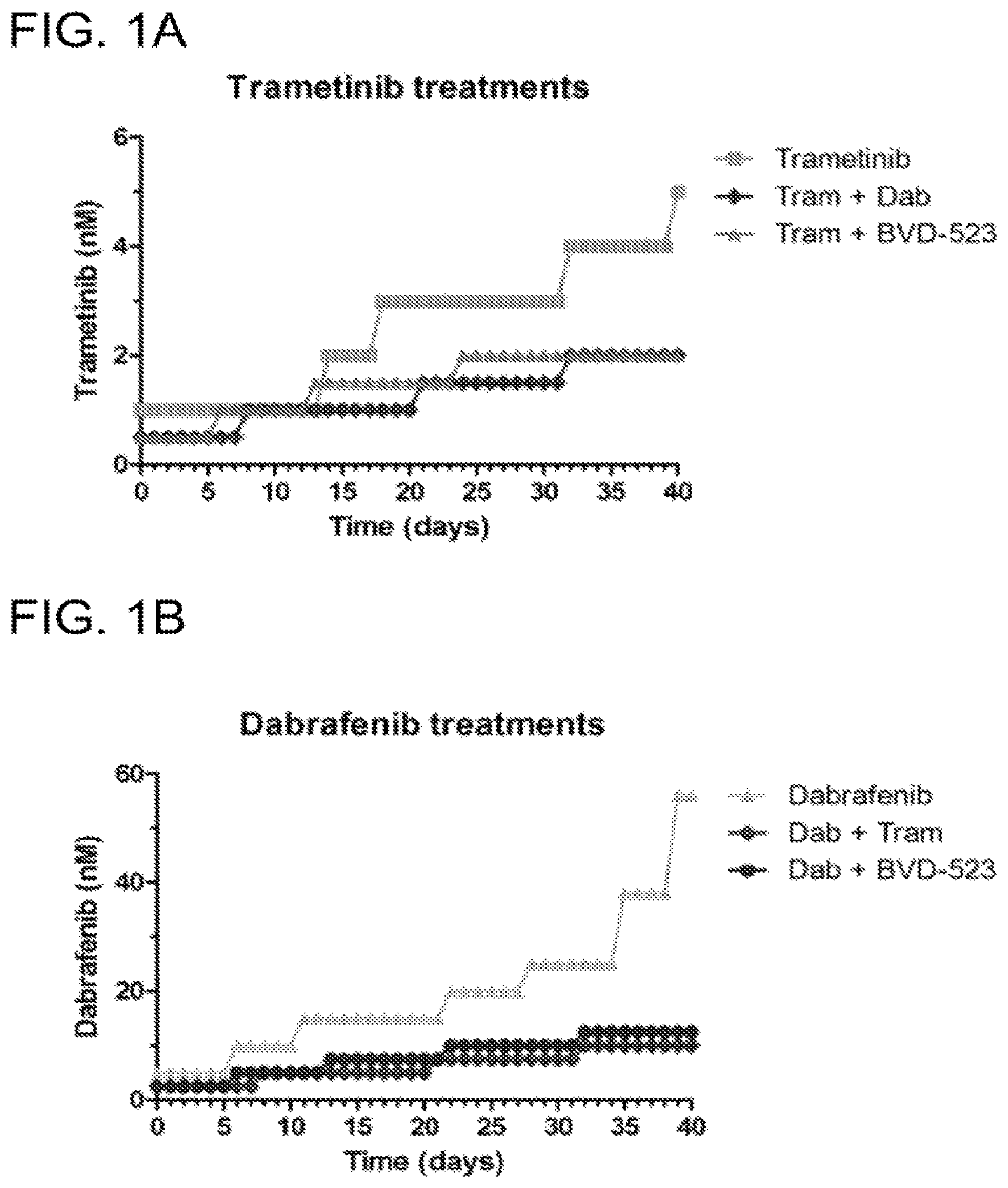
A - C show the progress of a dose escalation study in a human malignant melanoma cell line (A375 cells) for month 1. Various treatments (trametinib (a type 2 MEK inhibitor), dabrafenib (a BRAF inhibitor), and BVD-523 (an ERK1/2 inhibitor)) are as labeled.
A - H show the results of a proliferation assay that tracks changes in sensitivity to the escalated agent(s) at month 1. Various treatments (trametinib, dabrafenib, BVD-523, and paclitaxel) are as labeled on the top of the graph. The caption to the right of the graph shows the various types of cells generated from the dose escalation study. For example, “dabrafenib” refers to the cells that have been treated with the highest dose of dabrafenib from month 1 of the dose escalation study. Parental refers to the control cells that have not been treated with drugs. A , C and G are normalized to control, whereas D , F and H show the raw data.
A - D show the progress of a dose escalation study in A375 cells for month 2. Various treatments (trametinib, dabrafenib, and BVD-523) are as labeled.
A - H show the results of a proliferation assay that tracks changes in sensitivity to the escalated agent(s) at month 2. Various treatments (trametinib, dabrafenib, BVD-523, and paclitaxel) are as labeled on the top of the graph. The caption to the right of the graph shows the various types of cells generated from the dose escalation study. For example, “dabrafenib” refers to the cells that have been treated with the highest dose of dabrafenib from month 2 of the dose escalation study. Parental refers to the control cells that have not been treated with drugs. A , C and G are normalized to control, whereas D , F and H show the raw data.
A - H show only the parental and BVD-523 cell line data from A - H . Various treatments (trametinib, dabrafenib, BVD-523, and paclitaxel) are as labeled. A , C and G are normalized to control, whereas D , F and H show the raw data.
A - D show the progress of the dose escalation study in a human malignant cell line (A375 cells) for month 3. Various treatments (trametinib, dabrafenib, and BVD-523) are as labeled.
is a histogram showing the results of a proliferation assay as applied to cells grown in the DMSO control wells from the dose escalation assay.
A - D are a set of line graphs showing proliferation assays for month 3 of the study. Various treatments (trametinib, dabrafenib, BVD-523, and paclitaxel) are as labeled on the top of the graph. The caption to the right of the graph shows the various types of cells generated from the dose escalation study. For example, “dabrafenib” refers to the cells that have been treated with the highest dose of dabrafenib from month 3 of the dose escalation study. Parental refers to the control cells that have not been treated with drugs.
A - D show only the parental, dabrafenib, and BVD-523 cell line data from A - D .
A is a dose matrix showing % inhibition of the trametinib/dabrafenib combination in A375 cells using the Alamar Blue cell viability assay. B is a dose matrix showing excess over Bliss for the trametinib/dabrafenib combination. C and D show % viability relative to DMSO only treated controls for dabrafenib and trametinib single agent treatments in A375 cells using the Alamar Blue cell viability assay. E shows % viability relative to DMSO only treated controls for dabrafenib and trametinib combination treatments in A375 cells using the Alamar Blue cell viability assay.
A is a dose matrix showing % inhibition of the trametinib/dabrafenib combination in A375 cells using the CellTiter-Glo cell viability assay. B is a dose matrix showing excess over Bliss for the trametinib/dabrafenib combination. C and D show % viability relative to DMSO only treated controls for dabrafenib and trametinib single agent treatments in A375 cells using the CellTiter-Glo cell viability assay. E shows % viability relative to DMSO only treated controls for dabrafenib and trametinib combination treatments in A375 cells using the CellTiter-Glo cell viability assay.
A is a dose matrix showing % inhibition of the BVD-523/dabrafenib combination in A375 cells using the Alamar Blue cell viability assay. B is a dose matrix showing excess over Bliss for the BVD-523/dabrafenib combination. C and D show % viability relative to DMSO only treated controls for dabrafenib and BVD-523 single agent treatments in A375 cells using the Alamar Blue cell viability assay. E shows % viability relative to DMSO only treated controls for dabrafenib and BVD-523 combination treatments in A375 cells using the Alamar Blue cell viability assay.
A is a dose matrix showing % inhibition of the BVD-523/dabrafenib combination in A375 cells using the CellTiter-Glo cell viability assay. B is a dose matrix showing excess over Bliss for the BVD-523/dabrafenib combination. C and D show % viability relative to DMSO only treated controls for dabrafenib and BVD-523 single agent treatments in A375 cells using the CellTiter-Glo cell viability assay. E shows % viability relative to DMSO only treated controls for dabrafenib and BVD-523 combination treatments in A375 cells using the CellTiter-Glo cell viability assay.
A is a dose matrix showing % inhibition of the trametinib/BVD-523 combination in A375 cells using the Alamar Blue cell viability assay. B is a dose matrix showing excess over Bliss for the trametinib/BVD-523 combination. C and D show % viability relative to DMSO only treated controls for BVD-523 and trametinib single agent treatments in A375 cells using the Alamar Blue cell viability assay. E shows % viability relative to DMSO only treated controls for BVD-523 and trametinib combination treatments in A375 cells using the Alamar Blue cell viability assay.
A is a dose matrix showing % inhibition of the trametinib/BVD-523 combination in A375 cells using the CellTiter-Glo cell viability assay. B is a dose matrix showing excess over Bliss for the trametinib/BVD-523 combination. C and D show % viability relative to DMSO only treated controls for BVD-523 and trametinib single agent treatments in A375 cells using the CellTiter-Glo cell viability assay. E shows % viability relative to DMSO only treated controls for BVD-523 and trametinib combination treatments in A375 cells using the CellTiter-Glo cell viability assay.
A - D are a set of images showing Western blot analysis of MAPK signaling in A375 cells after a 4 hour treatment with various concentrations (in nM) of BVD-523, dabrafenib (Dab), and Trametinib (Tram). 40 μg of total protein was loaded in each lane except where indicated otherwise. In this experiment, duplicate samples were collected. A and B show results from duplicate samples. Similarly, C and D also show results from duplicate samples. In A and B , pRSK1 had a relatively weak signal in A375 cells compared to other markers. A different pRSK1-S380 antibody from Cell Signaling (cat. #11989) was tested but did not give a detectable signal (data not shown). In C and D , pCRAF-338 gave a minimal signal.
A - D are a set of images showing Western blot analysis of MAPK signaling in a human colorectal carcinoma cell line (HCT116 cells) after a 4 hour treatment with various concentrations (in nM) of BVD-523, dabrafenib (Dab), and Trametinib (Tram). 40 μg of total protein was loaded in each lane except where indicated otherwise. In this experiment, duplicate samples were collected. A and B show results from duplicate samples. Similarly, C and D also show results from duplicate samples. In A and B , pRSK1 levels appear to be very low in HCT116 cells, and in C and D , pCRAF-338 signal was also very weak.
A - D are a set of images showing Western blot analysis of cell cycle and apoptosis signaling in A375 melanoma cells after a 24 hour treatment with various concentrations (in nM) of BVD-523 (“BVD523”), trametinib (“tram”) and/or dabrafenib (“Dab”) as labelled. 50 μg of total protein was loaded in each lane except where indicated otherwise. In this experiment, duplicate samples were collected. A and B show results from duplicate samples. Similarly, C and D also show results from duplicate samples. In A and B , no band of a size corresponding to cleaved PARP (89 kDa) was apparent.
shows that BVD-523 can treat acquired resistance to targeted drugs in-vivo. A patient-derived line, ST052C, was isolated from a BRAFV600E melanoma patient that progressed following 10 months of therapy with MAPK-pathway directed therapies. Treated ex vivo, ST052C exhibited acquired cross-resistance to dabrafenib at 50 mg/kg BID. Meanwhile, BVD-523 was effective in ST052C as a single-agent at 100 mg/kg BID.
is a flowchart showing the dose escalation protocol used herein.
shows a schematic of the mitogen-activated protein kinases (MAPK) pathway.
A - E show the results of single agent proliferation assays. Proliferation results are shown for treatment with BVD-523 ( A ), SCH772984 ( B ), Dabrafenib ( C ), Trametinib ( D ), and Paclitaxel ( E ).
A - O show the results of the combination of BVD-523 and Dabrafenib. A shows a dose matrix showing inhibition (%) for the combination in RKO parental cells. B - C show the results of single agent proliferation assays for the combination in A . D shows Loewe excess for the combination in A and E shows Bliss excess for the combination in A . F shows a dose matrix showing inhibition (%) for the combination in RKO MEK1 (Q56P/+)— clone 1 cells. G - H show the results of single agent proliferation assays for the combination in F . I shows Loewe excess for the combination in F and J shows Bliss excess for the combination in F . K shows a dose matrix showing inhibition (%) for the combination in RKO MEK1 (Q56P/+)—clone 2 cells. L - M show the results of single agent proliferation assays for the combination in K . N shows Loewe excess for the combination in K and O shows Bliss excess for the combination in K .
A - O show the results of the combination of SCH772984 and Dabrafenib. A shows a dose matrix showing inhibition (%) for the combination in RKO parental cells. B - C show the results of single agent proliferation assays for the combination in A . D shows Loewe excess for the combination in A and E shows Bliss excess for the combination in A . F shows a dose matrix showing inhibition (%) for the combination in RKO MEK1 (Q56P/+)—clone 1 cells. G - H show the results of single agent proliferation assays for the combination in F . I shows Loewe excess for the combination in F and J shows Bliss excess for the combination in F . K shows a dose matrix showing inhibition (%) for the combination in RKO MEK1 (Q56P/+)—clone 2 cells. L - M show the results of single agent proliferation assays for the combination in K . N shows Loewe excess for the combination in K and O shows Bliss excess for the combination in K .
A - O show the results of the combination of Trametinib and Dabrafenib. A shows a dose matrix showing inhibition (%) for the combination in RKO parental cells. B - C show the results of single agent proliferation assays for the combination in A . D shows Loewe excess for the combination in A and E shows Bliss excess for the combination in A . F shows a dose matrix showing inhibition (%) for the combination in RKO MEK1 (Q56P/+)—clone 1 cells. G - H show the results of single agent proliferation assays for the combination in F . I shows Loewe excess for the combination in F and J shows Bliss excess for the combination in F . K shows a dose matrix showing inhibition (%) for the combination in RKO MEK1 (Q56P/+)—clone 2 cells. L - M show the results of single agent proliferation assays for the combination in K . N shows Loewe excess for the combination in K and O shows Bliss excess for the combination in K .
A shows Lowe Volumes for the combinations tested. B shows Bliss Volumes for the combinations tested. C shows Synergy Scores for the combinations tested.
A - I show the changes in MAPK and Effector Pathway Signaling in MEK acquired resistance. Isogenic RKO parental and MEK1 (Q56P/+) cells were treated with compound for 4 or 24 h and then immuno-blotted with the indicated antibodies. Dabrafenib was the BRAF inhibitor and trametinib was the MEK inhibitor. A shows increased signaling in RKO MEK1 (Q56P/+) cells. B - C show the results of a 4 hour treatment in Experiment 1 (See, Example 7) in RKO Parental ( 27 B) and RKO MEK1 (Q56P/+) ( 27 C) cells. D - E show the results of a 4 hour treatment in Experiment 2 (See, Example 7) in RKO Parental ( 27 D) and RKO MEK1 (Q56P/+) ( 27 E) cells. F - G show the results of a 4 hour treatment in Experiment 2 (See, Example 7) in RKO Parental ( 27 F) and RKO MEK1 (Q56P/+) ( 27 G) cells. H - I show a summary of results in RKO Parental ( 27 H) and RKO MEK1 (Q56P/+) ( 27 I) cells.
A - E show the results of the combination of BVD-523 and SCH772984. A shows a dose matrix showing inhibition (%) for the combination in A375 cells. B - C show the results of single agent proliferation assays for the combination in A . D shows Loewe excess for the combination in A and E shows Bliss excess for the combination in A .
A - F show discovery and characterization of the novel ERK1/2 inhibitor BVD-523 (ulixertinib). A shows that BVD-523 demonstrates inhibition in a reversible ATP-competitive manner. This is demonstrated by a linear increase in IC 50 values for inhibition of ERK2 with increasing ATP concentration as shown in B . C shows a representative plot of the dose-response curve and D shows a plot of IC 50 over time. E shows BVD-523 binding to ERK2 and phospho-ERK2 (pERK2), compared with negative control protein p38. F shows BVD-523 binding to ERK2 compared with the ERK inhibitors SCH772984 and pyrazolylpyrrole.
A - D show that BVD 523 inhibits cellular proliferation and enhances caspase 3 and caspase 7 activity in vitro. A shows that BVD-523 demonstrates preferential activity in cells with MAPK pathway mutations, as defined by the presence of mutations in RAS family members and RAF. In addition, as shown in B , BVD-523 blocks sensitive cell lines in the G1 phase of the cell cycle. C shows that BVD-523 induced a concentration- and time-dependent increase in caspase activity in the A375, WM266, and LS411N cancer cell lines after 72 hours of exposure. D shows that the MAPK pathway and effector proteins are modulated by acute (4-hour) and prolonged (24-hour) BVD-523 treatment in BRAF V600E -mutant A375 cells.
A - C show in vivo BVD-523 anti-tumor activity. BVD-523 monotherapy inhibits tumor growth in ( A ) A375 and ( B ) Colo205 cell line xenograft models ( a P<0.0001, compared with vehicle control; CPT-11 dosed on Day 14 and Day 18 only). Abbreviations: BID, twice daily; CMC, carboxymethylcellulose; QD, every day; Q4D, every 4 days. C shows that in Colo205 xenografts, increased ERK1/2 phosphorylation correlates with BVD-523 concentration.
A shows signaling effects of ERK1/2 inhibitors. Using RPPA, effects on proteins are measured in cell lines (A375, AN3Ca, Colo205, HCT116, HT29 and MIAPaca2) following treatment with ERK1/2 inhibitors BVD-523 (BVD), Vx11e (Vx), GDC-0994 (GDC), or SCH722984 (SCH). B shows that the ERK inhibitors BVD-523, GDC-0994, and Vx11e have differential effects on phospho-ERK (ERK 1/2 T202 Y204) compared with SCH722984; phospho-RSK (p90 RSK 380) and Cyclin D1 are inhibited by the ERK inhibitors tested. Abbreviations: BRAFi, BRAF inhibitors; MEKi, MEK inhibitors. C shows a western blot assay of cellular and nuclear fractions from a RKO cell line following treatment with BVD-523, trametinib, SCH722984, or dabrafenib. Histone H3 (nuclear localized protein) and HSP90 (cytoplasmically localized protein) were included as positive controls to confirm that the nuclear and cytoplasmic fractions were properly enriched; nuclear fractions have high H3 and cytoplasmic fractions have higher HSP90.
shows that the ERK inhibitors BVD-523, Vx11, GDC-0994, and SCH772984 (SCH) demonstrate cell line-dependent changes in phospho-ATK levels. Abbreviation: DMSO, dimethyl sulfoxide.
A - D show that BVD-523 demonstrates activity in models of resistance to BRAF/MEK inhibition. The appearance of resistance to BVD-523, dabrafenib, or trametinib in BRAF V600E A375 cells following exposure to increasing concentrations of drug is indicated. A strict set of “criteria” was applied to determine when the dose could be increased in order to ensure that the kinetics of the acquisition of resistance between treatments was comparable. See, Example 1. Time is shown against multipliers of IC 50 ; each point on the plotted line represents a change of medium or cell split. A shows that adapting cells to growth in the presence of BVD-523 was more challenging than with either dabrafenib or trametinib. B shows that BVD-523 sensitivity is retained in A375 cells cultured to acquire resistance to combined BRAF (dabrafenib)+MEK (trametinib) inhibition. In C , cells were treated with compound for 96 h and viability was assessed using CellTiter-Glo®. BVD-523 activity is retained in BRAF V600E RKO cells cross-resistant to BRAF (dabrafenib) and MEK (trametinib) inhibitors due to endogenous heterozygous knock-in of MEK1 Q56P . D shows that BVD-523 inhibition of pRSK in BRAF V600E -mutant cell line RKO is maintained in the presence of MEK1 Q56P , which confers resistance to MEK and BRAF inhibition. Knock-in of KRAS mutant alleles into SW48 cell lines significantly diminishes sensitivity to the MEK inhibitors trametinib and selumetinib, while comparatively sensitivity to BVD-523 is retained.
A shows BVD-523 in vivo activity in xenografts derived from a vemurafenib-relapsed patient. Mean tumor volume (±SEM) is shown for BVD-523 100 mg/kg BID alone, dabrafenib 50 mg/kg BID alone, and BVD-523 100 mg/kg BID plus dabrafenib 50 mg/kg BID. Abbreviations: BID, twice daily; SEM, standard error of mean.
A - D show the benefit of combined BVD-523 and BRAF inhibition. A - B show that the combination of BVD-523 plus dabrafenib exhibited superior antitumor activity compared with treatment with either agent alone in a A375 BRAF V600E -mutant melanoma cell line xenograft model with a tumor start volume of 75-144 mm 3 . C - D show similar data from the same model with an enlarged tumor volume (700-800 mm 3 ) at the start of dosing. Plots of mean tumor growth (left panels) and Kaplan-Meier survival (right panels) are presented for each study. Abbreviations: BID, twice daily; QD, once daily.
A shows that, in SW48 colorectal cells engineered with KRAS alleles, response to paclitaxel was unaltered compared to control. B shows combination interactions between BVD-523 and vemurafenib, which were assessed using an 8×10 matrix of concentrations using the Loewe Additivity and Bliss Independence Models, and analyzed with Horizon's Chalice, Bioinformatics Software. Chalice enables potential synergistic interactions to be identified by displaying the calculated excess inhibition over that predicted as being additive across the dose matrix as a heat map, and by reporting a quantitative “Synergy Score” based on the Loewe model. The results suggest that interactions between BVD-523 and vemurafenib are at least additive, and in some cases synergistic in melanoma cell lines carrying a BRAF V600E mutation. C shows that BVD-523 in combination with dabrafenib markedly delays the onset of acquired resistance in A375 BRAF V600E melanoma cells. The temporal acquisition of resistance in response to escalating concentrations of dabrafenib alone or in combination with BVD-523 or trametinib was assessed. Strict criteria were applied as to when the dose could be increased to ensure that the kinetics of adaptation was comparable between treatments. See, Example 1.
shows that BVD-523 inhibits ex vivo PMA-stimulated RSK1/2 phosphorylation in human whole blood. Averages of BVD-523 concentration data set are indicated by (−). n=20 for each concentration of BVD-523. Abbreviations: PBMC, peripheral blood mononuclear cells; RSK, ribosomal S6 kinase.
A shows steady-state BVD-523 pharmacokinetics (Cycle 1, Day 15). The dashed red line indicates an EC 50 200 ng/mL HWB. Abbreviations: AUC, area under the curve; BID, twice daily; C max , maximum concentration; EC 50 , 50% maximum effective concentration; HWB, human whole blood; SD, standard deviation. B shows pharmacodynamic inhibition of RSK phosphorylation by BVD-523 in human whole blood. Abbreviations: BID, twice daily; pRSK, phospho-RSK; RSK, ribosomal S6 kinase.
A shows the best radiographic response in patients treated with BVD-523. Included are all patients with disease measured by RECIST v1.1 who received 1 dose of study treatment and had >1 on-treatment tumor assessment (25/27; 2 did not receive both scans of target lesions). Response was measured as the change from baseline in the sum of the longest diameter of each target lesion. Dose shown is that which the patient was receiving at the time of response. The dashed line indicates the threshold for a partial response according to RECIST v1.1. Abbreviations: CRC, colorectal cancer; NET, neuroendocrine tumors; NSCLC, non-small cell lung cancer; NSGCT, nonseminomatous germ cell tumors; PNET, pancreatic NET; PTC, papillary thyroid cancer; RECIST v1.1, Response Evaluation Criteria in Solid Tumors version 1.1; SLD, sum of the largest diameter. B shows a computerized tomography scan of a confirmed partial response in a 61-year-old patient with a BRAF-mutant melanoma treated with BVD-523.
shows tumor response and tumor progression. Shown is a swimmer plot of tumor response, tumor progression, and duration of treatment in response-evaluable patients treated with BVD-523. Origin of the vertical axis corresponds to randomization date or reference start date. Analysis cut-off date: Dec. 1, 2015. Abbreviation: BID, twice daily.
DETAILED DESCRIPTION OF THE INVENTION
One embodiment of the present invention is a method for treating or ameliorating the effects of a cancer in a subject, which cancer is refractory or resistant to non-ERK MAPK pathway inhibitor therapy. The method comprises administering to the subject an effective amount of BVD-523 or a pharmaceutically acceptable salt thereof.
As used herein, the terms “treat,” “treating,” “treatment” and grammatical variations thereof mean subjecting an individual subject to a protocol, regimen, process or remedy, in which it is desired to obtain a physiologic response or outcome in that subject, e.g., a patient. In particular, the methods and compositions of the present invention may be used to slow the development of disease symptoms or delay the onset of the disease or condition, or halt the progression of disease development. However, because every treated subject may not respond to a particular treatment protocol, regimen, process or remedy, treating does not require that the desired physiologic response or outcome be achieved in each and every subject or subject population, e.g., patient population. Accordingly, a given subject or subject population, e.g., patient population may fail to respond or respond inadequately to treatment.
As used herein, the terms “ameliorate”, “ameliorating” and grammatical variations thereof mean to decrease the severity of the symptoms of a disease in a subject.
As used herein, a “subject” is a mammal, preferably, a human. In addition to humans, categories of mammals within the scope of the present invention include, for example, farm animals, domestic animals, laboratory animals, etc. Some examples of farm animals include cows, pigs, horses, goats, etc. Some examples of domestic animals include dogs, cats, etc. Some examples of laboratory animals include primates, rats, mice, rabbits, guinea pigs, etc.
In the present invention, BVD-523 corresponds to a compound according to formula (I):
and pharmaceutically acceptable salts thereof. BVD-523 may be synthesized according to the methods disclosed, e.g., in U.S. Pat. No. 7,354,939. Enantiomers and racemic mixtures of both enantiomers of BVD-523 are also contemplated within the scope of the present invention. BVD-523 is an ERK1/2 inhibitor with a mechanism of action that is believed to be, e.g., unique and distinct from certain other ERK1/2 inhibitors, such as SCH772984 and the pyrimidinal structure used by Hatzivassiliou et al. (2012). For example, other ERK1/2 inhibitors, such as SCH772984, inhibit autophosphorylation of ERK (Morris et al., 2013), whereas BVD-523 allows for the autophosphorylation of ERK while still inhibiting ERK. (See, e.g., ).
As used herein, the words “resistant” and “refractory” are used interchangeably. Being “resistant” to non-ERK MAPK pathway inhibitor therapy treatments means that non-ERK MAPK inhibitors have reduced efficacy in treating cancer.
As used herein, a “non-ERK MAPK inhibitor” means any substance that reduces the activity, expression or phosphorylation of proteins or other members of the MAPK pathway that results in a reduction of cell growth or an increase in cell death, with the exception of ERK1/2 inhibitors. As used herein, an “ERK1/2 inhibitor” means those substances that (i) directly interact with ERK1 and/or ERK2, e.g., by binding to ERK1/2 and (ii) decrease the expression or the activity of ERK1 and/or ERK2 protein kinases. Therefore, inhibitors that act upstream of ERK1/2, such as MEK inhibitors and RAF inhibitors, are not ERK1/2 inhibitors according to the present invention (but they are non-ERK MAPK inhibitors). Non-limiting examples of ERK1/2 inhibitors according to the present invention include AEZS-131 (Aeterna Zentaris), AEZS-136 (Aeterna Zentaris), BVD-523 (BioMed Valley Discoveries, Inc.), SCH-722984 (Merck & Co.), SCH-772984 (Merck & Co.), SCH-900353 (MK-8353) (Merck & Co.), pharmaceutically acceptable salts thereof, and combinations thereof.
An overview of the mammalian MAPK cascades is shown in . The MAPK pathway is reviewed in e.g., Akinleye et al., 2013. Briefly, with respect to the ERK1/2 module in (light purple box), the MAPK 1/2 signaling cascade is activated by ligand binding to receptor tyrosine kinases (RTK). The activated receptors recruit and phosphorylate adaptor proteins Grb2 and SOS, which then interact with membrane-bound GTPase Ras and cause its activation. In its activated GTP-bound form, Ras recruits and activates RAF kinases (A-RAF, B-RAF, and C-RAF/RAF-1). The activated RAF kinases activate MAPK 1/2 (MKK1/2), which in turn catalyzes the phosphorylation of threonine and tyrosine residues in the activation sequence Thr-Glu-Tyr of ERK1/2. With respect to the JNK/p38 module (yellow box in ), upstream kinases, MAP3Ks, such as MEKK1/4, ASK1/2, and MLK1/2/3, activate MAP2K3/6 (MKK3/6), MAP2K4 (MKK4), and MAP2K7 (MKK7). These MAP2K's then activate JNK protein kinases, including JNK1, JNK2, and JNK3, as well as p38 α/β/γ/δ. To execute their functions, JNKs activate several transcription factors, including c-Jun, ATF-2, NF-ATc1, HSF-1 and STAT3. With respect to the ERK5 module (blue box in ), the kinases upstream of MAP2K5 (MKK5) are MEKK2 and MEKK3. The best characterized downstream target of MEK5 is ERK5, also known as big MAP kinase 1 (BMK1) because it is twice the size of other MAPKs.
Non-limiting examples of non-ERK MAPK pathway inhibitors according to the present invention include RAS inhibitors, RAF inhibitors (such as, e.g., inhibitors of A-RAF, B-RAF, C-RAF (RAF-1)), MEK inhibitors, and combinations thereof. Preferably, the non-ERK MAPK pathway inhibitors are BRAF inhibitors, MEK inhibitors, and combinations thereof.
As used herein, a “RAS inhibitor” means those substances that (i) directly interact with RAS, e.g., by binding to RAS and (ii) decrease the expression or the activity of RAS. Non-limiting exemplary RAS inhibitors include, but are not limited to, farnesyl transferase inhibitors (such as, e.g., tipifarnib and lonafarnib), farnesyl group-containing small molecules (such as, e.g., salirasib and TLN-4601), DCAI, as disclosed by Maurer (Maurer et al., 2012), Kobe0065 and and Kobe2602, as disclosed by Shima (Shima et al., 2013), HBS 3 (Patgiri et al., 2011), and AIK-4 (Allinky).
As used herein, a “RAF inhibitor” means those substances that (i) directly interact with RAF, e.g., by binding to RAF and (ii) decrease the expression or the activity of RAF, such as, e.g., A-RAF, B-RAF, and C-RAF (RAF-1). Non-limiting exemplary RAF inhibitors, including BRAF inhibitors, include:
AAL881 (Novartis); AB-024 (Ambit Biosciences), ARQ-736 (ArQule), ARQ-761 (ArQule), AZ628 (Axon Medchem BV), BeiGene-283 (BeiGene), BIIB-024 (MLN 2480) (Sunesis & Takeda), b-raf inhibitor (Sareum), BRAF kinase inhibitor (Selexagen Therapeutics), BRAF siRNA 313 (tacaccagcaagctagatgca) and 523 (cctatcgttagagtcttcctg) (Liu et al., 2007), CTT239065 (Institute of Cancer Research), dabrafenib (GSK2118436), DP-4978 (Deciphera Pharmaceuticals), HM-95573 (Hanmi), GDC-0879 (Genentech), GW-5074 (Sigma Aldrich), ISIS 5132 (Novartis), L779450 (Merck), LBT613 (Novartis), LErafAON (NeoPharm, Inc.), LGX-818 (Novartis), pazopanib (GlaxoSmithKline), PLX3202 (Plexxikon), PLX4720 (Plexxikon), PLX5568 (Plexxikon), RAF-265 (Novartis), RAF-365 (Novartis), regorafenib (Bayer Healthcare Pharmaceuticals, Inc.), RO 5126766 (Hoffmann-La Roche), SB-590885 (GlaxoSmithKline), SB699393 (GlaxoSmithKline), sorafenib (Onyx Pharmaceuticals), TAK 632 (Takeda), TL-241 (Teligene), vemurafenib (RG7204 or PLX4032) (Daiichi Sankyo), XL-281 (Exelixis), ZM-336372 (AstraZeneca), pharmaceutically acceptable salts thereof, and combinations thereof.
As used herein, a “MEK inhibitor” means those substances that (i) directly interact with MEK, e.g., by binding to MEK and (ii) decrease the expression or the activity of MEK. Thus, inhibitors that act upstream of MEK, such as RAS inhibitors and RAF inhibitors, are not MEF inhibitors according to the present invention. Non-limiting examples of MEK inhibitors include anthrax toxin, antroquinonol (Golden Biotechnology), ARRY-142886 (6-(4-bromo-2-chloro-phenylamino)-7-fluoro-3-methyl-3H-benzoimidazole-5-carboxylic acid (2-hydroxy-ethoxy)-amide) (Array BioPharma), ARRY-438162 (Array BioPharma), AS-1940477 (Astellas), AS-703988 (Merck KGaA), bentamapimod (Merck KGaA), BI-847325 (Boehringer Ingelheim), E-6201 (Eisai), GDC-0623 (Hoffmann-La Roche), GDC-0973 (cobimetinib) (Hoffmann-La Roche), L783277 (Merck), lethal factor portion of anthrax toxin, MEK162 (Array BioPharma), PD 098059 (2-(2′-amino-3′-methoxyphenyl)-oxanaphthalen-4-one) (Pfizer), PD 184352 (CI-1040) (Pfizer), PD-0325901 (Pfizer), pimasertib (Santhera Pharmaceuticals), RDEA119 (Ardea Biosciences/Bayer), refametinib (AstraZeneca), RG422 (Chugai Pharmaceutical Co.), RO092210 (Roche), RO4987655 (Hoffmann-La Roche), RO5126766 (Hoffmann-La Roche), selumetinib (AZD6244) (AstraZeneca), SL327 (Sigma), TAK-733 (Takeda), trametinib (Japan Tobacco), U0126 (1,4-diamino-2,3-dicyano-1,4-bis(2-aminophenylthio)butadiene) (Sigma), WX-554 (Wilex), YopJ polypeptide (Mittal et al., 2010), pharmaceutically acceptable salts thereof, and combinations thereof.
In one aspect of this embodiment, substantially all phosphorylation of ribosomal s6 kinase (RSK) is inhibited after administration of BVD-523 or a pharmaceutically acceptable salt thereof. As used herein in the context of RSK phosphorylation, “substantially all” means a reduction of greater than 50% reduction, preferably greater than 55%, 60%, 65%, 70%, 75%, 80%, 85%, 90%, 91%, 92%, 93%, 94%, 95%, 96%, 97%, 98%, or 99% reduction.
In another aspect of this embodiment, the cancer has MAPK activity. As used herein, having “MAPK activity” means that proteins downstream of ERK are still active, even if proteins upstream of ERK may not be active. Such a cancer may be a solid tumor cancer or a hematologic cancer.
In the present invention, cancers include both solid and hematologic cancers. Non-limiting examples of solid cancers include adrenocortical carcinoma, anal cancer, bladder cancer, bone cancer (such as osteosarcoma), brain cancer, breast cancer, carcinoid cancer, carcinoma, cervical cancer, colon cancer, endometrial cancer, esophageal cancer, extrahepatic bile duct cancer, Ewing family of cancers, extracranial germ cell cancer, eye cancer, gallbladder cancer, gastric cancer, germ cell tumor, gestational trophoblastic tumor, head and neck cancer, hypopharyngeal cancer, islet cell carcinoma, kidney cancer, large intestine cancer, laryngeal cancer, leukemia, lip and oral cavity cancer, liver tumor/cancer, lung tumor/cancer, lymphoma, malignant mesothelioma, Merkel cell carcinoma, mycosis fungoides, myelodysplastic syndrome, myeloproliferative disorders, nasopharyngeal cancer, neuroblastoma, oral cancer, oropharyngeal cancer, osteosarcoma, ovarian epithelial cancer, ovarian germ cell cancer, pancreatic cancer, paranasal sinus and nasal cavity cancer, parathyroid cancer, penile cancer, pituitary cancer, plasma cell neoplasm, prostate cancer, rhabdomyosarcoma, rectal cancer, renal cell cancer, transitional cell cancer of the renal pelvis and ureter, salivary gland cancer, Sezary syndrome, skin cancers (such as cutaneous t-cell lymphoma, Kaposi's sarcoma, mast cell tumor, and melanoma), small intestine cancer, soft tissue sarcoma, stomach cancer, testicular cancer, thymoma, thyroid cancer, urethral cancer, uterine cancer, vaginal cancer, vulvar cancer, and Wilms' tumor.
Examples of hematologic cancers include, but are not limited to, leukemias, such as adult/childhood acute lymphoblastic leukemia, adult/childhood acute myeloid leukemia, chronic lymphocytic leukemia, chronic myelogenous leukemia, and hairy cell leukemia, lymphomas, such as AIDS-related lymphoma, cutaneous T-cell lymphoma, adult/childhood Hodgkin lymphoma, mycosis fungoides, adult/childhood non-Hodgkin lymphoma, primary central nervous system lymphoma, Sezary syndrome, cutaneous T-cell lymphoma, and Waldenstrom macroglobulinemia, as well as other proliferative disorders such as chronic myeloproliferative disorders, Langerhans cell histiocytosis, multiple myeloma/plasma cell neoplasm, myelodysplastic syndromes, and myelodysplastic/myeloproliferative neoplasms.
Preferably, the cancer is selected from the group consisting of a cancer of the large intestine, breast cancer, pancreatic cancer, skin cancer, and endometrial cancers. More preferably, the cancer is melanoma.
In another aspect of this embodiment, the method further comprises administering to the subject at least one additional therapeutic agent effective for treating or ameliorating the effects of the cancer. The additional therapeutic agent may be selected from the group consisting of an antibody or fragment thereof, a cytotoxic agent, a toxin, a radionuclide, an immunomodulator, a photoactive therapeutic agent, a radiosensitizing agent, a hormone, an anti-angiogenesis agent, and combinations thereof.
As used herein, an “antibody” encompasses naturally occurring immunoglobulins as well as non-naturally occurring immunoglobulins, including, for example, single chain antibodies, chimeric antibodies (e.g., humanized murine antibodies), and heteroconjugate antibodies (e.g., bispecific antibodies). Fragments of antibodies include those that bind antigen, (e.g., Fab′, F(ab′) 2 , Fab, Fv, and rIgG). See also, e.g., Pierce Catalog and Handbook, 1994-1995 (Pierce Chemical Co., Rockford, Ill.); Kuby, J., Immunology, 3rd Ed., W.H. Freeman & Co., New York (1998). The term antibody also includes bivalent or bispecific molecules, diabodies, triabodies, and tetrabodies. The term “antibody” further includes both polyclonal and monoclonal antibodies.
Examples of therapeutic antibodies that may be used in the present invention include rituximab (Rituxan), Cetuximab (Erbitux), bevacizumab (Avastin), and Ibritumomab (Zevalin).
Cytotoxic agents according to the present invention include DNA damaging agents, antimetabolites, anti-microtubule agents, antibiotic agents, etc. DNA damaging agents include alkylating agents, platinum-based agents, intercalating agents, and inhibitors of DNA replication. Non-limiting examples of DNA alkylating agents include cyclophosphamide, mechlorethamine, uramustine, melphalan, chlorambucil, ifosfamide, carmustine, lomustine, streptozocin, busulfan, temozolomide, pharmaceutically acceptable salts thereof, prodrugs, and combinations thereof. Non-limiting examples of platinum-based agents include cisplatin, carboplatin, oxaliplatin, nedaplatin, satraplatin, triplatin tetranitrate, pharmaceutically acceptable salts thereof, prodrugs, and combinations thereof. Non-limiting examples of intercalating agents include doxorubicin, daunorubicin, idarubicin, mitoxantrone, pharmaceutically acceptable salts thereof, prodrugs, and combinations thereof. Non-limiting examples of inhibitors of DNA replication include irinotecan, topotecan, amsacrine, etoposide, etoposide phosphate, teniposide, pharmaceutically acceptable salts thereof, prodrugs, and combinations thereof. Antimetabolites include folate antagonists such as methotrexate and pemetrexed, purine antagonists such as 6-mercaptopurine, dacarbazine, and fludarabine, and pyrimidine antagonists such as 5-fluorouracil, arabinosylcytosine, capecitabine, gemcitabine, decitabine, pharmaceutically acceptable salts thereof, prodrugs, and combinations thereof. Anti-microtubule agents include without limitation vinca alkaloids, paclitaxel (Taxol®), docetaxel (Taxotere®), and ixabepilone (Ixempra®). Antibiotic agents include without limitation actinomycin, anthracyclines, valrubicin, epirubicin, bleomycin, plicamycin, mitomycin, pharmaceutically acceptable salts thereof, prodrugs, and combinations thereof.
Cytotoxic agents according to the present invention also include an inhibitor of the PI3K/Akt pathway. Non-limiting examples of an inhibitor of the PI3K/Akt pathway include A-674563 (CAS #552325-73-2), AGL 2263, AMG-319 (Amgen, Thousand Oaks, CA), AS-041164 (5-benzo[1,3]dioxol-5-ylmethylene-thiazolidine-2,4-dione), AS-604850 (5-(2,2-Difluoro-benzo[1,3]dioxol-5-ylmethylene)-thiazolidine-2,4-dione), AS-605240 (5-quinoxilin-6-methylene-1,3-thiazolidine-2,4-dione), AT7867 (CAS #857531-00-1), benzimidazole series, Genentech (Roche Holdings Inc., South San Francisco, CA), BML-257 (CAS #32387-96-5), CAL-120 (Gilead Sciences, Foster City, CA), CAL-129 (Gilead Sciences), CAL-130 (Gilead Sciences), CAL-253 (Gilead Sciences), CAL-263 (Gilead Sciences), CAS #612847-09-3, CAS #681281-88-9, CAS #75747-14-7, CAS #925681-41-0, CAS #98510-80-6, CCT128930 (CAS #885499-61-6), CH5132799 (CAS #1007207-67-1), CHR-4432 (Chroma Therapeutics, Ltd., Abingdon, UK), FPA 124 (CAS #902779-59-3), GS-1101 (CAL-101) (Gilead Sciences), GSK 690693 (CAS #937174-76-0), H-89 (CAS #127243-85-0), Honokiol, IC87114 (Gilead Science), IPI-145 (Intellikine Inc.), KAR-4139 (Karus Therapeutics, Chilworth, UK), KAR-4141 (Karus Therapeutics), KIN-1 (Karus Therapeutics), KT 5720 (CAS #108068-98-0), Miltefosine, MK-2206 dihydrochloride (CAS #1032350-13-2), ML-9 (CAS #105637-50-1), Naltrindole Hydrochloride, OXY-111A (NormOxys Inc., Brighton, MA), perifosine, PHT-427 (CAS #1191951-57-1), PI3 kinase delta inhibitor, Merck KGaA (Merck & Co., Whitehouse Station, NJ), PI3 kinase delta inhibitors, Genentech (Roche Holdings Inc.), PI3 kinase delta inhibitors, Incozen (Incozen Therapeutics, Pvt. Ltd., Hydrabad, India), PI3 kinase delta inhibitors-2, Incozen (Incozen Therapeutics), PI3 kinase inhibitor, Roche-4 (Roche Holdings Inc.), PI3 kinase inhibitors, Roche (Roche Holdings Inc.), PI3 kinase inhibitors, Roche-5 (Roche Holdings Inc.), PI3-alpha/delta inhibitors, Pathway Therapeutics (Pathway Therapeutics Ltd., South San Francisco, CA), PI3-delta inhibitors, Cellzome (Cellzome AG, Heidelberg, Germany), PI3-delta inhibitors, Intellikine (Intellikine Inc., La Jolla, CA), PI3-delta inhibitors, Pathway Therapeutics-1 (Pathway Therapeutics Ltd.), PI3-delta inhibitors, Pathway Therapeutics-2 (Pathway Therapeutics Ltd.), PI3-delta/gamma inhibitors, Cellzome (Cellzome AG), PI3-delta/gamma inhibitors, Cellzome (Cellzome AG), PI3-delta/gamma inhibitors, Intellikine (Intellikine Inc.), PI3-delta/gamma inhibitors, Intellikine (Intellikine Inc.), PI3-delta/gamma inhibitors, Pathway Therapeutics (Pathway Therapeutics Ltd.), PI3-delta/gamma inhibitors, Pathway Therapeutics (Pathway Therapeutics Ltd.), PI3-gamma inhibitor Evotec (Evotec), PI3-gamma inhibitor, Cellzome (Cellzome AG), PI3-gamma inhibitors, Pathway Therapeutics (Pathway Therapeutics Ltd.), PI3K delta/gamma inhibitors, Intellikine-1 (Intellikine Inc.), PI3K delta/gamma inhibitors, Intellikine-1 (Intellikine Inc.), pictilisib (Roche Holdings Inc.), PIK-90 (CAS #677338-12-4), SC-103980 (Pfizer, New York, NY), SF-1126 (Semafore Pharmaceuticals, Indianapolis, IN), SH-5, SH-6, Tetrahydro Curcumin, TG100-115 (Targegen Inc., San Diego, CA), Triciribine, X-339 (Xcovery, West Palm Beach, FL), XL-499 (Evotech, Hamburg, Germany), pharmaceutically acceptable salts thereof, and combinations thereof.
In the present invention, the term “toxin” means an antigenic poison or venom of plant or animal origin. An example is diphtheria toxin or portions thereof.
In the present invention, the term “radionuclide” means a radioactive substance administered to the patient, e.g., intravenously or orally, after which it penetrates via the patient's normal metabolism into the target organ or tissue, where it delivers local radiation for a short time. Examples of radionuclides include, but are not limited to, I-125, At-211, Lu-177, Cu-67, I-131, Sm-153, Re-186, P-32, Re-188, In-114m, and Y-90.
In the present invention, the term “immunomodulator” means a substance that alters the immune response by augmenting or reducing the ability of the immune system to produce antibodies or sensitized cells that recognize and react with the antigen that initiated their production. Immunomodulators may be recombinant, synthetic, or natural preparations and include cytokines, corticosteroids, cytotoxic agents, thymosin, and immunoglobulins. Some immunomodulators are naturally present in the body, and certain of these are available in pharmacologic preparations. Examples of immunomodulators include, but are not limited to, granulocyte colony-stimulating factor (G-CSF), interferons, imiquimod and cellular membrane fractions from bacteria, IL-2, IL-7, IL-12, CCL3, CCL26, CXCL7, and synthetic cytosine phosphate-guanosine (CpG).
In the present invention, the term “photoactive therapeutic agent” means compounds and compositions that become active upon exposure to light. Certain examples of photoactive therapeutic agents are disclosed, e.g., in U.S. Patent Application Serial No. 2011/0152230 A1, “Photoactive Metal Nitrosyls For Blood Pressure Regulation And Cancer Therapy.”
In the present invention, the term “radiosensitizing agent” means a compound that makes tumor cells more sensitive to radiation therapy. Examples of radiosensitizing agents include misonidazole, metronidazole, tirapazamine, and trans sodium crocetinate.
In the present invention, the term “hormone” means a substance released by cells in one part of a body that affects cells in another part of the body. Examples of hormones include, but are not limited to, prostaglandins, leukotrienes, prostacyclin, thromboxane, amylin, antimullerian hormone, adiponectin, adrenocorticotropic hormone, angiotensinogen, angiotensin, vasopressin, atriopeptin, brain natriuretic peptide, calcitonin, cholecystokinin, corticotropin-releasing hormone, encephalin, endothelin, erythropoietin, follicle-stimulating hormone, galanin, gastrin, ghrelin, glucagon, gonadotropin-releasing hormone, growth hormone-releasing hormone, human chorionic gonadotropin, human placental lactogen, growth hormone, inhibin, insulin, somatomedin, leptin, lipotropin, luteinizing hormone, melanocyte stimulating hormone, motilin, orexin, oxytocin, pancreatic polypeptide, parathyroid hormone, prolactin, prolactin releasing hormone, relaxin, renin, secretin, somatostatin, thrombopoietin, thyroid-stimulating hormone, testosterone, dehydroepiandrosterone, androstenedione, dihydrotestosterone, aldosterone, estradiol, estrone, estriol, cortisol, progesterone, calcitriol, and calcidiol.
Some compounds interfere with the activity of certain hormones or stop the production of certain hormones. These hormone-interfering compounds include, but are not limited to, tamoxifen (Nolvadex®), anastrozole (Arimidex®), letrozole (Femara®), and fulvestrant (Faslodex®). Such compounds are also within the meaning of hormone in the present invention.
As used herein, an “anti-angiogenesis” agent means a substance that reduces or inhibits the growth of new blood vessels, such as, e.g., an inhibitor of vascular endothelial growth factor (VEGF) and an inhibitor of endothelial cell migration. Anti-angiogenesis agents include without limitation 2-methoxyestradiol, angiostatin, bevacizumab, cartilage-derived angiogenesis inhibitory factor, endostatin, IFN-α, IL-12, itraconazole, linomide, platelet factor-4, prolactin, SU5416, suramin, tasquinimod, tecogalan, tetrathiomolybdate, thalidomide, thrombospondin, thrombospondin, TNP-470, ziv-aflibercept, pharmaceutically acceptable salts thereof, prodrugs, and combinations thereof.
Another embodiment of the present invention is a method for treating or ameliorating the effects of a cancer in a subject. The method comprises:
•
• (a) identifying a subject with cancer that has become refractory or resistant to BRAF inhibitor therapy, MEK inhibitor therapy, or BRAF and MEK inhibitor therapy; and • (b) administering to the subject with said refractory or resistant cancer an effective amount of an ERK inhibitor, which is BVD-523 or a pharmaceutically acceptable salt thereof.
Suitable and preferred subjects are as disclosed herein. In this embodiment, the methods may be used to treat the cancers disclosed above. In accordance with the present invention, the cancer may have MAPK activity.
In one aspect of this embodiment, identifying a subject with cancer that is refractory or resistant to BRAF and/or MEK inhibitor therapy comprises:
•
• (a) obtaining a biological sample from the subject; and • (b) screening the sample to determine whether the subject has become resistant to an inhibitor therapy selected from the group consisting of BRAF inhibitor therapy, MEK inhibitor therapy, and combinations thereof.
In the present invention, biological samples include, but are not limited to, blood, plasma, urine, skin, saliva, and biopsies. Biological samples are obtained from a subject by routine procedures and methods which are known in the art.
Preferably, screening for a cancer that is refractory or resistant to BRAF inhibitor therapy may comprise, e.g., identifying (i) a switch between RAF isoforms, (ii) upregulation of RTK or NRAS signaling, (iii) reactivation of mitogen activated protein kinase (MAPK) signaling, (iv) the presence of a MEK activating mutation, and combinations thereof.
A switch between RAF isoforms may occur in subjects having acquired resistance to BRAF inhibitor therapy. To detect such a switch, BRAF inhibitor-resistant tumor cells may be retrieved from a patient and analyzed via Western blotting for ERK and phospho-ERK levels in the presence of a BRAF inhibitor. Comparison with BRAF inhibitor-sensitive cells treated with a BRAF inhibitor may reveal higher levels of phospho-ERK in BRAF inhibitor-resistant tumor cells, implying that a switch has taken place in which another RAF isoform phosphorylates ERK in place of BRAF. Confirmation of which RAF isoform has taken over may involve sh/siRNA-mediated knockdown of ARAF and CRAF individually in BRAF inhibitor-resistant cells exposed to a BRAF inhibitor, followed by subsequent Western blotting for ERK and phospho-ERK levels. If, for example, ARAF knockdown in BRAF inhibitor-resistant cells exposed to a BRAF inhibitor still results in high levels of phospho-ERK, it would indicate that CRAF has taken over phosphorylating ERK. Likewise, if CRAF was knocked down in BRAF inhibitor-resistant cells exposed to BRAF inhibitor and ERK was still highly phosphorylated, it would mean that ARAF has taken over ERK phosphorylation. RAF isoform switching may also involve simultaneous knockdown of ARAF and CRAF in BRAF inhibitor-resistant cells in the presence of BRAF inhibitor, effectively blocking all RAF-mediated phosphorylation. A resulting decrease in ERK phosphorylation would indicate that the BRAF inhibitor-resistant cells have the capacity to switch between RAF isoforms in order to phosphorylate ERK (Villanueva, et al., 2010).
Upregulation of RTK or NRAS signaling may also be a cause of BRAF inhibitor resistance. Detection may, e.g., first involve using Western blotting protocols with phospho-specific antibodies to analyze the activation of the downstream RAF effectors MEK1/2 and ERK1/2. If BRAF inhibitor-resistant cells show high activation levels of these proteins in the presence of a BRAF inhibitor, RTK or NRAS upregulation may be the cause. Gene expression profiling (or other related methods) of BRAF inhibitor-resistant cells in the presence of a BRAF inhibitor may reveal higher expression levels of KIT, MET, EGFR, and PDGFRβ RTKs as compared to BRAF inhibitor-sensitive cells. Real-time quantitative polymerase chain reaction experiments, or other similar procedures, focusing on any of these genes may confirm higher expression levels while phospho-RTK arrays (R&D Systems, Minneapolis, MN) may show elevated activation-associated tyrosine phosphorylation. Alternatively, NRAS activation may be detected by various gene sequencing protocols. Activating mutations in NRAS, particularly Q61K, may indicate that B-RAF signaling has been bypassed. In melanoma cells, activated NRAS uses C-RAF to signal to MEK-ERK. Thus, activated NRAS may enable a similar bypass pathway in BRAF inhibitor-resistant cells exposed to BRAF inhibitor. Further confirmation of these mechanisms in a given BRAF inhibitor-resistant sample may be accomplished, for example, using sh/siRNA-mediated knockdown of upregulated RTKs or activated NRAS in the presence of BRAF inhibitor. Any significant levels of growth inhibition may indicate that upregulation of RTK or NRAS signaling is the cause of BRAF inhibition in that particular sample (Nazarian, et al., 2010).
Detecting reactivation of MAPK signaling in BRAF inhibitor-resistant cells may indicate another bypass mechanism for BRAF inhibitor resistance. COT and C-RAF have been shown to be upregulated in a BRAF V600E background exposed to BRAF inhibitor. Quantitative real-time RT-PCR, e.g., may reveal increased COT expression in BRAF inhibitor-resistant cells in the presence of BRAF inhibitor. Furthermore, sh/siRNA-mediated knockdown of COT in BRAF inhibitor-resistant cells in the presence of BRAF inhibitor may reduce the viability of BRAF inhibitor-resistant cells, indicating that these particular cells may be sensitive to COT inhibition and/or combination BRAF inhibitor/MEK inhibitor treatments (Johannessen, et al., 2010).
Reactivation of MAPK signaling may also be accomplished in a BRAF inhibitor-resistant background by activating mutations in MEK1. Targeted, massively parallel sequencing of genomic DNA from a BRAF inhibitor-resistant tumor may reveal activating mutations in MEK1, such as C121S, G128D, N122D, and Y130, among others. Other, undocumented mutations in MEK1 may be analyzed by, for example, expressing the particular mutation in a BRAF inhibitor-sensitive cell line such as A375. Determining levels of growth inhibition in these cells upon exposure to BRAF inhibitor may indicate if the MEK1 mutation is causing resistance to BRAF inhibitory therapy. To confirm such a finding, Western blotting for elevated levels of phospho-ERK1/2 in cells ectopically expressing the MEK1 mutation may indicate that the MEK1 mutation is allowing the BRAF inhibitor-resistant tumor to bypass BRAF and promote phosphorylation of ERK through MEK1 (Wagle, et al., 2011).
In accordance with the present invention, screening for a cancer that is refractory or resistant to MEK inhibitor therapy may comprise, e.g., identifying (i) amplification of mutant BRAF, (ii) STAT3 upregulation, (iii) mutations in the allosteric pocket of MEK that directly block binding of inhibitors to MEK or lead to constitutive MEK activity, and combinations thereof.
Amplification of mutant BRAF may cause MEK inhibitor resistance. MEK inhibitor resistance is typically associated with high levels of phosphorylated ERK and MEK in the presence of a MEK inhibitor, which may be assessed via, for example, Western blotting. Amplification of mutant BRAF in MEK inhibitor-resistant cell lines may be detected by, for example, fluorescence in situ hybridization (FISH) or quantitative PCR from genomic DNA of the resistant cell lines. Confirmation that BRAF amplification is a primary cause of MEK inhibitor resistance may entail using BRAF-targeted sh/siRNAs in resistant cells. If a significant decrease in MEK or ERK phosphorylation is observed, BRAF amplification may be a suitable target for further therapeutic approaches. (Corcoran, et al., 2010).
Identifying STAT3 upregulation may indicate that a particular tumor sample is resistant to MEK inhibitor therapy. Genome-wide expression profiling may reveal the STAT3 pathway to be upregulated in a tumor. Other techniques, such as Western blotting for phospho-STAT3 and real-time qPCR for the STAT pathway-associated genes JAK1 and IL6ST may reveal upregulated STAT3. Further confirmation that STAT3 upregulation causes MEK inhibitor resistance in a particular sample may comprise the use of sh/siRNAs against STAT3 in the sample followed by appropriate Western blotting for MEK and ERK activation as well as phospho-STAT3 and total STAT3. Growth inhibition studies may show that STAT3 knockdown sensitizes previously MEK inhibitor-resistant cells to MEK inhibition. A similar effect may be seen if the sample were exposed to a STAT3 inhibitor such as JSI-124. Additional confirmation that STAT3 upregulation is the cause of MEK inhibitor resistance in a particular tumor could arise from Western blotting for BIM expression, including BIM-EL, BIM-L, and BIM-SL. BIM expression leads to MEK inhibitor-induced apoptosis, thus STAT3 upregulation may lower BIM levels. STAT3 is known to regulate the expression of miR 17-92, which suppresses BIM expression. Upregulated STAT3 may lead to higher levels of miR 17-92, which will lower BIM levels and promote resistance to MEK inhibition. Thus, real-time qPCR of miR 17-92 levels may also assist in assessing whether STAT3 upregulation is causing MEK inhibition resistance in a particular sample. (Dai, et al., 2011).
Mutations in the allosteric pocket of MEK that can directly block binding of inhibitors to MEK or lead to constitutive MEK activity may be detected by methods disclosed below. Such mutations have been identified previously by Emery and colleagues (Emery, et al., 2009) as well as Wang and colleagues (Wang et al., 2011). Other mutations may affect MEK1 codons located within or abutting the N-terminal negative regulatory helix, such as P124L and Q56P. (Id.).
Methods for identifying mutations in nucleic acids, such as the above identified MEK genes, are known in the art. Nucleic acids may be obtained from biological samples. In the present invention, biological samples include, but are not limited to, blood, plasma, urine, skin, saliva, and biopsies. Biological samples are obtained from a subject by routine procedures and methods which are known in the art.
Non-limiting examples of methods for identifying mutations include PCR, sequencing, hybrid capture, in-solution capture, molecular inversion probes, fluorescent in situ hybridization (FISH) assays, and combinations thereof.
Various sequencing methods are known in the art. These include, but are not limited to, Sanger sequencing (also referred to as dideoxy sequencing) and various sequencing-by-synthesis (SBS) methods as disclosed in, e.g., Metzker 2005, sequencing by hybridization, by ligation (for example, WO 2005021786), by degradation (for example, U.S. Pat. Nos. 5,622,824 and 6,140,053) and nanopore sequencing (which is commercially available from Oxford Nanopore Technologies, UK). In deep sequencing techniques, a given nucleotide in the sequence is read more than once during the sequencing process. Deep sequencing techniques are disclosed in e.g., U.S. Patent Publication No. 20120264632 and International Patent Publication No. WO2012125848.
PCR-based methods for detecting mutations are known in the art and employ PCR amplification, where each target sequence in the sample has a corresponding pair of unique, sequence-specific primers. For example, the polymerase chain reaction-restriction fragment length polymorphism (PCR-RFLP) method allows for rapid detection of mutations after the genomic sequences are amplified by PCR. The mutation is discriminated by digestion with specific restriction endonucleases and is identified by electrophoresis. See, e.g., Ota et al., 2007. Mutations may also be detected using real time PCR. See, e.g., International Application publication No. WO2012046981.
Hybrid capture methods are known in the art and are disclosed in e.g., U.S. Patent Publication No. 20130203632 and U.S. Pat. Nos. 8,389,219 and 8,288,520. These methods are based on the selective hybridization of the target genomic regions to user-designed oligonucleotides. The hybridization can be to oligonucleotides immobilized on high or low density microarrays (on-array capture), or solution-phase hybridization to oligonucleotides modified with a ligand (e.g. biotin) which can subsequently be immobilized to a solid surface, such as a bead (in-solution capture).
Molecular Inversion Probe (MIP) techniques are known in the art and are disclosed in e.g., Absalan et al., 2008. This method uses MIP molecules, which are special “padlock” probes (Nilsson et al, 1994) for genotyping. A MIP molecule is a linear oligonucleotide that contains specific regions, universal sequences, restriction sites and a Tag (index) sequence (16-22 bp). A MIP hybridizes directly around the genetic marker/SNP of interest. The MIP method may also use a number of “padlock” probe sets that hybridize to genomic DNA in parallel (Hardenbol et al., 2003). In case of a perfect match, genomic homology regions are ligated by undergoing an inversion in configuration (as suggested by the name of the technique) and creating a circular molecule. After the first restriction, all molecules are amplified with universal primers. Amplicons are restricted again to ensure short fragments for hybridization on a microarray. Generated short fragments are labeled and, through a Tag sequence, hybridized to a cTag (complementary strand for index) on an array. After the formation of Tag-cTag duplex, a signal is detected.
The following Tables 1, 2, and 3 show the SEQ ID Nos. of representative nucleic acid and amino acid sequences of wild type BRAF, N-RAS, and MEK1 from various animals in the sequence listing. These sequences may be used in methods for identifying subjects with mutant BRAF, N-RAS, and MEK1 genotypes.
TABLE 1
BRAF sequences
polypeptide or
nucleic acid Other
SEQ ID NO. sequence Organism information
1 nucleic acid human
2 polypeptide human
3 nucleic acid rat ( Rattus
norvegicus )
4 polypeptide rat ( Rattus
norvegicus )
5 nucleic acid mouse, Mus
musculus
6 polypeptide mouse, Mus
musculus
7 nucleic acid rabbit,
Oryctolagus
cuniculus
8 polypeptide rabbit,
Oryctolagus
cuniculus
9 nucleic acid guinea pig, Cavia
porcellus
10 polypeptide guinea pig, Cavia
porcellus
11 nucleic acid dog, Canis lupus variant x1
familiaris
12 polypeptide dog, Canis lupus variant x1
familiaris
13 nucleic acid dog, Canis lupus variant x2
familiaris
14 polypeptide dog, Canis lupus variant x2
familiaris
15 nucleic acid cat, Felis catus
16 polypeptide cat, Felis catus
17 nucleic acid cow, Bos taurus variant X1
18 polypeptide cow, Bos taurus variant X1
19 nucleic acid cow, Bos taurus variant X2
20 polypeptide cow, Bos taurus variant X2
21 nucleic acid cow, Bos taurus variant X3
22 polypeptide cow, Bos taurus variant X3
23 nucleic acid cow, Bos taurus variant X4
24 polypeptide cow, Bos taurus variant X4
25 nucleic acid cow, Bos taurus variant X5
26 polypeptide cow, Bos taurus variant X5
27 nucleic acid cow, Bos taurus variant X6
28 polypeptide cow, Bos taurus variant X6
29 nucleic acid cow, Bos taurus variant X7
30 polypeptide cow, Bos taurus variant X7
31 nucleic acid cow, Bos taurus variant X8
32 polypeptide cow, Bos taurus variant X8
33 nucleic acid cow, Bos taurus variant X9
34 polypeptide cow, Bos taurus variant X9
35 nucleic acid cow, Bos taurus variant X10
36 polypeptide cow, Bos taurus variant X10
37 nucleic acid cow, Bos taurus variant X11
38 polypeptide cow, Bos taurus variant X11
39 nucleic acid cow, Bos taurus variant 2
40 polypeptide cow, Bos taurus variant 2
41 nucleic acid horse, Equus
caballus
42 polypeptide horse, Equus
caballus
43 nucleic acid chicken, Gallus
gallus
44 polypeptide chicken, Gallus
gallus
TABLE 2
N-RAS sequences
polypeptide or
nucleic acid Other
SEQ ID NO. sequence Organism information
45 nucleic acid human
46 polypeptide human
47 nucleic acid rat ( Rattus norvegicus )
48 polypeptide rat ( Rattus norvegicus )
49 nucleic acid mouse, Mus musculus
50 polypeptide mouse, Mus musculus
51 nucleic acid guinea pig, Cavia porcellus
52 polypeptide guinea pig, Cavia porcellus
53 nucleic acid guinea pig, Cavia porcellus variant X1
54 polypeptide guinea pig, Cavia porcellus variant X1
55 nucleic acid dog, Canis lupus familiaris
56 polypeptide dog, Canis lupus familiaris
57 nucleic acid cat, Felis catus
58 polypeptide cat, Felis catus
59 nucleic acid cow, Bos taurus
60 polypeptide cow, Bos taurus
61 nucleic acid chicken, Gallus gallus
62 polypeptide chicken, Gallus gallus
TABLE 3
MEK1 sequences
polypeptide or
nucleic acid
SEQ ID NO. sequence Organism
63 nucleic acid human
64 polypeptide human
65 nucleic acid rat ( Rattus norvegicus )
66 polypeptide rat ( Rattus norvegicus )
67 nucleic acid mouse, Mus musculus
68 polypeptide mouse, Mus musculus
69 nucleic acid rabbit, Oryctolagus cuniculus
70 polypeptide rabbit, Oryctolagus cuniculus
71 nucleic acid guinea pig, Cavia porcellus
72 polypeptide guinea pig, Cavia porcellus
73 nucleic acid dog, Canis lupus familiaris
74 polypeptide dog, Canis lupus familiaris
75 nucleic acid cat, Felis catus
76 polypeptide cat, Felis catus
77 nucleic acid cow, Bos taurus
78 polypeptide cow, Bos taurus
79 nucleic acid horse, Equus caballus
80 polypeptide horse, Equus caballus
81 nucleic acid chicken, Gallus gallus
82 polypeptide chicken, Gallus gallus
In another aspect of this embodiment, the method further comprises administering at least one additional therapeutic agent, preferably an inhibitor of the PI3K/Akt pathway, as disclosed herein.
A further embodiment of the present invention is a method for treating or ameliorating the effects of cancer in a subject, which cancer is refractory or resistant to BRAF inhibitor therapy, MEK inhibitor therapy, or both. The method comprises administering to the subject an effective amount of BVD-523 or a pharmaceutically acceptable salt thereof.
Suitable and preferred subjects are as disclosed herein. In this embodiment, the methods may be used to treat the cancers disclosed above, including those cancers with the mutational backgrounds, resistance profiles, and MAPK activity identified above. Methods of identifying such mutations are also as set forth above.
In a further aspect of this embodiment, the method further comprises administering to the subject at least one additional therapeutic agent, preferably an inhibitor of the PI3K/Akt pathway, as disclosed herein.
Another embodiment of the present invention is a method for identifying a subject having cancer who would benefit from therapy with an ERK inhibitor. The method comprises:
•
• (a) obtaining a biological sample from the subject; and • (b) screening the sample to determine whether the subject has one or more of the following markers:
• (i) a switch between RAF isoforms, • (ii) upregulation of RTK or NRAS signaling, • (iii) reactivation of mitogen activated protein kinase (MAPK) signaling, • (iv) the presence of a MEK activating mutation, • (v) amplification of mutant BRAF, • (vi) STAT3 upregulation, • (vii) mutations in the allosteric pocket of MEK that directly block binding of inhibitors to MEK or lead to constitutive MEK activity, wherein the presence of one or more of the markers confirms that the subject's cancer is refractory or resistant to BRAF and/or MEK inhibitor therapy and that the subject would benefit from therapy with an ERK inhibitor, which is BVD-523 or a pharmaceutically acceptable salt thereof.
Suitable and preferred subjects are as disclosed herein. In this embodiment, the methods may be used to identify a subject having cancers disclosed above, including those cancers with the mutational backgrounds, resistance profiles, and MAPK activity identified above. Methods of identifying such mutations are also as set forth above.
In one aspect of this embodiment, the method further comprises administering BVD-523 or a pharmaceutically acceptable salt thereof to a subject having one or more of the markers. Preferably, the method additionally comprises administering to the subject having one or more of the markers at least one additional therapeutic agent, preferably an inhibitor of the PI3K/Akt pathway, as disclosed herein.
An additional embodiment of the present invention is a pharmaceutical composition for treating or ameliorating the effects of a cancer in a subject, which cancer is refractory or resistant to non-ERK MAPK pathway therapy. The composition comprises a pharmaceutically acceptable carrier or diluent and an effective amount of BVD-523 or a pharmaceutically acceptable salt thereof.
Suitable and preferred subjects and types of non-ERK MAPK pathway inhibitor therapy are as disclosed herein. In this embodiment, the pharmaceutical composition may be used to treat the cancers disclosed above, including those cancers with the mutational backgrounds, resistance profiles, and MAPK activity identified above. Methods of identifying such mutations are also as set forth above.
In one aspect of this embodiment, the pharmaceutical composition further comprises at least one additional therapeutic agent, preferably an inhibitor of the PI3K/Akt pathway, as disclosed herein.
Another embodiment of the present invention is a kit for treating or ameliorating the effects of a cancer in a subject, which cancer is refractory or resistant to non-ERK MAPK pathway therapy. This kit comprises any pharmaceutical composition according to the present invention packaged together with instructions for its use.
The kits may also include suitable storage containers, e.g., ampules, vials, tubes, etc., for each pharmaceutical composition and other reagents, e.g., buffers, balanced salt solutions, etc., for use in administering the pharmaceutical compositions to subjects. The pharmaceutical compositions and other reagents may be present in the kits in any convenient form, such as, e.g., in a solution or in a powder form. The kits may further include a packaging container, optionally having one or more partitions for housing the pharmaceutical composition and other optional reagents.
Suitable and preferred subjects and types of non-ERK MAPK pathway inhibitor therapy are as disclosed herein. In this embodiment, the kit may be used to treat the cancers disclosed above, including those cancers with the mutational backgrounds, resistance profiles, and MAPK activity identified herein. Methods of identifying such mutations are as set forth above.
In one aspect of this embodiment, the kit further comprises at least one additional therapeutic agent, preferably an inhibitor of the PI3K/Akt pathway, as disclosed herein.
Another embodiment of the present invention is a method for inhibiting phosphorylation of RSK in a cancer cell that is refractory or resistant to a non-ERK MAPK pathway inhibitor. The method comprises contacting the cancer cell with an effective amount of BVD-523 or a pharmaceutically acceptable salt thereof for a period of time sufficient for phosphorylation of RSK in the cancer cell to be inhibited. In this embodiment, “contacting” means bringing BVD-523 or a pharmaceutically acceptable salt thereof and optionally one or more additional therapeutic agents into close proximity to the cancer cells. This may be accomplished using conventional techniques of drug delivery to mammals, or in the in vitro situation by, e.g., providing BVD-523 or a pharmaceutically acceptable salt thereof and optionally other therapeutic agents to a culture media in which the cancer cells are located. In the ex vivo situation, contacting may be carried out by, e.g., providing BVD-523 or a pharmaceutically acceptable salt thereof and optionally other therapeutic agents to a cancerous tissue.
Suitable and preferred types of non-ERK MAPK pathway inhibitors are as disclosed herein. In this embodiment, effecting cancer cell death may be accomplished in cancer cells having various mutational backgrounds, resistance profiles, and MAPK activity as disclosed above. Methods of identifying such mutations are also as set forth above.
The methods of this embodiment, which may be carried out in vitro, ex vivo, or in vivo, may be used to effect cancer cell death, by e.g., killing cancer cells, in cells of the types of cancer disclosed herein.
In one aspect of this embodiment, greater than 50% of RSK phosphorylation is inhibited. In another aspect of this embodiment, greater than 75% of RSK phosphorylation is inhibited. In an additional aspect of this embodiment, greater than 90% of RSK phosphorylation is inhibited. In a further aspect of this embodiment, greater than 95% of RSK phosphorylation is inhibited. In another aspect of this embodiment, greater than 99% of RSK phosphorylation is inhibited. In an additional aspect of this embodiment, 100% of RSK phosphorylation is inhibited.
In a further aspect of this embodiment, the cancer cell is a mammalian cancer cell. Preferably, the mammalian cancer cell is obtained from a mammal selected from the group consisting of humans, primates, farm animals, and domestic animals. More preferably, the mammalian cancer cell is a human cancer cell.
In a further aspect of this embodiment, the contacting step comprises administering BVD-523 or a pharmaceutically acceptable salt to a subject from whom the cancer cell was obtained.
In the present invention, an “effective amount” or a “therapeutically effective amount” of a compound or composition disclosed herein is an amount of such compound or composition that is sufficient to effect beneficial or desired results as described herein when administered to a subject. Effective dosage forms, modes of administration, and dosage amounts may be determined empirically, and making such determinations is within the skill of the art. It is understood by those skilled in the art that the dosage amount will vary with the route of administration, the rate of excretion, the duration of the treatment, the identity of any other drugs being administered, the age, size, and species of mammal, e.g., human patient, and like factors well known in the arts of medicine and veterinary medicine. In general, a suitable dose of a compound or composition according to the invention will be that amount of the composition, which is the lowest dose effective to produce the desired effect. The effective dose of a compound or composition of the present invention may be administered as two, three, four, five, six or more sub-doses, administered separately at appropriate intervals throughout the day.
A suitable, non-limiting example of a dosage of a BVD-523 and other anti-cancer agents disclosed herein is from about 1 mg/kg to about 2400 mg/kg per day, such as from about 1 mg/kg to about 1200 mg/kg per day, 75 mg/kg per day to about 300 mg/kg per day, including from about 1 mg/kg to about 100 mg/kg per day. Other representative dosages of such agents include about 1 mg/kg, 5 mg/kg, 10 mg/kg, 15 mg/kg, 20 mg/kg, 25 mg/kg, 30 mg/kg, 35 mg/kg, 40 mg/kg, 45 mg/kg, 50 mg/kg, 60 mg/kg, 70 mg/kg, 75 mg/kg, 80 mg/kg, 90 mg/kg, 100 mg/kg, 125 mg/kg, 150 mg/kg, 175 mg/kg, 200 mg/kg, 250 mg/kg, 300 mg/kg, 400 mg/kg, 500 mg/kg, 600 mg/kg, 700 mg/kg, 800 mg/kg, 900 mg/kg, 1000 mg/kg, 1100 mg/kg, 1200 mg/kg, 1300 mg/kg, 1400 mg/kg, 1500 mg/kg, 1600 mg/kg, 1700 mg/kg, 1800 mg/kg, 1900 mg/kg, 2000 mg/kg, 2100 mg/kg, 2200 mg/kg, and 2300 mg/kg per day. The effective dose of BVD-523 and other anti-cancer agents disclosed herein, may be administered as two, three, four, five, six or more sub-doses, administered separately at appropriate intervals throughout the day.
The BVD-523, other inhibitors, and various other anti-cancer agents disclosed herein, or a pharmaceutical composition of the present invention may be administered in any desired and effective manner: for oral ingestion, or as an ointment or drop for local administration to the eyes, or for parenteral or other administration in any appropriate manner such as intraperitoneal, subcutaneous, topical, intradermal, inhalation, intrapulmonary, rectal, vaginal, sublingual, intramuscular, intravenous, intraarterial, intrathecal, or intralymphatic. Further, BVD-523, other inhibitors, and various other anti-cancer agents disclosed herein, or a pharmaceutical composition of the present invention may be administered in conjunction with other treatments. BVD-523, other inhibitors, and various other anti-cancer agents disclosed herein, or a pharmaceutical composition of the present invention may be encapsulated or otherwise protected against gastric or other secretions, if desired.
The pharmaceutical compositions of the invention comprise one or more active ingredients in admixture with one or more pharmaceutically-acceptable diluents or carriers and, optionally, one or more other compounds, drugs, ingredients and/or materials. Regardless of the route of administration selected, the agents/compounds of the present invention are formulated into pharmaceutically-acceptable dosage forms by conventional methods known to those of skill in the art. See, e.g., Remington, The Science and Practice of Pharmacy (21 st Edition, Lippincott Williams and Wilkins, Philadelphia, PA.).
Pharmaceutically acceptable diluents or carriers are well known in the art (see, e.g., Remington, The Science and Practice of Pharmacy (21 st Edition, Lippincott Williams and Wilkins, Philadelphia, PA.) and The National Formulary (American Pharmaceutical Association, Washington, D.C.)) and include sugars (e.g., lactose, sucrose, mannitol, and sorbitol), starches, cellulose preparations, calcium phosphates (e.g., dicalcium phosphate, tricalcium phosphate and calcium hydrogen phosphate), sodium citrate, water, aqueous solutions (e.g., saline, sodium chloride injection, Ringer's injection, dextrose injection, dextrose and sodium chloride injection, lactated Ringer's injection), alcohols (e.g., ethyl alcohol, propyl alcohol, and benzyl alcohol), polyols (e.g., glycerol, propylene glycol, and polyethylene glycol), organic esters (e.g., ethyl oleate and tryglycerides), biodegradable polymers (e.g., polylactide-polyglycolide, poly(orthoesters), and poly(anhydrides)), elastomeric matrices, liposomes, microspheres, oils (e.g., corn, germ, olive, castor, sesame, cottonseed, and groundnut), cocoa butter, waxes (e.g., suppository waxes), paraffins, silicones, talc, silicylate, etc. Each pharmaceutically acceptable diluent or carrier used in a pharmaceutical composition of the invention must be “acceptable” in the sense of being compatible with the other ingredients of the formulation and not injurious to the subject. Diluents or carriers suitable for a selected dosage form and intended route of administration are well known in the art, and acceptable diluents or carriers for a chosen dosage form and method of administration can be determined using ordinary skill in the art.
The pharmaceutical compositions of the invention may, optionally, contain additional ingredients and/or materials commonly used in pharmaceutical compositions. These ingredients and materials are well known in the art and include (1) fillers or extenders, such as starches, lactose, sucrose, glucose, mannitol, and silicic acid; (2) binders, such as carboxymethylcellulose, alginates, gelatin, polyvinyl pyrrolidone, hydroxypropylmethyl cellulose, sucrose and acacia; (3) humectants, such as glycerol; (4) disintegrating agents, such as agar-agar, calcium carbonate, potato or tapioca starch, alginic acid, certain silicates, sodium starch glycolate, cross-linked sodium carboxymethyl cellulose and sodium carbonate; (5) solution retarding agents, such as paraffin; (6) absorption accelerators, such as quaternary ammonium compounds; (7) wetting agents, such as cetyl alcohol and glycerol monostearate; (8) absorbents, such as kaolin and bentonite clay; (9) lubricants, such as talc, calcium stearate, magnesium stearate, solid polyethylene glycols, and sodium lauryl sulfate; (10) suspending agents, such as ethoxylated isostearyl alcohols, polyoxyethylene sorbitol and sorbitan esters, microcrystalline cellulose, aluminum metahydroxide, bentonite, agar-agar and tragacanth; (11) buffering agents; (12) excipients, such as lactose, milk sugars, polyethylene glycols, animal and vegetable fats, oils, waxes, paraffins, cocoa butter, starches, tragacanth, cellulose derivatives, polyethylene glycol, silicones, bentonites, silicic acid, talc, salicylate, zinc oxide, aluminum hydroxide, calcium silicates, and polyamide powder; (13) inert diluents, such as water or other solvents; (14) preservatives; (15) surface-active agents; (16) dispersing agents; (17) control-release or absorption-delaying agents, such as hydroxypropylmethyl cellulose, other polymer matrices, biodegradable polymers, liposomes, microspheres, aluminum monostearate, gelatin, and waxes; (18) opacifying agents; (19) adjuvants; (20) wetting agents; (21) emulsifying and suspending agents; (22), solubilizing agents and emulsifiers, such as ethyl alcohol, isopropyl alcohol, ethyl carbonate, ethyl acetate, benzyl alcohol, benzyl benzoate, propylene glycol, 1,3-butylene glycol, oils (in particular, cottonseed, groundnut, corn, germ, olive, castor and sesame oils), glycerol, tetrahydrofuryl alcohol, polyethylene glycols and fatty acid esters of sorbitan; (23) propellants, such as chlorofluorohydrocarbons and volatile unsubstituted hydrocarbons, such as butane and propane; (24) antioxidants; (25) agents which render the formulation isotonic with the blood of the intended recipient, such as sugars and sodium chloride; (26) thickening agents; (27) coating materials, such as lecithin; and (28) sweetening, flavoring, coloring, perfuming and preservative agents. Each such ingredient or material must be “acceptable” in the sense of being compatible with the other ingredients of the formulation and not injurious to the subject. Ingredients and materials suitable for a selected dosage form and intended route of administration are well known in the art, and acceptable ingredients and materials for a chosen dosage form and method of administration may be determined using ordinary skill in the art.
The pharmaceutical compositions of the present invention suitable for oral administration may be in the form of capsules, cachets, pills, tablets, powders, granules, a solution or a suspension in an aqueous or non-aqueous liquid, an oil-in-water or water-in-oil liquid emulsion, an elixir or syrup, a pastille, a bolus, an electuary or a paste. These formulations may be prepared by methods known in the art, e.g., by means of conventional pan-coating, mixing, granulation or lyophilization processes.
Solid dosage forms for oral administration (capsules, tablets, pills, dragees, powders, granules and the like) may be prepared, e.g., by mixing the active ingredient(s) with one or more pharmaceutically-acceptable diluents or carriers and, optionally, one or more fillers, extenders, binders, humectants, disintegrating agents, solution retarding agents, absorption accelerators, wetting agents, absorbents, lubricants, and/or coloring agents. Solid compositions of a similar type may be employed as fillers in soft and hard-filled gelatin capsules using a suitable excipient. A tablet may be made by compression or molding, optionally with one or more accessory ingredients. Compressed tablets may be prepared using a suitable binder, lubricant, inert diluent, preservative, disintegrant, surface-active or dispersing agent. Molded tablets may be made by molding in a suitable machine. The tablets, and other solid dosage forms, such as dragees, capsules, pills and granules, may optionally be scored or prepared with coatings and shells, such as enteric coatings and other coatings well known in the pharmaceutical-formulating art. They may also be formulated so as to provide slow or controlled release of the active ingredient therein. They may be sterilized by, for example, filtration through a bacteria-retaining filter. These compositions may also optionally contain opacifying agents and may be of a composition such that they release the active ingredient only, or preferentially, in a certain portion of the gastrointestinal tract, optionally, in a delayed manner. The active ingredient can also be in microencapsulated form.
Liquid dosage forms for oral administration include pharmaceutically-acceptable emulsions, microemulsions, solutions, suspensions, syrups and elixirs. The liquid dosage forms may contain suitable inert diluents commonly used in the art. Besides inert diluents, the oral compositions may also include adjuvants, such as wetting agents, emulsifying and suspending agents, sweetening, flavoring, coloring, perfuming and preservative agents. Suspensions may contain suspending agents.
The pharmaceutical compositions of the present invention for rectal or vaginal administration may be presented as a suppository, which may be prepared by mixing one or more active ingredient(s) with one or more suitable nonirritating diluents or carriers which are solid at room temperature, but liquid at body temperature and, therefore, will melt in the rectum or vaginal cavity and release the active compound. The pharmaceutical compositions of the present invention which are suitable for vaginal administration also include pessaries, tampons, creams, gels, pastes, foams or spray formulations containing such pharmaceutically-acceptable diluents or carriers as are known in the art to be appropriate.
Dosage forms for the topical or transdermal administration include powders, sprays, ointments, pastes, creams, lotions, gels, solutions, patches, drops and inhalants. The active agent(s)/compound(s) may be mixed under sterile conditions with a suitable pharmaceutically-acceptable diluent or carrier. The ointments, pastes, creams and gels may contain excipients. Powders and sprays may contain excipients and propellants.
The pharmaceutical compositions of the present invention suitable for parenteral administrations may comprise one or more agent(s)/compound(s) in combination with one or more pharmaceutically-acceptable sterile isotonic aqueous or non-aqueous solutions, dispersions, suspensions or emulsions, or sterile powders which may be reconstituted into sterile injectable solutions or dispersions just prior to use, which may contain suitable antioxidants, buffers, solutes which render the formulation isotonic with the blood of the intended recipient, or suspending or thickening agents. Proper fluidity can be maintained, for example, by the use of coating materials, by the maintenance of the required particle size in the case of dispersions, and by the use of surfactants. These pharmaceutical compositions may also contain suitable adjuvants, such as wetting agents, emulsifying agents and dispersing agents. It may also be desirable to include isotonic agents. In addition, prolonged absorption of the injectable pharmaceutical form may be brought about by the inclusion of agents which delay absorption.
In some cases, in order to prolong the effect of a drug (e.g., pharmaceutical formulation), it is desirable to slow its absorption from subcutaneous or intramuscular injection. This may be accomplished by the use of a liquid suspension of crystalline or amorphous material having poor water solubility.
The rate of absorption of the active agent/drug then depends upon its rate of dissolution which, in turn, may depend upon crystal size and crystalline form. Alternatively, delayed absorption of a parenterally-administered agent/drug may be accomplished by dissolving or suspending the active agent/drug in an oil vehicle. Injectable depot forms may be made by forming microencapsule matrices of the active ingredient in biodegradable polymers. Depending on the ratio of the active ingredient to polymer, and the nature of the particular polymer employed, the rate of active ingredient release can be controlled. Depot injectable formulations are also prepared by entrapping the drug in liposomes or microemulsions which are compatible with body tissue. The injectable materials can be sterilized for example, by filtration through a bacterial-retaining filter.
The formulations may be presented in unit-dose or multi-dose sealed containers, for example, ampules and vials, and may be stored in a lyophilized condition requiring only the addition of the sterile liquid diluent or carrier, for example water for injection, immediately prior to use. Extemporaneous injection solutions and suspensions may be prepared from sterile powders, granules and tablets of the type described above.
The present invention provides treatment of cancer which is refractory or resistant to non-ERK MAPK pathway inhibitor therapy and discloses combinations shown to enhance the effects of ERK inhibitors. Herein, applicants have also shown that the combination of different ERK inhibitors is likewise synergistic. Therefore, it is contemplated that the effects of the combinations described herein can be further improved by the use of one or more additional ERK inhibitors. Accordingly, some embodiments of the present invention include one or more additional ERK inhibitors.
The present invention also provides a method of treating a subject having an unresectable or metastatic BRAF600 mutation-positive melanoma comprising administering to the subject 600 mg BID of BVD-523 or a pharmaceutically acceptable salt thereof.
In some embodiments of the invention, the mutation is a BRAF V600E mutation.
The present invention also provides a composition for treating a subject having an unresectable or metastatic BRAF600 mutation-positive melanoma, the composition comprising 600 mg of BVD-523 or a pharmaceutically acceptable salt thereof and optionally a pharmaceutically acceptable carrier, adjuvant, or vehicle.
The following examples are provided to further illustrate the methods of the present invention. These examples are illustrative only and are not intended to limit the scope of the invention in any way.
EXAMPLES
Example 1
Materials and Methods
Cancer cell lines were maintained in cell culture under standard media and serum conditions. For dose escalation studies, A375 cells were split, grown to about 40-60% confluence, and then treated with the initial dose of the specified drug. Table 4 shows a summary of drug treatments that were escalated.
TABLE 4
Summary of Treatments Being Escalated
Treatment Inhibitor
1 Trametinib (MEKi)
2 Dabrafenib (BRAFi)
3 BVD-523 (ERKi)
4 Dabrafenib (BRAFi) + Trametinib (MEKi)
5 Dabrafenib (BRAFi) + BVD-523 (ERKi)
6 Trametinib (MEKi) + BVD-523 (ERKi)
Single agent dose escalations were performed based on Little et al., 2011 and are outlined in . Cells were then allowed to grow until 70-90% confluence and split. Split ratios were kept as “normal” as possible and reasonably consistent between treatments (e.g. a minimum of 50% of the normal split ratio of the parentals). Medium was refreshed every 3-4 days. When cells again reached about 40-60% confluence, the dose was escalated. In the event that the 40-60% window was missed, the cells were split again and dosed once they reached 40-60% confluence. Again, medium was refreshed every 3-4 days. The process was repeated as required ( ).
For single agent treatments, starting concentrations and dose increases were conducted by starting with the approximate IC 50 , escalating in small increments or, gently, for the initial 4-5 doses, doubling the dose, increasing by the same increment for the next 4 doses, then moving to 1.5-fold increases in concentration for subsequent doses.
For combination treatments, starting concentrations and dose increases were conducted by starting with half of the approximate IC 50 of each compound (combination assay suggests this will result in about 40-70% inhibition range), escalating as per single agents (i.e. doing an initial doubling and then increasing by the same increment for the next 4 doses, then moving to 1.5-fold increases in concentration). Table 5 shows the projected dose increases using these schemes.
TABLE 5
Projected Dose Increases - Month 1
Dab/Tram Dab/523 Tram/523
Tram Dab BVD-523 Dab Tram Dab 523 Tram 523
Dose (nM) (nM) (μM) (nM) (nM) (nM) (μM) (nM) (μM)
1 1 5 0.16 2.5 0.5 2.5 0.08 0.5 0.08
2 2 10 0.32 5 1 5 0.16 1 0.16
3 3 15 0.48 7.5 1.5 7.5 0.24 1.5 0.24
4 4 20 0.64 10 2 10 0.32 2 0.32
5 5 25 0.80 12.5 2.5 12.5 0.40 2.5 0.40
6 8 38 1.2 19 4 19 0.6 4 0.6
7 11 56 1.8 28 6 28 0.9 6 0.9
8 17 84 2.7 42 8 42 1.4 8 1.4
9 25 127 4.1 63 13 63 2.0 13 2.0
10 38 190 6.1 95 19 95 3.0 19 3.0
11 57 285 9.1 142 28 142 4.6 28 4.6
12 85 427 13.7 214 43 214 6.8 43 6.8
13 128 641 20.5 320 64 320 10.3 64 10.3
14 192 961 30.8 481 96 481 15.4 96 15.4
15 288 1442 46.1 721 144 721 23.1 144 23.1
16 432 2162 69.2 1081 216 1081 34.6 216 34.6
17 649 3244 103.8 1622 324 1622 51.9 324 51.9
18 973 4865 155.7 2433 487 2433 77.8 487 77.8
19 1460 7298 233.5 3649 730 3649 116.8 730 116.8
20 2189 10947 350.3 5474 1095 5474 175.2 1095 175.2
Clonal resistant cell populations were derived from resistant cell pools by limiting dilution.
Proliferation assays were used to track changes in sensitivity to the escalated agent(s) at appropriate time intervals (e.g. each month, although the timing is dependent on adequate cell numbers being available). For proliferation assays, cells were seeded in 96-well plates at 3000 cells per well in drug-free DMEM medium containing 10% FBS and allowed to adhere overnight prior to addition of compound or vehicle control. Compounds were prepared from DMSO stocks to give a final concentration range as shown in A - H . The final DMSO concentration was constant at 0.1%. Test compounds were incubated with the cells for 96 hours at 37° C. and 5% CO 2 in a humidified atmosphere. Alamar Blue 10% (v/v) was then added and incubated for 4 hours and fluorescent product was detected using a BMG FLUOstar plate reader. The average media only background value was deducted and the data analyzed using a 4-parameter logistic equation in GraphPad Prism. Paclitaxel was used as a positive control.
Proliferation assays for month 1 were initiated at day 28 using cells growing in the concentrations of each agent indicated in Table 6.
TABLE 6
Initial Concentrations of Drugs Used in
Proliferation Assays—Month 1
Line Dab Tram BVD-523
Parental — — —
Tram — 2 nM —
Dab 15 nM — —
BVD-523 — — 0.48 μM
Tram + Dab 5 nM 1 nM —
Dab + BVD-523 7.5 nM — 0.24 μM
Tram + BVD-523 — 1 nM 0.16 μM
Proliferation assays for month 2 were initiated at day 56 using cells growing in the concentrations of each agent indicated in Table 7.
TABLE 7
Initial Concentrations of Drugs Used in
Proliferation Assays—Month 2
Line Dab Tram BVD-523
Parental — — —
Tram — 8 nM —
Dab 127 nM — —
BVD-523 — — 0.8 μM
Tram + Dab 10 nM 2 nM —
Dab + BVD-523 12.5 nM — 0.4 μM
Tram + BVD-523 — 2 nM 0.32 μM
At the end of the 3 month escalation period, cultures were maintained at the top concentration for 2 weeks prior to the final round of proliferation assays and potential single cell cloning. As the proliferation assays/single cell cloning required actively proliferating cells, for treatments where cells were proliferating very slowly at the top concentration or that were only recently escalated, a backup culture was also maintained at a lower concentration (Table 8). For the BVD-523 treatment, where cells appeared to have almost completely stopped growing and looked particularly fragile at the top concentration (1.8 μM), cultures were maintained at a lower concentration for the 2 week period.
TABLE 8
Details of Treatments Being Cultured at a
Fixed Concentration for 2 Weeks
Backup
Treatment Inhibitor Culture 1 Culture
1 Tram 160 nM 80 nM
2 Dab 3.2 pM —
3 BVD-523 1.2 pM 0.8 μM
4 Dab + Tram D: 160 nM D: 80 nM
T: 30 nM T: 16 nM
5 Dab + D: 42 nM D: 28 nM
BVD-523 523: 1.4 μM 523: 0.9 μM
6 Tram + T: 4 nM T: 2.5 nM
BVD-523 523: 0.6 μM 523: 0.4 μM
Proliferation assays for month 3 used cells growing in the concentrations of each agent indicated in Table 9.
TABLE 9
Initial Concentrations of Drugs Used
in Proliferation Assays—Month 3
Line Dab Tram BVD-523
Parental — — —
Tram — 160 nM —
Dab 3.2 pM — —
BVD-523 — — 1.2 pM
Tram + Dab 80 nM 16 nM —
Dab + BVD-523 28 nM — 0.9 μM
Tram + BVD-523 — 2.5 nM 0.4 μM
For combination studies, A375 cells (ATCC) were seeded into triplicate 96-well plates at a cell density of 3000 cells/well in DMEM plus 10% FBS and allowed to adhere overnight prior to addition of test compound or vehicle control. Combinations were tested using a 10×8 dose matrix with a final DMSO concentration of 0.2%. A 96 hour assay incubation period followed, with subsequent addition of Alamar Blue 10% (v/v) and 4 hours incubation prior to reading on a fluorescent plate reader. After reading Alamar Blue, the medium/Alamar Blue mix was flicked off and 100 μl of CellTiter-Glo/PBS (1:1) added and the plates processed as per the manufacturers instructions (Promega). Media only background values were subtracted before the data was analysed. The Bliss additivity model was then applied.
In brief, predicted fractional inhibition values for combined inhibition were calculated using the equation C bliss =A+B−(A×B) where A and B are the fractional inhibitions obtained by drug A alone or drug B alone at specific concentrations. C bliss is the fractional inhibition that would be expected if the combination of the two drugs were exactly additive. C bliss values are subtracted from the experimentally observed fractional inhibition values to give an ‘excess over Bliss’ value. Excess over Bliss values greater than 0 indicate synergy, whereas values less than 0 indicate antagonism. Excess over Bliss values are plotted as heat maps ±SD.
The single and combination data are also presented as dose-response curves generated in GraphPad Prism (plotted using % viability relative to DMSO only treated controls).
For focused combination studies, the Alamar Blue viability assays were performed as described above for combination studies. Additionally, Caspase-Glo 3/7 assays were performed. In brief, HCT116 cells were seeded in triplicate in white 96-well plates at a cell density of 5000 cells/well in McCoy's 5A plus 10% FBS. A375 cells were seeded at a density of 5000 cells/well in DMEM plus 10% FBS. Cells were allowed to adhere overnight prior to addition of test compound or vehicle control. The final concentration of DMSO was 0.2%, and 800 nM staurosporine was included as a positive control. 24 and 48 hour assay incubation periods were used. Then, Caspase-Glo® 3/7 50% (v/v) was added, plates were mixed for 5 minutes on an orbital shaker and incubated for 1 hour at room temperature prior to reading on a luminescent plate reader. Media only background values were subtracted before the data was analysed.
For Differential Scanning Fluorimetry, SYPRO orange (5,000× solution, Invitrogen) was diluted (1:1,000) in buffer solution (10 mM HEPES, 150 mM NaCl, pH 7.5). HisX6 tagged proteins included inactive ERK2, active ERK2 (ppERK2), or p38α at a final concentration of 1 μM. The protein/dye solution and compounds in 100% DMSO were added to wells (2% v/v final DMSO concentration) to achieve the desired final concentrations, mixed, and placed into an RT-PCR instrument. Next, a melting curve was run from 25-95° C. at a rate of 1° C. per minute and the melting temperature (Tm) was determined for each protein in the absence or presence of compounds. The change in Tm (ΔTm) in the presence of various drug concentrations is presented.
For Ki determination of ERK1, activated ERK1 (10 nM) was incubated with various concentrations of the compounds in 2.5% (v/v) DMSO for 10 minutes at 30° C. in 0.1 M HEPES buffer (pH 7.5), 10 mM MgCl 2 , 2.5 mM phosphoenolpyruvate, 200 μM nicotinamide adenine dinucleotide (NADH), 150 μg/mL pyruvate kinase, 50 μg/mL lactate dehydrogenase, and 200 μM Erktide peptide. The reaction was initiated by the addition of 65 μM of ATP. Decreased absorbance rate (340 nm) was monitored and the IC 50 was determined as a function of inhibitor concentration.
For Ki determination of ERK2, the inhibitory activity of BVD-523 against ERK2 was determined using a radiometric assay, with final concentration of the components being 100 mM HEPES (pH 7.5), 10 mM MgCl 2 , 1 mM dithiothreitol (DTT), 0.12 nM ERK2, 10 μM myelin basic protein (MBP), and 50 μM 33 P-γ-ATP. All reaction components, with the exception of ATP and MBP, were premixed and aliquoted (33 μL) into a 96-well plate. A stock solution of compound in DMSO was used to make up to 500-fold dilutions, a 1.5-μL aliquot of DMSO or inhibitor in DMSO was added to each well. The reaction was initiated by adding the substrates 33 P-γ-ATP and MBP (33 μL). After 20 minutes the reaction was quenched with 20% (w/v) tricholoracetic acid (TCA) (55 μL) containing 4 mM ATP, transferred to the GF/B filter plates, and washed 3 times with 5% (w/v) TCA). Following the addition of Ultimate Gold™ scintillant (50 μL), the samples were counted in a Packard TopCount. From the activity versus concentration titration curve, the Ki value was determined by fitting the data to an equation for competitive tight binding inhibition kinetics using Prism software, version 3.0.
For IC 50 determination of ERK2, activity was assayed by a standard coupled-enzyme assay. The final concentrations were as follows: 0.1 M HEPES (pH 7.5), 10 mM MgCl 2 , 1 mM DTT, 2.5 mM phosphoenolpyruvate, 200 μM NADH, 50 μg/mL pyruvate kinase, 10 μg/mL lactate dehydrogenase, 65 μM ATP, and 800 μM peptide (ATGPLSPGPFGRR). All of the reaction components except ATP were premixed with ERK and aliquoted into assay-plate wells. BVD-523 in DMSO was introduced into each well, keeping the concentration of DMSO per well constant. BVD-523 concentrations spanned a 500-fold range for each titration. The assay-plate was incubated at 30° C. for 10 minutes in the plate reader compartment of the spectrophotometer (molecular devices) before initiating the reaction by adding ATP. The absorbance change at 340 nm was monitored as a function of time, the initial slope corresponds to the rate of the reaction. The rate versus concentration of the BVD-523 titration curve was fitted either to an equation for competitive tight-binding inhibition kinetics to determine a value for Ki or to a 3-parameter fit to determine the IC 50 using Prism software, version 3.0.
For apoptosis assays, cells were plated at 2×10 4 cells per well in a 96-well plate and allowed to attach overnight or grow to 50% confluency. Cells were treated with a serial dilution of BVD-523 in media (final volume 200 μL, concentration ranges 4-0.25 μM) and incubated for 48 hours in a 37° C. CO 2 incubator. Cells were washed with 100 μL of PBS, and 60 μL of radioimmunoprecipitation assay buffer was added (50 mM Tris-HCl, pH 8.0, 150 mM NaCl, 1.0% [w/v] NP-40, 0.5% [w/v] sodium deoxycholate, 1% [w/v] SDS), then incubated for 10 minutes at 4° C. to lyse the cells. A 30-μL lysate aliquot was added to 100 μL of caspase assay buffer (120 mM HEPES, 12 mM EDTA, 20 mM dithiothreitol, 12.5 μg/mL AC-DEVD-AMC caspase substrate) and incubated at RT from 4 hours to overnight. The plate was read in a fluorimeter (excitation wavelength 360 nm, emission wavelength 460 mm). The remaining 30 μL of lysate was analyzed for total protein content using the BioRad Protein Assay Kit (sample-to-working reagent ratio of 1:8). Final normalized caspase activity was derived as fluorescence units per μg protein and converted to a fold increase in caspase activity when compared with DMSO controls.
For measurement of antitumor activity in A375 xenografts, xenografts were initiated with A375 cells maintained by serial subcutaneous transplantation in female athymic nude mice. Each test mouse received an A375 tumor fragment (1 mm 3 ) implanted subcutaneously in the right flank. Once tumors reached target size (80-120 mm 3 ), animals were randomized into treatment and control groups, and drug treatment was initiated.
To evaluate BVD-523 monotherapy, BVD-523 in 1% (w/v) carboxymethylcellulose (CMC) was administered orally, per os (p.o.), BID at doses of 5, 25, 50, 100, or 150 mg/kg. Oral temozolomide was administered as a positive reference compound at 75 or 175 mg/kg once daily (QD) for a total of five treatments (QD×5).
The efficacy of BVD-523 in combination with dabrafenib was evaluated in mice randomized into 9 groups of 15 and 1 group of 10 (Group 10). Dabrafenib was administered p.o. at 50 or 100 mg/kg QD and BVD-523 was administered p.o. at 50 or 100 mg/kg BID, alone and in combination, until study end, vehicle-treated and temozolomide-treated (150 mg/kg QD×5) control groups were also included. Combination dosing was stopped on Day 20 to monitor for tumor regrowth. Animals were monitored individually and euthanized when each tumor reached an endpoint volume of 2000 mm 3 , or the final day (Day 45), whichever came first, and median time to endpoint (TTE) calculated. The combination was also evaluated in an upstaged A375 model where larger tumors in the range 228-1008 mm 3 were evaluated. Here, mice were randomized into 1 group (Group 1) of 14 and 4 groups (Groups 2-5) of 20. Dosing was initiated on Day 1 with dabrafenib plus BVD-523 (25 mg/kg dabrafenib+50 mg/kg BVD-523 or 50 mg/kg dabrafenib+100 mg/kg BVD-523), with each agent given p.o. BID until study end. The study included 50-mg/kg dabrafenib and 100-mg/kg BVD-523 monotherapy groups as well as a vehicle-treated control group. Tumors were measured twice weekly. Combination dosing was stopped on Day 42 to monitor for tumor regrowth through study end (Day 60). Treatment outcome was determined from % TGD, defined as the percent increase in median TTE for treated versus control mice, with differences between groups analyzed via log rank survival analysis. For TGI analysis, % TGI values were calculated and reported for each treatment (T) group versus the control (C) using the initial (i) and final (f) tumor measurements based on the following formula: % TGI=1−Tf−Ti/Cf−C. Mice were also monitored for CR and PR responses. Animals with a CR at the end of the study were additionally classified as TFS.
For measurement of BVD-523 activity in Colo205 xenografts, human Colo205 cells were cultured in RPMI 1640 supplemented with 10% (v/v) fetal bovine serum (FBS), 100 units/mL penicillin, 100 μg/mL streptomycin (Invitrogen), and 2 mM L -glutamine. Cells were cultured for fewer than four passages prior to implantation. Female athymic nude mice (19-23 g) were injected subcutaneously with 2×10 6 Colo205 cells into the right dorsal axillary region on Day 0.
Mice with an approximate tumor volume of 200 mm 3 were randomized into 6 experimental groups. Vehicle control, 1% CMC (w/v), was prepared weekly. BVD-523 was suspended in 1% (w/v) CMC at the desired concentration and homogenized on ice at 6,500 rpm for 50 minutes. BVD-523 suspensions were prepared weekly and administered p.o. BID at total daily doses of 50, 100, 150, and 200 mg/kg (n=12/group) on an 8- or 16-hour dosing schedule for 13 days. The vehicle control (n=12) was administered using the same dosing regimen. CPT-11 was administered as a positive reference compound (n=12). Each 1 mL of CPT-11 injection contained 20 mg irinotecan, 45 mg sorbitol, and 0.9 mg lactic acid. CPT-11 was administered at 100 mg/kg/day intraperitoneally every 4 days for 2 consecutive doses.
For measurement of ERK1/2 Isotope-Tagged Internal Standard (ITIS) Mass Spectrometry in Colo205 Xenografts, frozen tumors were lysed in 10 volumes of ice cold lysis buffer (10 mM TRIS-HCl, pH 8.0, 10 mM MgCl 2 , 1% (v/v) Triton X-100, Complete™ Protease Inhibitor Cocktail [Roche, cat. No. 1836170], Phosphatase Inhibitor Cocktail I [Sigma, cat. No. P-2850], Phosphatase Inhibitor Cocktail II [Sigma cat. No. 5726], and benzonase [Novagen cat. No. 70664]). Lysates were clarified by centrifugation (100,000×g for 60 minutes at 4° C.) and the supernatants adjusted to 2 mg/mL with lysis buffer. ERK1 was immunoprecipitated using agarose-coupled and pan-anti-ERK1 (Santa Cruz Biotechnology cat. No. sc-93ac) antibodies. Immunoprecipitated proteins were resolved by SDS-PAGE and stained with SYPRO Ruby (Invitrogen), and the ERK bands excised via razor. Gel slices were washed in 300 μL of 20 mM NH 4 HCO 3 , diced into small pieces, and placed in Page Eraser Tip (The Nest Group cat no. SEM0007). Gel fragments were reduced and alkylated prior to trypsin digestion. Tryptic fragments were isolated in 75 μL of 50% (v/v) Acetonitrile, 0.2% (v/v) trifluoroacetic acid and the resulting sample concentrated to 0-10 μL in a SpeedVac.
For ITIS analysis, digested samples were spiked with heavy-atom labeled peptide standards and fractional phosphorylation was quantified by coupled liquid chromatography-tandem mass spectrometry (MS). Nanocapillary chromatography was performed using a Rheos 2000 binary pump from Flux Instruments delivering nanoscale flow after 1:750 splitting, an LC Packings Inertsil nano-precolumn (C18, 5 mm, 100 Å, 30 mm ID×1 mm), and a New Objective PicoFrit AQUASIL resolving column (C18, 5 mm, 75/15 mm ID×10 cm), which also served as an electrospray ionization (ESI) emitter. An Applied Biosystem API 3000 mass spectrometer coupled with a nano-ESI source was used for MS analysis. An in-house-made gas nozzle connected to a nebulizing gas source was used to help steady nano-flow spray. Data were acquired in a multiple reaction monitoring (MRM) mode: nebulizing gas at 3; curtain gas at 7; collision gas at 5; ion spray voltage at 2150 volts, exit potential at 10 volts; Q1/Q3 resolution Low/Unit; and dwell time of 65 msec for all MRM channels. All raw MS data were processed using a combination of the Analyst software suite from Applied Biosystem and custom tools.
For assessment of drug sensitivity in cell-line models of acquired resistance, drug sensitivity of dose-escalated A375 cells and isogenic RKO cells was assessed in 96-hour proliferation assays. RKO isogenic cells (McCoy's 5A containing 10% [v/v] FBS) or dose-escalated A375 cells (DMEM containing 10% FBS were seeded into 96-well plates and allowed to adhere overnight prior to addition of compound or vehicle control. Note that the dose-escalated A375 cells were seeded in the absence of inhibitor. Compounds were prepared from 0.1% (v/v) DMSO stocks to give a final concentration as indicated. Test compounds were incubated with the cells for 96 hours at 37° C. in a 5% CO 2 humidified atmosphere. For the RKO cells, CellTiter-Glo® reagent (Promega) was added according to manufacturer's instructions and luminescence detected using a BMG FLUOstar plate reader. For the A375 assays Alamar blue (ThermoFisher) 10% (v/v) was added and incubated for 4 h, and fluorescent product was then detected using a BMG FLUOstar. The average media only background value was deducted and the data analyzed using a 4-parameter logistic equation in GraphPad Prism.
IC 50 Determination of ERK1 was measured in a final reaction volume of 25 μL. ERK1 (human) (5-10 mU) was incubated with 25 mM Tris (pH 7.5), 0.02 mM ethyleneglycoltetracetic acid, 250 μM peptide, 10 mM Mg acetate, and γ- 33 P-ATP (specific activity approximately 500 cpm/pmol, concentration as required). Adding Mg ATP initiated the reaction. After incubation for 40 minutes at room temperature (RT), the reaction was stopped by adding 5 μL of a 3% (w/v) phosphoric acid solution. Then, 10 μL of the reaction was spotted onto a P30 filtermat, and washed 3 times for 5 minutes in 75 mM of phosphoric acid then once in methanol before drying and scintillation counting.
RKO MEK1 Q56P Isogenic cells were produced by Horizon Discovery (Cambridge, UK; #HD 106-019) using a recombinant AAV-mediated gene targeting strategy. Briefly, rAAV virus was generated following transfection of the appropriate targeting vector and helper vectors in HEK293T cells, purified using an AAV purification kit (Virapur, San Diego, USA) and titrated using qPCR. Parental homozygous RKO cells (homozygous wild type for MEK1) were then infected with rAAV virus and clones that had integrated the selection cassette were identified by G418 selection and expanded. Correctly targeted clones that were heterozygous for knock-in of the MEK1 Q56P point mutation into a single allele were identified by PCR and sequencing.
Isogenic SW48 cell lines heterozygous for knock-in of mutant KRAS (De Roock et al 2010, JAMA, 304, 1812-1820) were obtained from Horizon Discovery (Catalogue numbers; HD 103-002, HD 103-006 HD 103-007, HD 103-009, HD 103-010, HD 103-011, HD 103-013). For proliferation assay, cells were seeded into 96-well plates in McCoy's 5A medium supplemented with 10% FBS and allowed to adhere overnight prior to addition of compound or vehicle control. Test compounds were incubated with the cells for 96 hours at 37° C. in a 5% CO 2 atmosphere. Viability was then assessed using Alamar blue.
The proprietary KinaseProfiler assay was conducted at Upstate Discovery and employed radiometric detection similar to that employed by Davies et al, was used to profile the selectivity of BVD-523 against a panel of 70 kinases.
A drug sensitivity analysis was carried out as part of The Genomics of Drug Sensitivity in Cancer Project using high-throughput screening, as previously described (Yang et al. 2013).
For Western blot analysis, A375 cells were seeded onto 10 cm dishes in Dulbecco's Modified Eagle's Medium plus 10% (v/v) FBS. Cells were allowed to adhere overnight prior to the addition of test compound or vehicle. For experiments with RKO cells, these cells were seeded in 6-well plates or 10 cm dishes with McCoy's 5A+10% (v/v) FBS. Cells were then treated at the desired concentration and duration. Cells were harvested by trypsinization, pelleted, and snap frozen. Lysates were prepared with RIPA buffer supplemented with protease and phosphatase inhibitor cocktails (Roche), clarified by centrifugation at 11,000 rpm for 10 minutes, and quantitated by bicinchoninic acid assay. Samples were resolved by SDS-PAGE, blotted onto polyvinylidene difluoride membranes, and probed using antibodies (i.e., pRB [Ser780], cat. no. 9307; CCND1, cat. no. ab6152; BCL-xL, cat. no. 2762; PARP, cat. no. 9542; DUSP6, cat. no. 3058S) directed to the indicated targets.
For Reverse Phase Protein Analysis (RPPA), A375, MIAPaCa-2, HCT116, Colo205, HT-29, and AN3Ca cells (ATCC) were plated at 80% confluence, allowed to recover overnight (MIAPaCa-2 cells were plated at 30% confluence and allowed to recover for 3 days), then treated with 10 μM of each compound (i.e., BVD-523, SCH722984, GDC-0994, or Vx-11e) for 6 hours at 37° C. Control wells were treated with DMSO at 0.1% (v/v) for 6 hours prior to cell lysate generation. Samples were then analyzed using reverse-phase protein microarray technology (Theranostics Health).
For analysis of pERK IHC in Colo205 xenografts, xenograft tumors were processed overnight in 70% through 100% graded ethanols, cleared in two changes of xylene, infiltrated with paraffin, and embedded into paraffin blocks. Then, 5-μm sections were cut and placed onto positively charged glass slides and baked for at least 30 minutes, but not longer than 1 hour, at 60° C. A single section from each animal and dose group was probed with anti-phospho p42/p44 MAPK antibody (pERK [1:100], CST; Cat no. 9101; Lot no. 16), counterstained with hematoxylin, and then analyzed microscopically using a Zeiss Axioplan 2 microscope. An isotype control (rabbit, Zymed laboratories, catalog no. 08-6199, lot no. 40186458) was run as a negative control.
For FACS analysis, cells were scraped and pelleted at 1,500 rpm for 5 minutes, then re-suspended in 1 mL of buffer and frozen at −70° C. The frozen cells were thawed and centrifuged again, followed by 10 minutes of re-suspension in 0.25 mL of Buffer A (trypsin in spermine tetrahydrochloride detergent buffer) to disaggregate cell clumps and digest cell membranes and cytoskeletons. Buffer B (trypsin inhibitor and Ribonuclease I in buffer, 0.2 mL) was added for 10 minutes in the dark. The resulting DNA-stained nuclei were filtered and analyzed by FACS. The histograms were analyzed to establish the proportion of cells in the G1, S, and G2/M phases of the cell cycle based on the presence of n and 2n DNA (or higher) content.
For measurement of in vitro combination activity, five thousand G-361 cells were seeded into triplicate 96-well plates containing McCoy's 5A with 10% (v/v) FBS and allowed to adhere overnight. The vemurafenib/BVD-523 combination was tested using a 10×8 dose matrix. Compounds were incubated with the cells for 72 hours at 37° C. in a 5% CO 2 humidified atmosphere. CellTiter-Glo reagent was added according to manufacturer's instructions and luminescence detected using a MBG FLUOstar plate reader. The interactions across the dose matrix were determined by the Loewe Additivity and Bliss independence models using Horizon's Chalice Combination Analysis Software.
For generating compound resistance in vitro by dose escalation, A375 parental cells (ATCC CRL-1619) were grown to ˜40-60% confluence in Dulbecco's Modified Eagle's Medium (DMEM) supplemented with 10% heat-inactivated FBS and penicillin/streptomycin, then treated with initial doses of BVD-523, trametinib, or dabrafenib either alone or in combination at or slightly below each compound's IC 50 ; for combination studies, initial dosing was half of each compound's IC 50 . Cells were allowed to grow until ˜70-90% confluence and split; medium was refreshed every 3-4 days. When cells again reached ˜40-60% confluence, the dose was escalated by the same increment (equivalent to the starting concentration) then moved to 1.5-fold increases in concentration followed by a further move to 2-fold increases if the cells continued to adapt rapidly (e.g., the first six doses of the dabrafenib escalation were: 5, 10, 15, 20, 25, and 37.5 nM). This process was repeated as required.
Cell viability assays for A were performed by a Resazurin (Alamar Blue) metabolic assay after 5 days in drug in full serum under high glucose conditions. Cells were seeded in 384-well microplates at ˜15%-50% confluence in medium with 10% FBS and penicillin/streptavidin plus high glucose (18-25 mM). The optimal cell number for each cell line was determined to optimize growth during drugging. For adherent cell lines, after overnight incubation cells were treated with 9 concentrations of each compound (2-fold dilutions series) using liquid handling robotics, and returned to the incubator for assay at a 96-h time point. For suspension cell lines, cells were treated with compound immediately after plating and returned to the incubator for a 96-h time point. Cells were then stained with 55 μg/ml Resazurin (Sigma) prepared in glutathione-free media for 4 hours. Quantitation of fluorescent signal intensity was performed using a fluorescent plate reader at excitation and emission wavelengths of 535/595 nm for Resazurin. All screening plates were subjected to stringent quality control measures. Effects on cell viability were measured and a curve-fitting algorithm was applied to the raw dataset to derive a multi-parameter description of drug response, including the half maximal inhibitory concentration (IC 50 ). IC 50 is expressed in natural log of the IC 50 in μM (LN_IC 50 ; EXP returns IC 50 in μM). Extrapolation of the IC 50 was allowed for where it yielded very high values. If desired the data was restricted to the tested concentration range by capping IC 50 values at the maximum tested concentration (and the minimum tested concentration for low values).
For efficacy testing of BVD-523 in a patient-derived xenograft (AT052C) representing melanoma from a BRAF V600E patient that had become clinically refractory to vemurafenib. Tumor fragments were harvested from host animals and implanted into immune-deficient mice. The study was initiated at a mean tumor volume of approximately 170 mm 3 , at which point the animals were randomized into four groups including a control (1% [v/v] CMC p.o., BID×31) and three treatment groups (BVD-523 [100 mg/kg], dabrafenib [50 mg/kg], or BVD-523/dabrafenib [100/50 mg/kg], n=10/group); All treatment drugs were administered p.o. on a BID×31 schedule.
For IC 50 determination for the inhibition of PMA-stimulated RSK1 phosphorylation by BVD-523 in human whole blood samples, IC 50 values for the inhibition of PMA stimulated RSK1 phosphorylation by BVD-523 were determined for 10 healthy donors (aged 22-61 years) using an 8-point concentration curve ranging from 10 μM to 5 nM of BVD-523. Controls consisted of 3 unstimulated samples and 3 PMA-stimulated samples for each donor. Both phosphor-RSK (pRSK) and total RSK levels were determined and data were calculated using pRSK/RSK levels for each sample.
Thirty milliliters of blood was drawn from each donor into sodium heparin vacutainers. One mL of whole blood was added to each of twenty-two 2-mL microtubes per donor. The microtubes tubes were labeled with the donor number (1 through 10) and the subsequent treatment designation: “A” for PMA stimulation only (maximum), “B” for BVD-523-containing samples that received PMA stimulation; and “C” for the unstimulated samples (minimum). Dimethyl sulfoxide (DMSO) was added to all tubes in groups A and C to a final concentration of 0.1%. Samples were then rocked gently at room temperature.
BVD-523 (10 mM in 100% DMSO) was serially diluted with 3-fold dilutions into 100% DMSO. These serially diluted BVD-523 samples in 100% DMSO were then diluted 10-fold in Dulbecco's Modified Eagle Medium containing 10% fetal bovine serum and penicillin/streptomycin/glutamine, and 10 μL of each of these working solutions was added per mL of blood for each designated BVD-523 concentration. Each concentration of BVD-523 was run in duplicate, two 1-mL blood samples each, yielding 16 total samples for the full 8-point concentration curve. Samples were then rocked gently at room temperature for a minimum of 2 hours but not longer than 3 hours.
Human whole blood samples in groups A and B for all donors were stimulated with PMA at a final concentration of 100 nM for 20 minutes at room temperature. Samples in group C were not treated with PMA but were rocked and handled as all other samples.
Upon completion of PMA treatment for each sample, peripheral blood mononuclear cells were isolated from the human whole blood. One mL of blood from each sample was gently layered onto 0.75 mL of room-temperature Histopaque 1077 in a 2-mL microcentrifuge tube. The samples were centrifuged for 2 minutes at 16,000×g in an Eppendorf microcentrifuge. The interface and upper layers were removed and added to tubes containing 1 mL of cold Dulbecco's phosphate-buffered saline (DPBS). These samples were then centrifuged for 30 seconds at 16,000×g to pellet the cells. The buffer supernatant was removed by aspiration and the pellets were re-suspended in 1 mL of cold DPBS. The pellets from each sample were then re-pelleted as above. The buffer was removed by aspiration and the pellets were lysed as indicated below.
Complete lysis buffer consisted of Meso Scale Discovery Tris lysis buffer, 1× Halt Protease inhibitor cocktail, 1× Phosphatase inhibitor cocktail 2, 1× Phosphatase inhibitor cocktail 3, 2 mM phenylmethanesulfonyl fluoride, and 0.1% sodium dodecyl sulfate. Lysis buffer was kept on ice and made fresh for each sample group. Final cell pellets were lysed by the addition of 120 μL of complete lysis buffer. Samples were vortexed until the cell pellet disappeared and then flash frozen on dry ice. Samples were stored at −20° C. prior to measurement of pRSK and total RSK by ELISA.
For the pRSK ELISA (PathScan), thawed lysates were combined 1:1 with sample diluent (provided in ELISA kit): 120 μL of lysate added to 120 μL of sample diluent in a round bottom 96-well plate. This combination was then transferred to the pRSK microwells at 100 μL per well. For the total RSK ELISA (PathScan), 20 μL of the lysate already diluted 1:1 in sample diluent was further diluted in 200 μL of sample diluent in a round bottom 96-well plate. This combination was then transferred to the total RSK microwells at 100 μL per well. The plates were sealed with a plate seal and incubated 16 to 18 hours at 4° C., a time that was shown to yield the best detection of the target protein. Both ELISAs were developed according to the kit instructions.
Patients aged ≥18 years were eligible for participation if they had noncurable, histologically confirmed metastatic or advanced stage malignant tumors; an ECOG performance status of 0 or 1; adequate renal, hepatic, bone marrow, and cardiac function; and a life expectancy 23 months. Patients may have received up to 2 prior lines of chemotherapy for their metastatic disease. Exclusion criteria were known uncontrolled brain metastases; gastrointestinal conditions which could impair absorption of study medication; history or current evidence/risk of retinal vein occlusion or central serous retinopathy; and concurrent therapy with drugs known to be strong inhibitors of CYP1A2, CYP2D6, and CYP3A4 or strong inducers of CYP3A4. All participants provided informed consent prior to initiation of any study procedures.
Patients that received at least one dose of BVD-523 were included in the analysis using SAS (version 9.3) software. The data cutoff was Dec. 1, 2016. This study is registered with ClinicalTrials.gov, number NCT01781429.
The present invention presents data from an open-label, multicenter phase I study to assess the safety, pharmacokinetics, and pharmacodynamics of escalating doses of BVD-523 in patients with advanced malignancies. The dosing regimen combined both accelerated titration and standard cohort 3+3 dose escalation schema, which were used jointly to identify the MTD and RP2D of BVD-523 in patients with advanced solid tumors. One to 6 patients per treatment cohort were assigned to receive sequentially higher oral doses of BVD-523 on a BID schedule (12-hour intervals) in 21-day cycles, starting at a dose of 10 mg BID. BVD-523 was administered BID continuously in 21-day cycles at the following doses: 10 mg (n=1); 20 mg (n=1); 40 mg (n=1); 75 mg (n=1); 150 mg (n=1); 300 mg (n=4); 600 mg (n=7); 750 mg (n=4); and 900 mg (n=7).
Patients received BID oral doses until disease progression, unacceptable toxicity, or a clinical observation satisfying another withdrawal criterion. Dose escalations occurred in up to 100% increments in single-patient cohorts until 1 patient experienced a ≥Grade 2 toxicity (excluding alopecia or diarrhea). Cohorts were then expanded to at least 3 patients each and subsequent dose-escalation increments were reduced from up to 100% to a maximum of 50%. When at least 1 patient in a 3-patient cohort experienced a DLT, up to 3 additional patients were treated at this dose level. When more than 1 DLT occurred in 56 patients, this dose level was defined as the nontolerated dose and dose escalation was stopped. Intrapatient dose escalation was allowed, provided the patients receiving the highest current dose had been observed for at least 3 weeks and dose-limiting side effects were reported in fewer than 2 of 6 patients assigned to a given dose. Patients experiencing DLTs or unacceptable toxicity had their treatment interrupted until the toxicity returned to ≤Grade 1. Resumption of BVD-523 treatment was then initiated at the next lower dose level tested or at a 20% to 30% dose decrease, aligning with capsule dosage.
The primary objective of the phase I study was to define the safety and tolerability of BVD-523 by determining the dose-limiting toxicities, the MTD, and the RP2D. The secondary objectives included the determination of the pharmacokinetic profile of BVD-523 in patients with advanced malignancies and the investigation of any preliminary clinical effects on tumor response, as assessed by physical or radiologic exam using RECIST v1.1. The exploratory objectives included evaluation of pharmacodynamic marker (biomarker) measures and investigation of preliminary clinical effects on tumor response assessed by 18 F-FDG-PET as indicated.
For determination of MTD, DLT, and RP2D, MTD was defined as the highest dose cohort at which 533% of patients experienced BVD-523-related DLTs in the first 21 days of treatment. DLT was defined as a BVD-related toxicity in the first 21 days of treatment that resulted in ≥Grade 4 hematologic toxicity for >1 day; Grade 3 hematologic toxicity with complications (e.g., thrombocytopenia with bleeding); ≥Grade 3 nonhematologic toxicity, except untreated nausea, vomiting, constipation, pain, and rash (these become DLTs if the AE persisted despite adequate treatment); or a treatment interruption exceeding 3 days in Cycle 1 (or the inability to being in Cycle 2 for >7 days) due to BVD-523-related toxicity.
The RP2D could be as high as the MTD and was determined in discussion with the clinical investigators, the medical monitor, and the sponsor. Observations related to pharmacokinetics, pharmacodynamics, and any cumulative toxicity observed after multiple cycles were included in the rationale supporting the RP2D.
With regard to safety assessments, AEs were defined as any untoward medical occurrence in a patient who was administered a medicinal product that does not necessarily have a causal relationship with BVD-523, and was coded using the MedDRA coding dictionary. An SAE was any untoward medical occurrence that occurred at any dose that resulted in death, was life-threatening, required inpatient hospitalization or prolongation of existing hospitalization, or resulted in persistent or significant disability/incapacity or a congenital anomaly/birth defect. The severity of AEs were graded according to the National Cancer Institute Common Terminology Criteria for Adverse Events, Grading Scale, version 4.
Safety evaluations were conducted at baseline, on Days 8, 15, 22, 29, 36, and 43, and, in patients who continued treatment, every 3 weeks or if clinically indicated thereafter. Each evaluation included a physical examination and clinical laboratory studies. Electrocardiograms were repeated if clinically significant and at the discretion of the investigator. The investigators made judgments regarding whether or not AEs were related to study drug and followed up until resolution or stabilization, or the AE was judged to be no longer clinically significant.
For pharmacokinetic analysis, the pharmacokinetic population consisted of patients who received at least one dose of BVD-523 and had evaluable pharmacokinetic data for plasma and/or urine. Blood samples were collected prior to dosing, and then at 0.5 (±5 min), 1 (±5 min), 2 (±10 min), 4 (±10 min), 6 (±10 min), 8 (±10 min), and 12 (±2 hr) hours on Day 1 (Visit 2; baseline/initiation of treatment) and Day 15 (Visit 4; at steady state) after the morning dose. On Day 22, prior to dose administration, a final blood sample was collected for pharmacokinetic analyses. Urine samples were collected predose and at the 1- to 6-hour and 6- to 12-±2-hour intervals postdose on Days 1 and 15. Plasma and urine samples were analyzed for BVD-523 and metabolites using validated LC/MS/MS methods. Standard pharmacokinetic parameters were obtained using Phoenix WinNonlin (Pharsight) with a noncompartmental method. Relationship between dose and exposure was calculated using standard least-squares regression analysis.
For pharmacodynamic confirmation of target inhibition by BVD-523, targeted ERK inhibition by BVD-523 was determined by examining pRSK as a target biomarker in human whole blood samples obtained from patients with advanced solid tumors (N=27) who had received different doses of BVD-523 (10-900 mg BID) during the phase I study. The activity of BVD-523 from 4 timepoints (baseline predose, baseline 4 hours postdose, Day 15 predose, and Day 15 4 hours postdose) was expressed as a percent activity (pRSK) of PMA-stimulated blood incubated with BVD-523.
For measurement of antitumor response, tumor measurements based on physical examination occurred at baseline and on the first day of each treatment cycle. CT and other assessments were made every 2 to 3 cycles. Findings were assessed in accordance with RECIST v1.1: CR was defined as disappearance of all target lesions; PR was defined as a ≥30% decrease in the sum of the longest diameters of target lesions, taking baseline measurements as reference; stable disease was defined as being of neither sufficient shrinkage to qualify for PR nor sufficient increase to qualify for progressive disease, taking as reference the baseline measurement. Metabolic response was assessed by visualizing tumor uptake of 18 F-glucose via 18 F-FDG-PET scanning prior to receiving the first dose of BVD-523 and at Day 15 (Visit 4).
Example 2
Dose Escalation and Proliferation Assays—Month 1
Dose Escalation Progress—Month 1
A375 cells were dose escalated using BVD-523, dabrafenib, and trametinib either as single agents or in combination. Doses were increased in small increments during the first month. Other than a marked reduction in growth rate, cells generally tolerated the escalations well and the doses were planned to be more aggressively escalated using larger increments in month 2. A - C show month 1 progress for the dose escalation studies.
Proliferation Assay Results—Month 1
Proliferation assays were performed to assess the response of the escalated cells lines vs. parental cell line, to BVD-523, dabrafenib, and trametinib treatments.
A - H show normalized and raw proliferation assay results from month 1 of the studies. Note that differences in max signals in DMSO controls between different treatments ( D , F , and H ) suggest differential growth rates between treatments. These differences may influence the responses of lines to inhibitors in the proliferation assays.
Table 10 shows IC 50 data for month 1 of the studies.
TABLE 10
IC 50 Data - Month 1
Cell Line, Relative IC 50 (nM)
BVD- Dab/ Dab/ Tram/
Compound Par* Tram Dab 523 Tram 523 523
Dabrafenib 6 29 about 8 58 68 11
161
Trametinib 0.5 2.2 2.5 0.7 3.9 3.1 2.5
BVD-523 189 335 350 268 300 412 263
Paclitaxel 2.2 3.0 3.3 3.4 3.5 3.4 3.4
There were early hints that cells grown in the presence of escalating doses of dabrafenib or trametinib, either as single agents or in combinations, were exhibiting decreased responses to these two agents in proliferation assays.
In the early stages of month 2, the growth rate of cells in the dabrafenib only treatment notably increased relative to the early stages of month 1. This enabled an increased rate of progression and suggested that resistance was becoming apparent.
Example 3
Dose Escalation and Proliferation Assays—Month 2
Dose Escalation Progress—Month 2
The second month of studies saw most treatments move into a phase where doses were increased in greater increments (1.5-fold) compared to the initial gentle escalation phase. The single agent escalation of dabrafenib and trametinib was quickest, with cells growing in concentrations equivalent to 100× parental cell IC 50 ( A and B ). The single agent escalation of BVD-523 progressed more slowly compared to dabrafenib and trametinib ( C ). See D for a comparison of the single agent escalations. BVD-523 escalated cells had a more “fragile” appearance and there was a greater number of floating cells compared to the dabrafenib and trametinib escalated populations.
The combined agent escalations progressed more slowly than the single agent treatments. The BVD-523/trametinib combination was particularly effective in preventing cells from progressing.
Proliferation Assay Results—Month 2
Proliferation assays on single agent escalated dabrafenib and trametinib cell populations revealed modest shifts in the dose response curves, suggesting that an additional period of escalation would be beneficial to further enrich for resistant cells. Interestingly, in the proliferations assay, there was evidence to suggest that cells exposed to BVD-523 grew less well upon inhibitor withdrawal, perhaps indicating a level of addiction.
A - H show normalized and raw proliferation assay results from month 2 of the studies. Note that differences in max signals in DMSO controls between different treatments ( D , F , and H ) suggest differential growth rates between treatments. These differences may influence the responses of lines to inhibitors in the proliferation assays.
A - H show normalized and raw proliferation assay results from month 2 of the studies with a focus on parental and BVD-523 line data only.
Table 11 shows IC 50 data for month 2 of the studies. Relative IC 50 s were determined from 4-parameter curve fits in Prism.
TABLE 11
IC 50 Data - Month 2
Cell Line, Relative IC 50 (nM)
BVD- Dab/ Dab/ Tram/
Compound Par* Tra Dab 523 Tram 523 523
Dabrafenib 4.1 6.2 11.5 697 256 218 68
Trametinib 0.4 0.7 1.1 24.3 12.6 6.2 4.6
BVD-523 187 252 284 1706 561 678 435
Paclitaxel 3.7 8.9 1.9 6.5 4.7 4.2 8.9
*Par = Parental cell line
Example 4
Dose Escalation and Proliferation Assays—Month 3
Dose Escalation Progress—Month 3
A - C show single and combination agent escalation for month 3 of the studies. D shows a comparison of single agent escalations.
Proliferation Assay Results—Month 3
shows an assessment of growth during the proliferation assay in DMSO control wells. A - D show results from month 3 of the studies. A - D show results from month 3 of the studies with a focus on single treatment cell lines.
Table 12 shows IC 50 data for month 3 of the studies. Relative IC 50 s were determined from 4-parameter curve fits in Prism. IC 50 values were not determined for the cell line escalated with trametinib due to a lack of growth during the assay (ND: not done).
TABLE 12
IC 50 Data - Month 3
Cell Line, Relative IC 50 (nM)
BVD- Dab/ Dab/ Tram/
Compound Par* Tram Dab 523 Tram 523 523
Dabrafenib 2.1 ND 2.5 18.4 17.9 337 73
Trametinib 0.2 ND 0.4 1.7 2.7 90 11.2
BVD-523 129 ND 198 433 323 1151 296
Paclitaxel 1.9 ND 1.9 6.5 4.7 4.2 8.9
*Par = Parental cell line
shows single and combination agent escalation for month 3 of the studies. Cell line variants were obtained that could grow in the presence of dabrafenib or trametinib at concentrations greater than 100 times the IC 50 of these agents in parental A375 cell. In comparison, cell lines resistant to BVD-523 could only be maintained in less than 10× of parental IC 50 concentration. Sensitivity testing suggested dabrafenib and trametinib-resistant cell lines remained relatively sensitive to BVD-523; the increased IC 50 “shift” for BVD-523 in resistant cell lines was more modest than those corresponding IC 50 increases following dabrafenib or trametinib treatment. Likewise, compared to dabrafenib or trametinib treatment, more complete inhibition of cell growth was observed when resistant cell lines were treated with BVD-523 at concentrations 10-fold above its IC 50 in the parental A375 line. In total, patterns of resistance and cross-sensitivity suggest BVD-523 may remain effective in settings of acquired resistance.
Example 5
Combination Study Results
As expected, A375 cells, which carry a BRAF (V600E) mutation, were sensitive to dabrafenib. Single agent IC 50 values calculated using Alamar Blue ( A - E , A - E , and A - E ) were generally slightly lower for Dabrafenib and BVD-523 compared to those derived using CellTiter-Glo ( A - E , A - E , and A - E ). Published IC 50 values for Dabrafenib and Trametinib in a 72 hour CellTiter-Glo assay were 28±16 nM and 5±3 nM respectively (Greger et al., 2012; King et al., 2013)—the single agent results reported here are consistent with these values. There was some evidence for a window of synergy in all treatments. Variation between triplicates was low, however, there was some evidence of edge effects that likely explains the apparent enhanced growth observed in some treatments versus the no drug control (e.g. particularly apparent in the Trametinib/BVD-523 combination). This makes the interpretation of the Bliss analysis more challenging as in some treatments it may have resulted in the artefactual enhancement in the level of synergy.
The combination assays were repeated for A375 cells. Single agent BVD-523, Trametinib and Dabrafenib potencies were consistent with those reported in the previous studies disclosed herein.
In sum, taken together the data show that MEK and BRAF resistant cells could be overcome by treatment with the ERK inhibitor, BVD-523.
Example 6
BVD-523 Altered Markers of MAPK Kinase Activity and Effector Function
For Western blot studies, HCT116 cells (5×10 6 ) were seeded into 10 cm dishes in McCoy's 5A plus 10% FBS. A375 cells (2.5×10 6 ) were seeded into 10 cm dishes in DMEM plus 10% FBS. Cells were allowed to adhere overnight prior to addition of the indicated amount of test compound (BVD-523) or vehicle control. Cells were treated for either 4 or 24 hours before isolation of whole-cell protein lysates, as specified below. Cells were harvested by trypsinisation, pelleted and snap frozen. Lysates were prepared with RIPA (Radio-Immunoprecipitation Assay) buffer, clarified by centrifugation and quantitated by bicinchoninic acid assay (BCA) assay. 20-50 μg of protein was resolved by SDS-PAGE electrophoresis, blotted onto PVDF membrane and probed using the antibodies detailed in Table 13 (for the 4-hour treatment) and Table 14 (for the 24-hour treatment) below.
TABLE 13
Antibody Details
Incubation/
Size Block
Antigen (kDa) Supplier Cat No Dilution Conditions Secondary
pRSK1/2 90 Cell 9335 1:1000 o/n 4° C. 5% anti-rabbit
pS380 Signaling BSA
pRSK1/2 90 Cell 11989 1:2000 o/n 4° C. 5% anti-rabbit
pS380 Signaling BSA
pRSK- 90 Millipore 04-419 1:40000 o/n 4° C. 5% anti-rabbit
T359/S363 BSA
Total RSK 90 Cell 9333 1:1000 o/n 4° C. 5% anti-rabbit
Signaling BSA
pErk 1/2 42/44 Cell 9106S 1:500 o/n 4° C. 5% anti-mouse
Signaling milk
Total ERK 42/44 Cell 9102 1:2000 o/n 4° C. 5% anti-rabbit
Signaling milk
pMEK1/2 45 Cell 9154 1:1000 o/n 4° C. 5% anti-rabbit
Signaling BSA
Total MEK 45 Cell 9126 1:1000 o/n 4° C. 5% anti-rabbit
Signaling BSA
pS6- 32 Cell 2211S 1:3000 o/n 4° C. 5% anti-rabbit
pS235 Signaling milk
Total S6 32 Cell 2217 1:2000 o/n 4° C. 5% anti-rabbit
Signaling milk
DUSP6 48 Cell 3058S 1:1000 o/n 4° C. 5% anti-rabbit
Signaling BSA
Total 73 BD Bio- 610152 1:2000 o/n 4° C. 5% anti-mouse
CRAF sciences milk
pCRAF- 73 Cell 9427 1:1000 o/n 4° C. 5% anti-rabbit
Ser338 Signaling BSA
pRB 105 Cell 9307 1:2000 o/n 4° C. 5% anti-rabbit
(Ser780) Signaling BSA
β-Actin 42 Sigma A5441 1:500,000 o/n 4° C. 5% anti-mouse
milk
TABLE 14
Antibody details
Incubation/
Size Block
Antigen (kDa) Supplier Cat No Dilution Conditions Secondary
pRB 105 Cell 9307 1:2000 o/n 4° C. 5% anti-rabbit
(Ser780) Signaling BSA
CCND1 34 Abcam ab6152 1:500 o/n 4° C. 5% anti-mouse
milk
Bim-EL 23 Millipore AB17003 1:1000 o/n 4° C. 5% anti-rabbit
BSA
Bim-EL 23 Cell 2933 1:1000 o/n 4° C. 5% anti-rabbit
Signaling BSA
BCL-xL 30 Cell 2762 1:2000 o/n 4° C. 5% anti-rabbit
Signaling BSA
PARP 116/89 Cell 9542 1:1000 o/n 4° C. 5% anti-rabbit
Signaling milk
Cleaved 17, 19 Cell 9664X 1:1000 o/n 4° C. 5% anti-rabbit
Caspase 3 Signaling milk
DUSP6 48 Cell 3058S 1:1000 o/n 4° C. 5% anti-rabbit
Signaling BSA
pRSK1/2 90 Cell 9335 1:1000 o/n 4° C. 5% anti-rabbit
pS380 Signaling BSA
pRSK1/2 90 Cell 11989 1:2000 o/n 4° C. 5% anti-rabbit
pS380 Signaling BSA
pRSK- 90 Millipore 04-419 1:40000 o/n 4° C. 5% anti-rabbit
T359/S363 BSA
Total RSK 90 Cell 9333 1:1000 o/n 4° C. 5% anti-rabbit
Signaling BSA
pErk 1/2 42/44 Cell 9106S 1:500 o/n 4° C. 5% anti-mouse
Signaling milk
Total ERK 42/44 Cell 9102 1:2000 o/n 4° C. 5% anti-rabbit
Signaling milk
B-Actin 42 Sigma A5441 1:500,000 o/n 4° C. 5% anti-mouse
milk
A - D , A - D , and A - D show Western blot analyses of cells treated with BVD-523 at various concentrations for the following: 1) MAPK signaling components in A375 cells after 4 hours; 2) cell cycle and apoptosis signaling in A375 24 hours treatment with various amounts of BVD-523; and 3) MAPK signaling in HCT-116 cells treated for 4 hours. The results show that acute and prolonged treatment with BVD-523 in RAF and RAS mutant cancer cells in-vitro affects both substrate phosphorylation and effector targets of ERK kinases. The concentrations of BVD-523 required to induce these changes is typically in the low micromolar range.
Changes in several specific activity markers are noteworthy. First, the abundance of slowly migrating isoforms of ERK kinase increase following BVD-523 treatment; modest changes can be observed acutely, and increase following prolonged treatment. While this could indicate an increase in enzymatically active, phosphorylated forms of ERK, it remains noteworthy that multiple proteins subject to both direct and indirect regulation by ERK remain “off” following BVD-523 treatment. First, RSK1/2 proteins exhibit reduced phosphorylation at residues that are strictly dependent on ERK for protein modification (T359/S363). Second, BVD-523 treatment induces complex changes in the MAPK feedback phosphatase, DUSP6: slowly migrating protein isoforms are reduced following acute treatment, while total protein levels are greatly reduced following prolonged BVD-523 treatment. Both of these findings are consistent with reduced activity of ERK kinases, which control DUSP6 function through both post-translational and transcriptional mechanisms. Overall, despite increases in cellular forms of ERK that are typically thought to be active, it appears likely that cellular ERK enzyme activity is fully inhibited following either acute or prolonged treatment with BVD-523.
Consistent with these observations, effector genes that require MAPK pathway signaling are altered following treatment with BVD-523. The G1/S cell-cycle apparatus is regulated at both post-translational and transcriptional levels by MAPK signaling, and cyclin-D1 protein levels are greatly reduced following prolonged BVD-523 treatment. Similarly, gene expression and protein abundance of apoptosis effectors often require intact MAPK signaling, and total levels of Bim-EL increase following prolonged BVD-523 treatment. As noted above, however, PARP protein cleavage and increased apoptosis were not noted in the A375 cell background, this suggests that additional factors may influence whether changes in BVD-523/ERK-dependent effector signaling are translated into definitive events such as cell death and cell cycle arrest.
Consistent with the cellular activity of BVD-523, marker analysis suggests that ERK inhibition alters a variety of molecular signaling events in cancer cells, making them susceptible to both decreased cell proliferation and survival.
In sum, A - D , A - D , and A - D show that BVD-523 inhibits the MAPK signaling pathway and may be more favorable compared to RAF or MEK inhibition in this setting.
Finally, properties of BVD-523 may make this a preferred agent for use as an ERK inhibitor, compared to other agents with a similar activity. It is known that kinase inhibitor drugs display unique and specific interactions with their enzyme targets, and that drug efficacy is strongly influenced by both the mode of direct inhibition, as well as susceptibility to adaptive changes that occur following treatment. For example, inhibitors of ABL, KIT, EGFR and ALK kinases are effective only when their cognate target is found in active or inactive configurations. Likewise, certain of these inhibitors are uniquely sensitive to either secondary genetic mutation, or post-translational adaptive changes, of the protein target. Finally, RAF inhibitors show differential potency to RAF kinases present in certain protein complexes and/or subcellular localizations. In summary, as ERK kinases are similarly known to exist in diverse, variable, and complex biochemical states, it appears likely that BVD-523 may interact with and inhibit these targets in a fashion that is distinct and highly preferable to other agents.
Example 7
Effects of BVD-523 and Benchmark ERK BRAF and MEK Inhibitors on Viability and MAPK Signalling
Single Agent Proliferation Assay
Cells were seeded in 96-well plates at the densities indicated in Table 15 in McCoy's 5A containing 10% FBS and allowed to adhere overnight prior to addition of compound or vehicle control. Compounds were prepared from DMSO stocks to give the desired final concentrations. The final DMSO concentration was constant at 0.1%. Test compounds were incubated with the cells for 96 h at 37° C., 5% CO 2 in a humidified atmosphere. CellTiter-Glo® reagent (Promega, Madison, WI) was added according to manufacturer's instructions and luminescence detected using the BMG FLUOstar plate reader (BMG Labtech, Ortenberg, Germany). The average media only background value was deducted and the data analysed using a 4-parameter logistic equation in GraphPad Prism (GraphPad Software, La Jolla, CA).
Combination Proliferation Assay
Cells were seeded into triplicate 96-well plates at the densities indicated in Table 15 in McCoy's 5A containing 10% FBS and allowed to adhere overnight prior to addition of test compound or vehicle control. Combinations were tested using a 10×8 dose matrix. The final DMSO concentration was constant at 0.2%.
Test compounds were incubated with the cells for 96 h at 37° C., 5% CO 2 in a humidified atmosphere. Cells were stained with Hoechst stain and fluorescence detected as described above. The average media only background value was deducted and the data analysed.
Combination interactions across the dose matrix were determined by the Loewe Additivity and Bliss independence models using Chalice™ Combination Analysis Software (Horizon Discovery Group, Cambridge, MA) as outlined in the user manual (available at chalice.horizondiscovery.com/chalice-portal/documentation/analyzer/home.jsp). Synergy is determined by comparing the experimentally observed level of inhibition at each combination point with the value expected for additivity, which is derived from the single-agent responses along the edges of the matrix. Potential synergistic interactions were identified by displaying the calculated excess inhibition over that predicted as being additive across the dose matrix as a heat map, and by reporting a quantitative ‘Synergy Score’ based on the Loewe model. The single agent data derived from the combination assay plates were presented as dose-response curves generated in Chalice™.
TABLE 15
Cell Line Seeding Density
Seeding density (cell/well)
96-well 6-Well 10 cm
Prolifer- dish
Cell Line ation Western Westerns
RKO Parental 1000 1 × 10 6 2.9 × 10 6
RKO MEK1 1250 Not tested Not tested
(Q56P/+) Clone 1
RKO MEK1 1000 7.5 × 10 5 2 ×10 6
(Q56P/+) Clone 2
Western Blotting
Cells were seeded into 6-well plates (Experiment 1) or 10 cm dishes (Experiment 2) at the densities indicated in Table 15 in McCoy's 5A containing 10% FBS and allowed to adhere overnight prior to addition of compound or vehicle control. Test compounds were added and incubated with the cells for 4 or 24 h at 37° C., 5% CO 2 in a humidified atmosphere. Cells were harvested by trypsinisation, pelleted by centrifugation and snap frozen on dry ice.
Lysates were prepared using RIPA buffer (50 mM Tris-hydrochloride, pH 8.0; 150 mM sodium chloride; 1.0% Igepal CA-630 (NP-40); 0.5% sodium deoxycholate; 0.1% sodium dodecyl sulphate; 1× complete EDTA-free protease inhibitor cocktail (Roche, Nutley, NJ; cat 05 892 791 001); 1×phosSTOP phosphatase inhibitor cocktail (Roche Nutley, NJ; cat. 04 906 837 001)) and clarified by centrifugation at 11,000 rpm for 10 min in a bench-top centrifuge.
Total protein in the lysates was quantitated by BCA assay according to the manufacturer's instructions (Pierce™ BCA Protein Assay Kit; Thermo Scientific, Waltham, MA; cat. 23225), boiled in sample buffer (NuPAGE LDS Sample Buffer; (Invitrogen, Carlsbad, CA; cat. NP0007)) and stored at −80° C.
Equal amounts of protein (40 μg) were resolved on NuPAGE 4-12% Bis-Tris gels (Invitrogen, Carlsbad, CA; cat. WG1402BOX) and blotted onto PVDF membranes using iBlot gel transfer stacks (Invitrogen, Carlsbad, CA; cat. IB4010-01) on an iBlot gel transfer device (Invitrogen Carlsbad, CA) according to the manufacturer's instructions.
Blots were probed using the antibodies and block conditions detailed in Table 16. Western blots were developed using Pierce™ ECL2 Western blotting substrate (Thermo Scientific, Waltham, MA; cat. 80196) and imaged using a FluorChem M Western blot imager (ProteinSimple, San Jose, CA).
TABLE 16
Antibodies and Western Blotting Conditions
Incubation/
Size block
Antigen (kDa) Supplier Cat No Dilution Conditions Secondary
pRSK- 90 Millipore 04-419 1:20000 o/n 4° C. 5% anti-rabbit
T359/S363 BSA
Total RSK 90 Cell 9333 1:1000 o/n 4° C. 5% anti-rabbit
Signaling BSA
pErk 1/2 42/44 Cell 9106S 1:500 o/n 4° C. 5% anti-mouse
Signaling milk
Total ERK 42/44 Cell 9102 1:2000 o/n 4° C. 5% anti-rabbit
Signaling milk
pMEK1/2 45 Cell 9154 1:1000 o/n 4° C. 5% anti-rabbit
Signaling BSA
Total MEK 45 Cell 9126 1:1000 o/n 4° C. 5% anti-rabbit
Signaling BSA
DUSP6 48 Cell 3058S 1:1000 o/n 4° C. 5% anti-rabbit
Signaling BSA
pRB 105 Cell 9307 1:2000 o/n 4° C. 5% anti-rabbit
(Ser780) Signaling BSA
CCND1 34 Abcam ab6152 1:500 o/n 4° C. 5% anti-mouse
milk
B-Actin 42 Sigma A5441 1:100,000 o/n 4° C. 5% anti-mouse
milk
Anti-rabbit — Cell 7074S 1:2000 1 h room temp; —
HRP-conjugated Signaling Block matched to
secondary primary Antibody
Anti-mouse — Cell 7076 1:5000 1 h room temp; —
HRP-conjugated Signaling Block matched to
secondary primary Antibody
The MEK1 (Q56P) mutation exemplifies a class of clinically relevant MEK1/2 activating mutations known to up-regulate the MAPK pathway and drive acquired resistance to BRAF or MEK inhibitors.
This study used a pair of RKO BRAF(V600E) cell lines that are isogenic for the presence or absence of a MEK1 (Q56P) activating mutation, to assess the effect that activating MEK mutations have in response to the novel ERK inhibitor BVD-523 versus other benchmark MAPK inhibitors.
Effects of on cell viability were assessed by quantitating cellular ATP levels using CellTiter-Glo® after 96 h. Single agent assays demonstrated that the double mutant BRAF(V600E)::MEK1(Q56P) cells displayed a markedly reduced sensitivity to inhibition with benchmark clinical BRAF (exemplified by Dabrafenib) or MEK (exemplified by Trametinib) inhibitors relative to the parental BRAF(V600E) cells, which demonstrates the suitability of this isogenic model for recapitulating the acquired resistance known to be associated with this class of mutation in the clinic (Table 17).
TABLE 17
Single Agent 1050 Values
RKO MEK1 RKO MEK1
RKO Q56P/+ Q56P/+
Compound Parental CI.1 CI.2
BVD-523 0.20 0.17 0.18
SCH772984 0.04 0.14 0.12
Dabrafenib n.d. n.d. n.d.
Trametinib 0.006 0.093 0.080
Paclitaxel 0.002 0.002 0.002
n.d.—not determined, only a partial dose response achieved
In contrast, response to BVD-523 was identical in both the parental and double mutant cells, indicating that BVD-523 is not susceptible to this mechanism of acquired resistance.
These results were identical in two independently derived double mutant BRAF(V600E)::MEK1(Q56P) cell line clones confirming that these differences in response versus the parental cells were specifically related to the presence of the MEK1 mutation rather than an unrelated clonal artifact ( A - E ). Similar results were also observed with a second mechanistically distinct benchmark ERK inhibitor (SCH772984), which supports the notion that these observations are specifically related to inhibition of ERK and not due to an off-target effect.
The effect of combining BVD-523 with a BRAF inhibitor (exemplified by Dabrafenib) was also assessed in these cell lines across a matrix of concentrations using the Loewe Addivity or Bliss Independence models with Horizon's Chalice™ combination analysis software ( - O and A - O ). The presence of potentially synergistic interactions was then assessed by displaying the calculated excess inhibition over that predicted as being additive across the dose matrix as a heat map, and by calculating a ‘Volume Score’ that shows whether the overall response to a combination is synergistic (positive values), antagonistic (negative values) or additive (˜0).
The results suggest that the BVD-523::Dabrafenib combination was mainly additive in the parental and mutant cell line. In contrast, the combination of a MEK inhibitor (trametinib) plus Dabrafenib, while being mostly additive in the parental cell line, showed strong synergy in the double mutant BRAF(V600E)::MEK1(Q56P) cell line ( A - O ). Loewe Volumes, Bliss Volumes and Synergy scores for the combinations tested are shown in Tables 18-20, respectively and are shown graphed in A - C .
TABLE 18
Loewe Volumes
RKO MEK1 RKO MEK1
RKO (Q56P)— (Q56P)—
Parental Clone 1 Clone 2
BVD-523 × Dabrafenib 3.54 2.88 2.35
Dabrafenib × SCH772984 5.2 6.79 6.14
Dabrafenib Trannetinib 5.68 12.6 11.6
TABLE 19
Bliss Volumes
RKO MEK1 RKO MEK1
RKO (Q56P)— (Q56P)—
Parental Clone 1 Clone 2
BVD-523 × Dabrafenib −0.894 0.527 1.42
Dabrafenib × SCH772984 0.209 4.3 5.07
Dabrafenib × Trannetinib 0.353 10.8 9.87
TABLE 20
Synergy Scores
RKO MEK1 RKO MEK1
RKO (Q56P)— (Q56P)—
Parental Clone 1 Clone 2
BVD-523 × Dabrafenib 3.18 2.31 1.77
Dabrafenib × SCH772984 4.56 5.57 4.36
Dabrafenib × Trannetinib 5.58 11 9.83
Effects on MAPK pathway signally was assessed by Western blotting. The levels of basal ERK phosphorylation (DMSO samples) was markedly upregulated in the MEK1(Q56P)-expressing line relative to parental further confirming that this isogenic model faithfully recapitulates the expected phenotype for the expression of MEK activating acquired resistance mutations.
In the parental BRAF(V600E) RKO cells, a reduced level of RSK1/2 phosphorylation is observed following acute treatment with RAF, MEK and ERK kinase inhibitors at pharmacologically active concentrations. In contrast, isogenic, double mutant BRAFV600E::MEK1Q56P cells do not exhibit reduced RSK phosphorylation following BRAF or MEK inhibitor treatment, while BVD-523 remains effective at similar concentrations ( A - I ). The dotted lines indicate that the trametinib-treated samples (plus matched DMSO control) and blots are derived from a separate experiment to the BRAFi and BVD-523 treated samples.
Changes in effector gene signaling consistent with cell growth inhibition patterns are observed following prolonged inhibitor treatment. In parental RKO lines, a reduced level of phosphorylated pRB is observed following prolonged MEK and ERK inhibitor treatment. At the level of pRB modulation, MEK1 mutant lines appear insensitive to low concentration MEK inhibitor treatment, while higher concentrations remain effective. Critically, BVD-523 potency against pRB activity does not appear to be strongly affected by MEK mutation. Surprisingly, RAF inhibitor treatment does not affect pRB status, despite potent inhibition of upstream signaling, in both parental and MEK mutant backgrounds.
In summary, these results show that BVD-523 is not susceptible to acquired resistance driven by MEK activating mutations such as MEK1 (Q56P). In addition they suggest that in combination the interactions between BVD-523 and BRAFi (exemplified by Dabrafenib) are additive irrespective of the presence of a MEK activating mutation.
Example 8
Combination Interactions Between ERK Inhibitors
RAF mutant melanoma cell line A375 cells were cultured in DMEM with 10% FBS and seeded into triplicate 96-well plates at an initial density of 2000 cells per well. Combination interactions between ERK inhibitors BVD-523 and SCH772984 were analyzed after 72 hours as described above in Example 4. Viability was determined using CellTiter-Glo® reagent (Promega, Madison, WI) according to manufacturer's instructions and luminescence was detected using the BMG FLUOstar plate reader (BMG Labtech, Ortenberg, Germany).
Visualization of the Loewe and Bliss ‘excess inhibition’ heat maps suggested that the combination of BVD-523 and SCH772984 was mainly additive with windows of potential synergy in mid-range doses ( A - E ).
In summary, these results suggest that interactions between BVD-523 and SCH772984 are at least additive, and in some cases synergistic.
Example 9
Targeting the MAPK Signaling Pathway in Cancer: Promising Activity with the Novel Selective ERK1/2 Inhibitor BVD-523 (Ulixertinib)
Treatment strategies for cancer have evolved from classic cytotoxic-based approaches to agents that counteract the effects of genetic lesions that drive aberrant signaling essential to tumor proliferation and survival. For example, the ERK module of the mitogen-activated protein kinase (MAPK) signaling cascade (RAS-RAF-MEK-ERK) (Cargnello and Rouxx 2011) can be engaged by several receptor tyrosine kinases (e.g., EGFR and ErbB-2) in addition to constitutively activated mutations of pathway components such as RAS and BRAF (Gollob et al. 2006). Through aberrant activation of ERK signaling, genetic alterations in RAS or BRAF result in rapid tumor growth, increased cell survival, and resistance to apoptosis (Poulikakos et al. 2011, Corcoran et al. 2010, Nazarian et al. 2010, Shi et al. 2014, Wagle et al. 2011). Activating mutations of RAS family members KRAS and NRAS are found in ˜30% of all human cancers, with particularly high incidence in pancreatic (Kanda et al. 2012) and colorectal cancer (Arrington et al. 2014). Constitutively activating mutations in the BRAF gene that normally encodes for valine at amino acid 600 have been observed in melanoma, thyroid carcinoma, colorectal cancer, and non-small cell lung cancer (Hall et al. 2014). Cancers bearing genetic mutations that result in changes of the downstream components ERK and MEK have also been reported (Ojesina et al. 2014, Arcila et al. 2015). Alterations that activate the MAPK pathway are also common in the setting of resistance to targeted therapies (Groenendijk et al. 2014). Thus, targeting the MAPK pathway terminal master kinases (ERK1/2) is a promising strategy for tumors harboring such pathway activating alterations (e.g., BRAF, NRAS, and KRAS).
Three MAPK pathway-targeting drugs have been approved by the US Food and Drug Administration (FDA) for single-agent treatment of nonresectable or metastatic cutaneous melanoma with BRAF V600 mutations: the BRAF inhibitors vemurafenib and dabrafenib and the MEK inhibitor trametinib. Furthermore, the combination of dabrafenib and trametinib is also approved in this indication (Queirolo et al. 2015 and Massey et al. 2015). An additional MEK inhibitor, cobimetinib, is approved in this indication as part of a combination regimen with BRAF inhibitors. Clinical experience with these drugs validates the MAPK pathway as a therapeutic target. In phase Ill trials of patients with BRAF V600 -mutant melanoma, the single agents vemurafenib and dabrafenib demonstrated superior response rates (approximately 50% vs. 5-19%) and median progression-free survival (PFS, 5.1-5.3 months vs. 1.6-2.7 months) over cytotoxic chemotherapy (dacarbazine) (Chapman et al. 2011 and Hauschild et al. 2012). Furthermore, clinical use of concomitant BRAF-plus MEK-targeted therapies has demonstrated that simultaneous targeting of different nodes in the MAPK pathway can enhance the magnitude and duration of response. First-line use of BRAF plus MEK-targeted agents (dabrafenib/trametinib or cobimetinib/vemurafenib) further improved median overall survival compared with single-agent BRAF inhibition (Robert et al. 2015, Long et al. 2015, Larkin et al. 2014). Thus, combined BRAF-/MEK-targeted therapy is a valuable treatment option for patients with metastatic melanoma with BRAF V600 mutations.
Despite improvements in clinical outcomes seen with BRAF-/MEK-inhibitor combination therapies, durable benefit is limited by the eventual development of acquired resistance and subsequent disease progression, with median PFS ranging from approximately 9 to 11 months. (Robert et al. 2015, Long et al. 2015, Larkin et al. 2014, and Flaherty et al. 2012). Genetic mechanisms of acquired resistance to single-agent BRAF inhibition have been intensely studied, and identification of resistance mechanisms include splice variants of BRAF (Poulikakos et al. 2011), BRAF V600E amplification (Corcoran et al. 2010), MEK mutations (Wagle et al. 2014), NRAS mutations, and RTK activation (Nazarian et al. 2010 and Shi et al. 2014). Resistance mechanisms in the setting of BRAF-/MEK-inhibitor combination therapy are beginning to emerge and mirror that of BRAF single-agent resistance (Wagle et al. 2014 and Long et al. 2014). These genetic events all share in common the ability to reactivate ERK signaling. Indeed, reactivated MAPK pathway signaling as measured by ERK transcriptional targets is common in tumor biopsies from BRAF inhibitor-resistant patients (Rizos et al. 2014). Furthermore, ERK1/2 reactivation has been observed in the absence of a genetic mechanism of resistance (Carlino et al. 2015). Therefore, the quest to achieve durable clinical benefit has led researchers to focus on evaluating additional agents that target the downstream MAPK components ERK1/2. Inhibiting ERK may provide important clinical benefit to patients with acquired resistance to BRAF/MEK inhibition. ERK family kinases have shown promise as therapeutic targets in preclinical cancer models, including those cancers resistant to BRAF or MEK inhibitors (Morris et al. 2013 and Hatzivassiliou et al. 2012). However, the potential use of such ERK1/2 inhibitors expands beyond acquired-resistance in melanoma.
Targeting ERK1/2 is a rational strategy in any tumor type harboring known drivers of MAPK, not only BRAF/MEK therapy-relapsed patients. As ERK1 and ERK2 reside downstream in the pathway, they represent a particularly attractive treatment strategy within the MAPK cascade that may avoid upstream resistance mechanisms. Here, preclinical characterization of BVD-523 (ulixertinib) in models of MAPK pathway-dependent cancers is reported, including drug-naïve and BRAF/MEK therapy acquired-resistant models. Results of a phase I dose-finding study of BVD-523 are included as a companion publication in this journal. See, Examples 17-24.
In the present invention, BVD-523 was shown to be a potent, highly selective, reversible, small molecule ATP-competitive inhibitor of ERK1/2 with in vitro and in vivo anticancer activity.
BVD-523 (ulixertinib) was identified and characterized as a novel, reversible, ATP-competitive ERK1/2 inhibitor with high potency and ERK1/2 selectivity. BVD-523 caused reduced proliferation and enhanced caspase activity, most notably in cells harboring MAPK (RAS-RAF-MEK) pathway mutations. In in vivo BRAF V600E xenograft studies, BVD-523 showed dose-dependent growth inhibition and tumor regressions. Interestingly, BVD-523 inhibited phosphorylation of target substrates despite increased phosphorylation of ERK1/2. BVD-523 also demonstrated antitumor activity in models of acquired resistance to single-agent and combination BRAF/MEK targeted therapy. Synergistic antiproliferative effects in a BRAF V600E -mutant melanoma cell line xenograph model were also demonstrated when BVD-523 was used in combination with BRAF inhibition. These studies suggest that BVD-523 holds promise as a treatment for ERK-dependent cancers, including those whose tumors have acquired resistance to other treatments targeting upstream nodes of the MAPK pathway.
Example 10
Discovery and Initial Characterization of a Novel ERK1/2 Inhibitor, BVD-523 (Ulixertinib)
Following extensive optimization of leads originally identified using a high-throughput, small-molecule screen (Aronov et al. 2009), a novel adenosine triphosphate (ATP)-competitive ERK1/2 inhibitor, BVD-523 (ulixertinib) was identified ( A). BVD-523 is a potent ERK inhibitor with a K i of 0.04±0.02 nM against ERK2. It was shown to be a reversible, competitive inhibitor of ATP, as the IC 50 values for ERK2 inhibition increased linearly with increasing ATP concentration ( B and C ). The IC 50 remained nearly constant for incubation times ≥10 minutes, suggesting rapid equilibrium and binding of BVD-523 with ERK2 ( D ). BVD-523 is also a tight-binding inhibitor of recombinant ERK1 (Rudolph et al. 2015), exhibiting a K i of <0.3 nM.
Binding of BVD-523 to ERK2 was demonstrated using calorimetric studies and compared to data generated using the ERK inhibitors SCH772984 and pyrazolylpyrrole (Arovov et al. 2007). All compounds bound and stabilized inactive ERK2 with increasing concentration, as indicated by positive ATm values ( E ). The 10- to 15-degree change in ΔTm observed with BVD-523 and SCH-772984 is consistent with compounds that have low-nanomolar binding affinities (Fedorov et al. 2012). BVD-523 demonstrated a strong binding affinity to both phosphorylated active ERK2 (pERK2) and inactive ERK2 ( F ). A stronger affinity to pERK2 compared with inactive ERK2 was observed. BVD-523 did not interact with the negative control protein p38α MAP kinase ( F ).
BVD-523 demonstrated excellent ERK1/2 kinase selectivity based on biochemical counter-screens against 75 kinases in addition to ERK1 and ERK2. The ATP concentrations were approximately equal to the K m in all assays. Kinases inhibited to greater than 50% by 2 μM BVD-523 were retested to generate K i values (or apparent Ki; Table 21). Twelve of the 14 kinases had a K i of <1 μM. The selectivity of BVD-523 for ERK2 was >7000-fold for all kinases tested except ERK1, which was inhibited with a Ki of <0.3 nM (10-fold). Therefore, BVD-523 is a highly potent and selective inhibitor of ERK1/2.
TABLE 21
BVD-523 displays selectivity for ERK1 and
ERK2 kinases.
Kinase Ki (μM)
CDK1/cyclinB 0.07 a
CDK2/cyclinA 0.36
CDK5/p35 0.09 a
CDK6/cycinD3 0.09
ERK1 0.0003
ERK2 0.00004
GSK3b 0.32
JNK2α 0.65 a
JNIK3 1.3
P38γ 0.45 a
P38δ 0.24
ROCKI 11.1
ROCKII 0.27 a
RSK3 0.45
a Apparent.
<50% inhibition at 2μM: ABL, AKT3, AMPK, AUR1, AUR2, AXL, BLX, CAMKII, CAMKIV, CHK1, CHK2, CK1, CK2, CSK, EGFR, EPHB4, FES, FGFR3, FLT3, FYN, IGF1R, IKKα, 1KKβ, IKKi, IRAK4, IRTK, 1TK, JAK3, JNKlα 1, KDR, LCK, LYN, cMET, MKK4, MKK6, MKK7β, MLK2, MSK1, MST2, NAK, NEK2, p38α, p38β, p70S6K, PAK2, PDGFRα, PDKI, PKA, PKQα, pKCβ II, PKCγ, PKCi, PKCθ, PRAK, PRK2, cRAF, SGK, SRC, SYK, TAM, TiE2, ZAP70
Example 11
BVD-523 Preferentially Inhibits Cellular Proliferation and Enhances Caspase-3/7 Activity In Vitro in Cancer Cell Lines with MAPK Pathway-Activating Mutations
BVD-523 cellular activity was assessed in a panel of approximately 1,000 cancer cell lines of various lineages and genetic backgrounds ( A and Table 22). Cell lines were classified as MAPK wild type (wt) or mutant depending on the absence or presence of mutations in RAS family members and BRAF. Although some MAPK-wt cell lines were sensitive to BVD-523, generally BVD-523 inhibited proliferation preferentially in cells with MAPK pathway alterations.
Next, the growth and survival impact of BVD-523 treatment on sensitive cells was characterized. Fluorescence activated cell sorting (FACS) analysis was performed on BRAF V600E -mutant melanoma cell line UACC-62 following treatment with BVD-523 at 500 nM or 2000 nM for 24 hours. Treated cells were arrested in the G1 phase of the cell cycle in a concentration-dependent manner ( B ).
In addition, caspase-3/7 activity was analyzed as a measure of apoptosis in multiple human cancer cell lines. A concentration- and cell-line-dependent increase in caspase 3/7 was observed following treatment with BVD-523 for 72 hours ( C ). BVD-523 treatment resulted in pronounced caspase-3/7 induction in a subset of MAPK-activated cell lines harboring a BRAF V600 mutation (A375, WM266, and LS411N). This is consistent with earlier observations for preferential inhibition of proliferation by BVD-523 in MAPK pathway-mutant cancer cell lines ( A ).
To further characterize the mechanism of action and effects on signaling elicited by BVD-523, the levels of various effector and MAPK-related proteins were assessed in BVD-523-treated BRAF V600E -mutant A375 melanoma cells ( D ). Phospho-ERK1/2 levels increased in a concentration-dependent manner after 4 and 24 hours of BVD-523 treatment. Despite prominent concentration-dependent increases in pERK1/2 observed with 2 μM BVD-523 treatment, phosphorylation of the ERK1/2 target RSK1/2 was reduced at both 4 and 24 hours, which is consistent with sustained inhibition. Total protein levels of DUSP6, a distal marker of ERK1/2 activity, were also attenuated at 4 and 24 hours. Following 24 hours of treatment with BVD-523, the apoptotic marker BIM-EL increased in a dose-dependent manner, while cyclin D-1 and pRB was attenuated at 2 μM. All effects are consistent with on-target ERK1/2 inhibition.
TABLE_22
Fitted Viability ratio
Barcode Organ Cell ID Cell Line Compound No MGH.IC50 20 uM 10 uM 5 uM 2.5 uM 1.25 uM 0.625 uM 0.3125 uM 0.15625 uM 0.078125 uM
026_8049_00277140 Biliary Tract 8049 ETK-1 456 3.525905 0.587 0.805 0.874 0.9304 0.8796 0.954 1.0285 1.094 0.9918
026_664_00277150 Biliary Tract 664 HuCCT1 456 3.600435 0.663 0.734 0.847 0.9661 0.9652 1.029 0.9656 1.0172 0.9981
026_653_00278500 Biliary Tract 653 EGI-1 456 4.229085 0.693 0.686 0.74 0.7843 0.8546 0.889 0.967 0.9286 0.9525
026_8204_00278540 Biliary Tract 8204 TGBC24TKB 456 5.609877 0.768 0.875 0.826 0.8122 0.8629 0.862 0.8909 0.9353 0.9353
026_8188_00293390 Biliary Tract 8188 TGBCITKB 456 6.179372 0.926 0.9299 0.913 0.9808 0.9201 1.144 1.0128 0.9048 0.9496
026_330_00278580 Bone 330 H-EMC-SS 456 0.038629 0.36 0.392 0.383 0.4615 0.437 0.566 0.7772 0.9442 0.9662
026_8047_00283120 Bone 8047 ES7 456 1.846677 0.515 0.521 0.539 0.5362 0.7569 0.769 0.8353 0.9371 0.9503
026_8053_00287650 Bone 8053 EW-13 456 2.197657 0.333 0.545 0.665 0.8165 0.9099 0.962 0.9571 0.9945 1.0406
026_8227_00288230 Bone 8227 CADO-ES1 456 2.29467 0.359 0.554 0.585 1.0389 0.9034 0.952 1.1264 1.2671 1.0023
026_8050_00279380 Bone 8050 EW-1 456 2.409222 0.487 0.555 0.593 0.6879 0.6908 0.788 0.8057 0.892 0.9331
026_306_00278530 Bone 306 SK-ES-1 456 2.4607 0.527 0.556 0.577 0.682 0.673 0.855 0.8706 0.8641 0.8867
026_305_00277180 Bone 305 U-2 OS 456 2.847932 0.145 0.599 0.657 0.7441 0.8231 0.793 0.8449 0.9969 0.8925
026_337_00283440 Bone 337 HuO9 456 2.916396 0.448 0.696 0.939 0.8026 0.8478 0.903 0.9796 0.8682 1.0954
26_8227_00304340 Bone 8227 CADO-ES1 456 2.975471 0.542 0.666 0.884 0.8971 0.9918 0.974 1.0247 1.0031 1.0728
026_8043_00283110 Bone 8043 ES1 456 2.981717 0.543 0.663 0.705 0.7865 0.811 0.835 0.7995 0.9278 0.8292
026_8142_00282550 Bone 8142 NOS-1 456 3.203574 0.547 0.775 0.825 0.892 0.7556 0.894 0.8477 1.1038 0.9881
026_8055_00290580 Bone 8055 EW-18 456 3.311765 0.638 0.688 0.718 1.1012 0.9293 0.993 1.0646 1.1078 1.0895
026_8058_00293350 Bone 8058 EW-3 456 3.365484 0.715 0.595 0.72 0.7195 0.8774 0.8 0.8628 0.9101 1.2148
026_339_00277160 Bone 339 NY 456 3.400937 0.59 0.789 0.875 0.9222 0.9594 0.975 0.933 1.1433 0.9637
026_8165_00287690 Bone 8165 SK-PN-DW 456 3.476926 0.621 0.812 0.933 0.9706 0.9188 0.991 1.0026 1.0012 1.0432
026_326_00282540 Bone 326 MHH-ES-1 456 3.524605 0.618 0.719 0.824 0.8235 0.8745 0.966 1.1187 1.0416 0.913
026_8048_00279370 Bone 8048 ES8 456 3.530755 0.572 0.698 0.765 0.8053 0.8255 0.912 0.931 0.9069 0.9095
026_331_00278590 Bone 331 HOS 456 3.602447 0.53 0.798 0.748 0.7609 0.8727 0.839 0.8786 0.8236 0.972
026_8045_00282660 Bone 8045 ES5 456 3.665641 0.704 0.653 0.874 0.8827 0.7407 0.913 0.8294 1.0585 1.162
026_8059_00283090 Bone 8059 EW-7 456 3.82717 0.662 0.72 0.76 0.831 0.8857 0.95 0.9309 0.9266 0.9963
026_8201_00282520 Bone 8201 ES3 456 3.982944 0.707 0.721 0.778 0.8414 0.8385 0.989 0.9588 1.024 1.0261
026_8056_00314310 Bone 8056 EW-22 456 4.196343 0.701 0.827 0.819 0.8824 0.9413 0.894 0.9848 1.0221 1.1139
026_329_00282700 Bone 329 G-292 Clone 456 4.264519 0.705 0.918 0.893 0.949 1.0435 1.016 0.9814 0.9215 1.1209
A141B1
026_324_00278550 Bone 324 CAL-72 456 4.286956 0.731 0.942 0.942 0.9262 0.9863 0.966 0.9797 0.9547 1.0113
026_304_00283460 Bone 304 Saos-2 456 4.597501 0.742 0.784 0.9 0.8765 0.9306 0.926 0.9516 0.95 1.0352
026_325_00283060 Bone 325 CAL-78 456 4.650689 0.727 0.913 0.918 0.9149 0.8999 0.897 0.9095 1.0242 1.0181
026_1138_00278560 Bone 1138 CS1 456 4.765346 0.744 0.848 0.864 0.8601 0.8818 1.016 1.0005 0.9749 0.977
026_8162_00282560 Bone 8162 SJSA-1 456 4.867747 0.802 0.803 0.805 0.7765 0.762 0.974 1.0651 1.0412 1.0623
026_336_00283430 Bone 336 HuO-3N1 456 4.900372 0.724 0.86 0.806 0.8427 0.8308 0.87 0.8972 0.9772 1.0073
026_328_00278600 Bone 328 TC-71 456 5.117725 0.844 0.939 0.97 1.0221 0.9857 1.072 1.023 1.0842 1.0771
026_8054_00282530 Bone 8054 EW-16 456 5.180986 0.835 0.775 0.925 0.8021 0.8155 0.934 0.9339 1.058 1.1414
026_335_00308220 Bone 3355 MG-63 456 5.257203 0.884 0.841 0.852 0.8745 1.0185 1.081 1.1007 1.0326 1.0709
026_1241_00283070 Bone 1241 CHSA8926 456 5.394244 0.883 0.851 0.947 0.9788 0.9327 1.019 1.0879 1.0294 1.119
026_8044_00279340 Bone 8044 ES4 456 6.158016 0.822 0.876 0.92 0.8612 0.8592 0.873 0.8969 0.9914 0.9632
026_8057_00283080 Bone 8057 EW-24 456 6.273162 0.927 0.899 0.97 0.9817 0.9704 1.012 0.9822 0.9596 0.9793
026_8051_00285230 Bone 8051 EW-11 456 6.340509 0.924 1.008 0.846 0.9309 1.047 0.868 0.9762 1.0834 1.048
026_8046_00279351 Bone 8046 ES6 456 6.745328 0.882 1.065 1.046 1.0203 1.0617 0.85 0.8881 1.0547 0.9578
026_8146_00285140 Brain 8146 ONS-76 456 1.017095 0.362 0.369 0.387 0.52 0.6146 0.733 0.8773 0.9176 1.1016
026_8009_00285111 Brain 8009 AM-38 456 2.859683 0.545 0.617 0.664 0.5881 0.5592 0.692 0.826 0.9522 1.078
026_8091_00285281 Brain 8091 KS-1 456 2.979142 0.617 0.59 0.62 0.7057 0.7844 0.875 0.9025 1.0584 1.1343
026_388_00285240 Brain 388 MOG-G-CCM 456 3.029922 0.505 0.754 0.852 0.977 0.9597 0.989 1.1211 1.0361 1.0747
026_352_00283150 Brain 352 LN-229 456 3.053877 0.552 0.647 0.662 0.7206 0.8119 0.932 0.9285 1.0381 1.0748
026_8214_00290680 Brain 8214 YH-13 456 3.068585 0.558 0.628 0.773 1.0443 0.9614 1.113 1.1139 1.093 1.2619
026_8214_00288290 Brain 8214 YH-13 456 3.531592 0.627 0.651 0.866 0.8387 0.8073 0.922 1.077 1.0619 1.1182
026_358_00293700 Brain 358 D283 Med 456 3.551231 0.64 0.743 0.916 0.9078 0.9464 0.928 0.871 0.9767 1.4204
026_8061_00290830 Brain 8061 GB-1 456 3.686496 0.613 0.692 0.809 0.8255 0.8977 0.877 0.9922 0.9416 0.8923
026_374_00283180 Brain 374 U-251MG 456 3.933399 0.654 0.733 0.861 0.881 0.8991 0.822 0.926 0.9972 1.134
026_343_00283160 Brain 343 PFSK-1 456 3.963833 0.626 0.904 1.007 129.02 0.934 1.078 1.0411 1.0084 1.052
026_393_00283190 Brain 393 YKG-1 456 3.987729 0.646 0.714 0.77 0.8178 0.8374 0.848 0.953 0.8805 1.0209
026_8028_00287630 Brain 8028 D-263MG 456 4.157483 0.662 0.709 0.734 0.7813 0.8341 0.839 0.9023 0.9333 1.0435
026_379_00283140 Brain 379 GAMG 456 4.214093 0.681 0.701 0.829 0.8043 0.8412 0.83 0.9322 0.8908 1.046
026_8019_00293320 Brain 8019 CAS-1 456 4.309856 0.732 0.772 0.825 0.9222 0.9783 1.227 0.8865 0.8407 1.162
026_8001_00285100 Brain 8001 8-MG-BA 456 4.345495 0.688 0.845 0.88 0.8958 0.9285 0.912 0.9148 0.9398 1.07
026_351_00283450 Brain 351 LN-18 456 4.481815 0.685 0.822 0.862 0.8746 0.8966 0.902 0.9022 0.9311 0.932
026_357_00283410 Brain 357 H4 456 4.481909 0.721 0.808 0.876 0.858 0.8822 0.94 1.0232 0.9287 1.061
026_8085_00293731 Brain 8085 KINGS-1 456 4.48888 0.797 0.781 0.82 0.9645 0.9641 1.015 0.9981 1.0442 0.974
026_350_00284910 Brain 350 M059J 456 4.537622 0.723 0.834 0.869 0.8888 0.9473 0.909 0.9144 1.0191 1.081
026_8015_00308070 Brain 8015 Becker 456 4.548091 0.696 0.814 0.876 0.8121 0.825 0.889 0.917 0.9113 1.013
026_8160_00287680 Brain 8160 SF539 456 4.738405 0.726 0.919 0.827 0.8875 0.9392 0.934 0.952 1.0525 0.928
026_8159_00287670 Brain 8159 SF268 456 4.804304 0.786 0.825 0.923 0.9225 0.9772 0.99 0.978 0.9754 0.969
026_359_00283100 Brain 359 Daoy 456 4.81575 0.683 0.74 0.796 0.8102 0.876 0.896 0.9135 0.9254 0.925
026_8217_00290890 Brain 8217 SK-MG-1 456 4.83361 0.725 0.784 0.83 0.844 0.8849 0.901 0.9119 0.9353 0.985
026_342_00285160 Brain 342 SW 1783 456 4.84471 0.796 0.905 0.896 0.9349 1.0662 0.935 1.0347 1.0148 1.08
026_8029_00288240 Brain 8029 D-336MG 456 4.925588 0.792 0.892 0.997 0.8872 0.9556 0.944 1.105 1.0724 1.105
026_8030_00295500 Brain 8030 D-392MG 456 4.966575 0.791 0.866 0.824 0.9331 0.8638 1.022 0.9531 0.9688 1.053
026_8089_00287440 Brain 8089 KNS-81-FD 456 5.077406 0.804 0.89 0.869 0.8138 0.8421 1.049 1.0747 0.9317 1.122
026_8138_00285290 Brain 8138 NMC-G1 456 5.086457 0.771 0.817 0.763 0.762 0.8138 0.887 0.968 1.0104 1.049
026_8139_00285130 Brain 8139 no-10 456 5.147267 0.824 0.888 0.928 0.9069 0.9436 1.031 0.943 1.05 1.054
026_8083_00293720 Brain 8083 KALS-1 456 5.203248 0.817 0.765 0.902 0.9843 0.9376 0.915 0.9382 1.0116 0.949
026_378_00284880 Brain 378 DK-MG 456 5.2953 0.789 0.757 0.713 0.7179 0.7297 0.849 0.8425 0.9101 1.011
026_383_00284900 Brain 383 LN-405 456 5.313289 0.839 0.886 0.901 0.937 0.8868 1.041 0.949 1.0816 1.098
026_8032_00293340 Brain 8032 D-542MG 456 5.342096 0.822 0.856 0.927 0.9108 0.8977 0.934 0.9191 0.9743 0.989
026_344_00282720 Brain 344 LNZTA3WT4 456 5.43481 0.777 1.136 0.931 0.9386 0.9371 1.018 1.0441 1.0001 0.994
026_8167_00290910 Brain 8167 SNB75 456 5.474524 0.76 0.772 0.83 0.8023 0.8147 1.01 0.8801 1.0523 0.938
026_8087_00285270 Brain 8087 KNS-42 456 5.484622 0.862 0.858 0.846 0.8777 0.9301 0.972 0.9923 1.0701 1.013
026_354_00287481 Brain 354 U-87MG 456 5.588679 0.851 0.949 0.942 0.9605 0.9939 1.004 1.0222 0.9964 1.085
026_8140_00285300 Brain 8140 no-11 456 5.608459 0.844 0.885 0.896 0.959 0.9411 0.893 0.9627 1.0352 0.943
026_8221_00284860 Brain 8221 D-423MG 456 5.731372 0.807 0.783 0.798 0.8469 0.8833 0.945 0.9877 0.9131 0.921
026_348_00283400 Brain 348 DBTRG-05MG 456 5.749405 0.792 0.75 0.763 0.7919 0.7917 0.856 0.9393 0.9013 0.992
026_341_00285310 Brain 341 SW 1088 456 5.805148 0.869 0.907 0.895 0.8893 0.9105 0.919 0.966 0.8961 1.095
026_356_00283420 Brain 356 Hs 683 456 5.858982 0.841 0.993 0.888 0.8789 0.8908 1.04 0.8743 0.906 1.058
026_8031_00287640 Brain 8031 D-502MG 456 5.99897 0.825 0.819 0.771 0.7649 0.8658 0.834 0.9457 0.9922 0.9572
026_8224_00284870 Brain 8224 D-566MG 456 6.026403 0.839 0.84 0.858 0.8841 0.9252 0.941 0.968 0.9815 0.9816
026_389_00284920 Brain 389 MOG-G-UVW 456 6.074777 0.861 0.876 0.879 0.9129 0.9004 0.902 1.0597 0.9108 1.0304
026_341_00283470 Brain 341 SW 1088 456 6.105387 0.913 0.89 0.897 0.897 0.9463 0.931 0.9486 0.9506 1.1024
026_375_00284850 Brain 375 42-MG-BA 456 6.106423 0.896 0.892 0.932 0.944 0.9633 0.976 0.9735 0.9871 1.0285
026_1122_00283170 Brain 1122 SF-295 456 6.112956 0.879 0.909 0.909 0.9301 0.9215 0.946 0.9199 0.9433 1.0329
026_8158_00290650 Brain 8158 SF126 456 6.158755 0.86 0.97 1 1.0676 1.0025 1.187 0.9851 0.9627 1.1324
026_340_00285250 Brain 340 CCF-STTG1 456 6.170298 0.851 0.911 0.916 0.9011 0.9748 0.919 0.9109 0.9323 0.9837
026_380_00284890 Brain 380 GMS-10 456 6.23472 0.842 0.885 0.853 0.8466 0.8914 0.914 0.8882 1.0019 1.0545
026_354_00290361 Brain 354 U-87 MG 456 6.315816 0.93 0.874 0.977 0.9346 0.9336 1.084 0.9295 1.062 1.073
026_8063_00290841 Brain 8063 GI-1 456 6.443002 0.809 0.877 0.913 0.9018 0.9184 0.86 0.9241 0.9072 0.9709
026_8027_00293330 Brain 8027 D-247MG 456 6.453915 0.928 0.905 0.908 0.8398 0.8592 0.911 0.9463 0.9529 0.9044
026_346_00283390 Brain 346 A172 456 6.640511 0.941 0.953 0.995 1.0208 0.9242 1.026 1.0141 1.0236 1.0356
026_8089_00291170 Brain 8089 KNS-81-FD 456 7.067458 0.854 0.823 0.854 0.8437 0.8524 0.889 0.8917 0.9075 0.9111
026_355_00285180 Brain 355 U-118MG 456 7.408088 0.965 1.005 0.945 0.9352 0.9307 0.932 0.9407 0.945 0.9851
026_347_00282740 Brain 347 T98G 456 7.802123 0.986 1.098 0.951 1.0602 0.9957 1.038 1.0462 0.9753 0.982
026_417_00271110 Breast 417 DU4475 456 −3.0044 0.119 0.118 0.124 0.1202 0.1235 0.121 0.164 0.4789 0.6922
26_465_00271670 Breast 465 MRK-nu-1 456 1.744742 0.115 0.398 0.572 0.6893 0.7807 0.868 0.921 0.9463 1.1175
026_438_00273540 Breast 438 HCC1599 456 1.968855 0.352 0.459 0.617 0.7517 0.8021 0.899 0.9102 0.9757 1.0216
026_435_00271290 Breast 435 HCC1187 456 2.132259 0.375 0.482 0.801 0.7466 0.7917 0.794 0.9164 0.9352 0.9707
026_403_00271400 Breast 403 MCF7 456 2.857648 0.493 0.634 0.765 0.8761 0.9706 0.973 1.0249 1.0247 1.0456
026_401_00273450 Breast 401 MDA-MB-468 456 3.05753 0.415 0.718 0.931 0.9526 0.909 0.954 0.9512 1.0282 0.9601
26_451_00271640 Breast 451 CAL-85-1 456 3.06898 0.489 0.695 0.808 0.7646 0.8147 0.885 0.8459 1.0885 0.9906
026_404_00273430 Breast 404 MDA-MB-231 456 3.086092 0.483 0.731 0.783 0.824 0.8358 0.874 0.9446 0.9609 1.0599
026_418_00271550 Breast 418 Hs 578T 456 3.125956 0.071 0.614 0.832 0.7916 0.8611 0.836 0.9569 0.9556 1.0186
026_402_00272120 Breast 402 CAMA-1 456 3.166443 0.55 0.636 0.773 0.8152 0.9017 0.886 0.906 0.9417 0.9695
026_426_00274200 Breast 426 HCC1569 456 3.228782 0.571 0.713 0.945 0.9056 0.9414 0.938 0.9814 1.028 1.0046
026_431_00271130 Breast 431 HCC1806 456 3.337319 0.566 0.672 0.68 0.6852 0.6987 0.765 0.8378 1.0081 1.1468
026_414_00271900 Breast 414 AU565 456 3.409308 0.533 0.816 0.949 0.9831 0.9841 0.924 0.9729 0.9876 1.1475
026_452_00272130 Breast 452 COLO-824 456 3.645131 0.338 0.743 0.843 0.9519 0.9643 0.904 0.9021 1.0288 0.9665
026_416_00271360 Breast 416 BT-549 456 3.723874 0.659 0.81 0.911 0.9492 0.9446 0.965 0.9707 0.9785 1.0314
026_8144_00274240 Breast 8144 OCUB-M 456 3.727884 0.44 0.801 0.89 0.9127 1.0139 1.046 0.9729 0.96 1.0167
026_432_00271960 Breast 432 HCC70 456 3.73179 0.605 0.733 0.855 0.8647 0.8214 0.887 0.9582 0.9394 1.1987
026_457_00273420 Breast 457 EVSA-T 456 3.968951 0.686 0.879 0.927 0.9385 0.9505 0.975 0.9713 0.9606 1.0214
026_466_00274370 Breast 466 YMB-1-E 456 3.997753 0.654 0.836 0.87 0.9113 0.9082 0.908 0.9623 1.0457 0.9738
026_441_00285120 Breast 441 HCC2157 456 3.997874 0.474 1.044 0.849 0.8244 0.6122 0.948 1.0739 0.6695 1.0405
026_443_00271990 Breast 443 MDA-MB-330 456 4.004084 0.601 0.92 0.94 0.9085 0.9663 0.971 0.9817 0.9257 1.0607
026_436_00271300 Breast 436 HCC1395 456 4.036641 0.703 0.897 0.946 0.9395 1.0136 1.033 1.0207 1.0407 1.1296
026_412_00277190 Breast 412 UACC-893 456 4.234383 0.421 0.859 0.854 0.8448 0.9188 0.999 0.9512 1.0422 0.9971
026_450_00271390 Breast 450 CAL-51 456 4.319545 0.678 0.725 0.783 0.8043 0.8395 0.899 0.9313 0.9642 1.0975
026_449_00271380 Breast 449 CAL-148 456 4.389344 0.747 0.676 1.08 0.9571 0.7093 0.888 0.981 0.8213 1.2196
026_434_00271920 Breast 434 HCC1143 456 4.464516 0.726 0.808 0.808 0.822 0.8993 0.923 0.919 0.949 1.1427
026_433_00276270 Breast 433 HCC202 456 4.571252 0.686 0.9 0.944 0.8549 0.8115 0.943 0.972 0.9241 0.9618
026_422_00274230 Breast 422 MDA-MB-175- 456 4.594595 0.7 0.733 0.74 0.7666 0.8545 0.848 0.9155 0.9541 0.9487
VII
026_461_00272170 Breast 461 MFM-223 456 4.656681 0.787 0.875 0.908 0.9465 0.988 1.047 1.0015 1.1431 1.0159
026_427_00271330 Breast 427 MDA-MB-453 456 4.669025 0.795 0.819 0.921 0.9998 0.9757 0.998 1.0349 1.0264 1.1651
026_448_00271370 Breast 448 CAL-120 456 4.779687 0.744 0.746 0.796 0.8032 0.8728 0.85 0.9852 1.0071 1.0287
026_411_00271420 Breast 411 UACC-812 456 5.072094 0.82 0.894 0.873 0.9564 0.9958 0.944 0.9931 1.0326 0.9659
026_442_00273480 Breast 442 HCC2218 456 5.225292 0.614 0.923 0.963 1.0597 1.042 1.043 1.0714 1.0498 1.0318
026_398_00272150 Breast 398 HCC1428 456 5.256241 0.85 0.899 1.013 0.8915 0.9851 0.983 0.9959 0.9937 1.0331
026_464_00308490 Breast 464 T47D 456 5.26439 0.825 0.853 0.869 0.8588 0.823 0.978 0.9397 0.9562 0.968
026_400_00273440 Breast 400 MDA-MB-436 456 5.286367 0.725 0.844 0.848 0.8326 0.8721 0.851 0.8881 0.9805 0.933
026_437_00280161 Breast 437 HCC1500 456 5.288806 0.796 0.982 0.913 0.8847 0.9397 1.088 0.8523 0.9109 0.9883
026_440_00271950 Breast 440 HCC1954 456 5.303093 0.807 0.813 0.885 0.8155 0.8463 0.861 1.0199 1.0209 0.9481
026_413_00271930 Breast 413 HCC1419 456 5.337084 0.839 0.926 0.932 0.9634 0.9633 0.941 0.9595 0.9516 1.1518
026_410_00272180 Breast 410 ZR-75-30 456 5.373081 0.83 0.857 0.88 0.8529 0.9183 0.913 0.911 1.03 0.9685
026_439_00271940 Breast 439 HCC1937 456 5.44243 0.841 0.952 0.975 1.0253 0.9632 0.953 1.0302 1.0262 1.0774
026_408_00271350 Breast 408 BT-20 456 5.735872 0.871 0.955 0.93 0.9913 0.9764 0.972 1.0674 0.9818 1.1818
026_399_00272160 Breast 399 MDA-MB-415 456 5.879088 0.884 0.875 0.885 0.8851 0.9175 0.914 0.9179 0.9049 0.9735
026_458_00274220 Breast 458 HDQ-P1 456 6.259493 0.84 1.072 1.136 1.0763 1.0797 1.042 1.0437 1.0231 1.0073
026_397_00274350 Breast 397 HCC38 456 6.744219 0.874 1.053 1.023 1.0222 0.9856 0.93 0.9274 0.9402 0.9941
026_405_00274360 Breast 405 MDA-MB-361 456 6.792889 0.935 0.959 0.987 0.9819 0.9119 0.921 0.9597 0.998 0.9922
026_425_00280231 Breast 425 MDA-MB-157 456 7.000504 0.906 1.069 1.05 0.9597 0.9229 0.966 0.9422 0.9712 0.9545
026_454_00272140 Breast 454 EFM-192A 456 7.097342 0.942 1.032 1.041 1.0545 0.9812 0.979 1.0186 1.0191 0.9742
026_420_00271541 Breast 420 BT-474 456 7.458914 0.191 1.089 1.053 1.0824 1.0008 0.955 0.9764 0.9678 1.0149
026_453_00273410 Breast 453 EFM-19 456 8.207256 1.096 1.286 1.208 1.1112 1.0544 1.042 1.0064 1.0474 1.0572
026_415_00316440 Breast 415 BT-483 456 8.21654 1.148 1.275 1.181 1.1462 1.089 1.147 1.0671 1.0911 1.1123
026_8176_00316650 Cervix 8176 TC-YIK 456 0.842618 0.29 0.416 0.488 0.5211 0.5993 0.669 0.76 0.7877 1.0572
026_479_00264920 Cervix 479 HT-3 456 1.420025 0.257 0.608 0.574 0.5844 0.5901 0.637 0.8649 0.8189 0.8617
026_478_00271910 Cervix 478 C-33 A 456 2.72591 0.472 0.615 0.658 0.6776 0.6753 0.734 0.7964 0.8383 0.9143
026_478_00269410 Cervix 478 C-33 A 456 2.976483 0.445 0.701 0.714 0.731 0.8172 0.771 0.9038 0.852 0.9634
026_493_00268830 Cervix 493 ME-180 456 3.07379 0.509 0.667 0.695 0.7355 0.6828 0.732 0.7953 0.9097 1.0456
026_476_00269050 Cervix 476 C-4 I 456 3.232632 0.508 0.792 0.857 0.8645 0.8671 0.933 1.0078 1.0484 1.1636
026_8145_00271140 Cervix 8145 OMC-1 456 3.295968 0.531 0.786 0.84 0.8546 0.9307 0.911 1.0261 1.0441 1.0392
026_484_00263710 Cervix 484 Ca Ski 456 3.639931 0.327 0.715 0.879 0.8811 0.8284 0.817 0.9599 1.0361 1.165
026_469_00264610 Cervix 469 HeLa 456 3.981495 0.311 0.783 0.933 0.9784 0.9807 0.982 0.9321 0.9429 0.9946
026_493_00262480 Cervix 493 ME-180 456 4.007923 0.639 0.799 0.885 0.9474 0.9337 0.873 0.9457 0.8694 0.8949
026_474_00291006 Cervix 474 SiHa 456 4.596545 0.742 0.846 0.832 0.8807 0.9276 0.898 1.0004 0.9967 1.1646
026_482_00262520 Cervix 482 SISO 456 5.313141 0.851 0.946 0.96 0.9752 0.9888 0.276 0.975 0.947 0.966
026_482_00274250 Cervix 482 SISO 456 5.375837 0.842 0.881 0.887 0.9541 0.9605 0.96 0.9679 1.044 1.048
026_482_00269740 Cervix 482 SISO 456 5.709731 0.838 0.89 0.925 0.9202 0.9445 0.931 0.9609 0.9695 0.993
026_468_00264600 Cervix 468 DoTc2 456 5.749229 0.363 0.92 0.961 0.9796 0.9907 0.984 1.01 0.9525 0.985
4510
026_473_00264650 Cervix 473 SW756 456 5.953892 0.162 0.868 0.813 0.7938 0.8104 0.779 0.9163 0.8951 0.956
026_491_00264830 Cervix 491 SKG-IIIa 456 6.261878 0.721 1.002 1.008 1.007 1.0125 0.97 1.0049 0.9721 0.993
026_476_00264900 Cervix 476 C-4 I 456 6.792994 0.225 0.991 0.994 0.9093 0.8797 0.89 0.982 0.9123 0.914
026_474_00264930 Cervix 474 SiHa 456 7.505839 0.532 0.824 0.865 0.9092 0.9029 0.879 0.8904 0.8746 0.878
026_472_00264630 Cervix 472 MS751 456 7.679336 1.023 0.945 0.949 0.9806 0.9744 0.979 0.9915 0.9775 0.982
026_8180_00276230 Esophagus 8180 TE-15 456 0.823778 0.313 0.365 0.448 0.4963 0.618 0.64 0.8902 0.6859 1.036
026_502_00276550 Esophagus 502 KYSE-450 456 1.219587 0.4222 0.41 0.448 0.5484 0.5334 0.703 0.7332 0.8892 0.853
026_497_00274050 Esophagus 497 KYSE-150 456 1.304746 0.328 0.402 0.467 0.567 0.6585 0.801 0.8957 0.9976 0.971
026_8252_00276570 Esophagus 8252 OACp4C 456 1.678468 0.101 0.3 0.567 0.6503 0.7826 0.861 0.8531 0.9243 0.944
026_496_00276530 Esophagus 496 KYSE-140 456 2.209734 0.522 0.516 0.476 0.5824 0.6741 0.815 0.8515 0.806 0.889
026_8233_00278570 Esophagus 8233 ESO26 456 2.595405 0.493 0.568 0.679 0.7293 0.7791 0.852 0.8801 1.0449 0.825
026_8184_00282680 Esophagus 8184 TE-6 456 2.946928 1.152 0.677 0.704 0.6755 0.7901 0.89 1.1989 1.0724 0.982
026_8277_00276670 Esophagus 8277 TE-4 456 3.072573 0.518 0.605 0.768 0.8018 0.8549 0.883 0.9093 0.8952 0.957
026_506_00277170 Esophagus 506 OE19 456 3.143883 0.544 0.752 0.743 0.8799 1.0437 0.937 1.0332 1.0004 1.070
026_8179_00276220 Esophagus 8179 TE-12 456 3.163617 0.183 0.742 0.633 0.6476 0.7356 0.839 0.7964 0.8189 0.831
026_8185_00276250 Esophagus 8185 TE-8 456 3.50176 0.201 0.606 0.658 0.7374 0.6587 0.744 0.775 0.681 0.925
026_8184_00293680 Esophagus 8184 TE-6 456 3.545508 0.552 0.767 0.935 0.8745 0.8626 0.742 1.0239 0.863 0.923
026_8178_00280260 Esophagus 8178 TE-10 456 3.804003 0.664 0.735 0.78 0.9124 0.8781 1.01 1.0331 0.9777 1.012
026_499_00276630 Esophagus 499 KYSE-270 456 4.276810 0.678 0.727 0.767 0.7928 0.8774 0.984 0.9911 1.0386 1.0007
026 509 00276620 Esophagus 509 KYSE-220 456 4.075564 0.637 0.656 0.682 0.7368 0.7969 0.844 0.873 0.9181 0.9229
026 8235 00276520 Esophagus 8235 FLO-1 456 4.100409 0.604 0.732 0.778 0.7882 0.8071 0.864 0.8729 0.8842 0.9483
026 8251 00276640 Esophagus 8251 OACM5-1 456 4.181038 0.673 0.784 0.878 0.8883 0.9366 0.926 0.9214 0.9309 0.9714
026 8186 00282690 Esophagus 8186 TE-9 456 4.291684 0.689 0.795 0.742 0.8146 0.856 0.846 1.0123 0.8588 1.0654
026 495 00274190 Esophagus 495 COLO-680N 456 4.332573 0.742 0.818 0.865 0.9122 0.97 0.96 1.1262 0.9684 1.0444
026 510 00273560 Esophagus 510 KYSE-50 456 4.431288 0.658 0.743 0.781 0.8044 0.8395 0.815 0.8665 0.9009 1.0802
026_8186_00292740 Esophagus 8186 TE-9 456 4.438695 0.739 0.769 0.893 0.8667 0.8573 0.944 1.0623 1.0025 1.1458
026_503_00274070 Esophagus 503 KYSE-510 456 4.484808 0.731 0.796 0.816 0.8942 0.9487 0.912 0.9785 1.0104 1.0221
026 504 00276560 Esophagus 504 KYSE-520 456 4.773857 0.716 0.731 0.748 0.7768 0.8124 0.867 0.9459 0.995 0.9576
026 8208 00276600 Esophagus 8208 HCE-4 456 4.88732 0.748 0.785 0.808 0.8645 0.9033 0.954 0.9197 0.9231 0.9878
026_512 00274080 Esophagus 512 T.T 456 4.943912 0.781 0.839 0.89 0.9002 0.9769 0.929 0.9845 0.9744 1.0152
026 8268 00276650 Esophagus 8268 SK-GT-4 456 5.079273 0.835 0.788 0.758 0.735 0.7503 0.833 0.9063 0.9163 0.972
026 505_00274210 Esophagus 505 KYSE-70 456 5.137973 0.794 0.857 0.892 0.8943 0.9411 0.957 0.9493 0.9907 1.0431
026_508_00278520 Esophagus 508 OE33 456 5.424479 0.701 0.81 0.783 0.7873 0.7763 0.833 0.8596 0.903 0.9287
026 498 00276540 Esophagus 498 KYSE-180 456 5.533652 0.84 0.853 0.898 0.9109 0.9353 0.924 0.9336 0.9199 0.942
026 8202 00276660 Esophagus 8202 TE-11 456 5.740526 0.822 0.845 0.848 0.8684 0.8821 0.913 0.9297 0.9627 1.0605
026_8039_00276580 Esophagus 8039 EC-GI-10 456 5.844841 0.878 0.905 0.892 0.951 0.9277 0.926 0.9555 1.04 1.0068
026_501_00274060 Esophagus 501 KYSE-410 456 6.135532 0.762 0.836 0.846 0.8398 0.8691 0.887 0.9278 0.9729 0.9854
026 8246 00276610 Esophagus 8246 KYAE-1 456 6.1525 0.887 0.93 0.92 0.9326 0.9185 0.978 0.97 0.9663 0.9315
026_507 00278510 Esophagus 507 OE21 456 6.23551 0.922 0.838 0.875 0.7771 0.8079 0.985 0.9753 0.9667 0.9919
026 8183 00276240 Esophagus 8183 TE-5 456 6.777236 0.111 1.028 0.936 1.0341 1.0898 0.876 0.8843 0.9699 0.8561
026 8177 00282670 Esophagus 8177 TE-1 456 7.848711 1.022 1.1 0.912 1.0973 1.0839 1.065 1.0874 1.0775 1.0749
026 545 00260020 Head & 545 DOK 456 −0.22061 0.308 0.451 0.33 0.4014 0.4436 0.534 0.6634 0.7589 0.8693
Neck
026_1217 00255750 Head & 1217 H3118 456 0.314816 0.254 0.413 0.453 0.4692 0.5199 0.565 0.691 0.6788 0.7738
Neck
026 526 00308740 Head & 526 PCI-4B 456 1.887412 0.418 0.409 0.489 0.7595 0.7429 0.873 0.9067 0.918 1.0403
Neck
026 530 00260620 Head & 530 PCI-30 456 1.98819 0.142 0.356 0.628 0.7119 0.7851 0.825 0.9139 0.8747 0.8098
Neck
026 552 00252890 Head & 552 SAT 456 2.534279 0.382 0.613 0.727 0.8554 0.7778 0.977 0.8474 0.7957 0.9605
Neck
026 550 00258980 Head & 550 SCC-4 456 2.544916 0.464 0.564 0.904 0.7519 0.7827 0.709 0.7715 0.8596 0.9574
Neck
026_1224 00256200 Head & 1224 SCC-9 456 2.68588 0.466 0.633 0.641 0.6635 0.6231 0.758 0.8287 0.8854 0.9263
Neck
026 1223 00259190 Head & 1223 SCC-25 456 2.934793 0.193 0.664 0.718 0.8957 0.937 0.932 1.0111 0.988 1.0055
Neck
026_548 00261030 Head & 548 RPMI 2650 456 3.095229 0.489 0.696 0.761 0.8664 0.8685 0.911 0.9177 0.9218 0.9624
Neck
026 517 00308680 Head & 517 JHU-011 456 3.112112 0.536 0.616 0.696 0.7845 0.8433 0.813 0.9157 0.9495 1.0827
Neck
026 8011 00257080 Head & 8011 BB30-HNC 456 3.217966 0.541 0.677 0.734 0.7445 0.7909 0.917 0.9622 0.9832 1.0203
Neck
026 553 00259140 Head & 553 OSC-20 456 3.378306 0.587 0.751 0.792 0.8761 0.9722 0.983 1.0097 0.974 0.999
Neck
026 556 00257220 Head & 556 SKN-3 456 3.392608 0.207 0.626 0.805 0.7174 0.6353 0.718 0.757 0.8593 0.8383
Neck
026 536 00256080 Head & 536 BHY 456 3.443799 0.593 0.821 0.877 0.8931 0.9405 1.049 1.0289 0.9991 1.0281
Neck
026 561 00257110 Head & 561 Ca9-22 456 3.710495 0.634 0.867 0.849 0.916 0.9493 0.99 1.0155 1.0225 1.0222
Neck
026 532 00308750 Head & 532 PCI-6A 456 3.742916 0.628 0.684 0.811 0.8452 0.8862 0.945 0.9298 0.9056 0.9974
Neck
026_8012_00266550 Head & 8012 BB49-HNC 456 3.77782 0.46 0.775 0.9 0.8967 0.924 0.968 0.9717 1.0116 0.9946
Neck
026_8100 00256170 Head & 8100 LB771-HNC 456 3.926882 0.701 0.899 0.929 0.9987 0.9867 0.989 1.0145 0.9621 0.9588
Neck
026 1222 00253030 Head & 1222 SCC-15 456 4.189701 0.411 0.772 0.855 0.8291 0.7747 1.02 0.8664 0.9717
Neck
026_533_00260900 Head & 533 PCI-15A 456 4.236361 1.325 1.15 0.832 0.8691 0.8188 0.863 0.9549 1.0427 1.0471
Neck
26 547 00314070 Head & 547 KOSC-2 456 4.563275 0.708 0.872 0.897 0.9 0.8378 0.941 1.0131 0.9825 0.9292
Neck c13-43
026 544 00256140 Head & 544 Detroit 562 456 4.601961 0.746 0.964 0.951 0.9801 0.9656 0.967 0.9765 0.9793 0.9061
Neck
026 543 00256100 Head & 543 BICR 78 456 4.851894 0.728 0.818 0.868 0.8349 0.9283 0.925 0.9696 0.966 0.9649
Neck
026_537 00256120 Head & 537 CAL-33 456 5.580216 0.834 0.892 0.921 0.9097 0.9511 0.935 0.9977 1.0062 0.9837
Neck
026 549 00256220 Head & 549 HO-1-N-1 456 5.63511 0.866 0.873 0.883 0.8726 0.8907 0.97 0.987 0.9898 1.0714
Neck
026 557 00259180 Head & 557 SAS 456 6.035072 0.913 0.97 0.967 0.9738 0.9866 1.043 1.0896 1.0407 1.0277
Neck
026 534 00256110 Head & 534 CAL 27 456 6.045151 0.85 0.904 0.912 0.9312 0.925 0.939 0.9758 0.9901 0.9927
Neck
026_542 00269190 Head & 542 BICR 31 456 6.045414 0.903 0.908 0.952 0.9408 0.977 0.97 0.9966 1.0002 1.0269
Neck
026 530 00262500 Head & 530 PCI-30 456 6.119674 0.884 0.955 1.145 0.9682 1.009 0.988 0.9261 1.0121 0.9861
Neck
026 540 00258490 Head & 540 BICR 10 456 6.128463 0.839 1.048 1.049 1.0556 1.0464 1.041 1.0301 0.974 0.9953
Neck
026 541 00256090 Head & 541 BICR 22 456 6.156446 0.828 1.076 1.058 0.9602 1.0898 1.064 1.0874 0.9689 1.0462
Neck
026 8003 00263440 Head & 8003 A253 456 6.291179 0.877 0.857 0.859 0.8594 0.9753 0.982 0.9985 0.9367 0.969
Neck
026 535 00256160 Head & 535 FaDu 456 6.303565 0.841 1.063 1.091 1.0795 1.0793 1.034 1.0404 1.0191 1.0095
Neck
026 554 00257210 Head & 554 OSC-19 456 6.322489 0.938 0.942 0.914 0.9247 0.9682 1.004 1.0285 1.0504 1.0506
Neck
026_559 00256250 Head & 559 HSC-3 456 6.797258 0.909 1.024 1.057 1.0632 1.0572 1.029 1.0059 0.9701 0.9782
Neck
026 8071 00256760 Head & 8071 HCE-T 456 6.917353 0.576 1.146 1.274 1.3514 1.1688 1.173 1.0336 1.1999 0.8849
Neck
026 521 00257180 Head & 521 JHU-022 456 7.049785 0.896 0.846 0.901 0.8757 0.9278 0.886 0.913 0.9436 0.9699
Neck
026_555_00256270 Head & 555 KON 456 7.114386 0.946 0.982 0.977 0.9826 0.9957 0.96 0.9991 0.961 0.9207
Neck
026_538 00258510 Head & 538 HN 456 7.118392 0.947 1.007 0.984 1.0014 1.0052 0.998 1.0105 0.9648 0.9952
Neck
026 546 00259150 Head & 546 PE/CA- 456 7.26219 0.96 0.963 0.931 0.9179 0.9698 0.969 0.9884 1.006 0.9974
Neck PJ15
026_560_00256260 Head & 560 HSC-4 456 7.41962 1.005 0.994 1.003 0.9486 1.2114 0.897 0.9756 0.9433 0.9255
Neck
026 551 00259130 Head & 551 HO-1-u-1 456 7.903602 0.999 1.037 1.039 1.0722 1.0616 1.067 1.0655 1.0038 0.9405
Neck
026_558_00256240 Head & 558 HSC-2 456 8.185707 1.148 1.077 0.985 1.1269 1.0034 1.093 0.9608 0.9252 0.9888
Neck
026 531 00258970 Head & 531 PCI-38 456 8.493869 1.046 1.067 1.063 1.0751 1.0712 0.965 1.0236 1.0421 0.9848
Neck
026_570 00293670 Intestine 570 SK-CO-1 456 −0.30187 0.268 0.258 0.267 0.2555 0.3746 0.418 0.7306 0.9824 0.9276
026_8153_00295901 Intestine 8153 RKO 456 0.044041 0.222 0.197 0.246 0.3161 0.4612 0.693 0.7818 0.9061 1.1131
18 Intestine 586 COLO205 456 0.350012 0.083 0.182 0.268 0.3978 0.5206 0.706 0.8518 0.9472 0.9745
026_582_00295550 Intestine 582 LoVo 456 0.399717 0.325 0.396 0.385 0.4168 0.4097 0.533 0.75 0.8239 0.9276
026_8108_00298530 Intestine 8108 LS-513 456 0.423432 0.094 0.146 0.195 0.2527 0.5673 0.876 1.1755 1.0179 1.1926
026_8274_00258540 Intestine 8274 SNU-61 456 0.467862 0.432 0.599 0.539 0.5369 0.5735 0.603 0.7283 0.7462 0.9243
026_8136_00260060 Intestine 8136 NCI-H747 456 0.578701 0.356 0.465 0.488 0.5338 0.5471 0.613 0.7238 0.8107 0.9473
026_574_00298390 Intestine 574 CL-11 456 0.894127 0.381 0.401 0.395 0.4593 0.6002 0.69 0.749 0.8474 0.9789
026_589_00295371 Intestine 589 HCT 116 456 0.931657 0.336 0.381 0.435 0.4732 0.5791 0.862 1.1049 1.0627 1.1072
026_608_00293620 Intestine 608 CCK-81 456 1.046144 0.242 0.394 0.399 0.4912 0.6325 0.738 0.9653 0.9069 0.9123
026_610_00293660 Intestine 610 RCM-1 456 1.475794 0.45 0.416 0.414 0.6252 0.6775 0.804 0.981 1.0277 1.0565
026_569_00295390 Intestine 569 HT-29 456 1.526342 0.48 0.464 0.5 0.5547 0.5893 0.74 0.9536 0.9048 0.9241
026_8271_00314300 Intestine 8271 SNU-175 456 1.739925 0.382 0.522 0.535 0.5651 0.6481 0.701 0.7957 0.9458 0.9851
026_8108_00296610 Intestine 8108 LS-513 456 1.815428 0.37 0.448 0.511 0.6156 0.8074 0.933 0.9905 0.9579 0.9991
026_592_00295380 Intestine 5959 HT115 456 1.869689 0.377 0.436 0.5 0.6258 0.8213 1.101 1.0858 1.0169 1.1148
026_606_00293630 Intestine 606 HCC-56 456 1.929923 0.646 0.514 0.536 0.5915 0.7207 0.867 0.8829 0.9131 0.9417
026_8107_00296450 Intestine 8107 LS-411N 456 2.297731 0.497 0.55 0.585 0.5585 0.6884 0.755 0.8626 0.8921 0.9253
026_595_00295420 Intestine 595 LS180 456 2.32965 0.453 0.515 0.551 0.6999 0.8666 0.91 1.0102 0.9178 1.1155
026_8169_00295910 Intestine 8169 SNU-C2B 456 2.617884 0.503 0.566 0.598 0.7373 0.671 0.774 0.9066 0.8796 0.9886
026_564_00292860 Intestine 564 NCI-H630 456 2.627492 0.496 0.556 0.55 0.7713 1.0007 0.964 0.9563 0.8783 0.9169
026_603_00292731 Intestine 603 SW837 456 2.797981 0.525 0.597 0.586 0.7811 0.7763 1.002 1.023 1.0218 1.0696
026_588_00295360 Intestine 588 GP5d 456 2.925873 0.521 0.65 0.67 0.679 0.8325 0.964 1.0479 1.1013 1.0678
026_598_00302650 Intestine 598 W 1417 456 3.077195 0.616 0.696 0.742 0.6531 1.034 1.029 1.0798 0.8321 1.2207
026_8276_00296000 Intestine 8276 NU-C5 456 3.153347 0.603 0.592 0.612 0.6327 0.7283 0.812 0.8824 0.9411 0.9768
026_593_00295530 Intestine 593 HT55 456 3.164186 0.589 0.646 0.61 0.7857 0.7974 1.03 1.1134 1.0941 1.1175
026_8106_00264670 Intestine 8106 LS-123 456 3.191118 0.547 0.687 0.783 0.7554 0.8823 0.879 0.9202 0.965 0.9375
026_599_00296340 Intestine 599 W 1463 456 3.237942 0.572 0.642 0.631 0.6255 0.6275 0.757 0.9237 0.9401 0.9681
026_8086_00296431 Intestine 8086 KM12 456 3.240654 0.564 0.657 0.65 0.6739 0.8062 0.903 0.8858 0.9825 0.9793
026_587_00302320 Intestine 587 COLO 741 456 3.269221 0.615 0.622 0.694 0.6624 0.7236 0.816 1.1058 1.0995 1.0783
026_8273_00295970 Intestine 8273 NU-407 456 3.390403 0.577 0.622 0.663 0.7325 0.7399 0.745 0.8059 0.8644 1.0342
026_8270_00304630 Intestine 8270 SNU-1040 456 3.643993 0.604 0.78 0.799 0.8256 0.8028 0.92 0.9246 0.9919 1.2066
026_8168_00295990 Intestine 8168 NU-C1 456 3.717495 0.645 0.673 0.685 0.6875 0.8368 0.739 0.8513 1.1115 1.0883
026_8275_00256210 Intestine 8275 NU-81 456 3.903109 0.338 0.659 0.68 0.6942 0.7065 0.761 0.7749 0.8653 0.9224
026_583_00295921 Intestine 583 W-948 456 3.908038 0.735 0.672 0.851 0.9918 1.0392 0.979 0.9178 0.9736 0.9758
026_8274_00295980 Intestine 8274 NU-61 456 4.14154 0.663 0.72 0.672 0.6639 0.7521 0.794 0.8775 0.8761 0.9371
026_8105_00296440 Intestine 8105 S-1034 456 4.222062 0.732 0.754 0.781 0.8085 0.8857 1.006 1.1032 1.0973 1.0698
026_580_00295930 Intestine 580 COLO-678 456 4.449849 0.891 0.793 0.767 0.8394 0.8741 0.917 1.0326 0.9344 1.0884
026_580_00266560 Intestine 580 COLO-678 456 4.550688 0.724 0.686 0.785 0.8147 0.8701 0.885 0.9546 0.9558 0.9803
026_581_00295830 Intestine 581 CT-15 456 4.608693 0.811 0.75 0.973 0.9405 1.0972 0.98 1.098 1.0722 1.1405
026_573_00296370 Intestine 573 SW620 456 4.816766 0.775 0.787 0.797 0.8519 0.8683 0.915 0.9626 1.0901 1.097
026_8021_00296390 Intestine 8021 COLO-320-HSR 456 4.87923 0.817 0.861 0.828 1.0219 0.8974 1.103 1.0927 0.9967 1.1145
026_8106_00298521 Intestine 8106 LS-123 456 4.895207 0.706 0.749 0.852 0.7598 0.7605 0.923 0.8934 0.9319 1.0175
026_600_00296361 Intestine 600 SW 48 456 4.951306 0.706 0.776 0.775 0.7937 0.8445 0.857 0.9382 0.915 0.9609
026_8070_00296411 Intestine 8070 HCC2998 456 4.984157 0.701 0.788 0.743 0.7463 0.8151 0.891 0.9115 0.9572 0.9432
026_8135_00295950 Intestine 8135 NCI-H716 456 4.988916 0.813 0.864 0.948 0.9832 0.9658 0.94 0.9372 0.9633 1.1237
026_8136_00295961 Intestine 8136 NCI-H747 456 5.220086 0.699 0.693 0.763 0.7315 0.7863 0.815 0.8715 0.8842 1.1461
026_574_00263900 Intestine 574 CL-11 456 5.294016 0.826 0.812 0.761 0.7543 0.8087 0.891 0.9784 0.9577 0.9649
026_8026_00300671 Intestine 8026 CW-2 456 5.403672 0.827 0.955 0.974 0.9551 0.9288 0.954 0.9824 0.9866 1.0636
026_607_00293610 Intestine 607 CaR-1 456 5.551737 0.834 0.873 0.912 0.8795 0.9318 0.939 0.9636 0.9483 0.9415
026_8074_00296420 Intestine 8074 HUTU-80 456 5.701754 0.841 0.852 0.876 0.9027 0.8952 1.007 1.0026 0.966 0.9322
026_563_00316540 Intestine 563 2BBe1 456 5.783056 0.853 0.949 0.926 0.9333 0.9253 0.879 0.9164 1.0369 1.0733
026_596_00296280 Intestine 596 DST8 456 6.402689 0.885 0.885 0.874 0.8768 0.9374 0.931 0.9758 0.9779 1.0734
026_597_00300651 Intestine 597 W 1116 456 6.447765 0,647 1.058 0.925 1.031 0.9839 0.997 1.0631 1.0277 0.905
026_601_00296480 Intestine 601 T84 456 7.233631 0.973 0.939 0.93 0.9736 0.9545 0.891 0.964 0.9372 1.0259
026_622_00288160 Kidney 622 G-401 456 1.158385 0.353 0.358 0.433 0.5045 0.6202 0.865 0.8778 1.0261 1.0061
026_626_00298790 Kidney 626 BFTC-909 456 1.589633 0.292 0.387 0.526 0.5522 0.8154 0.895 0.9347 1.005 1.054
026_623_00288201 Kidney 623 SK-NEP-1 456 1.837955 0.412 0.444 0.507 0.7421 0.8141 0.813 0.9099 0.9209 0.981
026_8264_00290630 Kidney 8264 CC-JF 456 2.377362 0.452 0.535 0.585 0.6574 0.9675 0.851 0.9828 1.0591 1.0712
026_619_00290290 Kidney 619 769-P 456 2.463867 0.439 0.58 0.576 0.7655 0.8898 0.994 1.0776 1.0508 1.1513
026_627_00291130 Kidney 627 CAL-54 456 2.931844 0.586 0.588 0.649 0.6813 0.7826 0.858 0.9811 0.9726 1.0003
026_617_00290310 Kidney 617 ACHN 456 2.983353 0.545 0.592 0.627 0.7345 0.7447 0.733 0.7712 0.919 1.1152
026_8263_00290620 Kidney 8263 RCC-FG2 456 3.111338 0.517 0.689 0.691 0.7857 0.7896 0.884 0.8746 0.9754 1.0284
026_8190_00290280 Kidney 8190 TK10 456 3.318654 0.638 0.654 0.671 0.7606 0.892 0.932 1.0085 1.0009 0.9983
026_638_00288220 Kidney 638 VMRC- RCZ 456 3.36569 0.14 0.709 0.838 0.9211 0.92 0.981 0.9922 0.9588 0.989
026_8261_00308760 Kidney 8261 RCC-AB 456 3.394556 0.566 0.724 0.758 0.85 0.8258 0.948 0.9492 0.9471 0.9351
026_628_00288210 Kidney 628 SW 13 456 3.41636 0.454 0.733 0.735 0.7572 0.8068 0.826 0.8584 0.9361 1.0195
026_8262_00290610 Kidney 8262 RCC-ER 456 3.745967 0.583 0.783 0.794 0.8415 0.9082 0.87 0.8861 0.9471 0.9855
026_8265_00302360 Kidney 8265 RCC-JW 456 3.749626 0.686 0.758 0.874 0.9595 1.0107 1.003 1.0135 1.0068 1.0345
026_8261_00311200 Kidney 8261 RCC-AB 456 3.919417 0.288 0.72 0.73 0.765 0.8515 0.878 0.9287 0.8965 0.94
026_618_00290300 Kidney 618 786-O 456 3.967789 0.657 0.719 0.822 0.8016 0.8829 0.898 1.0239 0.917 1.0472
026_625_00290670 Kidney 625 UO-31 456 3.998088 0.662 0.756 0.767 0.9002 0.8304 0.876 0.9012 1.0588 1.1507
026_8096_00290860 Kidney 8096 LB2241-RCC 456 3.99857 0.643 0.686 0.74 0.8137 0.8533 0.902 0.9235 0.9107 0.9322
026_614_00291210 Kidney 614 SW 156 456 4.137243 0.651 0.665 0.71 0.7683 0.8365 0.896 0.903 0.9074 0.9013
026_8249_00295560 Kidney 8249 NCC021 456 4.201277 0.701 0.897 0.903 0.9199 0.9735 0.942 0.9933 1.0276 1.0113
026_633_00290250 Kidney 633 KMRC-20 456 4.24311 0.713 0.872 0.83 0.9644 0.8737 1.135 1.027 1.0923 1.0373
026_8068_00290231 Kidney 8068 HA7-RCC 456 4.403879 0.761 0.764 0.7 0.8322 0.7944 0.89 1.0474 1.1224 1.0563
026_8095_00290260 Kidney 8095 LB1047-RCC 456 4.460236 0.772 0.824 0.914 1.0356 1.0154 1.004 1.0739 1.1192 1.1745
026_626_00258890 Kidney 626 BFTC-909 456 4.464205 0.741 0.932 1.057 1.0395 1.0888 1.03 1.0217 1.0625 1.0049
026_8147_00290270 Kidney 8147 OS-RC-2 456 4.480976 0.767 0.794 0.799 0.8302 0.9419 1.023 1.0718 1.0847 1.1694
026_8013_00290220 Kidney 8013 BB65-RCC 456 4.50555 0.714 0.769 0.765 0.8909 0.8509 0.865 0.9509 1.0096 0.903
026_8006_00293300 Kidney 8006 A704 456 4.630889 0.755 0.917 0.918 0.9328 0.9788 1.112 0.981 0.9813 1.0413
026_637_00290240 Kidney 637 KMRC-1 456 4.786417 0.748 0.889 0.97 0.9322 0.836 1.012 1.0239 0.9503 1.088
026_624_00290320 Kidney 624 Caki-1 456 4.808896 0.821 0.803 0.908 0.9738 0.9722 1.083 1.1676 1.1464 1.1228
026_8266_00290640 Kidney 8266 RCC-MF 456 4.811179 0.754 0.903 0.819 0.8455 0.8764 0.999 0.9885 0.935 1.1762
026_620_00288170 Kidney 620 G-402 456 4.865533 0.694 0.721 0.686 0.7919 0.7766 0.804 0.8404 0.885 0.9093
026_8152_00293381 Kidney 8152 RCC10 RGB 456 5.110675 0.821 0.719 0.783 0.9032 0.8829 0.858 0.8991 0.9287 1.0343
026_640_00291220 Kidney 640 VMRC-RCW 456 5.287926 0.73 0.737 0.793 0.8088 0.8755 0.905 0.9003 0.9127 0.9163
026_8102_00293360 Kidney 8102 LB996-RCC 456 5.484542 0.855 0.901 0.954 0.9116 0.9765 0.98 0.958 0.9786 0.9921
026_1119_00290901 Kidney 1119 SN-12C 456 5.586587 0.818 0.749 0.747 0.783 0.8069 0.856 0.9038 0.9508 0.9573
026_626_00290810 Kidney 626 BFTC-909 456 5.753321 0.799 0.854 0.903 0.9293 0.9289 0.92 0.9333 0.9322 0.9535
026_8005_00266530 Kidney 8005 A498 456 5.843211 0.594 0.917 1.003 1.0079 0.9307 0.996 1.0002 1.0033 0.9941
026_8157_00296471 Kidney 8157 RXF393 456 6.166218 0.853 0.878 0.91 0.8924 0.9071 0.932 0.9081 0.9505 0.9889
026_8102_00253000 Kidney 8102 LB996-RCC 456 6.306723 0.959 0.873 0.878 0.9741 0.9596 1.025 0.9525 0.9849 0.9931
026_8006_00263880 Kidney 8006 A704 456 6.969306 1.351 0.929 1.157 0.9881 1.0206 0.957 1.0009 0.9583 0.9931
026_8152_00256190 Kidney 8152 RCC10RGB 456 7.15535 1.178 0.835 1.176 0.846 0.8683 1.123 1.1733 1.1056 1.0876
026_8005_00296380 Kidney 8005 A498 456 8.190783 1.022 1.025 1.024 1.0158 1.03 1.032 1.0128 1.0239 1.0104
026_233_00277420 Leukemia 233 SIG-M5 456 5.883853 0.228 0.243 0.233 0.2401 0.2362 0.247 0.2641 0.2732 0.4405
026_217_00277380 Leukemia 217 OCI-AML2 456 −1.42786 0.09 0.102 0.106 0.1256 0.1044 0.132 0.3277 0.8333 0.8618
026_179_00314500 Leukemia 179 KMOE-2 456 0.249088 0.13 0.135 0.138 0.1591 0.3658 0.608 0.865 0.8967 1.0615
026_214_00285590 Leukemia 214 NB-4 456 0.011745 0.18 0.323 0.315 0.3611 0.4215 0.592 0.8144 0.8865 0.9464
026_168_00280410 Leukemia 168 JURL-MK1 456 0.181843 0.145 0.179 0.186 0.2526 0.4638 0.727 0.9379 0.904 0.9907
026_618_00290300 Kidney 618 786-O 456 3.967789 0.657 0.719 0.822 0.8016 0.8829 0.898 1.0239 0.917 1.0472
026_625_00290670 Kidney 625 UO-31 456 3.998088 0.662 0.756 0.767 0.9002 0.8304 0.876 0.9012 1.0588 1.1507
026_8096_00290860 Kidney 8096 LB2241-RCC 456 3.99857 0.643 0.686 0.74 0.8137 0.8533 0.902 0.9235 0.9107 0.9322
026_614_00291210 Kidney 614 SW 156 456 4.137243 0.651 0.665 0.71 0.7683 0.8365 0.896 0.903 0.9074 0.9013
026_8249_00295560 Kidney 8249 NCC021 456 4.201277 0.701 0.897 0.903 0.9199 0.9735 0.942 0.9933 1.0276 1.0113
026_633_00290250 Kidney 633 KMRC-20 456 4.24311 0.713 0.872 0.83 0.9644 0.8737 1.135 1.027 1.0923 1.0373
026_8068_00290231 Kidney 8068 HA7-RCC 456 4.403879 0.761 0.764 0.7 0.8322 0.7944 0.89 1.0474 1.1224 1.0563
026_8095_00290260 Kidney 8095 LB1047-RCC 456 4.460236 0.772 0.824 0.914 1.0356 1.0154 1.004 1.0739 1.1192 1.1745
026_626_00258890 Kidney 626 BFTC-909 456 4.464205 0.741 0.932 1.057 1.0395 1.0888 1.03 1.0217 1.0625 1.0049
026_8147_00290270 Kidney 8147 OS-RC-2 456 4.480976 0.767 0.794 0.799 0.8302 0.9419 1.023 1.0718 1.0847 1.1694
026_8013_00290220 Kidney 8013 BB65-RCC 456 4.50555 0.714 0.769 0.765 0.8909 0.8509 0.865 0.9509 1.0096 0.903
026_8006_00293300 Kidney 8006 A704 456 4.630889 0.755 0.917 0.918 0.9328 0.9788 1.112 0.981 0.9813 1.0413
026_637_00290240 Kidney 637 KMRC-1 456 4.786417 0.748 0.889 0.97 0.9322 0.836 1.012 1.0239 0.9503 1.088
026_624_00290320 Kidney 624 Caki-1 456 4.808896 0.821 0.803 0.908 0.9738 0.9722 1.083 1.1676 1.1464 1.1228
026_8266_00290640 Kidney 8266 RCC-MF 456 4.811179 0.754 0.903 0.819 0.8455 0.8764 0.999 0.9885 0.935 1.1762
026_620_00288170 Kidney 620 G-402 456 4.865533 0.694 0.721 0.686 0.7919 0.7766 0.804 0.8404 0.885 0.9093
026_8152_00293381 Kidney 8152 RCC10 RGB 456 5.110675 0.821 0.719 0.783 0.9032 0.8829 0.858 0.8991 0.9287 1.0343
026_640_00291220 Kidney 640 VMRC-RCW 456 5.287926 0.73 0.737 0.793 0.8088 0.8755 0.905 0.9003 0.9127 0.9163
026_8102_00293360 Kidney 8102 LB996-RCC 456 5.484542 0.855 0.901 0.954 0.9116 0.9765 0.98 0.958 0.9786 0.9921
026_1119_00290901 Kidney 1119 SN-12C 456 5.586587 0.818 0.749 0.747 0.783 0.8069 0.856 0.9038 0.9508 0.9573
026_626_00290810 Kidney 626 BFTC-909 456 5.753321 0.799 0.854 0.903 0.9293 0.9289 0.92 0.9333 0.9322 0.9535
026_8005_00266530 Kidney 8005 A498 456 5.843211 0.594 0.917 1.003 1.0079 0.9307 0.996 1.0002 1.0033 0.9941
026_8157_00296471 Kidney 8157 RXF393 456 6.166218 0.853 0.878 0.91 0.8924 0.9071 0.932 0.9081 0.9505 0.9889
026_8102_00253000 Kidney 8102 LB996-RCC 456 6.306723 0.959 0.873 0.878 0.9741 0.9596 1.025 0.9525 0.9849 0.9931
026_8006_00263880 Kidney 8006 A704 456 6.969306 1.351 0.929 1.157 0.9881 1.0206 0.957 1.0009 0.9583 0.9931
026_8152_00256190 Kidney 8152 RCC10RGB 456 7.15535 1.178 0.835 1.176 0.846 0.8683 1.123 1.1733 1.1056 1.0876
026_8005_00296380 Kidney 8005 A498 456 8.190783 1.022 1.025 1.024 1.0158 1.03 1.032 1.0128 1.0239 1.0104
026_233_00277420 Leukemia 233 SIG-M5 456 5.883853 0.228 0.243 0.233 0.2401 0.2362 0.247 0.2641 0.2732 0.4405
026_217_00277380 Leukemia 217 OCI-AML2 456 −1.42786 0.09 0.102 0.106 0.1256 0.1044 0.132 0.3277 0.8333 0.8618
026_179_00314500 Leukemia 179 KMOE-2 456 0.249088 0.13 0.135 0.138 0.1591 0.3658 0.608 0.865 0.8967 1.0615
026_214_00285590 Leukemia 214 NB-4 456 0.011745 0.18 0.323 0.315 0.3611 0.4215 0.592 0.8144 0.8865 0.9464
026_168_00280410 Leukemia 168 JURL-MK1 456 0.181843 0.145 0.179 0.186 0.2526 0.4638 0.727 0.9379 0.904 0.9907
026_194_00280680 Leukemia 194 ML-2 456 0.294246 0.418 0.395 0.379 0.4439 0.4739 0.633 0.7874 0.8519 1.0223
026_186_00280670 Leukemia 186 LAMA-84 456 0.295979 0.152 0.15 0.191 0.3623 0.6147 0.774 0.777 0.8716 0.8816
026_234_00314650 Leukemia 234 SKM-1 456 0.349518 0.37 0.347 0.369 0.4439 0.4995 0.57 0.729 0.9566 1.2103
026_221_00280300 Leukemia 221 OCI-M1 456 0.656393 0.183 0.235 0.344 0.5052 0.5942 0.759 0.8267 0.8418 1.1212
026_260_00280760 Leukemia 260 KO52 456 0.674413 0.348 0.376 0.357 0.3446 0.4195 0.753 0.7217 0.7637 1.0996
026_45_00274530 Leukemia 45 HL-60 456 0.756274 0.344 0.389 0.403 0.4669 0.6154 0.78 0.9211 0.9579 1.0107
026_218_00279140 Leukemia 218 OCI-AML3 456 0.868641 0.368 0.38 0.401 0.4571 0.5459 0.76 0.8359 0.9311 0.9403
026_219_00280290 Leukemia 219 OCI-AML5 456 0.879404 0.245 0.404 0.427 0.4943 0.686 0.712 0.8112 0.9498 0.9021
026_199_00314510 Leukemia 199 MOLT-13 456 0.892109 0.227 0.339 0.454 0.5097 0.5774 0.766 0.8101 0.9633 1.1416
026_226_00280310 Leukemia 226 PL-21 456 0.938066 0.406 0.425 0.463 0.4834 0.5377 0.657 0.7338 0.7978 0.8482
026_8141_00274380 Leukemia 8141 NOMO-1 456 1.040856 0.375 0.445 0.435 0.4798 0.5465 0.636 0.9597 0.9214 0.9288
026_8069_00279180 Leukemia 8069 HAL-01 456 1.147185 0.349 0.345 0.454 0.634 0.6764 1.103 0.7322 0.8261 1.0097
026_68_00273640 Leukemia 68 MV-4-11 456 1.155322 0.061 0.367 0.445 0.5488 0.6586 0.777 0.8697 0.9167 1.045
026_175_00282940 Leukemia 175 KARPAS-620 456 1.190853 0.562 0.517 0.444 0.6051 0.7411 0.916 0.9551 1.1003 1.0193
026_89_00278880 Leukemia 89 MEG-01 456 1.211836 0.223 0.376 0.433 0.6062 0.6931 0.86 0.9075 0.9993 1.0376
026_8017_00279150 Leukemia 8017 BV-173 456 1.464827 0.147 0.454 0.57 0.8503 0.5534 0.638 0.7679 0.8629 1.0089
026_225_00277400 Leukemia 225 PF-382 456 1.646942 0.317 0.403 0.525 0.6985 0.7396 0.932 0.9611 0.9018 1.0833
026_285_00282960 Leukemia 285 KY821A3 456 1.656661 0.422 0.426 0.445 0.6672 0.7837 0.935 1.0015 1.0293 1.0583
026_8008_00280620 Leukemia 8008 ALL-PO 456 1.659142 0.143 0.469 0.549 0.6225 0.6911 0.725 0.845 0.8482 1.019
026_177_00276860 Leukemia 177 KE-37 456 1.711407 0.195 0.451 0.523 0.6745 0.9068 0.897 0.9087 0.9169 1.0477
026_126_00280270 Leukemia 126 GDM-1 456 1.723253 0.297 0.444 0.595 0.682 0.7944 0.786 0.9053 0.9081 0.8666
026_261_00274440 Leukemia 261 MY-M12 456 1.811821 0.395 0.471 0.59 0.6443 0.7461 0.832 0.8778 1.0023 1.0569
026_201_00277390 Leukemia 201 MOLT-16 456 1.821177 0.276 0.43 0.578 0.7394 0.7801 0.857 0.9379 1.0322 0.9678
026_148_00277330 Leukemia 148 CMK 456 1.894859 0.275 0.484 0.637 0.6101 0.744 0.771 0.9002 0.8949 0.8668
026_28_00280320 Leukemia 28 SUP-B15 456 1.921651 0.261 0.506 0.579 0.7214 0.7165 0.82 0.908 0.9679 0.9913
026_190_00287920 Leukemia 190 ME-1 456 1.924633 0.611 0.596 0.587 0.5806 0.5987 0.684 0.7906 0.8581 0.9106
026_8150_00273700 Leukemia 8150 QIMR-WIL 456 1.928333 0.441 0.546 0.595 0.6574 0.7011 0.771 0.852 0.962 0.9148
026_8156_00273710 Leukemia 8156 RPMI-8866 456 1.939976 0.339 0.474 0.598 0.694 0.7428 0.867 0.9518 0.9936 0.9682
026_161_00277350 Leukemia 161 HC-1 456 1.948766 0.447 0.517 0.568 0.6165 0.6342 0.768 0.7642 0.9074 1.0155
026_195_00279120 Leukemia 195 MOLM-13 456 1.961596 0.394 0.455 0.518 0.6868 0.817 0.872 0.9157 0.983 1.0345
026_209_00279130 Leukemia 209 NALM-6 456 2.000316 0.14 0.471 0.592 0.6915 0.7587 0.808 0.8658 0.9205 0.9768
026_127_00278810 Leukemia 127 CESS 456 2.000616 0.342 0.505 0.625 0.6869 0.7679 0.843 0.9355 0.9565 0.9827
026_8196_00278790 Leukemia 8186 697 456 2.032634 0.337 0.476 0.61 0.7249 0.8167 0.885 1.0481 1.0695 1.0723
026_223_00276841 Leukemia 223 P12- 456 2.094412 0.266 0.472 0.62 1.0139 0.9551 0.864 0.9219 1.0283 0.907
ICHIKAWA
026_157_00279291 Leukemia 157 DND-41 456 2.109279 0.354 0.498 0.624 0.7174 0.8189 0.89 0.9495 0.9928 1.0144
026_174_00276850 Leukemia 174 KARPAS-45 456 2.156973 0.368 0.541 0.63 0.778 0.8566 0.998 1.0142 0.9561 0.9985
026_223_00274461 Leukemia 223 P12- 456 2.170641 0.274 0.465 0.567 0.909 0.9914 1.041 1.0272 0.9908 1.0038
ICHIKAWA
026_231_00277410 Leukemia 231 RPMI-8402 456 2.171412 0.292 0.525 0.673 0.8379 0.894 0.956 1.0525 1.0069 1.0163
026_176_00278840 Leukemia 176 KCL-22 456 2.178418 0.342 0.551 0.66 0.7185 0.7521 0.822 0.8942 1.034 0.9817
026_198_00279320 Leukemia 198 MOLP-8 456 2.182175 0.422 0.613 0.604 0.6789 0.7123 0.753 0.8469 0.8678 0.9555
026_35_00274541 Leukemia 35 MOLT-4 456 2.185513 0.368 0.518 0.657 0.7557 0.8266 0.893 0.9057 1.0649 1.0505
26_256_00273800 Leukemia 256 U266B1 456 2.191112 0.423 0.53 0.596 0.6351 0.7316 0.782 0.8701 0.9616 0.9089
026_41_00278850 Leukemia 41 KG-1 456 2.260524 0.445 0.507 0.569 0.7321 0.8443 0.89 0.9006 0.9237 0.9648
026_38_00278900 Leukemia 38 THP-1 456 2.296961 0.389 0.568 0.692 0.7667 0.7899 0.895 0.9332 0.9649 0.9902
026_153_00277340 Leukemia 153 CTV-1 456 2.301756 0.308 0.563 0.682 0.7882 0.8949 0.972 1.0362 1.0213 1.0568
26_284_00273770 Leukemia 284 KY821 456 2.31293 0.459 0.524 0.599 0.642 0.7677 0.831 0.9119 0.9596 0.9938
026_256_00304780 Leukemia 256 U266B1 456 2.374209 0.453 0.543 0.608 0.6629 0.7604 0.806 0.9117 0.9547 0.9487
026_8033_00279160 Leukemia 8033 DEL 456 2.390133 0.433 0.595 0.647 0.7617 0.7648 0.851 0.9096 0.9116 0.9641
026_227_00314640 Leukemia 227 RCH-ACV 456 2.405281 0.39 0.571 0.742 0.8517 0.9043 0.946 0.9917 1.0175 1.1197
026_33_00274521 Leukemia 33 CCRF-CEM 456 2.408403 0.354 0.606 0.685 0.7594 0.8191 0.904 0.9597 0.9629 1.0269
026_141_00276820 Leukemia 141 K-562 456 2.457405 0.51 0.504 0.624 0.8081 0.8379 1.163 0.9404 1.0057 1.0193
026_8137_00273680 Leukemia 8137 NKM-1 456 2.543263 0.464 0.601 0.622 0.6486 0.7425 0.801 0.8993 0.9038 0.9449
026_36_00274550 Leukemia 36 Reh 456 2.569808 0.418 0.628 0.742 0.8367 0.88 0.896 0.9262 0.8979 0.9849
026_8042_00285400 Leukemia 8042 EoL-1-cell 456 2.64235 0.232 0.569 0.651 0.7409 0.7743 0.894 0.8333 0.905 0.9094
026_281_00273690 Leukemia 281 P30/OHK 456 2.804566 0.473 0.654 0.769 0.9121 0.8865 1.022 1.0746 1.0233 1.0407
026_59_00278820 Leukemia 59 J.RT3-T3.5 456 2.830428 0.457 0.659 0.795 0.8429 0.9259 1.002 1.0587 0.9873 1.1396
026_164_00277360 Leukemia 164 HEL 456 2.835925 0.426 0.745 0.939 0.9081 1.0194 0.987 1.0611 1.0159 0.9841
026_183_00277370 Leukemia 183 L-363 456 2.864138 0.468 0.685 0.82 0.9025 0.9548 1.046 1.0249 0.9812 1.02
026_90_00282840 Leukemia 90 KU812 456 2.874545 0.446 0.74 0.806 0.917 0.9589 0.978 0.9646 1.0111 1.0409
026_27_00278890 Leukemia 27 RS4;11 456 2.914096 0.47 0.684 0.809 0.8895 0.9144 0.975 0.9547 0.9619 1.0194
026_167_00314490 Leukemia 167 JURKAT 456 2.954834 0.503 0.713 0.842 0.9399 0.9544 0.985 0.9987 1.034 1.0702
026_181_00278860 Leukemia 181 KOPN-8 456 2.957727 0.484 0.669 0.731 0.7843 0.8662 0.92 0.9473 0.9339 0.9555
026_8155_00309110 Leukemia 277 RPMI 8226 456 2.959542 0.648 0.63 0.689 0.8376 0.888 0.99 0.9938 1.0182 1.0157
026_8041_00280640 Leukemia 8041 EM-2 456 3.022652 0.557 0.687 0.614 0.634 0.706 0.679 0.8613 0.8617 1.9538
026_142_00279280 Leukemia 142 ALL-SIL 456 3.085854 0.187 0.624 0.769 0.7092 0.7975 0.937 0.9525 0.9717 0.8276
026_277_00280420 Leukemia 277 RPMI_8226 456 3.102844 0.659 0.636 0.566 0.6117 0.6594 0.722 0.8693 0.9508 0.9057
026_180_00279310 Leukemia 180 KMS-12-BM 456 3.125028 0.512 0.704 0.788 0.8503 0.8703 0.949 0.905 0.9806 0.9931
026_8066_00279170 Leukemia 8066 GR-ST 456 3.192114 0.532 0.681 0.762 0.8318 0.8448 0.865 1.0258 0.9609 0.9989
26_283_00273780 Leukemia 283 LC4-1 456 3.243599 0.592 0.732 0.916 0.9522 1.0268 1.045 0.9517 1.0295 1.0135
026_114_00273650 Leukemia 114 SUP-T1 456 3.397019 0.637 0.807 0.908 1.0154 0.984 1.031 0.99 0.9877 1.0134
026_138_00287901 Leukemia 138 Loucy 456 3.501279 0.289 0.749 0.772 0.942 0.9225 0.948 0.9678 0.9653 1.0654
026_8014_00282911 Leukemia 8014 BE-13 456 3.615529 0.68 0.757 0.965 1.1246 1.0528 1.075 1.0884 1.0694 1.1037
26_274_00273860 Leukemia 274 BALL-1 456 3.704228 0.65 0.709 0.777 0.8768 0.9725 0.983 0.9819 0.9839 0.9978
026_222_00280480 Leukemia 228 OPM-2 456 3.757754 0.681 0.619 0.771 0.9443 0.8789 1.073 0.9014 0.9191 0.9051
026_8164_00283540 Leukemia 8164 SK-MM-2 456 3.7 0.669 0.788 0.861 0.8903 0.938 0.941 1.0087 0.9277 0.9972
026_166_00278830 Leukemia 166 JJN-3 456 3.901981 0.63636 0.791 0.85 0.8566 0.8711 0.916 0.9455 0.9892 1.057
026_230_00282970 Leukemia 230 ROS-50 456 4.130585 0.741 0.775 0.805 0.9413 0.9813 1.11 1.1334 1.0559 0.999
026_159_00314480 Leukemia 159 EJM 456 4.251735 0.714 0.845 0.899 0.9099 1.0285 0.923 1.0677 1.0768 1.0543
026_278_00304730 Leukemia 278 KMS-12-PE 456 4.269602 0.765 0.814 0.84 1.0641 0.988 1.023 1.0045 1.0284 1.0665
026_8219_00282850 Leukemia 8219 Mo-T 456 4.313664 0.73 0.825 0.804 0.9425 0.9233 1.033 0.8454 1.1551 1.0561
026_279_00274450 Leukemia 279 P31/FUJ 456 4.386897 0.705 0.805 0.799 0.819 0.8632 1.043 1.0364 0.9822 1.0363
026_171_00285190 Leukemia 171 KARPAS-231 456 4.404825 0.703 0.9 0.906 0.9339 0.9295 0.904 0.9725 0.9496 0.9164
026_244_00273660 Leukemia 244 TALL-1 456 4.411016 0.698 0.758 0.785 0.8345 0.8593 0.861 1.0445 1.0026 1.0194
026_158_00291340 Leukemia 158 EHEB 456 4.509743 0.665 0.745 0.765 0.7841 0.8282 0.839 0.92 0.9348 1.0344
026_134_00278800 Leukemia 134 ARH-77 456 4.545002 0.781 0.856 0.96 0.848 1.0568 1.029 1.0104 1.0156 1.0086
026_246_00273670 Leukemia 246 U-698-M 456 4.580953 0.754 0.891 0.936 0.9419 0.9607 0.937 1.032 0.9352 1.0229
026_8113_00280440 Leukemia 8113 MHH-CALL-2 456 4.648418 0.771 0.883 0.929 0.9704 0.9337 0.987 1.0345 1.0223 1.0471
026_159_00311690 Leukemia 159 EJM 456 4.699945 0.746 0.894 0.921 0.9275 0.9393 0.941 0.9575 0.9338 0.9675
026_159_00282920 Leukemia 159 EJM 456 4.832393 0.746 0.976 1.016 0.9859 1.0015 1.002 1.1587 1.1041 1.0548
026_8115_00280450 Leukemia 8115 MN-60 456 4.861437 0.826 0.804 0.822 1.0586 0.9555 0.947 1.0471 1.128 1.0314
026_204_00280460 Leukemia 204 MONO- 456 4.946039 0.736 0.802 0.771 0.8409 0.8712 0.833 0.8634 1.0677 0.855
MAC-6
026_8117_00280470 Leukemia 8117 MUTZ-1 456 5.304526 0.823 0.984 1.063 1.051 1.0142 1.007 0.9986 0.9654 0.9525
026_188_00282930 Leukemia 188 LP-1 456 5.373997 0.831 0.887 0.972 0.8808 0.9105 0.886 0.9533 0.9576 1.138
026_8081_00285580 Leukemia 8081 JVM-3 456 5.581328 0.884 0.904 0.907 0.9131 1.01 1.097 1.0593 0.9629 1.0333
026_159_00309070 Leukemia 159 EJM 456 5.810283 0.882 0.986 0.998 1.0992 1.0048 1.045 1.0126 1.024 1.0649
026_8080_00280660 Leukemia 8080 JVM-2 456 5.982881 0.867 0.876 0.901 0.8865 0.9235 0.909 0.9782 0.8964 0.9789
026_278_00306920 Leukemia 278 KMS-12-PE 456 6.629507 0.971 0.92 0.95 0.9554 0.9046 0.905 0.9657 1.0243 0.9236
026_8010_00280630 Leukemia 8010 ATN-1 456 7.14863 1.03 0.958 0.835 0.8896 0.8651 0.907 0.9392 0.8582 0.9763
26_262_00273790 Leukemia 262 MLMA 456 7.68552 0.485 1.033 1.077 1.0216 1.0341 0.962 1.0378 0.9821 1.0245
026_278_00282950 Leukemia 278 KMS-12-PE 456 7.74945 0.958 1.101 1.04 1.1177 1.0046 1.029 1.0272 1.0311 1.0037
026_649_00264910 Liver 649 Hep3B2.1-7 456 0.30042 0.134 0.098 0.087 0.1121 0.2203 0.601 0.8432 0.8926 0.9089
026_658_00262810 Liver 658 JHH-1 456 −0.185127 0.054 0.329 0.515 0.3993 0.5194 0.524 0.6608 0.6499 0.6863
026_649_00266180 Liver 649 Hep3B2.1-7 456 −0.037335 0.073 0.105 0.093 0.0908 0.1037 0.202 0.8123 0.9207 1.007
026_667_00273550 Liver 667 HuH-7 456 1.289162 0.279 0.565 0.539 0.5535 0.7134 0.77 0.8626 0.9675 0.9662
026_659_00255780 Liver 659 JHH-2 456 1.758427 0.283 0.473 0.657 0.7149 0.551 0.819 0.8858 0.8891 1.0202
026_643_00266460 Liver 643 SNU-398 456 2.578054 0.415 0.687 0.643 0.6854 0.6879 0.717 0.7896 0.8076 0.9193
026_667_00269210 Liver 667 HuH-7 456 2.760591 0.501 0.59 0.665 0.6852 0.6886 0.781 0.95 1.0287 1.0142
026_647_00269110 Liver 647 SNU-387 456 2.930627 0.494 0.772 0.829 0.9402 0.9686 1.046 1.0372 1.0223 1.2144
026_661_00252500 Liver 661 JHH-7 456 3.286573 0.539 0.889 0.794 0.8777 1.0776 0.953 0.9918 1.037 0.9476
026_643_00263980 Liver 643 SNU-398 456 3.293137 0.487 0.768 0.854 0.8235 0.8763 0.883 0.9616 1.068 1.0718
026_642_00308440 Liver 642 C3A 456 3.554832 0.587 0.68 0.706 0.7687 0.817 0.878 0.9697 0.9574 0.9245
026_648_00258350 Liver 648 SNU-423 456 3.576003 0.139 0.699 0.902 0.9157 0.9485 0.909 0.9218 0.9469 1.0028
026_656_00252510 Liver 656 JHH-4 456 3.61979 0.701 0.653 0.631 0.8187 0.7968 0.977 0.9161 0.9897 0.9288
026_660_00252490 Liver 660 JHH-6 456 3.831185 0.696 0.88 1.034 0.9294 0.9465 1.04 0.9417 1.0528 0.952
026_644_00252750 Liver 644 SNU-449 456 4.40481 0.664 0.733 0.764 0.7954 0.8597 0.896 0.9485 0.9457 0.9162
026_644_00306170 Liver 644 SNU-449 456 6.450644 0.96 0.961 0.745 1.0716 1.0197 1.08 0.991 0.9007 0.9369
26_646_00314060 Liver 646 SNU-475 456 6.501654 0.181 0.97 0.971 0.9863 1.0061 1.007 1.0271 1.0202 0.057
026_654_00255800 Liver 654 SK-HEP-1 456 6.515068 0.927 0.956 0.961 0.9827 0.9589 0.98 0.9783 0.9726 0.9998
026_668_00252690 Liver 668 HLE 456 7.25378 0.434 1.006 1.087 0.9897 1.1103 0.964 1.006 1.106 0.9541
026_662_00252460 Liver 662 huH-1 456 7.722693 0.466 1.165 1.072 1.0401 1.0408 1.136 1.015 1.123 0.9778
026_645_00306160 Liver 645 SNU-182 456 7.852049 1.105 1.061 1.063 1.0055 1.0268 1.053 1.0365 1.0318 1.0842
026_642_00252670 Liver 642 C3A 456 7.864415 0.386 1.1 1.007 1.108 0.9463 1.051 0.9803 1.029 0.9218
026_830_00304760 Lung 830 NCI-H2135 456 −0.374655 0.298 0.262 0.246 0.3049 0.3692 0.528 0.7269 0.8905 0.977
026_698_00300170 Lung 698 NCI-H524 456 2.279246 0.443 0.506 0.63 0.8741 0.9302 1.005 1.0131 1.0304 1.0567
026_672_00314460 Lung 672 NCI-H510A 456 2.367223 0.323 0.585 0.763 0.783 0.8906 0.969 0.9972 1.1809 1.0131
026_761_00300410 Lung 761 COR-L279 456 3.131703 0.559 0.745 0.868 0.9821 1.0079 1.06 1.0144 1.0182 1.0709
026_726_00304770 Lung 726 NCI-H2171 456 3.185965 0.524 0.729 0.842 0.8655 0.9088 0.871 1.0252 0.9207 1.129
026_740_00302760 Lung 740 NCI-H82 456 3.210581 0.542 0.755 0.865 0.9592 1.0522 0.888 0.9137 1.004 1.0151
026_787_00302910 Lung 787 SBC-3 456 3.410219 0.582 0.655 0.694 0.802 0.8502 0.902 0.9485 0.9451 0.9885
026_695_00300150 Lung 695 NCI-H211 456 3.515811 0.644 0.645 0.719 0.8327 0.8177 0.933 0.9519 0.9812 1.0305
026_721_00302860 Lung 721 NCI-H2029 456 3.591515 0.606 0.8 0.891 0.9011 0.8579 0.931 0.9429 1.0032 1.0011
026_776_00303250 Lung 776 MS-1-L 456 3.614256 0.642 0.767 0.855 0.8458 1.1115 0.929 1.0414 1.0285 1.162
026_8197_00304741 Lung 8197 LU-139 456 3.667637 0.66 0.84 0.901 1.0158 0.9097 0.912 1.0844 1.1048 1.0641
026_702_00302900 Lung 702 NCI-H847 456 3.686524 0.818 0.707 0.668 0.6815 0.7184 0.743 0.7999 0.9145 0.9524
026_8203_00309050 Lung 8203 IST-SL1 456 3.697133 0.635 0.801 0.87 0.931 0.9112 1 1.0127 0.9507 1.0704
026_724_00300140 Lung 724 NCI-H2081 456 3.857634 0.623 0.866 0.895 0.9027 0.9349 0.948 0.969 0.9681 1.0072
026_765_00300050 Lung 765 DMS 273 456 3.890251 0.702 0.844 0.904 0.9648 1.028 0.968 1.0795 1.0165 1.0825
026_829_00305160 Lung 829 NCI-H2110 456 3.972695 0.67 0.694 0.776 0.8765 0.8765 0.946 1.0573 0.91 0.9398
026_742_00303230 Lung 742 DMS 53 456 3.990104 0.711 0.802 0.867 0.9734 1.0075 1.037 1.0307 1.0204 1.0405
026_710_00316710 Lung 710 NCI-H1341 456 4.024081 0.591 0.852 0.7 0.7407 0.8259 0.789 0.8069 0.8386 0.865
026_738_00302800 Lung 738 NCI-H446 456 4.043153 0.692 0.871 0.917 1.0421 0.9341 0.915 1.0657 0.9649 1.0382
026_751_00308570 Lung 751 NCI-H209 456 4.061511 0.657 0.848 0.89 0.9403 0.8939 0.91 0.9316 0.9524 0.9513
026_716_00298900 Lung 716 NCI-H1876 456 4.083 0.744 0.866 0.936 0.9448 0.9881 0.979 0.9782 0.9994 1.0261
026_725_00303280 Lung 725 NCI-H2141 456 4.09696 0.711 0.842 0.928 0.9702 0.9155 0.924 1.0044 1.0101 0.9559
026_688_00302810 Lung 688 SW 1271 456 4.124557 0.602 0.761 0.79 0.8093 0.807 0.823 0.896 0.8782 0.9341
026_720_00302380 Lung 720 NCI-H1994 456 4.130367 0.696 0.694 0.73 0.8114 0.9245 0.935 0.9484 0.9393 0.9738
026_811_00311720 Lung 811 NCI-H1435 456 4.138326 0.635 0.803 0.855 0.8503 0.8571 0.89 0.8912 0.955 0.9956
026_704_00300250 Lung 704 NCI-H1048 456 4.178908 0.166 0.762 0.867 0.8914 0.9318 0.923 0.9201 1.0122 0.9635
026_746_00302780 Lung 746 SHP-77 456 4.20487 0.79 0.843 0.955 1.029 0.9896 1.021 1.0111 0.9931 1.0025
026_829_00311740 Lung 829 NCI-H2110 456 4.22315 0.739 0.83 0.914 0.9675 0.9597 0.983 0.9791 1.032 0.9995
026_736_00300181 Lung 736 NCI-H69 456 4.26966 0.798 0.87 0.945 1.0535 1.0472 1.143 1.0521 1.0846 1.1743
026_724_00303270 Lung 724 NCI-H2081 456 4.274134 0.708 0.95 1.023 0.9666 1.0134 0.99 1.0037 1.0388 1.0531
026_714_00300260 Lung 714 NCI-H1694 456 4.276996 0.701 0.831 0.843 0.8708 0.9426 0.93 0.9095 1.1071 1.0848
026_715_00298890 Lung 715 NCI-H1836 456 4.291554 0.73 0.833 0.997 0.9315 0.9434 0.955 0.9291 0.9423 1
026_757_00302870 Lung 757 CPC-N 456 4.345126 0.718 0.819 0.887 0.8883 0.9167 0.938 0.9641 1.0154 1.0153
026_8229_00304990 Lung 8229 COR-L303 456 4.468573 0.685 0.828 0.788 0.868 0.6881 0.855 0.9579 0.8466 0.9772
026_691_00308560 Lung 691 NCI-H526 456 4.602758 0.748 0.932 0.944 0.9861 0.9744 0.954 1.0035 1.0955 1.0007
026_8099_00316740 Lung 8099 LB647-SCLC 456 4.613258 0.755 0.954 0.998 0.9372 0.957 1.041 1.0171 1.0259 0.9506
026_725_00302750 Lung 725 NCI-H2141 456 4.618451 0.747 0.869 0.906 0.9009 0.9283 0.901 1.003 0.9238 1.1424
026_705_00314520 Lung 705 NCI-H1092 456 4.678169 0.77 0.861 0.911 1.02 0.9158 1.082 0.9997 0.9139 0.961
026_684_00303260 Lung 684 NCI-H1688 456 4.865947 0.832 0.831 0.988 1.0672 0.9906 1.099 1.0391 1.0378 1.0698
026_725_00300160 Lung 725 NCI-H2141 456 4.894458 0.785 0.908 0.936 0.9468 0.9309 0.94 0.9635 1.0477 0.9963
026_8281_00300930 Lung 8281 COR-L311 456 5.024667 0.792 0.892 0.947 0.9155 0.8604 0.871 1.0268 1.0989 1.045
026_757_00300940 Lung 757 CPC-N 456 5.046784 0.796 0.904 0.984 1.0041 1.0137 0.919 0.905 0.9063 1.0167
026_701_00309060 Lung 701 NCI-H841 456 5.157768 0.826 0.808 0.939 0.891 0.8811 0.919 0.9514 1.0474 1.0933
026_814_00304750 Lung 814 NCI-H1568 456 5.159278 0.784 0.726 0.739 0.745 0.7127 0.774 0.9411 0.9 0.9817
026_741_00305010 Lung 741 NCI-H345 456 5.184481 0.801 0.818 0.835 0.9503 0.9116 0.894 0.8849 0.9853 1.083
026_705_00311700 Lung 705 NCI-H1092 456 5.191642 0.849 0.892 0.945 1.0426 0.9184 0.981 1.0366 1.0158 1.0581
026_786_00300950 Lung 786 SBC-5 456 5.281883 0.841 1.002 0.991 1.0148 0.9974 0.998 1.0298 1.0075 1.0015
026_723_00316720 Lung 723 NCI-H2066 456 5.313778 0.793 0.815 0.866 0.86 0.9117 0.892 0.9084 0.923 0.9757
026_705_00309080 Lung 705 NCI-H1092 456 5.329516 0.829 0.941 0.999 0.9672 0.8963 0.935 0.9991 0.9888 1.0506
026_709_00305000 Lung 709 NCI-H1304 456 5.330039 0.838 0.882 0.906 0.8939 0.9384 0.978 1.0127 1.0322 1.0575
026_739_00314630 Lung 739 NCI-H146 456 5.38813 0.858 0.893 0.978 1.0115 1.0583 0.937 0.9685 1.0018 1.0831
026_8110_00314450 Lung 8110 LU-165 456 5.539798 0.87 0.909 0.986 0.9964 0.9809 1.094 0.9305 0.9513 1.1416
026_811_00305140 Lung 811 NCI-H1435 456 5.586661 0.886 0.953 0.978 0.9914 1.0102 0.994 0.9871 0.9783 0.9731
026_711_00311710 Lung 711 NCI-H1417 456 5.606717 0.875 0.91 0.911 0.9612 1.0374 0.917 1.267 1.0195 0.9447
026_712_00309090 Lung 712 NCI-H1436 456 5.636542 0.85 0.918 0.976 0.9527 0.9331 0.932 0.9583 0.9477 1.0343
026_711_00305130 Lung 711 NCI-H1417 456 5.804325 0.849 1.022 0.916 0.9247 0.9771 0.939 0.9326 1.0168 1.0143
026_728_00311760 Lung 728 NCI-H2196 456 5.845371 0.89 0.908 0.918 0.9801 0.875 1.033 0.9519 0.931 1.0431
026_831_00311750 Lung 831 NCI-H2172 456 5.851811 0.879 0.986 1.002 0.9709 0.9562 0.984 0.9781 1.0144 0.974
026_1216_00300060 Lung 1216 H292 456 5.909493 0.869 0.823 0.808 0.8192 0.8429 0.864 0.9245 0.9789 1.0777
026_8109_00314440 Lung 8109 LU-134-A 456 5.930549 0.868 0.95 0.972 0.9375 0.9332 0.959 0.9516 1.1207 1.1025
026_831_00305170 Lung 831 NCI-H2172 456 6.053261 0.837 0.856 0.908 0.8908 0.9397 0.905 0.9677 0.9512 0.9839
026_728_00305180 Lung 728 NCI-H2196 456 6.171009 0.9 0.903 0.976 0.9979 0.9199 0.928 0.9453 0.9369 0.941
026_689_00300910 Lung 689 NCI-H187 456 6.191556 0.887 1.009 0.976 0.9779 0.9535 1.047 1.021 1.0846 0.959
026_785_00302770 Lung 785 SBC-1 456 6.234067 0.875 1.037 1.061 0.9376 1.0385 0.937 0.9403 1.0039 1.1602
026_8280_00306910 Lung 8280 COR-L321 456 6.254083 0.965 0.937 1.019 0.8492 0.948 1.048 1.0366 1.0761 0.9586
026_706_00318720 Lung 706 NCI-H1105 456 6.355 0.897 0.965 1.009 0.9821 0.9646 1.037 0.9974 0.9667 0.9589
026_712_00305150 Lung 712 NCI-H1436 456 6.498513 0.959 0.818 0.938 1.1033 0.9924 0.922 1.0128 1.0035 0.9263
026_8079_00306720 Lung 8079 IST-SL2 456 6.56418 0.947 0.972 0.935 0.9658 0.9445 0.966 0.9554 1.019 1.0006
026_743_00303220 Lung 743 DMS 114 456 6.614771 0.862 0.853 0.785 0.7831 0.861 0.851 0.8815 0.9129 1.0374
026_8022_00306711 Lung 8022 COLO-668 456 6.912523 0.97 0.968 0.956 1 0.9608 0.917 1.0093 0.9217 0.9308
026_8109_00308510 Lung 8109 LU-134-A 456 6.98132 0.924 1.012 1.105 0.9946 0.9684 1.081 0.9878 0.9397 0.9606
026_758_00303240 Lung 758 HCC-33 456 7.022636 0.931 1.056 1.002 1.0822 1.0508 1.011 1.0081 1.1612 1.1932
026_771_00306940 Lung 771 Lu-135 456 7.040802 0.988 0.969 0.972 1.0271 0.9989 1.006 0.993 1.0649 1.0235
026_694_00302790 Lung 694 NCI-H196 456 7.041262 0.976 0.954 0.975 0.9548 0.9357 0.922 0.9564 0.9433 1.019
026_764_00308550 Lung 764 COR-L95 456 7.251052 0.978 1.021 0.944 1.002 1.0708 0.947 0.9637 0.9383 0.903
026_763_00300900 Lung 763 COR-L88 456 7.365052 0.96 1.168 0.891 1.1434 1.1503 0.976 1.0066 1.0636 1.052
026_8134_00306730 Lung 8134 NCI-H64 456 7.782872 1.026 1.003 0.976 1.0025 0.951 1.047 0.9338 0.8997 1.0076
026_712_00311730 Lung 712 NCI-H1436 456 7.804947 1.019 1.049 0.947 0.9403 0.9104 0.931 0.9349 0.9472 0.9659
026_8018_00304801 Lung1NS 8018 Calu-6 456 −0.899538 0.106 0.165 0.183 0.2075 0.2699 0.394 0.8182 0.9121 1.0531
CLC
026_1246_00304570 Lung1NS 1246 NCI-H1770 456 −0.072444 0.109 0.175 0.267 0.3543 0.4184 0.552 0.6475 1.0183 0.9838
CLC
026_847_00304580 Lung1NS 847 NCI-H2087 456 1.048994 0.368 0.402 0.458 0.4756 0.5065 0.683 0.7888 0.9774 0.9846
CLC
026_680_00298830 Lung1NS 680 NCI-H727 456 1.334143 0.329 0.434 0.475 0.4492 0.5064 0.604 0.8522 0.9134 0.98
CLC
026_748_00304590 Lung1NS 748 NCI-H226 456 1.690128 0.342 0.457 0.514 0.5901 0.7687 0.757 0.7854 1.0039 0.932
CLC
026_851_00298380 Lung1NS 851 CAL-12T 456 1.708943 0.452 0.449 0.49 0.5839 0.7337 0.842 0.9205 0.938 0.9948
CLC
026_861_00300230 Lung1NS 861 LCLC-97TM1 456 2.249036 0.424 0.573 0.622 0.7209 0.7517 0.873 1.0412 0.9724 0.974
CLC
026_1245_00304550 Lung1NS 1245 NCI-H1648 456 2.511131 0.507 0.571 0.662 0.5623 0.7611 0.961 1.0696 1.0483 1.4204
CLC
026_1180_00308140 Lung1NS 1180 NCI-H3122 456 2.550953 0.534 0.517 0.616 0.6044 0.7162 0.883 0.9512 0.9659 0.9657
CLC
026_802_00298451 Lung1NS 802 NCI-H358 456 2.662533 0.509 0.53 0.626 0.7229 0.8072 0.806 0.8743 0.9218 0.9534
CLC
026_815_00311140 Lung1NS 815 NCI-H1623 456 2.802368 0.523 0.592 0.685 0.6168 0.6264 0.746 0.872 0.8493 1.0805
CLC
026_1180_00302350 Lung1NS 1180 NCI-H3122 456 2.945291 0.724 0.649 0.605 0.75 0.7455 0.913 0.9083 1.0538 1.1763
CLC
026_8040_00304501 Lung1NS 8040 EKVX 456 3.134434 0.532 0.642 0.782 0.752 0.7074 0.804 0.9087 1.0521 1.0032
CLC
026_865_00308451 Lung1NS 865 COR-L23 456 3.225036 0.58 0.657 0.735 0.83 0.9489 0.935 1.0144 1.0355 1.0002
CLC
026_1243_00304541 Lung1NS 1243 NCI-H1395 456 3.23207 0.553 0.739 0.944 0.948 0.9289 0.926 0.9919 1.0441 1.1113
CLC
026_884_00308160 Lung1NS 884 RERF-LC-MS 456 3.239905 0.585 0.663 0.662 0.6574 0.7423 0.886 0.9636 0.9621 0.9957
CLC
026_796_00295871 Lung1NS 796 NCI-H2009 456 3.244878 0.582 0.62 0.631 0.635 0.7036 0.747 0.8586 0.9443 0.9943
CLC
026_799_00295880 Lung1NS 799 NCI-H661 456 3.295179 0.667 0.587 0.685 0.6862 0.8151 0.782 1.0055 0.9053 0.9863
CLC
026_822_00311150 Lung1NS 822 NCI-H1869 456 3.570833 0.153 0.716 0.736 0.7399 0.8095 0.819 1.026 0.9674 1.0055
CLC
026_756_00302670 Lung1NS 756 BEN 456 3.65632 0.639 0.833 0.942 0.9322 0.9128 0.965 0.9486 1.0116 1.0192
CLC
026_876_00299781 Lung1NS 876 LU65 456 3.69068 0.635 0.695 0.704 0.7208 0.8211 0.878 0.9851 1.0211 1.0551
CLC
026_805_00304531 Lung1NS 805 NCI-H1155 456 3.716538 0.61 0.788 0.787 0.8467 0.9573 0.91 0.953 1.0683 1.0508
CLC
026_834_00304610 Lung1NS 834 NCI-H2347 456 3.72347 0.653 0.736 0.756 0.8026 0.8524 0.984 0.9516 1.2251 1.0554
CLC
026_822_00304840 Lung1NS 822 NCI-H1869 456 3.749478 0.594 0.736 0.791 0.7802 0.8592 0.824 0.8872 0.9703 1.0592
CLC
026_835_00302390 Lung1NS 835 NCI-H2405 456 3.789193 0.693 0.659 0.651 0.6574 0.7337 0.768 0.8849 0.9046 1.0375
CLC
026_678_00304981 Lung1NS 678 UMC-11 456 3.815948 0.655 0.751 0.848 0.8851 0.9411 1.013 0.9806 1.0842 1.1132
CLC
026_807_00314280 Lung1NS 807 NCI-H650 456 3.884087 0.604 0.778 0.772 0.8577 0.8346 0.815 1.0068 0.831 0.9772
CLC
026_871_00299771 Lung1NS 871 LK-2 456 3.898613 0.684 0.806 0.903 0.9071 0.958 1.018 0.9981 1.0604 1.0786
CLC
026_1249_00308150 Lung1NS 1249 NCI-H720 456 3.907633 0.632 0.829 0.932 1.0847 1.526 0.799 0.8751 1.2042 1.1215
CLC
026_8231_00304510 Lung1NS 8231 EMC-BAC-1 456 3.943946 0.675 0.713 0.751 0.8781 0.831 0.931 0.976 1.0569 1.0459
CLC
026_820_00304560 Lung1NS 8200 NCI-H1755 456 3.964037 0.658 0.769 0.785 0.8744 0.8799 0.931 0.9563 1.1261 1.0206
CLC
026_815_00304830 Lung1NS 8155 NCI-H1623 456 3.981628 0.646 0.709 0.712 0.7108 0.8124 0.879 0.7844 1.0245 1.0786
CLC
026_839_00302410 Lung1NS 8399 SW 900 456 3.982367 0.65 0.725 0.782 0.8242 0.8576 0.897 0.9535 1.0086 0.9978
CLC
026_804_00308480 Lung1NS 804 NCI-H810 456 4.03318 0.731 0.763 0.92 0.9442 0.9087 1.003 0.9482 0.9716 1.0139
1333 CLC
026_678_00309011 Lung1NS 678 UMC-11 456 4.0744 0.514 0.846 0.86 0.931 0.9037 0.925 0.9312 0.9354 1.0786
CLC
026_842_00298540 Lung1NS 842 NCI-H520 456 4.082969 0.729 0.811 0.916 1.0516 1.0142 1.002 1.0457 1.0022 0.9761
CLC
026_824_00314260 Lung1NS 824 NCI-H1944 456 4.107799 0.695 0.731 0.691 0.7704 0.893 0.886 0.905 0.9791 1.0866
CLC
026_888_00298370 Lung1NS 888 ABC-1 456 4.123019 0.64 0.676 0.717 0.7343 0.8328 0.84 0.8774 0.9196 0.9448
CLC
026_823_00298430 Lung1NS 823 NCI-H1915 456 4.260241 0.691 0.707 0.702 0.7393 0.7957 0.834 0.9053 0.9613 0.9902
CLC
026_8232_00304520 Lung1NS 8232 EMC-BAC-2 456 4.327709 0.712 0.795 0.825 0.8558 0.8815 0.959 0.9014 1.1843 1.0135
CLC
026_755_00300611 Lung1NS 755 NCI-H1975 456 4.450033 0.666 0.968 0.963 0.9052 0.9346 0.928 0.9969 0.9681 0.973
CLC
026_868_00295440 Lung1NS 868 PC-14 456 4.458594 0.726 0.893 0.842 0.8971 0.9361 1.057 0.9146 1.1281 0.933
CLC
026_872_00299750 Lung1NS 872 HARA 456 4.480998 0.731 0.742 0.798 0.8152 0.8972 0.941 0.9735 1.0074 1.0301
CLC
026_800_00298441 Lung1NS 800 NCI-H23 456 4.511394 0.702 0.698 0.786 0.7938 0.8549 0.889 0.9216 0.9447 1.013
CLC
026_836_00304620 Lung1NS 836 NCI-H2444 456 4.530511 0.684 0.798 0.819 0.8507 0.863 0.86 0.9116 1.0106 1.0518
CLC
026_865_00296401 Lung1NS 865 COR-L23 456 4.577187 0.791 0.78 0.815 0.8605 0.9148 0.924 1.1179 1.1287 1.1293
CLC
026_858_00300591 Lung1NS 858 HCC-78 456 4.583505 0.703 0.983 0.936 1.06 0.9813 0.96 1.0028 0.9854 1.0584
CLC
026_854_00300681 Lung1NS 854 EPLC-272H 456 4.590654 0.736 0.914 0.943 1.0019 1.0017 0.864 0.8937 0.9686 1.0373
CLC
026_837_00311160 Lung1NS 837 NCI-H2122 456 4.595192 0.771 0.917 0.969 0.9878 0.9667 1.017 1.0165 1.0062 1.0324
CLC
026_8111_00308110 Lung1NS 8111 LXF-289 456 4.689278 0.711 0.796 0.884 0.8648 0.868 0.89 0.9108 0.8979 0.9642
CLC
026_1136_00308471 Lung1NS 1136 NCI-H1993 456 4.705234 0.725 0.768 0.682 0.7469 0.7866 0.883 0.9296 0.914 0.9652
CLC
026_827_00308860 Lung1NS 827 NCI-H2085 456 4.711775 0.79 0.823 0.87 0.9311 0.924 1.007 0.967 1.0124 1.1093
CLC
026_859_00311090 Lung1NS 859 HCC-827 456 4.735253 0.737 0.86 0.852 0.7863 0.8298 0.853 1.0366 1.1949 0.9783
CLC
026_886_00296261 Lung1NS 886 EBC-1 456 4.744821 0.761 0.848 0.884 0.9053 0.937 0.969 0.9903 0.9432 1.0947
CLC
026_8132_00308130 Lung1NS 8132 NCI-H2126 456 4.781635 0.749 0.796 0.839 0.8331 0.8916 0.939 0.9049 0.9661 0.9286
CLC
026_793_00299711 Lung1NS 793 NCI-H1781 456 4.904802 0.775 0.801 0.686 0.7429 0.7804 0.897 0.9136 0.9608 1.0112
CLC
026_1247_00314271 Lung1NS 1247 NCI-H2291 456 4.945975 0.773 0.893 0.836 0.831 0.851 1.029 1.0615 0.9828 1.0493
CLC
026_860_00298400 Lung1NS 860 LCLC-103H 456 4.97209 0.751 0.819 0.803 0.8985 0.8725 0.898 0.9606 0.9519 1.061
CLC
026_806_00300270 Lung1NS 806 NCI-H647 456 5.044917 0.792 0.845 0.882 0.8698 0.8856 0.881 1.0769 0.9333 1.0648
CLC
026_877_00300630 Lung1NS 877 PC-3 456 5.056812 0.847 0.832 0.968 0.9943 1.0985 1.01 1.0152 1.0063 1.1608
CLC [JPC-3]
026_753_00298460 Lung1NS 753 NCI-H460 456 5.061076 0.839 0.888 0.945 0.9015 1.041 1.039 1.021 0.9905 1.0126
CLC
026_844_00295461 Lung1NS 844 SW 1573 456 5.077017 0.798 0.834 0.833 0.8824 0.8946 0.971 1.0223 0.9943 1.0074
CLC
026_8088_00314320 Lung1NS 8088 KNS-62 456 5.130485 0.86 0.847 0.879 0.9874 0.9738 1.047 1.0602 1.0303 0.9876
CLC
026_848_00300641 Lung1NS 848 SK-LU-1 456 5.2771 0.811 0.91 0.946 0.9174 0.9429 0.922 0.9544 1.0372 1.0115
CLC
026_864_00304961 Lung1NS 864 COR-L105 456 5.319498 0.718 0.78 0.762 0.8018 0.7683 0.837 0.9721 0.8644 0.9527
CLC
026_677_00298361 Lung1NS 677 A549 456 5.414187 0.763 0.799 0.843 0.8595 0.9001 0.919 0.9405 0.9783 0.996
CLC
026_8207_00304810 Lung1NS 8207 LC-1F 456 5.423288 0.825 0.794 0.845 0.8457 0.8483 0.976 0.8421 0.8626 0.9602
CLC
026_833_00299790 Lung1NS 833 NCI-H2342 456 5.548934 0.856 0.888 0.917 0.9241 0.9293 1.015 0.9449 1.0616 0.9624
026_870_00299801 Lung1NS 870 RERF-LC-KJ 456 5.685511 0.892 0.96 0.999 0.9623 1.0469 1.054 1.0305 1.0128 1.0476
CLC
026_845_00311341 Lung1NS 845 NCI-H1838 456 5.711103 0.847 0.867 0.950 0.9088 0.9208 0.932 0.9775 0.9857 0.9755
CLC
026_8103_00306210 Lung1NS 8103 LC-2-ad 456 5.718708 0.836 0.96 1.004 0.9427 1.0257 1.064 1.0682 0.9834 1.007
CLC
026_794_00300601 Lung1NS 794 NCI-H1792 456 5.721238 0.339 0.904 0.992 0.9248 0.9615 1.005 0.9405 0.9595 1.0225
CLC
026_890_00300220 Lung1NS 890 H3255 456 5.722728 0.903 0.862 0.844 0.9926 1.005 0.998 1.1503 1.1306 1.1501
CLC
026_862_00304820 Lung1NS 862 LOU-NH91 456 5.738178 0.886 0.864 0.837 0.9386 0.9258 0.887 0.948 1.0561 1.1752
CLC
026_812_00298410 Lung1NS 812 NCI-H1437 456 5.791603 0.894 0.945 0.993 0.9231 0.9704 1.003 1.0591 1.0305 1.0361
CLC
026_862_00316560 Lung1NS 862 LOU-NH91 456 5.867157 0.871 0.905 0.923 0.9415 0.9143 0.955 0.9491 0.9721 0.9923
CLC
026_857_00296270 Lung1NS 857 456 5.930045 0.904 0.868 0.893 0.9249 0.9348 0.956 1.0259 0.9727 1.0027
CLC HCC-44
026_679_00296240 Lung1NS 679 ChaGo-K-1 456 5.965866 0.878 0.915 0.949 0.8968 0.942 0.953 0.9732 0.9711 1.0338
CLC
026_791_00298421 Lung1NS 791 NCI-H1650 456 5.971987 0.888 0.896 0.979 0.9429 0.9543 0.921 0.9516 0.9551 0.9966
CLC
026_864_00311551 Lung1NS 864 COR-L105 456 5.975297 0.765 0.838 0.843 0.8384 0.8225 0.848 0.8917 0.8749 0.9811
CLC
026_846_00300620 Lung1NS 846 NCI-H2030 456 6.014339 0.886 0.979 0.985 0.9316 1.0428 0.925 0.9778 1.056 0.9904
CLC
026_841_00296291 Lung1NS 841 NCI-H2170 456 6.01763 0.897 0.938 0.928 0.9356 0.9557 0.955 1.0968 1.0708 1.0963
CLC
026_813_00308231 Lung1NS 813 NCI-H1563 456 6.06364 0.856 0.979 0.977 0.9369 0.9242 0.912 0.8859 0.9059 0.8856
CLC
026_816_00295860 Lung1NS 816 NCI-H1651 456 6.160326 0.864 1.039 1.026 1.008 1.0776 0.871 1.0553 1.0199 0.9978
CLC
026_818_00308241 Lung1NS 818 NCI-H1703 456 6.172519 0.946 0.829 0.858 0.9042 0.9197 0.887 0.9097 0.9729 0.9634
CLC
026_808_00296300 Lung1NS 808 NCI-H838 456 6.172929 0.922 0.941 0.955 1.022 0.964 1.043 1.0358 1.0134 1.0658
CLC
026_855_00302330 Lung1NS 855 HCC-15 456 6.195295 0.868 0.911 0.901 0.8895 0.9071 0.95 0.9608 1.0091 1.0383
CLC
026_803_00298470 Lung1NS 803 NCI-H522 456 6.200929 0.878 0.933 0.953 0.8695 0.9015 0.833 0.8882 0.8789 1.1066
CLC
026_832_00303110 Lung1NS 832 NCI-H2228 456 6.240586 0.908 0.872 0.907 0.9005 0.9724 0.974 0.9776 0.9706 0.968
CLC
026_874_00308171 Lung1NS 874 RERF- 456 6.282697 1.064 0.854 0.829 0.8009 0.8914 0.943 0.8612 0.9931 0.9393
CLC LC-Sq1
026_879_00308101 Lung1NS 879 LU99A 456 6.327465 0.881 0.987 0.995 1.0199 0.9725 0.948 0.9588 0.9756 0.9692
CLC
026_856_00299760 Lung1NS 856 HCC-366 456 6.328052 0.936 0.943 0.959 1.0286 0.9991 1.002 1.0072 1.0077 1.0015
CLC
026_798_00304790 Lung1NS 798 Calu-3 456 6.338698 0.926 0.986 0.869 0.9635 1.0683 1.166 1.1053 1.1123 1.1003
CLC
026_825_00308250 Lung1NS 825 NCI-H2023 456 6.435057 0.938 0.885 0.929 0.961 0.9166 0.959 0.9502 0.9835 0.9846
CLC
026_8072_00306200 Lung1NS 8072 HOP-62 456 6.481774 0.973 0.958 0.931 0.9405 0.9799 0.901 1.0374 0.9717 1.1512
CLC
026_843_00296331 Lung1NS 843 SK-MES-1 456 6.499026 0.91 0.99 0.934 0.9509 0.9694 1.003 0.9804 0.9674 1.0295
CLC
026_1251_00318710 Lung1NS 1251 NCI-H835 456 6.684349 0.964 1.054 0.854 0.9853 0.77 0.963 0.8714 0.9637 1.1416
CLC
026_816_00302370 Lung1NS 816 NCI-H1651 456 6.769433 0.903 1.072 1.021 1.002 1.0583 0.94 1.0664 1.0462 1.0774
CLC
026_801_00295941 Lung1NS 801 NCI-H1299 456 6.808075 1.036 0.898 0.912 0.9194 0.9832 0.955 1.0252 0.9946 1.085
CLC
026_850_00311050 Lung1NS 850 201T 456 6.874432 0.942 0.957 0.988 0.989 0.9596 0.985 0.9759 0.9839 0.9726
CLC
026_818_00309001 Lung1NS 818 NCI-H1703 456 7.192409 0.889 0.857 0.855 0.8355 0.8207 0.856 0.8191 0.9124 0.9468
CLC
026_1247_00304851 Lung1NS 1247 NCI-H2291 456 7.252153 1.162 1.047 0.877 1.034 0.8759 0.694 1.2149 1.0391 1.1021
CLC
026_819_00306250 Lung1NS 819 NCI-H1734 456 7.342705 1.046 1.007 1.012 1.018 0.9902 0.945 0.9742 0.9718 1.0221
CLC
026_821_00306261 Lung1NS 821 NCI-H1793 456 7.345651 1.015 1.1 1.058 1.0171 1.0121 1.065 1.0342 1.0776 1.0468
CLC
026_798_00308080 Lung1NS 798 Calu-3 456 7.389624 1.032 1 0.914 0.9927 1.0342 1.004 1.0095 0.9327 0.938
CLC
026_678_00306181 Lung1NS 678 UMC-11 456 7.458364 1.03 1.058 1.054 1.0958 1.0021 1.03 1.0784 1.0779 1.0688
CLC
026_797_00308730 Lung1NS 797 NCI-H596 456 7.556662 1.124 1.076 0.92 0.9992 0.9285 0.936 0.911 1.0276 0.8862
CLC
026_790_00306231 Lung1NS 790 NCI-H1573 456 7.606756 1.049 1 1.054 1.0146 1.0291 0.99 1.0304 1.0221 1.0512
CLC
026_752_00306191 Lung1NS 752 A-427 456 7.608444 1.109 0.988 1.054 1.0224 0.9429 1.084 1.0956 1.0273 1.0528
CLC
026_845_00306271 Lung1NS 845 NCI-H1838 456 7.666847 1.074 1.08 1.064 1.0779 1.0805 1.046 1.0674 0.9941 1.02
CLC
026_8133_00306280 Lung1NS 8133 NCI-H322M 456 7.713112 1.158 1.06 1.135 1.1499 1.1305 1.103 1.1464 1.1475 1.0913
CLC
026_8130_00306220 Lung1NS 8130 NCI-H1355 456 7.765888 1.12 1.188 1.002 0.9001 0.8103 1.095 0.9608 0.9714 0.9997
CLC
026_683_00306241 Lung1NS 683 NCI-H1581 456 7.774034 1.163 1.024 0.949 1.0959 1.0605 1.114 1.0118 0.9537 0.9212
CLC
026_792_00306140 Lung1NS 792 NCI-H1666 456 7.825548 1.136 1.069 1.132 1.0901 1.0688 1.097 1.0684 1.0463 1.1115
CLC
026_840_00306151 Lung1NS 840 NCI-H441 456 7.946249 1.088 1.059 1.052 1.0622 1.0476 1.049 1.0439 1.045 1.0714
CLC
026_8075_00306131 Lung1NS 8075 IA-LM 456 7.984543 1.046 1.042 1.043 1.0424 1.0323 1.048 1.0441 1.0279 1.0694
CLC
026_61_00285570 Lymphoma 61 JSC-1 456 0.316646 0.313 0.329 0.341 0.3908 0.5654 0.63 0.724 0.8346 0.8527
026_8222_00291350 Lymphoma 8222 H9 456 0.402947 0.102 0.284 0.272 0.3996 0.5762 0.732 0.8412 0.8346 0.8529
026_140_00291320 Lymphoma 140 A3/KAW 456 0.717935 0.185 0.296 0.408 0.4762 0.5561 0.736 0.8297 0.8761 0.8425
026_237_00291380 Lymphoma 237 SU-DHL-16 456 0.982467 0.155 0.278 0.405 0.5737 0.6759 0.816 0.9129 0.9363 0.9318
026_220_00288720 Lymphoma 220 OCI-LY-19 456 1.28484 0.324 0.393 0.455 0.5338 0.6443 0.826 0.9343 0.9969 1.073
026_257_00285640 Lymphoma 257 WIL2 NS 456 1.523653 0.32 0.456 0.509 0.6199 0.6926 0.771 0.8518 0.9524 0.934
026_239_00288750 Lymphoma 239 SU-DHL-5 456 1.616577 0.174 0.577 0.461 0.7856 0.7368 0.845 0.9512 0.9535 1.2005
026_124_00287850 Lymphoma 124 BC-1 456 1.816766 0.239 0.53 0.6 0.6778 0.8612 0.946 0.9754 0.9846 1.0038
026_104_00287960 Lymphoma 104 TUR 456 2.217781 0.396 0.51 0.597 0.7468 0.9062 0.94 0.9822 0.9761 1.0165
026_8199_00291330 Lymphoma 8199 CTB-1 456 2.341488 0.445 0.509 0.654 0.6993 0.7792 0.767 0.8214 0.8543 0.9676
026_69_00283480 Lymphoma 69 CA46 456 2.43077 0.358 0.6 0.775 0.78 0.8817 0.896 0.9912 0.9446 0.9358
026_112_00285620 Lymphoma 112 SR 456 2.466522 0.224 0.573 0.653 0.7668 0.8482 0.866 0.908 0.9409 0.9255
026_241_00288760 Lymphoma 241 SU-DHL-8 456 2.509783 0.398 0.583 0.743 0.8249 0.935 0.956 1.0439 0.9903 1.0527
026_255_00285610 Lymphoma 255 Sci-1 456 2.705483 0.445 0.61 0.788 0.9473 0.9153 1.003 0.9035 0.8642 0.8757
026_62_00293930 Lymphoma 62 IM-9 456 2.809638 0.572 0.562 0.594 0.6839 0.7773 1.18 0.876 1.0089 1.0329
026_93_00287880 Lymphoma 93 HH 456 2.828886 0.523 0.575 0.731 0.804 0.9283 0.948 0.9965 0.999 1.0069
026_216_00290710 Lymphoma 216 NU-DUL-1 456 2.880782 0.459 0.664 0.767 0.8093 0.7784 0.884 0.9338 0.9363 0.9519
026_123_00287860 Lymphoma 123 BC-3 456 2.893681 0.495 0.678 0.776 0.9051 1.0108 1.003 1.0056 0.9841 0.9941
026_113_00288520 Lymphoma 113 DB 456 2.901204 0.478 0.705 0.868 0.9097 0.9559 0.984 1.0104 0.992 1.0313
026_8035_00303290 Lymphoma 8035 DOHH-2 456 2.927461 0.508 0.78 0.831 0.8009 0.9998 0.997 1.0295 0.9393 1.0203
026_240_00300290 Lymphoma 240 SU-DHL-6 456 2.933827 0.208 0.663 0.733 0.7473 0.7814 0.839 0.8554 0.9327 1.029
026_248_00285630 Lymphoma 248 VAL 456 2.964017 0.528 0.639 0.739 0.9112 0.9265 0.96 1.0023 0.9827 0.9859
026_162_00290790 Lymphoma 162 HDLM-2 456 2.980685 0.56 0.811 0.678 0.7341 0.7627 0.782 0.7915 0.9638 0.7387
026_105_00287940 Lymphoma 105 RPMI 6666 456 3.064381 0.516 0.701 0.691 0.7257 0.8234 0.904 0.9883 1.0013 1.033
026_240_00302920 Lymphoma 240 SU-DHL-6 456 3.114948 0.326 0.629 0.741 0.7802 0.8119 0.831 0.9347 0.921 0.9838
026_163_00287730 Lymphoma 163 HD-MY-Z 456 3.123344 0.582 0.606 0.654 0.6825 0.785 0.896 0.9395 0.98 1.0207
026_139_00283530 Lymphoma 139 MC116 456 3.12577 0.085 0.686 0.917 0.9565 0.9611 0.99 0.9875 0.9789 0.9559
026_133_00293941 Lymphoma 133 NK-92MI 456 3.297366 0.637 0.637 0.757 0.8911 0.8633 1.136 1.0548 0.89 0.9001
026_282_00287750 Lymphoma 282 P32/ISH 456 3.328203 0.416 0.744 0.875 0.8947 0.8754 0.907 0.9959 0.9144 0.9277
026_80_00287950 Lymphoma 80 ST486 456 3.520498 0.263 0.688 0.699 0.7969 0.8071 0.904 0.8902 0.9142 1.017
026_73_00283500 Lymphoma 73 EB-3 456 3.528971 0.566 0.739 0.806 0.8214 0.8547 1.09 0.8321 0.8619 0.8548
026_60_00287891 Lymphoma 60 JM1 456 3.618767 0.577 0.678 0.734 0.7932 0.8209 0.833 0.8444 0.8567 0.902
026_185_00288820 Lymphoma 185 L-540 456 3.666174 0.626 0.88 0.936 1.0302 1.0245 1.037 1.0524 1.0175 1.0525
026_70_00283490 Lymphoma 70 Daudi 456 3.687192 0.603 0.789 0.925 0.8867 0.9929 0.987 0.8586 0.9555 0.8243
026_228_00291370 Lymphoma 228 RC-K8 456 3.710403 0.605 0.678 0.732 0.7776 0.8387 0.943 0.9437 0.9368 0.9149
026_74_00285600 Lymphoma 74 Raji 456 3.736373 0.639 0.768 0.89 0.8258 0.9671 0.97 0.9444 0.9665 1.046
026_173_00288920 Lymphoma 173 KARPAS-422 456 3.812903 0.638 0.787 0.876 0.8937 0.8652 0.959 0.9976 0.9896 1.005
026_125_00287910 Lymphoma 125 MC/CAR 456 3.860302 0.687 0.792 0.873 0.8871 1.009 1.011 0.9976 0.987 1.0162
026_280_00285420 Lymphoma 280 SCC-3 456 3.903427 0.648 0.86 0.895 0.9301 0.9335 0.934 1.0707 0.9 0.9445
026_242_00288770 Lymphoma 242 SUP-HD1 456 4.023177 0.671 0.815 0.875 0.8573 0.8914 0.965 1.0137 0.9754 1.1043
026_160_00285410 Lymphoma 160 GRANTA-519 456 4.112789 0.631 0.706 0.761 0.7798 0.7991 0.771 0.9167 0.9366 0.9971
026_144_00287710 Lymphoma 1444 BL-41 456 4.441898 0.536 1.076 0.941 0.9045 0.8922 0.893 0.9542 0.9696 1.0289
026_184_00290800 Lymphoma 184 L-428 456 4.489131 0.614 0.705 0.723 0.7315 0.7351 0.721 1.0011 0.7501 0.8687
026_128_00290690 Lymphoma 128 Farage 456 4.585156 0.766 0.834 0.861 0.8151 0.9324 0.908 1.3723 1.1697 1.2229
026_250_00285660 Lymphoma 250 WSU-NHL 456 4.693667 0.719 0.765 0.866 0.8242 0.9178 0.947 0.9725 0.9585 0.9714
026_182_00290700 Lymphoma 182 L-1236 456 4.714251 0.76 0.859 0.875 0.8522 0.9702 0.962 1.0483 0.9432 1.3018
026_95_00283510 Lymphoma 95 HT 456 4.721481 0.719 0.842 0.88 0.8266 0.8534 0.902 1.0348 0.9564 0.966
026_264_00288840 Lymphoma 264 TK 456 4.750226 0.794 0.966 0.936 0.9709 1.0212 1.024 1.0348 1.0318 1.0681
026_266_00287760 Lymphoma 266 SLVL 456 4.90866 0.731 0.786 0.794 0.8012 0.8742 0.873 0.9435 0.9199 0.977
026_75_00282830 Lymphoma 75 Jiyoye 456 4.937844 0.801 0.99 0.974 1.0523 1.196 1.107 1.0641 1.1044 1.0749
026_111_00291360 Lymphoma 111 Hs 445 456 5.022248 0.704 0.734 0.703 0.794 0.7451 0.779 0.8243 0.8675 0.946
026_8151_00288540 Lymphoma 8151 Ramos- 456 5.147746 0.243 0.868 0.954 0.9827 1.022 0.974 0.9967 0.9674 1.0529
2G6-4C10
026_156_00287720 Lymphoma 156 DG-75 456 5.222394 0.834 1.001 1.03 1.0349 0.9848 0.996 1.012 0.9965 0.9857
026_243_00296620 Lymphoma 243 SUP-M2 456 5.25553 0.648 0.888 0.96 0.9351 0.9518 0.968 0.9742 0.9627 0.9659
026_86_00287870 Lymphoma 86 EB2 456 5.287284 0.86 1.017 1.01 1.0356 1.0217 1.05 1.0267 1.0118 1.0227
026_162_00288790 Lymphoma 162 HDLM-2 456 5.425219 0.877 0.903 0.797 0.9228 1.0293 1.043 1.0157 1.0517 1.0837
026_172_00287740 Lymphoma 172 KARPAS-299 456 5.433867 0.832 0.8911 0.95 0.9494 0.955 0.954 0.9499 0.9633 0.9487
026_235_00285430 Lymphoma 235 SU-DHL-1 456 6.401484 0.835 0.997 0.987 0.9424 0.9387 0.884 0.8642 0.9464 0.9439
026_143_00288690 Lymphoma 143 AMO-1 456 6.692908 0.924 1.025 1.129 1.034 1.1112 1.034 1.0278 1.0136 1.0255
026_193_00288830 Lymphoma 193 MHH-PREB-1 456 6.799634 0.622 0.958 1.012 1.0149 1.0368 1.025 1.0064 0.9803 0.989
026_236_00288730 Lymphoma 236 SU-DHL-10 456 6.99662 0.175 0.993 1.05 1.0763 1.0476 1.029 1.0509 1.0397 1.0494
026_81_00288530 Lymphoma 81 GA-10 456 7.031749 0.602 1.003 1.009 1.1031 1.0252 1.021 1.0113 1.0077 1.0848
026_251_00287840 Lymphoma 251 YT 456 7.411746 0.64 0.986 1.008 1.0201 1.0204 1.022 1.0267 0.9848 1.0079
026_178_00288810 Lymphoma 178 KM-H2 456 7.739504 1.008 1.009 0.976 1.0197 1.0404 1.036 1.0412 1.0156 1.0276
026_249_00285650 Lymphoma 249 WSU-DLCL2 456 8.212885 1.047 1.226 1.172 1.1142 1.0869 1.071 0.9837 1.0247 1.0207
026_238_00288740 Lymphoma 238 SU-DHL-4 456 8.647656 1.061 1.077 1.045 1.0257 1.0384 1.029 1.0236 1.018 1.0204
026_131_00287930 Lymphoma 131 RL 456 8.679308 1.124 1.094 1.048 1.024 1.0293 1.012 1.0293 0.9824 1.0061
026_915_00269070 Miscellaneous 915 Hs 633T 456 1.797943 0.344 0.532 0.607 0.6061 0.6357 0.736 0.8936 1.0346 1.1375
026_911_00269060 Miscellaneous 911 GCT 456 2.424125 0.433 0.617 0.642 0.6508 0.655 0.804 0.7763 0.9066 0.9967
026_8172_00269460 Miscellaneous 8172 SW872 456 3.196748 0.511 0.716 0.719 0.7459 0.8264 0.881 0.9107 0.9313 1.0224
026_913_00271970 Miscellaneous 913 JAR 456 3.876744 0.685 0.695 0.794 0.851 0.9936 1.011 0.9013 1.0881 1.0491
026_8194_00271980 Miscellaneous 8194 JEG-3 456 3.901223 0.623 0.880 0.876 0.9097 0.9037 0.874 0.9014 0.943 1.1354
026_8171_00269120 Miscellaneous 8171 SW684 456 3.978538 0.693 0.91 0.98 1.1114 1.0275 1.032 0.9881 0.9218 1.0725
026_8112_00269450 Miscellaneous 8112 MFH-ino 456 4.013788 0.691 0.674 0.795 0.8068 0.8378 0.91 0.9824 1.0389 1.0625
026_916_00271320 Miscellaneous 916 HT 1080 456 4.254215 0.695 0.804 0.766 0.7943 0.8276 0.873 1.1135 1.1006 1.1093
026_8004_00271280 Miscellaneous 8004 A388 456 4.494172 0.743 0.793 0.841 0.8441 0.8899 0.888 1.1408 0.925 1.1327
026_8112_00271340 Miscellaneous 8112 MFH-ino 456 4.624376 0.721 0.732 0.741 0.7501 0.7753 0.799 1.017 0.9044 1.0866
026_8004_00269400 Miscellaneous 8004 A388 456 4.778414 0.747 0.764 0.776 0.8164 0.8628 0.861 0.9217 0.8924 1.0697
026_8192_00269470 Miscellaneous 8192 VA-ES-BJ 456 4.956405 0.78 0.867 0.874 0.984 0.9192 0.889 0.9737 1.0227 1.0186
026_8194_00269440 Miscellaneous 8194 JEG-3 456 5.058221 0.786 0.87 1.048 0.908 0.8876 0.984 0.8804 1.0294 1.0609
026_913_00269430 Miscellaneous 913 JAR 456 5.170211 0.816 0.841 0.849 0.8709 0.8661 0.88 1.0502 1.0585 1.0591
026_916_00269420 Miscellaneous 916 HT 1080 456 5.302771 0.831 0.891 0.904 0.9053 0.9327 0.978 0.9465 1.1023 1.1108
026_8175_00269140 Miscellaneous 8175 SW982 456 5.586364 0.832 0.968 0.988 1.1946 1.0638 1.017 1.0728 1.1006 1.2781
026_1225_00269660 Muscle 1255 RD 456 2.694207 0.612 0.595 0.602 0.575 0.6051 0.678 0.8404 0.9183 0.947
26_135_00271680 Muscle 135 SJCRH30 456 2.740947 0.247 0.61 0.713 0.8654 0.8633 0.854 0.9433 0.9991 1.105
026_924_00269640 Muscle 924 A673 456 2.779569 0.563 0.554 0.607 0.6884 0.7085 0.808 0.8122 0.8796 0.9437
26_562_00271660 Muscle 562 KYM-1 456 2.818237 0.433 0.665 0.727 0.7663 0.7943 0.835 0.9132 0.9948 0.9596
026_135_00271410 Muscle 135 SJCRH30 456 3.059385 0.345 0.672 0.79 0.8395 0.8741 0.957 0.9768 1.032 1.1796
026_923_00269680 Muscle 923 RH-41 456 3.133389 0.309 0.65 0.731 0.7895 0.6971 0.795 0.7303 0.9458 0.9325
026_562_00270060 Muscle 562 KYM-1 456 3.396905 0.586 0.748 0.78 0.8707 0.8698 0.955 1.0372 1.0323 1.0217
026_920_00269670 Muscle 920 RH-1 456 3.433085 0.581 0.772 0.846 0.9032 0.9238 0.951 0.9496 0.9615 0.9852
026_135_00270070 Muscle 135 SJCRH30 456 3.759361 0.326 0.727 0.825 0.8737 0.9084 0.931 0.9701 0.9946 0.9435
026_919_00269630 Muscle 919 A-204 456 5.25605 0.778 0.798 0.868 0.8744 0.861 0.89 0.9735 0.9392 0.9765
026_921_00285151 Muscle 921 RH-18 456 5.863422 0.84 0.987 0.961 0.9653 0.9811 0.903 0.8875 0.9228 0.9815
026_8182_00293791 Muscle 8182 TE-441-T 456 6.133177 0.848 1.001 1.103 1.0954 1.1007 0.855 0.8882 1.0698 0.8069
026_369_00258500 Nervous 369 CHP-212 456 4.151196 0.165 0.184 0.183 0.1873 0.1985 0.219 0.2948 0.3285 0.4946
System
026_390_00262920 Nervous 390 NB69 456 −1.3827 0.056 0.074 0.068 0.0948 0.096 0.163 0.4343 0.6938 0.8833
System
026_629_00316570 Nervous 629 NB(TU)1-10 456 −0.654294 0.322 0.361 0.388 0.398 0.4347 0.594 0.7533 0.6321 0.6782
System
026_366_00257090 Nervous 366 BE(2)-M17 456 −0.258429 0.204 0.352 0.333 0.3872 0.4128 0.547 0.6415 0.7687 0.9298
System
026_384_00314240 Nervous 384 MHH-NB-11 456 1.316182 0.368 0.42 0.48 0.6318 0.5903 0.783 0.7802 0.9243 0.5317
System
026_385_00314290 Nervous 385 SIMA 456 1.359572 0.402 0.496 0.488 0.5135 0.6006 0.629 0.8787 0.8808 1.0864
System
026_630_00264810 Nervous 630 NH-12 456 1.516245 0.143 0.443 0.537 0.5763 0.6816 0.684 0.7263 0.9504 0.791
System
026_8124_00308720 Nervous 8124 NB14 456 1.784337 0.802 0.401 0.6 0.6379 0.6871 0.943 0.8827 0.8247 0.9343
System
026_639_00271120 Nervous 639 GOTO 456 1.784838 0.174 0.52 0.54 0.6353 0.6485 0.726 0.9341 0.8908 1.1295
System
026_8094_00314230 Nervous 8094 LAN-6 456 1.824343 0.55 0.565 0.476 0.5734 0.6862 0.656 0.7893 0.9264 0.7016
System
026_8076_00260401 Nervous 8076 IMR-5 456 1.864038 0.346 0.489 0.575 1.2246 0.8619 0.823 1.0781 0.7607 0.8894
System
026_8127_00258950 Nervous 8127 NB5 456 2.106125 0.202 0.628 0.611 0.6823 0.725 0.845 0.9541 0.9703 1.0012
System
026_8124_00311130 Nervous 8124 NB14 456 2.216808 0.544 0.563 0.516 0.5711 0.5857 0.776 0.9014 0.9091 1.0395
System
026_8126_00264800 Nervous 8126 NB17 456 2.289546 0.347 0.54 0.684 0.7567 0.8851 0.929 0.8729 0.9752 0.9196
System
026_641_00308180 Nervous 641 TGW 456 2.326645 0.4556 0.502 0.593 0.7234 0.8006 0.88 0.9296 0.9651 0.9821
System
026_8121_00256290 Nervous 8121 NB10 456 2.356578 0.646 0.568 0.562 0.5835 0.6642 0.613 0.5487 0.6035 1.0005
System
026_8220_00308810 Nervous 8200 KP-N-YN 456 2.470465 0.366 0.619 0.752 0.7815 0.7642 0.87 0.8457 0.8335 0.8942
System
026_8090_00263920 Nervous 8090 KP-N-YS 456 2.547617 0.267 0.583 0.69 0.9135 0.905 0.924 0.9505 0.9232 1.012
System
026_363_00252730 Nervous 363 SK-N-FI 456 2.667265 0.519 0.583 0.574 0.6332 0.5059 0.571 0.7766 0.6898 0.9188
System
026_382_00311110 Nervous 382 KELLY 456 3.39659 0.518 0.757 0.767 0.7123 0.7538 0.883 0.8718 0.8733 0.9755
System
026_8064_00259120 Nervous 8064 GI-ME-N 456 3.426922 0.582 0.763 0.78 0.8295 0.8371 0.955 1.0539 1.0652 1.104
System
026_8195_00318640 Nervous 8195 CHP-134 456 3.519288 0.6 0.8 0.86 0.90 0.9931 0.919 0.9533 0.941 1.0273
System
026_382_00308690 Nervous 382 KELLY 456 3.678148 0.59 0.706 0.666 0.74 0.8277 0.814 0.8335 0.8742 0.9843
System
026_8129_00314250 Nervous 8129 NB7 456 3.824042 0.644 0.861 0.945 0.97 0.9655 0.998 1.0941 1.0771 1.0471
System
026_8126_00280241 Nervous 8126 NB17 456 3.845261 0.611 0.771 0.746 1.0569 0.8567 0.864 0.9408 0.9041 0.972
System
026_8007_00252850 Nervous 8007 ACN 456 3.989797 0.411 0.72 0.821 0.7359 0.7717 0.797 0.8528 1.0702 0.9564
System
026_8122_00273460 Nervous 8122 NB12 456 4.358809 0.15 0.809 0.911 0.9912 0.9113 1.021 0.9055 0.8723 1.0083
System
026_8226_00252530 Nervous 8226 NBsus SR 456 4.365592 1.14 0.81 0.878 0.6567 0.6737 0.94 0.7615 0.8399 1.1136
System
026_8064_00256670 Nervous 8064 GI-ME-N 456 4.809816 0.398 0.871 0.839 0.9402 0.8757 0.96 0.9284 0.9838 1.0451
System
026_8128_00257200 Nervous 8128 NB6 456 4.886145 0.836 0.93 0.956 1.0121 0.9926 1.008 0.9893 0.9944 0.9472
System
026_8123_00256300 Nervous 8123 NB13 456 5.775254 0.837 1.028 1.034 0.9756 1.0272 0.974 0.9893 0.9781 0.9486
System
026_396_00261020 Nervous 396 NB-1 456 5.873385 0.813 1.039 0.892 0.8527 0.9085 0.934 0.9583 0.9709 1.0441
System
026_370_00252740 Nervous 370 SK-N-SH 456 6.176056 0.926 0.811 0.891 1.0803 2.0427 1.01 0.892 0.9269 0.9864
System
026_364_00252720 Nervous 364 SK-N-DZ 456 6.251974 0.895 1.012 0.958 1.0963 0.9642 0.976 1.0005 0.9787 0.9774
System
026_370_00258530 Nervous 370 SK-N-SH 456 6.266144 0.36 0.933 1.052 1.0961 1.0754 0.948 0.9798 1.0134 0.9668
System
026_362_00252710 Nervous 362 SK-N-AS 456 6.874316 0.911 1.075 0.916 1.0354 0.9179 0.939 1.178 0.9451 0.9362
System
026_368_00252700 Nervous 368 MC-IXC 456 6.982443 0.084 0.616 1.087 1.1559 1.0678 1.11 1.0784 0.9917 0.9902
System
026_8122_00262490 Nervous 8122 NB12 456 7.149853 0.063 0.973 1.019 1.3067 1.0528 0.999 1.4063 0.9955 0.9632
System
026_934_00287430 Ovary 934 A2780 456 −0.227264 0.302 0.3 0.342 0.3503 0.3758 0.467 0.7239 0.7489 0.9268
026_1126_00293760 Ovary 1126 OV-90 456 0.856076 0.323 0.361 0.384 0.4703 0.5785 0.701 0.8275 0.885 0.873
026_1129_00290660 Ovary 1129 TOV-112D 456 2.270257 0.47 0.481 0.592 0.7498 0.7692 0.925 0.9217 0.9942 1.1258
026_1220_00291150 Ovary 1220 ES-2 456 2.397868 0.584 0.504 0.584 0.5655 0.9851 0.957 1.1602 1.1706 1.0966
026_949_00290350 Ovary 949 TYK-nu 456 2.489488 0.511 0.577 0.587 0.5768 0.6153 0.686 0.7718 1.0687 1.0378
026_925_00290850 Ovary 925 IGROV-1 456 2.753994 0.494 0.608 0.578 0.7594 0.7462 0.857 0.9169 0.8966 0.8943
026_8244_00314220 Ovary 8244 JHOS-4 456 2.779507 0.63 0.601 0.597 0.6381 0.7711 0.88 0.955 0.9128 0.9028
026_8279_00293400 Ovary 8279 UWB1.289 456 2.893774 0.764 0.625 0.723 0.7182 0.783 1.079 0.9597 1.044 1.0467
026_940_00290340 Ovary 940 RMG-I 456 3.11591 0.587 0.604 0.66 0.6995 0.6871 0.846 0.8531 0.9424 1.0257
26_8238_00304370 Ovary 8238 IOSE-364- 456 3.149354 0.505 0.763 0.761 0.7451 0.8102 0.848 1.0558 1.0226 1.0295
026_8237_00295840 Ovary 8237 Hey 456 3.317969 0.551 0.783 0.688 0.776 0.8484 0.917 1.1038 1.0681 1.1892
026_8260_00292720 Ovary 8260 PEO1 456 3.508406 0.648 0.61 0.642 0.7269 0.6891 0.74 1.0027 0.9408 0.9148
026_8230_00303100 Ovary 8230 DOV13 456 3.68994 0.636 0.73 0.886 0.851 0.9406 0.961 0.9388 0.9681 1.0998
026_8230_00292650 Ovary 8230 DOV13 456 3.809459 0.641 0.685 0.768 0.9488 0.8764 0.863 0.9076 0.9226 1.0565
026_8092_00295850 Ovary 8092 KURAMOCHI 456 3.819916 0.757 0.729 0.642 0.6589 0.7541 0.914 0.9211 1.0035 1.0531
026_8240_00291160 Ovary 8240 IOSE-523- 456 3.834885 0.676 0.747 0.827 0.9249 0.9868 1 0.9181 0.9742 1.0197
026_932_00291140 Ovary 932 EFO-27 456 3.943589 0.65 0.668 0.65 0.7216 0.7753 0.887 0.9104 0.9136 0.9152
026_8084_00292670 Ovary 8084 KGN 456 4.00968 0.776 0.686 0.68 0.804 0.816 0.93 0.911 0.9826 0.9092
026_1125_00290571 Ovary 1125 Caov-3 456 4.050855 0.676 0.787 0.855 0.951 0.9041 1.029 0.9092 0.8992 1.0107
026_8256_00292920 Ovary 8256 OV-7 456 4.064163 0.666 0.844 0.821 0.9099 0.9293 0.961 1.0098 0.9638 0.9379
026_8241_00292900 Ovary 8241 IOSE-75-16SV40 456 4.094216 0.698 0.804 0.834 0.8672 0.894 1.02 1.0443 1.0711 1.107
026_938_00287450 Ovary 938 OAW42 456 4.158942 0.689 0.707 0.728 0.8613 0.7453 0.912 0.7815 1.0258 1.0515
026_1235_00298501 Ovary 1235 Caov-4 456 4.19878 0.673 0.815 0.851 0.7794 0.8482 0.895 1.0046 1.0048 0.9449
026_1221_00293780 Ovary 1221 SW 626 456 4.261643 0.636 0.704 0.69 0.6894 0.7014 0.755 0.8172 0.8859 1.0281
026_933_00295510 Ovary 933 FU-OV-1 456 4.35795 0.921 0.786 0.66 0.785 0.7855 0.932 1.0797 1.0643 1.0563
026_8259_00292710 Ovary 8259 OVK-18 456 4.419332 0.714 0.849 0.926 0.7816 0.8328 1.11 1.0158 0.9241 1.1619
026_8242_00295400 Ovary 8242 JHOS-2 456 4.46038 0.744 0.845 0.843 0.8069 0.9687 1.09 0.9491 1.0683 1.0333
026_1128_00292620 Ovary 1128 PA-1 456 4.524728 0.741 0.875 0.809 0.8925 0.9409 1.005 1.0033 1.0111 1.0682
026_938_00290330 Ovary 938 OAW42 456 4.600882 0.772 0.772 0.843 0.9103 0.8456 1.001 1.0305 1.0314 1.0721
026_8148_00292700 Ovary 8148 OVCAR-4 456 4.649732 0.715 0.824 0.723 0.6704 0.8391 0.855 0.9034 1.0922 1.0169
026_8243_00295410 Ovary 8243 JHOS-3 456 4.699022 0.801 0.758 0.691 0.7427 0.8184 0.86 1.0104 0.9653 1.0478
026_1130_00308501 Ovary 1130 TOV-21G 456 4.743414 0.744 0.838 0.882 0.8952 0.9369 0.922 0.9212 0.9456 0.9683
026_931_00252940 Ovary 931 EFO-21 456 4.786052 0.749 0.962 0.957 1.0202 1.0143 0.983 0.9976 0.9688 0.9523
026_931_00290820 Ovary 931 EFO-21 456 4.852802 0.791 0.924 0.954 0.9827 1.0247 0.961 0.9353 0.9274 0.9237
026_932_00288450 Ovary 932 EFO-27 456 4.890908 0.759 0.729 0.783 0.7813 0.828 0.851 0.9362 1.0032 1.0515
026_8258_00291180 Ovary 8258 OVCA433 456 4.901177 0.703 0.713 0.753 0.7366 0.79 0.864 0.9468 0.9244 0.9669
026_928_00290870 Ovary 928 OVCAR-5 456 4.903025 0.791 0.718 0.699 0.6913 0.7147 0.8 0.831 0.8925 0.9149
026_8257_00293650 Ovary 8257 OVCA420 456 4.98883 0.716 0.738 0.79 0.8055 0.8238 0.819 0.8677 0.8812 1.0222
026_8257_00292690 Ovary 8257 OVCA420 456 5.050268 0.789 0.822 0.798 0.9932 0.8382 0.876 0.928 0.9213 1.1024
026_8239_00292890 Ovary 8239 IOSE-397 456 5.092878 0.842 0.8 0.866 0.8796 0.8926 0.921 1.2015 0.9976 1.2125
026_941_00288490 Ovary 941 RKN 456 5.095259 0.777 0.883 0.798 0.796 0.8682 1.049 1.195 1.0697 1.0119
026_929_00290880 Ovary 929 OVCAR-8 456 5.147098 0.763 0.805 0.822 0.8457 0.8675 0.888 0.9211 0.9687 1.0047
026_8215_00287660 Ovary 8215 OC-314 456 5.38803 0.869 0.99 0.986 1.0451 1.0092 1.01 1.0495 0.9963 1.0021
026_939_00287460 Ovary 939 SK-OV-3 456 5.430154 0.806 0.848 0.834 0.8094 0.8719 0.891 0.9424 0.903 1.1026
026_945_00288480 Ovary 945 OVMIU 456 5.797932 0.75 0.737 0.748 0.7949 0.7921 0.844 0.8857 0.9368 0.9866
026_948_00291230 Ovary 948 OVTOKO 456 5.89738 0.829 0.912 0.942 0.9105 0.938 0.909 0.9025 0.9329 0.9575
026_8255_00293640 Ovary 8255 OV-56 456 5.989644 0.874 0.894 0.904 0.9159 0.9189 0.911 0.9267 0.9453 0.9277
026_937_00288460 Ovary 937 OAW28 456 6.027686 0.859 0.878 0.802 0.8512 0.7724 0.814 1.0447 0.8649 1.0363
026_1127_00296460 Ovary 1127 NIH1OVCAR-3 456 6.109694 0.886 0.95 0.992 0.9785 0.8788 0.986 0.9619 1.0732 0.8745
026_947_00263500 Ovary 947 OVKATE 456 6.266319 0.819 0.823 0.875 0.8874 0.9093 0.906 0.9175 0.9563 0.9507
026_938_00292910 Ovary 938 OAW42 456 6.299032 0.918 0.963 0.958 0.9614 0.9778 1.041 1.0213 0.9899 1.0087
026_945_00256180 Ovary 945 OVMIU 456 6.360298 0.891 0.987 1.001 0.9225 0.8452 0.776 0.8273 0.9233 1.0102
026_946_00291190 Ovary 946 OVISE 456 6.600815 0.805 0.739 0.737 0.7358 0.7593 0.759 0.8539 0.8664 0.8624
026_8254_00295890 Ovary 8254 OV-17R 456 6.877329 0.913 1.041 0.974 1.0282 1.0077 1.015 1.0376 0.9484 1.0604
026_973_00295540 Pancreas 973 HUP-T4 456 0.866739 0.321 0.315 0.362 0.4721 0.5603 0.814 1.0984 0.8938 1.1407
026_983_00295450 Pancreas 983 SUIT-2 456 1.197889 0.397 0.339 0.382 0.581 0.6565 0.942 0.9937 1.019 1.1926
026_982_00292940 Pancreas 982 QGP-1 456 1.430625 0.538 0.437 0.492 0.5682 0.6307 0.8 0.8372 0.9601 1.0476
026_8118_00295430 Pancreas 8118 MZ1-PC 456 1.48113 0.363 0.489 0.495 0.5335 0.6471 0.671 0.9118 1.008 0.9838
026_8149_00293771 Pancreas 8149 PSN1 456 1.829333 0.531 0.553 0.5 0.5231 0.6104 0.71 0.8375 0.909 0.9509
026_953_00295470 Pancreas 953 AsPC-1 456 1.847893 0.476 0.515 0.508 0.4987 0.5741 0.746 0.8281 1.0377 1.0843
026_1256_00260300 Pancreas 1256 950-MP5 456 1.902786 0.332 0.473 0.515 0.7193 0.8035 0.916 0.9125 1.0441 0.9009
026_976_00298480 Pancreas 976 Panc04.03 456 2.685969 0.592 0.594 0.57 0.562 0.6645 0.706 0.8319 0.9296 1.0176
026_954_00292870 Pancreas 954 BxPC-3 456 2.90077 0.574 0.607 0.558 0.6572 0.7404 0.813 1.0541 1.0916 0.9092
026_967_00292570 Pancreas 967 Capan-1 456 3.140577 0.522 0.69 0.758 0.8527 0.6713 0.874 0.9506 0.894 0.958
026_975_00295591 Pancreas 975 YAPC 456 3.507979 0.613 0.705 0.797 0.9196 0.8833 0.921 1.0616 1.0323 1.0675
026_1135_00292930 Pancreas 1135 PL18 456 3.513426 0.636 0.623 0.694 0.6978 0.7917 0.832 0.9096 0.9334 0.9721
026_977_00308210 Pancreas 977 KP-1N 456 3.657778 0.607 0.764 0.684 0.7525 0.7655 0.980 0.9944 0.9837 0.9553
026_969_00295580 Pancreas 969 PA-TU-8988T 456 3.657963 0.604 0.653 0.725 0.7145 0.7879 0.992 1.0299 1.0048 1.0863
026_1491_00273490 Pancreas 1491 SNU-324 456 3.732679 0.387 0.683 0.791 0.7879 0.8486 0.832 0.9455 0.9813 0.9695
026_961_00295570 Pancreas 961 Panc02.03 456 4.088522 0.702 0.699 0.633 0.701 0.7003 0.795 0.8748 0.9019 1.1113
026_974_00292601 Pancreas 974 HUP-T3 456 4.280085 0.684 0.754 0.793 0.909 0.7596 0.88 0.9895 0.9696 1.0099
026_963_00293710 Pancreas 963 Hs 766T 456 4.34359 0.709 0.746 0.833 0.7623 0.8169 1.052 0.9605 0.9551 1.0544
026_959_00292630 Pancreas 959 Panc03.27 456 4.482408 0.701 0.682 0.805 0.8272 0.7565 0.838 0.9087 0.9434 1.0258
026_981_00293750 Pancreas 981 KP-4 456 4.755774 0.733 0.9 0.784 0.9218 0.8875 1.007 0.9325 1.0003 0.8788
026_968_00292580 Pancreas 968 CFPAC-1 456 4.814885 0.772 0.822 0.87 0.9195 0.9082 0.935 0.8889 1.0106 1.1286
026_1134_00300280 Pancreas 1134 PL4 456 4.8 0.738 0.739 0.727 0.7443 0.7816 0.797 0.9521 0.9663 1.0376
026_979_00293740 Pancreas 979 KP-3 456 4.900084 0.956 0.777 0.839 0.8825 0.8836 0.909 0.9593 0.9092 0.9686
026_956_00292591 Pancreas 956 HPAF-II 456 5.005523 0.734 0.786 0.762 0.6523 0.7269 0.755 0.9185 0.979 1.0195
026_953_00257150 Pancreas 953 AsPC-1 456 5.141432 0.761 0.708 0.731 0.7295 0.7369 0.79 0.8534 0.891 0.957
26_968_00304350 Pancreas 968 CFPAC-1 456 5.151366 0.817 0.828 0.864 0.8724 0.8715 1.008 1.007 0.9779 1.001
026_957_00296350 Pancreas 957 SW 1990 456 5.575766 0.849 0.911 0.906 0.8954 0.9494 0.957 0.977 0.9769 1.1173
026_960_00296311 Pancreas 960 Panc08.13 456 5.65459 0.875 0.894 0.924 0.9669 0.9243 0.93 1.1005 1.065 1.0309
026_951_00256230 Pancreas 951 HPAC 456 5.736336 0.862 1.024 0.931 0.8532 0.9386 1.035 1.0328 1.0507 1.0612
026_964_00295480 Pancreas 964 Capan-2 456 5.74256 0.877 0.928 0.759 0.8346 0.9905 0.925 1.0364 1.027 0.9499
026_1134_00298560 Pancreas 1134 PL4 456 5.771259 0.844 0.812 0.91 0.8479 0.7738 0.977 0.9068 1.059 0.9774
026_970_00293370 Pancreas 970 PA-TU-8902 456 5.772043 0.841 0.97 0.919 0.8896 0.9177 0.966 0.9181 1.322 0.9871
026_952_00292610 Pancreas 952 MIA PaCa-2 456 5.946631 0.923 0.885 0.718 0.8919 0.8505 1.058 1.0586 0.8995 1.1403
026_972_00296250 Pancreas 972 DAN-G 456 5.955955 0.897 0.924 0.945 0.9646 0.9703 0.978 1.0074 1.032 1.0585
026_951_00295520 Pancreas 951 HPAC 456 5.962773 0.923 0.889 0.787 0.9719 0.9562 1.118 0.986 0.9708 1.1145
026_975_00252910 Pancreas 975 YAPC 456 5.989883 1.015 0.914 0.897 0.8713 0.8903 1.037 0.977 1.1409 0.981
026_963_00252950 Pancreas 963 Hs 766T 456 6.264463 0.496 0.974 0.953 1.0445 0.9118 1.028 0.9324 1.0245 1.0186
026_958_00296320 Pancreas 958 Panc10.05 456 6.318194 0.851 0.835 0.851 0.824 0.8929 0.879 0.9003 1.0065 1.0291
026_955_00292640 Pancreas 955 SU.86.86 456 6.593699 1.017 0.82 0.986 0.9378 1.1258 1.072 1.0873 1.0381 0.9789
026_759_00300240 Pleura 759 MSTO-211H 456 3.066599 0.666 0.637 0.664 0.6954 0.8026 0.901 1.0485 1.0165 1.0436
026_1213_00303050 Pleura 1213 H2818 456 3.157415 0.577 0.674 0.728 0.8558 0.9032 0.962 0.9285 1.0744 1.1008
026_8116_00303080 Pleura 8116 MPP-89 456 3.723631 0.416 0.808 0.823 0.9733 0.9887 0.968 1.0012 0.9912 1.0294
026_1206_00302600 Pleura 1206 H2722 456 3.764667 0.604 0.768 0.801 0.8049 0.8692 0.937 0.9073 0.9842 0.9698
026_1210_00302610 Pleura 1210 H2803 456 4.117283 0.686 0.723 0.669 0.7081 0.719 0.892 0.9533 1.0129 0.9547
026_1215_00311260 Pleura 12 H290 456 4.122 0.6 0.7 0.6 0.76 0.77 0.7 0.81 0.985 0.981
026_1206_00308200 Pleura 1206 H2722 456 4.184817 0.699 0.769 0.85 0.8838 0.889 0.906 1.0135 0.9948 1.0129
026_1212_00300580 Pleura 1212 H2810 456 4.445211 0.69 0.929 0.942 0.9243 0.9927 0.884 0.9289 0.9051 0.9626
026_682_00304600 Pleura 682 NCI-H2452 456 4.452468 0.722 0.847 0.891 0.906 0.9407 0.899 0.9567 1.0786 1.1287
026_1200_00300690 Pleura 1200 H2373 456 4.612295 0.695 0.911 0.887 0.9257 0.9258 0.849 0.9218 0.9772 0.9399
026_1214_00308460 Pleura 1214 H2869 456 4.934927 0.775 0.881 0.878 0.926 0.9241 0.914 0.9475 0.9536 1.0138
026_1214_00308790 Pleura 1214 H2869 456 4.961713 0.802 0.879 0.908 0.9132 0.9528 0.991 0.9959 1.0132 1.0202
026_1202_00303040 Pleura 1202 H2591 456 5.067997 0.82 0.918 0.945 1.0327 0.9338 0.983 0.9541 1.0755 1.1707
026_1209_00300210 Pleura 1209 H28 456 5.341766 0.817 0.821 0.827 0.8331 0.8999 0.927 0.9491 1.0072 0.9857
026_8078_00303060 Pleura 8078 IST-MES1 456 5.358253 0.782 0.897 0.859 0.8822 0.8445 0.907 0.9752 0.926 1.0513
026_1199_00300560 Pleura 1199 H2369 456 5.439636 0.82 0.91 0.99 0.8596 0.9184 0.984 0.9172 0.9896 1.1394
026_8078_00304970 Pleura 8078 IST-MES1 456 5.505825 0.847 0.88 0.853 0.8587 0.8938 0.89 0.9416 0.9423 1.0968
026_1207_00298510 Pleura 1207 H2731 456 5.56988 0.819 1.018 1.003 0.8986 0.9778 0.921 0.9543 0.9856 0.9695
026_1198_00302580 Pleura 1198 H2052 456 5.579483 0.859 0.966 0.995 0.9551 0.9651 1.01 1.0265 1.0233 1.0095
026_1201_00302590 Pleura 1201 H2461 456 5.654117 0.856 0.868 0.914 0.904 0.8852 0.908 0.9343 1.0239 1.1079
026_1213_00300720 Pleura 1213 H2818 456 5.828097 0.843 0.946 0.86 0.9682 0.9236 0.942 0.9493 0.9688 0.9576
026_1211_00300570 Pleura 1211 H2804 456 5.890027 0.881 0.886 0.907 0.8753 0.9153 0.955 0.969 0.9857 1.0448
026_1218_00300730 Pleura 1218 H513 456 5.953268 0.9 0.905 0.905 1.0722 1.0284 0.976 0.9507 1.0341 1.2023
026_1208_00300710 Pleura 1208 H2795 456 6.063798 0.3 0.943 0.961 0.8752 0.9823 0.905 0.9466 0.9643 0.975
026_1203_00300850 Pleura 1203 H2595 456 6.184806 0.92 0.909 0.899 1.0357 1.0632 0.905 0.974 1.018 0.9037
026_8245_00282710 pleural 8245 KMS-11 456 0.702427 0.356 0.384 0.404 0.4804 0.491 0.652 0.7128 1.0645 1.1048
effusion
026_996_00298490 Prostate 996 22RV1 456 2.346887 0.542 0.521 0.592 0.6234 0.6635 0.707 0.7764 0.8517 0.9168
026_985_00303070 Prostate 985 LNCaP clone 456 4.018762 0.727 0.863 0.923 1.1164 1.0922 0.984 1.0179 1.1749 1.0533
FGC
026_987_00298550 Prostate 987 PC-3 456 4.097696 0.698 0.761 0.871 0.9338 0.9109 0.914 0.9938 1.2109 0.991
026_1001_00002003 Prostate 1001 DU 145 456 5.044916 0.768 0.832 0.867 0.8699 0.8879 0.906 0.9933 0.9168 1.1136
026_988_00308270 Prostate 988 PWR-1E 456 5.228199 0.804 0.854 0.877 0.8566 0.8621 0.923 0.9727 0.9516 0.9806
026_997_00300660 Prostate 997 BPH-1 456 5.448713 0.479 0.868 1.201 1.1209 1.1016 0.674 0.9562 1.1603 0.8983
026_1000_00300740 Prostate 1000 VCaP 456 5.968581 0.692 1.071 1.005 1.0988 0.9203 0.91 0.9225 0.9154 1.1301
026_1009_00264700 Skin 1009 WM35 456 2.372512 0.112 0.201 0.203 0.2168 0.2138 0.242 0.3676 0.463 0.7025
026_8212_00264590 Skin 8212 CP50-MEL-B 456 −1.651586 0.151 0.398 0.392 0.3817 0.3556 0.35 0.4631 0.5633 0.8209
026_1039_00265170 Skin 1039 SK-MEL-30 456 1.476493 0.263 0.352 0.317 0.3236 0.3515 0.424 0.5534 0.8565 0.8549
026_1023_00269690 Skin 1023 SK-MEL-2 456 −1.357658 0.147 0.207 0.235 0.2621 0.2935 0.343 0.5053 0.6866 0.8936
026_1034_00264680 Skin 1034 MEL-HO 456 −0.964561 0.144 0.372 0.375 0.3139 0.3537 0.327 0.4189 0.6188 0.8613
026_8073_00263480 Skin 8073 HT-144 456 0.641233 0.154 0.241 0.236 0.3036 0.3695 0.397 0.6432 0.7444 0.9033
026_8114_00259970 Skin 8114 MMAC-SF 456 0.613008 0.211 0.399 0.492 0.3813 0.4238 0.662 0.5683 0.6942 1.0563
026_8209_00266540 Skin 8209 A4-Fuk 456 0.557176 0.179 0.476 0.467 0.4234 0.4176 0.498 0.6644 0.7338 0.7609
026_1046_00263470 Skin 1045 HMVII 456 0.454742 0.389 0.419 0.403 0.3903 0.4097 0.503 0.6117 0.8285 1.0625
026_8120_00262840 Skin 8120 MZ7-mel 456 0.254795 0.073 0.323 0.41 0.4001 0.4106 0.468 0.6687 0.6311 0.8761
026_8191_00260580 Skin 8191 UACC-257 456 0.10266 0.456 0.468 0.426 0.404 0.4006 0.534 0.6654 0.7954 0.894
026_1176_00266430 Skin 1176 451Lu 456 0.00066 0.26 0.428 0.38 0.386 0.4254 0.499 0.6795 0.8423 0.9729
026_1149_00263460 Skin 1149 G-MEL 456 0.018696 0.065 0.23 0.181 0.1928 0.2465 0.404 0.7707 0.8991 0.9576
026_1147_00263750 Skin 1147 SK-MEL-28 456 0.142676 0.187 0.48 0.376 0.4566 0.4611 0.565 0.6083 0.8116 0.9418
026_1037_00260080 Skin 1037 SK-MEL-1 456 0.168848 0.176 0.417 0.368 0.3716 0.3919 0.613 0.6978 0.9091 0.966
026_1190_00266570 Skin 1190 Hs 939.T 456 0.185332 0.283 0.631 0.615 0.5802 0.5603 0.559 0.5576 0.7187 0.8082
026_1024_00265150 Skin 1024 M-14 456 0.192152 0.418 0.433 0.383 0.391 0.4651 0.618 0.742 0.7678 0.9177
026_1025_00269710 Skin 1025 COLO-679 456 0.228168 0.267 0.288 0.296 0.3664 0.4611 0.681 0.8141 0.9334 1.1196
026_8161_00263740 Skin 8161 SH-4 456 0.433257 0.203 0.383 0.33 0.3147 0.3323 0.488 0.7539 0.8959 0.983
026_8097_00262820 Skin 8097 LB2518-MEL 456 0.437866 0.076 0.501 0.37 0.3843 0.4237 0.706 0.7414 0.8914 0.9396
026_8120_00260550 Skin 8120 MZ7-mel 456 0.447706 0.299 0.428 0.435 0.4782 0.4839 0.498 0.6521 0.7326 0.8788
026_1033_00262470 Skin 1033 IPC-298 456 0.460127 0.363 0.36 0.404 0.4297 0.5245 0.562 0.7868 0.9191 0.8529
026_1031_00264030 Skin 1031 IGR-37 456 0.57267 0.159 0.498 0.512 0.4794 0.5367 0.602 0.8381 0.9754 1.0032
026_1006_00260110 Skin 1006 WM-115 456 0.616077 0.079 0.437 0.583 0.4912 0.4928 0.627 0.6176 0.6485 0.9586
026_8023_00265291 Skin 8023 COLO-829 456 0.740747 0.164 0.659 0.533 0.5534 0.5976 0.709 0.8699 0.9148 0.9877
026_1036_00264690 Skin 1036 RVH-421 456 0.784255 0.099 0.511 0.489 0.5329 0.5785 0.531 0.5954 0.5867 0.7408
026_1011_00269770 Skin 1011 WM278 456 0.944573 0.289 0.463 0.457 0.4545 0.4605 0.568 0.7513 0.8836 0.9597
026_1003_00269650 Skin 1003 G-361 456 0.948854 0.099 0.326 0.434 0.5233 0.6155 0.705 0.83 0.8998 1.0756
026_8002_00263700 Skin 8002 A101D 456 0.960267 0.088 0.468 0.524 0.5105 0.5276 0.55 0.5835 0.7643 0.8791
026_8104_00260540 Skin 8104 LOXIMVI 456 1.072404 0.278 0.403 0.39 0.4769 0.6158 0.839 0.877 0.864 0.9209
026_1005_00268780 Skin 1005 A-375 456 1.191442 0.45 0.499 0.485 0.4604 0.5149 0.506 0.6624 0.892 0.928
026_1004_00260870 Skin 1004 C32 456 1.195832 0.288 0.331 0.256 0.265 0.3055 0.504 0.8497 0.9278 0.9753
026_1030_00264020 Skin 1030 IGR-1 456 1.307792 0.075 0.388 0.556 0.5173 0.6922 0.688 0.8911 0.7819 0.8658
026_1035_00265160 Skin 1035 MEL-JUSO 456 1.414781 0.305 0.481 0.494 0.5153 0.7013 0.739 0.9127 0.9597 1.0093
026_8119_00259980 Skin 8119 MZ2-MEL. 456 1.446447 0.402 0.467 0.438 0.4246 0.4152 0.679 0.7345 0.8985 0.9484
026_8097_00260530 Skin 8097 LB2518-MEL 456 1.447504 0.439 0.438 0.44 0.3578 0.3688 0.635 0.8111 0.8622 0.8731
026_8225_00264640 Skin 8225 SK-MEL-5 456 1.574212 0.07 0.432 0.581 0.5597 0.6534 0.603 0.7648 0.9285 1.0194
026_8104_00262830 Skin 8104 LOXIMVI 456 1.676415 0.172 0.565 0.594 0.5546 0.7085 0.865 1.2098 1.0454 1.1061
026_1042_00274340 Skin 1042 COLO792 456 1.75025 0.329 0.514 0.573 0.6166 0.6518 0.787 0.8993 0.9066 0.9485
026_1026_00269720 Skin 1026 COLO-783 456 1.791757 0.479 0.599 0.603 0.6144 0.5728 0.634 0.6979 0.8575 0.9077
026_1010_00262530 Skin 1010 WM1552C 456 2.109919 0.3664 0.794 0.685 0.6806 0.6737 0.881 0.8586 0.9992 0.9359
026_1041_00263450 Skin 1041 A431 456 2.481335 0.436 0.563 0.633 0.821 0.8517 0.858 1.0792 0.8962 0.9346
026_8098_00269090 Skin 8098 LB373- 456 2.623655 0.496 0.615 0.627 0.6225 0.6708 0.815 0.8109 0.9711 1.0201
026_1022_00262940 Skin 1022 RPMI-7951 456 2.647594 0.249 0.552 0.678 0.6664 0.7181 0.824 0.8966 0.8605 0.908
026_1181_00269080 Skin 1181 Hs 944.T 456 2.824283 0.206 0.612 0.779 0.8499 0.8608 0.892 0.9924 1.1546 1.1214
026_1008_00262540 Skin 1008 WM793B 456 2.933974 0.371 0.744 0.693 0.6962 0.7393 0.731 0.8508 0.9586 0.8942
026_1027_00265280 Skin 1027 COLO-800 456 3.132083 0.537 0.717 0.804 0.8959 0.9417 0.926 0.9678 0.954 1.0136
026_8034_00265300 Skin 8034 DJM-1 456 3.234358 0.554 0.778 0.806 0.9452 0.9331 1.005 0.9966 1.0061 1.0084
026_1181_00264620 Skin 1181 Hs 944.T 456 3.491747 0.094 0.698 0.822 0.9152 0.8448 0.9 0.9921 0.9743 0.9841
026_8225_00263510 Skin 8225 SK-MEL-5 456 3.505326 0.234 0.653 0.694 0.7331 0.7681 0.79 0.9216 0.9437 0.9528
026_1145_00263720 Skin 1145 CHL-1 456 3.811805 0.609 0.895 0.833 0.8778 0.9025 0.855 0.9286 0.9316 1.0458
026_8060_00265311 Skin 8060 GAK 456 4.2621 0.37 0.758 0.827 0.7891 0.8733 0.894 0.9899 0.9692 0.9911
026_1047_00265320 Skin 1047 MEWO 456 4.342961 0.779 0.931 0.98 0.9757 0.9449 0.991 1.0008 0.9996 1
026_1022_00260910 Skin 10 RPMI-7951 456 4.58823 0.257 0.748 0.801 0.8703 0.8751 0.884 0.9495 0.9173 0.9542
026_1038_00260090 Skin 1038 SK-MEL-3 456 4.834702 0.151 0.731 0.777 0.7955 0.7955 0.827 0.8793 0.913 0.9361
026_1002_00260861 Skin 1002 A2058 456 5.928358 0.795 0.897 0.85 0.894 0.8474 0.885 1.0053 0.8902 0.984
026_8025_00306491 Skin 8025 CP66-MEL 456 6.278644 0.914 0.888 1.059 0.9053 1.0334 0.961 0.8798 1.0258 0.9475
026_1120_00264061 Skin 1120 UACC-62 456 6.317961 0.417 0.99 0.941 0.9531 0.9635 1.005 1.0535 1.0033 0.9903
026_1049_00269761 Skin 1049 VMRC-MELG 456 6.363031 0.904 0.991 0.949 0.974 0.9849 1.004 1.032 1.0282 1.0264
026_8077_00311281 Skin 8077 IST-MEL1 456 6.486215 0.817 0.849 0.783 0.8212 0.8361 0.894 0.8285 0.9342 0.9134
026_1002_00262871 Skin 1002 A2058 456 6.768535 0.494 1.023 0.918 0.9957 0.9334 0.899 0.9223 0.931 0.9502
026_1191_00266580 Skin 1191 Hs 940.T 456 7.017835 0.562 0.98 1.123 1.1931 0.9727 1.159 1.1334 1.0446 1.0643
026_8211_00306531 Skin 8211 SK-MEL-24 456 7.240348 0.995 1.062 1.047 0.9379 1.0364 1.075 1.0521 1.0504 1.0137
026_1004_00262880 Skin 1004 C32 456 7.407136 1.327 0.196 1.169 0.1356 1.1547 0.213 1.1935 0.7281 1.1468
026_8077_00263490 Skin 8077 IST-MEL1 456 8.189893 1.25 1.21 1.184 1.1565 0.9453 0.931 1.1642 1.0861 1.0387
026_1076_00260350 Stomach 1076 OCUM-1 456 −1.975727 0.138 0.299 0.203 0.1441 0.1472 0.137 0.1598 0.2644 0.5747
026_1050_00262790 Stomach 1050 AGS 456 0.402284 0.198 0.304 0.337 0.4411 0.6201 0.452 0.6355 0.7729 1.0239
026_1070_00258920 Stomach 1070 HSC-39 456 1.218484 0.163 0.38 0.469 0.5806 0.7048 0.892 1.16 0.922 1.1787
026_8193_00311240 Stomach 8193 ECC10 456 1.328742 0.306 0.42 0.445 0.5445 0.7218 0.758 0.8813 0.9883 0.9993
026_1052_00255810 Stomach 1052 SNU-1 456 1.425654 0.369 0.469 0.497 0.5342 0.5814 0.77 0.7984 0.8285 0.947
026_1056_00316590 Stomach 1056 KATO III 456 1.949149 0.309 0.531 0.622 0.6777 0.7504 0.912 0.9052 1.0407 1.0158
026_1060_00256830 Stomach 1060 MKN45 456 2.285447 0.504 0.586 0.532 0.5224 0.5043 0.577 0.7757 0.8156 0.9028
026_1072_00258880 Stomach 1072 23132/87 456 2.907608 0.473 0.717 0.911 0.8748 1.0846 1.055 1.07 0.981 1.001
026_1060_00262910 Stomach 1060 MKN45 456 2.913103 0.498 0.498 0.474 0.9422 0.5296 0.623 1.0575 0.9958 0.8867
026_1078_00263960 Stomach 1078 IM-95 456 3.209661 0.345 0.625 0.723 1.042 0.7453 0.866 0.8746 0.9835 0.9734
026_1054_00308870 Stomach 1054 SNU-16 456 3.34225 0.574 0.78 0.883 0.9578 0.9599 0.973 0.9861 1.0293 1.027
026_1064_00258960 Stomach 1064 NUGC-3 456 3.516892 0.253 0.754 0.947 0.9636 0.9596 1.019 1.0426 1.0278 1.0027
026_1075_00308260 Stomach 1075 NUGC-4 456 3.652276 0.617 0.827 0.703 0.9984 1.0102 1.068 1.1379 0.9929 1.1512
026_1065_00273570 Stomach 1065 MKN7 456 3.792655 0.621 0.777 0.872 0.891 0.9122 0.904 0.9197 0.9359 0.9547
026_1067_00311560 Stomach 1067 RERF-GC-1B 456 4.166168 0.732 0.677 0.761 0.8438 0.781 0.877 0.8716 0.958 1.0772
26_1067_00314080 Stomach 1067 RERF-GC-1B 456 4.402339 0.708 0.833 0.831 0.8383 0.8843 0.854 0.9212 0.9276 1.1227
026_1068_00258930 Stomach 1068 MKN28 456 4.480011 0.554 0.885 0.897 0.9579 0.9774 1.009 1.0156 1.0042 1.0326
026_1057_00271310 Stomach 1057 Hs 746T 456 4.481195 0.745 0.743 0.677 0.6977 0.6882 0.86 0.875 0.9503 1.0984
026_1060_00260890 Stomach 1060 MKN45 456 4.604315 0.753 0.738 0.731 0.6895 0.6891 0.836 1.0727 1.0008 0.9928
026_1051_00269200 Stomach 1051 FU97 456 4.755599 0.738 0.851 0.914 0.8985 0.8947 0.955 0.9241 0.9866 1.0457
026_8187_00316461 Stomach 8187 TGBC11TKB 456 4.931222 0.775 0.953 0.925 0.9227 0.9488 0.988 0.9649 0.9982 0.9763
026_1058_00263730 Stomach 1058 NCI-N87 456 5.400356 0.754 0.824 0.808 0.8382 0.8486 0.868 0.9105 0.9132 0.9828
026_1064_00264040 Stomach 1064 NUGC-3 456 6.53754 0.915 1.021 1.007 1.0316 0.9966 1.014 1.0431 0.9819 1.0068
026_1077_00264820 Stomach 1077 SCH 456 6.77844 0.466 1.271 1.195 1.2103 1.1255 0.977 0.9179 1.1315 1.1153
026_1051_00265140 Stomach 1051 FU97 456 6.812551 0.149 0.752 0.783 0.8562 0.833 0.758 0.8748 0.8287 0.8438
026_8067_00258320 Stomach 8067 GT3TKB 456 7.007727 0.623 0.977 1.004 1.0575 1.0443 1.026 1.0598 1.0143 1.0267
026_1053_00258360 Stomach 1053 SNU-5 456 7.265878 1 0.967 0.868 0.95 0.958 1.018 1.0763 1.0284 1.0105
026_1073_00258910 Stomach 1073 HGC-27 456 7.474785 0.055 1.003 1.012 1.0288 1.0225 1.013 1.0331 0.9845 0.9972
026_8062_00266170 Stomach 8062 GCIY 456 7.70033 1.076 1.218 0.962 1.0422 0.9155 1.202 0.9466 0.9302 1.1001
026_1059_00256820 Stomach 1059 MKN1 456 7.84127 1.023 1.223 1.097 1.1806 1.0334 0.924 1.0209 0.9691 0.9885
026_8216_00258330 Stomach 8216 RF-48 456 8.041101 0.627 1.056 1.075 1.0873 1.0084 1.031 1.0144 1.008 0.9914
026_8143_00302630 Testes 8143 NTERA- 456 4.238289 0.709 0.74 0.781 0.8439 0.8942 0.971 0.9553 0.9264 1.0878
026_1081_00299690 Testes 1081 NCC-IT-A3 456 4.69755 0.834 0.925 0.99 1.0022 1.0753 0.959 1.0664 0.9907 0.9674
026_1082_00300430 Testes 1082 NEC8 456 5.794775 0.518 0.919 1.026 1.1263 1.0267 0.882 1.2293 0.8205 0.9481
026_1087_00311210 Thyroid 1087 BHT-101 456 0.094631 0.409 0.402 0.405 0.4025 0.4677 0.606 0.749 0.9156 0.9734
026_1098_00252970 Thyroid 1098 IHH-4 456 0.734299 0.193 0.418 0.365 0.5027 0.4309 0.680 0.6796 0.9903 0.9333
026_1093_00253040 Thyroid 1093 TT2609-C02 456 1.438563 0.33 0.462 0.489 0.4674 0.6027 0.719 0.8623 0.9552 1.0031
026_1100_00252990 Thyroid 1100 KMH-2 456 1.898194 0.142 0.5 0.577 0.6566 0.6074 0.682 0.7694 0.8888 0.9822
026_1085_00252920 Thyroid 1085 8505C 456 2.3348 0.536 0.498 0.605 0.5369 0.584 0.788 0.7985 1.0523 0.937
026_1088_00252930 Thyroid 1088 CAL-62 456 2.495611 0.451 0.785 0.606 0.8114 0.6653 0.836 1.0285 1.0053 0.944
026_1089_00261010 Thyroid 1089 HTC-C3 456 2.538171 0.577 0.55 0.623 0.7757 0.5886 0.616 0.7161 0.7476 0.9625
026_1090_00311330 Thyroid 1090 ML-1 456 2.64388 0.368 0.64 0.793 0.8005 0.8127 0.931 0.9783 0.9389 1.0355
026_1090_00253010 Thyroid 1090 ML-1 456 3.121258 0.165 0.778 0.787 0.6376 0.6432 0.975 1.0524 0.7737 1.0765
026_1090_00308850 Thyroid 1090 ML-1 456 3.18393 0.308 0.673 0.724 0.8112 0.8338 0.925 0.9016 0.8988 1.0407
026_1086_00255730 Thyroid 1086 B-CPAP 456 3.682081 0.171 0.695 0.763 0.7585 0.7239 0.856 0.9452 0.9473 1.0079
026_8020_00314210 Thyroid 8020 CGTH-W-1 456 4.407018 0.694 0.874 0.871 0.8186 0.9478 0.965 0.9497 1.0206 1.0176
026_1084_00266520 Thyroid 1084 8305C 456 4.442179 0.592 0.739 0.746 0.7517 0.73 0.793 0.8273 0.8894 0.8901
026_8213_00259200 Thyroid 8213 TT 456 4.648028 0.769 0.966 0.965 0.9831 0.9968 0.984 0.9765 0.9632 0.942
026_8082_00252980 Thyroid 8082 K5 456 6.244906 0.27 0.935 0.007 0.9319 0.951 0.93 0.997 0.9506 0.9691
026_1099_00306470 Thyroid 1099 ASH-3 456 6.262224 0.912 0.905 0.964 0.9293 0.932 0.965 0.9777 0.9947 1.0629
026_1094_00259110 Thyroid 1094 FTC-133 456 6.573461 0.084 0.958 0.978 1.0951 1.0879 1.057 1.063 1.0254 0.8654
026_1092_00259170 Thyroid 1092 S-117 456 6.767861 0.271 0.973 0.988 1.0669 1.039 1.047 1.018 1.0563 1.0542
026_1097_00259160 Thyroid 1097 RO82-W-1 456 7.698514 0.685 1.079 1.053 1.0554 1.0411 1.049 1.0682 1.0349 1.0563
26_8036_00304360 Urinary 8036 DSH1 456 1.200178 0.377 0.348 0.397 0.5545 0.7402 0.871 0.9778 0.9884 1.0288
Track
026_24_00298840 Urinary 24 RT4 456 2.281802 0.504 0.543 0.577 0.6272 0.7473 0.889 1.0564 1.0628 1.0768
Track
026_18_00299720 Urinary 18 RT-112 456 2.448355 0.479 0.581 0.587 0.6728 0.7768 0.797 0.8705 1.106 1.03
Track
026_24_00252540 Urinary 24 RT4 456 2.668527 0.216 0.59 0.634 0.6994 0.7144 0.855 0.9368 0.9696 1.0194
Track
026_8036_00257170 Urinary 8036 DSH1 456 2.728478 0.679 0.605 0.639 0.6941 0.7355 0.829 0.9411 1.0033 1.0113
Track
026_9_00298850 Urinary 9 SW 780 456 2.896276 0.523 0.587 0.676 0.7538 0.7859 0.866 0.9594 0.9717 1.0348
Track
026_15_00316530 Urinary 15 BFTC-905 456 3.218144 0.607 0.59 0.688 0.6971 0.8338 0.848 0.8978 1.0448 1.0799
Track
026_8_00298880 Urinary 8 UM-UC-3 456 3.221517 0.557 0.72 0.789 0.8471 0.8599 0.995 1.0484 1.045 1.0264
Track
026_6_00303090 Urinary 6 5637 456 3.348554 0.553 0.725 0.744 0.7649 0.9313 0.918 0.9221 0.9563 1.0354
Track
026_6_00256650 Urinary 6 5637 456 3.837233 0.726 0.703 0.715 0.7187 0.7189 0.755 0.9193 0.965 1.0004
Track
026_8101_00256280 Urinary 8101 LB831-BLC 456 3.939929 0.504 0.835 0.952 1.0143 1.0014 1.01 0.9848 0.9739 0.9713
Track
026_11_00298870 Urinary 11 T24 456 4.120815 0.697 0.744 0.763 0.8533 0.8788 0.941 0.9969 1.0222 1.1105
Track
026_19_00298860 Urinary 19 SW-1710 456 4.713264 0.758 0.847 0.828 0.8254 0.8943 0.979 0.9968 1.0264 1.0955
Track
026_7_00302400 Urinary 7 SCaBER 456 4.780909 0.779 0.775 0.708 0.7824 0.8163 0.882 1.0463 0.9494 1.0621
Track
026_8101_00302620 Urinary 8101 LB831-BLC 456 4.856105 0.76 0.882 0.929 0.9235 0.9393 0.926 0.9386 0.9281 1.0507
Track
026_22_00298810 Urinary 22 HT 1376 456 4.888331 0.823 0.879 1.047 0.8692 1.0283 0.988 1.0731 1.1432 1.097
Track
026_20_00299740 Urinary 20 VM-CUB1 456 4.987745 0.751 0.753 0.758 0.8989 0.8726 0.877 0.9581 0.9471 0.9762
Track
026_14_00298780 Urinary 14 647-V 456 5.049696 0.854 0.851 0.873 0.8859 0.9584 1.097 1.1389 1.2074 1.0083
Track
026_12_00299730 Urinary 12 TCCSUP 456 5.306108 0.821 0.876 0.897 0.9178 0.9315 0.962 0.9176 1.0469 1.0217
Track
026_13_00298770 Urinary 13 639-V 456 5.658711 0.867 0.933 0.849 0.9317 0.8466 1.046 1.0223 1.1266 1.2765
Track
026_16_00298800 Urinary 16 CAL-29 456 5.956916 0.811 0.834 0.909 0.8884 0.9073 0.924 0.956 0.9709 0.9841
Track
026_3_00308800 Urinary 3 HT-1197 456 6.060787 0.877 0.935 0.984 0.8762 0.9541 0.87 1.0393 1.0266 1.0429
Track
026_17_00300420 Urinary 17 KU-19-19 456 6.388593 0.216 0.953 0.975 0.9996 0.9834 0.744 0.9959 0.9777 1.0473
Track
026_10_00298820 Urinary 10 J82 456 6.755266 0.951 0.965 0.925 0.9536 1.0393 1.06 1.0882 1.0657 1.037
Track
026_8154_00262510 Uterus 8154 RL95-2 456 0.033885 0.116 0.241 0.307 0.315 0.5516 0.413 0.6863 0.814 0.8778
026_1116_00268860 Uterus 1116 SNG-M 456 2.236003 0.377 0.605 0.635 0.4653 0.7155 0.805 0.9708 1.0702 1.1724
026_8154_00280250 Uterus 8154 RL95-2 456 2.655708 0.475 0.611 0.69 0.592 0.6865 0.677 0.826 0.8426 0.9723
026_8166_00269750 Uterus 8166 SK-UT-1 456 2.769805 0.399 0.642 0.861 0.9305 0.8691 0.946 0.8217 0.867 0.9308
026_1115_00268850 Uterus 1115 SKN 456 3.232484 0.402 0.724 0.819 0.8345 0.9291 0.941 1.0001 0.9878 0.9814
026_1112_00268820 Uterus 1112 Ishikawa 456 3.572844 0.62 0.659 0.62 0.6814 0.702 0.72 0.9036 0.8807 1.0744
(Heraklio)
02 ER-
026_1107_00311310 Uterus 1107 MFE-296 456 3.590101 0.601 0.697 0.647 0.7074 0.7773 0.802 0.8186 0.9166 1.0105
026_1108_00308840 Uterus 1108 MFE-319 456 3.953038 0.7 0.723 0.698 0.8033 0.8993 0.819 0.9773 1.1189 1.0369
026_1109_00269701 Uterus 1109 COLO684 456 4.059524 0.645 0.818 0.925 0.873 0.8541 0.934 0.9505 0.9782 1.0023
026_1102_00268790 Uterus 1102 AN3CA 456 4.238238 0.395 0.808 0.815 0.8203 0.9291 0.817 0.9786 0.9815 0.9877
026_1108_00314330 Uterus 1108 MFE-319 456 4.375739 0.745 0.784 0.794 0.8526 0.9259 0.907 1.0498 1.0643 1.1339
026_1113_00268840 Uterus 1113 MES-SA 456 4.83984 0.832 0.962 1.003 0.9833 0.9906 0.984 0.9981 1.0121 0.9684
026_1117_00268810 Uterus 1117 HEC-1 456 5.215029 0.824 0.904 0.885 0.8856 0.9834 0.972 0.9217 1.0697 1.0963
026_1113_00318661 Uterus 1113 MES-SA 456 5.307659 0.807 0.995 0.947 0.9632 1.0122 1.033 1.0384 1.0103 0.9636
026_8206_00264270 Uterus 8206 KLE 456 5.888467 0.885 1 1.029 1.0338 1.0454 1.029 0.9964 1.0291 0.9684
026_1105_00308190 Uterus 1105 ESS-1 456 6.082924 0.887 0.915 0.911 0.9349 0.8927 0.94 0.9007 0.9407 0.9198
026_1104_00306500 Uterus 1104 EN 456 7.302741 1.047 0.983 0.999 0.9204 1.0053 1.011 1.0162 1.0749 1.0308
026_1106_00306510 Uterus 1106 MFE-280 456 7.686964 1.124 0.983 1 0.9683 1.0601 1.156 1.0799 1.0206 0.9018
026_8163_00302640 Vulva 8163 SK-LMS-1 456 2.432701 0.479 0.526 0.621 0.7198 0.8786 0.991 1.0278 1.0369 1.1613
026_8173_00302660 Vulva 8173 SW954 456 2.875791 0.539 0.622 0.644 0.6956 0.8294 0.806 1.072 1.0089 1.087
26_8174_00304380 Vulva 8174 SW962 456 4.641057 0.756 0.704 0.824 0.7868 0.8056 0.875 0.851 0.96 1.0607
026_481_00302570 Vulva 481 CAL-39 456 5.164144 0.803 0.856 0.841 0.8864 0.9389 0.924 0.983 0.9909 1.1127
026_8174_00306540 Vulva 8174 SW962 456 6.896884 0.97 0.963 1.002 0.9267 1.0771 0.973 1.0027 1.0435 1.0588
Example 12
BVD-523 Demonstrates In Vivo Antitumor Activity in BRAF V600E -Mutant Cancer Cell Line Xenograft Models
Based on our in vitro findings that BVD-523 reduced proliferation and induced apoptosis in a concentration-dependent manner, BVD-523 was administered by oral gavage to demonstrate its in vivo anti-tumor activity in models with MAPK/ERK-pathway dependency. Xenograft models of melanoma (cell line A375), and colorectal cancer (cell line Colo205), were utilized, both of which harbor a BRAF V600E mutation.
In A375 cell line xenografts, BVD-523 efficacy was compared with the control cytotoxic alkylating agent temozolomide following 14 days of treatment. BVD-523 demonstrated significant dose-dependent antitumor activity starting at 50 mg/kg twice daily (BID) ( A ). Doses of 50 and 100 mg/kg BID significantly attenuated tumor growth, with tumor growth inhibition (TGI) of 71% (P=0.004) and 99% (P<0.001), respectively. Seven partial regressions (PRs) were noted in the 100 mg/kg BID group, no regression responses were noted in any other group. The efficacy observed compared favorably with that of temozolomide, which when administered at 75 and 175 mg/kg resulted in modest dose-dependent TGI of 34% (P>0.05) and 78% (P=0.005), respectively.
Additionally, BVD-523 demonstrated antitumor efficacy in a Colo205 human colorectal cancer cell line xenograft model ( B ). BVD-523 again showed significant dose-dependent tumor regressions at doses of 50, 75, and 100 mg/kg BID, yielding mean tumor regressions T/T i (T=End of treatment, T i =Treatment initiation) of −48.2%, −77.2%, and −92.3%, respectively (all P<0.0001). Regression was not observed at the lowest dose of BVD-523 (25 mg/kg BID); however, significant tumor growth inhibition, with a T/C (T=Treatment, C=Control) of 25.2% (P<0.0001), was observed. Although not well tolerated, the positive control chemotherapeutic agent irinotecan (CPT-11) showed significant antitumor activity, inhibiting Colo205 tumor growth with a T/C of 6.4% (P<0.0001). However, even at its maximum tolerated dose in mice, CPT-11 was not as effective as BVD-523 at doses of 50, 75, or 100 mg/kg BID.
To establish the relationship between pharmacokinetics and pharmacodynamics, BVD-523 plasma concentrations were compared with pERK1/2 levels measured in the tumor by immunohistochemistry and isotope-tagged internal standard mass spectrometry over a 24-hour period following a single 100 mg/kg oral dose of BVD-523 ( C ). Phosphorylation of ERK1/2 was low in untreated tumors (0 hours). Following treatment with BVD-523, ERK1/2 phosphorylation steadily increased from 1 hour post-dose to maximal levels at 8 hours post-dose, then returned to pre-dose levels by 24 hours. This increase in pERK1/2 correlated with BVD-523 drug plasma concentrations. The in vivo observation of increased pERK1/2 with BVD-523 treatment is consistent with earlier in vitro findings ( D ).
Example 13
BVD-523 Results in ERK1/2 Substrate Inhibition Despite Increased ERK1/2 Phosphorylation
To examine the effects of BVD-523 on signaling relative to other known ERK1/2 inhibitors (SCH772984, GDC-0994, and Vx-11e) (Morris et al. 2013 and Liu et al. 2015), a large-scale reverse phase protein array (RPPA) of approximately 40 proteins was employed in a variety of cell lines with sensitivity to ERK inhibition. Cell lines with common alterations in BRAF and RAS were assayed: BRAF V600E mutant lines A375, Colo205, and HT29; KRAS G12C -mutant cell line MIAPACa-2; KRAS G13D -mutant cell line HCT116; and AN3Ca with atypical HRAS F82L mutation. Changes in protein levels are shown as a percentage change from dimethyl sulfoxide (DMSO)-treated parental control ( A and Table 23). All ERK inhibitors elicited qualitatively similar protein effects, with the exception of phosphorylation of ERK1/2 (pERK1/2 [ERK1/2-T202, -Y204]); SCH7722984 inhibited pERK1/2 in all cell lines, while BVD-523, GDC-0994, and Vx-11e markedly increased pERK1/2. Phospho-p90 RSK (pRSK1) and cyclin D1, which are proximal and distal targets of pERK1/2, respectively, were similarly inhibited by all inhibitors tested regardless of the degree of ERK1/2 phosphorylation ( B ). These independent findings for BVD-523 are consistent with studies showing that phosphorylation of ERK1/2 substrates RSK1/2 remained inhibited despite dramatically elevated pERK1/2 by Western blots in A375 cells ( D ), in addition to protein-binding studies demonstrating BVD-523 binding and stabilization of pERK1/2 and inactive ERK1/2 ( E and F ). Therefore, measuring increased pERK1/2 levels could be considered as a clinical pharmacodynamic biomarker for BVD-523, while quantifying inhibition of ERK1/2 targets such as pRSK1 and DUSP6 as well could serve a similar purpose.
Additional protein changes are of note in this RPPA dataset ( A ). Decreased pS6-ribosomal protein appears to be another pharmacodynamic marker of ERK1/2 inhibition, as evidenced in all cell lines with all compounds ( B ). Furthermore, prominent induction of pAKT appears to be a cell line-dependent observation, where each ERK1/2 inhibitor induced pAKT in cell lines A375 and AN3CA cells ( ). Interestingly, the degree of inhibition of survival marker pBAD appears to differ between compounds, with only modest inhibition of pBAD by GDC-0994 compared with the other ERK1/2 inhibitors tested ( A ).
Next, how BVD-523 affects cellular localization of ERK1/2 and downstream target pRSK in a BRAF V600E -mutant RKO colorectal cell line ( C ) was investigated. In resting cells, ERK1/2 localizes to the cytoplasm, and once stimulated pERK1/2 migrates to target organelles, particularly the nucleus where transcriptional targets are activated (Wainstein et al. 2016). In DMSO-treated control cells, pERK1/2 is evident in both nuclear and cytoplasmic fractions, which is likely reflective of MAPK pathway activity due to the presence of BRAF V600E in this cell line. Treatment with BVD-523 resulted in elevated pERK1/2 in the nucleus and cytoplasm as well as a modest increase in nuclear total ERK1/2 compared with DMSO-treated cells, suggesting that compound-induced stabilization of pERK1/2 stimulates some nuclear translocation. Despite increased pERK1/2 in both compartments, pRSK levels are lower in the cytoplasmic and nuclear compartments compared with DMSO control. Comparator MAPK signaling inhibitors (i.e., trametinib, SCH7722984, dabrafenib) inhibited phosphorylation of ERK1/2 and RSK, as reflected by lower levels in the nuclear and cytoplasmic compartments. These data again suggest that BVD-523-associated increases in pERK1/2 are evident in both the cytoplasm and nucleus; however, this does not translate to activation of target substrates. This is consistent with data presented in D and A .
TABLE 23
% change from DMSO (matched cell line)
Avg (S6 Avg (S6
Ribo Prot Ribo Prot Avg Avg (p90 Avg Avg
Cell Line Treatment S235 236) S240 244) (Oyclin D1) RSK S380) (bad S112) (4ebp1 T70)
A375 BVD −95.3 −91.98 −81.45 −71 −72.37 −31.82
A375 Vx (Empty) (Empty) −85.46 −65.25 −69.29 23.33
A375 GDC −87.61 −80.3 −81.65 −60.74 −55.32 −29.47
A375 SCH −94.71 −91.78 −84.05 −72.44 −71.44 −31.75
AN3Ca BVD −43.41 −22.2 −0.69 −28.11 −54.1 32.17
AN3Ca Vx −18.54 −12.55 −9.59 −28.41 −45.63 16.67
AN3Ca GDC −30.74 −23.47 0.34 −29.44 2.53 11.28
AN3Ca SCH −61.99 −35.88 −11.33 −40.26 −39.14 61.57
COLO205 BVD −96.15 −97.33 −23.65 −50.84 −31.51 −36.35
COLO205 Vx −93.04 −94.89 −39.79 −58.6 −30.28 −43.71
COLO205 GDC −91.19 −91.59 −28.02 −57.5 −6.12 −36.69
COLO205 SCH −94.67 −95.09 −36.7 −62.31 −29.4 −27.51
HCT116 BVD −96.31 −96.26 −69.62 −31.81 −34.27 4.03
HCT116 Vx −90.03 −86.06 −72.72 −33.05 −23.88 10.35
HCT116 GDC −94.82 −95.1 −63.59 −22.25 −12.36 20.5
HCT116 SCH −93.86 −91.07 −73.21 −33.7 −31.29 5.6
HT29 BVD −44.68 −25.67 −37.21 −60.5 −20.66 −41.47
HT29 Vx −32.8 −24.35 −35.2 −43.41 −35.62 −2.89
HT29 GDC −41.45 −21.74 −35.69 −30.59 −12.98 1.95
HT29 SCH −44.9 −25.73 −36.66 −53.88 −33.9 −40.58
MIAPaca2 BVD −79.46 −88.03 −37.9 −35 −30.29 −9.42
MIAPaca2 Vx −63.36 −74.82 −33.96 −39.91 −20.85 −15.72
MIAPaca2 GDC −67.9 −75.59 −31.92 −39.09 −10.08 −34.01
MIAPaca2 SCH −77.57 −86.61 −39.88 −38.58 −33.07 19.27
% change from DMSO (matched cell line)
Avg Avg
(p70 S6 (p70 S6
Kinase Kinase Avg Avg Avg Avg (Caspase
Cell Line Treatment T389 T412) S371 S394) (ERK 12) (Akt) (Raptor) 3 CL D175)
A375 BVD −23.79 −8.58 −22.91 −14.03 −7.77 −8.06
A375 Vx −25.54 −17.32 −5.39 −30.34 −12.7 −9.27
A375 GDC −31.9 −17.34 31.55 −20.7 −14.32 −16.74
A375 SCH −42.73 −28.72 −21.65 −23.26 −11.66 −9.87
AN3Ca BVD −14.78 32.26 −9.05 −22.43 −13.82 −10.8
AN3Ca Vx 0.56 44.04 −11.27 −24.62 −2.47 −12.7
AN3Ca GDC 26.01 29.09 −2.87 −26.04 −8.05 1.55
AN3Ca SCH −16.63 24.56 −9.27 −16.35 −11.09 1.25
COLO205 BVD −36.4 −18.11 −18.83 −3.85 −7.14 −3.18
COLO205 Vx −28 −13.64 −12.32 −12.51 −0.05 −2.67
COLO205 GDC −32.2 −13.02 −3.33 −11.83 −5.48 23.06
COLO205 SCH −30.4 −14.59 −31.87 −10.31 −2.2 14.08
HCT116 BVD −28.11 −16.9 −29.42 4.41 −7.06 −10.11
HCT116 Vx −20.99 −9.89 −24.01 −18.15 −4.32 −5.19
HCT116 GDC −24.73 −11.47 −1.9 −6.13 −6.2 −8.36
HCT116 SCH −24.63 −12.3 −10.22 −9.86 −9.66 −4.63
HT29 BVD −24.58 −35.94 −44.3 −13.41 −8.53 −7.03
HT29 Vx −12.31 −22.86 0.24 −17.84 −6.53 −2.86
HT29 GDC −20.86 −25.73 4.66 −10.01 −6.85 −3.44
HT29 SCH −9.55 −20.52 −37 −16.93 −12.18 −7.9
MIAPaca2 BVD −39.23 −28.27 −40.33 23.63 21.15 22.35
MIAPaca2 Vx −30.66 −30.35 −14.85 −0.15 5.4 6.17
MIAPaca2 GDC −40.99 −14.4 −6.88 4.33 22.43 10.47
MIAPaca2 SCH −50.97 −40.47 −23.09 13.47 17.66 21.05
% change from DMSO (matched cell line)
Avg Avg Avg Avg Avg (p70 Avg Avg
Cell Line Treatment (mTOR S2448) (Bad S155) (cFos) (Rictor) S6 Kinase) (Raptor S792) (Bcl 2 T56)
A375 BVD −27.87 −21.9 4.39 −20.11 −7.6 −10.33 −8.54
A375 Vx −21.66 −6.3 −13.65 −8.16 −6.42 −0.86 −7.53
A375 GDC −23.61 −13.31 −12.46 −23.29 −18.11 −15.93 −4.1
A375 SCH −26.17 −13.86 −12.51 −22.13 −17.66 −6.89 −19.55
AN3Ca BVD −10.79 0.66 −5.15 −4.52 −10.27 −8.47 −12.85
AN3Ca Vx −2.37 4.59 −5.52 0.02 −2.33 0.37 −11.73
AN3Ca GDC −2.96 17.31 −0.63 −9.21 −3.67 4.85 1.23
AN3Ca SCH −4.84 12.92 −9.18 −10.89 −7.71 −4.03 −10.73
COLO205 BVD −23.51 −18.18 −12.25 −5.21 0.14 0.41 −11.84
COLO205 Vx −8.52 −9.72 −19.34 1.65 −3.42 0.2 −12.02
COLO205 GDC −7.36 −9.11 −21.33 −5.04 5.83 −9.04 −4.6
COLO205 SCH −9.44 −10.96 −15.17 −19.07 −2.85 −4.17 −6.73
HCT116 BVD −12.78 −30.72 −14.08 −13.05 −12.86 −22.04 −8.36
HCT116 Vx −10.12 −15.59 −13.89 1.78 −4.45 −11.21 −25
HCT116 GDC −19.33 −19.71 −10.36 −10.98 −9.9 −15.77 −11.96
HCT116 SCH −16.05 −22.96 −15.27 −18.5 −14.12 −18.18 −15.89
HT29 BVD −20.68 −25.9 −13.48 −18.76 −10.64 −10.48 −8.18
HT29 Vx −13.94 −11.26 −8.23 −2.6 −1.72 −2.13 −25.01
HT29 GDC −11.44 −6.7 −12.92 −10.62 −2.83 −1.75 1.61
HT29 SCH −22.65 −7.98 −9.26 −13.03 −2.36 −6.38 −17.9
MIAPaca2 BVD −11.73 −5.65 −18.44 −11.11 −3.59 5.95 −1.78
MIAPaca2 Vx −5.38 7.38 −4.43 −13.24 −9.27 −3.74 −9.86
MIAPaca2 GDC 11.84 8.18 −16.12 −11.25 −3.25 2.18 −2.12
MIAPaca2 SCH −11.48 −1.71 −8.99 −15.15 −7.51 4.43 −1.98
% change from DMSO (matched cell line)
Avg Avg
Avg Avg Avg (mTOR (Tuberin Avg
Cell Line Treatment (Bcl 2 S70) (Bcl2) (Bax) S2481) TS02 Y1571) (Chk1 S345) (CREB S133)
A375 BVD −7.91 −12.55 −6.98 −3.36 −6.32 −7.43 −12.65
A375 Vx −4.02 −9.93 −5.05 −2.9 −3.55 0.56 −15.8
A375 GDC 6.3 −3.13 3.97 −19.37 −16.74 −18.35 −1.18
A375 SCH −12.91 −18.53 −17.32 −15.82 −13.7 −10.59 −1.55
AN3Ca BVD −14.81 −16.83 −10.47 2.75 2.86 −13.34 1.03
AN3Ca Vx −14.39 −18.77 −7.89 7.22 3.8 −9.54 0.16
AN3Ca GDC −0.65 7.8 23.83 25.42 25.18 15.46 5.03
AN3Ca SCH −12.42 −5.14 0.15 11.24 13.44 14.56 3.64
COLO205 BVD −10.2 −0.13 0.28 −1.33 −3.48 −4.63 −2.67
COLO205 Vx −20.82 −14.09 −9.16 −9.43 −9.45 13.12 −10.64
COLO205 GDC −9 17.95 8.2 0.96 0.66 6.08 −11.85
COLO205 SCH −18.52 −14.56 −6.44 −6.68 −1.38 1 −14.56
HCT116 BVD −8.23 −3.59 −0.8 −34.09 −29.89 −39.65 −30.64
HCT116 Vx −17.79 −17.3 −20.46 −17.82 −16.51 −16.49 −9.17
HCT116 GDC −12.53 −4.56 −20.11 −18.34 −9.4 −18.77 −8.56
HCT116 SCH −18.34 −10.58 −13.86 −22.53 −16.17 −18.51 −24.18
HT29 BVD 2.83 10.68 8.39 −8.64 0.66 −13.48 −3.46
HT29 Vx −12.55 −16.73 −18.47 0.52 2.85 6.44 14.16
HT29 GDC 10.59 18.16 1.1 3.23 11.86 6.88 9.54
HT29 SCH −11.45 −10.01 −20.59 13.93 13.25 19.05 9.87
MIAPaca2 BVD 0.89 5.86 23.44 −0.24 1.7 1.2 −19.26
MIAPaca2 Vx −7.83 −2.3 4.33 −3.12 −0.01 2.09 −13.28
MIAPaca2 GDC −6.78 −7.8 3.48 3.65 5.71 32.96 −21.37
MIAPaca2 SCH −4.23 4.96 15.67 2.43 8.86 13.39 −6.63
% change from DMSO (matched cell line)
Avg
(Caspase 7 Avg Avg Avg Avg Avg Avg Avg
Cell Line Treatment CI D198) (Stat3) (Bak) (MSK1 S360) (mTOR) (cMyc) (Stat1) (Mcl1)
A375 BVD 3.18 6.02 −3.26 3.35 0.2 2.56 1.32 10.67
A375 Vx −7.62 1.71 0.65 −7.63 −3.31 −0.97 0.23 1.6
A375 GDC −5.53 14.24 2.76 −5.21 −6.2 −9.11 −5.67 −9.09
A375 SCH −6 −1.42 −2.37 0.97 −5.18 1.86 −6.01 2.11
AN3Ca BVD −12.35 −4.97 3.38 0.49 5.58 −0.58 −5.65 −4.9
AN3Ca Vx −8.09 −7.67 −1.6 6.83 −6.27 −5.47 −0.83 −4.24
AN3Ca GDC −15.56 −13.05 7.33 6.84 −2.85 3.99 9.15 −4.16
AN3Ca SCH −24.17 −6.01 9.73 −5.02 −5.33 0.88 5.52 −7.15
COLO205 BVD 6.76 −2.58 3.79 14.69 12.77 −1.11 0.53 −2.7
COLO205 Vx 0.03 −7.96 −2.79 6.22 3.62 −7.42 −6.1 −10.64
COLO205 GDC 1.37 −0.86 6.58 0.82 3.39 −6.22 7.26 2.5
COLO205 SCH 12.36 −6.1 4.59 7.54 −5.62 −0.64 −4.31 −0.14
HCT116 BVD −21.09 −5.52 −13.16 −13.45 −11.96 −11.15 −13.76 −8.72
HCT116 Vx −11.41 −7.76 −3.07 −13.73 −0.59 18.56 −14.06 −7.79
HCT116 GDC −13.99 −0.25 −1.74 −12.93 −4.85 12.03 −6.32 −4.77
HCT116 SCH −16.35 −7.67 −4.66 −15.32 −12.56 12.86 −10.74 −6.55
HT29 BVD −6.93 −6.46 −1.42 1.49 5.02 17.85 4.74 −2.83
HT29 Vx 8.28 −4.28 2.69 5.64 16.94 10.71 4.29 1.36
HT29 GDC −0.88 −3.69 3.56 −0.04 10.45 7.56 2.58 3.71
HT29 SCH 7.02 −2.15 2.78 1.25 9.31 13.55 5.79 14.05
MIAPaca2 BVD −6.44 −1.23 −15.15 −10.72 −3.27 −8.77 8.62 −7.27
MIAPaca2 Vx −0.32 0.61 −1.93 −0.87 −1.58 −5.94 −1.64 −6.58
MIAPaca2 GDC −4.92 −9.44 −8.11 −5.25 −9.8 −7.84 7.4 −1.79
MIAPaca2 SCH 8.35 −9.19 −10.88 2.74 1.64 2.11 7.17 −1.88
% change from DMSO (matched cell line)
Avg
Avg Avg Avg Avg (ERK 1 2
Cell Line Treatment (Bad S136) (Chk1) (Bim) (Akt S473) T202 Y204)
A375 BVD 12.31 16.94 14.57 73.07 43.34
A375 Vx 5.06 −0.86 12.32 93.85 128.93
A375 GDC −6.21 −7.72 9.8 53.66 142.37
A375 SCH 5.32 2.83 17.52 58.13 −90.63
AN3Ca BVD −1.02 −8.45 −12.57 52.11 733.27
AN3Ca Vx −3.81 −0.46 −1.46 56.17 718.94
AN3Ca GDC 0.71 9.43 −11.63 82.37 645.5
AN3Ca SCH 5.26 1.35 −14.09 66.17 19.75
COLO205 BVD 5.05 −2.86 41.73 −5.78 14.39
COLO205 Vx −1.01 −9.16 34.1 −10.96 98.48
COLO205 GDC 4 5.06 20.59 4.45 20.01
COLO205 SCH 1.88 7.49 29.22 −1.74 −91.43
HCT116 BVD −11.49 −11.26 12.44 −6.14 849.12
HCT116 Vx −5.39 −8.63 4.82 −16.94 873.33
HCT116 GDC −1.24 2.28 6.2 4.69 526.64
HCT116 SCH −10.55 −5.58 1.95 −8.76 −75.21
HT29 BVD 10.73 7.4 2.81 −3.06 54.82
HT29 Vx 5.53 4.68 3.12 −20.5 435.68
HT29 GDC 2 5.68 7.74 −10.5 268.99
HT29 SCH 9.67 14.64 0.69 −22.14 −74.84
MIAPaca2 BVD −4.12 −3.51 −12.51 9.9 209.14
MIAPaca2 Vx 0.36 −1.8 2.1 0.48 729.27
MIAPaca2 GDC 2.25 6.56 5.07 2.24 199.59
MIAPaca2 SCH 8.62 12.07 2.08 2.84 −76.71
Example 14
BVD-523 Exhibited Activity in In Vitro Models of BRAF and MEK Inhibitor Resistance
Emergence of resistance to BRAF and MEK inhibitors limits their clinical efficacy. Here, the experiments sought to model and compare the development of resistance to BRAF (dabrafenib), MEK (trametinib), and ERK1/2 (BVD-523) inhibition in vitro. Over several months, BRAF V600E -mutant A375 cells were cultured in progressively increasing concentrations of each inhibitor. Drug-resistant A375 cell lines were readily obtained following growth in high concentrations of trametinib or dabrafenib, while developing cell lines with resistance to BVD-523 proved challenging ( A ). Overall, these in vitro data suggest that at concentrations yielding similar target inhibition, resistance to BVD-523 is delayed compared with dabrafenib or trametinib, and may translate to durable responses in the clinic.
Reactivation and dependence on ERK1/2 signaling is a common feature of acquired resistance to BRAF/MEK inhibition (Morris et al. 2013 and Hatzivassiliou et al. 2012); therefore, the activity of BVD-523 in in vitro models of acquired resistance was evaluated. First, a dabrafenib and trametinib combination-resistant A375 population was obtained using the increased concentration method described. The IC 50 and IC 50 -fold change from parental A375 for dabrafenib, trametinib, and BVD-523 in the BRAF/MEK combination-resistant population is shown in Table 24. BVD-523 IC 50 was modestly shifted (2.5-fold), while dabrafenib and trametinib were more significantly shifted (8.5-fold and 13.5-fold, respectively) (Table 24). The cytotoxic agent paclitaxel was tested as a control with only a modest shift in potency observed. These data support the investigation of BVD-523 in the setting of BRAF/MEK therapy resistance, although the mechanism of resistance in this cell population remains to be characterized.
TABLE 24
BVD-523 activity in models
of BRAF/MEK inhibition
Cell BVD-
Line Dabrafenib Trametinib 523 Paclitaxel
Parental 2.1 0.2 129 1.9
(IC 50 nM)
BRAFi- + 17.9 2.7 323 3.5
MEKi-
resistant
(IC 50 nM)
Fold +8.5 +13.5 +2.5 +1.8
Change
To further investigate the tractability of ERK1/2 inhibition in a model with a known mechanism of BRAF inhibitor resistance, AAV-mediated gene targeting was used to generate a pair of RKO BRAF V600E -mutant cell lines isogenic for the presence or absence of an engineered heterozygous knock-in of MEK1 Q56P -activating mutation (Trunzer et al. 2013 and Emery et al. 2009). MEK1/2 mutations, including MEK1 Q56P , have been implicated in both single-agent BRAF and combination BRAF/MEK therapy-acquired resistance in patients (Wagle et al. 2011, Wagle et al. 2014, Emery et al. 2009 and Johnson et al. 2015). Single-agent assays demonstrated that relative to the parental BRAF V600E ::MEK1 wt cells, the double-mutant BRAF V600E ::MEK1 Q56P cells displayed a markedly reduced sensitivity to the BRAF inhibitors vemurafenib and dabrafenib and the MEK inhibitor trametinib ( B ). In contrast, response to BVD-523 was essentially identical in both the parental and MEK Q56P -mutant cells, indicating that BVD-523 is not susceptible to this mechanism of acquired resistance. These results were confirmed in 2 independently derived double-mutant BRAF V600E ::MEK1 Q56P cell line clones, thus validating that results were specifically related to the presence of the MEK1 Q56P mutation rather than an unrelated clonal artifact (data not shown). Similar results were also observed with a second mechanistically distinct ERK1/2 inhibitor (SCH772984), supporting the expectation that these observations are specifically related to mechanistic inhibition of ERK1/2 and not due to an off-target compound effect.
To further characterize the mechanistic effects of BVD-523 on MAPK pathway signaling in BRAF V600E ::MEK1 Q56P cell lines, protein levels were assessed by Western blot ( C ). In the parental BRAF V600E RKO cells, a reduced level of pRSK1/2 was observed following 4-hour treatment with BRAF (vemurafenib), MEK (trametinib), or ERK1/2 (BVD-523) inhibitors at pharmacologically active concentrations. In contrast, isogenic double-mutant BRAF V600E ::MEK1 Q56P cells did not exhibit reduced RSK phosphorylation following BRAF or MEK inhibitor treatment, while BVD-523 remained effective in inhibiting pRSK1/2 to a level comparable to parental RKO. Similarly, pRB is reduced, indicating G0/G1 arrest, by 24 hours of BVD-523 treatment in both parental RKO and BRAF V600E ::MEK1 Q56P .
Acquired KRAS mutations are also known drivers of resistance to MAPK pathway inhibitors. To understand the susceptibility of BVD-523 to this mechanism of resistance, an isogenic panel of clinically relevant KRAS mutations in colorectal cell line SW48 was used. Sensitivity to BVD-523 was compared with MEK inhibitors selumetinib and trametinib ( D ). Sensitivity to paclitaxel was unaltered ( A ). While several mutant KRAS alleles conferred robust to intermediate levels of resistance to MEK inhibition, sensitivity to BVD-523 was unaltered by the majority of alleles, and where a shift in sensitivity was observed, it was not to the extent observed with trametinib or selumetinib. Overall, these data suggest that BVD-523 is more efficacious in this context than MEK inhibitors.
Example 15
BVD-523 Demonstrates In Vivo Activity in a BRAF Inhibitor-Resistant Patient-Derived Melanoma Xenograft Model
To confirm and extend the antitumor effects of BVD-523 observed in in vitro models of BRAF-/MEK-acquired resistance, a BRAF-resistant xenograft model derived from a patient with resistance to vemurafenib was utilized. BVD-523 was dosed by oral gavage at 100 mg/kg BID for 28 days, both alone and in combination with dabrafenib at 50 mg/kg BID ( ). As expected, minimal antitumor activity was demonstrated for single-agent dabrafenib (22% TGI). BVD-523 activity was significant compared with vehicle control (P≤0.05), with a TGI of 78%. In this model, combining BVD-523 with dabrafenib resulted in a TGI of 76% (P≤0.05); therefore, further benefit was not gained for the combination compared with single-agent BVD-523 in this model of BRAF-acquired resistance.
Example 16
Combination Therapy with BVD-523 and a BRAF Inhibitor Provides Promising Antitumor Activity
Patients with BRAF-mutant cancer may acquire resistance to combined BRAF/MEK therapy (Wagle et al. 2014), warranting consideration of other combination approaches within the MAPK pathway. The anti-proliferative effects of combining BVD-523 with the BRAF inhibitor vemurafenib was assessed in the BRAF V600E -mutant melanoma cell line G-361. As anticipated, single agents BVD-523 and vemurafenib were both active, and modest synergy was observed when combined ( B ). This indicates that BVD-523 combined with BRAF inhibitors are at least additive and potentially synergistic in melanoma cell lines carrying a BRAF V600E mutation. Furthermore, generating acquired resistance in vitro following continuous culturing of BRAF V600E mutant cell line (A375) in BRAF inhibitor plus BVD-523 was challenging. In contrast generating resistance to dabrafenib alone occurred relatively rapidly ( C ). Even resistance to combined dabrafenib and trametinib emerged before dabrafenib plus trametinib.
The benefit of combined BRAF and ERK inhibition may not be fully realized in in vitro combination studies where concentrations are not limited by tolerability. To understand the benefit of the combination, efficacy was assessed in vivo utilizing xenografts of the BRAF V600E -mutant human melanoma cell line A375. Due to the noteworthy response to combination treatment, dosing in the combination groups was stopped on Day 20 to monitor for tumor regrowth, and was reinitiated on Day 42 ( A ). Tumors were measured twice weekly until the study was terminated on Day 45. The median time to endpoint (TTE) for controls was 9.2 days, and the maximum possible tumor growth delay (TGD) of 35.8 days was defined as 100%. Temozolomide treatment resulted in a TGD of 1.3 days (4%) and no regressions. The 50- and 100-mg/kg dabrafenib monotherapies produced TGDs of 6.9 days (19%) and 19.3 days (54%), respectively, a significant survival benefit (P<0.001), and 1 PR in the 100-mg/kg group. The 100-mg/kg BVD-523 monotherapy resulted in a TGD of 9.3 days (26%), a significant survival benefit (P<0.001), and 2 durable complete responses. The combinations of dabrafenib with BVD-523 each produced the maximum possible 100% TGD with noteworthy regression responses, and statistically superior overall survival compared with their corresponding monotherapies (P<0.001). The lowest dose combination produced a noteworthy 7/15 tumor-free survivors (TFS), and the 3 higher-dosage combinations produced a total of 43/44 TFS, consistent with curative or near-curative activity ( B ). In summary, the combination of dabrafenib with BVD-523 produced a greater number of TFS and superior efficacy to either single agent.
Based on the activity of BVD-523 plus dabrafenib in A375 xenograft models with a starting tumor volume of approximately 75-144 mm 3 , a follow-up experiment was conducted to determine the efficacy of combination therapy in “upstaged” A375 xenografts (average tumor start volume, 700-800 mm 3 ) ( C ). The median TTE for controls was 6.2 days, establishing a maximum possible TGD of 53.8 days, which was defined as 100% TGD for the 60-day study. BVD-523 100-mg/kg monotherapy produced a negligible TGD (0.7 day, 1%) and no significant survival difference from controls (P>0.05). The distribution of TTEs and 2 PRs suggested there may have been a subset of responders to treatment with BVD-523 alone. Dabrafenib 50-mg/kg monotherapy was efficacious, yielding a TGD of 46.2 days (86%) and a significant survival benefit compared with controls (P<0.001). This group had 5 PRs and 5 CRs, including 3 TFS, among the 11 evaluable mice ( D ). Both combinations of dabrafenib with BVD-523 produced the maximum 100% TGD and a significant survival benefit compared with controls (P<0.001). Each combination produced 100% regression responses among evaluable mice, though there were distinctions in regression activity. The 25-mg/kg dabrafenib and 50-mg/kg BVD-523 combination had 2 PRs and 8 CRs, with 6/10 TFS, whereas the 50-mg/kg dabrafenib and 100-mg/kg BVD-523 combination had 11/11 TFS on Day 60 ( D ). Overall, these data support the rationale for frontline combination of BVD-523 with BRAF-targeted therapy in BRAF V600 -mutant melanoma, and this is likely to extend to other tumor types harboring this alteration.
Discussion
BVD-523 is a potent, highly selective, reversible, small molecule ATP-competitive inhibitor of ERK1/2 with activity in in vivo and in vitro cancer models. In vitro, BVD-523 demonstrated potent inhibition against several human tumor cell lines, particularly those harboring activating mutations in the MAPK signaling pathway, consistent with its mechanism of action. BVD-523 elicited changes in downstream target and effector proteins, including inhibition of direct substrate of ERK1/2, pRSK, and total DUSP6 protein levels. These findings are in line with those of previous studies of other ERK1/2 inhibitors, which demonstrated effective suppression of pRSK with ERK1/2 inhibition (Morris et al. 2013 and Hatzivassiliou et al. 2012). Interestingly, BVD-523 treatment resulted in a marked increase in ERK1/2 phosphorylation in vitro and in vivo. Similar to our findings, an increase in pERK1/2 has been reported with the ERK1/2 inhibitor Vx11e; conversely, pERK1/2 inhibition occurs with SCH772984 (Morris et al. 2013). Although differences in pERK1/2 levels were observed among the various ERK1/2 inhibitors tested, downstream effectors (i.e., pRSK1 and total DUSP6) were similarly inhibited. These findings suggest quantifying ERK1/2 target substrates, such as pRSK1, may serve as reliable pharmacodynamic biomarkers for BVD-523-mediated inhibition of ERK1/2 activity.
While BRAF (dabrafenib, vemurafenib) and MEK (trametinib, cobimetinib) inhibitors validate the MAPK pathway as a therapeutic target, particularly in patients with BRAF V600 mutations, the antitumor response is limited by the emergence of acquired resistance and subsequent disease progression. Resistance has been attributed to the upregulation and activation of compensatory signaling molecules (Nazarian et al. 2010, Villanueva et al. 2010, Johannessen et al. 2010 and Wang et al. 2011), amplification of the target genes (Corcoran et al. 2010), and activating mutations of pathway components (e.g., RAS, MEK) (Wagle et al. 2011, Emery et al. 2009 and Wang et al. 2011). Reactivation of the ERK1/2 pathway is one common consequence of acquired resistance mechanism. When introduced into the BRAF V600E -mutant melanoma cell line A375, MEK Q56P conferred resistance to MEK and BRAF inhibition (Wagle et al. 2011). By contrast, BVD-523 retained its potent inhibitory activity in the engineered MEK Q56P cell line, indicating that ERK1/2 inhibition is effective in the setting of upstream activating alterations which can arise in response to BRAF/MEK treatment. As further evidence of a role for BVD-523 in the context of acquired resistance, efficacy of BVD-523 was evident in a xenograft model derived from a tumor sample from a patient whose disease progressed on vemurafenib; the BRAF inhibitor dabrafenib was not effective in this model. These data support a role for targeting ERK1/2 in the setting of BRAF/MEK resistance, and complement previously published findings (Morris et al. 2013 and Hatzivassiliou et al. 2012). To further characterize resistance to inhibitors of the MAPK pathway, the emergence of resistance to BVD-523 itself was investigated. It was found that single-agent treatment of cancer cells with BVD-523 was durable and more challenging to develop resistance compared with other agents targeting upstream MAPK signaling components (i.e., dabrafenib, trametinib). This may suggest that acquiring resistance to ERK1/2-targeting agents is harder to achieve than acquiring resistance to BRAF or MEK therapy, potentially due to the fact that BVD-523 preferentially targets the more conserved active confirmation of the ATP binding site. However, in vitro studies with other ERK1/2 inhibitors have identified specific mutants in ERK1/2 that drive resistance (Jha et al. 2016 and Goetz et al. 2014); these specific mutations have yet to be identified in clinical samples from ERK1/2 inhibitor-relapsed patients.
The potential clinical benefit of ERK1/2 inhibition with BVD-523 extends beyond the setting of BRAF/MEK therapy-resistant patients. As ERK1/2 is a downstream master node within this MAPK pathway, its inhibition is attractive in numerous cancer settings where tumor growth depends on MAPK signaling. Approximately 30% of all cancers harbor RAS mutations; therefore, targeting downstream ERK1/2 with BVD-523 is a rational treatment approach for these cancers. Furthermore, results from a study by Hayes et al. indicate that prolonged ERK1/2 inhibition in KRAS-mutant pancreatic cancer is associated with senescent-like growth suppression (Hayes et al. 2016). However, a combination approach may be required for maximal and durable attenuation of MAPK signaling in the setting of RAS mutations. For example, MEK inhibition in KRAS-mutant colorectal cancer cell results in an adaptive response of ErbB family activation, which dampens the response to MEK inhibition (Sun et al. 2014). Similar context-specific adaptive responses may occur following ERK1/2 inhibition with BVD-523. The optimal treatment combinations for various genetic profiles and cancer histologies are the subject of ongoing research. In addition to BRAF V600 and RAS mutations, other alterations which drive MAPK are emerging. For example, novel RAF fusions and atypical non-V600 BRAF mutations which promote RAF dimerization activate the MAPK pathway (Yao et al. 2015). BRAF inhibitors such as vemurafenib and dabrafenib which inhibit BRAF V600 -mutant monomer proteins have been shown to be inactive in atypical RAF alterations which drive MAPK signaling in a dimerization-dependent manner (Yao et al. 2015). However, treatment with BVD-523 to target downstream ERK1/2 in these tumors may be a novel approach to addressing this unmet medical need.
In the setting of BRAF V600 -mutant melanoma tumors, combined BRAF and MEK inhibition exemplifies how agents targeting different nodes of the same pathway can improve treatment response and duration. Our combination studies in BRAF V600E -mutant xenografts of human melanoma cell line A375 provides support for combination therapy with BVD-523 and BRAF inhibitors. The combination demonstrated superior benefit relative to single-agent treatments, including results consistent with curative responses. The clinical efficacy and tolerability of combined BRAF/BVD-523 therapy remains to be determined. It would not be unreasonable to expect that a BRAF/ERK1/2 combination will at least be comparable in efficacy to a targeted BRAF/MEK combination. Furthermore, the in vitro observation that acquired resistance to BVD-523 is more challenging to achieve compared with other MAPK pathway inhibitors suggests that the BRAF/BVD-523 inhibitor combination has the potential to provide a more durable response.
Significant progress has also been made using immunotherapy for melanoma. The US FDA has approved various immune checkpoint inhibitors for the treatment of advanced melanoma, including the cytotoxic T-lymphocyte antigen-4 targeted agent ipilimumab and the programmed death-1 inhibitors pembrolizumab and nivolumab. Combining BVD-523 with such immunotherapies is an attractive therapeutic option, further investigation is warranted to explore dosing schedules and to assess whether synergistic response can be achieved.
Based on the preclinical data, BVD-523 may hold promise for treatment of patients with malignancies dependent on MAPK signaling, including those whose tumors have acquired resistance to other treatments. The clinical development of BVD-523 is described below. See, Examples 17-24
Example 17
Phase I Dose-Escalation Study of the First-In-Class Novel Oral ERK1/2 Kinase Inhibitor BVD-523 (ulixertinib) in Patients with Advanced Solid Tumors
The present invention describes the first-in-human dose escalation study of an ERK1/2 inhibitor for the treatment of patients with advanced solid tumors. BVD-523 has an acceptable safety profile with favorable pharmacokinetics and early evidence of clinical activity.
Mitogen-activated protein kinase (MAPK) signaling via the RAS-RAF-MEK-ERK cascade plays a critical role in oncogenesis; thus attracting significant interest as a therapeutic target. This ubiquitous pathway is composed of RAS upstream of a cascade of the protein kinases RAF, MEK1/2, and ERK1/2. RAS is activated by GTP binding, which in turn results in activation of each protein kinase sequentially. Although they appear to be the only physiologic substrates for MEK1/2, ERK1/2 have many targets in the cytoplasm and nucleus, including the transcription factors Elk1, c-Fos, p53, Ets1/2, and c-Jun (Shaul et al. 2007). ERK1/2 activation and kinase activity influences cellular proliferation, differentiation, and survival through a variety of mechanisms (Rasola et al. 2010), including activation of the ribosomal S6 kinase (RSK) family members (Romeo et al. 2012).
Constitutive, aberrant activation of the RAS-RAF-MEK1/2-ERK1/2 signaling pathway has been identified and implicated in the development or maintenance of many cancers (Schubbert et al. 2007 and Gollob et al. 2006). Mutations in RAS family genes, such as KRAS, NRAS, and HRAS are the most common, with activating RAS mutations occurring in ˜30% of human cancers (Schubbert et al. 2007). KRAS mutations are prevalent in pancreatic (>90%) (Kanda et al. 2012), biliary tract (3%-50%) (Hezel et al. 2014), colorectal (30%-50%) (Arrington et al. 2012), lung (27%) (Pennycuick et al. 2012), ovarian (15%-39%) (Dobrzycka et al. 2009), and endometrioid endometrial (18%) (O'Hara and Bell 2012) cancers; NRAS mutations are prevalent in melanoma (20%) (Khattak et al. 2013) and myeloid leukemia (8%-13%) (Yohe 2015); and HRAS mutations are prevalent in bladder (12%) cancer (Fernández-Medarde and Santos 2011). Mutations in RAF family genes, most notably BRAF, are frequent, particularly in melanoma. BRAF mutations have been identified in 66% of malignant melanomas and in ˜7% of a wide range of other cancers (Davies et al. 2002), while MEK mutations are rarer, occurring at an overall frequency of 8% in melanomas (Nikolaev et al. 2012). In contrast, ERK mutations resulting in tumorigenesis have been reported only rarely to date (Deschenes-Simard et al. 2014).
The US Food and Drug Administration (FDA) has approved two selective BRAF inhibitors, vemurafenib and dabrafenib, as monotherapies for patients with BRAF V600 -mutant metastatic melanoma (Taflinar [package insert] and Zelboraf [package insert]). Though response rates for these targeted therapies can be as high as 50% in in patients with BRAF V600 mutations, duration of response is often measured in months, not years (Hauschild et al. 2012 and McArthur et al. 2014). The MEK1/2 inhibitor trametinib is also approved as a monotherapy in this setting (Mekinist [package insert]), but is more commonly used in combination with the BRAF inhibitor dabrafenib. First-line use of trametinib administered in combination with dabrafenib offers an even greater improvement in overall survival compared with vemurafenib monotherapy without increased overall toxicity (Robert et al. 2015), highlighting the potential utility of simultaneously targeting multiple proteins of this MAPK signaling pathway. This therapeutic combination was also associated with a lower incidence of MEK inhibitor-associated rash and BRAF inhibitor-induced hyperproliferative skin lesions compared with each single agent alone (Flaherty et al. 2012). Recently, a phase III trial also demonstrated significant improvements in overall survival (25.1 vs. 18.7 months, hazard ratio [HR] 0.71, P=0.0107), progression-free survival (PFS) (11.0 vs. 8.8 months, HR 0.67, P=0.0004), and overall response (69% vs. 53%; P=0.0014) with dabrafenib plus trametinib versus dabrafenib alone in patients with BRAF V600E/K mutation-positive melanoma (Long et al. 2015). Similarly, significant improvements in PFS (9.9 vs. 6.2 months, HR 0.51, P<0.001) and the rate of complete response (CR) or partial response (PR) (68% vs. 45%; P<0.001) have been demonstrated with the combination of cobimetinib plus vemurafenib compared with vemurafenib alone (Larkin et al. 2014). To this end, FDA approval was recently granted for the combination of vemurafenib and cobimetinib for BRAF V600E/K -mutated melanoma. Based on these and related findings, the combination of a BRAF inhibitor plus a MEK inhibitor has become a standard targeted treatment option for patients with metastatic melanoma containing BRAF V600E/K mutations.
Though BRAF/MEK-targeted combination therapy has been demonstrated to provide significant additional benefit beyond single-agent options, most patients eventually develop resistance and disease progression after ˜12 months (Robert et al. 2015, Flaherty et al. 2012 and Long et al. 2015). Several mechanisms of acquired resistance following either single-agent or combination therapies have been identified, including the generation of BRAF splicing variants, BRAF amplification, development of NRAS or MEK mutations, and upregulation of bypass pathways (Poulikakos et al. 2011, Corcoran et al. 2010, Nazarian et al. 2010, Shi et al. 2014, Johannessen et al. 2010, Wagle et al. 2011, Wagle et al. 2014 and Ahronian et al. 2015). Central to many of these mechanisms of resistance is the reactivation of ERK signaling, which enables the rapid recovery of MAPK pathway signaling and escape of tumor cells from single-agent BRAF or combination BRAF/MEK inhibitor therapies (Paraiso et al. 2010). ERK inhibition may provide the opportunity to avoid or overcome resistance from upstream mechanisms, as it is the most distal master kinase of this MAPK signaling pathway. This is supported by preclinical evidence that inhibition of ERK by small molecule inhibitors acted to both inhibit the emergence of resistance and overcome acquired resistance to BRAF and MEK inhibitors (Morris et al. 2013 and Hatzivassiliou et al. 2012).
BVD-523 is a highly potent, selective, reversible, ATP-competitive ERK1/2 inhibitor which has been shown to reduce tumor growth and induce tumor regression in BRAF and RAS mutant xenograft models. Furthermore, single-agent BVD-523 inhibited human xenograft models that were cross-resistant to both BRAF and MEK inhibitors. See, Examples 9-16. Therefore, an open-label, first-in-human study (Clinicaltrials.gov identifier, NCT01781429) of oral BVD-523 to identify both the maximum tolerated dose and the recommended dose for further study was undertaken. The present study also aimed to assess pharmacokinetic and pharmacodynamic properties as well as preliminary efficacy in patients with advanced cancers.
Example 18
Patient Characteristics
A total of 27 patients were enrolled and received at least one dose of study drug from Apr. 4, 2013 to Dec. 1, 2015. Baseline demographics and disease characteristics are shown in Table 25. The median patient age was 61 years (range, 33-86 years). Fifty-two percent (14/27) of patients were male and 63% (17/27) had an Eastern Cooperative Oncology Group (ECOG) performance status of 1. Melanoma was the most common cancer (30%; BRAF mutation present in 7/8 of these patients). The remaining patients had colorectal (19%; 5/27), papillary thyroid (15%; 4/27), or non-small cell lung cancer (NSCLC) (7%; 2/27), and 8 (30%) were classified as having other cancers (2 pancreatic, 1 appendiceal, 1 nonseminomatous germ cell, 1 ovarian and 3 with unknown primary). The majority of patients had received 2 or more prior lines of systemic therapy, with 41% (11/27) receiving 2 to 3 and 48% (13/27) receiving >3 prior lines of systemic therapy.
TABLE 25
Baseline demographics and clinical
characteristics of patients
Parameter N = 27
Median age, years (range) 61 (33-86)
Sex, n (%)
Female 13 (48)
Male 14 (52)
Ethnicity, n (%)
Not Hispanic/Latino 27 (100)
ECOG performance status
0 10 (37)
1 17 (63)
Cancer type, n (%)
Melanoma a 8 (30)
Colorectal 5 (19)
Papillary thyroid 4 (15)
Non-small cell lung 2 (7)
Other b 8 (30)
Molecular abnormalities, n (%) c
BRAF mutant 13 (48)
KRAS mutant 6 (22)
NRAS mutant 2 (7)
Other d 7 (26)
Unknown 4 (15)
Number of prior systemic
anticancer regimens,
n(%) 1 (4)
0 2 (7)
1 11 (41)
2-3 13 (48)
>3
Prior BRAF/MEK-targeted 11 (41)
therapy e , n (%)
BRAF 5 (19)
MEK 6 (22)
BRAF/MEK 2 (7)
a Seven were BRAF mutant and 1 was unknown.
b Two pancreatic, 1 appendiceal, 1 non-seminomatous germ cell, 1 ovarian, 3 unknown primary.
c Patients may have more than 1 molecular abnormality.
d Other molecular abnormalities included ERCC1, RRM1, thymidylate synthetase, GNAS, MEK1, TP53, CREBBP, ROS1, PTEN, AKT3, and PIK3CA.
e Some patients were treated with more than one BRAF inhibitor.
Abbreviation: ECOG, Eastern Cooperative Oncology Group.
Example 19
Ex Vivo Effects of BVD-523 on RSK1/2 Phosphorylation
An ex vivo biomarker assay that could be used to support clinical studies was developed to demonstrate the inhibitory effects of BVD-523 on ERK activity. The assay extends preclinical cellular data where inhibitors of MAPK signaling, such as BVD-523, dabrafenib, trametinib, and vemurafenib, have been shown to inhibit RSK phosphorylation as a function of inhibitor concentration in BRAF mutant cancer cell lines. See, Examples 9-16. Specifically, ERK inhibitor-dependent inhibition of phorbol 12-myristate 13-acetate (PMA)-stimulated phosphorylation of the ERK substrate RSK1 in whole blood was used as a target marker. When BVD-523 was added directly to whole blood from healthy volunteers, PMA-stimulated RSK phosphorylation decreased with increasing concentrations of BVD-523 ( ). The mean IC 50 for the cumulative data was 461±20 nM for BVD-523, with a maximum inhibition of 75.8±2.7% at 10 μM BVD-523. Maximum inhibition was defined as the RSK phosphorylation measured in the presence of 10 μM BVD-523. Patient-derived whole blood samples, collected just prior to dosing or at defined timepoints following dosing with BVD-523, were similarly treated and RSK phosphorylation levels quantitated.
Example 20
Dose Escalation, Dose-Limiting Toxicities (DLTs), Maximum Tolerated Dose (MTD), and Recommended Phase II Dose (RP2D)
As per protocol, 5 single-patient cohorts (from 10 to 150 mg twice-daily [BID]) proceeded without evidence of a DLT. The 300-mg BID cohort was expanded to more fully characterize BVD-523 exposures. One of 6 patients given 600 mg BID experienced a DLT of Grade 3 rash. The 900-mg BID dose exceeded the MTD, with one patient experiencing Grade 3 pruritus and elevated aspartate aminotransferase (AST) and another patient experiencing Grade 3 diarrhea, vomiting, dehydration, and elevated creatinine (Table 26). The subsequent intermediate dose of 750 mg BID also exceeded the MTD, with DLTs of Grade 3 rash and Grade 2 diarrhea in 1 patient and Grade 2 hypotension, elevated creatinine, and anemia in another patient. Therefore, the MTD and RP2D were determined to be 600 mg BID.
TABLE 26
Dose-limiting toxicities in Cycle 1 (21 days)
Dose,
mg DLT
(BID) Frequency DLT Description
10 0/1 N/A
20 0/1 N/A
40 0/1 N/A
75 0/1 N/A
150 0/1 N/A
300 0/4 N/A
600 1/8 Rash (Grade 3)
750 a 2/4 Rash (Grade 3), diarrhea (Grade 2)
Hypotension (Grade 2), elevated creatinine (Grade 2),
anemia (Grade 2), delay to cycle 2 dosing
900 2/7 Pruritus (Grade 3), elevated AST (Grade 3)
Diarrhea (Grade 3), vomiting (Grade 3), dehydration
(Grade 3), elevated creatinine (Grade 3)
a Intermediate dose.
Abbreviations: AST, aspartate transaminase, BID, twice daily; DLT, dose-limiting toxicity; N/A, not applicable.
Example 21
Adverse Events (AEs)
Investigator-assessed treatment-related AEs of any grade were noted in 26 of 27 patients (96%). The most common treatment-related AEs (>30%) were rash (predominately acneiform) (70%), fatigue (59%), diarrhea (52%), and nausea (52%) (Table 27). No patients experienced a Grade 4 or 5 treatment-related AE or discontinued treatment due to a treatment-related AE. Most events were Grade 1 to 2, with treatment-related Grade 3 events noted in 13 of 27 patients (48%). The only Grade 3 treatment-related events present in ≥10% of patients were diarrhea (15%) and increased liver function tests (11%), all of which occurred above the 600-mg BID dose.
TABLE 27
Adverse events possibly/definitely related to
BVD-523 in ≥10% of patients
N = 27
Grade Grade
Any grade, 1 or 2, 3 a , n
Event n (%) n (%) n (%)
Rash 20 (74) 18 (67) 2 b (7)
Fatigue 17 (63) 16 (59) 1 (4)
Diarrhea 16 (59) 12 (44) 4 (15)
Nausea 14 (52) 14 (52) 0
Vomiting 8 (30) 7 (26) 1 (4)
Anorexia 6 (22) 6 (22) 0
Pruritus 6 (22) 6 (22) 0
Anemia 5 (19) 3 (11) 2 (7)
Increased 5 (19) 4 (15) 1 (4)
creatinine
Dehydration 5 (19) 3 (11) 2 (7)
Peripheral edema 4 (15) 4 (15) 0
Increased LFTs 4 (14) 1 (4) 3 (11)
(ALT and AST)
Blurry/dimmed 3 (11) 3 (11) 0
visionb
Constipation 3 (11) 3 (11) 0
Fever 3 (11) 3 (11) 0
a No patients experienced Grade 4 or 5 AEs that were possibly or definitely related toBVD-523 treatment.
b Acneiform and maculo-papular rash.
c One Grade 1 event of related central serous retinopathy.
Analysis cut-off date: Dec. 1, 2015.
Abbreviations: AEs, adverse events; ALT, alanine transaminase, AST, aspartate transaminase, LFTs, liver function tests.
Fourteen patients experienced a total of 28 serious AEs (SAEs). Nine of these were considered to be related or possibly related to BVD-523 by the investigator, which included dehydration, diarrhea, or elevated creatinine (2 patients each), vomiting, nausea, and fever (1 patient each). All other SAEs were considered to be unrelated to treatment with BVD-523. Dose reductions resulting from AEs occurred in 3 patients during the study: 1 patient reduced from 600 mg BID to 300 mg BID and 2 patients reduced from 900 mg BID to 600 mg BID.
Example 22
Pharmacokinetics
Single-dose and steady-state pharmacokinetics of BVD-523 are summarized in A and Table 28. Generally, orally administered BVD-523 was slowly absorbed in patients with advanced malignancies. After reaching the maximum concentration (C max ), plasma BVD-523 levels remained sustained for approximately 2 to 4 hours. Subsequently, plasma drug concentrations slowly declined. Since plasma drug concentrations were measured only up to 12 hours after the morning dose, it was not possible to calculate an effective or terminal phase elimination rate. BVD-523 pharmacokinetics were linear and dose proportional in terms of both C max and area under the curve (AUC) when administered up to 600 mg BID. A further increase in exposure was not observed as the dose increased from 600 to 900 mg BID. The C max reached the level of the EC 50 based on the ex vivo whole blood assay (≈200 ng/mL) for all doses above 20 mg BID. Additionally, steady-state exposures remained at or above the target EC 50 for dose levels of ≥150 mg BID throughout the dosing period. Minimal plasma accumulation of BVD-523 and its metabolites were observed on Day 15 at the lower (<75 mg BID) dose levels, whereas accumulation ranged from approximately 1.3- to 4.0-fold for the higher dose levels. Predose concentrations on Day 22 were generally similar to those on Day 15, indicating that steady state had already been attained by Day 15 (data not shown). The degree of interpatient variability in plasma exposure to BVD-523 and its metabolites was considered moderate and not problematic.
TABLE 28
Steady-state BVD-523 pharmacokinetics (Cycle 1, Day 15)
C max′ ng/mL ± SD AUC 0-12′ ng·hr/mL ± SD
Dose, mg a n = Day 1 Day 15 Day 1 Day 15
10 1 48.2 45.7 220 234
20 1 14.9 15.8 91.7 98.7
40 1 100 191 614 999
150 1 133 326 817 2770
300 4 b 765 ± 234 586 ± 257 4110 ± 1140 4460 ± 2460
600 c 7 d 1110 ± 589 2750 ± 1740 2750 ± 1740 24400 ± 16200
750 4 h 1450 ± 539 2290 ± 1790 f 10700 ± 1120 g 23300 ± 19800 f
950 7 e 1430 ± 1010 1720 ± 328 10800 ± 6320 h 15900 ± 1300 e
a Dose level administered twice daily;
b n = 3 on Day 15;
c Number of subjects for Day 15 at the 600 mg dose level includes two subjects who started Day 1 dosing at 900 mg and were later reduced to 600 mg;
d n = 8 on Day 15;
e n = 4 on Day 15;
f One subject started on Day 1 dosing at 750 mg and was later reduced to 450 mg, Day 15 parameters for this subject reflect at least 10 consecutive doses at 450 mg/dose. Individual Day 15 parameters were 1300 ng/mL for C max and 10700 ng·hr/mL for AU C0-12 ;
g n = 3;
h n =5.
The urinary excretion after first dose and at steady state of BVD-523 was negligible (<0.2% of the dose) at all dose levels within 12 hours postdose, and not dose-related within this very low percentage range. Renal clearance appeared to be dose-independent. Individual renal clearance values ranged from 0.128 to 0.0895 L/hr (where n=1 per dose level) and mean values ranged from 0.0149 to 0.0300 L/hr (where n≥3).
Example 23
Pharmacodynamic Confirmation of Target Inhibition by BVD-523
To confirm on-target and pathway inhibition by BVD-523, RSK-1 phosphorylation was examined as a target biomarker in human whole blood samples from patients with solid tumors who received BVD-523. Steady state whole blood samples collected just prior to Day 15 dosing from BVD-523-treated patients displayed concentration-dependent inhibition of PMA stimulated ERK activity ( B ), ranging from 0% ERK inhibition with BVD-523 dosing at 10 mg BID to 93±8% ERK inhibition with dosing at 900 mg BID. The plasma concentrations of BVD-523 that yielded 50% inhibition of RSK phosphorylation were similar whether BVD-523 was spiked directly into healthy volunteer plasma or was present following oral dosing of patients.
Example 24
Antitumor Effects
Tumor response to BVD-523 was assessed in 25 evaluable patients using Response Evaluation Criteria in Solid Tumors version 1.1 (RECIST v1.1); 2 patients did not receive both scans of target lesions and were thus not evaluated using RECIST v1.1. No patients achieved a complete response, but 3 patients (all patients with melanoma with BRAF V600 mutations) achieved a partial response (129 days [BRAF/MEK-inhibitor naïve], 294 days ongoing at [refractory to prior BRAF/MEK inhibitors], 313 days ongoing by the data cutoff date [intolerant to other BRAF/MEK inhibitors]) ( A ). Interestingly, all 3 partial responders had BRAF-mutant melanoma. One partial responder, who was receiving BVD-523 at a dose of 450 mg BID, had an approximate 70% reduction in the sum of target lesions from baseline, while the other partial responders showed reductions of 47.0% and 33.6%. Stable disease was demonstrated in 18 patients, with 6 having stable disease for more than 6 months, and 6 additional patients having stable disease for more than 3 months. In this study, 4 patients displayed progressive disease at first evaluation.
B shows computed tomography (CT) scans of 1 of the 3 partial responders (RECIST v1.1) who had progressed on prior vemurafenib and subsequent dabrafenib/trametinib treatment; a durable partial response was observed following dosing of BVD-523 600 mg BID for >300 days. BVD-523 was associated with a metabolic response using fluorodeoxyglucose-positive emission tomography ( 18 F-FDG-PET) in 5 of 16 evaluable patients.
depicts the time to response and the duration of response in the study population. The two patients who demonstrated responses to BVD-523 remained on study and continued with BVD-523 treatment as of the study cutoff date (>500 days); additionally, one patient with bronchoalveolar NSCLC (not enough tissue for molecular profiling) had been on treatment for >700 days with stable disease. Twenty-four of 27 patients (90%) discontinued treatment due to progressive disease (22/27, 82%) or other reasons (2/27, 7%). The mean duration of BVD-523 treatment before discontinuation was 4.7 months.
Discussion
The present invention presents results from a first-in-human study evaluating the safety, pharmacokinetics, pharmacodynamics, and preliminary efficacy of BVD-523 in 27 patients with advanced solid tumors. In this dose-escalation study, oral treatment with BVD-523 resulted in both radiographic responses by RECIST v1.1 (3 partial responses) and prolonged disease stabilization in some patients, the majority of whom had been treated with ≥2 prior systemic therapies. Evidence of BVD-523-dependent inhibition of metabolic response in tumors was established in a subset of patients by imaging tumor uptake of 18 F-glucose. Drug exposures increased linearly with increasing doses up to 600 mg BID, with exposures at 600 mg BID providing near complete 24/7 inhibition of ERK-dependent substrate (RSK-1) phosphorylation in an ex vivo whole blood assay. Furthermore, tolerability to BVD-523 was manageable when administered up to its MTD and RP2D, determined to be 600 mg BID.
BVD-523 was generally well tolerated, with manageable and reversible toxicity. The most common AEs were rash (usually acneiform), fatigue, and gastrointestinal side effects, including nausea, vomiting, and diarrhea. The safety profile of BVD-523 is consistent with its selective inhibition of the MAPK pathway; the AE profile shows considerable overlap with MEK inhibitor experience. However, toxicities associated with any targeted therapy may include dependence on both the specific mechanism and the degree of target inhibition as well as any off-target effects (Zelboraf [package insert] and Hauschild et al. 2012). Ongoing and future investigations will extend both the efficacy and safety profile demonstrated in this dose-escalation study, and will guide how the unique profile of the ERK inhibitor BVD-523 might be used as a single agent or in combination with other agents.
Durable responses by RAF and MEK inhibitors are often limited by intrinsic and eventual acquired resistance, with a common feature often involving reactivation of the ERK pathway (Poulikakos et al. 2011, Corcoran et al. 2010, Nazarian et al. 2010, Shi et al. 2014, Johannessen et al. 2010, Wagle et al. 2011, Wagle et al. 2014, Ahronian et al. 2015 and Paraiso et al. 2010). Thus, ERK inhibition with BVD-523 alone or in combination with other MAPK signaling pathway inhibitors may have the potential to delay the development of resistance to existing therapies and to benefit a broader patient population. That ERK inhibitors, including BVD-523, retain their potency in BRAF- and MEK-resistant cell lines provide preclinical evidence for the use of ERK inhibitors in patients with acquired resistance to standard of care (BRAF/MEK combination therapy) See, e.g., Examples 9-16. Importantly, in this study, a patient whose cancer had progressed after experiencing stable disease when treated initially with a BRAF inhibitor (vemurafenib) and subsequently with a combination of BRAF and MEK inhibitors (dabrafenib/trametinib) had a partial response when receiving single-agent BVD-523. This patient has remained on-study for a total of 708 days, as of the cutoff date of the study reported herein. Based in part on the antitumor effects observed in this patient, the FDA has designated as a Fast Track development program the investigation of BVD-523 for the treatment of patients with unresectable or metastatic BRAF V600 mutation-positive melanoma that is refractory to or has progressed following treatment with a BRAF and/or MEK inhibitor(s). Precise definition of exactly how BVD-523 might best support patient care (eg, as a single agent or in various combinations) requires additional clinical studies.
In summary, the present examples present data from an initial data from the dose escalation portion of a phase I study evaluating BVD-523, a novel first-in-class ERK inhibitor, as a treatment for patients with advanced cancers. Continuous, twice-daily oral treatment with BVD-523 resulted in antitumor effects in several patients, including patients either naïve to or having progressed on available MAPK pathway-targeted therapies. BVD-523 was generally well tolerated in this advanced cancer patient population and toxicities were manageable, the MTD and RP2D were 600 mg BID. BVD-523 exposures increased linearly up to the RP2D and robust pharmacodynamics effects were evident at this dose level. An expansion of this phase I clinical study is currently underway to confirm and extend the observations made in the dose-escalation phase. Specifically, patients are being enrolled into molecularly classified expansion cohorts (e.g., NRAS, BRAF, MEK or ERK alterations) across various tumor histologies. Furthermore, expansion cohorts are evaluating the use of BVD-523 in patients with cancer who are either naïve to available MAPK pathway therapies or those whose disease has progressed on such treatments.
Documents
• ABSALAN, Farnaz, Mostafa Ronaghi (2008). Molecular Inversion Probe Assay. Methods in Molecular Biology 396. Humana Press. pp. 315-330. • AHRONIAN L G, Sennott E M, Van Allen E M, Wagle N, Kwak E L, Faris J E, et al. Clinical acquired resistance to RAF inhibitor combinations in BRAF-mutant colorectal cancer through MAPK pathway alterations. Cancer Discov 2015; 5:358-67. • ARCILA M E, Drilon A, Sylvester B E, Lovly C M, Borsu L, Reva B, et al. MAP2K1 (MEK1) mutations define a distinct subset of lung adenocarcinoma associated with smoking. Clin Cancer Res 2015; 21:1935-43. • ARONOV A M, Baker C, Bemis G W, Cao J, Chen G, Ford P J, et al. Flipped out: structure-guided design of selective pyrazolylpyrrole ERK inhibitors. J Med Chem 2007; 50:1280-7. • ARONOV A M, Tang Q, Martinez-Botella G, Bemis G W, Cao J, Chen G, et al. Structure-guided design of potent and selective pyrimidylpyrrole inhibitors of extracellular signal-regulated kinase (ERK) using conformational control. J Med Chem 2009; 52:6362-8. • ARRINGTON A K, Heinrich E L, Lee W, Duldulao M, Patel S, Sanchez J, et al. Prognostic and predictive roles of KRAS mutation in colorectal cancer. Int J Mol Sci 2012; 13:12153-68. • CARGNELLO M, Roux P P. Activation and function of the MAPKs and their substrates, the MAPK-activated protein kinases. Microbiol Mol Biol Rev 2011; 75:50-83. • CARLINO M S, Fung C, Shahheydari H, Todd J R, Boyd S C, Irvine M, et al. Preexisting MEK1P124 mutations diminish response to BRAF inhibitors in metastatic melanoma patients. Clin Cancer Res 2015; 21:98-105. • CHAPMAN P B, Hauschild A, Robert C, Haanen J B, Ascierto P, Larkin J, et al. Improved survival with vemurafenib in melanoma with BRAF V600E mutation. N Engl J Med 2011; 364:2507-16. • CORCORAN, R. B., et al. BRAF gene amplification can promote acquired resistance to MEK inhibitors in cancer cells harboring the BRAF V600E mutation. Sci Signal (2010); 3(149): ra84. • DAI, B., et al. STAT3 mediates resistance to MEK inhibitor through microRNA miR-17. Cancer Res (2011); 71:3658-3668. • DAVIES H, Bignell G R, Cox C, Stephens P, Edkins S, Clegg S, et al. Mutations of the BRAF gene in human cancer. Nature 2002; 417:949-54. • DESCHENES-SIMARD X, Kottakis F, Meloche S, Ferbeyre G. ERKs in cancer: friends or foes? Cancer Res 2014; 74:412-9. • DOBRZYCKA B, Terlikowski S J, Kowalczuk O, Niklinska W, Chyczewski L, Kulikowski M. Mutations in the KRAS gene in ovarian tumors. Folia Histochem Cytobiol 2009; 47:221-4. • EMERY, C. M., et al. MEK1 mutations confer resistance to MEK and B-RAF inhibition. PNAS (2009); 106(48):20411-6. • FEDOROV O, Niesen F H, Knapp S. Kinase inhibitor selectivity profiling using differential scanning fluorimetry. Methods Mol Biol 2012; 795:109-18. • FERNÁNDEZ-MEDARDE A, Santos E. Ras in cancer and developmental diseases. Genes Cancer 2011; 2:344-58. • FLAHERTY K T, Infante J R, Daud A, Gonzalez R, Kefford R F, Sosman J, et al. Combined BRAF and MEK inhibition in melanoma with BRAF V600 mutations. N Engl J Med 2012; 367:1694-703. • GOETZ E M, Ghandi M, Treacy D J, Wagle N, Garraway L A. ERK mutations confer resistance to mitogen-activated protein kinase pathway inhibitors. Cancer Res 2014; 74:7079-89. • GOLLOB J A, Wilhelm S, Carter C, Kelley S L. Role of Raf kinase in cancer: therapeutic potential of targeting the Raf/MEK/ERK signal transduction pathway. Semin Oncol 2006; 33:392-406. • GREGER, James G., et al. “Combinations of BRAF, MEK, and PI3K/mTOR inhibitors overcome acquired resistance to the BRAF inhibitor GSK2118436 dabrafenib, mediated by NRAS or MEK mutations.” Molecular cancer therapeutics 11.4 (2012): 909-920. • GROENENDIJK F H, Bernards R. Drug resistance to targeted therapies: deja vu all over again. Mol Oncol 2014; 8:1067-83. • HALL R D, Kudchadkar R R. BRAF mutations: signaling, epidemiology, and clinical experience in multiple malignancies. Cancer Control 2014; 21:221-30. • HARDENBOL, P., et al. Multiplexed genotyping with sequence-tagged molecular inversion probes. Nat. Biotechnol. 2003, no. 21, p. 673-678. • HATZIVASSILIOU, Georgia, et al. “RAF inhibitors prime wild-type RAF to activate the MAPK pathway and enhance growth.” Nature 464.7287 (2010): 431-435. • HATZIVASSILIOU G, Liu B, O'Brien C, Spoerke J M, Hoeflich K P, Haverty P M, et al. ERK inhibition overcomes acquired resistance to MEK inhibitors. Mol Cancer Ther 2012; 11:1143-54. • HAUSCHILD A, Grob J-J, Demidov L V, Jouary T, Gutzmer R, Millward M, et al. Dabrafenib in BRAF-mutated metastatic melanoma: a multicentre, open-label, phase 3 randomised controlled trial. Lancet 2012; 380:358-65. • HAYES T K, Neel N F, Hu C, Gautam P, Chenard M, Long B, et al. Long-Term ERK Inhibition in KRAS-Mutant Pancreatic Cancer Is Associated with MYC Degradation and Senescence-like Growth Suppression. Cancer Cell 2016; 29:75-89. • HEZEL A F, Noel M S, Allen J N, Abrams T A, Yurgelun M, Faris J E, et al. Phase II study of gemcitabine, oxaliplatin in combination with panitumumab in KRAS wild-type unresectable or metastatic biliary tract and gallbladder cancer. Br J Cancer 2014; 111:430-6. • JHA S, Morris E J, Hruza A, Mansueto M S, Schroeder G, Arbanas J, et al. Dissecting therapeutic resistance to ERK inhibition. Mol Cancer Ther 2016; 15:548-59. • JOHANNESSEN, C. M., et al. COT/MAP3K8 drives resistance to RAF inhibition through MAP kinase pathway reactivation. Nature (2010); 468(7326):968-972. • JOHNSON D B, Menzies A M, Zimmer L, Eroglu Z, Ye F, Zhao S, et al. Acquired BRAF inhibitor resistance: A multicenter meta-analysis of the spectrum and frequencies, clinical behaviour, and phenotypic associations of resistance mechanisms. Eur J Cancer 2015; 51:2792-9. • KANDA M, Matthaei H, Wu J, Hong S M, Yu J, Borges M, et al. Presence of somatic Mutations in most early-stage pancreatic intraepithelial neoplasia. Gastroenterology 2012; 142:730-733. • KHATTAK M, Fisher R, Turajlic S, Larkin J. Targeted therapy and immunotherapy in advanced melanoma: an evolving paradigm. Ther Adv Med Oncol 2013; 5:105-18. • KING, Alastair J., et al. “Dabrafenib; preclinical characterization, increased efficacy when combined with trametinib, while BRAF/MEK tool combination reduced skin lesions.” PloS one 8.7 (2013): e67583. • LARKIN J, Ascierto P A, Dréno B, Atkinson V, Liszkay G, Maio M, et al. Combined vemurafenib and cobimetinib in BRAF-mutated melanoma. N Engl J Med 2014; 371:1867-76. • LITTLE, A. S., et al., Amplification of the Driving Oncogene, KRAS or BRAF, Underpins Acquired Resistance to MEK1/2 Inhibitors in Colorectal Cancer Cells. Sci. Signal. 4, ra17 (2011). • LIU, Dingxie, et al. “BRAF V600E maintains proliferation, transformation, and tumorigenicity of BRAF-mutant papillary thyroid cancer cells.” Journal of Clinical Endocrinology & Metabolism 92.6 (2007): 2264-2271. • LIU B, Fu L, Zhang C, Zhang L, Zhang Y, Ouyang L, et al. Computational design, chemical synthesis, and biological evaluation of a novel ERK inhibitor (BL-EI001) with apoptosis-inducing mechanisms in breast cancer. Oncotarget 2015; 6:6762-75. • LONG G V, Fung C, Menzies A M, Pupo G M, Carlino M S, Hyman J, et al. Increased MAPK reactivation in early resistance to dabrafenib/trametinib combination therapy of BRAF-mutant metastatic melanoma. Nat Commun 2014; 5:5694. • LONG G V, Stroyakovskiy D, Gogas H, Levchenko E, de Braud F, Larkin J, et al. Dabrafenib and trametinib versus dabrafenib and placebo for Val600 BRAF-mutant melanoma: a multicentre, double-blind, phase 3 randomised controlled trial. Lancet 2015; 386:444-51. • MANANDHAR S P, Hildebrandt E R, Schmidt W K. Small-molecule inhibitors of the Rce1p CaaX protease. J Biomol Screen. 2007; 12(7):983-993. • MASSEY P R, Prasad V, Figg W D, Fojo T. Multiplying therapies and reducing toxicity in metastatic melanoma. Cancer Biol Ther 2015; 16:1014-8. • MAURER, T, Garrenton, L S, Oh, A, Pitts, K, Anderson, D J, Skelton, N J, Fauber, B P, Pan, B, Malek, S, Stokoe, D, Ludlam, M J C, Bowman, K K, Wu, J, Giannetti, A M, Starovasnik, M A, Mellman, I, Jackson, P K, Rudolph, J, Wang, W, Fang, G. Small-molecule ligands bind to a distinct pocket in Ras and inhibit SOS-mediated nucleotide exchange activity. PNAS. 2012; 109(14):5299-304. • MCARTHUR G A, Chapman P B, Robert C, Larkin J, Haanen J B, Dummer R, et al. Safety and efficacy of vemurafenib in BRAF v600E and BRAF v600K mutation-positive melanoma (BRIM-3): extended follow-up of a phase 3, randomised, open-label study. Lancet Oncol 2014; 15:323-32. • MEKINIST [package insert]. Research Triangle Park, N C: GlaxoSmithKline; 2014. • METZKER, Emerging technologies in DNA sequencing Genome Res. 2005. 15: 1767-1776. • MITTAL, Rohit et al. “The acetyltransferase activity of the bacterial toxin YopJ of Yersinia is activated by eukaryotic host cell inositol hexakisphosphate.” Journal of Biological Chemistry 285.26 (2010): 19927-19934. • MORRIS E J, Jha S, Restaino C R, Dayananth P, Zhu H, Cooper A, et al. Discovery of a novel ERK inhibitor with activity in models of acquired resistance to BRAF and MEK inhibitors. Cancer Discov 2013; 3:742-50. • NAZARIAN, R., et al. Melanomas acquire resistance to B-RAF (V600E) inhibition by RTK or N-RAS upregulation. Nature. 2010; 468(7326):973-977. • NIKOLAEV S I, Rimoldi D, Iseli C, Valsesia A, Robyr D, Gehrig C, et al. Exome sequencing identifies recurrent somatic MAP2K1 and MAP2K2 mutations in melanoma. Nat Genet 2012; 44:133-9. • NILSSON, M., et al. Padlock probes: circularizing oligonucleotides for localized DNA detection. Science. 1994, no. 265, p. 2085-2088. • O'HARA A J, Bell D W. The genomics and genetics of endometrial cancer. Adv Genomics Genet 2012; 2012:33-47. • OJESINA A I, Lichtenstein L, Freeman S S, Pedamallu C S, Imaz-Rosshandler I, Pugh T J, et al. Landscape of genomic alterations in cervical carcinomas. Nature 2014; 506:371-5. • OTA et al., Single nucleotide polymorphism detection by polymerase chain reaction-restriction fragment length polymorphism. Nat Protoc. 2007; 2(11):2857-64. • PARAISO K H T, Fedorenko I V, Cantini L P, Munko A C, Hall M, Sondak V K, et al. Recovery of phospho-ERK activity allows melanoma cells to escape from BRAF inhibitor therapy. Br J Cancer 2010; 102:1724-30. • PATGIRI A, Yadav, K K, Arora, P S, Bar-Sagi, D. An orthosteric inhibitor of the Ras-Sos interaction. Nat Chem Biol. 2011; 7:585-587. • PENNYCUICK A, Simpson T, Crawley D, Lal R, Santis G, Cane P, et al. Routine EGFR and KRAS mutation analysis using COLD-PCR in non-small cell lung cancer. Int J Clin Pract 2012; 66:748-52. • PORTER S B, Hildebrandt E R, Breevoort S R, Mokry D Z, Dore™, Schmidt W K. Inhibition of the CaaX proteases Rce1p and Ste24p by peptidyl (acyloxy)methyl ketones. Biochim Biophys Acta. 2007; 1773(6):853-862. • POULIKAKOS P I, Persaud Y, Janakiraman M, Kong X, Ng C, Moriceau G, et al. RAF inhibitor resistance is mediated by dimerization of aberrantly spliced BRAF(V600E). Nature 2011; 480:387-90. • QUEIROLO P, Picasso V, Spagnolo F. Combined BRAF and MEK inhibition for the treatment of BRAF-mutated metastatic melanoma. Cancer Treat Rev 2015; 41:519-26. • RASOLA A, Sciacovelli M, Chiara F, Pantic B, Brusilow W S, Bernardi P. Activation of mitochondrial ERK protects cancer cells from death through inhibition of the permeability transition. Proc Natl Acad Sci USA 2010; 107:726-31. • RIZOS H, Menzies A M, Pupo G M, Carlino M S, Fung C, Hyman J, et al. BRAF inhibitor resistance mechanisms in metastatic melanoma: spectrum and clinical impact. Clin Cancer Res 2014; 20:1965-77. • ROBERT C, Karaszewska B, Schachter J, Rutkowski P, Mackiewicz A, Stroiakovski D, et al. Improved overall survival in melanoma with combined dabrafenib and trametinib. N Engl J Med 2015; 372:30-9. • ROMEO Y, Zhang X, Roux P P. Regulation and function of the RSK family of protein kinases. Biochem J 2012; 441:553-69. • RUDOLPH J, Xiao Y, Pardi A, Ahn N G. Slow inhibition and conformation selective properties of extracellular signal-regulated kinase 1 and 2 inhibitors. Biochemistry 2015; 54:22-31. • SHAUL Y D, Seger R. The MEK/ERK cascade: from signaling specificity to diverse functions. Biochim Biophys Acta 2007; 1773:1213-26. • SHI H, Hugo W, Kong X, Hong A, Koya R C, Moriceau G, et al. Acquired resistance and clonal evolution in melanoma during BRAF inhibitor therapy. Cancer Discov 2014; 4:80-93. • SHIMA, F, Yoshikawa, Y, Ye, M, Araki, M, Matsumoto, S, Liao, J, Hu, L, Sugimoto, T, Ijiri, Y, Takeda, A, Nishiyama, Y, Sato, C, Muraoka, S, Tamura, A, Osoda, T, Tsuda, K-I, Miyakawa, T, Fukunishi, H, Shimada, J, Kumasaka, Yamamoto, M, Kataoka, T. In silico discovery of small-molecule Ras inhibitors that display antitumor activity by blocking the Ras-effector interaction. PNAS. 2013; 110(20):8182-7. • SCHUBBERT S, Shannon K, Bollag G. Hyperactive Ras in developmental disorders and cancer. Nat Rev Cancer 2007; 7:295-308. • SUN C, Hobor S, Bertotti A, Zecchin D, Huang S, Galimi F, et al. Intrinsic resistance to MEK inhibition in KRAS mutant lung and colon cancer through transcriptional induction of ERBB3. Cell Rep 2014; 7:86-93. • TAFLINAR [package insert]. Research Triangle Park, N C: GlaxoSmithKline; 2015. • TRUNZER K, Pavlick A C, Schuchter L, Gonzalez R, McArthur G A, Hutson T E, et al. Pharmacodynamic effects and mechanisms of resistance to vemurafenib in patients with metastatic melanoma. J Clin Oncol 2013; 31:1767-74. • VILLANUEVA, J., et al. Acquired resistance to BRAF inhibitors mediated by a RAF kinase switch in melanoma can be overcome by cotargeting MEK and IGF-1R/PI3K. Cancer Cell. 2010; 18:683-695. • WAGLE, N., et al. Dissecting therapeutic resistance to RAF inhibition in melanoma by tumor genomic profiling. Journal of Clinical Oncology 2011; 29(22):3085-3096. • WAGLE N, Van Allen E M, Treacy D J, Frederick D T, Cooper Z A, Taylor-Weiner A, et al. MAP kinase pathway alterations in BRAF-mutant melanoma patients with acquired resistance to combined RAF/MEK inhibition. Cancer Discov 2014; 4:61-8. • Wainstein E, Seger R. The dynamic subcellular localization of ERK: mechanisms of translocation and role in various organelles. Curr Opin Cell Biol 2016; 39:15-20. • WANG, H., et al. Identification of the MEK1(F129L) activating mutation as a potential mechanism of acquired resistance to MEK inhibition in human cancers carrying the B-RAF V600E mutation. Cancer Res (2011); 71(16):5535-45. • YANG W, Soares J, Greninger P, Edelman E J, Lightfoot H, Forbes S, et al. Genomics of Drug Sensitivity in Cancer (GDSC): a resource for therapeutic biomarker discovery in cancer cells. Nucleic Acids Res 2013; 41:D955-D961. • YAO Z, Torres N M, Tao A, Gao Y, Luo L, Li Q, et al. BRAF Mutants Evade ERK-Dependent Feedback by Different Mechanisms that Determine Their Sensitivity to Pharmacologic Inhibition. Cancer Cell 2015; 28:370-83. • YOHE S. Molecular genetic markers in acute myeloid leukemia. J Clin Med 2015; 4:460-78. • ZELBORAF [package insert]. South San Francisco, CA: Genentech USA, Inc.; 2015.
All documents cited in this application are hereby incorporated by reference as if recited in full herein.
Although illustrative embodiments of the present invention have been described herein, it should be understood that the invention is not limited to those described, and that various other changes or modifications may be made by one skilled in the art without departing from the scope or spirit of the invention.
Figures (20)
Citations
This patent cites (17)
- US9670177
- US9676746
- US9951041
- US10183927
- US10881646
- US11246859
- US2006/0106069
- US2009/0306020
- US2021/0038587
- US2015-531763
- US2016-509045
- US2016-513097
- US2015/095834
- US2015095819
- US2015095833
- US2015095842
- US2016025649