Method for Monitoring Objects Comprising, Respectively, Tags That Backscatter Ambient Signals
Abstract
A method for monitoring objects, the objects including, respectively, tags that backscatter ambient signals. The method is implemented by a receiver device and includes: receiving a first backscattered signal originating from a first object, the first backscattered signal corresponding to an ambient signal and including a message having an identification datum relating to the first object; and determining the desired presence or the undesired presence of the first object in a geographical area as a function of the identification datum relating to the first object. Use for systems for monitoring objects, for example to detect proximity between objects that should not be close to one another.
Claims (13)
1 . A method for monitoring objects, the objects comprising tags that backscatter ambient signals, the method being implemented by a receiver device and comprising, after obtaining a list comprising identification data relating to objects, a proximity of which to one another is undesired: receiving a first backscattered signal originating from a first object, the first backscattered signal corresponding to at least one first ambient signal and comprising a first message containing a first identification datum relating to the first object; receiving at least one second backscattered signal originating from at least one second object, said second backscattered signal corresponding to at least one second ambient signal and comprising at least one second message containing a second identification datum relating to said at least one second object; and determining an undesired presence of said first object depending on a geographical proximity of said first object to said at least one second object, and on a presence of the at least one first and second identification data in said obtained list.
5 . A receiver device comprising: at least one processor; and at least one non-transitory computer readable medium comprising instructions stored thereon which when executed by the at least one processor configure the receiver device to, after obtaining a list comprising identification data relating to objects, a proximity of which to one another is undesired: receive a first backscattered signal originating from a first object comprising a tag that backscatters at least a first ambient signal and a first message containing a first identification datum relating to the first object; receive at least one second backscattered signal originating from at least one second object comprising a tag that backscatters at least a second ambient signal and a second message containing a second identification datum relating to the second object; and determine an undesired presence of said first object depending on a geographical proximity of said first object to said at least one second object, and on a presence of the at least one first and second identification data in said obtained list.
7 . A non-transitory computer readable data medium on which is stored a computer program comprising code instructions for implementing a method for monitoring objects when the computer program is executed by at least one processor of a receiver device, the objects comprising tags that backscatter ambient signals, and the method comprising, after obtaining a list comprising identification data relating to objects, a proximity of which to one another is undesired: receiving a first backscattered signal originating from a first object, the first backscattered signal corresponding to an ambient signal and comprising a first message containing a first identification datum relating to the first object; receiving at least one second backscattered signal originating from at least one second object, said second backscattered signal corresponding to at least one second ambient signal and comprising at least one second message containing a second identification datum relating to said at least one second object; and determining an undesired presence of said first object depending on an undesired presence of said first object on depending on a geographical proximity of said first object to said at least one second object, and on a presence of the at least one first and second identification data in said obtained list.
Show 10 dependent claims
2 . The monitoring method as claimed in claim 1 , comprising transmitting to a monitoring server said first identification datum contained in said first backscattered signal.
3 . The monitoring method as claimed in claim 1 , comprising transmitting to a monitoring server said second identification datum contained in said second backscattered signal.
4 . The monitoring method as claimed in claim 1 , comprising generating an alert message to warn of an undesired geographical proximity of said first object and said at least one second object.
6 . A system for monitoring objects comprising tags that backscatter ambient signals, said system comprising: an emitter device that emits ambient signals; and the receiver device of claim 5 .
8 . The receiver device as claimed in claim 5 , wherein the instructions configure the processor to implement the following: transmitting to a monitoring server said first identification datum contained in said first backscattered signal.
9 . The receiver device as claimed in claim 5 , wherein the instructions configure the processor to implement the following: transmitting to a monitoring server said second identification datum contained in said second backscattered signal.
10 . The receiver device as claimed in claim 5 , wherein the instructions configure the processor to implement the following: generating an alert message to warn of an undesired geographical proximity of said first object and said at least one second object.
11 . The non-transitory computer readable data medium as claimed in claim 7 , wherein the method comprises transmitting to a monitoring server said first identification datum contained in said first backscattered signal.
12 . The non-transitory computer readable data medium as claimed in claim 7 , wherein the method comprises transmitting to a monitoring server said second identification datum contained in said second backscattered signal.
13 . The non-transitory computer readable data medium as claimed in claim 7 , wherein the method comprises generating an alert message to warn of an undesired geographical proximity of said first object and said at least one second object.
Full Description
Show full text →
CROSS-REFERENCE TO RELATED APPLICATIONS
This application is a Section 371 National Stage Application of International Application No. PCT/FR2021/051929, filed Nov. 3, 2021, which is incorporated by reference in its entirety and published as WO 2022/129714 A1, on Jun. 23, 2022, not in English. FIELD OF THE DISCLOSURE The present invention relates to a method for monitoring objects, especially with a view to detecting the proximity of two objects, or to detecting the presence of an object in a geographical region. In particular, the method is intended to detect the undesired proximity of two objects, or to detect the undesired presence of an object in a geographical region. It further relates to a monitoring system implementing this method. The invention is advantageously applicable to monitoring and tracing objects stored in containers or storage areas, especially with the aim of detecting the erroneous presence of an object in a given location or undesired proximity of objects.
BACKGROUND
OF THE DISCLOSURE It is known to monitor objects, for example with a view to tracing their movements and determining proximity between these objects should it arise. Various technologies may be used to trace objects. One widely used technology is the technology RFID (for “Radio Frequency Identification”). One known example of a monitoring system consists in deploying a set of passive RFID readers in a geographical region. Each RFID reader constantly irradiates, with a radio-frequency wave, one portion of the geographical region, with a view to detecting objects equipped with an RFID tag present in this portion of the geographical region. By virtue of this monitoring system, these objects may be traced in order, for example, to determine occurrences of object proximity. This monitoring system may be used in epidemic situations, to detect people carrying these objects who are located in proximity to one another. Another monitoring system intended to trace people, and especially to monitor for potential proximity between people, uses mobile devices, such as smartphones, configured to communicate using the Bluetooth Low Energy (BLE) communication standard. In this monitoring system, the mobile devices constantly emit and listen, and must be connected to a central unit managing the tracing data via a BLE or Wi-Fi connection, or via a communication network such as a 4G network, a LoRaWAN network or any other type of communication network. The equipment used in monitoring systems employing RFID or BLE technologies emits constantly and is expensive. Thus, monitoring objects using systems based on technologies of the aforementioned types leads to high power consumption, and the cost of implementation is high.
SUMMARY
The invention aims to improve the situation and provides a method for monitoring objects that is effective while decreasing power consumption. To this end, the invention relates, according to a first aspect, to a method for monitoring objects, the objects respectively comprising tags backscattering ambient signals. According to the invention, the monitoring method is implemented by a receiver device and comprises: receipt of a first backscattered signal originating from a first object, the first backscattered signal corresponding to an ambient signal and comprising a message containing an identification datum relating to the first object; and determination of a desired presence or an undesired presence of said first object in a geographical region depending on the identification datum relating to the first object. Thus, when the presence of an object in a geographical region is detected, it is determined whether the presence of this object is desired or undesired. The receiver device detects the presence of the object in the geographical region when it receives an ambient signal backscattered by the object comprising the tag backscattering the ambient signal. Once the presence of the object has been detected, the device determines, by means of the identification datum, whether the presence of the object in the geographical region is desired or not. The geographical region corresponds to the geographical region in which the receiver device is located, or in other words the region surrounding the receiver device. By virtue of the invention, an object present by mistake in a location or geographical region may be identified. In the same way, the desired presence of an object may be detected. Determination of the desired or undesired presence of an object is very useful in respect of storage of objects, and especially when contact, or proximity, of certain objects must be avoided, for example in order to prevent dangerous situations from arising. According to one feature, the monitoring method comprises receipt of a second backscattered signal originating from at least a second object, said second backscattered signal corresponding to an ambient signal and comprising a message containing an identification datum relating to said at least a second object, the desired or undesired presence of the first object in the geographical region further being determined depending on the identification datum relating to said at least a second object. Thus, the second datum relating to the identification of said at least a second object is taken into account to determine whether the presence of the first object is desired or undesired. It will be noted that identification data relating to both objects are taken into account. Thus, for example, the presence of an object may be undesirable in the presence of the other object, or in other words proximity of two objects (or a plurality of objects) may be undesired. It will be noted that the presence of an object may be undesirable in the presence of a plurality of objects. A typical example in which proximity of objects is monitored is storage of chemical substances. Specifically, proximity of certain chemical substances may present a danger. Two (or more) objects are considered to be close to one another (or to be in proximity to one another) when they are present simultaneously in the same geographical region. According to one feature, the determination of the desired or undesired presence comprises verification of the presence of the identification datum in a list of identification data and identification of the first object as being of desired presence or undesired presence depending on the result of the verification. According to embodiments, the list of identification data may be a list of identification data relating to objects the presence of which in the geographical region is desired, or a list of identification data relating to objects the presence of which in the geographical region is undesired, or a list of identification data relating to objects the proximity of which to each other is undesired. Thus, the determination of the desired or undesired presence of an object comprises verification of the identification data. For example, this verification may comprise consultation of a list of identification data to determine whether the identification datum relating to the object contained in the backscattered signal received by the receiver device is present in the list. Depending on the result of this verification, it is determined whether the presence of the object is desired or undesired. It will be noted that the identification datum relating to an object may be a datum uniquely identifying the object (object identifier) or a datum uniquely identifying one portion of the object, for example a substance contained by the object. According to one embodiment, the verification comprises consultation of a list of identification data relating to objects the presence of which in the geographical region is desired to verify whether the identification datum relating to the first object is found in the list. If the result of the consultation is negative, i.e. if the identification datum is not found in the list, it is determined that the presence of the object is undesired. On the contrary, if the result of the consultation is positive, i.e. if the identification datum is found in the list, it is determined that the presence of the object is desired. According to another embodiment, the verification comprises consultation of a list of identification data relating to objects the presence of which in the geographical region is not desired, to verify whether the identification data relating to the object are found in the list. In this embodiment, if the result of the consultation is negative, i.e. if the identification datum is not found in the list, it is determined that the presence of the object is desired. On the contrary, if the result of the consultation is positive, i.e. if the identification datum is found in the list, it is determined that the presence of the object is not desired. According to another embodiment, the verification comprises consultation of a list of identification data relating to objects proximity of which is not desired, to verify whether the identification data relating to the object are found in the list. In this embodiment, if for two objects the result of the consultation is positive, i.e. if the identification data relating to these objects are found in the list, it is determined that the proximity of these objects is undesired. Thus, placing the two objects in proximity, for example for storage, must be avoided. Of course, the verification may be implemented for a number of objects greater than two. Generally, if the result of the verification is positive for a plurality of objects, putting these objects in proximity must be avoided. Dangerous situations in which substances are mistakenly placed in proximity may be avoided. Furthermore, an object mistakenly stored in a geographical region may be detected. In the case where the presence of identification data in a list of identification data is verified for two objects, if the identification datum relating to one of the two objects is not present in the list, it is determined that the proximity of these objects is possible. Thus, storage in proximity of these objects is possible. It will be noted that when the verification is implemented for a set of objects comprising objects that are greater than two in number, the absence from the list of the identification datum relating to an object does not mean that all the objects may be placed in proximity. Specifically, proximity is possible only between objects not in the list, storage thereof in proximity being possible. According to one feature, the monitoring method comprises transmission to a monitoring server of said identification datum contained in the first backscattered signal. Thus, the monitoring server may store the identification data of the objects detected by the receiver device. The monitoring server is linked to the receiver device via a communication network. This monitoring server may be a processing unit centrally managing monitoring of objects. According to one feature, the monitoring method comprises transmission to the monitoring server of said identification datum contained in the second backscattered signal. According to one feature, the monitoring method comprises generation of an alert message intended to warn of the undesired presence of the first object in the geographical region. According to embodiments, the information message may be generated by the receiver device, by the monitoring server or by both. According to one feature, the monitoring method comprises generation of an alert message intended to warn of the undesired proximity of the first object and of said at least a second object. According to one feature, the alert messages may be addressed to user terminals with a view to being rendered on the user interface of the terminal. The information message may also be rendered on the receiver device and/or the monitoring server. The features of the monitoring method presented below may be implemented alone or in combination with one another. The present invention relates, according to a second aspect, to a receiver device comprising: a reception module configured to receive backscattered signals respectively originating from objects comprising tags backscattering ambient signals, the backscattered signals respectively comprising identification data relating to said objects; a determination module that determines, depending on the received identification data relating to said objects, a desired presence or an undesired presence of said objects in a geographical region or an undesired proximity of at least two objects. The present invention relates, according to a third aspect, to a system for monitoring objects respectively comprising tags backscattering ambient signals. The system comprises an emitter device that emits ambient signals and a receiver device according to the invention and implementing the monitoring method according to the invention. The present invention relates, according to a fourth aspect, to a computer program able to be implemented on a receiver device, the program comprising code instructions for implementing the steps of the monitoring method according to the invention, when it is executed by a processor. The present invention relates, according to a fifth aspect, to a data medium readable by a processor in a receiver device, on which is stored a computer program comprising code instructions for implementing the steps of the monitoring method according to the invention, when it is executed by the processor. The receiver device, the monitoring system, the computer program and the data medium have features and advantages analogous to those described above in relation to the monitoring method.
BRIEF DESCRIPTION OF THE DRAWINGS
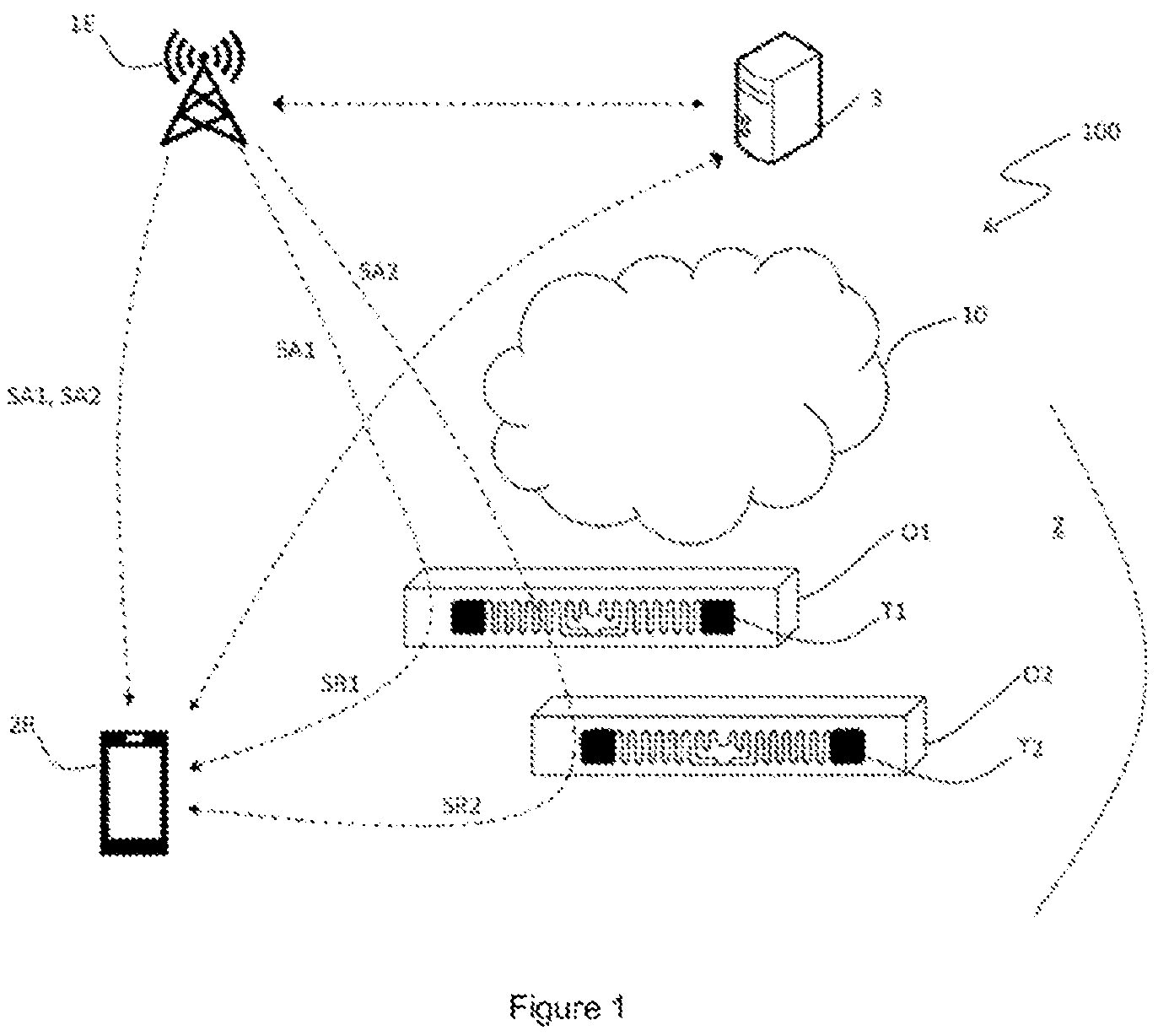
Other particular features and advantages of the invention will become more clearly apparent in the following description. In the appended drawings, which are given by way of non-limiting examples: is a schematic showing a monitoring system according to a first embodiment of the invention; is a schematic showing a monitoring system according to a second embodiment of the invention; a illustrates steps of a monitoring method according to one embodiment of the invention in the form of exchanges between the entities of , b illustrates steps of a monitoring method according to one embodiment of the invention in the form of exchanges between the entities of ; a illustrates a hardware architecture able to implement the monitoring method according to the invention; and b is a functional depiction of a receiving device according to one embodiment of the invention.
DETAILED DESCRIPTION
OF ILLUSTRATIVE EMBODIMENTS The invention is applicable to systems for monitoring objects, particularly with a view to detecting proximity between objects that must not be close to one another. As will be described in detail below, the monitoring system according to the invention uses ambient backscatter or backscatter of ambient signals emitted by an emitter device that emits radio-frequency signals. shows a monitoring system 100 according to a first embodiment of the invention. In this embodiment, the system comprises an emitter device 1 E configured to emit a radio-frequency signal, called the “ambient signal”. In one embodiment, the emitter device 1 E is network equipment, such as a base station allowing communication between a terminal 2 R and a mobile telephone network 10 , such as a 4G or 5G network. In other words, the radio-frequency signal or ambient signal is a telephone signal, for example a 4G or 5G signal. The base station (or emitter device) 1 E is configured to emit signals to the terminal 2 R and to receive signals from the terminal 2 R. It will be noted that the radio-frequency signal may be different, for example a 2G, 3G, 5G or 5G mobile telephone signal, a Wi-Fi signal, a Bluetooth signal or any other type of radio-frequency signal. Thus, according to other embodiments, the emitter device 1 E may be different. By way of completely non-limiting example, it may be integrated into a residential gateway intended to connect an access network to a packet-switched network, such as the Internet. The gateway may communicate with the terminal according to wireless communication standards such as Wi-Fi or Bluetooth standards, inter alia. The terminal 2 R may be a smartphone, a tablet, a personal computer or any other communicating object. The terminal 2 R is a receiver device 2 R configured to receive ambient signals. The terminal 2 R may be mobile in a geographic region Z or fixed. It will be noted that the emitter device 1 E and the receiver device 2 R may take different forms. Specifically, the base station and terminal are non-limiting examples. In the described embodiment, the base station 1 E emits an ambient signal that may be a communication or signaling signal. It will be noted that in the description of this embodiment, the emitter device and the base station are equivalent and have been designated by the same reference 1 E. Likewise, the receiver device and the terminal are equivalent in this embodiment and have been designated by the same reference 1 R. In the embodiment of , two objects O 1 , O 2 are present in the geographical region Z. Each object O 1 , O 2 comprises a backscatter tag T 1 , T 2 configured to backscatter ambient signals emitted by the emitter device 1 E (here the base station 1 E) to the receiver device 2 R (here the terminal 2 R). The geographical region Z corresponds to the geographical region in which the terminal 2 R is located, or in other words the region surrounding the terminal 2 R. This region Z may for example be a storage space in a closed or open environment. By way of illustration, the storage space Z may be a space located in a hangar, a building, on a tract of land, etc. In particular, the geographical region Z corresponds to a geographical region around the terminal 2 R in which the terminal 2 R is able to detect objects, and in particular the backscatter tags T 1 , T 2 . A backscatter tag (and therefore the object bearing it) is considered to have been detected by the receiver device 2 R when it receives an ambient signal backscattered by the backscatter tag, of a predefined power. In other words, an ambient signal SR 1 , SR 2 backscattered by a backscatter tag T 1 , T 2 is considered to have been received (and therefore the backscatter tag T 1 , T 2 detected) when the power of the backscattered ambient signal SR 1 , SR 2 on its receipt by the receiver device 2 R is equal to or greater than a detection threshold value. Below this detection threshold value, the backscattered ambient signal SR 1 , SR 2 is considered not to have been received by the receiver device 2 R, and, consequently, the backscatter tag T 1 , T 2 is not detected. Thus, the geographical region Z around the terminal 2 R corresponds to a geographical region in which the power of the received backscattered ambient signals SR 1 , SR 2 has a value equal to or greater than the predefined value. It will be noted that, for a given type of backscatter tag and reception module in the receiver device, the geographical region Z is spatially limited by this detection threshold value. It will further be noted that those skilled in the art have the necessary knowledge to determine the geographical region Z for a given type of backscatter tag and reception module. The number of objects bearing backscatter tags T 1 , T 2 may be different. Furthermore, other terminals could be present in the geographical region Z and implement the invention. The objects O 1 , O 2 are objects to be monitored by the monitoring system 100 . In particular, the monitoring system 100 is configured to verify whether the presence of the objects O 1 , O 2 in the geographical region Z is desired or undesired. In this geographical region Z, the presence of certain objects O 1 , O 2 is desired, i.e. their presence is permitted or authorized, for example for their storage. In contrast, the presence of other objects O 1 , O 2 is undesired, i.e. their presence, for example for their storage, in the geographical region Z is not permitted. According to embodiments, the presence of the object is not permitted on account of the geographical region Z. For example, it may be desired for all the objects stored in a geographical region to be of the same type. Thus, the presence of an object of a different type would not be desired. According to other embodiments, simultaneous presence of two objects in a geographical region may not be desired. It may be a question of objects proximity of which is to be avoided, for example chemical substances that must be kept away from each other as placing them in contact or in proximity could be dangerous. The emitter device 1 E and the receiver device 2 R are configured to communicate with a monitoring server 3 via the communication network 10 . This monitoring server 3 may be a processing unit centrally managing monitoring of objects. a illustrates steps of the monitoring method according to a first embodiment of the invention, in the form of exchanges between the entities described with reference to . In this embodiment, the monitoring method uses downlink communications between the base station (emitter device) 1 E and the terminal (receiver device) 2 R. According to one embodiment, the steps of the monitoring method are implemented by the receiver device or terminal 2 R. As described above, the emitter device or base station 1 E is configured to emit ambient signals SA 1 , SA 2 . Each backscatter tag T 1 , T 2 is configured to re-emit the ambient signals SA 1 , SA 2 to the receiver device or terminal 2 R. These re-emitted ambient signals SA 1 , SA 2 are called backscattered signals SR 1 , SR 2 . In a , two ambient signals SA 1 , SA 2 and two backscattered signals SR 1 , SR 2 have been shown. A first tag T 1 re-emits a first ambient signal S 1 , i.e. backscatters a first backscattered signal SR 1 , and a second tag T 2 re-emits a second ambient signal S 2 , i.e. backscatters a second backscattered signal SR 2 . These two ambient signals SA 1 , SA 2 are for example emitted at different times. Of course, the two tags T 1 , T 2 may re-emit the same ambient signal SA 1 , SA 2 . The receiver device or terminal 2 R is configured to receive the backscattered signals SR 1 , SR 2 . In the embodiment shown, the terminal 2 R receives E 1 the first backscattered signal SR 1 originating from the first object O 1 , and in particular from the first tag T 1 . The first backscattered signal SR 1 comprises a message, this message containing an identification datum Id 1 relating to the first object O 1 . According to embodiments, the identification datum Id 1 relating to the first object O 1 may be an identification datum uniquely identifying the object, or one portion of the object O 1 . For example, the object may be a container and the identification datum relating to the object a datum identifying its content. By way of example, the identification datum corresponds to a sequence of alphanumeric characters. Thus, the receiver device or terminal 2 R receiving the first backscattered signal SR 1 detects the first object O 1 . In other words, the terminal 2 R is aware of the presence of the first object O 1 in the geographical region Z. In one embodiment, the terminal 2 R obtains the identification datum relating to the first object O 1 and stores it in a list listing the objects present in the geographical region Z. In an embodiment such as the one shown in a , the terminal 2 R emits E 2 to the monitoring server 3 , the identification datum Id 1 relating to the first object O 1 , i.e. the identification datum Id 1 contained in the first backscattered signal SR 1 . Once the receiver device or terminal 2 R has detected the first object O 1 , it implements the determination E 3 of a desired presence or of an undesired presence of the first object O 1 in the geographical region Z. In other words, the terminal 2 R determines E 3 whether the presence of the first object O 1 is authorized or whether the presence of the first object O 1 is not authorized. The determination E 3 is implemented depending on the identification datum Id 1 relating to the first object O 1 . In one embodiment, the determination E 3 of the desired or undesired presence is implemented by verifying E 31 whether the identification datum is present in a list L of identification data of objects. According to one embodiment, this list L of identification data of objects is stored beforehand in the terminal 2 R. The list L of identification data may also be stored in the monitoring server 3 . In the embodiment shown, the terminal 2 R implements the verification E 31 of the presence of the identification datum Id 1 in the list L of identification data. In other embodiments (not shown), this verification is implemented by the monitoring server 3 . According to embodiments, the list L of identification data may take different forms. According to one embodiment, a first list L 1 of identification data lists identification data relating to objects the presence of which in the geographical region Z is undesired. Thus, in practice, in this embodiment, a consultation is carried out to see whether the identification data Id 1 relating to the first object O 1 are found in the list L 1 of identification data. If the result of the consultation E 31 is negative, i.e. if the identification datum Id 1 is not found in the list L 1 of identification data, the first object O 1 is identified as being of desired presence. Thus, it is determined that the presence of the first object O 1 is desired. In contrast, if the result of the consultation E 31 is positive, i.e. if the identification datum Id 1 is found in the list L 1 of identification data, the first object O 1 is identified E 32 as being of undesired presence. Thus, it is determined that the presence of the first object O 1 is not desired. According to another embodiment, a second list L 2 of identification data lists identification data relating to objects the presence of which in the geographical region Z is desired. In this embodiment, if during the consultation E 31 of the list L 2 of identification data the result is negative, i.e. if the identification datum Id 1 is not found in the list L 2 of identification data, the first object O 1 is identified as being of undesired presence. Thus, it is determined that the presence of the first object O 1 is not desired. In contrast, if the result of the consultation E 31 is positive, i.e. if the identification datum Id 1 is found in the list L 2 of identification data, the first object O 1 is identified E 32 as being of desired presence. In other words, it is determined that the presence of the first object O 1 is desired. When it is determined that the presence of the first object O 1 is undesired, the terminal 2 R generates E 4 an alert message intended to warn of the undesired presence of the first object O 1 in the geographical region Z. In one embodiment, the alert message ALT is rendered on the terminal 2 R to warn a user of the terminal 2 R of the undesired presence of the first object O 1 . In other embodiments, the alert message ALT may be addressed to other terminals and/or to the monitoring server in order to be rendered thereby. When it is determined E 3 that the presence of the first object O 1 is desired, an information message MESS may be generated and then rendered on the terminal and/or addressed to other terminals and/or to the monitoring server, to be rendered thereby. According to embodiments (not shown), at least one among the determination E 3 (verification E 31 and identification E 32 ), the generation E 4 and the rendition E 5 may be implemented by the monitoring server 3 . In one embodiment, the verification of the presence of the identification datum in the list L 1 , L 2 of identification data may be implemented in the monitoring server 3 . The result of this verification may be addressed to the terminal 2 , so that the identification E 32 of the first object may be implemented in the terminal 2 , or the identification E 32 of the first object may also be implemented by the monitoring server 3 . Next, the monitoring server 3 may itself implement the generation E 4 of the alert message or of the information message and its rendition E 5 , and/or address it to the terminal 2 R (and/or to other terminals) for rendition. According to one embodiment (not shown), the alert message ALT or the information message MESS may be addressed to the emitter device 1 E. When, as illustrated by a , the terminal 2 detects a second object O 2 present in the geographical region Z, i.e. when it receives E 2 a second backscattered signal SR 2 originating from the second object O 2 , it determines E 3 whether the presence of the second object is desired or undesired in the geographical region Z. The backscattered signal comprises a message containing an identification datum Id 2 relating to the second object O 2 . According to one embodiment, the terminal 2 R (and/or the monitoring server 3 ) implements the steps E 1 -E 5 described above regarding detection of the first object O 1 in a similar way for the second object O 2 . It will be noted that in the described embodiment, the first object O 1 is considered to be detected at a first time, this object being the only object detected at this first time, and the second object is considered to be detected at a later time. In this embodiment, the presence of these objects in the geographical region Z is concomitant. In other embodiments, the first object and the second object may be detected simultaneously. In this embodiment, in which more than one object is detected, the determination of the desired or undesired presence of the objects O 1 , O 2 in the geographical region Z, may be conditional upon concomitant presence of the objects in the geographical region Z. In other words, simultaneous presence of the objects in the geographical region possibly being incompatible, this incompatibility is taken into account in the determination of the desired or undesired presence of the objects O 1 , O 2 . In the embodiment described below, the verification of the presence of identification data in the list L, L 1 , L 2 of identification data is implemented for the first object O 1 and for the second object O 2 . As indicated below, according to embodiments, the list L of identification data used may be a list L 1 of identification data relating to objects of undesired presence in the geographical region Z or the list L 2 of identification data relating to objects of desired presence in the geographical region Z. In another embodiment, a third list L 3 of identification data may comprise identification data relating to objects the proximity of which to one another is undesired. In this embodiment, the verification of the presence of the identification data Id 1 , Id 2 of the first object O 1 and of the second object O 2 respectively comprises consultation of this list of identification data. In this embodiment, if during the verification E 31 in the list, the two objects O 1 , O 2 are found in the list L 3 of identification data, these objects O 1 , O 2 must not be placed in proximity to one another. Thus, they are identified as objects that cannot be placed in proximity to one another. Therefore, it is determined that proximity of these objects is undesired, or in other words that they cannot be present simultaneously in the geographical region Z. If the identification datum Id 1 , Id 2 relating to at least one of two objects O 1 , O 2 is not present in the list L 3 , it is determined that proximity of these objects O 1 , O 2 is possible. In other words, the objects O 1 , O 2 are identified as being able to be placed in proximity. Thus, storage in proximity of these objects is possible. shows a monitoring system 100 ′ according to a second embodiment of the invention. The equipment of the monitoring system of this embodiment is similar to the equipment of the monitoring system of . In this embodiment, the emitter device 2 E configured to emit an ambient signal is a terminal 2 E and the receiver device 1 R configured to detect backscattered signals is a base station 1 R. The monitoring system according to this embodiment uses uplink communications between the terminal 2 E and the base station 1 R. Just as for the first embodiment, the emitter device 2 E is a smartphone, but may be a tablet, a personal computer or any other communicating object. The terminal may be mobile in a geographical region Z or fixed. The receiver device 1 R may be another network equipment such as a residential gateway intended to connect an access network to a packet-switched network, such as the Internet. The gateway may communicate with the terminal according to wireless communication standards such as Wi-Fi or Bluetooth standards, inter alia. As for , the emitter device 2 E and the receiver device 1 R may take different forms. Specifically, the base station and terminal are non-limiting examples. Since this equipment is equivalent to that of the monitoring system of , it will not be described in detail here. In the described embodiment, the terminal 2 E emits an ambient signal, which may be a communication or signaling signal, to the base station 1 R. In the embodiment of , two objects O 1 , O 2 are present in the geographical region Z. Each object O 1 , O 2 comprises a backscatter tag T 1 , T 2 configured to backscatter the ambient signal SA 1 , SA 2 emitted by the emitter device 1 (here the terminal) to the receiver device 2 (here the base station 2 R). The geographical region Z corresponds to the geographical region in which the terminal 2 E is located, or in other words the region surrounding the terminal 2 E. As mentioned with reference to , the number of objects bearing backscatter tags T 1 , T 2 may be different. Furthermore, other terminals could be present in the geographical region Z and implement the invention. The objects O 1 , O 2 are similar to those described with reference to . b illustrates steps of the monitoring method according to a second embodiment of the invention, in the form of exchanges between the entities described with reference to . In this embodiment, the monitoring method uses uplink communications between the terminal (emitter device) 2 E and the base station (receiver device) 1 R. In this embodiment, the monitoring method is implemented by the base station 1 E. In this embodiment, two backscattered signals SR 1 , SR 2 are received by the base station 1 R. Once the two objects O 1 , O 2 have been detected, in this embodiment, the determination E 3 of the desired or undesired presence of the objects O 1 , O 2 is implemented by verifying the presence of the identification data Id 1 , Id 2 respectively relating to the objects O 1 , O 2 , in the third list L 3 of identification data. Of course, as indicated below, according to embodiments, the list L of identification data used may be a list L 1 of identification data relating to objects of undesired presence in the geographical region Z or the list L 2 of identification data relating to objects of desired presence in the geographical region Z. In this embodiment, if during the verification E 31 in the list, the two objects O 1 , O 2 are found in the list L 3 of identification data, these objects O 1 , O 2 must not be placed in proximity to one another. Thus, they are identified E 32 as objects that cannot be placed in proximity to one another. Therefore, it is determined that proximity of these objects is undesired, or in other words that they cannot be present simultaneously in the geographical region Z. Next, the base station 1 R generates E 4 an alert message ALT intended to warn of the undesired presence of the first object O 1 in the geographical region Z. In one embodiment, the alert message ALT is rendered on the base station 1 R, and may also be addressed to the terminal 2 E to warn a user of the terminal 2 E of the undesired presence of the first object O 1 . In other embodiments, the alert message ALT may be addressed to other terminals and/or to the monitoring server in order to be rendered thereby. If the identification datum Id 1 , Id 2 relating to at least one of two objects O 1 , O 2 is not present in the list L 3 of identification data, it is determined that proximity of these objects O 1 , O 2 is possible. In other words, the objects O 1 , O 2 are identified as being able to be placed in proximity. Thus, storage in proximity of these objects is possible. In this case, as for the embodiment of a , an information message MESS may be generated and addressed to the terminal 2 E and to the monitoring server 3 . a schematically illustrates a hardware architecture of a receiver device able to implement the monitoring method according to the invention. According to embodiments, the receiver device 2 may be a terminal ( ) or a base station ( ) or another network equipment. The receiver device 2 R, 1 R comprises a communication bus 200 to which are connected: a processing unit 201 , called CPU in the figure (CPU standing for Central Processing Unit), possibly comprising one or more processors; a non-volatile memory 202 , for example a read-only memory (ROM), an electrically erasable programmable read-only memory (EEPROM) or a flash memory; a random-access memory 203 or RAM; an input/output interface 204 , called I/O in the figure, for example keys or buttons, a screen, a keypad, a mouse or another pointing device such as a touchscreen or a remote controller allowing a user to interact with a receiver device 2 R, 1 R via a graphical interface or a human-machine interface; and communication interfaces 205 , called COM in the figure, suitable for exchanging data for example with the emitter device, with objects O 1 , O 2 bearing backscatter tags T 1 , T 2 or with a monitoring server via a communication network 10 . The random-access memory 203 contains registers suitable for storing variables and parameters that are created and modified during the execution of a computer program comprising instructions for implementing the monitoring method according to the invention. The instruction codes of the program stored in the non-volatile memory 202 are loaded into the memory RAM 203 in order to be executed by the processing unit CPU 201 . The non-volatile memory 202 is for example a rewritable EEPROM memory or flash memory able to form a medium within the meaning of the invention, i.e. able to comprise a computer program comprising instructions for implementing the monitoring method according to the invention. The rewritable memory may contain lists listing the objects present in a geographical region and/or lists of identification data used to implement the invention. A plurality of lists of identification data may be stored. According to embodiments, a list may be a list of identification data relating to objects the presence of which in the geographical region is desired, a list of identification data relating to objects the presence of which in the geographical region is undesired, or a list of identification data relating to objects the proximity of which to each other is undesired. This program defines, by way of its instructions, functional modules of the receiver device 2 R, 1 R that are implemented by and/or control the hardware elements described above. b is a functional representation of a receiver device 2 R, 1 R according to one embodiment. These modules especially comprise: a reception module 31 configured to receive backscattered signals respectively originating from objects comprising tags backscattering ambient signals, the backscattered signals respectively comprising identification data relating to said objects; and a determination module 32 configured to determine, depending on the received identification data relating to said objects, a desired presence or an undesired presence of said objects in a geographical region or an undesired proximity of at least two objects. According to embodiments, the determination module, which is used to determine desired or undesired presence, comprises a verification module 321 configured to verify the presence of the identification datum in a list L 1 ; L 2 ; L 3 of identification data; and an identification module 322 configured to identify the object as being of desired presence or undesired presence depending on the result of the verification. Furthermore, according to embodiments, the receiver device 2 R, 1 R comprises: a transmission module 33 configured to transmit, to a monitoring server, the identification datum contained in the first backscattered signal, and the identification datum contained in the second backscattered signal; and a generation module 34 configured to generate an alert message ALT intended to warn of the undesired presence of the first object in said geographical region or of the undesired proximity of the first and second objects. The aforementioned modules and means are controlled by the processor of the processing unit 301 . They may take the form of a program able to be executed by a processor, or a hardware form, such as an application-specific integrated circuit (ASIC), a system on chip (SoC), or a programmable logic circuit-type electronic component, such as an FPGA (for “field-programmable gate array”) component. The emitter device 1 E, 2 E also comprises a communication bus to which are connected a processing unit or microprocessor, a non-volatile memory, a random-access memory or RAM, and a communication interface suitable especially for exchanging data with the receiver device. Thus, by virtue of the invention, an object located by mistake in a geographical region, or a dangerous situation due to proximity of two objects, may be avoided without deploying expensive monitoring systems and consuming large amounts of power. Specifically, the system according to the invention, since it uses backscatter of ambient signals, does not consume large amounts of power. Furthermore, the monitoring system according to the invention uses equipment already present in networks and only requires backscatter tags by way of additional equipment. Since these backscatter tags are not expensive, implementation of the monitoring system according to the invention does not engender large expenses. Although the present disclosure has been described with reference to one or more examples, workers skilled in the art will recognize that changes may be made in form and detail without departing from the scope of the disclosure and/or the appended claims.
Figures (5)
Citations
This patent cites (3)
- US2012/0293307
- US2019/0317206
- US2022/0076550