Check Cover Assemblies for Backflow Prevention Assemblies with Integrated Test Cock Protection Shroud
Abstract
A check cover assembly for a backflow prevention assembly having a body defining an interior housing a test cock. The check cover assembly includes a ball with a central aperture and a complementary groove in an outer circumference of the ball as well as a base including a shroud portion housing the ball to create a ball valve. The shroud portion defines an access gap for accessing an actuation feature slot with a landkey of the ball valve and a threaded opening. A coupling is attached to the threaded opening in fluid communication with the interior for connecting to testing equipment. The actuation feature is used to open and close the ball valve.
Claims (3)
1 . A check cover assembly for a backflow prevention (“BFP”) assembly having a bucket defining an interior for containing a check valve assembly, the check cover assembly comprising: a ball with a central aperture and a groove in an outer circumference of the ball; a base for closing the bucket of the BFP and including: a shroud portion within the base and housing the ball to create a ball valve, the shroud portion defining an access gap; an actuation feature with a protrusion mounted in the access gap so that the protrusion engages the groove to open and close the ball valve; and an opening; and a test cock coupling attached to the opening and in fluid communication with an interior of the bucket of the BFP assembly, the test cock coupling securing the ball within the shroud portion and configured to connect to testing equipment, wherein: when the ball valve is open, the testing equipment is in communication with the interior of the bucket, when the ball valve is closed, the testing equipment is not in communication with the interior of the bucket and may be removed, the ball valve comprises a lower seal piece and an upper seal piece that sandwich the ball in the shroud portion to prevent leaking, the lower and upper seal pieces are o-rings configured to create seals against the ball, the shroud portion, and the base, the check cover assembly forms a hollow to create a socket, and further comprising a spring bias assembly having a first ball end in the socket to form a ball-and-socket joint and allow rotational movement of the ball end of the spring bias assembly, wherein the spring bias assembly is configured to extend to a second end that urges a sealing disc towards a closed position on an opening of the BFP assembly, and the base is dome-shaped, and the base and the shroud portion are unitarily formed from a composite polymer.
Show 2 dependent claims
2 . The check cover assembly as recited in claim 1 , wherein the actuating feature further comprises a stem inserted into the access gap of the shroud portion to couple to the groove of the ball for rotating the central aperture of the ball between open and closed positions, wherein a distal end of the stem forms the protrusion to engage the groove.
3 . The check cover assembly as recited in claim 1 , wherein the base forms a passageway from an inner area into the BFP assembly configured so that when the ball valve is open, a pressure reading of a pressure zone in the BFP assembly can be taken via connecting the test equipment to the test cock coupling.
Full Description
Show full text →
CROSS-REFERENCE
This application claims priority to U.S. patent application Ser. No. 17/400,686, filed on Aug. 12, 2021, which claims priority to U.S. Provisional Patent Application No. 63/066,411, filed Aug. 17, 2020, which is incorporated herein by reference. FIELD OF THE DISCLOSURE The subject disclosure relates to backflow prevention assemblies, and more particularly to backflow prevention assemblies having test cocks that are integrated and/or protected by a shroud.
BACKGROUND
In many water systems, backflow prevention (BFP) assemblies allow fluid and even solids to flow only in a desired, i.e., a forward, direction. As backsiphonage or backflow can present contamination and health problems, the backflow prevention valves and assemblies prevent flow in an undesired direction, i.e., a backward or reverse direction. BFP assemblies are installed in buildings, such as residential homes, and commercial buildings and factories, to protect public water supplies by preventing the reverse flow of water from the buildings back into the public water supply. Owing to the fact that BFP assemblies are important for water safety, BFP units are tested annually, often per government regulations, to assure proper operating conditions. Specifically, fluid pressure measurements are taken at specified locations in the BFP unit. If it is determined that a check valve, test cock or other component needs to be repaired or replaced, the inlet and outlet shutoff valves have to be closed, the faulty part analyzed and replaced. Then, the BFP assembly can be retested, the shutoff valves opened and the apparatus confirmed to be operating per any required ordinances and/or standards. The process is time-consuming and the steps have to be performed in the correct sequence and manner in order to not contaminate the public water supply, inadvertently flood an area, and return the BFP) assembly to working order. In order to save testing time, BFP assemblies typically have one or more test cocks, which may couple to a test fixture.
SUMMARY
The test cocks of BFP assemblies usually extend upward for easy access and use. Preferably, a check cover assembly in accordance with the subject technology provides support and/or protection. The check cover assembly may reinforce and/or shield the test cock. In many embodiments, the test cock can easily be installed or removed from the check cover for quick repair and replacement. The subject technology is directed to a check cover assembly for a backflow prevention (BFP) assembly including a base with an upstanding shroud. The shroud forms an inner area configured to receive a test cock to support and protect the test cock. Preferably, the base is dome-shaped and fabricated of a composite polymer. The shroud can form a gap for accessing the test cock to selectively open and close the test cock while installed in the inner area. The base may form a passageway from the inner area into the BFP assembly configured so that when the test cock is open, a pressure reading of a pressure zone in the BFP assembly can be taken via the test cock. In one embodiment, a banking surface in the inner area compliments a banking surface of the test cock to further stabilize the test cock. The check cover assembly can also include a retention fork in a slit formed in the shroud so that the test cock is captured in the inner area but the test cock can be removed from and inserted into the inner area without rotation when the retention fork is removed from the slit. The retention fork has two flat tines with a gap there between, the gap and the tines being sized to snugly fit into a groove of the test cock. Preferably, the base forms a hollow to create a socket portion of a ball-and-socket joint formed between the check cover assembly and a check valve assembly in the BFP assembly. In another embodiment, the base forms a passageway from the inner area that aligns with a lumen formed in a check valve assembly in the BFP assembly, the lumen being in fluid communication with a pressure zone within the BFP assembly so that when the test cock is open, a pressure reading of the pressure zone can be taken via the test cock. The check cover assembly can further include a second upstanding shroud on the base, wherein the second shroud forms an inner area configured to receive a second test cock to support and protect the test cock while allowing opening of the second test cock in place to allow pressure testing of a zone upstream from a check valve assembly coupled to the check cover. The test cock may be a ball valve and integrated into the shroud so that the shroud forms at least a portion of a housing surrounding a ball of the test cock. The subject technology is also directed to a protective assembly for a test cock on a valve assembly including an upstanding shroud. The shroud forms an inner area configured to receive a test cock to support and protect the test cock. The shroud may also form a gap for accessing the test cock to selectively open and close the test cock while installed in the inner area. The shroud forms a slit for a retention fork so that the test cock is selectively captured in the inner area but the test cock can be removed from and inserted into the inner area without rotation when the retention fork is removed from the slit. Another embodiment of the subject technology is directed to a BFP assembly comprising a check cover including a base with an upstanding shroud. The shroud forms an inner area configured to receive a test cock to support and protect the test cock. The shroud forms a void for accessing the test cock to selectively open the test cock while installed in the inner area for pressure testing a first zone in the BFP assembly. The BFP assembly may also include a second upstanding shroud on the base, wherein the second shroud forms an inner area configured to receive a second test cock to support and protect the second test cock while allowing selectively opening of the second test cock in place to allow pressure testing of a second zone in the BFP assembly. Each test cock is preferably a ball valve and integrated into the respective shroud so that the respective shroud forms at least a portion of a housing surrounding a ball of the test cock.
BRIEF DESCRIPTION OF THE DRAWINGS
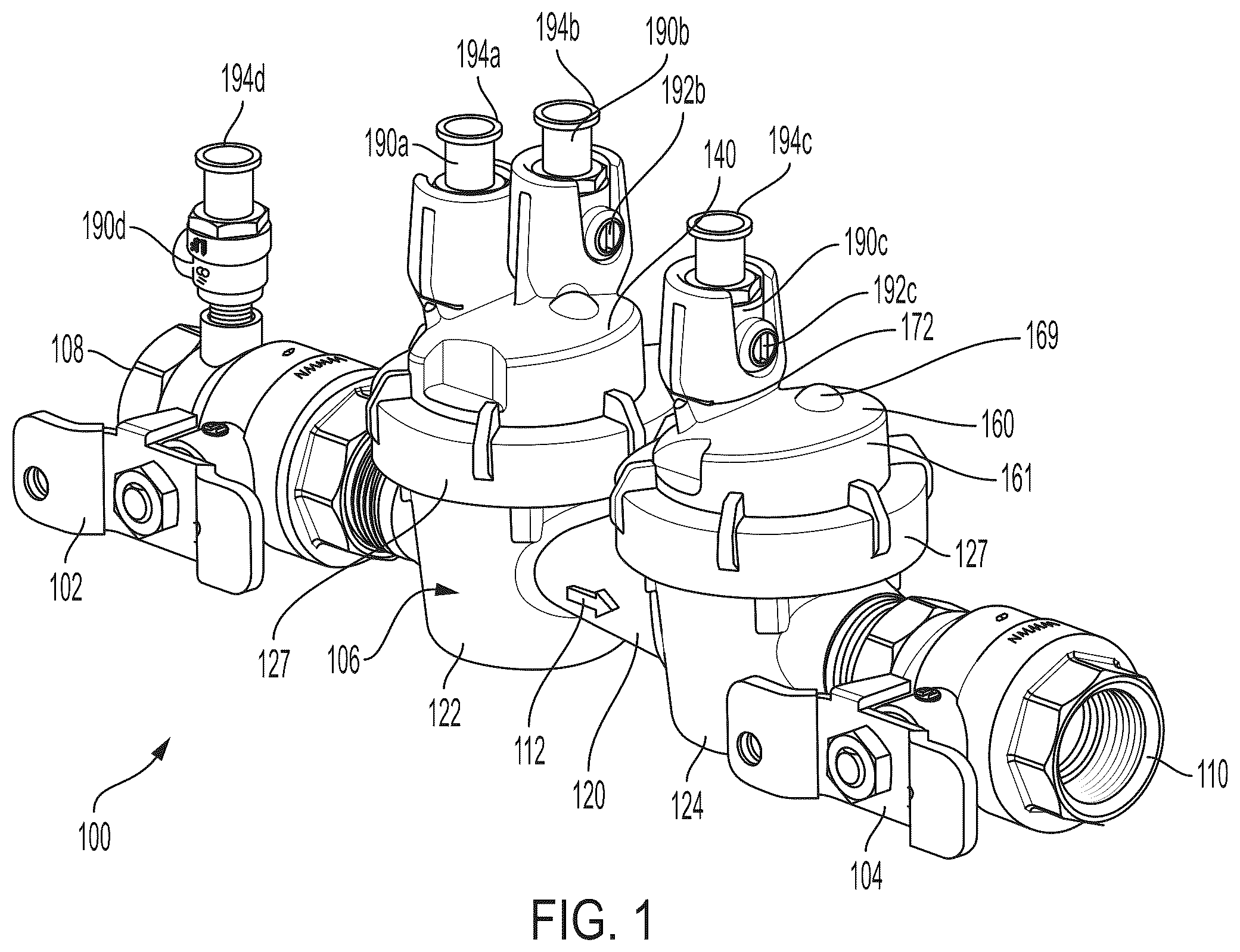
Various aspects of the present disclosure are discussed herein with reference to the accompanying Figures. It will be appreciated that for simplicity and clarity of illustration, elements shown in the drawings have not necessarily been drawn accurately or to scale. For example, the dimensions of some of the elements can be exaggerated relative to other elements for clarity or several physical components can be included in one functional block or element. Further, where considered appropriate, reference numerals can be repeated among the drawings to indicate corresponding or analogous elements. For purposes of clarity, however, not every component can be labeled in every drawing. The Figures are provided for the purposes of illustration and explanation and are not intended as a definition of the limits of the disclosure. is a perspective view of a backflow prevention BFP assembly with a check cover assembly having a protective shroud for each test cock in accordance with the present disclosure. is a top view of the BFP assembly of . is a cross-sectional view of the BFP assembly of . A is an exploded perspective view of a check cover assembly in accordance with the present disclosure. B is another exploded perspective view of the check cover assembly of A . is a perspective view of another check cover assembly with an integral test cock in accordance with the present disclosure. is an exploded view of the check cover assembly of . is a cross-sectional view of the check cover assembly of . is a cross-sectional view of a backflow prevention assembly with check cover assemblies having integral test cocks in accordance with the present disclosure.
DETAILED DESCRIPTION
The subject technology overcomes many of the prior art problems associated with backflow prevention assemblies. The advantages, and other features of the technology disclosed herein, will become more readily apparent to those having ordinary skill in the art from the following detailed description of certain exemplary embodiments taken in combination with the drawings and wherein like reference numerals identify similar structural elements. It should be noted that directional indications such as vertical, horizontal, upward, downward, right, left and the like, are used with respect to the figures and not meant in a limiting manner. Referring now to , shown are perspective and top views of a backflow prevention (BFP) assembly 100 in accordance with an aspect of the present disclosure. The BFP assembly 100 may be installed in a fluid system, e.g., a water supply for a building. The BFP assembly 100 includes an inlet shutoff valve 102 and an outlet shutoff valve 104 . In one embodiment, the shutoff valves 102 , 104 are one inch full port ball valves. A backflow prevention valve assembly 100 extends between the shutoff valves 102 , 104 . Many different configurations of BFP assemblies are possible. In normal operation, the BFP assembly 100 operates to carry fluid in only a forward direction as shown by indicia arrow 112 , e.g., left to right in , from an inlet 108 to an outlet 110 . The BFP assembly 100 operates to prevent flow in a backward direction, i.e., a direction from right to left in . The BFP assembly 100 includes a body 120 forming an upstream bucket 122 and a downstream bucket 124 . Each bucket 122 , 124 is enclosed by a check cover assembly 140 , 160 . The downstream test cover 140 includes two test cocks 190 a , 190 b for sensing pressure within the BFP assembly 100 . The upstream check cover assembly 160 includes a single test cock 190 c but the check cover assemblies 140 , 160 are otherwise very similar. Preferably, the check cover assemblies 140 , 160 are fabricated from a composite polymer. The inlet shutoff valve 102 also includes a test cock 190 d. Referring now to , a cross-sectional view of the BFP assembly 100 is shown. Each bucket 122 , 124 defines an interior 123 , 125 for containing a check valve assembly 130 a , 130 b . The check valve assemblies 130 a , 130 b are preassembled and inserted into the interiors 123 , 125 . Each check valve assembly 130 a , 130 b includes a frame 132 a , 132 b with a lower check seat 133 a , 133 b , which is selectively closed by a hinged disc holder assembly 134 a , 134 b . A spring bias assembly 135 a , 135 b urges the disc holder assembly 134 a , 134 b into the closed position. In the closed position, a sealing disc 137 a , 137 b carried by the disc holder 134 a , 134 b closes a valve opening 139 a , 139 b formed by the check seat 133 a . 133 b. If the pressure upstream of the check valve assemblies 130 a , 130 b exceeds the force of the spring bias assemblies 135 a , 135 b , the check valve assemblies 130 a , 130 b will open to allow forward flow. If not, one or both of the spring bias assemblies 135 a , 135 b will keep the BFP assembly 100 closed. The check valve assemblies 130 a , 130 b form three zones 121 a - c within the BFP assembly 100 . The upstream zone 121 a extends to the valve opening 139 a . The intermediate zone 121 b extends between the valve openings 139 a , 139 b . The downstream zone 121 c extends from the valve opening 139 b. The spring retainer assemblies 135 a , 135 b extend against the respective check cover assembly 140 , 160 . The check cover assemblies 140 , 160 form hollows 149 , 169 to create a somewhat ball-and-socket joint to allow rotational movement of the spring bias assemblies 135 a , 135 b . The check cover assemblies 140 , 160 enclose the interiors 123 , 125 and are secured in place by a cover nut 127 . O-rings 129 insure a proper seal. Referring additionally to A and 4 B , exploded perspective views of the check cover assembly 160 are shown. The check cover assembly 160 is a dome-shaped base 161 with an upstanding cup-shaped shroud 162 . The shroud 162 forms a protected inner area 164 that receives the test cock 190 c . Similarly, the check cover assembly 140 also has a dome-shaped base 161 . The base 161 and the shroud 162 may be unitarily formed. In another embodiment, the shroud 162 is formed separately and attached, such as by threads, to the base 161 . The shroud 162 forms a U-shaped peripheral gap 165 . It is envisioned that the gap 165 may be any size or shape void (e.g., a hole, a slot and the like) that allows access to the test cock 190 e and/or easy removal. The test cock 190 c is preferably an elongated ball valve with a slot 192 c for actuating the test cock 190 c between the open position (shown) and the closed position. The shroud 162 and gap 165 are sized and configured so that the slot 192 c is flush to avoid inadvertent actuation or damage of the test cock 190 c . The test cock 190 c has a central housing body 191 c connected to an upper coupling 194 c that receives a fixture to take a pressure reading of the downstream zone 121 c . In another embodiment, the shroud 162 extends up to or even past the upper coupling 194 and may flare out to facilitate coupling to a test fixture. A lower coupling 193 c couples to the check cover assembly 160 as described in more detail below. A passage 195 c extends through the test cock 190 c . To close the test cock 190 c (e.g., block the passage 195 c ), a flat screwdriver can be inserted into the slot 192 c to rotate the slot 192 c approximately ninety degrees (e.g., a horizontal position). The lower coupling 193 c carries an o-ring 196 c to seal against the check cover assembly 160 . The shroud 162 also forms a gap 165 for accessing the test cock slot 192 c when installed. The test cock 190 c fits snugly in the inner area 164 so the shroud 162 provides support and protection. The check cover assembly 160 forms a passageway 167 from the inner area 164 to the downstream zone 121 c . Thus, when the test cock lower coupling 193 c is inserted into the check cover passageway 167 and the test cock 190 c is open, a pressure reading of the downstream zone 121 c can be taken. The test cock o-ring 196 c seals in the passageway 167 . A banking surface 168 in the inner area 164 compliments a banking surface 198 c of the test cock 190 c to further stabilize the test cock 190 c. In addition to the above, a retention fork 170 inserts through a slit 172 (best seen in ) in the check cover assembly 160 to capture the test cock 190 c in the inner area 164 . The fork 170 has two flat tines 174 with a gap 176 between the tines 174 . The gap 176 and tines 174 are sized to snugly fit into the test cock groove 197 c . Thus, the test cock 190 c can be inserted into the inner area 164 and, without rotation, the fork 170 is inserted into the slit 172 to capture the test cock 190 c in place. The fork 170 has a hand grip end 178 that extends out of the slit 172 for easy manual removal of the test cock 190 c when desired. In another embodiment, a set screw, a permanent clip, cotter pin or the like is used to retain the test cock in place. In one embodiment, once the test cock is installed, the locking feature is permanent so that tampering is prevented among other benefits. Referring again to , there are two shrouds 142 a , 142 b on the check cover assembly 140 . As shown, the shrouds 142 a , 142 b share a partial sidewall 143 but could also be completely separate. Although not distinctly shown, each shroud 142 a , 142 b has similar basic structure and function to the shroud 160 discussed above. The shroud 142 b is very similar in that the shroud 142 b protects and supports the test cock 190 b utilized to test the pressure after the respective check valve assembly 130 in the intermediate zone 121 b . However, for the test cock 190 a to access the upstream zone 121 a , the check valve assembly 130 a forms a vertical lumen 138 aligned with the passage 147 a. As can be seen, the shrouds 142 a , 142 b , 162 support and protect the respective test cocks 190 a - c , yet by simply inserting or removing the fork 170 , the test cocks 190 a - c can be quickly and easily fixed in place or removed without rotational movement thereof. Further, the shrouds 142 a , 142 b , 162 provide ample access to open and close the test cocks 190 a - c while in place. In another embodiment, the ball valve includes a shroud and fork as discussed herein to support and protect the test cock. In another embodiment, the shroud has slots to reduce the material required for fabrication. In still another embodiment, the test cock is a smart test cock that may include sensors, wireless transmission electronics and the like, wherein the shroud is configured to provide protected space for the smart test cock. Referring now to , a perspective view of another check cover assembly 260 is shown. As will be appreciated by those of ordinary skill in the pertinent art, the check cover assembly 260 utilizes similar principles to the check cover assembly 160 described above. Accordingly, like reference numerals in the “200” series are used to indicate like elements. The primary difference of the check cover assembly 260 is that a test cock 280 is integral with the base 261 and shroud 262 , which reduces the number of components. Referring now to , an exploded view of the check cover assembly 260 is shown. The base 261 and shroud 262 still form an inner protected area 264 but the protected area 264 serves to form the housing body for the test cock 280 . The test cock 280 has a lower seal piece 282 a and an upper seal piece 282 b that sandwich a ball 284 . The seal pieces 282 a , 282 b may carry o-rings (not distinctly shown) and the like for creating a seal against the ball 284 , base 261 and shroud 262 . Each seal piece 282 a , 282 b has a central aperture 288 a , 288 b that supports the ball 284 for rotational movement. The ball 284 has a central aperture 285 through which fluid may flow when oriented in the open position. Stems 286 are inserted into access gaps 265 of the shroud 262 to couple to the ball 284 for rotating the ball 284 between the open and closed positions. A distal end 289 of the stem forms a landkey to engage a complimentary groove (not shown) in the outer circumference of the ball 284 . Slots 287 in the stems 286 make it easy to use a screwdriver to adjust the test cock 280 between open and closed. A coupling 290 fixes the ball 284 and pieces 282 a , 282 b in the protected area 264 . The coupling 290 has an upper end 291 configured to engage a test fixture (not shown). A lower end 292 of the coupling is threaded to engage inner threads 274 of the shroud 262 . A middle portion 293 is hexagonal shaped to allow tightening the coupling 290 into the base 261 with a wrench (not shown). The coupling 290 forms a passage 294 sized and oriented to align with the ball's central aperture 285 in the open position. Referring now to , a cross-sectional view of the check cover assembly 260 is shown. The shroud 262 has a bottom inner shoulder 271 that forms a central passage 273 . When assembled, the ball 284 and pieces 282 a , 282 b are compressed between the shoulder 271 and coupling 290 . In the open position, the ball 284 is rotated so that the passage 294 , central holes 288 a , 288 b , central aperture 285 and passage 273 are all aligned so that the zone under the check cover assembly 260 may be tested. Referring now to , a cross-sectional view of a BFP assembly 300 with check cover assemblies 340 , 360 having integral test cocks 380 a - c in accordance with the present disclosure are shown. The BFP assembly 300 is similar to that shown above so that similar components are labeled in the 30 ) series when possible and not described again for brevity. Check cover assembly 360 is similar to check cover assembly 260 described above. The test cock 380 c of the check cover assembly 360 is shown in the open position so that the downstream zone 321 c can be tested. The endpieces 382 a , 382 b are shown in more detail in that the endpieces 382 a , 382 b carry two o-rings 383 . Each base 341 , 361 forms a hollow 349 , 369 to create a socket portion of a ball-and-socket joint formed between the check cover assembly 340 , 360 and a spring bias assembly 335 a , 335 b of check valve assemblies 330 a , 330 b in the BFP assembly 100 . As can be seen, two test cocks 380 a , 380 b are integrated into the check cover assembly 340 . Thus, the upstream zone 321 a and the intermediate zone 321 b can both be checked. Similar to BFP assembly 100 , the shrouds 342 a , 342 b share a common sidewall 363 but still form the housing for the test cocks 380 a , 380 b , respectively. The central passage 373 a of the shoulder 371 a of the shroud 342 a aligns with the lumen 338 for testing the upstream zone 321 a . By having the test cocks 380 a - c integrated in the cover assemblies 340 , 360 , fast and easy repairs can be accomplished by simply swapping in a new test cover assembly 340 , 360 . The test cock 380 c is similar integrated into the check cover assembly 360 . It is also envisioned that a variety of different components or features may be incorporated into the test cover assemblies shown herein. For example, instead of or in addition to test cocks, the test cover assemblies may include a pressure sensor, a pressure switch, a temperature switch, a flow sensor and like combination devices. For example, one pressure and temperature switch is available from Grundfos Holding A/S of Bjerringbro, Denmark as model number 105RPS. Such components may be installed and protected by a shroud or more fully integrated into the test cover assembly for protection as shown herein. The test covers and shrouds can take different shapes to match the component(s) as needed The subject technology provides ample support and protection for test cocks while maintaining full functionality and access to the different zones of a backflow prevention assembly. Being able to simply utilize a retaining feature like a fork (or equivalent embodiment such as a set screw, cotter pin or the like) to retain the test cock in place to quickly remove or replace a test cock without rotation makes for faster and easier repairs. By having test cocks integrated into the check cover assembly, the number of components is advantageously reduced. Further, the test cock components are well supported and protected by integration. If desired, the retaining mechanism may be made in such a manner to be non-end user serviceable, as to comply with local ordinance requirements. In such a situation or for an expedited repair, the check cover assembly can simply be replaced quickly if necessary. As can be seen, the subject disclosure provides many improvements to BFP assemblies. Further, the subject technology can be adapted to any kind of valve. It will be appreciated by those of ordinary skill in the pertinent art that the functions of several elements can, in alternative embodiments, be carried out by fewer elements, or a single element. Similarly, in some embodiments, any functional element can perform fewer, or different, operations than those described with respect to the illustrated embodiment. Also, functional elements (e.g., check valves, valve elements, O-rings, thread, spring retention assemblies, and the like) shown as distinct for purposes of illustration can be incorporated within other functional elements in a particular implementation. While the subject technology has been described with respect to various embodiments, those skilled in the art will readily appreciate that various changes and/or modifications can be made to the subject technology without departing from the scope of the present disclosure.
Figures (8)
Citations
This patent cites (157)
- US213394
- US623418
- US953940
- US2310586
- US2514374
- US2533097
- US2827921
- US3173439
- US3189037
- US3429291
- US3570537
- US3837357
- US3837358
- US3859619
- US3896850
- US3905382
- US3906987
- US3996962
- US4014284
- US4244392
- US4276897
- US4284097
- US4416211
- US4452272
- US4453561
- US4489746
- US4523476
- US4618824
- US4667697
- US4694859
- US4776365
- US4777979
- US4878515
- US4920802
- US4945940
- US5008841
- US5024469
- US5072753
- US5125429
- US5236009
- US5246203
- US5299718
- US5316264
- US5404905
- US5425393
- US5520367
- US5551473
- US5566704
- US5584315
- US5586571
- US5669405
- US5709240
- US5711341
- US5713240
- US5735307
- US5794655
- US5901735
- US5918623
- US5950653
- US5992441
- US6021805
- US6123095
- US6155291
- US6170510
- US6196246
- US6220839
- US6343618
- US6349736
- US6374849
- US6378550
- US6443184
- US6471249
- US6513543
- US6546946
- US6581626
- US6659126
- US6675110
- US7114418
- US7434593
- US7506395
- US7784483
- US7934515
- US8997772
- US9091360
- US9546475
- US9995605
- US10132425
- USD876585
- US10561874
- USD886236
- US10719904
- USD908191
- US10883893
- US10914412
- US10962143
- USD917013
- USD919048
- USD919049
- USD928916
- USD941426
- USD957587
- USD958937
- US11449082
- US2002/0043282
- US2002/0078801
- US2003/0000577
- US2003/0168105
- US2004/0045604
- US2004/0107993
- US2005/0092364
- US2005/0199291
- US2006/0076062
- US2006/0185731
- US2006/0196542
- US2007/0181191
- US2007/0193633
- US2007/0204916
- US2007/0204917
- US2007/0240765
- US2008/0145739
- US2008/0289567
- US2009/0136935
- US2009/0194719
- US2011/0067225
- US2011/0309076
- US2012/0248759
- US2013/0026743
- US2013/0051482
- US2013/0255452
- US2014/0109986
- US2015/0260310
- US2016/0238157
- US2017/0023141
- US2017/0234441
- US2018/0156488
- US2019/0043157
- US2019/0136935
- US2019/0162341
- US2019/0271428
- US2019/0281371
- US2019/0323618
- US2020/0141612
- US2021/0172157
- US2021/0230850
- US2022/0049487
- US2022/0049786
- US2022/0412474
- US2023/0228067
- US110081212
- US1925477
- US8525261
- US202014102568
- US3832183
- US2002213629
- US2019009698
- US2003060459
- US2020023584