Translation Enhancing Nucleic Acid Compounds: ASO Coupled Translation-upregulation 1 (ACT-UP1) and Uses Thereof
Abstract
Disclosed herein are methods and compounds for enhancing gene expression by ACT-UP1 compounds. Such methods and compounds are useful for increasing expression of certain genes, many of which are associated with a variety of diseases and disorders.
Claims (21)
1 . A compound comprising an oligonucleotide for enhancing expression of JAG1 in a cell or salt thereof, wherein the oligonucleotide comprises at least a 20 nucleobase portion of the sequence of SEQ ID NO: 111, or a sequence thereof which differs up to 2 positions of SEQ ID NO: 111, wherein the compound further comprises a conjugate.
3 . A compound comprising an oligonucleotide for enhancing expression of JAG1 in a cell or salt thereof, wherein the oligonucleotide comprises at least a 20 nucleobase portion of the sequence of SEQ ID NO: 111, or a sequence thereof which differs up to 2 positions of SEQ ID NO: 111, wherein the compound comprises at least one chemical modification.
5 . A compound comprising an oligonucleotide for enhancing expression of JAG1 in a cell or salt thereof, wherein the oligonucleotide comprises at least a 20 nucleobase portion of the sequence of SEQ ID NO: 111, or a sequence thereof which differs up to 2 positions of SEQ ID NO: 111, wherein the compound is fully chemically modified.
7 . A compound comprising an oligonucleotide for enhancing expression of JAG1 in a cell or salt thereof, wherein the oligonucleotide comprises at least a 20 nucleobase portion of the sequence of SEQ ID NO: 111, or a sequence thereof which differs up to 2 positions of SEQ ID NO: 111, wherein the compound comprises at least one modified internucleoside linkage.
Show 17 dependent claims
2 . The compound of claim 1 , wherein the conjugate is an N-Acetyl galactosamine (GalNAc) moiety.
4 . The compound of claim 3 , wherein the at least one chemical modification can be selected from 2′-O-methyl (2′-OMe), 2′-O-(2-methoxyethyl) (2′-MOE), 2′-fluoro (2′-F), constrained ethyl (cEt), unlocked nucleic acid (UNA), locked nucleic acid (LNA), 2′-MOE modified T, and/or 5-methylcytosine base.
6 . The compound of claim 5 , wherein the chemical modifications can be selected from 2′-O-methyl (2′-OMe), 2′-O-(2-methoxyethyl) (2′-MOE), 2′-fluoro (2′-F), constrained ethyl (cEt), unlocked nucleic acid (UNA), locked nucleic acid (LNA), 2′-MOE modified T, and/or 5-methylcytosine base.
8 . The compound of claim 7 , wherein the at least one modified internucleoside linkage is a phosphorothioate (PS) internucleoside linkage.
9 . A method for enhancing JAG1 expression in a cell, comprising administering to the cell the compound of claim 1, 3, 5 or 7 in an amount sufficient to enhance expression of JAG1, thereby enhancing expression of JAG1 in the cell.
10 . The method of claim 9 , wherein expression of JAG1 in a cell is increased by at least about 10%, 15%, 20%, 25%, 30%, 35%, 40%, 45%, 50%, 55%, 60%, 65%, 70%, 75%, 80%, 85%, 90%, 95%, 100%, 150%, 200%, 250%, or 300%.
11 . A pharmaceutical composition for enhancing the expression of JAG1 comprising the compound of claim 1 , or salt thereof, alone or in combination with a pharmaceutically acceptable carrier and/or excipient.
12 . A kit comprising the pharmaceutical composition of claim 11 , and a label.
13 . The compound of claim 3 , e for enhancing expression of JAG1 in a cell, wherein the compound comprises the sequence and chemistry of ATXL316 (SEQ ID NO: 36) as shown in the chemical structure:
14 . A pharmaceutical composition for enhancing the expression of JAG1 comprising the compound of claim 13 , or a salt thereof, alone or in combination with a pharmaceutically acceptable carrier and/or excipient.
15 . A kit comprising the pharmaceutical composition of claim 14 , and a label.
16 . A pharmaceutical composition for enhancing the expression of JAG1 comprising the compound of claim 3 , or salt thereof, alone or in combination with a pharmaceutically acceptable carrier and/or excipient.
17 . A pharmaceutical composition for enhancing the expression of JAG1 comprising the compound of claim 5 , or salt thereof, alone or in combination with a pharmaceutically acceptable carrier and/or excipient.
18 . A pharmaceutical composition for enhancing the expression of JAG1 comprising the compound of claim 7 , or salt thereof, alone or in combination with a pharmaceutically acceptable carrier and/or excipient.
19 . A kit comprising the pharmaceutical composition of claim 16 , and a label.
20 . A kit comprising the pharmaceutical composition of claim 17 , and a label.
21 . A kit comprising the pharmaceutical composition of claim 18 , and a label.
Full Description
Show full text →
CROSS-REFERENCE TO RELATED APPLICATIONS
This subject application claims priority under 35 U.S.C. § 111(A) to PCT Application No. PCT/US25/13612 filed Jan. 29, 2025, which application claims the benefit of U.S. Provisional Applications Nos. 63/626,347, filed Jan. 29, 2024; 63/558,080, filed Feb. 26, 2024; 63/677,274, Jul. 30, 2024; and 63/727,989, filed Dec. 4, 2024, the contents of which are incorporated herein in their entireties by this reference. INCORPORATION BY REFERENCE OF MATERIAL SUBMITTED ELECTRONICALLY Incorporated by reference in its entirety is a computer-readable nucleotide/amino acid sequence listing submitted concurrently herewith and identified as follows: the text file named “2025_01_29_Seq_List_Act_Up” _(1236 KB), which was created on Jan. 28, 2025. Throughout this application various publications are referenced. All publications, gene transcript identifiers, patents, and patent applications mentioned in this specification are herein incorporated by reference to the same extent as if each individual publication, gene transcript identifiers, patent, or patent application was specifically and individually indicated to be incorporated by reference. FIELD Certain embodiments are directed to compounds for enhancing gene expression and methods of using the compounds. Such methods and compounds are useful for increasing expression of certain genes, many of which are associated with a variety of diseases and disorders.
BACKGROUND
Many diseases are caused by insufficient levels of functional proteins that normally perform important biological roles in ensuring cellular activities. Protein deficiency has many causes, including, for example, by mutations in the corresponding protein encoding genes, down-regulation of gene expression by altered upstream proteins or processes, and other reasons, Increasing the levels of the under-expressed, disease-related proteins can be a desired approach to treat diseases. Various approaches have been assessed to restore the expression of proteins through different mechanisms. These approaches include, but, are not limited to: delivery of DNA/mRNA molecules using virus or LNPs to introduce wild type protein expressing DNA or RNA (Samulski, R. J., and N. Muzyczka, 2014 AAV-Mediated Gene Therapy for Research and Therapeutic Purposes. Annu Rev Virol 1: 427-451; Wang, J., et al., 2023a Engineered mRNA Delivery Systems for Biomedical Applications. Adv Mater: e2308029); enhancing transcription using small activation RNAs (saRNA) or oligonucleotides by targeting the promoter regions (Li, L. C., 2017, Small RNA-Guided Transcriptional Gene Activation (RNAa) in Mammalian Cells. Adv Exp Med Biol 983: 1-20; Watts, J. K., et al., 2010, Effect of chemical modifications on modulation of gene expression by duplex antigene RNAs that are complementary to non-coding transcripts at gene promoters. Nucleic Acids Res 38: 5242-5259); modulating pre-mRNA splicing to generate more stable mRNA isoforms which in turn express more proteins (Sergeeva, O. V., E. Y. Shcherbinina, N. Shomron and T. S. Zatsepin, 2022, Modulation of RNA Splicing by Oligonucleotides: Mechanisms of Action and Therapeutic Implications. Nucleic Acid Ther 32: 123-138); increasing mRNA stability using oligonucleotides or small molecules that inhibit mRNA degradation through the non-sense mediated decay (NMD) pathway (Nomakuchi, T. T., F. Rigo, I. Aznarez and A. R. Krainer, 2016 Antisense oligonucleotide-directed inhibition of nonsense-mediated mRNA decay. Nat Biotechnol 34: 164-166); inhibiting miRNA function to de-repress gene expression using antisense oligonucleotides (ASOs) targeting either miRNA itself (anti-miRs) or targeting miRNA-binding sites in the mRNA sequences (Samad, A. F. A., and M. F. Kamaroddin, 2023 Innovative approaches in transforming microRNAs into therapeutic tools. Wiley Interdiscip Rev RNA 14: e1768); antisense oligonucleotides (ASOs) targeting inhibitory elements in the 5′ UTR of mRNA, such as uORFs or TIEs to enhance translation (U.S. Pat. No. 10,822,369; Liang et al., Antisense Oligonucleotides Targeting Translation Inhibitory Elements in 5′UTRs Can Selectively Increase Protein Levels, Nucleic Acids Res, 2017, 45(16): 9528-9546; Liang et al., Translation Efficiency of mRNAs is Increased by Antisense Oligonucleotides Targeting Upstream Open Reading Frames, Nature Biotechnology, 2016, 34(8):875-880); and, enhancing translation using a chimeric oligonucleotide compound coupling a guide RNA (gRNA) with an internal ribosome entry site (IRES) (US Publication US20230090706). Additional examples of methodologies to upregulate gene expression have been described by Li et al., (Targeting 3′ and 5′ Untranslated Regions with Antisense Oligonucleotides to Stabilize Frataxin mRNA and Increase Protein Expression, Nucleic Acids Res, 2021, 49(20):11560-11574); Torkzaban et al. (Development of a Tethered mRNA Amplifier to Increase Protein Expression, Biotechnol. J., 2022 October, 17(10):e2200214); U.S. Pat. Nos. 5,916,808; 9,018,368; 5,916,808; 9,297,008; US Publication US20110046200; US Publication US20220204978; US Publication US20190275170; and US Publication US20220127621. Upregulation of protein expression is an area of therapeutic interest for the treatment of disease and several companies are developing nucleic acid-based therapeutics to increase expression of protein. For example, Sarepta Therapeutics is using a phosphorodiamidate morpholino oligomer (PMO) to facilitate exon skipping to treat diseases such as Duchenne Muscular Dystrophy (eteplirsen) (US Publication US20190275072). Ionis developed nusinersen which modulates alternative splicing to increase protein expression (U.S. Pat. No. 10,436,802). Stoke Therapeutics is developing antisense oligonucleotides (ASOs) to increase protein levels in haploinsufficient patients by affecting intron retention by splicing to increase protein expression (U.S. Pat. No. 11,096,956). These approaches described above have specific advantages and may be applicable in certain situations. However, each approach has its own challenges that limit their application. For example, efficient and safe delivery of large molecules including mRNAs or DNAs into cells and nuclei remain challenging (Wang, Y. S., et al., 2023b mRNA-based vaccines and therapeutics: an in-depth survey of current and upcoming clinical applications. J Biomed Sci 30: 84). ASOs targeting miRNAs to enhance a particular gene expression may not be specific to a desired target since each miRNA may modulate the expression of hundreds of genes (Chen, P. Y., and G. Meister, 2005, microRNA-guided posttranscriptional gene regulation. Biol Chem 386: 1205-1218). The approaches of using ASOs targeting other elements, such as 5′ UTR uORFs, TIEs, splice sites, or 3′ UTR miRNA binding sites, require the presence of such elements in the target mRNAs, thus limiting the application of such approaches to the genes that must have such elements. Although significant progress has been made in the field of oligomeric compound technology, there remains a need in the art for new efficient ways to increase protein expression and treat a subject in need thereof, e.g., a subject with deficient protein expression and/or a subject having a disease described herein. Disclosed herein is a novel approach, antisense oligonucleotide (ASO) Coupled Translation-Upregulation 1 (ACT-UP1), that increases protein levels without the need of existing elements in the target mRNAs, therefore, in theory, it can increase the protein levels of any gene.
SUMMARY OF THE INVENTION
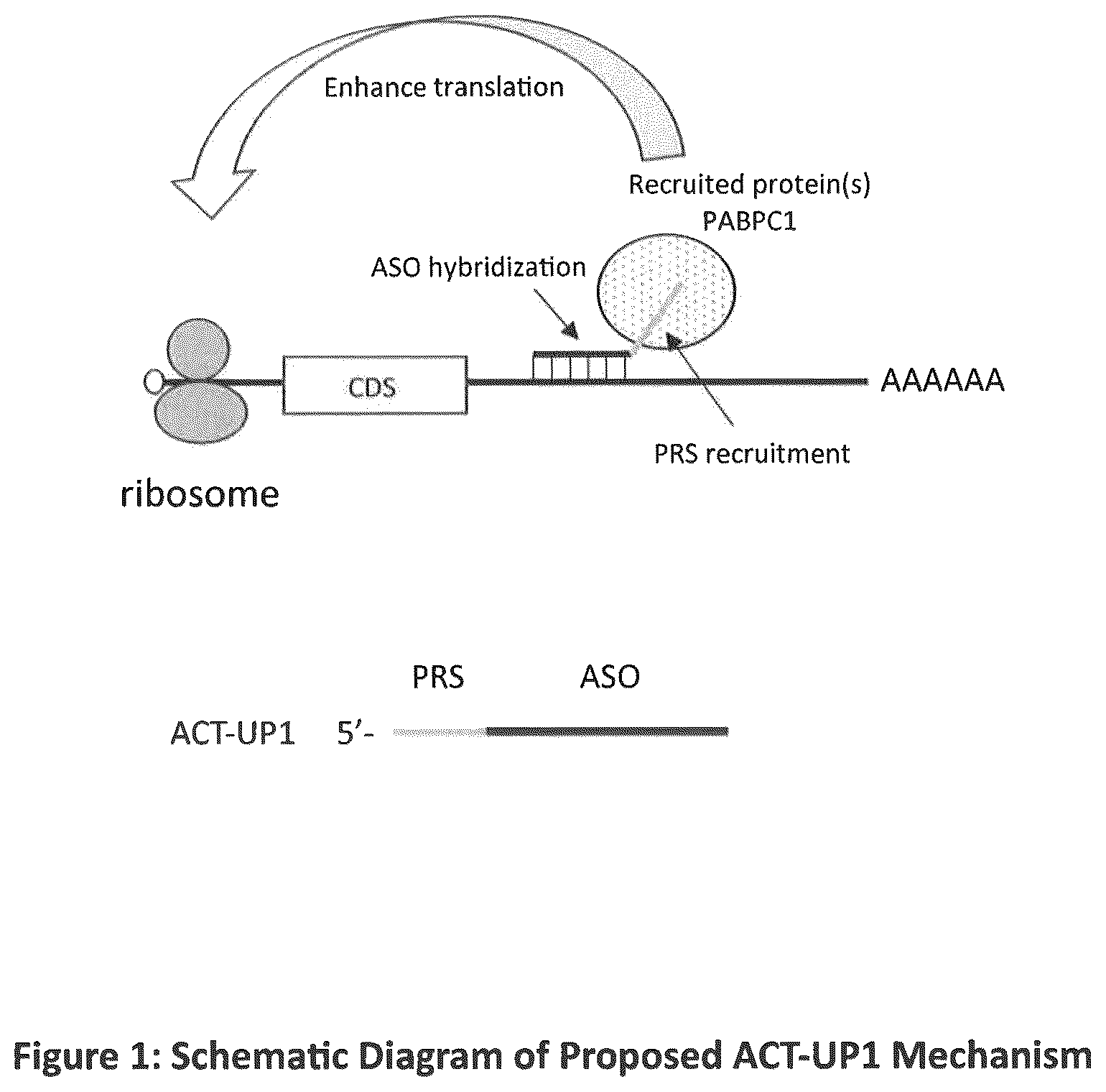
Several embodiments provided herein relate to the discovery of certain modifications to antisense compounds that can enhance their effectiveness in modulating gene expression. In certain embodiments, the antisense compounds enhance gene expression. In certain embodiments, the invention is directed to an antisense compound which is an antisense oligonucleotide (ASO) Coupled Translation-Upregulation 1 (ACT-UP1) compound. The ACT-UP1 compound comprises an ASO component joined to a protein recruiting sequence (PRS) component, wherein the ASO component hybridizes to a target mRNA, the PRS recruits translation related proteins, and wherein the ACT-UP1 compound enhances expression of a target protein. The ACT-UP1 compound may further comprise a conjugate. In accordance with the practice of the invention, the ASO component may be joined to the PRS directly or indirectly. In certain embodiments, an ACT-UP1 compound may be of about 17 to 45 linked nucleosides in length. The ACT-UP1 compound comprises an ASO component of about 12 to 25 linked nucleosides in length joined to a protein recruiting sequence (PRS) component of about 5 to 20 linked nucleosides in length. The ASO component hybridizes to a target mRNA, the PRS recruits translation-related proteins, and wherein the ACT-UP1 compound enhances protein expression. In certain embodiments, an ACT-UP1 compound may be of about 22 to 35 linked nucleosides in length. The ACT-UP1 compound comprises an ASO component 12 to 25 linked nucleosides in length joined to a protein recruiting sequence (PRS) component comprising GGACUGGACU (SEQ ID NO: 11) or AAACUAAACU (SEQ ID NO: 13). The ASO component hybridizes to a target mRNA, the PRS recruits translation-related proteins, and wherein the ACT-UP1 compound enhances protein expression. In further aspects, an ACT-UP1 compound may be anywhere from about 17 to 45 linked nucleosides in length, the ASO is about 12 to 25 linked nucleosides in length and the PRS is about to 20 linked nucleosides in length; includes at least one modified sugar, such as a bicyclic sugar, a 2′-O-(2-methoxyethyl) group, a 2′-O-methyl group, and/or a 4′-CH(CH 3 )—O-2′ (cEt) group; includes at least one modified internucleoside linkage, such as a phosphorothioate internucleoside linkage; and/or includes at least one modified nucleobase, such as a 5-methylcytidine. Certain embodiments provide kits and methods of using the compounds disclosed herein and processes to manufacture the compounds. BRIEF DESCRIPTION OF TIE DRAWINGS : A schematic diagram that shows a potential ACT-UP1 mechanism. The ACT-UP1 compound comprises an antisense oligonucleotide (ASO) joined to a protein recruiting sequence (PRS). The ASO specifically hybridizes to a target mRNA sequence, bringing the PRS into close proximity to the target mRNA. The PRS, a short sequence of linked nucleosides, recruits translation related proteins, e.g., PABPC1, close to the target mRNA thereby increasing translation of the targeted mRNA. : A Western Blot that shows Jagged 1 protein levels after HeLa cell transfection with ACT-UP1 compounds comprising different PRSs, namely, ATXL193, ATXL261 and ATXL228. The ACT-UP1 compounds with PRS enhance Jagged 1 protein expression. : A Western Blot that shows Jagged 1 protein levels after HeLa cell transfection with ACT-UP1 compounds. The data show that a PRS positioned 5′ to the ASO in an ACT-UP1 compound is more effective at increasing protein levels than a PRS positioned 3′ to the ASO in an ACT-UP1 compound. : A Western Blot that shows Jagged 1 protein levels after HeLa cell transfection with ACT-UP1 compounds. The data show that ASO binding positions on the target mRNA affect the ability of the ACT-UP1 compounds to increase protein expression. To certain degree, the closer the binding position to the transcript's stop codon, the more protein expressed. : A Western Blot that shows Jagged 1 protein levels after HeLa cell transfection with ACT-UP1 compounds containing different amounts of phosphorothioate (PS) linkages. : A Western Blot that shows Jagged 1 protein levels in a Western Blot after HEK293 cell transfection with an ACT-UP1 compound. The data shows that the ACT-UP1 compound can increase protein expression in cell lines other than HeLa. : A Western Blot that shows RAB9 protein levels after HeLa cell transfection with an ACT-UP1 compound. The data shows that the ACT-UP1 compound can increase protein expression of gene transcripts other than Jagged 1. : A Western Blot that shows RNase H1 protein levels after HeLa cell transfection with an ACT-UP1 compound. The data shows that the ACT-UP1 compound can increase protein expression of gene transcripts other than Jagged 1. : A Western Blot that shows PBGD protein levels after HeLa cell transfection with an ACT-UP1 compound. The data shows that the ACT-UP compound can increase protein expression of gene transcripts other than Jagged 1. A-C : A) A Western Blot that shows PBGD protein levels after murine Hepa1-6 cell transfection with ACT-UP1 compounds; and, B) a bar graph summarizing the PBGD protein levels; and, C) a bar graph summarizing mRNA levels in murine Hepa1-6 cells transfected with different PBGD ACT-UP1 compounds. The data indicate that ACT-UP1 compounds increase PBGD protein levels, but, do not increase PBGD mRNA levels significantly. : A Western Blot that shows FGF21 protein levels after Hep3B cell transfection with an ACT-UP1 compound. The data indicates that the ACT-UP1 compound can increase protein expression of other gene transcripts besides Jagged 1 and in cells other than HeLa. A-C : A) Western Blot that shows FGF21 protein levels after murine Hepa1-6 cell transfection with ACT-UP1 compounds; B) a bar graph summarizing the FGF21 protein levels; and, C) a bar graph summarizing mRNA levels in murine Hepa1-6 cells transfected with different FGF21 ACT-UP1 compounds. The data indicates that ACT-UP1 compounds increase FGF21 protein levels, but, do not increase FGF21 mRNA levels. A-C : A) A schematic of the ACT-UP1 affinity selection assay, B) and C) Western Blots showing that translation related proteins were recruited by ACT-UP1 compounds. : A Western Blot that shows Jagged 1 protein levels after HeLa cell transfection with ACT-UP1 compounds containing different PRS components. : Western Blots that show Jagged 1 protein levels after in vivo treatment of mice with ACT-UP1 compounds. A-B : A) Western Blot that shows HNF4A protein levels after human Hep3B cell transfection with ACT-UP1 compounds; and, B) a bar graph summarizing the HNF4A protein levels. The data indicates that human HNF4A protein is increased using different ACT-UP1 compounds in Hep3B cells. A-B : A) Western blot that shows Jagged 1 protein levels after in vivo treatment of mice with ACT-UP1 compounds with or without GalNAc conjugate; and, B) Western blot that shows Jagged 1 protein levels after in vivo treatment of mice with ACT-UP1 compounds with (ATXL282) or without (ATXL283) GalNAc conjugate. : Western blot that shows Jagged 1 protein levels four weeks after in vivo treatment of mice with an ACT-UP1 compound. : Western blot that shows Jagged 1 protein levels after in vivo treatment of Jag1 +/− mice with ACT-UP1 compounds. : Western blot that shows Jagged 1 protein levels in mice at 2- and 3-weeks After dosing with ACT-UP1 compounds. A-B : Bar graphs with qRT-PCR results that show the FGF21 mRNA levels in Hep3B cells treated with different ACT-UP1 compounds for 20 hr (Panel A) or 40 hr (Panel B). : A bar graph with ELISA results that show the plasma FGF21 protein levels in mice treated with different ACT-UP1 compounds. A-B : A) A Western Blot that shows JAG1 protein levels in GM11091 cells after transfection with ATXL316 ASO at 24 hr; and, B) a bar graph summarizing the JAG1 protein levels from the Western Blot with JAG1 protein normalized to Tubulin protein. The data indicates that ATXL316 increased JAG1 protein in patient GM11091 cells at 24 hrs. A-B : A) Western Blot that shows JAG1 protein levels in HeLa cells after transfection with 10 nM ATXL316, followed by 100 μg/ml CHX treatment at different times as indicated above the lanes; and, B) a graph plotting the JAG1 protein levels from the Western Blot with and JAG1 protein levels normalized to a CHX-insensitive protein detected by Hsp90 antibody. The data indicates ATXL316 ASO does not affect JAG1 protein stability. A-C : A) A table listing sequence, chemistry, and PRSs of ACT-UP1 compounds targeting JAG1, B) A Western Blot that shows JAG1 protein levels in HeLa cells after transfection with the ACT-UP1 compounds; and, C) a bar graph summarizing the JAG1 protein levels from the Western Blot with JAG1 protein normalized to a non-specific protein. The data indicates ACT-UP1 compounds with different PRSs can increase protein levels at 24 hrs. : A bar graph showing that different dual functional ASOs can increase FGF21 mRNA levels in human Hep3b cells. A-B : Western Blot analysis of FGF21 protein levels in human HepG2 cells after transfection with different ASOs at different concentrations. The data indicates that different dual functional ACT-UP1 compounds can increase FGF21 protein levels in human HepG2 cells. A-B : A) A Western Blot of HNF4A protein levels in human primary hepatocytes (HPH) treated with ACT-UP1 compounds by free uptake; and, B) a bar graph summarizing the HNF4A protein levels from the Western Blot with HNF4A protein normalized to GAPDH protein. The data indicates that ACT-UP1 compounds can increase protein levels at 66 hrs. : Western Blot analysis of HNF4A protein levels in murine Hepa1-6 cells after transfection with an ASO at different concentrations. The data indicates that the ACT-UP1 compound increased HNF4A protein in Hepa1-6 mouse cells within a broad dose range. A-B : A) Western Blots of HNF4A protein levels in mouse liver after treatment with ACT-UP1 compounds; and, B) bar graphs summarizing the HNF4A protein levels from the Western Blots with HNF4A protein normalized to Hsp90 protein. The data indicates that ACT-UP1 compounds can increase HNF4A protein levels in vivo.
DETAILED DESCRIPTION
OF THE INVENTION It is to be understood that both the foregoing general description and the following detailed description are exemplary and explanatory only and are not restrictive of the invention, as claimed. Herein, the use of the singular includes the plural unless specifically stated otherwise. As used herein, the use of “or” means “and/or” unless stated otherwise. Furthermore, the use of the term “including” as well as other forms, such as “includes” and “included”, is not limiting. Also, terms such as “element” or “component” encompass both elements and components comprising one unit and elements and components that comprise more than one subunit, unless specifically stated otherwise. The section headings used herein are for organizational purposes only and are not to be construed as limiting the subject matter described. All documents, or portions of documents, cited in this application, including, but not limited to, patents, patent applications, articles, books, and treatises, are hereby expressly incorporated-by-reference for the portions of the document discussed herein, as well as in their entirety. Definitions Unless specific definitions are provided, the nomenclature utilized in connection with, and the procedures and techniques of, analytical chemistry, synthetic organic chemistry, and medicinal and pharmaceutical chemistry described herein are well known and commonly used in the art. Standard techniques may be used for chemical synthesis, and chemical analysis. Where permitted, all patents, applications, published applications and other publications, GENBANK Accession Numbers and associated sequence information obtainable through databases such as National Center for Biotechnology Information (NCBI) and other data referred to throughout in the disclosure herein are incorporated-by-reference for the portions of the document discussed herein, as well as in their entirety. Unless otherwise indicated, the following terms have the following meanings: “2′-O-(2-methoxyethyl)” (also 2′-MOE and 2′-O(CH 2 ) 2 —OCH 3 ) refers to an 2-methoxyethyl modification at the 2′ position at the 0 of a furanose ring. A 2′-O-(2-methoxyethyl) modified sugar is a modified sugar. “2′-MOE nucleoside” (also 2′-O-(2-methoxyethyl) nucleoside) means a nucleoside comprising a 2′-MOE modified sugar moiety. “2′-MOE nucleotide” (also 2′-O-(2-methoxyethyl) nucleotide) means a nucleotide comprising a 2′-MOE modified sugar moiety. “2′-O-methyl” (also 2′-OCH 3 and 2′-OMe) refers to an methyl modification at the 2′ position at the 0 of a furanose ring. A 2′-O-methyl modified sugar is a modified sugar. “2′-OMe nucleoside” (also 2′-O-methyl nucleoside) means a nucleoside comprising a 2′-OMe modified sugar moiety. “2′-OMe nucleotide” (also 2′-O-methyl nucleotide) means a nucleotide comprising a 2′-OMe modified sugar moiety. “2′-substituted nucleoside” means a nucleoside comprising a substituent, i.e., a modification, at the 2′-position of the furanosyl ring other than H or OH. In certain embodiments, 2′ substituted nucleosides include nucleosides with a fluoro (2′-F), O-methyl (2′-OMe), O-(2-methoxyethyl) (2′-MOE) or bicyclic sugar modifications. A 2′-substituted nucleoside is a modified nucleoside. “3′ target site” refers to the nucleotide of a target nucleic acid which is complementary to the 3′-most nucleotide of a particular antisense compound. “5′ target site” refers to the nucleotide of a target nucleic acid which is complementary to the 5′-most nucleotide of a particular antisense compound. “5-methylcytosine” means a cytosine modified with a methyl group attached to the 5 position. A 5-methylcytosine is a modified nucleobase and is part of a modified nucleoside. “5-methylcytidine” is the name of the nucleoside when the 5 methyl modified nucleobase is combined with a modified or unmodified sugar. “About” as used herein means within ±7% of a measurable value. For example, if it is stated, “the compounds affected at least about 70% inhibition of mRNA”, it is implied that the mRNA levels are inhibited within a range of 63% and 77%. The term “about” as used herein when referring to an amount of a compound or agent of this invention, dose, time, temperature, and the like, is meant to encompass variations of ±10%, ±5%, ±1%, ±0.5%, or even ±0.1% of the specified amount. For sequence identity, “about” as used for percent sequence identity encompasses variations of ±5%. Unless otherwise indicated, all numbers expressing quantities of ingredients, properties such as reaction conditions, and so forth used in the specification and claims are to be understood as being modified in all instances by the term “about.” “Average” as used herein may be mean, mode or medium for a group of measurements. As used herein the singular forms “a”, “and”, and “the” include plural referents unless the context clearly dictates otherwise. Thus, for example, reference to “a cell” includes a plurality of such cells and reference to “the culture” includes reference to one or more cultures and equivalents thereof known to those skilled in the art. “ACT-UP1” or “ASO Coupled Translation-Upregulation 1” refers to an antisense oligonucleotide (ASO) joined to a protein recruiting sequence (PRS). The ASO specifically hybridizes to a target mRNA sequence, bringing the PRS into close proximity to the target mRNA. The PRS, a short sequence of linked nucleosides, attracts translation regulatory proteins close to the target mRNA thereby increasing translation of the targeted mRNA. As used herein, the protein recruiting sequence (PRS), although it comprises a short linkage of nucleosides, is not an antisense oligonucleotide (ASO) as it does not hybridize with a target nucleic acid (i.e., the protein recruiting sequence is not antisense to a target nucleic acid). The ASO can be joined directly to the PRS or they can be joined by a linker. In some preferred aspects the PRS is joined to the 5′ end of the ASO. In some aspects the PRS is joined to the 3′ end of the ASO. Joined=covalently linked; It is to be understood that the ACT-UP1 compound may comprise additional sequences in addition to the ASO and PRS. For example, in some embodiments, the ACT-UP1 comprises an ASO and PRS and a linker for joining the ASO and PRS. “ACT-UP1 activity” means any detectable or measurable activity attributable to the hybridization of an ACT-UP1 compound to its target nucleic acid. In certain embodiments, ACT-UP1 activity is an increase (i.e., up-regulation) in the amount of a target nucleic acid and/or expression of the protein encoded by such target nucleic acid. “ACT-UP1 upregulation” or “ACT-UP1 enhancement” means increasing target protein levels in the presence of an ACT-UP1 compound compared to target protein levels in the absence of the ACT-UP1 compound. “Animal” refers to a human or non-human animal, including, but not limited to, mice, rats, rabbits, dogs, cats, pigs, and non-human primates, including, but not limited to, monkeys and chimpanzees. “Antibody” refers to a molecule characterized by reacting specifically with an antigen in some way, where the antibody and the antigen are each defined in terms of the other. Antibody may refer to a complete antibody molecule or any fragment or region thereof, such as the heavy chain, the light chain, Fab region, and Fe region. “Antisense compound” means an oligomeric compound that is capable of undergoing hybridization to a target nucleic acid through hydrogen bonding. Examples of antisense compounds include single-stranded and double-stranded compounds, such as, antisense oligonucleotides (ASOs), siRNAs, shRNAs, snoRNAs, miRNAs, and satellite repeats. It is to be understood that antisense compounds include ACT-UP1 compounds which comprise an antisense oligonucleotide (ASO) joined to a protein recruiting sequence (PRS). “Antisense oligonucleotide” or “ASO” means a single-stranded oligonucleotide having a nucleobase sequence that permits hybridization to a corresponding region or segment of a target nucleic acid. In certain embodiments, the ASO comprises one or more modified nucleosides. In certain embodiments, the ASO comprises part of an ACT-UP1 compound. As used herein, ASO does not refer to the protein recruiting sequence (PRS) in ACT-UP1 compounds. “Base complementarity” refers to the capacity for the base pairing of nucleobases of an oligonucleotide with corresponding nucleobases in a target nucleic acid (i.e., hybridization), and is mediated by Watson-Crick, Hoogsteen or reversed Hoogsteen hydrogen binding between corresponding nucleobases. Base complementarity also refers to canonical (e.g., A:U, A:T, or C:G) or non-canonical base pairings (e.g., A:G, A:U, G:U, I:U, I:A, or I:C). “Bicyclic sugar” means a furanose ring modified by the bridging of two non-geminal carbon atoms. A bicyclic sugar is a modified sugar. “Cap structure” or “terminal cap moiety” means chemical modifications, which have been incorporated at either terminus of an antisense compound. “cEt” or “constrained ethyl” means a bicyclic sugar moiety comprising a bridge connecting the 4′-carbon and the 2′-carbon, wherein the bridge has the formula: 4′-CH(CH 3 )—O-2′. “Constrained ethyl nucleoside” (also cEt nucleoside) means a nucleoside comprising a bicyclic sugar moiety comprising a 4′-CH(CH 3 )—O-2′ bridge. “Chemical modification” means modification of molecular structure or element from naturally occurred molecules. For example, antisense oligonucleotides are composed of linked deoxyribonucleosides (also sometimes referred to herein as DNA nucleoside), therefore, substitution of a 2′-MOE nucleoside for a DNA nucleoside is considered a chemical modification of the antisense oligonucleotide. Examples of other chemical modification may be found hereinbelow. “Chemically distinct region” refers to a region of an antisense compound that is in some way chemically differcnt than another region of the same antisense compound. For example, a region having 2′-O-(2-methoxyethyl) nucleotides is chemically distinct from a region having nucleotides without 2′-O-(2-methoxyethyl) modifications. “Complementarity” means the capacity for pairing between nucleobases of a first nucleic acid and a second nucleic acid. “Comply” means the adherence with a recommended therapy by an individual. “Comprise,” “comprises” and “comprising” will be understood to imply the inclusion of a stated step or element or group of steps or elements but not the exclusion of any other step or element or group of steps or elements. “Contiguous nucleobases” means nucleobases immediately adjacent to each other. “Deoxyribonucleoside” means a nucleoside having a hydrogen at the 2′ position of the sugar portion of the nucleoside. A deoxyribonucleoside is sometimes referred to as DNA nucleoside, “D” or “d” herein. Deoxyribonucleosides may be modified with any of a variety of substituents and may be connected by covalent linkages other than naturally occurring phosphodiester such as phosphorothioate. “Deoxyribonucleotide” means a nucleotide having a hydrogen at the 2′ position of the sugar portion of the nucleotide. A deoxyribonucleotide is sometimes referred to as DNA nucleotide, “D” or “d” herein. Deoxyribonucleotides may be modified with any of a variety of substituents and may be connected by covalent linkages other than naturally occurring phosphodiester such as phosphorothioate. “Derivative” of a protein recruiting sequence (PRS) refers to selecting a sequence and then modifying the sequence for use as a PRS. For example, GGACU (SEQ ID NO: 8), a m 6 A methylation target sequence found in mRNA, can be the basis to make GGACU derivatives that are not used as a methylation target and are not found in mRNA (e.g., the GGACU sequence has been derivatized to be used as a PRS). Derivatives useful as PRS components of ACT-UP1 can also be made with additional nucleobases added to the original sequence (e.g., ACGGACUUGGACU, SEQ ID NO: 12), repeats of the original sequence linked together (e.g., GGACUGGACU, SEQ ID NO: 11), partial repeats of the original sequence linked together (GGACUGGAC, SEQ ID NO: 10), or a combination of modifications. In some examples, a derivative comprises one or more repeats or partial repeats of a specified sequence. Merely by way of example, modifications may be any of insertions, additions, deletions, or substitutions of particular nucleosides into a sequence (for example, GAACU (SEQ ID NO: 42), AGACU (SEQ ID NO: 43) or GGACA (SEQ ID NO:44) is a substitution of A into GGACU) as well as chemical modifications. For example, in the PRS, a modification includes at least one substitution. In other embodiments, a modifications includes at least two substitutions. “Dual functional compound” or “dual functional ACT-UP1 compound” refers to a compound with an ACT-UP1 design plus a design for a second function or mechanism that is not ACT-UP1. For example, a dual functional compound has an ACT-UP1 design (e.g., binds to the 3′UTR of a target transcript and has a PRS) and an AU rich element (ARE) targeting sequence. This dual functional compound would increase protein levels by both increasing mRNA levels (via blocking ARE binding) and also increasing protein translation (via ACT-UP1). “Efficacy” means the ability to produce a desired effect. “Expression” includes all the functions by which a gene's coded information is converted into structures present and operating in a cell. Such structures include, but are not limited to the products of transcription and translation. “Fully complementary” or “100% complementary” means each nucleobase of a first nucleic acid has a complementary nucleobase in a second nucleic acid. In certain embodiments, a first nucleic acid is an antisense compound and a target nucleic acid is a second nucleic acid. “Fully modified” or “Fully chemically modified” refers to an antisense compound comprising a contiguous sequence of nucleosides wherein essentially each nucleoside has a chemical modification. “Hybridization” means the annealing of complementary nucleic acid molecules. In certain embodiments, complementary nucleic acid molecules include, but are not limited to, an antisense compound and a nucleic acid target. In certain embodiments, complementary nucleic acid molecules include, but are not limited to, an antisense oligonucleotide and a nucleic acid target. “Immediately adjacent” means there are no intervening elements between the immediately adjacent elements. “Individual” means a human or non-human animal selected for treatment or therapy. “Induce”, “inhibit”, “potentiate”, “elevate”, “increase”, “decrease”, “enhance” or the like, generally denote quantitative differences between two states. “Inhibiting the expression or activity” refers to a reduction, or blockade of the expression or activity and does not necessarily indicate a total elimination of expression or activity. “Internucleoside linkage” or “linkage” refers to the chemical bond between nucleosides. The 3′ position of a nucleoside is hereby linked to a 5′ position of a subsequent nucleoside via the internucleoside linkage. “Isolated” means a state following one or more purifying steps but does not require absolute purity. “Joined” ASO and PRS components of ACT-UP1 compound means that the ASO and PRS components are covalently linked to form the ACT-UP1 compound. It is to be understood that the ACT-UP1 compound may comprise additional sequences joined to the ASO and/or PRS. For example, in some embodiments, the ACT-UP1 comprises the ASO and PRS components and a linker for joining the ASO and PRS. “Linked deoxynucleoside” means a nucleic acid base (A, G, C, T, U) substituted by deoxyribose linked by a phosphate ester to form a nucleotide. “Linked nucleosides” means adjacent nucleosides (e.g., A, G, C, T, or U) linked together by an internucleoside linkage. Examples of linked nucleosides include deoxyribonucleosides (sometimes referred to as DNA nucleosides herein) or ribonucleosides (sometimes referred to as RNA nucleosides herein). “Linker” means a molecule that functions as a spacer between two components, e.g., between the ACT-UP1 compound and a GalNAc conjugate moiety, and/or between a PRS and ASO within the ACT-UP1 compound. Examples of linkers include one or more of a fatty acid, polyethylene glycol (PEG), or amino acid. “Mismatch” or “non-complementary nucleobase” refers to the case when a nucleobase of a first nucleic acid is not capable of pairing with the corresponding nucleobase of a second or target nucleic acid through Watson-Crick base-pairing (e.g., A:T, A:U, or C:G). “Modified internucleoside linkage” refers to a substitution or any change from a naturally occurring internucleoside bond (i.e., a phosphodiester internucleoside bond). “Modified nucleobase” means any nucleobase other than adenine, cytosine, guanine, thymidine, or uracil. An “unmodified nucleobase” means the purine bases adenine (A) and guanine (G), and the pyrimidine bases thymine (T), cytosine (C) and uracil (U). In certain embodiments, an RNA nucleoside is considered modified when a DNA nucleoside is substituted for the RNA nucleoside. In certain embodiments, a DNA nucleoside is considered modified when an RNA nucleoside is substituted for the DNA nucleoside. “Modified nucleoside” means a nucleoside having, independently, a modified sugar moiety and/or modified nucleobase. “Modified nucleotide” means a nucleotide having, independently, a modified sugar moiety, modified internucleoside linkage, and/or a modified nucleobase. “Modified oligonucleotide” means an oligonucleotide comprising at least one modified internucleoside linkage, a modified sugar, and/or a modified nucleobase. “Modified sugar” means substitution and/or any change from a natural sugar moiety. “Moiety” means one of the portions into which something is divided i.e., a part or component of something. For example, a sugar moiety of a nucleotide is the sugar component of the nucleotide. “Monomer” refers to a single unit of an oligomer. Monomers include, but are not limited to, nucleosides and nucleotides, whether naturally occurring or modified. “Motif” means the pattern of unmodified and modified nucleosides in an antisense compound. Antisense compounds comprise motifs with various modified nucleobases, modified sugars and/or internucleoside linkages in order to improve, among other characteristics, delivery, stability, specificity, safety and potency of the antisense compounds. The motif is independent of the nucleobase sequence of the antisense compound and identifies only the pattern of modifications. “Natural sugar moiety” means a sugar moiety found in DNA (2′-H) or RNA (2′-OH). “Naturally occurring internucleoside linkage” means a 3′ to 5′ phosphodiester linkage. “Non-complementary nucleobase” refers to a pair of nucleobases that do not form hydrogen bonds with one another or otherwise support hybridization. “Nucleic acid” refers to molecules composed of monomeric nucleotides. A nucleic acid includes, but is not limited to, ribonucleic acids (RNA e.g., mRNA), deoxyribonucleic acids (DNA), single-stranded nucleic acids (e.g., antisense oligonucleotides (ASOs) and microRNAs (miRNA)), double-stranded nucleic acids (e.g., small interfering ribonucleic acids (siRNAs) and short hairpin RNAs (shRNAs). “Nucleobase” means a heterocyclic moiety capable of pairing with a base of another nucleic acid. “Nucleobase complementarity” refers to a nucleobase that is capable of base pairing (also known as being complementary) with another nucleobase. If a nucleobase at a certain position of an oligomeric compound is capable of hydrogen bonding with a nucleobase at a certain position of a target nucleic acid, then the position of hydrogen bonding between the oligomeric compound and the target nucleic acid is considered to be complementary at that nucleobase pair. For example, in DNA, adenine (A) is complementary to thymine (T); in RNA, adenine (A) is complementary to uracil (U); and, Guanine (G) is complementary to cytosine (C) in both DNA and RNA. Base pairs, or complementary nucleobases, are usually canonical Watson-Crick base pairs (e.g., C:G, A:U, or A:T), but, non-canonical base pairs such as Hoogsteen base pairs (e.g., A:G, or A:U), Wobble base pairs (e.g., G:U, I:U, I:A, or I:C, wherein I is hypoxanthine) and the like are also included. Nucleobase complementarity facilitates hybridization of the oligomeric compounds described herein to their target nucleic acids. “Nucleobase sequence” means the order of contiguous nucleobases independent of any sugar, linkage, and/or nucleobase modification. “Nucleoside” means a nucleobase linked to a sugar. “Nucleoside mimetic” includes those structures used to replace the sugar or the sugar and the base and not necessarily the linkage at one or more positions of an oligomeric compound such as for example nucleoside mimetics having morpholino, cyclohexenyl, cyclohexyl, tetrahydropyranyl, bicyclo or tricyclo sugar mimetics, e.g., non furanose sugar units. Nucleotide mimetic includes those structures used to replace the nucleoside and the linkage at one or more positions of an oligomeric compound such as for example peptide nucleic acids or morpholinos (morpholinos linked by —N(H)—C(═O)—O— or other non-phosphodiester linkage). Sugar surrogate overlaps with the slightly broader term nucleoside mimetic but is intended to indicate replacement of the sugar unit (furanose ring) only. The tetrahydropyranyl rings provided herein are illustrative of an example of a sugar surrogate wherein the furanose sugar group has been replaced with a tetrahydropyranyl ring system. “Mimetic” refers to groups that are substituted for a sugar, a nucleobase, and/or internucleoside linkage. Generally, a mimetic is used in place of the sugar or sugar-internucleoside linkage combination, and the nucleobase is maintained for hybridization to a selected target. “Nucleotide” means a nucleoside having a linkage group (e.g., a phosphate (p) or phosphorothioate (PS) group) covalently linked to the sugar portion of the nucleoside. Nucleotides include ribonucleotides and deoxyribonucleotides. Ribonucleotides are the linked nucleotide units forming RNA. Deoxyribonucleotides are the linked nucleotide units forming DNA. “Off-target effect” refers to an unwanted or deleterious biological effect associated with modulation of RNA or protein expression of a gene other than the intended target nucleic acid. “Oligomeric compound” means a sequence of linked monomeric subunits that is capable of undergoing hybridization to at least a region of a target nucleic acid through hydrogen bonding. The monomeric subunits can be modified or unmodified nucleotides or nucleosides. Examples of oligomeric compounds include antisense compounds (e.g., antisense oligonucleotides (ASOs) or ACT-UP1 compounds comprising antisense oligonucleotides). “Oligonucleotide” as used herein means a polymer of linked nucleosides each of which can be modified or unmodified, independent one from another. Oligonucleotides can have a linking group other than a phosphate group (e.g., a phosphorothioate=thiophosphate group) used as a linking moiety between nucleosides. “Substantially modified” or “substantially chemically modified” refers to an antisense compound comprising a contiguous sequence of nucleosides wherein the nucleosides are mostly, but, not fully, chemically modified. For example, the compound includes not more than about 5, 4, 3, 2, or 1 unmodified nucleoside. “Phosphorothioate linkage” or “PS” means a linkage between nucleosides where the phosphodiester bond is modified by replacing one of the non-bridging oxygen atoms with a sulfur atom. A phosphorothioate (=thiophosphate or also known as thiophosphate) linkage is a modified internucleoside linkage. “Protein recruiting sequence” or “PRS” is a short sequence of linked nucleosides that attracts and/or binds translation regulatory proteins. Merely by way of example, a translation regulatory protein can be an RNA binding protein (RBP) that regulates translation of mRNA into protein which is well known in the art (see Example 12). The PRS is the component of the ACT-UP1 compound that interacts with RNA binding proteins while the ASO is the component of the ACT-UP1 compound that hybridizes with a target nucleic acid; together, the ASO and PRS components of the ACT-UP1 compound enhance translation of a mRNA target. The protein recruiting sequence, although it comprises a short linkage of nucleosides, is not an antisense oligonucleotide (ASO) as it does not hybridize with a target nucleic acid (i.e., the protein recruiting sequence is not antisense to a target nucleic acid). The PRS component of ACT-UP1 may be a sequence derived from a naturally occurring sequence. For example, the PRS may be a sequence located in the 3′UTR of an mRNA transcript and derived to be a trans-acting PRS component of an ACT-UP1 compound. The derivative forming the PRS can be optionally modified with additional nucleobase(s), deletion of nucleobase(s), substitution of nucleobase(s), repetition of nucleobases, and the like. “Portion” means a defined number of contiguous (i.e., linked) nucleobases of a nucleic acid. In certain embodiments, a portion is a defined number of contiguous nucleobases of a target nucleic acid. In certain embodiments, a portion is a defined number of contiguous nucleobases of an antisense compound. “Region” is defined as a portion of the target nucleic acid having at least one identifiable structure, function, or characteristic. “RNA” or “ribonucleic acid” consists of ribose nucleotides or ribonucleotides (nitrogenous bases attached to a ribose sugar) linked by phosphodiester bonds, forming strands of varying lengths. The nitrogenous bases in RNA are adenine, guanine, cytosine, and uracil. The ribose sugar of RNA is a cyclical structure of five carbons and one oxygen. “Ribonucleoside” means a nucleoside having a hydroxy at the 2′ position of the sugar portion of the nucleoside. A ribonucleoside is sometimes referred to as RNA nucleoside, “R” or “r” herein. “Ribonucleotide” means a nucleotide having a hydroxy at the 2′ position of the sugar portion of the nucleotide. A ribonucleotide is sometimes referred to as RNA nucleotide, “R” or “r” herein. “Segments” are defined as smaller or sub-portions of regions within a target nucleic acid. “Sites,” as used herein, are defined as unique nucleobase positions within a target nucleic acid. “Specifically hybridizable” refers to an antisense compound having a sufficient degree of complementarity between an antisense compound (e.g., ASO) and a target nucleic acid to induce a desired effect, while exhibiting minimal or no effects on non-target nucleic acids under conditions in which specific binding is desired, i.e., under physiological conditions in the case of in vivo assays and therapeutic treatments. Examples of sufficient degrees of complementarity are disclosed herein. “Stringent hybridization conditions” or “stringent conditions” refer to conditions under which an antisense compound will hybridize to its target sequence, but to a minimal number of other sequences. “Subject” means a human or non-human animal selected for treatment or therapy. “Target” refers to a protein or nucleic acid sequence (e.g., mRNA), the modulation of which is desired. In certain embodiments, the modulation is an increase in expression of the target nucleic acid. In certain embodiments, the modulation is a decrease in expression of the target nucleic acid. “Target gene” refers to a gene encoding a target. “Targeting” means the process of design and selection of an antisense compound that will specifically hybridize to a target nucleic acid and induce a desired effect. “Target nucleic acid,” “target RNA,” “target RNA transcript” and “nucleic acid target” all mean a nucleic acid capable of being targeted by antisense compounds. “Target region” means a portion of a target nucleic acid to which one or more antisense compounds is targeted. “Target segment” means the sequence of nucleotides of a target nucleic acid to which an antisense compound is targeted. “5′ target site” refers to the 5′-most nucleotide of a target segment. “3′ target site” refers to the 3′-most nucleotide of a target segment. In an embodiment, a target segment is at least a 12-nucleobase portion (i.e., at least 12 consecutive nucleobases) of a target region to which an antisense compound is targeted. “Therapeutic efficacy” refers to the effectiveness of a therapeutic compound such as an antisense compound. Therapeutic efficacy can be increased by improvements in delivery, stability, specificity, safety and potency of the therapeutic compound. “Unmodified” RNA nucleoside mean the purines adenine (A) and guanine (G), and the pyrimidines cytosine (C) and uracil (U). “Unmodified” DNA nucleoside mean the purines adenine (A) and guanine (G), and the pyrimidines thymine (T) and cytosine (C). In certain embodiments, an unmodified RNA nucleoside is considered modified when a DNA nucleoside is substituted for the RNA nucleoside. In certain embodiments, an unmodified DNA nucleoside is considered modified when an RNA nucleoside is substituted for the DNA nucleoside. “Unmodified nucleoside” means a nucleoside composed of commonly and naturally occurring nucleobases and sugar moieties. For example, an unmodified nucleoside is a DNA nucleoside if used in a DNA sequence, however, in such DNA sequence, any other nucleoside (e.g., RNA nucleoside, 2′-OMe, 2′-MOE, or 2′-F) is considered a modified nucleoside. “Unmodified nucleotide” means a nucleotide composed of commonly and naturally occurring nucleobases, sugar moieties, and internucleoside linkages. For example, an unmodified nucleotide is a DNA nucleotide if used in a DNA sequence, however, in such DNA sequence, any other nucleotide (e.g., RNA nucleotide, 2′-OMe, 2′-MOE or 2′-F) is considered a modified nucleotide. “Validated target segment” is defined as at least an 8-nucleobase portion (i.e. 8 consecutive nucleobases) of a target region to which an antisense compound is targeted. “Wing segment” means a plurality of nucleosides at the 3′ and/or 5′ end of an antisense oligonucleotide, wherein the nucleosides are modified to impart to the antisense oligonucleotide properties such as, for example, enhanced activity, increased binding affinity for a target nucleic acid, and/or resistance to degradation by in vivo nucleases. Disclosed herein are antisense compounds that enhance target protein expression. In certain embodiments, the antisense compound comprises an antisense oligonucleotide (ASO) Coupled Translation-Upregulation 1 (ACT-UP1) compound. The ACT-UP1 compound comprises an ASO component joined to a protein recruiting sequence (PRS) component, wherein the ASO component hybridizes to a target mRNA, the PRS recruits translation related proteins, and wherein the ACT-UP1 compound enhances expression of a target protein. In some preferred aspects, the PRS is joined to the 5′ end of the ASO. In some aspects the PRS is joined to the 3′ end of the ASO. In certain embodiments, the ACT-UP1 compound comprises about 17 to 45, 17 to 44, 17 to 43, 17 to 42, 17 to 41, 17 to 40, 17 to 39, 17 to 38, 17 to 37, 17 to 36, 17 to 35, 17 to 34, 17 to 33, 17 to 32, 17 to 31, 17 to 30, 17 to 29, 17 to 28, 17 to 27, 17 to 26, 17 to 25, 19 to 45, 19 to 40, 19 to 35, 19 to 34, 19 to 33, 19 to 32, 19 to 31, 19 to 30, 19 to 29, 19 to 28, 19 to 27, 19 to 26, 19 to 25, 22 to 45, 22 to 40, 22 to 35, 22 to 34, 22 to 33, 22 to 32, 22 to 31, 22 to 30, 22 to 29, 22 to 28, 22 to 27, 22 to 26, 22 to 25, 25 to 45, 25 to 40, 25 to 35, 25 to 34, 25 to 33, 25 to 32, 25 to 31, to 30, 25 to 29, 25 to 28, or 25 to 27 linked subunits. In certain embodiments, the ASO component of the ACT-UP1 compound comprises about 12 to 25, 12 to 24, 12 to 23, 12 to 22, 12 to 21, 12 to 20, 12 to 19, 12 to 18, 12 to 17, 12 to 16, 12 to 15, or 12 to 14 linked nucleosides in length. In certain embodiments, the PRS component of the ACT-UP1 compound comprises about to 20, 5 to 19, 5 to 18, 5 to 17, 5 to 16, 5 to 15, 5 to 14, 5 to 13, 5 to 12, 5 to 11, 5 to 10, 5 to 9, to 8, 5 to 7, or 5 to 6 linked nucleosides in length. In certain embodiments, an ACT-UP1 compound may be about 17 to 45 linked nucleosides in length. The ACT-UP1 compound may comprise an ASO component of about 12 to 25 linked nucleosides in length joined to a protein recruiting sequence (PRS) component 5 to 20 linked nucleosides in length. In accordance with the invention, in some embodiments, the ASO component hybridizes to a target mRNA, the PRS recruits translation-related proteins, so that the ACT-UP1 compound enhances protein expression. In some preferred aspects, the PRS is joined to the 5′ end of the ASO. In some aspects the PRS is joined to the 3′ end of the ASO. In certain embodiments, the PRS comprises a derivative of a DRACH consensus sequence. In certain embodiments, the derivative of the DRACH consensus sequence comprises GGACU (SEQ ID NO: 8), GGAUU (SEQ ID NO: 9), GAACU (SEQ ID NO: 41), AGACU (SEQ ID NO: 42), AAACU (SEQ ID NO: 43), GGACA (SEQ ID NO: 44), AAACA (SEQ ID NO: 154) or a derivative thereof. In certain embodiments, the PRS comprises a derivative of a RRANN consensus sequence. In certain embodiments, the derivative of the RRANN consensus sequence comprises GGACU (SEQ ID NO: 8), GGAUU (SEQ ID NO: 9), GAACU (SEQ ID NO: 41), AGACU (SEQ ID NO: 42), AAACU (SEQ ID NO: 43) or GGACA (SEQ ID NO: 44) or a derivative thereof. In certain embodiments, the PRS comprises a derivative of an RRAWN consensus sequence. In certain embodiments, the derivative of the RRAWN consensus sequence comprises GGACU (SEQ ID NO: 8), GGAUU (SEQ ID NO: 9), GAACU (SEQ ID NO: 41), AGACU (SEQ ID NO: 42), AAACU (SEQ ID NO: 43) or GGACA (SEQ ID NO: 44) or a derivative thereof. In certain embodiments, the PRS comprises a derivative of a GGACU sequence (SEQ ID NO: 8). In certain embodiments, the GGACU derivative is selected from any of GGACU (SEQ I) NO: 8), GGACUGGAC (SEQ ID NO: 10), GGACUGGACU (SEQ ID NO: 11), GGACUGGACUGGACU (SEQ ID NO: 101), and ACGGACUUGGACU (SEQ ID NO: 12). In certain embodiments, the PRS comprises two to four repeats of derivative sequences GGACU (SEQ ID NO: 8), GGAUU (SEQ ID NO: 9), GAACU (SEQ ID NO: 41), AGACU (SEQ ID NO: 42), AAACU (SEQ ID NO: 43) or GGACA (SEQ ID NO: 44), or mixed combinations of the derivative sequences (e.g., GGACUGGACU (SEQ II) NO: 11) or AAACUAAACU (SEQ ID NO: 13)). In certain embodiments, the PRS comprises a derivative of a poly(A) sequence in the 3′UTR of a mRNA. In certain embodiments, the derivative of the poly(A) sequence is AAACUAAACU (SEQ ID NO: 13), AAAAAAAAAAAA (SEQ ID NO: 102), or AAAAAAAAAA (SEQ ID NO: 15). In certain embodiments, the PRS comprises a derivative of a poly(C) sequence in the 3′UTR of a mRNA. In certain embodiments, the derivative of the poly(C) sequence is CCCCCCCCCC (SEQ ID NO: 93). In certain embodiments, the PRS comprises a derivative of a poly(G) sequence in the 3′UTR of a mRNA. In certain embodiments, the derivative of the poly(G) sequence is GGGGGGGGGG (SEQ ID NO: 152). In certain embodiments, the PRS comprises a derivative of a poly(T) sequence in the 3′UTR of a mRNA. In certain embodiments, the derivative of the poly(T) sequence is TTTTTTTTTT (SEQ ID NO: 153). In certain embodiments, the PRS comprises a derivative of a poly(U) sequence in the 3′UTR of a mRNA. In certain embodiments, the derivative of the poly(U) sequence is UUUUUUUUUU (SEQ ID NO: 94). Additional examples of PRSs are found in the Tables herein. In certain embodiments, the ACT-UP1 compound is about 22 to 35 linked nucleosides in length. The ACT-UP1 compound comprises an ASO component having about 12 to 25 linked nucleosides in length joined to a PRS component comprising GGACUGGACU (SEQ ID NO: 11) or AAACUAAACU (SEQ ID NO: 13). In accordance with the invention, in some embodiments, the ASO component hybridizes to a target mRNA, the PRS recruits translation-related proteins so that the ACT-UP1 compound enhances protein expression. In some preferred aspects, the PRS is joined to the 5′ end of the ASO. In some aspects, the PRS is joined to the 3′ end of the ASO. In certain embodiments, the ACT-UP1 compound is a trans-acting protein enhancer. In certain embodiments, the ACT-UP1 trans-acting protein enhancer targets an mRNA transcript and recruits endogenous translation-related proteins to increase translation of a target protein. In certain embodiments, the ACT-UP1 compound targets a eukaryotic or prokaryotic mRNA. In certain embodiments, the ACT-UP1 compound targets a mammalian mRNA, a plant mRNA, a yeast mRNA, or a bacteria mRNA. In certain embodiments, the mammalian mRNA targeted encodes any of a Delta/Serrate/Lag-2 (DSL) protein such as JAG1, a RAB family of small GTPases such as RAB9, a porphobilinogen deaminase (PBGD), a RNase H family protein such as RNase H1, a nuclear transcription factor such as HNF4A, or a fibroblast growth factor such as FGF21. In certain embodiments, the ACT-UP1 compound targets a region about 20 to 50, 40 to 70, 60 to 90, 80 to 110, 100 to 130, 120 to 150, 140 to 170, 160 to 190, 180 to 210, 200 to 230, 220 to 250, 240 to 300, or 280 to 500 nucleotides downstream of a stop codon on a targeted mRNA. In certain embodiments, the ACT-UP1 compound further comprises an agent (e.g., a delivery, therapeutic, or diagnostic agent) so as to form a conjugated compound. In certain embodiments, the conjugate agent (also known as a conjugate moiety) can be selected from cholesterols, lipids, carbohydrates, phospholipids, biotin, phenazine, folate, phenanthridine, anthraquinone, acridine, fluoresceins, rhodamines, coumarins, peptides, antibodies, dyes, and tocopherol. In certain embodiments, the conjugate agent is a N-Acetylgalactosamine (GalNAc). In certain embodiments, the GalNAc is a GalNAc described in Sharma et al. (2018, Bioconjugate Chem, 29:2478-2488) or as described in WO2024137545). In certain embodiments, the ACT-UP1 compound comprises at least one chemical modification. In certain embodiments, the ACT-UP1 compound is partially, substantially, or fully chemically modified. In certain embodiments, the ACT-UP1 compound is chemically modified such that the chemical modification is selected from one or more of 2′-O-methyl (2′-OMe), 2′-O-(2-methoxyethyl) (2′-MOE), 2′-fluoro (2′-F), constrained ethyl (cEt), unlocked nucleic acid (UNA), locked nucleic acid (LNA), 2′-MOE modified T, and/or 5-methylcytosine base. In certain embodiments, the ASO and PRS of the ACT-UP1 compound comprise the same or different chemical modifications. In certain embodiments, the PRS chemical modification is 2′-OMe and/or 2′-MOE. In a preferred embodiment, the nucleosides of the PRS are 2′-OMe modified, and the nucleosides of the ASO are 2′-MOE modified. In another preferred embodiment, the nucleosides of the PRS are 2′-OMe modified, and the nucleosides of the ASO comprise cEt, LNA and/or 2′-MOE modified adenosines (eA), thymidines (eT), uridines (eU), and guanosines (eG), cytodines (eC), and 2′-MOE modified 5-methylcytidines (eCm). In an embodiment, the PRS comprises ribonucleosides or deoxyribonucleosides. In an embodiment, the ASO comprises ribonucleosides or deoxyribonucleosides. In a preferred embodiment, the PRS and ASO comprises modified ribonucleosides wherein the modification can be a substitution of a DNA nucleoside for an RNA nucleoside. In certain embodiments, the ACT-UP1 compound comprises at least one modified internucleoside linkage. In certain embodiments, the at least one modified internucleoside linkage is a phosphorothioate internucleotide (PS) linkage. In one embodiment, the PS linkage is placed/situated between the first and second nucleosides (counting from the 5′ to 3′ direction) in the PRS of the ACT-UP1 compound. In another embodiment, the PS linkage is between the second and third nucleosides in the PRS of the ACT-UP1 compound. In an embodiment, the PS linkage is between two or more nucleosides in the ASO of the ACT-UP1 compound. In an embodiment, the ASO of the ACT-UP1 compound is substantially modified with internucleoside PS linkages. In an embodiment, the ASO of the ACT-UP1 compound comprises PS linkages at the 3′ and 5′ end of the ASO and phosphate (PO) linkages in the middle of the ASO. In an embodiment, the ASO of the ACT-UP1 compound comprises PS linkages between at least 2, at least 3, at least 4, or at least 5 nucleosides at the 3′ end of the ASO, PS linkages between at least 2, at least 3, at least 4, or at least 5 nucleosides at the 5′ end of the ASO, and phosphate (PO) linkages in the middle of the ASO. In an embodiment, the PS linkage is between each nucleoside in the ASO of the ACT-UP1 compound. In a preferred embodiment, the PS linkages are between the first, second and third nucleosides of the PRS and between each nucleoside of the ASO. In certain embodiments, the PS linkages are placed between nucleosides adjacent to the PRS and ASO junction. In one embodiment, the PS linkages are placed in the PRS between at least 2, at least 3, at least 4, or at least 5 nucleosides immediately adjacent to the ASO, In one embodiment, the PS linkages are placed in the ASO between at least 2, at least 3, at least 4, or at least 5 nucleosides immediately adjacent to the PRS. In another embodiment, the ACT-UP1 compound comprises PS linkages: a) in the PRS between the first, second and third nucleosides, b) in the PRS between at least 2, at least 3, at least 4, or at least 5 nucleosides immediately adjacent to the ASO, c) in the ASO between at least 2, at least 3, at least 4, at least 5, at least 6, at least 7, at least 8, at least 9, or at least 10 nucleosides immediately adjacent to the PRS, and/or d) in the ASO between at least 2, at least 3, at least 4, or at least 5 nucleosides from the 3′ end of the ASO. In certain embodiments, the ACT-UP1 compound comprises a linker between the PRS and ASO portions of the ACT-UP1 compound. In another embodiment, the ACT-UP1 compound comprises a linker between the PRS and ASO and further comprises RS linkages: a) in the PRS between the first, second and third nucleosides, b) in the PRS between at least 2, at least 3, at least 4, or at least 5 nucleosides immediately adjacent to the linker, c) in the ASO between at least 2, at least 3, at least 4, at least 5, at least 6, at least 7, at least 8, at least 9, or at least 10 nucleosides immediately adjacent to the linker, and d) in the ASO between at least 2, at least 3, at least 4, or at least 5 nucleosides from the 3′ end of the ASO. In certain embodiments, the ACT-UP1 compound is about 17 to 45 linked nucleosides in length, the ASO is about 12 to 25 linked nucleosides in length and the PRS is about 5 to 20 linked nucleosides in length; includes at least one modified sugar, such as a bicyclic sugar, a 2′-O-(2-methoxyethyl) group (2′-MOE), a 2′-O-methyl group (2′-OMe), and/or a 4′-CH(CH 3 )—O-2′ constrained ethyl (cEt) group; includes at least one modified internucleoside linkage, such as a phosphorothioate (PS) internucleoside linkage; and/or includes at least one modified nucleobase, such as a 5-methylcytidine. In certain embodiments, the ACT-UP1 compound is about 22 to 35 linked nucleosides in length. The ACT-UP1 compound comprises an ASO component which is about 12 to 25 linked nucleosides in length joined to a PRS component comprising GGACUGGACU (SEQ ID NO: 11) or AAACUAAACU (SEQ ID NO: 13); includes at least one modified sugar, such as a bicyclic sugar, a 2′-O-(2-methoxyethyl) group (2′-MOE), a 2′-O-methyl group (2′-OMe), and/or a 4′-CH(CH 3 )—O-2′ (cEt) group; includes at least one modified internucleoside linkage, such as a phosphorothioate (PS) internucleoside linkage; and/or includes at least one modified nucleobase, such as a 5-methylcytidine. Further, in some embodiments, the ASO component hybridizes to a target mRNA, the PRS recruits translation-related proteins so that the ACT-UP1 compound enhances protein expression. In certain embodiments, the ACT-UP1 compound increases expression of a protein in a cell by at least about 10%, 15%, 20%, 25%, 30%, 35%, 40%, 45%, 50%, 55%, 60%, 65%, 70%, 75%, 80%, 85%, 90%, 95%, 100%, 150%, 200%, or 300%. Certain embodiments disclosed herein provide a pharmaceutical composition comprising the ACT-UP1 compound of described herein, alone or in combination with a pharmaceutically acceptable carrier or excipient. Certain embodiments disclosed herein provide a method for increasing translation of a target mRNA in a cell comprising administering an ACT-UP1 compound to a cell, in an amount sufficient to increase translation of the target mRNA. The ACT-UP1 compound increases translation of the target mRNA by at least about 10%, 15%, 20%, 25%, 30%, 35%, 40%, 45%, 50%, 55%, 60%, 65%, 70%, 75%, 80%, 85%, 90%, 95%, 100%, 150%, 200%, or 300%. Certain embodiments disclosed herein provide a method for increasing translation of a target mRNA in a subject comprising administering an ACT-UP1 compound to the subject, in an amount sufficient to increase translation of the target mRNA. The ACT-UP1 compound increases translation of the target mRNA by at least about 10%, 15%, 20%, 25%, 30%, 35%, 40%, 45%, 50%, 55%, 60%, 65%, 70%, 75%, 80%, 85%, 90%, 95%, 100%, 150%, 200%, or 300%. Certain embodiments disclosed herein provide a method for treating a haploinsufficiency disorder in a subject comprising administering an ACT-UP1 compound to the subject, in an amount sufficient to treat the haploinsufficiency disorder in the subject. The ACT-UP1 compound increases expression of a protein by at least about 10%, 15%, 20%, 25%, 30%, 35%, 40%, 45%, 50%, 55%, 60%, 65%, 70%, 75%, 80%, 85%, 90%, 95%, 100%, 150%, 200%, or 300% in order to treat the haploinsufficiency disorder in the subject. In certain embodiments, an ACT-UP1 compound can be administered subcutaneously, intrathecally or intravenously to a subject. Certain embodiments disclosed herein provide a process or methods for making an ACT-UP1 compound of the invention comprising synthesizing an oligonucleotide on a solid support using phosphoramidite chemistry thereby making the ACT-UP1 compound. In one embodiment, a process for preparing an ACT-UP1 compound of the invention is provided, wherein the process comprises the steps of: a) preparing the compound by sequential coupling of modified and/or unmodified nucleotides and/or linkers via the phosphoramiditc oligonucleotide synthesis on a conjugate modified or unmodified solid support; b) optionally, coupling a conjugate moiety to the compound on the solid support via the phosphoramidite oligonucleotide synthesis; c) detaching the compound from the solid support and removing the solid support; d) optionally, adding a conjugate post cleavage, and e) optionally, further purifying the compound, optionally using chromatography. Certain embodiments disclosed herein provide an ACT-UP1 compound for enhancing expression of JAG1 in a cell, wherein the compound comprises any of the antisense oligomeric sequences targeting JAG1 in Table 52D. Certain embodiments disclosed herein provide an ACT-UP1 compound for enhancing expression of JAG1 in a cell, wherein the compound comprises any of the modified antisense oligomeric sequences targeting JAG1 in Table 52C. In a preferred embodiment, the compound comprises the sequence of ATXL316 (SEQ ID NO: 11) or the chemistry and sequence of ATXL316 (SEQ ID NO: 36). In another preferred embodiment, the compound comprises the chemical structure of ATXL316: In one embodiment, a pharmaceutical composition comprises an antisense oligomeric compound for enhancing expression of JAG1 in a cell, alone or in combination with a pharmaceutically acceptable carrier and/or excipient. In a preferred embodiment, the pharmaceutical composition comprises ATXL316, alone or in combination with a pharmaceutically acceptable carrier and/or excipient. Certain embodiments provide a process or method for enhancing expression of JAG1 mRNA in a cell comprising administering an antisense oligomeric compound for increasing translation of JAG1, or a pharmaceutical composition comprising the antisense oligomeric compound for increasing translation of JAG1, to the cell, in an amount sufficient to increase translation of JAG1 mRNA. In one embodiment, the antisense oligomeric compound, or pharmaceutical composition thereof, increases translation of JAG1 protein by at least about 10%, 15%, 20%, 25%, 30%, 35%, 40%, 45%, 50%, 55%, 60%, 65%, 70%, 75%, 80%, 85%, 90%, 95%, 100%, 150%, 200%, 250%, or 300%. In a preferred embodiment, the antisense oligomeric compound for increasing translation of JAG1 is ATXL316. Certain embodiments provide a method for treating Alagille Syndrome in a subject comprising administering an antisense oligomeric, or pharmaceutical composition thereof, to increase JAG1 expression to the subject, in an amount sufficient to increase JAG1 in the subject. In a preferred embodiment, the compound or pharmaceutical composition comprises ATXL316. In certain embodiments, the compound or the compound or pharmaceutical composition is administered subcutaneously, intrathecally or intravenously to the subject. Certain embodiments provide a process for preparing ATXL316, wherein the process comprises the steps of: a) preparing the compound by sequential coupling of modified and/or unmodified nucleotides and/or linkers via the phosphoramidite oligonucleotide synthesis on a conjugate modified or unmodified solid support; b) optionally, coupling a conjugate moiety to the compound on the solid support via the phosphoramidite oligonucleotide synthesis; c) detaching the compound from the solid support and removing the solid support; and d) optionally, adding a conjugate post cleavage; and/or e) optionally, further purifying the compound, optionally using chromatography. Certain embodiments disclosed herein provide an ACT-UP1 compound for enhancing expression of FGF21 in a cell, wherein the compound comprises any of the antisense oligomeric sequences targeting FGF21 in Table 52D. Certain embodiments disclosed herein provide an ACT-UP1 compound for enhancing expression of FGF21 in a cell, wherein the compound comprises any of the modified antisense oligomeric sequences targeting FGF21 in Table 52C. In a preferred embodiment, the compound comprises the sequence of ATXL506 (SEQ ID NO: 136) or the chemistry and sequence of ATXL506 (SEQ ID NO: 81). In another preferred embodiment, the compound comprises the chemical structure of ATXL506: In one embodiment, a pharmaceutical composition comprises an antisense oligomeric compound for enhancing expression of FGF21 in a cell, alone or in combination with a pharmaceutically acceptable carrier and/or excipient. In a preferred embodiment, the pharmaceutical composition comprises ATXL506, alone or in combination with a pharmaceutically acceptable carrier and/or excipient. Certain embodiments provide a process or method for enhancing expression of FGF21 mRNA in a cell comprising administering an antisense oligomeric compound for increasing translation of FGF21, or a pharmaceutical composition comprising the antisense oligomeric compound for increasing translation of FGF21, to the cell, in an amount sufficient to increase translation of FGF21 mRNA. In one embodiment, the antisense oligomeric compound, or pharmaceutical composition thereof, increases translation of FGF21 protein by at least about 10%, 15%, 20%, 25%, 30%, 35%, 40%, 45%, 50%, 55%, 60%, 65%, 70%, 75%, 80%, 85%, 90%, 95%, 100%, 150%, 200%, 250%, or 300%. In a preferred embodiment, the antisense oligomeric compound for increasing translation of FGF21 is ATXL506. Certain embodiments provide a method for treating an inflammatory disease, disorder or condition in a subject comprising administering an antisense oligomeric compound, or pharmaceutical composition thereof, to the subject, in an amount sufficient to increase FGF21 in the subject. In certain embodiments, the inflammatory disease, disorder or condition is a metabolic disease, disorder or condition, a cardiovascular disease, disorder or condition and/or a dyslipidemia. In certain embodiments, the dyslipidemia is hyperlipidemia, hypercholesterolemia and/or hypertriglyceridemia. In certain embodiments, the hypertriglyceridemia is severe hypertriglyceridemia (SHTG). In certain embodiments, the metabolic disease, disorder or condition is glucose intolerance (e.g., peripheral glucose intolerance), steatosis, obesity, diabetes, non-alcoholic fatty liver disease (NAFLD) and/or metabolic dysfunction-associated steatohepatitis (MASH) (previously known as non-alcohol related steatohepatitis (NASH)). In a preferred embodiment, the compound or pharmaceutical composition comprises ATXL506. In certain embodiments, the compound or the compound or pharmaceutical composition is administered subcutaneously, intrathecally or intravenously to the subject. Certain embodiments provide a process for preparing ATXL506, wherein the process comprises the steps of: a) preparing the compound by sequential coupling of modified and/or unmodified nucleotides and/or linkers via the phosphoramidite oligonucleotide synthesis on a conjugate modified or unmodified solid support; b) optionally, coupling a conjugate moiety to the compound on the solid support via the phosphoramidite oligonucleotide synthesis; c) detaching the compound from the solid support and removing the solid support; and d) optionally, adding a conjugate post cleavage; and/or e) optionally, further purifying the compound, optionally using chromatography. Certain embodiments disclosed herein provide an ACT-UP1 compound for enhancing expression of HNF4A in a cell, wherein the compound comprises any of the antisense oligomeric sequences targeting HNF4A in Table 52D. Certain embodiments disclosed herein provide an ACT-UP1 compound for enhancing expression of HNF4A in a cell, wherein the compound comprises any of the modified antisense oligomeric sequences targeting HNF4A in Table 52C. In a preferred embodiment, the compound comprises the sequence of ATXL546 (SEQ ID NO: 150) or the chemistry and sequence of ATXL546 (SEQ ID NO: 91). In another preferred embodiment, the compound comprises the chemical structure of ATXL546: In a preferred embodiment, the compound comprises the sequence of ATXL547 (SEQ ID NO: 151) or the chemistry and sequence of ATXL547 (SEQ ID NO: 92). In another preferred embodiment, the compound comprises the chemical structure of ATXL547: In one embodiment, a pharmaceutical composition comprises an antisense oligomeric compound for enhancing expression of HNF4A in a cell, alone or in combination with a pharmaceutically acceptable carrier and/or excipient. In a preferred embodiment, the pharmaceutical composition comprises ATXL546, alone or in combination with a pharmaceutically acceptable carrier and/or excipient. In a preferred embodiment, the pharmaceutical composition comprises ATXL547, alone or in combination with a pharmaceutically acceptable carrier and/or excipient. Certain embodiments provide a process or method for enhancing expression of HNF4A mRNA in a cell comprising administering an antisense oligomeric compound for increasing translation of HNF4A, or a pharmaceutical composition comprising the antisense oligomeric compound for increasing translation of HNF4A, to the cell, in an amount sufficient to increase translation of HNF4A mRNA. In one embodiment, the antisense oligomeric compound, or pharmaceutical composition thereof, increases translation of HNF4A protein by at least about 10%, 15%, 20%, 25%, 30%, 35%, 40%, 45%, 50%, 55%, 60%, 65%, 70%, 75%, 80%, 85%, 90%, 95%, 100%, 150%, 200%, 250%, or 300%. In a preferred embodiment, the antisense oligomeric compound for increasing translation of HNF4A is ATXL546. In a preferred embodiment, the antisense oligomeric compound for increasing translation of HNF4A is ATXL547. Certain embodiments provide a method for treating fibrosis, cirrhosis, cancer and/or diabetes in a subject comprising administering an antisense oligomeric compound, or pharmaceutical composition thereof, to the subject, in an amount sufficient to increase HNF4A in the subject. In certain embodiments, the fibrosis is liver fibrosis. In certain embodiments, the cancer is hepatocellular carcinoma (HCC). In certain embodiments, the diabetes is maturity-onset diabetes of the young (MODY1). Certain embodiments provide a method for treating diseases of the liver in a subject comprising administering an antisense oligomeric compound, or pharmaceutical composition thereof, to the subject, in an amount sufficient to increase HNF4A in the subject. In a preferred embodiment, the compound or pharmaceutical composition comprises ATXL546. In another preferred embodiment, the compound or pharmaceutical composition comprises ATXL547. In certain embodiments, the antisense oligomeric compound or pharmaceutical composition can be administered subcutaneously, intrathecally or intravenously to the subject. Certain embodiments provide a process for preparing ATXL546 or ATXL547, wherein the process comprises the steps of: a) preparing the compound by sequential coupling of modified and/or unmodified nucleotides and/or linkers via the phosphoramidite oligonucleotide synthesis on a conjugate modified or unmodified solid support; b) optionally, coupling a conjugate moiety to the compound on the solid support via the phosphoramidite oligonucleotide synthesis; c) detaching the compound from the solid support and removing the solid support; and d) optionally, adding a conjugate post cleavage; and/or e) optionally, further purifying the compound, optionally using chromatography. Embodiment 1 provides an antisense oligonucleotide (ASO) Coupled Translation-Upregulation 1 (ACT-UP1) compound, wherein the ACT-UP1 compound comprises an ASO component joined to a protein recruiting sequence (PRS) component, wherein the ASO component is capable of hybridizing to a target mRNA, wherein the PRS is capable of recruiting translation related proteins, and wherein the ACT-UP1 compound is capable of enhancing protein expression. In one embodiment, the ASO component is joined to the PRS directly or indirectly. In Embodiment 2 provides the ACT-UP1 compound of Embodiment 1, wherein the PRS is 5 to 20, 5 to 19, 5 to 18, 5 to 17, 5 to 16, 5 to 15, 5 to 14, 5 to 13, 5 to 12, 5 to 11, 5 to 10, 5 to 9, 5 to 8, 5 to 7, or 5 to 6 linked nucleosides in length. Embodiment 3 provides the ACT-UP1 compound of Embodiment 1, wherein the PRS is a derivative of a DRACH consensus sequence or a sequence comprising (a) a DRACH consensus sequence and (b) additional sequence comprising one or more repeats or partial repeats of a DRACH consensus sequence wherein D is adenine (A), guanine (G) or thymine (T); R is adenine (A) or guanine (G); A is adenine (A); C is cytosine (C); H is adenine (A), cytosine (C) or uracil (U). In one embodiment, the DRACH consensus sequence is GGACU (SEQ ID NO: 8), GAACU (SEQ ID NO: 41), AGACU (SEQ ID NO: 42), AAACU (SEQ ID NO: 43), GGACA (SEQ ID NO: 44), or AAACA (SEQ ID NO: 154), or a derivative thereof. Embodiment 4 provides the ACT-UP1 compound of Embodiment 1, wherein the PRS is an RRANN consensus sequence or a sequence comprising (a) an RRANN consensus sequence and (b) additional sequence comprising one or more repeats or partial repeats of an RRANN consensus sequence, wherein R is adenine (A) or guanine (G); and N is adenine (A), guanine (G), cytosine (C), thymine (T) or uracil (U). In one embodiment, the RRANN consensus sequence is GGACU (SEQ ID NO: 8), GGAUU (SEQ ID NO: 9), GAACU (SEQ ID NO: 41), AGACU (SEQ ID NO: 42), AAACU (SEQ ID NO: 43), GGACA (SEQ ID NO: 44), AAACA (SEQ ID NO: 154), or a derivative thereof. In certain embodiments, the N at the 3′ end of the RRANN consensus sequence is a T. Embodiment 5 provides the ACT-UP1 compound of Embodiment 1, wherein the PRS is an RRAWN consensus sequence or a sequence comprising (a) an RRAWN consensus sequence and (b) additional sequence comprising one or more repeats or partial repeats of an RRANN consensus sequence, wherein R is adenine (A) or guanine (G); W is adenine (A) or cytosine (C); and N is adenine (A), guanine (G), cytosine (C), thymine (T) or uracil (U). In one embodiment, the DRACH consensus sequence is GGACU (SEQ ID NO: 8), GAACU (SEQ ID NO: 41), AGACU (SEQ ID NO: 42), AAACU (SEQ ID NO: 43), GGACA (SEQ ID NO: 44), AAACA (SEQ ID NO: 154), or a derivative thereof. In certain embodiments, the N in the RRAWN consensus sequence is a T. Embodiment 6 provides the ACT-UP1 compound of Embodiments 3, 4 or 5, wherein the GGACU or its derivative is selected from one of GGACU (SEQ ID NO: 8), GGACUGGAC (SEQ ID NO: 10), GGACUGGACU (SEQ ID NO: 11) and ACGGACUUGGACU (SEQ ID NO: 12). Embodiment 7 provides the ACT-UP1 compound of Embodiment 1, wherein the PRS is a derivative of a poly(A), poly(C), poly(G), poly(T), or poly(U) sequence in the 3′UTR of a mRNA. Embodiment 7 further provides a PRS with the sequence of GUGUGUGUGU (SEQ ID NO: 76) or CUCUCUCUCU (SEQ ID NO: 75). Embodiment 8 provides the ACT-UP1 compound of Embodiment 7, wherein the derivative of the poly(A) tail is AAACUAAACU (SEQ ID NO: 13), AAAAAAAAAA (SEQ ID NO: 15), AAACAAAACA (SEQ ID NO:99), AAAAAAAAAAAA (SEQ ID NO: 102); the poly(C) sequence is CCCCCCCCCC (SEQ ID NO: 93); the poly(U) sequence is UUUUUUUUUU (SEQ ID NO: 94). Embodiment 9 provides the ACT-UP1 compound of Embodiment 1, wherein the PRS supports binding of an RNA-binding protein and its associated complexes. In one embodiment, the RNA-binding protein and its associated complexes are translation-related proteins. In another embodiment, the translation-related protein(s) is selected from the group consisting of PABPC1, YTHDF1, ALKBH5, METTL3, and METTL14, and combination thereof. Embodiment 10 provides the ACT-UP1 compound of Embodiment 1, wherein the compound comprises 17 to 45, 17 to 44, 17 to 43, 17 to 42, 17 to 41, 17 to 40, 17 to 39, 17 to 38, 17 to 37, 17 to 36, 17 to 35, 17 to 34, 17 to 33, 17 to 32, 17 to 31, 17 to 30, 17 to 29, 17 to 28, 17 to 27, 17 to 26, 17 to 25, 19 to 45, 19 to 40, 19 to 35, 19 to 34, 19 to 33, 19 to 32, 19 to 31, 19 to 30, 19 to 29, 19 to 28, 19 to 27, 19 to 26, 19 to 25, 22 to 45, 22 to 40, 22 to 35, 22 to 34, 22 to 33, 22 to 32, 22 to 31, 22 to 30, 22 to 29, 22 to 28, 22 to 27, 22 to 26, 22 to 25, 25 to 45, 25 to 40, 25 to 35, 25 to 34, 25 to 33, 25 to 32, 25 to 31, 25 to 30, 25 to 29, 25 to 28, or 25 to 27 linked subunits. Embodiment 11 provides the ACT-UP1 compound of Embodiment 1, wherein the ASO is 12 to 25, 12 to 24, 12 to 23, 12 to 22, 12 to 21, 12 to 20, 12 to 19, 12 to 18, 12 to 17, 12 to 16, 12 to 15, or 12 to 14 linked nucleosides in length. Embodiment 12 provides the ACT-UP1 compound of Embodiment 1, wherein the ASO binds to a sequence in the 3′ UTR of the target mRNA. In one embodiment, the ASO binds to a sequence between the stop codon and the polyadenylation signal of the 3′-UTR of the target mRNA. In one embodiment, the polyadenylation signal is AAUAAA. Embodiment 13 provides the ACT-UP1 compound of Embodiment 1, wherein the ACT-UP1 compound comprises a dual function ASO. This dual functional compound may work via two mechanisms of action to enhance protein expression: (1) ACT-UP1 recruitment of translation proteins to increase protein expression, and (2) blocking a cis element in the target mRNA in order to stabilize or prevent degradation of the mRNA. In one embodiment, the cis element is an AU rich element (ARE) of the mRNA transcript. In one embodiment, the dual functional ACT-UP1 compound binds to the 3′UTR of a target transcript and comprises an AU rich element (ARE) targeting sequence, wherein the ARE-targeting sequence of the ACT-UP1 compound blocks the binding of cellular proteins to the ARE of a transcript and inhibits target mRNA degradation. In one embodiment, inhibiting target mRNA degradation increases target mRNA and protein expression. In one embodiment, the dual function ASO can increase FGF21 mRNA levels and FGF21 protein expression. In one embodiment, the dual functions of the ACT-UP1 compound are additive or synergistic in increasing protein expression of a target gene. Embodiment 14 provides the ACT-UP1 compound of Embodiment 1, wherein the ASO sequence is not a reverse complement of the PRS sequence. Embodiment 15 provides the ACT-UP1 compound of Embodiment 1, wherein the PRS is not an internal ribosome entry site (IRES) sequence. Embodiment 16 provides the ACT-UP1 compound of Embodiment 1, wherein the ACT-UP1 compound is a trans-acting protein enhancer. In one embodiment, the trans-acting protein enhancer recruits translation-related proteins to the target mRNA. In one embodiment, the translation-related protein is selected from the group consisting of PABPC1, YTHDF1, ALKBH5, METTLE3, and METTL14, and combination thereof. Embodiment 17 provides the ACT-UP1 compound of Embodiment 1, wherein the target mRNA is a mammalian mRNA, a plant mRNA, a yeast mRNA, or a bacteria mRNA. Embodiment 18 provides the ACT-UP1 compound of Embodiment 17, wherein the target mRNA is mammalian JAG1, RAB9, PBGD, RNase H I, HNF4A, or FGF21. Embodiment 19 provides the ACT-UP1 compound of Embodiment 1, wherein the ACT-UP1 compound targets a region about 20 to 50, 40 to 70, 60 to 90, 80 to 110, 100 to 130, 120 to 150, 140 to 170, 160 to 190, 180 to 210, 200 to 230, 220 to 250, 240 to 300, or 280 to 500 nucleotides downstream of a stop codon on the mRNA. Embodiment 20 provides the ACT-UP1 compound of Embodiment 1, further comprising a conjugate. In one embodiment, the conjugate can be selected from cholesterols, lipids, carbohydrates, phospholipids, biotin, phenazine, folate, phenanthridine, anthraquinone, acridine, fluoresceins, rhodamines, coumarins, peptides, antibodies, dyes, and tocopherol. In one embodiment, the conjugate is an N-acetylgalactosamine (GalNAc)-containing compound. Embodiment 21 provides the ACT-UP1 compound of Embodiment 1, wherein the compound comprises at least one chemical modification. In one embodiment, the compound is fully chemically modified. In one embodiment, the ASO and PRS comprise the same chemical modification. In one embodiment, the ASO and PRS comprise different chemical modifications. In one embodiment, the chemical modification can be selected from 2′-O-methyl (2′-OMe), 2′-O-(2-methoxyethyl) (2′-MOE), 2′-fluoro (2′-F), constrained ethyl (cEt), unlocked nucleic acid (UNA), locked nucleic acid (LNA), 2′-MOE modified T, and/or 5-methylcytosine base. In one embodiment, the PRS chemical modification is 2′-O-methyl (2′-OMe). In one embodiment, the ASO chemical modification is cEt and/or 2′-O-MOE modified 5-methylcytidines (eCm). Embodiment 22 provides the ACT-UP1 compound of Embodiment 1, wherein the compound comprises at least one modified internucleoside linkage. In one embodiment, the at least one modified internucleoside linkage is a phosphorothioate internucleotide (PS) linkage. Embodiment 23 provides the ACT-UP1 compound of Embodiment 1, comprising 17 to 45 linked nucleosides in length, wherein the ACT-UP1 compound comprises an ASO component comprising 12 to 25 linked nucleosides in length joined to a protein recruiting sequence (PRS) component comprising 5 to 20 linked nucleosides in length. Embodiment 24 provides the ACT-UP1 compound of Embodiment 1, comprising 22 to 35 linked nucleosides in length, wherein the ACT-UP1 compound comprises an ASO component comprising 12 to 25 linked nucleosides in length joined to a protein recruiting sequence (PRS) component comprising the sequence GGACUGGACU (SEQ ID NO: 11) or the sequence AAACUAAACU (SEQ ID NO: 13). Embodiment 25 provides the ACT-UP1 compound of any preceding embodiment, wherein the compound increases expression of a protein by at least about 10%, 15%, 20%, 25%, 30%, 35%, 40%, 45%, 50%, 55%, 60%, 65%, 70%, 75%, 80%, 85%, 90%, 95%, 100%, 150%, 200%, 250%, or 300%. Embodiment 26 provides a pharmaceutical composition comprising the ACT-UP1 compound of any preceding embodiment, alone or in combination with a pharmaceutically acceptable carrier and/or excipient. Embodiment 27 provides a method for increasing translation of a target mRNA in a cell comprising administering the ACT-UP1 compound of any of embodiments 1 to 25 or the pharmaceutical composition of embodiment 26 to the cell, in an amount sufficient to increase translation of the target mRNA. In one embodiment, the ACT-UP1 compound or the pharmaceutical composition can be administered subcutaneously, intrathecally or intravenously to the subject. Embodiment 28 provides a method for treating a haploinsufficiency disorder in a subject comprising administering the ACT-UP1 compound of any of embodiments 1 to 25 or the pharmaceutical composition of embodiment 26 to the subject, in an amount sufficient to treat the haploinsufficiency disorder in the subject. In one embodiment, the ACT-UP1 compound or the pharmaceutical composition can be administered subcutaneously, intrathecally or intravenously to the subject. Embodiment 29 provides a process for preparing the compound of any one of preceding embodiments, wherein the process comprises the steps of: a) preparing the compound by sequential coupling of modified and/or unmodified nucleotides and/or linkers via the phosphoramidite oligonucleotide synthesis on a conjugate modified or unmodified solid support; b) optionally, coupling a conjugate moiety to the compound on the solid support via the phosphoramidite oligonucleotide synthesis; c) detaching the compound from the solid support and removing the solid support; and d) optionally, adding a conjugate post cleavage. e) optionally, further purifying the compound, optionally using chromatography. Antisense Compounds Antisense compounds include antisense oligonucleotides (ASOs) and compounds that comprise ASOs such as ASO Coupled Translation-Upregulation 1 (ACT-UP1) compounds. An antisense compound is “antisense” to a target nucleic acid, meaning that it is capable of undergoing hybridization to a target nucleic acid through hydrogen bonding. In certain embodiments, an antisense oligonucleotide comprises a nucleobase sequence that, when written in the 5′ to 3′ direction, comprises the reverse complement of the target segment of a target nucleic acid to which it is targeted. In certain such embodiments, an antisense oligonucleotide has a nucleobase sequence that, when written in the 5′ to 3′ direction, comprises the reverse complement of the target segment of a target nucleic acid to which it is targeted. In certain embodiments, the antisense compound comprises an ACT-UP1 compound which in turn comprises an antisense oligonucleotide (ASO) component and a protein recruiting sequence (PRS) component. In certain embodiments, an antisense compound is about 17 to 45 subunits in length. In certain embodiments, an antisense compound comprises an ACT-UP1 compound which in turn comprises an antisense oligonucleotide about 12 to 25 subunits in length and a protein recruiting sequence about 5 to 20 subunits in length. In certain embodiments, an antisense compound is about 17 to 45 subunits in length. In certain embodiments, an antisense compound comprises an ACT-UP1 compound which in turn comprises an antisense oligonucleotide about 12 to 25 subunits in length and a protein recruiting sequence about 5 to 19 subunits in length. In certain embodiments, an antisense compound is about 17 to 45 subunits in length. In certain embodiments, an antisense compound comprises an ACT-UP1 compound which in turn comprises an antisense oligonucleotide about 12 to 25 subunits in length and a protein recruiting sequence about 5 to 18 subunits in length. In certain embodiments, an antisense compound is about 17 to 45 subunits in length. In certain embodiments, an antisense compound comprises an ACT-UP1 compound which in turn comprises an antisense oligonucleotide about 12 to 25 subunits in length and a protein recruiting sequence about 5 to 17 subunits in length. In certain embodiments, an antisense compound is about 17 to 45 subunits in length. In certain embodiments, an antisense compound comprises an ACT-UP1 compound which in turn comprises an antisense oligonucleotide about 12 to 25 subunits in length and a protein recruiting sequence about 5 to 16 subunits in length. In certain embodiments, an antisense compound is about 17 to 45 subunits in length. In certain embodiments, an antisense compound comprises an ACT-UP1 compound which in turn comprises an antisense oligonucleotide about 12 to 25 subunits in length and a protein recruiting sequence about 5 to 15 subunits in length. In certain embodiments, an antisense compound is about 17 to 45 subunits in length. In certain embodiments, an antisense compound comprises an ACT-UP1 compound which in turn comprises an antisense oligonucleotide about 12 to 25 subunits in length and a protein recruiting sequence about 5 to 14 subunits in length. In certain embodiments, an antisense compound is about 17 to 45 subunits in length. In certain embodiments, an antisense compound comprises an ACT-UP1 compound which in turn comprises an antisense oligonucleotide about 12 to 25 subunits in length and a protein recruiting sequence about 5 to 13 subunits in length. In certain embodiments, an antisense compound is about 17 to 45 subunits in length. In certain embodiments, an antisense compound comprises an ACT-UP1 compound which in turn comprises an antisense oligonucleotide about 12 to 25 subunits in length and a protein recruiting sequence about 5 to 12 subunits in length. In certain embodiments, an antisense compound is about 17 to 45 subunits in length. In certain embodiments, an antisense compound comprises an ACT-UP1 compound which in turn comprises an antisense oligonucleotide about 12 to 25 subunits in length and a protein recruiting sequence about 5 to 11 subunits in length. In certain embodiments, an antisense compound is about 17 to 45 subunits in length. In certain embodiments, an antisense compound comprises an ACT-UP1 compound which in turn comprises an antisense oligonucleotide about 12 to 25 subunits in length and a protein recruiting sequence about 5 to 10 subunits in length. In certain embodiments, an antisense compound is about 17 to 45 subunits in length. In certain embodiments, an antisense compound comprises an ACT-UP1 compound which in turn comprises an antisense oligonucleotide about 12 to 25 subunits in length and a protein recruiting sequence about 5 to 9 subunits in length. In certain embodiments, an antisense compound is about 17 to 45 subunits in length. In certain embodiments, an antisense compound comprises an ACT-UP1 compound which in turn comprises an antisense oligonucleotide about 12 to 25 subunits in length and a protein recruiting sequence about 5 to 8 subunits in length. In certain embodiments, an antisense compound is about 17 to 45 subunits in length. In certain embodiments, an antisense compound comprises an ACT-UP1 compound which in turn comprises an antisense oligonucleotide about 12 to 25 subunits in length and a protein recruiting sequence about 5 to 7 subunits in length. In certain embodiments, an antisense compound is about 17 to 45 subunits in length. In certain embodiments, an antisense compound comprises an ACT-UP1 compound which in turn comprises an antisense oligonucleotide about 12 to 25 subunits in length and a protein recruiting sequence about 5 or 6 subunits in length. In other embodiments, an antisense compound is about 17 to 45, 17 to 44, 17 to 43, 17 to 42, 17 to 41, 17 to 40, 17 to 39, 17 to 38, 17 to 37, 17 to 36, 17 to 35, 17 to 34, 17 to 33, 17 to 32, 17 to 31, 17 to 30, 17 to 29, 17 to 28, 17 to 27, 17 to 26, 17 to 25, 19 to 45, 19 to 40, 19 to 35, 19 to 34, 19 to 33, 19 to 32, 19 to 31, 19 to 30, 19 to 29, 19 to 28, 19 to 27, 19 to 26, 19 to 25, 22 to 45, 22 to 40, 22 to 35, 22 to 34, 22 to 33, 22 to 32, 22 to 31, 22 to 30, 22 to 29, 22 to 28, 22 to 27, 22 to 26, 22 to 25, 25 to 45, 25 to 40, 25 to 35, 25 to 34, 25 to 33, 25 to 32, 25 to 31, 25 to 30, 25 to 29, 25 to 28, or 25 to 27 linked subunits. In certain such embodiments, antisense compounds are about 17, 18, 19, 20, 21, 22, 23, 24, 25, 26, 27, 28, 29, 30, 31, 32, 33, 34, 35, 36, 37, 38, 39, 40, 41, 42, 43, 44, or 45 linked subunits in length, or a range defined by any two of the above values. In certain embodiments, an antisense oligonucleotide (ASO) is about 12 to 25, 12 to 24, 12 to 23, 12 to 22, 12 to 21, 12 to 20, 12 to 19, 12 to 18, 12 to 17, 12 to 16, 12 to 15, or 12 to 14 linked subunits in length. In certain embodiments, an antisense oligonucleotide is about 13 to 25, 13 to 24, 13 to 23, 13 to 22, 13 to 21, 13 to 20, 13 to 19, 13 to 18, 13 to 17, 13 to 16, 13 to 15, or 13 to 14 linked subunits in length. In certain embodiments, an antisense oligonucleotide is about 14 to 25, 14 to 24, 14 to 23, 14 to 22, 14 to 21, 14 to 20, 14 to 19, 14 to 18, 14 to 17, 14 to 16, or 14 to linked subunits in length. In certain embodiments, an antisense oligonucleotide is about 15 to 25, 15 to 24, 15 to 23, 15 to 22, 15 to 21, 15 to 20, 15 to 19, 15 to 18, 15 to 17, or 15 to 16 linked subunits in length. In certain embodiments, an antisense oligonucleotide is about 12, 13, 14, 15, 16, 17, 18, 19, 20, 21, 22, 23, 24 or 25 linked subunits in length, or a range defined by any two of the above values. In certain embodiments, a protein recruiting sequence (PRS) is about 5 to 20, 5 to 19, 5 to 18, 5 to 17, 5 to 16, 5 to 15, 5 to 14, 5 to 13, 5 to 12, 5 to 11, 5 to 10, 5 to 9, 5 to 8, 5 to 7 or 5 to 6 linked subunits in length. In certain embodiments, a protein recruiting sequence is about 5, 6, 7, 8, 9, 10, 11, 12, 13, 14, 15, 16, 17, 18, 19, or 20 linked subunits in length, or a range defined by any two of the above values. It is possible to increase or decrease the length of an antisense compound, such as an antisense oligonucleotide, and/or introduce base mismatch(s) with the target without eliminating activity (U.S. Pat. No. 7,772,203, incorporated-by-reference herein). For example, it is possible to introduce non-canonical base pairings (e.g., A:G, A:C, G:U, I:U, I:A, or I:C) into an antisense oligonucleotide without eliminating activity. In certain embodiments, designing an antisense oligonucleotide with one or more non-canonical base pairings, i.e., mismatch(s), enhances the activity of the antisense compound. Antisense Oligonucleotide Motifs A motif refers to a pattern of modification of an antisense oligonucleotide. Various motifs have been described in the art and are incorporated-by-reference herein (e.g., U.S. Pat. Nos. 11,203,755; 10,870,849; EP Patent 1,532,248; U.S. Pat. Nos. 11,406,716; 10,668,170; 9,796,974; 8,754,201; 10,837,013; 7,732,593; 7,015,315; 7,750,144; 8,420,799; 8,809,516; 8,796,436; 8,859,749; 9,708,615; 10,233,448; 10,273,477; 10,612,024; 10,612,027; 10,669,544; 11,401,517; 9,260,471; 9,970,005; 11,193,126; U.S. Pat. No. 8,604,183; 9,150,605; 9,708,610; USSN 2020/0031862; and USSN 2016/0272970). In certain embodiments, antisense oligonucleotides disclosed herein have chemically modified subunits arranged into motifs or patterns (i.e., chemical modification motifs/patterns) to confer on to the antisense oligonucleotides beneficial properties including, but not limited to: enhanced activity to increase potency; increased binding affinity to increase specificity for a target nucleic acid, thereby limiting off-target effects and increasing safety; or enhanced resistance to degradation by in vivo nucleases thereby increasing stability and durability. Target mRNAs and Associated Gene Expression Several embodiments are directed to methods of upregulating a target mRNA and/or upregulation of a target gene expression by an ACT-UP1 compound. In certain embodiments, the target mRNA is a transcript of JAG1. In some embodiments, the JAG1 mRNA sequence is SEQ ID NO: 1 (GENBANK Accession No. NM_000214.3) or a sequence comprising at least 90%, 91%, 92%, 93%, 94%, 95%, 96%, 97%, 98%, or 99% sequence identity thereto. In certain embodiments, the target mRNA is a transcript of RAB9A. In some embodiments, the RAB9A mRNA sequence is SEQ ID NO: 2 (GENBANK Accession No. NM_004251.5) or a sequence comprising at least 90%, 91%, 92%, 93%, 94%, 95%, 96%, 97%, 98%, or 99% sequence identity thereto. In certain embodiments, the target mRNA is a transcript of RNase H1. In some embodiments, the RNase H1 mRNA sequence is SEQ ID NO: 3 (GENBANK Accession No. NM_001286834.3) or a sequence comprising at least 90%, 91%, 92%, 93%, 94%, 95%, 96%, 97%, 98%, or 99% sequence identity thereto. In certain embodiments, the target mRNA is a transcript of PBGD. In some embodiments, the PBGD mRNA sequence is SEQ ID NO: 4 (GENBANK Accession No. NM_000190.4) or a sequence comprising at least 90%, 91%, 92%, 93%, 94%, 95%, 96%, 97%, 98%, or 99% sequence identity thereto. In certain embodiments, the target mRNA is a transcript of FGF21. In some embodiments, the FGF21 mRNA sequence is SEQ ID NO: 5 (GENBANK Accession No. NM_019113.4) or a sequence comprising at least 90%, 91%, 92%, 93%, 94%, 95%, 96%, 97%, 98%, or 99% sequence identity thereto. In certain embodiments, the target mRNA is a transcript of HNF4A. In some embodiments, the HNF4A mRNA sequence is SEQ ID NO: 45 (GENBANK Accession No. NM_178849.3) or a sequence comprising at least 90%, 91%, 92%, 93%, 94%, 95%, 96%, 97%, 98%, or 99% sequence identity thereto. In certain embodiments, the target mRNA is a transcript of klotho (KL). In some embodiments, the KL mRNA sequence is SEQ II) NO: 46 (GENBANK Accession No. NM_004795.4) or a sequence comprising at least 90%, 91%, 92%, 93%, 94%, 95%, 96%, 97%, 98%, or 99% sequence identity thereto. In certain embodiments, the target mRNA is a transcript of OPA1. In some embodiments, the OPA1 mRNA sequence is SEQ II) NO: 47 (GENBANK Accession No. NM_015560.3) or a sequence comprising at least 90%, 91%, 92%, 93%, 94%, 95%, 96%, 97%, 98%, or 99% sequence identity thereto. In certain embodiments, the target mRNA is a transcript of PKD1. In some embodiments, the PKD1 mRNA sequence is SEQ ID NO: 48 (GENBANK Accession No. NM_001009944.3) or a sequence comprising at least 90%, 91%, 92%, 93%, 94%, 95%, 96%, 97%, 98%, or 99% sequence identity thereto. In certain embodiments, the target mRNA is a transcript of PKD2. In some embodiments, the PKD2 mRNA sequence is SEQ ID NO: 49 (GENBANK Accession No. NM_000297.4) or a sequence comprising at least 90%, 91%, 92%, 93%, 94%, 95%, 96%, 97%, 98%, or 99% sequence identity thereto. In certain embodiments, the target mRNA is a transcript of HBB. In some embodiments, the HBB mRNA sequence is SEQ ID NO: 50 (GENBANK Accession No. NM_000518.5) or a sequence comprising at least 90%, 91%, 92%, 93%, 94%, 95%, 96%, 97%, 98%, or 99% sequence identity thereto. In certain embodiments, the target mRNA is a transcript of GRN. In some embodiments, the GRN mRNA sequence is SEQ ID NO: 51 (GENBANK Accession No. NM_002087.4) or a sequence comprising at least 90%, 91%, 92%, 93%, 94%, 95%, 96%, 97%, 98%, or 99% sequence identity thereto. In certain embodiments, the target mRNA is a transcript of SCN1A. In some embodiments, the SCN1A mRNA sequence is SEQ ID NO: 52 (GENBANK Accession No. NM_001165963.4) or a sequence comprising at least 90%, 91%, 92%, 93%, 94%, 95%, 96%, 97%, 98%, or 99% sequence identity thereto. In certain embodiments, the ACT-UP1 compounds of the invention target a sequence no farther than about 500 nucleotides, about 300 nucleotides, about 280 nucleotides, about 250 nucleotides, about 240 nucleotides, about 210 nucleotides, about 200 nucleotides, about 190 nucleotides, about 180 nucleotides, about 170 nucleotides, about 160 nucleotides, about 150 nucleotides, about 140 nucleotides, about 130 nucleotides, about 120 nucleotides, about 110 nucleotides, about 100 nucleotides, about 95 nucleotides, about 90 nucleotides, about 80 nucleotides, about 70 nucleotides, about 60 nucleotides, about 50 nucleotides or about 40 nucleotides downstream of a stop codon on a mRNA transcript. In certain embodiments, the ACT-UP1 compounds target a region of about 20 nucleotides to about 50 nucleotides, about 40 nucleotides to about 70 nucleotides, about 60 nucleotides to about 90 nucleotides, about 80 nucleotides to about 110 nucleotides, about 100 nucleotides to about 130 nucleotides, about 120 nucleotides to about 150 nucleotides, about 140 nucleotides to about 170 nucleotides, about 160 nucleotides to about 190 nucleotides, about 70 nucleotide to about 240 nucleotides, or about 180 nucleotides to about 210 nucleotides downstream of a stop codon on a mRNA transcript. In certain embodiments, the ACT-UP1 compounds target a sequence of about 50 nucleotides, about 70 nucleotides, about 80 nucleotides, about 90 nucleotides, about 100 nucleotides, about 150 nucleotides, about 160 nucleotides or about 190 nucleotides downstream of a stop codon on a mRNA transcript. In certain embodiments, the ACT-UP1 compounds target a region of about 20 to 50, about 40 to 70, about 60 to 90, about 80 to 110, about 100 to 130, about 120 to 150, about 140 to 170, about 160 to 190, about 180 to 210, about 200 to 230, about 220 to 250, about 240 to 300, or about 280 to 500 nucleotides downstream of a stop codon on a mRNA transcript. In certain embodiments, the targeted region on the mRNA is about 12, 13, 14, 15, 16, 17, 18, 19, 20, 21, 22, 23, 24, 25, 26, 27, 28, 29, or 30 nucleotides in length. In certain embodiments, the targeted region on the mRNA is in the 3′UTR. In certain embodiments, the targeted region on the mRNA is the 3′ UTR but not the poly(A) tail. In some preferred embodiments of the invention, the ACT-UP1 compounds of the invention target a sequence no farther than about 240 nucleotides, about 210 nucleotides, about 200 nucleotides, about 190 nucleotides, about 180 nucleotides, about 170 nucleotides, about 160 nucleotides, about 150 nucleotides, about 140 nucleotides, about 130 nucleotides, about 120 nucleotides, about 110 nucleotides, about 100 nucleotides, about 95 nucleotides, about 90 nucleotides, about 80 nucleotides, about 70 nucleotides, about 60 nucleotides, about 50 nucleotides or about 40 nucleotides downstream of a stop codon on a mRNA transcript. In a preferred embodiment, the target sequence is from about 50 nucleotides to about 240 nucleotides downstream of a stop codon on a mRNA transcript. In another preferred embodiment, the target sequence is from about 70 nucleotides to about 240 nucleotides downstream of a stop codon on a mRNA transcript. In yet another preferred embodiment, the target sequence is from about 95 nucleotides to about 240 nucleotides downstream of a stop codon on a mRNA transcript. In a further preferred embodiment, the target sequence is from about 140 nucleotides to about 240 nucleotides downstream of a stop codon on a mRNA transcript. In certain embodiments, the target mRNA is present in a eukaryotic cell or a prokaryotic cell. In certain embodiments, the target protein is expressed in a eukaryotic cell or a prokaryotic cell. In certain embodiments, the eukaryotic cell or a prokaryotic cell is a mammalian cell, a plant cell, a yeast cell or a bacteria cell. In some embodiments, the mammalian cell includes cells from mammals of the order Rodentia, such as mice and hamsters, and mammals of the order Logomorpha, such as rabbits, mammals from the order Carnivora, including Felines (cats) and Canines (dogs), mammals from the order Artiodactyla, including Bovines (cows) and Swines (pigs) or of the order Perissodactyla, including Equines (horses). In some aspects, the mammals are of the order Primates, Ceboids, or Simoids (monkeys) or of the order Anthropoids (humans and apes). In a preferred aspect, the mammalian cell is a human cell. In certain embodiments, the cell is in the form of a cultured cell line. In certain embodiments, the cell line is a primary cell line. Hybridization In some embodiments, hybridization occurs between an antisense compound disclosed herein and a mRNA. The most common mechanism of hybridization involves hydrogen bonding (e.g., Watson-Crick, Hoogsteen or reversed Hoogsteen hydrogen bonding) between complementary nucleobases of the nucleic acid molecules. In Watson-Crick canonical base pairings, adenine (A) is complementary to thymine (T) in DNA, adenine (A) is complementary to uracil (U) in RNA, and Guanine (G) is complementary to cytosine (C) in both DNA and RNA. Base pairs, or complementary nucleobases, are usually Watson-Crick base pairs (e.g., C:G, A:U, or A:T), but, non-canonical base pairs such as Hoogsteen base pairs (e.g., A:G or A:U), Wobble base pairs (e.g., G:U, I:U, I:A, or I:C, wherein I is hypoxanthine) and the like are also permitted during hybridization of the antisense compound to a target nucleic acid or target region. Wobble base pairs in RNAi agents have previously been described (see e.g., U.S. Pat. Nos. 7,732,593 and 7,750,144). Nucleobase complementarity facilitates hybridization of the antisense compounds described herein to their target nucleic acids with the stronger the pairing (e.g., the more base pairs and/or the stronger the hydrogen bond), the stronger the hybridization of the antisense compound to the target. Hybridization can occur under varying conditions. Stringent conditions are sequence-dependent and are determined by the nature and composition of the antisense compound to be hybridized. Methods of determining whether a sequence is specifically hybridizable to a target nucleic acid are well known in the art. In certain embodiments, the antisense compounds provided herein are specifically hybridizable with a target mRNA with little to no off-target binding. Complementarity An antisense compound comprising an antisense oligonucleotide is “complementary”, a “complement”, or has “complementarity” to a target nucleic acid when a sufficient number of nucleobases of the antisense oligonucleotide can hydrogen bond with the corresponding nucleobases of the target nucleic acid, such that a desired effect will occur (e.g., ACT-UP1 upregulation of a target nucleic acid such as an mRNA nucleic acid). Non-complementary nucleobases between an antisense oligonucleotide and an mRNA nucleic acid may be tolerated provided that the antisense oligonucleotide remains able to specifically hybridize to a target nucleic acid. Moreover, an antisense oligonucleotide may hybridize over one or more segments of an mRNA nucleic acid such that intervening or adjacent segments are not involved in the hybridization event (e.g., a loop structure, mismatch or hairpin structure). In certain embodiments, for antisense compounds which comprise an antisense oligonucleotide, the antisense oligonucleotide portion, are, or are at least, about 70%, 80%, 85%, 86%, 87%, 88%, 89%, 90%, 91%, 92%, 93%, 94%, 95%, 96%, 97%, 98%, 99%, or 100% complementary to an mRNA nucleic acid, a target region, target segment, or specified portion thereof. Percent complementarity of an antisense oligonucleotide with a target nucleic acid can be determined using routine methods. For example, an antisense compound in which about 18 out of 20 nucleobases of the antisense oligonucleotide are complementary to a target region, and would therefore specifically hybridize to the target, would represent 90 percent complementarity. In this example, the remaining noncomplementary nucleobases of the antisense oligonucleotide may be clustered or interspersed with complementary nucleobases and need not be contiguous to each other or to complementary nucleobases. As such, an antisense oligonucleotide which is 18 nucleobases in length having four noncomplementary nucleobases which are flanked by two regions of complete complementarity with the target nucleic acid would have 77.8% overall complementarity with the target nucleic acid and would thus fall within the scope of the present invention. Percent complementarity of an antisense oligonucleotide with a region of a target nucleic acid can be determined routinely using BLAST programs (basic local alignment search tools) and PowerBLAST programs known in the art (Altschul et al., J. Mol. Biol., 1990, 215, 403 410; Zhang and Madden, Genome Res., 1997, 7, 649 656). Percent homology, sequence identity or complementarity, can be determined by, for example, the Gap program (Wisconsin Sequence Analysis Package, Version 8 for Unix, Genetics Computer Group, University Research Park, Madison Wis.), using default settings, which uses the algorithm of Smith and Waterman (Adv. Appl. Math., 1981, 2, 482 489). In certain embodiments, the antisense oligonucleotides provided herein, or specified portions thereof, are fully complementary (i.e., 100% complementary) to a target nucleic acid, or specified portion thereof. For example, an antisense oligonucleotide may be fully complementary to an mRNA nucleic acid, or a target region, or a target segment or target sequence thereof. As used herein, “fully complementary” means each nucleobase of an antisense oligonucleotide is capable of precise base pairing with the corresponding nucleobases of a target nucleic acid. For example, a 20 nucleobase antisense oligonucleotide is fully complementary to a target sequence that is 400 nucleobases long, so long as there is a corresponding 20 nucleobase portion of the target nucleic acid that is fully complementary to the antisense oligonucleotide. Fully complementary can also be used in reference to a specified portion of the first and/or the second nucleic acid. For example, a 20 nucleobase portion of a 30 nucleobase antisense oligonucleotide can be “fully complementary” to a target sequence that is 400 nucleobases long. The 20 nucleobase portion of the 30 nucleobase oligonucleotide is fully complementary to the target sequence if the target sequence has a corresponding 20 nucleobase portion wherein each nucleobase is complementary to the 20 nucleobase portion of the antisense oligonucleotide. At the same time, the entire 30 nucleobase antisense oligonucleotide may or may not be fully complementary to the target sequence, depending on whether the remaining 10 nucleobases of the antisense oligonucleotide are also complementary to the target sequence. The location of a non-complementary nucleobase may be at the 5′ end or 3′ end of the antisense oligonucleotide. Alternatively, the non-complementary nucleobase or nucleobases may be at an internal position of the antisense oligonucleotide. When two or more non-complementary nucleobases are present, they may be contiguous (i.e. linked) or non-contiguous. In one embodiment, a non-complementary nucleobase is located in the wing segment of a gapmer antisense oligonucleotide. In certain embodiments, antisense oligonucleotide that are, or are up to about 14, 15, 16, 17, 18, 19, or 20 nucleobases in length comprise no more than 4, no more than 3, no more than 2, or no more than one (1) non-complementary nucleobase(s) relative to a target nucleic acid, such as an mRNA nucleic acid, or specified portion thereof. In certain embodiments, antisense oligonucleotide that are, or are up to about 14, 15, 16, 17, 18, 19, 20, 21, 22, 23, 24, 25, 26, 27, 28, 29, or 30 nucleobases in length comprise no more than 6, no more than 5, no more than 4, no more than 3, no more than 2, or no more than 1 non-complementary nucleobase(s) relative to a target nucleic acid, such as an mRNA nucleic acid, or specified portion thereof. The antisense oligonucleotides provided also include those which are complementary to a portion of a target nucleic acid. As used herein, “portion” refers to a defined number of contiguous (i.e. linked) nucleobases within a region or segment of a target nucleic acid. A “portion” can also refer to a defined number of contiguous nucleobases of an antisense oligonucleotide. In certain embodiments, the antisense oligonucleotides are complementary to at least a 10 nucleobase portion of a target segment. In certain embodiments, the antisense oligonucleotides are complementary to at least an 11 nucleobase portion of a target segment. In certain embodiments, the antisense oligonucleotides are complementary to at least a 12 nucleobase portion of a target segment. In certain embodiments, the antisense oligonucleotides are complementary to at least a 13 nucleobase portion of a target segment. In certain embodiments, the antisense oligonucleotides are complementary to at least a 14 nucleobase portion of a target segment. In certain embodiments, the antisense oligonucleotides are complementary to at least a 15 nucleobase portion of a target segment. Also contemplated are antisense oligonucleotides that are complementary to at least an about 12, 13, 14, 15, 16, 17, 18, 19, 20, or more nucleobase portion of a target segment, or a range defined by any two of these values. Identity The antisense oligonucleotides provided herein may also have a defined percent identity to a particular nucleotide sequence, SEQ ID NO, or compound represented by a specific identity number, or portion thereof. As used herein, an antisense oligonucleotide is identical to the sequence disclosed herein if it has the same nucleobase pairing ability. For example, a RNA which contains uracil in place of thymidine in a disclosed DNA sequence would be considered identical to the DNA sequence since both uracil and thymidine pair with adenine. Shortened and lengthened versions of the antisense oligonucleotide described herein as well as oligonucleotides having non-identical bases relative to the antisense oligonucleotides provided herein also are contemplated. The non-identical bases may be adjacent to each other or dispersed throughout the antisense oligonucleotide. Percent identity of an antisense oligonucleotide is calculated according to the number of bases that have identical base pairing relative to the sequence to which it is being compared. In certain embodiments, the antisense oligonucleotides, or portions thereof, are at least about 70%, 75%, 80%, 85%, 90%, 95%, 96%, 97%, 98%, 99% or 100% identical to one or more of the antisense oligonucleotides or SEQ ID NOs, or a portion thereof, disclosed herein. In certain embodiments, a portion of the antisense oligonucleotide is compared to an equal length portion of the target nucleic acid. In certain embodiments, an about 10, 11, 12, 13, 14, 15, 16, 17, 18, 19, 20, 21, 22, 23, 24, or 25 nucleobase portion is compared to an equal length portion of the target nucleic acid. Chemical Modifications A nucleoside is a base-sugar combination. The nucleobase (also known as base) portion of the nucleoside is normally a heterocyclic base moiety. Nucleotides are nucleosides that further include a covalent linkage (e.g., phosphate group or a chemically modified linkage as described infra) to the sugar portion of the nucleoside. Oligonucleotides are formed through the covalent linkage of adjacent nucleotides to one another, to form a linear polymeric oligonucleotide. Within the oligonucleotide structure, the linkage groups are commonly referred to as forming the internucleoside linkages of the oligonucleotide. Antisense compounds include antisense oligonucleotides (ASOs) and compounds that comprise ASOs such as ASO Coupled Translation-Upregulation 1 (ACT-UP1) compounds. Modifications to antisense compounds encompass substitutions or changes to nucleobases, internucleoside linkages or sugar moieties. Modified antisense compounds are often preferred over native or unmodified forms because of desirable properties such as, for example, enhanced delivery (e.g., increased cellular uptake), enhanced specificity or affinity for a nucleic acid target, increased stability in the presence of nucleases, enhanced safety (e.g., fewer side effects after administration of the compound to a subject) or increased potency (e.g., increased activity). Internucleoside Linkage Modifications The naturally occurring internucleoside linkage of RNA and DNA is a 3′ to 5′ phosphodiester linkage. For nucleosides that include a pentofuranosyl sugar, the phosphate group can be linked to the 2′, 3′ or 5′ hydroxyl moiety of the sugar. Oligomeric compounds having one or more modified, i.e. non-naturally occurring, internucleoside linkages are often selected over oligomeric compounds having naturally occurring internucleoside linkages because of desirable properties such as, for example, enhanced cellular uptake, enhanced affinity for target nucleic acids, decreased toxicity, increased stability and durability, decreased degradation and other desirable features for an oligomeric compound. Modified internucleoside linkages and their advantages are well known in the art (Crooke, S. T., et al., 2021a Antisense technology: an overview and prospectus. Nat Rev Drug Discov 20: 427-453; Crooke, S. T., et al., 2021b Antisense technology: A review. J Biol Chem 296: 100416). Oligomeric compounds having modified internucleoside linkages include internucleoside linkages that retain a phosphorus atom as well as internucleoside linkages that do not have a phosphorus atom. Representative phosphorus containing internucleoside linkages include, but are not limited to, phosphodiesters, phosphotriesters, methylphosphonates (e.g., 5′-methylphosphonate (5′-MP)), phosphoramidate, phosphorothioates (e.g., phosphorodithioate Rp isomer (PS, Rp), phosphorodithioate Rp isomer (PS, Sp), or 5′-phosphorothioate (5′-PS)), methoxypropylphosphonate, (S)-5′-C-methyl with Phosphate, and 5′-(E)-vinylphosphonate. In certain aspects, the internucleoside linkage may be replaced with a peptide nucleic acid (PNA) linkage. In certain embodiments, oligomeric compounds targeted to a nucleic acid comprise one or more modified internucleoside linkages. In certain embodiments, the modified internucleoside linkages are phosphorothioate (PS) linkages. In certain embodiments, one or more internucleoside linkage of an oligomeric compound is a phosphorothioate internucleoside linkage. In certain embodiments, each internucleoside linkage of an oligomeric compound is a phosphorothioate internucleoside linkage. In certain embodiments, each internucleoside linkage of an oligonucleotide is a phosphorothioate internucleoside linkage. Sugar Modifications Oligomeric compounds provided herein can contain one or more nucleosides wherein the sugar group has been modified. Such sugar modified nucleosides may impart desirable features such as increased stability, increased durability (e.g., increased half-life), increased binding affinity, decreased off-target effects, decreased immunogenicity, decreased toxicity, increased potency, or some other beneficial biological property to the oligomeric compounds. Sugar modifications and their advantages are known in the art (Faria, M., and H. Ulrich, 2008 Sugar boost: when ribose modifications improve oligonucleotide performance. Curr Opin Mol Ther 10: 168-175; Crooke, S. T., et al., 2021b Antisense technology: A review. J Biol Chem 296: 100416; Egli, M., and M. Manoharan, 2023 Chemistry, structure and function of approved oligonucleotide therapeutics. Nucleic Acids Res 51: 2529-2573). In certain embodiments, nucleosides comprise a chemically modified ribofuranose ring moiety. Examples of chemically modified ribofuranose rings can include, without limitation, addition of substituent groups (e.g., 5′ sugar modifications, or 2′ sugar modifications); bridging of non-geminal ring atoms to form bicyclic nucleic acids (BNA); replacement of the ribosyl ring oxygen atom with S, N(R), or C(R1)(R)2 (R═H, C 1 -C 12 alkyl or a protecting group); nucleoside mimetic; and combinations thereof. Examples of chemically modified sugars include, 2′-F-5′-methyl substituted nucleoside (see, e.g., PCT Publication WO2008101157 for other disclosed 5′, 2′-bis substituted nucleosides), replacement of the ribosyl ring oxygen atom with S with further substitution at the 2′-position (see, e.g., U.S. Publication US20050130923), or, alternatively, 5′-substitution of a BNA (see, PCT Publication WO2007134181 wherein LNA is substituted with, for example, a 5′-methyl or a 5′-vinyl group). A 2′-modified sugar refers to a furanosyl sugar modified at the 2′ position. A 2′-modified nucleoside refers to a nucleoside comprising a sugar modified at the 2′ position of a furanose ring. In certain embodiments, such modifications include substituents selected from: a halide, including, but not limited to substituted and unsubstituted alkoxy, substituted and unsubstituted thioalkyl, substituted and unsubstituted amino alkyl, substituted and unsubstituted alkyl, substituted and unsubstituted allyl, and substituted and unsubstituted alkynyl. In certain embodiments, 2′ modifications are selected from substituents including, but not limited to: O[(CH 2 ) n O] m CH 3 , O(CH 2 ) n NH 2 , O(CH 2 ) n CH 3 , O(CH 2 ) n ONH 2 , OCH 2 C(═O)N(H)CH 3 , and O(CH 2 ) n ON[(CH 2 ) n CH 3 ] 2 , where n and m are from 1 to about 10. Other 2′-substituent groups can also be selected from: C 1 -C 12 alkyl, substituted alkyl, alkenyl, alkynyl, alkaryl, aralkyl, O-alkaryl or O-aralkyl, SH, SCH 3 , OCN, Cl, Br, CN, CF 3 , OCF 3 , SOCH 3 , SO 2 CH 3 , ONO 2 , NO 2 , N 3 , NH 2 , heterocycloalkyl, heterocycloalkaryl, aminoalkylamino, polyalkylamino, substituted silyl, an RNA cleaving group, a reporter group, an intercalator, a group for improving pharmacokinetic properties, and a group for improving the pharmacodynamic properties of an oligomeric compound, and other substituents having similar properties. Further examples of nucleosides having modified sugar moieties include, without limitation, nucleosides comprising 5′-vinyl, 5′-methyl (R or S), 2′-F-5′-methyl, 4′-S, 2′-deoxy-2′-fluoro (2′-F), 2′-OCH 3 (2′-O-methyl, 2′-OMe), 2′-O(CH 2 ) 2 OCH 3 (2′-O-(2-methoxyethyl), 2′-O-MOE, 2′-MOE), 2′-O-methyl-4-pyridine, phosphorodiamidate morpholino (PMO), tricyclo-DNA (tcDNA), 2′-arabino-fluoro, 2′-O-benzyl, glycol nucleic acid (GNA), and/or unlocked nucleic acid (UNA) substituent groups. The substituent at the 2′ position can also be selected from allyl, amino, azido, thio, O-allyl, O—C 1 -C 10 alkyl, OCF 3 , O(CH 2 ) 2 SCH 3 , O(CH 2 ) 2 —O—N(Rm)(Rn), and O—CH 2 —C(═O)—N(Rm)(Rn), where each Rm and Rn is, independently, H or substituted or unsubstituted C 1 -C 10 alkyl. 2′-OMe or 2′-OCH 3 or 2′-O-methyl each refers to a nucleoside comprising a sugar comprising an —OCH 3 group at the 2′ position of the sugar ring. 2′-F refers to a sugar comprising a fluoro group at the 2′ position. 2′-O-(2-methoxyethyl) or 2′-O-MOE or 2′-MOE each refers to a nucleoside comprising a sugar comprising an —O(CH 2 ) 2 OCH 3 group at the 2′ position of the sugar ring. BNAs refer to modified nucleosides comprising a bicyclic sugar moiety wherein a bridge connecting two carbon atoms of the sugar ring connects the 2′ carbon and another carbon of the sugar ring. Examples of bicyclic nucleosides include, without limitation, nucleosides comprising a bridge between the 4′ and the 2′ ribosyl ring atoms such as in locked nucleic acid (LNA). In certain embodiments, oligomeric compounds provided herein include one or more bicyclic nucleosides wherein the bridge comprises a 4′ to 2′ bicyclic nucleoside. LNAs and UNAs have been described by Campbell and Wengel (Chem Soc Rev, 2011, 40(12):5680-9) and are incorporated-by-reference herein. In certain embodiments, oligomeric compounds comprise one or more nucleotides having modified sugar moieties. In certain embodiments, the modified sugar moiety is 2′-MOE. In certain embodiments, the modified sugar moiety has a 2′-OMe modification. In certain embodiments, the modified sugar moiety has a 2′-F modification. In certain embodiments, the modified sugar moiety is a cEt. Nucleobase Modifications An ACT-UP1 compound can also include nucleobase (often referred to in the art simply as “base”) modifications or substitutions. As used herein, “natural” nucleobases include the purine bases adenine (A) and guanine (G), and the pyrimidine bases thymine (1′), cytosine (C), and uracil (U). Modified nucleobases include other synthetic and natural nucleobases such as substitution of a ribonucleoside for a deoxyribonucleoside in a DNA oligomeric compound (e.g., substituting U in place of T in an RNA strand), substitution of a deoxyribonucleoside for a ribonucleoside in an RNA oligomeric compound (e.g., substituting T in place of U in an RNA strand), universal pairing nucleosides such as 3-formylidole and/or 5-Nitroindole (T. S. Zatsepin, D. A. Stetsenko, M. J. Gait and T. S. Oretskaya, Bioconjugate Chemistry, 16, 471-489, 2005; A. Okamoto, K. Tainaka and I. Saito, Tetrahedron Lett., 43,4581-4583,2002; D. Loakes, Nucleic Acids Research, 29,2437-2447, 2001; F. H. Martin, M. M. Castro, F. Aboul-ela and I. Tinoco, Jr, Nucleic Acids Research, 13, 8927-8938, 1985; S. C. Case-Green, E. M. Southern, Nucleic Acids Research, 22, 131-136, 1994; R. Eritja, D. M. Horowitz, P. A. Walker, J. P. Ziehler-Martin, M. S. Boosalis, M. F. Goodman, K. Itakura and B. E. Kaplan, Nucleic Acids Research, 14, 8135-8153, 1986; D. Picken and V. Gault, Nucleosides, Nucleotides and Nucleic Acids, 16, 937-939, 1997) Modified nucleobases can further include deoxythymidine (dT), 5-methylcytosine (also known as 5-me-C or mC), 5-hydroxymethyl cytosine, xanthine, hypoxanthine, 2-aminoadenine, 6-methyl and other alkyl derivatives of adenine and guanine, 2-propyl and other alkyl derivatives of adenine and guanine, 2-thiouracil, 2-thiothymine and 2-thiocytosine, 5-halouracil and cytosine, 5-propynyl uracil and cytosine, 6-azo uracil, cytosine and thymine, 5-uracil (pseudouracil), 4-thiouracil, 8-halo, 8-amino, 8-thiol, 8-thioalkyl, 8-hydroxyl anal other 8-substituted adenines and guanines, 5-halo, particularly 5-bromo, 5-trifluoromethyl and other 5-substituted uracils and cytosines, 7-methylguanine and 7-methyladenine, 8-azaguanine and 8-azaadenine, 7-deazaguanine and 7-deazaadenine and 3-deazaguanine and 3-deazaadenine. Additional nucleobases include those disclosed in U.S. Pat. No. 3,687,808, those disclosed in Modified Nucleosides in Biochemistry, Biotechnology and Medicine, Herdewijn, P. ed. Wiley-VCH, 2008; those disclosed in The Concise Encyclopedia Of Polymer Science And Engineering, pages 858-859, Kroschwitz, J. L. ed. John Wiley & Sons, 1990, these disclosed by Englisch et al., Angewandte Chemie, International Edition, 1991, 30, 613, and those disclosed by Sanghvi, Y S., Chapter 15, dsRNA Research and Applications, pages 289-302, Crooke, S. T. and Lebleu, B., Ed., CRC Press, 1993. Certain of these nucleobases are particularly useful for increasing the binding affinity of the oligomeric compounds featured in the invention. These include 5-substituted pyrimidines, 6-azapyrimidines and N-2, N-6 and 0-6 substituted purines, including 2-aminopropyladenine, 5-propynyluracil and 5-propynylcytosine. 5-methylcytosine substitutions have been shown to increase nucleic acid duplex stability by 0.6-1.2° C. (Sanghvi, Y. S., Crooke, S. T. and Lebleu, B., Eds., dsRNA Research and Applications, CRC Press, Boca Raton, 1993, pp. 276-278) and are exemplary base substitutions, even more particularly when combined with 2′-O-methoxyethyl sugar modifications. Representative U.S. Patents that teach the preparation of certain of the above noted modified nucleobases as well as other modified nucleobases include, but are not limited to, the above noted U.S. Pat. Nos. 3,687,808, 4,845,205; 5,130,30; 5,134,066; 5,175,273; 5,367,066; 5,432,272; 5,457,187; 5,459,255; 5,484,908; 5,502,177; 5,525,711; 5,552,540; 5,587,469; 5,594,121, 5,596,091; 5,614,617; 5,681,941; 5,750,692; 6,015,886; 6,147,200; 6,166,197; 6,222,025; 6,235,887; 6,380,368; 6,528,640; 6,639,062; 6,617,438; 7,045,610; 7,427,672; and 7,495,088, the entire contents of each of which are hereby incorporated herein by reference. Oligomeric Compound Delivery Systems Oligomeric compounds require entry into target cells to become active. A variety of modalities have been used to traffic oligomeric compounds into target cells including viral delivery vectors, lipid-based delivery, polymer-based delivery, and conjugate-based delivery (Paunovska et al., Drug Delivery Systems for RNA Therapeutics, 2022, Nature Reviews Genetics, 23(5):265-280; Chen et al., 2022, Molecular Therapy, Nucleic Acids, 29:150-160). Lipid-based particles can form specific structures such as micelles, liposomes and lipid nanoparticles (LPNs) to carry oligomeric compounds into cells. To form these particles, LPNs can include one or more of a cationic or ionizable lipid (e.g., DLin-MC3-DMA, SM-102, or ALC-0315), cholesterol, a helper lipid, 1,2-distearoyl-sn-glycero-3-phosphocholine (DSPC), poly(ethylene glycol) (PEG) modified lipid (e.g., PEG-2000-C-DMG, PEG-2000-DMG, or ALC-0159), C12-200, cKK-E12 and the like. Different combinations of lipids can be formulated to affect the delivery of the oligomeric compound to different types of cells. In one example, therapeutic siRNA patisiran was formulated in cationic ionizable lipid DLin-MC3-DMA, cholesterol, polar phospholipid DSPC, and PEG-2000-C-DMG for delivery to hepatocytes. Polymer-based particles are also used in oligomeric compound delivery systems. Such polymers include poly(lactic-co-glycolic acid) (PLGA), polyethylenimine (PEI), poly(l-lysine) (PLL), poly(beta-amino ester) (PBAE), dendrimers (e.g., poly(amidoamine) (PAMAM) or PLL), and other polymers or modified polymers thereof. The polymer composition can be varied depending on the traits desired for delivery of the oligomeric compound. The oligomeric compounds disclosed herein may be covalently linked to one or more moieties or conjugate agents which enhance the activity, cellular distribution or cellular uptake of the resulting compound. Conjugate agents can include cholesterols, lipids, carbohydrates, phospholipids, biotin, phenazine, folate, phenanthridine, anthraquinone, acridine, fluoresceins, rhodamines, coumarins, peptides, antibodies, dyes, tocopherol (Nishina et al., 2008, Molecular Therapy, 16(4):734-740), etc. Conjugate-based delivery can actively deliver oligomeric compounds to specific cell types. In an example, N-Acetylgalactosamine (GalNAc) is conjugated to an oligomeric compound and delivered into hepatocytes. Various GalNAc conjugate agents can be found in several publications including the following, all of which are incorporated-by-reference herein: Sharma et al., 2018, Bioconjugate Chem, 29:2478-2488; Nair et al., J. Am. Chem. Soc. 2014, 136(49):16958-16961; Keam, 20; 2, Drugs, 82:1419-1425; U.S. Pat. No. 10,087,208; Prakash et al., 2014, Nucleic Acids Res, 42(13):8796-807; Debacker et al., 2020, Molecular Therapy, 28(8):1759-1771; U.S. Pat. Nos. 11,110,174; 9,796,756; 9,181,549; 10,344,275; 10,570,169; 9,506,030; 7,582,744; and, WO2024137545. Oligomeric Compound Synthesis Oligomeric compounds were designed, synthesized, and prepared using methods known in the art. Solid phase syntheses of oligonucleotides were done on a MerMade T M 48× synthesizer (BioAutomation, LGC, Biosearch Technologies, Hoddesdon, UK), which can make up to 48 1 μMole or 5 μMole scale oligonucleotides per run using standard phosphoramidite chemistry. Phosphoramidite synthesis of oligonucleotides on a solid support is well known in the art (e.g., Beaucage and Caruthers, 1981, Tetrahedron Letters, 22(20): 1859-1862; Roy and Caruthers, 2013, Molecules, 18:14268-14284; and Roy and Caruthers et al., 2021, Nature Communications, 12:2760). Solid support is controlled pore glass (500-1400 A) loaded with universal linkers or loaded with 3′-GalNAc conjugates (AM Chemicals, Vista, CA, USA; Primetech ALC, Minsk, Belarus; Gene Link, Elmsford, NY, USA; or any GalNAc conjugate disclosed herein) or universal solid support (AM Chemicals, Vista, CA, USA). Ancillary synthesis reagents and standard 2′-cyanoethyl phosphoramidite monomers (2′-fluoro nucleosides, 2′-O-methyl nucleosides, RNA nucleosides, DNA nucleosides) were obtained from various sources (Hongene Biotech, Shanghai, China; Sigma-Aldrich, St. Louis, MO, USA; Glen Research, Sterling, VA, USA; ThermoFisher Scientific, Waltham, MA, USA; LGC Biosearch Technologies, Hoddesdon, UK). Phosphoramidite mixtures were prepared in anhydrous acetonitrile or 30% DMF:acetonitrile and were coupled using 0.25M 4,5-dicyanoimidazole (DCI)(Sigma-Aldrich, St. Louis, MO, USA) with coupling times ranging from 120-360 seconds. Standard phosphodiester linkages were achieved using 0.02M iodine mixture in Tetrahydrofuran (THF), pyridine and water. Phosphorothiate linkages were generated using 0.05M sulfurizing Reagent II (3-((Dimethylamino-methylidene)amino)-3H-1,2,4-dithiazole-3-thione, DDTT) (40:60,Pyridine/Acetonitrile) (LGC Biosearch Technologies, Hoddesdon, UK) with an oxidation time of 6 minutes. All sequences were synthesized with Dimethoxy Trityl (DMT) protecting group removed. Upon completion of solid phase synthesis, the oligonucleotides were cleaved from the solid support, and deprotection of base labile groups performed by incubation in ammonium hydroxide at 55° C. for 6 hours. Ammonium hydroxide was removed using a centrifugal vacuum concentrator to dryness at room temperature. For sequences containing natural ribonucleotides (2′-OH) protected with tert-butyl dimethyl silyl (TBDMS), a second deprotection was performed using triethylamine; trihydrofluoride (TEA:3HF). To each TBDMS protected oligonucleotide, 100 μL DMSO and 125 μL TEA:3HF were added and incubated at 65′C for 2.5 hours. After incubation, 25 μL of 3M sodium acetate was added to the solution which was subsequently precipitated in butanol at −20° C. for 30 minutes. The cloudy solution was centrifuged to a cake at which time the supernatant was carefully decanted with a pipette. The standard precipitation process was then completed with 75% ethanol:water then 100% ethanol as supernatant solutions. The oligonucleotide cake was dried for 30 minutes in a centrifugal vacuum concentrator. Desalting without HPLC purification was performed after precipitation with 3M sodium acetate with a follow on G25 Sephadex® column (Sigma-Aldrich, St. Louis, MO, USA) elution. Purification of oligonucleotides was afforded by anion exchange chromatography on a Gilson GX271 prep HPLC system (Middleton, WI, USA) using BioWorks Q40 resin (Uppsala, Sweden). Final desalt was performed by Sephadex® G25 column. All oligonucleotides were analyzed by ion pairing reverse phase HPLC for purity on an Agilent 1200 analytical HPLC (Santa Clara, CA, USA), negative ion mass spectrometry for intact mass on an Agilent 6130 single quad mass spectrometer (Santa Clara, CA, USA), and A260 quantification by UV/Vis on a Tecan Infinite® M Plex plate reader (Zurich, Switzerland). In Vitro Testing of Oligomeric Compounds Described herein are methods for the treatment of cells with oligomeric compounds such as ACT-UP1 compounds. Cells may be treated with oligomeric compounds when the cells reach approximately 60-80% confluency in culture. Reagents commonly used to introduce oligomeric compounds into cultured cells include the cationic lipid transfection reagent Oligofectamine™ 2000 or Lipofectamine™ 2000 (ThermoFisher Scientific, Waltham, MA). In one example, oligomeric compounds may be mixed with Oligofectamine™ 2000 in OPTI-MEM 1 (ThermoFisher Scientific, Waltham, MA) to achieve the desired final concentration of oligomeric compounds that may range from 0.001 to 300 nM oligomeric compounds in culture medium. Transfection procedures are done according to the manufacturer's recommended protocols. Another technique used to introduce oligomeric compounds into cultured cells includes electroporation. Oligomeric compounds conjugated with GalNAc can be introduced to cells through incubation of the conjugated compounds with cells without transfection reagents, referenced herein as “free uptake”. The oligo-GalNAc conjugates are transported into asialoglycoprotein receptor (ASGR) positive cells, such as hepatocytes, via endocytosis. Cells are treated with oligonieric compounds by routine methods. Cells may be harvested 4-144 hours after oligomeric compounds treatment, at which time mRNA (harvested at 4-144 hrs) or protein levels (extracted at 24-96 hrs) of target nucleic acids are measured by methods known in the art and described herein. In general, treatments are performed in multiple replicates, and the data are presented as the average (e.g., mean value) of the replicate treatments plus the standard deviation. The concentration of oligomeric compounds used varies from cell line to cell line and target to target. Methods to determine the optimal oligomeric compound concentration for a particular target in a particular cell line are well known in the art. In general, cells are treated with oligomeric compounds in a dose-dependent manner to allow for the calculation of the half-maximal inhibitory concentration value (IC50). Oligomeric compounds are typically used at concentrations ranging from 0.001 nM to 300 nM when transfected with Oligofectamine™ 2000 or Lipofectamine™ 2000. Oligomeric compounds are used at higher concentrations ranging from 7.5 to 20,000 nM when transfected using electroporation or free uptake. In Vivo Testing of Oligomeric Compounds The oligomeric compounds of the invention, for example, ACT-UP1 compounds, are tested in animals to assess their ability to modulate expression of a target protein and produce phenotypic changes such as a change in one or more markers affected by the target nucleic acid. Also, the phenotypic change can be a decrease in a disease, disorder, condition, or symptom related to the target nucleic acid. Testing may be performed in normal animals, or in experimental disease models. For administration to animals, oligomeric compounds are formulated in a pharmaceutically acceptable diluent, such as phosphate-buffered saline (PBS). Administration includes parenteral routes of administration, such as intraperitoneal, intravenous, and subcutaneous. Calculation of dosage and dosing frequency depends upon factors such as route of administration and animal body weight. In one embodiment, following a period of treatment with oligomeric compounds of the invention, RNA encoding the target nucleic acid is isolated from liver tissue and changes in the target nucleic acid expression are measured. Changes in protein levels expressed by the target nucleic acid can also be measured. RNA Isolation RNA analysis can be performed on total cellular RNA or poly(A)+ mRNA. Methods of RNA isolation are well known in the art. RNA is prepared using methods well known in the art, for example, using the TRIZOL Reagent (Thermo Fisher Scientific, Waltham, MA), Qiagen RNeasy kit (Qiagen, Hilden, Germany), or AcroPrep Advance 96-well Filter Plates (Pall Corporation, Port Washington, New York) using Qiagen's RLT, RW1 and RPE buffers. RNA extraction procedures are done according to the manufacturer's recommended protocols. Protein Isolation Protein analysis can be conducted on total cell extracts or tissue lysates. Methods of cell extracts or tissue lysates are well known in the art. Cellular proteins are prepared using methods well known in the art, for example, using RIPA buffer (ThermoFisher Scientific, Waltham, MA) or other appropriate buffers. Tissue lysates are prepared in RIPA buffer, with tissue homogenizer. Levels of proteins can be analyzed using Western blotting, ELISA, or other approaches. Compositions and Methods for Formulating Pharmaceutical Compositions The oligomeric compounds of the invention, such as ACT-UP1 compounds described herein, can be combined with pharmaceutically acceptable active or inert substances, such as a diluent, excipient or carrier, for the preparation of pharmaceutical compositions or formulations. Compositions and methods for the formulation of pharmaceutical compositions are dependent upon a number of criteria, including, but not limited to, route of administration, extent of disease, or dose to be administered. In certain embodiments, the pharmaceutical carrier or excipient is a pharmaceutically acceptable solvent, suspending agent, or any other pharmacologically inert vehicle for delivering one or more oligomeric compounds to an animal. The excipient can be liquid or solid and can be selected, with the planned manner of administration in mind, so as to provide for the desired bulk, consistency, etc., when combined with nucleic acid and the other components of a given pharmaceutical composition. Typical pharmaceutical carriers include, but are not limited to, binding agents (e.g., pregelatinized maize starch, polyvinylpyrrolidone and/or hydroxypropyl methylcellulose, etc.); fillers (e.g., lactose and other sugars, microcrystalline cellulose, pectin, gelatin, calcium sulfate, ethyl cellulose, polyacrylates and/or calcium hydrogen phosphate, etc.); lubricants (e.g., magnesium stearate, talc, silica, colloidal silicon dioxide, stearic acid, metallic stearates, hydrogenated vegetable oils, corn starch, polyethylene glycols, sodium benzoate, and/or sodium acetate, etc.); disintegrants (e.g., starch, and/or sodium starch glycolate, etc.); and wetting agents (e.g., sodium lauryl sulfate, etc.). Pharmaceutically acceptable organic or inorganic excipients, which do not deleteriously react with nucleic acid compounds, suitable for parenteral or non-parenteral administration can also be used to formulate the compositions of the present invention. Suitable pharmaceutically acceptable carriers include, but are not limited to, water, salt solutions, alcohols, polyethylene glycols, gelatin, lactose, amylose, magnesium stearate, tale, silicic acid, viscous paraffin, hydroxymethylcellulose, polyvinylpyrrolidone and the like. A pharmaceutically acceptable diluent includes phosphate-buffered saline (PBS). PBS is a diluent suitable for use in compositions to be delivered parenterally. Accordingly, in one embodiment, employed in the methods described herein is a pharmaceutical composition comprising an oligomeric compound and a pharmaceutically acceptable diluent. In certain embodiments, the pharmaceutically acceptable diluent is PBS. In certain embodiments, the oligomeric compound is an ACT-UP1 compound. Pharmaceutical compositions comprising oligomeric compounds such as ACT-UP1 compounds can encompass any pharmaceutically acceptable salts, esters, or salts of such esters, which, upon administration to an animal, including a human, is capable of providing (directly or indirectly) the biologically active metabolite or residue thereof. Accordingly, for example, the disclosure is also drawn to pharmaceutically acceptable salts of oligomeric compounds, prodrugs, pharmaceutically acceptable salts of such prodrugs, and other bioequivalents. Suitable pharmaceutically acceptable salts include, but are not limited to, sodium and potassium salts. In certain embodiments, a pharmaceutical composition is prepared for administration by injection (e.g., intravenous, subcutaneous, and/or intramuscular, etc.). In certain of such embodiments, a pharmaceutical composition comprises a carrier and is formulated in aqueous solution, such as water or physiologically compatible buffers such as Hanks's solution, Ringer's solution, or physiological saline buffer (e.g., PBS). In certain embodiments, other ingredients are included (e.g., ingredients that aid in solubility or serve as preservatives). In certain embodiments, injectable suspensions are prepared using appropriate liquid carriers, suspending agents and the like. Certain pharmaceutical compositions for injection are presented in unit dosage form, e.g., in ampoules or in multi-dose containers. Dosages For purposes of the disclosure, the amount or dose of the active agent (i.e., oligomeric compound of the invention) administered should be sufficient to e.g., modulate the expression of a target protein in an animal. In the animal (e.g., human), dose will be determined by the efficacy of the particular active agent and the condition of the animal, as well as the body weight of the animal to be treated. Many assays for determining an administered dose are known in the art. The dose of the active agent of the present disclosure also will be determined by the existence, nature and extent of any adverse side effects that might accompany the administration of a particular active agent of the present disclosure. Typically, the attending physician will decide the dosage of the active agent of the present disclosure with which to treat each individual patient, taking into consideration a variety of factors, such as age, body weight, general health, diet, sex, active agent of the present disclosure to be administered, route of administration, and the severity of the condition being treated. Dosing In certain embodiments, pharmaceutical compositions are administered according to a dosing regimen (e.g., dose, dose frequency, and duration) wherein the dosing regimen can be selected to achieve a desired effect. The desired effect can be, for example, reduction of a target nucleic acid or the prevention, reduction, amelioration or slowing the progression of a disease, disorder and/or condition, or symptom thereof, associated with the target nucleic acid. In certain embodiments, the variables of the dosing regimen are adjusted to result in a desired concentration of pharmaceutical composition in a subject. “Concentration of pharmaceutical composition” as used with regard to dose regimen can refer to the oligomeric compound or active ingredient of the pharmaceutical composition. For example, in certain embodiments, dose and dose frequency are adjusted to provide a tissue concentration or plasma concentration of a pharmaceutical composition at an amount sufficient to achieve a desired effect. Dosing is dependent on severity and responsiveness of the disease state to be treated, with the course of treatment lasting from several days to several months, or until a cure is effected or a diminution of the disease state is achieved. Dosing is also dependent on drug potency and metabolism. In certain embodiments, dosage is from about 0.01 μg to 50 mg per kg of body weight, 0.01 μg to 100 mg per kg of body weight, or within a range of about 0.001 mg to 1000 mg dosing, and may be given once or more daily, weekly, monthly, quarterly or yearly, or even once every 2 to 20 years. Following successful treatment, it may be desirable to have the patient undergo maintenance therapy to prevent the recurrence of the disease state, wherein the oligomeric compound is administered in maintenance doses, ranging from about 0.01 μg to 100 mg per kg of body weight, once or more daily, once or more weekly, once or more monthly, once or more quarterly, once or more yearly, to once every 20 years or ranging from about 0.001 mg to 1000 mg dosing. In certain embodiments, it may be desirable to administer the oligomeric compound from at most once daily, once weekly, once monthly, once quarterly, once yearly, once every two years, once every three years, once every four years, once every five years, once every ten years, to once every 20 years. In certain embodiments, the range of dosing is between any of about 1 mg-1500 mg, 100 mg-1400 mg, 100 mg-1300 mg, 100 mg-1200 mg, 100 mg-1100 mg, 100 mg-1000 mg, 100 mg-900 mg, 200 mg-800 mg, 300 mg-700 mg, 400 mg-600 mg, 100 mg-400 mg, 200 mg-500 mg, 300 mg-600 mg, and 400 mg-700 mg. In certain embodiments, a dose is about 100 mg, 150 mg, 200 mg, 250 mg, 300 mg, 350 mg, 400 mg, 450 mg, 500 mg, 550 mg, 600 mg, 650 mg, 700 mg, 800 mg, 850 mg, 900 mg, 950 mg, 1000 mg, 1050 mg, 1100 mg, 1150 mg, 1200 mg, 1250 mg, 1300 mg, 1350 mg, 1400 mg, 1450 mg, or 1500 mg. In certain embodiments, the oligomeric compound is dosed at any of about 150 mg, 200 mg, 300 mg, 400 mg, 500 mg, 600 mg, 700 mg, 800 mg, or 900 mg twice a year. In certain embodiments, the oligomeric compound is dosed at about 100 mg, 150 mg, 200 mg, 300 mg, 400 mg, 500 mg, 600 mg, 700 mg, 800 mg, or 900 mg quarterly. In certain embodiments, the oligomeric compound is dosed at about 50 mg, 100 mg, 150 mg, 200 mg, 300 mg, 400 mg, 500 mg, 600 mg, 700 mg, 800 mg, or 900 mg once monthly or every two months. In certain embodiments, the oligomeric compound is dosed at about 10 mg, 15 mg, 20 mg 25 mg, 50 mg, 100 mg, 150 mg, 200 mg, 300 mg, 400 mg, 500 mg, 600 mg, 700 mg, 800 mg, or 900 mg weekly or every two weeks. Administration The oligomeric compounds, such as ACT-UP1, or pharmaceutical compositions of the present invention can be administered in a number of ways depending upon whether local or systemic treatment is desired and upon the area to be treated. Administration can be oral, inhaled or parenteral. In certain embodiments, the compounds and compositions as described herein are administered parenterally. Parenteral administration includes intravenous, intra-arterial, subcutaneous, intraperitoneal or intramuscular injection or infusion; or intracranial, e.g., intrathecal or intraventricular, administration. In certain embodiments, parenteral administration is by infusion. Infusion can be chronic or continuous or short or intermittent. In certain embodiments, infused pharmaceutical agents are delivered with a pump. In certain embodiments, parenteral administration is by injection. The injection can be delivered with a syringe or a pump. In certain embodiments, the injection is a bolus injection. In certain embodiments, the injection is administered directly to a tissue or organ. In certain embodiments, formulations for parenteral, intrathecal or intraventricular administration can include sterile aqueous solutions which can also contain buffers, diluents and other suitable additives such as, but not limited to, penetration enhancers, carrier compounds and other pharmaceutically acceptable carriers or excipients. In certain embodiments, formulations for oral administration of the compounds or compositions can include, but is not limited to, pharmaceutical carriers, excipients, powders or granules, microparticulates, nanoparticulates, suspensions or solutions in water or non-aqueous media, capsules, gel capsules, sachets, tablets or minitablets. Thickeners, flavoring agents, diluents, emulsifiers, dispersing aids or binders can be desirable. In certain embodiments, oral formulations are those in which compounds provided herein are administered in conjunction with one or more penetration enhancers, surfactants and chelators. Kits of the Invention According to another aspect of the invention, kits are provided. Kits according to the invention include package(s) comprising any of the compositions of the invention or oligomeric compound of the invention. In various aspects, the kit comprises any of the compositions of the invention as a unit dose. For purposes herein “unit dose” refers to a discrete amount dispersed in a suitable carrier. The phrase “package” means any vessel containing compositions presented herein. In preferred embodiments, the package can be a box or wrapping. Packaging materials for use in packaging pharmaceutical products are well known to those of skill in the art. Examples of pharmaceutical packaging materials include, but are not limited to, blister packs, bottles, tubes, inhalers, pumps, bags, vials, containers, syringes (including pre-filled syringes), bottles, and any packaging material suitable for a selected formulation and intended mode of administration and treatment. The kit can also contain items that are not contained within the package but are attached to the outside of the package, for example, pipettes. Kits may optionally contain instructions for administering compositions of the present invention to a subject having a condition in need of treatment. Kits may also comprise instructions for approved uses of components of the composition herein by regulatory agencies, such as the United States Food and Drug Administration. Kits may optionally contain labeling or product inserts for the present compositions. The package(s) and/or any product insert(s) may themselves be approved by regulatory agencies. The kits can include compositions in the solid phase or in a liquid phase (such as buffers provided) in a package. The kits also can include buffers for preparing solutions for conducting the methods, and pipettes for transferring liquids from one container to another. The kit may optionally also contain one or more other compositions for use in combination therapies as described herein. In certain embodiments, the package(s) is a container for any of the means for administration such as intravitreal delivery, intraocular delivery, intratumoral delivery, peritumoral delivery, intraperitoneal delivery, intrathecal delivery, intramuscular injection, subcutaneous injection, intravenous delivery, intra-arterial delivery, intraventricular delivery, intrasternal delivery, intracranial delivery, or intradermal injection. Methods of Use The invention provides methods for enhancing the expression of a target protein in a subject comprising administering an effective amount of an oligomeric compound of the invention or a pharmaceutical composition of the invention, so as to increase the expression of a target protein in the subject. In certain embodiments, the oligomeric compound is an ACT-UP1 compound. In some preferred aspects, in the ACT-UP1 compound, the PRS is joined to the 5′ end of the ASO. In some aspects the PRS is joined to the 3′ end of the ASO. The invention provides methods for enhancing the expression of a target protein in a eukaryotic cell or a prokaryotic cell comprising administering an effective amount of an oligomeric compound of the invention or a pharmaceutical composition of the invention, so as to increase the expression of a target protein in the subject. In certain embodiments, the oligomeric compound is an ACT-UP1 compound. In certain embodiments, eukaryotic cell or a prokaryotic cell is a mammalian cell, a plant cell, a yeast cell or a bacteria cell. In certain embodiments, a method of enhancing a target gene expression in a cell comprises administering to the cell an oligomeric compound targeted to an mRNA transcript. In an embodiment, the oligomeric compound is an ACT-UP1 compound. In some preferred aspects, in the ACT-UP1 compound, the PRS is joined to the 5′ end of the ASO. In some aspects the PRS is joined to the 3′ end of the ASO. In certain embodiments, an oligomeric compound of the invention increases expression of a protein by at least about 10%, 15%, 20%, 25%, 30%, 35%, 40%, 45%, 50%, 55%, 60%, 65%, 70%, 75%, 80%, 85%, 90%, 95%, or 100%. In an embodiment, the oligomeric compound is an ACT-UP1 compound. In certain embodiments, a method of enhancing Jagged 1 (JAG1) gene expression in a cell comprises administering to the cell an oligomeric compound targeted to a human JAG1 mRNA transcript (GenBank No: NM_000214.3, SEQ ID NO: 1) is provided. In an embodiment, the oligomeric compound is an ACT-UP1 compound targeting JAG1. In certain embodiments, enhancing JAG1 gene expression in a cell treats a subject suffering from a JAG1 related disease. In certain embodiments, the JAG1 related disease is related to a decreased level of JAG1 protein. In a preferred embodiment, the oligomeric compound is an ACT-UP1 compound targeting JAG1. In certain embodiments, a method of enhancing RAB9A gene expression in a cell comprises administering to the cell an oligomeric compound targeted to a human RAB9A mRNA transcript (GenBank No: NM_004251.5, SEQ ID NO: 2) is provided. In an embodiment, the oligomeric compound is an ACT-UP1 compound targeting RAB9A. In certain embodiments, enhancing RAB9A gene expression in a cell treats a subject suffering from a RAB9 related disease. In certain embodiments, the RAB9A related disease is related to a decreased level of RAB9A protein. In a preferred embodiment, the oligomeric compound is an ACT-UP1 compound targeting RAB9A. In certain embodiments, a method of enhancing RNase H1 gene expression in a cell comprises administering to the cell an oligomeric compound targeted to a human RNase H1 mRNA transcript (GenBank No: NM_001286834.3, SEQ ID NO: 3) is provided. In certain embodiments, enhancing RNase H1 gene expression in a cell treats a subject suffering from a RNase H1 related disease. In certain embodiments, the RNase H1 related disease is related to a decreased level of RNase H1 protein. In a preferred embodiment, the oligomeric compound is an ACT-UP1 compound targeting RNase H1. In certain embodiments, a method of enhancing PBGD gene expression in a cell comprises administering to the cell an oligomeric compound targeted to a human PBGD (also known as HMBS) mRNA transcript (GenBank No: NM_000190.4, SEQ ID NO: 4) is provided. In certain embodiments, a method of enhancing PBGD gene expression in a cell comprises administering to the cell an oligomeric compound targeted to a murine PBGD mRNA (GenBank No: NM_013551.2, SEQ ID NO: 6) is provided. In certain embodiments, enhancing PBGD gene expression in a cell treats a subject suffering from a PBGD related disease. In certain embodiments, the PBGD related disease is related to a decreased level of PBGD protein. In a preferred embodiment, the oligomeric compound is an ACT-UP1 compound targeting PBGD. In certain embodiments, a method of enhancing FGF21 gene expression in a cell comprises administering to the cell an oligomeric compound targeted to a human FGF21 mRNA transcript (GenBank No: NM_019113.4, SEQ ID NO: 5) is provided. In certain embodiments, a method of enhancing FGF21 gene expression in a cell comprises administering to the cell an oligomeric compound targeted to a murine FGF21 mRNA (GenBank No: NM_020013.4, SEQ ID NO: 7) is provided. In certain embodiments, enhancing FGF21 gene expression in a cell treats a subject suffering from a FGF21 related disease. In certain embodiments, the FGF21 related disease is related to a decreased level of FGF21 protein production and/or secretion. In a preferred embodiment, the oligomeric compound is an ACT-UP1 compound targeting FGF21. In certain embodiments, a method of enhancing HNF4alpha (HNF4A) gene expression in a cell comprises administering to the cell an oligomeric compound targeted to a HNF4alpha mRNA transcript (GenBank No: NM_178849.3, SEQ ID NO: 45). In certain embodiments, enhancing HNF4alpha gene expression in a cell treats a subject suffering from a HNF4alpha related disease. In certain embodiments, the HNF4alpha related disease is related to a decreased level of HNF4alpha protein. In a preferred embodiment, the oligomeric compound is an ACT-UP1 compound targeting HNF4alpha. In certain embodiments, a method of enhancing klotho (KL) gene expression in a cell comprises administering to the cell an oligomeric compound targeted to a mRNA transcript (GenBank No: NM_004795.4, SEQ ID NO: 46). In certain embodiments, enhancing KL gene expression in a cell treats a subject suffering from a KL related disease. In certain embodiments, the KL related disease is related to a decreased level of klotho protein. In a preferred embodiment, the oligomeric compound is an ACT-UP1 compound targeting KL. In certain embodiments, a method of enhancing OPA1 gene expression in a cell comprises administering to the cell an oligomeric compound targeted to an OPA1 mRNA transcript (GenBank No: NM_015560.3, SEQ ID NO: 47). In certain embodiments, enhancing OPA1 gene expression in a cell treats a subject suffering from an OPA1 related disease. In certain embodiments, the OPA1 related disease is related to a decreased level of OPA1 protein. In a preferred embodiment, the oligomeric compound is an ACT-UP1 compound targeting OPA1. In certain embodiments, a method of enhancing PKD1 gene expression in a cell comprises administering to the cell an oligomeric compound targeted to a PKD1 mRNA transcript (GenBank No: NM_001009944.3, SEQ ID NO: 48). In certain embodiments, enhancing PKD1 gene expression in a cell treats a subject suffering from a PKD1 related disease. In certain embodiments, the PKD1 related disease is related to a decreased level of PKD1 protein. In a preferred embodiment, the oligomeric compound is an ACT-UP1 compound targeting PKD1. In certain embodiments, a method of enhancing PKD2 gene expression in a cell comprises administering to the cell an oligomeric compound targeted to a PKD2 mRNA transcript (GenBank No: NM_000297.4, SEQ ID NO: 49). In certain embodiments, enhancing PKD2 gene expression in a cell treats a subject suffering from a PKD2 related disease. In certain embodiments, the PKD2 related disease is related to a decreased level of PKD2 protein. In a preferred embodiment, the oligomeric compound is an ACT-UP1 compound targeting PKD2. In certain embodiments, a method of enhancing HBB gene expression in a cell comprises administering to the cell an oligomeric compound targeted to an HBB mRNA transcript (GenBank No: NM_000518.5, SEQ ID NO: 50). In certain embodiments, enhancing HBB gene expression in a cell treats a subject suffering from an HBB related disease. In certain embodiments, the HBB related disease is related to a decreased level of HBB protein. In a preferred embodiment, the oligomeric compound is an ACT-UP1 compound targeting HBB. In certain embodiments, a method of enhancing GRN gene expression in a cell comprises administering to the cell an oligomeric compound targeted to a GRN mRNA transcript (GenBank No: NM_002087.4, SEQ ID NO: 51). In certain embodiments, enhancing GRN gene expression in a cell treats a subject suffering from a GRN related disease. In a preferred embodiment, the oligomeric compound is an ACT-UP1 compound targeting GRN. In certain embodiments, a method of enhancing SCN1A gene expression in a cell comprises administering to the cell an oligomeric compound targeted to a SCN1A mRNA transcript (GenBank No: NM_001165963.4, SEQ ID NO: 52). In certain embodiments, enhancing SCN1A gene expression in a cell treats a subject suffering from a SCN1A related disease. In certain embodiments, the SCN1A related disease is related to a decreased level of SCN1A protein. In a preferred embodiment, the oligomeric compound is an ACT-UP1 compound targeting SCN1A. In some embodiments of the present disclosure, the subject is a mammal, including, but not limited to, mammals of the order Rodentia, such as mice and hamsters, and mammals of the order Logomorpha, such as rabbits, mammals from the order Carnivora, including Felines (cats) and Canines (dogs), mammals from the order Artiodactyla, including Bovines (cows) and Swines (pigs) or of the order Perissodactyla, including Equines (horses). In some aspects, the mammals are of the order Primates, Ceboids, or Simoids (monkeys) or of the order Anthropoids (humans and apes). In a preferred aspect, the mammal is a human. In Vivo Testing of ACT-UP1 Compounds In some embodiments of the present disclosure, ACT-UP1 compounds can be tested in subjects to assess their ability to enhance expression of a protein. In certain embodiments, ACT-UP1 compounds can be tested in subjects to assess their ability to increase mRNA translation in order to increase protein production and/or produce phenotypic changes related to that protein. In certain embodiments, ACT-UP1 compounds can be tested in subjects to assess their ability to treat a disease associated with the protein. Testing may be performed in normal subjects, or in experimental disease models. For administration to subjects, ACT-UP1 compounds are formulated in a pharmaceutically acceptable diluent, such as phosphate-buffered saline. Administration includes parenteral routes of administration, such as intraperitoneal, intravenous, and subcutaneous. Calculation of ACT-UP1 dosage and dosing frequency depends upon factors such as route of administration and subject's body weight. In one embodiment, following a period of treatment with an ACT-UP1 compound, the protein is isolated from a tissue and changes in protein expression are measured. In Vitro Assay to Identify ACT-UP1 Compounds for Enhancing Protein Expression In some embodiments of the present disclosure, in vitro assays to identify ACT-UP1 compounds for enhancing target protein expression are provided. In one example, a test mRNA is chosen as a target to upregulate its protein expression. Cells in culture (e.g., HeLa, Hepa1-6, or HEK293), are seeded and grown in one day to ˜70% confluency. The cells are then transfected with the ACT-UP1 compounds of interest at about 7.5 nM or 15 nM final concentrations using Lipofectamine™ 2000 Transfection Reagent (ThermoFisher Scientific, Waltham, MA), or are mock transfected as a control. Twenty-four (24) hr after transfection, cells are harvested and lysed, then the protein is extracted using RIPA Lysis and Extraction Buffer (ThermoFisher Scientific, Waltham, MA). The level of target protein can be determined by Western Blot or chemiluminescence, using a target protein specific antibody and optionally, a secondary antibody conjugated to either alkaline phosphatase or horse radish peroxidase. Western Blot images can be quantified using ImageJ (an open source software for processing and analyzing scientific images), and the results are quantified as percent protein levels relative to mock transfected cells following normalization to a loading control protein such as GAPDH or nucleolin (NCL). As the control protein is not targeted by the ACT-UP1 compounds tested in the assay, the level of the control protein is not affected, showing the specificity of the ACT-UP1 compounds in modulating target protein levels. Advantages of the Invention Many biological steps are involved in protein expression, e.g., RNA transcription, pre-mRNA splicing, mRNA stability, translation, and protein stability. Difficulties at any of these steps can lead to a decrease in protein expression or the production of nonfunctional protein, e.g., missense or nonsense mutations can lead to haploinsufficiency. Antisense compounds are maturing for use in therapeutic methods with several now commercially available for treatment of various diseases (Crooke, S. T., et al., 2021c, Antisense drug discovery and development technology considered in a pharmacological context. Biochem Pharmacol 189: 114196). As disclosed herein, antisense oligonucleotide (ASO) Coupled Translation-Upregulation 1 (also known as ACT-UP1) is a novel method to enhance protein expression. Also disclosed herein, a new class of antisense compounds, ACT-UP1 compounds, was developed for the novel approach to increase protein levels without the need of existing inhibitory elements in the target mRNAs. These ACT-UP1 compounds have been shown herein to increase the protein levels of multiple genes. The ACT-UP1 compound comprises an antisense oligonucleotide (ASO) joined to a protein recruiting sequence (PRS). Without being bound by any particular theory, the ASO component of the ACT-UP1 compound specifically hybridizes to a mRNA sequence of interest, bringing the PRS component of the ACT-UP1 compound into close proximity to the target mRNA. The PRS component attracts translation regulatory proteins to the target mRNA, facilitating the interaction of the translation-related proteins with the mRNA of interest, thereby increasing translation of the targeted mRNA. The PRS is a short single-strand sequence of linked nucleosides that can interact and/or bind with regulatory proteins. Single-stranded RNA can bind more proteins than double-stranded RNA (Liang, X. H., et al., 2015, Identification and characterization of intracellular proteins that bind oligonucleotides with phosphorothioate linkages. Nucleic Acids Res 43: 2927-2945). Thus, single-strand sequences were assessed for their protein recruiting ability as the PRS component of ACT-UP1. m 6 A RNA methylation plays an important role in the regulation of gene expression (He and He, m 6 A RNA Methylation: From Mechanisms to Therapeutic Potential, EMBO, 2021 Feb. 1, 40(3):e105977), where specific proteins involved in the m 6 A RNA methylation such as METTL3, an RNA methyltransferase, enhance mRNA translation through interaction with the cellular translation initiation machinery (Lin et al., METTL3 Promotes Translation in Human Cancer Cells, Mol Cell. 2016, 62(3):335-345; Choe et al., mRNA Circularization by METTL3-eIF3h Enhances Translation and Promotes Oncogenesis), Among the many components in the m 6 A methyltransferase complex, METTL3 forms a heterodimer with METTL14 to mediate adenine (A) to N 6 -methyl-adenosine (m 6 A) conversion in mRNA. The METTL3-METTL14 complex identifies a consensus sequence, DRACH (D is adenine (A), guanine (G) or thymine (T); R is adenine (A) or guanine (G); A is adenine (A); C is cytosine (C); H is adenine (A), cytosine (C) or uracil (U)) (He and He, EMBO, 2021 Feb. 1, 40(3):e105977). Examples of DRACH include, but are not limited to, the sequence GGACU (SEQ ID NO: 8) that can mediate N 6 -methyl-adenosine (m 6 A) conversion (Liu et al., A METTL3-METTL14 Complex Mediates Mammalian Nuclear RNA N 6 -Adenosine Methylation, Nat Chem Biol, 2014, 10(2):93-95). Sequences derived from GGACU sequence in mRNA (e.g., GGACU (SEQ ID NO: 8), GGAUU (SEQ ID NO: 9), GGACUGGAC (SEQ ID NO: 10), GGACUGGACU (SEQ ID NO: 11), ACGGACUUGGACU (SEQ ID NO: 12)), and GGACUGGACUGGACU (SEQ ID NO: 101)), were designed as the PRS component in ACT-UP1 compounds and tested in the examples hereinbelow. Other sequences derived from the DRACH consensus sequence are also contemplated for the PRS component of ACT-UP1 (e.g., AAACAAAACA (SEQ ID NO: 99). Also contemplated are PRS components derived from the RRANN consensus sequence (R is an Adenine or Guanine; A is an Adenine; and N is an Adenine, Guanine, Cytosine, Thymine or Uracil) or RRAWN consensus sequences (R is an Adenine or Guanine; A is an Adenine; W is an Adenine or Cytosine; and N is an Adenine, Guanine, Cytosine, Thymine or Uracil) in mRNA. PRS sequences derived from DRACH, RRANN or RRAWN consensus sequences include, but are not limited to, any of the following: 5 to 20 linked nucleosides comprising the sequences of GGACU (SEQ ID NO: 8), GGAUU (SEQ ID NO: 9), GAACU (SEQ ID NO: 41), AGACU (SEQ ID NO: 42), AAACU (SEQ ID NO: 43), GGACA (SEQ ID NO: 44), AAACA (SEQ ID NO: 154), or combinations thereof. For example, the PRS can comprise two to four repeats of sequence elements GGACU, GAACU, AGACU, AAACU or GGACA, or combinations thereof. The 3UTR of mRNAs play important roles in modulating translation through interactions with miRNAs or proteins (Hong, D., and S. Jeong, 2023, 3′UTR Diversity: Expanding Repertoire of RNA Alterations in Human mRNAs. Mol Cells 46: 48-56). For example, it has been known that poly(A) binding proteins (PABPs) that interact with 3′ UTR poly(A) tail are required for translation. Sequences derived from the poly(A) tail in mRNA (e.g., AAACUAAACU (SEQ ID NO: 13), AAAAAAAA (poly(A)s) (SEQ ID NO: 14), AAAAAAAAAA (poly(A) 10 (SEQ II) NO: 15), AAACAAAACA (SEQ ID NO: 99), or AAAAAAAAAAAA (poly(A) 12 (SEQ ID NO: 102)) were designed as the PRS component in ACT-UP1 compounds and tested in the examples hereinbelow. Although some methylation target sites and poly(A) tails have been associated with proteins related to translation as discussed above, the idea of using these RNA sequences outside of their natural mRNA environment to attract and recruit translation related proteins is a novel and inventive concept. In other words, naturally occurring cis-elements in mRNAs (e.g., DRACH consensus sequence, GGACU (SEQ ID NO: 8) and/or poly(A) tail) were transformed into trans-elements (i.e., the PRS) for use in ACT-UP1 compounds that can be administered to a subject to modulate gene expression. These PRSs were further transformed to make novel new PRSs as disclosed herein by chemically modifying the sequences to stabilize them, adding nucleobases to the sequences and/or changing the nucleobase sequences in order to improve the protein recruiting function of these PRSs. Unexpectedly, ACT-UP1 compounds coupling short PRSs with ASOs were shown to be effective in enhancing protein expression. As shown in the examples, hereinbelow, ACT-UP1 compounds were effective in upregulating gene expression of multiple targets and ACT-UP1 mediated protein upregulation was achieved both in vitro and in vivo. Thus, the ACT-UP1 approach has the potential to dramatically increase the number of targetable genes and extends potential therapeutic treatment to broader disease areas in subjects who need enhanced protein expression e.g., haploinsufficient patients. The ACT-UP1 approach and compound have several advantages as follows. As antisense compounds, ACT-UP1 compounds have the mature delivery, chemistry and stability of antisense compounds. The tolerability of different chemical modifications in supporting the specificity and activity of antisense compounds allows longer duration and less frequent dosing. ACT-UP1 compounds comprise a short PRS. The short length of the PRS element contributes to the short length of the ACT-UP1 compound allowing easier and shorter synthesis of the compound and use of less materials for synthesis of the compound. Short ACT-UP1 compounds make for easier entry into cells or tissue, an important requirement for safe and effective application of therapeutic agents. ACT-UP1 compounds can theoretically be used to upregulate any protein of interest as the ASO element of the ACT-UP1 compound can be designed to target any mRNA transcript and the PRS element enhances protein expression irrespective of target. ACT-UP1 compounds do not require co-delivery of exogenous proteins. Instead, the ACT-UP1 compound upon administration to subject is complete in and of itself to enhance target protein expression as it recruits a cell's endogenous translation proteins to the target mRNA. Therefore, ACT-UP1 compounds can be applied as therapeutic agents with relative ease. ACT-UP1 compounds acting mainly by increasing translation without affecting stability of target mRNA may be more suitable as a treatment option for haplo-insufficient patients wherein return to normality of a target protein may be no more than 2-fold or about 2-fold of the protein level observed in the haplo-insufficient patients avoiding massive overexpression of the target protein. ACT-UP1 compounds comprise modular components, accommodating additional elements to be added to the compounds. For example, when significantly high protein expression levels are desired. ACT-UP1 compounds may incorporate an ARE-targeting sequence to further stabilize the target mRNA. With both a higher steady state level of mRNA and increased translation of any single target mRNA due to the PRS, significantly high protein level is achieved as shown for the dual functional ACT-UP1 compound targeting FGF21 mRNA, as shown infra. ACT-UP1 compounds permit versatility of adjusting or fine-tuning protein expression level of a target mRNA in a cell based on the design of the ACT-UP compounds by choice of ACT-UP1 binding site location in a target mRNA, modification of the ACT-UP1 sequence, length of PRS, type of PRS, location of the PRS in relation to the ASO, presence of an existing element (e.g., an ARE-target sequence), and dose of ACT-UP1 compounds. EXAMPLES Non-Limiting Disclosure and Incorporation-by-Reference While certain compounds, compositions and methods described herein have been described with specificity in accordance with certain embodiments, the following examples serve only to illustrate the compounds described herein and are not intended to limit the same. Each of the references recited in the present application is herein incorporated-by-reference in its entirety. The following applies to all modified sequences disclosed herein. A notation is made before or after each nucleoside indicating the type of chemical modification, if any, made to the nucleoside. If no modification notation is made before or after a letter designating a nucleoside, the nucleoside is a deoxyribonucleoside. Notations for the chemical modifications to the compounds can be found as follows: “(5p)” before a nucleoside refers to a 5′-phosphate “r” before a nucleoside refers to a ribonucleoside (ribonucleoside which has been substituted for a deoxyribonucleoside) “d” (or no notation made before or after a nucleoside) before a nucleoside refers to a deoxyribonucleoside “f” before a nucleoside refers to a 2′-fluoro (2′-F) sugar modification “m” before a nucleoside refers to a 2′-OCH 3 (also known as 2′-O-methyl, 2′-OMe) modification “e” before a nucleoside refers to a 2′-O(CH 2 )OCIH3 (also known as 2′-O-(2-methoxyethyl), 2′-O-MOE, 2′-MOE) modification “eCm” refers to a 2′-O-MOE modified 5-methylcytidine “*” refers to a phosphorothioate (PS) linkage which has been substituted for a phosphate (PO) linkage “gna” before a nucleoside refers to a glycol nucleic acid modification “L” after a nucleoside refers to a locked nucleic acid (LNA) modification of the nucleoside “GL-GalNAc” is a GalNAc moiety described by Sharma et al. (2018, Bioconjugate Chem, 29:2478-2488) “AN-GalNAc” is a GalNAc moiety described in WO2024137545. If more than one sequence is disclosed in one row of the tables, the SEQ ID NO applies to the modified sequence (“Sequence+Chemistry”). Bolded and underlined sequences denote the PRS of an ACT-UP1 compound. Example 1: ACT-UP1 Compounds Increase Jagged 1 Protein Levels Alagille syndrome (ALGS) is a rare genetic disease mainly caused by a haploinsufficiency mutation(s) of the JAG1 gene (i.e., one allele of JAG1 remains wild type, whereas the other allele contains a mutation(s) that disrupts the normal production and/or function of the Jagged 1 protein) (Kohut, T. J., et al., 2021, Alagille Syndrome: A Focused Review on Clinical Features, Genetics, and Treatment. Semin Liver Dis 41:525-537). Such mutation(s) leads to insufficient levels of functional Jagged 1 protein, resulting in impaired development of the bile ducts in the liver. The impaired bile ducts lead to accumulation of bile acids in liver and blood, thus causing liver and other tissue damage. Therefore, restoration of the expression of functional Jagged 1 protein is expected to have therapeutic potential for ALGS. ACT-UP1 compounds targeting human JAG1 mRNA (GenBank NM_000214.3; SEQ ID NO: 1) were designed to assess whether they can increase JAG1 expression. The ACT-UP1 compounds comprise 2 elements coupled together: (1) an antisense oligonucleotide targeting JAG1 mRNA (JAG1 ASO), and (2) a protein recruiting sequence (PRS). The ASO element of the ACT-UP1 compounds was designed to bind to the 3′UTR of JAG1 mRNA (SEQ ID NO: 1) approximately 160 nucleotides downstream from the stop codon. The PRS elements of the ACT-UP1 compounds were designed as a single stranded sequence with one GGACU (SEQ ID NO: 8) sequence frequently found as m6A modification sites in mRNAs (Linder, B., et al., 2015, Single-nucleotide-resolution mapping of m6A and m6Am throughout the transcriptome. Nat Methods 12: 767-772) or with an incomplete repeat of the GGACU sequence i.e., GGACUGGAC (SEQ ID NO: 10). The GGACU sequence may recruit cellular proteins to modify the adenosine nucleotide and may modulate translation (Meyer, K. D., 2019, m(6)A-mediated translation regulation. Biochim Biophys Acta Gene Regul Mech 1862: 301-309). The PRS elements in the ACT-UP1 compounds are shown as the bolded and underlined sequences in Table 1. A compound only comprising the JAG1 ASO, ATXL228, targeting the same JAG1 mRNA sequence as the ACT-UP1 compounds was used as a control. To protect the compounds from nuclease degradation, the compounds were modified with 2′-O-methyl (also known as 2′-OMe) which was noted as “m” in front of the nucleotides modified as shown in Table 1. TABLE 1 Sequence and Chemistry of Compounds Sequence and SEQ Chemistry Sequence ID Compound (5′ to 3′) (5′ to 3′) NO ATXL228 mAmAmCmCmAmCmAmGm AACCACAGA 16 (JAG1 ASO) AmAmAmCmUmAmCmCmA AACUACCA ATXL261 mGmGmAmCmU GGAC U AACC 17 (PRS + JAG1 mAmAmCmCmAmCmAmGm ACAGAAACU ASO) AmAmAmCmUmAmCmCmA ACCA ATXL193 mGmGmAmCmUmGmGmAmC GGACUGGAC 18 (PRS + JAG1 mAmAmCmCmAmCmAmGmA AACCACAGA ASO) mAmAmCmUmAmCmCmA AACUACCA In Vitro Assay HeLa cells, seeded and grown in one day to ˜70% confluency, were transfected with the compounds listed in Table 1 at 7.5 nM or 15 nM final concentrations using Lipofectamine 2000 Transfection Reagent (ThermoFisher Scientific, Waltham, MA), or were mock transfected as a control. Twenty-four (24) hr after transfection, cells were harvested and lysed, then the protein was extracted using RIPA Lysis and Extraction Buffer (ThermoFisher Scientific, Waltham, MA). The level of Jagged 1 protein was determined by Western Blot, using a Jagged 1 specific antibody (ab109536 from Abcam, Waltham, MA). The Western result is shown in . The Western Blot image was quantified using ImageJ, and the results are shown in Table 2 as percent protein levels relative to mock transfected cells following normalization to a loading control protein, GAPDH. GAPDH was not targeted by the assay compounds and the level of GAPDH was not affected, suggesting the specificity of the compounds in modulating the target protein levels. TABLE 2 Jagged 1 Protein Levels in Cells Treated with Different Compounds Mock Compound (no treatment) ATXL193 ATXL261 ATXL228 Concen- n/a 7.5 15 7.5 15 7.5 15 tration (nM) Jagged 1 100 135.8 144.7 120.4 111.6 89.9 100.5 protein level % The results show that the ACT-UP1 compounds, ATXL193 and ATXL261, can increase the targeted Jagged 1 protein levels. The results also show that increasing the length of the PRS (ATXL193) increased expression of the Jagged 1 protein more than a shorter PRS (ATXL261). On the other hand, control JAG1 ASO ATXL228 that lacks the PRS but has the same mRNA binding sequence as the two ACT-UP1 compounds did not increase Jagged1 protein level, indicating the importance of the presence of the PRS in upregulating JAG1 expression. Example 2. The Position of the Protein Recruiting Sequence (PRS) Affects Activity The above ACT-UP1 compounds tested contain the protein recruiting sequence (PRS) at the 5′ end of the ACT-UP1 compounds. To determine if ACT-UP1 compounds with 3′ PRSs can also increase protein levels, an ACT-UP1 compound, ATXL384, was designed and synthesized. ATXL384 has the same mRNA binding domain as previously described for ATXL193 in Example 1, supra, and in Table 3, infra, but the PRS is placed at the 3′ end of the ACT-UP1 compound instead of the 5′ end of the JAG1 ASO. The PRSs tested are shown as the bolded and underlined sequences in Table 3. The sequence and chemistry of ATXL384 are listed in Table 3. TABLE 3 Sequence and Chemistry of ATXL193 and ATXL384 Sequence and Sequence SEQ Chemistry (5′ to ID Compound (5′ to 3′) 3′) NO. ATXL193 mGmGmAmCmUmGmGmAmC GGACUGGAC 18 (PRS + JAG1 mAmAmCmCmAmCmAmGmA AACCACAGA ASO) mAmAmCmUmAmCmCmA AACUACCA ATXL384 mAmAmCmCmAmCmAmGmA AACCACAGA 19 (JAG1 ASO mAmAmCmUmAmCmCmAm AACUACCA G + PRS) GmGmAmCmUmGmGmAmC GACUGGAC In Vitro Assay HeLa cells, seeded and grown in one day to ˜70% confluency, were transfected with the compounds listed in Table 3 at 7.5 nM or 15 nM final concentrations using Lipofectamine™ 2000 Transfection Reagent (ThermoFisher Scientific, Waltham, MA), or were mock transfected as a control. Twenty-four (24) hr after transfection, cells were harvested and lysed, then the protein was extracted using RIPA Lysis and Extraction Buffer (ThermoFisher Scientific, Waltham, MA). The level of Jagged 1 protein was determined by Western Blot, using a Jagged 1 specific antibody (ab109536 from Abcam, Waltham, MA). The Western result is shown in . The Western Blot was quantified using Image J, and the results are shown in Table 4 as percent protein levels relative to mock transfected cells following normalization to a loading control protein, GAPDH. GAPDH was not targeted by the assay compounds and the level of GAPDH was not affected, suggesting the specificity of the compounds in modulating the target protein levels. TABLE 4 Jagged 1 Protein Levels in HeLa Cells Mock Compound (no treatment) ATXL193 ATXL384 Concentration (nM) n/a 7.5 15 7.5 15 Jagged 1 protein level % 100 167.1 185.9 122.4 113.9 The results show that ACT-UP1 compound ATXL384 with a 3′ PRS failed to substantially increase Jagged 1 protein level, whereas under the same experimental conditions, the ACT-UP1 compound ATXL193 that contains a 5′ PRS again successfully increased Jagged1 protein level, indicating the importance of the position of the PRS in the ACT-UP1 compound. Example 3. The ASO Binding Position in the mRNA can Affect ACT-UP1 Activity To determine whether ASO binding position within the 3′ UTR of a target mRNA affects an ACT-UP1 compound's activity in increasing protein levels, ACT-UP1 compounds were designed to bind to approximately 50 (ATXL257), 100 (ATXL258), 500 (ATXL259), and 1000 (ATXL260) nucleotides downstream from the stop codon of JAG1 mRNA. These ACT-UP1 compounds contained the same PRSs (bolded and underlined sequences) at the 5′ end of the JAG1 ASOs as shown in Table 5. To protect the compounds from nuclease degradation, the compounds were modified with 2′-O-methyl (also known as 2′-OMe) which was noted as “m” in front of the nucleosides modified as shown in Table 5. To further enhance stability of the compounds, two phosphorothioate (PS) modifications were introduced next to the first two nucleosides and denoted by “*” in Table 5. TABLE 5 Sequence and Chemistry of JAGI ACT-UP1 Compounds Targeting Different Positions within the 3′ UTR of JAG1 mRNA Sequence and Chemistry Sequence SEQ ID Compound (5′ to 3′) (5′ to 3′) NO ATXL257 mG*mG*mAmCmUmGmGmAmCmU GGACUGGACU GUUUA 20 (PRS + JAG1 mGmUmUmUmAmAmAmGmAmAmC AAGAACUACAAGCC ASO) mUmAmCmAmAmGmCmC ATXL258 mG*mG*mAmCmUmGmGmAmCmU GGACUGGACU GGAUU 21 (PRS + JAG1 mGmGmAmUmUmCmUmAmAmGmU CUAAGUCAGCAA ASO) mCmAmGmCmAmA ATXL259 mG*mG*mAmCmUmGmGmAmCmU GGACUGGACU UGCUG 22 (PRS + JAG1 mUmGmCmUmGmUmGmGmUmUmC UGGUUCUGAGCUG ASO) mUmGmAmGmCmUmG ATXL260 mG*mG*mAmCmUmGmGmAmCmU GGACUGGACU CUGCA 23 (PRS + JAG1 mCmUmGmCmAmGmCmAmGmAmU GCAGAUCACCUGC ASO) mCmAmCmCmUmGmC In Vitro Assay HeLa cells, seeded and grown in one day to ˜70% confluency, were transfected with the compounds listed in Table 5 at 7.5 nM or 15 nM final concentrations using Lipofectamine™ 2000 Transfection Reagent (ThermoFisher Scientific, Waltham, MA), or were mock transfected as a control. Twenty-four (24) hr after transfection, cells were harvested and lysed, then the protein was extracted using RIPA Lysis and Extraction Buffer (ThermoFisher Scientific, Waltham, MA). The level of Jagged 1 protein was determined by Western Blot, using a Jagged 1 specific antibody (ab109536 from Abcam, Waltham, MA). The Western result is shown in . The Western Blot was quantified using Image J, and the results are shown in Table 6 as percent protein levels relative to mock transfected cells following normalization to a loading control protein, GAPDH. GAPDH was not targeted by the assay compounds and the level of GAPDH was not affected, suggesting the specificity of the compounds in modulating the target protein levels. TABLE 6 Jagged 1 Protein Levels in Cells Treated with ACT-UP1 Compounds Targeting Different Positions within the 3′ UTR of JAG1 mRNA Mock Compound (no treatment) ATXL257 ATXL258 ATXL259 ATXL260 Concentration n/a 7.5 15 7.5 15 7.5 15 7.5 15 (nM) Jagged 1 100 153.3 187.9 138.1 132.8 107.6 102.8 64.1 57.4 protein % The results showed that ACT-UP1 compounds with ASOs targeting different positions within the 3′ UTR had different activity in increasing protein levels. ASO binding to positions closer to the stop codon had better activity. These results further suggest that positions closer to stop codon may be preferentially targeted. Example 4. ACT-UP1 Compounds Containing PS and 2′-MOE Modifications For antisense oligonucleotides (ASOs) previously described in the art, phosphorothioate (PS) backbone modification is commonly used to increase nuclease resistance, enhance cellular uptake, and improve ASO drug performance. Thus, ACT-UP1 compounds were designed with PS backbone modifications. Different numbers of PS backbone modifications were introduced into an ACT-UP1 compound similar to ATXL193 (previously described, supra), generating alternative ACT-UP1 compounds ATXL234 and ATXL262. In addition, since 2′-O-(2-methoxyethyl) (also known as 2′-O-MOE, 2′-MOE or MOE) modifications have been successfully used in ASO drugs with excellent safety benefits (Crooke, S. T., et al., 2021a, Antisense technology: an overview and prospectus. Nat Rev Drug Discov 20: 427-453), 2′-MOE modifications were introduced into the ASO portion of an ACT-UP1 compound, where the ASO hybridizes with the target JAG1 mRNA sequence. To avoid potential effects of 2′-MOE on protein binding to the protein recruiting sequence (PRS) due to the bulky size of 2′-MOE, PRS was modified with 2′-OMe. The sequence and chemistry of these ACT-UP1 compounds are listed in Table 7. PS was denoted by “*”, 2′-OMe was denoted as “m”, and 2′-MOE was denoted by “e”, and 2′-MOE modified 5-methylcytidine was denoted as “eCm” in Table 7. The ACT-UP1 compounds contained the same PRSs (bolded and underlined sequences) at the 5′ end of the JAG1 ASOs as shown in Table 7. TABLE 7 Sequence and Chemistry of Jagged 1 ACT-UP1 Compounds with Varying PS Numbers Sequence and Chemistry Sequence SEQ Compound (5′ to 3′) (5′ to 3′) ID NO ATXL234 mG*mG*mAmCmUmGmGmAmCmU GGACUGGACU A 24 (PRS + eA*eA*eCm*eCm*eA*eCm* ACCACAGAAAC JAG1 eA*eG*eA*eA*eA*eCm* TACCA ASO) eT*A*cCm*eCm*eA ATXL262 mG*mG*mAmCmUmGmGmAmCmU GGACUGGACU A 25 (PRS + eAeAeCm*eCm*eA*eCm*eA* ACCACAGAAAC JAG1 eG*eA*eA*eA*eCm*eT*eA* TACCA ASO) eCm*eCm*eA In Vitro Assay HeLa cells, seeded and grown in one day to ˜70% confluency, were transfected with the compounds listed in Table 7 at 7.5 nM or 15 nM final concentrations using Lipofectamine™ 2000 Transfection Reagent (ThermoFisher Scientific, Waltham, MA), or were mock transfected as a control. Twenty-four (24) hr after transfection, cells were harvested and lysed, then the protein was extracted using RIPA Lysis and Extraction Buffer (ThermoFisher Scientific, Waltham, MA). The level of Jagged 1 protein was determined by Western Blot, using a Jagged 1 specific antibody (ab109536 from Abcam, Waltham, MA). The Western result is shown in . The Western Blot was quantified using Image J, and the results are shown in Table 8 as percent protein levels relative to mock transfected cells following normalization to a loading control protein, GAPDH. GAPDH was not targeted by the assay compounds and the level of GAPDH was not affected, suggesting the specificity of the compounds in modulating the target protein levels. TABLE 8 Jagged 1 Protein Levels in Cells Treated with ACT-UP1 compounds with Different Numbers of PS Mock Compound (no treatment) ATXL234 ATXL262 Concentration (nM) n/a 7.5 15 7.5 15 Jagged 1 protein level % 100 113.7 140.6 12.7.4 139.3 The results indicate that ACT-UP1 compounds with multiple PS and 2′-MOE modifications can also increase Jagged 1 protein levels, and that 14 or 16 PS modifications in the ACT-UP1 compound do not show significant differences in ACT-UP1 activity. Example 5. ACT-UP1 Compound can Increase Jagged 1 Protein Levels in a Different Cell Type The effect of the above-described ACT-UP1 compound ATXL193 was also assessed in HEK293 cells. Cells were transfected with ATXL193 at different concentrations using Lipofectamine™ 2000 Transfection Reagent (ThermoFisher Scientific, Waltham, MA), or were mock transfected as a control. Twenty-four (24) hr after transfection, cells were harvested and lysed, then the protein was extracted using RIPA Lysis and Extraction Buffer (ThermoFisher Scientific, Waltham, MA). The level of Jagged 1 protein was determined by Western Blot, using a Jagged 1 specific antibody (ab109536 from Abcam, Waltham, MA). The Western result is shown in . The Western Blot was quantified using Image J, and the results are shown in Table 9 as percent protein levels relative to mock transfected cells following normalization to a loading control protein, GAPDH. GAPDH was not targeted by the assay compounds and the level of GAPDH was not affected, suggesting the specificity of the compounds in modulating the target protein levels. TABLE 9 Jagged 1 Protein Levels in HEK293 Cells Treated with ATXL193 Mock Compound (no treatment) ATXL193 Concentration (nM) n/a 15 30 60 Jagged 1 protein level % 100 140.7 126.5 93.6 The result indicates that Jagged 1 protein levels can also be increased in HEK293 cells using an ACT-UP1 compound, suggesting that this upregulation phenotype is not unique to a specific cell type. Example 6. Rab9 Protein Level can be Increased Using an ACT-UP1 Compound To determine whether ACT-UP1 compounds can increase other protein levels besides Jagged 1, an ACT-UP1 compound was designed to target RAB9 which encodes a protein involved in the endolysosomal system. The ACT-UP1 compound was designed to bind an 18 nucleotide region of the RAB9 mRNA approximately 90 nt downstream from the stop codon of human RAB9A mRNA (GenBank No: NM_004251.5, SEQ ID NO: 2). To determine if altering the length and position of the ACT-UP1 PRS can affect protein level increases, two additional nucleosides were added to the 5′ end of the PRS and one nucleoside was introduced into the middle of the two GGACU sequences. The sequence and chemistry are shown in Table 10. PS was denoted by “*” and 2′-OMe was denoted as “m” in Table 10. The PRS of the ACT-UP1 compound is the bolded and underlined sequence at the 5′ end of the RAB9 ASO as shown in Table 10. TABLE 10 Sequence and Chemistry of ATXL230 Sequence and SEQ Chemistry Sequence ID Compound (5′ to 3′) (5′ to 3′) NO ATXL230 mA*mC*mGmGmAmCmUmUm ACGGACUUGG 26 (PRS + RAB1 GmGmAmCmUmCmUmGmCmU ACU CUGCUGC ASO) mGmCmAmAmAmCmGmCmU* AAACGCUAA mA*mA In Vitro Assay HeLa cells, seeded and grown in one day to ˜70% confluency, were transfected with the ACT-UP1 compound ATXL230 at 5 nM, 10 nM, 20 nM, and 40 nM final concentrations using Lipofectamine™ 2000 Transfection Reagent (ThermoFisher Scientific, Waltham, MA), or were mock transfected as a control. Twenty-four (24) hr after transfection, cells were harvested and lysed, then the protein was extracted using RIPA Lysis and Extraction Buffer (ThermoFisher Scientific, Waltham, MA). The level of RAB9 protein was determined by Western Blot, using a RAB9 specific antibody (ab2810 from Abcam, Waltham, MA). The Western result is shown in . The Western Blot was quantified using Image J, and the results are shown in Table 11 as percent protein levels relative to mock transfected cells following normalization to a loading control protein, GAPDH. GAPDH was not targeted by the assay compounds and the level of GAPDH was not affected, suggesting the specificity of the compounds in modulating the target protein levels. TABLE 11 Rab9 Protein Level in HeLa Cells Treated with ATXL230 Mock Compound (no treatment) ATXL230 Concentration (nM) n/a 5 10 20 40 Rab9 protein level % 100 112.7 125.5 113.6 100.7 The results indicate that Rab9 protein can also be increased using an ACT-UP1 compound, despite the compound containing a PRS (13 nt) lengthened with additional nucleotides. Example 7. RNase H1 Protein can be Increased Using an ACT-UP1 Compound RNase H1 protein is an endonuclease involved in R-loop solving and genome integrity (Cerritelli, S. M., and R. J. Crouch, 2019 RNases H: Multiple roles in maintaining genome integrity. DNA Repair (Amst) 84: 102742). Increasing the level of this protein has a potential benefit to treating Myelodysplastic Syndrome (Chen, L., et al., 2018, The Augmented R-Loop Is a Unifying Mechanism for Myelodysplastic Syndromes Induced by High-Risk Splicing Factor Mutations. Mol Cell 69: 412-425 e416). An ACT-UP1 compound, ATXL231, was designed to bind to the 3′UTR of human RNase 1-11 with 18 nucleosides hybridizing to RNase H mRNA approximately 80 nucleotides downstream from the stop codon of human RNase H mRNA (GenBank No: NM_001286834.3, SEQ ID NO: 3). ATXL231 targeting RNase H1 was designed with the same PRS as previously described for ATXL230 targeting RAB9. The sequence and chemistry for ATXL231 are shown in Table 12. PS was denoted by “*” and 2′-OMe was denoted as “m” in Table 12. The PRS of the ACT-UP1 compound is the bolded and underlined sequence at the 5′ end of the RNase H1 ASO, as shown in Table 12. TABLE 12 Sequence and Chemistry of ATXL231 Sequence and SEQ Chemistry Sequence ID Compound (5′ to 3′) (5′ to 3′) NO ATXL231 mA*mC*mGmGmAmCm ACGGACUUGG 27 (PRS + UmUmGmGmAmCmUm ACU CAAUGGU RNase CmAmAmUmGmGmUm CCUACCUGC H1 ASO) CmCmUmAmCmCmU* mG*mC In Vitro Assay HeLa cells, seeded and grown in one day to ˜70% confluency, were transfected with the ACT-UP1 compound ATXL231 at 5 nM, 10 nM, 20 nM, and 40 nM final concentrations using Lipofectamine™ 2000 Transfection Reagent (ThermoFisher Scientific, Waltham, MA), or were mock transfected as a control. Twenty-four (24) hr after transfection, cells were harvested and lysed, then the protein was extracted using RIPA Lysis and Extraction Buffer (ThermoFisher Scientific, Waltham, MA). The level of RNase H1 protein was determined by Western Blot, using an RNase H1 specific antibody (15606-1-AP from Proteintech®, Rosemont, IL). The Western result is shown in . The Western Blot was quantified using Image J, and the results are shown in Table 13 as percent protein levels relative to mock transfected cells following normalization to a loading control protein, GAPDH. GAPDH was not targeted by the assay compounds and the level of GAPDH was not affected, suggesting the specificity of the compounds in modulating the target protein levels. TABLE 13 RNase H1 Protein Level in HeLa Cells Treated with ATXL231 Mock Compound (no treatment) ATXL231 Concentration (nM) n/a 5 10 20 40 RNase H1 protein level % 100 123.4 139.0 138.1 119.0 The results indicate a significant increase in the levels of RNase H1 protein using the ACT-UP1 compound, suggesting that different target proteins can be increased using this technique, and that active ACT-UP I compounds can contain different lengths or sequences. Example 8. PBGD Protein can be Increased Using an ACT-UP1 Compound Acute Intermittent Porphyria (AIP) is a severe genetic disease that is caused by haploinsufficient mutation(s) of the Porphobilinogen Deaminase gene (PBGD, also known as hydroxymethylbilane synthase (HMBS)), a protein required for the heme biosynthesis pathway. An insufficient level of PBGD in a subject can cause accumulation of heme synthesis intermediates. Thus, increasing PBGD in a subject can potentially restore normal function in heme biosynthesis and treat the disease in the subject. An ACT-UP1 compound, ATXL243, was designed to bind to the 3′UTR of PBGD with at a sequence conserved between human, monkey, and mouse PBGD mRNA approximately 190 nucleotides downstream from the stop codon of human PBGD mRNA (GenBank No: NM_000190.4, SEQ ID NO: 4). The sequence and chemistry for ATXL243 is shown in Table 14. PS was denoted by “*” and 2′-OMe was denoted as “m” in Table 14. The PRS of the ACT-UP1 compound is the bolded and underlined sequence at the 5′ end of the PBGD ASO, as shown in Table 14. TABLE 14 Sequence and Chemistry of ATXL243 Targeting PBGD mRNA Sequence and SEQ Chemistry Sequence ID Compound (5′ to 3′) (5′ to 3′) NO ATXL243 mG*mG*mAmCmUmGmGmAm GGACUGGAC UC 28 (PRS + PBG CmU*mC*mU*mA*mA*mA* UAAAGAGAUGA D ASO) mG*mA*mG*mA*mU*mG* AGCC mA*mA*mG*mC*mC In Vitro Assay HeLa cells, seeded and grown in one day to ˜70% confluency, were transfected with the ACT-UP1 compound ATXL231 at 5 nM, 10 nM, 20 nM, 40 nM, and 80 nM final concentrations using Lipofectamine™ 2000 Transfection Reagent (ThermoFisher Scientific, Waltham, MA), or were mock transfected as a control. Twenty-four (24) hr after transfection, cells were harvested and lysed, and then the protein was extracted using RIPA Lysis and Extraction Buffer (ThermoFisher Scientific, Waltham, MA). The level of PBGD protein was determined by Western Blot, using a PBGD specific antibody (ab129092 from Abeam, Waltham, MA). The Western result is shown in . The Western Blot was quantified using Image J, and the results are shown in Table 15 as percent protein levels relative to mock transfected cells following normalization to a loading control protein, nucleolin (NCL). NCL was not targeted by the assay compounds, and the level of NCL was not affected, suggesting the specificity of the compounds in modulating the target protein levels. TABLE 15 PBGD Protein Level in HeLa Cells Transfected with ATXL243 Mock Compound (no treatment) ATXL243 Concentration (nM) n/a 5 10 20 40 80 PBGD protein 100 126.1 128.2 147.1 142.2 173.9 level % The results indicate that an ACT-UP1 compound can also increase PBGD protein levels, suggesting again that the ACT-UP1 upregulation approach described herein can be applied to upregulate expression of different target nucleic acids. Example 9. ACT-UP1 Compounds can Increase PBGD Protein in Mouse Hepa1-6 Cells To determine if ACT-UP1 mediated protein increase of PBGD in human HeLa cells can also be observed in a different species, ACT-UP1 compounds were designed to target mouse PBGD mRNA. ACT-UP1 compound ATXL319 was designed to target approximately 150 nt downstream of the stop codon of murine PBGD mRNA (GenBank No: NM_013551.2, SEQ ID NO: 6). To increase binding affinity, ATXL319 contains 3 locked nucleic acid (LNA) modified nucleotides at the 3′ end of the compound. ATXL320 and ATXL321 were designed to target a site 5 nucleotide upstream from the ATXL319 target site, but with different lengths of ASO hybridization regions. The sequence and chemistry of the compounds are listed in Table 16. PS was denoted by “*”, 2′-OMe was denoted as “m” in front of the modified nucleoside and LNA was denoted as “L” after the modified nucleoside in Table 16. “*[mCL]” specifically denotes an LNA 5-methyl cytidine 5′-thiophosphate. The PRS of the ACT-UP1 compound is the bolded and underlined sequence at the 5′ end of the PBGD ASO as shown in Table 16. Each compound further comprised a GalNAc conjugate as described in WO20241,37545 and designated “AN-GalNAc”. TABLE 16 Sequence and Chemistry of mouse PGBD targeting ACT-UP1 Compounds Sequence and Chemistry Sequence SEQ Compound (5′ to 3′) (5′ to 3′) ID NO ATXL319 mG*mG*mAmCmUmGmGmAmCmUmA*mG*mG* GGACUGGACU AG 29 (PRS + PBG mC*mC*mC*mC*mA*mA*mG*mG*mU*[GL]*mA* GCCCCAAGGUGAG D ASO) [GL]*mG*[mCL]-[AN-GalNAc] GC ATXL320 mG*mG*mAmCmUmGmGmAmCmUmC*mC*mC* GGACUGGACU CC 30 (PRS + PBG mA*mA*mG*mG*mU*mG*mA*mG*mG*mC*mA* CAAGGUGAGGCA D ASO) mU*mA*mU*mC-[AN-GalNAc] UAUC ATXL321 mG*mG*mAmCmUmGmGmAmCmUmC*mA*mA* GGACUGGACU CA 31 (PRS + PBG mG*mG*mU*mG*mA*mG*mG*mC*mA*mU*mA* AGGUGAGGCAUA D ASO) mU*mC-[AN-GalNAc] UC In Vitro Assay—Protein Assessment Hepa1-6 cells, seeded and grown in one day to ˜70% confluency, were transfected with the ACT-UP1 compounds 7.5 nM or 15 nM final concentrations using Lipofectamine™ 2000 Transfection Reagent (ThermoFisher Scientific, Waltham, MA), or were mock transfected as a control. Twenty-four (24) hr after transfection, cells were harvested and lysed, then the protein was extracted using RIPA Lysis and Extraction Buffer (ThermoFisher Scientific, Waltham, MA). The level of PBGD protein was determined by Western Blot, using a PBGD specific antibody (ab129092 from Abcam, Waltham, MA). The Western result is shown in A , and a chart graphing the results is shown in B . The Western Blot was quantified using Image J, and the results are shown in Table 17 as percent protein levels relative to mock transfected cells following normalization to a loading control protein, NCL. NCL was not targeted by the assay compounds and the level of NCL was not affected, suggesting the specificity of the compounds in modulating the target protein levels. TABLE 17 PBGD Protein Levels in Mouse Hepa1-6 Cells Transfected with ACT-UP1 Compounds ATXL319 ATXL319 ATXL320 ATXL320 ATXL321 ATXL321 Mock 7.5 nM 15 nM 7.5 nM 15 nM 7.5 nM 15 nM PBGD Protein % 100 136.2 158.1 122.0 137.9 162.7 179.1 In general, all three ACT-UP1 compounds were able to increase the protein level, with the higher dose showing more protein increase. Though different compounds may vary in increasing the PBGD protein level, the results indicate that PBGD protein levels can be increased using ACT-UP1 compounds in mouse cells, suggesting that the ACT-UP1 approach described herein is not unique to a particular species. In Vitro Assay—mRNA Assessment To determine if the ACT-UP1 compounds that were shown to increase protein levels also affect PBGD mRNA levels, total RNA was collected from cells as described above, and the level of PBGD mRNA was determined using quantitative real-time PCR (qRT-PCR), using mouse PBGD specific TaqMan primer probe sets (Mm01143545_m1 from ThermoFisher Scientific, Waltham, MA). qRT-PCR was performed using AgPath-ID™ One-Step RT-PCR Reagents in QS3 real-time PCR system (ThermoFisher Scientific, Waltham, MA). The target PBGD mRNA levels detected in qRT-PCR assay were normalized to total RNA levels measured with Ribogreen™ (ThermoFisher Scientific, Waltham, MA) detected in the aliquots of the corresponding RNA samples. The mRNA levels are shown in C and Table 18. TABLE 18 The PBGD mRNA Levels in Cells Treated with Various ACT-UP1 Compounds Mock ATXL319 ATXL319 ATXL320 ATXL320 ATXL321 ATXL321 Compound (no treatment) 7.5 nM 15 nM 7.5 nM 15 nM 7.5 nM 15 nM PBGD mRNA % 100.0 109.5 112.7 97.4 107.3 92.9 93.8 The results indicate that ACT-UP1 compounds increased PBGD protein levels, but, did not substantially affect PBGD mRNA levels. The results suggest that ACT-UP1 compounds may increase protein levels by enhancing translation, and not by increasing the mRNA levels. Example 10. FGF21 Protein can be Increased Using ACT-UP1 Compound Fibroblast growth factor 21 (FGF21) is a hormone that regulates important metabolic pathways, including the regulation of energy balance and glucose and lipid homeostasis. Administration of FGF21 to rodents or non-human primates causes considerable pharmacological benefits on a cluster of obesity-related metabolic complications, including a reduction in fat mass and alleviation of hyperglycemia, insulin resistance, dyslipidemia, cardiovascular disorders and non-alcoholic steatohepatitis (NASH). Currently, FGF21 and its analogues have been tested in clinical trials. However, due to the relative short half-life and potential immune responses of artificial FGF21, it is attractive to increase the expression of endogenous FGF21 protein for the treatment of chronic metabolic diseases. ACT-UP1 compound ATXL251 was designed to bind to the 3′UTR of FGF21 mRNA, approximately 90 nucleotides downstream of the stop codon of human FGF21 mRNA (GenBank No: NM_019113.4, SEQ ID NO: 5). The sequence and chemistry of ATXL251 are listed in Table 19. PS was denoted by “*”, 2′-OMe was denoted as “m” in front of the modified nucleoside (e.g., mG), 2′-MOE was denoted by “e” in front to the modified nucleoside (e.g., eG), and 2′-MOE modified 5-methylcytidine was denoted as “eCm” in Table 19. The PRS of ATXL251 is the bolded and underlined sequence at the 5′ end of the FGF21 ASO as shown in Table 19. TABLE 19 Sequence and Chemistry of ATXL251 Sequence and SEQ Chemistry Sequence ID Compound (5′ to 3′) (5′ to 3′) NO ATXL251 mG*mG*mAmCmUm GGACUGGACU 32 (PRS + GmGmAmCmUeA* ACTCTTTATT FGF21 eCm*eT*eCm*eT ATCTCAAG ASO) *eT*eT*eA*eT* eT*eA*eT*eCm* eT*eCm*eA*eA* eG In Vitro Assay Hep3B cells express FGF21 at relatively high levels based on the database of Protein Atlas (www.proteinatlas.com). The Hep3B cells, seeded and grown in one day to ˜70% confluency, were transfected with the ACT-UP1 compound at 5, 10, 20, 40, or 80 nM final concentrations using Lipofectamine™ 2000 Transfection Reagent (ThermoFisher Scientific, Waltham, MA), or were mock transfected as a control. Twenty-four (24) hr after transfection, cells were harvested and lysed, then the protein was extracted using RIPA Lysis and Extraction Buffer (ThermoFisher Scientific, Waltham, MA). The level of FGF21 protein was determined by Western Blot, using a FGF21 specific antibody (ab171941 from Abcam, Waltham, MA). The Western result is shown in . The Western Blot was quantified using Image J, and the results are shown in Table 20 as percent protein levels relative to mock transfected cells following normalization to a loading control protein, NCL. NCL was not targeted by the assay compounds and the level of NCL was not affected, suggesting the specificity of the compounds in modulating the target protein levels. TABLE 20 FGF21 Protein Level in Hep3B Cells Transfected with ATXL251 Mock Compound (no treatment) ATXL243 Concentration (nM) n/a 5 10 20 40 80 FGF21 protein 100 220.6 209.8 192.9 205.7 160.1 level % The results indicate that ATXL251 can increase FGF21 protein levels, further confirming that the ACT-UP1 approach described herein can be applied to increase protein levels of different genes. Example 11. FGF21 Protein can be Increased in Mouse Cells Using ACT-UP1 Compounds To determine if ACT-UP1 mediated protein increase of FGF21 in human HeLa cells can also be observed in a different species, ACT-UP1 compounds were designed to target the 3′UTR of mouse FGF21 mRNA. An ACT-UP1 compound was designed to target approximately 70 nt (ATXL318) downstream of the stop codon of murine FGF21 mRNA (GenBank No: NM_020013.4, SEQ ID NO: 7). This sequence is conserved between human, monkey, and mouse. In addition, ATXL317, which is derived from ATXL251 but with GalNAc conjugate (as described in WO2024137545), was also synthesized. ATXL317 has two mismatches with the mouse FGF21 mRNA. The sequence and chemistry of the compounds are listed in Table 21. PS was denoted by “*”, 2′-OMe was denoted as “m” in front of the modified nucleoside (e.g., mG), 2′-MOE was denoted by “e” in front of the modified nucleoside (e.g., eG), and 2′-MOE modified 5-methylcytidine was denoted as “eCm” in Table 21. The PRS of the ACT-UP1 compounds is shown as the bolded and underlined sequences at the 5′ end of the FGF21 ASOs in Table 21. Each compound further comprised a GalNAc conjugate as described in WO2024137545 and designated AN-GalNAc. TABLE 21 Sequence and Chemistry of ACT-UP1 Compounds Targeting Mouse FGF21 mRNA Sequence and Chemistry Sequence SEQ Compound (5′ to 3′) (5′ to 3′) ID NO ATXL317 mG*mG*mAmCmUmGmGmAmCm GGACUGGACU A 33 (PRS + UeA*eCm*eT*eCm*eT*eT* CTCTTTATTAT FGF21 eT*eA*eT*eT*eA*eT*eT* TCCAAG ASO) eCm*eCm*eA*eA*eG- [AN-GalNAc] ATXL318 mG*mG*mAmCmUmGmGmAmC GGACUGGACU A 34 (PRS + mUeA*eA*eA*eT*eA*eA* AATAAATAAGA FGF21 eA*eT*eA*eA*eG*eA*eT* TAAATA ASO) eA*eA*eA*eT*eA- [AN-GalNAc] In Vitro Assay—Protein Assessment Hepa1-6 cells, seeded and grown in one day to ˜70% confluency, were transfected with the ACT-UP1 compounds 7.5 nM or 15 nM final concentrations using Lipofectamine™ 2000 Transfection Reagent (ThermoFisher Scientific, Waltham, MA), or were mock transfected as a control. Twenty-four (24) hr after transfection, cells were harvested and lysed, then the protein was extracted using RIPA Lysis and Extraction Buffer (ThermoFisher Scientific, Waltham, MA). The level of FGF21 protein was determined by Western Blot, using a FGF21 specific antibody (ab171941 from Abcam, Waltham, MA). The Western result is shown in A and a chart graphing the results is shown in B . The Western Blot was quantified using Image J, and the results are shown in Table 22 as percent protein levels relative to mock transfected cells following normalization to a loading control protein, NCL. NCL was not targeted by the assay compounds and the level of NCL was not affected, suggesting the specificity of the compounds in modulating the target protein levels. TABLE 22 FGF21 Protein Level in Mouse Hepal-6 Cells Transfected with ACT-UP1 Compounds Mock (no ATXL317 ATXL317 ATXL318 ATXL318 Compound treatment) 7.5 nM 15M 7.5 nM 15M FGF21 100.0 110.1 131.9 92.2 164.5 protein % In general, the ACT-UP1 compounds assessed were able to increase FGF21 protein level, with a higher dose showing more protein increase than a lower dose. Consistent with what was observed with Jagged 1 ASO in a previous example, supra, the FGF21 ACT-UP1 compound, ATXL318, that hybridizes closer to the stop codon appears to increase expression of more FGF21 protein than ATXL317 which hybridizes farther from the stop codon and with 2 mismatches. Together, the results indicate that FGF21 protein levels can be increased using ACT-UP1 compounds in mouse cells, again suggesting that the ACT-UP1 approach described herein is not unique to a particular species. In Vitro Assay—mRNA Assessment To determine if the ACT-UP1 compounds that were shown to increase protein levels also affect FGF21 mRNA levels, total RNA was collected from cells as described above, and the level of FGF21 mRNA was determined using quantitative real-time PCR (qRT-PCR), using mouse FGF21 specific TaqMan prime probe sets (Mm07297622_g1 from ThermoFisher Scientific, Waltham, MA). qRT-PCR was performed using AgPath-ID™ One-Step RT-PCR Reagents in QS3 real-time PCR system (ThermoFisher Scientific, Waltham, MA). The target FGF21 mRNA levels detected in qRT-PCR assay were normalized to either total RNA levels measured with Ribogreen™ (ThermoFisher Scientific, Waltham, MA) detected in the aliquots of RNA samples. The mRNA levels are shown in C and Table 23. TABLE 23 FGF21 mRNA Levels in Hepal-6 Cells Treated with ACT-UPI Compounds Mock (no ATXL317 ATXL317 ATXL318 ATXL318 Compound treatment) 7.5 nM 15 nM 7.5 nM 15 nM FGF21 100.00 87.17 101.35 86.56 73.81 mRNA % The results indicate that ACT-UP1 compounds increased FGF21 protein levels, but, did not increase FGF21 mRNA levels. The results suggest that ACT-UP1 compounds may increase protein levels by enhancing translation, and not by increasing the mRNA levels. Example 12. ACT-UP1 can Recruit Cellular Proteins Potentially Involved in Translation “ASO Coupled Translation-Upregulation 1” or “ACT-UP1” refers to an antisense oligonucleotide (ASO) joined to a protein recruiting sequence (PRS). The ASO specifically hybridizes to a target mRNA sequence, bringing the PRS into close proximity to the target mRNA as shown in the previous examples which targeted specific nucleic acids and were able to increase protein expression of the specific targets. The PRS, a short sequence of linked nucleosides, is not an antisense oligonucleotide (ASO) as it does not hybridize with a target nucleic acid (i.e., the protein recruiting sequence is not antisense to a target nucleic acid nor does it specifically base pair with a sequence of the target nucleic acid). Without being bound to any particular theory, it is thought that the PRS element of an ACT-UP1 compound attracts translation regulatory proteins close to the target mRNA bound by the ASO element of the ACT-UP1 compound, thereby increasing translation of the targeted mRNA. To evaluate this hypothesis, a 17-nucleobase long oligonucleotide (ATXL263) was designed and synthesized. ATXL263 contains a 5′ biotin and sequence derived from the 3′UTR of JAG1 mRNA (SEQ ID NO: 1). The sequence and chemistry of ATXL263 are shown in Table 24. 2′-OMe was denoted as “m” in Table 24. TABLE 24 Sequence and Chemistry of ATXL263 Sequence and SEQ Chemistry Sequence ID Compound (5′ to 3′) (5′ to 3′) NO ATXL263 Biotin-mUmGmGmUm UGGUAGUUUCUG 35 AmGmUmUmUmCmUmG UGGUU mUmGmGmUmU ATXL263 can form 17 base-pair long duplexes with previously described compounds ATXL228, ATXL261, and ATXL193 (see Table 1). Also, as shown in Table 1, ATXL228 has no PRS component and is purely an ASO. ATXL261 is an example of an ACT-UP1 compound with a 5-nucleoside long PRS, and ATXL193 is an ACT-UP1 compound with a 9-nucleoside long PRS. ATXL263 is added to solutions of each of the other 3 compounds in 1× phosphate-buffered saline, and the duplexes were formed at 30 μM by heating the solutions at 94° C. for 4 mins in a block heater, followed by removal of the heating block containing the solution from the block heater and allowing it to gradually cool down to room temperature over a time course of 1 hr. NeutroAvidin Resin (Thermofisher Scientific, Waltham, MA) was prewashed with W100 buffer (50 mM Tris-HCl (pH7.5), 100 mM NaCl, 5 mM EDTA and 0.1% NP40), then incubated with duplex at 30 μM. The duplexes were attached to NeutroAvidin beads (schematic shown in A ). After washing with W100 buffer twice to get rid of excess duplex, the resin was blocked with blocking buffer (W100 with 10 mg/ml BAS, 1.2 mg/ml glycogen and 0.2 mg/ml transfer RNA) for 1 hr. Then, after twice washing by W100, 2.5 mg total protein prepared from HeLa cells was incubated with the duplex-coated beads for 2 hours. Proteins that were associated with the duplex were washed, and eluted from the beads by boiling in 2×SDS-loading buffer (ThermoFisher Scientific, Waltham, MA). The isolated proteins were analyzed on SDS-PAGE, and the presence of several proteins that potentially modulate translation was assessed: PABPC1 and m6A-recognization proteins (e.g., Mett13, YTHDF1, and ALKB15). PABPC1 It has been recently shown that through a guide RNA-Cas13-PABPC1 fusion system the fusion protein can be recruited to the 3′UTR of target mRNAs to increase the levels of target proteins (Torkzaban et al., Biotechnol. J., 2022 October, 17(10):e2200214). PABPC1 is an abundant cytoplasmic Poly(A) binding protein that is required for translation (Lemay, J. F., et al., 2010 Crossing the borders: poly(A)-binding proteins working on both sides of the fence. RNA Biol 7: 291-295). Therefore, co-isolation of PABPC1 with the ACT-UP1 compounds was evaluated by Western Blot using a specific PABPC1 antibody (10970-1-AP, from Proteintech®, Rosemont, IL, USA). The results, shown in B , indicate significant co-isolation of PABPC1 with the ACT-UP1 compounds, in a PRS length dependent manner; higher levels of PABPC1 protein were found co-isolated with ACT-UP1 compound ATXL193 which had a longer PRS than ATXL261 which had a shorter PRS. This is consistent with previous findings that the length of the RNA can affect the binding affinity of PABPC1 (Sachs, A. B., et al., 1987, A single domain of yeast poly(A)-binding protein is necessary and sufficient for RNA binding and cell viability. Mol Cell Biol 7: 3268-3276). As a control, another RNA binding protein, HuR (antibody ab200342 from Abcam, Cambridge, UK), did not show substantial PRS-dependent binding to the compounds ( B ). These results suggest that an ACT-UP1 compound can recruit RNA binding protein PABPC1 with its PRS component, which may enhance translation of the target mRNA. Additionally, a few proteins involved in the m6A modification pathway were also evaluated for binding to ACT-UP1 compounds. m6A is a nucleotide modification that is present in many mRNAs and may modulate translation through binding to m6A-recognization proteins (He, P. C., and C. He, 2021, m(6) A RNA methylation: from mechanisms to therapeutic potential. EMBO J 40: e105977; Meyer, K. D., 2019, m(6)A-mediated translation regulation. Biochim Biophys Acta Gene Regul Mech 1862: 301-309). The proteins assessed include Mett13 (antibody ab195352 from Abcam, Waltham, MA), a m6A writer protein; YTHDF1 (antibody ab252346 from Abcam, Waltham, MA), a m6A reader protein; and ALKBH5 (antibody ab195377 from Abcam, Waltham, MA), a m6A eraser protein (Huang, H., et al., 2020, The Biogenesis and Precise Control of RNA m(6)A Methylation. Trends Genet 36: 44-52). Western Blot results are shown in C . The data indicate that the ACT-UP1 compounds can significantly recruit YTHDF1, ALKBH5, and to a lesser extent, Mett13 proteins. As a control, the ASO ATXL228 without a PRS showed very weak binding to these proteins. Similar to PABPC1, these proteins also bind more to the ACT-UP1 compound with the longer PRS (ATXL193) than the ACT-UP1 compound with the shorter PRS (ATXL261). This trend of protein binding is consistent with the observation that ATXL193 caused a higher Jagged 1 protein increase compared with ATXL261, whereas ATXL228 (no PRS) did not increase the protein level (see Example 1, supra). These results together imply that an ACT-UP1 compound may recruit cellular RNA binding proteins including Mett13, YTHDF1, and ALKBH5, to the target mRNA, enhancing translation. Example 13. Different PRS can Increase Target Protein Levels The above-described protein recruiting sequences (PRSs) were derived from a consensus sequence GGACU (SEQ ID NO: 8) present in mRNAs that are preferentially modified for m6A (Linder, B., et al., 2015, Single-nucleotide-resolution mapping of m6A and m6Am throughout the transcriptome. Nat Methods 12: 767-772). The previous example showed that PABPC1 can be recruited to the GGACU derived PRS. Next, we assess the ability of other sequences for their ability to act as protein recruiting sequences (PRSs) in ACT-UP1 compounds. ACT-UP1 compounds were designed based on Jagged 1 targeting ACT-UP1 compound ATXL234 using the same ASO sequence, but, with different PRSs. The PRS components of the ACT-UP1 compounds were designed as derivatives of Poly(A) sequences because PABP protein has been shown to preferentially bind a poly(A) sequence (Lemay, J. F., et al., 2010 Crossing the borders: poly(A)-binding proteins working on both sides of the fence. RNA Biol 7: 291-295). The sequence and chemical modifications of the compounds are shown in Table 25. PS was denoted by “*”, 2′-OMe was denoted as “m” in front of the modified nucleosides, and 2′-MOE was denoted by “e” in front of the modified nucleosides (e.g., eG), and 2′-MOE modified 5-methylcytidine was denoted as “eCm”, as shown in Table 25. The PRS of the ACT-UP1 compounds is shown as the bolded and underlined sequences at the 5′ end of the JAG1 ASOs in Table 25. Each newly designed compound further comprised a GalNAc conjugate as described in WO2024137545 and designated AN-GalNAc). ATXL316 is the same sequence and sequence modification as ATXL234, but, additionally has a GalNAc conjugate attached. ATXL234 was previously described, supra. TABLE 25 Sequence and Chemistry of ACT-UP1 Compounds Containing Different PRSs SEQ Sequence and Chemistry Sequence ID Compound (5′ to 3′) (5′ to 3′) NO ATXL316 mG*mG*mAmCmUmGmGmAmCmU GGACUGGACU A 36 eA*eA*eCm*eCm*eA*eCm*eA*eG*eA*eA*eA*eCm ACCACAGAAACT *eT*eA*eCm*eCm*eA-[AN-GalNAc] ACCA ATXL286 mA*mA*mAmCmUmAmAmAmCmU AAACUAAACU A 37 eA*eA*eCm*eCm*eA*eCm*eA*eG*eA*eA*eA*eCm ACCACAGAAACT *eT*eA*eCm*eCm*eA-[AN-GalNAc] ACCA ATXL287 mA*mA*mAmAmAmAmAmAmAmA AAAAAAAAAA A 38 eA*eA*eCm*eCm*eA*eCm*eA*eG*eA*eA*eA*eCm ACCACAGAAACT *eT*eA*eCm*eCm*eA-[AN-GalNAc] ACCA ATXL288 mA*mA*mAmAmAmAmAmA AAAAAAAA AAC 39 eA*eA*eCm*eCm*eA*eCm*eA*eG*eA*eA*eA*eCm CACAGAAACTAC *eT*eA*eCm*eCm*eA-[AN-GalNAc] CA In Vitro Assay HeLa cells, seeded and grown in one day to ˜70% confluency, were transfected with the ACT-UP1 compounds 7.5 nM or 15 nM final concentrations using Lipofectamine™ 2000 Transfection Reagent (ThermoFisher Scientific, Waltham, MA), or were mock transfected as a control. Twenty-four (24) hr after transfection, cells were harvested and lysed, then the protein was extracted using RIPA Lysis and Extraction Buffer (ThermoFisher Scientific, Waltham, MA). The level of Jagged 1 protein was determined by Western Blot, using a Jagged 1 specific antibody (ab109536 from Abcam, Waltham, MA). The Western result is shown in . The Western Blot was quantified using Image J, and the results are shown in Table 26 as percent protein levels relative to mock transfected cells following normalization to a loading control protein, NCL. NCL was not targeted by the assay compounds and the level of NCL was not affected, suggesting the specificity of the compounds in modulating the target protein levels. TABLE 26 Jagged 1 Protein Levels in HeLa Cells Transfected with ACT-UP1 Compounds Containing Different PRSs Mock (no Compound treatment) ATXL234 ATXL316 ATXL286 ATXL287 ATXL288 Concentration n/a 7.5 15 7.5 15 7.5 15 7.5 15 7.5 15 (nM) Jagged 1 100.0 120.4 125.1 95.8 134.3 135.3 138.2 132.6 151.6 78.7 95.4 protein % The results indicate that other short linked nucleoside sequences (e.g., AAACUAAACU or AAAAAAAAAA) can also function as a PRS in an ACT-UP1 compound and increase target Jagged 1 protein level. However, it seems reducing the Poly(A) length to 8 nt abolished the PRS function in the ACT-UP1 compound. The data suggest that the PRS length is an important factor affecting the activity of ACT-UP1 compounds, likely due to influence on recruitment of important proteins regulating translation including PABPC1. Together, these results suggest that different PRSs can be employed to increase protein levels. Example 14. Jagged 1 Protein is Increased in Mouse Liver Using ACT-UP1 Compound To determine if the ACT-UP1 compounds that increased protein levels in vitro can also increase protein levels in vivo, a new ACT-UP1 compound, ATXL246, was designed and synthesized. ATXL246 was derived from ACT-UP1 compound ATXL234 but removed 3 nucleotides near 3′ end of the ASO region to determine if shorter base-pairing can still increase protein levels. In addition, ATXL246 contains a GalNAc conjugate (as described in WO2024137545) designated AN-GalNAc to facilitate liver delivery. The sequence and chemistry of ASO ATXL246 are listed in Table 27. PS was denoted by “*”, 2′-OMe was denoted as “m” in front of the modified nucleoside (e.g., mG), 2′-MOE was denoted by “e” in front of the modified nucleoside (e.g., eG), and 2′-MOE modified 5-methylcytidine was denoted as “eCm” in Table 27. ATXL316 was previously described in Table 25, supra. AN-GalNAc is a GalNAc conjugate described in WO2024137545. TABLE 27 Sequence and Chemistry of ATXL246 Sequence and SEQ Chemistry Sequence ID Compound (5′ to 3′) (5′ to 3′) NO ATXL246 mG*mG*mAmCmUmGmGmAmCmU GGACUGGACU AA 40 eA*eA*eCm*eCm*eA*eCm* CCACAGAAACCA eA*eG*eA*eA*eA*eCm* eCm*eA-[AN-GalNAc] Three animals per group of 7- to 8-week-old male Balb/C mice were injected subcutaneously with 0.5 mg/kg or 3 mg/kg of ATXL246 or ATXL316. Phosphate buffered saline was injected as a control. Post dosing 96 hr, the mice were dosed a second time, and then after another 96 hr, the mice were sacrificed, and organs harvested for analysis. Total protein from mouse liver was prepared and subjected to Western analysis. Jagged 1 protein was detected using antibody (ab109536 from Abeam, Waltham, MA). The Western result is shown in . The Western Blot was quantified using Image J, and the results are shown in Table 28 as percent protein levels relative to PBS-treated control mice following normalization to a loading control protein, alpha-tubulin. TABLE 28 Jagged 1 Protein Level in Mice Treated with ATXL246 and ATXL316 ATXL246 ATXL246 ATXL316 ATXL316 PBS 0.5 mg/kg 3 mg/kg 0.5 mg/kg 3 mg/kg Jagged 1 100 134.4 170.3 160.7 210.2 protein % The results indicate that the ACT-UP1 compounds ATXL246 and ATXL316 can increase Jagged 1 protein levels in animals, consistent with what was observed in vitro. Example 15. HNF4A Protein can be Increased in Cells Using ACT-UP1 Compounds HNF4A is a transcription factor important for the metabolic pathway in the liver. The protein level tends to be reduced along with the progression of metabolic diseases (Baciu et al., 2017, PLoS ONE 12(12): e0189223; Lu et al., 2022, Lipids Health Dis., 21(1):46). Increasing the HNF4A protein level in liver using either mRNA delivery or saRNA leads to beneficial effects for disease phenotypes including NASH and obesity (Yang et al., 2021, J Hepatol., 75(6):1420-1433; Huang et al., 2020, Mol Ther Nucleic Acids, 19:361-370). To determine if HNF4A protein can be increased using ACT-UP1 mechanism, ACT-UP1 compounds were designed to target the 3′UTR of human HNF4A mRNA. Four ACT-UP1 compounds were designed to target approximately 70 nt (ATXL394), 95 nt (ATXL395), 140 nt (ATXL396), and 240 nt (ATXL397) downstream of the stop codon of human HNF4A mRNA (GenBank No: NM_178849.3, SEQ ID NO: 45). These sequences are conserved between human and monkey. The ATXL395 is also conserved in mice. The sequence and chemistry of the compounds are listed in Table 29. PS was denoted by “*”, 2′-OMe was denoted as “m” in front of the nucleosides modified, as shown in Table 29. The PRS of the ACT-UP1 compounds is shown as the bolded and underlined sequences at the 5′ end of the HNF4A ASOs in Table 29. TABLE 29 Sequence and Chemistry of ACT-UP1 Compounds Targeting Human HNF4A mRNA Sequence and Chemistry Sequence SEQ Compound (5′ to 3′) (5′ to 3′) ID NO ATXL394 mG*mG*mAmCmUmGmGmAmCmU GGACUGGACU 53 mCmCmUmUmUmGmCmCmGmUm CCUUUGCCOUG GmAmCmCmAmC*mG*mU ACCACGU ATXL395 mG*mG*mAmCmUmGmGmAmCmU GGACUGGACU 54 mCmUmGmCmUmCmUmGmGmGmA CUGCUCUGGGA mCmUmGmGmU*mC*mC CUGGUCC ATXL396 mG*mG*mAmCmUmGmGmAmCmU GGACUGGACU 55 mCmCmUmUmAmGmGmCmCmAmU CCUUAGGCCAU mGmUmUmCmU*mC*mG GUUCUCG ATXL397 mG*mG*mAmCmUmGmGmAmCmU GGACUGGACU 56 mGmUmGmGmCmUmUmCmAmAmC GUGGCUUCAAC mAmUmGmA*mG*mA AUGAGA In Vitro Assay—Protein Assessment Hep3B cells, seeded and grown for one day to ˜70% confluency, were transfected with the ACT-UP1 compounds at 7.5 nM or 15 nM final concentrations using Lipofectamine™ 2000 Transfection Reagent (ThermoFisher Scientific, Waltham, MA), or were mock transfected as a control. Twenty-four (24) hr after transfection, cells were harvested and lysed, then the protein was extracted using RIPA Lysis and Extraction Buffer (ThermoFisher Scientific, Waltham, MA). The level of HNF4A protein was determined by Western Blot, using a HNF4A specific antibody (ab181604 from Abcam, Waltham, MA). The Western Blot result is shown in A and a bar graph quantifying the results is shown in B . The Western Blot was quantified using Image J, and the results are shown in Table 30 as percent protein levels relative to the average of four mock transfected cell samples following normalization to a loading control protein, NCL. NCL was not targeted by the assay compounds and the level of NCL was not affected, suggesting the specificity of the compounds in modulating the target protein levels. TABLE 30 HNF4A Protein Level in Human Hep3B Cells Transfected with ACT-UP1 Compounds Compound Mock ATXL394 ATXL395 ATXL396 ATXL397 Concentration (nM) 0 0 0 0 7.5 15 7.5 15 7.5 7.5 15 7.5 15 HNF4A protein level % 103 115 96 87 150 121 212 191 201 210 212 215 204 In general, the ACT-UP1 compounds assessed were able to increase HNF4A protein levels. Together, the results indicate that HNF4A protein levels can be increased using ACT-UP1 compounds in human cells, again suggesting that the ACT-UP1 approach described herein can be applied to different genes. Example 16. GalNAc-Conjugated ACT-UP1 Compounds Show Better Activity Increasing JAG1 Protein Levels To determine if ACT-UP1 compounds without GalNAc conjugation can also increase protein levels, several ACT-UP1 compounds were designed and assessed. Compound ATXL398 has the same sequence and sequence modifications as previously described ATXL246 but lacks the GalNAc conjugate of ATXL246. Compound ATXL282 targets a different position of the 3′ UTR of Jagged 1 mRNA than ATXL398. Compound ATXL283 has the same sequence and sequence modifications as ATXL282 but lacks GalNAc conjugation. The sequence and chemistry of these compounds are listed in Table 31. The GalNAc conjugate is designated AN-GalNAc and is described in WO2024137545. TABLE 31 Sequence and Chemistry of ASOs Sequence and Chemistry Sequence SEQ ID Compound (5′ to 3′) (5′ to 3′) NO ATXL398 mG*mG*mAmCmUmGmGmAm GGACUGGACU 57 CmUeA*eA*eCm*eCm*eA* AACCACAGAA eCm*eA*eG*eA*eA*eA* ACCA eCm*eCm*eA ATXL282 mG*mG*mAmCmUmGmGmAm GGACUGGACU 58 CmUeG*eT*eT*eT*eA*eA GTTTAAAGAA *eA*eG*eA*eA*eCm*eT* CTACAAGCC eA*eCm*eA*eA*eG*eCm* eCm-[AN-GalNAc] ATXL283 mG*mG*mAmCmUmGmGmAm GGACUGGACU 59 CmUeG*eT*eT*eT*eA*eA GTTTAAAGAA *eA*eG*eA*eA*eCm*eT CTACAAGCC *eA*eCm*eA*eA*eG* eCm*eCm Three animals per group of 7- to 8-week-old male Balb/C mice were injected subcutaneously with 0.5 mg/kg or 3 mg/kg of GalNAc-conjugated compounds ATXL246 or ATXL316. In addition, the corresponding non-GalNAc-conjugated counterparts, ATXL398 and ATXL234, were dosed at 15 and 50 mg/kg. Non-GalNAc-conjugated compounds are dosed at higher concentrations because their efficiency in entering cells is lower than GalNAc-conjugated compounds. In another study, ATXL282 was dosed at 0.5 mg/kg or 2.5 mg/kg; whereas the ATXL283 compound was dosed at 25 mg/kg. Phosphate buffered saline (PBS) was injected as a control in each case. After dosing 96 hr, the mice were dosed a second time and then after another 96 hr, the mice were sacrificed, and organs were harvested for analysis. Total protein from mouse liver was prepared and subjected to Western analysis. Jagged 1 protein was detected using antibody (ab109536 from Abcam, Cambridge, UK). The Western result is shown in A and B . The Western Blot was quantified using Image J, and the results are shown in Tables 32A-B as percent protein levels relative PBS-treated control mice following normalization to a loading control protein, NCL (ab22758 from Abcam, Cambridge, UK). TABLE 32A Jagged 1 Protein Level in the Livers of Mice Treated with Different Compounds ATXL398 ATXL234 ATXL246 ATXL316 15 50 15 50 3 3 PBS mg/kg mg/kg mg/kg mg/kg mg/kg mg/kg Jagged 1 protein 100.0 150.4 219.2 171.8 159.6 176.4 233.0 level % TABLE 32B Jagged 1 Protein Level in the Livers of Mice Treated with Different Compounds ATXL282 ATXL283 PBS 0.5 mg/kg 2.5 mg/kg 25 mg/kg Jagged 1 protein 100.0 81.0 179.7 164.3 level % The results indicate that the ACT-UP1 compounds without GalNAc conjugation can also increase the protein levels, whereas the compounds with GalNAc can increase the protein levels at low doses, consistent with the observations that GalNAc conjugation facilitates compound uptake by liver hepatocytes. Example 17. ACT-UP1 Compounds Increase JAG1 Protein Levels at 4 Weeks after Dosing in Mice To determine whether the activity of ACT-UP1 compounds is durable in mice after dosing, three animals per cohort of 7- to 8-week-old male Balb/C mice were injected subcutaneously with 0.5 mg/kg or 3 mg/kg of GalNAc-conjugated ATXL316. Post dosing 96 hr, the mice were dosed a second time. The mice were sacrificed 4 weeks after initial dosing, and organs were harvested for analysis. Total protein from mouse liver was prepared and subjected to Western analysis. Jagged 1 protein was detected using antibody (ab109536 from Abcam, Cambridge, UK). The Western Blot result is shown in . The Western Blot was quantified using Image J, and the results are shown in Table 33, as percent protein levels relative to PBS control treated mice following normalization to a loading control protein, NCL (ab22758 from Abcam, Cambridge, UK). TABLE 33 Jagged 1 Protein Level in Mice Treated with ATXL316 ATXL316 ATXL316 PBS (0.5 mg/kg) (3 mg/kg) Jagged 1 protein 100.0 142.5 135.2 % The results showed that the ACT-UP1 compound can increase Jagged 1 protein levels even at 4 weeks after dosing, suggesting a long lasting effect. Example 18. ACT-UP1 Compound Increases JAG1 Protein Levels in JAG1 Heterozygous Mice A mouse model that carries a JAG1 heterozygous deletion (JAG+/−) (pr139410, The Jackson Laboratory, Bar Harbor, Maine, USA) was used to assess upregulation of JAG1 by ACT-UP1 compounds. The compounds assessed in the JAG+/− model were 2 newly designed control compounds which do not contain a PRS element (ATXL245 and ATXL233) and previously described ACT-UP1 compound ATXL246. ATXL245 does not target JAG1. ATXL233 targets the 5′ UTR of the JAG1 mRNA transcript. The sequence and chemistry of the new compounds are listed in Table 34. GL-GalNAc is a GalNAc conjugate described by Sharma et al. (2018, Bioconjugate Chem, 29:2478-2488). AN-GalNAc is a GalNAc conjugate described in WO2024137545. TABLE 34 Sequence and Chemistry of ASOs Sequence and Chemistry Sequence SEQ ID Compound (5′ to 3′) (5′ to 3′) NO ATXL245 eT*eG*eCm*eA*eCm*eT* TGCACT 60 eG*eA*eCm*eG*eG*eA* GACGGA eA*eT*eA*eCm*eA*eA- ATACAA [GL-GalNAc] ATXL233 eT*eG*eCm*eA*eCm*eG* TGCACG 61 eA*eCm*eT*eG*eG*eA* ACTGGA eA*eA*eA*eCm*eA*eA- AAACAA [AN-GalNAc] 6-8 week old male JAG1+/− mice were dosed two times with 3 mg/kg compound, 96 hrs apart between the two doses. Mice were sacrificed at 96 hrs after last dosing, and organs were harvested for analysis. Total protein from mouse liver was prepared and subjected to Western Blot analysis. JAG1 protein was detected using antibody (ab109536 from Abcam, Cambridge, UK). The Western Blot result is shown in . The Western Blot was quantified using Image J, and the results are shown in Table 35, as percent protein levels relative to PBS control treated mice following normalization to loading control protein GAPDH (G8795 from Sigma-Aldrich, St. Louis, MO, USA). TABLE 35 Jagged 1 Protein Level in Jag1 +/− Mice PBS ATXL245 ATXL233 ATXL246 Jag1 100.0 133.5 183.7 186.5 protein % The results showed that the ACT-UP1 compound ATXL246 significantly increased the JAG1 protein level in JAG1+/− mice. In addition, another compound, ATXL233, which targets a uORF region within the 5′ UTR of JAG1 mRNA, also substantially increased the protein level. However, no statistically significant increase of JAG1 protein was seen by the non-JAG1-targeting control compound ATXL245. Example 19. ACT-UP1 Compounds with Varying PS Linkage Amounts Increase JAG1 Protein Levels in Animals Several ACT-UP1 compounds described above, such as ATXL316, contain a PRS that has two PS linked nucleosides at the 5′ end of the compound to protect the PRS from being degraded, and contain eight 2′-modified nucleosides linked with phosphodiester (PO) backbone to reduce non-specific protein binding. To determine whether the amounts of PS linkages in ACT-UP1 compounds can increase protein binding levels, two new compounds were designed based on the ATXL316 sequence with additional PS linkages between the PRS nucleosides. The new compounds, containing varying PS linkage amounts in the PRS (bolded and underlined in the table), are listed in Table 36. AN-GalNAc is a GalNAc conjugate described in WO2024137545. TABLE 36 Sequence and Chemistry of Jag1 ACT-UP1 Compounds SEQ Sequence and Chemistry Sequence ID Compound (5′ to 3′) (5′ to 3′) NO ATXL484 mG*mG*mA*mC*mU*mG*mG GGACUGGACU 62 *mA*mC*mU*eA*eA*eCm* AACCACAGAA eCm*eA*eCm*eA*eG*eA* ACTACCA eA*eA*eCm*eT*eA*eCm* eCm*eA-[AN-GalNAc] ATXL493 mG*mG*mAmCmUmG*mG* GGACUGGACU 63 mAmCmU*eA*eA*eCm* AACCACAGAA eCm*eA*eCm*eA*eG*A* ACTACCA eA*eA*eCm*eT*eA*eCm* eCm*eA-[AN-GalNAc] In Vivo Assay The new compounds, together with ATXL316, were tested in animals to evaluate their activity and duration. Three animals per group of 7- to 8-week-old male Balb/C mice were injected subcutaneously with 3 mg/kg of GalNAc-conjugated compounds. Phosphate buffered saline (PBS) was injected as a control. Post dosing 96 hr, the mice were dosed a second time, the mice were sacrificed at 2 weeks or 3 weeks after the second dosing, and organs were harvested for analysis. Total protein from mouse liver was prepared and subjected to Western Blot analysis. Jagged 1 protein was detected using antibody (70109T from Cell Signaling Technology, Danvers, MA, USA). The Western Blot result is shown in . The Western Blot was quantified using Image J, and the results are shown in Table 37 as percent protein levels relative to saline control treated mice following normalization to a loading control protein, GAPDH (G8795 from Sigma-Aldrich, St. Louis, MO, USA). TABLE 37 JAG1 Protein Levels in the Livers of Mice Treated with ACT-UP1 Compounds PBS ATXL316 ATXL484 ATXL493 JAG1 protein 2 week 100 142.9 140.8 143.8 levels % 3 week 100 161.5 134.2 128.7 The results showed that ACT-UP1 compounds with different numbers of PS can also increase the target JAG1 protein levels, and a substantial increase can be observed for ATXL316 at 3 weeks after compound dosing. Example 20. A Dual Functional ACT-UP1 Compound Increases FGF21 mRNA Levels In Vitro In order to further increase FGF21 levels, a dual functional ACT-UP1 compound, ATXL464, was designed. Without being bound by any particular theory, this dual functional compound may work via two mechanisms of action: (1) ACT-UP1 recruitment of translation proteins to increase protein expression, and (2) blocking the binding of cellular proteins to an AU rich element (ARE) of a transcript, thereby, inhibiting mRNA degradation. As a comparison to the dual functional ACT-UP1 compound, four additional compounds were designed to work solely via the ARE mechanism and target an ARE of FGF21 mRNA: ATXL460-ATXL463. ATXL464 has the same sequence and chemistry as ATXL461 plus a PRS, thus, it is a dual functional ACT-UP1+ARE targeting compound. The sequence and chemistry of the compounds are listed in Table 38. PS was denoted by “*”, 2′-OMe was denoted as “m” in front of the modified nucleosides, LNA was denoted as “L” after the modified nucleoside, 2′-MOE was denoted by “e” in front of the modified nucleoside, and 2′-MOE modified 5-methylcytidine was denoted as “eCm”. The PRS is bolded and underlined in the table. TABLE 38 Sequence and Chemistry of FGF21 Compounds Sequence and SEQ Chemistry Sequence ID Compound (5′ to 3′) (5′ to 3′) NO ATXL460 eA*eT*eA*eA*eG*eA* ATAAGATAAATA 64 eT*eA*eA*eA*eT*eA* ACCTAATAAAT eA*eCm*eCm*eT*eA* AL*eT*AL*eA*AL*eT ATXL461 eA*eT*eAeAeGeAeTe ATAAGATAAATA 65 AeAeAeTeAeA[eCm] ACCTAATAAAT [eCm]eTeAeAeTeA* eA*eA*eT ATXL462 eT*eA*eA*eGeAeTe TAAGATAAATAA 66 AeAeAeTeAeA[eCm] CCTAATAAA [eCm]eTeAeAeAT* eA*eA*eA ATXL463 eA*eA*eT*eAeAeAe AATAAATAAGAT 67 TeAeAeGeAeTeAeAe AAATAACC AeTeA*eA*eCm*eCm ATXL464 mG*mG*mAmCmUmGm GGACUGGACU AT 68 GmAmCmUeA*eT*eAe AAGATAAATAAC AeGeAeTeAeAeAeTe CTAATAAAT AeA[eCm][Cm]eTeA eAeTeA*eA*eA*eT In Vitro Assay Hep3B cells, seeded and grown in one day to ˜70% confluency, were transfected with the compounds at 5 different concentrations using Lipofectamine™ 2000 Transfection Reagent (ThermoFisher Scientific, Waltham, MA), or were mock transfected as a control. At 20 hr or 40 hr after transfection, cells were harvested and total RNA was prepared using Qiagen's RNeasy kit (Qiagen, Hilden, Germany) and the level of FGF21 mRNA was determined using quantitative real-time PCR (qRT-PCR), using human FGF21 specific TaqMan primer probe sets (Assay ID: Hs00173927_m1, ThermoFisher Scientific, Waltham, MA). qRT-PCR was performed using AgPath-ID™ One-Step RT-PCR Reagents in QS3 real-time PCR system (ThermoFisher Scientific, Waltham, MA). The FGF21 mRNA levels detected in qRT-PCR assay were normalized to total RNA levels measured with Ribogreen™ (ThermoFisher Scientific, Waltham, MA) detected in the aliquots of the corresponding RNA samples. The mRNA levels are shown in and Table 39. TABLE 39 FGF21 mRNA Levels in Hep3B Cells After Transfection Concentration Time (nM) 0.0 1.3 3.2 8.0 20.0 50.0 20 hr ATXL460 100.0 155.2 160.1 184.3 228.4 323.5 ATXL461 100.0 179.5 164.8 216.4 263.0 367.6 ATXL462 100.0 93.5 115.2 124.9 176.0 258.3 ATXL464 100.0 176.6 201.9 259.5 439.7 811.6 40 hr ATXL460 100.0 159.0 137.1 210.9 198.3 222.1 ATXL461 100.0 170.9 165.6 252.1 345.0 328.4 ATXL462 100.0 165.1 196.2 239.5 231.0 378.6 ATXL464 100.0 114.9 180.4 261.4 406.3 1220.1 The results indicate that the three compounds only targeting ARE increased FGF21 mRNA levels in a dose-dependent manner at two different time points. The dual functional ARE targeting plus ACT-UP1 compound (ATXL464) increased FGF21 mRNA levels substantially more than the compound only targeting ARE (ATXL461), especially at high doses. Example 21. The Dual Functional FGF21 ACT-UP1 Compound Increased FGF21 Protein Levels in Mouse Plasma To determine if a dual functional FGF21 ACT-UP1 compound can increase plasma FGF21 protein levels, new compounds ATXL482 and ATXL499 were designed based on previously described compounds ATXL461 and ATXL464 sequences, respectively, but with phosphorothioate linkages in the ARE binding region. Additionally, these compounds are also GalNAc conjugated to facilitate delivery to liver hepatocytes. The sequence and chemistry of the compounds are listed in Table 40. AN-GalNAc is a GalNAc conjugate described in WO2024137545. Bolded and underlined sequence is the PRS. TABLE 40 Sequence and Chemistry of FGF21 ASOs Sequence and SEQ Chemistry Sequence ID Compound (5′ to 3′) (5′ to 3′) NO ATXL482 eA*eT*eA*eA*eG* ATAAGATAAAT 69 eA*eT*eA*eA*eA* AACCTAATAAA eT*eA*eA*eCm*eCm* T eT*eA*eA*eT*eA* eA*eA*eT-[AN- GalNAc] ATXL499 mG*mG*mAmCmUmGm GGACUGGACU A 70 GmAmCmUeA*eT*eA* TAAGATAAATA eA*eG*eA*eT*eA* ACCTAATAAAT eA*eA*eT*eA*eA* eCm*eCm*eT*eA* eA*eT*eA*eA*eA* eT-[AN-GalNAc] To determine the activity of the new FGF21 dual functional ACT-UP1 compound in mice, three animals per group of 7- to 8-week-old male Balb/C mice were injected subcutaneously with 1, 3, 9, or 75 mg/kg of the GalNAc-conjugated compounds ATXL482 and ATXL499. Post dosing 72 hr, the mice were dosed a second time. The mice were sacrificed 72 hrs after the second dose, and blood samples were collected from mice using tubes coated with lithium heparin as an anticoagulant, and plasma was prepared by centrifugation of the blood samples at 2000×g for 10 min at 4° C. Plasma FGF21 protein levels were then determined using an ELISA kit specific to murine FGF21 (KE10042, Proteintech®, Rosemont, IL, USA). The FGF21 protein levels relative to saline control treated mice are shown in and in Table 41. TABLE 41 Relative Plasma FGF21 Protein Levels in Mice Treated with ASOs ATXL482 ATXL499 mg/kg PBS 1 3 9 75 1 3 9 75 FGF21 100.0 265.8 197.9 148.2 754.0 339.5 285.2 442.8 1022.2 protein % The results indicate that the dual functional ACT-UP1 compound ATXL499 caused more protein increase than the ARE targeting compound ATXL482, with around 4-fold increase at 9 mg/kg, and over 10-fold increase at 75 mg/kg, relative to saline treated group. Example 22. ACT-UP1 Compound can Increase Jagged 1 Protein Levels in ALGS Patient Derived Fibroblast Cells To evaluate if an ACT-UP1 compound can increase the target protein in a disease setting, the effect of the above-described ACT-UP1 compound ATXL316 was also assessed in GM11091 cells. This cell line was derived from an ALGS patient, and contains a heterozygous mutation in the JAG1 gene (Brooks B. M., et al., 2021, Stem Cell Res: 54:102447). GM11091 cells, grown to about 70% confluency, were transfected with ATXL316 at different concentrations using Lipofectamine™ 2000 Transfection Reagent (ThermoFisher Scientific, Waltham, MA), or were mock transfected as a control. Twenty-four (24) hr after transfection, cells were harvested and lysed, then the protein was extracted using RIPA Lysis and Extraction Buffer (ThermoFisher Scientific, Waltham, MA). The level of Jagged 1 protein was determined by Western Blot, using a JAG1 specific antibody (ab109536 from Abcam, Waltham, MA). The Western Blot result is shown in . The Western Blot was quantified using Image J, and the results are shown in Table 42 as percent protein levels relative to mock transfected cells following normalization to a loading control protein, alpha-tubulin (ab7291 from Abcam, Waltham, MA). TABLE 42 JAG1 Protein Levels in GM11091 Cells Treated with ATXL316 Mock Compound (no treatment) ATXL316 Concentration (nM) n/a 3.75 7.5 15 30 60 JAG1 protein level % 100 127.9 140.1 170.2 159.6 158.3 The results indicate that Jagged 1 protein levels can also be increased in GM11091 patient cells using the ATXL316 ACT-UP1 compound, suggesting that this upregulation approach may increase JAG1 protein levels in patients. Example 23. ACT-UP1 Compound ATXL316 can Increase Jagged 1 Protein Levels but Not Protein Stability As shown in previous examples, ATXL316 can increase JAG1 protein levels in cells. Without being bound by any particular theory, the increase in JAG1 protein levels may be due to increased JAG1 translation. However, the increase in JAG1 protein levels may also be the result of increased JAG1 protein stability. To assess this possibility, JAG1 protein stability in HeLa cells treated with or without ATXL316 was evaluated using cycloheximide (CHX), a potent translation inhibitor that stops the synthesis of new protein products. HeLa cells, seeded and grown in one day to ˜70% confluency, were mock transfected or transfected with 20 nM ATXL316 using Lipofectamine™ 2000 Transfection Reagent (ThermoFisher Scientific, Waltham, MA). Twelve (12) hours after transfection, the cells were treated with 100 μg/ml CHX for 0, 4, 8, or 12 hr to stop translation. Cells were then harvested and lysed, and the protein was extracted using RIPA Lysis and Extraction Buffer (ThermoFisher Scientific, Waltham, MA). JAG1 protein levels were determined by Western Blot using a JAG1 specific antibody (ab109536 from Abcam, Waltham, MA) as shown in A . JAG1 protein levels in the Western Blot were quantified using ImageJ, and the results are shown in Table 43 as percent protein levels relative to mock transfected cells at time point 0 following normalization to a loading control protein detected by an Hsp90 antibody (ProteinTech, Rosemont, IL, USA; Catalog #13171-1-AP). TABLE 43 JAG1 Protein Levels in HeLa Cells after Cycloheximide Treatment JAG1 protein % CHX treatment (hr) Mock Treated ATXL316 Treated 0 100.00 163.92 4 34.10 57.65 8 21.20 37.81 12 20.89 43.84 The results indicate that ATXL316 increased JAG1 protein level by approximately 63% before CHX treatment (time point 0). The JAG1 protein degradation rate is comparable in ATXL316 or mock treated cells, indicating that ATXL316 does not affect JAG1 protein stability. CHX treatment reduced the protein levels over time by inhibiting new JAG1 production, reflecting the pre-existing protein stability. These results suggest that ACT-UP1 compound ATXL316 increases protein translation. Example 24. Different PRS of ACT-UP1 Compound Targeting Jagged 1 can Increase Protein Levels In Example 13, it was shown that several different protein recruiting sequences (PRSs) in ACT-UP1 compounds can increase target protein levels. To evaluate the influence of additional ACT-UP1 PRSs on their ability to increase protein levels, 10 ACT-UP1 compounds with the same JAG1 mRNA binding sequence as ATXL316, but, with different PRSs (bolded and underlined in table) were designed, as shown in A and Table 44A. These ACT-UP1 compounds were assessed in HeLa cells. HeLa cells, seeded and grown in one day to ˜70% confluency, were transfected with the ACT-UP1 compounds at 7.5 nM or 15 nM final concentrations using Lipofectamine™ 2000 Transfection Reagent (ThermoFisher Scientific, Waltham, MA), or were mock transfected as a control. Twenty-four (24) hours after transfection, cells were harvested and lysed, then the protein was extracted using RIPA Lysis and Extraction Buffer (ThermoFisher Scientific, Waltham, MA). The level of JAG1 protein was determined by Western Blot, using a JAG1 specific antibody (ab109536 from Abcam, Waltham, MA). The Western Blot result is shown in B . The Western Blot was quantified using ImageJ, and the results are shown in Table 44B and C as percent protein levels relative to mock transfected cells following normalization to a non-specific protein band detected by the same antibody. TABLE 44A Sequence and Chemistry of ASOs with New PRSs Sequence and Chemistry Sequence SEQ Compound (5′ to 3′) (5′ to 3′) ID NO ATXL572 mC*mC*mCmCmCmCmCmCmCmC CCCCCCCCCC AACC 71 [eA]*[eA]*[eCm]*[eCm]*[eA]*[eCm]*[eA]*[eG]* ACAGAAACTACCA [eA]*[eA]*[eA]*[eCm]*[eT]*[eA]*[eCm]*[eCm]* [eA] ATXL573 mU*mU*mUmUmUmUmUmUmUmU UUUUUUUUUU AACC 72 [eA]*[eA]*[eCm]*[eCm]*[eA]*[eCm]*[eA]*[eG]* ACAGAAACTACCA [eA]*[eA]*[eA]*[eCm]*[eT]*[eA]*[eCm]*[eCm]* [eA] ATXL574 mA*mC*mAmCmAmCmAmCmAmC ACACACACAC AACC 73 [eA]*[eA]*[eCm]*[eCm]*[eA]*[eCm]*[eA]*[eG]* ACAGAAACTACCA [eA]*[eA]*[eA]*[eCm]*[eT]*[eA]*[eCm]*[eCm]* [eA] ATXL575 mA*mG*mAmGmAmGmAmGmAmG AGAGAGAGAG AAC 74 [eA]*[eA]*[eCm]*[eCm]*[eA]*[eCm]*[eA]*[eG]* CACAGAAACTACCA [eA]*[eA]*[eA]*[eCm]*[eT]*[eA]*[eCm]*[eCm]* [eA] ATXL576 mC*mU*mCmUmCmUmCmUmCmU CUCUCUCUCU AACC 75 [eA]*[eA]*[eCm]*[eCm]*[eA]*[eCm]*[eA]*[eG]* ACAGAAACTACCA [eA]*[eA]*[eA]*[eCm]*[eT]*[eA]*[eCm]*[eCm]* [eA] ATXL577 mG*mU*mGmUmGmUmGmUmGmU GUGUGUGUGU AAC 76 [eA]*[eA]*[eCm]*[eCm]*[eA]*[eCm]*[eA]*[eG]* CACAGAAACTACCA [eA]*[eA]*[eA]*[eCm]*[eT]*[eA]*[eCm]*[eCm]* [eA] ATXL578 mA*mA*mAmCmAmAmAmAmCmA AAACAAAACA AACC 77 [eA]*[eA]*[eCm]*[eCm]*[eA]*[eCm]*[eA]*[eG]* ACAGAAACTACCA [eA]*[eA]*[eA]*[eCm]*[eT]*[eA]*[eCm]*[eCm]* [eA] ATXL579 mA*mU*mUmAmUmUmAmUmUmA AUUAUUAUUA AACC 78 [eA]*[eA]*[eCm]*[eCm]*[eA]*[eCm]*[eA]*[eG]* ACAGAAACTACCA [eA]*[eA]*[eA]*[eCm]*[eT]*[eA]*[eCm]*[eCm]* [eA] ATXL580 mG*mG*mAmCmUmGmGmAmCmUmGmGmAmCmU GGACUGGACU GGA 79 [eA]*[eA]*[eCm]*[eCm]*[eA]*[eCm]*[eA]*[eG]* CU AACCACAGAAAC [eA]*[eA]*[eA]*[eCm]*[eT]*[eA]*[eCm]*[eCm]* TACCA [eA] ATXL581 mA*mA*mAmAmAmAmAmAmAmAmAmA AAAAAAAAAAAA A 80 [eA]*[eA]*[eCm]*[eCm]*[eA]*[eCm]*[eA]*[eG]* ACCACAGAAACTAC [eA]*[eA]*[eA]*[eCm]*[eT]*[eA]*[eCm]*[eCm]* CA [eA] TABLE 44B JAG1 Protein Levels in HeLa Cells Transfected with ACT-UP1 Compounds Containing Different PRSs ASO JAG1 protein % ATXL572-7.5 154.8 ATXL572-15 147.1 ATXL573-7.5 197.9 ATXL573-15 240.9 ATXL316-7.5 181.2 ATXL316-15 127.0 Mock 1 98.6 Mock 2 101.4 ATXL574-7.5 122.8 ATXL574-15 116.7 ATXL575-7.5 120.0 ATXL575-15 93.2 ATXL576-7.5 101.5 ATXL576-15 144.2 ATXL577-7.5 106.5 ATXL577-15 129.0 ATXL578-7.5 98.5 ATXL578-15 82.1 ATXL579-7.5 97.2 ATXL579-15 120.8 ATXL580-7.5 103.2 ATXL580-15 159.6 ATXL581-7.5 142.2 ATXL581-15 125.8 The results, together with results from Example 13, showed that many of the tested PRSs can increase JAG1 protein levels, to different extents, suggesting that the ACT-UP1 PRS region can tolerate sequence variations in enhancing protein levels. Example 25. Different Dual-Functional ACT-UP1 Compounds Targeting FGF21 mRNA Can Increase FGF21 mRNA Levels in Hep3B Cells To evaluate the effects of different chemistry and sequence on increasing FGF21 mRNA levels, several compounds were designed around the dual functional ACT-UP1 compound ATXL499 (previously described in Example 21) with different chemistry, sequence, and/or PRSs. Examples of these compounds are listed in Table 45. TABLE 45 Sequence and Chemistry of ACT-UP1 Compounds Targeting FGF21 Sequence and Chemistry Sequence SEQ ID Compound (5′ to 3′) (5′ to 3′) NO ATXL506 mG*mG*mAmCmUmGmGmAmCmU* GGACUGGACU AT 81 [eA]*[eT]*[eA]*[eA]*[eG]*[eA]* AAGATAAATAAC [eT]*[eA]*[eA]*[eA]*[eT]*[eA]* CTAATAAAT [eA]*[eCm]*[eCm]*[eT]*[eA]* [eA]*[eT]*[eA]*[eA]*[eA] *[eA]*[eT][AN-GalNAc] ATXLS17 mG*mG*mAmCmUmG*mG*mAmCmU* GGACUGGACU AT 82 [eA]*[eT]*[eA]*[eA]*[eG]*[eA]* AAGATAAATAAC [eT]*[eA]*[eA]*[eA]*[eT]*[eA]* CTAATAAAT [eA]*[eCm]*[eCm]*[eT]*[eA]* [eA]*[eT]*[eA]*[eA]*[eA] *[eA]*[eT][AN-GalNAc] ATXL518 mG*mG*mAmCmUmG*mG*mAmCmU* GGACUGGACU AT 83 [eA]*[eT]*[eA]*[eA]*[eG]*[eA]* AAGATAAATAAC [eT]*[eA]*[eA]*[eA]*[eT]*[eA]* CTAATAAAT [eA]*[eCm]*[eCm]*[eT]*[eA]* [eA]*[eT]*[eA]*[eA]*[eA] *[eA]*[eT][AN-GalNAc] ATXL519 mG*mG*mAmCmUmG*mGmA*mC*mU* GGACUGGACU AT 84 [eA]*[eT]*[eA]*[eA]*[eG]*[eA]* AAGATAAATAAC [eT]*[eA]*[eA]*[eA]*[eT]*[eA]* CTAATAAAT [eA]*[eCm]*[eCm]*[eT]*[eA]* [eA]*[eT]*[eA]*[eA]*[eA] *[eA]*[eT][AN-GalNAc] ATXL520 mG*mG*mAmCmUmG*mG*mA*mC*mU* GGACUGGACU AT 85 [eA]*[eT]*[eA]*[eA]*[eG]*[eA]* AAGATAAATAAC [eT]*[eA]*[eA]*[eA]*[eT]*[eA]* CTAATAAAT [eA]*[eCm]*[eCm]*[eT]*[eA]* [eA]*[eT]*[eA]*[eA]*[eA] *[eA]*[eT][AN-GalNAc] ATXLS21 mG*mG*mAmCmUmG*mGmA*mC* GGACUGGAC ATA 86 [eA]*[eT]*[eA]*[eA]*[eG]*[eA]* AGATAAATAACC [eT]*[eA]*[eA]*[eA]*[eT]*[eA]* TAATAAAT [eA]*[eCm]*[eCm]*[eT]*[eA]* [eA]*[eT]*[eA]*[eA]*[eA] *[eA]*[eT][AN-GalNAc] ATXLS22 mG*mG*mAmCmUmGmGmAmCmUmA*mU*mA GGACUGGACU A 87 *mA*mG*mA*mU*mA*mA*mA*mU*mA*mA*m UAAGAUAAAUAA C*mC*mU*mA*mA*mU*mA*mA*mA*mU[AN- CCUAAUAAAU GalNAc] ATXL523 mG*mG*mA*mC*mU* GGACU ATAAGAT 88 [eA]*[eT]*[eA]*[eA]*[eG]*[eA]* AAATAACCTAAT [eT]*[eA]*[eA]*[eA]*[eT]*[eA]* AAAT [eA]*[eCm]*[eCm]*[eT]*[eA]* [eA]*[eT]*[eA]*[eA]*[eA] *[eA]*[eT][AN-GalNAc] ATXL524 mG*mG*mAmCmU* GGACU ATAAGAT 89 [eA]*[eT]*[eA]*[eA]*[eG]*[eA]* AAATAACCTAAT [eT]*[eA]*[eA]*[eA]*[eT]*[eA]* AAAT [eA]*[eCm]*[eCm]*[eT]*[eA]* [eA]*[eT]*[eA]*[eA]*[eA] *[eA]*[eT][AN-GalNAc] ATXL525 mG*mG*mAmCmU GGACU ATAAGAT 90 [eA]*[eT]*[eA]*[eA]*[eG]*[eA]* AAATAACCTAAT [eT]*[eA]*[eA]*[eA]*[eT]*[eA]* AAAT [eA]*[eCm]*[eCm]*[eT]*[eA]* [eA]*[eT]*[eA]*[eA]*[eA] *[eA]*[eT][AN-GalNAc] In Vitro Assay for FGF21 mRNA Levels in Hep3B Cells Hep3B (human hepatoma) cells, seeded and grown in one day to ˜70% confluency, were transfected with the compounds at five different concentrations using Lipofectamine™ 2000 Transfection Reagent (ThermoFisher Scientific, Waltham, MA), or were mock transfected as a control. 48 hr after transfection, cells were harvested, and total RNA was prepared using Qiagen's RNeasy mini kit (Qiagen, Hilden, Germany) and the level of FGF21 mRNA was determined using quantitative real-time PCR (qRT-PCR), using human FGF21 specific TaqMan primer probe sets (Assay ID: Hs00173927_m1, ThermoFisher Scientific, Waltham, MA). qRT-PCR was performed using AgPath-ID™ One-Step RT-PCR Reagents in QS3 real-time PCR system (ThermoFisher Scientific, Waltham, MA). The FGF21 mRNA levels detected by the qRT-PCR assay were normalized to total RNA levels measured with Ribogreen™ (ThermoFisher Scientific, Waltham, MA) detected in the aliquots of the corresponding RNA samples. The mRNA levels are shown in and Table 46. TABLE 46 FGF21 mRNA Levels in Hep3B Cells Transfected with Different Compounds Name (nM) ATXL499 ATXL506 ATXL517 ATXL518 ATXL519 ATXL520 ATXL521 ATXL522 ATXL523 ATXL524 ATXL525 0 100 100 100 100 100 100 100 100 100 100 100 0.6 124.1 102.0 69.1 82.8 116.1 110.2 113.4 170.6 108.8 80.0 153.6 1.9 129.7 154.8 98.7 87.0 121.2 88.6 114.1 110.5 111.1 71.1 132.4 5.6 150.7 140.2 115.3 104.1 161.0 143.0 126.2 139.4 142.7 87.4 142.9 16.7 150.5 196.2 160.8 132.2 200.2 212.1 176.5 324.5 179.1 62.6 195.7 50 299.1 424.2 277.4 298.6 433.7 433.5 293.9 592.7 204.0 53.2 184.3 The results showed that these compounds with different chemistry, sequences and/or PRSs can increase FGF21 mRNA levels in Hep3B cells, especially those with longer PRSs (e.g., GGACUGGACU). The shorter PRS-containing compounds (ATXL523, ATXL524, and ATXL525) appear less active than those with longer PRSs. In Vitro Assay for FGF21 mRNA Levels in HepG2 Cells HepG2 cells, derived from liver and express FGF21 protein, were seeded and grown in one day to ˜70% confluency, then transfected with the compounds listed in Table 45 at 7.5 nM or 15 nM final concentrations using Lipofectamine™ 2000 Transfection Reagent (ThermoFisher Scientific, Waltham, MA), or were mock transfected as a control. Twenty-four (24) hr after transfection, cells were harvested and lysed, then the protein was extracted using RIPA Lysis and Extraction Buffer (ThermoFisher Scientific, Waltham, MA). The level of FGF21 protein was determined by Western Blot, using a FGF21 specific antibody (ab171941 from Abcam, Waltham, MA). The Western Blot results of the 7.5 and 15 nM samples are shown in , panels A and B, respectively. The Western Blot image was quantified using ImageJ, normalization to a loading control protein, GAPDH, and the percentages of protein levels relative to mock-transfected cells were calculated and are shown in Table 47. TABLE 47 FGF21 Protein Levels in HepG2 Cells Transfected with 7.5 nM of Compounds Name (nM) Mock ATXL499 ATXL506 ATXL517 ATXL518 ATXL519 ATXL520 ATXL521 ATXL522 ATXL523 ATXL524 ATXL525 7.5 nM 100 85 239 260 314 249 162 185 165 172 221 196 15 nM 100 175 156 179 163 156 111 80 89 99 82 43 The results indicate that these different ACT-UP1 compounds could increase FGF21 protein levels in HepG2 cells, although compounds with short PRS (e.g., ATXL525) showed lower activity than longer PRS-containing compounds, especially at higher compound concentrations. Example 26. HNF4A Protein can be Increased in Human Primary Hepatocytes Using Newly Designed ACT-UP1 Compounds To further evaluate the activity of ACT-UP1 compounds in increasing HNF4A protein levels, two new compounds were designed around previously described ATXL395 (see Example 15), with different sequences and chemistry, but, the same PRS. The new compounds contain a phosphorothioate (PS) backbone and 2′-MOE sugar modifications in the mRNA binding region to improve in vivo stability and GalNAc conjugate agents for delivery into hepatocytes. These compounds are listed in Table 48 with the PRS of the ACT-UP1 compounds shown as the bolded and underlined sequences at the 5′ end of the HNF4A antisense oligonucleotide sequence. TABLE 48 Sequence and Chemistry of New ACT-UP1 Compounds Targeting Human HNF4A mRNA SEQ Sequence and Chemistry Sequence ID Compound (5′ to 3′) (5′ to 3′) NO ATXL546 mG*mG*mAmCmUmGmGmAmCmU GGACUGG 91 [eCm]*[eT]*[eG]*[eCm]* ACU CTGC [eT]*[eCm]*[eT]*[eG]* TCTGGGA [eG]*[eG]*[eA]*[eCm]* CTGGT [eT]*[eG]*[eG]*[eT] [AN-GalNAc] ATXL547 mG*mG*mAmCmUmGmGmAmCmU GGACUGG 92 [eG]*[eCm]*[eT]*[eCm]* ACU GCTC [eT]*[eG]*[eG]*[eG]* TGGGACT [eA]*[eCm]*[eT]*[eG] GGTCC *[eG]*[eT]*[eCm]* [eCm][AN-GalNAc] In Vitro Assay—Protein Assessment The two GalNAc-conjugated compounds were evaluated in human primary hepatocytes (HPH) through free uptake, i.e., compounds were incubated with cells in the absence of transfection reagents and entered cells through endocytosis via the GalNAc conjugate and ASGR receptor interactions. HPH cells were grown to ˜70% confluence, then compounds were delivered at 5 and 25 μM final concentrations in OptiCulture media (XenoTech, Kansas City, KS, USA, K8300) to the cells. Cells were incubated in OptiCulture media with the compounds or water for 66 hrs, harvested and lysed, then the protein was extracted using RIPA Lysis and Extraction Buffer (ThermoFisher Scientific, Waltham, MA). The level of HNF4A protein was determined by Western Blot, using a HNF4A specific antibody (ab181604 from Abcam, Waltham, MA). The Western Blot result is shown in A and a bar graph quantifying the results is shown in B . The Western Blot was quantified using ImageJ, and the results are shown in Table 49 as percent protein levels relative to the average of four mock (PBS) cell samples following normalization to a loading control protein, GAPDH, detected using a GAPDH specific antibody (G8795 from Sigma-Aldrich, St. Louis, MO, USA). TABLE 49 HNF4A Protein Level in HPH Incubated with ACT-UP1 Compounds Compound (μM) HNF4A protein % ATXL546 2 165.77 25 105.54 ATXL547 2 148.96 25 119.76 Mock 100.00 The results show that the GalNAc-conjugated compounds derived from ATXL395 are able to increase HNF4A protein levels in human primary hepatocytes. Example 27. Dose-Response Study of ACT-UP1 Compound ATXL547 in Mouse Cells To evaluate the dose-response relationship, the activity of ATXL547 (previously described in Example 26) was tested in mouse Hepa1-6 cells by transfection. Cells, seeded and grown for one day to ˜70% confluency, were transfected with ATXL547 at 5, 10, 20, 40, and 80 nM final concentrations using Lipofectamine™ 2000 Transfection Reagent (ThermoFisher Scientific, Waltham, MA), or were mock transfected as a control. Twenty-four (24) hr after transfection, cells were harvested and lysed, then the protein was extracted using RIPA Lysis and Extraction Buffer (ThermoFisher Scientific, Waltham, MA). The level of HNF4A protein was determined by Western Blot, using a HNF4A specific antibody (R&D Systems, Minneapolis, MN, USA; Catalog #PP-1-11415-OC). The Western Blot result is shown in . The Western Blot was quantified using ImageJ, and the results are shown in Table 50 as percent protein levels relative to the average of four mock transfected cell samples following normalization to a loading control protein detected by an Hsp90 antibody (ProteinTech, Rosemont, IL, USA; Catalog #13171-1-AP). TABLE 50 HNF4A Protein Level in Mouse Hepa1-6 Cells Transfected with ATXL547 ATXL547 (nM) 0 5 10 20 40 80 HNF4a 100.0 154.4 209.7 232.8 200.5 205.4 protein % The results indicate that HNF4A protein levels can be increased using ATXL547 at a broad dose range from 5 to 80 nM, and the protein level remains controlled without super high over expression. Example 28. ACT-UP1 Compounds Increase HNF4A Protein Levels In Vivo To assess the activity of HNF4A ACT-UP1 compounds in vivo, mice were treated with the compounds and HNF4A protein levels were determined. Three animals per cohort of 7- to 8-week-old male Balb/C mice were injected subcutaneously with 2.0, 8.0, 16.0, or 30.0 mg/kg of GalNAc-conjugated ATXL546 or ATXL547. Phosphate buffered saline (PBS) was injected as a control. Post dosing 96 hr, the mice were dosed a second time with the same dose. The mice were sacrificed 4 days after the second dose and organs were harvested for analysis. Total protein from mouse liver was prepared and subjected to Western analysis. HNF4A protein was detected using antibody (R&D Systems, Minneapolis, MN, USA; Catalog #PP-H1415-OC). The Western Blot results are shown in . The Western Blots were quantified using ImageJ, and the results are shown in Table 51, as percent protein levels relative to PBS control treated mice following normalization to a loading control protein, Hsp90, detected using antibody (ProteinTech, Rosemont, IL, USA; Catalog #13171-1-AP). TABLE 51 HNF4A Protein Level in Mice Treated with ACT-UP1 Compounds HNF4A Compound HNF4A Compound or PBS protein % or PBS protein % PBS 100.00 PBS 100.00 ATXL546-2 124.35 ATXL547-2 111.01 ATXL546-8 179.17 ATXL547-8 129.00 ATXL546-16 184.64 ATXL547-16 118.76 ATXL546-30 125.48 ATXL547-30 86.15 PBS 103.87 PBS 86.14 The results show that the ACT-UP1 compounds can increase HNF4A protein levels in vivo, consistent with what was observed in vitro. TABLE 52A Sequence Listing of GenBank Sequences SEQ ID NO Sequence Name/Description 1 agacgggctctccgggtccttctccgagagccgggcgggcacgcgtca Human JAG1 mRNA ttgtgttacctgcggccggcccgcgagctaggctggtttttttttttc GENBANK tcccctccctcccccctttttccatgcagctgatctaaaagggaataa Accession No. aaggctgcgcataatcataataataaaagaaggggagcgcgagagaag NM_000214.3 gaaagaaagccgggaggtggaagaggagggggagcgtctcaaagaagc https://www.ncbi. gatcagaataataaaaggaggccgggctctttgccttctggaacgggc nlm.nih.gov/nuc cgctcttgaaagggcttttgaaaagtggtgttgttttccagtcgtgca core/NM_000214.3 tgctccaatcggcggagtatattagagccgggacgcggcggccgcagg ggcagcggcgacggcagcaccggcggcagcaccagcgcgaacagcagc ggcggcgtcccgagtgcccgcggcgcgcggcgcagcgatgcgttcccc acggacgcgcggccggtccgggcgccccctaagcctcctgctcgccct gctctgtgccctgcgagccaaggtgtgtggggcctcgggtcagttcga gttggagatcctgtccatgcagaacgtgaacggggagctgcagaacgg gaactgctgcggcggcgcccggaacccgggagaccgcaagtgcacccg cgacgagtgtgacacatacttcaaagtgtgcctcaaggagtatcagtc ccgcgtcacggccggggggccctgcagcttcggctcagggtccacgcc tgtcatcgggggcaacaccttcaacctcaaggccagccgcggcaacga ccgcaaccgcatcgtgctgcctttcagtttcgcctggccgaggtccta tacgttgcttgtggaggcgtgggattccagtaatgacaccgttcaacc tgacagtattattgaaaaggcttctcactcgggcatgatcaaccccag ccggcagtggcagacgctgaagcagaacacgggcgttgcccactttga gtatcagatccgcgtgacctgtgatgactactactatggctttggctg caataagttctgccgccccagagatgacttctttggacactatgcctg tgaccagaatggcaacaaaacttgcatggaaggctggatgggccccga atgtaacagagctatttgccgacaaggctgcagtcctaagcatgggtc ttgcaaactcccaggtgactgcaggtgccagtacggctggcaaggcct gtactgtgataagtgcatcccacacccgggatgcgtccacggcatctg taatgagccctggcagtgcctctgtgagaccaactggggcggccagct ctgtgacaaagatctcaattactgtgggactcatcagccgtgtctcaa cgggggaacttgtagcaacacaggccctgacaaatatcagtgttcctg ccctgaggggtattcaggacccaactgtgaaattgctgagcacgcctg cctctctgatccctgtcacaacagaggcagctgtaaggagacctccct gggctttgagtgtgagtgttccccaggctggaccggccccacatgctc tacaaacattgatgactgttctcctaataactgttcccacgggggcac ctgccaggacctggttaacggatttaagtgtgtgtgccccccacagtg gactgggaaaacgtgccagttagatgcaaatgaatgtgaggccaaacc ttgtgtaaacgccaaatcctgtaagaatctcattgccagctactactg cgactgtcttcccggctggatgggtcagaattgtgacataaatattaa tgactgccttggccagtgtcagaatgacgcctcctgtcgggatttggt taatggttatcgctgtatctgtccacctggctatgcaggcgatcactg tgagagagacatcgatgaatgtgccagcaacccctgtttgaatggggg tcactgtcagaatgaaatcaacagattccagtgtctgtgtcccactgg tttctctggaaacctctgtcagctggacatcgattattgtgagcctaa tccctgccagaacggtgcccagtgctacaaccgtgccagtgactattt ctgcaagtgccccgaggactatgagggcaagaactgctcacacctgaa agaccactgccgcacgaccccctgtgaagtgattgacagctgcacagt ggccatggcttccaacgacacacctgaaggggtgcggtatatttcctc attcacctgtgactgtaacaaaggcttcacgggaacatactgccatga caacgtctgtggtcctcacgggaagtgcaagagtcagtcgggaggcaa aaatattaatgactgtgagagcaacccttgtagaaacggtggcacttg catcgatggtgtcaactcctacaagtgcatctgtagtgacggctggga gggggcctactgtgaaaccaatattaatgactgcagccagaacccctg ccacaatgggggcacgtgtcgcgacctggtcaatgacttctactgtga ctgtaaaaatgggtggaaaggaaagacctgccactcacgtgacagtca gtgtgatgaggccacgtgcaacaacggtggcacctgctatgatgaggg ggatgcttttaagtgcatgtgtcctggcggctgggaaggaacaacctg taacatagcccgaaacagtagctgcctgcccaacccctgccataatgg gggcacatgtgtggtcaacggcgagtcctttacgtgcgtctgcaagga aggctgggaggggcccatctgtgctcagaataccaatgactgcagccc tcatccctgttacaacagcggcacctgtgtggatggagacaactggta ccggtgcgaatgtgccccgggttttgctgggcccgactgcagaataaa catcaatgaatgccagtcttcaccttgtgcctttggagcgacctgtgt ggatgagatcaatggctaccggtgtgtctgccctccagggcacagtgg tgccaagtgccaggaagtttcagggagaccttgcatcaccatggggag Egtgataccagatggggccaaatgggatgatgactgtaatacctgcca gtgcctgaatggacggatcgcctgctcaaaggtctggtgtggccctcg accttgcctgctccacaaagggcacagcgagtgccccagcgggcagag ctgcatccccatcctggacgaccagtgcttcgtccacccctgcactgg tgtgggcgagtgtcggtcttccagtctccagccggtgaagacaaagtg cacctctgactcctattaccaggataactgtgcgaacatcacatttac ctttaacaaggagatgatgtcaccaggtcttactacggagcacatttg cagtgaattgaggaatttgaatattttgaagaatgtttccgctgaata ttcaatctacatcgcttgcgagccttccccttcagcgaacaatgaaat acatgtggccatttctgctgaagatatacgggatgatgggaacccgat caaggaaatcactgacaaaataatcgatcttgttagtaaacgtgatgg aaacagctcgctgattgctgccgttgcagaagtaagagttcagaggcg gcctctgaagaacagaacagatttccttgttcccttgctgagctctgt cttaactgtggcttggatctgttgcttggtgacggccttctactggtg cctgcggaagcggcggaagccgggcagccacacacactcagcctctga ggacaacaccaccaacaacgtgcgggagcagctgaaccagatcaaaaa ccccattgagaaacatggggccaacacggtccccatcaaggattatga gaacaagaactccaaaatgtctaaaataaggacacacaattctgaagt agaagaggacgacatggacaaacaccagcagaaagcccggtttgccaa gcagccggcgtacacgctggtagacagagaagagaagccccccaacgg cacgccgacaaaacacccaaactggacasacaaacaggacaacagaga cttggaaagtgcccagagcttaaaccgaatggagtacatcgtatagca gaccgcgggcactgccgccgctaggtagagtctgagggcttgtagttc tttaaactgtcgtgtcatactcgagtctgaggccgttgctgacttaga atccctgtgttaatttaagttttgacaagctggcttacactggcaatg gtagtttctgtggttggctgggaaatcgagtgccgcatctcacagcta tgcaaaaagctagtcaacagtaccctggttgtgtgtccccttgcagcc gacacggtctcggatcaggctcccaggagcctgcccagccccctggtc tttgagctcccacttctgccagatgtcctaatggtgatgcagtcttag atcatagttttatttatatttattgactcttgagttgtttttgtatat tggttttatgatgacgtacaagtagttctgtatttgaaagtgcctttg cagctcagaaccacagcaacgatcacaaatgactttattatttatttt ttttaattgtatttttgttgttgggggaggggagactttgatgtcagc agttgctggtaaaatgaagaatttaaagaaaaaaatgtcaaaagtaga actttgtatagttatgtaaataattcttttttattaatcactgtgtat atttgatttattaacttaataatcaagagccttaaaacatcattcctt tttatttatatgtatgtgtttagaattgaaggtttttgatagcattgt aagcgtatggctttatttttttgaactcttctcattacttcttgccta taagccaadattaaggtgtttgaaaatagtttattttaaaacaatagg atgggcttctgtgcccagaatactgatggaatttttttgtacgacgtc agatgtttaaaacaccttctatagcatcacttaaaacacgttttaagg actgactgaggcagtttgaggattagtttagaacaggtttttttgttt gtttgttttttgtttttctgctttagacttgaaaagagacaggcaggt gatctgctgcagagcagtaagggaacaagttgagctatgacttaacat agccaaaatgtgagtggttgaatatgattaaaaatatcaaattaattg tgtgaacttggaagcacaccaatcttactttgtaaattctgatttctt ttcaccattcgtacataatactgaaccacttgtagatttgattttttt ttttaatctactgcatttagggagtattctaataagctagttgaatac ttgaaccataaaatgtccagtaagatcactgtttagatttgccataga gtacactgcctgccttaagtgaggaaatcaaagtgctattacgaagtt caagatcaaaaaggcttataaaacagagtaatcttgttggttcaccat tgagaccgtgaagatactttgtattgtcctattagtgttatatgaaca tacaaatgcatctttgatgtgttgttcttggcaataaattttgaaaag taatatttattaaatttttttgtatgaaaacatggaacagtgtggcct cttctgagcttacgtagttctaccggctttgccatgtgcttctgccac cctgctgagtctcttctggtaatcggggtataataggctctgcctgac agagggatggaggaagaactgaaaggcttttcaaccacaaaactcatc tggagttctcaaagacctggggctgctgtgaagctggaactgcgggag ccccatctaggggagccttgattcccttgttattcaacagcaagtgtg aatactgcttgaataaacaccactggattaatggcc 2 atgttgttccctccgcgctggacgggagcagctggagcgggagcctgg Human RAB9A mRNA ctgcgctaccgcggctgcctcctgctgtgcaggtccccgaccctctct GENBANK ctgtcctcattgcgcccagacgggccggcccagagctcccgggtcgtc Accession No. tttcgtgtggccgcgagacactcttgcactcctgtaatgagcctggca NM_004251.5 ctgtgatgaaacacttttcccgtgtcgtttgagtgcatcttctcaaca https://www.ncbi. accctaggagggttcttgaagcttttgagattaacaatggcaggaaaa nlm.nih.gov/nuc tcatcactttttaaagtaattctccttggagatggtggagttgggaag core/NM_004251.5 agttcacttatgaacagatatgtaactaataagtttgatacccagctc ttccatacaataggtgtggaatttttaaataaagatttggaagtggat ggacattttgttaccatgcagatttgggacacggcaggtcaggagcga ttccgaagcctgaggacaccattttacagaggttctgactgctgcctg cttacttttagtgtcgatgattcacaaagcttccagaacttaagtaac tggaagaaagaattcatatattatgcagatgtgaaagagcctgagagc tttccttttgtgattctgggtaacaagattgacataagcgaacggcag gtgtctacagaagaagcccaagcttggtgcagggacaacggcgactat ccttattttgaaacaagtgcaaaagatgccacaaatgtggcagcagcc tttgaggaagcggttcgaagagttcttgctaccgaggataggtcagat catttgattcagacagacacagtcaatcttcaccgaaagcccaagcct agctcatcttgctgttgattgttagattgttgatgcattctaaccaac tcacacatatacacaaaatcaacatggggatggagaagagaattagcg tttgcagcagtgtatcatctactaataaaattaaactaatgttgctgc ttcattagttggtgggagaagggacacatccactcttggaggaatata tttactcaataatggcaccttacatttataaattgtaacagttgtcta ataacgtttctttaatttaaatatgtaagttgcagagctaataaatga aatgaccaagactttaattataataaaaataagaaacttgactattct agaagttatacttggattttttcctgggaaaatggagaactacttttt atatgtgtatgtttttatgcaattagcattgtattcttggttcaggga aatactttcctaaagcaataatgttagatattaaagattaaaatctaa tgtatttgcaatgcattgttaatttacttcttcattctcttcaaaatg atttaaccattcctgttttcattctacatactagaattactctcacta gtaattactcatcatttgtgtgccattcatgcacccccacccccataa atcatgttccacagtctcaggcggagggtgggcccccagtggtacaag agttgcttcatacagtctgtaatacatccagctaaattcaagttgtct atgaatggaaagcctttccatagatagagttcagttttaagaaaaagg ctaactactgaacttggagaacagacaaatgtgcatttgataactgat gtaataattacaatgtactgtgtggaagatacaaaattacaattcgat taatggactaaatatttttgttactttcttgacccttggggaaagttt cttaattgaagttaaaacattcctttataacacaagacacaagctgac tttatcactctcagaagaaatactaagaaggattgtactttgtgagag ggtaaacgaagacatctttattcggcaatgtatttacttagtgtcttc tctattactgaacatttagtgatttgctctcaaggagattttttgtta gaaaaagacttgttgcagtgatcagacttgataaagcaaattgtggtc ttttgtggatgaagttca 3 ggtgttgagcgccggcggctcgcgcccacgctgggccgggagtcgaaa Human RNase H1 mRNA tgcttcccggtgccgggagtgagcgatgagctggcttctgttcctggc GENBANK ccacagagtcgccttggccgccttgccctgccgccgcggctctcgcgg Accession No. gttcgggatgttctatgccgtgaggaggggccgcaagaccggggtctt NM_001286834.3 tctgacctggaatgagtgcagagcacaggtggaccggtttcctgctgc https://www.ncbi. cagatttaagaagtttgccacagaggatgaggcctgggcctttgtcag nlm.nih.gov/nuc gaaatctgcaagcccggaagtttcagaagggcatgaaaatcaacatgg core/NM_001286834.3 acaagaatcggaggcgaaagccagcaagcgactccgtgagccactgga tggagatggacatgaaagcgcagagccgtatgcaaagcacatgaagcc gagcgtggagccggcgcctccagttagcagagacacgttttcctacat gggagacttcgtcgtcgtctacactgatggctgctgctccagtaatgg gcgtagaaggccgcgagcaggaatcggcgtttactgggggccaggcca tcctttaaatgtaggcattagacttcctgggcggcagacaaaccaaag agcggaaattcatgcagcctgcaaagccattgaacaagcaaagactca aaacatcaataaactggttctgtatacagacagtatgtttacgataaa tggtataactaactgggttcaaggttggaagaaaaatgggtggaagac aagtgcagggaaagaggtgatcaacaaagaggactttgtggcactgga gaggcttacccaggggatggacattcagtggatgcatgttcctggtca ttcgggatttataggcaatgaagaagctgacagattagccagagaagg agctaaacaatcggaagactgagccatgtgactttagtccttgggaga acttgagccagcggctgtcttgctgcctgtacttactggtgtggaaaa tagcctgcaggtaggaccattgcagtgatgggcagatgcgtctttcac acggaatcaggcacagtggccttctgtgacatgtgtttataaaaaatg gttaagtatataataaattgaacatctttgagattggagaattatgtg agatttccacattatgtttactgggttcaatactgtccttgcttgttt tattgcaggcaagcaaggcaaatggcctaaaatgctgtggcttatatt ttgataagaaatcaaaaaaccattggttaaaagatgcaactcagaagt ctggaagtattctgaaagcatccatttaccgtccagttgacaggtttg agtctcctgcttgtataggtgacttgtgcccatgggtacattaaagga acatgctgcccagggcctgggcggacagctcagtgggcaggatgtgtg ctgggtctcagccccatgtgcctgcttgctgggcagttagtatagggc aaagcctgcctgcggcgaccctggctgctaggccattctctaggaaca gctgcgactcataaagaccaagaagcataaataaactttcaaaaattt atttggctctttcgttaaaaactgtgcaaattaaaaaaaaaaaaaaaa aagtaagacaccggctgggcacagtggctcacttctgtaatcctagca ctttgggaggccaaggcgggcagatcacttgaggtcaggagtttgaga ccagcttggccaacatgacgaaaccctgtctctactaaaattacaaaa attatccaggtgtggtggcacgggcttgtagtcccagctacttgggag gctgaggcacaagaatcacttgaacccaggcggcagaggttgcagtga gccaagattgcaccactgcactccatcctgggcaacagagtgagactc tgtctcaaaaaaaaaaaaaagtagtaaaagtttgacatgattatttat ttagttttaaacctttttattataaaaacatacaggaagtgacacaaa acaaatgtatagcttattgaatgattatgattgtaaggtgaataacct ttgtgtccaccacctggtgaagaaatagtactttgccagataccccag gaggctctcccaagtgcccctccagccacagccctcttcttctccccc tccttgccccaacaagtaatcctgacttttacagaaatgactttcttg gttttttgatggcagtttagtcttgtctgcttttttttgtttattttt ttatctacttcagtgtccatttgcagtcccgtcggcctcactgttttc cctgccgtttatctgttgaagagcctgggctgtttgtcccatggcttc ccacagtgtagattttgctgaccacgtggtcatggtgtagttcagcat ggtcctctatgtttcctgcacattggcagctgggtccagaggcttgat gagcctcaaatttgatccctttggcaggagaacaggcggttaggagct ttcctcaggaaagtaccatgttgacggcagctgatgctcagtgccaag atccattaattatttggggttgcaaaatggtggtattctcattctgtc gttttgcttgcctttattagctggaatggttttctaagaaagtgtttt cttttttatacttatctggttacccagtggtacagttcatataggaag ggcaggataaatgcttgattctttgctcttgtacactaagtttttaag ataatgcattagttgtctgtcaaggaaggtgagtggtgaagggttttt acatatatacaagaattcatgggctgggcatggtgtcttatgcctgta atcccagcactttgggaggctgaggctggaggatcacatgaacccagg agtttgagactagtctgggcaacatagtgacaccctgtctctacagaa aattaaaataaaatcaggtgggtgtggtagtgcctgcctgttgtccca gctattctggaggctgagatgggaggatcgcttgggcccaggaggtcg aggatgcgtgagctgtgaccatgccaccacattccagcctgggcgaca gcaagtccttgtcttaaaaaaaaaaaagaatttgtggagttaagcata cttggtgggtttcaatccgttgtgatttttatctttatttagctcaga ctagcttattcggtcagtgagagggagcctcttcagcttggctcttgc tttcttttgataagtgtgcacatgtgtgcatacatgtgtgcacagacc acacgcacagtcattgatagctccctgcagcctggcatgtcaagatgc tctaggcccaatttatagagcttctgctccaaacctgtcttaaaagaa aaactttagacaagttagcagtttaattgagcagaaaatagtttcttc agctgggtagcactcaggaccaaaagtggttcagaacgttctcctgtg cgttgtgtgcaggctgtatttatttatagccacaggaagggaaagaca catgtacatggccagactgactgcaggtcagcctccacctcacatagg catgttttgggagccttcagcatgtgattggtgagactctgctgcttg ttacagaagtgtactctcaagtcaggtcccagtttgcttatacattaa gtgaggttataagtcactatgtacagaggcagttttaggccaaactta attccgtttaacacttggaatccattatttttcccagagtctctggta gagatggtatttcagatccagtttaggatgctcattgctattgcgttg gtcattatttctagatttttggacggagctttaaaaaaatacaaacat tgcacacacatatttaaaggaagaatattttctgagcctatattgata ttcccaatacaaattcagggtcctggggcctttacatagcctcctcta tatgatgtctgtgtctcctgcactcggaatcctgcttctcaagacaca ggacaatggcatggaatatccatcccttaatcactcacttgttttatt cctctttagcatttagcatttaaaaaaaatactaataccatagcatta attgtgatgatgaaaacagcactgtgtctacgttgtcagaaaaattgc tcctttttaccaccattgactcatttctgtgtgttcaggtctcataac cagtctatagtcagtgtcatcttggggacagtattccttgagtttctg atgttgaattcagttttgctggatacgaaattcttggcccagattttc tttgagtatcttgttttattctgttttcttccagcataaagtgatgca tgaaaagcctgatgaatcttgttttcttcccctgacagtcatatgctg tttttccttagatgcccaaaggattttttcctttttctgtcaagtcgg ccgttttattcgaatgtgtcatgtgttggtattggttgtcctggtcca tatttgcaagcgtatggtgtgctctttctatgtgtacttcatatctgt tattttaagaagatttgcttgaactggagtttagtgttacatttttct tgctttggcttttttctgtggggatccctgttatctgtatgttgaaat ctaaattggctgttctcagtgtttgccactgtctcttgaatctctttt atctctttctttgtttctttttgagttttaaaagttgttattgtacca cttttgttttgttttgttatttaaaataggaacagtgtctcactgtgt tgcccaggctggtcttaaactcctggcctcaagcgatcctccttcctt ggcctcccaaagtgctgggattacaggtgtgagccaccaaagccggcc ccaccttgctttttaaaacagctctgttgaggtgtaactgacaggtaa tgaactgcacatacgtgaagtgaccgatgcatttgcctgtgaagctgt cgccagaacatgtccatcaccaccaacagcagtttcacaccccggtct aaaccgtccctcgtgtcctccatgttcaggcaaccactggtctgctcc ctctcactaaaggttaatttatatattctagaattttatctgagtgga atcgcagagcaagtactgtggggggaggtgcttctactcagcataatt attttggcattcacccattttgtgtacatcaataatccacattttgta ttgcatggatataccacagtttatttatttacctgttgaccgatattt cgattatttccaatttctaaataaaaataaagcaaataaagctgccgt gaacattta 4 aagtgacgcgaggctctgcggagaccaggagtcagactgtaggacgac Human PBGD (also ctcgggtcccacgtgtccccggtactcgccggccggagcccccggctt known as HMBS) mRNA cccggggccgggggaccttagcggcacccacacacagcctactttcca GENBANK agcggagccatgtctggtaacggcaatgcggctgcaacggcggaagaa Accession No. aacagcccaaagatgagagtgattcgcgtgggtacccgcaagagccag NM_000190.4 cttgctcgcatacagacggacagtgtggtggcaacattgaaagcctcg https://www.ncbi. taccctggcctgcagtttgaaatcattgctatgtccaccacaggggac nlm.nih.gov/nuc aagattcttgatactgcactctctaagattggagagaaaagcctgttt core/NM_000190.4 accaaggagcttgaacatgccctggagaagaatgaagtggacctggtt gttcactccttgaaggacctgcccactgtgcttcctcctggcttcacc atcggagccatctgcaagcgggaaaaccctcatgatgctgttgtcttt cacccaaaatttgttgggaagaccctagaaaccctgccagagaagagt gtggtgggaaccagctccctgcgaagagcagcccagctgcagagaaag ttcccgcatctggagttcaggagtattcggggaaacctcaacacccgg cttcggaagctggacgagcagcaggagttcagtgccatcatcctggca acagctggcctgcagcgcatgggctggcacaaccgggtggggcagatc ctgcaccctgaggaatgcatgtatgctgtgggccagggggccttgggc gtggaagtgcgagccaaggaccaggacatcttggatctggtgggtgtg ctgcacgatcccgagactctgcttcgctgcatcgctgaaagggccttc ctgaggcacctggaaggaggctgcagtgtgccagtagccgtgcataca gctatgaaggatgggcaactgtacctgactggaggagtctggagtcta gacggctcagatagcatacaagagaccatgcaggctaccatccatgtc cctgcccagcatgaagatggccctgaggatgacccacagttggtaggc atcactgctcgtaacattccacgagggccccagttggctgcccagaac ttgggcatcagcctggccaacttgttgctgagcaaaggagccaaaaac atcctggatgttgcacggcagcttaacgatgcccattaactggtttgt ggggcacagatgcctgggttgctgctgtccagtgcctacatcccgggc ctcagtgccccattctcactgctatctggggagtgattaccccgggag actgaactgcagggttcaagccttccagggatttgcctcaccttgggg ccttgatgactgccttgcctcctcagtatgtgggggcttcatctcttt agagaagtccaagcaacagcctttgaatgtaaccaatcctactaataa accagttctgaaggtgt 5 acagatgaggttgaggttggcccacggccaggtgagaggcttccaagg Human FGF21 mRNA caggatacttgtgtctcagatgcggtcgcttctttcatacagcaattg GENBANK ccgccttgctgaggatcaaggaacctcagtgtcagatcacgccctccc Accession No. cccaaacttagaaattcagatggggcgcagaaatttctcttgttctgc NM_019113.4 gtgatctgcatagatggtccaagaggtggtttttccaggagcccagca https://www.ncbi. cccctcctccctccgactcagacccaggagtctggccctccattgaaa nlm.nih.gov/nuc ggaccccaggttacatcatccattcaggctgcccttgccacgatggaa core/NM_019113.4 ttctgtagctcctgccaaatgggtcaaatatcatggttcaggcgcagg gagggtgattgggcgggcctgtctgggtataaattctggagcttctgc atctatcccaaaaaacaagggtgttctgtcagctgaggatccagccga aagaggagccaggcactcaggccacctgagtctactcacctggacaac tggaatctggcaccaattctaaaccactcagcttctccgagctcacac cccggagatcacctgaggacccgagccattgatggactcggacgagac cgggttcgagcactcaggactgtgggtttctgtgctggctggtcttct gctgggagcctgccaggcacaccccatccctgactccagtcctctcct gcaattcgggggccaagtccggcagcggtacctctacacagatgatgc ccagcagacagaagcccacctggagatcagggaggatgggacggtggg gggcgctgctgaccagagccccgaaagtctcctgcagctgaaagcctt gaagccgggagttattcaaatcttgggagtcaagacatccaggttcct gtgccagcggccagatggggccctgtatggatcgctccactttgaccc tgaggcctgcagcttccgggagctgcttcttgaggacggatacaatgt ttaccagtccgaagcccacggcctcccgctgcacctgccagggaacaa gtccccacaccgggaccctgcaccccgaggaccagctcgcttcctgcc actaccaggcctgccccccgcactcccggagccacccggaatcctggc cccccagccccccgatgtgggctcctcggaccctctgagcatggtggg accttcccagggccgaagccccagctacgcttcctgaagccagaggct gtttactatgacatctcctctttatttattaggttatttatcttattt atttttttatttttcttacttgagataataaagagttccagaggagga taa 6 gaggaaggcaccgccccgttgagggagggcagcggacgtgacgcagag Murine PBGD ctcagcaggtcctgcagccggagtgaagtgcgggctcgggccccatgt (also known as gccttcagtcccggccggcccaggtcgccggcttctgcagacaccagg HMBS) mRNA ggaccgcagcggcactgccgcgcctgcgccctgggcggagtcatgtcc GenBank No: ggtaacggcggcgcggccacaaccgcggaagaaaacggctcaaagatg NM_013551.2 agggtgattcgagtgggcacccgtaagagccagctggctcgcatacag https://www.ncbi. accgacactgtggtggcgatgctgaaagccttgtaccctggcatacag nlm.nih.gov/nuc tttgaaatcattgctatgtccaccacgggagacaagattcttgatact core/NM_013551.2 gcactctctaagattggagagaagagcctgtttaccaaggagctagaa aacgccctggaaaaaaacgaagtggacctggtcgttcactccctgaag gatgtgcctaccatactacctcctggctttactattggagccatctgc aaacgggaaaacccttgtgatgctgttgtctttcacccaaagtttatt ggaaagaccctggaaaccttgccagagaaaagtgccgtgggaaccagc tctctgaggagagtggctcagctacagagaaagttcccccacctggaa ttcaagagtattcggggaaacctcaacacccgcctccggaagctggat gagctgcaggaattcagtgccatcgtcctggctgtggctggcctacag cgcatgggctggcagaaccgggtgggccagattttgcacccagaagaa tgcatgtatgctgtgggtcagggagccctagccgtggaagtccgagcc aaggaccaggatatcttggacctagtgagtgtgttgcacgatcctgaa actctgcttcgctgcattgctgaaagggcttttctgaggcacctggaa ggaggctgcagcgtgcccgtagcagtgcatacagtgatgaaagatggg caactgtacctgactggtggagtctggagtctagatggctcagatagc atgcaagagactatgcaggccaccatccaggtccctgttcagcaagaa gatggtccagaagatgacccacaactggttggaatcactgcccgtaac attccaagaggagcccagctagctgctgagaacctgggcatcagcctg gccagcttgctgctcaacaaaggagccaagaacatcctggatcttgca cggcagcttaatgatgtgcgctaactggtctgtagggcacaggaaccc tggctgccactccactgcctacttctggcttccaagtgccctgtgctc catccctagggatgtgattatcccaggaaattgaaccacggggttgtt gagacttccactttggaagatatgcctcaccttggggcctccatatct gcctttccctcagtagttgggggcttcatctctttagagaaagtccat gccaatctttgaatgtaaccaataccactaataaaccagtttagaatg tggttcttctgatagagttggggaagatatgaataaacccaaagccct tttaaacttgaaaaaaaaaaaaaaaaa 7 agacagccttagtgtcttctcagctggggattcaacacaggagaaaca Murine FGF21 mRNA gccattcactttgcctgagccccagtctgaacctgacccatccctgct GENBANK No: gggcaccggagtcagaacacaattccagctgccttggctcctcagccg NM_020013.4 ctcgcttgccaggggctctcccgaacggagcgcagccctgatggaatg https://www.ncbi. gatgagatctagagttgggaccctgggactgtgggtccgactgctgct nlm.nih.gov/nuc ggctgtcttcctgctgggggtctaccaagcataccccatccctgactc core/NM_020013.4 cagccccctcctccagtttgggggtcaagtccggcagaggtacctcta cacagatgacgaccaagacactgaagcccacctggagatcagggagga tggaacagtggtaggcgcagcacaccgcagtccagaaagtctcctgga gctcaaagccttgaagccaggggtcattcaaatcctgggtgtcaaagc ctctaggtttctttgccaacagccagatggagctctctatggatcgcc tcactttgatcctgaggcctgcagcttcagagaactgctgctggagga cggttacaatgtgtaccagtctgaagcccatggcctgcccctgcgtct gcctcagaaggactccccaaaccaggatgcaacatcctggggacctgt gcgcttcctgcccatgccaggcctgctccacgagccccaagaccaagc aggattcctgcccccagagcccccagatgtgggctcctctgaccccct gagcatggtagagcctttacagggccgaagccccagctatgcgtcctg actcttcctgaatctagggctgtttctttttgggtttccacttattta ttacgggtatttatcttatttatttattttagtttttttttcttactt ggaataataaagagtctgaaagaaaaatgtgtgtt 45 agatcttcccagaggacggtttgaaaggaaggcagagagggcactggg Human HNF4A mRNA aggaggcagtgggagggcggagggcgggggccttcggggtgggcgccc GENBANK agggtagggcaggtggccgcggcgtggaggcagggagaatgcgactct Accession No. ccaaaaccctcgtcgacatggacatggccgactacagtgctgcactgg NM_178849.3 acccagcctacaccaccctggaatttgagaatgtgcaggtgttgacga https://www.ncbi. tgggcaatgacacgtccccatcagaaggcaccaacctcaacgcgccca nlm.nih.gov/nuc acagcctgggtgtcagcgccctgtgtgccatctgcggggaccgggcca core/NM_178849.3 cgggcaaacactacggtgcctcgagctgtgacggctgcaagggcttct tccggaggagcgtgcggaagaaccacatgtactcctgcagatttagcc ggcagtgcgtggtggacaaagacaagaggaaccagtgccgctactgca ggctcaagaaatgcttccgggctggcatgaagaaggaagccgtccaga atgagcgggaccggatcagcactcgaaggtcaagctatgaggacagca gcctgccctccatcaatgcgctcctgcaggcggaggtcctgtcccgac agatcacctcccccgtctccgggatcaacggcgacattcgggcgaaga agattgccagcatcgcagatgtgtgtgagtccatgaaggagcagctgc tggttctcgttgagtgggccaagtacatcccagctttctgcgagctcc ccctggacgaccaggtggccctgctcagagcccatgctggcgagcacc tgctgctcggagccaccaagagatccatggtgttcaaggacgtgctgc tcctaggcaatgactacattgtccctcggcactgcccggagctggcgg agatgagccgggtgtccatacgcatccttgacgagctggtgctgccct tccaggagctgcagatcgatgacaatgagtatgcctacctcaaagcca tcatcttctttgacccagatgccaaggggctgagcgatccagggaaga tcaagcggctgcgttcccaggtgcaggtgagcttggaggactacatca acgaccgccagtatgactcgcgtggccgctttggagagctgctgctgc tgctgcccaccttgcagagcatcacctggcagatgatcgagcagatcc agttcatcaagctcttcggcatggccaagattgacaacctgttgcagg agatgctgctgggagggtcccccagcgatgcaccccatgcccaccacc ccctgcaccctcacctgatgcaggaacatatgggaaccaacgtcatcg ttgccaacacaatgcccactcacctcagcaacggacagatgtccaccc ctgagaccccacagccctcaccgccaggtggctcagggtctgagccct ataagctcctgccgggagccgtcgccacaatcgtcaagcccctctctg ccatcccccagccgaccatcaccaagcaggaagttatctagcaagccg ctggggcttgggggctccactggctccccccagccccctaagagagca cctggtgatcacgtggtcacggcaaaggaagacgtgatgccaggacca gtcccagagcaggaatgggaaggatgaagggcccgagaacatggccta agggccacatcccactgccacccttgacgccctgctctggataacaag actttgacttggggagacctctactgccttggacaacttttctcatgt tgaagccactgccttcaccttcaccttcatccatgtccaacccccgac ttcatcccaaaggacagccgcctggagatgacttgaggccttacttaa acccagctcccttcttccctagcctggtgcttctcctctcctagcccc tgtcatggtgtccagacagagccctgtgaggctgggtccaattgtggc acttggggcaccttgctcctccttctgctgctgcccccacctctgctg cctccctctgctgtcaccttgctcagccatcccgtcttctccaacacc acctctccagaggccaaggaggccttggaaacgattcccccagtcatt ctgggaacatgttgtaagcactgactgggaccaggcaccaggcagggt ctagaaggctgtggtgagggaagacgcctttctcctccaacccaacct catcctccttcttcagggacttgggtgggtacttgggtgaggatccct gaaggccttcaacccgagaaaacaaacccaggttggcgactgcaacag gaacttggagtggagaggaaaagcatcagaaagaggcagaccatccac caggcctttgagaaagggtagaattctggctggtagagcaggtgagat gggacattccaaagaacagcctgagccaaggcctagtggtagtaagaa tctagcaagaattgaggaagaatggtgtgggagagggatgatgaagag agagagggcctgctggagagcatagggtctggaacaccaggctgaggt cctgatcagcttcaaggagtatgcagggagctgggcttccagaaaatg aacacagcagttctgcagaggacgggaggctggaagctgggaggtcag gtggggtggatgatataatgcgggtgagagtaatgaggcttggggctg gagaggacaagatgggtaaaccctcacatcagagtgacatccaggagg aataagctcccagggcctgtctcaagctcttccttactcccaggcact gtcttaaggcatctgacatgcatcatctcatttaatcctcccttcctc cctattaacctagagattgtttttgttttttattctcctcctccctcc ccgccctcacccgccccactccctcctaacctagagattgttacagaa gctgaaattgcgttctaagaggtgaagtgattttttttctgaaactca cacaactaggaagtggctgagtcaggacttgaacccaggtctccctgg atcagaacaggagctcttaactacagtggctgaatagcttctccaaag gctccctgtgttctcaccgtgatcaagttgaggggcttccggctccct tctacagcctcagaaaccagactcgttcttctgggaaccctgcccact cccaggaccaagattggcctgaggctgcactaaaattcacttagggtc gagcatcctgtttgctgataaatattaaggagaattcatgactcttga cagcttttctctcttcactccccaagtcaaggggaggggtggcagggg tctgtttcctggaagtcaggctcatctggcctgttggcatgggggtgg gacagtgtgcacagtgtgggggcaggggagggctaagcaggcctgggt ttgagggctgctccggagaccgtcactccaggtgcattctggaagcat tagaccccaggatggagcgaccagcatgtcatccatgtggaatcttgg tggctttgaggacattctggaaaatgccactgaccagtgtgaacaaaa gggatgtgttatggggctggaggtgtgattaggtaggagggaaactgt tggaccgactcctgccccctgctcaacactgacccctctgagtggttg gaggcagtgccccagtgcccagaaatcccaccattagtgattgttttt tatgagaaagaggcgtggagaagtattggggcaatgtgtcagggagga atcaccacatccctacggcagtcccagccaagcccccaatcccagcgg agactgtgccctgctcagagctcccaagccttcccccaccacctcact caagtgcccctgaaatccctgccagacggctcagcctggtctgcggta aggcagggaggctggaaccatttctgggcattgtggtcattcccactg tgttcctccacctcctccctccagcgttgctcagacctctgtcttggg agaaaggttgagataagaatgtcccatggagtgccgtgggcaacagtg gcccttcatgggaacaatctgttggagcagggggtcagttctctgctg ggaatctacccctttctggaggagaaacccattccaccttaataactt tattgtaatgtgagaaacacaaaacaaagtttacttttttgactctaa gctgacatgatattagaaaatctctcgctctctttttttttttttttt ttttttttggctacttgagttgtggtcctaaaacataaaatctgatgg acaaacagagggttgctggggggacaagcgtgggcacaatttccccac caagacaccctgatcttcaggcgggtctcaggagcttctaaaaatccg catggctctcctgagagtggacagaggagaggagagggtcagaaatga acgctcttctatttcttgtcattaccaagccaattacttttgccaaat ttttctgtgatctgccctgattaagatgaattgtgaaatttacatcaa gcaattatcaaagcgggctgggtcccatcagaacgacccacatctttc tgtgggtgtgaatgtcattaggtcttgcgctgacccctgagcccccat cactgccgcctgatggggcaaagaaacaaaaaacatttcttactcttc tgtgttttaacaaaagtttataaaacaaaataaatggcgcatatgttt tctaagtccttggataagtatcttttctttcaggtatcagaaataaga ctgaatcttctggttctacttgggggttaaaaaattttttttaaagga agaatgagaatagttttatagttctttgtgatgtgcagaatgtttttg tgtccattataatttttcagtcttcacatcaagaggtaagcagttaga catgattactcccactttccagatgaggagactgaggcttgggggaag tgacttctcttggaaggcagaggtggacatctaaccctggtctcttga ttccaagtacttagtatatcgagagagtgaaagttgatcccccttctt gaagaggggagtgatgaggggagagtgcaatggcaagatctggaagaa tggcaagagggtccaagggtctgtcatcctccaccaaggttcaagaca gaaccttttgctgggtcacctcaatctgccagcaatggaagatgagta gctgtggggacatttcataaaagcaagtggtttttttgttttgttttg ttttgttttttgtttttttttctagaacaaggctgtgcacagtggctc acctctgtaatcccagcactttgggaggctgaggcgggaggatcactt gagctcaggagttcgagaccagccagagcaatataaggagaccccatc tctacaaaaaatttaaaaattagccaggtatagtggtgtgtgcctata gtaccagctactctgaaggctgaggtgggaagattgcttcagcccagg agttcgaggatgcagtgagctatgaatgcaacactgcactacagcctg gatgaaagaacaagactctgtctcaaaacataaataataagtaaaaag aataaaagcaagagatgcacttgagaatctccagccagatctgtagcc actgggcttctctccaaggctaaactattacaggagggtggccttgtg tctcggtcaccacagaccacagcgttccattcactcggggttgtgctg gagctggcttgtgagaactgactgttagcttctcttcccaactccatg tttgccagtgccacactgatagcttgaaattggttattgccggagtgt ttacaccacaaggactagcaaactctacaaatccgggcttttgttcct ggagagcccgttgttaacattcaccagcacaccacagcattcggcaat ggctggaccatgggatgcctacatatggggacatcctccttggggatg agggtagagcagggcgatcctttcacctcttccttaagggaggggaca aaagttctggtctgggaagcacacgttttgctgatcagcgtaaccttg ggcaggtcactccaccactccgagcctcatctgtaaagtgggaatgat atctccctccagggcagatgtcaggattcaatggaatgagatcacagt aactgtgagagctcccgttacatgaggagtacaagtgaactcttcatg cgcccctttttagcgagaagttaaccattaaactctccaggcttcaga gcacccattcgctgtctacctgatccctagggccgctcccgccttccc ctgtgccttccctccactagtcagcaccaggaaatgttttcgataacg ttgcaacggaggccttgttcatgctgccgccatcggggacaagcgcgg gggggggggggtggaggccagaggagactatttcagtcctaaattgtg cttaataaacccatatcaaaaccataaa 46 gcctggctcccgcgcagcatgcccgccagcgccccgccgcgccgcccg Human KL mRNA cggccgccgccgccgtcgctgtcgctgctgctggtgctgctgggcctg GENBANK ggcggccgccgcctgcgtgcggagccgggcgacggcgcgcagacctgg Accession No. gcccgtttctcgcggcctcctgcccccgaggccgcgggcctcttccag NM_004795.4 ggcaccttccccgacggcttcctctgggccgtgggcagcgccgcctac https://www.ncbi. cagaccgagggcggctggcagcagcacggcaagggtgcgtccatctgg nlm.nih.gov/nuc gatacgttcacccaccaccccctggcacccccgggagactcccggaac core/NM_004795.4 gccagtctgccgttgggcgccccgtcgccgctgcagcccgccaccggg gacgtagccagcgacagctacaacaacgtcttccgcgacacggaggcg ctgcgcgagctcggggtcactcactaccgcttctccatctcgtgggcg cgagtgctccccaatggcagcgcgggcgtccccaaccgcgaggggctg cgctactaccggcgcctgctggagcggctgcgggagctgggcgtgcag cccgtggtcaccctgtaccactgggacctgccccagcgcctgcaggac gcctacggcggctgggccaaccgcgccctggccgaccacttcagggat tacgcggagctctgcttccgccacttcggcggtcaggtcaagtactgg atcaccatcgacaacccctacgtggtggcctggcacggctacgccacc gggcgcctggcccccggcatccggggcagcccgcggctcgggtacctg gtggcgcacaacctcctcctggctcatgccaaagtctggcatctctac aatacttctttccgtcccactcagggaggtcaggtgtccattgcccta agctctcactggatcaatcctcgaagaatgaccgaccacagcatcaaa gaatgtcaaaaatctctggactttgtactaggttggtttgccaaaccc gtatttattgatggtgactatcccgagagcatgaagaataacctttca tctattctgcctgattttactgaatctgagaaaaagttcatcaaagga actgctgacttttttgctctttgctttggacccaccttgagttttcaa cttttggaccctcacatgaagttccgccaattggaatctcccaacctg aggcaactgctttcctggattgaccttgaatttaaccatcctcaaata tttattgtggaaaatggctggtttgtctcagggaccaccaagagagat gatgccaaatatatgtattacctcaaaaagttcatcatggaaacctta aaagccatcaagctggatggggtggatgtcatcgggtataccgcatgg tccctcatggatggtttcgagtggcacagaggttacagcatcaggcgt ggactcttctatgttgactttctaagccaggacaagatgttgttgcca aagtcttcagccttgttctaccaaaagctgatagagaaaaatggcttc cctcctttacctgaaaatcagcccctagaagggacatttccctgtgac tttgcttggggagttgttgacaactacattcaagtagataccactctg tctcagtttaccgacctgaatgtttacctgtgggatgtccaccacagt aaaaggcttattaaagtggatggggttgtgaccaagaagaggaaatcc tactgtgttgactttgctgccatccagccccagatcgctttactccag gaaatgcacgttacacattttcgcttctccctggactgggccctgatt ctccctctgggtaaccagtcccaggtgaaccacaccatcctgcagtac tatcgctgcatggccagcgagcttgtccgtgtcaacatcaccccagtg gtggccctgtggcagcctatggccccgaaccaaggactgccgcgcctc ctggccaggcagggcgcctgggagaacccctacactgccctggccttt gcagagtatgcccgactgtgctttcaagagctcggccatcacgtcaag ctttggataacgatgaatgagccgtatacaaggaatatgacatacagt gctggccacaaccttctgaaggcccatgccctggcttggcatgtgtac aatgaaaagtttaggcatgctcagaatgggaaaatatccatagccttg caggctgattggatagaacctgcctgccctttctcccaaaaggacaaa gaggtggctgagagagttttggaatttgacattggctggctggctgag cccattttcggctctggagattatccatgggtgatgagggactggctg aaccaaagaaacaattttcttcttccttatttcactgaagatgaaaaa aagctaatccagggtacctttgactttttggctttaagccattatacc accatccttgtagactcagaaaaagaagatccaataaaatacaatgat tacctagaagtgcaagaaatgaccgacatcacgtggctcaactccccc agtcaggtggcggtagtgccctgggggttgcgcaaagtgctgaactgg ctgaagttcaagtacggagacctccccatgtacataatatccaatgga atcgatgacgggctgcatgctgaggacgaccagctgagggtgtattat atgcagaattacataaacgaagctctcaaagcccacatactggatggt atcaatctttgcggatactttgcttattcgtttaacgaccgcacagct ccgaggtttggcctctatcgttatgctgcagatcagtttgagcccaag gcatccatgaaacattacaggaaaattattgacagcaatggtttcccg ggcccagaaactctggaaagattttgtccagaagaattcaccgtgtgt actgagtgcagtttttttcacacccgaaagtctttactggctttcata gcttttctattttttgcttctattatttctctctcccttatattttac tactcgaagaaaggcagaagaagttacaaatagttctgaacatttttc tattcattcattttgaaataattatgcagacacatcagctgttaacca tttgcacctctaagtgttgtgaaactgtaaatttcatacatttgactt ctagaaaacatttttgtggcttatgacagaggttttgaaatgggcata ggtgatcgtaaaatattgaataatgcgaatagtgcctgaatttgttct ctttttgggtgattaaaaaactgacaggcactataatttctgtaacac actaacaaaagcatgaaaaataggaaccacaccaatgcaacatttgtg cagaaatttgaatgacaagattaggaatattttcttctgcacccactt ctaaatttaatgtttttctggaagtagtaattgcaagagttcgaatag aaagttatgtaccaagtaaccatttctcagctgccataataatgccta agatacaggagagacgacagagggtcctaggctggaatgttcctttcg gtggcttcccctctgtcaaatctagtttcctatggaaaagaagatggc atgacatacttggagagcaaattatggaaatgtgtattttatatgatt aaagcaatgcttctatcaaatactagtattaatttatgtatctggtta gcatcttgttgagggccttgcacataggaaacttttgataagtatctg tttgaggtcctgtctaaaccctgtgtccctgagggatctgtctcactg cggaaaaacaaacatgaatcctgtgatattgggctcttcaggaagcat aaagcaattgtgaaatacagtataccgcagtggctctaggtggaggaa aggaggaaaaagtgcttattatgtgcaacattatgattaatctgatta tacaccatttttgagcagatcttggaatgaatgacatgacctttccct tttctattctttagctgtactgtaatttctttgagttgatagttttac agagaataaggatgaaataatcactcattctatgaacagtgacactac aaattcttaataggttcaaaagcaatctggtctgaataacactggatt tgtttctgtgatctctgaggtctattttatgtttttgctgctacttct gtggaagtagctttgaactagttttactttgaactttcacgctgaaac atgctagtgatatctagaaagggctaattaggtctcatcctttaatgc cccttaaataagtcttgctgattttcagacagggaagtctctctatta cactggagctgttttatagataagtcaatattgtatcaggcaagataa accaatgtcataacaggcattgccaacctcactgacacagggtcatag attttttcatgaaagataagcttttggtaatattcattttaaagtgga tgtataataatatactgtactatataatatatcatctttagaggtatg cttattaaaattggatgctagagaatcaagtttattttatgtatatat ttttctgattataagagtaatatatgttcattgtaaaaatttttaaaa Cacagaaactatatgcaaagaaaaaataaaaattatctataatctcag aacccagaaatagccactattaacatttcctacgtattttattttaca tagatcatattgtatatagttagtatctttattaatttttattatgaa actttcctttgtcattattagtcttcaaaagcatgatttttaatagtt gttgagtattccaccacaggaatgtatcacaacttaaccgttcccgtt tgttagactagtttcttattaatgttgatgaatgttgtttaaaaataa ttttgttgctacatttactttaatttccttgactgtaaagagaagtaa ttttgctccttgataaagtattatattaataataaatctgcctgcaac tttttgccttctttcataatca 47 aggctcttgcggaagtccatgcgccattgggagggcctcggccgcggc Human OPA1 mRNA tctgtgcccttgctgctgagggccacttcctgggtcattcctggaccg GENBANK ggagccgggctggggctcacacgggggctcccgcgtggccgtctcggc Accession No. gcctgcgtgacctccccgccggcgggatgtggcgactacgtcgggccg NM_015560.3 ctgtggcctgtgaggtctgccagtctttagtgaaacacagctctggaa https://www.ncbi. taaaaggaagtttaccactacaaaaactacatctggtttcacgaagca nlm.nih.gov/nuc tttatcattcacatcatcctaccttaaagcttcaacgaccccaattaa core/NM_015560.3 ggacatcctttcagcagttctcttctctgacaaaccttcctttacgta aactgaaattctctccaattaaatatggctaccagcctcgcaggaatt tttggccagcaagattagctacgagactcttaaaacttcgctatctca tactaggatcggctgttgggggtggctacacagccaaaaagacttttg atcagtggaaagatatgataccggaccttagtgaatataaatggattg tgcctgacattgtgtgggaaattgatgagtatatcgattttgagaaaa ttagaaaagcccttcctagttcagaagaccttgtaaagttagcaccag actttgacaagattgttgaaagccttagcttattgaaggactttttta cctcaggttctccggaagaaacggcgtttagagcaacagatcgtggat ctgaaagtgacaagcattttagaaaggtgtcagacaaagagaaaattg accaacttcaggaagaacttctgcacactcagttgaagtatcagagaa tcttggaacgattagaaaaggagaacaaagaattgagaaaattagtat tgcagaaagatgacaaaggcattcatcatagaaagcttaagaaatctt tgattgacatgtattctgaagttcttgatgttctctctgattatgatg ccagttataatacgcaagatcatctgccacgggttgttgtggttggag atcagagtgctggaaagactagtgtgttggaaatgattgcccaagctc gaatattcccaagaggatctggggagatgatgacacgttctccagtta aggtgactctgagtgaaggtcctcaccatgtggccctatttaaagata gttctcgggagtttgatcttaccaaagaagaagatcttgcagcattaa gacatgaaatagaacttcgaatgaggaaaaatgtgaaagaaggctgta ccgttagccctgagaccatatccttaaatgtaaaaggccctggactac agaggatggtgcttgttgacttaccaggtgtgattaatactgtgacat caggcatggctcctgacacaaaggaaactattttcagtatcagcaaag cttacatgcagaatcctaatgccatcatactgtgtattcaagatggat ctgtggatgctgaacgcagtattgttacagacttggtcagtcaaatgg accctcatggaaggagaaccatattcgttttgaccaaagtagacctgg cagagaaaaatgtagccagtccaagcaggattcagcagataattgaag gaaagctcttcccaatgaaagctttaggttattttgctgttgtaacag gaaaagggaacagctctgaaagcattgaagctataagagaatatgaag aagagttttttcagaattcaaagctcctaaagacaagcatgctaaagg cacaccaagtgactacaagaaatttaagccttgcagtatcagactgct tttggaaaatggtacgagagtctgttgaacaacaggctgatagtttca aagcaacacgttttaaccttgaaactgaatggaagaataactatcctc gcctgcgggaacttgaccggaatgaactatttgaaaaagctaaaaatg aaatccttgatgaagttatcagtctgagccaggttacaccaaaacatt gggaggaaatccttcaacaatctttgtgggaaagagtatcaactcatg tgattgaaaacatctaccttccagctgcgcagaccatgaattcaggaa cttttaacaccacagtggatatcaagcttaaacagtggactgataaac aacttcctaataaagcagtagaggttgcttgggagaccctacaagaag aattttcccgctttatgacagaaccgaaagggaaagagcatgatgaca tatttgataaacttaaagaggctgttaaggaagaaagtattaaacgac acaagtggaatgactttgcggaggacagcttgagggttattcaacaca atgctttggaagaccgatccatatctgataaacagcaatgggatgcag ctatttattttatggaagaggctctgcaggctcgtctcaaggatactg aaaatgcaattgaaaacatggtgggtccagactggaaaaagaggtggt tatactggaagaatcggacccaagaacagtgtgttcacaatgaaacca agaatgaattggagaagatgttgaaatgtaatgaggagcacccagctt atcttgcaagtgatgaaataaccacagtccggaagaaccttgaatccc gaggagtagaagtagatccaagcttgattaaggatacttggcatcaag tttatagaagacattttttaaaaacagctctaaaccattgtaaccttt gtcgaagaggtttttattactaccaaaggcattttgtagattctgagt tggaatgcaatgatgtggtcttgttttggcgtatacagcgcatgcttg ctatcaccgcaaatactttaaggcaacaacttacaaatactgaagtta ggcgattagagaaaaatgttasagaggtattggaagattttgctgaag atggtgagaagaagattaaattgcttactggtaaacgcgttcaactgg cggaagacctcaagaaagttagagaaattcaagaaaaacttgatgctt tcattgaagctcttcatcaggagaaataaattaaaatcgtactcataa tcagctctgcatacatctgaagaacaaaaacatcaacgtcttttgtcc agcctctttttcttctgctgttccacctttctaaacatacaataaagt catgggataaaaataatcgatgtatgttacgggcgctttaaccatcag ctgcctctcgaatggaagaacagtggtaatggattaacatcctatttt gttgtactaaagtgacaaatcggaataatataattggtatggccatta ggttcagtccttgaagataagaaacttgttctctgtttgttgtcttat ttgtggtggcactcgtttaatggattaactgaggttgctcaatgttca gtttcttttccagaaatacaatgctaggtgttttgaaataaaacttat atagcaattgtttaaagttatcaattgtatataaaatcacagtagcct gctaaatcattgtatgtgtctgtagtattctattcccagaaactattt gaccatgataattcagtttatattcaccacatgaaagaaaaatgggta acagaagaacccttaaaacaggttaatttggattgtaacgttcagtga aagaaatttcaacccttcatagccagcgaagaaatttgccttggaagc caagtcagtaccagcttacctatttgattcagttgctgttttctcact ctctatatccatttgaaattgatttattttagatgttgtatacttacg ttaggctttctgttaatagtggtttttctcctgttgacagagccaccg gattatgacacaggatgaggaagattaaggataatcaattgactaatt tcatttagaatattatcaaacatttcaactaggtatcagaaaaaggct ttctttcataagactattttaaatagaaattatttcaacaattaaagt aatgttgaccatccccctctcagctgaataaagaaaaatttagttcaa tttattgcaatttaattacaatactaccttcacaacattttcatgtgt tttaaataaatattttttaattggctaaaggacattcaagcaaagaaa tgctttctttacttaaaatgtctatctcatttgctgccttttcactaa gcctttactttgttaataaaagtgtccattgtgtgatgtttttgattt tacagtttgctaaatcttattttcttggagttgctttttggtaacagc cccattgctactccccattttattgttttacatcaatgcatgcttcgt tgtgatccctcaagatgtaacacttggtatgctcggttgaggatatga aaaaatacttccgaaaccaggaattcaatgtatgtttgttttatactg tttgataagaaaagtaggtccagccttaagcagcacagatgcgctggt agatgcatagtcaggaactttttttatttcttttaggtctagggacag gagtgaatagaaagggaggagagctctattatgttctatacacagatt aggagatgaccttactgggtacacccctctaaccagtgcttacaggtt aatgcatgttaatgaatatttttgcagttgtaaagcataacaattaca actacacatctatttctaaagaataaaacaggaccatatttatttact tctgtcaactatagaaagaaagaccttcagctgtatttccacagattt ctcccaaggaaaaggctaatattagtcactactgttatcacatccctt tgtataagttttaaaaagagatggagggagatcttcatttctttgagg agatcagtattgtaacgtatgtgaatagatgataacaattaatattac taaaagtcccacatgagagtcctgacgccctctccatgccccacagta atgtggcttctttcatgggtttttttttcttctttttagctgatctca tcctaagcatgctttatttttccttgaaagctaggtatttatcaactg cagatgttattgaaagaaaataaaattcagtctcaagagtaaaccctg tgtcttgtgtctgtagttcaaaagtcagaaatgattctaatttaaaca aaaagatactaaatatacagaagttaaattcgaactagccacagaatc atttgtttttatgtcagaatttgcaaagagtggagtggacaaagctct gtatggaagactgaacaactgtaaatagatgatatccaaacttaattt ggctaggacttcaattttaaaaatcagtgtacctaggcagtgcacagc acgaaataagtggcccttgcagcttccccgtttaacccactgtgctat agttgcgggtggaacagtcaacctttctagtagtttatgatattgccc tctttgtattcccattttctacagttttttccgcagacttctttctgc aaattattcagcctccaaatgcaaatgaatgatataaaaataagtagg gaacatggcagagagtggtgcttcccagcctcacaatgtgggaatttg acataggatgagagtcagagtataggtttaaaagataaaatctttagt taataattttgtatttatttattctagatgtatgtatctgaggaaaga aatctggtatttttgctttccaataaaggggatcaaagtaatggtttt tctctcagttctctaagctggtctatgttatagctctagcagtatgga aatgtgctttaaaatatgcttaccttttgaatgatcatggctatatgt tgttgagatatttgaaacttaccttgttttcacttgtgcactgtgaat gaactttgtattatttttttaaaaccttcacattacgtgtagatatta ttgcaacttatattttgcctgagcttgatcaaaggtcatttgtgtaga tgagtaattaaaaaatatttaaatcacattataattctattattggag agcatcttttaaatttttttctgttttaacgagggaaagagaaacctg tatacctagggtcattatttgaccccatagtataaccagattcatggt ctaacaagctctcagtgtggcttttctctgaatgcttgaatttcacat gccttgcatttcacagttgtactccatggtcaaccggtgctttttttc acatcgtggtacttgtcaaaacattttgttattttccttggtaaaata tataaaaaaggttttctaatttca 48 gcactgcagcgccagcgtccgagcgggcggccgagctcccggagcggc Human PKD1 mRNA ctggccccgagccccgagcgggcgtcgctcagcagcaggtcgcggccg GENBANK cagccccatccagccccgcgcccgccatgccgtccgcgggccccgcct Accession No. gagctgcggcctccgcgcgcgggcgggcctggggacggcggggccatg NM_001009944.3 cgcgcgctgccctaacgatgccgcccgccgcgcccgcccgcctggcgc https://www.ncbi. tggccctgggcctgggcctgtggctcggggcgctggcggggggccccg nlm.nih.gov/nuc ggcgcggctgcgggccctgcgagcccccctgcctctgcggcccagcgc core/NM_001009944.3 ccggcgccgcctgccgcgtcaactgctcgggccgcgggctgcggacgc tcggtcccgcgctgcgcatccccgcggacgccacagcgctagacgtct cccacaacctgctccgggcgctggacgttgggctcctggcgaacctct cggcgctggcagagctggatataagcaacaacaagatttctacgttag aagaaggaatatttgctaatttatttaatttaagtgaaataaacctga gtgggaacccgtttgagtgtgactgtggcctggcgtggctgccgcgat gggcggaggagcagcaggtgcgggtggtgcagcccgaggcagccacgt gtgctgggcctggctccctggctggccagcctctgcttggcatcccct tgctggacagtggctgtggtgaggagtatgtcgcctgcctccctgaca acagctcaggcaccgtggcagcagtgtccttttcagctgcccacgaag gcctgcttcagccagaggcctgcagcgccttctgcttctccaccggcc agggcctcgcagccctctcggagcagggctggtgcctgtgtggggcgg cccagccctccagtgcctcctttgcctgcctgtccctctgctccggcc ccccgccacctcctgcccccacctgtaggggccccaccctcctccagc acgtcttccctgcctccccaggggccaccctggtggggccccacggac ctctggcctctggccagctagcagccttccacatcgctgccccgctcc ctgtcactgccacacgctgggacttcggagacggctccgccgaggtgg atgccgctgggccggctgcctcgcatcgctatgtgctgcctgggcgct atcacgtgacggccgtgctggccctgggggccggctcagccctgctgg ggacagacgtgcaggtggaagcggcacctgccgccctggagctcgtgt gcccgtcctcggtgcagagtgacgagagcctcgacctcagcatccaga accgcggtggttcaggcctggaggccgcctacagcatcgtggccctgg gcgaggagccggcccgagcggtgcacccgctctgcccctcggacacgg agatcttccctggcaacgggcactgctaccgcctggtggtggagaagg cggcctggctgcaggcgcaggagcagtgtcaggcctgggccggggccg ccctggcaatggtggacagtcccgccgtgcagcgcttcctggtctccc gggtcaccaggagcctagacgtgtggatcggcttctcgactgtgcagg gggtggaggtgggcccagcgccgcagggcgaggccttcagcctggaga gctgccagaactggctgcccggggagccacacccagccacagccgagc actgcgtccggctcgggcccaccgggtggtgtaacaccgacctgtgct cagcgccgcacagctacgtctgcgagctgcagcccggaggcccagtgc aggatgccgagaacctcctcgtgggagcgcccagtggggacctgcagg gacccctgacgcctctggcacagcaggacggcctctcagccccgcacg agcccgtggaggtcatggtattcccgggcctgcgtctgagccgtgaag ccttcctcaccacggccgaatttgggacccaggagctccggcggcccg cccagctgcggctgcaggtgtaccggctcctcagcacagcagggaccc cggagaacggcagcgagcctgagagcaggtccccggacaacaggaccc agctggcccccgcgtgcatgccagggggacgctggtgccctggagcca acatctgcttgccgctggacgcctcctgccacccccaggcctgcgcca atggctgcacgtcagggccagggctacccggggccccctatgcgctat ggagagagttcctcttctccgttcccgcggggccccccgcgcagtact cggtcaccctccacggccaggatgtcctcatgctccctggtgacctcg ttggcttgcagcacgacgctggccctggcgccctcctgcactgctcgc cggctcccggccaccctggtccccgggccccgtacctctccgccaacg cctcgtcatggctgccccacttgccagcccagctggagggcacttggg cctgccctgcctgtgccctgcggctgcttgcagccacggaacagctca ccgtgctgctgggcttgaggcccaaccctggactgcggctgcctgggc gctatgaggtccgggcagaggtgggcaatggcgtgtccaggcacaacc tctcctgcagctttgacgtggtctccccagtggctgggctgcgggtca tctaccctgccccccgcgacggccgcctctacgtgcccaccaacggct cagccttggtgctccaggtggactctggtgccaacgccacggccacgg ctcgctggcctgggggcagtgtcagcgcccgctttgagaatgtctgcc ctgccctggtggccaccttcgtgcccggctgcccctgggagaccaacg ataccctgttctcagtggtagcactgccgtggctcagtgagggggagc acgtggtggacgtggtggtggaaaacagcgccagccgggccaacctca gcctgcgggtgacggcggaggagcccatctgtggcctccgcgccacgc ccagccccgaggcccgtgtactgcagggagtcctagtgaggtacagcc ccgtggtggaggccggctcggacatggtcttccggtggaccatcaacg acaagcagtccctgaccttccagaacgtggtcttcaatgtcatttatc agagcgcggcggtcttcaagctctcactgacggcctccaaccacgtga gcaacgtcaccgtgaactacaacgtaaccgtggagcggatgaacagga tgcagggtctgcaggtctccacagtgccggccgtgctgtcccccaatg ccacgctagcactgacggcgggcgtgctggtggactcggccgtggagg tggccttcctgtggacctttggggatggggagcaggccctccaccagt tccagcctccgtacaacgagtccttcccggttccagacccctcggtgg cccaggtgctggtggagcacaatgtcatgcacacctacgctgccccag gtgagtacctcctgaccgtgctggcatctaatgccttcgagaacctga cgcagcaggtgcctgtgagcgtgcgcgcctccctgccctccgtggctg tgggtgtgagtgacggcgtcctggtggccggccggcccgtcaccttct acccgcacccgctgccctcgcctgggggtgttctttacacgtgggact tcggggacggctcccctgtcctgacccagagccagccggctgccaacc acacctatgcctcgaggggcacctaccacgtgcgcctggaggtcaaca acacggtgagcggtgcggcggcccaggcggatgtgcgcgtctttgagg agctccgcggactcagcgtggacatgagcctggccgtggagcagggcg cccccgtggtggtcagcgccgcggtgcagacgggcgacaacatcacgt ggaccttcgacatgggggacggcaccgtgctgtcgggcccggaggcaa cagtggagcatgtgtacctgcgggcacagaactgcacagtgaccgtgg gtgcggccagccccgccggccacctggcccggagcctgcacgtgctgg tcttcgtcctggaggtgctgcgcgttgaacccgccgcctgcatcccca cgcagcctgacgcgcggctcacggcctacgtcaccgggaacccggccc actacctcttcgactggaccttcggggatggctcctccaacacgaccg tgcgggggtgcccgacggtgacacacaacttcacgcggagcggcacgt tccccctggcgctggtgctgtccagccgcgtgaacagggcgcattact tcaccagcatctgcgtggagccagaggtgggcaacgtcaccctgcagc cagagaggcagtttgtgcagctcggggacgaggcctggctggtggcat gtgcctggcccccgttcccctaccgctacacctgggactttggcaccg aggaagccgcccccacccgtgccaggggccctgaggtgacgttcatct accgagacccaggctcctatcttgtgacagtcaccgcgtccaacaaca tctctgctgccaatgactcagccctggtggaggtgcaggagcccgtgc tggtcaccagcatcaaggtcaatggctcccttgggctggagctgcagc agccgtacctgttctctgctgtgggccgtgggcgccccgccagctacc tgtgggatctgggggacggtgggtggctcgagggtccggaggtcaccc acgcttacaacagcacaggtgacttcacccttagggtggccggctgga atgaggtgagccgcagcgaggcctggctcaatgtgacggtgaagcggc gcgtgcgggggctcgtcgtcaatgcaagccgcacggtggtgcccctga atgggagcgtgagcttcagcacgtcgctggaggccggcagtgatgtgc gctattcctgggtgctctgtgaccgctgcacgcccatccctgggggtc ctaccatctcttacaccttccgctccgtgggcaccttcaatatcatcg tcacggctgagaacgaggtgggctccgcccaggacagcatcttcgtct atgtcctgcagctcatagaggggctgcaggtggtgggcggtggccgct acttccccaccaaccacacggtacagctgcaggccgtggttagggatg gcaccaacgtctcctacagctggactgcctggagggacaggggcccgg ccctggccggcagcggcaaaggcttctcgctcaccgtgctcgaggccg gcacctaccatgtgcagctgcgggccaccaacatgctgggcagcgcct gggccgactgcaccatggacttcgtggagcctgtggggtggctgatgg tggccgcctccccgaacccagctgccgtcaacacaagcgtcaccctca gtgccgagctggctggtggcagtggtgtcgtatacacttggtccttgg aggaggggctgagctgggagacctccgagccatttaccacccatagct tccccacacccggcctgcacttggtcaccatgacggcagggaacccgc tgggctcagccaacgccaccgtggaagtggatgtgcaggtgcctgtga gtggcctcagcatcagggccagcgagcccggaggcagcttcgtggcgg ccgggtcctctgtgcccttttgggggcagctggccacgggcaccaatg tgagctggtgctgggctgtgcccggcggcagcagcaagcgtggccctc atgtcaccatggtcttcccggatgctggcaccttctccatccggctca atgcctccaacgcagtcagctgggtctcagccacgtacaacctcacgg cggaggagcccatcgtgggcctggtgctgtgggccagcagcaaggtgg tggcgcccgggcagctggtccattttcagatcctgctggctgccggct cagctgtcaccttccgcctgcaggtcggcggggccaaccccgaggtgc tccccgggccccgtttctcccacagcttcccccgcgtcggagaccacg tggtgagcgtgcggggcaaaaaccacgtgagctgggcccaggcgcagg tgcgcatcgtggtgctggaggccgtgagtgggctgcaggtgcccaact gctgcgagcctggcatcgccacgggcactgagaggaacttcacagccc gcgtgcagcgcggctctcgggtcgcctacgcctggtacttctcgctgc agaaggtccagggcgactcgctggtcatcctgtcgggccgcgacgtca cctacacgcccgtggccgcggggctgttggagatccaggtgcgcgcct tcaacgccctgggcagtgagaaccgcacgctggtgctggaggttcagg acgccgtccagtatgtggccctgcagagcggcccctgcttcaccaacc cctaccactgggactttggggatgggtcgccagggcaggacacagatg gctcggcgcagtttgaggccgccaccagccccagcccccggcgtgtgg agcccagggccgagcactcctacctgaggcctggggactaccgcgtgc aggtgaacgcctccaacctggtgagcttcttcgtggcgcaggccacgg tgaccgtccaggtgctggcctgccgggagccggaggtggacgtggtcc tgcccctgcaggtgctgatgcggcgatcacagcgcaactacttggagg cccacgttgacctgcgcgactgcgtcacctaccagactgagtaccgct gggaggtgtatcgcaccgccagctgccagcggccggggcgcccagcgc gtgtggccctgcccggcgtggacgtgagccggcctcggctggtgctgc cgcggctggcgctgcctgtggggcactactgctttgtgtttgtcgtgt catttggggacacgccactgacacagagcatccaggccaatgtgacgg tggcccccgagcgcctggtgcccatcattgagggtggctcataccgcg tgtggtcagacacacgggacctggtgctggatgggagcgagtcctacg accccaacctggaggacggcgaccagacgccgctcagtttccactggg cctgtgtggcttcgacacagagggaggctggcgggtgtgcgctgaact ttgggccccgcgggagcagcacggtcaccattccacgggagcggctgg cggctggcgtggagtacaccttcagcctgaccgtgtggaaggccggcc gcaaggaggaggccaccaaccagacggtgctgatccggagtggccggg tgcccattgtgtccttggagtgtgtgtcctgcaaggcacaggccgtgt acgaagtgagccgcagctcctacgtgtacttggagggccgctgcctca attgcagcagcggctccaagcgagggcggtgggctgcacgtacgttca gcaacaagacgctggtgctggatgagaccaccacatccacgggcagtg caggcatgcgactggtgctgcggcggggcgtgctgcgggacggcgagg gatacaccttcacgctcacggtgctgggccgctctggcgaggaggagg gctgcgcctccatccgcctgtcccccaaccgcccgccgctggggggct cttgccgcctcttcccactgggggctgtgcacgccctcaccaccaagg tgcacttcgaatgcacgggctggcatgacgcggaggatgctggcgccc cgctggtgtacgccctgctgctgcggcgctgtcgccagggccactgcg aggagttctgtgtctacaagggcagcctctccagctacggagccgtgc tgcccccgggtttcaggccacacttcgaggtgggcctggccgtggtgg tgcaggaccagctgggagccgctgtggtcgccctcaacaggtctttgg ccatcaccctcccagagcccaacggcagcgcaacggggctcacagtct ggctgcacgggctcaccgctagtgtgctcccagggctgctgcggcagg ccgatccccagcacgtcatcgagtactcgttggccctggtcaccgtgc tgaacgagtacgagcgggccctggacgtggcggcagagcccaagcacg agcggcagcaccgagcccagatacgcaagaacatcacggagactctgg tgtccctgagggtccacactgtggatgacatccagcagatcgctgctg cgctggcccagtgcatggggcccagcagggagctcgtatgccgctcgt gcctgaagcagacgctgcacaagctggaggccatgatgctcatcctgc aggcagagaccaccgcgggcaccgtgacgcccaccgccatcggagaca gcatcctcaacatcacaggagacctcatccacctggccagctcggacg tgcgggcaccacagccctcagagctgggagccgagtcaccatctcgga tggtggcgtcccaggcctacaacctgacctctgccctcatgcgcatcc tcatgcgctcccgcgtgctcaacgaggagcccctgacgctggcgggcg aggagatcgtggcccagggcaagcgctcggacccgcggagcctgctgt gctatggcggcgccccagggcctggctgccacttctccatccccgagg ctttcagcggggccctggccaacctcagtgacgtggtgcagctcatct ttctggtggactccaatccctttccctttggctatatcagcaactaca ccgtctccaccaaggtggcctcgatggcattccagacacaggccggcg cccagatccccatcgagcggctggcctcagagcgcgccatcaccgtga aggtgcccaacaactcggactgggctgcccggggccaccgcagctccg ccaactccgccaactccgttgtggtccagccccaggcctccgtcggtg ctgtggtcaccctggacagcagcaaccctgcggccgggctgcatctgc agctcaactatacgctgctggacggccactacctgtctgaggaacctg agccctacctggcagtctacctacactcggagccccggcccaatgagc acaactgctcggctagcaggaggatccgcccagagtcactccagggtg ctgaccaccggccctacaccttcttcatttccccggggagcagagacc cagcggggagttaccatctgaacctctccagccacttccgctggtcgg cgctgcaggtgtccgtgggcctgtacacgtccctgtgccagtacttca gcgaggaggacatggtgtggcggacagaggggctgctgcccctggagg agacctcgccccgccaggccgtctgcctcacccgccacctcaccgcct tcggcgccagcctcttcgtgcccccaagccatgtccgctttgtgtttc ctgagccgacagcggatgtaaactacatcgtcatgctgacatgtgctg tgtgcctggtgacctacatggtcatggccgccatcctgcacaagctgg accagttggatgccagccggggccgcgccatccctttctgtgggcagc ggggccgcttcaagtacgagatcctcgtcaagacaggctggggccggg gctcaggtaccacggcccacgtgggcatcatgctgtatggggtggaca gccggagcggccaccggcacctggacggcgacagagccttccaccgca acagcctggacatcttccggatcgccaccccgcacagcctgggtagcg tgtggaagatccgagtgtggcacgacaacaaagggctcagccctgcct ggttcctgcagcacgtcatcgtcagggacctgcagacggcacgcagcg ccttcttcctggtcaatgactggctttcggtggagacggaggccaacg ggggcctggtggagaaggaggtgctggccgcgagcgacgcagcccttt tgcgcttccggcgcctgctggtggctgagctgcagcgtggcttctttg acaagcacatctggctctccatatgggaccggccgcctcgtagccgtt tcactcgcatccagagggccacctgctgcgttctcctcatctgcctct tcctgggcgccaacgccgtgtggtacggggctgttggcgactctgcct acagcacggggcatgtgtccaggctgagcccgctgagcgtcgacacag tcgctgttggcctggtgtccagcgtggttgtctatcccgtctacctgg ccatcctttttctcttccggatgtcccggagcaaggtggctgggagcc cgagccccacacctgccgggcagcaggtgctggacatcgacagctgcc tcgactcgtccgtgctggacagctccttcctcacgttctcaggcctcc acgctgagcaggcctttgttggacagatgaagagtgacttgtttctgg atgattctaagagtctggtgtgctggccctccggcgagggaacgctca gttggccggacctgctcagtgacccgtccattgtgggtagcaatctgc ggcagctggcacggggccaggcgggccatgggctgggcccagaggagg acggcttctccctggccagcccctactcgcctgccaaatccttctcag catcagatgaagacctgatccagcaggtccttgccgagggggtcagca gcccagcccctacccaagacacccacatggaaacggacctgctcagca gcctgtccagcactcctggggagaagacagagacgctggcgctgcaga ggctgggggagctggggccacccagcccaggcctgaactgggaacagc cccaggcagcgaggctgtccaggacaggactggtggagggtctgcgga agcgcctgctgccggcctggtgtgcctccctggcccacgggctcagcc tgctcctggtggctgtggctgtggctgtctcagggtgggtgggtgcga gcttccccccgggcgtgagtgttgcgtggctcctgtccagcagcgcca gcttcctggcctcattcctcggctgggagccactgaaggtcttgctgg aagccctgtacttctcactggtggccaagcggctgcacccggatgaag atgacaccctggtagagagcccggctgtgacgcctgtgagcgcacgtg tgccccgcgtacggccaccccacggctttgcactcttcctggccaagg aagaagcccgcaaggtcaagaggctacatggcatgctgcggagcctcc tggtgtacatgctttttctgctggtgaccctgctggccagctatgggg atgcctcatgccatgggcacgcctaccgtctgcaaagcgccatcaagc aggagctgcacagccgggccttcctggccatcacgcggtctgaggagc tctggccatggatggcccacgtgctgctgccctacgtccacgggaacc agtccagcccagagctggggcccccacggctgcggcaggtgcggctgc aggaagcactctacccagaccctcccggccccagggtccacacgtgct cggccgcaggaggcttcagcaccagcgattacgacgttggctgggaga gtcctcacaatggctcggggacgtgggcctattcagcgccggatctgc tgggggcatggtcctggggctcctgtgccgtgtatgacagcgggggct acgtgcaggagctgggcctgagcctggaggagagccgcgaccggctgc gcttcctgcagctgcacaactggctggacaacaggagccgcgctgtgt tcctggagctcacgcgctacagcccggccgtggggctgcacgccgccg tcacgctgcgcctcgagttcccggcggccggccgcgccctggccgccc tcagcgtccgcccctttgcgctgcgccgcctcagcgcgggcctctcgc tgcctctgctcacctcggtgtgcctgctgctgttcgccgtgcacttcg Ccgtggccgaggcccgtacttggcacagggaagggcgctggcgcgtgc tgcggctcggagcctgggcgcggtggctgctggtggcgctgacggcgg ccacggcactggtacgcctcgcccagctgggtgccgctgaccgccagt ggacccgtttcgtgcgcggccgcccgcgccgcttcactagcttcgacc aggtggcgcagctgagctccgcagcccgtggcctggcggcctcgctgc tcttcctgcttttggtcaaggctgcccagcagctacgcttcgtgcgcc agtggtccgtctttggcaagacattatgccgagctctgccagagctcc tgggggtcaccttgggcctggtggtgctcggggtagcctacgcccagc tggccatcctgctcgtgtcttcctgtgtggactccctctggagcgtgg cccaggccctgttggtgctgtgccctgggactgggctctctaccctgt gtcctgccgagtcctggcacctgtcacccctgctgtgtgtggggctct gggcactgcggctgtggggcgccctacggctgggggctgttattctcc gctggcgctaccacgccttgcgtggagagctgtaccggccggcctggg agccccaggactacgagatggtggagttgttcctgcgcaggctgcgcc tctggatgggcctcagcaaggtcaaggagttccgccacaaagtccgct ttgaagggatggagccgctgccctctcgctcctccaggggctccaagg tatccccggatgtgcccccacccagcgctggctccgatgcctcgcacc cctccacctcctccagccagctggatgggctgagcgtgagcctgggcc ggctggggacaaggtgtgagcctgagccctcccgcctccaagccgtgt tcgaggccctgctcacccagtttgaccgactcaaccaggccacagagg acgtctaccagctggagcagcagctgcacagcctgcaaggccgcagga gcagccgggcgcccgccggatcttcccgtggcccatccccgggcctgc ggccagcactgcccagccgccttgcccgggccagtcggggtgtggacc tggccactggccccagcaggacaccccttcgggccaagaacaaggtcc accccagcagcacttagtcctccttcctggcgggggtgggccgtggag tcggagtggacaccgctcagtattactttctgccgctgtcaaggccga gggccaggcagaatggctgcacgtaggttccccagagagcaggcaggg gcatctgtctgtctgtgggcttcagcactttaaagaggctgtgtggcc aaccaggacccagggtcccctccccagctcccttgggaaggacacagc agtattggacggtttctagcctctgagatgctaatttatttccccgag tcctcaggtacagcgggctgtgcccggccccaccccctgggcagatgt cccccactgctaaggctgctggcttcagggagggttagcctgcaccgc cgccaccctgcccctaagttattacctctccagttcctaccgtactcc ctgcaccgtctcactgtgtgtctcgtgtcagtaatttatatggtgtta aaatgtgtatatttttgtatgtcactattttcactagggctgaggggc ctgcgcccagagctggcctcccccaacacctgctgcgcttggtaggtg tggtggcgttatggcagcccggctgctgcttggatgcgagcttggcct tgggccggtgctgggggcacagctgtctgccaggcactctcatcaccc cagaggccttgtcatcctcccttgccccaggccaggtagcaagagagc agcgcccaggcctgctggcatcaggtctgggcaagtagcaggactagg catgtcagaggaccccagggtggttagaggaaaagactcctcctggg gctggctcccagggtggaggaaggtgactgtgtgtgtgtgtgtgtgcg cgcgcgcacgcgcgagtgtgctgtatggcccaggcagcctcaaggccc tcggagctggctgtgcctgcttctgtgtaccacttctgtgggcatggc cgcttctagagcctcgacacccccccaacccccgcaccaagcagacaa agtcaataaaagagctgtctgactgcaa 49 aggcggcggcgggcgccgggaagaaaggaacatggctcctgaggcgca Human PKD2 mRNA cagcgccgagcgcggcgccgcgcacccgcgcgccggacgccagtgacc GENBANK gcgatggtgaactccagtcgcgtgcagcctcagcagcccggggacgcc Accession No. aagcggccgcccgcgccccgcgcgccggacccgggccggctgatggct NM_000297.4 ggctgcgcggccgtgggcgccagcctcgccgccccgggcggcctctgc https://www.ncbi. gagcagcggggcctggagatcgagatgcagcgcatccggcaggcggcc nlm.nih.gov/nuc gcgcgggaccccccggccggagccgcggcctccccttctcctccgctc core/NM_000297.4 tcgtcgtgctcccggcaggcgtggagccgcgataaccccggcttcgag gccgaggaggaggaggaggaggtggaaggggaagaaggcggaatggtg gtggagatggacgtagagtggcgcccgggcagccggaggtcggccgcc tcctcggccgtgagctccgtgggcgcgcggagccgggggcttgggggc taccacggcgcgggccacccgagcgggaggcggcgccggcgagaggac cagggcccgccgtgccccagcccagtcggcggcggggacccgctgcat cgccacctccccctggaagggcagccgccccgagtggcctgggcggag aggctggttcgcgggctgcgaggtctctggggaacaagactcatggag gaaagcagcactaaccgagagaaataccttaaaagtgttttacgggaa ctggtcacatacctcctttttctcatagtcttgtgcatcttgacctac ggcatgatgagctccaatgtgtactactacacccggatgatgtcacag ctcttcctagacacccccgtgtccaaaacggagaaaactaactttaaa actctgtcttccatggaagacttctggaagttcacagaaggctcctta ttggatgggctgtactggaagatgcagcccagcaaccagactgaagct gacaaccgaagtttcatcttctatgagaacctgctgttaggggttcca cgaatacggcaactccgagtcagaaatggatcctgctctatcccccag gacttgagagatgaaattaaagagtgctatgatgtctactctgtcagt agtgaagatagggctccctttgggccccgaaatggaaccgcttggatc tacacaagtgaaaaagacttgaatggtagtagccactggggaatcatt gcaacttatagtggagctggctattatctggatttgtcaagaacaaga gaggaaacagctgcacaagttgctagcctcaagaaaaatgtctggctg gaccgaggaaccagggcaacttttattgacttctcagtgtacaacgcc aacattaacctgttctgtgtggtcaggttattggttgaattcccagca acaggtggtgtgattccatcttggcaatttcagcctttaaagctgatc cgatatgtcacaacttttgatttcttcctggcagcctgtgagattatc ttttgtttctttatcttttactatgtggtggaagagatattggaaatt cgcattcacaaactacactatttcaggagtttctggaattgtctggat gttgtgatcgttgtgctgtcagtggtagctataggaattaacatatac agaacatcaaatgtggaggtgctactacagtttctggaagatcaaaat actttccccaactttgagcatctggcatattggcagatacagttcaac aatatagctgctgtcacagtattttttgtctggattaagctcttcaaa ttcatcaattttaacaggaccatgagccagctctcgacaaccatgtct cgatgtgccaaagacctgtttggctttgctattatgttcttcattatt ttcctagcgtatgctcagttggcataccttgtctttggcactcaggtc gatgacttcagtactttccaagagtgtatcttcactcaattccgtatc attttgggcgatatcaactttgcagagattgaggaagctaatcgagtt ttgggaccaatttatttcactacatttgtgttctttatgttcttcatt cttttgaatatgtttttggctatcatcaatgatacttactctgaagtg asatctgacttggcacagcagaaagctgaaatggaactctcagatctt atcagaaagggctaccataaagctttggtcaaactaaaactgaaaaaa aataccgtggatgacatttcagagagtctgcggcaaggaggaggcaag ttaaactttgacgaacttcgacaagatctcaaagggaagggccatact gatgcagagattgaggcaatattcacaaagtacgaccaagatggagac caagaactgaccgaacatgaacatcagcagatgagagacgacttggag aaagagagggaggacctggatttggatcacagttctttaccacgtccc atgagcagccgaagtttccctcgaagcctggatgactctgaggaggat gacgatgaagatagcggacatagctccagaaggaggggaagcatttct agtggcgtttcttacgaagagtttcaagtcctggtgagacgagtggac cggatggagcattccatcggcagcatagtgtccaagattgacgccgtg atcgtgaagctagagattatggagcgagccaaactgaagaggagggag gtgctgggaaggctgttggatggggtggccgaggatgaaaggctgggt cgtgacagtgaaatccatagggaacagatggaacggctagtacgtgaa gagttggaacgctgggaatccgatgatgcagcttcccagatcagtcat ggtttaggcacgccagtgggactaaatggtcaacctcgccccagaagc tcccgcccatcttcctcccaatctacagaaggcatggaaggtgcaggt ggaaatgggagttctaatgtccacgtatgatatgtgtgtttcagtatg tgtgtttctaataagtgaggaagtggctgtcctgaattgctgtaacaa gcacactatttatatgccctgaccaccataggatgctagtctttgtga ccgattgctaatcttctgcactttaatttattttatataaactttacc catggttcaaagatttttttttctttttctcatataagaaatctaggt gtaaatattgagtacagaaaaaaaatcttcatgatgtgtattgagcgg tacgcccagttgccaccatgactgagtcttctcagttgacaatgaagt agccttttaaagctagaaaactgtcaaagggcttctgagtttcatttc cagtcacaaaaatcagtattgttatttttttccaagagtgtgaaggaa aatggggcattcctttccactctggcatagttcatgagcttaatacat agctttcttttaagaaaggagccttttttttcaactagcttcctgggg taaacttttctaaaagataaaatggaaaggaactccaaactatgatag aatctgtgtgaatggttaagatgaatgttaaatactatgcttttttgt aagttgatcgtatctgatgtctgtgggactaactgtatcacttaattt ttaccttattttggctctaatttgaataagctgagtaaaaccaccaaa gatcagttataggataaaatggcatctctaaccataacacaggagaat tggaaggagccctaagttgtcactcagtttaatttcttttaatggtta gtttagcctaaagatttatctgcatattctttttcccatgtggctcta ctcatttgcaactgaatttaatgttataactcatctagtgagaccaac ttactaaatttttagtatgcactgaaagtttttatccaacaattatgt tcattttaagcaaaattttaagaaagttttgaaattcataaagcattt ggttttaaactattttaagaatatagtactcggtcaggtatgacggct cacgcctglaatcccagcactttgggaggccgaaacaggcgaatcact tgagcccaggagttcaagaccaacatgggcaatgtggcgaaactccat ctctacaaaaaatgcaaaaataaaaaatatagtactcaagtattcttg atcctgtgtttcaaaactagaatttgtaatgcaaatggagctcagtct aataaaaaagaggttttggtattaaaagttcatacattagacagtatc agccaaaatttgagttagcaacactgttttctttacgagagggtctca cccaaatttatggggagaaatctatttctcaaaaaaaaaaatcttctt ttacagaaatgttgagtaaggtgacattttgagcgctaataagcaaaa gagcatgcagtgctgttgaataaccctcacttggagaaccaagagaat cctgtcgtttaatgctatattttaatttcacaagttgttcatttaact ggtagaatgtcagtccaatctccaatgagaacatgagcaaatagacct ttccaggttgaaagtgaaacatactgggtttctgtaagtttttcctca tggcttcatctctatctttactttctcttgaatatgctacacaaagtt ctttattactacatactaaagtttgcattccagggatattgactgtac atatttatgtatatgtaccatgttgttacatgtaaacaaacttcaatt tgaagtgcagctattatgtggtatccatgtgtatcgaccatgtgccat atatcaattatggtcactagaaagtctctttatgatactttttattgt actgtttttcatttcacttgcaaaattttgcagaattcctcctttcta Cccataaattacatatatttttcttctttagtcatggagaactccccc cctcatctcttccctattatctttccctgtgtactggtattattaaaa agacattacatacgcaagtctttctcgacaatcaagaatgttattaat gtgtaatactgagcactttacttcttaataaaaacttgatatagtagc a 50 acatttgcttctgacacaactgtgttcactagcaacctcaaacagaca Human HBB mRNA ccatggtgcatctgactcctgaggagaagtctgccgttactgccctgt GenBank ggggcaaggtgaacgtggatgaagttggtggtgaggccctgggcaggc Accession No. tgctggtggtctacccttggacccagaggttctttgagtcctttgggg NM_000518.5 atctgtccactcctgatgctgttatgggcaaccctaaggtgaaggctc https://www.ncbi. atggcaagaaagtgctcggtgcctttagtgatggcctggctcacctgg nlm.nih.gov/nuc acaacctcaagggcacctttgccacactgagtgagctgcactgtgaca core/NM_000518.3 agctgcacgtggatcctgagaacttcaggctcctgggcaacgtgctgg tctgtgtgctggcccatcactttggcaaagaattcaccccaccagtgc aggctgcctatcagaaagtggtggctggtgtggctaatgccctggccc acaagtatcactaagctcgctttcttgctgtccaatttctattaaagg ttcctttgttccctaagtccaactactaaactgggggatattatgaag ggccttgagcatctggattctgcctaataaaaaacatttattttcatt gcaa 51 gctgctgcccaaggaccgcggagtcggacgcaggcagaccatgtggac Human GRN mRNA cctggtgagctgggtggccttaacagcagggctggtggctggaacgcg GENBANK gtgcccagatggtcagttctgccctgtggcctgctgcctggaccccgg Accession No. aggagccagctacagctgctgccgtccccttctggacaaatggcccac NM_002087.4 aacactgagcaggcatctgggtggcccctgccaggttgatgcccactg https://www.ncbi. ctctgccggccactcctgcatctttaccgtctcagggacttccagttg nlm.nih.gov/nuc ctgccccttcccagaggccgtggcatgcggggatggccatcactgctg core/NM_002087.4 cccacggggcttccactgcagtgcagacgggcgatcctgcttccaaag atcaggtaacaactccgtgggtgccatccagtgccctgatagtcagtt cgaatgcccggacttctccacgtgctgtgttatggtcgatggctcctg ggggtgctgccccatgccccaggcttcctgctgtgaagacagggtgca ctgctgtccgcacggtgccttctgcgacctggttcacacccgctgcat cacacccacgggcacccaccccctggcaaagaagctccctgcccagag gactaacagggcagtggccttgtccagctcggtcatgtgtccggacgc acggtcccggtgccctgatggttctacctgctgtgagctgcccagtgg gaagtatggctgctgcccaatgcccaacgccacctgctgctccgatca cctgcactgctgcccccaagacactgtgtgtgacctgatccagagtaa gtgcctctccaaggagaacgctaccacggacctcctcactaagctgcc tgcgcacacagtgggggatgtgaaatgtgacatggaggtgagctgccc agatggctatacctgctgccgtctacagtcgggggcctggggctgctg cccttttacccaggctgtgtgctgtgaggaccacatacactgctgtcc cgcggggtttacgtgtgacacgcagaagggtacctgtgaacaggggcc ccaccaggtgccctggatggagaaggccccagctcacctcagcctgcc agacccacaagccttgaagagagatgtcccctgtgataatgtcagcag ctgtccctcctccgatacctgctgccaactcacgtctggggagtgggg ctgctgtccaatcccagaggctgtctgctgctcggaccaccagcactg ctgcccccagggctacacgtgtgtagctgaggggcagtgtcagcgagg aagcgagatcgtggctggactggagaagatgcctgcccgccgggcttc cttatcccaccccagagacatcggctgtgaccagcacaccagctgccc ggtggggcagacctgctgcccgagcctgggtgggagctgggcctgctg ccagttgccccatgctgtgtgctgcgaggatcgccagcactgctgccc ggctggctacacctgcaacgtgaaggctcgatcctgcgagaaggaagt ggtctctgcccagcctgccaccttcctggcccgtagccctcacgtggg tgtgaaggacgtggagtgtggggaaggacacttctgccatgataacca gacctgctgccgagacaaccgacagggctgggcctgctgtccctaccg ccagggcgtctgttgtgctgatcggcgccactgctgtcctgctggctt ccgctgcgcagccaggggtaccaagtgtttgcgcagggaggccccgcg ctgggacgcccctttgagggacccagccttgagacagctgctgtgagg gacagtactgaagactctgcagccctcgggaccccactcggagggtgc cctctgctcaggcctccctagcacctccccctaaccaaattctccctg gaccccattctgagctccccatcaccatgggaggtggggcctcaatct aaggccttccctgtcagaagggggttgtggcaaaagccacattacaag ctgccatcccctccccgtttcagtggaccctgtggccaggtgcttttc cctatccacaggggttttgtgtgtgtgcgcgtgtgcgtttcaataaa gtttgtacactttcttaa 52 accatagagtgaggcgaggatgaagccgagaggatactgcagaggtct Human SCN1A mRNA ctggtgcatgtgtgtatgtgtgcgtttgtgtgtgtttgtgtgtctgtg GENBANK tgttctgccccagtgagactgcagcccttgtaaatactttgacacctt Accession No. ttgcaagaaggaatctgaacaattgcaactgaaggcacattgttatca NM_001165963.4 tctcgtctttgggtgatgctgttcctcactgcagatggataattttcc https://www.ncbi. ttttaatcagaacagcataagaattatttctgagtggaggtgaggctt nlm.nih.gov/nuc gtccaaatgtctttgctatcatggatttcctgactcctacctgtttga core/NM_001165963.4 ggtttgggcaattatgaataaggctgctgtatacatccgtgtgcagga ttttgtgtggacataagttttcaactcctttggttaaatcctaaggaa tttcatatgcagaataaatggtaattaaaatgtgcaggatgacaagat ggagcaaacagtgcttgtaccaccaggacctgacagcttcaacttctt caccagagaatctcttgcggctattgaaagacgcattgcagaagaaaa ggcaaagaatcccaaaccagacaaaaaagatgacgacgaaaatggccc aaagccaaatagtgacttggaagctggadagaaccttccatttattta tggagacattcctccagagatggtgtcagagcccctggaggacctgga cccctactatatcaataagaaaacttttatagtattgaataaagggaa ggccatcttccggttcagtgccacctctgccctgtacattttaactcc cttcaatcctcttaggaaaatagctattaagattttggtacattcatt attcagcatgctaattatgtgcactattttgacaaactgtgtgtttat gacaatgagtaaccctcctgattggacaaagaatgtagaatacacctt cacaggaatatatacttttgaatcacttataaaaattattgcaagggg attctgtttagaagattttactttccttcgggatccatggaactggct cgatttcactgtcattacatttgcgtacgtcacagagtttgtggacct gggcaatgtctcggcattgagaacattcagagttctccgagcattgaa gacgatttcagtcattccaggcctgaaaaccattgtgggagccctgat ccagtctgtgaagaagctctcagatgtaatgatcctgactgtgttctg tctgagcgtatttgctctaattgggctgcagctgttcatgggcaacct gaggaataaatgtatacaatggcctcccaccaatgcttccttggagga acatagtatagaaaagaatataactgtgaattataatggtacacttat aaatgaaactgtctttgagtttgactggaagtcatatattcaagattc aagatatcattatttcctggagggttttttagatgcactactatgtgg aaatagctctgatgcaggccaatgtccagagggatatatgtgtgtgaa agctggtagaaatcccaattatggctacacaagctttgataccttcag ttgggcttttttgtccttgtttcgactaatgactcaggacttctggga aaatctttatcaactgacattacgtgctgctgggaaaacgtacatgat attttttgtattggtcattttcttgggctcattctacctaataaattt gatcctggctgtggtggccatggcctacgaggaacagaatcaggccac cttggaagaagcagaacagaaagaggccgaatttcagcagatgattga acagcttaaaaagcaacaggaggcagctcagcaggcagcaacggcaac tgcctcagaacattccagagagcccagtgcagcaggcaggctctcaga cagctcatctgaagcctctaagttgagttccaagagtgctaaggaaag aagaaatcggaggaagaaaagaaaacagaaagagcagtctggtgggga agagaaagatgaggatgaattccaaaaatctgaatctgaggacagcat caggaggaaaggttttcgcttctccattgaagggaaccgattgacata tgaaaagaggtactcctccccacaccagtctttgttgagcatccgtgg ctccctattttcaccaaggcgaaatagcagaacaagccttttcagctt tagagggcgagcaaaggatgtgggatctgagaacgacttcgcagatga tgagcacagcacctttgaggataacgagagccgtagagattccttgtt tgtgccccgacgacacggagagagacgcaacagcaacctgagtcagac cagtaggtcatcccggatgctggcagtgtttccagcgaatgggaagat gcacagcactgtggattgcaatggtgtggtttccttggttggtggacc ttcagttcctacatcgcctgttggacagcttctgccagaggtgataat agataagccagctactgatgacaatggaacaaccactgaaactgaaat gagaaagagaaggtcaagttctttccacgtttccatggactttctaga agatccttcccaaaggcaacgagcaatgagtatagccagcattctaac aaatacagtagaagaacttgaagaatccaggcagaaatgcccaccctg ttggtataaattttccaacatattcttaatctgggactgttctccata ttggttaaaagtgaaacatgttgtcaacctggttgtgatggacccatt tgttgacctggccatcaccatctgtattgtcttaaatactcttttcat ggccatggagcactatccaatgacggaccatttcaataatgtgcttac agtaggaaacttggttttcactgggatctttacagcagaaatgtttct gaaaattattgccatggatccttactattatttccaagaaggctggaa tatctttgacggttttattgtgacgcttagcctggtagaacttggact cgccaatgtggaaggattatctgttctccgttcatttcgattgctgcg agttttcaagttggcaaaatcttggccaacgttaaatatgctaataaa gatcatcggcaattccgtgggggctctgggaaatttaaccctcgtctt ggccatcatcgtcttcatttttgccgtggtcggcatgcagctctttgg taaaagctacaaagattgtgtctgcaagatcgccagtgattgtcaact cccacgctggcacatgaatgacttcttccactccttcctgattgtgtt ccgcgtgctgtgtggggagtggatagagaccatgtgggactgtatgga ggttgctggtcaagccatgtgccttactgtcttcatgatggtcatggt gattggaaacctagtggtcctgaatctctttctggccttgcttctgag ctcatttagtgcagacaaccttgcagccactgatgatgataatgaaat gaataatctccaaattgctgtggataggatgcacaaaggagtagctta tgtgaaaagaaaaatatatgaatttattcaacagtccttcattaggaa acaaaagattttagatgaaattaaaccacttgatgatctaaacaacaa gaaagacagttgtatgtccaatcatacagcagaaattgggaaagatct tgactatcttaaagatgtaaatggaactacaagtggtataggaactgg cagcagtgttgaaaaatacattattgatgaaagtgattacatgtcatt cataaacaaccccagtcttactgtgactgtaccaattgctgtaggaga atctgactttgaaaatttaaacacggaagactttagtagtgaatcgga tctggaagaaagcaaagagaaactgaatgaaagcagtagctcatcaga aggtagcactgtggacatcggcgcacctgtagaagaacagcccgtagt ggaacctgaagaaactcttgaaccagaagcttgtttcactgaaggctg tgtacaaagattcaagtgttgtcaaatcaatgtggaagaaggcagagg aaaacaatggtggaacctgagaaggacgtgtttccgaatagttgaaca taactggtttgagaccttcattgttttcatgattctccttagtagtgg tgctctggcatttgaagatatatatattgatcagcgaaagacgattaa gacgatgttggaatatgctgacaaggttttcacttacattttcattct ggaaatgcttctaaaatgggtggcatatggctatcaaacatatttcac caatgcctggtgttggctggacttcttaattgttgatgtttcattggt cagtttaacagcaaatgccttgggttactcagaacttggagccatcaa atctctcaggacactaagagctctgagacctctaagagccttatctcg atttgaagggatgagggtggttgtgaatgcccttttaggagcaattcc atccatcatgaatgtgcttctggtttgtcttatattctggctaatttt cagcatcatgggcgtaaatttgtttgctggcaaattctaccactgtat taacaccacaactggtgacaggtttgacatcgaagacgtgaataatca tactgattgcctaaaactaatagaaagaaatgagactgctcgatggaa aaatgtgaaagtaaactttgataatgtaggatttgggtatctctcttt gcttcaagttgccacattcaaaggatggatggatataatgtatgcagc agttgattccagaaatgtggaactccagcctaagtatgaagaaagtct gtacatgtatctttactttgttattttcatcatctttgggtccttctt caccttgaacctgtttattggtgtcatcatagataatttcaaccagca gaaaaagaagtttggaggtcaagacatctttatgacagaagaacagaa gaaatactataatgcaatgaaaaaattaggatcgaaaaaaccgcaaaa gcctatacctcgaccaggaaacaaatttcaaggaatggtctttgactt cgtaaccagacaagtttttgacataagcatcatgattctcatctgtct taacatggtcacaatgatggtggaaacagatgaccagagtgaatatgt gactaccattttgtcacgcatcaatctggtgttcattgtgctatttac tggagagtgtgtactgaaactcatctctctacgccattattattttac cattggatggaatatttttgattttgtggttgtcattctctccattgt aggtatgtttcttgccgagctgatagaaaagtatttcgtgtcccctac cctgttccgagtgatccgtcttgctaggattggccgaatcctacgtct gatcaaaggagcaaaggggatccgcacgctgctctttgctttgatgat gtcccttcctgcgttgtttaacatcggcctcctactcttcctagtcat gttcatctacgccatctttgggatgtccaactttgcctatgttaagag ggaagttgggatcgatgacatgttcaactttgagacctttggcaacag catgatctgcctattccaaattacaacctctgctggctcggatggatt gctagcacccattctcaacagtaagccacccgactgtgaccctaataa agttaaccctggaagctcagttaagggagactgtgggaacccatctgt tggaattttcttttttgtcagttacatcatcatatccttcctggttgt ggtgaacatgtacatcgcggtcatcctggagaacttcagtgttgctac tgaagaaagtgcagagcctctgagtgaggatgactttgagatgttcta tgaggtttgggagaagtttgatcccgatgcaactcagttcatggaatt tgaaaaattatctcagtttgcagctgcgcttgaaccgcctctcaatct gccacaaccaaacaaactccagctcattgccatggatttgcccatggt gagtggtgaccggatccactgtcttgatatcttatttgcttttacaaa gcgggttctaggagagagtggagagatggatgctctacgaatacagat ggaagagcgattcatggcttccaatccttccaaggtctcctatcagcc aatcactactactttaaaacgaaaacaagaggaagtatctgctgtcat tattcagcgtgcttacagacgccaccttttaaagcgaactgtaaaaca agcttcctttacgtacaataaaaacaaaatcaaaggtggggctaatct tcttataaaagaagacatgataattgacagaataaatgaaaactctat tacagaaaaaactgatctgaccatgtccactgcagcttgtccaccttc ctatgaccgggtgacaaagccaattgtggaaaaacatgagcaagaagg casagatgaaaaagccaaagggaaataaatgaaaataaataaaaataa ttgggtgacaaattgtttacagcctgtgaaggtgatgtatttttatca acaggactcctttaggaggtcaatgccaaactgactgtttttacacaa atctccttaaggtcagtgcctacaataagacagtgaccccttgtcagc aaactgtgactctgtgtaaaggggagatgaccttgacaggaggttact gttctcactaccagctgacactgctgaagataagatgcacaatggcta gtcagactgtagggaccagtttcaaggggtgcaaacctgtgattttgg ggttgtttaacatgaaacactttagtgtagtaattgtatccactgttt gcatttcaactgccacatttgtcacatttttatggaatctgttagtgg attcatctttttgttaatccatgtgtttattatatgtgactatttttg taaacgaagtttctgttgagaaataggctaaggacctctataacaggt atgccacctggggggtatggcaaccacatggccctcccagctacacaa agtcgtggtttgcatgagggcatgctgcacttagagatcatgcatgag aaaaagtcacaagaaaaacaaattcttaaatttcaccatatttctggg aggggtaattgggtgataagtggaggtgctttgttgatcttgttttgc gaaatccagcccctagaccaagtagattatttgtgggtaggccagtaa atcttagcaggtgcaaacttcattcaaatgtttggagtcataaatgtt atgtttctttttgttgtattaaaaaaaaaacctgaatagtgaatattg cccctcaccctccaccgccagaagactgaattgaccaaaattactctt tataaatttctgctttttcctgcactttgtttagccatcttcggctct cagcaaggttgacactgtatatgttaatgaaatgctatttattatgta aatagtcattttaccctgtggtgcacgtttgagcaaacaastaatgac ctaagcacagtatttattgcatcaaatatgtaccacaagaaatgtaga gtgcaagctttacacaggtaataaaatgtattctgtaccatttataga tagtttggatgctatcaatgcatgtttatattaccatgctgctgtatc tggtttctctcactgctcagaatctcatttatgagaaaccatatgtca gtggtaaagtcaaggaaattgttcaacagatctcatttatttaagtca ttaagcaatagtttgcagcactttaacagctttttggttatttttaca ttttaagtggataacatatggtatatagccagactgtacagacatgtL taaaaaaacacactgcttaacctattaaatatgtgtttagaattttat aagcaaatataaatactgtaaaaagtcactttattttatttttcagca ttatgtacataaatatgaagaggaaattatcttcaggttgatatcaca atcacttttcttactttctgtccatagtactttttcatgaaagaaatt tgctaaataagacatgaaaacaagactgggtagttgtagatttctgct ttttaaattacatttgctaattttagattatttcacaattttaaggag caaaataggttcacgattcatatccaaattatgctttgcaattggaaa agggtttaaaattttatttatatttctggtagtacctgcactaactga attgaaggtagtgcttatgttatttttgttctttttttctgacttcgg tttatgttttcatttctttggagtaatgctgctctagattgttctaaa tagaatgtgggcttcataatttttttttccacaaaaacagagtagtca acttatatagtcaattacatcaggacattttgtgtttcttacagaagc aaaccataggctcctcttttccttaaaactacttagataaactgtatt cgtgaactgcatgctggaaaatgctactattatgctaaataatgctaa ccaacatttaaaatgtgcaaaactaataaagattacattttttatttt attgtttgcccagtcactttttgttaacagaatattctaatgatatgg agattttttacattacaaattgggggagaaggggagcgcgcgcgcaca cacacacacacacacacacacacacacacacacacagaggcataccca cgttgacaacaaaacctagggtagatatgtcactggaggtagggggta atgacctcccagaattacaagcagcaggtgtgttctctgttaggagga agaactggtgtcagaggatagctagtgattctaggaggaagagaagta tggaagccagagtgatggtggatgaccccttgagctatgaaaagaaac ccttaaatcatcatttaaaaatttagaattgccatgtgtgtaggatac tgtgtttgctcctccagagccactctctctgcttctgcatcattctgt gtgtcccagaagggtgacttctacacattgcaaaaatgggctctccta cctttgagctcccaattggtttggccaatgagaagcaccagtgggaaa gcaccagagagagaagattgacataggaatatttcttctccaattcct tctttgctgggttggcactggactcattcctccccgaaaagtcatact ccaatcagactgcccctcatacaactgaagctactttctctggggtca ggtaatcactcctccccttgctccttcaggtctgctgctgcattgaga gtgcttttgtattccttgtagctttctcctaacattgctgacactttt gtaaatgtccccttcatgaaattcttctatatgcctcatttcagcatg ccatctgtctcctgcctggctgacacaaggtgattcaacagctcatga aagtcagcaggaagcaaagatgtgccttgcttcagcttggggtcttaa tcttgctaacttttgcagataaagaaaaacagtaactgggggaaccac agtgaagtccagtgcagaattcacagatatcatggaaaggttactcgg gtggtccagatagtaaaattaacagtctaaattaatctatctaaattt ctgaggaacgagaagccttcccttgtcatcaggtgaagccagaagagg gaatatagcctcaaccagaaaagggacagtaattaaaaggcttttccc atccttgtacaatggactgactttgcctcttcataacatcacaatcct aaagcaacacaacaattaattctgatatattagtagctgaaaaaaatt cccatttccaactaaggtaggtcagaattataggataaaccctgcaga ctttttatactacccatccacgccattactcactgttacctttccaaa tacaaagagaagaactggtaaaacataatcatataaatctccatattc attttgaaatatttggcatgatattttctgtgctaaaaagtaattatt cttcaaagaatgatgaggtcatgtcagtaagacacaggaaccaactag aaggggcttcccactggccaaatctggggcaagttgagcatcaaaata aatgatagtaaaagattataattcattgaataagaatcagcaaataca tactgatgtaagtaaataaggaaaagtacaaatctgtttcttgcagtt gaatgttaattaacaattgtagaagaaataacggagttagaaaaatca ctatttggcaatcaccctaatgacaattgattcatacaagaatcatca atgagtattaaaactcatgggtgaaagtttgatgaggaatagggtatt tatagcatcttaaagtatctcttctctattaagtagaaaatttaaaca gaagaaagtatactttggagaaatacagcagacaataccttcaaagat atcatcaattatgagaccaactgatactatgtgcctcctgataagata tactgaaagggccacattacttcttggtacacagtcaaaattttaaaa ccagaatctaactacaaggaaaatcaaattgaggacactctataaaat aagtggactgaactccttaaaaatgtcaatgtcatgaaagacaaagaa aggctaaagaattccatgaggtcaaagaactatgacaactaaacacaa ttctggatggaatatcaaattaaaaaataacagataaataatattatt gggaaagttgaataaatttgaatatggactgtttattagttattagta ttataatagtgttaattttcctaattttgttaagactagtgtgcctgt tccatgaaaatagaaaatgttcttattctctgaaaatgcatgctaaag tatttaggggtgaatgcaacaatgtctgcagctcattcttgaatcagt tcaaagaaaaatgagttacatttatatatatatgtatgtatgtaaaca gacatagataaaagtatagatgtgtgtgtgtctttagaaaggggagga ttttttttttttttttgctgtgtgttactgaagtgcctatgtctgcgt gttcacactatcatattttgtatgccctggactttataatttctacct tcaaaattagatctactgttggtaattaattcaatatatactggtttt ttaactactattctcatttcctagcagtaatcttcctgaaaagtcaca gaaatgattacattccttgttcttcataataatcactgtttaattaaa ataagaatattttagaaaagatctgcggcatagtggttaagaccccag tatttgatgctaaacagatctgatttggataacagaaggtggcacttt gctgtttaagctggggaccagacactgtgggtataaatagtaattcca aacacagctccacagagcagcacccttatgacaaggttttcatatgtc tatagttaagccagaaaattaagaataatgccataaatatttataaag ctgaacatatccaagttaaagacctttatcctgaaattgtatctttta gattattttctaaagactaataccatttaatgtttaaatgttctttgg aaatgatggtgagaatacgtgataatgggtcattggttttaatatttt atttagccaagtggaaaattggcaacctggtgtcggtcctcccatttg tattttactggtgcatgaaatccaaaagtctagtaaccattgggacag acaactctactgcataagtttgtatgtttgtatatctgtatcacaaag cccagacactcgaactatataaacttgtcgcactaaagacagcaaata tgtctggtaattgcatattcttcatgtgtgcactggaatttcttatta tataagaaaataaatgtgtttctaaaccaccatgaa TABLE 52B Sequence Listing of PRSs SEQ ID NO Sequence Name/Description 8 GGACU PRS GGACU derivative 9 GGAUU PRS GGAUU derivative 10 GGACUGGAC PRS GGACU derivative 11 GGACUGGACU PRS GGACU derivative 12 ACGGACUUGGACU PRS GGACU derivative 13 AAACUAAACU PRS Poly(A) derivative 14 AAAAAAAA PRS Poly(A) derivative 15 AAAAAAAAAA PRS Poly(A) derivative 41 GAACU PRS GGACU derivative 42 AGACU PRS GGACU derivative 43 AAACU PRS GGACU derivative 44 GGACA PRS GGACU derivative 93 CCCCCCCCCC PRS 94 UUUUUUUUUU PRS 95 ACACACACAC PRS 96 AGAGAGAGAG PRS 97 CUCUCUCUCU PRS 98 GUGUGUGUGU PRS 99 AAACAAAACA PRS Poly(A) derivative 100 AUUAUUAUUA PRS 101 GGACUGGACUGGACU PRS GGACU derivative 102 AAAAAAAAAAAA PRS Poly(A) derivative 152 GGGGGGGGGG PRS 153 TTTTTTTTTT PRS 154 AAACA PRS Poly(A) derivative TABLE 52C Sequence Listing of Compound Sequence with Chemistry SEQ ID NO Sequence + Chemistry Name/Description 16 mAmAmCmCmAmCmAmGmAmAmAmCmUmAmCmCmA ATXL228 (JAG1 ASO) 17 mGmGmAmCmUmAmAmCmCmAmCmAmGmAmAmAmCmUmAm ATXL261 CmCmA (PRS + JAG1 ASO) 18 mGmGmAmCmUmGmGmAmCmAmAmCmCmAmCmAmGmAmAm ATXL193 AmCmUmAmCmCmA (PRS + JAG1 ASO) 19 mAmAmCmCmAmCmAmGmAmAmAmCmUmAmCmCmAmGmGm ATXL384 AmCmUmGmGmAmC (JAG1 ASO + PRS) 20 mGmGmAmCmUmGmGmAmCmUmGmUmUmUmAmAmAmGmAm ATXL257 AmCmUmAmCmAmAmGmCmC (PRS + JAG1 ASO) 21 mGmGmAmCmUmGmGmAmCmUmGmGmAmUmUmCmUmAmAm ATXL258 OmUmCmAmGmCmAmA (PRS + JAG1 ASO) 22 mGmGmAmCmUmGmGmAmCmUmUmGmCmUmGmUmGmGmUm ATXL259 UmCmUmGmAmGmCmUmG (PRS + JAG1 ASO) 23 mGmGmAmCmUmGmGmAmCmUmCmUmGmCmAmGmCmAmGm ATXL260 AmUmCmAmCmCmUmGmC (PRS + JAG1 ASO) 24 mG*mG*mAmCmUmGmGmAmCmUeA*eA*eCm*eCm*eA*eCm*eA ATXL234 *eG*eA*eA*eA*eCm*eT*eA*eCm*eCm*eA (PRS + JAG1 ASO) 25 mG*mG*mAmCmUmGmGmAmCmUeAeAeCm*eCm*eA*eCm*eA*e ATXL262 G*eA*eA*eA*eCm*eT*eA*eCm*eCm*eA (PRS + JAG1 ASO) 26 mA*mC*mGmGmAmCmUmUmGmGmAmCmUmCmUmGmCmUmG ATXL230 mCmAmAmAmCmGmCmU*mA*mA (PRS + RAB1 ASO) 27 mA*mC*mGmGmAmCmUmUmGmGmAmCmUmCmAmAmUmGmG ATXL231 mUmCmCmUmAmCmCmU*mG*mC (PRS + RNase H1 ASO) 28 mG*mG*mAmCmUmGmGmAmCmU*mC*mU*mA*mA*mA*mG*m ATXL243 A*mG*mA*mU*mG*mA*mA*mG*mC*mC (PRS + PBGD ASO) 29 mG*mG*mAmCmUmGmGmAmCmUmA*mG*mG*mC*mC*mC*mC ATXL319 *mA*mA*mG*mG*mU*[GL]*mA*[GL]*mG*[mCL]-[AN-GalNAc] (PRS + PBGD ASO) Murine 30 mG*mG*mAmCmUmGmGmAmCmUmC*mC*mC*mA*mA*mG*mG ATXL320 **U*mG*mA*mG*mG*mC*mA*mU*mA*mU*mC-[AN-GalNAc] (PRS + PBGD ASO) Marine 31 mG*mG*mAmCmUmGmGmAmCmUmC*mA*mA*mG*mG*mU*m ATXL321 G*mA*mG*mG*mC*mA*mU*mA*mU*mC-[AN-GalNAc] (PRS + PBGD ASO) Murine 32 mG*mG*mAmCmUmGmGmAmCmUeA*eCm*eT*eCm*eT*eT*eT*e ATXL251 A*eT*eT**A*eT*eCm*eT*eCm*eA*eA*eG (PRS + FGF21 ASO) 33 mG*mG*mAmCmUmGmGmAmCmUeA*eCm*eT*eCm*eT*eT*eT*e ATXL317 A*eT*eT*eA*eT*eT*eCm*eCm*A*eA*eG-[AN-GalNAc] (PRS + FGF21 ASO) Marine 34 mG*mG*mAmCmUmGmGmAmCmUeA*eA**A*eT*eA*eA*eA*eT* ATXL318 eA*eA*eG*eA*eT*eA*A*eA*eT*CA-[AN-GalNAc] (PRS + FGF21 ASO) Murine 35 Biotin-mUmGmGmUmAmGmUmUmUmCmUmGmUmGmGmUmU ATXL263 + biotin 36 mG*mG*mAmCmUmGmGmAmCmUeA*eA*eCm*eCm*eA*eCm*eA ATXL316 *eG*cA*eA*cA*eCm*eT*eA*eCm*eCm*eA-[AN-GalNAc] 37 mA*mA*mAmCmUmAmAmAmCmUeA + eA*eCm*eCm*eA*eCm*eA ATXL286 *eG*eA*cA*eA**cCm*eT*eA*eCm*eCm*eA-[AN-GalNAc] 38 mA*mA*mAmAmAmAmAmAmAmAeA*eA*eCm*eCm*eA*eCm*e ATXL287 A*eG*A*eA*cA*eCm*eT*eA*eCm*eCm*eA-[AN-GalNAc] 39 mA*mA*mAmAmAmAmAmAeA*eA*eCm*eCm*eA*eCm*cA*eG*e ATXL288 A*eA*eA*cCm*eT*eA*eCm*eCm*eA-[AN-GalNAc] 40 mG*mG*mAmCmUmGmGmAmCmUeA*eA*eCm*eCm*eA*cCm*eA ATXL246 *G*eA*cA*cA*cCm*eCm*eA-[AN-GalNAc] 53 mG*mG*mAmCmUmGmGmAmCmUmCmCmUmUmUmGmCmCmG ATXL394 mUmOmAmCmCmAmC*mG*mU (PRS + HNF4A ASO) 54 mG*mG*mAmCmUmGmGmAmCmUmCmUmGmCmUmCmUmGmG ATXL395 mGmAmCmUmGmGmU*mC*mC (PRS + HNF4A ASO) 55 mG*mG*mAmCmUmGmGmAmCmUmCmCmUmUmAmGmGmCmC ATXL396 mAmUmGmUmUmCmU*mC*mG (PRS + HNF4A ASO) 56 mG*mG*mAmCmUmGmGmAmCmUmGmUmGmGmCmUmUmCmA ATXL397 mAmCmAmUmGmA*mG*mA (PRS + HNF4A ASO) 57 mG*mG*mAmCmUmGmGmAmCmUeA*eA*eCm*eCm*eA*eCm*eA ATXL398 *eG*eA*eA*eA*eCm*eCm*eA 58 mG*mG*mAmCmUmGmGmAmCmUeG**T**T*cT*eA*eA*eA*eG* ATXL282 eA*eA*eCm*eT*eA*cCm*eA*eA*eG*eCm*eCm-[AN-GalNAc] 59 mG*mG*mAmCmUmGmGmAmCmUeG*eT*eT**T*eA*eA*eA*eG* ATXL283 eA*eA*eCm*eT*eA*eCm*eA*cA*eG*eCm*eCm 60 eTeG*eCm*eA*eCm*eT*eG*eA*eCm*eG*eG*eA*eA*eT*eA*eCm* ATXL245 eA*eA-[GL-GalNAc] 61 eT*eG*eCm*eA*eCm*eG*eA*eCm*eT*eG*eG*cA*eA*cA*eA*eCm ATXL233 *eA*eA-[AN-GalNAc] 62 mG*mG*mA*mC*mU*mG*mG*mA*mC*mU**A*eA*eCm*eCm*eA ATXL484 *eCm*eA*eG*eA*eA*eA*eCm*eT*eA*eCm*eCm*eA-[AN-GalNAc] 63 mG*mG*mAmCmUmG*mG*mAmCmU**A*cA*eCm*eCm*eA*eCm ATXL493 *eA*eG*eA*cA*eA*eCm*eT*eA*eCm*eCm*eA-[AN-GalNAc] 64 eA*eT*eA*eA*eG*eA*eT*eA*eA*cA*eT*eA*cA*eCm*eCm*eT*eA ATXL460 *AL*T*AL*eA*AL*eT 65 eA*eT*eAeAeGeAeTeAeAcAeTeAeA[eCm][eCm]eTeAeAeTeA*eA*e ATXL461 A*ET 66 eT*eA*eA*eGeAeTeAcAcAeTeAcA[eCm][eCm]eTeAeAeT*eA*eA*eA ATXL462 67 eA*eA*eT*eAeAcAeTeAeAeGeAeTeAceAeAeTeA*eA*eCm*eCm ATXL463 68 mG*mG*mAmCmUmGmGmAmCmUeA*eT*eAeAeGeAeTeAeAeAe ATXL464 TeAcA[eCm][eCm]eTeAeAeTeA*eA*eA*eT 69 eA*eT*eA*eA*eG*eA*eT**A*cA*eA*eT*eA*eA*eCm*eCm*eT*eA ATXL482 *cA*eT*eA*eA*eA*eT-[AN-GalNAc] 70 mG*mG*mAmCmUmGmGmAmCmUeA*eT*eA*eA*eG*eA*eT*eA* ATXL499 cA*eA*eT*cA*eA*eCm*eCm*eT*eA*eA*eT*eA*eA*eA*eT-[AN-GalNAc] 71 mC*mC*mCmCmCmCmCmCmCmC[eA]*[eA]*[eCm]*[eCm]*[eA]* ATXL572 [eCm]*[eA]*[eG]*[eA]*[eA]*[eA]*[eCm]*[eT]*[eA]*[eCm]*[eCm]*[eA] 72 mU*mU*mUmUmUmUmUmUmUmU[eA]*[eA]*[eCm]*[eCm]*[eA]* ATXL573 [eCm]*[eA]*[eG]*[eA]*[eA]*[eA]*[eCm[*[eT]*[eA]*[eCm]*[eCm]*[eA] 73 mA*mC*mAmCmAmCmAmCmAmC[eA]*[eA]*[eCm]*[eCm]*[eA]* ATXL574 [eCm]*[eA]*[eG]*[eA]*[eA]*[eA]*[eCm]*[eT]*[eA]*[eCm]*[eCm]*[eA] 74 mA*mG&mAmGmAmGmAmGmAmG[eA]*[eA]*[eCm]*[eCm]*[eA]* ATXL575 [eCm]*[eA]*[eG]*[eA]*[eA]*[eA]*[eCm]*[eT]*[eA]*[eCm]*[eCm]*[eA] 75 mCmUmCmUmCmUmCmUmCmU[eA]*[eA]*[eCm]*[eCm]*[eA]* ATXL576 [eCm]*[eA]*[eG]*[eA]*[eA]*[eA]*[eCm]*[eT]*[eA]*[eCm]*[eCm]*[eA] 76 mG*mU*mGmUmGmUmGmUmGmU[eA]*[eA]*[eCm]*[eCm]*[eA]* ATXL577 [eCm]*[eA]*[eG]*[eA]*[eA]*[eA]*[eCm]*[eT]*[eA]*[eCm]*[eCm]*[eA] 77 mA*mA*mAmCmAmAmAmAmCmA[eA]*[eA]*[eCm]*[eCm]*[eA]* ATXL578 [eCm]*[eA]*[eG]*[eA]*[eA]*[eA]*[eCm]*[eT]*[eA]*[eCm]*[eCm]*[eA] 78 mA*mU*mUmAmUmUmAmUmUmA[eA]*[eA]*[eCm]*[eCm]*[eA]* ATXL579 [eCm]*[eA]*[eG]*[eA]*[eA]*[eA]*[eCm]*[eT]*[eA]*[eCm]*[eCm]*[eA] 79 mG*mG*mAmCmUmGmGmAmCmUmGmGmAmCmU[eA]*[eA]*[eCm]*[eCm]*[eA]* ATXL580 [eCm]*[eA]*[eG]*[eA]*[eA]*[eA]*[eCm]*[eT]*[eA]*[eCm]*[eCm]*[eA] 80 mA*mA*mAmAmAmAmAmAmAmA[eA]*[eA]*[eCm]*[eCm]*[eA][eCm][eA][eG]* [eA]*[eA]*[eA]*[eCm]*[eT]*[eA]*[eCm]*[eCm]*[eA] ATXL581 81 mG*mG*mAmCmUmGmGmAmCmU*[eA]*[eT]*[eA]*[eA]*[eG]*[eA]*[eT]* [eA]*[eA]*[eA]*[eT]*[eA]*[eA]*[eCm]*[eCm]*[eT]*[eA]*[eA]*[eT]* ATXL506 [eA]*[eA]*[eA]*[eT][AN-GalNAc] 82 mG*mG*mAmCmUmG*mG*mAmCmU*[eA]*[eT]*[eA]*[eA]*[eG]*[eA]*[eT]*[eA]* ATXL517 [eA]*[eA]*[eT]*[eA]*[eA]*[eCm]*[eCm]*[eT]*[eA]*[eA]*[eT]*[eA]* [eA]*[eA]*[eT][AN-GalNAc] 83 mG*mG*mAmCmUmG*mG*mAmCmU[eA]*[eT]*[eA]*[eA]*[eG]*[eA]* ATXL518 [eT]*[eA]*[eA]*[eA]*[eT]*[eA]*[eA]*[eCm]*[eCm]*[eT]*[eA]*[eA]* [eT]*[eA]*[eA]*[eA]*[eT[AN-GalNAc] 84 mG*mG*mAmCmUmG*mGmA*mC*mU*[eA]*[eT]*[eA]*[eA]*[eG]*[eA]* ATXL519 [eT]*[eA]*[eA]*[eA]*[eT]*[eA]*[eA]*[eCm]*[eCm]*[eT]*[eA]* [eA]*[eT]*[eA]*[eA]*[eA]*[eT][AN-GalNAc] 85 mG*mG*mAmCmUmG*mG*mA*mC*mU*[eA]*[eT]*[eA]*[eA]*[eG]*[eA]* ATXL520 [eT]([eA]*[eA]*[eA]*[eT]*[eA]*[eA]*[eCm]*[eCm]*[eT]*[eA]* [eA]*[eT]*[eA]*[eA]*[eA]*[eT][AN-GalNAc] 86 mG*mG*mAmCmUmG*mGmA*mC*[eA]*[eT]*[eA]*[eA]*[eG]*[eA]*[eT]* ATXL521 [eA]*[eA]*[eA]*[eT]*[eA]*[eA]*[eC]*[me]*[Cm]*[eT]*[eA]*[eA]*[eT] [eA]*[eA]*[eA]*[eT][AN-GalNAc] 87 mG*mG*mAmCmUmGmGmAmCmUmA*mU*mA*mA*mG*mA*mU*mA*mA*mA*mU* ATXL522 mA*mA*mC*mC*mU*mA*mA*mU*mA*mA*mA*mU[AN-GalNAc] 88 mG*mG*mA*mC*mU*[eA][eT]*[eA]*[eA]*[eG]*[eA]*[eT]*[eA]*[eA]* ATXL523 [eA]*[eT]*[eA]*[eA]*[eC]*[me]*[Cm]*[eT]*[eA]*[eA]*[eT]*[eA]*[eA]* [eA]*[eT][AN-GalNAc] 89 mG*mG*mAmCmU*[eA]*[eT]*[eA]*[eA]*[eG]*[eA]*[eT]*[eA]*[eA]*[eA]* ATXL524 [eT]*[eA]*[eA]*[eCm]*[eCm]*[eT]*[eA]*[eA]*[eT]*[eA]*[eA]* [eA][eT][AN-GalNAc] 90 mG*mG*mAmCmU[eA]*[eT]*[eA]*[eA]*[eG]*[eA]*[eT]*[eA]*[eA]*[eA]* ATXL525 [eT]*[eA]*[eA]*[eCm]*[eCm]*[eT]*[eA]*[eA]*[eT]*[eA]*[eA]*[eA]* [eT][AN-GalNAc] 91 mG*mG*mAmCmUmGmGmAmCmU[eCm][eT]*[eG]*[eG]*[eCm]*[eT]*[eCm]* ATXL546 [eT]*[eG]*[eG]*[eG]*[eA]*[eCm]*[eT]*[eG]*[eG]*[eT][AN-GalNAc] 92 mG*mG*mAmCmUmGmGmAmCmU[eG]*[eCm]*[eT]*[eCm*][eT]* ATXL547 [eG]*[eG]*[eG]*[eA]*[eCm]*[eT]*[eG]*[eG]*[eT]* [eCm]*[eCm][AN-GalNAc] TABLE 52D Sequence Listing of Compound Sequence without Chemistry SEQ ID NO Sequence Name/Description 103 AACCACAGAAACUACCA ATXL228 (JAG1 ASO) 104 GGACUAACCACAGAAACUACCA ATXL261 (PRS + JAG1 ASO) 105 GGACUGGACAACCACAGAAACUACCA ATXL193 (PRS + JAG1 ASO) 106 AACCACAGAAACUACCAGGACUGGAC ATXL384 (JAG1 ASO + PRS) 107 GGACUGGACUGUUUAAAGAACUACAAGCC ATXL257 (PRS + JAG1 ASO) 108 GGACUGGACUGGAUUCUAAGUCAGCAA ATXL258 (PRS + JAG1 ASO) 109 GGACUGGACUUGCUGUGGUUCUGAGCUG ATXL259 (PRS + JAG1 ASO) 110 GGACUGGACUCUGCAGCAGAUCACCUGC ATXL260 (PRS + JAG1 ASO) 111 GGACUGGACUAACCACAGAAACTACCA ATXL234 (PRS + JAG1 ASO) ATXL262 (PRS + JAG1 ASO) ATXL316 ATXL484 ATXL493 112 ACGGACUUGGACUCUGCUGCAAACGCUAA ATXL230 (PRS + RAB1 ASO) 113 ACGGACUUGGACUCAAUGGUCCUACCUGC ATXL231 (PRS + RNase H1 ASO) 114 GGACUGGACUCUAAAGAGAUGAAGCC ATXL243 (PRS + PBGD ASO) 115 OGACUGGACUAGGCCCCAAGGUGAGGC ATXL319 (PRS + PBGD ASO) 116 GGACUGGACUCCCAAGGUGAGGCAUAUC ATXL320 (PRS + PBGD ASO) 117 GGACUGGACUCAAGGUGAGGCAUAUC ATXL321 (PRS + PBGD ASO) 118 GGACUGGACUACTCTTTATTATCTCAAG ATXL251 (PRS + FGF21 ASO) 119 GGACUGGACUACTCTTTATTATTCCAAG ATXL317 (PRS + FGF21 ASO) 120 GGACUGGACUAAATAAATAAGATAAATA ATXL318 (PRS + FGF21 ASO) 121 UGGUAGUUUCUGUGGUU ATXL263 122 AAACUAAACUAACCACAGAAACTACCA ATXL286 123 AAAAAAAAAAAACCACAGAAACTACCA ATXL287 124 AAAAAAAAAACCACAGAAACTACCA ATXL288 125 GGACUGGACUAACCACAGAAACCA ATXL246 ATXL398 126 GGACUGGACUCCUUUGCCGUGACCACGU ATXL394 127 GGACUGGACUCUGCUCUGGGACUGGUCC ATXL395 128 GGACUGGACUCCUUAGGCCAUGUUCUCG ATXL396 129 GGACUGGACUGUGGCUUCAACAUGAGA ATXL397 130 GGACUGGACUGTTTAAAGAACTACAAGCC ATXL282 ATXL283 131 TGCACTGACGGAATACAA ATXL245 132 TGCACGACTGGAAAACAA ATXL233 133 ATAAGATAAATAACCTAATAAAT ATXL460 ATXL461 ATXL482 134 TAAGATAAATAACCTAATAAA ATXL462 135 AATAAATAAGATAAATAACC ATXL463 136 GGACUGGACUATAAGATAAATAACCTAATAAAT ATXL464 ATXL499 ATXL506 ATXL517 ATXL518 ATXL519 ATXL520 137 CCCCCCCCCCAACCACAGAAACTACCA ATXL572 138 UUUUUUUUUUAACCACAGAAACTACCA ATXL573 139 ACACACACACAACCACAGAAACTACCA ATXL574 140 AGAGAGAGAGAACCACAGAAACTACCA ATXL575 141 CUCUCUCUCUAACCACAGAAACTACCA ATXL576 142 GUGUGUGUGUAACCACAGAAACTACCA ATXL577 143 AAACAAAACAAACCACAGAAACTACCA ATXL578 144 AUUAUUAUUAAACCACAGAAACTACCA ATXL579 145 GGACUGGACUGGACUAACCACAGAAACTACCA ATXL580 146 AAAAAAAAAAAACCACAGAAACTACCA ATXL581 147 GGACUGGACATAAGATAAATAACCTAATAAAT ATXL521 148 GGACUGGACUAUAAGAUAAAUAACCUAAUAAAU ATXL522 149 GGACUATAAGATAAATAACCTAATAAAT ATXL523 ATXL524 ATXL525 150 GGACUGGACUCTGCTCTGGGACTGGT ATXL546 151 GGACUGGACUGCTCTGGGACTGGTCC ATXL547
Figures (20)
Citations
This patent cites (31)
- US5869282
- US5916808
- US7888497
- US8877721
- US9018368
- US9297008
- US10822369
- US11096956
- US2006/0003322
- US2006/0166922
- US2007/0042380
- US2011/0046200
- US2013/0309246
- US2015/0329918
- US2019/0275170
- US2022/0118000
- US2022/0127621
- US2022/0204978
- US2023/0090706
- USWO2013/173635
- USWO2016/061509
- USWO2016/170348
- USWO2017/201342
- USWO2023049707
- USWO2023/230167
- USWO2023212687
- USWO2023240254
- USWO2004/0483225
- USWO2024/137543
- USWO2024/137545
- USWO2024/259134