Abstract
The present invention relates to a fishing hook with an innovative design featuring two barbs strategically positioned on the inside of the hook's curve. The dual-barbed fishing hook enhances the retention capability, thereby reducing the likelihood of fish escaping during retrieval. This invention aims to provide anglers with an improved fishing hook design that increases catch efficiency while minimizing harm to the fish.
Claims (2)
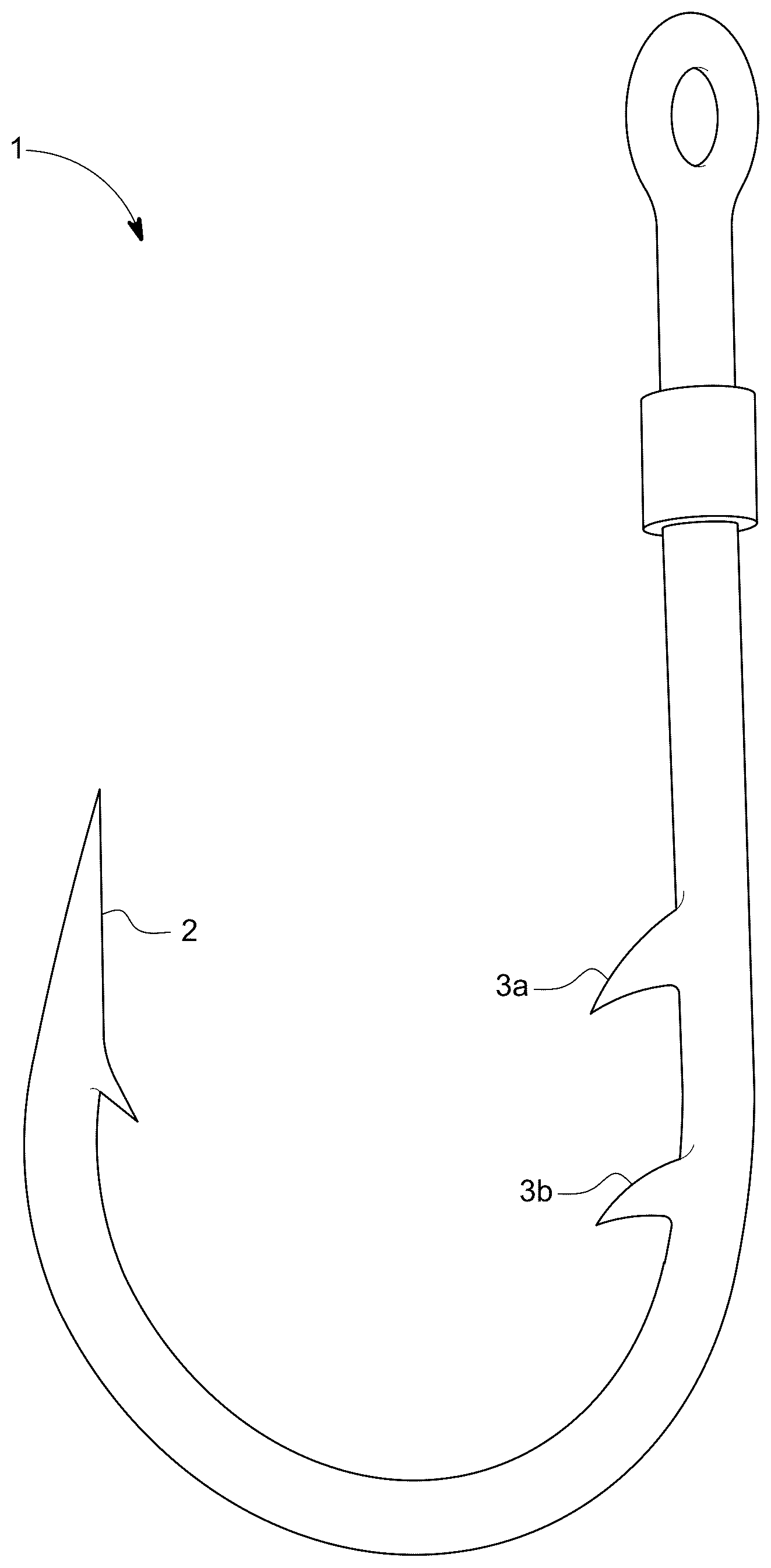
1 . An improvement in a fishhook comprising a shank defining an upwardly disposed barbed end portion, an upwardly disposed apertured end portion located opposite the barbed end portion, and a curved shank portion located therebetween, wherein the improvement comprises: the shank further defining a pair of spaced-apart downwardly disposed additional barbs oriented toward the barbed end portion, wherein one of the additional barbs is unitary with an external surface portion of the shank and the other one of the additional barbs is unitary with an external surface portion of the curved portion of the shank.
Show 1 dependent claims
2 . The improved fishhook of claim 1 , wherein the other one of the additional barbs is located closely adjacent to an uncurved portion of the shank and spaced below said one of the additional barbs.
Full Description
Show full text →
BACKGROUND OF THE INVENTION
Traditional fishing hooks typically feature a single barb located on the outside of the hook's curve. While effective in securing the catch, these hooks can occasionally result in fish escaping due to the single-point contact with the bait. Furthermore, the external barb design may cause excessive damage to the fish's mouth, affecting its survival upon release. In response to these limitations, various attempts have been made to improve fishing hook designs. Some designs have focused on increasing the sharpness or size of the barb, while others have explored alternative materials for construction. However, these modifications have often fallen short in addressing the core issues of retention and fish welfare. On multiple occasions, Marlins introduce their bill through the curve of the hook, and when this happens, they escape.
SUMMARY OF THE INVENTION
This invention prevents this situation by adding two spikes on the inside area of the hook's curve opposing the single (original) spike of the hook. This provides two additional contact areas with the bill facilitating the capture of marlins.
BRIEF DESCRIPTION OF DRAWINGS
illustrates a dual-barbed fishing hook with two barbs on the inside area of the hook's curve, at the point just opposite of the barb on the end of the hook.
DETAILED DESCRIPTION
OF THE INVENTION The present invention introduces a novel approach by incorporating two barbs on the inner side of the hook's curve. This unique configuration provides several advantages over conventional single-barbed hooks. Firstly, the dual-barbed design significantly enhances the hook's holding power by creating multiple points of contact with the fish's mouth upon penetration. This reduces the likelihood of the fish shaking off the hook during retrieval, thereby increasing catch rates. Secondly, positioning the barbs on the inside of the hook's curve offers additional protection to the fish's mouth. Unlike external barbs that can cause extensive damage upon penetration, the inner barbs exert less pressure on the fish's tissues, minimizing injury and facilitating safer catch-and-release practices. Moreover, the dual-barbed fishing hook is versatile and can be adapted to various fishing techniques and bait types. Whether used for freshwater or saltwater fishing, the enhanced retention capability of the hook ensures reliable performance across different fishing environments and target species. In summary, the dual-barbed fishing hook represents a significant advancement in fishing tackle technology, addressing the need for improved retention efficiency and fish welfare. By combining enhanced holding power with reduced harm to the catch, this invention offers anglers a more effective and ethical approach to fishing.
Figures (1)
Citations
This patent cites (17)
- US385913
- US620896
- US666309
- US1249342
- US2233863
- US2808678
- US4104820
- US5077931
- US6637148
- US7420930
- US7424786
- US9565842
- US2002/0032979
- US2002/0050093
- US2008/0047192
- US2008/0066370
- US2013/0239459