Abstract
According to one embodiment, a display device includes first and second lower electrodes, a second insulating layer including a first trench, a light emitting layer and an upper electrode. The first trench includes first, second and third trench portions. A first gap in a lower portion of the first trench portion is greater than a second gap in an upper portion of the first trench portion, a third gap in a lower portion of the second trench portion is greater than a fourth gap in an upper portion of the second trench portion, and a fifth gap in a lower portion of the third trench portion is greater than a sixth gap in an upper portion of the third trench portion.
Claims (14)
1 . A display device comprising: a base; a first insulating layer disposed on the base; a first lower electrode and a second lower electrode, disposed on the first insulating layer; a second insulating layer disposed on the first insulating layer and including a first aperture which overlaps the first lower electrode, a second aperture which overlaps the second lower electrode, and a first trench located between the first aperture and the second aperture; an organic layer which covers the second insulating layer, the first lower electrode located in the first aperture and the second lower electrode located in the second aperture, and including a light emitting layer; and an upper electrode which covers the organic layer, wherein the first trench comprises: a first trench portion including a bottom surface and a first side surface and a second side surface rising from the bottom surface; a second trench portion located above the first trench portion and including a first bottom portion extending from the first side surface to an outer side of the first trench, a second bottom portion extending from the second side surface to an outer side of the first trench, a third side surface rising from the first bottom portion, and a fourth side surface rising from the second bottom portion; and a third trench portion located above the second trench portion and including a third bottom portion extending from the third side surface to an outer side of the first trench, a fourth bottom portion extending from the fourth side surface to an outer side of the first trench, a fifth side surface rising from the third bottom portion, and a sixth side surface rising from the fourth bottom portion, a first gap between the first side surface and the second side surface in a lower portion of the first trench portion is greater than a second gap between the first side surface and the second side surface in an upper portion of the first trench portion, a third gap between the third side surface and the fourth side surface in a lower portion of the second trench portion is greater than a fourth gap between the third side surface and the fourth side surface in an upper portion of the second trench portion, a fifth gap between the fifth side surface and the sixth side surface in a lower portion of the third trench portion is greater than a sixth gap between the fifth side surface and the sixth side surface in an upper portion of the third trench portion, the third gap is greater than the first gap and less than the fifth gap, and the fourth gap is greater than the second gap and less than the sixth gap.
Show 13 dependent claims
2 . The display device of claim 1 , wherein the organic layer comprises a lower layer, a middle layer and an upper layer, stacked one on another, the lower layer includes a first lower layer portion which covers a first surface of the second insulating layer located between the first trench and the first aperture, a second lower layer portion located in the third bottom portion, a third lower layer portion located in the first bottom portion, and a fourth lower layer portion located in the bottom surface, the middle layer comprises a first middle layer portion which continuously covers the first lower layer portion and the second lower layer portion, a second middle layer portion which overlaps the third lower layer portion, and a third middle layer portion which overlaps the fourth lower layer portion, the upper layer comprises a first upper layer portion which continuously covers the first middle layer portion and the second middle layer portion, and a second upper layer portion which overlaps the third middle layer portion, the first lower layer portion, the second lower layer portion, the third lower layer portion, and the fourth lower layer portion are separated from each other, the first middle layer portion, the second middle layer portion, and the third middle layer portion are separated from each other, and the first upper layer portion and the second upper layer portion are separated from each other.
3 . The display device of claim 2 , wherein the first lower layer portion includes a first end portion located on a side of the first trench, the first end portion is covered by the first middle layer portion, the first middle layer portion includes a second end portion located on a side of the first trench, and the second end portion is covered by the first upper layer portion.
4 . The display device of claim 2 , wherein the lower layer comprises a fifth lower layer portion located in the second bottom portion, a sixth lower layer portion located in the fourth bottom portion, and a seventh lower layer portion which covers a second surface of the second insulating layer located between the first trench and the second aperture, the middle layer comprises a fourth middle layer portion which overlaps the fifth lower layer portion and a fifth middle layer portion which continuously covers the sixth lower layer portion and the seventh lower layer portion, the upper layer comprises a third upper layer portion which continuously covers the fourth middle layer portion and the fifth middle layer portion, the fourth lower layer portion, the fifth lower layer portion, the sixth lower layer portion and the seventh lower layer portion are separated from each other, the third middle layer portion, the fourth middle layer portion and the fifth middle layer portion are separated from each other, and the second upper layer portion and the third upper layer portion are separated from each other.
5 . The display device of claim 4 , wherein the seventh lower layer portion includes a third end portion located on a side of the first trench, the third end portion is covered by the fifth middle layer portion, the fifth middle layer portion includes a fourth end portion located on a side of the first trench, and the fourth end portion is covered by the third upper layer portion.
6 . The display device of claim 4 , wherein the upper electrode is in contact with the first upper layer portion, the second upper layer portion, the third upper layer portion, the second middle layer portion, the third middle layer portion, the fourth middle layer portion, the third lower layer portion, the fourth lower layer portion and the fifth lower layer portion, inside the first trench.
7 . The display device of claim 2 , wherein the light emitting layer is any one of the lower layer, the middle layer and the upper layer.
8 . The display device of claim 1 , wherein the first trench portion has a first depth, the second trench portion has a second depth, the third trench portion has a third depth, and the second depth is less than the first depth and greater than the third depth.
9 . The display device of claim 1 , wherein the organic layer includes a first portion which covers the first lower electrode located in the first aperture and covers a first surface of the second insulating layer located between the first trench and the first aperture, a second portion which covers the second lower electrode located in the second aperture and covers a second surface of the second insulating layer located between the first trench and the second aperture, and a third portion disposed on the bottom surface of the first trench and separated from the first portion and the second portion.
10 . The display device of claim 9 , wherein the first portion, the second portion and the third portion include the light emitting layer of a same color.
11 . The display device of claim 1 , wherein the second insulating layer further includes a second trench located on an opposite side to the first trench while interposing the first aperture therebetween, a third trench and a fourth trench connected to both the first trench and the second trench, respectively, and the third trench is located on an opposite side to the fourth trench while interposing the first aperture therebetween.
12 . The display device of claim 1 , further comprising: a display area which displays images, and a non-display area surrounding the display area; a power line located in the non-display area; and a peripheral electrode located in the non-display area and electrically connected to the power line, wherein the second insulating layer covers the peripheral electrode, and the upper electrode is connected to the peripheral electrode via a contact hole formed in the second insulating layer in the non-display area.
13 . The display device of claim 1 , wherein the organic layer further includes at least one of a hole injection layer, a hole transport layer, an electron injection layer, and an electron transport layer.
14 . The display device of claim 1 , wherein the first trench penetrates the second insulating layer to the first insulating layer.
Full Description
Show full text →
CROSS-REFERENCE TO RELATED APPLICATIONS
This application is a Continuation Application of PCT Application No. PCT/JP2022/000024, filed Jan. 4, 2022 and based upon and claiming the benefit of priority from Japanese Patent Application No. 2021-036475, filed Mar. 8, 2021, the entire contents of all of which are incorporated herein by reference. FIELD Embodiments described herein relate generally to a display device.
BACKGROUND
In recent years, display devices comprising organic light-emitting diodes (OLEDs) applied thereto as display elements have been put to practical use. The display devices comprise an organic layer between a pixel electrode and a common electrode. The organic layer includes functional layers such as a hole transport layer and an electron transport layer in addition to a light-emitting layer. Such an organic layer is formed, for example, by a vacuum evaporation method. For example, when organic layers are formed by stacking multiple functional layers, there is a risk that other functional layers and light-emitting layers may be exposed from the uppermost functional layer at the peripheral portion of the organic layer and come into contact with the common electrode, resulting in degradation in performance of the display device. Further, the organic layer should desirably be divided into and arranged in each pixel, for example, to suppress crosstalk between adjacent pixels. Here, a method of forming the organic layer by dividing it into each pixel using a vapor deposition method without using a mask, is being considered.
BRIEF DESCRIPTION OF THE DRAWINGS
is a plan view showing a configuration example of a display device according to the present embodiment. is a plan view showing a pixel. is a cross-sectional view of the display device taken along line A-A′ shown in . is a cross-sectional view showing a detailed configuration of the organic layer. is a plan view of the organic layer. is a cross-sectional view of the display device taken along line B-B′ shown in . is a cross-sectional view showing a first modified example of this embodiment. is a plan view showing a second modified example of this embodiment. is a plan view showing a third modified example of this embodiment.
DETAILED DESCRIPTION
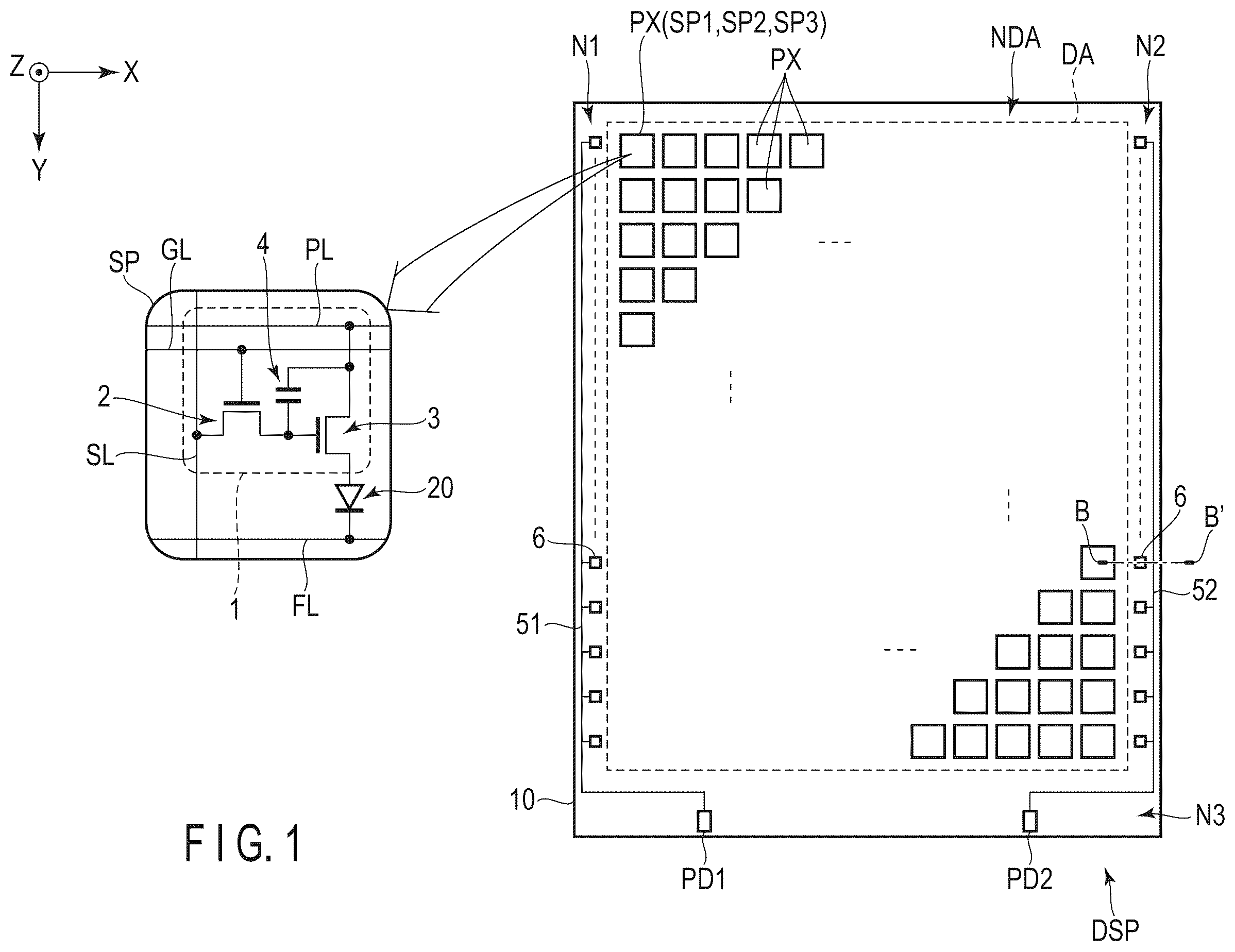
In general, according to one embodiment, a display device comprises a base, a first insulating layer disposed on the base, a first lower electrode and a second lower electrode, disposed on the first insulating layer, a second insulating layer disposed on the first insulating layer and including a first aperture which overlaps the first lower electrode, a second aperture which overlaps the second lower electrode, and a first trench located between the first aperture and the second aperture, an organic layer which covers the second insulating layer, the first lower electrode located in the first aperture and the second lower electrode located in the second aperture, and including a light emitting layer and an upper electrode which covers the organic layer, and the first trench comprises a first trench portion including a bottom surface and a first side surface and a second side surface rising from the bottom surface, a second trench portion located above the first trench portion and including a first bottom portion extending from the first side surface to an outer side of the first trench, a second bottom portion extending from the second side surface to an outer side of the first trench, a third side surface rising from the first bottom portion, and a fourth side surface rising from the second bottom portion and a third trench portion located above the second trench portion and including a third bottom portion extending from the third side surface to an outer side of the first trench, a fourth bottom portion extending from the fourth side surface to an outer side of the first trench, a fifth side surface rising from the third bottom portion, and a sixth side surface rising from the fourth bottom portion, a first gap between the first side surface and the second side surface in a lower portion of the first trench portion is greater than a second gap between the first side surface and the second side surface in an upper portion of the first trench portion, a third gap between the third side surface and the fourth side surface in a lower portion of the second trench portion is greater than a fourth gap between the third side surface and the fourth side surface in an upper portion of the second trench portion, a fifth gap between the fifth side surface and the sixth side surface in a lower portion of the third trench portion is greater than a sixth gap between the fifth side surface and the sixth side surface in an upper portion of the third trench portion, the third gap is greater than the first gap and less than the fifth gap, and the fourth gap is greater than the second gap and less than the sixth gap. Embodiments will be described hereinafter with reference to the accompanying drawings. Note that the disclosure is merely an example, and proper changes within the spirit of the invention, which are easily conceivable by a skilled person, are included in the scope of the invention as a matter of course. In addition, in some cases, in order to make the description clearer, the widths, thicknesses, shapes, etc., of the respective parts are schematically illustrated in the drawings, compared to the actual modes. However, the schematic illustration is merely an example, and adds no restrictions to the interpretation of the invention. Besides, in the specification and drawings, the same or similar elements as or to those described in connection with preceding drawings or those exhibiting similar functions are denoted by like reference numerals, and a detailed description thereof is omitted unless otherwise necessary. A display device DSP in this embodiment is an organic electroluminescent display device comprising an organic light-emitting diode (OLED) as a display element, and can be installed in televisions, personal computers, mobile terminals, mobile cell phones and the like. is a plan view showing a configuration example of the display device DSP of the embodiment. Some drawings show a first direction X, a second direction Y and a third direction Z which are orthogonal to each other. Note that the first direction X, the second direction Y and the third direction Z may intersect at an angle other than 90 degrees. In the following descriptions, a direction forwarding a tip of an arrow indicating the third direction Z is referred to as “upward” and a direction forwarding oppositely from the tip of the arrow is referred to as “downward”. In addition, it is assumed that there is an observation position to observe the display device DSP on a tip side of an arrow in a third direction Z, and viewing from this observation position toward the X-Y plane defined by the first direction X and the second direction Y is referred to as plan view. The display device DSP comprises an insulating base 10 . The base 10 may be glass or a flexible resin film. Further, the display device DSP includes a display area DA in which images are displayed and a non-display area NDA surrounding the display area DA. The display device DSP comprises, in the display area DA, a plurality of pixels PX arranged in a matrix along the first direction X and the second direction Y. The pixels PX each comprise a plurality of subpixels SP 1 , SP 2 and SP 3 . For example, the pixels PX each contain a red subpixel SP 1 , a green subpixel SP 2 and a blue subpixel SP 3 . Note that the pixels PX may additionally contain fourth or more subpixels in addition to the above-described three-color subpixels, of some other color such as white. A configuration example of one subpixel SP contained in a pixel PX will be briefly described. That is, the subpixel SP comprises a pixel circuit 1 and a display element 20 driven and controlled by the pixel circuit 1 . The pixel circuit 1 comprises a pixel switch 2 , a drive transistor 3 and a capacitor 4 . The pixel switch 2 and the drive transistor 3 are switching elements constituted by, for example, thin-film transistors. As to the pixel switch 2 , a gate electrode thereof is connected to a respective scanning line GL, a source electrode is connected to a respective signal line SL, and a drain electrode is connected to one of electrodes which constitutes the capacitor 4 and a gate electrode of the drive transistor 3 . As to the drive transistor 3 , a source electrode is connected to the other electrode of the capacitor 4 and a power line PL, and a drain electrode is connected to an anode of the display element 2 . A cathode of the display element 20 is connected to a power feed line FL. Note that the configuration of the pixel circuit 1 is not limited to that of the example shown in the figure. The display element 20 is an organic light emitting diode (OLED), which is a light-emitting element. For example, the subpixel SP 1 comprises a display element which emits light corresponding to red wavelengths, the subpixel SP 2 comprises a display element which emits light corresponding to green wavelengths, and the subpixel SP 3 comprises a display element which emits light corresponding to blue wavelengths. The configuration of the display element will be described later. The display device DSP comprises power lines 51 and 52 located in the non-display area NDA, a plurality of peripheral electrodes 6 , and pads PD 1 and PD 2 . Further, the non-display region NDA includes a first region N 1 and a second region N 2 , which extend in the second direction Y, and a third region N 3 extending in the first direction X. The first region N 1 , the display region DA and the second region N 2 are aligned in this order along the first direction X. In the third region N 3 , a flexible wiring substrate, not shown in the figure, is mounted. The power line 51 is located in the first region N 1 and the power line 52 is located in the second region N 2 . The plurality of peripheral electrodes 6 are aligned along the second direction Y in each of the first region N 1 and the second region N 2 . The pads PD 1 and PD 2 are located in the third region N 3 . The power line 51 is electrically connected to the plurality of peripheral electrodes 6 located in the first region N 1 . The power line 51 is electrically connected to the pad PD 1 . The power line 52 is electrically connected to the plurality of peripheral electrodes 6 located in the second region N 2 . The power line 52 is electrically connected to the pad PD 2 . is a plan view of a pixel PX. illustrates lower electrodes E 11 , E 12 and E 13 and an insulating layer 12 of the display device DSP. The lower electrode (first lower electrode) E 11 is disposed in the subpixel SP 1 . The lower electrode (second lower electrode) E 12 is disposed in the subpixel SP 2 . The lower electrode E 13 is disposed in the subpixel SP 3 . The lower electrodes E 11 to E 13 are aligned along the first direction X. The lower electrodes including the lower electrodes E 11 to E 13 are electrodes arranged for each subpixel or each display element, and may be referred to as pixel electrodes, anodes or the like. The insulating layer 12 is formed into a grid pattern in plan view. The insulating layer 12 is formed to compartmentalize display elements or subpixels from each other and may be referred to as ribs, partitions or the lie. The insulating layer 12 includes a first aperture OP 1 overlapping the lower electrode E 11 , a second aperture OP 2 overlapping the lower electrode E 12 and a third aperture OP 3 overlapping the lower electrode E 13 . The insulating layer 12 covers a peripheral portion of each of the lower electrodes E 11 to E 13 , and a central portion of each of the lower electrodes E 11 to E 13 is exposed from the insulating layer 12 in the first apertures OP 1 , the second aperture OP 2 and the third aperture OP 3 . Further, the insulating layer 12 includes a trench T 11 , a trench T 12 , a trench T 13 and a trench T 14 extending in the second direction Y and aligned along the first direction X, and a trench T 21 and a trench T 22 extending in the first direction X and aligned along the second direction Y. The trench (first trench) T 12 is located between the first aperture OP 1 and the second aperture OP 2 . The trench T 13 is located between the second aperture OP 2 and the third aperture OP 3 . The trench (second trench) T 11 is located on an opposite side to the trench T 12 while interposing the first aperture OP 1 therebetween. The trench T 14 is located on an opposite side to the trench T 13 while interposing the third aperture OP 3 therebetween. The trench (third trench) T 21 is connected to the trenches T 11 to T 14 . The trench (fourth trench) T 22 as well is connected to the trenches T 11 to T 14 . The trench T 21 is located on an opposite side to the trench T 22 while interposing the first aperture OP 1 , the second aperture OP 2 and third aperture OP 3 therebetween. The trenches are arranged so as not to overlap the adjacent lower electrodes in plan view. That is, the lower electrode E 11 is located between the trench T 11 and the trench T 12 , the lower electrode E 12 is located between the trench T 12 and the trench T 13 , and the lower electrode E 13 is located between the trench T 13 and the trench T 14 . Further, the lower electrodes E 11 to E 13 are located between the trench T 21 and the trench T 22 . Here, the outline of the subpixels corresponds to the outline of the lower electrodes, for example. That is, the subpixel SP 1 , the subpixel SP 2 and the subpixel SP 3 which constitute one pixel PX, are each formed into substantially a rectangular shape extending in the second direction Y and are aligned along the first direction X. The emission colors of those of the subpixels aligned in the first direction X, which are adjacent to each other are different from each other. Note that the areas of the subpixel SP 1 , the subpixel SP 2 and the subpixel SP 3 may be the same as each other, or may be different from each other as described below. The outline of the subpixels may be defined by the outline of the light emitting regions of the display elements. shows a cross-sectional view of the display device DSP taken along line A-A′ shown in . The display device DSP comprises a base 10 , switching elements SW 1 and SW 2 , an insulating layer 11 , lower electrodes E 11 and E 12 , an insulating layer 12 , an organic layer OR and an upper electrode E 2 . Further, the display element 20 A is constituted by the lower electrode E 11 , a first portion OR 1 of the organic layer OR and the upper electrode E 2 . The display element 20 B is constituted by the lower electrode E 12 , a second portion OR 2 of the organic layer OR and the upper electrode E 2 . The switching elements SW 1 and SW 2 are disposed on the base 10 . The switching elements SW 1 and SW 2 correspond, for example, to the drive transistor 3 shown in . The insulating layer (first insulating layer) 11 is disposed on the base 10 and covers the switching elements SW 1 and SW 2 . The insulating layer 11 corresponds to the underlying layer of the display elements 20 A and 20 B, and is, for example, an organic insulating layer. Note that the pixel switch 2 of the pixel circuit 1 , and the like shown in are disposed on the base 10 and covered by the insulating layer 11 , but illustration thereof is omitted here. The lower electrodes E 11 and E 12 are disposed on the insulating layer 11 . The lower electrode E 11 is electrically connected to the switching element SW 1 via a contact hole CH 1 formed in the insulating layer 11 . The lower electrode E 12 is electrically connected to the switching element SW 2 via a contact hole CH 2 formed in the insulating layer 11 . The lower electrodes E 11 and E 12 are transparent electrodes formed of, for example, a transparent conductive material such as indium tin oxide (ITO) or indium zinc oxide (IZO). Note that the lower electrodes E 11 and E 12 may be metal electrodes formed from a metal material such as silver or aluminum. Further, the lower electrodes E 11 and E 12 may be a stacked body of a transparent electrode and a metal electrode. For example, the lower electrodes E 11 and E 12 may be configured as a stacked body in which a transparent electrode, a metal electrode and a transparent electrode are stacked in this order, or as a stacked body of three or more layers. The insulating layer (second insulating layer) 12 is disposed on the insulating layer 11 and covers the peripheral portion of each of the lower electrodes E 11 and E 12 . The insulating layer 12 is, for example, an organic insulating layer. The insulating layer 12 includes the first aperture OP 1 , the second aperture OP 2 and the trench T 12 described above, and a first surface SF 1 and a second surface SF 2 . The first aperture OP 1 penetrates the insulating layer 12 to the lower electrode E 11 . The second aperture OP 2 penetrates the insulating layer 12 to the lower electrode E 12 . The first surface SF 1 is located between the trench T 12 and the first aperture OP 1 . The second surface SF 2 is located between the trench T 12 and the second aperture OP 2 . Further, the insulating layer 12 has a thickness TH. The thickness TH corresponds to the distance between the highest position of the insulating layer 12 and the insulating layer 11 in the illustrated example, and is, for example, 1.5 to 2.0 μm. The trench T 12 includes a first trench portion TP 1 , a second trench portion TP 2 located above the first trench portion TP 1 , and a third trench portion TP 3 located above the second trench portion TP 2 . The first trench portion TP 1 includes a bottom surface BS, a first side surface S 1 and a second side surface S 2 rising from the bottom surface BS. The bottom surface BS is, for example, a plane that is substantially parallel to the X-Y plane. The first side surface S 1 and the second side surface S 2 are spaced apart from and oppose each other along the first direction X. The second trench portion TP 2 includes a first bottom portion B 1 extending from the first side surface S 1 towards an outer side of the trench T 12 , a second bottom portion B 2 extending from the second side surface S 2 towards an outer side of the trench T 12 , a third side surface S 3 rising from the first bottom portion B 1 and a fourth side surface S 4 rising from the second bottom portion B 2 . The first bottom portion B 1 and the second bottom portion B 2 are, for example, substantially parallel to the bottom surface BS. The third side surface S 3 and the fourth side surface S 4 are spaced apart and oppose each other in the first direction X. The third trench portion TP 3 includes a third bottom portion B 3 extending from the third side surface S 3 towards an outer side of the trench T 12 , a fourth bottom portion B 4 extending from the fourth side surface S 4 towards an outer side of the trench T 12 , a fifth side surface S 5 rising from the third bottom portion B 3 and a sixth side surface S 6 rising from the fourth bottom portion B 4 . The third bottom portion B 3 and the fourth bottom portion B 4 are, for example, surfaces substantially parallel to the bottom surface BS. The fifth side surface S 5 and the sixth side surface S 6 are spaced apart from and oppose each other along the first direction X. The fifth side surface S 5 is connected to the first side surface SF 1 . The sixth side surface S 6 is connected to the second side surface SF 2 . The trench T 12 corresponds to a space enclosed by the first side surface S 1 , the second side surface S 2 , the third side surface S 3 , the fourth side surface S 4 , the fifth side surface S 5 , the sixth side surface S 6 , the bottom surface BS, the first bottom portion B 1 , the second bottom portion B 2 , the third bottom portion B 3 and the fourth bottom portion B 4 . The first trench portion TP 1 includes a first gap GP 1 between the first side surface S 1 and the second side surface S 2 in its lower portion and a second gap GP 2 between the first side surface S 1 and the second side surface S 2 in its upper portion. The first gap GP 1 is larger than the second gap GP 2 . In other words, the first trench portion TP 1 is formed so that the width along the first direction X decreases from the lower portion towards the upper portion. In other words, the first side surface S 1 is inclined with respect to the normal direction of the bottom surface BS so as to overlap the bottom surface BS. Similarly, the second side surface S 2 is inclined with respect to the normal direction of the bottom surface BS so as to overlap the bottom surface BS. The second trench portion TP 2 includes a third gap GP 3 between the third side surface S 3 and the fourth side surface S 4 in its lower portion and a fourth gap GP 4 between the third side surface S 3 and the fourth side surface S 4 in its upper portion. The third gap GP 3 is larger than the fourth gap GP 4 . In other words, the second trench portion TP 2 is formed so that the width along the first direction X decreases from the lower portion towards the upper portion. In other words, the third side surface S 3 is inclined with respect to the normal direction of the first bottom portion B 1 so as to overlap the first bottom portion B 1 . Similarly, the fourth side surface S 4 is inclined with respect to the normal direction of the second bottom portion B 2 so as to overlap the second bottom portion B 2 . The third trench portion TP 3 includes a fifth gap GP 5 between the fifth side surface S 5 and the sixth side surface S 6 in its lower portion and a sixth gap GP 6 between the fifth side surface S 5 and the sixth side surface S 6 in its upper portion. The fifth gap GP 5 is larger than the sixth gap GP 6 . In other words, the third trench portion TP 3 is formed so that the width along the first direction X decreases from the lower portion towards the upper portion. In other words, the fifth side surface S 5 is inclined with respect to the normal direction of the third bottom portion B 3 so as to overlap the third bottom portion B 3 . Similarly, the sixth side surface S 6 is inclined with respect to the normal direction of the fourth bottom portion B 4 so as to overlap the fourth bottom portion B 4 . The third gap GP 3 is larger than the first gap GP 1 and smaller than the fifth gap GP 5 . The fourth gap GP 4 is larger than the second gap GP 2 and smaller than the sixth gap GP 6 . The organic layer OR covers the insulating layer 12 , the lower electrode E 11 located in the first aperture OP 1 , and the lower electrode E 12 located in the second aperture OP 2 . The organic layer OR includes a first portion OR 1 , a second portion OR 2 and a third portion OR 3 . The first portion OR 1 covers the lower electrode E 11 located in the first aperture OP 1 , and the first surface SF 1 . The second portion OR 2 covers the lower electrode E 12 located in the second aperture OP 2 , and the second surface SF 2 . A part of the first portion OR 1 and a part of the second portion OR 2 are located in the trench T 12 as well. The third portion OR 3 is located at the bottom surface BS of the trench T 12 . The third portion OR 3 is spaced apart from the first portion OR 1 and the second portion OR 2 . The organic layer OR includes a light emitting layer EL as will be described later, and the first portion OR 1 , the second portion OR 2 and the third portion OR 3 include the color light emitting layers EL of the same color. In addition to the light-emitting layer EL, the organic layer OR includes at least one of a hole injection layer, a hole transport layer, an electron injection layer and an electron transport layer. The upper electrode E 2 covers the organic layer OR. That is, the upper electrode E 2 covers each of the first portion OR 1 , the second portion OR 2 , and the third portion OR 3 . The upper electrode E 2 covers the third portion OR 3 and is in contact with the bottom surface BS, inside the trench T 12 . Further, the upper electrode E 2 is in contact with the first side surface S 1 and the second side surface S 2 inside the trench T 12 . The upper electrode E 2 is a transparent electrode formed of, for example, a transparent conductive material such as ITO or IZO. The upper electrode E 2 is electrically connected to the feed line FL located in the display area DA shown in . The upper electrode E 2 is an electrode commonly arranged for a plurality of subpixels or a plurality of display elements, and may be referred to as a common electrode, counter electrode, cathode or the like. Note that the upper electrode E 2 may be covered by a transparent protective layer (including at least one of an inorganic insulating layer and an organic insulating layer) in some cases. In the display device 20 A, the first portion OR 1 is located between the lower electrode E 11 and the upper electrode E 2 to form a light emitting region. In display element 20 B, the second portion OR 2 is located between the lower electrode E 12 and the upper electrode E 2 to form a light-emitting region. Note that the third portion OR 3 is located between the insulating layer 12 and the upper electrode E 2 and is completely separated from the first portion OR 1 and the second portion OR 2 , and therefore it does not emit light. Further, of the first portion OR 1 , the region which covers the first surface SF 1 and the region located in the trench T 12 are located between the insulating layer 12 and the upper electrode E 2 , and therefore they do not substantially emit light. Similarly, of the second portion OR 2 , the region which covers the second surface SF 2 and the region located in the trench T 12 are located between the insulating layer 12 and the upper electrode E 2 , and therefore they do not substantially emit light. is a cross-sectional view showing a detailed configuration of the organic layer OR. The organic layer OR comprises a lower layer L 1 , a middle layer L 2 and an upper layer L 3 , stacked one on another. The lower layer L 1 comprises a first lower layer portion L 11 which covers the first surface SF 1 , a second lower layer portion L 12 located in the third bottom portion B 3 , a third lower layer portion L 13 located in the first bottom portion B 1 , a fourth lower layer portion L 14 located in the bottom portion BS, a fifth lower layer portion L 15 located in the second bottom portion B 2 , a sixth lower layer portion L 16 located in the fourth bottom portion B 4 , and a seventh lower layer portion L 17 which covers the second surface SF 2 . The first lower layer portion L 11 , the second lower layer portion L 12 , the third lower layer portion L 13 , the fourth lower layer portion L 14 , the fifth lower layer portion L 15 , the sixth lower layer portion L 16 and the seventh lower layer portion L 17 are separated from each other. The middle layer L 2 comprises a first middle layer portion L 21 which continuously covers the first lower layer portion L 11 and the second lower layer portion L 12 , a second middle layer portion L 22 which overlaps the third lower layer portion L 13 , a third middle layer portion L 23 which overlaps the fourth lower layer portion L 14 , a fourth middle layer portion L 24 which overlaps the fifth lower layer portion L 15 , and a fifth middle layer portion L 25 which continuously covers the sixth lower layer portion L 16 and the seventh lower layer portion L 17 . The first middle layer portion L 21 , the second middle layer portion L 22 , the third middle layer portion L 23 , the fourth middle layer portion L 24 and the fifth middle layer portion L 25 are separated from each other. The upper layer L 3 comprises a first upper layer portion L 31 which continuously covers the first middle layer portion L 21 and the second middle layer portion L 22 , a second upper layer portion L 32 which overlaps the third middle layer portion L 23 , and a third upper layer portion L 33 which continuously covers the fourth middle layer portion L 24 and the fifth middle layer portion L 25 . The first upper layer portion L 31 , the second upper layer portion L 32 and the third upper layer portion L 33 are separated from each other. The first lower layer portion L 11 includes a first end portion EG 1 located on a trench T 12 side. The first end portion EG 1 is covered by the first middle layer portion L 21 . The first middle layer portion L 21 includes a second end portion EG 2 located on the trench T 12 side. The second end portion EG 2 is covered by the first upper layer portion L 31 . The seventh lower layer portion L 17 includes a third end portion EG 3 located on the trench T 12 side. The third end portion EG 3 is covered by the fifth middle layer portion L 25 . The fifth middle layer portion L 25 includes a fourth end portion EG 4 located on the trench T 12 side. The fourth end portion EG 4 is covered by the third upper layer portion L 33 . The first portion OR 1 described above includes the first lower layer portion L 11 , the second lower layer portion L 12 , the third lower layer portion L 13 , the first middle layer portion L 21 , the second middle layer portion L 22 , and the first upper layer portion L 31 . The second portion OR 2 described above includes the fifth lower portion L 15 , the sixth lower portion L 16 , the seventh lower portion L 17 , the fourth middle portion L 24 , the fifth middle portion L 25 and the third upper portion L 33 . The third portion OR 3 described above includes the fourth lower portion L 14 , the third middle portion L 23 and the second upper portion L 32 . As shown in the figure, the gap GP is formed between the fifth side surface S 5 and the second lower layer portion L 12 . The gap GP is formed between the third side surface S 3 and the third lower layer portion L 13 and the second middle-layer portion L 22 . The gap GP is formed between the fourth side surface S 4 and the fifth lower layer portion L 15 and the fourth middle-layer portion L 24 . The gap GP is formed between the sixth side surface S 6 and the sixth lower layer portion L 16 . These gaps GP may not necessarily be formed, but may be filled by the organic layer OR. The upper electrode E 2 is in contact with the first upper layer portion L 31 , the second upper layer portion L 32 , the third upper layer portion L 33 , the second middle layer portion L 22 , the third middle layer portion L 23 , the fourth middle layer portion L 24 , the third lower layer portion L 13 , the fourth lower layer portion L 14 and the fifth lower layer portion L 15 in the trench T 12 . The first trench portion TP 1 has a first depth D 1 , the second trench portion TP 2 has a second depth D 2 , and the third trench portion TP 3 has a third depth D 3 . The second depth D 2 is less than the first depth D 1 and greater than the third depth D 3 . That is, the lower the trench portion is located, the deeper it is formed. The trench T 12 has a fourth depth D 4 . The fourth depth D 4 corresponds to the sum of the first depth D 1 , the second depth D 2 and the third depth D 3 . The fourth depth D 4 is, for example, 0.5 to 1.0 μm. Next, the film formation process for the organic layer OR will be described. The organic layer OR described above is formed, for example, by the vacuum deposition method. The way in which the organic material for forming the organic layer OR is released from the evaporation source is indicated in the figure as single dotted lines. After forming the insulating layer 12 including the first aperture OP 1 , the second aperture OP 2 and the trench T 12 , the organic material for forming the organic layer OR is deposited. First, the organic material for forming the lower layer L 1 is deposited. Since the fifth side surface S 5 is inclined, the lower layer L 1 is not substantially formed on the fifth side surface S 5 . As a result, the lower layer L 1 is formed so as to be separated into as the first lower layer portion L 11 and the second lower layer portion L 12 . Similarly, since the third side surface S 3 is inclined, the lower layer L 1 is not substantially formed on the third side surface S 3 . As a result, the lower layer L 1 is formed so as to be separated into as the second lower layer portion L 12 and the third lower layer portion L 13 . Similarly, since the first side surface S 1 is inclined, the lower layer L 1 is not substantially formed on the first side surface S 1 . As a result, the lower layer L 1 is formed so as to be separated into as the third lower layer portion L 13 and the fourth lower layer portion L 14 . Since the second side surface S 2 is inclined, the lower layer L 1 is not substantially formed on the second side surface S 2 . As a result, the lower layer L 1 is formed so as to be separated into as the fourth lower layer portion L 14 and the fifth lower layer portion L 15 . Similarly, since the fourth side surface S 4 is inclined, the lower layer L 1 is not substantially formed on the fourth side surface S 4 . As a result, the lower layer L 1 is formed so as to be separated into as the fifth lower layer portion L 15 and the sixth lower layer portion L 16 . Similarly, since the sixth side surface S 6 is inclined, the lower layer L 1 is not substantially formed on the sixth side surface S 6 . As a result, the lower layer L 1 is formed so as to be separated into as the sixth lower layer portion L 16 and the seventh lower layer portion L 17 . In other words, the lower layer L 1 is separated by the first side surface S 1 , the second side surface S 2 , the third side surface S 3 , the fourth side surface S 4 , the fifth side surface S 5 and the sixth side surface S 6 into the first lower layer portion L 11 , the second lower layer portion L 12 , the third lower layer portion L 13 , the fourth lower layer portion L 14 , the fifth lower layer portion L 15 , the sixth lower layer portion L 16 and the seventh lower layer portion L 17 . Next, an organic material for forming the middle layer L 2 is deposited. Since the second lower layer portion L 12 is located in the third bottom portion B 3 , the middle layer L 2 is not separated by the fifth side surface S 5 . The middle layer L 2 is separated by the third side surface S 3 into the first middle layer portion L 21 and the second middle layer portion L 22 because the second trench portion TP 2 has a sufficient depth. The middle layer L 2 is separated by the first side surface S 1 into the second middle layer portion L 22 and the third middle layer portion L 23 because the first trench portion TP 1 has a sufficient depth. The middle layer L 2 is separated by the second side surface S 2 into the third middle layer portion L 23 and the fourth middle layer portion L 24 because the first trench portion TP 1 has a sufficient depth. The middle layer L 2 is separated by the fourth side surface S 4 into the fourth middle portion L 24 and the fifth middle portion L 25 because the second trench portion TP 2 has a sufficient depth. The middle layer L 2 is not separated by the sixth side surface S 6 because the sixth lower layer portion L 16 is located in the fourth bottom portion B 4 . Next, an organic material for forming the upper layer L 3 is deposited. The upper layer L 3 is not separated by the fifth side surface S 5 because the second lower layer portion L 12 and the first middle layer portion L 21 are located to overlap the third bottom portion B 3 . The upper layer L 3 is not separated by the third side surface S 3 because the third lower portion L 13 and the second middle portion L 22 are located to overlap the first bottom portion B 1 . The upper layer L 3 is separated by the first side surface S 1 into as the first upper layer portion L 31 and the second upper layer portion L 32 because the first trench portion TP 1 has a sufficient depth. The upper layer L 3 is separated by the second side surface S 2 into as the second upper layer portion L 32 and the third upper layer portion L 33 because the first trench portion TP 1 has a sufficient depth. The upper layer L 3 is not separated by the fourth side surface S 4 because the fifth lower layer portion L 15 and the fourth middle layer portion L 24 are located to overlap the second bottom portion B 2 . The upper layer L 3 is not separated by the sixth side surface S 6 because the sixth lower portion L 16 and the fifth middle portion L 25 are located to overlap the fourth bottom portion B 4 . Note that since the upper electrode E 2 is formed by sputtering, it is continuously formed on the organic layer OR, the bottom surface BS, the first side surface S 1 and the second side surface S 2 . Next, the advantageous effects that can be obtained by this embodiment will be explained. It is desirable that the bottom layer L 1 , which is located at the lowermost layer of the organic layer OR, should be in contact with the lower electrodes E 11 and E 12 , and the upper layer L 3 , which is the uppermost layer, should be in contact with the upper electrode E 2 . However, for example, when the organic layer OR is provided to be separated for each subpixel, the lower layer L 1 and the middle layer L 2 may undesirably be exposed from the upper layer L 3 at the end portion of the organic layer OR and come into contact with the upper electrode E 2 . As a result, a current leakage from the lower layer L 1 or the middle layer L 2 to the upper electrode E 2 occurs, thus making it difficult in some cases to obtain a desired brightness and chromaticity with respect to the voltage applied. According to this embodiment, the trench T 12 includes a trench portion that is formed deeper as the location is lower, and the first side surface S 1 , the second side surface S 2 , the third side surface S 3 , the fourth side surface S 4 , the fifth side surface S 5 and the sixth side surface S 6 are inclined. With this structure, among the first lower layer portion L 11 , the first middle layer portion L 21 and the first upper layer portion L 31 that contribute to the display of the display element 20 A, the layers located on the upper side are more separated on an outer side of the subpixel SP 1 . Therefore, the first lower layer portion L 11 and the first middle layer portion L 21 are covered by the first upper layer portion L 31 , thereby making it possible to suppress contacting with the upper electrode E 2 . Similarly, among the seventh lower layer portion L 17 , the fifth middle layer portion L 25 and the third upper layer portion L 33 that contribute to the display of the display element 20 B, the layers located on the upper side are more separated on an outer side of the subpixel SP 2 . Therefore, the seventh lower layer portion L 17 and the fifth middle layer portion L 25 are covered by the third upper layer portion L 33 , thereby making it possible to suppress contacting with the upper electrode E 2 . Since the third lower layer portion L 13 and the second middle layer portion L 22 in contact with the upper electrode E 2 are separated from the first lower layer portion L 11 and the first middle layer portion L 21 that contribute to the display, current leakage from the third lower layer portion L 13 and the second middle layer portion L 22 to the upper electrode E 2 does not occurs. Further, since the fifth lower layer portion L 15 and the fourth middle layer portion L 24 , which are in contact with the upper electrode E 2 , are separated from the seventh lower layer portion L 17 and the fifth middle layer portion L 25 , which contribute to the display, current leakage from the fifth lower layer portion L 15 and the fourth middle layer portion L 24 to the upper electrode E 2 does not occur. Therefore, current leakage from the lower layer L 1 and the middle layer L 2 to the upper electrode E 2 is suppressed, thereby making it possible to suppress degradation in performance of the display device. Note that the depth of each trench portion is adjusted according to the film thickness of each layer which constitutes the organic layer OR. Further, in the example illustrated, the trench T 12 includes three trench portions, but it may as well include four or more trench portions. The number of trench portions may be greater than the number of layers which constitute the organic layer OR. Further, the organic layer OR may be constituted by four or more layers, for example. In such a case as well, the uppermost layer among the layers constituting the organic layer OR is separated on an outer side with respect to the other layers. Further, in the example shown in , the first side surface S 1 , the second side surface S 2 , the third side surface S 3 , the fourth side surface S 4 , the fifth side surface S 5 , the sixth side surface S 6 and the bottom surface BS are flat, but they may as well be curved. Moreover, according to this embodiment, the organic layer OR can be formed to be separated into the first portion OR 1 located in the subpixel SP 1 and the second portion OR 2 located in the subpixel SP 2 in the trench T 12 . That is, by full-surface deposition without using a mask, the organic layer ORs can be formed to be separated for each subpixel. With this configuration, it is possible to suppress crosstalk between adjacent subpixels. Further, since separate components for separating the organic layer ORs are not required, manufacturing costs can be reduced. As described above, the organic layer OR includes a light-emitting layer EL, and for example, the light-emitting layer EL is any one of the lower layer L 1 , the middle layer L 2 and the upper layer L 3 . Here, let us assume, for example, that the lower layer L 1 and the upper layer L 3 are functional layers, and the middle layer L 2 is the light-emitting layer EL. The lower layer L 1 and the upper layer L 3 are, for example, a hole injection layer, a hole transport layer, a hole blocking layer, an electron injection layer, an electron transport layer, and an electron blocking layer, but may as well be other functional layers. Each of the lower layer L 1 and the upper layer L 3 is not limited to a single layer, but may as well be a stacked body of a plurality of functional layers. Further, at least one of the lower layer L 1 and the upper layer L 3 may be omitted. For example, when the lower electrodes E 11 and E 12 correspond to anodes, the lower layer L 1 located between the light emitting layer EL and the lower electrodes E 11 and E 12 includes at least one of a hole injection layer and a hole transport layer, and the upper layer L 3 located between the light emitting layer EL and the upper electrode E 2 includes at least one of an electron transport layer and an electron injection layer. Note that when the potential of the lower electrodes E 11 and E 12 is relatively higher than the potential of the upper electrode E 2 , the lower electrodes E 11 and E 12 correspond to anodes and the upper electrode E 2 corresponds to a cathode. When the potential of the upper electrode E 2 is relatively higher than the potential of the lower electrodes E 11 and E 12 , the upper electrode E 2 corresponds to the anode and the lower electrodes E 11 and E 12 correspond to the cathodes. Moreover, for example, in all of the subpixels SP in the display area DA, organic layers OR including the light-emitting layers EL of the same color are disposed. When the emission color of each display element is white, a multicolor display can be realized by arranging color filters opposing the display elements. Further, when the emission color of each display element is ultraviolet light, a multicolor display can be realized by arranging a photo-conversion layer opposing the display elements. is a plan view of the organic layer OR. In , the region where the organic layer OR is placed is indicated by shaded lines. The first portion OR 1 is disposed in the subpixel SP 1 . The second portion OR 2 is disposed in the subpixel SP 2 . The first portion OR 1 and the second portion OR 2 are aligned along the first direction X. The third portion OR 3 is formed into a grid shape in plan view. The third portion OR 3 includes portions OR 31 , OR 32 and OR 33 extending in the second direction Y and aligned along the first direction X, and portions OR 34 and OR 35 extending in the first direction X and aligned along the second direction Y. The portion OR 32 is located between the first portion OR 1 and the second portion OR 2 . The portion OR 31 is located on an opposite side to the portion OR 32 while interposing the first portion OR 1 therebetween. The portion OR 33 is located on an opposite side to the portion OR 32 while interposing the second portion OR 2 therebetween. The portion OR 34 is connected to the portions OR 31 to OR 33 . The portion OR 35 is connected to the portions OR 31 to OR 33 . The portion OR 34 is located on an opposite side to the portion OR 35 while interposing the first portion OR 1 and the second portion OR 2 . The portions OR 31 to OR 33 are located in the trenches T 11 to T 13 , respectively. Further, the portions OR 34 and OR 35 are located in the trenches T 21 and T 22 , respectively. Note that the outline of the first portion OR 1 is larger than the outline of the lower electrode E 11 in plan view. The outline of the second portion OR 2 is formed larger than the outline of the lower electrode E 12 in plan view. is a cross-sectional view of the display device DSP taken along line B-B′ shown in . The peripheral electrode 6 and the power line 52 are located on the insulating layer 11 . The insulating layer 12 covers the peripheral electrode 6 and the power line 52 . The organic layer OR is not formed in the non-display area NDA. The upper electrode E 2 covers the insulating layer 12 in the non-display area NDA and is connected to the peripheral electrode 6 via the contact hole CH 3 formed in the insulating layer 12 . In the example illustrated, the peripheral electrode 6 and the power line 52 are located in the same layer as that of the lower electrode E 10 , but they may as well be located in different layers from that of the lower electrode E 10 , respectively. is a cross-sectional view of the first modified example of this embodiment. The configuration shown in is different from that of in that the trench T 12 penetrates the insulating layer 12 to the insulating layer 11 . In the example shown in the figure, the bottom surface BS corresponds to the upper surface of the insulating layer 11 . Therefore, the third portion OR 3 and the upper electrode E 2 are in contact with the insulating layer 11 in the trench T 12 . In such a first modified example as described above, advantageous effects similar to those described above can be obtained. is a plan view of the second modified example of this embodiment. The configuration shown in is different from that of in the layout of the subpixel SP 1 , the subpixel SP 2 and the subpixel SP 3 . The lower electrodes E 11 and E 12 are aligned along the second direction Y. The lower electrode E 13 is aligned along the lower electrodes E 11 and E 12 in the first direction X. The insulating layer 12 includes trenches T 15 , T 16 and T 17 extending in the second direction Y and aligned along the first direction X, and trenches T 23 , T 24 and T 25 extending in the first direction X and aligned along the second direction Y. The trench T 16 is located between the first opening OP 1 and the second opening OP 2 , and the third aperture OP 3 . The trench T 15 is located on an opposite side to the trench T 16 while interposing the first aperture OP 1 and the second aperture OP 2 . The trench T 17 is located on an opposite side to the trench T 16 while interposing the third aperture OP 3 therebetween. The trench T 23 is connected to the trenches T 15 to T 17 . The trench T 24 is connected to the trenches T 15 and T 16 . The trench T 25 is connected to the trenches T 15 to T 17 . The trench T 23 is located on an opposite side to the trench T 25 while interposing the first aperture OP 1 , the second aperture OP 2 and the third aperture OP 3 therebetween. The trench T 24 is located between the first aperture OP 1 and the second aperture OP 2 . Each trench does not overlap adjacent lower electrodes in plan view. In the first direction X, the lower electrodes E 11 and E 12 are located between the trenches T 15 and T 16 , and the lower electrode E 13 is located between the trenches T 16 and T 17 . Further, in the second direction Y, the lower electrode E 11 is located between the trenches T 23 and T 24 , the lower electrode E 12 is located between the trenches T 24 and T 25 , and the lower electrode E 13 is located between the trenches T 23 and T 25 . The sub-pixel SP 1 and the subpixel SP 2 are aligned along the second direction Y, the subpixel SP 1 and the subpixel SP 3 are aligned along the first direction X, and the subpixel SP 2 and the subpixel SP 3 are aligned along the first direction X. The subpixel SP 1 is formed into a substantially rectangular shape extending along the first direction X, and the subpixel SP 2 and the subpixel SP 3 are formed into a substantially rectangular shape extending along the second direction Y. The emission colors of the subpixels SP 1 to SP 3 are different from each other. Further, the areas of the subpixels SP 1 to SP 3 are different from each other. The area of the subpixel SP 2 is larger than that of the subpixel SP 1 , and the area of the subpixel SP 3 is larger than that of the subpixel SP 2 . Note that the area of the subpixel SP 1 may be the same as that of the subpixel SP 2 . In such a second modified example as described above, advantageous effects similar to those described above can be obtained. is a plan view of the third modified example of this embodiment. The configuration shown in is different from that of in the layout of the subpixel SP 1 , the subpixel SP 2 and the subpixel SP 3 . The direction DR 1 shown in is inclined at an angle θ 1 counterclockwise with respect to the second direction Y, and the direction DR 2 shown in is inclined at an angle θ 2 clockwise with respect to the second direction Y. The insulating layer 12 includes a plurality of trenches T 1 extending in the direction DR 1 and aligned along the direction DR 2 , and a plurality of trenches T 2 extending in the direction DR 2 and aligned along the direction DR 1 . The plurality of lower electrodes E 11 and the plurality of first openings OP 1 are respectively located in the plurality of red subpixels SP 1 . The plurality of lower electrodes E 12 and the plurality of second apertures OP 2 are respectively located in the plurality of green subpixels SP 2 . The plurality of lower electrodes E 13 and the plurality of third apertures OP 3 are respectively located in the plurality of blue subpixels SP 3 . Each of the plurality of lower electrodes E 11 and E 12 , which are alternately aligned along the direction DR 1 , is located between each respective adjacent pair of trenches T 1 . Further, each of the plurality of lower electrodes E 12 and E 13 , which as well are aligned alternately along the direction DR 1 , is located between each respective adjacent pair of trenches T 1 . Each of the plurality of lower electrodes E 11 and E 12 , which are aligned alternately along the direction DR 2 , is located between each respective adjacent pair of trenches T 2 . Each of the plurality of lower electrodes E 12 and E 13 , which as well are aligned alternately along the direction DR 2 , is located between each respective adjacent pair of trenches T 2 . Each of the trenches T 1 and T 2 does not overlap adjacent lower electrodes in plan view. The subpixels SP 1 and SP 3 are formed into a substantially square shape, some of the subpixels SP 2 are formed into a substantially rectangular shape extending in the direction DR 1 , and other subpixels SP 2 are formed into a substantially rectangular shape extending in the direction DR 2 . Further, the areas of the subpixels SP 1 to SP 3 are different from each other. The area of the subpixel SP 3 is larger than that of the subpixel SP 1 , and the area of the subpixel SP 1 is larger than that of the subpixel SP 2 . In such a third modified example as described above, advantageous effects similar to those described above can be obtained. As described above, according to this embodiment, it is possible to obtain a display device which can suppress degradation in performance of the display element. While certain embodiments have been described, these embodiments have been presented by way of example only, and are not intended to limit the scope of the inventions. Indeed, the novel embodiments described herein may be embodied in a variety of other forms; furthermore, various omissions, substitutions and changes in the form of the embodiments described herein may be made without departing from the spirit of the inventions. The accompanying claims and their equivalents are intended to cover such forms or modifications as would fall within the scope and spirit of the inventions.
Figures (9)
Citations
This patent cites (12)
- US11494017
- US2017/0271421
- US2018/0301521
- US2020/0044001
- US2020/0286948
- US2022/0208943
- US2022/0231100
- US2023/0269971
- US2023/0380222
- US2008-135325
- US2009-244527
- US2012/102218