Communication Apparatus and Communication Method
Abstract
A first apparatus that performs sensing to sense a second apparatus via radio waves includes: a communication unit that receives a frame transmitted by the second apparatus via radio waves and senses the second apparatus using the received frame; and a controller that selects, from among predetermined frequencies, a frequency for the second apparatus to transmit the radio waves at, notifies the second apparatus of the selected frequency, and controls the communication unit perform the sensing using the frequency.
Claims (7)
1 . A communication apparatus which is a first apparatus that performs sensing via radio waves to sense a second apparatus, the communication apparatus comprising: a communication unit configured to receive a frame transmitted via radio waves by the second apparatus and sense the second apparatus using the frame received; and a controller that selects, from among predetermined frequency bands, a frequency band for the second apparatus to transmit the radio waves at, notifies the second apparatus of the frequency band selected, and controls the communication unit to perform the sensing using the frequency band, the predetermined frequency bands including a first frequency band and a second frequency band, wherein a usable frequency range of a signal for sensing that uses the second frequency band is wider than a usable frequency range of a signal for sensing that uses the first frequency band, in response to a decrease in reception quality of the signal for sensing in the first frequency band transmitted by the second apparatus, the controller changes a frequency of the signal for sensing to the second frequency band, and transmits, to the second apparatus, information indicating the change of the frequency of the signal for sensing to the second frequency band, and the communication unit is configured to sense the second apparatus in the second frequency band in response to the change of the frequency of the signal for sensing to the second frequency band.
4 . A communication apparatus which is a second apparatus that is sensed via radio waves by sensing performed by a first apparatus, the communication apparatus comprising: a second communication unit configured to transmit, via radio waves, a frame to be sensed by a first communication unit of the first apparatus; and a controller that receives a notification of a frequency band from the first apparatus, and controls the second communication unit to transmit the frame via radio waves using the frequency band indicated in the notification so that the second apparatus is sensed by the first communication unit of the first apparatus, the frequency band indicated in the notification being a frequency band selected by the first apparatus from among predetermined frequency bands, the predetermined frequency bands including a first frequency band and a second frequency band, wherein a usable frequency range of a signal for sensing that uses the second frequency band is wider than a usable frequency range of a signal for sensing that uses the first frequency band, the controller receives, from the first apparatus, information indicating a change of a frequency of the signal for sensing to the second frequency band, and changes the frequency of the signal for sensing to the second frequency band, and the second communication unit is configured to transmit the frame to be sensed via radio waves using the second frequency band in response to the change of the frequency of the signal for sensing to the second frequency band.
6 . A communication method executed by a communication apparatus which is a first apparatus that performs sensing via radio waves to sense a second apparatus, the communication method comprising: receiving a frame transmitted via radio waves by the second apparatus and sensing the second apparatus using the frame received; and selecting, from among predetermined frequency bands, a frequency band for the second apparatus to transmit the radio waves at, notifying the second apparatus of the frequency band selected, and controlling the sensing to perform the sensing using the frequency band, the predetermined frequency bands including a first frequency band and a second frequency band, wherein a usable frequency range of a signal for sensing that uses the second frequency band is wider than a usable frequency range of a signal for sensing that uses the first frequency band, and the communication method further comprises: in response to a decrease in reception quality of the signal for sensing in the first frequency band transmitted by the second apparatus, changing a frequency of the signal for sensing to the second frequency band, and transmitting, to the second apparatus, information indicating the change of the frequency of the signal for sensing to the second frequency band, and sensing the second apparatus in the second frequency band in response to the changing of the frequency of the signal for sensing to the second frequency band.
7 . A communication method executed by a communication apparatus which is a second apparatus that is sensed via radio waves by sensing performed by a first apparatus, the communication method comprising: transmitting from a second communication unit, via radio waves, a frame to be sensed by a first communication unit of the first apparatus; and receiving a notification of a frequency band from the first apparatus, and controlling the second communication unit to transmit the frame via radio waves using the frequency band indicated in the notification so that the second apparatus is sensed by the first communication unit of the first apparatus, the frequency band indicated in the notification being a frequency band selected by the first apparatus from among predetermined frequency bands, the predetermined frequency bands including a first frequency band and a second frequency band, wherein a usable frequency range of a signal for sensing that uses the second frequency band is wider than a usable frequency range of a signal for sensing that uses the first frequency band, and the communication method further comprises: receiving, from the first apparatus, information indicating a change of a frequency of the signal for sensing to the second frequency band, and changing the frequency of the signal for sensing to the second frequency band; and transmitting the frame to be sensed via radio waves using the second frequency band in response to the changing of the frequency of the signal for sensing to the second frequency band.
Show 3 dependent claims
2 . The communication apparatus according to claim 1 , wherein when selecting the frequency band, the controller selects the frequency band independently of a frequency band used for communication by the communication unit.
3 . The communication apparatus according to claim 1 , wherein the sensing includes at least one of detecting a position of an object, detecting presence or absence of an object, or detecting a shape of an object, by analyzing the radio waves received by the communication unit.
5 . The communication apparatus according to claim 4 , wherein the second communication unit is configured to transmit, as the frame, a frame that includes a preamble and does not include a data field.
Full Description
Show full text →
CROSS REFERENCE TO RELATED APPLICATIONS
This application is a U.S. continuation application of PCT International Patent Application Number PCT/JP2020/033555 filed on Sep. 4, 2020, claiming the benefit of priority of U.S. Provisional Patent Application No. 62/895,673 filed on Sep. 4, 2019, Japanese Patent Application No. 2019-204317 filed on Nov. 11, 2019, Japanese Patent Application No. 2020-023816 filed on Feb. 14, 2020, and Japanese Patent Application No. 2020-105635 filed on Jun. 18, 2020, the entire contents of which are hereby incorporated by reference.
BACKGROUND
1. Technical Field The present disclosure relates to a communication apparatus and a communication method. 2. Description of the Related Art One method of sensing the situation in the surrounding area includes a method of detecting light in the surrounding area using, for example, a camera, and a method of detecting light, infrared light, ultrasound waves that have reflected off something in the surrounding area. In recent years, a method of sensing the situation in the surrounding area using radio waves has also been proposed.
SUMMARY
There are various purposes for using spatial sensing, applications of spatial sensing, and environments in which spatial sensing is used. In view of this, one aspect of the present disclosure provides a communication and transmitting apparatus and a communication and transmitting method capable of performing sensing in the surrounding area using radio waves. Another aspect of the present disclosure provides a communication apparatus and a communication method that operate according to a communication protocol for controlling the time and frequency at which to performing sensing in the surrounding area using radio waves. Another aspect of the present disclosure provides an apparatus, a system, and a method for presenting information to a user in accordance with a result of sensing the surrounding area using radio waves, light, infrared light, and/or ultrasound waves and the like. Another aspect of the present disclosure provides an apparatus, a system, and a method for controlling an operation of a device in accordance with a result of sensing the surrounding area using one or a combination of two or more of radio waves, light, infrared light, and ultrasound waves and the like. Another aspect of the present disclosure provides an apparatus, a system, and a method for generating data based on a result of sensing the surrounding area using one or a combination of two or more of radio waves, light, infrared light, and ultrasound waves and the like. Another aspect of the present disclosure provides an apparatus, a system, and a method for transmitting, to another device or a server or the like, a result of sensing the surrounding area using one or a combination of two or more of radio waves, light, infrared light, and ultrasound waves and the like, or data generated based on the result of the sensing. Another aspect of the present disclosure provides an apparatus, a system, and a method for obtaining, for the purpose of implementing processing for, e.g., controlling one device, a result of sensing the surrounding area using one or a combination of two or more of radio waves, light, infrared light, and ultrasound waves and the like, or data generated based on the result of the sensing, from another device or a server or the like. A communication apparatus according to one aspect of the present disclosure is a first apparatus that performs sensing via radio waves to sense a second apparatus, include: a communication unit configured to receive a frame transmitted via radio waves by the second apparatus and sense the second apparatus using the frame received; and a controller that selects, from among predetermined frequencies, a frequency for the second apparatus to transmit the radio waves at, notifies the second apparatus of the frequency selected, and controls the communication unit to perform the sensing using the frequency. General or specific aspects of these may be realized as a system, method, integrated circuit, computer program, computer-readable recording medium such as a CD-ROM, or any given combination thereof. One or more aspects of the present disclosure can facilitate the realization and widespread use of sensing of surroundings using radio waves. The present disclosure includes an aspect that can facilitate the realization and widespread use of new services that utilize sensing of surroundings using one or a combination of two or more of radio waves, light, infrared light, and ultrasound waves and the like. This makes it possible to provide any one or more of, for example, control of device operations, control of information presented to a user, and the generation of data, based on, for example, a state, shape, or action of a person or object in a real-world space. As a result, it is expected to contribute to any one or more of, for example, improvement of user convenience, simplification of input operations made by users, automation of processing, provision of new services, and detection of events occurring in the real-world space that have been difficult to detect so far.
BRIEF DESCRIPTION OF DRAWINGS
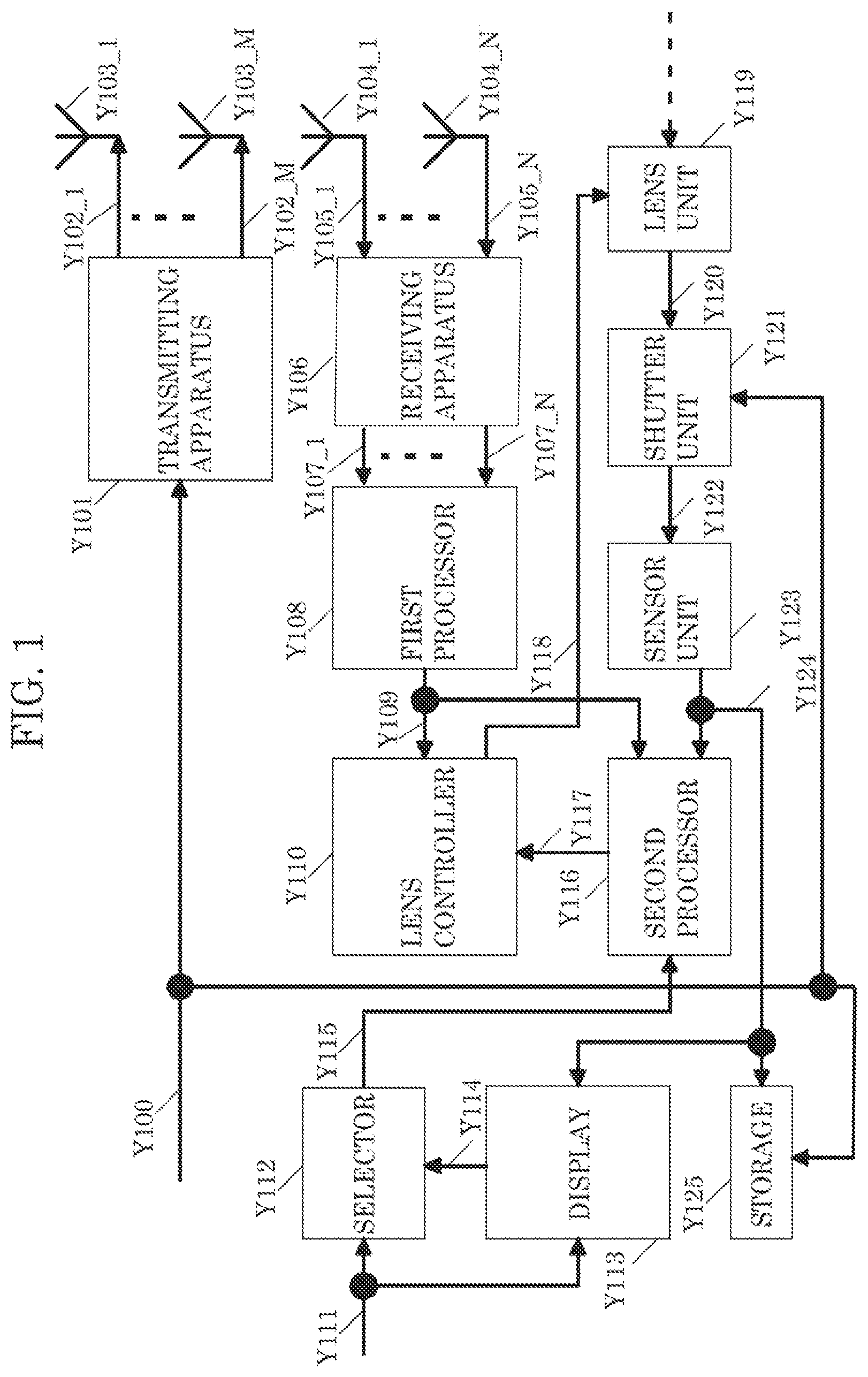
These and other objects, advantages and features of the disclosure will become apparent from the following description thereof taken in conjunction with the accompanying drawings that illustrate a specific embodiment of the present disclosure. illustrates one example of a configuration of a detecting apparatus according to Embodiment 1; illustrates one example of a configuration of the detecting apparatus according to Embodiment 1; illustrates one example of a configuration of the detecting apparatus according to Embodiment 1; illustrates a variation of a configuration of the detecting apparatus according to Embodiment 1; illustrates a variation of a configuration of the detecting apparatus according to Embodiment 1; illustrates a variation of a configuration of the detecting apparatus according to Embodiment 1; illustrates one example of a separated configuration of the detecting apparatus according to Embodiment 1; illustrates one example of a separated configuration of the detecting apparatus according to Embodiment 1; illustrates one example of a separated configuration of the detecting apparatus according to Embodiment 1; illustrates one example of a separated configuration of the detecting apparatus according to Embodiment 1; illustrates one example of a state of an apparatus according to Embodiment 2; illustrates one example of a configuration of a frame according to Embodiment 2; illustrates one example of a configuration of a frame according to Embodiment 2; illustrates one example of a configuration of an apparatus according to Embodiment 3; illustrates one example of a configuration of the apparatus according to Embodiment 3; illustrates one example of a configuration of the apparatus according to Embodiment 3; illustrates one example of a system configuration according to Embodiment 4; illustrates one example of a configuration of an apparatus according to Embodiment 4; illustrates one example of a configuration of a frame according to Embodiment 4; illustrates one example of a configuration of a frame according to Embodiment 4; illustrates one example of a configuration of a frame according to Embodiment 4; illustrates one example of a configuration of a frame according to Embodiment 4; illustrates one example of a configuration of a frame according to Embodiment 4; illustrates one example of a configuration of a frame according to Embodiment 4; illustrates one example of a configuration of a frame according to Embodiment 4; illustrates one example of a configuration of a frame according to Embodiment 4; illustrates one example of a configuration of a frame according to Embodiment 4; illustrates one example of a configuration of a frame according to Embodiment 4; illustrates one example of a configuration of a frame according to Embodiment 4; illustrates one example of a configuration of a frame according to Embodiment 4; illustrates one example of a configuration of a frame according to Embodiment 4; illustrates one example of a configuration of a frame according to Embodiment 4; illustrates one example of a configuration of a frame according to Embodiment 4; illustrates one example of a configuration of a frame according to Embodiment 4; illustrates one example of a configuration of a frame according to Embodiment 4; illustrates one example of a configuration of a frame according to Embodiment 4; illustrates one example of a configuration of a frame according to Embodiment 4; illustrates one example of a configuration of a control system according to Embodiment 5; illustrates one example of a configuration of the control system according to Embodiment 5; illustrates one example of an external appearance of the control system according to Embodiment 5; illustrates one example of processes performed by of the control system according to Embodiment 5; illustrates one example of a configuration of a transmitting apparatus according to Embodiment 6; illustrates one example of processes performed by the transmitting apparatus according to Embodiment 6; illustrates one example of a configuration of an apparatus according to Embodiment 7; illustrates one example of a relation between an apparatus and a person according to Embodiment 7; illustrates one example of a state between a person, a terminal, and an apparatus according to Embodiment 7; illustrates one example of a state between a person, a terminal, and an apparatus according to Embodiment 7; illustrates one example of a relation between an apparatus, a terminal, and a person according to Embodiment 7; illustrates one example of a relation between an apparatus, a terminal, and a person according to Embodiment 7; illustrates one example of a state of apparatuses according to Embodiment 8; illustrates a flow chart of an example of operations performed when an AP is first set up inside home according to Embodiment 8; illustrates a flow chart of an example of operations performed by the AP according to Embodiment 8; illustrates a flow chart of an example of operations performed by a system according to Embodiment 8; illustrates a flow chart of an example of operations performed by the AP and a cloud server according to Embodiment 8; illustrates one example of a state of apparatuses according to Embodiment 9; illustrates a flow chart of an example of operations performed when an AP is first set up inside home according to Embodiment 9; illustrates a flow chart of an example of operations performed by the AP according to Embodiment 9; illustrates a flow chart of an example of operations performed by a system according to Embodiment 9; illustrates a flow chart of an example of operations performed by the AP and a cloud server according to Embodiment 9; illustrates one example of a system configuration according to Embodiment 10; illustrates one example of a system configuration according to Embodiment 10; illustrates one example of a system configuration according to Embodiment 10; illustrates one example of a system configuration according to Embodiment 10; illustrates a sensing method described in the embodiments; illustrates a sensing method described in the embodiments; illustrates one example of a system configuration according to Embodiment 11; illustrates one example of a system configuration according to Embodiment 11; illustrates one example of a configuration of a first apparatus according to Embodiment 11; illustrates one example of a configuration of a first apparatus according to Embodiment 11; illustrates a flow chart of one example of an operations performed by a first apparatus according to Embodiment 11; illustrates a flow chart of one example of an operations performed by a first apparatus according to Embodiment 11; illustrates a flow chart of one example of an operations performed by a first apparatus according to Embodiment 11; illustrates an example of a display displayed by a monitor according to Embodiment 11; illustrates an example of a display displayed by a monitor according to Embodiment 11; illustrates an example of a display displayed by a monitor according to Embodiment 11; illustrates an example of a display displayed by a monitor according to Embodiment 11; illustrates an example of a display displayed by a monitor according to Embodiment 11; illustrates an example of a display displayed by a monitor according to Embodiment 11; illustrates an example of a display displayed by a monitor according to Embodiment 11; illustrates an example of a display displayed by a monitor according to Embodiment 11; illustrates a flow chart of one example of an operations performed by a first apparatus according to Embodiment 11; illustrates a flow chart of one example of an operations performed by a first apparatus according to Embodiment 11; illustrates an example of a display displayed by a monitor according to Embodiment 11; illustrates an example of a display displayed by a monitor according to Embodiment 11; illustrates an example of a display displayed by a monitor according to Embodiment 11; illustrates an example of a display displayed by a monitor according to Embodiment 11; illustrates an example of a display displayed by a monitor according to Embodiment 11; illustrates an example of a display displayed by a monitor according to Embodiment 11; illustrates an example of a display displayed by a monitor according to Embodiment 11; illustrates an example of a display displayed by a monitor according to Embodiment 11; illustrates an example of a display displayed by a monitor according to Embodiment 11; illustrates an example of a display displayed by a monitor according to Embodiment 11; illustrates an example of a display displayed by a monitor according to Embodiment 11; illustrates an example of a display displayed by a monitor according to Embodiment 11; illustrates an example of a display displayed by a monitor according to Embodiment 11; illustrates an example of a display displayed by a monitor according to Embodiment 11; illustrates an example of a display displayed by a monitor according to Embodiment 11; illustrates an example of a display displayed by a monitor according to Embodiment 11; illustrates an example of a display displayed by a monitor according to Embodiment 11; illustrates an example of a display displayed by a monitor according to Embodiment 11; illustrates an example of a display displayed by a monitor according to Embodiment 11; illustrates an apparatus that performs communication with a second apparatus according to Embodiment 12; illustrates an example of a display displayed by a monitor according to Embodiment 12; illustrates an example of a display displayed by a monitor according to Embodiment 12; illustrates an example of a map according to Embodiment 13; illustrates an example of a map according to Embodiment 13; illustrates an example of how the display is switched according to Embodiment 13; illustrates an example of how the display is switched according to Embodiment 13; illustrates an example of how the display is switched according to Embodiment 13; illustrates one example of a system configuration according to Embodiment 14; illustrates an example of a transmission state according to Embodiment 14; illustrates an example of a transmission state according to Embodiment 14; illustrates an example of a configuration of a frame according to Embodiment 14; illustrates an example of a configuration of a frame according to Embodiment 14; illustrates an example of a configuration of a frame according to Embodiment 14; illustrates an example of a state of an apparatus according to Embodiment 15; illustrates an example of a state of an apparatus according to Embodiment 17; illustrates an example of a state of an apparatus according to Embodiment 18; illustrates an example of a state of an apparatus according to Embodiment 19; illustrates an example of a sensing system or a sensing and communication system according to Embodiment 20; illustrates an example of a configuration of information related to sensing capability according to Embodiment 20; illustrates an example of operations performed by an apparatus and a target according to Embodiment 20; illustrates an example of operations performed by an apparatus and a target according to Embodiment 20; A illustrates an example of operations performed by an apparatus and a target according to Embodiment 20; B illustrates an example of operations performed by an apparatus and a target according to Embodiment 20; A illustrates an example of a state when an apparatus is performing operations for sensing according to Embodiment 20; B illustrates an example of a state when an apparatus is performing operations for sensing according to Embodiment 20; illustrates one example of the status of sensing and a communication system according to Embodiment 21; illustrates an example of a configuration of a signal transmitted by an apparatus according to Embodiment 21; A illustrates one example of a configuration of a control information symbol according to Embodiment 21; B illustrates one example of a configuration of a symbol for sensing according to Embodiment 21; illustrates an example of a configuration of a signal transmitted by an apparatus according to Embodiment 21; illustrates an example of a configuration of a signal transmitted by an apparatus according to Embodiment 21; illustrates one example of a configuration of an apparatus and a target according to Embodiment 21; illustrates an example of a configuration related to a transmit antenna according to Embodiment 21; illustrates a specific example of a frame included in a signal for sensing transmitted by an apparatus according to Embodiment 21; illustrates one example of a configuration of a signal for sensing transmitted using an antenna according to Embodiment 21; illustrates an example of a configuration of a signal for sensing transmitted using an antenna and a parameter according to Embodiment 21; illustrates one example of a system configuration according to Embodiment 22; A illustrates one example of operations performed when charging a vehicle according to Embodiment 22; B illustrates one example of operations performed when charging a vehicle according to Embodiment 22; C illustrates one example of operations performed when charging a vehicle according to Embodiment 22; D illustrates one example of operations performed when charging a vehicle according to Embodiment 22; A illustrates one example of operations for ending charging of a vehicle according to Embodiment 22; B illustrates one example of operations for ending charging of a vehicle according to Embodiment 22; illustrates one example of a system configuration according to Embodiment 22; illustrates one example of a system configuration according to Embodiment 23; A illustrates one example of operations for unlocking the doors of a vehicle according to Embodiment 23; B illustrates one example of operations for unlocking the doors of a vehicle according to Embodiment 23; illustrates one example of a system configuration according to Embodiment 23; A illustrates one example for operating a drive system in a vehicle according to Embodiment 23; B illustrates one example for operating a drive system in a vehicle according to Embodiment 23; illustrates an example of a configuration of a system according to Embodiment 24; A illustrates an example of operations performed by apparatuses according to Embodiment 25; B illustrates an example of operations performed by apparatuses according to Embodiment 25; illustrates an example of operations performed by apparatuses according to Embodiment 25; illustrates an example of a configuration of sensing-related information according to Embodiment 25; A illustrates an example of a frame according to Embodiment 25; B illustrates an example of a frame according to Embodiment 25; illustrates an example of a system configuration according to Embodiment 26; illustrates an example of a configuration of an apparatus according to Embodiment 27; A illustrates an example of a configuration of apparatuses according to Embodiment 27; B illustrates an example of a configuration of apparatuses according to Embodiment 27; C illustrates an example of a configuration of apparatuses according to Embodiment 27; D illustrates an example of a configuration of apparatuses according to Embodiment 27; A illustrates an example of a configuration of an apparatus according to Embodiment 27; B illustrates an example of a configuration of an apparatus according to Embodiment 27; A illustrates an example of a display according to Embodiment 27; B illustrates an example of a display according to Embodiment 27; A illustrates an example of a display according to Embodiment 27; B illustrates an example of a display according to Embodiment 27; illustrates an example of a system configuration according to Embodiment 28; A illustrates an example of regions of a target according to Embodiment 28; B illustrates an example of transmission of signals for sensing according to Embodiment 28; C illustrates an example of reception of signals for sensing according to Embodiment 28; D illustrates an example of reception of signals for sensing according to Embodiment 28; A illustrates an example of distances to regions according to Embodiment 28; B illustrates an example of distances to regions according to Embodiment 28; C illustrates an example of distances to regions according to Embodiment 28; D illustrates an example of distances to regions according to Embodiment 28; A illustrates an example regions of a target according to Embodiment 28; B illustrates an example of transmission of signals for sensing according to Embodiment 28; C illustrates an example of transmission of signals for sensing according to Embodiment 28; illustrates an example of a signal transmitted by an apparatus according to Embodiment 28; A illustrates an example of a configuration of an apparatus according to Embodiment 29; B illustrates an example of a configuration of an apparatus according to Embodiment 29; illustrates an example of an arrangement of speakers according to Embodiment 30; illustrates an example of a configuration of information related to sensing capability according to the embodiments; and illustrates measurement or estimation of a position using triangulation described in the embodiments.
DETAILED
DESCRIPTION OF THE EMBODIMENTS
A communication apparatus according to one aspect of the present invention is a first apparatus that performs sensing via radio waves to sense a second apparatus, include: a communication unit configured to receive a frame transmitted via radio waves by the second apparatus and sense the second apparatus using the frame received; and a controller that selects, from among predetermined frequencies, a frequency for the second apparatus to transmit the radio waves at, notifies the second apparatus of the frequency selected, and controls the communication unit to perform the sensing using the frequency. According to this aspect, a communication apparatus (i.e., the first apparatus) notifies the second apparatus, which is the target to be sensed, of the frequency at which to transmit radio waves, and senses the second apparatus using the notified frequency. Typically, what radio wave frequency is suitable for sensing depends on the distance between the first apparatus and the second apparatus, or the radio wave environment around one or both of the first apparatus and the second apparatus. Accordingly, employing a configuration in which the frequency to be used for sensing is selectable from among a plurality of frequencies makes it possible for the first apparatus to adequately sense the second apparatus. The first apparatus can thus sense the surrounding area. For example, when selecting the frequency, the controller may select the frequency independently of a frequency used for communication by the communication unit. According to this aspect, a communication apparatus (i.e., the first apparatus) selects the frequency independently of the frequency used for communication. Accordingly, a frequency suitable for sensing the second apparatus can be selected, regardless of the frequency that the first apparatus uses for communication. This allows the first apparatus to even more adequately sense the surrounding area. For example, the sensing may include at least one of detecting a position of an object, detecting presence or absence of an object, or detecting a shape of an object, by analyzing the radio waves received by the communication unit. This aspect enables a communication apparatus (i.e., the first apparatus) to more easily obtain a sensing result of the surrounding area of the transmitting apparatus by performing processing of detecting the position of an object, processing of detecting the presence or absence of an object, and/or processing of detecting the shape of an object. A communication apparatus according to one aspect of the present invention is a second apparatus that is sensed via radio waves by sensing performed by a first apparatus, and may include: a communication unit configured to transmit, via radio waves, a frame for the sensing; and a controller that receives a notification of a frequency from the first apparatus, and controls the communication unit to transmit the frame via radio waves using the frequency indicated in the notification. According to this aspect, a communication apparatus (i.e., the second apparatus) receives, from the first apparatus that has targeted the second apparatus for sensing, a notification of a frequency at which to transmit radio waves, and transmits radio waves at the frequency indicated in the received notification in order to be sensed by the first apparatus. Typically, what radio wave frequency is suitable for sensing depends on the distance between the first apparatus and the second apparatus, or the radio wave environment around one or both of the first apparatus and the second apparatus. Accordingly, by the second apparatus being configured to be capable of transmission at the frequency notified by the first apparatus, the second apparatus can be a target of sensing by the first apparatus. The second apparatus can thus be sensed by first apparatus. For example, the communication unit may be configured to transmit, as the frame, a frame that includes a preamble and does not include a data field. According to this aspect, a communication apparatus (i.e., the second apparatus) can reduce radio wave transmission time because the frame it transmits to be sensed by the first apparatus does not include a data field. A communication method according to one aspect of the present invention is executed by a communication apparatus which is a first apparatus that performs sensing via radio waves to sense a second apparatus, and includes: receiving a frame transmitted via radio waves by the second apparatus and sensing the second apparatus using the frame received; and selecting, from among predetermined frequencies, a frequency for the second apparatus to transmit the radio waves at, notifying the second apparatus of the frequency selected, and controlling the sensing to perform the sensing using the frequency. This aspect achieves the same advantageous effects as the communication apparatus described above. A communication method according to one aspect of the present invention is executed by a communication apparatus which is a second apparatus that is sensed via radio waves by sensing performed by a first apparatus, and includes: transmitting, via radio waves, a frame for the sensing; and receiving a notification of a frequency from the first apparatus, and controlling the transmitting to transmit the frame via radio waves using the frequency indicated in the notification. This aspect achieves the same advantageous effects as the communication apparatus described above. General or specific aspects of these may be realized as a system, method, integrated circuit, computer program, computer-readable recording medium such as a CD-ROM, or any given combination thereof. Hereinafter, the transmitting apparatus according to the present disclosure will be described in greater detail with reference to the drawings. Each of the following embodiments describes a general or specific example. The numerical values, shapes, materials, elements, the arrangement and connection of the elements, the steps, the order of the steps, etc., shown in the following embodiments are mere examples, and therefore do not limit the scope of the present disclosure. Therefore, among elements in the following embodiments, those not recited in any of the independent claims indicating the broadest scope are described as optional elements. Embodiment 1 In the present embodiment, a detecting apparatus capable of detecting a position of an object in the surrounding area, positional relationships between objects, and distance to an object will be described. Note that the detecting apparatus is also herein referred to as a transmitting apparatus. illustrates one example of a configuration of the detecting apparatus according to the present embodiment. Transmitting apparatus Y 101 receives an input of control signal Y 100 . In this example, control signal Y 100 includes information for controlling operations of one or more element included in detecting apparatus, such as information indicating to start operations for object detection, information indicating to end operations for object detection, information indicating to start recording a still image or video, and information indicating to end recording a still image or video. When control signal Y 100 includes information indicating to start operations for object detection, for example, transmitting apparatus Y 101 generates, in receiving apparatus Y 106 , M modulated signals to be used for radio wave direction of arrival estimation, and outputs M transmission signals. In other words, transmitting apparatus Y 101 outputs transmission signals Y 102 _ 1 through Y 102 _M. Note that M is an integer that is greater than or equal to 1. Transmission signal Y 102 _ i is output as radio waves from antenna Y 103 _ i . Note that i is an integer that is greater than or equal to 1 and less than or equal to M. Antenna Y 103 _ i may be configured as a single antenna, and may be configured as a plurality of antennas. When antenna Y 103 _ i is configured as a plurality of antennas, antenna Y 103 _ i may include directionality control functionality. A modulated signal transmitted from transmitting apparatus Y 101 is reflected by an object present in the direction in which the modulated signal is radiated or in the surrounding area of the radiated modulation signal. Receiving apparatus Y 106 receives the reflected waves. Accordingly, receiving apparatus Y 106 receives reception signal group Y 105 _ 1 received by antenna Y 104 _ 1 through reception signal group Y 105 _N received by antenna Y 104 _N. Note that N is an integer that is greater than or equal to 1. Hereinafter, a case in which antenna Y 104 _ i is configured of a plurality of antennas will be described. As such, in the following description, the signals received by antenna Y 104 _ i will be referred to as reception signal group Y 105 _ i . For example, when antenna Y 104 _ i is configured of 16 antennas, reception signal group Y 105 _ i includes 16 reception signals. Receiving apparatus Y 106 performs direction of arrival estimation on reception signal group Y 105 _ 1 and estimates the distance to an object based on the timing of the transmission of modulated signals by transmitting apparatus Y 101 and the timing of obtainment of reception signal group Y 105 _ 1 . Receiving apparatus Y 106 thus outputs object estimation information Y 107 _ 1 . The phrase “distance to an object” used above means, for example, the distance between the object and the detecting apparatus. Here, the value calculated as the distance is, for example, the distance between the object and an antenna, the distance between the object and a central position of a plurality of antennas, or the distance between the object and a sensor unit (to be described later). The “distance to an object” may be, for example, the distance between a point or region of reflection of the modulated signal on the object and the detecting apparatus. When, for example, a plurality of modulated signals are transmitted simultaneously, a plurality of distances to an object may be measured, one for each of a plurality of points or regions on the object. Similarly, receiving apparatus Y 106 performs direction of arrival estimation on reception signal group Y 105 _ i and estimates the distance to an object based on the timing of the transmission of modulated signals by transmitting apparatus Y 101 and the timing of obtainment of reception signal group Y 105 _ i . Receiving apparatus Y 106 thus outputs object estimation information Y 107 _ i . Note that i is an integer that is greater than or equal to 1 and less than or equal to N. First processor Y 108 receives an input of object estimation information Y 107 _ 1 through object estimation information Y 107 _N. For example, first processor Y 108 performs detailed object estimation using object estimation information Y 107 _ 1 through object estimation information Y 107 _N, and outputs object estimation signal Y 109 . Display Y 113 receives inputs of image information Y 124 and area information Y 111 for restricting the area in which to perform object recognition, associates an image with the area in which to perform object recognition, and outputs area signal Y 114 . Note that the association of an image with the area in which to perform object recognition is, for example, specifying the area in which to perform object recognition in an image obtained in display Y 113 . The association of an image with the area in which to perform object recognition may be, for example, specifying an area in which first processor Y 108 is to perform object recognition in accordance with a specified area of an image obtained in display Y 113 . Selector Y 112 receives inputs of area information Y 111 and area signal Y 114 , for restricting the area in which to perform object recognition. Selector Y 112 determines an area to detect an object in based on area information Y 111 and area signal Y 114 , and outputs selected area signal Y 115 . Note that selector Y 112 need not restrict the area to detect an object in. In such cases, selector Y 112 need not output selected area signal Y 115 ; selected area signal Y 115 may include information indicating that the area to detect an object in is not restricted. Although this configuration includes display Y 113 and display Y 113 is configured to output area signal Y 114 , the detecting apparatus is not limited to this configuration. Moreover, display Y 113 may restrict the area of object detection based on instruction from the user made on a panel such as a liquid crystal panel via a touch panel function (e.g., an apparatus including a display apparatus such as a liquid crystal panel and a positional input apparatus such as a touch pad). Second processor Y 116 receives inputs of object estimation signal Y 109 , selected area signal Y 115 , and image information Y 124 . In this example, second processor Y 116 performs first and second processing methods. However, second processor Y 116 may perform only one of the first and second processing methods, and, alternatively, may switch between the first and second processing methods depending on the situation. Second processor Y 116 may generate auxiliary information for storing distance information for a plurality of positions using object estimation signal Y 109 . For example, the auxiliary information is a plurality of items of position information corresponding to an object that is a candidate to be captured, and second processor Y 116 may select position information corresponding to an object that is a candidate to be captured from the plurality of items of position information corresponding to an object that is a candidate to be captured. First Processing Method: Second processor Y 116 performs object recognition from image information Y 124 . Second processor Y 116 estimates the distance between each object recognized and the detecting apparatus based on recognition information for the object and object estimation signal Y 109 , and outputs estimated distance information Y 117 . Note that second processor Y 116 may restrict the area in which object recognition is to be performed, using selected area signal Y 115 . Second processor Y 116 may restrict which objects to perform distance estimation on, using selected area signal Y 115 . Second Processing Method: Second processor Y 116 estimates the distance between each object and the detecting apparatus from object estimation signal Y 109 and image information Y 124 , and outputs estimated distance information Y 117 . Note that second processor Y 116 may restrict the area in which object recognition is to be performed, using selected area signal Y 115 . Second processor Y 116 may restrict which objects to perform distance estimation on, using selected area signal Y 115 . Lens controller Y 110 receives inputs of object estimation signal Y 109 and estimated distance information Y 117 . Lens controller Y 110 determines control of operations related to the lens using object estimation signal Y 109 and/or estimated distance information Y 117 , such as focal distance control for a target object, lens focus control for a target object, and controlling the direction in which to capture a target object, and outputs operation control signal Y 118 . Lens unit Y 119 receives an input of operation control signal Y 118 , and based on operation control signal Y 118 , controls operations related to the lens, such as focal distance control for a target object, lens focus control for a target object, and/or controlling the direction in which to capture a target object, and outputs object signal Y 120 . Note that object signal Y 120 is an optical signal. Shutter unit Y 121 receives inputs of control signal Y 100 and object signal Y 120 , controls operation of the shutter based on control signal Y 100 , and outputs post-control object signal Y 122 . Sensor unit Y 123 receives an input of post-control object signal Y 122 , performs optical to electric signal conversion, for example, and outputs image information Y 124 . For example, a charge-coupled device (CCD) image sensor, a complementary metal oxide semiconductor (CMOS) image sensor, or an organic CMOS image sensor may be used as sensor unit Y 123 . Storage Y 125 receives inputs of control signal Y 100 and image information Y 124 , and stores image information, such as a video or a still image, based on control signal Y 100 . Storage Y 125 may store the image information obtained by sensor unit Y 123 as-is, and may store encoded data encoded using an image encoding technique. In addition to or instead of image information, storage Y 125 may store analytical data obtained as a result of signal processing the image. The analytical data is, for example, information indicating whether a detection target, which is set in advance and examples of which include a person, animal, vehicle, or drone, is captured or not, that is to say, whether or not a detection target is present in the region of capture or not. The analytical data may include information related to an attribute of the detection target such as color or size, the orientation of the detection target, and information related to an activity, such as the path of movement, the speed of the detection target, time of stay of the detection target, what the detection target is doing, or what the detection target is looking at. For example, the information related to an attribute may include, in the case of a person, the estimated gender and/or age of the person, and in the case of a vehicle, the model of the vehicle, the number of passengers, and/or the amount of cargo loaded in the vehicle. As described above, with the detecting apparatus according to the present embodiment, it is possible to estimate the distance to an object using radio waves. Moreover, with the detecting apparatus according to the present embodiment, by controlling a lens used to capture the object based on the estimated distance to the object, it is possible to control the lens according to purpose, such as clearly capturing the target object to be captured. Moreover, with the detecting apparatus according to the present embodiment, the distance to the object can be estimated even when the surrounding area is dark, for example, which makes it possible to improve the reliability of the estimation of the distance to the object. Moreover, by both estimating the distance to the object using radio waves and estimating the distance to the object based on an optical signal (image), there is a possibility that the advantageous effect that more accurate or more reliable distance estimation can be performed can be achieved. Next, the configuration of a detecting apparatus that differs from and is capable of detecting an object with high accuracy will be described. illustrates an example of a configuration of a detecting apparatus that differs from . In , elements that operate the same as in have the same reference signs, and repeated description will be omitted. Sensor unit with shutter function Y 200 receives inputs of control signal Y 100 and object signal Y 120 . Sensor unit with shutter function Y 200 receives an input of control signal Y 100 , controls shutter operation based on control signal Y 100 , and generates and outputs image information Y 124 by performing optical to electric signal conversion, for example. The shutter of sensor unit with shutter function Y 200 may be, for example, an electronic shutter or a global shutter. In , operations performed by elements other than sensor unit with shutter function Y 200 are the same as described with reference to . With the detecting apparatus configured as described above, it is possible to estimate distance to an object using radio waves. Moreover, with the detecting apparatus configured as described above, by controlling a lens used to capture the object based on the estimated distance to the object, it is possible to control the lens according to purpose, such as clearly capturing the target object to be captured. Moreover, with the detecting apparatus configured as described above, the distance to the object can be estimated even when the surrounding area is dark, for example, which makes it possible to improve the reliability of the estimation of the distance to the object. Moreover, by both estimating the distance to the object using radio waves and estimating the distance to the object based on an optical signal (image), there is a possibility that the advantageous effect that more accurate or more reliable distance estimation can be performed can be achieved. Next, the configuration of a detecting apparatus that differs from and and is capable of detecting an object with high accuracy will be described. illustrates an example of a configuration of a detecting apparatus that differs from and . In , elements that operate the same as in and have the same reference signs, and repeated description will be omitted. One characterizing feature of the configuration in is that the detecting apparatus includes both shutter unit Y 121 and sensor unit with shutter function Y 200 . For example, shutter unit Y 121 includes a mechanical shutter such as a focal-plane shutter. Sensor unit with shutter function Y 200 includes an electronic shutter or a global shutter. Sensor unit with shutter function Y 200 receives an input of control signal Y 100 , and when the operation information included in control signal Y 100 indicates video mode, the shutter function of sensor unit with shutter function Y 200 operates. In contrast, shutter unit Y 121 receives an input of control signal Y 100 , and when the operation information included in control signal Y 100 indicates video mode, shutter unit Y 121 does not operate the shutter, that is to say, keeps the shutter open. Sensor unit with shutter function Y 200 receives an input of control signal Y 100 , and when the operation information included in control signal Y 100 indicates still image mode, control signal Y 100 includes, for example, shutter speed information. In still image mode, sensor unit with shutter function Y 200 operates the shutter function of sensor unit with shutter function Y 200 in accordance with the shutter speed information. Shutter unit Y 121 receives an input of control signal Y 100 , and when the operation information included in control signal Y 100 indicates still image mode, control signal Y 100 includes, for example, shutter speed information. In still image mode, shutter unit Y 121 operates the shutter function in accordance with the shutter speed information. Note that in the still image mode, when the shutter function of sensor unit with shutter function Y 200 is operating, the shutter function of shutter unit Y 121 does not operate. Conversely, when the shutter function of shutter unit Y 121 is operating, the shutter function of sensor unit with shutter function Y 200 does not operate. In , operations performed by elements other than those described above are the same as described with reference to . With the detecting apparatus configured as described above, it is possible to estimate distance to an object using radio waves. Moreover, with the detecting apparatus configured as described above, by controlling a lens used to capture the object based on the estimated distance to the object, it is possible to control the lens according to purpose, such as clearly capturing the target object to be captured. Moreover, with the detecting apparatus configured as described above, the distance to the object can be estimated even when the surrounding area is dark, for example, which makes it possible to improve the reliability of the estimation of the distance to the object. Moreover, by both estimating the distance to the object using radio waves and estimating the distance to the object based on an optical signal (image), there is a possibility that the advantageous effect that more accurate or more reliable distance estimation can be performed can be achieved. illustrates a variation of . In , elements that operate the same as in have the same reference signs, and repeated description will be omitted. Second processor Y 116 receives inputs of object estimation signal Y 109 , selected area signal Y 115 , image information Y 124 , and data group Y 403 . In this example, second processor Y 116 performs object recognition from image information Y 124 , based on data group Y 403 . Second processor Y 116 estimates the distance between each object recognized and the detecting apparatus illustrated in the figure based on recognition information for the object and object estimation signal Y 109 , and outputs estimated distance information Y 117 . Second processor Y 116 may restrict which objects to perform distance estimation on, using selected area signal Y 115 . Examples of signal processing used when performing object recognition using image information Y 124 include processing of detecting a person or part of the person such as their face, processing of identifying a person, processing of detecting a target object such as a vehicle or a drone, processing of identifying a target object such as a vehicle or a drone, processing of detecting activity or movement of a detected person or target object, and processing of tracking a detected person or target object. In this example, image information Y 124 may be one or more still images, and may be a video of a plurality of frames successively obtained at a predetermined time. For example, at least one feature amount obtained by performing a predetermined calculation process determined based on the purpose of the signal processing is extracted from image information Y 124 , and the signal processing is performed based on a comparison result of the extracted feature amount and a known feature amount corresponding to the target object or an activity thereof. Moreover, the signal processing may be performed based on a determination of whether the extracted feature amount exceeds a predetermined threshold or not. Moreover, the signal processing may be performed based on some other signal processing not described above. For example, the signal processing may be performed using a model created via machine learning using a multi-layer neural network. When a model created via machine learning using a multi-layer neural network is used, preprocessing may be performed on video image data, and the preprocessed data may be input into the model created via machine learning using a multi-layer neural network. In , second processor Y 116 may output data to query data unit Y 402 . For example, based on this information, query data unit Y 402 may reduce the output data amount of data group Y 403 . In the above description, second processor Y 116 is exemplified as performing object recognition using image information Y 124 , but second processor Y 116 may perform object recognition using object estimation signal Y 109 in addition to image information Y 124 . In this example, object estimation signal Y 109 need not comprise only distance information; for example, object estimation signal Y 109 may include information such as reflectance, which is obtained by analyzing reception signal group Y 105 _ i. Second processor Y 116 may output object recognition information Y 404 . Communication apparatus Y 400 receives an input of object recognition information Y 404 , generates a modulated signal including this data, and transmits the modulated signal to a communication apparatus that is a communication partner. In this example, the communication apparatus that is a communication partner is, for example, connected to a server, and the server obtains object recognition information Y 404 from the modulated signal transmitted by communication apparatus Y 400 , generates an object recognition database, generates a modulated signal including this data base via the communication apparatus, and transmits the generated modulated signal to communication apparatus Y 400 . Communication apparatus Y 400 receives the modulated signal, obtains object recognition database Y 401 , and outputs object recognition database Y 401 to query data unit Y 402 . Query data unit Y 402 receives an input of object recognition database Y 401 , and updates data group Y 403 that second processor Y 116 uses to perform object recognition. With the detecting apparatus configured as described above, it is possible to estimate distance to an object using radio waves. Moreover, with the detecting apparatus configured as described above, by controlling a lens used to capture the object based on the estimated distance to the object, it is possible to control the lens according to purpose, such as clearly capturing the target object to be captured. Moreover, with the detecting apparatus configured as described above, the distance to the object can be estimated even when the surrounding area is dark, for example, which makes it possible to improve the reliability of the estimation of the distance to the object. Moreover, by both estimating the distance to the object using radio waves and estimating the distance to the object based on an optical signal (image), there is a possibility that the advantageous effect that more accurate or more reliable distance estimation can be performed can be achieved. Furthermore, with the detecting apparatus configured as described above, the mechanism for updating the database used for object recognition makes it possible to improve the accuracy and reliability of the object recognition, which resultantly contributes to an improvement in the accuracy and reliability of distance estimation. Moreover, when object recognition is performed using information obtained using radio waves in addition to using image information, there is a possibility that the accuracy and reliability of the object recognition will improve. illustrates a variation of . In , elements that operate the same as in , , and have the same reference signs, and repeated description will be omitted. As operations performed by each element illustrated in have already been described, repeated description thereof will be omitted. illustrates a variation of . In , elements that operate the same as in , , and have the same reference signs, and repeated description will be omitted. As operations performed by each element illustrated in have already been described, repeated description thereof will be omitted. With the detecting apparatus configured as described above, it is possible to estimate distance to an object using radio waves. Moreover, with the detecting apparatus configured as described above, by controlling a lens used to capture the object based on the estimated distance to the object, it is possible to control the lens according to purpose, such as clearly capturing the target object to be captured. Moreover, with the detecting apparatus configured as described above, the distance to the object can be estimated even when the surrounding area is dark, for example, which makes it possible to improve the reliability of the estimation of the distance to the object. Moreover, by both estimating the distance to the object using radio waves and estimating the distance to the object based on an optical signal (image), there is a possibility that the advantageous effect that more accurate or more reliable distance estimation can be performed can be achieved. Furthermore, with the detecting apparatus configured as described above, the mechanism for updating the database used for object recognition makes it possible to improve the accuracy and reliability of the object recognition, which resultantly contributes to an improvement in the accuracy and reliability of distance estimation. Moreover, when object recognition is performed using information obtained using radio waves in addition to using image information, there is a possibility that the accuracy and reliability of the object recognition will improve. In the present embodiment, although an apparatus exemplified as having one of the configurations illustrated in through is referred to as a “detecting apparatus”, the naming of the apparatus is not limited to a “detecting apparatus”. For example, since the apparatus according to the present embodiment includes storage, this element may be referred to as a “storage apparatus”, and since the apparatus includes a sensor unit, this element may be referred to as a camera, a video camera, a monitoring camera, a security camera, a recording apparatus, or a still image capturing apparatus. Moreover, this element may simply be referred to as an “apparatus”. The naming of this element is not limited to the above examples. The configurations of , , , , , and may be realized as a system of a combination of separate apparatuses. Hereinafter, an example in which a configuration is realized as a plurality of separate apparatuses will be given. illustrates a first example of separation of apparatuses. Second apparatus Y 702 is an apparatus that includes lens unit Y 119 that is included in the apparatuses illustrated in , , , , , and . First apparatus Y 701 is an apparatus that includes elements other than lens unit Y 119 that are included in the apparatuses illustrated in , , , , , and . First apparatus Y 701 includes first interface Y 703 for connecting to second apparatus Y 702 , and second apparatus Y 702 includes second interface Y 704 for connecting to first apparatus Y 701 . Accordingly, first interface Y 703 receives an input of operation control signal Y 118 . Second interface Y 704 then outputs a signal to lens unit Y 119 . By connecting first interface Y 703 and second interface Y 704 , lens unit Y 119 can obtain a signal that corresponds to operation control signal Y 118 . Note that first interface Y 703 and second interface Y 704 may be connected in any manner. For example, first interface Y 703 and second interface Y 704 may be directly connected, and, alternatively, may be connected via a connection cable, for example. However, the connection method is not limited to the above examples. illustrates a second example of separation of apparatuses. Third apparatus Y 802 includes transmitting apparatus Y 101 , antennas Y 103 _ 1 to Y 103 _M, antennas Y 104 _ 1 to Y 104 _N, receiving apparatus Y 106 , and first processor Y 108 that are included in the apparatuses illustrated in , , , , , and . First variant Y 801 of first apparatus Y 701 is an apparatus that includes elements other than transmitting apparatus Y 101 , antennas Y 103 _ 1 to Y 103 _M, antennas Y 104 _ 1 to Y 104 _N, receiving apparatus Y 106 , and first processor Y 108 that are included in the apparatuses illustrated in , , , , , and . First variant Y 801 of first apparatus Y 701 includes third interface Y 803 for connecting to third apparatus Y 802 , and third apparatus Y 802 includes fourth interface Y 804 for connecting to first variant Y 801 of first apparatus Y 701 . Accordingly, third interface Y 803 receives an input of control signal Y 100 . Fourth interface Y 804 then outputs a signal to transmitting apparatus Y 101 . By connecting third interface Y 803 and fourth interface Y 804 , transmitting apparatus Y 101 can obtain a signal that corresponds to control signal Y 100 . Fourth interface Y 804 receives an input of object estimation signal Y 109 . Third interface Y 803 then outputs a signal. Accordingly, by connecting third interface Y 803 and fourth interface Y 804 , third interface Y 803 outputs a signal corresponding to object estimation signal Y 109 . Note that third interface Y 803 and fourth interface Y 804 may be connected in any manner. For example, third interface Y 803 and fourth interface Y 804 may be directly connected, and, alternatively, may be connected via a connection cable, for example. However, the connection method is not limited to the above examples. illustrates a third example of separation of apparatuses. In , elements that operate the same as in and have the same reference signs, and repeated description will be omitted. Second variant Y 901 of first apparatus Y 701 includes the elements that are included in the apparatuses illustrated in , , , , , and except for transmitting apparatus Y 101 , antennas Y 103 _ 1 to Y 103 _M, antennas Y 104 _ 1 to Y 104 _N, receiving apparatus Y 106 , first processor Y 108 , and lens unit Y 119 . Second variant Y 901 of first apparatus Y 701 also includes first interface Y 703 and third interface Y 803 . Note that first interface Y 703 , second interface Y 704 , third interface Y 803 , and fourth interface Y 804 illustrated in operate as described above. illustrates a third example of separation of apparatuses. In , elements that operate the same as in and have the same reference signs, and repeated description will be omitted. Second variant Y 901 of first apparatus Y 701 includes the elements that are included in the apparatuses illustrated in , , , , , and except for transmitting apparatus Y 101 , antennas Y 103 _ 1 to Y 103 _M, antennas Y 104 _ 1 to Y 104 _N, receiving apparatus Y 106 , first processor Y 108 , and lens unit Y 119 . Second variant Y 901 of first apparatus Y 701 also includes first interface Y 703 and third interface Y 803 . Note that first interface Y 703 , second interface Y 704 , third interface Y 803 , and fourth interface Y 804 illustrated in operate as described above. illustrates a fourth example of separation of apparatuses. In , elements that operate the same as in , , and have the same reference signs, and repeated description will be omitted. Fourth apparatus Y 1002 includes transmitting apparatus Y 101 , antennas Y 103 _ 1 through Y 103 _M, antennas Y 104 _ 1 through Y 104 _N, receiving apparatus Y 106 , first processor Y 108 , and lens unit Y 119 that are included in the configurations illustrated in , , , , , and , and further includes second interface Y 704 and fourth interface Y 804 . As operations performed by each element illustrated in have already been described, repeated description thereof will be omitted. Although examples of operations performed by the present embodiment have been described with reference to through , the configurations illustrated in through are merely non-limiting examples. Transmitting apparatus Y 101 and receiving apparatus Y 106 illustrated in through transmit and receive radio waves, and operations performed when doing so have been described. In contrast, if transmitting apparatus Y 101 illustrated in through is configured to generate an optical modulated signal such as a visible light modulated signal and receiving apparatus Y 106 illustrated in through is configured to receive optical modulated signals, the embodiment can still be carried out. If such a configuration is adopted, light emitting diodes (LEDs) or electroluminescent (EL) elements are used instead of antennas Y 103 _ 1 through Y 103 _M, and photodiodes or image sensors or the like are used instead of antennas Y 104 _ 1 through Y 104 _N. In the apparatuses illustrated from to and the like, object recognition may be performed using information obtained using radio waves. In through , one characterizing feature is that object recognition or estimation of distance to an object is performed and a still image or video is recorded (stored), but the configuration of an apparatus having such a characterizing feature is not limited to the configurations illustrated in through . Note that transmission power needs to be increased to increase sensing distance. For example, transmission power can be increased by narrowing the transmission band. Sensing using polarized waves is also possible. Embodiment 2 In the present embodiment, a configuration method of the modulated signal transmitted by the apparatus described with reference to through and the like according to Embodiment 1 that performs distance estimation using radio waves or performs object recognition using radio waves will be described. illustrates one example of states of apparatus Y 1101 that performs distance estimation using radio waves or performs object recognition using radio waves described in Embodiment 1, object Y 1102 that is a target for the distance estimation or object recognition, and other apparatuses. Hereinafter, “apparatus Y 1101 that performs distance estimation using radio waves or performs object recognition using radio waves” will be referred to simply as “apparatus Y 1101 ”. illustrates terminal Y 1103 and access point (AP) Y 1104 in addition to apparatus Y 1101 and object Y 1102 . Terminal Y 1103 and AP Y 1104 use a first frequency band when they communicate. Apparatus Y 1101 uses the first frequency band when performing distance estimation or object recognition on object Y 1102 . In this example, when communication between terminal Y 1103 and AP Y 1104 and distance estimation or object recognition of object Y 1102 by apparatus Y 1101 are performed at the same time, radio waves from one will interfere with radio waves from the other, which decreases communication quality and may contribute to a decrease in accuracy of the distance estimation or object recognition. In the present embodiment, a method for improving these decreases will be described. illustrates an example of a frame configuration used when terminal Y 1103 and access point (AP) Y 1104 transmit modulated signals for communication as illustrated in . In , time is represented on the horizontal axis. Reference symbol for communication Y 1201 is a symbol for a communication partner to perform signal detection, time synchronization, frequency synchronization, channel estimation, etc. Reference symbol for communication Y 1201 may be control information or a media access control (MAC) frame required for a procedure to perform data communication. Control information symbol for communication Y 1202 is a symbol for notifying of the communication method or the like of data symbol for communication Y 1203 . Accordingly, control information symbol for communication Y 1202 includes information such as information indicating the error correction coding method (information indicating coding rate, block length (code length), error correction code), information indicating the modulation method, information indicating the transmitting method (for example, information indicating whether single stream transmission or multi-stream transmission is used) (information indicating modulation and coding scheme (MCS)), information indicating data length, etc. Data symbol for communication Y 1203 is a symbol for transmitting data to a communication partner. The frame configuration illustrated in is merely one example; the frame configuration may include other symbols. A single carrier transmission method or a multi-carrier transmission method, such as orthogonal frequency division multiplexing (OFDM) may be used to transmit the frame illustrated in . Reference symbol for communication Y 1201 may include a region for transmitting data. The region for transmitting data may include data for identifying whether the transmission signal is transmitting a signal for communication or transmitting a signal for object detection. Although the naming “reference symbol for communication” Y 1201 is used, the naming of such a symbol is not limited to this example. Reference symbol for communication Y 1201 may be referred to as a pilot symbol, training symbol, training field, preamble, control information symbol, mid-amble, etc. illustrates one example of a frame configuration of a modulated signal transmitted by apparatus Y 1101 . In , elements that operate the same as in have the same reference signs, and as they have already been described above, repeated description will be omitted. As described in Embodiment 1, based on information indicating to start operations for object detection or information indicating to start recording a still image or video included in control signal Y 100 , apparatus Y 1101 first transmits reference symbol for communication Y 1201 . Note that information indicating to start operations for object detection or information indicating to start recording a still image or video may be implemented by a user pressing a button included in apparatus Y 1101 , a user touching a touch panel included in apparatus Y 1101 , a user pressing a shutter button included in apparatus Y 1101 , or a user pressing a record start button included in apparatus Y 1101 . Apparatus Y 1101 then transmits “modulated signal for object detection or modulated signal for estimating distance to object” Y 1302 . As a result of apparatus Y 1101 transmitting a modulated signal like in , terminal Y 1103 and AP Y 1104 in detect reference symbol for communication Y 1201 illustrated in , whereby they know that a modulated signal is present in the first frequency band. Accordingly, when terminal Y 1103 and AP Y 1104 detect reference symbol for communication Y 1201 , they temporarily suspend modulated signal transmission. When terminal Y 1103 and AP Y 1104 cease to detect reference symbol for communication Y 1201 , they can resume modulated signal transmission. By implementing the above, a situation in which a modulated signal transmitted by apparatus Y 1101 and a modulated signal transmitted by terminal Y 1103 or AP Y 1104 interfere with one another can be inhibited from occurring, which makes it possible to achieve the advantageous effects of an improvement in data reception quality in communication between terminal Y 1103 and AP Y 1104 and an improvement in accuracy of distance estimation and object recognition performed by apparatus Y 1101 . The frame configuration illustrated in is merely one example; the frame configuration may include other modulated signals. Hereinafter, a sensing method that uses radio waves will be described by way of examples. An apparatus that implements the sensing method that uses radio waves to be described in the following embodiment may use the sensing method in combination with processing that uses sensing data obtained from a sensor having an image capturing function such as a camera as described in Embodiments 1 and 2. Conversely, an apparatus that implements the sensing method that uses radio waves to be described in the following embodiment need not use the sensing method in combination with processing that uses sensing data obtained from a sensor having an image capturing function such as a camera. As used herein, implementation of a sensing method that uses radio waves without being combined with processing that uses sensing data obtained from a sensor having an image capturing function such as a camera does not refer only to a case in which an apparatus that does not include a camera performs sensing using radio waves. For example, an apparatus that includes a camera, such as a smartphone, may capture an image or perform sensing for distance measuring using one or more cameras, and may separately perform sensing that uses radio waves using, for example, a wireless communication unit or wireless communication radar. In order for an apparatus that includes a camera, such as a smartphone, to control the capturing of an image or the performing of sensing for distance measuring using one or more cameras, the apparatus may refrain from using the sensing result of the sensing that uses radio waves using, for example, a wireless communication unit or wireless communication radar, and in order for the apparatus to control the sensing that uses radio waves using, for example, a wireless communication unit or wireless communication radar, the apparatus may refrain from using the sensing result of the capturing of an image or the performing of sensing for distance measuring using one or more cameras, and on the other hand, the apparatus may use a combination of both sensing results in a single application. Embodiment 3 In the present embodiment, for example, a system includes one or more of an apparatus that performs communication, an apparatus that performs sensing, and an apparatus that performs communication and sensing. First, configurations of, for example, an apparatus that performs sensing and an apparatus that performs communication and sensing will be described. illustrates one example of a configuration of apparatus X 100 that performs sensing that transmits a signal for sensing and receives a signal for sensing that has reflected off an object in the surrounding area and returned. Transmitting apparatus X 101 generates transmission signals X 102 _ 1 through X 102 _M as signals for sensing, and transmits transmission signals X 102 _ 1 through X 102 _M from antennas X 103 _ 1 through X 103 _M, respectively. In this example, the number of antennas used for transmission is M, where M is an integer that is greater than or equal to 1 or greater than or equal to 2. For example, transmitting apparatus X 101 may generate transmission signals X 102 _ 1 through X 102 _M by multiplying the same sensing signal by coefficients determined for each antenna, and transmit transmission signals X 102 _ 1 through X 102 _M from antennas X 103 _ 1 through X 103 _M to perform directionality control for the sensing signals. Moreover, for example, transmitting apparatus X 101 may generate transmission signals X 102 _ 1 through X 102 _M by multiplying a plurality of sensing signals with coefficients determined for each of the sensing signals and each of the antennas, and combining them, and transmit the generated transmission signals X 102 _ 1 through X 102 _M from antennas X 103 _ 1 through X 103 _M. This makes it possible to perform directionality control for each sensing signal. Coefficients determined for each antenna or coefficients determined for each sensing signal and each antenna are expressed as complex numbers or integers. Depending on the value of the coefficient, the amplitude and/or phase of the sensing signal transmitted from each antenna differs. However, the coefficient may be 1, and in this case, a sensing signal generated by transmitting apparatus X 101 is transmitted as-is from the antenna whose coefficient value is 1. Note that transmitting apparatus X 101 may transmit transmission signals without performing directionality control. For example, transmission signals of antennas corresponding to each of the plurality of sensing signals may be output by transmitting apparatus X 101 as-is from antennas X 103 _ 1 through X 103 _M. Although there are a plurality of sensing signals and a plurality of antennas in the above example, the number of sensing signals generated by transmitting apparatus X 101 and the number of antennas that transmit sensing signals may be one. Sensing signals transmitted from antennas X 103 _ 1 through X 103 _M are reflected off object #1 X 110 _ 1 and object #2 X 110 _ 2 , and the reflected sensing signals are received by antennas X 104 _ 1 through X 104 _N included in apparatus X 100 . In this example, the number of antennas that receive sensing signals is N, where N is an integer that is greater than or equal to 1 or greater than or equal to 2. The number of antennas used for transmission, M, may be the same as or different than the number of antennas used for reception, N. Reception signals X 105 _ 1 through X 105 _N received by antennas X 104 _ 1 through X 104 _N are input into receiving apparatus X 106 . For example, receiving apparatus X 106 implements, on reception signals X 105 _ 1 through X 105 _N, filter processing of extracting only a frequency range or channel components in a frequency range in which the sensing signals are transmitted, frequency conversion processing of conversion from a wireless communication frequency band to an intermediate frequency band (IF band) or frequency band of a baseband signal, and/or weighting synthesis processing on N reception signals, and outputs estimation signal X 107 . Coefficients used in the weighting synthesis performed on the N reception signals can be set for each of reception signals X 105 _ 1 through X 105 _N, and reception directionality control can be performed by changing the coefficient values. The coefficients may be estimated in advance, and, alternatively, using reception signals X 105 _ 1 through X 105 _N, the coefficients may be set so as yield an amplitude or signal-to-noise power ratio (SNR) of weighting-synthesized sensing signal components that are larger than when a different coefficient is used, or set so as to exceed a predetermined threshold. Moreover, by using a plurality of groups of N coefficients corresponding to reception signals X 105 _ 1 through X 105 _N, receiving apparatus X 106 may simultaneously obtain signals having a directionality that corresponds to each group of coefficients. However, it is possible to carry out the above without performing weighting synthesis. Estimator X 108 performs estimation processing related to the sensing environment, i.e., the surrounding environment, using estimation signal X 107 . The estimation processing performed by estimator X 108 will be described in greater detail later. Control signal X 109 is input into transmitting apparatus X 101 , receiving apparatus X 106 , and estimator X 108 , and instructs transmitting apparatus X 101 , receiving apparatus X 106 , and estimator X 108 in regard to the implementation of sensing, control of the sensing area, and control of sensing timing. This concludes the description related to one example of a configuration of apparatus X 100 according to the present embodiment. Although illustrates an example in which signals generated by apparatus X 100 are transmitted from M antennas and signals received by N antennas are signal processed by receiving apparatus X 106 , the configuration of an apparatus that implements the sensing method described in the present embodiment is not limited to this example. For example, a transmit antenna unit for transmitting signals may be configured of a plurality of antenna units each of which includes a plurality of antennas. Here, the plurality of antenna units may have the same directionality and directionality control function, and, alternatively, the range in which directionality control can be performed may differ from antenna unit to antenna unit. In such cases, a single transmitting apparatus X 101 may be configured to select, from among the plurality of antenna units, an antenna unit for transmitting sensing signals, and, alternatively, sensing signals may be transmitted simultaneously from the plurality of antenna units. Moreover, transmitting apparatus X 101 may be configured to switch between transmitting a single sensing signal from a single antenna unit and transmitting sensing signals simultaneously from a plurality of antenna units. Moreover, apparatus X 100 may include a plurality of transmitting apparatuses X 101 , and may include a transmitting apparatus X 101 for each antenna unit. Reception signals X 105 _ 1 through X 105 _N received by antennas X 104 _ 1 through X 104 _N are input into receiving apparatus X 106 . For example, receiving apparatus X 106 implements, on reception signals X 105 _ 1 through X 105 _N, filter processing of extracting only a frequency range or channel components in a frequency range in which the sensing signals are transmitted, frequency conversion processing of conversion from a wireless communication frequency band to an intermediate frequency band (IF band) or frequency band of a baseband signal, and/or weighting synthesis processing on N reception signals, and outputs estimation signal X 107 . Coefficients used in the weighting synthesis performed on the N reception signals can be set for each of reception signals X 105 _ 1 through X 105 _N, and reception directionality control can be performed by changing the coefficient values. Coefficients may be estimated in advance, and, alternatively, using reception signals X 105 _ 1 through X 105 _N, coefficients may be set so as yield an amplitude or SNR of weighting-synthesized sensing signal components that are larger than when a different coefficient is used, or set so as to exceed a predetermined threshold. Moreover, by using a plurality of groups of N coefficients corresponding to reception signals X 105 _ 1 through X 105 _N, receiving apparatus X 106 may simultaneously obtain signals having a directionality that corresponds to each group of coefficients. However, it is possible to carry out the above without performing weighting synthesis. Estimator X 108 performs estimation processing related to the sensing environment, i.e., the surrounding environment, using estimation signal X 107 . The estimation processing performed by estimator X 108 will be described in greater detail later. Control signal X 109 is input into transmitting apparatus X 101 , receiving apparatus X 106 , and estimator X 108 , and instructs transmitting apparatus X 101 , receiving apparatus X 106 , and estimator X 108 in regard to the implementation of sensing, control of the sensing area, and control of sensing timing. This concludes the description related to one example of a configuration of apparatus X 100 according to the present embodiment. Although illustrates an example in which signals generated by apparatus X 100 are transmitted from M antennas and signals received by N antennas are signal processed by receiving apparatus X 106 , the configuration of an apparatus that implements the sensing method described in the present embodiment is not limited to this example. For example, a transmit antenna unit for transmitting signals may be configured of a plurality of antenna units each of which includes a plurality of antennas. Here, the plurality of antenna units may have the same directionality and directionality control function, and, alternatively, the range in which directionality control can be performed may differ from antenna unit to antenna unit. In such cases, a single transmitting apparatus X 101 may be configured to select, from among the plurality of antenna units, an antenna unit for transmitting sensing signals, and, alternatively, sensing signals may be transmitted simultaneously from the plurality of antenna units. Moreover, transmitting apparatus X 101 may be configured to switch between transmitting a single sensing signal from a single antenna unit and transmitting sensing signals simultaneously from a plurality of antenna units. Moreover, apparatus X 100 may include a plurality of transmitting apparatuses X 101 , and may include a transmitting apparatus X 101 for each antenna unit. Similarly, a receive antenna unit transmitting signals may be configured of a plurality of antenna units each of which includes a plurality of antennas. Here, the plurality of antenna units may have the same directionality control capabilities such as directionality control range and directionality control accuracy, and, alternatively, directionality control capabilities may differ from antenna unit to antenna unit. Moreover, the plurality of antenna units may be disposed so as to have the same directionality control capabilities such as directionality control range and directionality control accuracy, but so that the spatial area in which directionality control can be performed differs. Here, a configuration in which a single receiving apparatus X 106 selects and uses an antenna unit for obtaining reception signals from among a plurality of antenna units may be implemented, and, alternatively, a configuration in which signals received from a plurality of antenna units are signal processed simultaneously may be implemented. Moreover, receiving apparatus X 106 may be configured to switch between whether to signal process only a reception signal received from a single antenna unit or whether to simultaneously signal process reception signals received from a plurality of antenna units. Moreover, apparatus X 100 may include a plurality of receiving apparatus X 106 , and may include a receiving apparatus X 106 for each antenna unit. Apparatus X 100 may include a plurality of antennas that can be used for both transmission and reception of signals, rather than a plurality of transmit antennas and a plurality of receive antennas. In such cases, apparatus X 100 may be capable of selectively switching each antenna between transmission use and reception use, and may switch a plurality of antennas between transmission use and reception use over time. Apparatus X 100 may include a transmission and reception antenna unit that can be used commonly for both signal transmission and reception. Here, the transmission and reception antenna unit may include a plurality of antenna units, and each antenna unit may be switched between transmission use and a reception use. Apparatus X 100 may include a selector that selects and switches antenna units to be used to transmit a signal generated by transmitting apparatus X 101 and antenna units to be used to receive a signal applied with signal processing by receiving apparatus X 106 . Note that when sensing signals are transmitting simultaneously using a plurality of antenna units, the directionalities of the signals transmitted from each antenna unit may be the same and, alternatively, may be different. When apparatus X 100 transmits sensing signals using the same directionality from a plurality of antenna units, there is a possibility that the distance that the sensing signals can reach or the distance to a reflection point at which the reflected sensing signals are receivable can be increased. Note that the number of antennas included in the antenna unit in the above description may be the same across all antenna units and may differ from antenna unit to antenna unit. Next, the estimation processing performed by estimator X 108 will be described by way of example. For example, estimator X 108 estimates the distance between the apparatus it is included in (hereinafter also referred to as a host apparatus) and an object that reflected a sensing signal. The estimation of the distance between the host apparatus and an object that reflected a sensing signal can be calculated by, for example, detecting an amount of delay between the time of transmission and time of reception of the sensing signal, and multiplying the amount of delay by a propagation speed of electromagnetic waves. Estimator X 108 may estimate the direction of arrival of a reception signal, that is to say, the direction in which an object that reflected a sensing signal is present, using a direction of arrival estimation method such as multiple signal classification (MUSIC). In addition to the distance between the host apparatus and an object, estimator X 108 is capable of estimating the position of an object that reflected a transmitted signal by estimating the direction. Estimator X 108 is capable of estimating the position of an object by triangulation using, for example, a direction of arrival estimation method such as MUSIC, the position of the transmit antenna, the position of the receive antenna, and the direction of transmission directionality control. Using the reception signal, estimator X 108 may detect, for example, the object, movement of the object, material properties of the object, etc. The position of the object may be expressed using a polar coordinate system, and may be expressed using a three-dimensional Cartesian coordinate system. The origin of the coordinate system may be, for example, an arbitrary position in apparatus X 100 , and the axes in the coordinate system may be oriented arbitrarily. When a device including apparatus X 100 includes a plurality of wireless communication sensors or other distance sensors having the same or different configuration as apparatus X 100 in addition to apparatus X 100 , the origin and axes of the coordinate system of the data obtained by each sensor may be the same across all sensors and may be unique to each sensor. Estimator X 108 may output position information expressed in the unique coordinate system described above as-is, and, alternatively, may convert the coordinate system to the coordinate system used in common by all devices. The converted coordinate system may be a coordinate system unique to the devices, and, alternatively, may be a common coordinate system used by other devices such as a coordinate system used by three-dimensional map data used by a device. Estimator X 108 may estimate, in each of a plurality of directions, distance to an object that reflected a signal, and obtain three-dimensional coordinates for the plurality of estimated reflection positions as a point cloud. The data format of the plurality of distance measuring results obtained by estimator X 108 need not be a point cloud format including three-dimensional coordinate values, and may be, for example, a distance image or some other format. When a distance image format is used, a position (the coordinates) in a two-dimensional plane in the distance image corresponds to the direction of arrival of the reception signal from the perspective of the host apparatus, and distances to an object in directions corresponding to each pixel position in the image are stored as pixel sample values. Estimator X 108 may further perform recognition processing such as estimating the shape of the object using the above-described point cloud data or distance image data. For example, estimator X 108 can estimate the shape of the object based on one or more close points that are distanced within a predetermined range, or by extracting a plurality of points or image regions determined to be of the same object, and estimating the shape of the object based on the one point, the positional relationship of the plurality of points, or the shapes of the image regions. Estimator X 108 may perform identification of the sensed object as the recognition processing that uses the result of the estimation of the shape of the object. In such cases, estimator X 108 may identify whether the object in the sensing range is a person or some other animal, and may perform identification that classifies the object. Note that the recognition processing performed by estimator X 108 may be processing performed for purposes other than object identification. For example, as the recognition processing, estimator X 108 may detect the number of people or number of vehicles, etc., in the sensing range, and, for example, may estimate the position or orientation of the face of a detected person. As an example of recognition processing that differs from the above-described recognition processing, estimator X 108 may perform processing such as face authentication that determines whether the shape of a detected person's face matches a person registered in advance, or determines who the detected person is. Estimator X 108 may measure the distance between the host apparatus and an object a plurality of times at different points in time, and obtain a temporal change in the distance between the host apparatus and the object or a temporal change in the position of a detected point. In such cases, estimator X 108 may estimate the speed or acceleration or the like of a moving object, as recognition processing that uses temporal change in the distance between the host apparatus and the object or a temporal change in the position of a detected point. For example, estimator X 108 may estimate the speed or direction of movement of a vehicle driving in the sensing range. Note that recognition processing that is performed by estimator X 108 using the temporal change in distance or position of a detected point may be used for the purpose of something other than estimation of the speed or acceleration or the like of the object. For example, by estimator X 108 detecting whether a detected person performed a specific action based on change in posture of the person, apparatus X 100 may be used as a gesture input device for an electronic device such as a smartphone, tablet, or personal computer. The above-described estimation of the speed of a moving object may be derived by comparing the frequency of the transmitted sensing signal to the frequency of the received reflected signal, and estimating a change in frequency caused by the Doppler effect on the reflected signal. Next, the sensing signal used by transmitting apparatus X 101 and receiving apparatus X 106 will be described by way of example. Apparatus X 100 may transmit the pulse signal disclosed in S. Schuster, S. Scheiblhofer, R. Feger, and A. Stelzer, “Signal model and statistical analysis for the sequential sampling pulse radar technique,” in Proc. IEEE Radar Conf, 2008, pp. 1-6, 2008 and D. Cao, T. Li, P. Kang, H. Liu, S. Zhou, H. Su, “Single-Pulse Multi-Beams Operation of Phased Array Radar”, 2016 CIE International Conference on Radar (RADAR), pp. 1-4, 2016 as the signal for sensing. Apparatus X 100 transmits the pulse signal in a frequency range used for sensing, and measures the distance to an object that reflected the sensing signal based on the amount of delay between the transmission time of the pulse signal and the reception time of the reflected signal. As another example of the signal for sensing, apparatus X 100 may use a signal conforming to a frequency modulated continuous wave (FMCW) scheme or a phase modulated continuous wave (PMCW) scheme disclosed in A. Bourdoux, K. Parashar, and M. Bauduin, “Phenomenology of mutual interference of FMCW and PMCW automotive radars,” in 2017 IEEE Radar Conference (Radar Conf.), pp. 1709-1714, 2017. A FMCW signal is a signal obtained by converting a chirp signal in which the frequency changes with time, to a wireless communication frequency. As estimation processing that uses a FMCW signal, estimator X 108 superimposes a signal transmitted from apparatus X 100 and a signal received by receiving apparatus X 106 using a mixer. As a result, the superimposed signal becomes a signal having an intermediate frequency relative to the frequency of the reception signal, which is dependent on the time of flight of the reception signal, and as such, distance to the object that reflected the FMCW signal is measured by detecting a frequency component included in the superimposed signal. As another example of the signal for sensing, apparatus X 100 may use a signal obtained by frequency converting a modulated signal having a predetermined frequency to a signal of a frequency range used in sensing. In such cases, estimator X 108 can, for example, estimate the distance to an object that reflected a signal for sensing, based on a difference between the phase of the modulation component of the signal transmitted from apparatus X 100 and the phase of the modulation component of the signal received by receiving apparatus X 106 . Moreover, estimator X 108 may detect variations in frequency caused by the Doppler effect up until the sensing signal is received after being reflected and estimating the movement speed and direction of a moving object by comparing the frequency of the transmitted modulated signal and the frequency of the received modulated signal. Note that there may be a plurality of frequency components included in the modulated signal, and for example, an OFDM signal including a plurality of frequency components may be used as the modulated signal disclosed in J. Fink, F. K. Jondral, “Comparison of OFDM radar and chirp sequence radar,” in 2015 16th International Radar Symposium (IRS), pp. 315-320, 2015. Note that examples of the signal for sensing are not limited to the above examples. The signal for sensing may be a signal modulated using a modulation method, may be an unmodulated carrier, or some other signal. As described above, apparatus X 100 may simultaneously transmit a plurality of sensing signals using a plurality of antennas, and may simultaneously transmit a plurality of sensing signals using a plurality of antenna units each of which includes a plurality of antennas. The present embodiment describes an example in which distance is measured from the difference between the transmission time of the sensing signal and the reception time of the reflected signal, as the estimation processing performed by estimator X 108 . However, the estimation processing performed by estimator X 108 is not limited to the above example. For example, estimator X 108 may estimate a transmission path state from the received reflected signal, and perform recognition processing based on a temporal change in estimated transmission path state, an average value of past estimated transmission path states, or comparison with a feature amount, to determine whether an object is present in the sensing range or detect the presence or absence of movement of an object. Moreover, estimator X 108 may detect, for example, the presence or absence of rainfall based on an attenuation status of the reception signal. The present embodiment also described an example in which reflected waves of a transmitted sensing signal are used in sensing. However, performing sensing using a sensing signal is not limited to the apparatus that transmits the sensing signal. For example, receiving apparatus X 106 included in apparatus X 100 may receive a sensing signal transmitted from another apparatus, and estimator X 108 may determine whether the other apparatus is in a range in which the sensing signal will reach based on the reception signal, and estimate the direction in which the other apparatus is present. Estimator X 108 may also estimate the distance to the other apparatus based on the signal strength of the received sensing signal. Moreover, transmitting apparatus X 101 included in apparatus X 100 may transmit a sensing signal so that another apparatus can use it in performing sensing. The sensing signal transmitted in such cases may be a sensing signal transmitted for sensing by the host apparatus using reflected waves and may be a sensing signal cyclically transmitted for use in sensing by another apparatus. When apparatus X 100 receives a sensing signal transmitted from another apparatus, apparatus X 100 may use transmitting apparatus X 101 to transmit a sensing signal in the direction in which the reception signal was received. Note that the sensing signal transmitted to another apparatus may be transmitted without performing directionality control. Although illustrates an example in which apparatus X 100 that performs sensing receives signals reflected off object #1 and object #2, signals obtained after reflecting off object #1 and object #2 and further reflecting off some other object(s) or matter may be obtained by apparatus X 100 that performs sensing and object detection may be performed, distance to the object may be estimated, and the position of the object may be estimated, etc. Next, an example of a sensing method that uses radio waves that differs from the example illustrated in will be given. illustrates one example of a configuration of apparatus X 200 that performs sensing using, for example, radio waves. Elements in that have the same function as in have the same reference signs, and detailed description thereof will be omitted. Apparatus X 200 differs from apparatus X 100 in that apparatus X 200 performs sensing using a modulated signal for sensing and/or a modulated signal for communication. One feature is that, for example, apparatus X 200 transmits a signal, and as a result of a terminal, which is a communication partner, observing changes in the signal transmitted by apparatus X 200 , estimates the position of, size of, and distance to an object (for example, object #1 in ). Note that when apparatus X 200 is transmitting a modulated signal for communication, data communication with the terminal is also possible. Hereinafter, a case in which sensing is performed using a modulated signal for communication will be described. Transmitting apparatus X 201 receives inputs of control signal X 109 and transmission data X 210 , and generates transmission signals for communication X 202 _ 1 through X 202 _M by implementing error correction coding processing, modulation processing, precoding, multiplexing processing, etc. Apparatus X 200 respectively transmits transmission signals X 202 _ 1 through X 202 _M from antennas X 103 _ 1 through X 103 _M. The number of transmission signals and the number of antennas used to transmit the transmission signals is the same as described with reference to , that is to say, may be two or more and, alternatively, may be one. The example in differs from the example in in that while the transmission signal in includes a sensing signal component, the transmission signal in includes a component of a signal of modulated transmission data, but the aspect that directionality control can be performed using coefficients used by transmitting apparatus X 201 in weighting synthesis processing for generating the transmission signal is the same as with the example illustrated in . Moreover, just like apparatus X 100 , apparatus X 200 may include a single antenna unit that includes a plurality of antennas, and, alternatively, may include a plurality of antenna units. Note that when directionality control is performed, transmitting apparatus X 101 described with reference to performs transmission directionality control in the direction in which sensing is to be performed, but transmitting apparatus X 201 in performs transmission directionality control to improve communication quality with the terminal that is the communication partner. However, transmitting apparatus X 201 may perform transmission signal directionality control toward the direction in which sensing is to be performed, and the terminal that is the communication partner may use the signal transmitted by apparatus X 200 to perform sensing and further perform directionality control so as to achieve a desired sensing result. When transmitting apparatus X 201 performs directionality control for sensing to be performed by the terminal, transmitting apparatus X 201 transmits a signal using a coefficient specified by the terminal. The signal transmitted in such cases may include a signal component modulated using transmission data, and, alternatively, need not include a signal component modulated using transmission data. A signal that does not include a signal component modulated using transmission data is, for example, a signal modulated using a value known by the terminal such as a preamble or reference signal. Moreover, transmitting apparatus X 201 may use different directionality control when transmitting a signal including a signal component modulated using transmission data and when transmitting a signal that does not include a signal component modulated using transmission data. Note that the terminal both obtains data and performs sensing by receiving the modulated signal transmitted by apparatus X 200 . Moreover, the terminal transmits a signal, and by apparatus X 200 , which is the communication partner, observing changes in the signal transmitted by the terminal, apparatus X 200 may estimate, for example, the position of, size of, distance to, classification of, and material property of an object (for example, object #1 in ). Note that when the terminal is transmitting a modulated signal for communication, data communication with apparatus X 200 is also possible. For example, apparatus X 200 receives modulated signals transmitted by terminal using antennas X 104 _ 1 through X 104 _N. Receiving apparatus X 206 receives control signal X 109 and reception signals X 205 _ 1 through X 205 _N as inputs, and obtains reception data by performing demodulation processing and error correction decoding processing, etc. Receiving apparatus X 206 outputs, as estimation signal X 207 , transmission path characteristics and the like obtained via the reception processing. Coefficients used in the weighting synthesis performed on the N reception signals can be set for each of reception signals X 105 _ 1 through X 105 _N, and reception directionality control can be performed by changing the coefficient values. The coefficients may be estimated in advance, and, alternatively, using reception signals X 105 _ 1 through X 105 _N, the coefficients may be set so as yield an amplitude or SNR of weighting-synthesized sensing signal components that are larger than when a different coefficient is used, or set so as to exceed a predetermined threshold. Moreover, by using a plurality of groups of N coefficients corresponding to reception signals X 105 _ 1 through X 105 _N, receiving apparatus X 206 may simultaneously obtain signals having a directionality that corresponds to each group of coefficients. Estimator X 208 receives inputs of control signal X 109 and estimation signal X 207 , and performs estimation processing using estimation signal X 207 . Estimator X 208 estimates the surrounding environment, such as whether an object is present or not in the surrounding area, based on, for example, transmission path characteristics included in estimation signal X 207 . Estimator X 208 may detect the movement of an object or the approach of an object or the like based on change in the transmission path characteristics with time. Estimator X 208 may estimate the direction of arrival of a reception signal, that is to say, estimate the direction in which an object that reflected the sensing signal is present using a direction of arrival estimation method such as MUSIC. Estimator X 208 may estimate the position of an object by performing triangulation using a direction of arrival estimation method such as MUSIC, antenna position (for example, the position of the transmitting apparatus and the position of the receiving apparatus), and the direction of the transmission directionality control. Using the reception signal, estimator X 208 may detect, for example, the object, movement of the object, material properties of the object, etc. Estimator X 208 implements the above-described estimation processing by implementing, on estimation signal X 207 , signal processing in accordance with what is to be detected, such as the presence or absence of the above-described object or the presence or absence of movement of the object. Here, the estimation processing is performed based on a determination result of whether a feature amount extracted via the signal processing exceeds a predetermined threshold or not. The estimation processing may be performed based on signal processing other than the signal processing described in the above example. For example, the estimation processing may be performed using a model created via machine learning using a multi-layer neural network. When a model created via machine learning using a multi-layer neural network is used in the estimation processing, estimator X 208 may perform predetermined preprocessing on estimation signal X 207 , and the preprocessed data may be input into the model created via machine learning using a multi-layer neural network. Moreover, estimator X 208 may use information such as the frequency range or channel number in the frequency range that is used for communication. Moreover, estimator X 208 may use the address of the communication apparatus that transmitted the reception signal for communication or the address of the communication apparatus that is a destination of the signal. In this way, by using information related to the reception signal for communication, such as the frequency range or the address of the communication apparatus, it is possible to compare positions of communication apparatuses that transmitted the signals or signals for communication having the same or similar conditions in regard to, for example, the directionality used when transmitting the signals, and thus there is a possibility that estimation accuracy can be improved. The above described a case in which sensing is performed using a signal for communication transmitted by a communication partner. Although illustrates an example in which, in apparatus X 200 , the configuration for implementing transmission processing, i.e., transmitting apparatus X 201 and antennas X 103 _ 1 through X 103 _M differs from the configuration for implementing reception processing, i.e., receiving apparatus X 206 and antennas X 104 _ 1 through X 104 _N, the configuration of apparatus X 200 is not limited to this example. For example, transmitting apparatus X 201 and receiving apparatus X 206 may be implemented as a single element, and a plurality of antennas may be used for both transmission and reception. Moreover, just like with the description made with reference to , the plurality of antennas for transmission in apparatus X 200 may be configured of a plurality of antenna units, and the plurality of antennas for reception in apparatus X 200 may be configured of a plurality of antenna units. Moreover, the plurality of antennas for transmission and the plurality of antennas for reception may be configured as a transmission and reception antenna unit. Moreover, a signal for sensing may be used instead of a signal for communication. In other words, a first apparatus may use a signal for sensing transmitted by another apparatus to estimate, for example, the position of, size of, distance to, classification of, and material property of an object (for example, object #1 in ). The sensing method that uses a signal for communication may also be used for the same purpose as the example described with reference to in which a sensing signal is transmitted to another apparatus. In other words, apparatus X 200 may use a signal for communication transmitted from another apparatus such as a terminal for not only sensing the surrounding environment from transmission path characteristics and the like of the signal, but for determining whether the other apparatus is in a range in which the signal for communication will reach or estimating the direction in which the other apparatus is present as well. Note that apparatus X 200 may perform only demodulation operations without performing sensing operations when receiving a modulated signal for communication transmitted by a, for example, terminal that is a communication partner. Next, the apparatus that performs communication and sensing will be described. illustrates one example of a configuration of an apparatus that performs communication and sensing. Elements in that have the same function as in and have the same reference signs, and detailed description thereof will be omitted. Apparatus X 300 both performs sensing using a modulated signal for sensing and sensing using a modulated signal for communication. Accordingly, transmitting apparatus X 301 included in X 300 includes a function for transmitting a signal for sensing, just like transmitting apparatus X 101 , and a function for transmitting a signal for communication to another communication apparatus, just like transmitting apparatus X 201 . Moreover, receiving apparatus X 306 included in apparatus X 300 includes a function for receiving a signal for sensing, just like receiving apparatus X 106 , and a function for receiving a signal for communication transmitted by another communication apparatus, just like receiving apparatus X 206 . Moreover, estimator X 308 performs both estimation processing that uses a signal for sensing, just like estimator X 108 , and estimation processing that uses a signal for communication, just like estimator X 208 . When transmitting and/or receiving signals for sensing, processes performed by each element included in apparatus X 300 are the same as apparatus X 100 illustrated in , and when transmitting and/or receiving signals for communication, processes performed by each element included in apparatus X 300 are the same as apparatus X 200 illustrated in . Although illustrates an example in which, in apparatus X 300 , the configuration for implementing transmission processing, i.e., transmitting apparatus X 301 and antennas X 103 _ 1 through X 103 _M differs from the configuration for implementing reception processing, i.e., receiving apparatus X 306 and antennas X 104 _ 1 through X 104 _N, the configuration of apparatus X 300 is not limited to this example. For example, transmitting apparatus X 301 and receiving apparatus X 306 may be implemented as a single element, and one or more or a plurality of antennas may be used for both transmission and reception. Moreover, apparatus X 300 may include a transmitting apparatus for sensing that is separate from a transmitting apparatus for communication. In such cases, the transmitting apparatus for communication and the transmitting apparatus for sensing may switchedly use the same one or more or a plurality of antennas, and, alternatively, may include one or more or a plurality of dedicated communication antennas and one or more or a plurality of dedicated sensing antennas. Note that transmitting apparatus X 301 that transmits both signals for communication and signals for sensing may switch between transmitting a signal for sensing and transmitting a modulated signal for communication based on mode information included in control signal X 309 and transmit the signals from an antenna, that is to say, may include a mode for transmitting signals for sensing and a mode for transmitting modulated signals for communication. Moreover, transmitting apparatus X 301 that transmits both signals for communication and signals for sensing may transmit a signal that is a combination of a signal for sensing and a modulated signal for communication. Moreover, apparatus X 300 may include a receiving apparatus for sensing that is separate from a receiving apparatus for communication. In such cases, the receiving apparatus for communication and the receiving apparatus for sensing may switchedly use the same one or more or a plurality of antennas, and, alternatively, may include one or more or a plurality of dedicated communication antennas and one or more or a plurality of dedicated sensing antennas. Moreover, apparatus X 300 may include a transmitting apparatus for communication, a transmitting apparatus for sensing, a receiving apparatus for communication and a receiving apparatus for sensing that are separate from one another. Moreover, apparatus X 300 may include a transceiver apparatus for communication and a transceiver apparatus for sensing. Moreover, apparatus X 300 may include a transceiver apparatus for communication, a transmitting apparatus for sensing, and a receiving apparatus for sensing. In the present embodiment as well, just as described with reference to and , one or more or a plurality of transmit antennas may be configured of one or more or a plurality of antenna units, and one or more or a plurality of receive antennas may be configured of one or more or a plurality of antenna units. Moreover, one or more or a plurality of transmit antennas and one or more or a plurality of receive antennas may be configured as a common transmission and reception antenna unit. Using the above-described apparatus configuration makes it possible to implement embodiments to be described hereinafter, which in turn makes it possible to achieve the advantageous effects described in each embodiment. Hereinafter, implementation methods will be described in more detail by way of examples. Embodiment 4 The present embodiment will give one example of a sensing method used when sensing is performed by an access point (AP) or terminal having a wireless communication function. illustrates one example of a system configuration according to the present embodiment. In , Z 100 indicates an access point (AP), and Z 101 _ 1 , Z 101 _ 2 , and Z 101 _ 3 each indicate a terminal that wirelessly communicates with the AP. Although each terminal is exemplified as communicating with the AP in , each terminal may also have a function for communicating with other terminals. illustrates one example of a configuration of an apparatus capable of communication and sensing that AP Z 100 and terminals Z 101 _ 1 , Z 101 _ 2 , and Z 101 _ 3 include. The apparatus illustrated in performs sensing using one or a plurality of frequency ranges that can be used for communication, just like apparatus X 300 illustrated in and described in Embodiment 3, and one or a plurality of channels included in each of the one or a plurality of frequency ranges. The apparatus illustrated in includes transceiver Z 201 , sensing unit Z 202 , transmission and reception antenna unit Z 203 , transmission signal selector Z 204 , reception signal selector Z 205 , and controller Z 206 . Transceiver Z 201 transmits and receives signals for communication. Processing for transmitting and receiving signals for communication performed by the transceiver is the same as the transmission processing performed by transmitting apparatus X 201 and the reception processing performed by receiving apparatus X 206 that are described in Embodiment 3. Sensing unit Z 202 performs sensing based on a reception signal. Sensing unit Z 202 may implement a sensing method in which the signal for sensing described in Embodiment 3 is transmitted and a received reflected signal is used for sensing, and may implement a sensing method in which a signal for communication received from another communication apparatus such as a terminal or AP is used for sensing, which is also described in Embodiment 3. Moreover, sensing unit Z 202 may implement both a sensing method that transmits a sensing signal and a sensing method that transmits a received signal for communication. When a sensing method that transmits a sensing signal is implemented, sensing unit Z 202 performs the same processing as transmitting apparatus X 101 described in Embodiment 1, and generates and outputs a signal for sensing. On the other hand, when sensing unit Z 202 does not implement a sensing method that transmits a sensing signal and implements a sensing method that uses a signal for communication, sensing unit Z 202 need not transmit a signal. Transmission and reception antenna unit Z 203 transmits and receives signals. Transmission signal selector Z 204 transmits, from transmission and reception antenna unit Z 203 , signals generated by transceiver Z 201 and sensing unit Z 202 . Reception signal selector Z 205 inputs signals received by transmission and reception antenna unit Z 203 into transceiver Z 201 and sensing unit Z 202 . Controller Z 206 generates a control signal for controlling operations of transceiver Z 201 , sensing unit Z 202 , transmission signal selector Z 204 , and reception signal selector Z 205 , and controls the frequency and period to be used for communication and the frequency and period to be used for sensing. Note that transmission signal selector Z 204 generates and outputs a signal in accordance with a frame including a combination of a signal for sensing and a signal for communication. Moreover, reception signal selector Z 205 generates a signal for communication and a signal for sensing from a reception signal, and outputs both. through illustrate examples of configurations of frames that are transmitted and received by an apparatus according to the present embodiment. In through , time is represented on the horizontal axis, and in , , and through , frequency is represented on the vertical axis. The frequency on the vertical axis may be frequency in a single channel in a single frequency range such as a subcarrier of an orthogonal frequency division multiplexing (OFDM) signal, and, alternatively, may be frequency in a plurality of channels in one or more frequency ranges. Moreover, the frequency on the vertical axis may be in a plurality of subcarriers of an OFDM signal that straddles a plurality of channels. Accordingly, a single carrier transmission scheme may be used, and, alternatively, a multicarrier transmission scheme such as OFDM may be used. Moreover, when the frame is used for sensing or when the signal is used for sensing, for example, a pulse signal that is bandlimited may be used, and a tone signal or carrier may be used. Accordingly, when the frames illustrated in through are used for communication and/or sensing, the frame illustrated in need not be a signal that conforms to a single carrier transmission scheme or a signal that conforms to a multicarrier transmission scheme. The reference symbol illustrated in through is a symbol for the apparatus according to the present embodiment to implement sensing. Note that the reference symbol may include a function for the communication partner to perform, for example, signal detection, time synchronization, frequency synchronization, channel estimation, etc. Moreover, the reference symbol may be control information or a media access control (MAC) frame required for procedures to perform data communication. The control information symbol is, for example, a symbol for notifying of the communication method of the data symbol. Accordingly, the control information symbol includes information such as information indicating the error correction coding method (information indicating coding rate, block length (code length), error correction code), information indicating the modulation method, information indicating the transmitting method (for example, information indicating whether single stream transmission or multi-stream transmission is used) (information indicating modulation and coding scheme (MCS)), information indicating data length, etc. The data symbol is a symbol for transmitting data to the communication partner. The guard interval is an interval disposed directly after the reference signal, and is for assisting sensing. For example, the guard interval is provided to avoid interference between signals or symbols disposed before and after the guard interval, or for changing the transmission directionality and/or reception directionality of the symbol before the guard interval and the symbol after the guard interval. For example, a signal need not be present in the guard interval. Note that a guard interval need not be provided in a frame. For example, sensing unit Z 202 is used to obtain a reception state of a signal in a state in which the communication apparatus in which sensing unit Z 202 is included or another communication apparatus is not transmitting a signal for sensing or a signal for communication in the guard interval. Note that the frame configurations illustrated in through are merely non-limiting examples. For example, some other symbol may be included in the frame. Moreover, a single carrier transmission scheme or a multicarrier transmission scheme such as OFDM may be used when transmitting the frame. The reference symbol may include a region for transmitting data. The region for transmitting data may include data for identifying whether the transmission signal is transmitting a signal for communication or transmitting a signal for object detection. Although the naming “reference symbol” is used herein, the naming is not limited to this example. The reference symbol may be referred to as a pilot symbol, a training symbol, and training field, a preamble, a control information symbol, or a mid-amble or the like. For example, sensing may be implemented using a pilot symbol, training symbol, training field, preamble, control information symbol, mid-amble, etc. illustrates a frame configuration when the apparatus according to the present embodiment is performing communication. The frame illustrated in includes a preamble, a control information symbol, and a data symbol. illustrates a frame configuration when the apparatus according to the present embodiment is performing sensing. A frame configuration when a reference symbol is transmitted for sensing is shown on the left hand side of . The frame on the left hand side of includes a reference symbol. The frame configuration on the right hand side of includes a preamble and a control information symbol in addition to the reference symbol for sensing. The frame shown on the right hand side of includes a preamble, a control information symbol, and a reference signal. Even if the apparatus that receives the frame illustrated on the right hand side of includes only a communication function, by receiving the preamble and the control information symbol, the apparatus can know that a signal for sensing is present, whereby the apparatus can achieve the advantageous effect that it can control the transmission timing of a modulated signal so as not to cause interference. An example of the presence of such a signal is illustrated in . As illustrated in , it is possible to have a modulated signal for communication and a modulated signal for sensing in a given frequency band. Note that the apparatus according to the present embodiment may be an apparatus that includes only a communication function that enables for the transmission and reception of the frame illustrated in . Moreover, the apparatus according to the present embodiment may be an apparatus that includes only a sensing function that enables for the transmission and reception of the frame illustrated in . The apparatus according to the present embodiment may be an apparatus that performs both processing for communication and processing for sensing in parallel, so as to enable the transmission and reception of the frames illustrated in through . The frames illustrated in through will be described hereinafter. Note that through illustrate examples of frames that enable sensing, and there are also cases in which there are frames that enable communication along with sensing. Moreover, in frames through , there are frames including a guard interval, but the frames may be configured without a guard interval and the embodiment can still be implemented. Consider the state illustrated in from the viewpoint of the frames illustrated in through . However, the AP may be considered as a repeater. The frame illustrated in includes a preamble, a control information symbol, a data symbol, a mid-amble, and a data symbol. In this example, the mid-amble is a symbol for demodulating a data symbol, and/or a symbol for sensing. This applies to other figures as well. Although the preamble is exemplified as being provided for realizing communication, the preamble and/or the control information symbol may be used by the apparatus for sensing. This applies to other figures as well. The frame illustrated in includes a preamble, a control information symbol, a data symbol, a mid-amble, and a data symbol. A guard interval is provided between the mid-amble and a data symbol. The symbol before the guard interval and the symbol after the guard interval may have different transmission directionalities. This applies to other figures as well. Moreover, a guard interval may be provided before the mid-amble. Furthermore, the frame need not include a guard interval. This applies to other figures as well. The frame illustrated in includes a preamble, a control information symbol, data symbols, and reference signals. The data symbols are disposed in two mutually different frequency bands F 81 and F 83 . The reference signals are disposed in frequency band F 82 which differs from the frequency bands in which the data symbols are disposed. More specifically, three reference signals are disposed in frequency band F 82 , in different time slots. Guard intervals are provided between the reference signals. In other words, three reference signals are disposed with guard intervals provided between adjacent reference signals. Note that the reference signals are used for sensing. This applies to other figures as well. Moreover, the reference signal before a guard interval and the reference signal after the guard interval may have different transmission directionalities. This applies to other figures as well. When data symbols or reference signals are disposed in two or more frequency bands or two or more channels, multiple access may be employed via orthogonal frequency division multiple access (OFDMA). In such cases, the data symbols or reference signals are disposed in a specified range along the time axis and a specified range along the frequency axis. As used herein, the above-described range is also referred to as a time-frequency resource which is a resource defined by time and frequency. A time-frequency resource in which a symbol including communication data is disposed is also referred to as a resource for communication, and a time-frequency resource in which a symbol for sensing via radio waves is disposed is also referred to as a resource for sensing. This applies hereinafter as well. The frame illustrated in includes a preamble, a control information symbol, data symbols, and reference signals. The data symbols are disposed in five mutually different frequency bands F 91 through F 95 . The reference signals are disposed in frequency bands F 92 and F 94 . In frequency bands F 92 and F 94 , a guard interval is provided between the reference signal and a data symbol. Like frequency bands F 92 and F 94 , both data symbols and reference signals may be provided in some frequency resources. Such a configuration makes it possible to achieve the advantageous effect of an improvement in frequency use efficiency. The reference signal and data symbol before and after the guard interval may have different transmission directionalities. This applies to other figures as well. The frame illustrated in includes a preamble, a control information symbol, data symbols, and reference signals. The data symbols are disposed in frequency bands F 101 and F 103 through F 105 . Three reference signals are disposed in frequency band F 102 with guard intervals provided between adjacent reference signals. Moreover, a reference signal is disposed spanning across frequency bands F 101 through F 105 . After that reference signal, data symbols are disposed in frequency bands F 101 through F 103 and F 105 , and in frequency band F 104 , two reference signals are disposed with a guard interval provided therebetween. One characteristic feature is that a high bandwidth reference signal and a low bandwidth reference signal are present. This improves the possibility that highly accurate sensing can be performed. The frame illustrated in includes a preamble, a control information symbol, and data symbols destined for different users. The data symbols destined for different users include data symbols destined for user #1, user #2, user #3, and user #4 disposed in frequency bands F 111 , F 112 , F 113 , and F 114 , respectively. This frame configuration can be considered to be an example of an OFDMA frame. For example, this frame configuration can be considered to be a frame transmitted by an AP or repeater or the like. The frame illustrated in includes a preamble, a control information symbol, data symbols destined for different users, and a mid-amble. The data symbols destined for different users include data symbols destined for user #1, user #2, user #3, and user #4 disposed in frequency bands F 121 , F 122 , F 123 , and F 124 , respectively. The mid-amble is disposed between data symbols destined for users. This frame configuration can be considered to be an example of an OFDMA frame. For example, this frame configuration can be considered to be a frame transmitted by an AP or repeater or the like. The frame illustrated in includes a preamble, a control information symbol, data symbols destined for different users, and a mid-amble. The data symbols destined for different users include data symbols destined for user #1, user #2, user #3, and user #4 disposed in frequency bands F 131 , F 132 , F 133 , and F 134 , respectively. The mid-amble is disposed between data symbols destined for users. A guard interval is provided between the mid-amble and data symbols destined for users. A guard interval may be provided before the mid-amble. This frame configuration can be considered to be an example of an OFDMA frame. For example, this frame configuration can be considered to be a frame transmitted by an AP or repeater or the like. The frame illustrated in includes a preamble, a control information symbol, data symbols destined for different users, and reference signals. The data symbols destined for different users include data symbols destined for user #1, user #3, and user #4 disposed in frequency bands F 141 , F 143 , and F 144 , respectively. In frequency band F 142 , three reference signals are disposed with guard intervals provided between adjacent reference signals. When OFDMA is used, there may be a frequency band that is not used for data symbols destined for users (for example, frequency band F 142 in ), and in such cases, a reference signal is disposed in the frequency band that is not used for data symbols destined for users. Note that frequency band F 142 can be used to transmit a data symbol destined for a given user. For example, this frame configuration can be considered to be a frame transmitted by an AP or repeater or the like. The frame illustrated in includes a preamble, a control information symbol, data symbols destined for different users, and reference signals. The data symbols destined for different users include data symbols destined for user #1, user #2, user #3, and user #4 disposed in frequency bands F 151 , F 152 , F 153 , and F 154 , respectively. In frequency band F 151 , after the data symbol destined for user #1, two reference signals are disposed with a guard interval provided therebetween. In frequency band F 152 , a reference signal is disposed after the data symbol destined for user #2, and a guard interval is provided after that reference signal. When OFDMA is used, the length of time that a data symbol destined for a user occupies may differ from user to user, and in such cases, a reference signal is disposed in the frequency band and the span of time that are not used for data symbols destined for users. For example, the length of time that the data symbol destined for user #1 occupies is shorter than the length of time that the data symbol destined for user #4 occupies, so it is possible to use the time after the data symbol destined for user #1 for transmitting a reference symbol. For example, this frame configuration can be considered to be a frame transmitted by an AP or repeater or the like. The frame illustrated in includes a preamble, a control information symbol, data symbols destined for different users, and reference signals. The data symbols destined for different users include data symbols destined for user #1, user #3, and user #4 disposed in frequency bands F 161 , F 163 , and F 164 , respectively. A reference signal is disposed spanning across frequency bands F 161 through F 164 , and a guard interval is provided after that reference signal. In frequency band F 162 , a guard interval is provided between reference signals. For example, this frame configuration can be considered to be a frame transmitted by an AP or repeater or the like. The frame illustrated in includes a preamble, a control information symbol, data symbols destined for different users, and reference signals. The data symbols destined for different users include data symbols destined for user #1, user #2, user #3, and user #4 disposed in frequency bands F 171 , F 172 , F 173 , and F 174 , respectively. A reference signal is disposed spanning across frequency bands F 171 through F 174 , and a guard interval is provided after that reference signal. In frequency band F 171 , a reference signal destined for user #1 is disposed after the guard interval, and another guard interval is disposed after the reference signal. In frequency band F 172 , a reference signal destined for user #2 is disposed after the guard interval, and another guard interval is disposed after the reference signal. In frequency bands F 171 and F 172 , the length of time that the data symbols destined for users, the reference signals, and the guard intervals occupy are different. For example, this frame configuration can be considered to be a frame transmitted by an AP or repeater or the like. The frame illustrated in is an example of a configuration of a frame transmitted by a terminal, such as a configuration of a frame transmitted by a terminal possessed by user #1, and includes a preamble, a control information symbol, and a data symbol (transmitted by the terminal possessed by user #1). The data symbol (transmitted by the terminal possessed by user #1) is disposed in frequency band F 181 . Frequency band F 182 is not assigned to the terminal possessed by user #1. However, frequency band F 182 can be used by a terminal possessed by another user (a terminal other than user #1's terminal) to transmit data symbols and reference signals. The frame illustrated in is an example of a configuration of a frame transmitted by a terminal, such as a configuration of a frame transmitted by a terminal possessed by user #1, and includes a preamble, a control information symbol, data symbols (transmitted by the terminal possessed by user #1), and reference signals. The data symbols (transmitted by the terminal possessed by user #1) are disposed in frequency band F 191 . Frequency band F 192 is not assigned to the terminal possessed by user #1. A reference signal and a guard interval are provided after a data symbol (transmitted by the terminal possessed by user #1). Another reference signal and another guard interval are also provided after the next data symbol (transmitted by the terminal possessed by user #1). Note that frequency band F 192 can be used by a terminal possessed by another user (a terminal other than user #1's terminal) to transmit data symbols and reference signals. The frame illustrated in is an example of a configuration of a frame transmitted by a terminal, such as a configuration of a frame transmitted by a terminal possessed by user #1, and includes a preamble, a control information symbol, data symbols (transmitted by the terminal possessed by user #1), and reference signals. Data symbols (transmitted by the terminal possessed by user #1) are disposed in frequency bands F 201 and F 202 . Frequency band F 203 is not assigned to the terminal possessed by user #1. In frequency band F 201 , just like in frequency band F 191 illustrated in , a reference signal and a guard interval are provided after a data symbol (transmitted by the terminal possessed by user #1), and another reference signal and another guard interval are also provided after the next data symbol (transmitted by the terminal possessed by user #1). In frequency band F 202 , just like in frequency band F 181 illustrated in , data symbols (transmitted by the terminal possessed by user #1) are disposed, and no reference signal or guard interval is provided. Note that frequency band F 203 can be used by a terminal possessed by another user (a terminal other than user #1's terminal) to transmit data symbols and reference signals. The frame illustrated in is an example of a configuration of a frame transmitted by a terminal, such as a configuration of a frame transmitted by a terminal possessed by user #1, and includes a preamble, a control information symbol, data symbols (transmitted by the terminal possessed by user #1), and reference signals. Data symbols (transmitted by the terminal possessed by user #1) are disposed in frequency bands F 211 and F 212 . Frequency band F 213 is not assigned to the terminal possessed by user #1. In frequency band F 211 , just like in frequency band F 191 illustrated in , a reference signal and a guard interval are provided after a data symbol (transmitted by the terminal possessed by user #1), and another reference signal and another guard interval are also provided after the next data symbol (transmitted by the terminal possessed by user #1). Data symbols (transmitted by the terminal possessed by user #1) and a reference signal are disposed in frequency band F 212 . Note that frequency band F 213 can be used by a terminal possessed by another user (a terminal other than user #1's terminal) to transmit data symbols and reference signals. One characteristic feature is that a high bandwidth reference signal and a low bandwidth reference signal are present. This improves the possibility that highly accurate sensing can be performed. The apparatus according to the present embodiment may be an apparatus that is capable of performing processing for transmitting and receiving the frame illustrated in or the frame illustrated in . The apparatus according to the present embodiment may be an apparatus that is capable of performing processing for transmitting and receiving the frame illustrated in and the frames illustrated in through . The apparatus according to the present embodiment may be an apparatus that is capable of performing processing for transmitting and receiving the frame illustrated in and the frames illustrated in through . The apparatus according to the present embodiment may be an apparatus that is capable of performing processing for transmitting and receiving the frame illustrated in , the frame illustrated in , and the frames illustrated in through . Note that when the apparatus according to the present embodiment transmits, for example, the frames illustrated in through , the apparatus according to the present embodiment may transmit the frames illustrated in through from a single antenna, and, alternatively, the apparatus according to the present embodiment may transmit the frames illustrated in through from a plurality of antennas. Moreover, when the apparatus according to the present embodiment receives a modulated signal of the frames from through , the apparatus according to the present embodiment may receive the signal of the frames from through using a single antenna, and alternatively, the apparatus according to the present embodiment may receive the signal of the frames from through using a plurality of antennas. Accordingly, the transmission scheme may be any one of single-input single-output (SISO), multiple-input single-output (MISO), single-input multiple-output (SIMO), and multiple-input multiple-output (MIMO). This achieves the advantageous effect that an AP (or repeater) and terminal can implement sensing and communication. As described above, the transmitting apparatus includes: a frame configuration unit configured to configure a frame conforming to orthogonal frequency-division multiple access (OFDMA) and including a plurality of time-frequency resources, each being a resource defined by time and frequency; and a transmitter configured to transmit the frame configured by the frame configuration unit over radio waves. The frame configuration unit is configured to configure, as the frame, a frame including a resource for communication and a resource for sensing, the resource for communication being a time-frequency resource in which a symbol including communication data is disposed, and the resource for sensing being a time-frequency resource in which a symbol for sensing via radio waves transmitted by the transmitter is disposed. For example, the frame may include at least two of the resources for sensing, the at least two resources for sensing being defined by different times and a same frequency, and disposed temporally adjacent to one another with a guard interval therebetween. For example, reference signals in frequency band F 142 illustrated in correspond to the at least two resources for sensing. For example, the frame may include two guard intervals of different lengths of time and different frequencies. For example, the guard interval in frequency band F 171 and the guard interval in frequency band F 172 illustrated in correspond to the two guard intervals. For example, the frame may include at least two of the resources for sensing, the at least two resources for sensing being of different frequencies and different lengths of time. For example, reference signal in frequency band F 171 and the reference signal in frequency band F 172 illustrated in correspond to the at least two resources for sensing. Furthermore, the sensing processing may include at least one of processing of detecting a position of an object, processing of detecting presence or absence of an object, or processing of detecting a shape of an object, by analyzing the reflected wave received by the receiver. Embodiment 5 In the present embodiment, a control system that uses the detecting apparatus and the like described in Embodiments 1 through 4 to control operation of a device will be described. The detecting apparatus according to the present embodiment further includes a controller that controls the driving of an electronic device based on a result of sensing processing performed by a processor. The control system according to the present embodiment includes the detecting apparatus and the electronic device. illustrates one example of a configuration of the control system according to the present embodiment. The control system illustrated in includes device A 11 and detecting apparatus A 12 . In this example, device A 11 is an electronic device that can operate under control from apparatuses included in device A 11 , and examples of device A 11 include an electric motorcycle, an electric kick scooter, a vacuum cleaner, and an electric automobile. Detecting apparatus A 12 is an information processing apparatus such as a smartphone or tablet. Device A 11 includes interface #1, interface #2, controller A 111 , drive unit A 112 , sensor A 113 , and communication unit A 114 . Interface #1 and interface #2 are interface apparatuses for communicating with detecting apparatus A 12 . In the example illustrated in , interface #1 and interface #2 are interfaces that communicate without the aid of an intervening apparatus such as a repeater apparatus. Note that the communication in this case may be wireless communication, such as Bluetooth (registered trademark), wireless LAN, or optical communication or the like, and may be wired communication, such as universal serial bus (USB) or power line communication (PLC) or the like. Moreover, unlike the example illustrated in , an intervening device such as a repeater may be provided. Interface #1 receives a signal from interface #3 included in detecting apparatus A 12 (this signal is also referred to as a first signal). Interface #2 transmits a signal to interface #4 included in detecting apparatus A 12 (this signal is also referred to as a second signal). Note that interface #1 may receive a supply of power from detecting apparatus A 12 . Controller A 111 is a processor that controls the driving of drive unit A 112 and controls sensor A 113 . Controller A 111 receives a signal from detecting apparatus A 12 via interface #1, and controls the driving of drive unit A 112 and controls sensor A 113 based on the received signal. Controller A 111 also obtains information indicating, for example, the states of drive unit A 112 and sensor A 113 , and transmits this information to detecting apparatus A 12 via interface #2. Note that controller A 111 may obtain, via communication unit A 114 , a software program for operating controller A 111 . Drive unit A 112 is a processor that drives device A 11 . For example, drive unit A 112 includes a wheel for moving device A 11 , a steering apparatus for controlling the direction of the wheel, and an acceleration apparatus or a braking device for controlling the rotational speed of the wheel. Drive unit A 112 may further include a battery or the like as a power source for driving the wheel. Drive unit A 112 increases or decreases the movement speed of, or changes the movement direction of device A 11 by operating under control by controller A 111 . Drive unit A 112 also outputs information indicating, for example, the state of drive unit A 112 to controller A 111 . Sensor A 113 is a sensor that performs sensing in the surrounding area of device A 11 . For example, sensor A 113 is a sensor that measures, for example, temperature, humidity, or illuminance, or a distance sensor that measures distance to an object in the surrounding area. Sensor A 113 operates under control by controller A 111 , and outputs a sensor value or the like to controller A 111 . Communication unit A 114 is a communication interface that wirelessly communicates with an access point (AP). Although an AP is exemplified above, this may be a base station or communication apparatus or the like instead. Detecting apparatus A 12 includes interface #3, interface #4, controller A 121 , processor A 122 , image sensor A 123 , application storage A 124 , communication unit #1, communication unit #2, and sensing unit A 125 . Interface #3 and interface #4 are interface apparatuses for communicating with device A 11 . In the example illustrated in , interface #3 and interface #4 are interfaces that communicate without the aid of an intervening apparatus such as a repeater apparatus. Note that the communication in this case may be wireless communication, such as Bluetooth (registered trademark), wireless LAN, or optical communication or the like, and may be wired communication, such as USB or PLC or the like. Moreover, unlike the example illustrated in , an intervening device such as a repeater may be provided. Interface #3 transmits a signal to interface #1 of device A 11 . Interface #4 receives a signal from interface #2 of device A 11 . Note that interface #3 may supply power to device A 11 . Controller A 121 is a processor that controls operation of device A 11 . For example, controller A 121 obtains, from device A 11 via interface #4, a sensor value obtained from sensor A 113 or information indicating, for example, the state of drive unit A 112 , and based on the obtained sensor value or information, generates a signal for controlling the driving of drive unit A 112 and/or controlling controller A 111 . Controller A 121 transmits the generated signal to device A 11 via interface #3, and, for example, controls controller A 111 and/or controls drive unit A 112 . Next, another method will be described. Controller A 121 is a processor that controls operation of device A 11 . Controller A 121 obtains, via processor A 122 , a sensor value obtained by sensing unit A 125 , and based on the obtained sensor value, generates a signal for controlling the driving of drive unit A 112 and/or controlling controller A 111 . Note that controller A 121 may use information obtained from drive unit A 112 and/or sensor A 113 when generating the signal for controlling the driving of drive unit A 112 and/or controlling controller A 111 . Controller A 121 transmits the generated signal to device A 11 via interface #3, and, for example, controls controller A 111 and/or controls drive unit A 112 . Processor A 122 is a computing apparatus that performs information processing in detecting apparatus A 12 . Processor A 122 is configured as, for example, a CPU. Image sensor A 123 is a sensor that captures and generates an image of the surrounding area of detecting apparatus A 12 . Image sensor A 123 supplies the data of the generated image to processor A 122 . Application storage A 124 is a storage apparatus that stores an application (software program) for controlling device A 11 or detecting apparatus A 12 . Application storage A 124 obtains the application (software program) via, for example, communication unit #1 or communication unit #2. Note that when the accuracy of control carried out by controller A 121 is improved as a result of an application update, it is possible to achieve the advantageous effect that safety related to the driving of the system of device A 11 and detecting apparatus A 12 can be improved. Communication unit #1 is a communication interface that wirelessly communicates with an access point (AP). Communication unit #2 is a communication interface that wirelessly communicates with a base station of a mobile telephone carrier network. Sensing unit A 125 is a processor that performs sensing using radio waves for communication. Sensing unit A 125 recognizes an object in the surrounding area of detecting apparatus A 12 . More specifically, sensing unit A 125 detects a person, vehicle, automobile, or obstacle or the like in the surrounding area of detecting apparatus A 12 , and recognizes an action made by the object. Sensing unit A 125 may be configured to transmit radio waves on the same frequency as communication unit #1. In the control system illustrated in , detecting apparatus A 12 may be mounted to device A 11 , and, alternatively, device A 11 may be disposed in a location distanced from detecting apparatus A 12 . When detecting apparatus A 12 is mounted to device A 11 , device A 11 is controlled by signals transmitted and received via communication unit A 114 or interfaces #1 or #2. For example, when device A 11 is controlled via interface #1 or interface #2, when device A 11 is used when the user is outside his or her home, detecting apparatus A 12 can be mounted to device A 11 . Moreover, for example, when device A 11 is controlled via communication unit A 114 , device A 11 is controlled based on a signal transmitted from detecting apparatus A 12 via an access point (AP). However, when device A 11 is controlled via communication unit A 114 , there is a possibility of a functionality restriction. Note that when device A 11 communicates with detecting apparatus A 12 via communication unit A 114 , device A 11 may communicate with communication unit #1 of detecting apparatus A 12 directly, without the aid of an intervening access point (AP). With this configuration, by updating the application on the detecting apparatus A 12 side, it is possible to update functionality and update the control algorithm. This achieves the advantageous effect that it is possible to provide new functionality via an application update. Moreover, by installing a new application in detecting apparatus A 12 , it is possible to use a device such as a smartphone or tablet which previously could not be used to control a conventional device A 11 , to control the conventional device A 11 . This configuration makes it possible use to an already existing device to control device A 11 . As a result, it is possible to use an unused device that is not being used, which makes it possible to achieve the advantageous effect that it is possible to utilize wasted resources such as the CPU, GPU, memory, storage, modem, and/or display of an unused device. Note that firmware or an application can be updated on the device A 11 side in addition to the detecting apparatus A 12 side as well. This configuration makes it possible to provide new functionality that cannot be provided by updating an application on the detecting apparatus A 12 side alone, or when a security problem is found on the device A 11 , quickly address the security problem by providing device A 11 with firmware or an application removed of the security problem. An application is obtained from an external apparatus such as a cloud server via communication unit #1 and/or communication unit #2. Next, an example of a configuration of a control system that controls device A 11 when detecting apparatus A 12 is mounted to device A 11 and the user is outside his or her home will be given. illustrates one example of a configuration of the control system according to the present embodiment. The control system illustrated in includes device A 11 , detecting apparatus A 12 , AP A 21 , network A 22 , base station A 23 , and apparatus A 24 . Device A 11 and detecting apparatus A 12 transmit and receive signals via interface #1, interface #2, interface #3, and interface #4. Details regarding the configuration are as described above. AP A 21 is an access point that can connect to communication unit #1 of detecting apparatus A 12 . Network A 22 is a network that is connected to AP A 21 and base station A 23 . Network A 22 may include part of a mobile phone carrier network or part of the internet. Network A 22 may be connected to a cloud including a server that executes information processing. Base station A 23 is, for example, a base station apparatus that is connected to a mobile phone carrier network, and is connected to apparatus A 24 . Apparatus A 24 is, for example, a portable information processing apparatus possessed by the user, such as a smartphone or tablet. In the control system, detecting apparatus A 12 is communicably connected to apparatus A 24 via AP A 21 , network A 22 , and base station A 23 , using communication unit #1. For example, device A 11 , one example of which is a vacuum cleaner, detecting apparatus A 12 is connected to device A 11 via interface #1, interface #2, interface #3, and interface #4. For example, apparatus A 24 accesses detecting apparatus A 12 mounted to device A 11 via one or more networks, and controls device A 11 via detecting apparatus A 12 . One characterizing feature of the control system is that device A 11 is controlled using data obtained by sensing using sensing unit A 125 included in detecting apparatus A 12 . This configuration enables the use of data obtained by sensing using a sensor that is not included in device A 11 to control device A 11 . This makes it possible to realize functionality that could not be realized with device A 11 alone. Moreover, by device A 11 obtaining, via interface #1 and/or interface #2, data obtained by sensing using sensing unit A 125 included in detecting apparatus A 12 , security can be improved compared to when data is obtained over a network via communication unit A 114 , and it is possible to provide functionality that could not be provided if there were security restrictions. One characterizing feature of the control system is that device A 11 is controlled via detecting apparatus A 12 mounted to device A 11 . This configuration allows detecting apparatus A 12 to determine whether or not to receive an instruction for control transmitted from apparatus A 24 . For example, by performing processing for, for example, authentication between apparatus A 24 and detecting apparatus A 12 , security against unauthorized access can be improved. Furthermore, as described above, when the accuracy of control carried out by controller A 121 is improved as a result of an application in application storage A 124 being updated, it is possible to achieve the advantageous effect that safety related to the driving of the system of device A 11 and detecting apparatus A 12 can be improved. illustrates one example of an external appearance of the control system according to the present embodiment. The control system illustrated in includes detecting apparatus A 12 mounted to an electric kick scooter that corresponds to device A 11 . Detecting apparatus A 12 controls, for example, the acceleration and deceleration of device A 11 based on a sensing result of sensing unit A 125 . The electric kick scooter may be enabled to control drive unit A 112 in accordance with an input from the user made using an input unit for operation input on the device A 11 (i.e., electric kick scooter) side or the detecting apparatus A 12 side. Controller A 121 controls drive unit A 112 to perform operations such as increasing the speed of device A 11 (i.e., the electric kick scooter) or changing the direction of travel. Controller A 121 may control drive unit A 112 to reduce the speed of device A 11 . The speed of device A 11 may be reduced by the use of a brake or the use of braking force by a generator or the like. Here, controller A 121 may control drive unit A 112 in accordance with an input from the input unit, and may control drive unit A 112 based on sensing data obtained from device A 11 and/or sensing unit A 125 . For example, sensing unit A 125 performs sensing using radio waves. Note that the sensing method using radio waves has already been described in another embodiment. For example, assume sensing unit A 125 performs sensing, and detects a person. Based on information indicating “person detected” obtained from sensing unit A 125 , controller A 121 transmits a control signal including information indicating to decelerate to device A 11 via interface #3 and interface #4. Accordingly, controller A 111 and drive unit A 112 included in device A 11 perform control of decelerating. Assume sensing unit A 125 performs sensing using radio waves and detects that there is no obstacle ahead. Based on information indicating “no obstacle” obtained from sensing unit A 125 , controller A 121 transmits a control signal including information indicating to accelerate and then continue travelling at a constant speed to device A 11 via interface #3 and interface #4. Accordingly, controller A 111 and drive unit A 112 included in device A 11 perform control of accelerating and then continuing to travel at a constant speed. Assume sensing unit A 125 performs sensing using radio waves and detects an obstacle to the right. Based on information indicating “obstacle to the right” obtained from sensing unit A 125 , controller A 121 transmits a control signal including information indicating to operate so as to avoid the obstacle to device A 11 via interface #3 and interface #4. Accordingly, controller A 111 and drive unit A 112 included in device A 11 perform control of operating so as to avoid an obstacle. Next, another operation example will be given. Sensing unit A 125 may perform sensing using radio waves, and based on information indicating the result of the sensing, controller A 121 may estimate its own position or perform obstacle detection, and output a control signal for performing control of accelerating or decelerating. In this example, controller A 121 is capable of estimating its own position or performing obstacle detection using image information obtained from image sensor A 123 and information obtained from sensor A 113 . Controller A 121 transmits this control signal to device A 11 via interface #3 and interface #4. Accordingly, controller A 111 and drive unit A 112 included in device A 11 perform control based on a control signal. As yet another example of control based on sensing data obtained from sensing unit A 125 , controller A 121 detects an action of a user based on speed or acceleration data obtained by a speed sensor or an acceleration sensor, and performs control of acceleration or deceleration. In this example, the action of the user detected using sensing unit A 125 is the act of the user kicking the ground, but the action is not limited to this example. For example, the action may be the user shifting the center of gravity of his or her body, and may be the orientation of the user's face or the user changing the orientation of his or her face. In this example, a sensor that can be used as sensing unit A 125 may be a weight sensor or wireless radar. By performing such control, it is possible to achieve the advantageous effect of an improvement in the safety of the user. illustrates one example of processes performed by the control system according to the present embodiment. One example of control in the above examples of control operations performed by controller A 121 will be given with reference to this flow chart. At the point in time that a user instructs start of a control operation via a switch or button, at the point in time that the user turns on the power of device A 11 , at the point in time that the user attaches detecting apparatus A 12 to device A 11 , or at the point in time of detection of the user mounting the kick scooter that device A 11 is embodied as, device A 11 starts the control operation depicted in the flow chart. In step S 001 , when controller A 121 starts the control operation, controller A 121 obtains acceleration data from sensor A 113 included in device A 11 or sensing unit A 125 included in detecting apparatus A 12 . In step S 002 , controller A 121 performs detection for an acceleration action of device A 11 from the acceleration data. When an acceleration action is detected (yes in step S 002 ), processing proceeds to step S 003 , and when an acceleration action is not detected (no in step S 002 ), processing proceeds to step S 004 . In step S 003 , controller A 121 controls drive unit A 112 , and executes assist processing such as revving the motor and generating an accelerating force in the direction of travel. For example, the generation of acceleration force may be performed across a span of a determined amount of time to further increase acceleration at the point in time of determination that acceleration was performed based on the acceleration data, or may be performed so as to maintain speed across a span of a determined amount of time at the point in time that acceleration is completed after being performed or at the point in time that deceleration begins after acceleration being performed. When the assist processing of step S 003 completes, processing returns to step S 001 . In step S 004 , controller A 121 determines whether to end control of drive unit A 112 or not, ends processing if determining to end control of drive unit A 112 , and returns to step S 001 if determining to not end control of drive unit A 112 . In regard to the determination of whether to end control of drive unit A 112 or not, for example, controller A 121 may determine to end control of drive unit A 112 when device A 11 has come to a complete stop, and may determine to end control of drive unit A 112 when the user has powered device A 11 off, when the user has detached detecting apparatus A 12 from device A 11 , or when it is detected that the user has gotten off the kick scooter that device A 11 is embodied as. Next, another operation pertaining to will be described. At the point in time that a user instructs start of a control operation via a switch or button, at the point in time that the user turns on the power of device A 11 , at the point in time that the user attaches detecting apparatus A 12 to device A 11 , or at the point in time of detection of the user mounting the kick scooter that device A 11 is embodied as, device A 11 starts the control operation depicted in the flow chart. In step S 001 , when controller A 111 starts the control operation, controller A 121 obtains acceleration data from sensor A 113 included in device A 11 . In step S 002 , controller A 111 performs detection for an acceleration action of device A 11 from the acceleration data. When an acceleration action is detected (yes in step S 002 ), processing proceeds to step S 003 , and when an acceleration action is not detected (no in step S 002 ), processing proceeds to step S 004 . In step S 003 , controller A 111 controls drive unit A 112 , and executes assist processing such as revving the motor and generating an accelerating force in the direction of travel. For example, the generation of acceleration force may be performed across a span of a determined amount of time to further increase acceleration at the point in time of determination that acceleration was performed based on the acceleration data, or may be performed so as to maintain speed across a span of a determined amount of time at the point in time that acceleration is completed after being performed or at the point in time that deceleration begins after acceleration being performed. When the assist processing of step S 003 completes, processing returns to step S 001 . In step S 004 , controller A 111 determines whether to end control of drive unit A 112 or not, ends processing if determining to end control of drive unit A 112 , and returns to step S 001 if determining to not end control of drive unit A 112 . In regard to the determination of whether to end control of drive unit A 112 or not, for example, controller A 111 may determine to end control of drive unit A 112 when device A 11 has come to a complete stop, and may determine to end control of drive unit A 112 when the user has powered device A 11 off, when the user has detached detecting apparatus A 12 from device A 11 , or when it is detected that the user has gotten off the kick scooter that device A 11 is embodied as. By assisting acceleration based on an action of the user, it is possible to carry out minute control in accordance with the user's action, which makes it possible to achieve the advantageous effect of improved safety since unintended acceleration can be prevented. Embodiment 6 In the present embodiment, another aspect of the configuration and processes performed by the transmitting apparatus according to the above embodiment will be described. illustrates one example of a configuration of transmitting apparatus A 3 according to Embodiment 6. As illustrated in , transmitting apparatus A 3 includes frame configuration unit A 31 , transmitter A 32 , receiver A 33 , and processor A 34 . Frame configuration unit A 31 configures a frame that conforms to a single carrier scheme, a multi-carrier scheme such as OFDM, or an orthogonal frequency-division multiple access (OFDMA) scheme, and includes a plurality of time-frequency resources which are resources defined by time and frequency. Frame configuration unit A 31 configures, as the frame, a frame including a resource for communication and a resource for sensing, the resource for communication being a time-frequency resource in which a symbol including communication data is disposed, and the resource for sensing being a time-frequency resource in which a symbol for sensing via radio waves transmitted by transmitter A 32 is disposed. Transmitter A 32 transmits the frame configured by frame configuration unit A 31 over radio waves. illustrates one example of processes performed by the transmitting apparatus according to Embodiment 6. As illustrated in , in step S 1 (frame configuration step), a frame is configured that conforms to a single carrier scheme, a multi-carrier scheme such as OFDM, or an OFDMA scheme, and includes a plurality of time-frequency resources which are resources defined by time and/or frequency. Here, in the frame configuration step, the frame that is configured includes a resource for communication and a resource for sensing, the resource for communication being a time-frequency resource in which a symbol including communication data is disposed, and the resource for sensing being a time-frequency resource in which a symbol for sensing via radio waves transmitted in a transmitting step. In step S 2 (transmitting step), the frame configured in the frame configuration step is transmitted over radio waves. This makes it possible for the transmitting apparatus to perform sensing in the surrounding area. Embodiment 7 In the present embodiment, a specific implementation example of an apparatus that can perform sensing will be given. illustrates one example of a configuration of an apparatus having both a communication function and a sensing function. Transceiver N 102 receives inputs of data N 101 and control signal N 100 . When control signal N 100 indicates to implement communication, transceiver N 102 performs processing on data N 101 such as error correction coding, modulation and the like, and outputs modulated signal N 103 . When control signal N 100 indicates to implement sensing, transceiver N 102 does not operate. Sensing unit N 104 receives an input of control signal N 100 , and when control signal N 100 indicates to implement sensing, sensing unit X 204 outputs signal for sensing N 105 . When control signal N 100 indicates to implement communication, sensing unit N 104 , for example, does not operate. Sensing unit N 104 receives an input of signal N 181 related to an operation, determines a sensing operation based on signal N 181 related to an operation, and performs an operation based on that determination. This will be described in greater detail later. Transmission signal selector N 106 receives inputs of control signal N 100 , modulated signal N 103 , and signal for sensing N 105 . When control signal N 100 indicates to implement communication, transmission signal selector N 106 outputs modulated signal N 103 as selected signal N 107 . When control signal N 100 indicates to implement sensing, transmission signal selector N 106 outputs signal for sensing N 105 as selected signal N 107 . Power adjuster N 108 receives inputs of selected signal N 107 and control signal N 100 . When control signal N 100 indicates to implement communication, power adjuster N 108 performs power adjustment for communication on selected signal N 107 (for example, the coefficient that selected signal N 107 is multiplied by is α), and outputs transmission signal N 109 . When control signal N 100 indicates to implement sensing, power adjuster N 108 performs power adjustment for communication on selected signal N 107 (for example, the coefficient that selected signal N 107 is multiplied by is β), and outputs transmission signal N 109 . Note that α and β are, for example, real numbers that are greater than or equal to 0. In this example, α>β (α is greater than 8). This makes it possible to achieve the advantageous effects that transmission power can be reduced when sensing is performed, which inhibits sensing through walls for example and increase the probability that privacy can be maintained, and that when communication is performed, high data reception quality can be achieved. Note that α and β may be complex numbers. In such cases, |α|>|β|. Here as well, it possible to achieve the advantageous effects that transmission power can be reduced when sensing is performed, which inhibits sensing through walls for example and increase the probability that privacy can be maintained, and that when communication is performed, high data reception quality can be achieved. Transmission signal N 109 is then output from transmission and reception antenna unit N 110 as radio waves. Note that power adjuster N 108 may be omitted. In such cases, selected signal N 107 is output from transmission and reception antenna unit N 110 as radio waves. Transmission and reception antenna unit N 110 outputs reception signal N 111 . Reception signal selector N 112 receives inputs of control signal N 100 and reception signal N 111 . When control signal N 100 indicates to implement communication, reception signal selector N 112 outputs reception signal N 111 as signal N 113 . When control signal N 100 indicates to implement sensing, reception signal selector N 112 outputs reception signal N 111 as signal N 114 . Transceiver N 102 receives inputs of control signal N 100 and signal N 113 . When control signal N 100 indicates to implement communication, transceiver N 102 performs processing such as demodulation and error correction decoding on signal N 113 , and outputs reception data N 115 . Sensing unit N 104 receives inputs of control signal N 100 and signal N 114 . When control signal N 100 indicates to implement sensing, sensing unit N 104 performs sensing using signal N 114 and the like, and outputs sensing result N 116 . Controller N 151 generates and outputs control signal N 100 based on external signal N 150 and reception data N 115 and the like. Controller N 151 generates and outputs control signal N 100 based on external signal N 150 and reception data N 115 and the like. Registration unit N 180 receives inputs of external signal N 150 and sensing result N 116 . For example, when external signal N 150 indicates to perform an operation for registering an operation, registration unit N 180 outputs signal N 181 related to an operation that includes information indicating to implement the operation registration. When signal N 181 related to an operation includes information indicating to implement the operation registration, sensing unit N 104 generates and outputs a signal for sensing N 105 for sensing, for example, a target gesture. This signal for sensing N 105 is then transmitted as radio waves. An apparatus capable of sensing then receives the signal, sensing unit N 104 performs sensing estimation on the received signal, and outputs sensing result N 116 . Registration unit N 180 registers sensing result N 116 . Hereinafter, detailed examples will be given. Example 1 In his or her home, a first person takes out a device capable of sensing, or an apparatus capable of sensing that includes communication functionality, and loses it somewhere. Here, “a device capable of sensing, or an apparatus capable of sensing that includes communication functionality” will be referred to as apparatus #A. Detailed examples of apparatus #A have already been given above. The first person desires an easy way to search for the lost apparatus #A. Hereinafter, an example of an operation that addresses this desire will be given. illustrates an example of the relationship between apparatus #A and the first person. As illustrated in , first, apparatus #A determines to register a gesture (N 201 ). Accordingly, apparatus #A transmits a signal for sensing. In response, the first person performs a movement to be registered in apparatus #A (N 202 ). This gesture is referred to as a first gesture. Apparatus #A then registers the first gesture (N 203 ). Apparatus #A may be equipped with a function for confirming whether the gesture was correctly registered or not. Apparatus #A may also be equipped with a function for editing a registered gesture. For example, the first person may use these functions to correctly register the first gesture in apparatus #A. Next, a registered gesture (for example, the first gesture) and an operation of apparatus #A are paired (N 211 ). As one example, when a person who cannot find apparatus #A performs the first gesture, apparatus #A performs an operation of emitting a sound or vibrating. For example, the above operation of emitting a sound or vibrating is referred to as a first operation. Note that apparatus #A registers the content associated (paired) with the first operation. Thereafter, apparatus #A implements sensing periodically, regularly, or irregularly. Then, for example, since the first person lost apparatus #A, first person performs the first gesture (N 212 ). Although the person who performs the first gesture is exemplified as the first person, some other person may perform the first gesture. In response, apparatus #A recognizes the first gesture through sensing, and performs the first operation (N 213 ). This makes it possible to achieve the advantageous effect that it is possible to easily find apparatus #A. This also has the advantageous effect that the person is not required to have a special device. Next, a method for preventing false recognition of a gesture will be given. As described above, apparatus #A can register a gesture performed by a person via steps N 201 , N 202 , and N 203 illustrated in . Assume apparatus #A registers a plurality of gestures using this method. For example, apparatus #A registers a first gesture, a second gesture, a third gesture, and a fourth gesture. However, as described above, apparatus #A emits a sound or vibrates as a result of a person merely performing the first gesture, so there is a possibility that apparatus #A will emit a sound or vibrate even when a person inadvertently performs a first gesture (hereinafter this is referred to as a false operation). To prevent such a false operation, a method of pairing a plurality of gestures with an operation of apparatus #A may be employed. For example, the first person registers, in apparatus #A, that apparatus #A is to perform an operation of emitting a sound or vibrating when a first gesture and a fourth gesture registered in apparatus #A are performed successively. With this configuration, when the first person performs the first gesture and the fourth gesture, apparatus #A recognizes these gestures and emits a sound or vibrates. By using a combination of plurality of gestures, there is a lower probability that a person other than the first person who registered the gestures will perform the combination of gestures by chance, which makes it possible to achieve the advantageous effect that apparatus #A performing false operation can be drastically reduced. Note that the number of gestures registered in apparatus #A is not limited to the above example; the same advantageous effects can be achieved so long as a plurality of gestures are registered. The number of gestures used in a combination is also not limited to the above example; it is sufficient so long as a combination of a plurality of gestures is paired with an operation of the apparatus #A. Note that the number of gestures registered in apparatus #A is not limited to the above example; the same advantageous effects can be achieved so long as a plurality of gestures are registered. The number of gestures used in a combination is also not limited to the above example; it is sufficient so long as a combination of a plurality of gestures is paired with an operation of the apparatus #A. In the above example, the operation performed by apparatus #A is exemplified as emitting a sound or vibrating, but the pairing of a plurality of gestures with an operation of an apparatus is not limited to this example. As will be described later, a plurality of gestures may be paired with an operation of an apparatus (terminal) using through . Although the above exemplifies the operation performed by apparatus #A when a person performs a plurality of gestures and apparatus #A recognizes these plurality of gestures as emitting sound or vibrating, the operation is not limited to this example; an apparatus (terminal) may operate as will be described later by way of example with reference to through . In , a gesture is registered, and then the gesture and an operation of apparatus #A are paired, but the procedure is not limited to this order; an operation of apparatus #A may be specified, and then a gesture to be paired may be registered. Moreover, a gesture to be paired with an operation of apparatus #A may be a gesture that is (already) provided in the apparatus #A. The important point here is that one or a plurality of gestures is paired with an operation of terminal #A. Example 2 In Example 1, a gesture is paired with an operation performed by apparatus #A such as emitting sound or vibrating, but in this example, a gesture is paired with an operation related to a communication function of apparatus #A (terminal #A). illustrates an example of states of first person N 301 , terminal #A labeled N 302 that is capable of sensing and includes communication functionality, and apparatus #B labeled N 303 . In the example illustrated in , terminal #A labeled N 302 and apparatus #B labeled N 303 are capable of communicating. illustrates an example that differs from . In , elements that operate the same as in have the same reference signs. In , first person N 301 , terminal #A labeled N 302 that is capable of sensing and includes a communication apparatus, access point (AP) N 401 , and apparatus #B labeled N 303 are present. Network N 402 may also be present. In the example illustrated in , terminal #A labeled N 302 and AP labeled N 401 are capable of communicating, and apparatus #B labeled N 303 and AP labeled N 401 are capable of communicating. Operations performed by each of the apparatuses illustrated in will be described with reference to . First, terminal #A labeled N 302 determines to register a gesture (N 501 ). Accordingly, terminal #A labeled N 302 transmits a signal for sensing. In response, the first person N 301 performs a movement to be registered in terminal #A labeled N 302 (N 502 ). This gesture is referred to as a second gesture. Terminal #A labeled N 302 then registers the second gesture (N 503 ). As described above, terminal #A labeled N 302 may be equipped with a function for confirming whether the gesture was correctly registered or not. Terminal #A labeled N 302 may also be equipped with a function for editing a registered gesture. For example, first person N 301 may use these functions to correctly register the second gesture in terminal #A labeled N 302 . Next, a registered gesture (for example, the second gesture) and an operation of terminal #A labeled N 302 are paired (N 511 ). One example of such a pairing is as follows. When a person, including first person N 301 , performs the second gesture, terminal #A labeled N 302 instructs apparatus #B labeled N 303 to perform the second operation. Accordingly, terminal #A labeled N 302 performs pairing like described above, such as transmitting, to apparatus #B labeled N 303 , information instructing the second operation to be performed. Thereafter, terminal #A labeled N 302 implements sensing periodically, regularly, or irregularly. Assume first person N 301 performed the second gesture (N 512 ) because they wanted to request apparatus #B labeled N 303 to perform the second operation. Although the person who performs the second gesture is exemplified as first person N 301 , some other person may perform the second gesture. Terminal labeled N 0302 then recognizes the second gesture by performing sensing (N 513 ), and transmits, to apparatus #B labeled N 303 , information instructing the performing of the second operation (N 514 ). Apparatus #B labeled N 303 then performs the second operation (N 515 ). This makes it possible to achieve the advantageous effect that apparatus #B can be easily instructed to perform an operation. This also has the advantageous effect that the person is not required to have a special device. Operations performed by each of the apparatuses illustrated in will be described with reference to . In , elements that operate the same as in have the same reference signs, and repeated description will be omitted. First, terminal #A labeled N 302 determines to register a gesture (N 501 ). Accordingly, terminal #A labeled N 302 transmits a signal for sensing. In response, the first person N 301 performs a movement to be registered in terminal #A labeled N 302 (N 502 ). This gesture is referred to as a second gesture. Terminal #A labeled N 302 then registers the second gesture (N 503 ). As described above, terminal #A labeled N 302 may be equipped with a function for confirming whether the gesture was correctly registered or not. Terminal #A labeled N 302 may also be equipped with a function for editing a registered gesture. For example, first person N 301 may use these functions to correctly register the second gesture in terminal #A labeled N 302 . Next, a registered gesture (for example, the second gesture) and an operation of terminal #A labeled N 302 are paired (N 611 ). One example of such a pairing is as follows. When a person, including first person N 301 , performs the second gesture, terminal #A labeled N 302 instructs apparatus #B labeled N 303 to perform a third operation. Accordingly, terminal #A labeled N 302 transmits, to AP labeled N 401 , information instructing the third operation to be performed. AP labeled N 401 then transmits, to apparatus #B labeled N 303 , a modulated signal including this information (i.e., an instruction to perform the third operation). Thereafter, terminal #A labeled N 302 implements sensing periodically, regularly, or irregularly. Assume first person N 301 performed the second gesture (N 612 ) because they wanted to request apparatus #B labeled N 303 to perform the third operation. Although the person who performs the second gesture is exemplified as first person N 301 , some other person may perform the second gesture. Terminal #A labeled N 302 then recognizes the second gesture by performing sensing (N 613 ), and transmits, to AP labeled N 401 , information instructing the performing of the third operation (N 614 ). AP labeled N 401 then transmits, to apparatus #B labeled N 303 , a modulated signal including this information (i.e., an instruction to perform the third operation) (N 615 ). Apparatus #B labeled N 303 then performs the third operation (N 616 ). In , AP labeled N 401 may be communicating with network N 402 . For example, AP labeled N 401 may communicate with a cloud server via network N 402 . AP labeled N 401 may receive instruction from the cloud server. For example, the cloud server may obtain information related to sensing from, for example, terminal #A labeled N 302 , apparatus #B labeled N 303 , and/or AP labeled N 401 . In such cases, the cloud server itself may know the registered content of a gesture, and perform computation for recognizing a gesture. However, terminal #A labeled N 302 needs to upload information that will serve as a basis for this to the cloud server. Moreover, the cloud server may know the content that is paired to a gesture, and may instruct terminal #A labeled N 302 , apparatus #B labeled N 303 , and/or AP labeled N 401 based on known content. This makes it possible to achieve the advantageous effect that apparatus #B can be easily instructed to perform an operation. Here, it is possible to achieve the advantageous effect that a person can instruct a device without the person being required to have a special device. Although the term “gesture” is used in the above description, instead of a gesture, the following may be used: movement of a person, the shape of part of a body, movement of part of a body, detection of a person, detection of part of a person, authentication of a person, authentication of part of a person, movement of an object, the shape of an object, detection of an object, authentication of an object. Moreover, for the sensing method, an example described in the present specification may be used, and, alternatively, some other method may be used. Embodiment 8 In the present embodiment, a specific example of sensing performed in a space in which an apparatus capable of performing sensing is present will be given. illustrates one example of states of apparatuses according to the present embodiment. N 700 indicates the inside of a home as an example of the space. As illustrated in , for example, access point (AP) N 701 , audio equipment N 702 , device N 703 , which is a terminal such as a smartphone, smart speaker, tablet, computer, or mobile phone or the like, and luminaire N 704 are present in-home space N 700 . Hereinafter, device N 703 will be referred to as device #C. Moreover, in this example, person N 705 is living in in-home space N 700 . AP labeled N 701 is capable of performing sensing and capable of communicating, as described in other embodiments. For example, AP labeled N 701 communicates with audio equipment N 702 , device #C labeled N 703 , and luminaire N 704 . AP labeled N 701 may communicate with other apparatuses as well. AP labeled N 701 is communicating with (cloud) server N 720 via network N 710 . AP labeled N 701 is further communicating with base station N 730 via network N 710 . Base station N 730 is communicating with device N 731 , which is a terminal such as a smartphone, tablet, computer, or mobile phone or the like. Hereinafter, device N 731 will be referred to as device #D. Next, a detailed example of operations performed by AP labeled N 701 illustrated in will be given. illustrates a flow chart of an example of operations performed when AP labeled N 701 is first set up inside the home. First, AP labeled N 701 performs sensing (N 801 ), and uploads, to a cloud server, for example, information indicating in-home status, such as information indicating the number of rooms, information indicating the shape of a room, information on placed objects, such as information indicating the position of furniture, information indicating the shape of furniture, information indicating the position of an appliance (including audio equipment N 702 and luminaire N 704 ), information indicating the shape of an appliance, information indicating the position of an electronic device (including device #C labeled N 703 ), information indicating the shape of an electronic device, etc. (N 802 ). With this, AP labeled N 701 concludes initial sensing (N 803 ). Although the term “initial sensing” is used, after AP labeled N 701 is initially set up, the operations illustrated in may be performed by AP labeled N 701 periodically, aperiodically, regularly, or irregularly. Next, another example in which device #C labeled N 703 performs the operations illustrated in will be given. First, device #C labeled N 703 performs sensing (N 801 ), and uploads, to a cloud server via AP labeled N 701 , for example, information indicating in-home status, such as information indicating the number of rooms, information indicating the shape of a room, information on placed objects, such as information indicating the position of furniture, information indicating the shape of furniture, information indicating the position of an appliance (including audio equipment N 702 and luminaire N 704 ), information indicating the shape of an appliance, information indicating the position of an electronic device, information indicating the shape of an electronic device, etc. (N 802 ). With this, device #C labeled N 703 concludes initial sensing (N 803 ). Although the term “initial sensing” is used, device #C labeled N 703 may perform the operations illustrated in periodically, aperioclically, regularly, or irregularly. illustrates a flow chart of one example of operations performed by AP labeled N 701 . AP labeled N 701 uploads, to a cloud server, information about in-home devices obtained via sensing, such as information about an appliance (including audio equipment N 702 and luminaire N 704 ) and information about an electronic device (including device #C labeled N 703 ) (N 901 ). Next, information related to the pairing of an operation performed by an in-home device and sensing performed by AP labeled N 701 is uploaded to the cloud server (N 902 ). The pairing of an operation performed by an in-home device and sensing performed a device capable of sensing (AP labeled N 701 in this example) as well as the registering of the pairing, are exemplified in Embodiment 7. Hereinafter, points of difference from Embodiment 7, in particular in regard to a pairing operation example, will be described. Next, another example in which device #C labeled N 703 performs the operations illustrated in will be given. Device #C labeled N 703 uploads, to a cloud server via AP labeled N 701 , information about in-home devices obtained via sensing, such as information about an appliance (including audio equipment N 702 and luminaire N 704 ) and information about an electronic device (N 901 ). Next, information related to the pairing of an operation performed by an in-home device and sensing performed by device #C labeled N 703 is uploaded to the cloud server (N 902 ). The pairing of an operation performed by an in-home device and sensing performed a device capable of sensing (device #C labeled N 703 in this example) as well as the registering of the pairing, are exemplified in Embodiment 7. Hereinafter, points of difference from Embodiment 7, in particular in regard to a pairing operation example, will be described. illustrates a flow chart of an example of operations related to the system. Hereinafter, examples of the pairing of audio equipment N 702 and sensing, the pairing of device #C and sensing, and the pairing of luminaire N 704 and sensing will be given with reference to . AP labeled N 701 performs sensing (N 1001 ). As a result of the sensing, AP labeled N 701 confirms whether a moving object, including a person, was detected in the home (N 1002 ). When AP labeled N 701 does not detect a moving object, including a person, in the home (no in N 1002 ), the processing returns to the “perform sensing” step N 1001 . When AP labeled N 701 does detect a moving object, including a person, in the home (yes in N 1002 ), AP labeled N 701 uploads, to cloud server N 720 via network N 710 , information related to in-home status (N 1003 ). In response, cloud server N 720 transmits, to AP labeled N 701 , information related to control of audio equipment N 702 , information related to control of device #C labeled N 703 , or information related to control of luminaire N 704 . AP labeled N 701 then obtains information related to control (control information) (yes in N 1004 ). AP labeled N 701 then transmits the control information to the target device (in the example illustrated in , audio equipment N 702 , device #C labeled N 703 , or luminaire N 704 ) (N 1005 ). In response, the target device carries out control based on the control information, and ends control (N 1006 ). AP labeled N 701 then performs the next iteration of sensing (N 1001 ). On the other hand, consider a case in which AP labeled N 701 detects a moving object, including a person, in the home (yes in N 1002 ), uploads, to cloud server N 720 via network N 710 , information related to in-home status (N 1003 ), but does not obtain control information from cloud server N 720 (no in N 1004 ). In such cases, AP labeled N 701 performs the next iteration of sensing (N 1001 ). For example, consider a case in which AP labeled N 701 transmits control information to audio equipment N 702 in step N 1005 . In such cases, cloud server N 720 transmits, to AP labeled N 701 , information related to directionality control for sound/audio of audio equipment N 702 , based on information indicating the position of a person obtained by sensing by AP labeled N 701 . AP labeled N 701 transmits information related to directionality control for sound/audio to audio equipment N 702 , and based on the information related to directionality control for sound/audio, audio equipment N 702 performs directionality control for sound/audio. As another example, consider a case in which AP labeled N 701 transmits control information to luminaire N 704 in step N 1005 . In such cases, cloud server N 720 transmits, to AP labeled N 701 , information related to the lighting of luminaire N 704 , such as ON/OFF or light emission directionality control, based on information indicating the position of a person or moving object obtained by sensing by AP labeled N 701 . AP labeled N 701 then transmits information related to ON/OFF or light emission directionality control to luminaire N 704 , and luminaire N 704 carries out control for turning ON/OFF the lighting or control of the direction of light emission, based on the information related to ON/OFF or light emission directionality control. As described above, by controlling a device present in the home based on the in-home state, it is possible to achieve the advantageous effect that comfortable, safe living can be provided. Next, another example of will be given. Device #C labeled N 703 performs sensing (N 1001 ). As a result of the sensing, device #C labeled N 703 confirms whether a moving object, including a person, was detected in the home (N 1002 ). When device #C labeled N 703 does not detect a moving object, including a person, in the home (no in N 1002 ), the processing returns to the “perform sensing” step N 1001 . When device #C labeled N 703 detects a moving object, including a person, in the home (yes in N 1002 ), device #C labeled N 703 uploads, to cloud server N 720 via AP labeled N 701 and network N 710 , information related to in-home status (N 1003 ). In response, cloud server N 720 transmits, to device #C labeled N 703 via network N 710 and AP labeled N 701 , information related to control of audio equipment N 702 or information related to control of luminaire N 704 . Device #C labeled N 703 then obtains information related to control (control information) (yes in N 1004 ). Device #C labeled N 703 then transmits the control information to the target device (in the example illustrated in , audio equipment N 702 or luminaire N 704 ) (N 1005 ). However, this transmission is performed via AP labeled N 701 . In response, the target device carries out control based on the control information, and ends control (N 1006 ). Device #C labeled N 703 then performs the next iteration of sensing (N 1001 ). On the other hand, consider a case in which device #C labeled N 703 detects a moving object, including a person, in the home (yes in N 1002 ), uploads, to cloud server N 720 via AP labeled N 701 and network N 710 , information related to in-home status (N 1003 ), but does not obtain control information from cloud server N 720 (no in N 1004 ). In such cases, device #C labeled N 703 performs the next iteration of sensing (N 1001 ). For example, consider a case in which device #C labeled N 703 transmits control information to audio equipment N 702 in step N 1005 . In such cases, cloud server N 720 transmits, to device #C labeled N 703 via AP labeled N 701 , information related to directionality control for sound/audio of audio equipment N 702 , based on information indicating the position of a person obtained by sensing by device #C labeled N 703 . Device #C labeled N 703 transmits information related to directionality control for sound/audio to audio equipment N 702 via AP labeled N 701 , and based on the information related to directionality control for sound/audio, audio equipment N 702 performs directionality control for sound/audio. As another example, consider a case in which device #C labeled N 703 transmits control information to luminaire N 704 in step N 1005 . In such cases, cloud server N 720 transmits, to device #C labeled N 703 via AP labeled N 701 , information related to the lighting of luminaire N 704 , such as ON/OFF or light emission directionality control, based on information indicating the position of a person or moving object obtained by sensing by device #C labeled N 703 . Device #C labeled N 703 then transmits information related to ON/OFF or light emission directionality control to luminaire N 704 via AP labeled N 701 , and luminaire N 704 carries out control for turning ON/OFF the lighting or control of the direction of light emission, based on the information related to ON/OFF or light emission directionality control. As described above, by controlling a device present in the home based on the in-home state, it is possible to achieve the advantageous effect that comfortable, safe living can be provided. illustrates a flow chart of one example of operations performed by in-home AP labeled N 701 and cloud server N 720 . AP labeled N 701 performs sensing (N 1101 ), and uploads, to a cloud server, for example, information indicating in-home status, such as information indicating the number of rooms, information indicating the shape of a room, information on placed objects, such as information indicating the position of furniture, information indicating the shape of furniture, information indicating the position of an appliance (including audio equipment N 702 and luminaire N 704 ), information indicating the shape of an appliance, information indicating the position of an electronic device (including device #C labeled N 703 ), information indicating the shape of an electronic device, etc. (N 1102 ). Cloud server N 720 compares stored information related to in-home status with the newly obtained information related to in-home status. Cloud server N 720 then confirms whether a new state has been detected or not (N 1103 ). When cloud server N 720 confirms that a new state has been detected (yes in N 1103 ), cloud server N 720 updates the information related to in-home status (N 1104 ). Then, the next iteration of AP labeled N 701 sensing is performed (N 1101 ). When cloud server N 720 does not confirm that a new state has been detected (no in N 1103 ), the next iteration of AP labeled N 701 sensing is performed (N 1101 ). Next, another example in which device #C labeled N 703 and cloud server N 720 perform the operations illustrated in will be given. Device #C labeled N 703 performs sensing (N 1101 ), and uploads, to a cloud server via AP labeled N 701 , for example, information indicating in-home status, such as information indicating the number of rooms, information indicating the shape of a room, information on placed objects, such as information indicating the position of furniture, information indicating the shape of furniture, information indicating the position of an appliance (including audio equipment N 702 and luminaire N 704 ), information indicating the shape of an appliance, information indicating the position of an electronic device, information indicating the shape of an electronic device, etc. (N 1102 ). Cloud server N 720 compares stored information related to in-home status with the newly obtained information related to in-home status. Cloud server N 720 then confirms whether a new state has been detected or not (N 1103 ). When cloud server N 720 confirms that a new state has been detected (yes in N 1103 ), cloud server N 720 updates the information related to in-home status (N 1104 ). Then, the next iteration of device #C labeled N 703 sensing is performed (N 1101 ). When cloud server N 720 does not confirm that a new state has been detected (no in N 1103 ), the next iteration of device #C labeled N 703 sensing is performed (N 1101 ). As described above, by controlling a device present in the home based on the in-home state, it is possible to achieve the advantageous effect that comfortable, safe living can be provided. It is also possible to achieve the advantageous effect that more favorable control is possible by updating information obtained via sensing as needed. Note that in , operations pertaining to the cloud server are indicated via the dashed-line box. Similarly, in , operations pertaining to the cloud server are indicated via the dashed-line box. Embodiment 9 In the present embodiment, a specific example of sensing performed in a space in which an apparatus capable of performing sensing is present will be given. illustrates one example of states of apparatuses according to the present embodiment. In , elements that operate the same as in have the same reference signs. N 700 indicates the inside of a home as an example of the space. As illustrated in , for example, access point (AP) N 701 , audio equipment N 702 , device N 703 , which is a terminal such as a smartphone, smart speaker, tablet, computer, or mobile phone or the like, and luminaire N 704 are present in-home space N 700 . Hereinafter, device N 703 will be referred to as device #C. For example, assume server Q 101 is present in in-home space N 700 . Moreover, in this example, person N 705 is living in in-home space N 700 . AP labeled N 701 is capable of performing sensing and capable of communicating, as described in other embodiments. For example, AP labeled N 701 communicates with audio equipment N 702 , device #C labeled N 703 , and luminaire N 704 . AP labeled N 701 may communicate with other apparatuses as well. AP labeled N 701 is communicating with server Q 101 via network Q 102 . AP labeled N 701 is further communicating with base station N 730 via network N 710 . Base station N 730 is communicating with device N 731 , which is a terminal such as a smartphone, tablet, computer, or mobile phone or the like. Hereinafter, device N 731 will be referred to as device #D. Next, a detailed example of operations performed by AP labeled N 701 illustrated in will be given. illustrates a flow chart of an example of operations performed when AP labeled N 701 is first set up inside the home. First, AP labeled N 701 performs sensing (Q 201 ), and uploads, to server Q 101 , for example, information indicating in-home status, such as information indicating the number of rooms, information indicating the shape of a room, information on placed objects, such as information indicating the position of furniture, information indicating the shape of furniture, information indicating the position of an appliance (including audio equipment N 702 and luminaire N 704 ), information indicating the shape of an appliance, information indicating the position of an electronic device (including device #C labeled N 703 ), information indicating the shape of an electronic device, etc. (Q 202 ). With this, AP labeled N 701 concludes initial sensing (Q 203 ). Although the term “initial sensing” is used, after AP labeled N 701 is first set up, the operations illustrated in may be performed by AP labeled N 701 periodically, aperiodically, regularly, or irregularly. Next, another example in which device #C labeled N 703 performs the operations illustrated in will be given. First, device #C labeled N 703 performs sensing (Q 201 ), and uploads, to server Q 101 via AP labeled N 701 , for example, information indicating in-home status, such as information indicating the number of rooms, information indicating the shape of a room, information on placed objects, such as information indicating the position of furniture, information indicating the shape of furniture, information indicating the position of an appliance (including audio equipment N 702 and luminaire N 704 ), information indicating the shape of an appliance, information indicating the position of an electronic device, information indicating the shape of an electronic device, etc. (Q 202 ). With this, device #C labeled N 703 concludes initial sensing (Q 203 ). Although the term “initial sensing” is used, device #C labeled N 703 may perform the operations illustrated in periodically, aperiodically, regularly, or irregularly. illustrates a flow chart of one example of operations performed by AP labeled N 701 . AP labeled N 701 uploads, to server Q 101 , information about in-home devices obtained via sensing, such as information about an appliance (including audio equipment N 702 and luminaire N 704 ) and information about an electronic device (including device #C labeled N 703 ) (Q 301 ). Next, information related to the pairing of an operation performed by an in-home device and sensing performed by AP labeled N 701 is uploaded to server Q 101 (Q 302 ). The pairing of an operation performed by an in-home device and sensing performed a device capable of sensing (AP labeled N 701 in this example) as well as the registering of the pairing, are exemplified in Embodiment 7. Hereinafter, points of difference from Embodiment 7, in particular in regard to a pairing operation example, will be described. Next, another example in which device #C labeled N 703 performs the operations illustrated in will be given. Device #C labeled N 703 uploads, to server Q 101 via AP labeled N 701 , information about in-home devices obtained via sensing, such as information about an appliance (including audio equipment N 702 and luminaire N 704 ) and information about an electronic device (Q 301 ). Next, information related to the pairing of an operation performed by an in-home device and sensing performed by device #C labeled N 703 is uploaded to server Q 101 and/or the cloud server (Q 302 ). The pairing of an operation performed by an in-home device and sensing performed a device capable of sensing (device #C labeled N 703 in this example) as well as the registering of the pairing, are exemplified in Embodiment 7. Hereinafter, points of difference from Embodiment 7, in particular in regard to a pairing operation example, will be described. illustrates a flow chart of an example of operations related to, for example, the system illustrated in . Hereinafter, examples of the pairing of audio equipment N 702 and sensing, the pairing of device #C and sensing, and the pairing of luminaire N 704 and sensing will be given with reference to . Note that in , operations pertaining to the server are indicated via the dashed-line box. AP labeled N 701 performs sensing (Q 401 ). As a result of the sensing, AP labeled N 701 confirms whether a moving object, including a person, was detected in the home (Q 402 ). When AP labeled N 701 does not detect a moving object, including a person, in the home (no in Q 402 ), the processing returns to the “perform sensing” step Q 401 . When AP labeled N 701 does detect a moving object, including a person, in the home (yes in Q 402 ), AP labeled N 701 uploads information related to in-home status to server Q 101 via network Q 102 (Q 403 ). In response, server Q 101 transmits, to AP labeled N 701 , information related to control of audio equipment N 702 , information related to control of device #C labeled N 703 , or information related to control of luminaire N 704 . AP labeled N 701 then obtains information related to control (control information) (yes in Q 404 ). AP labeled N 701 then transmits the control information to the target device (in the example illustrated in , audio equipment N 702 , device #C labeled N 703 , or luminaire N 704 ) (Q 405 ). In response, the target device carries out control based on the control information, and ends control (Q 406 ). AP labeled N 701 then performs the next iteration of sensing (Q 401 ). On the other hand, consider a case in which AP labeled N 701 detects a moving object, including a person, in the home (yes in Q 402 ), uploads, to server Q 101 via network Q 102 , information related to in-home status (Q 403 ), but does not obtain control information from server Q 101 (no in Q 404 ). In such cases, AP labeled N 701 performs the next iteration of sensing (Q 401 ). For example, consider a case in which AP labeled N 701 transmits control information to audio equipment N 702 in step Q 405 . In such cases, server Q 101 transmits, to AP labeled N 701 , information related to directionality control for sound/audio of audio equipment N 702 , based on information indicating the position of a person obtained by sensing by AP labeled N 701 . AP labeled N 701 transmits information related to directionality control for sound/audio to audio equipment N 702 , and based on the information related to directionality control for sound/audio, audio equipment N 702 performs directionality control for sound/audio. As another example, consider a case in which AP labeled N 701 transmits control information to luminaire N 704 in step Q 405 . In such cases, server Q 101 transmits, to AP labeled N 701 , information related to the lighting of luminaire N 704 , such as ON/OFF or light emission directionality control, based on information indicating the position of a person or moving object obtained by sensing by AP labeled N 701 . AP labeled N 701 then transmits information related to ON/OFF or light emission directionality control to luminaire N 704 , and luminaire N 704 carries out control for turning ON/OFF the lighting or control of the direction of light emission, based on the information related to ON/OFF or light emission directionality control. As described above, by controlling a device present in the home based on the in-home state, it is possible to achieve the advantageous effect that comfortable, safe living can be provided. Next, another example of will be given. Device #C labeled N 703 performs sensing (Q 401 ). As a result of the sensing, device #C labeled N 703 confirms whether a moving object, including a person, was detected in the home (Q 402 ). When device #C labeled N 703 does not detect a moving object, including a person, in the home (no in Q 402 ), the processing returns to the “perform sensing” step Q 401 . When device #C labeled N 703 does detect a moving object, including a person, in the home (yes in Q 402 ), device #C labeled N 703 uploads, to server Q 101 via AP labeled N 701 and network Q 102 , information related to in-home status (Q 403 ). In response, server Q 101 transmits, to device #C labeled N 703 via network Q 102 and AP labeled N 701 , information related to control of audio equipment N 702 or information related to control of luminaire N 704 . Device #C labeled N 703 then obtains information related to control (control information) (yes in Q 404 ). Device #C labeled N 703 then transmits the control information to the target device (in the example illustrated in , audio equipment N 702 or luminaire N 704 ) (Q 405 ). However, this transmission is performed via AP labeled N 701 . In response, the target device carries out control based on the control information, and ends control (Q 406 ). Device #C labeled N 703 then performs the next iteration of sensing (Q 401 ). On the other hand, consider a case in which device #C labeled N 703 detects a moving object, including a person, in the home (yes in Q 402 ), uploads, to server Q 101 via AP labeled N 701 and network Q 102 , information related to in-home status (Q 403 ), but does not obtain control information from server Q 101 (no in Q 404 ). In such cases, device #C labeled N 703 performs the next iteration of sensing (Q 401 ). For example, consider a case in which device #C labeled N 703 transmits control information to audio equipment N 702 in step Q 405 . In such cases, server Q 101 transmits, to device #C labeled N 703 via AP labeled N 701 , information related to directionality control for sound/audio of audio equipment N 702 , based on information indicating the position of a person obtained by sensing by device #C labeled N 703 . Device #C labeled N 703 transmits information related to directionality control for sound/audio to audio equipment N 702 via AP labeled N 701 , and based on the information related to directionality control for sound/audio, audio equipment N 702 performs directionality control for sound/audio. As another example, consider a case in which device #C labeled N 703 transmits control information to luminaire N 704 in step Q 405 . In such cases, server Q 101 transmits, to device #C labeled N 703 via AP labeled N 701 , information related to the lighting of luminaire N 704 , such as ON/OFF or light emission directionality control, based on information indicating the position of a person or moving object obtained by sensing by device #C labeled N 703 . Device #C labeled N 703 then transmits information related to ON/OFF or light emission directionality control to luminaire N 704 via AP labeled N 701 , and luminaire N 704 carries out control for turning ON/OFF the lighting or control of the direction of light emission, based on the information related to ON/OFF or light emission directionality control. As described above, by controlling a device present in the home based on the in-home state, it is possible to achieve the advantageous effect that comfortable, safe living can be provided. illustrates a flow chart of one example of operations performed by in-home AP labeled N 701 and server Q 101 . Note that in , operations pertaining to the server are indicated via the dashed-line box. AP labeled N 701 performs sensing (Q 501 ), and uploads, to server Q 101 , for example, information indicating in-home status, such as information indicating the number of rooms, information indicating the shape of a room, information on placed objects, such as information indicating the position of furniture, information indicating the shape of furniture, information indicating the position of an appliance (including audio equipment N 702 and luminaire N 704 ), information indicating the shape of an appliance, information indicating the position of an electronic device (including device #C labeled N 703 ), information indicating the shape of an electronic device, etc. (Q 502 ). Server Q 101 compares stored information related to in-home status with the newly obtained information related to in-home status. Server Q 101 then confirms whether a new state has been detected or not (Q 503 ). When server Q 101 confirms that a new state has been detected (yes in Q 503 ), server Q 101 updates the information related to in-home status (Q 504 ). Then, the next iteration of AP labeled N 701 sensing is performed (Q 501 ). When server Q 101 does not confirm that a new state has been detected (no in Q 503 ), the next iteration of AP labeled N 701 sensing is performed (Q 501 ). Next, another example in which device #C labeled N 703 and server Q 101 perform the operations illustrated in will be given. Device #C labeled N 703 performs sensing (Q 501 ), and uploads, to server Q 101 via AP labeled N 701 , for example, information indicating in-home status, such as information indicating the number of rooms, information indicating the shape of a room, information on placed objects, such as information indicating the position of furniture, information indicating the shape of furniture, information indicating the position of an appliance (including audio equipment N 702 and luminaire N 704 ), information indicating the shape of an appliance, information indicating the position of an electronic device, information indicating the shape of an electronic device, etc. (Q 502 ). Server Q 101 compares stored information related to in-home status with the newly obtained information related to in-home status. Server Q 101 then confirms whether a new state has been detected or not (Q 503 ). When server Q 101 confirms that a new state has been detected (yes in Q 503 ), server Q 101 updates the information related to in-home status (Q 504 ). Then, the next iteration of device #C labeled N 703 sensing is performed (Q 501 ). When server Q 101 does not confirm that a new state has been detected (no in Q 503 ), the next iteration of device #C labeled N 703 sensing is performed (Q 501 ). As described above, by controlling a device present in the home based on the in-home state, it is possible to achieve the advantageous effect that comfortable, safe living can be provided. It is also possible to achieve the advantageous effect that more favorable control is possible by updating information obtained via sensing as needed. In , AP labeled N 701 , network labeled Q 102 , and server Q 101 may be configured as a single apparatus. In such cases, network Q 102 may be wired or wireless, and thus AP labeled N 701 and server Q 101 may be connected by wire or wirelessly in the single apparatus. Embodiment 10 In the present embodiment, examples of specific usage methods of an apparatus having at least sensing functionality will be given. Example 1 A character is generated based on an object obtained via sensing, and the character is displayed on a screen. Using the character in an application diversifies the application, and achieves such an advantageous effect. illustrates one example of a configuration of a system according to the present embodiment. In , assume the second apparatus is equipped with a monitor. The first apparatus at least has sensing functionality. The first apparatus performs sensing, generates, for example, information by capturing a characterizing feature of a first person, and transmits the generated information to the second apparatus. The second apparatus then generates a first character to be displayed on the monitor included in the second apparatus, based on the information on a characterizing feature of the first person. The first character can then be displayed on the monitor included in the second apparatus. Note that the first character may be customized by being transformed in some way. As an example of another method, the first apparatus performs sensing, generates, for example, second character information by capturing a characterizing feature of a second object, and transmits the generated information to the second apparatus. The second apparatus then displays, on the monitor included in the second apparatus, the second character based on the second character information. Note that the second character may be customized by being transformed in some way. Note that the first apparatus and the second apparatus may be configured as a single apparatus. illustrates one example of a system configuration according to the present embodiment that differs from the example illustrated in . In , assume the second apparatus is connectable to an external monitor. The first apparatus at least has sensing functionality. The first apparatus performs sensing, generates, for example, information by capturing a characterizing feature of a first person, and transmits the generated information to the second apparatus. The second apparatus then generates a first character to be displayed on the monitor connected to the second apparatus, based on the information on a characterizing feature of the first person. It is then possible to display the first character on the monitor. Note that the first character may be customized by being transformed in some way. As an example of another method, the first apparatus performs sensing, generates, for example, second character information by capturing a characterizing feature of a second object, and transmits the generated information to the second apparatus. The second apparatus then displays the second character based on the second character information on the monitor. Note that the second character may be customized by being transformed in some way. Example 2 It is possible to reproduce the three-dimensional space that an object occupies by using object estimation information obtained from an image (still image or video) of an object obtained by a sensor capable of capturing an image, such as a camera, and, for example, by performing sensing using wireless technology. illustrates one example of a configuration of a system according to the present embodiment. In , assume the third apparatus is equipped with a monitor. Assume the third apparatus includes a sensor capable of capturing an image, such as a camera, and a wireless sensing unit. Three-dimensional space estimation information for the object is obtained by the wireless sensing unit. Two-dimensional (or three-dimensional) image information and color information of the object are obtained by capturing an image using a sensor capable of capturing an image, such as a camera. The three-dimensional space estimator generates three-dimensional space (colorized) estimation information for the object from the three-dimensional space estimation information for the object and the two-dimensional (or three-dimensional) image information and color information of the object, and displays the generated information on the monitor. Note that since three-dimensional information has been obtained, when the three-dimensional space (colorized) estimation information for the object is displayed on the monitor, the viewpoint from which the object is viewed can be changed freely. illustrates one example of a system configuration according to the present embodiment that differs from the example illustrated in . In , assume the third apparatus is connectable to an external monitor. Basic operations performed by the elements are as described with reference to . Note that the sensing methods in the embodiments will be described supplementally. and illustrate sensing methods described in the embodiments. schematically and three-dimensionally illustrates a space. As illustrated in , an object and a detecting apparatus are present in the space. For example, the detecting apparatus senses an object using wireless technology using, for example, radio waves. Note that the object may be any shape. illustrates one example of a plane passing through the object that is parallel to the xy plane in , and illustrates, for example, paths of radio waves transmitted by the detecting apparatus. Here, radio waves obtained by the detecting apparatus from the object may be reflected waves which are radio waves that reach the object and are reflected by the object, and may be radio waves emitted by the object itself. As illustrated in , the detecting apparatus receives radio wave W 1 that reaches the detecting apparatus directly after being reflected or emitted by the object (hereinafter referred to as a direct wave). The detecting apparatus also receives radio waves W 2 , W 3 and W 4 which are transmitted by the detecting apparatus, reflect off a wall, reach the object, reflect off the object, once again reflect off a wall, and reach the detecting apparatus (hereinafter referred to as reflected waves). illustrates an example of a single two-dimensional xy plane that cuts through the three-dimensional space. Since the above description can be applied to this two-dimensional plane that cuts through the three-dimensional space, the detecting apparatus can detect the position and shape of an object using direct and reflected waves. Stated differently, the detecting apparatus can achieve the advantageous effect that it can detect part of an object that cannot be captured with a sensor capable of capturing an image, such as a camera. Embodiment 11 In the present embodiment, a specific implementation example that uses sensing will be given. illustrates an example of the system configuration according to the present embodiment. First apparatus T 101 is communicating with server (cloud server) T 103 via network T 102 . Second apparatus T 105 is communicating with server (cloud server) T 103 via network T 104 . As an example, second apparatus T 105 provides (uploads) an application (software) created (developed) by a user to server (cloud server) T 103 . Server (cloud server) T 103 is a server (cloud server) to which applications (software) are uploaded from apparatuses including the second apparatus and stored. Server (cloud server) T 103 may include a plurality of apparatuses, and the plurality of apparatuses may be dispersed and connected by a network. Server (cloud server) T 103 is an apparatus that provides applications to apparatuses including the first apparatus. Conceivable examples of the first apparatus include, but are not limited to a mobile phone, a cellular phone, a smartphone, a tablet, a tablet personal computer (PC), a personal computer (the personal computer may have a monitor or be able to connect a monitor), a notebook PC, a television, an apparatus connected to a monitor, a game console, a portable game console, augmented reality (AR) glasses, AR goggles, a monitor capable of displaying AR, an apparatus connected to a monitor capable of displaying AR, virtual reality (VR) glasses, VII goggles, a monitor capable of displaying VR, an apparatus connected to a monitor capable of displaying VR, mixed reality (MR) glasses, a monitor capable of displaying MR, an apparatus connected to a monitor capable of displaying MR, a car navigation system, a head mounted display, an apparatus connected to a head mounted display, a monitor, an apparatus connected to a monitor, a projector, an apparatus connected to a projector, etc. illustrates a second example of a system configuration according to the present embodiment. In , elements that operate the same as in have the same reference signs, and repeated description will be omitted. differs from in that first apparatus T 101 is communicating with computer network T 111 . illustrates one example of a configuration of first apparatus illustrated in and . Communication unit T 201 is communicating with another apparatus as indicated by T 211 and T 212 . For example, communication unit T 201 is communicating with computer network T 111 and server (cloud server) T 103 . Communication unit T 201 may communicate with other apparatuses as well. Communication unit T 201 is connected to storage T 202 , monitor T 203 , position estimator T 204 , signal processor T 205 , and camera T 206 . Storage T 202 is connected to communication unit T 201 , monitor T 203 , position estimator T 204 , signal processor T 205 , and camera T 206 . Monitor T 203 is connected to communication unit T 201 , storage T 202 , position estimator T 204 , signal processor T 205 , and camera T 206 . Position estimator T 204 is connected to communication unit T 201 , storage T 202 , monitor T 203 , signal processor T 205 , and camera T 206 . Signal processor T 205 is connected to communication unit T 201 , storage T 202 , monitor T 203 , position estimator T 204 , and camera T 206 . Camera (image capturer) (image sensor) T 206 is connected to communication unit T 201 , storage T 202 , monitor T 203 , position estimator T 204 , and signal processor T 205 . illustrates one example of a configuration the first apparatus illustrated in and that differs from the configuration illustrated in . Communication unit T 201 is communicating with another apparatus as indicated by T 211 and T 212 . For example, communication unit T 201 is communicating with computer network T 111 and server (cloud server) T 103 . Communication unit T 201 may communicate with other apparatuses as well. Communication unit T 201 is connected to storage T 202 , monitor T 203 , position estimator T 204 , signal processor T 205 , camera T 206 , and sensing unit T 207 . Storage T 202 is connected to communication unit T 201 , monitor T 203 , position estimator T 204 , signal processor T 205 , camera T 206 , and sensing unit T 207 . Monitor T 203 is connected to communication unit T 201 , storage T 202 , position estimator T 204 , signal processor T 205 , camera T 206 , and sensing unit T 207 . Position estimator T 204 is connected to communication unit T 201 , storage T 202 , monitor T 203 , signal processor T 205 , camera T 206 , and sensing unit T 207 . Signal processor T 205 is connected to communication unit T 201 , storage T 202 , monitor T 203 , position estimator T 204 , camera T 206 , and sensing unit T 207 . Camera (image capturer) (image sensor) T 206 is connected to communication unit T 201 , storage T 202 , monitor T 203 , position estimator T 204 , signal processor T 205 , and sensing unit T 207 . Sensing unit T 207 is connected to communication unit T 201 , storage T 202 , monitor T 203 , position estimator T 204 , signal processor T 205 , and camera T 206 . As described in and , first apparatus T 101 illustrated in and downloads an application (software) from (cloud) server T 103 via network T 102 . First apparatus T 101 having one of the configurations illustrated in and stores the downloaded application (software) in storage T 202 . Accordingly, communication unit T 201 included in first apparatus T 101 having one of the configurations illustrated in and obtains the application (software) from (cloud) server T 103 via network T 102 and stores the application (software) in storage T 102 . Signal processor T 205 illustrated in and , for example, starts an application stored in storage T 202 based on instructions from the user, and performs execution based on the application. The user's instructions may be implemented, for example, by the user using the touch panel function of monitor T 203 , or the user may give the instructions from an external device via communication unit T 201 . Signal processor T 205 in then accesses communication unit T 201 , storage T 202 , monitor T 203 , position estimator T 204 , and camera T 206 as necessary by executing the application. The configuration of first apparatus T 101 is not limited to the configuration illustrated in , and may include other parts accessible by communication unit T 201 , storage T 202 , monitor T 203 , position estimator T 204 , signal processor T 205 , and camera T 206 . Signal processor T 205 in accesses communication unit T 201 , storage T 202 , monitor T 203 , position estimator T 204 , camera T 206 , and sensing unit T 207 as necessary by executing the application. The configuration of first apparatus T 101 is not limited to the configuration illustrated in , and may include other parts accessible by communication unit T 201 , storage T 202 , monitor T 203 , position estimator T 204 , signal processor T 205 , camera T 206 , and sensing unit T 207 . illustrates one example of a flow of operations when signal processor T 205 of first apparatus T 101 having the configuration illustrated in or implements an application (software). First, the execution of the application (software) starts. Next, whether the application that is being executed is within the validity period is checked (see T 301 ). If “NO” (i.e., if the application is not valid), the application ends or the user is prompted to update the application (for example, a display prompting to update the application is displayed on monitor T 203 ). If “YES” (i.e., if the application is valid), next, whether position information is obtainable (see T 302 ) is checked (for example, when position information can be obtained by position estimator T 204 , the position information is determined to be obtainable). If “NO” (i.e., if position information is unobtainable (for example, when position estimator T 204 is not operating or position information is not available)), the application ends or the user is prompted to make a change so as to enable the obtainment of position information (for example, a prompt to enable the obtainment of position information is displayed on monitor T 203 ). If “YES” (i.e., if position information is obtainable (for example, when position estimator T 204 is operating or when position information is available)), the processing proceeds to the next operation. Examples of methods of obtaining position information include the following: Position estimator T 204 includes a global positioning system (GPS), and obtains position information by operation of the GPS; Communication unit T 201 obtains information from a base station of a cellular system, and position estimator T 204 uses the information to estimate the position and obtain position information; Communication unit T 201 obtains information from a wireless LAN access point, and position estimator T 204 uses the information to estimate the position and obtain position information; Communication unit T 201 obtains information from a base station or access point or the like of an optical communication system such as a visible light communication system, and position estimator T 204 uses the information to estimate the position and obtain position information; and Using information obtained by sensing unit T 207 performing sensing, position estimator T 204 performs position estimation and obtains position information. Since the sensing by sensing unit T 207 is described in detail in other embodiments of the present specification, description here will be omitted. Sensing can be done using radio waves or light, such as visible light. If the obtainment of position information is set to off while signal processor T 205 is executing the application (software) (i.e., if position information becomes unobtainable), the application ends or the user is prompted to make a change so as to enable the obtainment of position information (for example, a prompt to enable the obtainment of position information is displayed on monitor T 203 ). and , which illustrate a first example and a second example, respectively, of processes performed after those in when signal processor T 205 of first apparatus T 101 is implementing the application will be described. First example: Example 1-1 and Example 1-2 will be described as examples of the First Example. Example 1-1: As illustrated in , after the processing of , first, position estimator T 204 illustrated in and obtains position information, which signal processor T 205 then obtains (see T 401 ). Camera T 206 illustrated in and then obtains a still image or a video (in real-time or not in real-time). Signal processor T 205 then performs analysis such as detecting a distinctive object from the still image or video obtained from camera T 206 (see T 402 ). As a result, peripheral information based on position information is obtained (see T 403 ). From the position information, the still image or video, and the peripheral information based on the position information, signal processor T 205 displays, on monitor T 203 , for example, in addition to the still image or video of the vicinity of the position: an advertisement, the first character group, and that the game can be implemented; an advertisement and the first character group; or an advertisement and that the game can be implemented (see T 403 ). Although the terminology “character group” is used, this refers to one or two or more characters. Example 1-2: As illustrated in , after the processing of , first, position estimator T 204 illustrated in and obtains position information, which signal processor T 205 then obtains (see T 401 ). Camera T 206 illustrated in and then obtains a still image or a video (in real-time or not in real-time). Signal processor T 205 then performs analysis such as detecting a distinctive object from the still image or video obtained from camera T 206 (see T 402 ). As a result, peripheral information based on position information is obtained (see T 403 ). From the position information, the still image or video, and the peripheral information based on the position information, signal processor T 205 displays, on monitor T 203 : an advertisement, the first character group, and that the game can be implemented; an advertisement and the first character group; or an advertisement and that the game can be implemented (see T 403 ). In Example 1-1, the user sees the peripheral information in the form of a still image or video, but in Example 1-2, the user sees the peripheral information in the form of a view of the real world. Stated differently, the user will see a view of the real world and a display of: an advertisement, the first character group, and that the game can be implemented; an advertisement and the first character group; an advertisement and that the game can be implemented; or an advertisement. Although the terminology “character group” is used, this refers to one or two or more characters. Second example: Example 2-1, Example 2-2, and Example 2-3 will be described as examples of the Second Example. Example 2-1: As illustrated in , after the processing of , first, position estimator T 204 illustrated in and obtains position information, which signal processor T 205 then obtains (see T 401 ). Camera T 206 illustrated in and then obtains a still image or a video (in real-time or not in real-time). Signal processor T 205 then obtains peripheral information based on position information from the position information (see T 411 ). From the position information, the still image or video, and the peripheral information based on the position information, signal processor T 205 displays, on monitor T 203 , for example, in addition to the still image or video of the vicinity of the position: an advertisement, the first character group, and that the game can be implemented; an advertisement and the first character group; or an advertisement and that the game can be implemented (see T 411 ). Although the terminology “character group” is used, this refers to one or two or more characters. Example 2-2: As illustrated in , after the processing of , first, position estimator T 204 illustrated in and obtains position information, which signal processor T 205 then obtains (see T 401 ). Camera T 206 illustrated in and then obtains a still image or a video (in real-time or not in real-time). Signal processor T 205 then obtains peripheral information based on position information from the position information (see T 411 ). From the position information, the still image or video, and the peripheral information based on the position information, signal processor T 205 displays, on monitor T 203 : an advertisement, the first character group, and that the game can be implemented; an advertisement and the first character group; or an advertisement and that the game can be implemented (see T 411 ). In Example 2-1, the user sees the peripheral information in the form of a still image or video, but in Example 2-2, the user sees the peripheral information in the form of a view of the real world. Stated differently, the user will see a view of the real world and a display of: an advertisement, the first character group, and that the game can be implemented; an advertisement and the first character group; an advertisement and that the game can be implemented; or an advertisement. Although the terminology “character group” is used, this refers to one or two or more characters. Example 2-3: As illustrated in , after the processing of , first, position estimator T 204 illustrated in and obtains position information, which signal processor T 205 then obtains (see T 401 ). Signal processor T 205 then obtains peripheral information based on position information from the position information (see T 411 ). From the position information and the peripheral information based on the position information, signal processor T 205 displays, on monitor T 203 : an advertisement, the first character group, and that the game can be implemented; an advertisement and the first character group; or an advertisement and that the game can be implemented (see T 411 ). In Example 2-1, the user sees the peripheral information in the form of a still image or video, but in Example 2-2, the user sees the peripheral information in the form of a view of the real world. Stated differently, the user will see a view of the real world and a display of: an advertisement, the first character group, and that the game can be implemented; an advertisement and the first character group; an advertisement and that the game can be implemented; or an advertisement. Although the terminology “character group” is used, this refers to one or two or more characters. In this case, camera T 206 may be omitted from the configurations illustrated in and . Next, specific examples of displays displayed by monitor T 203 will be given. The example illustrated in will be described. In this example, in position estimator T 204 illustrated in and , the position is estimated to be in the vicinity of 4-2-8 Shibakouen, Minato-ku, Tokyo (see T 501 ). A still image or video, such as that indicated by T 502 , is obtained in camera T 206 illustrated in and . Accordingly, signal processor T 205 illustrated in and analyzes the still image or video obtained by camera unit T 206 , and recognizes that one of the structures is the Tokyo Tower. Here, signal processor T 205 may perform processing using the position information. In this case, the application displays, in the vicinity of the Tokyo Tower, (A) a display of a shop advertisement, (B) a display for game implementation, and a display of a character group (named character group C). Accordingly, monitor T 203 illustrated in and displays an image or video of the vicinity of, for example, the Tokyo Tower, as well as (A) a display of a shop advertisement, (B) a display for game implementation, and a display of a character group (named character group C) (see T 503 ). As an example of another method, monitor T 203 illustrated in and may display (A) a display of a shop advertisement, (B) a display for game implementation, and a display of a character group (named character group C) (see T 503 ), and overlap these displays with a view of the real world in the vicinity of, for example, the Tokyo Tower, in a manner viewable by the user. Although the above example includes displaying (A) a display of a shop advertisement, (B) a display for game implementation, and a display of a character group (named character group C), one or more of these may be displayed. The following are also permitted. The display may be set according to the position and a distinctive object. For example, suppose that signal processor T 205 recognizes that the position is in the vicinity of the Sky Tree based on the information obtained by position estimator T 204 and/or the information obtained by camera unit T 206 . In this case, the application displays, in the vicinity of the Sky Tree, a display of an advertisement for company D, (E) a display for game implementation, and a display of a character group (named character group F). Accordingly, monitor T 203 illustrated in and displays an image or video of the vicinity of, for example, the Sky Tree, as well as a display of an advertisement for company D, (E) a display for game implementation, and a display of a character group (named character group F). As an example of another method, monitor T 203 illustrated in and may display a display of an advertisement for company D, (E) a display for game implementation, and a display of a character group (named character group F), and overlap these displays with a view of the real world in the vicinity of, for example, the Sky Tree, in a manner viewable by the user. Although the above example includes displaying a display of an advertisement for company D, (E) a display for game implementation, and a display of a character group (named character group F), one or more of these may be displayed. The display may be different for each application. For example, suppose that first apparatus T 101 having the configuration illustrated in or executes an application different from the one described above. In this example, in position estimator T 204 illustrated in and , the position is estimated to be in the vicinity of 4-2-8 Shibakouen, Minato-ku, Tokyo (see T 501 ). A still image or video, such as that indicated by T 502 , is obtained in camera T 206 illustrated in and . Accordingly, signal processor T 205 illustrated in and analyzes the still image or video obtained by camera unit T 206 , and recognizes that one of the structures is the Tokyo Tower. Here, signal processor T 205 may perform processing using the position information. In this case, this different application displays, in the vicinity of the Tokyo Tower, a display of an advertisement for company G, (H) a display for game implementation, and a display of a character group (named character group I). Accordingly, monitor T 203 illustrated in and displays an image or video of the vicinity of, for example, the Tokyo Tower, as well as a display of an advertisement for company G, (H) a display for game implementation, and a display of a character group (named character group I). As an example of another method, monitor T 203 illustrated in and may display a display of an advertisement for company G, (H) a display for game implementation, and a display of a character group (named character group I), and overlap these displays with a view of the real world in the vicinity of, for example, the Tokyo Tower, in a manner viewable by the user. Although the above example includes displaying a display of an advertisement for company G, (H) a display for game implementation, and a display of a character group (named character group I), one or more of these may be displayed. The display may be set according to a change in time. For example, suppose that at time #1, the display of T 503 in is performed as described above. Similarly, at time #2, in position estimator T 204 illustrated in and , the position is estimated to be in the vicinity of 4-2-8 Shibakouen, Minato-ku, Tokyo (see T 501 ). A still image or video, such as that indicated by T 502 , is obtained in camera T 206 illustrated in and . Accordingly, signal processor T 205 illustrated in and analyzes the still image or video obtained by camera unit T 206 , and recognizes that one of the structures is the Tokyo Tower. Here, signal processor T 205 may perform processing using the position information. In this case, at time #2 the application displays, in the vicinity of the Tokyo Tower, a display of an advertisement for company J, (K) a display for game implementation, and a display of a character group (named character group L). Accordingly, monitor T 203 illustrated in and displays an image or video of the vicinity of, for example, the Tokyo Tower, as well as a display of an advertisement for company J, (K) a display for game implementation, and a display of a character group (named character group L). As an example of another method, monitor T 203 illustrated in and may display a display of an advertisement for company J, (K) a display for game implementation, and a display of a character group (named character group L), and overlap these displays with a view of the real world in the vicinity of, for example, the Tokyo Tower, in a manner viewable by the user. Although the above example includes displaying a display of an advertisement for company J, (K) a display for game implementation, and a display of a character group (named character group L), one or more of these may be displayed. The example illustrated in will be described. In this example, in position estimator T 204 illustrated in and , the position is estimated to be in the vicinity of 4-2-8 Shibakouen, Minato-ku, Tokyo (see T 501 ). A still image or video, such as that indicated by T 502 , is obtained in camera T 206 illustrated in and . Accordingly, signal processor T 205 illustrated in and analyzes the still image or video obtained by camera unit T 206 , and recognizes that one of the structures is the Tokyo Tower. Here, signal processor T 205 may perform processing using the position information. In this case, the application displays, in the vicinity of the Tokyo Tower, (A) a display of a shop advertisement, and a display of a character group (named character group C). Accordingly, monitor T 203 illustrated in and displays an image or video of the vicinity of, for example, the Tokyo Tower, as well as (A) a display of a shop advertisement, and a display of a character group (named character group C) (see T 513 ). As an example of another method, monitor T 203 illustrated in and may display (A) a display of a shop advertisement, and a display of a character group (named character group C) (see T 513 ), and overlap these displays with a view of the real world in the vicinity of, for example, the Tokyo Tower, in a manner viewable by the user. Although the above example includes displaying (A) a display of a shop advertisement, and a display of a character group (named character group C), one or more of these may be displayed. The following are also permitted. The display may be set according to the position and a distinctive object. For example, suppose that signal processor T 205 recognizes that the position is in the vicinity of the Sky Tree based on the information obtained by position estimator T 204 and/or the information obtained by camera unit T 206 . In this case, the application displays, in the vicinity of the Sky Tree, a display of an advertisement for company D, and a display of a character group (named character group F). Accordingly, monitor T 203 illustrated in and displays an image or video of the vicinity of, for example, the Sky Tree, as well as a display of an advertisement for company D, and a display of a character group (named character group F). As an example of another method, monitor T 203 illustrated in and may display a display of an advertisement for company D, and a display of a character group (named character group F), and overlap these displays with a view of the real world in the vicinity of, for example, the Sky Tree, in a manner viewable by the user. Although the above example includes displaying a display of an advertisement for company D, and a display of a character group (named character group F), one or more of these may be displayed. The display may be different for each application. For example, suppose that first apparatus T 101 having the configuration illustrated in or executes an application different from the one described above. In this example, in position estimator T 204 illustrated in and , the position is estimated to be in the vicinity of 4-2-8 Shibakouen, Minato-ku, Tokyo (see T 501 ). A still image or video, such as that indicated by T 502 , is obtained in camera T 206 illustrated in and . Accordingly, signal processor T 205 illustrated in and analyzes the still image or video obtained by camera unit T 206 , and recognizes that one of the structures is the Tokyo Tower. Here, signal processor T 205 may perform processing using the position information. In this case, this different application displays, in the vicinity of the Tokyo Tower, a display of an advertisement for company G, and a display of a character group (named character group I). Accordingly, monitor T 203 illustrated in and displays an image or video of the vicinity of, for example, the Tokyo Tower, as well as a display of an advertisement for company G, and a display of a character group (named character group I). As an example of another method, monitor T 203 illustrated in and may display a display of an advertisement for company G, and a display of a character group (named character group I), and overlap these displays with a view of the real world in the vicinity of, for example, the Tokyo Tower, in a manner viewable by the user. Although the above example includes displaying a display of an advertisement for company G, and a display of a character group (named character group I), one or more of these may be displayed. The display may be set according to a change in time. For example, suppose that at time #1, the display of T 503 in is performed as described above. Similarly, at time #2, in position estimator T 204 illustrated in and , the position is estimated to be in the vicinity of 4-2-8 Shibakouen, Minato-ku, Tokyo (see T 501 ). A still image or video, such as that indicated by T 502 , is obtained in camera T 206 illustrated in and . Accordingly, signal processor T 205 illustrated in and analyzes the still image or video obtained by camera unit T 206 , and recognizes that one of the structures is the Tokyo Tower. Here, signal processor T 205 may perform processing using the position information. In this case, at time #2 the application displays, in the vicinity of the Tokyo Tower, a display of an advertisement for company J, and a display of a character group (named character group L). Accordingly, monitor T 203 illustrated in and displays an image or video of the vicinity of, for example, the Tokyo Tower, as well as a display of an advertisement for company J, and a display of a character group (named character group L). As an example of another method, monitor T 203 illustrated in and may display a display of an advertisement for company J, and a display of a character group (named character group L), and overlap these displays with a view of the real world in the vicinity of, for example, the Tokyo Tower, in a manner viewable by the user. Although the above example includes displaying a display of an advertisement for company J, and a display of a character group (named character group L), one or more of these may be displayed. The example illustrated in will be described. In this example, in position estimator T 204 illustrated in and , the position is estimated to be in the vicinity of 4-2-8 Shibakouen, Minato-ku, Tokyo (see T 501 ). A still image or video, such as that indicated by T 502 , is obtained in camera T 206 illustrated in and . Accordingly, signal processor T 205 illustrated in and analyzes the still image or video obtained by camera unit T 206 , and recognizes that one of the structures is the Tokyo Tower. Here, signal processor T 205 may perform processing using the position information. In this case, the application displays, in the vicinity of the Tokyo Tower, (A) a display of a shop advertisement, and (B) a display for game implementation. Accordingly, monitor T 203 illustrated in and displays an image or video of the vicinity of, for example, the Tokyo Tower, as well as (A) a display of a shop advertisement, and (B) a display for game implementation (see T 523 ). As an example of another method, monitor T 203 illustrated in and may display (A) a display of a shop advertisement, and (B) a display for game implementation (see T 523 ), and overlap these displays with a view of the real world in the vicinity of, for example, the Tokyo Tower, in a manner viewable by the user. Although the above example includes displaying (A) a display of a shop advertisement, and (B) a display for game implementation, one or more of these may be displayed. The following are also permitted. The display may be set according to the position and a distinctive object. For example, suppose that signal processor T 205 recognizes that the position is in the vicinity of the Sky Tree based on the information obtained by position estimator T 204 and/or the information obtained by camera unit T 206 . In this case, the application displays, in the vicinity of the Sky Tree, a display of an advertisement for company D, and (E) a display for game implementation. Accordingly, monitor T 203 illustrated in and displays an image or video of the vicinity of, for example, the Sky Tree, as well as a display of an advertisement for company D, and (E) a display for game implementation. As an example of another method, monitor T 203 illustrated in and may display a display of an advertisement for company D, and (E) a display for game implementation, and overlap these displays with a view of the real world in the vicinity of, for example, the Sky Tree, in a manner viewable by the user. Although the above example includes displaying a display of an advertisement for company D, and (E) a display for game implementation, one or more of these may be displayed. The display may be different for each application. For example, suppose that first apparatus T 101 having the configuration illustrated in or executes an application different from the one described above. In this example, in position estimator T 204 illustrated in and , the position is estimated to be in the vicinity of 4-2-8 Shibakouen, Minato-ku, Tokyo (see T 501 ). A still image or video, such as that indicated by T 502 , is obtained in camera T 206 illustrated in and . Accordingly, signal processor T 205 illustrated in and analyzes the still image or video obtained by camera unit T 206 , and recognizes that one of the structures is the Tokyo Tower. In this case, this different application displays, in the vicinity of the Tokyo Tower, a display of an advertisement for company G, and (H) a display for game implementation. Here, signal processor T 205 may perform processing using the position information. Accordingly, monitor T 203 illustrated in and displays an image or video of the vicinity of, for example, the Tokyo Tower, as well as a display of an advertisement for company G, and (H) a display for game implementation. As an example of another method, monitor T 203 illustrated in and may display a display of an advertisement for company G, and (H) a display for game implementation, and overlap these displays with a view of the real world in the vicinity of, for example, the Tokyo Tower, in a manner viewable by the user. Although the above example includes displaying a display of an advertisement for company G, and (H) a display for game implementation, one or more of these may be displayed. The display may be set according to a change in time. For example, suppose that at time #1, the display of T 503 in is performed as described above. Similarly, at time #2, in position estimator T 204 illustrated in and , the position is estimated to be in the vicinity of 4-2-8 Shibakouen, Minato-ku, Tokyo (see T 501 ). A still image or video, such as that indicated by T 502 , is obtained in camera T 206 illustrated in and . Accordingly, signal processor T 205 illustrated in and analyzes the still image or video obtained by camera unit T 206 , and recognizes that one of the structures is the Tokyo Tower. Here, signal processor T 205 may perform processing using the position information. In this case, at time #2 the application displays, in the vicinity of the Tokyo Tower, a display of an advertisement for company J, and (K) a display for game implementation. Accordingly, monitor T 203 illustrated in and displays an image or video of the vicinity of, for example, the Tokyo Tower, as well as a display of an advertisement for company J, and (K) a display for game implementation. As an example of another method, monitor T 203 illustrated in and may display a display of an advertisement for company J, and (K) a display for game implementation, and overlap these displays with a view of the real world in the vicinity of, for example, the Tokyo Tower, in a manner viewable by the user. Although the above example includes displaying a display of an advertisement for company J and (K) a display for game implementation, one or more of these may be displayed. The example illustrated in will be described. In this example, in position estimator T 204 illustrated in and , the position is estimated to be in the vicinity of 4-2-8 Shibakouen, Minato-ku, Tokyo (see T 501 ). A still image or video, such as that indicated by T 502 , is obtained in camera T 206 illustrated in and . Accordingly, signal processor T 205 illustrated in and analyzes the still image or video obtained by camera unit T 206 , and recognizes that one of the structures is the Tokyo Tower. Here, signal processor T 205 may perform processing using the position information. In this case, this different application displays, in the vicinity of the Tokyo Tower, (A) a display of a shop advertisement. Accordingly, monitor T 203 illustrated in and displays an image or video of the vicinity of, for example, the Tokyo Tower, as well as (A) a display of a shop advertisement (see T 533 ). As an example of another method, monitor T 203 illustrated in and may display (A) a display of a shop advertisement (see T 533 ), and overlap this display with a view of the real world in the vicinity of, for example, the Tokyo Tower, in a manner viewable by the user. The following are also permitted. The display may be set according to the position and a distinctive object. For example, suppose that signal processor T 205 recognizes that the position is in the vicinity of the Sky Tree based on the information obtained by position estimator T 204 and/or the information obtained by camera unit T 206 . In this case, the application displays, in the vicinity of the Sky Tree, a display of an advertisement for company D. Accordingly, monitor T 203 illustrated in and displays an image or video of the vicinity of, for example, the Sky Tree, as well as a display of an advertisement for company D. As an example of another method, monitor T 203 illustrated in and may display a display of an advertisement for company D, and overlap this display with a view of the real world in the vicinity of, for example, the Sky Tree, in a manner viewable by the user. The display may be different for each application. For example, suppose that first apparatus T 101 having the configuration illustrated in or executes an application different from the one described above. In this example, in position estimator T 204 illustrated in and , the position is estimated to be in the vicinity of 4-2-8 Shibakouen, Minato-ku, Tokyo (see T 501 ). A still image or video, such as that indicated by T 502 , is obtained in camera T 206 illustrated in and . Accordingly, signal processor T 205 illustrated in and analyzes the still image or video obtained by camera unit T 206 , and recognizes that one of the structures is the Tokyo Tower. Here, signal processor T 205 may perform processing using the position information. In this case, this different application displays, in the vicinity of the Tokyo Tower, a display of an advertisement for company G. Accordingly, monitor T 203 illustrated in and displays an image or video of the vicinity of, for example, the Tokyo Tower, as well as a display of an advertisement for company G. As an example of another method, monitor T 203 illustrated in and may display a display of an advertisement for company G, and overlap this display with a view of the real world in the vicinity of, for example, the Tokyo Tower, in a manner viewable by the user. The display may be set according to a change in time. For example, suppose that at time #1, the display of T 503 in is performed as described above. Similarly, at time #2, in position estimator T 204 illustrated in and , the position is estimated to be in the vicinity of 4-2-8 Shibakouen, Minato-ku, Tokyo (see T 501 ). A still image or video, such as that indicated by T 502 , is obtained in camera T 206 illustrated in and . Accordingly, signal processor T 205 illustrated in and analyzes the still image or video obtained by camera unit T 206 , and recognizes that one of the structures is the Tokyo Tower. Here, signal processor T 205 may perform processing using the position information. In this case, at time #2 the application displays, in the vicinity of the Tokyo Tower, a display of an advertisement for company J. Accordingly, monitor T 203 illustrated in and displays an image or video of the vicinity of, for example, the Tokyo Tower, as well as a display of an advertisement for company J. As an example of another method, monitor T 203 illustrated in and may display a display of an advertisement for company J, and overlap this display with a view of the real world in the vicinity of, for example, the Tokyo Tower, in a manner viewable by the user. The example illustrated in will be described. In this example, in position estimator T 204 illustrated in and , the position is estimated to be in the vicinity of 4-2-8 Shibakouen, Minato-ku, Tokyo (see T 501 ). A still image or video, such as that indicated by T 502 , is obtained in camera T 206 illustrated in and . Accordingly, signal processor T 205 in and recognizes that this is the vicinity of Tokyo Tower, based on the position information. In this case, the application displays, in the vicinity of the Tokyo Tower, (A) a display of a shop advertisement, (B) a display for game implementation, and a display of a character group (named character group C). Accordingly, monitor T 203 illustrated in and displays an image or video of the vicinity of, for example, the Tokyo Tower, as well as (A) a display of a shop advertisement, (B) a display for game implementation, and a display of a character group (named character group C) (see T 603 ). As an example of another method, monitor T 203 illustrated in and may display (A) a display of a shop advertisement, (B) a display for game implementation, and a display of a character group (named character group C) (see T 603 ), and overlap these displays with a view of the real world in the vicinity of, for example, the Tokyo Tower, in a manner viewable by the user. Although the above example includes displaying (A) a display of a shop advertisement, (B) a display for game implementation, and a display of a character group (named character group C), one or more of these may be displayed. The following are also permitted. The display may be set according to the position and a distinctive object. For example, suppose that signal processor T 205 recognizes that the position is in the vicinity of the Sky Tree based on the information obtained by position estimator T 204 . In this case, the application displays, in the vicinity of the Sky Tree, a display of an advertisement for company D, (E) a display for game implementation, and a display of a character group (named character group F). Accordingly, monitor T 203 illustrated in and displays an image or video of the vicinity of, for example, the Sky Tree, as well as a display of an advertisement for company D, (E) a display for game implementation, and a display of a character group (named character group F). As an example of another method, monitor T 203 illustrated in and may display a display of an advertisement for company D, (E) a display for game implementation, and a display of a character group (named character group F), and overlap these displays with a view of the real world in the vicinity of, for example, the Sky Tree, in a manner viewable by the user. Although the above example includes displaying a display of an advertisement for company D, (E) a display for game implementation, and a display of a character group (named character group F), one or more of these may be displayed. The display may be different for each application. For example, suppose that first apparatus T 101 having the configuration illustrated in or executes an application different from the one described above. In this example, in position estimator T 204 illustrated in and , the position is estimated to be in the vicinity of 4-2-8 Shibakouen, Minato-ku, Tokyo (see T 501 ). A still image or video, such as that indicated by T 502 , is obtained in camera T 206 illustrated in and . Accordingly, signal processor T 205 in and recognizes that this is the vicinity of Tokyo Tower, based on the position information. In this case, this different application displays, in the vicinity of the Tokyo Tower, a display of an advertisement for company G, (H) a display for game implementation, and a display of a character group (named character group I). Accordingly, monitor T 203 illustrated in and displays an image or video of the vicinity of, for example, the Tokyo Tower, as well as a display of an advertisement for company G, (H) a display for game implementation, and a display of a character group (named character group I). As an example of another method, monitor T 203 illustrated in and may display a display of an advertisement for company G, (H) a display for game implementation, and a display of a character group (named character group I), and overlap these displays with a view of the real world in the vicinity of, for example, the Tokyo Tower, in a manner viewable by the user. Although the above example includes displaying a display of an advertisement for company G, (H) a display for game implementation, and a display of a character group (named character group I), one or more of these may be displayed. The display may be set according to a change in time. For example, suppose that at time #1, the display of T 503 in is performed as described above. Similarly, at time #2, in position estimator T 204 illustrated in and , the position is estimated to be in the vicinity of 4-2-8 Shibakouen, Minato-ku, Tokyo (see T 501 ). A still image or video, such as that indicated by T 502 , is obtained in camera T 206 illustrated in and . Accordingly, signal processor T 205 in and recognizes that this is the vicinity of Tokyo Tower, based on the position information. In this case, at time #2 the application displays, in the vicinity of the Tokyo Tower, a display of an advertisement for company J, (K) a display for game implementation, and a display of a character group (named character group L). Accordingly, monitor T 203 illustrated in and displays an image or video of the vicinity of, for example, the Tokyo Tower, as well as a display of an advertisement for company J, (K) a display for game implementation, and a display of a character group (named character group L). As an example of another method, monitor T 203 illustrated in and may display a display of an advertisement for company J, (K) a display for game implementation, and a display of a character group (named character group L), and overlap these displays with a view of the real world in the vicinity of, for example, the Tokyo Tower, in a manner viewable by the user. Although the above example includes displaying a display of an advertisement for company J, (K) a display for game implementation, and a display of a character group (named character group L), one or more of these may be displayed. The example illustrated in will be described. In this example, in position estimator T 204 illustrated in and , the position is estimated to be in the vicinity of 4-2-8 Shibakouen, Minato-ku, Tokyo (see T 501 ). A still image or video, such as that indicated by T 502 , is obtained in camera T 206 illustrated in and . Accordingly, signal processor T 205 in and recognizes that this is the vicinity of Tokyo Tower, based on the position information. In this case, the application displays, in the vicinity of the Tokyo Tower, (A) a display of a shop advertisement, and a display of a character group (named character group C). Accordingly, monitor T 203 illustrated in and displays an image or video of the vicinity of, for example, the Tokyo Tower, as well as (A) a display of a shop advertisement, and a display of a character group (named character group C) (see T 613 ). As an example of another method, monitor T 203 illustrated in and may display (A) a display of a shop advertisement, and a display of a character group (named character group C) (see T 613 ), and overlap these displays with a view of the real world in the vicinity of, for example, the Tokyo Tower, in a manner viewable by the user. Although the above example includes displaying (A) a display of a shop advertisement, and a display of a character group (named character group C), one or more of these may be displayed. The following are also permitted. The display may be set according to the position and a distinctive object. For example, suppose that signal processor T 205 recognizes that the position is in the vicinity of the Sky Tree based on the information obtained by position estimator T 204 . In this case, the application displays, in the vicinity of the Sky Tree, a display of an advertisement for company D, and a display of a character group (named character group F). Accordingly, monitor T 203 illustrated in and displays an image or video of the vicinity of, for example, the Sky Tree, as well as a display of an advertisement for company D, and a display of a character group (named character group F). As an example of another method, monitor T 203 illustrated in and may display a display of an advertisement for company D, and a display of a character group (named character group F), and overlap these displays with a view of the real world in the vicinity of, for example, the Sky Tree, in a manner viewable by the user. Although the above example includes displaying a display of an advertisement for company D, and a display of a character group (named character group F), one or more of these may be displayed. The display may be different for each application. For example, suppose that first apparatus T 101 having the configuration illustrated in or executes an application different from the one described above. In this example, in position estimator T 204 illustrated in and , the position is estimated to be in the vicinity of 4-2-8 Shibakouen, Minato-ku, Tokyo (see T 501 ). A still image or video, such as that indicated by T 502 , is obtained in camera T 206 illustrated in and . Accordingly, signal processor T 205 in and recognizes that this is the vicinity of Tokyo Tower, based on the position information. In this case, this different application displays, in the vicinity of the Tokyo Tower, a display of an advertisement for company G, and a display of a character group (named character group I). Accordingly, monitor T 203 illustrated in and displays an image or video of the vicinity of, for example, the Tokyo Tower, as well as a display of an advertisement for company G, and a display of a character group (named character group I). As an example of another method, monitor T 203 illustrated in and may display a display of an advertisement for company G, and a display of a character group (named character group I), and overlap these displays with a view of the real world in the vicinity of, for example, the Tokyo Tower, in a manner viewable by the user. Although the above example includes displaying a display of an advertisement for company G, and a display of a character group (named character group I), one or more of these may be displayed. The display may be set according to a change in time. For example, suppose that at time #1, the display of T 503 in is performed as described above. Similarly, at time #2, in position estimator T 204 illustrated in and , the position is estimated to be in the vicinity of 4-2-8 Shibakouen, Minato-ku, Tokyo (see T 501 ). A still image or video, such as that indicated by T 502 , is obtained in camera T 206 illustrated in and . Accordingly, signal processor T 205 in and recognizes that this is the vicinity of Tokyo Tower, based on the position information. In this case, at time #2 the application displays, in the vicinity of the Tokyo Tower, a display of an advertisement for company J, and a display of a character group (named character group L). Accordingly, monitor T 203 illustrated in and displays an image or video of the vicinity of, for example, the Tokyo Tower, as well as a display of an advertisement for company J, and a display of a character group (named character group L). As an example of another method, monitor T 203 illustrated in and may display a display of an advertisement for company J, and a display of a character group (named character group L), and overlap these displays with a view of the real world in the vicinity of, for example, the Tokyo Tower, in a manner viewable by the user. Although the above example includes displaying a display of an advertisement for company J, and a display of a character group (named character group L), one or more of these may be displayed. The example illustrated in will be described. In this example, in position estimator T 204 illustrated in and , the position is estimated to be in the vicinity of 4-2-8 Shibakouen, Minato-ku, Tokyo (see T 501 ). A still image or video, such as that indicated by T 502 , is obtained in camera T 206 illustrated in and . Accordingly, signal processor T 205 in and recognizes that this is the vicinity of Tokyo Tower, based on the position information. In this case, the application displays, in the vicinity of the Tokyo Tower, (A) a display of a shop advertisement, and (B) a display for game implementation. Accordingly, monitor T 203 illustrated in and displays an image or video of the vicinity of, for example, the Tokyo Tower, as well as (A) a display of a shop advertisement, and (B) a display for game implementation (see T 623 ). As an example of another method, monitor T 203 illustrated in and may display (A) a display of a shop advertisement, and (B) a display for game implementation (see T 623 ), and overlap these displays with a view of the real world in the vicinity of, for example, the Tokyo Tower, in a manner viewable by the user. Although the above example includes displaying (A) a display of a shop advertisement, and (B) a display for game implementation, one or more of these may be displayed. The following are also permitted. The display may be set according to the position and a distinctive object. For example, suppose that signal processor T 205 recognizes that the position is in the vicinity of the Sky Tree based on the information obtained by position estimator T 204 . In this case, the application displays, in the vicinity of the Sky Tree, a display of an advertisement for company D, and (E) a display for game implementation. Accordingly, monitor T 203 illustrated in and displays an image or video of the vicinity of, for example, the Sky Tree, as well as a display of an advertisement for company D, and (E) a display for game implementation. As an example of another method, monitor T 203 illustrated in and may display a display of an advertisement for company D, and (E) a display for game implementation, and overlap these displays with a view of the real world in the vicinity of, for example, the Sky Tree, in a manner viewable by the user. Although the above example includes displaying a display of an advertisement for company D, and (E) a display for game implementation, one or more of these may be displayed. The display may be different for each application. For example, suppose that first apparatus T 101 having the configuration illustrated in or executes an application different from the one described above. In this example, in position estimator T 204 illustrated in and , the position is estimated to be in the vicinity of 4-2-8 Shibakouen, Minato-ku, Tokyo (see T 501 ). A still image or video, such as that indicated by T 502 , is obtained in camera T 206 illustrated in and . Accordingly, signal processor T 205 in and recognizes that this is the vicinity of Tokyo Tower, based on the position information. In this case, this different application displays, in the vicinity of the Tokyo Tower, a display of an advertisement for company G, and (H) a display for game implementation. Here, signal processor T 205 may perform processing using the position information. Accordingly, monitor T 203 illustrated in and displays an image or video of the vicinity of, for example, the Tokyo Tower, as well as a display of an advertisement for company G, and (H) a display for game implementation. As an example of another method, monitor T 203 illustrated in and may display a display of an advertisement for company G, and (H) a display for game implementation, and overlap these displays with a view of the real world in the vicinity of, for example, the Tokyo Tower, in a manner viewable by the user. Although the above example includes displaying a display of an advertisement for company G, and (H) a display for game implementation, one or more of these may be displayed. The display may be set according to a change in time. For example, suppose that at time #1, the display of T 503 in is performed as described above. Similarly, at time #2, in position estimator T 204 illustrated in and , the position is estimated to be in the vicinity of 4-2-8 Shibakouen, Minato-ku, Tokyo (see T 501 ). A still image or video, such as that indicated by T 502 , is obtained in camera T 206 illustrated in and . Accordingly, signal processor T 205 in and recognizes that this is the vicinity of Tokyo Tower, based on the position information. In this case, at time #2 the application displays, in the vicinity of the Tokyo Tower, a display of an advertisement for company J, and (K) a display for game implementation. Accordingly, monitor T 203 illustrated in and displays an image or video of the vicinity of, for example, the Tokyo Tower, as well as a display of an advertisement for company J, and (K) a display for game implementation. As an example of another method, monitor T 203 illustrated in and may display a display of an advertisement for company J, and (K) a display for game implementation, and overlap these displays with a view of the real world in the vicinity of, for example, the Tokyo Tower, in a manner viewable by the user. Although the above example includes displaying a display of an advertisement for company J and (K) a display for game implementation, one or more of these may be displayed. The example illustrated in will be described. In this example, in position estimator T 204 illustrated in and , the position is estimated to be in the vicinity of 4-2-8 Shibakouen, Minato-ku, Tokyo (see T 501 ). A still image or video, such as that indicated by T 502 , is obtained in camera T 206 illustrated in and . Accordingly, signal processor T 205 in and recognizes that this is the vicinity of Tokyo Tower, based on the position information. In this case, this different application displays, in the vicinity of the Tokyo Tower, (A) a display of a shop advertisement. Accordingly, monitor T 203 illustrated in and displays an image or video of the vicinity of, for example, the Tokyo Tower, as well as (A) a display of a shop advertisement (see T 633 ). As an example of another method, monitor T 203 illustrated in and may display (A) a display of a shop advertisement (see T 633 ), and overlap this display with a view of the real world in the vicinity of, for example, the Tokyo Tower, in a manner viewable by the user. The following are also permitted. The display may be set according to the position and a distinctive object. For example, suppose that signal processor T 205 recognizes that the position is in the vicinity of the Sky Tree based on the information obtained by position estimator T 204 . In this case, the application displays, in the vicinity of the Sky Tree, a display of an advertisement for company D. Accordingly, monitor T 203 illustrated in and displays an image or video of the vicinity of, for example, the Sky Tree, as well as a display of an advertisement for company D. As an example of another method, monitor T 203 illustrated in and may display a display of an advertisement for company D, and overlap this display with a view of the real world in the vicinity of, for example, the Sky Tree, in a manner viewable by the user. The display may be different for each application. For example, suppose that first apparatus T 101 having the configuration illustrated in or executes an application different from the one described above. In this example, in position estimator T 204 illustrated in and , the position is estimated to be in the vicinity of 4-2-8 Shibakouen, Minato-ku, Tokyo (see T 501 ). A still image or video, such as that indicated by T 502 , is obtained in camera T 206 illustrated in and . Accordingly, signal processor T 205 in and recognizes that this is the vicinity of Tokyo Tower, based on the position information. In this case, this different application displays, in the vicinity of the Tokyo Tower, a display of an advertisement for company G. Accordingly, monitor T 203 illustrated in and displays an image or video of the vicinity of, for example, the Tokyo Tower, as well as a display of an advertisement for company G. As an example of another method, monitor T 203 illustrated in and may display a display of an advertisement for company G, and overlap this display with a view of the real world in the vicinity of, for example, the Tokyo Tower, in a manner viewable by the user. The display may be set according to a change in time. For example, suppose that at time #1, the display of T 503 in is performed as described above. Similarly, at time #2, in position estimator T 204 illustrated in and , the position is estimated to be in the vicinity of 4-2-8 Shibakouen, Minato-ku, Tokyo (see T 501 ). A still image or video, such as that indicated by T 502 , is obtained in camera T 206 illustrated in and . Accordingly, signal processor T 205 in and recognizes that this is the vicinity of Tokyo Tower, based on the position information. In this case, at time #2 the application displays, in the vicinity of the Tokyo Tower, a display of an advertisement for company J. Accordingly, monitor T 203 illustrated in and displays an image or video of the vicinity of, for example, the Tokyo Tower, as well as a display of an advertisement for company J. As an example of another method, monitor T 203 illustrated in and may display a display of an advertisement for company J, and overlap this display with a view of the real world in the vicinity of, for example, the Tokyo Tower, in a manner viewable by the user. and , which illustrate a third example and a fourth example, respectively, of processes performed after those in when signal processor T 205 of first apparatus T 101 is implementing the application will be described. Third example: Example 3-1 and Example 3-2 will be described as examples of the Third Example. Example 3-1: As illustrated in , after the processing of , first, position estimator T 204 illustrated in and obtains position information, which signal processor T 205 then obtains (see T 401 ). Camera T 206 illustrated in and then obtains a still image or a video (in real-time or not in real-time). Signal processor T 205 then performs analysis such as detecting a distinctive object from the still image or video obtained from camera T 206 (see T 402 ). As a result, peripheral information based on position information is obtained (see T 703 ). From the position information, the still image or the video, and the peripheral information based on the position information, signal processor T 205 displays, on monitor T 203 , for example, in addition to the still image or video of the vicinity of the position: a store, the first character group, and that the game can be implemented; a store and the first character group; a store and that the game can be implemented; or a store (see T 703 ). Although the terminology “character group” is used, this refers to one or two or more characters. Example 3-2: As illustrated in , after the processing of , first, position estimator T 204 illustrated in and obtains position information, which signal processor T 205 then obtains (see T 401 ). Camera T 206 illustrated in and then obtains a still image or a video (in real-time or not in real-time). Signal processor T 205 then performs analysis such as detecting a distinctive object from the still image or video obtained from camera T 206 (see T 402 ). As a result, peripheral information based on position information is obtained (see T 403 ). From the position information, the still image or the video, and the peripheral information based on the position information, signal processor T 205 displays, on monitor T 203 , for example: a store, the first character group, and that the game can be implemented; a store and the first character group; a store and that the game can be implemented; or a store (see T 703 ). In Example 3-1, the user sees the peripheral information in the form of a still image or video, but in Example 3-2, the user sees the peripheral information in the form of a view of the real world. Stated differently, the user will see a view of the real world and a display of: a store, the first character group, and that the game can be implemented; a store and the first character group; a store and that the game can be implemented; or a store. Although the terminology “character group” is used, this refers to one or two or more characters. Fourth example: Example 4-1, Example 4-2, and Example 4-3 will be described as examples of the Fourth Example. Example 4-1: As illustrated in , after the processing of , first, position estimator T 204 illustrated in and obtains position information, which signal processor T 205 then obtains (see T 401 ). Camera T 206 illustrated in and then obtains a still image or a video (in real-time or not in real-time). Signal processor T 205 then obtains peripheral information based on position information from the position information (see T 711 ). From the position information, the still image or the video, and the peripheral information based on the position information, signal processor T 205 displays, on monitor T 203 , for example, in addition to the still image or video of the vicinity of the position: a store, the first character group, and that the game can be implemented; a store and the first character group; a store and that the game can be implemented; or a store (see T 711 ). Although the terminology “character group” is used, this refers to one or two or more characters. Example 4-2: As illustrated in , after the processing of , first, position estimator T 204 illustrated in and obtains position information, which signal processor T 205 then obtains (see T 401 ). Camera T 206 illustrated in and then obtains a still image or a video (in real-time or not in real-time). Signal processor T 205 then obtains peripheral information based on position information from the position information (see T 711 ). From the position information, the still image or the video, and the peripheral information based on the position information, signal processor T 205 displays, on monitor T 203 , for example: a store, the first character group, and that the game can be implemented; a store and the first character group; a store and that the game can be implemented; or a store (see T 711 ). In Example 4-1, the user sees the peripheral information in the form of a still image or video, but in Example 4-2, the user sees the peripheral information in the form of a view of the real world. Stated differently, the user will see a view of the real world and a display of: a store, the first character group, and that the game can be implemented; a store and the first character group; a store and that the game can be implemented; or a store. Although the terminology “character group” is used, this refers to one or two or more characters. Example 4-3: As illustrated in , after the processing of , first, position estimator T 204 illustrated in and obtains position information, which signal processor T 205 then obtains (see T 401 ). Signal processor T 205 then obtains peripheral information based on position information from the position information (see T 711 ). From the position information and the peripheral information based on the position information, signal processor T 205 displays, on monitor T 203 , for example: a store, the first character group, and that the game can be implemented; a store and the first character group; a store and that the game can be implemented; or a store (see T 711 ). In Example 4-1, the user sees the peripheral information in the form of a still image or video, but in Example 4-2, the user sees the peripheral information in the form of a view of the real world. Stated differently, the user will see a view of the real world and a display of: a store, the first character group, and that the game can be implemented; a store and the first character group; a store and that the game can be implemented; or a store. Although the terminology “character group” is used, this refers to one or two or more characters. In this case, camera T 206 may be omitted from the configurations illustrated in and . Next, specific examples of displays displayed by monitor T 203 will be given. The example illustrated in will be described. In this example, in position estimator T 204 illustrated in and , the position is estimated to be in the vicinity of 4-2-8 Shibakouen, Minato-ku, Tokyo (see T 501 ). A still image or video, such as that indicated by T 502 , is obtained in camera T 206 illustrated in and . Accordingly, signal processor T 205 illustrated in and analyzes the still image or video obtained by camera unit T 206 , and recognizes that one of the structures is the Tokyo Tower. Here, signal processor T 205 may perform processing using the position information. In this case, the application displays, in the vicinity of the Tokyo Tower, (c) a display of a rice shop, (B) a display for game implementation, and a display of a character group (named character group C). Accordingly, monitor T 203 illustrated in and displays an image or video of the vicinity of, for example, the Tokyo Tower, as well as (c) a display of a rice shop, (B) a display for game implementation, and a display of a character group (named character group C) (see T 803 ). As an example of another method, monitor T 203 illustrated in and may display (c) a display of a rice shop, (B) a display for game implementation, and a display of a character group (named character group C) (see T 803 ), and overlap these displays with a view of the real world in the vicinity of, for example, the Tokyo Tower, in a manner viewable by the user. Although the above example includes displaying (c) a display of a rice shop, (B) a display for game implementation, and a display of a character group (named character group C), one or more of these may be displayed. The following are also permitted. The display may be set according to the position and a distinctive object. For example, suppose that signal processor T 205 recognizes that the position is in the vicinity of the Sky Tree based on the information obtained by position estimator T 204 and/or the information obtained by camera unit T 206 . In this case, the application displays, in the vicinity of the Sky Tree, (d) a display of a shop, (E) a display for game implementation, and a display of a character group (named character group F). Accordingly, monitor T 203 illustrated in and displays an image or video of the vicinity of, for example, the Sky Tree, as well as (d) a display of a shop, (E) a display for game implementation, and a display of a character group (named character group F). As an example of another method, monitor T 203 illustrated in and may display (d) a display of a shop, (E) a display for game implementation, and a display of a character group (named character group F), and overlap these displays with a view of the real world in the vicinity of, for example, the Sky Tree, in a manner viewable by the user. Although the above example includes displaying (d) a display of a shop, (E) a display for game implementation, and a display of a character group (named character group F), one or more of these may be displayed. The display may be different for each application. For example, suppose that first apparatus T 101 having the configuration illustrated in or executes an application different from the one described above. In this example, in position estimator T 204 illustrated in and , the position is estimated to be in the vicinity of 4-2-8 Shibakouen, Minato-ku, Tokyo (see T 501 ). A still image or video, such as that indicated by T 502 , is obtained in camera T 206 illustrated in and . Accordingly, signal processor T 205 illustrated in and analyzes the still image or video obtained by camera unit T 206 , and recognizes that one of the structures is the Tokyo Tower. Here, signal processor T 205 may perform processing using the position information. In this case, this different application displays, in the vicinity of the Tokyo Tower, (g) a display of a shop, (H) a display for game implementation, and a display of a character group (named character group I). Accordingly, monitor T 203 illustrated in and displays an image or video of the vicinity of, for example, the Tokyo Tower, as well as (g) a display of a shop, (H) a display for game implementation, and a display of a character group (named character group I). As an example of another method, monitor T 203 illustrated in and may display (g) a display of a shop, (H) a display for game implementation, and a display of a character group (named character group I), and overlap these displays with a view of the real world in the vicinity of, for example, the Tokyo Tower, in a manner viewable by the user. Although the above example includes displaying (g) a display of a shop, (H) a display for game implementation, and a display of a character group (named character group I), one or more of these may be displayed. The display may be set according to a change in time. For example, suppose that at time #1, the display of T 503 in is performed as described above. Similarly, at time #2, in position estimator T 204 illustrated in and , the position is estimated to be in the vicinity of 4-2-8 Shibakouen, Minato-ku, Tokyo (see T 501 ). A still image or video, such as that indicated by T 502 , is obtained in camera T 206 illustrated in and . Accordingly, signal processor T 205 illustrated in and analyzes the still image or video obtained by camera unit T 206 , and recognizes that one of the structures is the Tokyo Tower. Here, signal processor T 205 may perform processing using the position information. In this case, at time #2 the application displays, in the vicinity of the Tokyo Tower, (j) a display of a shop, (K) a display for game implementation, and a display of a character group (named character group L). Accordingly, monitor T 203 illustrated in and displays an image or video of the vicinity of, for example, the Tokyo Tower, as well as (j) a display of a shop, (K) a display for game implementation, and a display of a character group (named character group L). As an example of another method, monitor T 203 illustrated in and may display (j) a display of a shop, (K) a display for game implementation, and a display of a character group (named character group L), and overlap these displays with a view of the real world in the vicinity of, for example, the Tokyo Tower, in a manner viewable by the user. Although the above example includes displaying (j) a display of a shop, (K) a display for game implementation, and a display of a character group (named character group L), one or more of these may be displayed. The example illustrated in will be described. In this example, in position estimator T 204 illustrated in and , the position is estimated to be in the vicinity of 4-2-8 Shibakouen, Minato-ku, Tokyo (see T 501 ). A still image or video, such as that indicated by T 502 , is obtained in camera T 206 illustrated in and . Accordingly, signal processor T 205 illustrated in and analyzes the still image or video obtained by camera unit T 206 , and recognizes that one of the structures is the Tokyo Tower. Here, signal processor T 205 may perform processing using the position information. In this case, the application displays, in the vicinity of the Tokyo Tower, (c) a display of a rice shop, and a display of a character group (named character group C). Accordingly, monitor T 203 illustrated in and displays an image or video of the vicinity of, for example, the Tokyo Tower, as well as (c) a display of a rice shop, and a display of a character group (named character group C) (see T 813 ). As an example of another method, monitor T 203 illustrated in and may display (c) a display of a rice shop, and a display of a character group (named character group C) (see T 813 ), and overlap these displays with a view of the real world in the vicinity of, for example, the Tokyo Tower, in a manner viewable by the user. Although the above example includes displaying (c) a display of a rice shop, and a display of a character group (named character group C), one or more of these may be displayed. The following are also permitted. The display may be set according to the position and a distinctive object. For example, suppose that signal processor T 205 recognizes that the position is in the vicinity of the Sky Tree based on the information obtained by position estimator T 204 and/or the information obtained by camera unit T 206 . In this case, the application displays, in the vicinity of the Sky Tree, (d) a display of a shop, and a display of a character group (named character group F). Accordingly, monitor T 203 illustrated in and displays an image or video of the vicinity of, for example, the Sky Tree, as well as (d) a display of a shop, and a display of a character group (named character group F). As an example of another method, monitor T 203 illustrated in and may display (d) a display of a shop, and a display of a character group (named character group F), and overlap these displays with a view of the real world in the vicinity of, for example, the Sky Tree, in a manner viewable by the user. Although the above example includes displaying (d) a display of a shop, and a display of a character group (named character group F), one or more of these may be displayed. The display may be different for each application. For example, suppose that first apparatus T 101 having the configuration illustrated in or executes an application different from the one described above. In this example, in position estimator T 204 illustrated in and , the position is estimated to be in the vicinity of 4-2-8 Shibakouen, Minato-ku, Tokyo (see T 501 ). A still image or video, such as that indicated by T 502 , is obtained in camera T 206 illustrated in and . Accordingly, signal processor T 205 illustrated in and analyzes the still image or video obtained by camera unit T 206 , and recognizes that one of the structures is the Tokyo Tower. Here, signal processor T 205 may perform processing using the position information. In this case, this different application displays, in the vicinity of the Tokyo Tower, (g) a display of a shop, and a display of a character group (named character group I). Accordingly, monitor T 203 illustrated in and displays an image or video of the vicinity of, for example, the Tokyo Tower, as well as (g) a display of a shop, and a display of a character group (named character group I). As an example of another method, monitor T 203 illustrated in and may display (g) a display of a shop, and a display of a character group (named character group I), and overlap these displays with a view of the real world in the vicinity of, for example, the Tokyo Tower, in a manner viewable by the user. Although the above example includes displaying (g) a display of a shop, and a display of a character group (named character group I), one or more of these may be displayed. The display may be set according to a change in time. For example, suppose that at time #1, the display of T 503 in is performed as described above. Similarly, at time #2, in position estimator T 204 illustrated in and , the position is estimated to be in the vicinity of 4-2-8 Shibakouen, Minato-ku, Tokyo (see T 501 ). A still image or video, such as that indicated by T 502 , is obtained in camera T 206 illustrated in and . Accordingly, signal processor T 205 illustrated in and analyzes the still image or video obtained by camera unit T 206 , and recognizes that one of the structures is the Tokyo Tower. Here, signal processor T 205 may perform processing using the position information. In this case, at time #2 the application displays, in the vicinity of the Tokyo Tower, (j) a display of a shop, and a display of a character group (named character group L). Accordingly, monitor T 203 illustrated in and displays an image or video of the vicinity of, for example, the Tokyo Tower, as well as (j) a display of a shop, and a display of a character group (named character group L). As an example of another method, monitor T 203 illustrated in and may display (j) a display of a shop, and a display of a character group (named character group L), and overlap these displays with a view of the real world in the vicinity of, for example, the Tokyo Tower, in a manner viewable by the user. Although the above example includes displaying (j) a display of a shop, and a display of a character group (named character group L), one or more of these may be displayed. The example illustrated in will be described. In this example, in position estimator T 204 illustrated in and , the position is estimated to be in the vicinity of 4-2-8 Shibakouen, Minato-ku, Tokyo (see T 501 ). A still image or video, such as that indicated by T 502 , is obtained in camera T 206 illustrated in and . Accordingly, signal processor T 205 illustrated in and analyzes the still image or video obtained by camera unit T 206 , and recognizes that one of the structures is the Tokyo Tower. Here, signal processor T 205 may perform processing using the position information. In this case, the application displays, in the vicinity of the Tokyo Tower, (c) a display of a rice shop, and (B) a display for game implementation. Accordingly, monitor T 203 illustrated in and displays an image or video of the vicinity of, for example, the Tokyo Tower, as well as (c) a display of a rice shop, and (B) a display for game implementation (see T 823 ). As an example of another method, monitor T 203 illustrated in and may display (c) a display of a rice shop, and (B) a display for game implementation (see T 823 ), and overlap these displays with a view of the real world in the vicinity of, for example, the Tokyo Tower, in a manner viewable by the user. Although the above example includes displaying (c) a display of a rice shop, and (B) a display for game implementation, one or more of these may be displayed. The following are also permitted. The display may be set according to the position and a distinctive object. For example, suppose that signal processor T 205 recognizes that the position is in the vicinity of the Sky Tree based on the information obtained by position estimator T 204 and/or the information obtained by camera unit T 206 . In this case, the application displays, in the vicinity of the Sky Tree, (d) a display of a shop, and (E) a display for game implementation. Accordingly, monitor T 203 illustrated in and displays an image or video of the vicinity of, for example, the Sky Tree, as well as (d) a display of a shop, and (E) a display for game implementation. As an example of another method, monitor T 203 illustrated in and may display (d) a display of a shop, and (E) a display for game implementation, and overlap these displays with a view of the real world in the vicinity of, for example, the Sky Tree, in a manner viewable by the user. Although the above example includes displaying (d) a display of a shop, and (E) a display for game implementation, one or more of these may be displayed. The display may be different for each application. For example, suppose that first apparatus T 101 having the configuration illustrated in or executes an application different from the one described above. In this example, in position estimator T 204 illustrated in and , the position is estimated to be in the vicinity of 4-2-8 Shibakouen, Minato-ku, Tokyo (see T 501 ). A still image or video, such as that indicated by T 502 , is obtained in camera T 206 illustrated in and . Accordingly, signal processor T 205 illustrated in and analyzes the still image or video obtained by camera unit T 206 , and recognizes that one of the structures is the Tokyo Tower. In this case, this different application displays, in the vicinity of the Tokyo Tower, (g) a display of a shop, and (H) a display for game implementation. Here, signal processor T 205 may perform processing using the position information. Accordingly, monitor T 203 illustrated in and displays an image or video of the vicinity of, for example, the Tokyo Tower, as well as (g) a display of a shop, and (H) a display for game implementation. As an example of another method, monitor T 203 illustrated in and may display (g) a display of a shop, and (H) a display for game implementation, and overlap these displays with a view of the real world in the vicinity of, for example, the Tokyo Tower, in a manner viewable by the user. Although the above example includes displaying (g) a display of a shop, and (H) a display for game implementation, one or more of these may be displayed. The display may be set according to a change in time. For example, suppose that at time #1, the display of T 503 in is performed as described above. Similarly, at time #2, in position estimator T 204 illustrated in and , the position is estimated to be in the vicinity of 4-2-8 Shibakouen, Minato-ku, Tokyo (see T 501 ). A still image or video, such as that indicated by T 502 , is obtained in camera T 206 illustrated in and . Accordingly, signal processor T 205 illustrated in and analyzes the still image or video obtained by camera unit T 206 , and recognizes that one of the structures is the Tokyo Tower. Here, signal processor T 205 may perform processing using the position information. In this case, at time #2 the application displays, in the vicinity of the Tokyo Tower, (j) a display of a shop, and (K) a display for game implementation. Accordingly, monitor T 203 illustrated in and displays an image or video of the vicinity of, for example, the Tokyo Tower, as well as (j) a display of a shop, and (K) a display for game implementation. As an example of another method, monitor T 203 illustrated in and may display (j) a display of a shop, and (K) a display for game implementation, and overlap these displays with a view of the real world in the vicinity of, for example, the Tokyo Tower, in a manner viewable by the user. Although the above example includes displaying (j) a display of a shop, and (K) a display for game implementation, one or more of these may be displayed. The example illustrated in will be described. In this example, in position estimator T 204 illustrated in and , the position is estimated to be in the vicinity of 4-2-8 Shibakouen, Minato-ku, Tokyo (see T 501 ). A still image or video, such as that indicated by T 502 , is obtained in camera T 206 illustrated in and . Accordingly, signal processor T 205 illustrated in and analyzes the still image or video obtained by camera unit T 206 , and recognizes that one of the structures is the Tokyo Tower. Here, signal processor T 205 may perform processing using the position information. In this case, this different application displays, in the vicinity of the Tokyo Tower, (c) a display of a rice shop. Accordingly, monitor T 203 illustrated in and displays an image or video of the vicinity of, for example, the Tokyo Tower, as well as (c) a display of a rice shop (see T 833 ). As an example of another method, monitor T 203 illustrated in and may display (c) a display of a rice shop (see T 833 ), and overlap these displays with a view of the real world in the vicinity of, for example, the Tokyo Tower, in a manner viewable by the user. The following are also permitted. The display may be set according to the position and a distinctive object. For example, suppose that signal processor T 205 recognizes that the position is in the vicinity of the Sky Tree based on the information obtained by position estimator T 204 and/or the information obtained by camera unit T 206 . In this case, the application displays, in the vicinity of the Sky Tree, (d) a display of a shop. Accordingly, monitor T 203 illustrated in and displays an image or video of the vicinity of, for example, the Sky Tree, as well as (d) a display of a shop. As an example of another method, monitor T 203 illustrated in and may display (d) a display of a shop, and overlap this display with a view of the real world in the vicinity of, for example, the Sky Tree, in a manner viewable by the user. The display may be different for each application. For example, suppose that first apparatus T 101 having the configuration illustrated in or executes an application different from the one described above. In this example, in position estimator T 204 illustrated in and , the position is estimated to be in the vicinity of 4-2-8 Shibakouen, Minato-ku, Tokyo (see T 501 ). A still image or video, such as that indicated by T 502 , is obtained in camera T 206 illustrated in and . Accordingly, signal processor T 205 illustrated in and analyzes the still image or video obtained by camera unit T 206 , and recognizes that one of the structures is the Tokyo Tower. Here, signal processor T 205 may perform processing using the position information. In this case, this different application displays, in the vicinity of the Tokyo Tower, (g) a display of a shop. Accordingly, monitor T 203 illustrated in and displays an image or video of the vicinity of, for example, the Tokyo Tower, as well as (g) a display of a shop. As an example of another method, monitor T 203 illustrated in and may display (g) a display of a shop, and overlap this display with a view of the real world in the vicinity of, for example, the Tokyo Tower, in a manner viewable by the user. The display may be set according to a change in time. For example, suppose that at time #1, the display of T 503 in is performed as described above. Similarly, at time #2, in position estimator T 204 illustrated in and , the position is estimated to be in the vicinity of 4-2-8 Shibakouen, Minato-ku, Tokyo (see T 501 ). A still image or video, such as that indicated by T 502 , is obtained in camera T 206 illustrated in and . Accordingly, signal processor T 205 illustrated in and analyzes the still image or video obtained by camera unit T 206 , and recognizes that one of the structures is the Tokyo Tower. Here, signal processor T 205 may perform processing using the position information. In this case, at time #2 the application displays, in the vicinity of the Tokyo Tower, (j) a display of a shop. Accordingly, monitor T 203 illustrated in and displays an image or video of the vicinity of, for example, the Tokyo Tower, as well as (j) a display of a shop. As an example of another method, monitor T 203 illustrated in and may display (j) a display of a shop, and overlap this display with a view of the real world in the vicinity of, for example, the Tokyo Tower, in a manner viewable by the user. The example illustrated in will be described. In this example, in position estimator T 204 illustrated in and , the position is estimated to be in the vicinity of 4-2-8 Shibakouen, Minato-ku, Tokyo (see T 501 ). A still image or video, such as that indicated by T 502 , is obtained in camera T 206 illustrated in and . Accordingly, signal processor T 205 in and recognizes that this is the vicinity of Tokyo Tower, based on the position information. In this case, the application displays, in the vicinity of the Tokyo Tower, (c) a display of a rice shop, (B) a display for game implementation, and a display of a character group (named character group C). Accordingly, monitor T 203 illustrated in and displays an image or video of the vicinity of, for example, the Tokyo Tower, as well as (c) a display of a rice shop, (B) a display for game implementation, and a display of a character group (named character group C) (see T 903 ). As an example of another method, monitor T 203 illustrated in and may display (c) a display of a rice shop, (B) a display for game implementation, and a display of a character group (named character group C) (see T 903 ), and overlap these displays with a view of the real world in the vicinity of, for example, the Tokyo Tower, in a manner viewable by the user. Although the above example includes displaying (c) a display of a rice shop, (B) a display for game implementation, and a display of a character group (named character group C), one or more of these may be displayed. The following are also permitted. The display may be set according to the position and a distinctive object. For example, suppose that signal processor T 205 recognizes that the position is in the vicinity of the Sky Tree based on the information obtained by position estimator T 204 . In this case, the application displays, in the vicinity of the Sky Tree, (d) a display of a shop, (E) a display for game implementation, and a display of a character group (named character group F). Accordingly, monitor T 203 illustrated in and displays an image or video of the vicinity of, for example, the Sky Tree, as well as (d) a display of a shop, (E) a display for game implementation, and a display of a character group (named character group F). As an example of another method, monitor T 203 illustrated in and may display (d) a display of a shop, (E) a display for game implementation, and a display of a character group (named character group F), and overlap these displays with a view of the real world in the vicinity of, for example, the Sky Tree, in a manner viewable by the user. Although the above example includes displaying (d) a display of a shop, (E) a display for game implementation, and a display of a character group (named character group F), one or more of these may be displayed. The display may be different for each application. For example, suppose that first apparatus T 101 having the configuration illustrated in or executes an application different from the one described above. In this example, in position estimator T 204 illustrated in and , the position is estimated to be in the vicinity of 4-2-8 Shibakouen, Minato-ku, Tokyo (see T 501 ). A still image or video, such as that indicated by T 502 , is obtained in camera T 206 illustrated in and . Accordingly, signal processor T 205 in and recognizes that this is the vicinity of Tokyo Tower, based on the position information. In this case, this different application displays, in the vicinity of the Tokyo Tower, (g) a display of a shop, (H) a display for game implementation, and a display of a character group (named character group I). Accordingly, monitor T 203 illustrated in and displays an image or video of the vicinity of, for example, the Tokyo Tower, as well as (g) a display of a shop, (H) a display for game implementation, and a display of a character group (named character group I). As an example of another method, monitor T 203 illustrated in and may display (g) a display of a shop, (H) a display for game implementation, and a display of a character group (named character group I), and overlap these displays with a view of the real world in the vicinity of, for example, the Tokyo Tower, in a manner viewable by the user. Although the above example includes displaying (g) a display of a shop, (H) a display for game implementation, and a display of a character group (named character group I), one or more of these may be displayed. The display may be set according to a change in time. For example, suppose that at time #1, the display of T 503 in is performed as described above. Similarly, at time #2, in position estimator T 204 illustrated in and , the position is estimated to be in the vicinity of 4-2-8 Shibakouen, Minato-ku, Tokyo (see T 501 ). A still image or video, such as that indicated by T 502 , is obtained in camera T 206 illustrated in and . Accordingly, signal processor T 205 in and recognizes that this is the vicinity of Tokyo Tower, based on the position information. In this case, at time #2 the application displays, in the vicinity of the Tokyo Tower, (j) a display of a shop, (K) a display for game implementation, and a display of a character group (named character group L). Accordingly, monitor T 203 illustrated in and displays an image or video of the vicinity of, for example, the Tokyo Tower, as well as (j) a display of a shop, (K) a display for game implementation, and a display of a character group (named character group L). As an example of another method, monitor T 203 illustrated in and may display (j) a display of a shop, (K) a display for game implementation, and a display of a character group (named character group L), and overlap these displays with a view of the real world in the vicinity of, for example, the Tokyo Tower, in a manner viewable by the user. Although the above example includes displaying (j) a display of a shop, (K) a display for game implementation, and a display of a character group (named character group L), one or more of these may be displayed. The example illustrated in will be described. In this example, in position estimator T 204 illustrated in and , the position is estimated to be in the vicinity of 4-2-8 Shibakouen, Minato-ku, Tokyo (see T 501 ). A still image or video, such as that indicated by T 502 , is obtained in camera T 206 illustrated in and . Accordingly, signal processor T 205 in and recognizes that this is the vicinity of Tokyo Tower, based on the position information. In this case, the application displays, in the vicinity of the Tokyo Tower, (c) a display of a rice shop, and a display of a character group (named character group C). Accordingly, monitor T 203 illustrated in and displays an image or video of the vicinity of, for example, the Tokyo Tower, as well as (c) a display of a rice shop, and a display of a character group (named character group C) (see T 913 ). As an example of another method, monitor T 203 illustrated in and may display (c) a display of a rice shop, and a display of a character group (named character group C) (see T 913 ), and overlap these displays with a view of the real world in the vicinity of, for example, the Tokyo Tower, in a manner viewable by the user. Although the above example includes displaying (c) a display of a rice shop, and a display of a character group (named character group C), one or more of these may be displayed. The following are also permitted. The display may be set according to the position and a distinctive object. For example, suppose that signal processor T 205 recognizes that the position is in the vicinity of the Sky Tree based on the information obtained by position estimator T 204 . In this case, the application displays, in the vicinity of the Sky Tree, (d) a display of a shop, and a display of a character group (named character group F). Accordingly, monitor T 203 illustrated in and displays an image or video of the vicinity of, for example, the Sky Tree, as well as (d) a display of a shop, and a display of a character group (named character group F). As an example of another method, monitor T 203 illustrated in and may display (d) a display of a shop, and a display of a character group (named character group F), and overlap these displays with a view of the real world in the vicinity of, for example, the Sky Tree, in a manner viewable by the user. Although the above example includes displaying (d) a display of a shop, and a display of a character group (named character group F), one or more of these may be displayed. The display may be different for each application. For example, suppose that first apparatus T 101 having the configuration illustrated in or executes an application different from the one described above. In this example, in position estimator T 204 illustrated in and , the position is estimated to be in the vicinity of 4-2-8 Shibakouen, Minato-ku, Tokyo (see T 501 ). A still image or video, such as that indicated by T 502 , is obtained in camera T 206 illustrated in and . Accordingly, signal processor T 205 in and recognizes that this is the vicinity of Tokyo Tower, based on the position information. In this case, this different application displays, in the vicinity of the Tokyo Tower, (g) a display of a shop, and a display of a character group (named character group I). Accordingly, monitor T 203 illustrated in and displays an image or video of the vicinity of, for example, the Tokyo Tower, as well as (g) a display of a shop, and a display of a character group (named character group I). As an example of another method, monitor T 203 illustrated in and may display (g) a display of a shop, and a display of a character group (named character group I), and overlap these displays with a view of the real world in the vicinity of, for example, the Tokyo Tower, in a manner viewable by the user. Although the above example includes displaying (g) a display of a shop, and a display of a character group (named character group I), one or more of these may be displayed. The display may be set according to a change in time. For example, suppose that at time #1, the display of T 503 in is performed as described above. Similarly, at time #2, in position estimator T 204 illustrated in and , the position is estimated to be in the vicinity of 4-2-8 Shibakouen, Minato-ku, Tokyo (see T 501 ). A still image or video, such as that indicated by T 502 , is obtained in camera T 206 illustrated in and . Accordingly, signal processor T 205 in and recognizes that this is the vicinity of Tokyo Tower, based on the position information. In this case, at time #2 the application displays, in the vicinity of the Tokyo Tower, (j) a display of a shop, and a display of a character group (named character group L). Accordingly, monitor T 203 illustrated in and displays an image or video of the vicinity of, for example, the Tokyo Tower, as well as (j) a display of a shop, and a display of a character group (named character group L). As an example of another method, monitor T 203 illustrated in and may display (j) a display of a shop, and a display of a character group (named character group L), and overlap these displays with a view of the real world in the vicinity of, for example, the Tokyo Tower, in a manner viewable by the user. Although the above example includes displaying (j) a display of a shop, and a display of a character group (named character group L), one or more of these may be displayed. The example illustrated in will be described. In this example, in position estimator T 204 illustrated in and , the position is estimated to be in the vicinity of 4-2-8 Shibakouen, Minato-ku, Tokyo (see T 501 ). A still image or video, such as that indicated by T 502 , is obtained in camera T 206 illustrated in and . Accordingly, signal processor T 205 in and recognizes that this is the vicinity of Tokyo Tower, based on the position information. In this case, the application displays, in the vicinity of the Tokyo Tower, (c) a display of a rice shop, and (B) a display for game implementation. Accordingly, monitor T 203 illustrated in and displays an image or video of the vicinity of, for example, the Tokyo Tower, as well as (c) a display of a rice shop, and (B) a display for game implementation (see T 923 ). As an example of another method, monitor T 203 illustrated in and may display (c) a display of a rice shop, and (B) a display for game implementation (see T 923 ), and overlap these displays with a view of the real world in the vicinity of, for example, the Tokyo Tower, in a manner viewable by the user. Although the above example includes displaying (c) a display of a rice shop, and (B) a display for game implementation, one or more of these may be displayed. The following are also permitted. The display may be set according to the position and a distinctive object. For example, suppose that signal processor T 205 recognizes that the position is in the vicinity of the Sky Tree based on the information obtained by position estimator T 204 . In this case, the application displays, in the vicinity of the Sky Tree, (d) a display of a shop, and (E) a display for game implementation. Accordingly, monitor T 203 illustrated in and displays an image or video of the vicinity of, for example, the Sky Tree, as well as (d) a display of a shop, and (E) a display for game implementation. As an example of another method, monitor T 203 illustrated in and may display (d) a display of a shop, and (E) a display for game implementation, and overlap these displays with a view of the real world in the vicinity of, for example, the Sky Tree, in a manner viewable by the user. Although the above example includes displaying (d) a display of a shop, and (E) a display for game implementation, one or more of these may be displayed. The display may be different for each application. For example, suppose that first apparatus T 101 having the configuration illustrated in or executes an application different from the one described above. In this example, in position estimator T 204 illustrated in and , the position is estimated to be in the vicinity of 4-2-8 Shibakouen, Minato-ku, Tokyo (see T 501 ). A still image or video, such as that indicated by T 502 , is obtained in camera T 206 illustrated in and . Accordingly, signal processor T 205 in and recognizes that this is the vicinity of Tokyo Tower, based on the position information. In this case, this different application displays, in the vicinity of the Tokyo Tower, (g) a display of a shop, and (H) a display for game implementation. Here, signal processor T 205 may perform processing using the position information. Accordingly, monitor T 203 illustrated in and displays an image or video of the vicinity of, for example, the Tokyo Tower, as well as (g) a display of a shop, and (H) a display for game implementation. As an example of another method, monitor T 203 illustrated in and may display (g) a display of a shop, and (H) a display for game implementation, and overlap these displays with a view of the real world in the vicinity of, for example, the Tokyo Tower, in a manner viewable by the user. Although the above example includes displaying (g) a display of a shop, and (H) a display for game implementation, one or more of these may be displayed. The display may be set according to a change in time. For example, suppose that at time #1, the display of T 503 in is performed as described above. Similarly, at time #2, in position estimator T 204 illustrated in and , the position is estimated to be in the vicinity of 4-2-8 Shibakouen, Minato-ku, Tokyo (see T 501 ). A still image or video, such as that indicated by T 502 , is obtained in camera T 206 illustrated in and . Accordingly, signal processor T 205 in and recognizes that this is the vicinity of Tokyo Tower, based on the position information. In this case, at time #2 the application displays, in the vicinity of the Tokyo Tower, (j) a display of a shop, and (K) a display for game implementation. Accordingly, monitor T 203 illustrated in and displays an image or video of the vicinity of, for example, the Tokyo Tower, as well as (j) a display of a shop, and (K) a display for game implementation. As an example of another method, monitor T 203 illustrated in and may display (j) a display of a shop, and (K) a display for game implementation, and overlap these displays with a view of the real world in the vicinity of, for example, the Tokyo Tower, in a manner viewable by the user. Although the above example includes displaying (j) a display of a shop, and (K) a display for game implementation, one or more of these may be displayed. The example illustrated in will be described. In this example, in position estimator T 204 illustrated in and , the position is estimated to be in the vicinity of 4-2-8 Shibakouen, Minato-ku, Tokyo (see T 501 ). A still image or video, such as that indicated by T 502 , is obtained in camera T 206 illustrated in and . Accordingly, signal processor T 205 in and recognizes that this is the vicinity of Tokyo Tower, based on the position information. In this case, this different application displays, in the vicinity of the Tokyo Tower, (c) a display of a rice shop. Accordingly, monitor T 203 illustrated in and displays an image or video of the vicinity of, for example, the Tokyo Tower, as well as (c) a display of a rice shop (see T 933 ). As an example of another method, monitor T 203 illustrated in and may display (c) a display of a rice shop (see T 933 ), and overlap this display with a view of the real world in the vicinity of, for example, the Tokyo Tower, in a manner viewable by the user. The following are also permitted. The display may be set according to the position and a distinctive object. For example, suppose that signal processor T 205 recognizes that the position is in the vicinity of the Sky Tree based on the information obtained by position estimator T 204 . In this case, the application displays, in the vicinity of the Sky Tree, (d) a display of a shop. Accordingly, monitor T 203 illustrated in and displays an image or video of the vicinity of, for example, the Sky Tree, as well as (d) a display of a shop. As an example of another method, monitor T 203 illustrated in and may display (d) a display of a shop, and overlap this display with a view of the real world in the vicinity of, for example, the Sky Tree, in a manner viewable by the user. The display may be different for each application. For example, suppose that first apparatus T 101 having the configuration illustrated in or executes an application different from the one described above. In this example, in position estimator T 204 illustrated in and , the position is estimated to be in the vicinity of 4-2-8 Shibakouen, Minato-ku, Tokyo (see T 501 ). A still image or video, such as that indicated by T 502 , is obtained in camera T 206 illustrated in and . Accordingly, signal processor T 205 in and recognizes that this is the vicinity of Tokyo Tower, based on the position information. In this case, this different application displays, in the vicinity of the Tokyo Tower, (g) a display of a shop. Accordingly, monitor T 203 illustrated in and displays an image or video of the vicinity of, for example, the Tokyo Tower, as well as (g) a display of a shop. As an example of another method, monitor T 203 illustrated in and may display (g) a display of a shop, and overlap this display with a view of the real world in the vicinity of, for example, the Tokyo Tower, in a manner viewable by the user. The display may be set according to a change in time. For example, suppose that at time #1, the display of T 503 in is performed as described above. Similarly, at time #2, in position estimator T 204 illustrated in and , the position is estimated to be in the vicinity of 4-2-8 Shibakouen, Minato-ku, Tokyo (see T 501 ). A still image or video, such as that indicated by T 502 , is obtained in camera T 206 illustrated in and . Accordingly, signal processor T 205 in and recognizes that this is the vicinity of Tokyo Tower, based on the position information. In this case, at time #2 the application displays, in the vicinity of the Tokyo Tower, (j) a display of a shop. Accordingly, monitor T 203 illustrated in and displays an image or video of the vicinity of, for example, the Tokyo Tower, as well as (j) a display of a shop. As an example of another method, monitor T 203 illustrated in and may display (j) a display of a shop, and overlap this display with a view of the real world in the vicinity of, for example, the Tokyo Tower, in a manner viewable by the user. The example illustrated in will be described. In this example, in position estimator T 204 illustrated in and , the position is estimated to be in the vicinity of 4-2-8 Shibakouen, Minato-ku, Tokyo (see T 501 ). A still image or video, such as that indicated by T 502 , is obtained in camera T 206 illustrated in and . Accordingly, signal processor T 205 illustrated in and analyzes the still image or video obtained by camera unit T 206 , and recognizes that one of the structures is the Tokyo Tower. Here, signal processor T 205 may perform processing using the position information. In this case, the application displays, in the vicinity of the Tokyo Tower, (α) a display of a sales venue entrance, (B) a display for game implementation, and a display of a character group (named character group C). Accordingly, monitor T 203 illustrated in and displays an image or video of the vicinity of, for example, the Tokyo Tower, as well as (a) a display of a sales venue entrance, (B) a display for game implementation, and a display of a character group (named character group C) (see T 1003 ). As an example of another method, monitor T 203 illustrated in and may display (α) a display of a sales venue entrance, (B) a display for game implementation, and a display of a character group (named character group C) (see T 1003 ), and overlap these displays with a view of the real world in the vicinity of, for example, the Tokyo Tower, in a manner viewable by the user. Although the above example includes displaying (α) a display of a sales venue entrance, (B) a display for game implementation, and a display of a character group (named character group C), one or more of these may be displayed. The following are also permitted. The display may be set according to the position and a distinctive object. For example, suppose that signal processor T 205 recognizes that the position is in the vicinity of the Sky Tree based on the information obtained by position estimator T 204 and/or the information obtained by camera unit T 206 . In this case, the application displays, in the vicinity of the Sky Tree, (β) a display of a sales venue entrance, (E) a display for game implementation, and a display of a character group (named character group F). Accordingly, monitor T 203 illustrated in and displays an image or video of the vicinity of, for example, the Sky Tree, as well as (β) a display of a sales venue entrance, (E) a display for game implementation, and a display of a character group (named character group F). As an example of another method, monitor T 203 illustrated in and may display (β) a display of a sales venue entrance, (E) a display for game implementation, and a display of a character group (named character group F), and overlap these displays with a view of the real world in the vicinity of, for example, the Sky Tree, in a manner viewable by the user. Although the above example includes displaying (β) a display of a sales venue entrance, (E) a display for game implementation, and a display of a character group (named character group F), one or more of these may be displayed. The display may be different for each application. For example, suppose that first apparatus T 101 having the configuration illustrated in or executes an application different from the one described above. In this example, in position estimator T 204 illustrated in and , the position is estimated to be in the vicinity of 4-2-8 Shibakouen, Minato-ku, Tokyo (see T 501 ). A still image or video, such as that indicated by T 502 , is obtained in camera T 206 illustrated in and . Accordingly, signal processor T 205 illustrated in and analyzes the still image or video obtained by camera unit T 206 , and recognizes that one of the structures is the Tokyo Tower. Here, signal processor T 205 may perform processing using the position information. In this case, this different application displays, in the vicinity of the Tokyo Tower, (γ) a display of a sales venue entrance, (H) a display for game implementation, and a display of a character group (named character group I). Accordingly, monitor T 203 illustrated in and displays an image or video of the vicinity of, for example, the Tokyo Tower, as well as (γ) a display of a sales venue entrance, (H) a display for game implementation, and a display of a character group (named character group I). As an example of another method, monitor T 203 illustrated in and may display (γ) a display of a sales venue entrance, (H) a display for game implementation, and a display of a character group (named character group I), and overlap these displays with a view of the real world in the vicinity of, for example, the Tokyo Tower, in a manner viewable by the user. Although the above example includes displaying (γ) a display of a sales venue entrance, (H) a display for game implementation, and a display of a character group (named character group I), one or more of these may be displayed. The display may be set according to a change in time. For example, suppose that at time #1, the display of T 503 in is performed as described above. Similarly, at time #2, in position estimator T 204 illustrated in and , the position is estimated to be in the vicinity of 4-2-8 Shibakouen, Minato-ku, Tokyo (see T 501 ). A still image or video, such as that indicated by T 502 , is obtained in camera T 206 illustrated in and . Accordingly, signal processor T 205 illustrated in and analyzes the still image or video obtained by camera unit T 206 , and recognizes that one of the structures is the Tokyo Tower. Here, signal processor T 205 may perform processing using the position information. In this case, the application displays, at time #2 in the vicinity of the Tokyo Tower, (δ) a display of a sales venue entrance, (K) a display for game implementation, and a display of a character group (named character group L). Accordingly, monitor T 203 illustrated in and displays an image or video of the vicinity of, for example, the Tokyo Tower, as well as (δ) a display of a sales venue entrance, (K) a display for game implementation, and a display of a character group (named character group L). As an example of another method, monitor T 203 illustrated in and may display (δ) a display of a sales venue entrance, (K) a display for game implementation, and a display of a character group (named character group L), and overlap these displays with a view of the real world in the vicinity of, for example, the Tokyo Tower, in a manner viewable by the user. Although the above example includes displaying (δ) a display of a sales venue entrance, (K) a display for game implementation, and a display of a character group (named character group L), one or more of these may be displayed. The example illustrated in will be described. In this example, in position estimator T 204 illustrated in and , the position is estimated to be in the vicinity of 4-2-8 Shibakouen, Minato-ku, Tokyo (see T 501 ). A still image or video, such as that indicated by T 502 , is obtained in camera T 206 illustrated in and . Accordingly, signal processor T 205 illustrated in and analyzes the still image or video obtained by camera unit T 206 , and recognizes that one of the structures is the Tokyo Tower. Here, signal processor T 205 may perform processing using the position information. In this case, the application displays, in the vicinity of the Tokyo Tower, (α) a display of a sales venue entrance, and a display of a character group (named character group C). Accordingly, monitor T 203 illustrated in and displays an image or video of the vicinity of, for example, the Tokyo Tower, as well as (α) a display of a sales venue entrance, and a display of a character group (named character group C) (see T 1013 ). As an example of another method, monitor T 203 illustrated in and may display (α) a display of a sales venue entrance, and a display of a character group (named character group C) (see T 1013 ), and overlap these displays with a view of the real world in the vicinity of, for example, the Tokyo Tower, in a manner viewable by the user. Although the above example includes displaying (α) a display of a sales venue entrance, and a display of a character group (named character group C), one or more of these may be displayed. The following are also permitted. The display may be set according to the position and a distinctive object. For example, suppose that signal processor T 205 recognizes that the position is in the vicinity of the Sky Tree based on the information obtained by position estimator T 204 and/or the information obtained by camera unit T 206 . In this case, the application displays, in the vicinity of the Sky Tree, (β) a display of a sales venue entrance, and a display of a character group (named character group F). Accordingly, monitor T 203 illustrated in and displays an image or video of the vicinity of, for example, the Sky Tree, as well as (β) a display of a sales venue entrance, and a display of a character group (named character group F). As an example of another method, monitor T 203 illustrated in and may display (β) a display of a sales venue entrance, and a display of a character group (named character group F), and overlap these displays with a view of the real world in the vicinity of, for example, the Sky Tree, in a manner viewable by the user. Although the above example includes displaying (β) a display of a sales venue entrance, and a display of a character group (named character group F), and a display of a character group (named character group F), one or more of these may be displayed. The display may be different for each application. For example, suppose that first apparatus T 101 having the configuration illustrated in or executes an application different from the one described above. In this example, in position estimator T 204 illustrated in and , the position is estimated to be in the vicinity of 4-2-8 Shibakouen, Minato-ku, Tokyo (see T 501 ). A still image or video, such as that indicated by T 502 , is obtained in camera T 206 illustrated in and . Accordingly, signal processor T 205 illustrated in and analyzes the still image or video obtained by camera unit T 206 , and recognizes that one of the structures is the Tokyo Tower. Here, signal processor T 205 may perform processing using the position information. In this case, this different application displays, in the vicinity of the Tokyo Tower, (γ) a display of a sales venue entrance, and a display of a character group (named character group I). Accordingly, monitor T 203 illustrated in and displays an image or video of the vicinity of, for example, the Tokyo Tower, as well as (γ) a display of a sales venue entrance, and a display of a character group (named character group I). As an example of another method, monitor T 203 illustrated in and may display (γ) a display of a sales venue entrance, and a display of a character group (named character group I), and overlap these displays with a view of the real world in the vicinity of, for example, the Tokyo Tower, in a manner viewable by the user. Although the above example includes displaying (γ) a display of a sales venue entrance, and a display of a character group (named character group I), one or more of these may be displayed. The display may be set according to a change in time. For example, suppose that at time #1, the display of T 503 in is performed as described above. Similarly, at time #2, in position estimator T 204 illustrated in and , the position is estimated to be in the vicinity of 4-2-8 Shibakouen, Minato-ku, Tokyo (see T 501 ). A still image or video, such as that indicated by T 502 , is obtained in camera T 206 illustrated in and . Accordingly, signal processor T 205 illustrated in and analyzes the still image or video obtained by camera unit T 206 , and recognizes that one of the structures is the Tokyo Tower. Here, signal processor T 205 may perform processing using the position information. In this case, the application displays, at time #2 in the vicinity of the Tokyo Tower, (δ) a display of a sales venue entrance, and a display of a character group (named character group L). Accordingly, monitor T 203 illustrated in and displays an image or video of the vicinity of, for example, the Tokyo Tower, as well as (δ) a display of a sales venue entrance, and a display of a character group (named character group L). As an example of another method, monitor T 203 illustrated in and may display (δ) a display of a sales venue entrance, and a display of a character group (named character group L), and overlap these displays with a view of the real world in the vicinity of, for example, the Tokyo Tower, in a manner viewable by the user. Although the above example includes displaying (δ) a display of a sales venue entrance, and a display of a character group (named character group L), one or more of these may be displayed. The example illustrated in will be described. In this example, in position estimator T 204 illustrated in and , the position is estimated to be in the vicinity of 4-2-8 Shibakouen, Minato-ku, Tokyo (see T 501 ). A still image or video, such as that indicated by T 502 , is obtained in camera T 206 illustrated in and . Accordingly, signal processor T 205 illustrated in and analyzes the still image or video obtained by camera unit T 206 , and recognizes that one of the structures is the Tokyo Tower. Here, signal processor T 205 may perform processing using the position information. In this case, the application displays, in the vicinity of the Tokyo Tower, (α) a display of a sales venue entrance, and (B) a display for game implementation. Accordingly, monitor T 203 illustrated in and displays an image or video of the vicinity of, for example, the Tokyo Tower, as well as (α) a display of a sales venue entrance, and (B) a display for game implementation (see T 1023 ). As an example of another method, monitor T 203 illustrated in and may display (α) a display of a sales venue entrance, and (B) a display for game implementation (see T 1023 ), and overlap these displays with a view of the real world in the vicinity of, for example, the Tokyo Tower, in a manner viewable by the user. Although the above example includes displaying (α) a display of a sales venue entrance, and (B) a display for game implementation, one or more of these may be displayed. The following are also permitted. The display may be set according to the position and a distinctive object. For example, suppose that signal processor T 205 recognizes that the position is in the vicinity of the Sky Tree based on the information obtained by position estimator T 204 and/or the information obtained by camera unit T 206 . In this case, the application displays, in the vicinity of the Sky Tree, (β) a display of a sales venue entrance, and (E) a display for game implementation. Accordingly, monitor T 203 illustrated in and displays an image or video of the vicinity of, for example, the Sky Tree, as well as (β) a display of a sales venue entrance, and (E) a display for game implementation. As an example of another method, monitor T 203 illustrated in and may display (β) a display of a sales venue entrance, and (E) a display for game implementation, and overlap these displays with a view of the real world in the vicinity of, for example, the Sky Tree, in a manner viewable by the user. Although the above example includes displaying (β) a display of a sales venue entrance, and (E) a display for game implementation, one or more of these may be displayed. The display may be different for each application. For example, suppose that first apparatus T 101 having the configuration illustrated in or executes an application different from the one described above. In this example, in position estimator T 204 illustrated in and , the position is estimated to be in the vicinity of 4-2-8 Shibakouen, Minato-ku, Tokyo (see T 501 ). A still image or video, such as that indicated by T 502 , is obtained in camera T 206 illustrated in and . Accordingly, signal processor T 205 illustrated in and analyzes the still image or video obtained by camera unit T 206 , and recognizes that one of the structures is the Tokyo Tower. In this case, this different application displays, in the vicinity of the Tokyo Tower, (γ) a display of a sales venue entrance, and (H) a display for game implementation. Here, signal processor T 205 may perform processing using the position information. Accordingly, monitor T 203 illustrated in and displays an image or video of the vicinity of, for example, the Tokyo Tower, as well as (γ) a display of a sales venue entrance, and (H) a display for game implementation. As an example of another method, monitor T 203 illustrated in and may display (γ) a display of a sales venue entrance, and (H) a display for game implementation, and overlap these displays with a view of the real world in the vicinity of, for example, the Tokyo Tower, in a manner viewable by the user. Although the above example includes displaying (γ) a display of a sales venue entrance, and (H) a display for game implementation, one or more of these may be displayed. The display may be set according to a change in time. For example, suppose that at time #1, the display of T 503 in is performed as described above. Similarly, at time #2, in position estimator T 204 illustrated in and , the position is estimated to be in the vicinity of 4-2-8 Shibakouen, Minato-ku, Tokyo (see T 501 ). A still image or video, such as that indicated by T 502 , is obtained in camera T 206 illustrated in and . Accordingly, signal processor T 205 illustrated in and analyzes the still image or video obtained by camera unit T 206 , and recognizes that one of the structures is the Tokyo Tower. Here, signal processor T 205 may perform processing using the position information. In this case, the application displays, at time #2 in the vicinity of the Tokyo Tower, (δ) a display of a sales venue entrance, and (K) a display for game implementation. Accordingly, monitor T 203 illustrated in and displays an image or video of the vicinity of, for example, the Tokyo Tower, as well as (δ) a display of a sales venue entrance, and (K) a display for game implementation. As an example of another method, monitor T 203 illustrated in and may display (δ) a display of a sales venue entrance, and (K) a display for game implementation, and overlap these displays with a view of the real world in the vicinity of, for example, the Tokyo Tower, in a manner viewable by the user. Although the above example includes displaying (δ) a display of a sales venue entrance, and (K) a display for game implementation, one or more of these may be displayed. The example illustrated in will be described. In this example, in position estimator T 204 illustrated in and , the position is estimated to be in the vicinity of 4-2-8 Shibakouen, Minato-ku, Tokyo (see T 501 ). A still image or video, such as that indicated by T 502 , is obtained in camera T 206 illustrated in and . Accordingly, signal processor T 205 illustrated in and analyzes the still image or video obtained by camera unit T 206 , and recognizes that one of the structures is the Tokyo Tower. Here, signal processor T 205 may perform processing using the position information. In this case, the application displays, in the vicinity of the Tokyo Tower, (α) a display of a sales venue entrance. Accordingly, monitor T 203 illustrated in and displays an image or video of the vicinity of, for example, the Tokyo Tower, as well as (α) a display of a sales venue entrance (see T 1033 ). As an example of another method, monitor T 203 illustrated in and may display (α) a display of a sales venue entrance (see T 1033 ), and overlap this display with a view of the real world in the vicinity of, for example, the Tokyo Tower, in a manner viewable by the user. The following are also permitted. The display may be set according to the position and a distinctive object. For example, suppose that signal processor T 205 recognizes that the position is in the vicinity of the Sky Tree based on the information obtained by position estimator T 204 and/or the information obtained by camera unit T 206 . In this case, the application displays, in the vicinity of the Sky Tree, (δ) a display of a sales venue entrance. Accordingly, monitor T 203 illustrated in and displays an image or video of the vicinity of, for example, the Sky Tree, as well as (β) a display of a sales venue entrance. As an example of another method, monitor T 203 illustrated in and may display (β) a display of a sales venue entrance, and overlap this display with a view of the real world in the vicinity of, for example, the Sky Tree, in a manner viewable by the user. The display may be different for each application. For example, suppose that first apparatus T 101 having the configuration illustrated in or executes an application different from the one described above. In this example, in position estimator T 204 illustrated in and , the position is estimated to be in the vicinity of 4-2-8 Shibakouen, Minato-ku, Tokyo (see T 501 ). A still image or video, such as that indicated by T 502 , is obtained in camera T 206 illustrated in and . Accordingly, signal processor T 205 illustrated in and analyzes the still image or video obtained by camera unit T 206 , and recognizes that one of the structures is the Tokyo Tower. Here, signal processor T 205 may perform processing using the position information. In this case, this different application displays, in the vicinity of the Tokyo Tower, (γ) a display of a sales venue entrance. Accordingly, monitor T 203 illustrated in and displays an image or video of the vicinity of, for example, the Tokyo Tower, as well as (γ) a display of a sales venue entrance. As an example of another method, monitor T 203 illustrated in and may display (γ) a display of a sales venue entrance, and overlap this display with a view of the real world in the vicinity of, for example, the Tokyo Tower, in a manner viewable by the user. The display may be set according to a change in time. For example, suppose that at time #1, the display of T 503 in is performed as described above. Similarly, at time #2, in position estimator T 204 illustrated in and , the position is estimated to be in the vicinity of 4-2-8 Shibakouen, Minato-ku, Tokyo (see T 501 ). A still image or video, such as that indicated by T 502 , is obtained in camera T 206 illustrated in and . Accordingly, signal processor T 205 illustrated in and analyzes the still image or video obtained by camera unit T 206 , and recognizes that one of the structures is the Tokyo Tower. Here, signal processor T 205 may perform processing using the position information. In this case, at time #2 the application displays, in the vicinity of the Tokyo Tower, (δ) a display of a sales venue entrance. Accordingly, monitor T 203 illustrated in and displays an image or video of the vicinity of, for example, the Tokyo Tower, as well as (δ) a display of a sales venue entrance. As an example of another method, monitor T 203 illustrated in and may display (δ) a display of a sales venue entrance, and overlap this display with a view of the real world in the vicinity of, for example, the Tokyo Tower, in a manner viewable by the user. The example illustrated in will be described. In this example, in position estimator T 204 illustrated in and , the position is estimated to be in the vicinity of 4-2-8 Shibakouen, Minato-ku, Tokyo (see T 501 ). A still image or video, such as that indicated by T 502 , is obtained in camera T 206 illustrated in and . Accordingly, signal processor T 205 in and recognizes that this is the vicinity of Tokyo Tower, based on the position information. In this case, the application displays, in the vicinity of the Tokyo Tower, (α) a display of a sales venue entrance, (B) a display for game implementation, and a display of a character group (named character group C). Accordingly, monitor T 203 illustrated in and displays an image or video of the vicinity of, for example, the Tokyo Tower, as well as (α) a display of a sales venue entrance, (B) a display for game implementation, and a display of a character group (named character group C) (see T 1103 ). As an example of another method, monitor T 203 illustrated in and may display (α) a display of a sales venue entrance, (B) a display for game implementation, and a display of a character group (named character group C) (see T 1103 ), and overlap these displays with a view of the real world in the vicinity of, for example, the Tokyo Tower, in a manner viewable by the user. Although the above example includes displaying (α) a display of a sales venue entrance, (B) a display for game implementation, and a display of a character group (named character group C), one or more of these may be displayed. The following are also permitted. The display may be set according to the position and a distinctive object. For example, suppose that signal processor T 205 recognizes that the position is in the vicinity of the Sky Tree based on the information obtained by position estimator T 204 . In this case, the application displays, in the vicinity of the Sky Tree, (β) a display of a sales venue entrance, (E) a display for game implementation, and a display of a character group (named character group F). Accordingly, monitor T 203 illustrated in and displays an image or video of the vicinity of, for example, the Sky Tree, as well as (β) a display of a sales venue entrance, (E) a display for game implementation, and a display of a character group (named character group F). As an example of another method, monitor T 203 illustrated in and may display (β) a display of a sales venue entrance, (E) a display for game implementation, and a display of a character group (named character group F), and overlap these displays with a view of the real world in the vicinity of, for example, the Sky Tree, in a manner viewable by the user. Although the above example includes displaying (β) a display of a sales venue entrance, (E) a display for game implementation, and a display of a character group (named character group F), one or more of these may be displayed. The display may be different for each application. For example, suppose that first apparatus T 101 having the configuration illustrated in or executes an application different from the one described above. In this example, in position estimator T 204 illustrated in and , the position is estimated to be in the vicinity of 4-2-8 Shibakouen, Minato-ku, Tokyo (see T 501 ). A still image or video, such as that indicated by T 502 , is obtained in camera T 206 illustrated in and . Accordingly, signal processor T 205 in and recognizes that this is the vicinity of Tokyo Tower, based on the position information. In this case, this different application displays, in the vicinity of the Tokyo Tower, (γ) a display of a sales venue entrance, (H) a display for game implementation, and a display of a character group (named character group I). Accordingly, monitor T 203 illustrated in and displays an image or video of the vicinity of, for example, the Tokyo Tower, as well as (γ) a display of a sales venue entrance, (H) a display for game implementation, and a display of a character group (named character group I). As an example of another method, monitor T 203 illustrated in and may display (γ) a display of a sales venue entrance, (H) a display for game implementation, and a display of a character group (named character group I), and overlap these displays with a view of the real world in the vicinity of, for example, the Tokyo Tower, in a manner viewable by the user. Although the above example includes displaying (γ) a display of a sales venue entrance, (H) a display for game implementation, and a display of a character group (named character group I), one or more of these may be displayed. The display may be set according to a change in time. For example, suppose that at time #1, the display of T 503 in is performed as described above. Similarly, at time #2, in position estimator T 204 illustrated in and , the position is estimated to be in the vicinity of 4-2-8 Shibakouen, Minato-ku, Tokyo (see T 501 ). A still image or video, such as that indicated by T 502 , is obtained in camera T 206 illustrated in and . Accordingly, signal processor T 205 in and recognizes that this is the vicinity of Tokyo Tower, based on the position information. In this case, the application displays, at time #2 in the vicinity of the Tokyo Tower, (δ) a display of a sales venue entrance, (K) a display for game implementation, and a display of a character group (named character group L). Accordingly, monitor T 203 illustrated in and displays an image or video of the vicinity of, for example, the Tokyo Tower, as well as (δ) a display of a sales venue entrance, (K) a display for game implementation, and a display of a character group (named character group L). As an example of another method, monitor T 203 illustrated in and may display (δ) a display of a sales venue entrance, (K) a display for game implementation, and a display of a character group (named character group L), and overlap these displays with a view of the real world in the vicinity of, for example, the Tokyo Tower, in a manner viewable by the user. Although the above example includes displaying (δ) a display of a sales venue entrance, (K) a display for game implementation, and a display of a character group (named character group L), one or more of these may be displayed. The example illustrated in will be described. In this example, in position estimator T 204 illustrated in and , the position is estimated to be in the vicinity of 4-2-8 Shibakouen, Minato-ku, Tokyo (see T 501 ). A still image or video, such as that indicated by T 502 , is obtained in camera T 206 illustrated in and . Accordingly, signal processor T 205 in and recognizes that this is the vicinity of Tokyo Tower, based on the position information. In this case, the application displays, in the vicinity of the Tokyo Tower, (α) a display of a sales venue entrance, and a display of a character group (named character group C). Accordingly, monitor T 203 illustrated in and displays an image or video of the vicinity of, for example, the Tokyo Tower, as well as (α) a display of a sales venue entrance, and a display of a character group (named character group C) (see T 1113 ). As an example of another method, monitor T 203 illustrated in and may display (α) a display of a sales venue entrance, and a display of a character group (named character group C) (see T 1113 ), and overlap these displays with a view of the real world in the vicinity of, for example, the Tokyo Tower, in a manner viewable by the user. Although the above example includes displaying (α) a display of a sales venue entrance, and a display of a character group (named character group C), one or more of these may be displayed. The following are also permitted. The display may be set according to the position and a distinctive object. For example, suppose that signal processor T 205 recognizes that the position is in the vicinity of the Sky Tree based on the information obtained by position estimator T 204 . In this case, the application displays, in the vicinity of the Sky Tree, (β) a display of a sales venue entrance, and a display of a character group (named character group F). Accordingly, monitor T 203 illustrated in and displays an image or video of the vicinity of, for example, the Sky Tree, as well as (β) a display of a sales venue entrance, and a display of a character group (named character group F). As an example of another method, monitor T 203 illustrated in and may display (β) a display of a sales venue entrance, and a display of a character group (named character group F), and overlap these displays with a view of the real world in the vicinity of, for example, the Sky Tree, in a manner viewable by the user. Although the above example includes displaying (β) a display of a sales venue entrance, and a display of a character group (named character group F), and a display of a character group (named character group F), one or more of these may be displayed. The display may be different for each application. For example, suppose that first apparatus T 101 having the configuration illustrated in or executes an application different from the one described above. In this example, in position estimator T 204 illustrated in and , the position is estimated to be in the vicinity of 4-2-8 Shibakouen, Minato-ku, Tokyo (see T 501 ). A still image or video, such as that indicated by T 502 , is obtained in camera T 206 illustrated in and . Accordingly, signal processor T 205 in and recognizes that this is the vicinity of Tokyo Tower, based on the position information. In this case, this different application displays, in the vicinity of the Tokyo Tower, (γ) a display of a sales venue entrance, and a display of a character group (named character group I). Accordingly, monitor T 203 illustrated in and displays an image or video of the vicinity of, for example, the Tokyo Tower, as well as (γ) a display of a sales venue entrance, and a display of a character group (named character group I). As an example of another method, monitor T 203 illustrated in and may display (γ) a display of a sales venue entrance, and a display of a character group (named character group I), and overlap these displays with a view of the real world in the vicinity of, for example, the Tokyo Tower, in a manner viewable by the user. Although the above example includes displaying (γ) a display of a sales venue entrance, and a display of a character group (named character group I), one or more of these may be displayed. The display may be set according to a change in time. For example, suppose that at time #1, the display of T 503 in is performed as described above. Similarly, at time #2, in position estimator T 204 illustrated in and , the position is estimated to be in the vicinity of 4-2-8 Shibakouen, Minato-ku, Tokyo (see T 501 ). A still image or video, such as that indicated by T 502 , is obtained in camera T 206 illustrated in and . Accordingly, signal processor T 205 in and recognizes that this is the vicinity of Tokyo Tower, based on the position information. In this case, the application displays, at time #2 in the vicinity of the Tokyo Tower, (δ) a display of a sales venue entrance, and a display of a character group (named character group L). Accordingly, monitor T 203 illustrated in and displays an image or video of the vicinity of, for example, the Tokyo Tower, as well as (δ) a display of a sales venue entrance, and a display of a character group (named character group L). As an example of another method, monitor T 203 illustrated in and may display (δ) a display of a sales venue entrance, and a display of a character group (named character group L), and overlap these displays with a view of the real world in the vicinity of, for example, the Tokyo Tower, in a manner viewable by the user. Although the above example includes displaying (δ) a display of a sales venue entrance, and a display of a character group (named character group L), one or more of these may be displayed. The example illustrated in will be described. In this example, in position estimator T 204 illustrated in and , the position is estimated to be in the vicinity of 4-2-8 Shibakouen, Minato-ku, Tokyo (see T 501 ). A still image or video, such as that indicated by T 502 , is obtained in camera T 206 illustrated in and . Accordingly, signal processor T 205 in and recognizes that this is the vicinity of Tokyo Tower, based on the position information. In this case, the application displays, in the vicinity of the Tokyo Tower, (α) a display of a sales venue entrance, and (B) a display for game implementation. Accordingly, monitor T 203 illustrated in and displays an image or video of the vicinity of, for example, the Tokyo Tower, as well as (α) a display of a sales venue entrance, and (B) a display for game implementation (see T 1123 ). As an example of another method, monitor T 203 illustrated in and may display (α) a display of a sales venue entrance, and (B) a display for game implementation (see T 1123 ), and overlap these displays with a view of the real world in the vicinity of, for example, the Tokyo Tower, in a manner viewable by the user. Although the above example includes displaying (α) a display of a sales venue entrance, and (B) a display for game implementation, one or more of these may be displayed. The following are also permitted. The display may be set according to the position and a distinctive object. For example, suppose that signal processor T 205 recognizes that the position is in the vicinity of the Sky Tree based on the information obtained by position estimator T 204 . In this case, the application displays, in the vicinity of the Sky Tree, (β) a display of a sales venue entrance, and (E) a display for game implementation. Accordingly, monitor T 203 illustrated in and displays an image or video of the vicinity of, for example, the Sky Tree, as well as (β) a display of a sales venue entrance, and (E) a display for game implementation. As an example of another method, monitor T 203 illustrated in and may display (β) a display of a sales venue entrance, and (E) a display for game implementation, and overlap these displays with a view of the real world in the vicinity of, for example, the Sky Tree, in a manner viewable by the user. Although the above example includes displaying (β) a display of a sales venue entrance, and (E) a display for game implementation, one or more of these may be displayed. The display may be different for each application. For example, suppose that first apparatus T 101 having the configuration illustrated in or executes an application different from the one described above. In this example, in position estimator T 204 illustrated in and , the position is estimated to be in the vicinity of 4-2-8 Shibakouen, Minato-ku, Tokyo (see T 501 ). A still image or video, such as that indicated by T 502 , is obtained in camera T 206 illustrated in and . Accordingly, signal processor T 205 in and recognizes that this is the vicinity of Tokyo Tower, based on the position information. In this case, this different application displays, in the vicinity of the Tokyo Tower, (γ) a display of a sales venue entrance, and (H) a display for game implementation. Here, signal processor T 205 may perform processing using the position information. Accordingly, monitor T 203 illustrated in and displays an image or video of the vicinity of, for example, the Tokyo Tower, as well as (γ) a display of a sales venue entrance, and (H) a display for game implementation. As an example of another method, monitor T 203 illustrated in and may display (γ) a display of a sales venue entrance, and (H) a display for game implementation, and overlap these displays with a view of the real world in the vicinity of, for example, the Tokyo Tower, in a manner viewable by the user. Although the above example includes displaying (γ) a display of a sales venue entrance, and (H) a display for game implementation, one or more of these may be displayed. The display may be set according to a change in time. For example, suppose that at time #1, the display of T 503 in is performed as described above. Similarly, at time #2, in position estimator T 204 illustrated in and , the position is estimated to be in the vicinity of 4-2-8 Shibakouen, Minato-ku, Tokyo (see T 501 ). A still image or video, such as that indicated by T 502 , is obtained in camera T 206 illustrated in and . Accordingly, signal processor T 205 in and recognizes that this is the vicinity of Tokyo Tower, based on the position information. In this case, the application displays, at time #2 in the vicinity of the Tokyo Tower, (δ) a display of a sales venue entrance, and (K) a display for game implementation. Accordingly, monitor T 203 illustrated in and displays an image or video of the vicinity of, for example, the Tokyo Tower, as well as (δ) a display of a sales venue entrance, and (K) a display for game implementation. As an example of another method, monitor T 203 illustrated in and may display (δ) a display of a sales venue entrance, and (K) a display for game implementation, and overlap these displays with a view of the real world in the vicinity of, for example, the Tokyo Tower, in a manner viewable by the user. Although the above example includes displaying (δ) a display of a sales venue entrance, and (K) a display for game implementation, one or more of these may be displayed. The example illustrated in will be described. In this example, in position estimator T 204 illustrated in and , the position is estimated to be in the vicinity of 4-2-8 Shibakouen, Minato-ku, Tokyo (see T 501 ). A still image or video, such as that indicated by T 502 , is obtained in camera T 206 illustrated in and . Accordingly, signal processor T 205 in and recognizes that this is the vicinity of Tokyo Tower, based on the position information. In this case, the application displays, in the vicinity of the Tokyo Tower, (α) a display of a sales venue entrance. Accordingly, monitor T 203 illustrated in and displays an image or video of the vicinity of, for example, the Tokyo Tower, as well as (α) a display of a sales venue entrance (see T 1133 ). As an example of another method, monitor T 203 illustrated in and may display (α) a display of a sales venue entrance (see T 1133 ), and overlap this display with a view of the real world in the vicinity of, for example, the Tokyo Tower, in a manner viewable by the user. The following are also permitted. The display may be set according to the position and a distinctive object. For example, suppose that signal processor T 205 recognizes that the position is in the vicinity of the Sky Tree based on the information obtained by position estimator T 204 . In this case, the application displays, in the vicinity of the Sky Tree, (β) a display of a sales venue entrance. Accordingly, monitor T 203 illustrated in and displays an image or video of the vicinity of, for example, the Sky Tree, as well as (β) a display of a sales venue entrance. As an example of another method, monitor T 203 illustrated in and may display (β) a display of a sales venue entrance, and overlap this display with a view of the real world in the vicinity of, for example, the Sky Tree, in a manner viewable by the user. The display may be different for each application. For example, suppose that first apparatus T 101 having the configuration illustrated in or executes an application different from the one described above. In this example, in position estimator T 204 illustrated in and , the position is estimated to be in the vicinity of 4-2-8 Shibakouen, Minato-ku, Tokyo (see T 501 ). A still image or video, such as that indicated by T 502 , is obtained in camera T 206 illustrated in and . Accordingly, signal processor T 205 in and recognizes that this is the vicinity of Tokyo Tower, based on the position information. In this case, this different application displays, in the vicinity of the Tokyo Tower, (γ) a display of a sales venue entrance. Accordingly, monitor T 203 illustrated in and displays an image or video of the vicinity of, for example, the Tokyo Tower, as well as (γ) a display of a sales venue entrance. As an example of another method, monitor T 203 illustrated in and may display (γ) a display of a sales venue entrance, and overlap this display with a view of the real world in the vicinity of, for example, the Tokyo Tower, in a manner viewable by the user. The display may be set according to a change in time. For example, suppose that at time #1, the display of T 503 in is performed as described above. Similarly, at time #2, in position estimator T 204 illustrated in and , the position is estimated to be in the vicinity of 4-2-8 Shibakouen, Minato-ku, Tokyo (see T 501 ). A still image or video, such as that indicated by T 502 , is obtained in camera T 206 illustrated in and . Accordingly, signal processor T 205 in and recognizes that this is the vicinity of Tokyo Tower, based on the position information. In this case, at time #2 the application displays, in the vicinity of the Tokyo Tower, (δ) a display of a sales venue entrance. Accordingly, monitor T 203 illustrated in and displays an image or video of the vicinity of, for example, the Tokyo Tower, as well as (δ) a display of a sales venue entrance. As an example of another method, monitor T 203 illustrated in and may display (δ) a display of a sales venue entrance, and overlap this display with a view of the real world in the vicinity of, for example, the Tokyo Tower, in a manner viewable by the user. illustrates an example of a screen that is displayed when a user, for example, taps or clicks “sales venue entrance” in , , , , , , , or that is displayed on monitor T 203 (included in first apparatus T 101 illustrated in or ). The screen illustrated in may be a screen reached by a user, for example, tapping or clicking on “sales venue entrance” that links to sites to be accessed, for example. However, the screen illustrated in is not limited to this example. What is important is that one or more or two or more stores are displayed on the screen, as in , and that the user can access each store. As illustrated in , store A labeled T 1201 , store B labeled T 1202 , store C labeled T 1203 , store D labeled T 1204 , and store E labeled T 1205 are displayed on monitor T 203 included in first apparatus T 101 illustrated in or . When the user taps or clicks store A labeled T 1201 , store B labeled T 1202 , store C labeled T 1203 , store D labeled T 1204 , or store E labeled T 1205 , the following screen is displayed. is an example of a screen that is displayed on monitor T 203 included in first apparatus T 101 illustrated in or when a user taps or clicks a store displayed in , for example. For example, illustrates a screen that is displayed when a user taps or clicks store A labeled T 1201 . is also an example of a screen that is displayed on monitor T 203 included in first apparatus T 101 illustrated in or when a user taps or clicks “(c) rice shop” displayed in , , , , , , , or , for example. As illustrated in , prices of rice are displayed in manner that enables the viewer to see that the products have a uniform price of 6000 yen: Koshihikari #1 6000 yen; Koshihikari #2 6000 yen; Koshihikari #3 6000 yen; Sasanishiki #A 6000 yen; and Sasanishiki #B 6000 yen. Then, when the user taps or clicks “Koshihikari #3 6000 yen”, the user's checkout screen, as illustrated in , is displayed on monitor T 203 included in first apparatus T 101 illustrated in or . The screens illustrated in , , and are only examples; examples of screens that are displayed on monitor T 203 are not limited to these examples. As described above, advertisements, stores, characters, games, and the like can be placed at desired positions in an augmented space or a virtual space without physically placing advertisements, stores, characters, games, and the like in a real-world space, achieving the advantageous effect of being able to provide the user with a wide range of information. Moreover, by displaying and arranging advertisements, stores, characters, games, etc., in an augmented space or a virtual space by linking them with objects in a real-world space where people gather, such as a tourist attraction, an entertainment facility, and an event venue, it is possible achieve the advantageous effect of an increase in the possibility of providing advertisements, stores, characters, games, etc., in an augmented space or a virtual space to many users. Accordingly, in the above explanation, the Tokyo Tower and the Sky Tree are used as examples of a real-world space where people gather, such as a tourist attraction, an entertainment facility, and an event venue. Furthermore, by changing and updating the events of advertisements, stores, characters, games, etc., arranged in an augmented space or a virtual space according to the location, time, application, etc., the advantageous effect of providing more information to the user can be achieved. Embodiment 12 The present embodiment presents an example of operations performed by second apparatus T 105 illustrated in and described in Embodiment 11. As described in Embodiment 11, second apparatus T 105 is an apparatus for generating and providing an application for use by first apparatus T 101 . In the present embodiment, operations related to second apparatus T 105 regarding content displayed by the application will be described. is a diagram of an apparatus that performs communication with second apparatus T 105 illustrated in and . As illustrated in , second apparatus T 105 communicates with third apparatus #1 labeled T 1503 _ 1 via network T 1501 . Similarly, second apparatus T 105 communicates with third apparatus #2 labeled T 1503 _ 2 via network T 1501 . Second apparatus T 105 communicates with third apparatus #N labeled T 1503 _N via network T 1501 . Note that N is an integer greater than or equal to 1. Here, second apparatus T 105 obtains the information of the content to be displayed on monitor T 203 of first apparatus T 101 in the application described in Embodiment 11 from, for example, third apparatus #1 labeled T 1503 _ 1 , third apparatus #2 labeled T 1503 _ 2 , . . . , and the third apparatus #N labeled T 1503 _N. An example will be given below. Up to three displays can be displayed in the vicinity of the Tokyo Tower, like in , , , , , , , , , , , , , , , , , , , , , , , and of Embodiment 11. The areas for these three displays displayed on monitor T 203 of first apparatus T 101 are named displayable area #1 labeled T 1611 , displayable area #2 labeled T 1612 , and displayable area #3 labeled T 1613 , as illustrated in . In the present embodiment, second apparatus T 105 obtains information related to the display of the vicinity of the Tokyo Tower to be displayed on monitor T 203 of first apparatus T 101 in the application described in Embodiment 11 from, for example, third apparatus #1 labeled T 1503 _ 1 , third apparatus #2 labeled T 1503 _ 2 , . . . , and the third apparatus #N labeled T 1503 _N. Second apparatus T 105 causes third apparatus #1 labeled T 1503 _ 1 , third apparatus #2 labeled T 1503 _ 2 , . . . , and third apparatus #N labeled T 1503 _N to perform solicitation regarding interest in displaying in each of displayable area #1 labeled T 1611 , displayable area #2 labeled T 1612 , and displayable area #3 labeled T 1613 in the vicinity of the Tokyo Tower, and one example of a result thereof is illustrated in . In displayable area #1 labeled T 1711 , as illustrated in , there are 100 bids at this point in time, the amount of money (bid amount) required for display in the application in displayable area #1 labeled T 1711 is 50,000 yen at this point in time, and the bid deadline for displayable area #1 labeled T 1711 is 0:00:00 on Jul. 1, 2020 (at this point in time, the remaining time is 5 days, 0 hours, 0 minutes). In displayable area #2 labeled T 1712 , as illustrated in , there are 50 bids at this point in time, the amount of money (bid amount) required for display in the application in displayable area #2 labeled T 1712 is 30,000 yen at this point in time, and the bid deadline for displayable area #2 labeled T 1712 is 0:00:00 on Jul. 8, 2020 (at this point, the remaining time is 12 days, 0 hours, 0 minutes). In displayable area #3 labeled T 1713 , as illustrated in , there are 80 bids at this point in time, the amount of money (bid amount) required for display in the application in displayable area #3 labeled T 1713 is 20,000 yen at this point in time, and the bid deadline for displayable area #3 labeled T 1713 is 0:00:00 on Jun. 20, 2020 (at this point, biding is closed). An application is created in second apparatus T 105 so that a display determined by these bids is displayed in displayable area #1, displayable area #2, and displayable area #3, and the created application is uploaded to (cloud) server T 103 by second apparatus T 105 . First apparatus T 101 then downloads this application and displays it based on the bids. An example of such a display is as described in Embodiment 11. Although the above describes an example of bidding related to a display in the vicinity of Tokyo Tower, this example is non-limiting. The bidding may be for a display in any location. However, in order to display, and provide information via the display, to a large number of people, tourist attractions, entertainment facilities, and event venues where people gather can be considered as examples of suitable locations. As described above, by competitively determining the events to be displayed in an augmented space or a virtual space generated based on the real-world space that is valuable as a place to provide information, it is possible to achieve the advantageous effect of an increase in the possibility of providing more valuable information to the user. Although the above describes an example in which the display is determined based on bidding, a location there may be places where the display is determined without bidding. The examples of displays used for the bidding or the displays based on location are not limited to the examples described in the present embodiment. Embodiment 13 A variation of Embodiment 11 will be described in the present embodiment. For example, suppose that in Embodiment 11, first apparatus T 101 performs the display as described in , , , , , , , , , , , , , , , , , , , , , , , or in the vicinity of a certain position at the Tokyo Tower. At this time, if many users gather around the vicinity of this certain position holding first apparatuses T 101 and access, for example, a cellular communication base station to connect to the network, the data transmission speed may decrease whereby the performance of first apparatus T 101 may degrade. A variation of Embodiment 11 for overcoming this issue will be described in the present embodiment. If, at the certain position in the vicinity of the Tokyo Tower, any one of the displays in , , , , , , , , , , , , , , , , , , , , , , , and described in Embodiment 11 is displayed, and people gather there and use first apparatus T 101 to access a site related to , , , , , , , , , , , , , , , , , , , , , , , or via a cellular communication base station or a wireless LAN (local area network) access point, the access may become congested, which may cause difficulty in accessing the site. Hereinafter, a method for overcoming this issue will be described. illustrates a map of the area around Tokyo Tower. The direction is set as indicated by arrow T 1800 . T 1801 indicates the position of Tokyo Tower. For example, if first apparatus T 101 is present at point T 1802 _ 1 from 11:00 to 11:15 and first apparatus T 101 is facing toward the Tokyo Tower, monitor T 203 of first apparatus T 101 displays (A) a display of a shop advertisement, (B) a display for game implementation, and a display of character group C, as illustrated in T 503 in . In order to perform this display, first apparatus T 101 accesses a cellular communication base station or a wireless LAN access point. For example, if there are a plurality of users, each user is assumed to possess first apparatus T 101 . In this case, there is a high possibility that a cellular communication base station and/or a wireless LAN access point in the vicinity of point T 1802 _ 1 will be congested. When first apparatus T 101 is located at point T 1802 _ 1 after 11:15 and first apparatus T 101 is facing toward the Tokyo Tower, if monitor T 203 of first apparatus T 101 displays (A) a display of a shop advertisement, (B) a display for game implementation, and a display of character group C, as illustrated in T 503 in , a cellular communication base station and/or a wireless LAN access point in the vicinity of point T 1802 _ 1 are likely to be further congested. Accordingly, as illustrated in , when first apparatus T 101 is at point 1802 _ 2 , which is different from point T 1802 _ 1 , from 11:15 to 11:30, and first apparatus T 101 is facing toward the Tokyo Tower, monitor T 203 of first apparatus T 101 displays (A) a display of a shop advertisement, (B) a display for game implementation, and a display of character group C, as illustrated in T 503 in . In this way, first apparatus T 101 is more likely to access a cellular communication base station or a wireless LAN access point that is different from the cellular communication base station and the wireless LAN access point that first apparatus T 101 accesses when it is at point T 1802 _ 1 , thereby achieving the advantageous effect of reduced access congestion. Similarly, as illustrated in , when first apparatus T 101 is present at point T 1802 _ 3 from 11:30 to 11:45 and first apparatus T 101 is facing toward the Tokyo Tower, monitor T 203 of first apparatus T 101 displays (A) a display of a shop advertisement, (B) a display for game implementation, and a display of character group C, as illustrated in T 503 in . This achieves the advantageous effect of reduced access congestion. In this way, by changing the points (positions) at which (A) a display of a shop advertisement, (B) a display for game implementation, and a display of character group C are implemented in first apparatus T 101 depending on the time, for example, the congestion of access to a cellular communication base station and/or a wireless LAN access point can be reduced. For example, the points (positions) at which (A) a display of a shop advertisement, (B) a display for game implementation, and a display of character group C are displayed, as illustrated in , can be changed, for example, with an application obtained by first apparatus T 101 from (cloud) server T 103 . The relationship between time and the points are not limited to the examples in . Although illustrates an example in the vicinity of the Tokyo Tower, it is possible to implement the above in other locations. Although the above described an example in which first apparatus T 101 displays (A) a display of a shop advertisement, (B) a display for game implementation, and a display of character group C, the content to be displayed are not limited to this example. illustrates a different example than , but with the same reference signs. The direction is set as indicated by arrow T 1800 in . T 1801 indicates the position of Tokyo Tower. For example, if first apparatus T 101 is present at point T 1802 _ 1 from 11:00 to 11:15 and first apparatus T 101 is facing toward the Tokyo Tower, monitor T 203 of first apparatus T 101 displays (A) a display of a shop advertisement, (B) a display for game implementation, and a display of character group C, as illustrated in T 503 in . In order to perform this display, first apparatus T 101 accesses a cellular communication base station or a wireless LAN access point. For example, if there are a plurality of users, each user is assumed to possess first apparatus T 101 . In this case, there is a high possibility that a cellular communication base station or a wireless LAN access point in the vicinity of point T 1802 _ 1 will be congested. When first apparatus T 101 is located at point T 1802 _ 1 after 11:15 and first apparatus T 101 is facing toward the Tokyo Tower, if monitor T 203 of first apparatus T 101 displays (A) a display of a shop advertisement, (B) a display for game implementation, and a display of character group C, as illustrated in T 503 in , a cellular communication base station and/or a wireless LAN access point in the vicinity of point T 1802 _ 1 are likely to be further congested. Accordingly, as illustrated in , from 11:15 to 11:30, there is no point at which first apparatus T 101 displays (A) a display of a shop advertisement, (B) a display for game implementation, and a display of character group C. This will reduce the congestion of access to cellular communication base stations and/or wireless LAN access points. As illustrated in , when first apparatus T 101 is at point 1802 _ 2 , which is different from point T 1802 _ 1 , from 11:30 to 11:45, and first apparatus T 101 is facing toward the Tokyo Tower, monitor T 203 of first apparatus T 101 displays (A) a display of a shop advertisement, (B) a display for game implementation, and a display of character group C, as illustrated in T 503 in . In this way, first apparatus T 101 is more likely to access a cellular communication base station or a wireless LAN access point that is different from the cellular communication base station and the wireless LAN access point that first apparatus T 101 accesses when it is at point T 1802 _ 1 , thereby achieving the advantageous effect of reduced access congestion. As illustrated in , from 11:45 to 12:00, there is no point at which first apparatus T 101 displays (A) a display of a shop advertisement, (B) a display for game implementation, and a display of character group C. This will reduce the congestion of access to cellular communication base stations and/or wireless LAN access points. As illustrated in , when first apparatus T 101 is present at point T 1802 _ 03 from 12:00 to 12:15 and first apparatus T 101 is facing toward the Tokyo Tower, monitor T 203 of first apparatus T 101 displays (A) a display of a shop advertisement, (B) a display for game implementation, and a display of character group C, as illustrated in T 503 in . This will reduce the congestion of access to cellular communication base stations and/or wireless LAN access points. In this way, by changing the points (positions) at which (A) a display of a shop advertisement, (B) a display for game implementation, and a display of character group C are implemented in first apparatus T 101 depending on the time, or by cancelling implementation of (A) a display of a shop advertisement, (B) a display for game implementation, and a display of character group C in first apparatus T 101 depending on the time, for example, the congestion of access to a cellular communication base station and/or a wireless LAN access point can be reduced. For example, the points (positions) at which (A) a display of a shop advertisement, (B) a display for game implementation, and a display of character group C are displayed, or the cancelling of (A) a display of a shop advertisement, (B) a display for game implementation, and a display of character group C illustrated in can be changed, for example, with an application obtained by first apparatus T 101 from (cloud) server T 103 . The relationship between time and the points are not limited to the examples in . Although illustrates an example in the vicinity of the Tokyo Tower, it is possible to implement the above in other locations. Although the above described an example in which first apparatus T 101 displays (A) a display of a shop advertisement, (B) a display for game implementation, and a display of character group C, the content to be displayed are not limited to this example. illustrates an example of how the display by first apparatus T 101 is switched depending on time at point T 1802 _ 1 in and . If first apparatus T 101 is present at point T 1802 _ 1 from 11:00 to 11:15 and first apparatus T 101 is facing toward the Tokyo Tower, monitor T 203 of first apparatus T 101 displays (A) a display of a shop advertisement, (B) a display for game implementation, and a display of character group C, as illustrated in T 503 in . “11:00-11:15 Display first display group” in refers to this. As illustrated by “11:15-11:30 Display second display group” in , from 11:15 to 11:30, when first apparatus T 101 is at point T 1802 _ 1 and first apparatus T 101 is facing toward the Tokyo Tower, monitor T 203 of first apparatus T 101 displays a second display group different from the first display group. Conceivable examples of the second display group include, for example, the display examples illustrated in , , , , , , , , , , , , , , , , , , , , , , , and described in Embodiment 11. As illustrated by “11:30-11:45 Display third display group” in , from 11:30 to 11:45, when first apparatus T 101 is at point T 1802 _ 1 and first apparatus T 101 is facing toward the Tokyo Tower, monitor T 203 of first apparatus T 101 displays a third display group different from the first display group and the second display group. Conceivable examples of the third display group include, for example, the display examples illustrated in , , , , , , , , , , , , , , , , , , , , , , , and described in Embodiment 11. In this way, in first apparatus T 101 , by changing the display content according to the time of day, it may be possible to reduce congestion of access to, for example, a cellular communication base station and/or a wireless LAN access point because user popularity changes depending on the display content. For example, a change of display content depending on time, such as in , can be realized, for example, by an application obtained by first apparatus T 101 from (cloud) server T 103 . The relationship between time and the content to be displayed is not limited to the example in . Although the above describes an example in the vicinity of the Tokyo Tower, it is possible to implement the above in other locations. illustrates an example of how the display by first apparatus T 101 is switched depending on time at point T 1802 _ 1 in and . If first apparatus T 101 is present at point T 1802 _ 1 from 11:00 to 11:15 and first apparatus T 101 is facing toward the Tokyo Tower, monitor T 203 of first apparatus T 101 displays (A) a display of a shop advertisement, (B) a display for game implementation, and a display of character group C, as illustrated in T 503 in . “11:00-11:15 Display first display group” in refers to this. Even if first apparatus T 101 is present at point T 1802 _ 1 from 11:15 to 11:30 and first apparatus T 101 is facing toward the Tokyo Tower, monitor T 203 of first apparatus T 101 does not display (A) a display of a shop advertisement, (B) a display for game implementation, and a display of character group C, as illustrated in T 503 in . This will reduce the congestion of access to cellular communication base stations and/or wireless LAN access points. As illustrated by “11:30-11:45 Display second display group” in , from 11:30 to 11:45, when first apparatus T 101 is at point T 1802 _ 1 and first apparatus T 101 is facing toward the Tokyo Tower, monitor T 203 of first apparatus T 101 displays a second display group different from the first display group. Conceivable examples of the second display group include, for example, the display examples illustrated in , , , , , , , , , , , , , , , , , , , , , , , and described in Embodiment 11. Even if first apparatus T 101 is present at point T 1802 _ 1 from 11:45 to 12:00 and first apparatus T 101 is facing toward the Tokyo Tower, monitor T 203 of first apparatus T 101 does not display (A) a display of a shop advertisement, (B) a display for game implementation, and a display of character group C, as illustrated in T 503 in . This will reduce the congestion of access to cellular communication base stations and/or wireless LAN access points. As illustrated by “12:00-12:15 Display third display group” in , from 12:00 to 12:15, when first apparatus T 101 is at point T 1802 _ 1 and first apparatus T 101 is facing toward the Tokyo Tower, monitor T 203 of first apparatus T 101 displays a third display group different from the first display group and the second display group. Conceivable examples of the third display group include, for example, the display examples illustrated in , , , , , , , , , , , , , , , , , , , , , , , and described in Embodiment 11. In this way, in first apparatus T 101 , by changing the display content according to the time of day, it may be possible to reduce congestion of access to, for example, a cellular communication base station and/or a wireless LAN access point because user popularity changes depending on the display content. Alternatively, by cancelling implementation of (A) a display of a shop advertisement, (B) a display for game implementation, and a display of character group C in first apparatus T 101 depending on the time, for example, the congestion of access to a cellular communication base station and/or a wireless LAN access point can be reduced. For example, a change of display content depending on time, such as in , can be realized, for example, by an application obtained by first apparatus T 101 from (cloud) server T 103 . The relationship between time and the content to be displayed is not limited to the example in . Although the above describes an example in the vicinity of the Tokyo Tower, it is possible to implement the above in other locations. illustrates an example of how the display by first apparatus T 101 is switched depending on time at point T 1802 _ 1 in and . If first apparatus T 101 is present at point T 1802 _ 1 from 11:00 to 11:15 and first apparatus T 101 is facing toward the Tokyo Tower, monitor T 203 of first apparatus T 101 displays (A) a display of a shop advertisement, (B) a display for game implementation, and a display of character group C, as illustrated in T 503 in . “11:00-11:15 Display first display group” in refers to this. Even if first apparatus T 101 is present at point T 1802 _ 1 from 11:15 to 11:30 and first apparatus T 101 is facing toward the Tokyo Tower, monitor T 203 of first apparatus T 101 does not display (A) a display of a shop advertisement, (B) a display for game implementation, and a display of character group C, as illustrated in T 503 in . This will reduce the congestion of access to cellular communication base stations and/or wireless LAN access points. If first apparatus T 101 is present at point T 1802 _ 1 from 11:30 to 11:45 and first apparatus T 101 is facing toward the Tokyo Tower, monitor T 203 of first apparatus T 101 displays (A) a display of a shop advertisement, (B) a display for game implementation, and a display of character group C, as illustrated in T 503 in . “11:30-11:45 Display first display group” in refers to this. Even if first apparatus T 101 is present at point T 1802 _ 1 from 11:45 to 12:00 and first apparatus T 101 is facing toward the Tokyo Tower, monitor T 203 of first apparatus T 101 does not display (A) a display of a shop advertisement, (B) a display for game implementation, and a display of character group C, as illustrated in T 503 in . This will reduce the congestion of access to cellular communication base stations and/or wireless LAN access points. If first apparatus T 101 is present at point T 1802 _ 1 from 12:00 to 12:15 and first apparatus T 101 is facing toward the Tokyo Tower, monitor T 203 of first apparatus T 101 displays (A) a display of a shop advertisement, (B) a display for game implementation, and a display of character group C, as illustrated in T 503 in . “12:00-12:15 Display first display group” in refers to this. In this way, by cancelling implementation of (A) a display of a shop advertisement, (B) a display for game implementation, and a display of character group C in first apparatus T 101 depending on the time, for example, the congestion of access to a cellular communication base station and/or a wireless LAN access point can be reduced. For example, a change of display content depending on time, such as in , can be realized, for example, by an application obtained by first apparatus T 101 from (cloud) server T 103 . The relationship between time and the content to be displayed is not limited to the example in . Although the above describes an example in the vicinity of the Tokyo Tower, it is possible to implement the above in other locations. As described above, in first apparatus T 101 , by changing the display content according to the time of day, it may be possible to reduce congestion of access to, for example, a cellular communication base station and/or a wireless LAN access point because user popularity changes depending on the display content. Alternatively, by cancelling implementation of (A) a display of a shop advertisement, (B) a display for game implementation, and a display of character group C in first apparatus T 101 depending on the time, for example, the congestion of access to a cellular communication base station and/or a wireless LAN access point can be reduced. Note that the descriptions given in the present embodiment are non-limiting examples. For example, the present embodiment may be implemented by combining two or more of the examples. Moreover, although the vicinity of the Tokyo Tower is used as an example, the location is not limited to this example. Moreover, the operations described in the present embodiment may be implemented in a plurality of locations. Embodiment 14 In the present embodiment, a variation of Embodiments 1 through 4 will be described. For example, through were used to explain the switching and coexistence of modulation signals for communication and sensing modulated signals. The present embodiment describes a variation thereof. illustrates an example of the system configuration according to the present embodiment. Base station U 101 is communicating with terminal #1 labeled U 102 _ 1 , terminal #2 labeled U 102 _ 2 , and terminal #3 labeled U 102 _ 3 . Target (object) U 103 that the base station or a terminal detects by sensing is also present. illustrates an example of the transmission state of base station U 101 illustrated in . Time is represented on the horizontal axis. illustrates an example of the transmission state of terminal #1 labeled U 102 _ 1 , terminal #2 labeled U 102 _ 2 , and terminal #3 labeled U 102 _ 3 illustrated in . Time is represented on the horizontal axis. As illustrated in and , first, base station U 101 transmits frame B 1 labeled U 201 _ 1 . Thereafter, terminal #1 labeled U 102 _ 1 and/or terminal #2 labeled U 102 _ 2 and/or terminal #3 labeled U 102 _ 3 transmit(s) frame T 1 labeled U 202 _ 1 . Next, base station U 101 transmits frame B 2 labeled U 201 _ 2 . Thereafter, terminal #1 labeled U 102 _ 1 and/or terminal #2 labeled U 102 _ 2 and/or terminal #3 labeled U 102 _ 3 transmit(s) frame T 2 labeled U 202 _ 2 . Base station U 101 then transmits frame B 3 labeled U 201 _ 3 . Thereafter, terminal #1 labeled U 102 _ 1 and/or terminal #2 labeled U 102 _ 2 and/or terminal #3 labeled U 102 _ 3 transmit(s) frame T 3 labeled U 202 _ 3 . Time division multiplexing (TDM) or carrier sense multiple access with collision avoidance (CSMA/CA) may be implemented, and transmission states other than those illustrated in and are possible. Base station U 101 may use a multi-carrier transmission scheme such as OFDM, or a single-carrier transmission scheme. When base station U 101 uses a multicarrier transmission scheme, symbols may be present in the frequency axis direction in . Terminal #1 labeled U 102 _ 1 , terminal #2 labeled U 102 _ 2 , and terminal #3 labeled U 102 _ 3 may use a multi-carrier transmission scheme such as OFDM, or a single-carrier transmission system. When a terminal uses a multicarrier transmission scheme, symbols may be present in the frequency axis direction in . Hereinafter, description will focus on base station U 101 and terminal #1 labeled U 102 _ 1 in . Note that in this example, each of base station U 101 , terminal #1 labeled U 102 _ 1 , terminal #2 labeled U 102 _ 2 , and terminal #3 labeled U 102 _ 3 uses a multi-carrier transmission scheme such as OFDM. An example of the frame configuration of frame B 1 labeled U 201 _ 1 in is illustrated in . illustrates an example of the configuration of frame B 1 transmitted by base station U 101 . Time is represented on the horizontal axis and frequency is represented on the vertical axis. In , frame U 301 _ 2 destined for terminal #1 is the symbol destined for terminal #1 labeled U 102 _ 1 transmitted by base station U 101 . Other frames U 301 _ 1 and U 301 _ 3 in may include, for example, symbols destined for terminal #2 labeled U 102 _ 2 and symbols destined for terminal #3 labeled U 102 _ 3 . is an example of the frame configuration of frame T 1 labeled U 202 _ 1 in . Terminal #1 labeled U 102 _ 1 transmits terminal #1 transmission frame U 401 _ 2 illustrated in . For example, terminal #2 labeled U 102 _ 2 generates a modulated signal using, for example, some time and frequency resources of the other frames U 401 _ 1 and U 401 _ 3 in , and transmits it to base station U 101 . Terminal #3 labeled U 102 _ 3 generates a modulated signal using, for example, some time and frequency resources of the other frames U 401 _ 1 and U 401 _ 3 in , and transmits it to base station U 101 . Here, terminal #1 transmission frame U 401 _ 2 transmitted by terminal #1 labeled U 102 _ 1 includes data for requesting sensing to base station U 101 (it is the base station that transmits the modulated signal for sensing, and since the sensing has been described in other embodiments, repeated description is omitted). Sensing methods include the following. <1> Sensing is performed independently by a base station or a terminal. <2> Sensing is performed by a plurality of base stations. <3> Sensing is performed by a plurality of terminals. <4> Sensing is performed by a base station and a terminal. Any of these methods may be implemented in the present embodiment. Frame B 1 labeled U 201 _ 1 in includes data requesting retransmission related to data sent to terminal #1 labeled U 102 _ 1 by base station U 101 . Terminal #1 labeled U 102 _ 1 may transmit, to base station U 101 , a negative acknowledgement (NACK), which indicates that the data transmitted by base station U 101 could not be correctly received, instead of the data requesting retransmission. Instead of transmitting the data requesting retransmission, terminal #1 labeled U 102 _ 1 may refrain from transmitting an acknowledgement (ACK) to base station U 101 , which indicates that the data transmitted by base station U 101 was correctly received. Base station U 101 then receives the modulated signal containing this data. Base station U 101 then transmits frame B 2 labeled U 201 _ 2 , as illustrated in . Taking the data delay at terminal #1 labeled U 102 _ 1 and the ease of demodulation by retransmission into consideration, using, for example, the frame illustrated for frame B 2 labeled U 201 _ 2 , base station U 101 transmits the data for retransmission to terminal #1 labeled U 102 _ 1 . As another method, base station U 101 transmits the frame illustrated in in frame B 2 labeled U 201 _ 2 in . In , time is represented on the horizontal axis and frequency is represented on the vertical axis. In , in the frame (for data) destined for terminal #1 labeled U 501 _ 2 , based on the retransmission request of terminal #1 labeled U 102 _ 1 , in frame T 1 labeled U 202 _ 1 in , base station U 101 sends the data for retransmission to terminal #1 labeled U 102 _ 1 . The frame (for sensing) related to terminal #1 labeled U 501 _ 4 is a frame transmitted by base station U 101 in response to the request for sensing made by terminal #1 labeled U 102 _ 1 to base station U 101 . Accordingly, base station U 101 transmits a modulated signal of the frame (for sensing) related to terminal #1 labeled U 501 _ 4 , and performs sensing. Base station U 101 notifies terminal #1 labeled U 102 _ 1 of the result of the sensing. In this way, by transmitting, in frame B 2 labeled U 201 _ 2 , a frame containing symbols for sensing and retransmission data destined for terminal #1 labeled U 102 _ 1 , base station U 101 can achieve the advantageous effect of a reduced delay and easily performed demodulation, and the advantageous effect that sensing can be implemented with less delay. By implementing this, a terminal can achieve the advantageous effect of reduced delay and easy demodulation. Note that in the above description, “base station” can be replaced with “terminal” and “terminal” can be replaced with “base station” and the embodiment can be implemented in the same manner to achieve the same advantageous effects. The configurations of the frames in , , and are examples; frames other than those illustrated in , , and may be present, and the method of allocation of each frame in the time and frequency axes is not limited to the examples illustrated in , , and . For example, a frame including control information, a reference signal, and symbols for time and frequency synchronization may be present in . Here, the frame including control information, the reference signal, and the symbols for time and frequency synchronization may be allocated to a certain time, to a certain frequency, or to a certain time and frequency. Frame U 301 _ 2 destined for terminal #1 may be transmitted using multiple frequency resources. Frame U 301 _ 2 destined for the terminal #1 may be transmitted using a certain time resource, or using a certain time resource and a certain frequency resource. The configuration of the frames transmitted by terminal #1 labeled U 102 _ 1 is not limited to the configuration illustrated in . For example, terminal #1 labeled U 102 _ 1 may transmit a modulated signal including data to base station U 101 using multiple frequency resources. Terminal #1 labeled U 102 _ 1 may transmit a modulated signal including data to base station U 101 using a certain time resource. Terminal #1 labeled U 102 _ 1 may transmit a modulated signal including data to base station U 101 using a certain time resource and a certain frequency resource. The configuration of the frames transmitted by base station U 101 is not limited to the configuration illustrated in . For example, the frame (for data) destined for terminal #1 labeled U 501 _ 2 may be transmitted using multiple frequency resources. The frame (for data) destined for terminal #1 labeled U 501 _ 2 may be transmitted using a certain time resource, or using a certain time resource and a certain frequency resource. Similarly, the frame (for sensing) related to terminal #1 labeled U 501 _ 4 may be transmitted using multiple frequency resources. The frame (for sensing) related to terminal #1 labeled U 501 _ 4 may be transmitted using a certain time resource, or using a certain time resource and a certain frequency resource. Furthermore, the frame (for sensing) related to terminal #1 labeled U 501 _ 4 may be transmitted by base station U 101 or a base station other than base station U 101 using a different frequency band than the frame (for data) destined for terminal #1 labeled U 501 _ 2 . In the frequency band used by the frame (for sensing) related to terminal #1 labeled U 501 _ 4 , a single-carrier transmission scheme may be used, or multi-carrier transmission scheme such as OFDM may be used. Embodiment 15 In the present embodiment, a variation of Embodiment 9 will be described. In the present embodiment, a specific example of sensing performed in a space in which an apparatus capable of performing sensing is present will be given. illustrates one example of states of apparatuses according to the present embodiment. In , elements that operate the same as in and have the same reference signs. N 700 indicates the inside of a home as an example of the space. As illustrated in , for example, access point (AP) N 701 , audio equipment N 702 , device N 703 , which is a terminal such as a smartphone, smart speaker, tablet, computer, or mobile phone or the like, and luminaire N 704 are present in-home space N 700 . Hereinafter, device N 703 will be referred to as device #C. For example, assume server Q 101 is present in in-home space N 700 . Note that server Q 101 may be referred to as an edge server or edge computer. This also applies to . Moreover, in this example, person N 705 is living in in-home space N 700 . AP labeled N 701 is capable of performing sensing and capable of communicating, as described in other embodiments. For example, AP labeled N 701 communicates with audio equipment N 702 , device #C labeled N 703 , and luminaire N 704 . AP labeled N 701 may communicate with other apparatuses as well. AP labeled N 701 is communicating with server Q 101 via network Q 102 . AP labeled N 701 is further communicating with base station N 730 via network N 710 . Base station N 730 is communicating with device N 731 , which is a terminal such as a smartphone, tablet, computer, or mobile phone or the like. Hereinafter, device N 731 will be referred to as device #D. Moreover, just like in , AP labeled N 701 is communicating with cloud server N 720 via network 710 . Next, a detailed example of operations performed by AP labeled N 701 illustrated in will be given. illustrates a flow chart of an example of operations performed when AP labeled N 701 is first set up inside the home. First, AP labeled N 701 performs sensing (Q 201 ), and uploads, to server Q 101 , for example, information indicating in-home status, such as information indicating the number of rooms, information indicating the shape of a room, information on placed objects, such as information indicating the position of furniture, information indicating the shape of furniture, information indicating the position of an appliance (including audio equipment N 702 and luminaire N 704 ), information indicating the shape of an appliance, information indicating the position of an electronic device (including device #C labeled N 703 ), information indicating the shape of an electronic device, etc. (Q 202 ). With this, AP labeled N 701 concludes initial sensing (Q 203 ). Although the term “initial sensing” is used, after AP labeled N 701 is first set up, the operations illustrated in may be performed by AP labeled N 701 periodically, aperioclically, regularly, or irregularly. Next, another example in which device #C labeled N 703 performs the operations illustrated in will be given. First, device #C labeled N 703 performs sensing (Q 201 ), and uploads, to server Q 101 via AP labeled N 701 , for example, information indicating in-home status, such as information indicating the number of rooms, information indicating the shape of a room, information on placed objects, such as information indicating the position of furniture, information indicating the shape of furniture, information indicating the position of an appliance (including audio equipment N 702 and luminaire N 704 ), information indicating the shape of an appliance, information indicating the position of an electronic device, information indicating the shape of an electronic device, etc. (Q 202 ). With this, device #C labeled N 703 concludes initial sensing (Q 203 ). Although the term “initial sensing” is used, device #C labeled N 703 may perform the operations illustrated in periodically, aperioclically, regularly, or irregularly. illustrates a flow chart of one example of operations performed by AP labeled N 701 . AP labeled N 701 uploads, to server Q 101 , information about in-home devices obtained via sensing, such as information about an appliance (including audio equipment N 702 and luminaire N 704 ) and information about an electronic device (including device #C labeled N 703 ) (Q 301 ). Next, information related to the pairing of an operation performed by an in-home device and sensing performed by AP labeled N 701 is uploaded to server Q 101 (Q 302 ). The pairing of an operation performed by an in-home device and sensing performed a device capable of sensing (AP labeled N 701 in this example) as well as the registering of the pairing, are exemplified in Embodiment 7. Next, server Q 101 uploads, to cloud server 720 , part or all of information related to the pairing of an operation performed by an in-home device and sensing performed by AP labeled N 701 . In this way, server Q 101 performs some of the signal processing, which can reduce the amount of data to be transmitted, and transmits the data to cloud server N 720 , thus achieving the advantageous effect of an improvement in data transmission efficiency. Next, another example in which device #C labeled N 703 performs the operations illustrated in will be given. Device #C labeled N 703 uploads, to server Q 101 via AP labeled N 701 , information about in-home devices obtained via sensing, such as information about an appliance (including audio equipment N 702 and luminaire N 704 ) and information about an electronic device (Q 301 ). Next, information related to the pairing of an operation performed by an in-home device and sensing performed by device #C labeled N 703 is uploaded to server Q 101 (Q 302 ). The pairing of an operation performed by an in-home device and sensing performed a device capable of sensing (device #C labeled N 703 in this example) as well as the registering of the pairing, are exemplified in Embodiment 7. Hereinafter, points of difference from Embodiment 7, in particular in regard to a pairing operation example, will be described. Next, server Q 101 uploads, to cloud server 720 , part or all of information related to the pairing of an operation performed by an in-home device and sensing performed by AP labeled N 701 . In this way, server Q 101 performs some of the signal processing, which can reduce the amount of data to be transmitted, and transmits the data to cloud server N 720 , thus achieving the advantageous effect of an improvement in data transmission efficiency. illustrates a flow chart of an example of operations related to, for example, the system illustrated in . Hereinafter, examples of the pairing of audio equipment N 702 and sensing, the pairing of device #C and sensing, and the pairing of luminaire N 704 and sensing will be given with reference to . Note that in , operations pertaining to the server are indicated via the dashed-line box. AP labeled N 701 performs sensing (Q 401 ). As a result of the sensing, AP labeled N 701 confirms whether a moving object, including a person, was detected in the home (Q 402 ). When AP labeled N 701 does not detect a moving object, including a person, in the home (no in Q 402 ), the processing returns to the “perform sensing” step Q 401 . When AP labeled N 701 does detect a moving object, including a person, in the home (yes in Q 402 ), AP labeled N 701 uploads information related to in-home status to server Q 101 via network Q 102 (Q 403 ). In response, server Q 101 transmits, to AP labeled N 701 , information related to control of audio equipment N 702 , information related to control of device #C labeled N 703 , or information related to control of luminaire N 704 . AP 701 labeled N 701 then obtains information related to control (control information) (yes in Q 404 ). AP labeled N 701 then transmits the control information to the target device (in the example illustrated in , audio equipment N 702 , device #C labeled N 703 , or luminaire N 704 ) (Q 405 ). AP labeled N 701 transmits this control information to cloud server N 720 via network 710 . This enables cloud server N 720 to know the state of each device present in in-home space N 700 . In response, the target device carries out control based on the control information, and ends control (Q 406 ). AP labeled N 701 then performs the next iteration of sensing (Q 401 ). On the other hand, consider a case in which AP labeled N 701 detects a moving object, including a person, in the home (yes in Q 402 ), uploads, to server Q 101 via network Q 102 , information related to in-home status (Q 403 ), but does not obtain control information from server Q 101 (no in Q 404 ). In such cases, AP labeled N 701 performs the next iteration of sensing (Q 401 ). For example, consider a case in which AP labeled N 701 transmits control information to audio equipment N 702 in step Q 405 . In such cases, server Q 101 transmits, to AP labeled N 701 , information related to directionality control for sound/audio of audio equipment N 702 , based on information indicating the position of a person obtained by sensing by AP labeled N 701 . AP labeled N 701 transmits information related to directionality control for sound/audio to audio equipment N 702 , and based on the information related to directionality control for sound/audio, audio equipment N 702 performs directionality control for sound/audio. AP labeled N 701 transmits the information related to directionality control for the sound/audio to cloud server N 720 via network 710 . This enables cloud server N 720 to know the state of audio equipment N 702 in in-home space N 700 . As another example, consider a case in which AP labeled N 701 transmits control information to luminaire N 704 in step Q 405 . In such cases, server Q 101 transmits, to AP labeled N 701 , information related to the lighting of luminaire N 704 , such as ON/OFF or light emission directionality control, based on information indicating the position of a person or moving object obtained by sensing by AP labeled N 701 . AP labeled N 701 then transmits information related to ON/OFF or light emission directionality control to luminaire N 704 , and luminaire N 704 carries out control for turning ON/OFF the lighting or control of the direction of light emission, based on the information related to ON/OFF or light emission directionality control. AP labeled N 701 transmits the ON/OFF or light emission directionality control to cloud server N 720 via network 710 . This enables cloud server N 720 to know the state of luminaire N 704 in in-home space N 700 . As described above, by controlling a device present in the home based on the in-home state, it is possible to achieve the advantageous effect that comfortable, safe living can be provided. Next, another example of will be given. Device #C labeled N 703 performs sensing (Q 401 ). As a result of the sensing, device #C labeled N 703 confirms whether a moving object, including a person, was detected in the home (Q 402 ). When device #C labeled N 703 does not detect a moving object, including a person, in the home (no in Q 402 ), the processing returns to the “perform sensing” step Q 401 . When device #C labeled N 703 does detect a moving object, including a person, in the home (yes in Q 402 ), device #C labeled N 703 uploads, to server Q 101 via AP labeled N 701 and network Q 102 , information related to in-home status (Q 403 ). In response, server Q 101 transmits, to device #C labeled N 703 via network Q 102 and AP labeled N 701 , information related to control of audio equipment N 702 or information related to control of luminaire N 704 . Device #C labeled N 703 then obtains information related to control (control information) (yes in Q 404 ). Device #C labeled N 703 then transmits the control information to the target device (in the example illustrated in , audio equipment N 702 or luminaire N 704 ) (Q 405 ). However, this transmission is performed via AP labeled N 701 . Device #C labeled N 703 transmits this control information to cloud server N 720 . However, this transmission is performed via AP labeled N 701 . This enables cloud server N 720 to know the state of each device present in in-home space N 700 . In response, the target device carries out control based on the control information, and ends control (Q 406 ). Device #C labeled N 703 then performs the next iteration of sensing (Q 401 ). On the other hand, consider a case in which device #C labeled N 703 detects a moving object, including a person, in the home (yes in Q 402 ), uploads, to server Q 101 via AP labeled N 701 and network Q 102 , information related to in-home status (Q 403 ), but does not obtain control information from server Q 101 (no in Q 404 ). In such cases, device #C labeled N 703 performs the next iteration of sensing (Q 401 ). For example, consider a case in which device #C labeled N 703 transmits control information to audio equipment N 702 in step Q 405 . In such cases, server Q 101 transmits, to device #C labeled N 703 via AP labeled N 701 , information related to directionality control for sound/audio of audio equipment N 702 , based on information indicating the position of a person obtained by sensing by device #C labeled N 703 . Device #C labeled N 703 transmits information related to directionality control for sound/audio to audio equipment N 702 via AP labeled N 701 , and based on the information related to directionality control for sound/audio, audio equipment N 702 performs directionality control for sound/audio. Device #C labeled N 703 transmits information related to directionality control for sound/audio to cloud server N 720 . However, this transmission is performed via AP labeled N 701 . This enables cloud server N 720 to know the state of audio equipment N 702 in in-home space N 700 . As another example, consider a case in which device #C labeled N 703 transmits control information to luminaire N 704 in step Q 405 . In such cases, server Q 101 transmits, to device #C labeled N 703 via AP labeled N 701 , information related to the lighting of luminaire N 704 , such as ON/OFF or light emission directionality control, based on information indicating the position of a person or moving object obtained by sensing by device #C labeled N 703 . Device #C labeled N 703 then transmits information related to ON/OFF or light emission directionality control to luminaire N 704 via AP labeled N 701 , and luminaire N 704 carries out control for turning ON/OFF the lighting or control of the direction of light emission, based on the information related to ON/OFF or light emission directionality control. Device #C labeled N 703 transmits information related to ON/OFF or light emission directionality control to cloud server N 720 . However, this transmission is performed via AP labeled N 701 . This enables cloud server N 720 to know the state of luminaire N 704 in in-home space N 700 . As described above, by controlling a device present in the home based on the in-home state, it is possible to achieve the advantageous effect that comfortable, safe living can be provided. illustrates a flow chart of one example of operations performed by in-home AP labeled N 701 and server Q 101 . Note that in , operations pertaining to the server are indicated via the dashed-line box. AP labeled N 701 performs sensing (Q 501 ), and uploads, to server Q 101 , for example, information indicating in-home status, such as information indicating the number of rooms, information indicating the shape of a room, information on placed objects, such as information indicating the position of furniture, information indicating the shape of furniture, information indicating the position of an appliance (including audio equipment N 702 and luminaire N 704 ), information indicating the shape of an appliance, information indicating the position of an electronic device (including device #C labeled N 703 ), information indicating the shape of an electronic device, etc. (Q 502 ). Server Q 101 compares stored information related to in-home status with the newly obtained information related to in-home status. Server Q 101 then confirms whether a new state has been detected or not (Q 503 ). When server Q 101 confirms that a new state has been detected (yes in Q 503 ), server Q 101 updates the information related to in-home status (Q 504 ). Server Q 101 sends the updated information to cloud server N 720 via AP labeled N 701 . This enables cloud server N 720 to know the state of in-home space N 700 in in-home space N 700 . Then, the next iteration of AP labeled N 701 sensing is performed (Q 501 ). When server Q 101 does not confirm that a new state has been detected (no in Q 503 ), the next iteration of AP labeled N 701 sensing is performed (Q 501 ). Next, another example in which device #C labeled N 703 and server Q 101 perform the operations illustrated in will be given. Device #C labeled N 703 performs sensing (Q 501 ), and uploads, to server Q 101 via AP labeled N 701 , for example, information indicating in-home status, such as information indicating the number of rooms, information indicating the shape of a room, information on placed objects, such as information indicating the position of furniture, information indicating the shape of furniture, information indicating the position of an appliance (including audio equipment N 702 and luminaire N 704 ), information indicating the shape of an appliance, information indicating the position of an electronic device, information indicating the shape of an electronic device, etc. (Q 502 ). Server Q 101 compares stored information related to in-home status with the newly obtained information related to in-home status. Server Q 101 then confirms whether a new state has been detected or not (Q 503 ). When server Q 101 confirms that a new state has been detected (yes in Q 503 ), server Q 101 updates the information related to in-home status (Q 504 ). Server Q 101 sends the updated information to cloud server N 720 via AP labeled N 701 . This enables cloud server N 720 to know the state of in-home space N 700 in in-home space N 700 . Then, the next iteration of device #C labeled N 703 sensing is performed (Q 501 ). When server Q 101 does not confirm that a new state has been detected (no in Q 503 ), the next iteration of device #C labeled N 703 sensing is performed (Q 501 ). The following is possible. Smartphone N 731 illustrated in can connect to cloud server N 720 via base station N 730 and network N 710 . Accordingly, the user can access cloud server N 720 via smartphone N 731 and know information on each device present in in-home space N 700 (smartphone N 731 obtains this information from cloud server N 720 ). The user accesses cloud server N 720 via smartphone N 731 and transmits, to cloud server N 720 , information for implementing some operation with respect to each device present in in-home space N 700 . Thereafter, cloud server N 720 transmits, for example, information for implementing some operation with respect to each device present in in-home space N 700 via AP labeled N 701 and server Q 101 to each device present in in-home space N 700 , and each device present in in-home space N 700 executes an operation based on this information. As described above, by controlling a device present in the home based on the in-home state, it is possible to achieve the advantageous effect that comfortable, safe living can be provided. It is also possible to achieve the advantageous effect that more favorable control is possible by updating information obtained via sensing as needed. In , AP labeled N 701 , network labeled Q 102 , and server Q 101 may be configured as a single apparatus. In such cases, network Q 102 may be wired or wireless, and thus AP labeled N 701 and server Q 101 may be connected by wire or wirelessly in the single apparatus. Embodiment 16 A variation of operations described in Embodiment 8, Embodiment 9, and Embodiment 15 will be described. describes the uploading of information related to in-home status to a cloud server and describes the uploading of information about in-home devices to the cloud server, and examples of specific methods thereof are described in Embodiment 8. Here, other methods will be described. For example, using device #C labeled N 703 and smartphone N 731 illustrated in and , a user may register information about appliances (including audio equipment N 702 and luminaire N 704 ) that are present in the home labeled N 700 to cloud server N 720 . Using a device other than these devices, the user may register the information about the appliances (including audio equipment N 702 and luminaire N 704 ) present in the home labeled N 700 to cloud server N 720 via AP labeled N 701 . In this way, information about appliances present in the home labeled N 700 can be registered in cloud server N 720 without performing sensing. Appliances (including audio equipment N 702 and luminaire N 704 ) present in the home labeled N 700 may transmit radio waves and register the information about the appliances present in the home labeled N 700 in cloud server N 720 via AP labeled N 701 . In and , the appliances (for example, including audio equipment N 702 , luminaire N 704 , and device #C labeled N 703 ) may perform sensing. For example, although the terminology “in-home status sensing N 801 ” is used in , the sensing of the in-home status may be performed by appliances. In this case, one of the devices that uploads information related to in-home status to cloud server N 720 (N 802 ) is an appliance. In , the device that performs the sensing (N 1001 ) may be an appliance. Thereafter, the appliance determines whether a moving object, including a person, was detected in the home (N 1002 ), and uploads information related to the in-home status to cloud server N 720 (N 1003 ). Furthermore, in , the device that performs the sensing (N 1101 ) may be an appliance. Thereafter, the appliance uploads information related to the in-home status to cloud server N 720 (N 1102 ). describes the uploading of information related to in-home status to a server and describes the uploading of information about in-home devices to the server, and examples of specific examples thereof are described in Embodiment 9 and Embodiment 15. Next, another method will be described. For example, using device #C labeled N 703 and smartphone N 731 illustrated in and , a user may register information about appliances (including audio equipment N 702 and luminaire N 704 ) that are present in the home labeled N 700 to server Q 101 . Using a device other than these devices, the user may register the information about the appliances (including audio equipment N 702 and luminaire N 704 ) present in the home labeled N 700 to server Q 101 via AP labeled N 701 . In this way, information about appliances present in the home labeled N 700 can be registered in server Q 101 without performing sensing. Appliances (including audio equipment N 702 and luminaire N 704 ) present in the home labeled N 700 may transmit radio waves and register the information about the appliances present in the home labeled N 700 in server Q 101 via AP labeled N 701 . In and , the appliances (for example, including audio equipment N 702 , luminaire N 704 , and device #C labeled N 703 ) may perform sensing. For example, although the terminology “in-home status sensing Q 201 ” is used in , the sensing of the in-home status may be performed by appliances. In this case, one of the devices that uploads information related to in-home status to server Q 101 (Q 202 ) is an appliance. In , the device that performs the sensing (Q 401 ) may be an appliance. Thereafter, the appliance determines whether a moving object, including a person, was detected in the home (Q 402 ), and uploads information related to the in-home status to server Q 101 (Q 403 ). In , the device that performs the sensing (Q 501 ) may be an appliance. Thereafter, the appliance uploads information related to the in-home status to server Q 101 (Q 502 ). Embodiment 17 In the present embodiment, a variation of Embodiment 8 will be described. illustrates one example of states of apparatuses according to the present embodiment. In , elements that operate the same as in have the same reference signs. Repeated description of configurations that have already been described in Embodiment 8 will be omitted. One characterizing feature in is that a repeater is present in in-home space N 700 . Hereinafter this will be described in greater detail. Repeater #1 labeled V 201 _ 1 is communicating with devices that have a communication function (excluding a repeater). Here, a device having this communication function communicates with AP labeled N 701 via repeater #1 labeled V 201 _ 1 . Repeater #2 labeled V 201 _ 2 is communicating with devices that have a communication function (excluding a repeater). Here, a device having this communication function communicates with AP labeled N 701 via repeater #2 labeled V 201 _ 2 and repeater #1 labeled V 201 _ 1 . Repeater #3 labeled V 201 _ 3 is communicating with devices that have a communication function (excluding a repeater). Here, a device having this communication function communicates with AP labeled N 701 via repeater #3 labeled V 201 _ 3 . Additionally, repeater #1 labeled V 201 _ 1 , repeater #2 labeled V 201 _ 2 , and repeater #3 labeled V 201 _ 3 may include a sensing function. For example, repeater #1 labeled V 201 _ 1 performs the operations illustrated in . First, repeater #1 labeled V 201 _ 1 performs sensing (N 801 ), and uploads, to a cloud server via AP labeled N 701 , for example, information indicating in-home status, such as information indicating the number of rooms, information indicating the shape of a room, information on placed objects, such as information indicating the position of furniture, information indicating the shape of furniture, information indicating the position of an appliance (for example, luminaire V 202 _ 1 ), information indicating the shape of an appliance, information indicating the position of an electronic device, information indicating the shape of an electronic device, etc. (N 802 ). With this, repeater #1 labeled V 201 _ 1 concludes initial sensing (N 803 ). Although the term “initial sensing” is used, after repeater #1 labeled V 201 _ 1 is first set up, the operations illustrated in may be performed by repeater #1 labeled V 201 _ 1 periodically, aperiodically, regularly, or irregularly. Repeater #2 labeled V 201 _ 2 also performs the operations illustrated in . First, repeater #2 labeled V 201 _ 2 performs sensing (N 801 ), and uploads, to a cloud server via repeater #1 labeled V 201 _ 1 and AP labeled N 701 , for example, information indicating in-home status, such as information indicating the number of rooms, information indicating the shape of a room, information on placed objects, such as information indicating the position of furniture, information indicating the shape of furniture, information indicating the position of an appliance (for example, luminaire V 202 _ 2 , smartphone or tablet or computer or video device V 203 , display apparatus V 204 such as a display, projector, television, head mounted display, AR glasses, AR goggles, VR glasses, VR goggles, etc.), information indicating the shape of an appliance, information indicating the position of an electronic device, information indicating the shape of an electronic device, etc. (N 802 ). With this, repeater #2 labeled V 201 _ 2 concludes initial sensing (N 803 ). Although the term “initial sensing” is used, after repeater #2 labeled V 201 _ 2 is first set up, the operations illustrated in may be performed by repeater #2 labeled V 201 _ 2 periodically, aperiodically, regularly, or irregularly. Repeater #3 labeled V 201 _ 3 also performs the operations illustrated in . First, repeater #3 labeled V 201 _ 3 performs sensing (N 801 ), and uploads, to a cloud server via AP labeled N 701 , for example, information indicating in-home status, such as information indicating the number of rooms, information indicating the shape of a room, information on placed objects, such as information indicating the position of furniture, information indicating the shape of furniture, information indicating the position of an appliance (for example, luminaire V 202 _ 3 ), information indicating the shape of an appliance, information indicating the position of an electronic device, information indicating the shape of an electronic device, etc. (N 802 ). With this, repeater #3 labeled V 201 _ 3 concludes initial sensing (N 803 ). Although the term “initial sensing” is used, after repeater #3 labeled V 201 _ 3 is first set up, the operations illustrated in may be performed by repeater #3 labeled V 201 _ 3 periodically, aperiodically, regularly, or irregularly. For example, repeater #1 labeled V 201 _ 1 performs the operations illustrated in . Repeater #1 labeled V 201 _ 1 uploads, to a cloud server via AP labeled N 701 , information about in-home devices obtained via sensing, such as information about an appliance (including, for example, luminaire V 202 _ 1 ) and information about an electronic device (N 901 ). Next, information related to the pairing of an operation performed by an in-home device and sensing performed by repeater #1 labeled V 201 _ 1 is uploaded to the cloud server (N 902 ). The pairing of an operation performed by an in-home device and sensing performed a device capable of sensing (repeater #1 labeled V 201 _ 1 in this example) as well as the registering of the pairing, are exemplified in Embodiment 7 and Embodiment 8, and repeated description thereof will be omitted. Repeater #2 labeled V 201 _ 2 also performs the operations illustrated in . Repeater #2 labeled V 201 _ 2 uploads, to a cloud server via repeater #1 labeled V 201 _ 1 and AP labeled N 701 , information about in-home devices obtained via sensing, such as information about an appliance (including, for example, luminaire V 202 _ 2 , smartphone or tablet or computer or video device V 203 , display apparatus V 204 such as a display, projector, television, head mounted display, AR glasses, AR goggles, VII glasses, VII goggles, etc.) and information about an electronic device (N 901 ). Next, information related to the pairing of an operation performed by an in-home device and sensing performed by repeater #2 labeled V 201 _ 2 is uploaded to the cloud server (N 902 ). The pairing of an operation performed by an in-home device and sensing performed a device capable of sensing (repeater #2 labeled V 201 _ 2 in this example) as well as the registering of the pairing, are exemplified in Embodiment 7 and Embodiment 8, and repeated description thereof will be omitted in part. Repeater #3 labeled V 201 _ 3 also performs the operations illustrated in . Repeater #3 labeled V 201 _ 3 uploads, to a cloud server via AP labeled N 701 , information about in-home devices obtained via sensing, such as information about an appliance (including, for example, luminaire V 202 _ 3 ) and information about an electronic device (N 901 ). Next, information related to the pairing of an operation performed by an in-home device and sensing performed by repeater #3 labeled V 201 _ 3 is uploaded to the cloud server (N 902 ). The pairing of an operation performed by an in-home device and sensing performed a device capable of sensing (repeater #3 labeled V 201 _ 3 in this example) as well as the registering of the pairing, are exemplified in Embodiment 7 and Embodiment 8, and repeated description thereof will be omitted. illustrates a flow chart of an example of operations related to the system. Hereinafter, an example of the pairing of luminaire V 202 _ 1 and sensing will be given with reference to . Repeater #1 labeled V 201 _ 1 performs sensing (N 1001 ). As a result of the sensing, repeater #1 labeled V 201 _ 1 confirms whether a moving object, including a person, was detected in the home (N 1002 ). When repeater #1 labeled V 201 _ 1 does not detect a moving object, including a person, in the home (no in N 1002 ), the processing returns to the “perform sensing” step N 1001 . When repeater #1 labeled V 201 _ 1 detects a moving object, including a person, in the home (yes in N 1002 ), repeater #1 labeled V 201 _ 1 uploads, to cloud server N 720 via AP labeled N 701 and network N 710 , information related to in-home status (N 1003 ). In response, cloud server N 720 transmits, to repeater #1 labeled V 201 _ 1 via network N 710 and AP labeled N 701 , information related to control of luminaire V 202 _ 1 . Repeater #1 labeled V 201 _ 1 then obtains information related to control (control information) (yes in N 1004 ). Repeater #1 labeled V 201 _ 1 then transmits the control information to the target device (in the example illustrated in , luminaire V 202 _ 1 ) (N 1005 ). In response, the target device carries out control based on the control information, and ends control (N 1006 ). Repeater #1 labeled V 201 _ 1 then performs the next iteration of sensing (N 1001 ). On the other hand, consider a case in which repeater #1 labeled V 201 _ 1 detects a moving object, including a person, in the home (yes in N 1002 ), uploads, to cloud server N 720 via AP labeled N 701 and network N 710 , information related to in-home status (N 1003 ), but does not obtain control information from cloud server N 720 via network N 710 and AP labeled N 701 (no in N 1004 ). In such cases, repeater #1 labeled V 201 _ 1 then performs the next iteration of sensing (N 1001 ). For example, consider a case in which repeater #1 labeled V 201 _ 1 transmits control information to luminaire V 202 _ 1 in step N 1005 . In such cases, cloud server N 720 transmits, to repeater #1 labeled V 201 _ 1 via network N 710 and AP labeled N 701 , information related to the lighting of luminaire V 202 _ 1 , such as ON/OFF or light emission directionality control, based on information indicating the position of a person or moving object obtained by sensing by repeater #1 labeled V 201 _ 1 . Repeater #1 labeled V 201 _ 1 then transmits information related to ON/OFF or light emission directionality control to luminaire V 202 _ 1 , and luminaire V 202 _ 1 carries out control for turning ON/OFF the lighting or control of the direction of light emission, based on the information related to ON/OFF or light emission directionality control. illustrates a flow chart of an example of operations related to the system. Hereinafter, an example of the pairing of luminaire V 202 _ 3 and sensing will be given with reference to . Repeater #3 labeled V 201 _ 3 performs sensing (N 1001 ). As a result of the sensing, repeater #3 labeled V 201 _ 3 confirms whether a moving object, including a person, was detected in the home (N 1002 ). When repeater #3 labeled V 201 _ 3 does not detect a moving object, including a person, in the home (no in N 1002 ), the processing returns to the “perform sensing” step N 1001 . When repeater #3 labeled V 201 _ 3 detects a moving object, including a person, in the home (yes in N 1002 ), repeater #3 labeled V 201 _ 3 uploads, to cloud server N 720 via AP labeled N 701 and network N 710 , information related to in-home status (N 1003 ). In response, cloud server N 720 transmits, to repeater #3 labeled V 201 _ 3 via network N 710 and AP labeled N 701 , information related to control of luminaire V 202 _ 3 . Repeater #3 labeled V 201 _ 3 then obtains information related to control (control information) (yes in N 1004 ). Repeater #3 labeled V 201 _ 3 then transmits the control information to the target device (in the example illustrated in , luminaire V 202 _ 3 ) (N 1005 ). In response, the target device carries out control based on the control information, and ends control (N 1006 ). Repeater #3 labeled V 201 _ 3 then performs the next iteration of sensing (N 1001 ). On the other hand, consider a case in which repeater #3 labeled V 201 _ 3 detects a moving object, including a person, in the home (yes in N 1002 ), uploads, to cloud server N 720 via AP labeled N 701 and network N 710 , information related to in-home status (N 1003 ), but does not obtain control information from cloud server N 720 via network N 710 and AP labeled N 701 (no in N 1004 ). In such cases, repeater #3 labeled V 201 _ 3 then performs the next iteration of sensing (N 1001 ). For example, consider a case in which repeater #3 labeled V 201 _ 3 transmits control information to luminaire V 202 _ 3 in step N 1005 . In such cases, cloud server N 720 transmits, to repeater #3 labeled V 201 _ 3 via network N 710 and AP labeled N 701 , information related to the lighting of luminaire V 202 _ 3 , such as ON/OFF or light emission directionality control, based on information indicating the position of a person or moving object obtained by sensing by repeater #3 labeled V 201 _ 3 . Repeater #3 labeled V 201 _ 3 then transmits information related to ON/OFF or light emission directionality control to luminaire V 202 _ 3 , and luminaire V 202 _ 3 carries out control for turning ON/OFF the lighting or control of the direction of light emission, based on the information related to ON/OFF or light emission directionality control. illustrates a flow chart of an example of operations related to the system. Hereinafter, with reference to , an example of pairing of luminaire V 202 _ 2 and sensing, an example of pairing of smartphone or tablet or computer or video device V 203 and sensing, an example of pairing of display apparatus V 204 such as a display, projector, television, head mounted display, AR glasses, AR goggles, VII glasses, VII goggles, etc., and sensing will be given. Repeater #2 labeled V 201 _ 2 performs sensing (N 1001 ). As a result of the sensing, repeater #2 labeled V 201 _ 2 confirms whether a moving object, including a person, was detected in the home (N 1002 ). When repeater #2 labeled V 201 _ 2 does not detect a moving object, including a person, in the home (no in N 1002 ), the processing returns to the “perform sensing” step N 1001 . When repeater #2 labeled V 201 _ 2 detects a moving object, including a person, in the home (yes in N 1002 ), repeater #2 labeled V 201 _ 2 uploads, to cloud server N 720 via AP labeled N 701 , repeater #1 labeled V 201 _ 1 , and network N 710 , information related to in-home status (N 1003 ). In response, cloud server N 720 transmits, to repeater #2 labeled V 201 _ 2 via network N 710 , AP labeled N 701 , and repeater #1 labeled V 201 _ 1 , information related to control of smartphone or tablet or computer or video device V 203 , or information related to control of display apparatus V 204 such as a display, projector, television, head mounted display, AR glasses, AR goggles, VR glasses, VR goggles, etc., or information related to control of luminaire V 202 _ 2 . Repeater #2 labeled V 201 _ 2 then obtains information related to control (control information) (yes in N 1004 ). Repeater #2 labeled V 201 _ 2 then transmits the control information to the target device (in the example illustrated in , luminaire V 202 _ 2 , or smartphone or tablet or computer or video device V 203 , or display apparatus V 204 such as a display, projector, television, head mounted display, AR glasses, AR goggles, VR glasses, VR goggles, etc.) (N 1005 ). In response, the target device carries out control based on the control information, and ends control (N 1006 ). Repeater #2 labeled V 201 _ 2 then performs the next iteration of sensing (N 1001 ). On the other hand, consider a case in which repeater #2 labeled V 201 _ 2 detects a moving object, including a person, in the home (yes in N 1002 ), uploads, to cloud server N 720 via repeater #1 labeled V 201 _ 1 , AP labeled N 701 , and network N 710 , information related to in-home status (N 1003 ), but does not obtain control information from cloud server N 720 via network N 710 , AP labeled N 701 , and repeater #1 labeled V 201 _ 1 (no in N 1004 ). In such cases, repeater #2 labeled V 201 _ 2 then performs the next iteration of sensing (N 1001 ). For example, consider a case in which repeater #2 labeled V 201 _ 2 transmits control information to luminaire V 202 _ 2 in step N 1005 . In such cases, cloud server N 720 transmits, to repeater #2 labeled V 201 _ 2 via network N 710 , AP labeled N 701 , and repeater #1 labeled V 201 _ 1 , information related to the lighting of luminaire V 202 _ 2 , such as ON/OFF or light emission directionality control, based on information indicating the position of a person or moving object obtained by sensing by repeater #2 labeled V 201 _ 2 . Repeater #2 labeled V 201 _ 2 then transmits information related to ON/OFF or light emission directionality control to luminaire V 202 _ 2 , and luminaire V 202 _ 2 carries out control for turning ON/OFF the lighting or control of the direction of light emission, based on the information related to ON/OFF or light emission directionality control. For example, consider a case in which repeater #2 labeled V 201 _ 2 transmits control information to smartphone or tablet or computer or video device V 203 in step N 1005 . In such cases, cloud server N 720 transmits, to repeater #2 labeled V 201 _ 2 via network N 710 , AP labeled N 701 , and repeater #1 labeled V 201 _ 1 , information related to, for example, the ON/OFF control of smartphone or tablet or computer or video device V 203 , based on information indicating the position of a person obtained by sensing by repeater #2 labeled V 201 _ 2 . Repeater #2 labeled V 201 _ 2 transmits information related to, for example, the ON/OFF control of smartphone or tablet or computer or video device V 203 to smartphone or tablet or computer or video device V 203 , and smartphone or tablet or computer or video device V 203 performs ON/OFF control based on the information related to, for example, the ON/OFF control of smartphone or tablet or computer or video device V 203 . Although ON/OFF control is used in this example, other control may be performed instead. Consider a case in which repeater #2 labeled V 201 _ 2 transmits control information to display apparatus V 204 such as a display, projector, television, head mounted display, AR glasses, AR goggles, VR glasses, VR goggles, etc., in N 1005 . In such cases, cloud server N 720 transmits, to repeater #2 labeled V 201 _ 2 via network N 710 , AP labeled N 701 , and repeater #1 labeled V 201 _ 1 , information related to, for example, the ON/OFF control of display apparatus V 204 such as a display, projector, television, head mounted display, AR glasses, AR goggles, VR glasses, VR goggles, etc., based on information indicating the position of a person obtained by sensing by repeater #2 labeled V 201 _ 2 . Repeater #2 labeled V 201 _ 2 transmits information related to, for example, the ON/OFF control of display apparatus V 204 such as a display, projector, television, head mounted display, AR glasses, AR goggles, VR glasses, VR goggles, etc., to display apparatus V 204 such as a display, projector, television, head mounted display, AR glasses, AR goggles, VR glasses, VR goggles, etc., and display apparatus V 204 such as a display, projector, television, head mounted display, AR glasses, AR goggles, VR glasses, VR goggles, etc., performs ON/OFF control based on the information related to, for example, the ON/OFF control of display apparatus V 204 such as a display, projector, television, head mounted display, AR glasses, AR goggles, VR glasses, VR goggles, etc. Although ON/OFF control is used in this example, other control may be performed instead. As described above, by controlling a device present in the home based on the in-home state, it is possible to achieve the advantageous effect that comfortable, safe living can be provided. Next, other operations will be described with reference to . For example, repeater #2 labeled V 201 _ 2 performs sensing (N 1001 ). As a result of the sensing, repeater #2 labeled V 201 _ 2 confirms whether a moving object, including a person, was detected in the home (N 1002 ). In particular, the detection of a person and smartphone or tablet or computer or video device V 203 is performed. In this example, a stationary appliance may be detected. When repeater #2 labeled V 201 _ 2 does not detect a moving object, including a person, in the home (no in N 1002 ), the processing returns to the “perform sensing” step N 1001 . In particular, in this example, the detection of a person and smartphone or tablet or computer or video device V 203 is not performed. When repeater #2 labeled V 201 _ 2 detects a moving object, including a person, in the home (yes in N 1002 ), repeater #2 labeled V 201 _ 2 uploads, to cloud server N 720 via AP labeled N 701 , repeater #1 labeled V 201 _ 1 , and network N 710 , information related to in-home status (N 1003 ). In particular, in this example, repeater #2 labeled V 201 _ 2 has detected a person and smartphone or tablet or computer or video device V 203 in the home. Repeater #2 labeled V 201 _ 2 uploads information related to the in-home status (indicating that a person and smartphone or tablet or computer or video device V 203 have been detected) to cloud server N 720 via AP labeled N 701 , repeater #1 labeled V 201 _ 1 , and network N 710 (N 1003 ). In response, cloud server N 720 transmits, to repeater #2 labeled V 201 _ 2 via network N 710 , AP labeled N 701 , and repeater #1 labeled V 201 _ 1 , information related to control of smartphone or tablet or computer or video device V 203 , or information related to control of display apparatus V 204 such as a display, projector, television, head mounted display, AR glasses, AR goggles, VR glasses, VR goggles, etc., or information related to control of luminaire V 202 _ 2 . Repeater #2 labeled V 201 _ 2 then obtains information related to control (control information) (yes in N 1004 ). In particular, in this example, since a person and smartphone or tablet or computer or video device V 203 were detected, cloud server N 720 transmits, to repeater #2 labeled V 201 _ 2 via network N 710 , AP labeled N 701 , and repeater #1 labeled V 201 _ 1 , information related to control of display apparatus V 204 such as a display, projector, television, head mounted display, AR glasses, AR goggles, VR glasses, VR goggles, etc., or information related to control of luminaire V 202 _ 2 . The information related to control of luminaire V 202 _ 2 is as described above. As information related to control of display apparatus V 204 such as a display, projector, television, head mounted display, AR glasses, AR goggles, VR glasses, VR goggles, etc., since smartphone or tablet or computer or video device V 203 was detected, in order to enable smartphone or tablet or computer or video device V 203 to connect to display apparatus V 204 such as a display, projector, television, head mounted display, AR glasses, AR goggles, VR glasses, VR goggles, etc., as information related to control of display apparatus V 204 such as a display, projector, television, head mounted display, AR glasses, AR goggles, VR glasses, VR goggles, etc., information for turning display apparatus V 204 such as a display, projector, television, head mounted display, AR glasses, AR goggles, VR glasses, VR goggles, etc., ON is transmitted by cloud server N 720 . As information related to control of display apparatus V 204 such as a display, projector, television, head mounted display, AR glasses, AR goggles, VR glasses, VR goggles, etc., control information related to the implementation of start-up for connecting to smartphone or tablet or computer or video device V 203 may be transmitted by cloud server N 720 . Repeater #2 labeled V 201 _ 2 then obtains information related to control (control information) (yes in N 1004 ). Repeater #2 labeled V 201 _ 2 then transmits the control information to the target device (in the example illustrated in , luminaire V 202 _ 2 , or smartphone or tablet or computer or video device V 203 , or display apparatus V 204 such as a display, projector, television, head mounted display, AR glasses, AR goggles, VR glasses, VR goggles, etc.) (N 1005 ). In particular, in this example, repeater #2 labeled V 201 _ 2 transmits the above-described control information to luminaire V 202 _ 2 and display apparatus V 204 such as a display, projector, television, head mounted display, AR glasses, AR goggles, VR glasses, VR goggles, etc. In response, the target device carries out control based on the control information, and ends control (N 1006 ). Repeater #2 labeled V 201 _ 2 then performs the next iteration of sensing (N 1001 ). On the other hand, consider a case in which repeater #2 labeled V 201 _ 2 detects a moving object, including a person, in the home (yes in N 1002 ), uploads, to cloud server N 720 via repeater #1 labeled V 201 _ 1 , AP labeled N 701 , and network N 710 , information related to in-home status (N 1003 ), but does not obtain control information from cloud server N 720 via network N 710 , AP labeled N 701 , and repeater #1 labeled V 201 _ 1 (no in N 1004 ). In such cases, repeater #2 labeled V 201 _ 2 then performs the next iteration of sensing (N 1001 ). As described above, by controlling a device present in the home based on the in-home state, it is possible to achieve the advantageous effect that comfortable, safe living can be provided. Moreover, as a result of a plurality of devices being controlled in coordination with one another in accordance with the sensing, it is possible to achieve the advantageous effect of further improvement in user convenience. illustrates a flow chart of one example of operations performed by repeater #1 labeled V 201 _ 1 and cloud server N 720 . Repeater #1 labeled V 201 _ 1 performs sensing (N 1101 ), and uploads, to a cloud server via AP labeled N 701 and network N 710 , for example, information indicating in-home status, such as information indicating the number of rooms, information indicating the shape of a room, information on placed objects, such as information indicating the position of furniture, information indicating the shape of furniture, information indicating the position of an appliance, information indicating the shape of an appliance, information indicating the position of an electronic device, information indicating the shape of an electronic device, etc. (N 1102 ). Cloud server N 720 compares stored information related to in-home status with the newly obtained information related to in-home status. Cloud server N 720 then confirms whether a new state has been detected or not (N 1103 ). When cloud server N 720 confirms that a new state has been detected (yes in N 1103 ), cloud server N 720 updates the information related to in-home status (N 1104 ). Then, the next iteration of repeater #1 labeled V 201 _ 1 sensing is performed (N 1101 ). When cloud server N 720 does not confirm that a new state has been detected (no in N 1103 ), the next iteration of repeater #1 labeled V 201 _ 1 sensing is performed (N 1101 ). may be considered as a flow chart of one example of operations performed by repeater #2 labeled V 201 _ 2 and cloud server N 720 . Repeater #2 labeled V 201 _ 2 performs sensing (N 1101 ), and uploads, to a cloud server via repeater #1 labeled V 201 _ 1 , AP labeled N 701 , and network N 710 , for example, information indicating in-home status, such as information indicating the number of rooms, information indicating the shape of a room, information on placed objects, such as information indicating the position of furniture, information indicating the shape of furniture, information indicating the position of an appliance, information indicating the shape of an appliance, information indicating the position of an electronic device, information indicating the shape of an electronic device, etc. (N 1102 ). Cloud server N 720 compares stored information related to in-home status with the newly obtained information related to in-home status. Cloud server N 720 then confirms whether a new state has been detected or not (N 1103 ). When cloud server N 720 confirms that a new state has been detected (yes in N 1103 ), cloud server N 720 updates the information related to in-home status (N 1104 ). Then, the next iteration of repeater #2 labeled V 201 _ 2 sensing is performed (N 1101 ). When cloud server N 720 does not confirm that a new state has been detected (no in N 1103 ), the next iteration of repeater #2 labeled V 201 _ 2 sensing is performed (N 1101 ). may be considered as a flow chart of one example of operations performed by repeater #3 labeled V 201 _ 3 and cloud server N 720 . Repeater #3 labeled V 201 _ 3 performs sensing (N 1101 ), and uploads, to a cloud server via repeater #1 labeled V 201 _ 1 , AP labeled N 701 , and network N 710 , for example, information indicating in-home status, such as information indicating the number of rooms, information indicating the shape of a room, information on placed objects, such as information indicating the position of furniture, information indicating the shape of furniture, information indicating the position of an appliance, information indicating the shape of an appliance, information indicating the position of an electronic device, information indicating the shape of an electronic device, etc. (N 1102 ). Cloud server N 720 compares stored information related to in-home status with the newly obtained information related to in-home status. Cloud server N 720 then confirms whether a new state has been detected or not (N 1103 ). When cloud server N 720 confirms that a new state has been detected (yes in N 1103 ), cloud server N 720 updates the information related to in-home status (N 1104 ). Then, the next iteration of repeater #3 labeled V 201 _ 3 sensing is performed (N 1101 ). When cloud server N 720 does not confirm that a new state has been detected (no in N 1103 ), the next iteration of repeater #3 labeled V 201 _ 3 sensing is performed (N 1101 ). As described above, by controlling a device present in the home based on the in-home state, it is possible to achieve the advantageous effect that comfortable, safe living can be provided. It is also possible to achieve the advantageous effect that more favorable control is possible by updating information obtained via sensing as needed. For example, using device #C labeled N 703 and smartphone N 731 illustrated in , a user may register information about appliances (including audio equipment N 702 , luminaire N 704 , luminaires V 202 _ 1 , V 202 _ 2 , and V 202 _ 3 , smartphone or tablet or computer or video device V 203 , and display apparatus V 204 ) that are present in the home labeled N 700 to cloud server N 720 . Moreover, using a device other than these device, a user may register, at least via AP labeled N 701 , information about appliances (including audio equipment N 702 , luminaire N 704 , luminaires V 202 _ 1 , V 202 _ 2 , and V 202 _ 3 , smartphone or tablet or computer or video device V 203 , and display apparatus V 204 ) that are present in the home labeled N 700 to cloud server N 720 . In this way, information about appliances present in the home labeled N 700 can be registered in cloud server N 720 without performing sensing. Appliances (including audio equipment N 702 , luminaire N 704 , luminaires V 202 _ 1 , V 202 _ 2 , and V 202 _ 3 , smartphone or tablet or computer or video device V 203 , and display apparatus V 204 ) present in the home labeled N 700 may transmit radio waves and register the information about the appliances present in the home labeled N 700 in cloud server N 720 via AP labeled N 701 . Moreover, in , appliances (including audio equipment N 702 , luminaire N 704 , device #C labeled N 703 , luminaires V 202 _ 1 , V 202 _ 2 , and V 202 _ 3 , smartphone or tablet or computer or video device V 203 , and display apparatus V 204 ) may implement the sensing. For example, although the terminology “in-home status sensing N 801 ” is used in , the sensing of the in-home status may be performed by appliances. In this case, one of the devices that uploads information related to in-home status to cloud server N 720 (N 802 ) is an appliance. In , the device that performs the sensing (N 1001 ) may be an appliance. Thereafter, the appliance determines whether a moving object, including a person, was detected in the home (N 1002 ), and uploads information related to the in-home status to cloud server N 720 (N 1003 ). Furthermore, in , the device that performs the sensing (N 1101 ) may be an appliance. Thereafter, the appliance uploads information related to the in-home status to cloud server N 720 (N 1102 ). It is also possible to implement the following. As one example, we will focus on luminaire V 202 _ 3 illustrated in . As described above, repeater #3 labeled V 201 _ 3 obtains information related to the sensing of luminaire V 203 _ 3 , by performing sensing. Then, repeater #3 labeled V 201 _ 3 transmits the information related to the sensing of luminaire V 203 _ 3 to repeater #1 labeled V 201 _ 1 and/or repeater #2 labeled V 201 _ 2 and/or AP labeled N 701 and/or cloud server N 720 . Then, for example, repeater #1 labeled V 201 _ 1 also performs sensing to transmit the information related to the sensing of luminaire V 203 _ 3 to repeater #2 labeled V 201 _ 2 and/or repeater #3 labeled V 201 _ 3 and/or AP labeled N 701 and/or cloud server N 720 . For example, cloud server N 702 obtains information related to the sensing of luminaire V 203 _ 3 transmitted by repeater #3 labeled V 201 _ 3 and information related to the sensing of luminaire V 203 _ 3 transmitted by repeater #1 labeled V 201 _ 1 . Cloud server N 702 can then use the information related to the sensing of luminaire V 203 _ 3 transmitted by repeater #3 labeled V 201 _ 3 and the information related to the sensing of luminaire V 203 _ 3 transmitted by repeater #1 labeled V 201 _ 1 to perform triangulation as described in other embodiments to achieve the advantageous effect that more accurate position information and the like is obtainable. Similarly, AP labeled N 701 obtains information related to the sensing of luminaire V 203 _ 3 transmitted by repeater #3 labeled V 201 _ 3 and information related to the sensing of luminaire V 203 _ 3 transmitted by repeater #1 labeled V 201 _ 1 . AP labeled N 701 can then use the information related to the sensing of luminaire V 203 _ 3 transmitted by repeater #3 labeled V 201 _ 3 and the information related to the sensing of luminaire V 203 _ 3 transmitted by repeater #1 labeled V 201 _ 1 to perform triangulation as described in other embodiments to achieve the advantageous effect that more accurate position information and the like is obtainable. AP labeled N 701 may transmit information indicating the triangulation result to cloud server N 720 . Assume repeater #2 labeled V 201 _ 2 has obtained the information related to the sensing of luminaire V 203 _ 3 transmitted by repeater #3 labeled V 201 _ 3 and the information related to the sensing of luminaire V 203 _ 3 transmitted by repeater #1 labeled V 201 _ 1 . Repeater #2 labeled V 201 _ 2 can then use the information related to the sensing of luminaire V 203 _ 3 transmitted by repeater #3 labeled V 201 _ 3 and the information related to the sensing of luminaire V 203 _ 3 transmitted by repeater #1 labeled V 201 _ 1 to perform triangulation as described in other embodiments to achieve the advantageous effect that more accurate position information and the like is obtainable. Repeater #2 labeled V 201 _ 2 may transmit information indicating the triangulation result to cloud server N 720 . Repeater #1 labeled V 201 _ 1 obtains the information related to the sensing of luminaire V 203 _ 3 transmitted by repeater #3 labeled V 201 _ 3 , and obtains information related to the sensing of luminaire V 203 _ 3 generated by itself. Repeater #1 labeled V 201 _ 1 can then use the information related to the sensing of luminaire V 203 _ 3 transmitted by repeater #3 labeled V 201 _ 3 and the information related to the sensing of luminaire V 203 _ 3 generated by itself to perform triangulation as described in other embodiments to achieve the advantageous effect that more accurate position information and the like is obtainable. Repeater #1 labeled V 201 _ 1 may transmit information indicating the triangulation result to cloud server N 720 . Repeater #3 labeled V 201 _ 3 obtains the information related to the sensing of luminaire V 203 _ 3 transmitted by repeater #1 labeled V 201 _ 1 , and obtains information related to the sensing of luminaire V 203 _ 3 generated by itself. Repeater #3 labeled V 201 _ 3 can then use the information related to the sensing of luminaire V 203 _ 3 transmitted by repeater #1 labeled V 201 _ 1 and the information related to the sensing of luminaire V 203 _ 3 generated by itself to perform triangulation as described in other embodiments to achieve the advantageous effect that more accurate position information and the like is obtainable. Repeater #3 labeled V 201 _ 3 may transmit information indicating the triangulation result to cloud server N 720 . Although the above describes an example of obtaining information related to the sensing of luminaire V 203 _ 3 by sensing, this is only an example; the AP and repeater can transmit, to an AP, a repeater, and a cloud server, information related to the sensing of appliances, information related to the sensing of people, and information related to the sensing of objects present in the home by sensing, may share this information, and as a result of the AP, the repeater, and the cloud server performing triangulation, an advantageous effect whereby a more accurate location of the target object can be obtained. Although the present embodiment is described using the system configuration illustrated in as an example, this example is not limiting. For example, a system in which a plurality of APs are present in the home, a system in which no repeaters are present in the home, and a system in which one or more repeaters are present in the home are acceptable. The target objects to be detected and measured by the APs, repeaters, and the like by sensing are not limited to those described in the present embodiment. In , the location where the APs and repeaters are placed is described as inside a home, but this example is not limiting. For example, it is possible to implement the content described in the present embodiment by placing APs and repeaters in a convenience store, a supermarket, a parking lot, a stadium, a hall, a building, inside a building, a station, an airport, a factory, inside an aircraft, inside a ship, inside a car, inside railroads, and the like. Even in such cases, the present embodiment can be carried out in the same manner. Embodiment 18 In the present embodiment, a variation of Embodiment 9 will be described. illustrates one example of states of apparatuses according to the present embodiment. In , elements that operate the same as in and have the same reference signs. Repeated description of configurations that have already been described in Embodiment 9 will be omitted. One characterizing feature in is that a repeater is present in in-home space N 700 . Hereinafter this will be described in greater detail. Repeater #1 labeled V 201 _ 1 is communicating with devices that have a communication function (excluding a repeater). Here, a device having this communication function communicates with AP labeled N 701 via repeater #1 labeled V 201 _ 1 . Repeater #2 labeled V 201 _ 2 is communicating with devices that have a communication function (excluding a repeater). Here, a device having this communication function communicates with AP labeled N 701 via repeater #2 labeled V 201 _ 2 and repeater #1 labeled V 201 _ 1 . Repeater #3 labeled V 201 _ 3 is communicating with devices that have a communication function (excluding a repeater). Here, a device having this communication function communicates with AP labeled N 701 via repeater #3 labeled V 201 _ 3 . Additionally, repeater #1 labeled V 201 _ 1 , repeater #2 labeled V 201 _ 2 , and repeater #3 labeled V 201 _ 3 may include a sensing function. For example, repeater #1 labeled V 201 _ 1 performs the operations illustrated in . First, repeater #1 labeled V 201 _ 1 performs sensing (Q 201 ), and uploads, to server Q 101 via AP labeled N 701 , for example, information indicating in-home status, such as information indicating the number of rooms, information indicating the shape of a room, information on placed objects, such as information indicating the position of furniture, information indicating the shape of furniture, information indicating the position of an appliance (for example, luminaire V 202 _ 1 ), information indicating the shape of an appliance, information indicating the position of an electronic device, information indicating the shape of an electronic device, etc. (Q 202 ). With this, repeater #1 labeled V 201 _ 1 concludes initial sensing (Q 203 ). Although the term “initial sensing” is used, after repeater #1 labeled V 201 _ 1 is first set up, the operations illustrated in may be performed by repeater #1 labeled V 201 _ 1 periodically, aperiodically, regularly, or irregularly. Repeater #2 labeled V 201 _ 2 also performs the operations illustrated in . First, repeater #2 labeled V 201 _ 2 performs sensing (Q 201 ), and uploads, to server Q 101 via repeater #1 labeled V 201 _ 1 and AP labeled N 701 , for example, information indicating in-home status, such as information indicating the number of rooms, information indicating the shape of a room, information on placed objects, such as information indicating the position of furniture, information indicating the shape of furniture, information indicating the position of an appliance (for example, luminaire V 202 _ 2 , smartphone or tablet or computer or video device V 203 , display apparatus V 204 such as a display, projector, television, head mounted display, AR glasses, AR goggles, VR glasses, VR goggles, etc.), information indicating the shape of an appliance, information indicating the position of an electronic device, information indicating the shape of an electronic device, etc. (Q 202 ). With this, repeater #2 labeled V 201 _ 2 concludes initial sensing (Q 203 ). Although the term “initial sensing” is used, after repeater #2 labeled V 201 _ 2 is first set up, the operations illustrated in may be performed by repeater #2 labeled V 201 _ 2 periodically, aperiodically, regularly, or irregularly. Repeater #3 labeled V 201 _ 3 also performs the operations illustrated in . First, repeater #3 labeled V 201 _ 3 performs sensing (Q 201 ), and uploads, to server Q 101 via AP labeled N 701 , for example, information indicating in-home status, such as information indicating the number of rooms, information indicating the shape of a room, information on placed objects, such as information indicating the position of furniture, information indicating the shape of furniture, information indicating the position of an appliance (for example, luminaire V 202 _ 3 ), information indicating the shape of an appliance, information indicating the position of an electronic device, information indicating the shape of an electronic device, etc. (Q 202 ). With this, repeater #3 labeled V 201 _ 3 concludes initial sensing (Q 203 ). Although the term “initial sensing” is used, after repeater #3 labeled V 201 _ 3 is first set up, the operations illustrated in may be performed by repeater #3 labeled V 201 _ 3 periodically, aperiodically, regularly, or irregularly. For example, repeater #1 labeled V 201 _ 1 performs the operations illustrated in . Repeater #1 labeled V 201 _ 1 uploads, to server Q 101 via AP labeled N 701 , information about in-home devices obtained via sensing, such as information about an appliance (including, for example, luminaire V 202 _ 1 ) and information about an electronic device (Q 301 ). Next, information related to the pairing of an operation performed by an in-home device and sensing performed by repeater #1 labeled V 201 _ 1 is uploaded to server Q 101 (Q 302 ). The pairing of an operation performed by an in-home device and sensing performed a device capable of sensing (repeater #1 labeled V 201 _ 1 in this example) as well as the registering of the pairing, are exemplified in Embodiment 7 and Embodiment 9, and repeated description thereof will be omitted. Repeater #2 labeled V 201 _ 2 also performs the operations illustrated in . Repeater #2 labeled V 201 _ 2 uploads, to server Q 101 via repeater #1 labeled V 201 _ 1 and AP labeled N 701 , information about in-home devices obtained via sensing, such as information about an appliance (including, for example, luminaire V 202 _ 2 , smartphone or tablet or computer or video device V 203 , display apparatus V 204 such as a display, projector, television, head mounted display, AR glasses, AR goggles, VII glasses, VII goggles, etc.) and information about an electronic device (Q 301 ). Next, information related to the pairing of an operation performed by an in-home device and sensing performed by repeater #2 labeled V 201 _ 2 is uploaded to server Q 101 (Q 302 ). The pairing of an operation performed by an in-home device and sensing performed a device capable of sensing (repeater #2 labeled V 201 _ 2 in this example) as well as the registering of the pairing, are exemplified in Embodiment 7 and Embodiment 9, and repeated description thereof will be omitted in part. Repeater #3 labeled V 201 _ 3 also performs the operations illustrated in . Repeater #3 labeled V 201 _ 3 uploads, to server Q 101 via AP labeled N 701 , information about in-home devices obtained via sensing, such as information about an appliance (including, for example, luminaire V 202 _ 3 ) and information about an electronic device (Q 301 ). Next, information related to the pairing of an operation performed by an in-home device and sensing performed by repeater #3 labeled V 201 _ 3 is uploaded to server Q 101 (Q 302 ). The pairing of an operation performed by an in-home device and sensing performed a device capable of sensing (repeater #3 labeled V 201 _ 3 in this example) as well as the registering of the pairing, are exemplified in Embodiment 7 and Embodiment 9, and repeated description thereof will be omitted. illustrates a flow chart of an example of operations related to the system. Hereinafter, an example of the pairing of luminaire V 202 _ 1 and sensing will be given with reference to . Repeater #1 labeled V 201 _ 1 performs sensing (Q 401 ). As a result of the sensing, repeater #1 labeled V 201 _ 1 confirms whether a moving object, including a person, was detected in the home (Q 402 ). When repeater #1 labeled V 201 _ 1 does not detect a moving object, including a person, in the home (no in Q 402 ), the processing returns to the “perform sensing” step Q 401 . When repeater #1 labeled V 201 _ 1 does detect a moving object, including a person, in the home (yes in Q 402 ), repeater #1 labeled V 201 _ 1 uploads, to server Q 101 via AP labeled N 701 and network Q 102 , information related to in-home status (Q 403 ). In response, server Q 101 transmits, to repeater #1 labeled V 201 _ 1 via AP labeled N 701 and network Q 102 , information related to control of luminaire V 202 _ 1 . Repeater #1 labeled V 201 _ 1 then obtains information related to control (control information) (yes in Q 404 ). Repeater #1 labeled V 201 _ 1 then transmits the control information to the target device (in the example illustrated in , luminaire V 202 _ 1 ) (Q 405 ). In response, the target device carries out control based on the control information, and ends control (Q 406 ). Repeater #1 labeled V 201 _ 1 then performs the next iteration of sensing (Q 401 ). On the other hand, consider a case in which repeater #1 labeled V 201 _ 1 detects a moving object, including a person, in the home (yes in Q 402 ), uploads, to server Q 101 via AP labeled N 701 and network Q 102 , information related to in-home status (Q 403 ), but does not obtain control information from server Q 101 (no in Q 404 ). Repeater #1 labeled V 201 _ 1 then performs the next iteration of sensing (Q 401 ). For example, consider a case in which repeater #1 labeled V 201 _ 1 transmits control information to luminaire V 202 _ 1 in step Q 405 . In such cases, server Q 101 transmits, to AP labeled N 701 , information related to the lighting of luminaire V 202 _ 1 , such as ON/OFF or light emission directionality control, based on information indicating the position of a person or moving object obtained by sensing by repeater #1 labeled V 201 _ 1 . Via repeater #1 labeled V 201 _ 1 , AP labeled N 701 then transmits information related to ON/OFF or light emission directionality control to luminaire V 202 _ 1 , and luminaire V 202 _ 1 carries out control for turning ON/OFF the lighting or control of the direction of light emission, based on the information related to ON/OFF or light emission directionality control. illustrates a flow chart of an example of operations related to the system. Hereinafter, an example of the pairing of luminaire V 202 _ 3 and sensing will be given with reference to . Repeater #3 labeled V 201 _ 3 performs sensing (Q 401 ). As a result of the sensing, repeater #3 labeled V 201 _ 3 confirms whether a moving object, including a person, was detected in the home (Q 402 ). When repeater #3 labeled V 201 _ 3 does not detect a moving object, including a person, in the home (no in Q 402 ), the processing returns to the “perform sensing” step Q 401 . When repeater #3 labeled V 201 _ 3 does detect a moving object, including a person, in the home (yes in Q 402 ), repeater #3 labeled V 201 _ 3 uploads, to server Q 101 via AP labeled N 701 and network Q 102 , information related to in-home status (Q 403 ). In response, server Q 101 transmits, to repeater #3 labeled V 201 _ 3 via AP labeled N 701 and network Q 102 , information related to control of luminaire V 202 _ 3 . Repeater #3 labeled V 201 _ 3 then obtains information related to control (control information) (yes in Q 404 ). Repeater #3 labeled V 201 _ 3 then transmits the control information to the target device (in the example illustrated in , luminaire V 202 _ 3 ) (Q 405 ). In response, the target device carries out control based on the control information, and ends control (Q 406 ). Repeater #3 labeled V 201 _ 3 then performs the next iteration of sensing (Q 401 ). On the other hand, consider a case in which repeater #3 labeled V 201 _ 3 detects a moving object, including a person, in the home (yes in Q 402 ), uploads, to server Q 101 via AP labeled N 701 and network Q 102 , information related to in-home status (Q 403 ), but does not obtain control information from server Q 101 (no in Q 404 ). Repeater #3 labeled V 201 _ 3 then performs the next iteration of sensing (Q 401 ). For example, consider a case in which repeater #3 labeled V 201 _ 3 transmits control information to luminaire V 202 _ 3 in step Q 405 . In such cases, server Q 101 transmits, to AP labeled N 701 , information related to the lighting of luminaire V 202 _ 3 , such as ON/OFF or light emission directionality control, based on information indicating the position of a person or moving object obtained by sensing by repeater #3 labeled V 201 _ 3 . Via repeater #3 labeled V 201 _ 3 , AP labeled N 701 then transmits information related to ON/OFF or light emission directionality control to luminaire V 202 _ 3 , and luminaire V 202 _ 3 carries out control for turning ON/OFF the lighting or control of the direction of light emission, based on the information related to ON/OFF or light emission directionality control. illustrates a flow chart of an example of operations related to the system. Hereinafter, with reference to , an example of pairing of luminaire V 202 _ 2 and sensing, an example of pairing of smartphone or tablet or computer or video device V 203 and sensing, an example of pairing of display apparatus V 204 such as a display, projector, television, head mounted display, AR glasses, AR goggles, VII glasses, VII goggles, etc., and sensing will be given. Repeater #2 labeled V 201 _ 2 performs sensing (Q 401 ). As a result of the sensing, repeater #2 labeled V 201 _ 2 confirms whether a moving object, including a person, was detected in the home (Q 402 ). When repeater #2 labeled V 201 _ 2 does not detect a moving object, including a person, in the home (no in Q 402 ), the processing returns to the “perform sensing” step Q 401 . When repeater #2 labeled V 201 _ 2 does detect a moving object, including a person, in the home (yes in Q 402 ), repeater #2 labeled V 201 _ 2 uploads, to server Q 101 via AP labeled N 701 , repeater #1 labeled V 201 _ 1 , and network Q 102 , information related to in-home status (Q 403 ). In response, server Q 101 transmits, to repeater #2 labeled V 201 _ 2 via AP labeled N 701 , network Q 102 , and repeater #1 labeled V 201 _ 1 , information related to control of smartphone or tablet or computer or video device V 203 , or information related to control of display apparatus V 204 such as a display, projector, television, head mounted display, AR glasses, AR goggles, VR glasses, VR goggles, etc., or information related to control of luminaire V 202 _ 2 . Repeater #2 labeled V 201 _ 2 then obtains information related to control (control information) (yes in Q 404 ). Repeater #2 labeled V 201 _ 2 then transmits the control information to the target device (in the example illustrated in , luminaire V 202 _ 2 , or smartphone or tablet or computer or video device V 203 , or display apparatus V 204 such as a display, projector, television, head mounted display, AR glasses, AR goggles, VR glasses, VR goggles, etc.) (Q 405 ). In response, the target device carries out control based on the control information, and ends control (Q 406 ). Repeater #2 labeled V 201 _ 2 then performs the next iteration of sensing (Q 401 ). On the other hand, consider a case in which repeater #2 labeled V 201 _ 2 detects a moving object, including a person, in the home (yes in Q 402 ), uploads, to server Q 101 via repeater #1 labeled V 201 _ 1 , AP labeled N 701 , and network Q 102 , information related to in-home status (Q 403 ), but does not obtain control information from server Q 101 (no in Q 404 ). Repeater #2 labeled V 201 _ 2 then performs the next iteration of sensing (Q 401 ). For example, consider a case in which repeater #2 labeled V 201 _ 2 transmits control information to luminaire V 202 _ 2 in step Q 405 . In such cases, server Q 101 transmits, to AP labeled N 701 , information related to the lighting of luminaire V 202 _ 2 , such as ON/OFF or light emission directionality control, based on information indicating the position of a person or moving object obtained by sensing by repeater #2 labeled V 201 _ 2 . Via repeater #1 labeled V 201 _ 1 and repeater #2 labeled V 201 _ 2 , AP labeled N 701 then transmits information related to ON/OFF or light emission directionality control to luminaire V 202 _ 2 , and luminaire V 202 _ 2 carries out control for turning ON/OFF the lighting or control of the direction of light emission, based on the information related to ON/OFF or light emission directionality control. For example, consider a case in which repeater #2 labeled V 201 _ 2 transmits control information to smartphone or tablet or computer or video device V 203 in step Q 405 . In such cases, server Q 101 transmits, to AP labeled N 701 , information related to, for example, the ON/OFF control of smartphone or tablet or computer or video device V 203 , based on information indicating the position of a person or moving object obtained by sensing by repeater #2 labeled V 201 _ 2 . AP labeled N 701 transmits, to smartphone or tablet or computer or video device V 203 via repeater #1 labeled V 201 _ 1 and repeater #2 labeled V 201 _ 2 , information related to, for example, the ON/OFF control of smartphone or tablet or computer or video device V 203 , and smartphone or tablet or computer or video device V 203 performs ON/OFF control. Although ON/OFF control is used in this example, other control may be performed instead. Consider a case in which repeater #2 labeled V 201 _ 2 transmits control information to display apparatus V 204 such as a display, projector, television, head mounted display, AR glasses, AR goggles, VR glasses, VR goggles, etc., in Q 405 . In such cases, server Q 101 transmits, to AP labeled N 701 , information related to, for example, the ON/OFF control of display apparatus V 204 such as a display, projector, television, head mounted display, AR glasses, AR goggles, VR glasses, VR goggles, etc., based on information indicating the position of a person or moving object obtained by sensing by repeater #2 labeled V 201 _ 2 . AP labeled N 701 transmits, to display apparatus V 204 such as a display, projector, television, head mounted display, AR glasses, AR goggles, VR glasses, VR goggles, etc., via repeater #1 labeled V 201 _ 1 and repeater #2 labeled V 201 _ 2 , information related to, for example, the ON/OFF control of display apparatus V 204 such as a display, projector, television, head mounted display, AR glasses, AR goggles, VR glasses, VR goggles, etc., and display apparatus V 204 such as a display, projector, television, head mounted display, AR glasses, AR goggles, VR glasses, VR goggles, etc., performs ON/OFF control. Although ON/OFF control is used in this example, other control may be performed instead. As described above, by controlling a device present in the home based on the in-home state, it is possible to achieve the advantageous effect that comfortable, safe living can be provided. Next, other operations will be described with reference to . For example, repeater #2 labeled V 201 _ 2 performs sensing (Q 401 ). As a result of the sensing, repeater #2 labeled V 201 _ 2 confirms whether a moving object, including a person, was detected in the home (Q 402 ). When repeater #2 labeled V 201 _ 2 does not detect a moving object, including a person, in the home (no in Q 402 ), the processing returns to the “perform sensing” step Q 401 . In particular, the detection of a person and smartphone or tablet or computer or video device V 203 is performed. In this example, a stationary appliance is not detected. When repeater #2 labeled V 201 _ 2 does detect a moving object, including a person, in the home (yes in Q 402 ), repeater #2 labeled V 201 _ 2 uploads, to server Q 101 via AP labeled N 701 , repeater #1 labeled V 201 _ 1 , and network Q 102 , information related to in-home status (Q 403 ). In particular, in this example, repeater #2 labeled V 201 _ 2 has detected a person and smartphone or tablet or computer or video device V 203 in the home. In response, server Q 101 transmits, to repeater #2 labeled V 201 _ 2 via AP labeled N 701 , network Q 102 , and repeater #1 labeled V 201 _ 1 , information related to control of smartphone or tablet or computer or video device V 203 , or information related to control of display apparatus V 204 such as a display, projector, television, head mounted display, AR glasses, AR goggles, VR glasses, VR goggles, etc., or information related to control of luminaire V 202 _ 2 . Repeater #2 labeled V 201 _ 2 then obtains information related to control (control information) (yes in Q 404 ). In particular, in this example, since a person and smartphone or tablet or computer or video device V 203 were detected, server Q 101 transmits, to repeater #2 labeled V 201 _ 2 via network Q 102 , AP labeled N 701 , and repeater #1 labeled V 201 _ 1 , information related to control of display apparatus V 204 such as a display, projector, television, head mounted display, AR glasses, AR goggles, VR glasses, VR goggles, etc., or information related to control of luminaire V 202 _ 2 . The information related to control of luminaire V 202 _ 2 is as described above. As information related to control of display apparatus V 204 such as a display, projector, television, head mounted display, AR glasses, AR goggles, VR glasses, VR goggles, etc., since smartphone or tablet or computer or video device V 203 was detected, in order to enable smartphone or tablet or computer or video device V 203 to connect to display apparatus V 204 such as a display, projector, television, head mounted display, AR glasses, AR goggles, VR glasses, VR goggles, etc., as information related to control of display apparatus V 204 such as a display, projector, television, head mounted display, AR glasses, AR goggles, VR glasses, VR goggles, etc., information for turning display apparatus V 204 such as a display, projector, television, head mounted display, AR glasses, AR goggles, VR glasses, VR goggles, etc., ON is transmitted by server Q 101 . As information related to control of display apparatus V 204 such as a display, projector, television, head mounted display, AR glasses, AR goggles, VR glasses, VR goggles, etc., control information related to the implementation of start-up for connecting to smartphone or tablet or computer or video device V 203 may be transmitted by cloud server N 720 . Repeater #2 labeled V 201 _ 2 then transmits the control information to the target device (in the example illustrated in , luminaire V 202 _ 2 , or smartphone or tablet or computer or video device V 203 , or display apparatus V 204 such as a display, projector, television, head mounted display, AR glasses, AR goggles, VR glasses, VR goggles, etc.) (Q 405 ). In particular, in this example, repeater #2 labeled V 201 _ 2 transmits the above-described control information to luminaire V 202 _ 2 and display apparatus V 204 such as a display, projector, television, head mounted display, AR glasses, AR goggles, VR glasses, VR goggles, etc. In response, the target device carries out control based on the control information, and ends control (Q 406 ). Repeater #2 labeled V 201 _ 2 then performs the next iteration of sensing (Q 401 ). On the other hand, consider a case in which repeater #2 labeled V 201 _ 2 detects a moving object, including a person, in the home (yes in Q 402 ), uploads, to server Q 101 via repeater #1 labeled V 201 _ 1 , AP labeled N 701 , and network Q 102 , information related to in-home status (Q 403 ), but does not obtain control information from server Q 101 (no in Q 404 ). Repeater #2 labeled V 201 _ 2 then performs the next iteration of sensing (Q 401 ). As described above, by controlling a device present in the home based on the in-home state, it is possible to achieve the advantageous effect that comfortable, safe living can be provided. Moreover, as a result of a plurality of devices being controlled in coordination with one another in accordance with the sensing, it is possible to achieve the advantageous effect of further improvement in user convenience. illustrates a flow chart of one example of operations performed by repeater #1 labeled V 201 _ 1 and server Q 101 . Repeater #1 labeled V 201 _ 1 performs sensing (Q 501 ), and uploads, to server Q 101 via AP labeled N 701 and network Q 102 , for example, information indicating in-home status, such as information indicating the number of rooms, information indicating the shape of a room, information on placed objects, such as information indicating the position of furniture, information indicating the shape of furniture, information indicating the position of an appliance, information indicating the shape of an appliance, information indicating the position of an electronic device, information indicating the shape of an electronic device, etc. (Q 502 ). Server Q 101 compares stored information related to in-home status with the newly obtained information related to in-home status. Server Q 101 then confirms whether a new state has been detected or not (Q 503 ). When server Q 101 confirms that a new state has been detected (yes in Q 503 ), server Q 101 updates the information related to in-home status (Q 504 ). Then, the next iteration of repeater #1 labeled V 201 _ 1 sensing is performed (Q 501 ). When server Q 101 does not confirm that a new state has been detected (no in Q 503 ), the next iteration of repeater #1 labeled V 201 _ 1 sensing is performed (Q 501 ). may be considered as a flow chart of one example of operations performed by repeater #2 labeled V 201 _ 2 and server Q 101 . Repeater #2 labeled V 201 _ 2 performs sensing (Q 501 ), and uploads, to server Q 101 via AP labeled N 701 , network Q 102 , and repeater #1 labeled V 201 _ 1 , for example, information indicating in-home status, such as information indicating the number of rooms, information indicating the shape of a room, information on placed objects, such as information indicating the position of furniture, information indicating the shape of furniture, information indicating the position of an appliance, information indicating the shape of an appliance, information indicating the position of an electronic device, information indicating the shape of an electronic device, etc. (Q 502 ). Server Q 101 compares stored information related to in-home status with the newly obtained information related to in-home status. Server Q 101 then confirms whether a new state has been detected or not (Q 503 ). When server Q 101 confirms that a new state has been detected (yes in Q 503 ), server Q 101 updates the information related to in-home status (Q 504 ). Then, the next iteration of repeater #2 labeled V 201 _ 2 sensing is performed (Q 501 ). When server Q 101 does not confirm that a new state has been detected (no in Q 503 ), the next iteration of repeater #2 labeled V 201 _ 2 sensing is performed (Q 501 ). may be considered as a flow chart of one example of operations performed by repeater #3 labeled V 201 _ 3 and server Q 101 . Repeater #3 labeled V 201 _ 3 performs sensing (Q 501 ), and uploads, to server Q 101 via AP labeled N 701 and network Q 102 , for example, information indicating in-home status, such as information indicating the number of rooms, information indicating the shape of a room, information on placed objects, such as information indicating the position of furniture, information indicating the shape of furniture, information indicating the position of an appliance, information indicating the shape of an appliance, information indicating the position of an electronic device, information indicating the shape of an electronic device, etc. (Q 502 ). Server Q 101 compares stored information related to in-home status with the newly obtained information related to in-home status. Server Q 101 then confirms whether a new state has been detected or not (Q 503 ). When server Q 101 confirms that a new state has been detected (yes in Q 503 ), server Q 101 updates the information related to in-home status (Q 504 ). Then, the next iteration of repeater #3 labeled V 201 _ 3 sensing is performed (Q 501 ). When server Q 101 does not confirm that a new state has been detected (no in Q 503 ), the next iteration of repeater #3 labeled V 201 _ 3 sensing is performed (Q 501 ). As described above, by controlling a device present in the home based on the in-home state, it is possible to achieve the advantageous effect that comfortable, safe living can be provided. It is also possible to achieve the advantageous effect that more favorable control is possible by updating information obtained via sensing as needed. In , AP labeled N 701 , network labeled Q 102 , and server Q 101 may be configured as a single apparatus. In such cases, network Q 102 may be wired or wireless, and thus AP labeled N 701 and server Q 101 may be connected by wire or wirelessly in the single apparatus. For example, using device #C labeled N 703 and smartphone N 731 illustrated in , a user may register information about appliances (including audio equipment N 702 , luminaire N 704 , luminaires V 202 _ 1 , V 202 _ 2 , and V 202 _ 3 , smartphone or tablet or computer or video device V 203 , and display apparatus V 204 ) that are present in the home labeled N 700 to server Q 101 . Moreover, using a device other than these device, a user may register, at least via AP labeled N 701 , information about appliances (including audio equipment N 702 , luminaire N 704 , luminaires V 202 _ 1 , V 202 _ 2 , and V 202 _ 3 , smartphone or tablet or computer or video device V 203 , and display apparatus V 204 ) that are present in the home labeled N 700 to server Q 101 . In this way, information about appliances present in the home labeled N 700 can be registered in server Q 101 without performing sensing. Appliances (including audio equipment N 702 , luminaire N 704 , luminaires V 202 _ 1 , V 202 _ 2 , and V 202 _ 3 , smartphone or tablet or computer or video device V 203 , and display apparatus V 204 ) present in the home labeled N 700 may transmit radio waves and register the information about the appliances present in the home labeled N 700 in server Q 101 via AP labeled N 701 . Moreover, in , appliances (including audio equipment N 702 , luminaire N 704 , device #C labeled N 703 , luminaires V 202 _ 1 , V 202 _ 2 , and V 202 _ 3 , smartphone or tablet or computer or video device V 203 , and display apparatus V 204 ) may implement the sensing. For example, although the terminology “in-home status sensing Q 201 ” is used in , the sensing of the in-home status may be performed by appliances. In this case, one of the devices that uploads information related to in-home status to server Q 101 (Q 202 ) is an appliance. In , the device that performs the sensing (Q 401 ) may be an appliance. Thereafter, the appliance determines whether a moving object, including a person, was detected in the home (Q 402 ), and uploads information related to the in-home status to server Q 101 (Q 403 ). In , the device that performs the sensing (Q 501 ) may be an appliance. Thereafter, the appliance uploads information related to the in-home status to server Q 101 (Q 502 ). It is also possible to implement the following. As one example, we will focus on luminaire V 202 _ 3 illustrated in . As described above, repeater #3 labeled V 201 _ 3 obtains information related to the sensing of luminaire V 203 _ 3 , by performing sensing. Then, repeater #3 labeled V 201 _ 3 transmits the information related to the sensing of luminaire V 203 _ 3 to repeater #1 labeled V 201 _ 1 and/or repeater #2 labeled V 201 _ 2 and/or AP labeled N 701 and/or server Q 101 . Then, for example, repeater #1 labeled V 201 _ 1 also performs sensing to transmit the information related to the sensing of luminaire V 203 _ 3 to repeater #2 labeled V 201 _ 2 and/or repeater #3 labeled V 201 _ 3 and/or AP labeled N 701 and/or server Q 101 . For example, server Q 101 obtains information related to the sensing of luminaire V 203 _ 3 transmitted by repeater #3 labeled V 201 _ 3 and information related to the sensing of luminaire V 203 _ 3 transmitted by repeater #1 labeled V 201 _ 1 . Cloud server N 702 can then use the information related to the sensing of luminaire V 203 _ 3 transmitted by repeater #3 labeled V 201 _ 3 and the information related to the sensing of luminaire V 203 _ 3 transmitted by repeater #1 labeled V 201 _ 1 to perform triangulation as described in other embodiments to achieve the advantageous effect that more accurate position information and the like is obtainable. Similarly, AP labeled N 701 obtains information related to the sensing of luminaire V 203 _ 3 transmitted by repeater #3 labeled V 201 _ 3 and information related to the sensing of luminaire V 203 _ 3 transmitted by repeater #1 labeled V 201 _ 1 . AP labeled N 701 can then use the information related to the sensing of luminaire V 203 _ 3 transmitted by repeater #3 labeled V 201 _ 3 and the information related to the sensing of luminaire V 203 _ 3 transmitted by repeater #1 labeled V 201 _ 1 to perform triangulation as described in other embodiments to achieve the advantageous effect that more accurate position information and the like is obtainable. AP labeled N 701 may transmit information indicating the triangulation result to server Q 101 . Assume repeater #2 labeled V 201 _ 2 has obtained the information related to the sensing of luminaire V 203 _ 3 transmitted by repeater #3 labeled V 201 _ 3 and the information related to the sensing of luminaire V 203 _ 3 transmitted by repeater #1 labeled V 201 _ 1 . Repeater #2 labeled V 201 _ 2 can then use the information related to the sensing of luminaire V 203 _ 3 transmitted by repeater #3 labeled V 201 _ 3 and the information related to the sensing of luminaire V 203 _ 3 transmitted by repeater #1 labeled V 201 _ 1 to perform triangulation as described in other embodiments to achieve the advantageous effect that more accurate position information and the like is obtainable. Repeater #2 labeled V 201 _ 2 may transmit information indicating the triangulation result to server Q 101 . Repeater #1 labeled V 201 _ 1 obtains the information related to the sensing of luminaire V 203 _ 3 transmitted by repeater #3 labeled V 201 _ 3 , and obtains information related to the sensing of luminaire V 203 _ 3 generated by itself. Repeater #1 labeled V 201 _ 1 can then use the information related to the sensing of luminaire V 203 _ 3 transmitted by repeater #3 labeled V 201 _ 3 and the information related to the sensing of luminaire V 203 _ 3 generated by itself to perform triangulation as described in other embodiments to achieve the advantageous effect that more accurate position information and the like is obtainable. Repeater #1 labeled V 201 _ 1 may transmit information indicating the triangulation result to server Q 101 . Repeater #3 labeled V 201 _ 3 obtains the information related to the sensing of luminaire V 203 _ 3 transmitted by repeater #1 labeled V 201 _ 1 , and obtains information related to the sensing of luminaire V 203 _ 3 generated by itself. Repeater #3 labeled V 201 _ 3 can then use the information related to the sensing of luminaire V 203 _ 3 transmitted by repeater #1 labeled V 201 _ 1 and the information related to the sensing of luminaire V 203 _ 3 generated by itself to perform triangulation as described in other embodiments to achieve the advantageous effect that more accurate position information and the like is obtainable. Repeater #3 labeled V 201 _ 3 may transmit information indicating the triangulation result to server Q 101 . Although the above describes an example of obtaining information related to the sensing of luminaire V 203 _ 3 by sensing, this is only an example; the AP and repeater can transmit, to an AP, a repeater, and a server, information related to the sensing of appliances, information related to the sensing of people, and information related to the sensing of objects present in the home by sensing, may share this information, and as a result of the AP, the repeater, and the server performing triangulation, an advantageous effect whereby a more accurate location of the target object can be obtained. Although the present embodiment is described using the system configuration illustrated in as an example, this example is not limiting. For example, a system in which a plurality of APs are present in the home, a system in which no repeaters are present in the home, and a system in which one or more repeaters are present in the home are acceptable. The target objects to be detected and measured by the APs, repeaters, and the like by sensing are not limited to those described in the present embodiment. In , the location where the APs and repeaters are placed is described as inside a home, but this example is not limiting. For example, it is possible to implement the content described in the present embodiment by placing APs and repeaters in a convenience store, a supermarket, a parking lot, a stadium, a hall, a building, inside a building, a station, an airport, a factory, inside an aircraft, inside a ship, inside a car, inside railroads, and the like. Even in such cases, the present embodiment can be carried out in the same manner. Embodiment 19 In the present embodiment, a variation of Embodiment 18 will be described. In the present embodiment, a specific example of sensing performed in a space in which an apparatus capable of performing sensing is present will be given. illustrates one example of states of apparatuses according to the present embodiment. In , elements that operate the same as in and have the same reference signs. N 700 indicates the inside of a home as an example of the space. As illustrated in , for example, access point (AP) N 701 , audio equipment N 702 , device N 703 , which is a terminal such as a smartphone, smart speaker, tablet, computer, or mobile phone or the like, luminaire N 704 , luminaires V 202 _ 1 , V 202 _ 2 , and V 202 _ 3 , smartphone or tablet or computer or video device V 203 , and display apparatus V 204 such as a display, projector, television, head mounted display, AR glasses, AR goggles, VR glasses, VR goggles, etc., are present in-home space N 700 . Hereinafter, device N 703 will be referred to as device #C. For example, assume server Q 101 is present in in-home space N 700 . Note that server Q 101 may be referred to as an edge server or edge computer. This also applies to . One characterizing feature in is that a repeater is present in in-home space N 700 . Repeater #1 labeled V 201 _ 1 is communicating with devices that have a communication function (excluding a repeater). Here, a device having this communication function communicates with AP labeled N 701 via repeater #1 labeled V 201 _ 1 . Repeater #2 labeled V 201 _ 2 is communicating with devices that have a communication function (excluding a repeater). Here, a device having this communication function communicates with AP labeled N 701 via repeater #2 labeled V 201 _ 2 and repeater #1 labeled V 201 _ 1 . Repeater #3 labeled V 201 _ 3 is communicating with devices that have a communication function (excluding a repeater). Here, a device having this communication function communicates with AP labeled N 701 via repeater #3 labeled V 201 _ 3 . Additionally, repeater #1 labeled V 201 _ 1 , repeater #2 labeled V 201 _ 2 , and repeater #3 labeled V 201 _ 3 may include a sensing function. Moreover, in this example, person N 705 is living in in-home space N 700 . AP labeled N 701 is capable of performing sensing and capable of communicating, as described in other embodiments. For example, AP labeled N 701 communicates with audio equipment N 702 , device #C labeled N 703 , luminaire N 704 , repeater #1 labeled V 201 _ 1 , and repeater #3 labeled V 201 _ 3 . AP labeled N 701 may communicate with other apparatuses as well. AP labeled N 701 is communicating with server Q 101 via network Q 102 . AP labeled N 701 is further communicating with base station N 730 via network N 710 . Base station N 730 is communicating with device N 731 , which is a terminal such as a smartphone, tablet, computer, or mobile phone or the like. Hereinafter, device N 731 will be referred to as device #D. Moreover, just like in , AP labeled N 701 is communicating with cloud server N 720 via network 710 . Hereinafter, content that has already been described in other embodiments will be omitted. Accordingly, hereinafter, operations pertaining to repeater #1 labeled V 201 _ 1 , repeater #2 labeled V 201 _ 2 , and repeater #3 labeled V 201 _ 3 in particular will be described. Repeater #1 labeled V 201 _ 1 , repeater #2 labeled V 201 _ 2 , and repeater #3 labeled V 201 _ 3 perform the operations illustrated in . As these operations have already been described, repeated description thereof will be omitted. For example, repeater #1 labeled V 201 _ 1 performs the operations illustrated in . Repeater #1 labeled V 201 _ 1 uploads, to server Q 101 via AP labeled N 701 , information about in-home devices obtained via sensing, such as information about an appliance (including, for example, luminaire V 202 _ 1 ) and information about an electronic device (Q 301 ). Next, information related to the pairing of an operation performed by an in-home device and sensing performed by repeater #1 labeled V 201 _ 1 is uploaded to server Q 101 (Q 302 ). The pairing of an operation performed by an in-home device and sensing performed a device capable of sensing (repeater #1 labeled V 201 _ 1 in this example) as well as the registering of the pairing, are exemplified in Embodiment 7 and Embodiment 9, and repeated description thereof will be omitted. Next, server Q 101 uploads, to cloud server 720 , part or all of information related to the pairing of an operation performed by an in-home device and sensing performed by repeater #1 labeled V 201 _ 1 . In this way, server Q 101 performs some of the signal processing, which can reduce the amount of data to be transmitted, and transmits the data to cloud server N 720 , thus achieving the advantageous effect of an improvement in data transmission efficiency. Repeater #2 labeled V 201 _ 2 also performs the operations illustrated in . Repeater #2 labeled V 201 _ 2 uploads, to server Q 101 via repeater #1 labeled V 201 _ 1 and AP labeled N 701 , information about in-home devices obtained via sensing, such as information about an appliance (including, for example, luminaire V 202 _ 2 , smartphone or tablet or computer or video device V 203 , display apparatus V 204 such as a display, projector, television, head mounted display, AR glasses, AR goggles, VII glasses, VII goggles, etc.) and information about an electronic device (Q 301 ). Next, information related to the pairing of an operation performed by an in-home device and sensing performed by repeater #2 labeled V 201 _ 2 is uploaded to server Q 101 (Q 302 ). The pairing of an operation performed by an in-home device and sensing performed a device capable of sensing (repeater #2 labeled V 201 _ 2 in this example) as well as the registering of the pairing, are exemplified in Embodiment 7 and Embodiment 9, and repeated description thereof will be omitted in part. Next, server Q 101 uploads, to cloud server 720 , part or all of information related to the pairing of an operation performed by an in-home device and sensing performed by repeater #2 labeled V 201 _ 2 . In this way, server Q 101 performs some of the signal processing, which can reduce the amount of data to be transmitted, and transmits the data to cloud server N 720 , thus achieving the advantageous effect of an improvement in data transmission efficiency. Repeater #3 labeled V 201 _ 3 also performs the operations illustrated in . Repeater #3 labeled V 201 _ 3 uploads, to server Q 101 via AP labeled N 701 , information about in-home devices obtained via sensing, such as information about an appliance (including, for example, luminaire V 202 _ 3 ) and information about an electronic device (Q 301 ). Next, information related to the pairing of an operation performed by an in-home device and sensing performed by repeater #3 labeled V 201 _ 3 is uploaded to server Q 101 (Q 302 ). The pairing of an operation performed by an in-home device and sensing performed a device capable of sensing (repeater #3 labeled V 201 _ 3 in this example) as well as the registering of the pairing, are exemplified in Embodiment 7 and Embodiment 9, and repeated description thereof will be omitted. Next, server Q 101 uploads, to cloud server 720 , part or all of information related to the pairing of an operation performed by an in-home device and sensing performed by repeater #3 labeled V 201 _ 3 . In this way, server Q 101 performs some of the signal processing, which can reduce the amount of data to be transmitted, and transmits the data to cloud server N 720 , thus achieving the advantageous effect of an improvement in data transmission efficiency. illustrates a flow chart of an example of operations related to the system. Hereinafter, an example of the pairing of luminaire V 202 _ 1 and sensing will be given with reference to . Repeater #1 labeled V 201 _ 1 performs sensing (Q 401 ). As a result of the sensing, repeater #1 labeled V 201 _ 1 confirms whether a moving object, including a person, was detected in the home (Q 402 ). When repeater #1 labeled V 201 _ 1 does not detect a moving object, including a person, in the home (no in Q 402 ), the processing returns to the “perform sensing” step Q 401 . When repeater #1 labeled V 201 _ 1 does detect a moving object, including a person, in the home (yes in Q 402 ), repeater #1 labeled V 201 _ 1 uploads, to server Q 101 via AP labeled N 701 and network Q 102 , information related to in-home status (Q 403 ). In response, server Q 101 transmits, to repeater #1 labeled V 201 _ 1 via AP labeled N 701 and network Q 102 , information related to control of luminaire V 202 _ 1 . Repeater #1 labeled V 201 _ 1 then obtains information related to control (control information) (yes in Q 404 ). Repeater #1 labeled V 201 _ 1 then transmits the control information to the target device (in the example illustrated in , luminaire V 202 _ 1 ) (Q 405 ). Repeater #1 labeled V 201 _ 1 transmits this control information to cloud server N 720 via AP labeled N 701 and network 710 . This enables cloud server N 720 to know the state of each device present in in-home space N 700 . In response, the target device carries out control based on the control information, and ends control (Q 406 ). Repeater #1 labeled V 201 _ 1 then performs the next iteration of sensing (Q 401 ). On the other hand, consider a case in which repeater #1 labeled V 201 _ 1 detects a moving object, including a person, in the home (yes in Q 402 ), uploads, to server Q 101 via AP labeled N 701 and network Q 102 , information related to in-home status (Q 403 ), but does not obtain control information from server Q 101 (no in Q 404 ). Repeater #1 labeled V 201 _ 1 then performs the next iteration of sensing (Q 401 ). For example, consider a case in which repeater #1 labeled V 201 _ 1 transmits control information to luminaire V 202 _ 1 in step Q 405 . In such cases, server Q 101 transmits, to AP labeled N 701 , information related to the lighting of luminaire V 202 _ 1 , such as ON/OFF or light emission directionality control, based on information indicating the position of a person or moving object obtained by sensing by repeater #1 labeled V 201 _ 1 . Via repeater #1 labeled V 201 _ 1 , AP labeled N 701 then transmits information related to ON/OFF or light emission directionality control to luminaire V 202 _ 1 , and luminaire V 202 _ 1 carries out control for turning ON/OFF the lighting or control of the direction of light emission, based on the information related to ON/OFF or light emission directionality control. Repeater #1 labeled V 201 _ 1 transmits, to cloud server N 720 via AP labeled N 701 and network 710 , information related to the lighting of luminaire V 202 _ 1 , such as ON/OFF or light emission directionality control. This enables cloud server N 720 to know the state of each device present in in-home space N 700 . illustrates a flow chart of an example of operations related to the system. Hereinafter, an example of the pairing of luminaire V 202 _ 3 and sensing will be given with reference to . Repeater #3 labeled V 201 _ 3 performs sensing (Q 401 ). As a result of the sensing, repeater #3 labeled V 201 _ 3 confirms whether a moving object, including a person, was detected in the home (Q 402 ). When repeater #3 labeled V 201 _ 3 does not detect a moving object, including a person, in the home (no in Q 402 ), the processing returns to the “perform sensing” step Q 401 . When repeater #3 labeled V 201 _ 3 does detect a moving object, including a person, in the home (yes in Q 402 ), repeater #3 labeled V 201 _ 3 uploads, to server Q 101 via AP labeled N 701 and network Q 102 , information related to in-home status (Q 403 ). In response, server Q 101 transmits, to repeater #3 labeled V 201 _ 3 via AP labeled N 701 and network Q 102 , information related to control of luminaire V 202 _ 3 . Repeater #3 labeled V 201 _ 3 then obtains information related to control (control information) (yes in Q 404 ). Repeater #3 labeled V 201 _ 3 then transmits the control information to the target device (in the example illustrated in , luminaire V 202 _ 3 ) (Q 405 ). Repeater #3 labeled V 201 _ 3 transmits this control information to cloud server N 720 via AP labeled N 701 and network 710 . This enables cloud server N 720 to know the state of each device present in in-home space N 700 . In response, the target device carries out control based on the control information, and ends control (Q 406 ). Repeater #3 labeled V 201 _ 3 then performs the next iteration of sensing (Q 401 ). On the other hand, consider a case in which repeater #3 labeled V 201 _ 3 detects a moving object, including a person, in the home (yes in Q 402 ), uploads, to server Q 101 via AP labeled N 701 and network Q 102 , information related to in-home status (Q 403 ), but does not obtain control information from server Q 101 (no in Q 404 ). Repeater #3 labeled V 201 _ 3 then performs the next iteration of sensing (Q 401 ). For example, consider a case in which repeater #3 labeled V 201 _ 3 transmits control information to luminaire V 202 _ 3 in step Q 405 . In such cases, server Q 101 transmits, to AP labeled N 701 , information related to the lighting of luminaire V 202 _ 3 , such as ON/OFF or light emission directionality control, based on information indicating the position of a person or moving object obtained by sensing by repeater #3 labeled V 201 _ 3 . Via repeater #3 labeled V 201 _ 3 , AP labeled N 701 then transmits information related to ON/OFF or light emission directionality control to luminaire V 202 _ 3 , and luminaire V 202 _ 3 carries out control for turning ON/OFF the lighting or control of the direction of light emission, based on the information related to ON/OFF or light emission directionality control. Repeater #3 labeled V 201 _ 3 transmits, to cloud server N 720 via AP labeled N 701 and network 710 , information related to the lighting of luminaire V 202 _ 1 , such as ON/OFF or light emission directionality control. This enables cloud server N 720 to know the state of each device present in in-home space N 700 . illustrates a flow chart of an example of operations related to the system. Hereinafter, with reference to , an example of pairing of luminaire V 202 _ 2 and sensing, an example of pairing of smartphone or tablet or computer or video device V 203 and sensing, an example of pairing of display apparatus V 204 such as a display, projector, television, head mounted display, AR glasses, AR goggles, VII glasses, VII goggles, etc., and sensing will be given. Repeater #2 labeled V 201 _ 2 performs sensing (Q 401 ). As a result of the sensing, repeater #2 labeled V 201 _ 2 confirms whether a moving object, including a person, was detected in the home (Q 402 ). When repeater #2 labeled V 201 _ 2 does not detect a moving object, including a person, in the home (no in Q 402 ), the processing returns to the “perform sensing” step Q 401 . When repeater #2 labeled V 201 _ 2 does detect a moving object, including a person, in the home (yes in Q 402 ), repeater #2 labeled V 201 _ 2 uploads, to server Q 101 via AP labeled N 701 , repeater #1 labeled V 201 _ 1 , and network Q 102 , information related to in-home status (Q 403 ). In response, server Q 101 transmits, to repeater #2 labeled V 201 _ 2 via AP labeled N 701 , network Q 102 , and repeater #1 labeled V 201 _ 1 , information related to control of smartphone or tablet or computer or video device V 203 , or information related to control of display apparatus V 204 such as a display, projector, television, head mounted display, AR glasses, AR goggles, VR glasses, VR goggles, etc., or information related to control of luminaire V 202 _ 2 . Repeater #2 labeled V 201 _ 2 then obtains information related to control (control information) (yes in Q 404 ). Repeater #2 labeled V 201 _ 2 then transmits the control information to the target device (in the example illustrated in , luminaire V 202 _ 2 , or smartphone or tablet or computer or video device V 203 , or display apparatus V 204 such as a display, projector, television, head mounted display, AR glasses, AR goggles, VR glasses, VR goggles, etc.) (Q 405 ). Repeater #2 labeled V 201 _ 2 transmits this control information to cloud server N 720 via repeater #1 labeled V 201 _ 1 , AP labeled N 701 , and network 710 . This enables cloud server N 720 to know the state of each device present in in-home space N 700 . In response, the target device carries out control based on the control information, and ends control (Q 406 ). Repeater #2 labeled V 201 _ 2 then performs the next iteration of sensing (Q 401 ). On the other hand, consider a case in which repeater #2 labeled V 201 _ 2 detects a moving object, including a person, in the home (yes in Q 402 ), uploads, to server Q 101 via repeater #1 labeled V 201 _ 1 , AP labeled N 701 , and network Q 102 , information related to in-home status (Q 403 ), but does not obtain control information from server Q 101 (no in Q 404 ). Repeater #2 labeled V 201 _ 2 then performs the next iteration of sensing (Q 401 ). For example, consider a case in which repeater #2 labeled V 201 _ 2 transmits control information to luminaire V 202 _ 2 in step Q 405 . In such cases, server Q 101 transmits, to AP labeled N 701 , information related to the lighting of luminaire V 202 _ 2 , such as ON/OFF or light emission directionality control, based on information indicating the position of a person or moving object obtained by sensing by repeater #2 labeled V 201 _ 2 . Via repeater #1 labeled V 201 _ 1 and repeater #2 labeled V 201 _ 2 , AP labeled N 701 then transmits information related to ON/OFF or light emission directionality control to luminaire V 202 _ 2 , and luminaire V 202 _ 2 carries out control for turning ON/OFF the lighting or control of the direction of light emission, based on the information related to ON/OFF or light emission directionality control. Repeater #2 labeled V 201 _ 2 transmits, to cloud server N 720 via repeater #1 labeled V 201 _ 1 , AP labeled N 701 , and network 710 , information related to the lighting of luminaire V 202 _ 2 , such as ON/OFF or light emission directionality control. This enables cloud server N 720 to know the state of each device present in in-home space N 700 . For example, consider a case in which repeater #2 labeled V 201 _ 2 transmits control information to smartphone or tablet or computer or video device V 203 in step Q 405 . In such cases, server Q 101 transmits, to AP labeled N 701 , information related to, for example, the ON/OFF control of smartphone or tablet or computer or video device V 203 , based on information indicating the position of a person or moving object obtained by sensing by repeater #2 labeled V 201 _ 2 . AP labeled N 701 transmits, to smartphone or tablet or computer or video device V 203 via repeater #1 labeled V 201 _ 1 and repeater #2 labeled V 201 _ 2 , information related to, for example, the ON/OFF control of smartphone or tablet or computer or video device V 203 , and smartphone or tablet or computer or video device V 203 performs ON/OFF control. Although ON/OFF control is used in this example, other control may be performed instead. Repeater #2 labeled V 201 _ 2 transmits the information related to, for example, the ON/OFF control of smartphone or tablet or computer or video device V 203 to cloud server N 720 via repeater #1 labeled V 201 _ 1 , AP labeled N 701 , and network 710 . This enables cloud server N 720 to know the state of each device present in in-home space N 700 . Consider a case in which repeater #2 labeled V 201 _ 2 transmits control information to display apparatus V 204 such as a display, projector, television, head mounted display, AR glasses, AR goggles, VR glasses, VR goggles, etc., in Q 405 . In such cases, server Q 101 transmits, to AP labeled N 701 , information related to, for example, the ON/OFF control of display apparatus V 204 such as a display, projector, television, head mounted display, AR glasses, AR goggles, VR glasses, VR goggles, etc., based on information indicating the position of a person or moving object obtained by sensing by repeater #2 labeled V 201 _ 2 . AP labeled N 701 transmits, to display apparatus V 204 such as a display, projector, television, head mounted display, AR glasses, AR goggles, VR glasses, VR goggles, etc., via repeater #1 labeled V 201 _ 1 and repeater #2 labeled V 201 _ 2 , information related to, for example, the ON/OFF control of display apparatus V 204 such as a display, projector, television, head mounted display, AR glasses, AR goggles, VR glasses, VR goggles, etc., and display apparatus V 204 such as a display, projector, television, head mounted display, AR glasses, AR goggles, VR glasses, VR goggles, etc., performs ON/OFF control. Although ON/OFF control is used in this example, other control may be performed instead. Repeater #2 labeled V 201 _ 2 transmits the information related to, for example, the ON/OFF control of display apparatus V 204 such as a display, projector, television, head mounted display, AR glasses, AR goggles, VR glasses, VR goggles, etc., to cloud server N 720 via repeater #1 labeled V 201 _ 1 , AP labeled N 701 , and network 710 . This enables cloud server N 720 to know the state of each device present in in-home space N 700 . As described above, by controlling a device present in the home based on the in-home state, it is possible to achieve the advantageous effect that comfortable, safe living can be provided. Next, other operations will be described with reference to . For example, repeater #2 labeled V 201 _ 2 performs sensing (Q 401 ). As a result of the sensing, repeater #2 labeled V 201 _ 2 confirms whether a moving object, including a person, was detected in the home (Q 402 ). When repeater #2 labeled V 201 _ 2 does not detect a moving object, including a person, in the home (no in Q 402 ), the processing returns to the “perform sensing” step Q 401 . In particular, the detection of a person and smartphone or tablet or computer or video device V 203 is performed. In this example, a stationary appliance is not detected. When repeater #2 labeled V 201 _ 2 does detect a moving object, including a person, in the home (yes in Q 402 ), repeater #2 labeled V 201 _ 2 uploads, to server Q 101 via AP labeled N 701 , repeater #1 labeled V 201 _ 1 , and network Q 102 , information related to in-home status (Q 403 ). In particular, in this example, repeater #2 labeled V 201 _ 2 has detected a person and smartphone or tablet or computer or video device V 203 in the home. In response, server Q 101 transmits, to repeater #2 labeled V 201 _ 2 via AP labeled N 701 , network Q 102 , and repeater #1 labeled V 201 _ 1 , information related to control of smartphone or tablet or computer or video device V 203 , or information related to control of display apparatus V 204 such as a display, projector, television, head mounted display, AR glasses, AR goggles, VR glasses, VR goggles, etc., or information related to control of luminaire V 202 _ 2 . Repeater #2 labeled V 201 _ 2 then obtains information related to control (control information) (yes in Q 404 ). In particular, in this example, since a person and smartphone or tablet or computer or video device V 203 were detected, server Q 101 transmits, to repeater #2 labeled V 201 _ 2 via network Q 102 , AP labeled N 701 , and repeater #1 labeled V 201 _ 1 , information related to control of display apparatus V 204 such as a display, projector, television, head mounted display, AR glasses, AR goggles, VR glasses, VR goggles, etc., or information related to control of luminaire V 202 _ 2 . The information related to control of luminaire V 202 _ 2 is as described above. As information related to control of display apparatus V 204 such as a display, projector, television, head mounted display, AR glasses, AR goggles, VR glasses, VR goggles, etc., since smartphone or tablet or computer or video device V 203 was detected, in order to enable smartphone or tablet or computer or video device V 203 to connect to display apparatus V 204 such as a display, projector, television, head mounted display, AR glasses, AR goggles, VR glasses, VR goggles, etc., as information related to control of display apparatus V 204 such as a display, projector, television, head mounted display, AR glasses, AR goggles, VR glasses, VR goggles, etc., information for turning display apparatus V 204 such as a display, projector, television, head mounted display, AR glasses, AR goggles, VR glasses, VR goggles, etc., ON is transmitted by server Q 101 . As information related to control of display apparatus V 204 such as a display, projector, television, head mounted display, AR glasses, AR goggles, VR glasses, VR goggles, etc., control information related to the implementation of start-up for connecting to smartphone or tablet or computer or video device V 203 may be transmitted by cloud server N 720 . Repeater #2 labeled V 201 _ 2 then transmits the control information to the target device (in the example illustrated in , luminaire V 202 _ 2 , or smartphone or tablet or computer or video device V 203 , or display apparatus V 204 such as a display, projector, television, head mounted display, AR glasses, AR goggles, VR glasses, VR goggles, etc.) (Q 405 ). In particular, in this example, repeater #2 labeled V 201 _ 2 transmits the above-described control information to luminaire V 202 _ 2 and display apparatus V 204 such as a display, projector, television, head mounted display, AR glasses, AR goggles, VR glasses, VR goggles, etc. Repeater #2 labeled V 201 _ 2 transmits this control information to cloud server N 720 via repeater #1 labeled V 201 _ 1 , AP labeled N 701 , and network 710 . This enables cloud server N 720 to know the state of each device present in in-home space N 700 . In response, the target device carries out control based on the control information, and ends control (Q 406 ). Repeater #2 labeled V 201 _ 2 then performs the next iteration of sensing (Q 401 ). On the other hand, consider a case in which repeater #2 labeled V 201 _ 2 detects a moving object, including a person, in the home (yes in Q 402 ), uploads, to server Q 101 via repeater #1 labeled V 201 _ 1 , AP labeled N 701 , and network Q 102 , information related to in-home status (Q 403 ), but does not obtain control information from server Q 101 (no in Q 404 ). Repeater #2 labeled V 201 _ 2 then performs the next iteration of sensing (Q 401 ). As described above, by controlling a device present in the home based on the in-home state, it is possible to achieve the advantageous effect that comfortable, safe living can be provided. Moreover, as a result of a plurality of devices being controlled in coordination with one another in accordance with the sensing, it is possible to achieve the advantageous effect of further improvement in user convenience. illustrates a flow chart of one example of operations performed by repeater #1 labeled V 201 _ 1 and server Q 101 . Repeater #1 labeled V 201 _ 1 performs sensing (Q 501 ), and uploads, to server Q 101 via AP labeled N 701 and network Q 102 , for example, information indicating in-home status, such as information indicating the number of rooms, information indicating the shape of a room, information on placed objects, such as information indicating the position of furniture, information indicating the shape of furniture, information indicating the position of an appliance, information indicating the shape of an appliance, information indicating the position of an electronic device, information indicating the shape of an electronic device, etc. (Q 502 ). Server Q 101 compares stored information related to in-home status with the newly obtained information related to in-home status. Server Q 101 then confirms whether a new state has been detected or not (Q 503 ). When server Q 101 confirms that a new state has been detected (yes in Q 503 ), server Q 101 updates the information related to in-home status (Q 504 ). Server Q 101 sends the updated information to cloud server N 720 via AP labeled N 701 . This enables cloud server N 720 to know the state of in-home space N 700 in in-home space N 700 . Then, the next iteration of repeater #1 labeled V 201 _ 1 sensing is performed (Q 501 ). When server Q 101 does not confirm that a new state has been detected (no in Q 503 ), the next iteration of repeater #1 labeled V 201 _ 1 sensing is performed (Q 501 ). may be considered as a flow chart of one example of operations performed by repeater #2 labeled V 201 _ 2 and server Q 101 . Repeater #2 labeled V 201 _ 2 performs sensing (Q 501 ), and uploads, to server Q 101 via AP labeled N 701 , network Q 102 , and repeater #1 labeled V 201 _ 1 , for example, information indicating in-home status, such as information indicating the number of rooms, information indicating the shape of a room, information on placed objects, such as information indicating the position of furniture, information indicating the shape of furniture, information indicating the position of an appliance, information indicating the shape of an appliance, information indicating the position of an electronic device, information indicating the shape of an electronic device, etc. (Q 502 ). Server Q 101 compares stored information related to in-home status with the newly obtained information related to in-home status. Server Q 101 then confirms whether a new state has been detected or not (Q 503 ). When server Q 101 confirms that a new state has been detected (yes in Q 503 ), server Q 101 updates the information related to in-home status (Q 504 ). Server Q 101 sends the updated information to cloud server N 720 via AP labeled N 701 . This enables cloud server N 720 to know the state of in-home space N 700 in in-home space N 700 . Then, the next iteration of repeater #2 labeled V 201 _ 2 sensing is performed (Q 501 ). When server Q 101 does not confirm that a new state has been detected (no in Q 503 ), the next iteration of repeater #2 labeled V 201 _ 2 sensing is performed (Q 501 ). may be considered as a flow chart of one example of operations performed by repeater #3 labeled V 201 _ 3 and server Q 101 . Repeater #3 labeled V 201 _ 3 performs sensing (Q 501 ), and uploads, to server Q 101 via AP labeled N 701 and network Q 102 , for example, information indicating in-home status, such as information indicating the number of rooms, information indicating the shape of a room, information on placed objects, such as information indicating the position of furniture, information indicating the shape of furniture, information indicating the position of an appliance, information indicating the shape of an appliance, information indicating the position of an electronic device, information indicating the shape of an electronic device, etc. (Q 502 ). Server Q 101 compares stored information related to in-home status with the newly obtained information related to in-home status. Server Q 101 then confirms whether a new state has been detected or not (Q 503 ). When server Q 101 confirms that a new state has been detected (yes in Q 503 ), server Q 101 updates the information related to in-home status (Q 504 ). Server Q 101 sends the updated information to cloud server N 720 via AP labeled N 701 . This enables cloud server N 720 to know the state of in-home space N 700 in in-home space N 700 . Then, the next iteration of repeater #3 labeled V 201 _ 3 sensing is performed (Q 501 ). When server Q 101 does not confirm that a new state has been detected (no in Q 503 ), the next iteration of repeater #3 labeled V 201 _ 3 sensing is performed (Q 501 ). The following is possible. Smartphone N 731 illustrated in can connect to cloud server N 720 via base station N 730 and network N 710 . Accordingly, the user can access cloud server N 720 via smartphone N 731 and know information on each device present in in-home space N 700 (smartphone N 731 obtains this information from cloud server N 720 ). The user accesses cloud server N 720 via smartphone N 731 and transmits, to cloud server N 720 , information for implementing some operation with respect to each device present in in-home space N 700 . Thereafter, cloud server N 720 transmits, for example, information for implementing some operation with respect to each device present in in-home space N 700 via, for example, AP labeled N 701 , repeater #1 labeled V 201 _ 1 , repeater #2 labeled V 201 _ 2 , repeater #3 labeled V 201 _ 3 , and server Q 101 to each device present in in-home space N 700 , and each device present in in-home space N 700 executes an operation based on this information. As described above, by controlling a device present in the home based on the in-home state, it is possible to achieve the advantageous effect that comfortable, safe living can be provided. It is also possible to achieve the advantageous effect that more favorable control is possible by updating information obtained via sensing as needed. In , AP labeled N 701 , network labeled Q 102 , and server Q 101 may be configured as a single apparatus. In such cases, network Q 102 may be wired or wireless, and thus AP labeled N 701 and server Q 101 may be connected by wire or wirelessly in the single apparatus. For example, using device #C labeled N 703 and smartphone N 731 illustrated in , a user may register information about appliances (including audio equipment N 702 , luminaire N 704 , luminaires V 202 _ 1 , V 202 _ 2 , and V 202 _ 3 , smartphone or tablet or computer or video device V 203 , and display apparatus V 204 ) that are present in the home labeled N 700 to server Q 101 . Moreover, using a device other than these device, a user may register, at least via AP labeled N 701 , information about appliances (including audio equipment N 702 , luminaire N 704 , luminaires V 202 _ 1 , V 202 _ 2 , and V 202 _ 3 , smartphone or tablet or computer or video device V 203 , and display apparatus V 204 ) that are present in the home labeled N 700 to server Q 101 . In this way, information about appliances present in the home labeled N 700 can be registered in server Q 101 without performing sensing. Appliances (including audio equipment N 702 , luminaire N 704 , luminaires V 202 _ 1 , V 202 _ 2 , and V 202 _ 3 , smartphone or tablet or computer or video device V 203 , and display apparatus V 204 ) present in the home labeled N 700 may transmit radio waves and register the information about the appliances present in the home labeled N 700 in server Q 101 via AP labeled N 701 . Moreover, in , appliances (including audio equipment N 702 , luminaire N 704 , device #C labeled N 703 , luminaires V 202 _ 1 , V 202 _ 2 , and V 202 _ 3 , smartphone or tablet or computer or video device V 203 , and display apparatus V 204 ) may implement the sensing. For example, although the terminology “in-home status sensing Q 201 ” is used in , the sensing of the in-home status may be performed by appliances. In this case, one of the devices that uploads information related to in-home status to server Q 101 (Q 202 ) is an appliance. In , the device that performs the sensing (Q 401 ) may be an appliance. Thereafter, the appliance determines whether a moving object, including a person, was detected in the home (Q 402 ), and uploads information related to the in-home status to server Q 101 (Q 403 ). In , the device that performs the sensing (Q 501 ) may be an appliance. Thereafter, the appliance uploads information related to the in-home status to server Q 101 (Q 502 ). It is also possible to implement the following. As one example, we will focus on luminaire V 202 _ 3 illustrated in . As described above, repeater #3 labeled V 201 _ 3 obtains information related to the sensing of luminaire V 203 _ 3 , by performing sensing. Then, repeater #3 labeled V 201 _ 3 transmits the information related to the sensing of luminaire V 203 _ 3 to repeater #1 labeled V 201 _ 1 and/or repeater #2 labeled V 201 _ 2 and/or AP labeled N 701 and/or server Q 101 and/or cloud server N 720 . Then, for example, repeater #1 labeled V 201 _ 1 also performs sensing to transmit the information related to the sensing of luminaire V 203 _ 3 to repeater #2 labeled V 201 _ 2 and/or repeater #3 labeled V 201 _ 3 and/or AP labeled N 701 and/or server Q 101 and/or cloud server N 720 . For example, server Q 101 obtains information related to the sensing of luminaire V 203 _ 3 transmitted by repeater #3 labeled V 201 _ 3 and information related to the sensing of luminaire V 203 _ 3 transmitted by repeater #1 labeled V 201 _ 1 . Cloud server N 702 can then use the information related to the sensing of luminaire V 203 _ 3 transmitted by repeater #3 labeled V 201 _ 3 and the information related to the sensing of luminaire V 203 _ 3 transmitted by repeater #1 labeled V 201 _ 1 to perform triangulation as described in other embodiments to achieve the advantageous effect that more accurate position information and the like is obtainable. Server Q 101 may transmit information indicating the triangulation result to cloud server N 720 . Similarly, cloud server N 720 obtains information related to the sensing of luminaire V 203 _ 3 transmitted by repeater #3 labeled V 201 _ 3 and information related to the sensing of luminaire V 203 _ 3 transmitted by repeater #1 labeled V 201 _ 1 . Cloud server N 702 can then use the information related to the sensing of luminaire V 203 _ 3 transmitted by repeater #3 labeled V 201 _ 3 and the information related to the sensing of luminaire V 203 _ 3 transmitted by repeater #1 labeled V 201 _ 1 to perform triangulation as described in other embodiments to achieve the advantageous effect that more accurate position information and the like is obtainable. Note that cloud server N 720 may transmit information indicating the triangulation result to server Q 101 . AP labeled N 701 obtains information related to the sensing of luminaire V 203 _ 3 transmitted by repeater #3 labeled V 201 _ 3 and information related to the sensing of luminaire V 203 _ 3 transmitted by repeater #1 labeled V 201 _ 1 . AP labeled N 701 can then use the information related to the sensing of luminaire V 203 _ 3 transmitted by repeater #3 labeled V 201 _ 3 and the information related to the sensing of luminaire V 203 _ 3 transmitted by repeater #1 labeled V 201 _ 1 to perform triangulation as described in other embodiments to achieve the advantageous effect that more accurate position information and the like is obtainable. AP labeled N 701 may transmit information indicating the triangulation result to server Q 101 and cloud server N 720 . Assume repeater #2 labeled V 201 _ 2 has obtained the information related to the sensing of luminaire V 203 _ 3 transmitted by repeater #3 labeled V 201 _ 3 and the information related to the sensing of luminaire V 203 _ 3 transmitted by repeater #1 labeled V 201 _ 1 . Repeater #2 labeled V 201 _ 2 can then use the information related to the sensing of luminaire V 203 _ 3 transmitted by repeater #3 labeled V 201 _ 3 and the information related to the sensing of luminaire V 203 _ 3 transmitted by repeater #1 labeled V 201 _ 1 to perform triangulation as described in other embodiments to achieve the advantageous effect that more accurate position information and the like is obtainable. Repeater #2 labeled V 201 _ 2 may transmit information indicating the triangulation result to server Q 101 and cloud server N 720 . Repeater #1 labeled V 201 _ 1 obtains the information related to the sensing of luminaire V 203 _ 3 transmitted by repeater #3 labeled V 201 _ 3 , and obtains information related to the sensing of luminaire V 203 _ 3 generated by itself. Repeater #1 labeled V 201 _ 1 can then use the information related to the sensing of luminaire V 203 _ 3 transmitted by repeater #3 labeled V 201 _ 3 and the information related to the sensing of luminaire V 203 _ 3 generated by itself to perform triangulation as described in other embodiments to achieve the advantageous effect that more accurate position information and the like is obtainable. Repeater #1 labeled V 201 _ 1 may transmit information indicating the triangulation result to server Q 101 and cloud server N 720 . Repeater #3 labeled V 201 _ 3 obtains the information related to the sensing of luminaire V 203 _ 3 transmitted by repeater #1 labeled V 201 _ 1 , and obtains information related to the sensing of luminaire V 203 _ 3 generated by itself. Repeater #3 labeled V 201 _ 3 can then use the information related to the sensing of luminaire V 203 _ 3 transmitted by repeater #1 labeled V 201 _ 1 and the information related to the sensing of luminaire V 203 _ 3 generated by itself to perform triangulation as described in other embodiments to achieve the advantageous effect that more accurate position information and the like is obtainable. Repeater #3 labeled V 201 _ 3 may transmit information indicating the triangulation result to server Q 101 and cloud server N 720 . Although the above describes an example of obtaining information related to the sensing of luminaire V 203 _ 3 by sensing, this is only an example; the AP and repeater can transmit, to an AP, a repeater, a server, and a cloud server, information related to the sensing of appliances, information related to the sensing of people, and information related to the sensing of objects present in the home by sensing, may share this information, and as a result of the AP, the repeater, the server, and the cloud server performing triangulation, an advantageous effect whereby a more accurate location of the target object can be obtained. Although the present embodiment is described using the system configuration illustrated in as an example, this example is not limiting. For example, a system in which a plurality of APs are present in the home, a system in which no repeaters are present in the home, and a system in which one or more repeaters are present in the home are acceptable. The target objects to be detected and measured by the APs, repeaters, and the like by sensing are not limited to those described in the present embodiment. In , the location where the APs and repeaters are placed is described as inside a home, but this example is not limiting. For example, it is possible to implement the content described in the present embodiment by placing APs and repeaters in a convenience store, a supermarket, a parking lot, a stadium, a hall, a building, inside a building, a station, an airport, a factory, inside an aircraft, inside a ship, inside a car, inside railroads, and the like. Even in such cases, the present embodiment can be carried out in the same manner. Embodiment 20 In other embodiments, apparatuses that transmit signals for sensing are described. Here, modulated signals transmitted by such apparatuses will be described. illustrates an example of a sensing system or a sensing and communication system in the present embodiment. 1_1 th apparatus W 101 _ 1 and 1_2 th apparatus W 101 _ 2 are apparatuses that can perform sensing and (wireless) communication. Second apparatus W 102 requests either 1_1 th apparatus W 101 _ 1 or 1_2 th apparatus W 101 _ 2 to sense target (object) W 103 . For example, consider a case in which second apparatus W 102 requests 1_1 th apparatus W 101 _ 1 to sense target (object) W 103 . illustrates an example of the configuration of information W 201 related to sensing capability transmitted by 1_1 th apparatus W 101 _ 1 and 1_2 th apparatus W 101 _ 2 in . The base station may transmit control information including information W 201 related to sensing capability using, for example, a physical broadcast channel (PBCH), a physical downlink shared channel (PDSCH), and a physical downlink control channel (PDCCH), for example. The channel used to transmit this control information is not limited these examples. As illustrated in , information W 201 related to sensing capability includes at least one of information W 211 related to whether sensing can be performed or not, information W 212 related to whether the sensing request from second apparatus W 102 can be implemented or not, or information W 213 related to whether the sensing request from second apparatus W 102 can be accepted or not. Next, specific examples will be given of information W 211 related to whether sensing can be performed or not, information W 212 related to whether the sensing request from second apparatus W 102 can be implemented or not, and information W 213 related to whether the sensing request from second apparatus W 102 can be accepted or not. Information W 211 Related to Whether Sensing can be Performed or not Information W 211 related to whether sensing can be performed or not is information for a base station to notify, for example, a terminal, a repeater, or another base station (in the example illustrated in , for example, second apparatus W 102 ; 1_Xth apparatus W 101 _ 1 is also acceptable, where X=1 or 2) of whether sensing can be implemented or not. Accordingly, when information W 211 related to whether sensing can be performed or not includes at least information indicating that sensing can be implemented, this indicates that 1_1 th apparatus W 101 _1 and 1_2 th apparatus W 101 _ 2 include a sensing function. This also indicates that 1_1 th apparatus W 101 _ 1 and 1_2 th apparatus W 101 _ 2 include a communication function. Since the relevant configurations have already been described in detail in other embodiments, repeated description will be omitted. Information W 212 Related to Whether the Sensing Request from Second Apparatus W 102 can be Implemented or not Information W 212 related to whether the sensing request from second apparatus W 102 can be implemented or not is information for notifying, for example, second apparatus W 102 , of information indicating whether 1_X th apparatus can implement sensing or not, when 1_X th apparatus receives a sensing request (a request from a terminal for 1_X th apparatus to perform sensing) from second apparatus W 102 . Although this information is named “information W 212 related to whether the sensing request from second apparatus W 102 can be implemented or not” here, information W 212 related to whether the sensing request from second apparatus W 102 can be implemented or not may be information related to whether the sensing request from an apparatus other than second apparatus W 102 , such as a repeater or another base station, can be implemented or not. Information W 213 Related to Whether the Sensing Request from Second Apparatus W 102 can be Accepted or not Information W 213 related to whether the sensing request from second apparatus W 102 can be accepted or not is information for notifying, for example, second apparatus W 102 , of information indicating whether 1_X th apparatus can accept the sensing request from second apparatus W 102 or not, when 1_X th apparatus receives a sensing request (a request from second apparatus W 102 for 1_X th apparatus to perform sensing) from second apparatus W 102 . Accordingly, even when 1_X th apparatus is requested to perform sensing by second apparatus W 102 , 1_X th apparatus is equipped with modes for when 1_X th apparatus can accept the request and cannot accept the request. Although this information is named “information W 213 related to whether the sensing request from second apparatus W 102 can be accepted or not”, information W 213 related to whether the sensing request from second apparatus W 102 can be accepted or not may be information related to whether the sensing request from an apparatus other than second apparatus W 102 , such as a repeater or another base station, can be accepted or not. By doing the above, 1_X th apparatus and second apparatus W 102 and the like can know the capability of sensing of the 1_X th apparatus and the state of the sensing request, and can thus achieve the advantageous effect of being able to perform suitable control related to sensing and communication with the 1_X th apparatus. Although the apparatus that transmits information W 201 related to sensing capability illustrated in is exemplified as the 1_X th apparatus, this example is not limiting. For example, information W 201 related to sensing capability may be transmitted by a communication apparatus such as a base station, a repeater, a terminal, or an access point. Moreover, although the terminology “the sensing request from second apparatus W 102 ” is used in “information W 212 related to whether the sensing request from second apparatus W 102 can be implemented or not” and “information W 213 related to whether the sensing request from second apparatus W 102 can be accepted or not”, which are transmitted by an apparatus that transmits information W 201 related to sensing capability illustrated in , the sensing request may be from a communication apparatus other than second apparatus W 102 , such as a base station, a repeater, an access point, or a terminal. Accordingly, W 212 can be implemented as “information related to whether the sensing request from a communication apparatus can be implemented or not” and W 213 can be implemented as “information related to whether the sensing request from a communication apparatus can be accepted or not”. Next, a method of estimating the position of target W 103 in will be described. Second apparatus W 102 obtains information W 201 related to sensing capability illustrated in transmitted by 1_1 th apparatus W 101 _1 and 1_2 th apparatus W 101 _ 2 , and thus knows whether 1_1 th apparatus W 101 _ 1 and 1_2 th apparatus W 101 _ 2 supports sensing or not. Hereinafter, as one example, it is assumed that both 1_1 th apparatus W 101 _ 1 and 1_2 th apparatus W 101 _ 2 are capable of implementing sensing, and when there is a sensing request from second apparatus W 102 , both 1_1 th apparatus W 101 _1 and 1_2 th apparatus W 101 _ 2 are capable of implementing sensing operations in response to the request to implement sensing. illustrates an example of operations performed by 1_1 th apparatus W 101 _ 1 and second apparatus W 102 . In this example, second apparatus W 102 is requesting 1_1 th apparatus W 101 _ 1 to implement estimation of the position and the like of target (object) W 103 . As illustrated in , second apparatus W 102 transmits, to 1_1 th apparatus W 101 _ 1 , a request to sense target (object) W 103 (W 301 ). 1_1 th apparatus W 101 _ 1 receives this information. 1_1 th apparatus W 101 _ 1 then transmits information indicating whether 1_1 th apparatus W 101 _ 1 will sense target (object) W 103 or not (W 311 ). This example will assume that 1_1 th apparatus W 101 _ 1 accepts the sensing request. To sense target (object) W 103 , 1_1 th apparatus W 101 _ 1 transmits a signal for sensing (W 312 ). 1_1 th apparatus W 101 _ 1 receives the signal for sensing and, for example, estimates the position of target (object) W 103 (W 313 ). Although 1_1 th apparatus W 101 _ 1 is exemplified as estimating a position, 1_1 th apparatus W 101 _ 1 may estimate something other than a position, such as the shape of target (object) W 103 , a solid substance composing target (object) W 103 , a group of points of target (object) W 103 , an extracted part of target (object) W 103 , movement of target (object) W 103 , movement of a group of points of target (object) W 103 , and movement of an extracted part of target (object) W 103 . Since estimation methods used in such cases have already been described in other embodiments, repeated description will be omitted. 1_1 th apparatus W 101 _ 1 transmits information indicating the estimation result obtained in W 313 to second apparatus W 102 . Second apparatus W 102 receives this information indicating the estimation result (W 303 ). When it is not necessary for the information indicating the estimation result obtained in W 313 to be shared with second apparatus W 102 , 1_1 th apparatus W 101 _ 1 need not transmit the information indicating the estimation result obtained in W 313 to second apparatus W 102 . By implementing the above, each apparatus can obtain information obtained by sensing, which makes it possible to achieve the advantageous effect that it is possible to control another apparatus using information obtained by sensing. illustrates an example of operations performed by 1_1 th apparatus W 101 _ 1 , second apparatus W 102 , and target (object) W 103 that differs from the example in . In this example, second apparatus W 102 is requesting 1_1 th apparatus W 101 _ 1 to implement estimation of the position and the like of target (object) W 103 . As illustrated in , second apparatus W 102 transmits, to 1_1 th apparatus W 101 _ 1 , a request to sense target (object) W 103 (W 401 ). 1_1 th apparatus W 101 _ 1 receives this information. 1_1 th apparatus W 101 _ 1 then transmits information indicating whether 1_1 th apparatus W 101 _ 1 will sense target (object) W 103 or not (W 411 ). This example will assume that 1_1 th apparatus W 101 _ 1 accepts the sensing request. Target (object) W 103 transmits a signal for sensing for allowing the 1_1 th apparatus to perform sensing (W 421 ). 1_1 th apparatus W 101 _ 1 receives the signal for sensing and, for example, estimates the position of target (object) W 103 (W 412 ). Although 1_1 th apparatus W 101 _ 1 is exemplified as estimating a position, 1_1 th apparatus W 101 _ 1 may estimate something other than a position, such as the shape of target (object) W 103 , a solid substance composing target (object) W 103 , a group of points of target (object) W 103 , an extracted part of target (object) W 103 , movement of target (object) W 103 , movement of group of points of target (object) W 103 , and movement of an extracted part of target (object) W 103 . Since estimation methods used in such cases have already been described in other embodiments, repeated description will be omitted. 1_1 th apparatus W 101 _ 1 transmits information indicating the estimation result obtained in W 412 to second apparatus W 102 . Second apparatus W 102 receives this information indicating the estimation result (W 403 ). When it is not necessary for the information indicating the estimation result obtained in W 412 to be shared with second apparatus W 102 , 1_1 th apparatus W 101 _ 1 need not transmit the information indicating the estimation result obtained in W 412 to second apparatus W 102 . By implementing the above, each apparatus can obtain information obtained by sensing, which makes it possible to achieve the advantageous effect that it is possible to control another apparatus using information obtained by sensing. Although 1 lth apparatus W 101 _ 1 , 1_2 th apparatus W 101 _ 2 , and target (object) W 103 transmit a signal for sensing in the above description, this signal may be referred to as a reference signal, a reference symbol, a pilot symbol, a pilot signal, or a preamble. However, the naming is not limited to the above examples. Hereinafter, configuration examples of apparatuses, namely 1_1 th apparatus W 101 _ 1 , 1_2 th apparatus W 101 _ 2 , and target (object) W 103 will be given. A and B illustrates configuration examples of 1_1 th apparatus W 101 _ 1 , 1_2 th apparatus W 101 _ 2 , and target (object) W 103 . Signal generator W 502 receives an input of control signal W 500 and generates and outputs a signal based on information in control signal W 500 . Next, specific examples will be given. First example: for example, when control signal W 500 indicates to transmit a modulated signal for communication, signal generator W 502 performs processing on data W 501 such as error correction coding, modulation (mapping), and processing based on the transmitting method, and transmits a modulated signal as radio waves using at least one antenna port from among antenna ports W 505 _ 1 through W 505 _N. Note that N is an integer greater than or equal to 1. When control signal W 500 indicates to transmit a modulated signal for communication and a signal for sensing, signal generator W 502 performs processing data W 501 such as error correction coding, modulation (mapping), and processing based on the transmitting method, and transmits a modulated signal as radio waves using at least one antenna port from among antenna ports W 505 _ 1 through W 505 _N, and signal generator W 502 generates a signal for sensing and transmits it from antenna port W 506 as radio waves. When control signal W 500 indicates to transmit a signal for sensing, signal generator W 502 generates a signal for sensing and transmits it from antenna port W 506 as radio waves. When a signal for sensing is transmitted from antenna port 2106 , the signal for sensing, for example, reflects off target W 510 , and the reflected wave reaches antenna port W 512 ( A ). In the example illustrated in B , the signal for sensing transmitted by W 510 reaches antenna port W 512 . For example, when control signal W 500 indicates to perform demodulation for communication, the modulated signal is received using at least one antenna port from among antenna ports W 511 _ 1 through W 511 _M, and signal processor W 515 receives an input of this modulated signal, performs processing such as demodulation, and outputs received data W 516 . Note that M is an integer greater than or equal to 1. When control signal W 500 indicates to perform demodulation for communication or processing for sensing, the modulated signal is received using at least one antenna port from among antenna ports W 511 _ 1 through W 511 _M, and signal processor W 515 receives an input of this modulated signal, performs processing such as demodulation, and outputs received data W 516 , and signal processor W 515 also receives an input of the signal received at antenna port W 512 , performs processing for sensing, and outputs, for example, target distance information etc., W 517 . When control signal W 500 indicates to perform processing for sensing, signal processor W 515 receives an input of the signal received at antenna port W 512 , performs processing for sensing, and outputs, for example, target distance information etc., W 517 . Although the terminology “outputs, for example, target distance information etc.” is used above, something other than distance, such as the shape of the target, a solid substance composing the target, a group of points of the target, an extracted part of the target, movement of the target, movement of a group of points of the target, and movement of an extracted part of the target may be estimated, and estimation information thereof may be output. In the above example, antenna ports W 505 _ 1 through W 505 _N are transmit antenna ports for communication, and antenna port W 506 is a transmit antenna port for sensing. Antenna ports W 511 _ 1 through W 511 _M are receive antenna ports for communication, and antenna port W 512 is a receive antenna port for sensing. A and B illustrate examples of states when 1_1 th apparatus W 101 _1 and 1_2 th apparatus W 101 _ 2 having the configuration illustrated in A are performing operations for sensing. For example, as illustrated in A , regarding 1_1 th apparatus W 101 _ 1 and 1_2 th apparatus W 101 _ 2 having the configuration illustrated in A , the interval for transmission of the signal for sensing is signal transmission interval W 601 between time v 1 and time v 2 . 1_1 th apparatus W 101 _ 1 and 1_2 th apparatus W 101 _ 2 having the configuration illustrated in A receives a signal in signal transmission interval W 601 between time v 1 and time v 2 , performs signal processing, and senses the target. Accordingly, as illustrated in B , in reception-related operations W 602 between time v 1 and time v 2 , 1_1 th apparatus W 101 _1 and 1_2 th apparatus W 101 _ 2 having the configuration illustrated in A perform reception operations related to sensing. In other words, upon implementing sensing, 1_1 th apparatus W 101 _ 1 and 1_2 th apparatus W 101 _ 2 may have time intervals for performing both signal transmission interval operations and signal reception-related operations. Accordingly, it is a possibility that the configuration should include separate antenna ports for communication and for sensing. Note that an antenna port may be a logical antenna of one or more physical antennas (i.e., an antenna group). Stated differently, an “antenna port” does not necessarily refer to a single physical antenna, and may refer to, for example, an antenna array of a plurality of antennas. For example, whether an antenna port includes a number of physical antennas or not is not stipulated, but the minimum unit that a terminal station can transmit a reference signal may be stipulated. Moreover, regarding the antenna port, a unit or minimum unit of precoding vector or precoding matrix weighting may be stipulated. Note that the above information regarding the antenna port is information related to the entire present specification. For example, a transmit antenna is provided, and this transmit antenna may be used by a plurality of transmit antenna ports. For example, a receive antenna is provided, and this receive antenna may be used by a plurality of receive antenna ports. Moreover, for example, an antenna may be provided, and this antenna may be used by a plurality of antenna ports. Note that the above information regarding the antenna port is information related to the entire present specification. Second example: A first mode and a second mode are defined as follows. First mode (for example, a mode conforming to a first release standard): The first mode is a mode that supports a first communication scheme. Second mode (for example, a mode conforming to a second release standard): The second mode is a mode that supports a second communication scheme and sensing. First Case: In A and B , for example, when control signal W 500 indicates to transmit a modulated signal in accordance with the first mode, signal generator W 502 performs processing on data W 501 such as error correction coding, modulation (mapping), and processing based on the transmitting method, and transmits a modulated signal in accordance with the first mode as radio waves using at least one antenna port from among antenna ports W 505 _ 1 through W 505 _N. Note that N is an integer greater than or equal to 1. When control signal W 500 indicates to transmit a modulated signal and/or a signal for sensing in accordance with the second mode, signal generator W 502 performs processing on data W 501 such as error correction coding, modulation (mapping), and processing based on the transmitting method, and transmits a modulated signal in accordance with the second mode as radio waves using antenna port W 506 . Alternatively or additionally, signal generator W 502 generates a signal for sensing and transmits it as radio waves from antenna port W 506 . When control signal W 500 indicates to transmit a modulated signal in accordance with the first mode and transmit a modulated signal and/or a signal for sensing in accordance with the second mode, the following two operations are performed. (1) Signal generator W 502 performs processing on data W 501 such as error correction coding, modulation (mapping), and processing based on the transmitting method, and transmits a modulated signal in accordance with the first mode as radio waves using at least one antenna port from among antenna ports W 505 _ 1 through 2105 _N. Note that N is an integer greater than or equal to 1. (2) Signal generator W 502 performs processing on data W 501 such as error correction coding, modulation (mapping), and processing based on the transmitting method, and transmits a modulated signal in accordance with the second mode as radio waves using antenna port W 506 . Alternatively or additionally, signal generator W 502 generates a signal for sensing and transmits it as radio waves from antenna port W 506 . In A and B , for example, when control signal W 500 indicates to perform demodulation in accordance with the first mode, the modulated signal is received using at least one antenna port from among antenna ports W 511 _ 1 through W 511 _M, and signal processor W 515 receives an input of this modulated signal, performs processing such as demodulation, and outputs received data W 516 in accordance with the first mode. Note that M is an integer greater than or equal to 1. When control signal W 500 indicates to perform processing in the second mode, signal processor W 515 receives an input of the signal received at antenna port W 512 , performs processing for sensing, and, for example, output target distance information etc., W 517 . Alternatively or additionally, a modulated signal is received using antenna port W 512 , and signal processor W 515 receives an input of this modulated signal, performs processing such as demodulation, and outputs received data W 516 in accordance with the second mode. When control signal W 500 indicates to perform demodulation in the first mode and perform processing in the second mode, the following two operations are performed. (3) A modulated signal is received using at least one antenna port from among antenna ports W 511 _ 1 through W 511 _M, and signal processor W 515 receives an input of this modulated signal, performs processing such as demodulation, and outputs received data W 516 in accordance with the first mode. (4) Signal processor W 515 receives an input of a signal received at antenna port W 512 , performs processing for sensing, and, for example, outputs target distance information etc., W 517 . Alternatively or additionally, a modulated signal is received using antenna port W 512 , and signal processor W 515 receives an input of this modulated signal, performs processing such as demodulation, and outputs received data W 516 in accordance with the second mode. In the above example, antenna ports W 505 _ 1 through W 505 _N are transmit antenna ports for the first mode, and antenna port W 506 is a transmit antenna port for the second mode. Antenna ports W 511 _ 1 through W 511 _M are receive antenna ports for the first mode, and antenna port W 512 is a receive antenna port for the second mode. Second Case: In A and B , for example, when control signal W 500 indicates at least to transmit a modulated signal in accordance with the first mode, signal generator W 502 performs processing on data W 501 such as error correction coding, modulation (mapping), and processing based on the transmitting method, and transmits a modulated signal in accordance with the first mode as radio waves using at least one antenna port from among antenna ports W 505 _ 1 through W 505 _(N−1). Note that N is an integer greater than or equal to 2. When control signal W 500 indicates to transmit at least a modulated signal for communication in accordance with the second mode, signal generator W 502 performs processing on data W 501 such as error correction coding, modulation (mapping), and processing based on the transmitting method, and transmits a modulated signal in accordance with the second mode as radio waves using antenna port W 505 _N. When control signal W 500 indicates to transmit at least a signal for sensing in accordance with the second mode, signal generator W 502 generates a signal for sensing and transmits it from antenna port W 506 as radio waves. In A and B , for example, when control signal W 500 indicates at least to perform demodulation in accordance with the first mode, the modulated signal is received using at least one antenna port from among antenna ports W 511 _ 1 through W 511 _(M−1), and signal processor W 515 receives an input of this modulated signal, performs processing such as demodulation, and outputs received data W 516 in accordance with the first mode. Note that M is an integer greater than or equal to 2. When control signal W 500 indicates at least to perform demodulation in the second mode, a modulated signal is received using antenna port W 511 _M, and signal processor W 515 receives an input of this modulated signal, performs processing such as demodulation, and outputs received data W 516 in accordance with the second mode. When control signal W 500 indicates at least to perform processing for sensing in the second mode, signal processor W 515 receives an input of the signal received at antenna port W 512 , performs processing for sensing, and outputs, for example, target distance information etc., W 517 . In the above example, antenna ports W 505 _ 1 through W 505 _(N−1) are transmit antenna ports for the first mode, antenna port W 505 _N is a transmit antenna for communication for the second mode, and antenna port W 506 is a transmit antenna port for sensing for the second mode. Antenna ports W 511 _ 1 through W 511 _(M−1) are receive antenna ports for the first mode, antenna port W 511 _M is a receive antenna for communication for the second mode, and antenna port W 512 is a receive antenna port for sensing for the second mode. Third Case: In A and B , for example, when control signal W 500 indicates at least to transmit a modulated signal in accordance with the first mode, signal generator W 502 performs processing on data W 501 such as error correction coding, modulation (mapping), and processing based on the transmitting method, and transmits a modulated signal in accordance with the first mode as radio waves using at least one antenna port from among antenna ports W 505 _ 1 through W 505 _N. Note that N is an integer greater than or equal to 1. When control signal W 500 indicates to transmit at least a modulated signal for communication in accordance with the second mode, signal generator W 502 performs processing on data W 501 such as error correction coding, modulation (mapping), and processing based on the transmitting method, and transmits a modulated signal in accordance with the second mode as radio waves using at least one antenna port from among antenna ports W 505 _ 1 through W 505 _N. When control signal W 500 indicates to transmit at least a signal for sensing in accordance with the second mode, signal generator W 502 generates a signal for sensing and transmits it from antenna port W 506 as radio waves. In A and B , for example, when control signal W 500 indicates at least to perform demodulation in accordance with the first mode, the modulated signal is received using at least one antenna port from among antenna ports W 511 _ 1 through W 511 _M, and signal processor W 515 receives an input of this modulated signal, performs processing such as demodulation, and outputs received data W 516 in accordance with the first mode. Note that M is an integer greater than or equal to 1. When control signal W 500 indicates at least to perform demodulation in accordance with the second mode, the modulated signal is received using at least one antenna port from among antenna ports W 511 _ 1 through W 511 _M, and signal processor W 515 receives an input of this modulated signal, performs processing such as demodulation, and outputs received data W 516 in accordance with the second mode. When control signal W 500 indicates at least to perform processing for sensing in the second mode, signal processor W 515 receives an input of the signal received at antenna port W 512 , performs processing for sensing, and outputs, for example, target distance information etc., W 517 . In the above example, antenna ports W 505 _ 1 through W 505 _N are transmit antenna ports for the first mode and transmit antenna ports for communication for the second mode, and antenna port W 506 is a transmit antenna port for sensing for the second mode. Antenna ports W 511 _ 1 through W 511 _M are receive antenna ports for the first mode and receive antenna ports for communication for the second mode, and antenna port W 512 is a receive antenna port for sensing for the second mode. As described above, by using different antenna ports for communication and sensing, it is possible to achieve the advantageous effect wherein it is possible to achieve both high-quality communication and high-precision sensing. As described above, configurations of 1_1 th apparatus W 101 _ 1 , 1_2 th apparatus W 101 _ 2 , and target (object) W 103 are illustrated in A and B , the method of using the antenna ports thereof have been described above. It goes without saying that the configurations of 1_1 th apparatus W 101 _ 1 , 1_2 th apparatus W 101 _ 2 , and target (object) W 103 , as well as the method of using the antenna ports thereof can be applied to other embodiments as well. Although an example of the flow of operations performed by the 1_1 th apparatus and the second apparatus is given in , this is merely one example. The order of the operations may differ from the order illustrated in . Although an example of the flow of operations performed by the 1_1 th apparatus, the second apparatus, and the target is given in , this is merely one example. The order of the operations may differ from the order illustrated in . Embodiment 21 In other embodiments, apparatuses that transmit signals for sensing are described. Here, a transmitting method of a signal related to the signal for sensing will be described. illustrates one example of the status of sensing and the communication system. 3_1 th apparatus W 701 _ 1 , 3_2 th apparatus W 701 _ 2 , and 3_3 th apparatus W 701 _ 3 are apparatuses that can transmit a signal for sensing and can perform communication. Target (object) W 702 is a target object to be measured by sensing. An example of the configuration of a signal transmitted by apparatuses that transmit a signal for sensing, which is described in other embodiments, namely 3_1 th apparatus W 701 _ 1 , 3_2 th apparatus W 701 _ 2 , and 3_3 th apparatus W 701 _ 3 in , is illustrated in . In , frequency is represented on the vertical axis and time is represented on the horizontal axis. For example, 3_1 th apparatus W 701 _ 1 illustrated in measures and estimates target (object) W 702 via sensing. Here, as illustrated in , 3_1 th apparatus W 701 _ 1 transmits control information symbol (control information signal) W 801 and symbol for sensing (signal for sensing) W 802 using a first frequency region. A illustrates one example of a configuration of control information symbol W 801 illustrated in , and B illustrates one example of a configuration of sensing symbol W 802 illustrated in . As illustrated in A , for example, control information symbol W 801 includes information W 901 related to signal type, information W 902 related to sensing method, and information W 903 related to frequency. Note that control information symbol W 801 may be configured to include any one of information W 901 related to signal type, information W 902 related to sensing method, and information W 903 related to frequency. Specific examples of information W 901 related to signal type, information W 902 related to sensing method, and information W 903 related to frequency are given below. Information W 901 Related to Signal Type: Information W 901 related to signal type is information for 3_X th apparatus W 701 _X that transmits this information to notify other apparatuses of whether to implement data transmission or implement sensing. In , X is 1 or 2 or 3. Information W 902 Related to Sensing Method: Information W 902 related to sensing method is information for 3_X th apparatus W 701 _X that transmits this information to notify other apparatuses of whether itself is to implement sensing or it is requesting another apparatus to implement sensing. In , X is 1 or 2 or 3. Information W 903 Related to Frequency: Information W 903 related to frequency is information for 3_X th apparatus W 701 _X that transmits this information to notify other apparatuses of the frequency range to be used for signal transmission (the number of channels to be used is also acceptable). In , X is 1 or 2 or 3. As described above, by transmitting the control information described above to another device, it is possible to achieve the advantageous effect that communication and sensing can be performed under suitable conditions by the other device performing suitable control, for example, control of the transmission operation to inhibit signal interference. Moreover, as illustrated in B , for example, symbol for sensing W 802 includes information W 911 on an apparatus that transmitted the signal, and reference signal (reference symbol) W 912 . Note that symbol for sensing W 802 includes at least reference signal (reference symbol) W 912 . Specific examples of information W 911 on an apparatus that transmitted the signal and reference signal (reference symbol) W 912 are given below. Information W 911 on an Apparatus that Transmitted the Signal: Information W 911 on an apparatus that transmitted the signal is a region for transmitting information indicating, for example, a unique number (identification (ID)), that allows another apparatus to identify 3_X th apparatus W 701 _X that transmitted this information. In , X is 1 or 2 or 3. For example, assume 3_X th apparatus W 701 _X transmits a signal including symbol for sensing W 802 , this signal hits and reflects off a target, and 3_X th apparatus W 701 _X receives the signal including symbol for sensing W 802 . Here, by 3_X th apparatus W 701 _X receiving information W 911 on an apparatus that transmitted the signal, it can be determined whether the signal including symbol for sensing W 802 is a desired signal or not, which makes it possible to implement accurate sensing. Reference Signal (Reference Symbol) W 912 : Reference signal (reference symbol) W 912 is a signal (symbol) that is used by 3_X th apparatus W 701 _X or another apparatus that transmits this information to implement measurement in sensing. An example, which differs from the example illustrated in , of the configuration of a signal transmitted by apparatuses that transmit a signal for sensing, which is described in other embodiments, namely 3_1 th apparatus W 701 _ 1 , 3_2 th apparatus W 701 _ 2 , and 3_3 th apparatus W 701 _ 3 in , is illustrated in . In , frequency is represented on the vertical axis and time is represented on the horizontal axis. For example, 3_1 th apparatus W 701 _ 1 illustrated in measures and estimates target (object) W 702 via sensing. Here, as illustrated in , 3_1 th apparatus W 701 _ 1 uses a first frequency region to transmit control information symbol #1 (control information signal #1) W 1001 _ 1 and symbol for sensing #1 (signal for sensing #1) W 1002 _ 1 . 3_1 th apparatus W 701 _ 1 illustrated in measures and estimates another target via sensing. Here, as illustrated in , 3_1 th apparatus W 701 _ 1 uses a second frequency region to transmit control information symbol #2 (control information signal #2) W 1001 _ 2 and symbol for sensing #2 (signal for sensing #2) W 1002 _ 2 . Here, the configuration method used for control information symbol #1 (control information signal #1) W 1001 _ 1 and control information symbol #2 (control information signal #2) W 1001 _ 2 is the same as the configuration method used for control information symbol W 801 described with reference to A . Moreover, the configuration method used for symbol for sensing #1 (signal for sensing #1) W 1002 _ 1 and symbol for sensing #2 (signal for sensing #2) W 1002 _ 2 is the same as the configuration method used for symbol for sensing W 802 described with reference to B . illustrates an example of the time intervals in which control information symbol #1 (control information signal #1) W 1001 _ 1 and control information symbol #2 (control information signal #2) W 1001 _ 2 are present, and the time intervals in which symbol for sensing #1 (signal for sensing #1) W 1002 _ 1 and symbol for sensing #2 (signal for sensing #2) W 1002 _ 2 are present. Note that the temporal timing at which control information symbol #1 (control information signal #1) W 1001 _ 1 and symbol for sensing #1 (signal for sensing #1) W 1002 _ 1 are transmitted and the temporal timing at which control information symbol #2 (control information signal #2) W 1001 _ 2 and symbol for sensing #2 (signal for sensing #2) W 1002 _ 2 are transmitted are not limited to the example illustrated in . For example, time division may be performed. Although the first frequency region and the second frequency region are exemplified as adjacent frequency regions in , first frequency region and second frequency region may be arranged discretely on the frequency axis. An example, which differs from the examples illustrated in and , of the configuration of a signal transmitted by apparatuses that transmit a signal for sensing, which is described in other embodiments, namely 3_1 th apparatus W 701 _ 1 , 3_2 th apparatus W 701 _ 2 , and 3_3 th apparatus W 701 _ 3 in , is illustrated in . In , frequency is represented on the vertical axis and time is represented on the horizontal axis. For example, 3 lth apparatus W 701 _ 1 illustrated in measures and estimates target (object) W 702 via sensing. Here, as illustrated in , 3_1 th apparatus W 701 _ 1 transmits control information symbol #1 (control information signal #1) W 1001 _ 1 using the first frequency region and transmits control information symbol #2 (control information signal #2) W 1001 _ 2 using the second frequency region, and transmits symbol for sensing W 1102 using the first frequency region and the second frequency region. Here, the configuration method used for control information symbol #1 (control information signal #1) W 1001 _ 1 and control information symbol #2 (control information signal #2) W 1001 _ 2 is the same as the configuration method used for control information symbol W 801 described with reference to A . Here, the configuration method of symbol for sensing W 1102 is the same as the configuration method of symbol for sensing W 802 described with reference to B . illustrates an example of the time intervals in which control information symbol #1 (control information signal #1) W 1001 _ 1 and control information symbol #2 (control information signal #2) W 1001 _ 2 are present. Note that the temporal timing at which control information symbol #1 (control information signal #1) W 1001 _ 1 is transmitted and the temporal timing at which control information symbol #2 (control information signal #2) W 1001 _ 2 is transmitted are not limited to the example illustrated in . For example, time division may be performed. Although the first frequency region and the second frequency region are exemplified as adjacent frequency regions in , first frequency region and second frequency region may be arranged discretely on the frequency axis. Moreover, control information symbol #1 (control information signal #1) W 1001 _ 1 and control information symbol #2 (control information signal #2) W 1001 _ 2 may include the same data content. For example, the information related to signal type that is included in control information symbol #1 (control information signal #1) W 1001 _ 1 may have the same data content as the information related to signal type that is included in control information symbol #2 (control information signal #2) W 1001 _ 2 . Moreover, the information related to sensing method that is included in control information symbol #1 (control information signal #1) W 1001 _ 1 may have the same data content as the information related to sensing method that is included in control information symbol #2 (control information signal #2) W 1001 _ 2 . Moreover, the information related to frequency that is included in control information symbol #1 (control information signal #1) W 1001 _ 1 may have the same data content as the information related to frequency that is included in control information symbol #2 (control information signal #2) W 1001 _ 2 . The control information symbol illustrated in , A , , and may be transmitted from the apparatus using, for example, a physical broadcast channel (PBCH), a physical downlink shared channel (PDSCH), a physical downlink control channel (PDCCH), a physical uplink shared channel (PUSCH), a physical uplink control channel (PUCCH), or a beacon or a preamble. Next, examples of operations pertaining to the direction of arrival estimation described in other embodiments will be given. illustrates one example of the configuration of 1_1 th apparatus W 101 _ 1 , 1_2 th apparatus W 101 _ 2 , and target (object) W 103 , and operations that are the same as in have the same reference numbers, and repeated description thereof will be omitted. As illustrated in , 1_1 th apparatus W 101 _ 1 , 1_2 th apparatus W 101 _ 2 , and target (object) W 103 include transmit antennas 1202 _ 1 through 1202 _L. Note that L is an integer greater than or equal to 1. A configuration example pertaining to transmit antenna 1202 _ i (i is an integer greater than or equal to 1 and less than or equal to L) is illustrated in . As illustrated in , transmit antenna W 1302 _ i includes, for example, four antennas W 1304 _ 1 , W 1304 _ 2 , W 1304 _ 3 , and W 1305 _ 4 . Although transmit antenna W 1302 _ i is exemplified as including four antennas here, transmit antenna W 1302 _ i is not limited to four antennas, and may include two or more antennas. Processor W 1302 receives inputs of signal W 1301 (corresponding to signal W 1201 _ i in ) and control signal W 1300 (corresponding to control signal W 500 in ), and when control signal W 1300 indicates to transmit a signal for sensing, processor W 1302 performs processing for transmission directionality control on signal W 1301 , and outputs transmission directionality control processed signal W 1303 _ i . Note that i is an integer that is greater than or equal to 1 and less than or equal to 4. Moreover, transmission directionality control processed signal W 1303 _ i is output as radio waves from antenna W 1304 _ i. Next, a specific configuration example of the signal for sensing transmitted by 1_1 th apparatus W 101 _ 1 , 1_2 th apparatus W 101 _ 2 , and target (object) W 103 will be given. illustrates a specific example of frame W 1401 included in the signal for sensing that is transmitted by 1_1 th apparatus W 101 _ 1 , 1_2 th apparatus W 101 _ 2 , and target (object) W 103 . Frame W 1401 included in the signal for sensing includes, for example, signal for sensing W 1411 _ 1 transmitted using a first antenna, signal for sensing W 1411 _ 2 transmitted using a second antenna, . . . , and signal for sensing W 1411 _L transmitted using an Lth antenna. Signal for sensing W 1411 _ 1 transmitted using a first antenna is a signal transmitted from transmit antenna W 1202 _ 1 of 1_1 th apparatus W 101 _ 1 , 1_2 th apparatus W 101 _ 2 , and target (object) W 103 . Signal for sensing W 1411 _L transmitted using an Lth antenna is a signal transmitted from transmit antenna W 1202 _L of 1_1 th apparatus W 101 _ 1 , 1_2 th apparatus W 101 _ 2 , and target (object) W 103 . In other words, signal for sensing W 1411 _ i transmitted using an i th antenna is a signal transmitted from transmit antenna W 1202 _ i of 1_1 th apparatus W 101 _ 1 , 1_2 th apparatus W 101 _ 2 , and target (object) W 103 . Note that i is an integer that is greater than or equal to 1 and less than or equal to L. illustrates one example of a configuration of signal for sensing W 1411 _ i transmitted using an i th antenna that is illustrated in . As illustrated in , signal for sensing W 1411 _ i transmitted using the i th antenna includes signal for sensing W 1501 _ 1 transmitted using the i th antenna and a first parameter, signal for sensing W 1501 _ 2 transmitted using the i th antenna and a second parameter, . . . , and signal for sensing W 1501 _ z transmitted using the i th antenna and a z th parameter. Note that z is an integer greater than or equal to 1 or an integer greater than or equal to 2. At transmit antenna W 1202 _ i illustrated in of 1_1 th apparatus W 101 _ 1 , 1_2 th apparatus W 101 _ 2 , and target (object) W 103 , processor W 1302 illustrated in performs transmission directionality control using the first parameter, generates signal for sensing W 1501 _ 1 to be transmitted using the i th antenna and the first parameter, and sensing W 1501 _ 1 to be transmitted using the i th antenna and the first parameter is transmitted from antennas W 1304 _ 1 through W 1304 _ 4 illustrated in . Note that sensing W 1501 _ 1 to be transmitted using the i th antenna and the first parameter includes four signals W 1303 _ 1 , W 1303 _ 2 , W 1303 _ 3 , and W 13503 _ 4 . At transmit antenna W 1202 _ i illustrated in of 1_1 th apparatus W 101 _ 1 , 1_2 th apparatus W 101 _ 2 , and target (object) W 103 , processor W 1302 illustrated in performs transmission directionality control using the second parameter, generates signal for sensing W 1501 _ 2 to be transmitted using the i th antenna and the second parameter, and sensing W 1501 _ 2 to be transmitted using the i th antenna and the second parameter is transmitted from antennas W 1304 _ 1 through W 1304 _ 4 illustrated in . Note that sensing W 1501 _ 2 to be transmitted using the i th antenna and the second parameter includes four signals W 1303 _ 1 , W 1303 _ 2 , W 1303 _ 3 , and W 1303 _ 4 . At transmit antenna W 1202 _ i illustrated in of 1_1 th apparatus W 101 _ 1 , 1_2 th apparatus W 101 _ 2 , and target (object) W 103 , processor W 1302 illustrated in performs transmission directionality control using the z th parameter, generates signal for sensing W 1501 _ z to be transmitted using the i th antenna and the z th parameter, and sensing W 1501 _ z to be transmitted using the i th antenna and the z th parameter is transmitted from antennas W 1304 _ 1 through W 1304 _ 4 illustrated in . Note that sensing W 1501 _ z to be transmitted using the i th antenna and the z th parameter includes four signals W 1303 _ 1 , W 1303 _ 2 , W 1303 _ 3 , and W 1303 _ 4 . A configuration example of signal for sensing W 1501 _ j transmitted using the i th antenna and a j th parameter in is illustrated in . Note that j is an integer that is greater than or equal to 1 and less than or equal to z. As illustrated in , signal for sensing 2701 _ j transmitted using the i th antenna and a j th parameter includes, for example, antenna information W 1601 and parameter information W 1602 . Although not illustrated in , signal for sensing W 1501 _ j transmitted using the i th antenna and the j th parameter includes a signal for performing sensing. Antenna information W 1601 includes information that can specify that the i th antenna is used (for example, information such as antenna identification (ID) information). Accordingly, an apparatus that receives signal for sensing W 1501 _ j transmitted using the i th antenna and the j th parameter (this may be the apparatus that transmitted this signal or some other apparatus), can obtain information on the antenna used when 1_1 th apparatus W 101 _ 1 , 1_2 th apparatus W 101 _ 2 , and/or target (object) W 103 transmitted the signal for sensing. Parameter information W 1602 includes information that can specify the parameter used in the transmission directionality control (for example, information such as parameter identification (ID) information). Accordingly, an apparatus that receives signal for sensing W 1501 _ j transmitted using the i th antenna and the j th parameter (this may be the apparatus that transmitted this signal or some other apparatus), can obtain information on the transmission directionality control parameter used when 1_1 th apparatus W 101 _ 1 , 1_2 th apparatus W 101 _ 2 , and/or target (object) W 103 transmitted the signal for sensing. 1_1 th apparatus W 101 _ 1 , 1_2 th apparatus W 101 _ 2 , and target (object) W 103 may transmit, along with the above information, reference signal (for sensing) W 1699 illustrated in . Reference signal W 1699 is transmitted using the i th antenna and the j th parameter. When another apparatus receives this signal, that apparatus receives any one of signals included in signal for sensing W 1501 _ j transmitted using the i th antenna and the j th parameter in frame W 1401 for sensing that is transmitted by 1_1 th apparatus W 101 _ 1 , 1_2 th apparatus W 101 _ 2 , and target (object) W 103 . This apparatus then transmits, as feedback information, antenna information W 1601 and parameter information W 1602 included in signal for sensing W 1501 _ j transmitted using the i th antenna and the j th parameter, to 1_1 th apparatus W 101 _ 1 , 1_2 th apparatus W 101 _ 2 , and target (object) W 103 . 1_1 th apparatus W 101 _ 1 , 1_2 th apparatus W 101 _ 2 , and target (object) W 103 receive and obtain this feedback information, and thus know the transmission directionality of the signal, i.e., the direction of the signal. Accordingly, it is possible to estimate the direction (of arrival), which makes it possible to achieve the advantageous effect that sensing can be easily implemented based on the direction (of arrival). Although antenna information W 1601 and parameter information W 1602 are described separately in , the information may be generated without differentiating between them. For example, ID 1 is assigned to “first antenna, first parameter”, ID 2 is assigned to “first antenna, second parameter”, ID 3 is assigned to “second antenna, first parameter”, ID 4 is assigned to “second antenna, second parameter”, . . . , etc. For example, ID 1 information is included in the case of a signal for sensing transmitted using the first antenna and the first parameter, and this signal for sensing transmitted using the first antenna and the first parameter is transmitted from 1_1 th apparatus W 101 _ 1 , 1_2 th apparatus W 101 _ 2 , and target (object) W 103 . For example, ID 2 information is included in the case of a signal for sensing transmitted using the first antenna and the second parameter, and this signal for sensing transmitted using the first antenna and the second parameter is transmitted from 1_1 th apparatus W 101 _ 1 , 1_2 th apparatus W 101 _ 2 , and target (object) W 103 . For example, ID 3 information is included in the case of a signal for sensing transmitted using the second antenna and the first parameter, and this signal for sensing transmitted using the second antenna and the first parameter is transmitted from 1_1 th apparatus W 101 _ 1 , 1_2 th apparatus W 101 _ 2 , and target (object) W 103 . For example, ID 4 information is included in the case of a signal for sensing transmitted using the second antenna and the second parameter, and this signal for sensing transmitted using the second antenna and the second parameter is transmitted from 1_1 th apparatus W 101 _ 1 , 1_2 th apparatus W 101 _ 2 , and target (object) W 103 . This apparatus then transmits, as feedback information, ID information (for example, ID 1, ID 2, etc.) of signal for sensing W 1501 _ j transmitted using the i th antenna and the j th parameter, to 1_1 th apparatus W 101 _ 1 , 1_2 th apparatus W 101 _ 2 , and target (object) W 103 . Embodiment 22 In the present embodiment, a variation of Embodiment 9, Embodiment 15, Embodiment 16, Embodiment 17, Embodiment 18, and Embodiment 19 will be described. illustrates one example of the system configuration according to the present embodiment. In , operations that are the same as those in , , , , , , etc., have the same reference numbers and have already been described. Accordingly, repeated description thereof will be omitted. N 700 indicates a space, such as a space in a home. However, N 700 may be some indoor space other than an in-home space. This also applies to the other embodiments as well. For example, assume server Q 101 is present in in-home space N 700 . Note that server Q 101 may be referred to as an edge server or edge computer. Moreover, in this example, person N 705 is living in in-home space N 700 . In-home system (indoor system) W 1700 is present in in-home space N 700 . In-home system (indoor system) W 1700 is configured as a network of, for example, audio equipment, a luminaire, a smartphone, a smart speaker, a tablet, a computer, a video device, a display apparatus, a repeater such as illustrated in, for example, , , , , , and . As specific configuration and operation examples of the network have already been given with reference to, for example, , , , , , and , repeated description thereof will be omitted. Note that in-home system (indoor system) W 1700 may include apparatuses and devices other than audio equipment, a luminaire, a smartphone, a smart speaker, a tablet, a computer, a video device, a display apparatus, a repeater such as illustrated in, for example, , , , , , and . For example, in-home system (indoor system) W 1700 may include a gateway, a communication apparatus, and an AP. For example, in-home system W 1700 is performing wireless communication with AP (gateway) N 701 . For example, in-home system W 1700 may be performing power line communication (PLC) with AP (gateway) N 701 . Communication apparatus W 1701 , switch #1 labeled W 1711 , and switch #2 labeled W 1712 are present in in-home (indoor) space N 700 . For example, communication apparatus W 1701 is performing wireless communication with AP (gateway) N 701 . For example, communication apparatus W 1701 may be performing power line communication with AP (gateway) N 701 . Furthermore, communication apparatus W 1701 may be performing wireless communication or power line communication with in-home system W 1700 . For example, switch #1 labeled W 1711 is performing wireless communication with AP (gateway) N 701 . For example, switch #1 labeled W 1711 may be performing power line communication with AP (gateway) N 701 . Furthermore, switch #1 labeled W 1711 may perform wireless communication or power line communication with in-home system W 1700 . Switch #1 labeled W 1711 can be controlled to supply or not to supply power to connector (outlet) W 1713 . Operations for this control will be described in greater detail later. For example, switch #2 labeled W 1712 is performing wireless communication with AP (gateway) N 701 . For example, switch #2 labeled W 1712 may be performing power line communication with AP (gateway) N 701 . Furthermore, switch #2 labeled W 1712 may be performing wireless communication or power line communication with in-home system W 1700 . Switch #2 labeled W 1712 can be controlled to supply or not supply power to power transmission apparatus W 1714 . Operations for this control will be described in greater detail later. Vehicle W 1750 is present outside or in a garage. Although a vehicle is used as an example here, instead of a vehicle (automobile), an electric motorcycle (e-motorcycle), an electric kick scooter, a vacuum cleaner, an electric automobile, an electric power-assisted automobile, an electric power-assisted kick scooter, a motorcycle, an automobile, a boat, an airplane, a drone, a baby carriage, an electronic consumer product, an appliance (a household appliance) a computer, a server, a tablet, or a smartphone may be used. Hereinafter, operations performed when charging the battery included in vehicle W 1750 will be described. Charging of the battery included in vehicle W 1750 may be performed by connecting the vehicle to connector W 1713 , or, for example, by proximity to or contact with power transmission apparatus W 1714 when wireless power transfer is used. In the case of the present embodiment, switch #1 labeled W 1711 does not supply power to the power line and connector W 1713 on the right side of switch #1 labeled W 1711 , except during the relevant charging operation of vehicle W 1750 . Similarly, switch #2 labeled W 1712 does not supply power to the power line and power transmission apparatus W 1714 on the right side of switch #2 labeled W 1712 , except during the relevant charging operation of vehicle W 1750 . This achieves the advantageous effect whereby theft of electricity can be prevented. It goes without saying that the power line on the left side of switch #1 labeled W 1711 and the power line on the left side of switch #2 labeled W 1712 are supplied with power. Next, operations performed when charging vehicle W 1750 will be described. A illustrates an example of operations performed when charging vehicle W 1750 illustrated in . The “sensing apparatus” in A is an apparatus present in in-home space N 700 , and may be AP labeled N 701 , communication apparatus W 1701 , or server Q 101 , and may be present in in-home system (indoor system) W 1700 . The sensing apparatus may be switch #1 labeled W 1711 or switch #2 labeled W 1712 , for example. Note that the sensing apparatus is an apparatus that performs sensing like described in other embodiments. The “apparatus” in A may be the sensing apparatus itself, and may be AP (gateway) N 701 , server Q 101 , switch #1 labeled W 1711 , or switch #2 labeled W 1712 . The “switch #1” in A is switch #1 labeled W 1711 illustrated in , and the “switch #2” in A is switch #2 labeled W 1712 illustrated in . As illustrated in A , the sensing apparatus detects an operation related to person W 1799 (that is, for example, outside) who is attempting to charge vehicle W 1750 (W 1801 ). What the sensing apparatus detects may be a characterizing feature of the person or a gesture made by the person. What the sensing apparatus detects may be as described in other embodiments. The sensing apparatus then transmits, to the apparatus, information obtained in the detecting of an operation related to person W 1799 in step W 1801 (W 1802 ). Note that the communication between the sensing apparatus and the apparatus may be wireless communication, and may be wired communication such as power line communication (however, this example is non-limiting). Moreover, both wired and wireless communication may be used. The apparatus obtains this information, and implements authentication as to whether the charging of the vehicle being attempted by person W 1799 is unauthorized or not (W 1811 ). Examples of the authentication method include extracting a characterizing feature of person W 1799 and determining whether the characterizing feature is unauthorized or not, and detecting an action or gesture performed by person W 1799 and determining whether the action or gesture is unauthorized or not. Note that the authentication method is not limited to these examples; methods described in other embodiments may be used. Accordingly, the extraction of an operation or characterizing feature related to a person is used as a code or key. The apparatus then transmits information indicating the result of the authentication to switch #1 labeled W 1711 and/or switch #2 labeled W 1712 (W 1812 ). Note that the communication between the apparatus and the switch may be wireless or wired. Moreover, both wired and wireless communication may be used. Switch #1 labeled W 1711 and/or switch #2 labeled W 1712 receive this information indicating the result of the authentication. When switch #1 labeled W 1711 determines to supply power based on the result of the authentication, switch #1 labeled W 1711 supplies power to connector (outlet) W 1713 . When switch #1 labeled W 1711 determines to not supply power based on the result of the authentication, switch #1 labeled W 1711 does not supply power to connector (outlet) W 1713 (W 1821 ). Similarly, when switch #2 labeled W 1712 determines to supply power based on the result of the authentication, switch #2 labeled W 1712 supplies power to power transmission apparatus W 1714 . When switch #2 labeled W 1712 determines to not supply power based on the result of the authentication, switch #2 labeled W 1712 does not supply power to power transmission apparatus W 1714 (W 1821 ). Next, another method will be described. Assume the default state of switch #1 labeled W 1711 is to not supply power to connector (outlet) W 1713 . Assume the default state of switch #2 labeled W 1712 is to not supply power to connector (outlet) W 1713 . Assume the apparatus in A determines that the supply of power is not unauthorized as a result of the authentication. In this case, the apparatus transmits, to switch #1 labeled W 1711 and/or switch #2 labeled W 1712 , information indicating to start supplying power as information indicating the result of the authentication (W 1812 ). Switch #1 labeled W 1711 determines to supply power based on the result of the authentication, and supplies power to connector (outlet) W 1713 (W 1821 ). Similarly, switch #2 labeled W 1712 determines to supply power based on the result of the authentication, and supplies power to power transmission apparatus W 1714 (W 1821 ). B illustrates an example that differs from the example of A of operations performed when charging vehicle W 1750 in . The sensing apparatus in B is an apparatus present in in-home space N 700 , and may be AP labeled N 701 , communication apparatus W 1701 , or server Q 101 , and may be present in in-home system (indoor system) W 1700 . The sensing apparatus may be switch #1 labeled W 1711 or switch #2 labeled W 1712 , for example. Note that the sensing apparatus is an apparatus that performs sensing like described in other embodiments. The “switch #1” in B is switch #1 labeled W 1711 illustrated in , and the “switch #2” in B is switch #2 labeled W 1712 illustrated in . As illustrated in B , the sensing apparatus detects an operation related to person W 1799 (that is, for example, outside) who is attempting to charge vehicle W 1750 (W 1801 ). What the sensing apparatus detects may be a characterizing feature of the person or a gesture made by the person. What the sensing apparatus detects may be as described in other embodiments. The sensing apparatus then transmits, to switch #1 labeled W 1711 and/or switch #2 labeled W 1712 , information obtained in the detecting of an operation related to person W 1799 in step W 1801 (W 1802 ). Note that the communication between the sensing apparatus and the switch may be wireless or wired. Moreover, both wired and wireless communication may be used. Switch #1 labeled W 1711 and/or switch #2 labeled W 1712 receive this information obtained in the detecting of an operation related to person W 1799 in step W 1801 . When switch #1 labeled W 1711 determines to supply power based on this information obtained in the detecting of an operation related to person W 1799 in step W 1801 , switch #1 labeled W 1711 supplies power to connector (outlet) W 1713 . When switch #1 labeled W 1711 determines to not supply power based on this information obtained in the detecting of an operation related to person W 1799 in step W 1801 , switch #1 labeled W 1711 does not supply power to connector (outlet) W 1713 (W 1821 ). Similarly, when switch #2 labeled W 1712 determines to supply power based on this information obtained in the detecting of an operation related to person W 1799 in step W 1801 , switch #2 labeled W 1712 supplies power to power transmission apparatus W 1714 . When switch #2 labeled W 1712 determines to not supply power based on this information obtained in the detecting of an operation related to person W 1799 in step W 1801 , switch #2 labeled W 1712 does not supply power to power transmission apparatus W 1714 (W 1821 ). As another method, the sensing apparatus may perform the authentication. For example, the sensing apparatus may determine whether to supply power or not based on the information obtained in the detecting of an operation related to person W 1799 in step W 1801 . The sensing apparatus then transmits information indicating the determination result to switch #1 labeled W 1711 and/or switch #2 labeled W 1712 . Switch #1 labeled W 1711 then determines whether to supply power or not based on this information indicating the determination result. Similarly, switch #2 labeled W 1712 determines whether to supply power or not based on this information indicating the determination result. Next, another method will be described. Assume the default state of switch #1 labeled W 1711 is to not supply power to connector (outlet) W 1713 . Assume the default state of switch #2 labeled W 1712 is to not supply power to connector (outlet) W 1713 . Assume the sensing apparatus in B determines that the supply of power is not unauthorized as a result of the authentication. In this case, the sensing apparatus transmits, to switch #1 labeled W 1711 and/or switch #2 labeled W 1712 , information indicating to start supplying power as information indicating the result of the authentication (W 1812 ). Switch #1 labeled W 1711 determines to supply power based on the result of the authentication, and supplies power to connector (outlet) W 1713 . Similarly, switch #2 labeled W 1712 determines to supply power based on the result of the authentication, and supplies power to power transmission apparatus W 1714 . C illustrates an example that differs from the examples of A and B of operations performed when charging vehicle W 1750 in . The sensing apparatus in C is an apparatus present in in-home space N 700 , and may be AP labeled N 701 , communication apparatus W 1701 , or server Q 101 , and may be present in in-home system (indoor system) W 1700 . The sensing apparatus may be switch #1 labeled W 1711 or switch #2 labeled W 1712 , for example. Note that the sensing apparatus is an apparatus that performs sensing like described in other embodiments. The “apparatus” in C may be the sensing apparatus itself, and may be AP (gateway) N 701 , server Q 101 , switch #1 labeled W 1711 , or switch #2 labeled W 1712 . The “switch #1” in C is switch #1 labeled W 1711 illustrated in , and the “switch #2” in C is switch #2 labeled W 1712 illustrated in . C differs from the example illustrated in A in that switch #1 labeled W 1711 and/or switch #2 labeled W 1712 perform primary authentication W 1851 . Accordingly, the following will focus on the description of primary authentication W 1851 , and description of other operations will be omitted as they are the same as described with reference to A . For example, vehicle W 1750 in is connected to connector (outlet) W 1713 via a cable, and vehicle W 1750 transmits, to switch #1 labeled W 1711 via the cable, connector (outlet) W 1719 , and the power line, information indicating an identifier (ID) of vehicle W 1750 or a key for connection. As illustrated in C , switch #1 labeled W 1711 obtains this information and performs authentication for connecting to vehicle W 1750 (W 1851 ). If a positive authentication is made, the operation proceeds to the next step. For example, vehicle W 1750 in transmits, to switch #2 labeled W 1712 via power transmission apparatus W 1714 and the power line, information indicating an identifier (ID) of vehicle W 1750 or a key for connection. As illustrated in C , switch #2 labeled W 1712 obtains this information and performs authentication for connecting to vehicle W 1750 (W 1851 ). If a positive authentication is made, the operation proceeds to the next step. As another method, vehicle W 1750 includes a communication apparatus, and the communication apparatus included in vehicle W 1750 transmits, to a communication apparatus such as base station N 730 , AP (gateway) N 701 , communication apparatus W 1701 , a communication apparatus included in in-home system (indoor system) W 1700 , switch #1 labeled W 1711 , or switch #2 labeled W 1712 , information indicating an identifier (ID) of vehicle W 1750 or a key for connection. Then, the communication apparatus such as base station N 730 , AP (gateway) N 701 , communication apparatus W 1701 , a communication apparatus included in in-home system (indoor system) W 1700 , switch #1 labeled W 1711 , or switch #2 labeled W 1712 forwards, to an authentication apparatus such as AP (gateway) N 701 , communication apparatus W 1701 , a communication apparatus included in in-home system (indoor system) W 1700 , switch #1 labeled W 1711 , switch #2 labeled W 1712 , or server Q 101 , information indicating an identifier (ID) of vehicle W 1750 or a key for connection, and the authentication apparatus such as AP (gateway) N 701 , communication apparatus W 1701 , a communication apparatus included in in-home system (indoor system) W 1700 , switch #1 labeled W 1711 , switch #2 labeled W 1712 , or server Q 101 performs authentication for the connection between vehicle W 1750 and connector (outlet) W 1713 and/or power transmission apparatus W 1714 , using the information indicating an identifier (ID) of vehicle W 1750 or a key for connection. The authentication apparatus such as AP (gateway) N 701 , communication apparatus W 1701 , a communication apparatus included in in-home system (indoor system) W 1700 , switch #1 labeled W 1711 , switch #2 labeled W 1712 , or server Q 101 then transmits the result of the authentication to switch #1 labeled W 1711 and/or switch #2 labeled W 1712 , and performs primary authentication (W 1851 ). If a positive authentication is made, the operation proceeds to the next step. Performing a primary authentication in this way further achieves the advantageous effect that charging of an unauthorized vehicle can be inhibited by performing authentication. D illustrates an example that differs from the examples of A , B , and C of operations performed when charging vehicle W 1750 in . The sensing apparatus in D is an apparatus present in in-home space N 700 , and may be AP labeled N 701 , communication apparatus W 1701 , or server Q 101 , and may be present in in-home system (indoor system) W 1700 . The sensing apparatus may be switch #1 labeled W 1711 or switch #2 labeled W 1712 , for example. Note that the sensing apparatus is an apparatus that performs sensing like described in other embodiments. The “switch #1” in D is switch #1 labeled W 1711 illustrated in , and the “switch #2” in D is switch #2 labeled W 1712 illustrated in . D differs from the example illustrated in B in that switch #1 labeled W 1711 and/or switch #2 labeled W 1712 perform primary authentication W 1851 . Accordingly, the following will focus on the description of primary authentication W 1851 , and description of other operations will be omitted as they are the same as described with reference to B . For example, vehicle W 1750 in is connected to connector (outlet) W 1713 via a cable, and vehicle W 1750 transmits, to switch #1 labeled W 1711 via the cable, connector (outlet) W 1719 , and power line, information indicating an identifier (ID) of vehicle W 1750 or a key for connection. As illustrated in D , switch #1 labeled W 1711 obtains this information and performs authentication for connecting to vehicle W 1750 (W 1851 ). If a positive authentication is made, the operation proceeds to the next step. For example, vehicle W 1750 in transmits, to switch #2 labeled W 1712 via power transmission apparatus W 1714 and the power line, information indicating an identifier (ID) of vehicle W 1750 or a key for connection. As illustrated in D , switch #2 labeled W 1712 obtains this information and performs authentication for connecting to vehicle W 1750 (W 1851 ). If a positive authentication is made, the operation proceeds to the next step. As another method, vehicle W 1750 includes a communication apparatus, and the communication apparatus included in vehicle W 1750 transmits, to a communication apparatus such as a communication apparatus, switch #1 labeled W 1711 , or switch #2 labeled W 1712 included in base station N 730 , AP (gateway) N 701 , communication apparatus W 1701 , and in-home system (indoor system) W 1700 , information indicating an identifier (ID) of vehicle W 1750 or a key for connection. Then, the communication apparatus such as base station N 730 , AP (gateway) N 701 , communication apparatus W 1701 , a communication apparatus included in in-home system (indoor system) W 1700 , switch #1 labeled W 1711 , or switch #2 labeled W 1712 forwards, to an authentication apparatus such as AP (gateway) N 701 , communication apparatus W 1701 , a communication apparatus included in in-home system (indoor system) W 1700 , switch #1 labeled W 1711 , switch #2 labeled W 1712 , or server Q 101 , information indicating an identifier (ID) of vehicle W 1750 or a key for connection, and the authentication apparatus such as AP (gateway) N 701 , communication apparatus W 1701 , a communication apparatus included in in-home system (indoor system) W 1700 , switch #1 labeled W 1711 , switch #2 labeled W 1712 , or server Q 101 performs authentication for the connection between vehicle W 1750 and connector (outlet) W 1713 and/or power transmission apparatus W 1714 , using the information indicating an identifier (ID) of vehicle W 1750 or a key for connection. The authentication apparatus such as AP (gateway) N 701 , communication apparatus W 1701 , a communication apparatus included in in-home system (indoor system) W 1700 , switch #1 labeled W 1711 , switch #2 labeled W 1712 , or server Q 101 then transmits the result of the authentication to switch #1 labeled W 1711 and/or switch #2 labeled W 1712 , and performs primary authentication (W 1851 ). If a positive authentication is made, the operation proceeds to the next step. Performing a primary authentication in this way achieves the advantageous effect that charging of an unauthorized vehicle can be inhibited by performing authentication. As described with reference to A , B , C , and D , by detecting a characterizing feature of person W 1799 in and/or a gesture made by person W 1799 using a sensing apparatus present in an in-home (indoor) space, there is no need to provide an apparatus such as a sensing apparatus that uses electricity outdoors, whereby it is possible to achieve the advantageous effect that the possibility of electricity theft can be reduced. Furthermore, since the apparatus such as a sensing apparatus that uses electricity is in an in-home (indoor) space, sealing for protecting against dust and water is not necessary for the apparatus and the power system, which achieves the advantageous effect that it is possible to reduce the cost of the apparatus. Next, an example of operations for ending charging when vehicle W 1750 illustrated in starts the charging process described above will be given. A illustrates an example of operations performed when ending the charging of vehicle W 1750 illustrated in . The sensing apparatus in A is an apparatus present in in-home space N 700 , and may be AP labeled N 701 , communication apparatus W 1701 , or server Q 101 , and may be present in in-home system (indoor system) W 1700 . The sensing apparatus may be switch #1 labeled W 1711 or switch #2 labeled W 1712 , for example. Note that the sensing apparatus is an apparatus that performs sensing like described in other embodiments. The “apparatus” in A may be the sensing apparatus itself, and may be AP (gateway) N 701 , server Q 101 , switch #1 labeled W 1711 , or switch #2 labeled W 1712 . The “switch #1” in A is switch #1 labeled W 1711 illustrated in , and the “switch #2” in A is switch #2 labeled W 1712 illustrated in . As illustrated in A , the sensing apparatus ends the charging of vehicle W 1750 . The sensing apparatus then detects an operation related to person W 1799 (who is outside, for example) (W 1901 ). What the sensing apparatus detects may be a characterizing feature of the person or a gesture made by the person. What the sensing apparatus detects may be as described in other embodiments. The sensing apparatus then transmits, to the apparatus, information obtained in the detecting of an operation related to person W 1799 in step W 1901 (W 1902 ). Note that the communication between the sensing apparatus and the apparatus may be wireless communication, and may be wired communication such as power line communication (however, this example is non-limiting). Moreover, both wired and wireless communication may be used. The apparatus obtains this information, and implements authentication as to whether the completion of the charging of the vehicle being attempted by person W 1799 is correct work or not (W 1911 ). Examples of the authentication method include extracting a characterizing feature of person W 1799 and determining, and detecting an action or gesture performed by person W 1799 and determining. Note that the authentication method is not limited to these examples; methods described in other embodiments may be used. Accordingly, the extraction of an operation or characterizing feature related to a person is used as a code or key. The apparatus then transmits information indicating the result of the authentication to switch #1 labeled W 1711 and/or switch #2 labeled W 1712 (W 1912 ). Note that the communication between the apparatus and the switch may be wireless or wired. Moreover, both wired and wireless communication may be used. Switch #1 labeled W 1711 and/or switch #2 labeled W 1712 receive this information indicating the result of the authentication. When switch #1 labeled W 1711 determines to stop the supply of power based on the result of the authentication, switch #1 labeled W 1711 stops the supply of power to connector (outlet) W 1713 (W 1921 ). Similarly, when switch #2 labeled W 1712 determines to stop the supply of power based on the result of the authentication, switch #2 labeled W 1712 stops the supply of power to power transmission apparatus W 1714 (W 1921 ). B illustrates an example that differs from the example of A of operations for ending charging vehicle W 1750 in . The sensing apparatus in B is an apparatus present in in-home space N 700 , and may be AP labeled N 701 , communication apparatus W 1701 , or server Q 101 , and may be present in in-home system (indoor system) W 1700 . The sensing apparatus may be switch #1 labeled W 1711 or switch #2 labeled W 1712 , for example. Note that the sensing apparatus is an apparatus that performs sensing like described in other embodiments. The “switch #1” in B is switch #1 labeled W 1711 illustrated in , and the “switch #2” in B is switch #2 labeled W 1712 illustrated in . As illustrated in B , the sensing apparatus ends the charging of vehicle W 1750 . The sensing apparatus then detects an operation related to person W 1799 (who is outside, for example) (W 1901 ). What the sensing apparatus detects may be a characterizing feature of the person or a gesture made by the person. What the sensing apparatus detects may be as described in other embodiments. The sensing apparatus then transmits, to switch #1 labeled W 1711 and/or switch #2 labeled W 1712 , information obtained in the detecting of an operation related to person W 1799 in step W 1901 (W 1902 ). Note that the communication between the sensing apparatus and the switch may be wireless or wired. Moreover, both wired and wireless communication may be used. Switch #1 labeled W 1711 and/or switch #2 labeled W 1712 receive this information obtained in the detecting of an operation related to person W 1799 in step W 1901 . When switch #1 labeled W 1711 determines to stop the supply of power based on this information obtained in the detecting of an operation related to person W 1799 in step W 1901 , switch #1 labeled W 1711 stops supplying power to connector (outlet) W 1713 (W 1921 ). Similarly, when switch #2 labeled W 1712 determines to stop the supply of power based on this information obtained in the detecting of an operation related to person W 1799 in step W 1901 , switch #2 labeled W 1712 stops supplying power to power transmission apparatus W 1714 (W 1921 ). As another method, the sensing apparatus may perform the authentication. For example, the sensing apparatus may determine whether to stop the supply of power or not based on the information obtained in the detecting of an operation related to person W 1799 in step W 1901 . The sensing apparatus then transmits information indicating the determination result to switch #1 labeled W 1711 and/or switch #2 labeled W 1712 . Switch #1 labeled W 1711 then determines whether to stop the supply of power or not based on this information indicating the determination result. Similarly, switch #2 labeled W 1712 determines whether to stop the supply of power or not based on this information indicating the determination result. Methods of stopping the supply of power other than the methods described with reference to A and B include, for example, switch #1 labeled W 1711 stopping the supply of power when a power supply time set by a timer is exceeded. Similarly, switch #2 labeled W 1712 may stop the supply of power when a power supply time set by a timer is exceeded. Note that switch #1 labeled W 1711 and switch #2 labeled W 1712 may include the timer, a device other than switch #1 labeled W 1711 and switch #2 labeled W 1712 may include the timer and this device may notify switch #1 labeled W 1711 and switch #2 labeled W 1712 of time information and control information and the like. Moreover, vehicle W 1750 may recognize that the charging is complete and transmit information related to the completion of the charging to switch #1 labeled W 1711 , and switch #1 labeled W 1711 may stop the supply of power. Similarly, vehicle W 1750 may recognize that the charging is complete and transmit information related to the completion of the charging to switch #2 labeled W 1712 , and switch #2 labeled W 1712 may stop the supply of power. Note that vehicle W 1750 may recognize that the charging is complete and transmit information related to the completion of the charging to a communication apparatus other than switch #1 labeled W 1711 and switch #2 labeled W 1712 . This communication apparatus may transmit the information related to the completion of the charging to switch #1 labeled W 1711 and switch #2 labeled W 1712 over a network and switch #1 labeled W 1711 and switch #2 labeled W 1712 may stop the supply of power. Stopping the charging as described above makes it possible to interrupt power as desired by a user (person) and makes it possible to achieve the advantageous effect that theft of electricity can be prevented by producing a state in which power is interrupted. illustrates an example that differs from of the system configuration according to the present embodiment. In , operations that are the same as those in , , , , , , etc., have the same reference numbers and have already been described. Accordingly, repeated description thereof will be omitted. N 700 indicates a space, such as a space in a home. However, N 700 may be some indoor space other than an in-home space. This also applies to the other embodiments as well. For example, assume server Q 101 is present in in-home space N 700 . Note that server Q 101 may be referred to as an edge server or edge computer. Moreover, in this example, person N 705 is living in in-home space N 700 . In-home system (indoor system) W 1700 is present in in-home space N 700 . In-home system (indoor system) W 1700 is configured as a network of, for example, audio equipment, a luminaire, a smartphone, a smart speaker, a tablet, a computer, a video device, a display apparatus, a repeater such as illustrated in, for example, , , , , , and . As specific configuration and operation examples of the network have already been given with reference to, for example, , , , , , and , repeated description thereof will be omitted. Note that in-home system (indoor system) W 1700 may include apparatuses and devices other than audio equipment, a luminaire, a smartphone, a smart speaker, a tablet, a computer, a video device, a display apparatus, a repeater such as illustrated in, for example, , , , , , and . For example, in-home system (indoor system) W 1700 may include a gateway, a communication apparatus, and an AP. One characterizing feature of is that the devices and systems in in-home space N 700 in are communicating with cloud server N 720 via AP (gateway) N 701 and via network N 710 . Here, “devices and systems in in-home space N 700 ” include, for example, server Q 101 , in-home system W 1700 , AP (gateway) N 701 , communication apparatus W 1701 , switch #1 labeled W 1711 , and switch #2 labeled W 1712 . Moreover, connector (outlet) W 1713 , power transmission apparatus W 1714 , and vehicle W 1750 in may also be communicating with cloud server N 720 via, for example, server Q 101 and AP (gateway) N 701 . For example, in-home system W 1700 is performing wireless communication with AP (gateway) N 701 . For example, in-home system W 1700 may be performing power line communication (PLC) with AP (gateway) N 701 . Communication apparatus W 1701 , switch #1 labeled W 1711 , and switch #2 labeled W 1712 are present in in-home (indoor) space N 700 . For example, communication apparatus W 1701 is performing wireless communication with AP (gateway) N 701 . For example, communication apparatus W 1701 may be performing power line communication with AP (gateway) N 701 . Furthermore, communication apparatus W 1701 may be performing wireless communication or power line communication with in-home system W 1700 . For example, switch #1 labeled W 1711 is performing wireless communication with AP (gateway) N 701 . For example, switch #1 labeled W 1711 may be performing power line communication with AP (gateway) N 701 . Furthermore, switch #1 labeled W 1711 may be performing wireless communication or power line communication with in-home system W 1700 . Switch #1 labeled W 1711 may communicate with cloud server N 720 via another apparatus and/or network N 710 or the like. Switch #1 labeled W 1711 can be controlled to supply or not to supply power to connector (outlet) W 1713 . Operations for this control will be described in greater detail later. For example, switch #2 labeled W 1712 is performing wireless communication with AP (gateway) N 701 . For example, switch #2 labeled W 1712 may be performing power line communication with AP (gateway) N 701 . Furthermore, switch #2 labeled W 1712 may be performing wireless communication or power line communication with in-home system W 1700 . Switch #2 labeled W 1712 may communicate with cloud server N 720 via another apparatus and/or network N 710 or the like. Switch #2 labeled W 1712 can be controlled to supply or not supply power to power transmission apparatus W 1714 . Operations for this control will be described in greater detail later. Vehicle W 1750 is present outside or in a garage. Although a vehicle is used as an example here, instead of a vehicle (automobile), an electric motorcycle (e-motorcycle), an electric kick scooter, a vacuum cleaner, an electric automobile, an electric power-assisted automobile, an electric power-assisted kick scooter, a motorcycle, an automobile, a boat, an airplane, a drone, a baby carriage, an electronic consumer product, an appliance (a household appliance) a computer, a server, a tablet, or a smartphone may be used. Hereinafter, operations performed when charging the battery included in vehicle W 1750 will be described. Charging of the battery included in vehicle W 1750 may be performed by connecting the vehicle to connector W 1713 , or, for example, by proximity to or contact with power transmission apparatus W 1714 when wireless power transfer is used. In the case of the present embodiment, switch #1 labeled W 1711 does not supply power to the power line and connector W 1713 on the right side of switch #1 labeled W 1711 , except during the relevant charging operation of vehicle W 1750 . Similarly, switch #2 labeled W 1712 does not supply power to the power line and power transmission apparatus W 1714 on the right side of switch #2 labeled W 1712 , except during the relevant charging operation of vehicle W 1750 . This achieves the advantageous effect whereby theft of electricity can be prevented. It goes without saying that the power line on the left side of switch #1 labeled W 1711 and the power line on the left side of switch #2 labeled W 1712 are supplied with power. Next, operations performed when charging vehicle W 1750 will be described. A illustrates an example of operations performed when charging vehicle W 1750 illustrated in . The sensing apparatus in A may be an apparatus that is present in in-home space N 700 , and may be cloud server N 720 . The sensing apparatus in A may be AP labeled N 701 , communication apparatus W 1701 , or server Q 101 , and may be present in in-home system (indoor system) W 1700 . The sensing apparatus may be switch #1 labeled W 1711 or switch #2 labeled W 1712 , for example. Note that the sensing apparatus is an apparatus that performs sensing like described in other embodiments. The “apparatus” in A may be the sensing apparatus itself, and may be AP (gateway) N 701 , server Q 101 , switch #1 labeled W 1711 , switch #2 labeled W 1712 , or cloud server N 720 . The “switch #1” in A is switch #1 labeled W 1711 illustrated in , and the “switch #2” in A is switch #2 labeled W 1712 illustrated in . As illustrated in A , the sensing apparatus detects an operation related to person W 1799 (that is, for example, outside) who is attempting to charge vehicle W 1750 (W 1801 ). What the sensing apparatus detects may be a characterizing feature of the person or a gesture made by the person. What the sensing apparatus detects may be as described in other embodiments. The sensing apparatus then transmits, to the apparatus, information obtained in the detecting of an operation related to person W 1799 in step W 1801 (W 1802 ). Note that the communication between the sensing apparatus and the apparatus may be wireless communication, and may be wired communication such as power line communication (however, this example is non-limiting). Moreover, both wired and wireless communication may be used. The apparatus obtains this information, and implements authentication as to whether the charging of the vehicle being attempted by person W 1799 is unauthorized or not (W 1811 ). Examples of the authentication method include extracting a characterizing feature of person W 1799 and determining whether the characterizing feature is unauthorized or not, and detecting an action or gesture performed by person W 1799 and determining whether the action or gesture is unauthorized or not. Note that the authentication method is not limited to these examples; methods described in other embodiments may be used. Accordingly, the extraction of an operation or characterizing feature related to a person is used as a code or key. The apparatus then transmits information indicating the result of the authentication to switch #1 labeled W 1711 and/or switch #2 labeled W 1712 (W 1812 ). Note that the communication between the apparatus and the switch may be wireless or wired. Moreover, both wired and wireless communication may be used. Switch #1 labeled W 1711 and/or switch #2 labeled W 1712 receive this information indicating the result of the authentication. When switch #1 labeled W 1711 determines to supply power based on the result of the authentication, switch #1 labeled W 1711 supplies power to connector (outlet) W 1713 . When switch #1 labeled W 1711 determines to not supply power based on the result of the authentication, switch #1 labeled W 1711 does not supply power to connector (outlet) W 1713 (W 1821 ). Similarly, when switch #2 labeled W 1712 determines to supply power based on the result of the authentication, switch #2 labeled W 1712 supplies power to power transmission apparatus W 1714 . When switch #2 labeled W 1712 determines to not supply power based on the result of the authentication, switch #2 labeled W 1712 does not supply power to power transmission apparatus W 1714 (W 1821 ). Next, another method will be described. Assume the default state of switch #1 labeled W 1711 is to not supply power to connector (outlet) W 1713 . Assume the default state of switch #2 labeled W 1712 is to not supply power to connector (outlet) W 1713 . Assume the apparatus in A determines that the supply of power is not unauthorized as a result of the authentication. In this case, the apparatus transmits, to switch #1 labeled W 1711 and/or switch #2 labeled W 1712 , information indicating to start supplying power as information indicating the result of the authentication (W 1812 ). Switch #1 labeled W 1711 determines to supply power based on the result of the authentication, and supplies power to connector (outlet) W 1713 (W 1821 ). Similarly, switch #2 labeled W 1712 determines to supply power based on the result of the authentication, and supplies power to power transmission apparatus W 1714 (W 1821 ). Note that the apparatus, the sensing apparatus, switch #1, and switch #2 illustrated in A may transmit, to cloud server N 720 via another apparatus, information related to its own state and information obtained by implementing an operation. B illustrates an example that differs from the example of A of operations performed when charging vehicle W 1750 in . The sensing apparatus in B may be an apparatus that is present in in-home space N 700 , and may be cloud server N 720 . The sensing apparatus in A may be AP labeled N 701 , communication apparatus W 1701 , or server Q 101 , and may be present in in-home system (indoor system) W 1700 . The sensing apparatus may be switch #1 labeled W 1711 or switch #2 labeled W 1712 , for example. Note that the sensing apparatus is an apparatus that performs sensing like described in other embodiments. The “switch #1” in B is switch #1 labeled W 1711 illustrated in , and the “switch #2” in B is switch #2 labeled W 1712 illustrated in . As illustrated in B , the sensing apparatus detects an operation related to person W 1799 (that is, for example, outside) who is attempting to charge vehicle W 1750 (W 1801 ). What the sensing apparatus detects may be a characterizing feature of the person or a gesture made by the person. What the sensing apparatus detects may be as described in other embodiments. The sensing apparatus then transmits, to switch #1 labeled W 1711 and/or switch #2 labeled W 1712 , information obtained in the detecting of an operation related to person W 1799 in step W 1801 (W 1802 ). Note that the communication between the sensing apparatus and the switch may be wireless or wired. Moreover, both wired and wireless communication may be used. Switch #1 labeled W 1711 and/or switch #2 labeled W 1712 receive this information obtained in the detecting of an operation related to person W 1799 in step W 1801 . When switch #1 labeled W 1711 determines to supply power based on this information obtained in the detecting of an operation related to person W 1799 in step W 1801 , switch #1 labeled W 1711 supplies power to connector (outlet) W 1713 . When switch #1 labeled W 1711 determines to not supply power based on this information obtained in the detecting of an operation related to person W 1799 in step W 1801 , switch #1 labeled W 1711 does not supply power to connector (outlet) W 1713 (W 1821 ). Similarly, when switch #2 labeled W 1712 determines to supply power based on this information obtained in the detecting of an operation related to person W 1799 in step W 1801 , switch #2 labeled W 1712 supplies power to power transmission apparatus W 1714 . When switch #2 labeled W 1712 determines to not supply power based on this information obtained in the detecting of an operation related to person W 1799 in step W 1801 , switch #2 labeled W 1712 does not supply power to power transmission apparatus W 1714 (W 1821 ). As another method, the sensing apparatus may perform the authentication. For example, the sensing apparatus may determine whether to supply power or not based on the information obtained in the detecting of an operation related to person W 1799 in step W 1801 . The sensing apparatus then transmits information indicating the determination result to switch #1 labeled W 1711 and/or switch #2 labeled W 1712 . Switch #1 labeled W 1711 then determines whether to supply power or not based on this information indicating the determination result. Similarly, switch #2 labeled W 1712 determines whether to supply power or not based on this information indicating the determination result. Next, another method will be described. Assume the default state of switch #1 labeled W 1711 is to not supply power to connector (outlet) W 1713 . Assume the default state of switch #2 labeled W 1712 is to not supply power to connector (outlet) W 1713 . Assume the sensing apparatus in B determines that the supply of power is not unauthorized as a result of the authentication. In this case, the sensing apparatus transmits, to switch #1 labeled W 1711 and/or switch #2 labeled W 1712 , information indicating to start supplying power as information indicating the result of the authentication (W 1812 ). Switch #1 labeled W 1711 determines to supply power based on the result of the authentication, and supplies power to connector (outlet) W 1713 . Similarly, switch #2 labeled W 1712 determines to supply power based on the result of the authentication, and supplies power to power transmission apparatus W 1714 . Note that the sensing apparatus, switch #1, and switch #2 illustrated in B may transmit, to cloud server N 720 via another apparatus, information related to its own state and information obtained by implementing an operation. C illustrates an example that differs from the examples of A and B of operations performed when charging vehicle W 1750 in . The sensing apparatus in C may be an apparatus that is present in in-home space N 700 , and may be cloud server N 720 . The sensing apparatus in A may be AP labeled N 701 , communication apparatus W 1701 , or server Q 101 , and may be present in in-home system (indoor system) W 1700 . The sensing apparatus may be switch #1 labeled W 1711 or switch #2 labeled W 1712 , for example. Note that the sensing apparatus is an apparatus that performs sensing like described in other embodiments. The “apparatus” in C may be the sensing apparatus itself, and may be AP (gateway) N 701 , server Q 101 , switch #1 labeled W 1711 , switch #2 labeled W 1712 , or cloud server N 720 . The “switch #1” in C is switch #1 labeled W 1711 illustrated in , and the “switch #2” in C is switch #2 labeled W 1712 illustrated in . C differs from the example illustrated in A in that switch #1 labeled W 1711 and/or switch #2 labeled W 1712 perform primary authentication W 1851 . Accordingly, the following will focus on the description of primary authentication W 1851 , and description of other operations will be omitted as they are the same as described with reference to A . For example, vehicle W 1750 in is connected to connector (outlet) W 1713 via a cable, and vehicle W 1750 transmits, to switch #1 labeled W 1711 via the cable, connector (outlet) W 1719 , and power line, information indicating an identifier (ID) of vehicle W 1750 or a key for connection. As illustrated in C , switch #1 labeled W 1711 obtains this information and performs authentication for connecting to vehicle W 1750 (W 1851 ). If a positive authentication is made, the operation proceeds to the next step. For example, vehicle W 1750 in transmits, to switch #2 labeled W 1712 via power transmission apparatus W 1714 and the power line, information indicating an identifier (ID) of vehicle W 1750 or a key for connection. As illustrated in C , switch #2 labeled W 1712 obtains this information and performs authentication for connecting to vehicle W 1750 (W 1851 ). If a positive authentication is made, the operation proceeds to the next step. As another method, vehicle W 1750 includes a communication apparatus, and the communication apparatus included in vehicle W 1750 transmits, to a communication apparatus such as a communication apparatus, switch #1 labeled W 1711 , or switch #2 labeled W 1712 included in base station N 730 , AP (gateway) N 701 , communication apparatus W 1701 , and in-home system (indoor system) W 1700 , information indicating an identifier (ID) of vehicle W 1750 or a key for connection. Then, the communication apparatus such as base station N 730 , AP (gateway) N 701 , communication apparatus W 1701 , a communication apparatus included in in-home system (indoor system) W 1700 , switch #1 labeled W 1711 , or switch #2 labeled W 1712 forwards, to an authentication apparatus such as AP (gateway) N 701 , communication apparatus W 1701 , a communication apparatus included in in-home system (indoor system) W 1700 , switch #1 labeled W 1711 , switch #2 labeled W 1712 , or server Q 101 , information indicating an identifier (ID) of vehicle W 1750 or a key for connection, and the authentication apparatus such as AP (gateway) N 701 , communication apparatus W 1701 , a communication apparatus included in in-home system (indoor system) W 1700 , switch #1 labeled W 1711 , switch #2 labeled W 1712 , or server Q 101 performs authentication for the connection between vehicle W 1750 and connector (outlet) W 1713 and/or power transmission apparatus W 1714 , using the information indicating an identifier (ID) of vehicle W 1750 or a key for connection. The authentication apparatus such as AP (gateway) N 701 , communication apparatus W 1701 , a communication apparatus included in in-home system (indoor system) W 1700 , switch #1 labeled W 1711 , switch #2 labeled W 1712 , or server Q 101 then transmits the result of the authentication to switch #1 labeled W 1711 and/or switch #2 labeled W 1712 , and performs primary authentication (W 1851 ). If a positive authentication is made, the operation proceeds to the next step. Note that the apparatus, the sensing apparatus, switch #1, and switch #2 illustrated in C may transmit, to cloud server N 720 via another apparatus, information related to its own state and information obtained by implementing an operation. Performing a primary authentication in this way achieves the advantageous effect that charging of an unauthorized vehicle can be inhibited by performing authentication. D illustrates an example that differs from the examples of A , B , and C of operations performed when charging vehicle W 1750 in . The sensing apparatus in D may be an apparatus that is present in in-home space N 700 , and may be cloud server N 720 . The sensing apparatus in A may be AP labeled N 701 , communication apparatus W 1701 , or server Q 101 , and may be present in in-home system (indoor system) W 1700 . The sensing apparatus may be switch #1 labeled W 1711 or switch #2 labeled W 1712 , for example. Note that the sensing apparatus is an apparatus that performs sensing like described in other embodiments. The “switch #1” in D is switch #1 labeled W 1711 illustrated in , and the “switch #2” in D is switch #2 labeled W 1712 illustrated in . D differs from the example illustrated in B in that switch #1 labeled W 1711 and/or switch #2 labeled W 1712 perform primary authentication W 1851 . Accordingly, the following will focus on the description of primary authentication W 1851 , and description of other operations will be omitted as they are the same as described with reference to B . For example, vehicle W 1750 in is connected to connector (outlet) W 1713 via a cable, and vehicle W 1750 transmits, to switch #1 labeled W 1711 via the cable, connector (outlet) W 1719 , and power line, information indicating an identifier (ID) of vehicle W 1750 or a key for connection. As illustrated in D , switch #1 labeled W 1711 obtains this information and performs authentication for connecting to vehicle W 1750 (W 1851 ). If a positive authentication is made, the operation proceeds to the next step. For example, vehicle W 1750 in transmits, to switch #2 labeled W 1712 via power transmission apparatus W 1714 and the power line, information indicating an identifier (ID) of vehicle W 1750 or a key for connection. As illustrated in D , switch #2 labeled W 1712 obtains this information and performs authentication for connecting to vehicle W 1750 (W 1851 ). If a positive authentication is made, the operation proceeds to the next step. As another method, vehicle W 1750 includes a communication apparatus, and the communication apparatus included in vehicle W 1750 transmits, to a communication apparatus such as a communication apparatus, switch #1 labeled W 1711 , or switch #2 labeled W 1712 included in base station N 730 , AP (gateway) N 701 , communication apparatus W 1701 , and in-home system (indoor system) W 1700 , information indicating an identifier (ID) of vehicle W 1750 or a key for connection. Then, the communication apparatus such as base station N 730 , AP (gateway) N 701 , communication apparatus W 1701 , a communication apparatus included in in-home system (indoor system) W 1700 , switch #1 labeled W 1711 , or switch #2 labeled W 1712 forwards, to an authentication apparatus such as AP (gateway) N 701 , communication apparatus W 1701 , a communication apparatus included in in-home system (indoor system) W 1700 , switch #1 labeled W 1711 , switch #2 labeled W 1712 , or server Q 101 , information indicating an identifier (ID) of vehicle W 1750 or a key for connection, and the authentication apparatus such as AP (gateway) N 701 , communication apparatus W 1701 , a communication apparatus included in in-home system (indoor system) W 1700 , switch #1 labeled W 1711 , switch #2 labeled W 1712 , or server Q 101 performs authentication for the connection between vehicle W 1750 and connector (outlet) W 1713 and/or power transmission apparatus W 1714 , using the information indicating an identifier (ID) of vehicle W 1750 or a key for connection. The authentication apparatus such as AP (gateway) N 701 , communication apparatus W 1701 , a communication apparatus included in in-home system (indoor system) W 1700 , switch #1 labeled W 1711 , switch #2 labeled W 1712 , or server Q 101 then transmits the result of the authentication to switch #1 labeled W 1711 and/or switch #2 labeled W 1712 , and performs primary authentication (W 1851 ). If a positive authentication is made, the operation proceeds to the next step. Note that the apparatus, the sensing apparatus, switch #1, and switch #2 illustrated in D may transmit, to cloud server N 720 via another apparatus, information related to its own state and information obtained by implementing an operation. Performing a primary authentication in this way achieves the advantageous effect that charging of an unauthorized vehicle can be inhibited by performing authentication. As described with reference to A , B , C , and D , by detecting a characterizing feature of person W 1799 in and/or a gesture made by person W 1799 using a sensing apparatus present in an in-home (indoor) space, there is no need to provide an apparatus such as a sensing apparatus that uses electricity outdoors, whereby it is possible to achieve the advantageous effect that the possibility of electricity theft can be reduced. Furthermore, since the apparatus such as a sensing apparatus that uses electricity is in an in-home (indoor) space, sealing for protecting against dust and water is not necessary for the apparatus and the power system, which achieves the advantageous effect that it is possible to reduce the cost of the apparatus. Next, an example of operations for ending charging when vehicle W 1750 illustrated in starts the charging process described above will be given. A illustrates an example of operations performed when ending the charging of vehicle W 1750 illustrated in . The sensing apparatus in A may be an apparatus that is present in in-home space N 700 , and may be cloud server N 720 . The sensing apparatus in A may be AP labeled N 701 , communication apparatus W 1701 , or server Q 101 , and may be present in in-home system (indoor system) W 1700 . The sensing apparatus may be switch #1 labeled W 1711 or switch #2 labeled W 1712 , for example. Note that the sensing apparatus is an apparatus that performs sensing like described in other embodiments. The “apparatus” in A may be the sensing apparatus itself, and may be AP (gateway) N 701 , server Q 101 , switch #1 labeled W 1711 , switch #2 labeled W 1712 , or cloud server N 720 . The “switch #1” in A is switch #1 labeled W 1711 illustrated in , and the “switch #2” in A is switch #2 labeled W 1712 illustrated in . As illustrated in A , the sensing apparatus ends the charging of vehicle W 1750 . The sensing apparatus then detects an operation related to person W 1799 (who is outside, for example) (W 1901 ). What the sensing apparatus detects may be a characterizing feature of the person or a gesture made by the person. What the sensing apparatus detects may be as described in other embodiments. The sensing apparatus then transmits, to the apparatus, information obtained in the detecting of an operation related to person W 1799 in step W 1901 (W 1902 ). Note that the communication between the sensing apparatus and the apparatus may be wireless communication, and may be wired communication such as power line communication (however, this example is non-limiting). Moreover, both wired and wireless communication may be used. The apparatus obtains this information, and implements authentication as to whether the completion of the charging of the vehicle being attempted by person W 1799 is correct work or not (W 1911 ). Examples of the authentication method include extracting a characterizing feature of person W 1799 and determining, and detecting an action or gesture performed by person W 1799 and determining. Note that the authentication method is not limited to these examples; methods described in other embodiments may be used. Accordingly, the extraction of an operation or characterizing feature related to a person is used as a code or key. The apparatus then transmits information indicating the result of the authentication to switch #1 labeled W 1711 and/or switch #2 labeled W 1712 (W 1912 ). Note that the communication between the apparatus and the switch may be wireless or wired. Moreover, both wired and wireless communication may be used. Switch #1 labeled W 1711 and/or switch #2 labeled W 1712 receive this information indicating the result of the authentication. When switch #1 labeled W 1711 determines to stop the supply of power based on the result of the authentication, switch #1 labeled W 1711 stops the supply of power to connector (outlet) W 1713 (W 1921 ). Similarly, when switch #2 labeled W 1712 determines to stop the supply of power based on the result of the authentication, switch #2 labeled W 1712 stops the supply of power to power transmission apparatus W 1714 (W 1921 ). B illustrates an example that differs from the example of A of operations for ending charging vehicle W 1750 in . The sensing apparatus in B may be an apparatus that is present in in-home space N 700 , and may be cloud server N 720 . The sensing apparatus in A may be AP labeled N 701 , communication apparatus W 1701 , or server Q 101 , and may be present in in-home system (indoor system) W 1700 . The sensing apparatus may be switch #1 labeled W 1711 or switch #2 labeled W 1712 , for example. Note that the sensing apparatus is an apparatus that performs sensing like described in other embodiments. The “switch #1” in B is switch #1 labeled W 1711 illustrated in , and the “switch #2” in B is switch #2 labeled W 1712 illustrated in . As illustrated in B , the sensing apparatus ends the charging of vehicle W 1750 . The sensing apparatus then detects an operation related to person W 1799 (who is outside, for example) (W 1901 ). What the sensing apparatus detects may be a characterizing feature of the person or a gesture made by the person. What the sensing apparatus detects may be as described in other embodiments. The sensing apparatus then transmits, to switch #1 labeled W 1711 and/or switch #2 labeled W 1712 , information obtained in the detecting of an operation related to person W 1799 in step W 1901 (W 1902 ). Note that the communication between the sensing apparatus and the switch may be wireless or wired. Moreover, both wired and wireless communication may be used. Switch #1 labeled W 1711 and/or switch #2 labeled W 1712 receive this information obtained in the detecting of an operation related to person W 1799 in step W 1901 . When switch #1 labeled W 1711 determines to stop the supply of power based on this information obtained in the detecting of an operation related to person W 1799 in step W 1901 , switch #1 labeled W 1711 stops supplying power to connector (outlet) W 1713 (W 1921 ). Similarly, when switch #2 labeled W 1712 determines to stop the supply of power based on this information obtained in the detecting of an operation related to person W 1799 in step W 1901 , switch #2 labeled W 1712 stops supplying power to power transmission apparatus W 1714 (W 1921 ). As another method, the sensing apparatus may perform the authentication. For example, the sensing apparatus may determine whether to stop the supply of power or not based on the information obtained in the detecting of an operation related to person W 1799 in step W 1901 . The sensing apparatus then transmits information indicating the determination result to switch #1 labeled W 1711 and/or switch #2 labeled W 1712 . Switch #1 labeled W 1711 then determines whether to stop the supply of power or not based on this information indicating the determination result. Similarly, switch #2 labeled W 1712 determines whether to stop the supply of power or not based on this information indicating the determination result. Methods of stopping the supply of power other than the methods described with reference to A and B include, for example, switch #1 labeled W 1711 stopping the supply of power when a power supply time set by a timer is exceeded. Similarly, switch #2 labeled W 1712 may stop the supply of power when a power supply time set by a timer is exceeded. Note that switch #1 labeled W 1711 and switch #2 labeled W 1712 may include the timer, a device other than switch #1 labeled W 1711 and switch #2 labeled W 1712 may include the timer and this device may notify switch #1 labeled W 1711 and switch #2 labeled W 1712 of time information and control information and the like. Moreover, vehicle W 1750 may recognize that the charging is complete and transmit information related to the completion of the charging to switch #1 labeled W 1711 , and switch #1 labeled W 1711 may stop the supply of power. Similarly, vehicle W 1750 may recognize that the charging is complete and transmit information related to the completion of the charging to switch #2 labeled W 1712 , and switch #2 labeled W 1712 may stop the supply of power. Note that vehicle W 1750 may recognize that the charging is complete and transmit information related to the completion of the charging to a communication apparatus other than switch #1 labeled W 1711 and switch #2 labeled W 1712 . This communication apparatus may transmit the information related to the completion of the charging to switch #1 labeled W 1711 and switch #2 labeled W 1712 over a network and switch #1 labeled W 1711 and switch #2 labeled W 1712 may stop the supply of power. Stopping the charging as described above makes it possible to interrupt power as desired by a user (person) and makes it possible to achieve the advantageous effect that theft of electricity can be prevented by producing a state in which power is interrupted. Although and illustrate examples in which both the pair of switch #1 labeled W 1711 and connector (outlet) W 1713 and the pair of switch #2 labeled W 1712 and power transmission apparatus W 1714 are present in in-home space N 700 , in-home space N 700 may include only the pair of switch #1 labeled W 1711 and connector (outlet) W 1713 , and may include only the pair of switch #2 labeled W 1712 and power transmission apparatus W 1714 . In and , a single apparatus may include switch #1 labeled W 1711 and switch #2 labeled W 1712 . Accordingly, a configuration in which a single apparatus includes a plurality of switches is possible. Although configuration examples of the system according to the present embodiment were given based on and , the configuration method of the system is not limited to the examples in and . For example, although and pertain to methods for charging a vehicle, connector (outlet) W 1713 and power transmission apparatus W 1714 may supply power to any apparatus that requires power. In such cases, the descriptions given above with reference to A , B , C , D , A , and B can be applied to the method of power supply and the method of stopping the supply of power. Embodiment 23 In the present embodiment, a variation of Embodiment 22 and the like will be described. illustrates one example of the system configuration according to the present embodiment. Vehicle W 2100 and person W 2199 are present. Cabin W 2101 is present in vehicle W 2100 . At least AP (access point) W 2111 , door lock system (door management system) W 2112 , and drive system W 2113 are present in cabin W 2101 . AP labeled W 2111 includes a communication function and a sensing function. Since the relevant configurations have already been described in detail in other embodiments, repeated description will be omitted. The communication function of the AP labeled W 2111 may be wireless or wired communication. Door lock system (door management system) W 2112 is a system for locking and unlocking the doors and trunk of the vehicle. Drive system W 2113 is a system for managing the starting and stopping of the driving of the vehicle. Here, AP labeled W 2111 may directly communicate with door lock system (door management system) W 2112 or communicate with door lock system W 2112 via another apparatus or a network. Moreover, AP labeled W 2111 may directly communicate with drive system W 2113 or communicate with drive system W 2113 via another apparatus or a network. Although W 2111 is referred to as an AP, this apparatus may be referred to as a terminal, a gateway, a communication apparatus, a sensing apparatus, a computer, or a server or the like. Moreover, alternatives for the “vehicle” include a truck, a hybrid car, an electric automobile, a vehicle that runs on diesel oil, gasoline, hydrogen, or gas, an electric motorcycle (an e-motorcycle), an electric kick scooter, an electric power-assisted automobile, an electric power-assisted kick scooter, a motorcycle, a boat, and an airplane. Moreover, although a vehicle and the cabin of a vehicle are used in this example, a home and the inside of the home, a building and the inside of the building, an office and the inside of the office, and a warehouse and the inside of the warehouse are acceptable. Hereinafter, an example of operations performed by the system will be given. A illustrates one example of operations for unlocking the doors in cabin W 2101 of vehicle W 2100 in . The “AP” in A indicates AP labeled W 2111 in . The “apparatus” in A may be AP labeled W 2111 , may be door lock system (door management system) W 2112 , and may be some other apparatus. The “door lock system” in A indicates door lock system (door management system) W 2112 . In the description of A , it is assumed that the doors of vehicle W 2100 in are locked. It is also assumed that person W 2199 is going to unlock the doors of vehicle W 2100 . In A , the apparatus implements primary authentication (W 2210 ). More specifically, in , person W 2199 possesses an apparatus for performing authentication. The apparatus for performing authentication then transmits information acting as a key, and, for example, AP labeled W 2111 or the apparatus in A receives this information and performs authentication for unlocking the doors. When the primary authentication in A completes, processing proceeds to the next step. The apparatus that implements the primary authentication need not be the apparatus described above, and may be some other apparatus. As illustrated in A , the AP then detects an operation related to person W 2199 (W 2201 ). What the AP detects may be a characterizing feature of the person or a gesture made by the person. What the AP detects may be as described in other embodiments. The AP in A then transmits, to the apparatus, information obtained in the detecting of an operation related to person W 2199 in step W 2101 (W 2102 ). Note that the communication between the AP and the apparatus may be wireless communication, and may be wired communication such as power line communication (however, this example is non-limiting). Moreover, both wired and wireless communication may be used. The apparatus in A obtains this information, and implements authentication as to whether the unlocking of the doors of the vehicle by person W 2199 is unauthorized or not (W 2211 ). Examples of the authentication method include extracting a characterizing feature of person W 2199 and determining authorization, and detecting an action or gesture performed by person W 2199 and determining authorization. Note that the authentication method is not limited to these examples; methods described in other embodiments may be used. Accordingly, the extraction of an operation or characterizing feature related to a person is used as a code or key. The apparatus transmits information indicating the result of the authentication to door lock system (door management system) W 2112 (W 2212 ). Note that the communication between the apparatus and door lock system (door management system) W 2112 may be wireless or wired. Moreover, both wired and wireless communication may be used. As illustrated in A , door lock system (door management system) W 2112 then receives this information indicating the result of the authentication. When door lock system (door management system) W 2112 determines to unlock the doors based on the information indicating the result of the authentication, door lock system (door management system) W 2112 unlocks the doors of vehicle W 2100 . When door lock system (door management system) W 2112 determines to not unlock the doors based on the information indicating the result of the authentication, door lock system (door management system) W 2112 does not unlock the doors of vehicle W 2100 (W 2221 ). B illustrates one example, that differs from A , of operations for unlocking the doors in cabin W 2101 of vehicle W 2100 in . The “AP” in B indicates AP labeled W 2111 in . The “door lock system” in B indicates door lock system (door management system) W 2112 . In the description of B , it is assumed that the doors of vehicle W 2100 in are locked. It is also assumed that person W 2199 is going to unlock the doors of vehicle W 2100 . In B , the AP implements primary authentication (W 2200 ). More specifically, in , person W 2199 possesses an apparatus for performing authentication. The apparatus for performing authentication then transmits information acting as a key, and, for example, AP labeled W 2111 or another apparatus in receives this information and performs authentication for unlocking the doors. When the primary authentication in B completes, processing proceeds to the next step. The apparatus that implements the primary authentication need not be the apparatus described above, and may be some other apparatus. As illustrated in B , the AP then detects an operation related to person W 2199 (W 2201 ). What the AP detects may be a characterizing feature of the person or a gesture made by the person. What the AP detects may be as described in other embodiments. The AP in B transmits information obtained in the detecting of an operation related to person W 2199 in step W 2101 to the door lock system (door management system) (W 2102 ). Note that the communication between the AP and the door lock system (door management system) may be wireless communication, and may be wired communication such as power line communication (however, this example is non-limiting). Moreover, both wired and wireless communication may be used. Door lock system (door management system) W 2112 in B obtains this information, and implements authentication as to whether the unlocking of the doors of the vehicle by person W 2199 is unauthorized or not (W 2222 ). Examples of the authentication method include extracting a characterizing feature of person W 2199 and determining authorization, and detecting an action or gesture performed by person W 2199 and determining authorization. Note that the authentication method is not limited to these examples; methods described in other embodiments may be used. Accordingly, the extraction of an operation or characterizing feature related to a person is used as a code or key. When door lock system (door management system) W 2112 determines to unlock the doors based on the information indicating the result of the authentication, door lock system (door management system) W 2112 unlocks the doors of vehicle W 2100 . When door lock system (door management system) W 2112 determines to not unlock the doors based on the information indicating the result of the authentication, door lock system (door management system) W 2112 does not unlock the doors of vehicle W 2100 (W 2221 ). As described above with reference to A and B , by detecting a characterizing feature of person W 2199 in or detecting a gesture made by person W 2199 in using an AP present in the cabin (indoors), the locking of the doors can be controlled using a desired operation, which makes it possible to achieve the advantageous effect that it is possible to reduce the chance of theft or mischievous activity in the cabin (indoors). Furthermore, since the apparatus such as an AP that uses electricity is in a cabin of a vehicle (indoors), sealing for protecting against dust and water is not necessary for the apparatus and the power system, which achieves the advantageous effect that it is possible to reduce the cost of the apparatus. illustrates one example of the system configuration according to the present embodiment. In , elements that operate the same as in have the same reference signs. Vehicle W 2100 and person W 2199 are present. Cabin W 2101 is present in vehicle W 2100 . At least AP (access point) W 2111 , door lock system (door management system) W 2112 , and drive system W 2113 are present in cabin W 2101 . AP labeled W 2111 includes a communication function and a sensing function. Since the relevant configurations have already been described in detail in other embodiments, repeated description will be omitted. The communication function of the AP labeled W 2111 may be wireless or wired communication. Door lock system (door management system) W 2112 is a system for locking and unlocking the doors and trunk of the vehicle. Drive system W 2113 is a system for managing the starting and stopping of the driving of the vehicle. Here, AP labeled W 2111 may directly communicate with door lock system (door management system) W 2112 or communicate with door lock system W 2112 via another apparatus or a network. Moreover, AP labeled W 2111 may directly communicate with drive system W 2113 or communicate with drive system W 2113 via another apparatus or a network. Although W 2111 is referred to as an AP, this apparatus may be referred to as a terminal, a gateway, a communication apparatus, a sensing apparatus, a computer, or a server or the like. Moreover, alternatives for the “vehicle” include a truck, a hybrid car, an electric automobile, a vehicle that runs on diesel oil, gasoline, hydrogen, or gas, an electric motorcycle (an e-motorcycle), an electric kick scooter, an electric power-assisted automobile, an electric power-assisted kick scooter, a motorcycle, a boat, and an airplane. Moreover, although a vehicle and the cabin of a vehicle are used in this example, a home and the inside of the home, a building and the inside of the building, an office and the inside of the office, and a warehouse and the inside of the warehouse are acceptable. Hereinafter, an example of operations performed by the system will be given. A illustrates one example of operating drive system W 2113 in cabin W 2101 of vehicle W 2100 illustrated in . The “AP” in A indicates AP labeled W 2111 in . The “apparatus” in A may be AP labeled W 2111 or drive system W 2113 , and may be some other apparatus. The “drive system” in A indicates drive system W 2113 . In the following description of A , it will be assumed that the drive system of vehicle W 2100 in is not operating. It will also be assumed that person W 2199 inside the cabin of the vehicle is going to operate the drive system of vehicle W 2100 . In A , the apparatus implements primary authentication (W 2410 ). More specifically, in , person W 2199 possesses an apparatus for performing authentication. The apparatus for performing authentication then transmits information acting as a key, and, for example, AP labeled W 2111 or the apparatus in A receives this information and performs authentication for operating the drive system. When the primary authentication in A completes, processing proceeds to the next step. The apparatus that implements the primary authentication need not be the apparatus described above, and may be some other apparatus. As illustrated in A , the AP then detects an operation related to person W 2199 (W 2401 ). What the AP detects may be a characterizing feature of the person or a gesture made by the person. What the AP detects may be as described in other embodiments. The AP in A then transmits, to the apparatus, information obtained in the detecting of an operation related to person W 2199 in step W 2401 (W 2402 ). Note that the communication between the AP and the apparatus may be wireless communication, and may be wired communication such as power line communication (however, this example is non-limiting). Moreover, both wired and wireless communication may be used. The apparatus in A obtains this information, and implements authentication as to whether the operating of the drive system by person W 2199 is unauthorized or not (W 2411 ). Examples of the authentication method include extracting a characterizing feature of person W 2199 and determining authorization, and detecting an action or gesture performed by person W 2199 and determining authorization. Note that the authentication method is not limited to these examples; methods described in other embodiments may be used. Accordingly, the extraction of an operation or characterizing feature related to a person is used as a code or key. The apparatus transmits information indicating the result of the authentication to drive system W 2113 (W 2412 ). Note that the communication between the apparatus and drive system W 2113 may be wireless or wired. Moreover, both wired and wireless communication may be used. As illustrated in A , drive system W 2113 receives this information indicating the result of the authentication. When drive system W 2112 determines to operate the drive system based on the information indicating the result of the authentication, drive system W 2112 operates the drive system of vehicle W 2100 . When drive system W 2113 determines to not operate the drive system based on the information indicating the result of the authentication, drive system W 2112 does not operate the drive system of vehicle W 2100 (W 2421 ). B illustrates one example, which differs from A , of operating drive system W 2113 in cabin W 2101 of vehicle W 2100 illustrated in . The “AP” in B indicates AP labeled W 2111 in . The “drive system” in B indicates drive system W 2113 . In the description of B , it will be assumed that the drive system of vehicle W 2100 in is not operating. It will also be assumed that person W 2199 inside the cabin of the vehicle is going to operate the drive system of vehicle W 2100 . In B , the AP implements primary authentication (W 2400 ). More specifically, in , person W 2199 possesses an apparatus for performing authentication. The apparatus for performing authentication then transmits information acting as a key, and, for example, AP labeled W 2111 or another apparatus in receives this information and performs authentication for operating the drive system. When the primary authentication in B completes, processing proceeds to the next step. The apparatus that implements the primary authentication need not be the apparatus described above, and may be some other apparatus. As illustrated in B , the AP then detects an operation related to person W 2199 (W 2401 ). What the AP detects may be a characterizing feature of the person or a gesture made by the person. What the AP detects may be as described in other embodiments. The AP in B then transmits, to the drive system, information obtained in the detecting of an operation related to person W 2199 in step W 2401 (W 2402 ). Note that the communication between the AP and the drive system may be wireless communication, and may be wired communication such as power line communication (however, this example is non-limiting). Moreover, both wired and wireless communication may be used. The drive system in B obtains this information, and implements authentication as to whether the operating of the drive system of the vehicle by person W 2199 is unauthorized or not (W 2422 ). Examples of the authentication method include extracting a characterizing feature of person W 2199 and determining authorization, and detecting an action or gesture performed by person W 2199 and determining authorization. Note that the authentication method is not limited to these examples; methods described in other embodiments may be used. Accordingly, the extraction of an operation or characterizing feature related to a person is used as a code or key. When the drive system determines to operate the drive system based on the information indicating the result of the authentication, the drive system operates the drive system of vehicle W 2100 . When the drive system determines to not operate the drive system based on the information indicating the result of the authentication, the drive system does not operate the drive system of vehicle W 2100 (W 2421 ). As described above with reference to A and B , by detecting a characterizing feature of person W 2199 in or detecting a gesture made by person W 2199 in using an AP present in the cabin (indoors), the drive system be controlled using a desired operation, which makes it possible to achieve the advantageous effect that it is possible to reduce the chance of theft or mischievous activity of the vehicle. Furthermore, since the apparatus such as an AP that uses electricity is in a cabin of a vehicle (indoors), sealing for protecting against dust and water is not necessary for the apparatus and the power system, which achieves the advantageous effect that it is possible to reduce the cost of the apparatus. Although configuration examples of the system according to the present embodiment were given based on and , the configuration method of the system is not limited to the examples in and . For example, in and , a single apparatus may include AP labeled W 2111 and door lock system (door management system) W 2112 . Moreover, a single apparatus may include AP labeled W 2111 and drive system W 2113 . Moreover, a single apparatus may include door lock system (door management system) W 2112 and drive system W 2113 . Moreover, a single apparatus may include AP labeled W 2111 , door lock system (door management system) W 2112 and the drive system. Embodiment 24 In the present embodiment, a variation of Embodiment 1 and Embodiment 2 will be described. illustrates an example of a configuration of a system according to the present embodiment. Control apparatus W 2500 receives inputs of signal W 2501 , received data W 2514 , sensing estimation signal W 2523 , and image data W 2531 , generates control signal W 2502 based on these signals, and outputs the generated control signal W 2502 . Communication apparatus W 2510 receives inputs of data W 2511 and control signal W 2502 , and when control signal W 2502 indicates “communication mode”, performs signal processing such as error correction coding and modulation (mapping) on data W 2511 , and generates and outputs a transmission signal (W 2512 ). The transmission signal is transmitted from antenna W 2513 as radio waves. Communication apparatus W 2510 receives an input of control signal W 2502 , and when control signal W 2502 indicates “communication mode”, receives an input of a received signal (W 2512 ) received at antenna W 2513 , performs signal processing such as demodulation and error correction decoding to obtain received data W 2514 , and outputs received data W 2514 . When control signal W 2502 indicates “sensing mode”, sensing apparatus W 2520 generates and outputs a signal for sensing (W 2522 ). The signal for sensing is transmitted from antenna W 2521 as radio waves. Sensing apparatus W 2520 receives an input of control signal W 2502 , and when control signal W 2502 indicates “sensing mode”, receives an input of the received signal (W 2522 ) received at antenna W 2521 , performs signal processing for sensing, outputs sensing estimation signal W 2523 , and when necessary, outputs sensing estimation signal W 2524 to video/still image capturing apparatus W 2530 . Sensing apparatus W 2520 receives an input of signal W 2532 , and may perform sensing based on signal W 2532 . Note that antennas W 2513 and W 2521 are shared and may be implemented as a single antenna. Video/still image capturing apparatus W 2530 receives an input of control signal W 2502 , and when control signal W 2502 indicates “capturing mode”, captures a video or still image of target object W 2599 , and outputs video or still image information W 2531 . Note that video/still image capturing apparatus W 2530 includes one or more of the lens controller, the sensor unit, the shutter unit, the lens unit, and the sensor unit with shutter function illustrated in through . Next, a characterizing feature of the present embodiment will be described by way of examples. Example 1 Control apparatus W 2500 receives inputs of signal W 2501 , received data W 2514 , sensing estimation signal W 2523 , and image data W 2531 , generates control signal W 2502 based on these signals, and outputs the generated control signal W 2502 . Signal W 2501 may include mode information indicating the mode set by the user to be used in . For example, control signal W 2502 includes at least a communication mode, a sensing mode, and a capturing mode. Moreover, control signal W 2502 can set at least one or more of the modes. When control signal W 2502 includes information indicating to set the mode to “capturing mode”, control signal W 2502 does not include information indicating to set the mode to “sensing mode”. In other words, when sensing is to be performed in the capturing mode, the mode is not set to “sensing mode”. Note that the sensing mode is a mode for implementing sensing other than the sensing to be performed in the capturing mode. This can also be applied to the descriptions of other present embodiments. Specific examples of operations performed when sensing in the capturing mode are given in Embodiment 1 and Embodiment 2. In this way, it is possible to reduce the chance of affecting the video/still image operations, which makes it possible to achieve the advantageous effect that high-definition capturing can be performed. Example 2 For example, control signal W 2502 includes at least a communication mode, a sensing mode, and a capturing mode. Moreover, control signal W 2502 can set at least one or more of the modes. The frequency band that communication apparatus W 2510 uses and the frequency band that the sensing uses are the same. For example, the frequency band that communication apparatus W 2510 uses is the 60 GHz band and the frequency band that the sensing uses is the 60 GHz band. Here, when control signal W 2502 includes information indicating to set the mode to “capturing mode”, control signal W 2502 does not include information indicating to set the mode to “sensing mode” and does not include information indicating to set the mode to “communication mode”. With this, the chance that communication apparatus W 2510 will cause radio interference with sensing apparatus W 2520 in regard to video/still image operations can be reduce, which makes it possible to achieve the advantageous effect that high-definition capturing can be performed. Example 3 For example, control signal W 2502 includes at least a communication mode, a sensing mode, and a capturing mode. Moreover, control signal W 2502 can set at least one or more of the modes. The frequency band that communication apparatus W 2510 uses and the frequency band that the sensing uses are the same. For example, the frequency band that communication apparatus W 2510 uses is the 60 GHz band and the frequency band that the sensing uses is the 60 GHz band. Here, when control signal W 2502 includes information indicating to set the mode to “communication mode”, control signal W 2502 may include information indicating to set the mode to “sensing mode”. As described in other embodiments, this is because it is possible to perform control so that a signal indicating “communication mode” and a signal indicating “sensing mode” do not interfere with each other. However, when the signal indicates “capturing mode”, since sensing apparatus W 2520 prioritizes capturing, it is preferable to avoid configure the settings to allow communication apparatus to W 2520 . When control signal W 2502 includes information indicating to set the mode to “sensing mode”, control signal W 2502 may include information indicating to set the mode to “communication mode”. As described in other embodiments, this is because it is possible to perform control so that a signal indicating “communication mode” and a signal indicating “sensing mode” do not interfere with each other. With this, the chance that communication apparatus W 2510 will cause radio interference with sensing apparatus W 2520 in regard to video/still image operations can be reduce, which makes it possible to achieve the advantageous effect that high-definition capturing can be performed. Although sensing apparatus W 2520 is exemplified as performing sensing using radio waves in , sensing apparatus W 2520 may be an apparatus for performing sensing using light, and may be an apparatus equipped with functions for both sensing using radio waves and sensing using light. When performing sensing using light, a photodiode or an image sensor may be used, and an LED or an organic EL element or the like may be used. This is described in other embodiments. Embodiment 25 A variation of Embodiment 20 will be described in the present embodiment. In , 1_1 th apparatus W 101 _ 1 , 1_2 th apparatus W 101 _ 2 , and second apparatus W 102 may be referred to as an initiator, a responder, a sensing initiator, and a sensing responder. This also applies to the other embodiments. When two communication apparatuses are present, the first communication apparatus may be referred to as an initiator or a sensing initiator and the second communication apparatus may be referred to as a responder or a sensing responder. In such cases, at least one of the first communication apparatus and the second communication apparatus performs sensing. When three or more communication apparatuses are present, these communication apparatuses fall into the category of initiator or sensing initiator or the category of responder or sensing responder. Moreover, Embodiment 20 may be operated as one function of the wireless LAN system. This is applicable to the other embodiments as well. Next, a variation of Embodiment 20 will be described. Although 1_1 th apparatus W 101 _ 1 is exemplified as estimating the position or the like of target W 103 in , 1_1 th apparatus W 101 _ 1 may estimate the position or the like of second apparatus W 102 instead of target W 103 . In such cases, 1_1 th apparatus W 101 _ 1 may transmit a sensing signal (W 312 ) and estimate the position or the like of second apparatus W 102 (W 313 ). 1_1 th apparatus W 101 _ 1 then transmits estimation information of the position or the like of second apparatus W 102 to second apparatus W 102 (W 314 ). The second apparatus receives this information (W 303 ). Although 1_1 th apparatus W 101 _ 1 is exemplified as receiving a sensing request (W 301 ) from second apparatus W 102 in , 1_1 th apparatus W 101 _ 1 may receive a sensing request from second apparatus W 102 . Accordingly, 1_1 th apparatus W 101 _ 1 may be equipped with a mode for receiving a sensing request from another apparatus and implementing sensing and a mode for implementing sensing without a sensing request from another apparatus, and may switch between these modes to implement sensing. Although 1_1 th apparatus W 101 _ 1 is exemplified as estimating the position or the like of target W 103 in , 1_1 th apparatus W 101 _ 1 may estimate the position or the like of second apparatus W 102 instead of target W 103 . In such cases, 1_1 th apparatus W 101 _ 1 may transmit a signal for sensing (W 412 ) and estimate the position or the like of second apparatus W 102 (W 412 ). 1_1 th apparatus W 101 _ 1 then transmits estimation information of the position or the like of second apparatus W 102 to second apparatus W 102 (W 413 ). The second apparatus receives this information (W 403 ). Although 1_1 th apparatus W 101 _ 1 is exemplified as receiving a sensing request (W 401 ) from second apparatus W 102 in , 1_1 th apparatus W 101 _ 1 may receive a sensing request from second apparatus W 102 . Accordingly, 1_1 th apparatus W 101 _ 1 may be equipped with a mode for receiving a sensing request from another apparatus and implementing sensing and a mode for implementing sensing without a sensing request from another apparatus, and may switch between these modes to implement sensing. Next, an example in which sensing using triangulation described in other embodiments is applied to Embodiment 20 will be given. A illustrates an example of operations performed by 1_1 th apparatus W 101 _ 1 , 1_2 th apparatus W 101 _ 2 , and second apparatus W 102 . Here, an example will be used in which second apparatus W 102 is requesting 1_1 th apparatus W 101 _ 1 to implement estimation of the position and the like of target (object) W 103 . As illustrated in A , second apparatus W 102 transmits, to 1_1 th apparatus W 101 _ 1 , a request to sense target (object) W 103 (W 2601 ). 1_1 th apparatus W 101 _ 1 receives this information. 1_1 th apparatus W 101 _ 1 then transmits information indicating whether 1_1 th apparatus W 101 _ 1 will sense target (object) W 103 or not (W 2611 ). Second apparatus W 102 receives the information indicating whether 1_1 th apparatus W 101 _ 1 will sense target (object) W 103 or not (W 2602 ). This example will assume that 1_1 th apparatus W 101 _ 1 accepts the sensing request. 1_1 th apparatus W 101 _ 1 transmits information indicating a triangulation request and indicating an information sharing request to 1_2 th apparatus W 101 _ 2 in order to sense target (object) W 103 (W 2612 ). Here, the triangulation is performed using 1_1 th apparatus W 101 _ 1 and 1_2 th apparatus W 101 _ 2 . Accordingly, the information sharing request requests the sharing of, for example, information indicating the distance between 11 th apparatus W 101 _ 1 and 1_2 th apparatus W 101 _ 2 , and other information required for triangulation, such as information indicating other distances, transmission signal emission angle, reception direction of arrival, etc. Here, 1_1 th apparatus W 101 _ 1 has 1_2 th apparatus W 101 _ 2 perform the request to implement estimation using sensing, i.e., the request to receive the signal for sensing transmitted by 1_1 th apparatus W 101 _ 1 . 1_2 th apparatus W 101 _ 2 receives the information indicating the triangulation request and the information sharing request transmitted by 1_1 th apparatus W 101 _ 1 . 1_2 th apparatus W 101 _ 2 transmits information indicating whether to receive the triangulation request and if there is information that needs to be shared, transmits that information (W 2621 ). 1_1 th apparatus W 101 _ 1 receives this information. In this example, 1_2 th apparatus W 101 _ 2 is exemplified as receiving a triangulation request. However, 1_2 th apparatus W 101 _ 2 need not receive a triangulation request. 1_1 th apparatus W 101 _ 1 then transmits a signal for sensing (W 2613 ). 1_2 th apparatus W 101 _ 2 receives this signal, and then implements triangulation for estimating the position of target W 103 (W 2622 ). Since a method of triangulation has already been described in detail in other embodiments, repeated description will be omitted. 1_2 th apparatus W 101 _ 2 transmits information indicating the result of the estimation obtained in W 2622 to 1_1 th apparatus W 101 _ 1 (W 2623 ). 1_1 th apparatus W 101 _ 1 receives the information indicating the result of the estimation obtained in W 2622 , and transmits this information to second apparatus W 102 (W 2614 ). Second apparatus W 102 receives this information indicating the estimation result (W 2603 ). When it is not necessary for the information indicating the estimation result obtained in W 2614 to be shared with second apparatus W 102 , 1_1 th apparatus W 101 _ 1 need not transmit the information indicating the estimation result obtained in W 2614 to second apparatus W 102 . By implementing the above, each apparatus can obtain information obtained by sensing, which makes it possible to achieve the advantageous effect that it is possible to control another apparatus using information obtained by sensing. Although 1_1 th apparatus W 101 _ 1 and 1_2 th apparatus W 101 _ 2 are exemplified as estimating the position or the like of target W 103 in A , 1_1 th apparatus W 101 _ 1 and 1_2 th apparatus W 101 _ 2 may estimate the position or the like of second apparatus W 102 instead of target W 103 . In such cases, 1_1 th apparatus W 101 _ 1 may transmit a sensing signal (W 2612 ), and 1_2 th apparatus W 101 _ 2 may estimate the position or the like of second apparatus W 102 (W 2622 ). Although 1_1 th apparatus W 101 _ 1 is exemplified as receiving a sensing request (W 2601 ) from second apparatus W 102 in A , 1_1 th apparatus W 101 _ 1 may receive a sensing request from second apparatus W 102 . Accordingly, 1_1 th apparatus W 101 _ 1 may be equipped with a mode for receiving a sensing request from another apparatus and implementing sensing and a mode for implementing sensing without a sensing request from another apparatus, and may switch between these modes to implement sensing. B illustrates an example, which differs from A , of operations performed by 1_1 th apparatus W 101 _ 1 , 1_2 th apparatus W 101 _ 2 , and second apparatus W 102 . Here, an example will be used in which second apparatus W 102 is requesting 1_1 th apparatus W 101 _ 1 to implement estimation of the position and the like of target (object) W 103 . In B , elements that operate the same as in A have the same reference signs, and repeated description will be omitted. Accordingly, only the aspects of B that differ from A will be described. In B , 1_2 th apparatus W 101 _ 2 transmits information indicating the estimation result obtained in W 2622 to second apparatus W 102 (W 2623 ). Accordingly, 1_1 th apparatus W 101 _ 1 transmits, to 1_2 th apparatus W 101 _ 2 in W 2612 , information indicating that a sensing request was made by second apparatus W 102 . Second apparatus W 102 receives this information indicating the estimation result (W 2603 ). When it is not necessary for the information indicating the estimation result obtained in W 2622 to be shared with second apparatus W 102 , 1_2 th apparatus W 101 _ 2 need not transmit the information indicating the estimation result obtained in W 2622 to second apparatus W 102 . By implementing the above, each apparatus can obtain information obtained by sensing, which makes it possible to achieve the advantageous effect that it is possible to control another apparatus using information obtained by sensing. Although 1_1 th apparatus W 101 _ 1 and 1_2 th apparatus W 101 _ 2 are exemplified as estimating the position or the like of target W 103 in B , 1_1 th apparatus W 101 _ 1 and 1_2 th apparatus W 101 _ 2 may estimate the position or the like of second apparatus W 102 instead of target W 103 . In such cases, 1_1 th apparatus W 101 _ 1 may transmit a sensing signal (W 2612 ), and 1_2 th apparatus W 101 _ 2 may estimate the position or the like of second apparatus W 102 (W 2622 ). Although 1_1 th apparatus W 101 _ 1 is exemplified as receiving a sensing request (W 2601 ) from second apparatus W 102 in B , 1_1 th apparatus W 101 _ 1 may receive a sensing request from second apparatus W 102 . Accordingly, 1_1 th apparatus W 101 _ 1 may be equipped with a mode for receiving a sensing request from another apparatus and implementing sensing and a mode for implementing sensing without a sensing request from another apparatus, and may switch between these modes to implement sensing. illustrates an example of operations performed by 1_1 th apparatus W 101 _ 1 , 1_2 th apparatus W 101 _ 2 , and second apparatus W 102 . In , operations that are the same as in A and B have the same reference signs. Here, an example will be used in which second apparatus W 102 is requesting 1_1 th apparatus W 101 _ 1 to implement estimation of the position and the like of target (object) W 103 . As illustrated in , second apparatus W 102 transmits, to 1_1 th apparatus W 101 _ 1 , a request to sense target (object) W 103 (W 2601 ). 1_1 th apparatus W 101 _ 1 receives this information. 1_1 th apparatus W 101 _ 1 then transmits information indicating whether 1_1 th apparatus W 101 _ 1 will sense target (object) W 103 or not (W 2611 ). This example will assume that 1_1 th apparatus W 101 _ 1 accepts the sensing request. 1_1 th apparatus W 101 _ 1 transmits information indicating, for example, a triangulation request and an information sharing request to 1_2 th apparatus W 101 _ 2 in order to sense target (object) W 103 (W 2711 ). Here, the triangulation is performed using 1_1 th apparatus W 101 _ 1 and 1_2 th apparatus W 101 _ 2 . Accordingly, the information sharing request requests the sharing of, for example, information indicating the distance between 1_1 th apparatus W 101 _ 1 and 1_2 th apparatus W 101 _ 2 , and other information required for triangulation, such as information indicating other distances, transmission signal emission angle, reception direction of arrival, etc. Here, 1_1 th apparatus W 101 _ 1 has 1_2 th apparatus W 101 _ 2 perform the request to transmit the signal for sensing. 1_2 th apparatus W 101 _ 2 receives the information indicating, for example, the triangulation request and the information sharing request transmitted by 1_1 th apparatus W 101 _ 1 . 1_2 th apparatus W 101 _ 2 transmits information indicating whether to receive the triangulation request and if there is information that needs to be shared, transmits that information (W 2621 ). 1_1 th apparatus W 101 _ 1 receives this information (W 2712 ). In this example, 1_2 th apparatus W 101 _ 2 is exemplified as receiving a triangulation request. However, 1_2 th apparatus W 101 _ 2 need not receive a triangulation request. 1_2 th apparatus W 101 _ 2 receives the request to transmit a signal for sensing. 1_2 th apparatus W 101 _ 2 transmits the signal for sensing (W 2721 ). 1_1 th apparatus W 101 _ 1 receives this signal, and then implements triangulation for estimating the position of target W 103 (W 2713 ). Since a method of triangulation has already been described in detail in other embodiments, repeated description will be omitted. 1_1 th apparatus W 101 _ 1 transmits the information indicating the result of the estimation obtained in W 2713 to second apparatus W 102 (W 2714 ). Second apparatus W 102 receives this information indicating the estimation result (W 2701 ). When it is not necessary for the information indicating the estimation result obtained in W 2713 to be shared with second apparatus W 102 , 1_1 th apparatus W 101 _ 1 need not transmit the information indicating the estimation result obtained in W 2713 to second apparatus W 102 . By implementing the above, each apparatus can obtain information obtained by sensing, which makes it possible to achieve the advantageous effect that it is possible to control another apparatus using information obtained by sensing. Although 1_1 th apparatus W 101 _ 1 and 1_2 th apparatus W 101 _ 2 are exemplified as estimating the position or the like of target W 103 in , 1_1 th apparatus W 101 _1 and 1_2 th apparatus W 101 _ 2 may estimate the position or the like of second apparatus W 102 instead of target W 103 . In such cases, 1_2 th apparatus W 101 _ 2 may transmit a sensing signal (W 2712 ), and 1_1 th apparatus W 101 _ 1 may estimate the position or the like of second apparatus W 102 (W 2713 ). Although 1_1 th apparatus W 101 _ 1 is exemplified as receiving a sensing request (W 2601 ) from second apparatus W 102 in , 1_1 th apparatus W 101 _ 1 may receive a sensing request from second apparatus W 102 . Accordingly, 1_1 th apparatus W 101 _ 1 may be equipped with a mode for receiving a sensing request from another apparatus and implementing sensing and a mode for implementing sensing without a sensing request from another apparatus, and may switch between these modes to implement sensing. Note that in A , B , and , when 1_1 th apparatus W 101 _ 1 , 1_2 th apparatus W 101 _ 2 , and second apparatus W 102 estimate target W 103 , any one of 1_1 th apparatus W 101 _ 1 , 1_2 th apparatus W 101 _ 2 , and second apparatus W 102 may transmit, for example, information about the position to be measured and/or information about the target to be measured, to another apparatus. For example, target W 103 may include a global positioning system (GPS), and target W 103 may use GPS to measure the position and notify another apparatus of this position information. This enables 1_1 th apparatus W 101 _ 1 , 1_2 th apparatus W 101 _ 2 , and second apparatus W 102 to share information about target W 103 . Target W 103 may transmit its own information (for example, information indicating the ID of target W 103 , peripheral information for the location of target W 103 , information about the user of target W 103 , etc.) to another apparatus such as 1_1 th apparatus W 101 _ 1 , 1_2 th apparatus W 101 _ 2 , or second apparatus W 102 . Next, an example of information transmitted by 1_1 th apparatus W 101 _ 1 , 1_2 th apparatus W 101 _ 2 , and second apparatus W 102 will be given. illustrates an example of a configuration of sensing-related information W 2801 transmitted by 1_1 th apparatus W 101 _ 1 , 1_2 th apparatus W 101 _ 2 , and second apparatus W 102 . Sensing-related information W 2801 includes, for example, sensing request information W 2811 , sensing request response information W 2812 , information W 2813 related to the sensing result, triangulation request information W 2814 , triangulation request response information W 2815 , information W 2816 related to the triangulation result, information W 2817 related to the sensing method, and information W 2818 related to frame type. A illustrates an example of a frame used when transmitting data symbol W 2903 and communicating. Preamble W 2901 is a signal for the communication partner to perform signal detection, time synchronization, frequency synchronization, frequency offset estimation, phase noise estimation, etc. Control information symbol W 2902 is a symbol for transmitting control information. For example, control information symbol W 2902 includes sensing-related information W 2801 illustrated in . Control information symbol W 2902 also includes information related to the transmitting method of data symbol W 2903 , information indicating the modulation method of data symbol W 2903 , information related to the error correction coding method of data symbol W 2903 , information related to the data amount of data symbol W 2903 , etc. Data symbol W 2903 is a symbol for transmitting data to the communication partner. Note that the configuration of the frame used when communicating is not limited to the example illustrated in A . Control information symbol W 2902 may include part of sensing-related information W 2801 illustrated in . B illustrates an example of a frame used when transmitting a signal for sensing. In B , elements that operate the same as in A have the same reference signs, and repeated description will be omitted. Symbol for sensing W 2913 is a symbol transmitted for itself or another apparatus to perform estimation via sensing. Control information symbol W 2902 includes sensing-related information W 2801 illustrated in . Control information symbol W 2902 may include information on the transmitting apparatus. With this, for example, it is possible to achieve the advantageous effect that, when implementing triangulation, the apparatus that receives this frame can identify the transmitting apparatus. Control information symbol W 2902 may include part of sensing-related information W 2801 illustrated in . Hereinafter, sensing request information W 2811 , sensing request response information W 2812 , information W 2813 related to the sensing result, triangulation request information W 2814 , triangulation request response information W 2815 , information W 2816 related to the triangulation result, information W 2817 related to the sensing method, and information W 2818 related to frame type will be described by way of example. Information W 2818 related to frame type is, for example, information for discerning between a frame used when transmitting a signal for sensing and a frame used when performing the communication illustrated in A . Accordingly, for example, when the apparatus transmits a frame used when performing communication, information W 2818 related to frame type includes information indicating that the frame is a frame used when performing the communication illustrated in A . When the apparatus transmits a frame used when transmitting a signal for sensing, information W 2818 related to frame type includes information indicating that the frame is a frame used when transmitting a signal for sensing. The information included in information W 2818 related to frame type is not limited to these examples. For example, information indicating that the frame is a frame for transmitting information required to implement sensing may be included in information W 2818 related to frame type. As illustrated in the example in , one example of a sensing method is one in which an apparatus transmits a signal for sensing and that same apparatus receives the transmitted signal and performs sensing (hereinafter referred to as a “first method”). As illustrated in the example in , one example of a sensing method is one in which a second apparatus transmits a signal, a first apparatus receives the transmitted signal, and the second apparatus performs sensing (hereinafter referred to as a “second method”). As illustrated in A and B , another example of a sensing method is one in which triangulation is performed (hereinafter referred to as a “third method”). Information W 2817 related to the sensing method in is information for identifying which sensing method is used. For example, when an apparatus transmits a sensing frame for implementing the first method, information W 2817 related to the sensing method includes information indicating that the frame is a frame for sensing according to the first method. When an apparatus transmits a sensing frame for the second method, information W 2817 related to the sensing method includes information indicating that the frame is a frame for sensing according to the second method. When an apparatus transmits a sensing frame for the third method, information W 2817 related to the sensing method includes information indicating that the frame is a frame for sensing according to the third method. The sensing method is not limited to the first through third methods. When an apparatus transmits a sensing frame for another method, information W 2817 related to the sensing method includes information indicating the sensing method, and the apparatus transmits this sensing frame. As illustrated in , , A , B , and , when second apparatus W 102 requests 1_1 th apparatus W 101 _ 1 to perform sensing, second apparatus W 102 inserts information indicating that it is requesting sensing into sensing request information W 2811 in , and second apparatus W 102 transmits control information symbol W 2902 including sensing-related information W 2801 including sensing request information W 2811 . When an apparatus is not requesting sensing, the apparatus may transmit control information symbol W 2902 including sensing-related information W 2801 including sensing request information W 2811 including information indicating that it is not requesting sensing, and, alternatively, may not transmit sensing request information W 2811 . As illustrated in , , A , B , and , when 1_1 th apparatus W 101 _ 1 receives the sensing request from second apparatus W 102 , 1_1 th apparatus W 101 _ 1 transmits response information. This response information is sensing request response information W 2812 illustrated in . Accordingly, sensing request response information W 2812 includes information indicating whether the sensing request is accepted or not. As illustrated in , , A , B , and , when second apparatus W 102 requests 1_1 th apparatus W 101 _ 1 to perform sensing, for example, as illustrated in , 1_1 th apparatus W 101 _ 1 transmits information indicating the result of the target estimation (W 314 ). In this way, when transmitting the result of the target estimation, information indicating that the target estimation result is included is transmitted via information W 2813 related to the sensing result illustrated in . As illustrated in A , B , and , when 1_1 th apparatus W 101 _ 1 makes a triangulation request to 1_2 th apparatus W 101 _ 2 , 1_1 th apparatus W 101 _ 1 inserts information indicating that a triangulation request is being made into triangulation request information W 2814 illustrated in , and 1_1 th apparatus W 101 _ 1 transmits control information symbol W 2902 including sensing-related information W 2801 including triangulation request information W 2814 . When an apparatus such as 1_1 th apparatus W 101 _ 1 is not requesting triangulation, that apparatus may transmit control information symbol W 2902 including sensing-related information W 2801 including triangulation request information W 2814 including information indicating that it is not requesting triangulation, and, alternatively, may not transmit triangulation request information W 2814 . As illustrated in A , B , and , when 1_2 th apparatus W 101 _ 2 receives the triangulation request from 1_1 th apparatus W 101 _ 1 , 1_2 th apparatus W 101 _ 2 transmits response information. This response information is triangulation request response information W 2815 illustrated in . Accordingly, triangulation request response information W 2815 includes information indicating whether the triangulation request is accepted or not. As illustrated in A , B , and , when 1_2 th apparatus W 101 _ 2 transmits a triangulation result to 1_1 th apparatus W 101 _ 1 or second apparatus W 102 (W 2623 ), 1_2 th apparatus W 101 _ 2 transmits information indicating that the triangulation result is included via information W 2816 related to the triangulation result illustrated in . By performing sensing and communication as described above, each apparatus can obtain information obtained by sensing, which makes it possible to achieve the advantageous effect that it is possible to control another apparatus using information obtained by sensing. As illustrated in , by transmitting sensing-related information W 2801 , an advantageous effect whereby control related to sensing can be implemented more accurately and the sensing result can be shared among a plurality of apparatuses can be achieved. Note that the naming of the information illustrated in is not limited to the naming used in the example illustrated in ; other names may be used. In other words, the information included in each of these items of information performs an important role. Embodiment 26 In the present embodiment, improvement of the accuracy of the sensing result will be discussed. illustrates an example of a system configuration according to the present embodiment. 1_1 th apparatus, 1_2 th apparatus, . . . , and 1_M th apparatus perform target sensing. For example, the sensing method may be the first method, the second method, or the third method described in Embodiment 25, or another sensing method described in another embodiment. However, when the second method is used, the target needs to transmit a signal for sensing. When performing triangulation using the third method, a 1_i th apparatus (i is an integer greater than or equal to 1 and less than or equal to M) may implement triangulation itself, the 1_i th apparatus may implement triangulation with a 1_j th apparatus (i≠j), and the 1_i th apparatus may implement triangulation with some other apparatus. The 1_i th apparatus then implements triangulation a plurality of time using a plurality of apparatuses. When triangulation is implemented using the 1_i th apparatus and the 1_j th apparatus, various combinations of i and j are used to implement the triangulation using the 1_i th apparatus and the 1_j th apparatus. The 1_i th apparatus transmits information indicating the sensing result to a (cloud) server via, for example, a 2_k th apparatus (k is an integer greater than or equal to 1 and less than or equal to N) and/or a network. Note that the 1_i th apparatus may transmit information other than the information indicating the sensing result to the (cloud) server (for example, the position information of the 1_i th apparatus or the position information of the target). The (cloud) server may obtain the information indicating the sensing result from some other apparatus. This enables the (cloud) server to obtain sensing results of a plurality of targets. The (cloud) server then calculates a target sensing result from the plurality of sensing results. This makes it possible to achieve the advantageous effect that target sensing result accuracy can be improved. For example, the target sensing result accuracy can be improved by the (cloud) server performing statistical processing (for example, averaging processing) on sensing results obtained from a plurality of 1_i th apparatuses and other apparatuses. The sensing result calculated by the (cloud) server may be transmitted to the 2_k th apparatus and the 1_i th apparatus. The communication between the 1_i th apparatus and the 2_k th apparatus may be wireless or wired. The target sensing by the 1_i th apparatus may be performed wirelessly via radio waves or performed using light such as visible light. In and the like, when the 1_i th apparatus and the 2_k th apparatus, for example, measure the target, either the 1_i th apparatus or the 2_k th apparatus may transmit information indicating the position to be measured and information indicating the target to be measured, for example, to the other apparatus. For example, the target may include a GPS, and the target may use GPS to measure the position and notify another apparatus of this position information. This enables the 1_i th apparatus and the 2_j th apparatus to share information about the target. The target may transmit its own information (for example, information indicating the ID of the target, peripheral information for the location of the target, information about the user of the target, etc.) to another apparatus such as the 1_i th apparatus or the 2_k th apparatus. Embodiment 27 In the present embodiment, an example of a method for switching signals for sensing will be given. illustrates one example of a configuration of first apparatus ay 301 and second apparatus ay 302 . First sensing apparatus ay 201 receives an input of first control signal ay 231 , and when first control signal ay 231 instructs to transmit a signal for sensing, first sensing apparatus ay 201 outputs a transmission signal including a signal for sensing (ay 202 ), and the transmission signal including the signal for sensing is output from antenna ay 203 as radio waves. When first control signal ay 231 instructs to receive a signal for sensing, first sensing apparatus ay 201 receives an input of a received signal (ay 202 ) received at antenna ay 203 , and performs processing for sensing based on, for example, the received signal, and outputs information ay 234 including first sensing result information. Note that the frequency used by first sensing apparatus ay 201 is a first frequency (band). Second sensing apparatus ay 211 receives an input of second control signal ay 232 , and when second control signal ay 232 instructs to transmit a signal for sensing, second sensing apparatus ay 211 outputs a transmission signal including a signal for sensing (ay 212 ), and the transmission signal including the signal for sensing is output from antenna ay 213 as radio waves. When second control signal ay 232 instructs to receive a signal for sensing, second sensing apparatus ay 211 receives an input of a received signal (ay 212 ) received at antenna ay 213 , and performs processing for sensing based on, for example, the received signal, and outputs information ay 235 including second sensing result information. Note that the frequency used by second sensing apparatus ay 211 is a second frequency (band). Communication apparatus ay 221 receives inputs of third control signal ay 233 and data ay 242 , and when the third control signal ay 233 instructs to implement communication, implements, for example, error correction coding, modulation, and processing for communication on data ay 242 , generates and outputs a transmission signal (ay 222 ), and the transmission signal is output from antenna ay 223 as radio waves. Note that when it is necessary to transmit information ay 234 including the first sensing result information and information ay 235 including the second sensing result information to another apparatus, communication apparatus ay 221 may receive an input of information ay 234 including the first sensing result information and information ay 235 including the second sensing result information, and generate and output a transmission signal including information ay 234 including the first sensing result information and information ay 235 including the second sensing result information. When third control signal ay 233 instructs to implement communication, communication apparatus ay 221 receives an input of a received signal (ay 222 ) received at antenna ay 223 , implements processing such as demodulation and error correction decoding, and outputs received data ay 241 . Controller ay 230 receives inputs of signal ay 251 , information ay 234 including the first sensing result information, information ay 235 including the second sensing result information, and received data ay 241 , outputs first control signal ay 231 , second control signal ay 232 , and third control signal ay 233 for controlling first sensing apparatus ay 201 , second sensing apparatus ay 211 , and communication apparatus ay 221 , and also outputs control information ay 252 . The control of first sensing apparatus ay 201 , second sensing apparatus ay 211 , and communication apparatus ay 221 is described in greater detail below. A illustrates an example of a state of first apparatus ay 301 having the configuration illustrated in and second apparatus ay 302 having the configuration illustrated in . Here, second apparatus ay 302 transmits a signal for sensing using the first frequency (band). First apparatus ay 301 receives the signal for sensing of the first frequency (band) transmitted by second apparatus ay 302 , and performs sensing on the second apparatus ay 302 . Note that as the procedures up through first apparatus ay 301 sensing second apparatus ay 302 using the signal for sensing transmitted by second apparatus ay 302 have already been described in other embodiments, repeated description will be omitted here. Hereinafter, the range in which sensing is possible of the signal for sensing of the first frequency (band) is greater than the range in which sensing is possible of the signal for sensing of the second frequency (band). As one example, the first frequency (band) is an unlicensed band in the 60 GHz band, and the second frequency (band) is an unlicensed band in 2.4 GHz band (or a licensed band in the 5 GHz or 6 GHz band). Here, the frequency range of the signal for sensing of the second frequency (band) is likely to be wider than the frequency range of the signal for sensing of the first frequency (band), and in such cases, when sensing is performed in the second frequency (band), it is possible to perform highly accurate sensing estimation. As another example, the first frequency (band) is the 5 GHz band (or 6 GHz band), and the second frequency (band) is the 2.4 GHz band. First apparatus ay 301 processes the signal for sensing of the first frequency (band) transmitted by second apparatus ay 302 at first sensing apparatus ay 201 illustrated in . Here, information ay 234 included in the first sensing result information includes information indicating that the reception quality of the signal for sensing of the first frequency (band) has decreased. Controller ay 230 illustrated in that is included in first apparatus ay 301 receives an input of information ay 234 including first sensing result information that includes the information indicating that the reception quality of the signal for sensing of the first frequency (band) has decreased, and based on the information indicating that the reception quality of the signal for sensing of the first frequency (band) has decreased, determines to change the frequency of the signal for sensing to the second frequency (band). Accordingly, controller ay 230 illustrated in that is included in first apparatus ay 301 outputs, as control information ay 252 , information indicating that the frequency of the signal for sensing is to be changed to the second frequency (band). Controller ay 230 illustrated in that is included in first apparatus ay 301 also outputs, as third control signal ay 233 , information instructing implementation of communication. With this, as illustrated in B , communication apparatus ay 221 of first apparatus ay 301 having the configuration illustrated in generates, in accordance with the instruction to implement communication made via third control signal ay 233 , a modulated signal including information related to a request to change the frequency of the signal for sensing to the second frequency (band) that is included in control information ay 252 , and transmits this modulated signal to second apparatus ay 302 . Communication apparatus ay 221 of second apparatus ay 302 having the configuration illustrated in receives this modulated signal, and performs processing such as demodulation and error correction decoding to obtain received data ay 242 . Here, received data ay 242 includes the information related to the request to change the frequency of the signal for sensing to the second frequency (band). Controller ay 230 of second apparatus ay 302 receives an input of received data ay 242 , and based on the information related to the request to change the frequency of the signal for sensing to the second frequency (band), outputs second control signal ay 232 including information instructing the transmission of the signal for sensing. Accordingly, as illustrated in C , second sensing apparatus ay 211 of second apparatus ay 302 having the configuration illustrated in receives an input of second control signal ay 232 , and generates and outputs a signal for sensing based on the information instructing the transmission of the signal for sensing that is included in second control signal ay 232 . This signal for sensing is then output from antenna ay 213 as radio waves. Note that this signal for sensing is a signal of the second frequency (band). In the above description, taking into consideration ensuring communication distance, one suitable method is to use the second frequency in the communication between first apparatus ay 301 and second apparatus ay 302 . Moreover, a frequency other than the first frequency (band) and the second frequency (band) may be used in the communication between first apparatus ay 301 and second apparatus ay 302 . However, the frequency (band) used in the communication between first apparatus ay 301 and second apparatus ay 302 is not limited to these examples. First apparatus ay 301 may communicate with second apparatus ay 302 via some other apparatus (for example, an access point, a repeater, or a base station or the like). Second apparatus ay 302 may communicate with first apparatus ay 301 via some other apparatus (for example, an access point, a repeater, or a base station or the like). First apparatus ay 301 and second apparatus ay 302 illustrated in A , B , and C may be expressed as follows. D illustrates another example of first apparatus ay 301 and second apparatus ay 302 having the configuration of (i.e., first apparatus ay 311 and second apparatus ay 312 ). First apparatus ay 311 includes communication unit ay 315 and controller ay 316 . Communication unit ay 315 receives frames transmitted via radio waves by second apparatus ay 312 and senses second apparatus ay 312 using the received frames. Controller ay 316 selects a frequency of the radio waves to be transmitted by second apparatus ay 312 from among predetermined frequencies, notifies second apparatus ay 312 of the selected frequency, and controls communication unit ay 315 to perform sensing using this frequency. The notification of the frequency may be a request to change the frequency. Here, when selecting a frequency, controller ay 316 may do so independent of the frequency that communication unit ay 315 uses for communication. The sensing may include at least one of processing of detecting a position of an object, processing of detecting presence or absence of an object, or processing of detecting a shape of an object, by analyzing the radio waves received by communication unit ay 315 . Second apparatus ay 312 includes communication unit ay 317 and controller ay 318 . Communication unit ay 317 transmits a frame for sensing via radio waves. Controller ay 318 receives the notification of the frequency from first apparatus ay 311 , and controls communication unit ay 317 to transmit a frame via radio waves using the frequency indicated in the notification. Here, communication unit ay 317 may transmit, as this frame, a frame that includes a preamble and does not include a data field. By switching the frequency band used by the signal for sensing as described above, the advantageous effect whereby first apparatus ay 301 can continuously perform sensing of second apparatus ay 302 can be achieved. Although communication apparatus ay 221 of second apparatus ay 302 transmits information related to a request to change the frequency of the signal for sensing to the second frequency (band) (or the first frequency (band)), communication apparatus ay 221 in first apparatus ay 301 may, after receiving the information related to a request to change the frequency of the signal for sensing to the second frequency (band) (or the first frequency (band)), transmits, to second apparatus ay 302 , response information as to whether to change the frequency of the signal for sensing to the second frequency (band) (or the first frequency (band)). Next, another operation example will be given. A illustrates an example of a state of first apparatus ay 301 having the configuration illustrated in and second apparatus ay 302 having the configuration illustrated in . Here, second apparatus ay 302 transmits a signal for sensing using the second frequency (band). First apparatus ay 301 receives the signal for sensing of the second frequency (band) transmitted by second apparatus ay 302 , and performs sensing on the second apparatus ay 302 . Note that as the procedures up through first apparatus ay 301 sensing second apparatus ay 302 using the signal for sensing transmitted by second apparatus ay 302 have already been described in other embodiments, repeated description will be omitted here. Hereinafter, the range in which sensing is possible of the signal for sensing of the first frequency (band) is greater than the range in which sensing is possible of the signal for sensing of the second frequency (band). As one example, the first frequency (band) is an unlicensed band in the 60 GHz band, and the second frequency (band) is an unlicensed band in 2.4 GHz band (or a licensed band in the 5 GHz or 6 GHz band). Here, the frequency range of the signal for sensing of the second frequency (band) is likely to be wider than the frequency range of the signal for sensing of the first frequency (band), and in such cases, when sensing is performed in the second frequency (band), it is possible to perform highly accurate sensing estimation. First apparatus ay 301 processes the signal for sensing of the second frequency (band) transmitted by second apparatus ay 302 at second sensing apparatus ay 211 illustrated in . Here, information ay 235 included in the second sensing result information includes information indicating that the reception quality of the signal for sensing of the second frequency (band) has improved. Controller ay 230 illustrated in that is included in first apparatus ay 301 receives an input of information ay 235 including second sensing result information that includes the information indicating that the reception quality of the signal for sensing of the second frequency (band) has improved, and based on the information indicating that the reception quality of the signal for sensing of the second frequency (band) has improved, determines to change the frequency of the signal for sensing to the first frequency (band). Accordingly, controller ay 230 illustrated in that is included in first apparatus ay 301 outputs, as control information ay 252 , information indicating that the frequency of the signal for sensing is to be changed to the first frequency (band). Controller ay 230 illustrated in that is included in first apparatus ay 301 also outputs, as third control signal ay 233 , information instructing implementation of communication. With this, as illustrated in B , communication apparatus ay 221 of first apparatus ay 301 having the configuration illustrated in generates, in accordance with the instruction to implement communication made via third control signal ay 233 , a modulated signal including information related to a request to change the frequency of the signal for sensing to the first frequency (band) that is included in control information ay 252 , and transmits this modulated signal to second apparatus ay 302 . Communication apparatus ay 221 of second apparatus ay 302 having the configuration illustrated in receives this modulated signal, and performs processing such as demodulation and error correction decoding to obtain received data ay 242 . Here, received data ay 242 includes the information related to the request to change the frequency of the signal for sensing to the first frequency (band). Controller ay 230 of second apparatus ay 302 receives an input of received data ay 242 , and based on the information related to the request to change the frequency of the signal for sensing to the first frequency (band), outputs second control signal ay 232 including information instructing the transmission of the signal for sensing. Accordingly, as illustrated in A , second sensing apparatus ay 211 of second apparatus ay 302 having the configuration illustrated in receives an input of second control signal ay 232 , and generates and outputs a signal for sensing based on the information instructing the transmission of the signal for sensing that is included in second control signal ay 232 . This signal for sensing is then output from antenna ay 213 as radio waves. Note that this signal for sensing is a signal of the first frequency (band). A illustrates one example of a configuration of first apparatus ay 301 and second apparatus ay 302 , and first apparatus ay 301 and second apparatus ay 302 include, for example, sensing and communication apparatus ay 401 , capturing apparatus ay 402 , display ay 403 , and signal processor ay 404 . Note that sensing and communication apparatus ay 401 for example includes the configuration illustrated in (but may have a configuration that does not include a communication apparatus). B illustrates an example of a configuration of first apparatus ay 301 and second apparatus ay 302 that differs from A , and elements that operate in the same manner as in A have the same reference signs and repeated description will be omitted. First apparatus ay 301 and second apparatus ay 302 include position estimator ay 405 such as a global positioning system (GPS). First apparatus ay 301 and second apparatus ay 302 may include elements other than those illustrated in the examples of A and B . For example, in A and C , first apparatus ay 301 receives a signal for sensing transmitted by second apparatus ay 302 , and estimates, for example, position. When first apparatus ay 301 has the configuration illustrated in , sensing and communication apparatus ay 401 estimates sensing result information. Capturing apparatus ay 402 of first apparatus ay 301 obtains image information, such as a still image or video, of the surrounding area, and outputs it. Signal processor ay 404 receives an input of the sensing result information and image information, estimates which position second apparatus ay 302 is at in the image, and outputs an image appended with position information of second apparatus ay 302 . Note that second position information output by position estimator ay 405 may be used to calculate the position of second apparatus ay 302 . Display ay 403 receives an input of the image appended with position information of second apparatus ay 302 , and displays the image and the position of second apparatus ay 302 on the image. A illustrates an example of the display of the image and the position of second apparatus ay 302 on the image by display ay 403 . For example, screen ay 500 includes a person, a building, and road ay 503 . For example, second apparatus ay 302 is located in the direction of double circle ay 501 , so double circle ay 501 is displayed on screen ay 500 as illustrated in A . In order to indicate distance, the size of the double circle may be changed. For example, double circle sizes include a small double circle ay 601 , a medium double circle ay 602 , and a large double circle ay 603 as illustrated in A . When second apparatus ay 302 is within 10 meters, inclusive, of first apparatus ay 301 , display ay 403 displays the large double circle ay 603 along with the image. When second apparatus ay 302 is between 10 meters and 20 meters, inclusive, of first apparatus ay 301 , display ay 403 displays the medium double circle ay 602 along with the image. When second apparatus ay 302 is 20 meters or farther away from first apparatus ay 301 , display ay 403 displays the small double circle ay 601 along with the image. An estimated value of second apparatus ay 302 from first apparatus ay 301 may be displayed along with the image. Although three sizes of double circles are exemplified in A , this is merely one non-limiting example, capability of displaying one or more sizes is sufficient. Moreover, the implementation method is not limited to the above example. A double circle is given as an example, but the above can be implemented in the same manner even if some other symbol, image, or character is used. B illustrates an example, which differs from A , of the display of the image and the position of second apparatus ay 302 on the image by display ay 403 . For example, screen ay 500 includes a person, a building, and road ay 503 . For example, second apparatus ay 302 is located in the direction of arrow ay 502 , so arrow ay 502 is displayed on screen ay 500 as illustrated in B . In order to indicate distance, the length of the arrow may be changed. For example, arrow lengths include a small arrow ay 611 , a medium arrow ay 612 , and a large arrow ay 613 as illustrated in B . When second apparatus ay 302 is within 10 meters, inclusive, of first apparatus ay 301 , display ay 403 displays the large arrow ay 613 along with the image. When second apparatus ay 302 is between 10 meters and 20 meters, inclusive, of first apparatus ay 301 , display ay 403 displays the medium arrow ay 612 along with the image. When second apparatus ay 302 is 20 meters or farther away from first apparatus ay 301 , display ay 403 displays the small arrow ay 611 along with the image. An estimated value of second apparatus ay 302 from first apparatus ay 301 may be displayed along with the image. Although three sizes of arrows are exemplified in B , this is merely one non-limiting example, capability of displaying one or more sizes is sufficient. Moreover, instead of different lengths of arrows, distance may be expressed using different thicknesses of arrows. Moreover, the implementation method is not limited to the above example. An arrow is given as an example, but the above can be implemented in the same manner even if some other symbol, image, or character is used. As described above, by enabling the user to determine the distance of the target from him or herself (for example, the distance between first apparatus ay 301 and second apparatus ay 302 ) by using different sized characters or symbols such as arrows, it is possible to achieve the advantageous effect that the user can easily know the location of the target. Note that display ay 403 may display a map of the area around its location (for example, the location of first apparatus ay 301 ), and may indicate the location of the target (for example, second apparatus ay 302 ) on the displayed map. Here, information related to the position of first apparatus ay 301 is obtained from position estimator ay 405 illustrated in B . In A and B , display unit ay 403 may be a separate device, in which case first apparatus ay 301 and second apparatus ay 302 may include an interface for wireless or wired connection to display unit ay 403 . Display ay 403 may be a display, AR/VR/MR glasses, or the like. Although the above describes a method of displaying the position of a target on an image obtained by capturing apparatus ay 402 (also referred to as a first display method) and a method of displaying the position of a target on a map of the area around its location (also referred to as a second display method), first apparatus ay 301 may, for example, switch between the first display method and the second display method, and, alternatively, may simultaneously use the first and second display methods. Although an example is given above in which first apparatus ay 301 that receives the signal transmitted by second apparatus ay 302 senses second apparatus ay 302 , the application of the first and second display methods can be implemented in the same manner for other sensing methods as well. Note that other sensing methods have already been described in another embodiment. For example, when the target is sensed by first apparatus ay 301 transmitting a signal for sensing and then receiving that signal for sensing, the target's location is displayed on first apparatus ay 301 in both the first and second display methods. For example, when triangulation is implemented using first apparatus ay 301 and the third apparatus and the position or the like of the target is sensed by first apparatus ay 301 , the target's location is displayed on first apparatus ay 301 in both the first and second display methods. When a mobile apparatus that includes a drive unit—such as an electric motorcycle (e-motorcycle), an electric kick scooter, a vacuum cleaner, an electric automobile, an electric power-assisted automobile, an electric power-assisted kick scooter, a motorcycle, an automobile, a robot, or a bicycle—includes first apparatus ay 301 , first apparatus ay 301 senses second apparatus ay 302 or a target and estimates the position or the like of second apparatus ay 302 or the target. Here, first apparatus ay 301 may continuously estimate the position of second apparatus ay 302 or the target, and the mobile apparatus that includes first apparatus ay 301 may control the drive unit so as to follow the movement of second apparatus ay 302 or the target. Embodiment 28 The method of sensing and the method of estimation using sensing is not limited to the methods described in the present specification. For example, the following methods may be used. When sensing for detecting recesses and protrusions in an object is used, absolute distance information is not necessarily required. For example, suppose that an apparatus transmits a signal for sensing at regular intervals. An apparatus that receives these signals for sensing then detects delays in the signals for sensing from the regular interval. These delays can be converted into distance to detect recesses and protrusions in an object. Hereinafter, a specific example of operations will be given. illustrates an example of the system configuration according to the present embodiment. First apparatus ay 701 transmits a signal for sensing and estimates, for example, the shape or recesses and protrusions of target ay 701 . More specifically, first apparatus ay 701 transmits a signal for sensing toward target ay 702 , receives the signal for sensing that reflects off the target, and estimates the shape or recesses and protrusions of target ay 702 . Here, first apparatus ay 701 performs transmission directionality control (transmission beamforming), for example. The transmitted beam is changed temporally. A illustrates target ay 702 divided into nine regions. For example, first apparatus ay 701 targets region ay 801 illustrated in A , performs transmission directionality control (transmission beamforming), and transmits a signal for sensing. Thereafter, first apparatus ay 701 targets region ay 802 illustrated in A , performs transmission directionality control (transmission beamforming), and transmits a signal for sensing. First apparatus ay 701 transmits signals for sensing in the following order. First apparatus ay 701 targets region ay 803 illustrated in A , performs transmission directionality control (transmission beamforming), and transmits a signal for sensing. First apparatus ay 701 targets region ay 804 illustrated in A , performs transmission directionality control (transmission beamforming), and transmits a signal for sensing. First apparatus ay 701 targets region ay 805 illustrated in A , performs transmission directionality control (transmission beamforming), and transmits a signal for sensing. First apparatus ay 701 targets region ay 806 illustrated in A , performs transmission directionality control (transmission beamforming), and transmits a signal for sensing. First apparatus ay 701 targets region ay 807 illustrated in A , performs transmission directionality control (transmission beamforming), and transmits a signal for sensing. First apparatus ay 701 targets region ay 808 illustrated in A , performs transmission directionality control (transmission beamforming), and transmits a signal for sensing. First apparatus ay 701 targets region ay 809 illustrated in A , performs transmission directionality control (transmission beamforming), and transmits a signal for sensing. Note that the order in which first apparatus ay 701 transmits signals for sensing to the regions is not limited to the above example. B illustrates an example of the transmission of signals for sensing by first apparatus ay 701 . Time is represented on the horizontal axis. As illustrated in B , first apparatus ay 701 transmits frame ay 811 for region ay 801 to region ay 801 as a signal for sensing. Next, first apparatus ay 701 transmits frame ay 812 for region ay 802 to region ay 802 as a signal for sensing. Thereafter, first apparatus ay 701 performs the following transmission. First apparatus ay 701 transmits frame ay 813 for region ay 803 to region ay 803 as a signal for sensing. First apparatus ay 701 transmits frame ay 814 for region ay 804 to region ay 804 as a signal for sensing. First apparatus ay 701 transmits frame ay 815 for region ay 805 to region ay 805 as a signal for sensing. First apparatus ay 701 transmits frame ay 816 for region ay 806 to region ay 806 as a signal for sensing. First apparatus ay 701 transmits frame ay 817 for region ay 807 to region ay 807 as a signal for sensing. First apparatus ay 701 transmits frame ay 818 for region ay 808 to region ay 808 as a signal for sensing. First apparatus ay 701 transmits frame ay 819 for region ay 809 to region ay 809 as a signal for sensing. However, only frame ay 811 for region ay 801 , frame ay 812 for region ay 802 , frame ay 813 for region ay 803 , and frame ay 814 for region ay 804 are shown in B . Here, as illustrated in B , the time interval of frame ay 811 for region ay 801 and frame ay 812 for region ay 802 is T 1 . The time intervals span between the starting points of two frames. The time interval of frame ay 812 for region ay 802 and frame ay 813 for region ay 803 is T 2 . The time interval of frame ay 813 for region ay 803 and frame ay 814 for region ay 804 is T 3 . The time intervals are set in a similar manner, but description is omitted here. First apparatus ay 701 receives the signals for sensing transmitted as illustrated in B . C illustrates an example of the reception of these signals for sensing by first apparatus ay 701 . As illustrated in C , first apparatus ay 701 receives frame ay 821 _ 1 for region ay 801 , frame ay 822 _ 1 for region ay 802 , frame ay 823 _ 1 for region ay 803 , frame ay 824 _ 1 for region ay 804 , and so on. In B , the time interval of frame ay 811 for region ay 801 and frame ay 812 for region ay 802 is T 1 , and in C , the time interval of frame ay 821 _ 1 for region ay 801 and frame ay 822 _ 1 for region ay 802 is T 1 . In this case, since there is no change between the transmission time interval (T 1 ) and the reception time interval, we know that there is no change between the distance between first apparatus ay 701 and region ay 801 and the distance between first apparatus ay 701 and region ay 802 . In other words, as illustrated in A , we know that regions ay 801 and ay 802 are flat (i.e., have no recesses or protrusions). In A , distance is represented on the vertical axis and regions are represented on the horizontal axis. In B , the time interval of frame ay 812 for region ay 802 and frame ay 813 for region ay 803 is T 2 , and in C , the time interval of frame ay 823 _ 1 for region ay 803 and frame ay 822 _ 1 for region ay 802 is T 2 . In this case, since there is no change between the transmission time interval (T 2 ) and the reception time interval, we know that there is no change between the distance between first apparatus ay 701 and region ay 802 and the distance between first apparatus ay 701 and region ay 803 . In other words, as illustrated in A , we know that regions ay 802 and ay 803 are flat (i.e., have no recesses or protrusions). In B , the time interval of frame ay 813 for region ay 803 and frame ay 814 for region ay 804 is T 3 , and in C , the time interval of frame ay 823 _ 1 for region ay 803 and frame ay 824 _ 1 for region ay 804 is T 3 . In this case, since there is no change between the transmission time interval (T 3 ) and the reception time interval, we know that there is no change between the distance between first apparatus ay 701 and region ay 803 and the distance between first apparatus ay 701 and region ay 804 . In other words, we know that regions ay 803 and ay 804 are flat (i.e., have no recesses or protrusions). The relationship between region ay 801 and region ay 804 will be flat (i.e., have no recesses or protrusions), as in B , considering A . In B , distance is represented on the vertical axis and regions are represented on the horizontal axis. Next, another example will be given. First apparatus ay 701 receives the signals for sensing transmitted as illustrated in B . D illustrates an example, which differs from C , of the reception of these signals for sensing by first apparatus ay 701 . As illustrated in D , first apparatus ay 701 receives frame ay 821 _ 2 for region ay 801 , frame ay 822 _ 2 for region ay 802 , frame ay 823 _ 2 for region ay 803 , frame ay 824 _ 2 for region ay 804 , and so on. In B , the time interval of frame ay 811 for region ay 801 and frame ay 812 for region ay 802 is T 1 , and in D , the time interval of frame ay 821 _ 2 for region ay 801 and frame ay 822 _ 2 for region ay 802 is T 1 −ΔTx1. In this case, since the reception time interval is T 1 −ΔTx1 relative to the transmission time interval (T 1 ), we know that there is an amount of change of −ΔTx1, and thus there is a change in the distance between first apparatus ay 701 and region ay 801 and the distance between first apparatus ay 701 and region ay 802 that is equivalent to the amount expressed by −ΔTx1. In other words, as illustrated in C , the distance between region ay 801 and region ay 802 changes by an amount of −ΔTx1, indicating a recess. In C , distance is represented on the vertical axis and regions are represented on the horizontal axis. In B , the time interval of frame ay 812 for region ay 802 and frame ay 813 for region ay 803 is T 2 , and in D , the time interval of frame ay 822 _ 2 for region ay 802 and frame ay 823 _ 2 for region ay 803 is T 2 +ΔTx2. In this case, since the reception time interval is T 2 +ΔTx2 relative to the transmission time interval (T 2 ), we know that there is an amount of change of +ΔTx2, and thus there is a change in the distance between first apparatus ay 701 and region ay 802 and the distance between first apparatus ay 701 and region ay 803 that is equivalent to the amount expressed by +ΔTx2. In other words, as illustrated in C , the distance between region ay 802 and region ay 803 changes by an amount of +ΔTx2, indicating a protrusion. In B , the time interval of frame ay 813 for region ay 803 and frame ay 814 for region ay 804 is T 3 , and in C , the time interval of frame ay 823 _ 1 for region ay 803 and frame ay 824 _ 1 for region ay 804 is T 3 +ΔTx3. In this case, since the reception time interval is T 3 +ΔTx3 relative to the transmission time interval (T 3 ), we know that there is an amount of change of +ΔTx3, and thus there is a change in the distance between first apparatus ay 701 and region ay 803 and the distance between first apparatus ay 701 and region ay 804 that is equivalent to the amount expressed by +ΔTx3. In other words, the distance between region ay 803 and region ay 804 changes by an amount of +ΔTx3, indicating a protrusion. The relationship between region ay 801 and region ay 804 will be protruding, as in D , considering C . In D , distance is represented on the vertical axis and regions are represented on the horizontal axis. By implementing the above example, it is possible to achieve the advantageous effect of knowing recesses and protrusions in a plurality of regions, that is, the unevenness of an object, without having to estimate the absolute distances of the regions. In the above example, when there is a first frame and a frame immediately before the first frame (referred to here as a “second frame”), the difference between distances to the region corresponding to the first frame and the region corresponding to the second frame is calculated. In this example, the difference between the distances to the region corresponding to the first frame is calculated with reference to the second frame, but the frame serving as the reference may be some other frame. For example, in the above description, the difference between distances to regions ay 804 and ay 803 is calculated using the frame for region ay 804 and the frame for region ay 803 , but the difference between distances to regions ay 804 and ay 802 may be calculated using the frame for region ay 804 and the frame for region ay 802 , and the difference between distances to regions ay 804 and ay 801 may be calculated using the frame for region ay 804 and the frame for region ay 801 . Note that frames used for calculating the difference between distances to two regions are not limited to these examples. Note that any sort of sensing method may be used when estimating recesses and protrusions as described above. Moreover, the transmission of the signals for sensing by first apparatus ay 701 is not limited to the example illustrated in B . Next, an example will be given. When first apparatus ay 701 senses target ay 702 like in , target ay 702 may be divided into 16 regions like in A rather than 9 regions like in A , and the signals for sensing may be transmitted by first apparatus ay 701 like in B and C . B and C illustrates an example of the transmission of signals for sensing by first apparatus ay 701 . Time is represented on the horizontal axis. As illustrated in B , first apparatus ay 701 transmits frame ay 1051 for region ay 1001 to region ay 1001 as a signal for sensing. Note that frame ay 1051 for region ay 1001 is a frame for first apparatus ay 701 to estimate the recess or protrusion of region ay 1001 . Thereafter, first apparatus ay 701 performs the following transmission. First apparatus ay 701 transmits frame ay 1052 for region ay 1002 to region ay 1002 as a signal for sensing. Note that frame ay 1052 for region ay 1002 is a frame for first apparatus ay 701 to estimate the recess or protrusion of region ay 1002 . First apparatus ay 701 transmits frame ay 1053 for region ay 1003 to region ay 1003 as a signal for sensing. Note that frame ay 1053 for region ay 1003 is a frame for first apparatus ay 701 to estimate the recess or protrusion of region ay 1003 . First apparatus ay 701 transmits frame ay 1054 for region ay 1004 to region ay 1004 as a signal for sensing. Note that frame ay 1054 for region ay 1004 is a frame for first apparatus ay 701 to estimate the recess or protrusion of region ay 1004 . First apparatus ay 701 transmits frame ay 1055 for region ay 1005 to region ay 1005 as a signal for sensing. Note that frame ay 1055 for region ay 1005 is a frame for first apparatus ay 701 to estimate the recess or protrusion of region ay 1005 . First apparatus ay 701 transmits frame ay 1056 for region ay 1006 to region ay 1006 as a signal for sensing. Note that frame ay 1056 for region ay 1006 is a frame for first apparatus ay 701 to estimate the recess or protrusion of region ay 1006 . First apparatus ay 701 transmits frame ay 1057 for region ay 1007 to region ay 1007 as a signal for sensing. Note that frame ay 1057 for region ay 1007 is a frame for first apparatus ay 701 to estimate the recess or protrusion of region ay 1007 . First apparatus ay 701 transmits frame ay 1058 for region ay 1008 to region ay 1008 as a signal for sensing. Note that frame ay 1058 for region ay 1008 is a frame for first apparatus ay 701 to estimate the recess or protrusion of region ay 1008 . Here, frame ay 1051 for region ay 1001 , frame ay 1052 for region ay 1002 , frame ay 1053 for region ay 1003 , frame ay 1054 for region ay 1004 , frame ay 1055 for region ay 1005 , frame ay 1056 for region ay 1006 , frame ay 1057 for region ay 1007 , and frame ay 1058 for region ay 1008 are present in a first time interval. As illustrated in C , first apparatus ay 701 transmits frame ay 1079 for region ay 1009 to region ay 1009 as a signal for sensing. Note that frame ay 1079 for region ay 1009 is a frame for first apparatus ay 701 to estimate the recess or protrusion of region ay 1009 . Thereafter, first apparatus ay 701 performs the following transmission. First apparatus ay 701 transmits frame ay 1080 for region ay 1010 to region ay 1010 as a signal for sensing. Note that frame ay 1080 for region ay 1010 is a frame for first apparatus ay 701 to estimate the recess or protrusion of region ay 1010 . First apparatus ay 701 transmits frame ay 1081 for region ay 1011 to region ay 1011 as a signal for sensing. Note that frame ay 1081 for region ay 1011 is a frame for first apparatus ay 701 to estimate the recess or protrusion of region ay 1011 . First apparatus ay 701 transmits frame ay 1082 for region ay 1012 to region ay 1012 as a signal for sensing. Note that frame ay 1082 for region ay 1012 is a frame for first apparatus ay 701 to estimate the recess or protrusion of region ay 1012 . First apparatus ay 701 transmits frame ay 1083 for region ay 1013 to region ay 1013 as a signal for sensing. Note that frame ay 1083 for region ay 1013 is a frame for first apparatus ay 701 to estimate the recess or protrusion of region ay 1013 . First apparatus ay 701 transmits frame ay 1084 for region ay 1014 to region ay 1014 as a signal for sensing. Note that frame ay 1084 for region ay 1014 is a frame for first apparatus ay 701 to estimate the recess or protrusion of region ay 1014 . First apparatus ay 701 transmits frame ay 1085 for region ay 1015 to region ay 1015 as a signal for sensing. Note that frame ay 1085 for region ay 1015 is a frame for first apparatus ay 701 to estimate the recess or protrusion of region ay 1015 . First apparatus ay 701 transmits frame ay 1086 for region ay 1016 to region ay 1016 as a signal for sensing. Note that frame ay 1086 for region ay 1016 is a frame for first apparatus ay 701 to estimate the recess or protrusion of region ay 1016 . Here, frame ay 1079 for region ay 1009 , frame ay 1080 for region ay 1010 , frame ay 1081 for region ay 1011 , frame ay 1082 for region ay 1012 , frame ay 1083 for region ay 1013 , frame ay 1084 for region ay 1014 , frame ay 1085 for region ay 1015 , and frame ay 1086 for region ay 1016 are present in a first time interval. The first time interval includes a time interval in which a plurality of frames are transmitted at the same time period. In this way, the recesses and protrusions of a plurality of regions may be estimated by transmitting a plurality of transmission beams in the same time period. In B , B , and C , the frame intervals are exemplified as being set as T 1 , T 2 , . . . , and so on, but the values of these intervals may be set by first apparatus ay 701 (and may be a fixed value). This will be described next. illustrates an example of a signal transmitted by first apparatus ay 701 illustrated in . In , time is represented on the horizontal axis. In , frame (1) for recess/protrusion estimation labeled ay 1111 _ 1 , frame (2) for recess/protrusion estimation labeled ay 1111 _ 2 , and so on are frames for estimating the regions illustrated in B , B , and C (for example, the frame for region ay 801 ). Training symbol ay 1101 is a symbol for setting “T” (the length between frames) in , that is, a symbol for setting, for example, T 1 , T 2 , and T 3 in B , and T 1 , T 2 , T 3 , . . . , T 9 , T 10 , and T 11 in B and C . First apparatus ay 701 illustrated in transmits training symbol ay 1101 illustrated in . Training symbol ay 1101 reflects off target ay 702 and is received by first apparatus ay 701 . First apparatus ay 701 thus knows the time of transmission and time of reception of training symbol ay 1101 . The interval between the transmission timing and the reception timing is expressed as X. When X is set greater than T 1 , T 2 , and T 3 in B , T 1 , T 2 , T 3 , . . . , T 9 , T 10 , and T 11 in B and C , and T in , it is possible to reduce interference between transmitted and received signals. Thus, T 1 , T 2 , and T 3 in B , T 1 , T 2 , T 3 , . . . , T 9 , T 10 , and T 11 in B and C , and T in are set in this manner. Moreover, in , assume first apparatus ay 701 is estimating the recesses and protrusions of target ay 702 in response to a request from a second apparatus. Here, when first apparatus ay 701 transmits information indicating the recess/protrusion estimation of target ay 702 to the second apparatus, first apparatus ay 701 transmits information indicating an amount of change in distance (information indicating a difference in distances) to the second apparatus. Moreover, as described in other embodiments, when it is necessary to transmit the information to another apparatus such as a server or cloud server, first apparatus ay 701 transmits information indicating an amount of change in distance (information indicating a difference in distances) to the other apparatus. Note that the present embodiment may be combined with one or more other embodiments and carried out. For example, when combined with Embodiment 10, it is possible to detect recesses and protrusions of an object in three dimensions, and detect recesses and protrusion of intricate sections that would be difficult to detect with the naked eye such as sections that are dark from being in the shade. Although the regions are exemplified as quadrilateral regions in A and A , this is merely for the sake of facilitating the explanation, and is a non-limiting example. By, at any point in time, first apparatus ay 791 performs sensing for estimating the distance between any region in A of target ay 702 and first apparatus ay 791 (or another device), and also estimates the recess or protrusion of each region of target ay 702 as described above, first apparatus ay 791 can estimate the distance between each region of target ay 702 and first apparatus ay 791 (or another apparatus). For example, in B , at any given point in time, first apparatus ay 791 implements sensing for estimating the distance between any region of target ay 702 in A and first apparatus ay 791 (or another apparatus). Examples of sensing methods for estimating distance are described in other embodiments. Embodiment 29 In the present embodiment, a configuration in which the first apparatus ay 701 illustrated in includes a plurality of sensing units will be described. A illustrates an example of a configuration of first apparatus ay 701 . As illustrated in A , first apparatus ay 701 includes a plurality of sensing units, a plurality of processing/control units, and a signal processor. Each of the plurality of sensing units performs sensing of a target using radio waves. The frequency used for transmission and reception may be settable in each sensing unit. The frequency used for transmission and reception may be different in each sensing unit (alternatively, the frequency may be the same). For example, the topmost sensing unit may use a first frequency for transmission and reception, and the bottommost sensing unit may use a second frequency for transmission and reception. One or more of the plurality of sensing units may be sensing units that use light such as visible light. The plurality of processing/control units are provided in one-to-one correspondence with the plurality of sensing units, and are provided at a later stage in the circuit than the sensing units. Each of the plurality of processing/control units performs object recognition or object recess/protrusion estimation on a sensing result output by the corresponding sensing unit. The signal processor generates and outputs object recognition information that is a combination of the information on object recognition obtained by the plurality of processing/control units. Alternatively, the signal processor generates and outputs object recess/protrusion information that is a combination of the object recess/protrusion estimation information obtained by the plurality of processing/control units. The signal processor performs scheduling of which specific positions are to be sensed by the plurality of sensing units based on the object recognition information or the object recess/protrusion estimation information obtained by the plurality of processing/control units. B illustrates another example of a configuration of first apparatus ay 701 . With the configuration illustrated in B , just like the configuration illustrated in A , first apparatus ay 701 includes a plurality of sensing units, a plurality of processing/control units, and a signal processor. The plurality of processing/control units are connected together and can transmit and receive signals. With the configuration of B , it is possible for one processing/control unit to instruct the obtainment of estimation information generated by another processing/control unit, and to control which locations are sensed by the sensing unit. Note this applies to sensing using light such as visible light in addition to sensing using radio waves. Moreover, a different target may be sensed by each of the plurality of sensing units. Embodiment 30 While an example of control of audio equipment N 702 based on a sensing result was described in Embodiment 8 (see, for example, ) and the like, another implementation example will be given in the present embodiment. illustrates an example of an arrangement of speakers. As illustrated in , a plurality of speakers (speaker #1, speaker #2, . . . , speaker #M (M is an integer greater than or equal to 1 or greater than or equal to 2)) are aligned along, for example, an aisle. The location where the loudspeakers are aligned may be, for example, an aisle, a hallway, a room, or stairs. Speaker #i (i is an integer greater than or equal to 1 and less than or equal to M) may include a plurality of speakers. Each speaker may be equipped with an amplifying function, and each speaker may be audio equipment. Audio equipment N 702 described in other embodiments may include a plurality of speakers. Each speaker or audio equipment N 702 may include one or more microphones or two or more microphones, and may record sound (audio) based on sensing. The recorded sound (audio) information may be uploaded to cloud server N 720 and/or server Q 101 . Cloud server N 720 and/or server Q 101 may transmit the sound (audio) information to audio equipment N 702 and/or a speaker to reproduce the sound. Each speaker may communicate with an AP, repeater, and/or a terminal. The speakers may also be able to communicate with each other. Note that the communication may be wireless or wired. Each speaker plays audio such as sound or speech based on instructions from the AP, repeater, terminal, cloud server N 702 , and/or server Q 101 . Each speaker may include a sensing function. The sensing result can be uploaded to cloud server N 702 and/or server Q 101 via the AP, repeater, terminal, and/or network. As illustrated in , a plurality of speakers including speaker #1 are arranged along, for example, an aisle, hallway, room or stairs. According to the sensing result, for example, movement of a moving object (such as a person) is detected, and audio such as sound or speech is played in accordance with the movement of the moving object. As one specific example, the plurality of speakers including speaker #1 are used for broadcasts made in a facility or emergency guidance instructions. Among the plurality of speakers including speaker #1, the speaker closest to the position of the person detected by the sensing may be controlled to play audio. When it is desired to guide a person in a particular direction, among the plurality of speakers including speaker #1, the speaker located at a position ahead of the position of the person detected by the sensing in the direction in which it is desired to guide the person may be controlled to play audio. The audio may include, for example, speech related to guidance such as “please move this way”, “please turn right”, or “please go straight”. By controlling devices present based on the state of the surrounding space as described above, it is possible to achieve the advantageous effect that it is possible to provide comfortable and safe living, and possible to achieve the advantageous effect that the user can listen to high quality sound. Supplemental Information 1 As a matter of course, the embodiments described in the present description may be combined and carried out with other content such as supplemental information. In the present disclosure, detecting apparatus A 12 is exemplified as being implemented as a camera, but detecting apparatus A 12 according to the present disclosure may be implemented as something else. For example, detecting apparatus A 12 may be a smartphone or personal computer, and may be a vehicle, robot, or drone. Supplemental Information 2 As a matter of course, the embodiments described in the present description may be combined and carried out with other content such as supplemental information. The terminal and access point (AP) may transmit a single modulated signal in order to perform communication, and may transmit a plurality of modulated signals using a plurality of antennas to perform communication. Accordingly, the transmission scheme known as multiple-input multiple-output (MIMO) may be used. Thus, the terminal and AP may be configured so as to include a plurality of receive antennas. Supplemental Information 3 When an apparatus transmits a signal for sensing, it may also transmit time information and position information to assist in estimation such as position estimation, location estimation, etc. As a result, the apparatus that receives the signal for sensing can use this information to perform sensing, and the apparatus that receives the signal can use these items of information to learn more about the surrounding environment. When the apparatus includes an antenna, the antenna may include a single antenna or two or more antennas. The antenna may include a single antenna or antenna element, or two or more antennas or antenna elements. In Embodiment 11, Embodiment 12, Embodiment 13 and the like, display of an amount of money based on a currency and transactions and sales based on a currency are described, but instead of being based on a currency, display of an amount of money based on a virtual currency and transactions and sales based on a virtual currency may be carried out in Embodiment 11, Embodiment 12, Embodiment 13 and the like. Here, for example, in , , and , the amount of the virtual currency is displayed instead of the amount of money. In Embodiment 11, Embodiment 12, Embodiment 13 and the like, display of an amount of money based on a currency and transactions and sales based on currency are described, but instead of a display of an amount of money based on a currency, a display of transactions and sales based on points issued by an organization to which the person belongs may be displayed in Embodiment 11, Embodiment 12, Embodiment 13 and the like. Here, for example, in , , and , points based on points issued by an organization to which the person belongs are displayed instead of the amount of money. In the description of position estimator T 204 included in the first apparatus illustrated in and , several examples of methods for detecting the position of the first apparatus were described, but it goes without saying that any method capable of detecting the position may be used. For example, position estimator T 204 may estimate a position and a direction in the real-world space by matching three-dimensional map data prepared by a method such as simultaneous localization and mapping (SLAM) using data obtained using a camera or LIDAR, with three-dimensional map data corresponding to the real-world space that is prepared in advance. Position estimator T 204 may estimate a position and direction in the real-world space by image matching using the image captured by the camera and a plurality of reference images whose positions and directions in the real-world space are known. Here, position estimator T 204 may use, as a reference image, not an image actually captured, but a composite image created from a plurality of captured images or an image generated from three-dimensional map data of a real-world space. The three-dimensional map data corresponding to the real-world space used for the position estimation may be stored in advance in storage T 202 , or may be data around the first apparatus obtained from a server via communication unit T 201 based on the position information estimated from GPS or the like. The format of the three-dimensional map data used here may be, for example, point cloud data, mesh data, vector data, or modeled object data or the like. The three-dimensional map data may include two or more types of data, such as point cloud data, mesh data, vector data, and object data. The position information detected by position estimator T 204 in Embodiment 11, Embodiment 12, and Embodiment 13, is exemplified as being in the form of an address, but the format of the position information is not limited to this example. For example, the coordinate values may be based on any geodetic system, such as world geodetic system (WGS) 84 , or a unique coordinate system set up for use within a specific range, such as within a building. The above description describes another example of a position estimation method performed by position estimator T 204 included in the first apparatus illustrated in and , but position estimator ay 405 included in first apparatus ay 301 and second apparatus ay 302 illustrated in B may implement the above position estimation method. In Embodiment 11, Embodiment 12, and Embodiment 13, a case is described in which a superimposing image, such as an image of an advertisement image, an image of a character, or an image of an application such as a game is superimposed on a base image, such as an image captured by a camera, based on the estimated position information. Here, the image after superimposition generated by signal processor T 205 may be an image in which the pixel values of the base image are replaced by the pixel values of the superimposing image, or an image in which the pixel values of the base image are corrected by the pixel values of the superimposing image. Next, an example of the process in which signal processor T 205 corrects the pixel values of the base image with the pixel values of the superimposing image will be described. Signal processor T 205 may, for example, multiply the pixel values of the base image and the pixel values of the superimposing image by a coefficient set for each of them, and then use the values obtained by adding the two pixel values after the coefficient multiplication as the pixel values of the image after superimposition. Signal processor T 205 may multiply the coefficient only for one of the pixel values of the base image or the pixel values of the superimposing image, or it may multiply the coefficient for the sum of the pixel values of the base image and the pixel values of the superimposing image. The coefficients used to generate the image after superimposition may be set in advance, derived based on the base image, or derived based on parameters set in the superimposing image. Signal processor T 205 may also correct the pixel values of the superimposing image based on the position of a surrounding light source and the color and intensity of the light estimated from the superimposing image and other sensors. In this way, signal processor T 205 generates the image after superimposition using the pixel values of the base image and the pixel values of the superimposing image, thereby enabling the user to be presented with information of the base image captured by a camera or the like even in the area where the superimposing image is displayed. As a result, the possibility that necessary information is hidden by the superimposing image and cannot be seen by the user can be reduced. In the following description, a display method that uses pixel values composted from the pixel values of the superimposing image and the pixel values of the base image is called a “display having transparency”, and a display method in which the pixel values of the area in which the superimposing image is displayed do not include components of the pixel values of the base image is called a “display without transparency”. When the superimposing image is displayed on a transmissive display such as AR/MR glasses, signal processor T 205 does not need to use the application transmitted to the AR/MR glasses. The image after superimposition can also provide the user with a view of the surrounding scenery in the area where the superimposing image is displayed, if the display is controlled by a control signal so that light incident from the surroundings is transmitted in the area where the superimposing image is displayed. Stated differently, it is possible to provide the user with a display having transparency. As a result, the possibility that necessary information is hidden by the superimposing image and cannot be seen by the user can be reduced. The image after superimposition generated by signal processor T 205 need not include the entire superimposing image. As an example of the process of generating an image after superimposition that does not include the entire superimposing image, the following describes a case in which a position is specified for placing the superimposing image in the space captured by the base image. In this case, signal processor T 205 determines whether the area in which the superimposing image is to be displayed on the base image includes an obstructing area corresponding to an obstructing object located in front of the position where the superimposing image is to be placed as seen from the capturing position. If it is determined that the area in which the superimposing image is to be displayed includes an obstructing area, signal processor T 205 generates the superimposing image without displaying the superimposing image in the obstructing area. Here, the determination of whether or not the surrounding object photographed in the base image is an obstructing object is achieved by comparing, for example, the distance information of the surrounding object obtained by a distance measurement method such as LIDAR or VSLAM, the distance image generated from the distance information, and the distance to the superimposing image derived from the position in the space where the superimposing image is displayed. With this, it is possible to present a superimposing image to a user in which a part of the superimposing image appears to be hidden by an obstructing object. As a result, for example, it is possible to reduce the possibility of giving a user a sense that something is incorrect caused by the superimposing image, which should be located deeper than the obstructing object, being superimposed on the obstructing object. When displaying the superimposing image on a transmissive display such as AR/MR glasses, signal processor T 205 generates a display image by removing the portion of the superimposing image corresponding to the area in the display located between the user's eye and the obstructing object, and displays the generated image on the AR/MR glasses to make it appear to the user that the superimposing image is hidden by the obstructing object. As a result, for example, it is possible to reduce the possibility of giving a user a sense that something is incorrect caused by the superimposing image, which should be located deeper than the obstructing object, being superimposed on the obstructing object. Next, an example of a method of specifying the position in the real-world space in which to display the superimposing image will be given. The position in space to display the superimposing image may be specified using three-dimensional map data. For example, information indicating whether or not the display of a superimposing image is permitted for a three-dimensional object such as a building or other architecture, a structure such as a fence, a utility pole, or a traffic signal, a road, or a plant, or the ground or water surface included in the three-dimensional map data, or an identifier indicating types of superimposing images permitted to be displayed may be added. Control information, such as information indicating whether or not the display of a superimposing image is permitted, and identifiers indicating types of superimposing images permitted to be displayed may be added to some surfaces, such as the surfaces of buildings, structures, roads, ground, water surfaces, and plants included in the three-dimensional map data. Here, the types of superimposing images that are permitted to be displayed are, for example, images of advertisements, images of characters, images of applications such as games, etc., but these classifications are mere examples; the superimposing images may be classified into types other than those given above. The surface to which the control information is added is stored in the three-dimensional map as a single data unit that is grouped together so that it can be distinguished from other surfaces. When point cloud data is used as the three-dimensional map, a unit of processing for point cloud compression, such as slices, tiles, or objects may be used as the data unit. With the above-described configuration for specifying a position in space where the superimposing image is to be displayed using the three-dimensional map data, it is possible to display the superimposing image on the surface of an object existing in a real-world space based on the control information stored in the three-dimensional map data. Moreover, since the superimposing image is displayed on the surface of an object existing in a real-world space, it is possible to prevent the superimposing image from interfering with the display of objects in the real-world space other than the surface on which the superimposing image is displayed. Therefore, when the surface of an object existing in the real-world space is specified as a position in the space where the superimposing image is displayed, there is an advantageous effect is that it becomes easier to use a display that does not have transparency. The control information may include information indicating that the display of the superimposing image is prohibited, rather than information indicating whether or not the display of the superimposing image is permitted. With this, even in a system in which a user can add a new area for displaying a superimposing image, the user can prevent the display of the superimposing image by designating in advance an area in which the display of the superimposing image is undesirable. In addition, a surface or space virtually arranged in the three-dimensional map space may be used to specify the area to display the superimposing image, instead of the surface of the corresponding object in the real-world space. Here, the virtually arranged surface may be represented, for example, by two vectors indicating displacement from the coordinates of one of vertexes of a rectangular plane to two adjacent vertices, or by the coordinates of the center of the rectangular plane or any vertex, the vertical and horizontal lengths of the rectangular plane, and three rotation angles. The shape of the surface does not have to be rectangular, and may be circular. The surface does not have to be flat. For example, the surface may be of any shape represented by a set of points. The virtually arranged surface may be represented, for example, by three vectors indicating displacement from the coordinates of one of vertexes of a cuboid to three adjacent vertices, or by the coordinates of the center of the cuboid or any vertex, the vertical, horizontal, and depth-wise lengths of the cuboid, and three rotation angles. The shape of the space does not have to be a cuboid. For example, the space may be a sphere. The space not have to be a space delimited by planes. For example, the space can be a space of any shape in which surface boundaries are represented by a set of points. A virtual surface or space stored in a three-dimensional map as an area in which to display a superimposing image may include one or more of the following as control information: information indicating that the data is a virtual object, information indicating that display of the superimposing image is permitted, and identifiers indicating types of superimposing images permitted to be displayed. Adding information indicating that the data is a virtual object to a virtual surface or space makes it easy for the user to ascertain that the object is a virtual object. Although a surface or space that does not exist in the real-world space is referred to here as a “virtual object”, it may have a different name. For example, a surface or space that does not exist in the real-world space may be referred to as an invisible object or the like, and may be referred to by any name as long as it can be distinguished from an object that exists in the real-world space. With a configuration in which a surface or space virtually arranged in a three-dimensional map space is used as the area for displaying the superimposing image, it is possible to display the superimposing image in an area where nothing exists in the real-world space. In addition, since it is possible to specify the area where the superimposing image can be displayed, it is possible to prevent the superimposing image from being mistakenly displayed in an area where it is undesirable to display the superimposing image. The three-dimensional map data may include a space to which control information indicating that the display of the superimposing image is prohibited is added. With this, even in a system in which a user can add a new area for displaying a superimposing image, the user can prevent the display of the superimposing image by designating in advance an area in which the display of the superimposing image is undesirable. Areas, such as surfaces or spaces, in which the display of superimposing images is permitted may be assigned identifiers that allow the areas to be distinguished from each other, as control information. For example, when displaying an advertisement as described in Embodiment 11, Embodiment 12, and Embodiment 13, signal processor T 205 obtains or generates and displays an image of an advertisement corresponding to an identifier of the area. With this configuration, it is possible to display different advertisement images for each area. This enables an advertiser to specify which area to display the advertisement in, for example. Signal processor T 205 may switch the advertisement to be obtained or generated according to the combination of the identifier of the area and the identifier of the application being started. With this configuration, it is possible to change the advertisement to be displayed for each application, and thus possible to sell advertisement space for each application. As a result, applications of services that have more users are likely to increase the number of times advertisements are displayed and increase advertising revenue, which is expected to promote improvements in services and applications. The identifier for each region may be unique for each area. Alternatively, a common identifier may be assigned to a plurality of areas. When a plurality of areas are assigned with a common identifier, it is possible to display the same advertisement by treating the areas with the common identifier as a single group. Control information added to the area where the advertisement image is being displayed may include information indicating the type of advertisement that can be displayed. Examples of types of advertisements include advertisements for food, advertisements for appliances, advertisements for books, advertisements for game software, and so on. However, these types are mere examples; the advertisements may be classified differently from the above examples. With this configuration, it is possible to limit the types of advertisements that are permitted to be displayed in each area. The specification or restriction of the type of advertisement need not be set for each individual display area; by setting the specification or restriction of the type of advertisement for a larger space corresponding to a specific road or block, the specification or restriction of the type of advertisement set for the larger space may be applied to a plurality of display areas encompassed by the larger space. The above description describes a case in which information indicating a position in the space in which the superimposing image is to be displayed is included in the three-dimensional map data, but the information indicating a position in the space in which the superimposing image is to be displayed may be provided as additional data to be used together with the three-dimensional map data. The additional data may indicate the position information using the same coordinate system used to indicate the position in the three-dimensional map. In this case, the additional data need only include, as control information, one or both of the information indicating the coordinate system used to specify the position information or the information indicating the three-dimensional map data to be used together. The position information in the additional data may be indicated by a relative position from a reference point set at an arbitrary position in the three-dimensional map space. In this case, the additional data need only include, as control information, information indicating the three-dimensional map data to be used together and information indicating one reference point among a plurality of reference points specified in the three-dimensional locus. However, if only one reference point is included in the three-dimensional map data, the additional data need not include information indicating the reference point as control information. The area for displaying the superimposing image included in the additional data may be a surface that matches part of a surface of an object existing in the real-world space included in the corresponding three-dimensional map data, or a surface or a space registered as a virtual object that does not match a surface of an object existing in the real-world space. The area for displaying the superimposing image may be included in both the three-dimensional map data and the additional data. With the configuration in which the area to display the superimposing image is designated using the above-mentioned additional data, the area to display the superimposing image can be created using the additional data, so that even a person who is not an administrator of the three-dimensional map data can create the area to display the superimposing image. Even for plural applications that use common three-dimensional map data, the area in which the superimposing image is displayed can be made different for each application by using different additional data for each application. As mentioned above, areas such as surfaces and spaces that can display superimposing images provided with three-dimensional map data or additional data may be commonly used across a plurality of mutually different applications. With this configuration, a developer of an application can select an area for displaying a superimposing image from among areas in which the superimposing image can be displayed that have been designated in advance, thereby facilitating the development of applications for displaying the superimposing image. In addition, since the producer of the three-dimensional map data or the additional data can control the setting of areas in which display of a superimposing image is permitted and areas in which display of a superimposing image is prohibited, the occurrence of problems resulting from allowing, without restriction, the display of a superimposing image can be inhibited. Although the above describes displaying a superimposing image, the superimposing image may be not only a two-dimensional image but also a three-dimensional object. In such cases, the superimposing image and three-dimensional object may be referred to as a superimposing object, and the terminology “superimposing image” in the above description may be replaced by “superimposing object”. In Embodiment 10 and Embodiment 28, a method for detecting the shape of an object in three dimensions and a method for detecting recesses and protrusions of an object and the like was described with reference to , . Here, the apparatus that obtains the information obtained by detecting the shape and recesses/protrusions of the object in three dimensions may have a function to set the viewpoint (each time) and display the shape and recesses/protrusions of the object on a display, AR/VR/MR glasses, or the like, or to set the viewpoint (each time) and transmit the information on the shape and recesses/protrusions of the object to the display device. Instead of generating and displaying, on the display device, an image representing the shape and recesses/protrusions of the object visible from the set virtual viewpoint based on the obtained data of the shape and recesses/protrusions of the object, an image representing the shape and recesses/protrusions of the object may be displayed superimposed on a portion of the area of the image captured by the camera from the position of the detecting apparatus. For example, a distance image generated from distance data detected by radio waves W 2 and W 3 transmitted by the detecting apparatus may be superimposed on an area of the image that corresponds to a wall that reflected radio waves W 2 and W 3 . With this configuration, the shape and recesses/protrusions of the object detected by the reflection of the radio waves on the wall is displayed in the area of the image corresponding to the wall where the radio waves were reflected, so that the information can be presented to the user in a manner similar to that of observing an object reflected in a mirror, which may make it easier for the user to ascertain the shape and unevenness of the object. Embodiment 20 includes a description of , which illustrates a configuration example of information W 201 related to sensing capability transmitted by 1_1 th apparatus W 101 _ 1 and 1_2 th apparatus W 101 _ 2 in . Here, 1_1 th apparatus W 101 _ 1 and 1_2 th apparatus W 101 _ 2 which transmit information W 201 related to sensing capability illustrated in may be terminals. Here, the terminal may transmit control information including information W 201 related to sensing capability using, for example, a physical uplink shared channel (PUSCH), a physical random access channel (PRACH), or a physical uplink control channel (PUCCH). The channel used to transmit this control information is not limited these examples. illustrates an example, different from that of , of a configuration of information W 201 related to sensing capability transmitted by 1_1 th apparatus W 101 _ 1 and 1_2 th apparatus W 101 _ 2 . Here, a base station may transmit control information including information W 201 related to sensing capability using, for example, PBCH, PDSCH, or PDCCH. The channel used to transmit this control information is not limited these examples. Moreover, a terminal may transmit control information including information W 201 related to sensing capability using, for example, PUSCH, PRACH, or PUCCH. The channel used to transmit this control information is not limited these examples. Information W 201 related to sensing capability can be said to be information for notifying other apparatuses of the sensing capability of the apparatus transmitting this information. As illustrated in , information W 201 related to sensing capability includes at least one of the following: information W 16301 related to whether a signal for sensing can be transmitted, information W 16302 related to the frequency band of the signal for sensing to be transmitted, and information W 16303 related to the frequency band in which sensing is possible. Next, specific examples will be given of information W 16301 related to whether a signal for sensing can be transmitted, information W 16302 related to the frequency band of the signal for sensing to be transmitted, and information W 16303 related to the frequency band in which sensing is possible. Information W 16301 Related to Whether a Signal for Sensing can be Transmitted: Information W 16301 related to whether a signal for sensing can be transmitted is information that indicates whether the apparatus is capable of transmitting a signal for sensing or not and information that is transmitted (notified) to another apparatus. The sensing method to which the signal for sensing corresponds may be any method. Information W 16302 Related to the Frequency Band of the Signal for Sensing to be Transmitted: Information W 16302 related to the frequency band of the signal for sensing to be transmitted is information related to the frequency band used when the apparatus transmits a signal for sensing. For example, information on whether or not the apparatus supports transmission of a signal for sensing in the 2.4 GHz band, information on whether or not the apparatus supports transmission of a signal for sensing in the 5 GHz band, and information on whether or not the apparatus supports transmission of a signal for sensing in the 60 GHz band may be included in the information W 16302 related to the frequency band of the signal for sensing to be transmitted. The sensing method to which the signal for sensing corresponds may be any method. Information W 16303 Related to the Frequency Band in which Sensing is Possible Information W 16303 related to the frequency band in which sensing is possible is information related to the frequency band in which the apparatus can perform sensing. For example, information on whether or not the apparatus supports sensing using signals for sensing in the 2.4 GHz band, information on whether or not the apparatus supports sensing using signals for sensing in the 5 GHz band, and information on whether or not the apparatus supports sensing using signals for sensing in the 60 GHz band may be included in information W 16303 related to the frequency band in which sensing is possible. The sensing method to which the signal for sensing corresponds may be any method. Information W 201 related to sensing capability illustrated in and and the like may be transmitted by second apparatus W 102 . Stated differently, information W 201 related to sensing capability illustrated in and and the like may be transmitted by a base station, a terminal, an AP, a repeater, etc. The apparatus capable of transmitting and/or receiving sensing-related signals may be an apparatus that is capable of transmitting information W 201 related to sensing capability, but is not capable of communicating with other apparatuses. In such cases, the configuration of information W 201 related to sensing capability is not limited to the configurations illustrated in and . In the present specification, for the sake of simplicity, the terms terminal, AP, base station, apparatus, detecting apparatus, device, etc., are used, but the terms by which these elements are referred are not limited to these examples. For example, the terminal may be referred to as a communication/broadcast device such as a base station, access point, mobile phone, smartphone, or tablet, as a communication device such as a television, radio, or personal computer, or as a communication apparatus, a repeater, or a server. The AP may be referred to as a communication/broadcast device such as a base station, terminal, mobile phone, smartphone, or tablet, as a communication device such as a television, radio, or personal computer, or as a communication apparatus, a repeater, a server, an eNodeB (eNB), or a gNodeB (gNB). The base station may be referred to as a communication/broadcast device such as an AP, terminal, mobile phone, smartphone, or tablet, as a communication device such as a television, radio, or personal computer, or as a communication apparatus, a repeater, or server, an eNodeB (eNB), or a gNodeB (gNB). The device that performs sensing may be referred to as a communication/broadcast device such as an AP, base station, terminal, mobile phone, smartphone, or tablet, as a communication device such as a television, radio, or personal computer, or as a communication apparatus, a repeater, or a server. The apparatus or detecting apparatus may be referred to as a communication/broadcast device such as an AP, base station, terminal, mobile phone, smartphone, or tablet, as a communication device such as a television, radio, or personal computer, or as a communication apparatus, a repeater, or a server. The device or device A may be referred to as a communication/broadcast device such as an AP, base station, terminal, mobile phone, smartphone, or tablet, as a communication device such as a television, radio, or personal computer, or as a communication apparatus, a repeater, a server, an electronic motorcycle (e-motorcycle), an electric kick scooter, a vacuum cleaner, an electric automobile, an electric power-assisted automobile, a motorcycle, an automobile, a boat, or airplane. The embodiments are merely examples. For example, while a “modulation method, an error correction coding method (error correction code, code length, coding rate, etc., to be used), control information, etc.” are exemplified, it is possible to carry out the present disclosure with the same configuration even when other types of a “modulation method, an error correction coding method (error correction code, code length, coding rate, etc., to be used), control information, etc.” are applied. Regarding the modulation method, even when a modulation method other than the modulation methods described in the present specification is used, it is possible to carry out the exemplary embodiments and the other contents described herein. For example, APSK (for example, 16APSK, 64APSK, 128APSK, 256APSK, 1024APSK, and 4096APSK), PAM (for example, 4PAM, 8PAM, 16PAM, 64PAM, 128PAM, 256PAM, 1024PAM, and 4096PAM), PSK (for example, BPSK, QPSK, 8PSK, 16PSK, 64PSK, 128PSK, 256PSK, 1024PSK, and 4096PSK), and QAM (for example, 4QAM, 8QAM, 16QAM, 64QAM, 128QAM, 256QAM, 1024QAM, and 4096QAM) may be applied, or in each modulation method, uniform mapping or non-uniform mapping may be performed. Moreover, a method for arranging 2, 4, 8, 16, 64, 128, 256, 1024, etc., signal points on an I-Q plane (a modulation method having 2, 4, 8, 16, 64, 128, 256, 1024, etc., signal points) is not limited to a signal point arrangement method of the modulation methods described herein. The transmitting apparatus and receiving apparatus according to the present disclosure are devices having a communication function, and the devices may be devices having a communication function, and such devices may be configured to be connectable with devices for running applications such as a television, a radio, a personal computer, and a mobile phone, via a certain interface. Moreover, in the present embodiment, symbols other than data symbols, such as a pilot symbol (preamble, unique word, post-amble, reference symbol, mid-amble, etc.), a control information symbol, a null symbol, may be arranged in any order in the frame. Here, the terms “reference symbol” and “control information symbol” are used, but the naming of such symbols is not important; the functions that they perform are. A reference symbol or reference signal may be a known symbol that is modulated using PSK modulation in a transceiver, and the receiver may use this symbol to perform, for example, frequency synchronization, time synchronization, channel estimation (channel state information (CSI) estimation) for each modulated signal, and signal detection. Alternatively, the reference symbol or reference signal enables a symbol transmitted by a transmitter to be known by a receiver by the receiver being synchronized. The control information symbol is a symbol for transmitting information required to be transmitted to a communication partner in order to establish communication pertaining to anything other than data (such as application data) (this information is, for example, the modulation method, error correction coding method, coding rate of the error correction encoding method used in the communication, and/or upper layer settings information). Note that the present disclosure is not limited to the embodiments; various modifications may be made to the embodiments. For example, each embodiment is described as being implemented as a communication device, but this example is not limiting, each embodiment may implement a corresponding communication method as software. Note that a program for executing the above-described communication method may be stored in read only memory (ROM) in advance to cause a central processing unit (CPU) to operate this program. Moreover, the program for executing the communication method may be stored in a computer-readable storage medium, the program stored in the recording medium may be recorded in RAM in a computer, and the computer may be caused to operate according to this program. Each configuration of each of the above-described embodiments, etc., may be realized as a large scale integration (LSI) circuit, which is typically an integrated circuit that includes an input terminal and an output terminal. These integrated circuits may be formed as separate chips, or may be formed as one chip so as to include the entire configuration or part of the configuration of each embodiment. LSI is described here, but the circuit may also be referred to as an IC, a system LSI circuit, a super LSI circuit or an ultra LSI circuit depending on the degree of integration. Moreover, the circuit integration technique is not limited to LSI, and may be realized by a dedicated circuit or a general purpose processor. After manufacturing of the LSI circuit, a programmable FPGA or a reconfigurable processor which is reconfigurable in connection or settings of circuit cells inside the LSI circuit may be used. Further, when development of a semiconductor technology or another derived technology provides a circuit integration technology which replaces LSI, as a matter of course, functional blocks may be integrated by using this technology. Adaption of biotechnology, for example, is a possibility. The transmitting method supported by the AP and terminal may be a multi-carrier scheme such as OFDM, and may be a single-carrier scheme. The AP and terminal may support both a multi-carrier scheme and a single-carrier scheme. In such cases, a plurality of methods may be used to generate the single-carrier scheme modulated signal, and implementation is possible regardless of which method is used. Examples of single-carrier schemes include discrete Fourier transform (DFT)-spread orthogonal frequency division multiplexing (OFDM), trajectory constrained DFT-Spread OFDM, OFDM based single carrier (SC), single carrier (SC)-frequency division multiple access (FDMA), and guard interval DFT-spread OFDM. Note that at least one of the field programmable gate array (FPGA) and the central processing unit (CPU) may be configured to download, via wired or wireless communication, some or all of the software required to implement the communication method described in the present disclosure. At least one of the FPGA and the CPU may be further configured to download, via wired or wireless communication, some or all of software required to perform updates. The downloaded software may be stored in storage, and based on the stored software, at least one of the FPGA and the CPU may be operated to implement the digital signal processing described in the present disclosure. Here, a device including at least one of the FPGA and the CPU may connect to a communications modem over a wired or wireless connection, and the device and the communications modem may implement the communication method described in the present disclosure. For example, a communication device such as the AP, or the terminal described in the present specification may include at least one of the FPGA and the CPU, and include an interface for obtaining, from an external source, software for operating at least one of the FPGA and the CPU. The communication device may further include storage for storing software obtained from the external source, and implement the signal processing described in the present disclosure by operating the FPGA and the CPU based on the stored software. The sensing or sensing processing described in the present specification includes at least processing of detecting the position of an object, processing of detecting presence or absence of an object, processing of predicting a material property of an object, processing of detecting movement of an object, processing of estimating the status of a surrounding area of an apparatus capable of performing sensing, processing of estimating a distance between an apparatus capable of performing sensing and an object, or processing of detecting the shape of an object. In the processing of detecting the position of an object, there are instances in which an object and object movement may be detected simultaneously. Moreover, in the processing of detecting presence or absence of an object or processing of detecting the shape of an object, it is possible to specify a target object. In the above embodiments, upon detecting an object (a person, animal, vehicle, etc.), a shutter may be triggered, that is to say, a still image may be captured. Moreover, upon detecting an object, a video may be captured. What is to be detected may be a predetermined gesture. The sensing may be sensing performed via wireless technology that uses radio waves or sensing performed via wireless technology that uses a higher frequency, such as light. An apparatus for sensing like that illustrated in and an apparatus for communication like that illustrated in may be connected via an interface or the like to achieve an apparatus capable of both sensing and communication like that in . Note that the purpose for using spatial sensing, the application of spatial sensing, and the environment in which spatial sensing is used vary. Various factors vary depending on the application or environment of use, such as the object that is a detection target or the distance to an object that is a detection target, desired distance precision, allowable delay time, or information desired to be obtained simultaneously with the detection of an object. Accordingly, depending on the purpose for using spatial sensing, the application of spatial sensing, and the environment in which spatial sensing is used, a transmitting apparatus and a transmitting method that can obtain a purpose-specific sensing result by, for example, switching sensing methods or combining a plurality of sensing methods are required. With the detecting apparatus according to the above aspect, by performing detection of distance to an object using radio waves and controlling detection position using image information, it is possible to easily specify an object that is a detection target for distance measuring, and detect the distance thereto. For example, when a user specifies an object as a detection target based on video displayed on an apparatus having a display such as a touch panel and an input unit or inputs a signal to be selected, it is easy for the user to specify a target object for sensing performed using radio waves. Moreover, for example, when an object that is a detection target is detected via image processing that uses image information obtained by an image capturing unit and distance between the detected object is estimated, it is possible to use a feature amount included in the image information, such as color or shape, in the object detection. Accordingly, compared to when detection is performed using only radio waves, it is possible to improve object detection precision and foster improvement of identification ability of an object. An example in which triangulation is used is given in the present disclosure. Hereinafter, another method for measuring or estimating position using triangulation will be described with reference to . Process A: In , for example, first apparatus 6601 transmits a signal using radio waves. This signal is then reflected by second apparatus 6602 , and first apparatus 6601 obtains the reflected signal. With this, first apparatus 6601 knows the distance between first apparatus 6601 and second apparatus 6602 . Note that first apparatus 6601 may share with second apparatus 6602 the information of the distance between first apparatus 6601 and second apparatus 6602 . Process B: For example, first apparatus 6601 transmits a signal using radio waves. This signal is then reflected by target (object) 6603 , and first apparatus 6601 obtains the reflected signal. With this, first apparatus 6601 knows the distance between first apparatus 6601 and target (object) 6603 . Note that first apparatus 6601 may share with second apparatus 6602 the information of the distance between first apparatus 6601 and target (object) 6603 . Process C: For example, second apparatus 6602 transmits a signal using radio waves. This signal is then reflected by target (object) 6603 , and second apparatus 6602 obtains the reflected signal. With this, second apparatus 6602 knows the distance between second apparatus 6602 and target (object) 6603 . Note that second apparatus 6602 may share with first apparatus 6601 the information of the distance between second apparatus 6602 and target (object) 6603 . Process D: First apparatus 6601 and/or second apparatus 6602 obtains, via Process A, Process B, and Process C, information indicating the distance between first apparatus 6601 and second apparatus 6602 , information indicating the distance between first apparatus 6601 and target (object) 6603 , and information indicating the distance between second apparatus 6602 and target (object) 6603 , and performs triangulation using this information to know the position of target (object) 6603 . Next, another method will be described. Process E: For example, first apparatus 6601 and/or second apparatus 6602 store, at the point in time of being initially set up, information indicating the distance between first apparatus 6601 and second apparatus 6602 . Process F: For example, first apparatus 6601 transmits a signal using radio waves. This signal is then reflected by target (object) 6603 , and first apparatus 6601 obtains the reflected signal. With this, first apparatus 6601 knows the distance between first apparatus 6601 and target (object) 6603 . Note that first apparatus 6601 may share with second apparatus 6602 the information of the distance between first apparatus 6601 and target (object) 6603 . Process G: For example, second apparatus 6602 transmits a signal using radio waves. This signal is then reflected by target (object) 6603 , and second apparatus 6602 obtains the reflected signal. With this, second apparatus 6602 knows the distance between second apparatus 6602 and target (object) 6603 . Note that second apparatus 6602 may share with first apparatus 6601 the information of the distance between second apparatus 6602 and target (object) 6603 . Process H: First apparatus 6601 and/or second apparatus 6602 obtains, via Process E, Process F, and Process G, information indicating the distance between first apparatus 6601 and second apparatus 6602 , information indicating the distance between first apparatus 6601 and target (object) 6603 , and information indicating the distance between second apparatus 6602 and target (object) 6603 , and performs triangulation using this information to know the position of target (object) 6603 . Note that first apparatus 6601 and second apparatus 6602 may be configured as a single apparatus. In the present disclosure, pairing of a gesture and an operation of an apparatus is described. Hereinafter, an example of registration processing for pairing of a gesture and an operation of an apparatus will be described. In Embodiment 7 in the present disclosure, an example in which a registered first gesture and a first operation of apparatus #A, such as emitting sound or vibrating, is given. Here, the processing of registering the combination of the first gesture and the operation of apparatus #A as a paired operation may be performed using, for example, a settings screen for setting a paired operation of a device in device #A, for example. For example, in order to pair a gesture and an operation of a device, the user opens a settings screen on device #A, and one or more candidate gestures are displayed on the settings screen. Here, when the user selects a first gesture from among the one or more candidate gestures displayed on the settings screen, one or more candidate operations that are permitted to be used in apparatus #A are displayed on the settings screen. For example, when the user selects a first operation from among a plurality of candidate operations, a confirmation screen for determining whether or not to pair the first gesture and the first operation as a combination of a gesture and a device operation is displayed, and the registration is completed by the user making an input that confirms the pairing. Note that the method used to register the pairing of a gesture and a device operation that uses the above-described settings screen is merely one example of a plurality of pairing registration methods; the method used to register the pairing of a gesture and a device operation according to the present disclosure is not limited to the above method. For example, instead of selecting an operation to be paired after selecting a gesture, a gesture may be selected after selecting an operation to be paired. In such cases, after selecting an operation to be paired, a plurality of gesture candidates that can be paired are displayed on the settings screen. Note that as with this example, the procedure of processes for pairing a gesture and an operation of an apparatus and the order of the processes are not limited to the examples given in the specification. Moreover, the method of registering the pairing of a gesture and a device operation may be provided using a graphical user interface (GUI). When a GUI is used, for example, icons or blocks corresponding to each of a plurality of gesture candidates and icons or blocks corresponding to each of a plurality of device operation candidates may be displayed on the screen, the pairing process may be described by moving around the icons or blocks and connecting them using a touch panel or mouse or by connecting the icons or blocks with a connector indicated by a line, for example, and the described pairing process may then be registered. Although the above describes a case in which a gesture is paired with an operation of a device, in addition to the user selecting a gesture from a settings screen, a surrounding environment or a user movement detectable by another sensor included in device #A, e.g., a voice command, may be selectably presented as a candidate for an input that can be paired with a device operation. Since this configuration enables control of an operation of a device based on, for example, a movement of the user other than a gesture or a place in which the device is used, the probability that a user operation (user input) can be simplified and erroneous user operation can be avoided increases, and there is a possibility that this can contribute to an improvement of operability. Although the above describes a case in which the pairing of a gesture and a device operation is performed on a settings screen of device #A, the setting may be configured using some device other than device #A. In such cases, on the settings screen of the other device, the user selects, via the other device, a device to be set from among a plurality of candidate devices whose pairable operation settings are configurable. Moreover, for example, when a combination of an operation of a device and an action of a user, such as a gesture, detected by a device capable of sensing that is placed in the space described in Embodiment 8, such as the inside of a home, is registered in a server as a paired operation, the user selects which device or sensor for the pairing registration from among a plurality of devices capable of sensing or sensors, and selects which device for the pairing registration from among a plurality of devices that provide usable operations. For example, to perform the pairing registration, the user opens a settings screen on a device such as a smartphone, tablet, computer, or mobile phone or the like, whereby one or more candidate devices or candidate sensors that can be used in the pairing registration are displayed on the settings screen. The user then selects a first device from among the one or more candidate devices or candidate sensors displayed on the settings screen, whereby one or more candidate gestures detectable by the selected first device are displayed. When the user selects a first gesture from among the one or more candidate gestures displayed on the settings screen, one or more candidate apparatuses that can be paired are displayed on the settings screen. The user selects apparatus #A from among the plurality of displayed candidate apparatuses, whereby one or more candidate operations permitted to be used in apparatus #A are displayed on the settings screen. For example, when the user selects a first operation from among a plurality of candidate operations, a confirmation screen for determining whether or not to pair the first gesture and the first operation as a combination of a gesture and a device operation is displayed, and the registration is completed by the user making an input that confirms the pairing. With this configuration, for example, it is possible to register the pairing of an operation of a given device that is pairable and a gesture detected by a given device or sensor that is pairable and is placed in a target space such as the inside of a home. As a result, for example, it is possible to control an operation based on a gesture even for a device that does not include a gesture detection function, which makes it possible to improve the operability of the device. Note that the pairing registration method used for the combination of a gesture and a device and device operation that uses the above-described settings screen is merely one example of a plurality of pairing registration methods; the pairing registration method used for the combination of a gesture and a device and device operation according to the present disclosure is not limited to the above method. For example, instead of, after selecting a device or sensor to be paired, a gesture candidate that is detectable by the selected device or sensor being displayed, one or more detectable gesture candidates for each of a plurality of devices or sensors may be simultaneously displayed on a settings screen. Similarly, instead of, after selecting a device to be paired, an operation candidate of the selected device being displayed, a plurality of selectable operations for each of a plurality of devices may be simultaneously displayed on a settings screen. The above configuration enables selection of a combination of a device and an operation to be paired with a single user input operation which simplifies user operation and makes it possible to improve operability. Additionally, instead of selecting a device operation after selecting a gesture, a gesture may be selected after selecting a device operation. In such cases, after selecting a device operation, a plurality of candidate gestures that can be paired are displayed on the settings screen. When associating a combination of a plurality of gestures with a device operation, a combination of a plurality of gestures that are detectable by mutually different devices or sensors may be used. As one example of a paired operation for a combination of gestures that are detectable by a plurality of devices or sensors, a case in which access point (AP) N 701 and audio equipment N 702 in or each include a sensing function will be described. Access point (AP) N 701 detects a first change pattern registered in advance based on a temporal change in first sensing data obtained by a first sensor included in access point (AP) N 701 . In this example, the first change pattern is a pattern detected when the user performs a first gesture. Although the process of detecting a first change pattern from the first sensing data is exemplified as being performed by access point (AP) N 701 , the detection process may be performed by some other device, such as cloud server N 720 illustrated in , server Q 101 illustrated in , or some other device. In such cases, access point (AP) N 701 forwards the first sensing data to the other device over a network, and the other device uses the first sensing data to perform the process of detecting one or more change patterns including the first change pattern. Audio equipment N 702 detects a second change pattern registered in advance based on a temporal change in second sensing data obtained by a second sensor included in audio equipment N 702 . In this example, the second change pattern is a pattern detected when the user performs a first gesture. Although the process of detecting a second change pattern from the second sensing data is exemplified as being performed by audio equipment N 702 , the detection process may be performed by some other device, such as access point (AP) N 701 , cloud server N 720 illustrated in , server Q 101 illustrated in , or some other device. In such cases, audio equipment N 702 forwards the first sensing data to the other device over a network, and the other device uses the first sensing data to perform the process of detecting one or more change patterns including the second change pattern. Taking security into consideration, the other device that performs the detection process may be restricted to a device capable of direct wireless communication such as access point (AP) N 701 or a device connected to a directly-wired communication cable. Next, a first example of using a combination of mutually different devices or sensors in the detection of a gesture will be described. In the first example, upon registering the pairing function, when both the first change pattern is detected from the first sensing data and the second change pattern is detected from the second sensing data, the registration associates and registers a fourth operation such as increasing the volume of a speaker included in audio equipment N 702 , for example, or increasing the amplitude of a voice component transmitted in a voice signal output from an audio output terminal, or decreasing the volume of a speaker included in audio equipment N 702 , for example, or decreasing the amplitude of a voice component transmitted in a voice signal output from an audio output terminal. In other words, when the first change pattern is detected from the first sensing data and the second change pattern is detected from the second sensing data, the fourth operation is performed in audio equipment N 702 . As one example of a paired operation using the above configuration, a case in which the user performs a second gesture different than the first gesture will be described. Assume the user performs the second gesture and a sensing result similar to the first gesture from the position of access point (AP) N 701 is obtained, and a sensing result not similar to the first gesture from the position of audio equipment N 702 is obtained. In such cases, with a determination that uses only the first sensing data, the first change pattern is detected, and audio equipment N 702 performs the fourth operation. This operation is unintended by the user, as the user performed the second gesture. However, with a determination that uses the second sensing data in addition to the first sensing data, the second change pattern is detected from the second sensing data, so the fourth operation is not performed. In other words, with a configuration in which a gesture performed by the user is determined using a plurality of devices that have the above-described sensing function or a plurality of sensors and the determination result is paired with an operation of a given device, it is possible to inhibit a device from performing an operation which is unintended by the user. Next, a second example of using a combination of mutually different devices or sensors in the detection of a gesture will be described. In the second example, upon registering the pairing function, when the first change pattern and is detected from the first sensing data but the second change pattern is not detected from the second sensing data, the registration associates and registers the fourth operation. In other words, when the first change pattern is detected from the first sensing data but the second change pattern is not detected from the second sensing data, the fourth operation is performed in audio equipment N 702 . As one example of a paired operation using the above configuration, a case will be described in which the user is in a position that can be sensed from both access point (AP) N 701 and audio equipment N 702 , such as a position close to audio equipment N 702 , and performs the first gesture. In such cases, since the first change pattern is detected from the first sensing data and the second change pattern is detected from the second sensing data, audio equipment N 702 does not perform the fourth operation. Next, as another example of a paired operation, a case will be described in which the user is in a position that can be sensed from access point (AP) N 701 but cannot be sensed from audio equipment N 702 , such as a position distanced from audio equipment N 702 , that is to say, is in a position outside the sensing range of audio equipment N 702 , and performs the first gesture. In such cases, since the first change pattern is detected from the first sensing data but the second change pattern is not detected from the second sensing data, audio equipment N 702 performs the fourth operation. Although the above describes an example in which audio equipment N 702 performs the fourth operation when the first gesture is detected from a sensing result of access point (AP) N 701 and the first gesture is not detected from a sensing result of audio equipment N 702 , the configuration according to the present disclosure whereby a determination is made as to whether the user performed a gesture or not using a plurality of devices having a sensing function or a plurality of sensors, and the determination result is paired with an operation of a given device is not limited to this example. For example, the sensing performed by audio equipment N 702 may be sensing that only determines whether an object is present in the surrounding area or not, and not sensing that detects a gesture. In such cases, instead of the condition “the first gesture is not detected from the sensing result of audio equipment N 702 ”, for example, the condition “an object is not detected in the surrounding area from the sensing result of audio equipment N 702 ” may be employed. Here, “an object is not detected in the surrounding area from the sensing result of audio equipment N 702 ” is, for example, a situation in which an object other than an object detected in the initial sensing described in Embodiment 8 or 9 is not detected, or a situation in which second sensing data is obtained that is similar to the second sensing data obtained upon performing the initial sensing. When the first gesture is detected from the sensing result of access point (AP) N 701 and the first gesture is detected from the sensing result of audio equipment N 702 , audio equipment N 702 may perform a fifth operation different than the fourth operation, and when the first gesture is detected from the sensing result of access point (AP) N 701 but the first gesture is not detected from the sensing result of audio equipment N 702 , audio equipment N 702 may perform the fourth operation. As described above, with the configuration in which a determination is made as to whether a user has made a gesture or not using a plurality of devices having a sensing function or a plurality of sensors and the determination result is paired with an operation of a given device, whether the paired operation is implemented or not based on, for example, the position, orientation, or posture of the user can be switched, even if the user performs the same gesture, and the device operation to be implemented can be switched based on, for example, the position, orientation, or posture of the user. As a result, it may be possible to improve operability of the device by the user and inhibit the execution of a device operation that the user does not intend to execute. Moreover, the method of registering the pairing of the above-described event that is detectable from sensing data from a plurality of devices or sensors and a device operation may be provided using a graphical user interface (GUI). When a GUI is used, for example, icons or blocks corresponding to each of a plurality of candidates of events that are detectable from sensing data from a plurality of devices or sensors and icons or blocks corresponding to each of a plurality of device operation candidates may be displayed on the screen, the pairing process may be described by moving around the icons or blocks and connecting them using a touch panel or mouse or by connecting the icons or blocks with a connector indicated by a line, for example, and the described pairing process may then be registered. The above describes an example of providing a function for describing and registering a pairing process using the above-described settings screen and pairing registration method to determine whether a condition has been met, such as whether a specified gesture has been detected or whether a specified event has been detected using sensing data, and perform a specified device operation when a detection is made or when a detection is not made. However, the registerable pairing process according to the present disclosure is not limited to this example. For example, in order to describe a complicated pairing process, the above-described settings screen and pairing registration method may provide a function that describes a relationship between a plurality of gestures or between a gesture and a device operation, using a given logical operator such as a OR, AND, XOR, or NOT. Moreover, in order to describe a complicated pairing process, the above-described settings screen and pairing registration method may provide a function that can describe a relationship between a plurality of events or between an event and a device operation, using a given logical operator such as a OR, AND, XOR, or NOT. Moreover, in addition to condition determination based on sensing data, a combination of any given condition determinations, such as a condition determination based on time information or a condition determination based on, for example, the number of devices connected to the network or a function included in a device, may be used. In the present disclosure, the sensor used for sensing is not limited to sensing that uses radio waves. For example, sensing that uses light such as light detection and ranging (LIDAR) may be used. When a combination of a plurality of sensors is used, the sensors that are combined may be any sort of sensors. For example, a camera may be used as a sensor, and captured video may be used as sensing data as-is, or image processing for extracting a feature amount or image processing such as patter recognition may be performed on the video, and the result may be used as sensing data. Moreover, for example, data obtained from any given sensor included in a wearable terminal worn by the user may be used as sensing data. Examples of such a sensor include a microphone, position sensor, acceleration sensor, myoelectric potential sensor, or temperature sensor. Although the above describes an example of a case in which registration of a paired operation of a combination of events detected using a plurality of sensing data items is performed by a user on a settings screen or GUI, another method may be used for the registration. For example, in the process for registering a gesture to a device that is described in Embodiment 7, it may be created automatically. For example, in the system described in Embodiment 8 or 9, after a user instructs gesture registration to start, while the user is performing the gesture, a first sensor and a second sensor included in a plurality of different or same devices each obtain sensing data, and a temporal change in the sensing data obtained by each of the sensors is stored. Thereafter, determination as to whether or not the registered gesture has been made or not is performed using the sensing data obtained by the first sensor and the sensing data obtained by the second sensor. This configuration achieves the advantageous effect that it is possible to simplify the registration of a paired operation of a combination of events detected using a plurality of sensing data items. Note that when a sensor that performs sensing using radio waves is used, the sensing data used in the above-described process may be data indicating a three-dimensional position or shape in a given format such as a point cloud or mesh format, and may be data obtained by implementing given signal processing on the reception signal, such as a transmission path characteristic estimated from a pilot or reference signal, a correlation value between a reference signal and the reception signal, or a phase difference between sub-carriers in an OFDM signal. The sensing data may be, for example, data obtained by extracting a difference between a sensing result obtained while a moving target object is not present, such as the sensing result of the initial sensing described above, and a sensing result obtained by normal sensing performed for the purpose of detecting a target object. In the above embodiments, each element may be configured as dedicated hardware or may be realized by executing a software program suitable for the element. Each of the elements may be realized by means of a program executing unit, such as a central processing unit (CPU) or a processor, reading and executing the software program recorded on a recording medium such as a hard disk or a semiconductor memory. Here, the software program for realizing the transmitting apparatus and the like according to each of the embodiments is the program described below. The program causes a computer to execute a transmitting method including: configuring a frame conforming to orthogonal frequency-division multiple access (OFDMA) and including a plurality of time-frequency resources, each being a resource defined by time and frequency; and transmitting the frame configured in the configuring over radio waves, wherein in the configuring, a frame including a resource for communication and a resource for sensing is configured as the frame, the resource for communication being a time-frequency resource in which a symbol including communication data is disposed, and the resource for sensing being a time-frequency resource in which a symbol for sensing via radio waves transmitted in the transmitting is disposed. Hereinbefore, a transmitting apparatus and the like according to one or more aspects has been described based on exemplary embodiments, but the present invention is not limited to the above exemplary embodiments. Various modifications of the exemplary embodiments as well as embodiments resulting from combinations of elements from different exemplary embodiments that may be conceived by those skilled in the art are intended to be included within the scope of the one or more aspects as long as these do not depart from the novel teachings and advantages of the present invention.
INDUSTRIAL APPLICABILITY
The present disclosure includes an invention applicable in, for example, a wireless communication apparatus, a wired communication apparatus, or a terminal or device including such an apparatus.
Figures (20)
Citations
This patent cites (47)
- US5247327
- US9696421
- US10698081
- US10795009
- US11102750
- US11105912
- US2002/0024422
- US2006/0180363
- US2007/0060079
- US2008/0018521
- US2009/0081923
- US2013/0316730
- US2016/0259041
- US2017/0299696
- US2018/0081048
- US2018/0095161
- US2018/0231653
- US2019/0028215
- US2019/0059012
- US2019/0162817
- US2020/0036487
- US2020/0084369
- US2020/0107249
- US2020/0150263
- US2020/0213970
- US2020/0371220
- US2021/0239831
- US2022/0066018
- US2022/0146625
- US2022/0330116
- US5-93844
- US10-3109
- US10-232338
- US2002-64404
- US2004-322809
- US2006-230101
- US2007-71819
- US2008-26310
- US2010-78527
- US2011-80799
- US2013-72732
- US2014-138290
- US2018-522306
- US10-1615319
- US2016/200508
- US2018/056819
- US2018/179695