Abstract
A de-icing system which includes actuators attached to the part; and a device for controlling the actuators in order to vibrate the part. The control device is designed for the following, the actuators being divided into a plurality of groups: to control the actuators of a first one of the groups in order to establish a resonant frequency of the part; then to control the actuators of a second one of the groups in order to establish a resonant frequency of the part and, in parallel, to control the actuators of the first group in order to de-ice the part by vibrating it, using the resonant frequency established with this first group.
Claims (10)
1 . A de-icing system for de-icing a part of an aircraft, comprising: actuators divided into at least two groups and attached to the part; and a control device comprising first and second calculators; wherein the first calculator successively controls the actuators of each of the groups to determine a resonant frequency of the part for each said group; and the second calculator successively controls the actuators of each of the groups to de-ice the part by vibrating the part, using the resonant frequency of the part for said group determined by the first calculator, wherein the controlling by the second calculator at least partially overlaps the controlling by the first calculator; and wherein the first calculator in response to a failure of the second calculator, to successively control the actuators of each of the groups to de-ice the part by vibrating the part, using the resonant frequency of the part for said group determined by the first calculator, the first calculator successively controls the actuators of each of the groups to de-ice the part by vibrating the part, using the resonant frequency of the part for said group determined by the first calculator.
8 . A method for de-icing a part of an aircraft using at least two groups of actuators attached to the part, comprising: successively controlling the actuators of each of the groups to determine a resonant frequency of the part for said group with a first calculator; successively controlling with a second calculator the actuators of each of the groups to de-ice the part by vibrating the part using the resonant frequency of the part for said group determined by the first calculator, wherein the controlling by the second calculator at least partially overlaps the controlling by the first calculator; and in response to a failure of the second calculator to de-ice the part by vibrating the part using the resonant frequency of the part for said group determined by the first calculator; successively controlling with the first calculator the actuators of each of the groups to de-ice the part by vibrating the part using the resonant frequency of the part for said group determined by the first calculator.
Show 8 dependent claims
2 . The de-icing system according to claim 1 , wherein the part is a part of a nacelle of the aircraft.
3 . The de-icing system according to claim 1 , wherein the actuators are piezoelectric actuators.
4 . The de-icing system according to claim 1 , wherein the part is an air inlet lip of the nacelle of the aircraft.
5 . The de-icing system according to claim 1 , wherein the second calculator, in response to a failure of the first calculator to successively control the actuators of each of the groups to determine a resonant frequency of the part for each said group, the second calculator successively controls the actuators of each of the groups to determine a resonant frequency of the part for each said group; and the second calculator successively controls the actuators of each of the groups to de-ice the part by vibrating the part, using the resonant frequency of the part for said group determined by the second calculator.
6 . A nacelle for an aircraft, comprising: an air inlet lip; and a de-icing system according to claim 1 , for de-icing the lip.
7 . An aircraft comprising: a part on which ice is likely to appear; and a de-icing system according to claim 1 , for de-icing this part.
9 . The method of claim 8 , further comprising: in response to a failure of the first calculator successively controlling the actuators of each of the groups to determine a resonant frequency of the part for said group with the first calculator, successively controlling with the second calculator the actuators of each of the groups to determine the resonant frequency of the part for said group with the second calculator; successively controlling with the second calculator the actuators of each of the groups to de-ice the part by vibrating the part using the resonant frequency of the part for said group determined by the second calculator.
10 . A computer program comprising instructions for implementing the method of claim 8 , when executed by a computer.
Full Description
Show full text →
TECHNICAL
FIELD OF THE INVENTION
The present invention relates to a de-icing system for de-icing a part of an aircraft, a nacelle of an aircraft equipped with such a de-icing system, an aircraft equipped with such a de-icing system, a method for de-icing a part of an aircraft and a corresponding computer program. TECHNOLOGICAL
BACKGROUND
The French patent application published under the number FR 3 078948 A1 describes a de-icing system for de-icing a part of an aircraft, comprising: actuators attached to the part; and a control device for controlling the actuators to vibrate the part. In this publication, the part to be de-iced is an air inlet lip of a nacelle of the aircraft and the actuators are piezoelectric actuators distributed along the length of this air inlet lip. It may be desirable to reduce the de-icing time.
SUMMARY OF THE INVENTION
A de-icing system for de-icing a part of an aircraft is therefore proposed, comprising: actuators attached to the part; and a control device for controlling the actuators for vibrating the part; wherein the control device is designed for, the actuators being divided into a plurality of groups: controlling the actuators of a first of the groups to determine a resonant frequency of the part; then on the one hand, controlling the actuators of a second of the groups to determine a resonant frequency of the part and, on the other hand, in parallel, controlling the actuators of the first group to de-ice the part by vibrating it, using the resonant frequency determined with this first group. Thanks to the invention, the resonant frequency with the actuators of the second group is determined during the de-icing via the actuators of the first group. This overlap allows to reduce the total de-icing time. Optionally, the part is a part of a nacelle of the aircraft. Also optionally, the part is an air inlet lip of the nacelle of the aircraft. Also optionally, the actuators are also piezoelectric actuators. Also optionally, with the groups following one another in sequence, the control device is designed for, in parallel: controlling the actuators of one group after the other in sequence, to determine a resonant frequency of the part in each case; and controlling the actuators of one group after the other in sequence, to de-ice the part each time by vibrating it, using the resonant frequency determined with this group. Also optionally, the control device is designed for: controlling the actuators of the first group to determine a resonant frequency of the part; then to successively for each of the other group or groups: controlling the current group to determine a resonant frequency of the part and, in parallel, controlling the previous group to de-ice the part by vibrating it, using the resonant frequency determined with this previous group; then controlling the actuators of the last group to de-ice the part by vibrating it, using the resonant frequency determined with this last group. Also optionally, the control device is designed to start determining a resonant frequency of the part with the next group, without waiting for the end of the de-icing of the part with the current group. Also optionally, the control device comprises first and second calculators, the first calculator being designed to carry out the step or steps of determining the resonant frequency of the part and the second calculator being designed to carry out the step or steps of de-icing the part. Also optionally, the first calculator is designed, once the resonant frequencies have been determined with all the groups, to carry out at least one of the de-icing step or the de-icing steps not yet carried out by the second calculator. Also optionally, each calculator is further designed to, in response to a failure of the other calculator: controlling the actuators of a first of the groups to determine a resonant frequency of the part; then to successively, in order of succession, for each of the other groups: controlling the actuators of the previous group to de-ice the part by vibrating it, using the resonant frequency determined with this previous group, then controlling the actuators of the current group to determine a resonant frequency of the part; then controlling the actuators of the last group to de-ice the part by vibrating it, using the resonant frequency determined with this last group. A nacelle for an aircraft is also proposed, comprising: an air inlet lip; and a de-icing system according to the invention for de-icing the lip. An aircraft is also proposed comprising: a part on which ice is likely to appear; and a de-icing system according to the invention for de-icing this part. A method for de-icing a part of an aircraft is also proposed, comprising: controlling the actuators of a first group of actuators attached to the part, to determine a resonant frequency of the part; then on the one hand, controlling the actuators of a second group of actuators attached to the part to determine a resonant frequency of the part and, on the other hand, in parallel, controlling the actuators of the first group to de-ice the part by vibrating it, using the resonant frequency determined with this first group. A computer program is also proposed comprising instructions for implementing the method according to the invention, when executed by a computer. BRIEF DESCRIPTION OF THE FIGURES The invention will be better understood with the aid of the following description, given solely by way of example and made with reference to the appended drawings in which: is a three-dimensional view of a nacelle of an aircraft, is a cross-sectional view and a rear view of an air inlet lip of the nacelle in , is a functional view of an example of a de-icing system according to the invention for de-icing the air inlet lip of , is a block diagram of steps in a first example of a de-icing method according to the invention for de-icing the air inlet lip of , is a timeline illustrating the sequence of the steps in the method shown in , is a block diagram of steps in a second example of a de-icing method according to the invention for de-icing the air inlet lip of , is a timeline illustrating the sequence of the steps in the method shown in , is a block diagram of steps in an example of a de-icing method for de-icing the air inlet lip of , in the event of failure of a portion of the system of , and is a timeline illustrating the sequence of the steps in the method shown in .
DETAILED DESCRIPTION
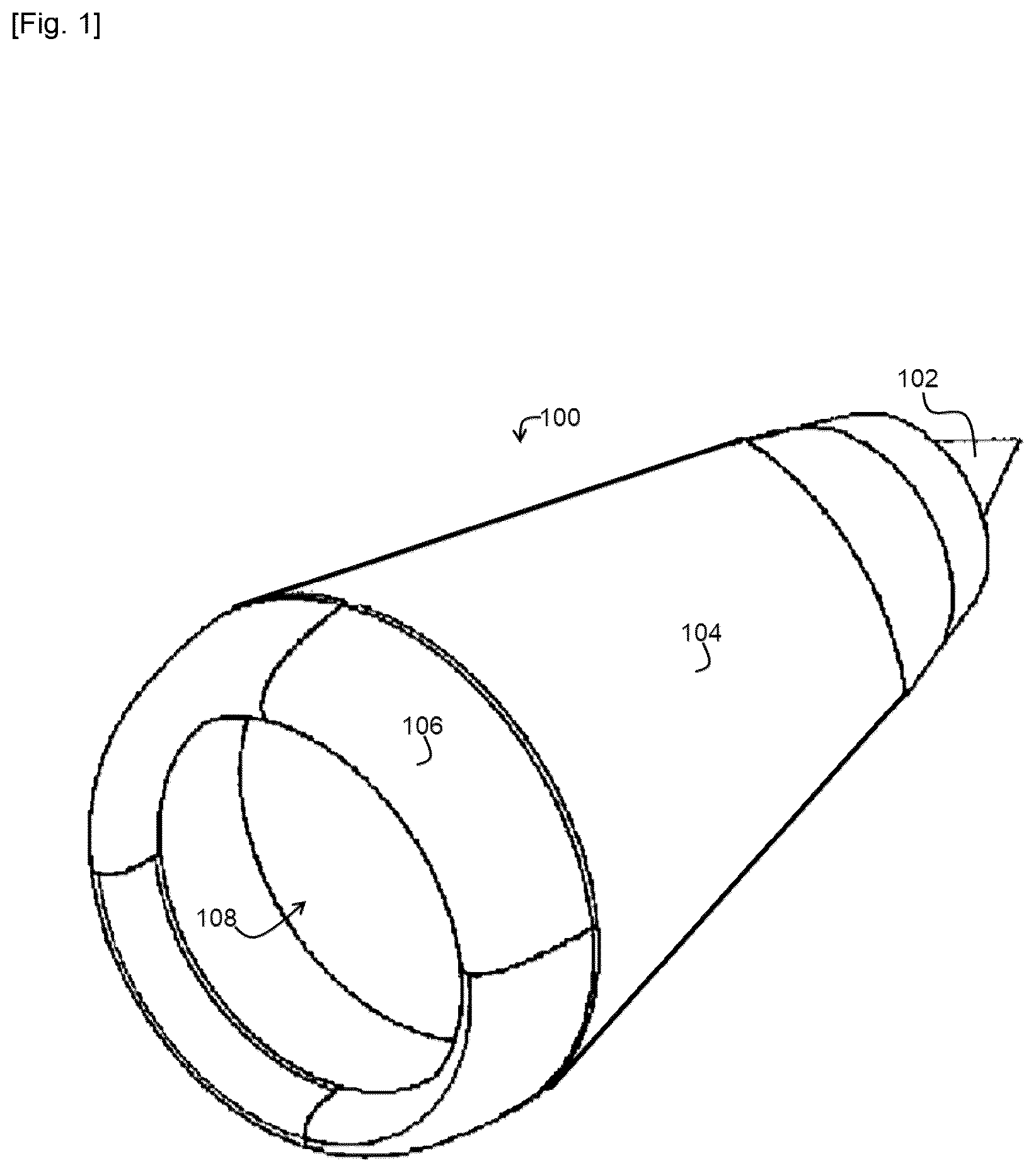
OF THE INVENTION shows a nacelle 100 of an aircraft with a turboshaft engine 102 inserted in it. The nacelle 100 comprises a tubular envelope 104 surrounding the turboshaft engine 102 and, along a perimeter of a front end of the tubular envelope 104 , a lip 106 delimiting an air inlet 108 . With reference to , the lip 106 is generally folded into a “V” shape so as to have a central wall 202 and a peripheral wall 204 meeting at a front summit 206 . In particular, the lip 106 has an internal face 208 . The nacelle 100 also comprises actuators 210 attached to the internal face 208 of the lip 106 . For the sake of clarity, only some of the actuators are referred to as 210 . In the example described, these actuators 210 are attached to the portion of the internal face 208 extending over the central wall 202 of the lip 106 . However, in other embodiments, all or some of the actuators 210 could be attached to the portion of the internal face 208 extending over the peripheral wall 204 . The actuators 210 are preferably piezoelectric. In , sixteen actuators 210 are shown but, in practice, there may be many fewer or more, for example from four to over a hundred. Still in the example described, the actuators 210 are distributed along the lip 106 so as to follow each other around the air inlet 108 . In this way, the actuators 210 are, for example, arranged in a circle, preferably evenly spaced from one another. The actuators 210 are divided into several groups, for example four groups G 1 , G 2 , G 3 , G 4 . In practice, many more groups could be planned. Preferably, the groups G 1 - 4 are distinct, which means that each actuator 210 belongs to only one of the groups G 1 - 4 . This arrangement allows to optimise the number of interconnection harnesses and their lengths. Even more preferably, the groups G 1 - 4 include substantially the same number of actuators 210 (to within the tolerance, e.g. within 10%), so as to maintain the same load for the converter across all the groups and be able to detect the loss of one or more actuators. For example, the groups G 1 - 4 group together the actuators 210 located respectively in angular sectors S 1 , S 2 , S 3 , S 4 of the lip 106 . With reference to , a de-icing system 300 for de-icing the lip 106 of the nacelle 100 will now be described in more detail. Within the meaning of the present invention, the term “de-icing” includes not only removing ice that has already formed, but also preventing the formation of ice before it occurs (anti-icing). Furthermore, the term “de-icing” covers only partial de-icing of the de-iced part (the lip 106 in the example described). The de-icing system 300 firstly comprises the actuators 210 described above. The de-icing system 300 also comprises a control device 302 for controlling the actuators 210 . In the example described, the control device 302 comprises two calculators 304 A, 304 B each having an output SA, SB, and a multiple switch 305 designed to selectively connect each group G 1 - 4 to the output SA of the calculator 304 A or to the output SB of the calculator 304 B, or to disconnect this group G 1 - 4 . The calculators 304 A, 304 B will now be described in more detail. Each calculator 304 A, 304 B comprises an analysis module 306 A, 306 B and a de-icing module 308 A, 308 B. Each calculator 304 A, 304 B also comprises a local switch 310 A, 310 B for selectively connecting the analysis module 306 A, 306 B and the de-icing module 308 A, 308 B to its output SA or SB. Thus, with the multiple switch 305 and the local switch 310 A, 310 B, it is possible to connect each of the groups G 1 - 4 either to the analysis module 306 A of the calculator 304 A, or to the de-icing module 308 A of the calculator 304 A, or to the analysis module 306 B of the calculator 304 B, or to the de-icing module 308 B of the calculator 304 B. Each analysis module 306 A, 306 B is designed to determine a resonant frequency of the lip 106 by controlling the group G 1 - 4 to which it is connected. In the example described, this resonant frequency is substantially that of the sector S 1 - 4 of the lip 106 comprising the actuators 210 of the connected group G 1 -G 4 . The resonant frequency can vary according to the length of the harnesses, the ambient temperature, the variation in the characteristics of the components due to their heating, and the amount of ice present, and the analysis module 306 A, 306 B can be used to update the resonant frequency. The desired resonant frequency is preferably a high frequency, for example between 10 kHz and 200 kHz. It is therefore preferable to determine the resonant frequency with a high degree of accuracy and robustness to a small variation around this frequency. To determine this resonant frequency, the analysis module 306 A, 306 B can use several analysis methods. In a first analysis method, the analysis module 306 A, 306 B is designed to search for the resonant frequency by frequency sweeping. In the case where the actuators 210 are piezoelectric, the analysis module 306 A, 306 B is designed, for example, to apply to the actuators 210 of the connected group G 1 - 4 a sinusoidal excitation voltage with a frequency sweeping a predefined interval in a given time, for example between 10 kHz and 200 kHz. From the current measured in the piezoelectric actuators 210 , the analysis module 306 A, 306 B is then designed to calculate the impedance as a function of frequency and to determine the resonant frequency as the frequency where the impedance is minimum. This first analysis method is referred to as “Chirp sine sweep based piezo-impedance measurement” and uses the voltage and current values as a function of the variation of the frequency to directly deduce the impedance after filtering. It therefore does not require complex calculations for each frequency step, as is the case with a discrete Fourier transform. In a second analysis method, the analysis module 306 A, 306 B is designed to determine the resonant frequency by frequency analysis. In the case where the actuators 210 are piezoelectric, the analysis module 306 A, 306 B is designed, for example, to apply a periodic or pulsed excitation voltage in order, in response, to obtain a frequency spectrum from the measurement of the current in the piezoelectric actuators, for example by means of a Fourier transform, for each frequency. The analysis module 306 A, 306 B is then designed to determine the frequency of the largest peak in the frequency spectrum, this frequency being the desired resonant frequency. In order to limit the power consumption of the de-icing system 300 , each analysis module 306 A, 306 B is preferably designed to apply low voltage excitation voltages, for example between 0 and 50 V (peak to peak). Each analysis module 306 A, 306 B comprises, for example, a Field-Programmable Gate Array (FPGA) or a Digital Signal Processing (DSP) unit. Each de-icing module 310 A, 310 B is designed to de-ice the lip 106 by making it vibrate, controlling the actuators 210 of the group G 1 - 4 to which it is connected. In particular, in the example described, the de-icing is carried out each time by vibrating mainly the sector S 1 - 4 corresponding to the connected group G 1 - 4 , while the other sectors may vibrate little or not at all. More precisely, the de-icing module 310 A, 310 B is designed to control the actuators 210 of the connected group using the resonant frequency previously determined with this group by one of the analysis modules 306 A, 306 B. In a first example, the de-icing module 310 A, 310 B is designed to excite the actuators 210 of the connected group G 1 - 4 , for a predefined duration, at an excitation frequency equal to the determined resonant frequency or derived by the de-icing module 310 A, 310 B from the determined resonant frequency. In a second example, the de-icing module 310 A, 310 B is designed to start exciting the actuators 210 of the connected group G 1 - 4 , at the resonant frequency (or at a frequency derived by the de-icing module 310 A, 310 B from the determined resonant frequency), and then to vary the excitation frequency to follow the resonant frequency. As de-icing progresses, the quantity of ice on the lip 106 decreases, for example as a result of pieces of frost lifting off, which can modify the resonant frequency. The heating of the components of the power converter during the de-icing can also modify the resonant frequency to be applied. For example, the de-icing module 310 A, 310 B may use the Maximum Point Tracking Method. The principle of this method is to insert a small low-frequency variation in the control around the high-frequency operating point of the piezoelectric actuators. The aim is to control the phase between the injected low-frequency signal and the low-frequency variation in output power. The output power provided is calculated from a measurement of a current flowing through the actuators 210 of the connected group G 1 - 4 and the voltage applied to the actuators 210 of the connected group G 1 - 4 . A low-pass filter allows to preserve the low-frequency power variation. If the injected signal is in phase with the calculated output power, then the slope is positive and the power tends towards the maximum power. If the two variations are in phase opposition, then the slope is negative and the output power decreases. In this way, the controllable frequency will automatically move towards a stable resonant frequency corresponding to the maximum power provided to the actuators that will deliver a maximum mechanical force to the air inlet structure. In the case where the actuators 210 are piezoelectric, the de-icing module 310 A, 310 B is designed, for example, to apply an excitation voltage at the excitation frequency. The excitation voltage is preferably high voltage, i.e. it has a higher peak-to-peak value than the low-voltage excitation voltage used by the analysis module. This peak-to-peak value is greater than 50 V, for example, and preferably greater than 100 V. For example, each de-icing module 310 A, 310 B comprises a power converter 312 A, 312 B and a module 314 A, 314 B for controlling the power converter 312 A, 312 B. Each power converter 312 A, 312 B is for example designed to supply the sinusoidal excitation voltage from a DC voltage, for example from a respective Auto Transformer Rectifier Unit (also referred to by the acronym ATRU). The control module 314 A, 314 B comprises, for example, a microcontroller or a programmable gate array (FPGA). In some embodiments, the control device 302 comprises a computing device equipped with a data processing unit (such as a microprocessor) and a main memory associated with the data processing unit. A computer program comprising instructions is intended to be loaded into the main memory, so that the data processing unit executes these instructions and thus implements one or more of the modules 305 , 306 A, 308 A, 310 A, 312 A, 314 A, 306 B, 308 B, 310 B, 312 B, 314 B. These modules are therefore software modules. With reference to , a first example 400 of a de-icing method will now be described. In addition, the groups G 1 - 4 are assumed to be ordered in succession (G 1 , then G 2 , then G 3 , then G 4 in the example described) in the control device 302 . During a step 402 , the multiple switch 314 and the local switches 310 A, 310 B connect the analysis module 306 A to the actuators 210 of the first group G 1 and, for example, disconnect the actuators of the other groups G 2 - 4 from the control device 302 . During a step 404 , the analysis module 306 A controls the actuators of the first group G 1 to determine a resonant frequency of the lip 106 , and transmits the resonant frequency to the de-icing module 308 B. In the example described, the analysis module 306 A transmits this resonant frequency to the control module 314 A which retransmits it to the control module 314 B. The steps 406 to 410 are then implemented successively for each of the other groups G 2 - 4 . In a step 406 , the multiple switch 314 and the local switches 308 A, 308 B connect the actuators 210 of the current group to the analysis module 306 A and the actuators of the previous group to the de-icing module 308 B and, for example, disconnect the actuators of the other groups from the control device 302 . During a step 408 , the analysis module 306 A controls the actuators 210 of the current group to determine a resonant frequency of the lip 106 , and transmits the resonant frequency determined with the current group to the de-icing module 308 B. In the example described, the analysis module 306 A transmits this resonant frequency to the control module 314 A which retransmits it to the control module 314 B. In parallel with the step 408 , during a step 410 , the de-icing module 308 B controls the actuators 210 of the previous group to de-ice the lip 106 by vibrating it, using the resonant frequency determined by the analysis module 306 A with this previous group. In a step 412 , the multiple switch 305 and the local switches 310 A, 310 B connect the actuators of the last group G 4 to the de-icing module 308 B and, for example, disconnect the actuators of the other groups G 1 - 3 from the control device 302 . During a step 414 , the de-icing module 310 B controls the actuators 210 of the last group G 4 to de-ice the lip 106 by vibrating it, using the resonant frequency determined by the analysis module 306 A with this last group G 4 . illustrates the alternation over time (t) of the analysis (oval) and de-icing (rectangular) steps during the implementation of the de-icing method 400 . As can be appreciated, the de-icing method 400 does not use the modules 306 B and 308 A. In this way, they can be omitted from the control device 302 . However, they are useful for continuing to be able to de-ice in the event of failure of one of the calculators 304 A, 304 B, as will be described below with reference to . With reference to , a second example 600 of a de-icing method will now be described. In this second example, the control device 302 is still designed for, in parallel: controlling the actuators 210 of one group after the other in the order of succession, each time to determine a resonant frequency of the lip 106 , and controlling the actuators 210 of one group after the other in the order of succession to de-ice the lip 106 by causing it to vibrate, using the resonant frequency determined with this group. However, this time the control device 302 is designed to start determining a resonant frequency of the lip 106 with the next group, without waiting for the end of de-icing of the lip 106 with the current group. More precisely, in the example described, during a step 602 , the multiple switch 305 and the local switches 310 A, 310 B connect the actuators 210 of the first group G 1 to the analysis module 306 A and, for example, disconnect the actuators 210 of the other groups G 2 - 4 from the control device 302 . During a step 604 , the analysis module 306 A controls the actuators 210 of the first group G 1 to determine a resonant frequency of the lip 106 , and transmits this resonant frequency to the de-icing module 308 B. The loops of steps 600 A and 600 B are carried out in parallel. The first loop of steps 600 A is carried out successively for each group G 2 -G 3 of actuators 210 . In a step 606 , the multiple switch 314 and the local switch 310 A connect the actuators 210 of the current group to the analysis module 306 A. During a step 608 , the analysis module 306 A controls the actuators 210 of the current group to determine a resonant frequency of the lip 106 , and transmits the resonant frequency determined to the de-icing modules 308 A, 308 B. In the example described, the analysis module 306 A transmits this resonant frequency to the control module 314 A which retransmits it to the control module 314 B. During a step 610 , the de-icing module 308 A controls the actuators of a group of actuators 210 that the de-icing module 308 B has not yet controlled, in order to de-ice the lip 106 by causing it to vibrate. The step 610 may be carried out several times, as long as the actuators 210 of all the groups G 1 - 4 have not been controlled to de-ice the lip 106 , either by the de-icing module 308 A or by the de-icing module 308 B (see below). The second loop of steps 600 B is carried out successively for each group G 1 -G 4 , unless this group has already been used in the step 610 to de-ice the lip 106 . In a step 612 , the multiple switch 314 and the local switch 310 B connect the actuators 210 of the current group to the de-icing module 308 B. In a step 614 , the de-icing module 308 B controls the actuators of the current group to de-ice the lip 106 by vibrating it, using the resonant frequency determined by the analysis module 306 A with this current group. illustrates the alternation over time (t) of the analysis (oval) and de-icing (rectangular) steps during the implementation of the method 600 . As can be seen in this figure, the analysis steps may be shorter than the de-icing steps, so that the calculator 304 A can quickly finish the analysis for all the groups G 1 - 4 and can then, in step 610 , help the calculator 304 B to finish de-icing. In the example described, the calculator 304 A can start de-icing with the actuators 210 of the last group G 4 while the calculator 304 A is still de-icing with the actuators of the group G 3 . All in all, the de-icing is therefore quicker. With reference to , a third example of a de-icing method will now be described. During a step 802 , one of the calculators 304 A, 304 B detects that the other has failed. In the remainder of the description, it will be assumed that the calculator 304 B has failed. If the calculator 304 A were to fail, the method 800 would be identical, with the A and B suffixes reversed. The following steps are then carried out for each group G 1 - 4 of actuators 210 , according to an order of succession of the groups G 1 - 4 . In a step 804 , the multiple switch 314 and the local switch 310 A connect the actuators 210 of the current group to the analysis module 306 A. During a step 806 , the analysis module 306 A controls the actuators 210 of the current group to determine a resonant frequency of the lip 106 . In a step 808 , the multiple switch 314 and the local switch 310 A connect the actuators 210 of the current group to the de-icing module 308 A. In a step 810 , the de-icing module 308 A controls the actuators of the current group to de-ice the lip 106 by vibrating it, using the resonant frequency determined with this current group. In this way, a complete de-icing can be obtained with only the calculator 304 A or 304 B still healthy. illustrates the alternation over time (t) of the analysis (oval) and de-icing (rectangular) steps during the implementation of the de-icing method 800 . It should be noted that the invention is not limited to the embodiments described above. Indeed, it will be apparent to the person skilled in the art that various modifications can be made to the above-described embodiments, in the light of the teaching just disclosed. In particular, the steps of the methods described above may be carried out in any possible sequence (which may include steps carried out in parallel). In addition, the actuators could be divided into several assemblies of groups such as the groups G 1 -G 4 described above. Each assembly would then comprise several groups of actuators. The groups in the same assembly would be controlled as described above. For example, there could be four assemblies of sixteen groups each, making a total of sixty-four groups. For example, if the method in is used to control the groups in each assembly, with the assemblies controlled synchronously with each other, the following sequence could be obtained: the first group of each assembly determines a resonant frequency, then the first group in each assembly carries out a de-icing at the resonant frequency it has determined, and at the same time the second group of each assembly determines a resonant frequency, then the second group in each assembly carries out a de-icing using the resonant frequency it has determined, and at the same time the third group in each assembly determines a resonant frequency, then and so on. Alternatively, the control of the groups could be asynchronous from one assembly to another. In other words, the groups in each assembly would be controlled independently of the groups in the other assemblies. In the detailed presentation of the invention made above, the terms used should not be interpreted as limiting the invention to the embodiments set forth in the present description, but should be interpreted to include all equivalents the anticipation of which is within the reach of the person skilled in the art by applying his general knowledge to the implementation of the teaching just disclosed.
Figures (9)
Citations
This patent cites (9)
- US2010/0294882
- US2011/0011056
- US2013/0032671
- US2015/0292351
- US2018/0216529
- US2021/0078711
- US2908738
- US2922522
- US3078948