Vehicle Air Conditioning Apparatus
Abstract
A vehicle air conditioning apparatus includes: a refrigerant circuit including a compressor configured to compress refrigerant, an outdoor heat exchanger configured to perform a heat exchange between the refrigerant and outdoor air, and a heat absorption heat exchanger configured to absorb heat from a heat-absorbed subject into the refrigerant; and a controller configured to control the refrigerant circuit. The controller can selectively perform defrosting modes including: a hot gas defrosting mode to defrost the outdoor heat exchanger by the refrigerant compressed by the compressor; and a heat absorption defrosting mode to defrost the outdoor heat exchanger by the refrigerant absorbing the heat from the heat-absorbed subject and compressed by the compressor. The controller sets a selecting condition to preferentially select the heat absorption defrosting mode, and a switching condition to switch the heat absorption defrosting mode to the hot gas defrosting mode and performs the hot gas defrosting mode.
Claims (11)
1 . A vehicle air conditioning apparatus comprising: a refrigerant circuit including: a compressor configured to compress refrigerant; an outdoor heat exchanger configured to perform a heat exchange between the refrigerant and outdoor air; and a heat absorption heat exchanger configured to absorb heat from a heat-absorbed subject into the refrigerant; and a controller configured to control the refrigerant circuit, the controller comprising a heat pump ECU, inputs of the heat pump ECU being connected to: an HVAC intake temperature sensor configured to detect a temperature of an air taken from an intake port into an air flow passage; an indoor air temperature sensor configured to detect an indoor air temperature Tin that is a temperature of an air in a vehicle compartment; a blowing temperature sensor configured to detect a temperature of an air blowing from a blowing outlet to the vehicle compartment; a discharge pressure sensor configured to detect a discharge pressure Pd that is a pressure of a refrigerant discharged from the compressor; a discharge temperature sensor configured to detect temperature Td of the refrigerant discharged from the compressor; a suction temperature sensor configured to detect temperature Ts of the refrigerant sucked into the compressor; an indoor condenser temperature sensor configured to detect an indoor condenser temperature TCI that is a temperature of the refrigerant passed through the indoor condenser or a temperature of the indoor condenser; an indoor condenser pressure sensor configured to detect an indoor condenser exit pressure Pci that is a pressure of the refrigerant just after exiting from the indoor condenser; a heat absorbing device temperature sensor configured to detect a heat absorbing device temperature Te that is a temperature of an air passed through a heat absorbing device or a temperature of the heat absorbing device itself; a heat absorbing device pressure sensor configured to detect a pressure of the refrigerant in the heat absorbing device or a pressure of the refrigerant just after exiting from the heat absorbing device; an air conditioning operating device configured to set a preset temperature and switching of an air conditioning operation; an outdoor heat exchanger temperature sensor configured to detect a temperature TXO of the refrigerant just after being discharged from the outdoor heat exchanger; an outdoor heat exchanger pressure sensor configured to detect a discharged refrigerant pressure PXO that is a pressure of the refrigerant just after being discharged from the outdoor heat exchanger; and a heat medium temperature sensor configured to detect temperature Tw that is a chiller water temperature of a heat medium exited from a heat medium flow path of a refrigerant-heat medium heat exchanger and circulating through a heat medium circuit, and outputs of the heat pump ECU being connected to: the compressor; an outdoor blower; an indoor blower; an intake switching damper; an air mix damper; an outdoor expansion valve; the indoor expansion valve; one or more of solenoid valves; an auxiliary heater; and a chiller expansion valve, wherein the controller can selectively perform a plurality of defrosting modes including: a hot gas defrosting mode to defrost the outdoor heat exchanger by the refrigerant compressed by the compressor; and a heat absorption defrosting mode to defrost the outdoor heat exchanger by the refrigerant absorbing the heat from the heat-absorbed subject and compressed by the compressor, and the controller sets a selecting condition to preferentially select the heat absorption defrosting mode, and a switching condition to switch the heat absorption defrosting mode to the hot gas defrosting mode and performs the hot gas defrosting mode, wherein the heat absorption defrosting mode includes at least one of: a chiller defrosting mode in which the heat absorption heat exchanger is the refrigerant-heat medium heat exchanger configured to perform a heat exchange between heat medium circulating through the heat medium circuit and the refrigerant; and a cooling cycle defrosting mode in which the heat absorption heat exchanger is the heat absorbing device configured to absorb heat into the refrigerant from air supplied to the vehicle compartment, and wherein the controller: sets the selecting condition based on the vehicle compartment temperature, selects the cooling cycle defrosting mode when the vehicle compartment temperature is equal to or higher than a predetermined temperature Tint 1 , and selects the chiller defrosting mode when the temperature Tw of the heat medium flowing through the refrigerant-heat medium heat exchanger is equal to or higher than a predetermined temperature Twt 1 and the vehicle compartment temperature is equal to or higher than the predetermined temperature Tint 1 .
4 . A vehicle air conditioning apparatus comprising: a refrigerant circuit including: a compressor configured to compress refrigerant; an outdoor heat exchanger configured to perform a heat exchange between the refrigerant and outdoor air; and a heat absorption heat exchanger configured to absorb heat from a heat-absorbed subject into the refrigerant; and a controller configured to control the refrigerant circuit, the controller comprising a heat pump ECU, inputs of the heat pump ECU being connected to: an HVAC intake temperature sensor configured to detect a temperature of an air taken from an intake port into an air flow passage; an indoor air temperature sensor configured to detect an indoor air temperature Tin that is a temperature of an air in a vehicle compartment; a blowing temperature sensor configured to detect a temperature of an air blowing from a blowing outlet to the vehicle compartment; a discharge pressure sensor configured to detect a discharge pressure Pd that is a pressure of a refrigerant discharged from the compressor; a discharge temperature sensor configured to detect temperature Td of the refrigerant discharged from the compressor; a suction temperature sensor configured to detect temperature Ts of the refrigerant sucked into the compressor; an indoor condenser temperature sensor configured to detect an indoor condenser temperature TCI that is a temperature of the refrigerant passed through the indoor condenser or a temperature of the indoor condenser; an indoor condenser pressure sensor configured to detect an indoor condenser exit pressure Pci that is a pressure of the refrigerant just after exiting from the indoor condenser; a heat absorbing device temperature sensor configured to detect a heat absorbing device temperature Te that is a temperature of an air passed through a heat absorbing device or a temperature of the heat absorbing device itself; a heat absorbing device pressure sensor configured to detect a pressure of the refrigerant in the heat absorbing device or a pressure of the refrigerant just after exiting from the heat absorbing device; an air conditioning operating device configured to set a preset temperature and switching of an air conditioning operation; an outdoor heat exchanger temperature sensor configured to detect a temperature TXO of the refrigerant just after being discharged from the outdoor heat exchanger; an outdoor heat exchanger pressure sensor configured to detect a discharged refrigerant pressure PXO that is a pressure of the refrigerant just after being discharged from the outdoor heat exchanger; and a heat medium temperature sensor configured to detect temperature Tw that is a chiller water temperature of a heat medium exited from a heat medium flow path of a refrigerant-heat medium heat exchanger and circulating through a heat medium circuit, and outputs of the heat pump ECU being connected to: the compressor; an outdoor blower; an indoor blower; an intake switching damper; an air mix damper; an outdoor expansion valve; the indoor expansion valve; one or more of solenoid valves; an auxiliary heater; and a chiller expansion valve, wherein the controller can selectively perform a plurality of defrosting modes including: a hot gas defrosting mode to defrost the outdoor heat exchanger by the refrigerant compressed by the compressor; and a heat absorption defrosting mode to defrost the outdoor heat exchanger by the refrigerant absorbing the heat from the heat-absorbed subject and compressed by the compressor, and the controller sets a selecting condition to preferentially select the heat absorption defrosting mode, and a switching condition to switch the heat absorption defrosting mode to the hot gas defrosting mode and performs the hot gas defrosting mode, wherein the heat absorption defrosting mode includes at least one of: a chiller defrosting mode in which the heat absorption heat exchanger is the refrigerant-heat medium heat exchanger configured to perform a heat exchange between heat medium circulating through the heat medium circuit and the refrigerant; and a cooling cycle defrosting mode in which the heat absorption heat exchanger is the heat absorbing device configured to absorb heat into the refrigerant from air supplied to the vehicle compartment, and wherein the controller: sets the selecting condition based on the vehicle compartment temperature, selects the cooling cycle defrosting mode when the vehicle compartment temperature is equal to or higher than a predetermined temperature Tint 1 , and selects the hot gas defrosting mode when the temperature Tw of the heat medium flowing through the refrigerant-heat medium heat exchanger is lower than a predetermined temperature Twt 1 , the vehicle compartment temperature is lower than the predetermined temperature Tint 1 , and an outdoor temperature is equal to or higher than a predetermined temperature Tx.
7 . A vehicle air conditioning apparatus comprising: a refrigerant circuit including: a compressor configured to compress refrigerant; an outdoor heat exchanger configured to perform a heat exchange between the refrigerant and outdoor air; and a heat absorption heat exchanger configured to absorb heat from a heat-absorbed subject into the refrigerant; and a controller configured to control the refrigerant circuit, the controller comprising a heat pump ECU, inputs of the heat pump ECU being connected to: an HVAC intake temperature sensor configured to detect a temperature of an air taken from an intake port into an air flow passage; an indoor air temperature sensor configured to detect an indoor air temperature Tin that is a temperature of an air in a vehicle compartment; a blowing temperature sensor configured to detect a temperature of an air blowing from a blowing outlet to the vehicle compartment; a discharge pressure sensor configured to detect a discharge pressure Pd that is a pressure of a refrigerant discharged from the compressor; a discharge temperature sensor configured to detect temperature Td of the refrigerant discharged from the compressor; a suction temperature sensor configured to detect temperature Ts of the refrigerant sucked into the compressor; an indoor condenser temperature sensor configured to detect an indoor condenser temperature TCI that is a temperature of the refrigerant passed through the indoor condenser or a temperature of the indoor condenser; an indoor condenser pressure sensor configured to detect an indoor condenser exit pressure Pci that is a pressure of the refrigerant just after exiting from the indoor condenser; a heat absorbing device temperature sensor configured to detect a heat absorbing device temperature Te that is a temperature of an air passed through a heat absorbing device or a temperature of the heat absorbing device itself; a heat absorbing device pressure sensor configured to detect a pressure of the refrigerant in the heat absorbing device or a pressure of the refrigerant just after exiting from the heat absorbing device; an air conditioning operating device configured to set a preset temperature and switching of an air conditioning operation; an outdoor heat exchanger temperature sensor configured to detect a temperature TXO of the refrigerant just after being discharged from the outdoor heat exchanger; an outdoor heat exchanger pressure sensor configured to detect a discharged refrigerant pressure PXO that is a pressure of the refrigerant just after being discharged from the outdoor heat exchanger; and a heat medium temperature sensor configured to detect temperature Tw that is a chiller water temperature of a heat medium exited from a heat medium flow path of a refrigerant-heat medium heat exchanger and circulating through a heat medium circuit, and outputs of the heat pump ECU being connected to: the compressor; an outdoor blower; an indoor blower; an intake switching damper; an air mix damper; an outdoor expansion valve; the indoor expansion valve; one or more of solenoid valves; an auxiliary heater; and a chiller expansion valve, wherein the controller can selectively perform a plurality of defrosting modes including: a hot gas defrosting mode to defrost the outdoor heat exchanger by the refrigerant compressed by the compressor; and a heat absorption defrosting mode to defrost the outdoor heat exchanger by the refrigerant absorbing the heat from the heat-absorbed subject and compressed by the compressor, and the controller sets a selecting condition to preferentially select the heat absorption defrosting mode, and a switching condition to switch the heat absorption defrosting mode to the hot gas defrosting mode and performs the hot gas defrosting mode, wherein the heat absorption defrosting mode includes at least one of: a chiller defrosting mode in which the heat absorption heat exchanger is the refrigerant-heat medium heat exchanger configured to perform a heat exchange between heat medium circulating through the heat medium circuit and the refrigerant; and a cooling cycle defrosting mode in which the heat absorption heat exchanger is the heat absorbing device configured to absorb heat into the refrigerant from air supplied to the vehicle compartment, and wherein when the temperature of the heat medium is lower than a predetermined temperature Twt 2 during execution of the chiller defrosting mode, the controller actuates an auxiliary heat source provided in the heat medium circuit and configured to heat the heat medium, and when the vehicle compartment temperature is lower than a predetermined temperature Tint 2 during execution of the cooling cycle defrosting mode, the controller actuates the auxiliary heat source configured to heat the air flowing into the vehicle compartment.
Show 8 dependent claims
2 . The vehicle air conditioning apparatus according to claim 1 , wherein: the controller is configured to: set the switching condition based on one of the refrigerant pressure, the refrigerant temperature, and a period of time for which the heat absorption defrosting mode is performed; and switch from the heat absorption defrosting mode to the hot gas defrosting mode when one of the refrigerant pressure, the refrigerant temperature, and the period of time satisfies the set switching condition.
3 . The vehicle air conditioning apparatus according to claim 1 , wherein one of a state in which the refrigerant temperature is equal to or higher than a preset threshold temperature Trt 3 , and a state in which the refrigerant pressure is equal to or higher than a preset threshold pressure Prt 3 continues for a predetermined period of time TP 2 , the controller ends a defrosting mode.
5 . The vehicle air conditioning apparatus according to claim 4 , wherein the controller is configured to: set the switching condition based on one of the refrigerant pressure, the refrigerant temperature, and a period of time for which the heat absorption defrosting mode is performed; and switch from the heat absorption defrosting mode to the hot gas defrosting mode when one of the refrigerant pressure, the refrigerant temperature, and the period of time satisfies the set switching condition.
6 . The vehicle air conditioning apparatus according to claim 4 , wherein one of a state in which the refrigerant temperature is equal to or higher than a preset threshold temperature Trt 3 , and a state in which the refrigerant pressure is equal to or higher than a preset threshold pressure Prt 3 continues for a predetermined period of time TP 2 , the controller ends a defrosting mode.
8 . The vehicle air conditioning apparatus according to claim 7 , wherein the controller is configured to: set the selecting condition based on a temperature of the heat-absorbed subject, and preferentially select the heat absorption defrosting mode when the temperature of the heat-absorbed subject satisfies the selecting condition.
9 . The vehicle air conditioning apparatus according to claim 7 , wherein the controller is configured to: set the switching condition based on one of the refrigerant pressure, the refrigerant temperature, and a period of time for which the heat absorption defrosting mode is performed; and switch from the heat absorption defrosting mode to the hot gas defrosting mode when one of the refrigerant pressure, the refrigerant temperature, and the period of time satisfies the set switching condition.
10 . The vehicle air conditioning apparatus according to claim 7 , wherein the controller is configured to: set the selecting condition based on the temperature of the heat medium flowing through the refrigerant-heat medium heat exchanger, and select the chiller defrosting mode when the temperature of the heat medium flowing through the refrigerant-heat medium heat exchanger is equal to or higher than the predetermined temperature Twt 1 .
11 . The vehicle air conditioning apparatus according to claim 7 , wherein one of a state in which the refrigerant temperature is equal to or higher than a preset threshold temperature Trt 3 , and a state in which the refrigerant pressure is equal to or higher than a preset threshold pressure Prt 3 continues for a predetermined period of time TP 2 , the controller ends a defrosting mode.
Full Description
Show full text →
TECHNICAL FIELD
The present invention relates to a vehicle air conditioning apparatus applicable to a vehicle, and specifically to a vehicle air conditioning apparatus configured to defrost an outdoor heat exchanger.
BACKGROUND
ART Conventionally, an air conditioning apparatus applicable to a vehicle includes a refrigerant circuit in which a compressor, an indoor heat exchanger (serving as an evaporator during cooling and as a condenser during heating), an outdoor heat exchanger (serving as a condenser during cooling and as an evaporator during heating), and an expansion valve are connected, and is configured to perform air conditioning by supplying a vehicle compartment with air having been subjected to a heat exchange with refrigerant in the indoor heat exchanger. In this vehicle air conditioning apparatus, the outdoor heat exchanger functions as a heat absorbing device during the heating operation, and therefore, when the outdoor temperature is low, condensed water is frozen on the surface of the outdoor heat exchanger and consequently frost may be formed. When the frost is formed on the outdoor heat exchanger, the heat transfer coefficient is decreased so that sufficient heat is not absorbed. Therefore, it is not possible to sufficiently heat the vehicle compartment, and consequently it is required to perform defrosting operation. For example, there has been known a vehicle air conditioning apparatus configured to perform the defrosting operation with appropriate performance depending on the situation when the frost is formed on the outdoor heat exchanger, by switching between a strong defrosting operation mode to circulate the refrigerant through the outdoor heat exchanger and a weak defrosting operation mode to bypass the outdoor heat exchanger after the refrigerant discharged from a compressor is flowed to an indoor heat exchanger (for example, Patent Literature 1). CITATION LIST Patent Literature PTL1: Japanese Patent Application Laid-Open No. 2014-196018
SUMMARY
OF INVENTION Problem to be Solved by the Invention However, in the vehicle air conditioning apparatus disclosed in the above-described Patent Literature 1, during the defrosting in the strong defrosting operation mode, heat loss in the pipes and the heat release from the outdoor heat exchanger are large, and therefore the amount of heat required for the defrosting is not sufficient only by the heat from the compressor. Consequently, it may take time for the defrosting, or it may not be possible to evenly remove the frost. Meanwhile, the weak defrosting operation mode is selected to melt the frost on the outdoor heat exchanger in a case where the frost is formed on the outdoor heat exchanger during the heating when the outdoor temperature is relatively high (higher than 0 degrees Celsius). In this operation mode, the refrigerant is not circulated in the outdoor heat exchanger, and therefore not to actively defrost the outdoor heat exchanger, and consequently the frost may not be evenly removed. The invention is proposed to address the above-described problems, and it is therefore an object of the invention to rapidly, surely and evenly remove the frost depending on the situation of a vehicle. Solution to Problem An aspect of the invention provides a vehicle air conditioning apparatus including: a refrigerant circuit including a compressor configured to compress refrigerant, an outdoor heat exchanger configured to perform a heat exchange between the refrigerant and outdoor air, and a heat absorption heat exchanger configured to absorb heat from a heat-absorbed subject into the refrigerant; and a controller configured to control the refrigerant circuit. The controller can selectively perform a plurality of defrosting modes including: a hot gas defrosting mode to defrost the outdoor heat exchanger by the refrigerant compressed by the compressor; and a heat absorption defrosting mode to defrost the outdoor heat exchanger by the refrigerant absorbing the heat from the heat-absorbed subject and compressed by the compressor. The controller sets a selecting condition to preferentially select the heat absorption defrosting mode, and a switching condition to switch the heat absorption defrosting mode to the hot gas defrosting mode and performs the hot gas defrosting mode. Effect of the Invention According to the invention, it is possible to rapidly, surely and evenly remove the frost depending on the situation of a vehicle.
BRIEF DESCRIPTION OF DRAWINGS
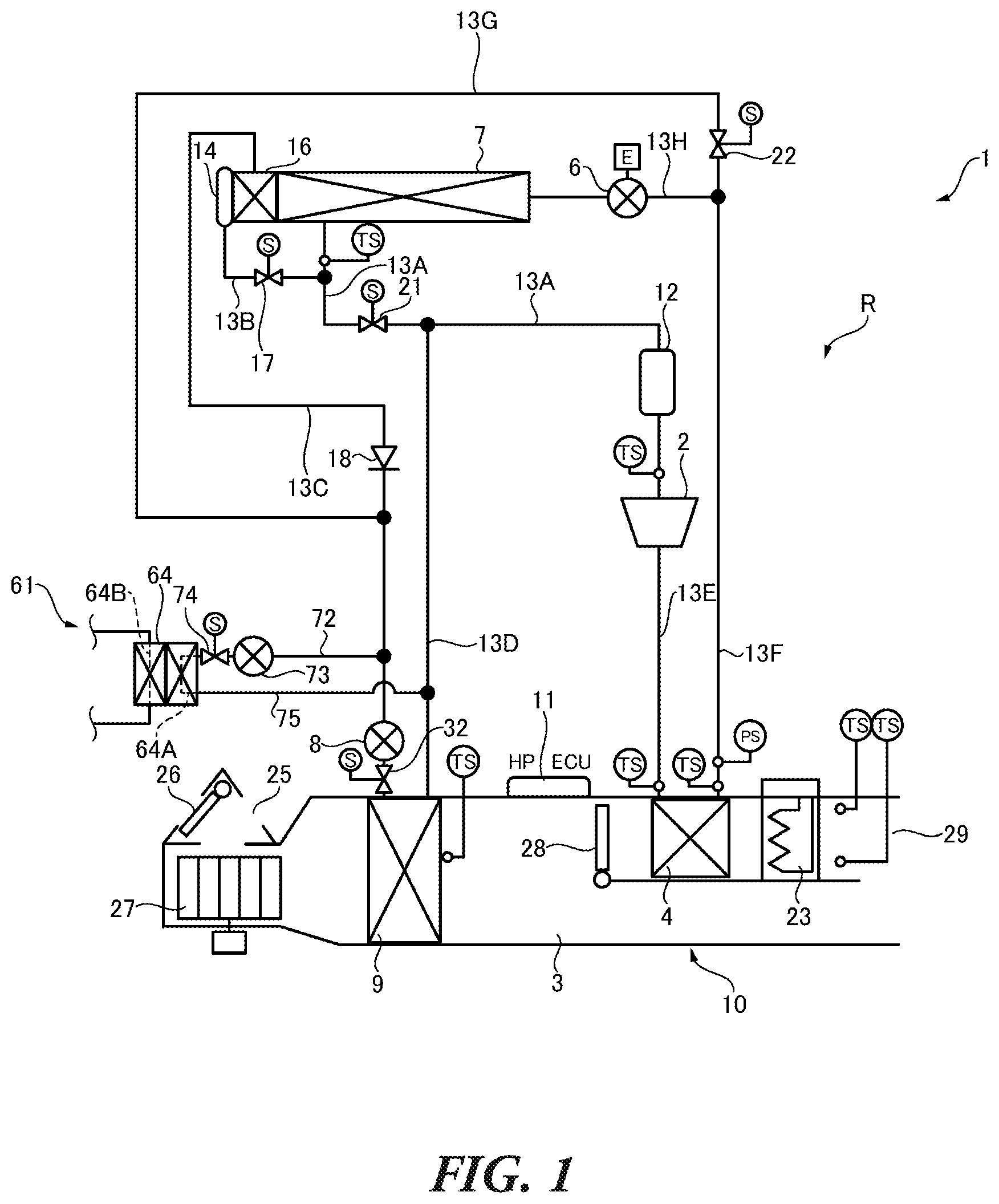
illustrates a schematic configuration of a refrigerant circuit of a vehicle air conditioning apparatus according to an embodiment of the invention; is a block diagram illustrating a schematic configuration of a heat pump ECU as a controller of the vehicle air conditioning apparatus according to the embodiment of the invention; illustrates the flow of refrigerant to defrost an outdoor heat exchanger in a hot gas defrosting mode of the vehicle air conditioning apparatus according to the embodiment of the invention; illustrates the flow of refrigerant to defrost the outdoor heat exchanger in a chiller defrosting mode of the vehicle air conditioning apparatus according to the embodiment of the invention; illustrates the flow of refrigerant to defrost the outdoor heat exchanger in a cooling cycle defrosting mode of the vehicle air conditioning apparatus according to the embodiment of the invention; illustrates another schematic configuration of the refrigerant circuit of the vehicle air conditioning apparatus according to the embodiment of the invention; illustrates the flow of refrigerant in another example of the refrigerant circuit to defrost the outdoor heat exchanger in a hot gas defrosting mode of the vehicle air conditioning apparatus according to the embodiment of the invention; illustrates the flow of refrigerant in another example of the refrigerant circuit to defrost the outdoor heat exchanger in a chiller defrosting mode of the vehicle air conditioning apparatus according to the embodiment of the invention; illustrates the flow of refrigerant in another example of the refrigerant circuit to defrost the outdoor heat exchanger in a cooling cycle defrosting mode of the vehicle air conditioning apparatus according to the embodiment of the invention; is a flowchart illustrating a process of selecting and switching defrosting modes of the vehicle air conditioning apparatus according to the embodiment of the invention; and A- 11 C are flowcharts illustrating a process of controlling the operation of an auxiliary heat source during a heat absorption defrosting mode in the vehicle air conditioning apparatus according to the embodiment of the invention.
DESCRIPTION OF EMBODIMENTS
Hereinafter, an embodiment of the invention will be described in detail with reference to the drawings. In the description below, the same reference number in different drawings denotes the same component with the same function, and duplicate description for each of the drawings is omitted accordingly. illustrates a schematic configuration of a vehicle air conditioning apparatus 1 according to an embodiment of the invention. The vehicle air conditioning apparatus 1 is applicable to vehicles, for example, an electric vehicle (EV) without an engine (internal combustion), and a so-called hybrid vehicle using an engine and an electric drive motor together. This vehicle includes a battery (e.g. a lithium battery), and is configured to drive and run by supplying the power of the battery charged by an external power source to a motor unit including the drive motor. Also the vehicle air conditioning apparatus 1 is driven by the power supplied from the battery. The vehicle air conditioning apparatus 1 according to the present embodiment includes a refrigerant circuit R, and performs heat pump operation with use of the refrigerant circuit R to perform air conditioning (heating, cooling, dehumidifying, ventilating, and defrosting) of a vehicle compartment. In addition, a heat medium circuit connected to the refrigerant circuit R is used to cool and warm up electric devices such as a battery and a motor. Here, in the description below, “refrigerant” is circulating medium whose state varies (compressed, condensed, expanded, and evaporated) in a heat pump of the refrigerant circuit, and “heat medium” is medium configured to absorb and release heat without varying its state. The refrigerant circuit R includes: an electric motor-driven compressor 2 configured to compress refrigerant, an indoor condenser (heat releasing device) 4 , as an indoor heat exchanger, provided in an air flow passage 3 of an HVAC unit 10 through which the air of the vehicle compartment is ventilated and circulated, and configured to release the heat from the refrigerant having a high temperature and a high pressure discharged from the compressor 2 and heat the air to be supplied into the vehicle compartment; an outdoor expansion valve 6 configured to decompress and expand the refrigerant during the heating; an outdoor heat exchanger 7 functioning as a heat releasing device (condenser) to release the heat from the refrigerant during the cooling, and configured to perform a heat exchange between the refrigerant and the outdoor air to function as an evaporator to absorb the heat into the refrigerant during the heating; an indoor expansion valve 8 configured to decompress and expand the refrigerant; a heat absorbing device 9 provided in the air flow passage 3 and configured to absorb the heat into the refrigerant from the inside and the outside of the vehicle compartment to cool the air to be supplied into the vehicle compartment during the cooling and the dehumidifying; and an accumulator 12 , which are connected by refrigerant pipes 13 A to 13 H. The outdoor expansion valve 6 and the indoor expansion valve 8 are electronic expansion valves driven by a pulse motor (not illustrated), and the degree of opening of them is appropriately controlled between the full closing and the full opening based on the number of pulses applied to the pulse motor. The outdoor expansion valve 6 decompresses and expands the refrigerant having flowed from the indoor condenser 4 and flowing into the outdoor heat exchanger 7 . In addition, during the heating using the outdoor heat exchanger 7 , the degree of opening of the outdoor expansion valve 6 is controlled by a heat pump ECU 11 described later, so as to make a SC (sub-cooling) value as an indicator of the achievement of supercooling at the refrigerant outlet of the indoor condenser 4 attain to a predetermined target value (SC control). The indoor expansion valve 8 decompresses and expands the refrigerant flowing into the heat absorbing device 9 , and adjusts the degree of superheat of the refrigerant in the heat absorbing device 9 . An outdoor blower (not illustrated) is provided in the outdoor heat exchanger 7 . The outdoor blower forcibly ventilates the outdoor heat exchanger 7 by the outdoor air to cause a heat exchange between the outdoor air and the refrigerant, and allows the outdoor heat exchanger 7 to be ventilated by the outdoor air even during the stop of the vehicle. A receiver dryer 14 and a supercooling device 16 are provided in the outdoor heat exchanger 7 on the downstream side with respect to the refrigerant flow. The refrigerant outlet side of the outdoor heat exchanger 7 is connected to the receiver dryer 14 via the refrigerant pipe 13 A and the refrigerant pipe 13 B branching from the refrigerant pipe 13 A. A solenoid valve 17 (for cooling) is provided in the refrigerant pipe 13 B, as an on-off valve configured to open to flow the refrigerant to the heat absorbing device 9 . The outlet side of the supercooling device 16 is connected to the refrigerant inlet side of the heat absorbing device 9 via the refrigerant pipe 13 C. A check valve 18 , an indoor expansion valve 8 and a solenoid valve 32 as an indoor heat exchanger valve (on-off valve) are provided in the refrigerant pipe 13 C in this order from the outdoor heat exchanger 7 side. The check valve 18 is provided in the refrigerant pipe 13 C such that the direction toward the heat absorbing device 9 is the forward direction. Meanwhile, a solenoid valve 21 (for heating) as an on-off valve configured to open during the heating, the accumulator 12 and the compressor 2 are connected in series to the refrigerant pipe 13 A extending from the outdoor heat exchanger 7 . The refrigerant pipe 13 A branches into the refrigerant pipe 13 D between the outlet side of the solenoid valve 21 and the inlet side of the accumulator 12 , and the refrigerant pipe 13 D is connected to the refrigerant outlet side of the heat absorbing device 9 . The refrigerant outlet of the compressor 2 is connected to the refrigerant inlet of the indoor condenser 4 by the refrigerant pipe 13 E. One end of the refrigerant pipe 13 F is connected to the refrigerant outlet of the indoor condenser 4 , and the other end of the refrigerant pipe 13 F branches into the refrigerant pipe 13 G and the refrigerant pipe 13 H upstream of the outdoor expansion valve 6 (with respect to the refrigerant flow). The refrigerant pipe 13 H branched from the refrigerant pipe 13 F is connected to the refrigerant inlet of the outdoor heat exchanger 7 via the outdoor expansion valve 6 . Meanwhile, the refrigerant pipe 13 G branched from the refrigerant pipe 13 F is connected to the refrigerant pipe 13 C between the check valve 18 and the indoor expansion valve 8 . A solenoid valve 22 is provided in the refrigerant pipe 13 G upstream from the connection point to the refrigerant pipe 13 C with respect to the refrigerant flow. By this means, the refrigerant pipe 13 G is connected in parallel to a series circuit including the outdoor expansion valve 6 , the outdoor heat exchanger 7 and the check valve 18 , and forms a bypass circuit configured to bypass the outdoor expansion valve 6 , the outdoor heat exchanger 7 , and the check valve 18 . An outdoor air intake port and an indoor air intake port (representatively illustrated as “intake port 25 ” in ) are formed upstream of the heat absorbing device 9 with respect to the air flow in the air flow passage 3 . A intake switching damper 26 is provided in the intake port 25 . The intake switching damper 26 appropriately switches between the indoor air which is the air in the vehicle compartment (indoor air circulation) and the outdoor air which is the air outside the vehicle compartment (outdoor air introduction) to introduce the air from the intake port 25 into the air flow passage 3 . An indoor blower (blower fan) 27 is provided downstream of the intake switching damper 26 with respect to the air flow, and configured to supply the introduced indoor air and outdoor air to the air flow passage 3 . In , an auxiliary heater 23 functions as an auxiliary heating device. The auxiliary heater 23 is an electric heater such as a PTC heater, and is provided in the air flow passage 3 on the downstream side of the indoor condenser 4 with respect to the air flow of the air flow passage 3 . The auxiliary heater 23 is turned on and generates heat to supplement the heating in the vehicle compartment. An air mix damper 28 is provided upstream of the indoor condenser 4 with respect to the air flow in the air flow passage 3 , and configured to adjust the ratio between the indoor condenser 4 and the auxiliary heater 23 through which the air (the indoor air and the outdoor air) having flowed into the air flow passage 3 and passed through the heat absorbing device 9 is ventilated. Here, as auxiliary heating means, for example, it may circulate hot water heated by the waste heat of the compressor through a heater core disposed in the air flow passage 3 to heat the air to be sent. A refrigerant-heat medium heat exchanger 64 is connected to the refrigerant circuit R. The refrigerant-heat medium heat exchanger 64 includes a refrigerant flow path 64 A and a heat medium flow path 64 B, and constitutes part of the refrigerant circuit R and also part of a heat medium circuit 61 such as a device temperature adjustment circuit (not illustrated). To be more specific, the refrigerant-heat medium heat exchanger 64 is connected to the refrigerant circuit R as follows. One end of a refrigerant pipe 72 as a branching circuit is connected to the refrigerant circuit R downstream of the check valve 18 provided in the refrigerant pipe 13 C and upstream of the indoor expansion valve 8 with respect to the refrigerant flow. A chiller expansion valve 73 , and a solenoid valve 74 as an on-off valve are provided in the refrigerant pipe 72 . The chiller expansion valve 73 is an electronic expansion valve driven by a pulse motor (not illustrated), and has the degree of opening which is appropriately controlled between the full closing and the full opening based on the number of pulses applied to the pulse motor. The chiller expansion valve 73 decompresses and expands the refrigerant flowing into the refrigerant flow path 64 A of the refrigerant-heat medium heat exchanger 64 , and adjusts the degree of superheat of the refrigerant in the refrigerant flow path 64 A of the refrigerant-heat medium heat exchanger 64 . In the refrigerant-heat medium heat exchanger 64 , the other end of the refrigerant pipe 72 is connected to the inlet of the refrigerant flow path 64 A, and one end of a refrigerant pipe 75 is connected to the outlet of the refrigerant flow path 64 A. The other end of the refrigerant pipe 75 is connected to the refrigerant pipe 13 D upstream from the heat exchanger 9 with respect to the refrigerant flow. In this way, the chiller expansion valve 73 , the solenoid valve 74 , and the refrigerant flow path 64 A of the refrigerant-heat medium heat exchanger 64 also constitute part of the refrigerant circuit R, and constitute part of the heat medium circuit 61 . When the chiller expansion valve 73 is open, part or the whole of the refrigerant having circulated through the refrigerant circuit R and flowed from the refrigerant pipe 13 G and the outdoor heat exchanger 7 flows into the refrigerant pipe 72 , is decompressed by the chiller expansion valve 73 , flows into the refrigerant flow path of the refrigerant-heat medium heat exchanger 64 , and evaporates. The heat medium flows into the heat medium flow path 64 B. For example, when the heat medium circuit 61 is a device temperature adjustment circuit, the heat medium circulating through temperature-adjusted subjects such as a battery and a motor unit flows into the heat medium flow path 64 B. While flowing through the refrigerant flow path 64 A of the refrigerant-heat medium heat exchanger 64 , the refrigerant absorbs the heat from the heat medium flowing through the heat medium flow path 64 B. By this means, when the heat medium circuit 61 is a device temperature adjustment circuit, the heat medium circuit 61 performs a heat exchange between the heat medium circulating in the temperature-adjusted subjects such as a battery and a motor unit and the refrigerant circulating through the refrigerant circuit R to adjust the temperatures of the battery and the motor unit. As the heat medium, for example, water, refrigerant such as HFO-1234yf, liquid such as coolant, and gas such as air may be adopted. illustrates a schematic configuration of the heat pump ECU 11 as a controller of the vehicle air conditioning apparatus 1 . The heat pump ECU 11 is connected to a vehicle controller 35 for the general control of the vehicle including the control of driving, via an in-vehicle network such as a CAN (controller area network) and a LIN (local interconnect network), and therefore can communicate with one another, and send and receive information. A microcomputer as an example of a computer with a processor is applicable to each of the heat pump ECU 11 and the vehicle controller 35 . Various sensors and detectors are connected to the heat pump ECU 11 as follows, and outputs of these sensors and detectors are inputted to the heat pump ECU 11 . To be more specific, the heat pump ECU 11 is connected to an outdoor air temperature sensor 33 configured to detect outdoor air temperature Tam of the vehicle; an HVAC intake temperature sensor 36 configured to detect the temperature of the air taken from the intake port 25 into the air flow passage 3 ; an indoor air temperature sensor 37 configured to detect the temperature of the air in the vehicle compartment (indoor air temperature Tin); a blowing temperature sensor 41 configured to detect the temperature of the air blowing from a blowing outlet 29 to the vehicle compartment; a discharge pressure sensor 42 configured to detect the pressure of the refrigerant discharged from the compressor 2 (discharge pressure Pd); a discharge temperature sensor 43 configured to detect temperature Td of the refrigerant discharged from the compressor 2 ; a suction temperature sensor 44 configured to detect temperature Ts of the refrigerant sucked into the compressor 2 ; an indoor condenser temperature sensor 46 configured to detect the temperature of the indoor condenser 4 (the temperature of the refrigerant having passed through the indoor condenser 4 , or the temperature of the indoor condenser 4 itself: indoor condenser temperature TCI); an indoor condenser pressure sensor 47 configured to detect the pressure of the indoor condenser 4 (the pressure of the refrigerant just after exiting from the indoor condenser 4 : indoor condenser exit pressure Pci); a heat absorbing device temperature sensor 48 configured to detect the temperature of the heat absorbing device 9 (the temperature of the air having passed through the heat absorbing device 9 , or the temperature of the heat absorbing device 9 itself: heat absorbing device temperature Te); a heat absorbing device pressure sensor 49 configured to detect the refrigerant pressure of the heat absorbing device 9 (the pressure of the refrigerant in the heat absorbing device 9 , or the pressure of the refrigerant just after exiting from the heat absorbing device 9 ); an air conditioning operating device 53 configured to set the preset temperature and the switching of the air conditioning operation; an outdoor heat exchanger temperature sensor 54 configured to detect temperature of the outdoor heat exchanger 7 (temperature TXO of the refrigerant just after being discharged from the outdoor heat exchanger 7 ); and an outdoor heat exchanger pressure sensor 56 configured to detect the refrigerant pressure of the outdoor heat exchanger 7 (the pressure of the refrigerant just after being discharged from the outdoor heat exchanger 7 : discharged refrigerant pressure PXO). In addition to the above-described components, the heat pump ECU 11 is connected to a heat medium temperature sensor 79 configured to detect temperature Tw (hereinafter, referred to as “chiller water temperature”) of the heat medium having exited from the heat medium flow path of the refrigerant-heat medium heat exchanger 64 and circulating through the heat medium circuit. On the other hand, the output of the heat pump ECU 11 is connected to the compressor 2 , the outdoor blower (not illustrated), the indoor blower (blower fan) 27 , the intake switching damper 26 , the air mix damper 28 , the outdoor expansion valve 6 , the indoor expansion valve 8 , the solenoid valves 17 , 21 , 22 , 35 , and 74 , the auxiliary heater 23 , and the chiller expansion valve 73 . The heat pump ECU 11 controls these components based on the output of each of the sensors, the setting inputted by the air conditioning operating device 53 , and the information from the vehicle controller 35 . When the vehicle air conditioning apparatus 1 configured as described above performs the heating operation, the refrigerant evaporates in the outdoor heat exchanger 7 and absorbs the heat from the outdoor air to reduce the temperature of the outdoor heat exchanger 7 , and therefore the moisture of the outdoor air becomes frost and adheres to the surface of the outdoor heat exchanger 7 . Therefore, it is required to defrost the outdoor heat exchanger 7 . In this case, the vehicle air conditioning apparatus 1 appropriately selects or switches between a plurality of defrosting operation modes depending on the situation of the vehicle to defrost the outdoor heat exchanger 7 . To be more specific, the vehicle air conditioning apparatus 1 according to the present embodiment appropriately selects between a hot gas defrosting mode to perform defrosting with so-called hot gas, and a heat absorption defrosting mode to absorb the heat into the refrigerant circulating through the refrigerant circuit R in the refrigerant-heat medium heat exchanger 64 or the heat absorbing device 9 and release the heat from the refrigerant in the outdoor heat exchanger 7 . The hot gas defrosting mode can almost evenly remove the frost and be easily controlled, but has low defrosting performance because it depends on only the compressor 2 to absorb the heat into the refrigerant. Accordingly, when the outdoor temperature is too low, it may not be possible to surely remove the frost. On the other hand, in the heat absorption defrosting mode, the heat is absorbed into the refrigerant in the refrigerant-heat medium heat exchanger 64 or the heat absorbing device 9 , and the refrigerant is compressed by the compressor 2 to increase the temperature and the pressure of the refrigerant to high levels. In addition, an auxiliary heat source can be used, and therefore the heat absorption defrosting mode has high defrosting performance and can be used even when the outdoor temperature is too low. Consequently, the vehicle air conditioning apparatus 1 according to the present embodiment can rapidly, surely, and evenly remove the frost by selecting or switching between the heat absorption defrosting mode and the hot gas defrosting mode, based on preset conditions (described in detail later) depending on the situation of the vehicle. <Hot Gas Defrosting Mode> illustrates the flow of refrigerant in the refrigerant circuit R to defrost the outdoor heat exchanger 7 in the hot gas defrosting mode. In the hot gas defrosting mode, the heat pump ECU 11 fully opens the outdoor expansion valve 6 and actuates the compressor 2 to allow the refrigerant having a high temperature discharged from the compressor 2 to flow into the indoor condenser 4 while the refrigerant circuit R is set for the heating operation. Here, in the hot gas defrosting mode, the heat of the refrigerant is used for the defrosting, and therefore the refrigerant is hardly condensed in the indoor condenser 4 and merely passes through the indoor condenser 4 . The refrigerant having exited from the indoor condenser 4 passes through the refrigerant pipe 13 F, reaches the refrigerant pipe 13 H, passes through the outdoor expansion valve 6 , and flows into the outdoor heat exchanger 7 . The refrigerant with a high temperature having flowed into the outdoor heat exchanger 7 releases the heat in the outdoor heat exchanger 7 , and melts the frost. The outdoor heat exchanger 7 is defrosted by the sensible heat and the latent heat of the refrigerant. Therefore, the hot gas defrosting mode can evenly defrost the outdoor heat exchanger 7 . Here, during the defrosting, the outdoor blower is stopped, and, when a grille shutter is provided, it is closed. In addition, the blower fan 27 is not actuated, and the air mix damper 28 is closed. <Heat Absorption Defrosting Mode> The heat absorption defrosting mode includes, for example, a chiller defrosting mode to allow the refrigerant-heat medium heat exchanger 64 to function as a heat absorbing device, and a cooling cycle defrosting mode to use the heat absorbing device 9 . Hereinafter, the chiller defrosting mode and the cooling cycle defrosting mode will be described. (1) Chiller Defrosting illustrates the flow of refrigerant in the refrigerant circuit R to defrost the outdoor heat exchanger 7 in the chiller defrosting mode. In the chiller defrosting mode, the heat pump ECU 11 opens the solenoid valve 17 to allow the refrigerant having exited from the outdoor heat exchanger 7 to pass through the receiver dryer 14 , the supercooling device 16 , and the check valve 18 , and flow into the refrigerant pipe 72 . In addition, the heat pump ECU 11 opens the chiller expansion valve 73 and the solenoid valve 74 to allow the refrigerant to flow into the refrigerant flow path 64 A of the refrigerant-heat medium heat exchanger 64 . In the refrigerant flow path 64 A, the refrigerant absorbs the heat from the heat medium having circulated through the heat medium circuit 61 . The heat pump ECU 11 closes at least one of the indoor expansion valve 8 and the solenoid valve 32 to allow the refrigerant having absorbed the heat to flow into the refrigerant pipes 13 D and 13 A via the refrigerant pipe 75 , fully opens the outdoor expansion valve 6 , actuates the compressor 2 , and flows the refrigerant into the compressor 2 . Then, the refrigerant compressed and discharged from the compressor 2 , which has a high temperature and a high pressure, flows into the indoor condenser 4 . Here, the heat of the refrigerant is used for the defrosting, and therefore the refrigerant is hardly condensed in the indoor condenser 4 and merely passes through the indoor condenser 4 . The refrigerant having exited from the indoor condenser 4 passes through the refrigerant pipe 13 F, reaches the refrigerant pipe 13 H, passes through the outdoor expansion valve 6 , and flows into the outdoor heat exchanger 7 . The refrigerant with a high temperature having flowed into the outdoor heat exchanger 7 releases the heat in the outdoor heat exchanger 7 , and melts the frost. The outdoor heat exchanger 7 is defrosted by the latent heat of the refrigerant. Here, during the defrosting, the outdoor blower is stopped, and, when a grille shutter is provided, it is closed. In addition, the blower fan 27 is not actuated, and the air mix damper 28 is closed. In the chiller defrosting mode, the defrosting performance depends on not only the performance of the compressor 2 , but also the degree of heat absorption of the refrigerant in the refrigerant-heat medium heat exchanger 64 . Incidentally, for example, an electric coolant heater (ECH) as an auxiliary heat source provided in the heat medium circuit 61 is appropriately actuated, and therefore it is possible to raise the temperature of the heat medium circulating through the heat medium circuit 61 . Therefore, the electric coolant heater is supplementarily used to complement the amount of heat absorbed from the heat medium into the refrigerant, and consequently it is possible to complement the defrosting performance in the chiller defrosting mode. (2) Cooling Cycle Defrosting illustrates the flow of refrigerant in the refrigerant circuit R to defrost the outdoor heat exchanger 7 in the cooling cycle defrosting mode. In the cooling cycle defrosting mode, the heat pump ECU 11 opens the solenoid valve 17 to allow the refrigerant having exited from the outdoor heat exchanger 7 to pass through the receiver dryer 14 , the supercooling device 16 and the check valve 18 and flow into the refrigerant pipe 72 . In addition, the heat pump ECU 11 opens the indoor expansion valve 8 and the solenoid valve 32 to allow the refrigerant to flow into the heat absorbing device 9 and evaporate and absorb the heat in the heat absorbing device 9 . In this case, the indoor blower 27 is actuated to allow the air blown out to ventilate the heat absorbing device 9 . The heat pump ECU 11 causes the refrigerant having evaporated and absorbed the heat in the heat absorbing device 9 to flow into the refrigerant pipes 13 D and 13 A, fully opens the outdoor expansion valve 6 and actuates the compressor 2 to allow the refrigerant to flow into the compressor 2 . Then, the refrigerant compressed and discharged from the compressor 2 , which has a high temperature and a high pressure, flows into the indoor condenser 4 . Here, the heat of the refrigerant is used for the defrosting, and therefore the refrigerant is hardly condensed in the indoor condenser 4 and merely passes through the indoor condenser 4 . The refrigerant having exited from the indoor condenser 4 passes through the refrigerant pipe 13 F, reaches the refrigerant pipe 13 H, passes through the outdoor expansion valve 6 , and flows into the outdoor heat exchanger 7 . The refrigerant with a high temperature and a high pressure having flowed into the outdoor heat exchanger 7 releases the heat in the outdoor heat exchanger 7 , and melts the frost. The outdoor heat exchanger 7 is defrosted by the latent heat of the refrigerant. Here, during the defrosting, the outdoor blower is stopped, and, when a grille shutter is provided, it is closed. In addition, only for the defrosting, the blower fan 27 is actuated, and the air mix damper 28 is closed. In the cooling cycle defrosting mode, the defrosting performance depends on not only the performance of the compressor 2 , but also the degree of heat absorption of the refrigerant in the heat absorbing device 9 . Therefore, the auxiliary heater 23 such as an air heater (PTC heater) is appropriately actuated as an auxiliary heat source. In this case, the blower fan 27 is actuated, and the air mix damper 28 is opened. In this way, the air heated by the auxiliary heater 23 is circulated in the vehicle compartment to complement the heating of the vehicle compartment. By this means, it is possible to complement the amount of heat absorbed from the air in the vehicle compartment into the refrigerant in the heat absorbing device 9 , and therefore to complement the defrosting performance in the cooling cycle defrosting mode. Here, as described above, both in the heat absorption defrosting mode and the hot gas defrosting mode, the heat of the refrigerant is used for the defrosting, and therefore there is no need to condense the refrigerant in the indoor condenser 4 . Therefore, a refrigerant pipe to bypass the indoor condenser 4 may be provided in the refrigerant circuit. For example, as illustrated in , a refrigerant pipe 13 I may be provided to allow the refrigerant discharged from the compressor 2 not to pass through the indoor condenser 4 but to flow into the refrigerant pipe 13 H between the outdoor heat exchanger 7 and the outdoor expansion valve 6 . In addition, a solenoid valve 40 and a solenoid valve 30 are provided upstream and downstream of the connection point of the refrigerant pipe 13 I and the refrigerant pipe 13 E with respect to the refrigerant flow, respectively. In this refrigerant circuit, the flow of refrigerant in the hot gas defrosting mode ( ), the flow of refrigerant in the chiller defrosting mode ( ), and the flow of refrigerant in the cooling cycle defrosting mode ( ) are as follows. The refrigerant having a high temperature and a high pressure discharged from the compressor 2 flows into the refrigerant pipe 13 E. The solenoid valve 30 is closed and the solenoid valve 40 is opened to allow the refrigerant to pass through the solenoid valve 40 and the refrigerant pipe 13 I and flow into the outdoor heat exchanger 7 . The refrigerant releases the heat in the outdoor heat exchanger 7 to melt the frost. In the hot gas defrosting mode illustrated in , the refrigerant having exited from the outdoor heat exchanger 7 passes through the solenoid valve 21 and is sucked into the compressor 2 . In the chiller defrosting mode illustrated in , the refrigerant having exited from the outdoor heat exchanger 7 passes through the solenoid valve 17 , the receiver dryer 14 , the supercooling device 16 , and the check valve 18 , flows into the refrigerant pipe 72 , passes through the chiller expansion valve 73 and the solenoid valve 74 , absorbs the heat from the heat medium in the refrigerant flow path 64 A of the refrigerant-heat medium heat exchanger 64 , and is sucked into the compressor 2 . In the cooling cycle defrosting mode illustrated in , the refrigerant having exited from the outdoor heat exchanger 7 passes through the solenoid valve 17 , the receiver dryer 14 , the supercooling device 16 , and the check valve 18 , flows into the heat absorbing device 9 , and evaporates and absorbs the heat in the heat absorbing device 9 , and is sucked into the compressor 2 . In the cooling cycle defrosting mode in particular, the air mix damper 28 needs to be opened to circulate the air heated by the auxiliary heater 23 through the vehicle compartment. When the air mix damper 28 is opened, the refrigerant passing through the indoor condenser 4 is subjected to a heat exchange with the air of the vehicle compartment in the indoor condenser 4 , and therefore the defrosting performance is decreased. To address this, the indoor condenser 4 is bypassed to prevent the heat exchange between the air of the vehicle compartment and the refrigerant in the indoor condenser 4 . By this means, it is possible to direct the refrigerant having a high temperature and a high pressure directly to the outdoor heat exchanger 7 , and consequently to improve the defrosting performance. <Setting Conditions of Selecting or Switching Between Defrosting Modes> As described above, the selecting and the switching between the defrosting modes are performed based on the preset conditions. With the present embodiment, the heat pump ECU 11 presets conditions including: selecting conditions to select the defrosting mode to perform the defrosting when the defrosting needs to be started; switching conditions to switch the heat absorption defrosting mode to the hot gas defrosting mode; operation conditions to actuate the auxiliary heat source in the heat absorption defrosting mode; and defrosting end conditions to end the defrosting. (1) Selecting Heat Absorption Defrosting Mode or Hot Gas Defrosting Mode As described above, the defrosting performance of the heat absorption defrosting mode is high because the heat is absorbed into the refrigerant by the compressor 2 , and also by the refrigerant-heat medium heat exchanger 64 or the heat absorbing device 9 , and the auxiliary heat source can be used. Therefore, when rapid defrosting is desired, it is preferred that the heat absorption defrosting mode is preferentially performed. However, the defrosting only in the heat absorption defrosting mode may not fully melt the frost or not evenly remove the frost. Accordingly after the rapid defrosting is performed in the heat absorption defrosting mode, the hot gas defrosting mode is performed. By this means, even though the frost is not fully melted by the defrosting in the heat absorption defrosting mode, it is possible to surely and evenly remove the frost. In addition, when the heat absorption defrosting mode is performed, it is possible to select the mode having higher defrosting performance from between the chiller defrosting mode and the cooling cycle defrosting mode, depending on the situation of the vehicle (the temperature of the heat medium passing through the refrigerant-heat medium heat exchanger 64 , and the vehicle compartment temperature). In this way, the defrosting mode is selected, and appropriately switched and performed, and therefore it is possible to rapidly, surely and evenly remove the frost. The selecting condition to select between the heat absorption defrosting mode and the hot gas defrosting mode is set by the temperature of each of the heat-absorbed subjects. To be more specific, for example, the selecting condition to select the chiller defrosting mode can be set by the chiller water temperature Tw (the temperature of the heat medium flowing through the refrigerant-heat medium heat exchanger 64 ). Meanwhile, the selecting condition to select the cooling cycle defrosting mode can be set by the vehicle compartment temperature Tin (the temperature of the heat medium (air) being subjected to a heat exchange with the refrigerant in the heat absorbing device 9 ). When the selecting condition is satisfied, that is, when the chiller water temperature Tw is equal to or higher than predetermined temperature Twt 1 , the heat pump ECU 11 selects the chiller defrosting mode, and, when the vehicle compartment temperature Tin is equal to or higher than predetermined temperature Tint 1 , the heat pump ECU 11 selects the cooling cycle defrosting mode. Here, when the chiller water temperature Tw is equal to or higher than the predetermined temperature Twt 1 , and the vehicle compartment temperature Tin is equal to or higher than the predetermined temperature Tint 1 , the chiller defrosting mode is preferentially selected. On the other hand, when the selecting condition is not satisfied, that is, when the chiller water temperature Tw is lower than the predetermined temperature Twt 1 , and the vehicle compartment temperature Tin is lower than the predetermined temperature Tint 1 , the heat pump ECU 11 determines the defrosting mode to be selected, based on predetermined temperature Tx set for the outdoor temperature Tam. That is, when the outdoor temperature Tam is equal to or higher than the predetermined temperature Tx, the hot gas defrosting mode is selected, and on the other hand, when the outdoor temperature Tam is lower than the predetermined temperature Tx, the heat absorption defrosting mode (the chiller defrosting mode) is selected. In this case, when the chiller defrosting mode is performed, the chiller water temperature Tw is lower than the predetermined temperature Twt 1 , and therefore the defrosting performance is not sufficient in this state. To address this, the heat pump ECU 11 actuates the electric coolant heater (ECH) as an auxiliary heat source to complement the defrosting performance. (2) Switching Heat Absorption Defrosting Mode to Hot Gas Defrosting Mode When the chiller defrosting mode or the cooling cycle defrosting mode is switched to the hot gas defrosting mode, for example, threshold temperature Trt 1 for the refrigerant temperature, or threshold pressure Prt 1 for the refrigerant pressure is set as a switching condition. For example, the threshold temperature Trt 1 is set to 5 degrees Celsius, and the threshold pressure Prt 1 is set to 0.25 MPaG, which are a temperature and a pressure at which it is conceivable that the defrosting in the chiller defrosting mode or the cooling cycle defrosting mode has substantially progressed. After starting the defrosting in the chiller defrosting mode or the cooling cycle defrosting mode, when the refrigerant temperature or the refrigerant pressure is equal to or higher the preset threshold (the threshold temperature Trt 1 or the threshold pressure Prt 1 ), the heat pump ECU 11 switches the chiller defrosting mode or the cooling cycle defrosting mode to the hot gas defrosting mode. In addition, as a switching condition, it is possible to set predetermined period of time TP 1 (e.g. 15 minutes) from starting the chiller defrosting mode or the cooling cycle defrosting mode. As the refrigerant temperature, for example, the temperature Ts of the refrigerant sucked into the compressor 2 , the temperature Td of the refrigerant discharged from the compressor 2 , and the temperature TXO of the refrigerant just after being discharged from the outdoor heat exchanger 7 are detected and used. As the refrigerant pressure, for example, pressure Ps of the refrigerant sucked into the compressor 2 , the pressure Pd of the refrigerant discharged from the compressor 2 , and the pressure PXO of the refrigerant just after being discharged from the outdoor heat exchanger 7 are detected and used. (3) Operation of Auxiliary Heat Source During Defrosting in Heat Absorption Defrosting Mode The heat pump ECU 11 also sets operation conditions to determine whether the auxiliary heat source is actuated during the defrosting in the heat absorption defrosting mode. In the chiller defrosting mode, when the chiller water temperature Tw (the temperature of the heat medium) is lower than temperature Twt 2 set as an operation condition, the electric coolant heater (ECH) as an auxiliary heat source is actuated. Meanwhile, when the chiller water temperature Tw is higher than temperature Twt 3 set as an operation stop condition, the electric coolant heater may be stopped. Here, the temperature Twt 2 set as the operation condition may be equal to the predetermined temperature Twt 1 defined as the selecting condition. In the cooling cycle defrosting mode, when the vehicle compartment temperature Tin is lower than temperature Tint 2 set as an operation condition, the auxiliary heater 23 as an auxiliary heat source is actuated. Meanwhile, when the vehicle compartment temperature Tin is higher than temperature Tint 3 set as an operation stop condition, the auxiliary heater 23 may be stopped. The temperature Tint 2 set as the operation condition may be equal to the predetermined temperature Tint 1 defined as the selecting condition. (4) End of Defrosting With the present embodiment, as the defrosting end condition to end the defrosting, threshold Trt 2 for the refrigerant temperature, or threshold Prt 2 for the refrigerant pressure is set. When predetermined period of time TP 2 for which the temperature or the pressure of the refrigerant is higher than the preset threshold (the threshold temperature Trt 2 or the threshold pressure Prt 2 ) has elapsed, the heat pump ECU 11 ends the defrosting mode. <Process of Selecting and Switching Between Defrosting Modes> Hereinafter, selecting and switching between the defrosting modes of the vehicle air conditioning apparatus according to the present embodiment will be described with reference to the flowchart illustrated in . When the defrosting operation is automatically selected or selected by manually operating the air conditioning operating device 53 , the heat pump ECU 11 determines that the defrosting is requested (step S 11 ), and determines whether the heating is also requested (step S 12 ). When determining that the heating is not requested, the heat pump ECU 11 monitors whether the chiller water temperature Tw is equal to or higher than the predetermined temperature Twt 1 (step S 13 ). When determining that the chiller water temperature Tw is equal to or higher than the predetermined temperature Twt 1 , the heat pump ECU 11 selects and performs the chiller defrosting mode (step S 14 ). When selecting the chiller defrosting mode, the heat pump ECU 11 stops the blower fan 27 and closes the air mix damper 28 (step S 15 ), and then controls the electric coolant heater as an auxiliary heat source (ECH control) (step S 16 ). The ECH control will be described later. After that, the heat pump ECU 11 monitors whether the defrosting mode needs to be switched (step S 17 ). Determination of whether the defrosting mode needs to be switched is as follows. After starting defrosting the outdoor heat exchanger 7 in the chiller defrosting mode in the step S 14 , the heat pump ECU 11 obtains the refrigerant temperature (Ts, Td, or TXO) from one of the suction temperature sensor 44 , the discharge temperature sensor 43 , and the outdoor heat exchanger temperature sensor 54 , and switches the chiller defrosting mode to the hot gas defrosting mode (step S 17 and step S 18 ) when the refrigerant temperature Tr is equal to or higher than the preset threshold temperature Trt 1 . In the step S 17 , the refrigerant pressure (Ps, Pd, or PXO) may be obtained from the discharge pressure sensor 42 , or the outdoor heat exchanger pressure sensor 56 , instead of the refrigerant temperature, and when the refrigerant pressure is equal to or higher than the preset threshold temperature Prt 1 (step S 17 ), the chiller defrosting mode may be switched to the hot gas defrosting mode (step S 17 and step S 18 ). Alternatively, the heat pump ECU 11 may switch the chiller defrosting mode to the hot gas defrosting mode after the predetermined period of time TP 1 has elapsed from the start of defrosting the outdoor heat exchanger 7 in the chiller defrosting mode in the step S 14 (the step S 17 and the step S 18 ). When determining that the defrosting mode does not need to be switched in the step S 17 , the heat pump ECU 11 ends the defrosting. When the hot gas defrosting mode is selected and performed (the step S 18 ), the heat pump ECU 11 determines whether to end the defrosting (step S 19 ). To be more specific, the heat pump ECU 11 ends the defrosting when the state in which the refrigerant temperature is equal to or higher than the preset threshold temperature Trt 2 , or the state in which the refrigerant pressure is equal to or higher than the preset threshold pressure Prt 2 continues for the predetermined period of time TP 2 (the step S 19 ). When the condition to end the defrosting is not satisfied, the heat pump ECU 11 moves the step back to the step S 11 and repeats the above-described process while continuing the defrosting (step S 20 ). On the other hand, when determining that the chiller water temperature Tw is lower than the predetermined temperature Twt 1 in the step S 13 , the heat pump ECU 11 monitors the vehicle compartment temperature Tin (step S 21 ). When determining that the vehicle compartment temperature Tin is equal to or higher than the predetermined temperature Tint 1 , the heat pump ECU 11 selects and performs the cooling cycle defrosting mode (step S 22 ). When selecting the cooling cycle defrosting mode, the heat pump ECU 11 controls the auxiliary heater 23 (PTC control) (step S 23 ). The PTC control will be described later. After that, the heat pump ECU 11 performs the step S 17 to the step S 19 described above. That is, the heat pump ECU 11 monitors whether the defrosting mode needs to be switched (the step S 17 ), and when determining that the defrosting mode does not need to be switched, the heat pump ECU 11 ends the defrosting. On the other hand, when determining that the defrosting mode needs to be switched, the heat pump ECU 11 switches the defrosting mode and performs the hot gas defrosting mode (the step S 18 ). After performing the hot gas defrosting mode, the heat pump ECU 11 determines whether to end the defrosting (step S 19 ), and when a predetermined defrosting end condition is satisfied, the heat pump ECU 11 ends the defrosting. In step S 21 of monitoring the vehicle compartment temperature Tin, when the vehicle compartment temperature Tin is lower than the predetermined temperature Tint 1 , the heat pump ECU 11 obtains the outdoor temperature Tam detected by the outdoor temperature sensor 33 . The heat pump ECU 11 compares the outdoor temperature Tam with the predetermined temperature Tx (step S 24 ). When determining that the outdoor temperature Tam is equal to or higher than the predetermined temperature Tx in the step S 24822 , the heat pump ECU 11 selects the hot gas defrosting mode (step S 25 ). On the other hand, when the outdoor temperature Tam is lower than the predetermined temperature Tx, the heat pump ECU 11 selects the chiller defrosting mode as the heat absorption defrosting mode (step S 26 ). When the chiller defrosting mode is selected, the ECH control is performed (step S 27 ). Both in the case where the hot gas defrosting mode is selected (the step S 25 ), and in the case where the chiller defrosting mode is selected (the step S 26 ), the blower fan 27 is stopped and the air mix damper 28 is closed (step S 28 ) to perform the defrosting. After that, the heat pump ECU 11 determines whether to end the defrosting, and when the predetermined defrosting end condition is satisfied, the heat pump ECU 11 ends the defrosting. When determining that the heating is requested in the step S 12 , the heat pump ECU 11 selects and performs the cooling cycle defrosting mode (step S 29 ). When the cooling cycle defrosting mode is selected, the air conditioning control is performed with use of the auxiliary heater (PTC air conditioning control) (step S 30 ). The PTC air conditioning control will be described later. After that, the heat pump ECU 11 performs the step S 17 to step S 19 described above. That is, the heat pump ECU 11 monitors whether the defrosting mode needs to be switched (the step S 17 ), and when determining that the defrosting mode does not need to be switched, the heat pump ECU 11 ends the defrosting. On the other hand, when determining that the defrosting mode needs to be switched, the heat pump ECU 11 switches the defrosting mode and performs the hot gas defrosting mode (the step S 18 ). After performing the hot gas defrosting mode, the heat pump ECU 11 determines whether to end the defrosting (the step S 19 ), and when the predetermined defrosting end condition is satisfied, the heat pump ECU 11 ends the defrosting. <Process of Actuating Auxiliary Heat Source> Hereinafter, with reference to the flowcharts illustrated in A- 11 C , control processes (the ECH control, the PTC control, and the PTC air conditioning control) of actuating the auxiliary heat source during the heat absorption defrosting mode of the vehicle air conditioning apparatus according to the present embodiment will be described. During the heat absorption defrosting mode, the heat pump ECU 11 complements the defrosting performance as needed. Therefore, when the chiller defrosting mode is being performed, the heat pump ECU 11 controls the electric coolant heater according to the flowchart of the ECH control illustrated in A . To be more specific, the heat pump ECU 11 compares the chiller water temperature Tw with the predetermined temperature Twt 2 (step S 311 ), and when determining that the chiller water temperature Tw is equal to or higher than the predetermined temperature Twt 2 , the heat pump ECU 11 does not actuate the electric coolant heater (step S 312 ). On the other hand, when determining that the chiller water temperature Tw is lower than the predetermined temperature Twt 2 , the heat pump ECU 11 actuates the electric coolant heater (step S 313 ). When the cooling cycle defrosting mode is being performed, the heat pump ECU 11 controls the auxiliary heater 23 according to the flowchart of the PTC control illustrated in . To be more specific, the heat pump ECU 11 compares the vehicle compartment temperature Tin with the predetermined temperature Tint 2 (step S 321 ), and when determining that the vehicle compartment temperature Tin is equal to or higher than the predetermined temperature Tint 2 , the heat pump ECU 11 does not actuate the auxiliary heater (step S 322 ), actuates the blower fan, and closes the air mix damper 28 (S 323 ). On the other hand, when determining that the vehicle compartment temperature Tin is lower than the predetermined temperature Tint 1 , the heat pump ECU 11 actuates the auxiliary heater (S 324 ), actuates the blower fan, and opens the air mix damper 28 (step S 325 ). When the heating is requested, and the cooling cycle defrosting mode is being performed, the heat pump ECU 11 controls the auxiliary heater 23 according to the flowchart of the PTC air conditioning control illustrated in C . To be more specific, the heat pump ECU 11 compares the vehicle compartment temperature Tin with preset temperature Tset set by a user (step S 331 ), and when determining that the vehicle compartment temperature Tin is equal to or higher than the preset temperature Tset, the heat pump ECU 11 does not actuate the auxiliary heater (step S 332 ), actuates the blower fan, and closes the air mix damper 28 (S 333 ). On the other hand, when determining that the vehicle compartment temperature Tin is lower than the preset temperature Tset, the heat pump ECU 11 actuates the auxiliary heater (step S 334 ), actuates the blower fan, and opens the air mix damper 28 (step S 335 ). Here, operation stop conditions may be set for the electric coolant heater and the auxiliary heater. When the heating is requested, and the cooling cycle defrosting mode is being performed, the heat pump ECU 11 controls the auxiliary heater 23 according to the flowchart of the PTC air conditioning control illustrated in (C) . To be more specific, the heat pump ECU 11 compares the vehicle compartment temperature Tin with preset temperature Tset set by a user (step S 331 ), and when determining that the vehicle compartment temperature Tin is higher than the preset temperature Tset, the heat pump ECU 11 does not actuate the auxiliary heater (step S 332 ), actuates the blower fan, and closes the air mix damper 28 (S 333 ). On the other hand, when determining that the vehicle compartment temperature Tin is lower than the preset temperature Tset, the heat pump ECU 11 actuates the auxiliary heater (step S 334 ), actuates the blower fan, and opens the air mix damper 28 (step S 335 ). Here, operation stop conditions may be set for the electric coolant heater and the auxiliary heater. As described above, in the vehicle air conditioning apparatus 1 according to the present embodiment, the heat pump ECU 11 can perform the plurality of defrosting modes including the heat absorption defrosting mode (the chiller defrosting mode or the cooling cycle defrosting mode) and the hot gas defrosting mode. The heat pump ECU 11 performs the defrosting by preferentially performing the heat absorption defrosting mode according to the predetermined selecting condition, and switching the heat absorption defrosting mode to the hot gas defrosting mode depending on the proceeding of the defrosting. By this means, it is possible to rapidly perform the defrosting in the heat absorption defrosting mode, and solve uneven defrosting such as unmelted frost in the hot gas defrosting mode, and consequently to rapidly and evenly remove the frost. As described above, the embodiments of the present invention have been described in detail with reference to the drawings. However, the specific configuration is not limited to these embodiments, and the design can be changed without departing from the scope of the present invention. REFERENCE SIGNS LIST 1 : vehicle air conditioning apparatus, 2 : compressor, 3 : air flow passage, 4 : indoor condenser, 6 : outdoor expansion valve, 7 : outdoor heat exchanger, 8 : indoor expansion valve, 9 : heat absorbing device, 11 : heat pump ECU (controller), 23 : auxiliary heater, 27 : blower fan 28 : air mix damper 64 : refrigerant-heat medium heat exchanger, 73 : chiller expansion valve
Figures (11)
Citations
This patent cites (8)
- US2002/0036080
- US2013-241094
- US2014-196018
- US2015-048041
- US2019-001244
- US2019-018708
- US2019051890
- US2020-079004