Abstract
The battery electric vehicle selects and executes a charge mode from a first charge mode in which power supplied from an external power source device to a first neutral point of a first motor is supplied to a power storage device via the first motor and a first inverter, and a second charge mode in which power supplied from the external power source device to a second neutral point of a second motor is supplied to the power storage device via the second motor and a second inverter, based on at least one of temperatures of the first and second motors and temperatures of the first and second inverters.
Claims (8)
1 . A battery electric vehicle, comprising: a power storage device; first and second motors with a three-phase coil respectively; first and second inverters configured to convert DC power from the power storage device to three-phase AC power and supply the three-phase AC power to the first and second motors, respectively; and a controller programmed to control the first and second inverters, wherein the controller is programmed to select and execute a charge mode from a first charge mode in which power supplied from an external power source device to a first neutral point of the first motor is supplied to the power storage device via the first motor and the first inverter, and a second charge mode in which power supplied from the external power source device to a second neutral point of the second motor is supplied to the power storage device via the second motor and the second inverter, based on at least one of a temperature difference between temperatures of the first and second motors, or a temperature difference between temperatures of the first and second inverters.
2 . A battery electric vehicle, comprising: a power storage device; first and second motors with a three-phase coil respectively; first and second inverters configured to convert DC power from the power storage device to three-phase AC power and supply the three-phase AC power to the first and second motors, respectively; and a controller programmed to control the first and second inverters, wherein the controller is programmed to select and execute a charge mode from a first charge mode in which power supplied from an external power source device to a first neutral point of the first motor is supplied to the power storage device via the first motor and the first inverter, and a second charge mode in which power supplied from the external power source device to a second neutral point of the second motor is supplied to the power storage device via the second motor and the second inverter, based on at least one of temperatures of the first and second motors and temperatures of the first and second inverters, and the controller is programmed to switch the charge mode to the second charge mode, when the charge mode is the first charge mode and a value obtained by subtracting the temperature of the second motor from the temperature of the first motor reaches equal to or higher than a first threshold value, or when the charge mode is the first charge mode and a value obtained by subtracting the temperature of the second inverter from the temperature of the first inverter reaches equal to or higher than a second threshold value, and the controller is programmed to switch the charge mode to the first charge mode, when the charge mode is the second charge mode and a value obtained by subtracting the temperature of the first motor from the temperature of the second motor reaches equal to or higher than a third threshold value, or when the charge mode is the second charge mode and a value obtained by subtracting the temperature of the first inverter from the temperature of the second inverter reaches equal to or higher than a fourth threshold value.
Show 6 dependent claims
3 . The battery electric vehicle according to claim 1 , wherein the controller is programmed to switch the charge mode to the second charge mode, when the charge mode is the first charge mode and the temperature of the first motor reaches equal to or higher than a first threshold value, or when the charge mode is the first charge mode and the temperature of the first inverter reaches equal to or higher than a second threshold value, and the controller is programmed to switch the charge mode to the first charge mode, when the charge mode is the second charge mode and the temperature of the second motor reaches equal to or higher than a third threshold value, or when the charge mode is the second charge mode and the temperature of the second inverter reaches equal to or higher than a fourth threshold value.
4 . The battery electric vehicle according to claim 1 , further comprising: a cooling device that is configured to distribute a cooling water in one or both of a first flow path including the first motor and the first inverter and a second flow path including the second motor and the second inverter, wherein the controller is programmed to distribute the cooling water only in the first flow path among the first and second flow paths when the charge mode is the first charge mode, and the controller is programmed to distribute the cooling water only in the second flow path among the first and second flow paths when the charge mode is the second charge mode.
5 . The battery electric vehicle according to claim 4 , wherein the controller is programmed to switch the charge mode to the second charge mode when the charge mode continues in the first charge mode for a first predetermined time, and the controller is programmed to switch the charge mode to the first charge mode when the charge mode continues in the second charge mode for a second predetermined time.
6 . The battery electric vehicle according to claim 1 , wherein the controller is programmed to switch the charge mode between the first charge mode and the second charge mode, in response to the temperature difference between the temperatures of the first motor and the second motor being equal to or higher than a first predetermined threshold value, or in response to the temperature difference between the temperatures of the first inverter and the second inverter being equal to or higher than a second predetermined threshold value.
7 . The battery electric vehicle according to claim 6 , wherein during the first charge mode, in response to the temperature difference between the temperatures of the first motor and the second motor being less than the first predetermined threshold value, the controller is programmed to determine whether the first charge mode has continued for a predetermined time.
8 . The battery electric vehicle according to claim 7 , wherein in response to a determination by the controller that the first charge mode has not continued for the predetermined time, the controller is programmed to determine to hold the first charge mode, and in response to a determination by the controller that the first charge mode has continued for the predetermined time, the controller is programmed to determine to switch to the second charge mode.
Full Description
Show full text →
CROSS-REFERENCE TO RELATED APPLICATION
The present disclosure claims priority to Japanese Patent Application No. 2023-035775 filed on Mar. 8, 2023, which is incorporated herein by reference in its entirety including specification, drawings and claims.
TECHNICAL FIELD
The present disclosure relates to a battery electric vehicle.
BACKGROUND
A proposed configuration of a battery electric vehicle includes a power storage device, a motor that has a three-phase coil, an inverter that converts DC power from the power storage device to three-phase AC power and supplies it to the motor, and a controller that controls the inverter (see, for example, Patent Document 1). In this battery electric vehicle, the controller controls the inverter by setting a duty of switching elements of the inverter during external charging, in which power supplied from an external power source device to a neutral point of the motor is supplied to the power storage device via the motor and the inverter. CITATION LIST Patent Literature PTL 1: US2020/0177014A1
SUMMARY
The battery electric vehicle may include a power storage device, first and second motors with a three-phase coil respectively, and first and second inverters that convert DC power from the power storage device to three-phase AC power and supply it to the first and second motors, respectively. In this case, when the battery electric vehicle continues to use only one of the first motor and first inverter or the second motor and second inverter during external charging, a relatively large imbalance between the two temperatures may occur. The main object of the battery electric vehicle of the present disclosure is to suppress the relatively large imbalance between the temperature of the first motor and the temperature of the second motor, and between the temperature of the first inverter and the temperature of the second inverter. In order to achieve the above main object, the battery electric vehicle of the present disclosure employs the following configuration. The present disclosure is directed to a battery electric vehicle. The battery electric vehicle includes a power storage device, first and second motors with a three-phase coil respectively, first and second inverters that is configured to convert DC power from the power storage device to three-phase AC power and supply the three-phase AC power to the first and second motors, respectively, and a controller that is programmed to control the first and second inverters. The controller is programmed to select and execute a charge mode from a first charge mode in which power supplied from an external power source device to a first neutral point of the first motor is supplied to the power storage device via the first motor and the first inverter, and a second charge mode in which power supplied from the external power source device to a second neutral point of the second motor is supplied to the power storage device via the second motor and the second inverter, based on at least one of temperatures of the first and second motors and temperatures of the first and second inverters. In the battery electric vehicle according to this aspect of the present disclosure, the controller is programmed to select and execute a charge mode from a first charge mode in which power supplied from an external power source device to a first neutral point of the first motor is supplied to the power storage device via the first motor and the first inverter, and a second charge mode in which power supplied from the external power source device to a second neutral point of the second motor is supplied to the power storage device via the second motor and the second inverter, based on at least one of temperatures of the first and second motors and temperatures of the first and second inverters. As a result, the battery electric vehicle can suppress a relatively large imbalance between the temperature of the first motor and the temperature of the second motor, and between the temperature of the first inverter and the temperature of the second inverter, compared to a case where the controller always sets the charge mode to the first charge mode and the case where the controller always sets the charge mode to the second charge mode.
BRIEF DESCRIPTION OF DRAWINGS
is a schematic configuration diagram of a battery electric vehicle and a charging stand. is the schematic configuration diagram of the battery electric vehicle and the charging stand. is a flowchart showing an example of an external charging control routine. is a flowchart showing an example of the external charging control routine. is a flowchart showing an example of the external charging control routine. is a flowchart showing an example of the external charging control routine.
DESCRIPTION OF EMBODIMENTS
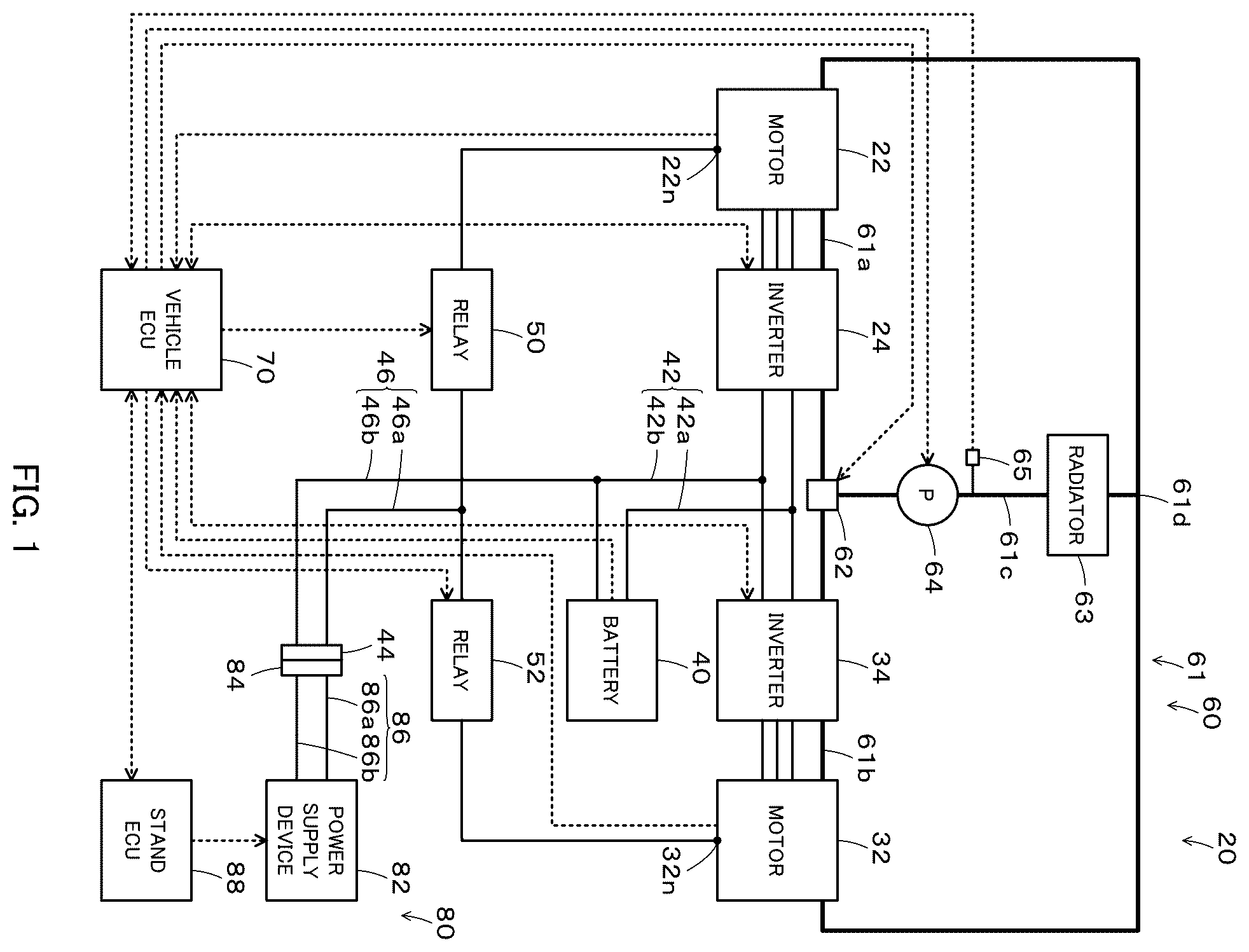
The embodiment of the present disclosure is described with reference to the drawings. and are both schematic configuration diagrams of a battery electric vehicle 20 of the embodiment and a charging stand 80 as an external power supply device. As shown in and , the battery electric vehicle 20 includes motors 22 and 32 , inverters 24 and 34 , a battery 40 as a power storage device, a device side connector 44 , relays 50 and 52 , a cooling device 60 , and an electronic control unit for the vehicle (vehicle ECU 70 ). The motors 22 and 32 are configured as three-phase AC motors, respectively. The motors 22 and 32 include a rotor with permanent magnets embedded in the rotor core and a stator with a three-phase coil wound around the stator core, respectively. Connections of the three-phase coils of the motors 22 and 32 form the neutral points 22 n and 32 n (first and second neutral points), respectively. The rotors of the motors 22 and 32 are incorporated in the left and right drive wheels, respectively. In the embodiment, the motors 22 and 32 have same rated values (specifications). The inverters 24 and 34 are connected to the battery 40 via the positive side line 42 a and the negative side line 42 b of the power line 42 . The inverter 24 has six transistors T 11 to T 16 as switching elements and six diodes D 11 to D 16 . The transistors T 11 -T 16 are arranged in pairs such that they are source and sink side to the positive side line 42 a and the negative side line 42 b , respectively. Each of the connection points of the two paired transistors T 11 - 116 is connected to each of the three-phase coil of the motor 22 . The six diodes D 11 -D 16 are connected in parallel to each of the six transistors T 11 -T 16 . The inverter 24 converts DC power from the battery 40 to three-phase AC power and supplies it to the motor 22 . The inverter 34 is configured in the same manner as the inverter 24 . The inverter 34 has six transistors T 21 to T 26 and six diodes D 11 to D 16 . The inverter 34 converts the DC power from the battery 40 into the three-phase AC power and supplies it to the motor 32 . A capacitor 43 is connected to the positive side line 42 a and the negative side line 42 b . In the embodiment, the inverters 24 and 34 have same rated values (specifications). The battery 40 is configured as a lithium ion rechargeable battery or nickel metal hydride battery, for example. The battery 40 is connected to the inverters 24 and 34 via the positive side line 42 a and the negative side line 42 b , as described above. The device side connector 44 is configured to be connectable to a stand side connector 84 of the charging stand 80 . The device side connector 44 is connected to the neutral points 22 n and 32 n of the motors 22 and 32 via the positive side line 46 a of the power line 46 and the relays 50 and 52 . The device side connector 44 is also connected to the negative side line 42 b via the negative side line 46 b of the power line 46 . A capacitor 47 is connected to the positive side line 46 a and the negative side line 46 b. The relays 50 and 52 connect and disconnect the neutral points 22 n and 32 n of the motors 22 and 32 to the positive side line 46 a by turning on and off, respectively. When the relay 50 is on, a three-phase boost converter is configured by the motor 22 and the inverter 24 between the positive side line 46 a and the negative side line 46 b of the power line 46 and the positive side line 42 a and the negative side line 42 b of the power line 42 . When the relay 52 is on, a three-phase boost converter is configured by the motor 32 and the inverter 34 between the positive side line 46 a and the negative side line 46 b of the power line 46 and the positive side line 42 a and the negative side line 42 b of the power line 42 . The cooling device 60 has a circulation flow path 61 , a switcher 62 , a radiator 63 , and an electric pump 64 . The circulation flow path 61 has a first flow path 61 a , a second flow path 61 b , and a third flow path 61 c . The first flow path 61 a is a flow path for circulating cooling water from the switcher 62 through the inverter 24 and the motor 22 to the confluence 61 d . The second flow path 61 b is a flow path for circulating the cooling water from the switcher 62 through the inverter 34 and the motor 32 to the confluence 61 d . The third flow path 61 c is a flow path for circulating the cooling water from the confluence 61 d through the radiator 63 and the electric pump 64 to the switcher 62 . The switcher 62 is configured to switch the circulation of the cooling water in three ways: both the first flow path 61 a and the second flow path 61 b , only the first flow path 61 a , and only the second flow path 61 b . The electric pump 64 pumps the cooling water in the third flow path 61 c. The vehicle ECU 70 includes a microcomputer. The microcomputer has a CPU, ROM, RAM, flash memory, I/O ports, and communication ports. The vehicle ECU 70 inputs signals from various sensors. For example, the vehicle ECU 70 inputs rotational positions of the rotors of the motors 22 and 32 from rotational position sensors and phase currents of each phase of the motors 22 and 32 from current sensors. The vehicle ECU 70 also inputs temperatures αm1 and αm2 of the motors 22 and 32 from temperature sensors 22 t and 32 t , and temperatures αi1 and αi2 of the inverters 24 and 34 from temperature sensors 24 t and 34 t . The vehicle ECU 70 also inputs a voltage Vb of the battery 40 from a voltage sensor 40 v , a current Ib of the battery 40 from a current sensor 40 i , and a temperature αb of the battery 40 from a temperature sensor 40 t . The vehicle ECU 70 also inputs a voltage Vc of the capacitor 47 from a voltage sensor 47 a and a cooling water temperature αw, which is a temperature of the cooling water in the circulation flow path 61 (third flow path 61 c ), from a water temperature sensor 65 . The vehicle ECU 70 outputs various control signals. For example, the vehicle ECU 70 outputs control signals to the transistors T 11 to T 16 and T 21 to T 26 of the inverters 24 and 34 , control signals to the relays 50 and 52 , and control signals to the electric pump 64 . The vehicle ECU 70 calculates electric angles θe1 and θe2 and rotation speeds Nm1 and Nm2 of the motors 22 and 32 based on the rotational positions of the rotors of the motors 22 and 32 . The vehicle ECU 70 calculates the state of charge SOC of the battery 40 based on the integrated value of the current Ib of the battery 40 . The vehicle ECU 70 sets the input limit Win, which is the allowable input power of the battery 40 , based on the state of charge SOC of the battery 40 and the temperature αb of the battery 40 . The vehicle ECU 70 is capable of communicating with an electronic control unit (stand ECU) 88 of the charging stand 80 at home or at a charging station. The charging stand 80 is located at a home or charging station, or the like. The charging stand 80 includes a power supply device 82 , the stand side connector 84 , and the stand ECU 88 . The power supply device 82 is connected to the stand side connector 84 via the positive side line 86 a and the negative side line 86 b of the power line 86 . The power supply device 82 is configured to convert AC power from a power system to DC power and to adjust output voltage and output power. The stand side connector 84 is configured to be connectable to the device side connector 44 of the battery electric vehicle 20 . When the stand side connector 84 is connected to the device side connector 44 , the positive side line 86 a is connected to the positive side line 46 a , and the negative side line 86 b is connected to the negative side line 46 b , respectively. The stand ECU 88 includes a microcomputer. The microcomputer has a CPU, ROM, RAM, flash memory, I/O ports, and communication ports. The stand ECU 88 inputs an output voltage Vs of the power supply device 82 from a voltage sensor 83 v and an output current Is of the power supply device 82 from a current sensor 83 i . The stand ECU 88 outputs a control signal to the power supply device 82 . The stand ECU 88 calculates an output power Ps based on the output voltage Vs and the output current Is. The stand ECU 88 is configured to communicate with the vehicle ECU 70 of the battery electric vehicle 20 . The following describes the operations of the battery electric vehicle 20 and more specifically the operations during external charging. The external charging is the charging of the battery 40 using the power from the power supply device 82 of the charging stand 80 . In this embodiment, the battery electric vehicle 20 performs the external charging while switching the charging mode between the first charge mode and the second charge mode. The first charge mode is a mode in which the power supplied from the power supply device 82 to the neutral point 22 n of the motor 22 is supplied to the battery 40 via the motor 22 and the inverter 24 . The second charge mode is a mode in which the power supplied from the power supply device 82 to the neutral point 32 n of the motor 32 is supplied to the battery 40 via the motor 32 and the inverter 34 . is a flowchart showing an example of an external charging control routine executed by the vehicle ECU 70 . This routine is executed when the charging start condition is satisfied while the device side connector 44 and the stand side connector 84 are connected. The charging start condition is used, for example, as a condition where the user instructs to start charging the battery 40 . At start of the routine, both relays 50 and 52 are off. During execution of the routine, the vehicle ECU 70 controls the switcher 62 and the electric pump 64 such that the cooling water is distributed in both the first flow path 61 a and the second flow path 61 b. When the external charging control routine of is executed, the vehicle ECU 70 selects the first charge mode (step S 100 ). The vehicle ECU 70 turns on the relay 50 (step S 102 ). The vehicle ECU 70 sets the target power Ps* and transmits it to the stand ECU 88 (step S 104 ). The vehicle ECU 70 performs drive control of the inverter 24 (step S 106 ). The target power Ps* is set, for example, within the input limit Win of the battery 40 . The stand ECU 88 controls the power supply device 82 such that the output power Ps is equal to the target power Ps*. In the drive control of the inverter 24 , the duty of the transistors T 11 to T 16 is set based on the voltage ratio between the voltage Vb of the battery 40 and the voltage Vc of the capacitor 47 . The vehicle ECU 70 inputs the temperatures αm1 and αm2 of the motors 22 and 32 (step S 110 ). The vehicle ECU 70 determines whether the charging mode is the first charge mode or the second charge mode (step S 120 ). When the charging mode is the first charge mode, the vehicle ECU 70 compares the value (αm1−αm2) obtained by subtracting the temperature αm2 of the motor 32 from the temperature αm1 of the motor 22 with a threshold value Δαmref1 (step S 130 ). When the value (αm1−αm2) is less than the threshold value Δαmref1, the vehicle ECU 70 determines to hold the charging mode. In this case, the vehicle ECU 70 sets the target power Ps* and transmits it to the stand ECU 88 (step S 132 ). The vehicle ECU 70 performs the drive control of the inverter 24 (step S 134 ). The vehicle ECU 70 determines whether the charging stop condition is satisfied (step S 170 ). The charging stop condition is used, for example, as an OR condition, such as a condition where the state of charge SOC of the battery 40 reaches equal to or higher than the threshold value Sth, a condition where the user instructs to stop charging the battery 40 , and the like. When the charging stop condition is not satisfied in step S 170 , the vehicle ECU 70 returns to the process of step S 110 . When the value (αm1−αm2) is equal to or higher than the threshold value Δαmref1 in step S 130 , the vehicle ECU 70 determines that the charging mode is required to be switched to the second charge mode (step S 140 ). In this case, the vehicle ECU 70 executes a first stop process (step S 142 ). In the first stop process, the vehicle ECU 70 stops the drive control of the inverter 24 and sends a power interruption command to the stand ECU 88 . The stand ECU 88 suspends the power supply device 82 . This suspends the external charging. The vehicle ECU 70 turns off the relay 50 and turns on the relay 52 (step S 144 ). The vehicle ECU 70 sets the target power Ps* and transmits it to the stand ECU 88 (step S 152 ). The vehicle ECU 70 performs the drive control of the inverter 34 (step S 154 ) and moves to the process of step S 170 . In the drive control of the inverter 34 , the duty of transistors T 21 to T 26 is set based on the voltage ratio between the voltage Vb of the battery 40 and the voltage Vc of the capacitor 47 . The battery electric vehicle 20 can suppress a further increase in the temperature αm1 of the motor 22 by switching the charging mode to the second charge mode. As a result, the battery electric vehicle 20 can suppress a relatively large imbalance between the temperature αm1 of the motor 22 and the temperature αm2 of the motor 32 . When the charging mode is the second charge mode in step S 120 , the vehicle ECU 70 compares the value (αm2−αm1) obtained by subtracting the temperature αm1 of the motor 22 from the temperature αm2 of the motor 32 with a threshold value Δαmref2 (step S 150 ). The threshold value Δαmref2 is, for example, the same value as the threshold value Δαmref1. When the value (αm2−αm1) is less than the threshold value Δ αmref2, the vehicle ECU 70 determines to hold the charging mode. In this case, the vehicle ECU 70 sets the target power Ps* and transmits it to the stand ECU 88 (step S 152 ). The vehicle ECU 70 performs the drive control of the inverter 34 (step S 154 ), and moves to the process of step S 170 . When the value (αm2−αm1) is equal to or higher than the threshold value Δαmref2 in step S 150 , the vehicle ECU 70 determines that the charging mode is required to be switched to the first charge mode (step S 160 ). In this case, the vehicle ECU 70 executes a second stop process (step S 162 ). In the second stop process, the vehicle ECU 70 stops the drive control of the inverter 34 and sends the power interruption command to the stand ECU 88 . The stand ECU 88 suspends the power supply device 82 . This suspends the external charging. The vehicle ECU 70 turns off the relay 52 and turns on the relay 50 (step S 164 ). The vehicle ECU 70 sets the target power Ps* and transmits it to the stand ECU 88 (step S 132 ). The vehicle ECU 70 performs the drive control of the inverter 24 (step S 134 ) and moves to the process of step S 170 . By switching the charging mode to the first charge mode, the battery electric vehicle 20 can suppress a further increase in the temperature αm2 of the motor 32 . As a result, the battery electric vehicle 20 can suppress the relatively large imbalance between the temperature αm1 of the motor 22 and the temperature αm2 of the motor 32 . When the charging stop condition is satisfied in step S 170 , the vehicle ECU 70 executes a final stop process (step S 172 ) and this routine is terminated. In the final stop process, the vehicle ECU 70 stops the drive control of the one being driven of the inverters 24 and 34 and sends a power end command to the stand ECU 88 . The stand ECU 88 shuts down the power supply device 82 . This terminates the external charging. In the battery electric vehicle 20 of the embodiment described above, the vehicle ECU 70 switches the charging mode to the second charge mode when the charging mode is the first charge mode and the value (αm1−αm2) reaches equal to or higher than the threshold value Δαmref1. Also, the vehicle ECU 70 switches the charging mode to the first charge mode when the charging mode is the second charge mode and the value (αm2−αm1) reaches equal to or higher than the threshold value Δαmref2. This can suppress a relatively large imbalance between the temperature αm1 of the motor 22 and the temperature αm2 of the motor 32 . As a result, when the battery electric vehicle 20 is subsequently driven, a relatively large imbalance between the drive performance of the motor 22 and the drive performance of the motor 32 can be suppressed. The vehicle ECU 70 may compare the value (αi1−αi2) obtained by subtracting the temperature αi2 of the inverter 34 from the temperature αi1 of the inverter 24 with a threshold value Δαiref1, instead of the process of step S 130 of the embodiment described above. That is, when the value (αi1−αi2) is less than the threshold value Δαiref1, the vehicle ECU 70 may hold the charging mode, and when the value (αi1−αi2) is equal to or higher than the threshold value Δαiref1, the vehicle ECU 70 may switch the charging mode to the second charge mode. The vehicle ECU 70 may compare the value (αi2−αi1) obtained by subtracting the temperature αi1 of the inverter 24 from the temperature αi2 of the inverter 34 with a threshold value Δαiref2, instead of the process of step S 150 . That is, when the value (αi2−αi1) is less than the threshold value Δαiref2, the vehicle ECU 70 may hold the charging mode, and when the value (Δi2−αi1) is equal to or higher than the threshold value Δαiref2, the vehicle ECU 70 may switch the charging mode to the first charge mode. The threshold values Δαierf1 and Δαiref2 are, for example, the same value. This can suppress a relatively large imbalance between the temperatures αi1 of the inverter 24 and αi2 of the inverter 34 . The vehicle ECU 70 may execute the external charging control routine of , instead of the external charging control routine of of the embodiment described above. The external charging control routine of differs from the external charging control routine of in that the processes of steps S 130 and S 150 are replaced by processes of steps S 130 b and S 150 b . In the external charging control routine of , when the charging mode is the first charge mode in step S 120 , the vehicle ECU 70 compares the temperature αm of the motor 22 with a threshold value αmref1 (step S 130 b ). When the temperature αm1 of the motor 22 is less than the threshold value αmref1, the vehicle ECU 70 determines to hold the charging mode and moves to the process of step S 132 . On the other hand, when the temperature αm1 of the motor 22 is equal to or higher than the threshold value αmref1, the vehicle ECU 70 determines that the charge mode is required to be switched to the second charge mode (step S 140 ) and moves to the process of step S 142 . In this case, as in the embodiment described above, the battery electric vehicle 20 can suppress the further increase of the temperature αm1 of the motor 22 by switching the charging mode to the second charge mode. As a result, the battery electric vehicle 20 can suppress the relatively large imbalance between the temperature αm1 of the motor 22 and the temperature αm2 of the motor 32 . When the charging mode is the second charge mode in step S 120 , the vehicle ECU 70 compares the temperature am of the motor 32 with a threshold value αmref2 (step S 150 b ). The threshold value 60 mref2 is, for example, the same value as the threshold value αmref1. When the temperature αm2 of the motor 32 is less than the threshold value αmref2, the vehicle ECU 70 determines to hold the charging mode and moves to the process of step S 152 . On the other hand, when the temperature αm2 of the motor 32 is equal to or higher than the threshold value αmref2, the vehicle ECU 70 determines that the charging mode is required to be switched to the first charge mode (step S 160 ) and moves to the process of step S 162 . In this case, as in the embodiment described above, the battery electric vehicle 20 can suppress the further increase of the temperature αm2 of the motor 32 by switching the charging mode to the first charge mode. As a result, the battery electric vehicle 20 can suppress the relatively large imbalance between the temperature αm1 of the motor 22 and the temperature αm2 of the motor 32 . The vehicle ECU 70 may compare the temperature αi1 of the inverter 24 with a threshold value αiref1, instead of the process of step S 130 b of the external charging control routine of . That is, when the temperature ail of the inverter 24 is less than the threshold value αiref1, the vehicle ECU 70 may hold the charging mode, and when the temperature αi1 of the inverter 24 is equal to or higher than the threshold value αiref1, the vehicle ECU 70 may switch the charging mode to the second charge mode. The vehicle ECU 70 may compare the temperature αi2 of the inverter 34 with a threshold value αiref2, instead of the process of step S 150 b . That is, when the temperature αi2 of the inverter 34 is less than the threshold value αiref2, the vehicle ECU 70 may hold the charging mode, and when the temperature αi2 of the inverter 34 is equal to or higher than the threshold value αiref2, the vehicle ECU 70 may switch the charging mode to the first charge mode. The threshold values αierf1 and αiref2 are, for example, the same value. This can suppress the relatively large imbalance between the temperatures ail of inverter 24 and αi2 of inverter 34 . The vehicle ECU 70 may execute the external charging control routine of , instead of the external charging control routine of of the embodiment described above. The external charging control routine of differs from the external charging control routine of in that processes of steps S 103 , S 146 , and S 166 are added. In the external charging control routine of , when the vehicle ECU 70 turns on the relay 50 in step S 102 , the vehicle ECU 70 starts executing a first distribution control (step S 103 ). In the first distribution control, the vehicle ECU 70 controls the switcher 62 and the electric pump 64 such that the cooling water is distributed only in the first flow path 61 a among the first flow path 61 a and the second flow path 61 b . That is, in the first charge mode, the vehicle ECU 70 executes the first distribution control. In this way, the battery electric vehicle 20 can suppress the temperature rise of the motor 22 and the inverter 24 . When the vehicle ECU 70 turns off the relay 50 and turns on the relay 52 in step S 144 , the vehicle ECU 70 switches from the first distribution control to the second distribution control (step S 146 ) and moves to the process of step S 152 . In the second distribution control, the vehicle ECU 70 controls the switcher 62 and the electric pump 64 such that the cooling water is distributed only in the second flow path 61 b among the first flow path 61 a and the second flow path 61 b . That is, in the second charge mode, the vehicle ECU 70 executes the second distribution control. In this way, the battery electric vehicle 20 can suppress the temperature rise of the motor 32 and the inverter 34 . When the vehicle ECU 70 turns off the relay 52 and turns on the relay 50 in step S 164 , the vehicle ECU 70 switches from the second distribution control to the first distribution control (step S 166 ) and moves to the process of step S 132 . The vehicle ECU 70 may execute the external charging control routine of , instead of the external charging control routine of . The external charging control routine of differs from the external charging control routine of in that processes of steps S 131 and S 151 are added. In the external charging control routine of , when the charging mode is the first charge mode in step S 120 and the value (αm1−αm2) is less than the threshold value Δαmref1 in step S 130 , the vehicle ECU 70 determines whether the charging mode has continued in the first charge mode for a predetermined time T 1 (step S 131 ). When the charging mode has not continued in the first charge mode for the predetermined time T 1 , the vehicle ECU 70 determines to hold the charging mode and moves to the process of step S 132 . On the other hand, when the charging mode has continued in the first charge mode for the predetermined time T 1 , the vehicle ECU 70 determines that the charging mode is required to be switched to the second charge mode (step S 140 ) and moves to the process of step S 142 . This can suppress the duration of the first charge mode from becoming too long. When the charging mode is the second charge mode in step S 120 and the value (αm2−αm1) is less than the threshold value Δαmref2 in step S 150 , the vehicle ECU 70 determines whether the charging mode has continued in the second charge mode for the predetermined time T 2 (step S 151 ). When the charging mode has not continued in the second charge mode for the predetermined time T 2 , the vehicle ECU 70 determines to hold the charging mode and moves to the process of step S 152 . On the other hand, when the charging mode continues in the second charge mode for the predetermined time T 2 , the vehicle ECU 70 determines that the charging mode is required to be switched to the first charge mode (step S 160 ) and moves to the process of step S 162 . The predetermined time T 2 is, for example, the same as the predetermined time T 1 . This can suppress the duration of the second charge mode from becoming too long. The vehicle ECU 70 may switch the charging mode to the second charge mode when at least one of first to fourth conditions is satisfied, instead of the processes of steps S 130 and S 130 b of the external charging control routine of to . The first condition is a condition that the value (αm1−αm2) is equal to or higher than the threshold value Δαmref1. The second condition is a condition that the value (αi1−αi2) is equal to or higher than the threshold value Δαiref1. The third condition is a condition that the temperature αm1 of motor 22 is equal to or higher than the threshold value αmref1. The fourth condition is a condition that the temperature αi1 of the inverter 24 is equal to or higher than the threshold value αiref1. The vehicle ECU 70 may switch the charging mode to the first charge mode when at least one of fifth to eighth conditions is satisfied, instead of the processes of steps S 150 and S 150 b . The fifth condition is a condition that the value (αm2−αm1) is equal to or higher than the threshold value Δαmref2. The sixth condition is a condition that the value (αi2−αi1) is equal to or higher than the threshold value Δαiref2. The seventh condition is a condition that the temperature αm2 of motor 32 is equal to or higher than the threshold value αmref2. The eighth condition is a condition that the temperature αi2 of the inverter 34 is equal to or higher than the threshold value αiref2. In the embodiments described above, the motors 22 and 32 may be used to drive the front and rear drive wheels, respectively, instead of being used to drive the left and right drive wheels, respectively. In the embodiments described above, the power storage device may be a capacitor instead of the battery 40 . In the embodiments described above, the form of the battery electric vehicle 20 including the motors 22 and 32 may be replaced by the form of a hybrid electric vehicle including the motors 22 and 32 and an engine, or by a fuel cell electric vehicle including the motors 22 and 32 and a fuel cell. In the battery electric vehicle of the present disclosure, the controller may be programmed to switch the charge mode to the second charge mode, when the charge mode is the first charge mode and a value obtained by subtracting the temperature of the second motor from the temperature of the first motor reaches equal to or higher than a first threshold value, or when the charge mode is the first charge mode and a value obtained by subtracting the temperature of the second inverter from the temperature of the first inverter reaches equal to or higher than a second threshold value, and the controller may be programmed to switch the charge mode to the first charge mode, when the charge mode is the second charge mode and a value obtained by subtracting the temperature of the first motor from the temperature of the second motor reaches equal to or higher than a third threshold value, or when the charge mode is the second charge mode and a value obtained by subtracting the temperature of the first inverter from the temperature of the second inverter reaches equal to or higher than a fourth threshold value. In the battery electric vehicle of the present disclosure, the controller may be programmed to switch the charge mode to the second charge mode, when the charge mode is the first charge mode and the temperature of the first motor reaches equal to or higher than a first threshold value, or when the charge mode is the first charge mode and the temperature of the first inverter reaches equal to or higher than a second threshold value, and the controller may be programmed to switch the charge mode to the first charge mode, when the charge mode is the second charge mode and the temperature of the second motor reaches equal to or higher than a third threshold value, or when the charge mode is the second charge mode and the temperature of the second inverter reaches equal to or higher than a fourth threshold value. In the battery electric vehicle of the present disclosure, the battery electric vehicle may further include a cooling device that is configured to distribute a cooling water in one or both of a first flow path including the first motor and the first inverter and a second flow path including the second motor and the second inverter, wherein the controller may programmed to distribute the cooling water only in the first flow path among the first and second flow paths when the charge mode is the first charge mode, and the controller may be programmed to distribute the cooling water only in the second flow path among the first and second flow paths when the charge mode is the second charge mode. In this case, the controller may be programmed to switch the charge mode to the second charge mode when the charge mode continues in the first charge mode for a first predetermined time, and the controller may be programmed to switch the charge mode to the first charge mode when the charge mode continues in the second charge mode for a second predetermined time. The aspect of the disclosure is described above with reference to the embodiment. The disclosure is, however, not limited to the above embodiment but various modifications and variations may be made to the embodiment without departing from the scope of the disclosure.
INDUSTRIAL APPLICABILITY
The technique of the disclosure is applicable to the manufacturing industries of the battery electric vehicle and so on.
Figures (6)
Citations
This patent cites (15)
- US2016/0280218
- US2017/0137016
- US2017/0257055
- US2019/0202319
- US2020/0177014
- US2023/0097060
- US2024/0092203
- US111391719
- US112389234
- US113022344
- US112398185
- US2007-068340
- US2009-038958
- US2010178593
- US2016063587