Iron-type Golf Club Head with Improved Exit Channel for Hosel Adjustability Features
Abstract
An iron-type golf club head with a hosel, a hosel bore, and an exit channel in communication with the hosel bore that is offset from and extends at an angle of up to 15 degrees with respect to the hosel bore is disclosed herein. The exit channel does not extend into the face or sole of the golf club head, thereby preserving the structural integrity and aesthetics of the golf club while permitting the use of adjustable hosel features that allow for easy adjustments to the loft and lie of the club head. This feature may be used in connection with any type of irons, including wedges.
Claims (2)
1 . An iron-type golf club head comprising: a hosel comprising a hosel bore, a through hole, and a hosel axis; a face; a topline; a sole; and a heel section comprising an exit channel, wherein the exit channel comprises a channel axis, wherein the exit channel is in communication with the through hole and the hosel bore, and wherein the channel axis extends at an angle A 1 of 1 to 15 degrees measured along a heel-toe direction from the hosel axis 12 (lie direction) and at an angle A 2 of 1 to 15 degrees measured along a front-back direction from the hosel axis 12 (loft direction); wherein the exit channel does not extend into the sole or the face.
Show 1 dependent claims
2 . The iron-type golf club head of claim 1 , wherein the iron-type golf club head is selected from the group consisting of a wedge, a blade iron, a hollow iron, and a cavity-back iron.
Full Description
Show full text →
CROSS REFERENCE
S TO RELATED APPLICATIONS The present application claims priority to U.S. Provisional Application No. 63/226,108, filed on Jul. 27, 2021, the disclosure of which is hereby incorporated by reference in its entirety herein. STATEMENT REGARDING FEDERALLY SPONSORED RESEARCH OR DEVELOPMENT Not Applicable
BACKGROUND OF THE INVENTION
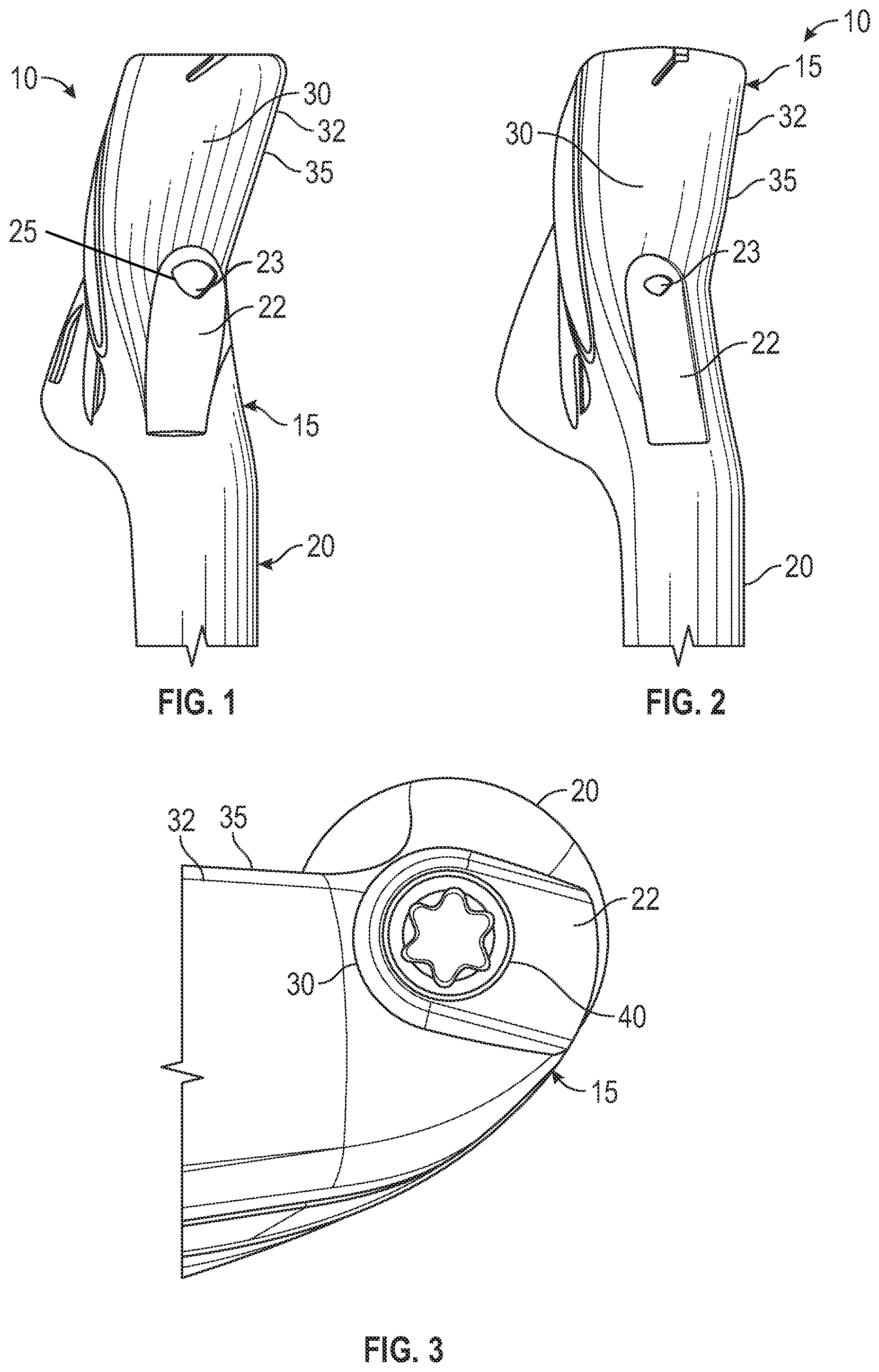
Field of the Invention The present invention relates to an iron-type golf club head with an improved hosel exit channel structure that allows adjustments to be made to loft and lie angles of the iron without negatively affecting its performance or aesthetics. Description of the Related Art The prior art discloses many different adjustable hosel designs that allow for adjustment of lie and/or loft angles of a wood-type golf club head. These prior art designs permit off-axis orientation of an adjustable hosel assembly (e.g., shaft, shaft sleeve) within the hosel bore itself, which assembly is affixed to the hosel with a mechanical fastener 40 such as a bolt or screw. The problem with these designs, however, lies in the fact that they are not readily translatable to iron-type golf club heads, including wedges. As shown in , applying prior art adjustable hosel 20 structures to iron-type club heads 10 creates exit channels 22 that interfere with or otherwise affect the sole 30 and face 35 surfaces, leading to increased breakage and suboptimal aesthetics. For example, when the exit channel 22 is aligned with both the lie angle and the loft angle of the hosel 20 , as shown in , the channel 22 cuts into the sole and the face and interferes with the leading edge 32 of the iron body. When the exit channel 22 is aligned with the lie angle of the hosel 20 but offset from the loft angle of the hosel 20 , as shown in , the exit channel still cuts into the sole. In both of these configurations, the dimensions of the iron head 10 are such that the exit channel 22 cuts deeply into the body 15 , creating openings 23 into the hollow portions of the club head if the club 10 is hollow and divots if the club 10 is solid. In addition to being unsightly, these openings result in breakage and permit debris to enter the interior of the body. Therefore, there is a need for an improved adjustable hosel design for iron-type golf club heads. BRIEF
SUMMARY OF THE INVENTION
One aspect of the present invention is an iron-type golf club head configured to receive an adjustable hosel assembly, the iron-type golf club head comprising a hosel with an exit channel in a heel side of the head that is angled up to 15 degrees from one or both of a hosel loft and lie axis. Another aspect of the present invention is an iron-type golf club head comprising a hosel comprising a hosel bore, a through hole, and a hosel axis, a face, a topline, a sole, and a heel section comprising an exit channel, wherein the exit channel comprises a channel axis, wherein the exit channel is in communication with the through hole and the hosel bore, and wherein the channel axis is offset from and extends at an angle with respect to the hosel axis. In some embodiments, the angle may be no less than 1 degree and no more than 15 degrees, and in a further embodiment, may be approximately 10 degrees. In other embodiments, the exit channel may not extend into the sole or the face. In any embodiment, the iron-type golf club head may be selected from the group consisting of a wedge, a blade iron, a hollow iron, and a cavity-back iron. Yet another aspect of the present invention is an assembly comprising an iron-type golf club head comprising a face, a rear surface, a sole, a topline, a heel section, a hosel, a hosel bore, a flange encircling a through-hole, and an exit channel, a mechanical fastener comprising a fastener head with a first set of engagement features and an elongated body, and an adjustment tool comprising a tool head with a second set of engagement features sized to engage with the first set of engagement features, wherein the hosel bore has a first axis, wherein the exit channel has a second axis, and wherein the second axis extends at a channel angle of no more than 15 degrees with respect to the first axis, wherein the mechanical fastener is sized to fit within the exit channel so that the elongated body extends through the through hole and the fastener head abuts the flange, and wherein the tool head is sized to fit within the exit channel and engage with the fastener head. In some embodiments, exit channel may be disposed entirely within the heel section and may not extend into the sole or the face. In any embodiment, the iron-type golf club head may be selected from the group consisting of a wedge, a blade iron, a hollow iron, and a cavity-back iron. In a further embodiment, the iron-type golf club head may be a wedge selected from the group consisting of a pitching wedge, a gap wedge, a sand wedge, and a lob wedge. In other embodiments, the second axis may extend at an angle of approximately 10 degrees with respect to the first axis. In still other embodiments, the tool head may have a hexagonal shape. In a further embodiment, the tool heed may comprise a tool axis, at least one edge that is angled with respect to the tool axis, and at least one relief cut. In a further embodiment, the at least one edge may extend at an edge angle of up to 15 degrees with respect to the tool axis, and may be approximately equivalent to the channel angle. In another embodiment, the tool head may comprise a plurality of relief cuts. Having briefly described the present invention, the above and further objects, features and advantages thereof will be recognized by those skilled in the pertinent art from the following detailed description of the invention when taken in conjunction with the accompanying drawings. BRIEF DESCRIPTION OF THE SEVERAL VIEWS OF THE DRAWINGS are perspective views of iron-type golf club heads incorporating hosel exit channels found in prior art adjustable hosel designs. is a heel-side perspective view of a golf club head of the present invention. is a sole elevational view of the embodiment shown in . is a cross-sectional view of the embodiment shown in taken along lines 6 - 6 . is a cross-sectional view of the embodiment shown in taken along lines 7 - 7 . is a side perspective view of an adjustment tool sized to engage with the golf club head shown in . is a sole perspective view of the tool shown in engaged with the embodiment shown in . is a cross-sectional view of the embodiment shown in taken along lines 10 - 10 . is a cross-sectional view of the embodiment shown in taken along lines 11 - 11 .
DETAILED DESCRIPTION
OF THE INVENTION The preferred embodiment of the present invention, shown in , is an iron-type golf club head 10 comprising a hosel 20 , a heel section 26 beneath the hosel, sole 30 configured to contact turf during play, a leading edge 32 , a face 35 configured contact a golf ball, a topline 36 , and a rear surface 38 . The iron head 10 is configured to receive an adjustable hosel assembly (not shown), as the hosel 20 has a bore 21 with a flange 25 surrounding a through-hole 23 in communication with a hosel exit channel 22 disposed in the heel section 26 . The bore 21 follows a hosel axis 12 , which defines the loft and lie of the head 10 , while the exit channel 22 is angled (or off-axis) with respect to the hosel axis 12 . A mechanical fastener 40 such as a bolt or screw is placed into the exit channel 22 to engage with the adjustable hosel assembly and temporarily fix a shaft to the iron club head 10 . Unlike the exit channels of prior art designs, the exit channel 22 of the present invention has an axis 14 extending at an angle A 1 of up to 15 degrees measured along a heel-toe direction from the hosel axis 12 (lie direction) and at an angle A 2 of up to 15 degrees measured along a front-back direction from the hosel axis 12 (loft direction), as shown in . In the preferred embodiment, A 1 and A 2 are each approximately 10 degrees. When a mechanical fastener 40 is engaged with an adjustable hosel assembly such that the head 42 of the fastener 40 is disposed within the exit channel 22 and abuts the flange 25 and the elongated body 44 of the fastener extends into the hosel bore 21 , a tool 50 with a head 52 that is customized to match the engagement features of the fastener head 42 can be inserted into the channel 22 without interference from other parts of the iron head 10 . The tool head 52 preferably has a hexagonal shape with edges 51 , 53 with angles A 3 , A 4 of up to 15 degrees measured with respect to a tool axis 54 and relief cuts 55 to maximize surface contact with the fastener head 42 . The angled exit channel 22 of the present invention allows for a more attractive finished club head 10 than would be created from combining prior art adjustable hosel designs with iron club heads 10 , as the exit channel 26 is confined to the heel section 26 without extending into the sole 30 , leading edge 32 , or face 35 . This configuration also allows for enough points of hosel adjustability that a single head 10 can be used for fitting purposes. This head 10 can be used in play or as a fitting device to help golfers select irons with suitable loft and lie angles. In other embodiments, the angled exit channel 22 of the present invention may be used in wedges. From the foregoing it is believed that those skilled in the pertinent art will recognize the meritorious advancement of this invention and will readily understand that while the present invention has been described in association with a preferred embodiment thereof, and other embodiments illustrated in the accompanying drawings, numerous changes, modifications, combinations, and substitutions of equivalents may be made therein without departing from the spirit and scope of this invention which is intended to be unlimited by the foregoing except as may appear in the following appended claims. The section titles included herein also are not intended to be limiting. Therefore, the embodiments of the invention in which an exclusive property or privilege is claimed are defined in the following appended claims.
Figures (5)
Citations
This patent cites (104)
- US1137457
- US2067556
- US2091794
- US2326495
- US2332342
- US2847219
- US4995609
- US5067711
- US5133553
- US5222734
- US5320347
- US6120384
- US8727899
- US8753221
- US9144719
- US9144720
- US9694262
- US9802089
- US9814944
- US10195497
- US10716972
- US2009/0233728
- US2009/0286611
- US2009/0286619
- US2010/0069170
- US2010/0197424
- US2011/0118045
- US2011/0152000
- US2011/0177876
- US2011/0312437
- US2012/0034994
- US2012/0071262
- US2012/0100926
- US2012/0122601
- US2012/0142445
- US2012/0316006
- US2013/0085010
- US2013/0116062
- US2013/0184098
- US2013/0210542
- US2013/0344979
- US2014/0031139
- US2014/0080629
- US2014/0121035
- US2014/0256461
- US2014/0274446
- US2015/0018116
- US2015/0367185
- US2015/0367186
- US2015/0375065
- US2016/0001146
- US2016/0023061
- US2016/0059093
- US2016/0059094
- US2016/0129320
- US2016/0166894
- US2016/0184662
- US2016/0243411
- US2016/0263448
- US2016/0332039
- US2016/0354648
- US2017/0252613
- US2017/0266518
- US2018/0028877
- US2018/0065003
- US2018/0154224
- US2018/0161650
- US2018/0189758
- US2018/0200590
- US2018/0318661
- US2019/0076705
- US2019/0105545
- US2019/0381370
- US2020/0360771
- US2021/0291025
- US2021/0322838
- US2021/0387064
- US2022/0032131
- US2022/0118321
- US2022/0184475
- US2023/0149782
- US2023/0158371
- US2024/0082659
- US2025/0041677
- US103877711
- US2241173
- US2496274
- US2001509718
- US4671447
- US2015100704
- US2016129695
- US100412931
- US101404729
- US20210045913
- US20210121233
- USWO-2012064707
- USWO-2012088618
- USWO-2013028885
- USWO-2013122885
- USWO-2014070343
- USWO-2014070904
- USWO-2017120389
- USWO-2021022219
- USWO-2022081640