Stacked Semiconductor Device and Method of Fabricating the Same
Abstract
A stacked semiconductor device includes first chips and a second chip. The first chips are arranged in an array, and includes first and second type through vias, an internal wire layer, a redistribution line and conductive pins. The internal wire layer is disposed on and electrically connected to the first and second type through vias. The redistribution line is disposed on and electrically connected to the second type through vias and the internal wire layer, wherein the redistribution line extends from a top surface of the second type through vias to a position non-overlapped with the second type through vias. The conductive pins are disposed on and electrically connected to the redistribution line. The second chip is stacked on the first chips, wherein the second chip includes connection pins, and the second chip is connected to the first chips by bonding the connection pins to the conductive pins.
Claims (15)
1 . A stacked semiconductor device, comprising: a plurality of first chips arranged in an array, wherein each of the plurality of first chips arranged in the array are separated by dicing lines, and each of the plurality of first chips comprises: first type through vias and second type through vias; an internal wire layer disposed on and electrically connected to the first type through vias and the second type through vias; a redistribution line disposed on and electrically connected to the second type through vias and the internal wire layer, wherein the redistribution line extends from a top surface of the second type through vias to a position non-overlapped with the second type through vias; a plurality of conductive pins disposed on and electrically connected to the redistribution line; and an extended redistribution line disposed on and electrically connected to the second type through vias and the internal wire layer, wherein the extended redistribution line extends from the top surface of the second type through vias of one of the plurality of first chips across the dicing lines towards the plurality of conductive pins of another one of the plurality of first chips; a second chip stacked on the plurality of first chips, wherein the second chip comprises a plurality of connection pins, and the second chip is connected to the plurality of first chips by bonding the plurality of connection pins to the plurality of conductive pins.
12 . A method of fabricating a stacked semiconductor device, comprising: forming a plurality of first chips on a first semiconductor wafer by: forming first type through vias and second type through vias over a first wafer substrate; forming an internal wire layer disposed on and electrically connected to the first type through vias and the second type through vias, wherein the first type through vias, the second type through vias and the internal wire layer are formed through a first group of photomasks; forming a redistribution line disposed on and electrically connected to the second type through vias and the internal wire layer, wherein the redistribution line extends from a top surface of the second type through vias to a position non-overlapped with the second type through vias; and forming a plurality of conductive pins disposed on and electrically connected to the redistribution line, wherein the redistribution line and the plurality of conductive pins are formed through a second group of photomasks; dicing the first semiconductor wafer to separate out an array of first chips from the plurality of first chips; forming a plurality of second chips on a second semiconductor wafer, wherein the second chips comprise a plurality of connection pins; dicing the second semiconductor wafer to separate out a second chip from the plurality of second chips; and bonding the array of first chips to the second chip by electrically connecting the plurality of conductive pins to the plurality of connection pins.
Show 13 dependent claims
2 . The stacked semiconductor device according to claim 1 , wherein the plurality of first chips is arranged in an array of N rows and M columns, and N and M are an integer, and wherein an outline of the second chip corresponds to an outline of the plurality of first chips arranged in the array.
3 . The stacked semiconductor device according to claim 2 , wherein a single second chip is bonded to the plurality of first chips arranged in an array of 2 rows and 4 columns.
4 . The stacked semiconductor device according to claim 2 , wherein a single second chip is bonded to the plurality of first chips arranged in an array of 2 rows and 2 columns.
5 . The stacked semiconductor device according to claim 1 , wherein the extended redistribution line extends across two adjacent first chips of the plurality of first chips.
6 . The stacked semiconductor device according to claim 1 , wherein the extended redistribution line extends across four adjacent first chips of the plurality of first chips.
7 . The stacked semiconductor device according to claim 1 , further comprising conductive terminals disposed on and electrically connected to the first type through vias and the second type through vias.
8 . The stacked semiconductor device according to claim 7 , wherein the first type through vias electrically connects the signals or power supply lines of the plurality of first chips to the conductive terminals, and the second type through vias electrically connects the signals or power supply lines of the second chip to the conductive terminals.
9 . The stacked semiconductor device according to claim 1 , wherein the first type through vias are arranged in a first column in each of the plurality of first chips, and the second type through vias are arranged in a second column in each of the plurality of first chips.
10 . The stacked semiconductor device according to claim 1 , wherein each of the plurality of first chips further comprises: a transistor structure; and another redistribution line disposed on and electrically connected to the transistor structure through the internal wire layer, wherein the another redistribution line extends from an internal wire of the internal wire layer located on top of the transistor structure to a position away from the internal wire, and wherein the plurality of conductive pins is disposed on and electrically connected to the another redistribution line.
11 . The stacked semiconductor device according to claim 1 , wherein the plurality of first chips include memory chips and the second chip includes a logic chip.
13 . The method according to claim 12 , wherein forming the plurality of first chips on the first semiconductor wafer further comprises: forming an extended redistribution line disposed on and electrically connected to the second type through vias and the internal wire layer, wherein the extended redistribution line extends from the top surface of the second type through vias of one of the plurality of first chips across a dicing line towards the plurality of conductive pins of another one of the plurality of first chips.
14 . The method according to claim 12 , further comprises forming conductive terminals disposed on and electrically connected to the first type through vias and the second type through vias.
15 . The method according to claim 14 , wherein after bonding the array of first chips to the second chip, the first type through vias electrically connects the signals or power supply lines of the plurality of first chips to the conductive terminals, and the second type through vias electrically connects the signals or power supply lines of the second chip to the conductive terminals.
Full Description
Show full text →
BACKGROUND
Technical Field The present disclosure relates to a stacked semiconductor device. In particular, the disclosure relates to a stacked semiconductor device and a method of fabricating the same. Description of Related Art Stacked semiconductor device composed of heterogeneous chips, such as logic chips and memory chips are formed by wafer-on-wafer technology. Typically, there is a difference between the logic chip size and the memory chip size, whereby the stacked device may be composed of a single logic chip stacked on multiple memory chips. The memory chips on a wafer are fabricated uniformly with a set of photomasks. In general, the memory chips may be coupled to various logic chips, and the quantity of memory chips used in a stacked device is variable according to the logic chip size to be coupled with. As means for providing interconnection between the signals of logic and memory chips, face to face bonding can be utilized in which metal terminals (conductive pins/connection pins) provided on the surfaces of both chips are directly bonded together. On the other hand, bonding pads which are used to connect signals or power supply of the chips to pins of a device package are provided on the backside of the memory chips. In this case, those signals are routed from the frontside to the backside of the memory chips by through substrate vias (TSVs). The TSVs in a single memory chip are provided at certain positions for connecting signals of the memory chip to bonding pads on the backside of the chip. However, as the positions of the metal terminals (conductive pins/connection pins) on the logic chip are unique to each logic chip design, the TSVs used for connecting the signals of the logic chip to the bonding pads are not fixed. Usually, semiconductor memories are fabricated with “photomask sets”. Thus, if the positions of the TSVs are changed according to a partner logic chip, the “photomask sets” must also be redesigned.
SUMMARY
In accordance with some embodiments of the present disclosure, a stacked semiconductor device is fabricated by bonding memory chips with logic chip without utilizing extra photomask sets. In one embodiment of the present disclosure, a stacked semiconductor device includes a plurality of first chips and a second chip. The plurality of first chips is arranged in an array, and includes first type through vias, second type through vias, an internal wire layer, a redistribution line and a plurality of conductive pins. The internal wire layer is disposed on and electrically connected to the first type through vias and the second type through vias. The redistribution line is disposed on and electrically connected to the second type through vias and the internal wire layer, wherein the redistribution line extends from a top surface of the second type through vias to a position non-overlapped with the second type through vias. The conductive pins are disposed on and electrically connected to the redistribution line. The second chip is stacked on the first chips, wherein the second chip includes a plurality of connection pins, and the second chip is connected to the first chips by bonding the connection pins to the conductive pins. In some embodiments, the first chips are arranged in an array of N rows and M columns, and N and M are an integer, and wherein an outline of the second chip corresponds to an outline of the first chips arranged in the array. In some embodiments, a single second chip is bonded to the first chips arranged in an array of 2 rows and 4 columns. In some embodiments, a single second chip is bonded to the first chips arranged in an array of 2 rows and 2 columns. In some embodiments, each of the first chips arranged in the array are separated by dicing lines, and wherein the first chips further include an extended redistribution line disposed on and electrically connected to the second type through vias and the internal wire layer, wherein the extended redistribution line extends from the top surface of the second type through vias of one of the first chips across the dicing lines towards the conductive pins of another one of the first chips. In some embodiments, the extended redistribution line extends across two adjacent first chips. In some embodiments, the extended redistribution line extends across four adjacent first chips. In some embodiments, the stacked semiconductor device further includes conductive terminals disposed on and electrically connected to the first type through vias and the second type through vias. In some embodiments, the first type through vias electrically connects the signals or power supply lines of the first chips to the conductive terminals, and the second type through vias electrically connects the signals or power supply lines of the second chip to the conductive terminals. In some embodiments, the first type through vias are arranged in a first column in each of the first chips, and the second type through vias are arranged in a second column in each of the first chips. In some embodiments, each of the first chips further includes a transistor structure and another redistribution line. The redistribution line is disposed on and electrically connected to the transistor structure through the internal wire layer, and extends from an internal wire of the internal wire layer located on top of the transistor structure to a position away from the internal wire. The conductive pins are disposed on and electrically connected to the redistribution line. In some embodiments, the first chips include memory chips and the second chip includes a logic chip. In another embodiment of the present disclosure, a method of fabricating a stacked semiconductor device is described. The method includes the following steps. First chips are formed on a semiconductor wafer by forming first type through vias and second type through vias, forming an internal wire layer, forming a redistribution line, and forming conductive pins. The first type through vias and second type through vias are formed over a first wafer substrate. The internal wire layer is formed on and electrically connected to the first type through vias and the second type through vias, wherein the first type through vias, the second type through vias and the internal wire layer are formed through a first group of photomasks. The redistribution line is formed on and electrically connected to the second type through vias and the internal wire layer, wherein the redistribution line extends from a top surface of the second type through vias to a position non-overlapped with the second type through vias. Conductive pins are formed on and electrically connected to the redistribution line, wherein the redistribution line and the conductive pins are formed through a second group of photomasks. The first semiconductor wafer is diced to separate out an array of first chips from the plurality of first chips. Second chips are formed on a second semiconductor wafer, wherein the second chips include connection pins. The semiconductor wafer is diced to separate out a second chip from the plurality of second chips. The array of first chips is bonded to the second chip by electrically connecting the conductive pins to the connection pins. In some embodiments, forming the first chips on the first semiconductor wafer further includes forming an extended redistribution line disposed on and electrically connected to the second type through vias and the internal wire layer, wherein the extended redistribution line extends from the top surface of the second type through vias of one of the first chips across a dicing line towards the conductive pins of another one of the first chips. In some embodiments, the method further includes forming conductive terminals disposed on and electrically connected to the first type through vias and the second type through vias. In some embodiments, after bonding the array of first chips to the second chip, the first type through vias electrically connects the signals or power supply lines of the first chips to the conductive terminals, and the second type through vias electrically connects the signals or power supply lines of the second chip to the conductive terminals. In the above embodiments, a redistribution line and conductive pins are used to electrically connect the signals of the logic chip (second chip) to the through substrate vias (TSVs) of the memory chips (first chips), whereby the signals are further routed to the conductive terminals (or bonding pads) located on the backside of the memory chips. As such, there is no need to redesign the photomask sets for fabricating the TSVs. In other words, the TSVs and the internal wire layer located under the redistribution line may be fabricated using common photomask sets, and the memory chips fabricated with the common photomasks can be used in plural stacked semiconductor devices with different partner logic chips. To make the aforementioned more comprehensible, several embodiments accompanied with drawings are described in detail as follows.
BRIEF DESCRIPTION OF THE DRAWINGS
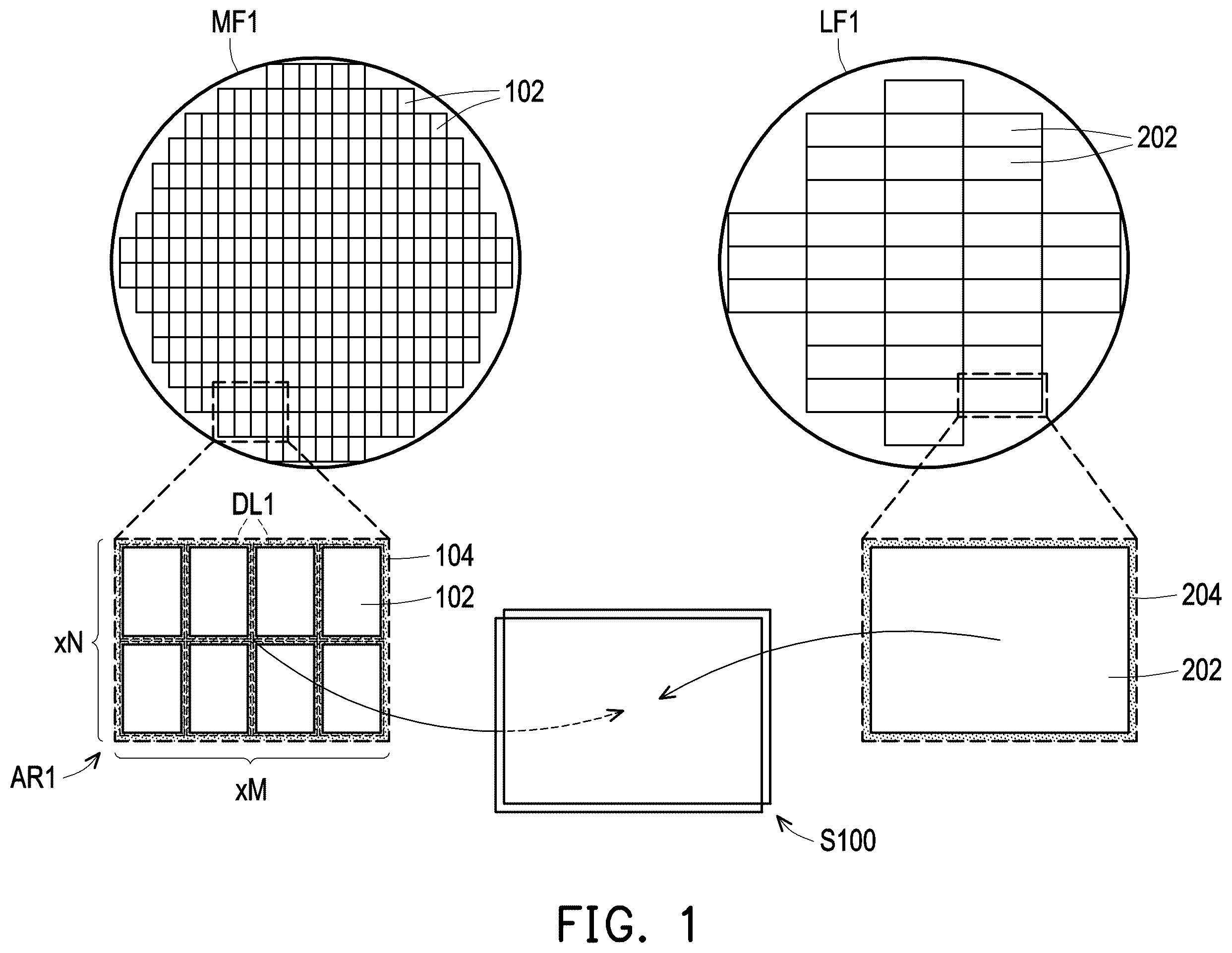
The accompanying drawings are included to provide a further understanding of the disclosure, and are incorporated in and constitute a part of this specification. The drawings illustrate exemplary embodiments of the disclosure and, together with the description, serve to explain the principles of the disclosure. is a schematic top view of a method of fabricating a stacked semiconductor device in accordance with some embodiments of the present disclosure. A and B are schematic top and sectional views of a second chip bonded to an array of first chips in accordance with some embodiments of the present disclosure. A is a schematic top view of the array of first chips in accordance with some embodiments of the present disclosure. B is an enlarged top view and sectional view of one first chip in accordance with some embodiments of the present disclosure. C is an enlarged top view and sectional view of one first chip in accordance with some comparative embodiments of the present disclosure. is a schematic top view of an array of second chips bonded to an array of first chips in accordance with some embodiments of the present disclosure.
DESCRIPTION OF THE EMBODIMENTS
is a schematic top view of a method of fabricating a stacked semiconductor device in accordance with some embodiments of the present disclosure. Referring to , a first semiconductor wafer MF 1 and a second semiconductor wafer LF 1 are provided. In some embodiments, the first semiconductor wafer MF 1 is a memory wafer whereas the second semiconductor wafer LF 1 is a logic wafer. For example, in some embodiments, a plurality of first chips 102 (e.g., memory chips) are formed on the first semiconductor wafer MF 1 , while a plurality of second chips 202 (e.g. logic chips) are formed on the second semiconductor wafer LF 1 . As illustrated in , the first semiconductor wafer MF 1 may be diced to separate out an array AR 1 of the first chips 102 from the wafer. For example, the first chips 102 are arranged in an array AR 1 of N rows and M columns (xN:xM), wherein N and M are an integer. Although the illustrated array AR 1 are shown to include the first chips 102 arranged in an array of 2 rows and 4 columns, the disclosure is not limited thereto. In other embodiments, the array AR 1 may include the first chips 102 arranged in an array of more or less than 2 rows, and more or less than 4 columns. In other words, the number of rows N and the number of columns M is not particularly limited, and may be adjusted based on product requirement. In some embodiments, the first chips 102 in the array AR 1 are surrounded by a molding compound 104 (or encapsulant). Furthermore, each of the first chips 102 are separated by dicing lines DL 1 , and are electrically isolated from one another in the array AR 1 . As further illustrated in , the second semiconductor wafer LF may be diced to separate out a second chip 202 . For example, one second chip 202 is separated from the second semiconductor wafer LF by cutting through dicing lines (not shown). In some embodiments, the second chip 202 is surrounded by a molding compound 204 (or encapsulant). After separating out the array AR 1 of the first chips 102 and the second chip 202 from their respective wafers, the second chip 202 is stacked on the array AR 1 of first chips 102 to form a stacked semiconductor device S 100 . The details of the first chips 102 and the second chip 202 will be described next with reference to A and B . A and B are schematic top and sectional views of a second chip bonded to an array of first chips in accordance with some embodiments of the present disclosure. Referring to the top view of the array AR 1 of first chips 102 and the top view of the second chip 202 illustrated in A , each of the first chips 102 includes a plurality of conductive pins 106 located on a front surface 102 A of the first chips 102 , while the second chip 202 includes a plurality of connection pins 206 located on a front surface 202 A of the second chip 202 . In some embodiments, the conductive pins 106 and the connection pins 206 may be made of conductive materials such as aluminum, titanium, copper, nickel, tungsten, or alloys thereof. In certain embodiments, an outline of the second chip 202 corresponds to an outline of the first chips 102 arranged in the array AR 1 . In the exemplary embodiment, the outline or shape of a total of eight first chips 102 arranged in the array AR 1 matches the outline or shape of one second chip 202 . As further illustrated in A , the total number of connection pins 206 located on the front surface 202 A of the second chip 202 are the same as the total number of conductive pins 106 located on the front surface 102 A of the first chip 102 . Furthermore, the conductive pins 106 on the front surface 102 A of the first chip 102 are arranged in a mirror-image fashion with respect to the connection pins 206 on the front surface 202 A of the second chip 202 . As such, when bonding the second chip 202 to the array AR 1 of first chips 102 in a face-to-face manner (e.g. bonding the front surface 102 A to the front surface 202 A), the connection pins 206 may be directly bonded and connected to the conductive pins 106 . As illustrated in B , the second chip 202 is bonded to the first chips 102 to form the stacked semiconductor device S 100 . As shown in B , each of the first chips 102 may include a wafer substrate SB 1 , such as a silicon substrate. A transistor structure TR 1 may be formed on the substrate SB 1 . In some embodiments, dielectric layers DI 1 (including one or a plurality of dielectric layers) may be formed on the wafer substrate SB 1 to surround the transistor structure TR 1 . Furthermore, first type through vias TV 1 and second type through vias TV 2 (through substrate vias) may be formed over the wafer substrate SB 1 and within the dielectric layers DI 1 , whereby the first type through vias TV 1 and second type through vias TV 2 penetrate through the wafer substrate SB 1 . In some embodiments, bonding pads (not labeled) and conductive terminals 110 are formed on the backside surface 102 B of the first chips 102 , whereby the bonding pads and conductive terminals 110 are disposed on and electrically connected to the first type through vias TV 1 and second type through vias TV 2 . As further shown in B , an internal wire layer including a plurality of internal wires IC 1 are formed on and electrically connected to the first type through vias TV 1 and second type through vias TV 2 . In some embodiments, the internal wires IC 1 may be connected to the transistor structure TR 1 through a via contact VC 1 . In some embodiments, a redistribution line RDL 1 is formed over the transistor structure TR 1 . For example, the redistribution line RDL 1 is disposed on and electrically connected to the transistor structure TR 1 through the internal wire layer (including internal wires IC 1 ), wherein the redistribution line RDL 1 extends from an internal wire IC 1 of the internal wire layer located on top of the transistor structure TR 1 to a position away from the internal wire IC 1 . Similarly, a redistribution line RDL 2 is formed over the second type through vias TV 2 . For example, the redistribution line RDL 2 is disposed on and electrically connected to the second type through vias TV 2 and the internal wire layer (including internal wires IC 1 ), wherein the redistribution line RDL 2 extends from a top surface of the second type through vias TV 2 to a position non-overlapped with the second type through vias TV 2 . The redistribution line RDL 1 and redistribution line RDL 2 may be electrically connected to the internal wires IC 1 located below through the conductive vias VX 1 , VX 2 respectively. After forming the redistribution line RDL 1 and redistribution line RDL 2 , a dielectric layer DI 2 is formed on the dielectric layers DI 1 , and conductive pins 106 are formed in the dielectric layer DI 2 , and formed on and electrically connected to the redistribution lines RDL 1 , RDL 2 . In some embodiments, the conductive pins 106 are electrically connected to the redistribution lines RDL 1 , RDL 2 through the conductive vias 106 V. In certain embodiments, the conductive pins 106 are exposed on the front surface 102 A of the first chips 102 . In the exemplary embodiment, since a position of the connection pins 206 located on a front surface 202 A of the second chip 202 are unique for each of the second chip 202 (logic chip), the corresponding position of the conductive pins 106 used for bonding to the connection pins 206 needs to be adjusted for each of the first chips 102 (memory chip) to ensure reliable bonding. To prevent the need to adjust the position of the first type through vias TV 1 and second type through vias TV 2 , the redistribution lines RDL 1 , RDL 2 are formed and used for routing the signals from the conductive pins 106 to the first type through vias TV 1 and second type through vias TV 2 . As such, the first type through vias TV 1 , the second type through vias TV 2 and the internal wire layer (including internal wires IC 1 ) may be fabricated using common photomask sets (a first group of photomasks) for each of the first chips 102 (memory chip). On the other hand, custom photomask sets (a second group of photomasks) may be used to form the redistribution lines RDL 1 , RDL 2 and the conductive pins 106 of the first chips 102 depending on the position of the connection pins 206 of the second chip 202 . After bonding the second chip 202 to the array AR 1 of first chips 102 , a stacked semiconductor device S 100 in accordance with some embodiments of the present disclosure may be accomplished. In the stacked semiconductor device S 100 having the above design, the first type through vias TV 1 may electrically connect the signals or power supply lines of the first chips 102 (memory chip) to the conductive terminals 110 , while the second type through vias TV 2 may electrically connect the signals or power supply lines of the second chip 202 to the conductive terminals 110 (e.g., through the conductive pins 106 and the redistribution line RDL 2 ). In the exemplary embodiment, a redistribution line RDL 2 and conductive pins 106 are used to electrically connect the signals of the logic chip (second chip 202 ) to the second type through vias TV 2 of the memory chips (first chips 102 ), whereby the signals are further routed to the conductive terminals 110 (or bonding pads) located on the backside surface 102 B of the memory chips (first chips 102 ). As such, there is no need to redesign the photomask sets for fabricating the second type through vias TV 2 in each of the first chips 102 . In other words, the arrangement of the second type through vias TV 2 in each of the first chips 102 may be the same. Overall, a stacked semiconductor device S 100 is fabricated by bonding memory chips (first chips 102 ) with logic chip (second chip 202 ) without utilizing extra photomask sets. The details of the connection of the redistribution lines provided in the array AR 1 of first chips 102 will be described next with reference to A and B . A is a schematic top view of the array of first chips in accordance with some embodiments of the present disclosure. B is an enlarged top view and sectional view of one first chip in accordance with some embodiments of the present disclosure. Referring to A , the first chips 102 arranged in an array AR 1 may include first chips 102 - 1 , 102 - 2 , 102 - 3 , 102 - 4 located in a first row, and first chips 102 - 5 , 102 - 6 , 102 - 7 , 102 - 8 located in a second row of the array AR 1 . In the exemplary embodiment, each of the first chips ( 102 - 1 , 102 - 2 , 102 - 3 , 102 - 4 , 102 - 5 , 102 - 6 , 102 - 7 , 102 - 8 ) include conductive pins 106 revealed at the front surface of the first chips 102 . In some embodiments, the redistribution line RDL 1 electrically connect a conductive pin 106 to an internal wire IC 1 of the internal wire layer located underneath. In certain embodiments, the redistribution line RDL 1 may be electrically connected to the transistor structure TR 1 through the internal wire IC 1 . In some embodiments, the redistribution line RDL 2 electrically connect a conductive pin 106 to a second type through via TV 2 located underneath. However, it is noted that the redistribution line RDL 1 and the redistribution line RDL 2 are routings that are provided within a span of the first chips 102 . In other words, the redistribution lines RDL 1 , RDL 2 do not extend beyond a boundary of each of the first chips ( 102 - 1 , 102 - 2 , 102 - 3 , 102 - 4 , 102 - 5 , 102 - 6 , 102 - 7 , 102 - 8 ), and do not cross over the dicing lines DL 1 . In some embodiments, the first chips 102 (including 102 - 1 , 102 - 2 , 102 - 3 , 102 - 4 , 102 - 5 , 102 - 6 , 102 - 7 , 102 - 8 ) may further include an extended redistribution line RDL 3 disposed on and electrically connected to the second type through vias TV 2 and over the internal wire layer. For example, the extended redistribution line RDL 3 may extend from the top surface of the second type through vias TV 2 of one of the first chips (e.g., first chip 102 - 2 ) across the dicing lines DL towards the conductive pins 106 of another first chips (e.g., first chip 102 - 1 ). In the exemplary embodiment, the extended redistribution line RDL 3 may extend across two adjacent first chips (e.g., from first chip 102 - 2 to first chip 102 - 1 ). In certain embodiments, the extended redistribution line RDL 3 may extend across four adjacent first chips (e.g., from first chip 102 - 5 across first chips 102 - 6 , 102 - 7 and to the first chip 102 - 8 ). In other words, the extended redistribution line RDL 3 may extend across the dicing lines DL 1 separating the first chips 102 ( 102 - 1 , 102 - 2 , 102 - 3 , 102 - 4 , 102 - 5 , 102 - 6 , 102 - 7 , 102 - 8 ), and may provide routing across each of the first chips 102 ( 102 - 1 , 102 - 2 , 102 - 3 , 102 - 4 , 102 - 5 , 102 - 6 , 102 - 7 , 102 - 8 ), which may be adjusted based on design requirements. As further illustrated in B , in the top view W 1 of the first chips 102 (including ( 102 - 1 , 102 - 2 , 102 - 3 , 102 - 4 , 102 - 5 , 102 - 6 , 102 - 7 , 102 - 8 ), the first type through vias TV 1 are arranged in a first column (in region XR 2 ) in each of the first chips ( 102 - 1 , 102 - 2 , 102 - 3 , 102 - 4 , 102 - 5 , 102 - 6 , 102 - 7 , 102 - 8 ), and the second type through vias TV 2 are arranged in a second column (in region XR 1 ) in each of the first chips ( 102 - 1 , 102 - 2 , 102 - 3 , 102 - 4 , 102 - 5 , 102 - 6 , 102 - 7 , 102 - 8 ). In other words, the position of the first type through vias TV 1 and the second type through vias TV 2 are the same for each of the first chips 102 - 1 , 102 - 2 , 102 - 3 , 102 - 4 , 102 - 5 , 102 - 6 , 102 - 7 , 102 - 8 ). Furthermore, from the sectional view W 2 of the first chips 102 (including 102 - 1 , 102 - 2 , 102 - 3 , 102 - 4 , 102 - 5 , 102 - 6 , 102 - 7 , 102 - 8 ), it can be seen that the first type through vias TV 1 electrically connects the signals or power supply lines (from the internal wires IC 1 ) of the first chips 102 to the conductive terminals 110 . On the other hand, the second type through vias TV 2 electrically connects the signals or power supply lines of the second chip 202 (not shown) to the conductive terminals 110 by using the redistribution line RDL 2 . As such, since the position of the first type through vias TV 1 and the second type through vias TV 2 are maintained the same in each of the first chips 102 in the array AR 1 , common photomask sets can be used for their fabrication. Overall, a stacked semiconductor device S 100 is fabricated by bonding memory chips (first chips 102 ) with logic chip (second chip 202 ) without utilizing extra photomask sets. C is an enlarged top view and sectional view of one first chip in accordance with some comparative embodiments of the present disclosure. In the comparative embodiment shown in C , the second type through vias TV 2 are directly connected to the conductive pins 106 through the internal wires IC 1 (see sectional view W 2 ), and a redistribution line is omitted. As the position of the conductive pins 106 of the first chips 102 needs to match the position of the connection pins 206 of the second chip 202 , the position of the second type through vias TV 2 located directly below the conductive pins 206 also needs to be re-designed. In other words, the second type through vias TV 2 located in each of the first chips 102 may be at different positions, and extra custom photomask sets will be required for fabricating these through vias at varied positions. is a schematic top view of an array of second chips bonded to an array of first chips in accordance with some embodiments of the present disclosure. The embodiment shown in may be similar to the embodiments described previously. Therefore, the same reference numerals are used to refer to the same or liked parts, and its detailed description will be omitted herein. Referring to , in some embodiments, an array of second chips 202 (including 202 - 1 , 202 - 2 , 202 - 3 , 202 - 4 ) are bonded to an array (including AR 1 , AR 2 , AR 3 , AR 4 ) of first chips 102 . For example, the second chip 202 - 1 is bonded to the array AR 1 of the first chips 102 , the second chip 202 - 2 is bonded to the array AR 2 of the first chips 102 , the second chip 202 - 3 is bonded to the array AR 3 of the first chips 102 , and the second chip 202 - 4 is bonded to the array AR 4 of the first chips 102 . As illustrated in , each of the array AR 1 , AR 2 , AR 3 , AR 4 of the first chip 102 may include first chips 102 - 1 , 102 - 2 , 102 - 3 , 102 - 4 that are arranged in an array of 2 rows and 2 columns. Similar to the above embodiments, a redistribution line RDL 2 , an extended redistribution line RDL 3 and conductive pins 106 are used to electrically connect the signals of the logic chip (second chip 202 ) to the second type through vias TV 2 of the memory chips (first chips 102 ), whereby the signals are further routed to the conductive terminals 110 (not shown) located on the backside surface of the memory chips (first chips 102 ). As such, there is no need to redesign the photomask sets for fabricating the second type through vias TV 2 in each of the first chips 102 . In other words, the arrangement of the second type through vias TV 2 in each of the first chips 102 may be the same. Overall, a stacked semiconductor device S 100 is fabricated by bonding memory chips (first chips 102 ) with logic chip (second chip 202 ) without utilizing extra photomask sets. In the above embodiments, a redistribution line and conductive pins are used to electrically connect the signals of the logic chip (second chip) to the through substrate vias (TSVs) of the memory chips (first chips), whereby the signals are further routed to the conductive terminals (or bonding pads) located on the backside of the memory chips. As such, there is no need to redesign the photomask sets for fabricating the TSVs. In other words, the TSVs and the internal wire layer located under the redistribution line may be fabricated using common photomask sets, and the memory chips fabricated with the common photomasks can be used in plural stacked semiconductor devices with different partner logic chips. Overall, the method of fabricating the stacked semiconductor device can be simplified. It will be apparent to those skilled in the art that various modifications and variations can be made to the disclosed embodiments without departing from the scope or spirit of the disclosure. In view of the foregoing, it is intended that the disclosure covers modifications and variations provided that they fall within the scope of the following claims and their equivalents.
Figures (7)
Citations
This patent cites (31)
- US9111941
- US11616003
- US2011/0068433
- US2012/0018885
- US2012/0091580
- US2012/0106117
- US2014/0051189
- US2014/0264769
- US2015/0091179
- US2015/0235949
- US2016/0111386
- US2016/0307862
- US2019/0311973
- US2020/0013754
- US2020/0168527
- US2021/0125967
- US2021/0193640
- US2021/0233901
- US2021/0375829
- US2022/0013485
- US2022/0157782
- US2022/0199517
- US2022/0359436
- US2022/0384356
- US2023/0051863
- US2024/0006374
- US2024/0021534
- US2024/0153911
- US2024/0321833
- US202240817
- US202245079