Controlling Method for Wireless Communication Device
Abstract
A controlling method for a wireless communication device is provided. The controlling method for the wireless communication device includes: attaching a first Universal Subscriber Identity Module (USIM) to a Long-Term Evolution (LTE) network; determining whether a second USIM is camped on the LTE network; detecting whether a paging collision is happened, if the second USIM is camped on the LTE network; generating a requested International Mobile Subscriber Identity (IMSI) offset for the second USIM, if the paging collision is happened, wherein the requested IMSI offset is 1 or min(T, nB)−1, T is a default paging period and nB is a number of paging occurrences within the default paging period; transmitting an attach request with the requested IMSI offset to the LTE network for the second USIM; receiving a negotiated IMSI offset from the LTE network; and attaching the second USIM to the LTE network with the negotiated IMSI offset.
Claims (15)
1 . A controlling method for a wireless communication device, comprising: attaching a first Universal Subscriber Identity Module (USIM) to a Long-Term Evolution (LTE) network; determining whether a second USIM is camped on the LTE network; detecting whether a paging collision is happened, if the second USIM is camped on the LTE network; generating a requested International Mobile Subscriber Identity (IMSI) offset for the second USIM, if the paging collision is happened, wherein the requested IMSI offset is 1 or min (T, nB)−1, T is a default paging period and nB is a number of paging occurrences within the default paging period; transmitting an attach request with the requested IMSI offset to the LTE network for the second USIM; receiving a negotiated IMSI offset from the LTE network after transmitting the attach request with the requested IMSI offset to the LTE network; and attaching the second USIM to the LTE network with the negotiated IMSI offset.
9 . A controlling method for a wireless communication device, comprising: attaching a first Universal Subscriber Identity Module (USIM) to an LTE cell of a Long-Term Evolution (LTE) network; determining whether a second USIM is camped on the LTE cell of the LTE network; generating a requested International Mobile Subscriber Identity (IMSI) offset for the second USIM to increase a paging occasion overlapping ratio between the first USIM and the second USIM; transmitting an attach request with the requested IMSI offset to the LTE network for the second USIM; receiving a negotiated IMSI offset from the LTE network after transmitting the attach request with the requested IMSI offset to the LTE network; and attaching the second USIM to the LTE network with the negotiated IMSI offset.
12 . A controlling method for a wireless communication device, comprising: attaching a first Universal Subscriber Identity Module (USIM) to a Long-Term Evolution (LTE) network; determining whether a second USIM is camped on the LTE network; attaching the second USIM to the LTE network with an accepted International Mobile Subscriber Identity (IMSI) offset which is different from a request IMSI offset; determining whether a paging occasion overlapping ratio is increased with the accepted IMSI offset; and transmitting an attach request or a tracking area update (TAU) request without the request IMSI offset to the LTE network to erase an alternative IMSI value, if the paging occasion overlapping ratio is increased.
Show 12 dependent claims
2 . The controlling method for the wireless communication device according to claim 1 , wherein the first USIM and the second USIM are camped on different LTE cells.
3 . The controlling method for the wireless communication device according to claim 1 , wherein a paging occasion (PO) gap between the first USIM and the second USIM is 1 system frame number.
4 . The controlling method for the wireless communication device according to claim 1 , wherein a paging occasion (PO) gap between the first USIM and the second USIM is less than 5 system frame number.
5 . The controlling method for the wireless communication device according to claim 1 , further comprising: transmitting the attach request without the requested IMSI offset to the LTE network for the second USIM, if the paging collision is not happened.
6 . The controlling method for the wireless communication device according to claim 1 , wherein T is a parameter obtained from a system information block 2 (SIB2).
7 . The controlling method for the wireless communication device according to claim 1 , wherein nB is a parameter obtained from a system information block 2 (SIB2).
8 . The controlling method for the wireless communication device according to claim 1 , wherein the second USIM is camped on the LTE network after the first USIM is attached to the LTE network.
10 . The controlling method for the wireless communication device according to claim 9 , wherein the paging occasion overlapping ratio is increased by 10%.
11 . The controlling method for the wireless communication device according to claim 9 , wherein the second USIM is camped on the LTE cell of the LTE network after the first USIM is attached to the LTE cell of the LTE network.
13 . The controlling method for the wireless communication device according to claim 12 , wherein the first USIM and the second USIM are camped on different LTE cells.
14 . The controlling method for the wireless communication device according to claim 12 , further comprising: monitoring paging with the accepted IMSI offset, if the paging occasion overlapping ratio is not increased.
15 . The controlling method for the wireless communication device according to claim 12 , wherein the second USIM is camped on the LTE network after the first USIM is attached to the LTE network.
Full Description
Show full text →
This application claims the benefit of U.S. provisional application Ser. No. 63/421,589, filed Nov. 2, 2022, the disclosure of which is incorporated by reference herein in its entirety.
TECHNICAL FIELD
The disclosure relates in general to a controlling method for an electric device, and more particularly to a controlling method for a wireless communication device.
BACKGROUND
Along with the development of wireless communication technology, some wireless communication devices may equip more than one Universal Subscriber Identity Module (USIM). In such wireless communication devices, the paging occasions (POs) configured by the network for the Multi-USIMs may be overlapped with each other and the paging collision cannot be avoided. Further, if the paging occasions for the Multi-USIMs are far apart, the wireless communication device must be frequently waked up and the power consummation cannot be reduced.
SUMMARY
The disclosure is directed to a controlling method for a wireless communication device. If multi-USIMs are camped on different cells, paging occasions for the multi-USIMs are controlled to be separated to avoid the paging collision and the paging occasion gap between the multi-USIMs is controlled to be minimized to maximize the sleep ratio in the idle mode for reducing the power consumption of the wireless communication device. If the multi-USIMs are camped on the same cell, the paging occasion overlapping ratio is controlled to be maximized for reducing the power consumption of the wireless communication device. According to one embodiment, a controlling method for a wireless communication device is provided. The controlling method for the wireless communication device includes: attaching a first Universal Subscriber Identity Module (USIM) to a Long-Term Evolution (LTE) network; determining whether a second USIM is camped on the LTE network; detecting whether a paging collision is happened, if the second USIM is camped on the different LTE cell of LTE network; generating a requested International Mobile Subscriber Identity (IMSI) offset for the second USIM, if the paging collision is happened, wherein the requested IMSI offset is 1 or min(T, nB)−1, T is a default paging period and nB is a number of paging occurrences within the default paging period; transmitting an attach request with the requested IMSI offset to the LTE network for the second USIM; receiving a negotiated IMSI offset from the LTE network after transmitting the attach request with the requested IMSI offset to the LTE network; and attaching the second USIM to the LTE network with the negotiated IMSI offset. According to another embodiment, a controlling method for a wireless communication device is provided. The controlling method for the wireless communication device includes: attaching a first Universal Subscriber Identity Module (USIM) to an LTE cell of a Long-Term Evolution (LTE) network; determining whether a second USIM is camped on the same LTE cell of the LTE network; generating a requested International Mobile Subscriber Identity (IMSI) offset for the second USIM to increase a paging occasion overlapping ratio between the first USIM and the second USIM; transmitting an attach request with the requested IMSI offset to the LTE network for the second USIM; receiving a negotiated IMSI offset from the LTE network after transmitting the attach request with the requested IMSI offset to the LTE network; and attaching the second USIM to the LTE network with the negotiated IMSI offset. According to an alternative embodiment, a controlling method for a wireless communication device. The controlling method for the wireless communication device includes: attaching a first Universal Subscriber Identity Module (USIM) to a Long-Term Evolution (LTE) network; determining whether a second USIM is camped on the LTE network; attaching the second USIM to the LTE network with an accepted International Mobile Subscriber Identity (IMSI) offset which is different from a request IMSI offset; determining whether a paging occasion overlapping ratio is increased with the accepted IMSI offset; and transmitting an attach request or a tracking area update (TAU) request without the request IMSI offset to the LTE network to erase an alternative IMSI value, if the paging occasion overlapping ratio is increased.
BRIEF DESCRIPTION OF THE DRAWINGS
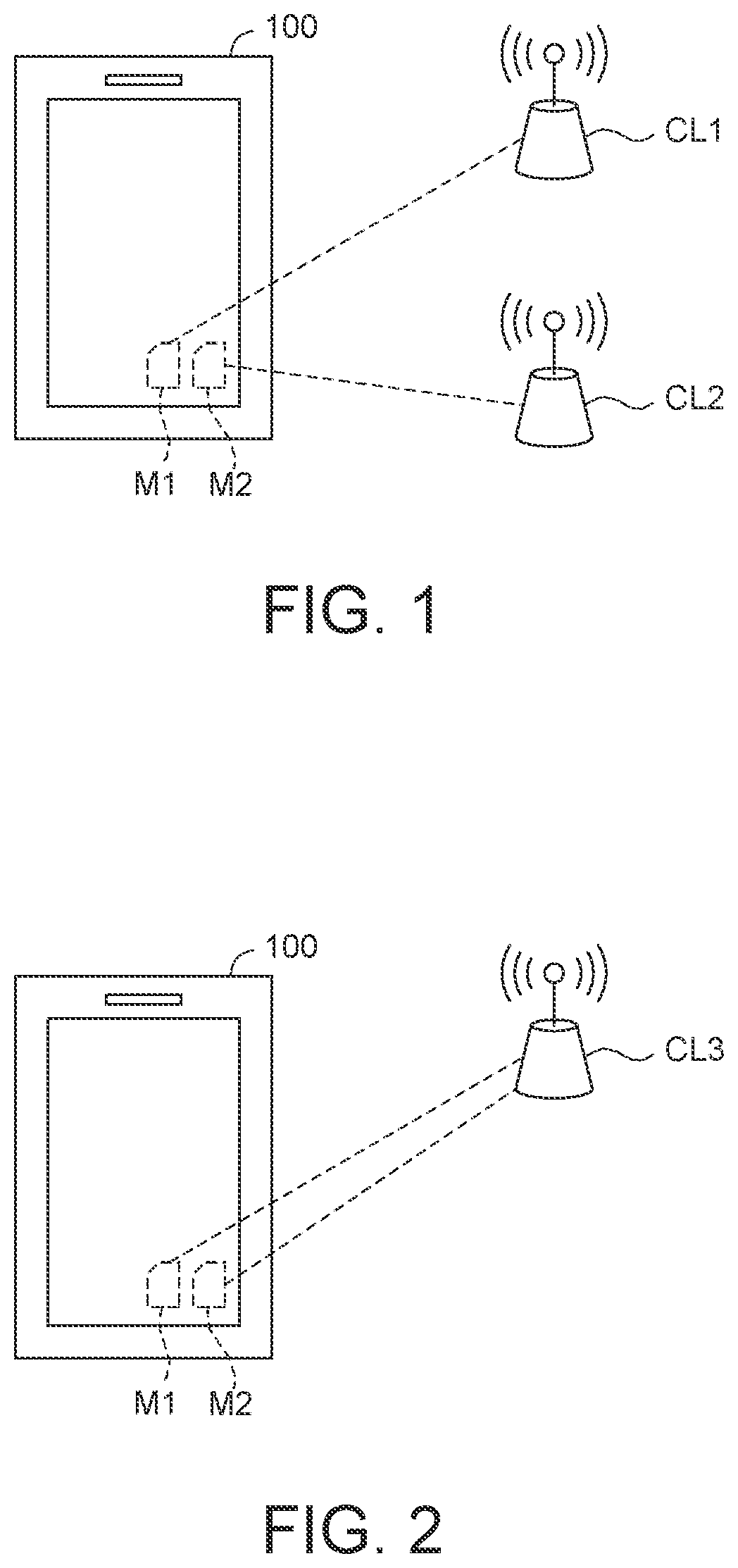
shows a wireless communication device 100 with multi-USIM (Universal Subscriber Identity Module) according to one embodiment. shows the wireless communication device 100 with multi-USIM according to another embodiment. shows a flowchart of a controlling method for the wireless communication device 100 according to one embodiment. illustrates some of the steps in the . shows a flowchart of a controlling method for the wireless communication device 100 according to another embodiment. illustrates some of the steps in the . shows a flowchart of a controlling method for the wireless communication device 100 according to another embodiment. illustrates some of the steps in the . In the following detailed description, for purposes of explanation, numerous specific details are set forth in order to provide a thorough understanding of the disclosed embodiments. It will be apparent, however, that one or more embodiments may be practiced without these specific details. In other instances, well-known structures and devices are schematically shown in order to simplify the drawing.
DETAILED DESCRIPTION
The following disclosure provides many different embodiments, or examples, for implementing different features of the provided subject matter. Specific examples of components and arrangements are described below to simplify the present disclosure. These are, of course, merely examples and are not intended to be limiting. For example, the formation of a first feature over or on a second feature in the description that follows may include embodiments in which the first and second features are formed in direct contact, and may also include embodiments in which additional features may be formed between the first and second features, such that the first and second features may not be in direct contact. In addition, the present disclosure may repeat reference numerals and/or letters in the various examples. This repetition is for the purpose of simplicity and clarity and does not in itself dictate a relationship between the various embodiments and/or configurations discussed. The terms “comprise,” “comprising,” “include,” “including,” “has,” “having,” etc. used in this specification are open-ended and mean “comprises but not limited.” The terms used in this specification generally have their ordinary meanings in the art and in the specific context where each term is used. The use of examples in this specification, including examples of any terms discussed herein, is illustrative only, and in no way limits the scope and meaning of the disclosure or of any exemplified term. Likewise, the present disclosure is not limited to various embodiments given in this specification. Please refer to , which shows a wireless communication device 100 with multi-USIM (Universal Subscriber Identity Module) according to one embodiment. The wireless communication device 100 is, for example, a smart phone, a tablet computer, a smart watch or a laptop computer. The wireless communication device 100 includes, for example, a first USIM M 1 and a second USIM M 2 . As shown in the , the first USIM M 1 and the second USIM M 2 may be camped on different Long-Term Evolution (LTE) cells CL 1 and CL 2 . The paging occasions (POs) for the first USIM M 1 and the second USIM M 2 may be overlapped with each other to cause the paging collision. In this disclosure, the paging occasions for the first USIM M 1 and the second USIM M 2 are controlled to be separated to avoid the paging collision. Further, the paging occasion gap between the first USIM M 1 and the second USIM M 2 is controlled to be minimized to maximize the sleep ratio in the idle mode for reducing the power consumption of the wireless communication device 100 . Please refer to , which shows the wireless communication device 100 with multi-USIM according to another embodiment. As shown in the , the first USIM M 1 and the second USIM M 2 may be camped on the same LTE cell CL 3 . If the paging occasions for the first USIM M 1 and the second USIM M 2 are far apart, the wireless communication device 100 must be frequently waked up and the power consummation cannot be reduced. In this disclosure, the paging occasion overlapping ratio is controlled to be maximized. The wireless communication device 100 could monitor paging occasion as less as possible to reduce the power consumption. Please refer to , and . shows a flowchart of a controlling method for the wireless communication device 100 according to one embodiment. illustrates some of the steps in the . As shown in the , when the first USIM M 1 and the second USIM M 2 are camped on different LTE cells CL 1 , CL 2 , the wireless communication device 100 could be controlled through the controlling method described in the to avoid the paging collision and reduce the power consumption. The controlling method described in the includes steps S 110 to S 190 . In the step S 110 , the first USIM M 1 is attached to an LTE network NW. Next, in the step S 120 , the wireless communication device 100 determines whether the second USIM M 2 is camped on the LTE network NW or not. If the second USIM M 2 is camped on the LTE network NW, the process proceeds to the step S 130 . In this embodiment, the first USIM M 1 and the second USIM M 2 are camped on different LTE cells CL 1 , CL 2 (shown in the ). In the step S 130 , the wireless communication device 100 detects whether a paging collision is happened. If the paging collision is happened, the process proceeds to the step S 140 ; if the paging collision is not happened, the process proceeds to the step S 180 . In the step S 140 , as shown in the , a requested International Mobile Subscriber Identity (IMSI) offset OSr 1 for the second USIM M 2 is generated. In this embodiment, the requested IMSI offset OSr 1 is 1 or min (T, nB)−1. T and nB are parameters obtained from a system information block 2 (SIB2). T is a default paging period and nB is a number of paging occurrences within the default paging period. The requested IMSI offset OSr 1 is used to separate the paging occasions of the first USIM M 1 and the second USIM M 2 , and minimize the paging occasion gap between the first USIM M 1 and the second USIM M 2 . Next, in the step S 150 , as shown in the , the wireless communication device 100 transmits an attach request RQ 1 with the requested IMSI offset OSr 1 to the LTE network NW for the second USIM M 2 . Afterwards, in the step S 160 , as shown in the , the wireless communication device 100 receives an attach accept AC 1 with a negotiated IMSI offset OSn 1 from the LTE network NW. The negotiated IMSI offset OSn 1 may be identical to or different from the requested IMSI offset OSr 1 . Then, in the step S 170 , as shown in the , the second USIM M 2 is attached to the LTE network NW with the negotiated IMSI offset OSn 1 and an attach complete message MS 1 is transmitted to the LTE network NW. On the other hand, in the step S 180 , the wireless communication device 100 transmits the attach request (not shown) without any requested IMSI offset to the LTE network NW for the second USIM M 2 . Then, in the step S 190 , the second USIM M 2 is attached to the LTE network NW and an attach complete message (not shown) is transmitted to the LTE network NW. In this embodiment, the requested IMSI offset OSr 1 is used to separate the paging occasions of the first USIM M 1 and the second USIM M 2 , and minimize the paging occasion gap between the first USIM M 1 and the second USIM M 2 . For example, the paging occasion gap between the first USIM M 1 and the second USIM M 2 could be controlled to be less than 5 system frame number, such as 1 system frame number. Please refer to , and . shows a flowchart of a controlling method for the wireless communication device 100 according to another embodiment. illustrates some of the steps in the . As shown in the , when the first USIM M 1 and the second USIM M 2 are camped on the same LTE cell CL 3 , the wireless communication device 100 could be controlled through the controlling method described in the to maximize the paging occasion overlapping ratio and the wireless communication device 100 could monitor paging occasion as less as possible to reduce the power consumption. The controlling method described in the includes steps S 210 to S 260 . In the step S 210 , the first USIM M 1 is attached to the LTE cell CL 3 (shown in the ) of the LTE network NW. Then, in the step S 220 , the wireless communication device 100 determines whether the second USIM M 2 is camped on the LTE cell CL 3 of the LTE network NW or not. If the second USIM M 2 is camped on the LTE cell CL 3 of the LTE network NW, the process proceeds to the step S 230 . In this embodiment, the first USIM M 1 and the second USIM M 2 are camped on the same LTE cell CL 3 . In the step S 230 , as shown in the , a requested International Mobile Subscriber Identity (IMSI) offset OSr 2 for the second USIM M 2 is generated to increase the paging occasion overlapping ratio between the first USIM M 1 and the second USIM M 2 . For example, the requested IMSI offset OSr 2 is used to increase the paging occasion overlapping ratio by 10%. Next, in the step S 240 , as shown in the , the wireless communication device 100 transmits an attach request RQ 2 with a requested IMSI offset OSr 2 to the LTE network NW for the second USIM M 2 . Afterwards, in the step S 250 , as shown in the , the wireless communication device 100 receives an attached accept AC 2 with a negotiated IMSI offset OSn 2 from the LTE network NW. The negotiated IMSI offset OSn 2 may be identical to or different from the requested IMSI offset OSr 2 . Then, in the step S 260 , as shown in the , the second USIM M 2 is attached to the LTE network NW with the negotiated IMSI offset OSn 2 and an attach complete message MS 2 is transmitted to the LTE network NW. In this embodiment, the requested IMSI offset OSr 2 is used to maximize the paging occasion overlapping ratio and the wireless communication device 100 could monitor paging occasion as less as possible to reduce the power consumption. Please refer to , and . shows a flowchart of a controlling method for the wireless communication device 100 according to another embodiment. illustrates some of the steps in the . As shown in the , when the first USIM M 1 and the second USIM M 2 are camped on different LTE cells CL 1 , CL 2 , the wireless communication device 100 could be controlled through the controlling method described in the to avoid the paging collision. The controlling method described in the includes steps S 310 to S 380 . In the step S 310 , the first USIM M 1 is attached to the LTE network NW. Next, in the step S 320 , the wireless communication device 100 determine whether the second USIM M 2 is camped on the LTE network NW or not. If the second USIM M 2 is camped on the LTE network NW, the process proceeds to the step S 330 . In this embodiment, the first USIM M 1 and the second USIM M 2 are camped on different LTE cells CL 1 , CL 2 (shown in the ). In the step S 330 , as shown in the , the second USIM M 2 is attached to the LTE network NW with an accepted International Mobile Subscriber Identity (IMSI) offset OSa 3 which is different from a request IMSI offset, such as the request IMSI offset OSr 1 shown in the . Next, in the step S 340 , the wireless communication device 100 determines whether a paging occasion overlapping ratio is increased with the accepted IMSI offset OSa 3 . If the paging occasion overlapping ratio is increased with the accepted IMSI offset OSa 3 , the process proceeds to the step S 350 ; if the paging occasion overlapping ratio is not increased with the accepted IMSI offset OSa 3 , the process proceeds to the step S 380 . In case of the paging occasion overlapping ratio is increased with the accepted IMSI offset OSa 3 and the performance of the wireless communication device 100 would be downgraded. In the step S 350 , as shown in the , the wireless communication device transmits an attach request RQ 31 or a tracking area update (TAU) request RQ 32 without the request IMSI offset to the LTE network NW to erase an alternative IMSI value in the LTE network NW. Afterwards, in the step S 360 , as shown in the , the wireless communication device 100 receives an attach accept AC 31 or a tracking area accept AC 32 without any IMSI offset from the LTE network NW. Then, in the step S 370 , as shown in the , the second USIM M 2 is attached to the LTE network NW without any IMSI offset and an attach complete message MS 31 is transmitted to the LTE network NW; or the tracking area is updated and a tracking area complete message MS 32 is transmitted to the LTE network NW. On the other hand, in the step S 360 , the wireless communication device 100 monitors paging with the accepted IMSI offset OSa 3 . In this embodiment, the attach request RQ 31 or the TAU request RQ 32 without the request IMSI offset is used to erase an alternative IMSI value in the LTE network NW, such that the performance of the wireless communication device 100 could be kept without downgrading. It will be apparent to those skilled in the art that various modifications and variations can be made to the disclosed embodiments. It is intended that the specification and examples be considered as exemplary only, with a true scope of the disclosure being indicated by the following claims and their equivalents.
Figures (7)
Citations
This patent cites (42)
- US10334525
- US10360409
- US10397770
- US11228899
- US11665668
- US11689981
- US11864156
- US11864157
- US11997643
- US12041524
- US12101739
- US12120636
- US12219518
- US12238670
- US12256362
- US12324017
- US12328782
- US12363524
- US12389368
- US12395960
- US12414078
- US12432547
- US12432708
- US2022/0225275
- US2022/0264506
- US2023/0007624
- US2023/0033096
- US2023/0079012
- US2023/0122569
- US2023/0144323
- US2023/0232368
- US2023/0300787
- US2023/0370837
- US2023/0379877
- US2023/0403678
- US2024/0089918
- US2024/0276203
- US2025/0016738
- US2025/0063339
- US2610485
- USWO-2022009177
- USWO-2023068982