Heart Valve Sealing Devices and Delivery Devices Therefor
Abstract
An implantable prosthetic device has two anchor portions. Each anchor portion is configured to attach the prosthetic device to a native valve leaflet. The two anchor portions can be opened both simultaneously by a single actuator and can also be opened independently by two or more separate actuators.
Claims (15)
1 . A valve repair device for repairing a native valve of a patient, the valve repair device comprising: first and second moveable paddle portions, wherein the first and second moveable paddle portions are moveable relative to a central portion of the device between an open position and a closed position and are configured to attach to the native valve of the patient; a first clasp having a moveable portion and a fixed portion secured to the first moveable paddle portion, wherein the first clasp is moveable between an open position and a closed position and is configured to attach to the native valve of the patient; a second clasp having a moveable portion and a fixed portion secured to the second paddle portion, wherein the second clasp is moveable between an open position and a closed position and is configured to attach to the native valve of the patient; a first flexible portion that attaches the first paddle portion to the central portion of the device; and a second flexible portion that attaches the second paddle portion to the central portion; wherein the fixed portion of the first clasp causes a pulling force to be applied to the first paddle portion when a pulling force is applied to the first clasp to move the first clasp from the closed position to the open position; wherein the first flexible portion is configured such that the pulling force applied to the first paddle portion as a result of the pulling force being applied to the first clasp causes the first flexible portion to flex and the first paddle portion to move from the closed position to the open position; and wherein the first paddle portion is configured to be moved from the closed position to the open position as a result of the pulling force being applied to the first clasp while the second paddle portion is maintained in the closed position.
6 . A method of repairing a native heart valve having at least two native leaflets with a valve repair device having first and second moveable paddle portions, and first and second clasps each having a moveable portion and a fixed portion attached to the first and second moveable paddle portions, respectively, the method comprising: pulling on the moveable portion of the first clasp of the first paddle portion to cause the first clasp to open and the first moveable paddle portion to open to release a captured native leaflet; wherein an attachment between the fixed portion of the first clasp and the first paddle portion causes a pulling force to be applied to the first paddle portion as a result of the pulling on the first clasp; wherein the pulling force applied to the first paddle portion as a result of the pulling on the first clasp causes a first flexible portion to flex and the first paddle portion to open; wherein the first paddle portion is opened as a result of the pulling on the first clasp while the second paddle portion is maintained in the closed position; positioning the valve repair device to re-capture the released leaflet; and closing the first clasp and first paddle portion to secure the released leaflet.
12 . A system for repairing a native valve of a patient, the system comprising: a delivery catheter having a first lumen; a valve repair device deliverable through the first lumen, the valve repair device comprising: first and second moveable paddle portions, wherein the first and second moveable paddle portions are moveable relative to a central portion of the device between an open position and a closed position and are configured to attach to the native valve of the patient; a first clasp having a moveable portion and a fixed portion secured to the first paddle portion, wherein the first clasp is moveable between an open position and a closed position and is configured to attach to the native valve of the patient; a second clasp having a moveable portion and a fixed portion secured to the second paddle portion, wherein the second clasp is moveable between an open position and a closed position and is configured to attach to the native valve of the patient; a first flexible portion that attaches the first paddle portion to the central portion of the device; a second flexible portion that attaches the second paddle portion to the central portion; wherein the fixed portion of the first clasp causes a pulling force to be applied to the first paddle portion when a pulling force is applied to the first clasp to move the first clasp from the closed position to the open position; wherein the first flexible portion is configured such that the pulling force applied to the first paddle portion as a result of the pulling force being applied to the first clasp causes the first flexible portion to flex and the first paddle portion to move from the closed position to the open position; and wherein the first paddle portion is configured to be moved from the closed position to the open position as a result of the pulling force being applied to the first clasp while the second paddle portion is maintained in the closed position.
Show 12 dependent claims
2 . The valve repair device of any of claim 1 , further comprising: a shaft; a collar that the shaft extends through, the collar being attached to the central portion; and a cap attached to the shaft such that the cap can be moved by the shaft away from the collar; wherein movement of the cap toward the collar causes both the first paddle portion and the second paddle portion to move to the closed position, and movement of the cap away from the collar causes both the first paddle portion and the second paddle portion to move to the open position.
3 . The valve repair device of claim 1 , further comprising an actuation line attached to the moveable portion of the first clasp.
4 . The valve repair device of claim 3 , wherein applying tension to the actuation line causes the first clasp to open and the first moveable paddle portion to open.
5 . The valve repair device of claim 1 , wherein the first clasp is moved from the closed position to the open position by pulling on a movable portion of the first clasp.
7 . The method of claim 6 , further comprising maintaining the second clasp and second paddle portion in a closed position when pulling on the first clasp to open the first clasp and the first paddle portion.
8 . The method of claim 6 , further comprising: pulling on the second clasp of the second paddle portion to cause the second clasp to open and the second paddle portion to open to release a second captured native leaflet; positioning the valve repair device to re-capture the second released leaflet; and closing the second clasp and second paddle portion to secure the second released leaflet.
9 . The method of claim 8 , wherein the first and second clasps are opened simultaneously.
10 . The method of claim 8 , wherein the valve repair device further includes a collar attached to a coaption portion, a shaft extending through the collar and attached to a cap such that the cap can be moved by the shaft away from the collar, wherein the cap is attached to the first and second paddle portions and wherein movement of the cap toward the collar causes both of the first and second paddle portions to move to the closed position, and movement of the cap away from the collar causes both of the first and second paddle portions to move to the open position.
11 . The method of claim 10 , further comprising maintaining the position of the cap relative to the collar while pulling on the first and second clasps.
13 . The valve repair device of any of claim 12 , further comprising: a shaft; a collar that the shaft extends through, the collar being attached to the central portion; and a cap attached to the shaft such that the cap can be moved by the shaft away from the collar; wherein movement of the cap toward the collar causes both the first paddle portion and the second paddle portion to move to the closed position, and movement of the cap away from the collar causes both the first paddle portion and the second paddle portion to move to the open position.
14 . The valve repair device of claim 12 , further comprising an actuation line attached to the moveable portion of the first clasp.
15 . The valve repair device of claim 14 , wherein applying tension to the actuation line causes the first clasp to open and the first moveable paddle portion to open.
Full Description
Show full text →
RELATED APPLICATION The present application is a continuation application of International Application No. PCT/US2020/017534, filed Feb. 10, 2020, titled “Heart Valve Sealing Devices and Delivery Devices Therefor,” which claims the benefit of U.S. Provisional Application No. 62/803,854, filed on Feb. 11, 2019, titled “Heart Valve Sealing Devices and Delivery Devices Therefor,” which are incorporated herein by reference in their entirety for all purposes.
TECHNICAL FIELD
The present application relates generally to prosthetic devices and related methods for helping to seal native heart valves and prevent or reduce regurgitation therethrough, as well as devices and related methods for implanting such prosthetic devices.
BACKGROUND OF THE INVENTION
The native heart valves (i.e., the aortic, pulmonary, tricuspid, and mitral valves) serve critical functions in assuring the forward flow of an adequate supply of blood through the cardiovascular system. These heart valves can be damaged, and thus rendered less effective, for example, by congenital malformations, inflammatory processes, infectious conditions, disease, etc. Such damage to the valves can result in serious cardiovascular compromise or death. Damaged valves can be surgically repaired or replaced during open heart surgery. However, open heart surgeries are highly invasive, and complications may occur. Transvascular techniques can be used to introduce and implant prosthetic devices in a manner that is much less invasive than open heart surgery. As one example, a transvascular technique useable for accessing the native mitral and aortic valves is the trans-septal technique. The trans-septal technique comprises advancing a catheter into the right atrium (e.g., inserting a catheter into the right femoral vein, up the inferior vena cava and into the right atrium). The septum is then punctured, and the catheter passed into the left atrium. A similar transvascular technique can be used to implant a prosthetic device within the tricuspid valve that begins similarly to the trans-septal technique but stops short of puncturing the septum and instead turns the delivery catheter toward the tricuspid valve in the right atrium. A healthy heart has a generally conical shape that tapers to a lower apex. The heart is four-chambered and comprises the left atrium, right atrium, left ventricle, and right ventricle. The left and right sides of the heart are separated by a wall generally referred to as the septum. The native mitral valve of the human heart connects the left atrium to the left ventricle. The mitral valve has a very different anatomy than other native heart valves. The mitral valve includes an annulus portion, which is an annular portion of the native valve tissue surrounding the mitral valve orifice, and a pair of cusps, or leaflets, extending downward from the annulus into the left ventricle. The mitral valve annulus can form a “D”-shaped, oval, or otherwise out-of-round cross-sectional shape having major and minor axes. The anterior leaflet can be larger than the posterior leaflet, forming a generally “C”-shaped boundary between the abutting sides of the leaflets when they are closed together. When operating properly, the anterior leaflet and the posterior leaflet function together as a one-way valve to allow blood to flow only from the left atrium to the left ventricle. The left atrium receives oxygenated blood from the pulmonary veins. When the muscles of the left atrium contract and the left ventricle dilates (also referred to as “ventricular diastole” or “diastole”), the oxygenated blood that is collected in the left atrium flows into the left ventricle. When the muscles of the left atrium relax and the muscles of the left ventricle contract (also referred to as “ventricular systole” or “systole”), the increased blood pressure in the left ventricle urges the sides of the two leaflets together, thereby closing the one-way mitral valve so that blood cannot flow back to the left atrium and is instead expelled out of the left ventricle through the aortic valve. To prevent the two leaflets from prolapsing under pressure and folding back through the mitral annulus toward the left atrium, a plurality of fibrous cords called chordae tendineae tether the leaflets to papillary muscles in the left ventricle. Valvular regurgitation involves the valve improperly allowing some blood to flow in the wrong direction through the valve. For example, mitral regurgitation occurs when the native mitral valve fails to close properly and blood flows into the left atrium from the left ventricle during the systolic phase of heart contraction. Mitral regurgitation is one of the most common forms of valvular heart disease. Mitral regurgitation can have many different causes, such as leaflet prolapse, dysfunctional papillary muscles, stretching of the mitral valve annulus resulting from dilation of the left ventricle, more than one of these, etc. Mitral regurgitation at a central portion of the leaflets can be referred to as central jet mitral regurgitation and mitral regurgitation nearer to one commissure (i.e., location where the leaflets meet) of the leaflets can be referred to as eccentric jet mitral regurgitation. Central jet regurgitation occurs when the edges of the leaflets do not meet in the middle and thus the valve does not close, and regurgitation is present.
SUMMARY
This summary is meant to provide some examples and is not intended to be limiting of the scope of the invention in any way. For example, any feature included in an example of this summary is not required by the claims, unless the claims explicitly recite the features. Also, the features, components, steps, concepts, etc. described in examples in this summary and elsewhere in this disclosure can be combined in a variety of ways. Various features and steps as described elsewhere in this disclosure may be included in the examples summarized here. An example implantable prosthetic device has a two anchor portions. Each anchor portion is configured to attach the prosthetic device to a native valve leaflet. In one example embodiment, the two anchor portions can be opened both simultaneously by a single actuator and can also be opened individually/independently by two separate actuators. In one example embodiment, the device can be opened and closed both by extending and retracting the overall length of the device and without changing the overall length of the device. In one example embodiment, the two anchor portions can be opened independently and can be opened simultaneously without changing the overall length of the device. In one example embodiment, the device can open and close the anchor portions simultaneously by extending and retracting the overall length of the device and can open and close the anchor portions either individually or simultaneously, without extending or retracting the overall length of the device. In one example embodiment, a valve repair device for repairing a native valve of a patient includes a shaft, a collar, a cap, a plurality of paddle portions, a plurality of opening lines and a plurality of clasps. The shaft extends through the collar. The cap is attached to the shaft such that the cap can be moved by the shaft away from the collar. The plurality of paddle portions are moveable between an open position and a closed position. The plurality of opening lines are attached to the paddle portions. The clasps are attached to the paddle portions. Movement of the cap toward the collar causes the paddle portions to move to the closed position, and movement of the cap away from the collar causes the paddle portions to move to the open position. In one example embodiment, a valve repair device for repairing a native valve of a patient includes a coaption portion, a shaft, a collar, a cap, a plurality of paddle portions, a plurality of opening lines and a plurality of clasps. The shaft extends through the collar. The collar is attached to the coaption portion. The cap is attached to the shaft such that the cap can be moved by the shaft away from the collar. The plurality of paddle portions are moveable between an open position and a closed position. The plurality of opening lines are attached to the paddle portions. The clasps are attached to the paddle portions. Movement of the cap toward the collar causes the paddle portions to move to the closed position, and movement of the cap away from the collar causes the paddle portions to move to the open position. In one example embodiment, a valve repair device for repairing a native valve of a patient includes first and second paddle portions, first and second inner flexible portions, first and second outer flexible portions, first and second clasps attached to the first and second paddle portions, and a cap. The first and second paddle portions are moveable between an open position and a closed position. The clasps are moveable between an open position and a closed position. The first outer flexible portion attaches the first paddle portion to the cap. The second outer flexible portion attaches the second paddle portion to the cap. The first inner and outer flexible portions enable the first paddle portion to be moved to an open position while the first clasp, the second paddle portion, and the second clasp are maintained in the closed position. The second inner and outer flexible portions enable the second paddle portion to be moved to an open position while the second clasp, the first paddle portion, and the first clasp are maintained in the closed position. In some embodiments, the device includes a coaptation portion or coaption portion. In some embodiments, the first inner flexible portion attaches the first paddle portion to the coaption portion. In some embodiments, the second inner flexible portion attaches the second paddle portion to the coaption portion. In one example embodiment, a valve repair device for repairing a native valve of a patient includes a first paddle portion, a second paddle portion, a rigid paddle actuator, a first flexible actuator, a second flexible actuator, first and second clasps, and first and second clasp actuators. The first paddle portion and the second paddle portion are simultaneously moveable between an open position and a closed position by movement of the rigid paddle actuator. The first flexible paddle actuator is moveable from a closed position where the first paddle portion is closed to an open position where the first paddle portion is open. The second flexible paddle actuator is moveable from a closed position where the second paddle portion is closed to an open position where the second paddle portion is open. The first and second clasps are attached to the first and second paddle portions. The first clasp actuator is moveable from a closed position where the first clasp is closed to an open position where the first clasp is open. The second clasp actuator is moveable from a closed position where the second clasp is closed to an open position where the second clasp is open. When the rigid paddle actuator is in the closed position, movement of the first flexible paddle actuator from the closed to the open position moves the first paddle portion to the open position while the first clasp, the second paddle portion, and the second clasp remain in the closed position. The valve repair device can also include a coaptation portion or coaption portion. In some embodiments, the coaptation portion or coaption portion can comprise a coaption element, spacer, plug, etc. In one example embodiment of a method of repairing a native heart valve a first paddle portion is pulled to cause the first paddle portion to open. A first clasp is pulled to cause the first clasp to open to release a captured native leaflet while the second clasp and second paddle portion are maintained in a closed position. The valve repair device is positioned to re-capture the released leaflet. The first clasp and first paddle portion are closed to secure the released leaflet. This method can be performed on a living animal or on a simulation, such as on a cadaver, cadaver heart, simulator (e.g. with the body parts, heart, tissue, etc. being simulated), etc. In one embodiment, a method comprises repairing a native valve having at least two native leaflets with a valve repair device having first and second paddle portions and first and second clasps attached to the first and second paddle portions. The method comprises advancing the valve repair device to the native valve, which can be done transluminally, transeptally, transfemorally, and/or via surgery. The method comprises pulling on the first clasp of the first paddle portion to cause the first clasp to open, maneuvering the device such that a first native leaflet is positioned inside the first clasp, and closing the first clasp to capture the first native leaflet. The method can also comprise pulling on the second clasp of the second paddle portion to cause the second clasp to open, maneuvering the device such that a second native leaflet is positioned inside the second clasp, and closing the second clasp to capture the second native leaflet. The method can also comprise pulling on the first clasp of the first paddle portion to cause the first clasp to open to release the first native leaflet while maintaining the second clasp and second paddle portion in a closed position. The method can also include positioning the valve repair device to re-capture the released first leaflet and closing the first clasp and first paddle portion to secure the first leaflet. The method can also comprise pulling on the second clasp of the second paddle portion to cause the second clasp to open to release the second native leaflet while maintaining the first clasp and first paddle portion in a closed position. The method can also include positioning the valve repair device to re-capture the released second leaflet and closing the second clasp and second paddle portion to secure the second leaflet. In one example embodiment, a valve repair device or valve repair system for repairing a native valve of a patient comprises a shaft, a proximal portion (e.g., collar, cover, disk, coaption element, spacer, post, dome, tube, etc.) that the shaft extends through, a cap attached to the shaft such that the cap can be moved by the shaft away from the proximal portion. The device/system also includes an anchor portion and/or anchors. In some implementations, the anchor portion and/or anchors include a plurality of paddle portions, wherein the paddle portions are moveable between an open position and a closed position. In some implementations, the device/system includes at least one clasp attached to each of the paddle portions. In some implementations, movement of the cap toward the proximal portion causes the paddle portions to move to the closed position, and movement of the cap away from the proximal portion causes the paddle portions to move to the open position. In some embodiments, the device/system includes a plurality of opening lines attached and/or connected (directly or indirectly) to the paddle portions. In some embodiments, applying tension to a first one of the opening lines causes an attached first paddle portion to open and/or change its position and/or configuration. In some implementations, a distance between the cap and the proximal portion remains constant while tension is applied to the opening line. In some embodiments, the opening lines are attached to the clasps. In some embodiments, the clasp(s) comprises a fixed arm attached to one of the paddle portions, a moveable arm having a friction-enhancing portion (e.g., barbed portion, ridged portion, protrusion portion, grooved portion, textured portion, etc.), and a hinge portion hingeably connecting the fixed arm to the movable arm. In some embodiments, the device/system further comprises at least one actuation line attached to the moveable arm of the clasp. In some implementations, the actuation line is attached to a distal end of the moveable arm and an opening line is attached to the hinge portion. The clasp and actuation line can be configured such that applying tension to the actuation line causes the clasp to open. In some implementations, applying tension to the actuation line causes the clasp to open and applying tension to the opening line causes the paddle portion to open. In some implementations, applying tension to the actuation line causes both the clasp to open and the paddle portion to open. In some implementations, a distance between the cap and the proximal portion remains constant while tension is applied to the actuation line. A further understanding of the nature and advantages of the present invention are set forth in the following description and claims, particularly when considered in conjunction with the accompanying drawings in which like parts bear like reference numerals.
BRIEF DESCRIPTION OF THE DRAWINGS
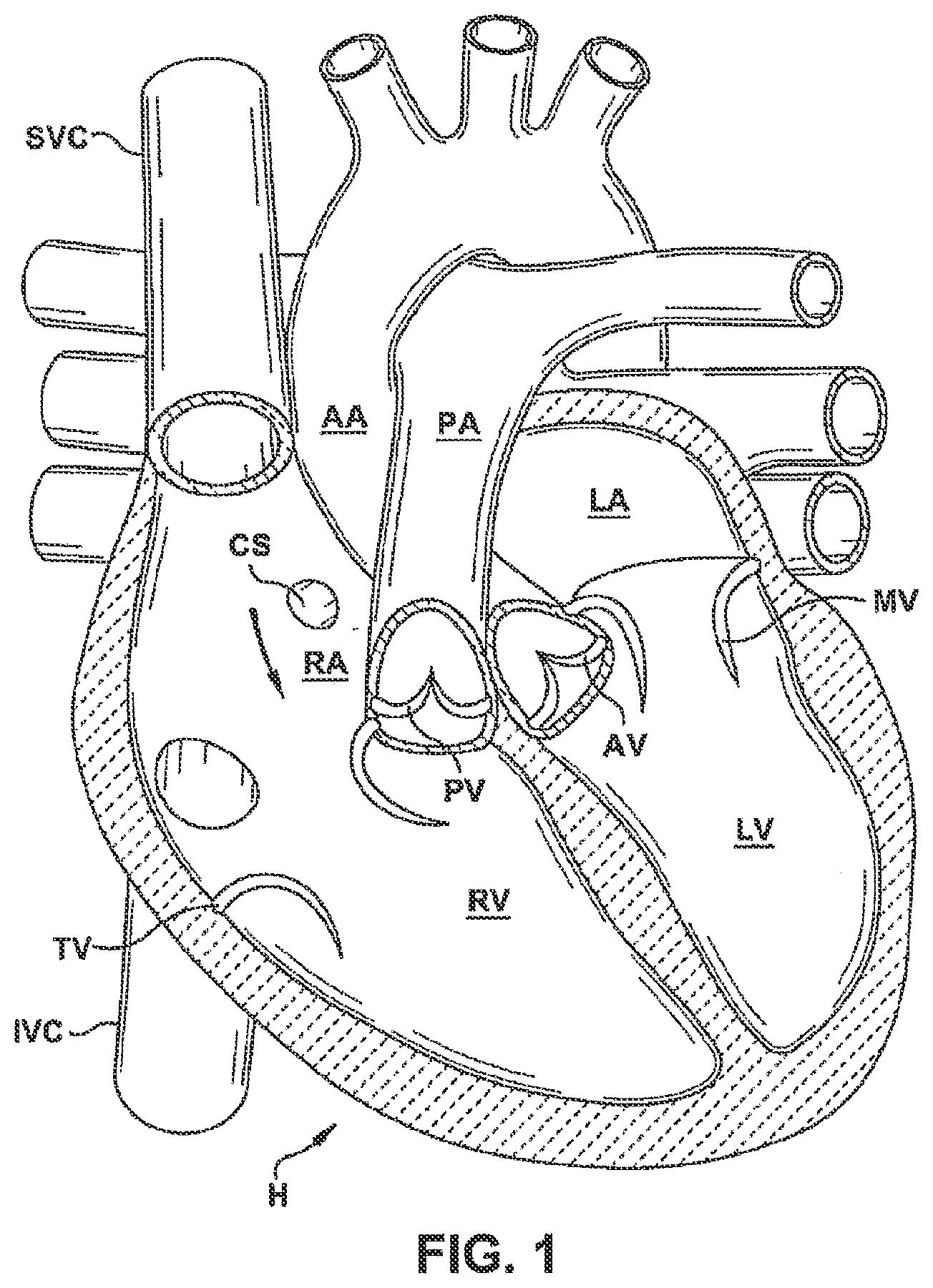
To further clarify various aspects of embodiments of the present disclosure, a more particular description of the certain embodiments will be made by reference to various aspects of the appended drawings. It is appreciated that these drawings depict only typical embodiments of the present disclosure and are therefore not to be considered limiting of the scope of the disclosure. Moreover, while the figures can be drawn to scale for some embodiments, the figures are not necessarily drawn to scale for all embodiments. Embodiments and other features and advantages of the present disclosure will be described and explained with additional specificity and detail through the use of the accompanying drawings in which: illustrates a cutaway view of the human heart in a diastolic phase; illustrates a cutaway view of the human heart in a systolic phase; A is another cutaway view of the human heart in a systolic phase; B is the cutaway view of A annotated to illustrate a natural shape of mitral valve leaflets in the systolic phase; illustrates a cutaway view of the human heart in a diastolic phase, in which the chordae tendineae are shown attaching the leaflets of the mitral and tricuspid valves to ventricle walls; illustrates a healthy mitral valve with the leaflets closed as viewed from an atrial side of the mitral valve; illustrates a dysfunctional mitral valve with a visible gap between the leaflets as viewed from an atrial side of the mitral valve; illustrates a mitral valve having a wide gap between the posterior leaflet and the anterior leaflet; A illustrates a coaption element in the gap of the mitral valve as viewed from an atrial side of the mitral valve; B illustrates a valve repair device attached to mitral valve leaflets with the coaption element in the gap of the mitral valve as viewed from a ventricular side of the mitral valve; C is a perspective view of a valve repair device attached to mitral valve leaflets with the coaption element in the gap of the mitral valve shown from a ventricular side of the mitral valve; D is a schematic view illustrating a path of mitral valve leaflets along each side of a coaption element of an example mitral valve repair device; E is a top schematic view illustrating a path of mitral valve leaflets around a coaption element of an example native valve repair device; illustrates a tricuspid valve viewed from an atrial side of the tricuspid valve; show an example embodiment of an implantable prosthetic device, in various stages of deployment; A shows an example embodiment of an implantable prosthetic device that is similar to the device illustrated by , but where the paddles are independently controllable; show the implantable prosthetic device of being delivered and implanted within the native valve; shows an example embodiment of an implantable prosthetic device or frame of an implantable prosthetic device; shows an example embodiment of an implantable prosthetic device or frame of an implantable prosthetic device; show example embodiments of an implantable prosthetic device or component of an implantable prosthetic device; A shows an example embodiment of an implantable prosthetic device; show an example embodiment of a clasp for use in an implantable prosthetic device; show an example embodiment of an implantable prosthetic device; A shows an example embodiment of an implantable prosthetic device; A and 32 B are perspective views of a cap and a coaption element insert of the implantable prosthetic device of in sealed and spaced apart positions, respectively; shows a clasp for use in an implantable prosthetic device; shows a portion of native valve tissue grasped by a clasp; show an example embodiment of an implantable prosthetic device being delivered and implanted within the native valve; shows a side view of an example implantable prosthetic device without clasps in a closed position; A shows a side view of an example implantable prosthetic device without clasps in a closed position; shows a side view of an example implantable prosthetic device with clasps in a closed position; A shows a side view of an example implantable prosthetic device with clasps in a closed position; B shows a side view of an example implantable prosthetic device with clasps in a closed position, the device being attached to a deployment device; C shows a side view of the example implantable prosthetic device according to B , the device being provided with a cover; D shows a front view of the example implantable prosthetic device according to B , the device being attached to a deployment device; E shows a front view of the example implantable prosthetic device according to D , the device being provided with a cover; F shows a side view of the example implantable prosthetic device according to B with clasps in the closed position; G shows a front view of the example implantable prosthetic device according to F ; H shows a bottom view of the example implantable prosthetic device according to F ; shows a side view of an example implantable prosthetic device without clasps in a partially-open position; shows a side view of an example implantable prosthetic device in a partially-open position with clasps in a closed position; shows a side view of an example implantable prosthetic device in a partially-open position with clasps in an open position; shows a side view of an example implantable prosthetic device without clasps in a half-open position; shows a side view of an example implantable prosthetic device in a half-open position with clasps in a closed position; A shows a side view of an example implantable prosthetic device in a half-open position with clasps in a closed position; B shows a front view of the example implantable prosthetic device according to A ; C shows a side view of the example implantable prosthetic device according to A , the device being provided with a cover; D shows a front view of the example implantable prosthetic device according to A , the device being provided with a cover; shows a side view of an example implantable prosthetic device in a half-open position with clasps in an open position; A shows a side view of an example implantable prosthetic device in a half-open position with clasps in an open position; B shows a front view of the example implantable prosthetic device according to A ; C shows a side view of the example implantable prosthetic device according to A , the device being provided with a cover; D shows a front view of the example implantable prosthetic device according to A , the device being provided with a cover; shows a side view of an example implantable prosthetic device without clasps in a three-quarters-open position; shows a side view of an example implantable prosthetic device in a three-quarters-open position with clasps in a closed position; shows a side view of an example implantable prosthetic device in a three-quarters-open position with clasps in an open position; shows a side view of an example implantable prosthetic device without clasps near a full bailout position or near a fully-open position; shows a side view of an example implantable prosthetic device without clasps in a full bailout position or a fully-open position; shows a side view of an example implantable device in a full bailout position with clasps in a closed position; A shows a side view of an example implantable device in a full bailout position with clasps in a closed position; B shows a front view of the example implantable prosthetic device according to A ; C shows a side view the example implantable prosthetic device according to A , the device being provided with a cover; D shows a front view of the example implantable prosthetic device according to A , the device being provided with a cover; shows a side view of an example implantable device in a full bailout position with clasps in an open position; A shows a side view of an example implantable device in a full bailout position with clasps in an open position; B shows a front view of the example implantable prosthetic device according to A ; C shows a side view the example implantable prosthetic device according to A , the device being provided with a cover; D shows a front view of the example implantable prosthetic device according to A , the device being provided with a cover; A- 62 B illustrate the movement of the paddles of an example embodiment of an implantable prosthetic device; A- 63 C illustrate the movement of the paddles of an example embodiment of an implantable prosthetic device; A- 64 C illustrate the movement of the paddles of an example embodiment of an implantable prosthetic device; shows a perspective view of an example implantable prosthetic device in a closed position; A shows a perspective view of an example implantable prosthetic device in a closed position; shows a perspective view of the implantable prosthetic device of ; A shows a perspective view of the implantable prosthetic device of A ; shows a front view of the implantable prosthetic device of ; A shows a front view of the implantable prosthetic device of A ; shows a front view of the implantable prosthetic device of with additional components; A shows a front view of the implantable prosthetic device of A with additional components; shows a side view of the implantable prosthetic device of ; shows a top view of the implantable prosthetic device of ; A shows a top view of the implantable prosthetic device of A ; shows a top view of the implantable prosthetic device of with a collar component; A shows a top view of the implantable prosthetic device of A with a collar component; shows a bottom view of the implantable prosthetic device of ; A shows a bottom view of the implantable prosthetic device of A ; shows a bottom view of the implantable prosthetic device of with a cap component; A shows a bottom view of the implantable prosthetic device of A with a cap component; shows a sectioned perspective view of the implantable prosthetic device of sectioned by cross-section plane 75 ; A shows a sectioned perspective view of the implantable prosthetic device of A sectioned by cross-section plane 75 A; shows a top cross-section view of the example prosthetic device illustrated by ; A shows a top cross-section view of the example prosthetic device illustrated by A ; shows a sectioned perspective view of the implantable prosthetic device of sectioned by cross-section plane 77 ; A shows a sectioned perspective view of the implantable prosthetic device of A sectioned by cross-section plane 77 A; shows a top cross-section view of the example prosthetic device illustrated by ; A shows a top cross-section view of the example prosthetic device illustrated by A ; shows a sectioned perspective view of the implantable prosthetic device of sectioned by cross-section plane 77 ; A shows a sectioned perspective view of the implantable prosthetic device of A sectioned by cross-section plane 77 A; shows a top cross-section view of the example prosthetic device illustrated by ; A shows a top cross-section view of the example prosthetic device illustrated by A ; shows a sectioned perspective view of the implantable prosthetic device of sectioned by cross-section plane 81 ; A shows a sectioned perspective view of the implantable prosthetic device of A sectioned by cross-section plane 81 A; shows a top cross-section view of the example prosthetic device illustrated by ; A shows a top cross-section view of the example prosthetic device illustrated by A ; shows a sectioned perspective view of the implantable prosthetic device of sectioned by cross-section plane 83 ; A shows a sectioned perspective view of the implantable prosthetic device of A sectioned by cross-section plane 83 A; shows a top cross-section view of the example prosthetic device illustrated by ; A shows a top cross-section view of the example prosthetic device illustrated by A ; shows an example embodiment of an implantable prosthetic device with integral barbs; shows an example embodiment of an implantable prosthetic device with integral barbs; shows an example embodiment of an implantable prosthetic device with integral barbs; A shows an example embodiment of an implantable prosthetic device with integral barbs; shows an example embodiment of an implantable prosthetic device with integral barbs; A shows an example embodiment of an implantable prosthetic device with integral barbs; shows an example embodiment of an implantable prosthetic device with integral barbs; A shows an example embodiment of an implantable prosthetic device with integral barbs; shows a perspective view of a coapting portion and paddle portions of the implantable prosthetic device illustrated by ; A shows a perspective view of a coapting portion and paddle portions of the implantable prosthetic device illustrated by A ; shows a perspective view of a coapting portion and paddle portions of the implantable prosthetic device illustrated by ; A shows a perspective view of a coapting portion and paddle portions of the implantable prosthetic device illustrated by A ; shows a front view of a coapting portion and paddle portions of the implantable prosthetic device illustrated by ; A shows a front view of a coapting portion and paddle portions of the implantable prosthetic device illustrated by A ; shows a side view of a coapting portion and paddle portions of the implantable prosthetic device illustrated by ; A shows a side view of a coapting portion and paddle portions of the implantable prosthetic device illustrated by A ; shows a top view of a coapting portion and paddle portions of the implantable prosthetic device illustrated by ; A shows a top view of a coapting portion and paddle portions of the implantable prosthetic device illustrated by A ; shows a bottom view of a coapting portion and paddle portions of the implantable prosthetic device illustrated by ; A shows a bottom view of a coapting portion and paddle portions of the implantable prosthetic device illustrated by A ; shows a sectioned perspective view of a coapting portion and paddle portions of the implantable prosthetic device illustrated by with the section taken across plane 96 ; A shows a sectioned perspective view of a coapting portion and paddle portions of the implantable prosthetic device illustrated by A with the section taken across plane 96 A; shows a cross-section view of the coapting portion and paddle portions of ; A shows a cross-section view of the coapting portion and paddle portions of A ; shows a sectioned perspective view of a coapting portion and paddle portions of the implantable prosthetic device illustrated by with the section taken across plane 98 ; A shows a sectioned perspective view of a coapting portion and paddle portions of the implantable prosthetic device illustrated by A with the section taken across plane 98 A; shows a cross-section view of the coapting portion and paddle portions of ; A shows a cross-section view of the coapting portion and paddle portions of A ; shows a sectioned perspective view of a coapting portion and paddle portions of the implantable prosthetic device illustrated by with the section taken across plane 100 ; A shows a sectioned perspective view of a coapting portion and paddle portions of the implantable prosthetic device illustrated by A with the section taken across plane 100 A; shows a cross-section view of the coapting portion and paddle portions of ; A shows a cross-section view of the coapting portion and paddle portions of A ; shows a sectioned perspective view of a coapting portion and paddle portions of the implantable prosthetic device illustrated by with the section taken across plane 102 ; A shows a sectioned perspective view of a coapting portion and paddle portions of the implantable prosthetic device illustrated by A with the section taken across plane 102 A; shows a cross-section view of the coapting portion and paddle portions of ; A shows a cross-section view of the coapting portion and paddle portions of A ; shows an example embodiment of an implantable prosthetic device; shows an example embodiment of an implantable prosthetic device; shows an example embodiment of an implantable prosthetic device; shows a side view of an example embodiment of an expandable coaption element in an unexpanded condition; A shows a side view of an example embodiment of an expandable coaption element in an unexpanded condition; B shows a side view of an example embodiment of an expandable coaption element in an unexpanded condition; C shows a side view of an example embodiment of an expandable coaption element in an unexpanded condition; D shows a side view of an example embodiment of an expandable coaption element in an unexpanded condition; E shows a side view of an example embodiment of an expandable coaption element in an unexpanded condition; F shows an example embodiment of an expandable coaption element; G shows an example embodiment of an expandable coaption element; H shows an example embodiment of an expandable coaption element; I shows an example embodiment of an expandable coaption element; shows an end view of the expandable coaption element of ; shows the expandable coaption element of in an expanded condition; A shows the expandable coaption element of A in an expanded condition; B shows the expandable coaption element of B in an expanded condition; C shows the expandable coaption element of C in an expanded condition; D shows the expandable coaption element of D in an expanded condition; E shows the expandable coaption element of E in an expanded condition; shows an end view of the coaption element of ; shows a side view of an example embodiment of an implantable prosthetic device; shows an end view of a coaption element of the example prosthetic device of , taken along lines 111 . show perspective views of an example embodiment of a paddle frame for the implantable prosthetic device of ; A shows a perspective view of an example embodiment of a paddle frame for the implantable prosthetic device of A ; A shows a side view of the paddle frame of A ; shows a front view of the paddle frame of ; A shows a top view of the paddle frame of A ; shows a top view of the paddle frame of ; A shows a front view of the paddle frame of A ; shows a side view of the paddle frame of ; A shows a rear view of the paddle frame of A ; shows a bottom view of the paddle frame of ; A shows a bottom view of the paddle frame of A ; shows a front view of the paddle frame of ; shows a front view of the paddle frame of in a compressed condition inside a delivery device; shows a side view of an example embodiment of an implantable prosthetic device in a closed condition; shows a front view of a paddle frame of the example prosthetic device of ; shows a side view of the implantable prosthetic device of in an open condition; shows a front view of the paddle frame of the open prosthetic device of ; shows a side view of an example embodiment of an implantable prosthetic device in a closed condition; shows a front view of a paddle frame of the example prosthetic device of ; shows a side view of the implantable prosthetic device of in a closed condition; shows a front view of the paddle frame of the open prosthetic device of ; shows an example embodiment of an implantable prosthetic device; show an example embodiment of an implantable prosthetic device; shows an example embodiment of an implantable prosthetic device; show an example embodiment of an implantable prosthetic device; show an example embodiment of an implantable prosthetic device; shows an example embodiment of an implantable prosthetic device; show use of an example embodiment of an implantable prosthetic device; shows an example embodiment of a delivery assembly including a delivery device and an example prosthetic device; shows a perspective view of an example embodiment of an implantable prosthetic device releasably coupled to a delivery device; shows the embodiment of with the implantable prosthetic device released from the delivery device; shows a cross-sectional view of the coupler of ; shows a perspective view of the delivery assembly of with the prosthetic device shown in partial cross-section and some components of the delivery apparatus shown schematically; shows a plan view of a shaft of the delivery device of ; shows a side elevation view of a proximal end portion of the delivery device of ; shows a cross-sectional view of the proximal end portion of the delivery device of , taken along the line 151 - 151 shown in ; shows an exploded view of the proximal end portion of the delivery device of ; show an example procedure used to repair a native valve of a heart, which is partially shown; shows an example embodiment of a handle for the delivery apparatus of ; is an exploded view of the handle of ; shows an example embodiment of a coupler and a proximal collar for the delivery assembly of , showing the coupler releasably coupled to the proximal collar; shows a perspective view of the coupler and proximal collar of , showing the coupler released from the proximal collar; shows example embodiments of a cap, actuation element or means of actuating, and release wire for the delivery assembly of , showing the cap releasably coupled to the actuation element or means of actuating by the release wire. shows a perspective view of the cap, actuation element or means of actuating, and the release wire of , showing the cap released from the actuation element or means of actuating and the release wire; shows example embodiments of a coupler, a proximal collar, a cap, and an actuation element or means of actuating of the delivery assembly of ; shows a perspective view of the coupler and proximal collar of ; shows an example embodiment of a clasp control member of the delivery apparatus of ; shows a detail view of the clasp control member of , taken from the perspective 170 shown in ; shows an example embodiment of a guide rail for the clasp control member of ; shows an example embodiment of a shaft of the delivery device of ; shows an example embodiment of an implantable prosthetic device and delivery device for releasing and recapturing the prosthetic device; shows an example embodiment of an implantable prosthetic device and delivery device for releasing and recapturing the prosthetic device; A shows an example embodiment of an implantable prosthetic device and delivery device for releasing and recapturing the prosthetic device; shows an example embodiment of an implantable prosthetic device and delivery device for releasing and recapturing the prosthetic device; A shows an example embodiment of an implantable prosthetic device and delivery device for releasing and recapturing the prosthetic device; shows an example embodiment of an implantable prosthetic device and delivery device for releasing and recapturing the prosthetic device; show an example embodiment of a coupler for an example implantable prosthetic device; show an example embodiment of a coupler for an example implantable prosthetic device; show an example embodiment of a coupler for an example implantable prosthetic device; show an example embodiment of a coupler for an example implantable prosthetic device; shows an example embodiment of an actuation element or means of actuating for an example prosthetic device; shows an actuation mechanism for an example prosthetic device; shows an actuation mechanism for an example prosthetic device; A shows an actuation mechanism for an example prosthetic device; shows an actuation mechanism for an example prosthetic device; shows an actuation mechanism for an example prosthetic device; is a perspective view of a blank used to make a paddle frame; is a perspective view of the blank of bent to make a paddle frame; is a perspective view of a shape-set paddle frame attached to a cap of a valve repair device; is a perspective view of the paddle frame of flexed and attached to inner and outer paddles at a closed position; is a perspective view of two of the paddle frames of A showing the paddle frames in a shape-set position; is a perspective view of the paddle frames of showing the paddle frames in a loaded position; is an enlarged side view of device of C showing the cover; is an enlarged side view of the device of C showing the cover; shows an exploded view of an example prosthetic device; shows an enlarged perspective view of the collar of an example prosthetic device; shows an enlarged perspective view of the cap of an example prosthetic device; shows an exploded view of the cap of ; shows a plan view of an inner cover for an example prosthetic device; shows a plan view of an outer cover for an example prosthetic device; shows an enlarged view of a strip of material for an example prosthetic device; shows an end view of the material of ; shows an end view of the material of arranged in a plurality of layers; A shows an example implantable prosthetic device in the gap of the native valve as viewed from an atrial side of the native valve during diastole, with example inflatable spacers in a deflated condition; B shows the device of A during systole, with example inflatable spacers in a deflated condition; A shows the device of A during diastole, with example inflatable spacers in an inflated condition; B shows the device of A during systole, with example inflatable spacers in an inflated condition; A shows an example expandable spacer in a compressed condition; B shows the expandable spacer of A in an expanded condition; A shows an example implantable prosthetic device, with example inflatable spacers in a deflated condition; B shows the device of B , with example inflatable spacers in an inflated condition; A is a side view of an example implantable prosthetic device; B is a front/back view of the device of A ; A is a top view of an example auxiliary spacer for attaching to the device of A ; B is a side view of the spacer of A ; is a side view of the spacer of A, 213 B being assembled to the device of A, 212 B ; A is a side view of the spacer of A, 213 B assembled to the device of A, 212 B ; B is a top view of the assembly of A ; A is a side view of an example implantable prosthetic device; B is a front/back view of the device of A ; A is a top view of an example auxiliary spacer for attaching to the device of A ; B is a side view of the spacer of A ; is an example auxiliary spacer; A is a top view of an example implantable prosthetic device; B is a side view of an example implantable prosthetic device; A is a top view of example auxiliary spacers; B is a top view of example auxiliary spacers; C is a top view of example auxiliary spacers; D is a top view of example auxiliary spacers; E is a top view of example auxiliary spacers; is a plan view of an example implantable prosthetic device cut from a flat sheet of material; is a perspective view of the device of ; shows the device of in the gap of the native valve as viewed from an atrial side of the native valve; is a plan view of an example implantable prosthetic device cut from a flat sheet of material; is a perspective view of the device of ; shows an example embodiment of an implantable prosthetic device with a two-piece cover; shows an example embodiment of an implantable prosthetic device with a two-piece cover; shows an example embodiment of an implantable prosthetic device with a two-piece cover; shows an example embodiment of an implantable prosthetic device with a two-piece cover; shows an example embodiment of an implantable prosthetic device with a two-piece cover; shows an example embodiment of an implantable prosthetic device with a two-piece cover; show an example embodiment of an implantable prosthetic device in various stages of deployment; show the example implantable prosthetic device of being delivered and implanted within a native valve; show the example implantable prosthetic device of being delivered and implanted within a native valve while avoiding an obstacle; shows a perspective view of a coapting portion and paddle portions of an example embodiment of an implantable prosthetic device; shows a side view of an example implantable prosthetic device without clasps in a closed position; shows a side view of an example implantable prosthetic device with clasps in a closed position; show an example implantable prosthetic device, which can be similar to the example implantable device of any of , attached to a deployment device and arranged in various stages of deployment; show an example implantable prosthetic device, which can be similar to the example implantable device of any of , being delivered and implanted within a native valve; show an example implantable prosthetic device, which can be similar to the example implantable device of any of , being delivered and implanted within a native valve while avoiding an obstacle; show an example embodiment of an implantable prosthetic device in various stages of deployment; show the example implantable prosthetic device of being delivered and implanted within a native valve; show the example implantable prosthetic device of being delivered and implanted within a native valve while avoiding an obstacle; show an example embodiment of an implantable prosthetic device in various stages of deployment; show the example implantable prosthetic device of being delivered and implanted within a native valve; and show the example implantable prosthetic device of being delivered and implanted within a native valve while avoiding an obstacle.
DETAILED DESCRIPTION
The following description refers to the accompanying drawings, which illustrate specific embodiments of the present disclosure. Other embodiments having different structures and operation do not depart from the scope of the present disclosure. Example embodiments of the present disclosure are directed to devices and methods for repairing a defective heart valve. It should be noted that various embodiments of native valve reparation devices and systems for delivery are disclosed herein, and any combination of these options can be made unless specifically excluded. In other words, individual components of the disclosed devices and systems can be combined unless mutually exclusive or otherwise physically impossible. As described herein, when one or more components are described as being connected, joined, affixed, coupled, attached, or otherwise interconnected, such interconnection may be direct as between the components or may be indirect such as through the use of one or more intermediary components. Also as described herein, reference to a “member,” “component,” or “portion” shall not be limited to a single structural member, component, or element but can include an assembly of components, members, or elements. Also as described herein, the terms “substantially” and “about” are defined as at least close to (and includes) a given value or state (preferably within 10% of, more preferably within 1% of, and most preferably within 0.1% of). are cutaway views of the human heart H in diastolic and systolic phases, respectively. The right ventricle RV and left ventricle LV are separated from the right atrium RA and left atrium LA, respectively, by the tricuspid valve TV and mitral valve MV; i.e., the atrioventricular valves. Additionally, the aortic valve AV separates the left ventricle LV from the ascending aorta AA, and the pulmonary valve PV separates the right ventricle from the pulmonary artery PA. Each of these valves has flexible leaflets (e.g., leaflets 20 , 22 shown in ) extending inward across the respective orifices that come together or “coapt” in the flow stream to form the one-way, fluid-occluding surfaces. The native valve repair systems of the present application are described primarily with respect to the mitral valve MV. Therefore, anatomical structures of the left atrium LA and left ventricle LV will be explained in greater detail. It should be understood that the devices described herein may also be used in repairing other native valves, e.g., the devices can be used in repairing the tricuspid valve TV, the aortic valve AV, and the pulmonary valve PV. The left atrium LA receives oxygenated blood from the lungs. During the diastolic phase, or diastole, seen in , the blood that was previously collected in the left atrium LA (during the systolic phase) moves through the mitral valve MV and into the left ventricle LV by expansion of the left ventricle LV. In the systolic phase, or systole, seen in , the left ventricle LV contracts to force the blood through the aortic valve AV and ascending aorta AA into the body. During systole, the leaflets of the mitral valve MV close to prevent the blood from regurgitating from the left ventricle LV and back into the left atrium LA, and blood is collected in the left atrium from the pulmonary vein. In one example embodiment, the devices described by the present application are used to repair the function of a defective mitral valve MV. That is, the devices are configured to help close the leaflets of the mitral valve to prevent blood from regurgitating from the left ventricle LV and back into the left atrium LA. Many of the devices described in the present application are designed to easily grasp and secure the native leaflets around a coaption element or spacer that acts as a filler in the regurgitant orifice to prevent or inhibit back flow or regurgitation during systole. Referring now to , the mitral valve MV includes two leaflets, the anterior leaflet 20 and the posterior leaflet 22 . The mitral valve MV also includes an annulus 24 , which is a variably dense fibrous ring of tissues that encircles the leaflets 20 , 22 . Referring to , the mitral valve MV is anchored to the wall of the left ventricle LV by chordae tendineae 10 . The chordae tendineae 10 are cord-like tendons that connect the papillary muscles 12 (i.e., the muscles located at the base of the chordae tendineae and within the walls of the left ventricle) to the leaflets 20 , 22 of the mitral valve MV. The papillary muscles 12 serve to limit the movements of the mitral valve MV and prevent the mitral valve from being reverted. The mitral valve MV opens and closes in response to pressure changes in the left atrium LA and the left ventricle LV. The papillary muscles do not open or close the mitral valve MV. Rather, the papillary muscles brace the mitral valve MV against the high pressure needed to circulate blood throughout the body. Together the papillary muscles and the chordae tendineae are known as the subvalvular apparatus, which functions to keep the mitral valve MV from prolapsing into the left atrium LA when the mitral valve closes. Various disease processes can impair proper function of one or more of the native valves of the heart H. These disease processes include degenerative processes (e.g., Barlow's Disease, fibroelastic deficiency), inflammatory processes (e.g., Rheumatic Heart Disease), and infectious processes (e.g., endocarditis). In addition, damage to the left ventricle LV or the right ventricle RV from prior heart attacks (i.e., myocardial infarction secondary to coronary artery disease) or other heart diseases (e.g., cardiomyopathy) can distort a native valve's geometry, which can cause the native valve to dysfunction. However, the vast majority of patients undergoing valve surgery, such as surgery to the mitral valve MV, suffer from a degenerative disease that causes a malfunction in a leaflet (e.g., leaflets 20 , 22 ) of a native valve (e.g., the mitral valve MV), which results in prolapse and regurgitation. Generally, a native valve may malfunction in two different ways: (1) valve stenosis; and (2) valve regurgitation. Valve stenosis occurs when a native valve does not open completely and thereby causes an obstruction of blood flow. Typically, valve stenosis results from buildup of calcified material on the leaflets of a valve, which causes the leaflets to thicken and impairs the ability of the valve to fully open to permit forward blood flow. The second type of valve malfunction, valve regurgitation, occurs when the leaflets of the valve do not close completely thereby causing blood to leak back into the prior chamber (e.g., causing blood to leak from the left ventricle to the left atrium). There are three main mechanisms by which a native valve becomes regurgitant—or incompetent—which include Carpentier's type I, type II, and type III malfunctions. A Carpentier type I malfunction involves the dilation of the annulus such that normally functioning leaflets are distracted from each other and fail to form a tight seal (i.e., the leaflets do not coapt properly). Included in a type I mechanism malfunction are perforations of the leaflets, as are present in endocarditis. A Carpentier's type II malfunction involves prolapse of one or more leaflets of a native valve above a plane of coaption. A Carpentier's type III malfunction involves restriction of the motion of one or more leaflets of a native valve such that the leaflets are abnormally constrained below the plane of the annulus. Leaflet restriction can be caused by rheumatic disease (Ma) or dilation of a ventricle (IIIb). Referring to , when a healthy mitral valve MV is in a closed position, the anterior leaflet 20 and the posterior leaflet 22 coapt, which prevents blood from leaking from the left ventricle LV to the left atrium LA. Referring to , regurgitation occurs when the anterior leaflet 20 and/or the posterior leaflet 22 of the mitral valve MV is displaced into the left atrium LA during systole. This failure to coapt causes a gap 26 between the anterior leaflet 20 and the posterior leaflet 22 , which allows blood to flow back into the left atrium LA from the left ventricle LV during systole. As set forth above, there are several different ways that a leaflet (e.g. leaflets 20 , 22 of mitral valve MV) may malfunction, which can thereby lead to regurgitation. Referring to , in certain situations, the mitral valve MV of a patient can have a wide gap 26 between the anterior leaflet 20 and the posterior leaflet 22 when the mitral valve is in a closed position (i.e., during the systolic phase). For example, the gap 26 can have a width W between about 2.5 mm and about 17.5 mm, such as between about 5 mm and about 15 mm, such as between about 7.5 mm and about 12.5 mm, such as about 10 mm. In some situations, the gap 26 can have a width W greater than 15 mm. In any of the above-mentioned situations, a valve repair device is desired that is capable of engaging the anterior leaflet 20 and the posterior leaflet 22 to close the gap 26 and prevent regurgitation of blood through the mitral valve MV. Although stenosis or regurgitation can affect any valve, stenosis is predominantly found to affect either the aortic valve AV or the pulmonary valve PV, and regurgitation is predominantly found to affect either the mitral valve MV or the tricuspid valve TV. Both valve stenosis and valve regurgitation increase the workload of the heart H and may lead to very serious conditions if left un-treated; such as endocarditis, congestive heart failure, permanent heart damage, cardiac arrest, and ultimately death. Because the left side of the heart (i.e., the left atrium LA, the left ventricle LV, the mitral valve MV, and the aortic valve AV) is primarily responsible for circulating the flow of blood throughout the body, malfunction of the mitral valve MV or the aortic valve AV is particularly problematic and often life threatening. Accordingly, because of the substantially higher pressures on the left side of the heart, dysfunction of the mitral valve MV or the aortic valve AV is often more problematic. Malfunctioning native heart valves may either be repaired or replaced. Repair typically involves the preservation and correction of the patient's native valve. Replacement typically involves replacing the patient's native valve with a biological or mechanical substitute. Typically, the aortic valve AV and pulmonary valve PV are more prone to stenosis. Because stenotic damage sustained by the leaflets is irreversible, the most conventional treatments for a stenotic aortic valve or stenotic pulmonary valve are removal and replacement of the valve with a surgically implanted heart valve, or displacement of the valve with a transcatheter heart valve. The mitral valve MV and the tricuspid valve TV are more prone to deformation of leaflets, which, as described above, prevents the mitral valve or tricuspid valve from closing properly and allows for regurgitation or back flow of blood from the ventricle into the atrium (e.g., a deformed mitral valve MV may allow for regurgitation or back flow from the left ventricle LV to the left atrium LA). The regurgitation or back flow of blood from the ventricle to the atrium results in valvular insufficiency. Deformations in the structure or shape of the mitral valve MV or the tricuspid valve TV are often repairable. In addition, regurgitation can occur due to the chordae tendineae 10 becoming dysfunctional (e.g., the chordae tendineae may stretch or rupture), which allows the anterior leaflet 20 and the posterior leaflet 22 to be reverted such that blood is regurgitated into the left atrium LA. The problems occurring due to dysfunctional chordae tendineae 10 can be repaired by repairing the chordae tendineae or the structure of the mitral valve (e.g., by securing the leaflets 20 , 22 at the affected portion of the mitral valve). The devices and procedures disclosed herein often make reference to repairing a mitral valve for illustration. However, it should be understood that the devices and concepts provided herein can be used to repair any native valve, as well as any component of a native valve. For example, referring now to , any of the devices and concepts provided herein can be used to repair the tricuspid valve TV. For example, any of the devices and concepts provided herein can be used between any two of the anterior leaflet 30 , septal leaflet 32 , and posterior leaflet 34 to prevent or inhibit regurgitation of blood from the right ventricle into the right atrium. In addition, any of the devices and concepts provided herein can be used on all three of the leaflets 30 , 32 , 34 together to prevent or inhibit regurgitation of blood from the right ventricle to the right atrium. That is, the valve repair devices provided herein can be centrally located between the three leaflets 30 , 32 , 34 . An example implantable prosthetic device has a coaption element (e.g., spacer, coaptation element, etc.) and at least one anchor. The coaption element is configured to be positioned within the native heart valve orifice to help fill the space between the leaflets and form a more effective seal, thereby reducing or preventing regurgitation described above. The coaption element can have a structure that is impervious or resistant to blood and that allows the native leaflets to close around the coaption element during ventricular systole to block blood from flowing from the left or right ventricle back into the left or right atrium, respectively. The prosthetic device can be configured to seal against two or three native valve leaflets; that is, the device may be used in the native mitral (bicuspid) and tricuspid valves. The coaption element is sometimes referred to herein as a spacer because the coaption element can fill a space between improperly functioning native mitral or tricuspid leaflets that do not close completely. The coaption element (e.g., spacer, coaptation element, etc.) can have various shapes. In some embodiments, the coaption element can have an elongated cylindrical shape having a round cross-sectional shape. In some embodiments, the coaption element can have an oval cross-sectional shape, a crescent cross-sectional shape, a rectangular cross-sectional shape, or various other non-cylindrical shapes. The coaption element can have an atrial portion positioned in or adjacent to the left atrium, a ventricular or lower portion positioned in or adjacent to the left ventricle, and a side surface that extends between the native leaflets. In embodiments configured for use in the tricuspid valve, the atrial or upper portion is positioned in or adjacent to the right atrium, and the ventricular or lower portion is positioned in or adjacent to the right ventricle, and the side surface that extends between the native tricuspid leaflets. The anchor can be configured to secure the device to one or both of the native leaflets such that the coaption element is positioned between the two native leaflets. In embodiments configured for use in the tricuspid valve, the anchor is configured to secure the device to one, two, or three of the tricuspid leaflets such that the coaption element is positioned between the three native leaflets. In some embodiments, the anchor can attach to the coaption element at a location adjacent the ventricular portion of the coaption element. In some embodiments, the anchor can attach to an actuation element, such as a shaft or actuation wire, to which the coaption element is also attached. In some embodiments, the anchor and the coaption element can be positioned independently with respect to each other by separately moving each of the anchor and the coaption element along the longitudinal axis of the actuation element (e.g., actuation shaft, actuation rod, actuation wire, etc.). In some embodiments, the anchor and the coaption element can be positioned simultaneously by moving the anchor and the coaption element together along the longitudinal axis of the actuation element, e.g., shaft or actuation wire. The anchor can be configured to be positioned behind a native leaflet when implanted such that the leaflet is grasped by the anchor. The prosthetic device can be configured to be implanted via a delivery sheath. The coaption element and the anchor can be compressible to a radially compressed state and can be self-expandable to a radially expanded state when compressive pressure is released. The device can be configured for the anchor to be expanded radially away from the still-compressed coaption element initially in order to create a gap between the coaption element and the anchor. A native leaflet can then be positioned in the gap. The coaption element can be expanded radially, closing the gap between the coaption element and the anchor and capturing the leaflet between the coaption element and the anchor. In some embodiments, the anchor and coaption element are optionally configured to self-expand. The implantation methods for various embodiments can be different and are more fully discussed below with respect to each embodiment. Additional information regarding these and other delivery methods can be found in U.S. Pat. No. 8,449,599 and U.S. Patent Application Publication Nos. 2014/0222136, 2014/0067052, and 2016/0331523, each of which is incorporated herein by reference in its entirety for all purposes. These methods can be performed on a living animal or on a simulation, such as on a cadaver, cadaver heart, simulator (e.g. with the body parts, heart, tissue, etc. being simulated), etc. mutatis mutandis. The disclosed prosthetic devices can be configured such that the anchor is connected to a leaflet, taking advantage of the tension from native chordae tendineae to resist high systolic pressure urging the device toward the left atrium. During diastole, the devices can rely on the compressive and retention forces exerted on the leaflet that is grasped by the anchor. Referring now to , a schematically illustrated implantable prosthetic device 100 (e.g., a prosthetic spacer device, etc.) is shown in various stages of deployment. The device 100 can include any other features for an implantable prosthetic device discussed in the present application, and the device 100 can be positioned to engage valve tissue 20 , 22 as part of any suitable valve repair system (e.g., any valve repair system disclosed in the present application). The device 100 is deployed from a delivery sheath or means for delivery 102 and includes a coapting portion or coaptation portion 104 and an anchor portion 106 . In some embodiments, the coaptation portion 104 of the device 100 includes a coaption element or means for coapting 110 that is adapted to be implanted between the leaflets of a native valve (e.g., a native mitral valve, tricuspid valve, etc.) and is slidably attached to an actuation element 112 (e.g., actuation wire, actuation shaft, actuation tube, etc.). The anchor portion 106 is actuatable between open and closed conditions and can take a wide variety of forms, such as, for example, paddles, gripping elements, or the like. Actuation of the actuation element or means for actuating 112 opens and closes the anchor portion 106 of the device 100 to grasp the native valve leaflets during implantation. The actuation element or means for actuation 112 (as well as other actuation elements and means for actuation herein) can take a wide variety of different forms (e.g., as a wire, rod, shaft, tube, screw, suture, line, combination of these, etc.). As one example, the actuation element can be threaded such that rotation of the actuation wire or shaft moves the anchor portion 106 relative to the coaption portion 104 . Or, the actuation element can be unthreaded, such that pushing or pulling the actuation element 112 moves the anchor portion 106 relative to the coaption portion 104 . The anchor portion 106 and/or anchors of the device 100 include outer paddles 120 and inner paddles 122 that are, in some embodiments, connected between a cap 114 and the coaption element or means for coapting 110 by portions 124 , 126 , 128 . The connection portions 124 , 126 , 128 can be jointed and/or flexible to move between all of the positions described below. The interconnection of the outer paddles 120 , the inner paddles 122 , the coaption element or means for coapting 110 , and the cap 114 by the portions 124 , 126 , and 128 can constrain the device to the positions and movements illustrated herein. In some implementations, the actuation element or means for actuating 112 (e.g., actuation wire, actuation shaft, etc.) extends through the delivery sheath and the coaption element or means for coapting 110 to the cap 114 at the distal connection of the anchor portion 106 . Extending and retracting the actuation element or means for actuating 112 increases and decreases the spacing between the coaption element or means for coapting 110 and the cap 114 , respectively. A collar or other attachment element removably attaches the coaption element or means for coapting 110 to the delivery sheath or means for delivery 102 so that the actuation element or means for actuating 112 slides through the collar or other attachment element and through the coaption element or means for coapting 110 during actuation to open and close the paddles 120 , 122 of the anchor portion 106 . Referring now to , the anchor portion 106 and/or anchors include attachment portions or gripping members. The illustrated gripping members comprise clasps 130 that include a base or fixed arm 132 , a moveable arm 134 , optional barbs or other means for securing 136 , and a joint portion 138 . The fixed arms 132 are attached to the inner paddles 122 . In some embodiments, the fixed arms 132 are attached to the inner paddles 122 with the joint portion 138 disposed proximate the coapting 110 coaption element or means for coapting 110 . The clasps or barbed clasps have flat surfaces and do not fit in a recess of the inner paddle. Rather, the flat portions of the clasps are disposed against the surface of the inner paddle 122 . The joint portion 138 provides a spring force between the fixed and moveable arms 132 , 134 of the clasp 130 . The joint portion 138 can be any suitable joint, such as a flexible joint, a spring joint, a pivot joint, or the like. In some embodiments, the joint portion 138 is a flexible piece of material integrally formed with the fixed and moveable arms 132 , 134 . The fixed arms 132 are attached to the inner paddles 122 and remain stationary relative to the inner paddles 122 when the moveable arms 134 are opened to open the clasps 130 and expose the barbs, friction-enhancing elements, or means for securing 136 . In some implementations, the clasps 130 are opened by applying tension to actuation lines 116 attached to the moveable arms 134 , thereby causing the moveable arms 134 to articulate, flex, or pivot on the joint portions 138 . Other actuation mechanisms are also possible. During implantation, the paddles 120 , 122 can be opened and closed, for example, to grasp the native leaflets (e.g., native mitral valve leaflets, etc.) between the paddles 120 , 122 and/or between the paddles 120 , 122 and a coaption element or means for coapting 110 . The clasps 130 can be used to grasp and/or further secure the native leaflets by engaging the leaflets with barbs, friction-enhancing elements, or means for securing 136 and pinching the leaflets between the moveable and fixed arms 134 , 132 . The barbs, friction-enhancing elements, or other means for securing 136 of the clasps or barbed clasps 130 increase friction with the leaflets or may partially or completely puncture the leaflets. The actuation lines 116 can be actuated separately so that each clasp 130 can be opened and closed separately. Separate operation allows one leaflet to be grasped at a time, or for the repositioning of a clasp 130 on a leaflet that was insufficiently grasped, without altering a successful grasp on the other leaflet. The clasps 130 can be opened and closed relative to the position of the inner paddle 122 (as long as the inner paddle is in an open position), thereby allowing leaflets to be grasped in a variety of positions as the particular situation requires. The clasps 130 can be opened separately by pulling on an attached actuation line 116 that extends through the delivery sheath or means for delivery 102 to the clasp 130 . The actuation line 116 can take a wide variety of forms, such as, for example, a line, a suture, a wire, a rod, a catheter, or the like. The clasps 130 can be spring loaded so that in the closed position the clasps 130 continue to provide a pinching force on the grasped native leaflet. This pinching force remains constant regardless of the position of the inner paddles 122 . Barbs or means for securing 136 of the barbed clasps 130 can pierce the native leaflets to further secure the native leaflets. Referring now to , the device 100 is shown in an elongated or fully open condition for deployment from the delivery sheath. The device 100 is loaded in the delivery sheath in the fully open position, because the fully open position takes up the least space and allows the smallest catheter to be used (or the largest device 100 to be used for a given catheter size). In the elongated condition the cap 114 is spaced apart from the coaption element or means for coapting 110 such that the paddles 120 , 122 are fully extended. In some embodiments, an angle formed between the interior of the outer and inner paddles 120 , 122 is approximately 180 degrees. The clasps 130 are kept in a closed condition during deployment through the delivery sheath or means for delivery 102 so that the barbs or means for securing 136 ( ) do not catch or damage the sheath or tissue in the patient's heart. Referring now to , the device 100 is shown in an elongated detangling condition, similar to , but with the clasps 130 in a fully open position, ranging from about 140 degrees to about 200 degrees, from about 170 degrees to about 190 degrees, or about 180 degrees between fixed and moveable portions of the clasps 130 . Fully opening the paddles 120 , 122 and the clasps 130 has been found to improve ease of detanglement or detachment from anatomy of the patient, such as the chordae tendineae, during implantation of the device 100 . Referring now to , the device 100 is shown in a shortened or fully closed condition. The compact size of the device 100 in the shortened condition allows for easier maneuvering and placement within the heart. To move the device 100 from the elongated condition to the shortened condition, the actuation element or means for actuating 112 is retracted to pull the cap 114 towards the coaption element or means for coapting 110 . The connection portion(s) 126 (e.g., joint(s), flexible connection(s), etc.) between the outer paddle 120 and inner paddle 122 are constrained in movement such that compression forces acting on the outer paddle 120 from the cap 114 being retracted towards the coaption element or means for coapting 110 cause the paddles or gripping elements 120 , 122 to move radially outward. During movement from the open to closed position, the outer paddles 120 maintain an acute angle with the actuation element or means for actuating 112 . The outer paddles 120 can optionally be biased toward a closed position. The inner paddles 122 during the same motion move through a considerably larger angle as they are oriented away from the coaption element or means for coapting 110 in the open condition and collapse along the sides of the coaption element or means for coapting 110 in the closed condition. In some embodiments, the inner paddles 122 are thinner and/or narrower than the outer paddles 120 , and the connection portions 126 , 128 (e.g., joints, flexible connections, etc.) connected to the inner paddles 122 can be thinner and/or more flexible. For example, this increased flexibility can allow more movement than the connection portion 124 connecting the outer paddle 120 to the cap 114 . In some embodiments, the outer paddles 120 are narrower than the inner paddles 122 . The connection portions 126 , 128 connected to the inner paddles 122 can be more flexible, for example, to allow more movement than the connection portion 124 connecting the outer paddle 120 to the cap 114 . In some embodiments, the inner paddles 122 can be the same or substantially the same width as the outer paddles (See for example, A ). Referring now to , the device 100 is shown in a partially open, grasp-ready condition. To transition from the fully closed to the partially open condition, the actuation element or means for actuating 112 (e.g., actuation wire, actuation shaft, etc.) is extended to push the cap 114 away from the coaption element or means for coapting 110 , thereby pulling on the outer paddles 120 , which in turn pull on the inner paddles 122 , causing the anchors or anchor portion 106 to partially unfold. The actuation lines 116 are also retracted to open the clasps 130 so that the leaflets can be grasped. In the example illustrated by , the pair of inner and outer paddles 122 , 120 are moved in unison, rather than independently, by a single actuation element or means for actuating 112 . Also, the positions of the clasps 130 are dependent on the positions of the paddles 122 , 120 . For example, referring to closing the paddles 122 , 120 also closes the clasps. A illustrates an example embodiment where the paddles 120 , 122 are independently controllable. The device 100 A illustrated by A is similar to the device illustrated by , except the device 100 A includes an actuation element that is configured as two independent actuation elements or actuation wires 112 A, 112 B, which are coupled to two independent caps 114 A, 114 B. To transition a first inner paddle and a first outer paddle from the fully closed to the partially open condition, the actuation element or means for actuating 112 A is extended to push the cap 114 A away from the coaption element or means for coapting 110 , thereby pulling on the outer paddle 120 , which in turn pulls on the inner paddle 122 , causing the first anchor portion 106 to partially unfold. To transition a second inner paddle and a second outer paddle from the fully closed to the partially open condition, the actuation element or means for actuating 112 B is extended to push the cap 114 away from the coaption element or means for coapting 110 , thereby pulling on the outer paddle 120 , which in turn pulls on the inner paddle 122 , causing the second anchor portion 106 to partially unfold. The independent paddle control illustrated by A can be implemented on any of the devices disclosed by the present application. Referring now to , one of the actuation lines 116 is extended to allow one of the clasps 130 to close. Referring now to , the other actuation line 116 is extended to allow the other clasp 130 to close. Either or both of the actuation lines 116 can be repeatedly actuated to repeatedly open and close the clasps 130 . Referring now to , the device 100 is shown in a fully closed and deployed condition. The delivery sheath or means for delivery 102 and actuation element or means for actuating 112 is/are retracted and the paddles 120 , 122 and clasps 130 remain in a fully closed position. Once deployed, the device 100 can be maintained in the fully closed position with a mechanical latch or can be biased to remain closed through the use of spring materials, such as steel, other metals, plastics, composites, etc. or shape-memory alloys such as Nitinol. For example, the connection portions 124 , 126 , 128 , the joint portion(s) 138 , and/or the inner and outer paddles 122 , 120 and/or an additional biasing component (see component 524 in ) can be formed of metals such as steel or shape-memory alloy, such as Nitinol—produced in a wire, sheet, tubing, or laser sintered powder—and are biased to hold the outer paddles 120 closed around the coaption element or means for coapting 110 and the clasps 130 pinched around native leaflets. Similarly, the fixed and moveable arms 132 , 134 of the clasps 130 are biased to pinch the leaflets. In certain embodiments, the attachment or connection portions 124 , 126 , 128 , joint portion(s) 138 , and/or the inner and outer paddles 122 , 120 and/or an additional biasing component (see component 524 in ) can be formed of any other suitably elastic material, such as a metal or polymer material, to maintain the device in the closed condition after implantation. Referring now to , the implantable device 100 is shown provided with a cover 140 . The cover 140 can be a cloth material such as polyethylene cloth of a fine mesh. The cloth cover can provide a blood seal on the surface of the spacer, and/or promote rapid tissue ingrowth. The cover 140 includes first and second cover portions 142 , 144 that each cover different portions of the device 100 . In some embodiments, a portion of one of the first and second cover portions 142 , 144 overlaps a portion of the other of the first and second cover portion 142 , 144 . The first and second cover portions 142 , 144 can be arranged in various ways, and in some embodiments, can include an overlapping portion 146 that overlaps one of the first and second cover portions 142 , 144 . Referring now to , various arrangements of the first and second cover portions 142 , 144 are shown without overlapping portions 146 . Referring now to , the first cover portion 142 (represented by thin line cross-hatching), which can be made from a single piece of material, extends from the cap 114 to cover the cap 114 , outer paddles 120 , inner paddles 122 , and the fixed arms 132 of the clasps 130 . The second cover 144 (represented by thick line cross-hatching), which can be a single piece of material, covers the coaption element or means for coapting 110 . Referring now to , the first cover portion 142 , which can be made from a single piece of material, extends from the cap 114 to cover the cap 114 , outer paddles 120 , inner paddles 122 , the fixed arms 132 and moveable arms 134 of the clasps 130 . As with the cover 140 of , the second cover 144 covers the coaption element or means for coapting 110 . Referring now to , the first cover portion 142 , which can be made from a single piece of material, extends from the cap 114 to cover the cap 114 , outer paddles 120 , inner paddles 122 , and the fixed arms 132 of the clasps 130 . The second cover 144 , which can be made from a single piece of material, covers the coaption element or means for coapting 110 and extends from the coaption element or means for coapting 110 to cover the moveable arms 134 of the clasps 130 . Referring now to , the first cover portion 142 , which can be made from a single piece of material, extends from the cap 114 to cover the cap 114 and outer paddles 120 . The second cover 144 , which can be made from a single piece of material, covers the coaption element or means for coapting 110 and extends from the coaption element or means for coapting 110 to cover the inner paddles 122 , and the fixed arms 132 and moveable arms 134 of the clasps 130 . Referring now to , arrangements of the first and second cover portions 142 , 144 are shown that include an overlapping portion 146 . Referring now to , the first cover portion 142 , which can be made from a single piece of material, extends from the cap 114 to cover the cap 114 , outer paddles 120 , inner paddles 122 , and the fixed arms 132 and moveable arms 134 of the clasps 130 . The second cover 144 , which can be made from a single piece of material, covers the coaption element or means for coapting 110 and includes overlapping portions 146 that extend from the coaption element or means for coapting 110 to overlap a portion of the moveable arms 134 that are covered by the first cover 142 . Referring now to , the first cover portion 142 , which can be made from a single piece of material, extends from the cap 114 to cover the cap 114 , outer paddles 120 , inner paddles 122 , and the fixed arms 132 of the clasps 130 . The second cover 144 , which can be made from a single piece of material, covers the coaption element or means for coapting 110 and moveable arms 134 of the clasps 130 . The first cover 142 also includes overlapping portions 146 that extend from the fixed arms 132 and inner paddles 122 to overlap a portion of the moveable arms 134 and coaption element or means for coapting 110 that are covered by the second cover 144 . Referring now to , the implantable device 100 of is shown being delivered and implanted within the native mitral valve MV of the heart H. The methods and steps shown and/or discussed can be performed on a living animal or on a simulation, such as on a cadaver, cadaver heart, simulator (e.g. with the body parts, heart, tissue, etc. being simulated), etc. Referring now to , the delivery sheath is inserted into the left atrium LA through the septum and the device 100 is deployed from the delivery sheath in the fully open condition. The actuation element or means for actuating 112 is then retracted to move the device 100 into the fully closed condition shown in . As can be seen in , the device 100 is moved into position within the mitral valve MV into the ventricle LV and partially opened so that the leaflets 20 , 22 can be grasped. Referring now to , an actuation line 116 is extended to close one of the clasps 130 , capturing a leaflet 20 . shows the other actuation line 116 being then extended to close the other clasp 130 , capturing the remaining leaflet 22 . As can be seen in , the delivery sheath or means for delivery 102 and actuation element or means for actuating 112 and actuation lines 116 are then retracted and the device 100 is fully closed and deployed in the native mitral valve MV. Referring now to , an example implantable prosthetic device 200 or frame thereof is shown. In some embodiments, the device 200 includes an annular spacer member 202 , a fabric cover (not shown), and anchors 204 extending from the spacer member 202 . The ends of each anchor 204 can be coupled to respective struts of the spacer member 202 by respective sleeves 206 that can be crimped or welded around the connection portions of the anchors 204 and the struts of the spacer member 202 . In an example embodiment, a latching mechanism can bind the spacer member 202 to the anchor 204 within the sleeve 206 . For example, the sleeve can be machined to have an interior shape that matches or is slightly smaller than the exterior shape of the ends of the spacer member 202 and the anchor 204 , so that the sleeve can be friction fit on the connection portions. One or more barbs or projections 208 can be mounted on the frame of the spacer member 202 . The free ends of the barbs or projections 208 can comprise various shapes including rounded, pointed, barbed, or the like. The projections 208 can exert a retaining force against native leaflets by virtue of the anchors 204 , which are shaped to force the native leaflets inwardly into the spacer member 202 . Referring now to , an example implantable prosthetic device 300 or frame thereof is shown. In some embodiments, the prosthetic spacer device 300 includes an annular spacer member 302 , a fabric cover (not shown), and anchors 304 extending from the spacer member 302 and can be configured similar to the prosthetic spacer device 200 . One or more barbs or projections 306 can be mounted on the frame of the spacer member 302 . The ends of the projections 306 can comprise stoppers 308 . The stoppers 308 of the projections can be configured in a wide variety of different ways. For example, the stoppers 308 can be configured to limit the extent of the projections 306 that can engage and/or penetrate the native leaflets and/or the stoppers can be configured to prevent removal of the projections 306 from the tissue after the projections 306 have penetrated the tissue. The anchors 304 of the prosthetic spacer device 300 can be configured similar to the anchors 204 of the prosthetic spacer device 200 except that the curve of each anchor 304 comprises a larger radius than the anchors 204 . As such, the anchors 304 cover a relatively larger portion of the spacer member 302 than the anchors 204 . This can, for example, distribute the clamping force of the anchors 304 against the native leaflets over a relatively larger surface of the native leaflets in order to further protect the native leaflet tissue. Additional details regarding the prosthetic spacer devices can be found, for example, in U.S. Patent Application Publication No. 2016/0331523 and U.S. Provisional Application No. 62/161,688, which applications are incorporated by reference herein. The devices 200 , 300 can include any other features for an implantable prosthetic device discussed in the present application, and the device 200 , 300 can be positioned to engage valve tissue 20 , 22 as part of any suitable valve repair system (e.g., any valve repair system disclosed in the present application). Referring now to , an example embodiment of an implantable prosthetic spacer device 400 and components thereof are shown. The device 400 can include any other features for an implantable prosthetic device discussed in the present application, and the device 400 can be positioned to engage valve tissue 20 , 22 as part of any suitable valve repair system (e.g., any valve repair system disclosed in the present application). Referring now to , the implantable medical device 400 (e.g., implantable prosthetic device, prosthetic spacer, or coaption device, etc.) can include a coaption portion 404 and an anchor portion 406 , the anchor portion 406 including a plurality of anchors 408 . The coaption portion 404 includes a coaption or spacer member 410 . The anchor portion 406 includes a plurality of paddles 420 (e.g., two in the illustrated embodiment), and a plurality of clasps 430 (e.g., two in the illustrated embodiment). A first or proximal collar 411 , and a second collar or cap 414 are used to move the coaption portion 404 and the anchor portion 406 relative to one another. As shown in , first connection portions 425 of the anchors 408 can be coupled to and extend from a first portion 417 of the coaption or spacer member 410 , and second connection portions 421 of the anchors 408 can be coupled to the second collar 414 . The proximal collar 411 can be coupled to a second portion 419 of the coaption member 410 . The coaption member 410 and the anchors 408 can be coupled together in various ways. For example, as shown in the illustrated embodiment, the coaption member 410 and the anchors 408 can be coupled together by integrally forming the coaption member 410 and the anchors 408 as a single, unitary component. This can be accomplished, for example, by forming the coaption member 410 and the anchors 408 from a braided or woven material, such as braided or woven nitinol wire. In some embodiments, the coaption member 410 and the anchors 408 can be coupled together by welding, fasteners, adhesive, joint connections, sutures, friction fittings, swaging, and/or other means for coupling. Referring now to , the anchors 408 can comprise first portions or outer paddles 420 and second portions or inner paddles 422 separated by joint portions 423 . In this manner, the anchors 408 are configured similar to legs in that the inner paddles 422 are like upper portions of the legs, the outer paddles 420 are like lower portions of the legs, and the joint portions 423 are like knee portions of the legs. In some embodiments, the inner paddle portion 422 , the outer paddle portion 420 , and the joint portion 423 are formed from a continuous strip of a fabric, such as a metal fabric. In some embodiments, the strip of fabric can be a composite strip of fabric. The anchors 408 can be configured to move between various configurations by axially moving the cap 414 relative to the proximal collar 411 and thus moving the anchors 408 (e.g., moving the anchors 408 relative to a coaption member 410 and/or another portion of the device) along a longitudinal axis extending between the first or distal and second or proximal portions 417 , 419 of the coaption member 410 . For example, the anchors 408 can be positioned in a straight configuration by moving the cap 414 away from the coaption member 410 and/or another portion of the device. In the straight configuration, the paddle portions are aligned or straight in the direction of the longitudinal axis of the device and the joint portions 423 of the anchors 408 are adjacent the longitudinal axis of the device and/or a coaption member 410 of the device (e.g., similar to the configuration shown in ). From the straight configuration, the anchors 408 can be moved to a fully folded configuration (e.g., ) by moving the anchors 408 toward the coaption member 410 and/or another portion of the device. Initially as the cap 414 moves toward the coaption member 410 and/or another portion of the device, the anchors 408 bend at the joint portions 423 , 425 , 421 and the joint portions 423 move radially outwardly relative to the longitudinal axis of the device and/or a coaption member 410 of the device and axially toward the first portion 417 of the device and/or coaption member 410 , as shown in . As the cap 414 continues to move toward the coaption member 410 and/or another portion of the device, the joint portions 423 move radially inwardly relative to the longitudinal axis of the device and/or coaption member 410 and axially toward the proximal portion 419 of the device and/or coaption member 410 , as shown in . In some embodiments, an angle between the inner paddles 422 of the anchors 408 and the coaption member 410 and/or a midline of the device can be approximately 180 degrees when the anchors 408 are in the straight configuration (see, e.g., ), and the angle between the inner paddles 422 of the anchors 408 and the coaption member 410 and/or a midline of the device can be approximately 0 degrees when the anchors 408 are in the fully folded configuration (See ). The anchors 408 can be positioned in various partially folded configurations such that the angle between the inner paddles 422 of the anchors 408 and the coaption member 410 and/or a midline of the device can be approximately 10-170 degrees or approximately 45-135 degrees. The midline can be a longitudinal axis of the device. Configuring the prosthetic spacer device 400 such that the anchors 408 can extend to a straight or approximately straight configuration (e.g. approximately 120-180 degrees relative to the coaption member 410 and/or a midline of the device) can provide several advantages. For example, this can reduce the radial crimp profile of the prosthetic spacer device 400 . It can also make it easier to grasp the native leaflets by providing a larger opening in which to grasp the native leaflets. Additionally, the relatively narrow, straight configuration can prevent or reduce the likelihood that the prosthetic spacer device 400 will become entangled in native anatomy (e.g., chordae tendineae) when positioning and/or retrieving the prosthetic spacer device 400 into the delivery apparatus. Referring again to , the clasps 430 can comprise attachment or fixed portions 432 and arm or moveable portions 434 . The attachment or fixed portions 432 can be coupled to the inner paddles 422 of the anchors 408 in various ways such as with sutures, adhesive, fasteners, welding, stitching, swaging, friction fit and/or other means for coupling or fastening. In some embodiments, the moveable portions 434 can articulate, flex, or pivot relative to the fixed portions 432 between an open configuration (e.g., ) and a closed configuration ( ). In some embodiments, the clasps 430 can be biased to the closed configuration. In some embodiments, in the open configuration, the fixed portions 432 and the moveable portions 434 flex or pivot away from each other such that native leaflets can be positioned between the fixed portions 432 and the moveable portions 434 . In some embodiments, in the closed configuration, the fixed portions 432 and the moveable portions 434 flex or pivot toward each other, thereby clamping the native leaflets between the fixed portions 432 and the moveable portions 434 . Referring to , clasps 430 are shown in top and perspective views. The fixed portions 432 (only one shown in ) can comprise one or more openings 433 (e.g., three in the illustrated embodiment). At least some of the openings 433 can be used to couple the fixed portions 432 to the anchors 408 . For example, sutures and/or fasteners can extend through the openings 433 to couple the fixed portions 432 to the anchors 408 or other attachments, such as welding, adhesives, etc. can be used. The moveable portions 434 can comprise one or more side beams 431 . When two side beams are included as illustrated, the side beams can be spaced apart to form slots 431 A. The slots 431 A can be configured to receive the fixed portions 432 . The moveable portions 434 can also include spring portions 434 A that are coupled to the fixed portions 432 and barb support portions 434 B disposed opposite the spring portions 434 A. The barb support portions 434 B can comprise gripper or attachment elements such as barbs 436 and/or other means for frictionally engaging native leaflet tissue. The gripper elements can be configured to engage and/or penetrate the native leaflet tissue to help retain the native leaflets between the fixed portions 432 and moveable portions 434 of the clasps 430 . The barb support portions 434 B can also comprise eyelets 435 , which can be used to couple the barb support portions 434 B to an actuation mechanism configured to flex or pivot the moveable portions 434 relative to the fixed portions 432 . Additional details regarding coupling the clasps 430 to the actuation mechanism are provided below. In some embodiments, the clasps 430 can be formed from a shape memory material such as nitinol, stainless steel, and/or shape memory polymers. In certain embodiments, the clasps 430 can be formed by laser-cutting a piece of flat sheet material (e.g., nitinol) or a tube in the configuration shown in or a similar or different configuration and then shape-setting the clasp 430 in the configuration shown in . Shape-setting the clasps 430 in this manner can provide several advantages. For example, the clasps 430 can optionally be compressed from the shape-set configuration (e.g., ) to the flat configuration (e.g., ), or another configuration which reduces the radial crimp profile of the clasps 430 . For example, the barbs can optionally be compressed to a flat configuration. Reducing the radial crimp profile can improve trackability and retrievability of the prosthetic spacer device 400 relative to a catheter shaft of a delivery apparatus because barbs 436 are pointing radially inwardly toward the anchors 408 when the prosthetic spacer device 400 is advanced through or retrieved into the catheter shaft (see, e.g., ). This can prevent or reduce the likelihood that the clasps 430 may snag or skive the catheter shaft. In addition, shape-setting the clasps 430 in the configuration shown in can increase the clamping force of the clasps 430 when the clasps 430 are in the closed configuration. This is because the moveable portions 434 are shape-set relative to the fixed portions 432 to a first position (e.g., ) which is beyond the position the moveable portions 434 can achieve when the clasps 430 are attached to the anchors 408 (e.g., ) because the anchors 408 prevent the moveable portions 434 from further movement toward the shape-set configuration. This results in moveable portions 434 having a preload (i.e., the clamping force is greater than zero) when the clasps 430 are attached to the anchors 408 and in the closed configuration. Thus, shape-setting the clasps 430 in the configuration can increase the clamping force of the clasps 430 compared to clasps that are shape-set in the closed configuration. The magnitude of the preload of the clasps 430 can be altered by adjusting the angle in which the moveable portions 434 are shape-set relative to the fixed portions 432 . For example, increasing the relative angle between the moveable portions 434 and the fixed portions 432 increases the preload, and decreasing the relative angle between the moveable portions 434 and the fixed portions 432 decreases the preload. It can also be adjusted in other ways, such as based on the configuration of the joint, hinge, materials, etc. In some embodiments, the proximal collar 411 and/or the coaption member 410 can comprise a hemostatic seal 413 configured to reduce or prevent blood from flowing through the proximal collar 411 and/or the coaption member 410 . For example, in some embodiments, the hemostatic seal 413 can comprise a plurality of flexible flaps 413 A, as shown in . In some embodiments, the flaps 413 A can be configured to pivot from a sealed configuration to an open configuration to allow a shaft of a delivery apparatus to extend through the second collar 414 . In one example embodiment, the flaps 413 A form a seal around the shaft of the delivery apparatus. When the shaft of the delivery apparatus is removed, the flaps 413 A can be configured to return to the sealed configuration from the open configuration. Referring now to A , an example embodiment of an implantable prosthetic spacer device 400 A is shown. The device 400 A can include any other features for an implantable prosthetic device discussed in the present application, and the device 400 A can be positioned to engage valve tissue 20 , 22 as part of any suitable valve repair system (e.g., any valve repair system disclosed in the present application). The implantable medical device 400 A (e.g., implantable prosthetic device, prosthetic spacer, or coaption device, etc.) can include a coaption portion 404 A and an anchor portion 406 A, the anchor portion 406 A including a plurality of anchors 408 A. The coaption portion 404 A includes a coaption member or spacer 410 A. The anchor portion 406 A includes a plurality of paddles 420 A (e.g., two in the illustrated embodiment), and a plurality of clasps 430 A (e.g., two in the illustrated embodiment). A first or proximal collar 411 A, and a second collar or cap 414 A are used to move the coaption portion 404 A and the anchor portion 406 A relative to one another. The coaption member 410 A extends from a proximal portion 419 B assembled to the collar 411 A to a distal portion 417 A that connects to the anchors 408 A. The coaption member 410 A and the anchors 408 A can be coupled together in various ways. For example, as shown in the illustrated embodiment, the coaption member 410 A and the anchors 408 A can be coupled together by integrally forming the coaption member 410 A and the anchors 408 A as a single, unitary component. This can be accomplished, for example, by forming the coaption member 410 A and the anchors 408 A from a continuous strip 401 A of a braided or woven material, such as braided or woven nitinol wire. The anchors 408 A are attached to the coaption member 410 A by hinge portions 425 A and to the cap 414 A by hinge portions 421 A. The anchors 408 A can comprise first portions or outer paddles 420 A and second portions or inner paddles 422 A separated by joint portions 423 A. The joint portions 423 A are attached to paddle frames 424 A that are hingeably attached to the cap 414 A. In this manner, the anchors 408 A are configured similar to legs in that the inner paddles 422 A are like upper portions of the legs, the outer paddles 420 A are like lower portions of the legs, and the joint portions 423 A are like knee portions of the legs. In the illustrated example, the inner paddle portion 422 A, the outer paddle portion 420 A, and the joint portion 423 A are formed from the continuous strip of fabric 401 A, such as a metal fabric. The anchors 408 A can be configured to move between various configurations by axially moving the cap 414 A relative to the proximal collar 411 A and thus moving the anchors 408 A (e.g., moving the anchors 408 A relative to a coaption member 410 A and/or another portion of the device) along a longitudinal axis extending between the cap 414 A and the proximal collar 411 A. For example, the anchors 408 can be positioned in a straight configuration (see A ) by moving the cap 414 A away from the coaption member 410 A and/or another portion of the device. In the straight configuration, the paddle portions 420 A, 422 A are aligned or straight in the direction of the longitudinal axis of the device and the joint portions 423 A of the anchors 408 A are adjacent the longitudinal axis of the device and/or coaption member 410 A of the device (e.g., similar to the configuration shown in A ). From the straight configuration, the anchors 408 can be moved to a fully folded configuration (e.g., A ) by moving the toward the coaption member 410 A and/or another portion of the device. Initially, as the cap 414 A moves toward the coaption member 410 A and/or another portion of the device, the anchors 408 A bend at joint portions 421 A, 423 A, 425 A, and the joint portions 423 A move radially outwardly relative to the longitudinal axis of the device 400 A and axially toward the distal portion 417 A of the device and/or coaption member 410 A, as shown in A and 54 A . As the cap 414 A continues to move toward the coaption member 410 A and/or another portion of the device, the joint portions 423 A move radially inwardly relative to the longitudinal axis of the device 400 A and axially toward the proximal portion 419 B of the device and/or coaption member 410 A, as shown in A . In some embodiments, an angle between the inner paddles 422 A of the anchors 408 A and the coaption member 410 A and/or a midline of the device can be approximately 180 degrees when the anchors 408 A are in the straight configuration (see, e.g., A ), and the angle between the inner paddles 422 A of the anchors 408 A and the coaption member 410 A and/or a midline of the device can be approximately 0 degrees when the anchors 408 A are in the fully folded configuration (see A ). The anchors 408 A can be positioned in various partially folded configurations such that the angle between the inner paddles 422 A of the anchors 408 A and the coaption member 410 A and/or a midline of the device can be approximately 10-170 degrees or approximately 45-135 degrees. The midline can be a longitudinal axis of the device. Configuring the prosthetic spacer device 400 A such that the anchors 408 A can extend to a straight or approximately straight configuration (e.g. approximately 120-180 degrees relative to the coaption member 410 A and/or a midline of the device) can provide several advantages. For example, this can reduce the radial crimp profile of the prosthetic spacer device 400 A. It can also make it easier to grasp the native leaflets by providing a larger opening in which to grasp the native leaflets. Additionally, the relatively narrow, straight configuration can prevent or reduce the likelihood that the prosthetic spacer device 400 A will become entangled in native anatomy (e.g., chordae tendineae) when positioning and/or retrieving the prosthetic spacer device 400 A into the delivery apparatus. The clasps 430 A can comprise attachment or fixed portions 432 C and arm or moveable portions 434 C. The attachment or fixed portions 432 C can be coupled to the inner paddles 422 A of the anchors 408 A in various ways such as with sutures, adhesive, fasteners, welding, stitching, swaging, friction fit, and/or other means for coupling. The clasps 430 A are similar to the clasps 430 . In some embodiments, the moveable portions 434 C can articulate, flex, or pivot relative to the fixed portions 432 C between an open configuration (e.g., A ) and a closed configuration ( A ). In some embodiments, the clasps 430 A can be biased to the closed configuration. In the open configuration, the fixed portions 432 C and the moveable portions 434 C articulate, pivot, or flex away from each other such that native leaflets can be positioned between the fixed portions 432 C and the moveable portions 434 C. In the closed configuration, the fixed portions 432 C and the moveable portions 434 C articulate, pivot, or flex toward each other, thereby clamping the native leaflets between the fixed portions 432 C and the moveable portions 434 C. The strip 401 A is attached to the collar 411 A, cap 414 A, paddle frames 424 A, clasps 430 A to form both the coaption portion 404 A and the anchor portion 406 A of the device 400 A. In the illustrated embodiment, the coaption member 410 A, hinge portions 421 A, 423 A, 425 A, outer paddles 420 A, and inner paddles 422 A are formed from the continuous strip 401 A. The continuous strip 401 A can be a single layer of material or can include two or more layers. In certain embodiments, portions of the device 400 A have a single layer of the strip of material 401 A and other portions are formed from multiple overlapping or overlying layers of the strip of material 401 A. For example, A shows the coaption member 410 A and inner paddles 422 A formed from multiple overlapping layers of the strip of material 401 A. The single continuous strip of material 401 A can start and end in various locations of the device 400 A. The ends of the strip of material 401 A can be in the same location or different locations of the device 400 A. For example, in the illustrated embodiment of A , the strip of material begins and ends in the location of the inner paddles 422 A. Referring now to A , the example implantable prosthetic device 400 A is shown covered with a cover 440 A. The cover 440 A is disposed on the coaption member 410 A, the collar 411 A, the cap 414 A, the paddles 420 A, 422 A, the paddle frames 424 A, and the clasps 430 A. The cover 440 A can be configured to prevent or reduce blood-flow through the prosthetic spacer device 400 A and/or to promote native tissue ingrowth. In some embodiments, the cover 440 A can be a cloth or fabric such as PET, velour, or other suitable fabric. In some embodiments, in lieu of or in addition to a fabric, the cover 440 A can include a coating (e.g., polymeric material, silicone, etc.) that is applied to the prosthetic spacer device 400 A. Referring now to , an example embodiment of an implantable prosthetic device 500 (e.g., a prosthetic spacer device, etc.) is shown. The implantable device 500 is one of the many different configurations that the device 100 that is schematically illustrated in can take. The device 500 can include any other features for an implantable prosthetic device discussed in the present application, and the device 500 can be positioned to engage valve tissue 20 , 22 as part of any suitable valve repair system (e.g., any valve repair system disclosed in the present application). The implantable medical device 500 (e.g., prosthetic spacer device, etc.) can comprise a plurality of anchors 508 that include outer paddles 520 , inner paddles 522 , clasps 530 , a first or proximal collar 511 , and a second collar or cap 514 . These components of the prosthetic spacer device 500 can be configured the same or substantially similar to one or more of the corresponding components of the implantable medical device 400 . Implantable medical device 500 can optionally include a coaption element or spacer member 510 . The implantable medical device 500 can also include a plurality of paddle extension members or paddle frames 524 . The paddle frames 524 can be configured with a round three-dimensional shape with first connection portions 526 coupled to and extending from the cap 514 and second connection portions 528 disposed opposite the first connection portions 526 . In some embodiments, the paddle frames 524 are configured to extend circumferentially farther around a coaption member 510 than the outer paddles 520 . For example, in some embodiments, each of the paddle frames 524 extend around approximately half of the circumference of the coaption member 510 (as shown in ), and the outer paddles 520 extend around less than half of the circumference of the coaption member 510 (as shown in ). The paddle frames 524 can also be configured to extend laterally (i.e., perpendicular to a longitudinal axis of the device and/or a coaption member 510 of the device), e.g., beyond an outer diameter of the coaption member 510 . In the illustrated example, the inner paddle portions 522 and the outer paddle portions 520 can be formed from a continuous strip of fabric that are connected to the paddle frames 524 . For example, the inner paddle portions and the outer paddle portions can be connected to the connection portion of the paddle frame at the flexible connection between the inner paddle portion and the outer paddle portion. The paddle frames 524 can further be configured such that connection portions 528 of the paddle frames 524 are connected to or axially adjacent a joint portion 523 . The connection portions of the paddle frames 524 can be positioned between outer and inner paddles 520 , 522 , on the outside of the paddle portion 520 , on the inside of the inner paddle portion, or on top of the joint portion 523 when the implantable medical device 500 is in a folded configuration (e.g., ). The connections between the paddle frames 524 , the single strip that forms the outer and inner paddles 520 , 522 , the cap 514 , and/or the coaption element can constrain each of these parts to the movements and positions described herein. In particular the joint portion 523 is constrained by its connection between the outer and inner paddles 520 , 522 and by its connection to the paddle frame. Similarly, the paddle frame 524 is constrained by its attachment to the joint portion 523 (and thus the inner and outer paddles) and to the cap. Configuring the paddle frames 524 in this manner provides increased surface area compared to the outer paddles 520 alone. This can, for example, make it easier to grasp and secure the native leaflets. The increased surface area can also distribute the clamping force of the paddles 520 and paddle frames 524 against the native leaflets over a relatively larger surface of the native leaflets in order to further protect the native leaflet tissue. The increased surface area of the paddle frames 524 can also allow the native leaflets to be clamped to the prosthetic device 500 , such that the native leaflets coapt entirely around the coaption member 510 . This can, for example, improve sealing of the native leaflet and thus prevent or further reduce mitral regurgitation. Referring to , the implantable medical device 500 can also include a cover 540 . In some embodiments, the cover 540 can be disposed on the coaption member 510 , the paddles 520 , 522 , and/or the paddle frames 524 . The cover 540 can be configured to prevent or reduce blood-flow through the prosthetic device 500 and/or to promote native tissue ingrowth. In some embodiments, the cover 540 can be a cloth or fabric such as PET, velour, or other suitable fabric. In some embodiments, in lieu of or in addition to a fabric, the cover 540 can include a coating (e.g., polymer, silicone, etc.) that is applied to the prosthetic device 500 . illustrate the implantable prosthetic device 500 of with anchors 508 of an anchor portion 506 and clasps 530 in open positions. The device 500 is deployed from a delivery sheath (not shown). The device 500 can include a coaption portion 504 and/or an anchor portion 506 . The device 500 is loaded in the delivery sheath in the fully extended or bailout position, because the fully extended or bailout position takes up the least space and allows the smallest catheter to be used (See ). Or, the fully extended position allows the largest device 500 to be used for a given catheter size. In some embodiments, the coaption portion 504 of the device can include a coaption element 510 for implantation between the native leaflets of a native valve (e.g., mitral valve, tricuspid valve, etc.). An insert 516 A is disposed inside the coaption element 510 . The insert 516 A and the coaption element 510 are slidably attached to an actuation element or means for actuation 512 (e.g., actuation wire, rod, shaft, tube, screw, suture, line, combination of these, etc.). The anchors 508 of the device 500 include outer paddles 520 and inner paddles 522 that are flexibly connected to the cap 514 and the coaption element 510 . Actuation of the actuation element or means for actuation 512 opens and closes the anchors 508 of the device 500 to grasp the native valve leaflets during implantation. The actuation element 512 extends through the delivery sheath (not shown) and one, some, or all of the proximal collar 511 , a coaption element 510 , and/or the insert 516 A, and extends to the cap 514 . In some embodiments, extending and retracting the actuation element 512 increases and decreases the spacing between the coaption element 510 and the cap 514 , respectively. This changing of the spacing between the cap 514 and the coaption element 510 (or optionally another element of the device) causes the anchor portion 506 of the device to move between different positions. The proximal collar 511 optionally includes a collar seal 513 that forms a seal around the actuation element or means for actuation 512 during implantation of the device 500 , and that seals shut when the actuation element 512 is removed to close or substantially close the proximal end of the device 500 to blood flow through the interior of the coaption element 510 after implantation. In some embodiments, a coupler or means for coupling 2214 (see ) removably engages and attaches the proximal collar 511 and the coaption element 510 to the delivery sheath. In some embodiments, coupler or means for coupling 2214 is held closed around the proximal collar 511 by the actuation element 512 , such that removal of the actuation element 512 allows fingers (see ) of the coupler or means for coupling 2214 to open, releasing the proximal collar 511 . In some embodiments, the proximal collar 511 and the insert 516 A in the coaption element 510 slide along the actuation element 512 during actuation to open and close the paddles 520 , 522 of the anchors 508 . Referring to A and 32 B , in some embodiments the cap 514 optionally includes a sealing projection 516 that sealingly fits within a sealing opening 517 of the insert 516 A. In an example embodiment, the cap 514 includes a sealing opening and the insert 516 A includes a sealing projection. The insert 516 A can sealingly fit inside a distal opening 515 of the coaption element 510 , the coaption element 510 having a hollow interior. Referring to A , the sealing projection 516 of the cap 514 sealingly engages the opening 517 in the insert 516 A to maintain the distal end of the coaption element 510 closed or substantially closed to blood flow when the device 500 is implanted and/or in the closed position. In an example embodiment, instead of the sealing engagement between the cap 514 and the insert 516 A, the insert 516 A can optionally include a seal, like the collar seal 513 of the proximal collar, that forms a seal around the actuation element or means for actuation 512 during implantation of the device 500 , and that seals shut when the actuation element 512 is removed. Such a seal can close or substantially close the distal end of the coaption element 510 to blood flow after implantation. In some embodiments, the coaption element 510 and/or paddles 520 , 522 are formed from a flexible material that can be a metal fabric, such as a mesh, woven, braided, or formed in any other suitable way or a laser cut or otherwise cut flexible material. The material can be cloth, shape-memory alloy wire—such as Nitinol—to provide shape-setting capability, or any other flexible material suitable for implantation in the human body. Paddle frames 524 provide additional pinching force between the inner paddles 522 and the coaption element 510 and assist in wrapping the leaflets around the sides of the coaption element 510 for a better seal between the coaption element 510 and the leaflets. In some embodiments, the covering 540 illustrated by extends around the paddle frames 524 . The clasps 530 include a base or fixed arm 532 , a moveable arm 534 , friction-enhancing elements or barbs 536 , and a joint portion 538 . The fixed arms 532 are attached to the inner paddles 522 , with the joint portion 538 disposed proximate the coaption element 510 . The clasps or barbed clasps have flat surfaces and do not fit in a recess of the paddle. Rather, the flat portion of the clasps are disposed against the surface of the inner paddle 522 . For example, the fixed arms 532 are attached to the inner paddles 522 through holes or slots 533 with sutures (not shown). The fixed arms 532 can be attached to the inner paddles 522 or another portion of the device with any suitable means, such as screws or other fasteners, crimped sleeves, mechanical latches or snaps, welding, adhesive, or the like. The fixed arms 532 remain stationary or substantially stationary relative to the inner paddles 522 when the moveable arms 534 are opened to open the clasps 530 and expose the barbs 536 . The clasps 530 are opened by applying tension to actuation lines (not shown) attached to holes 535 in the moveable arms 534 , thereby causing the moveable arms 534 to pivot or flex on the joint portions 538 . During implantation, the anchors 508 are opened and closed to grasp the native valve leaflets between the paddles 520 , 522 /or between the paddles 520 , 522 and the coaption element 510 . The clasps 530 further secure the native leaflets by engaging the leaflets with friction-enhancing elements or barbs 536 and pinching the leaflets between the moveable and fixed arms 534 , 532 . The friction-enhancing elements or barbs 536 of the clasps 530 increase friction with the leaflets or may partially or completely puncture the leaflets. The actuation lines can be actuated separately so that each clasp 530 can be opened and closed separately. Separate operation allows one leaflet to be grasped at a time, or for the repositioning of a clasp 530 on a leaflet that was insufficiently grasped, without altering a successful grasp on the other leaflet. The clasps 530 can open and close when the inner paddle 522 is not closed, thereby allowing leaflets to be grasped in a variety of positions as the particular situation requires. Referring now to , an example clasp or barbed clasp 600 for use in implantable prosthetic devices, such as the devices described above, is shown. However, a wide variety of different clasps can be used. Examples of clasps that can be used include but are not limited to any of the clasps or barbed clasps disclosed in the present application and any of the applications that are incorporated herein by reference and/or that the present application claims priority to. In the illustrated example, the barbed clasp 600 is formed from a top layer 602 and a bottom layer 604 . The two-layer design of the clasp 600 allow thinner sheets of material to be used, thereby improving the flexibility of the clasp 600 over a clasp formed from a single thicker sheet, while maintaining the strength of the clasp 600 needed to successfully retain a native valve leaflet. The clasp 600 includes a fixed arm 610 , a jointed portion 620 , and a movable arm 630 having a barbed portion 640 . The top and bottom layers 602 , 604 have a similar shape and in certain embodiments are attached to each other at the barbed portion 640 . However, the top and bottom layers 602 , 604 can be attached to one another at other or additional locations. The jointed portion 620 is spring-loaded so that the fixed and moveable arms 610 , 630 are biased toward each other when the clasp 600 is in a closed condition. When assembled to an implantable prosthetic device, the fixed arm 610 is attached to a portion of the prosthetic device. The clasp 600 is opened by pulling on an actuation line attached to the moveable arm 630 until the spring force of the joint portion 620 is overcome. The fixed arm 610 is formed from a tongue 611 of material extending from the jointed portion 620 between two side beams 631 of the moveable arm 630 . The tongue 611 is biased between the side beams 631 by the joint portion 620 such that force must be applied to move the tongue 611 from a neutral position located beyond the side beams 631 to a preloaded position parallel or substantially parallel with the side beams 631 . The tongue 611 is held in the preloaded position by an optional T-shaped crossbar 614 that is attached to the tongue 611 and extends outward to engage the side beams 631 . In an example embodiment, the crossbar is omitted and the tongue 611 is attached to the inner paddle 522 , and the inner paddle 522 maintains the clasp in the preloaded position. In the two-layer clasp application, the top and bottom layers 602 , 604 or just the top layer can be attached to the inner paddle. In some embodiments, the angle between the fixed and moveable arms 610 , 630 when the tongue is in the neutral position is about 30 to about 100 degrees, 30 to about 90 degrees, or about 30 to about 60 degrees, or about 40 to about 50 degrees, or about 45 degrees. The tongue 611 includes holes 612 for receiving sutures (not shown) that attach the fixed arm 610 to an implantable device. The fixed arm 610 can be attached to an implantable device, such as with screws or other fasteners, crimped sleeves, mechanical latches or snaps, welding, adhesive, or the like. In certain embodiments, the holes 612 are elongated slots or oval-shaped holes to accommodate sliding of the layers 602 , 604 without damaging the sutures attaching the clasp 600 to an implantable device. The joint portion 620 is formed by two beam loops 622 that extend from the tongue 611 of the fixed arm 610 to the side beams 631 of the moveable arm 630 . In certain embodiments, the beam loops 622 are narrower than the tongue 611 and side beam 631 to provide additional flexibility. The beam loops 622 each include a center portion 624 extending from the tongue 611 and an outer portion 626 extending to the side beams 631 . The beam loops 622 are bent into a somewhat spiral or helical shape by bending the center and outer portions 624 , 626 in opposite directions, thereby forming an offset or step distance 628 between the tongue 611 and side beams 631 . The step distance 628 provides space between the arms 610 , 630 to accommodate the native leaflet of the native valve after it is grasped. In some embodiments, the step distance 628 is about 0.5 millimeter to about 1 millimeter, or about 0.75 millimeters. When viewed in a top plan view, the beam loops have an “omega-like” shape. This shape of the beam loops 622 allows the fixed and moveable arms 610 , 630 to move considerably relative to each other without plastically deforming the clasp material. For example, in certain embodiments, the tongue 611 can be flexed or pivoted from a neutral position that is approximately 45 degrees beyond the moveable arm 630 to a fully open position that ranges from about 140 degrees to about 200 degrees, from about 170 degrees to about 190 degrees, or about 180 degrees from the moveable arm 630 without plastically deforming the clasp material. In certain embodiments, the clasp material plastically deforms during opening without reducing or without substantially reducing the pinch force exerted between the fixed and moveable arms in the closed position. Preloading the tongue 611 enables the clasp 600 to maintain a pinching or clipping force on the native leaflet when closed. The preloading of the tongue 611 provides a significant advantage over prior art clips that provide little or no pinching force when closed. Additionally, closing the clasp 600 with spring force is a significant improvement over clips that use a one-time locking closure mechanism, as the clasp 600 can be repeatedly opened and closed for repositioning on the leaflet while still maintaining sufficient pinching force when closed. In addition, the spring-loaded clasps also allow for easier removal of the device over time as compared to a device that locks in a closed position (after tissue ingrowth). In one example embodiment, both the clasps and the paddles are spring biased to their closed positions (as opposed to being locked in the closed position), which can allow for easier removal of the device after tissue ingrowth. The barbed portion 640 of the moveable arm 630 includes an eyelet 642 , barbs 644 , and barb supports 646 . Positioning the barbed portion of the clasp 600 toward an end of the moveable arm 630 increases the space between the barbs 644 and the fixed arm 610 when the clasp 600 is opened, thereby improving the ability of the clasp 600 to successfully grasp a leaflet during implantation. This distance also allows the barbs 644 to more reliably disengage from the leaflet for repositioning. In certain embodiments, the barbs of the clasps can be staggered longitudinally to further distribute pinch forces and local leaflet stress. The barbs 644 are laterally spaced apart at the same distance from the joint portion 620 , providing a superior distribution of pinching forces on the leaflet tissue while also making the clasp more robust to leaflet grasp than barbs arranged in a longitudinal row. In some embodiments, the barbs 644 can be staggered to further distribute pinch forces and local leaflet stress. The barbs 644 are formed from the bottom layer 604 and the barb supports 646 are formed from the top layer. In certain embodiments, the barbs are formed from the top layer 602 and the barb supports are formed from the bottom layer 604 . Forming the barbs 644 only in one of the two layers 602 , 604 allows the barbs to be thinner and therefore effectively sharper than a barb formed from the same material that is twice as thick. The barb supports 646 extend along a lower portion of the barbs 644 to stiffen the barbs 644 , further improving penetration and retention of the leaflet tissue. In certain embodiments, the ends of the barbs 644 are further sharpened using any suitable sharpening means. The barbs 644 are angled away from the moveable arm 630 such that they easily penetrate tissue of the native leaflets with minimal pinching or clipping force. The barbs 644 extend from the moveable arm at an angle of about 45 degrees to about 75 degrees, or about 45 degrees to about 60 degrees, or about 48 to about 56 degrees, or about 52 degrees. The angle of the barbs 644 provides further benefits, in that force pulling the implant off the native leaflet will encourage the barbs 644 to further engage the tissue, thereby ensuring better retention. Retention of the leaflet in the clasp 600 can be further improved by the position of the T-shaped cross bar 614 near the barbs 644 when the clasp 600 is closed. In this arrangement, the tissue pierced by the barbs 644 is pinched against the moveable arm 630 at the cross bar 614 location, thereby forming the tissue into an S-shaped torturous path as it passes over the barbs 644 . Thus, forces pulling the leaflet away from the clasp 600 will encourage the tissue to further engage the barbs 644 before the leaflets can escape. For example, leaflet tension during diastole can encourage the barbs to pull toward the end portion of the leaflet. The S-shaped path can utilize the leaflet tension during diastole to more tightly engage the leaflets with the barbs. Each layer 602 , 604 of the clasp 600 is laser cut from a sheet of shape-memory alloy, such as Nitinol. The top layer 602 is aligned and attached to the bottom layer 604 . In certain embodiments, the layers 602 , 604 are attached at the barbed portion 640 of the moveable arm 630 . For example, the layers 602 , 604 can be attached only at the barbed portion 640 , to allow the remainder of the layers to slide relative to one another. Portions of the combined layers 602 , 604 , such as a fixed arm 610 , barbs 644 and barb supports 646 , and beam loops 622 are bent into a desired position. The layers 602 , 604 can be bent and shape-set together or can be bent and shape-set separately and then joined together. The clasp 600 is then subjected to a shape-setting process so that internal forces of the material will tend to return to the set shape after being subjected to deformation by external forces. After shape-setting, the tongue 611 is moved to its preloaded position so that the crossbar 614 can be attached. In one example embodiment, the clasp 600 can optionally be completely flattened for delivery through a delivery sheath and allowed to expand once deployed within the heart. The clasp 600 is opened and closed by applying and releasing tension on an actuation line, suture, wire, rod, catheter, or the like (not shown) attached to the moveable arm 630 . In some embodiments, the actuation line or suture is inserted through an eyelet 642 near the barbed portion 640 of the moveable arm 630 and wraps around the moveable arm 630 before returning to the delivery sheath. In certain embodiments, an intermediate loop or intermediate suture loop is made through the eyelet and the line/suture is inserted through the intermediate loop. In one embodiment, the intermediate loop can be composed of fabric or another material attached to the movable arm, instead of a suture loop. An intermediate loop of material or suture material reduces friction experienced by the actuation line/suture relative to the friction between the actuation line/suture and the clasp material. When the line/suture is looped through the eyelet 642 or intermediate loop, both ends of the actuation line/suture extend back into and through a delivery sheath (e.g., ). The line/suture can be removed by pulling one end of the line/suture proximally until the other end of the line/suture pulls through the eyelet or intermediate loop and back into the delivery sheath. Referring now to , a close-up view of one of the leaflets 20 , 22 grasped by a clasp such as clasps 430 , 530 is shown. The leaflet 20 , 22 is grasped between the moveable and fixed arms 434 , 532 of the clasp 430 , 530 . As shown in , the tissue of the leaflet 20 , 22 is not pierced by the friction-enhancing elements or barbs 436 , 536 , though in some embodiments the barbs 436 , 536 may partially or fully pierce through the leaflet 20 , 22 . The angle and height of the barbs 436 , 536 relative to the moveable arm 434 , 534 helps to secure the leaflet 20 , 22 within the clasp 430 , 530 . In particular, a force pulling the implant off of the native leaflet will encourage the barbs 436 , 536 to further engage the tissue, thereby ensuring better retention. Retention of the leaflet 20 , 22 in the clasp 430 , 530 is further improved by the position of fixed arm 432 , 532 near the barbs 436 , 536 when the clasp 430 , 530 is closed. In this arrangement, the tissue is formed by the fixed arms 432 , 532 and the moveable arms 434 , 534 and the barbs 436 , 536 into an S-shaped torturous path. Thus, forces pulling the leaflet away from the clasp 430 , 530 will encourage the tissue to further engage the barbs 436 , 536 before the leaflets can escape. For example, as mentioned above, leaflet tension during diastole can encourage the barbs to pull toward the end portion of the leaflet. The S-shaped path can utilize the leaflet tension during diastole to more tightly engage the leaflets with the barbs. Referring now to , the implantable device 500 is shown being delivered and implanted within the native mitral valve MV of the heart H. The methods and steps shown and/or discussed can be performed on a living animal or on a simulation, such as on a cadaver, cadaver heart, simulator (e.g. with the body parts, heart, tissue, etc. being simulated), etc. As described above, the device 500 has a covering 540 (see ) over the coaption element 510 , clasps 530 , inner paddles 522 and/or the outer paddles 520 . The device 500 is deployed from a delivery sheath 502 . The device 500 can include a coaption portion 504 and/or an anchor portion 506 including a plurality of anchors 508 (i.e., two in the illustrated embodiment). In some embodiments, the coaption portion 504 of the device includes a coaption element 510 (e.g., spacer, plug, etc.) for implantation between the leaflets 20 , 22 of the native mitral valve MV that is slidably attached to an actuation element or means for actuation 512 . Actuation of the actuation element or means for actuation 512 opens and closes the anchors 508 of the device 500 to grasp the mitral valve leaflets 20 , 22 during implantation. In some embodiments, the anchors 508 of the device 500 include outer paddles 520 and inner paddles 522 that are flexibly connected to the cap 514 and the coaption element 510 . The actuation element 512 extends through a capture mechanism 503 (see ), delivery sheath 502 , and the coaption element 510 to the cap 514 connected to the anchor portion 506 . Extending and retracting the actuation element 512 increases and decreases the spacing between the coaption element 510 and the cap 514 , respectively. In the example illustrated by , the pair of inner and outer paddles 522 , 520 are moved in unison, rather than independently, by a single actuation element 512 . Also, the positions of the clasps 530 are dependent on the positions of the paddles 522 , 520 . For example, referring to closing the paddles 522 , 520 also closes the clasps. In one example embodiment, the device 500 can be made to have the paddles 520 , 522 be independently controllable in the same manner as the A embodiment. Fingers of the capture mechanism 503 removably attach the collar 511 to the delivery sheath 502 . The collar 511 and the coaption element 510 slide along the actuation element 512 during actuation to open and close the anchors 508 of the anchor portion 506 . In some embodiments, the capture mechanism 503 is held closed around the collar 511 by the actuation element 512 , such that removal of the actuation element 512 allows the fingers of the capture mechanism 503 to open, releasing the collar 511 , and thus the coaption element 510 . In some embodiments, the coaption element 510 and/or paddles 520 , 522 are formed from a flexible material that can be a metal fabric, such as a mesh, woven, braided, or formed in any other suitable way or a laser cut or otherwise cut flexible material. The flexible material can be cloth, shape-memory alloy wire—such as Nitinol—to provide shape-setting capability, or any other flexible material suitable for implantation in the human body. Other configurations are also possible. The clasps 530 include a base or fixed arm 532 , a moveable arm 534 , barbs 536 (see ), and a joint portion 538 . The fixed arms 532 are attached to the inner paddles 522 . In some embodiments, the joint portions 538 are disposed proximate a coaption element 510 . Sutures (not shown) attach the fixed arms 532 to the inner paddles 522 . The fixed arms 532 can be attached to the inner paddles 522 and/or another portion of the device with any suitable means, such as screws or other fasteners, crimped sleeves, mechanical latches or snaps, welding, adhesive, or the like. The fixed arms 532 remain stationary or substantially stationary when the moveable arms 534 are opened to open the barbed clasps 530 and expose the barbs 536 . The clasps 530 are opened by applying tension to clasp control members or actuation lines 537 attached to the moveable arms 534 , thereby causing the moveable arms 534 to pivot or flex on the joint portions 538 . During implantation, the anchors 508 are opened and closed to grasp the native valve leaflets between the paddles 520 , 522 and/or between the paddles 520 , 522 and the coaption element 510 . The outer paddles 520 have a wide curved shape that fits around the curved shape of the coaption element 510 to more securely grip the leaflets 20 , 22 . The curved shape and rounded edges of the outer paddle 520 also prohibits tearing of the leaflet tissue. The clasps or barbed clasps 530 further secure the native leaflets by engaging the leaflets with friction-enhancing elements or barbs 536 and pinching the leaflets between the moveable and fixed arms 534 , 532 . The friction-enhancing elements or barbs 536 of the clasps 530 increase friction with the leaflets or may partially or completely puncture the leaflets. The actuation lines can be actuated separately so that each clasp 530 can be opened and closed separately. Separate operation allows one leaflet to be grasped at a time, or for the repositioning of a clasp 530 on a leaflet that was insufficiently grasped, without altering a successful grasp on the other leaflet. The clasps 530 can be fully opened and closed when the inner paddle 522 is not closed, thereby allowing leaflets to be grasped in a variety of positions as the particular situation requires. The device 500 is loaded in the delivery sheath in the fully open or fully extended position, because the fully open or fully extended position takes up the least space and allows the smallest catheter to be used (or the largest device 500 to be used for a given catheter size). Referring now to , the delivery sheath is inserted into the left atrium LA through the septum and the device 500 is deployed from the delivery sheath 502 in the fully open condition. The actuation element 512 is then retracted to move the device 500 into the fully closed condition shown in and then maneuvered towards the mitral valve MV (or other native valve, if implanted in another valve) as shown in . Referring now to , when the device 500 is aligned with the native valve or mitral valve MV, the actuation element 512 is extended to open the paddles 520 , 522 into the partially opened position and the clasp control members or actuation lines 537 are retracted to open the clasps or barbed clasps 530 to prepare for leaflet grasp. Next, as shown in , the partially open device 500 is inserted through the native valve or mitral valve MV until leaflets 20 , 22 are properly positioned in between the inner paddles 522 and the coaption element 510 and inside the open clasps 530 . shows the device 500 with both clasps 530 closed, though the friction-enhancing elements or barbs 536 of one clasp 530 missed one of the leaflets 22 . As can be seen in , the out of position clasp 530 is opened and closed again to properly grasp the missed leaflet 22 . When both leaflets 20 , 22 are grasped properly, the actuation element 512 is retracted to move the device 500 into the fully closed position shown in . With the device 500 fully implanted in the native mitral valve MV, the actuation element 512 is withdrawn to release the capture mechanism 503 from the proximal collar 511 . Once deployed, the device 500 can be maintained in the fully closed position with a mechanical means such as a latch or can be biased to remain closed through the use of spring material, such as steel, and/or shape-memory alloys such as Nitinol. For example, the paddles 520 , 522 can be formed of steel or Nitinol shape-memory alloy—produced in a wire, sheet, tubing, or laser sintered powder—and are biased to hold the outer paddles 520 closed around the inner paddles 522 , coaption element 510 , and the clasps 530 pinched around native leaflets 20 , 22 . The device 500 can have a wide variety of different shapes and sizes. Referring to A- 6 E , in an example embodiment, the coaption element 510 functions as a gap filler in the valve regurgitant orifice, such as the gap 26 in the native valve illustrated by . Referring to A , since the coaption element 510 is deployed between two opposing valve leaflets 20 , 22 , the leaflets will not coapt against each other in the area of the coaption element 510 , but coapt against the coaption element 510 instead. This reduces the distance the leaflets 20 , 22 need to be approximated. A reduction in leaflet approximation distance can result in several advantages. For example, the coaption element and resulting reduced approximation can facilitate repair of severe mitral valve anatomies, such as large gaps in functional valve disease (See for example, ). Since the coaption element 510 reduces the distance the native valves have to be approximated, the stress in the native valves can be reduced or minimized. Shorter approximation distance of the valve leaflets 20 , 22 can require less approximation forces which can result in less tension of the leaflets and less diameter reduction of the valve annulus. The smaller reduction of the valve annulus (or no reduction of the valve annulus) can result in less reduction in valve orifice area as compared to a device without a spacer. As a result, the coaption element 510 can reduce the transvalvular gradients. In one example embodiment, the paddle frames 524 conform to the shape of the coaption element 510 . In one example, if the coaption element 510 is wider than the paddle frames 524 , a distance (gap) between the opposing leaflets 20 , 22 can be created by the device 500 . Referring to A- 6 E , in one example embodiment the paddles are configured to conform to the shape or geometry of the coaption element 510 . As a result, the paddles can mate with both the coaption element 510 and the native valve. Referring to D and 6 E , in one example embodiment the paddles 524 surround the coaption element 510 . Thus, when the leaflets 20 , 22 are coapted or pressed against the coaption element 510 , the leaflets 20 , 22 fully surround or “hug” the coaption element 510 in its entirety, thus small leaks on the medial and lateral aspects of the coaption element 510 can be prevented. B and 6 C illustrate the valve repair device 500 attached to native valve leaflets 20 , 22 from the ventricular side of the mitral valve. A illustrates the valve repair device 500 attached to mitral valve leaflets 20 , 22 from the atrial side of the mitral valve. Referring to A and 6 B , when the paddles have a geometry that conforms to the geometry of the coaption element 510 , the leaflets 20 , 22 can coapt around the coaption element and/or along the length of the spacer. Referring to E , a schematic atrial view/surgeons view depicts the paddle frames (which would not actually be visible from a true atrial view), conforming to the spacer geometry. The opposing leaflets 20 , 22 (the ends of which would also not be visible in the true atrial view) being approximated by the paddles, to fully surround or “hug” the coaption element 510 . Referring to B- 6 E , because the paddle frames 524 conform to the shape of the coaption element 510 , the valve leaflets 20 , 22 can be coapted completely around the coaption element by the paddle frames 524 , including on the lateral and medial aspects 601 , 603 of the coaption element 510 . This coaption of the leaflets 20 , 22 against the lateral and medial aspects of the coaption element 510 would seem to contradict the statement above that the presence of a coaption element 510 minimizes the distance the leaflets need to be approximated. However, the distance the leaflets 20 , 22 need to be approximated is still minimized if the coaption element 510 is placed precisely at a regurgitant gap and the regurgitant gap is less than the width (medial—lateral) of the coaption element 510 . Referring to A and 6 E , the coaption element 510 can take a wide variety of different shapes. In one example embodiment, when viewed from the top (and/or sectional views from the top; see ), the coaption element has an oval shape or an elliptical shape. The oval or elliptical shape can allow the paddle frames 524 to conform to the shape of the coaption element and/or can reduce lateral leaks (See ). As mentioned above, the coaption element 510 can reduce tension of the opposing leaflets by reducing the distance the leaflets need to be approximated to the coaption element 510 at the positions 601 , 603 . The reduction of the distance of leaflet approximation at the positions 601 , 603 can result in the reduction of leaflet stresses and gradients. In addition, as is also explained above, the native valve leaflets 20 , 22 can surround or “hug” the coaption element in order to prevent lateral leaks. In one example embodiment, the geometrical characteristics of the coaption element can be designed to preserve and augment these two characteristics of the device 500 . Referring to A , as seen from a Left Ventricular Outflow Tract (LVOT) view, the anatomy of the leaflets 20 , 22 is such that the inner sides of the leaflets coapt at the free end portions and the leaflets 20 , 22 start receding or spreading apart from each other. The leaflets 20 , 22 spread apart in the atrial direction, until each leaflet meets with the mitral annulus. In one example embodiment, the valve repair device 500 and its coaption element 510 are designed to conform to the geometrical anatomy of the valve leaflets 20 , 22 . To achieve valve sealing, the valve repair device 500 can be designed to coapt the native leaflets to the coaption element, completely around the coaption element, including at the medial 601 and lateral 603 positions of the coaption element 510 . Additionally, a reduction on forces required to bring the leaflets into contact with the coaption element 510 at the positions 601 , 603 can minimize leaflet stress and gradients. B shows how a tapered or triangular shape of a coaption element 510 will naturally adapt to the native valve geometry and to its expanding leaflet nature (toward the annulus). D illustrates the geometry of the coaption element 510 and the paddle frame 524 from an LVOT perspective. As can be seen in this view, the coaption element 510 has a tapered shape being smaller in dimension in the area closer to where the inside surfaces of the leaflets 20 , 22 are required to coapt and increase in dimension as the coaption element extends toward the atrium. The depicted native valve geometry is accommodated by a tapered coaption element geometry. Still referring to D , the tapered coaption element geometry, in conjunction with the illustrated expanding paddle frame 524 shape (toward the valve annulus) can help to achieve coaptation on the lower end of the leaflets, reduce stress, and minimize transvalvular gradients. Referring to C , in one example embodiment remaining shapes of the coaption element 510 and the paddle frames 524 can be defined based on an Intra-Commissural view of the native valve and the device 500 . Two factors of these shapes are leaflet coaptation against the coaption element 510 and reduction of stress on the leaflets due to the coaption. Referring to C and 67 , to both coapt the valve leaflets 20 , 22 against the coaption element 510 and reduce the stress applied to the valve leaflets 20 , 22 by the coaption element 510 and/or the paddles 524 , the coaption element 510 can have a round or rounded shape and the paddle frame 524 can have a full radius that spans from one leg of the paddles to the other leg of the paddles. The round shape of the coaption element and/or the illustrated fully rounded shape of the paddle frame will distribute the stresses on the leaflets 20 , 22 across a large, curved engagement area 607 . For example, in C , the force on the leaflets 20 , 22 by the paddle frames is spread along the entire rounded length of the paddle frame 524 , as the leaflets 20 try to open during the diastole cycle. Referring to , in one example embodiment, to cooperate with the full rounded shape of the paddle frames 524 , and/or in order to maximize leaflet coaptation against the coaption element 510 and leaflet-to-leaflet coaptation at the sides 601 , 603 of the coaption element 510 , the shape of the coaption element in the intra-commissural view follows a round shape. Referring to , the round shape of the coaption element in this view substantially follows or is close to the shape of the paddle frames 524 . In one example embodiment, the overall shape of the coaption element 510 is an elliptical or oval cross section when seen from the surgeon's view (top view—See ), a tapered shape or cross section when seen from an LVOT view (side view—See ), and a substantially round shape or rounded shape when seen from an intra-commissural view (See ). In one example embodiment, a blend of these three geometries can result in the three-dimensional shape of the illustrated coaption element 510 that achieves the benefits described above. In one example embodiment, the dimensions of the coaption element are selected to minimize the number of implants that a single patient will require (preferably one), while at the same time maintaining low transvalvular gradients. In one example embodiment, the anterior-posterior distance X 47B at the top of the spacer is about 5 mm, and the medial-lateral distance X 67D of the spacer at its widest is about 10 mm. In one example embodiment, the overall geometry of the device 500 can be based on these two dimensions and the overall shape strategy described above. It should be readily apparent that the use of other anterior-posterior distance X 47B and medial-lateral distance X 67D as starting points for the device will result in a device having different dimensions. Further, using other dimensions and the shape strategy described above will also result in a device having different dimensions. Tables A, B, and C provide examples of values and ranges for dimensions of the device and components of the device for some example embodiments. However, the device can have a wide variety of different shapes and sizes and need not have all or any of the dimensional values or dimensional ranges provided in Tables A, B, and C. Table A provides examples of linear dimensions X in millimeters and ranges of linear dimensions in millimeters for the device and components of the device. Table B provides examples of radius dimensions R in millimeters and ranges of radius dimensions in millimeters for the device and components of the device. Table C provides examples of angular dimensions α in degrees and ranges of angular dimensions in degrees for the device and components of the device. The subscripts for each of the dimensions indicates the drawing in which the dimension first appears. TABLE A Linear Dimensions (mm) Range A Range B Range C Range D Range C Example (max) (min) (max) (min) (max) (min) (max) (min) X 47A 2.8 1.4 4.2 2.1 3.5 2.52 3.08 2.66 2.94 X 47B 5.3 2.65 7.95 3.975 6.625 4.77 5.83 5.035 5.565 X 47C 2.8 1.4 4.2 2.1 3.5 2.52 3.08 2.66 2.94 X 47D 3.3 1.65 4.95 2.475 4.125 2.97 3.63 3.135 3.465 X 47E 5.4 2.7 8.1 4.05 6.75 4.86 5.94 5.13 5.67 X 47F 8 4 12 6 10 7.2 8.8 7.6 8.4 X 47G 1 0.5 1.5 0.75 1.25 0.9 1.1 0.95 1.05 X 52A 12 6 18 9 15 10.8 13.2 11.4 12.6 X 58A 11 5.5 16.5 8.25 13.75 9.9 12.1 10.45 11.55 X 59A 27 13.5 40.5 20.25 33.75 24.3 29.7 25.65 28.35 X 59B 8 4 12 6 10 7.2 8.8 7.6 8.4 X 59C 7 3.5 10.5 5.25 8.75 6.3 7.7 6.65 7.35 X 67A 2.4 1.2 3.6 1.8 3 2.16 2.64 2.28 2.52 X 67B 3.7 1.85 5.55 2.775 4.625 3.33 4.07 3.515 3.885 X 67C 10 5 15 7.5 12.5 9 11 9.5 10.5 X 67D 10 5 15 7.5 12.5 9 11 9.5 10.5 X 67E 15 7.5 22.5 11.25 18.75 13.5 16.5 14.25 15.75 X 67F 1 0.5 1.5 0.75 1.25 0.9 1.1 0.95 1.05 X 68 14.2 7.1 21.3 10.65 17.75 12.78 15.62 13.49 14.91 X 70A 1.7 0.85 2.55 1.275 2.125 1.53 1.87 1.615 1.785 X 70B 2.8 1.4 4.2 2.1 3.5 2.52 3.08 2.66 2.94 X 71A 6.2 3.1 9.3 4.65 7.75 5.58 6.82 5.89 6.51 X 71B 5.4 2.7 8.1 4.05 6.75 4.86 5.94 5.13 5.67 X 71C 0.9 0.45 1.35 0.675 1.125 0.81 0.99 0.855 0.945 X 71D 3.75 1.875 5.625 2.8125 4.6875 3.375 4.125 3.5625 3.9375 X 71E 4.5 2.25 6.75 3.375 5.625 4.05 4.95 4.275 4.725 X 72A 10.4 5.2 15.6 7.8 13 9.36 11.44 9.88 10.92 X 91A 8.8 4.4 13.2 6.6 11 7.92 9.68 8.36 9.24 X 91B 7.8 3.9 11.7 5.85 9.75 7.02 8.58 7.41 8.19 X 91C 8.1 4.05 12.15 6.075 10.125 7.29 8.91 7.695 8.505 X 91D 13.6 6.8 20.4 10.2 17 12.24 14.96 12.92 14.28 X 92A 0.05 0.025 0.075 0.0375 0.0625 0.045 0.055 0.0475 0.0525 X 92B 1.5 0.75 2.25 1.125 1.875 1.35 1.65 1.425 1.575 X 92C 10.8 5.4 16.2 8.1 13.5 9.72 11.88 10.26 11.34 X 95A 13.8 6.9 20.7 10.35 17.25 12.42 15.18 13.11 14.49 X 96A 8.2 4.1 12.3 6.15 10.25 7.38 9.02 7.79 8.61 X 96B 5.1 2.55 7.65 3.825 6.375 4.59 5.61 4.845 5.355 X 96C 0.5 0.25 0.75 0.375 0.625 0.45 0.55 0.475 0.525 X 97 10.8 5.4 16.2 8.1 13.5 9.72 11.88 10.26 11.34 X 98A 9.8 4.9 14.7 7.35 12.25 8.82 10.78 9.31 10.29 X 98B 5 2.5 7.5 3.75 6.25 4.5 5.5 4.75 5.25 X 99 8 4 12 6 10 7.2 8.8 7.6 8.4 X 100A 9.7 4.85 14.55 7.275 12.125 8.73 10.67 9.215 10.185 X 100B 4 2 6 3 5 3.6 4.4 3.8 4.2 X 101 5.2 2.6 7.8 3.9 6.5 4.68 5.72 4.94 5.46 X 10²A 8 4 12 6 10 7.2 8.8 7.6 8.4 X 10²B 2.9 1.45 4.35 2.175 3.625 2.61 3.19 2.755 3.045 X 117A 4.2 2.1 6.3 3.15 5.25 3.78 4.62 3.99 4.41 X 117B 14.5 7.25 21.75 10.875 18.125 13.05 15.95 13.775 15.225 X 117C 13 6.5 19.5 9.75 16.25 11.7 14.3 12.35 13.65 TABLE B Radius Dimensions (mm) Range A Range B Range C Range D Range C Example (max) (min) (max) (min) (max) (min) (max) (min) R 47A 1.3 0.65 1.95 0.975 1.625 1.17 1.43 1.235 1.365 R 47B 1 0.5 1.5 0.75 1.25 0.9 1.1 0.95 1.05 R 47C 0.6 0.3 0.9 0.45 0.75 0.54 0.66 0.57 0.63 R 47D 5 2.5 7.5 3.75 6.25 4.5 5.5 4.75 5.25 R 47E 0.75 0.375 1.125 0.5625 0.9375 0.675 0.825 0.7125 0.7875 R 67A 0.75 0.375 1.125 0.5625 0.9375 0.675 0.825 0.7125 0.7875 R 67B 0.9 0.45 1.35 0.675 1.125 0.81 0.99 0.855 0.945 R 70A 1.4 0.7 2.1 1.05 1.75 1.26 1.54 1.33 1.47 R 70B 0.4 0.2 0.6 0.3 0.5 0.36 0.44 0.38 0.42 R 70C 0.6 0.3 0.9 0.45 0.75 0.54 0.66 0.57 0.63 R 70D 7 3.5 10.5 5.25 8.75 6.3 7.7 6.65 7.35 R 71A 1.6 0.8 2.4 1.2 2 1.44 1.76 1.52 1.68 R 72A 1.85 0.925 2.775 1.3875 2.3125 1.665 2.035 1.7575 1.9425 R 73A 1.9 0.95 2.85 1.425 2.375 1.71 2.09 1.805 1.995 R 91A 9.2 4.6 13.8 6.9 11.5 8.28 10.12 8.74 9.66 R 91B 0.3 0.15 0.45 0.225 0.375 0.27 0.33 0.285 0.315 R 91C 0.3 0.15 0.45 0.225 0.375 0.27 0.33 0.285 0.315 R 92A 0.75 0.375 1.125 0.5625 0.9375 0.675 0.825 0.7125 0.7875 R 94A 1.65 0.825 2.475 1.2375 2.0625 1.485 1.815 1.5675 1.7325 R 96A 1.7 0.85 2.55 1.275 2.125 1.53 1.87 1.615 1.785 R 96B 4.7 2.35 7.05 3.525 5.875 4.23 5.17 4.465 4.935 R 98A 1.3 0.65 1.95 0.975 1.625 1.17 1.43 1.235 1.365 R 98B 7.6 3.8 11.4 5.7 9.5 6.84 8.36 7.22 7.98 R 100A 0.9 0.45 1.35 0.675 1.125 0.81 0.99 0.855 0.945 R 100B 9.6 4.8 14.4 7.2 12 8.64 10.56 9.12 10.08 R 102A 0.45 0.225 0.675 0.3375 0.5625 0.405 0.495 0.4275 0.4725 R 102B 8.5 4.25 12.75 6.375 10.625 7.65 9.35 8.075 8.925 R 115A 9.3 4.65 13.95 6.975 11.625 8.37 10.23 8.835 9.765 R 115B 7.8 3.9 11.7 5.85 9.75 7.02 8.58 7.41 8.19 R 115C 7.8 3.9 11.7 5.85 9.75 7.02 8.58 7.41 8.19 R 115D 6.7 3.35 10.05 5.025 8.375 6.03 7.37 6.365 7.035 R 115E 1.5 0.75 2.25 1.125 1.875 1.35 1.65 1.425 1.575 TABLE C Angular Dimensions (degrees) Range A Range B Range C Range D Range C Example (max) (min) (max) (min) (max) (min) (max) (min) α 47 12 6 18 9 15 10.8 13.2 11.4 12.6 α 91A 9 4.5 13.5 6.75 11.25 8.1 9.9 8.55 9.45 α 91B 14 7 21 10.5 17.5 12.6 15.4 13.3 14.7 α 91C 20 10 30 15 25 18 22 19 21 α 117A 39 19.5 58.5 29.25 48.75 35.1 42.9 37.05 40.95 α 117B 3 1.5 4.5 2.25 3.75 2.7 3.3 2.85 3.15 Referring now to , an implantable device 500 is shown in various positions and configurations. The implantable device 500 can include any other features for an implantable prosthetic device discussed in the present application, and the device 500 can be positioned to engage valve tissue 20 , 22 as part of any suitable valve repair system (e.g., any valve repair system disclosed in the present application). The implantable device 500 has a proximal or attachment portion 505 , a coaption element 510 (e.g., a spacer, etc.), inner anchor portions or inner paddles 522 , outer anchor portions or outer paddles 520 , anchor extension members or paddle frames 524 , and a distal portion 507 . The inner paddles 522 are attached (e.g., jointably attached, etc.) between the coaption element 510 and the outer paddles 520 . The outer paddles 520 are attached (e.g., jointably attached, etc.) between the inner paddles 522 and the distal portion 507 . The paddle frames 524 are attached to the cap 514 at the distal portion 507 and extend to the joint portion 523 between the inner and outer paddles 522 , 520 . In some embodiments, the paddle frames 524 are formed of a material that is more rigid and stiff than the material forming the paddles 522 , 520 so that the paddle frames 524 provide support for the paddles 522 , 520 . In one example embodiment, the inner paddles 522 are stiff, relatively stiff, rigid, have rigid portions and/or are stiffened by a stiffening member or the fixed portion of the clasps 530 . The stiffening of the inner paddle allows the device to move to the various different positions shown and described herein. The inner paddle 522 , the outer paddle 520 , the coaption can all be interconnected as described herein, such that the device 500 is constrained to the movements and positions shown and described herein. Referring now to , the device 500 is shown in a closed position. When closed, the inner paddles 522 are disposed between the outer paddles 520 and the coaption element 510 . In some embodiments, the device 500 includes clasps or gripping members 530 ( ) that can be opened and closed to grasp the native leaflets 20 , 22 of the mitral valve MV. The clasps 530 are attached to and move with the inner paddles 522 and are disposed between the inner paddles 522 and the coaption element 510 . Referring now to , the device 500 is shown in a partially open position. The device 500 is moved into the partially open position by an actuation element or means for actuation 512 that passes through the attachment portion 505 and coaption element 510 and can removably engage the distal portion 507 . The actuation element 512 is extended through the attachment portion 505 such that a distance D between the attachment portion 505 and distal portion 507 increases as the actuation element 512 is extended. In the example illustrated by , the pair of inner and outer paddles 522 , 520 are moved in unison, rather than independently, by a single actuation element 512 . Also, the positions of the clasps 530 are dependent on the positions of the paddles 522 , 520 . For example, referring to closing the paddles 522 , 520 also closes the clasps. In one example embodiment, the device 500 can be made to have the paddles 520 , 522 be independently controllable in the same manner as the A embodiment. Extending the actuation element 512 pulls down on the bottom portions of the outer paddles 520 and paddle frames 524 . The outer paddles 520 and paddle frames 524 pull down on the inner paddles 522 , where the inner paddles 522 are connected to the outer paddles 520 and the paddle frames 524 . Because the attachment portion 505 and coaption element 510 are held in place, the inner paddles 522 are caused to flex or pivot in an opening direction. The inner paddles 522 , the outer paddles 520 , and the paddle frames all flex to the position shown in . Opening the paddles 522 , 520 and frames 524 forms a gap 520 A between the coaption element 510 and the inner paddle 522 that can receive and grasp the native leaflets 20 . As is described above, some embodiments of the device 500 include clasps or gripping members 530 . When the device 500 is partially opened the clasps 530 are exposed. In some embodiments, the closed clasps 530 ( ) can be opened ( ), thereby creating a second opening or gap 530 A for receiving and capturing the native leaflets 20 , 22 . The extent of the gap 530 A in the clasps 530 is limited to the extent that the inner paddle 522 has spread away from the coaption element 510 . Referring now to , the device 500 is shown in a laterally extended or open position. The device 500 is moved into the laterally extended or open position by continuing to extend the actuation element 512 described above, thereby increasing the distance D between the attachment portion 505 and distal portion 507 . Continuing to extend the actuation element 512 pulls down on the outer paddles 520 and paddle frames 524 , thereby causing the inner paddles 522 to spread apart further from the coaption element 510 . In the laterally extended or open position, the inner paddles 522 extend horizontally more than in other positions of the device 500 and form an approximately 90-degree angle with the coaption element 510 . Similarly, the paddle frames 524 are at their maximum spread position when the device 500 is in the laterally extended or open position. The increased gap 520 A formed in the laterally extended or open position allows clasps 530 to open further ( ) before engaging the coaption element 510 , thereby increasing the size of the gap 530 A. Referring now to , the device 500 is shown in a three-quarters extended position. The device 500 is moved into the three-quarters extended position by continuing to extend the actuation element 512 described above, thereby increasing the distance D between the attachment portion 505 and distal portion 507 . Continuing to extend the actuation element 512 pulls down on the outer paddles 520 and paddle frames 524 , thereby causing the inner paddles 522 to spread apart further from the coaption element 510 . In the three-quarters extended position, the inner paddles 522 are open beyond 90 degrees to an approximately 135-degree angle with the coaption element 510 and/or a midline of the device. The paddle frames 524 are less spread than in the laterally extended or open position and begin to move inward toward the actuation element 512 as the actuation element 512 extends further. The outer paddles 520 also flex back toward the actuation element 512 . As with the laterally extended or open position, the increased gap 520 A formed in the laterally extended or open position allows clasps 530 to open even further ( ), thereby increasing the size of the gap 530 A. Referring now to , the device 500 is shown in an almost fully extended position. The device 500 is moved into the almost fully extended position by continuing to extend the actuation element 512 described above, thereby increasing the distance D between the attachment portion 505 and distal portion 507 . Continuing to extend the actuation element 512 pulls down on the outer paddles 520 and paddle frames 524 , thereby causing the inner paddles 522 to spread apart further from the coaption element 510 . In the almost fully extended position, the inner paddles 522 begin to approach an approximately 180-degree angle with the coaption element 510 . Although the inner paddles move to this position, the outer paddles 520 and the paddle frames 524 never move or flex to or past a ninety-degree angle with respect to the coaption element 510 . In the almost fully extended position the inner and outer paddles 522 , 520 can have a somewhat curved shape. Referring now to , the device 500 is shown in a fully extended position. The device 500 is moved into the fully extended position by continuing to extend the actuation element 512 described above, thereby increasing the distance D between the attachment portion 505 and distal portion 507 to a maximum distance allowable by the device 500 . Continuing to extend the actuation element 512 pulls down on the outer paddles 520 and paddle frames 524 , thereby causing the inner paddles 522 to spread apart further from the coaption element 510 . The outer paddles 520 and paddle frames 524 move to a position where they are close to the actuation element. In the fully extended position, the inner paddles 522 are open to an approximately 180-degree angle with the coaption element 510 . The inner and outer paddles 522 , 520 are stretched straight in the fully extended position to form an approximately 180-degree angle between the paddles 522 , 520 . The fully extended position of the device 500 provides the maximum size of the gap 520 A between the paddles, and, in some embodiments, allows clasps 530 to also open fully to approximately 180 degrees ( ) between portions of the clasp 530 . The position of the device 500 is the narrowest configuration. Thus, the fully extended position of the device 500 may be a desirable position for bailout of the device 500 from an attempted implantation or may be a desired position for placement of the device in a delivery catheter, or the like. Referring now to A, 48 A- 48 H, 53 A- 53 C, 54 A- 54 D, 60 A- 60 D, and 61 A- 61 D , an implantable device 500 A is shown in various positions and configurations. The implantable device 500 A can include any other features for an implantable prosthetic device discussed in the present application, and the device 500 A can be positioned to engage valve tissue 20 , 22 as part of any suitable valve repair system (e.g., any valve repair system disclosed in the present application). The implantable device 500 A has a proximal or attachment portion 505 A, a coaption element 510 A, inner anchor portions or inner paddles 522 A, outer anchor portions or outer paddles 520 A, anchor extension members or paddle frames 524 A, and a distal portion 507 A. The inner paddles 522 A are attached (e.g., jointably attached, etc.) between the coaption element 510 A, e.g., by joint portions 525 A and the outer paddles 520 A by joint portions 523 A. The outer paddles 520 A are attached (e.g., jointably attached, etc.) between the inner paddles 522 A, e.g., by joint portions 523 A, and the distal portion 507 A, e.g., by joint portions 521 A. The paddle frames 524 A are attached to the cap 514 A ( A ) at the distal portion 507 A and extend to the joint portion 523 A between the inner and outer paddles 522 A, 520 A. In some embodiments, the paddle frames 524 A are formed of a material that is more rigid and stiff than the material forming the paddles 522 A, 520 A so that the paddle frames 524 A provide support for the paddles 522 A, 520 A. The paddle frames 524 A include an opening or slot 524 B for receiving the joint portions 523 A ( A ). In some embodiments, the inner paddles 522 A are stiff, relatively stiff, rigid, have rigid portions and/or are stiffened by a stiffening member or the fixed portion of the clasps 530 C. The stiffening of the inner paddle allows the device to move to the various different positions shown and described herein. The inner paddle 522 A, the outer paddle 520 A, and the coaption element can all be interconnected as described herein, such that the device 500 A is constrained to the movements and positions shown and described herein. The coaption element 510 A, inner paddles 522 A, outer paddles 520 A can be attached together by integrally forming the coaption element 510 A and the paddles 520 A, 522 A as a single, unitary component. This can be accomplished, for example, by forming the coaption element 510 A and the paddles 520 A, 522 A from a continuous strip 501 A of a braided or woven material, such as braided or woven nitinol wire. The continuous strip 501 A is attached to a collar 511 D, a cap 514 A, paddle frames 524 A, clasps 530 C. In the illustrated embodiment, the coaption element 510 A, hinge portions 521 A, 523 A, 525 A, outer paddles 520 A, and inner paddles 522 A are formed from the continuous strip 501 A. The continuous strip 501 A can be a single layer of material or can include two or more layers. In certain embodiments, portions of the device 500 A have a single layer of the strip of material 501 A and other portions are formed from multiple overlapping or overlying layers of the strip of material 501 A. For example, A shows the coaption element 510 A and inner paddles 522 A formed from multiple overlapping or overlying layers of the strip of material 501 A. Consequently, the coaption element 510 A and inner paddle 522 A have an increased stiffness relative to the outer paddles 520 A that are formed from a single layer of material 501 A. The single continuous strip of material 501 A can start and end in various locations of the device 500 A. The ends of the strip of material 501 A can be in the same location or different locations of the device 500 A. For example, in the illustrated embodiment of A , the strip of material begins and ends in the location of the inner paddles 522 . The clasps 530 C can comprise attachment or fixed portions 532 C, arm or moveable portions 534 C, barbs 536 C, and joint portions 538 C. The attachment or fixed portions 532 C can be coupled to the inner paddles 522 A in various ways such as with sutures, adhesive, fasteners, welding, stitching, swaging, friction fit and/or other means for coupling with the joint portions 538 C disposed proximate the coaption element 510 A. The clasps 530 C can be similar to clasps 430 . The moveable portions 534 C can pivot or flex relative to the fixed portions 532 C between an open configuration (e.g., A ) and a closed configuration ( A ). In some embodiments, the clasps 530 C can be biased to the closed configuration. In the open configuration, the fixed portions 532 C and the moveable portions 534 C pivot or flex away from each other such that native leaflets can be positioned between the fixed portions 532 C and the moveable portions 534 C. In the closed configuration, the fixed portions 532 C and the moveable portions 534 C pivot or flex toward each other, thereby clamping the native leaflets between the fixed portions 532 C and the moveable portions 534 C. The fixed arms 532 C remain stationary or substantially stationary when the moveable arms 534 C are opened to open the clasps 530 C and expose the friction-enhancing elements or barbs 536 C. The clasps 530 C are opened by applying tension to actuation lines 537 A attached to the moveable arms 534 C, thereby causing the moveable arms 534 C to pivot or flex on the joint portions 538 C. Referring now to A, and 48 A- 48 H , the device 500 A is shown in a closed position. A side view of the device 500 A is shown in B, 48 C, and 48 F , from a front view in Figures D, 48 E, and 48 G , and from a bottom view in H . The device 500 A is narrower when viewed from the front than the side. From the side, the device 500 A has a generally inverted trapezoidal shape that is rounded and tapers toward the distal portion 507 A of the device 500 A. From the front, the device 500 A has a generally rounded rectangle shape that tapers somewhat toward the distal portion 507 A. As can be seen from the bottom view of the device 500 A shown in H , the device 500 A has a generally rounded rectangle shape when viewed from below (and when viewed from above as can be seen in, for example, A ). In the closed configuration of the device 500 A, the inner paddles 522 A are disposed between the outer paddles 520 A and the coaption element 510 A. In some embodiments, the device 500 A includes clasps or gripping members 530 C ( A ) that can be opened and closed to grasp the native leaflets 20 , 22 of the mitral valve MV. The clasps 530 C are attached to and move with the inner paddles 522 A and are disposed between the inner paddles 522 A and the coaption element 510 A. Referring now to B- 48 D , the device 500 A is shown attached to a delivery device 502 A. The delivery device 502 A has actuatable members or fingers 503 A that releasably engage the attachment portion 505 A. An actuation element 512 A extends from the delivery device 502 A to the cap 514 A through the attachment portion 505 A and coaption element 510 A of the prosthetic device 500 A. Extending and retracting the actuation element 512 A causes the device 500 A to open and close, as is described below. Actuation lines/sutures 537 A extend from the delivery device 502 A to attach to the clasps 530 C. Tension can be applied to the lines/sutures 537 A to open the clasps 530 C and released to allow the clasps 530 C to close. The device 500 A is shown separated from the delivery device 502 A in a deployed condition in F- 48 G . Referring now to C and 48 E , the device 500 A is shown with a cover 540 A. The cover 540 A can be formed from a single piece of material, or from multiple segments abutting or joined to each other. In the illustrated embodiment, the cover 540 A has an outer or lower cover 541 A and an inner or upper cover 543 A. The outer cover 541 A covers the cap 514 A, outer paddles 520 A, inner paddles 522 A, and clasps 530 C. The inner cover 543 A covers the coaption element 510 A and the proximal ends of the inner paddles 522 A and clasps 530 C where the coaption element 510 A meets the inner paddles 522 A and clasps 530 C. The cover 540 A can be a cloth material such as polyethylene cloth of a fine mesh. The cloth cover can provide a blood seal on the surface of the spacer, and/or promote rapid tissue ingrowth. Referring now to A- 53 D and 54 A- 54 D , the device 500 A is shown in a laterally extended or open position. The device 500 A is moved into the open position by the actuation element or means for actuation 512 A that passes through the attachment portion 505 A and coaption element 510 A and can removably engage the distal portion 507 A. The actuation element 512 A is extended through the attachment portion 505 A such that a distance D 2 between the attachment portion 505 A and distal portion 507 A increases as the actuation element 512 A is extended. In the example illustrated by A- 53 D and 54 A- 54 D , the pair of inner and outer paddles 520 A, 522 A are moved in unison, rather than independently, by a single actuation element 512 A. Also, the positions of the clasps 530 C are dependent on the positions of the paddles 520 A, 522 A. For example, referring to A closing the paddles 520 A, 522 A also closes the clasps 530 C. In one example embodiment, the device 500 A can be made to have the paddles 520 A, 522 A be independently controllable in the same manner as the A embodiment. Extending the actuation element 512 A pulls down on the bottom portions of the outer paddles 520 A and paddle frames 524 A to transition the device 500 A from a closed to partially open position. The outer paddles 520 A and paddle frames 524 A pull down on the inner paddles 522 A where the inner paddles 522 A are connected to the outer paddles 520 A and the paddle frames 524 A. Because the attachment portion 505 A and coaption element 510 A are held in place, the inner paddles 522 A are caused to pivot or flex in an opening direction. The inner paddles 522 A, the outer paddles 520 A, and the paddle frames all flex to the position shown in A . Opening the paddles 522 A, 520 A and frames 524 forms a gap 520 D between the coaption element 510 A and the inner paddle 522 A that can receive and grasp the native leaflets 20 . Continuing to extend the actuation element 512 A pulls down on the outer paddles 520 A and paddle frames 524 A, thereby causing the inner paddles 522 A to spread apart further from the coaption element 510 A. In the laterally extended or open position, the inner paddles 522 A extend horizontally more than in other positions of the device 500 A and form an approximately 90-degree angle with the coaption element 510 A. Similarly, the paddle frames 524 A are at their maximum spread position when the device 500 A is in the laterally extended or open position. The increased gap 520 D formed in the laterally extended or open position allows clasps 530 C to open further ( A ) before engaging the coaption element 510 A, thereby increasing the size of the gap 530 D as compared to the partially open position. As is described above, some embodiments of the device 500 A include clasps or gripping members 530 C. When the device 500 A is opened the clasps 530 C are exposed. In some embodiments, the closed clasps 530 C ( A- 53 D ) can be opened ( A- 54 D ), thereby creating a second opening or gap 530 D for receiving and capturing the native leaflets 20 , 22 . The extent of the gap 530 D in the clasps 530 C is limited to the extent that the inner paddle 522 A has spread away from the coaption element 510 A. Referring now to A- 60 D and 61 A- 61 D , the device 500 A is shown in a fully extended position. The device 500 A is moved into the fully extended position by continuing to extend the actuation element 512 A described above, thereby increasing the distance D 2 between the attachment portion 505 A and distal portion 507 A to a maximum distance allowable by the device 500 A. Continuing to extend the actuation element 512 A pulls down on the outer paddles 520 A and paddle frames 524 A, thereby causing the inner paddles 522 A to extend further away from the coaption element 510 A. The outer paddles 520 A and paddle frames 524 A move to a position where they are close to the actuation element. In the fully extended position, the inner paddles 522 A are open to an approximately 180-degree angle with the coaption element 510 A. The inner and outer paddles 522 A, 520 A are stretched straight or substantially straight in the fully extended position to form an approximately 180-degree angle between the paddles 522 A, 520 A. The fully extended position of the device 500 A provides the maximum size of the gap 520 D between the paddles, and, in some embodiments, allows clasps 530 C to also open fully to approximately 180 degrees ( A ) between portions of the clasp 530 C. The position of the device 500 A is the narrowest configuration. Thus, the fully extended position of the device 500 A may be a desirable position for bailout of the device 500 A from an attempted implantation or may be a desired position for placement of the device in a delivery catheter, or the like. Referring now to , enlarged views of portions of C are shown. Referring now to , the inner cover 543 A can be seen covering the coaption element 510 A from the proximal portion 519 B to the distal portion 517 A. In some embodiments, the inner cover 543 A is formed from a flat sheet (see ) of a cloth material such as polyethylene cloth of a fine mesh and is folded around the coaption element 510 A and held in place by stitches 545 A. Referring now to , the outer cover 541 A can be seen covering the clasps 530 C and inner paddles 522 A. Collar portions 548 A of inner cover 543 A cover the portion of the clasps 530 C and inner paddles 522 A closest to the coaption element 510 A. Transition portions 547 A of the inner cover 543 A extend from the coaption element 510 A to the collar portions 548 A to provide a smooth transition between the coaption element 510 A and the clasps 530 C and inner paddles 522 A so that native tissue is not caught on the device 500 A during implantation. Referring now to , an exploded view of the device 500 A is shown. The coaption element 510 A, outer paddles 520 A, and inner paddles 522 A are formed from a single strip of material 501 A, as described above. The collar 511 D, cap 514 A, paddle frames 524 A, and clasps 530 C are assembled to the strip of material 501 A to form the device 500 A. The cap 514 A includes a retention body 560 A with a locking aperture 561 A for receiving a retaining nut 562 A having a threaded bore 564 A that engages a threaded portion 568 A of a retaining bolt 566 A. The threaded portion 568 A of the retaining bolt 566 A is inserted through the opening 527 B to engage the retention body and nut 560 A, 562 A to attach the cap 514 A to the strip of material 501 A. In some embodiments, a stiffening member 539 C is attached to the inner paddle 522 A to stiffen the inner paddle 522 A to maintain the inner paddle in a straight or substantially straight configuration as the inner paddle is moved between the various positions. A cutout 539 D in the stiffening member 539 C is shaped to receive the fixed arm 532 C of the clasp 530 C so that the stiffening member 539 C can fit around the fixed arm 532 C when both the stiffening member 539 C and clasp 530 C are attached to the inner paddle 522 A. Like the fixed arm 532 C, the stiffening member 539 C can be coupled to the inner paddles 522 A in various ways such as with sutures, adhesive, fasteners, welding, stitching, swaging, friction fit and/or other means for coupling. Referring now to , an enlarged view of the collar 511 D attached to the proximal portion 519 B of the coaption element 510 A is shown. The collar 511 D includes protrusions 511 B for releasably engaging the fingers 503 A of the delivery device 502 A. An aperture 515 A in the collar 511 D receives the actuation element 512 A. The proximal portion 519 B of the coaption element 510 A flares outward to form two loops 519 D that are inserted through the arcuate openings 513 A of the collar 511 D to attach the collar 511 D to the proximal portion 519 B of the coaption element 510 A. The loops 519 D are formed by folding the strip of material 501 A to form first and second layers 581 A, 582 A. Referring now to , enlarged and exploded views of the cap 514 A are shown, respectively. shows an enlarged view of the cap 514 A attached to the distal portion 527 A of the strip of material 501 A. The retention body 560 A, retaining nut 562 A, and retaining bolt 566 A cooperate to attach the paddle frames 524 A to the distal portion 527 A of the strip of material 501 A. In particular, the retaining bolt 566 A is inserted through the opening 527 B of the distal portion 527 A ( ) to prohibit movement of the cap 514 A along the strip of material 501 A. A channel 560 B in the retention body 560 A and a flange 567 A of the bolt 566 A form a passageway 514 B through the cap 514 A for the distal portion 527 A. Referring now to , the components of the cap 514 A are shown in an exploded view to better illustrate the features of the components of the cap 514 A and paddle frames 524 A and to show how those features interlock during assembly of the cap 514 A to the distal portion 527 A. Forming the cap 514 A from multiple components that can be assembled around the strip of material 501 A allows the cap 514 A to be attached after the strip of material 501 A has been folded to form the coaption element 510 A and paddles 520 A, 522 A and been woven through the collar 511 D and paddle frames 524 A. The retention body 560 A includes a locking aperture 561 A for receiving the retaining nut 562 A. The locking aperture 561 A has a generally rectangular shape and includes two opposing locking channels 561 B that receive the attachment portions 524 C of the paddle frames 524 A. A transverse locking channel 561 C formed in the bottom of the retention body 560 A has the same width as the locking channels 561 B. The paddle frames 524 A include notches 524 D in the attachment portions 524 C that form hook portions 524 E that engage the transverse locking channel 561 C to secure the paddle frames 524 A to the cap 514 A. The retaining nut 562 A includes a rectangular locking body 563 A extending distally from a flange 563 B. The locking body 563 A is configured to slidably engage the locking aperture 561 A of the retention body 560 A while leaving the locking channels 561 B unobstructed. Thus, the locking body 563 A can be inserted into the locking aperture 561 A to lock the attachment portions 524 C of the paddle frames 524 A within the locking channels 561 B. Notches 563 C in the flange 563 B accommodate the attachment portions 524 C of the paddle frames 524 A. The threaded bore 564 A is formed through the retaining nut 562 A to receive the retaining bolt 566 A. The retaining bolt 566 A includes a threaded portion 568 A extending from the flange 567 A. The threaded portion 568 A is inserted through the opening 527 B in the distal portion 527 A to threadedly engage the threaded bore 564 A of the retaining nut 562 A. The flange 567 A has a rounded shape that provides a rounded end to the distal portion 507 A of the device 500 A. The flange 567 A includes openings 567 B for receiving a tool (not shown) that engages the bolt 566 A so that the bolt 566 A can be turned during assembly to couple the components of the cap 514 A together. To assemble the paddle frames 524 A and cap 514 A to the distal portion 527 A, the paddle frames 524 A are squeezed to narrow the width of the attachment portion 524 C so that the attachment portions 524 C can be inserted into the locking channels 561 B of the locking aperture 561 A. When the paddle frames 524 A are allowed to expand, the attachment portions 524 C expand outward so that the notches 524 D engage the retention body 560 A and the hook portions 524 E engage the transverse locking channel 561 C. The retaining nut 562 A is then inserted into the locking aperture 561 A with the locking portion 563 A arranged between the two attachment portions 524 C of each paddle frame 524 A, thereby locking the paddle frames 524 A in engagement with the retention body 560 A. The assembled paddle frames 524 A, retention body 560 A, and retaining nut 562 A are placed on the distal portion 527 A so that the threaded bore 564 A aligns with the opening 527 B and the threaded portion 568 A of the bolt 566 A is inserted through the opening 527 B to threadedly engage the threaded bore 564 A. The bolt 566 A is then tightened until the flange 567 A engages the retention body 560 A and the cap 514 A is securely assembled to the distal portion 527 A. Referring now to , portions of the cover 540 A are shown cut from flat sheets of material. The cover 540 A includes the outer cover 541 A and the inner cover 543 A. Each of the covers 541 A, 543 A include different shaped segments or portions to attach to different portions of the device 500 A. In particular, the covers 541 A, 543 A are shaped to smooth transitions between portions of the device 500 A to reduce catch points and provide a smoother exterior to the device 500 . The various segments of the covers 541 A, 543 A extend from a middle portion that is shaped to attach to an end of the device 500 A. In some embodiments, the portion of the cover 541 A, 543 A that attaches to an end of the device 500 A is located at an end of the covers 541 A, 543 A or can be located anywhere between the middle and ends of the covers 541 A, 543 A. Various portions of the covers 541 A, 543 A can be shaped to wrap around portions of the device 500 A. The cover 540 A can be made of any suitable material, such as a polyethylene cloth of a fine mesh. In some embodiments, the cover is formed out of a single piece of material. In some embodiments, the cover can be formed of any number of pieces of material that are attached to the device and/or joined together by any suitable means, such as by stitching, adhesives, welding, or the like. Referring to C and 204 , the outer cover 541 A extends outward from a middle portion 580 to end portions 588 . The middle portion 580 is shaped to be attached to the cap 514 A of the device 500 A. Outer paddle portions 582 extend from the middle portion 580 to inner paddle and inside clasp portions 584 . The inner paddle and inside clasp portions 584 extend from the outer paddle portions 582 to outside moveable clasp portions 586 . The outside moveable clasp portions 586 extend from the inner paddle portions 584 to the end portions 588 . The outer paddle portions 582 include wing portions 583 that extend laterally to a width that is wider than the other portions of the outer cover 541 A so that the outer paddle portions 582 can attach to the outer paddles 520 A and paddle frames 524 A of the device 500 A. The inner paddle portions 584 attach to the inner paddles 522 A, stationary arms 532 C, and the inside surface (the side with the friction-enhancing elements or barbs) of the moveable arms 534 C. The outside clasp portions 586 attach to the outside surface (the side without the friction-enhancing elements or barbs) of the moveable arms 534 C of the clasps 530 C. The ends 588 of the outer cover 541 A terminate near the joint portion 538 C of the clasp 530 C on the outside of the clasps 530 C. The inner paddle and inside clasp portions 584 include openings 585 that allow the friction-enhancing elements or barbs 536 C of the clasps 530 C to protrude through the outer cover 541 A to engage tissue of the native heart valve. Referring to C and 203 , the inner cover 543 A extends outward from a middle portion 590 to end portions 598 . The middle portion 590 is configured to be attached to the collar 511 D of the device 500 A. Openings 591 in the middle portion 590 expose the protrusions 511 E from the collar 511 D when the middle portion 590 is attached to the collar 511 D so that the protrusions 511 E can be engaged by the delivery device 502 A. Coaption portions 592 extend from the middle portion 590 to flexible hinge portions 594 . Holes 593 along the edges of the coaption portions 592 allow each of the coaption portions 592 to be joined together after being folded around the coaption element 510 A, such as, for example, by stitches 545 A. The flexible hinge portions 594 extend from the coaption portions 592 to transition portions 596 . The transition portions 596 extend from the flexible hinge portions 594 to the end portions 598 . Holes 597 along the edges of the transition portions 596 allow each of the transition portions 596 to be wrapped around the inner paddle 522 A and ends of the clasp 530 C and secured to itself by stitches or other suitable securing means. The flexible hinge portions 594 bridge the gaps between the coaption element 510 A and the clasps 530 C when the device 500 A is opened, as can be seen in . Referring now to A- 64 C , an implantable device 700 is shown. The implantable device 700 has paddles 702 that open and close to grasp leaflets 20 , 22 against clasps or gripping devices 704 . The paddles 702 move to create an opening 706 between the paddles 702 and gripping devices 704 in which the leaflets 20 , 22 can be grasped. The device 700 can be configured to close a wide gap 26 ( ) in the native heart valve MV, TV. In addition, the implantable device 700 can include any other features for a device discussed in the present application, and the device 700 can be positioned to engage valve leaflets 20 , 22 as part of any suitable valve repair system (e.g., any valve repair system disclosed in the present application). The device 700 can include any other features for an implantable prosthetic device discussed in the present application, and the device 700 can be positioned to engage valve tissue 20 , 22 as part of any suitable valve repair system (e.g., any valve repair system disclosed in the present application). Referring to A , the paddles 702 of the device 700 are moved, rotated, or pivoted outward in the direction X to create an opening 706 between the paddles 702 and the gripping members 704 having a width W. The width W can be, for example, between about 5 mm and about 15 mm, such as between 7.5 mm and about 12.5 mm, such as about 10 mm. In alternative embodiments, the width W can be less than 5 mm or greater than 15 mm. Referring to B , the paddles 702 of the device 700 are moved outward in the direction Z such that the opening 706 has a width H. The width H can be, for example, between about 10 mm and about 25 mm, such as between about 10 mm and about 20 mm, such as between about 12.5 mm and about 17.5 mm, such as about 15 mm. In some embodiments, the width H can be less than 10 mm or more than 25 mm. In some embodiments, the ratio between the width H and the width W can be about 5 to 1 or less, such as about 4 to 1 or less such as about 3 to 1 or less, such as about 2 to 1 or less, such as about 1.5 to 1 or less, such as about 1.25 to 1 or less, such as about 1 to 1. The device 700 can be configured such that the paddles 702 are moved, rotated, or pivoted outward in the direction X and then moved outward in the direction Z to create the opening 706 having a width H between the paddles 702 and the gripping members 704 . Optionally, the device 700 can be configured such that the paddles are moved outward in the direction Z and then moved or pivoted outward in the direction X to create width H between the paddles 702 and gripping members 704 . In addition, the device 700 can be configured such that the paddles 702 are moved or pivoted outward in the direction X and moved outward in the direction Z simultaneously to create the width H between the paddles 702 and the gripping members 704 . A- 63 C illustrate an implantable device 700 in which the paddles 702 are moved, rotated, or pivoted outward in the direction X, and, subsequently, moved outward in the direction Z to create a wider opening 706 . A illustrates the implantable device 700 in a closed position, such that the paddles 702 are engaging the gripping members 704 . Referring to B , the paddles 702 are moved or pivoted outward in the direction X to create an opening 706 having a width W for receiving valve tissue. Referring to C , after the paddles 702 are moved or pivoted outward in the direction X, the paddles 702 are moved outward in the direction Z such that the opening 706 has a width H. After valve tissue is received in the openings 706 between the paddles 702 and the gripping members 704 , the valve repair device is moved back to the closed position (as shown in A ) to secure the valve repair device 700 to the valve tissue. The implantable device 700 can include any other features for an implantable device discussed in the present application, and the implantable device 700 can be positioned to engage valve tissue 20 , 22 as part of any suitable valve repair system (e.g., any valve repair system disclosed in the present application). A- 64 C illustrate an implantable device 700 in which the paddles 702 are moved outward in the direction Z, and, subsequently, moved, extended, or pivoted outward in the direction X to create a wider opening 706 . A illustrates the implantable device 700 in a closed position, such that the paddles 702 are engaging the gripping members 704 . Referring to B , the paddles 702 are moved outward in the direction Z to create an opening 706 having a width W for receiving valve tissue. Referring to C , after the paddles 702 are moved outward in the direction Z, the paddles 702 are moved or pivoted outward in the direction X such that the opening 706 has a width H. After valve tissue is received in the openings 706 between the paddles 702 and the gripping members 704 , the implantable device 700 is moved back to the closed position (as shown in A ) to secure the implantable device 700 to the valve tissue. The implantable device 700 can include any other features for an implantable device discussed in the present application, and the implantable device 700 can be positioned to engage valve tissue 20 , 22 as part of any suitable valve repair system (e.g., any valve repair system disclosed in the present application). While A- 63 C illustrate a device 700 in which the paddles 702 are moved or pivoted and then spread apart, and A- 64 C illustrate a device 700 in which the paddles 702 are spread apart and then moved or pivoted, in some embodiments, a device 700 can include paddles 702 that can be spread apart and moved or pivoted simultaneously. In addition, in some embodiments, the paddles 702 can be spread apart and moved or pivoted independently of each other. That is, in the embodiments for the valve repair device 700 shown in A- 63 C and 64 A- 64 C , as well as the embodiment in which the spreading apart and moving or pivoting of each paddle 702 is completed simultaneously, the paddles 702 can be controlled independently of each other. Referring now to , the example implantable device 500 is shown in the closed condition. Referring now to , the device 500 extends from a proximal portion 505 to a distal portion 507 and includes a coaption portion 510 , inner paddles 522 , outer paddles 520 , and paddle frames 524 . In some embodiments, the outer paddles 520 extend to and/or around the paddle frames 524 and can have more than one layer to surround the paddle frames 524 . The proximal portion 505 can include a collar 511 for attaching a delivery device (not shown). The distal portion 507 can include a cap 514 that is attached (e.g., jointably attached, etc.) to the outer paddles 520 and is engaged by an actuation element (not shown) to open and close the device 500 to facilitate implantation in the native valve as described in the present application. Referring now to , a front view of the device 500 is shown. The device 500 has a shape that is symmetrical or substantially symmetrical around a vertical front-to-back plane 550 and is narrower or generally narrower at the distal portion 507 than the proximal portion 505 . The shape of the coaption element 510 and paddle frames 524 is rounded or generally rounded to prevent the device 500 from catching or snagging on structures of the heart, such as the chordae tendineae, during implantation. For this reason, the proximal collar 511 ( ) and cap 514 ( ) also have round edges. When viewed from the front or back, the paddle frames 524 can be seen to have a rounded or generally rounded shape, extending upwards and outwards from the distal portion 507 to approximately coincide with the shape of the coaption element 510 when viewed from the front or back. Thus, the coaption element 510 and paddle frames 524 generally define the shape of the device 500 when viewed from the front or back. In addition, the rounded shape of the paddle frames 524 and the corresponding rounded shape of the coaption element can distribute leaflet stress across a wider surface. In some embodiments, the paddle frames 524 and/or the coaption element 510 can have other shapes. Referring now to , a side view of the device 500 is shown. As with the front and back views ( ), the device 500 has a shape that is symmetrical or substantially symmetrical around a vertical side-to-side plane 552 when viewed from the side. The distal portion 507 is also generally narrower than the proximal portion 505 when the device 500 is viewed from the side. The coaption element 510 optionally also has a tapering or generally tapering shape that narrows toward the distal portion 507 of the device 500 . However, in some example embodiments, the coaption element does not taper as it extends from the proximal portion of the device to the distal portion of the device. The rounded features of the device 500 are further demonstrated by the round shape of the paddles 520 , 522 where the inner and outer paddles 520 , 522 are joined together and the round shape of the paddle frames 524 . However, the paddles 520 , 522 and paddle frames 524 can take a wide variety of different forms. For example, the paddles 520 , 522 and the paddle frames 524 can be rounded along the top edges but be flat or substantially flat on the sides of the paddles 520 , 522 and/or the paddle frames. By making the paddles 520 , 522 flat or substantially flat on the sides, two devices can be implanted side-by-side on the native valve leaflet, with the two devices sitting flush or substantially flush against each other. The closed paddles 520 , 522 form gaps 542 between the inner paddles 522 and the coaption element 510 that are configured to receive native tissue. As can be seen in , the narrowing of the coaption element 510 gives the gaps 542 a somewhat teardrop shape that increases in width as the gaps 542 approach the distal portion 507 of the device. The widening of the gaps 542 toward the distal portion 507 allows the paddles 520 , 522 to contact tissue grasped in the gaps 542 nearer to the proximal portion 505 . The paddle frames 524 extend vertically from the distal portion 507 toward the proximal portion 505 until approximately a middle third of the device 500 before bending or flaring outward so that the connection portion of the frames 524 passes through gaps 544 formed by the inner paddles 522 folded inside of the outer paddles 520 . However, in some embodiments the connection of the frames is positioned inside the inner paddles 522 or outside the outer paddles 520 . The outer paddles 520 have a rounded shape that is similar to that of the coaption element 510 when viewed from the front or back ( ). Thus, the device 500 has a rounded shape or substantially round shape. The round shape of the device 500 is particularly visible when the device 500 is viewed from the top ( ) or bottom ( ). Referring now to , top views of the device 500 are shown. The device 500 has a shape that is symmetrical or substantially symmetrical around a front-to-back plane 550 and is also symmetrical or substantially symmetrical around a side-to-side plane 552 when viewed from the top. An opening 519 A in the coaption element 510 is visible at the proximal portion 505 of the device 500 . As can be seen in , the coaption element 510 can be hollow inside. The proximal collar 511 shown in can be secured to the coaption element 510 to close off the coaption element 510 . In one example embodiment, the coaption element is not planar and has all curved surfaces. For example, the coaption elements 510 illustrated herein can be formed of a series of blended surfaces have a variety of different radii of curvature. The coaption element 510 has an oval or generally oval shape when viewed from the top. However, in some example embodiments, the coaption element 510 can have other shapes when viewed from the top. For example, the coaption element can have a rectangular, square, diamond, elliptical, or any other shape. The paddle frames 224 each have an arcuate shape with a smaller radius than the coaption element 510 so that the gaps 542 formed between the inner paddles 522 and paddle frames 524 and the coaption element 510 taper as they approach left 551 and right 553 sides of the device 500 . Thus, native tissue, such as the leaflets 20 , 22 tend to be pinched between the paddle frames 524 and the coaption element 510 towards the left and right sides 551 , 553 of the device 500 . Referring now to , bottom views of the device 500 are shown. As with the top views ( ), the device 500 has a shape that is symmetrical or substantially symmetrical around the front-to-back plane 550 and is also symmetrical or substantially symmetrical around the side-to-side plane 552 when viewed from the bottom. The cap 514 is shown in and can attach (e.g., jointably attach, etc.) to the outer paddles 520 and the paddle frames 524 . The paddle frames 524 extend outward from the distal portion 507 of the device 500 to the left and right sides 551 , 553 at a narrow or slight angle from the side-to-side plane 552 . The paddle frames 524 extend further away from the side-to-side plane 552 as the paddle frames 524 extend toward the proximal portion of the device 500 ( ) to ultimately form the arcuate shape seen in . Referring now to , perspective and cross-sectional views of the device 500 are shown. Referring now to , the device 500 is shown sliced by cross-section plane 75 near the proximal portion of the coaption element 510 . Referring now to , a cross-sectional view of the device 500 is shown as viewed from cross-section plane 75 in . At the location of the plane 75 , the coaption element 510 has a round or generally round shape with lobes arranged along the front-to-back plane 550 . The gaps 542 between the paddle frames 524 and coaption element 510 form a crescent-like shape with a central width 543 . As noted above, the gaps 542 narrow as the gaps 542 approach the left and right sides 551 , 553 . Referring now to , the device 500 is shown sliced by cross-section plane 77 positioned about three-quarters of the way between the distal portion 507 and the proximal portion 505 of the coaption element 510 . Referring now to , a cross-sectional view of the device 500 is shown as viewed from cross-section plane 77 in . At the location of the plane 75 , the coaption element 510 has an oval or generally oval shape oriented along the side-to-side plane 552 . The gaps 542 between the paddle frames 524 and coaption element 510 form a crescent or crescent-like shape with a central width 543 that is less than the central width 543 seen in . At the location of the plane 77 , the width 543 of the gaps 542 is narrower towards the center of the device, widens somewhat as the gaps 542 approach the left and right sides 551 , 553 before narrowing again. Thus, the native tissue is pinched in the center of the gaps 542 about three-quarters of the way up the coaption element 510 . Referring now to , the device 500 is shown sliced by cross-section plane 79 positioned about half of the way between the distal portion 507 and the proximal portion 505 of the coaption element 510 . Referring now to , a cross-sectional view of the device 500 is shown as viewed from cross-section plane 79 in . At the location of the plane 79 , the coaption element 510 has an oval or generally oval shape oriented along the side-to-side plane 552 . The paddle frames 524 can be seen near the left and right sides 551 , 553 very close to or in contact with the coaption element 510 . The gaps 542 are crescent or generally crescent shaped and are wider than the gaps 542 viewed along the plane 77 ( .) Referring now to , the device 500 is shown sliced by cross-section plane 81 positioned about one-quarter of the way between the distal portion 507 and the proximal portion 505 of the coaption element 510 . Referring now to , a cross-sectional view of the device 500 is shown as viewed from cross-section plane 81 in . At the location of the plane 81 , the coaption element 510 has an oval or generally oval shape oriented along the side-to-side plane 552 that is narrower than the oval shape seen in . The paddle frames 524 can be seen near the left and right sides 551 , 553 very close to or in contact with the coaption element 510 . The gaps 542 are crescent or generally crescent shaped and are wider than the gaps 542 viewed along the plane 79 ( .) Referring now to , the device 500 is shown sliced by cross-section plane 83 positioned near the distal portion 507 of the coaption element 510 . Referring now to , a cross-sectional view of the device 500 is shown as viewed from cross-section plane 83 in . At the location of the plane 83 , the coaption element 510 has an oval or generally oval shape oriented along the side-to-side plane 552 that is narrower than the oval shape seen in as the coaption element 510 tapers toward the distal portion 507 of the device 500 . The paddle frames 524 can be seen near the left and right sides 551 , 553 very close to or in contact with the coaption element 510 . While the inner paddles 522 are not visible in , the gaps 542 are crescent or generally crescent shaped and are wider than the gaps 542 viewed along the plane 81 ( .) Referring now to A, 66 A, 67 A, 68 A, 70 A, 71 A, 72 A, 73 A, 74 A, 75 A, 76 A, 77 A, 78 A, 79 A, 80 A, 81 A, 82 A, and 83 A , the example implantable device 500 A is shown in the closed condition. Referring now to A and 66 A , the device 500 A extends from a proximal portion 505 A to a distal portion 507 A and includes a coaption portion 510 A, inner paddles 522 A, outer paddles 520 A, and paddle frames 524 A. The proximal portion 505 A can include a collar 511 D for attaching a delivery device (not shown). The distal portion 507 A can include a cap 514 A that is attached (e.g., jointably attached, etc.) to the outer paddles 520 A and is engaged by an actuation element (not shown) to open and close the device 500 A to facilitate implantation in the native valve as described in the present application. Referring now to A and 68 A , front views of the device 500 A are shown. The device 500 A has a shape that is symmetrical or substantially symmetrical around a vertical front-to-back plane 550 A and is generally narrower at the distal portion 507 A than along the paddle frames 524 A. The shape of the coaption element 510 A and paddle frames 524 A is a generally rounded rectangular shape to prevent the device 500 A from catching or snagging on structures of the heart, such as the chordae tendineae, during implantation. For this reason, the proximal collar 511 D ( A ) and cap 514 A ( A ) can also have round edges. When viewed from the front or back, the paddle frames 524 A can be seen to have a generally rounded rectangular shape, extending upwards and outwards from the distal portion 507 A to a shape that has sides that are wider than and approximately parallel to the coaption element 510 A when viewed from the front or back. Thus, the paddle frames 524 A generally define the shape of the device 500 A when viewed from the front or back. In addition, the rounded rectangular shape of the paddle frames 524 A can distribute leaflet stress across a wider surface. In some example embodiments, the paddle frames 524 A and/or the coaption element 510 A can have other shapes. As with the front and back views ( A and 68 A ), the device 500 A has a shape that is symmetrical or substantially symmetrical around a vertical side-to-side plane 552 A ( A ) when viewed from the side (e.g., A ). The distal portion 507 A is also generally narrower than the proximal portion 505 A when the device 500 A is viewed from the side. In the embodiment illustrated in B , the coaption element 510 A does not taper as it extends from the proximal portion 505 A of the device 500 A to the distal portion 507 A of the device 500 A. However, in some example embodiments, the coaption element does taper as it extends from the proximal portion of the device to the distal portion of the device (e.g., ). The generally rounded features of the device 500 A are further demonstrated by the rounded shape of the paddles 520 A, 522 A where the inner and outer paddles 520 A, 522 A are joined together. However, the paddles 520 A, 522 A and paddle frames 524 A can take a wide variety of different forms. For example, the paddles 520 A, 522 A and the paddle frames 524 A can be rounded along the top edges and be flat or substantially flat on the sides (e.g., the sides of the paddle frames 524 A arranged at the front and back sides of the device 500 A). By making the paddles 520 A, 522 A flat or substantially flat on the sides, two devices can be implanted side-by-side on the native valve leaflet, with the two devices sitting flush or substantially flush against each other. The closed paddles 520 A, 522 A form gaps 542 A between the inner paddles 522 A and the coaption element 510 A that are configured to receive native tissue. As can be seen in B and 48 F , the proximal end of the coaption element 510 A has an approximately dog-bone shape so that the gaps 542 A are narrower toward the proximal portion 505 A as the gaps 542 A approach the distal portion 507 A of the device. The narrowing of the gaps 542 A toward the attachment portion 505 A allows the paddles 520 A, 522 A to contact tissue grasped in the gaps 542 A nearer to the proximal portion 505 A. The paddle frames 524 A extend vertically from the distal portion 507 A toward the proximal portion 505 A until approximately a middle third of the device 500 A before bending or flaring outward so that a connection portion 524 B of the frames 524 A passes through gaps 544 A formed by the inner paddles 522 A folded inside of the outer paddles 520 A. However, in some embodiments the connections of the frames are positioned inside the inner paddles 522 A or outside the outer paddles 520 A. The outer paddles 520 A have a rounded rectangular shape that is similar to that of the coaption element 510 A when viewed from the front or back ( A and 68 A ). Thus, the device 500 A has a rounded rectangular shape. The rounded rectangular shape of the device 500 A is particularly visible when the device 500 A is viewed from the top ( A and 71 A ) or bottom ( A and 73 A ). Referring now to A and 71 A , top views of the device 500 A are shown. The device 500 A has a shape that is symmetrical or substantially symmetrical around a front-to-back plane 550 A and is also symmetrical or substantially symmetrical around a side-to-side plane 552 A when viewed from the top. A proximal opening 519 C in the coaption element 510 A is visible at the proximal portion 505 A of the device 500 A. The actuation element 512 A is received through the opening 519 C so that the coaption element 510 A wraps around the actuation element 512 A. In some embodiments, the opening 519 C is formed by inserting the actuation element 512 A between the folded and overlapping layers of the strip of material 501 A (described in detail below). In some embodiments, the opening 519 C is formed by shape-setting the folded layers of the strip of material 501 A forming the coaption element 510 A around a blank or jig to give the coaption element 510 A a rounded or generally rounded shape. The proximal collar 511 D shown in A can be secured to the coaption element 510 A to close off the coaption element 510 A. The proximal collar 511 D includes attachment portions 513 A that engage with openings 546 A formed by the folded layers of the strip of material 501 A that form the coaption element 510 A. In some embodiments, the attachment portions 513 A are holes in the collar 511 D so that the strip of material 501 A must be inserted through the collar 511 D before folding the strip of material 501 A during assembly of the device 500 A. In some embodiments, the attachment portions 513 A are open slots (e.g., the attachment portions 524 B of the paddle frames 524 A) that receive the strip of material 501 A before or after folding the strip of material 501 A. As is noted above, the coaption element 510 A has a generally rectangular shape when viewed from the top. In some example embodiments, the coaption element 510 A can have other shapes when viewed from the top. For example, the coaption element can have a round, square, diamond, elliptical, or any other shape. The paddle frames 224 A each have a rounded rectangular shape when viewed from the top so that the paddle frames 224 A surround the rectangular coaption element 510 A. Thus, native tissue, such as the leaflets 20 , 22 tend to be pinched or compressed evenly in the gaps 542 A formed between the inner paddles 522 A and paddle frames 524 A and the coaption element 510 A. Referring now to A and 73 A , bottom views of the device 500 A are shown. As with the top views ( A and 71 A ), the device 500 A has a shape that is symmetrical or substantially symmetrical around the front-to-back plane 550 A and is also symmetrical or substantially symmetrical around the side-to-side plane 552 A when viewed from the bottom. A distal portion 527 A of the strip of material 501 A includes an aperture 527 B for receiving the cap 514 A shown in A . The paddle frames 524 A extend outward from the distal portion 507 A of the device 500 A to the left and right sides 551 A, 553 A at a narrow or slight angle from the side-to-side plane 552 A. The paddle frames 524 A extend further away from the side-to-side plane 552 A while maintaining a generally constant distance relative to the front-to-back plane 550 A as the paddle frames 524 A extend toward the proximal portion 505 A of the device 500 A ( A ) to ultimately form the rounded rectangle shape seen in A and 71 A . In one example embodiment, the dimensions of the device 500 A are selected to minimize the number of implants that a single patient will require (preferably one), while at the same time maintaining low transvalvular gradients. In one example embodiment, the anterior-posterior distance Y 47 I of the device 500 A at the widest is less than 10 mm, and the medial-lateral distance Y 67 C of the spacer at its widest is less than 6 mm. In one example embodiment, the overall geometry of the device 500 A can be based on these two dimensions and the overall shape strategy described above. It should be readily apparent that the use of other anterior-posterior distance Y 47 I and medial-lateral distance Y 67 C as starting points for the device 500 A will result in a device having different dimensions. Further, using other dimensions and the shape strategy described above will also result in a device having different dimensions. Tables D and E provide examples of values and ranges for dimensions of the device 500 A and components of the device 500 A for some example embodiments. However, the device 500 A can have a wide variety of different shapes and sizes and need not have all or any of the dimensional values or dimensional ranges provided in Tables D and E. Table D provides examples of linear dimensions Y in millimeters and ranges of linear dimensions in millimeters for the device 500 A and components of the device 500 A. Table B provides examples of radius dimensions S in millimeters and ranges of radius dimensions in millimeters for the device 500 A and components of the device 500 A. The subscripts for each of the dimensions indicates the drawing in which the dimension first appears. TABLE D Linear Dimensions (mm) Range A Range B Range C Range D Example (max) (min) (max) (min) (max) (min) (max) (min) Y 47A 2.58 1.29 3.87 1.94 3.23 2.32 2.84 2.45 2.71 Y 47B 1.43 0.72 2.15 1.07 1.79 1.29 1.57 1.36 1.30 Y 47C 3.75 1.88 5.63 2.81 4.69 3.38 4.13 3.56 3.94 Y 47D 0.35 0.18 0.53 0.26 0.44 0.32 0.39 0.33 0.37 Y 47E 0.71 0.36 1.07 0.53 0.89 0.64 0.78 0.67 0.75 Y 47F 1.07 0.54 1.61 0.80 1.34 0.96 1.18 1.02 1.12 Y 47G 7.68 3.84 11.52 5.76 9.60 6.91 8.45 7.30 8.06 Y 47H 5.41 2.71 8.12 4.05 6.76 4.87 5.95 5.14 5.68 Y 47I 9.16 4.58 13.74 6.87 11.45 8.24 10.08 8.70 9.62 Y 47J 0.72 0.36 1.08 0.54 0.90 0.65 0.79 0.68 0.76 Y 67A 1.61 0.81 2.42 1.21 2.01 1.45 1.77 1.53 1.69 Y 67B 3.25 1.63 4.88 2.44 4.06 2.93 3.58 3.09 3.41 Y 67C 5.90 2.95 8.85 4.43 7.38 5.31 6.49 5.61 6.20 Y 67D 15.21 7.60 22.81 11.41 19.01 13.69 16.73 14.45 15.97 Y 67E 3.25 1.63 4.88 2.44 4.06 2.93 3.58 3.09 3.41 Y 68A 14.04 7.02 21.06 10.53 17.55 12.64 15.44 13.34 14.74 Y 71A 4.50 2.25 6.75 3.38 5.63 4.05 4.95 4.28 4.73 Y 72A 2.50 1.25 3.75 1.88 3.13 2.25 2.75 2.38 2.63 Y 114A 4.34 2.17 6.50 3.25 5.42 3.90 4.77 4.12 4.55 Y 114B 13.28 6.64 19.92 9.96 16.60 11.95 14.61 12.62 13.94 Y 116A 14.79 7.39 22.18 11.09 18.48 13.31 16.27 14.05 15.53 TABLE E Radius Dimensions (mm) Range A Range B Range C Range D Example (max) (min) (max) (min) (max) (min) (max) (min) S 47A 0.74 0.37 1.11 0.56 0.93 0.67 0.81 0.70 0.78 S 47B 0.68 0.34 1.02 0.31 0.85 0.61 0.75 0.65 0.71 S 47C 1.10 0.55 1.65 0.83 1.38 0.99 1.21 1.05 1.16 S 47D 5.62 2.81 8.43 4.22 7.03 5.06 6.18 5.34 5.90 S 47E 0.96 0.48 1.44 0.72 1.20 0.86 1.06 0.91 1.01 S 71A 0.63 0.31 0.94 0.47 0.78 0.56 0.69 0.59 0.66 S 71B 2.07 1.04 3.11 1.55 2.59 1.86 2.28 1.97 2.17 S 73A 1.88 0.94 2.81 1.41 2.34 1.69 2.06 1.78 1.97 S 124A 5.62 2.81 8.43 4.22 7.03 5.06 6.18 5.34 5.90 S 124B 6.00 3.00 9.00 4.50 7.50 5.40 6.60 5.70 6.30 S 114C 3.15 1.58 4.73 2.36 3.94 2.84 3.47 2.99 3.31 S 117A 1.15 0.58 1.73 0.86 1.44 1.04 1.27 1.09 1.21 S 117B 2.69 1.35 4.04 2.02 3.36 2.42 2.96 2.56 2.82 Referring now to A, 75 A, 76 A, 77 A, 78 A, 79 A, 80 A, 81 A, 82 A, and 83 A , perspective and cross-sectional views of the device 500 A are shown. Referring now to A , the device 500 A is shown sliced by cross-section plane 75 A near the proximal portion of the coaption element 510 A. Referring now to A , a cross-sectional view of the device 500 A is shown as viewed from cross-section plane 75 A in A . At the location of the plane 75 A, the coaption element 510 A has a generally rounded rectangular shape. The gaps 542 A between the inner paddles 522 A and coaption element 510 A have a width 542 B. As noted above, the gaps 542 A have a consistent or generally consistent width. Referring now to A , the device 500 A is shown sliced by cross-section plane 77 A positioned about three-quarters of the way between the distal portion 507 A and the proximal portion 505 A of the coaption element 510 A. Referring now to A , a cross-sectional view of the device 500 A is shown as viewed from cross-section plane 77 A in A . As can be seen in A and 77 A , the strip of material 501 A forming the device 500 A is overlapped to form four layers in the area of the coaption element 510 A. A single layer of the strip of material 501 A forms each of the inner paddle 522 A and the outer paddle 520 A. At the location of the plane 75 A, the coaption element 510 A has a generally rectangular shape oriented along the side-to-side plane 552 A. The gaps 542 A between the inner paddle 522 A and the coaption element 510 A are visible. The gaps 542 A between the inner paddles 522 A and coaption element 510 A have a width 542 B that is greater than the width 542 B seen in A . The gaps 544 A between the outer and inner paddles 520 A, 522 A have a consistent or generally consistent width 544 B for receiving the attachment portion 524 B of the paddle frames 524 A. Referring now to A , the device 500 A is shown sliced by cross-section plane 79 A positioned about half of the way between the distal portion 507 A and the proximal portion 505 A of the device 500 A. Referring now to A , a cross-sectional view of the device 500 A is shown as viewed from cross-section plane 79 A in A . As can be seen in A and 79 A , the strip of material 501 A forming the device 500 A is overlapped to form four layers in the area of the coaption element 510 A, two layers in the area of the inner paddle 522 A, and one layer in the area of the outer paddle 520 A. At the location of the plane 79 A, the coaption element 510 A has a generally rectangular shape oriented along the side-to-side plane 552 A. The gaps 542 A between the inner paddles 522 A and the coaption element 510 A have a width 542 B that is the same or about the same as the width 542 B seen in A . Referring now to A , the device 500 A is shown sliced by cross-section plane 81 A positioned about one-quarter of the way between the distal portion 507 A and the proximal portion 505 A of the device 500 A. Referring now to A , a cross-sectional view of the device 500 A is shown as viewed from cross-section plane 81 A in A . As can be seen in A and 81 A , the strip of material 501 A forming the device 500 A is overlapped to form four layers in the area of the coaption element 510 A, two layers in the area of the inner paddle 522 A, and the outer paddle 520 A is formed by a single layer. At the location of the plane 81 A, the coaption element 510 A has a generally rectangular shape oriented along the side-to-side plane 552 A. The gaps 542 A between the inner paddle 522 A and coaption element 510 A have a width 542 B that is about the same as the central width 542 B seen in A . Referring now to A , the device 500 A is shown sliced by cross-section plane 83 A positioned about one-quarter of the way between the distal portion 507 A and the proximal portion 505 A of the device 500 A. Referring now to A , a cross-sectional view of the device 500 A is shown as viewed from cross-section plane 83 A in A . As can be seen in A and 83 A , the strip of material 501 A forming the device 500 A is overlapped to form four layers in the area of the coaption element 510 A, two layers in the area of the inner paddle 522 A, and a single layer forms the outer paddle 520 A. At the location of the plane 83 A, the coaption element 510 A has a generally rectangular shape oriented along the side-to-side plane 552 A. The gaps 542 A between the inner paddles 522 A and coaption element 510 A form an arcuate shape with a width 542 B that is about the same as the central width 542 B seen in A . Referring now to , 86 A, 87 A, and 88 A , example implantable devices 100 , 500 , 500 A are shown without clasps or articulable gripping members. Rather, the example devices 100 , 500 , 500 A shown in , 86 A, 87 A, and 88 A , have barbs or gripping members 800 / 800 A and/or 802 / 802 A integrated into portions of the coaption element or paddles of the anchor portion of the devices to facilitate grasping of the tissue of the native heart valve. Referring now to , an example implantable device 100 is shown that does not include articulable clasps or gripping elements. As described above, the device 100 is deployed from a delivery sheath or means for delivery 102 and includes a coaption portion 104 and an anchor portion 106 . The coaption portion 104 of the device 100 includes a coaption element or means for coapting 110 that is adapted to be implanted between the leaflets 20 , 22 of a native valve (e.g., mitral valve MV, etc.) and is slidably attached to an actuation element or shaft 112 that extends through the coaption element or means for coapting 110 to a distal cap 114 . The anchor portion 106 of the device 100 includes outer paddles 120 and inner paddles 122 that are connected between the distal cap 114 and the coaption element or means for coapting 110 . The anchor portion 106 is actuatable between open and closed conditions and can take a wide variety of forms, such as, for example, paddles, gripping elements, or the like. Actuation of the actuation element or means for actuating 112 opens and closes the anchor portion 106 of the device 100 to grasp the native valve leaflets 20 , 22 during implantation. Rather than articulable clasps or gripping elements, the device 100 shown in includes barbed portions 800 arranged on the coaption element or means for coapting 110 , with each side of the coaption element or means for coapting 110 having at least one barbed portion 800 . When the anchor portion 106 of the device 100 is closed, tissue grasped between the inner paddles 122 and the coaption element or means for coapting 110 is pressed against the barbed portions 800 . The barbed portions 800 can be sharp so that they engage—and in some embodiments, pierce—the native tissue and prohibit the tissue from retracting from the device 100 . In some embodiments, the barbed portions 800 are angled downward to increase engagement with the native tissue. Referring now to , the example implantable device 100 is shown without separate articulable clasps. As described above, the device 100 is deployed from a delivery sheath or means for delivery 102 and includes a coaption portion 104 and an anchor portion 106 . The coaption portion 104 of the device 100 includes a coaption element or means for coapting 110 that is adapted to be implanted between the leaflets 20 , 22 of the native valve or mitral valve MV and is slidably attached to an actuation element 112 (e.g., actuation wire, shaft, rod, suture, line, etc.) that extends through the coaption element or means for coapting 110 to a distal cap 114 . The anchor portion 106 of the device 100 includes outer paddles 120 and inner paddles 122 that are connected between the distal cap 114 and the coaption element or means for coapting 110 . The anchor portion 106 is actuatable between open and closed conditions and can take a wide variety of forms, such as, for example, paddles, gripping elements, or the like. Actuation of the actuation element or means for actuating 112 opens and closes the anchor portion 106 of the device 100 to grasp the native valve leaflets 20 , 22 during implantation. Rather than separate articulable clasps or gripping elements, the device 100 shown in includes barbed portions 800 arranged on the inner paddles 122 , with each inner paddle 122 having at least one barbed portion 800 . When the anchor portion 106 of the device 100 is closed, tissue grasped between the inner paddles 122 and the coaption element or means for coapting 110 is pressed against the barbed portions 800 . The barbed portions 800 are sharp so that they engage—and in some embodiments, pierce—the native tissue and prohibit the tissue from retracting from the device 100 . In some embodiments, the barbed portions 800 are angled downward to increase engagement with the native tissue. Referring now to , the example implantable device 500 is shown that does not include articulable clasps or gripping elements. As described above, the device 500 includes a coaption portion 504 and an anchor portion 506 . The coaption portion 504 of the device 500 includes a coaption element 510 that is adapted to be implanted between the leaflets 20 , 22 of the native valve or native mitral valve MV and is slidably attached to an actuation element or means for actuation 512 that extends through the coaption element 510 to a distal cap 514 . The anchor portion 506 of the device 500 includes outer paddles 520 and inner paddles 522 that are connected between the distal cap 514 and the coaption element 510 . The anchor portion 506 is actuatable between open and closed conditions and can take a wide variety of forms, such as, for example, paddles, gripping elements, or the like. Actuation of the actuation element 512 opens and closes the anchor portion 506 of the device 500 to grasp the native valve leaflets 20 , 22 during implantation. Rather than articulable clasps or gripping elements, the device 500 includes barbed portions 800 arranged on the inner paddles 522 , with each inner paddle 522 optionally having more than one barbed portion 800 . When the anchor portion 506 of the device 500 is closed, tissue grasped between the inner paddles 522 and the coaption element 510 is pressed against the barbed portions 800 . The barbed portions 800 are sharp so that they engage—and in some embodiments, pierce—the native tissue and prohibit the tissue from retracting from the device 500 . In some embodiments, the barbed portions 800 are angled downward to increase engagement with the native tissue. Referring now to A , the example implantable device 500 A is shown that does not include articulable clasps or gripping elements. As described above, the device 500 A includes a coaption element 510 A that is adapted to be implanted between the leaflets 20 , 22 of the native valve or native mitral valve MV and is slidably attached to an actuation element or means for actuation (not shown) that extends through the coaption element 510 A to a distal cap 514 A. The device 500 A also includes outer paddles 520 A and inner paddles 522 A that are connected between the distal cap 514 A and the coaption element 510 A. The device 500 A is actuatable between open and closed conditions and can take a wide variety of forms, such as, for example, paddles, gripping elements, or the like. Actuation of the actuation element opens and closes the paddles 520 A, 522 A of the device 500 A to grasp the native valve leaflets 20 , 22 during implantation. Rather than articulable clasps or gripping elements, the device 500 A includes barbed portions 800 A arranged on the inner paddles 522 A, with each inner paddle 522 A optionally having more than one barbed portion 800 A. When the device 500 A is closed, tissue grasped between the inner paddles 522 A and the coaption element 510 A is pressed against the barbed portions 800 A. The barbed portions 800 A are sharp so that they engage—and in some embodiments, pierce—the native tissue and prohibit the tissue from retracting from the device 500 A. In some embodiments, the barbed portions 800 A are angled downward to increase engagement with the native tissue. Referring now to , the example implantable device 500 is shown that does not include separate articulable clasps or gripping elements. As described above, the device 500 includes a coaption portion 504 and an anchor portion 506 . The coaption portion 504 of the device 500 includes a coaption element 510 that is adapted to be implanted between the leaflets 20 , 22 of the native valve or native mitral valve MV and is slidably attached to an actuation element or means for actuation 512 that extends through the coaption element 510 to a distal cap 514 . The anchor portion 506 of the device 500 includes outer paddles 520 and inner paddles 522 that are connected between the distal cap 514 and the coaption element 510 . The anchor portion 506 is actuatable between open and closed conditions and can take a wide variety of forms, such as, for example, paddles, gripping elements, or the like. Actuation of the actuation element 512 opens and closes the anchor portion 506 of the device 500 to grasp the native valve leaflets 20 , 22 during implantation. Rather than separate articulable clasps or gripping elements, the device 500 includes barbed portions 800 arranged on the coaption element 510 , with each side of the coaption element 510 having more than one barbed portion 800 . When the anchor portion 506 of the device 500 is closed, tissue grasped between the inner paddles 522 and the coaption element 510 is pressed against the barbed portions 800 . The barbed portions 800 are sharp so that they engage—and in some embodiments, pierce—the native tissue and prohibit the tissue from retracting from the device 500 . In some embodiments, the barbed portions 800 are angled downward to increase engagement with the native tissue. Referring now to A , the example implantable device 500 A is shown that does not include articulable clasps or gripping elements. As described above, the device 500 A can have a coaption element 510 A that is adapted to be implanted between the leaflets 20 , 22 of the native valve or native mitral valve MV and is slidably attached to an actuation element or means for actuation (not shown) that extends through the coaption element 510 A to a distal cap 514 A. The device 500 A also includes outer paddles 520 A and inner paddles 522 A that are connected between the distal cap 514 A and the coaption element 510 A. The device 500 A is actuatable between open and closed conditions and can take a wide variety of forms, such as, for example, paddles, gripping elements, or the like. Actuation of the actuation element opens and closes the paddles 520 A, 522 A of the device 500 A to grasp the native valve leaflets 20 , 22 during implantation. Rather than separate articulable clasps or gripping elements, the device 500 A includes barbed portions 800 A arranged on the coaption element 510 A, with each side of the coaption element 510 A having more than one barbed portion 800 A. When the device 500 A is closed, tissue grasped between the inner paddles 522 A and the coaption element 510 A is pressed against the barbed portions 800 A. The barbed portions 800 A are sharp so that they engage—and in some embodiments, pierce—the native tissue and prohibit the tissue from retracting from the device 500 A. In some embodiments, the barbed portions 800 A are angled downward to increase engagement with the native tissue. Referring now to , the example implantable device 500 is shown that does not include separate articulable clasps or gripping elements. As described above, the device 500 includes a coaption portion 504 and an anchor portion 506 . The coaption portion 504 of the device 500 includes a coaption element 510 that is adapted to be implanted between the leaflets 20 , 22 of the native valve or native mitral valve MV and is slidably attached to an actuation element or means for actuation 512 that extends through the coaption element 510 to a distal cap 514 . The anchor portion 506 of the device 500 includes outer paddles 520 and inner paddles 522 that are connected between the distal cap 514 and the coaption element 510 . The anchor portion 506 is actuatable between open and closed conditions and can take a wide variety of forms, such as, for example, paddles, gripping elements, or the like. Actuation of the actuation element 512 opens and closes the anchor portion 506 of the device 500 to grasp the native valve leaflets 20 , 22 during implantation. Rather than articulable clasps or gripping elements, the device 500 includes barbed portions 800 arranged on the coaption element 510 , with each side of the coaption element 510 including at least one barbed portion 800 . Similar to the device 100 described above, the device 500 also includes barbed portions 802 arranged on the inner paddles 522 , with each inner paddle 522 having at least one barbed portion 802 . When the anchor portion 506 of the device 500 is closed, tissue grasped between the inner paddles 522 and the coaption element 510 is pressed against the barbed portions 800 , 802 . The barbed portions 800 , 802 are sharp so that they engage—and in some embodiments, pierce—the native tissue and prohibit the tissue from retracting from the device 500 . In some embodiments, the barbed portions 800 , 802 are angled downward to increase engagement with the native tissue. The combination of barbed portions 800 on the coaption element 510 and barbed portions 802 on the inner paddles 522 forms the grasped tissue into an S-shaped tortuous path as it passes over the barbed portions 800 , 802 . Thus, forces pulling the tissue away from the device 500 will encourage the tissue to further engage the barbed portions 800 , 802 before the tissue can escape. Referring now to A , the example implantable device 500 A is shown that does not include articulable clasps or gripping elements. As described above, the device 500 A can have a coaption element 510 A that is adapted to be implanted between the leaflets 20 , 22 of the native valve or native mitral valve MV and is slidably attached to an actuation element or means for actuation (not shown) that extends through the coaption element 510 A to a distal cap 514 A. The device 500 A also includes outer paddles 520 A and inner paddles 522 A that are connected between the distal cap 514 A and the coaption element 510 A. The device 500 A is actuatable between open and closed conditions and can take a wide variety of forms, such as, for example, paddles, gripping elements, or the like. Actuation of the actuation element opens and closes the paddles 520 A, 522 A of the device 500 A to grasp the native valve leaflets 20 , 22 during implantation. Rather than articulable clasps or gripping elements, the device 500 A includes barbed portions 800 A arranged on the coaption element 510 A, with each side of the coaption element 510 A including at least one barbed portion 800 A. The device 500 A also includes barbed portions 802 A arranged on the inner paddles 522 A, with each inner paddle 522 A having at least one barbed portion 802 A. When the device 500 A is closed, tissue grasped between the inner paddles 522 A and the coaption element 510 A is pressed against the barbed portions 800 A, 802 A. The barbed portions 800 A, 802 A are sharp so that they engage—and in some embodiments, pierce—the native tissue and prohibit the tissue from retracting from the device 500 A. In some embodiments, the barbed portions 800 A, 802 A are angled downward to increase engagement with the native tissue. The combination of barbed portions 800 A on the coaption element 510 A and barbed portions 802 A on the inner paddles 522 A forms the grasped tissue into an S-shaped tortuous path as it passes over the barbed portions 800 A, 802 A. Thus, forces pulling the tissue away from the device 500 A will encourage the tissue to further engage the barbed portions 800 A, 802 A before the tissue can escape. Referring now to , the coaption element 510 and paddles 520 , 522 of the example device 500 are shown. The coaption element 510 and the paddles can be made from a wide variety of different materials. The coaption element 510 and paddles 520 , 522 can be formed from one or more of a variety of materials, for example, a metal fabric, such as a mesh, woven, braided, electrospun, deposited or formed in any other suitable way, laser cut, or otherwise cut material or flexible material. The material can be cloth, shape-memory alloy wire—such as Nitinol—to provide shape-setting capability, or any other flexible material suitable for implantation in the human body. In one example embodiment, the coaption element is made from a braided mesh of metal wires, such as a braided mesh of nitinol wires. In one example embodiment, the coaption element 510 is made of a braided mesh of between 25 and 100 wires, such as between 40 and 85 wires, such as between 45 and 60 wires, such as about 48 Nitinol wires or 50 Nitinol wires. The coaption element can be covered in a cloth, such as a polyethylene cloth. The coaption element 510 , can be surrounded in its entirety with a cloth cover, such as a polyethylene cloth of a fine mesh. The cloth cover can provide a blood seal on the surface of the spacer, and/or promote rapid tissue ingrowth. The use of a shape memory material, such as braided Nitinol wire mesh, for the construction of the coaption element 510 results in a coaption element that can self-expandable, flexible in all directions, and/or results in low strains when the coaption element is crimped and/or bent. The material can be a single piece, two halves joined together, or a plurality of sections or pieces that are fastened or joined together in any suitable manner, such as, by welding, with adhesives, or the like. Referring now to , the device 500 extends from a proximal portion 505 to a distal portion 507 and includes a coaption element 510 , inner paddles 522 , and outer paddles 520 . The coaption element 510 includes a proximal opening 519 A and a distal opening 515 ( ). The proximal opening 519 A of the coaption element 510 is formed in a proximal portion 519 of the coaption element 510 . The coaption element 510 is connected (e.g., jointably connected, etc.) to the inner paddles 522 , e.g., by joint portions 525 . The inner paddles 522 are connected (e.g., jointably connected, etc.) to the outer paddles 520 , e.g., by joint portions 523 . The outer paddles 520 are attached (e.g., jointably attached, etc.) to distal portions 527 , e.g., by joint portions 521 . Coaption gaps 542 are formed between the inner paddles 522 and the coaption element 510 . Paddle gaps 544 are formed between the inner and outer paddles 520 , 522 when the paddles 520 , 522 are folded, for example, as shown in . Referring now to , a front view of the device 500 is shown (a back view of which would be identical). The coaption element 510 includes the proximal portion 519 , a middle portion 518 , and a distal portion 517 . The proximal portion 519 includes the proximal opening 519 A. The distal portion 517 includes the distal opening 515 and is connected to the joint portions 525 . The shape of the coaption element 510 is rounded or generally rounded to prevent the device 500 from catching or snagging on structures of the heart, such as the chordae tendineae, during implantation. Referring now to , a side view of the device 500 is shown Similar to the device 500 viewed from the front, the distal portion 507 of the device 500 is generally narrower than the proximal portion 505 of the device 500 when the device 500 is viewed from the side. The coaption element 510 flares outwards in the proximal portion 519 from the proximal opening 519 A to the middle portion 518 . The coaption element 510 then tapers or narrows in the middle portion 518 from the proximal portion 519 to the distal portion 517 . The distal portion 517 remains narrow and then splits into the two joint portions 525 . In some embodiments, the generally rounded features of the device 500 are further demonstrated by the round shape of the joint portions 523 that jointably connect the inner and outer paddles 520 , 522 and the outwardly bowed shape of the outer paddles 520 . The coaption gaps 542 formed between the inner paddles 522 and the coaption element 510 are configured to receive native tissue. The narrowing of the coaption element 510 gives the gaps 542 a somewhat teardrop shape that increases in width as the gaps 542 approach the distal portion 507 of the device 500 . The widening of the gaps 542 toward the distal portion 507 allows the inner paddles 522 to contact tissue grasped in the gaps 542 nearer to the proximal portion 505 where pinching forces are greater as a result of the mechanical advantage provided by the length of the paddles 520 , 522 and other securing or anchoring elements, such as those described in the present application. Referring now to , a top view of the device 500 is shown. The proximal opening 519 A in the coaption element 510 is visible at the proximal portion 505 of the device 500 and the coaption element 510 can be seen to be hollow inside. The coaption element 510 has an oval or generally oval shape when viewed from the top. While the paddles 520 , 522 appear as protruding rectangular shapes, the paddles 520 , 522 can extend laterally and have an arcuate or crescent-like shape. Referring now to , a bottom view of the device 500 is shown. The distal opening 515 in the coaption element 510 is visible at the distal portion 507 of the device 500 and the coaption element 510 can be seen to be hollow inside. The coaption element 510 has an oval or generally oval shape when viewed from the top. While the paddles 520 , 522 appear as protruding rectangular shapes, the paddles 520 , 522 can extend laterally and have an arcuate or crescent-like shape. The distal portion 517 of the coaption element 510 can be seen splitting in two to join with the joint portions 525 . Referring now to A, 90 A, 91 A, 92 A, 93 A, 94 A, 95 A, 96 A, 97 A, 98 A, 99 A, 100 A, 101 A, and 102 A , the portions of the device 500 A formed by the strip of material 501 A (e.g., a single, continuous strip of material, a composite strip of material, etc.), that is, the coaption element 510 A and paddles 520 A, 522 A, are shown. The coaption element 510 A and the paddles can be made from a wide variety of different materials. The coaption element 510 A, and paddles 520 A, 522 A can be formed from a material that can be a metal fabric, such as a mesh, woven, braided, electrospun, deposited or formed in any other suitable way, laser cut, or otherwise cut material or flexible material. The material can be cloth, shape-memory alloy wire—such as Nitinol—to provide shape-setting capability, or any other flexible material suitable for implantation in the human body. In one example embodiment, the coaption element 510 A, inner paddle 522 A, and outer paddle 520 A are made from a single, continuous strip of material 501 A. The strip of material 501 A can be formed from a material that can be a metal fabric, such as a mesh, woven, braided, electrospun, deposited or formed in any other suitable way, laser cut, or otherwise cut material or flexible material. The material can be cloth, shape-memory alloy wire—such as Nitinol—to provide shape-setting capability, or any other flexible material suitable for implantation in the human body. In one example embodiment, the strip of material 501 A is made of a braided mesh of between 25 and 100 strands, such as between 40 and 85 strands, such as between 45 and 60 strands, such as about 48 Nitinol wires or 50 Nitinol wires. Referring now to , an example woven or braided material 4000 that can be used for the strip of material 501 A is shown. Referring now to , an enlarged plan view of the material 4000 is shown. The material 4000 extends from a first edge 4002 to a second edge 4004 . The edges 4002 , 4004 surround a central portion or field 4006 . The material 4000 is formed by braiding or weaving together central strands 4020 , such as Nitinol wires. Edge strands 4010 extend longitudinally through the material 4000 along the edges 4002 , 4004 . The central strands 4020 are woven or braided such that the central strands 4020 wrap around the edge strands 4010 . Wrapping the central strands 4020 around the edge strands 4010 causes the material 4000 near the edges 4002 , 4004 to be thicker than the material in the central portion 4006 , forming a lobed or dog-bone-like shape when the material 4000 is viewed from the end, as is shown in . Thus, the edges 4002 , 4004 of the material 4000 are less flexible than the central portion 4006 . The edge strands 4010 and central strands 4020 can be similar in diameter and can have a diameter ranging from about 0.06 millimeters to about 0.18 millimeters. In some embodiments, the edge strands 4010 can have a larger diameter than the central strands 4020 to impart more stiffness or rigidity to the edges 4002 , 4004 than the central portion 4006 . For example, the edge strands 4010 can have a diameter ranging from 0.07 millimeters to about 0.27 millimeters, or about 0.17 millimeters, and the central strands 4020 can have a diameter ranging from about 0.04 millimeters to about 0.15 millimeters, or about 0.009 millimeters. In some embodiments, the edges 4002 , 4004 are made less flexible than the central portion 4006 by using different materials for the edge strands 4010 and central strands 4020 , such as, for example, a metal material—e.g., Nitinol—for the edge strands 4010 and a cloth or plastic material—e.g., polyethylene—for the central strands 4020 . Optionally, the edge strands 4010 and central strands 4020 can be made from the same material that is subjected to different chemical and/or thermal processes that alter the flexibility of the materials so that the central strands 4020 are more flexible than the edge strands 4010 . Referring now to , folded portions of material 4000 are layered on top of each other to form a section that has four layers 4000 A, 4000 B, 4000 C, 4000 D. The lobed shape of the individual layers, with thicker edges 4002 , 4004 than the central portion 4006 , creates three gaps 4001 A, 4001 B, 4001 C between the layers 4000 A, 4000 B, 4000 C, 4000 D of material 4000 in the location of the central portion 4006 . Outer gaps 4001 A, 4001 C are formed between outer layers 4000 A, 4000 D and the adjacent middle layers 4000 B, 4000 C. As is discussed in the present disclosure, the coaption element 510 A of the device 500 A can be formed from four layers of material, such as the material 4000 . When layers of the material 4000 are used to form the coaption element 510 A, the actuation element 512 A of the device 500 A can be inserted through the middle gap 4001 B formed in the center of the four layers of material 4000 . The actuation element 512 A can have a larger diameter than the width of the gap 4001 B, so that inserting the actuation element 512 A causes the middle gap 4001 B to stretch open and adjacent outer gaps 4001 A, 4001 C to reduce in size. In some embodiments, inserting the actuation element 512 A causes the center body portions 4006 on either side to bulge outward to a thickness that is greater than the thickness of the four stacked edge portions 4002 , 4004 . The coaption element 510 A and paddles 520 A, 522 A can be covered in a cloth, such as a polyethylene cloth. The coaption element 510 A and paddles 520 A, 522 A can be surrounded in their entirety with a cloth cover (e.g., cover 540 A), such as a polyethylene cloth of a fine mesh. The cloth cover can provide a blood seal on the surface of the spacer, and/or promote rapid tissue ingrowth. The use of a shape memory material, such as braided Nitinol wire mesh, for the construction of the coaption element 510 A and paddles 520 A, 522 A results in a coaption element and paddles that can be self-expandable, flexible in all directions, and/or results in low strains when crimped and/or bent. The material can be a single piece, two halves joined together, or a plurality of sections or pieces that are fastened or joined together in any suitable manner, such as, by welding, with adhesives, or the like. Referring now to A and 90 A , the device 500 A extends from a proximal portion 505 A to a distal portion 507 A and includes a coaption element 510 A, inner paddles 522 A, and outer paddles 520 A. The single, continuous strip of material 501 A extends between two ends 501 B and is folded to form the coaption element 510 A, inner paddles 522 A, and outer paddles 520 A. Some portions of the device 500 A are formed from multiple layers of the strip of material 501 A. For example, the strip of material 501 A is overlapped to form four layers in the area of the coaption element 510 A and two layers in the area of the inner paddle 522 A. The coaption element 510 A and paddles 520 A, 522 A are connected (e.g., jointably connected, etc.) together, e.g., by joint portions of the strip of material 501 A. The coaption element 510 A is connected (e.g., jointably connected, etc.) to the inner paddles 522 A, e.g., by joint portions 525 A. The inner paddles 522 A are connected (e.g., jointably connected, etc.) to the outer paddles 520 A, e.g., by joint portions 523 A. The outer paddles 520 A are attached (e.g., jointably attached, etc.) to the distal portion 527 A, e.g., by joint portions 521 A. The aperture 527 B in the distal portion 527 A engages the cap 514 A. Various gaps are formed between portions of the device 500 A when the strip of material 501 A is folded into the desired shape. Coaption gaps 542 A are formed between the inner paddles 522 A and the coaption element 510 A. Paddle gaps 544 A are formed between the inner and outer paddles 520 A, 522 A when the paddles 520 A, 522 A are folded, for example, as shown in A . Collar gaps 546 A are formed when the strip of material 501 A is folded to form the proximal portions 519 B of the coaption element 510 A. Referring now to A , a front view of the device 500 A is shown (a back view of which would be identical). The coaption element 510 A includes the proximal portion 519 B extending above the joint portions 523 A of the paddles 520 A, 522 A. The distal portion 517 A of the coaption element 510 A is concealed by the paddles 520 A, 522 A when viewed from the front or back, giving the device 500 A a long and narrow rounded rectangular shape. The shape of the coaption element 510 A helps prevent the device 500 A from catching or snagging on structures of the heart, such as the chordae tendineae, during implantation. Referring now to A , a side view of the device 500 A is shown. The distal end 507 A of the device 500 A is generally narrower than the proximal end 505 A of the device 500 A when the device 500 A is viewed from the side, forming a generally blunt and rounded shape. The coaption element 510 A includes the proximal portion 519 B, a middle portion 518 A, and the distal portion 517 A. The proximal portion 519 B flares outward from the middle portion 518 A to engage the collar 511 D ( A ). The middle portion 518 A of the coaption element 510 A is straight or generally straight when viewed from the side. The distal portion 517 A is attached (e.g., jointably attached, etc.) to the inner paddles 522 A, e.g., by the joint portions 525 A. In some embodiments, the generally rounded features of the device 500 A are further demonstrated by the round shape of the joint portions 523 A that jointably connect the paddles 520 A, 522 A. In some embodiments, the joint portions 521 A connecting the outer paddles 520 A to the distal portion 527 A are also rounded and ease the transition in shape from the strip of material 501 A to the cap 514 A ( A ) that is assembled to the flat or generally flat distal portion 527 A. The coaption gaps 542 A formed between the inner paddles 522 A and the coaption element 510 A are configured to receive native tissue. The general straightness of the middle portion 518 A of the coaption element 510 A and the inner paddles 522 A gives the gaps 542 A a consistent or generally consistent width with a narrow upper end where the proximal portion 519 B flares outward to engage the collar 511 D ( A ). Thus, the inner paddles 522 A contact the tissue grasped in the gaps 542 A nearer to the proximal portion 505 A where pinching forces are greater as a result of the mechanical advantage provided by the length of the paddles 520 A, 522 A and other securing or anchoring elements, such as those described in the present application. As discussed above, the coaption element 510 A and paddles 520 A, 522 A of the device 500 A are formed by folding the strip of material 501 A. The strip of material 501 A is then unfolded and assembled with other components, such as the collar 511 D, cap 514 A, and paddle frames 524 A. The strip of material 501 A is shape-set after being formed into a desired shape so that the strip of material 501 A returns to the desired shape after assembly with other components. In some embodiments, a jig is used during folding and shape-setting of the strip of material 501 A to ensure that the strip of material 501 A is folded in the proper location with the desired radius. Referring again to A , portions of a jig 570 A to aid in folding and shape-setting the device 500 A are shown. The strip of material 501 A is shown folded around the jig 570 A so that the strip of material 501 A forms a desired shape. To fold the strip of material 501 A into the shape of the device 500 A using the jig 570 A, the strip of material 501 A is arranged with one of the ends 501 B at the location of the inner paddle 522 A. The strip 501 A is extended from the end 501 B in a distal direction 507 B to form a first layer 581 A of the inner paddle 522 A, around a first jig portion 572 A to form a first layer 581 A of the hinge portion 525 A, and then in a proximal direction 505 B to form the first layer 581 A of the coaption element 510 A. The first layer 581 A of material forms the sides of the inner paddle 522 A and coaption element 510 A that surround the coaption gap 542 A. The strip 501 A is then wrapped around a second jig portion 574 A to form one of the proximal portions 519 B and openings 546 A of the coaption element 510 A. The strip 501 A is then extended in a distal direction 507 A along the first layer 581 A to form a second layer 582 A of the coaption element 510 A. The strip 501 A is then wrapped back round the first jig portion 572 A, forming the second layer 582 A of the hinge portion 525 A and back in the proximal direction 505 B to form the second layer 582 A of the inner paddle 522 A. The strip 501 A is then wrapped around a third jig portion 576 A to form the joint portion 523 A. The strip 501 A then extends in the distal direction 507 A along the inner paddle 522 A to form the outer paddle 520 A before being folded around a fourth jig portion 578 A to form the joint portion 521 . The strip 501 A is then extended laterally to form the distal portion 527 . The routing of the strip 501 A through the jig 570 A is then performed in reverse order on the opposite side of the jig 570 A to form the second half of the device 500 A. That is, the strip 501 A is then wrapped around the fourth, third, second, and first jig portions 578 A, 576 A, 574 A, 572 A to form the second half of the device 500 A. Once the strip 501 A has been wrapped around the jig portions as described above, a shape-setting operation is performed. While the portions of the illustrated jig have a round or generally round shape, the portions can have any shape to aid in the folding and shaping of the strip of material 501 A. The jig 570 can have more or fewer portions for engaging the strip of material 501 A. Referring now to A , a top view of the device 500 A is shown. The first and second layers 581 A, 582 A of each half of the device 500 A form the four layers of the coaption element 510 A. The proximal opening 519 C of the coaption element 510 A is formed between the two second layers 582 A. In some embodiments, the opening 519 C is formed by inserting the actuation element 512 A (not shown) between the folded and overlapping layers of the strip of material 501 A after shape-setting of the strip of material 501 A. In some embodiments, the opening 519 C is formed by shape-setting the folded layers 581 A, 582 A of the strip of material 501 A around an additional jig portion (not shown) to give the coaption element 510 A a rounded or generally rounded shape when viewed from the top. Referring now to A , a bottom view of the device 500 A is shown. The distal portion 527 A of the strip of material 501 A is shown, as is the aperture 527 B for receiving the cap 514 A. The coaption element 510 A and outer paddles 520 A have a generally rounded rectangle shape when viewed from below. Referring now to , perspective and cross-sectional views of the device 500 are shown. Referring now to , the device 500 is shown sliced by cross-section plane 96 near the proximal portion of the coaption element 510 . Referring now to , a cross-sectional view of the device 500 is shown as viewed from cross-section plane 96 in . At the location of the plane 96 , the coaption element 510 has an oval or generally oval shape with thicker portions along the sides of the coaption element 510 . The distal opening 515 is visible from the proximal portion and the coaption element 510 has a hollow interior. Referring now to , the device 500 is shown sliced by cross-section plane 98 positioned about half of the way between the distal portion 507 and the proximal portion 505 of the coaption element 510 . Referring now to , a cross-sectional view of the device 500 is shown as viewed from cross-section plane 98 in . At the location of the plane 98 , the coaption element 510 has an oval or generally oval shape that is larger than the oval shape of . Referring now to , the device 500 is shown sliced by cross-section plane 100 positioned about one-quarter of the way between the distal portion 507 and the proximal portion 505 of the coaption element 510 . Referring now to , a cross-sectional view of the device 500 is shown as viewed from cross-section plane 100 in . At the location of the plane 100 , the coaption element 510 has an oval or generally oval shape that is narrower than the oval shape seen in . Referring now to , the device 500 is shown sliced by cross-section plane 102 positioned near the distal portion 507 of the coaption element 510 . Referring now to , a cross-sectional view of the device 500 is shown as viewed from cross-section plane 102 in . At the location of the plane 102 , the coaption element 510 has an oval or generally oval shape that is smaller than the oval shape seen in and that is split as the coaption element 510 joins the joint portions 525 . Referring now to A, 96 A, 97 A, 98 A, 99 A, 100 A, 101 A, and 102 A , perspective and cross-sectional views of the portions of the device 500 A formed by the single, continuous strip of material 501 A are shown. Referring now to A , the device 500 A is shown sliced by cross-section plane 96 A near the proximal portion of the coaption element 510 A. Referring now to A , a cross-sectional view of the device 500 A is shown as viewed from cross-section plane 96 A in A . At the location of the plane 96 A, the coaption element 510 has a rectangular or generally rectangular shape. In some embodiments, when the actuation element (not shown) is inserted between the layers 582 A of the coaption element 510 A, the coaption element 510 A remains straight when viewed from the side but bows outward to form a rounded or generally round shape when viewed from cross-section plane 96 A. Referring now to A , the device 500 A is shown sliced by cross-section plane 98 A near the proximal portion of the coaption element 510 A. Referring now to A , a cross-sectional view of the device 500 A is shown as viewed from cross-section plane 98 A in A . At the location of the plane 98 A, the coaption element 510 has a rectangular or generally rectangular shape. In some embodiments, when the actuation element (not shown) is inserted between the layers 582 A of the coaption element 510 A, the coaption element 510 A remains straight when viewed from the side but bows outward to form a rounded or generally round shape when viewed from cross-section plane 98 A. Referring now to A , the device 500 A is shown sliced by cross-section plane 100 A near the proximal portion of the coaption element 510 A. Referring now to A , a cross-sectional view of the device 500 A is shown as viewed from cross-section plane 100 A in A . At the location of the plane 100 A, the coaption element 510 has a rectangular or generally rectangular shape. In some embodiments, when the actuation element (not shown) is inserted between the layers 582 A of the coaption element 510 A, the coaption element 510 A remains straight when viewed from the side but bows outward to form a rounded or generally round shape when viewed from cross-section plane 100 A. Referring now to A , the device 500 A is shown sliced by cross-section plane 102 A near the proximal portion of the coaption element 510 A. Referring now to A , a cross-sectional view of the device 500 A is shown as viewed from cross-section plane 102 A in A . At the location of the plane 102 A, the coaption element 510 has a rectangular or generally rectangular shape. In some embodiments, when the actuation element (not shown) is inserted between the layers 582 A of the coaption element 510 A, the coaption element 510 A remains straight when viewed from the side but bows outward to form a rounded or generally round shape when viewed from cross-section plane 102 A. Referring now to , the example implantable prosthetic device 100 is shown having covered and uncovered portions. The device 100 is shown implanted in the native mitral valve MV and secured to the native leaflets 20 , 22 . As described above, the device 100 includes a coaption element or means for coapting 110 , paddles 120 , clasps 130 , and a cap 114 . The paddles 120 and clasps 130 are in a closed position to secure the device 100 to the grasped native leaflets 20 , 22 of the mitral valve MV. A proximal portion 105 of the device 100 is exposed to the left atrium LA and a distal portion 107 of the device 100 is exposed to the left ventricle LV. Referring now to , the device 100 is shown with a covering 900 that covers the entirety of the coaption element or means for coapting 110 and the cap 114 . In some embodiments, the covering 900 can be a cloth or fabric or polymer such as PET, velour, electrospun, deposited, or other suitable material. In some embodiments, in lieu of or in addition to a fabric, the cover can include a coating (e.g., polymeric) that is applied to the prosthetic spacer device and/or mechanical sealing mechanisms, such as silicone and interlocking joints can be used. The covering 900 can be formed from a metal fabric, such as a mesh, woven, braided, or formed in any other suitable way or a laser cut or otherwise cut flexible material. The covering 900 can be cloth, shape-memory alloy wire—such as Nitinol—to provide shape-setting capability, or any other flexible material suitable for implantation in the human body. The covering 900 prohibits blood flow through coaption element or means for coapting 110 at the proximal portion 105 , and also provides a seal between the device 100 and the leaflets 20 , 22 . Thus, the covering 900 aids in the prohibition of blood flow through the native valve at the location of the device 100 . The covering 900 also prohibits recirculating blood flow from entering the device 100 from the distal portion 107 . Referring now to , the device 100 is shown with a covering 1000 that partially covers the coaption element or means for coapting 110 from the proximal portion 105 of the device 100 to the portion of the coaption element or means for coapting 110 that engages the native leaflets 20 , 22 . In some embodiments, the cover can be a cloth or fabric such as PET, velour, or other suitable fabric. In some embodiments, in lieu of or in addition to a fabric, the cover can include a coating (e.g., polymeric) that is applied to the prosthetic spacer device. The covering 1000 can be formed from a metal fabric, such as a mesh, woven, braided, or formed in any other suitable way or a laser cut or otherwise cut flexible material. The covering 1000 can be cloth, shape-memory alloy wire—such as Nitinol—to provide shape-setting capability, or any other flexible material suitable for implantation in the human body. Thus, the covering 1000 prohibits blood flow through the coaption element or means for coapting 110 at the proximal portion 105 . Referring now to , the device 100 is shown with a covering 1100 that partially covers the coaption element or means for coapting 110 extending from the portion of the coaption element or means for coapting 110 that engages the native leaflets 20 , 22 toward the distal portion 107 . The covering 1100 also covers the cap 114 . In some embodiments, the cover can be a cloth or fabric such as PET, velour, or other suitable fabric. In some embodiments, in lieu of or in addition to a fabric, the cover can include a coating (e.g., polymeric) that is applied to the prosthetic spacer device. The covering 1100 can be formed from a mesh, woven, braided, or formed in any other suitable way. The covering 1100 can be cloth, polymer, silicone, electrospun material, deposited material, and/or shape-memory alloy wire—such as Nitinol—to provide shape-setting capability, or any other flexible material suitable for implantation in the human body. Thus, blood flow can enter the coaption element or means for coapting 110 but is prohibited from passing through the device by the covering 1100 arranged toward the distal portion 107 . The covering 1100 also prohibits recirculating blood flow from entering the device 100 from the distal portion 107 . Referring now to , an example coaption element 1200 for an implantable prosthetic device is shown. The coaption element 1200 can be used with any of the implantable prosthetic devices described in the present application. Referring to , the coaption element 1200 has a cylindrical or generally cylindrical shape extending between two caps 1201 . However, the coaption element 1200 can have any shape, such as any of the shapes disclosed herein. In one example embodiment, the direction of expansion of the coaption element 1200 can be controlled. For example, the width/size of the coaption element in the Anterior to Posterior direction (when implanted), Medial to Lateral direction (when implanted), or both can be expanded (or contracted) in a controlled manner. The coaption element can be made from a mesh 1200 of material. Referring now to , the mesh wall of the generally cylindrical coaption element 1200 extends outward from the caps 1201 by a distance 1204 . Referring now to , axial forces 1208 are applied to the caps 1201 of the coaption element 1200 causing the coaption element 1200 to compress in an axial direction. Compressing the coaption element 1200 axially causes the coaption element 1200 to expand or bulge in an outward direction 1210 , such that the distance 1204 increases. The coaption element 1200 can be compressed in a wide variety of different ways. For example, a threaded connection can be used to draw the two ends of the coaption element together or push the two ends of the coaption element apart. For example, a collar can be provided on each end of the coaption element. One of the collars can threadedly engage a threaded shaft, while the other collar is rotatably connected to the shaft. Rotating the shaft in one direction draws the collars together. Rotating the shaft in the opposite direction moves the collars apart. Incorporating the coaption element 1200 into an implantable prosthetic device of the present application allows the coaption element to be expanded to press outward against tissue grasped between the coaption element and the paddles and/or gripping members. Referring now to A, 108 A, 106 B, and 108 B , example coaption elements 1200 , similar to the embodiment illustrated by , for an implantable prosthetic device is shown. The coaption element 1200 can be used with any of the implantable prosthetic devices described in the present application. Referring to A , the coaption element 1200 has a cylindrical or generally cylindrical shape extending between two caps 1201 . However, the coaption element 1200 can have any shape, such as any of the shapes disclosed herein. In the example illustrated by A and 108 A , the coaption element 1200 comprises a tube 1203 with slots 1205 . For example, the tube 1203 can be made from a shape memory alloy, such as nitinol, and the slots can be cut, such as laser cut, into the tube. The slots can be cut into the material that forms the tube, before the material is formed into a tube. In one example embodiment, the direction of expansion of the coaption element 1200 can be controlled. For example, the configuration of the slots 1205 and/or a shape-set of the tube can be selected to control the shape of the expanded coaption element 1200 . For example, the configuration of the slots 1205 and/or a shape-set can determine the way the width/size of the coaption element in the Anterior to Posterior direction, and/or Medial to Lateral direction expanded (and/or contract). Referring to A , the tube wall of the generally cylindrical coaption element 1200 can extend outward from caps 1201 by a distance 1204 . Referring now to A , axial forces 1208 and/or rotational forces 1209 can be applied to the caps 1201 of the coaption element 1200 causing the coaption element 1200 to expand from the configuration illustrated by A to the configuration illustrated by A . In the illustrated example, compressing the coaption element 1200 axially and twisting the coaption element 1200 to expand or bulge in an outward direction 1210 , such that the distance 1204 increases. Referring to B and 108 B , the coaption element 1200 can be compressed in a wide variety of different ways. For example, a threaded connection 1221 can be used to draw the two ends of the coaption element together and twist the coaption element in a first direction or push the two ends of the coaption element apart and twist the coaption element in a second direction. For example, a collar can be provided on each end of the coaption element. One of the collars can threadedly engage a threaded shaft, while the other collar is fixedly connected to the shaft. Rotating the shaft in one direction draws the collars together and rotates the collars relative to one another in a first direction. Rotating the shaft in the opposite direction moves the collars apart and rotates the collars relative to one another in a second direction. The pitch of the threaded connection can be selected to set a ratio between the distance the coaption element 1200 is compressed and the angle that the coaption element is twisted. Incorporating the coaption elements 1200 illustrated by A, 108 A, 106 B, and 108 B into an implantable prosthetic device of the present application allows the coaption element to be expanded to press outward against tissue grasped between the coaption element and the paddles and/or gripping members. C and 108 C illustrate an example embodiment of a controllably expandable coaption element 1200 for an implantable prosthetic device. The coaption element 1200 can be used on its own, with a covering, or inside any of the coaption elements described herein (to expand the coaption element). The coaption element 1200 can be used with any of the implantable prosthetic devices described in the present application. Referring to C , the coaption element 1200 has pairs of pivotally connected arms 1231 . The pairs of pivotally connected arms 1231 each extending between and pivotally connected to two caps 1201 . In the illustrated example, there are two pairs of pivotally connected arms 1231 . However, there can be one, three, four, or any number of pairs of pivotally connected arms. In one example embodiment, the direction of expansion of the coaption element 1200 can be controlled. For example, two pairs (as illustrated) of pivotally connected arms can be included to change the width/size of the coaption element in only one of the Anterior to Posterior direction, and/or Medial to Lateral direction. Four pairs of pivotally connected arms 1231 can be included to change the width/size of the coaption element in both the Anterior to Posterior direction and Medial to Lateral direction. When four pairs of pivotally connected arms 1231 are included, the arms can have different lengths and/or pivot point locations to make the coaption element 1200 expand (or contract) differently in different directions. For example, the lengths of the arms can be selected to expand more in the Medial to Lateral direction than the Anterior to Posterior direction. Referring now to C , axial forces 1208 can be applied to the caps 1201 of the coaption element 1200 causing the coaption element 1200 to expand from the configuration illustrated by C to the configuration illustrated by C . In the illustrated example, compressing the pivotally connected arms 1231 axially causes the pivotal connections 1233 or knees to spread apart in an outward direction 1210 , such that the distance 1204 increases. Referring to C and 108 C , the coaption element 1200 can be compressed in a wide variety of different ways. For example, a threaded connection 1221 can be used to draw the two ends of the coaption element together or push the two ends of the coaption element apart. For example, a collar can be provided on each end of the coaption element. One of the collars can threadedly engage a threaded shaft, while the other collar is rotatably connected to the shaft. Rotating the shaft in one direction draws the collars together. Rotating the shaft in the opposite direction moves the collars apart. Incorporating the coaption element 1200 illustrated by C, and 108 C into an implantable prosthetic device of the present application allows the coaption element to be expanded to press outward against tissue grasped between the coaption element and the paddles and/or gripping members. D and 108 D illustrate an example embodiment of an expandable coaption element 1200 for an implantable prosthetic device. The coaption element 1200 can be used on its own, with a covering (See E and 108 E ), or inside any of the coaption elements described herein (to expand the coaption element). The coaption element 1200 can be used with any of the implantable prosthetic devices described in the present application. Referring to C , the coaption element 1200 has, a central support member 1243 , one or more pivotally connected arms 1241 , and connection lines 1245 . Each arm 1241 extends from a pivotal connection to the central support member 1243 . Each connection line 1245 is connected to the central support member 1243 and a pivotally connected arm 1241 . The length of the connection line 1245 sets the degree to which the connection arms pivot away from the central support member 1243 . In the illustrated example, there are two pivotally connected arms 1241 . However, there can be one, three, four, or any number of pivotally connected arms. In one example embodiment, the direction of expansion of the coaption element 1200 can be controlled. For example, two pivotally connected arms can be included to change the width/size of the coaption element in only one of the Anterior to Posterior direction, and/or Medial to Lateral direction. Four pivotally connected arms 1241 can be included to change the width/size of the coaption element in both the Anterior to Posterior direction and Medial to Lateral direction. When four pivotally connected arms 1241 are included, the arms and/or the connection lines 1245 can have different lengths and/or pivot point locations to make the coaption element 1200 expand (or contract) differently in different directions. For example, the lengths of the arms and/or the connection lines can be selected to expand more in the Medial to Lateral direction than the Anterior to Posterior direction. The arms 1241 can be moved from the contracted position ( D ) to the expanded position ( D ). For example, the arms 1241 can be biased toward the expanded position by a spring or other biasing means. In the illustrated example, restraints 1247 , such as sutures hold the arms 1241 in the contracted position. The restraints 1247 can be removed or broken to cause the coaption element 1200 to expand from the configuration illustrated by D to the configuration illustrated by D . E and 108 E illustrate an example embodiment that is similar to the embodiment illustrated by D and 108 D , except that the coaption element includes a covering material 1253 . The covering material 1253 can extend from the central support member 1243 to each arm 1241 . The covering material 1253 can be used with the connection lines 1245 or the covering material can eliminate the need for the connection lines 1245 . Referring now to F , an example coaption element 1200 , similar to the embodiment illustrated by , for an implantable prosthetic device is shown. The coaption element 1200 can be used with any of the implantable prosthetic devices described in the present application. Referring to F , the coaption element 1200 is defined by a coil 1263 extending between two caps 1201 . The coaption element 1200 can have any shape, such as any of the shapes disclosed herein. The coil 1263 can be made from a shape memory alloy, such as nitinol. In one example embodiment, the direction of expansion of the coaption element 1200 can be controlled. For example, the shape-set of the coil 1263 can be selected to control the shape of the expanded coaption element 1200 . For example, the configuration of the shape-set can determine the way the width/size of the coaption element in the Anterior to Posterior direction, and/or Medial to Lateral direction expand (and/or contract). Referring to Axial forces 1208 and/or rotational forces 1209 can be applied to caps 1201 of the coaption element 1200 causing the coaption element 1200 to expand or retract from the configuration illustrated by F . In the illustrated example, extending the coil 1263 axially and twisting the coil 1263 contracts the coil in an inward direction 1211 and compressing the coil 1263 axially and twisting the coil in the opposite direction expands or bulge the coil in an outward direction. Referring to F , the coaption element 1200 can be compressed in a wide variety of different ways. For example, a threaded connection 1221 can be used to draw the two ends of the coaption element together and twist the coaption element in a first direction or push the two ends of the coaption element apart and twist the coaption element in a second direction. For example, a collar can be fixedly connected to each end of the coil 1263 . One of the collars can threadedly engage a threaded shaft, while the other collar is fixedly connected to the shaft. Rotating the shaft in one direction draws the collars together and rotates the collars relative to one another in a first direction. Rotating the shaft in the opposite direction moves the collars apart and rotates the collars relative to one another in a second direction. The pitch of the threaded connection can be selected to set a ratio between the distance the coaption element 1200 is compressed and the angle that the coaption element is twisted. Incorporating the coaption elements 1200 illustrated by F into an implantable prosthetic device of the present application allows the coaption element to be expanded to press outward against tissue grasped between the coaption element and the paddles and/or gripping members. G- 106 I illustrate example embodiments of expandable coaption elements 1200 . In the examples illustrated by G- 106 I , the coaption elements are inflated by a fluid medium to expand the coaption element. The fluid medium can take a wide variety of different forms. Examples of fluids that can be used to inflate the coaption element 1200 include, but are not limited to, air, gel, water, blood, foaming materials, etc. The coaption element 1200 can be used with any of the implantable prosthetic devices described in the present application. Referring to G , the coaption element 1200 can have an outer layer 1271 (For example, any of the coaption elements 110 , 510 disclosed herein) and an inner layer 1273 or balloon. The coaption element 1200 can have any shape, such as any of the shapes disclosed herein. In the example illustrated by G and 1086 , the inner layer 1273 is disposed in the outer layer 1271 and can have the same or generally the same shape as the inner surface of the outer layer. The inner layer can be made from an expandable material, such as a rubber or other material traditionally used for making balloons and angioplasty devices. The outer layer 1271 can be made from a shape memory alloy, such as nitinol. Referring to H and 106 I , in one example embodiment, the direction of expansion of the coaption element 1200 can be controlled. In the example illustrated by H , the inner layer 1273 comprises two balloons that are optionally connected together. However, any number of balloons can be used. For example, the inner layer can comprise 3, 4, or any number of balloons. The balloons can be individually inflated to control the shape of expansion of the coaption element 1200 . When the balloons are connected together, the connection can also affect the shape of expansion. In the example illustrated by H , the balloons are connected together along a plane 1275 or area. Expansion of the inner layer 1273 in the direction 1277 will be less than the expansion in the direction 1279 due to the connection 1275 . As such, in this example, the expansion due to inflation can be limited to or substantially limited to expansion in the Medial to Lateral direction. The use of multiple balloons and the configuration of any connections between the balloons can determine the way the width/size of the coaption element in the Anterior to Posterior direction, and/or Medial to Lateral direction expand (and/or contract). In the example illustrated by I , the inner layer 1273 comprises one or more supports 1281 or struts. One support 1281 is illustrated, but any number can be used. For example, the inner layer can comprise 2, 3, 4, or any number of supports. The supports 1281 can divide the inner layer into multiple independently inflatable chambers or the supports may not seal off independent chambers and inflation fluid applied to any chamber will fill all of the chambers. When there are independently inflatable chambers, the chambers can be individually inflated to control the shape of expansion of the coaption element 1200 . The supports also affect the shape of expansion. In the example illustrated by I , the support 1281 will reduce or eliminate expansion of the inner layer 1273 in the direction 1277 . As such, in this example, the expansion due to inflation can be limited to or substantially limited to expansion in the Medial to Lateral direction. The use of multiple independently inflatable chambers and/or the configuration of the support members 1281 can determine the way the width/size of the coaption element in the Anterior to Posterior direction, and/or Medial to Lateral direction expand (and/or contract). Incorporating the coaption elements 1200 illustrated by G- 106 I into an implantable prosthetic device of the present application allows the coaption element to be expanded to press outward against tissue grasped between the coaption element and the paddles and/or gripping members. Referring now to , an example implantable prosthetic device 1300 is shown. The device 1300 is similar to the device 100 , described above, and includes a coaption element 1310 , paddles 1320 , and clasps or gripping members 1330 . Referring now to , a top view of the coaption element 1310 is shown. As can be seen in , the coaption element 1310 has an oval or generally oval-shaped cross-section. The coaption element 1310 does not include a central opening and can be formed from a solid piece of material, such as foam. Forming the coaption element 1310 from a solid piece of foam material prohibits blood from flowing through the center of the coaption element 1310 , thereby substantially eliminating a location where blood can be captured. The device 1300 can include any other features for an implantable prosthetic device discussed in the present application, and the device 1300 can be positioned to engage valve tissue 20 , 22 as part of any suitable valve repair system (e.g., any valve repair system disclosed in the present application). The prosthetic device 1300 can be opened and closed in a wide variety of different ways. For example, a sleeve can be slidably disposed over the coaption element to engage and open the paddles. Or, the paddles can be opened by pulling a line or suture that opens the clasps and the movement of the clasps can open the paddles. However, any mechanism for opening and closing the device 1300 can be used. Referring now to , an example paddle frame 1400 for an implantable prosthetic device is shown. The paddle frame 1400 can be used with any of the implantable prosthetic devices described in the present application. The paddle frame 1400 is formed from a piece of material 1402 , such as nitinol, or any other suitable material. The paddle frame 1400 extends from a cap attachment portion 1410 to a paddle connection portion 1420 and has a proximal portion 1422 , a middle portion 1424 , and a distal portion 1426 . In some embodiments, the paddle frame 1400 includes attachment portions 1440 for securing a cover (see ), the inner paddle 522 , and/or the outer paddle 520 to the paddle frame 1400 . In some embodiments, the paddle frame 1400 is thinner in the location of the fifth curve 1438 to facilitate bending of both sides of the paddle frame 1400 toward the center plane 1404 during, for example, crimping of the device. The paddle frame 1400 extends from a first attachment portion 1412 in a rounded, three-dimensional shape through the proximal, middle, and distal portions 1422 , 1424 , 1426 and returns to a second attachment portion 1414 . To form a rounded three-dimensional shape, the paddle frame 1400 is bent or curved in multiple locations as the paddle frame 1400 extends between the first and second attachment portions 1412 , 1414 . The attachment portions 1412 , 1414 include notches 1416 , 1418 respectively for attachment to the cap. The paddle frame 1400 flexes at the area 1419 . The area 1419 can include a wider portion 1417 to distribute the stress that results from flexing the paddle frame 1400 over a greater area. Also, notches 1416 , 1418 can include radiused notches 1415 at each end of the notches. The radiused notches 1415 serve as strain reliefs for the bending area 1419 and the area where the paddle frame 1400 connects to the cap. The paddle frame 1400 curves away from a median or central plane 1404 ( ) at a first curve 1430 to widen the shape of the paddle frame 1400 . As can be seen in , the paddle frame 1400 also curves away from a frontal plane 1406 in the location of the first curve 1430 . The paddle frame 1400 curves away from the outward direction of the first curve 1430 at a second curve 1432 to form sides of the frame 1400 . The paddle frame continues to slope away from the frontal plane 1406 in the location of the second curve 1432 . In some embodiments, the second curve 1432 has a larger radius than the first curve 1430 . The paddle frame 1400 curves away from the frontal plane 1406 at a third curve 1434 as the paddle frame 1400 continues to curve in the arc of the second curve 1432 when viewed from the frontal plane 1406 . This curvature at the third curve 1434 results in a gradual departure of the frame 1400 , and thus the native valve leaflet from the centerline 1406 . This departure from the centerline results in spreading of the leaflet tissue toward the valve annulus, which can result in less stress on the leaflet tissue. The paddle frame 1400 curves toward the lateral plane 1404 at a fourth curve 1436 as the frame 1400 continues to curve away from the frontal plane 1406 . The rounded three-dimensional shape of the paddle frame 1400 is closed with a fifth curve 1438 that joins both sides of the paddle frame 1400 . As can be seen in , the paddle frame 1400 has an arcuate or generally arcuate shape as the frame 1400 extends away from the attachment portion 1420 and to the closed portion 1424 . The middle portion 1424 of the frame is closer to the frontal plane 1406 than the closed portion 1424 , giving the sides of the middle portion 1424 a rounded, wing-like shape that engages the curved surface of coaption element (not shown) during grasping of native tissue between a paddle (not shown) and coaption element of an implantable device of the present invention. Referring to , in an example embodiment, a flat blank 1403 of paddle frame 1400 can be cut, for example laser cut, from a flat sheet of material. Referring to , the cut blank 1403 can then be bent to form the three-dimensional shaped paddle frame 1400 . Referring to , in one example embodiment, the paddle frames 1400 can be shape-set to provide increased clamping force against or toward the coaption element 510 when the paddles 520 , 522 are in the closed configuration. This is because the paddle frames are shape-set relative to the closed position (e.g. ) to a first position (e.g., ) which is beyond the position where the inner paddle 522 would engage the coaption element, such as beyond the central plane 552 of the device 500 , such as beyond the opposite side of the coaption element, such as beyond the outer paddle on the opposite side of the coaption element. Referring to , the paddle frame 1400 is flexed and attached to the inner and outer paddles 522 , 520 , for example by stitching. This results in the paddle frames having a preload (i.e., the clamping force against or toward the coaption element is greater than zero) when the paddle frames 1400 are in the closed configuration. Thus, shape-setting the paddle frames 1400 in the configuration can increase the clamping force of the paddle frames 1400 compared to paddle frames that are shape-set in the closed configuration ( ). The magnitude of the preload of the paddle frames 1400 can be altered by adjusting the degree to which the paddle frames 1400 are shape-set relative to the coaption element 510 . The farther the paddle frames 1400 are shape-set past the closed position, the greater the preload. The curves of the paddle frame 1400 can be independent from one another, that is, one curve is complete before another curve starts, or can be combined, that is, the paddle frame 1400 curves in multiple directions simultaneously. Referring now to A, 114 A, 115 A, 116 A, 117 A, and 118 A , example paddle frames 1400 A for an implantable prosthetic device are shown. The paddle frames 1400 A can be used with any of the implantable prosthetic devices described in the present application. Each paddle frame 1400 A is formed from a piece of material 1402 A, such as nitinol, or any other suitable material. Each paddle frame 1400 A extends from a cap attachment portion 1410 A to a paddle connection portion 1420 A and has a proximal portion 1422 A, a middle portion 1424 A, and a distal portion 1426 A. Each paddle frame 1400 A extends from a first attachment portion 1412 A in a rounded, three-dimensional shape through the proximal, middle, and distal portions 1422 , 1424 , 1426 and returns to a second attachment portion 1414 . To form a rounded three-dimensional shape, each paddle frame 1400 A is bent or curved in multiple locations as the paddle frame 1400 A extends from the first and second attachment portions 1412 A, 1414 A. The attachment portions 1412 A, 1414 A include notches 1416 A, 1418 A respectively for attachment to the cap. The paddle frames 1400 A flex at the area 1419 A. The area 1419 A can include a wider portion 1417 A to distribute the stress that results from flexing the paddle frame 1400 A over a greater area. Also, notches 1416 A, 1418 A can include radiused notches 1415 A at each end of the notches 1416 A, 1418 A. The radiused notches 1415 A serve as strain reliefs for the bending area 1419 A and the area where the paddle frame 1400 A connects to the cap. Each paddle frame 1400 A curves away from a median or central plane 1404 A ( A ) at a first curve 1430 A to widen the shape of the paddle frame 1400 A. As can be seen in A , the paddle frame 1400 A also curves away from a frontal plane 1406 A in the location of the first curve 1430 A. The paddle frame 1400 A curves away from the outward direction of the first curve 1430 A at a second curve 1432 A to form sides 1433 A of the frame 1400 A that are parallel or substantially parallel to the central plane 1404 A when viewed from the frontal plane 1406 A. The paddle frame continues to slope away from the frontal plane 1406 A in the location of the second curve 1432 A. In some embodiments, the second curve 1432 A has a larger radius than the first curve 1430 A. The paddle frame 1400 A curves back toward the frontal plane 1406 A at a third curve 1434 A in the middle portion 1424 A while the sides 1433 A of the paddle frame 1400 A remain parallel or substantially parallel to the central plane 1404 A. The paddle frame 1400 A curves away from the central plane 1404 A a second time at a fourth curve 1436 A and continues to curve away from the central plane 1404 A through the remainder of the middle and distal portions 1424 A, 1426 A. The rounded three-dimensional shape of the paddle frame 1400 A is closed by an end portion 1442 A connected to the sides 1433 A by fifth curves 1438 A that form rounded corners of the distal end 1426 A of the paddle frame 1400 A. The end portion 1442 A can be wider than the remainder of the paddle frame 1400 A to accommodate features that allow the paddle frames 1400 A to be attached to the paddles (not shown) and cover (not shown). For example, the end portion 1442 A can include a slot 1444 A for receiving a portion of a strip of material, such as the strip of material 401 A, 501 A described above. An opening 1446 A in the end portion 1442 A allows a strip of material to be inserted into the slot 1444 A. The end portion 1442 A can also include attachment holes 1440 A for securing a cover (see A ) to the paddle frame 1400 A. As can be seen in A and 117 A , the paddle frame 1400 A has a generally rounded rectangle shape as the frame extends away from the attachment portion 1410 A to the closed end of the paddle connection portion 1420 A. The middle portion 1424 A of the frame is closer to the frontal plane 1406 A than the distal portion 1426 A, giving the sides of the middle portion 1424 A a rounded, wing-like shape that engages the front and back surfaces of the coaption element (not shown) during grasping of native tissue between a paddle (not shown) and coaption element of an implantable device described herein. Referring to , the paddle frames 1400 A are shown assembled to the cap 514 A of an example implantable device, such as the device 500 A described above. In one example embodiment, the paddle frames 1400 A can be shape-set to provide increased clamping force against or toward a coaption element 510 A when the paddles 520 A, 522 A are in the closed configuration. This is because the paddle frames 1400 A are shape-set relative to the closed position (e.g., ) to a first position (e.g., ) which is beyond the position where the inner paddle 522 A would engage the coaption element 510 A, such as beyond the central plane 552 A of the device 500 A (e.g., A ), such as beyond the opposite side of the coaption element, such as beyond the outer paddle on the opposite side of the coaption element. In the first position the sides 1433 A of the paddle frames 1400 A are intertwined in that the sides 1433 A of one paddle frame 1400 A are moved slightly laterally to allow movement past the sides 1433 A of the other paddle frame 1400 A until the end portions 1442 A of each frame 1400 A contact each other and the sides 1433 A and prevent further movement. The magnitude of the preload of the paddle frames 1400 A can be altered by adjusting the degree to which the paddle frames 1400 A are shape-set relative to the coaption element 510 A. The farther the paddle frames 1400 A are shape-set past the closed position, the greater the preload force when the paddle frames 1400 A are moved into the open position. The curves of the paddle frame 1400 A can be independent from one another, that is, one curve is complete before another curve starts, or can be combined, that is, the paddle frame 1400 A curves in multiple directions simultaneously. Like the paddle frame 1400 shown in , in an example embodiment, the paddle frame 1400 A can be formed from a flat blank that is cut from a flat sheet of material, for example, by laser cutting. The cut blank can then be bent to form the three-dimensional shape of the paddle frame 1400 A. Referring now to , the paddle frame 1400 is shown in an expanded condition ( ) and a compressed condition ( ). The paddle frame 1400 is in a compressed condition when the paddles are disposed in a delivery device 1450 . Referring to , the paddle frame 1400 is moved from the expanded condition to the compressed condition by compressing the paddle in the direction X and extending a length of the paddle in the direction Y. When the paddles 1400 are in the compressed condition, the paddles have a width H. The width H can be, for example between about 4 mm and about 7 mm, such as, between about 5 mm and about 6 mm. In alternative embodiments, the width H can be less than 4 mm or more than 7 mm. In certain embodiments, the width H of the compressed paddles 1400 is equal or substantially equal to a width D of the delivery opening 1452 of the delivery device 1450 . The ratio between the width W of the paddles in the expanded condition and the width H of the paddles in the compressed condition can be, for example, about 4 to 1 or less, such as about 3 to 1 or less, such as about 2 to 1 or less, such as about 1.5 to 1, such as about 1.25 to 1, such as about 1 to 1. In alternative embodiments, the ratio between the width W and the width H can be more than 4 to 1. illustrates the connection portions 1410 compressed from the positions illustrated by . However, in some example embodiments, the connection portions 1410 will not be compressed. For example, the connection portions 1410 will not be compressed when the connection portions 1410 are connected to a cap 514 . The paddle frame 1400 A shown in A and 114 A- 118 A can be similarly compressed. Referring now to , the example implantable device 500 is shown in open and closed conditions with paddle frames that are compressed or stretched as the anchor portion 506 of the device is opened and closed. The paddle frames 1524 are like the paddle frame 1400 described above. Referring now to , the anchor portion 506 is shown in a closed condition. Referring now to , the paddle frames 1524 have a first width W 1 and a first length L 1 . Referring now to , the anchor portion 506 is shown in an open condition and the paddle frames 1524 are in an extended condition ( ). Opening the anchor portion 506 of the device 500 causes the paddle frames 1524 to move, extend, or pivot outward from the coaption portion 510 and transition to the extended condition. In the extended condition, the paddle frames 1524 have a second or extended length L 2 and a second or extended width W 2 . In the extended condition, the paddle frame 1524 lengthens and narrows such that the second length L 2 is greater than the first length L 1 and the second width W 2 is narrower than the first width W 1 . One advantage of this embodiment is that the paddle frames become narrower and can have less chordal engagement during grasping of the leaflets. However, the paddle frames become wide when the implant is closed to enhance support of the leaflet. Another advantage of this embodiment is that the paddle frames also become narrower and longer in the bailout position. The narrower paddle size in the extended, elongated, or bailout position can allow for less chordal entanglement and increased ease of bailout. Referring now to , the example implantable device 500 is shown in open and closed conditions with paddle frames that are compressed or stretched as the anchor portion 506 of the device is opened and closed. The paddle frames 1624 are similar to the paddle frame 1400 described above. Referring now to , the anchor portion 506 is shown in a closed condition. Referring now to , the paddle frames 1624 have a first width W 1 and a first length L 1 . Referring now to , the anchor portion 506 is shown in an open condition and the paddle frames 1624 are in a compressed condition ( ). Opening the anchor portion 506 of the device 500 causes the paddle frames 1624 to move, extend, or pivot outward from the coaption portion 510 and transition to the compressed condition. In the compressed condition, the paddle frames 1624 have a second or compressed length L 2 and a second or compressed width W 2 . In the compressed condition, the paddle frame 1624 shortens and widens such that the second length L 2 is less than the first length L 1 and the second width W 2 is wider than the first width W 1 . Referring now to , example implantable prosthetic devices are shown that can be locked or fastened closed. Referring now to , the example implantable prosthetic device 500 is shown that can be locked or retained in a closed condition with magnets. As described above, the device 500 includes a coaption element 510 and paddles 520 . The paddles 520 open and close to grasp leaflets 20 , 22 of the native heart valve, as described in more detail above. The coaption element 510 includes one or more magnets 1700 and the paddles 520 include one or more magnets 1702 . The magnets 1700 , 1702 have opposite poles facing each other such that the magnets 1702 in the paddles 520 are attracted to the magnets 1700 in the coaption element 510 and the magnetic attractive forces between the magnets 1700 , 1702 retain the paddles 520 in a closed condition. In certain embodiments, the magnets 1700 , 1702 are programmed or polymagnets with patterns of polarity such that the implantable device 500 can be locked and unlocked by moving—such as rotating—the magnet 1700 within the coaption element. For example, the magnet 1700 can be configured such that the magnet 1700 attracts the magnets 1702 in the paddles 520 in a first orientation and repels the magnets 1702 in the paddles 520 when the magnet 1700 is rotated 90 degrees into a second orientation. Referring now to , the example implantable prosthetic device 500 is shown that can be locked or retained in a closed condition with an elastic band 1800 . The elastic band 1800 can be made from any flexible material and have any configuration. For example, the elastic band can comprise coiled nitinol, can have a stent like structure, etc. As described above, the device 500 includes a coaption element 510 , paddles 520 , and clasps 530 . The paddles 520 and clasps 530 open and close to grasp leaflets 20 , 22 of the native heart valve, as described in more detail above. The paddles 520 move between an open condition ( ) to a closed condition ( ) by actuation of an actuation element or means for actuation 512 , as described above. The elastic band 1800 can be arranged to lock or retain the device 500 in a closed condition. When the device 500 is in the open condition ( ) the band 1800 is arranged around the paddles 520 in a relaxed or disengaged condition. For example, the band 1800 can be arranged around a narrower portion of the open device 500 , such as a tapered portion of the paddles 520 near a distal portion 507 of the device. When the device 500 is in the closed condition ( ) the band 1800 is arranged around the paddles 520 in an engaged condition. In certain embodiments, when the band 1800 is in the engaged condition it is arranged around the widest portion of the device 500 or can be arranged around the center of the device 500 . The band 1800 is moved from the disengaged condition in a closing or engaging direction 1802 to the engaged condition with sutures (not shown) or other suitable means of moving the band 1800 . Movement of the band 1800 can cause the paddles 520 to move in a closing direction 1804 , thereby closing and securing the device 500 in a single movement of the band 1800 . Optionally, device 500 can be closed and the band 1800 moved into the engaged location to secure the device 500 in the closed condition. Referring now to , the example implantable prosthetic device 500 is shown that can be locked or retained in a closed condition with a biasing member 1900 . As described above, the device 500 includes a coaption element 510 , paddles 520 , and clasps 530 . The paddles 520 are moved between open and closed positions with an actuation element 512 extending through the coaption element 510 to a cap 514 . The paddles 520 and clasps 530 are opened and closed to grasp leaflets 20 , 22 of the native heart valve, as described in more detail above. In the closed condition, the paddles 520 and the clasps 530 engage the tissue of valve leaflets 20 , 22 and each other to secure the device 500 to the valve tissue. The biasing member 1900 (e.g., a spring) is configured to bias the cap 514 toward the coaption element 510 , thereby biasing the device 500 toward the closed condition. After the device 500 is delivered to and attached to the valve tissue with a delivery device (not shown), the delivery device is removed from the patient's body and the biasing member 1900 maintains the device 500 in a closed condition to prevent detachment of the device 500 from the valve tissue. Referring now to , an example implantable prosthetic device 2000 is shown that can be locked or retained in a closed condition with latches. The device 2000 can include any other features for an implantable prosthetic device discussed in the present application, and the device 2000 can be positioned to engage valve tissue 20 , 22 as part of any suitable valve repair system (e.g., any valve repair system disclosed in the present application). The device 2000 is similar to other implantable devices described above and includes paddles 2002 and gripping members or clasps 2004 . The paddles 2002 are opened and closed to grasp the native leaflets 20 , 22 in a gap 2006 between the paddles 2002 and gripping members 2004 . The device 2000 also includes a latch member 2008 attached to the paddles 2002 , in which the latch member 2008 is configured to attach the paddles 2002 to the gripping members 2004 when the device 2000 is in the closed position. In some embodiments, the latch member 2008 serves as a secondary latching mechanism and is configured to keep the device 2000 in the closed position when other mechanisms fail. Referring to , the device 2000 is in an open position with valve tissue 20 , 22 disposed in the gap or opening 2006 between the paddles 2002 and the gripping members 2004 . Referring to , the device 2000 is moved to the closed position such that the valve tissue 20 , 22 is secured between the paddles 2002 and the gripping members 2004 . The device 2000 can be moved to the closed position by any suitable manner, such as, for example, any manner described in the present application. When the device 2000 is moved to the closed position, the latch member 2008 punctures the valve tissue 20 , 22 and is inserted into or through the gripping member 2004 to secure the paddle 2002 to the gripping member 2004 . The latch member 2008 can take any suitable form that can secure the paddles 2002 to the gripping members 2004 , such as, for example, metals, plastics, etc. Referring now to , the example implantable prosthetic device 2000 is shown that can be locked or retained in a closed condition with latches. In , the device 2000 includes a coaption element 2010 . Referring to , the device 2000 is in an open position with valve tissue 20 , 22 disposed in the gap or opening 2006 between the paddles 2002 and the gripping members 2004 . Referring to , the device 2000 is moved to the closed position such that the valve tissue 20 , 22 is secured between the paddles 2002 and the gripping members 2004 . The device 2000 can be moved to the closed position by any suitable manner, such as, for example, any manner described in the present application. When the device 2000 is moved to the closed position, the latch member 2008 punctures the valve tissue 20 , 22 and is inserted into or through the gripping member 2004 to secure the paddle 2002 to the gripping member 2004 . In the illustrated embodiment, the latch member 2008 protrudes beyond the gripping members 2004 and into the coaption element 2010 . In some embodiments, the latch member 2008 can be secured in the coaption element 2010 by latching onto a portion of the coaption element 2010 or by penetrating the coaption element 2010 material. The latch member 2008 can take any suitable form that can secure the paddles 2002 to the gripping members 2004 , such as, for example, metals, plastics, etc. Referring now to , various embodiments of implantable prosthetic devices and methods of using the same are shown that facilitate release of native tissue grasped by the implantable prosthetic devices. The devices can include any other features for an implantable prosthetic device discussed in the present application, and the devices can be positioned to engage valve tissue 20 , 22 as part of any suitable valve repair system (e.g., any valve repair system disclosed in the present application). Referring now to , a device 2100 with stretchable clasps or gripping members is shown. The device 2100 is delivered from a delivery sheath 2102 and has a coaption element 2110 , paddles 2120 , and clasps or gripping members 2130 . The gripping members 2130 include barbs 2132 and stretchable portions 2134 . The stretchable portions 2134 allow the clasps 2130 to be stretched in a stretching direction 2136 . Actuation lines or actuation sutures 2104 extend from the delivery sheath 2102 to the clasps 2130 . Retracting the lines/sutures 2104 in a retraction direction 2106 opens and stretches the clasps 2130 to a fully extended position. In some embodiments, the clasps 2130 primarily stretch once the clasps 2130 are in the fully open position. Movement of the barbs 2132 in the stretching direction 2136 allows for clean disengagement from the native tissue. In some embodiments, the stretchable portion 2134 is configured to be moved such that the barbs 2132 exit the valve tissue in a direction opposite or substantially opposite the direction in which the barbs entered the native tissue. Optionally, the clasps 2130 can be otherwise extendable to allow for disengagement from the native tissue without tearing the native tissue. For example, joint portions 2131 can be configured to allow the barbs 2132 of the clasps 2130 to be pulled in the direction 2136 . Referring now to , two example embodiments of methods of releasing valve tissue from the prosthetic device 500 are shown. As described above, the device 500 includes a coaption element 510 , inner paddles 522 , outer paddles 520 , and clasps 530 . The device 500 is deployed from a delivery sheath 502 . An actuation element 512 extends through the coaption element 510 to a cap 514 . Actuation of the actuation element 512 opens and closes the paddles 520 , 522 to open and close the device. In some embodiments, the clasps 530 are barbed clasps that include barbs 536 . The clasps 530 include moveable arms 534 and stationary arms 532 . The stationary arms 532 are attached to the inner paddles 522 so that the clasps 530 move with the movement of the inner paddles 522 . Clasp control members or actuation lines/sutures 537 extend from the delivery sheath 502 to the moveable arms 534 of the clasps 530 . These methods and techniques can be performed on a living animal or on a simulation, such as on a cadaver, cadaver heart, simulator (e.g. with the body parts, heart, tissue, etc. being simulated), etc. mutatis mutandis. illustrate an example method of releasing grasped valve tissue. In the example illustrated by , the device is shown in an open or substantially open position to more clearly illustrate the movements of the parts of the device 500 that are involved with tissue release. However, in practice the tissue release method is more likely to be practiced with the device 500 in the more closed positions illustrated by . That is, it is not likely that the paddles and clasps will be substantially opened before moving the clasps to release the valve tissue as illustrated by . It is more likely that the paddles and clasps will only be opened slightly before releasing the valve tissue as illustrated by . The same parts that move in the example illustrated by move in the example illustrated by . Referring now to , the device 500 is shown in an open or substantially open position with the clasps 530 in a closed position. Retraction of the clasp control members or actuation lines/sutures 537 articulates, flexes, or pivots the moveable arms 534 of the clasps 530 to a partially open position ( ) and then to a fully open position ( ). Referring now to , once the clasps 530 are in the fully open position ( ), further retraction of the actuation lines/sutures 537 in the retraction direction 560 pulls upward on the moveable arms 534 , barbs 536 , and inner paddles 522 in a tissue release direction. The portion 523 of the inner paddles 522 closest to the coaption element flex upward in direction 562 to allow this movement in the retraction direction 560 . There can optionally be a small gap G 140 between the clasps 530 and the coaption element 510 . The inner paddles can flex at the small gap (if there is a small gap) or at the connection 523 between the coaption element 510 and the inner paddles if there is not a gap. This flexing movement 562 of the inner paddles 522 can optionally also cause the outer paddles to move or pivot downward. Movement of the barbs 536 in the tissue release direction 560 allows for clean disengagement from the native tissue. The barbs can be at an angle θ (see ) to the moveable arms 534 that facilitates release from the tissue. For example, the angle θ can be between 10 and 60 degrees, such as 20 and 50 degrees, such as 25 and 45 degrees, such as about 30 degrees, or 30 degrees. Referring now to , the device 500 is shown in a slightly opened position or a closed position. As mentioned above, the same parts of the device 500 move in the example illustrated by as in the example illustrated by . In the partially open position or closed position, further retraction of the actuation lines/sutures 537 in the retraction direction 560 pulls upward on the moveable arms 534 , barbs 536 , and inner paddles 522 . The portion of the inner paddles 522 closest to the coaption element flexes or is lifted-up in the direction 562 to allow the movement. As mentioned above, there can optionally be a small gap G 140 between the clasps 530 and the coaption element 510 . The inner paddles can flex 562 at the small gap (if there is a small gap) or at the connection between the coaption element 510 and the inner paddles if there is not a gap. The movement of the barbs 536 in the direction 560 releases the valve tissue from the barbs. The lifting on the inner paddles 522 can optionally also force the outer paddles 520 to move outward in an opening direction 564 . The optional outward movement 564 of the outer paddles 520 relieves the pinching force applied to grasped tissue by the paddles and the coaption element. Relieving the pinching force on the tissue can also assist in the release of the tissue from the barbs. In one example embodiment, the device 500 is moved from the position illustrated by to the position illustrated by or 141 to fully disengage the device from the native valve. show an example delivery assembly 2200 and its components. Referring to , the delivery assembly 2200 can comprise the implantable prosthetic spacer device 500 (or any other implantable device described in the present application) and a delivery apparatus 2202 . The delivery apparatus 2202 can comprise a plurality of catheters and catheter stabilizers. For example, in the illustrated embodiment, the delivery apparatus 2202 includes a first catheter 2204 , a second catheter 2206 , a third catheter 2208 , and catheter stabilizers 2210 . The second catheter 2206 extends coaxially through the first catheter 2204 , and the third catheter 2208 extends coaxially through the first and second catheters 2204 , 2206 . The prosthetic spacer device 500 can be releasably coupled to a distal end portion of the third catheter 2208 of the delivery apparatus 2202 , as further described below. In the illustrated embodiment, the delivery assembly 2200 is configured, for example, for implanting the prosthetic spacer device 500 in a native valve via a transvascular approach (e.g., the native mitral valve MV via a transseptal delivery approach, etc.). In some embodiments, the delivery assembly 2200 can be configured for implanting the prosthetic spacer device 500 in aortic, tricuspid, or pulmonary valve regions of a human heart. Also, the delivery assembly 2200 can be configured for various delivery methods, including transseptal, transaortic, transventricular, etc. Referring to , the first collar or cap 514 of the prosthetic spacer device 500 can include a bore 516 A. In some embodiments, the bore 516 A can comprise internal threads configured to releasably engage corresponding external threads on a distal end 512 B of the actuation element or means of actuating 512 of the delivery apparatus 2202 , as shown in . Referring again to , the second or proximal collar 511 of the prosthetic spacer device 500 can include a central opening 511 C that is axially aligned with the bore 516 A of the cap 514 . The central opening 511 C of the proximal collar 511 can be configured to slidably receive the actuation element, actuation shaft, or means of actuating 512 of the delivery apparatus 2202 , as shown in . In some embodiments, the proximal collar 511 and/or the coaption element 510 can have a sealing member (not shown, but see, e.g., the sealing member 413 shown in ) configured to seal the central opening 511 C when the actuation element or means of actuating 512 is withdrawn from the central opening 511 C. As shown in , the proximal collar 511 can also include a plurality of engagement portions or projections 511 A and a plurality of guide openings 511 B. The projections 511 A can extending radially outwardly and can be circumferentially offset (e.g., by about 90 degrees) relative to the guide openings 511 B. The guide openings 511 B can be disposed radially outwardly from the central opening 511 C. The projections 511 A and the guide openings 511 B of the proximal collar 511 can be configured to releasably engage a coupler or means for coupling 2214 of the delivery apparatus 2202 , as shown in . Referring again to and as mentioned above, the delivery apparatus 2202 can include the first and second catheters 2204 , 2206 . The first and second catheters 2204 , 2206 can be used, for example, to access an implantation location (e.g., a native mitral valve or tricuspid valve region of a heart) and/or to position the third catheter 2208 at the implantation location. The first and second catheters 2204 , 2206 can comprise first and second sheaths 2216 , 2218 , respectively. The catheters 2204 , 2206 can be configured such that the sheaths 2216 , 2218 are steerable. Additional details regarding the first catheter 2204 can be found, for example, in U.S. Published Patent Application No. 2016/0155987, which is incorporated by reference herein in its entirety. Additional details regarding the second catheter 2206 can be found, for example, in U.S. Provisional Patent Application No. 62/418,528, which is incorporated by reference herein in its entirety. Referring still to , delivery apparatus 2202 can also include the third catheter 2208 , as mentioned above. The third catheter 2208 can be used, for example, to deliver, manipulate, position, and/or deploy the prosthetic spacer device 500 at the implantation location. Referring to , the third catheter 2208 can comprise the actuation element or inner shaft 512 , the coupler or means for coupling 2214 , an outer shaft 2220 , a handle 2222 (shown schematically), and clasp control members or actuation lines 537 . A proximal end portion 2220 a of the outer shaft 2220 can be coupled to and extend distally from the handle 2222 , and a distal end portion 2220 b of the outer shaft 2220 can be coupled to the coupler or means for coupling 2214 . A proximal end portion of the actuation element or means of actuating 512 can coupled to an actuation knob 2226 . The actuation element or means of actuating 512 can extend distally from the knob 2226 (shown schematically), through the handle 2222 , through the outer shaft 2220 , and through the coupler or means for coupling 2214 . The actuation element or means of actuating 512 can be moveable (e.g., axially and/or rotationally) relative to the outer shaft 2220 and the handle 2222 . The clasp control members or actuation lines 537 can extend through and be axially movable relative to the handle 2222 and the outer shaft 2220 . The clasp control members/actuation lines 537 can also be axially movable relative to the actuation element or means of actuating 512 . As shown in , the actuation element or means of actuating 512 (e.g., actuation shaft, etc.) of the third catheter 2208 can be releasably coupled to the cap 514 of the prosthetic spacer device 500 . For example, in some embodiments, the distal end portion 512 B of the actuation element or means of actuating 512 can comprise external thread configured to releasably engage the interior threads of the bore 516 A of the prosthetic spacer device 500 . As such, rotating the actuation element or means of actuating 512 in a first direction (e.g., clockwise) relative to the cap 514 of the prosthetic spacer device 500 releasably secures the actuation element or means of actuating 512 to the cap 514 . Rotating the actuation element or means of actuating 512 in a second direction (e.g., counterclockwise) relative to the cap 514 of the prosthetic spacer device 500 releases the actuation element or means of actuating 512 from the cap 514 . Referring now to , the coupler or means for coupling 2214 of the third catheter 2208 can be releasably coupled to the proximal collar 511 of the prosthetic spacer device 500 . For example, in some embodiments, the coupler or means for coupling 2214 can comprise a plurality of flexible arms 2228 and a plurality of stabilizer members 2230 . The flexible arms 2228 can comprise apertures 2232 , ports 2233 ( ), and eyelets 2234 ( ). The flexible arms 2228 can be configured to move or pivot between a first or release configuration ( ) and a second or coupled configuration ( ). In the first configuration, the flexible arms 2228 extend radially outwardly relative to the stabilizer members 2230 . In the second configuration, the flexible arms 220 extend axially parallel to the stabilizer members 2230 and the eyelets 2234 radially overlap, as shown in . The flexible arms 2228 can be configured (e.g., shape-set) to be biased to the first configuration. The prosthetic spacer device 500 can be releasably coupled to the coupler or means for coupling 2214 by inserting the stabilizer members 2230 of the coupler or means for coupling 2214 into the guide openings 511 B of the prosthetic spacer device 500 . The flexible arms 2228 of the coupler or means for coupling 2214 can then be moved or pivoted radially inwardly from the first configuration to the second configuration such that the projections 511 A of the prosthetic spacer device 500 extend radially into the apertures 2232 of the flexible arms 2228 . The flexible arms 2228 can be retained in the second configuration by inserting the distal end portion 512 B of the actuation element or means of actuating 512 (e.g., actuation shaft, etc.) through openings 2236 of the eyelets 2234 , which prevents the flexible arms 2228 from moving or pivoting radially outwardly from the second configuration to the first configuration, thereby releasably coupling the prosthetic spacer device 500 to the coupler or means for coupling 2214 . The prosthetic spacer device 500 can be released from the coupler or means for coupling 2214 by proximally retracting the actuation element or means of actuating 512 relative to the coupler or means for coupling 2214 such that the distal end portion 512 B of the actuation element or means of actuating 512 withdraws from the openings 2236 of the eyelets 2234 . This allows the flexible arms 2228 to move or pivot radially outwardly from the second configuration to the first configuration, which withdraws the projections 511 A of the prosthetic spacer device 500 from the apertures 2232 of the flexible arms 2228 . The stabilizer members 2230 can remain inserted into the guide openings 511 B of the prosthetic spacer device 500 during and after the flexible arms 2228 are released. This can, for example, prevent the prosthetic spacer device 500 from moving (e.g., shifting and/or rocking) while the flexible arms 2228 are released. The stabilizer members 2230 can then be withdrawn from the guide openings 511 B of the prosthetic spacer device 500 by proximally retracting the coupler or means for coupling 2214 relative to the prosthetic spacer device 500 , thereby releasing the prosthetic spacer device 500 from the coupler or means for coupling 2214 . Referring to , the outer shaft 2220 of the third catheter 2208 can be an elongate shaft extending axially between the proximal end portion 2220 a , which is coupled to the handle 2222 , and the distal end portion 2220 b , which is coupled to the coupler or means for coupling 2214 . The outer shaft 2220 can also include an intermediate portion 2220 c disposed between the proximal and distal end portions 2220 a , 2220 b. Referring to , the outer shaft 2220 can comprise a plurality of axially extending lumens, including an actuation element lumen or means of actuating lumen 2238 and a plurality of control member lumens 2240 (e.g., four in the illustrated embodiment). In some embodiments, the outer shaft 2220 can comprise more (e.g., six) or less (e.g., two) than four control member lumens 2240 . The actuation element lumen or means of actuating lumen 2238 can be configured to receive the actuation element or means of actuating 512 , and the control member lumens 2240 can be configured to receive one or more clasp control members or actuation lines 537 . The lumens 2238 , 2240 can also be configured such that the actuation element or means of actuating 512 and clasp control members/lines 537 can be movable axially and/or rotationally relative to the respective lumens 2238 , 2240 . In particular embodiments, the lumens 2238 , 2240 can comprise a liner or coating configured to reduce friction within the lumens 2238 , 2240 . For example, the lumens 2238 , 2240 can comprise a liner comprising PTFE. Referring still to , the outer shaft 2220 can be formed from various materials, including metals and polymers. For example, in one particular embodiment, the proximal end portion 2220 a can comprise stainless steel and the distal and intermediate portions 2220 b , 2220 c can comprise PEBAX (e.g., PEBAX®). The outer shaft 2220 can also comprise an outer covering or coating, such as a polymer that is reflowed over the portions 2220 a , 2220 b , and 2220 c. The outer shaft 2220 can include one or more coil portions 2242 disposed radially outwardly from the lumens 2238 , 2240 . For example, in one particular embodiment, the outer shaft 2220 can comprise a first coil 2242 a , a second coil 2242 b , and a third coil 2242 c . The first coil 2242 a can be the radially outermost coil, the third coil 2242 c can be the radially innermost coil, and the second coil 2242 b can be radially disposed between the first coil 2242 a and the third coil 2242 c. The coil portions 2242 can comprise various materials and/or configurations. For example, the coil portions 2242 can be formed from stainless steel. In one particular embodiment, the first and third coils 2242 a , 2242 c comprise stainless steel coils wound in a left-hand configuration, and the second coil 2242 b comprises a stainless-steel coil wound in a right-hand configuration. The coil portions 2242 can also comprise various pitches. The pitch of one or more of the coils 2242 can be the same or different than the pitch of one or more other coils 2242 . In one particular embodiment, the first and second coils 2242 a , 2242 b can have a first pitch (e.g., 0.74 in.), and the third coil can comprise a second pitch (e.g., 0.14 in.). The outer shaft 2220 can also comprise a tie layer 2244 disposed radially inwardly from the third coil 2242 c . The tie layer 2244 can be formed of various materials including polymers, such as PEBAX (e.g., PEBAX®). As shown in , the handle 2222 of the third catheter 2208 can include a housing 2246 , an actuation lock mechanism 2248 , a clasp control mechanism 2250 , and a flushing mechanism 2252 . Referring to , a distal end portion of the housing 2246 can be coupled to the proximal end portion 2220 a of the outer shaft 2220 . The actuation lock mechanism 2248 , the clasp control mechanism 2250 , and a flushing mechanism 2252 can be coupled to a proximal end of the housing 2246 . The actuation lock mechanism 2248 can be configured to selectively lock the position of the actuation element or means of actuating 512 relative to the housing 2246 and the outer shaft 2220 . The clasp control mechanism 2250 can also be coupled to proximal end portions of the clasp control members or actuation lines 537 and can be configured to secure the clasp control members 537 relative to the handle 2222 and to move the clasp control members 537 relative to the outer shaft 2220 and the actuation element or means of actuating 512 . The flushing mechanism 2252 can be configured for flushing (e.g., with a saline solution) the outer shaft 2220 prior to inserting the outer shaft 2220 into a patient's vasculature. As shown in , the housing 2246 of the handle 2222 can comprise a main body 2254 and a nose portion 2256 coupled to a distal end portion of the main body 2254 . The main body 2254 and the nose portion 2256 can be coupled together in various manners, including fasteners 2258 and/or pins 2260 (e.g., as shown in the illustrated embodiment), adhesive, and/or other coupling means. The housing 2246 can be formed from various materials, including polymers (e.g., polycarbonate). The main body 2254 of the housing 2246 can comprise a plurality of lumens, including an actuation element lumen or means of actuating lumen 2262 (e.g., an actuation shaft lumen, actuation tube, etc.), control member lumens 2264 ( ), and a flushing lumen 2266 that connects with the actuation element lumen or means of actuating lumen 2262 ( ). As shown in , the main body 2254 can also include a plurality of tubes (e.g., hypotubes), including an actuation tube 2268 and control member tubes 2270 that are disposed at least partially in the actuation element lumen or means of actuating lumen 2262 and the control member lumens 2264 , respectively. The tubes 2268 , 2270 can be axially movable (e.g., slidable) relative to the lumens 2262 , 2264 , respectively. The proximal end of the actuation tube or lumen 2268 can extend proximally from the main body 2254 and can be coupled to the knob 2226 and to the proximal end portion of the actuation element or means of actuating 512 . The proximal ends of the control member tubes 2270 can extend proximally from the main body 2254 and can be coupled to the clasp control mechanism 2250 and the clasp control members 537 . The distal ends of the tubes 2268 , 2270 can comprise flanges 2272 , 2274 configured to engage a stopper to limit the axial movement of the tubes 2268 , 2270 relative to the housing 2246 . For example, the flanges 2272 , 2274 can be configured to contact respective surfaces of the main body 2254 (e.g., a lip) to prevent tubes 2268 , 2270 from withdrawing completely from the proximal ends of the lumens 2262 , 2264 , respectively. The actuation tube or lumen 2268 can be configured to receive and be coupled to the proximal end portion of the actuation element or means of actuating 512 . The control member tubes 2270 can be configured to receive portions of the clasp control mechanism 2250 , as further described below. The tubes 2268 , 2270 can be formed from various materials, including polymers and metals (e.g., stainless steel). In some embodiments, the main body 2254 can include a plurality of seal members 2276 (e.g., O-rings) configured to prevent or reduce blood leakage through the lumens and around the shafts and/or tubes. The seal members can be secured relative to the main body 2254 , for example, by fasteners 2278 (e.g., hollow-lock or socket-jam set screws). As shown in , the nose portion 2256 of the housing 2246 can comprise a plurality of lumens, including an actuation element lumen or means of actuating lumen 2280 (e.g., an actuation shaft lumen, etc.), and control member lumens 2282 . The actuation element lumen or means of actuating lumen 2280 of the nose portion 2256 can be extend coaxially with the actuation element lumen or means of actuating lumen 2262 of the main body 2254 . Proximal ends of the control member lumens 2282 of the nose portion 2256 can be aligned with the control member lumens 2264 of the main body 2254 at the proximal end of the nose portion 2256 (i.e., the lumens 2282 , 2264 are in the same plane). The control member lumens 2282 can extend from the proximal ends at an angle (i.e., relative to the control member lumens 2264 of the main body 2254 ), and distal ends of the control member lumens 2282 can connect with the actuation element lumen or means of actuating lumen 2280 of the nose portion 2256 at a location toward the distal end of the nose portion 2256 . In other words, the proximal ends of the lumens 2282 are in a first plane (i.e., the plane of the control member lumens 2264 of the main body 2254 ), and the distal ends of the lumens 2282 are in a second plane (i.e., the plane of the actuation shaft lumen or means of actuating lumen 2262 of the main body 2254 ). As shown in , the actuation element lumen or means of actuating lumen 2280 of the nose portion 2256 can be configured to receive the proximal end portion of the outer shaft 2220 . The proximal end portion of the outer shaft 2220 can be coupled to the nose portion 2256 in many ways such as with adhesive, fasteners, frictional fit, and/or other coupling means. Referring still to , the actuation lock mechanism 2248 of the handle 2222 can be coupled to the proximal end portion of the main body 2254 of the housing 2246 and to the actuation tube 2268 . The actuation lock mechanism 2248 can be configured to selectively control relative movement between the actuation tube 2268 and the housing 2246 . This, in turn, selectively controls relative movement between the actuation element or means of actuating 512 (which is coupled to the actuation tube 2268 ) and the outer shaft 2220 (which is coupled to the nose portion 2256 of the housing 2246 ). In some embodiments, the actuation lock mechanism 2248 can comprise a lock configuration, which prevents relative movement between the actuation tube 2268 and the housing 2246 , and a release configuration, which allows relative movement between the actuation tube 2268 and the housing 2246 . In some embodiments, the actuation lock mechanism 2248 can be configured to include one or more intermediate configurations (i.e., in addition to the lock and release configuration) which allow relative movement between the actuation tube 2268 and the housing 2246 , but the force required to cause the relative movement is greater than when the actuation lock mechanism is in the release configuration. As shown in of the illustrated embodiment, the actuation lock mechanism 2248 can comprise a lock (e.g., a Tuohy-Borst adapter) 2284 and a coupler (e.g., a female luer coupler) 2286 . The coupler 2286 can be attached to the distal end of the lock 2284 and coupled to the proximal end of the main body 2254 of the housing 2246 . The actuation tube 2268 can coaxially extend through the lock 2284 and the coupler 2286 . As such, rotating a knob 2288 of the lock 2284 in a first direction (e.g., clockwise) can increase the frictional engagement of the lock 2284 on the actuation tube 2268 , thus making relative movement between the actuation tube 2268 and the housing 2246 more difficult or preventing it altogether. Rotating a knob 2288 of the lock 2284 in a second direction (e.g., counterclockwise) can decrease the frictional engagement of the lock 2284 on the actuation tube 2268 , thus making relative movement between the actuation tube 2268 and the housing 2246 easier. In some embodiments, actuation lock mechanism 2248 can comprise other configurations configured for preventing relative movement between the actuation tube 2268 and the housing 2246 . For example, the locking mechanism 2248 can include lock configured like a stopcock valve in which a plunger portion of valve selectively engages the actuation tube 2268 . The clasp control mechanism 2250 can comprise an actuator member 2290 and one or more locking members 2292 (e.g., two in the illustrated embodiment). A distal end portion of the actuator member 2290 can be coupled to the control member tubes 2270 , which extend from the proximal end of the main body 2254 of the housing 2246 , as best shown in . The locking members 2292 can be coupled to a proximal end portion of the actuator member 2290 . As shown in the illustrated embodiment, the actuator member 2290 can, optionally, comprise a first side portion 2294 and a second side portion 2296 selectively coupled to the first side portion 2294 by a connecting pin 2298 . The actuator member 2290 can be configured such that the first and second side portions 2294 , 2296 move together when the connecting pin 2298 is inserted through the first and second side portions 2294 , 2296 . When the connecting pin 2298 is withdrawn, the first and second side portions 2294 , 2296 can be moved relative to each other. This can allow the clasp control members or lines 537 (which are releasably coupled to the first and second side portions 2294 , 2296 by the locking elements 2292 ) to be individually actuated. The connection between the first and second side portions 2294 , 2296 can be configured such that the first and second side portions 2294 , 2296 can move axially (i.e., proximally and distally) but not rotationally relative to each other when the connecting pin 2298 is withdrawn. This can be accomplished, for example, by configuring the first side portion 2294 with keyed slot or groove and configuring second side portion 2296 with a keyed projection or tongue that corresponds to the keyed slot or groove of the first side portion 2294 . This can, for example, prevent or reduce the likelihood that the clasp control members/lines 537 from twisting relative to the outer shaft 2220 . The first and second side portions 2294 , 2296 can include axially extending lumens 2201 . Distal ends of the lumens 2201 can be configured to receive the proximal end portions of the control member tubes 2270 . Proximal ends of the lumens 2201 can be configured to receive portions of the locking members 2292 . The locking members 2292 can be configured to selectively control relative movement between a clasp control member 537 and the respective first or second side portion 2294 , 2296 of the actuator member 2290 . The locking members 2292 can comprise a lock configuration, which prevents relative movement between a clasp control member 537 and the respective first or second side portion 2294 , 2296 , and a release configuration, which allows relative movement between a clasp control member 537 and the respective first or second side portion 2294 , 2296 . In some embodiments, the locking members 2292 can also comprise one or more intermediate configurations (i.e., in addition to the lock and release configuration) which allows relative movement between a clasp control member 537 and the respective first or second side portion 2294 , 2296 , but the force required to cause the relative movement is greater than when the locking members 2292 are in the release configuration. As shown in the illustrated embodiment, the locking members 2292 can be configured similar to stopcock valves. Thus, rotating knobs 2203 in a first direction (e.g., clockwise) can increase the frictional engagement between the locking members 2292 on the clasp control members/lines 537 and make relative movement between a clasp control member 537 and the respective first or second side portion 2294 , 2296 more difficult or prevent it altogether. Rotating knobs 2203 in a second direction (e.g., counterclockwise) can decrease the frictional engagement between the locking members 2292 on the clasp control members 537 and make relative movement between a clasp control member 537 and the respective first or second side portion 2294 , 2296 easier. In some embodiments, actuation locking members 2292 can comprise other configurations configured for preventing relative movement between the locking members 2292 on the clasp control members 537 . The flushing mechanism 2252 can comprise a flushing tube 2205 and a valve 2207 (e.g., a stopcock valve). A distal end of the flushing tube 2205 can be coupled to and in fluidic communication with the flushing lumen 2266 and thus with the actuation shaft lumen or means of actuating lumen 2262 of the main body 2254 . A proximal end of the flushing tube 2205 can be coupled to the valve 2207 . In this manner, the flushing mechanism 2252 can be configured for flushing (e.g., with a saline solution) the outer shaft 2220 prior to inserting the outer shaft 2220 into a patient's vasculature. The clasp control members 537 or actuation lines can be configured to manipulate the configuration of the clasps 530 , as further described below. As shown in , each of the clasp control members or lines 537 can be configured as a suture (e.g., wire, thread, etc.) loop. Proximal end portions of the control members 537 can extend proximally from the proximal end portion of the clasp control mechanism 2250 and can be releasably coupled to the locking mechanisms 2292 of the clasp control mechanism 2250 . From the locking mechanisms 2292 , the clasp control members or actuation lines 537 can form loops extending distally through the lumens 2201 of the clasp control mechanism 2250 , through the control member tubes 2270 , the control member lumens 2264 , 2282 of the handle 2222 , and through the control member lumens 2240 of the outer shaft 2220 . The clasp control members 537 can extend radially outwardly from the lumens 2240 , for example, through the ports 2233 ( ) of the coupler or means for coupling 2214 . The clasp control members 537 can then extend through openings 535 of the clasps 530 . The clasp control members 537 can then extend proximally back to the coupler or means for coupling 2214 , radially inwardly through the ports 2233 of the coupler or means for coupling 2214 , and then proximally through the outer shaft 2220 and the handle 2222 , and to the locking mechanisms 2292 of the clasp control mechanism 2250 . In , the clasp control members or lines 537 are shown slacken and the clasps 530 are partially open in order to illustrate the clasp control members 537 extending through the openings 535 of the clasps 530 . However, ordinarily when the clasp control members 537 are slacken, the clasps 530 would be in the closed configuration. As shown in the illustrated embodiment, each of the clasp control members or actuation lines 537 can extend through multiple lumens 2240 of the outer shaft 2220 . For example, each of the clasp control members 537 can be looped through two of the lumens 2240 . In some embodiments, each of the clasp control members 537 can be disposed in a single lumen 2240 . In some embodiments, multiple clasp control members 537 can be disposed in a single lumen 2240 . With the clasp control members or actuation lines 537 coupled to the clasps 530 , the clasp control mechanism 2250 can be used to actuate the clasps 530 between open and closed configurations. The clasps 530 can be opened by moving the actuator member 2290 proximally relative to the knob 2226 and the housing 2246 . This increases tension of the clasp control members 537 and causes the clasp 530 to move from the closed configuration to the open configuration. The clasps 530 can be closed by moving the actuator member 2290 distally relative to the knob 2226 and the housing 2246 . This decreases tension on the clasp control members 537 and allows the clasp 530 to move from the open configuration to the closed configuration. The clasps 530 can be individually actuated by removing the pin 2298 and moving the first or second side portions 2294 , 2296 relative to each other, the knob 2226 , and the housing 2246 . When the handle 2222 is assembled as best shown in , the actuation element or means of actuating 512 can extend distally from the knob 2226 , through the actuation tube 2268 , through the actuation lumens 2262 , 2280 of the housing 2246 , through the actuation lumen 2238 of the outer shaft 2220 , and through the coupler or means for coupling 2214 . Referring now to , the delivery assembly 2200 is used, for example, to implant the prosthetic spacer device 500 in native mitral valve MV of a heart H using a transseptal delivery approach. are similar to , described above, that show the implantable prosthetic device 100 being implanted in the heart H and , described above, that show the implantable prosthetic device 500 being implanted in the heart H. The methods and steps shown and/or discussed can be performed on a living animal or on a simulation, such as on a cadaver, cadaver heart, simulator (e.g. with the body parts, heart, tissue, etc. being simulated), etc. Although not shown, a guide wire can be inserted into the patient's vasculature (e.g., a femoral vein) through an introducer sheath. The guide wire can be advanced through the femoral vein, through the inferior vena cava, into the right atrium, through the interatrial septum IAS (e.g., via the fossa ovalis), and into the left atrium LA. The first sheath 2216 of the first catheter 2204 can be advanced over the guide wire such that a distal end portion of the first sheath 2216 is disposed in the left atrium LA, as shown in . With the prosthetic spacer device 500 coupled to the third catheter 2208 (e.g., as shown in ) and configured in a radially compressed, delivery configuration, the prosthetic spacer device 500 can be loaded into the first sheath 2216 at a distal end of the second sheath 2218 of the second catheter 2206 . The first sheath 2216 retains the prosthetic spacer device 500 in the delivery configuration. In some embodiments, the radially compressed, delivery configuration can be an axially elongated configuration (e.g., like the configuration shown in ). In some embodiments, the radially compressed, delivery configuration can be an axially foreshorten configuration (e.g., similar to the configuration shown in ). The second catheter 2206 along with the prosthetic spacer device 500 and the third catheter 2208 can then be advanced together through the first catheter 2204 such that a distal end portion of the sheath 2218 exposed from the distal end portion of the first sheath 2216 and is disposed in the left atrium LA, as shown in . As shown in , the prosthetic spacer device 500 can be exposed from the first sheath 2216 by distally advancing the outer shaft 2220 and the actuation element or means of actuating 512 of the third catheter 2208 relative to the first sheath 2216 and/or retracting the first sheath 2216 relative to the outer shaft 2220 and the actuation element or means of actuating 512 , thus forcing the paddles 520 , 522 of the anchors 508 out of the first sheath 2216 . Once exposed from the first sheath 2216 , the paddles 520 , 522 can be folded by retracting the actuation element or means of actuating 512 of the third catheter 2208 relative to the outer shaft 2220 of the third catheter 2208 and/or by advancing the outer shaft 2220 relative to the actuation element or means of actuating 512 , causing the paddles 520 , 522 to bend from the configuration shown in , to the configuration shown in , and then to the configuration shown in . This can be accomplished, for example, by placing the actuation lock mechanism 2248 in the release configuration (e.g., by rotating the knob 2288 counterclockwise relative to the handle 2222 ) and then moving the knob 2226 proximally relative to the housing 2246 . Another option is to set the locking knob 2288 to maintain enough friction that you can actively slide the actuation element or means for actuation 512 but the actuation element or means for actuation will not move on its own. At any point in the procedure, the physician can lock the relative position of the actuation element or means of actuating 512 and the outer shaft 2220 , and thus the position of the paddles 520 , 522 , by actuating the actuation locking mechanism 2248 . The prosthetic spacer device 500 can then be positioned coaxial relative to the native mitral valve MV by manipulating (e.g., steering and/or bending) the second sheath 2218 of the second catheter 2206 , as shown in . The prosthetic spacer device 500 can also be rotated (e.g., by rotating the housing 2246 ) relative to the native mitral valve MV such that the paddles 520 , 522 align with native leaflets 20 , 22 of the mitral valve MV. The paddles 520 , 522 of the prosthetic spacer device 500 can then be partially opened (i.e., moved radially outwardly relative to the coaption element 510 ) to the configuration shown in by moving the knob 2226 distally relative to the housing 2246 . The prosthetic spacer device 500 can then be advanced through the annulus of the native mitral valve MV and at least partially into the left ventricle LV. The prosthetic spacer device 500 is then partially retracted such that the paddles 520 , 522 are positioned behind the ventricular portions of the leaflets 20 , 22 (e.g., at the A2/P2 positions) and the coaption element 510 is disposed on the atrial side of the leaflets 20 , 22 . In this configuration, the native leaflets 20 , 22 can be secured relative to the paddles 520 , 522 by capturing the native leaflets with the clasps 530 . The native leaflets 20 , 22 can be grasped simultaneously or separately by actuating the actuator member 2290 . For example, shows separate leaflet grasping. This can be accomplished by removing the pin 2298 from the actuator member 2290 and moving the first or second side portions 2294 , 2296 relative to each other, the knob 2226 , and the housing 2246 . Moving the first or second side portions 2294 , 2296 distally relative to the knob 2226 and the housing 2246 closes the clasps 530 on the native leaflets 20 , 22 (e.g., as shown by the left clasp 530 as illustrated in ). Moving the first or second side portions 2294 , 2296 proximally relative to the knob 2226 and the housing 2246 opens the clasps 530 (e.g., as shown by the right clasp 530 as illustrated in ). Once a clasp 530 is closed, a physician can re-open the clasp 530 to adjust the positioning of the clasp 530 . With both of the native leaflets 20 , 22 secured within the clasps 530 , the physician can move the knob 2226 proximally relative to the housing 2246 . This pulls the paddles 520 , 522 and thus the native leaflets 20 , 22 radially inwardly against the coaption element 510 , as shown in . The physician can then observe the positioning and/or reduction in regurgitation. If repositioning or removal is desired the physician can re-open the paddles 520 , 522 and/or the clasps 530 . Once the desired positioning and/or reduction in regurgitation is achieved, the physician can release the prosthetic spacer device 500 from the delivery apparatus 2202 . The clasps 530 can be released from the delivery apparatus 2202 by releasing the clasp control members or actuation lines 537 from the locking members 2292 and unthreading the clasp control members or actuation lines 537 from the openings 535 of the clasps 530 . The cap 514 of the prosthetic spacer device 500 can be released from the delivery apparatus 2202 by rotating the knob 2226 in the second direction relative to the housing 2246 such that the actuation element or means of actuating 512 withdraws from the bore 516 A. The actuation element or means of actuating 512 can then be retracted proximally through the prosthetic spacer device 500 by pulling the knob 2226 proximally relative to the housing 2246 . The proximal collar 511 of the prosthetic spacer device 500 can be released from the delivery apparatus 2202 by retracting the actuation element or means of actuating 512 proximally relative to the coupler or means for coupling 2214 such that the distal end portion of the actuation element or means of actuating 512 withdraws from the eyelets 2234 of the coupler or means for coupling 2214 . This allows the flexible arms 2228 of the coupler or means for coupling 2214 to move radially outwardly away from the projections 511 A of the proximal collar 511 . The stabilizer members 2230 of the coupler or means for coupling 2214 can then be withdrawn from the guide openings 511 B of the proximal collar 511 by pulling the housing 2246 proximally, thereby releasing the prosthetic spacer device 500 from the delivery apparatus 2202 as shown in . The shafts 512 , 2220 of the third catheter 2208 can then be retracted proximally into the second sheath 2218 of the second catheter 2206 , and the second sheath 2218 of the second catheter 2206 can be retracted proximally into the first sheath 2216 of the first catheter 2204 . The catheters 2204 , 2206 , 2208 can then be retracted proximally and removed from the patient's vasculature. With the prosthetic spacer device 500 implanted at the A2/P2 position, the native mitral valve MV comprises a double orifice during ventricular diastole, as shown in . During ventricular systole, the side surfaces of the native leaflets 20 , 22 can coapt all the way around the prosthetic spacer device 500 to prevent or reduce mitral regurgitation. Referring now to , an example embodiment of a handle 2300 for the delivery apparatus 2200 is shown. Referring to , the handle 2300 can comprise a housing 2302 , an actuation control mechanism 2304 , the clasp control mechanism 2250 , and a flushing mechanism (not shown, but see, e.g., the flushing mechanism 2252 in ). The housing 2302 can include a main body 2306 and the nose portion 2256 . The nose portion 2256 of the housing 2302 can be coupled to a proximal end portion of the outer shaft 2220 . The actuation control mechanism 2304 , the clasp control mechanism 2250 , and a flushing mechanism 2252 can be coupled to a proximal end of the main body 2306 of the housing 2302 . The handle 2300 can be configured similar to the handle 2222 , except that the handle 2300 is configured such that rotational movement of the first knob 2318 of the actuation control mechanism 2304 relative to the housing 2302 causes axial movement of the actuation tube 2268 and the actuation element or means of actuating 512 ; whereas, the handle 2222 is configured such that axial movement of the knob 2226 relative to the housing 2246 causes axial movement of the actuation tube 2268 and the actuation element or means of actuating 512 . As mentioned above, the housing 2302 can include a main body 2306 and the nose portion 2256 . Referring to , the main body 2306 of the housing 2302 can comprise an actuation lumen 2308 , control member lumens 2310 , and a flange portion 2312 . The flange portion 2312 can extend axially from a proximal end portion of the main body 2306 and annularly around the actuation lumen 2308 . The flange portion 2312 of the main body 2306 can comprise one or more circumferential grooves 2314 , a bore (not shown), and a guide pin 2316 . The grooves 2314 can be configured to interact with the actuation control mechanism 2304 , as further described below. The bore can extend radially inwardly from an outside diameter to an inside diameter of the flange portion 2312 and can be configured to receive the guide pin 2316 . The guide pin 2316 can be partially disposed in the bore and can extend radially inwardly from the bore such that the guide pin 2316 protrudes into the actuation lumen 2308 . Referring still to , the actuation control mechanism 2304 can comprise a first knob 2318 , attachment pins 2320 , a drive screw 2322 , a collet 2324 , and a second knob 2326 . The first knob 2318 can have a distal end portion 2328 and a proximal end portion 2330 . The first knob 2318 can be configured such that the inside diameter of the distal end portion 2328 is relatively larger than the inside diameter of the proximal end portion 2330 . The distal end portion 2328 can comprise openings 2332 that extend radially inwardly from an outside diameter to the inside diameter of the distal end portion 2328 . Referring again to , the inside diameter of the distal end portion 2328 can be configured such that the distal end portion 2328 of the first knob 2318 can extend over the flange portion 2312 of the main body 2306 . The openings 2332 ( ) can be configured to axially align with the grooves 2314 when the first knob 2318 is disposed over the flange 2312 . The attachment pins 2320 can be configured so as to extend through the openings 2332 of the first knob 2318 and into grooves 2314 of the flange 2312 . In this manner, the attachment pins 2320 allow relative rotational movement and prevent relative axial movement between the first knob 2318 and the flange 2312 . The inside diameter of the proximal end portion 2330 of the first knob 2318 can have internal threads (not shown) configured to engage corresponding external threads 2334 of the drive screw 2322 . As shown in , the drive screw 2322 can have a slot 2336 that extends axially across the external threads 2334 . The slot 2336 can be configured to receive the guide pin 2316 of the flange portion 2312 . As such, when the handle 2300 is assembled ( ) and the first knob 2318 is rotated relative to the flange 2312 , the guide pin 2316 prevents the drive screw 2322 from rotating together with the first knob 2318 and causes the drive screw 2322 to move axially relative to the first knob 2318 and the flange 2312 . In this manner, rotating the first knob 2318 in a first direction (e.g., clockwise) moves the drive screw distally relative to the housing 2302 , and rotating the first knob 2318 in a second direction (e.g., counterclockwise) moves the drive screw proximally relative to the housing 2302 . The drive screw 2322 can also have a lumen 2338 , as shown in . The lumen 2338 can be configured such that the actuation tube 2268 can extend through the drive screw 2322 . The lumen 2338 can be configured such that a distal end portion 2340 of the collet 2324 can also be inserted into a proximal end portion of the lumen 2338 . The second knob 2326 can comprise a first, distal portion 2342 and a second, proximal portion 2344 . The first portion 2342 can include internal threads (not shown) corresponding to the external threads 2334 of the drive screw 2322 . The second portion 2344 can comprise a conical inside surface configured to engage a proximal end portion 2346 of the collet 2324 . When assembled ( ), the actuation tube 2268 can extend through the lumen 2338 of the drive screw 2322 , through the collet 2324 , and through the second knob 2326 . The second knob 2326 can be disposed over the collet 2324 and the internal threads of the first portion 2342 of the second knob can threadedly engage the external threads 2334 of the drive screw 2322 . Accordingly, rotating the second knob 2326 in a first direction (e.g., clockwise) relative to the drive screw 2322 causes the second portion 2344 of the second knob 2326 to move toward the proximal end portion 2346 of the collet 2324 and thus urges the collet 2324 radially inwardly against the actuation tube 2268 . As a result, the actuation tube 2268 and the drive screw 2322 move axially together when the first knob 2318 is rotated relative to the housing 2302 . Rotating the second knob 2326 in a second direction (e.g., counterclockwise) relative to the drive screw 2322 causes the second portion 2344 of the second knob 2326 to move away from the proximal end portion 2346 of the collet 2324 and thus allows the collet 2324 to move radially outwardly relative to the actuation tube 2268 . As a result, the actuation tube 2268 and the drive screw 2322 can move relative to each other. With the prosthetic spacer device 500 coupled to the actuation element or means of actuating 512 and the outer shaft 2220 of the delivery apparatus 2202 , the physician can use the actuation control mechanism 2304 of the handle 2300 to manipulate the paddles 520 , 522 of the prosthetic spacer device 500 relative to the spacer member 202 of the prosthetic spacer device 500 . The actuation control mechanism 2304 can be activated by rotating the second knob 2326 in the first direction relative to the drive screw 2322 to secure the actuation tube 2268 and thus the actuation element or means of actuating 512 to the drive screw 2322 . The physician can then rotate the first knob 2318 relative to the housing 2302 , which causes the drive screw 2322 and thus the actuation tube 2268 and the actuation element or means of actuating 512 to move axially relative to the housing 2302 and thus the outer shaft 2220 . This, in turn, causes the paddles 520 , 522 (which are coupled to the actuation element or means of actuating 512 via the cap 514 ) to move relative to the coaption element 510 (which is coupled to the outer shaft 2220 via coupler or means for coupling 2214 and the proximal collar 511 ). The prosthetic spacer device 500 can be released from the delivery apparatus 2202 by rotating the second knob 2326 in the second direction relative to the drive screw 2322 . This allows the actuation tube 2268 and thus the actuation element or means of actuating 512 to move relative to the drive screw 2322 . The shafts 512 , 2220 of the delivery apparatus 2202 can then be removed from the respective collars of the prosthetic spacer device 500 , as described above. Configuring a delivery apparatus with the actuation control mechanism 2304 can provide several advantages. For example, the rotational forces required to actuate the first knob 2318 of the handle 2300 can be less than the axial forces required to actuate the knob 2226 of the handle 2300 . The actuation control mechanism 2304 can also provide relatively more precise control of the paddles 520 , 522 because the axial movement of the actuation element or means of actuating 512 is controlled by rotation of the first knob 2318 and the thread pitch of the drive screw 2322 rather than be axial movement of the knob 2226 . In other words, the actuation control mechanism 2304 can be configured, for example, such that one rotation of the first knob 2318 moves the actuation element or means of actuating 512 a small axial distance (e.g., 1 mm): whereas, it can be relatively more difficult to axially move the knob 2226 and thus the shaft 512 in small increments (e.g., 1 mm). Additionally, the actuation control mechanism 2304 can prevent or reduce inadvertent movement and release of the actuation element or means of actuating 512 . For example, because the actuation control mechanism 2304 requires rotational movement of the first knob 2318 to move the actuation element or means of actuating 512 , it can prevent or reduce the likelihood that the actuation element or means of actuating 512 will move if the knob 2226 is inadvertently contacted. Also, the physician has to rotate the second knob 2326 to release the actuation tube 2268 from the drive screw 2322 before the physician can rotate the knob 2226 to release the actuation element or means of actuating 512 from the cap 514 of the prosthetic spacer device 500 and proximally retract the actuation element or means of actuating 512 . This two-step release process could reduce the likelihood of a physician inadvertently releasing the prosthetic spacer device 500 from the delivery apparatus 2202 . show example embodiments of a coupler 2400 and a proximal collar 2402 . Although not shown, the coupler 2400 can be coupled to the distal end portion of the outer shaft 2220 ( ) in a manner similar to the coupler or means for coupling 2214 . As shown, the proximal collar 2402 can be coupled to a proximal end portion of the coaption element 510 in a manner similar to the proximal collar 511 ( ). As such, the coupler 2400 and the proximal collar 2402 can be used, for example, in lieu of the coupler or means for coupling 2214 and the proximal collar 514 of the delivery assembly 2200 , respectively, to releasably couple the prosthetic spacer device 500 to the outer shaft 2220 ( ). Referring to , the coupler 2400 can comprise an axially-extending lumen 2404 and a plurality of radially-extending openings 2406 . The lumen 2404 can be configured to receive the actuation element or means of actuating 512 ( ). The openings 2406 can be configured to receive the proximal collar 2402 , as further described below. The proximal collar 2402 can comprise a plurality of proximally-extending tabs or fingers 2408 . Free end portions 2410 of the fingers 2408 can have radially-extending projections 2412 formed thereon. The fingers 2408 can be configured to move or pivot between a first or resting state ( ) and a second or deflected state ( ). In the first state, the free end portions 2410 of the fingers 2408 press radially inwardly against each other. In the second state, the free end portions 2410 of the fingers 2408 are radially spaced from each other. Referring to , the coupler 2400 and the proximal collar 2402 be releasably coupled together by positioning the fingers 2408 of the proximal collar 2402 within the coupler 2400 . The actuation element or means of actuating 512 can then be advanced through the lumen 2404 of the coupler 2400 and through the fingers 2408 of the proximal collar 2402 , thus causing the free ends 2410 of the fingers 2408 to move or pivot radially-outwardly from the first state to the second state. The projections 2412 of the fingers 2408 and the openings 2406 of the coupler 2400 can be rotationally aligned such that the projections 2412 extend into the openings 2406 , thereby releasably coupling the coupler 2400 to the proximal collar 2402 . The coupler 2400 can be released from the proximal collar 2402 by retracting the actuation element or means of actuating 512 from the finger 2408 of the proximal collar 2402 . This allows the free end portions 2410 of the fingers 2408 to move or pivot from the second state back to the first state and causes the projections 2412 of the fingers 2408 to withdraw from the openings 2406 of the coupler 2400 , thus releasing the coupler 2400 from the proximal collar 2402 . In some embodiments, the fingers 2408 of the proximal collar 2402 can be configured to create a hemostatic seal when the fingers 2408 are in the first state. This can, for example, prevent or reduce blood from flowing through the proximal collar 2402 when the prosthetic spacer device 500 is implanted in a patient. show example embodiments of a cap 2500 , an actuation element or means of actuating 2502 (e.g., actuation shaft, etc.), and a release member (e.g., wire) 2504 , which can be used, for example, with the delivery assembly 2200 . Although not shown, the cap 2500 can be coupled to the distal portion of the prosthetic spacer device 500 . A proximal portion (not shown) of the actuation element or means of actuating 2502 can be coupled to the actuation tube 2268 and the knob 2226 . From the proximal end portion, the actuation element or means of actuating 2502 can extend distally through the handle 2222 ( ), through the outer shaft 2220 ( ), and into the prosthetic spacer device 500 ( ). A distal end portion of the actuation element or means of actuating 2502 can be releasably coupled to the cap 2500 of the prosthetic spacer device 500 . As such, the cap 2500 and the actuation element or means of actuating 2502 can be used, for example, in lieu of the cap 514 and the actuation element or means of actuating 512 of the delivery assembly 2200 , respectively. Referring to , the cap 2500 can comprise a central bore 2506 and a tongue or tab 2508 formed (e.g., laser cut) in a side surface 2510 of the cap 2500 . The tongue 2508 can have an opening 2512 formed (e.g., laser cut) therein. The central bore 2506 can be configured to receive a distal end portion of the actuation element or means of actuating 2502 . The tongue 2508 can be movable or pivotable relative to the side surface 2510 of the cap 2500 from a first or resting configuration ( ) to a second or deflected configuration ( ). In the first configuration, the tongue 2508 can be flush with the side surface 2510 . In the second configuration, the tongue 2508 can extend radially inwardly relative to the side surface 2510 to protrude into the central bore 2506 . The tongue 2508 can be used, for example, to releasably couple the cap 2500 to the actuation element or means of actuating 2502 , as shown in . For example, the actuation element or means of actuating 2502 can be inserted into the central bore 2506 of the cap 2500 . The tongue 2508 can then be pushed radially inwardly from the first configuration to the second configuration such that the tongue 2508 presses against the actuation element or means of actuating 2502 . The release member 2504 can then be advanced distally such that a distal end portion 2514 of the release member 2504 extends through the opening 2512 of the tongue 2508 . Thus, the release member 2504 retains the tongue 2508 in the second configuration against the actuation element or means of actuating 2502 , thereby releasably coupling the cap 2500 to the actuation element or means of actuating 2502 . The cap 2500 can be released from the actuation element or means of actuating 2502 by retracting the release member 2504 proximally such that the distal end portion 2514 of the release member 2504 withdraws from the opening 2512 of the tongue 2508 . This allows the tongue to move radially outwardly from the second state back to the first state, thereby releasing the cap 2500 from the actuation element or means of actuating 2502 . This configuration can provide several advantages. For example, in some embodiments, the cap 2500 and the actuation element or means of actuating 2502 can be formed without threads. Removing the threads can make manufacturing the cap 2500 and the actuation element or means of actuating 2502 easier and/or less expensive. Removing the threads from the actuation element or means of actuating 2502 can also reduce the likelihood the actuation element or means of actuating 2502 could catch or snag on another component of the delivery assembly 2200 . show example embodiments of a coupler 2600 , a proximal collar 2602 , a cap 2604 , and an actuation element or means of actuating 2606 (e.g., actuation shaft, etc.), which can be used, for example, with the delivery assembly 2200 . Referring to , the coupler 2600 can be coupled to the distal end portion of the outer shaft 2220 . The proximal collar 2602 can be coupled to the proximal portion of the prosthetic spacer device 500 (shown schematically in partial cross-section), and the cap 2604 can be coupled to the distal portion of the prosthetic spacer device 500 . A proximal portion (not shown) of the actuation element or means of actuating 2606 can be coupled to the actuation tube 2268 and the knob 2226 . From the proximal end portion, the actuation element or means of actuating 2606 can extend distally through the handle 2222 ( ), through the outer shaft 2220 ( ), and into the prosthetic spacer device 200 ( ). A distal end portion of the actuation element or means of actuating 2606 can be releasably coupled to the cap 2604 of the prosthetic spacer device 500 . As such, the coupler 2600 , the proximal collar 2602 , the cap 2604 , and the actuation element or means of actuating 2606 can be used, for example, in lieu of the coupler or means for coupling 2214 , the proximal collar 511 , the cap 514 , and the actuation element or means of actuating 512 of the delivery assembly 2200 , respectively. Referring to , the coupler 2600 can comprise a connection portion 2608 , a plurality of pins 2610 (e.g., three in the illustrated embodiment), and one or more securing members 2612 (e.g., three in the illustrated embodiment). The pins 2610 and the securing members can be coupled to and extend distally from the connection portion 2600 . The connection portion 2608 can have an axially-extending lumen 2614 configured to slidably receive the actuation element or means of actuating 2606 . In some embodiments, the connection portion 2608 can also have a recessed outwardly facing surface 2615 configured to be inserted into the distal end portion of the outer shaft 2220 , as shown in . As best shown in , the pins 2610 can be spaced circumferentially relative to each other and relative to the securing members 2612 . The securing members 2612 can be spaced circumferentially relative to each other. In some embodiments, the pins 2610 and the securing members 2612 can be configured in an alternating type pattern (e.g., pin-securing member-pin and so on) on the connection portion 2608 . Referring to , the pins 2610 can be configured to extend into openings 2616 of the proximal collar 2602 . In certain embodiments, the securing members 2612 can be suture loops. The securing members 2612 can be configured to extend through the openings 2616 of the proximal collar 2602 and around the actuation element or means of actuating 2606 . For clarity, only one securing member 2612 is shown extending around the actuation element or means of actuating 2606 in . Referring again to , in addition to the openings 2616 , the proximal collar 2602 can comprise a central lumen 2618 disposed radially inward from the openings 2616 . The central lumen 2618 can extend axially and can be configured to slidably receive the actuation element or means of actuating 2606 , as shown in . The cap 2604 can be configured in a sleeve-like manner such that the actuation element or means of actuating 2606 can slidably extend through the cap 2604 , as shown in . The actuation element or means of actuating 2606 can comprise a radially-expandable portion 2620 disposed at or near the distal end portion 2622 of the actuation element or means of actuating 2606 . The radially-expandable portion 2620 can be configured to be selectively expandable from a compressed configuration to an expanded configuration. The radially-expandable portion 2620 can be configured such that an outside diameter of the radially-expandable portion 2620 is less than the inside diameter of the cap 2604 , the central lumen 2618 of the proximal collar 2602 , and the lumen 2614 of the coupler 2600 when the radially-expandable portion 2620 is in the compressed configuration. When the radially expandable portion 2620 is in the expanded configuration, the outside diameter of the radially-expandable portion 2620 is greater than the inside diameter of the cap 2604 . Thus, in the expanded configuration, the radially-expandable portion 2620 can prevent the distal end portion 2622 from moving proximally relative to the cap 2604 . As shown in , the prosthetic spacer device 500 can be releasably coupled to the outer shaft 2220 and the actuation element or means of actuating 2606 by inserting the pins 2610 and the securing members 2612 through respective openings 2616 in the proximal collar 2602 . With the radially-expandable portion 2620 in the compressed configuration, the actuation element or means of actuating 2606 can be advanced distally through the lumen 2614 of the coupler 2600 , through the lumen 2618 and the securing members 2612 of the proximal collar 2602 , and through the cap 2604 such that the radially-expandable portion 2620 is disposed distal relative to the cap 2604 . The radially-expandable portion 2620 of the actuation element or means of actuating 2606 can then be expanded from the compressed configuration to the expanded configuration, thus releasably coupling the prosthetic spacer device 500 to the outer shaft 2220 and the actuation element or means of actuating 2606 . The prosthetic device 500 can be released from the outer shaft 2220 and the actuation element or means of actuating 2606 by compressing the radially-expandable portion 2620 of the actuation element or means of actuating 2606 and proximally retracting the actuation element or means of actuating 2606 through the cap 2604 , through the securing members 2612 and the lumen 2618 of the proximal collar 2602 . The outer shaft 2220 can then be retracted proximally relative to the prosthetic spacer device 500 such that the pins 2610 and the securing members 2612 withdraw from the openings 2616 in the proximal collar 2602 , thus releasing the prosthetic spacer device 500 from the outer shaft 2220 and the actuation element or means of actuating 2606 . show an example embodiment of clasp control members, which can be used, for example, in lieu of the clasp control members 537 of the delivery assembly 2200 . Referring to , the clasp control members can comprise sleeves 2702 , connecting members 2704 , and release members 2706 . The connecting members 2704 and the release members 2706 can extend axially through and can be movable relative to the sleeves 2702 . Proximal end portions (not shown) of the sleeves 2702 can be coupled to the control member tubes 2270 , and distal end portions of the sleeves 2708 can be releasable coupled to the clasps 530 of the prosthetic spacer device 500 by the connecting members 2704 and the release members 2706 , as further described below. The connecting members 2704 can, for example, be suture loops that extend distally from the clasp control mechanism 2250 of the delivery apparatus 2202 , through the control member tubes 2270 , through the sleeves 2702 , and through the openings 535 of the clasps 530 . The connecting members 2704 can be releasably coupled to the clasps 530 of the prosthetic spacer device 500 by the release members 2706 . The release members 2706 can, for example, be wires that extend distally from the clasp control mechanism 2250 of the delivery apparatus 2202 , through the control member tubes 2270 , through the sleeves 2702 , and through the loops of the connecting members 2704 . In this manner, the release members 2706 releasably couple the connecting members 2704 and thus the sleeves 2702 to the clasps 530 by preventing the connection members 2704 from withdrawing through the openings 535 of the clasps 530 . The connection members 2704 can be released from the clasps 530 by withdrawing the release members 2706 from the loops of the connecting members 2704 and withdrawing the connecting members 2704 from the openings 535 of the clasps 530 . With the sleeves 2702 releasably coupled to the clasps 530 of the prosthetic spacer device 500 by the connecting members 2704 and the release members 2706 , the clasps 530 can be actuated (either together or separately) by moving the sleeves 2702 axially relative to the outer shaft 2220 and the actuation element or means of actuating 512 . This can be accomplished, for example, by moving the actuator member 2290 , which are coupled to the sleeves 2702 via the control tubes 2268 , relative to the housing 2246 and actuation tube 2268 . Moving the actuation member 2290 proximally relative to the housing 2246 and actuation tube 2268 can open the clasps 530 and moving the actuation member 2290 distally relative to the housing 2246 and actuation tube 2268 can close the clasps 530 . Because the sleeves 2702 are relatively rigid (e.g., compared to the clasp control members 537 ), the sleeves 2702 can be used to push the clasps 530 closed (either in lieu of or in addition to the bias of the clasps 530 to the closed position). This pushability can help to ensure the native leaflets are grasped within the clasps 530 and thus secured to the paddles 520 , 522 . shows an example embodiment of a guide rail or means for guiding 2800 . The guide rail or means for guiding 2800 can, for example, be coupled to the clasps 530 of the prosthetic spacer device 500 . In some embodiments, the clasp control member 2700 can be releasably coupled to the guide rail or means for guiding 2800 in a snare-like manner similar to that described above with respect to . Coupling a clasp control member 2700 to the guide rail or means for guiding 2800 rather than directly to the clasps 530 allows the clasp control member 2700 to slide longitudinally along the guide rail or means for guiding 2800 as the clasp 530 moves between the open and the closed configurations. This can, for example, allow the clasp control member 2700 to maintain a relatively constant angle relative to the paddles 520 , 522 as the clasps 530 are actuated. For example, the clasp control member 2700 can slide outwardly toward a first side portion 2802 of the guide rail or means for guiding 2800 when the clasp 530 is pulled open, and the clasp control member 2700 can slide inwardly toward a second side portion 2804 of the guide rail or means for guiding 2800 when the clasp 530 is pushed closed. This can therefore reduce the force required to actuate the clasp control member 2700 . For example, the sleeves 2702 can remain more substantially straight as the movable portion of the clasp 530 swings through its full arc of motion. This is due to the sliding movement on the guide rail or means for guiding 2800 . By sliding and remaining substantially straight, the amount of bending of the sleeves is limited. shows an example embodiment of a shaft 2900 . The shaft 2900 can be used, for example, with the delivery apparatus 2202 in lieu of the outer shaft 2220 of the third catheter 2208 . The shaft 2900 can comprise a plurality of axially extending lumens, including an actuation element lumen or means of actuating lumen 2902 (e.g., an actuation shaft lumen, actuation tube, etc.), and a plurality of control member lumens 2904 (e.g., four in the illustrated embodiment) disposed radially outwardly from the actuation element lumen or means of actuating lumen 2902 . The control member lumens 2904 can be spaced relative to each other and can be evenly distributed circumferentially around the actuation element lumen or means of actuating lumen 2902 . For example, each of the control member lumens 2904 can be located approximately 90 degrees from an adjacent control member lumen 2904 . The actuation element lumen or means of actuating lumen 2902 can be configured to receive the actuation element or means of actuating 512 , and the control member lumens 2904 can be configured to receive the clasp control members or actuation lines 537 . The lumens 2902 , 2904 can also be configured such that the actuation element or means of actuating 512 and clasp control members/lines 537 can be movable (e.g., axially and/or rotationally) relative to the lumens 2902 , 2904 , respectively. In particular embodiments, the lumens 2902 , 2904 can comprise a liner or coating (e.g., PTFE, polymer, hydrogel, etc.) configured to reduce friction between the lumens 2902 , 2904 and the actuation element or means of actuating 512 and clasp control members/lines 537 , respectively. The shaft 2900 can be formed from various materials, including metals and polymers. For example, in one particular embodiment, the shaft 2900 can comprise a first portion 2906 , a second portion 2908 , and a third portion 2910 . The first portion 2906 be the radially outermost portion, the third portion 2910 can be the radially innermost portion, and the second portion 2908 can be disposed radially between the first and third portions 2906 , 2910 . In certain embodiments, the first and third portions 2906 , 2910 can be formed from polymeric material (e.g., PEBAX or other material having a Type D Shore durometer value of 55D), and the second portion 2908 can be formed from a metallic material (e.g., braided stainless steel). Configuring the shaft 2900 in this manner can, for example, further improve control of the distal end portion of the shaft 2900 . For example, this configuration can prevent or reduce “whipping” (e.g., sudden or abrupt movement) at the distal end portion of the shaft 2900 when the shaft 2900 is rotated at the proximal end portion (e.g., by rotating the housing 2246 of the handle 2222 ). As such, a physician can more precisely control the distal end portion of the shaft 2900 and thus more precisely control the prosthetic spacer device (e.g., the spacer device 500 ) during the implantation procedure such as when the physician rotates the prosthetic spacer device to align the anchors of the prosthetic spacer device with the native leaflets. It should be noted that in certain embodiments the housing 2246 of the handle 2222 can comprise four control member lumens 2264 , 2282 (i.e., four of each) that are coupled to the control member lumens 2904 . As such, each portion of the clasp control members or lines 537 can extend distally in a separate lumen from the clasp control mechanism 2250 of the handle 2222 to the prosthetic spacer device 500 . Referring to , the actuation element 512 can be hollow so that a tethering line or suture 3000 can be extended through the actuation element 512 to the device 500 . The actuation element 512 extends through the device 500 and is attached to the cap 514 . Retracting the tethering line 3000 in the retraction direction X relative to a coupler of the delivery assembly 2200 reduces the length of the tethering line 3000 , thereby moving the coupler of the delivery assembly 2200 toward the device 500 in a recapture direction Y. Referring again to , the device 500 is shown in a closed position as if after delivery and implantation in a native valve. Once the device 500 is implanted, the coupler of the delivery assembly 2200 is opened and moved away from the device in a retraction direction X so that the performance of the device 500 can be monitored to see if any adjustments may be desirable. If further adjustments to the device 500 are desired, the tethering line 3000 is retracted in the retraction direction X so that the coupler of the delivery assembly 2200 moves in the recapture direction Y toward the device 500 . Referring now to , the coupler of the delivery assembly 2200 has been moved into a suitable position to recapture the device 500 . Once in position, the actuation lines 3002 for each moveable arm 2228 are retracted in an actuation direction A to cause the moveable arms 2228 to move in a closing direction B close around the proximal collar 511 of the device 500 . In some embodiments, the tethering line 3000 is adjusted simultaneously with the actuation lines 3002 to aid in recapturing the device 500 which may be moving around as the native valve opens and closes. Referring now to , the moveable arms 2228 are closed around the proximal collar 511 . The actuation element 512 is then moved in a distal direction C, through the securing portions of the moveable arms 2228 and into the device 500 along the tethering line 3000 . To recapture and secure the device 500 , a threaded end 512 B of the actuation element 512 is threaded into a threaded receptacle 516 A of the cap 514 as shown in . A and 175 A illustrate an example of a mechanism that can be used to recouple the coupler of the delivery assembly 2200 to the collar 511 of the device 500 . In the example of A and 175 A , the actuation element 512 can be hollow so that a tethering line or suture 3000 can be extended through the actuation element 512 to the device 500 . As in the embodiment illustrated by , retracting the tethering line 3000 in the retraction direction X moves the coupler of the delivery assembly 2200 toward the device 500 in a recapture direction Y. Referring now to A and 175 A , the coupler of the delivery assembly 2200 has been moved into a suitable position to recapture the device 500 . Once in position, a closing sleeve 3003 that fits around the moveable arms 2228 is advanced over the coupler of the delivery assembly 2200 in a closing direction C to press the moveable arms 2228 inward in a closing direction D around the proximal collar 511 of the device 500 . In some embodiments, the tethering line 3000 is adjusted simultaneously with the closing sleeve 3003 to aid in recapturing the device 500 which may be moving around as the native valve opens and closes. Referring now to A , the moveable arms 2228 are closed around the proximal collar 511 . The actuation element 512 is then moved in a distal direction E and into the device 500 along the tethering line 3000 . To recapture and secure the device 500 , a threaded end 512 B of the actuation element 512 is threaded into a threaded receptacle 516 A of the cap 514 as shown in . Referring now to , an example implantable prosthetic device 3100 is shown. The device 3100 includes an implantable prosthetic device 3110 and a coupler 3120 . An actuation element or means of actuating or wire 3130 can extend through the coupler 3120 to the device 3110 to open and close the device 3110 . The device 3110 is similar to example implantable prosthetic devices described in the present application and includes a proximal collar 3112 having an opening 3114 and radially disposed apertures 3116 . The coupler 3120 has moveable arms or fingers 3122 that can be moved between open and closed positions. The moveable arms 3122 include protrusions 3124 configured to engage the apertures 3116 of the proximal collar 3112 of the device 3110 . The moveable arms 3122 are biased inward so that moving the actuation element or means of actuating 3130 in a distal direction Y through the coupler 3120 and between the moveable arms 3122 spreads the moveable arms 3122 outwards so that the protrusions 3124 engage the apertures 3116 . In the illustrated embodiment, the protrusions 3124 and apertures 3116 are tapered to ease engagement of the protrusions 3124 with the apertures 3116 . Moving the actuation element or means of actuating 3130 in a retraction direction X allows the moveable arms 3122 to move inward so that the protrusions 3124 disengage the apertures 3116 . In this way the device 3110 can be released and recaptured by the coupler 3120 . Referring now to , an example implantable prosthetic device 3200 is shown. The device 3200 includes an implantable prosthetic device 3210 and a coupler 3220 . An actuation element or means of actuating or wire 3230 can extend through the coupler 3220 to the device 3210 to open and close the device 3210 . The device 3210 is similar to example implantable prosthetic devices described in the present application and includes a proximal collar 3212 having an opening 3214 and radially disposed apertures 3216 . The coupler 3220 has moveable arms or fingers 3222 that can be moved between open and closed positions. The moveable arms 3222 include protrusions 3224 configured to engage the apertures 3216 of the proximal collar 3212 of the device 3210 . The moveable arms 3222 are biased inward so that moving the actuation element or means of actuating 3230 in a distal direction Y through the coupler 3220 and between the moveable arms 3222 spreads the moveable arms 3222 outwards so that the protrusions 3224 engage the apertures 3216 . Moving the actuation element or means of actuating 3230 in a retraction direction X allows the moveable arms 3222 to move inward so that the protrusions 3224 disengage the apertures 3216 . In this way the device 3210 can be released and recaptured by the coupler 3220 . The actuation element 3230 (e.g., actuation wire, shaft, tube, etc.) can be hollow so that a tethering line or suture 3232 can be extended through the actuation element 3230 to the device 3210 . The actuation element 3230 extends through the opening 3214 of the device 3210 and is attached to securing portions 3218 . Retracting the tethering line 3232 in the retraction direction X ( ) reduces the length of the tethering line 3232 , thereby moving the coupler 3220 toward the device 3210 such that the moveable arms 3222 are inserted into the opening 3214 of the device 3210 as shown in . Referring now to , once the coupler 3220 has been moved into position to recapture the device 3210 the actuation element 3230 is moved in the distal direction Y to recouple the coupler 3220 to the device 3210 . The actuation element 3230 engages the moveable arms 3222 , thereby causing the protrusions 3224 to move in an outward direction A to engage the apertures 3216 of the device 3210 . In the illustrated embodiment, the protrusions 3224 and apertures 3216 are tapered to ease engagement of the protrusions 3224 with the apertures 3216 . In some embodiments, the tethering line 3232 is adjusted simultaneously as the actuation element or means of actuating 3230 is extended to take up slack in the actuation line and maintain engagement between the coupler 3220 and device 3210 . Referring now to , an example implantable prosthetic device 3300 is shown. The device 3300 includes an implantable prosthetic device 3310 and a coupler 3320 . An actuation element or means of actuating or wire 3330 can extend through the coupler 3320 to the device 3310 to open and close the device 3310 . The device 3310 is similar to example implantable prosthetic devices described in the present application and includes a proximal collar 3312 having an opening 3314 and radially disposed apertures 3316 . The coupler 3320 has moveable arms or fingers 3322 that can be moved between open and closed positions. The moveable arms 3322 include distal protrusions 3324 configured to engage the apertures 3316 of the proximal collar 3312 of the device 3310 . The moveable arms 3322 also include internal protrusions 3326 having apertures 3328 configured to receive the actuation element or means of actuating 3330 . In the closed position, the internal apertures 3328 are offset from the actuation element or means of actuating 3330 . The actuation element or means of actuating 3330 has a tapered end 3332 to engage the offset apertures 3328 . As successive apertures 3328 are engaged by the tapered end 3332 of the actuation element or means of actuating 3330 , the moveable arms 3322 are moved outward to engage the opening 3314 . The moveable arms 3322 are biased inward so that moving the actuation element or means of actuating 3330 in a distal direction Y through the coupler 3320 and between the moveable arms 3322 spreads the moveable arms 3322 outwards so that the protrusions 3324 engage the apertures 3316 . Moving the actuation element or means of actuating 3330 in a retraction direction X allows the moveable arms 3322 to move inward so that the protrusions 3324 disengage the apertures 3316 . In this way the device 3310 can be released and recaptured by the coupler 3320 . In some embodiments, the prosthetic device 3300 is similar to the device 3200 and includes a tethering line (not shown) that allows the device 3300 to be recaptured. Referring now to , an example implantable prosthetic device 3400 is shown. The device 3400 includes an implantable prosthetic device 3410 and a coupler 3420 . An actuation element or means of actuating or wire 3430 can extend through the coupler 3420 to the device 3410 to open and close the device 3410 . The device 3410 is similar to example implantable prosthetic devices described in the present application and includes a proximal collar 3412 having an opening 3414 and radially disposed apertures. The coupler 3420 has moveable arms or fingers 3422 that can be moved between open and closed positions. The moveable arms 3422 include distal protrusions 3424 configured to engage the apertures 3416 of the proximal collar 3412 of the device 3410 . The moveable arms 3422 also include internal protrusions 3426 having apertures 3428 configured to receive the actuation element or means of actuating 3430 . In the closed position, the internal apertures 3428 are offset from the actuation element or means of actuating 3430 . The actuation element or means of actuating 3430 has a tapered end 3432 to engage the offset apertures 3428 . As successive apertures 3428 are engaged by the tapered end 3432 of the actuation element or means of actuating 3430 , the moveable arms 3422 are moved inward to engage the opening 3414 . The moveable arms 3422 are biased outward so that moving the actuation element or means of actuating 3430 in a distal direction Y through the coupler 3420 and between the moveable arms 3422 retracts the moveable arms 3422 inwards so that the protrusions 3424 engage the apertures 3416 . Moving the actuation element or means of actuating 3430 in a retraction direction X allows the moveable arms 3422 to spread outward so that the protrusions 3424 disengage the apertures 3416 . In this way the device 3410 can be released and recaptured by the coupler 3420 . In some embodiments, the prosthetic device 3400 is similar to the device 3200 and includes a tethering line (not shown) that allows the device 3400 to be recaptured. Referring to , an actuation element or means of actuating 3500 for placing and actuating an implantable prosthetic device is shown. The actuation element or means of actuating 3500 includes a hollow positioning shaft 3510 and a hollow device shaft 3520 that fit over a retaining shaft 3530 that holds the hollow positioning and device shafts 3510 , 3520 together at a connection 3502 . The hollow positioning shaft 3510 extends from a delivery device 3504 and when coupled to the device shaft 3520 allows an implantable device 3506 to be placed in a suitable location for implantation. The location of the connection 3502 between the hollow positioning shaft 3510 and the device shaft 3520 can be at a wide variety of different positions in an implantable device. For example, the connection 3502 can be at a proximal portion of a device or can be at a distal portion of a device. The hollow positioning shaft 3510 can include a protruding portion 3512 and a recessed receiving portion 3514 . The device shaft 3520 can also include a protruding portion 3522 and a recessed receiving portion 3524 . When the hollow positioning and device shafts 3510 , 3520 are coupled, the protruding portion 3512 of the hollow positioning shaft 3510 is received by the receiving portion 3524 of the device shaft 3520 , and the protruding portion 3522 of the device shaft 3520 is received by the receiving portion 3514 of the hollow positioning shaft 3510 . The hollow positioning and device shafts 3510 , 3520 can be connected in a wide variety of different ways. For example, the hollow positioning shaft 3510 can include a bore or channel 3516 that is aligned with a bore or channel 3526 of the hollow device shaft 3520 when the protruding portions 3512 , 3522 are disposed in the receiving portions 3514 , 3524 , respectively. When the openings 3516 , 3526 are aligned and the retaining shaft 3530 is placed into the openings 3516 , 3526 in the direction X, the hollow positioning and device shafts 3510 , 3520 are retained together. When the retaining shaft 3530 is removed from the openings 3516 , 3526 in the direction Z, protruding portions 3512 , 3522 can be removed from the receiving portions 3514 , 3524 , such that the device 3506 is detached from the hollow positioning shaft 3510 . Still referring to , in some embodiments, when the hollow positioning and device shafts 3510 , 3520 are secured to each other, an aperture 3540 is created at interface 3542 between the hollow positioning and device shafts 3510 , 3520 . The aperture 3540 is configured to secure a control line 3544 between the hollow positioning and device shafts 3510 , 3520 to allow for separate control of clasps or gripping members (not shown). That is, the aperture 3540 is configured such that the line 3544 does not move relative to the aperture 3540 when the hollow positioning and device shafts 3510 , 3520 are joined together. Upon detachment of the hollow positioning and device shafts 3510 , 3520 , the line 3544 is released from the aperture 3540 and can be removed from the implantable device 3506 . The line 3544 can then be retracted into the catheter to release the clasps gripping members. Referring now to , an actuation or control mechanism 3600 is shown. The control mechanism 3600 can be used to open and close first and second clasps or gripping members 3610 , 3620 to grasp native leaflets for implantation of an implantable prosthetic device. The control mechanism 3600 includes a first gripper control member 3612 and a second gripper control member 3622 . The first gripper control member 3612 is configured to move the first gripping member 3610 bi-directionally in the direction X, and the second gripper control member 3622 is configured to move the second gripping member 3620 bi-directionally in the direction Z. Movement of the first gripping member 3610 in the direction X adjusts the width W of a first opening 3616 between the first gripping member 3610 and a first paddle 3614 , and movement of the second gripping member 3620 in the direction Z will adjust the width H of a second opening 3626 between the second gripping member 3620 and a second paddle 3624 . In the illustrated embodiment, the gripper control members 3610 , 3620 include actuation lines configured as push/pull links 3611 , 3621 , such as, for example, a catheter, a flexible rod, a stiff wire, etc. and a coupler 3613 , 3623 . Each push/pull link 3611 , 3621 extends from a delivery device 3602 and is removably attached to the corresponding gripping member 3612 , 3622 by the couplers 3613 , 3623 . The link 3611 is configured to be pushed and pulled in the direction Y. Movement of the link 3611 in the direction Y causes the gripping member 3610 to move in the direction X. Similarly, the link 3621 is configured to be pushed and pulled in the direction M, and movement of the link 3621 in the direction M causes the gripping member 3620 to move in the direction H. Referring now to A , an actuation or control mechanism 3700 for use in implantable prosthetic devices, such as the devices described in the present application, is shown. The actuation mechanism 3700 allows for pushing and pulling of portions of an implantable device, such as the clasps or gripping members described above. The mechanism 3700 includes first and second control members 3710 , 3720 that extend from a delivery device 3702 . The delivery device 3702 can be any suitable device, such as a sheath or catheter. The first and second control members 3710 , 3720 include first and second sutures 3712 , 3722 and first and second flexible wires 3714 , 3724 . The first and second flexible wires 3714 , 3724 extend from the delivery device 3702 and each include a loop 3716 , 3726 for receiving the first and second sutures 3712 , 3722 and for engaging a clasp or gripping member. Each of the first and second sutures 3712 , 3722 extends from the delivery device 3702 , through a one of the first and second loops 3716 , 3726 , respectively, and back into the delivery device 3702 . In the example illustrated by , each suture 3712 , 3722 extends through one of the loops 3716 , 3726 once. In the example illustrated by , each suture 3712 , 3722 extends through one of the loops 3716 , 3726 twice. In some embodiments, the first and second control members 3710 , 3720 extend through separate delivery devices 3702 . The sutures 3712 , 3722 are removably attached to moveable arms of example clasps described above. The first and second loops 3716 , 3726 of the respective wires 3714 , 3724 are able to move along the corresponding sutures 3712 , 3722 such that the loops 3716 , 3726 can engage the corresponding clasps to engage the moveable arms. That is, the sutures 3712 , 3722 are used to pull the moveable arms in an opening direction and the wires 3714 , 3724 are used to push the moveable arms in a closing direction. The wires 3714 , 3724 can be made of, for example, steel alloy, nickel-titanium alloy, or any other metal or plastic material. In certain embodiments, the wires 3714 , 3724 can have a diameter between about 0.10 mm and about 0.35 mm, between about 0.15 mm and about 0.30 mm, and between about 0.20 mm and about 0.25 mm. While the wires 3714 , 3724 are shown as coming out of separate lumens than the sutures 3712 , 3722 , in one embodiment, the wires 3714 , 3724 can share a lumen with a suture. In the examples of A , the wires 3714 , 3724 can be replaced with a rigid or semi-rigid tube or pushable coil. The tube or pushable coil can share a lumen with a suture loop, the suture loop can be disposed inside the tube or pushable coil. The tube or pushable coil can be advanced over one side or both sides of each suture loop to push. The tube, pushable coil, or wire can be retracted as necessary into the catheter when not needed. Referring now to , an example embodiment of an actuation or control mechanism 3800 includes a first catheter 3811 , a second catheter 3821 , and single line 3830 , such as a wire or suture. The first catheter 3811 and line 3830 are configured to move a first gripping member 3810 in the direction X, and the second catheter 3821 and line 3830 configured to move a second gripping member 3820 in the direction Z. Movement of the gripping member 3810 in the direction X will adjust the width W of a first opening 3816 between the first gripping member 3810 and a first paddle 3814 , and movement of the second gripping member 3820 in the direction Z will adjust the width H of a second opening 3826 between the second gripping member 3820 and a second paddle 3824 . The line 3830 extends from a delivery device 3802 through the catheters 3811 , 3821 and is threaded through openings in both gripping member 3810 , 3820 . Each catheter 3811 , 3821 is configured to engage and move the corresponding gripping member 3810 , 3820 . In particular, the first catheter 3811 is configured to be pushed in the direction Y while the line 3830 is payed out of the second catheter 3821 or tension in the line 3830 is reduced. The first catheter 3811 is configured to be pulled in the direction Y while the line 3830 is pulled into the first catheter 3811 or tension in the line is increased. Movement of the first catheter 3811 in the direction Y causes the first catheter 3811 to move the first gripping member 3810 in the direction X. Similarly, the second catheter 3821 is configured to be pushed in the direction M while the line 3830 is payed out of the first catheter 3811 or tension in the line 3830 is reduced. The second catheter 3821 is configured to be pulled in the direction M while the line 3830 is pulled into the second catheter 3821 or tension in the line 3830 is increased. Movement of the second catheter 3821 in the direction M causes the second catheter 3821 to move the second gripping member 3820 in the direction H. In an alternative embodiment, the control mechanism 3800 described above with reference to can include a first flexible wire with a loop (e.g., the flexible wire 3714 with the loop 3716 shown in ) and a second flexible wire with a loop (e.g., the flexible wire 3724 with the loop 3726 shown in ), and the single line 3830 extends through the loop 3716 , 3726 of each of the wires 3830 . Referring to , an example embodiment of an actuation or control mechanism 3900 includes a single line 3930 , such as a suture or wire, that is removably attached to first and second clasps or gripping members 3910 , 3920 and removably fixed between a shaft or positioning shaft 3904 and a shaft or device shaft 3906 of an implantable device. While described as two shafts 3904 , 3906 , these could be configured as a single shaft passing through a loop of line 3930 , e.g., and can be retractable from the loop to release the line. The shafts 3904 , 3906 are similar to the hollow positioning and device shafts 3510 , 3520 , described in more detail above. The single line 3930 is connected at a connection 3908 between the shafts 3904 , 3906 , such that the single line 3930 can separately control the gripping members 3910 , 3920 . That is, movement of a first portion 3932 of the line 3930 in a direction Y will adjust a width W between the first gripping member 3910 and a first paddle 3914 but will not adjust a width H between the second gripping member 3920 and a second paddle 3924 . Similarly, movement of a second portion 3934 of the line 3930 in a direction M will adjust a width H between the second gripping member 3920 and a second paddle 3924 but will not adjust the width W between the first gripping member 3910 and the first paddle 3914 . After the valve repair device is in a closed position and secured to the native valve tissue, the positioning shaft 3904 is detached from the device shaft 3906 . Decoupling the shafts 3904 , 3906 releases the line 3930 from the connection 3908 . The line 3930 can then be retracted into the catheter 3902 to release the gripping members 3910 , 3920 by pulling one end of the line 3930 into the catheter 3902 . Pulling one end of the line 3930 into the catheter 3902 pulls the other end of the line 3930 through the gripping members 3910 , 3920 and then into the catheter 3902 . Any of the lines described herein can be retracted in this manner. While described here as a single line, a similar configuration could also be used where line 3930 is two separate lines each connecting in a similar way to a respective clasp or gripping member 3910 , 3920 , and with each of the separate lines attaching to the shafts 3904 , 3906 or to a combined single shaft (e.g., that passes through loops at the ends of the two lines and can be retracted to release the two lines). Referring now to A, 208 B, 209 A, and 209 B , an example implantable prosthetic device 4100 , such as the devices described in the present application, is shown anchored to native leaflets 20 , 22 . The device 4100 includes a coaption or spacer element 4102 and anchors 4104 . The anchors 4104 attach the device 4100 to the leaflets 20 , 22 . As can be seen in B , first and second gaps 26 A, 26 B remain between the closed leaflets 20 , 22 after the device 4100 is deployed. The coaption element 4102 includes first and second auxiliary, inflatable coaption or spacer elements 4106 , 4108 that are shown in a deflated condition in A and 208 B . Referring now to A, 209 B , the device 4100 is shown with the auxiliary coaption elements 4106 , 4108 in an inflated condition. The first and second auxiliary coaption elements 4106 , 4108 can be inflated to fill the first and second gaps 26 A, 26 B. Filling the gaps 26 A, 26 B allows the leaflets 20 , 22 to more fully seal around the device 4100 . The auxiliary coaption elements 4106 , 4108 are independently inflatable so that the first auxiliary coaption element 4106 can be inflated to a different size than the second auxiliary coaption element 4108 to fill different size gaps 26 A, 26 B. Referring now to A and 210 B , an example expandable coaption or spacer element 4200 for use with a prosthetic implantable device of the present disclosure is shown. Referring now to A , the expandable coaption element 4200 is shown in a compressed condition. The expandable coaption element 4200 is formed from a coiled wire 4202 that is retained in the compressed condition by a retaining element 4204 . Once the coaption element 4200 is in a desired location, an actuation line or actuation suture 4206 is used to pull the retaining element 4204 in an actuation direction 4208 . Removing the retaining element 4204 allows the coaption element 4200 to expand in an expansion direction 4210 to a larger, expanded size. The coaption element 4200 can be used as the auxiliary coaption element 4106 , 4108 in the embodiment of A, 208 B, 209 A, and 209 B . Referring now to A and 211 B , an example implantable prosthetic device 4300 , such as the devices described in the present application, is shown. The device 4300 extends from a proximal end 4301 to a distal end 4303 . Like the device 4100 described above, the device 4300 includes a coaption or spacer element 4302 that has first and second auxiliary, inflatable coaption or spacer elements 4306 , 4308 that are shown in a deflated condition in A . Each auxiliary coaption element 4306 , 4308 extends from a proximal end 4306 A, 4308 A to a distal end 4306 B, 4308 B. Referring now to B , the device 4300 is shown with the auxiliary coaption elements 4306 , 4308 in an inflated condition. When inflated, the proximal ends 4306 A, 4308 A and distal end 4306 B, 4308 B have different sizes such that the auxiliary coaption elements 4306 , 4308 increase in size from the proximal 4306 A, 4308 A to distal ends 4306 B, 4308 B. In certain embodiments, the proximal ends are larger than the distal ends. The varying width of the auxiliary coaption elements 4306 , 4308 improves coaption between leaflets (not shown) and the device 4300 where the gaps between leaflets change in size from the proximal to distal ends 4301 , 4303 of the device 4300 . Referring now to A, 212 B, 213 A, 213 B, 214 , 215 A, 215 B, 216 A, 216 B, 217 A, 217 B, and 218 an example implantable prosthetic device 4400 , such as the devices described in the present application, is shown. Referring now to A, 212 B, 213 A, 213 B, and 214 , the device 4400 includes a coaption or spacer element 4402 , anchors 4404 , and an attachment portion 4406 . The attachment portion 4406 is a threaded rod that extends from the coaption element 4402 to receive an auxiliary coaption or spacer element 4410 . The auxiliary coaption element 4410 has an inverted L-shape with an attachment opening 4412 and a spacer body 4414 . The attachment opening 4412 receives the attachment portion 4406 to attach the auxiliary coaption element 4410 to the device 4400 . The spacer body 4414 extends along one side of the coaption element 4402 to fill a gap (e.g., gaps 26 A, 26 B shown in B ) between the leaflets. The auxiliary coaption element 4410 can have any suitable shape and can vary in width and size like the inflatable spacers 4106 , 4108 , 4306 , and 4308 described above. Referring now to , the auxiliary coaption element 4410 is shown being assembled to the device 4400 . The auxiliary coaption element 4410 can be attached to the attachment portion 4406 of the device 4400 after the device 4400 has been implanted between the native leaflets (not shown) and anchored in place via the anchors 4404 . As can be seen in A and 215 B , the auxiliary coaption element 4410 is secured to the attachment portion 4406 with a nut 4408 after being attached to the device 4400 . In certain embodiments, the attachment opening 4412 in the auxiliary coaption element 4410 is a slot to allow for lateral adjustment of the position of the auxiliary coaption element 4410 without fully removing the auxiliary coaption element 4410 from the device 4400 . That is, the nut 4408 can be loosened to allow the position of the auxiliary coaption element 4410 to be adjusted after assembly to the device 4400 . Referring now to A, 216 B, 217 A, 217 B , the device 4400 and auxiliary coaption element or spacer 4410 are shown with different means of attaching the auxiliary coaption element 4410 to the device 4400 than the threaded rod and nut 4408 described above. The device 4400 shown in A and 216 B includes a circular magnet 4407 surrounding the attachment portion 4406 . The auxiliary coaption element 4410 shown in A and 217 B includes a similarly shaped magnet 4413 surrounding the attachment opening 4412 (which is shown as a hole, rather than a slot). When the auxiliary coaption element 4410 is assembled to the device 4400 opposite poles of two magnets 4407 , 4413 face each other and are attracted to each other and retain the auxiliary coaption element 4410 on the device 4400 by way of magnetic attractive forces. In some embodiments, a plurality of magnets are provided on the device 4400 and/or the auxiliary coaption element 4410 . Referring now to , a double-sided auxiliary coaption element 4420 for attachment to the device 4400 is shown. The auxiliary coaption element 4420 has an inverted U-shape with an attachment opening 4422 disposed between two coaption portions 4424 . Like the auxiliary coaption element 4410 described above, the attachment opening 4422 receives the attachment portion 4406 to attach the auxiliary coaption element 4420 to the device 4400 . The coaption portions 4424 extend along both sides of the coaption element 4402 to fill gaps (e.g., gaps 26 A, 26 B shown in B ) between the leaflets. The auxiliary coaption element 4420 can have any suitable shape and can vary in width and size like the inflatable spacers 4106 , 4108 , 4306 , and 4308 described above. Referring now to A, 219 B , an example implantable prosthetic device 4500 , such as the devices described in the present application, is shown. The device 4500 includes a coaption or spacer element 4502 and attachment portions 4504 arranged on opposite sides of the coaption element 4502 . The attachment portions 4504 are configured to receive auxiliary coaption or spacer elements of varying shapes and sizes ( A- 220 E ). In the illustrated embodiment, the attachment portions 4504 are shown as hoops that receive posts or pins 4512 of the auxiliary coaption elements ( A- 220 E ). Like the spacers 4410 shown above, the auxiliary coaption elements 4510 A, 4510 B, 4520 A, 4520 B, 4530 A, 4530 B, 4540 A, 4540 B, 4550 A, 4550 B shown in A- 220 E extend along one or both sides of the coaption element 4502 to fill a gap (e.g., gaps 26 A, 26 B shown in B ) between the leaflets. To accommodate gaps of different sizes and shapes, the variety of auxiliary coaption elements 4510 A, 4510 B, 4520 A, 4520 B, 4530 A, 4530 B, 4540 A, 4540 B, 4550 A, 4550 B are provided with semi-circle, rounded triangular, or other suitable shapes in a range of sizes. Different size and shape auxiliary coaption elements 4510 A, 4510 B, 4520 A, 4520 B, 4530 A, 4530 B, 4540 A, 4540 B, 4550 A, 4550 B can be attached to the coaption element 4502 to accommodate gaps that are different shapes and sizes on opposite sides of the coaption element 4502 . Referring now to , an example implantable prosthetic device 4600 is shown. Referring now to , the device 4600 is shown cut from a flat sheet of material 4602 , such as Nitinol, into a lattice-like shape formed from a plurality of struts. The coaption portion 4604 of the device 4600 includes auxiliary coaption portions 4606 that expand outwards from the coaption element 4602 when the device 4600 is formed into a three-dimensional shape. The auxiliary coaption portions 4606 can be longer struts that are curved before the prosthetic device is expanded. Referring now to , when the device is expanded, the longer curved struts expand to form the auxiliary coaption portions 4606 . The expanded auxiliary coaption portions 4606 fill or partially fill gaps 26 between the native leaflets 20 , 22 when the device 4600 is implanted between the native leaflets 20 , 22 . In some embodiments, the coaption portion 4604 of the device is covered with a cover (not shown) can be a cloth material such as polyethylene cloth of a fine mesh. The cloth cover can provide a blood seal on the surface of the spacer, and/or promote rapid tissue ingrowth. Referring now to , an example implantable prosthetic device 4700 is shown. Referring now to , the device 4700 is shown cut from a flat sheet of material 4702 , such as Nitinol. The device 4700 includes coaption portions 4704 , inner paddle portions 4706 , outer paddle portions 4708 , and a middle portion 4710 . Referring now to , the device 4700 is shown folded into a three-dimensional shape. The material 4702 is folded at the middle portion 4710 so that the various portions of each side of the material 4702 align. When the coaption portions 4704 are aligned, a matrix of cut-outs in the material 4702 form the coaption portion 4704 into a three-dimensional shape similar to the shape of the coaption elements described above. Referring now to , an example embodiment of an implantable prosthetic spacer device 4800 is shown. In the example illustrated by , the two anchor portions 4806 can be opened both simultaneously and individually or independently. Optionally, in the example illustrated by , the device can be opened and closed both by extending and retracting the overall length of the device as described above and without changing the overall length of the device. In one example embodiment, the two anchor portions 4806 can be opened individually/independently and/or simultaneously without changing the overall length of the device. In one example embodiment, the device 4800 can open and close the anchor portions 4806 simultaneously by extending and retracting the overall length of the device and can open and close the anchor portions 4806 either individually/independently or simultaneously, without extending or retracting the overall length of the device. The device 4800 can include any other features for an implantable prosthetic device discussed in the present application, and the device 4800 can be positioned to engage valve tissue 20 , 22 as part of any suitable valve repair system (e.g., any valve repair system disclosed in the present application). In addition, any of the devices described herein can be operated and/or deployed in the same or similar manner that the device 4800 is actuated and/or deployed in . Referring now to , the implantable medical device 4800 (e.g., prosthetic device, prosthetic spacer, coaption device, etc.) can be deployed from a delivery sheath or means for delivery 4802 by a pusher 4813 , such as a rod or tube as described above. The device 4800 can include a coaption portion 4804 and/or an anchor portion 4806 , the anchor portion 4806 including two or more anchors 4808 . The coaption portion 4804 can optionally include a coaption member or spacer 4810 . The anchor portion 4806 includes a plurality of paddles 4820 (e.g., two in the illustrated embodiment), and a plurality of clasps 4830 (e.g., two in the illustrated embodiment). A first or proximal collar 4811 , and a second collar or cap 4814 are used to move the anchor portion 4806 and/or to move the coaption portion 4804 and the anchor portion 4806 relative to one another. Actuation of the actuator, actuation wire or means for actuating 4812 opens and closes the anchor portion 4806 of the device 4800 to grasp the mitral valve leaflets during implantation in the manner described above. The actuator or actuation element 4812 (e.g., actuation wire or shaft) can take a wide variety of different forms. For example, the actuation element can be threaded such that rotation of the actuation element moves the anchor portion 4806 relative to the coaption portion 4804 and/or another portion of the device. Or, the actuation element can be unthreaded, such that pushing or pulling the actuation wire or shaft 4812 moves the anchor portion 4806 relative to the coaption portion 4804 and/or another portion of the device. In some embodiments, a coaption member 4810 extends from a proximal portion 4819 assembled to the collar 4811 to a distal portion 4817 that connects to the anchors 4808 . The coaption member 4810 and the anchors 4808 can be coupled together in various ways. For example, as shown in the illustrated embodiment, the coaption member 4810 and the anchors 4808 can optionally be coupled together by integrally forming the coaption member 4810 and the anchors 4808 as a single, unitary component. This can be accomplished, for example, by forming the coaption member 4810 and the anchors 4808 from a continuous strip of a braided or woven material, such as braided or woven nitinol wire (see, e.g., ). In some embodiments, the components are separately formed and are attached together. In some embodiments, the anchors 4808 are attached to the coaption member 4810 by inner flexible portions 4822 and to the cap 4814 by outer flexible portions 4821 . The anchors 4808 can comprise a pair of paddles 4820 . In some embodiments, the anchors 4808 can comprise inner and outer paddles joined by a flexible portion (e.g., In the A embodiment, the paddles 420 A, 422 A of the device 400 A are joined by hinge portion 423 A). The paddles 4820 are attached to paddle frames 4824 that are flexibly attached to the cap 4814 . The anchors 4808 can be configured to move between various configurations by axially moving the cap 4814 relative to the proximal collar 4811 and thus moving the anchors 4808 (e.g., relative to the coaption member 4810 and/or another portion of the device) along a longitudinal axis extending between the cap 4814 and the proximal collar 4811 . For example, the anchors 4808 can be positioned in a straight configuration by moving the cap 4814 away from the coaption member 4810 and/or another portion of the device. The anchors 4808 can also be positioned in a closed configuration (see ) by moving the cap 4814 toward the coaption member 4810 and/or another portion of the device. When the cap 4814 is pulled all the way toward the coaption member 4810 and/or another portion of the device by the actuation element 4812 , the paddles 4820 are closed, for example, closed against the coaption element 4810 and/or any native tissue (e.g., a valve leaflet, not shown) captured, e.g., captured between the coaption element 4810 and the paddles 4820 , and pinched so as to secure the device 4800 to the native tissue. The clasps 4830 can comprise attachment or fixed portions 4832 and arm or moveable portions 4834 . The attachment or fixed portions 4832 can be coupled or connected to the paddle portions 4820 of the anchors 4808 in various ways such as with sutures, adhesive, fasteners, welding, stitching, swaging, friction fit and/or other means for coupling. The clasps 4830 can be similar to or the same as the clasps 430 . The fixed portions 4832 of the clasps 4830 are attached to the paddles 4820 such that a gap 4843 is formed between the clasp 4830 and the inner flexible portion 4822 and the inner flexible portion 4822 includes an area of slack 4844 (e.g., ). For example, in some embodiments, the inner flexible portion 4822 is longer than the minimum distance between the coaption element 4810 and the paddle portion 4820 . Thus, when the paddle portions 4820 are in the closed condition, the inner flexible portion 4822 is relatively relaxed and capable of movement. In some embodiments, the fixed portions 4832 of the clasps 4830 are attached near the outermost ends of the paddle portions 4820 , as can be seen in . The moveable portions 4834 can move, articulate, or pivot relative to the fixed portions 4832 between an open configuration (e.g., ) and a closed configuration (e.g., ). In some embodiments, the clasps 4830 can be biased to the closed configuration. In the open configuration, the fixed portions 4832 and the moveable portions 4834 move, pivot, or flex away from each other such that native leaflets (see ) can be positioned between the fixed portions 4832 and the moveable portions 4834 . In the closed configuration, the fixed portions 4832 and the moveable portions 4834 move, pivot, or flex toward each other, thereby clamping the native leaflets between the fixed portions 4832 and the moveable portions 4834 . Each clasp 4830 can be opened separately by pulling on an attached actuator or actuation line 4816 that extends through the delivery sheath or means for delivery 4802 to the moveable portions 4834 of the clasps 4830 , while the push rod or tube 4813 holds the collar 4811 in place. The actuator or actuation lines 4816 can take a wide variety of forms, such as, for example, a line, a suture, a wire, a rod, a catheter, or the like. The clasps 4830 can be spring loaded so that in the closed position the clasps 4830 continue to provide a pinching force on the grasped native leaflet. This pinching force remains constant regardless of the position of the paddle portions 4820 . Barbs or means for securing 4836 of the clasps 4830 can pierce the native leaflets to further secure the native leaflets. Referring now to , tension is applied to one actuator or actuation line 4816 to pull the moveable portion 4834 of one clasp 4830 in a retracting or proximal direction 4840 while the actuator, actuation element, or means for actuating 4812 and the push rod or wire 4813 maintain the cap 4811 and the collar 4814 in a retracted condition that biases the paddles 4820 toward a closed condition. As the actuation line 4816 is retracted to pull the moveable portion 4834 of the clasp 4830 in the retracting direction 4840 , the fixed portion 4832 of the clasp 4830 remains attached to the paddle portion 4820 . The tension of the actuation line 4816 causes the clasp to open and pulls the hinge portion 4838 of the clasp toward the collar in the direction 4840 . Since the device 4800 is maintained in the unextended, closed condition, the paddle portion 4820 is prevented from moving in the direction 4840 , but the paddle frames 4824 can flex outward to allow the ends of the paddle portions 4820 and the fixed portions 4832 of the clasps 4830 to move outward. As such, the tension in the actuation line 4826 is transmitted through the movable portion 4834 of the clasp 4830 to move, articulate, flex, or pivot the end of the paddle portion 4820 outward against the biasing force of the paddle frame 4824 . The slack 4844 in the inner flexible portion 4822 is taken up to allow the paddle portion 4820 to move, articulate, flex, or pivot in the outward or opening direction 4842 in response to the tension applied to the clasp 4830 . The tension in the direction 4840 thereby causes both an opening movement of the paddle portion 4820 and the fixed portion 4832 to open relative to the moveable portion 4834 of the clasp 4830 without extending the actuation element 4812 . Consequently, one anchor 4808 of the anchor portion 4806 can be opened without opening the other anchor 4808 , as would typically occur when the actuation element 4812 is extended to open the anchor portion 4806 . As can be seen in , either anchor portion 4806 can be opened while the other anchor portion is left in the closed condition. As can be seen in , while each clasp 4830 can be opened independent of the other, both clasps 4830 can also be opened at the same time by applying tension to both actuation lines 4816 without extending the actuation element 4812 to open the paddles. Because the clasps 4830 and/or the paddle frames 4824 are spring loaded, releasing tension on the actuation line(s) 4816 causes both the clasp(s) 4830 and the paddle portion(s) to close. That is, the spring force of the paddle frame 4824 causes the end of the paddle portion 4820 to move, articulate, flex, or pivot back toward a center of the device (e.g., toward a coaption element 4810 ) and return the slack to the inner paddle portion 4822 . The spring force of the hinge portion 4838 pulls the movable portion 4834 back down (in the direction opposite to the direction 4840 ) and closes the clasp 4830 . Referring now to , the implantable device of is shown with one clasp 4830 being opened to capture a leaflet 20 , 22 that remains uncaptured by the device 4830 . For example, the implantable device 4800 can be extended to open the anchor portions, positioned to capture both native valve leaflets, and then retracted to close the device and capture the native valve leaflets. However, if for some reason one of the native valve leaflets is properly captured by an anchor portion 4806 while the other native valve leaflet is improperly captured by the other anchor portion 4806 or not captured at all by the other anchor portion 4806 , the problem can be corrected without releasing the properly captured valve leaflet and/or without extending the device to open the device. For example, if one of the native valve leaflets are improperly captured, one anchor portion 4806 can be opened to release the improperly captured leaflet, without opening the other anchor portion 4806 and/or without extending the device. Then, the device can be repositioned, while the first leaflet remains properly captured by the first anchor portion, to properly position the second leaflet in the second clasp 4830 . Once the second leaflet is properly positioned, the second anchor portion 4806 is closed to properly capture the second leaflet. Similarly, if one of the native valve leaflets is not captured at all, just the anchor portion 4806 that failed to capture a leaflet can be opened, without opening the other anchor portion 4806 and/or without extending the device. Then, the device can be repositioned, while the first leaflet remains properly captured by the first anchor portion, to properly position the second leaflet in the second clasp 4830 . Once the second leaflet is properly positioned, the second anchor portion 4806 is closed to properly capture the second leaflet. Referring now to , the device 4800 is shown with both clasps 4830 in a closed condition. One leaflet 20 , 22 is captured within one of the clasps 4830 , while the other leaflet 20 , 22 remains un-captured. While not shown, it can also be the case that one leaflet is properly captured, while the other leaflet is improperly captured. Referring now to , tension is applied to the actuation line 4816 connected to the empty clasp 4830 (or the clasp with an improperly positioned leaflet) to pull the moveable portion 4834 of the clasp 4830 in the retracting or proximal direction 4840 . The actuation element or means for actuating 4812 and the pusher rod or tube 4813 maintain the device in a retracted condition. As a result, one paddle 4820 is maintained in a closed condition on the properly captured leaflet and the other paddle 4820 is opened against the biasing force of the paddle frame 4824 . As the actuation line 4816 is retracted to pull the moveable portion 4834 of the clasp 4830 in the retracting direction 4840 , the fixed portion 4832 of the clasp 4830 remains attached to the paddle portion 4820 . The tension of the actuation line 4816 is transmitted through the clasp 4830 to open the paddle portion 4820 and take up the slack in the inner flexible portion 4822 as described above. Once the clasp 4830 is opened, the device 4800 is repositioned so that the missed or released leaflet 20 , 22 is disposed between the fixed portion 4832 and the moveable portion 4834 of the open clasp 4830 . Referring now to , tension on the actuation line 4816 is released, thereby allowing the actuation lines 4816 to move in a releasing direction 4841 . As tension on the actuation lines 4816 is released, the paddle frames 4824 and/or the spring-loaded hinge portions 4838 of the clasps 4830 cause the open paddle portion 4820 and the clasps 4830 to close as described above. As the clasps 4830 and paddle portions 4820 close, the leaflet 20 , 22 is pinched within the closing clasp 4830 and the paddles 4820 . Referring now to , the implantable device of is shown with both clasps 4830 being opened to capture leaflets 20 , 22 of the native valve in an area of the heart that is space-constrained, for example, by the presence of an obstacle 24 . The obstacle can take a wide variety of different forms. For example, the obstacle can be inside the right or left ventricle, such as a ventricular wall, a papillary muscle, chordae, etc. However, the obstacle 24 can be any anatomic structure or a previously implanted device that would be contacted if the device were moved to an elongated state or another state during deployment. In one example embodiment, the device 4800 is moved to one or more of the positions illustrated by in one of the atria of the heart. For example, the device 4800 can be deployed in an atrium from a catheter as described above. The device can be moved to and/or between one or more of the positions illustrated by to avoid an obstacle. In a limited space, the obstacle may prevent the actuation element 4812 from being extended enough to open the paddle portions 4820 , or the actuation element 4812 may not be able to extend enough without contacting the obstacle 24 . Referring now to , tension is applied to the actuation lines 4816 connected to the clasps 4830 to pull the moveable portions 4834 of the clasps 4830 in the retracting or proximal direction 4840 while the actuation element or means for actuating 4812 and the pusher rod or tube maintain the device 4800 in a retracted condition. The paddles 4820 are opened against the biasing force of the paddle frames 4824 as described above, while the device 4800 is maintained in the shortened condition to avoid contacting the obstacle 24 . As the actuation lines 4816 are retracted to pull the moveable portions 4834 of the clasps 4830 in the retracting direction 4840 , the clasps 4830 and the paddle portions 4820 are opened as described above, while the device is maintained in the retracted condition, since the cap 4824 and the collar 4811 are not moved relatively apart. Referring now to , once the clasps 4830 are opened, the device 4800 is moved in a direction 4840 by retracting the pusher tube or rod 4813 into the catheter 4802 and or moving the catheter 4802 to position the leaflets 20 , 22 between the fixed portions 4832 and the moveable portions 4834 of the open clasps 4830 . Once the device 4800 is in position to capture the leaflets 20 , 22 , as is shown in , tension on the actuation lines 4816 is released, thereby allowing the actuation lines 4816 to move in a releasing direction 4841 . Referring now to , as tension on the actuation lines 4816 is released, the biasing force of the paddle frames 4824 and/or the spring-loaded hinge portions 4838 of the clasps 4830 cause the paddle portions 4820 and the clasps 4830 to close as described above. As the paddle portions 4820 and the clasps 4830 close, the leaflets 20 , 22 are captured by the clasps 4830 and paddles 4820 to secure the device 4800 to the native valve leaflets, without engaging the obstacle. Referring now to , an example embodiment of an implantable prosthetic spacer device 4900 is shown. In the example illustrated by , the two anchor portions 4906 can be opened both simultaneously and can also be opened individually/independently. Optionally, in the example illustrated by , the device can be opened and closed both by extending and retracting the overall length of the device as described above and without changing the overall length of the device. In one example embodiment, the two anchor portions 4906 can be opened individually/independently and/or simultaneously without changing the overall length of the device. In one example embodiment, the device 4900 can open and close the anchor portions 4906 simultaneously by extending and retracting the overall length of the device and can open and close the anchor portions 4906 either individually/independently or simultaneously, without extending or retracting the overall length of the device. The device 4900 can include any other features for an implantable prosthetic device discussed in the present application, and the device 4900 can be positioned to engage valve tissue 20 , 22 as part of any suitable valve repair system (e.g., any valve repair system disclosed in the present application). In addition, any of the devices described herein can be operated and/or deployed in the same or similar manner that the device 4900 is actuated and/or deployed in . Referring now to , the device 4900 extends from a proximal portion 4905 to a distal portion 4907 and includes paddle portions 4920 , outer flexible portions 4921 , inner flexible portions 4922 , and paddle frames 4924 . The proximal portion 4905 can include a first or proximal collar 4911 ( ) for attaching a delivery device 4902 ( ). For example, a pusher 4913 such as a rod or tube as described above can be attached to the collar for positioning the device 4900 . The distal portion 4907 can include a second collar or cap 4914 ( ) that is attached to the outer flexible portions 4921 and is engaged by an actuation element 4912 ( ) to open and close the device 4900 to facilitate implantation in the mitral valve as described in the present application. In some embodiments, the device 4900 can include a coaption element 4910 . As shown in the illustrated embodiment, the coaption element 4910 and paddle portions 4920 of the device 4900 can be formed from a single, continuous strip of material 4901 (e.g., a unitary strip of material, a composite strip of material, etc.). In some embodiments, such as some of the examples shown and described above, the coaption element 4910 and the paddle portions 4920 are formed from a single piece of material that is not a strip, or not all a strip. In some embodiments, the coaption element 4910 and the paddle portions 4920 are formed from discrete pieces. The coaption element 4910 and/or the paddle portions 4920 can be made from a wide variety of different materials. The strip of material 4901 can be formed from a material that can be a metal fabric, such as a mesh, woven, braided, electrospun or formed in any other suitable way or a laser cut or otherwise cut flexible material. The material can be cloth, shape-memory alloy wire—such as Nitinol—to provide shape-setting capability, or any other flexible material suitable for implantation in the human body. In one example embodiment, the strip of material 4901 is made of a braided mesh of between 25 and 100 strands, such as between 40 and 85 strands, such as between 45 and 60 strands, such as about 48 Nitinol wires or 50 Nitinol wires. In the example illustrated by , the single, continuous strip of material 4901 extends between two ends 4901 A and is folded to form the coaption element 4910 and paddle portions 4920 . Some portions of the device 4900 are formed from multiple layers of the strip of material 4901 . For example, the strip of material 4901 is overlapped to form four layers in the area of the coaption element 4910 . As with the device 500 A described above, gaps are formed between portions of the device 4900 when the strip of material 4901 is folded into the desired shape which provide room for the strip of material 4901 to be attached to other components of the device 4900 (e.g., the collar 4911 or clasps 4930 ). The coaption member 4910 extends from a proximal portion 4919 assembled to the collar 4911 to a distal portion 4917 that connects to the paddle portions 4920 . As can be seen in , the ends 4901 A of the strip of material 4901 are located near the distal portion 4917 of the coaption element 4910 in the embodiment illustrated by . Thus, the inner flexible portions 4922 and the inner paddle portions are each formed from a single layer of the strip of material 4901 . The operation of the device 4900 is similar to the operation of the device 500 A. The dimensions of the device 4900 are similar to those of the device 500 A described herein and listed in Tables D and E. However, since the inner flexible portions 4922 and the inner paddle portions are each formed from a single layer of the strip of material 4901 , the paddle portions 4920 and inner flexible portions 4922 of the device 4900 are thinner than the inner paddles 522 A and hinge portions 525 A of the device 500 A. Forming the inner flexible portions 4922 and paddle portions 4920 out of a single layer of the strip of material 4901 provides the inner flexible portions 4922 and paddle portions 4920 with greater flexibility. This enhanced flexibility can enable or assist the ability to independently open either one of the paddle portions 4920 , as is described below. In some embodiments, the coaption element 4910 and paddle portions 4920 are connected by the flexible portions of the strip of material 4901 . The coaption element 4910 can be flexibly connected to the paddle portions 4920 by the inner flexible portion 4922 . The paddle portions 4920 can be flexibly connected to a distal portion 4927 by the outer flexible portions 4921 . The optional aperture 4929 in the distal portion 4927 engages the cap 4914 . Referring now to , the implantable medical device 4900 (e.g., implantable prosthetic device, prosthetic spacer, coaption device, etc.) includes an anchor portion 4906 , the anchor portion 4906 including a plurality of anchors 4908 . The anchor portion 4906 includes a plurality of paddles 4920 (e.g., two in the illustrated embodiment), and a plurality of clasps 4930 (e.g., two in the illustrated embodiment). The implantable medical device can also include a coaptation or coaption portion 4904 . In some embodiments, the coaption portion 4904 can include a coaption element 4910 (e.g., a coaption member, spacer, plug, etc.). The first or proximal collar 4911 , and the second collar or cap 4914 are used to move the anchor portion 4906 and/or to move a coaption portion 4904 and the anchor portion 4906 relative to one another. In embodiments with a coaption element or coaption member, the coaption element or coaption member 4910 and the paddle portions 4920 can be coupled together in various ways. For example, as shown in the illustrated embodiment, the coaption member 4910 and the paddle portions 4920 can be coupled together by integrally forming the coaption member 4910 and the paddle portions 4920 as a single, unitary component. This can be accomplished, for example, by forming the coaption member 4910 and the paddle portions 4920 from the continuous strip 4901 of a braided or woven material, such as braided or woven nitinol wire, as shown in . However, in some example embodiments, the paddle portions and the coaption member are formed from a single piece, but not a strip, or the paddle portion and the coaption member can be formed from separate pieces. In some embodiments, the paddle portions 4920 are attached to the coaption member 4910 by inner flexible portions 4922 and to the cap 4914 by outer flexible portions 4921 . In some embodiments, the paddle portions 4920 can comprise inner and outer paddles joined by a flexible portion (e.g., In the A embodiment, the paddles 420 A, 422 A of the device 400 A are joined by hinge portion 423 A). The paddle portions 4920 are attached to paddle frames 4924 that are attached to the cap 4914 . In this manner, the anchors 4908 are configured similar to legs in that the inner flexible portions 4922 are like upper portions of the legs, the outer flexible portions 4921 are like lower portions of the legs. In the illustrated example, the inner flexible portion 4922 , and the outer flexible portion 4921 are formed from the continuous strip of fabric 4901 , such as a metal fabric. However, in some example embodiments, the inner and outer flexible portions are formed from separate components that are connected. The clasps 4930 can comprise attachment or fixed portions 4932 and arm or moveable portions 4934 . The attachment or fixed portions 4932 can be coupled or connected to the paddle portions 4920 of the anchors 4908 in various ways such as with sutures, adhesive, fasteners, welding, stitching, swaging, friction fit and/or other means for coupling. The clasps 4930 can be similar to or the same as the clasps 430 . The fixed portions 4932 of the clasps 4930 are attached to the paddles 4920 such that a gap 4943 is formed between the clasp 4930 and the inner flexible portion 4922 and the inner flexible portion 4922 includes an area of slack 4944 . For example, in some embodiments, the inner flexible portion 4922 is longer than the minimum distance between the coaption element 4910 and the paddle portion 4920 . Thus, when the paddle portions 4920 are in the closed condition, the inner flexible portion 4922 is relatively relaxed and capable of movement. In some embodiments, the fixed portions 4932 of the clasps 4930 are attached near the outermost ends of the paddle portions 4920 , as can be seen in . The moveable portions 4934 can move, articulate, flex, or pivot relative to the fixed portions 4932 between an open configuration (e.g., ) and a closed configuration (e.g., ). In some embodiments, the clasps 4930 can be biased to the closed configuration. In the open configuration, the fixed portions 4932 and the moveable portions 4934 move, pivot, or flex away from each other such that native leaflets (see ) can be positioned between the fixed portions 4932 and the moveable portions 4934 . In the closed configuration, the fixed portions 4932 and the moveable portions 4934 move, pivot, or flex toward each other, thereby clamping the native leaflets between the fixed portions 4932 and the moveable portions 4934 . Each clasp 4930 can be opened separately by pulling on an attached actuation line 4916 that extends through the delivery sheath or means for delivery 4902 to the moveable portions 4934 of the clasps 4930 , while the push rod or tube 4913 holds the collar 4911 in place. The actuation lines 4916 can take a wide variety of forms, such as, for example, a line, a suture, a wire, a rod, a catheter, or the like. The clasps 4930 can be spring loaded so that in the closed position the clasps 4930 continue to provide a pinching force on the grasped native leaflet. This pinching force remains constant regardless of the position of the paddle portions 4920 . In some embodiments, barbs, friction-enhancing elements, and/or other means for securing 4936 of the clasps 4930 can engage the native leaflets (e.g., barbs piercing the native leaflets, etc.) to further secure the native leaflets and secure the device to the native leaflets. Referring now to , tension is applied to one actuation line 4916 to pull the moveable portion 4934 of one clasp 4930 in a retracting or proximal direction 4940 while the actuation element or means for actuating 4912 and the push rod or wire 4913 maintain the cap 4911 and the collar 4914 in a retracted condition that biases the paddles 4920 toward a closed condition. As the actuation line 4916 is retracted to pull the moveable portion 4934 of the clasp 4930 in the retracting direction 4940 , the fixed portion 4932 of the clasp 4930 remains attached to the paddle portion 4920 . The tension of the actuation line 4916 causes the clasp 4930 to open and pulls the hinge portion 4938 of the clasp toward the collar in the direction 4940 . Since the device 4900 is maintained in the unextended, closed condition, the paddle portion 4920 is prevented from moving in the direction 4940 , but the paddle frames 4924 can flex outward to allow the ends of the paddle portions 4920 and the fixed portions 4932 of the clasps 4930 to move outward. As such, the tension in the actuation line 4926 is transmitted through the movable portion 4934 of the clasp 4930 to move, articulate, flex, or pivot the end of the paddle portion 4920 outward against the biasing force of the paddle frame 4924 . The slack 4944 in the inner flexible portion 4922 is taken up to allow the paddle portion 4920 to move, articulate, flex, or pivot in the outward or opening direction 4942 in response to the tension applied to the clasp 4930 . The tension in the direction 4940 thereby causes both an opening movement of the paddle portion 4920 and the fixed portion 4932 to open relative to the moveable portion 4934 of the clasp 4930 , thereby causing the paddle 4920 to open without extending the actuation element 4912 . Consequently, one anchor 4908 of the anchor portion 4906 can be opened without opening the other anchor 4908 , as would typically occur when the actuation element 4912 is extended to open the anchor portion 4906 . As can be seen in , either anchor portion 4906 can be opened while the other anchor portion is left in the closed condition. As can be seen in , while each clasp 4930 can be opened independent of the other, both clasps 4930 can also be opened at the same time by applying tension to both actuation lines 4916 without extending the actuation element 4912 to open the paddles. Because the clasps 4930 and/or the paddle frames 4924 are spring loaded, releasing tension on the actuation line(s) 4916 causes both the clasp(s) 4930 and the paddle portion(s) to close. That is, the spring force of the paddle frame 4924 causes the end of the paddle portion 4920 to move, articulate, flex, or pivot back toward the coaption element 4910 and return the slack to the inner flexible portion 4922 . The spring force of the hinge portion 4938 pulls the movable portion 4934 back down (in the direction opposite to the direction 4940 ) and closes the clasp 4930 . Referring now to , the implantable device of is shown with one clasp 4930 being opened to capture a leaflet 20 , 22 that remains uncaptured by the device 4930 . For example, the implantable device 4900 can be extended to open the anchor portions, positioned to capture both native valve leaflets, and then retracted to close the device and capture the native valve leaflets. However, if for some reason one of the native valve leaflets is properly captured by an anchor portion 4906 while the other native valve leaflet is improperly captured by the other anchor portion 4906 or not captured at all by the other anchor portion 4906 , the problem can be corrected without releasing the properly captured valve leaflet and/or without extending the device to open the device. For example, if one of the native valve leaflets are improperly captured, one anchor portion 4906 can be opened to release the improperly captured leaflet, without opening the other anchor portion 4906 and/or without extending the device. Then, the device can be repositioned, while the first leaflet remains properly captured by the first anchor portion, to properly position the second leaflet in the second clasp 4930 . Once the second leaflet is properly positioned, the second anchor portion 4906 is closed to properly capture the second leaflet. Similarly, if one of the native valve leaflets is not captured at all, just the anchor portion 4906 that failed to capture a leaflet can be opened, without opening the other anchor portion 4906 and/or without extending the device. Then, the device can be repositioned, while the first leaflet remains properly captured by the first anchor portion, to properly position the second leaflet in the second clasp 4930 . Once the second leaflet is properly positioned, the second anchor portion 4906 is closed to properly capture the second leaflet. Referring now to , the device 4900 is shown with both clasps 4930 in a closed condition. One leaflet 20 , 22 is captured within one of the clasps 4930 , while the other leaflet 20 , 22 remains un-captured. While not shown, it can also be the case that one leaflet is properly captured, while the other leaflet is improperly captured. Referring now to , tension is applied to the actuation line 4916 connected to the empty clasp 4930 (or the clasp with an improperly positioned leaflet) to pull the moveable portion 4934 of the clasp 4930 in the retracting or proximal direction 4940 . The actuation element or means for actuating 4912 and the pusher rod or tube 4913 maintain the device in a retracted condition. As a result, one paddle 4920 is maintained in a closed condition on the properly captured leaflet and the other paddle 4920 is opened against the biasing force of the paddle frame 4924 . As the actuation line 4916 is retracted to pull the moveable portion 4934 of the clasp 4930 in the retracting direction 4940 , the fixed portion 4932 of the clasp 4930 remains attached to the paddle portion 4920 . The tension of the actuation line 4916 is transmitted through the clasp 4930 to open the paddle portion 4920 and take up the slack in the inner flexible portion 4922 as described above. Once the clasp 4930 is opened, the device 4900 is repositioned so that the missed or released leaflet 20 , 22 is disposed between the fixed portion 4932 and the moveable portion 4934 of the open clasp 4930 , as can be seen in . Referring now to , tension on the actuation line 4916 is released, thereby allowing the actuation lines 4916 to move in a releasing direction 4941 . As tension on the actuation lines 4916 is released, the paddle frames 4924 and/or the spring-loaded hinge portions 4938 of the clasps 4930 cause the open paddle portion 4820 and the open clasp 4930 to close as described above. As the clasps 4930 and the paddle portions 4920 close, the leaflet 20 , 22 is pinched within the closing clasp 4930 and paddle 4920 . Referring now to , the implantable device of is shown with both clasps 4930 being opened to capture leaflets 20 , 22 of the native valve in an area of the heart that is space-constrained, for example, by the presence of an obstacle 24 . The obstacle can take a wide variety of different forms. For example, the obstacle can be inside the right or left ventricle, such as a ventricular wall, a papillary muscle, chordae, etc. However, the obstacle 24 can be any anatomic structure or a previously implanted device that would be contacted if the device were moved to an elongated state during deployment. In a limited space, the obstacle may prevent the actuation element 4912 from being extended enough to open the paddle portions 4920 , or the actuation element 4912 may not be able to extend enough without contacting the obstacle 24 . In one example embodiment, the device 4900 is moved to one or more of the positions illustrated by in one of the atria of the heart. For example, the device 4900 can be deployed in an atrium from a catheter as described above. The device can be moved to and/or between one or more of the positions illustrated by to avoid an obstacle. Referring now to , tension is applied to the actuation lines 4916 connected to the clasps 4930 to pull the moveable portions 4934 of the clasps 4930 in the retracting or proximal direction 4940 . At the same time, the actuation element or means for actuating 4912 and the pusher rod or tube maintain the device 4900 in a retracted condition. The paddles 4920 are opened against the biasing force of the paddle frames 4824 as described above, while the device 4800 is maintained in the shortened condition to avoid contacting the obstacle 24 . As the actuation lines 4916 are retracted to pull the moveable portions 4934 of the clasps 4930 in the retracting direction 4940 , the clasps 4830 and the paddle portions 4820 are opened as described above. Meanwhile, the device is maintained in the retracted condition, since the cap 4824 and the collar 4811 are not moved relatively apart. Referring now to , once the clasps 4930 are opened, the device 4900 is moved in a direction 4940 by retracting the pusher tube or rod 4913 into the catheter 4902 and/or moving the catheter 4902 to position the leaflets 20 , 22 between the fixed portions 4932 and the moveable portions 4934 of the open clasps 4930 . Once the device 4900 is in position to capture the leaflets 20 , 22 , as is shown in , tension on the actuation lines 4916 is released, thereby allowing the actuation lines 4916 to move in a releasing direction 4941 . Referring now to , as tension on the actuation lines 4916 is released, the biasing force of the paddle frames 4824 and/or the spring-loaded hinge portions 4938 of the clasps 4930 cause the paddle portions 4920 and the clasps 4930 to close as described above. As the paddle portions 4820 and the clasps 4930 close, the leaflets 20 , 22 are captured by the clasps 4930 and paddles 4920 to secure the device 4900 to the native valve leaflets, without engaging the obstacle. Referring now to , an example embodiment of an implantable prosthetic spacer device 5000 is shown. In the example illustrated by , two anchors 5008 of an anchor portion 5006 can be opened both simultaneously and can also be opened individually/independently. Optionally, in the example illustrated by , the device can be opened and closed both by extending and retracting the overall length of the device as described above and without changing the overall length of the device. In one example embodiment, the two anchors 5008 can be opened individually/independently and/or simultaneously without changing the overall length of the device. In one example embodiment, the device 5000 can open and close the anchors 5008 simultaneously by extending and retracting the overall length of the device and can open and close the anchors 5008 either individually/independently or simultaneously, without extending or retracting the overall length of the device. The device 5000 can include any other features for an implantable prosthetic device discussed in the present application, and the device 5000 can be positioned to engage valve tissue 20 , 22 as part of any suitable valve repair system (e.g., any valve repair system disclosed in the present application). In addition, any of the devices described herein can be operated and/or deployed in the same or similar manner that the device 5000 is actuated and/or deployed in . Referring now to , the implantable medical device 5000 (e.g., implantable prosthetic device, prosthetic spacer, or coaption device, etc.) can be deployed from a delivery sheath or means for delivery 5002 by a pusher 5013 , such as a rod or tube as described above. The device 5000 can include a coaption portion 5004 and the anchor portion 5006 , the anchor portion 5006 including two or more anchors 5008 . The coaption portion 5004 includes a coaption member or spacer 5010 . The anchor portion 5006 includes a plurality of paddles 5020 (e.g., two in the illustrated embodiment), and a plurality of clasps 5030 (e.g., two in the illustrated embodiment). A first or proximal collar 5011 , and a second collar or cap 5014 are used to move the coaption portion 5004 and the anchor portion 5006 relative to one another. Actuation of the actuator, actuation element or means for actuating 5012 opens and closes the anchor portion 5006 of the device 5000 to grasp the mitral valve leaflets during implantation in the manner described above. The actuator or actuation element 5012 (e.g., actuation wire or shaft, etc.) can take a wide variety of different forms. For example, the actuation element can be threaded such that rotation of the actuation wire or shaft moves the anchor portion 5006 relative to the coaption portion 5004 . Or, the actuation element can be unthreaded, such that pushing or pulling the actuation element 5012 moves the anchor portion 5006 relative to the coaption portion 5004 . The coaption member 5010 extends from a proximal portion 5019 assembled to the collar 5011 to a distal portion 5017 that connects to the anchors 5008 . The coaption member 5010 and the anchors 5008 can be coupled together in various ways. For example, as shown in the illustrated embodiment, the coaption member 5010 and the anchors 5008 can optionally be coupled together by integrally forming the coaption member 5010 and the anchors 5008 as a single, unitary component. This can be accomplished, for example, by forming the coaption member 5010 and the anchors 5008 from a continuous strip of a braided or woven material, such as braided or woven nitinol wire (see, e.g., ). In some embodiments, the components are separately formed and are attached together. The anchors 5008 are attached to the coaption member 5010 by inner flexible portions 5022 and to the cap 5014 by outer flexible portions 5021 . The anchors 5008 can comprise a pair of paddle portions 5020 . In some embodiments, the anchors 5008 can comprise inner and outer paddles joined by a flexible portion (e.g., In the A embodiment, the paddles 420 A, 422 A of the device 400 A are joined by hinge portion 423 A). The paddle portions 5020 are attached to paddle frames 5024 that are flexibly attached to the cap 5014 . The anchors 5008 can be configured to move between various configurations by axially moving the cap 5014 relative to the proximal collar 5011 and thus moving the anchors 5008 (e.g., moving the anchors 5008 relative to a coaption member 5010 and/or another portion of the device) along a longitudinal axis extending between the cap 5014 and the proximal collar 5011 . For example, the anchors 5008 can be positioned in a straight configuration by moving the cap 5014 away from the coaption member 5010 and/or another portion of the device. The anchors 5008 can also be positioned in a closed configuration (see ) by moving the cap 5014 toward the coaption member 5010 and/or another portion of the device. When the cap 5014 is pulled all the way toward the coaption member 5010 and/or another portion of the device by the actuation element 5012 , the paddle portions 5020 are closed, e.g., against the coaption element 5010 and/or any native tissue (e.g., a valve leaflet, not shown) captured, e.g., captured between the coaption element 5010 and the paddle portion 5020 , and pinched so as to secure the device 5000 to the native tissue. The clasps 5030 can comprise attachment or fixed portions 5032 that are hingeably connected to arm or moveable portions 5034 by hinge portions 5038 . The moveable portions 5034 can include barbs, friction-enhancing elements, and/or other means for securing 5036 that can engage the native leaflets (e.g., barbs piercing the native leaflets, etc.) to further secure native leaflets captured between the fixed and moveable portions 5032 , 5034 of the clasps 5030 . The attachment or fixed portions 5032 can be coupled or connected to the paddle portions 5020 of the anchors 5008 in various ways such as with sutures, adhesive, fasteners, welding, stitching, swaging, friction fit and/or other means for coupling. The clasps 5030 can be similar to or the same as the clasps 430 . The fixed portions 5032 of the clasps 5030 are attached to the paddle portions 5020 such that a gap 5043 is formed between the clasp 5030 and the inner flexible portion 5022 and the inner flexible portion 5022 includes an area of slack 5044 (e.g., ). For example, in some embodiments, the inner flexible portion 5022 is longer than the minimum distance between the coaption element 5010 and the paddle portion 5020 . Thus, when the paddle portions 5020 are in the closed condition, the inner flexible portion 5022 is relatively relaxed and capable of movement. In some embodiments, the fixed portions 5032 of the clasps 5030 are attached near the outermost ends of the paddle portions 5020 , as can be seen, for example, in . The moveable portions 5034 can move, articulate, flex, or pivot relative to the fixed portions 5032 between an open configuration (e.g., ) and a closed configuration (e.g., ). In some embodiments, the clasps 5030 can be biased to the closed configuration. In the open configuration, the fixed portions 5032 and the moveable portions 5034 move, pivot, or flex away from each other such that native leaflets (see ) can be positioned between the fixed portions 5032 and the moveable portions 5034 . In the closed configuration, the fixed portions 5032 and the moveable portions 5034 move, pivot, or flex toward each other, thereby clamping the native leaflets between the fixed portions 5032 and the moveable portions 5034 (e.g., ). The clasps 5030 can be spring loaded so that in the closed position the clasps 5030 continue to provide a pinching force on the grasped native leaflet. This pinching force remains constant regardless of the position of the paddle portions 5020 . Referring now to , each paddle portion 5020 can be opened separately by pulling on an opener or opening line 5018 that extends through the delivery device 5002 to the hinge portions 5038 of the clasps 5030 , while the push rod or tube 5013 holds the collar 5011 in place. The openers or opening lines 5018 can take a wide variety of forms, such as, for example, a line, a suture, a wire, a rod, a catheter, or the like. Tension is applied to the opener or opening line 5018 to pull the hinge portion 5038 of one clasp 5030 in a retracting or proximal direction 5040 while the actuator, actuation element, or means for actuating 5012 and the push rod or wire 5013 maintain the cap 5011 and the collar 5014 in a retracted condition that biases the paddle portion 5020 toward a closed condition. As the opening line 5018 is retracted to pull the hinge portion 5038 of the clasp 5030 in the retracting direction 5040 , the fixed portion 5032 of the clasp 5030 remains attached to the paddle portion 5020 and the moveable portion 5034 of the clasp 5030 remains closed (see ). Since the device 5000 is maintained in the unextended, closed condition, the paddle portion 5020 is prevented from moving in the direction 5040 , but the paddle frames 5024 can flex outward to allow the ends of the paddle portions 5020 and the attached clasps 5030 to move outward. As such, the tension in the opening line 5018 is transmitted through the hinge portion 5038 and the fixed portion 5032 of the clasp 5030 to move, articulate, flex, or pivot the end of the paddle portion 5020 in an outward or opening direction 5042 against the biasing force of the paddle frame 5024 . The slack 5044 in the inner flexible portion 5022 is taken up to allow the paddle portion 5020 to move, articulate, flex, or pivot in the outward or opening direction 5042 in response to the tension applied to the clasp 5030 via the opening line 5018 . The tension in the direction 5040 thereby causes an opening movement of the paddle portion 5020 without opening the clasp 5030 or extending the actuation element 5012 . Consequently, one anchor 5008 of the anchor portion 5006 can be opened without opening the other anchor 5008 , as would typically occur when the actuation element 5012 is extended to open the anchor portion 5006 . As can be seen in , either paddle portion 5020 can be opened while the other paddle portion 5020 is left in the closed condition. As can be seen in , while each paddle portion 5020 can be opened independent of the other, both paddle portions 5020 can also be opened at the same time by applying tension to both opening lines 5018 without extending the actuation element 5012 to open the paddles. Tension can also be released on the actuation lines 5016 as tension is applied to the opening lines 5018 to avoid inadvertent opening of the clasps 5030 caused by increased tension on the actuation lines 5030 resulting from the movement of the paddle portions 5020 in the opening direction 5042 . Referring now to , while maintaining tension on the opening line 5018 to hold the paddle portion in an open position 5030 , tension is applied to an actuator or actuation line 5016 to pull the moveable portion 5034 of the clasp 5030 in the retracting or proximal direction 5040 to cause the clasp 5030 to open—that is, to move, articulate, flex, or pivot away from the fixed portion 5032 of the clasp 5030 that remains attached to the paddle portion 5020 . The actuator or actuation lines 5016 can take a wide variety of forms, such as, for example, a line, a suture, a wire, a rod, a catheter, or the like. In some embodiments, the clasp 5030 can be opened until the moveable portion 5034 contacts the coaption portion 5010 —in other words, the clasp 5030 can be opened as far as the paddle portion 5020 has been opened. Once the clasp 5030 has been opened by the application of tension on the actuation line 5016 , the tension on the opening line 5018 can be increased or decreased to change the orientation of the fixed portion 5032 of the clasp 5030 to provide further control over the size and orientation of the opening between the fixed and moveable portions 5032 , 5034 of the clasp 5030 . As can be seen in , either clasp 5030 can be opened while the other clasp 5030 is left in the closed condition. As can be seen in , while each clasp 5030 can be opened independent of the other, both clasp 5030 can also be opened at the same time by applying tension to both actuating lines 5016 while maintaining tension on both opening lines 5018 to hold the paddle portions 5020 open while the clasps 5030 are opened. Because the paddle frames 5024 are spring loaded, releasing tension on the opening line(s) 5018 causes the paddle portion(s) 5020 to close. That is, the spring force of the paddle frame 5024 causes the end of the paddle portion 5020 to move, articulate, flex, or pivot back toward the center of the device (e.g., toward a coaption element 5010 ) in a closing direction 5046 and return the slack to the inner paddle portion 5022 . Similarly, because the hinge portion(s) 5038 of the clasp(s) 5030 are spring loaded, releasing tension on the actuation line(s) 5016 causes the moveable portion(s) 5034 to move in a clasp closing direction toward the fixed portion(s) 5032 , thereby closing the clasp(s) 5030 . Referring now to , the implantable device of is shown with one paddle portion 5020 and clasp 5030 being opened to capture a leaflet 20 , 22 that remains uncaptured by the device 5000 . For example, the implantable device 5000 can be extended to open the anchor portion 5006 , positioned to capture both native valve leaflets, and then retracted to close the device 5000 and capture the native valve leaflets. However, if for some reason one of the native valve leaflets is properly captured by an anchor 5008 while the other native valve leaflet is improperly captured by the other anchor 5008 or not captured at all by the other anchor 5008 , the problem can be corrected without releasing the properly captured valve leaflet and/or without extending the device to open the device 5000 . For example, if one of the native valve leaflets are improperly captured, one anchor 5008 —i.e., one clasp 5030 and/or paddle portion 5020 —can be opened to release the improperly captured leaflet, without opening the other anchor 5008 and/or without extending the device 5000 . Then, the device 5000 can be repositioned, while the first leaflet remains properly captured by the first anchor 5008 , to properly position the second leaflet in the second anchor 5008 . Once the second leaflet is properly positioned, the second anchor 5008 is closed to properly capture the second leaflet. Referring now to , the device 5000 is shown with both paddle portions 5020 and clasps 5030 in a closed condition. One leaflet 20 , 22 is captured within one of the clasps 5030 , while the other leaflet 20 , 22 remains uncaptured. While not shown, it can also be the case that one leaflet is properly captured, while the other leaflet is improperly captured. Referring now to , tension is applied to the actuation line 5016 connected to the moveable portion 5034 of the clasp 5030 and to the opening line 5018 connected to the hinge portion 5038 of the empty clasp 5030 (or the clasp with an improperly positioned leaflet) to pull the moveable and hinge portions 5034 , 5038 of the clasp 5030 in the retracting or proximal direction 5040 . The actuation element or means for actuating 5012 and the pusher rod or tube 5013 maintains the device in a retracted condition. As a result, one paddle portion 5020 is maintained in a closed condition on the properly captured leaflet and the other paddle portion 5020 is opened against the biasing force of the paddle frame 5024 . As the opening line 5018 is retracted to pull the hinge portion 5038 of the clasp 5030 in the retracting direction 5040 , the fixed portion 5032 of the clasp 5030 remains attached to the paddle portion 5020 . The tension of the opening line 5018 is transmitted through the clasp 5030 to move the paddle portion 5020 in the opening direction 5042 to open the paddle portion 5020 and take up the slack in the inner flexible portion 5022 as described above. Tension applied to the actuation line 5016 causes the moveable arm 5034 of the clasp 5030 to move in the retracting direction 5040 while the fixed portion 5032 of the clasp 5030 remains attached to the paddle portion 5020 , thereby causing the clasp 5030 to open. Tension can be applied to the actuation and opening lines 5016 , 5018 simultaneously, or to one of the actuation and opening lines 5016 , 5018 and then the other. That is, tension could be applied to the opening line 5018 until the paddle portion 5020 has opened to a certain position before tension is applied to the actuation line 5016 to begin opening the clasp 5030 . For example, when a leaflet 20 , 22 is improperly captured, it may be beneficial to fully open the paddle portion 5020 before opening the clasp 5030 . Optionally, tension could be applied to the actuation line 5016 to open the paddle portion 5020 and clasp 5030 simultaneously, with tension being applied to the opening line 5018 to hold the paddle portion 5020 in the open position to facilitate independent control of the opening of the clasp 5030 via the actuation line 5016 . With the clasp 5030 opened, the device 5000 can be repositioned by moving the device 5000 toward the native leaflet 20 , 22 in a capture direction 5048 ( ) until the native leaflet 20 , 22 is in a capture-ready position—i.e., when the leaflet 20 , 22 is disposed between the fixed and movable portions 5032 , 5034 of the clasp 5030 . During repositioning, the orientation of the clasp 5030 can be altered by varying the tension applied to the opening line 5018 to further open or slightly close the paddle portion 5020 so that the orientation of the fixed portion 5032 of the clasp 5030 —and, consequently, the orientation of the opening between the fixed and moveable portions 5032 , 5034 —can be changed to facilitate capture of the native leaflet 20 , 22 . The repositioning of the device 5000 can also be done while the clasp 5030 remains in a closed condition to avoid catching the moveable portion 5034 on native structures of the heart—e.g., chordae—during movement of the device 5000 in the capture direction 5048 . When the native leaflet 20 , 22 is in a capture-ready position, tension on the actuation line 5016 can be released to allow the clasp 5030 to close by way of the spring-loaded hinge portions 5038 of the clasp 5030 . Closure of the clasp 5030 on the native leaflet 20 , 22 pinches and secures the native leaflet 20 , 22 within the clasp 5030 , as is shown in . Once the clasp 5030 has closed, the operator confirms that the leaflet 20 , 22 is sufficiently captured before proceeding. If needed, the clasp 5030 can be opened by applying tension to the actuation line 5016 to make an additional capture attempt. Referring now to , once sufficient capture of the native leaflet 20 , 22 has been confirmed, tension on the opening line 5018 can be released to allow the paddle portion 5020 to close by way of the spring-loaded paddle frames 5024 . Closure of the paddle portion 5020 draws the clasp 5030 and captured native leaflet 20 , 22 toward and into engagement with a center and/or a coaption portion 5010 of the device, further pinching the native leaflet 20 , 22 , e.g., between the paddle portion 5020 and/or between the paddle portion 5020 and the coaption portion 5010 . As can be seen above, the ability to open and close the clasp 5030 independent from the opening of the paddle portion 5020 enables the operator to reposition the device 5000 to improve capture of the native leaflets 20 , 22 . Referring now to , the implantable device of is shown with both paddle portions 5020 and clasps 5030 being opened to capture leaflets 20 , 22 of the native valve in an area of the heart that is space-constrained, for example, by the presence of an obstacle 24 . That is, in a limited space, the obstacle may prevent the actuation element 5012 from being extended enough to open the paddle portions 5020 , or the actuation element 5012 may not be able to extend enough without contacting the obstacle 24 . The obstacle 24 can take a wide variety of different forms. For example, the obstacle 24 can be inside the right or left ventricle, such as a ventricular wall, a papillary muscle, chordae, etc. However, the obstacle 24 can be any anatomic structure or a previously implanted device that would be contacted if the device 5000 were moved to an elongated state or another state during deployment. In one example embodiment, the device 5000 is moved to one or more of the positions illustrated by in one of the atria of the heart. For example, the device 5000 can be deployed in an atrium from a catheter as described above. The device 5000 can be moved to and/or between one or more of the positions illustrated by to avoid an obstacle. Referring now to , tension is applied to the opening lines 5018 connected to the clasps 5030 to pull the hinge portions 5038 of the clasps 5030 in the retracting or proximal direction 5040 while the actuation element or means for actuating 5012 and the pusher rod or tube 5013 maintain the device 5000 in a retracted condition. Thus, the paddles 5020 are opened against the biasing force of the paddle frames 5024 as described above, while the device 5000 is maintained in the shortened condition—that is, the cap 5024 and the collar 5011 are not moved relatively apart—to avoid contacting the obstacle 24 . Tension can also be released on the actuation lines 5016 as tension is applied to the opening lines 5018 to avoid inadvertent opening of the clasps 5030 caused by increased tension on the actuation lines 5030 resulting from the movement of the paddle portions 5020 in the opening direction 5042 . Referring now to , tension is applied to the actuation lines 5016 connected to the clasps 5030 to pull the moveable portions 5034 of the clasps 5030 in the retracting or proximal direction 5040 while the paddle portions 5020 remain opened as described above. The clasps 5030 are opened against the biasing force of the hinge portions 5038 described above. Referring now to , once the clasps 5030 are opened, the device 5000 is moved in a direction 5040 by retracting the pusher tube or rod 5013 into the catheter 5002 and/or moving the catheter 5002 to position the leaflets 20 , 22 between the fixed portions 5032 and the moveable portions 5034 of the open clasps 5030 . Once the device 5000 is in position to capture the leaflets 20 , 22 , as is shown in , tension on the actuation lines 5016 is released, thereby allowing the actuation lines 5016 to move in a releasing direction 5041 so that the spring-loaded hinge portions 5038 cause the clasps 5030 to close as described above to capture and pinch the leaflets 20 , 22 between the fixed and moveable portions 5032 , 5034 of the clasps 5030 . Referring now to , as tension on the opening lines 5016 is released, the biasing force of the paddle frames 5024 cause the paddle portions 5020 to close as described above. As the paddle portions 5020 and the clasps 5030 close, the leaflets 20 , 22 are captured by the clasps 5030 and paddles 5020 to secure the device 5000 to the native valve leaflets, without engaging the obstacle. Tension can also be applied to the actuation lines 5016 as tension is released on the opening lines 5018 to take up slack in the actuation lines 5016 as the paddle portions 5020 move, articulate, flex, or pivot in the closing direction 5046 . Referring now to , an example embodiment of an implantable prosthetic spacer device 5100 is shown. In the example illustrated by , two anchors 5108 of an anchor portion 5106 can be opened both simultaneously and can also be opened individually/independently. Optionally, in the example illustrated by , the device can be opened and closed both by extending and retracting the overall length of the device as described above and without changing the overall length of the device. In one example embodiment, the two anchors 5108 can be opened individually/independently and/or simultaneously without changing the overall length of the device. In one example embodiment, the device 5100 can open and close the anchors 5108 simultaneously by extending and retracting the overall length of the device and can open and close the anchors 5108 either individually/independently or simultaneously, without extending or retracting the overall length of the device. The device 5100 can include any other features for an implantable prosthetic device discussed in the present application, and the device 5100 can be positioned to engage valve tissue 20 , 22 as part of any suitable valve repair system (e.g., any valve repair system disclosed in the present application). In addition, any of the devices described herein can be operated and/or deployed in the same or similar manner that the device 5100 is actuated and/or deployed in . Referring now to , the implantable medical device 5100 (e.g., implantable prosthetic device, prosthetic spacer, or coaption device, etc.) can be deployed from a delivery sheath or means for delivery 5102 by a pusher 5113 , such as a rod or tube as described above. The device 5100 includes an anchor portion 5106 , the anchor portion 5106 including two or more anchors 5108 . The device 5100 can also include a coaption portion 5104 . In some embodiments, the coaption portion 5104 includes a coaption member or spacer 5110 . In some embodiments, the anchor portion 5106 includes a plurality of paddles 5120 (e.g., two in the illustrated embodiment), and a plurality of clasps 5130 (e.g., two in the illustrated embodiment). A first or proximal collar 5111 , and a second collar or cap 5114 are used to move the anchor portion 5106 and/or move a coaption portion 5104 and the anchor portion 5106 relative to one another. Actuation of the actuator, actuation element or means for actuating 5112 opens and closes the anchor portion 5106 of the device 5100 to grasp the mitral valve leaflets during implantation in the manner described above. The actuator or actuation element 5112 (e.g., actuation wire or shaft, etc.) can take a wide variety of different forms. For example, the actuation element can be threaded such that rotation of the actuation element moves the anchor portion 5106 and/or moves the anchor portion 5106 relative to a coaption portion 5104 . Or, the actuation element can be unthreaded, such that pushing or pulling the actuation element 5112 moves the anchor portion 5106 and/or moves the anchor portion 5106 relative to a coaption portion 5104 . In some embodiments, the coaption member 5110 extends from a proximal portion 5119 assembled to the collar 5111 to a distal portion 5117 that connects to the anchors 5108 . The coaption member 5110 and the anchors 5108 can be coupled together in various ways. For example, as shown in the illustrated embodiment, the coaption member 5110 and the anchors 5108 can optionally be coupled together by integrally forming the coaption member 5110 and the anchors 5108 as a single, unitary component. This can be accomplished, for example, by forming the coaption member 5110 and the anchors 5108 from a single, continuous strip of a braided or woven material, such as braided or woven nitinol wire (see, e.g., ). In some embodiments, such as some of the examples shown and described above, the coaption element 5110 and the paddle portions 5120 are formed from a single piece of material that is not a strip, or not all a strip. In some embodiments, the coaption element 5110 and the paddle portions 5120 are formed from discrete pieces. The coaption element 5110 and/or the paddle portions 5120 can be made from a wide variety of different materials. The strip of material 5101 can be formed from a material that can be a metal fabric, such as a mesh, woven, braided, electrospun or formed in any other suitable way or a laser cut or otherwise cut flexible material. The material can be cloth, shape-memory alloy wire—such as Nitinol—to provide shape-setting capability, or any other flexible material suitable for implantation in the human body. In one example embodiment, the strip of material 5101 is made of a braided mesh of between 25 and 100 strands, such as between 40 and 85 strands, such as between 45 and 60 strands, such as about 48 Nitinol wires or 50 Nitinol wires. In some embodiments, as in the example illustrated by , the single, continuous strip of material 5101 extends between two ends and is folded to form the coaption element 5110 and paddle portions 5120 . Some portions of the device 5100 are formed from multiple layers of the strip of material 5101 . For example, the strip of material 5101 is overlapped to form four layers in the area of the coaption element 5110 . As with the device 500 A described above, gaps are formed between portions of the device 5100 when the strip of material 5101 is folded into the desired shape which provide room for the strip of material 5101 to be attached to other components of the device 5100 (e.g., the collar 5111 or clasps 5130 ). In some embodiments, the coaption member 5110 extends from a proximal portion 5119 assembled to the collar 5111 to a distal portion 5117 that connects to the paddle portions 5120 . The ends of the strip of material 5101 are located near the distal portion 5117 of the coaption element 5110 in the embodiment illustrated by . Thus, the inner flexible portions 5122 and the inner paddle portions are each formed from a single layer of the strip of material 5101 . The operation of the device 5100 is similar to the operation of the device 500 A. The dimensions of the device 5100 are similar to those of the device 500 A described herein and listed in Tables D and E. However, since the inner flexible portions 5122 and the inner paddle portions are each formed from a single layer of the strip of material 5101 , the paddle portions 5120 and inner flexible portions 5122 of the device 5100 are thinner than the inner paddles 522 A and hinge portions 525 A of the device 500 A. Forming the inner flexible portions 5122 and paddle portions 5120 out of a single layer of the strip of material 5101 provides the inner flexible portions 5122 and paddle portions 5120 with greater flexibility. This enhanced flexibility can enable or assist the ability to independently open either one of the paddle portions 5120 , as is described below. In some embodiments, the coaption element 5110 and paddle portions 5120 are connected by the flexible portions of the strip of material 5101 . The coaption element 5110 is flexibly connected to the paddle portions 5120 by the inner flexible portion 5122 . The paddle portions 5120 can be flexibly connected to a distal portion 5127 by the outer flexible portions 5121 . An optional aperture in the distal portion engages the cap 5114 . In some embodiments, the anchors 5108 are attached to the coaption member 5110 by inner flexible portions 5122 and to the cap 5114 by outer flexible portions 5121 . The anchors 5108 can comprise a pair of paddle portions 5120 . In some embodiments, the anchors 5108 can comprise inner and outer paddles joined by a flexible portion (e.g., In the A embodiment, the paddles 420 A, 422 A of the device 400 A are joined by hinge portion 423 A). The paddle portions 5120 are attached to paddle frames 5124 that are flexibly attached to the cap 5114 . The anchors 5108 can be configured to move between various configurations by axially moving the cap 5114 relative to the proximal collar 5111 and thus moving the anchors 5108 (e.g., moving the anchors 5108 relative to the coaption member 5110 and/or another portion of the device) along a longitudinal axis extending between the cap 5114 and the proximal collar 5111 . For example, the anchors 5108 can be positioned in a straight configuration by moving the cap 5114 away from the coaption member 5110 . The anchors 5108 can also be positioned in a closed configuration (see ) by moving the cap 5114 toward the coaption member 5110 . When the cap 5114 is pulled all the way toward the coaption member 5110 by the actuation element 5112 , the paddle portions 5120 are closed, e.g., against the native tissue and/or against a coaption element 5110 and any native tissue (e.g., a valve leaflet, not shown) captured, e.g., captured between the coaption element 5110 and the paddle portion 5120 , and pinched so as to secure the device 5100 to the native tissue. The clasps 5130 can comprise attachment or fixed portions 5132 that are hingeably connected to arm or moveable portions 5134 by hinge portions 5138 . The moveable portions 5134 can include barbs, friction-enhancing elements, and/or other means for securing 5136 that can engage the native leaflets (e.g., barbs piercing the native leaflets, etc.) to further secure native leaflets captured between the fixed and moveable portions 5132 , 5134 of the clasps 5130 . The attachment or fixed portions 5132 can be coupled or connected to the paddle portions 5120 of the anchors 5108 in various ways such as with sutures, adhesive, fasteners, welding, stitching, swaging, friction fit and/or other means for coupling. The clasps 5130 can be similar to or the same as the clasps 430 . The fixed portions 5132 of the clasps 5130 are attached to the paddle portions 5120 such that a gap 5143 is formed between the clasp 5130 and the inner flexible portion 5122 and the inner flexible portion 5122 includes an area of slack 5144 (e.g., ). For example, in some embodiments, the inner flexible portion 5122 is longer than the minimum distance between the coaption element 5110 and the paddle portion 5120 . Thus, when the paddle portions 5120 are in the closed condition, the inner flexible portion 5122 is relatively relaxed and capable of movement. In some embodiments, the fixed portions 5132 of the clasps 5130 are attached near the outermost ends of the paddle portions 5120 , as can be seen, for example, in . The moveable portions 5134 can move, articulate, flex, or pivot relative to the fixed portions 5132 between an open configuration (e.g., ) and a closed configuration (e.g., ). In some embodiments, the clasps 5130 can be biased to the closed configuration. In the open configuration, the fixed portions 5132 and the moveable portions 5134 move, pivot, or flex away from each other such that native leaflets (see ) can be positioned between the fixed portions 5132 and the moveable portions 5134 . In the closed configuration, the fixed portions 5132 and the moveable portions 5134 move, pivot, or flex toward each other, thereby clamping the native leaflets between the fixed portions 5132 and the moveable portions 5134 (e.g., ). The clasps 5130 can be spring loaded so that in the closed position the clasps 5130 continue to provide a pinching force on the grasped native leaflet. This pinching force remains constant regardless of the position of the paddle portions 5120 . Referring now to , each paddle portion 5120 can be opened separately by pulling on an opener, line, or opening line 5118 that extends through the delivery device 5102 to the hinge portions 5138 of the clasps 5130 , while the push rod or tube 5113 holds the collar 5111 in place. The openers, lines, or opening lines 5118 can take a wide variety of forms, such as, for example, a line, a suture, a wire, a rod, a catheter, or the like. Tension is applied to the opener or opening line 5118 to pull the hinge portion 5138 of one clasp 5130 in a retracting or proximal direction 5140 while the actuator, actuation element, or means for actuating 5112 and the push rod or wire 5113 maintain the cap 5111 and the collar 5114 in a retracted condition that biases the paddle portion 5120 toward a closed condition. As the opening line 5118 is retracted to pull the hinge portion 5138 of the clasp 5130 in the retracting direction 5140 , the fixed portion 5132 of the clasp 5130 remains attached to the paddle portion 5120 and the moveable portion 5134 of the clasp 5130 remains closed (see ). Since the device 5100 is maintained in the unextended, closed condition, the paddle portion 5120 is prevented from moving in the direction 5140 , but the paddle frames 5124 can flex outward to allow the ends of the paddle portions 5120 and the attached clasps 5130 to move outward. As such, the tension in the opening line 5118 is transmitted through the hinge portion 5138 and the fixed portion 5132 of the clasp 5130 to move, articulate, flex, or pivot the end of the paddle portion 5120 in an outward or opening direction 5142 against the biasing force of the paddle frame 5124 . The slack 5144 in the inner flexible portion 5122 is taken up to allow the paddle portion 5120 to move, articulate, flex, or pivot in the outward or opening direction 5142 in response to the tension applied to the clasp 5130 via the opening line 5118 . The tension in the direction 5140 thereby causes an opening movement of the paddle portion 5120 without opening the clasp 5130 or extending the actuation element 5112 . Consequently, one anchor 5108 of the anchor portion 5106 can be opened without opening the other anchor 5108 , as would typically occur when the actuation element 5112 is extended to open the anchor portion 5106 . As can be seen in , either paddle portion 5120 can be opened while the other paddle portion 5120 is left in the closed condition. As can be seen in , while each paddle portion 5120 can be opened independent of the other, both paddle portions 5120 can also be opened at the same time by applying tension to both opening lines 5118 without extending the actuation element 5112 to open the paddles. Tension can also be released on the actuation lines 5116 as tension is applied to the opening lines 5118 to avoid inadvertent opening of the clasps 5130 caused by increased tension on the actuation lines 5130 resulting from the movement of the paddle portions 5120 in the opening direction 5142 . Referring now to , while maintaining tension on the opening line 5118 to hold the paddle portion in an open position 5130 , tension is applied to an actuator or actuation line 5116 to pull the moveable portion 5134 of the clasp 5130 in the retracting or proximal direction 5140 to cause the clasp 5130 to open—that is, to move, articulate, flex, or pivot away from the fixed portion 5132 of the clasp 5130 that remains attached to the paddle portion 5120 . The actuator or actuation lines 5116 can take a wide variety of forms, such as, for example, a line, a suture, a wire, a rod, a catheter, or the like. In some embodiments, the clasp 5130 can be opened until the moveable portion 5134 contacts a coaption portion 5110 . In some embodiments, the clasp 5130 can be opened as far as the paddle portion 5120 has been opened. Once the clasp 5130 has been opened by the application of tension on the actuation line 5116 , the tension on the opening line 5118 can be increased or decreased to change the orientation of the fixed portion 5132 of the clasp 5130 to provide further control over the size and orientation of the opening between the fixed and moveable portions 5132 , 5134 of the clasp 5130 . As can be seen in , either clasp 5130 can be opened while the other clasp 5130 is left in the closed condition. As can be seen in , while each clasp 5130 can be opened independent of the other, both clasp 5130 can also be opened at the same time by applying tension to both actuating lines 5116 while maintaining tension on both opening lines 5118 to hold the paddle portions 5120 open while the clasps 5130 are opened. Because the paddle frames 5124 are spring loaded, releasing tension on the opening line(s) 5118 causes the paddle portion(s) 5120 to close. That is, the spring force of the paddle frame 5124 causes the end of the paddle portion 5120 to move, articulate, flex, or pivot back toward a center of the device or toward a coaption element 5110 in a closing direction 5146 and return the slack to the inner paddle portion 5122 . Similarly, because the hinge portion(s) 5138 of the clasp(s) 5130 are spring loaded, releasing tension on the actuation line(s) 5116 causes the moveable portion(s) 5134 to move in a clasp closing direction toward the fixed portion(s) 5132 , thereby closing the clasp(s) 5130 . Referring now to , the implantable device of is shown with one paddle portion 5120 and clasp 5130 being opened to capture a leaflet 20 , 22 that remains uncaptured by the device 5100 . For example, the implantable device 5100 can be extended to open the anchor portion 5106 , positioned to capture both native valve leaflets, and then retracted to close the device 5100 and capture the native valve leaflets. However, if for some reason one of the native valve leaflets is properly captured by an anchor 5108 while the other native valve leaflet is improperly captured by the other anchor 5108 or not captured at all by the other anchor 5108 , the problem can be corrected without releasing the properly captured valve leaflet and/or without extending the device to open the device 5100 . For example, if one of the native valve leaflets are improperly captured, one anchor 5108 —i.e., one clasp 5130 and/or paddle portion 5120 —can be opened to release the improperly captured leaflet, without opening the other anchor 5108 and/or without extending the device 5100 . Then, the device 5100 can be repositioned, while the first leaflet remains properly captured by the first anchor 5108 , to properly position the second leaflet in the second anchor 5108 . Once the second leaflet is properly positioned, the second anchor 5108 is closed to properly capture the second leaflet. Referring now to , the device 5100 is shown with both paddle portions 5120 and clasps 5130 in a closed condition. One leaflet 20 , 22 is captured within one of the clasps 5130 , while the other leaflet 20 , 22 remains uncaptured. While not shown, it can also be the case that one leaflet is properly captured, while the other leaflet is improperly captured. Referring now to , tension is applied to the actuation line 5116 connected to the moveable portion 5134 of the clasp 5130 and to the opening line 5118 connected to the hinge portion 5138 of the empty clasp 5130 (or the clasp with an improperly positioned leaflet) to pull the moveable and hinge portions 5134 , 5138 of the clasp 5130 in the retracting or proximal direction 5140 . The actuation element or means for actuating 5112 and the pusher rod or tube 5113 maintains the device in a retracted condition. As a result, one paddle portion 5120 is maintained in a closed condition on the properly captured leaflet and the other paddle portion 5120 is opened against the biasing force of the paddle frame 5124 . As the opening line 5118 is retracted to pull the hinge portion 5138 of the clasp 5130 in the retracting direction 5140 , the fixed portion 5132 of the clasp 5130 remains attached to the paddle portion 5120 . The tension of the opening line 5118 is transmitted through the clasp 5130 to move the paddle portion 5120 in the opening direction 5142 to open the paddle portion 5120 and take up the slack in the inner flexible portion 5122 as described above. Tension applied to the actuation line 5116 causes the moveable arm 5134 of the clasp 5130 to move in the retracting direction 5140 while the fixed portion 5132 of the clasp 5130 remains attached to the paddle portion 5120 , thereby causing the clasp 5130 to open. Tension can be applied to the actuation and opening lines 5116 , 5118 simultaneously, or to one of the actuation and opening lines 5116 , 5118 and then the other. That is, tension could be applied to the opening line 5118 until the paddle portion 5120 has opened to a certain position before tension is applied to the actuation line 5116 to begin opening the clasp 5130 . For example, when a leaflet 20 , 22 is improperly captured, it may be beneficial to fully open the paddle portion 5120 before opening the clasp 5130 . Optionally, tension could be applied to the actuation line 5116 to open the paddle portion 5120 and clasp 5130 simultaneously, with tension being applied to the opening line 5118 to hold the paddle portion 5120 in the open position to facilitate independent control of the opening of the clasp 5130 via the actuation line 5116 . With the clasp 5130 opened, the device 5100 can be repositioned by moving the device 5100 toward the native leaflet 20 , 22 in a capture direction 5148 ( ) until the native leaflet 20 , 22 is in a capture-ready position—i.e., when the leaflet 20 , 22 is disposed between the fixed and movable portions 5132 , 5134 of the clasp 5130 . During repositioning, the orientation of the clasp 5130 can be altered by varying the tension applied to the opening line 5118 to further open or slightly close the paddle portion 5120 so that the orientation of the fixed portion 5132 of the clasp 5130 —and, consequently, the orientation of the opening between the fixed and moveable portions 5132 , 5134 —can be changed to facilitate capture of the native leaflet 20 , 22 . The repositioning of the device 5100 can also be done while the clasp 5130 remains in a closed condition to avoid catching the moveable portion 5134 on native structures of the heart—e.g., chordae—during movement of the device 5100 in the capture direction 5148 . When the native leaflet 20 , 22 is in a capture-ready position, tension on the actuation line 5116 can be released to allow the clasp 5130 to close by way of the spring-loaded hinge portions 5138 of the clasp 5130 . Closure of the clasp 5130 on the native leaflet 20 , 22 pinches and secures the native leaflet 20 , 22 within the clasp 5130 , as is shown in . Once the clasp 5130 has closed, the operator confirms that the leaflet 20 , 22 is sufficiently captured before proceeding. If needed, the clasp 5130 can be opened by applying tension to the actuation line 5116 to make an additional capture attempt. Referring now to , once sufficient capture of the native leaflet 20 , 22 has been confirmed, tension on the opening line 5118 can be released to allow the paddle portion 5120 to close by way of the spring-loaded paddle frames 5124 . In some embodiments, closure of the paddle portion 5120 draws the clasp 5130 and captured native leaflet 20 , 22 toward and into engagement with the coaption portion 5110 , further pinching the native leaflet 20 , 22 between the paddle portion 5120 and the coaption portion 5110 . As can be seen above, the ability to open and close the clasp 5130 independent from the opening of the paddle portion 5120 enables the operator to reposition the device 5100 to improve capture of the native leaflets 20 , 22 . Referring now to , the implantable device of is shown with both paddle portions 5120 and clasps 5130 being opened to capture leaflets 20 , 22 of the native valve in an area of the heart that is space-constrained, for example, by the presence of an obstacle 24 . That is, in a limited space, the obstacle may prevent the actuation element 5112 from being extended enough to open the paddle portions 5120 , or the actuation element 5112 may not be able to extend enough without contacting the obstacle 24 . The obstacle 24 can take a wide variety of different forms. For example, the obstacle 24 can be inside the right or left ventricle, such as a ventricular wall, a papillary muscle, chordae, etc. However, the obstacle 24 can be any anatomic structure or a previously implanted device that would be contacted if the device 5100 were moved to an elongated state or another state during deployment. In one example embodiment, the device 5100 is moved to one or more of the positions illustrated by in one of the atria of the heart. For example, the device 5100 can be deployed in an atrium from a catheter as described above. The device 5100 can be moved to and/or between one or more of the positions illustrated by to avoid an obstacle. Referring now to , tension is applied to the actuation lines or opening lines 5118 connected to the clasps 5130 to pull the hinge portions 5138 of the clasps 5130 in the retracting or proximal direction 5140 while the actuation element or means for actuating 5112 and the pusher rod or tube 5113 maintain the device 5100 in a retracted condition. Thus, the paddles 5120 are opened against the biasing force of the paddle frames 5124 as described above, while the device 5100 is maintained in the shortened condition—that is, the cap 5124 and the collar 5111 are not moved relatively apart—to avoid contacting the obstacle 24 . Tension can also be released on the actuation lines 5116 as tension is applied to the opening lines 5118 to avoid inadvertent opening of the clasps 5130 caused by increased tension on the actuation lines 5130 resulting from the movement of the paddle portions 5120 in the opening direction 5142 . Referring now to , tension is applied to the actuation lines 5116 connected to the clasps 5130 to pull the moveable portions 5134 of the clasps 5130 in the retracting or proximal direction 5140 while the paddle portions 5120 remain opened as described above. The clasps 5130 are opened against the biasing force of the hinge portions 5138 described above. Referring now to , once the clasps 5130 are opened, the device 5100 is moved in a direction 5140 by retracting the pusher tube or rod 5113 into the catheter 5102 and/or moving the catheter 5102 to position the leaflets 20 , 22 between the fixed portions 5132 and the moveable portions 5134 of the open clasps 5130 . Once the device 5100 is in position to capture the leaflets 20 , 22 , as is shown in , tension on the actuation lines 5116 is released, thereby allowing the actuation lines 5116 to move in a releasing direction 5141 so that the spring-loaded hinge portions 5138 cause the clasps 5130 to close as described above to capture and pinch the leaflets 20 , 22 between the fixed and moveable portions 5132 , 5134 of the clasps 5130 . Referring now to , as tension on the opening lines 5116 is released, the biasing force of the paddle frames 5124 cause the paddle portions 5120 to close as described above. As the paddle portions 5120 and the clasps 5130 close, the leaflets 20 , 22 are captured by the clasps 5130 and paddles 5120 to secure the device 5100 to the native valve leaflets, without engaging the obstacle. Tension can also be applied to the actuation lines 5116 as tension is released on the opening lines 5118 to take up slack in the actuation lines 5116 as the paddle portions 5120 move, articulate, flex, or pivot in the closing direction 5146 . While various inventive aspects, concepts and features of the disclosures may be described and illustrated herein as embodied in combination in the example embodiments, these various aspects, concepts, and features may be used in many alternative embodiments, either individually or in various combinations and sub-combinations thereof. Unless expressly excluded herein all such combinations and sub-combinations are intended to be within the scope of the present application. Still further, while various alternative embodiments as to the various aspects, concepts, and features of the disclosures—such as alternative materials, structures, configurations, methods, devices, and components, alternatives as to form, fit, and function, and so on—may be described herein, such descriptions are not intended to be a complete or exhaustive list of available alternative embodiments, whether presently known or later developed. Those skilled in the art may readily adopt one or more of the inventive aspects, concepts, or features into additional embodiments and uses within the scope of the present application even if such embodiments are not expressly disclosed herein. Additionally, even though some features, concepts, or aspects of the disclosures may be described herein as being a preferred arrangement or method, such description is not intended to suggest that such feature is required or necessary unless expressly so stated. Still further, example or representative values and ranges may be included to assist in understanding the present application, however, such values and ranges are not to be construed in a limiting sense and are intended to be critical values or ranges only if so expressly stated. Moreover, while various aspects, features and concepts may be expressly identified herein as being inventive or forming part of a disclosure, such identification is not intended to be exclusive, but rather there may be inventive aspects, concepts, and features that are fully described herein without being expressly identified as such or as part of a specific disclosure, the disclosures instead being set forth in the appended claims. Descriptions of example methods or processes are not limited to inclusion of all steps as being required in all cases, nor is the order that the steps are presented to be construed as required or necessary unless expressly so stated. Further, the treatment techniques, methods, operations, steps, etc. described or suggested herein can be performed on a living animal or on a non-living simulation, such as on a cadaver, cadaver heart, simulator (e.g. with the body parts, tissue, etc. being simulated), etc. The words used in the claims have their full ordinary meanings and are not limited in any way by the description of the embodiments in the specification.
Figures (20)
Citations
This patent cites (533)
- US3874388
- US4340091
- US4506669
- US4590937
- US4693248
- US4803983
- US5125895
- US5171252
- US5195962
- US5292326
- US5327905
- US5363861
- US5370685
- US5389077
- US5411552
- US5450860
- US5456674
- US5474057
- US5478353
- US5487746
- US5565004
- US5607462
- US5609598
- US5611794
- US5626607
- US5695504
- US5716417
- US5727569
- US5741297
- US5782746
- US5797960
- US5836311
- US5843076
- US5855590
- US5885271
- US5888247
- US5891017
- US5891112
- US5894843
- US5921979
- US5944738
- US5957835
- US5972020
- US5980534
- US6004329
- US6010531
- US6017358
- US6086600
- US6120496
- US6132370
- US6162239
- US6165183
- US6182664
- US6193732
- US6193734
- US6200315
- US6228032
- US6241743
- US6269819
- US6269829
- US6312447
- US6461366
- US6468285
- US6508806
- US6508825
- US6530933
- US6537290
- US6544215
- US6626930
- US6629534
- US6719767
- US6764510
- US6770083
- US6837867
- US6855137
- US6913614
- US6939337
- US6945956
- US7048754
- US7101395
- US7125421
- US7288097
- US7371210
- US7464712
- US7509959
- US7569062
- US7618449
- US7682369
- US7731706
- US7744609
- US7748389
- US7753932
- US7758596
- US7780723
- US7803185
- US7824443
- US7981123
- US7988724
- US8052750
- US8070805
- US8096985
- US8104149
- US8133239
- US8147542
- US8172856
- US8206437
- US8216301
- US8303653
- US8313525
- US8348995
- US8348996
- US8414643
- US8425404
- US8449599
- US8449606
- US8460368
- US8470028
- US8480730
- US8540767
- US8579965
- US8585756
- US8652202
- US8668733
- US8721665
- US8740918
- US8771347
- US8778017
- US8834564
- US8840663
- US8876894
- US8876895
- US8945177
- US9034032
- US9198757
- US9220507
- US9259317
- US9282972
- US9301834
- US9308360
- US9387071
- US9427327
- US9439763
- US9510837
- US9510946
- US9572660
- US9642704
- US9700445
- US9775963
- USD809139
- US9889002
- US9949824
- US10076327
- US10076415
- US10099050
- US10105221
- US10105222
- US10111751
- US10123873
- US10130475
- US10136993
- US10159570
- US10226309
- US10231837
- US10238493
- US10238494
- US10238495
- US10299924
- US10376673
- US10575841
- US2001/0005787
- US2002/0013571
- US2002/0107531
- US2002/0173811
- US2002/0183787
- US2003/0144573
- US2003/0187467
- US2003/0208231
- US2004/0003819
- US2004/0030382
- US2004/0034365
- US2004/0044350
- US2004/0044365
- US2004/0049207
- US2004/0122448
- US2004/0127981
- US2004/0127982
- US2004/0147943
- US2004/0181135
- US2004/0181206
- US2004/0181238
- US2004/0210307
- US2004/0220593
- US2005/0010287
- US2005/0049618
- US2005/0070926
- US2005/0137690
- US2005/0143767
- US2005/0165429
- US2005/0216039
- US2005/0251177
- US2005/0251183
- US2005/0288786
- US2006/0020275
- US2006/0089671
- US2006/0100649
- US2006/0122647
- US2006/0142694
- US2006/0173251
- US2006/0178700
- US2006/0224169
- US2007/0010800
- US2007/0010877
- US2007/0016286
- US2007/0021779
- US2007/0032807
- US2007/0093857
- US2007/0093890
- US2007/0156197
- US2007/0191154
- US2007/0197858
- US2007/0198038
- US2007/0265700
- US2007/0282414
- US2007/0293943
- US2007/0299387
- US2007/0299424
- US2008/0039743
- US2008/0039953
- US2008/0065149
- US2008/0077144
- US2008/0091169
- US2008/0140089
- US2008/0147093
- US2008/0147112
- US2008/0149685
- US2008/0167713
- US2008/0177300
- US2008/0208332
- US2008/0221672
- US2008/0255427
- US2008/0281411
- US2008/0287862
- US2008/0294247
- US2008/0312506
- US2008/0319455
- US2009/0005863
- US2009/0024110
- US2009/0131880
- US2009/0156995
- US2009/0163934
- US2009/0166913
- US2009/0177266
- US2009/0234280
- US2009/0275902
- US2009/0287304
- US2010/0022823
- US2010/0057192
- US2010/0069834
- US2010/0094317
- US2010/0106141
- US2010/0121434
- US2010/0249497
- US2010/0298929
- US2010/0324595
- US2011/0082538
- US2011/0137410
- US2011/0245855
- US2011/0257723
- US2011/0295281
- US2012/0022633
- US2012/0089125
- US2012/0109160
- US2012/0116419
- US2012/0209318
- US2012/0277853
- US2013/0035759
- US2013/0041314
- US2013/0066341
- US2013/0066342
- US2013/0072945
- US2013/0073034
- US2013/0110254
- US2013/0190798
- US2013/0190861
- US2013/0268069
- US2013/0282059
- US2013/0304197
- US2013/0325110
- US2014/0031928
- US2014/0046433
- US2014/0046434
- US2014/0052237
- US2014/0058411
- US2014/0067048
- US2014/0067052
- US2014/0094903
- US2014/0135685
- US2014/0194975
- US2014/0200662
- US2014/0207231
- US2014/0236198
- US2014/0243968
- US2014/0251042
- US2014/0277404
- US2014/0277411
- US2014/0277427
- US2014/0316428
- US2014/0324164
- US2014/0330368
- US2014/0336751
- US2014/0371843
- US2015/0039084
- US2015/0057704
- US2015/0094802
- US2015/0100116
- US2015/0105808
- US2015/0148896
- US2015/0157268
- US2015/0196390
- US2015/0223793
- US2015/0230919
- US2015/0238313
- US2015/0257757
- US2015/0257877
- US2015/0257883
- US2015/0313592
- US2015/0351904
- US2015/0366666
- US2016/0008129
- US2016/0008131
- US2016/0022970
- US2016/0051796
- US2016/0074164
- US2016/0074165
- US2016/0106539
- US2016/0113762
- US2016/0113764
- US2016/0113766
- US2016/0155987
- US2016/0174979
- US2016/0174981
- US2016/0242906
- US2016/0287387
- US2016/0302811
- US2016/0317290
- US2016/0331523
- US2016/0354082
- US2017/0020521
- US2017/0035561
- US2017/0035566
- US2017/0042456
- US2017/0042678
- US2017/0049455
- US2017/0100119
- US2017/0100236
- US2017/0224955
- US2017/0239048
- US2017/0252154
- US2017/0266413
- US2017/0281330
- US2017/0348102
- US2018/0008311
- US2018/0021044
- US2018/0021129
- US2018/0021134
- US2018/0078271
- US2018/0078361
- US2018/0092661
- US2018/0126124
- US2018/0133008
- US2018/0146964
- US2018/0146966
- US2018/0153552
- US2018/0161159
- US2018/0168803
- US2018/0185154
- US2018/0221147
- US2018/0235657
- US2018/0243086
- US2018/0258665
- US2018/0263767
- US2018/0296326
- US2018/0296327
- US2018/0296328
- US2018/0296329
- US2018/0296330
- US2018/0296331
- US2018/0296332
- US2018/0296333
- US2018/0296334
- US2018/0325661
- US2018/0325671
- US2018/0333259
- US2018/0344457
- US2018/0353181
- US2019/0000613
- US2019/0000623
- US2019/0008642
- US2019/0008643
- US2019/0015199
- US2019/0015200
- US2019/0015207
- US2019/0015208
- US2019/0021851
- US2019/0021852
- US2019/0029498
- US2019/0029810
- US2019/0029813
- US2019/0030285
- US2019/0053810
- US2019/0060058
- US2019/0060059
- US2019/0060072
- US2019/0060073
- US2019/0060074
- US2019/0060075
- US2019/0069991
- US2019/0069992
- US2019/0069993
- US2019/0105156
- US2019/0111239
- US2019/0117113
- US2019/0142589
- US2019/0159782
- US2019/0167197
- US2019/0183644
- US2019/0192296
- US2019/0209323
- US2019/0261995
- US2019/0261996
- US2019/0261997
- US2019/0314155
- US2019/0321166
- US2020/0113683
- US2020/0138569
- US2020/0205979
- US2020/0237512
- US2020/0337842
- US2020/0352717
- US2020/0360054
- US2020/0360132
- US2020/0368016
- US2020/0383782
- US2021/0022850
- US2021/0059680
- US2021/0169650
- US2021/0186698
- US2021/0251757
- US2021/0259835
- US2021/0267781
- US2021/0307900
- US2021/0330456
- US2021/0338418
- US2021/0361238
- US2021/0361416
- US2021/0361422
- US2021/0361428
- US2021/0378818
- US2021/0401434
- US2022/0039943
- US2022/0039954
- US2022/0071767
- US2022/0133327
- US2022/0142780
- US2022/0142781
- US2022/0226108
- US2022/0233312
- US2022/0257196
- US2022/0287841
- US2022/0296248
- US2022/0313433
- US2023/0014540
- US2023/0149170
- US2023/0218291
- US2023/0270549
- US1142351
- US106175845
- US106491245
- US107789017
- US109953779
- US110338857
- US110495972
- US110537946
- US110664515
- US209996540
- US211243911
- US211723546
- US111870398
- US111904660
- US112120831
- US112168427
- US112190367
- US212346813
- US212415988
- US212490263
- US113476182
- US113855328
- US215019733
- US0098100
- US9711600
- US2014064694
- US2017015632
- US2018013856
- US2018050200
- US2018050203
- US2018195015
- US2018195201
- US2018195215
- US2019139904
- US2020106705
- US2020106827
- US2020112622
- US2020167677
- US2020168081
- US2020172224
- US2020176410
- US2021196580
- US2021227412
- US2022006087
- US2022036209
- US2022051241
- US2022052506
- US2022068188
- US2022101817
- US2022140175
- US2022153131
- US2022155298
- US2022157592
- US2022212172
- US2023003755
- US2023004098
- US2023278663
- US2023288003