Liquid Droplet Discharging Apparatus
Abstract
A liquid droplet discharging apparatus includes: a channel member having a channel including a nozzle and a pressure chamber communicating with the nozzle; and a piezoelectric element fixed to the channel member and configured to apply pressure to liquid inside the pressure chamber to discharge liquid droplets of the liquid from the nozzle. A natural frequency Fr of the liquid inside the channel is in a range of 120 kHz to 160 kHz, a recording resolution which is a resolution of an image to be recorded by the liquid droplets is not less than 1200 dpi; and a diameter D [μm] of the nozzle and the natural frequency Fr [KHz] satisfy: D≥0.0343×Fr+6.6979.
Claims (8)
1 . A liquid droplet discharging apparatus, comprising: a channel member having a channel including a nozzle and a pressure chamber communicating with the nozzle; and a piezoelectric element fixed to the channel member and configured to apply pressure to liquid inside the pressure chamber to discharge liquid droplets of the liquid from the nozzle, wherein a natural frequency Fr of the liquid inside the channel is in a range of 120 kHz to 160 kHz, a recording resolution which is a resolution of an image to be recorded by the liquid droplets is not less than 1200 dpi, and a diameter D [μm] of the nozzle and the natural frequency Fr [KHz] satisfy: D≥0.0343×Fr+6.6979.
Show 7 dependent claims
2 . The liquid droplet discharging apparatus according to claim 1 , wherein the diameter D [μm] of the nozzle and the natural frequency Fr [KHz] satisfy: D≤0.0453×Fr+10.261.
3 . The liquid droplet discharging apparatus according to claim 1 , wherein a plurality of nozzles including the nozzle is arranged in a row at a pitch of not less than 300 dpi.
4 . The liquid droplet discharging apparatus according to claim 1 , wherein the piezoelectric element is a thin film piezoelectric element.
5 . The liquid droplet discharging apparatus according to claim 4 , wherein a thickness of the thin film piezoelectric element is not more than 1.5 μm.
6 . The liquid droplet discharging apparatus according to claim 1 , wherein a width of the pressure chamber is not more than 70 μm.
7 . The liquid droplet discharging apparatus according to claim 1 , wherein a length of the pressure chamber is not more than 550 μm.
8 . The liquid droplet discharging apparatus according to claim 1 , wherein discharging initial velocities of the liquid droplets from the nozzle are not less than 7 m/s.
Full Description
Show full text →
REFERENCE TO RELATED APPLICATIONS
This application claims priority from Japanese Patent Application No. 2022-211072 filed on Dec. 28, 2022. The entire content of the priority application is incorporated herein by reference.
BACKGROUND ART
There is a known ink-jet recording apparatus configured to drive a head having a nozzle pitch of 180 dpi at a driving frequency in a range of approximately 25 kHz to 40 kHz.
SUMMARY
In order to perform a high-speed recording, it is considered to increase the driving frequency to be high. One of the means for increasing the driving frequency is to increase a natural frequency Fr of a channel.
Further, in order to realize a high image quality, it is considered to make a recording resolution to be not less than 1200 dpi.
Generally, however, as the natural frequency Fr is increased, an amount of a liquid droplet discharged from the nozzle is reduced. Accordingly, in a case that the natural frequency Fr is increased, it is not possible to discharge the liquid droplet in an amount sufficient for the recording, depending on the diameter of the nozzle.
An object of the present disclosure is to provide a liquid droplet discharging apparatus capable of discharging liquid droplets in an amount sufficient for the recording, with a high driving frequency and with a high recording resolution.
According to an aspect of the present disclosure, there is provided a liquid droplet discharging apparatus, including: a channel member having a channel including a nozzle and a pressure chamber communicating with the nozzle; and a piezoelectric element fixed to the channel member and configured to apply pressure to liquid inside the pressure chamber to discharge liquid droplets of the liquid from the nozzle, wherein a natural frequency Fr of the liquid inside the channel is in a range of 120 kHz to 160 kHz, a recording resolution which is a resolution of an image to be recorded by the liquid droplets is not less than 1200 dpi, and a diameter D [μm] of the nozzle and the natural frequency Fr [KHz] satisfy: D≥0.0343×Fr+6.6979.
According to the aspect of the present disclosure, the natural frequency Fr is in the range of 120 kHz to 160 kHz, thereby making it possible to increase the driving frequency. Further, the recording resolution is not less than 1200 dpi which is high. In this case, by causing the diameter D [μm] of the nozzle and the natural frequency Fr [KHz] to satisfy: D≥0.0343×Fr+6.6979, it is possible to discharge the liquid droplets in an amount sufficient for the recording, as indicated by a result of analysis to be described later on.
BRIEF DESCRIPTION OF DRAWINGS
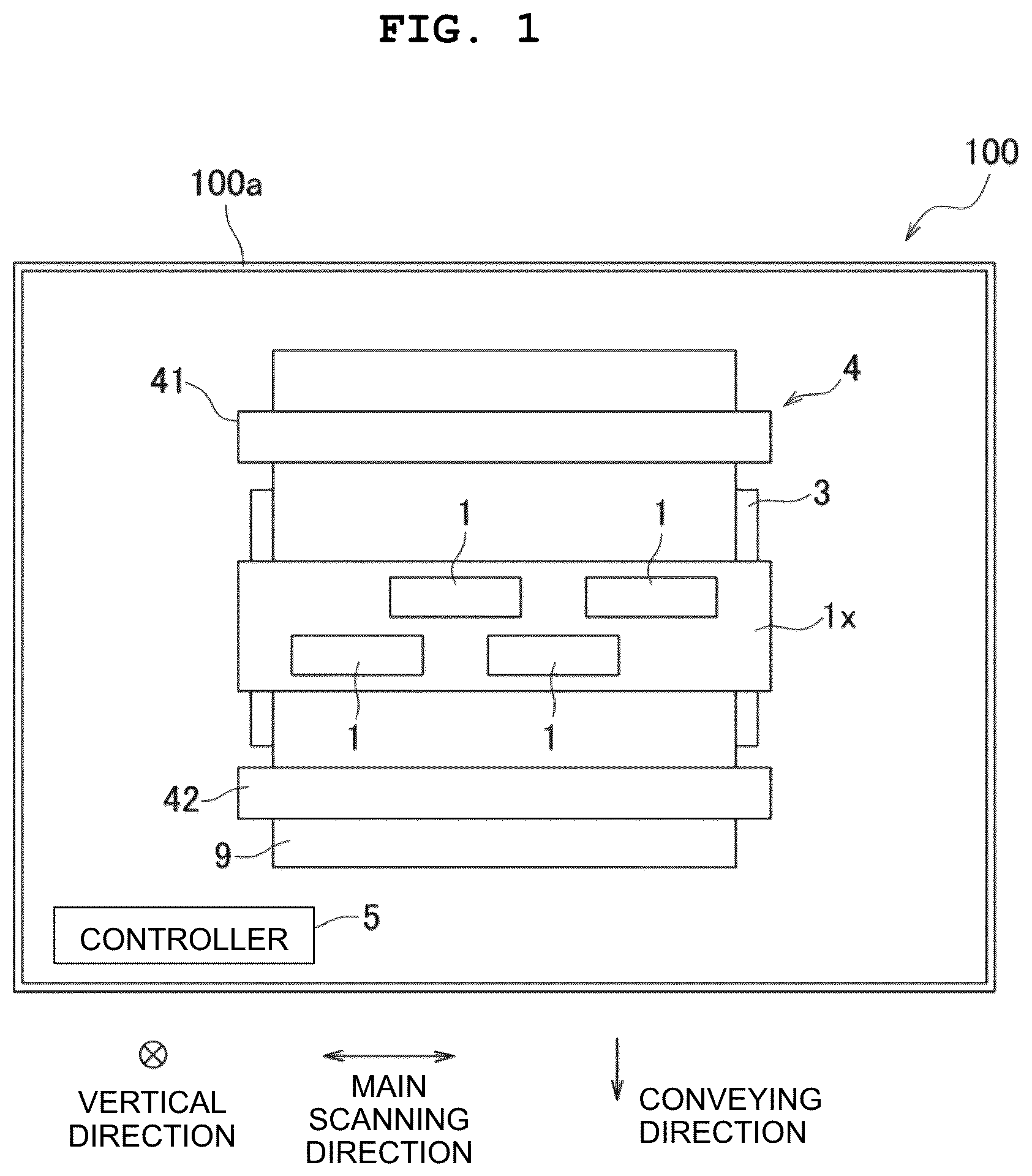
is a plan view of a printer according to an embodiment of the present disclosure.
is a block diagram depicting an electric configuration of the printer.
is a plan view depicting one of four heads constructing a head unit of the printer.
is a cross-sectional view of one of the four heads taken along a IV-IV line of .
is a graph indicating a relationship among a diameter D of a nozzle, a natural frequency Fr and an amount V of an ink droplet.
is a graph indicating a relationship between the diameter D of the nozzle and the natural frequency Fr.
DESCRIPTION
<Overall Configuration of Printer 100 >
A printer 100 according to an embodiment of the present disclosure is provided with a casing 100 a , a head unit 1 x , a platen 3 , a conveying mechanism 4 and a controller 5 , as depicted in . The head unit 1 x , the platen 3 , the conveying mechanism 4 and the controller 5 are arranged inside of the casing 100 a . The printer 100 is further provided with an input part constructed of a button arranged on an outer surface of the casing 100 a.
The head unit 1 x is long in a main scanning direction. The main scanning direction is a direction along a width of a paper sheet 9 and is orthogonal to the vertical direction. The head unit 1 x is of a line system in which ink is discharged with respect to the paper sheet 9 in a state that a position of the head unit 1 x is fixed. The head unit 1 x includes four heads 1 . Each of the four heads 1 is long in the main scanning direction, and the four heads 1 are arranged in a staggered manner in the main scanning direction.
The platen 3 is a plate along a plane orthogonal to the vertical direction, and is arranged below the head unit 1 x . The paper sheet 9 is supported on the upper surface of the platen 3 .
The conveying mechanism 4 includes two roller pairs 41 and 42 , and a conveying motor 43 as depicted in . In a conveying direction, the head unit 1 x and the platen 3 are arranged between the two roller pairs 41 and 42 . The conveying direction is orthogonal to the vertical direction and the main scanning direction. In a case that the conveying motor 43 is driven by a control of the controller 5 , the two roller pairs 41 and 42 are rotated. By the rotations of the two roller pairs 41 and 42 , the paper sheet 9 pinched by the two roller pairs 41 and 42 is conveyed in the conveying direction.
As depicted in , the controller 5 includes a CPU 51 , a ROM 52 and a RAM 53 .
The CPU 51 executes a variety of kinds of control based on data inputted from an external apparatus or device and/or an input part, and in accordance with a program and data stored in the ROM 52 and/or the RAM 53 . The external apparatus is, for example, a PC.
The ROM 52 stores the program and the data with which the CPU 51 performs the variety of kinds of control. The RAM 53 temporarily stores data used by the CPU 51 in a case that the CPU 51 executes the program.
<Configuration of Head 1 >
As depicted in , the head 1 includes a channel member 12 and an actuator member 13 .
As depicted in , two supply ports 121 and two return ports 122 are formed in the upper surface of the channel member 12 . The two supply ports 121 are arranged at one end in the main scanning direction in the channel member 12 . The two return ports 122 are arranged at the other end in the main scanning direction in the channel member 12 . Each of the two supply ports 121 and the two return ports 122 is communicated with an ink tank (not depicted in the drawings) via a tube, etc.
The channel member 12 has two common channels 12 A and a plurality of individual channels 12 B.
The two common channels 12 A are arranged side by side in the conveying direction and each extends in the main scanning direction. Each of the two supply ports 121 is connected to one end in the main scanning direction in one of the two common channels 12 A, and each of the two return ports 122 is connected to the other end in the main scanning direction in one of the two common channels 12 A. Each of the two common channels 12 A communicates with the ink tank via one of the two supply ports 121 and one of the two return ports 122 , and communicates with the plurality of individual channels 12 B.
Each of the plurality of individual channels 12 B includes a nozzle 12 N and a pressure chamber 12 P communicating with the nozzle 12 N. The individual channel 12 B corresponds to a “channel” of the present disclosure.
A plurality of pieces of the nozzle 12 N is opened in the lower surface of the channel member 12 , and a plurality of pieces of the pressure chamber 12 P is opened in the upper surface of the channel member 12 . In a plane orthogonal to the vertical direction, the opening of the nozzle 12 N is substantially circular, and the opening of the pressure chamber 12 P is substantially rectangular.
A width W of the pressure chamber 12 P is not more than 70 μm. A length L of the pressure chamber 12 P is not more than 550 μm. The width W is a length in the main scanning direction, and the length L is a length in the conveying direction.
As depicted in , the nozzles 12 N are arranged in a staggered manner in the main scanning direction and construct four nozzle rows R 1 to R 4 . Each of the nozzle rows R 1 to R 4 is constructed of nozzles 12 N which are aligned in the main scanning direction.
In each of the nozzle rows R 1 to R 4 , the nozzles 12 N are arranged in the main scanning direction at a pitch P which is not less than 300 dpi. For example, in a case that a recording resolution in each of the nozzle rows R 1 to R 4 is 300 dpi, the pitch P is approximately 84 μm. The recording resolution is a resolution of an image which is to be recorded by droplets of the ink (ink droplets) discharged from the nozzle 12 N.
In two nozzles rows, among the four nozzle rows R 1 to R 4 , which are adjacent to each other in the conveying direction, the positions of the nozzles 12 N in the main scanning direction are shifted by half the pitch P. With this, in a case that the recording resolution in each of the nozzle rows R 1 to R 4 is 300 dpi, a recording resolution of 1200 dpi is realized by the four nozzle rows R 1 to R 4 . The head 1 of the present embodiment has a recording resolution of 1200 dpi×1200 dpi in the main scanning direction and the conveying direction.
In a case that the pump 10 as depicted in is driven by a control of the controller 5 , the ink inside the ink tank is thereby supplied to the two common channels 12 A via the two supply ports 121 , and is distributed from the two common channels 12 A to the plurality of individual channels 12 B.
In a case that a piezoelectric element 13 X (to be described later on) is driven so as to reduce the volume of the pressure chamber 12 P, the ink inside the individual channel 12 B is discharged as ink droplets from the nozzle 12 N.
The ink which has moved inside the two common channels 12 A from one end toward the other end in the main scanning direction thereof and reached the two return ports 122 is returned to the ink tank via the tube.
As depicted in , the actuator member 13 is fixed to the upper surface of the channel member 12 . The actuator member 13 includes a vibration plate 13 A made of a metal, a piezoelectric layer 13 B and a plurality of individual electrodes 13 C.
The actuator member 13 is a thin film piezoelectric element which is formed by performing film formation sequentially, on the upper surface of the vibration plate 13 A, of a thin film which is to be the piezoelectric layer 13 B and a thin film which is to be the individual electrodes 13 C. The thin film piezoelectric element is so-called micro electromechanical systems (MEMS). The thickness of the thin film piezoelectric element is not more than 1.5 μm.
The vibration plate 13 A is arranged on the upper surface of the channel member 12 so as to cover the pressure chambers 12 P. The piezoelectric layer 13 B is arranged on the upper surface of the vibration plate 13 A. Each of the individual electrodes 13 C is arranged on the upper surface of the piezoelectric layer 13 B so as to overlap, in the vertical direction, with a pressure chamber 12 P corresponding thereto.
A part in the vibration plate 13 A and a part in the piezoelectric layer 13 B which are sandwiched between each of the individual electrodes 13 C and one of the pressure chambers 12 P function as a piezoelectric element 13 X. The piezoelectric element 13 X is independently deformable in accordance with a potential applied to the individual electrode 13 C.
The vibration plate 13 A and the individual electrodes 13 C are electrically connected to a driver IC 14 . The driver IC 14 maintains a potential of the vibration plate 13 A at the ground potential, whereas the driver IC 14 changes the potential of each of the individual electrodes 13 C. The vibration plate 13 A functions as a common electrode which is an electrode common to the piezoelectric elements 13 X. The driver IC 14 generates a driving signal based on a control signal from the controller 5 and supplies the driving signal to each of the individual electrodes 13 C. The driving signal changes the potential of each of the individual electrodes 13 C between a predetermined driving potential and the ground potential.
<Analysis>
The inventor of the present disclosure uses analytic models of 2000 pieces of the head 1 , and analyzed a relationship among a natural frequency Fr of the individual channel 12 B, a diameter D of the nozzle 12 N and an amount V of an ink droplet discharged from the nozzle 12 N.
The analytic models of 2000 pieces of the head 1 (2000 analytic models) are mutually different in the configuration of the individual channel 12 B. The configuration of the individual channel 12 B includes the width W of the pressure chamber 12 P, the length L of the pressure chamber 12 P and the diameter D of the nozzle 12 N. The natural frequency Fr depends at least on the configuration of the individual channel 12 B. Accordingly, in the 2000 analytic models, there are various natural frequencies Fr.
is a graph in which the amount V of the ink droplet discharged by applying the driving signal to the piezoelectric element 13 X in each of the analytic models is plotted in a gray scale. Note that in the 2000 analytic models, the driving potential was adjusted so that discharging velocities of the ink droplets became to be same among the 2000 analytic models.
A pulse width of a pulse included in the driving signal is equal to an Acoustic Length (AL). The AL is one way propagation time of a pressure wave in the individual channel 12 B. Since the 2000 analytic models are mutually different in the configuration of the individual channel 12 B, the AL are mutually different among the 2000 analytic models. Therefore, the pulse widths were different among the 2000 analytic models.
It is appreciated from that as the natural frequency Fr is higher, the amount V of the ink droplet is smaller. Further, it is also appreciated that as the diameter D of the nozzle 12 N is smaller, the amount V of the ink droplet is smaller.
In the present embodiment, the natural frequency Fr is made to be in a range of 120 kHz to 160 kHz so as to increase the driving frequency. Further, the recording resolution is made to be not less than 1200 dpi. In order to record an image of satisfactory quality in this recording resolution, it is required to discharge an ink droplet of which amount is not less than 2 pl from the nozzle 12 N.
In , an area on the upper side with respect to a straight line of “D=0.0343×Fr+6.6979” is a range in which the amount V of the ink droplet is not less than 2 pl. Accordingly, an area A surrounded by broken lines and a location in the vicinity thereof correspond to the present embodiment. Namely, in the present embodiment, the head 1 is configured such that the diameter D [μm] of the nozzle 12 N and the natural frequency Fr [kHz] satisfy: D≥0.0343×Fr+6.6979.
Note, however, that in a case that the amount V of the ink droplet discharged from the nozzle 12 N becomes excessive, the supply of the ink to the nozzle 12 N might be unstable. Further, the ink droplet wets and spreads on the paper sheet 9 to a great extent, which in turn might deteriorate the image quality. In view of this, the inventor of the present disclosure presumed the upper limit of the amount V of the ink droplet to be approximately 4 pl, and extracted analytic models, of the 2000 analytic models, in each of which the amount of the ink droplet discharged was in the range of 3.5 pl to 4.5 pl.
is a graph of the analytic models which are extracted from the 2000 analytic models and in each of which the amount of the ink droplet discharged was in the range of 3.5 pl to 4.5 pl. In , a relationship between the diameter D of the nozzle 12 N and the natural frequency Fr in each of the extracted analytic models is plotted. From , an approximate straight line of “D=0.0453×Fr+10.261” was obtained. From this result, in the present embodiment, the head 1 is configured so that the diameter D [μm] of the nozzle 12 N and the natural frequency Fr [kHz] satisfy D≤0.0453×Fr+10.261.
Furthermore, in the present embodiment, a discharging initial velocity of the ink droplet from the nozzle 12 N is made to be not less than 7 m/s. The discharging initial velocity is a velocity in a case that a meniscus of the nozzle 12 N is separated from the nozzle 12 N and flies. In order to make the discharging initial velocity to be not less than 7 m/s, a waveform and a driving potential of the driving signal which the controller 5 causes the driver IC 14 to generate are adjusted.
In particular, in a case that the conveying velocity of the paper sheet 9 is not less than 70 m/minute, it is preferred that the discharging initial velocity is not less than 7 m/s in order to prevent any deviation in a landing position due to influence of an air current generated accompanying with the conveyance of the paper sheet 9 . The landing position is a position, in the paper sheet 9 , on which the ink droplet lands.
<Effect of the Embodiment>
As described above, according to the present embodiment, the natural frequency Fr is made to be in the range of 120 kHz to 160 kHz, thereby making it possible to increase the driving frequency. Further, the recording resolution is made to be not less than 1200 dpi which is high. In this case, by causing the diameter D [μm] of the nozzle 12 N and the natural frequency Fr [KHz] to satisfy D≥0.0343×Fr+6.6979, it is possible to discharge the ink droplet in the amount V which is sufficient for the recording, as indicated by the result of the analysis. Here, the phrase “amount sufficient for the recording” means an amount capable of making a discharge duty, which is a density of liquid droplets per unit area, to be 100%.
Note that the natural frequency Fr is associated with the rigidity of the piezoelectric element 13 X. In a case that the rigidity of the piezoelectric element 13 X is small, the natural frequency Fr is low. In a case that the natural frequency Fr is less than 120 kHz and that the rigidity of the piezoelectric element 13 X is small, the AL becomes long which in turn makes it impossible to increase the driving frequency.
On the other hand, in a case that the natural frequency Fr exceeds 160 kHz and that the rigidity of the piezoelectric element 13 X is great, an excessive energy might be required for the deformation of the piezoelectric element 13 X. This consequently makes the heat value of the piezoelectric element 13 X to be great and allows the heat of the piezoelectric elements 13 X to be transferred to the ink, which in turn might adversely affect the discharge. Further, the driver IC 14 might be broken or fail due to the heat.
According to the present embodiment, since the natural frequency Fr is made to be in the range of 120 kHz to 160 kHz, it is possible to increase the driving frequency, while preventing the heat from being generated in the piezoelectric element 13 X as described above.
In a case that the diameter D of the nozzle 12 N and the natural frequency Fr [kHz] satisfy D>0.0453×Fr+10.261, the amount V of the ink droplet discharged from the nozzle 12 N becomes excessive. In a case that the amount V becomes excessive, the supply of the ink to the nozzle 12 N might be unstable. Further, the ink droplet wets and spreads on the paper sheet 9 to a great extent, which in turn might deteriorate the image quality. In view of this, in the present embodiment, the diameter D of the nozzle 12 N and the natural frequency Fr [kHz] satisfy D≤0.0453×Fr+10.261, which in turn does not make the amount V of the ink droplet discharged from the nozzle 12 N to be excessive. Owing to this, it is possible to supply the ink stably to the nozzle 12 N, and to prevent any lowering in the image quality which would be otherwise caused due to the wetting and spreading of the ink droplet.
The nozzles 12 N are arranged at the pitch of not less than 300 dpi per one row, as depicted in . Owing to this, it is possible to make the size of the head 1 to be small, and to obtain a high image quality.
The piezoelectric element 13 X is the thin film piezoelectric element. Since the thickness of the thin film piezoelectric element is small, the thin film piezoelectric element is easily deformed and is sufficiently deformable even in a case that the size of the pressure chamber 12 P is small. Accordingly, in the case that the piezoelectric element 13 X is the thin film piezoelectric element, it is possible to make the piezoelectric element 13 X to be sufficiently deformable, while satisfying the requirement that the natural frequency Fr is in the range of 120 kHz to 160 kHz, by making the size of the pressure chamber 12 P be small to thereby increasing the natural frequency Fr.
The thickness of the thin film piezoelectric element is not more than 1.5 μm. In this case, it is possible to make the piezoelectric element 13 X to be sufficiently deformable, while satisfying the requirement that the natural frequency Fr is in the range of 120 kHz to 160 kHz, in a more ensured manner.
The width W of the pressure chamber 12 P is not more than 70 μm. In this case, since the size of the pressure chamber 12 P is small, the natural frequency Fr is increased, which in turn makes it possible to satisfy the requirement that the natural frequency is in the range of 120 kHz to 160 kHz, in more ensured manner.
The length L of the pressure chamber 12 P is not more than 550 μm. In this case, since the size of the pressure chamber 12 P is small, the natural frequency Fr is increased, which in turn makes it possible to satisfy the requirement that the natural frequency Fr is in the range of 120 kHz to 160 kHz, in more ensured manner.
In a case that the initial discharging velocity of the ink droplet from the nozzle 12 N is less than 7 m/s, the flying direction of the ink droplet is more likely to be deviated from a desired direction, due to the influence of an air current generated accompanying with the conveyance of the paper sheet 9 . Therefore, the landing position of the ink droplet is more likely to be deviated from a desired position. In view of this, in the present embodiment, the initial discharging velocity is not less than 7 m/s, which in turn stabilizes the landing position.
<Modifications>
Although the embodiment of the present disclosure has been explained above, the present disclosure is not limited to or restricted by the above-described embodiment, and various design changes can be made within the scope of the claims.
In the above-described embodiment, although the electrode constructing the piezoelectric element has a two-layered structure including the individual electrode and the common electrode, the electrode may have a three-layered structure. The three-layered structure is, for example, a structure including a driving electrode to which a high potential and a low potential are selectively applied, a high potential electrode maintained at the high potential and a low potential electrode maintained at the low potential.
In the above-described embodiment, although the opening of the nozzle is substantially circular, the opening may have a rectangular shape. In a case that the opening of the nozzle has the rectangular shape, the diameter of a circle having an area same as an area of this rectangular shape is made to be the diameter D of the nozzle.
The head is not limited to the head of the line system, and may be a head of a serial system.
The object of discharge is not limited to the paper sheet, and may be, for example, cloth (fabric), a substrate or plastic member, etc.
The liquid droplet discharged from the nozzle is not limited to the ink droplet. The liquid droplet may be, for example, a liquid droplet of a treatment liquid which agglutinates or precipitates a component in the ink.
The present disclosure is not limited to being applicable to the printer, and is applicable also to facsimiles, copy machines, multifunction peripherals, etc. Further, the present disclosure is applicable also to a liquid droplet discharging apparatus used for any other application than the recording of an image. For example, the present disclosure is applicable to a liquid droplet discharging apparatus which forms an electroconductive pattern by discharging an electroconductive liquid on a substrate.
Figures (6)
Citations
This patent cites (3)
- US2021/0370672
- US2009279865
- US2011025516