Probiotic Compositions for Long COVID
Abstract
The present invention provides for compositions and methods for treating long COVID symptoms or reducing the risk of developing such symptoms. More specifically, the present invention provides for compositions that comprises an effective amount of one or more beneficial bacterial species such as Bifidobacterium pseudocatenulatum and are useful for treating long COVID. Also provided are methods of using the compositions to treat long COVID.
Claims (17)
1 . A method for treating post-acute COVID-19 syndrome (PACS) in a subject who has been diagnosed with COVID-19, comprising administering to the subject a composition comprising an effective amount of Bifidobacterium pseudocatenulatum and not comprising Lactobacillus acidophilus, Lactobacillus plantarum , or Bifidobacterium animalis.
Show 16 dependent claims
2 . The method of claim 1 , wherein the administering step further comprises administering to the subject an effective amount of Bifidobacterium longum.
3 . The method of claim 2 , wherein the administering step comprises administering to the subject two or more compositions, each comprising one or more of Bifidobacterium pseudocatenulatum and Bifidobacterium longum and not comprising Lactobacillus acidophilus, Lactobacillus plantarum , or Bifidobacterium animalis.
4 . The method of claim 2 , wherein the administering step comprises oral ingestion of one or more compositions comprising Bifidobacterium pseudocatenulatum and Bifidobacterium longum and not comprising Lactobacillus acidophilus, Lactobacillus plantarum , or Bifidobacterium animalis.
5 . The method of claim 1 , further comprising administering to the subject Bifidobacterium adolescentis.
6 . The method of claim 2 , comprising administering to the subject a total of about 10 6 to about 10 12 colony-forming unit (CFU) of Bifidobacterium pseudocatenulatum and Bifidobacterium longum.
7 . The method of claim 1 , wherein the composition does not comprise any bacterial species selected from the group consisting of Lachnospira pectinoschiza, Scardovia wiggsiae, Oscillibacter sp. CAG:241 , Streptococcus vestibularis, Lactococcus garvieae, Erysipelatoclostridium ramosum, Stomatobaculum longum, Staphylococcus epidermidis, Holdemaniafiliformis , Lachnospiraceae bacterium 2 1 46FAA, Clostridium innocuum, Parascardovia denticolens, Clostridium bolteae CAG 59 , Fusobacterium varium, Clostridium bolteae, Scardovia inopinata, Bacteroides caccae, Rothia mucilaginosa, Streptococcus mutans, Ruminococcus gnavus, Actinomyces graevenitzii, Parabacteroides distasonis, Bacteroides vulgatus, Anaeromassilibacillus sp. An250 , Massiliomicrobiota timonensis, Lactobacillus acidophilus, Peptostreptococcus anaerobius, Butyrivibrio sp. CAG:318 , Lactobacillus plantarum, Megamonas rupellensis, Lactobacillus johnsonii, Bifidobacterium animalis, Morganella morganii , Lachnospiraceae bacterium oral taxon 096 , Lactobacillus delbrueckii, Blautia producta, Turicimonas muris , Clostridiales bacterium 1_7_47F AA, Bacteroides thetaiotaomicron, Bacteroides sp. CAG:144 , Streptococcus lutetiensis, Butyricicoccus pullicaecorum, Blautia coccoides, Anaerotignum lactatifermentans, Megasphaera micronuciformis, Bacteroides xylanisolvens, Clostridium clostridioforme, Pediococcus acidilactici, Enterococcus casseliflavus, Intestinibacter bartlettii, Flavonifractor plautii, Actinomyces johnsonii , and Atopobium parvulum.
8 . The method of claim 1 , further comprising administering to the subject an effective amount of one or more of Blautia wexlerae, Faecalibacterium prausnitzii , and Fusicatenibacter saccharivorans.
9 . The method of claim 1 , further comprising administering to the subject an effective amount of: (i) Agathobaculum butyriciproducens, Roseburia hominis, Anaerostipes hadrus, Dialister sp. CAG:357, and Eubacterium rectale; (ii) Agathobaculum butyriciproducens, Roseburia hominis , and Asaccharobacter celatus; (iii) Agathobaculum butyriciproducens, Roseburia hominis, Anaerostipes hadrus , and Coprococcus comes; (iv) Agathobaculum butyriciproducens, Roseburia hominis, Anaerostipes hadrus , and Alistipes putredinis; (v) Agathobaculum butyriciproducens, Anaerostipes hadrus, Eubacterium sp. CAG:274, and Dorea formicigenerans ; or (vi) Agathobaculum butyriciproducens, Roseburia hominis, Eubacterium rectale, Gemmiger formicilis, Eubacterium ventriosum , and Dorea formicigenerans.
10 . The method of claim 1 , further comprising administering to the subject an effective amount of one or more different butyrate-producing bacterial species of Roseburia inulinivorans, Faecalibacterium prausnitzii , and Roseburia hominis.
11 . The method of claim 1 , wherein the subject is administered a composition comprising (1) an effective amount of Bifidobacterium pseudocatenulatum and Bifidobacterium longum and not comprising Lactobacillus acidophilus, Lactobacillus plantarum , or Bifidobacterium animalis ; and (2) one or more physiologically acceptable excipients.
12 . The method of claim 4 , wherein each of the composition(s) is in the form of a food or beverage item.
13 . The method of claim 1 , wherein the administering comprises direct deposit of the composition to the subject's gastrointestinal tract.
14 . The method of claim 3 , wherein the subject is administered two or more compositions, each comprising (1) an effective amount of one or more of Bifidobacterium pseudocatenulatum and Bifidobacterium longum and not comprising Lactobacillus acidophilus, Lactobacillus plantarum , or Bifidobacterium animalis ; and (2) one or more physiologically acceptable excipients.
15 . The method of claim 2 , wherein the subject is administered the composition by oral ingestion.
16 . The method of claim 15 , wherein the composition is in the form of a food or beverage item.
17 . The method of claim 1 , wherein the subject is administered a composition comprising (1) an effective amount of Bifidobacterium pseudocatenulatum, Bifidobacterium longum , and Blautia wexlerae and not comprising Lactobacillus acidophilus, Lactobacillus plantarum , or Bifidobacterium animalis ; and (2) one or more physiologically acceptable excipients.
Full Description
Show full text →
RELATED APPLICATIONS
This application claims priority to U.S. Provisional Patent Application No. 63/272,608, filed Oct. 27, 2021, the contents of which are hereby incorporated by reference in the entirety for all purposes.
BACKGROUND OF THE INVENTION
In recent years, viral and bacterial infection is becoming more prevalent worldwide and presents a serious public health threat. For example, the Coronavirus-2019 (COVID-19) global pandemic of a respiratory disease caused by severe acute respiratory syndrome coronavirus 2 (SARS-CoV-2) has affected over 435 million people worldwide, including nearly 6 million deaths, and is exacerbated by a lack of officially approved therapeutics as well as a lack of thoroughly tested, proven safe and effective vaccines. Several promising therapeutic agents are currently undergoing active investigation and development for prophylactic or therapeutic use in the treatment for COVID-19 to prevent or ameliorate its damaging effects to the afflicted patients, while in the meantime experimental vaccines are widely distributed to the general population.
Accordingly, there exists an urgent need for new and meaningful methods to supplement therapeutic and vaccination efforts by way of preventing or treating symptoms of long COVID or post-acute COVID syndrome (PACS) among patients who are recovering from the disease, including adults and children, to achieve reduction or elimination of long lingering clinical symptoms and their associated effects. The purpose of this study is to identify gut microbial species that can potentially provide the beneficial effects of preventing or treating PACS as well as to identify gut microbial species that can be monitored among patients suffering from active COVID to indicate individuals who are likely to develop PACS symptoms in the future, who can then be given treatment accordingly in a prophylactic manner. Direct supplementation of these beneficial gut microbial species is a potentially effective means to achieve these goals in the efforts of reducing or eliminating the long-term ill effects of infectious diseases such as COVID-19. The present invention fulfills this and other related needs by identifying beneficial gut microorganisms so as to allow formulation of new compositions and application of new methods that are effective for addressing lingering clinical symptoms among recovered COVID patients, as well as by identifying gut microorganisms that can serve as markers to indicate COVID patients who have an increased risk of developing PACS as to allow these patients to be treated prophylactically to prevent the onset of long COVID symptoms.
BRIEF SUMMARY OF THE INVENTION
The present inventors discovered in their studies the certain gut microbial species and their metabolites can help prevent and treat the symptoms of long COVID or post-acute COVID syndrome (PACS) among patients who have been diagnosed of COVID-19, including those having recovered from the disease (e.g., having had at least one negative test report for SARS-CoV2, the virus causing the infection), thus provide an important utility in facilitating patients' complete recovery from the disease and elimination of potential lingering ill effects caused by this pathogen. The microorganisms so identified now serve to provide new methods and compositions as an integral part of the COVID-19 therapy and long-term management.
In a first aspect, the present invention provides a composition that is useful for use in treating PACS in a subject comprising an effective amount of (1) one or more beneficial bacterial species selected from Table 1 and Bifidobacterium longum, Blautia wexlerae , and Bifidobacterium pseudocatenulatum ; and (2) a physiologically acceptable excipient. In some embodiments, the composition further comprises one or more of beneficial bacterial species selected from Table 3. In some embodiments, the composition comprises a total of about 10 6 to about 10 12 colony-forming unit (CFU) of the beneficial bacterial species. In some embodiments, the composition comprises no detectable amount of any bacterial species in Table 4 including Scardovia wiggsiae and Bacteroides xylanisolvens . In some embodiments, the composition comprises an effective amount of one or more different beneficial bacterial species of Bifidobacterium longum, Blautia wexlerae, Bifidobacterium pseudocatenulatum, Faecalibacterium prausnitzii , and Fusicatenibacter saccharivorans . In some embodiments, the composition comprises an effective amount of one or more different butyrate-producing bacterial species of Roseburia inulinivorans, Faecalibacterium prausnitzii , and Roseburia Hominis . In some embodiments, the composition consists essentially of an effective amount of (1) one or more of the beneficial bacterial species selected from Table 1 and Bifidobacterium longum, Blautia wexlerae , and Bifidobacterium pseudocatenulatum ; (2) one or more physiologically acceptable excipients. In some embodiments, the composition is formulated for oral ingestion, such as in the form of a food or beverage item. In some embodiments, the composition is formulated for direct deposit to the subject's gastrointestinal tract. Optionally, the composition may further includes one or more agents known to enhance immunity, for example, effective in suppressing an infectious agent, such as SARS-CoV-2, and reducing disease severity (e.g., ivermectin, hydroxychloroquine, Zinc, vitamin C, vitamin D, quercetin, melatonin, fluvoxamine or fluoxetine, proxalutamide, azithromycin, doxycycline, or any combination thereof).
In the second aspect, the present invention provides a method for treating or preventing PACS in a subject by administering to the subject an effective amount of the composition described above and herein. In some embodiments, the subject has already developed PACS. In some embodiments, the subject has been diagnosed of COVID but has not yet developed PACS. In some embodiments, the administering step comprises administering to the subject one composition comprising one or more of the beneficial bacterial species. In some embodiments, the administering step comprises administering to the subject two or more compositions, each comprising one or more of the beneficial bacterial species. In some embodiments, the administering step comprises oral ingestion of the composition(s), which may be prior to or with food intake, or shortly after food intake (e.g., a meal or snack). In some embodiments, the administering step comprises direct deposit to the subject's gastrointestinal tract. For example, the technique knowns as fetal microbiota transplant (FMT) is used wherein a composition made from processed suitable donor fecal material containing the desirable amount of the beneficial bacterial species may be used to introduce the bacteria into a COVID or PACS patient's gastrointestinal tract. Optionally, the method also includes administering to the subject, either in the same composition(s) containing the beneficial bacteria, may further includes one or more agents known to enhance immunity, for example, effective in suppressing an infectious agent, such as SARS-CoV-2, and reducing disease severity (e.g., ivermectin, hydroxychloroquine, Zinc, vitamin C, vitamin D, quercetin, melatonin, fluvoxamine or fluoxetine, provalutamide, azithromycin, doxycycline, or any combination thereof).
In a related aspect, the present invention provides a novel use of a composition in treating or preventing PACS in a subject. The composition comprising an effective amount of (1) one or more beneficial bacterial species selected from Table 1 and Bifidobacterium longum, Blautia wexlerae , and Bifidobacterium pseudocatenulatum ; and (2) a physiologically acceptable excipient. In some embodiments, the composition further comprises one or more of beneficial bacterial species selected from Table 3. In some embodiments, the composition comprises a total of about 10 6 to about 10 12 colony-forming unit (CFU) of the beneficial bacterial species. In some embodiments, the composition comprises no detectable amount of any bacterial species in Table 4 including Scardovia wiggsiae and Bacteroides xylanisolvens . In some embodiments, the composition comprises an effective amount of one or more different beneficial bacterial species of Bifidobacterium longum, Blautia wexlerae, Bifidobacterium pseudocatenulatum, Faecalibacterium prausnitzii , and Fusicatenibacter saccharivorans . In some embodiments, the composition comprises an effective amount of one or more different butyrate-producing bacterial species of Roseburia inulinivorans, Faecalibacterium prausnitzii , and Roseburia Hominis . In some embodiments, the composition consists essentially of an effective amount of (1) one or more of the beneficial bacterial species selected from Table 1 and Bifidobacterium longum, Blautia wexlerae , and Bifidobacterium pseudocatenulatum ; (2) one or more physiologically acceptable excipients. In some embodiments, the composition is formulated for oral ingestion, such as in the form of a food or beverage item. In some embodiments, the composition is formulated for direct deposit to the subject's gastrointestinal tract. Optionally, the composition may further includes one or more agents known to enhance immunity, for example, effective in suppressing an infectious agent, such as SARS-CoV-2, and reducing disease severity (e.g., ivermectin, hydroxychloroquine, Zinc, vitamin C, vitamin D, quercetin, melatonin, fluvoxamine or fluoxetine, proxalutamide, azithromycin, doxycycline, or any combination thereof).
In a third aspect, the present invention provides a kit for treating or preventing PACS in a subject. The kit includes multiple containers, each containing a distinct composition comprising an effective amount of one or more beneficial bacterial species selected from Table 1 and Bifidobacterium longum, Blautia wexlerae , and Bifidobacterium pseudocatenulatum . In some embodiments, the kit comprises a plurality of containers, each containing a distinct composition comprising an effective amount of one or more different beneficial bacterial species selected from Bifidobacterium longum, Blautia wexlerae, Bifidobacterium pseudocatenulatum, Faecalibacterium prausnitzii , and Fusicatenibacter saccharivorans . In some embodiments, the kit includes a plurality of containers, each containing a distinct composition comprising an effective amount of one or more different butyrate-producing bacterial species of Roseburia inulinivorans, Faecalibacterium prausnitzii , and Roseburia Hominis . In some embodiments, the compositions are in the form of a powder, liquid, paste, cream, tablet, or capsule. The kit may further include one or more additional containers, each containing one or more agents known to effectively suppress an infectious agent such as SARS-CoV-2 and/or to reduce disease severity or facilitate patient recovery from COVID-19 (e.g., ivermectin, vitamin C, vitamin D, quercetin, melatonin, Zinc, azithromycin, doxycycline, hydroxychloroquine, fluvoxamine or fluoxetin, proxalutamide, or any combination thereof). Moreover, a user instruction manual may be included in the kit for the proper use of the kit, providing information such as suitable subjects for treatment and time, dosing etc.
In a fourth aspect, the present invention provides a method for assessing risk of PACS in a subject. The method includes these steps: (1) determining, in a stool sample from the subject, the level or relative abundance of one or more of the bacterial species set forth in Table 2: (2) determining the level or relative abundance of the same bacterial species in a stool sample obtained at the time of initial diagnosis of COVID-19 (such as at the time of first positive test report for COVID-19 or at the time of admission to a hospital) from a reference cohort comprising COVID-19 patients who would or would not eventually develop PACS; (3) generating decision trees by random forest model using data obtained from step (2) and running the level or relative abundance of one or more of the bacterial species from step (1) down the decision trees to generate a score; and (4) determining the subject with a score greater than 0.5 as having an increased risk for PACS, and determining the subject with a score no greater than 0.5 as having no increased risk for PACS. In some embodiments, each of steps (1) and (2) comprises metagenomics sequencing. In some embodiments, each of steps (1) and (2) comprises a polymerase chain reaction (PCR), e.g., a quantitative PCR (qPCR). In some embodiments, the bacterial species comprise one or more of Bifidobacterium longum, Blautia wexlerae, Bifidobacterium pseudocatenulatum, Faecalibacterium prausnitzii , and Fusicatenibacter saccharivorans.
BRIEF DESCRIPTION OF THE DRAWINGS
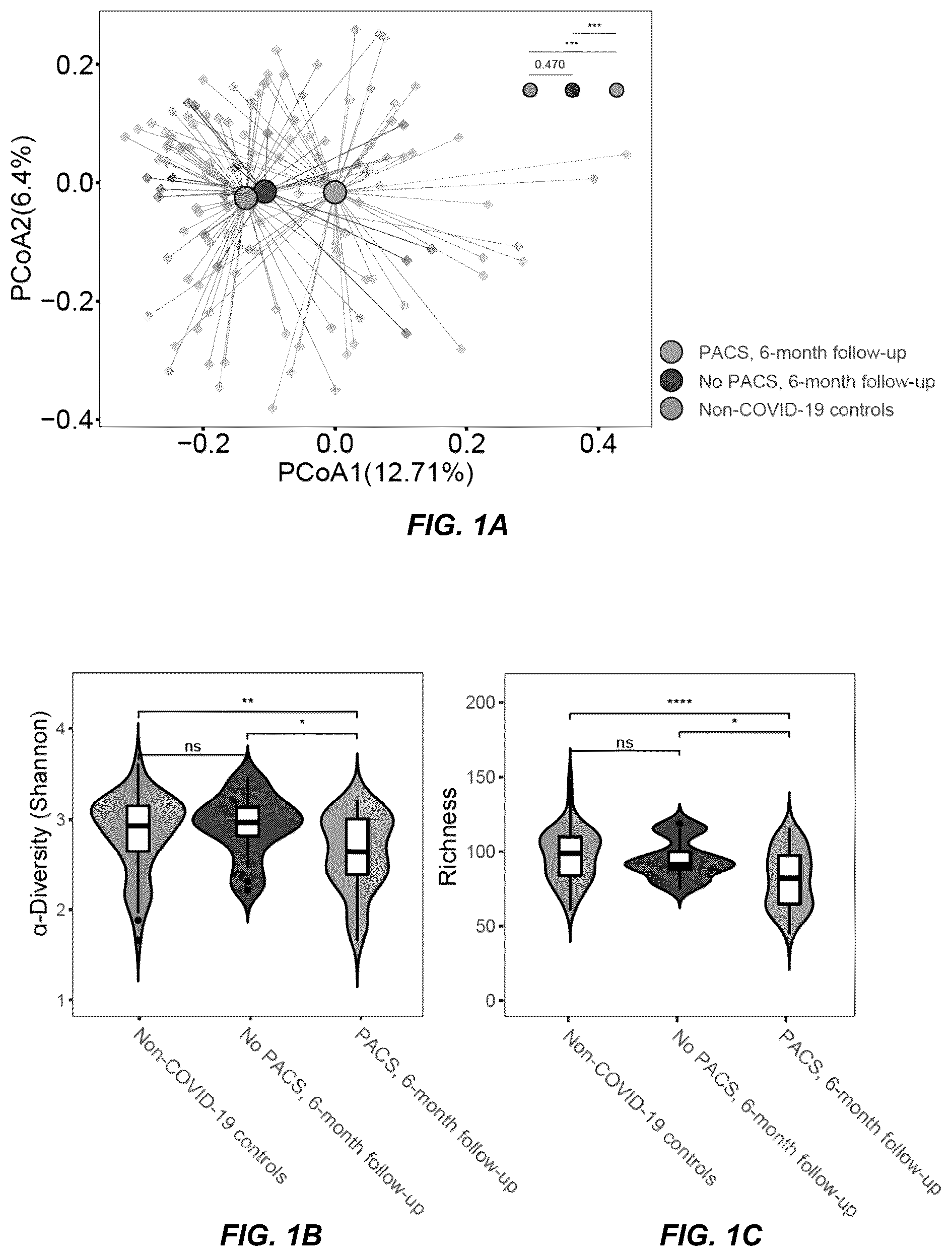
A - D Gut microbiota composition in patients with COVID-19 with and without PACS at 6 months. A : Principal Coordinates Analysis of gut microbiota composition of patients with COVID-19 with and without PACS at 6 months. B : Bacteria diversity and richness. C analysis of gut microbiota composition of patients with and without PACS. D : Linear discriminant analysis effect size (LEfSe) analysis of discriminant taxa in gut microbiome of patients with PACS at six months.
A - C Factors affecting the gut microbiome in follow-up stools from patients after clearing virus. A : Effect size of subject metadata on gut microbiome composition determined by PERMANOVA test. B : Overall associations between gut microbiome composition with different subgroups of PACS determined by PERMANOVA test. C : Associations of bacteria species with different categories of PACS at 6 months.
A - B Post-acute COVID-19 syndrome (PACS) after virus clearance. A : The proportion of 30 symptoms at 3 months and 6 months after acute COVID-19. B : Multivariable analysis on factors associated with development of PACS. The centre dot denotes the mean value, the boxes denote the upper and lower interquartile ranges.
A - B PACS proportion in COVID-19 patients. A : PACS proportion at different subgroups by COVID-19 severity in 106 patients at 3-month and 6-month follow-up. B : PACS proportion at different subgroups by COVID-19 severity in 68 patients who had stool samples at 3-month and 6-month follow-up.
A - E Compositional differences in gut microbiota of in-hospital patients and their follow-up stools after negative SARS-CoV-2, and non-COVID-19 individuals. A : Principal Coordinates Analysis of gut microbiota composition of patients with COVID-19 before and after negative SARS-CoV-2 compared with non-COVID-19 subjects. B : Diversity and richness. C : Analysis of gut microbiota in COVID-19 patients at 1 month and 6 months after virus clearance. D : Average relative abundance of top 5 phyla and top 10 microbial genera. E : top 5 phyla and top 10 microbial genera detected in stools from in-hospital patient and their follow-up within 1 month and longer than 6 months after negative SARS-CoV-2.
A - B Compositional differences in gut microbiota of in-hospital patients with antibiotics and their follow-up stools after negative RT-qPCR for viral RNA in nasopharyngeal swabs, and non-COVID-19 individuals. A : Principal Coordinates Analysis of gut microbiota composition of COVID-19 patients with antibiotics before and after negative RT-qPCR for SARS-CoV-2 compared with non-COVID-19 subjects. B : Principal Coordinates Analysis of gut microbiota composition of COVID-19 patients with or without antibiotics 6 months after negative RT-qPCR for SARS-CoV-2 compared with non-COVID-19 subjects.
A - F Compositional differences in gut microbiota of follow-up samples at different time points after virus clearance. A : Differences of the top 7 phyla in 1 month and 6 months follow-up sample. B : Differences of the top 10 genus in 1 month and 6 months follow-up sample. C : Differences of the top 20 species in 1 month and 6 months follow-up sample. D : Principal Coordinates Analysis of gut microbiota composition of COVID-19 patients at 1 month, 6 months and 9 months after negative RT-qPCR for SARS-CoV-2. E : Diversity and richness of gut microbiota in COVID-19 patients at 1 month, 6 months, and 9 months. F : analysis of gut microbiota in COVID-19 patients at 1 month, 6 months, and 9 months.
A - B Post-acute COVID-19 syndrome (PACS) after virus clearance in 68 patients with serial stool samples. A : The morbidity of top 16 symptoms at 6 months after acute COVID-19. B : Multivariable analysis on factors associated with development of PACS. The centre dot denote the mean value, the boxes denote the upper and lower interquartile ranges.
A - E Compositional differences in gut microbiota of baseline and follow-up samples at different time points after virus clearance. A : Principal Coordinates Analysis of gut microbiota composition of COVID-19 patients with or without PACS before and after negative RT-qPCR for SARS-CoV-2 compared with non-COVID-19 subjects. B : Diversity and richness analysis of gut microbiota in COVID-19 patients at baseline compared with non-COVID-19 subjects. C : Diversity and richness analysis of gut microbiota in COVID-19 patients at 6 months follow-up compared with non-COVID-19 subjects. D : The change of gut microbial composition from baseline to six months follow-up after virus clearance in COVID-19 patients with or without PACS. E : Lefse analysis in gut microbiome of recovered patients with PACS at baseline.
A - B Six-minute walk distance (6MWD) correlate with gut bacteria composition. A : The 6MWD in COVID-19 patients with or without PACS. B : Association of bacteria species with 6MWD in COVID-19 patients at 6 months follow-up (from linear mixed models in MaAsLin).
A - D Gut microbiota composition at admission of patients with COVID-19 who had or had not any persistent symptoms at six months. A : Principal Coordinates Analysis of gut microbiota composition of patients with COVID-19 who had or had not any persistent symptoms at month 6 after clearing SARS-CoV-2. B : Gut microbiota composition of first stool samples after confirmed positive RT-qPCR for SARS-CoV-2 during hospitalization. C : Associations between persistent symptoms in recovered patients with COVID-19 and baseline microbial features as determined by MaAsLin with multivariate linear model (P<0.05). D : Schematic summary of associations between gut microbiome and PACS development
DEFINITIONS
As used herein, the term “SARS-CoV-2 or severe acute respiratory syndrome coronavirus 2,” refers to the virus that causes Coronavirus Disease 2019 (COVID-19). It is also referred to as the “COVID-19 virus.”
The term “post-acute COVID-19 syndrome (PACS)” or “long COVID” is used to describe a medical condition in which a patient who has recovered from COVID, as indicated by a negative PCR report at least 2 weeks prior (e.g., from at least 3 or 4 weeks earlier), yet continuously and stably exhibits one or more symptoms of the disease without any notable progression. The symptoms may include respiratory (cough, sputum, nasal congestion/runny nose, shortness of breath), neuropsychiatric (headache, dizziness, loss of taste, loss of smell, anxiety, difficulty in concentration, difficulty in sleeping, sadness, poor memory, blurred vision), gastrointestinal (nausea, diarrhoea, abdominal pain, epigastric pain), dermatological (hair loss), or musculoskeletal (joint pain, muscle pain) symptoms, as well as fatigue.
The term “inhibiting” or “inhibition,” as used herein, refers to any detectable negative effect on a target biological process, such as RNA/protein expression of a target gene, the biological activity of a target protein, cellular signal transduction, cell proliferation, presence/level of an organism especially a micro-organism, any measurable biomarker, bio-parameter, or symptom in a subject, and the like. Typically, an inhibition is reflected in a decrease of at least 10%, 20%, 30%, 40%, 50%, 60%, 70%, 80%, 90% or greater in the target process (e.g., a subject's bodyweight, or the blood glucose/cholesterol level, or any measurable symptom or biomarker in a subject, such as an infection rate among subjects by a pathogenic infectious agent), or any one of the downstream parameters mentioned above, when compared to a control. “Inhibition” further includes a 100% reduction, i.e., a complete elimination, prevention, or abolition of a target biological process or signal. The other relative terms such as “suppressing.” “suppression,” “reducing,” and “reduction” are used in a similar fashion in this disclosure to refer to decreases to different levels (e.g., at least 10%, 20%, 30%, 40%, 50%, 60%, 70%, 80%, 90% or greater decrease compared to a control level) up to complete elimination of a target biological process or signal. On the other hand, terms such as “activate,” “activating,” “activation,” “increase,” “increasing,” “promote,” “promoting,” “enhance,” “enhancing,” or “enhancement” are used in this disclosure to encompass positive changes at different levels (e.g., at least about 5%, 10%, 20%, 30%, 40%, 50%, 60%, 70%, 80%, 90%, 100%, 200%, or greater such as 3, 5, 8, 10, 20-fold increase compared to a control level in a target process, signal, or parameter.
As used herein, the term “treatment” or “treating” includes both therapeutic and preventative measures taken to address the presence of a disease or condition or the risk of developing such disease or condition at a later time. It encompasses therapeutic or preventive measures for alleviating ongoing symptoms, inhibiting or slowing disease progression, delaying of onset of symptoms, or eliminating or reducing side-effects caused by such disease or condition. A preventive measure in this context and its variations do not require 100% elimination of the occurrence of an event; rather, they refer to a suppression or reduction in the likelihood or severity of such occurrence or a delay in such occurrence.
The term “severity” of a disease refers to the level and extent to which a disease progresses to cause detrimental effects on the well-being and health of a patient suffering from the disease, such as short-term and long-term physical, mental, and psychological disability, up to and including death of the patient. Severity of a disease can be reflected in the nature and quantity of the necessary therapeutic and maintenance measures, the time duration required for patient recovery, the extent of possible recovery, the percentage of patient full recovery, the percentage of patients in need of long-term care, and mortality rate.
A “patient” or “subject” receiving the composition or treatment method of this invention is a human, including both adult and juvenile human, of any age, gender, and ethnic background, who has been diagnosed with COVID-19 (e.g., has had a positive nucleic acid and/or antibody test result for SARS-CoV2) and is in need of being treated to address PACS symptoms or to prevent the onset of such symptoms. Typically, the patient or subject receiving treatment according to the method of this invention to prevent or treat long COVID symptoms is not otherwise in need of treatment by the same therapeutic agents. For example, if a subject is receiving the symbiotic composition according to the claimed method, the subject is not suffering from any disease that is known to be treated by the same therapeutic agents. Although a patient may be of any age, in some cases the patient is at least 20, 30, 40, 45, 50, 55, 60, 65, 70, 75, 80, or 85 years of age: in some cases, a patient may be between 20 and 30, 30 and 40, 40 and 45 years old, or between 50 and 65 years of age, or between 65 and 85 years of age. A “child” subject is one under the age of 18 years, e.g., about 5-17, 9 or 10-17, or 12-17 years old, including an “infant.” who is younger than about 12 months old, e.g., younger than about 10, 8, 6, 4, or 2 months old, whereas an “adult” subject is one who is 18 years or older.
The term “effective amount,” as used herein, refers to an amount that produces intended (e.g., therapeutic or prophylactic) effects for which a substance is administered. The effects include the prevention, correction, or inhibition of progression of the symptoms of a particular disease/condition and related complications to any detectable extent, e.g., incidence of disease, infection rate, one or more of the symptoms of a viral or bacterial infection and related disorder (e.g., COVID-19). The exact amount will depend on the purpose of the treatment, and will be ascertainable by one skilled in the art using known techniques (see, e.g., Lieberman, Pharmaceutical Dosage Forms (vols. 1-3, 1992): Lloyd, The Art, Science and Technology of Pharmaceutical Compounding (1999); and Pickar, Dosage Calculations (1999)).
The term “about” when used in reference to a given value denotes a range encompassing ±10% of the value.
A “pharmaceutically acceptable” or “pharmacologically acceptable” excipient is a substance that is not biologically harmful or otherwise undesirable, i.e., the excipient may be administered to an individual along with a bioactive agent without causing any undesirable biological effects. Neither would the excipient interact in a deleterious manner with any of the components of the composition in which it is contained.
The term “excipient” refers to any essentially accessory substance that may be present in the finished dosage form of the composition of this invention. For example, the term “excipient” includes vehicles, binders, disintegrants, fillers (diluents), lubricants, glidants (flow enhancers), compression aids, colors, sweeteners, preservatives, suspending/dispersing agents, film formers/coatings, flavors and printing inks.
The term “consisting essentially of,” when used in the context of describing a composition containing an active ingredient or multiple active ingredients, refer to the fact that the composition does not contain other ingredients possessing any similar or relevant biological activity of the active ingredient(s) or capable of enhancing or suppressing the activity, whereas one or more inactive ingredients such as physiological or pharmaceutically acceptable excipients may be present in the composition. For example, a composition consisting essentially of active agents (for instance, one or more bacterial species in Table 1) effective for treating PACS in a subject is a composition that does not contain any other agents that may have any detectable positive or negative effect on the same target process (e.g., any one of the PACS symptoms) or that may increase or decrease to any measurable extent of the relevant symptoms among the receiving subjects.
DETAILED DESCRIPTION OF THE INVENTION
I. Introduction
This invention describes specific bacterial species and combination thereof (e.g., beneficial bacterial species listed in Table 1 and Table 3 plus Bifidobacterium longum, Blautia wexlerae , and Bifidobacterium pseudocatenulatum ) for preventing or treating PACS symptoms in a subject, especially when the subject is a human adult or child suffering but recovering from COVID-19. The practical use of the invention includes development and manufacturing of commercial food products or health supplements, for example in the form of a powder, tablet, capsule, or liquid, which can be taken alone or added to food or beverages, as well as any other formulation suitable for use by fecal microbiota transplant (FMT).
II. Pharmaceutical Compositions and Administration
The present invention provides pharmaceutical compositions comprising an effective amount of one or more of the beneficial bacterial species listed in Table 1 and Table 3 plus Bifidobacterium longum, Blautia wexlerae , and Bifidobacterium pseudocatenulatum for treating a COVID-19 patient to reduce the risk of developing symptom(s) of PACS or to ameliorate the symptom(s) if any already present. Pharmaceutical compositions of the invention are suitable for use in a variety of drug delivery systems. Suitable formulations for use in the present invention are found in Remington's Pharmaceutical Sciences , Mack Publishing Company, Philadelphia, PA, 17th ed. (1985). For a brief review of methods for drug delivery, see, Langer, Science 249:1527-1533 (1990).
The pharmaceutical compositions of the present invention can be administered by various routes, e.g., systemic administration via oral ingestion or local delivery using a rectal suppository. The preferred route of administering the pharmaceutical compositions is oral administration at daily doses of about 10 6 to about 10 12 CFU for the combination of all beneficial bacterial species listed in Table 1 and Table 3 plus Bifidobacterium longum, Blautia wexlerae , and Bifidobacterium pseudocatenulatum . When multiple bacterial species are administered to the subject, they may be administered either in one single composition or in multiple compositions. The appropriate dose may be administered in a single daily dose or as divided doses presented at appropriate intervals, for example as two, three, four, or more subdoses per day. The duration of administration may range from about 1 week to about 8 weeks, e.g., about 2 week to about 4 weeks, or for a longer time period (e.g., up to 6 months) as the relevant symptoms persist.
For preparing pharmaceutical compositions containing the beneficial bacteria identified in this disclosure, one or more inert and pharmaceutically acceptable carriers are used. The pharmaceutical carrier can be either solid or liquid. Solid form preparations include, for example, powders, tablets, dispersible granules, capsules, cachets, and suppositories. A solid carrier can be one or more substances that can also act as diluents, flavoring agents, solubilizers, lubricants, suspending agents, binders, or tablet disintegrating agents: it can also be an encapsulating material.
In powders, the carrier is generally a finely divided solid that is in a mixture with the finely divided active component, e.g., any one or more of the beneficial bacterial species listed in Table 1 and Table 3 plus Bifidobacterium longum, Blautia wexlerae , and Bifidobacterium pseudocatenulatum . In tablets, the active ingredient is mixed with the carrier having the necessary binding properties in suitable proportions and compacted in the shape and size desired.
For preparing pharmaceutical compositions in the form of suppositories, a low-melting wax such as a mixture of fatty acid glycerides and cocoa butter is first melted and the active ingredient is dispersed therein by, for example, stirring. The molten homogeneous mixture is then poured into convenient-sized molds and allowed to cool and solidify.
Powders and tablets preferably contain between about 5% to about 100% by weight of the active ingredient(s) (e.g., one or more of the beneficial bacterial species listed in Table 1 and Table 3 plus Bifidobacterium longum, Blautia wexlerae , and Bifidobacterium pseudocatenulatum ). Suitable carriers include, for example, magnesium carbonate, magnesium stearate, talc, lactose, sugar, pectin, dextrin, starch, tragacanth, methyl cellulose, sodium carboxymethyl cellulose, a low-melting wax, cocoa butter, and the like.
The pharmaceutical compositions can include the formulation of the active ingredient(s), e.g., one or more of the beneficial bacterial species listed in Table 1 and Table 3 plus Bifidobacterium longum, Blautia wexlerae , and Bifidobacterium pseudocatenulatum , with encapsulating material as a carrier providing a capsule in which the active ingredient(s) (with or without other carriers) is surrounded by the carrier, such that the carrier is thus in association with the active ingredient(s). In a similar manner, sachets can also be included. Tablets, powders, sachets, and capsules can be used as solid dosage forms suitable for oral administration.
Liquid pharmaceutical compositions include, for example, solutions suitable for oral administration or local delivery, suspensions, and emulsions suitable for oral administration. Sterile water solutions of the active component (e.g., one or more of the beneficial bacterial species listed in Table 1 and Table 3 plus Bifidobacterium longum, Blautia wexlerae , and Bifidobacterium pseudocatenulatum ) or sterile solutions of the active component in solvents comprising water, buffered water, saline, PBS, ethanol, or propylene glycol are examples of liquid or semi-liquid compositions suitable for oral administration or local delivery such as by rectal suppository. The compositions may contain pharmaceutically acceptable auxiliary substances as required to approximate physiological conditions, such as pH adjusting and buffering agents, tonicity adjusting agents, wetting agents, detergents, and the like.
Sterile solutions can be prepared by dissolving the active component (e.g., one or more of the beneficial bacterial species listed in Table 1 and Table 3 plus Bifidobacterium longum, Blautia wexlerae , and Bifidobacterium pseudocatenulatum ) in the desired solvent system, and then passing the resulting solution through a membrane filter to sterilize it or, alternatively, by dissolving the sterile active component in a previously sterilized solvent under sterile conditions. The resulting aqueous solutions may be packaged for use as is, or lyophilized, the lyophilized preparation being combined with a sterile aqueous carrier prior to administration. The pH of the preparations typically will be between 3 and 11, more preferably from 5 to 9, and most preferably from 7 to 8.
Single or multiple administrations of the compositions can be carried out with dose levels and pattern being selected by the treating physician. In any event, the pharmaceutical formulations should provide a quantity of an active agent sufficient to effectively enhance the efficacy of a vaccine and/or reduce or eliminate undesirable adverse effects of a vaccine.
Different combinations of bacteria in the pharmaceutical compositions can be chosen according to Table 1 to target specific categories of symptoms. For example, Agathobaculum butyriciproducens, Bifidobacterium pseudocatenulatum, Roseburia hominis, Anaerostipes hadrus, Dialister sp. CAG:357 , Eubacterium rectale can be used to prevent or alleviate fatigue: Agathobaculum butyriciproducens, Bifidobacterium pseudocatenulatum, Roseburia hominis, Asaccharobacter celatus can be used to prevent or alleviate gastrointestinal symptoms: Agathobaculum butyriciproducens, Roseburia hominis, Anaerostipes hadrus, Coprococcus comes can be used to prevent or alleviate neurological symptoms: Agathobaculum butyriciproducens, Bifidobacterium pseudocatenulatum, Roseburia hominis, Anaerostipes hadrus, Alistipes putredinis can be used to prevent or alleviate respiratory symptoms: Agathobaculum butyriciproducens, Anaerostipes hadrus, Eubacterium sp. CAG:274 , Dorea formicigenerans can be used to prevent or alleviate musculoskeletal symptoms; and Agathobaculum butyriciproducens, Roseburia hominis, Eubacterium rectale, Gemmiger formicilis, Eubacterium ventriosum, Dorea formicigenerans can be used to prevent or alleviate hair loss.
III. Additional Therapeutic Agents
Additional known therapeutic agent or agents may be used in combination with an active agent such as one or more of the beneficial bacterial species listed in Table 1 and Table 3 plus Bifidobacterium longum, Blautia wexlerae , and Bifidobacterium pseudocatenulatum in the practice of the present invention for the purpose of treating or preventing PACS symptom(s) in a patient recovering from COVID-19. In such applications, one or more of the previously known effective prophylactic/therapeutic agents can be administered to patients concurrently with an effective amount of the active agent(s) either together in a single composition or separately in two or more different compositions.
For example, drugs and supplements that are known to be effective for use to prevent or treat COVID-19 include ivermectin, vitamin C, vitamin D, melatonin, quercetin, Zinc, hydroxychloroquine, fluvoxamine/fluoxetine, proxalutamide, doxycycline, and azithromycin. They may be used in combination with the active agents (such as any one or more of the beneficial bacterial species listed in Table 1 and Table 3 plus Bifidobacterium longum, Blautia wexlerae , and Bifidobacterium pseudocatenulatum ) of the present invention to promote safe and full recovery among patients suffering from SARS-CoV2 infection, reduce potential disease severity (including morbidity and mortality), and ensure elimination of any lingering long-term ill effects from the disease. In particular, the combination of Zinc, hydroxychloroquine, and azithromycin and the combination of ivermectin, fluvoxamine or fluoxetine, proxalutamide, doxycycline, vitamin C, vitamin D, melatonin, quercetin, and Zinc have demonstrated high efficacy in both COVID prophylaxis and therapy. Thus, these known drug/supplement or nutritheutical combinations can be used in the method of this invention along with the active components of one or more of the beneficial bacterial species listed in Table 1 and Table 3 plus Bifidobacterium longum, Blautia wexlerae , and Bifidobacterium pseudocatenulatum.
IV. Kits
The invention also provides kits for treating and preventing PACS symptoms among patients recovering from COVID-19 in accordance with the method disclosed herein. The kits typically include a plurality of containers, each containing a composition comprising one or more of the beneficial bacterial species listed in Table 1 and Table 3 plus Bifidobacterium longum, Blautia wexlerae , and Bifidobacterium pseudocatenulatum . Further, additional agents or drugs that are known to be therapeutically effective for prevention and/or treatment of the disease, including for ameliorating the symptoms and reducing the severity of the disease, as well as for facilitating recovery from the disease (such as those described in the last section or otherwise known in the pertinent technical field) may be included in the kit. The plurality of containers of the kit each may contain a different active agent/drug or a distinct combination of two or more of the active agents or drugs. The kit may further include informational material providing instructions on how to dispense the pharmaceutical composition(s), including description of the type of patients who may be treated (e.g., human patients, adults or children, who have been diagnosed of COVID-19 and now are in the process of recovering and are therefore seeking to eliminate lingering symptoms of the disease or to reduce the risk of such symptoms becoming persistent and continuous), the dosage, frequency, and manner of administration, and the like.
V. Risk Assessment and Treatment
The present inventors also discovered that the altered level of certain bacterial species can indicate the prospect or likelihood of a COVID patient later develop PACS symptoms and therefore can provide a basis for prophylactic treatment: they revealed that the level or relative abundance of certain bacterial species (such as one or more of the species shown in Table 2) can be analyze to indicate an individual patient's risk or likelihood for later developing PACS symptoms when properly calculated using certain specified mathematic tools.
For example, when a stool sample taken from a COVID patient who is being tested is analyzed, the level or relative abundance of bacterial species in Table 2 in the sample is determined, e.g., by PCR especially quantitative PCR. In the meantime, the level or relative abundance of the same bacterial species is determined by the same method as the bacterial species is/are present in stool samples taken from individual COVID patients at the time of initial diagnosis of COVID-19 from a reference cohort comprising these COVID-19 patients, some of whom would eventually develop PACS whereas others would not develop PACS. Decision trees are then generated by random forest model using data obtained from the reference cohort, and the level or relative abundance of one or more of the bacterial species from the individual patient being tested is run down the decision trees to generate a score. The patient is deemed to have an increased risk for developing PACS when his score is greater than 0.5. In contrast, when his score is no greater than 0.5, the patient is deemed to have no increased risk for PACS.
Once the PACS risk assessment is made, for example, an individual who has been diagnosed as suffering from COVID-19 (e.g., based on a positive PCR or antibody test for SARS-CoV2) and who has been in the process of recovering from the disease is deemed to have an increased risk of developing PACS at a later time, appropriate treatment steps can be taken as a measure to achieve the goal of preventing the onset of the PACS symptoms or reducing their severity or eliminating them altogether. For instance, the patient may be given composition(s) comprising an effective amount of one or more of the beneficial bacterial species listed in Table 1 and Table 3 plus Bifidobacterium longum, Blautia wexlerae , and Bifidobacterium pseudocatenulatum , e.g., by FMT or by an alternative administration method via oral or local delivery, such that the bacterial profile in the patient's gastrointestinal tract will be modified to one that is favorable for the outcome of prevented, reduced, eliminated, or reversed PACS symptoms.
EXAMPLES
The following examples are provided by way of illustration only and not by way of limitation. Those of skill in the art will readily recognize a variety of non-critical parameters that could be changed or modified to yield essentially the same or similar results.
BACKGROUND
Clinical characteristics of coronavirus 2019 (COVID-19) during the acute infection is well described but little is known of long-term complications of COVID-19. Post-acute COVID-19 syndrome (PACS) characterised by long term complications and/or persistent symptoms beyond four weeks after the onset of COVID-19 is increasingly being recognised 1-3 . Up to three quarters of patients described at least one symptom at six months after recovery and multi-system symptoms including fatigue, muscle weakness and sleep difficulties are commonly reported 4 .
Reasons underlying the development of PACS is largely unclear. Perturbations of immune and inflammatory responses, cellular damage by acute viral infection or sequele of post critical illness may contribute to long term symptoms after COVID-19 infection 5 . As the gastrointestinal tract is the largest immunological organ in the body, aberrant immune response to COVID-19 infection induced by resident microorganisms may affect the recovery process. Emerging evidence supports the potential role of gut dysbiosis in severity of COVID-19 infection 6 . The present inventors herein investigated whether gut microbiota composition and to what extent affects risk of persistent symptoms in recovered patients with different severity of COVID-19 infection.
Supplementation of Beneficial Bacterial for Reducing Risk or Alleviating Symptom of PACS
Gut microbiome composition and association with different symptoms were examined at six months. Based on permutational multivariate analysis of variance (PERMANOVA), gut composition was not associated with medical therapy during hospitalisation or disease severity ( A , Table 14). Symptoms of PACS were categorised into respiratory (cough, sputum, nasal congestion/runny nose, shortness of breath), neuropsychiatric (headache, dizziness, loss of taste, loss of smell, anxiety, difficulty in concentration, difficulty in sleeping, sadness, poor memory, blurred vision), gastrointestinal (nausea, diarrhoea, abdominal pain, epigastric pain), dermatological (hair loss), musculoskeletal (joint pain, muscle pain), and fatigue. Associations of single bacteria taxa with different categories of symptoms were tested using multivariate association with linear model (MaAsLin). Different symptomatology was associated with different gut microbiome patterns ( B , Table 15).
A total of 81 bacterial species were associated with different categories of PACS and many of the bacteria species were associated with more than two categories of persistent symptoms ( C , Table 16). At six months, gut microbiome composition in patients with persistent respiratory symptoms were positively correlated with a number of opportunistic pathogens including Streptococcus anginosus group, Streptococcus vestibularis. Streptococcus gordonii and Clostridium disporicum , whereas abundance of nosocomial pathogens linked to opportunistic infections including Clostridium innocuum , and Actinomyces naeslundii , were correlated with neuropsychiatric symptoms and fatigue. Butyrate-producing species such as Roseburia inulinivorans, Faecalibacterium prausnitzii , and Roseburia hominis were significantly depleted in patients who had persistent hair loss at six months (n=23), compared with non-COVID-19 controls (P<0.05, Table 16). Furthermore, relative abundance of multiple bacterial species known to be beneficial to host immunity including Bifidobacterium pseudocatenulatum, F. prausnitali, R. inulinivorans and Roseburia hominis showed the largest inverse correlations with PACS at six months ( C , Table 16, Table 17).
It was discovered that very few patients were admitted to an intensive care unit or required mechanical ventilation, yet many developed PACS suggesting that persistent symptoms are unlikely to be the result of post critical illness syndrome. Loss of several symbionts including the genera Bifidobacteria, Roseburia , and Faecalibacteria known to have immunomodulatory functions were especially associated with persistent symptoms among recovered COVID-19 patients. The latter two bacteria are important short-chain acid (SCFAs) producers and major players in maintenance of immune homeostasis. SCFAs have been shown to alter chemotaxis and phagocytosis, induce reactive oxygen species, change cell proliferation and function, and have antimicrobial and anti-inflammatory effects.
A method is therefore provided for preventing and alleviating these symptoms by supplementation of these beneficial bacterial listed in Table 1 and Table 3. As these symptoms can also occur in the any persons including people with no history of COVID-19, such a method can be applied to anyone concerning these symptoms.
Machine Learning Model to Predict Risk of PACS
Species listed in Table 2, and preferably Bifidobacterium longum (NCBI:txid216816), Blautia wexlerae (NCBI:txid418240), Bifidobacterium pseudocatenulatum (NCBI:txid28026), Faecalibacterium prausnitzii (NCBI:txid853), Fusicatenibacter saccharivorans (NCBI:txid1150298), can be used in different combinations to build a risk assessment model to determine whether a person is at risk of PACS of COVID-19 after the person was tested positive for COVID-19.
To determine the risk of PACS in a subject, the following steps will be carried out:
•
• (1) Obtain a set of training data by determine the relative abundance of species selected from Table 12 in a cohort of COVID-19 patients with and without PACS at the time of initial diagnosis of COVID-19, such as at admission to hospital. • (2) Determine the relative abundance of these species in the subject who is being tested for the risk of PACS. • (3) Compare the relative abundance of these species in the subject with the training data using random forest model. • (4) Decision trees will be generated by random forest from the training data. The relative abundances will be run down the decision trees and generate a risk score. If at least 50% trees (possibility >0.5) in the model consider the subject as COVID-19 patients having PACS, the subject being tested is deemed to have an increased risk for PACS. If less than 50% trees (possibility <0.5) in the model consider the subject as COVID-19 patients not having PACS, the subject being tested is deemed to not have an increased risk for PACS. Supplementation of Beneficial Bacterial to Improve Functional Capacity
The 6-minute walk test (6MWT) is frequently used to determine functional capacity in patients 4 . Previous work has shown that post-convalescence patients with lower microbiota richness had impaired lung function 6 , however, the cause of reduced 6-minute walk distance after COVID-19 remains unknown. Of the 68 COVID-19 patients who had provided stool samples at six-month follow up, 52 of them had 6-minute walk test assessment at six months. The median walking distance at 6 minutes in patients with PACS was significantly lower than those without PACS (mean 464 meter vs 382 meter, P<0.001, A ). The walking distance was positively correlated with several short-chain fatty acid (SCFA) and butyrate producers of the gut microbiome including Bifidobacterium pseudocatenulatum 7 , Roseburia inulinivorans 8 and Bacteroides ovatus 9 , implying beneficial symbiosis between human and gut-lung-microbiome axis after clearing the virus. Supplementation of these SCFA and butyrate producers ( Bifidobacterium pseudocatenulatum, Roseburia inulinivorans and Bacteroides ovatus ) could therefore improve functional capacity.
Significant inverse associations of walking distance with pathogenic bacteria species (for example, Clostridium innocuum, Clostridium bolteae ) were also observed, which could confer pathogenicity or were associated with disease risk in different populations 10, 11 (P<0.05, B ). Reducing the bacteria listed in B also could improve functional capacity.
Supplementation of Beneficial Bacteria to Prevent or Alleviate Overall PACS
Amongst gut bacteria species detected in patients with PACS, 28 bacteria species were diminished and 14 were enriched at baseline and follow-up samples ( D, 9 E , Table 11, Table 12). At six months, patients with PACS showed significantly lower level of Collinsella aerofaciens, F. prausnitzii, Blautia obeum and higher level of Ruminococcus _ gnavus, Bacteroides _ vulgatus compared with non-COVID-19 controls (P<0.05, Linear discriminant analysis Effect Size >2, LefSe) ( D , Table 12). Subjects without PACS only had 22 bacteria species alterations at admission which recovered completely by six months ( D , Table 13).
Bacteria species such as Christensenella minuta, Eubacterium ramulus, Bifidobacterium adolescentis were found to be depleted at baseline sample of patients who developed PACS at six months (P<0.05, LefSe >2, E , Table 11). A total of 13 bacteria species including B. wexlerae and B. longum at admission negatively correlated with PACS at six months indicating the putative protective role of these species in the recovery from SARS-CoV-2 infection ( B , C ) whereas Actinomyces _sp_S6_Spd3 . Actinomyces _ johnsonii and Atopobium _ parvulum were positively correlated with PACS. Overlap of bacteria species such as R. gnavus, C. innocuum, Erysipelatous ramosum was found that remained altered from baseline to follow-up and exhibited association with several PACS symptoms ( D ), further implying the link between altered gut microbiome and the recovery process in COVID-19 patients. These findings altogether suggest that an individual's gut microbiome configuration at admission may affect the subject's susceptibility to long-term complications of COVID-19.
A composition comprising one or more beneficial bacteria selected from Table 3 or E (grey, Non-COVID-19 controls), Table 11 (group=Non-Covid-19 controls), D (orange, Non-COVID-19 controls), Table 12 (group=Non-Covid-19 controls), B (coef <0). These bacteria can be administered in combination or as single probiotic to prevent or alleviate symptoms of PACS in a subject. Preferably, the bacteria are selected from the group consisting of Bifidobacterium longum (NCBI:txid216816), Blautia wexlerae (NCBI:txid418240), Streptococcus salivarius (NCBI:txid1304), Fusicatenibacter _ saccharivorans (NCBI:txid 1150298), Firmicutes _ bacterium CAG 83 (NCBI:txid 1262992), Gemella _ sanguinis (NCBI:txid 84135), Streptococcus _ australis (NCBI:txid 113107), Eubacterium _ hallii (NCBI:txid411469), Faecalibacterium _ prausnitzii (NCBI:txid 853), Anaerostipes _ hadrus (NCBI:txid 649756).
Methods
Study Population
This prospective cohort study was performed at three regional hospitals (Prince of Wales Hospital. United Christian Hospital and Yan Chai Hospital) in Hong Kong. China. All patients with a confirmed diagnosis of COVID-19, as evidenced by a positive SARS-CoV-2 by reverse transcriptase polymerase chain reaction test in nasopharyngeal swab, nasal swab, deep throat saliva, sputum, tracheal aspirate or stool, were recruited from 1 Feb. to 31 Aug. 2020. All patients with confirmed COVID-19 were required to be hospitalised according to local government policy. Patients could be discharged if they fit either one of the below criteria: two clinical specimens of the same type (i.e., respiratory or stool) tested negative for nucleic acid of SARS-CoV-2 by RT-PCR taken at least 24 hours apart or tested positive for SARS-CoV-2 antibody. Patients were excluded if they were unable to be contacted, declined to participate in study or died before the follow-up visit. Data including demographics, clinical and laboratory data were extracted from electronic medical records in the Clinical Management System of the Hong Kong Hospital Authority. Severity of COVID-19 infection was categorized as (1) mild, if there was no radiographic evidence of pneumonia; (2) moderate, if pneumonia was present along with fever and respiratory tract symptoms; (3) severe, if respiratory rate ≥30/min. oxygen saturation ≤93% when breathing ambient air, or PaO2/FiO2≤300 mm Hg (1 mm Hg=0.133 kPa); or (4) critical, if there was respiratory failure requiring mechanical ventilation, shock, or organ failure requiring intensive care. 12 Stool samples were collected serially from admission, at one month and at six months after discharge from hospital. Stool samples from in-hospital patients were collected by hospital staff while discharged patients provided stools on day of follow-up at 1 month and 6 months after discharge or self-sampled at home and couriered to the hospital within 24 hours of collection. All samples were collected in collection tubes containing preservative media (cat. 63700. Norgen Biotek Corp. Ontario Canada) and stored immediately at −80° C. until processing. It was previously shown that data of gut microbiota composition generated from stools collected using this preservative medium were comparable with data obtained from samples that were immediately stored at −80° C. 13 . The presence of 30 most commonly reported symptoms post-COVID 14, 15 was assessed at three and six months after illness onset (Table 19). Post-acute COVID-19 syndrome (PACS) was defined as at least one persistent symptom which cannot be explained by alternative diagnosis four weeks after clearance of SARS-CoV-2. Six-minute walk distance test (6MWT), which is a simple functional assessment to assess the aerobic capacity and endurance, was performed at six months after discharge in a subset of recovered COVID-19 patient. The 6MWT distance data were correlated with the gut microbiota analysis. Controls were recruited before the COVID-19 pandemic (between 2019 and 2020) from the community through advertisement and from the endoscopy centre at the Prince of Wales Hospital in subjects who had a normal colonoscopy (stools collected before bowel preparation). Aged- and gender-matched controls with similar co-morbidities and standard dietary pattern were selected for comparison of gut microbiota composition between subjects with and without COVID-19 infection. Demographics and co-morbidities of controls were listed in Table 8. The exclusion criteria for non-COVID-19 controls were (1) the use of laxatives or anti-diarrheal drugs in the last 3 months; (2) recent dietary changes (e.g., becoming vegetarian/vegan); (3) known complex infections or sepsis; (4) known history of severe organ failure (including decompensated cirrhosis, malignant disease, kidney failure, epilepsy, active serious infection, acquired immunodeficiency syndrome); (5) bowel surgery in the last 6 months (excluding colonoscopy/procedure related to perianal disease); (6) presence of an ileostomy/stoma; and (7) current pregnancy. Given that diet is known to impact the gut microbiome, dietary records were documented for all COVID-19 patients during the time of hospitalisation. Standardized meals daily were provided by the department of hospital catering service of each hospital and the dietary component and pattern were consistent with the habitual diet commonly consumed by Hong Kong Chinese. After discharge, COVID-19 patients were advised to continue a diverse and standard Chinese diet that were consistent with habitual daily diets consumed by Hong Kong Chinese. The study was conducted in accordance with the declaration of Helsinki. All patients provided written informed consent. The study was approved by the Joint Chinese University of Hong Kong—New Territories East Cluster Clinical Research Ethics Committee (CREC Reference no.: 2020.076).
Stool DNA Extraction and Sequencing
Detailed methods are described in Zuo et al 16 . Briefly, DNA was extracted from 0.1 g of homogenised faecal samples using the Maxwell RSC PureFood GMO and Authentication Kit and a Maxwell RSC Instrument nucleic acid extraction platform (Promega. Wisconsin. USA) according to manufacturer's instructions. Sequencing libraries were prepared from extracted DNA using the Nextera DNA Flex Library Prep Kit (Illumina, California, USA) and sequenced on an Illumina NovaSeq 6000 System (2×150 bp) at the Centre for Gut Microbiota Research, Chinese University of Hong Kong Raw sequence data generated for this study are available in the Sequence Read Archive under BioProject accession: PRJNA714459.
Bioinformatics
Raw sequence data were quality filtered using Trimmomatic V.39 to remove adaptor and low-quality sequences and decontaminated against human genome (Reference: hg38) by Kneaddata (V.0.7.2 https://bitbucket.org/biobakery/kneaddata/wiki/Home). Following this, microbiota composition profiles were inferred from quality-filtered forward reads using MetaPhlAn3 version 3.0.5. GNU parallel 17 was used for parallel analysis jobs to accelerate data processing.
Statistical Analysis and Inferring Gut Microbiota Composition
Continuous variables were expressed in median (interquartile range) whereas categorical variables were presented as number (percentage). Qualitative and quantitative differences between subgroups were analysed using chi-squared or Fisher's exact tests for categorical parameters and Mann-Whitney test for continuous parameters, as appropriate. Odds ratio and adjusted odds ratio (aOR) with 95% confidence interval (Cl) were estimated using logistic regression to examine clinical parameters associated with development of PACS. The site by species counts and relative abundance tables were input into R V.3.5.1 for statistical analysis. Principal Coordinates Analysis (PCoA) was used to visualise the clustering of samples based on their species level compositional profiles. Associations between gut community composition and patients' parameters were assessed using permutational multivariate analysis of variance (PERMANOVA). Associations of specific microbial species with patient parameters were identified using the linear discriminant analysis effect size (LEfSe) and the multivariate analysis by linear models (MaAsLin) statistical frameworks implemented in the Huttenhower Lab Galaxy instance (website: huttenhower.sph.harvard.edu/galaxy/). PCoA, PERMANOVA and Procrustes analysis are implemented in the vegan R package V.2.5-7.
Random Forest-Based Machine Learning Approach
A random forest was executed to create a predictive model for PACS using gut microbiome composition at admission. The machine learning model analysed the relative abundance of microbiome taxonomic species-level inferred by MetaPhlAn3 version 3.0.5. Machine learning experiments used random forest, as this algorithm has been shown to outperform other learning tools for microbiome data 18 . For the implementation of the model, the scikit-learn implementation 19 was used. An ensemble of 2,000 estimator trees and Shannon entropy were used to evaluate the quality of a split at each node of a tree. The two hyperparameters for the minimum number of samples per leaf and for the number of features per tree were set, as indicated elsewhere, to 5 and 30%, respectively. Hyperparameters for all methods were optimized by maximization of accuracy via 10-fold cross-validation.
All patents, patent applications, and other publications, including GenBank Accession Numbers and equivalents, cited in this application are incorporated by reference in the entirety for all purposes.
REFERENCES
• 1. Nalbandian A, Sehgal K, Gupta A, et al. Post-acute COVID-19 syndrome. Nature Medicine 2021:1-15. • 2. Blomberg B, Mohn K, Brokstad K A, et al. Long COVID affects home-isolated young patients. 2021. • 3. Agarwala P, Salzman S H. Six-minute walk test: clinical role, technique, coding, and reimbursement. Chest 2020:157:603-611. • 4. Huang C, Huang L, Wang Y, et al. 6-month consequences of COVID-19 in patients discharged from hospital: a cohort study. The Lancet 2021. • 5. Lyons-Weiler J. Pathogenic priming likely contributes to serious and critical illness and mortality in COVID-19 via autoimmunity. Journal of translational autoimmunity 2020:3:100051. • 6. Chen Y, Gu S, Chen Y, et al. Six-month follow-up of gut microbiota richness in patients with COVID-19. Gut 2021: gutjnl-2021-324090. • 7. Salazar N, Dewulf E M, Neyrinck A M, et al. Inulin-type fructans modulate intestinal Bifidobacterium species populations and decrease fecal short-chain fatty acids in obese women. Clinical nutrition 2015:34:501-507. • 8. Pichler M J, Yamada C, Shuoker B, et al. Butyrate producing colonic Clostridiales metabolise human milk oligosaccharides and cross feed on mucin via conserved pathways. Nature communications 2020:11:1-15. • 9. Fu X, Liu Z, Zhu C, et al. Nondigestible carbohydrates, butyrate, and butyrate-producing bacteria. Critical reviews in food science and nutrition 2019:59:S130-S152. • 10. Chia J-H, Wu T-S, Wu T-L, et al, Clostridium innocuum is a vancomycin-resistant pathogen that may cause antibiotic-associated diarrhoea. Clinical Microbiology and Infection 2018:24:1195-1199. • 11. Pequegnat B, Monteiro M A. Carbohydrate Scaffolds for the Study of the Autism-associated Bacterium, Clostridium bolteae . Current medicinal chemistry 2019:26:6341-6348. • 12. Wu J, Liu J, Zhao X, et al. Clinical characteristics of imported cases of coronavirus disease 2019 (COVID-19) in Jiangsu Province: a multicenter descriptive study. Clinical Infectious Diseases 2020:71:706-712. • 13. Chen Z, Hui P C, Hui M, et al. Impact of preservation method and 16S rRNA hypervariable region on gut microbiota profiling. Msystems 2019:4:e00271-18. • 14. Lambert N, Corps S, El-Azab S A, et al. COVID-19 Survivors' Reports of the Timing, Duration, and Health Impacts of Post-Acute Sequelae of SARS-CoV-2 (PASC) Infection. medRxiv 2021. • 15. Lambert N J, Corps S. COVID-19 “long hauler” symptoms survey report. 2020. • 16. Zuo T, Zhang F, Lui G C, et al. Alterations in gut microbiota of patients with COVID-19 during time of hospitalization. Gastroenterology 2020; 159:944-955. e8. • 17. Tange O. GNU Parallel 2018. 2018. https://doi.org/10.5281/zenodo.1146014 • 18. Pasolli E, Truong D T, Malik F, et al. Machine Learning Meta-analysis of Large Metagenomic Datasets: Tools and Biological Insights. PLOS Computational Biology 2016; 12: e1004977. • 19. Pedregosa F, Varoquaux G, Gramfort A, et al. Scikit-learn: Machine learning in Python, the Journal of machine Learning research 2011; 12:2825-2830.
TABLE 1
List of beneficial bacterial for preventing and alleviating different categories of symptoms
no species NCBI: txid Fatigue Gastrointestinal Neurological Respiratory Musculoskeletal Hair Loss
1 Agathobaculum — butyriciproducens 1628085 1 1 1 1 1 1
2 Bifidobacterium — pseudocatenulatum 28026 1 1 0 1 0 0
3 Roseburia — hominis 301301 1 1 1 1 1 1
4 Anaerostipes — hadrus 649756 1 0 1 1 1 1
5 Dialister _sp_CAG_357 1262869 1 0 1 1 1 1
6 Eubacterium — rectale 39491 1 0 1 1 1 1
7 Collinsella — aerofaciens 74426 1 1 0 1 0 0
8 Gemmiger — formicilis 745368 1 1 1 1 1 1
9 Firmicutes — bacterium _CAG_83 1262992 1 0 1 1 0 0
10 Coprococcus — comes 410072 1 0 1 0 0 0
11 Faecalibacterium — prausnitzii 853 1 1 1 1 1 1
12 Eubacterium _sp_CAG_274 1262888 1 0 1 1 1 0
13 Ruthenibacterium — lactatiformans 1550024 1 0 1 1 0 0
14 Clostridium — leptum 1535 1 1 0 1 0 0
15 Alistipes — putredinis 28117 1 0 0 1 1 0
16 Eubacterium — ventriosum 39496 1 0 1 1 1 1
17 Oscillibacter _sp_57_20 1897011 1 1 1 1 1 0
18 Fusicatenibacter — saccharivorans 1150298 1 0 0 0 0 0
19 Eubacterium — hallii 39488 1 0 0 0 0 0
20 Dorea — formicigenerans 39486 1 0 0 0 1 1
21 Asaccharobacter — celatus 394340 0 1 1 0 1 0
22 Adlercreutzia — equolifaciens 446660 0 1 1 1 1 0
23 Ruminococcus — torques 33039 0 1 0 0 0 0
24 Roseburia — inulinivorans 360807 0 0 0 0 1 1
25 Ruminococcus — lactaris 46228 0 0 0 0 1 1
26 Ruminococcus — bicirculans 1160721 0 0 1 0 0 0
27 Barnesiella — intestinihominis 487174 0 0 1 0 0 0
28 Eubacterium — ramulus 39490 0 0 1 0 0 0
29 Lactococcus — petauri 1940789 0 0 1 0 0 0
“1” indicates that the bacteria is useful for preventing and mitigating the corresponding category of symptoms.
TABLE 2
Bacteria species for building a risk assessment
model in descending order of importance
species score NCBI: txid
s_ Blautia — wexlerae 0.044853018 418240
s_ Bifidobacterium — longum 0.039271434 216816
s_ Streptococcus — salivarius 0.036930763 1304
s_ Fusicatenibacter — saccharivorans 0.026351186 1150298
s_ Firmicutes — bacterium _CAG_83 0.021478871 1262992
s_ Gemella — sanguinis 0.021051858 84135
s_ Streptococcus — australis 0.019761804 113107
s_ Eubacterium — hallii 0.018000532 39488
s_ Faecalibacterium — prausnitzii 0.016089614 853
s_ Anaerostipes — hadrus 0.015924345 649756
s_ Intestinibacter — bartlettii 0.014674211 261299
s_ Dorea — longicatena 0.014600968 88431
s_ Erysipelatoclostridium — ramosum 0.01335624 1547
s_ Bifidobacterium — pseudocatenulatum 0.01314953 28026
s_ Phascolarctobacterium — faecium 0.012391813 33025
s_ Bacteroides — xylanisolvens 0.012266979 371601
s_ Roseburia — faecis 0.012191856 301302
s_ Agathobaculum — butyriciproducens 0.011140696 1628085
s_ Dorea — formicigenerans 0.010857435 39486
s_ Roseburia — inulinivorans 0.010290666 360807
s_ Collinsella — aerofaciens 0.010238569 74426
s_ Actinomyces — naeslundii 0.010154623 1655
s_ Escherichia — coli 0.010118598 562
TABLE 3
Beneficial bacteria species for preventing
or alleviating symptoms of PACS
Species NCBI: txid
1 Christensenella minuta 626937
2 Eubacterium ramulus 39490
3 Bifidobacterium adolescentis 1680
4 Collinsella aerofaciens 74426
5 Bifidobacterium pseudocatenulatum 28026
6 Eubacterium rectale 39491
7 Faecalibacterium prausnitzii 853
8 Fusobacterium ulcerans 861
9 Dialister sp. CAG: 357 1262869
10 Fusicatenibacter saccharivorans 1150298
11 Streptococcus anginosus group 671232
12 Lactococcus petauri 1940789
13 Staphylococcus aureus 1280
14 Rothia aeria 172042
15 Collinsella stercoris 147206
16 Blautia obeum 40520
17 Roseburia faecis 301302
18 Lawsonibacter asaccharolyticus 2108523
19 Ruminococcus torques 33039
20 Coprococcus comes 410072
21 Dorea longicatena 88431
22 Lactobacillus fermentum 1613
23 Actinomyces odontolyticus 1660
24 Adlercreutzia equolifaciens 446660
25 Agathobaculum butyriciproducens 1628085
26 Ruminococcus bicirculans 1160721
27 Megasphaera elsdenii 907
28 Romboutsia ilealis 1115758
29 Abiotrophia defectiva 46125
30 Dorea formicigenerans 39486
31 Clostridium citroniae 358743
32 Firmicutes bacterium CAG: 83 1262992
33 Ruminococcus lactaris 46228
34 Eubacterium sp. CAG: 38 1262889
35 Abiotrophia sp. HMSC24B09 1581061
36 Gemmiger formicilis 745368
37 Eubacterium sp. CAG: 251 1262886
38 Clostridium leptum 1535
39 Clostridium symbiosum 1512
40 Roseburia intestinalis 166486
41 Actinomyces sp. oral taxon 180 651609
42 Phascolarctobacterium succinatutens 626940
43 Barnesiella intestinihominis 487174
44 Eubacteriaceae bacterium CHKCI005 1780381
45 Asaccharobacter celatus 394340
46 Roseburia hominis 301301
47 Enterorhabdus caecimuris 671266
48 Enterococcus avium 33945
49 Roseburia inulinivorans 360807
50 Parabacteroides sp. CAG: 409 1262913
51 Parabacteroides goldsteinii 328812
52 Coprococcus catus 116085
53 Oscillibacter sp. 57_20 1897011
54 Actinomyces sp. oral taxon 181 712121
55 Blautia wexlerae 418240
56 Bifidobacterium longum 216816
57 Eubacterium hallii 39488
58 Sellimonas intestinalis 1653434
59 Ruminococcus bromii 40518
60 Blautia sp. CAG: 257 1262756
61 Clostridium spiroforme 29348
The above compositions typically comprise no detectable amount of any bacterial species in Table 4.
TABLE 4
Unfavorable bacterial species that should be minimized in the
composition for preventing or alleviating symptoms of PACS
Species NCBI: txid
1 Lachnospira pectinoschiza 28052
2 Scardovia wiggsiae 230143
3 Oscillibacter sp. CAG: 241 1262911
4 Streptococcus vestibularis 1343
5 Lactococcus garvieae 1363
6 Erysipelatoclostridium ramosum 1547
7 Stomatobaculum longum 796942
8 Staphylococcus epidermidis 1282
9 Holdemania filiformis 61171
10 Lachnospiraceae bacterium 2 1 46FAA 2683689
11 Clostridium innocuum 1522
12 Parascardovia denticolens 78258
13 Clostridium bolteae CAG 59 1263064
14 Fusobacterium varium 856
15 Clostridium bolteae 208479
16 Scardovia inopinata 78259
17 Bacteroides caccae 47678
18 Rothia mucilaginosa 43675
19 Streptococcus mutans 1309
20 Ruminococcus gnavus 33038
21 Actinomyces graevenitzii 55565
22 Parabacteroides distasonis 823
23 Bacteroides vulgatus 821
24 Anaeromassilibacillus sp. An250 1965604
25 Massiliomicrobiota timonensis 1776392
26 Lactobacillus acidophilus 1579
27 Peptostreptococcus anaerobius 1261
28 Butyrivibrio sp. CAG: 318 1262761
29 Lactobacillus plantarum 1590
30 Megamonas rupellensis 491921
31 Lactobacillus johnsonii 33959
32 Bifidobacterium animalis 28025
33 Morganella morganii 582
34 Lachnospiraceae bacterium oral taxon 096 712982
35 Lactobacillus delbrueckii 1584
36 Blautia producta 33035
37 Turicimonas muris 1796652
38 Clostridiales bacterium 1_7_47FAA 457421
39 Bacteroides thetaiotaomicron 818
40 Bacteroides sp. CAG: 144 1262736
41 Streptococcus lutetiensis 150055
42 Butyricicoccus pullicaecorum 501571
43 Blautia coccoides 1532
44 Anaerotignum lactatifermentans 160404
45 Megasphaera micronuciformis 187326
46 Bacteroides xylanisolvens 371601
47 Clostridium clostridioforme 1531
48 Pediococcus acidilactici 1254
49 Enterococcus casseliflavus 37734
50 Intestinibacter bartlettii 261299
51 Flavonifractor plautii 292800
52 Actinomyces johnsonii 544581
53 Atopobium parvulum 1382
TABLE 5
Clinical characteristics of the 106 recovered COVID-19 patients
Female, n (%) 56 (52.9)
Age, years (IQR) 61 (33-62)
Non-smokers, n (%) 62 (75.6)
Presence of any co-morbidities, n (%) 45 (42.5)
Types of co-morbidities
Diabetes Mellitus 16 (15.7)
Hypertension 18 (17.0)
Hyperlipidaemia 12 (11.3)
Length of stay in hospital, days (IQR) 17 (10-25)
Severity of COVID-19, n (%)
Asymptomatic 4 (3.8)
Mild 31 (29.3)
Moderate 55 (51.8)
Severe 10 (9.4)
Critical 6 (5.7)
Pneumonia changes on CXR, n (%) 67 (63.2)
ICU admission, n (%) 6 (5.7)
Required oxygen supplementation, n (%) 16 (15.1)
Required Mechanical Ventilation, n (%) 3 (2.8)
Any Treatment for COVID-19, n (%) 54 (50.9)
Treatment for COVID-19, n (%)
Kaletra 39 (36.8)
Ribavirin 30 (28.3)
Interferon 36 (34.0)
Remedesvir 5 (4.7)
Antibiotics 25 (23.6)
Number of persistent symptoms by 3 months, n (%) 86 (81.1)
1 21 (19.8)
2-3 26 (24.5)
>3 39 (36.8)
Number of persistent symptoms by 6 months, n (%) 81 (76.4)
1 17 (16.0)
2-3 29 (27.4)
>3 35 (33)
IQR: interquartile range;
CXR: chest x-ray
TABLE 6
Univariate and multivariable analysis on factors associated with development of PACS
Univariate Analysis Multivariate analysis
Odds Ratio (95% CI) p value Adjusted OR (95% CI) p value
Age 1.002 (0.975-1.029) 0.894 0.999 (0.961-1.039) 0.976
Gender-Male 2.405 (0.950-6.091) 0.064 2.567 (0.934-7.100) 0.067
Co-morbidities 0.688 (0.272-1.739) 0.429 0.493 (0.140-1.736) 0.271
Medications used during
active COVID-19
Antibiotics 0.594 (0.2-1.766) 0.349 2.681 (0.644-11.166) 0.175
Remedesvir 3.545 (0.668-18.811) 0.137 7.030 (0.711-69.528) 0.095
Lopinavir/Ritonavir 0.533 (0.214-1.328) 0.177 0.360 (0.113-1.152) 0.085
Interferon 0.922 (0.370-2.298) 0.861 1.229 (0.394-3.837) 0.722
Ribavarin 1.276 (0.519-3.319) 0.596 2.024 (0.630-6.496) 0.236
Severity of COVID-19 1.095 (0.319-3.756) 0.885 2.056 (0.337-12.534) 0.435
TABLE 7
Collection time and label name of stool samples
collected from 68 COVID-19 patients
Patients At Admission Month 1 Month 6 Month 9
COV1 AC1 M1C1 M6C1 M9C1
COV2 AC2 M1C2 M6C2
COV3 M1C3 M6C3
COV4 AC4 M1C4 M6C4
COV5 AC5 M1C5 M6C5
COV6 AC6 M1C6 M6C6
COV7 AC7 M6C7
COV8 M1C8 M6C8
COV9 AC9 M6C9
COV10 AC10 M1C10 M6C10
COV11 AC11 M1C11 M6C11
COV12 M1C12 M6C12
COV13 AC13 M1C13 M6C13
COV14 M1C14 M6C14 M9C14
COV15 AC15 M1C15 M6C15 M9C15
COV16 M1C16 M6C16
COV17 M1C17 M6C17
COV18 AC18 M1C18 M6C18
COV19 M1C19 M6C19 M9C19
COV20 M1C20 M6C20
COV21 M1C21 M6C21
COV22 AC22 M1C22 M6C22 M9C22
COV23 AC23 M1C23 M6C23
COV24 AC24 M1C24 M6C24
COV25 AC25 M1C25 M6C25
COV26 AC26 M1C26 M6C26
COV27 M1C27 M6C27
COV28 AC28 M1C28 M6C28 M9C28
COV29 AC29 M1C29 M6C29 M9C29
COV30 AC30 M1C30 M6C30 M9C30
COV31 M1C31 M6C31
COV32 AC32 M1C32 M6C32
COV33 AC33 M1C33 M6C33
COV34 AC34 M1C34 M6C34
COV35 AC35 M1C35 M6C35
COV36 AC36 M6C36 M9C36
COV37 AC37 M1C37 M6C37
COV38 AC38 M1C38 M6C38
COV39 AC39 M1C39 M6C39
COV40 M1C40 M6C40
COV41 AC41 M1C41 M6C41
COV42 AC42 M1C42 M6C42
COV43 AC43 M1C43 M6C43
COV44 AC44 M1C44 M6C44
COV45 AC45 M1C45 M6C45
COV46 AC46 M1C46 M6C46
COV47 AC47 M1C47 M6C47
COV48 M1C48 M6C48
COV49 AC49 M1C49 M6C49
COV50 AC50 M1C50 M6C50
COV51 AC51 M1C51 M6C51
COV52 AC52 M6C52
COV53 M1C53 M6C53 M9C53
COV54 M1C54 M6C54
COV55 AC55 M1C55 M6C55
COV56 M1C56 M6C56
COV57 M6C57
COV58 AC58 M1C58 M6C58
COV59 AC59 M1C59 M6C59
COV60 M1C60 M6C60 M9C60
COV61 AC61 M1C61 M6C61
COV62 AC62 M1C62 M6C62
COV63 AC63 M1C63 M6C63
COV64 AC64 M1C64 M6C64
COV65 M1C65 M6C65
COV66 M1C66 M6C66
COV67 M1C67 M6C67
COV68 M1C68 M6C68
TABLE 8
Characteristics of the COVID-19 and non-COVID-19 cohorts
Cohorts COVID-19 Non-COVID-19
Number, n 68 68
Female, n (%) 34 (50%) 36 (52.9%)
Median age, mean ± SD* 49 ± 17.7 47.2 ± 16.8
Comorbidities, n (%)
Hypertension 12 (17.6%) 11 (16.2%)
Hyperlipidaemia 7 (10.3%) 10 (14.7%)
Diabetes 9 (13.23%) 9 (13.23%)
Antibiotic therapy, n (%) 18 (26.5%) 0
Antiviral therapy, n (%)
Lopinavir/Ritonavir 40 (58.8%) 0
Ribavirin 33 (48.6%) 0
Interferon Beta-1B 21 (30.9%) 0
Disease Severity Category, n (%)
Mild 18 (26.5%) NA
Moderate 34 (50%) NA
Severe 10 (14.7%) NA
Critical 6 (8.8%) NA
PACS, n (%) 50 (73.5%) NA
*p = 0.796
Abbreviations: NA, not available
TABLE 9
PERMANOVA of gut microbiota composition of COVID-19 patients during active
infection and after disease resolution compared with non-COVID-19 controls.
Df SumsOfSqs MeanSqs F. Model R2 Pr(>F)
Overall 3 3.082 1.02732 3.4156 0.05169 0.001 ***
Baseline at admission vs 1 0.9425 0.94251 2.9379 0.03127 0.001 ***
1-month follow-up
Baseline at admission vs 1 1.011 1.01085 3.1815 0.02941 0.001 ***
6-month follow-up
1-month follow-up vs 1 0.2702 0.2702 0.90364 0.00973 0.555
6-month follow-up
Non-COVID-19 controls 1 0.9457 0.94574 3.386 0.0392 0.001 ***
vs 1-month follow-up
Non-COVID-19 controls 1 0.936 0.93598 3.3195 0.03309 0.001 ***
vs 6-month follow-up
Baseline at admission vs 1 2.015 2.01503 6.6624 0.0649 0.001 ***
Non-COVID-19 controls
TABLE 10
Gut microbiota compositional differences at phylum, genus and species level between
1 month and 6 months follow-up from COVID-19 patients after virus clearance.
Mean relative abundance Mean relative abundance
Species of follow-up at 1 month of follow-up at 6 months p
Bifidobacterium — adolescentis 6.318359516 7.120534259 0.054428
Ruminococcus — gnavus 6.416870484 4.807582037 0.463656
Bifidobacterium — pseudocatenulatum 5.021357903 4.526993148 0.77484
Collinsella — aerofaciens 4.800161613 3.325205 0.206583
Bifidobacterium — longum 4.130408871 4.380152407 0.853731
Bacteroides — vulgatus 3.979818065 4.877217963 0.593539
Anaerostipes — hadrus 3.662100645 2.227491852 0.054936
Fusicatenibacter — saccharivorans 3.023687581 3.775144074 0.369943
Escherichia — coli 2.768972419 2.672876296 0.953224
Bacteroides — uniformis 2.64162371 3.174495556 0.488834
Blautia — wexlerae 2.418245645 2.803695556 0.705193
Eubacterium — rectale 2.232464194 2.892056481 0.47049
Faecalibacterium — prausnitzii 2.108901613 2.289432593 0.719759
Dorea — longicatena 1.908688548 1.625454815 0.49127
Klebsiella — pneumoniae 1.734108065 0.973925556 0.359312
Roseburia — inulinivorans 1.724062258 1.163785741 0.386555
Ruminococcus — bromii 1.531714677 2.301826111 0.269612
Streptococcus — salivarius 1.440257258 1.542684259 0.822009
Prevotella — copri 1.398804355 2.404542407 0.400338
Eubacterium — hallii 1.370099677 1.441855741 0.863033
Others 41.27332661 37.64653648 0.21548
TABLE 11
LEfSe analysis of microbial communities of baseline samples from
COVID-19 patients with PACS compared with non-COVID-19 controls.
Species ra group LDA p
Lachnospira — pectinoschiza 2.662066 Baseline at admission 2.041103 0.02917
Scardovia — wiggsiae 2.366584 Baseline at admission 2.061504 0.042077
Oscillibacter _sp_CAG_241 2.060583 Baseline at admission 2.104827 0.013277
Streptococcus — vestibularis 2.388228 Baseline at admission 2.119491 0.001698
Lactococcus — garvieae 1.222595 Baseline at admission 2.144591 0.02392
Erysipelatoclostridium — ramosum 2.540561 Baseline at admission 2.149007 0.001679
Stomatobaculum — longum 2.016039 Baseline at admission 2.171035 0.006196
Staphylococcus — epidermidis 2.368067 Baseline at admission 2.175591 0.002597
Holdemania — filiformis 1.337645 Baseline at admission 2.202201 0.014375
Lachnospiraceae_ bacterium _2_1_46FAA 2.457545 Baseline at admission 2.243613 0.001085
Clostridium — innocuum 2.674212 Baseline at admission 2.248737 0.0425
Parascardovia — denticolens 1.301043 Baseline at admission 2.263001 0.006196
Clostridium — bolteae _CAG_59 2.620008 Baseline at admission 2.364587 0.036732
Ruthenibacterium — lactatiformans 3.118544 Baseline at admission 2.512153 0.029686
Fusobacterium — varium 2.933172 Baseline at admission 2.56629 0.000202
Allisonella — histaminiformans 0.777189 Baseline at admission 2.615677 0.001258
Eubacterium _sp_CAG_274 2.370278 Baseline at admission 2.634039 0.047203
Clostridium — bolteae 2.907103 Baseline at admission 2.645922 0.000133
Scardovia — inopinata 0.031558 Baseline at admission 2.667949 0.01479
Oxalobacter — formigenes 1.658304 Baseline at admission 2.74345 0.025495
Bacteroides — caccae 3.23481 Baseline at admission 2.81153 0.047984
Rothia — mucilaginosa 1.767019 Baseline at admission 2.816374 0.027913
Firmicutes — bacterium _CAG_110 1.761268 Baseline at admission 2.994536 0.025286
Streptococcus — mutans 1.007893 Baseline at admission 3.089457 0.047071
Ruminococcus — gnavus 3.707892 Baseline at admission 3.165713 0.016031
Actinomyces — graevenitzii 1.736821 Baseline at admission 3.187091 0.013242
Parabacteroides — distasonis 3.693748 Baseline at admission 3.328771 6.49E−07
Bacteroides — vulgatus 4.07972 Baseline at admission 3.595267 2.16E−05
Anaeromassilibacillus _sp_An250 1.107616 Baseline at admission 4.311554 0.012597
Christensenella — minuta 1.227747 Non-COVID-19 controls −4.31155 0.009708
Eubacterium — ramulus 2.567403 Non-COVID-19 controls −3.67379 0.003202
Hungatella — hathewayi 2.286886 Non-COVID-19 controls −3.65849 0.003409
Bifidobacterium — adolescentis 3.938295 Non-COVID-19 controls −3.45699 0.016984
Collinsella — aerofaciens 4.011515 Non-COVID-19 controls −3.44447 0.007536
Bifidobacterium — pseudocatenulatum 4.018657 Non-COVID-19 controls −3.39601 0.002948
Eubacterium — rectale 3.775804 Non-COVID-19 controls −3.26529 5.98E−05
Faecalibacterium — prausnitzii 3.799575 Non-COVID-19 controls −3.22697 2.19E−05
Fusobacterium — ulcerans 1.64475 Non-COVID-19 controls −3.09619 0.019634
Dialister _sp_CAG_357 3.424291 Non-COVID-19 controls −3.08881 0.006483
Fusicatenibacter — saccharivorans 3.614425 Non-COVID-19 controls −3.06289 1.28E−05
Streptococcus — anginosus _group 1.508137 Non-COVID-19 controls −3.03595 0.030618
Lactococcus — petauri 1.502136 Non-COVID-19 controls −3.01067 0.002497
Staphylococcus — aureus 1.575224 Non-COVID-19 controls −3.00731 0.035582
Lactobacillus — mucosae 0.514818 Non-COVID-19 controls −3.00731 0.035582
Rothia — aeria 1.812678 Non-COVID-19 controls −3.00731 0.037819
Collinsella — stercoris 2.050498 Non-COVID-19 controls −2.99846 0.033138
Blautia — obeum 3.446459 Non-COVID-19 controls −2.92977 0.000421
Roseburia — faecis 3.372277 Non-COVID-19 controls −2.88697 4.37E−05
Lawsonibacter — asaccharolyticus 1.339051 Non-COVID-19 controls −2.82111 0.004664
Ruminococcus — torques 3.530717 Non-COVID-19 controls −2.79736 0.004323
Coprococcus — comes 3.293897 Non-COVID-19 controls −2.78332 0.00011
Dorea — longicatena 3.465248 Non-COVID-19 controls −2.77819 0.001453
Lactobacillus — fermentum 1.541037 Non-COVID-19 controls −2.76014 0.000823
Actinomyces — odontolyticus 2.12128 Non-COVID-19 controls −2.68134 0.030841
Adlercreutzia — equolifaciens 3.027229 Non-COVID-19 controls −2.67334 6.71E−08
Agathobaculum — butyriciproducens 3.190823 Non-COVID-19 controls −2.66275 1.66E−05
Ruminococcus — bicirculans 3.114601 Non-COVID-19 controls −2.62201 0.007377
Megasphaera — elsdenii 2.294488 Non-COVID-19 controls −2.58938 0.001417
Romboutsia — ilealis 0.888059 Non-COVID-19 controls −2.5261 0.034551
Abiotrophia — defectiva 0.976659 Non-COVID-19 controls −2.496 0.041632
Clostridium — aldenense 1.307197 Non-COVID-19 controls −2.49401 0.006784
Dorea — formicigenerans 3.226203 Non-COVID-19 controls −2.4677 0.005998
Clostridium — citroniae 2.008986 Non-COVID-19 controls −2.46299 0.009102
Firmicutes — bacterium _CAG_83 3.011101 Non-COVID-19 controls −2.41462 0.00253
Ruminococcus — lactaris 2.949404 Non-COVID-19 controls −2.40823 0.000232
Eubacterium _sp_CAG_38 2.271021 Non-COVID-19 controls −2.37595 0.002106
Clostridium — lavalense 1.094742 Non-COVID-19 controls −2.35217 0.002053
Abiotrophia _sp_HMSC24B09 1.754694 Non-COVID-19 controls −2.33505 0.040479
Gemmiger — formicilis 2.763414 Non-COVID-19 controls −2.306 0.000873
Eubacterium _sp_CAG_251 2.760954 Non-COVID-19 controls −2.30195 0.009485
Clostridium — leptum 2.569503 Non-COVID-19 controls −2.23689 1.17E−05
Clostridium — symbiosum 2.253018 Non-COVID-19 controls −2.21048 0.008256
Roseburia — intestinalis 2.627094 Non-COVID-19 controls −2.20585 0.002538
Actinomyces _sp_oral_taxon_180 1.030178 Non-COVID-19 controls −2.20159 0.009463
Phascolarctobacterium — succinatutens 2.540848 Non-COVID-19 controls −2.20014 0.030488
Eubacterium — ventriosum 2.300968 Non-COVID-19 controls −2.18057 0.000131
Barnesiella — intestinihominis 2.400284 Non-COVID-19 controls −2.17332 0.022432
Eubacteriaceae_ bacterium _CHKCI005 0.126146 Non-COVID-19 controls −2.16971 0.037375
Asaccharobacter — celatus 2.511319 Non-COVID-19 controls −2.15192 5.85E−07
Roseburia — hominis 2.573063 Non-COVID-19 controls −2.14533 0.000324
Enterorhabdus — caecimuris 0.813749 Non-COVID-19 controls −2.09028 1.98E−05
TABLE 12
LEfSe analysis of microbial communities of 6 months follow-up from
COVID-19 patients with PACS compared with non-COVID-19 controls.
Species ra group LDA p
Oxalobacter — formigenes 2.503402 Non-COVID-19 controls 2.261669 0.047088
Collinsella — stercoris 2.895596 Non-COVID-19 controls 2.347592 0.045724
Eubacterium _sp_CAG_274 3.215376 Non-COVID-19 controls 2.583104 0.045596
Enterococcus — avium 3.419383 Non-COVID-19 controls 3.051719 0.04196
Roseburia — inulinivorans 3.947197 Non-COVID-19 controls 3.241366 0.040309
Parabacteroides _sp_CAG_409 2.558447 Non-COVID-19 controls 2.508434 0.031885
Dorea — longicatena 4.310346 Non-COVID-19 controls 3.412411 0.030127
Actinomyces _sp_S6_Spd3 1.699661 Non-COVID-19 controls 2.790593 0.030057
Parabacteroides — goldsteinii 2.880034 Non-COVID-19 controls 2.456916 0.029656
Ruminococcus — lactaris 3.794502 Non-COVID-19 controls 3.041964 0.018042
Coprococcus — catus 3.395037 Non-COVID-19 controls 2.529098 0.013888
Eubacterium _sp_CAG_251 3.606052 Non-COVID-19 controls 3.311248 0.013264
Allisonella — histaminiformans 1.622287 Non-COVID-19 controls 2.578857 0.012195
Enterorhabdus — caecimuris 1.658847 Non-COVID-19 controls 2.477651 0.009605
Oscillibacter _sp_57_20 3.235984 Non-COVID-19 controls 2.60015 0.009002
Ruthenibacterium — lactatiformans 3.837198 Non-COVID-19 controls 3.231341 0.008749
Roseburia — faecis 4.217375 Non-COVID-19 controls 3.534599 0.007139
Eubacterium — ramulus 3.412501 Non-COVID-19 controls 2.59505 0.006471
Eubacterium — rectale 4.620902 Non-COVID-19 controls 3.853853 0.006085
Clostridium — leptum 3.414602 Non-COVID-19 controls 2.940181 0.005082
Actinomyces _sp_oral_taxon_181 1.632622 Non-COVID-19 controls 2.607737 0.005041
Dorea — formicigenerans 4.071301 Non-COVID-19 controls 3.347256 0.004481
Barnesiella — intestinihominis 3.245382 Non-COVID-19 controls 2.81273 0.002924
Collinsella — aerofaciens 4.856613 Non-COVID-19 controls 4.277675 0.002545
Ruminococcus — bicirculans 3.959699 Non-COVID-19 controls 3.559165 0.002258
Firmicutes — bacterium _CAG_110 2.606366 Non-COVID-19 controls 2.407199 0.001425
Firmicutes — bacterium _CAG_83 3.856199 Non-COVID-19 controls 3.391538 0.00052
Asaccharobacter — celatus 3.356417 Non-COVID-19 controls 2.905801 0.000369
Agathobaculum — butyriciproducens 4.035921 Non-COVID-19 controls 3.363939 0.000261
Roseburia — hominis 3.418161 Non-COVID-19 controls 3.051324 0.000179
Adlercreutzia — equolifaciens 3.872327 Non-COVID-19 controls 3.44168 8.29E−05
Coprococcus — comes 4.138995 Non-COVID-19 controls 3.441481 6.56E−05
Blautia — obeum 4.291557 Non-COVID-19 controls 3.811778 4.25E−05
Gemmiger — formicilis 3.608512 Non-COVID-19 controls 3.20193 3.06E−05
Ruminococcus — torques 4.375815 Non-COVID-19 controls 3.751223 2.69E−05
Faecalibacterium — prausnitzii 4.644673 Non-COVID-19 controls 4.085711 1.89E−05
Massiliomicrobiota — timonensis 1.410744 PACS, 6-month follow-up 2.291138 0.04833
Lactobacillus — acidophilus 2.700508 PACS, 6-month follow-up 3.083063 0.041631
Peptostreptococcus — anaerobius 1.994231 PACS, 6-month follow-up 2.486531 0.041631
Butyrivibrio _sp_CAG_318 2.287376 PACS, 6-month follow-up 2.18923 0.041631
Lactobacillus — plantarum 1.452155 PACS, 6-month follow-up 2.649174 0.041631
Megamonas — rupellensis 2.534971 PACS, 6-month follow-up 2.557236 0.041631
Lactobacillus — johnsonii 2.468542 PACS, 6-month follow-up 2.823628 0.041631
Bifidobacterium — animalis 2.335044 PACS, 6-month follow-up 2.565207 0.041631
Morganella — morganii 3.2669 PACS, 6-month follow-up 3.125486 0.041631
Lachnospiraceae_ bacterium _oral_taxon_096 1.211174 PACS, 6-month follow-up 3.52759 0.041631
Lactobacillus — delbrueckii 1.289946 PACS, 6-month follow-up 3.186949 0.041631
Blautia — producta 3.006427 PACS, 6-month follow-up 2.645113 0.040141
Clostridium — lavalense 1.320479 PACS, 6-month follow-up 2.989671 0.037157
Turicimonas — muris 2.065453 PACS, 6-month follow-up 2.081054 0.036666
Clostridiales — bacterium _1_7_47FAA 1.556881 PACS, 6-month follow-up 2.883858 0.036102
Bacteroides — thetaiotaomicron 4.208205 PACS, 6-month follow-up 3.73705 0.034879
Bacteroides _sp_CAG_144 2.00843 PACS, 6-month follow-up 2.521743 0.018155
Streptococcus — lutetiensis 3.275533 PACS, 6-month follow-up 3.059707 0.018155
Butyricicoccus — pullicaecorum 1.933932 PACS, 6-month follow-up 2.189865 0.018155
Blautia — coccoides 3.300568 PACS, 6-month follow-up 2.934761 0.016613
Clostridium — aldenense 1.948256 PACS, 6-month follow-up 2.471031 0.015847
Anaerotignum — lactatifermentans 2.981355 PACS, 6-month follow-up 2.443348 0.014595
Megasphaera — micronuciformis 2.615489 PACS, 6-month follow-up 2.342229 0.011551
Bacteroides — xylanisolvens 3.754041 PACS, 6-month follow-up 3.349487 0.009557
Clostridium — clostridioforme 3.145469 PACS, 6-month follow-up 2.78469 0.008496
Pediococcus — acidilactici 2.708659 PACS, 6-month follow-up 2.404562 0.008217
Enterococcus — casseliflavus 2.023796 PACS, 6-month follow-up 2.484483 0.007987
Parabacteroides — distasonis 3.909731 PACS, 6-month follow-up 3.344174 0.005963
Hungatella — hathewayi 2.982291 PACS, 6-month follow-up 2.536142 0.005292
Bacteroides — vulgatus 4.709232 PACS, 6-month follow-up 4.205795 0.004589
Eubacterium — ventriosum 3.18131 PACS, 6-month follow-up 2.556534 0.003931
Intestinibacter — bartlettii 3.275179 PACS, 6-month follow-up 2.729117 0.003585
Clostridium — innocuum 3.773594 PACS, 6-month follow-up 3.315425 0.002504
Lachnospiraceae_ bacterium _2_1_46FAA 3.0353 PACS, 6-month follow-up 2.760839 0.001547
Flavonifractor — plautii 3.867593 PACS, 6-month follow-up 3.262406 0.001544
Fusobacterium — varium 2.560112 PACS, 6-month follow-up 2.361968 0.001015
Lactobacillus — mucosae 3.307126 PACS, 6-month follow-up 2.948678 0.000676
Ruminococcus — gnavus 4.748382 PACS, 6-month follow-up 4.24838 0.000412
Streptococcus — mutans 2.293884 PACS, 6-month follow-up 2.423506 0.000273
Clostridium — bolteae 3.030018 PACS, 6-month follow-up 2.626561 1.31E−05
Erysipelatoclostridium — ramosum 3.532908 PACS, 6-month follow-up 3.144547 7.61E−08
TABLE 13
LEfSe analysis of microbial communities of baseline samples from
patients without PACS compared with non-COVID-19 controls.
Species ra group LDA p
Asaccharobacter — celatus 3.589301 Non-COVID-19 controls 3.187274 0.007646
Propionibacterium — acidifaciens 2.259488 Non-COVID-19 controls 2.543664 0.042236
Klebsiella — pneumoniae 3.664402 Non-COVID-19 controls 3.211935 0.030184
Actinomyces — johnsonii 1.687132 Non-COVID-19 controls 2.788892 0.006817
Enterorhabdus — caecimuris 2.05471 Non-COVID-19 controls 2.535265 0.014033
Actinobaculum _sp_oral_taxon_183 2.159574 Non-COVID-19 controls 2.598551 0.017777
Gemella — morbillorum 1.962751 Non-COVID-19 controls 2.636828 0.00499
Blautia — obeum 4.649692 Non-COVID-19 controls 4.216888 0.022228
Klebsiella — quasipneumoniae 2.773263 Non-COVID-19 controls 2.408263 0.035876
Streptococcus — mitis 3.042367 Non-COVID-19 controls 2.769942 0.04122
Eubacterium _sp_CAG_38 2.056515 Non-COVID-19 controls 2.624635 0.042236
Olsenella — uli 1.171401 Non-COVID-19 controls 3.074099 0.042236
Ruminococcus — lactaris 3.622477 Non-COVID-19 controls 3.292806 0.03181
Streptococcus — cristatus 2.35577 Non-COVID-19 controls 2.466158 0.012874
Adlercreutzia — equolifaciens 4.112556 Non-COVID-19 controls 3.7258 0.001849
Catabacter — hongkongensis 2.345458 Non-COVID-19 controls 2.551125 0.020275
Actinomyces _sp_S6_Spd3 2.026612 Non-COVID-19 controls 2.7594 0.015406
Erysipelatoclostridium — ramosum 3.332633 No PACS, baseline at admission 3.049787 0.008409
Parabacteroides — distasonis 4.374644 No PACS, baseline at admission 4.003809 0.001028
Fusobacterium — ulcerans 2.846614 No PACS, baseline at admission 2.723018 0.03517
Bacteroides — vulgatus 4.635411 No PACS, baseline at admission 4.249452 0.008503
Bacteroides — thetaiotaomicron 4.345324 No PACS, baseline at admission 3.924016 0.04972
Flavonifractor — plautii 3.838596 No PACS, baseline at admission 3.345743 0.014055
Bacteroides — fragilis 4.298785 No PACS, baseline at admission 3.920648 0.033927
Clostridium — lavalense 2.262086 No PACS, baseline at admission 2.639733 0.013386
TABLE 14
Multifactorial PERMANOVA (Adonis) tests for significance and relative contribution
of factors on gut microbiome communities of 6 months follow-up.
Characteristics SumsOfSqs MeanSqs F. Model R2 p_value p. adjust
Severity 0.424432225 0.424432225 1.329145565 0.029322096 0.126 0.886
Gender 0.316257309 0.316257309 0.982819831 0.021848782 0.486 0.886
Age 0.300906112 0.300906112 0.934100764 0.020788238 0.553 0.886
Ribavarin 0.29601955 0.29601955 0.918614743 0.020450648 0.562 0.886
Antibiotic 0.271017263 0.271017263 0.839546648 0.018723354 0.671 0.886
Co_morbidities 0.2708723 0.2708723 0.839089022 0.018713338 0.655 0.886
Interferon 0.246286249 0.246286249 0.761609803 0.0170148 0.78 0.886
Lopinavir/Ritonavir 0.219978857 0.219978857 0.679002024 0.015197342 0.886 0.886
TABLE 15
Multifactorial PERMANOVA (Adonis) tests for associations of different
subgroups of PACS to gut microbiome communities of 6 months follow-up
Characteristics SumsOfSqs MeanSqs F. Model R2 p_value p. adjust
Gastrointestinal 0.6247 0.62466 2.2083 0.06856 0.006 0.0072
Respiratory 0.7862 0.78624 2.699 0.06176 0.002 0.004
Fatigue 0.776 0.77605 2.5627 0.05751 0.001 0.003
Musculoskeletal 0.6622 0.66217 2.252 0.05737 0.004 0.006
Hairloss 0.5152 0.51515 1.8087 0.04914 0.013 0.013
Neurological 0.7493 0.74931 2.54 0.04414 0.001 0.003
to
TABLE 16
Associations between different subgroups of PACS and gut microbiota
composition at 6 months follow up using MaAsLin analysis.
no species Fatigue Gastrointestinal Neurological Respiratory Musculoskeletal HairLoss
1 Actinomyces — odontolyticus 1 1 1 1 1 1
2 Agathobaculum — butyriciproducens 1 1 1 1 1 1
3 Faecalibacterium — prausnitzii 1 1 1 1 1 1
4 Gemmiger — formicilis 1 1 1 1 1 1
5 Intestinibacter — bartlettii 1 1 1 1 1 1
6 Roseburia — hominis 1 1 1 1 1 1
7 Actinomyces — naeslundii 1 1 1 1 1 0
8 Erysipelatoclostridium — ramosum 1 1 1 1 1 0
9 Oscillibacter _sp_57_20 1 1 1 1 1 0
10 Actinobaculum _sp_oral_taxon_183 1 1 1 1 0 0
11 Bifidobacterium — pseudocatenulatum 1 1 0 1 0 0
12 Clostridium — leptum 1 1 0 1 0 0
13 Collinsella — aerofaciens 1 1 0 1 0 0
14 Lactobacillus — salivarius 1 1 0 0 0 0
15 Actinomyces — oris 1 0 1 1 1 1
16 Actinomyces _sp_oral_taxon_414 1 0 1 1 1 1
17 Anaerostipes — hadrus 1 0 1 1 1 1
18 Bifidobacterium — dentium 1 0 1 1 1 1
19 Dialister _sp_CAG_357 1 0 1 1 1 1
20 Eubacterium — rectale 1 0 1 1 1 1
21 Eubacterium — ventriosum 1 0 1 1 1 1
22 Olsenella — uli 1 0 1 1 1 1
23 Streptococcus — anginosus _group 1 0 1 1 1 1
24 Actinomyces _sp_oral_taxon_448 1 0 1 1 1 0
25 Eubacterium _sp_CAG_274 1 0 1 1 1 0
26 Rothia — mucilaginosa 1 0 1 1 1 0
27 Streptococcus — infantis 1 0 1 1 1 0
28 Streptococcus — vestibularis 1 0 1 1 1 0
29 Actinomyces — massiliensis 1 0 1 1 0 0
30 Corynebacterium — durum 1 0 1 1 0 0
31 Firmicutes — bacterium _CAG_83 1 0 1 1 0 0
32 Ruthenibacterium — lactatiformans 1 0 1 1 0 0
33 Streptococcus — gordonii 1 0 1 1 0 0
34 Coprococcus — comes 1 0 1 0 0 0
35 Faecalicoccus — pleomorphus 1 0 0 1 1 1
36 Alistipes — putredinis 1 0 0 1 1 0
37 Actinomyces _sp_oral_taxon_897 1 0 0 1 0 0
38 Propionibacterium — acidifaciens 1 0 0 1 0 0
39 Dorea — formicigenerans 1 0 0 0 1 1
40 Lactobacillus — mucosae 1 0 0 0 1 0
41 Anaerostipes — caccae 1 0 0 0 0 0
42 Eubacterium — hallii 1 0 0 0 0 0
43 Fusicatenibacter — saccharivorans 1 0 0 0 0 0
44 Megasphaera — micronuciformis 1 0 0 0 0 0
45 Streptococcus — parasanguinis 1 0 0 0 0 0
46 Adlercreutzia — equolifaciens 0 1 1 1 1 0
47 Clostridium — innocuum 0 1 1 0 1 1
48 Asaccharobacter — celatus 0 1 1 0 1 0
49 Ruminococcus — gnavus 0 1 1 0 1 0
50 Eisenbergiella — tayi 0 1 0 0 1 1
51 Eubacterium — limosum 0 1 0 0 1 1
52 Blautia _sp_CAG_257 0 1 0 0 0 0
53 Ruminococcus — torques 0 1 0 0 0 0
54 Blautia — producta 0 0 1 1 1 0
55 Streptococcus — mutans 0 0 1 1 1 0
56 Actinomyces _sp_ICM47 0 0 1 1 0 0
57 Clostridium — disporicum 0 0 1 1 0 0
58 Clostridium — bolteae 0 0 1 0 1 1
59 Bacteroides — massiliensis 0 0 1 0 0 0
60 Bacteroides — vulgatus 0 0 1 0 0 0
61 Barnesiella — intestinihominis 0 0 1 0 0 0
62 Eubacterium — ramulus 0 0 1 0 0 0
63 Lactococcus — petauri 0 0 1 0 0 0
64 Romboutsia — ilealis 0 0 1 0 0 0
65 Ruminococcus — bicirculans 0 0 1 0 0 0
66 Actinomyces — graevenitzii 0 0 0 1 0 0
67 Pseudopropionibacterium — propionicum 0 0 0 1 0 0
68 Streptococcus — cristatus 0 0 0 1 0 0
69 Veillonella — parvula 0 0 0 1 0 0
70 Hungatella — hathewayi 0 0 0 0 1 1
71 Roseburia — inulinivorans 0 0 0 0 1 1
72 Ruminococcus — lactaris 0 0 0 0 1 1
73 Bacteroides — thetaiotaomicron 0 0 0 0 1 0
74 Eubacterium — callanderi 0 0 0 0 1 0
75 Haemophilus — parainfluenzae 0 0 0 0 1 0
76 Eisenbergiella — massiliensis 0 0 0 0 0 1
77 Faecalitalea — cylindroides 0 0 0 0 0 1
78 Firmicutes — bacterium _CAG_94 0 0 0 0 0 1
79 Lactonifactor — longoviformis 0 0 0 0 0 1
80 Massiliomicrobiota — timonensis 0 0 0 0 0 1
81 Pseudoflavonifractor _sp_An184 0 0 0 0 0 1
1 = significantly associated
0 = not significantly associated
TABLE 17
Bacteria species positively correlated with different post-COVID
sequelaes (P < 0.05, from linear mixed models in MaAsLin).
Number of
patients Bacteria species positively
Symptoms affected correlated with PACS (P < 0.05)
Respiratory symptoms
Cough 9 Actinomyces — naeslundii
Sputum 13 Intestinibacter — bartlettii
Nasal congestion/ 15 Actinomyces — oris
runny nose Actinomyces _sp_ICM47
Shortness of 18 Actinomyces — odontolyticus
breath Streptococcus — anginosus _group
Streptococcus — vestibularis
Streptococcus — gordonii
Rothia — mucilaginosa
Clostridium — disporicum
Actinobaculum _sp_oral_taxon_183
Erysipelatoclostridium — ramosum
Veillonella — parvula
Streptococcus — mutans
Streptococcus — infantis
Lactobacillus — mucosae
Bifidobacterium — dentium
Actinomyces — graevenitzii
Olsenella — uli
Faecalicoccus — pleomorphus
Blautia — producta
Propionibacterium — acidifaciens
Actinomyces _sp_oral_taxon_448
Pseudopropionibacterium — propionicum
Actinomyces — massiliensis
Actinomyces _sp_oral_taxon_897
Streptococcus — cristatus
Actinomyces _sp_oral_taxon_414
Corynebacterium — durum
Gastrointestinal symptoms
Nausea 3 Ruminococcus — gnavus
Diarrhoea 5 Actinomyces — naeslundii
Epi pain 6 Clostridium — innocuum
Abdomanial pain 3 Blautia _sp_CAG_257
Intestinibacter — bartlettii
Eubacterium — limosum
Actinomyces — odontolyticus
Actinobaculum _sp_oral_taxon_183
Lactobacillus — salivarius
Eisenbergiella — tayi
Erysipelatoclostridium — ramosum
Neuropsychiatric symptoms
Headache 12 Erysipelatoclostridium — ramosum
Dizziness 9 Ruminococcus — gnavus
Loss of taste 5 Clostridium — innocuum
Loss of smell 9 Actinomyces _sp_ICM47
Difficulty in 15 Intestinibacter — bartlettii
concentration Actinomyces — naeslundii
Difficulty in 22 Actinomyces — oris
sleeping Bacteroides — vulgatus
Anxiety 22 Actinomyces — odontolyticus
Sadness 15 Clostridium — bolteae
Poor memory 30 Streptococcus — mutans
Blurred vision 19 Streptococcus — anginosus _group
Rothia — mucilaginosa
Streptococcus — gordonii
Bacteroides — massiliensis
Streptococcus — vestibularis
Bifidobacterium — dentium
Actinobaculum _sp_oral_taxon_183
Streptococcus — infantis
Clostridium — disporicum
Blautia — producta
Romboutsia — ilealis
Actinomyces _sp_oral_taxon_448
Actinomyces _sp_oral_taxon_414
Olsenella — uli
Corynebacterium — durum
Actinomyces — massiliensis
Dermatological symptoms
Hair loss 23 Intestinibacter — bartlettii
Clostridium — innocuum
Streptococcus — anginosus _group
Eisenbergiella — massiliensis
Hungatella — hathewayi
Faecalitalea — cylindroides
Eubacterium — limosum
Bifidobacterium — dentium
Clostridium — bolteae
Pseudoflavonifractor _sp_An184
Faecalicoccus — pleomorphus
Actinomyces — odontolyticus
Actinomyces — oris
Eisenbergiella — tayi
Lactonifactor — longoviformis
Firmicutes — bacterium _CAG_94
Olsenella — uli
Massiliomicrobiota — timonensis
Actinomyces _sp_oral_taxon_414
Musculoskeletal symptoms
Joint pain 11 Intestinibacter — bartlettii
Muscle pain 16 Hungatella — hathewayi
Streptococcus — anginosus _group
Clostridium — innocuum
Eubacterium — limosum
Actinomyces — oris
Ruminococcus — gnavus
Clostridium — bolteae
Bifidobacterium — dentium
Erysipelatoclostridium — ramosum
Bacteroides — thetaiotaomicron
Actinomyces — odontolyticus
Streptococcus — mutans
Streptococcus — vestibularis
Eisenbergiella — tayi
Haemophilus — parainfluenzae
Eubacterium — callanderi
Streptococcus — infantis
Actinomyces — naeslundii
Blautia — producta
Olsenella — uli
Actinomyces _sp_oral_taxon_448
Rothia — mucilaginosa
Faecalicoccus — pleomorphus
Lactobacillus — mucosae
Actinomyces _sp_oral_taxon_414
Fatigue 32 Actinomyces — naeslundii
Clostridium — innocuum
Actinomyces — oris
Intestinibacter — bartlettii
Actinomyces — odontolyticus
Streptococcus — parasanguinis
Bifidobacterium — dentium
Erysipelatoclostridium — ramosum
Streptococcus — anginosus _group
Megasphaera — micronuciformis
Rothia — mucilaginosa
Streptococcus — vestibularis
Anaerostipes — caccae
Streptococcus — gordonii
Actinobaculum _sp_oral_taxon_183
Lactobacillus — mucosae
Propionibacterium — acidifaciens
Actinomyces _sp_oral_taxon_448
Olsenella — uli
Streptococcus — infantis
Actinomyces _sp_oral_taxon_414
Faecalicoccus — pleomorphus
Actinomyces _sp_oral_taxon_897
Lactobacillus — salivarius
Actinomyces — massiliensis
Corynebacterium — durum
TABLE 18
Baseline Bacteria species associated with
post-acute COVID-19 syndrome at month 6
Mean relative Association
Species# Phylum abundance (%) cohort
Bifidobacterium — longum Actinobacteria 5.00 No Symptoms
Bifidobacterium — pseudocatenulatum Actinobacteria 4.68 No Symptoms
Blautia — wexlerae Firmicutes 4.67 No Symptoms
Faecalibacterium — prausnitzii Firmicutes 4.51 No Symptoms
Fusicatenibacter — saccharivorans Firmicutes 4.43 No Symptoms
Anaerostipes — hadrus Firmicutes 4.30 No Symptoms
Eubacterium — hallii Firmicutes 4.29 No Symptoms
Roseburia — inulinivorans Firmicutes 4.16 No Symptoms
Dorea — longicatena Firmicutes 4.13 No Symptoms
Coprococcus — comes Firmicutes 3.94 No Symptoms
Firmicutes — bacterium _CAG_83 Firmicutes 3.94 No Symptoms
Streptococcus — salivarius Firmicutes 3.85 No Symptoms
Agathobaculum — butyriciproducens Firmicutes 3.82 No Symptoms
Roseburia — faecis Firmicutes 3.76 No Symptoms
Sellimonas — intestinalis Firmicutes 3.44 No Symptoms
Eubacterium — ramulus Firmicutes 3.19 No Symptoms
Clostridium — disporicum Firmicutes 2.50 No Symptoms
Actinomyces — naeslundii Firmicutes 2.28 No Symptoms
Holdemania — filiformis Firmicutes 2.05 No Symptoms
Phascolarctobacterium — faecium Firmicutes 3.77 PACS#
*Mean relative abundance >1% in either cohort
#PACS: Post-acute COVID-19 syndrome
# Ordered by logarithmic discriminant analysis score reported by linear discriminant analysis effect size
TABLE 19
Questionnaire used for symptom assessment
Symptoms Month 3 Month 6
Fever
Chills
Cough
Sputum Production
Sore throat
Congested or runny nose
Fatigue
Joint pain
Muscle pain
Shortness of breath
Headache
Dizziness
Nausea
Vomiting
Diarrhoea
Loss of taste
Loss of smell
Abdominal pain
Epigastric pain
Difficulty in concentration
Inability to exercise
Difficulty in sleeping
Anxiety
Sadness
Memory problem
Chest pain
Palpitations
Night sweats
Hair loss
Blurred vision
Any other symptoms
Figures (20)
Citations
This patent cites (6)
- US113005060
- US20160049376
- US102169794
- US102296290
- USWO-2008053444
- USWO-2021211620