Abstract
Occurrence of uneven wear in a tire having a plurality of blocks is suppressed. A pneumatic tire according to the present invention includes, on a tread, a first intermediate land area formed on an inner side in a tire axial direction of a first shoulder main groove and a second intermediate land area formed on an inner side in the tire axial direction of a second shoulder main groove. Each of a plurality of first intermediate blocks provided in the first intermediate land area has a smaller area of a ground contact surface than each of a plurality of second intermediate blocks provided in the second intermediate land area. A step is formed on at least part of a circumferential edge of the first intermediate block. The step is not formed on a circumferential edge of the second intermediate block.
Claims (10)
1 . A pneumatic tire comprising: on a tread, a first shoulder main groove and a second shoulder main groove extending in a tire circumferential direction; a first intermediate land area formed on an inner side in a tire axial direction of the first shoulder main groove; a second intermediate land area formed on the inner side in the tire axial direction of the second shoulder main groove; a first shoulder land area formed on an outer side in the tire axial direction of the first shoulder main groove; a second shoulder land area formed on an outer side in the tire axial direction of the second shoulder main groove; a first intermediate main groove and a second intermediate main groove provided between the first shoulder main groove and the second shoulder main groove and extending in the tire circumferential direction; and a center land area formed between the first intermediate main groove and the second intermediate main groove, wherein the first intermediate land area has a plurality of first intermediate blocks provided to be aligned in the tire circumferential direction, the second intermediate land area has a plurality of second intermediate blocks provided to be aligned in the tire circumferential direction, each of the first intermediate blocks has a smaller area of a ground contact surface than each of the second intermediate blocks, and a step is formed on at least part of a circumferential edge of each of the first intermediate blocks, the step is not formed on a circumferential edge of each of the second intermediate blocks, the first shoulder main groove is placed closer to a vehicle inside than the second intermediate main groove, the first intermediate main groove is placed closer to the vehicle inside than the second intermediate main groove, the first shoulder land area has a plurality of inside shoulder blocks provided to be aligned in the tire circumferential direction, the second shoulder land area has a plurality of outside shoulder blocks provided to be aligned in the tire circumferential direction, the center land area has a plurality of center blocks provided to be aligned in the tire circumferential direction, the first intermediate land area is provided between the first shoulder main groove and the first intermediate main groove, and has a plurality of inside intermediate blocks provided to be aligned in the tire circumferential direction, the second intermediate land area is formed between the second shoulder main groove and the second intermediate main groove, and has a plurality of outside intermediate blocks provided to be aligned in the tire circumferential direction, the first shoulder main groove, the second shoulder main groove, and the first intermediate main groove are straight main grooves extending in parallel to the tire circumferential direction, the second intermediate main groove is a zigzag main groove extending in the tire circumferential direction while bending with an amplitude in the tire axial direction, and steps are formed on at least part of circumferential edges of each of the inside intermediate blocks, each of the inside shoulder blocks, and each of the outside shoulder blocks, and the step is not formed on circumferential edges of each of the outside intermediate blocks and each of the center blocks.
Show 9 dependent claims
2 . The pneumatic tire according to claim 1 , wherein the step is formed on end edges in the tire circumferential direction of each of the first intermediate blocks, and is not formed on an end edge in the tire axial direction of each of the first intermediate blocks.
3 . The pneumatic tire according to claim 1 , wherein the second intermediate land area has first outside intermediate lateral grooves provided between the outside intermediate blocks, and a plurality of first protrusions protruding from side walls of the outside intermediate blocks facing the second shoulder main groove to the inside of the second shoulder main groove, the second shoulder land area has outside shoulder lateral grooves provided between the outside shoulder blocks, the outside shoulder lateral groove has a shoulder opening that opens to the second shoulder main groove, the first protrusion includes a first protrusion inclined surface connected to a ground contact surface of each of the outside intermediate blocks, the first protrusion inclined surface is inclined so that a protruding height from a groove bottom of the second shoulder main groove becomes smaller as going to a tip end, and at least part of the tip end of the first protrusion overlaps with the shoulder opening in the tire axial direction.
4 . The pneumatic tire according to claim 3 , wherein the outside shoulder lateral groove extends straight, and a center in the tire circumferential direction of the tip end of the first protrusion overlaps with a center in the tire circumferential direction of the shoulder opening in an extended direction of the outside shoulder lateral groove.
5 . The pneumatic tire according to claim 3 , wherein the first protrusion inclined surface forms a trapezoidal shape in which a length in the tire circumferential direction becomes shorter as going to a tip end side, and a length in the tire circumferential direction of the tip end of the first protrusion is shorter than a length in the tire circumferential direction of the shoulder opening.
6 . The pneumatic tire according to claim 3 , wherein the first protrusions include large protrusions and small protrusions in which an area of the first protrusion inclined surface is smaller than the large protrusions, the outside shoulder lateral grooves include large shoulder lateral grooves and small shoulder lateral grooves having a narrower groove width than the large shoulder lateral grooves, and the large protrusion overlaps with the large shoulder lateral groove in the tire axial direction, and the small protrusion overlaps with the small shoulder lateral groove in the tire axial direction.
7 . The pneumatic tire according to claim 3 , wherein each of the outside shoulder blocks has a first side wall and a second side wall facing the outside shoulder lateral groove, a first shoulder inclined surface provided on the first side wall and is inclined so that a groove width of the outside shoulder lateral groove is widened as coming close to the second shoulder main groove, and a second shoulder inclined surface provided on the second side wall and is inclined so that the groove width of the outside shoulder lateral groove is widened as coming close to the second shoulder main groove, the second intermediate land area has second outer intermediate lateral grooves provided alternately with the first outside intermediate lateral grooves in the tire circumferential direction, in which one end thereof opens to the second shoulder main groove and the other end terminates respectively in each of the outside intermediate blocks, the first outside intermediate lateral groove and the second outside intermediate lateral groove are inclined in opposite directions to each other with respect to the tire axial direction, and the first shoulder inclined surface is provided in parallel to an extended direction of the first outside intermediate lateral groove, and the second shoulder inclined surface is provided in parallel to an extended direction of the second outside intermediate lateral groove.
8 . The pneumatic tire according to claim 3 , wherein each of the outside shoulder blocks has a first side wall facing the outside shoulder lateral groove on a kicking side of each of the outside shoulder blocks, a second side wall facing the outside shoulder lateral groove on a stepping side of each of the outside shoulder blocks, a first shoulder inclined surface provided on the first side wall and is inclined so that a groove width of the outside shoulder lateral groove is widened as coming close to the second shoulder main groove, and a second shoulder inclined surface provided on the second side wall and is inclined so that the groove width of the outside shoulder lateral groove is widened as coming close to the second shoulder main groove, and the first shoulder inclined surface is wider than the second shoulder inclined surface.
9 . The pneumatic tire according to claim 3 , wherein the second intermediate area has second protrusions provided alternately with the first protrusions in the tire circumferential direction, the second protrusion has a second protrusion inclined surface connected to the ground contact surface of each of the outside intermediate blocks, the second protrusion inclined surface is inclined so that a protruding height from the groove bottom of the second shoulder main groove becomes smaller as going to a tip end side, and a protruding amount from the side wall facing the second shoulder main groove to the second shoulder main groove is smaller than the first protrusion, and each of the outside shoulder blocks is provided with a chamfered portion at a position facing the second protrusion with the outside shoulder main groove interposed therebetween.
10 . The pneumatic tire according to claim 7 , wherein the shoulder opening is provided on an extension of the first outside intermediate lateral groove.
Full Description
Show full text →
BACKGROUND OF THE INVENTION
Field of the Invention
The present invention relates to a pneumatic tire.
Description of Related Art
There exists a pneumatic tire provided with a plurality of blocks formed by main grooves extending in a tire circumferential direction and lateral grooves extending in a tire axial direction on a tread. The tire provided with such blocks tends to be excellent in traction performance due to the existence of lateral grooves.
JP2011-46223A proposes a tire including a plurality of blocks in which steps are formed on circumferential edges of the blocks to increase the edge effect and to thereby improve the traction performance.
SUMMARY OF THE INVENTION
However, blocks provided with the steps have high rigidity, and difference in rigidity of blocks may be increased, which can lead to occurrence of uneven wear in which blocks with low rigidity wear earlier than blocks with high rigidity. In view of the above, an object of the present invention is to provide a pneumatic tire which can suppress the occurrence of uneven wear.
A pneumatic tire according to the embodiment includes, on a tread, a first shoulder main groove and a second shoulder main groove extending in a tire circumferential direction, a first intermediate land area formed on an inner side in a tire axial direction of the first shoulder main groove, and a second intermediate land area formed on an inner side in the tire axial direction of the second shoulder main groove, in which the first intermediate land area has a plurality of first intermediate blocks provided to be aligned in the tire circumferential direction, the second intermediate land area has a plurality of second intermediate blocks provided to be aligned in the tire circumferential direction, the first intermediate block has a smaller area of a ground contact surface than the second intermediate block, and a step is formed on at least part of a circumferential edge of the first intermediate block, and the step is not formed on a circumferential edge of the second intermediate block.
The present invention provided with the above characteristics can suppress occurrence of uneven wear in the tire having a plurality of blocks.
BRIEF DESCRIPTION OF THE DRAWINGS
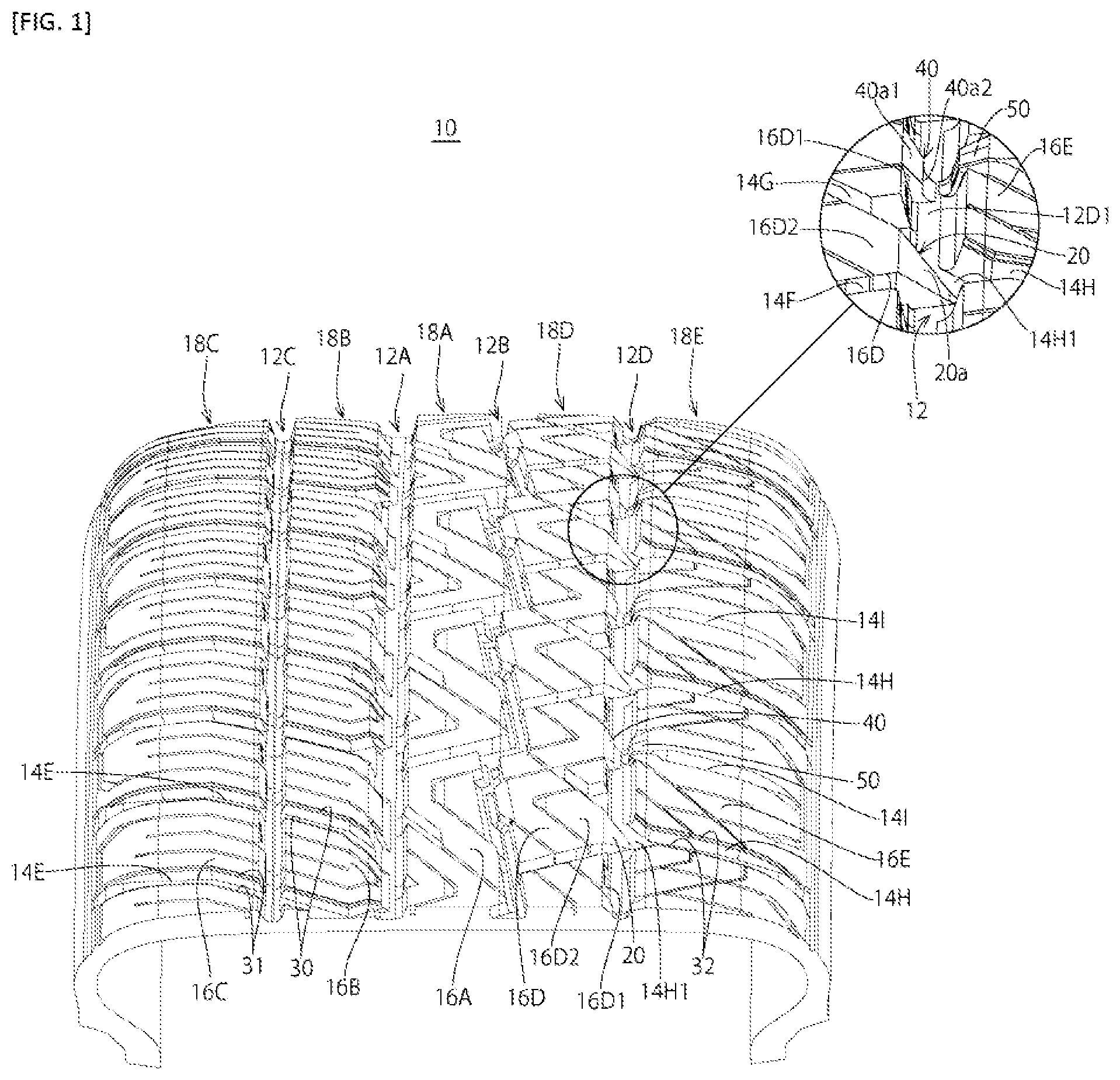
is a perspective view showing a tread pattern of a pneumatic tire according to an embodiment;
is a development view showing the tread pattern of the pneumatic tire according to an embodiment;
is a main-part enlarged plan view of the tread pattern in ;
is a cross-sectional view taken along IV-IV line in ;
is a main-part enlarged plan view of the tread pattern in ;
is a cross-sectional view taken along VI-VI line in ;
is a cross-sectional view taken along VII-VII line in ; and
is a development view showing a tread pattern of a pneumatic tire according to a modification example of the present invention.
DESCRIPTION OF EMBODIMENTS
Hereinafter, an embodiment of the present invention will be explained with reference to the drawings.
A tire according to the embodiment is a pneumatic tire, which is provided with right and left pair of bead parts and sidewalk, and a tread provided between both sidewalls so as to connect outer end portions in a radial direction of the right and left sidewalls to each other. An internal configuration of the tire is not particularly limited, and the tire is formed by including, for example, annular bead cores embedded in beads, a radial-structured carcass ply extending in a toroidal shape between the pair of beads, a belt, a tread rubber, and the like provided on an outer side in the tire radial direction of the carcass ply on the tread. In the embodiment, a general tire structure can be adopted except for a tread pattern.
Respective shapes and dimensions in this description are measured in a normal state with no load in which the tire is fitted to a normal rim and a normal internal pressure is filled unless otherwise noted. The normal rim corresponds to the “standard rim” in the JATMA standard, “Design Rim” in the TRA standard, or “Measuring Rim” in the ETRTO standard. The normal internal pressure corresponds to the “maximum air pressure” in the JATMA standard, the “maximum value” described in “TIRE LOAD LIMITS AT VARIOUS COLD INFLATION PRESSURES” in the TRA standard, or “INFLATION PRESSURE” in the ETRTO standard.
(1) Basic Structure of Tread 10
is a perspective view showing part of a tread 10 of the tire according to an embodiment, and is a partial development view of the tread 10 of the same tire. In the drawing, a symbol CL denotes a tire equatorial plane corresponding to the center in the tire axial direction. A symbol A denotes the tire axial direction (also referred to as a tire width direction). An inside in the tire axial direction A indicates the side closer to the tire equatorial plane CL. An outside in the tire axial direction A indicates the side farther from the tire equatorial plane CL. A symbol C denotes a tire circumferential direction which is a direction on a circumference centered at a tire rotation axis.
The tire shown in and is a tire in which front and back sides are designated when mounted to a vehicle. That is, a surface facing the outside and a surface facing the inside when mounted to the vehicle are designated. Accordingly, an indication for designating a mounting direction to the vehicle is provided on, for example, a sidewall surface of the tire. The tire is mounted to the vehicle so that a side denoted by a symbol OUT faces the outside (vehicle outside) in a vehicle mounted posture and a side denoted by a symbol IN faces the inside (vehicle inside) in the vehicle mounted posture in .
As shown in and , four main grooves 12 A, 12 B, 12 C, and 12 D extending in the tire circumferential direction C, lateral grooves 14 A, 14 B, 14 C, 14 D, 14 E, 14 F, 14 G, 14 H, and 14 I extending in the tire axial direction A, and blocks 16 A, 16 B, 16 C, 16 D, and 16 E are provided on the surface of the tread 10 .
Specifically, an inside center main groove 12 A provided on the vehicle inside of the tire equatorial plane CL, an outside center main groove 12 B provided on the vehicle outside of the tire equatorial plane CL, an inside shoulder main groove 12 C provided on an outer side in the tire axial direction of the inside center main groove 12 A, and an outside shoulder main groove 12 D provided on an outer side in the tire axial direction of the outside center main groove 12 B are provided on the tread 10 .
In the embodiment, the inside center main groove 12 A on the vehicle inside IN, the inside shoulder main groove 12 C on the vehicle inside IN, and the outside shoulder main groove 12 D on the vehicle outside OUT are straight main grooves extending in parallel to the tire circumferential direction C. The outside center main groove 12 B on the vehicle outside OUT is a zigzag main groove extending in the tire circumferential direction C while bending in a zigzag shape.
Note that the inside center main groove 12 A, the inside shoulder main groove 12 C, and the outside shoulder main groove 12 D may be zigzag-shaped main grooves, and the outside center main groove 12 B may be a straight-shaped main groove. That is, the main grooves 12 A, 126 , 12 C, and 12 D do not always have to be parallel to the tire circumferential direction C as long as the grooves extend in the tire circumferential direction C and may be grooves extending in the tire circumferential direction C while being inclined.
A center land area 18 A is provided between the inside center main groove 12 A and the outside main groove 126 . An inside intermediate land area 186 is provided on an inner side in the tire width direction of the inside shoulder main groove 12 C (between the inside center main groove 12 A and the inside shoulder main groove 12 C). An inside shoulder land area 18 C is provided on an outer side in the tire width direction of the inside shoulder main groove 12 C (between the inside shoulder main groove 12 C and a ground contact end). An outside intermediate land area 18 D is provided on an inner side in the tire width direction of the outside shoulder main groove 12 D (between the outside center main groove 126 and the outside shoulder main groove 12 D). An outside shoulder land area 18 E is provided on an outer side in the tire width direction of the outside shoulder main groove 12 D (namely, between the outside shoulder main groove 12 D and a ground contact end).
(2) Center Land Area 18 A
As shown in , the center land area 18 A provided between the inside center main groove 12 A and the outside center main groove 126 has a plurality of first center lateral grooves 14 A and a plurality of center blocks 16 A. The first center lateral groove 14 A is a groove extending while being inclined with respect to the tire axial direction A and opening to the inside center main groove 12 A and the outside center main groove 126 .
One side of the center blocks 16 A in the tire axial direction A is sectioned by the outside center main groove 126 extending in a zigzag shape in the tire circumferential direction C, the other side thereof is sectioned by the straight-shaped inside center main groove 12 A extending in parallel to the tire circumferential direction C, and the center blocks 16 A are divided in the tire circumferential direction C by the first center lateral grooves 14 A.
The center blocks 16 A are provided with second center lateral grooves 146 which are inclined in an opposite direction of the first center lateral grooves 14 A. The second center lateral groove 146 is a groove in which one end opens to the inside center main groove 12 A and the other end terminates in the center block 16 A. The first center lateral grooves 14 A and the second center lateral grooves 146 are alternately provided in the tire circumferential direction C. Note that the first center lateral groove 14 A and the second center lateral groove 146 may be a straight-shaped groove, a curved groove, or a groove having a bent portion.
(3) Inside Intermediate Land Area 186
As shown in and , the inside intermediate land area 188 provided on the inner side in the tire width direction of the inside shoulder main groove 12 C has a plurality of first inside intermediate lateral grooves 14 C, a plurality of second inside intermediate lateral grooves 14 D, and a plurality of inside intermediate blocks 16 B.
The first inside intermediate lateral groove 14 C and the second inside intermediate lateral groove 140 are grooves extending while being inclined with respect to the tire axial direction A and opening to the inside center main groove 12 A and the inside shoulder main groove 12 C. The first inside intermediate lateral grooves 14 C and the second inside intermediate lateral grooves 14 D are alternately provided in the tire circumferential direction C. The first inside intermediate lateral groove 14 C is formed in a straight shape. The second inside intermediate lateral groove 14 D is formed by a groove in which a portion closer to the inside shoulder main groove 12 C is parallel to the first inside intermediate lateral groove 14 C and a bent portion is formed at a center part in the tire axial direction. Note that the first inside intermediate lateral groove 14 C and the second inside intermediate lateral groove 14 D may be a straight-shaped groove, a curved groove, or a groove having a bent portion.
The inside intermediate blocks 16 B are blocks in which both sides thereof in the tire axial direction A are sectioned by the straight-shaped inside center main groove 12 A and the inside shoulder main groove 12 C extending in parallel to the tire circumferential direction C, which are divided in the tire circumferential direction C by the first inside intermediate lateral grooves 14 C and the second inside intermediate lateral grooves 14 D.
As shown in and , a step 30 extending in the tire axial direction A is formed on both end edges of the inside intermediate block 16 B in the tire circumferential direction C.
(4) Inside Shoulder Land Area 18 C
As shown in and , the inside shoulder land area 18 C provided on the outer side in the tire width direction of the inside shoulder main groove 12 C has a plurality of inside shoulder lateral grooves 14 E, and a plurality of inside shoulder blocks 16 C.
The inside shoulder lateral groove 14 E is a groove extending while being inclined with respect to the tire axial direction A and opening to the inside shoulder main groove 12 C and the ground contact end. Openings of the inside shoulder lateral grooves 14 E opening to the inside shoulder main groove 12 C are formed on extended lines of the first inside intermediate lateral groove 14 C and the second inside intermediate lateral groove 14 D. The inside shoulder lateral groove 14 E is formed by a groove having a bent portion. Note that the inside shoulder lateral groove 14 E may be a straight-shaped groove or a curved groove.
The inside shoulder blocks 16 C are blocks in which the inside thereof in the tire axial direction is sectioned by the straight-shaped inside shoulder main groove 12 C extending in parallel to the tire circumferential direction C, which are divided in the tire circumferential direction C by the inside shoulder lateral grooves 14 E.
A step 31 extending in the tire axial direction A is formed on both end edges of the inside shoulder block 16 C in the tire circumferential direction C.
(5) Outside Intermediate Land Area 13 D
As shown in and , the outside intermediate land area 18 D provided between the outside center main groove 12 B and the outside shoulder main groove 12 D has a plurality of first outside intermediate lateral grooves 14 F and a plurality of outside intermediate blocks 16 D.
The first outside intermediate lateral groove 14 F is a straight-shaped groove extending while being inclined with respect to the tire axial direction A and opening to the outside center main groove 12 B and the outside shoulder main groove 12 D.
The outside intermediate blocks 16 D are blocks in which one side thereof in the tire axial direction is sectioned by the outside center main groove 12 B extending in a zigzag shape in the tire circumferential direction C and the other side thereof is sectioned by the straight-shaped outside shoulder main groove 120 extending in parallel to the tire circumferential direction C, which are divided in the tire circumferential direction C by the first outside intermediate lateral grooves 14 F.
Each of the outside intermediate blocks 160 provided in the outside intermediate land area 18 D has a wider area of a ground contact surface than each of the inside intermediate blocks 16 B provided in the inside intermediate land area 18 B. As shown in and , when there are provided lateral grooves or grooves called sipes with a minute groove width (for example, 1 mm or less) which are closed at the time of contacting the ground in a normal load of the tire in the outside intermediate blocks 160 or the inside intermediate blocks 16 B, the area of the ground contact surface indicates an area of a block surface not including the lateral grooves and sipes.
The outside intermediate blocks 160 are provided with second outside intermediate lateral grooves 14 G which are inclined in an opposite direction of the first outside intermediate lateral grooves 14 F. The second outside intermediate lateral groove 14 G is a straight-shaped groove in which one end opens to the outside shoulder main groove 120 and the other end terminates in the outside intermediate block 16 D. The second outside intermediate lateral grooves 14 G and the first outside intermediate lateral grooves 14 F are alternately provided in the tire circumferential direction C. Note that the first outside intermediate lateral groove 14 F and the second outside intermediate lateral groove 14 G may be a straight-shaped groove, a curved groove, or a groove having a bent portion.
Moreover, a first protrusion 20 and a second protrusion 40 protruding from a side wall 1501 facing the outside shoulder main groove 12 D to the inside of the outside shoulder main groove 12 D are provided in the outside intermediate block 16 D. The details of the first protrusion 20 and the second protrusion 40 will be described later.
In addition, on a portion of the second outside intermediate lateral groove 14 G close to the outside center main groove 12 B, a sipe may be provided so as to pierce into the outside center main groove 12 B.
(6) First Protrusion 20 and Second Protrusion 40
Next, the first protrusion 20 and the second protrusion 40 will be explained mainly with reference to to .
As shown in to , the first protrusion 20 and the second protrusion 40 protrude to the inside of the outside shoulder main groove 120 from the side wall 1601 of the outside intermediate block 16 D facing the outside shoulder main groove 12 D. A protruding amount of the second protrusion 40 from the side wall 16 D 1 of the outside intermediate block 160 to the outside shoulder main groove 12 D is smaller than that of the first protrusion 20 .
The first protrusion 20 is provided in an area sandwiched between the first outside intermediate lateral groove 14 F and the second outside intermediate lateral groove 14 G which come close to each other in the tire circumferential direction C as going to the outside shoulder main groove 12 D. The second protrusion 40 is provided in an area sandwiched between the first outside intermediate lateral groove 14 F and the second outside intermediate lateral groove 14 G which are away from each other in the tire circumferential direction C as going to the outside shoulder main groove 12 D. The outside intermediate block 16 D is each provided with one first protrusion 20 and one second protrusion 40 . The first protrusions 20 and the second protrusions 40 are alternately provided in the tire circumferential direction C.
The first protrusion 20 has a first protrusion inclined surface 20 a which connects a ground contact surface 16 D 2 of the outside intermediate block 160 to a groove bottom 1201 of the outside shoulder main groove 120 as shown in and . The first protrusion inclined surface 20 a is formed by a plane inclined so that a protruding height from the groove bottom 1201 becomes smaller as going to a tip end 2013 (namely, as coming dose to the outside shoulder land area ISE). The first protrusion inclined surface 20 a is smoothly connected to the groove bottom 12 D 1 with a curved surface near the groove bottom 12 D 1 of the outside shoulder main groove 12 D.
The first protrusion 20 has a side wall 20 c provided on one side in the tire circumferential direction C and a side wall 20 d provided on the other side. One side wall 20 c is placed on the same plane as a side wall 16 D 3 of the outside intermediate block 16 D, which faces the first outside intermediate lateral groove 14 F. The other side wall 20 d is placed on the same plane as a side wall 16 D 4 of the outside intermediate block 16 D, which faces the second outside intermediate side groove 14 G. The side wall 20 c and the side wall 20 d are inclined so that an interval therebetween comes close to each other as going to the tip end 20 b of the first protrusion 20 . The first protrusion inclined surface 20 a thus forms a trapezoidal shape in which a length in the tire circumferential direction C becomes shorter as going to the tip end 20 b when seen from the tire radial direction as shown in .
The above first protrusion 20 is provided so that at least part of the tip end 20 b overlaps with a portion 14 H 1 where the first outside shoulder lateral groove 14 H opens to the outside shoulder main groove 12 D (hereinafter, the portion may be referred to as a shoulder opening 14 H 1 ) in the tire axial direction A.
In the first protrusion 20 , the tip end 20 b is preferably arranged so that the center in the tire circumferential direction C of the tip end 20 b overlaps with the center in the tire circumferential direction of the shoulder opening 14 H 1 in an extended direction of the first outside shoulder lateral groove 14 H. Moreover, a length in the tire circumferential direction C of the tip end 20 b of the first protrusion 20 is preferably shorter than a length in the tire circumferential direction C of the shoulder opening 14 H 1 .
The second protrusion 40 has a second protrusion inclined surface 40 a which connects the ground contact surface 1602 of the outside intermediate block 161 to the groove bottom 1201 of the outside shoulder main groove 120 as shown in and . The second protrusion inclined surface 40 a forms a trapezoidal shape in which a length in the tire circumferential direction C becomes shorter as going to a tip end 40 b when seen from the tire radial direction as shown in . In the embodiment, a length in the tire circumferential direction C of the tip end 40 b of the second protrusion 40 is longer than the length in the tire circumferential direction C of the tip end 20 b of the first protrusion 20 .
The second protrusion inclined surface 40 a has a ground contact surface side inclined surface 40 a 1 connected to the ground contact surface 1602 of the outside intermediate block 160 and a groove bottom side inclined surface 40 a 2 connected to a tip end side of the ground contact surface side inclined surface 40 a 1 as shown in . The ground contact surface side inclined surface 40 a 1 is formed by a plane inclined so that a protruding height from the groove bottom 1201 becomes smaller as going to the tip end 40 b of the second protrusion 40 (namely, as coming close to the outside shoulder land area 18 E). The groove bottom side inclined surface 40 a 2 is formed by a plane provided approximately in parallel to the tire radial direction. The groove bottom side inclined surface 40 a 2 is smoothly connected to the groove bottom 1201 with a curved surface near the groove bottom 1201 of the outside shoulder main groove 120 .
(7) Outside Shoulder Land Area 18 E
As shown in and , the outside shoulder land area 18 E provided on the outer side in the tire width direction of the outside shoulder main groove 120 has a plurality of first outside shoulder lateral grooves 14 H, and a plurality of outside shoulder blocks 16 E. The first outside shoulder lateral groove 14 H is a straight-shaped groove extending while being inclined with respect to the tire axial direction A and opening to the outside shoulder main groove 12 D and the ground contact end.
The outside shoulder blocks 16 E are blocks in which the inside thereof in the tire axial direction A is sectioned by the straight-shaped outside shoulder main groove 12 D extending in parallel to the tire circumferential direction C, which are divided in the tire circumferential direction C by the first outside shoulder lateral grooves 14 H.
Each of the outside shoulder blocks 16 E provided in the outside shoulder land area 18 E has a wider area of a ground contact surface than each of the inside shoulder blocks 16 C provided in the inside shoulder land area 18 C. Note that, when there are provided lateral grooves or sipes in the outside shoulder blocks 16 E or the inside shoulder blocks 16 C as shown in , the area of the ground contact surface indicates an area of a block surface not including the lateral grooves and sipes.
The outside shoulder block 16 E has a first side wall 16 E 1 and a second side wall 16 E 2 which face the first outside shoulder lateral grooves 14 H.
On the outside shoulder main groove 12 D side of the first side wall 16 E 1 , a first shoulder inclined surface 16 E 3 which is inclined with respect to the first side wall 16 E 1 so that a groove width of the first outside shoulder lateral groove 14 H is widened as coming close to the outside shoulder main groove 12 D. The first shoulder inclined surface 16 E 3 is formed by a plane which is parallel to an extended direction of the first outside intermediate lateral groove 14 F.
On the outside shoulder main groove 12 D side of the second side wall 16 E 2 , a second shoulder inclined surface 16 E 4 which is inclined with respect to the second side wall 16 E 2 so that the groove width of the first outside shoulder lateral groove 14 H is widened as coming close to the outside shoulder main groove 12 D. The second shoulder inclined surface 16 E 4 is formed by a plane which is parallel to an extended direction of the second outside intermediate lateral groove 14 G.
The outside shoulder main groove 12 D has the widest groove width at the shoulder opening 14 H 1 due to the first shoulder inclined surface 16 E 3 and the second shoulder inclined surface 16 E 4 . In the embodiment, the shoulder opening 14 H 1 of the first outside shoulder lateral groove 14 H is placed on the extension of the first outside intermediate lateral groove 14 F, and the shoulder opening 14 H 1 of the first outside shoulder lateral groove 14 H is placed on the extension of the second outside intermediate lateral groove 14 G.
When the pneumatic tire is a tire in which a rotation direction is designated, it is preferable that the first shoulder inclined surface 16 E 3 that is wider than the second shoulder inclined surface 16 E 4 is provided on a kicking side of the outside shoulder block 16 E (a rear side in the rotation direction), and the second shoulder inclined surface 16 E 4 narrower than the first shoulder inclined surface 16 E 3 is provided on a stepping side (a front side in the rotation direction).
A step 32 extending in the tire axial direction A is formed on both end edges of the outside shoulder block 16 E in the tire circumferential direction C.
Moreover, the outside shoulder block 16 E is provided with a chamfered portion 50 that is inclined from a ground contact surface 16 E 5 to a side wall 16 E 6 facing the outside shoulder main groove 12 D, and a second outside shoulder lateral groove 14 I extending in parallel to the first outside shoulder lateral groove 14 H.
The chamfered portion 50 is provided at a position facing the second protrusion 40 provided in the outside intermediate block 16 D with the outside shoulder main groove 12 D interposed therebetween. The chamfered portion 50 may protrude from the side wall 16 E 6 facing the outside shoulder main groove 120 in the outside shoulder block 16 E to the outside shoulder main groove 120 as shown in and .
The second outside shoulder lateral groove 14 I is a groove in which one end opens to the ground contact end and the other end terminates in the outside shoulder block 16 E. The first outside shoulder lateral grooves 14 H and the second outside shoulder lateral grooves 14 I are alternately provided in the tire circumferential direction C.
Note that the first outside shoulder lateral groove 14 H and the second outside shoulder lateral groove 14 I may be a straight-shaped groove, a curved groove, or a groove having a bent portion.
Moreover, on portions of the second outside shoulder lateral grooves 14 I close to the outside shoulder main groove 12 D, cuts called sipes with a minute groove width (for example, 1 mm or less) which are closed at the time of contacting the ground in the normal load of the tire may be provided so as to pierce into the outside shoulder main groove 120 .
(B) Steps 30 , 31 , 32
In the inside intermediate block 16 B and the outside intermediate block 16 D, the step 30 is provided in the inside intermediate block 16 B in which the area of the ground contact surface is smaller; however, the step is not provided on a circumferential edge of the outside intermediate block 16 D in the embodiment.
Among the blocks 16 A, 16 B, 16 C, 16 D, and 16 E provided on the tread 10 , the steps 30 , 31 , and 32 are provided in the inside intermediate block 16 B, the inside shoulder block 16 C, and the outside shoulder block 16 E in which sides thereof in the tire axial direction A are sectioned only by straight-shaped straight main grooves extending in parallel to the tire circumferential direction C; however, the step is not provided in the center block 16 A and the outside intermediate block 16 D in which one side thereof in the tire axial direction A is sectioned by the zigzag groove (outside center main groove 12 B) extending in a zigzag shape in the tire circumferential direction C.
The step 30 provided in the inside intermediate block 166 is formed by a recess formed by a first surface 30 a and a second surface 30 b as shown in . The step 30 is provided on the entire edge formed by the side wall 1661 of the inside intermediate block 166 facing the first inside intermediate lateral groove 14 C or the second inside intermediate lateral groove 14 D and the ground contact surface 16 B 2 of the inside intermediate block 16 B.
The first surface 30 a is a surface provided on an inner side in the tire radial direction than the ground contact surface 16 B 2 and facing the outside in the tire radial direction. The second surface 30 b is a surface standing from the first surface 30 a outward in the radial direction and connecting the first surface 30 a and the ground contact surface 1662 .
The step 31 provided in the inside shoulder block 16 C is formed by a recess formed by a first surface facing the outside in the tire radial direction and a second surface connecting the first surface and the ground contact surface 1602 of the inside shoulder block 16 C in the same manner as the step 30 . The step 31 is provided on the entire edge formed by the side wall 16 C 1 of the inside shoulder block 16 C facing the inside shoulder lateral groove 14 E and the ground contact surface 16 C 2 of the inside shoulder block 16 C.
The step 32 provided in the outside shoulder block 16 E is formed by a recess formed by a first surface facing the outside in the tire radial direction and a second surface connecting the first surface and the ground contact surface 16 E 5 of the outside shoulder block 16 E in the same manner as the steps 30 and 31 . The step 32 is provided on the entire edge formed by the side wall 16 E 1 or 16 E 2 of the outside shoulder block 16 E facing the first outside shoulder lateral groove 14 H and the ground contact surface 16 E 5 of the outside shoulder block 16 E.
The step 30 provided in the inside intermediate block 166 , the step 31 provided in the inside shoulder block 16 C, and the step 32 provided in the outside shoulder block 16 E have the same cross-sectional shape in the embodiment. For example, a depth of the steps 30 , 31 , and 32 (a length in the tire radial direction from the ground contact surfaces 1662 , 16 C 2 , and 16 E 5 to the first surface 30 a ) H is preferably 5 to 50% of a depth of the lateral grooves 14 C, 14 D, 14 E, and 14 H, and can be, for example, 0.5 to 2.0 mm. A width W of the steps 30 , 31 , and 32 (a length from the side wall of the blocks where the steps 30 , 31 , and 32 are provided to the second surface 30 b ) can be set to be smaller than the depth H of the steps 30 , 31 , and 32 , and can be, for example, 0.2 to 2.0 mm.
(9) Advantageous Effects
In the inside intermediate block 16 B and the outside intermediate block 16 D, the step 30 is provided in the inside intermediate block 166 in which the area of the ground contact surface is smaller; however, the step is not provided in the outside intermediate block 16 D in which the area of the ground contact surface is larger in the embodiment. Therefore, it is possible to increase block rigidity of the inside intermediate block 166 where the area of the ground contact surface is small and the block rigidity tends to be lowered, and it is possible to suppress uneven wear generated between the inside intermediate block 166 and the outside intermediate block 16 D.
Among the blocks 16 A, 16 B, 16 C, 16 D, and 16 E provided on the tread 10 , the steps 30 , 31 , and 32 are provided in the inside intermediate block 16 B, the inside shoulder block 16 C, and the outside shoulder block 16 E in which sides thereof in the tire axial direction A are sectioned only by straight-shaped straight main grooves extending in parallel to the tire circumferential direction C in the embodiment. On the other hand, the step is not provided in the center block 16 A and the outside intermediate block 16 D in which one side in the tire axial direction A is sectioned by the outside center main groove 12 B extending in a zigzag shape in the tire circumferential direction C. The block rigidity tends to be lowered in the blocks 166 , 16 C, and 16 E in which sides in the tire axial direction A are sectioned only by the straight-shaped straight main grooves as compared with the blocks 16 A and 16 D in which sides in the tire axial direction A are sectioned by the zigzag-shaped zigzag main groove; however, it is possible to increase the block rigidity of the blocks 16 B, 16 C, and 16 E and to suppress uneven wear generated between the blocks 166 , 16 C, 16 E and the blocks 16 A, 16 D.
Furthermore, the first protrusions 20 protruding to the outside shoulder main groove 121 are provided in the outside intermediate blocks 16 D in the embodiment; therefore, the rigidity of the outside intermediate blocks 16 D can be improved and steering stability can be improved.
Since at least part of the tip end 20 b of the first protrusion 20 overlaps with the shoulder opening 14 H 1 in the tire axial direction A in the embodiment, the groove width of the outside shoulder main groove 120 is not easily narrowed even when the first protrusion 20 protrudes to the main groove 120 , and drainage performance can be secured.
Additionally, the first protrusion 20 has the first protrusion inclined surface 20 a that is inclined so that the protruding height from the groove bottom 12 D 1 gradually smaller as going to the tip end 20 b from the ground contact surface 1602 of the outside intermediate block 16 D to the groove bottom 12131 of the outside shoulder main groove 12 D. Therefore, water entering the outside shoulder main groove 12 D is easily led to the first outside shoulder lateral groove 14 H by the first protrusion inclined surface 20 a and drainage performance can be increased.
In the embodiment, the first protrusion inclined surface 20 a of the first protrusion 20 forms the trapezoidal shape in which the length in the tire circumferential direction C becomes shorter as going to the tip end 20 b when seen from the tire radial direction, and the rigidity of the first protrusion 20 can be increased as compared with a protrusion having a rectangular shape. Therefore, desired rigidity can be obtained in the outside intermediate block 16 D even with the first protrusion 20 that is relatively small, and the block rigidity of the outside intermediate block 160 can be increased while securing drainage performance.
The outside shoulder block 16 E is provided with the first shoulder inclined surface 16 E 3 and the second shoulder inclined surface 16 E 4 which are inclined so that the groove width of the first outside shoulder lateral groove 14 H is widened in the first side wall 16 E 1 and the second side wall 16 E 2 facing the first outside shoulder lateral grooves 14 H in the embodiment. Therefore, water entering the outside shoulder main groove 12 D is easily drained to the first outside shoulder lateral groove 14 H, and drainage performance can be increased.
Moreover, the first shoulder inclined surface 16 E 3 and the second shoulder inclined surface 16 E 4 are provided at block corner parts where uneven wear easily occurs in the outside shoulder block 16 E; therefore, an angle at a corner part formed by the outside shoulder main groove 120 and the outside shoulder lateral groove 14 crossing each other becomes large, which suppresses wear in the corner part and suppressing uneven wear in the outside intermediate block 16 D.
Furthermore, the first shoulder inclined surface 16 E 3 is formed by the plane which is parallel to the extended direction of the first outside intermediate lateral groove 14 F and the second shoulder inclined surface 16 E 4 is formed by the plane which is parallel to the extended direction of the second outside intermediate lateral groove 14 G; therefore, water flowing from the first outside intermediate lateral groove 14 F or the second outside intermediate lateral groove 14 G to the outside shoulder main groove 12 D is guided by the first shoulder inclined surface 16 E 3 or the second shoulder inclined surface 16 E 4 and is easily drained to the first outside shoulder lateral groove 14 H.
(10) Modification Examples
The above embodiment is exemplification, and the range of the invention is not limited to the above embodiment. Various modifications may occur in the above embodiment within a scope not departing from the gist of the invention. A plurality of modification examples will be explained below, and any one of the plurality of modification examples may be applied or two or more of the plurality of modification examples may be combined and applied to the embodiment.
Modification Example 1
The steps 31 and 32 are provided in the inside shoulder block 16 C and the outside shoulder block 16 E in the above embodiment; however, it is also preferable that the step is not provided in the outside shoulder block 16 E in which the area of the ground contact surface is larger and the step is provided on at least part of a circumferential edge of the inside shoulder block 16 C in which the area of the ground contact surface is smaller.
Modification Example 2
The steps 30 , 31 , and 32 are provided on end edges in the tire circumferential direction of the inside intermediate block 166 , the inside shoulder block 16 C, and the outside shoulder block 16 E, and the step is not provided on end edges in the tire axial direction of these blocks 166 , 16 C, and 16 E (namely, side walls of the inside intermediate block 16 B facing the main grooves); however, steps may be provided only on end edges in the tire axial direction of the blocks 16 B, 16 C, and 16 E or the step may be provided on the entire circumferential edge of the inside intermediate block 166 .
Modification Example 3
The modification example 3 of the above embodiment will be explained with reference to . In the drawings showing the modification example, the same symbols as the above embodiment are given to components similar to the above embodiment.
In the example of , there exist a large protrusion 1201 in which the area of the first protrusion inclined surface 20 a is large, a small protrusion 120 S in which the area of the first protrusion inclined surface 20 a is smaller than the large protrusion 1201 , and a middle protrusion 120 M in which the area of the first protrusion inclined surface 20 a is smaller than the large protrusion 1201 and larger than the small protrusion 120 S as the first protrusions 20 provided in the outside intermediate blocks 16 D.
In addition, there exist a large shoulder lateral groove 114 H 1 in which the groove width of the shoulder opening 14 H 1 is larger, a small shoulder lateral groove 114 HS in which the groove width of the shoulder opening 14 H 1 is smaller than the large shoulder lateral groove 114 HL, and a middle shoulder lateral groove 114 HM in which the groove width of the shoulder opening 14 H 1 is smaller than the large shoulder lateral groove 114 HL and larger than the small shoulder lateral groove 114 HS as the first outside shoulder lateral grooves 14 H provided in the outside shoulder land area 18 E.
The large protrusion 120 L is provided so as to overlap with the large shoulder lateral groove 114 HL in the tire axial direction A, the small protrusion 120 S is provided so as to overlap with the small shoulder lateral groove 114 HS in the tire axial direction A, and the middle protrusion 120 M is provided so as to overlap the middle shoulder lateral groove 114 HM in the tire axial direction A.
In the modification example having the above configuration, it is possible to reduce pitch noise generated during traveling of the vehicle while securing drainage performance.
REFERENCE SIGNS LIST
•
• 10 : tread • 12 A: inside center main groove • 12 B: outside center main groove • 12 C: inside shoulder main groove • 12 D: outside shoulder main groove • 12 D 1 : groove bottom • 14 A: first center lateral groove • 14 B: second center lateral groove • 14 C: first inside intermediate lateral groove • 140 : second inside intermediate lateral groove • 14 E: inside shoulder lateral groove • 14 F: first outside intermediate lateral groove • 14 G: second outside intermediate lateral groove • 14 H: first outside shoulder lateral groove • 14 H 1 : shoulder opening • 14 I: second outside shoulder lateral groove • 16 A: center block • 158 : inside intermediate block • 16 B 1 : side wall • 16 B 2 : ground contact surface • 16 C: inside shoulder block • 1601 : side wall • 16 C 2 : ground contact surface • 16 D: outside intermediate block • 16 D 1 : side wall • 16 D 2 : ground contact surface • 16 D 3 : side wall • 16 D 4 : side wall • 16 E: outside shoulder block • 16 E 1 : first side wall • 16 E 2 : second side wall • 16 E 3 : first shoulder inclined surface • 16 E 4 : second shoulder inclined surface • 16 E 5 : ground contact surface • 16 E 6 : side wall • 18 A: center land area • 188 : inside intermediate land area • 18 C: inside shoulder land area • 18 D: outside intermediate land area • 18 E: outside shoulder land area • 20 : first protrusion • 20 a : first protrusion inclined surface • 20 b : tip end • 20 c : side wall • 20 d : side wall • 30 : step • 31 : step • 32 : step • 40 : second protrusion • 40 a : second protrusion inclined surface • 40 a 1 : ground contact surface side inclined surface • 40 a 2 : groove bottom side inclined surface • 50 : chamfered portion
Figures (7)
Citations
This patent cites (3)
- US1870258
- US2011-46223
- US2011051431