Abstract
A valve seat unit according to an embodiment of the present disclosure, includes: a base; a valve seat including a seat surface for a valve to sit on and configured separately from the base; and a bolt securing the valve seat to the base. A head portion of the bolt is located between the seat surface and a seat back surface of the valve seat located opposite to the seat surface.
Claims (6)
1 . A valve seat unit, comprising: a valve seat including a seat surface for a valve to sit on and a seat back surface located opposite to the seat surface; a base configured separately from the valve seat and supporting the valve seat; and a bolt securing the valve seat to the base, wherein a head portion of the bolt is located between the seat surface and the seat back surface, wherein the base includes a support surface in contact with the seat back surface and supporting the valve seat, wherein the valve seat formed in a ring shape further includes a chamfered portion connected to one radial end of the seat back surface, wherein the base further includes a base corner portion facing the chamfered portion, and wherein the valve seat unit further comprises an O-ring disposed between the base corner portion and the chamfered portion.
5 . A reciprocating compressor, comprising: a cylinder which internally forms a cylinder chamber; a piston housed in the cylinder chamber and capable of reciprocating inside the cylinder; an intake valve disposed around the cylinder chamber; a ring-shaped intake valve seat including a seat surface for the intake valve to be seated on, and a seat back surface located opposite to the seat surface; a base configured separately from the intake valve seat and supporting the intake valve seat from a side of the seat back surface; and a bolt securing the intake valve seat to the base, wherein the seat surface includes: an inner seat formed in an annular shape; and an outer seat formed in an annular shape so as to surround the inner seat, the intake valve being configured to seat on both of the inner seat and the outer seat, and wherein the intake valve seat has a recessed portion for housing a head portion of the bolt between the inner seat and the outer seat such that the head portion is located between the seat surface and the seat back surface, the recessed portion facing the annular intake valve.
Show 4 dependent claims
2 . The valve seat unit according to claim 1 , wherein the seat surface has: an inner seat formed in an annular shape; and an outer seat formed in an annular shape so as to surround the inner seat, and wherein the bolt is located between the inner seat and the outer seat.
3 . The valve seat unit according to claim 1 , wherein the valve seat is formed by a metal material.
4 . The valve seat unit according to claim 1 , wherein the valve seat is formed by a resin material.
6 . The reciprocating compressor according to claim 5 , wherein the base includes a flange formed integrally with the cylinder.
Full Description
Show full text →
TECHNICAL FIELD
The present disclosure relates to a valve seat unit.
BACKGROUND
A valve seat unit for seating a valve is known. In Patent Document 1, a seat plate as a valve seat for seating a discharge valve of a compressor is formed integrally with a cylinder.
CITATION LIST
Patent Literature
•
• Patent Document 1: JPH9-158878A
SUMMARY
Technical Problem
However, in the above-described patent document, when the valve seat plate is replaced for reasons of, for example, wear, etc., the cylinder needs to be replaced together with the seat plate, and the cylinder may be subject to disposal. In seeking a solution thereto, it is required that seating performance of the discharge valve is not impaired.
An object of the present disclosure is to provide a valve seat unit that can reduce the number of parts to be disposed of in replacement work and can stably seat the valve.
Solution to Problem
A valve seat unit according to at least one embodiment of the present disclosure, includes: a valve seat including a seat surface for a valve to sit on and a seat back surface located opposite to the seat surface; a base configured separately from the valve seat and supporting the valve seat; and a bolt securing the valve seat to the base. A head portion of the bolt is located between the seat surface and the seat back surface.
Advantageous Effects
According to the present disclosure, it is possible to provide a valve seat unit that can reduce the number of parts to be disposed of in replacement work and can stably seat the valve.
BRIEF DESCRIPTION OF DRAWINGS
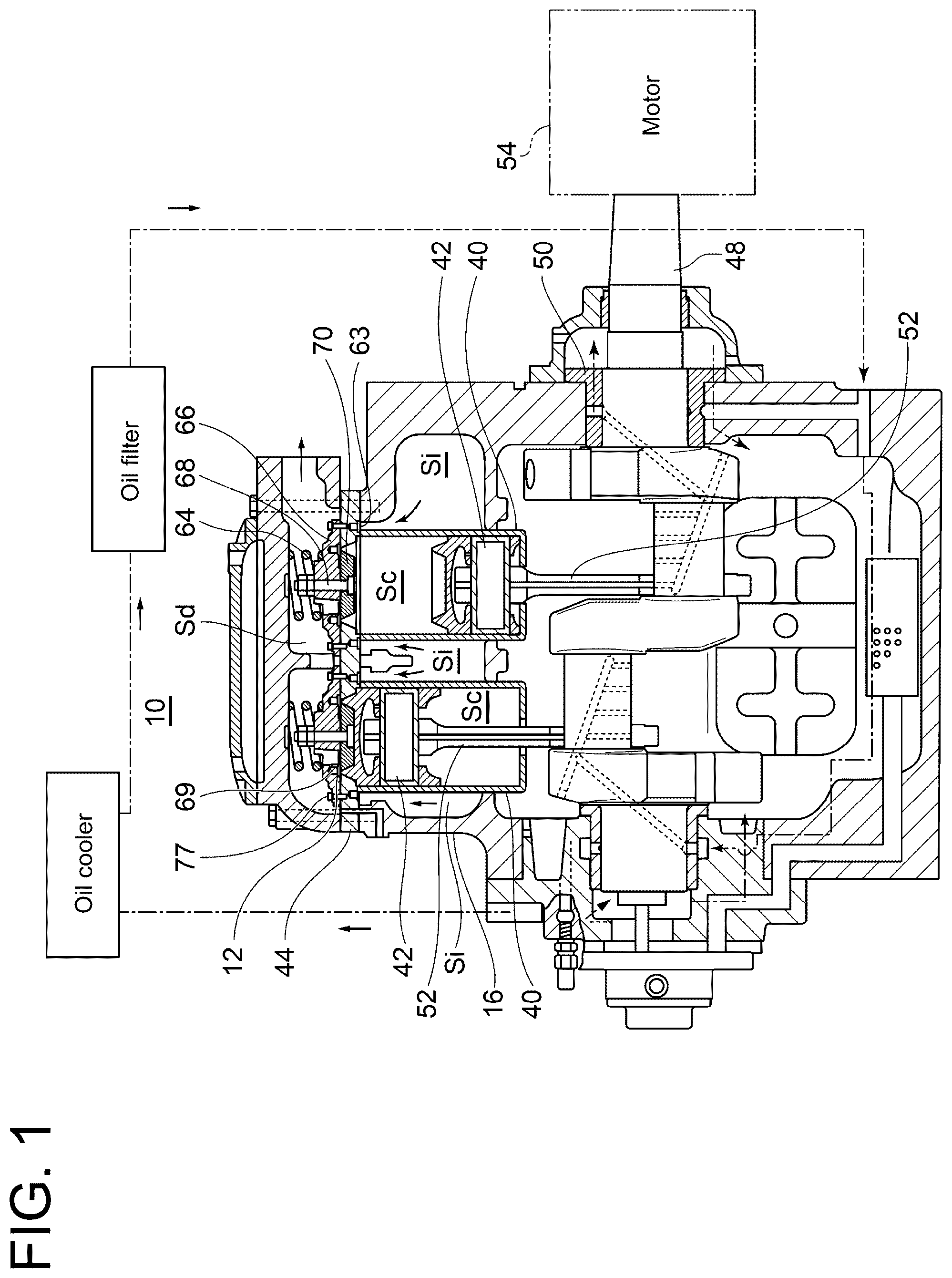
is a conceptual cross-sectional view of a reciprocating compressor according to an embodiment.
A is a conceptual view of a valve seat unit according to an embodiment for an intake valve.
B is a conceptual view of a valve seat unit according to another embodiment for the intake valve.
is a conceptual view of a valve seat according to an embodiment for a discharge valve.
DETAILED DESCRIPTION
Some embodiments of the present disclosure will be described below with reference to the accompanying drawings. It is intended, however, that unless particularly identified, dimensions, materials, shapes, relative positions and the like of components described or shown in the drawings as the embodiments shall be interpreted as illustrative only and not intended to limit the scope of the present disclosure.
For instance, an expression of relative or absolute arrangement such as “in a direction”, “along a direction”, “parallel”, “orthogonal”, “centered”, “concentric” and “coaxial” shall not be construed as indicating only the arrangement in a strict literal sense, but also includes a state where the arrangement is relatively displaced by a tolerance, or by an angle or a distance whereby it is possible to achieve the same function.
For instance, an expression of an equal state such as “same”, “equal”, and “uniform” shall not be construed as indicating only the state in which the feature is strictly equal, but also includes a state in which there is a tolerance or a difference that can still achieve the same function.
Further, for instance, an expression of a shape such as a rectangular shape or a tubular shape shall not be construed as only the geometrically strict shape, but also includes a shape with unevenness or chamfered corners within the range in which the same effect can be achieved.
On the other hand, the expressions “comprising”, “including” or “having” one constitutional element is not an exclusive expression that excludes the presence of other constitutional elements.
The same configurations are indicated by the same reference characters and may not be described again in detail.
1. OVERVIEW OF RECIPROCATING COMPRESSOR 10
is a conceptual cross-sectional view of a reciprocating compressor 10 (hereinafter, may be referred to as the “compressor 10 ”) according to an embodiment of the present disclosure. The compressor 10 is incorporated into a refrigeration cycle including a plurality of heat exchangers, for example, a condenser and an evaporator. As the refrigeration cycle, a binary refrigeration cycle, a two-stage compression refrigeration cycle, a reverse Brayton refrigeration cycle, or the like can be given. In this case, a gas compressed by the compressor 10 is a refrigerant gas.
In another embodiment, the compressor 10 may be incorporated into an internal combustion engine, etc. and a gas compressed by the compressor 10 may be a combustion gas, etc.
The compressor 10 according to an embodiment of the present disclosure includes a crankcase 16 and a plurality of cylinders 40 housed in the crankcase 16 . Each cylinder 40 internally forms a cylinder chamber Sc where a piston 42 is housed. Each piston 42 is connected to a crank shaft 48 , which is supported by a bearing 50 disposed in the crankcase 16 , via a connecting rod 52 , etc. Further, one end of the crank shaft 48 is connected to a motor 54 , and each piston 42 can reciprocate inside each cylinder 40 when driven by the motor 54 .
In the exemplary embodiment shown in , two cylinders 40 are disposed in parallel, and the pistons 42 in the two cylinders 40 are connected to the crank shaft 48 so as to reciprocate in phases different by 180° at a rotation angle of the crank shaft 48 .
In the following description, the axial direction of the cylinder 40 may simply be referred to as the “axial direction”. In the present embodiment, the axial direction coincides with the vertical direction, and the crank shaft 48 extends in the horizontal direction.
On one end side of the cylinder 40 (an upper end side of the cylinder 40 in ), a mechanism for supporting a discharge valve 12 is mounted. This mechanism includes a valve plate 44 , a valve seat 110 C (see ) which is separate from the valve plate 44 , and a discharge valve seat 70 in truncated conical shape disposed inside an opening formed in the valve plate 44 . The discharge valve seat 70 is coupled to a valve cage 66 by a bolt 68 , and the discharge valve 12 is held between the discharge valve seat 70 and the valve cage 66 . Further, the valve cage 66 is biased toward the cylinder 40 by a head spring 64 . Further, the discharge valve 12 is biased toward valve seat 110 C and the discharge valve seat 70 by a valve spring (not shown) housed in a spring hole 69 disposed in the valve cage 66 .
The compressor 10 according to an embodiment of the present disclosure further includes an intake valve 63 disposed around the cylinder chamber Sc of the cylinder 40 , and a valve seat 110 A (see A ) as an intake valve seat, which is configured to seat the intake valve 63 . The intake valve 63 has an O-ring shape extending continuously over the circumferential direction with the axis of the cylinder 40 as a reference. In another embodiment, the intake valve 63 may be a plurality of plate valves arranged along the circumferential direction.
An overview of an operation of the compressor 10 shown in is as follows.
When the piston 42 is lowered and a closed space in the cylinder chamber Sc is depressurized as the motor 54 is driven, a pressure in an intake space Si formed outside the cylinder 40 exceeds the pressure in the closed space by a certain degree. The intake valve 63 seated on the valve seat 110 A (see A ) is pushed up, and a gas in the intake space Si is sucked into the cylinder chamber Sc through the valve seat 110 A. Thereafter, the piston 42 finishes its descent and begins to rise. As a result of the gas being compressed by the piston 42 and the closed space being pressurized, the intake valve 63 is pushed down and seated on the valve seat 110 A. When the piston 42 rises further and the pressure in the closed space exceeds a pressure in a discharge space Sd by a certain degree, the discharge valve 12 is pushed up and the compressed gas in the cylinder chamber Sc is discharged to the discharge space Sd. When the piston 42 then begins to descend, the pressure in the closed space of the cylinder chamber Sc is reduced, and the discharge valve 12 is biased by a valve spring and is seated on the valve seat 110 C and the discharge valve seat 70 .
2. VALVE SEAT UNIT 20
Details of a valve seat unit 20 which is a component of the compressor 10 will be exemplified with reference to A, 2 B and 3 . The valve seat unit 20 according to an embodiment of the present disclosure is a unit for seating the valve (the intake valve 63 or the discharge valve 12 ). Hereinafter, valve seat units 20 A, 20 B for seating the intake valve 63 will be described with reference to A, 2 B , respectively, and a valve seat unit 20 C for seating the discharge valve 12 will be described with reference to . Further, in the following description, the valve seat units 20 A to 20 C may collectively be referred to as the “valve seat unit 20 ”.
<2-1. Details of Valve Seat Unit 20 A for Intake Valve>
Details of the valve seat unit 20 A according to an embodiment for the intake valve will be exemplified with reference to A . In A , some components are illustrated without hatching for convenience of viewing the drawing (the same also applies to B, 3 ).
The valve seat unit 20 A includes a valve seat 110 A ( 110 ) having a seat surface 111 A ( 111 ) for the intake valve 63 to sit on, a base 80 A ( 80 ) configured separately from the valve seat 110 A, a bolt 150 A ( 150 ) securing the valve seat 110 A to the base 80 A, and a gasket 31 interposed between the valve seat 110 A and the valve plate 44 . The seat surface 111 A is formed in an O-ring shape, as an example.
The base 80 A of the present embodiment includes the above-described cylinder 40 and a flange 81 A formed integrally with the cylinder 40 . Further, the valve seat 110 A includes a seat back surface 112 A ( 112 ) located opposite to the seat surface 111 A. The base 80 A of the present embodiment has a flange 81 A in contact with the seat back surface 112 , and this flange 81 A supports the valve seat 110 A. The bolt 150 A secures the valve seat 110 A to the flange 81 A. A shaft portion 152 A of the bolt 150 A in the present example penetrates the flange 81 A, and a nut 159 is screwed to the shaft portion 152 A protruding from the flange 81 A. By screwing the nut 159 , a head portion 151 A of the bolt 150 presses the valve seat 110 A against the flange 81 A, thereby fixing the valve seat 110 A to the flange 81 A.
The head portion 151 A of the bolt 150 A in the present embodiment is arranged at an axial position between the seat surface 111 A and the seat back surface 112 A. As a more specific example, the entire head portion 151 A is housed in a recessed portion 79 disposed in the valve seat 110 A. The shaft portion 152 A of the bolt 150 A described above is inserted into a through hole formed in the bottom of the recessed portion 79 . The recessed portion 79 according to an embodiment is formed integrally with the seat surface 111 A and is recessed toward the seat back surface 112 A.
A back seat 45 formed in the valve plate 44 is disposed in line with the above-described seat surface 111 A in the axial direction, and the intake valve 63 is configured to move between the back seat 45 and the seat surface 111 A (arrow M). A spring may be disposed between the intake valve 63 and the back seat 45 (that is, the intake valve 63 may not be in direct contact with the back seat 45 ). The back seat 45 is located on an inner side of the gasket 31 formed in an annular shape.
Details of an operation of seating the intake valve 63 on the valve seat 110 A having the above configuration are as follows. When the closed space of the cylinder 40 is pressurized as the piston 42 rises, the intake valve 63 having been pushed up moves toward the seat surface 111 A. When at least part of the intake valve 63 contacts the seat surface 111 A, various forces act on the intake valve 63 . For example, when the axis of the intake valve 63 is inclined with respect to the vertical direction (not shown), the intake valve 63 rotates on its own axis with a portion of one side of the intake valve 63 sliding against the seat surface 111 A (as the intake valve 63 rotates on its own axis, the portion of the one side of the intake valve 63 , which is in contact with the seat surface 111 A, may change). Then, when the momentum of the rotation of the intake valve 63 on its own axis weakens, the intake valve 63 comes to rest and is seated on the seat surface 111 A.
By seating the intake valve 63 , the valve seat 110 A exhibits a gas sealing function. That is, the valve seat 110 A makes the intake space Si and the closed space of the cylinder 40 non-communicative with each other, and restricts gas flow between the two spaces.
Since the head portion 151 A is located between the seat surface 111 A and the seat back surface 112 A, the intake valve 63 does not contact the head portion 151 A during the seating process and therefore, the head portion 151 A does not affect the seating of the intake valve 63 .
As described above, since a frictional force is generated between the intake valve 63 and the valve seat 110 A, the valve seat 110 A may fail due to wear, etc. if the compressor 10 is operated for a long period of time. In this case, the valve seat 110 A is replaced. For example, the specific replacement work is as follows.
First, the valve plate 44 , the gasket 31 , and the intake valve 63 are removed in sequence. Thereafter, the nut 159 is loosened and the bolt 150 A is removed. Whereby, the valve seat 110 A is removed from the base 80 A and replaced with a new valve seat 110 A. Thereafter, the new valve seat 110 A is placed on the base 80 A, and the bolt 150 A, the nut 159 , the intake valve 63 , the gasket 31 , and the valve plate 44 are assembled in sequence, completing the replacement work. In the above-described replacement work, the valve seat 110 A including the cylinder 40 may be removed from the crankcase 16 before the nut 159 is loosened.
According to the above configuration, even if the valve seat 110 A fails, the valve seat 110 A can be removed from the base 80 A by removing the bolt 150 A and replaced with another valve seat 110 A. That is, the base 80 A need not be replaced. Whereby, the base 80 A can be excluded from parts to be disposed of as a result of the replacement work, making it possible to reduce the number of parts to be disposed of. Further, since the head portion 151 A of the bolt 150 A is located between the seat surface 111 A and the seat back surface 112 A, the bolt 150 A does not affect the seating of the intake valve 63 in the valve seat 110 A. In view of the above, the valve seat 110 A is achieved which can reduce the number of parts to be disposed of in the replacement work and can stably seat the intake valve 63 .
In the embodiment illustrated in A , the base 80 A includes a support surface 89 in contact with the seat back surface 112 A of the valve seat 110 A. The support surface 89 in direct contact with the seat back surface 112 A supports the valve seat 110 A. According to the above configuration, since the support surface 89 is in direct contact with the seat back surface 112 A, a seating position of the intake valve 63 can easily be controlled. More specifically, the seating position of the intake valve 63 can be set to a desired position simply by controlling respective shapes of the base 80 A and the valve seat 110 A during a manufacturing process. Therefore, stable seating of the intake valve 63 can easily be achieved.
In the embodiment illustrated in A , the valve seat 110 A formed in a ring shape includes a chamfered portion 119 A ( 119 ) connected to one radial end (an inner end in the present example) of the seat back surface 112 A. Further, the base 80 includes a base corner portion 88 A ( 88 ) facing the chamfered portion 119 . Then, an O-ring 85 A ( 85 ) which is a component of the valve seat 110 A of the present embodiment is disposed between the chamfered portion 119 A and the base corner portion 88 A. The O-ring 85 A is in close contact with the chamfered portion 119 A and the base corner portion 88 A. According to the above configuration, the simple configuration where the O-ring 85 A is arranged between the chamfered portion 119 A and the base corner portion 88 A allows the valve seat 110 A to stably exhibit the gas sealing function. For example, a gas compressed in the closed space of the cylinder 40 can be restricted from passing between the valve seat 110 A and the base 80 A.
In the embodiment illustrated in A , the seat surface 111 A includes an inner seat 116 formed in an annular shape and an outer seat 113 formed in an annular shape so as to surround the inner seat 116 . Then, the bolt 150 A ( 150 ) is located between the inner seat 116 and the outer seat 113 . In other words, the recessed portion 79 accommodating the head portion 151 A of the bolt 150 A is arranged at a radial position between the inner seat 116 and the outer seat 113 . According to the above configuration, a space between the inner seat 116 and the outer seat 113 is utilized as the arrangement space for the bolt 150 A, the valve seat 110 A can be made more compact compared to a case where the bolt 150 A is arranged on an opposite side of the outer seat 113 from the inner seat 116 (i.e., the radially outside of the outer seat 113 ).
In the present embodiment, the intake valve 63 is formed by a metal material, as an example. A material of the valve seat 110 A may be the same as or different from the material of the intake valve 63 . For example, at least one of the intake valve 63 and the valve seat 110 A may be formed of steel. Further, the hardness of the intake valve 63 may be higher or lower than the hardness of the valve seat 110 A.
The valve seat 110 A according to some embodiments is formed by a metal material. According to the above configuration, deformation of the valve seat 110 A is suppressed even when a fastening force associated with fastening of the bolt 150 A acts on the valve seat 110 A. Whereby, a seating position of the intake valve 63 in the axial direction can be set to a desired position. Therefore, it is possible to suppress a variation in seating position of the intake valve 63 before and after the valve seat 110 A is replaced.
Further, the valve seat 110 A according to some embodiments is formed by a resin material. There is a high risk of failure in the compressor 10 if the intake valve 63 wears and breaks due to friction caused between the intake valve 63 and the valve seat 110 A. In more details, the valve seat 110 A may not be able to exhibit its sealing function if debris generated from the intake valve 63 is chewed between the intake valve 63 and the seat surface 111 A. Another risk is that the cylinder 40 and the piston 42 may break if the debris from the intake valve 63 enters into the cylinder 40 and gets caught between the piston 42 and an inner surface of the cylinder 40 .
In this regard, according to the above configuration, even if friction occurs between the intake valve 63 and the valve seat 110 A as the compressor 10 operates, wear occurs more easily on the valve seat 110 than on the intake valve 63 since the valve seat 110 A is made of resin, suppressing defects caused by the wear on the intake valve 63 . Thus, the compressor 10 can stably be operated over a long period of time without any of the above-described failure.
<2-2. Details of Valve Seat Unit 20 B for Intake Valve>
Details of the valve seat unit 20 B according to another embodiment for the intake valve will be exemplified with reference to B . In B , the same components as those in A are indicated by the same reference signs. Hereinafter, the configuration of the valve seat unit 20 B, which is different from the valve seat unit 20 A (see A ) will be described.
The valve seat unit 20 B includes a valve seat 110 B ( 110 ), a base 80 B ( 80 ) supporting the valve seat 110 B, and a bolt 150 B ( 150 ) securing the valve seat 110 B to the base 80 B. A head portion 151 B ( 151 ) of the bolt 150 B is located between a seat surface 111 B and a seat back surface 112 B, which are components of the valve seat 110 B. In the example of B , a fastening hole 82 into which a shaft portion 152 B of the bolt 150 B is screwed is formed in a flange 81 B of the base 80 B.
The valve seat unit 20 B of the present embodiment includes a gasket 97 . The gasket 97 is interposed between a support surface 89 of the flange 81 B and the seat back surface 112 B of the valve seat 110 B, and is made of metal as an example. Further, a groove 87 is formed in an inner peripheral surface of the valve seat 110 B over the entire length in the circumferential direction, and an O-ring 85 B ( 85 ) is arranged inside the groove 87 . The O-ring 85 B is in close contact with the inner peripheral surface of the valve seat 110 B and the outer peripheral surface of the cylinder 40 , and restricts the gas from passing between the valve seat 110 B and the cylinder 40 .
According to the above configuration, in work of replacing the valve seat 110 B with another valve seat 110 B, there is no need to remove the nut 159 ( A ) exemplified in the valve seat unit 20 A. That is, there is no need for a worker to reach an opposite side (vertically lower side) of the flange 81 B from the valve seat 110 B with his or her hand or tool. Whereby, since the work of removing the cylinder 40 from the crankcase 16 , which is exemplified in the valve seat unit 20 A, is no longer essential, the replacement work can be made easier.
<2-3. Details of Valve Seat Unit 20 C for Intake Valve>
The valve seat unit 20 C ( 20 ) for the discharge valve will be described with reference to . The valve seat unit 20 C includes the previously-described discharge valve seat 70 and the valve seat 110 C ( 110 ) configured separately from the valve plate 44 . The discharge valve seat surface 71 of the discharge valve seat 70 and a seat surface 111 C of the valve seat 110 C both function as seats for the discharge valve 12 to sit on. In the following description, for convenience, the valve plate 44 having the function of supporting the valve seat 110 C may be referred to as a “base 80 C”. The valve seat 110 C ( 110 ) of the present embodiment includes a bolt 150 C ( 150 ) securing the valve seat 110 C to the base 80 C ( 80 ). A head portion 151 C ( 151 ) of the bolt 150 C is arranged at an axial position between the seat surface 111 C and a seat back surface 112 C ( 112 ) of the valve seat 110 C.
The discharge valve 12 may wear as with the intake valve 63 . Specifically, when the discharge valve 12 moves toward the discharge valve seat 70 and the valve seat 110 C as the closed space of the cylinder 40 is depressurized, the axis of the discharge valve 12 may be inclined with respect to the vertical direction. At this time, the discharge valve 12 rotates on its own axis such that a portion of one side of the discharge valve 12 slides against the valve seat 110 C, which may cause the one side of the discharge valve 12 to wear out and fail.
When the discharge valve 12 fails, work is performed to replace the discharge valve 12 with another discharge valve 12 . Specifically, after the valve cage 66 is removed, the bolt 150 C is loosened and the valve seat 110 C is removed from the base 80 C. Whereby, the valve seat 110 C is replaced with another valve seat 110 C, and the base 80 C need not be replaced.
In the embodiment illustrated in , the valve seat 110 C formed in a ring shape includes a chamfered portion 119 C ( 119 ) connected to one radial end (an outer end in the present example) of the seat back surface 112 C, and the base 80 C includes a base corner portion 88 C ( 88 ) facing the chamfered portion 119 C. The valve seat unit 20 C of the present embodiment includes an O-ring 85 C ( 85 ) disposed between the chamfered portion 119 C and the base corner portion 88 C. The O-ring 85 C is in close contact with the valve seat 110 C and the base corner portion 88 C, and functions to seal a portion between the valve seat 110 and the base corner portion 88 C to prevent the gas from passing through.
3. CONCLUSION
The contents described in some embodiments described above would be understood as follows, for instance.
1) A valve seat unit ( 20 ) according to at least one embodiment of the present disclosure, includes: a valve seat ( 110 ) including a seat surface ( 111 ) for a valve (intake valve 63 , discharge valve 12 ) to sit on and a seat back surface ( 112 ) located opposite to the seat surface; a base ( 80 ) configured separately from the valve seat and supporting the valve seat; and a bolt ( 150 ) securing the valve seat to the base. A head portion ( 151 ) of the bolt is located between the seat surface and the seat back surface.
According to the above configuration 1), even if the valve seat fails, the failed valve seat can be removed from the base by removing the bolt and replaced with another valve seat. That is, the base need not be replaced. Whereby, the base can be excluded from parts to be disposed of in the replacement work, making it possible to reduce the number of parts to be disposed of. Further, since the head portion of the bolt is located between the seat surface and the seat back surface, the bolt does not affect the seating of the valve in the valve seat. In view of the above, the valve seat unit is achieved which can reduce the number of parts to be disposed of in the replacement work and can stably seat the valve.
2) In some embodiments, the valve seat unit according to the above 1), wherein the base includes a support surface ( 89 ) in contact with the seat back surface and supporting the valve seat.
According to the above configuration 2), since the support surface of the base is in direct contact with the seat back surface, a seating position of the valve can easily be controlled. More specifically, the seating position of the valve can be set to a desired position simply by controlling respective shapes of the base and the valve seat. Therefore, stable seating of the valve can easily be achieved.
3) In some embodiments, the valve seat unit according to the above 2), wherein the valve seat formed in a ring shape further includes a chamfered portion ( 119 ) connected to one radial end of the seat back surface, wherein the base further includes a base corner portion ( 88 ) facing the chamfered portion, and wherein the valve seat unit further includes an O-ring ( 85 ) disposed between the base corner portion and the chamfered portion.
According to the above configuration 3), the simple configuration where the O-ring is arranged between the chamfered portion and the base corner portion allows the valve seat unit to stably exhibit the gas sealing function. For example, during a process in which a compressor incorporating the valve seat unit compresses a gas, the valve seat unit can suppress passage of the compressed gas through between the valve seat and the base.
4) In some embodiments, the valve seat unit according to any of the above 1) to 3), wherein the seat surface has: an inner seat ( 116 ) formed in an annular shape; and an outer seat ( 113 ) formed in an annular shape so as to surround the inner seat, and wherein the bolt is located between the inner seat and the outer seat.
According to the above configuration 4), a space between the inner seat and the outer seat is utilized as the arrangement space for the bolt, the valve seat unit can be made more compact compared to a case where the bolt is arranged on an opposite side of the outer seat surface from the inner seat.
5) In some embodiments, the valve seat according to any of the above 1) to 4), wherein the valve seat is formed by a metal material.
According to the above configuration 5), deformation of the valve seat is suppressed when the bolt is fastened, making it possible to set the seating position of the valve to a desired position. Therefore, it is possible to suppress a variation in seating position of the valve before and after the valve seat is replaced.
6) In some embodiments, the valve seat according to any of the above 1) to 5), wherein the valve seat is formed by a resin material.
There is a high risk of failure in the compressor incorporating the valve seat unit, if the valve wears and breaks due to friction caused between the valve and the valve seat. In this regard, according to the above configuration 6), even if friction occurs between the valve and the valve seat as the compressor operates, wear on the valve is suppressed since the valve seat is made of resin. Thus, the compressor can stably be operated over a long period of time without any failure.
REFERENCE SIGNS LIST
•
• 20 : Valve seat unit • 80 : Base • 85 A: O-ring • 85 B: O-ring • 85 C: O-ring • 87 : Groove • 88 : Base corner portion • 89 : Support surface • 110 : Valve seat • 111 : Seat surface • 112 : Seat back surface • 113 : Outer seat • 116 : Inner seat • 119 : Chamfered portion • 150 : Bolt • 151 : Head portion
Figures (4)
Citations
This patent cites (8)
- US5511583
- US2019/0234230
- US116201931
- US1545386
- US2331729
- USS58111385
- USH09158878
- USH10512945