Abstract
A display panel and a display device are provided. A compensation module of a pixel circuit of a display panel is on in a bias adjustment stage, a data write stage, and a time period between the bias adjustment stage and the data write stage; and/or, a reset module of the pixel circuit is on in the bias adjustment stage and a reset stage and is turned off at least after the compensation module is turned on.
Claims (20)
1 . A display panel, comprising: a pixel circuit and a light-emitting element; wherein the pixel circuit comprises a drive module, a compensation module, a reset module, a data write module, and a bias adjustment module; the drive module comprises a drive transistor; the drive transistor comprises a gate, a first electrode, and a second electrode; and the compensation module is connected between the gate of the drive transistor and the second electrode of the drive transistor; a working process of the display panel comprises a reset stage, a data write stage, and a bias adjustment stage; the reset module is configured to supply a reset signal to the drive transistor in the reset stage; the data write module is configured to supply a data signal to the drive transistor in the data write stage; and in the bias adjustment stage, the bias adjustment module is turned on and is configured to supply a bias adjustment signal to the drive transistor; wherein the display panel satisfies at least one of the following: the compensation module is on in the bias adjustment stage, the data write stage, and a time period between the bias adjustment stage and the data write stage; or the reset module is on in the bias adjustment stage and the reset stage and is turned off at least after the compensation module is turned on, and a time period in which the reset module is turned on overlaps a time period in which the compensation module is turned on.
20 . A display device, comprising a display panel, wherein the display panel comprising: a pixel circuit and a light-emitting element; wherein the pixel circuit comprises a drive module, a compensation module, a reset module, a data write module, and a bias adjustment module; the drive module comprises a drive transistor; the drive transistor comprises a gate, a first electrode, and a second electrode; and the compensation module is connected between the gate of the drive transistor and the second electrode of the drive transistor; a working process of the display panel comprises a reset stage, a data write stage, and a bias adjustment stage; the reset module is configured to supply a reset signal to the drive transistor in the reset stage; the data write module is configured to supply a data signal to the drive transistor in the data write stage; and in the bias adjustment stage, the bias adjustment module is turned on and is configured to supply a bias adjustment signal to the drive transistor; wherein the display panel satisfies at least one of the following: the compensation module is on in the bias adjustment stage, the data write stage, and a time period between the bias adjustment stage and the data write stage; or the reset module is on in the bias adjustment stage and the reset stage and is turned off at least after the compensation module is turned on, and a time period in which the reset module is turned on overlaps a time period in which the compensation module is turned on.
Show 18 dependent claims
2 . The display panel according to claim 1 , wherein the compensation module is on in the bias adjustment stage, the data write stage, and the time period between the bias adjustment stage and the data write stage; and a time length of the bias adjustment stage is Ws, a time length of the data write stage is Wd, and a time length of the time period in which the compensation module is turned on is Wc, wherein the bias adjustment stage is located before the data write stage, a time length of a time period between an end of the bias adjustment stage and a start of the data write stage is Wt 1 , and Wc≥(Ws+Wd+Wt 1 ); or the bias adjustment stage is located after the data write stage, a time length of a time period between an end of the data write stage and a start of the bias adjustment stage is Wt 2 , and Wc≥(Ws+Wd+Wt 2 ).
3 . The display panel according to claim 2 , wherein the reset stage is located between the bias adjustment stage and the data write stage, and the compensation module is on in the reset stage.
4 . The display panel according to claim 3 , wherein a time length of the time period in which the reset module is turned on is Wr; and the bias adjustment stage is located before the data write stage, and the time length of the time period between the end of the bias adjustment stage and the start of the data write stage is Wt 1 ; wherein Wr<Wt 1 .
5 . The display panel according to claim 2 , wherein the bias adjustment stage is located before the data write stage; and a time length of a time period between turning-on of the compensation module and the start of the bias adjustment stage is Wb 1 , and a time length of a time period between the end of the data write stage and turning-off of the compensation module is Wa 1 ; wherein Wb 1 ≥0, and/or Wa 1 ≥0.
6 . The display panel according to claim 5 , wherein Wb 1≠ Wa 1.
7 . The display panel according to claim 6 , wherein Wb 1< Wa 1.
8 . The display panel according to claim 2 , wherein the bias adjustment stage is located after the data write stage; and a time length of a time period between turning-on of the compensation module and the start of the data write stage is Wb 2 , and a time length of a time period between the end of the bias adjustment stage and turning-off of the compensation module is Wa 2 ; wherein Wb 2 ≥0, and/or Wa 2 ≥0.
9 . The display panel according to claim 8 , wherein Wb 2≠ Wa 2.
10 . The display panel according to claim 9 , wherein Wb 2> Wa 2.
11 . The display panel according to claim 1 , wherein the reset module is on in the bias adjustment stage and the reset stage and is turned off at least after the compensation module is turned on; and a time length of the bias adjustment stage is Ws, a time length of a time period between an end of the bias adjustment stage and turning-on of the compensation module is Wt 3 , and a time length of the reset stage is Wr; wherein Wr≥(Ws+Wt 3 ).
12 . The display panel according to claim 11 , wherein a time length of a time period when the reset stage overlaps the time period when the compensation module is turned on is Wt 4 ; wherein Wr≥(Ws+Wt 3 +Wt 4 ).
13 . The display panel according to claim 12 , wherein a time length of a time period between a start of the reset stage and a start of the bias adjustment stage is Wb 3 ; wherein Wb 3 ≥0.
14 . The display panel according to claim 13 , wherein Wb 3≠ Wt 4.
15 . The display panel according to claim 13 , wherein Wb 3≤ Wt 4.
16 . The display panel according to claim 1 , wherein the reset module is connected to the gate of the drive transistor; the data write module is connected to the first electrode of the drive transistor; and the bias adjustment module is connected to the first electrode of the drive transistor or the second electrode of the drive transistor.
17 . The display panel according to claim 1 , wherein when the compensation module is turned on, the bias adjustment module transmits the bias adjustment signal to the gate of the drive transistor in the bias adjustment stage; and when the compensation module is turned off, the bias adjustment module transmits the bias adjustment signal to the first electrode of the drive transistor and/or the second electrode of the drive transistor in the bias adjustment stage.
18 . The display panel according to claim 1 , wherein the bias adjustment stage comprises a first bias adjustment stage and a second bias adjustment stage, the first bias adjustment stage is located before the data write stage, and the second bias adjustment stage is located after the data write stage, wherein the compensation module is on in the first bias adjustment stage, the data write stage, and a time period between the first bias adjustment stage and the data write stage.
19 . The display panel according to claim 1 , wherein the bias adjustment stage comprises a first bias adjustment stage and a second bias adjustment stage, the first bias adjustment stage is located before the data write stage, and the second bias adjustment stage is located after the data write stage, wherein the reset module is on in the first bias adjustment stage and the reset stage and is turned off at least after the compensation module is turned on.
Full Description
Show full text →
CROSS-REFERENCE TO RELATED APPLICATION(S)
This application claims priority to Chinese Patent Application No. 202310799443.0 filed on Jun. 30, 2023, the disclosure of which is incorporated herein by reference in its entirety.
TECHNICAL FIELD
The present disclosure relates to the field of display technology and, in particular, to a display panel and a display device.
BACKGROUND
A self-luminous display panel is usually provided with a light-emitting element. Therefore, it is unnecessary to provide a backlight module used for supplying a light source for the display panel so that the self-luminous display panel is thin and has a simple structure, which has become a research focus in the current display field.
As a key component in the display panel, a pixel circuit plays an important role in supplying a drive current to the light-emitting element of the display panel. The driving process of an existing pixel circuit is relatively complex, requiring a driver circuit for driving the pixel circuit to have a higher processing capacity. Accordingly, the process complexity and process preparation cost of the driver circuit in the display panel are relatively high.
SUMMARY
The present disclosure provides a display panel and a display device.
In one aspect of the present disclosure, a display panel is provided. The display panel includes a pixel circuit and a light-emitting element.
The pixel circuit includes a drive module, a compensation module, a reset module, a data write module, and a bias adjustment module.
The drive module includes a drive transistor. The drive transistor includes a gate, a first electrode, and a second electrode. The compensation module is connected between the gate of the drive transistor and the second electrode of the drive transistor.
A working process of the display panel includes a reset stage, a data write stage, and a bias adjustment stage.
The reset module is configured to supply a reset signal to the drive transistor in the reset stage.
The data write module is configured to supply a data signal to the drive transistor in the data write stage.
The bias adjustment module is turned on and is configured to supply a bias adjustment signal to the drive transistor in the bias adjustment stage.
The display panel satisfies at least one of the following: the compensation module is on in the bias adjustment stage, the data write stage, and a time period between the bias adjustment stage and the data write stage; or, the reset module is on in the bias adjustment stage and the reset stage and the reset module is turned off at least after the compensation module is turned on.
According to another aspect of the present disclosure, a display device is provided. The display device includes the display panel described in the first aspect.
For the display panel and the display device according to embodiments of the present disclosure, the compensation module is on in the bias adjustment stage, the data write stage, and the time period between the bias adjustment stage and the data write stage; moreover/alternatively, the reset module is on in the bias adjustment stage and the reset stage and is turned off at least after the compensation module is turned on.
It is to be understood that the content described in this section is neither intended to identify key or critical features of embodiments of the present disclosure nor intended to limit the scope of the present disclosure. Other features of the present disclosure become easily understood through the description hereinafter.
BRIEF DESCRIPTION OF DRAWINGS
To illustrate technical solutions in embodiments of the present disclosure more clearly, drawings used in the description of the embodiments are briefly described below. Apparently, the drawings described below only illustrate part of embodiments of the present disclosure, and those of ordinary skill in the art may obtain other drawings based on the drawings on the premise that no creative work is done.
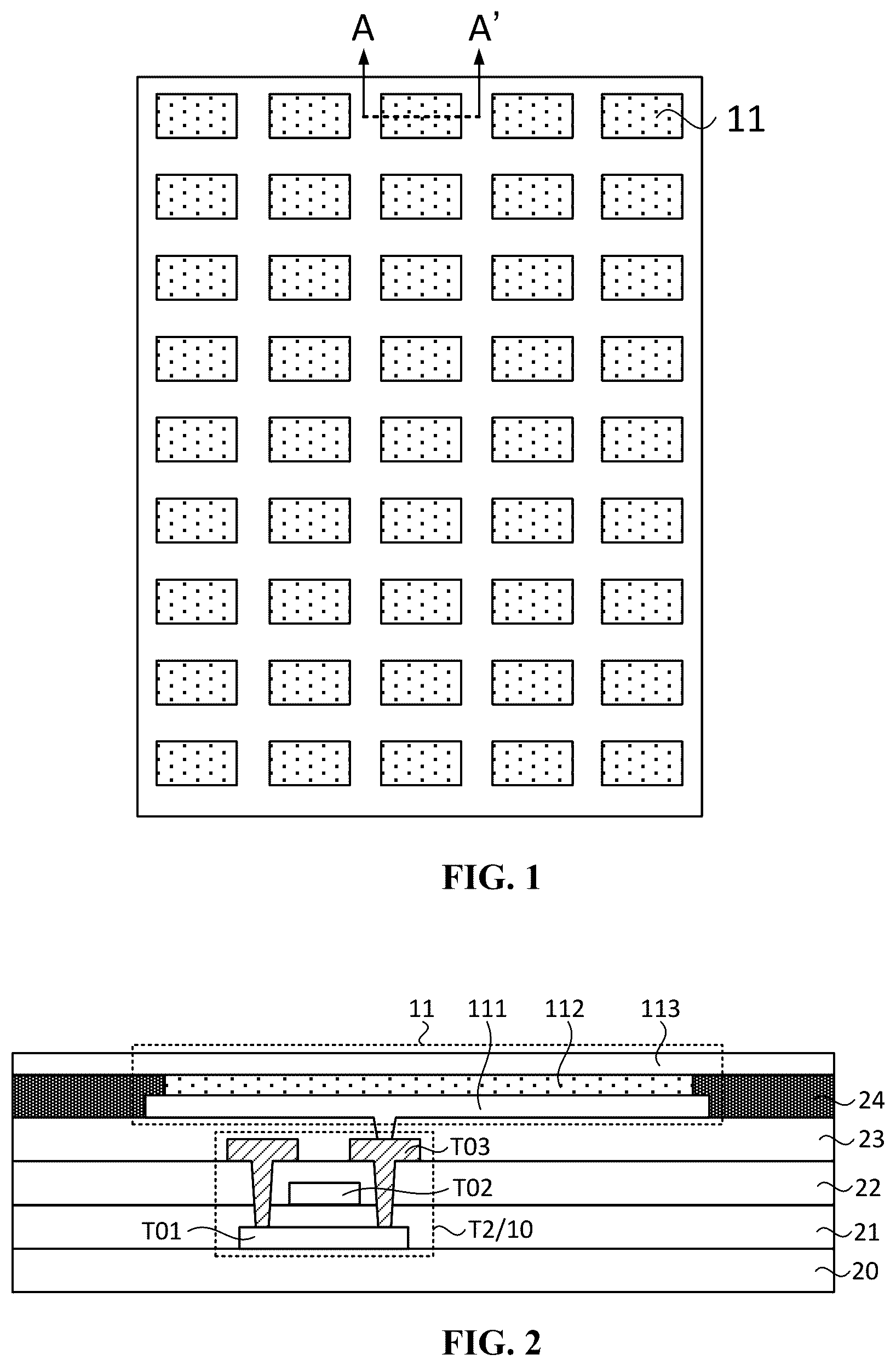
is a structural diagram of a display panel according to an embodiment of the present disclosure.
is a sectional diagram taken along direction A-A′ of .
is a structural diagram of a pixel circuit according to an embodiment of the present disclosure.
is a structural diagram of another pixel circuit according to an embodiment of the present disclosure.
is a structural diagram of another pixel circuit according to an embodiment of the present disclosure.
is a structural diagram of another pixel circuit according to an embodiment of the present disclosure.
is a drive timing diagram of a pixel circuit according to an embodiment of the present disclosure.
is another drive timing diagram of a pixel circuit according to an embodiment of the present disclosure.
is a drive timing diagram of a pixel circuit in the related art.
is a drive timing diagram of another pixel circuit in the related art.
is another drive timing diagram of a pixel circuit according to an embodiment of the present disclosure.
is another drive timing diagram of a pixel circuit according to an embodiment of the present disclosure.
is another drive timing diagram of a pixel circuit according to an embodiment of the present disclosure.
is a structural diagram of a display device according to an embodiment of the present disclosure.
DETAILED DESCRIPTION
Technical solutions in embodiments of the present disclosure are described clearly and completely in conjunction with drawings in embodiments of the present disclosure from which technical solutions of the present disclosure are better understood by those skilled in the art. Apparently, the embodiments described below are part, not all, of embodiments of the present disclosure. Based on embodiments of the present disclosure, all other embodiments obtained by those of ordinary skill in the art on the premise that no creative work is done are within the scope of the present disclosure.
It is to be noted that terms such as “first” and “second” in the description, claims and drawings of the present disclosure are used for distinguishing between similar objects and are not necessarily used for describing a particular order or sequence. It is to be understood that the data used in this manner are interchangeable in appropriate cases so that embodiments of the present disclosure described herein can be implemented in an order not illustrated or described herein. Additionally, the terms “including”, “having” and variations thereof are intended to encompass a non-exclusive inclusion. For example, a process, method, system, product, or device that includes a series of steps or units not only includes the expressly listed steps or units but may also include other steps or units that are not expressly listed or are inherent to such process, method, product, or device.
is a structural diagram of a display panel according to an embodiment of the present disclosure. is a sectional diagram taken along direction A-A′ of . is a structural diagram of a pixel circuit according to an embodiment of the present disclosure. is a structural diagram of another pixel circuit according to an embodiment of the present disclosure. is a structural diagram of another pixel circuit according to an embodiment of the present disclosure. is a structural diagram of another pixel circuit according to an embodiment of the present disclosure. is a drive timing diagram of a pixel circuit according to an embodiment of the present disclosure. is another drive timing diagram of a pixel circuit according to an embodiment of the present disclosure. As shown in to 8 , the display panel according to the embodiment of the present disclosure includes pixel circuits 10 and light-emitting elements 11 . A pixel circuit 10 includes a drive module 101 , a compensation module 102 , a reset module 103 , a data write module 104 , and a bias adjustment module 105 . The drive module 101 includes a drive transistor T 2 . The drive transistor T 2 includes a gate, a first electrode, and a second electrode. The compensation module 102 is connected between the gate of the drive transistor T 2 and the second electrode of the drive transistor T 2 .
A working process of the display panel includes a reset stage t 10 , a data write stage t 20 , and a bias adjustment stage t 30 . The reset module 103 supplies a reset signal Vref to the drive transistor T 2 in the reset stage t 10 . The data write module 104 supplies a data signal Vdata to the drive transistor T 2 in the data write stage t 20 . The bias adjustment module 105 is turned on and supplies a bias adjustment signal V 0 to the drive transistor T 2 in the bias adjustment stage t 30 .
The compensation module 102 is on in the bias adjustment stage t 30 , the data write stage t 20 , and a time period t 40 between the bias adjustment stage t 30 and the data write stage t 20 ; and/or, the reset module 103 is on in the bias adjustment stage t 30 and the reset stage t 10 and is turned off at least after the compensation module 102 is turned on.
Specifically, as shown in , the display panel may include multiple pixel circuits 10 arranged in array and multiple light-emitting elements 11 arranged in array. The arrangement manner of the pixel circuits 10 and the arrangement manner of the light-emitting elements 11 may be set according to actual requirements.
As shown in , when the light-emitting elements 11 are organic light-emitting diodes (OLEDs), each of the light-emitting elements 11 may include an anode 111 , a light-emitting layer 112 , and a cathode 113 that are stacked; however, it is not limited thereto. In other embodiments, the light-emitting elements 11 may also include micro light-emitting diodes (micro-LEDs or mini-LEDs) or other types of light-emitting components.
With continued reference to , the multiple pixel circuits 10 are electrically connected to the multiple light-emitting elements 11 correspondingly. The pixel circuit 10 is configured to supply a drive current to a light-emitting element 11 electrically connected to the pixel circuit 10 to drive the light-emitting element 11 to emit light. Exemplarily, by way of example, the light-emitting element 11 is an organic light-emitting diode. When the pixel circuit 10 supplies the drive current to the light-emitting element 11 , an electron is injected into a light-emitting layer 112 through a cathode 113 , and a hole is injected into the light-emitting layer 112 through an anode 111 . The electron and the hole are combined in the light-emitting layer 112 to release energy and emit light.
With continued reference to to 6 , the pixel circuit 10 may specifically include the drive module 101 , the compensation module 102 , the reset module 103 , the data write module 104 , and the bias adjustment module 105 .
The drive module 101 may be the drive transistor T 2 configured to supply the drive current to the light-emitting element 11 . Specifically, the drive transistor T 2 includes the gate (that is, an N1 node), the first electrode (that is, an N2 node), and a second electrode (that is, an N3 node). The drive transistor T 2 may be turned on according to the potential of the gate (N1 node) of the drive transistor T 2 . The drive current formed by the turning-on of the drive transistor T 2 is used for driving the light-emitting element 11 to emit light. The potential of the gate of the drive transistor T 2 may determine the magnitude of the turning-on current so that the brightness of the light-emitting element 11 can be adjusted by controlling the voltage of the gate of the drive transistor T 2 , implementing grayscale control.
The reset module 103 may be connected to the gate (N1 node) of the drive transistor T 2 and configured to supply the reset signal Vref to the gate of the drive transistor T 2 . The data write module 104 may be connected to the first electrode (N2 node) of the drive transistor T 2 and configured to supply the data signal Vdata to the drive transistor T 2 . The compensation module 102 may be connected to the gate (N1 node) of the drive transistor T 2 and the second electrode (N3 node) of the drive transistor T 2 and configured to compensate for the threshold voltage of the drive transistor T 2 . The bias adjustment module 105 may be connected to the first electrode (N2 node) of the drive transistor T 2 or the second electrode (N3 node) of the drive transistor T 2 and configured to supply the bias adjustment signal V 0 to the drive transistor T 2 .
Additionally, with continued reference to to 6 , the pixel circuit 10 may further include an initialization module 106 and a light emission control module 107 . The initialization module 106 may be connected to the anode of the light-emitting element 11 and configured to supply an initialization signal Vini to the light-emitting element 11 .
The light emission control module 107 , the drive transistor T 2 , and the light-emitting element 11 are connected in series between a first power signal terminal and a second power signal terminal and are configured to selectively allow the light-emitting element 11 to enter a light emission stage. The first power signal terminal may be configured to supply a first power signal PVDD. The second power signal terminal may be configured to supply a second power signal PVEE. The voltage of the first power signal PVDD is greater than the voltage of the second power signal PVEE.
With continued reference to to 6 , optionally, the light emission control module 107 includes a first light emission control module 1071 and a second light emission control module 1072 . The first light emission control module 1071 is connected between the first power signal terminal and an electrode of the drive transistor T 2 . The first light emission control module 1071 may be configured to control the conduction or disconduction of a transmission path between the drive transistor T 2 and the first power signal terminal. The second light emission control module 1072 is connected between another electrode of the drive transistor T 2 and the light-emitting element 11 . The second light emission control module 1072 may be configured to control the conduction or disconduction of a transmission path between the drive transistor T 2 and the second power signal terminal.
With continued reference to to 6 , in this embodiment, a control terminal of the data write module 104 receives a first scan signal SP. The first scan signal SP controls the data write module 104 to turn on and off. A control terminal of the compensation module 102 receives a second scan signal S 2 N. The second scan signal S 2 N controls the compensation module 102 to turn on and off. A control terminal of the bias adjustment module 105 receives a bias adjustment control signal SP*. The bias adjustment control signal SP* controls the bias adjustment module 105 to turn on and off. A control terminal of the reset module 103 receives a third scan signal S 1 N. The third scan signal S 1 N controls the reset module 103 to turn on and off. A control terminal of the initialization module 106 receives a fourth scan signal S 3 N. The fourth scan signal S 3 N controls the initialization module 106 to turn on and off. A control terminal of the light emission control module 107 receives a light emission control signal EM. The light emission control signal EM controls the light emission control module 107 to turn on and off.
Additionally, optionally, as shown in to 6 , the data write module 104 includes a data write transistor T 1 . The first scan signal SP controls the data write transistor T 1 to turn on and off. The compensation module 102 includes a compensation transistor T 3 . The second scan signal S 2 N controls the compensation transistor T 3 to turn on and off. The bias adjustment module 105 includes a bias adjustment transistor T 4 . The bias adjustment control signal SP* controls the bias adjustment transistor T 4 to turn on and off. The reset module 103 includes a reset transistor T 5 . The third scan signal S 1 N controls the reset transistor T 5 to turn on and off. The initialization module 106 includes an initialization transistor T 6 . The fourth scan signal S 3 N controls the initialization transistor T 6 to turn on and off. The first light emission control module 1071 includes a first light emission control transistor T 7 . The second light emission control module 1072 includes a second light emission control transistor T 8 . The light emission control signal EM controls the first light emission control transistor T 7 and the second light emission control transistor T 8 to turn on and off.
It is to be noted that when conditions permit, at least two of the first scan signal SP, the second scan signal S 2 N, the third scan signal S 1 N, the fourth scan signal S 3 N, the bias adjustment control signal SP*, the light emission control signal EM, and the like may be the same signal. For example, when the bias adjustment transistor T 8 and the initialization transistor T 6 are of the same type, the bias adjustment control signal SP* and the fourth scan signal S 3 N may be the same signal.
Additionally, as shown in , when the drive transistor T 2 is a PMOS-type transistor, the pixel circuit 10 may further include a storage capacitor C 1 . A first electrode of the storage capacitor C 1 is connected to the first power signal terminal. A second electrode of the storage capacitor C 1 is connected to the gate of the drive transistor T 2 and configured to store signals transmitted to the gate of the drive transistor T 2 . As shown in , the bias adjustment module 105 is connected to the first electrode of the drive transistor T 2 , that is, the N2 node. As shown in , the bias adjustment module 105 is connected to the second electrode of the drive transistor T 2 , that is, the N3 node.
With continued reference to , when the drive transistor T 2 is an NMOS-type transistor, the pixel circuit 10 may also include the storage capacitor C 1 . The first electrode of the storage capacitor C 1 is connected to the light-emitting element 11 . The second electrode of the storage capacitor C 1 is connected to the gate of the drive transistor T 2 and configured to store the signals transmitted to the gate of the drive transistor T 2 . As shown in , the bias adjustment module 105 is connected to the first electrode of the drive transistor T 2 , that is, the N2 node. As shown in , the bias adjustment module 105 is connected to the second electrode of the drive transistor T 2 , that is, the N3 node.
With continued reference to , the working process of the display panel at least includes the reset stage t 10 , the data write stage t 20 , and the bias adjustment stage t 30 .
As shown in to 8 , by way of example, the reset module 103 is the NMOS-type reset transistor T 5 , the data write module 104 is the PMOS-type data write transistor T 1 , and the compensation module 102 is the NMOS-type compensation transistor T 3 .
In the reset stage t 10 , the third scan signal S 1 N is a high-level effective pulse so that the reset transistor T 5 is turned on, the reset signal Vref is transmitted to the gate (N1 node) of the drive transistor T 2 through the reset transistor T 5 that is turned on, thereby resetting the gate of the drive transistor T 2 . In this case, the potential of the gate (N1 node) of the drive transistor T 2 is consistent with the potential of the reset signal Vref to prevent a data signal of the previous frame carried on the gate of the drive transistor T 2 from affecting the writing of a data signal of the next frame.
In the data write stage t 20 , the first scan signal SP is a low-level effective pulse, and the second scan signal S 2 N is a high-level effective pulse. In this case, the data write transistor T 1 and the compensation transistor T 3 are turned on. Moreover, the potential of the gate of the drive transistor T 2 is consistent with the potential of the potential of the reset signal Vref. The drive transistor T 2 is also turned on. The data signal Vdata passes through the data write transistor T 1 , the drive transistor T 2 , and the compensation transistor T 3 and is applied to the gate (N1 node) of the drive transistor T 2 . The potential of the N1 node increases gradually until the drive transistor T 2 is turned off. When the drive transistor T 2 is turned off, the potential of the gate of the drive transistor T 2 is V data −|V th |. V data denotes the voltage value of the data signal Vdata. |V th | denotes the threshold voltage of the drive transistor T 2 .
Further, after the data write stage t 20 ends, the display panel may enter the light emission stage. Exemplarily, as shown in , by way of example, the first light emission control module 1071 is the PMOS-type first light emission control transistor T 7 , and the second light emission control module 1072 is the PMOS-type second light emission control transistor T 8 . In the light emission stage, the light emission control signal EM may jump into a low-level effective pulse, and the first light emission control transistor T 7 and the second light emission control transistor T 8 are turned on. Because the first light emission control transistor T 7 is turned on, the first power signal PVDD may be transmitted to the first electrode of the drive transistor T 2 . In this case, the voltage difference between the first electrode of the drive transistor T 2 and the gate of the drive transistor T 2 is V PVDD −(V data −|V th |) so that the drive current generated by the drive transistor T 2 is K*(V data −V PVDD ) 2 . K is a coefficient related to, for example, the size and material of the drive transistor T 2 . With this arrangement, the drive current generated by the drive transistor T 2 is unrelated to the threshold voltage |V th | of the drive transistor T 2 . The drive transistor is transmitted to the anode of the light-emitting element 11 through the second light emission control transistor T 8 that is turned on so that the light-emitting element 11 emits light.
As described above, the voltage value V data of the data signal Vdata may control the magnitude of the drive current generated by the drive transistor T 2 . The magnitude of the drive current generated by the drive transistor T 2 determines the final grayscale displayed by the display panel. Therefore, when a grayscale change is displayed by the display panel, the voltage value V data of the corresponding data signal Vdata may also change.
The data signal Vdata written by the gate of the drive transistor T 2 varies with the grayscale. In the light emission process of the drive transistor T 2 , the potential difference between the gate of the drive transistor T 2 and the first electrode of the drive transistor T 2 or the second electrode of the drive transistor T 2 may lead to a bias problem. That is, when the drive transistor T 2 is a PMOS-type transistor, and when the drive transistor T 2 is turned on but the voltage of the gate of the drive transistor T 2 is greater than the voltage of the first electrode of the drive transistor T 2 or the voltage of the second electrode of the drive transistor T 2 , the bias problem may occur. That is, when the drive transistor T 2 is an NMOS-type transistor, and when the drive transistor T 2 is turned on but the voltage of the gate of the drive transistor T 2 is less than the voltage of the first electrode of the drive transistor T 2 or the voltage of the second electrode of the drive transistor T 2 , the bias problem may occur. The bias problem often leads to a reverse electric field inside the drive transistor T 2 , resulting in carrier polarization and thereby leading to the threshold voltage drift of the drive transistor T 2 . The threshold voltage drift of the drive transistor T 2 may affect the writing of the data signal, making the drive current generated by the drive transistor T 2 unstable, and leading to a flicker problem especially when the grayscale changes.
Based on the preceding technical problem, in this embodiment, the working process of the display panel further includes the bias adjustment stage t 30 . As shown in , 4 , 7 , and 8 , by way of example, the bias adjustment module 105 is the PMOS-type bias adjustment transistor T 4 . In the bias adjustment stage t 30 , the bias adjustment control signal SP* is a low-level effective pulse so that the bias adjustment transistor T 4 is turned on, and the bias adjustment signal V 0 is input to the first electrode of the drive transistor T 2 or the second electrode of the drive transistor T 2 to adjust the voltage difference between the gate of the drive transistor T 2 and the first electrode of the drive transistor T 2 or the second electrode of the drive transistor T 2 , thereby eliminating the reverse electric field generated inside the drive transistor T 2 , solving the bias problem, avoiding the threshold voltage drift of the drive transistor T 2 , and thereby helping alleviate the flicker phenomenon.
Exemplarily, when the drive transistor T 2 is a PMOS-type transistor, in the bias adjustment stage t 30 , the potential of the first electrode of the drive transistor T 2 or the potential of the second electrode of the drive transistor T 2 may be raised through the bias adjustment signal V 0 so as to increase the voltage difference between the first electrode of the drive transistor T 2 or the second electrode of the drive transistor T 2 and the gate of the drive transistor T 2 , counteracting the reverse electric field generated inside the drive transistor T 2 and solving the bias problem; however, it is not limited thereto.
With continued reference to , 4 , 7 , and 8 , in the bias adjustment stage t 30 , the second scan signal S 2 N is a high-level effective pulse so that the compensation transistor T 3 is turned on. In this case, the bias adjustment signal V 0 may be transmitted through the compensation transistor T 3 to the gate of the drive transistor T 2 so that the potential of the gate of the drive transistor T 2 is consistent with the potential of the first electrode of the drive transistor T 2 and/or the potential of the second electrode of the drive transistor T 2 , further alleviating the phenomenon of the threshold voltage drift of the drive transistor T 2 and thereby alleviating the flicker phenomenon.
Additionally, when the fourth scan signal S 3 N controls the initialization transistor T 6 to turn on, the initialization signal Vini can be transmitted to the anode of the light-emitting element 11 to initialize the anode of the light-emitting element 11 , preventing the drive current supplied to the anode of the light-emitting element 11 in the previous frame from affecting the display brightness of the light-emitting element 11 in the next frame.
In an optional embodiment, the channel type of the initialization transistor T 6 may be the same as the channel type of the bias adjustment transistor T 4 . With this arrangement, the bias adjustment control signal SP* and the fourth scan signal S 3 N may be the same signal so that the initialization transistor T 6 and the bias adjustment transistor T 4 can be turned on or off simultaneously.
It is to be understood that the type of each transistor in the pixel circuit 10 and the corresponding driving process are exemplarily described above. In this embodiment of the present disclosure, when the type of each transistor in the pixel circuit 10 changes, a driving process similar to that described above can also be performed by changing each signal received by the gate of each transistor, which is not repeated here.
is a drive timing diagram of a pixel circuit in the related art. As shown in , in a bias adjustment stage t 30 , a second scan signal S 2 N is an effective pulse, and a compensation transistor T 3 is turned on once to supply a bias adjustment signal V 0 to a gate of a drive transistor T 2 . In a data write stage t 20 , the second scan signal S 2 N is an effective pulse, and the compensation transistor T 3 is turned on again to supply a data signal Vdata to the gate of the drive transistor T 2 . Accordingly, the compensation transistor T 3 needs to be turned on twice in one image refresh frame. Then the second scan signal S 2 N needs to supply two effective pulses in one image refresh frame, making the driving process relatively complicated. Moreover, a driver circuit for supplying the second scan signal S 2 N needs to output effective pulses at a higher hopping frequency, putting forward higher requirements for the processing capacity of the driver circuit, and thereby increasing the processing complexity and processing preparation cost of the driver circuit.
Based on the preceding technical problem, with continued reference to , in this embodiment of the present disclosure, the compensation module 102 is on in the bias adjustment stage t 30 , the data write stage t 20 , and the time period t 40 between the bias adjustment stage t 30 and the data write stage t 20 . In this case, the compensation module 102 keeps on after being turned on for the first time in the bias adjustment stage t 30 and is turned off after the data write stage t 20 of this image refresh frame ends. The compensation module 102 only needs to be turned on once in one image refresh frame. Correspondingly, the second scan signal S 2 N only needs to supply an effective pulse once in one image refresh frame. Compared with the related art, the second scan signal S 2 N is maintained as the effective pulse in the time period t 40 between the bias adjustment stage t 30 and the data write stage t 20 and performs no hopping, thereby reducing the hopping frequency of the second scan signal S 2 N, simplifying the driving process, reducing requirements for the processing ability of the driver circuit supplying the second scan signal S 2 N, and helping reduce the processing complexity and processing preparation cost of the driver circuit.
With continued reference to , in another optional embodiment, the third scan signal S 1 N is an effective pulse in the bias adjustment stage t 30 and the reset stage t 10 . The reset module 103 is on. The reset signal Vref can be written to the gate (N1 node) of the drive transistor T 2 to reset the drive transistor T 2 , clearing the data signal written to the gate of the drive transistor T 2 in the previous frame and enabling the drive transistor T 2 to stay in the on state.
In the bias adjustment stage t 30 , the reset module 103 is on, the reset signal Vref may adjust the potential of the gate of the drive transistor T 2 . Moreover, the bias adjustment control signal SP* is an effective pulse, and the bias adjustment module 105 is turned on. The bias adjustment signal V 0 is input to the first electrode of the drive transistor T 2 or the second electrode of the drive transistor T 2 to adjust the potential of the first electrode of the drive transistor T 2 or the potential of the second electrode of the drive transistor T 2 so that the voltage difference between the gate of the drive transistor T 2 and the first electrode of the drive transistor T 2 or the second electrode of the drive transistor T 2 is adjusted through the reset signal Vref and the bias adjustment signal V 0 . With this arrangement, an adjustment range of the voltage difference between the gate of the drive transistor T 2 and the first electrode of the drive transistor T 2 or the second electrode of the drive transistor T 2 may be enlarged, better helping eliminate the reverse electric field generated inside the drive transistor T 2 , solving the bias problem, avoiding the threshold voltage drift of the drive transistor T 2 , and alleviating the flicker phenomenon.
Exemplarily, as shown in , by way of example, the drive transistor T 2 is a PMOS-type transistor. In the bias adjustment stage t 30 , the third scan signal S 1 N is an effective pulse, the reset module 103 is on, and the reset signal Vref is written to the gate of the drive transistor T 2 , thereby clearing the data signal written to the gate of the drive transistor T 2 in the previous frame. Moreover, to guarantee that the drive transistor T 2 is in the on state, the reset signal Vref may pull down the potential of the gate of the drive transistor T 2 , making the potential of the gate of the drive transistor T 2 lower. Moreover, the bias adjustment control signal SP* is an effective pulse. The bias adjustment module 105 is turned on. The bias adjustment signal V 0 is written to the second electrode (N3 node) of the drive transistor T 2 , raising the potential of the second electrode of the drive transistor T 2 . Therefore, a greater voltage difference is formed between the second electrode of the drive transistor T 2 and the gate of the drive transistor T 2 , counteracting the reverse electric field generated inside the drive transistor T 2 more rapidly, solving the bias problem, making the threshold voltage of the drive transistor T 2 more stable, and thereby helping alleviate the flicker phenomenon.
With continued reference to , in this embodiment, in the bias adjustment stage t 30 , the reset module 103 is on, and the potential of the gate of the drive transistor T 2 is adjusted by the reset signal Vref. In this case, the compensation module 102 does not need to be turned on again. That is, the compensation module 102 is off in the bias adjustment stage t 30 so that the second scan signal S 2 N does not need to supply an effective pulse through hopping in the bias adjustment stage t 30 . Therefore, in one image refresh frame, the compensation module 102 only needs to be turned on once in the data write stage t 20 . Correspondingly, the second scan signal S 2 N only needs to supply an effective pulse once in the data write stage t 20 , thereby reducing the hopping frequency of the second scan signal S 2 N, simplifying the driving process, reducing requirements for the processing ability of the driver circuit supplying the second scan signal S 2 N, and helping reduce the processing complexity and processing preparation cost of the driver circuit.
is another drive timing diagram of a pixel circuit in the related art. As shown in , an inventor found after further research that a great voltage difference exists between the second electrode of the drive transistor T 2 and the gate of the drive transistor T 2 after the bias adjustment stage t 30 ends. By way of example, the drive transistor T 2 is a PMOS-type transistor. The potential of the gate of the drive transistor T 2 is low, while the second electrode (N3 node) of the drive transistor T 2 is kept at a relatively high potential. As shown in , if the reset stage t 10 is located before the start moment of the compensation module 102 , that is, if the reset module 103 is turned off before the compensation module 102 is turned on, then the data write transistor T 1 and the compensation transistor T 3 are turned on in the data write stage t 20 . When the data signal Vdatais written to the gate (N1 node) of the drive transistor T 2 through the second electrode (N3 node) of the drive transistor T 2 from the first electrode (N2 node) of the drive transistor T 2 , the second electrode (N3 node) of the drive transistor T 2 is at a high potential, affecting the input of the data signal Vdata, thereby not helping with the writing of the data signal Vdata to the gate (N1 node) of the drive transistor T 2 , and affecting the accuracy and stability of the writing of the data signal Vdata.
Based on the preceding technical problem, with continued reference to , in this embodiment, the reset module 103 is set to be at least turned off after the compensation module 102 is turned on. That is, a time period (that is, the reset stage t 10 ) when the reset module 103 is turned on overlaps a time period when the compensation module 102 is turned on. The reset module 103 and the compensation module 102 are each turned on in an overlapping period between the time period when the reset module 103 is turned on and the time period when the compensation module 102 is turned on. The reset signal Vref may be transmitted through the reset module 103 and the compensation module 102 to the second electrode (N3 node) of the drive transistor T 2 , thereby pulling down the potential of the second electrode of the drive transistor T 2 and making the potential of the second electrode of the drive transistor T 2 be the same as the potential of the gate of the drive transistor T 2 . In this case, in the data write stage t 20 , when the data signal Vdata is written to the gate (N1 node) of the drive transistor T 2 from the first electrode (N2 node) of the drive transistor T 2 and through the second electrode (N3 node) of the drive transistor T 2 . Moreover, the second electrode (N3 node) of the drive transistor T 2 is at a low potential, thereby better helping with the input of the data signal Vdata and enabling the data signal Vdata to be written to the gate (N1 node) of the drive transistor T 2 more accurately.
It is to be noted that an example in which the drive transistor T 2 is a PMOS-type transistor is used for describing the technical solutions illustrated in the preceding . In other embodiments, when the type of the drive transistor T 2 changes, the driving process and beneficial effect similar to the above-mentioned driving process and beneficial effect can also be achieved by changing the potential magnitude of each signal, which is not repeated here.
Additionally, one image refresh frame may include multiple bias adjustment stages t 30 . The compensation module 102 may be set to be on in a portion of the bias adjustment stages t 30 , the data write stage t 20 , and a time period between the portion of the bias adjustment stages t 30 and the data write stage t 20 . The reset module 103 may be set to be on in the other portion of the bias adjustment stages t 30 and the reset stage t 10 , and the reset module 103 is turned off at least after the compensation module 102 is turned on to achieve the driving process and beneficial effect similar to the above-mentioned driving process and beneficial effect, which is not specifically limited by this embodiment of the present disclosure.
Above all, for the display panel according to this embodiment of the present disclosure, the compensation module is on in the bias adjustment stage, the data write stage, and the time period between the bias adjustment stage and the data write stage; moreover/alternatively, the reset module is on in the bias adjustment stage and the reset stage and is turned off at least after the compensation module is turned on. In this case, the compensation module in the pixel circuit is only turned on once in one image refresh frame. Accordingly, a scan signal for controlling the compensation transistor to turn on and off only needs to be provided with an effective pulse once in one image refresh frame, thereby reducing the hopping frequency of the scan signal, simplifying the driving process, reducing requirements for the processing ability of the driver circuit supplying the scan signal, and thereby reducing the processing complexity and processing preparation cost of the driver circuit.
is another drive timing diagram of a pixel circuit according to an embodiment of the present disclosure. As shown in , 7 , and 11 , optionally, the compensation module 102 is on in the bias adjustment stage t 30 , the data write stage t 20 , and the time period t 40 between the bias adjustment stage t 30 and the data write stage t 20 . The time length of the bias adjustment stage t 30 is Ws. The time length of the data write stage t 20 is Wd. The time length of the time period when the compensation module 102 is turned on is Wc. The bias adjustment stage t 30 is located before the data write stage t 20 . The time length of a time period t 41 between an end of the bias adjustment stage t 30 and a start of the data write stage t 20 is Wt 1 , and Wc≥(Ws+Wd+Wt 1 ). Alternatively, the bias adjustment stage t 30 is located after the data write stage t 20 , the time length of a time period t 42 between an end of the data write stage t 20 and a start of the bias adjustment stage t 30 is Wt 2 , and Wc≥(Ws+Wd+Wt 2 ).
Specifically, as shown in , in this embodiment, the bias adjustment stage t 30 may be located before the data write stage t 20 so as to supply the bias adjustment signal V 0 to the drive transistor T 2 before the data signal Vdata is written to the gate of the drive transistor T 2 . The bias adjustment signal V 0 may adjust the voltage difference between the gate of the drive transistor T 2 and the first electrode of the drive transistor T 2 or the second electrode of the drive transistor T 2 so as to alleviate the phenomenon of the threshold voltage drift due to the relatively great potential difference among the gate of the drive transistor T 2 , the first electrode of the drive transistor T 2 , and the second electrode of the drive transistor T 2 , thereby helping with the accurate writing of the data signal Vdata in the data write stage t 20 .
Moreover, with continued reference to , the time length Wc of the time period in which the compensation module 102 is turned on is set to be minimally equal to the sum of the time length Ws of the bias adjustment stage t 30 , the time length Wd of the data write stage t 20 , and the time length Wt 1 of the time period t 41 between the end of the bias adjustment stage t 30 and the start of the data write stage t 20 so that the time length Wc of the time period in which the compensation module 102 is turned on can cover the time length Ws of the bias adjustment stage t 30 , the time length Wd of the data write stage t 20 , and the time length Wt 1 of the time period t 41 between the end of the bias adjustment stage t 30 and the start of the data write stage t 20 , thereby guaranteeing that the compensation module 102 is in the on state in the bias adjustment stage t 30 , the data write stage t 20 , and the time period t 41 between the end of the bias adjustment stage t 30 and the start of the data write stage t 20 . Therefore, the driving process of the bias adjustment stage t 30 and the driving process of the data write stage t 20 are implemented, and the compensation module 102 only needs to be turned on once in one image refresh frame. Correspondingly, the second scan signal S 2 N only needs to supply an effective pulse once in one image refresh frame so that the second scan signal S 2 N does not need to hop in the time period t 41 between the end of the bias adjustment stage t 30 and the start of the data write stage t 20 , thereby reducing the hopping frequency of the second scan signal S 2 N, simplifying the driving process, reducing requirements for the processing ability of the driver circuit supplying the second scan signal S 2 N, and helping reduce the processing complexity and processing preparation cost of the driver circuit.
Additionally, after the hopping frequency of the second scan signal S 2 N is reduced, the frequency of outputting an effective pulse by the driver circuit supplying the second scan signal S 2 N is reduced, thereby helping reduce the electricity consumption of the driver circuit and thereby helping reduce the power consumption of the display panel.
Further, as shown in , the time length Wc of the time period in which the compensation module 102 is turned on may be set to be greater than the sum of the time length Ws of the bias adjustment stage t 30 , the time length Wd of the data write stage t 20 , and the time length Wt 1 of the time period t 41 between the end of the bias adjustment stage t 30 and the start of the data write stage t 20 . That is, Wc>(Ws+Wd+Wt 1 ). Such an arrangement guarantees that the compensation module 102 is in the on state in the bias adjustment stage t 30 , the data write stage t 20 , and the time period t 41 between the end of the bias adjustment stage t 30 and the start of the data write stage t 20 . Moreover, such an arrangement enables the compensation module 102 to be turned on before the bias adjustment stage t 30 . That is, before the bias adjustment signal V 0 is input to the drive transistor T 2 , the compensation module 102 is enabled to be turned, thereby guaranteeing the working stability of the compensation module 102 when the bias adjustment signal V 0 is transmitted through the compensation module 102 to the gate of the drive transistor T 2 . Moreover, the arrangement in which Wc>(Ws+Wd+Wt 1 ) also enables the compensation module 102 to be turned off after the data write stage t 20 ends. Therefore, in the data write stage t 20 , that is, when the data signal Vdata is written to the gate of the drive transistor T 2 , it guarantees that the compensation module 102 is in the on state stably, thereby guaranteeing the accuracy and stability of the writing of the data signal Vdata.
In another optional embodiment, as shown in , the bias adjustment stage t 30 may also be located after the data write stage t 20 so as to supply the bias adjustment signal V 0 to the drive transistor T 2 after the data signal Vdata is written to the gate of the drive transistor T 2 and before the light-emitting element 11 enters the light emission stage. The bias adjustment signal V 0 may adjust the voltage difference between the gate of the drive transistor T 2 and the first electrode of the drive transistor T 2 or the second electrode of the drive transistor T 2 so as to alleviate the phenomenon of the threshold voltage drift due to the relatively great potential difference among the gate of the drive transistor T 2 , the first electrode of the drive transistor T 2 , and the second electrode of the drive transistor T 2 , thereby enabling the drive transistor T 2 to be able to supply an accurate drive current to the light-emitting element 11 in a subsequent light emission stage, enabling the light-emitting element 11 to emit light accurately, and improving the display effect of the display panel.
Moreover, with continued reference to , the time length Wc of the time period in which the compensation module 102 is turned on is set to be minimally equal to the sum of the time length Ws of the bias adjustment stage t 30 , the time length Wd of the data write stage t 20 , and the time length Wt 2 of the time period t 42 between the end of the data write stage t 20 and the start of the bias adjustment stage t 30 so that the time length Wc of the time period in which the compensation module 102 is turned on can cover the time length Ws of the bias adjustment stage t 30 , the time length Wd of the data write stage t 20 , and the time length Wt 2 of the time period t 42 between the end of the data write stage t 20 and the start of the bias adjustment stage t 30 , thereby guaranteeing that the compensation module 102 is in the on state in the bias adjustment stage t 30 , the data write stage t 20 , and the time period t 42 between the end of the data write stage t 20 and the start of the bias adjustment stage t 30 . Therefore, the driving process of the bias adjustment stage t 30 and the driving process of the data write stage t 20 are implemented, and the compensation module 102 only needs to be turned on once in one image refresh frame. Correspondingly, the second scan signal S 2 N only needs to supply an effective pulse once in one image refresh frame so that the second scan signal S 2 N does not need to hop in the time period t 42 between the end of the data write stage t 20 and the start of the bias adjustment stage t 30 , thereby reducing the hopping frequency of the second scan signal S 2 N, simplifying the driving process, reducing requirements for the processing ability of the driver circuit supplying the second scan signal S 2 N, and helping reduce the processing complexity and processing preparation cost of the driver circuit.
Additionally, after the hopping frequency of the second scan signal S 2 N is reduced, the frequency of outputting an effective pulse by the driver circuit supplying the second scan signal S 2 N is reduced, helping reduce the electricity consumption of the driver circuit and thereby helping reduce the power consumption of the display panel.
Further, as shown in , the time length Wc of the time period in which the compensation module 102 is turned on may be set to be greater than the sum of the time length Ws of the bias adjustment stage t 30 , the time length Wd of the data write stage t 20 , and the time length Wt 2 of the time period t 42 between the end of the data write stage t 20 and the start of the bias adjustment stage t 30 . That is, Wc>(Ws+Wd+Wt 2 ). Such an arrangement guarantees that the compensation module 102 is in the on state in the bias adjustment stage t 30 , the data write stage t 20 , and the time period t 42 between the end of the data write stage t 20 and the start of the bias adjustment stage t 30 . Moreover, such an arrangement enables the compensation module 102 to be turned on before the data write stage t 20 . That is, before the data signal Vdata is written to the gate of the drive transistor T 2 , the compensation module 102 is enabled to be turned. Therefore, in the data write stage t 20 , that is, when the data signal Vdata is written to the gate of the drive transistor T 2 , it guarantees that the compensation module 102 is in the on state stably, thereby guaranteeing the accuracy and stability of the writing of the data signal Vdata. Moreover, the arrangement in which Wc>(Ws+Wd+Wt 2 ) also enables the compensation module 102 to be turned off after the bias adjustment stage t 30 ends. That is, the compensation module 102 is turned off after the bias adjustment signal V 0 is written to the drive transistor T 2 completely. Therefore, when the bias adjustment signal V 0 is transmitted through the compensation module 102 to the gate of the drive transistor T 2 , it guarantees that the compensation module 102 is in the on state stably, thereby guaranteeing the accuracy and stability of the writing of the bias adjustment signal V 0 .
With continued reference to , optionally, the reset stage t 10 is located between the bias adjustment stage t 30 and the data write stage t 20 . The compensation module 102 is on in the reset stage t 10 .
Specifically, as shown in , the reset stage t 10 is set to be located between the bias adjustment stage t 30 and the data write stage t 20 . In this case, the time of an effective pulse of the third scan signal S 1 N does not overlap the time of an effective pulse of the bias adjustment control signal SP* so that the reset stage t 10 and the bias adjustment stage t 30 are in different time periods and do not affect each other, thereby guaranteeing the accuracy of resetting each drive transistor T 2 and the accuracy of performing a bias adjustment for each drive transistor T 2 . Moreover, the time of the effective pulse of the third scan signal S 1 N does not overlap the time of an effective pulse of the first scan signal SP so that the reset stage t 10 and the data write stage t 20 are in different time periods, thereby preventing the writing of the data signal Vdata from affecting the reset of the gate of the drive transistor T 2 , preventing the reset signal Vref from affecting the writing of the data signal Vdata, improving the accuracy of resetting the gate of the drive transistor T 2 , and guaranteeing that the data signal Vdata can be written to the gate of the drive transistor T 2 accurately.
With continued reference to , the compensation module 102 is on in the reset stage t 10 . On one hand, it may guarantee that the compensation module 102 only needs to be turned on once in one image refresh frame. Correspondingly, the second scan signal S 2 N only needs to supply an effective pulse once in one image refresh frame, thereby reducing the hopping frequency of the second scan signal S 2 N, simplifying the driving process, reducing requirements for the processing ability of the driver circuit supplying the second scan signal S 2 N, and reducing the processing complexity and processing preparation cost of the driver circuit. On the other hand, the compensation module 102 is on in the reset stage t 10 . The reset signal Vref may be transmitted through the reset module 103 and the compensation module 102 to the second electrode (N3 node) of the drive transistor T 2 , thereby making the potential of the second electrode of the drive transistor T 2 be the same as the potential of the gate of the drive transistor T 2 . In this case, when the data signal Vdata is written to the gate of the drive transistor T 2 from the first electrode (N2 node) of the drive transistor T 2 and through the second electrode (N3 node) of the drive transistor T 2 in the data write stage t 20 , the reset signal Vref is written to the second electrode of the drive transistor T 2 , thereby better helping with the input of the data signal Vdata and enabling the data signal Vdata to be written to the gate of the drive transistor T 2 more accurately.
With continued reference to , optionally, the time length of a time period in which the reset module 103 is turned on is Wr. The bias adjustment stage t 30 is located before the data write stage t 20 . The time length of the time period t 41 between the end of the bias adjustment stage t 30 and the start of the data write stage t 20 is Wt 1 . Wr<Wt 1 .
The time length Wr of the time period in which the reset module 103 is turned on is the time length of the reset stage t 10 .
In this embodiment, as shown in , the time length Wr of the time period in which the reset module 103 is turned on is set to be less than the time length Wt 1 of the time period t 41 between the end of the bias adjustment stage t 30 and the start of the data write stage t 20 , thereby guaranteeing that the reset stage t 10 and the bias adjustment stage t 30 are in different time periods and that the reset stage t 10 and the data write stage t 20 are in different time periods. Moreover, an interval may exist between the time of the effective pulse of the third scan signal S 1 N and the time of the effective pulse of the bias adjustment control signal SP* so that the reset module 103 is turned on after the bias adjustment stage t 30 ends. Therefore, in the bias adjustment stage t 30 , that is, when the bias adjustment signal V 0 is transmitted through the compensation module 102 to the gate of the drive transistor T 2 , it guarantees that the reset module 103 is in the off state stably, thereby preventing the writing of the reset signal Vref from affecting the accuracy of performing a bias adjustment for the drive transistor T 2 .
Moreover, the arrangement in which Wr<Wt 1 enables an interval to exist between the time of the effective pulse of the third scan signal S 1 N and the time of the effective pulse of the first scan signal SP, thereby enabling the data write module to be turned on after the reset module 103 is turned off. Therefore, before the data write stage t 20 , that is, before the data signal Vdata is written to the gate of the drive transistor T 2 , it guarantees that the gate of the drive transistor T 2 is already reset and that the drive transistor T 2 is already in the on state. Moreover, in the data write stage t 20 , that is, when the data signal Vdata is written to the gate of the drive transistor T 2 , it guarantees that the reset module 103 is in the off state stably, thereby preventing the writing of the reset signal Vref from affecting the writing of the data signal Vdata, improving the accuracy of resetting the gate of the drive transistor T 2 , and guaranteeing that the data signal Vdata can be written to the gate of the drive transistor T 2 accurately.
With continued reference to , optionally, the bias adjustment stage t 30 is located before the data write stage t 20 . The time length of a time period between the turning-on of the compensation module 102 and the start of the bias adjustment stage t 30 is Wb 1 . The time length of a time period between the end of the data write stage t 20 and the turning-off of the compensation module 102 is Wa 1 . Wb 1 ≥0. Moreover/alternatively, Wa 1 ≥0.
Specifically, as shown in , the bias adjustment stage t 30 is located before the data write stage t 20 so as to supply the bias adjustment signal V 0 to the drive transistor T 2 before the data signal Vdata is written to the gate of the drive transistor T 2 . The bias adjustment signal V 0 may adjust the voltage difference between the gate of the drive transistor T 2 and the first electrode of the drive transistor T 2 or the second electrode of the drive transistor T 2 so as to alleviate the phenomenon of the threshold voltage drift due to the relatively great potential difference among the gate of the drive transistor T 2 , the first electrode of the drive transistor T 2 , and the second electrode of the drive transistor T 2 , thereby helping with the accurate writing of the data signal Vdata in the data write stage t 20 .
Moreover, with continued reference to , the time length Wb 1 of the time period between the turning-on of the compensation module 102 and the start of the bias adjustment stage t 30 is set to be greater than or equal to 0, thereby guaranteeing that the compensation module 102 is in the on state in the bias adjustment stage t 30 . Therefore, the bias adjustment signal V 0 may be transmitted through the compensation transistor T 3 to the gate of the drive transistor T 2 so that the potential of the gate of the drive transistor T 2 is consistent with the potential of the first electrode of the drive transistor T 2 and/or the potential of the second electrode of the drive transistor T 2 , thereby alleviating the phenomenon of the threshold voltage drift of the drive transistor T 2 and alleviating the flicker phenomenon.
Further, as shown in , the time length Wb 1 of the time period between the turning-on of the compensation module 102 and the start of the bias adjustment stage t 30 may be set to be greater than 0 so that the compensation module 102 is turned on before the bias adjustment stage t 30 . That is, it guarantees that the compensation module 102 is already in the on state before the bias adjustment signal V 0 is input to the drive transistor T 2 , thereby guaranteeing the working stability of the compensation module 102 when the bias adjustment signal V 0 is transmitted through the compensation module 102 to the gate of the drive transistor T 2 .
With continued reference to , in this embodiment, the time length Wa 1 of the time period between the end of the data write stage t 20 and the turning-off of the compensation module 102 is greater than or equal to 0, thereby guaranteeing that the compensation module 102 is in the on state in the data write stage t 20 . Therefore, the data signal Vdata may be transmitted through the compensation transistor T 3 to the gate of the drive transistor T 2 .
Further, as shown in , the time length Wa 1 of the time period between the end of the data write stage t 20 and the turning-off of the compensation module 102 may be set to be greater than 0 so that the compensation module 102 is turned off after the end of the data write stage t 20 . Therefore, in the data write stage t 20 , that is, when the data signal Vdata is written to the gate of the drive transistor T 2 , it guarantees that the compensation module 102 is in the on state stably, thereby guaranteeing the accuracy and stability of the writing of the data signal Vdata.
With continued reference to , optionally, Wb 1 ≠Wa 1 .
As shown in , in the bias adjustment stage t 30 , the bias adjustment control signal SP* is an effective pulse, the bias adjustment module 105 is turned on, and the bias adjustment signal V 0 is input to the first electrode of the drive transistor T 2 or the second electrode of the drive transistor T 2 to adjust the voltage difference between the gate of the drive transistor T 2 and the first electrode of the drive transistor T 2 or the second electrode of the drive transistor T 2 , thereby eliminating the reverse electric field generated inside the drive transistor T 2 and solving the bias problem. Moreover, the bias adjustment signal V 0 may also be transmitted through the compensation transistor T 3 to the gate of the drive transistor T 2 so that the potential of the gate of the drive transistor T 2 is consistent with the potential of the first electrode of the drive transistor T 2 and/or the potential of the second electrode of the drive transistor T 2 , thereby alleviating the phenomenon of the threshold voltage drift of the drive transistor T 2 and alleviating the flicker phenomenon.
In the data write stage t 20 , the first scan signal SP is an effective pulse and the second scan signal S 2 N is an effective pulse, the data write module 104 and the compensation module 102 are turned on. The data signal Vdata passes through the data write module 104 , the drive transistor T 2 , and the compensation module 102 and is written to the gate of the drive transistor T 2 until the drive transistor T 2 is turned off.
It can be seen that driving processes, signals written to the drive transistor T 2 , and required technical effects are different in the bias adjustment stage t 30 and the data write stage t 20 . Therefore, the time length Wb 1 of the time period between the turning-on of the compensation module 102 and the start of the bias adjustment stage t 30 is set to be unequal to the time length Wa 1 of the time period between the end of the data write stage t 20 and the turning-off of the compensation module 102 . Such an arrangement enables the time length Wb 1 of the time period between the turning-on of the compensation module 102 and the start of the bias adjustment stage t 30 and the time length Wa 1 of the time period between the end of the data write stage t 20 and the turning-off of the compensation module 102 to better meet the driving requirements of the bias adjustment stage t 30 and the data write stage t 20 , makes the driving process of the pixel circuit better help with the accurate light emission of the light-emitting element 11 , and improves the display effect of the display panel.
With continued reference to , optionally, Wb 1 <Wa 1 .
The voltage value of the data signal Vdata written to the gate of the drive transistor T 2 may affect the magnitude of the drive current generated by the drive transistor T 2 . The magnitude of the drive current generated by the drive transistor T 2 determines the final grayscale displayed by the display panel. Therefore, it is vital to the final display effect of the display panel that the data signal Vdata is written to the gate of the drive transistor T 2 accurately in the data write stage t 20 .
In this embodiment, as shown in , the time length Wa 1 of the time period between the end of the data write stage t 20 and the turning-off of the compensation module 102 is relatively long. In this case, after the end of the data write stage t 20 , that is, after the data signal Vdata is written to the gate of the drive transistor T 2 , the compensation module 102 continues to be in the on state for a relatively long time, guaranteeing the accuracy and stability of the writing of the data signal Vdata.
Moreover, the time length Wb 1 of the time period between the turning-on of the compensation module 102 and the start of the bias adjustment stage t 30 is relatively short. Such an arrangement does not affect the bias adjustment for the drive transistor T 2 in the bias adjustment stage t 30 and shortens the time length Wb 1 of the time period between the turning-on of the compensation module 102 and the start of the bias adjustment stage t 30 . Therefore, when the duration of one image refresh frame is fixed, it is helpful to prolong the light emission stage, to improve the display brightness of the display panel, and to improve the display effect.
With continued reference to , optionally, the bias adjustment stage t 30 is located after the data write stage t 20 . The time length of a time period between the turning-on of the compensation module 102 and the start of the data write stage t 20 is Wb 2 . The time length of a time period between the end of the bias adjustment stage t 30 and the turning-off of the compensation module 102 is Wa 2 . Wb 2 ≥0. Moreover/alternatively, Wa 2 ≥0.
Specifically, as shown in , the bias adjustment stage t 30 is located after the data write stage t 20 so as to supply the bias adjustment signal V 0 to the drive transistor T 2 after the data signal Vdata is written to the gate of the drive transistor T 2 and before the light-emitting element 11 enters the light emission stage. The bias adjustment signal V 0 may adjust the voltage difference between the gate of the drive transistor T 2 and the first electrode of the drive transistor T 2 or the second electrode of the drive transistor T 2 so as to alleviate the phenomenon of the threshold voltage drift due to the relatively great potential difference among the gate of the drive transistor T 2 , the first electrode of the drive transistor T 2 , and the second electrode of the drive transistor T 2 , thereby enabling the drive transistor T 2 to be able to supply an accurate drive current to the light-emitting element 11 in a subsequent light emission stage, enabling the light-emitting element 11 to emit light accurately, and improving the display effect of the display panel.
As shown in , the time length Wb 2 of the time period between the turning-on of the compensation module 102 and the start of the data write stage t 20 is set to be greater than or equal to 0, thereby guaranteeing that the compensation module 102 is in the on state in the data write stage t 20 . Therefore, the data signal Vdata may be transmitted through the compensation transistor T 3 to the gate of the drive transistor T 2 .
Further, as shown in , the time length Wb 2 of the time period between the turning-on of the compensation module 102 and the start of the data write stage t 20 may be set to be greater than 0 so that the compensation module 102 is turned on before the data write stage t 20 . Therefore, in the data write stage t 20 , that is, when the data signal Vdata is written to the gate of the drive transistor T 2 , it guarantees that the compensation module 102 is in the on state stably, thereby guaranteeing the accuracy and stability of the writing of the data signal Vdata.
Moreover, with continued reference to , the time length Wa 2 of the time period between the end of the bias adjustment stage t 30 and the turning-off of the compensation module 102 is greater than or equal to 0, thereby guaranteeing that the compensation module 102 is in the on state in the bias adjustment stage t 30 . Therefore, the bias adjustment signal V 0 may be transmitted through the compensation transistor T 3 to the gate of the drive transistor T 2 so that the potential of the gate of the drive transistor T 2 is consistent with the potential of the first electrode of the drive transistor T 2 and/or the potential of the second electrode of the drive transistor T 2 , thereby alleviating the phenomenon of the threshold voltage drift of the drive transistor T 2 and alleviating the flicker phenomenon.
Further, as shown in , the time length Wa 2 of the time period between the end of the bias adjustment stage t 30 and the turning-off of the compensation module 102 may be set to be greater than 0 so that the compensation module 102 is turned off after the end of the bias adjustment stage t 30 . Therefore, in the bias adjustment stage t 30 , that is, when the bias adjustment signal V 0 is transmitted through the compensation module 102 to the gate of the drive transistor T 2 , it guarantees that the compensation module 102 is in the on state stably, thereby guaranteeing the accuracy and stability of the bias adjustment.
With continued reference to , optionally, Wb 2 ≠Wa 2 .
As mentioned above, driving processes, signals written to the drive transistor T 2 , and required technical effects are different in the bias adjustment stage t 30 and the data write stage t 20 . Therefore, the time length Wb 2 of the time period between the turning-on of the compensation module 102 and the start of the data write stage t 20 is set to be unequal to the time length Wa 2 of the time period between the end of the bias adjustment stage t 30 and the turning-off of the compensation module 102 . Such an arrangement enables the time length Wb 2 of the time period between the turning-on of the compensation module 102 and the start of the data write stage t 20 and the time length Wa 2 of the time period between the end of the bias adjustment stage t 30 and the turning-off of the compensation module 102 to better meet the driving requirements of the bias adjustment stage t 30 and the data write stage t 20 , makes the driving process of the pixel circuit better help with the accurate light emission of the light-emitting element 11 , and improves the display effect of the display panel.
With continued reference to , optionally, Wb 2 >Wa 2 .
The voltage value of the data signal Vdata written to the gate of the drive transistor T 2 may affect the magnitude of the drive current generated by the drive transistor T 2 . The magnitude of the drive current generated by the drive transistor T 2 determines the final grayscale displayed by the display panel. Therefore, it is vital to the final display effect of the display panel that the data signal Vdata is written to the gate of the drive transistor T 2 accurately in the data write stage t 20 .
In this embodiment, as shown in , the time length Wb 2 of the time period between the turning-on of the compensation module 102 and the start of the data write stage t 20 is relatively long. In this case, before the data write stage t 20 , that is, before the data signal Vdata is written to the gate of the drive transistor T 2 , the compensation module 102 is in the on state for a relatively long time. Therefore, in the data write stage t 20 , that is, when the data signal Vdata is written to the gate of the drive transistor T 2 , it guarantees that the compensation module 102 is in the on state stably, thereby guaranteeing the accuracy and stability of the writing of the data signal Vdata.
Moreover, the time length Wa 2 of the time period between the end of the bias adjustment stage t 30 and the turning-off of the compensation module 102 is relatively short. Such an arrangement does not affect the bias adjustment for the drive transistor T 2 in the bias adjustment stage t 30 and shortens the time length Wa 2 of the time period between the end of the bias adjustment stage t 30 and the turning-off of the compensation module 102 . Therefore, when the duration of one image refresh frame is fixed, it is helpful to prolong the light emission stage, to improve the display brightness of the display panel, and to improve the display effect.
With continued reference to , optionally, the reset module 103 is on in the bias adjustment stage t 30 and the reset stage t 10 and is turned off at least after the compensation module 102 is turned on. The time length of the bias adjustment stage t 30 is Ws. A time length of a time period between the end of the bias adjustment stage t 30 and the turning-on of the compensation module 102 is Wt 3 . The time length of the reset stage t 10 is Wr. Wr≥(Ws+Wt 3 ).
As shown in , in the bias adjustment stage t 30 , the third scan signal S 1 N is an effective pulse, the reset module 103 is on, and the reset signal Vref may adjust the potential of the gate of the drive transistor T 2 . Moreover, the bias adjustment control signal SP* is an effective pulse, and the bias adjustment module 105 is turned on. The bias adjustment signal V 0 is input to the first electrode of the drive transistor T 2 or the second electrode of the drive transistor T 2 to adjust the potential of the first electrode of the drive transistor T 2 or the potential of the second electrode of the drive transistor T 2 so that the voltage difference between the gate of the drive transistor T 2 and the first electrode of the drive transistor T 2 or the second electrode of the drive transistor T 2 is adjusted through the reset signal Vref and the bias adjustment signal V 0 . With this arrangement, the adjustment range of the voltage difference between the gate of the drive transistor T 2 and the first electrode of the drive transistor T 2 or the second electrode of the drive transistor T 2 may be enlarged, thereby better helping eliminate the reverse electric field generated inside the drive transistor T 2 , solving the bias problem, avoiding the threshold voltage drift of the drive transistor T 2 , and alleviating the flicker phenomenon.
Moreover, in the bias adjustment stage t 30 , the reset module 103 is on, and the potential of the gate of the drive transistor T 2 is adjusted by the reset signal Vref. In this case, the compensation module 102 does not need to be turned on again. That is, the compensation module 102 keeps off in the bias adjustment stage t 30 so that the second scan signal S 2 N does not need to supply an effective pulse through hopping in the bias adjustment stage t 30 . Therefore, in one image refresh frame, the compensation module 102 only needs to be turned on once in the data write stage t 20 . Correspondingly, the second scan signal S 2 N only needs to supply an effective pulse once in the data write stage t 20 , thereby reducing the hopping frequency of the second scan signal S 2 N, simplifying the driving process, reducing requirements for the processing ability of the driver circuit supplying the second scan signal S 2 N, and helping reduce the processing complexity and processing preparation cost of the driver circuit.
Further, as shown in , the time length Wr of the reset stage t 10 is set to be minimally equal to the sum of the time length Ws of the bias adjustment stage t 30 and the time period Wt 3 between the end of the bias adjustment stage t 30 and the turning-on of the compensation module 102 so that the time length Wr of the reset stage t 10 can cover the time length Ws of the bias adjustment stage t 30 and the time period Wt 3 between the end of the bias adjustment stage t 30 and the turning-on of the compensation module 102 , thereby guaranteeing that the reset module 103 is in the on state in the bias adjustment stage t 30 and the reset stage t 10 . Therefore, when the driving process of the bias adjustment stage t 30 and the driving process of the reset stage t 10 are implemented, the reset module 103 only needs to be turned on once in one image refresh frame. Correspondingly, the third scan signal S 1 N only needs to supply an effective pulse once in one image refresh frame, thereby preventing the hopping frequency of the third scan signal S 1 N from rising, and making the processing complexity and processing preparation cost of the driver circuit supplying the third scan signal S 1 N relatively low.
Further, as shown in , the time length Wr of the reset stage t 10 may be set to be greater than the sum of the time length Ws of the bias adjustment stage t 30 and the time period Wt 3 between the end of the bias adjustment stage t 30 and the turning-on of the compensation module 102 . That is, Wr>(Ws+Wt 3 ). Such an arrangement guarantees that the reset module 103 is in the on state in the bias adjustment stage t 30 and the reset stage t 10 . Moreover, such an arrangement enables the reset module 103 to be turned on before the bias adjustment stage t 30 . That is, before the bias adjustment signal V 0 is input to the drive transistor T 2 , the reset signal Vref is already written to the gate of the drive transistor T 2 so that the drive transistor T 2 is in the on state stably. Therefore, when the bias adjustment signal V 0 is input to the drive transistor T 2 , it may guarantee that the potential of the first electrode of the drive transistor T 2 and the potential of the second electrode of the drive transistor T 2 are consistent with the potential of the bias adjustment signal V 0 , thereby alleviating the phenomenon of the threshold voltage drift due to the relatively great potential difference among the gate of the drive transistor T 2 , the first electrode of the drive transistor T 2 , and the second electrode of the drive transistor T 2 , solving the bias problem, and alleviating the flicker phenomenon.
Moreover, as shown in , the arrangement in which Wr>(Ws+Wt 3 ) may also guarantee that the reset module 103 is turned off after the compensation module 102 is turned on so that the time period (that is, the reset stage t 10 ) in which the reset module 103 is turned on overlaps the time period in which the compensation module 102 is turned on. The reset module 103 and the compensation module 102 are each turned on in the overlapping period between the time period in which the reset module 103 is turned on and the time period in which the compensation module 102 is turned on. The reset signal Vref may be transmitted through the reset module 103 and the compensation module 102 to the second electrode (N3 node) of the drive transistor T 2 , thereby adjusting the potential of the second electrode of the drive transistor T 2 and making the potential of the second electrode of the drive transistor T 2 be the same as the potential of the gate of the drive transistor T 2 . In this manner, when the data signal Vdata is written to the gate (N1 node) of the drive transistor T 2 from the first electrode (N2 node) of the drive transistor T 2 and through the second electrode (N3 node) of the drive transistor T 2 in the data write stage t 20 , the potential of the second electrode (N3 node) of the drive transistor T 2 is the same as the potential of the gate of the drive transistor T 2 , thereby better helping with the input of the data signal Vdata and thereby enabling the data signal Vdata to be written to the gate of the drive transistor T 2 more accurately.
With continued reference to , optionally, the time length of a time period in which the reset stage t 10 overlaps the time period when the compensation module 102 is turned on is Wt 4 . Wr≥(Ws+Wt 3 +Wt 4 ).
Specifically, as shown in , the time length Wr of the reset stage t 10 is set to be minimally equal to the sum of the time length Ws of the bias adjustment stage t 30 , the time period Wt 3 between the end of the bias adjustment stage t 30 and the turning-on of the compensation module 102 , and the time length Wt 4 of the time period overlapping between the reset stage t 10 and the time period in which the compensation module 102 is turned on, so that the time length Wr of the reset stage t 10 can cover the time length Ws of the bias adjustment stage t 30 , the time period Wt 3 between the end of the bias adjustment stage t 30 and the turning-on of the compensation module 102 , and the time length Wt 4 of the time period overlapping between the reset stage t 10 and the time period in which the compensation module 102 is turned on, thereby guaranteeing that the reset module 103 is in the on state in the bias adjustment stage t 30 , the time period Wt 3 between the end of the bias adjustment stage t 30 and the turning-on of the compensation module 102 , and the time period overlapping between the reset stage t 10 and the time period in which the compensation module 102 is turned on. Therefore, when the driving process of the bias adjustment stage t 30 , the driving process of the reset stage t 10 , and the driving process of the time period overlapping between the reset stage t 10 and the time period in which the compensation module 102 is turned on are implemented, the reset module 103 only needs to be turned on once in one image refresh frame. Correspondingly, the third scan signal S 1 N only needs to supply an effective pulse once in one image refresh frame, thereby preventing the hopping frequency of the third scan signal S 1 N from rising, and making the processing complexity and processing preparation cost of the driver circuit supplying the third scan signal S 1 N relatively low.
With continued reference to , optionally, the time length of a time period between a start of the reset stage t 10 and the start of the bias adjustment stage t 30 is Wb 3 . Wb 3 ≥0.
As shown in , the time length Wb 3 of the time period between the start of the reset stage t 10 and the start of the bias adjustment stage t 30 is greater than or equal to 0, thereby guaranteeing that the reset module 103 is in the on state in the bias adjustment stage t 30 . In this case, the bias adjustment signal V 0 is written to the first electrode of the drive transistor T 2 or the second electrode of the drive transistor T 2 , and the reset signal Vref is written to the gate of the drive transistor T 2 . Therefore, the voltage difference between the gate of the drive transistor T 2 and the first electrode of the drive transistor T 2 or the second electrode of the drive transistor T 2 is adjusted through the reset signal Vref and the bias adjustment signal V 0 , eliminating the reverse electric field generated inside the drive transistor T 2 , solving the bias problem, reducing the threshold voltage drift of the drive transistor T 2 , and alleviating the flicker phenomenon.
Further, as shown in , the time length Wb 3 of the time period between the start of the reset stage t 10 and the start of the bias adjustment stage t 30 may be set to be greater than 0 so that the reset module 103 is turned on before the bias adjustment stage t 30 . Therefore, before the bias adjustment signal V 0 is input to the drive transistor T 2 , the drive transistor T 2 is in the on state stably. When the bias adjustment signal V 0 is input to the drive transistor T 2 , it may guarantee that the potential of the first electrode of the drive transistor T 2 and the potential of the second electrode of the drive transistor T 2 are consistent with the potential of the bias adjustment signal V 0 , thereby alleviating the phenomenon of the threshold voltage drift due to the relatively great potential difference among the gate of the drive transistor T 2 , the first electrode of the drive transistor T 2 , and the second electrode of the drive transistor T 2 , solving the bias problem, and alleviating the flicker phenomenon.
With continued reference to , optionally, Wb 3 ≠Wt 4 .
As shown in , the reset signal Vref may be transmitted through the reset module 103 and the compensation module 102 to the second electrode (N3 node) of the drive transistor T 2 in the time period overlapping between the reset stage t 10 and the time period in which the compensation module 102 is turned on, thereby adjusting the potential of the second electrode of the drive transistor T 2 and making the potential of the second electrode of the drive transistor T 2 be the same as the potential of the gate of the drive transistor T 2 . In this case, when the data signal Vdata is written to the gate (N1 node) of the drive transistor T 2 from the first electrode (N2 node) of the drive transistor T 2 and through the second electrode (N3 node) of the drive transistor T 2 in the data write stage t 20 , the potential of the second electrode (N3 node) of the drive transistor T 2 is the same as the potential of the gate of the drive transistor T 2 , thereby better helping with the input of the data signal Vdata and thereby enabling the data signal Vdata to be written to the gate of the drive transistor T 2 more accurately.
In the time period between the start of the reset stage t 10 and the start of the bias adjustment stage t 30 , the reset module 103 is turned on before the bias adjustment stage t 30 . Therefore, before the bias adjustment signal V 0 is input to the drive transistor T 2 , the drive transistor T 2 is in the on state. When the bias adjustment signal V 0 is input to the drive transistor T 2 , it may guarantee that the potential of the first electrode of the drive transistor T 2 and the potential of the second electrode of the drive transistor T 2 are consistent with the potential of the bias adjustment signal V 0 , thereby alleviating the phenomenon of the threshold voltage drift due to the relatively great potential difference among the gate of the drive transistor T 2 , the first electrode of the drive transistor T 2 , and the second electrode of the drive transistor T 2 , solving the bias problem, and alleviating the flicker phenomenon.
It can be seen that driving processes and required technical effects are different in the time period overlapping between the reset stage t 10 and the time period in which the compensation module 102 is turned on and the time period between the start of the reset stage t 10 and the start of the bias adjustment stage t 30 . Therefore, the time length Wb 3 of the time period between the start of the reset stage t 10 and the start of the bias adjustment stage t 30 is set to be unequal to the time length Wt 4 of the time period overlapping between the reset stage t 10 and the time period in which the compensation module 102 is turned on. Such an arrangement enables the time length Wb 3 of the time period between the start of the reset stage t 10 and the start of the bias adjustment stage t 30 and the time length Wt 4 of the time period overlapping between the reset stage t 10 and the time period in which the compensation module 102 is turned on to better meet the driving requirements of the time period overlapping between the reset stage t 10 and the time period in which the compensation module 102 is turned on and the driving requirements of the time period between the start of the reset stage t 10 and the start of the bias adjustment stage t 30 , thereby making the driving process of the pixel circuit better help with the accurate light emission of the light-emitting element 11 , and improving the display effect of the display panel.
With continued reference to , optionally, Wb 3 ≤Wt 4 .
In the time period overlapping between the reset stage t 10 and the time period in which the compensation module 102 is turned on, the potential of the second electrode of the drive transistor T 2 adjusted by the reset signal Vref may affect the accuracy of the data signal Vdata written to the gate of the drive transistor T 2 in the data write stage t 20 . The data signal Vdata written to the gate of the drive transistor T 2 may affect the magnitude of the drive current generated by the drive transistor T 2 , thereby affecting the grayscale finally displayed by the display panel. Therefore, in the time period overlapping between the reset stage t 10 and the time period in which the compensation module 102 is turned on, the effect of the reset signal Vref written to the second electrode of the drive transistor T 2 may affect the final display effect of the display panel.
In this embodiment, as shown in , the arrangement in which the time length Wt 4 of the time period overlapping between the reset stage t 10 and the time period in which the compensation module 102 is turned on is minimally equal to the time length Wb 3 of the time period between the start of the reset stage t 10 and the start of the bias adjustment stage t 30 guarantees that the time period overlapping between the reset stage t 10 and the time period in which the compensation module 102 is turned on has enough time length, guarantees that the potential of the second electrode of the drive transistor T 2 is consistent with the potential of the reset signal Vref, and thereby enables the data signal Vdata to be written to the gate of the drive transistor T 2 more accurately in the data write stage t 20 .
Further, with continued reference to , the time length Wb 3 of the time period between the start of the reset stage t 10 and the start of the bias adjustment stage t 30 may be set to be less than the time length Wt 4 of the time period overlapping between the reset stage t 10 and the time period in which the compensation module 102 is turned on. Such an arrangement does not affect the bias adjustment for the drive transistor T 2 in the bias adjustment stage t 30 and shortens the time length Wb 3 of the time period between the start of the reset stage t 10 and the start of the bias adjustment stage t 30 . Therefore, when the duration of one image refresh frame is fixed, it is helpful to prolong the light emission stage, to improve the display brightness of the display panel, and to improve the display effect.
With continued reference to to 6 , optionally, the reset module 103 is connected to the gate (N1 node) of the drive transistor T 2 . The data write module 104 is connected to the first electrode (N2 node) of the drive transistor T 2 . The bias adjustment module 105 is connected to the first electrode (N2 node) of the drive transistor T 2 or the second electrode (N3 node) of the drive transistor T 2 .
Specifically, as shown in to 6 , the reset module 103 may be connected to the gate (N1 node) of the drive transistor T 2 and configured to supply the reset signal Vref to the gate of the drive transistor T 2 .
Exemplarily, as shown in , the third scan signal S 1 N is an effective pulse in the reset stage t 10 . The reset module 103 is turned on. The reset signal Vref is transmitted to the gate (N1 node) of the drive transistor T 2 through the reset module 103 that is turned on, thereby resetting the gate of the drive transistor T 2 . In this case, the potential of the gate (N1 node) of the drive transistor T 2 is consistent with the potential of the reset signal Vref to prevent a data signal of the previous frame carried on the gate of the drive transistor T 2 from affecting the writing of a data signal of the next frame.
The data write module 104 may be connected to the first electrode (N2 node) of the drive transistor T 2 and configured to supply the data signal Vdata to the drive transistor T 2 .
Exemplarily, as shown in , in the data write stage t 20 , the first scan signal SP is an effective pulse, and the second scan signal S 2 N is an effective pulse. The data write module 104 and the compensation module 102 are turned on. The data signal Vdata passes through the data write module 104 , the drive transistor T 2 , and the compensation module 102 and is written to the gate (N1 node) of the drive transistor T 2 .
The bias adjustment module 105 may be connected to the first electrode (N2 node) of the drive transistor T 2 or the second electrode (N3 node) of the drive transistor T 2 and configured to supply the bias adjustment signal V 0 to the drive transistor T 2 .
Exemplarily, as shown in , in the bias adjustment stage t 30 , the bias adjustment control signal SP* is an effective pulse, the bias adjustment module 105 is turned on. The bias adjustment signal V 0 is input to the first electrode of the drive transistor T 2 or the second electrode of the drive transistor T 2 to adjust the voltage difference between the gate of the drive transistor T 2 and the first electrode of the drive transistor T 2 or the second electrode of the drive transistor T 2 , thereby eliminating the reverse electric field generated inside the drive transistor T 2 , solving the bias problem, avoiding the threshold voltage drift of the drive transistor T 2 , and helping alleviate the flicker phenomenon.
As shown in , when the drive transistor T 2 is a PMOS-type transistor, the first electrode of the storage capacitor C 1 in the pixel circuit 10 is connected to the first power signal terminal. The second electrode of the storage capacitor C 1 in the pixel circuit 10 is connected to the gate of the drive transistor T 2 and configured to store the signals transmitted to the gate of the drive transistor T 2 . In this case, as shown in , the bias adjustment module 105 may be connected to the first electrode of the drive transistor T 2 , that is, the N2 node. In another optional embodiment, as shown in , the bias adjustment module 105 may also be connected to the second electrode of the drive transistor T 2 , that is, the N3 node.
As shown in , when the drive transistor T 2 is an NMOS-type transistor, the first electrode of the storage capacitor C 1 in the pixel circuit 10 is connected to the light-emitting element 11 . The second electrode of the storage capacitor C 1 in the pixel circuit 10 is connected to the gate of the drive transistor T 2 and configured to store the signals transmitted to the gate of the drive transistor T 2 . In this case, as shown in , the bias adjustment module 105 may be connected to the first electrode of the drive transistor T 2 , that is, the N2 node. In another optional embodiment, as shown in , the bias adjustment module 105 may also be connected to the second electrode of the drive transistor T 2 , that is, the N3 node.
With continued reference to to 8 , optionally, when the compensation module 102 is turned on, the bias adjustment module 105 transmits the bias adjustment signal V 0 to the gate of the drive transistor T 2 in the bias adjustment stage t 30 . When the compensation module 102 is turned off, the bias adjustment module 105 transmits the bias adjustment signal V 0 to the first electrode of the drive transistor T 2 and/or the second electrode of the drive transistor T 2 in the bias adjustment stage t 30 .
As shown in , in the bias adjustment stage t 30 , the compensation module 102 is turned on, the bias adjustment module 105 may transmit the bias adjustment signal V 0 through the compensation module 102 to the gate of the drive transistor T 2 so that the potential of the gate of the drive transistor T 2 is consistent with the potential of the first electrode of the drive transistor T 2 and/or the potential of the second electrode of the drive transistor T 2 , thereby eliminating the reverse electric field generated inside the drive transistor T 2 , solving the bias problem, alleviating the phenomenon of the threshold voltage drift of the drive transistor T 2 , and alleviating the flicker phenomenon.
In another optional embodiment, as shown in , in the bias adjustment stage t 30 , the compensation module 102 is turned off, the bias adjustment module 105 may transmit the bias adjustment signal V 0 to the first electrode of the drive transistor T 2 and/or the second electrode of the drive transistor T 2 to adjust the potential of the first electrode of the drive transistor T 2 and/or the potential of the second electrode of the drive transistor T 2 , thereby adjusting the voltage difference between the gate of the drive transistor T 2 and the first electrode of the drive transistor T 2 or the second electrode of the drive transistor T 2 , eliminating the reverse electric field generated inside the drive transistor T 2 , solving the bias problem, alleviating the phenomenon of the threshold voltage drift of the drive transistor T 2 , and alleviating the flicker phenomenon.
is another drive timing diagram of a pixel circuit according to an embodiment of the present disclosure. As shown in , optionally, the bias adjustment stage t 30 includes a first bias adjustment stage t 31 and a second bias adjustment stage t 32 . The first bias adjustment stage t 31 is located before the data write stage t 20 . The second bias adjustment stage t 32 is located after the data write stage t 20 . The compensation module 102 is on in the first bias adjustment stage t 31 , the data write stage t 20 , and a time period t 40 between the first bias adjustment stage t 31 and the data write stage t 20 .
As shown in , the first bias adjustment stage t 31 is located before the data write stage t 20 so as to supply the bias adjustment signal V 0 to the drive transistor T 2 before the data signal Vdata is written to the gate of the drive transistor T 2 . The bias adjustment signal V 0 may adjust the voltage difference between the gate of the drive transistor T 2 and the first electrode of the drive transistor T 2 or the second electrode of the drive transistor T 2 so as to alleviate the phenomenon of the threshold voltage drift due to the relatively great potential difference among the gate of the drive transistor T 2 , the first electrode of the drive transistor T 2 , and the second electrode of the drive transistor T 2 , thereby helping with the accurate writing of the data signal Vdata in the data write stage t 20 .
The second bias adjustment stage t 32 is located after the data write stage t 20 so as to supply the bias adjustment signal V 0 to the drive transistor T 2 after the data signal Vdata is written to the gate of the drive transistor T 2 and before the light-emitting element 11 enters the light emission stage. The bias adjustment signal V 0 may adjust the voltage difference between the gate of the drive transistor T 2 and the first electrode of the drive transistor T 2 or the second electrode of the drive transistor T 2 so as to alleviate the phenomenon of the threshold voltage drift due to the relatively great potential difference among the gate of the drive transistor T 2 , the first electrode of the drive transistor T 2 , and the second electrode of the drive transistor T 2 , thereby enabling the drive transistor T 2 to be able to supply an accurate drive current to the light-emitting element 11 in a subsequent light emission stage, enabling the light-emitting element 11 to emit light accurately, and improving the display effect of the display panel.
Further, as shown in , the compensation module 102 is on in the first bias adjustment stage t 31 , the data write stage t 20 , and the time period t 40 between the first bias adjustment stage t 31 and the data write stage t 20 . In this case, the compensation module 102 keeps on after being turned on for the first time in the first bias adjustment stage t 31 and is turned off after the data write stage t 20 of this image refresh frame ends. The compensation module 102 only needs to be turned on once in one image refresh frame. Correspondingly, the second scan signal S 2 N only needs to supply an effective pulse once in one image refresh frame, thereby reducing the hopping frequency of the second scan signal S 2 N, simplifying the driving process, reducing requirements for the processing ability of the driver circuit supplying the second scan signal S 2 N, and helping reduce the processing complexity and processing preparation cost of the driver circuit.
It is to be noted that as shown in , the compensation module 102 is turned on in the first bias adjustment stage t 31 . The bias adjustment module 105 may transmit the bias adjustment signal V 0 through the compensation module 102 to the gate of the drive transistor T 2 so that the potential of the gate of the drive transistor T 2 is consistent with the potential of the first electrode of the drive transistor T 2 and/or the potential of the second electrode of the drive transistor T 2 , thereby eliminating the reverse electric field generated inside the drive transistor T 2 , solving the bias problem, alleviating the phenomenon of the threshold voltage drift of the drive transistor T 2 , and alleviating the flicker phenomenon.
The compensation module 102 is turned off in the second bias adjustment stage t 32 . The bias adjustment module 105 may transmit the bias adjustment signal V 0 to the first electrode of the drive transistor T 2 and/or the second electrode of the drive transistor T 2 to adjust the potential of the first electrode of the drive transistor T 2 and/or the potential of the second electrode of the drive transistor T 2 , thereby adjusting the voltage difference between the gate of the drive transistor T 2 and the first electrode of the drive transistor T 2 or the second electrode of the drive transistor T 2 , eliminating the reverse electric field generated inside the drive transistor T 2 , solving the bias problem, alleviating the phenomenon of the threshold voltage drift of the drive transistor T 2 , and alleviating the flicker phenomenon.
is another drive timing diagram of a pixel circuit according to an embodiment of the present disclosure. As shown in , optionally, the bias adjustment stage t 30 includes a first bias adjustment stage t 31 and a second bias adjustment stage t 32 . The first bias adjustment stage t 31 is located before the data write stage t 20 . The second bias adjustment stage t 32 is located after the data write stage t 20 . The reset module 103 is on in the first bias adjustment stage t 31 and the reset stage t 10 and is turned off at least after the compensation module 102 is turned on.
As shown in , the first bias adjustment stage t 31 is located before the data write stage t 20 so as to supply the bias adjustment signal V 0 to the drive transistor T 2 before the data signal Vdata is written to the gate of the drive transistor T 2 . The bias adjustment signal V 0 may adjust the voltage difference between the gate of the drive transistor T 2 and the first electrode of the drive transistor T 2 or the second electrode of the drive transistor T 2 so as to alleviate the phenomenon of the threshold voltage drift due to the relatively great potential difference among the gate of the drive transistor T 2 , the first electrode of the drive transistor T 2 , and the second electrode of the drive transistor T 2 , thereby helping with the accurate writing of the data signal Vdata in the data write stage t 20 .
The second bias adjustment stage t 32 is located after the data write stage t 20 so as to supply the bias adjustment signal V 0 to the drive transistor T 2 after the data signal Vdata is written to the gate of the drive transistor T 2 and before the light-emitting element 11 enters the light emission stage. The bias adjustment signal V 0 may adjust the voltage difference between the gate of the drive transistor T 2 and the first electrode of the drive transistor T 2 or the second electrode of the drive transistor T 2 so as to alleviate the phenomenon of the threshold voltage drift due to the relatively great potential difference among the gate of the drive transistor T 2 , the first electrode of the drive transistor T 2 , and the second electrode of the drive transistor T 2 , thereby enabling the drive transistor T 2 to be able to supply an accurate drive current to the light-emitting element 11 in a subsequent light emission stage, enabling the light-emitting element 11 to emit light accurately, and improving the display effect of the display panel.
Further, as shown in , the third scan signal S 1 N is an effective pulse in the first bias adjustment stage t 31 and the reset stage t 10 . The reset module 103 is on. The reset signal Vref is written to the gate (N1 node) of the drive transistor T 2 to adjust the potential of the gate of the drive transistor T 2 . Moreover, the bias adjustment control signal SP* is an effective pulse, the bias adjustment module 105 is turned on. The bias adjustment signal V 0 is input to the first electrode of the drive transistor T 2 or the second electrode of the drive transistor T 2 to adjust the potential of the first electrode of the drive transistor T 2 or the potential of the second electrode of the drive transistor T 2 so that the voltage difference between the gate of the drive transistor T 2 and the first electrode of the drive transistor T 2 or the second electrode of the drive transistor T 2 is adjusted through the reset signal Vref and the bias adjustment signal V 0 . With this arrangement, the adjustment range of the voltage difference between the gate of the drive transistor T 2 and the first electrode of the drive transistor T 2 or the second electrode of the drive transistor T 2 may be enlarged, thereby helping eliminate the reverse electric field generated inside the drive transistor T 2 , solving the bias problem, alleviating the phenomenon of the threshold voltage drift of the drive transistor T 2 , and alleviating the flicker phenomenon.
Moreover, the reset module 103 is turned off at least after the compensation module 102 is turned on. That is, the time period (that is, the reset stage t 10 ) in which the reset module 103 is turned on overlaps the time period in which the compensation module 102 is turned on. The reset module 103 and the compensation module 102 are each turned on in the time period overlapping between the time period in which the reset module 103 is turned on and the time period in which the compensation module 102 is turned on. The reset signal Vref may be transmitted through the reset module 103 and the compensation module 102 to the second electrode (N3 node) of the drive transistor T 2 , thereby making the potential of the second electrode of the drive transistor T 2 consistent with the potential of the reset signal Vref. In this manner, when the data signal Vdata is written to the gate (N1 node) of the drive transistor T 2 from the first electrode (N2 node) of the drive transistor T 2 and through the second electrode (N3 node) of the drive transistor T 2 in the data write stage t 20 , the potential of the second electrode of the drive transistor T 2 is consistent with the potential of the reset signal Vref, thereby better helping with the input of the data signal Vdata and enabling the data signal Vdata to be written to the gate of the drive transistor T 2 more accurately.
It is to be noted that as shown in , the compensation module 102 is turned off in the first bias adjustment stage t 31 and the second bias adjustment stage t 32 . The bias adjustment module 105 may transmit the bias adjustment signal V 0 to the first electrode of the drive transistor T 2 and/or the second electrode of the drive transistor T 2 to adjust the potential of the first electrode of the drive transistor T 2 and/or the potential of the second electrode of the drive transistor T 2 , thereby adjusting the voltage difference between the gate of the drive transistor T 2 and the first electrode of the drive transistor T 2 or the second electrode of the drive transistor T 2 , eliminating the reverse electric field generated inside the drive transistor T 2 , solving the bias problem, alleviating the phenomenon of the threshold voltage drift of the drive transistor T 2 , and alleviating the flicker phenomenon.
Based on the same inventive concept, an embodiment of the present disclosure disclosure provides a display device. is a structural diagram of a display device according to an embodiment of the present disclosure. As shown in , the display device 50 includes the display panel 51 according to any embodiment of the present disclosure. Therefore, the display device 50 according to this embodiment of the present disclosure has the technical effects of the technical solution of any one of the embodiments described above, and structures which are the same as or correspond to the structures in the embodiments described above and the explanation of the term will not be repeated herein.
The display device 50 according to this embodiment of the present disclosure may be the cellphone shown in or may be any other electronic product having a display function. The electronic product includes, but is not limited to, a television set, a laptop, a desktop display, a tablet, a digital camera, a smart bracelet, smart glasses, an in-vehicle display, a medical device, an industrial control device, or a touch interactive terminal. The electronic product is not specially limited in this embodiment of the present disclosure.
It is to be understood that various forms of processes shown in the preceding may be adopted with steps reordered, added, or deleted. For example, the steps described in the present disclosure may be performed in parallel, sequentially, or in different orders, as long as the desired results of technical solutions of the present disclosure can be achieved, and no limitation is imposed herein.
The preceding embodiments do not limit the scope of the present disclosure. It is to be understood by those skilled in the art that various modifications, combinations, sub-combinations, and substitutions may be performed according to design requirements and other factors. Any modification, equivalent substitution, improvement, or the like made within the spirit and principle of the present disclosure is within the scope of the present disclosure.
Figures (7)
Citations
This patent cites (1)
- US2022/0335872