Chip Card with Radio-frequency Antennas
Abstract
A chip card including a card body including a metal layer, an RF chip, and a first RF antenna placed in a cut-out zone and connected to the chip. The metal layer has two regions, the first region completely containing the cut-out zone. A first slit connects the cut-out zone to an edge of the first region, a second slit opens onto an edge of the layer or into the cut-out zone and ends in the second region. A second RF antenna allows coupling to the first antenna. The chip card includes at least one turn facing the first slit and at least one turn facing the second slit.
Claims (20)
1 . A chip card comprising: a rectangular card body formed at least in part by a metal layer comprising a cut-out zone; an RF chip; a first RF antenna placed in or facing the cut-out zone and electrically connected to the RF chip, said metal layer consisting of a first region and a second region that are delineated by a straight line parallel to a short side of the chip card, the first region containing the cut-out zone; a first slit connecting the cut-out zone to a peripheral edge of the first region; a second slit opening either onto a peripheral edge of the metal layer or into the cut-out zone, the second slit ending with a closed portion in the second region; and a second RF antenna electrically insulated from the metal layer and from the first RF antenna and configured to allow coupling to the first RF antenna, the second RF antenna comprising at least one portion of turn located facing the first slit and at least one portion of turn located facing said second slit.
8 . A method for manufacturing a chip card of generally rectangular shape from a card body formed at least in part by a metal layer, said metal layer comprising a cut-out zone, said metal layer consisting of a first region and a second region entirely delineated by a straight line parallel to a short side of the chip card, the first region completely containing the cut-out zone and an area of the first region being smaller than an area of the second region, a first slit in the metal layer connecting the cut-out zone to a peripheral edge of the first region and a second slit in the metal layer opening either onto a peripheral edge of the metal layer or into the cut-out zone, the second slit ending with a closed portion in the second region, the method comprising: forming, on or in the card body, a first RF antenna in or facing the cut-out zone of the metal layer; assembling an RF chip with the card body so that the RF chip is electrically connected to the first RF antenna; and forming, on or in the card body, a second RF antenna so that the second RF antenna is electrically insulated from the metal layer and from the first RF antenna, the second RF antenna being configured to allow coupling to the first RF antenna, the second RF antenna comprising at least one portion of turn located facing the first slit and at least one portion of turn located facing the second slit.
Show 18 dependent claims
2 . The chip card according to claim 1 , wherein the second RF antenna comprises: a first antenna portion lying facing a peripheral zone of the metal layer, at least one turn of said first antenna portion lying facing the first slit; a second antenna portion connected to the first antenna portion and arranged at least partially facing the second region of the metal layer, at least one turn of said second antenna portion lying facing, at least partially, the second slit; and a third antenna portion, electrically connected to the second antenna portion, and lying facing the cut-out zone so as to allow coupling to the first RF antenna, the first antenna portion being configured to collect an image current induced by first eddy currents flowing on an edge through the metal layer when the chip card is subjected to an electromagnetic field under operating conditions of the chip card, and the second antenna portion being configured to collect an image current induced by the first eddy currents flowing through the second region of the metal layer when the chip card is subjected to an electromagnetic field under adverse operating conditions corresponding to only some of said operating conditions.
3 . The chip card according to claim 2 , wherein the adverse operating conditions are conditions under which the chip card is off-centre with respect to an antenna of a device generating said electromagnetic field.
4 . The chip card according to claim 1 , wherein said second region comprises a special zone for exploitation of eddy currents, said second RF antenna being located facing the second slit in said special zone.
5 . The chip card according to claim 4 , wherein said special zone for exploitation of the eddy currents is a zone of a surface of the chip card that is subjected to a uniform maximum-strength magnetic field whatever the operating conditions of the chip card.
6 . The chip card according to claim 4 , wherein said special zone for exploitation of the eddy currents is a disk centred on said chip card and a radius of the special zone corresponds to a radius of an operational volume of said chip card.
7 . The chip card according to claim 6 , wherein the chip card complies with an EMVCo standard, said special zone for exploitation of the eddy currents being a disk of 25 mm radius centred on said chip card.
9 . The chip card according to claim 5 , wherein said special zone for exploitation of the eddy currents is a disk centred on said chip card and a radius of the special zone corresponds to a radius of an operational volume of said chip card.
10 . The chip card according to claim 9 , wherein the chip card complies with an EMVCo standard, said special zone for exploitation of the eddy currents being a disk of 25 mm radius centred on said chip card.
11 . The chip card according to claim 2 , wherein said second region comprises a special zone for exploitation of eddy currents, said second RF antenna being located facing the second slit in said special zone.
12 . The chip card according to claim 11 , wherein said special zone for exploitation of the eddy currents is a disk centered on said chip card and a radius of the special zone corresponds to a radius of an operational volume of said chip card.
13 . The chip card according to claim 12 , wherein the chip card complies with an EMVCo standard, said special zone for exploitation of the eddy currents being a disk of 25 mm radius centered on said chip card.
14 . The chip card according to claim 11 , wherein said special zone for exploitation of the eddy currents is a zone of a surface of the chip card that is subjected to a uniform maximum-strength magnetic field whatever the operating conditions of the chip card.
15 . The chip card according to claim 14 , wherein said special zone for exploitation of the eddy currents is a disk centered on said chip card and a radius of the special zone corresponds to a radius of an operational volume of said chip card.
16 . The chip card according to claim 3 , wherein said second region comprises a special zone for exploitation of eddy currents, said second RF antenna being located facing the second slit in said special zone.
17 . The chip card according to claim 16 , wherein said special zone for exploitation of the eddy currents is a disk centered on said chip card and a radius of the special zone corresponds to a radius of an operational volume of said chip card.
18 . The chip card according to claim 17 , wherein the chip card complies with an EMVCo standard, said special zone for exploitation of the eddy currents being a disk of 25 mm radius centered on said chip card.
19 . The chip card according to claim 16 , wherein said special zone for exploitation of the eddy currents is a zone of a surface of the chip card that is subjected to a uniform maximum-strength magnetic field whatever the operating conditions of the chip card.
20 . The chip card according to claim 19 , wherein said special zone for exploitation of the eddy currents is a disk centered on said chip card and a radius of the special zone corresponds to a radius of an operational volume of said chip card.
Full Description
Show full text →
TECHNICAL FIELD
The invention relates to the field of chip cards and more particularly relates to metal chip cards able to operate in contactless mode.
PRIOR ART
At the present time, the use of chip cards (or smart cards) is commonplace in everyday life. Such cards are for example used as bank cards, loyalty cards, access cards, etc., and may take various formats depending on their respective uses. Chip cards may be designed to perform various types of functions, and in particular to carry out transactions, such as banking transactions (payments, transfers, etc.), authentication-related transactions, etc.
As is known, a chip card generally comprises a card body that is equipped with an electronic chip that is configured to exchange signals with the outside world and to perform various functions depending on the desired use of the card. To this end, chip cards are equipped with means of communication allowing interaction with the outside world, and typically with an NFC reader or external reader.
Conventionally, a chip card is designed to interact with an external NFC reader by means of external contacts accessible on the surface of the card. Appropriate contact pins of an external NFC reader may thus be positioned on the external contacts of the card, in order to allow a communication by contact.
More recently, contactless chip cards have seen increasing growth due to the greater speed and simplicity of contactless transactions. To this end, contactless cards incorporate a radio-frequency (RF) antenna allowing RF signals to be exchanged with an external NFC reader (NFC standing for Near Field Communication). This RF antenna is generally composed of a plurality of conductive turns that lie in the body of the card.
The structure and appearance of chip cards may vary depending on the case. In particular, metal chip cards are seeing increasing interest notably because of the attractive aesthetic appearance of these cards (metallic reflections, brushed surface effect, etc.), the impression of quality that they may give (the appreciable weight of the metal, high-class aesthetics), or the connotation of prestige associated therewith by their users. Due in particular to their considerable weight and the impression of high quality that they give, these cards are preferred by certain users as they may serve as a social marker and differentiating element.
However, it has been observed that the presence of metal in the body of a chip card causes major difficulties when the card incorporates an RF antenna so as to be able to operate in contactless mode. The metal acts as an electromagnetic shield and blocks or obstructs the RF signals exchanged by the RF antenna with the outside world. The metal present in the card body may thus impede contactless communication between a chip card and an external NFC reader, and for example hinder a contactless transaction (a payment, inter alia).
This problem in particular arises when the card is presented so as to be offset from the centre of the NFC reader in its plane. This is very common in the RFID HF NFC environment, for example during a payment when the user approaches her or his card in an off-centred manner with respect to the reader of the point of sale.
for example illustrates an operational volume in the entirety of which the card must be operational in order to meet a standard defined by the international organization EMVCo. The skilled person may refer to the document “EMV Contactless Specifications for Payment Systems, Book D: EMV Contactless Communication Protocol Specification. Version 2.6, March 2016.”. One of the objectives of EMVCo is to guarantee the interoperability and compatibility of chip cards and chip-card readers under defined operating conditions.
This operational volume is defined by dimensions S 1 , S 2 , D 1 , D 2 that are recalled in .
This figure also shows the projection of nine points of volume onto a plane. For example, point 6 illustrates a situation in which the centre of the card is offset by 25 mm with respect to the centre of the NFC reader.
In the current state of the art, metal chip cards do not function satisfactorily in the entirety of the EMVCo operational volume, in particular in card positions corresponding to point 6 .
There is therefore a need for high-performance metal (RFID for example) chip cards that are simple to manufacture, and that are capable of effective contactless interaction with an external NFC reader, whatever the position of the card with respect to an external NFC reader, under defined operating conditions.
SUMMARY OF THE INVENTION
To this end, the present invention relates to a chip card comprising a card body of a generally rectangular shape formed at least in part by a metal layer comprising a cut-out zone;
•
• an RF chip; • a first RF antenna placed in or facing the cut-out zone, said first RF antenna being electrically connected to the RF chip; • said metal layer consisting of a first region and a second region that are entirely delineated by a straight line parallel to a short side of the card, the first region entirely containing the cut-out zone and its area being smaller than the area of the second region, • a first slit connecting the cut-out zone to a peripheral edge of the first region; • a second slit opening either onto a peripheral edge of the metal layer or into the cut-out zone, the second slit ending with a closed portion in the second region; and • a second RF antenna electrically insulated from the metal layer and from the first RF antenna and configured to allow coupling to the first antenna, the second antenna comprising at least one portion of turn facing the first slit and at least one portion of turn facing the second slit.
The invention thus provides a high-performance metal (RFID for example) chip card that is simple to manufacture, and that is capable of effective contactless interaction with an external NFC reader, whatever the position and orientation of the card with respect to the external NFC reader.
Very advantageously, the metal layer therefore comprises at least two slits, a first slit being located in the first region, the second slit being located in the second region.
Preferably, the first slit opens onto a short side of the chip card, closest to the cut-out zone.
Preferably, the second metal slit opens into the cavity and ends in a zone of the card located between the cavity and the centre of the chip card.
Each of these slits allows the magnetic field generated by a card reader to pass through the metal layer, and an induced current to thus be generated in the turns of the second antenna located facing these slits.
This configuration also allows each of the aforementioned turns of the second antenna to collect, locally in the slits, an image current induced by a current flowing through the metal layer because of the magnetic flux generated by the chip-card reader.
As detailed below, because of the continuity of the eddy currents, the two currents collected by these antenna turns, namely the one induced directly by the electromagnetic field passing through a slit and the one that is an image of a local eddy current flowing through the metal layer, add constructively.
This configuration allows effective coupling between the two antennas, whatever the operating conditions of the card.
In one embodiment, the second RF antenna comprises:
•
• a first antenna portion lying facing a peripheral zone of the metal layer, at least one portion of turn of said first antenna portion lying facing the first slit, • a second antenna portion connected to the first antenna portion and arranged at least partially facing the second region of the metal layer, at least one portion of turn of said second antenna portion lying facing the second slit (F 2 ), • a third antenna portion, electrically connected to the second antenna portion, and lying at least partially facing the cut-out zone so as to allow coupling to the first antenna; • (i) the first antenna portion being configured to collect an image current induced by first eddy currents flowing on an edge through the metal layer when the chip card is subjected to an electromagnetic field under operating conditions of the chip card; • (ii) the second antenna portion being configured to collect an image current induced by eddy currents flowing through the second region of the metal layer when the chip card is subjected to an electromagnetic field under what are called adverse operating conditions corresponding to only some of said operating conditions.
In particular, operating conditions may be adverse when the cut-out zone (or cavity) is relatively far from the maximum-strength field.
The first antenna portion is arranged facing a peripheral zone of the metal layer, and is preferably routed substantially rectangularly so as to follow the outline of the chip card along its four sides, particularly in the first region of the card in the vicinity of the cut-out zone.
Normally, whatever the operating conditions of the card, the magnetic field of the card reader generates a loop of an eddy current that flows along the edge of the card and that induces an image current that is able to be collected by this first portion of the second antenna.
The first portion of the second antenna advantageously makes it possible to harvest the energy of a main loop of the eddy currents flowing along the peripheral edge of the metal layer when the entire surface of the card is exposed to a uniform magnetic field generated by the antenna of a reader of said card, and in particular when the latter is centred with respect to the antenna of the chip-card reader.
The second portion of the second antenna for its part makes it possible to efficiently harvest the energy of the eddy currents flowing through the chip card when the chip card is used under less favourable conditions, the card being off-centre with respect to the antenna of the card reader.
Specifically, when the card is off-centre with respect to the antenna of the reader so that the cut-out zone and the first antenna are offset from the centre of the antenna of the reader, the main loop of the eddy current is mainly confined to the second region of the metal layer, then facing the maximum-strength magnetic field.
In one embodiment, the second region comprises a special zone for exploitation of the eddy currents, the portion of the turn of the second antenna being located facing the second slit in this special zone.
In one embodiment, the special zone for exploitation of the eddy currents is a disk centred on said card and the radius of which corresponds to the radius of an operational volume of said card.
This embodiment makes it possible to guarantee that, whatever the operating conditions of the chip card, the second slit of the metal layer will itself be located in this operational zone and that a main loop of the eddy current will flow around the edge of this slit.
In one embodiment, the chip card complies with the EMVCo standard, the zone for exploitation of the eddy currents being a disk of 25 mm radius centred on said card.
When the chip card is subjected to a magnetic field, the combined action of the image current obtained from the first portion and/or the second portion of the second antenna on the one hand, and of a current induced in the second portion and/or the third portion of the second antenna by the magnetic field received through the metal layer on the other hand, allows the amount of energy collected in the second RF antenna from the magnetic field to be maximized, and therefore effective magnetic coupling between the two RF antennas to be guaranteed, this allowing maximum energy to be delivered to the RF chip connected to the first RF antenna.
In operation, under the effect of the magnetic field to which the chip card is subjected, the RF chip is thus capable of using the second RF antenna coupled to the first RF antenna to communicate with an external NFC reader (and in particular to transmit RF signals to and/or receive RF signals from the NFC reader). When a user presents the chip card to the NFC reader, under determined operating conditions, a contactless communication may thus be set up between the NFC reader and the chip card, whatever the orientation of the latter with respect to the NFC reader. Specifically, eddy currents are generated in the metal layer whatever the orientation of the chip card relative to the NFC reader. Likewise, whatever face of the chip card is presented in front of the NFC reader, the third antenna portion of the second antenna is capable of collecting a current component induced by the magnetic field in the cut-out zone.
According to one particular embodiment, the second RF antenna is configured so that the third antenna portion lies exclusively facing the cut-out zone.
According to one particular embodiment, the first RF antenna is placed facing the cut-out zone so that the cut-out zone lies in between the first and second RF antennas, so as to allow magnetic coupling between said first and second antennas.
According to one particular embodiment, the second RF antenna is electrically insulated from the metal layer and from the first RF antenna by an insulating layer placed in between the second RF antenna on the one hand, and the metal layer and the cut-out zone on the other hand.
According to one particular embodiment, the chip card further comprises an electronic module comprising the RF chip, said electronic module being arranged in or facing the cut-out zone.
According to one particular embodiment, the first and third antenna portions of the second RF antenna are connected in parallel with a capacitive component.
According to one particular embodiment, the magnetic coupling allows the RF chip to set up a contactless communication with the world outside the chip card using the second RF antenna coupled to the first RF antenna.
The invention also relates to a process for manufacturing a chip card of generally rectangular shape from a card body formed at least in part by a metal layer, said metal layer comprising a cut-out zone, said metal layer consisting of a first region and a second region entirely delineated by a straight line parallel to a short side of the card, the first region completely containing the cut-out zone and its area being smaller than the area of the second region, a first slit in the metal layer connecting the cut-out zone to a peripheral edge of the metal layer of the first region and a second slit in the metal layer opening either onto a peripheral edge of the metal layer or into the cut-out zone, the second slit ending with a closed portion in the second region, the process comprising:
•
• forming, on or in the card body, a first RF antenna in or facing the cut-out zone of the metal layer; • assembling an RF chip with the card body so that the RF chip is electrically connected to the first RF antenna; and • forming, on or in the card body, a second RF antenna so that the second RF antenna is electrically insulated from the metal layer and from the first RF antenna, the second antenna being configured to allow coupling to the first antenna, the second antenna comprising at least one portion of turn located facing the first slit and at least one portion of turn located facing the second slit.
BRIEF DESCRIPTION OF THE DRAWINGS
Other features and advantages of the present invention will become apparent from the description given below, with reference to the appended drawings, which illustrate examples of embodiment thereof that are completely non-limiting in nature. In the figures:
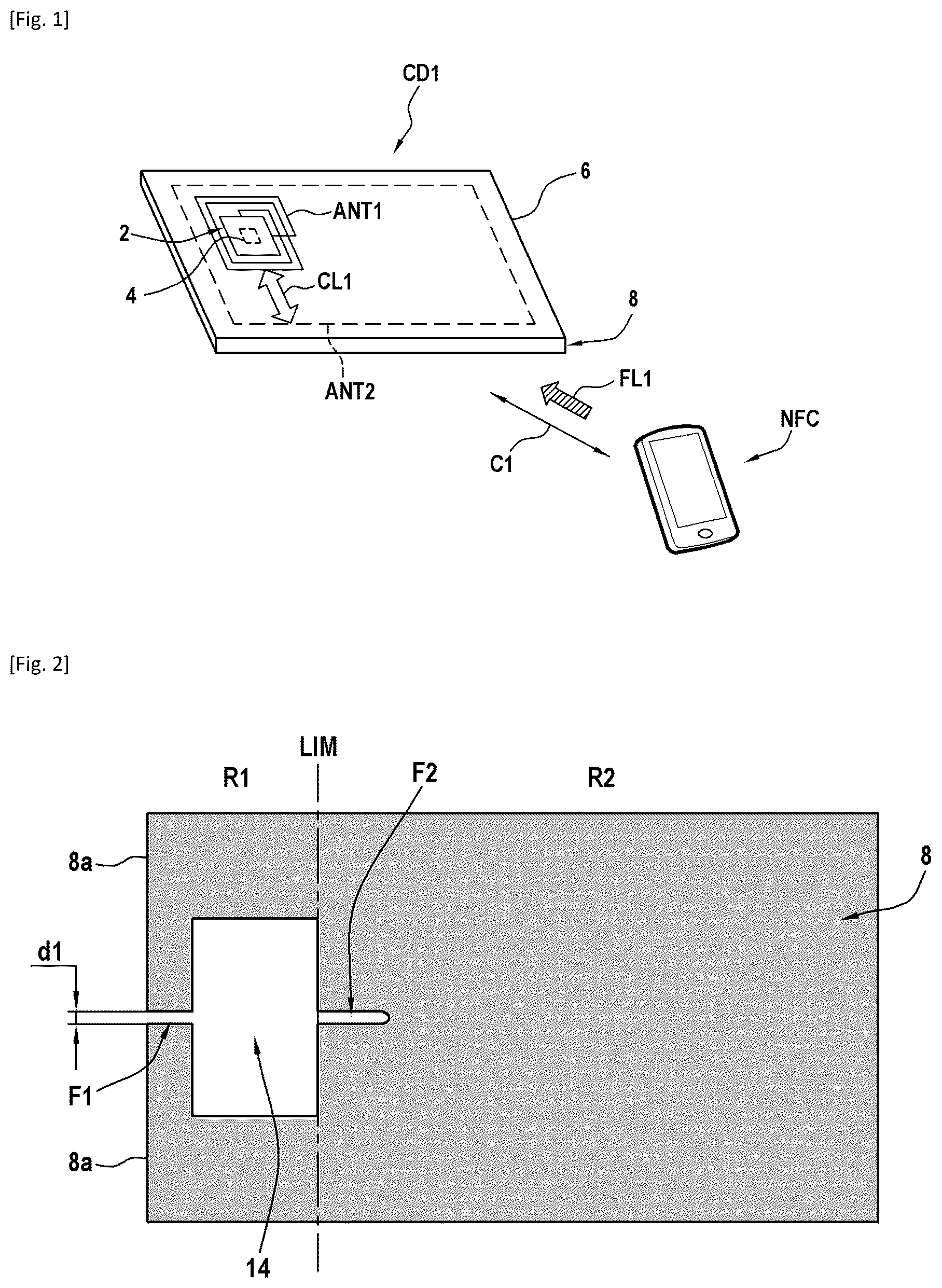
schematically shows a chip card interacting with an NFC reader, according to at least one particular embodiment of the invention;
is a top (or bottom) view of a metal layer of a chip card according to at least one particular embodiment of the invention;
is an exploded cross-sectional view schematically showing the structure of a chip card according to at least one particular embodiment of the invention;
is a detailed cross-sectional view of a segment of a chip card, according to at least one particular embodiment of the invention;
illustrates a zone of exploitability of the eddy currents in a metal layer;
shows a chip card centred with respect to the source of an incident magnetic field;
shows a chip card off-centre with respect to the source of an incident magnetic field;
A shows a first example of a metal layer able to be used in particular implementations of the invention;
B shows a second example of a metal layer able to be used in particular implementations of the invention;
C shows a third example of a metal layer able to be used in particular implementations of the invention;
D shows a fourth example of a metal layer able to be used in particular implementations of the invention;
shows one example of arrangement of an antenna and of a metal layer able to be implemented in a chip card according to one particular embodiment of the invention;
shows a chip card according to one particular embodiment of the invention;
illustrates operation of the chip card of ;
shows another chip card according to one particular embodiment of the invention;
shows, in the form of a flowchart, the steps of a process for manufacturing a chip card of the invention, according to at least one particular embodiment; and
, which has already been described, shows operating conditions of a chip card as defined by the international organization EMVCo.
DESCRIPTION OF EMBODIMENTS
As indicated above, the invention relates to metal chip cards configured to operate in contactless mode, and also relates to the manufacture of such chip cards. In the present document, a “metal chip card” is a chip card comprising a metal or a combination (alloy) of metals, for example taking the form of a metal layer or of a plurality of metal layers.
As indicated above, a contactless chip card is configured by nature to communicate contactlessly with the outside world, and more particularly with an external NFC reader. To this end, a contactless chip card incorporates a radio-frequency (RF) antenna for exchanging (receiving and/or transmitting) RF signals with an external NFC reader. Such a chip card may further have the capacity to also operate in contact mode, using external contacts provided for this purpose on the surface of the card: “dual” cards (or cards with a dual communication interface) are then referred to, these cards thus being capable of operating in contactless mode and in contact mode.
At the present time there is strong demand from users for metal chip cards, in particular for the reasons mentioned above (aesthetic aspects, impression of quality, prestige, etc.). In particular, it is desirable to produce chip cards in which the bulk (or a substantial part) of the card body is made of metal, or at least in which the card body comprises a metal plate (or metal layer), in order to obtain a certain uniformity and quality in the visual and aesthetic appearance of the card.
However, when a contactless chip card comprises a metal layer and an RF antenna placed on or in the vicinity of one of the faces of the metal layer, it has been observed that this metal layer disrupts contactless communication between the RF antenna and the outside world, in particular when the metal layer is placed between the RF antenna and the external NFC reader with which the chip card is attempting to communicate, because of the electromagnetic shielding induced by the metal layer. Thus, depending on the position and orientation of the card with respect to the reader, it may or may not be possible to perform a contactless transaction between a metal chip card and an external NFC reader. In certain cases, a transaction is possible if the chip card is presented so that the antenna is placed on the side of the NFC reader (without the metal layer being interposed between the two), but RF communication is disrupted, or even impossible, if the metal layer forms an electromagnetic barrier between the RF antenna of the card and the NFC reader (the metal plate acts as an electromagnetic barrier between the RF chip and the NFC reader). However, for RF communications to be possible between a metal chip card and an external NFC reader, it is generally necessary for the card to comprise ferrite in order to limit the electromagnetic disruptions caused by the metal portion. Without ferrite, even if a metal chip card is correctly oriented relative to an external NFC reader, it is generally not possible to properly exchange RF communications between the card and the NFC reader, thus making any transaction impossible (or at least difficult).
The invention in particular intends to overcome the aforementioned drawbacks and problems. To this end, the invention relates to a chip card comprising a metal layer and a particular antenna structure comprising two RF antennas, namely a first RF antenna electrically connected to an RF chip of the card, and a second RF antenna partially lying facing the metal layer to collect an image current induced by eddy currents flowing through the metal layer when the card is subjected to an electromagnetic field. A portion of the second RF antenna is further configured to allow magnetic coupling between the first RF antenna and the second RF antenna. To this end, the metal layer comprises a cut-out zone, the first RF antenna being positioned in or facing this cut-out zone, and one portion of the second RF antenna is positioned facing the cut-out zone to allow magnetic coupling to be established between the two RF antennas. By establishing such coupling through the cut-out zone, the RF chip of the card may thus use the second RF antenna to communicate contactlessly with the outside world. At least two slits are further provided in the metal layer in order to facilitate magnetic coupling between the two RF antennas whatever the operating conditions of the card.
To this end, the present invention relates to a chip card comprising a card body of generally rectangular shape formed at least in part by a metal layer comprising a cut-out zone, an RF chip, and a first RF antenna placed in or facing the cut-out zone, said first RF antenna being electrically connected to the RF chip, the metal layer consisting of a first region and second region that are entirely delineated by a straight line parallel to a short side of the card, the first region completely containing the cut-out zone and its area being smaller than the area of the second region, a first slit connecting the cut-out zone to a peripheral edge of the first region, a second slit opening either onto a peripheral edge of the metal layer or into the cut-out zone, the second slit ending with a closed portion in the second region; and a second RF antenna electrically insulated from the metal layer and from the first RF antenna and configured to allow coupling to the first antenna, the second antenna comprising at least one portion of turn facing the first slit and at least one portion of turn facing the second slit.
The invention also relates to a process for manufacturing such chip cards. Particular embodiments, and other aspects of the invention, are described in more detail below.
In the present description, examples of implementation of the invention are described with reference to a “dual” chip card, i.e. a card with a dual communication interface, having the capacity to communicate both in contact mode (via external contacts) and in contactless mode (via an RF antenna structure). It will however be noted that the invention is more generally applicable to any chip card configured to communicate contactlessly, irrespectively of whether it has the ability to also operate in contact mode.
In addition, in the following examples the considered chip card is a bank card, such as a payment card for example. This chip card may comply with the standard ISO 7816 and may operate according to the EMV standard, although neither of these aspects is essential to the implementation of the invention. More generally, the invention applies to any metal chip card configured to implement a transaction in contactless mode, including EMV cards or chip cards using another transaction standard, for example the NFC standard (for example according to ISO 14443-2, ISO 10373-6 or “EMV Contactless Certification”). Generally, the chip card of the invention may be configured to carry out a transaction of any type, such as banking transactions (payments, transfers, debits, etc.), authentication-related transactions, etc.
Unless otherwise indicated, elements common to a plurality of figures or analogous elements in a plurality of figures have been designated with the same reference signs and have identical or analogous characteristics, and hence these common or analogous elements have generally not been described more than once for the sake of simplicity.
The terms “first”, “second”, etc. have been used in this document by arbitrary convention to allow various elements (such as keys, devices, etc.) implemented in the embodiments described below to be identified and distinguished.
shows a metal chip card CD 1 configured to communicate in contactless mode with the outside world, and for example with an external NFC reader (or reader). The chip card CD 1 comprises an RF chip 4 , a card body 6 and two RF antennas (or at least two RF antennas), namely a first RF antenna ANT 1 and a second RF antenna ANT 2 . The RF chip 4 and the two RF antennas ANT 1 and ANT 2 are positioned on or in the card body 6 .
The card body 6 is formed at least in part of (or comprises) a metal layer 8 . This metal layer 8 may be made of a single metal, such as stainless steel or aluminium for example, or of an alloy of a plurality of different metals. The metal layer 8 may comprise a plurality of metal sublayers. According to one particular example, the card body 6 , and more generally the chip card CD 1 , is devoid of ferrite, this allowing manufacture of the card to be simplified.
The chip card is generally rectangular in shape (the corners being slightly rounded). In the examples considered here, the card body 6 is in ID-1 credit-card format, although the invention may be implemented with other formats.
The RF chip 4 is an electronic chip configured to set up contactless communication with the external NFC reader using the RF antennas ANT 1 and ANT 2 , as described below. To do this, the RF chip 4 is electronically connected to the first RF antenna ANT 1 but the second RF antenna ANT 2 is electrically insulated from the RF chip 4 and from the first RF antenna ANT 1 .
The antennas ANT 1 and ANT 2 partially face each other to allow magnetic coupling by induction between these two antennas and thus allow the RF chip 4 to use the second RF antenna ANT 2 to set up a contactless communication C 1 with the external NFC reader, as described in more detail below.
The RF chip 4 may for example comprise a microcontroller (or a processor) configured to set up a contactless communication with the world outside the chip card CD 1 (with the external NFC reader in this example) using the first and second RF antennas ANT 1 , ANT 2 coupled together by magnetic induction.
By way of illustration, shows the one and only metal layer 8 according to one embodiment.
In this example, the metal layer 8 comprises a cut-out zone 14 opening onto a peripheral edge (or outline) 8 a of the metal layer 8 . The cut-out zone 14 is a through-aperture (or zone) formed in the metal layer 8 to allow the first RF antenna ANT 1 to be positioned facing a portion of the second RF antenna ANT 2 as described below. The shape and dimensions of this cut-out zone 14 may be set on a case-by-case basis. By way of example, the cut-out zone 14 formed in the metal layer 8 is rectangular.
In the present application, and as shown in , the metal layer is considered to consist of two regions R 1 , R 2 delineated by a straight line LIM parallel to a short side of the card, the first region R 1 completely containing the cut-out zone 14 and its area being smaller than the area of the second region R 2 .
In the embodiment shown in , the straight line LIM is tangent to the cut-out zone 14 on its side closest to the centre of the chip card.
In the example shown in , the metal layer 8 comprises a first slit F 1 that connects or links a peripheral edge 8 a of the first region R 1 to the cut-out zone 14 . In other words, the cut-out zone 14 emerges (or opens) onto the peripheral edge 8 a via this first slit F 1 . This first slit F 1 is characterized by a distance d 1 separating two opposite peripheral edges of the metal layer 8 , the value of this distance d 1 potentially varying from case to case.
The position of the cut-out zone 14 in the metal layer 8 may vary from case to case. According to the particular example shown in , the cut-out zone 14 is positioned in the vicinity of a peripheral edge 8 a of the metal layer 8 , this making it possible to ensure effective magnetic coupling FL 1 between the RF antennas ANT 1 and ANT 2 , as explained in more detail below.
Other implementations are however possible, in which for example the cut-out zone 14 is positioned at the centre (or substantially at the centre) of the metal layer 8 , it being understood that this cut-out zone 14 is always configured to open onto (or be linked to) to a peripheral edge 8 a of the metal layer 8 via a first slit F 1 .
This cut-out zone 14 more or less corresponds to the zone accommodating the module, this accommodating zone being specified by standards so that the terminals can connect to the contacts of a module 2 described below.
In one embodiment, the conductive turns of the first RF antenna ANT 1 form a winding around the RF chip 4 in the cut-out zone 14 . This arrangement makes it possible to position the RF chip 4 very close to the first RF antenna ANT 1 and thus to limit the complexity of manufacture of the chip card CD 1 , in particular as regards the electrical connection between the RF chip 4 and the first antenna ANT 1 .
Particular embodiments in which the metal layer 8 comprises a cut-out zone 14 with the configuration illustrated in will now be considered.
In particular, schematically shows an exploded cross-sectional view of the chip card CD 1 and schematically shows a detailed cross-sectional view of the chip card CD 1 , according to at least one particular embodiment.
As shown in , the RF chip 4 is considered to be comprised (or embedded) in an electronic module 2 , the latter being inserted into the card body 6 . The electronic module 2 is for example positioned in a cavity 5 formed in the upper face of the card body 6 . To do this, the cut-out zone 14 contains an electrically insulating material 9 in which the cavity 5 used to accommodate the electronic module 2 is formed. Thus, the RF chip 4 is positioned in the cut-out zone 14 (or, as a variant, facing and above the cut-out zone 14 ). It should be noted, however, that various arrangements of the RF chip 4 are possible. Variants in which the RF chip 4 is not placed in, or facing, the cut-out zone 14 are in particular possible.
According to one variant embodiment, the RF chip 4 (with or without the electronic module 2 ) is positioned on (or facing) the metal layer 8 . To this end, an insulating material may be placed between the RF chip 4 and the metal layer to provide electrical insulation.
In the example of , the electronic module 2 comprises, on its upper face, external contacts (or contact lands) CT 1 configured to allow communication by contact between the RF chip 4 and an external NFC reader provided to this end (with the NFC reader for example). More particularly, the electronic module 2 may comprise a printed circuit board (PCB) comprising the external contacts CT 1 on its upper face, and the RF chip 4 on its lower face. The external contacts CR 1 are metal zones designed to welcome connection pins of an external NFC reader. These external contacts CT 1 may be compliant with the standard ISO 7816, although other examples are possible. The electronic module 2 is placed in the chip card CD 1 so that its external contacts CT 1 are accessible from the upper surface of the card body 6 , to allow the RF chip 4 to communicate by contact with an external NFC reader.
As already indicated, embodiments are also possible without such external contacts CT 1 . In addition, it is not obligatory for the RF chip 4 to be integrated into the electronic module 2 as shown in the figures, other arrangements of the RF chip 4 without such a module being possible.
In the example of , the RF chip 4 is placed in the cut-out zone 14 . As a variant, the first RF antenna ANT 1 is placed outside the cut-out zone 14 , namely facing the cut-out zone 14 (in alignment with and above the latter). The cut-out zone 14 is thus located in between the first and second RF antennas ANT 1 and ANT 2 , to allow coupling CL 1 by magnetic induction between said first and second antennas ANT 1 and ANT 2 .
The RF chip 4 , and more generally the electronic module 2 , may be arranged in the insulating layer 9 (commonly called the inlay). This configuration makes it easier to mount the RF chip 4 and the first RF antenna ANT 1 in the card body 6 .
As shown in , the card body 6 comprises at least one external insulating layer 12 formed on the lower face 10 b of the insulating layer 10 so as to cover and protect the second RF antenna ANT 2 . At least one protective insulating layer may also be provided, if necessary, on the upper face of the card body.
Each of the RF antennas ANT 1 , ANT 2 comprises at least one electrically conductive portion of turn so as to allow exchanges of RF signals between the chip card CD 1 and the outside world. The RF antennas ANT 1 and ANT 2 may each consist, for example, of an electrically conductive track, wire or member forming one or more conductive turns. In the present case, the first and second RF antennas ANT 1 , ANT 2 are considered to each comprise a plurality of conductive turns. Various manufacturing techniques (wire winding, deposition, etching) well known per se may be used to produce these RF antennas. The physical characteristics (shape/size of the intersection, length of the antenna, number of turns, material, etc.) of the RF antennas ANT 1 and ANT 2 may be set on a case-by-case basis in particular to allow wireless communication at the desired frequencies (or in the desired frequency ranges).
More precisely, as shown in , the first RF antenna ANT 1 comprises a plurality of electrically conductive turns—called “first” conductive turns—placed in the cut-out zone 14 . In this particular case, the size of the RF antenna ANT 1 is therefore limited insofar as its first conductive turns are contained in the cut-out zone.
Moreover, the second RF antenna ANT 2 is electrically insulated from the metal layer 8 and from the first RF antenna ANT 1 . This insulation may be provided in various ways depending on the case. By way of example, the card body 6 is considered to comprise an electrically insulating layer 10 (commonly called an “inlay” which stands for “inner layer”) interposed between the second RF antenna ANT 2 on the one hand, and the metal layer 8 and the cut-out zone 14 on the other hand. The insulating layer 10 is in particular located at the interface between the second antenna ANT 2 and the insulating material 9 in which the first RF antenna ANT 1 lies.
As illustrated in , and to facilitate the description, the second RF antenna ANT 2 is considered to comprise at least three antenna portions, namely a first antenna portion ANT 2 a , a second antenna portion ANT 2 b , and a third antenna portion ANT 2 c , that are electrically connected to one another.
More precisely, the first and second antenna portions ANT 2 a and ANT 2 b comprise a plurality of electrically conductive turns, which lie facing (or opposite) the metal layer 8 , to collect an image current induced by eddy currents I 1 that flow through the metal layer 8 when the latter is subjected to an incident magnetic field.
More precisely, and as explained in detail below, the first antenna portion ANT 2 a (the second antenna portion ANT 2 b , respectively) is arranged to effectively collect the eddy currents flowing through the metal layer when the chip card CD 1 is centred with respect to the antenna of the NFC reader (in an off-centre position with respect to the antenna of the NFC reader, respectively).
In this document, the card is considered to be centred with respect to the antenna of the NFC reader when the entire surface of the card is exposed to a uniform maximum-strength magnetic field generated by the antenna of the NFC reader.
As shown in , in at least one embodiment, the RF chip 4 is electrically connected to the first RF antenna ANT 1 . In the example considered here, the electrical connection is made via connection pads (or lands) 16 a and 16 b of the electronic module 2 , these pads being connected to connection pads (or lands) 18 a and 18 b provided to this end in the cut-out zone 14 (in the insulating material 9 in this example), respectively. The connection pads 18 a and 18 b are in turn connected to the two ends of the first RF antenna ANT 1 , respectively. However, other ways of connecting the RF chip 4 to the first RF antenna ANT 1 are envisageable.
Various configurations of the second RF antenna ANT 2 are possible. According to one preferred embodiment, the third antenna portion ANT 2 c lies exclusively facing the cut-out 14 zone. In other words, this third antenna portion ANT 2 c , which is formed from a plurality of conductive turns, is placed facing the cut-out zone 14 so that it does not lie facing the metal layer 8 . In particular, the third antenna portion ANT 2 c is not superposed with (or does not cover) the metal layer 8 on the periphery of the cut-out zone 14 , this allowing the flux of the magnetic field to which the third antenna portion ANT 2 b and the first RF antenna ANT 1 are subjected to be optimized. Although it is not desirable for a segment of the third antenna portion ANT 2 c to lie facing the metal layer 8 , a certain tolerance may be accepted in certain cases.
The hatching in illustrates, for one particular embodiment of the invention, a special zone ZC for exploitation of the eddy currents that flow through the metal layer 8 when the chip card is exposed to a magnetic field under defined conditions, this special zone ZC being contained in region R 2 of the metal layer 8 .
is given, merely by way of illustration, in the particular context of the operating conditions defined by the international organization EMVCo and recalled above with reference to .
As known, when a metal surface is subjected to a magnetic field, this magnetic field induces on this surface eddy currents that form closed loops, the dominant loops being such that they maximize the area of these loops opposite the maximum-strength magnetic field.
Thus, when a metal layer is subjected to a magnetic field that is uniform over the entire surface of the card, the dominant loop of the eddy currents induced by the incident magnetic field follows the outline of the card.
In contrast, assuming that the reader possesses a circular antenna and that it produces a uniform magnetic field, as soon as the metal surface is no longer entirely opposite a uniform field, the dominant loop no longer follows the outlines of the card, but maximizes the area of this loop in direct view of the maximum-strength magnetic field.
In other words, in a first approximation, the dominant loop bounds the projection of this field on the surface of the card.
In one embodiment of the invention, the special zone ZC for exploitation of the eddy currents may be a zone of the surface of the card that is subjected to a uniform maximum-strength magnetic field whatever the operating conditions of the card.
For example, shows a chip card in ID 1 format (length L of 85.6 mm and width I of 54.0 mm), C being the centre of the card and further being considered below to be the centre of the metal layer 8 , and a zone ZC of exploitability of the eddy currents consisting of a disk having a centre C and a radius r of 2.5 cm.
The inventors have determined that whatever the position of the centre C of the card in the operational volume defined by the organization EMVCo, such a special zone of exploitability ZC (disk of 25 mm radius in the centre of the card) is entirely contained in an electromagnetic field generated by the antenna of the NFC reader of sufficient strength for eddy currents flowing through this zone to be exploited by the invention.
In a circle CH R bounding a maximum-strength magnetic field generated by an NFC reader has been shown. This figure assumes an NFC-reader antenna that is perfectly circular and rotationally symmetrical.
In this figure, the centre C of the chip card CD 1 is located at the centre of the circle CH R .
shows the chip card CD 1 , the centre C of the chip card CP being offset by 25 mm with respect to the centre of the circle CH R , this offset of 25 mm corresponding to the maximum offset of the card in the operational volume defined by EMVCo (point 6 of ).
The inventors have observed that the zone ZC of exploitability of the eddy currents that is shown in (disk of 25 mm radius centred on the card) is located entirely in the maximum-strength field CH R of the NFC reader, in particular for the maximum offset (point 6 ) of the card in the operational volume defined by EMVCo, and therefore in any position of the card under the defined operating conditions.
The invention may be used in contexts other than that of the EMVCo standard.
Generally, the zone ZC of exploitability of the eddy currents that is used in the invention may be defined so that this zone ZC is located entirely in a maximum-strength magnetic field, whatever the position of the card under predefined operating conditions.
A to 8 D show four examples of a metal layer 8 comprising:
•
• (i) a cut-out zone 14 connected by a first slit F 1 to the edge 8 a corresponding to the short side of the metal layer 8 closest to the cut-out zone; and • (ii) a slit F 2 , noteworthy in that it opens either onto one edge of the metal layer 8 or into the cut-out zone 14 and in that it has a closed end located in the second region R 2 of the metal layer, and in the examples of A to 8 C more precisely in a special zone ZC of exploitability of the eddy currents.
In A to 8 D , the symbol FL 1 shows the direction of the magnetic field of the NFC reader. This magnetic field generates eddy-current loops on the metal layer 8 . For the sake of simplicity, only two loops B 1 , B 2 have been shown, these including a dominant loop B 1 .
In the four examples, the slits F 1 and F 2 are thus arranged to let the magnetic field generated by a chip-card reader pass through and to pass an image current of a current flowing in a loop of an eddy current flowing through the metal layer 8 .
These slits F 2 make it possible to orient the eddy currents so that the latter are in phase with the magnetic flux delivered by the terminal around the slit, and hence the eddy currents around the slit do not counteract this magnetic flux.
shows, in addition to the metal layer 8 , an antenna ANT 2 (second antenna in the context of the invention) provided on a plastic layer (not shown).
This figure shows the three portions of this antenna, these portions being referred to below as the first antenna portion ANT 2 a , the second antenna portion ANT 2 b and the third antenna portion ANT 2 c.
The antenna ANT 2 is configured so that current flows in the same direction in the first, second and third antenna portions ANT 2 a , ANT 2 b , ANT 2 c.
In the embodiment of , the first antenna portion ANT 2 a is the most peripheral portion. It is arranged facing the metal layer 8 and extends along the four edges of the metal layer 8 . It comprises at least one portion of turn straddling the first slit F 1 .
In the embodiment of , the second antenna portion ANT 2 b is connected to the first antenna portion ANT 2 a . The second antenna portion ANT 2 b is noteworthy in that it is arranged facing the second region R 2 of the metal layer 8 and in that it has at least one portion of turn facing the second slit.
Thus, at least one turn of the antenna ANT 2 b is able to pick up an image current induced by a current flowing in a main loop of an eddy current generated by an incident magnetic field under the operating conditions of the chip card, when this loop is located in the second region R 2 .
In the embodiment of , the third antenna portion ANT 2 c terminates the second antenna ANT 2 . It is the portion of the antenna ANT 2 that is not superposed with the metal layer 8 but which is superposed with at least one portion of the cut-out zone 14 .
shows a chip card CD 1 according to one embodiment of the invention. It in particular comprises a first antenna ANT 1 electrically connected to an RF chip, a second antenna ANT 2 and a metal layer 8 .
The metal layer 8 comprises a cut-out zone 14 or cavity the size of which is at least equal to the size of the dielectric substrate accommodating the first antenna ANT 1 , the first antenna ANT 1 being placed in or facing the cut-out zone, in such a way that the first antenna ANT 1 does not overlap with the metal layer 8 .
In the embodiment of , the first antenna ANT 1 is provided on the substrate bearing a contact plate. As a variant, the first antenna ANT 1 may be carried by another dielectric substrate placed in the cut-out zone 14 and connected to the contact-plate module, bearing the RF chip, by a connection ACF.
In the embodiment of , the cut-out zone 14 opens onto a peripheral edge 8 a of the metal layer. To this end, the cut-out zone is connected to the peripheral edge 8 a of the metal layer by a first slit F 1 that extends from the cut-out zone to the edge 8 a of the metal layer 8 .
In the embodiment of , a second slit F 2 extends from the cut-out zone 14 towards the interior (or central zone) of the metal layer. This second slit is closed and its end is located in the second region R 2 .
In the embodiment described here, the second antenna ANT 2 is electrically insulated from the metal layer 8 by means of a dielectric insulating layer.
The second antenna ANT 2 may be considered to comprise three portions ANT 2 a , ANT 2 b and ANT 2 c , the current flowing in the same direction through these three antenna portions.
As illustrated in , the first antenna portion ANT 2 a is the most peripheral portion. It is arranged facing the metal layer 8 and extends along the four edges of the metal layer 8 . It straddles the slit F 1 .
As illustrated in , the second antenna portion ANT 2 b is connected to the first antenna portion ANT 2 a . The second antenna portion ANT 2 b is arranged facing the metal layer 8 and at least one turn straddles the slit F 2 in the second region R 2 .
As illustrated in , the third antenna portion ANT 2 c terminates the second antenna ANT 2 . The third antenna portion ANT 2 c is not superposed with the metal layer 8 but is superposed with at least one portion of the cut-out zone 14 .
As described in detail below, the third antenna portion ANT 2 c ensures inductive coupling between the second antenna ANT 2 and the first antenna ANT 1 .
In the embodiment described here, the card CD 1 comprises a capacitive element CP 1 . In the embodiment described here, the capacitive element CP 1 is a parallel-plate capacitor. Other implementations may be used. The capacitive element CP 1 may take the form of a discrete capacitive component.
In the example described here, the capacitive component CP 1 is placed in the insulating layer 10 or on the lower face 10 b of this insulating layer 10 . The RF antennas ANT 1 and ANT 2 are connected in parallel with the capacitive component CP 1 . This capacitive component CP 1 thus forms, with the RF antennas ANT 1 and ANT 2 , an RLC circuit allowing the resonant frequency of the second RF antenna ANT 2 to be tuned so that it is for example equal to 13.56 MHz, this allowing a communication C 1 in contactless mode of RFID type with an RFID reader (for example according to standard ISO14443/ISO 10373, in particular its current version ISO/IEC 10373-6:2020 or any of the earlier versions, or any later version).
The capacitive component CP 1 may b″ of 'omb type and comprises two opposite sets of conductive fingers interdigitated with one another, other forms of capacitor however being possible (parallel-plate capacitor, discrete surface-mounted capacitor, parallel-wire capacitor, etc.).
For example, a first end of the third antenna portion ANT 2 c is connected via a first connection to the capacitive component CP 1 and a second end of the third antenna portion ANT 2 c is connected via a second connection to a first end of the first antenna portion ANT 2 a . Moreover, the capacitive component CP 1 is connected via a third connection to a second end of the first antenna portion ANT 2 a.
The examples of slits F 2 shown in A- 8 D are merely non-limiting examples. Any slit opening either into the cavity 14 or onto one edge of the card and ending with a closed end in the second region R 2 , preferably in a special zone ZC of exploitability of the eddy currents, may be used in the context of the invention.
illustrates operation of the chip card of when it is centred with respect to the antenna of the NFC reader, or in other words when the surface of the card is exposed to a uniform magnetic field FL 1 generated by the reader.
Under the effect of the magnetic field FL 1 , eddy currents—generally denoted I 1 —are generated in the metal layer 8 . These eddy currents I 1 form closed loops of flowing current on the surface of the metal layer 8 . These eddy currents form closed loops in the metal layer 8 , in a direction such as to create a magnetic field that counteracts the incident magnetic field.
In the example of , the eddy currents flow clockwise.
Let it be assumed that the entire surface of the card is exposed to a uniform magnetic field and, as in the case illustrated in , that the dominant eddy-current loop B 1 follows the peripheral outline of the metal layer 8 . By way of illustration only, two other secondary loops B 2 and B 3 have been shown.
As known to those skilled in the art, the eddy currents, which flow in the clockwise direction, induce an image current I 2 a that flows through the first antenna portion ANT 2 in the anti-clockwise direction.
As shown in , eddy currents—referred to as first eddy currents—corresponding to dominant loops flowing on the surface of the metal layer 8 in the vicinity of the peripheral outline of said metal layer 8 , have been denoted I 1 a . Eddy currents—referred to as second eddy currents—corresponding to secondary loops flowing on the surface of the metal layer 8 in the vicinity of the peripheral outline of the cut-out zone 14 , have been denoted I 1 b.
Since the eddy currents flow in closed loops, the eddy currents I 1 b are actually a continuation of the eddy currents I 1 a in the vicinity of the peripheral outline of the cut-out zone 14 . As may be seen in , the second eddy currents I 1 b flow, in the vicinity of the second antenna portion ANT 2 b , in a direction of rotation (or direction of flow) opposite to that of the first eddy currents I 1 a flowing in the vicinity of the peripheral outline of the metal layer 8 . By way of example, in this example the first and second eddy currents I 1 a , I 1 b are considered to flow in the clockwise and anti-clockwise directions, respectively, the inverse configuration however being possible depending on the orientation of the magnetic field FL 1 in question. The oppositely directed flows of the eddy currents I 1 a and I 1 b in particular results from the aforementioned continuation of the eddy currents, and from the presence of the cut-out zone 14 which, in this example, is connected by the linking slit F 1 to the peripheral outline 8 a of the metal layer 8 .
Therefore, the current I 2 flowing through the second RF antenna ANT 2 is an induced current resulting from two components, namely: an image current I 2 a induced by the first eddy currents I 1 flowing on the surface of the metal layer 8 in the vicinity of the first antenna portion ANT 2 a ; and a current I 2 b that is induced directly in the third antenna portion ANT 2 c by the incident magnetic field FL 1 through the cut-out zone 14 (I 2 =I 2 a +I 2 b ). The very structure of the chip card CD 1 is designed to lead to this dual contribution of the induced currents I 2 a and I 2 b , in order to collect in the second antenna RF the highest possible overall induced current I 2 .
More precisely, the first antenna portion ANT 2 a lying facing the metal layer 8 collects an image current I 2 a induced by the first eddy currents I 1 a flowing on the surface of the metal layer 8 under the effect of the magnetic field FL 1 when the chip card CD 1 is centred with the antenna of the NFC reader.
These first eddy currents I 1 a correspond to dominant loops flowing on the surface of the metal layer 8 in the vicinity of the turns of the first antenna portion ANT 2 a . As already indicated, the first antenna portion ANT 2 a may preferably lie facing a peripheral zone (or strip) of the metal layer 8 , to collect a maximum of the energy generated by the dominant eddy-current loops. The first eddy currents I 1 a flowing in the vicinity of the first antenna portion ANT 1 a (in this example on the periphery of the metal layer 8 ) produce an effect that counteracts the incident magnetic field FL 1 . The induced current I 2 a collected in the turns of the first antenna portion ANT 2 a is itself a reaction to the first eddy currents I 1 a.
Thus, the image current I 2 a induced by the first eddy currents I 1 a is conveyed by electrical conduction to the third antenna portion ANT 2 c , because of the electrical continuity of the first, second and third antenna portions ANT 2 a , ANT 2 b , ANT 2 c , which are connected together.
The image current I 2 a thus flows through the turns of the third antenna portion ANT 2 c , which is positioned facing the cut-out zone 14 .
As illustrated in , the image current I 2 a flows in the same direction of rotation (or the same direction of flow) through the turns of the first, second and third antenna portions ANT 2 a , ANT 2 b and ANT 2 c , namely in the anti-clockwise direction in this example. However, because of the presence in the metal layer 8 of the cut-out zone 14 connected via the linking slit F 1 to the peripheral edge 8 a , the second eddy currents I 1 b (secondary loops) flow in the vicinity of the cut-out zone 14 , on the surface of the metal layer 8 , in a direction of rotation (or direction of flow) opposite that of the first eddy currents I 2 a flowing on the periphery of the metal layer 8 . By way of example, the second eddy currents I 1 b here flow in the anti-clockwise direction whereas the first eddy currents I 1 a flow in the clockwise direction. Thus, the second eddy currents I 1 b flowing on the periphery of the cut-out zone 14 do not counteract the magnetic field passing through the slit and contribute to amplifying the image current I 1 a flowing through the turns of the third antenna portion ANT 2 c.
Moreover, the effect of the second slit F 2 is to push the dominant eddy-current loop towards the second portion ANT 2 b of the second antenna ANT 2 , this increasing the coupling of energy between the eddy currents of the metal layer 8 and the second antenna portion ANT 2 b in the vicinity of the second slit F 2 .
As already indicated, the third antenna portion ANT 2 c further collects, in its turns, a current I 2 b that is induced directly by the incident magnetic field FL 1 picked up in the cut-out zone 14 by the third antenna portion ANT 2 c . In this example, the magnetic field FL 1 is directed from the upper face of the chip card CD 1 to its lower face. Thus, the current component I 2 b induced in the second antenna portion ANT 2 b also flows in the anti-clockwise and therefore adds constructively with the image current I 2 a . Since the two current components I 2 a and I 2 b flow in the same direction (in-phase components) in the second antenna ANT 2 , they add constructively to contribute together to the generation of the overall induced current I 2 flowing through the second antenna ANT 2 .
The overall current I 2 flowing through the third antenna portion ANT 2 c in turn induces a magnetic field that causes magnetic coupling CL 1 between the first RF antenna ANT 1 and the third RF antenna portion ANT 2 c , and therefore also between the first RF antenna ANT 1 and the second RF antenna ANT 2 . The combined action of the image current I 2 a delivered by the first antenna portion ANT 2 a on the one hand, and of the current I 2 b induced by the magnetic field FL 1 in the cut-out zone 14 in the third antenna portion ANT 2 c on the other hand, allows the amount of energy collected in the second RF antenna ANT 2 from the magnetic field FL 1 to be maximized, and therefore effective magnetic coupling CL 1 between the two RF antennas ANT 1 , ANT 2 to be guaranteed, this making it possible to deliver a maximum of energy to the RF chip 4 connected to the first RF antenna ANT 1 .
The third antenna portion ANT 2 c thus contributes to amplifying the energy harvested because it also comprises an electric-current component induced directly by the incident magnetic field of the NFC reader. The fact that the current flows in the same direction through the three portions of the antenna ANT 2 increases the transfer of energy (energy harvested simultaneously from the eddy currents on the surface of the metal layer 8 combined with the harvested energy directly induced by the incident magnetic flux through the cavity zone 14 ) by coupling to the first antenna ANT 1 and therefore to the RF chip 4 .
Returning to A for example, when the card CD 1 is off-centre with respect to the NFC reader, the dominant loop B 1 flows through the second region R 2 in the clockwise direction in a closed loop along the edges 8 b , 8 c , 8 d of the metal layer 8 , this loop passing through the metal layer from the edge 8 d to the edge 8 b on a path that maximizes the area of this loop in direct view of the maximum-strength magnetic field.
As explained with reference to , the second antenna portion ANT 2 b is arranged so that at least one of its turns straddles the slit F 2 in the second region F 2 , preferably in a special zone ZC of exploitability of the eddy currents ZC.
The antenna ANT 2 b is thus able to pick up an image current induced by a current flowing through the dominant loop B 1 of the eddy current induced by the magnetic field when the card is off-centre, the dominant loop B 1 being deviated by the slit F 2 , facing at least one turn of the second portion ANT 2 b (and possibly facing or in proximity to at least one portion of turn of the first antenna portion ANT 2 a ).
In operation, under the effect of the magnetic field FL 1 to which the chip card CD 1 is subjected, the RF chip 4 is thus capable of using the second RF antenna ANT 2 coupled to the first RF antenna ANT 1 to communicate with the external NFC reader (and in particular to transmit and/or receive RF signals to/from the NFC reader) whatever the position of the card with respect to the NFC reader under defined operating conditions.
When a user presents the chip card CD 1 in the vicinity of the NFC reader, a contactless communication may thus be set up between the NFC reader and the chip card CD 1 , whatever the position and orientation of the latter in relation to the NFC reader, the current induced by the dominant eddy-current loops being collected either by the first antenna portion ANT 2 a or by the second antenna portion ANT 2 b depending on whether the card is centred or offset with respect to the reader, within the limits of the operating conditions of the card.
As already indicated, various arrangements of the chip card CD 1 may be envisaged, in particular as regards the configuration, i.e. shape, dimensions, position, etc. of the cut-out zone 14 and of the slits F 1 and F 2 .
illustrates another chip card according to the invention. In this embodiment, the second slit F 2 opens onto an edge opposite the edge 8 a into which the first slit F 1 opens.
In this embodiment of the invention, the second antenna ANT 2 comprises a fourth portion ANT 2 d around the cut-out zone 14 and connecting the turns of the second portion ANT 2 b to that of the third portion ANT 2 c of the second antenna ANT 2 . The fourth antenna portion ANT 2 d is in direct superposition with the conductor of the metal layer 8 and is also electrically insulated from this metal layer, like the first and second antenna portions ANT 2 a , ANT 2 b.
These four antenna portions are arranged so that the current flows in the same direction in these four portions.
As detailed above, the circle CH R represents the outline bounding the region/zone of maximum strength of the magnetic field of the NFC reader, in the plane of the card, where the field may be considered to be approximately uniform.
illustrates a situation in which the NFC card is placed offset with respect to the centre of the circle CH R , so that the cut-out zone 14 and the third and fourth antenna portions ANT 2 c and ANT 2 d are outside this region of maximum magnetic field.
The slit F 2 opens onto one edge of the card and ends with a closed portion in the second region R 2 of the metal layer.
This slit F 2 is thus arranged to deviate the dominant eddy-current loops towards the zone ZC of exploitation of the eddy currents, facing which zone at least one turn of the second antenna ANT 2 b lies.
In the embodiment described here, the depth of the slit F 2 in the longitudinal dimension of the chip card is chosen to be at least equal to or close to the distance of the adjacent turns of the antenna ANT 2 b with respect to the edge of the metal layer onto which the slit F 2 opens.
Moreover, and as shown in the detail of , the slit F 2 also allows the incident magnetic field of the reader to pass through the metal layer 8 while being in phase with the electric current induced in the turns of the second antenna ANT 2 b . As explained above, the current in the second antenna ANT 2 b has the following components:
•
• (i) a first component corresponding to the image current picked up by the second antenna ANT 2 b ; and • (ii) a second component created by magnetic induction through the aperture of the slit F 2 in the portion of the antenna wires of the second antenna ANT 2 b that straddle the slit F 2 .
schematically shows a process for manufacturing one of the chip cards CD 1 described above, according to at least one particular embodiment. In a providing step S 2 , a card body 6 comprising a metal layer 8 as described above is formed (or provided). In particular, this card body 6 is formed at least in part by a metal layer 8 , this metal layer 8 comprising a cut-out zone 14 .
The metal layer 8 is considered to consist of a first region R 1 and a second region R 2 entirely delineated by a straight line LIM parallel to a short side of the card CD 1 , the first region R 1 entirely containing the cut-out zone 14 , its area being smaller than the area of the second region R 2 .
The metal layer comprises a first slit F 1 that connects the cut-out zone to a peripheral edge 8 a of the metal layer and a second slit F 2 that opens either onto a peripheral edge of the metal layer or into the cut-out zone 14 , the second slit F 2 ending with a closed portion in the second region R 2 .
In a forming step S 4 , a first RF antenna ANT 1 is formed (or assembled) on or in the card body 6 in or facing the cut-out zone 14 of the metal layer 8 , as already described.
In an assembling step S 6 , an RF chip 4 is assembled with the card body 6 so that the RF chip 4 is electrically connected to the first RF antenna, as described above.
In a forming step S 8 , a second RF antenna ANT 2 is formed (or assembled) on or in the card body 6 so that the second RF antenna ANT 2 is electrically insulated from the metal layer 8 and from the first RF antenna ANT 1 , as described above. In particular, the forming step S 8 is carried out so that the second RF antenna is intended to allow coupling to the first antenna, the second antenna comprising at least one turn located facing the first slit F 1 and at least one turn located facing the second slit F 2 .
Those skilled in the art will understand that the embodiments and variants described above are merely non-limiting examples of implementations of the invention. In particular, a person skilled in the art will be able to envisage any adaptation or combination of the embodiments and variants described above, in order to meet a particular need according to the claims presented below.
Figures (11)
Citations
This patent cites (5)
- US2021/0049431
- US2021/0081748
- US2021/0192311
- USWO 2021/030782
- USWO 2021/030782