Metering Method Based on Converted Slip Ratio Fitting for Wet Natural Gas
Abstract
A metering method based on converted slip ratio fitting for wet natural gas is provided. The method includes fitting relationships between a gas Froude number and Venturi differential pressure and Venturi pressure loss with known data to obtain a gas Froude number calculation formula; dividing the known data according to a size of the gas Froude number, and performing piecewise fitting to obtain a piecewise converted slip ratio calculation formula under different gas Froude numbers; performing fitting on the dryness fraction and the converted slip ratio calculation formula; and acquiring, on the basis of the gas Froude number calculation formula, the converted slip ratio calculation formula, an overrated factor calculation formula and a dryness fraction calculation formula, some necessary real-time data to calculate a real-time flow rate of the wet gas. The method avoids using a ray flow meter and has advantages that include accurate metering and no radioactive pollution.
Claims (5)
1 . A flow metering method based on converted slip ratio fitting for wet natural gas, being implemented according to the following steps: step 1, acquiring a fitting array, wherein the fitting array comprises some one-to-one corresponding data comprising a gas Froude number Frg, Venturi pressure loss PL, Venturi differential pressure DP 1 , a converted slip ratio SS, a dryness fraction X and an overrated factor OR; step 2, fitting relationships between the gas Froude number Frg and the Venturi pressure loss PL and Venturi differential pressure DP 1 according to Formula (1) as follows: Frg=F(DP 3 ) Formula (1),
Show 4 dependent claims
2 . The flow metering method based on converted slip ratio fitting for wet natural gas according to claim 1 , wherein in step 2, fitting is performed according to Formula (1) as follows:
3 . The flow metering method based on converted slip ratio fitting for wet natural gas according to claim 1 , wherein in step 3, piecewise fitting is performed according to Formula group (2) as follows:
4 . The flow metering method based on converted slip ratio fitting for wet natural gas according to claim 1 , wherein in step 4, fitting is performed to obtain the overrated factor calculation formula according to Formula (3) as follows:
5 . The flow metering method based on converted slip ratio fitting for wet natural gas according to claim 1 , wherein in step 3, the division range is artificially set.
Full Description
Show full text →
CROSS REFERENCE TO THE RELATED APPLICATIONS
This application is the national phase entry of International Application No. PCT/CN2023/089553, filed on Apr. 20, 2023, which is based upon and claims priority to Chinese Patent Application No. 202211651518.2, filed on Dec. 21, 2022, the entire contents of which are incorporated herein by reference.
TECHNICAL FIELD
The present disclosure relates to natural gas extraction engineering, and in particular to a flow metering method in a natural gas extraction process.
BACKGROUND
The state advocates carbon neutralization, strives to reach the peak value by 2030, and strives to realize carbon neutralization by 2060. Compared with petroleum, natural gas has the advantages of low carbon and high efficiency, is a cleaner energy source, and also an important transitional resource for realizing carbon neutralization in the future. The whole world has stepped up its efforts to extract natural gas.
A wet gas flow meter is an important apparatus for natural gas exploitation, which provides important real-time metering data for gas reservoir management and enhanced oil recovery. There are two main technologies for the wet gas flow meter, one is “Venturi+gamma ray” technology, and the other is “V-cone+gamma ray” technology. Both technologies require two metering methods to cooperate with each other, and integrate their respective data to calculate a flow rate of wet gas (gas and liquid two-phase flow).
However, although such two technologies are widely used, existing wet gas flow meters are limited in application in some areas due to safety regulatory issues for gamma radiation sources, and therefore, it is necessary to develop a wet gas flow metering technology of the non-ray technology.
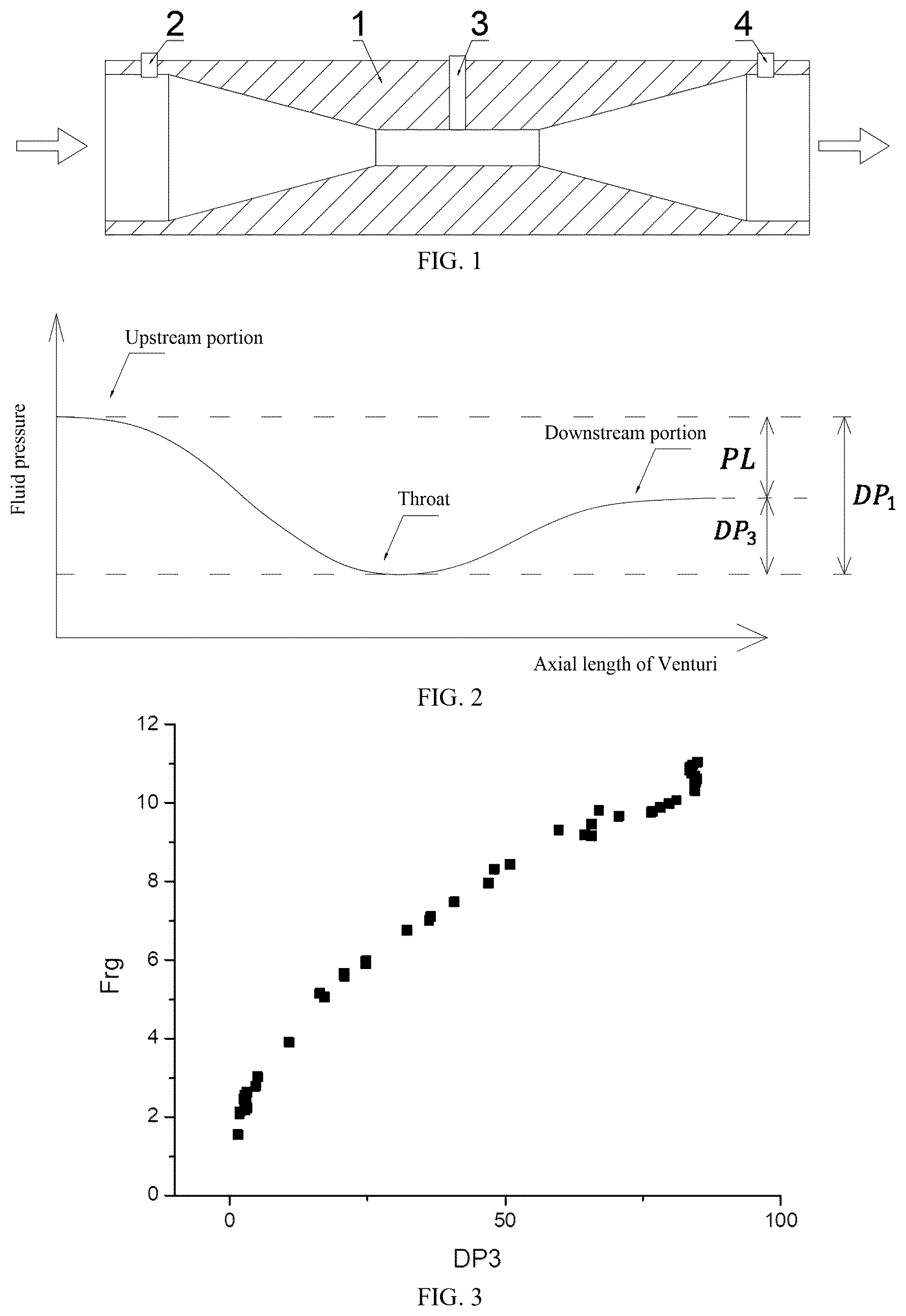
As the mature prior art, the basic principle of the Venturi metering technology is shown in . Venturi differential pressure DP 1 is measured by taking pressure ( 2 and 3 ) at the upstream portion and the throat of a Venturi tube respectively, Venturi pressure loss PL is measured by taking pressure at the upstream portion and downstream portion ( 2 and 4 ) of the Venturi tube respectively. When wet gas flows in the Venturi tube, the pressure decreases first and then recovers, as shown in .
SUMMARY OF THE INVENTION
In view of the above reasons, the present disclosure provides a metering method based on converted slip ratio fitting for wet natural gas, which performs virtual metering only based on a basic Venturi flow meter and gets rid of dependence on a ray flow meter. In practical application, the metering method has the advantages of accurate metering, small errors and no radioactive pollution, and has practical application value and significance.
The main technical solutions employed by the present disclosure are implemented according to the following steps:
Firstly, fitting relationships between a gas Froude number and Venturi differential pressure and Venturi pressure loss with known data to obtain a gas Froude number calculation formula, which specifically includes the following steps:
•
• step 1, acquiring a fitting array, where • the fitting array includes some one-to-one corresponding data including a gas Froude number Frg, Venturi pressure loss PL, Venturi differential pressure DP 1 , a converted slip ratio SS, a dryness fraction X and an overrated factor OR; and • step 2, fitting relationships between the gas Froude number Frg and the Venturi pressure loss PL and Venturi differential pressure DP 1 according to Formula (1) as follows:
Frg = F ( D P 3 ) , Formula ( 1 ) where D P 3 = D P 1 - P L , and
•
• a gas Froude number calculation formula is obtained by means of fitting.
Then, dividing the known data according to a size of the gas Froude number, and fitting relationships between a converted slip ratio and the Venturi differential pressure and the Venturi pressure loss in sections according to the section of the known data to obtain a piecewise converted slip ratio calculation formula under different gas Froude numbers, which specifically includes the following steps:
•
• step 3, setting a division range according to a data size of the gas Froude number Frg, and dividing the fitting array into three sections, namely a high Frg section, a medium Frg section and a low Frg section; and • fitting, according to the section to which the fitting array belongs, relationships between the converted slip ratio SS and the Venturi pressure loss PL and the Venturi differential pressure DP 1 in sections, as shown in Formula group (2) as follows:
{ SS = f 1 ( k ) , Frg > x 2 ; SS = f 2 ( k ) , x 1 ≤ F r g ≤ x 2 ; SS = f 3 ( k ) , Frg < x 1 ; . Formula group ( 2 )
In the formula group,
•
• x 1 , x 2 are both natural numbers, x 1 <x 2 , and
k = D P 1 / DP 3 .
A piecewise converted slip ratio calculation formula is obtained by means of fitting.
Then, fitting relationships between the overrated factor OR and the dryness fraction X, and the converted slip ratio SS respectively to obtain a dryness fraction calculation formula and a converted slip ratio calculation formula:
•
• step 4, fitting a relationship between the overrated factor OR and the converted slip ratio SS according to Formula (3) as follows:
OR = f 4 ( SS ) , Formula ( 3 )
•
• thereby obtaining an overrated factor calculation formula; and • fitting a relationship between the dryness fraction X and the converted slip ratio SS according to Formula (4) as follows:
X = f 5 ( S S ) , Formula ( 4 )
•
• thereby obtaining a dryness fraction calculation formula.
Next, acquiring, on the basis of the gas Froude number calculation formula, the converted slip ratio calculation formula, the overrated factor calculation formula and the dryness fraction calculation formula, some necessary real-time data to calculate a real-time flow rate of wet gas, which specifically includes the following step:
•
• step 5, acquiring a calculation array of wet gas to be measured, where • the calculation array includes some one-to-one corresponding data including real-time Venturi pressure loss PL s , real-time Venturi differential pressure DP 1 s , and a real-time gas phase density ρ g .
A real-time k s value is calculated according to Formula (5) as follows:
k s = DP 1 s DP 1 s - PL s . Formula ( 5 )
A real-time DP 3 s value is calculated according to Formula (6) as follows:
DP 3 s = DP 1 s - PL s . Formula ( 6 )
After the above data is obtained, the real-time gas Froude number is obtained by using the real-time DP 3 s data first, the section range of the real-time data is determined according to the size of the real-time gas Froude number on the basis of the same rule, and related data are plugged into the piecewise converted slip ratio calculation formula, so as to calculate a real-time converted slip ratio. Then, a real-time overrated factor and a real-time dryness fraction are calculated on the basis of the converted slip ratio, which specifically includes the following steps:
•
• step 6, calculating a real-time overrated factor OR s and a real-time dryness fraction X s ; • plugging the real-time DP 3 s value into the gas Froude number calculation formula obtained in step 2 to obtain a real-time gas Froude number Frg s , comparing the three values of Frg s ,x 1 and x 2 , and determining the section to which the calculation array belongs by taking the division range set in step 3 as a standard; • plugging the real-time k s value into the corresponding section in the piecewise converted slip ratio calculation formula obtained in step 3 to calculate and obtain the real-time converted slip ratio SS s ; • plugging the real-time converted slip ratio SS s into the overrated factor calculation formula obtained in step 4 to calculate and obtain a real-time overrated factor OR s ; and • plugging the real-time converted slip ratio SS s into the dryness fraction calculation formula obtained in step 4 to calculate and obtain the real-time X s .
Finally, overrating a gas mass flow rate in combination with a real-time calibrated gas phase density and liquid phase density to obtain a real-time gas phase mass flow rate and a real-time liquid phase mass flow rate by means of calculation:
•
• Step 7, calculating an overrated gas mass flow rate M tp according to Formula (7) as follows:
M tp = CEd 2 DP 1 s * ρ g . Formula ( 7 )
In the formula, C and E are both constants, and d represents a diameter of the throat of a Venturi.
Step 8, calculating a real-time gas phase mass flow rate M g of wet gas to be measured according to Formula (8) as follows:
M g = M tp / OR s . Formula ( 8 )
Step 9, calculating a real-time liquid phase mass flow rate M l of the wet gas to be measured according to Formula (9) as follows:
M l = M g ( 1 - X s ) X s . Formula ( 9 )
BRIEF DESCRIPTION OF THE DRAWINGS
is a schematic diagram of an internal structure of a Venturi tube;
is a schematic diagram of pressure changes during flowing of wet gas in a Venturi tube;
is a Frg-DP 3 curve corresponding to a test case;
is a SS-k curve during fitting of a high Frg section corresponding to a test case;
is a SS-k curve during fitting of a medium Frg section corresponding to a test case;
is a SS-k curve during fitting of a low Frg section corresponding to a test case;
is a OR-SS curve obtained by means of fitting in a test case; and
is a X-SS curve obtained by means of fitting in a test case.
DETAILED DESCRIPTION OF THE EMBODIMENTS
The present disclosure will be further described below with reference to the examples and the accompanying drawings.
Example 1
A metering method based on converted slip ratio fitting for wet natural gas is implemented according to the following steps:
•
• step 1, acquire a fitting array, where • the fitting array includes some one-to-one corresponding data including a gas Froude number Frg, Venturi pressure loss PL, Venturi differential pressure DP 1 , a converted slip ratio SS, a dryness fraction X and an overrated factor OR.
Step 2, fit relationships between the gas Froude number Frg and the Venturi pressure loss PL and Venturi differential pressure DP 1 according to Formula (1) as follows:
Frg = F ( DP 3 ) . Formula ( 1 )
In the formula, DP 3 =DP 1 −PL, and
•
• a gas Froude number calculation formula is obtained by means of fitting.
Step 3, set a division range according to a data size of the gas Froude number Frg, and divide the fitting array into three sections, namely a high Frg section, a medium Frg section and a low Frg section; and
•
• fit, according to the section to which the fitting array belongs, relationships between the converted slip ratio SS and the Venturi pressure loss PL and the Venturi differential pressure DP 1 in sections, as shown in Formula group (2) as follows:
{ SS = f 1 ( k ) , Frg > x 2 ; SS = f 2 ( k ) , x 1 ≤ Frg ≤ x 2 ; SS = f 3 ( k ) , Frg < x 2 ; Formula group ( 2 )
In the formula group,
•
• x 1 , x 2 are both natural numbers, x 1 <x 2 , and
k = DP 1 / DP 3 .
A piecewise converted slip ratio calculation formula is obtained by means of fitting.
Step 4, fit a relationship between the overrated factor OR and the converted slip ratio SS according to Formula (3) as follows:
OR = f 4 ( SS ) , Formula ( 3 )
•
• thereby obtaining an overrated factor calculation formula.
Fit a relationship between the dryness fraction X and the converted slip ratio SS according to Formula (4) as follows:
X = f 5 ( SS ) , Formula ( 4 )
•
• thereby obtaining a dryness fraction calculation formula.
Step 5, acquire a calculation array of wet gas to be measured, where
•
• the calculation array includes some one-to-one corresponding data including real-time Venturi pressure loss PL s , real-time Venturi differential pressure DP 1 s , and a real-time gas phase density ρ g .
A real-time k s value is calculated according to Formula (5) as follows:
k s = DP 1 s DP 1 s - PL s . Formula ( 5 )
A real-time DP 3 s value is calculated according to Formula (6) as follows:
DP 3 s = DP 1 s - PL s . Formula ( 6 )
Step 6, calculate a real-time overrated factor OR s and a real-time dryness fraction X s ;
•
• plug the real-time DP 3 s value into the gas Froude number calculation formula obtained in step 2 to obtain a real-time gas Froude number Frg s , compare the three values of Frg s ,x 1 and x 2 , and determine the section to which the calculation array belongs by taking the division range set in step 3 as a standard; • plug the real-time k s value into the corresponding section in the piecewise converted slip ratio calculation formula obtained in step 3 to calculate and obtain the real-time converted slip ratio SS s ; • plug the real-time converted slip ratio SS s into the overrated factor calculation formula obtained in step 4 to calculate and obtain a real-time overrated factor OR s ; and • plug the real-time converted slip ratio SS s into the dryness fraction calculation formula obtained in step 4 to calculate and obtain the real-time X s .
Step 7, calculate an overrated gas mass flow rate M tp according to Formula (7) as follows:
M tp = CEd 2 DP 1 s * ρ g . Formula ( 7 )
In the formula, C and E are both constants, and d represents a diameter of the throat of a Venturi.
Step 8, calculate a real-time gas phase mass flow rate M g of wet gas to be measured according to Formula (8) as follows:
M g = M tp / OR s . Formula ( 8 )
Step 9, calculate a real-time liquid phase mass flow rate M l of the wet gas to be measured according to Formula (9) as follows:
M l = M g ( 1 - X s ) X s . Formula ( 9 )
Example 2
This example differs from Example 1 only in that in step 2, fitting is performed according to Formula (1) as follows:
Frg = F ( DP 3 ) = a 1 * DP 3 3 + b 1 * DP 3 2 + c 1 * DP 3 + d 1 . Formula ( 1 )
In the formula, a 1 , b 1 , c 1 , d 1 are all natural numbers, and the calculation can be obtained by means fitting after some Frg and DP 3 are plugged.
Example 3
This example differs from Example 1 only in that in step 3, piecewise fitting is performed according to Formula group (2) as follows:
{ SS = f 1 ( k ) = a 2 k b 2 + c 2 , Frg > x 2 ; SS = f 2 ( k ) = a 3 k b 3 + c 3 , x 1 ≤ Frg ≤ x 2 ; SS = f 3 ( k ) = a 4 k b 4 k + a 5 e b 4 k , Frg < x 1 ; . Formula group ( 2 )
In the formula group, a 2 , a 3 , a 4 , a 5 , b 2 , b 3 , b 4 , b 5 , c 2 , c 3 are all natural numbers, and specific parameters can be obtained by fitting some data including the converted slip ratio SS, the Venturi pressure loss PL and the Venturi differential pressure DP 1 .
Example 4
This example differs from Example 1 only in that in step 4, fitting is performed to obtain an overrated factor calculation formula according to Formula (3) as follows:
OR = f 4 ( SS ) = a 6 S S b 6 + c 6 . Formula ( 3 )
In the formula, a 6 , b 6 and c 6 are all natural numbers which are obtained by fitting the overrated factor OR and the converted slip ratio SS.
Fitting is performed to obtain the dryness fraction calculation formula according to Formula (4) as follows:
X = f 5 ( SS ) = a 7 SS b 7 + c 7 . Formula ( 4 )
In the formula, a 7 , b 7 and c 7 are all natural numbers which are obtained by fitting the dryness fraction X and the converted slip ratio SS.
Example 5
A metering method based on converted slip ratio fitting for wet natural gas is implemented according to the following steps:
•
• step 1, acquire a fitting array, where • the fitting array includes some one-to-one corresponding data including a gas Froude number Frg, Venturi pressure loss PL, Venturi differential pressure DP 1 , a converted slip ratio SS, a dryness fraction X and an overrated factor OR.
Step 2, fit relationships between the gas Froude number Frg and the Venturi pressure loss PL and Venturi differential pressure DP 1 according to Formula (1) as follows:
Frg = F ( DP 3 ) = a 1 * DP 3 3 + b 1 * DP 3 2 + c 1 * DP 3 + d 1 . Formula ( 1 )
In the formula, DP 3 =DP 1 −PL,
•
• a 1 , b 1 , c 1 , d 1 are all natural numbers, and specific parameters can be obtained by means fitting after some Frg and DP 3 are plugged, • thereby obtaining a gas Froude number calculation formula by means of fitting.
Step 3, set a division range according to a data size of the gas Froude number Frg, and divide the fitting array into three sections, namely a high Frg section, a medium Frg section and a low Frg section; and
•
• fit, according to the section to which the fitting array belongs, relationships between the converted slip ratio SS and the Venturi pressure loss PL and the Venturi differential pressure DP 1 in sections, as shown in Formula group (2) as follows:
{ SS = f 1 ( k ) = a 2 k b 2 + c 2 , Frg > x 2 ; SS = f 2 ( k ) = a 3 k b 3 + c 3 , x 1 ≤ Frg ≤ x 2 ; . SS = f 3 ( k ) = a 4 e b 4 k + a 5 e b 5 k , Frg < x 1 ; Formula group ( 2 )
•
• In the formula group, • x 1 , x 2 are both natural numbers, x 1 <x 2 , and
k = DP 1 / DP 3 .
•
• a 2 , a 3 , a 4 , a 5 , b 2 , b 3 , b 4 , b 5 , c 2 , c 3 are all natural numbers, and specific parameters can be obtained by fitting some data including the converted slip ratio SS, the Venturi pressure loss PL and the Venturi differential pressure DP 1 , • thereby obtaining a piecewise converted slip ratio calculation formula by means of fitting.
Supplementary description is made to step 3 with one example. For example, there are three fitting arrays as follows:
•
• the first fitting array includes: a gas Froude number Frg 1 , Venturi pressure loss PL 1 , Venturi differential pressure DP 1,1 and a converted slip ratio SS 1 .
The second fitting array includes: a gas Froude number Frg 2 , Venturi pressure loss PL 2 , Venturi differential pressure DP 1,2 and a converted slip ratio SS 2 .
The third fitting array includes: gas Froude number Frg 3 , Venturi pressure loss PL 3 , Venturi differential pressure DP 1,3 and a converted slip ratio SS 3 .
After the division range of Frg is set:
For the first fitting array, Frg>x 2 , which belongs to a high Frg section range.
For the second fitting array, Frg≥x 1 , and Frg≤x 2 , which belongs to a medium Frg section range.
For the third fitting array, Frg<x 1 , which belongs to a low Frg section range.
Therefore, during fitting:
•
• the first fitting array should be fitted according to SS=f 1 (k)=a 2 k b 2 +c 2 , • the second fitting array should be fitted according to SS=f 2 (k)=a 3 k b 3 +c 3 , and • the third fitting array should be fitted according to SS=f 3 (k)=a 4 e b 4 k +a 5 e b 5 k .
Certainly, during respective fitting of the three sections, enough data is required to so as to obtain the corresponding parameters.
Step 4, fit a relationship between the overrated factor OR and the converted slip ratio SS according to Formula (3) as follows:
OR = f 4 ( SS ) = a 6 SS b 6 + c 6 . Formula ( 3 )
In the formula, a 6 , b 6 and c 6 are all natural numbers, and specific parameters are obtained by fitting the overrated factor OR and the converted slip ratio SS,
•
• thereby obtaining an overrated factor calculation formula by means of fitting.
Fit a relationship between the dryness fraction X and the converted slip ratio SS according to Formula (4) as follows:
X = f 5 ( SS ) = a 7 SS b 7 + c 7 . Formula ( 4 )
In the formula, a 7 , b 7 and c 7 are all natural numbers, and specific parameters are obtained by fitting the dryness fraction X and the converted slip ratio SS, thereby obtaining a dryness fraction calculation formula by means of fitting.
Step 5, acquire a calculation array of wet gas to be measured, where
•
• the calculation array includes some one-to-one corresponding data including real-time Venturi pressure loss PL s , real-time Venturi differential pressure DP 1 s , and a real-time gas phase density ρ g .
A real-time k s value is calculated according to Formula (5) as follows:
k s = DP 1 s DP 1 s - PL s . Formula ( 5 )
A real-time DP 3 s value is calculated according to Formula (6) as follows:
DP 3 s = DP 1 s - PL s . Formula ( 6 )
Step 6, calculate a real-time overrated factor OR s and a real-time dryness fraction X s .
Plug the real-time DP 3 s value into the gas Froude number calculation formula obtained in step 2 to obtain a real-time gas Froude number Frg s , compare the three values of Frg s ,x 1 and x 2 , and determine the section to which the calculation array belongs by taking the division range set in step 3 as a standard.
Plug the real-time k s value into the corresponding section in the piecewise converted slip ratio calculation formula obtained in step 3 to calculate and obtain the real-time converted slip ratio SS s , where the specific situation are as follows:
•
• when Frg s >x 2 , the calculation array belongs to the high Frg section range, and related data (k s ) should be plugged into SS=f 1 (k)=a 2 k b 2 +c 2 to calculate the converted slip ratio (in this case, all parameters in the formula are known).
When Frg≥x 1 and Frg≤x 2 , the calculation array belongs to the medium Frg section range, and the related data (k s ) should be plugged into SS=f 2 (k)=a 3 k b 3 +c 3 to calculate the converted slip ratio (in this case, all parameters in the formula are known).
When Frg<x 1 , the calculation array belongs to the low Frg section range, and the related data (k s ) should be brought into a 4 e b 4 k +a 5 e b 5 k to calculate the converted slip ratio (in this case, all parameters in the formula are known).
Plug the real-time converted slip ratio SS s obtained by means of the above steps into the overrated factor calculation formula obtained in step 4 to calculate and obtain a real-time overrated factor OR s .
Plug the real-time converted slip ratio SS s into the dryness fraction calculation formula obtained in step 4 to calculate and obtain the real-time dryness fraction X s .
Step 7, calculate an overrated gas mass flow rate M tp according to Formula (7) as follows:
M tp = CEd 2 DP 1 s * ρ g . Formula ( 7 )
In the formula,
E = 2 · π 4 1 - β 4 . β = d / D .
•
• C represents a Venturi outflow coefficient, • d represents a diameter of the throat of the Venturi, and • D represents a diameter of a straight tube section of a Venturi inlet.
Step 8, calculate a real-time gas phase mass flow rate M g of wet gas to be measured according to Formula (8) as follows:
M g = M tp / OR s . Formula ( 8 )
Step 9, calculate a real-time liquid phase mass flow rate M l of the wet gas to be measured according to Formula (9) as follows:
M 1 = M g ( 1 - X s ) X s . Formula ( 9 )
Test Case
A test is performed according to the method mentioned in Example 5.
1. Fitting Between Frg and DP 3
Fitting is performed on several gas Froude numbers Frg, Venturi pressure loss PL, Venturi differential pressure DP 1 , and DP 3 =DP 1 −PL.
Several coordinate points (Frg, DP 3 ) are obtained, which are distributed in a plane rectangular coordinate system as shown in . The relationship between Frg and DP 3 by means of fitting is:
•
• Frg=−5DP 3 3 −0.002819DP 3 2 +0.2341DP 3 +1.728+1.534e, the degree of fitting thereof is R 2 =0.996, and e is natural number e. 2. Piecewise Fitting
According to experience, it is set that x 1 =3.500 and x 2 =9.170, and
•
• the division standard for the high Frg section is Frg>9.170; • the division standard for the medium Frg section is 3.500≤Frg≤9.170; and • the division standard for the low Frg section is Frg<3.500.
Several coordinate points (SS, k) are obtained by means of calculation, and coordinate points (SS, k) of the high, medium and low Frg sections are distributed in the plane rectangular coordinate system, which are shown in , and respectively.
Piecewise fitting is performed on the coordinates (SS, k) of each section to obtain:
{ SS = 1 . 5 0 9 k - 11.44 + 2 6 . 7 3 , Frg > x 2 ; SS = 2 . 9 2 8 k - 9.465 + 2 0 . 2 4 , x 1 ≤ Frg ≤ x 2 ; SS = 41 3 . 9 e - 0.8947 k + 7.842 * 1 0 1 6 e - 3 9 . 1 5 k , Frg < x 1 ; . Form u l a group ( 2 )
The degrees of fitting, namely R 2 , of the above three formulas are 0.990, 0.996 and 0.853 respectively.
3. Fitting of Overrated Factor and Dryness Fraction Calculation Formulas
See for a scatter diagram of some overrated factors OR and corresponding converted slip ratios SS. Fitting is performed to obtain: OR=f 4 (SS)=a 6 SS b 6 +c 6 =4.159SS −0.8443 +1.038, and the degree of fitting R 2 =0.997.
See for a scatter diagram of some dryness fractions X and corresponding converted slip ratios SS. Fitting is performed to obtain:
•
• X=f 5 (SS)=a 7 SS b 7 +c 7 =−2.152SS −0.5501 +1.059, and the degree of fitting R 2 =0.997. 4. Real-Time Data is Acquired, a Real-Time Converted Slip Ratio SS s , a Real-Time Overrated Factor OR s , • a real-time dryness fraction X s and an overrated gas mass flow rate M tp calculated in sequence, and a real-time gas phase mass flow rate M g and a real-time liquid phase mass flow rate M l are obtained by means of calculation. Moreover, relative errors Err g and Err 1 are calculated respectively with real-time gas and liquid phase mass flow rates as reference. See Tables 1-1, 1-2 and 1-3 for statistical results.
TABLE 1-1
Statistical table for real-time gas and liquid phase mass flow rates and
relative errors (high Frg section)
Testing
point M g Err g M l Err l
High Frg section TP40 26.145 −1.00% 6.483 8.47%
TP6 26.814 0.50% 0.229 −61.45%
TP27 27.254 0.34% 4.068 2.35%
TP35 27.689 −0.36% 5.901 6.66%
TP57 29.574 4.99% 12.269 −20.46%
TP61 29.646 5.01% 12.301 −20.69%
TP11 28.383 0.82% 1.077 −14.12%
TP56 29.404 3.19% 12.149 −15.07%
TP51 29.196 1.41% 11.940 −8.60%
TP50 29.100 0.17% 11.696 −3.35%
TP47 29.292 −1.50% 10.501 6.80%
TP42 29.383 −1.75% 9.595 10.53%
TP41 29.671 −1.64% 8.492 12.93%
TP34 29.960 −1.27% 7.641 13.10%
TP30 30.252 −1.01% 6.804 13.81%
TP26 30.712 −0.19% 5.345 10.82%
TP22 31.021 0.23% 4.088 11.09%
TP18 31.369 0.60% 2.780 8.73%
TP17 31.611 0.76% 1.953 4.83%
TP10 31.775 0.71% 1.581 6.65%
TP5 32.029 0.92% 0.538 −28.15%
TABLE 1-2
Statistical table for real-time gas and liquid phase mass flow rates
and relative errors (medium Frg section)
Testing
point M g Err g M l Err l
Medium Frg section TP71 13.598 21.97% 7.401 −44.37%
TP67 16.322 12.76% 8.883 −33.82%
TP59 14.194 −3.71% 7.719 9.84%
TP64 16.934 5.74% 9.215 −21.35%
TP62 16.305 0.46% 8.870 −7.28%
TP66 18.666 10.33% 10.157 −30.39%
TP7 17.073 0.03% 0.179 −53.64%
TP20 19.352 0.05% 1.552 1.62%
TP32 19.736 −1.55% 4.146 11.70%
TP46 18.649 −8.36% 8.978 45.84%
TP28 21.365 −0.32% 3.215 3.10%
TP52 21.472 −6.03% 11.180 23.88%
TP16 23.774 −0.31% 1.478 10.51%
TP23 24.104 −0.36% 2.937 8.55%
TP58 25.596 −2.99% 13.448 9.52%
TABLE 1-3
Statistical table for real-time gas and liquid phase mass flow rates
and relative errors (low Frg section)
Testing
point M g Err g M l Err l
Low Frg section TP72 5.460 23.81% 2.676 −53.03%
TP37 5.929 −0.51% 1.322 4.30%
TP33 6.049 −1.00% 1.261 10.81%
TP9 5.983 −3.93% 0.383 170.24%
TP69 7.895 23.80% 3.335 −51.87%
TP14 6.777 −1.81% 0.612 51.36%
TP21 6.856 −1.47% 0.756 39.57%
TP38 7.105 1.26% 1.538 −5.96%
TP44 7.155 1.65% 1.703 −6.95%
TP48 7.573 3.53% 2.196 −17.12%
TP54 7.888 5.37% 2.506 −23.21%
TP13 7.847 −1.24% 0.507 38.43%
TP25 8.771 1.82% 0.808 −19.03%
It can be seen from Tables 1-1, 1-2 and 1-3, that the relative error between the gas phase mass flow rate calculated by using the method of Example 5 and a true value is relatively small, and the relative error fluctuation of the liquid phase mass flow rate is relatively large. However, for metering of the wet gas (high gas volume fraction), the stable gas phase mass flow rate with a smaller error has practical guiding significance.
Beneficial effects: fitting is performed with known data by using the method of the present disclosure to obtain the converted slip ratio calculation formula, the overrated factor calculation formula and the dryness fraction calculation formula in sequence. Then, virtual metering is performed in combination with pressure data measured by using a Venturi flow meter, gas density parameters of the wet gas, etc. to calculate flow data of the wet gas, and dependence on a ray flow meter is avoided. The advantages of accurate metering, small errors and no radioactive pollution are achieved.
Finally, it should be noted that the above description are merely preferred examples of the present disclosure. Under the inspiration of the present disclosure, those of ordinary skill in the art can make various similar representations without departing from the spirit and claims of the present disclosure, and such transformations fall within the protection scope of the present disclosure.
Figures (3)
Citations
This patent cites (11)
- US5461930
- US2008/0295607
- US2011/0040485
- US2019/0339102
- US105675070
- US112964316
- US113389540
- US115060626
- US115420342
- US115855187
- US2014232007