Composition Containing Refrigerant, Use Thereof, Refrigerator Having Same, and Operation Method for Said Refrigerator
Abstract
The present disclosure provides a mixed refrigerant having four types of performance, i.e., an excellent coefficient of performance and refrigerating capacity that allow it to serve as an alternative refrigerant for R410A, a sufficiently low GWP, and non-flammability. Specifically, the present disclosure provides a composition comprising a refrigerant, the refrigerant comprising trifluoroiodomethane (CF 3 I) and difluoromethane (R32), wherein the contents of CF 3 I and R32 in the refrigerant are respectively 48 mass %≥CF 3 I≥46 mass % and 54 mass %≥R32≥52 mass %, based on the total amount of CF 3 I and R32 taken as 100 mass %.
Claims (5)
1 . A composition comprising a refrigerant, the refrigerant comprising trifluoroiodomethane (CF 3 I) and trans-1,2-difluoroethylene (HFO-1132(E)), wherein the contents of CF3I and HFO-1132(E) in the refrigerant are respectively 66 mass %≥CF 3 I≥62 mass % and 38 mass %≥HFO-1132(E)≥34mass %, based on the total amount of CF 3 I and HFO-1132(E) taken as 100 mass %.
Show 4 dependent claims
2 . The composition according to claim 1 , wherein the refrigerant is a working fluid for a refrigerating machine, wherein the composition further comprises a refrigeration oil.
3 . The composition according to claim 1 , wherein the refrigerant is an alternative refrigerant for R410A.
4 . A refrigerating machine comprising the composition according to claim 1 as a working fluid.
5 . A method for operating a refrigerating machine, comprising circulating the composition according to claim 1 as a working fluid in a refrigerating machine.
Full Description
Show full text →
TECHNICAL FIELD
The present disclosure relates to a composition comprising a refrigerant, use of the composition, a refrigerating machine having the composition, and a method for operating the refrigerating machine.
BACKGROUND ART
R410A is currently used as an air conditioning refrigerant for home air conditioners etc. R410A is a two-component mixed refrigerant of difluoromethane (CH 2 F 2 : R32) and pentafluoroethane (C 2 HF 5 : R125), and is a pseudo-azeotropic composition.
However, R410A has a global warming potential (GWP) of 2088. Due to the growing concerns about global warming, R32, which has a GWP of 675, has been increasingly used. For this reason, various low-GWP mixed refrigerants that can replace R410A have been proposed (PTL 1).
Further, as the prior art related to the present disclosure, PTL 2, PTL 3, and the like disclose refrigerant compositions comprising trifluoroiodomethane (CF 3 I).
CITATION LIST
Patent Literature
•
• PTL 1: WO2015/141678 • PTL 2: JP2009-24152A • PTL 3: JPH08-277389A
SUMMARY OF INVENTION
Technical Problem
The present inventors performed independent examination, and conceived of the idea that no prior art had developed refrigerant compositions having four types of performance, i.e., an excellent coefficient of performance (COP) and refrigerating capacity (also referred to as “cooling capacity” and “capacity”) that allow them to serve as alternative refrigerants for R410A, a sufficiently low GWP, and non-flammability. An object of the present disclosure is to solve this unique problem.
Solution to Problem
1. A composition comprising a refrigerant, the refrigerant comprising trifluoroiodomethane (CF 3 I) and difluoromethane (R32), wherein the contents of CF 3 I and R32 in the refrigerant are respectively 48 mass %≥CF 3 I≥46 mass % and 54 mass %≥R32≥52 mass %, based on the total amount of CF 3 I and R32 taken as 100 mass %.
2. A composition comprising a refrigerant, the refrigerant comprising trifluoroiodomethane (CF 3 I), difluoromethane (R32), and pentafluoroethane (R125), wherein
when the mass % of R32, R125, and CF 3 I based on their sum is respectively represented by x, y, and z, coordinates (x,y,z) in a ternary composition diagram in which the sum of R32, R125, and CF 3 I is 100 mass % are within the range of a figure surrounded by line segments EF, FD, DX, and XE that connect the following 4 points:
•
• point E (53.7, 11.0, 35.3), • point F (51.6, 0.0, 48.4) • point D (65.0. 0.0, 35.0), and • point X (64.6. 8.9, 26.5), • excluding the line segment FD,
the line segment EF is represented by coordinates (x, −1.1255x 2 +123.76x−3389.3, 1.1255x 2 −124.76x+3489.3), and
the line segments FD, DX, and XE are straight lines.
3. A composition comprising a refrigerant, the refrigerant comprising trifluoroiodomethane (CF 3 I) and trans-1,2-difluoroethylene (HFO-1132(E)), wherein the contents of CF 3 I and HFO-1132(E) in the refrigerant are respectively 68 mass %≥CF 3 I≥62 mass % and 38 mass %≥HFO-1132(E)≥32 mass %, based on the total amount of CF 3 I and HFO-1132(E) taken as 100 mass %.
4. A composition comprising a refrigerant, the refrigerant comprising trifluoroiodomethane (CF 3 I), difluoromethane (R32), and trans-1,2-difluoroethylene (HFO-1132(E)), wherein when the mass % of HFO-1132(E), CF 3 I, and R32 based on their sum is respectively represented by x, y, and z, coordinates (x,y,z) in a ternary composition diagram in which the sum of HFO-1132(E), CF 3 I, and R32 is 100 mass % are within the range of a figure surrounded by line segments JH, HY, and YJ that connect the following 3 points:
•
• point Y (32.5, 58.1, 9.4), • point J (0.0. 77.2, 22.8), and • point H (0.0. 35.0, 65.0), • excluding the line segment JH,
the line segment YJ is represented by coordinates (x, −0.0027x 2 −0.5002x+77.2, 0.0027x 2 −0.4998x+22.8), and
the line segments JH and HY are straight lines.
5. A composition comprising a refrigerant, the refrigerant comprising trifluoroiodomethane (CF 3 I), difluoromethane (R32), and trifluoroethylene (HFO-1123), wherein
when the mass % of HFO-1123, CF 3 I, and R32 based on their sum is respectively represented by x, y, and z, coordinates (x,y,z) in a ternary composition diagram in which the sum of HFO-1123, CF 3 I, and R32 is 100 mass % are within the range of a figure surrounded by line segments ZN, NL, and LZ that connect the following 3 points:
•
• point Z (41.6, 53.5, 4.9), • point N (0.0. 77.2, 22.8), and • point L (0.0. 35.0, 65.0), • excluding the line segment NL,
the line segment ZN is represented by coordinates (x, −0.0007x 2 −0.5402x+77.2, 0.0007x 2 −0.4598x+22.8), and the line segments NL and LZ are straight lines.
6. A composition comprising a refrigerant, the refrigerant comprising difluoromethane (R32), pentafluoroethane (R125), trifluoroiodomethane (CF 3 I), and 2,3,3,3-tetrafluoroethylene (HFO-1234yf), and the refrigerant comprising one of the following refrigerants A and B:
in a ternary composition diagram in which the total concentration of R32, R125, CF 3 I, and HFO-1234yf is 100 mass %, the concentration of HFO-1234yf is x mass %, and the total concentration of R32, R125, and CF 3 I is represented by (100−x) mass %,
refrigerant A having a composition ratio in which
•
• (1)-1. 11.7 mass %≥x≥6.0 mass %, and • (1)-2. the concentration of R32, R125, and CF 3 I (concentration of R32 (mass %)/concentration of R125 (mass %)/concentration of CF 3 I (mass %)) is within the range of a quadrilateral or triangle having, as vertices, point C (1.1753x+41.14/−0.2282x+13.464/100−R1234yf−R32−R125), point D (0.0247x 2 +0.563x+43.733/0.0/100−R1234yf−R32−R125), point F (−0.8069x+64.948/0.0/100−R1234yf−R32−R125), and point E (−0.8247x+64.54/0.1581x+8.96/100−R1234yf−R32−R125), excluding the line segment DF; and
refrigerant B having a composition ratio in which
•
• (2)-1. 12.6 mass %≥x≥11.7 mass %, and • (2)-2. the concentration of R32, R125, and CF 3 I (concentration of R32 (mass %)/concentration of R125 (mass %)/concentration of CF 3 I (mass %)) is within the range of a triangle having, as vertices, point G (−1.2222x 2 +29.589x−123.98/20.5x 2 −510.15x+3173.3/100−R1234yf−R32−R125), point D (1.2213x+39.415/0.0/100−R1234yf−R32−R125), and point F (0.7787x+64.615/0.0/100−R1234yf−R32−R125), excluding the line segment DF.
7. A composition comprising a refrigerant, the refrigerant comprising difluoromethane (R32), pentafluoroethane (R125), trifluoroiodomethane (CF 3 I), and 1,3,3,3-tetrafluoropropene (HFO-1234ze), and the refrigerant comprising one of the following refrigerants A and B:
in a ternary composition diagram in which the total concentration of R32, R125, CF 3 I, and HFO-1234ze is 100 mass %, the concentration of HFO-1234ze is x mass %, and the total concentration of R32, R125, and CF 3 I is represented by (100−x) mass %,
refrigerant A having a composition ratio in which
(1)-1. 8.3 mass %≥x≥4.0 mass %, and
(1)-2. the concentration of R32, R125, and CF 3 I (concentration of R32 (mass %)/concentration of R125 (mass %)/concentration of CF 3 I (mass %)) is within the range of a quadrilateral or triangle having, as vertices, point C (0.0435x 2 +1.4652x+42.543/−0.3726x+13.406/100−R1234ze−R32−R125), point D (0.097x 2 +0.6802x+44.628/0.0/100−R1234ze−R32−R125), point F (−0.8143x+64.967/0.0/100−R1234ze−R32−R125), and point E (−0.0061x 2 −0.7393x+64.254/0.1631x+8.9386/100−R1234ze−R32−R125), excluding the line segment DF; and
refrigerant B having a composition ratio in which
•
• (2)-1. 8.9 mass %≥x≥8.3 mass %, and • (2)-2. the concentration of R32, R125, and CF 3 I (concentration of R32 (mass %)/concentration of R125 (mass %)/concentration of CF 3 I (mass %)) is within the range of a triangle having, as vertices, point G (0.1667x+56.3/2.7778x 2 −64.944x+357.98/100−R1234ze−R32−R125), point D (1.5625x 2 −24.938x+155.98/0.0/100−R1234ze−R32−R125), and point F (−0.6667x+63.733/0.0/100−R1234ze−R32−R125), excluding the line segment DF.
8. The composition according to any one of Items 1 to 7, for use as a working fluid for a refrigerating machine, wherein the composition further comprises a refrigeration oil.
9. The composition according to any one of Items 1 to 8, for use as an alternative refrigerant for R410A.
10. Use of the composition according to any one of Items 1 to 8 as an alternative refrigerant for R410A.
11. A refrigerating machine comprising the composition according to any one of Items 1 to 9 as a working fluid.
12. A method for operating a refrigerating machine, comprising circulating the composition according to any one of Items 1 to 9 as a working fluid in a refrigerating machine.
Advantageous Effects of Invention
The refrigerant according to the present disclosure has four types of performance, i.e., an excellent coefficient of performance (COP) and refrigerating capacity that allow it to serve as an alternative refrigerant for R410A, a sufficiently low GWP, and non-flammability. Therefore, the refrigerant and composition comprising the same according to the present disclosure are useful, for example, as working fluids for refrigerating machines.
BRIEF DESCRIPTION OF DRAWINGS
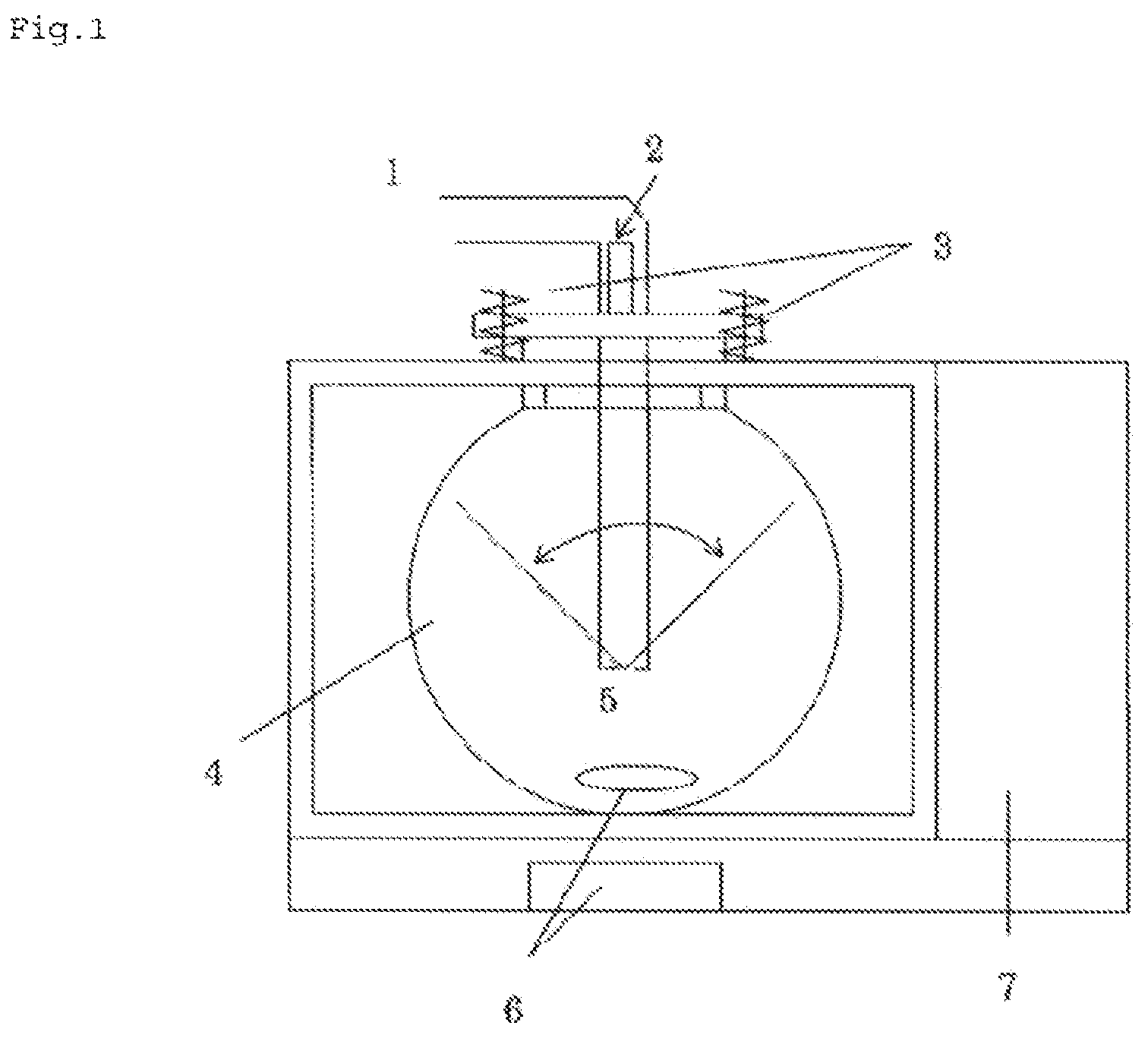
is a schematic diagram of an apparatus used for a non-flammability test of refrigerants.
is a view showing the formulation of refrigerant 2 of the present invention in a ternary composition diagram in which the sum of R32, R125, and CF 3 I is 100 mass % falling within the range of a figure surrounded by line segments EF, FD, DX, and XE that connect 4 points E, F, D, and X (excluding the line segment FD).
is a view showing the formulation of refrigerant 4 of the present invention in a ternary composition diagram in which the sum of HFO-1132(E), CF 3 I, and R32 is 100 mass % falling within the range of a figure surrounded by line segments JH, HY, and YJ that connect 3 points Y, J, and H (excluding the line segment JH).
is a view showing the formulation of refrigerant 5 of the present invention in a ternary composition diagram in which the sum of HFO-1123, CF 3 I, and R32 is 100 mass % falling within the range of a figure surrounded by line segments ZN, NL, and LZ that connect 3 points Z, N, and L (excluding the line segment NL).
is a view showing the formulation of refrigerant 6 of the present invention in a ternary composition diagram in which the total concentration of R32, R125, CF 3 I, and HFO-1234yf is 100 mass %, the concentration of HFO-1234yf is x mass %, and the total concentration of R32, R125, and CF 3 I is represented by (100−x) mass %, when x=6 mass %; that is, the formulation falls within the range of a quadrilateral having, as vertices, points C, D, F, and E (excluding the line segment DF).
is a view showing the formulation of refrigerant 6 of the present invention in a ternary composition diagram in which the total concentration of R32, R125, CF 3 I, and HFO-1234yf is 100 mass %, the concentration of HFO-1234yf is x mass %, and the total concentration of R32, R125, and CF 3 I is represented by (100−x) mass %, when x=9 mass %; that is, the formulation falls within the range of a quadrilateral having, as vertices, points C, D, F, and E (excluding the line segment DF).
is a view showing the formulation of refrigerant 6 of the present invention in a ternary composition diagram in which the total concentration of R32, R125, CF 3 I, and HFO-1234yf is 100 mass %, the concentration of HFO-1234yf is x mass %, and the total concentration of R32, R125, and CF 3 I is represented by (100−x) mass %, when x=11.7 mass %; that is, the formulation falls within the range of a triangle having, as vertices, points C (=E=G), D, and F (excluding the line segment DF).
is a view showing the formulation of refrigerant 6 of the present invention in a ternary composition diagram in which the total concentration of R32, R125, CF 3 I, and HFO-1234yf is 100 mass %, the concentration of HFO-1234yf is x mass %, and the total concentration of R32, R125, and CF 3 I is represented by (100−x) mass %, when x=12.1 mass %; that is, the formulation falls within the range of a triangle having, as vertices, points G, D, and F (excluding the line segment DF).
is a view showing that in a ternary composition diagram in which the total concentration of R32, R125, CF 3 I, and HFO-1234yf is 100 mass %, the concentration of HFO-1234yf is x mass %, and the total concentration of R32, R125, and CF 3 I is represented by (100−x) mass %, when x=12.6 mass %, the formulation converges to point D (=F=G). Here, point D does not correspond to refrigerant 6 of the present invention.
is a view showing the formulation of refrigerant 7 of the present invention in a ternary composition diagram in which the total concentration of R32, R125, CF 3 I, and HFO-1234ze is 100 mass %, the concentration of HFO-1234ze is x mass %, and the total concentration of R32, R125, and CF 3 I is represented by (100−x) mass %, when x=4 mass %; that is, the formulation falls within the range of a quadrilateral having, as vertices, points C, D, F, and E (excluding the line segment DF).
is a view showing the formulation of refrigerant 7 of the present invention in a ternary composition diagram in which the total concentration of R32, R125, CF 3 I, and HFO-1234ze is 100 mass %, the concentration of HFO-1234ze is x mass %, and the total concentration of R32, R125, and CF 3 I is represented by (100−x) mass %, when x=6 mass %; that is, the formulation falls within the range of a quadrilateral having, as vertices, points C, D, F, and E (excluding the line segment DF).
is a view showing the formulation of refrigerant 7 of the present invention in a ternary composition diagram in which the total concentration of R32, R125, CF 3 I, and HFO-1234ze is 100 mass %, the concentration of HFO-1234ze is x mass %, and the total concentration of R32, R125, and CF 3 I is represented by (100−x) mass %, when x=8.3 mass %; that is, the formulation falls within the range of a triangle having, as vertices, points C (=E=G), D, and F (excluding the line segment DF).
is a view showing the formulation of refrigerant 7 of the present invention in a ternary composition diagram in which the total concentration of R32, R125, CF 3 I, and HFO-1234ze is 100 mass %, the concentration of HFO-1234ze is x mass %, and the total concentration of R32, R125, and CF 3 I is represented by (100−x) mass %, when x=8.6 mass %; that is, the formulation falls within the range of a triangle having, as vertices, points G, D, and F (excluding the line segment DF).
is a view showing that in a ternary composition diagram in which the total concentration of R32, R125, CF 3 I, and HFO-1234ze is 100 mass %, the concentration of HFO-1234ze is x mass %, and the total concentration of R32, R125, and CF 3 I is represented by (100−x) mass %, when x=8.9 mass %, the formulation converges to point D (=F=G). Here, point D does not correspond to refrigerant 7 of the present invention.
DESCRIPTION OF EMBODIMENTS
The present inventors conducted intensive studies to solve the above problem, and consequently found that a refrigerant having a specific formulation comprising trifluoroiodomethane (CF 3 I) has the properties described above.
The present disclosure has been completed as a result of further research based on this finding. The present disclosure includes the following embodiments.
Definition of Terms
In the present disclosure, the term “refrigerant” includes at least compounds that are specified in ISO 817 (International Organization for Standardization), and that are given a refrigerant number (ASHRAE number) representing the type of refrigerant with “R” at the beginning; and further includes refrigerants that have properties equivalent to those of such refrigerants, even though a refrigerant number is not yet given. Refrigerants are broadly divided into fluorocarbon compounds and non-fluorocarbon compounds in terms of the structure of the compounds. Fluorocarbon compounds include chlorofluorocarbons (CFC), hydrochlorofluorocarbons (HCFC), and hydrofluorocarbons (HFC). Non-fluorocarbon compounds include propane (R290), propylene (R1270), butane (R600), isobutane (R600a), carbon dioxide (R744), ammonia (R717), and the like.
In the present disclosure, the phrase “composition comprising a refrigerant” at least includes (1) a refrigerant itself (including a mixture of refrigerants), (2) a composition that further comprises other components and that can be mixed with at least a refrigeration oil to obtain a working fluid for a refrigerating machine, and (3) a working fluid for a refrigerating machine containing a refrigeration oil. In the present specification, of these three embodiments, the composition (2) is referred to as a “refrigerant composition” so as to distinguish it from a refrigerant itself (including a mixture of refrigerants). Further, the working fluid for a refrigerating machine (3) is referred to as a “refrigeration oil-containing working fluid” so as to distinguish it from the “refrigerant composition.”
In the present disclosure, when the term “alternative” is used in a context in which the first refrigerant is replaced with the second refrigerant, the first type of “alternative” means that equipment designed for operation using the first refrigerant can be operated using the second refrigerant under optimum conditions, optionally with changes of only a few parts (at least one of the following: refrigeration oil, gasket, packing, expansion valve, dryer, and other parts) and equipment adjustment. In other words, this type of alternative means that the same equipment is operated with an alternative refrigerant. Embodiments of this type of “alternative” include “drop-in alternative,” “nearly drop-in alternative,” and “retrofit,” in the order in which the extent of changes and adjustment necessary for replacing the first refrigerant with the second refrigerant is smaller.
The term “alternative” also includes a second type of “alternative,” which means that equipment designed for operation using the second refrigerant is operated for the same use as the existing use with the first refrigerant by using the second refrigerant. This type of alternative means that the same use is achieved with an alternative refrigerant.
In the present disclosure, the term “refrigerating machine” refers to machines in general that draw heat from an object or space to make the temperature thereof lower than the temperature of ambient air, and maintain a low temperature. In other words, refrigerating machines refer to conversion machines that gain energy from the outside to do work, and that perform energy conversion, in order to transfer heat from where the temperature is lower to where the temperature is higher.
In the present disclosure, the term “non-flammable” means that, among refrigerant allowable concentrations, the worst case of formulation for flammability (WCF) is determined to be classified as “Class 1 (i.e., WCF non-flammable)” or ASHRAE non-flammable according to the US ANSI/ASHRAE Standard 34-2013.
The non-flammability is determined based on the measurement equipment and measurement method of the flammability test according to ASTM E681-2009. The measurement is specifically carried out in the following manner.
A spherical glass flask with an internal volume of 12 liters shown in is used so that the state of combustion can be visually observed and video-recorded. The glass flask is configured so that gas is released from the upper lid when excessive pressure is generated by combustion. Ignition is generated by discharge from electrodes held at a height of ⅓ from the bottom. The test conditions are as follows.
Test Conditions
•
• Test container: 280 mm-diameter spherical shape (internal volume: 12 liters) • Test temperature: 60° C.±3° C. • Pressure: 101.3 kPa±0.7 kPa • Water content: 0.0088 g±0.0005 g per gram of dry air • Binary refrigerant composition/air mixture ratio: 1 vol.% increment±0.2 vol. % • Binary refrigerant composition mixture: ±0.1 mass % • Ignition method: AC discharge, voltage 15 kV, current 30 mA, neon transformer • Electrode spacing: 6.4 mm (¼ inch) • Spark: 0.4 seconds±0.05 seconds Determination Criteria: • When the flame spreads at 90 degrees or more around the ignition point=flammable (propagation) • When the flame spreads at less than 90 degrees around the ignition point=no flame propagation (non-flammable) 1. Refrigerant 1.1 Refrigerant Component
The refrigerants according to the present disclosure can be roughly classified into Embodiments 1 to 7 (also referred to as refrigerants 1 to 7, respectively). All of refrigerants 1 to 7 have four types of performance, i.e., an excellent coefficient of performance and refrigerating capacity that allow them to serve as alternative refrigerants for R410A, a sufficiently low GWP, and non-flammability. Therefore, refrigerants 1 to 7 and the compositions comprising the same according to the present disclosure are useful, for example, as working fluids for refrigerating machines. Refrigerants 1 to 7 are described below.
Embodiment 1: Refrigerant 1
Refrigerant 1 according to the present disclosure comprises trifluoroiodomethane (CF 3 I) and difluoromethane (R32), wherein the contents of CF 3 I and R32 in the refrigerant are respectively 48 mass %≥CF 3 I≥46 mass % and 54 mass %≥R32≥52 mass %, based on the total amount of CF 3 I and R32 taken as 100 mass %. That is, refrigerant 1 is a mixed refrigerant.
Refrigerant 1 has four types of performance, i.e., an excellent coefficient of performance and refrigerating capacity that allow it to serve as an alternative refrigerant for R410A, a sufficiently low GWP, and non-flammability. Specifically, refrigerant 1 has a coefficient of performance of 98% or more relative to R32, a refrigerating capacity of 95% or more relative to R32, a GWP of 750 or less (particularly 400 or less), and ASHRAE non-flammability performance.
Refrigerant 1 comprises CF 3 I and R32, and the contents of CF 3 I and R32 in the refrigerant are respectively 48 mass %≥CF 3 I≥46 mass % and 54 mass %≥R32≥52 mass % based on the total amount of CF 3 I and R32 taken as 100 mass %. Further, the total amount of CF 3 I and R32 in the entire refrigerant is preferably 99.5 mass % or more, more preferably 99.7 mass % or more, and most preferably 99.9 mass % or more. Examples of components other than CF 3 I and R32 in the entire refrigerant include by-products that may be inevitably contained during the production of CF 3 I and R32.
The ASHRAE non-flammability limit of CF 3 I and R32 was confirmed by the following procedure.
A leak test during storage, shipping, and use was simulated based on ANSI/ASHRAE Standard 34-2013 using Refprop 9.0 to determine the initial mixture formulation in which the worst case of fractionation for flammability (WCFF) became the non-flammability limit formulation of CF 3 I and R32 (CF 3 I/R32)=(35 mass %/65 mass %); the method for determination thereof is described in Embodiment 6. As a result, the initial mixture formulation was (CF 3 I/R32)=(46 mass %/54 mass %). This mixture formulation is the ASHRAE non-flammability limit.
Embodiment 2: Refrigerant 2
Refrigerant 2 according to the present disclosure comprises trifluoroiodomethane (CF 3 I), difluoromethane (R32), and pentafluoroethane (R125), wherein when the mass % of R32, R125, and CF 3 I based on their sum is respectively represented by x, y, and z, coordinates (x,y,z) in a ternary composition diagram in which the sum of R32, R125, and CF 3 I is 100 mass % are within the range of a figure surrounded by line segments EF, FD, DX, and XE that connect the following 4 points:
•
• point E (53.7, 11.0, 35.3), • point F (51.6, 0.0, 48.4) • point D (65.0. 0.0, 35.0), and • point X (64.6. 8.9, 26.5), • excluding the line segment FD,
the line segment EF is represented by coordinates (x, −1.1255x+123.76x−3389.3, 1.1255x=−124.76x+3489.3), and
the line segments FD, DX, and XE are straight lines.
That is, refrigerant 2 is a mixed refrigerant.
When the above requirements are satisfied, refrigerant 2 has four types of performance, i.e., an excellent coefficient of performance and refrigerating capacity that allow it to serve as an alternative refrigerant for R410A, a sufficiently low GWP, and non-flammability. Specifically, refrigerant 2 has a coefficient of performance of 98% or more relative to R32, a refrigerating capacity of 95% or more relative to R32, a GWP of 750 or less (particularly 600 or less), and WCF non-flammability performance.
Refrigerant 2 comprises R32, R125, and CF 3 I. In particular, the total amount of R32, R125, and CF 3 I in the entire refrigerant is preferably 99.5 mass % or more, more preferably 99.7 mass % or more, and most preferably 99.9 mass % or more. Examples of components other than R32, R125, and CF 3 I in the entire refrigerant include by-products that may be inevitably contained during the production of R32, R125, and CF 3 I.
Embodiment 3: Refrigerant 3
Refrigerant 3 according to the present disclosure comprises trifluoroiodomethane (CF 3 I) and trans-1,2-difluoroethylene (HFO-1132(E)), wherein the contents of CF 3 I and HFO-1132(E) in the refrigerant are respectively 68 mass %≥CF 3 I≥62 mass % and 38 mass %≥HFO-1132(E)≥32 mass %, based on the total amount of CF 3 I and HFO-1132(E) taken as 100 mass %. That is, refrigerant 3 is a mixed refrigerant.
Refrigerant 3 has four types of performance, i.e., an excellent coefficient of performance and refrigerating capacity that allow it to serve as an alternative refrigerant for R410A, a sufficiently low GWP, and non-flammability. Specifically, refrigerant 3 has a coefficient of performance of 100% or more (particularly 105% or more) relative to R410A, a refrigerating capacity of 65% or more relative to R410A, a GWP of 1 or less, and WCF non-flammability performance.
Refrigerant 3 comprises CF 3 I and HFO-1132(E), and the contents of CF 3 I and HFO-1132(E) in the refrigerant are respectively 68 mass %≥CF 3 I≥62 mass % and 38 mass %≥HFO-1132(E)≥32 mass %, based on the total amount of CF 3 I and HFO-1132(E) taken as 100 mass %. Further, the total amount of CF 3 I and HFO-1132(E) in the entire refrigerant is preferably 99.5 mass % or more, more preferably 99.7 mass % or more, and most preferably 99.9 mass % or more. Examples of components other than CF 3 I and HFO-1132(E) in the entire refrigerant include by-products that may be inevitably contained during the production of CF 3 I and HFO-1132(E).
Embodiment 4: Refrigerant 4
Refrigerant 4 according to the present disclosure comprises trifluoroiodomethane (CF 3 I), difluoromethane (R32), and trans-1,2-difluoroethylene (HFO-1132(E)), wherein when the mass % of HFO-1132(E), CF 3 I, and R32 based on their sum is respectively represented by x, y, and z, coordinates (x,y,z) in a ternary composition diagram in which the sum of HFO-1132(E), CF 3 I, and R32 is 100 mass % are within the range of a figure surrounded by line segments JH, HY, and YJ that connect the following 3 points:
•
• point Y (32.5, 58.1, 9.4), • point J (0.0. 77.2, 22.8), and • point H (0.0. 35.0, 65.0), • excluding the line segment JH,
the line segment YJ is represented by coordinates (x, −0.0027x 2 −0.5002x+77.2, 0.0027x 2 −0.4998x+22.8), and
the line segments JH and HY are straight lines.
That is, refrigerant 4 is a mixed refrigerant.
When the above requirements are satisfied, refrigerant 4 has four types of performance, i.e., an excellent coefficient of performance and refrigerating capacity that allow it to serve as an alternative refrigerant for R410A, a sufficiently low GWP, and non-flammability. Specifically, refrigerant 4 has a coefficient of performance of 99% or more relative to R32, a refrigerating capacity of 80% or more relative to R32, a GWP of 750 or less (particularly 450 or less), and WCF non-flammability performance.
Refrigerant 4 comprises HFO-1132(E), CF 3 I, and R32. In particular, the total amount of HFO-1132(E), CF 3 I, and R32 in the entire refrigerant is preferably 99.5 mass % or more, more preferably 99.7 mass % or more, and most preferably 99.9 mass % or more. Examples of components other than HFO-1132(E), CF 3 I, and R32 in the entire refrigerant include by-products that may be inevitably contained during the production of HFO-1132(E), CF 3 I, and R32.
Embodiment 5: Refrigerant 5
Refrigerant 5 according to the present disclosure comprises trifluoroiodomethane (CF 3 I), difluoromethane (R32), and trifluoroethylene (HFO-1123), wherein when the mass % of HFO-1123, CF 3 I, and R32 based on their sum is respectively represented by x, y, and z, coordinates (x,y,z) in a ternary composition diagram in which the sum of HFO-1123, CF 3 I, and R32 is 100 mass % are within the range of a figure surrounded by line segments ZN, NL, and LZ that connect the following 3 points:
•
• point Z (41.6, 53.5, 4.9), • point N (0.0. 77.2, 22.8), and • point L (0.0. 35.0, 65.0), • excluding the line segment NL,
the line segment ZN is represented by coordinates (x, −0.0007x 2 −0.5402x+77.2, 0.0007x 2 −0.4598x+22.8), and
the line segments NL and LZ are straight lines.
That is, refrigerant 5 is a mixed refrigerant.
When the above requirements are satisfied, refrigerant 5 has four types of performance, i.e., an excellent coefficient of performance and refrigerating capacity that allow it to serve as an alternative refrigerant for R410A, a sufficiently low GWP, and non-flammability. Specifically, refrigerant 5 has a coefficient of performance of 99% or more relative to R32, a refrigerating capacity of 80% or more relative to R32, a GWP of 750 or less (particularly 450 or less), and WCF non-flammability performance.
Refrigerant 5 comprises HFO-1123, CF 3 I, and R32. In particular, the total amount of HFO-1123, CF 3 I, and R32 in the entire refrigerant is preferably 99.5 mass % or more, more preferably 99.7 mass % or more, and most preferably 99.9 mass % or more. Examples of components other than HFO-1123, CF 3 I, and R32 in the entire refrigerant include by-products that may be inevitably contained during the production of HFO-1123, CF 3 I, and R32.
Embodiment 6: Refrigerant 6
Refrigerant 6 according to the present disclosure comprises difluoromethane (R32), pentafluoroethane (R125), trifluoroiodomethane (CF 3 I), and 2,3,3,3-tetrafluoroethylene (HFO-1234yf), and refrigerant 6 comprises one of the following refrigerants A and B:
in a ternary composition diagram in which the total concentration of R32, R125, CF 3 I, and HFO-1234yf is 100 mass %, the concentration of HFO-1234yf is x mass %, and the total concentration of R32, R125, and CF 3 I is represented by (100−x) mass %,
refrigerant A having a composition ratio in which
•
• (1)-1. 11.7 mass %≥x≥6.0 mass %, and • (1)-2. the concentration of R32, R125, and CF 3 I (concentration of R32 (mass %)/concentration of R125 (mass %)/concentration of CF 3 I (mass %)) is within the range of a quadrilateral or triangle having, as vertices, point C (1.1753x+41.14/−0.2282x+13.464/100−R1234yf−R32−R125), point D (0.0247x 2 +0.563x+43.733/0.0/100−R1234yf−R32−R125), point F (−0.8069x+64.948/0.0/100−R1234yf−R32−R125), and point E (−0.8247x+64.54/0.1581x+8.96/100−R1234yf−R32−R125), excluding the line segment DF; and
refrigerant B having a composition ratio in which
•
• (2)-1. 12.6 mass %≥x≥11.7 mass %, and • (2)-2. the concentration of R32, R125, and CF 3 I (concentration of R32 (mass %)/concentration of R125 (mass %)/concentration of CF 3 I (mass %)) is within the range of a triangle having, as vertices, point G (−1.2222x 2 +29.589x−123.98/20.5x 2 −510.15x+3173.3/100−R1234yf−R32−R125), point D (1.2213x+39.415/0.0/100−R1234yf−R32−R125), and point F (0.7787x+64.615/0.0/100−R1234yf−R32−R125), excluding the line segment DF. That is, refrigerant 6 is a mixed refrigerant.
When the above requirements are satisfied in the case in which the concentration x of HFO-1234yfx is (1) 11.7 mass %≥x≥6.0 mass % or (2) 12.6 mass %≥x≥11.7 mass %, refrigerant 6 has four types of performance, i.e., an excellent coefficient of performance and refrigerating capacity that allow it to serve as an alternative refrigerant for R410A, a sufficiently low GWP, and non-flammability. Specifically, refrigerant 6 has a coefficient of performance of 100% or more relative to R410A, a refrigerating capacity of 100% or more relative to R410A, a GWP of 750 or less, and WCF non-flammability performance.
Refrigerant 6 comprises R32, R125, CF 3 I, and HFO-1234yf. In particular, the total amount of R32, R125, CF 3 I, and HFO-1234yf in the entire refrigerant is preferably 99.5 mass % or more, more preferably 99.7 mass % or more, and most preferably 99.9 mass % or more. Examples of components other than R32, R125, CF 3 I, and HFO-1234yf in the entire refrigerant include by-products that may be inevitably contained during the production of R32, R125, CF 3 I, and HFO-1234yf.
The following describes the methods for determining points A, B, C, D, E, F, and G, which are classified according to the range of x. The technical meanings of points A, B, C, D, E, F, and G are as follows. Further, the concentration at each point is a value obtained in the Examples of Embodiment 6 (refrigerant 6) described later.
•
• A: a composition ratio in which GWP=750, and the concentration of CF 3 I (mass %) is 0.0 mass % • B: a composition ratio in which GWP=750, and the concentration of R32 (mass %) is 0.0 mass % • C: a composition ratio in which the refrigerating capacity relative to R410A is 100% (a refrigerating capacity of 100% relative to R410A), and GWP=750 • D: a composition ratio in which the refrigerating capacity relative to R410A is 100% (a refrigerating capacity of 100% relative to R410A), and the concentration of R125 (mass %) is 0.0 mass % • E: a WCF non-flammable composition ratio in which GWP=750 • F: a WCF non-flammable composition ratio in which the concentration of R125 (mass %) is 0.0 mass % • G: a WCF non-flammable composition ratio in which the refrigerating capacity relative to R410A is 100% (a refrigerating capacity of 100% relative to R410A) (1) Method for Determining Points C, D, E, F, and G (1-1) Point C 11.7 Mass %≥x≥6.0 Mass %
When the concentration of HFO-1234yf is 6.0 mass %, point C on a ternary composition diagram in which the total concentration of R32, R125, and CF 3 I is (100−x) mass % is concentration of R32 (mass %)/concentration of R125 (mass %)/concentration of CF 3 I (mass %)=(48.2/12.1/33.7);
when the concentration of HFO-1234yf is 9.0 mass %, point C on the ternary composition diagram in which the total concentration of R32, R125, and CF 3 I is (100−x) mass % is concentration of R32 (mass %)/concentration of R125 (mass %)/concentration of CF 3 I (mass %)=(51.7/11.4/27.9); and
when the concentration of HFO-1234yf is 11.7 mass %, point C on the ternary composition diagram in which the total concentration of R32, R125, and CF 3 I is (100−x) mass % is (concentration of R32 (mass %)/concentration of R125 (mass %)/concentration of CF 3 I (mass %))=(54.9/10.8/22.6).
Therefore, when the total concentration of R32, R125, CF 3 I, and HFO-1234yf is 100 mass %, assuming that the concentration of R32 is y mass %, the equation of the regression line obtained from the above three points plotted in the xy coordinates is represented by y=1.1753x+41.14.
Moreover, assuming that the concentration of R125 is y mass %, the equation of the regression line obtained in the same manner is represented by y=−0.2282x+13.464.
Therefore, the concentration of CF 3 I at point C is (100−R1234yf−R32−R125).
Form the above, point C on the ternary composition diagram in which the total concentration of R32, R125, and CF 3 I is (100−x) (concentration of R32 (mass %)/concentration of R125 (mass %)/concentration of CF 3 I (mass %)) is represented by (1.1753x+41.14/−0.2282x+13.464/100−R1234yf−R32−R125).
12.6 Mass %≥x≥11.7 Mass %
The same calculation was performed for the above range of x. Table 1 below shows the results of point C (concentration of R32 (mass %)/concentration of R125 (mass %)/concentration of CF 3 I (mass %)) for each concentration range of x.
TABLE 1
Point C
Item 11.7 ≥ R1234yf ≥ 6.0 12.6 ≥ R1234yf ≥ 11.7
R1234yf 6.0 9.0 11.7 11.7 12.1 12.6
R32 48.2 51.7 54.9 54.9 55.5 56.4
R125 12.1 11.4 10.8 10.8 10.7 10.5
CF3I 33.7 27.9 22.6 22.6 21.7 20.4
R1234yf x x
R32 approximate 1.1753x + 41.14 1.6721x + 35.311
expression
R125 approximate −0.2282x + 13.464 −0.3361x + 14.744
expression
CF3I approximate 100-R1234yf-R32-R125 100-R1234yf-R32-R125
expression
(1-2) Points D, E, F, and G
Points D, E, F, and G were determined below in the same manner as in the case of point C. The results are shown in Tables 2 to 5 below.
TABLE 2
Point D
Item 11.7 ≥ R1234yf ≥ 6.0 12.6 ≥ R1234yf ≥ 11.7
R1234yf 6.0 9.0 11.7 11.7 12.1 12.6
R32 48.0 50.8 53.7 53.7 54.8 54.8
R125 0 0 0 0 0 0
CF3I 46.0 40.2 34.6 34.6 32.6 32.6
R1234yf x x
R32 approximate 0.0247x2 + 0.563x + 43.733 1.2213x + 39.415
expression
R125 approximate 0 0
expression
CF3I approximate 100-R1234yf-R32-R125 100-R1234yf-R32-R125
expression
TABLE 3
Point E
Item 11.7 ≥ R1234yf ≥ 6.0 12.6 ≥ R1234yf ≥ 11.7
R1234yf 6.0 9.0 11.7 11.7 12.1 12.6
R32 59.6 57.1 54.9 54.9 54.6 54.2
R125 9.9 10.4 10.8 10.8 10.9 10.9
CF3I 24.5 23.5 22.6 22.6 22.4 22.3
R1234yf x x
R32 approximate −0.8247x + 64.54 −0.7787x + 64.015
expression
R125 approximate 0.1581x + 8.96 0.1066x + 9.5738
expression
CF3I approximate 100-R1234y-R32-R125 100-R1234yf-R32-R125
expression
TABLE 4
Point F
Item 11.7 ≥ R1234yf ≥ 6.0 12.6 ≥ R1234yf ≥ 11.7
R1234yf 6.0 9.0 11.7 11.7 12.1 12.6
R32 60.1 57.7 55.5 55.5 55.2 54.8
R125 0 0 0 0 0 0
CF3I 33.9 33.3 32.8 32.8 32.7 32.6
R1234yf x x
R32 approximate −0.8069x + 64.948 −0.7787x + 64.615
expression
R125 approximate 0 0
expression
CF3I approximate 100-R1234y-R32-R125 100-R1234yf-R32-R125
expression
TABLE 5
Point G
Item 12.6 ≥ R1234yf ≥ 11.7
R1234yf 11.7 12.1 12.6
R32 54.9 55.1 54.8
R125 10.8 1.9 0
CF3I 22.6 30.9 32.6
R1234yf x
R32 approximate −1.2222x2 +
expression 29.589x −123.98
R125 approximate 20.5x2 − 510.15x +
expression 3173.3
CF3I approximate 100 − R1234ze −
expression R32 − R125
On the ternary composition diagram in which the total concentration of R32, R125, and CF 3 I is (100−x), a set of points with GWP=7500 is represented by a straight line connecting points A and B, which are presented as functions of x when HFO-1234yf=x. For example, on the ternary composition diagrams of to 9 , GWP is 750 or less in the regions on the vertex side of CF 3 I with respect to the straight line.
Further, on the ternary composition diagram in which the total concentration of R32, R125, and CF 3 I is (100−x), a set of points with a refrigerating capacity of 100% relative to R410A is approximated to a straight line connecting points C and D, which are presented as functions of x when HFO-1234yf=x. For example, on the ternary composition diagrams of to 9 , the refrigerating capacity relative to R410A is 100% or more in the regions on the vertex side of R32 with respect to the approximate line.
Moreover, on the ternary composition diagram in which the total concentration of R32, R125, and CF 3 I is (100−x), a set of points with WCF non-flammability is approximated to a straight line connecting points E and F, which are presented as functions of x when HFO-1234yf=x. For example, on the ternary composition diagrams of to 9 , it is WCF non-flammable in the regions on the vertex side of CF 3 I with respect to the approximate line.
Non-Flammability Limit (Identification of Line Segment EF)
First, the non-flammability limit of a binary mixed refrigerant of a flammable refrigerant (R32, 1234yf) and a non-flammable refrigerant (CF 3 I, R125) was identified.
The non-flammability limit of the binary mixed refrigerant was determined based on the measurement equipment and measurement method of the flammability test according to ASTM E681-2009 (details are as described above).
As a result, in the mixed refrigerant of flammable refrigerant R32 and non-flammable refrigerant CF 3 I, no flame propagation was observed from R32=65.0 wt % and CF 3 I=35.0 wt %, and this formulation was regarded as the non-flammability limit. Further, no flame propagation was observed from R32=63.0 wt % and R125=37.0 wt % in the mixed refrigerant of flammable refrigerant R32 and non-flammable refrigerant R125, from 1234yf=80.0 wt % and CF 3 I=20.0 wt % in the mixed refrigerant of flammable refrigerant 1234yf and non-flammable refrigerant CF 3 I, and from 1234yf=79.0 wt % and R125=21.0 wt % in the mixed refrigerant of flammable refrigerant 1234yf and non-flammable refrigerant R125. These formulations were regarded as the non-flammability limits. The results are summarized in Table 6.
TABLE 6
Flammable Non-flammable
Item refrigerant refrigerant
Combination in binary mixed refrigerant R32 CF3I
Non-flammability limit (wt. %) 65.0 35.0
Combination in binary mixed refrigerant R32 R125
Non-flammability limit (wt. %) 63.0 37.0
Combination in binary mixed refrigerant 1234yf CF3I
Non-flammability limit (wt. %) 80.0 20.0
Combination in binary mixed refrigerant 1234yf R125
Non-flammability limit (wt. %) 79.0 21.0
Points E and F showing the non-flammability limit were identified in such a manner that in the relationships of R32-equivalent flammable refrigerant concentration=R32+(63/37)*(21/79)*R1234yf and R32-equivalent non-flammable refrigerant concentration=(63/37)*R125+(65/35)*CF 3 I, a case in which R32-equivalent flammable refrigerant concentration−non-flammable refrigerant concentration<0 was determined to be non-flammable, and a case in which R32-equivalent flammable refrigerant concentration−non-flammable refrigerant concentration>0 was determined to be flammable.
Table 7 shows the details of points E and F. Line segment EF is a regression line connecting these two points E and F.
TABLE 7
Point E
Flammable Non-flammable
refrigerant refrigerant
concentration concentration Flammability-
in terms in terms non-
R32 R125 CF3I R1234yf of R32 of R32 flammability
mass % mass % mass % mass % mass % mass % mass % Determination
59.6 9.9 24.5 6.0 62.316 62.357 −0.041 Non-flammable
59.7 9.9 24.4 6.0 62.416 62.171 0.245 Flammable
57.1 10.4 23.5 9.0 61.174 61.351 −0.177 Non-flammable
57.2 10.4 23.4 9.0 61.274 61.165 0.108 Flammable
54.9 10.8 22.6 11.7 60.196 60.361 −0.165 Non-flammable
55.0 10.8 22.5 11.7 60.296 60.175 0.121 Flammable
54.6 10.9 22.4 12.1 60.077 60.159 −0.083 Non-flammable
54.5 10.9 22.3 12.1 59.977 59.974 0.003 Flammable
54.2 10.9 22.3 12.6 59.903 59.974 −0.071 Non-flammable
54.3 10.9 22.2 12.6 60.003 59.788 0.215 Flammable
Point F
Flammable Non-flammable
refrigerant refrigerant
concentration concentration Flammability-
in terms in terms non-
R32 R125 CF3I R1234yf of R32 of R32 flammability
mass % mass % mass % mass % mass % mass % mass % Determination
60.1 0 33.9 6 62.816 62.957 −0.141 Non-flammable
60.2 0 33.8 6 62.916 62.771 0.144 Flammable
57.7 0 33.3 9 61.774 61.843 −0.069 Non-flammable
57.8 0 33.2 9 61.874 61.657 0.216 Flammable
55.5 0 32.8 11.7 60.796 60.914 −0.119 Non-flammable
55.6 0 32.7 11.7 60.896 60.729 0.167 Flammable
55.2 0 32.7 12.1 60.677 60.729 −0.052 Non-flammable
55.3 0 32.6 12.1 60.777 60.543 0.234 Flammable
54.8 0 32.6 12.6 60.503 60.543 −0.040 Non-flammable
54.9 0 32.5 12.6 60.603 60.357 0.246 Flammable
Embodiment 7: Refrigerant 7
Refrigerant 7 according to the present disclosure comprises difluoromethane (R32), pentafluoroethane (R125), trifluoroiodomethane (CF 3 I), and 1,3,3,3-tetrafluoropropene (HFO-1234ze), and refrigerant 7 comprises at least one of the following refrigerants A and B:
in a ternary composition diagram in which the total concentration of R32, R125, CF 3 I, and HFO-1234ze is 100 mass %, the concentration of HFO-1234ze is x mass %, and the total concentration of R32, R125, and CF 3 I is represented by (100−x) mass %,
refrigerant A having a composition ratio in which
•
• (1)-1. 8.3 mass %≥x≥4.0 mass %, and • (1)-2. the concentration of R32, R125, and CF 3 I (concentration of R32 (mass %)/concentration of R125 (mass %)/concentration of CF 3 I (mass %)) is within the range of a quadrilateral or triangle having, as vertices, point C (0.0435x 2 +1.4652x+42.543/−0.3726x+13.406/100−R1234ze−R32−R125), point D (0.097x=+0.6802x+44.628/0.0/100−R1234ze−R32−R125), point F (−0.8143x+64.967/0.0/100−R1234ze−R32−R125), and point E (−0.0061x 2 −0.7393x+64.254/0.1631x+8.9386/100−R1234ze−R32−R125), excluding the line segment DF; and
refrigerant B having a composition ratio in which
•
• (2)-1. 8.9 mass %≥x≥8.3 mass %, and • (2)-2. the concentration of R32, R125, and CF 3 I (concentration of R32 (mass %)/concentration of R125 (mass %)/concentration of CF 3 I (mass %)) is within the range of a triangle having, as vertices, point G (0.1667x+56.3/2.7778x 2 −64.944x+357.98/100−R1234ze−R32−R125), point D (1.5625x 2 −24.938x+155.98/0.0/100−R1234ze−R32−R125), and point F (−0.6667x+63.733/0.0/100−R1234ze−R32−R125), excluding the line segment DF. That is, refrigerant 7 is a mixed refrigerant.
When the above requirements are satisfied in the case in which the concentration x of HFO-1234ze is (1) 8.3 mass %≥x≥4.0 mass % or (2) 8.9 mass %>x≥8.3 mass %, refrigerant 7 has four types of performance, i.e., an excellent coefficient of performance and refrigerating capacity that allow it to serve as an alternative refrigerant for R410A, a sufficiently low GWP, and non-flammability. Specifically, refrigerant 7 has a coefficient of performance of 100% or more relative to R410A, a refrigerating capacity of 100% or more relative to R410A, a GWP of 750 or less, and WCF non-flammability performance.
Refrigerant 7 comprises R32, R125, CF 3 I, and HFO-1234ze. In particular, the total amount of R32, R125, CF 3 I, and HFO-1234ze in the entire refrigerant is preferably 99.5 mass % or more, more preferably 99.7 mass % or more, and most preferably 99.9 mass % or more. Examples of components other than R32, R125, CF 3 I, and HFO-1234ze in the entire refrigerant include by-products that may be inevitably contained during the production of R32, R125, CF 3 I, and HFO-1234ze.
The following describes the methods for determining points A, B, C, D, E, F, and G, which are classified according to the range of x. The technical meanings of points A, B, C, D, E, F, and G are as follows. Further, the concentration at each point is a value obtained in the Examples of Embodiment 7 (refrigerant 7) described later.
•
• A: a composition ratio in which GWP=750, and the concentration of CF 3 I (mass %) is 0.0 mass % • B: a composition ratio in which GWP=750, and the concentration of R32 (mass %) is 0.0 mass % • C: a composition ratio in which the refrigerating capacity relative to R410A is 100% (a refrigerating capacity of 100% relative to R410A), and GWP=750 • D: a composition ratio in which the refrigerating capacity relative to R410A is 100% (a refrigerating capacity of 100% relative to R410A), and the concentration of R125 (mass %) is 0.0 mass % • E: a WCF non-flammable composition ratio in which GWP=750 • F: a WCF non-flammable composition ratio in which the concentration of R125 (mass %) is 0.0 mass % • G: a WCF non-flammable composition ratio in which the refrigerating capacity relative to R410A is 100% (a refrigerating capacity of 100% relative to R410A) (1) Method for Determining Points C, D, E, F, and G (1-1) Point C 8.3 Mass %≥x≥4.0 Mass %
When the concentration of HFO-1234ze is 4.0 mass %, point C on a ternary composition diagram in which the total concentration of R32, R125, and CF 3 I is (100−x) mass % is concentration of R32 (mass %)/concentration of R125 (mass %)/concentration of CF 3 I (mass %)=(49.1/11.9/35.0);
when the concentration of HFO-1234yf is 6.0 mass %, point C on the ternary composition diagram in which the total concentration of R32, R125, and CF 3 I is (100−x) mass % is concentration of R32 (mass %)/concentration of R125 (mass %)/concentration of CF 3 I (mass %)=(52.9/11.2/29.9); and
when the concentration of HFO-1234yf is 8.3 mass %, point C on the ternary composition diagram in which the total concentration of R32, R125, and CF 3 I is (100−x) mass % is (concentration of R32 (mass %)/concentration of R125 (mass %)/concentration of CF 3 I (mass %)=(57.7/10.3/23.7).
Therefore, when the total concentration of R32, R125, CF 3 I, and HFO-1234ze is 100 mass %, assuming that the concentration of R32 is y mass %, the equation of the regression line obtained from the above three points plotted in the xy coordinates is represented by y=0.0435x 2 +1.4652x+42.543.
Moreover, assuming that the concentration of R125 is y mass %, the equation of the regression line obtained in the same manner is represented by y=−0.3726x+13.462.
Therefore, the concentration of CF 3 I at point C is (100−R1234ze−R32−R125).
From the above, point C on the ternary composition diagram in which the total concentration of R32, R125, and CF 3 I is (100−x) (concentration of R32 (mass %)/concentration of R125 (mass %)/concentration of CF 3 I (mass %)) is represented by (0.0435x+1.4652x+42.543/−0.3726x+13.462/100−R1234ze−R32−R125).
8.9 Mass %≥x>8.3 Mass %
The same calculation was performed for the above range of x. Table 8 below shows the results of point C (concentration of R32 (mass %)/concentration of R125 (mass %)/concentration of CF 3 I (mass %)) for each concentration range of x.
TABLE 8
Point C
Item 8.3 ≥ R1234ze ≥ 4.0 8.9 ≥ R1234ze ≥ 8.3
R1234ze 4.0 6.0 8.3 8.3 8.6 8.9
R32 49.1 52.9 57.7 57.7 58.4 59.1
R125 11.9 11.2 10.3 10.3 10.1 10.0
CF3I 35.0 29.9 23.7 23.7 22.9 22.0
R1234ze x x
R32 approximate 0.0435x2 + 1.4652x + 42.543 2.3333x + 38.333
expression
R125 approximate −0.3726x + 13.406 −0.5x + 14.433
expression
CF3I approximate 100-R1234ze-R32-R125 100-R1234ze-R32-R125
expression
(1-2) Points D, E, F, and G
Points D, E, F, and G were determined below in the same manner as in the case of point C. The results are shown in Tables 9 to 12 below.
TABLE 9
Point D
Item 8.3 ≥ R1234ze ≥ 4.0 8.9 ≥ R1234ze ≥ 8.3
R1234ze 4.0 6.0 8.3 8.3 8.6 8.9
R32 48.9 52.2 56.5 56.5 57.1 57.8
R125 0 0 0 0 0 0
CF3I 47.1 41.8 35.4 35.4 34.3 33.3
R1234ze x x
R32 approximate 0.097x2 + 0.6802x + 1.5625x2 − 24.938x +
expression 44.628 155.98
R125 approximate 0 0
expression
CF3I approximate 100-R1234ze-R32-R125 100-R1234ze-R32-R125
expression
TABLE 10
Point E
Item 8.3 ≥ R1234ze ≥ 4.0 8.9 ≥ R1234ze ≥ 8.3
R1234ze 4.0 6.0 8.3 8.3 8.6 8.9
R32 61.2 59.6 57.7 57.7 57.4 57.2
R125 9.6 9.9 10.3 10.3 10.3 10.3
CF3I 25.2 24.5 23.7 23.7 23.7 23.6
R1234ze x x
R32 approximate −0.0061x2 − 0.7393x + 0.5556x2 − 10.389x +
expression 64.254 105.66
R125 approximate 0.1631x + 8.9386 10.3
expression
CF3I approximate 100-R1234ze-R32-R125 100-R1234ze-R32-R125
expression
TABLE 11
Point F
Item 8.3 ≥ R1234ze ≥ 4.0 8.9 ≥ R1234ze ≥ 8.3
R1234ze 4.0 6.0 8.3 8.3 8.6 8.9
R32 61.7 60.1 58.2 58.2 58 57.8
R125 0 0 0 0 0 0
CF3I 34.3 33.9 33.5 33.5 33.4 33.3
R1234ze x x
R32 approximate −0.8143x + 64.967 −0.6667x + 63.733
expression
R125 approximate 0 0
expression
CF3I approximate 100-R1234ze-R32-R125 100-R1234ze-R32-R125
expression
TABLE 12
Point G
Item 8.9 ≥ R1234ze ≥ 8.3
R1234ze 8.3 8.6 8.9
R32 57.7 57.7 57.8
R125 10.3 4.9 0
CF3I 23.7 28.8 33.3
R1234ze x
R32 approximate 0.1667x + 56.3
expression
R125 approximate 2.7778x2 − 64.944x +
expression 357.98
CF3I approximate 100 − R1234ze −
expression R32 − R125
On the ternary composition diagram in which the total concentration of R32, R125, and CF 3 I is (100−x), a set of points with GWP=7500 is represented by a straight line connecting points A and B, which are presented as functions of x when HFO-1234ze=x. For example, on the ternary composition diagrams of to 14 , the GWP is 750 or less in the regions on the vertex side of CF 3 I with respect to the straight line.
Further, on the ternary composition diagram in which the total concentration of R32, R125, and CF 3 I is (100−x), a set of points with a refrigerating capacity of 100% relative to R410A is approximated to a straight line connecting points C and D, which are presented as functions of x when HFO-1234ze=x. For example, on the ternary composition diagrams of to 14 , the refrigerating capacity relative to R410A is 100% or more in the regions on the vertex side of R32 with respect to the approximate straight line.
Moreover, on the ternary composition diagram in which the total concentration of R32, R125, and CF 3 I is (100−x), a set of points with WCF non-flammability is approximated to a straight line connecting points E and F, which are presented as functions of x when HFO-1234ze=x. For example, on the ternary composition diagrams of to 14 , it is WCF non-flammable in the regions on the vertex side of CF 3 I with respect to the approximate line.
Non-Flammability Limit (Identification of Line Segment EF)
First, the non-flammability limit of a binary mixed refrigerant of a flammable refrigerant (R32, 1234ze) and a non-flammable refrigerant (CF 3 I, R125) was identified.
The non-flammability limit of the binary mixed refrigerant was determined based on the measurement equipment and measurement method of the flammability test according to ASTM E681-2009 (details are as described above).
As a result, in the mixed refrigerant of flammable refrigerant R32 and non-flammable refrigerant CF 3 I, no flame propagation was observed from R32=65.0 wt % and CF 3 I=35.0 wt %, and this formulation was regarded as the non-flammability limit. Further, no flame propagation was observed from R32=63.0 wt % and R125=37.0 wt % in the mixed refrigerant of flammable refrigerant R32 and non-flammable refrigerant R125, from 1234ze=80.0 wt % and CF 3 I=20.0 wt % in the mixed refrigerant of flammable refrigerant 1234ze and non-flammable refrigerant CF 3 I, and from 1234yf=79.0 wt % and R125=21.0 wt % in the mixed refrigerant of flammable refrigerant 1234ze and non-flammable refrigerant R125. These formulations were regarded as the non-flammability limits. The results are summarized in Table 13.
TABLE 13
Flammable Non-flammable
Item refrigerant refrigerant
Combination in binary mixed refrigerant R32 CF3I
Non-flammability limit (wt. %) 65.0 35.0
Combination in binary mixed refrigerant R32 R125
Non-flammability limit (wt. %) 63.0 37.0
Combination in binary mixed refrigerant 1234ze CF3I
Non-flammability limit (wt. %) 80.0 20.0
Combination in binary mixed refrigerant 1234ze R125
Non-flammability limit (wt. %) 79.0 21.0
Points E and F showing the non-flammability limit were identified in such a manner that in the relationships of R32-equivalent flammable refrigerant=R32+(63/37)*(21/79)*R1234ze and R32-equivalent non-flammable refrigerant concentration=(63/37)*R125+(65/35)*CF 3 I, a case in which R32-equivalent flammable refrigerant concentration−non-flammable refrigerant concentration<0 was determined to be non-flammable, and a case in which R32-equivalent flammable refrigerant concentration−non-flammable refrigerant concentration>0 was determined to be flammable.
Table 14 shows the details of points E and F. Line segment EF is a regression line connecting these two points E and F.
TABLE 14
Point E
Flammable Non-flammable
refrigerant refrigerant
concentration concentration Flammability-
in terms in terms non-
R32 R125 CF3I R1234ze of R32 of R32 flammability
mass % mass % mass % mass % mass % mass % mass % Determination
61.2 9.6 25.2 4.0 63.010 63.146 −0.135 Non-flammable
61.3 9.6 25.1 4.0 63.110 62.960 0.150 Flammable
59.6 9.9 24.5 60 62.316 62.357 −0.041 Non-flammable
59.7 9.9 24.4 6.0 62.416 62.171 0.245 Flammable
57.7 10.3 23.7 8.3 61.457 61.552 −0.095 Non-flammable
57.8 10.3 23.6 8.3 61.557 61.366 0.190 Flammable
57.4 10.3 23.7 8.6 61.293 61.552 −0.260 Non-flammable
57.5 10.3 23.6 8.6 61.393 61.366 0.026 Flammable
57.2 10.3 23.6 8.9 61.228 61.366 −0.138 Non-flammable
57.3 10.3 23.5 8.9 61.328 61.181 0.148 Flammable
Point F
Flammable Non-flammable
refrigerant refrigerant
concentration concentration Flammability-
in terms in terms non-
R32 R125 CF3I R1234ze of R32 of R32 flammability
mass % mass % mass % mass % mass % mass % mass % Determination
61.7 0 34.3 4 63.510 63.700 −0.190 Non-flammable
61.8 0 34.2 4 63.610 63.514 0.096 Flammable
60.1 0 33.9 6 62.816 62.957 −0.141 Non-flammable
60.2 0 33.8 6 62.916 62.771 0.144 Flammable
58.2 0 33.5 8.3 61.957 62.214 −0.258 Non-flammable
58.3 0 33.4 8.3 62.057 62.029 0.028 Flammable
58 0 33.4 8.6 61.893 62.029 0.136 Non-flammable
58.1 0 33.3 8.6 61.993 61.843 0.150 Flammable
57.8 0 33.4 8.9 61.828 62.029 −0.200 Non-flammable
57.9 0 33.3 8.9 61.928 61.843 0.085 Flammable
1.2. Use
The refrigerant according to the present disclosure can be preferably used as a working fluid in a refrigerating machine.
The composition according to the present disclosure is suitable for use as an alternative refrigerant for R410A.
2. Refrigerant Composition
The refrigerant composition according to the present disclosure comprises at least the refrigerant according to the present disclosure, and can be used for the same use as the refrigerant according to the present disclosure. Moreover, the refrigerant composition according to the present disclosure can be further mixed with at least a refrigeration oil to thereby obtain a working fluid for a refrigerating machine.
The refrigerant composition according to the present disclosure further comprises at least one other component in addition to the refrigerant according to the present disclosure. The refrigerant composition according to the present disclosure may comprise at least one of the following other components, if necessary. As described above, when the refrigerant composition according to the present disclosure is used as a working fluid in a refrigerating machine, it is generally used as a mixture with at least a refrigeration oil. Therefore, it is preferable that the refrigerant composition according to the present disclosure does not substantially comprise a refrigeration oil. Specifically, in the refrigerant composition according to the present disclosure, the content of the refrigeration oil based on the entire refrigerant composition is preferably 0 to 1 mass %, and more preferably 0 to 0.1 mass %.
2.1. Water
The refrigerant composition according to the present disclosure may contain a small amount of water. The water content of the refrigerant composition is preferably 0 to 0.1 mass %, more preferably 0 to 0.075 mass %, even more preferably 0 to 0.05 mass %, and particularly preferably 0 to 0.025 mass %, based on the entire refrigerant.
A small amount of water contained in the refrigerant composition stabilizes double bonds in the molecules of unsaturated fluorocarbon compounds that can be present in the refrigerant, and makes it less likely that the unsaturated fluorocarbon compounds will be oxidized, thus increasing the stability of the refrigerant composition. From the viewpoint of obtaining the above effect due to inclusion of water, the lower limit of the water content is about 0.001 mass %. For example, the water content can be adjusted within the range of 0.001 to 0.1 mass %, 0.001 to 0.075 mass %, 0.001 to 0.05 mass %, or 0.001 to 0.025 mass %.
2.2. Tracer
A tracer is added to the refrigerant composition according to the present disclosure at a detectable concentration such that when the refrigerant composition has been diluted, contaminated, or undergone other changes, the tracer can trace the changes.
The refrigerant composition according to the present disclosure may comprise a single tracer, or two or more tracers.
The tracer is not limited, and can be suitably selected from commonly used tracers. It is preferable to select, as the tracer, a compound that cannot become an impurity inevitably mixed in the refrigerant according to the present disclosure.
Examples of tracers include hydrofluorocarbons, hydrochlorofluorocarbons, chlorofluorocarbons, hydrochlorocarbons, fluorocarbons, deuterated hydrocarbons, deuterated hydrofluorocarbons, perfluorocarbons, fluoroethers, brominated compounds, iodinated compounds, alcohols, aldehydes, ketones, and nitrous oxide (N 2 O). The tracer is particularly preferably a hydrofluorocarbon, a hydrochlorofluorocarbon, a chlorofluorocarbon, a hydrochlorocarbon, a fluorocarbon, or a fluoroether.
Specifically, the following compounds are preferable as the tracer.
•
• FC-14 (tetrafluoromethane, CF 4 ) • HCC-40 (chloromethane, CH 3 Cl) • HFC-23 (trifluoromethane, CHF 3 ) • HFC-41 (fluoromethane, CH 3 Cl) • HFC-125 (pentafluoroethane, CF 3 CHF 2 ) • HFC-134a (1,1,1,2-tetrafluoroethane, CF 3 CH 2 F) • HFC-134 (1,1,2,2-tetrafluoroethane, CHF 2 CHF 2 ) • HFC-143a (1,1,1-trifluoroethane, CF 3 CH 3 ) • HFC-143 (1,1,2-trifluoroethane, CHF 2 CH 2 F) • HFC-152a (1,1-difluoroethane, CHF 2 CH 3 ) • HFC-152 (1,2-difluoroethane, CH 2 FCH 2 F) • HFC-161 (fluoroethane, CH 3 CH 2 F) • HFC-245fa (1,1,1,3,3-pentafluoropropane, CF 3 CH 2 CHF 2 ) • HFC-236fa (1,1,1,3,3,3-hexafluoropropane, CF 3 CH 2 CF 3 ) • HFC-236ea (1,1,1,2,3,3-hexafluoropropane, CF 3 CHFCHF 2 ) • HFC-227ea (1,1,1,2,3,3,3-heptafluoropropane, CF 3 CHFCF 3 ) • HCFC-22 (chlorodifluoromethane, CHClF 2 ) • HCFC-31 (chlorofluoromethane, CH 2 ClF) • CFC-1113 (chlorotrifluoroethylene, CF 2 ═CClF) • HFE-125 (trifluoromethyl-difluoromethyl ether, CF 3 OCHF 2 ) • HFE-134a (trifluoromethyl-fluoromethyl ether, CF 3 OCH 2 F) • HFE-143a (trifluoromethyl-methyl ether, CF 3 OCH 3 ) • HFE-227ea (trifluoromethyl-tetrafluoroethyl ether, CF 3 OCHFCF 3 ) • HFE-236fa (trifluoromethyl-trifluoroethyl ether, CF 3 OCH 2 CF 3 )
The tracer compound may be present at a total concentration of about 10 parts per million by weight (ppm) to about 1000 ppm in the refrigerant composition. The tracer compound is preferably present at a total concentration of about 30 ppm to about 500 ppm, and most preferably about 50 ppm to about 300 ppm, in the refrigerant composition.
2.3. Ultraviolet Fluorescent Dye
The refrigerant composition according to the present disclosure may comprise a single ultraviolet fluorescent dye, or two or more ultraviolet fluorescent dyes.
The ultraviolet fluorescent dye is not limited, and can be suitably selected from commonly used ultraviolet fluorescent dyes.
Examples of ultraviolet fluorescent dyes include naphthalimide, coumarin, anthracene, phenanthrene, xanthene, thioxanthene, naphthoxanthene, fluorescein, and derivatives thereof. The ultraviolet fluorescent dye is particularly preferably either naphthalimide or coumarin, or both.
2.4. Stabilizer
The refrigerant composition according to the present disclosure may comprise a single stabilizer, or two or more stabilizers.
The stabilizer is not limited, and can be suitably selected from commonly used stabilizers.
Examples of stabilizers include nitro compounds, ethers, and amines.
Examples of nitro compounds include aliphatic nitro compounds, such as nitromethane and nitroethane; and aromatic nitro compounds, such as nitro benzene and nitro styrene.
Examples of ethers include 1,4-dioxane.
Examples of amines include 2,2,3,3,3-pentafluoropropylamine and diphenylamine.
Examples of stabilizers also include butylhydroxyxylene and benzotriazole.
The content of the stabilizer is not limited. Generally, the content of the stabilizer is preferably 0.01 to 5 mass %, and more preferably 0.05 to 2 mass %, based on the entire refrigerant.
2.5. Polymerization Inhibitor
The refrigerant composition according to the present disclosure may comprise a single polymerization inhibitor, or two or more polymerization inhibitors.
The polymerization inhibitor is not limited, and can be suitably selected from commonly used polymerization inhibitors.
Examples of polymerization inhibitors include 4-methoxy-1-naphthol, hydroquinone, hydroquinone methyl ether, dimethyl-t-butylphenol, 2,6-di-tert-butyl-p-cresol, and benzotriazole.
The content of the polymerization inhibitor is not limited. Generally, the content of the polymerization inhibitor is preferably 0.01 to 5 mass %, and more preferably 0.05 to 2 mass %, based on the entire refrigerant.
3. Refrigeration Oil-Containing Working Fluid
The refrigeration oil-containing working fluid according to the present disclosure comprises at least the refrigerant or refrigerant composition according to the present disclosure and a refrigeration oil, for use as a working fluid in a refrigerating machine. Specifically, the refrigeration oil-containing working fluid according to the present disclosure is obtained by mixing a refrigeration oil used in a compressor of a refrigerating machine with the refrigerant or the refrigerant composition. The refrigeration oil-containing working fluid generally comprises 10 to 50 mass % of refrigeration oil.
3.1. Refrigeration Oil
The composition according to the present disclosure may comprise a single refrigeration oil, or two or more refrigeration oils.
The refrigeration oil is not limited, and can be suitably selected from commonly used refrigeration oils. In this case, refrigeration oils that are superior in the action of increasing the miscibility with the mixture and the stability of the mixture, for example, are suitably selected as necessary.
The base oil of the refrigeration oil is preferably, for example, at least one member selected from the group consisting of polyalkylene glycols (PAG), polyol esters (POE), and polyvinyl ethers (PVE).
The refrigeration oil may further contain additives in addition to the base oil. The additive may be at least one member selected from the group consisting of antioxidants, extreme-pressure agents, acid scavengers, oxygen scavengers, copper deactivators, rust inhibitors, oil agents, and antifoaming agents.
A refrigeration oil with a kinematic viscosity of 5 to 400 cSt at 40° C. is preferable from the standpoint of lubrication.
The refrigeration oil-containing working fluid according to the present disclosure may further optionally contain at least one additive. Examples of additives include the compatibilizing agents described below.
3.2. Compatibilizing Agent
The refrigeration oil-containing working fluid according to the present disclosure may comprise a single compatibilizing agent, or two or more compatibilizing agents.
The compatibilizing agent is not limited, and can be suitably selected from commonly used compatibilizing agents.
Examples of compatibilizing agents include polyoxyalkylene glycol ethers, amides, nitriles, ketones, chlorocarbons, esters, lactones, aryl ethers, fluoroethers, and 1,1,1-trifluoroalkanes. The compatibilizing agent is particularly preferably a polyoxyalkylene glycol ether.
4. Method for Operating Refrigerating Machine
The method for operating a refrigerating machine according to the present disclosure is a method for operating a refrigerating machine using the refrigerant according to the present disclosure.
Specifically, the method for operating a refrigerating machine according to the present disclosure comprises circulating the refrigerant according to the present disclosure in a refrigerating machine.
The embodiments are described above; however, it will be understood that various changes in forms and details can be made without departing from the spirit and scope of the claims.
EXAMPLES
The present disclosure is described in more detail below with reference to Examples. However, the present disclosure is not limited to the Examples.
In the Examples and Comparative Examples, the GWP of mixed refrigerants was evaluated based on the values stated in the Intergovernmental Panel on Climate Change (IPCC), fourth report. The GWP of HFO-1132(E), which was not stated therein, was assumed to be 1 from HFO-1132a (GWP=1 or less) and HFO-1123 (GWP=0.3, described in PTL 1). The refrigerating capacity of the mixed refrigerants was determined by performing theoretical refrigeration cycle calculations for the mixed refrigerants using the National Institute of Science and Technology (NIST) and Reference Fluid Thermodynamic and Transport Properties Database (Refprop 9.0) under the following conditions.
•
• Evaporating temperature: 5° C. • Condensation temperature: 45° C. • Superheating temperature: 5K • Subcooling temperature: 5K • Compressor efficiency: 70%
Further, the coefficient of performance (COP) of the mixed refrigerants was calculated according to the following equation. COP=(refrigerating capacity or heating capacity)/amount of electrical power consumed
Examples and Comparative Examples of Embodiment 1 (Refrigerant 1)
Mixed refrigerants were prepared by mixing R32 and CF 3 I at mass % shown in Table 15 based on the sum of them.
TABLE 15
Evaluation results
Example/ Composition Refrigerating Temperature Flammable/
Comparative ratio (mass %) COP ratio (%) capacity ratio (%) glide non-flammable
Example CF3I HFC-32 GWP (relative to R32) (relative to R32) (K) (ASHRAE)
Comparative 0 100 675 100 100 0 Slightly flammable
Example 1
Comparative 40 60 405 98.3 97.1 0.2 Slightly flammable
Example 2
Comparative 41 59 399 98.3 96.9 0.2 Slightly flammable
Example 3
Comparative 42 58 392 98.3 96.7 0.2 Slightly flammable
Example 4
Comparative 43 57 385 98.2 96.5 0.3 Slightly flammable
Example 5
Comparative 44 56 378 98.2 96.2 0.3 Slightly flammable
Example 6
Comparative 45 55 372 98.2 96.0 0.4 Slightly flammable
Example 7
Example 1 46 54 365 98.1 95.7 0.4 Non-flammable
Example 2 47 53 358 98.1 95.4 0.5 Non-flammable
Example 3 48 52 351 98.1 95.1 0.6 Non-flammable
Comparative 49 51 345 98.0 94.8 0.7 Non-flammable
Example 8
Comparative 50 50 338 98.0 94.4 0.8 Non-flammable
Example 9
Comparative 100 0 1 109.5 31.1 0.0 Non-flammable
Example 10
Due to the predetermined formulation, refrigerant 1 has four types of performance, i.e., an excellent coefficient of performance and refrigerating capacity that allow it to serve as an alternative refrigerant for R410A, a sufficiently low GWP, and non-flammability. Specifically, it was revealed that the mixed refrigerants of Examples 1 to 3, which were specific examples of refrigerant 1, had a coefficient of performance of 98% or more relative to R32, a refrigerating capacity of 95% or more relative to R32, a GWP of 750 or less (particularly 400 or less), and ASHRAE non-flammability performance.
Examples and Comparative Examples of Embodiment 2 (Refrigerant 2)
Mixed refrigerants were prepared by mixing R32, R125, and CF 3 I at mass % shown in Table 16 based on the sum of them.
TABLE 16
Evaluation results
Refrigerating
Example/ COP ratio (%) capacity ratio Flammable/
Comparative Composition ratio (mass %) (relative (%) (relative Temperature non-flammable
Example Point CF3I HFC-32 HFC-125 GWP to R32) to R32) glide (K) (WCF)
Comparative 0 100 0 675 100 100 0 Slightly
Example 1 flammable
Comparative A 2.6 97.4 0 750 99.9 99.7 0.0 Slightly
Example 11 flammable
Comparative B 0 21.4 78.6 750 105.6 45.9 11.0 Non-
Example 12 flammable
Comparative C 0 63.0 37.0 1720 98.5 94.3 1.0 Non-
Example 13 flammable
Example 4 D 35.0 65.0 0 439 98.5 97.9 0.1 Non-
flammable
Example 5 X 26.5 64.6 8.9 750 98.4 97.1 0.1 Non-
flammable
Example 6 E 35.3 53.7 11.0 750 98.0 95.0 0.2 Non-
flammable
Example 7 40.3 52.7 7.0 601 98.0 95.0 0.3 Non-
flammable
Example 8 F 48.4 51.6 0 349 98.1 95.0 0.6 Non-
flammable
Example 9 36.5 53.5 10.0 711 98.0 95.0 0.3 Non-
flammable
Comparative 20.0 70.0 10.0 823 98.7 97.6 0.0 Slightly
Example 14 flammable
Due to the predetermined formulation, refrigerant 2 has four types of performance, i.e., an excellent coefficient of performance and refrigerating capacity that allow it to serve as an alternative refrigerant for R410A, a sufficiently low GWP, and non-flammability. Specifically, it was revealed that the mixed refrigerants of Examples 4 to 9, which were specific examples of refrigerant 2, had a coefficient of performance of 98% or more relative to R32, a refrigerating capacity of 95% or more relative to R32, a GWP of 750 or less (particularly 600 or less), and WCF non-flammability performance.
Examples and Comparative Examples of Embodiment 3 (Refrigerant 3)
Mixed refrigerants were prepared by mixing HFO-1132(E) and CF 3 I at mass % shown in Table 17 based on the sum of them.
TABLE 17
Evaluation results
Example/ COP ratio (%) Refrigerating Flammable/
Comparative Composition ratio (mass %) (relative to capacity ratio (%) Temperature non-flammable
Example CF3I E-HFO-1132 GWP R410A) (relative to R410A) glide (K) (WCF)
Comparative HFC − 32 = 100 675 102.4 109.8 0 Slightly
Example 1 flammable
Comparative R410A 2088 100 100 0.1 Non-flammable
Example 15
Comparative 0 100 1 97.8 97.6 0 Weakly
Example 15 flammable
Comparative 60 40 1 105.6 69.0 1.0 Slightly
Example 16 flammable
Comparative 61 39 1 105.7 68.4 9.6 Slightly
Example 17 flammable
Example 10 62 38 1 105.9 67.7 9.7 Non-flammable
Example 11 63 37 1 106.1 67.1 9.8 Non-flammable
Comparative 64 36 1 106.2 66.4 9.9 Non-flammable
Example 12
Example 13 65 35 1 106.4 65.7 10.0 Non-flammable
Example 14 66 34 1 106.6 65.0 10.0 Non-flammable
Comparative 67 33 1 106.8 64.4 10.1 Non-flammable
Example 18
Comparative 68 32 1 106.9 63.6 10.2 Non-flammable
Example 19
Comparative 69 31 1 107.1 62.9 10.2 Non-flammable
Example 20
Comparative 70 30 1 107.3 62.2 10.3 Non-flammable
Example 21
Comparative 100 0 1 112.1 34.1 0.0 Non-flammable
Example 10
Due to the predetermined formulation, refrigerant 3 has four types of performance, i.e., an excellent coefficient of performance and refrigerating capacity that allow it to serve as an alternative refrigerant for R410A, a sufficiently low GWP, and non-flammability. Specifically, it was revealed that the mixed refrigerants of Examples 10 to 14, which were specific examples of refrigerant 3, had a coefficient of performance of 100% or more (particularly 105% or more) relative to R410A, a refrigerating capacity of 65% or more relative to R410A, a GWP of 1 or less, and WCF non-flammability performance.
Examples and Comparative Examples of Embodiment 4 (Refrigerant 4)
Mixed refrigerants were prepared by mixing R32, HFO-1132(E), and CF 3 I at mass % shown in Table 18 based on the sum of them.
TABLE 18
Evaluation results
Refrigerating
Example/ Composition ratio (mass %) COP ratio capacity ratio Flammable/
Comparative E-HFO- (%) (relative (%) (relative to Temperature non-flammable
Example Point CF3I 1132 HFC-32 GWP to R32) R32) glide (K) (WCF)
Comparative 0 0 100 675 100 100 0 Slightly
Example 1 flammable
Comparative 0 100 0 1 97.8 97.6 0 Weakly
Example 15 flammable
Comparative G 62 38 0 1 105.9 67.7 9.7 Non-
Example 22 flammable
Example 15 H 35 0 65 439 100.8 107.5 0.1 Non-
flammable
Comparative I 40.6 59.4 0 1 102.4 80.0 6.6 Slightly
Example 23 flammable
Example 16 Y 58.1 32.5 9.4 64 102.6 80.0 11.7 Non-
flammable
Example 17 67.8 17.2 15 102 102.6 80.0 13.7 Non-
flammable
Example 18 J 77.2 0 22.8 155 100.2 80.0 13.1 Non-
flammable
Example 19 55 25 20 136 99.4 88.6 9.0 Non-
flammable
Comparative 70 20 10 68 104.6 74.9 15.2 Non-
Example 24 flammable
Comparative 40 30 30 203 97.5 99.7 4.1 Slightly
Example 25 flammable
Due to the predetermined formulation, refrigerant 4 has four types of performance, i.e., an excellent coefficient of performance and refrigerating capacity that allow it to serve as an alternative refrigerant for R410A, a sufficiently low GWP, and non-flammability. Specifically, it was revealed that the mixed refrigerants of Examples 15 to 19, which were specific examples of refrigerant 4, had a coefficient of performance of 99% or more relative to R32, a refrigerating capacity of 80% or more relative to R32, a GWP of 750 or less (particularly 450 or less), and WCF non-flammability performance.
Examples and Comparative Examples of Embodiment 5 (Refrigerant 5)
Mixed refrigerants were prepared by mixing R32, HFO-1123, and CF 3 I at mass % shown in Table 19 based on the sum of them.
TABLE 19
Evaluation results
Refrigerating
Example/ Composition ratio (mass %) COP ratio capacity ratio Flammable/
Comparative HFO- (%) (relative (%) (relative to Temperature non-flammable
Example Point CF3I 1123 HFC-32 GWP to R32) R32) glide (K) (WCF)
Comparative 0 0 100 675 100 100 0 Slightly
Example 1 flammable
Comparative 0 100 0 0.3 90.6 108.0 0 Slightly
Example 26 flammable
Comparative K 45 55 0 0.7 103.0 73.9 12.8 Non-
Example 27 flammable
Example 20 L 35 0 65 439 100.8 107.5 0.1 Non-
flammable
Comparative M 46.5 53.5 0 0.6 101.0 80.0 11.4 Slightly
Example 28 flammable
Example 21 Z 53.5 41.6 4.9 34 101.6 80.0 12.7 Non-
flammable
Example 22 65.6 20.9 13.5 92 102.1 80.0 13.9 Non-
flammable
Example 23 N 77.2 0 22.8 155 100.2 80.0 13.1 Non-
flammable
Example 24 55 30 15 102 99.5 86.3 10.5 Non-
flammable
Comparative 70 20 10 68 104.3 75.0 16.2 Non-
Example 29 flammable
Comparative 40 40 20 136 96.8 96.6 5.8 Slightly
Example 30 flammable
Due to the predetermined formulation, refrigerant 5 has four types of performance, i.e., an excellent coefficient of performance and refrigerating capacity that allow it to serve as an alternative refrigerant for R410A, a sufficiently low GWP, and non-flammability. Specifically, it was revealed that the mixed refrigerants of Examples 20 to 24, which were specific examples of refrigerant 5, had a coefficient of performance of 99% or more relative to R32, a refrigerating capacity of 80% or more relative to R32, a GWP of 750 or less (particularly 450 or less), and WCF non-flammability performance.
Examples and Comparative Examples of Embodiment 6 (Refrigerant 6)
Mixed refrigerants were prepared by mixing R32, R125, HFO-1234yf, and CF 3 I at mass % shown in Table 20 (R1234yf=6 mass %), Table 21 (R1234yf=9 mass %), Table 22 (R1234yf=11.7 mass %), Table 23 (R1234yf=12.1 mass %), and Table 24 (R1234yf=12.6 mass %) based on the sum of them.
TABLE 20
Comparative Comparative Comparative Comparative Comparative
Example 1 Example Example Example Example Example Example
Item Unit R410A A B C D E F
R32 mass % 50 90.0 0.0 48.2 48.0 59.6 60.1
R125 mass % 50 4.0 21.4 12.1 0.0 9.9 0.0
CF3I mass % 0 0.0 72.6 33.7 46.0 24.5 33.9
R1234yf mass % 0 6.0 6.0 6.0 6.0 6.0 6.0
COP ratio % 100 102 108 100 100 101 101
(relative to
R410A)
Refrigerating % 100 107 50 100 100 103 104
capacity ratio
(relative to
R410A)
GWP — 2088 750 750 750 325 750 406
Flammability Non- Flammable Non- Non- Non- Non- Non-
flammable flammable flammable flammable flammable flammable
TABLE 21
Comparative Comparative Comparative Comparative Comparative
Example 1 Example Example Example Example Example Example
Item Unit R410A A B C D E F
R32 mass % 50 86.2 0.0 5.17 50.8 57.1 57.7
R125 mass % 50 4.8 21.4 11.4 0.0 10.4 0.0
CF3I mass % 0 0.0 69.6 27.9 40.2 23.5 33.3
R1234yf mass % 0 9.0 9.0 9.0 9.0 9.0 9.0
COP rato (relative to % 100 102 107 101 101 101 101
R410A)
Refrigerating capacity ratio % 100 106 50 100 100 102 102
(relative to R410A)
GWP — 2088 750 750 750 344 750 390
Flammability Non- Flammable Non- Non- Non- Non- Non-
flammable flammable flammable flammable flammable flammable
TABLE 22
Comparative Comparative Comparative Comparative Comparative
Example 1 Example Example Example Example Example
Item Unit R410A A B C = E = G D F
R32 mass % 50 82.9 0.0 54.9 53.7 55.5
R125 mass % 50 5.4 21.4 10.8 0.0 0.0
CF3I mass % 0 0.0 66.9 22.6 34.6 32.8
R1234yf mass % 0 11.7 11.7 11.7 11.7 11.7
COP ratio (relative to R410A) % 100 102 107 101 101 101
Refrigerating capacity ratio % 100 105 49 100 100 101
(relative to R410A)
GWP — 2088 750 750 750 363 375
Flammability Non- Flammable Non- Non- Non- Non-
flammable flammable flammable flammable flammable
TABLE 23
Comparative Comparative Comparative Comparative Comparative
Example 1 Example Example Example Example Example Example Example
Item Unit R410A A B C D E F G
R32 mass % 50 82.4 0.0 55.5 54.3 54.6 55.2 54.9
R125 mass % 50 5.5 21.4 10.7 0.0 10.9 0.0 5.4
CF3I mass % 0 0.0 65.9 21.7 33.6 22.4 32.7 27.6
R1234yf mass % 0 12.1 12.1 12.1 12.1 12.1 12.1 12.1
COP ratio (relative to % 100 102 107 101 101 101 101 101
R410A)
Refrigerating capacity % 100 105 49 100 100 100 100 100
ratio (relative to R410A)
GWP — 2088 750 750 750 367 750 373 560
Flammability Non- Flammable Non- Non- Non- Non- Non- Non-
flammable flammable flammable flammable flammable flammable flammable
TABLE 24
Comparative Comparative Comparative Comparative
Example 1 Example Example Example Example Example
Item Unit R410A A B C D = F = G E
R32 mass % 50 81.8 0.0 56.4 54.8 54.2
R125 mass % 50 5.6 21.4 10.5 0.0 10.9
CF3I mass % 0 0.0 65.9 20.5 32.6 22.3
R1234yf mass % 0 12.6 12.6 12.6 12.6 12.6
COP ratio (relative to R410A) % 100 102 107 101 101 101
Refrigerating capacity ratio % 100 105 49 100 100 99
(relative to R410A)
GWP — 2088 750 750 750 371 750
Flammability Non- Flammable Non- Non- Non- Non-
flammable flammable flammable flammable flammable
When the above requirements are satisfied in the case in which the concentration x of HFO-1234yfx is (1) 11.7 mass %≥x≥6.0 mass % or (2) 12.6 mass %≥x≥11.7 mass %, refrigerant 6 has four types of performance, i.e., an excellent coefficient of performance and refrigerating capacity that allow it to serve as an alternative refrigerant for R410A, a sufficiently low GWP, and non-flammability. Specifically, it was revealed that the mixed refrigerants of the Examples in the above tables, which were specific examples of refrigerant 6, had a coefficient of performance of 100% or more relative to R410A, a refrigerating capacity of 100% or more relative to R410A, a GWP of 750 or less, and WCF non-flammability performance.
Examples and Comparative Examples of Embodiment 7 (Refrigerant 7)
Mixed refrigerants were prepared by mixing R32, R125, HFO-1234ze, and CF 3 I at mass % shown in Table 25 (R1234ze=4 mass %), Table 26 (R1234ze=6 mass %), Table 27 (R1234ze=8.3 mass %), Table 28 (R1234ze=8.6 mass %), and Table 29 (R1234ze=8.9 mass %) based on the sum of them.
TABLE 25
Comparative Comparative Comparative Comparative Comparative
Example 1 Example Example Example Example Example Example
Item Unit R410A A B C D E F
R32 mass % 50 92.4 0.0 49.1 48.9 61.2 61.7
R125 mass % 50 3.6 21.4 11.9 0.0 9.6 0.0
CF3I mass % 0 0.0 74.6 35.0 47.1 25.2 34.3
R1234ze mass % 0 4.0 4.0 4.0 4.0 4.0 4.0
COP ratio (relative to % 100 102 108 100 100 101 101
R410A)
Refrigerating capacity % 100 107 49 100 100 103 104
ratio (relative to R410A)
GWP — 2088 750 750 750 331 750 417
Flammabifty Non- Flammable Non- Non- Non- Non- Non-
flammable flammable flammable flammable flammable flammable
TABLE 26
Comparative Comparative Comparative Comparative Comparative
Example 1 Example Example Example Example Example Example
Item Unit R410A A B C D E F
R32 mass % 50 90.0 0.0 52.9 52.2 59.6 60.1
R125 mass % 50 4.0 21.4 11.2 0.0 9.9 0.0
CF3I mass % 0 0.0 72.6 29.9 41.8 24.5 33.9
R1234ze mass % 0 6.0 6.0 6.0 6.0 6.0 6.0
COP ratio (relative to % 100 102 108 101 101 101 101
R410A)
Refrigerating capacity ratio % 100 106 49 100 100 102 102
(relative to R410A)
GWP — 2088 750 750 750 353 750 406
Flammability Non- Flammable Non- Non- Non- Non- Non-
flammable flammable flammable flammable flammable flammable
TABLE 27
Comparative Comparative Comparative Comparative Comparative
Example 1 Example Example Example Example Example
Item Unit R410A A B C = E = G D F
R32 mass % 50 87.4 0.0 57.5 56.5 58.2
R125 mass % 50 4.5 21.4 10.3 0.0 0.0
CF3I mass % 0 0.0 70.5 24.1 35.4 33.5
R1234ze mass % 0 8.3 8.3 8.3 8.3 8.3
COP ratio (relative to R410A) % 100 102 108 101 101 101
Refrigerating capacity ratio % 100 105 49 100 100 101
(relative to R410A)
GWP — 2088 750 750 750 382 394
Flammability Non- Flammable Non- Non- Non- Non-
flammable flammable flammable flammable flammable
TABLE 28
Comparative Comparative Comparative Comparative Comparative
Example 1 Example Example Example Example Example Example Example
Item Unit R410A A B C D E F G
R32 mass % 50 86.7 0.0 58.4 57.1 57.4 58.0 57.7
R125 mass % 50 4.7 21.4 10.1 0.0 10.3 0.0 4.9
CF3I mass % 0 0.0 70.0 22.9 34.3 23.7 33.4 28.8
R1234ze mass % 0 8.6 8.6 8.6 8.6 8.6 8.6 8.6
COP ratio (relative to % 100 102 108 101 101 101 101 101
R410A)
Reingerating capacity % 100 104 49 100 100 100 100 100
ratio (relative to R410A)
GWP — 2088 750 750 748 386 750 392 562
Flammability Non- Flammable Non Non- Non- Non- Non- Non-
flammable flammable flammable flammable flammable flammatte flammable
TABLE 29
Comparative Comparative Comparative Comparative
Example 1 Example Example Example Example Example
Item Unit R410A A B C D = F = G E
R32 mass % 50 86.4 0.0 59.1 57.8 57.2
R125 mass % 50 4.7 21.4 10.0 0.0 10.3
CF3I mass % 0 0.0 70.5 22.0 33.3 23.6
R1234ze mass % 0 8.9 8.1 8.9 8.9 8.9
COP ratio (relative to R410A) % 100 102 108 101 101 101
Refrigerating capacity ratio % 100 104 49 100 100 100
(relative to R410A)
GWP — 2088 750 750 750 391 750
Flammability Non- Flammable Non- Non- Non- Non
flammable flammable flammable flammable flammable
When the above requirements are satisfied in the case in which the concentration x of HFO-1234ze is (1) 8.3 mass %≥x≥4.0 mass % or (2) 8.9 mass %>x≥8.3 mass %, refrigerant 7 has four types of performance, i.e., an excellent coefficient of performance and refrigerating capacity that allow it to serve as an alternative refrigerant for R410A, a sufficiently low GWP, and non-flammability. Specifically, it was revealed that the mixed refrigerants of the Examples in the above tables, which were specific examples of refrigerant 7, had a coefficient of performance of 100% or more relative to R410A, a refrigerating capacity of 100% or more relative to R410A, a GWP of 750 or less, and WCF non-flammability performance.
REFERENCE SIGNS LIST
•
• 1 : Ignition source • 2 : Sample inlet • 3 : Springs • 4 : 12-liter glass flask • 5 : Electrodes • 6 : Stirrer • 7 : Insulated chamber • A: A composition ratio in which GWP=750, and the concentration of CF 3 I (mass %) is 0.0 mass % • B: A composition ratio in which GWP=750, and the concentration of R32 (mass %) is 0.0 mass % • C: A composition ratio in which the refrigerating capacity relative to R410A is 100% (a refrigerating capacity of 100% relative to R410A), and GWP=750 • D: A composition ratio in which the refrigerating capacity relative to R410A is 100% (a refrigerating capacity of 100% relative to R410A), and the concentration of R125 (mass %) is 0.0 mass % • E: A WCF non-flammable composition ratio in which GWP=750 • F: A WCF non-flammable composition ratio in which the concentration of R125 (mass %) is 0.0 mass % • G: A WCF non-flammable composition ratio in which the refrigerating capacity relative to R410A is 100% (a refrigerating capacity of 100% relative to R410A)
Figures (14)
Citations
This patent cites (18)
- US7083742
- US2006/0033071
- US2011/0252801
- US2011/0253927
- US2015/0121873
- US2015/0121911
- US2017/0002245
- US2018/0030324
- US101835869
- US8-277389
- US9-59612
- US2000-178543
- US2009-24152
- US2009/059106
- US2015/141678
- US2018/022888
- US2018/022943
- US2018/022949