Expandable Intervertebral Fusion Implant
Abstract
An expandable intervertebral fusion implant, including a base, an inferior component arranged on a first side of the base, a superior component arranged on a second side of the base, opposite the first side, a first worm rotatably arranged in the base and including a through-hole, a second worm rotatably arranged in the base, the second worm concentrically aligned with and spaced apart from the first worm, and an expansion mechanism, including a first screw extending between the base and the superior component, and a second screw non-rotatably connected to the first screw and extending between the base and the inferior component wherein as the first worm is rotated in a first circumferential direction, the first screw and the second screw rotate in a second circumferential direction and the inferior component and the superior component are displaced relative to the base.
Claims (19)
1 . An expandable intervertebral fusion implant, comprising: a base, including: a first top surface; a first bottom surface; a first end including a first worm rotatably arranged therein, the first worm comprising a radially outward facing surface comprising threading; and a second end including a second worm rotatably arranged therein; an inferior component, including: a second top surface operatively arranged to engage the first bottom surface; and a second bottom surface; a superior component, including: a third top surface; a third bottom surface operatively arranged to engage the first top surface; and a first expansion mechanism, including: a first screw comprising a first bottom end connected to the base and a first top end connected to the superior component; a gear engaged with the threading; and a second screw comprising a second bottom end connected to the inferior component and a second top end connected to the base; wherein as the first worm is rotated in a first circumferential direction, the first screw and the second screw rotate in a second circumferential direction and the superior component and the inferior component are displaced relative to the base.
14 . An expandable intervertebral fusion implant, comprising: an inferior component, including: a first top surface; a first bottom surface; a first end; and a second end; a superior component, including: a second top surface; a second bottom surface; a third end; and a fourth end; a first worm arranged between the inferior component and the superior component; a second worm concentrically aligned with the first worm and arranged between the inferior component and the superior component; an expansion mechanism, including: a first screw comprising a first bottom end connected to the first worm and a first top end connected to the superior component, wherein the first top end is pivotably connected to the superior component; and a second screw comprising a second bottom end connected to the inferior component and a second top end connected to the first worm, the second screw being non-rotatably connected to the first screw; wherein as the first worm is rotated in a first circumferential direction, the first screw and the second screw rotate in a second circumferential direction and the superior component is displaced relative to the inferior component.
19 . An expandable intervertebral fusion implant, comprising: a base; an inferior component arranged on a first side of the base; a superior component arranged on a second side of the base, opposite the first side; a first worm rotatably arranged in the base and including a through-hole; a second worm rotatably arranged in the base, the second worm concentrically aligned with and spaced apart from the first worm; and an expansion mechanism, including: a first screw extending between the base and the superior component; and a second screw non-rotatably connected to the first screw and extending between the base and the inferior component; wherein as the first worm is rotated in a first circumferential direction, the first screw and the second screw rotate in a second circumferential direction and the inferior component and the superior component are displaced relative to the base.
Show 16 dependent claims
2 . The expandable intervertebral fusion implant as recited in claim 1 , wherein the first expansion mechanism further comprises a first sleeve threadably engaged with the first worm.
3 . The expandable intervertebral fusion implant as recited in claim 2 , wherein as the first screw rotates in the second circumferential direction, the first sleeve displaces relative to the base.
4 . The expandable intervertebral fusion implant as recited in claim 2 , wherein the first sleeve is pivotably connected to the superior component.
5 . The expandable intervertebral fusion implant as recited in claim 2 , wherein the first expansion mechanism further comprises a second sleeve threadably engaged with the first worm.
6 . The expandable intervertebral fusion implant as recited in claim 5 , wherein the second sleeve is pivotably connected to the inferior component.
7 . The expandable intervertebral fusion implant as recited in claim 1 , wherein the second worm is spaced apart from the first worm.
8 . The expandable intervertebral fusion implant as recited in claim 1 , wherein the first worm comprises a through-hole.
9 . The expandable intervertebral fusion implant as recited in claim 1 , further comprising a second expansion mechanism including: a third screw comprising a third bottom end connected to the base and a third top end connected to the superior component; and a fourth screw comprising a fourth bottom end connected to the inferior component and a fourth top end connected to the base.
10 . The expandable intervertebral fusion implant as recited in claim 9 , wherein as the second worm is rotated in the first circumferential direction, the third screw and the fourth screw rotate in the second circumferential direction and the superior component and the inferior component are displaced relative to the base.
11 . The expandable intervertebral fusion implant as recited in claim 1 , wherein the first worm and the second worm are concentrically aligned.
12 . The expandable intervertebral fusion implant as recited in claim 1 , further comprising a nut threadably engaged with the first screw, wherein the nut comprises a dome.
13 . The expandable intervertebral fusion implant as recited in claim 12 , wherein as the first screw rotates in the second circumferential direction, the nut displaces relative to the base.
15 . The expandable intervertebral fusion implant as recited in claim 14 , wherein: the first worm comprises a radially outward facing surface comprising threading; and the expansion mechanism further comprises a gear non-rotatably connected to the first screw and the second screw and engaged with the threading.
16 . The expandable intervertebral fusion implant as recited in claim 14 , wherein: the expansion mechanism further comprises a sleeve threadably engaged with the first worm; and as the first worm rotates in the first circumferential direction, the sleeve displaces axially relative to the first screw.
17 . The expandable intervertebral fusion implant as recited in claim 14 , wherein the second top end is pivotably connected to the inferior component.
18 . The expandable intervertebral fusion implant as recited in claim 14 , wherein: the expansion mechanism further comprises a nut threadably engaged with the first worm; and the nut comprises a dome.
Full Description
Show full text →
CROSS-REFERENCE TO RELATED APPLICATIONS
This application is filed under 35 U.S.C. § 120 as a continuation-in-part of U.S. patent application Ser. No. 17/081,003, filed on Oct. 27, 2020, which reference is hereby incorporated by reference in its entirety.
FIELD
The present disclosure relates to orthopedic surgery, and more particularly to an expandable and deployable intervertebral fusion implant capable of being placed within an intervertebral disc space and expanded.
BACKGROUND
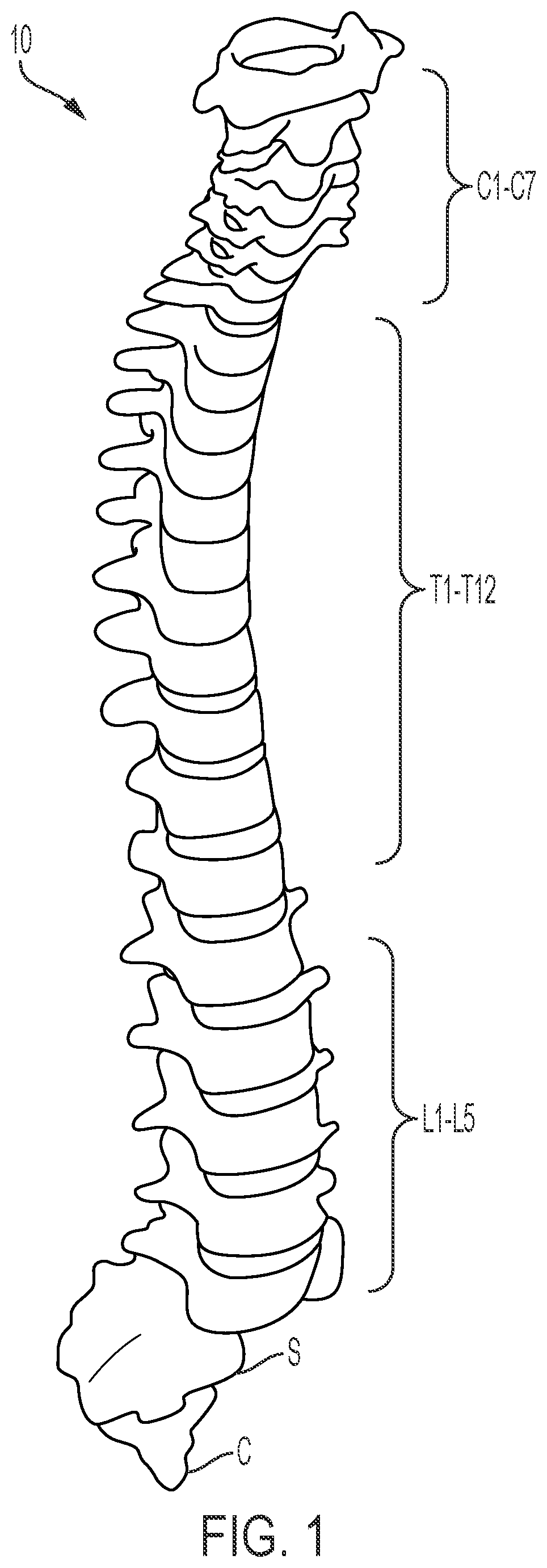
The spinal column, or backbone, is one of the most important parts of the body. It provides the main support, allowing us to stand upright, bend, and twist. As shown in , thirty three (33) individual bones interlock with each other to form the spinal column. The vertebrae are numbered and divided into regions. The cervical vertebrae C 1 -C 7 form the neck, support the head and neck, and allow nodding and shaking of the head. The thoracic vertebrae T 1 -T 12 join with the ribs to form the rib cage. The five lumbar vertebrae L 1 -L 5 carry most of the weight of the upper body and provide a stable center of gravity when a person moves. Five vertebrae of the sacrum S and four of the coccyx C are fused. This comprises the back wall of the pelvis. Intervertebral discs are located between each of the mobile vertebra. Intervertebral discs comprise a thick outer layer with a crisscrossing fibrous structure annulus A that surrounds a soft gel-like center, the nucleus N. Discs function like shock-absorbing springs. The annulus pulls the vertebral bodies together against the elastic resistance of the gel-filled nucleus. When we bend, the nucleus acts like a ball bearing, allowing the vertebral bodies to roll over the incompressible gel. Each disc works in concert with two facet joints, forming a spinal motion segment. The biomechanical function of each pair of facet joints is to guide and limit the movement of the spinal motion segment. The surfaces of the joint are coated with cartilage that helps each joint move smoothly. Directly behind the discs, the ring-like vertebral bodies create a vertical tunnel called the spinal canal or neuro canal. The spinal cord and spinal nerves pass through the spinal canal, which protects them from injury. The spinal cord is the major column of nerve tissue that is connected to the brain and serves as an information super-highway between the brain and the body. The nerves in the spinal cord branch off to form pairs of nerve roots that travel through the small openings between the vertebrae and the intervertebral foramens.
Various medical conditions require a surgeon to repair, remove and/or replace the aforementioned discs. For example, in one surgical procedure, known as a discectomy (or diskectomy) with interbody fusion, the surgeon removes the nucleus of the disc and replaces it with an implant. As shown in , it may be necessary, for example, for the surgeon to remove the nucleus of the disc between the L 3 and L 4 vertebrae. Disc D L3-L4 is shown in an enlarged view in . This figure also shows various anatomical structures of the spine, including facets F 3 A and F 4 A, facet joint FJ, spinous processes SP 3 (not shown) and SP 4 , transverse processes TP 3 A and TP 4 A, and intervertebral foramen IF. is a top view of the section of the spinal column shown in , with the L 3 vertebra removed to expose annulus A and nucleus N of disc D L3-L4 . Neural canal NC is also shown. is an anterior perspective view of the section of the spinal column shown in . is a partial cross-sectional view of the section of the spinal column shown in , taken generally along line 6 - 6 , but with vertebra L 3 in place atop disc D L3-L4 .
Of all animals possessing a backbone, human beings are the only creatures who remain upright for significant periods of time. From an evolutionary standpoint, this erect posture has conferred a number of strategic benefits, not the least of which is freeing the upper limbs for purposes other than locomotion. From an anthropologic standpoint, it is also evident that this unique evolutionary adaptation is a relatively recent change, and as such has not benefitted from natural selection as much as have backbones held in a horizontal attitude. As a result, the stresses acting upon the human backbone (or “vertebral column”), are unique in many senses, and result in a variety of problems or disease states that are peculiar to the human species.
The human vertebral column is essentially a tower of bones held upright by fibrous bands called ligaments and contractile elements called muscles. There are seven bones in the neck or cervical region, twelve in the chest or thoracic region, five in the lower back or lumbar region, and five in the pelvic or sacral region, which are normally fused together to form the back part of the pelvis. This column of bones is critical for providing structural support for the entire body.
Between the vertebral bones themselves exist soft tissue structures, i.e., discs, composed of fibrous tissue and cartilage that are compressible and act as shock absorbers for sudden downward forces on the upright column. The discs allow the bones to move independently of each other, as well. The repetitive forces which act on these intervertebral discs during repetitive activities of bending, lifting, and twisting cause them to break down or degenerate over time.
Presumably, because of humans' upright posture their intervertebral discs have a high propensity to degenerate. Overt trauma or covert trauma, occurring in the course of repetitive activities, disproportionately affects the more highly mobile areas of the spine. Disruption of a disc's internal architecture leads to bulging, herniation, or protrusion of pieces of the disc and eventual disc space collapse. Resulting mechanical and even chemical irritation of surrounding neural elements (spinal cord and nerves) cause pain, attended by varying degrees of disability. In addition, loss of disc space height relaxes tension on the longitudinal spinal ligaments, thereby contributing to varying degrees of spinal movement.
The time-honored method of addressing the issues of neural irritation and instability resulting from severe disc damage has largely focused on removal of the damaged disc and fusing the adjacent vertebral elements together. Removal of the disc relieves the mechanical and chemical irritation of neural elements, while osseous union (i.e., bone knitting) solves the problem of stability.
While cancellous bone appears ideal to provide the biologic components necessary for osseous union to occur, it does not initially have the strength to resist the tremendous forces that may occur in the intervertebral disc space, nor does it have the capacity to adequately stabilize the spine until long term bony union occurs. For these reasons, many spinal surgeons have found that interbody fusion using bone alone has an unacceptably high rate of bone graft migration or even expulsion or nonunion due to structural failure of the bone or residual degrees of motion that retard or prohibit bony union. Intervertebral prosthesis in various forms has therefore been used to provide immediate stability and to protect and preserve an environment that fosters growth of the grafted bone such that a structurally significant bony fusion can occur.
Limitations of most present-day intervertebral implants are significant and revolve largely around the marked variation in the disc space height and shape that result from either biologic variability or pathologic change. For example, if a disc space is 20 mm in height, a circular implant bridging this gap requires a minimum diameter of 20 mm just to contact the end plate of the vertebral bone. Generally, end plate disruption must occur to allow a generous bony union, meaning that an additional 2-3 mm must be added on either side resulting in a final implant size of 24-26 mm. During implantation from an anterior approach (i.e., from the front of the body), excessive retraction (or pulling) is often required on the great blood vessels, which greatly enhances the risk of devastating complications such as vascular tears or thrombosis. On the other hand, during a posterior approach, large implant diameters may require excessive traction on neural elements for adequate placement, even if all posterior bony elements are removed. In some instances, an adequate implant size cannot be inserted posteriorly, particularly if there is a significant degree of distraction to obtain stability by tightening the annular ligamentous tension band. Compromising on implant size risks sub-optimal stability or a loose implant, which has a greater risk of migration within, or expulsion from, the disc space. The alternative of excessively retracting neural elements to facilitate a posterior implant application results in a neuropraxia at best and permanent neural damage at worst.
Thus, there is a long-felt need for an expandable and deployable intervertebral fusion implant capable of being placed within an intervertebral disc space and expanded.
SUMMARY
According to aspects illustrated herein, there is provided an expandable intervertebral fusion implant, comprising a base, including a first top surface, a first bottom surface, a first end including a first worm rotatably arranged therein, and a second end including a second worm rotatably arranged therein, an inferior component, including a second top surface operatively arranged to engage the first bottom surface, and a second bottom surface, a superior component, including a third top surface, a third bottom surface operatively arranged to engage the first top surface, and a first expansion mechanism, including a first screw comprising a first bottom end connected to the base and a first top end connected to the superior component, and a second screw comprising a second bottom end connected to the base and a second top end connected to the inferior component, wherein as the first worm is rotated in a first circumferential direction, the first screw and the second screw rotate in a second circumferential direction and the superior component and the inferior component are displaced relative to the base.
In some embodiments, the first worm comprises a radially outward facing surface comprising threading, and the first expansion mechanism further comprises gear engaged with the threading. In some embodiments, the first expansion mechanism further comprises a first sleeve threadably engaged with the first worm. In some embodiments, as the first screw rotates in the second circumferential direction, the first sleeve displaces relative to the base. In some embodiments, the first sleeve is pivotably connected to the superior component. In some embodiments, the first expansion mechanism further comprises a second sleeve threadably engaged with the first worm. In some embodiments, the second sleeve is pivotably connected to the inferior component.
In some embodiments, the second worm is spaced apart from the first worm. In some embodiments, the first worm comprises a through-hole. In some embodiments, the expandable intervertebral fusion implant further comprises a second expansion mechanism including a third screw comprising a third bottom end connected to the base and a third top end connected to the superior component, and a fourth screw comprising a fourth bottom end connected to the base and a fourth top end connected to the inferior component. In some embodiments, as the second worm is rotated in the first circumferential direction, the third screw and the fourth screw rotate in the second circumferential direction and the superior component and the inferior component are displaced relative to the base. In some embodiments, the first worm and the second worm are concentrically aligned. In some embodiments, the expandable intervertebral fusion implant further comprises a nut threadably engaged with the first screw, wherein the nut comprises a dome. In some embodiments, as the first screw rotates in the second circumferential direction, the nut displaces relative to the base.
According to aspects illustrated herein, there is provided an expandable intervertebral fusion implant, comprising an inferior component, including a first top surface, a first bottom surface, a first end including a first worm rotatably arranged therein, and a second end including a second worm rotatable arranged therein, a superior component, including a second top surface, a second bottom surface, a third end, and a fourth end, a first worm arranged between the inferior component and the superior component, a second worm concentrically aligned with the first worm and arranged between the inferior component and the superior component, an expansion mechanism, including a first screw comprising a first bottom end connected to the first worm and a first top end connected to the superior component, and a second screw comprising a second bottom end connected to the first worm and a second top end connected to the inferior component, the second screw being non-rotatably connected to the first screw, wherein as the first worm is rotated in a first circumferential direction, the first screw and the second screw rotate in a second circumferential direction and the superior component is displaced relative to the inferior component.
In some embodiments, the first worm comprises a radially outward facing surface comprising threading, and the expansion mechanism further comprises a gear non-rotatably connected to the first screw and the second screw and engaged with the threading. In some embodiments, the expansion mechanism further comprises a sleeve threadably engaged with the first worm, and as the first worm rotates in the first circumferential direction, the sleeve displaces axially relative to the first screw. In some embodiments, the first top end is pivotably connected to the superior component, and the second top end is pivotably connected to the inferior component. In some embodiments, the expansion mechanism further comprises a nut threadably engaged with the first worm, and the nut comprises a dome.
According to aspects illustrated herein, there is provided an expandable intervertebral fusion implant, comprising a base, an inferior component arranged on a first side of the base, a superior component arranged on a second side of the base, opposite the first side, a first worm rotatably arranged in the base and including a through-hole, a second worm rotatably arranged in the base, the second worm concentrically aligned with and spaced apart from the first worm, and an expansion mechanism, including a first screw extending between the base and the superior component, and a second screw non-rotatably connected to the first screw and extending between the base and the inferior component, wherein as the first worm is rotated in a first circumferential direction, the first screw and the second screw rotate in a second circumferential direction and the inferior component and the superior component are displaced relative to the base.
According to aspects illustrated herein, there is provided an expandable intervertebral fusion implant, comprising an inferior component, including a first top surface, a first bottom surface, a first end including a first worm rotatably arranged therein, and a second end including a second worm rotatable arranged therein, a superior component, including a second top surface, a second bottom surface, a third end, and a fourth end, and a first expansion mechanism including a first screw, the first screw comprising a first bottom end connected to the inferior component and a first top end connected to the superior component, wherein as the first worm is rotated in a first circumferential direction, the first screw rotates in a second circumferential direction and the superior component is displaced relative to the inferior component.
In some embodiments, the first worm comprises a radially outward facing surface comprising threading, and the first expansion mechanism further comprises a first bevel gear engaged with the threading. In some embodiments, the first expansion mechanism further comprises a first sleeve threadably engaged with the first worm. In some embodiments, as the first screw rotates in the second circumferential direction, the first sleeve displaces relative to the inferior component. In some embodiments, the first sleeve is pivotably connected to the superior component. In some embodiments, the superior component further comprises a frusto-conical hole extending from the second bottom surface, and the first sleeve engages the frusto-conical hole. In some embodiments, the second worm is spaced apart from the first worm. In some embodiments, the first worm comprises a through-hole. In some embodiments, the expandable intervertebral fusion implant further comprises a second expansion mechanism including a second screw, the second screw comprising a second bottom end connected to the inferior component and a second top end connected to the superior component. In some embodiments, as the second worm is rotated in the first circumferential direction, the second screw rotates in the second circumferential direction and the superior component is displaced relative to the inferior component. In some embodiments, the first worm and the second worm are concentrically aligned. In some embodiments, the expandable intervertebral fusion implant further comprises a section extending from one of the inferior component and the superior component and a groove arranged in the other of the inferior component and the superior component, the section being engaged with the groove.
According to aspects illustrated herein, there is provided an expandable intervertebral fusion implant, comprising an inferior component, including a first top surface, a first bottom surface, a first end including a first worm rotatably arranged therein, and a second end including a second worm rotatable arranged therein, a superior component, including a second top surface, a second bottom surface, a third end, and a fourth end, a first expansion mechanism including a first screw, the first screw comprising a first bottom end connected to the inferior component and a first top end connected to the superior component, and a second expansion mechanism including a second screw, the second screw comprising a second bottom end connected to the inferior component and a second top end connected to the superior component, wherein as the first worm is rotated in a first circumferential direction, the first screw rotates in a second circumferential direction and the superior component is displaced relative to the inferior component, and as the second worm is rotated in the first circumferential direction, the second screw rotates in the second circumferential direction and the superior component is displaced relative to the inferior component.
In some embodiments, the first worm comprises a radially outward facing surface comprising threading, and the first expansion mechanism further comprises a first bevel gear arranged at the first bottom end engaged with the threading. In some embodiments, the first expansion mechanism further comprises a first sleeve threadably engaged with the first worm, and as the first screw rotates in the second circumferential direction, the first sleeve displaces relative to the inferior component. In some embodiments, the first top end is pivotably connected to the superior component. In some embodiments, the superior component further comprises a frusto-conical hole extending from the second bottom surface, and the first screw engages the frusto-conical hole. In some embodiments, the second worm is spaced apart from the first worm, and the first worm and the second worm are concentrically aligned. In some embodiments, the first worm comprises a through-hole.
According to aspects illustrated herein, there is provided an expandable intervertebral fusion implant, comprising an inferior component, including a first top surface, a first bottom surface, a superior component, including a second top surface, a second bottom surface including a first frusto-conical hole and a second frusto-conical hole, a first worm including a through-hole, a second worm spaced apart from the first worm, a first expansion mechanism including a first screw engaged with the first worm and the first frusto-conical hole, the first screw comprising a first bottom end connected to the inferior component and a first top end pivotably connected to the superior component, and a second expansion mechanism including a second screw engaged with the second worm and the second frusto-conical hole, the second screw comprising a second bottom end connected to the inferior component and a second top end pivotably connected to the superior component, wherein as the first worm is rotated in a first circumferential direction, the first screw rotates in a second circumferential direction and the superior component is displaced away from the inferior component, and as the second worm is rotated in the first circumferential direction, the second screw rotates in the second circumferential direction and the superior component is displaced away from the inferior component.
These and other objects, features, and advantages of the present disclosure will become readily apparent upon a review of the following detailed description of the disclosure, in view of the drawings and appended claims.
BRIEF DESCRIPTION OF THE DRAWINGS
Various embodiments are disclosed, by way of example only, with reference to the accompanying schematic drawings in which corresponding reference symbols indicate corresponding parts, in which:
is an anterior perspective view of a spinal column;
is an anterior perspective view of the lumbar section of the spinal column shown in ;
is a lateral perspective view of two vertebrae, a disc, and related spinal anatomy;
is a top view of a section of the spinal column, taken generally along line 4 - 4 in ;
is an enlarged anterior perspective view of the spinal column shown in , except with the top vertebra and all other structure above the top vertebra removed;
is a partial cross-sectional view of the top and bottom vertebrae and disc, taken generally along line 6 - 6 in ;
A is a front perspective view of an expandable intervertebral fusion implant, in a collapsed state;
B is a front perspective view of the expandable intervertebral fusion implant shown in A , in an expanded state;
is a cross-sectional view of the expandable intervertebral fusion implant taken generally along line 8 - 8 in A ;
is a cross-sectional view of the expandable intervertebral fusion implant taken generally along line 9 - 9 in A ;
is a cross-sectional view of the expandable intervertebral fusion implant taken generally along line 10 - 10 in A ;
is a perspective view of a tool used for expanding and collapsing the expandable intervertebral fusion implant shown in A ;
is an anterior perspective view of a spinal column including the expandable intervertebral fusion implant shown in A , in an expanded state;
is a perspective view of an expandable intervertebral fusion implant, in a collapsed state;
A is a cross-sectional view of the expandable intervertebral fusion implant taken generally along line 14 - 14 in ;
B is a cross-sectional view of the expandable intervertebral fusion implant taken generally along line 14 - 14 in , in an expanded state;
is a perspective view of an expandable intervertebral fusion implant, in a collapsed state;
A is a cross-sectional view of the expandable intervertebral fusion implant taken generally along line 16 - 16 in ; and,
B is a cross-sectional view of the expandable intervertebral fusion implant taken generally along line 16 - 16 in , in an expanded state.
DETAILED DESCRIPTION
At the outset, it should be appreciated that like drawing numbers on different drawing views identify identical, or functionally similar, structural elements. It is to be understood that the claims are not limited to the disclosed aspects.
Furthermore, it is understood that this disclosure is not limited to the particular methodology, materials and modifications described and as such may, of course, vary. It is also understood that the terminology used herein is for the purpose of describing particular aspects only, and is not intended to limit the scope of the claims.
Unless defined otherwise, all technical and scientific terms used herein have the same meaning as commonly understood to one of ordinary skill in the art to which this disclosure pertains. It should be understood that any methods, devices or materials similar or equivalent to those described herein can be used in the practice or testing of the example embodiments. The assembly of the present disclosure could be driven by hydraulics, electronics, pneumatics, and/or springs.
It should be appreciated that the term “substantially” is synonymous with terms such as “nearly,” “very nearly,” “about,” “approximately,” “around,” “bordering on,” “close to,” “essentially,” “in the neighborhood of,” “in the vicinity of,” etc., and such terms may be used interchangeably as appearing in the specification and claims. It should be appreciated that the term “proximate” is synonymous with terms such as “nearby,” “close,” “adjacent,” “neighboring,” “immediate,” “adjoining,” etc., and such terms may be used interchangeably as appearing in the specification and claims. The term “approximately” is intended to mean values within ten percent of the specified value.
It should be understood that use of “or” in the present application is with respect to a “non-exclusive” arrangement, unless stated otherwise. For example, when saying that “item x is A or B,” it is understood that this can mean one of the following: (1) item x is only one or the other of A and B; (2) item xis both A and B. Alternately stated, the word “or” is not used to define an “exclusive or” arrangement. For example, an “exclusive or” arrangement for the statement “item x is A or B” would require that x can be only one of A and B. Furthermore, as used herein, “and/or” is intended to mean a grammatical conjunction used to indicate that one or more of the elements or conditions recited may be included or occur. For example, a device comprising a first element, a second element and/or a third element, is intended to be construed as any one of the following structural arrangements: a device comprising a first element; a device comprising a second element; a device comprising a third element; a device comprising a first element and a second element; a device comprising a first element and a third element; a device comprising a first element, a second element and a third element; or, a device comprising a second element and a third element.
Moreover, as used herein, the phrases “comprises at least one of” and “comprising at least one of” in combination with a system or element is intended to mean that the system or element includes one or more of the elements listed after the phrase. For example, a device comprising at least one of: a first element; a second element; and, a third element, is intended to be construed as any one of the following structural arrangements: a device comprising a first element; a device comprising a second element; a device comprising a third element; a device comprising a first element and a second element; a device comprising a first element and a third element; a device comprising a first element, a second element and a third element; or, a device comprising a second element and a third element. A similar interpretation is intended when the phrase “used in at least one of:” is used herein. Furthermore, as used herein, “and/or” is intended to mean a grammatical conjunction used to indicate that one or more of the elements or conditions recited may be included or occur. For example, a device comprising a first element, a second element and/or a third element, is intended to be construed as any one of the following structural arrangements: a device comprising a first element; a device comprising a second element; a device comprising a third element; a device comprising a first element and a second element; a device comprising a first element and a third element; a device comprising a first element, a second element and a third element; or, a device comprising a second element and a third element.
By “non-rotatably connected” elements, we mean that: the elements are connected so that whenever one of the elements rotate, all the elements rotate; and, relative rotation between the elements is not possible. Radial and/or axial movement of non-rotatably connected elements with respect to each other is possible, but not required. By “rotatably connected” elements, we mean that: the elements are rotatable with respect to each other; and, whenever one element is displaced radially and/or axially, all the elements are displaced radially and/or axially.
Adverting now to the figures, and as described previously, depict various parts and sections of spinal anatomy.
A is a front perspective view of expandable intervertebral fusion implant 110 , in a collapsed state. B is a front perspective view of expandable intervertebral fusion implant 110 , in an expanded state. is a cross-sectional view of expandable intervertebral fusion implant 110 taken generally along line 8 - 8 in A . is a cross-sectional view of expandable intervertebral fusion implant 110 taken generally along line 9 - 9 in A . is a cross-sectional view of expandable intervertebral fusion implant 110 taken generally along line 10 - 10 in A . Expandable intervertebral fusion implant 110 generally comprises inferior component 120 , superior component 160 , and at least one expansion mechanism, for example, a worm drive comprising worm 200 A and/or worm 200 B and screw 220 A and/or screw 220 B, respectively. The following description should be read in view of A- 10 .
Inferior component 120 comprises top surface 122 , bottom surface 124 , end 126 , and end 128 . Top surface 122 is an interior surface of expandable intervertebral fusion implant 110 that generally faces superior component 160 and is operatively arranged to engage and/or abut against surface 164 . Bottom surface 124 is an exterior surface of expandable intervertebral fusion implant 110 that generally faces away from superior component 160 and is operatively arranged to engage and/or abut against a vertebra, as will be described in greater detail below. In some embodiments, surface 122 is arranged parallel to surface 124 . In some embodiments, surface 122 is arranged nonparallel to surface 124 . In some embodiments, surface 124 is curvilinear, for example, proximate end 128 .
In some embodiments, inferior component 120 further comprises one or more holes. For example, inferior component 120 comprises hole 121 A, which extends from end 126 . Hole 121 A extends from end 126 in direction D 1 and is arranged to house worm 200 A, as will be described in greater detail below. Inferior component 120 comprises hole 121 B arranged proximate end 128 . Hole 121 B is arranged to house worm 200 B, as will be described in greater detail below. In some embodiments, hole 121 B is equal in size (e.g., diameter) to hole 121 A. In some embodiments, hole 121 B is not equal in size to hole 121 A. Inferior component 120 comprises holes 130 A and 130 B, which extend through inferior component 120 in direction D 5 . Holes 130 A-B extend from surface 122 in direction D 4 . Inferior component 120 comprises hole 132 , which extends from surface 122 to surface 124 . In some embodiments, hole 132 may instead be a plurality of holes, not just one. Holes 130 A-B and 132 are operatively arranged to allow bone fusion material, which may be injected within expandable intervertebral fusion implant 110 once implanted within a spinal column, to engage adjacent vertebra thereby encouraging bony fusion. As such, it should be appreciated that any number of holes of any number of geometric shapes can be arranged in inferior component 120 . Hole 121 A is operatively arranged to allow for the injection of bone material. As will be described in greater detail below, worm 200 A is arranged in hole 121 A and comprises through-hole 202 A. Once expandable intervertebral fusion implant 110 is implanted, bone material can be injected therein via hole 202 A. Hole 121 B may allow for fusion in some embodiments wherein worm 200 B comprises a through-hole.
Inferior component 120 further comprises at least one section, for example section 134 A and section 134 B, which extends vertically from surface 122 in direction D 3 . Sections 134 A and 134 B are operatively arranged to slidingly and pivotably engage grooves 174 A and 174 B, respectively, to maintain alignment of inferior component 120 and superior component 160 in directions D 1 and D 2 while still allowing superior component 160 and inferior component 120 to pivot with respect to each other. In some embodiments, section 134 A comprises a tongue or protrusion extending in direction D 6 therefrom and section 134 B comprises a tongue or protrusion extending in direction D 5 therefrom (see A ).
Inferior component 120 further comprises one or more holes, for example holes 142 A and 142 B. Hole 142 A is generally arranged proximate end 126 and extends from surface 122 in direction D 4 . Hole 142 A comprises a radially inward facing surface and engages screw 220 A, as will be described in greater detail below. In some embodiments, hole 142 A comprises notch 144 A arranged proximate or at surface 122 . Notch 144 A is operatively arranged to engage with protrusion 244 A to non-rotatably connect sleeve 240 A and inferior component 120 . In some embodiments, hole 142 A comprises a cylindrical section that engages screw 220 A and sleeve 240 A and a tapered portion proximate surface 124 that engages bevel gear 228 A (see ). Hole 142 B is generally arranged proximate end 128 and extends from surface 122 in direction D 4 . Hole 142 B comprises a radially inward facing surface and engages screw 220 B, as will be described in greater detail below. In some embodiments, hole 142 B comprises notch 144 B arranged proximate or at surface 122 . Notch 144 B is operatively arranged to engage with protrusion 244 B to non-rotatably connect sleeve 240 B and inferior component 120 . In some embodiments, hole 142 B comprises a cylindrical section that engages screw 220 B and sleeve 240 B and a tapered portion proximate surface 124 that engages bevel gear 228 B (see ). It should be appreciated that in some embodiments, and as shown, inferior component 120 comprises two holes 142 A arranged proximate end 126 to engage two screws 220 A and two holes 142 B arranged proximate end 128 to engage two screws 220 B.
Superior component 160 comprises top surface 162 , bottom surface 164 , end 166 , and end 168 . Top surface 162 is an exterior surface of expandable intervertebral fusion implant 110 that generally faces away from inferior component 120 and is operatively arranged to engage and/or abut against a vertebra, as will be described in greater detail below. Bottom surface 164 is an interior surface of expandable intervertebral fusion implant 110 that generally faces inferior component 120 and is operatively arranged to engage and/or abut against surface 122 , as will be described in greater detail below. In some embodiments, surface 162 is arranged parallel to surface 164 . In some embodiments, surface 162 is arranged nonparallel to surface 164 . In some embodiments, surface 162 is curvilinear, for example, proximate end 168 .
In some embodiments, superior component 160 further comprises one or more holes. For example, superior component 160 comprises holes 170 A and 170 B, which extend through superior component 160 in direction D 5 . Holes 170 A-B extend from surface 162 in direction D 3 . Superior component 160 comprises hole 172 , which extends from surface 162 to surface 164 . Holes 170 A-B and 172 are operatively arranged to allow bone fusion material, which may be injected within expandable intervertebral fusion implant 110 once implanted within a spinal column, to engage adjacent vertebra thereby encouraging bony fusion. As such, it should be appreciated that any number of holes of any number of geometric shapes can be arranged in superior component 160 . In some embodiments, superior component 160 further comprises one or more holes in end 166 and/or end 168 .
Superior component 160 further comprises at least one groove, for example groove 174 A and section 174 B, which extends from surface 162 to surface 164 . Grooves 174 A and 174 B are operatively arranged to slidingly and pivotably engage sections 134 A and 134 B, respectively, to maintain alignment of superior component 160 and inferior component 120 in directions D 1 and D 2 while still allowing superior component 160 and inferior component 120 to pivot with respect to each other. In some embodiments, groove 174 A comprises an indentation or channel that is arranged to engage a tongue or protrusion of section 134 A and groove 174 B comprises an indentation or channel that is arranged to engage a tongue or protrusion of section 134 B. Such arrangement allows the tongue or protrusion of section 134 A, 134 B to engage the indentation or channel of groove 174 A, 174 B such that superior component 160 can displace in direction D 3 and direction D 4 relative to section 134 A, 134 B, but cannot displace in direction D 5 and direction D 6 , or direction D 1 or direction D 2 , relative to section 134 A, 134 B and thus inferior component 120 .
Superior component 160 further comprises one or more holes, for example holes 182 A and 182 B. Hole 182 A is generally arranged proximate end 166 and extends from surface 164 in direction D 3 . Hole 182 A comprises surface 184 A and surface 186 A, and engages screw 220 A and sleeve 240 A, as will be described in greater detail below. In some embodiments, hole 182 A further comprises socket 188 A operatively arranged to pivotably connect to ball 250 A of screw 220 A and/or sleeve 240 A. In some embodiments, surface 184 A is frusto-conical and decreases in diameter in direction D 3 . Such an arrangement allows superior component 160 to pivot with respect to inferior component 120 such that, for example, end 168 can be expanded to a greater height than that of end 166 , or vice versa. In some embodiments, surface 186 A is cylindrical. Socket 188 A is operatively arranged to engage ball 250 A of screw 220 A to expand and contract expandable intervertebral fusion implant 110 . Hole 182 B is generally arranged proximate end 168 and extends from surface 164 in direction D 3 . Hole 182 B comprises surface 184 B and surface 186 B, and engages screw 220 B and sleeve 240 B, as will be described in greater detail below. In some embodiments, hole 182 B further comprises socket 188 B operatively arranged to pivotably connect to ball 250 B of screw 220 B and/or sleeve 240 B. In some embodiments, surface 184 B is frusto-conical and decreases in diameter in direction D 3 . Such an arrangement allows superior component 160 to pivot with respect to inferior component 120 such that, for example, end 168 can be expanded to a greater height than that of end 166 , or vice versa. In some embodiments, surface 186 B is cylindrical. Socket 188 B is operatively arranged to engage ball 250 B of screw 220 B to expand and contract expandable intervertebral fusion implant 110 .
Worm 200 A is generally cylindrical and operatively arranged to rotatably engage hole 142 A (or holes 142 A), and specifically, screw 220 A (or screws 220 A). Worm 200 A comprises through-hole 202 A and radially outward facing surface 204 A. Radially outward facing surface 204 A comprises threading arranged to engage bevel gear 228 A. Worm 200 A is rotatably connected to inferior component 120 via hole 121 A, meaning worm 200 A is capable of displacing circumferentially with respect to inferior component 120 . Worm 200 A is not capable of displacing axially, in directions D 1 and D 2 , with respect to inferior component 120 . Through-hole 202 A is operatively arranged to be engaged by a tool in order to rotate worm 200 A, for example tool 300 , as will be described in greater detail below. Such head may comprise any drive type suitable for rotating worm 200 A, for example, Phillips and Frearson, slotted, combination, socked, internal hex, Allen, torx, external hex, etc. However, it should be appreciated that hole 202 A is a through-hole that allows not only bone material to be injected into expandable intervertebral fusion implant 110 , but also access to worm 200 B. As worm 200 A is rotated, for example in circumferential direction CD 1 or circumferential direction CD 2 , threading of radially outward facing surface 204 A engages teeth on bevel gear 228 A to displace screw 220 A in circumferential direction CD 3 or circumferential direction CD 4 , within hole 142 A.
Screw 220 A comprises end 222 A, 224 A, and radially outward facing surface 226 A. End 222 A engages inferior component 120 and end 224 A engages superior component 160 . Radially outward facing surface 226 A comprises threading operatively arranged to engage with threading of sleeve 240 A, as will be described in greater detail below. Screw 220 A further comprises bevel gear 228 A connected to end 222 A. As is known in the art, bevel gear 228 A is operatively arranged to engage threading of radially outward facing surface 204 A (of worm 200 A). This engagement creates a worm drive, meaning that as worm 200 A is rotated in circumferential direction CD 1 or circumferential direction CD 2 , threading of radially outward facing surface 204 A engages teeth on bevel gear 228 A, which displaces screw 220 A in circumferential direction CD 3 or circumferential direction CD 4 within hole 142 A. In some embodiments, bevel gear 228 A is fixedly secured to screw 220 A. In some embodiments, bevel gear 228 A and screw 220 A are integrally formed.
Sleeve 240 A is generally cylindrical, is rotatably connected to screw 220 A at end 224 A, and is connected to superior component 160 . Sleeve 240 A comprises radially inward facing surface 242 A and protrusion or key 244 A. Radially inward facing surface 242 A comprises threading that engages threading on radially outward facing surface 226 A of screw 220 A. As previously described, protrusion 244 A engages notch 144 A in inferior component 120 . As screw 220 A is displaced in circumferential direction CD 3 or circumferential direction CD 4 , as a result of worm 200 A being displaced in circumferential direction CD 1 or circumferential direction CD 2 , sleeve 240 A displaces in direction D 3 or direction D 4 relative to screw 220 A, thereby displacing superior component 160 in direction D 3 and direction D 4 relative to inferior component 120 . In some embodiments, sleeve 240 A comprises ball 250 A operatively arranged to pivotably engage superior component 160 , specifically, socket 188 A. Such “ball and socket” joint connection allows for pivotable movement of superior component 160 relative to inferior component 120 . In some embodiments, sleeve 240 A only partially surrounds screw 220 A. In some embodiments, sleeve 240 A completely circumscribes screw 220 A. Sleeve 240 A may also protect screw 220 A and hole 142 A from ingrowth of foreign materials (e.g., tissue, bone fusion material, etc.).
Screw 220 A and sleeve 240 A are capable of displacing within hole 142 A. Specifically, screw 220 A is capable of displacing in circumferential directions CD 3 and CD 4 relative to inferior component 120 and sleeve 240 A is capable of displacing in directions D 3 and D 4 relative to inferior component 120 . The engagement of worm 200 A and screw 220 A (i.e., bevel gear 228 A) operates similar to a worm drive, wherein rotational displacement of worm 200 A causes rotational displacement of screw 220 A and linear displacement of sleeve 240 A. As such, when worm 200 A is rotated in a first rotational direction, screw 220 A is displaced within hole 142 A such that sleeve 240 A and superior component 160 are displaced in direction D 3 relative to inferior component 120 , expanding expandable intervertebral fusion implant 110 . When worm 200 A is rotated in a second rotational direction, opposite the first rotational direction, screw 220 A is displaced within hole 142 A such that sleeve 240 A and superior component 160 are displaced in direction D 4 relative to inferior component 120 , contracting expandable intervertebral fusion implant 110 . It should be appreciated that while the drawings illustrate only one worm 200 A arranged to engage two screws 220 A at the same time, in some embodiments expandable intervertebral fusion implant 110 may comprise two worms 200 A that independently engage the two screws 220 A. Such an arrangement would allow for each corner (of end 166 ) to be expanded/contracted independently of each other.
Worm 200 B is generally cylindrical and operatively arranged to rotatably engage hole 142 B (or holes 142 B), and specifically, screw 220 B (or screws 220 B). Worm 200 B comprises hole 202 B and radially outward facing surface 204 B. In some embodiments, hole 202 B is a through-hole. In some embodiments, hole 202 B is not a through-hole. Radially outward facing surface 204 B comprises threading arranged to engage bevel gear 228 B. Worm 200 B is rotatably connected to inferior component 120 via hole 121 B, meaning worm 200 B is capable of displacing circumferentially with respect to inferior component 120 . Worm 200 A is not capable of displacing axially, in directions D 1 and D 2 , with respect to inferior component 120 . Hole 202 B is operatively arranged to be engaged by a tool in order to rotate worm 200 B, for example tool 300 , as will be described in greater detail below. Such head may comprise any drive type suitable for rotating worm 200 B, for example, Phillips and Frearson, slotted, combination, socked, internal hex, Allen, torx, external hex, etc. As worm 200 B is rotated, for example in circumferential direction CD 1 or circumferential direction CD 2 , threading of radially outward facing surface 204 B engages teeth on bevel gear 228 B to displace screw 220 B in circumferential direction CD 3 or circumferential direction CD 4 , within hole 142 B.
Screw 220 B comprises end 222 B, 224 B, and radially outward facing surface 226 B. End 222 B engages inferior component 120 and end 224 B engages superior component 160 . Radially outward facing surface 226 B comprises threading operatively arranged to engage with threading of sleeve 240 B, as will be described in greater detail below. Screw 220 B further comprises bevel gear 228 B connected to end 222 B. As is known in the art, bevel gear 228 B is operatively arranged to engage threading of radially outward facing surface 204 B (of worm 200 B). This engagement creates a worm drive, meaning that as worm 200 B is rotated in circumferential direction CD 1 or circumferential direction CD 2 , threading of radially outward facing surface 204 B engages teeth on bevel gear 228 B, which displaces screw 220 B in circumferential direction CD 3 or circumferential direction CD 4 within hole 142 B. In some embodiments, bevel gear 228 B is fixedly secured to screw 220 B. In some embodiments, bevel gear 228 B and screw 220 B are integrally formed.
Sleeve 240 B is generally cylindrical, is rotatably connected to screw 220 B at end 224 B, and is connected to superior component 160 . Sleeve 240 B comprises radially inward facing surface 242 B and protrusion or key 244 B. Radially inward facing surface 242 B comprises threading that engages threading on radially outward facing surface 226 B of screw 220 B. As previously described, protrusion 244 B engages notch 144 B in inferior component 120 . As screw 220 B is displaced in circumferential direction CD 3 or circumferential direction CD 4 , as a result of worm 200 B being displaced in circumferential direction CD 1 or circumferential direction CD 2 , sleeve 240 B displaces in direction D 3 or direction D 4 relative to screw 220 B, thereby displacing superior component 160 in direction D 3 and direction D 4 relative to inferior component 120 . In some embodiments, sleeve 240 B comprises ball 250 B operatively arranged to pivotably engage superior component 160 , specifically, socket 188 B. Such “ball and socket” joint connection allows for pivotable movement of superior component 160 relative to inferior component 120 . In some embodiments, sleeve 240 B only partially surrounds screw 220 B. In some embodiments, sleeve 240 B completely circumscribes screw 220 B. Sleeve 240 B may also protect screw 220 B and hole 142 B from ingrowth of foreign materials (e.g., tissue, bone fusion material, etc.).
Screw 220 B and sleeve 240 B are capable of displacing within hole 142 B. Specifically, screw 220 B is capable of displacing in circumferential directions CD 3 and CD 4 relative to inferior component 120 and sleeve 240 B is capable of displacing in directions D 3 and D 4 relative to inferior component 120 . The engagement of worm 200 B and screw 220 B (i.e., bevel gear 228 B) operates similar to a worm drive, wherein rotational displacement of worm 200 B causes rotational displacement of screw 220 B and linear displacement of sleeve 240 B. As such, when worm 200 B is rotated in a first rotational direction, screw 220 B is displaced within hole 142 B such that sleeve 240 B and superior component 160 are displaced in direction D 3 relative to inferior component 120 , expanding expandable intervertebral fusion implant 110 . When worm 200 B is rotated in a second rotational direction, opposite the first rotational direction, screw 220 B is displaced within hole 142 B such that sleeve 240 B and superior component 160 are displaced in direction D 4 relative to inferior component 120 , contracting expandable intervertebral fusion implant 110 . It should be appreciated that while the drawings illustrate only one worm 200 B arranged to engage two screws 220 B at the same time, in some embodiments expandable intervertebral fusion implant 110 may comprise two worms 200 B that independently engage the two screws 220 B. Such an arrangement would allow for each corner (of end 168 ) to be expanded/contracted independently of each other.
It should be appreciated that in some embodiments, expandable intervertebral implant 110 comprises one or more expansion mechanisms, for example, four worm drives and four screws. Specifically, and as shown, inferior component 120 comprises two worms, namely, worms 200 A and 200 B, and four screws, namely, screws 220 A engaged with worm 200 A and screws 220 B engaged with worm 200 B. The arrangement of the expansion mechanisms as well as the pivotable connection of the screws/sleeves to the superior component (i.e., the ball and socket joints) allows for a user to individually expand each end of expandable intervertebral implant 110 to the desired height. In other words, surface 162 need not be parallel to surface 124 , which allows for a more custom expansion of expandable intervertebral implant 110 . Furthermore, and as previously described, in some embodiments, each of the four screws comprises its own worm. In such embodiments, a user can individually expand each corner of expandable intervertebral implant 110 to the desired height.
is a perspective view of tool 300 used for expanding and collapsing expandable intervertebral fusion implant 110 . Tool 300 comprises section 310 and section 320 . Section 310 comprises proximal end 312 and distal end 322 . Section 320 is connected to distal end 322 of section 310 and comprises end 322 and end 324 . Section 312 is hexagonal (i.e., an Allen wrench) and comprises width W 1 . Width W 1 is measured across-flats (AF), which is the distance between two opposite parallel flat sides of the key. Section 320 is hexagonal and end 324 comprises width W 2 . Width W 2 is measured AF. In some embodiments, width W 2 is less than width W 1 . In some embodiments, width W 2 is equal to width W 1 . As best shown in , tool 300 is operatively arranged to engage both worm 200 A and worm 200 B at the same time. Width W 1 corresponds to width W 3 of hole 202 A of worm 200 A. Width W 3 is measured AF. Thus, when section 310 is engaged with hole 202 A, tool 300 and worm 200 A are non-rotatably connected. Width W 2 corresponds to width W 4 of hole 202 B of worm 200 B. Width W 4 is measured AF. Thus, when section 320 is engaged with hole 202 B, tool 300 and worm 200 B are non-rotatably connected. It should be appreciated that tool 300 is only one example of a tool that can be used to expand and contract expandable intervertebral fusion implant 110 , and that any tool suitable for rotating worm 200 A and worm 200 B, either at the same time or independently of each other, may be used. In some embodiments, worm 200 A and worm 200 B are rotated at different times (independently) or at different rates in order to achieve a non-parallel state of expandable intervertebral fusion implant 110 (i.e., surface 162 is non-parallel to surface 124 ).
In some embodiments, and as shown, section 310 further comprises through-bore 316 extending longitudinally from end 312 to end 314 . Section 320 further comprises section 326 engaged with through-bore 316 . Section 326 is fixedly secured to section 320 , and sections 320 and 326 are rotatably connected to section 310 . Section 326 may comprise a fitting in end 328 such as a hex head, Phillips head, torx head, etc. As such, section 320 can be rotated independent of section 310 , and vice versa. This allows tool 300 to elevate the front and back of implant 110 , 410 , 610 independently to obtain lordosis by virtue of the pivotable connection of the superior and inferior components.
is an anterior perspective view of a spinal column including expandable intervertebral fusion implant 110 , in an expanded state. Expandable intervertebral fusion implant 110 is inserted into the spinal column between, for example, vertebra L 3 and vertebra L 4 , or where disc D L3-L4 should be. Expandable intervertebral fusion implant 110 is then vertically expanded until the desired height is reached. As previously described, expandable intervertebral implant 110 is expanded by rotating worm 200 A and/or worm 200 B. It should be appreciated that expandable intervertebral implant 110 may be expanded prior to insertion, or after insertion. Expandable intervertebral implant 110 is then filled with fusion material, for example, via hole 202 A in worm 200 A, and left in situ.
is a perspective view of expandable intervertebral fusion implant 410 , in a collapsed state. A is a cross-sectional view of expandable intervertebral fusion implant 410 taken generally along line 14 - 14 in . B is a cross-sectional view of expandable intervertebral fusion implant 410 taken generally along line 14 - 14 in , in an expanded state. Expandable intervertebral fusion implant 410 generally comprises inferior component 420 , superior component 460 , base or intermediate component 560 , and at least one expansion mechanism, for example, a worm drive comprising worm 500 A and/or worm 500 B and screws 520 A-B. The following description should be read in view of B .
Base 560 comprises top surface 562 , bottom surface 564 , end 566 , and end 568 . Top surface 562 is an interior surface of expandable intervertebral fusion implant 410 that generally faces superior component 460 and is operatively arranged to engage and/or abut against surface 464 . Bottom surface 564 is an interior surface of expandable intervertebral fusion implant 410 that generally faces inferior component 420 and is operatively arranged to engage and/or abut against surface 422 . In some embodiments, surface 562 is arranged parallel to surface 564 . In some embodiments, surface 562 is arranged nonparallel to surface 564 . In some embodiments, surface 564 is curvilinear, for example, proximate end 568 . In some embodiments, base 560 further comprises one or more apertures. For example, in some embodiments base 560 comprises holes 570 A-B, which extend through base 560 in direction D 5 . Base 560 further comprises a hole, which extends from surface 562 to surface 564 . These holes are operatively arranged to allow bone fusion material, which may be injected within expandable intervertebral fusion implant 410 once implanted within a spinal column, to engage adjacent vertebra thereby encouraging bony fusion. As such, it should be appreciated that any number of holes of any number of geometric shapes can be arranged in base 560 .
In some embodiments, base 560 further comprises one or more holes in end 566 and/or end 568 , for example holes 561 A-B. In some embodiments, hole 561 A extends from end 566 in direction D 1 and is arranged to house worm 500 A, as will be described in greater detail below. Hole 561 B is arranged proximate end 568 . Hole 561 B is arranged to house worm 500 B, as will be described in greater detail below. In some embodiments, hole 561 B is equal in size (e.g., diameter) to hole 561 A. In some embodiments, hole 561 B is not equal in size to hole 561 A. Hole 561 A is operatively arranged to allow for the injection of bone material. As will be described in greater detail below, worm 500 A is arranged in hole 561 A and comprises through-hole 502 A. Once expandable intervertebral fusion implant 410 is implanted, bone material can be injected therein via hole 502 A. Hole 561 B may allow for fusion in some embodiments wherein worm 500 B comprises a through-hole (e.g., hole 502 B is a through-hole).
Inferior component 420 comprises top surface 422 , bottom surface 424 , end 426 , and end 428 . Top surface 422 is an interior surface of expandable intervertebral fusion implant 410 that generally faces superior component 460 , and base 560 , and is operatively arranged to engage and/or abut against surface 564 . Bottom surface 424 is an exterior surface of expandable intervertebral fusion implant 410 that generally faces away from superior component 460 and base 560 and is operatively arranged to engage and/or abut against a vertebra. In some embodiments, surface 422 is arranged parallel to surface 424 . In some embodiments, surface 422 is arranged nonparallel to surface 424 . In some embodiments, surface 424 is curvilinear, for example, proximate end 428 .
In some embodiments, inferior component 420 comprises hole 432 , which extends from surface 422 to surface 424 . In some embodiments, hole 432 may instead be a plurality of holes, not just one. Holes 570 A-B and 432 are operatively arranged to allow bone fusion material, which may be injected within expandable intervertebral fusion implant 410 once implanted within a spinal column, to engage adjacent vertebra thereby encouraging bony fusion. As such, it should be appreciated that any number of holes of any number of geometric shapes can be arranged in inferior component 420 . Inferior component 420 further comprises one or more holes, for example holes 488 B. In some embodiments, holes 488 B are sockets and engage balls 550 B to form a pivotable connection between screws 520 B, and thus base 560 , and inferior component 420 , as will be described in greater detail below.
Superior component 460 comprises top surface 462 , bottom surface 464 , end 466 , and end 468 . Top surface 462 is an exterior surface of expandable intervertebral fusion implant 410 that generally faces away from inferior component 420 and base 560 and is operatively arranged to engage and/or abut against a vertebra. Bottom surface 464 is an interior surface of expandable intervertebral fusion implant 410 that generally faces inferior component 420 , and base 560 , and is operatively arranged to engage and/or abut against surface 562 . In some embodiments, surface 462 is arranged parallel to surface 464 . In some embodiments, surface 462 is arranged nonparallel to surface 464 . In some embodiments, surface 464 is curvilinear, for example, proximate end 468 .
In some embodiments, superior component 460 comprises hole 472 , which extends from surface 462 to surface 464 . In some embodiments, hole 472 may instead be a plurality of holes, not just one. Holes 570 A-B and 472 are operatively arranged to allow bone fusion material, which may be injected within expandable intervertebral fusion implant 410 once implanted within a spinal column, to engage adjacent vertebra thereby encouraging bony fusion. As such, it should be appreciated that any number of holes of any number of geometric shapes can be arranged in superior component 460 . Superior component 460 further comprises one or more holes, for example holes 488 A. In some embodiments, holes 488 A are sockets and engage balls 550 A to form a pivotable connection between screws 520 A, and thus base 560 , and superior component 460 , as will be described in greater detail below.
In some embodiments, screws 520 A-B are non-rotatably connected to gears 528 . Gears 528 and screws 520 A-B are rotatably connected to base 560 . Screw 520 A extends at least partially through a hole in base 560 and comprises end 522 A connected to gear 528 and end 524 A threadably engaged with sleeve 540 A. Sleeve 540 A is slidably engaged with base 560 , that is, sleeve 540 A is displaceable in directions D 3 and D 4 with respect to base 560 . Sleeve 540 A comprises radially inward facing surface 542 A having threading that engages threaded radially outward facing surface 526 A of screw 520 A. Sleeve 540 A further comprises ball 550 A pivotably engaged with socket 488 A. It should be appreciated that sleeve 540 A may be connected to superior component 460 in any suitable way, for example, bolts, rivets, adhesive, solder, welding, etc. In some embodiments, sleeve 540 A may comprise a protrusion that engages a notch in the hole of base 560 to non-rotatably connect sleeve 540 A to base 560 .
Screw 520 B extends at least partially through a hole in base 560 and comprises end 522 B connected to gear 528 and end 524 B threadably engaged with sleeve 540 B. Sleeve 540 B is slidably engaged with base 560 , that is, sleeve 540 B is displaceable in directions D 3 and D 4 with respect to base 560 . Sleeve 540 B comprises radially inward facing surface 542 B having threading that engages threaded radially outward facing surface 526 B of screw 520 B. Sleeve 540 B further comprises ball 550 B pivotably engaged with socket 488 B. It should be appreciated that sleeve 540 B may be connected to inferior component 420 in any suitable way, for example, bolts, rivets, adhesive, solder, welding, etc. In some embodiments, sleeve 540 B may comprise a protrusion that engages a notch in the hole of base 560 to non-rotatably connect sleeve 540 B to base 560 .
As gears 528 rotate in a first circumferential direction, screws 520 A-B also rotate in the first circumferential direction, sleeve 540 A and superior component 460 displace in direction D 3 with respect to base 560 , and sleeve 540 B and inferior component 420 displace in direction D 4 with respect to base 560 . Thus, rotation of gears 528 in the first circumferential direction causes implant 410 to expand. As gears 528 rotate in a second circumferential direction, opposite the first circumferential direction, screws 520 A-B also rotate in the second circumferential direction, sleeve 540 A and superior component 460 displace in direction D 4 with respect to base 560 , and sleeve 540 B and inferior component 420 displace in direction D 3 with respect to base 560 . Thus, rotation of gears 528 in the second circumferential direction causes implant 410 to collapse.
Worm 500 A is generally cylindrical and comprises through-hole 502 A and radially outward facing surface 504 A. Radially outward facing surface 504 A comprises threading arranged to engage gears 528 . Worm 500 B is generally cylindrical and comprises hole 502 B and radially outward facing surface 504 B. Radially outward facing surface 504 B comprises threading arranged to engage gears 528 (on distal end 568 ). Worms 500 A-B are rotatably connected to base 560 via holes 561 A-B, respectively, meaning worms 500 A-B are capable of displacing circumferentially with respect to base 560 . Worms 500 A-B are not capable of displacing axially, in directions D 1 and D 2 , with respect to base 560 . Through-hole 502 A is operatively arranged to be engaged by a tool in order to rotate worm 500 A, for example tool 300 . Such head may comprise any drive type suitable for rotating worm 500 A, 500 B for example, Phillips and Frearson, slotted, combination, socked, internal hex, Allen, torx, external hex, etc. However, it should be appreciated that hole 502 A is a through-hole that allows not only bone material to be injected into expandable intervertebral fusion implant 410 , but also access to worm 500 B. As worm 500 A, 500 B is rotated, for example in circumferential direction CD 1 or circumferential direction CD 2 , threading of radially outward facing surface 504 A, 504 B engages teeth on gears 528 to displace screws 520 A-B in circumferential direction CD 3 or circumferential direction CD 4 , within base 560 . This in turn causes implant 410 to expand and collapse as previously described. The engagement of worm 500 A, 500 B with gears 528 creates a worm drive. It should be appreciated that while the drawings illustrate only one worm 500 A arranged to engage two gears 528 at the same time, in some embodiments expandable intervertebral fusion implant 410 may comprise two worms 500 A that independently engage the two gears 528 . Such an arrangement would allow for each corner (of end 566 ) to be expanded/contracted independently of each other. The same is true of worm 500 B, wherein in some embodiments implant 410 comprises two worms 500 B arranged to independently engage two gears 528 .
is a perspective view of expandable intervertebral fusion implant 610 , in a collapsed state. A is a cross-sectional view of expandable intervertebral fusion implant 610 taken generally along line 16 - 16 in . B is a cross-sectional view of expandable intervertebral fusion implant 610 taken generally along line 16 - 16 in , in an expanded state. Expandable intervertebral fusion implant 610 generally comprises inferior component 620 , superior component 660 , base or intermediate component 760 , and at least one expansion mechanism, for example, a worm drive comprising worm 700 A and/or worm 700 B and screws 720 A. The following description should be read in view of B .
Base 760 comprises top surface 762 , bottom surface 764 , end 766 , and end 768 . Top surface 762 is an interior surface of expandable intervertebral fusion implant 610 that generally faces superior component 660 and is operatively arranged to engage and/or abut against surface 664 . Bottom surface 764 is an interior surface of expandable intervertebral fusion implant 610 that generally faces inferior component 620 and is operatively arranged to engage and/or abut against surface 622 . In some embodiments, surface 762 is arranged parallel to surface 764 . In some embodiments, surface 762 is arranged nonparallel to surface 764 . In some embodiments, surface 764 is curvilinear, for example, proximate end 768 . In some embodiments, base 760 further comprises a hole, which extends from surface 762 to surface 764 . This hole is operatively arranged to allow bone fusion material, which may be injected within expandable intervertebral fusion implant 610 once implanted within a spinal column, to engage adjacent vertebra thereby encouraging bony fusion. As such, it should be appreciated that any number of holes of any number of geometric shapes can be arranged in base 760 .
In some embodiments, base 760 further comprises one or more holes in end 766 and/or end 768 , for example holes 761 A-B. In some embodiments, hole 761 A extends from end 766 in direction D 1 and is arranged to house worm 700 A, as will be described in greater detail below. Hole 761 B is arranged proximate end 768 . Hole 761 B is arranged to house worm 700 B, as will be described in greater detail below. In some embodiments, hole 761 B is equal in size (e.g., diameter) to hole 761 A. In some embodiments, hole 761 B is not equal in size to hole 761 A. Hole 761 A is operatively arranged to allow for the injection of bone material. As will be described in greater detail below, worm 700 A is arranged in hole 761 A and comprises through-hole 702 A. Once expandable intervertebral fusion implant 610 is implanted, bone material can be injected therein via hole 702 A. Hole 761 B may allow for fusion in some embodiments wherein worm 700 B comprises a through-hole (e.g., hole 702 B is a through-hole).
Inferior component 620 comprises top surface 622 , bottom surface 624 , end 626 , and end 628 . Top surface 622 is an interior surface of expandable intervertebral fusion implant 610 that generally faces superior component 660 , and base 760 , and is operatively arranged to engage and/or abut against surface 764 . Bottom surface 624 is an exterior surface of expandable intervertebral fusion implant 610 that generally faces away from superior component 660 and base 760 and is operatively arranged to engage and/or abut against a vertebra. In some embodiments, surface 622 is arranged parallel to surface 624 . In some embodiments, surface 622 is arranged nonparallel to surface 624 . In some embodiments, surface 624 is curvilinear, for example, proximate end 628 .
In some embodiments, inferior component 620 comprises hole 632 , which extends from surface 622 to surface 624 . In some embodiments, hole 632 may instead be a plurality of holes, not just one. In some embodiments, inferior component 620 comprises one or more holes, for example, holes 630 A-B, which extend through inferior component 620 in direction D 5 . Holes 630 A-B and 632 are operatively arranged to allow bone fusion material, which may be injected within expandable intervertebral fusion implant 610 once implanted within a spinal column, to engage adjacent vertebra thereby encouraging bony fusion. As such, it should be appreciated that any number of holes of any number of geometric shapes can be arranged in inferior component 620 . Inferior component 620 further comprises one or more holes, for example holes 688 B. In some embodiments, holes 688 B are sockets and engage balls 750 B to form a pivotable connection between screws 720 B, and thus base 760 , and inferior component 620 , as will be described in greater detail below.
Superior component 660 comprises top surface 662 , bottom surface 664 , end 666 , and end 668 . Top surface 662 is an exterior surface of expandable intervertebral fusion implant 610 that generally faces away from inferior component 620 and base 660 and is operatively arranged to engage and/or abut against a vertebra. Bottom surface 664 is an interior surface of expandable intervertebral fusion implant 610 that generally faces inferior component 620 , and base 760 , and is operatively arranged to engage and/or abut against surface 762 . In some embodiments, surface 662 is arranged parallel to surface 664 . In some embodiments, surface 662 is arranged nonparallel to surface 664 . In some embodiments, surface 664 is curvilinear, for example, proximate end 668 .
In some embodiments, superior component 660 comprises hole 672 , which extends from surface 662 to surface 664 . In some embodiments, hole 672 may instead be a plurality of holes, not just one. In some embodiments, superior component 660 comprises one or more holes, for example, holes 670 A-B, which extend through superior component 660 in direction D 5 . Holes 670 A-B and 672 are operatively arranged to allow bone fusion material, which may be injected within expandable intervertebral fusion implant 610 once implanted within a spinal column, to engage adjacent vertebra thereby encouraging bony fusion. As such, it should be appreciated that any number of holes of any number of geometric shapes can be arranged in superior component 660 . Superior component 660 further comprises one or more holes, for example holes 688 A. In some embodiments, holes 688 A are sockets and engage balls 750 A to form a pivotable connection between screws 720 A, and thus base 760 , and superior component 660 , as will be described in greater detail below.
In some embodiments, screws 720 A-B are non-rotatably connected to gears 728 . Gears 728 and screws 720 A-B are rotatably connected to base 760 . Screw 720 A extends at least partially through a hole in base 760 and comprises end 722 A connected to gear 728 and end 724 A. End 724 A slidingly engages superior component 660 and threadably engages nut 740 A. Nut 740 A is slidably engaged with base 760 , that is, nut 740 A is displaceable in directions D 3 and D 4 with respect to base 760 . Nut 740 A comprises radially inward facing surface 742 A having threading that engages threaded radially outward facing surface 726 A of screw 720 A. Nut 740 A further comprises ball or dome 750 A pivotably engaged with socket 688 A. In some embodiments, dome 750 A is an at least partially spherical surface of nut 740 A. Dome 750 A is slidingly engaged with socket or domed hole 688 A. Frictional engagement between dome 750 A and socket 688 A prevents nut 740 A from rotating as screw 720 A rotates. It should be appreciated that nut 740 A may be connected to superior component 660 in any suitable way, for example, bolts, rivets, adhesive, solder, welding, etc.
Screw 720 B extends at least partially through a hole in base 760 and comprises end 722 B connected to gear 728 and end 724 B. End 724 B slidingly engages inferior component 620 and threadably engages nut 740 B. Nut 740 B is slidably engaged with base 760 , that is, nut 740 B is displaceable in directions D 3 and D 4 with respect to base 760 . Nut 740 B comprises radially inward facing surface 742 B having threading that engages threaded radially outward facing surface 726 B of screw 720 B. Nut 740 B further comprises ball or dome 750 B pivotably engaged with socket 688 B. In some embodiments, dome 750 B is an at least partially spherical surface of nut 740 B. Dome 750 B is slidingly engaged with socket or domed hole 688 B. Frictional engagement between dome 750 B and socket 688 B prevents nut 740 B from rotating as screw 720 B rotates. It should be appreciated that nut 740 B may be connected to inferior component 620 in any suitable way, for example, bolts, rivets, adhesive, solder, welding, etc.
As gears 728 rotate in a first circumferential direction, screws 720 A-B also rotate in the first circumferential direction, nuts 740 A and superior component 460 displace in direction D 3 with respect to base 760 , and nuts 740 B and inferior component 420 displace in direction D 4 with respect to base 760 . Thus, rotation of gears 728 in the first circumferential direction causes implant 610 to expand. As gears 728 rotate in a second circumferential direction, opposite the first circumferential direction, screws 720 A-B also rotate in the second circumferential direction, nuts 740 A and superior component 660 displace in direction D 4 with respect to base 760 , and nuts 740 B and inferior component 620 displace in direction D 3 with respect to base 760 . Thus, rotation of gears 728 in the second circumferential direction causes implant 610 to collapse.
Worm 700 A is generally cylindrical and comprises through-hole 702 A and radially outward facing surface 704 A. Radially outward facing surface 704 A comprises threading arranged to engage gears 728 . Worm 700 B is generally cylindrical and comprises hole 702 B and radially outward facing surface 704 B. Radially outward facing surface 704 B comprises threading arranged to engage gears 728 (on distal end 768 ). Worms 700 A-B are rotatably connected to base 760 via holes 761 A-B, respectively, meaning worms 700 A-B are capable of displacing circumferentially with respect to base 760 . Worms 700 A-B are not capable of displacing axially, in directions D 1 and D 2 , with respect to base 760 . Through-hole 702 A is operatively arranged to be engaged by a tool in order to rotate worm 700 A, for example tool 300 . Such head may comprise any drive type suitable for rotating worm 700 A, 700 B for example, Phillips and Frearson, slotted, combination, socked, internal hex, Allen, torx, external hex, etc. However, it should be appreciated that hole 702 A is a through-hole that allows not only bone material to be injected into expandable intervertebral fusion implant 610 , but also access to worm 700 B. As worm 700 A, 700 B is rotated, for example in circumferential direction CD 1 or circumferential direction CD 2 , threading of radially outward facing surface 704 A, 704 B engages teeth on gears 728 to displace screws 720 A-B in circumferential direction CD 3 or circumferential direction CD 4 , within base 760 . This in turn causes implant 610 to expand and collapse as previously described. The engagement of worm 700 A, 700 B with gears 728 creates a worm drive. It should be appreciated that while the drawings illustrate only one worm 700 A arranged to engage two gears 728 at the same time, in some embodiments expandable intervertebral fusion implant 610 may comprise two worms 700 A that independently engage the two gears 728 . Such an arrangement would allow for each corner (of end 766 ) to be expanded/contracted independently of each other. The same is true of worm 700 B, wherein in some embodiments implant 610 comprises two worms 700 B arranged to independently engage two gears 728 .
It will be appreciated that various aspects of the disclosure above and other features and functions, or alternatives thereof, may be desirably combined into many other different systems or applications. Various presently unforeseen or unanticipated alternatives, modifications, variations, or improvements therein may be subsequently made by those skilled in the art which are also intended to be encompassed by the following claims.
REFERENCE NUMERALS
•
• 10 Spinal column • 12 Ligament • C 1 -C 7 Cervical vertebrae • T 1 -T 12 Thoracic vertebrae • L 1 -L 5 Lumbar vertebrae • S Sacrum • C Coccyx • D L1-L2 Disc • D L2-L3 Disc • D L3-L4 Disc • D L4-L5 Disc • F Facet • FJ Facet joint • SP Spinous process • TP Transverse process • IF Intervertebral foramen • NC Neural canal • A Annulus • N Nucleus • DH Disc space height • 110 Expandable intervertebral fusion implant • 120 Inferior component • 121 A Hole • 121 B Hole • 122 Surface • 124 Surface • 126 End • 128 End • 130 A Hole • 130 B Hole • 132 Hole • 134 A Section • 134 B Section • 142 A Hole • 142 B Hole • 144 A Notch • 144 B Notch • 160 Superior component • 162 Surface • 164 Surface • 166 End • 168 End • 170 A Hole • 170 B Hole • 172 Hole • 174 A Groove • 174 B Groove • 182 A Hole • 182 B Hole • 184 A Surface • 184 B Surface • 186 A Surface • 186 B Surface • 188 A Socket • 188 B Socket • 200 A Worm • 200 B Worm • 202 A Hole • 202 B Hole • 204 A Radially outward facing surface • 204 B Radially outward facing surface • 220 A Screw • 220 B Screw • 222 A End • 222 B End • 224 A End • 224 B End • 226 A Radially outward facing surface • 226 B Radially outward facing surface • 228 A Bevel gear • 228 B Bevel gear • 240 A Sleeve • 240 B Sleeve • 242 A Radially inward facing surface • 242 B Radially inward facing surface • 244 A Protrusion • 244 B Protrusion • 250 A Ball • 250 B Ball • 300 Tool • 310 Section • 312 End • 314 End • 316 Through-bore • 320 Section • 322 End • 324 End • 326 Section • 328 End • 410 Expandable intervertebral fusion implant • 420 Inferior component • 422 Surface • 424 Surface • 426 End • 428 End • 432 Hole • 460 Superior component • 462 Surface • 464 Surface • 466 End • 468 End • 472 Hole • 488 A Hole or socket • 488 B Hole or socket • 500 A Worm • 500 B Worm • 502 A Hole • 502 B Hole • 504 A Radially outward facing surface • 504 B Radially outward facing surface • 520 A Screw • 520 B Screw • 522 A End • 522 B End • 524 A End • 524 B End • 526 A Radially outward facing surface • 526 B Radially outward facing surface • 528 Gear • 540 A Sleeve • 540 B Sleeve • 542 A Radially inward facing surface • 542 B Radially inward facing surface • 550 A Ball • 550 B Ball • 560 Base or intermediate component • 561 A Hole • 561 B Hole • 562 Surface • 564 Surface • 566 End • 568 End • 570 A Hole • 570 B Hole • 610 Expandable intervertebral fusion implant • 620 Inferior component • 622 Surface • 624 Surface • 626 End • 628 End • 630 A Hole • 630 B Hole • 632 Hole • 660 Superior component • 662 Surface • 664 Surface • 666 End • 668 End • 670 A Hole • 670 B Hole • 672 Hole • 688 A Socket • 688 B Socket • 700 A Worm • 700 B Worm • 702 A Hole • 702 B Hole • 704 A Radially outward facing surface • 704 B Radially outward facing surface • 720 A Screw • 720 B Screw • 722 A End • 722 B End • 724 A End • 724 B End • 726 A Radially outward facing surface • 726 B Radially outward facing surface • 728 Gear • 740 A Nut • 740 B Nut • 742 A Radially inward facing surface • 742 B Radially inward facing surface • 750 A Ball or dome • 750 B Ball or dome • 760 Base or intermediate component • 762 Surface • 764 Surface • 766 End • 768 End • CD 1 Circumferential direction • CD 2 Circumferential direction • CD 3 Circumferential direction • CD 4 Circumferential direction • D 1 Direction • D 2 Direction • D 3 Direction • D 4 Direction • D 5 Direction • D 6 Direction • W 1 Width • W 2 Width • W 3 Width • W 4 Width
Figures (19)
Citations
This patent cites (33)
- US3922726
- US6090143
- US8377140
- US9474626
- US10117755
- US10172718
- US11207192
- US2003/0065396
- US2004/0186569
- US2006/0149385
- US2007/0198089
- US2007/0255407
- US2008/0140207
- US2011/0172716
- US2011/0172774
- US2012/0109128
- US2012/0323329
- US2013/0158668
- US2013/0274883
- US2015/0094814
- US2016/0089247
- US2017/0071752
- US2017/0100258
- US2017/0224505
- US2018/0071110
- US2018/0360616
- US2019/0083279
- US2019/0388232
- US2020/0100905
- US2020/0405499
- US2021/0378832
- US2023/0363923
- US2368529