Abstract
A zoom lens consisting of, in order from an object side to an image side: a first lens group that has a positive refractive power; a second lens group that has a negative refractive power; and a subsequent group that has a plurality of lens groups, wherein: the zoom lens includes an aperture stop at a position closer to the image side than a lens surface closest to the image side in the second lens group, a lens group closest to the image side in the subsequent group includes at least one negative lens of which an object side lens surface is a concave surface being in contact with air, during zooming, a spacing between the first lens group and the second lens group changes, a spacing between the second lens group and the subsequent group changes, and spacings between all adjacent lens groups in the subsequent group change.
Claims (30)
1 . A zoom lens consisting of, in order from an object side to an image side: a first lens group that has a positive refractive power; a second lens group that has a negative refractive power; and a subsequent group that has a plurality of lens groups, wherein: the zoom lens includes an aperture stop at a position closer to the image side than a lens surface closest to the image side in the second lens group, a lens group closest to the image side in the subsequent group includes at least one negative lens of which an object side lens surface is a concave surface being in contact with air, during zooming, a spacing between the first lens group and the second lens group changes, a spacing between the second lens group and the subsequent group changes, and spacings between all adjacent lens groups in the subsequent group change, during zooming, lens spacings inside the first lens group, the second lens group, and the plurality of lens groups in the subsequent group are unchanged, the second lens group consists of, in order from the object side to the image side: a negative meniscus lens having a convex surface facing toward the object side, a negative lens, a positive lens, and a negative meniscus lens having a convex surface facing toward the image side, a lens group closest to the object side in the subsequent group is defined as a third lens group, the third lens group has a positive refractive power, a lens closest to the object side of the third lens group and a second lens from the object side of the third lens group are uncemented positive lenses, an uncemented biconcave lens is arranged closest to the image side of the third lens group, the lens group closest to the image side in the subsequent group has a negative refractive power, the subsequent group includes two or three cemented lenses, each formed by a positive lens and a negative lens cemented together, and a negative lens cemented together, in a case in which a focal length of the zoom lens at a wide angle end in a state in which an infinite distance object is in focus is fw, a distance on an optical axis from a lens surface closest to the object side in the first lens group to a paraxial entrance pupil position at the wide angle end in a state in which the infinite distance object is in focus is Denw, and a sign of Denw is positive in a case where the paraxial entrance pupil position is closer to the image side than the lens surface closest to the object side in the first lens group, and is negative in a case where the paraxial entrance pupil position is closer to the object side than the lens surface closest to the object side in the first lens group, Conditional Expression (1) is satisfied, which is represented by 0.7< fw/Denw< 1.5 (1), and in a case in which a focal length of a lens group closest to the object side among lens groups that have positive refractive powers and that are included in the subsequent group in a state in which the infinite distance object is in focus is fp, a focal length of the second lens group is f2, and a focal length of the first lens group is f1, Conditional Expressions ( 19 - 3 ) and ( 23 - 3 ) are satisfied, which are represented by −2.338≤ fp/f 2<-1.5 (19-3), and −0.3< f 2/f1 <-0.1539 (23-3).
Show 29 dependent claims
2 . The zoom lens according to claim 1 , wherein in a case in which a distance on the optical axis from the lens surface closest to the object side in the first lens group to a lens surface closest to the image side in the first lens group is D1, and a sum of a back focal length in terms of an air conversion distance and a distance on the optical axis from the lens surface closest to the object side in the first lens group to a lens surface closest to the image side in the subsequent group, at a telephoto end in a state in which the infinite distance object is in focus is TL t , Conditional Expression (3) is satisfied, which is represented by 0.01 <D 1 /TLt< 0.1 (3).
3 . The zoom lens according to claim 1 , wherein in a case in which a focal length of the zoom lens at a telephoto end in a state in which the infinite distance object is in focus is ft, Conditional Expression (4) is satisfied, which is represented by 4.9 <ft/fw< 12 (4).
4 . The zoom lens according to claim 1 , wherein: the subsequent group includes at least one Lx lens of which an image side lens surface is a convex surface being in contact with air, and in a case in which a lateral magnification in an A optical system, which minimizes an absolute value of an inverse of a lateral magnification at the wide angle end in a case where the aperture stop is used as an object point in a state in which the infinite distance object is in focus, in at least one optical system configured to range from a lens surface adjacent to the image side of the aperture stop to an image side lens surface of the Lx lens is βA, Conditional Expression (5) is satisfied, which is represented by −0.5<1 /βA< 0.5 (5).
5 . The zoom lens according to claim 4 , wherein in a case in which a height of an on-axis marginal ray on a lens surface closest to the image side in the A optical system from the optical axis at a telephoto end in a state in which the infinite distance object is in focus is HAt, and a height of the on-axis marginal ray in the aperture stop from the optical axis at the telephoto end in a state in which the infinite distance object is in focus is HSt, Conditional Expression (6) is satisfied, which is represented by 0.73 <HAt/HSt< 2.3 (6).
6 . The zoom lens according to claim 4 , wherein in a case in which a focal length of the zoom lens at a telephoto end in a state in which the infinite distance object is in focus is ft, and a combined focal length from a lens surface closest to the object side in the subsequent group to a lens surface closest to the image side in the A optical system at the telephoto end in a state in which the infinite distance object is in focus is fpAt, Conditional Expression (7) is satisfied, which is represented by 3 <ft/fpAt< 15 (7).
7 . The zoom lens according to claim 4 , wherein in a case in which a height of an on-axis marginal ray on a lens surface closest to the image side in the A optical system from the optical axis at a telephoto end in a state in which the infinite distance object is in focus is HAt, and a height of a principal ray with a maximum image height on the lens surface closest to the image side in the A optical system from the optical axis at the wide angle end in a state in which the infinite distance object is in focus is HAW, Conditional Expression (8) is satisfied, which is represented by 0.35 <HAt/HAw< 1.6 (8).
8 . The zoom lens according to claim 4 , wherein the subsequent group includes a lens surface, which is a concave surface being in contact with air and which is an image side surface, between a lens surface closest to the image side in the A optical system and a lens surface which is a concave surface being in contact with air and which is an object side surface included in the lens group closest to the image side in the subsequent group.
9 . The zoom lens according to claim 4 , wherein in a case in which a distance on the optical axis from the aperture stop to a lens surface closest to the image side in the A optical system at a telephoto end in a state in which the infinite distance object is in focus is DSAt, and a sum of a back focal length in terms of an air conversion distance and a distance on the optical axis from the aperture stop to a lens surface closest to the image side in the subsequent group, at the telephoto end in a state in which the infinite distance object is in focus is DSLt, Conditional Expression (9) is satisfied, which is represented by 0.1 <DSAt/DSLt< 0.54 (9).
10 . The zoom lens according to claim 4 , wherein in a case in which a spacing on the optical axis between a lens surface closest to the image side in the A optical system and a lens surface adjacent to the image side of the lens surface closest to the image side in the A optical system at a telephoto end in a state in which the infinite distance object is in focus is dA, and a maximum image height at the telephoto end is Yt, Conditional Expression (10) is satisfied, which is represented by 0.015 <dA/Yt< 0.35 (10).
11 . The zoom lens according to claim 1 , wherein in a case in which a sum of a back focal length in terms of an air conversion distance and a distance on the optical axis from the lens surface closest to the object side in the first lens group to a lens surface closest to the image side in the subsequent group at a telephoto end in a state in which the infinite distance object is in focus is TLt, a difference in an optical axis direction between a position at the wide angle end and a position at the telephoto end of a lens group closest to the object side among lens groups that have positive refractive powers and that are included in the subsequent group in a state in which the infinite distance object is in focus is Mp, and a sign of Mp is positive in a case where the lens group closest to the object side moves from the object side to the image side, and is negative in a case where the lens group closest to the object side moves from the image side to the object side, during zooming from the wide angle end to the telephoto end, Conditional Expression (18) is satisfied, which is represented by −0.45 <Mp/TLt<− 0.06 (18).
12 . The zoom lens according to claim 1 , wherein the first lens group includes a negative lens and a positive lens, in order from a position closest to the object side to the image side.
13 . The zoom lens according to claim 1 , wherein in a case in which a back focal length in terms of an air conversion distance at the wide angle end in a state in which the infinite distance object is in focus is BFw, and a maximum image height at the wide angle end is Yw, Conditional Expression (12) is satisfied, which is represented by 0.38 <BFw/Yw< 1.5 (12).
14 . The zoom lens according to claim 1 , wherein in a case in which an Abbe number of a lens closest to the object side in the first lens group based on a d line is ν1, Conditional Expression (13) is satisfied, which is represented by 10<ν1<50 (13).
15 . The zoom lens according to claim 1 , wherein in a case in which a refractive index of a lens closest to the object side in the first lens group at a d line is N1, Conditional Expression (14) is satisfied, which is represented by 1.7 <N 1<2.3 (14).
16 . The zoom lens according to claim 1 , wherein in a case in which a refractive index of a negative lens closest to the object side at a d line among negative lenses included in the second lens group is N2n, Conditional Expression (15) is satisfied, which is represented by 1.6 <N 2 n< 2.2 (15).
17 . The zoom lens according to claim 1 , wherein in a case in which a refractive index of a positive lens that has a strongest refractive power at a d line among positive lenses included in the second lens group is N2p, Conditional Expression (16) is satisfied, which is represented by 1.65 <N 2 p< 2 (16).
18 . The zoom lens according to claim 1 , wherein in a case in which an Abbe number of a negative lens closest to the image side based on a d line among negative lenses included in the subsequent group is νnL, Conditional Expression (17) is satisfied, which is represented by 27 <νnL< 102 (17).
19 . The zoom lens according to claim 1 , wherein the subsequent group includes at least one lens group that has a positive refractive power.
20 . The zoom lens according to claim 19 , wherein in a case in which a sum of a back focal length in terms of an air conversion distance and a distance on the optical axis from the lens surface closest to the object side in the first lens group to a lens surface closest to the image side in the subsequent group at a telephoto end in a state in which the infinite distance object is in focus is TL t , a difference in an optical axis direction between a position at the wide angle end and a position at the telephoto end of a lens group closest to the object side among lens groups that have positive refractive powers and that are included in the subsequent group in a state in which the infinite distance object is in focus is Mp, and a sign of Mp is positive in a case where the lens group closest to the object side moves from the object side to the image side, and is negative in a case where the lens group closest to the object side moves from the image side to the object side, during zooming from the wide angle end to the telephoto end, Conditional Expression (18) is satisfied, which is represented by −0.45 <Mp/TL t <− 0 . 06 (18).
21 . The zoom lens according to claim 19 , wherein in a case in which a distance on the optical axis from a lens surface closest to the image side in the first lens group to a lens surface closest to the object side in a lens group closest to the object side among lens groups that have positive refractive powers and that are included in the subsequent group at a telephoto end in a state in which the infinite distance object is in focus is D1pt, and a sum of a back focal length in terms of an air conversion distance and a distance on the optical axis from the lens surface closest to the object side in the first lens group to a lens surface closest to the image side in the subsequent group, at the telephoto end in a state in which the infinite distance object is in focus is TLt, Conditional Expression (20) is satisfied, which is represented by 0.2 <D 1 pt/TLt< 0.5 (20).
22 . The zoom lens according to claim 1 , wherein: the subsequent group includes at least one Lx lens of which an image side lens surface is a convex surface being in contact with air, an optical system, which minimizes an absolute value of an inverse of a lateral magnification at the wide angle end in a case where the aperture stop is used as an object point in a state in which the infinite distance object is in focus, in at least one optical system configured to range from a lens surface adjacent to the image side of the aperture stop to an image side lens surface of the Lx lens is an A optical system, and in a case in which a combined focal length at the wide angle end in a state in which the infinite distance object is in focus from a lens surface adjacent to the image side of a lens surface closest to the image side in the A optical system to a lens surface closest to the image side in the subsequent group is fBw, Conditional Expression (21) is satisfied, which is represented by −1.6 <fw/fBw<− 0.25 (21).
23 . The zoom lens according to claim 1 , wherein in a case in which a maximum half angle of view at the wide angle end in a state in which the infinite distance object is in focus is ωw, and a maximum image height at the wide angle end is Yw, Conditional Expression (22) is satisfied, which is represented by 0.97 <fw ×tan ω w/Yw< 1.3 (22).
24 . The zoom lens according to claim 1 , wherein the subsequent group includes a focus group that moves along the optical axis during focusing.
25 . The zoom lens according to claim 24 , wherein the focus group consists of two or fewer lenses.
26 . The zoom lens according to claim 24 , wherein the focus group has a negative refractive power.
27 . The zoom lens according to claim 1 , wherein in a case in which Conditional Expression (23-4) is satisfied, which is represented by −0.23 <f 2 /f 1≤−0.1539 (23-4).
28 . An imaging apparatus comprising the zoom lens according to claim 1 .
29 . The zoom lens according to claim 1 , wherein in a case in which a distance on the optical axis from a paraxial exit pupil position to an image plane at the wide angle end in a state in which the infinite distance object is in focus is Dexw, and a sign of Dexw is positive in a case where the paraxial exit pupil position is closer to the object side than the image plane, and is negative in a case where the paraxial exit pupil position is closer to the image side than the image plane, Conditional Expression (2) is satisfied, which is represented by 0.25< fw/Dexw< 1 (2).
30 . The zoom lens according to claim 1 , wherein the subsequent group includes only two cemented lenses, each formed by a positive lens and a negative lens cemented together.
Full Description
Show full text →
CROSS-REFERENCE TO RELATED APPLICATIONS
The present application claims priority under 35 U.S.C. § 119 to Japanese Patent Application No. 2021-122747, filed on Jul. 27, 2021. The above application is hereby expressly incorporated by reference, in its entirety, into the present application.
BACKGROUND
Technical Field
The technique of the present disclosure relates to a zoom lens and an imaging apparatus.
Related Art
As a zoom lens applicable to an imaging apparatus such as a digital camera and a video camera, for example, a lens system described in JP2019-113609A is known.
In recent years, there has been a demand for a zoom lens having a small size and a light weight while achieving a high zoom ratio.
SUMMARY
The present disclosure has been made in view of the above circumstances, and an object of the present invention is to provide a zoom lens having a small size and a light weight while achieving a high zoom ratio, and an imaging apparatus comprising the zoom lens.
According to a first aspect of the present disclosure, there is provided a zoom lens consisting of, in order from an object side to an image side: a first lens group that has a positive refractive power, a second lens group that has a negative refractive power, and a subsequent group that has a plurality of lens groups. The zoom lens includes an aperture stop at a position closer to the image side than a lens surface closest to the image side in the second lens group. A lens group closest to the image side in the subsequent group includes at least one negative lens of which an object side lens surface is a concave surface being in contact with air. During zooming, a spacing between the first lens group and the second lens group changes, a spacing between the second lens group and the subsequent group changes, and spacings between all adjacent lens groups in the subsequent group change. During zooming, lens spacings inside the first lens group, the second lens group, and the plurality of lens groups in the subsequent group are unchanged. Assuming that a focal length of a whole system at a wide angle end in a state in which an infinite distance object is in focus is fw, a distance on an optical axis from a lens surface closest to the object side in the first lens group to a paraxial entrance pupil position at the wide angle end in a state in which the infinite distance object is in focus is Denw, and a sign of Denw is positive in a case where the paraxial entrance pupil position is closer to the image side than the lens surface closest to the object side in the first lens group, and is negative in a case where the paraxial entrance pupil position is closer to the object side than the lens surface closest to the object side in the first lens group, Conditional Expression (1) is satisfied, which is represented by 0.7< fw/Denw <1.5 (1).
In the first aspect, assuming that a distance on the optical axis from a paraxial exit pupil position to an image plane at the wide angle end in a state in which the infinite distance object is in focus is Dexw, and a sign of Dexw is positive in a case where the paraxial exit pupil position is closer to the object side than the image plane, and is negative in a case where the paraxial exit pupil position is closer to the image side than the image plane, it is preferable to satisfy Conditional Expression (2), which is represented by 0.25< fw/Dexw <1 (2).
In the first aspect, assuming that a distance on the optical axis from the lens surface closest to the object side in the first lens group to a lens surface closest to the image side in the first lens group is D1, and a sum of a back focal length in terms of an air conversion distance and a distance on the optical axis from the lens surface closest to the object side in the first lens group to a lens surface closest to the image side in the subsequent group, at a telephoto end in a state in which the infinite distance object is in focus is TLt, it is preferable to satisfy Conditional Expression (3), which is represented by 0.01< D 1/ TLt< 0.1 (3).
In the first aspect, assuming that a focal length of the whole system at a telephoto end in a state in which the infinite distance object is in focus is ft, it is preferable to satisfy Conditional Expression (4), which is represented by 4.9< ft/fw< 12 (4).
In the first aspect, it is preferable that the subsequent group includes at least one Lx lens of which an image side lens surface is a convex surface being in contact with air. Assuming that a lateral magnification in an A optical system, which minimizes an absolute value of an inverse of a lateral magnification at the wide angle end in a case where the aperture stop is used as an object point in a state in which the infinite distance object is in focus, in at least one optical system configured to range from a lens surface adjacent to the image side of the aperture stop to an image side lens surface of the Lx lens is βA, it is preferable to satisfy Conditional Expression (5), which is represented by −0.5<β A< 0.5 (5).
In the first aspect, assuming that a height of an on-axis marginal ray on a lens surface closest to the image side in the A optical system from the optical axis at a telephoto end in a state in which the infinite distance object is in focus is HAt, and a height of the on-axis marginal ray in the aperture stop from the optical axis at the telephoto end in a state in which the infinite distance object is in focus is HSt, it is preferable to satisfy Conditional Expression (6), which is represented by 0.73< HAt/HSt< 2.3 (6).
In the first aspect, assuming that a focal length of the whole system at a telephoto end in a state in which the infinite distance object is in focus is ft, and a combined focal length from a lens surface closest to the object side in the subsequent group to a lens surface closest to the image side in the A optical system at the telephoto end in a state in which the infinite distance object is in focus is fpAt, it is preferable to satisfy Conditional Expression (7), which is represented by 3< ft/fpAt <15 (7).
In the first aspect, assuming that a height of an on-axis marginal ray on a lens surface closest to the image side in the A optical system from the optical axis at a telephoto end in a state in which the infinite distance object is in focus is HAt, and a height of a principal ray with a maximum image height on the lens surface closest to the image side in the A optical system from the optical axis at the wide angle end in a state in which the infinite distance object is in focus is HAw, it is preferable to satisfy Conditional Expression (8), which is represented by 0.35< HAt/HAw< 1.6 (8).
In the first aspect, it is preferable that the subsequent group includes a lens surface, which is a concave surface being in contact with air and which is image side surface, between a lens surface closest to the image side in the A optical system and a lens surface which is a concave surface being in contact with air and which is an object side surface included in the lens group closest to the image side in the subsequent group.
In the first aspect, assuming that a distance on the optical axis from the aperture stop to a lens surface closest to the image side in the A optical system at a telephoto end in a state in which the infinite distance object is in focus is DSAt, and a sum of a back focal length in terms of an air conversion distance and a distance on the optical axis from the aperture stop to a lens surface closest to the image side in the subsequent group, at the telephoto end in a state in which the infinite distance object is in focus is DSLt, it is preferable to satisfy Conditional Expression (9), which is represented by 0.1 <DSAt/DSLt <0.54 (9).
In the first aspect, assuming that a spacing on the optical axis between a lens surface closest to the image side in the A optical system and a lens surface adjacent to the image side of the lens surface closest to the image side in the A optical system at a telephoto end in a state in which the infinite distance object is in focus is dA, and a maximum image height at the telephoto end is Yt, it is preferable to satisfy Conditional Expression (10), which is represented by 0.015< dA/Yt< 0.35 (10).
In the first aspect, assuming that a sum of a back focal length at an air conversion distance and a distance on the optical axis from the lens surface closest to the object side in the first lens group to a lens surface closest to the image side in the subsequent group at a telephoto end in a state in which the infinite distance object is in focus is TLt, and a focal length of the whole system at the telephoto end in a state in which the infinite distance object is in focus is ft, it is preferable to satisfy Conditional Expression (11), which is represented by 0.65< TLt/ft< 1.5 (11).
In the first aspect, it is preferable that the first lens group includes a negative lens and a positive lens, in order from a position closest to the object side to the image side.
In the first aspect, assuming that a back focal length in terms of an air conversion distance at the wide angle end in a state in which the infinite distance object is in focus is BFw, and a maximum image height at the wide angle end is Yw, it is preferable to satisfy Conditional Expression (12), which is represented by 0.38< BFw/Yw< 1.5 (12).
In the first aspect, assuming that an Abbe number of a lens closest to the object side in the first lens group based on a d line is ν1, it is preferable to satisfy Conditional Expression (13), which is represented by 10<ν1<50 (13).
In the first aspect, assuming that a refractive index of a lens closest to the object side in the first lens group at a d line is N1, it is preferable to satisfy Conditional Expression (14), which is represented by 1.7< N 1<2.3 (14).
In the first aspect, assuming that a refractive index of a negative lens closest to the object side at a d line among negative lenses included in the second lens group is N2n, it is preferable to satisfy Conditional Expression (15), which is represented by 1.6< N 2 n< 2.2 (15).
In the first aspect, assuming that a refractive index of a positive lens that has a strongest refractive power at a d line among positive lenses included in the second lens group is N2p, it is preferable to satisfy Conditional Expression (16), which is represented by 1.65< N 2 p< 2 (16).
In the first aspect, assuming that an Abbe number of a negative lens closest to the image side based on a d line among negative lenses included in the subsequent group is νnL, it is preferable to satisfy Conditional Expression (17), which is represented by 27<ν nL< 102 (17).
In the first aspect, it is preferable that the subsequent group includes at least one lens group that has a positive refractive power.
In the first aspect, assuming that a sum of a back focal length at an air conversion distance and a distance on the optical axis from the lens surface closest to the object side in the first lens group to a lens surface closest to the image side in the subsequent group at a telephoto end in a state in which the infinite distance object is in focus is TLt, a difference in an optical axis direction between a position at the wide angle end and a position at the telephoto end of a lens group closest to the object side among lens groups that have positive refractive powers and that are included in the subsequent group in a state in which the infinite distance object is in focus is Mp, and a sign of Mp is positive in a case where the lens group closest to the object side moves from the object side to the image side, and is negative in a case where the lens group closest to the object side moves from the image side to the object side, during zooming from the wide angle end to the telephoto end, it is preferable to satisfy Conditional Expression (18), which is represented by −0.45< Mp/TLt<− 0.06 (18).
In the first aspect, assuming that a focal length of a lens group closest to the object side among lens groups that have positive refractive powers and that are included in the subsequent group in a state in which the infinite distance object is in focus is fp, and a focal length of the second lens group is f2, it is preferable to satisfy Conditional Expression (19), which is represented by −4.3< fp/f 2<−1.1 (19).
In the first aspect, assuming that a distance on the optical axis from a lens surface closest to the image side in the first lens group to a lens surface closest to the object side in a lens group closest to the object side among lens groups that have positive refractive powers and that are included in the subsequent group at a telephoto end in a state in which the infinite distance object is in focus is D1pt, and a sum of a back focal length in terms of an air conversion distance and a distance on the optical axis from the lens surface closest to the object side in the first lens group to a lens surface closest to the image side in the subsequent group, at the telephoto end in a state in which the infinite distance object is in focus is TLt, it is preferable to satisfy Conditional Expression (20), which is represented by 0.2< D 1 pt/TLt< 0.5 (20).
In the first aspect, it is preferable that the subsequent group includes at least one Lx lens of which an image side lens surface is a convex surface being in contact with air. It is preferable that an optical system, which minimizes an absolute value of an inverse of a lateral magnification at a wide angle end in a case where an aperture stop is used as an object point in a state in which the infinite distance object is in focus, in at least one optical system configured to range from a lens surface adjacent to the image side of the aperture stop to an image side lens surface of the Lx lens is an A optical system. Assuming that a combined focal length at the wide angle end in a state in which the infinite distance object is in focus from a lens surface adjacent to the image side of a lens surface closest to the image side in the A optical system to a lens surface closest to the image side in the subsequent group is fBw, it is preferable to satisfy Conditional Expression (21), which is represented by −1.6< fw/fBw<− 0.25 (21).
In the first aspect, assuming that a maximum half angle of view at the wide angle end in a state in which the infinite distance object is in focus is tow, and a maximum image height at the wide angle end is Yw, it is preferable to satisfy Conditional Expression (22), which is represented by 0.97< fw ×tan ω w/Yw< 1.3 (22).
In the first aspect, it is preferable that the subsequent group includes a focus group that moves along the optical axis during focusing.
In the first aspect, it is preferable that the focus group consists of two or fewer lenses.
In the first aspect, it is preferable that the focus group has a negative refractive power.
In the first aspect, assuming that a focal length of the first lens group is f1, and a focal length of the second lens group is f2, it is preferable to satisfy Conditional Expression (23), which is represented by −0.3< f 2/ f 1<−0.05 (23).
According to a second aspect of the present disclosure, there is provided an imaging apparatus comprising the zoom lens according to the first aspect.
In the present specification, it should be noted that the terms “consisting of” and “consists of” mean that the lens may include not only the above-mentioned components but also lenses substantially having no refractive powers, optical elements, which are not lenses, such as a stop, a filter, and a cover glass, and mechanism parts such as a lens flange, a lens barrel, an imaging element, and a camera shaking correction mechanism.
The term “˜group that has a positive refractive power” in the present specification means that the group has a positive refractive power as a whole. The term “group that has a negative refractive power” means that the group has a negative refractive power as a whole. The term “a lens that has a positive refractive power” and the term “a positive lens” are synonymous. The term “a lens that has a negative refractive power” and the term “negative lens” are synonymous.
The “first lens group”, “second lens group”, and “plurality of lens groups” in the present specification refer to parts each including at least one lens. The parts are constituents part of the zoom lens and are divided by air spacings that change during zooming. During zooming, the lens groups move or remain stationary, and the mutual spacings between the lenses of one lens group do not change. That is, in the present specification, one lens group is a group in which the spacing between adjacent groups changes during zooming and the total spacing between adjacent lenses does not change within itself. The term “˜lens group” is not limited to a configuration consisting of a plurality of lenses, but may consist of only one lens.
The term “a single lens” means one lens that is not cemented. Here, a compound aspherical lens (a lens in which a spherical lens and an aspherical film formed on the spherical lens are integrally formed and function as one aspherical lens as a whole) is not regarded as cemented lenses, but the compound aspherical lens is regarded as one lens. Unless otherwise specified, the sign of the refractive power and the surface shape of a lens including an aspherical surface are considered in terms of the paraxial region.
In the present specification, the term “whole system” means “zoom lens”. The “focal length” used in a conditional expression is a paraxial focal length. Unless otherwise specified, the “distance on the optical axis” used in Conditional Expression is considered as a geometrical length rather than an air conversion length. The “back focal length in terms of the air conversion distance” is the air conversion distance on the optical axis from the lens surface closest to the image side in the zoom lens to the image side focal position of the zoom lens.
The values used in conditional expressions are values in a case where the d line is used as a reference in a state in which the infinite distance object is in focus. The “d line”, “C line” and “F line” described in the present specification are emission lines. In the present specification, it is assumed that the d line wavelength is 587.56 nm (nanometers), the C line wavelength is 656.27 nm (nanometers), and the F line wavelength is 486.13 nm (nanometers).
According to the present disclosure, it is possible to provide a zoom lens having a small size and a light weight while achieving a high zoom ratio, and an imaging apparatus comprising the zoom lens.
BRIEF DESCRIPTION OF THE DRAWINGS
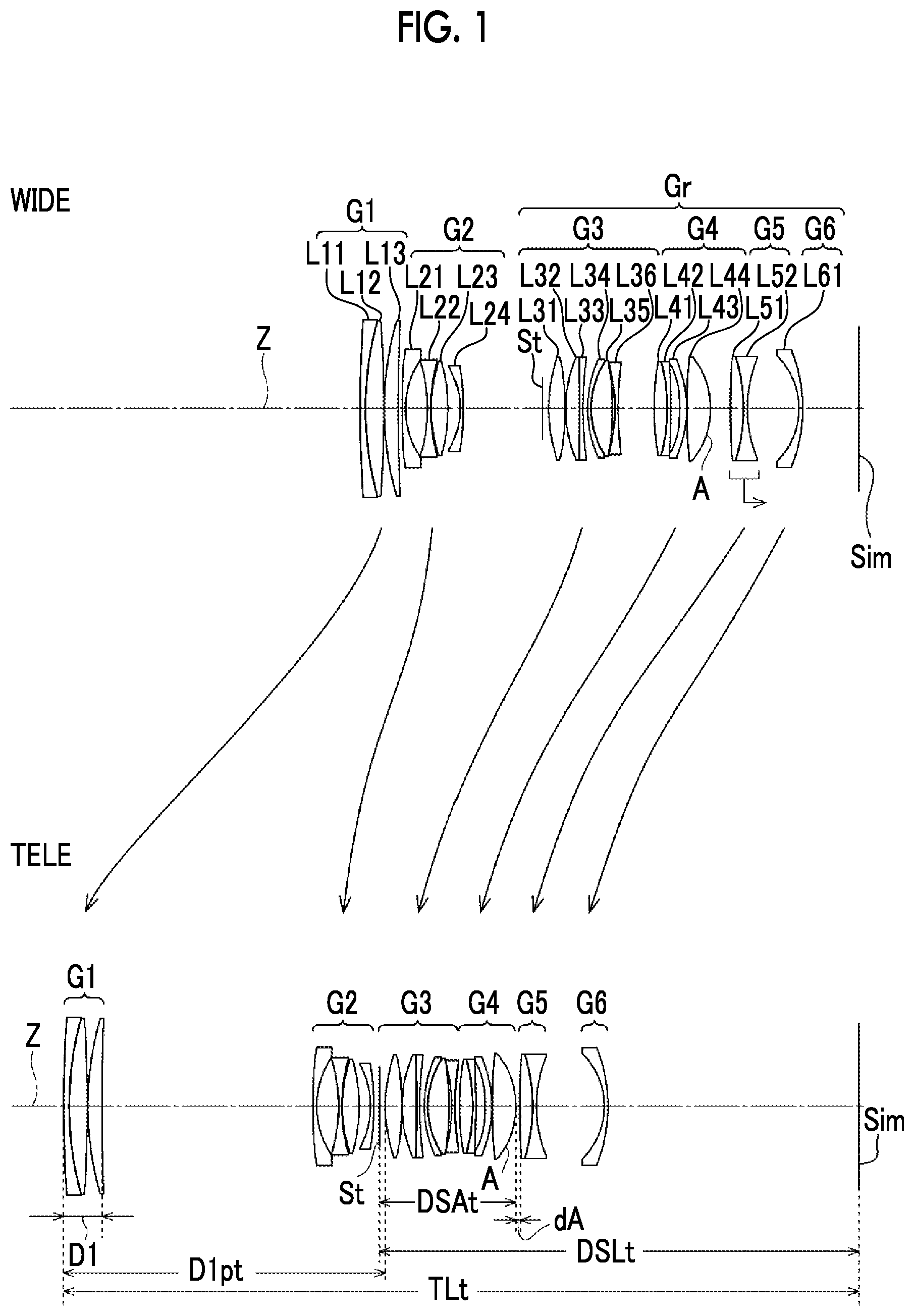
is a diagram showing a cross-sectional configuration and movement loci of a zoom lens according to an embodiment, the zoom lens corresponding to a zoom lens of Example 1.
is a diagram showing a cross-sectional configuration and a luminous flux of the zoom lens shown in .
is a diagram for explaining symbols of each conditional expression.
is a diagram for explaining symbols of each conditional expression.
is a diagram showing aberrations of the zoom lens of Example 1.
is a diagram showing a cross-sectional configuration and movement loci of the zoom lens of Example 2.
is a diagram showing aberrations of the zoom lens of Example 2.
is a diagram showing a cross-sectional configuration and movement loci of the zoom lens of Example 3.
is a diagram showing aberrations of the zoom lens of Example 3.
is a diagram showing a cross-sectional configuration and movement loci of the zoom lens of Example 4.
is a diagram showing aberrations of the zoom lens of Example 4.
is a diagram showing a cross-sectional configuration and movement loci of the zoom lens of Example 5.
is a diagram showing aberrations of the zoom lens of Example 5.
is a diagram showing a cross-sectional configuration and movement loci of the zoom lens of Example 6.
is a diagram showing aberrations of the zoom lens of Example 6.
is a diagram showing a cross-sectional configuration and movement loci of the zoom lens of Example 7.
is a diagram showing aberrations of the zoom lens of Example 7.
is a diagram showing a cross-sectional configuration and movement loci of the zoom lens of Example 8.
is a diagram showing aberrations of the zoom lens of Example 8.
is a perspective view of the front side of the imaging apparatus according to an embodiment.
is a perspective view of the rear side of the imaging apparatus according to the embodiment.
DETAILED DESCRIPTION
Hereinafter, embodiments of the present disclosure will be described with reference to the accompanying drawings. is a cross-sectional view of a configuration of a zoom lens according to an embodiment of the present disclosure and a diagram showing movement loci thereof. In , the upper part labeled “WIDE” shows the wide angle end state, and the lower part labeled “TELE” shows the telephoto end state. is a cross-sectional view showing a configuration and luminous flux in each zooming state of the zoom lens of . In , the top part labeled “WIDE” shows the wide angle end state, the middle part labeled “MIDDLE” shows the middle focal length state, and the lower part labeled “TELE” shows the telephoto end state. Further, shows luminous flux including on-axis luminous flux wa and luminous flux with the maximum angle of view wb at the wide angle end state, on-axis luminous flux ma and luminous flux with the maximum angle of view mb at the middle focal length state, and on-axis luminous flux to and luminous flux with the maximum angle of view tb at the telephoto end state. show situations where an infinite distance object is in focus, the left side thereof is an object side, and the right side thereof is an image side. The examples shown in correspond to a zoom lens of Example 1 described later.
The zoom lens according to the present embodiment consists of, in order from the object side to the image side: a first lens group G 1 that has a positive refractive power, a second lens group G 2 that has a negative refractive power, and a subsequent group Gr that has a plurality of lens groups. As an example in , the subsequent group Gr consists of a third lens group G 3 that has a positive refractive power, a fourth lens group G 4 that has a positive refractive power, a fifth lens group G 5 that has a negative refractive power, and a sixth lens group G 6 that has a negative refractive power.
In the example shown in , the first lens group G 1 consists of three lenses L 11 to L 13 , in order from the object side to the image side. The second lens group G 2 consists of four lenses L 21 to L 24 , in order from the object side to the image side. The third lens group G 3 consists of an aperture stop St and six lenses L 31 to L 36 , in order from the object side to the image side. The fourth lens group G 4 consists of four lenses L 41 to L 44 , in order from the object side to the image side. The fifth lens group G 5 consists of two lenses L 51 and L 52 , in order from the object side to the image side. The sixth lens group G 6 consists of one lens L 61 .
The zoom lens according to the present embodiment is configured to include an aperture stop St closer to the image side than the lens surface closest to the image side in the second lens group G 2 . The aperture stop St in does not indicate a shape and a size thereof, but indicates a position thereof in the optical axis direction.
In the zoom lens according to the present embodiment, during zooming, a spacing between the first lens group G 1 and the second lens group G 2 changes, a spacing between the second lens group G 2 and the subsequent group Gr changes, and spacings between all adjacent lens groups in the subsequent group Gr change. Further, during zooming, the lens spacing inside the plurality of lens groups included in the first lens group G 1 , the second lens group G 2 , and the subsequent group Gr is unchanged. That is, in the zoom lens according to the present embodiment, the spacings between all the adjacent lens groups change with each other, and the lens spacings inside the lens groups do not change. In , arrows between the upper and lower parts indicates respective approximate movement loci of the first lens group G 1 , the second lens group G 2 , the third lens group G 3 , the fourth lens group G 4 , the fifth lens group G 5 , and the sixth lens group G 6 , during zooming from the wide angle end to the telephoto end.
As described above, the zoom lens consists of, in order from the object side to the image side, a first lens group G 1 that has a positive refractive power, a second lens group G 2 that has a negative refractive power, and a subsequent group Gr that has a plurality of lens groups, and includes an aperture stop St closer to the image side than the lens surface closest to the image side in the second lens group G 2 . During zooming, spacings between all the adjacent lens groups mutually change, and lens spacings inside the lens groups are unchanged. As a result, there is an advantage in achieving a high zoom ratio.
The lens group closest to the image side in the subsequent group Gr includes at least one negative lens of which the object side lens surface is a concave surface being in contact with air. The lens group closest to the image side in the subsequent group Gr includes at least one negative lens of which the object side lens surface is a concave surface being in contact with air. As a result, there is an advantage in achieving reduction in total length of the lens system. In , for example, the sixth lens group G 6 , which is the lens group closest to the image side in the subsequent group Gr, is a concave surface of which the object side lens surface is in contact with air, and includes a lens L 61 that has a negative refractive power.
It is preferable that the first lens group G 1 includes a negative lens and a positive lens, in order from the position closest to the object side to the image side. With such a configuration, there is an advantage in suppressing lateral chromatic aberration on the wide angle side. As a result, there is an advantage in suppressing longitudinal chromatic aberration on the telephoto side. In , for example, the first lens group G 1 includes a lens L 11 that has a negative refractive power and a lens L 12 that has a positive refractive power, in order from the position closest to the object side to the image side.
It is preferable that the subsequent group Gr includes at least one lens group that has a positive refractive power. Since the subsequent group Gr includes at least one lens group in which the subsequent group Gr has a positive refractive power, there is an advantage in achieving a high zoom ratio. In , for example, the subsequent group Gr includes a lens group having two positive refractive powers, a third lens group G 3 and a fourth lens group G 4 .
It is preferable that the subsequent group Gr includes a focus group that moves along the optical axis Z during focusing. Here, the focus group consists of at least one lens that moves during focusing. Focusing is performed by moving the focus group. Since the zoom lens includes the focus group in the subsequent group Gr, there is an advantage in suppressing fluctuations in various aberrations that occur during focusing. The right-pointing arrow drawn below the lenses L 51 and L 52 in indicates that the lenses L 51 and L 52 are a focus group that moves toward the image side during focusing from the infinite distance object to the close range object.
It is preferable that the focus group consists of two or fewer lenses. Since the focus group consists of two or fewer lenses of the focus group is advantageous for achieving reduction in weight of the focus group. Further, it is preferable that the focus group has a negative refractive power. Since the focus group has a negative refractive power, there is an advantage in achieving reduction in amount of movement of the focus group during focusing.
In the zoom lens according to the present embodiment, assuming that a focal length of a whole system at a wide angle end in a state in which an infinite distance object is in focus is fw and a distance on the optical axis Z from a lens surface closest to the object side in the first lens group to a paraxial entrance pupil position Penw at the wide angle end in a state in which the infinite distance object is in focus is Denw, it is preferable to satisfy Conditional Expression (1). Here, the sign of Denw is positive in a case where the paraxial entrance pupil position Penw is closer to the image side than the lens surface closest to the object side in the first lens group, and is negative in a case where the paraxial entrance pupil position Penw is closer to the object side than the lens surface closest to the object side in the first lens group. is a cross-sectional view showing a configuration and a luminous flux corresponding to the zoom lens in the wide angle end state of , and shows the paraxial entrance pupil position Penw and the distance Denw as an example.
By not allowing the corresponding value of Conditional Expression (1) to be equal to or less than the lower limit, the distance Denw is prevented from becoming excessively large, and the paraxial entrance pupil position Penw can be made closer to the object side. As a result, the height from the optical axis Z in a case where the off-axis ray passes through the first lens group G 1 can be lowered, and the diameter increase of the first lens group G 1 can be suppressed. Therefore, the size of the first lens group G 1 can be reduced. As a result, there is an advantage in achieving reduction in weight. By not allowing the corresponding value of Conditional Expression (1) to be equal to or greater than the upper limit, the rays with the respective image heights are appropriately separated in the first lens group G 1 . As a result, there is an advantage in correcting lateral chromatic aberration. In order to obtain more favorable characteristics, it is more preferable that the zoom lens satisfies Conditional Expression (1-1), and it is yet more preferable to satisfy Conditional Expression (1-2). 0.7< fw/Denw <1.5 (1) 0.83< fw/Denw <1.35 (1-1) 0.94< fw/Denw <1.22 (1-2)
In the zoom lens according to the present embodiment, assuming that a focal length of a whole system at a wide angle end in a state in which an infinite distance object is in focus is fw and a distance on the optical axis Z from the paraxial exit pupil position Pexw to the image plane Sim at the wide angle end in a state in which the infinite distance object is in focus is Dexw, it is preferable to satisfy Conditional Expression (2). Here, the sign of Dexw is positive in a case where the paraxial exit pupil position Pexw is closer to the object side than the image plane Sim, and is negative in a case where the paraxial exit pupil position Pexw is closer to the image side than the image plane Sim. shows the paraxial exit pupil position Pexw and the distance Dexw as an example. By not allowing the corresponding value of Conditional Expression (2) to be equal to or less than the lower limit, the total length of the lens system can be shortened. As a result, there is an advantage in achieving reduction in size. By not allowing the corresponding value of Conditional Expression (2) to be equal to or greater than the upper limit, the angle of incidence of the off-axis ray on the image plane Sim can be reduced. As a result, there is an advantage in ensuring the amount of peripheral light. In order to obtain more favorable characteristics, it is more preferable that the zoom lens satisfies Conditional Expression (2-1), and it is yet more preferable to satisfy Conditional Expression (2-2). 0.25< fw/Dexw <1 (2) 0.33< fw/Dexw <0.6 (2-1) 0.39< fw/Dexw <0.55 (2-2)
In the zoom lens according to the present embodiment, assuming that a distance on the optical axis Z from the lens surface closest to the object side in the first lens group G 1 to a lens surface closest to the image side in the first lens group G 1 is D1, and a sum of a back focal length in terms of an air conversion distance and a distance on the optical axis Z from the lens surface closest to the object side in the first lens group G 1 to the lens surface closest to the image side in the subsequent group Gr, at the telephoto end in a state in which the infinite distance object is in focus is TLt, it is preferable to satisfy Conditional Expression (3). The lower part of shows the distance D1 and the sum TLt as an example. By not allowing the corresponding value of Conditional Expression (3) to be equal to or less than the lower limit, there is an advantage in suppressing longitudinal chromatic aberration on the telephoto side. By not allowing the corresponding value of Conditional Expression (3) to be equal to or greater than the upper limit, the weight of the first lens group G 1 can be reduced. As a result, there is an advantage in achieving reduction in weight of the entire lens system. In order to obtain more favorable characteristics, it is more preferable that the zoom lens satisfies Conditional Expression (3-1), and it is yet more preferable to satisfy Conditional Expression (3-2). 0.01< D 1/ TLt< 0.1 (3) 0.015< D 1/ TLt< 0.07 (3-1) 0.02< D 1/ TLt< 0.053 (3-2)
In the zoom lens according to the present embodiment, assuming that a focal length of a whole system at a wide angle end in a state in which an infinite distance object is in focus is fw and a focal length of the whole system at the telephoto end in a state in which the infinite distance object is in focus is ft, it is preferable to satisfy Conditional Expression (4). By not allowing the corresponding value of Conditional Expression (4) to be equal to or less than the lower limit, there is an advantage in achieving an increase in zoom ratio. By not allowing the corresponding value of Conditional Expression (4) to be equal to or greater than the upper limit, the zoom ratio is prevented from becoming excessively high. As a result, there is an advantage in achieving reduction in size of the entire lens system. In order to obtain more favorable characteristics, it is more preferable that the zoom lens satisfies Conditional Expression (4-1), and it is yet more preferable to satisfy Conditional Expression (4-2). 4.9< ft/fw< 12 (4) 5.7< ft/fw< 10 (4-1) 6.2< ft/fw< 7.5 (4-2)
It is preferable that the subsequent group Gr includes at least one Lx lens of which an image side lens surface is a convex surface being in contact with air. Assuming that a lateral magnification in an A optical system, which minimizes an absolute value of an inverse of a lateral magnification at the wide angle end in a case where the aperture stop St is used as an object point in a state in which the infinite distance object is in focus, in at least one optical system configured to range from a lens surface adjacent to the image side of the aperture stop St to the image side lens surface of the Lx lens is βA, it is preferable to satisfy Conditional Expression (5). That is, assuming that the lateral magnification of each optical system configured to range from the lens surface adjacent to the image side of the aperture stop St to the image side lens surface of each Lx lens is βx, an optical system, which minimizes |1/βx|, is the “A optical system”, and it is preferable that the lateral magnification βA of the A optical system satisfies Conditional Expression (5). Further, the image side lens surface (that is, the convex surface being in contact with air) of the Lx lens in the A optical system is hereinafter referred to as “A surface A”.
For example, in the zoom lens shown in , the Lx lens of which the image side lens surface included in the subsequent group Gr is a convex surface being in contact with air corresponds to six lenses L 31 , L 35 , L 42 , L 43 , L 44 , and L 61 . Among the six optical systems configured to range from the object side lens surface of the lens L 31 adjacent to the image side of the aperture stop St to the image side lens surface of each Lx lens, the optical system which minimizes |1/βx| is an optical system configured to range from an object side lens surface of the lens L 31 to an image side lens surface of the lens L 44 . In such a case, the “A optical system” is an optical system configured to range from the object side lens surface of the lens L 31 to the image side lens surface of the lens L 44 , and the A surface A is an image side lens surface of the lens L 44 as shown in .
By not allowing the corresponding value of Conditional Expression (5) to be equal to or less than the lower limit, it is possible to suppress a decrease in the angle between the principal ray of the off-axis luminous flux passing through the A surface A and the optical axis Z. As a result, it is possible to suppress excessive correction in astigmatism occurring between the A surface A and the image plane Sim. By not allowing the corresponding value of Conditional Expression (5) to be equal to or greater than the upper limit, it is possible to suppress an increase in angle formed by the principal ray of the off-axis luminous flux passing through the A surface A and the optical axis Z. As a result, there is an advantage in correcting astigmatism occurring between the A surface A and the image plane Sim. In order to obtain more favorable characteristics, it is more preferable that the zoom lens satisfies Conditional Expression (5-1), and it is yet more preferable to satisfy Conditional Expression (5-2). −0.5<1/β A< 0.5 (5) −0.4<1/β A< 0.36 (5-1) −0.35<1/β A< 0.13 (5-2)
In the zoom lens according to the present embodiment, assuming that a height of an on-axis marginal ray on a lens surface (that is, the A surface A) closest to the image side in the A optical system from the optical axis Z at the telephoto end in a state in which the infinite distance object is in focus is HAt, and a height of the on-axis marginal ray in the aperture stop St from the optical axis Z at the telephoto end in a state in which the infinite distance object is in focus is HSt, it is preferable to satisfy Conditional Expression (6). is a partial cross-sectional view showing a configuration corresponding to the zoom lens in the telephoto end state of and an on-axis luminous flux ta, and shows the height HAt and the height HSt as an example. By not allowing the corresponding value of Conditional Expression (6) to be equal to or less than the lower limit, there is an advantage in suppressing spherical aberration on the telephoto side. By not allowing the corresponding value of Conditional Expression (6) to be equal to or greater than the upper limit, it is possible to suppress an increase in diameter of the subsequent group Gr. As a result, there is an advantage in achieving reduction in weight. In order to obtain more favorable characteristics, it is more preferable that the zoom lens satisfies Conditional Expression (6-1), and it is yet more preferable to satisfy Conditional Expression (6-2). 0.73< HAt/HSt< 2.3 (6) 0.83< HAt/HSt< 1.6 (6-1) 0.92< HAt/HSt< 1.37 (6-2)
In the zoom lens according to the present embodiment, assuming that a focal length of the whole system at the telephoto end in a state in which the infinite distance object is in focus is ft, and a combined focal length from a lens surface closest to the object side in the subsequent group Gr to the lens surface (that is, the A surface A) closest to the image side in the A optical system at the telephoto end in a state in which the infinite distance object is in focus is fpAt, it is preferable to satisfy Conditional Expression (7). By not allowing the corresponding value of Conditional Expression (7) to be equal to or less than the lower limit, there is an advantage in ensuring the amount of peripheral light. By not allowing the corresponding value of Conditional Expression (7) to be equal to or greater than the upper limit, there is an advantage in suppressing spherical aberration on the telephoto side. In order to obtain more favorable characteristics, it is more preferable that the zoom lens satisfies Conditional Expression (7-1), and it is yet more preferable to satisfy Conditional Expression (7-2). 3< ft/fpAt <15 (7) 4.5< ft/fpAt <12 (7-1) 5.7< ft/fpAt <9 (7-2)
In the zoom lens according to the present embodiment, assuming that a height of an on-axis marginal ray on the lens surface (that is, the A surface A) closest to the image side in the A optical system from the optical axis Z at the telephoto end in a state in which the infinite distance object is in focus is HAt, and a height of a principal ray with a maximum image height on the lens surface (that is, the A surface A) closest to the image side in the A optical system from the optical axis Z at the wide angle end in a state in which the infinite distance object is in focus is HAw, it is preferable to satisfy Conditional Expression (8). shows the height HAw as an example. By not allowing the corresponding value of Conditional Expression (8) to be equal to or less than the lower limit, there is an advantage in suppressing astigmatism on the wide angle side. By not allowing the corresponding value of Conditional Expression (8) to be equal to or greater than the upper limit, there is an advantage in suppressing fluctuation in field curvature during zooming. In order to obtain more favorable characteristics, it is more preferable that the zoom lens satisfies Conditional Expression (8-1), and it is yet more preferable to satisfy Conditional Expression (8-2). 0.35< HAt/HAw< 1.6 (8) 0.65< HAt/HAw< 1.4 (8-1) 0.83< HAt/HAw< 1.25 (8-2)
It is preferable that the subsequent group Gr includes a lens surface, which is a concave surface being in contact with air and which is image side surface, between the lens surface (that is, the A surface A) closest to the image side in the A optical system and a lens surface which is a concave surface being in contact with air and which is an object side surface included in the lens group closest to the image side in the subsequent group Gr. By adopting such a configuration, there is an advantage in suppressing astigmatism on the wide angle side while maintaining the reduction in size of the entire lens system. In the example of , the subsequent group Gr includes the image side surface of the lens L 52 , which is an image side surface is a concave surface being in contact with air, between the image side surface of the lens L 44 , which is a lens surface (that is, the A surface A) closest to the image side in the A optical system, and the object side surface of the lens L 61 , which is a concave surface being in contact with air and which is an object side surface included in the sixth lens group G 6 closest to the image side in the subsequent group Gr.
In the zoom lens according to the present embodiment, assuming that a distance on the optical axis Z from the aperture stop St to the lens surface (that is, the A surface A) closest to the image side in the A optical system at the telephoto end in a state in which the infinite distance object is in focus is DSAt, and a sum of a back focal length in terms of an air conversion distance and a distance on the optical axis Z from the aperture stop St to the lens surface closest to the image side in the subsequent group Gr, at the telephoto end in a state in which the infinite distance object is in focus is DSLt, it is preferable to satisfy Conditional Expression (9). The lower part of shows the distance DSAt and the sum DSLt as an example. By not allowing the corresponding value of Conditional Expression (9) to be equal to or less than the lower limit, refraction of the off-axis ray from the A surface A to the image plane Sim can be relaxed. As a result, there is an advantage in suppressing occurrence of various off-axis aberrations. By not allowing the corresponding value of Conditional Expression (9) to be equal to or greater than the upper limit, the luminous flux diameter closer to the image side than the aperture stop St can be made smaller. As a result, there is an advantage in achieving reduction in diameter of the subsequent group Gr. In order to obtain more favorable characteristics, it is more preferable that the zoom lens satisfies Conditional Expression (9-1), and it is yet more preferable to satisfy Conditional Expression (9-2). 0.1 <DSAt/DSLt <0.54 (9) 0.15 <DSAt/DSLt <0.4 (9-1) 0.18 <DSAt/DSLt <0.32 (9-2)
In the zoom lens according to the present embodiment, assuming that a spacing on the optical axis Z between the lens surface (that is, the A surface A) closest to the image side in the A optical system and a lens surface adjacent to the image side of the lens surface (that is, the A surface A) at the telephoto end in a state in which the infinite distance object is in focus is dA, and a maximum image height at the telephoto end is Yt, it is preferable to satisfy Conditional Expression (10). The lower part of shows the spacing dA as an example, and the lower part of shows the maximum image height Yt as an example. By not allowing the corresponding value of Conditional Expression (10) to be equal to or less than the lower limit, there is an advantage in achieving reduction in size of the entire lens system. By not allowing the corresponding value of Conditional Expression (10) to be equal to or greater than the upper limit, there is an advantage in suppressing spherical aberration on the telephoto side. In order to obtain more favorable characteristics, it is more preferable that the zoom lens satisfies Conditional Expression (10-1), and it is yet more preferable to satisfy Conditional Expression (10-2). 0.015< dA/Yt< 0.35 (10) 0.025< dA/Yt< 0.2 (10-1) 0.037< dA/Yt< 0.11 (10-2)
In the zoom lens according to the present embodiment, assuming that a sum of a back focal length at an air conversion distance and a distance on the optical axis Z from a lens surface closest to the object side in the first lens group G 1 to a lens surface closest to the image side in the subsequent group Gr at the telephoto end in a state in which the infinite distance object is in focus is TLt, and a focal length of the whole system at the telephoto end in a state in which the infinite distance object is in focus is ft, it is preferable to satisfy Conditional Expression (11). By not allowing the corresponding value of Conditional Expression (11) to be equal to or less than the lower limit, there is an advantage in suppressing longitudinal chromatic aberration on the telephoto side. By not allowing the corresponding value of Conditional Expression (11) to be equal to or greater than the upper limit, there is an advantage in achieving reduction in total length of the lens system and to be advantageous in reduction in size. In order to obtain more favorable characteristics, it is more preferable that the zoom lens satisfies Conditional Expression (11-1), and it is yet more preferable to satisfy Conditional Expression (11-2). 0.65< TLt/ft< 1.5 (11) 0.8< TLt/ft< 1.4 (11-1) 0.95< TLt/ft< 1.27 (11-2)
In the zoom lens according to the present embodiment, assuming that a back focal length in terms of an air conversion distance at the wide angle end in a state in which the infinite distance object is in focus is BFw, and a maximum image height at the wide angle end is Yw, it is preferable to satisfy Conditional Expression (12). By not allowing the corresponding value of Conditional Expression (12) to be equal to or less than the lower limit, there is an advantage in ensuring the amount of peripheral light. By not allowing the corresponding value of Conditional Expression (12) to be equal to or greater than the upper limit, there is an advantage in achieving reduction in total length of the lens system and to be advantageous in reduction in size. In order to obtain more favorable characteristics, it is more preferable that the zoom lens satisfies Conditional Expression (12-1), and it is yet more preferable to satisfy Conditional Expression (12-2). 0.38< BFw/Yw< 1.5 (12) 0.45< BFw/Yw< 1.2 (12-1) 0.59< BFw/Yw< 0.98 (12-2)
Assuming that an Abbe number of the lens closest to the object side in the first lens group G 1 based on the d line is ν1, it is preferable to satisfy Conditional Expression (13). By not allowing the corresponding value of Conditional Expression (13) to be equal to or less than the lower limit, it is possible to suppress excessive correction of longitudinal chromatic aberration. By not allowing the corresponding value of Conditional Expression (13) to be equal to or greater than the upper limit, there is an advantage in correcting longitudinal chromatic aberration. In order to obtain more favorable characteristics, it is more preferable that the zoom lens satisfies Conditional Expression (13-1), and it is yet more preferable to satisfy Conditional Expression (13-2). In the example of , the lens L 11 satisfies Conditional Expression (13). 10<ν1<50 (13) 12<ν1<40 (13-1) 14<ν1<27.3 (13-2)
Assuming that a refractive index of the lens closest to the object side in the first lens group G 1 at the d line is N1, it is preferable to satisfy Conditional Expression (14). By not allowing the corresponding value of Conditional Expression (14) to be equal to or less than the lower limit, there is an advantage in suppressing astigmatism. By not allowing the corresponding value of Conditional Expression (14) to be equal to or greater than the upper limit, the availability of the lens material is increased, and a material that is easier to manufacture can be used. In order to obtain more favorable characteristics, it is more preferable that the zoom lens satisfies Conditional Expression (14-1), and it is yet more preferable to satisfy Conditional Expression (14-2). In the example of , the lens L 11 satisfies Conditional Expression (14). 1.7< N 1<2.3 (14) 1.84< N 1<2.22 (14-1) 1.88< N 1<2.16 (14-2)
Assuming that a refractive index of a negative lens closest to the object side at the d line among negative lenses included in the second lens group G 2 is N2n, it is preferable to satisfy Conditional Expression (15). By not allowing the corresponding value of Conditional Expression (15) to be equal to or less than the lower limit, the refractive power can be ensured without making the absolute value of the curvature radius of the negative lens excessively small. Therefore, the size of the negative lens in the optical axis direction can be prevented from increasing. As a result, there is an advantage in achieving reduction in weight. By not allowing the corresponding value of Conditional Expression (15) to be equal to or greater than the upper limit, the availability of the lens material is increased, and a material that is easier to manufacture can be used. In order to obtain more favorable characteristics, it is more preferable that the zoom lens satisfies Conditional Expression (15-1), and it is yet more preferable to satisfy Conditional Expression (15-2). In the example of , the lens L 21 satisfies Conditional Expression (15). 1.6< N 2 n< 2.2 (15) 1.65< N 2 n< 2.11 (15-1) 1.7< N 2 n< 2.05 (15-2)
Assuming that a refractive index of the positive lens that has the strongest refractive power at the d line among the positive lenses included in the second lens group G 2 is N2p, it is preferable to satisfy Conditional Expression (16). By not allowing the corresponding value of Conditional Expression (16) to be equal to or less than the lower limit, there is an advantage in suppressing astigmatism. By not allowing the corresponding value of Conditional Expression (16) to be equal to or greater than the upper limit, the availability of the lens material is increased, and a material that is easier to manufacture can be used. In order to obtain more favorable characteristics, it is more preferable that the zoom lens satisfies Conditional Expression (16-1), and it is yet more preferable to satisfy Conditional Expression (16-2). In the example of , the lens L 23 satisfies Conditional Expression (16). 1.65< N 2 p< 2 (16) 1.71< N 2 p< 1.93 (16-1) 1.77< N 2 p< 1.9 (16-2)
Assuming that an Abbe number of a negative lens closest to the image side based on the d line among negative lenses included in the subsequent group Gr is νnL, it is preferable to satisfy Conditional Expression (17). By not allowing the corresponding value of Conditional Expression (17) to be equal to or less than the lower limit, there is an advantage in suppressing lateral chromatic aberration. By not allowing the corresponding value of Conditional Expression (17) to be equal to or greater than the upper limit, it is possible to suppress excessive correction of lateral chromatic aberration. In order to obtain more favorable characteristics, it is more preferable that the zoom lens satisfies Conditional Expression (17-1), and it is yet more preferable to satisfy Conditional Expression (17-2). In the example of , the lens L 61 satisfies Conditional Expression (17). 27<ν nL< 102 (17) 50<ν nL< 96 (17-1) 70<ν nL< 88 (17-2)
In the zoom lens according to the present embodiment, assuming that a sum of a back focal length at an air conversion distance and a distance on the optical axis Z from a lens surface closest to the object side in the first lens group G 1 to a lens surface closest to the image side in the subsequent group Gr at the telephoto end in a state in which the infinite distance object is in focus is TLt, a difference in the direction of the optical axis Z between positions of a lens group closest to the object side at the wide angle end and at the telephoto end among lens groups that have positive refractive powers and that are included in the subsequent group Gr in a state in which the infinite distance object is in focus is Mp, it is preferable to satisfy Conditional Expression (18). Here, the sign of Mp is positive in a case where the lens group closest to the object side moves from the object side to the image side, and is negative in a case where the lens group moves from the image side to the object side, during zooming from the wide angle end to the telephoto end. By not allowing the corresponding value of Conditional Expression (18) to be equal to or less than the lower limit, the absolute value of Mp is prevented from becoming excessively large. Therefore, it is possible to suppress an increase in amount of movement of the lens group closest to the object side among the lens groups that have positive refractive powers and that are included in the subsequent group Gr. As a result, there is an advantage in achieving reduction in size. By not allowing the corresponding value of Conditional Expression (18) to be equal to or greater than the upper limit, the absolute value of Mp is prevented from becoming excessively small. As a result, there is an advantage in achieving a high zoom ratio. In order to obtain more favorable characteristics, it is more preferable that the zoom lens satisfies Conditional Expression (18-1), and it is yet more preferable to satisfy Conditional Expression (18-2). In the example of , a difference in the direction of the optical axis Z between positions of the third lens group G 3 which is a lens group closest to the object side at the wide angle end and at the telephoto end among lens groups that have positive refractive powers and that are included in the subsequent group Gr is Mp, Conditional Expression (18) is satisfied. −0.45< Mp/TLt<− 0.06 (18) −0.39< Mp/TLt<− 0.12 (18-1) −0.33< Mp/TLt<− 0.15 (18-2)
In the zoom lens according to the present embodiment, assuming that a focal length of a lens group closest to the object side among lens groups that have positive refractive powers and that are included in the subsequent group Gr in a state in which the infinite distance object is in focus is fp, and a focal length of the second lens group G 2 is f2, it is preferable to satisfy Conditional Expression (19). By not allowing the corresponding value of Conditional Expression (19) to be equal to or less than the lower limit, the absolute value of f2 is prevented from becoming excessively small. As a result, there is an advantage in suppressing fluctuations in various aberrations that occur during zooming. By not allowing the corresponding value of Conditional Expression (19) to be equal to or greater than the upper limit, the absolute value of f2 is prevented from becoming excessively large. As a result, there is an advantage in shortening the second lens group G 2 , and thus there is an advantage in achieving reduction in size. In order to obtain more favorable characteristics, it is more preferable that the zoom lens satisfies Conditional Expression (19-1), and it is yet more preferable to satisfy Conditional Expression (19-2). In the example of , assuming that a focal length of the third lens group G 3 , which is the lens group closest to the object side among the lens groups that have positive refractive powers and that are included in the subsequent group Gr, is fp, Conditional Expression (19) is satisfied. −4.3< fp/f 2<−1.1 (19) −3.9< fp/f 2<−1.5 (19-1) −3.4< fp/f 2<−1.95 (19-2)
In the zoom lens according to the present embodiment, assuming that a distance on the optical axis Z from a lens surface closest to the image side in the first lens group G 1 to a lens surface closest to the object side in a lens group closest to the object side among lens groups that have positive refractive powers and that are included in the subsequent group Gr at the telephoto end in a state in which the infinite distance object is in focus is D1pt, and a sum of a back focal length in terms of an air conversion distance and a distance on the optical axis Z from the lens surface closest to the object side in the first lens group G 1 to the lens surface closest to the image side in the subsequent group Gr, at the telephoto end in a state in which the infinite distance object is in focus is TLt, it is preferable to satisfy Conditional Expression (20). The lower part of shows the distance D1pt and the sum TLt as an example. By not allowing the corresponding value of Conditional Expression (20) to be equal to or less than the lower limit, there is an advantage in achieving reduction in total length of the lens system. By not allowing the corresponding value of Conditional Expression (20) to be equal to or greater than the upper limit, there is an advantage in suppressing spherical aberration on the telephoto side. In order to obtain more favorable characteristics, it is more preferable that the zoom lens satisfies Conditional Expression (20-1), and it is yet more preferable to satisfy Conditional Expression (20-2). 0.2< D 1 pt/TLt< 0.5 (20) 0.25< D 1 pt/TLt< 0.42 (20-1) 0.29< D 1 pt/TLt< 0.39 (20-2)
As described above, in a case where the subsequent group Gr includes at least one Lx lens of which the image side lens surface is a convex surface being in contact with air, an optical system, which minimizes an absolute value of an inverse of a lateral magnification at the wide angle end in a case where an aperture stop St is used as an object point in a state in which the infinite distance object is in focus, in at least one optical system configured to range from a lens surface adjacent to the image side of the aperture stop St to the image side lens surface of the Lx lens is an A optical system. In the zoom lens according to the present embodiment, the focal length of the whole system at the wide angle end in a state in which the infinite distance object is in focus is fw, and a combined focal length at the wide angle end in a state in which the infinite distance object is in focus from a lens surface adjacent to the image side of the lens surface (that is, the A surface A) closest to the image side in the A optical system to a lens surface closest to the image side in the subsequent group Gr is fBw, it is preferable to satisfy Conditional Expression (21). By not allowing the corresponding value of Conditional Expression (21) to be equal to or less than the lower limit, there is an advantage in suppressing astigmatism on the wide angle side. By not allowing the corresponding value of Conditional Expression (21) to be equal to or greater than the upper limit, the negative refractive power from the lens surface adjacent to the image side of the A surface A to the lens surface closest to the image side in the subsequent group Gr can be strengthened. Therefore, the luminous flux diameter from the lens surface closest to the object side in the subsequent group Gr to the A surface A can be reduced. As a result, there is an advantage in achieving reduction in diameter. In order to obtain more favorable characteristics, it is more preferable that the zoom lens satisfies Conditional Expression (21-1), and it is yet more preferable to satisfy Conditional Expression (21-2). −1.6< fw/fBw<− 0.25 (21) −1.3< fw/fBw<− 0.37 (21-1) −1.1< fw/fBw<− 0.69 (21-2)
In the zoom lens according to the present embodiment, assuming that a focal length of the whole system at the wide angle end in a state in which the infinite distance object is in focus as fw, a maximum half angle of view at the wide angle end in a state in which the infinite distance object is in focus is tow, and a maximum image height at the wide angle end is Yw, it is preferable to satisfy Conditional Expression (22). By not allowing the corresponding value of Conditional Expression (22) to be equal to or less than the lower limit, the height of the off-axis ray passing through the lens closest to the object side in the first lens group G 1 from the optical axis Z can be lowered on the wide angle side. As a result, there is an advantage in achieving reduction in diameter. By not allowing the corresponding value of Conditional Expression (22) to be equal to or greater than the upper limit, there is an advantage in suppressing various aberrations of the off-axis ray on the wide angle side. In order to obtain more favorable characteristics, it is more preferable that the zoom lens satisfies Conditional Expression (22-1), and it is yet more preferable to satisfy Conditional Expression (22-2). 0.97< fw ×tan ω w/Yw< 1.3 (22) 1< fw ×tan ω w/Yw< 1.19 (22-1) 1.02< fw ×tan ω w/Yw< 1.11 (22-2)
Assuming that a focal length of the first lens group G 1 is f1 and a focal length of the second lens group G 2 is f2, it is preferable that the zoom lens according to the present embodiment satisfies Conditional Expression (23). By not allowing the corresponding value of Conditional Expression (23) to be equal to or less than the lower limit, there is an advantage in achieving a high zoom ratio. By not allowing the corresponding value of Conditional Expression (23) to be equal to or greater than the upper limit, there is an advantage in suppressing fluctuations in various aberrations that occur during zooming. In order to obtain more favorable characteristics, it is more preferable that the zoom lens satisfies Conditional Expression (23-1), and it is yet more preferable to satisfy Conditional Expression (23-2). −0.3< f 2/ f 1<−0.05 (23) −0.23< f 2/ f 1<−0.1 (23-1) −0.19< f 2/ f 1<−0.14 (23-2)
The above-mentioned preferable configurations and available configurations including the configurations relating to Conditional Expressions may be any combination, and it is preferable to optionally adopt the configurations in accordance with required specification. It should be noted that Conditional Expressions that the zoom lens of the present disclosure preferably satisfies are not limited to Conditional Expressions described in the form of Expressions, and the lower limits and the upper limits are selected from the preferable, more preferable, and yet more preferable conditional expressions. Conditional Expressions may include all conditional expressions obtained through optional combinations. Further, the example shown in is an example, and various modifications can be made without departing from the scope of the technique of the present disclosure. For example, the number of lenses constituting each lens group may be different from the number shown in .
For example, a preferred embodiment of the present disclosure is a zoom lens consisting of, in order from the object side to the image side: a first lens group G 1 that has a positive refractive power, a second lens group G 2 that has a negative refractive power, and a subsequent group Gr that has a plurality of lens groups. The zoom lens includes an aperture stop St at a position closer to the image side than a lens surface closest to the image side in the second lens group G 2 . A lens group closest to the image side in the subsequent group Gr includes at least one negative lens of which an object side lens surface is a concave surface being in contact with air. During zooming, a spacing between the first lens group G 1 and the second lens group G 2 changes, a spacing between the second lens group G 2 and the subsequent group Gr changes, and spacings between all adjacent lens groups in the subsequent group Gr change. During zooming, lens spacings inside the first lens group G 1 , the second lens group G 2 , and the plurality of lens groups are unchanged. Thus, the zoom lens satisfies Conditional Expression (1).
Next, examples of the zoom lens of the present disclosure will be described, with reference to the drawings. The reference numerals attached to the lenses in the cross-sectional views of each example are used independently for each example in order to avoid complication of description and drawings due to an increase in number of digits of the reference numerals. Therefore, even in a case where common reference numerals are attached in the drawings of different examples, components do not necessarily have a common configuration.
Example 1
shows a configuration and movement loci of a zoom lens of Example 1, and an illustration method and a configuration thereof are as described above. Therefore, some description is not repeated herein. Regarding the zoom lens of Example 1, Table 1 shows basic lens data, Table 2 shows specifications and variable surface spacings, and Table 3 shows aspherical coefficients thereof.
Table 1 is noted as follows. The column of Sn shows surface numbers in a case where the surface closest to the object side is the first surface and the number is increased one by one toward the image side. The column of R shows a curvature radius of each surface. The column of D shows a surface spacing between each surface and the surface adjacent to the image side on the optical axis. The column of Nd shows a refractive index of each component at the d line. The column of νd shows an Abbe number of each component based on the d line. Table 1 also shows the aperture stop St, and in the column of the surface number of the surface corresponding to the aperture stop St, the surface number and (St) are noted. Further, in a cell of a surface number of a surface corresponding to the A surface A, the surface number and a term of (A) are noted. In Table 1, the sign of the curvature radius of the convex surface facing toward the object side is positive and the sign of the curvature radius of the convex surface facing toward the image side is negative. In Table 1, the symbol DD [ ] is used for each variable surface spacing during zooming, and the object side surface number of the spacing is given in [ ] and is noted in the column of D.
Table 2 shows the zoom magnification Zr, the focal length f of the whole system, the back focal length BF, the F number FNo., the maximum total angle of view 2ω, and the variable surface spacing during zooming. [°] in the cell of 2ω indicates that the unit thereof is a degree. The values shown in Table 2 are values in the case of using the d line as a reference in a state in which the infinite distance object is in focus. In Table 2, the values in the wide angle end state, the middle focal length state, and the telephoto end state are shown in columns labeled WIDE, MIDDLE, and TELE, respectively.
In Table 1, a reference sign * is attached to surface numbers of aspherical surfaces, and numerical values of the paraxial curvature radius are written into the column of the curvature radius of the aspherical surface. In Table 3, the row of Sn shows surface numbers of the aspherical surfaces, and the rows of KA and Am (m is an integer of 3 or more) shows numerical values of the aspherical coefficients for each aspherical surface. The “E±n” (n is an integer) in numerical values of the aspherical coefficients of Table 3 indicates “10 ±n ”. KA and Am are the aspherical coefficients in the aspherical surface expression represented by the following expression. Zd=C×h 2 /{1+(1− KA×C 2 ×h 2 ) 1/2 }+ΣAm×h m
Here,
•
• Zd is an aspherical surface depth (a length of a perpendicular from a point on an aspherical surface at height h to a plane that is perpendicular to the optical axis and that is in contact with the vertex of the aspherical surface), • h is a height (a distance from the optical axis to the lens surface), • C is an inverse of the paraxial curvature radius, • KA and Am are aspherical coefficients, and • Σ in the aspherical surface expression means the sum with respect to m.
In the data of each table, degrees are used as a unit of an angle, and millimeters (mm) are used as a unit of a length, but appropriate different units may be used since the optical system can be used even in a case where the system is enlarged or reduced in proportion. Each of the following tables shows numerical values rounded off to predetermined decimal places.
TABLE 1
Example 1
Sn R D Nd vd
1 331.0255 1.4086 1.96300 24.11
2 88.5944 4.7137 1.53775 74.70
3 −327.9097 0.1002
4 84.3684 3.6596 1.86100 37.10
5 661.6761 DD[5]
*6 270.9414 0.9002 1.85135 40.10
*7 24.3655 5.6395
8 −43.1327 0.8368 1.75500 52.32
9 47.5474 0.1011
10 39.9947 4.3384 1.82115 24.06
11 −45.3780 2.9388
12 −23.4967 0.8487 1.72987 57.58
13 −70.4345 DD[13]
14(St) ∞ 1.5007
*15 39.8220 4.2667 1.59201 67.02
*16 −73.3593 0.0998
17 34.6162 3.6545 1.48749 70.24
18 −658.8974 0.8566 1.80440 39.59
19 104.1638 1.2048
20 32.2697 0.8448 1.95234 33.43
21 23.2106 0.0998
22 23.2106 5.3984 1.48749 70.24
23 −75.4665 0.6567
24 −45.2596 0.8423 1.82200 46.62
25 92.5959 DD[25]
26 73.5219 3.4108 1.49700 81.54
27 −48.3043 0.8352 1.98326 31.02
28 −266.5243 2.3682
*29 −45.6318 1.7351 1.78436 51.87
*30 −35.1678 0.1021
*31 158.5781 6.0760 1.55032 75.50
*32(A) -24.2967 DD[32]
33 206.8111 3.3459 1.97722 31.65
34 −46.9241 0.9709 1.77823 46.56
35 35.1932 DD[35]
36 −19.7340 0.9490 1.49700 81.54
37 −41.9426
TABLE 2
Example 1
WIDE MIDDLE TELE
Zr 1.0 2.6 6.7
f 27.30 71.10 184.18
BF 14.5210 44.5024 64.6757
FNo. 3.49 4.10 5.70
2ω(°) 81.2 32.8 12.8
DD[5] 0.9373 22.3019 54.4095
DD[13] 20.4486 9.4941 1.4511
DD[25] 9.2638 2.7453 0.9930
DD[32] 5.1589 1.3608 0.9911
DD[35] 13.3318 17.1299 17.4996
TABLE 3
Example 1
Sn 6 7 15 16
KA 1.0000000 1.0000000 1.0000000 1.0000000
E+00 E+00 E+00 E+00
A3 0.0000000 0.0000000 0.0000000 0.0000000
E+00 E+00 E+00 E+00
A4 9.0419287 6.9280608 −9.7505425 8.9930512
E−06 E−06 E−07 E−07
A5 0.0000000 0.0000000 0.0000000 0.0000000
E+00 E+00 E+00 E+00
A6 −9.0649172 −1.4235140 3.0946976 −3.3689655
E−09 E−08 E−10 E−09
A7 0.0000000 0.0000000 0.0000000 0.0000000
E+00 E+00 E+00 E+00
A8 −2.5429857 3.6567591 −2.3630929 −1.6029722
E−10 E−10 E−10 E−10
A9 0.0000000 0.0000000 0.0000000 0.0000000
E+00 E+00 E+00 E+00
A10 4.1548506 −8.7339529 3.0939260 −1.5274232
E−12 E−12 E−13 E−12
A11 0.0000000 0.0000000 0.0000000 0.0000000
E+00 E+00 E+00 E+00
A12 −2.3750206 1.1668810 1.0474635 2.7713383
E−14 E−13 E−14 E−14
A13 0.0000000 0.0000000 0.0000000 0.0000000
E+00 E+00 E+00 E+00
A14 6.0966974 −6.3540808 −1.0562305 −1.7792667
E−17 E−16 E−16 E−16
A15 0.0000000 0.0000000 0.0000000 0.0000000
E+00 E+00 E+00 E+00
A16 −5.8637514 1.1868286 2.6098193 3.7349026
E−20 E−18 E−19 E−19
Sn 29 30 31 32
KA 1.0000000 1.0000000 1.0000000 1.0000000
E+00 E+00 E+00 E+00
A3 0.0000000 0.0000000 0.0000000 0.0000000
E+00 E+00 E+00 E+00
A4 −6.0401300 −2.1622590 3.8571099 −1.4361569
E−05 E−05 E−06 E−05
A5 0.0000000 0.0000000 0.0000000 0.0000000
E+00 E+00 E+00 E+00
A6 6.5749656 9.7578529 −1.2779274 −1.8187831
E−08 E−08 E−08 E−08
A7 0.0000000 0.0000000 0.0000000 0.0000000
E+00 E+00 E+00 E+00
A8 −9.7342327 −6.6836753 −1.9275502 1.8786514
E−10 E−10 E−11 E−10
A9 0.0000000 0.0000000 0.0000000 0.0000000
E+00 E+00 E+00 E+00
A10 1.2276699 9.6679349 1.9236039 −1.1113493
E−11 E−12 E−13 E−12
A11 0.0000000 0.0000000 0.0000000 0.0000000
E+00 E+00 E+00 E+00
A12 −4.0370775 −3.1010028 −6.6536598 2.5875067
E−14 E−14 E−16 E−15
A13 0.0000000 0.0000000 0.0000000 0.0000000
E+00 E+00 E+00 E+00
A14 0.0000000 0.0000000 7.4538414 −1.5934823
E+00 E+00 E−18 E−18
A15 0.0000000 0.0000000 0.0000000 0.0000000
E+00 E+00 E+00 E+00
A16 0.0000000 0.0000000 −2.1415715 1.2905219
E+00 E+00 E−20 E−20
is a diagram showing aberrations of the zoom lens of Example 1 in a state where the infinite distance object is in focus. shows, in order from the left, spherical aberration, astigmatism, distortion, and lateral chromatic aberration. In , the upper part labeled “WIDE” shows aberrations in the wide angle end state, the middle part labeled “MIDDLE” shows aberrations in the middle focal length state, and the lower part labeled “TELE” shows aberrations in the telephoto end state. In the spherical aberration diagram, aberrations at the d line, the C line, and the F line are indicated by the solid line, the long broken line, and the short broken line, respectively. In the astigmatism diagram, aberration in the sagittal direction at the d line is indicated by the solid line, and aberration in the tangential direction at the d line is indicated by the short broken line. In the distortion diagram, aberration at the d line is indicated by the solid line. In the lateral chromatic aberration diagram, the aberrations at the C line and the F line are indicated by the long broken line and the short broken line, respectively. In the spherical aberration diagram, the value of the F number is shown after “FNo.=”, and in the other aberration diagrams, the value of the half angle of view is shown after “ω=”.
Symbols, meanings, description methods, and illustration methods of the respective data pieces according to Example 1 are the same as those in the following examples unless otherwise specified. Therefore, in the following description, repeated description will not be given.
Example 2
is a diagram showing a cross-sectional view of the configuration and movement loci of the zoom lens of Example 2 at the wide angle end in a state where the infinite distance object is in focus. It should be noted that, compared with , does not show the configuration at the telephoto end, and the point is the same in the following cross-sectional views of Examples 3 to 8. The zoom lens of Example 2 consists of a first lens group G 1 that has a positive refractive power, a second lens group G 2 that has a negative refractive power, and a subsequent group Gr, in order from the object side to the image side. The subsequent group Gr consists of a third lens group G 3 that has a positive refractive power, a fourth lens group G 4 that has a positive refractive power, and a fifth lens group G 5 that has a negative refractive power, in order from the object side to the image side.
The first lens group G 1 consists of three lenses L 11 to L 13 , in order from the object side to the image side. The second lens group G 2 consists of four lenses L 21 to L 24 , in order from the object side to the image side. The third lens group G 3 consists of an aperture stop St and five lenses L 31 to L 35 , in order from the object side to the image side. The fourth lens group G 4 consists of six lenses L 41 to L 46 in order from the object side to the image side. The fifth lens group G 5 consists of one lens L 51 . The focus group consists of two lenses L 45 and L 46 .
Regarding the zoom lens of Example 2, Table 4 shows basic lens data, Table 5 shows specifications and variable surface spacings, and Table 6 shows aspherical coefficients thereof. shows aberration diagrams.
TABLE 4
Example 2
Sn R D Nd vd
1 94.2986 1.4176 1.89286 20.36
2 63.3654 4.5098 1.59522 67.73
3 373.8168 0.0998
4 98.4414 2.8091 1.80400 46.53
5 332.3682 DD[5]
*6 116.8746 1.3459 1.83481 42.74
*7 18.1975 5.9032
8 −97.6485 0.8292 1.82721 47.38
9 45.6157 0.0998
10 31.4850 4.5832 1.85896 22.73
11 −68.4772 2.0809
12 −30.1543 0.8516 1.82502 47.61
13 −2870.4505 DD[13]
14(St) ∞ 1.5002
*15 47.7458 2.1969 1.49700 81.54
*16 −263.2799 2.9472
17 40.7280 2.5484 1.49700 81.54
18 −818.8158 0.2323
19 25.2301 0.8582 1.60242 66.81
20 22.1342 0.7926
21 33.0430 5.5534 1.51823 58.90
22 −25.6413 0.0998
23 −28.0069 0.8643 1.76047 39.33
24 92.5896 DD[24]
25 70.1476 5.1409 1.43875 94.66
26 −21.4621 0.8486 1.88032 41.69
27 −77.6100 2.0795
*28 −39.7424 1.0898 1.87570 42.29
*29 −34.5887 0.0998
*30 128.6415 7.5100 1.48749 70.24
*31(A) −19.5233 0.9946
32 133.5257 3.1265 1.90191 39.55
33 −56.5553 0.8458 1.73923 56.60
34 41.3995 DD[34]
35 −19.8870 1.5002 1.62923 62.55
36 −55.7871
TABLE 5
Example 2
WIDE MIDDLE TELE
Zr 1.0 2.6 6.7
f 25.87 67.38 174.53
BF 21.0195 46.8049 56.6225
FNo. 3.5 5.05 5.80
2ω(°) 85.6 34.6 13.6
DD[5] 0.9766 20.7270 54.9698
DD[13] 23.5239 9.1717 1.4737
DD[24] 9.4594 3.5609 1.2093
DD[34] 13.6205 16.8386 18.9876
TABLE 6
Example 2
Sn 6 7 15 16
KA 1.0000000 1.0000000 1.0000000 1.0000000
E+00 E+00 E+00 E+00
A3 0.0000000 0.0000000 0.0000000 0.0000000
E+00 E+00 E+00 E+00
A4 −5.0854245 −7.7702130 −1.4990912 −1.4995166
E−06 E−06 E−05 E−05
A5 0.0000000 0.0000000 0.0000000 0.0000000
E+00 E+00 E+00 E+00
A6 4.7329307 −7.1725961 −1.9992757 −1.7162613
E−08 E−09 E−07 E−07
A7 0.0000000 0.0000000 0.0000000 0.0000000
E+00 E+00 E+00 E+00
A8 −2.2317953 1.0581109 −1.9672269 −2.0005583
E−10 E−09 E−09 E−09
A9 0.0000000 0.0000000 0.0000000 0.0000000
E+00 E+00 E+00 E+00
A10 1.3935294 −1.9120690 2.3349735 4.9436422
E−13 E−11 E−12 E−13
A11 0.0000000 0.0000000 0.0000000 0.0000000
E+00 E+00 E+00 E+00
A12 2.6437173 1.4890578 3.2549821 3.0798971
E−15 E−13 E−14 E−15
A13 0.0000000 0.0000000 0.0000000 0.0000000
E+00 E+00 E+00 E+00
A14 −9.5124017 −6.1043050 −1.6308454 −5.0060094
E−18 E−16 E−15 E−16
A15 0.0000000 0.0000000 0.0000000 0.0000000
E+00 E+00 E+00 E+00
A16 1.0513469 1.0104097 1.6538290 −3.2764146
E−20 E−18 E−18 E−18
Sn 28 29 30 31
KA 1.0000000 1.0000000 1.0000000 1.0000000
E+00 E+00 E+00 E+00
A3 0.0000000 0.0000000 0.0000000 0.0000000
E+00 E+00 E+00 E+00
A4 −5.7484792 −2.5522568 7.4579686 −4.9045419
E−05 E−05 E−06 E−06
A5 0.0000000 0.0000000 0.0000000 0.0000000
E+00 E+00 E+00 E+00
A6 4.7243437 9.8159108 7.1531359 −7.8896578
E−08 E−08 E−09 E−09
A7 0.0000000 0.0000000 0.0000000 0.0000000
E+00 E+00 E+00 E+00
A8 −1.0536171 −7.5077137 1.0694491 1.9017398
E−09 E−10 E−10 E−10
A9 0.0000000 0.0000000 0.0000000 0.0000000
E+00 E+00 E+00 E+00
A10 9.2135585 9.4462274 4.2732218 −4.1903558
E−12 E−12 E−13 E−13
A11 0.0000000 0.0000000 0.0000000 0.0000000
E+00 E+00 E+00 E+00
A12 −3.7046484 −4.1512455 −3.5921816 5.3383347
E−14 E−14 E−15 E−15
A13 0.0000000 0.0000000 0.0000000 0.0000000
E+00 E+00 E+00 E+00
A14 0.0000000 0.0000000 1.1487541 −5.7859996
E+00 E+00 E−18 E−20
A15 0.0000000 0.0000000 0.0000000 0.0000000
E+00 E+00 E+00 E+00
A16 0.0000000 0.0000000 3.3684259 2.0859008
E+00 E+00 E−20 E−20
is a diagram showing a cross-sectional view and movement loci of the configuration at the wide angle end in a state in which the zoom lens of Example 3 is in a state in which the infinite distance object is in focus. The zoom lens of Example 3 consists of a first lens group G 1 that has a positive refractive power, a second lens group G 2 that has a negative refractive power, and a subsequent group Gr, in order from the object side to the image side. The subsequent group Gr consists of a third lens group G 3 that has a positive refractive power, a fourth lens group G 4 that has a positive refractive power, and a fifth lens group G 5 that has a negative refractive power, in order from the object side to the image side.
The first lens group G 1 consists of three lenses L 11 to L 13 , in order from the object side to the image side. The second lens group G 2 consists of four lenses L 21 to L 24 , in order from the object side to the image side. The third lens group G 3 consists of an aperture stop St and five lenses L 31 to L 35 , in order from the object side to the image side. The fourth lens group G 4 consists of six lenses L 41 to L 46 in order from the object side to the image side. The fifth lens group G 5 consists of one lens L 51 . The focus group consists of two lenses L 45 and L 46 .
Regarding the zoom lens of Example 3, Table 7 shows basic lens data, Table 8 shows specifications and variable surface spacings, and Table 9 shows aspherical coefficients thereof. shows aberration diagrams.
TABLE 7
Example 3
Sn R D Nd vd
1 91.3282 1.4284 1.89286 20.36
2 61.9165 4.5100 1.59522 67.73
3 325.4496 6.0998
4 101.4041 2.8345 1.80400 46.53
5 384.8026 DD[5]
*6 177.4449 1.4529 1.84289 45.73
*7 19.4415 5.3265
8 −191.8075 0.8339 1.77104 53.27
9 39.8527 0.0998
10 31.1364 4.0268 1.85446 22.28
11 −147.6059 3.3001
12 −27.5174 0.8557 1.77149 53.22
13 −150.6664 DD[13]
14(St) ∞ 1.5002
*15 50.6217 2.1761 1.49700 81.54
*16 −145.7703 2.6260
17 42.6124 2.5526 1.48999 83.93
18 −357.4670 0.2323
19 33.4495 0.8537 1.72974 36.99
20 21.3700 0.1002
21 21.3700 6.9548 1.49001 59.70
22 −24.5126 0.1000
23 −28.9882 0.8581 1.73962 54.52
24 92.5909 DD[24]
25 74.8207 4.9864 1.43875 94.66
26 −21.4817 0.8488 1.89217 32.36
27 −91.2085 2.0449
*28 −41.7574 1.1892 1.88356 38.38
*29 −34.5054 0.1000
*30 117.7191 7.4485 1.49001 56.87
*31(A) −19.8258 0.9900
32 143.3168 2.9565 1.95733 30.87
33 −61.9237 0.8457 1.74704 43.40
34 39.9659 DD[34]
35 −19.3181 1.5002 1.57417 71.26
36 −56.9740
TABLE 8
Example 3
WIDE MIDDLE TELE
Zr 1.0 2.6 6.7
f 26.11 67.99 176.12
BF 20.2616 44.6536 54.8744
FNo. 3.5 5.01 5.81
2ω(°) 84.8 34.2 13.4
DD[5] 0.9883 22.3838 54.7510
DD[13] 24.0519 9.7002 1.4824
DD[24] 9.2299 3.0117 0.9801
DD[34] 13.6551 16.9137 19.3537
TABLE 9
Example 3
Sn 6 7 15 16
KA 1.0000000 1.0000000 1.0000000 1.0000000
E+00 E+00 E+00 E+00
A3 0.0000000 0.0000000 0.0000000 0.0000000
E+00 E+00 E+00 E+00
A4 −2.7520703 −6.6555103 −1.4351117 −1.0642509
E−06 E−06 E−05 E−05
A5 0.0000000 0.0000000 0.0000000 0.0000000
E+00 E+00 E+00 E+00
A6 5.0719388 7.0202052 −9.6200249 −8.7417248
E−08 E−09 E−08 E−08
A7 0.0000000 0.0000000 0.0000000 0.0000000
E+00 E+00 E+00 E+00
A8 −2.2246578 1.0626091 −1.6772998 −1.4745334
E−10 E−09 E−09 E−09
A9 0.0000000 0.0000000 0.0000000 0.0000000
E+00 E+00 E+00 E+00
A10 1.2475921 −1.8567018 1.9661601 2.7011696
E−13 E−11 E−12 E−12
A11 0.0000000 0.0000000 0.0000000 0.0000000
E+00 E+00 E+00 E+00
A12 2.5922454 1.4963842 5.5997309 −2.4022057
E−15 E−13 E−14 E−14
A13 0.0000000 0.0000000 0.0000000 0.0000000
E+00 E+00 E+00 E+00
A14 −9.5905620 −6.2890987 −1.6920000 −4.4423933
E−18 E−16 E−15 E−16
A15 0.0000000 0.0000000 0.0000000 0.0000000
E+00 E+00 E+00 E+00
A16 1.1099154 1.0605909 8.8397107 2.9172231
E−20 E−18 E−18 E−18
Sn 30 31
KA 1.0000000E+00 1.0000000E+00
A3 0.0000000E+00 0.0000000E+00
A4 7.1510381E−06 −5.3385345E−06
A5 0.0000000E+00 0.0000000E+00
A6 6.0440286E−09 −8.7836339E−09
A7 0.0000000E+00 0.0000000E+00
A8 1.0472543E−10 2.0721547E−10
A9 0.0000000E+00 0.0000000E+00
A10 4.3006004E−13 −3.9425982E−13
A11 0.0000000E+00 0.0000000E+00
A12 −3.4899393E−15 5.3052749E−15
A13 0.0000000E+00 0.0000000E+00
A14 2.0601858E−18 −5.4434840E−19
A15 0.0000000E+00 0.0000000E+00
A16 3.0437374E−20 1.9122186E−20
is a diagram showing a cross-sectional view of the configuration and movement loci of the zoom lens of Example 4 at the wide angle end in a state where the infinite distance object is in focus. The zoom lens of Example 4 consists of a first lens group G 1 that has a positive refractive power, a second lens group G 2 that has a negative refractive power, and a subsequent group Gr, in order from the object side to the image side. The subsequent group Gr consists of a third lens group G 3 that has a positive refractive power, a fourth lens group G 4 that has a positive refractive power, and a fifth lens group G 5 that has a negative refractive power, in order from the object side to the image side.
The first lens group G 1 consists of three lenses L 11 to L 13 , in order from the object side to the image side. The second lens group G 2 consists of four lenses L 21 to L 24 , in order from the object side to the image side. The third lens group G 3 consists of an aperture stop St and five lenses L 31 to L 35 , in order from the object side to the image side. The fourth lens group G 4 consists of four lenses L 41 to L 44 , in order from the object side to the image side. The fifth lens group G 5 consists of three lenses L 51 to L 53 , in order from the object side to the image side. The focus group consists of two lenses L 51 and L 52 .
Regarding the zoom lens of Example 4, Table 10 shows basic lens data, Table 11 shows specifications and variable surface spacings, and Table 12 shows aspherical coefficients thereof. shows aberration diagrams.
TABLE 10
Example 4
Sn R D Nd vd
1 76.8011 1.3135 1.85478 24.80
2 54.0634 3.9199 1.49700 81.54
3 173.9810 0.1000
4 78.4547 3.3337 1.67599 56.51
5 512.2216 DD[5]
*6 66.7802 0.6249 1.95375 32.32
*7 21.3969 5.6912
8 −34.8672 0.9109 1.74790 55.69
9 31.5092 0.0999
10 31.0062 5.2412 1.84666 23.78
11 −53.1642 2.1059
12 −19.2919 0.8701 1.69691 59.22
13 −39.3029 DD[13]
14(St) ∞ 1.5002
*15 40.0266 3.9563 1.61239 64.39
*16 −139.8115 0.2480
17 35.7093 3.2235 1.49700 81.54
18 117.6130 0.7828
19 27.2537 0.8344 1.89214 40.57
20 16.8772 6.8805 1.49700 81.54
21 −259.8917 1.3002
22 −47.5312 0.8474 1.74492 56.01
23 92.4817 DD[23]
24 51.9548 3.8604 1.49700 81.54
25 −55.4556 0.8433 1.93840 19.79
26 906.5318 2.2491
*27 −69.1040 1.2628 1.84258 40.37
*28 −50.3927 0.1002
*29 74.1626 6.4522 1.66308 53.29
*30(A) −28.0967 DD[30]
31 45.3043 3.0828 1.91478 19.26
32 −632.4399 0.8369 1.94097 35.45
33 22.9727 13.4509
34 −44.4821 2.5002 1.70937 58.60
35 −220.7101
TABLE 11
Example 4
WIDE MIDDLE TELE
Zr 1.0 2.6 6.7
f 28.81 75.03 194.36
BF 17.3401 46.4248 65.0606
FNo. 3.49 4.21 5.71
2ω(°) 75.6 31.0 12.2
DD[5] 0.9961 18.1647 54.2307
DD[13] 19.5855 6.7824 1.6671
DD[23] 9.4304 2.3350 0.9915
DD[30] 2.2849 3.2393 0.9975
TABLE 12
Example 4
Sn 6 7 15 16
KA 1.0000000E+00 1.0000000E+00 1.0000000E+00 1.0000000E+00
A3 0.0000000E+00 0.0000000E+00 0.0000000E+00 0.0000000E+00
A4 9.2029669E−06 4.8473432E−06 5.5131401E−06 6.5202376E−06
A5 0.0000000E+00 0.0000000E+00 0.0000000E+00 0.0000000E+00
A6 9.7282928E−08 9.0764089E−08 2.0768593E−08 −1.3672107E−09
A7 0.0000000E+00 0.0000000E+00 0.0000000E+00 0.0000000E+00
A8 −1.2940229E−09 6.1781382E−10 −3.1110859E−10 1.8313518E−10
A9 0.0000000E+00 0.0000000E+00 0.0000000E+00 0.0000000E+00
A10 1.3634021E−11 −3.9966969E−11 1.3619354E−12 −4.9102808E−12
A11 0.0000000E+00 0.0000000E+00 0.0000000E+00 0.0000000E+00
A12 −6.9599360E−14 7.1964354E−13 3.6679622E−15 4.8113603E−14
A13 0.0000000E+00 0.0000000E+00 0.0000000E+00 0.0000000E+00
A14 1.3176501E−16 −5.5017541E−15 −5.0782568E−17 −2.1652307E−16
A15 0.0000000E+00 0.0000000E+00 0.0000000E+00 0.0000000E+00
A16 9.5440166E−20 1.5831148E−17 1.5354112E−19 4.1016274E−19
Sn 27 28 29 30
KA 1.0000000E+00 1.0000000E+00 1.0000000E+00 1.0000000E+00
A3 0.0000000E+00 0.0000000E+00 0.0000000E+00 0.0000000E+00
A4 −5.5818320E−05 −2.3551824E−05 4.3504970E−06 −6.3973755E−06
A5 0.0000000E+00 0.0000000E+00 0.0000000E+00 0.0000000E+00
A6 9.0022274E−08 8.7742289E−08 −3.4779428E−08 −8.1191081E−09
A7 0.0000000E+00 0.0000000E+00 0.0000000E+00 0.0000000E+00
A8 −9.1436181E−10 −7.5067163E−10 3.2460015E−11 1.8673881E−10
A9 0.0000000E+00 0.0000000E+00 0.0000000E+00 0.0000000E+00
A10 1.2071908E−11 1.0179525E−11 2.5306137E−13 −1.0958144E−12
A11 0.0000000E+00 0.0000000E+00 0.0000000E+00 0.0000000E+00
A12 −3.9955451E−14 −3.2395123E−14 −1.5025806E−15 2.2170398E−15
A13 0.0000000E+00 0.0000000E+00 0.0000000E+00 0.0000000E+00
A14 0.0000000E+00 0.0000000E+00 9.5339743E−18 2.9230242E−19
A15 0.0000000E+00 0.0000000E+00 0.0000000E+00 0.0000000E+00
A16 0.0000000E+00 0.0000000E+00 −1.6280576E−20 1.1684252E−20
Example 5
is a diagram showing a cross-sectional view of the configuration and movement loci of the zoom lens of Example 5 at the wide angle end in a state where the infinite distance object is in focus. The zoom lens of Example 5 consists of a first lens group G 1 that has a positive refractive power, a second lens group G 2 that has a negative refractive power, and a subsequent group Gr, in order from the object side to the image side. The subsequent group Gr consists of a third lens group G 3 that has a positive refractive power and a fourth lens group G 4 that has a positive refractive power, in order from the object side to the image side.
The first lens group G 1 consists of three lenses L 11 to L 13 , in order from the object side to the image side. The second lens group G 2 consists of four lenses L 21 to L 24 , in order from the object side to the image side. The third lens group G 3 consists of an aperture stop St and five lenses L 31 to L 35 , in order from the object side to the image side. The fourth lens group G 4 consists of six lenses L 41 to L 46 in order from the object side to the image side. The focus group consists of two lenses L 44 and L 45 .
Regarding the zoom lens of Example 5, Table 13 shows basic lens data, Table 14 shows specifications and variable surface spacings, and Table 15 shows aspherical coefficients thereof. shows aberration diagrams.
TABLE 13
Example 5
Sn R D Nd υd
1 120.8544 1.4084 1.84666 23.78
2 78.7720 4.0098 1.52841 76.45
3 1178.9254 0.0999
4 69.8826 3.5357 1.52841 76.45
5 274.9872 DD[5]
*6 −79.1876 1.3146 1.85400 40.38
*7 44.8021 5.6689
8 −41.0337 1.0886 1.66304 60.84
9 27.8964 4.2081 1.84666 23.78
10 −73.6110 4.7367
11 −20.8709 0.8672 1.76352 54.06
12 −44.9746 DD[12]
13(St) ∞ 1.5001
*14 31.3766 3.5544 1.77533 33.14
*15 439.3222 0.4180
16 27.7954 3.2273 1.55032 75.50
17 85.6611 1.0081
18 32.7718 0.8482 1.97387 26.95
19 15.2287 5.9718 1.48999 57.95
20 4836.1549 1.4183
21 −43.3262 0.8631 1.83806 23.79
22 91.5792 DD[22]
23 33.9611 6.2775 1.49700 81.54
24 −31.5544 0.8444 1.96003 33.45
25 −94.7461 0.0998
*26 51.2884 6.3571 1.78124 36.32
*27(A) −33.1512 2.4529
28 58.2270 3.5591 1.97735 21.70
29 −108.9392 0.8509 1.91163 38.53
30 20.9832 15.6002
*31 −49.8976 3.1649 1.51001 63.47
*32 −131.3096
TABLE 14
Example 5
WIDE MIDDLE TELE
Zr 1.0 2.6 6.7
f 28.53 74.30 192.46
BF 17.3235 43.3374 73.2919
FNo. 3.5 4.09 5.75
2ω(°) 78 32.0 12.6
DD[5] 0.9940 26.9753 54.4024
DD[12] 19.2782 8.4771 1.4872
DD[22] 5.5083 2.2657 0.9998
TABLE 15
Example 5
Sn 6 7 14 15
KA 1.0000000E+00 1.0000000E+00 1.0000000E+00 1.0000000E+00
A3 0.0000000E+00 0.0000000E+00 0.0000000E+00 0.0000000E+00
A4 2.4589350E−04 2.4350307E−04 5.5712322E−07 6.4337565E−06
A5 −2.4513510E−06 3.6544495E−06 8.0335468E−08 −1.0842651E−06
A6 −3.6922105E−06 −5.3938036E−06 1.9158322E−07 3.3059380E−07
A7 4.3236972E−08 3.9191979E−07 −2.7010346E−08 −6.4517780E−08
A8 6.2460880E−08 1.1357783E−08 −2.7244082E−09 3.2875282E−08
A9 −5.7534252E−09 −7.8583864E−10 4.7842471E−10 −1.3371233E−08
A10 1.8460870E−10 −2.0813309E−10 4.8790774E−11 2.9755526E−09
A11 −2.3491868E−11 2.0778393E−11 −9.2415441E−12 −3.9657778E−10
A12 3.5232180E−12 −4.7261390E−13 3.2659693E−14 3.3764626E−11
A13 −1.5499269E−13 −1.7869498E−13 4.4929083E−14 −1.8857632E−12
A14 −3.7225619E−15 3.3580100E−14 −8.2525714E−16 6.8494956E−14
A15 4.5742890E−16 −2.3269081E−15 −1.2331717E−16 −1.5123928E−15
A16 −9.5025188E−18 5.7012314E−17 4.4807943E−18 1.5886399E−17
Sn 26 27 31 32
KA 1.0000000E+00 1.0000000E+00 1.0000000E+00 1.0000000E+00
A3 0.0000000E+00 0.0000000E+00 0.0000000E+00 0.0000000E+00
A4 −1.9490732E−05 8.8404673E−06 −3.6889097E−05 −4.5124313E−05
A5 −3.5575686E−07 −1.0526549E−06 −6.0497515E−06 −3.7222445E−06
A6 2.9061581E−07 1.9036179E−07 1.1463129E−06 8.5350455E−07
A7 −5.3572390E−08 −9.7785111E−09 −7.6210504E−08 −5.2729281E−08
A8 3.3482667E−09 −1.0469664E−09 −3.0371168E−09 −5.5039115E−09
A9 −1.6486957E−11 1.0152556E−11 9.5225976E−10 8.1518507E−10
A10 2.8507031E−11 1.9256934E−11 −1.6723948E−10 −1.0106683E−11
A11 −7.7225782E−12 −1.3094559E−12 1.4828393E−11 −2.3121063E−12
A12 5.6556435E−13 −1.7416538E−14 1.1936109E−12 7.3614270E−14
A13 9.3127657E−15 3.7829161E−15 −3.3874214E−13 −6.3349472E−15
A14 −3.6596332E−15 −2.0679251E−16 2.4596591E−14 1.0356282E−15
A15 2.0422965E−16 1.5366434E−17 −6.9688623E−16 −4.9353887E−17
A16 −3.9317101E−18 −5.2727592E−19 5.0456996E−18 6.6359189E−19
is a diagram showing a cross-sectional view of the configuration and movement loci of the zoom lens of Example 6 at the wide angle end in a state where the infinite distance object is in focus. The zoom lens of Example 6 consists of a first lens group G 1 that has a positive refractive power, a second lens group G 2 that has a negative refractive power, and a subsequent group Gr, in order from the object side to the image side. The subsequent group Gr consists of a third lens group G 3 that has a positive refractive power, a fourth lens group G 4 that has a positive refractive power, a fifth lens group G 5 that has a negative refractive power, and a sixth lens group G 6 that has a negative refractive power, in order from the object side to the image side.
The first lens group G 1 consists of two lenses L 11 and L 12 , in order from the object side to the image side. The second lens group G 2 consists of four lenses L 21 to L 24 , in order from the object side to the image side. The third lens group G 3 consists of the aperture stop St and four lenses L 31 to L 34 , in order from the object side to the image side. The fourth lens group G 4 consists of three lenses L 41 to L 43 , in order from the object side to the image side. The fifth lens group G 5 consists of one lens L 51 . The sixth lens group G 6 consists of two lenses L 61 and L 62 , in order from the object side to the image side. The focus group consists of one lens L 51 .
Regarding the zoom lens of Example 6, Table 16 shows basic lens data, Table 17 shows specifications and variable surface spacings, and Table 18 shows aspherical coefficients thereof. shows aberration diagrams.
TABLE 16
Example 6
Sn R D Nd υd
1 68.9522 1.3711 2.10420 17.02
2 59.8272 0.1625
3 62.1092 3.9515 1.74309 56.20
4 323.0079 DD[4]
*5 110.3686 1.3102 1.72916 54.68
*6 20.6634 4.6707
7 −94.9541 0.8647 1.75799 54.64
8 33.2125 0.1498
9 28.5682 3.3818 1.80809 22.76
10 −618.9637 0.8510
11 −65.2670 0.8706 1.89425 38.05
12 −230.3568 DD[12]
13(St) ∞ 2.3641
*14 43.4819 3.5359 1.70343 38.81
*15 −284.5752 0.0998
16 26.0556 6.3024 1.43875 94.66
17 −32.7600 1.1180 1.95375 32.32
18 −92.8030 2.5928
19 −20.4593 1.4531 2.00100 29.14
20 −40.2354 DD[20]
*21 −40.3994 1.1009 1.83481 42.74
*22 −57.5298 0.3345
23 216.1291 6.0259 1.49700 81.54
24 −21.6837 0.1999
25 −569.5860 5.6054 1.59522 67.73
26(A) −23.5710 DD[26]
*27 199.4222 1.2238 1.76450 49.10
*28 28.5358 DD[28]
29 −39.4070 1.0968 1.49700 81.54
30 53.4970 3.5469 2.00330 28.27
31 548.7050
TABLE 17
Example 6
WIDE MIDDLE TELE
Zr 1.0 2.6 6.7
f 27.83 72.48 187.76
BF 17.2042 27.5828 94.0172
FNo. 3.57 4.10 5.95
2ω(°) 80 32.4 13.0
DD[4] 2.9998 32.6307 54.4028
DD[12] 21.5726 4.4738 2.2954
DD[20] 6.4399 2.1094 1.1094
DD[26] 7.7323 7.6408 0.9780
DD[28] 13.0818 22.4570 23.1482
TABLE 18
Example 6
Sn 5 6 14 15
KA 1.0000000E+00 1.0000000E+00 1.0000000E+00 1.0000000E+00
A3 0.0000000E+00 −6.4249018E−21 −7.1967845E−06 9.6162431E−06
A4 2.1026947E−05 2.0761744E−05 1.4468207E−05 −5.9867173E−06
A5 −1.4114432E−07 1.9562647E−06 −1.6269960E−07 6.5258772E−07
A6 −9.8386607E−08 −3.1931032E−07 −3.2381520E−08 8.5121697E−08
A7 −9.1672421E−09 −2.8613068E−08 5.1702675E−09 −3.6300337E−08
A8 −7.4307947E−10 4.0916326E−09 8.5867673E−10 8.8186207E−10
A9 2.3238618E−10 3.3331082E−10 −4.1726342E−11 5.7160245E−10
A10 7.5349156E−12 −4.8526734E−11 −1.4395286E−11 −3.8720225E−11
A11 −2.0599610E−12 −2.2413528E−12 4.1436200E−13 −3.8268722E−12
A12 −1.3021207E−15 3.7479941E−13 7.8834817E−14 3.1568904E−13
A13 8.0142807E−15 7.7466528E−15 −2.0379720E−15 1.1723515E−14
A14 −1.4372652E−16 −1.4402879E−15 −2.0655696E−16 −1.0980583E−15
A15 −1.1580371E−17 −1.0837261E−17 2.8321841E−18 −1.3835591E−17
A16 3.4113539E−19 2.0765419E−18 2.0102878E−19 1.4275833E−18
Sn 21 22 27 28
KA 1.0000000E+00 1.0000000E+00 1.0000000E+00 1.0000000E+00
A3 −2.9217084E−05 −2.2340815E−05 1.0842022E−20 3.2526065E−20
A4 −1.5126058E−05 2.7221651E−05 3.4176984E−05 3.4632508E−05
A5 −1.0430132E−06 −7.4493367E−07 −8.7119831E−07 −4.8914551E−07
A6 1.0550829E−07 2.2261181E−07 −2.8331271E−07 −3.2177171E−07
A7 1.8182278E−08 2.5842665E−09 8.8305298E−09 7.0884935E−09
A8 −1.8393033E−09 −1.5658859E−09 1.5975322E−09 1.8717949E−09
A9 −1.1816726E−10 −3.0537621E−12 −2.4218835E−11 −1.1489588E−11
A10 1.1156753E−11 5.7152018E−12 −7.6106217E−12 −8.7400382E−12
A11 2.7832804E−13 −6.0948003E−15 −2.9586987E−14 −6.1158631E−14
A12 −2.0790051E−14 −8.4689739E−15 2.8523108E−14 2.8232902E−14
A13 2.4154602E−16 2.9693494E−16
A14 −6.0791539E−17 −4.6591881E−17
A15 −3.0121437E−19 −3.5582887E−19
A16 5.0894324E−20 2.7835806E−20
is a diagram showing a cross-sectional view of the configuration and movement loci of the zoom lens of Example 7 at the wide angle end in a state where the infinite distance object is in focus. The zoom lens of Example 7 consists of a first lens group G 1 that has a positive refractive power, a second lens group G 2 that has a negative refractive power, and a subsequent group Gr, in order from the object side to the image side. The subsequent group Gr consists of a third lens group G 3 that has a positive refractive power and a fourth lens group G 4 that has a positive refractive power, in order from the object side to the image side.
The first lens group G 1 consists of three lenses L 11 to L 13 , in order from the object side to the image side. The second lens group G 2 consists of four lenses L 21 to L 24 , in order from the object side to the image side. The third lens group G 3 consists of an aperture stop St and six lenses L 31 to L 36 , in order from the object side to the image side. The fourth lens group G 4 consists of seven lenses L 41 to L 47 , in order from the object side to the image side. The focus group consists of one lens L 44 . Unlike Example 1, the focus group of Example 7 moves to the object side during focusing from the infinite distance object to the close range object.
Regarding the zoom lens of Example 7, Table 19 shows basic lens data, Table 20 shows specifications and variable surface spacings, and Table 21 shows aspherical coefficients thereof. shows aberration diagrams.
TABLE 19
Example 7
Sn R D Nd υd
1 68.3456 1.3162 2.00069 25.46
2 48.8445 3.5186 1.55032 75.50
3 106.8906 0.9998
4 94.5686 3.1070 1.75510 54.94
5 5632.8687 DD[5]
*6 165.5878 1.1780 1.83481 42.74
*7 24.3971 4.7370
8 −51.1304 0.9998 1.78787 51.50
9 44.4537 1.0000
10 34.9852 3.8064 1.82115 24.06
11 −45.3969 1.0002
12 −28.4552 0.9998 1.72658 57.74
13 92.5386 DD[13]
14(St) ∞ 1.5001
*15 31.5760 3.9074 1.56864 47.76
*16 −181.9429 0.9999
17 35.9428 3.5575 1.49700 81.61
18 −223.6162 1.0001 2.00101 29.16
19 104.1650 1.0000
20 25.0132 0.9998 1.83282 46.79
21 16.0514 7.1517 1.48749 70.44
22 −75.0865 1.0000
23 −36.8829 1.0002 1.69210 59.45
24 92.5905 DD[24]
25 35.1963 4.6500 1.45860 90.19
26 −52.2763 1.0002 1.99064 25.37
27 1034.9395 1.1261
*28 −109.2029 1.5763 1.81302 34.21
*29 −55.2880 4.2752
*30 32.3701 8.5104 1.61953 64.09
*31(A) −39.0916 1.0001
32 52.9140 3.2925 1.95928 33.53
33 −345.1503 1.0100 1.76154 54.26
34 19.7524 14.5739
35 −30.0149 1.0002 1.73014 57.56
36 −73.1071
TABLE 20
Example 7
WIDE MIDDLE TELE
Zr 1.0 2.6 6.7
f 27.22 70.88 183.61
BF 16.7938 45.0036 73.5282
FNo. 3.49 4.09 5.71
2ω(°) 81.4 32.6 13.0
DD[5] 0.9998 24.5915 54.4017
DD[13] 16.3023 6.7787 1.5449
DD[24] 9.2205 3.8323 0.9888
TABLE 21
Example 7
Sn 6 7 15 16
KA 1.0000000E+00 1.0000000E+00 1.0000000E+00 1.0000000E+00
A3 0.0000000E+00 0.0000000E+00 0.0000000E+00 0.0000000E+00
A4 5.1877887E−05 5.7032160E−05 1.7134069E−05 1.1896888E−06
A5 6.5670426E−07 −2.9287919E−07 −2.5279610E−05 7.8055330E−07
A6 −9.9499668E−07 −5.1575089E−07 1.6326617E−05 −6.7261373E−08
A7 6.5220992E−08 −1.6622123E−08 −5.6067274E−06 −5.0009412E−08
A8 7.1902265E−10 1.2720389E−09 1.1016895E−06 6.2986394E−09
A9 4.7907508E−10 1.6707789E−09 −1.1798063E−07 2.3514008E−09
A10 −8.3524058E−11 −1.3415373E−10 4.3471104E−09 −6.1085209E−10
A11 −3.4844914E−12 −6.5140834E−12 3.8183498E−10 1.6908350E−11
A12 1.1793441E−12 −5.1024330E−13 −3.7210273E−11 9.3206438E−12
A13 −5.2327471E−14 2.0360666E−13 −1.1944104E−12 −1.2728207E−12
A14 −1.9069886E−15 −2.0496203E−15 2.9439535E−13 6.2361398E−14
A15 1.9982285E−16 −1.1783024E−15 −1.4423102E−14 −7.2136846E−16
A16 −4.1101368E−18 4.9619108E−17 2.3767074E−16 −2.0587200E−17
Sn 28 29 30 31
KA 1.0000000E+00 1.0000000E+00 1.0000000E+00 1.0000000E+00
A3 0.0000000E+00 0.0000000E+00 0.0000000E+00 0.0000000E+00
A4 −3.3955976E−05 −1.5249651E−05 −6.9287301E−06 3.8362374E−06
A5 1.1274565E−05 4.5174356E−06 −4.2973757E−07 1.2002836E−07
A6 −4.3420571E−06 −6.5937278E−07 −7.6976844E−08 −6.2756622E−08
A7 1.2386666E−06 −4.7392381E−08 2.3891788E−08 −6.1862009E−11
A8 −2.7461856E−07 2.1737316E−08 −5.3572276E−10 1.5770236E−09
A9 4.4473735E−08 −6.7476934E−10 −3.7230339E−10 −5.8959514E−11
A10 −4.7758380E−09 −2.7182627E−10 5.4872335E−11 −1.8861749E−11
A11 3.1176973E−10 2.2461096E−11 −3.9086131E−12 1.4074700E−12
A12 −1.3199123E−11 −1.9445621E−13 1.3039265E−13 6.4075572E−14
A13 8.8527890E−13 1.9203389E−13 6.8281587E−15 −6.3344389E−15
A14 −9.0142326E−14 −3.8923481E−14 −1.1830366E−15 −3.3111279E−16
A15 4.9666166E−15 2.4841208E−15 6.0439716E−17 3.9527993E−17
A16 −1.0244251E−16 −5.3990374E−17 −1.1039294E−18 −9.2151824E−19
Example 8
is a diagram showing a cross-sectional view of the configuration and movement loci of the zoom lens of Example 8 at the wide angle end in a state where the infinite distance object is in focus. The zoom lens of Example 8 consists of a first lens group G 1 that has a positive refractive power, a second lens group G 2 that has a negative refractive power, and a subsequent group Gr, in order from the object side to the image side. The subsequent group Gr consists of a third lens group G 3 that has a positive refractive power and a fourth lens group G 4 that has a positive refractive power, in order from the object side to the image side.
The first lens group G 1 consists of three lenses L 11 to L 13 , in order from the object side to the image side. The second lens group G 2 consists of four lenses L 21 to L 24 , in order from the object side to the image side. The third lens group G 3 consists of an aperture stop St and five lenses L 31 to L 35 , in order from the object side to the image side. The fourth lens group G 4 consists of six lenses L 41 to L 46 in order from the object side to the image side. The focus group consists of two lenses L 44 and L 45 .
Regarding the zoom lens of Example 8, Table 22 shows basic lens data, Table 23 shows specifications and variable surface spacings, and Table 24 shows aspherical coefficients thereof. shows aberration diagrams.
TABLE 22
Example 8
Sn R D Nd υd
1 128.9392 1.4289 1.84666 23.78
2 75.8357 3.7290 1.52841 76.45
3 579.7203 0.1002
4 70.4460 3.0496 1.63995 54.13
5 268.1538 DD[5]
*6 −91.6351 1.4882 1.88202 37.22
*7 39.7641 6.3984
8 −35.5668 0.9711 1.65480 61.24
9 29.2320 4.2153 1.84666 23.78
10 −67.5262 5.5435
11 −20.7318 0.8791 1.77224 53.14
12 −39.0867 DD[12]
13(St) ∞ 1.4998
*14 30.9632 3.7210 1.78487 47.90
*15 394.8815 0.1002
16 27.3611 4.4143 1.57260 71.49
17 82.2648 0.1145
18 32.6139 1.0024 1.98420 28.25
19 14.7907 6.7826 1.49000 56.88
20 −81939.3504 1.6201
21 −41.7290 0.8581 1.83069 46.29
22 92.2691 DD[22]
23 33.3917 6.6373 1.50349 81.90
24 −31.5654 0.8837 1.94697 33.90
25 −91.9956 0.0998
*26 52.2276 6.5463 1.77614 52.73
*27(A) −33.6763 1.3060
28 57.6224 4.1762 1.98956 21.84
29 −94.2052 0.9518 1.93352 36.23
30 21.6482 15.6002
*31 −48.3506 3.3645 1.51633 64.06
*32 −113.3578
TABLE 23
Example 8
WIDE MIDDLE TELE
Zr 1.0 2.4 5.8
f 27.27 65.82 158.14
BF 16.2223 42.3725 68.8554
FNo. 3.5 4.09 5.71
2ω(°) 80.2 36.0 15.4
DD[5] 0.9973 21.3287 49.8494
DD[12] 17.9529 7.4497 1.4898
DD[22] 5.3857 2.2104 0.9966
TABLE 24
Example 8
Sn 6 7 14 15
KA 1.0000000E+00 1.0000000E+00 1.0000000E+00 1.0000000E+00
A3 0.0000000E+00 0.0000000E+00 0.0000000E+00 0.0000000E+00
A4 2.0645694E−04 2.1722228E−04 2.7383011E−06 8.4498736E−06
A5 1.1133536E−05 5.6892667E−06 −1.2003285E−07 −1.8903756E−06
A6 −9.8551481E−06 −6.6432828E−06 −7.1613485E−08 5.3922288E−07
A7 1.8325493E−06 1.0830564E−06 4.7866771E−08 −7.2789796E−08
A8 −2.0648927E−07 −1.4376382E−07 −1.2040299E−08 2.2084039E−09
A9 1.1961611E−08 1.9373033E−08 1.6182252E−09 5.1984767E−10
A10 4.3585542E−10 −2.0779092E−09 −1.2831347E−10 −3.6871169E−11
A11 −1.2564221E−10 1.6102768E−10 1.1047386E−11 −2.3769924E−12
A12 5.8443660E−12 −9.7109616E−12 −1.7460898E−12 1.5823043E−13
A13 3.1440881E−13 5.0888495E−13 2.0553776E−13 1.7117526E−14
A14 −4.4337613E−14 −2.3269420E−14 −1.3002413E−14 −1.0079318E−15
A15 1.7823159E−15 7.9085890E−16 4.0488604E−16 −3.3778985E−17
A16 −2.5683728E−17 −1.3702066E−17 −4.7635459E−18 2.1742752E−18
Sn 26 27 31 32
KA 1.0000000E+00 1.0000000E+00 1.0000000E+00 1.0000000E+00
A3 0.0000000E+00 0.0000000E+00 0.0000000E+00 0.0000000E+00
A4 −1.6316232E−05 9.7614767E−06 −4.7682149E−05 −4.6378152E−05
A5 −2.0392103E−06 −1.9028949E−06 −1.6469488E−06 −3.9449178E−06
A6 5.0573049E−07 4.3725090E−07 −2.5485254E−07 9.1921917E−07
A7 −6.9662086E−08 −8.1361261E−08 2.3501599E−07 −5.8313375E−08
A8 4.6335441E−09 1.1136256E−08 −4.3985894E−08 −4.0193222E−09
A9 1.5102016E−10 −8.8152244E−10 3.0183602E−09 6.2062123E−10
A10 −6.0614961E−11 1.2445456E−11 3.4043528E−11 −1.7443976E−12
A11 4.3123332E−12 2.6252836E−12 −1.3817648E−11 −1.6220335E−12
A12 −8.7270345E−14 −2.9628136E−14 3.0201114E−13 −1.1558761E−13
A13 1.2402659E−14 −1.4494018E−14 3.7899487E−14 1.3593337E−14
A14 −2.4979974E−15 5.2279038E−16 −4.0606498E−15 6.1724864E−18
A15 1.5882642E−16 1.8187197E−17 2.5042581E−16 −2.6266586E−17
A16 −3.3947965E−18 −9.0637881E−19 −6.8852908E−18 5.3414769E−19
Tables 25 and 26 show corresponding values of Conditional Expressions (1) to (23) of the zoom lenses of Examples 1 to 8.
TABLE 25
Expres- sion Con- ditional Exam- ple 1 Exam- ple 2 Exam- ple 3 Exam- ple 4
(1) fw/Denw 1.0979 1.0195 1.0032 1.1631
(2) fw/Dexw 0.5077 0.4462 0.4593 0.5195
(3) D1/TLt 0.0483 0.0445 0.0450 0.0430
(4) ft/fw 6.7460 6.7460 6.7460 6.7460
(5) 1/βA 0.09009 0.03173 0.05946 −0.04274
(6) HAt/HSt 1.0182 1.1930 1.1521 0.9797
(7) ft/fpAt 6.6383 6.3534 6.4079 7.3657
(8) HAt/ HAw 0.9335 0.9636 0.9444 0.9368
(9) DSAt/ DSLt 0.2832 0.3024 0.3063 0.2914
(10) dA/Yt 0.0458 0.0460 0.0458 0.0461
(11) TLt/ft 1.1115 1.1380 1.1190 1.0361
(12) BFw/Yw 0.6714 0.9718 0.9367 0.8017
(13) υ1 24.11 20.36 20.36 24.80
(14) N1 1.96300 1.89286 1.89286 1.85478
(15) N2n 1.85135 1.83481 1.84289 1.95375
(16) N2p 1.82115 1.85896 1.85446 1.84666
(17) υnL 81.54 62.55 71.26 58.60
(18) Mp/TLt −0.2046 −0.1647 −0.1627 −0.1887
(19) fp/2 −2.0758 −2.3380 −2.2215 −2.2138
(20) D1pt/TLt 0.3564 0.3707 0.3736 0.3622
(21) fw/fBw −0.7655 −0.7706 −0.7721 −0.9918
(22) fw × tanωw/ Yw 1.0822 1.1073 1.1027 1.0338
(23) f2/f1 −0.1708 −0.1539 −0.1566 −0.1645
TABLE 26
Expres- sion Con- ditional Exam- ple 5 Exam- ple 6 Exam- ple 7 Exam- ple 8
(1) fw/Denw 1.0748 1.0610 1.1529 1.0763
(2) fw/Dexw 0.4907 0.4129 0.4332 0.4653
(3) D1/TLt 0.0421 0.0238 0.0412 0.0398
(4) ft/fw 6.7460 6.7460 6.7460 5.8000
(5) 1/βA 0.09258 −0.06928 −0.32583 0.08323
(6) HAt/HSt 1.0059 1.2988 1.1296 0.9705
(7) ft/fpAt 7.5436 7.3947 6.3280 6.0899
(8) HAt/ HAw 1.1893 1.2362 0.8143 1.0474
(9) DSAt/ DSLt 0.2523 0.2043 0.3191 0.2723
(10) dA/Yt 0.1134 0.0452 0.0462 0.0604
(11) TLt/ft 1.1178 1.2257 1.1833 1.3195
(12) BFw/Yw 0.8009 0.7954 0.7764 0.7500
(13) υ1 23.78 17.02 25.46 23.78
(14) N1 1.84666 2.10420 2.00069 1.84666
(15) N2n 1.85400 1.72916 1.83481 1.88202
(16) N2p 1.84666 1.80809 1.82115 1.84666
(17) υnL 63.47 28.27 57.56 64.06
(18) Mp/TLt −0.2392 −0.3250 −0.2232 −0.2312
(19) fp/2 −2.9251 −3.1878 −2.5696 −2.7892
(20) D1pt/TLt 0.3499 0.3092 0.3276 0.3466
(21) fw/fBw −0.9309 −0.8129 −0.9682 −0.8495
(22) fw × tanωw/ Yw 1.0682 1.0802 1.0816 1.0603
(23) f2/f1 −0.1527 −0.1776 −0.1381 −0.1489
As can be seen from the data described above, the zoom lenses of Examples 1 to 8 have a zoom ratio of 5.5 times or more and are configured to be small-size and lightweight while achieving a high zoom ratio.
Next, an imaging apparatus according to an embodiment of the present disclosure will be described. are external views of a camera 30 which is the imaging apparatus according to the embodiment of the present disclosure. is a perspective view of the camera 30 viewed from a front side, and is a perspective view of the camera 30 viewed from a rear side. The camera 30 is a so-called mirrorless type digital camera, and the interchangeable lens 20 can be removably attached thereto. The interchangeable lens 20 is configured to include a zoom lens 1 , which is housed in a lens barrel, according to an embodiment of the present disclosure.
The camera 30 comprises a camera body 31 , and a shutter button 32 and a power button 33 are provided on an upper surface of the camera body 31 . Further, an operating part 34 , an operating part 35 , and a display unit 36 are provided on a rear surface of the camera body 31 . The display unit 36 is able to display a captured image and an image within an angle of view before imaging.
An imaging aperture, through which light from an imaging target is incident, is provided at the center on the front surface of the camera body 31 . A mount 37 is provided at a position corresponding to the imaging aperture. The interchangeable lens 20 is mounted on the camera body 31 with the mount 37 interposed therebetween.
In the camera body 31 , there are provided an imaging element, a signal processing circuit, a storage medium, and the like. The imaging element such as a charge coupled device (CCD) or a complementary metal oxide semiconductor (CMOS) outputs a captured image signal based on a subject image which is formed through the interchangeable lens 20 . The signal processing circuit generates an image through processing of the captured image signal which is output from the imaging element. The storage medium stores the generated image. The camera 30 is able to capture a still image or a video in a case where the shutter button 32 is pressed, and is able to store image data, which is obtained through imaging, in the storage medium.
The technique of the present disclosure has been hitherto described through embodiments and examples, but the technique of the present disclosure is not limited to the above-mentioned embodiments and examples, and may be modified into various forms. For example, values such as the curvature radius, the surface spacing, the refractive index, the Abbe number, and the aspherical coefficient of each lens are not limited to the values shown in the numerical examples, and different values may be used therefor.
Further, the imaging apparatus according to the embodiment of the present disclosure is not limited to the above example, and may be modified into various forms such as a camera other than the mirrorless type, a film camera, and a video camera.
Figures (20)
Citations
This patent cites (23)
- US2007/0242365
- US2013/0093940
- US2013/0250424
- US2013/0308034
- US2014/0177065
- US2016/0252712
- US2019/0025560
- US2019/0064491
- US2019/0196143
- US2020/0142167
- US2020/0174235
- US2020/0174236
- US2020/0264413
- US2021/0132345
- US2022/0035124
- US2022/0260814
- US202049279
- US2013-254160
- US2014-126678
- US2019-113609
- US2020-071439
- US2020-101736
- US2020-144207