Engineered Microorganisms for the Deconstruction of Polymers
Abstract
Disclosed herein are engineered P. putida KT2440 co-expressing PETase and MHETase enzymes that selectively degrades PET into monomers, ethylene glycol and terephthalate (TPA). In another embodiment, disclosed herein are methods for making and using a highly efficient EG metabolizing P. putida KT2440 strain. Given that native P. putida does not have a TPA metabolic pathway, nor the proteins to transport TPA into the cell, the next metabolic engineering challenge for developing synthetic P. putida strain to plastic upcycling was enabling TPA catabolismin P. putida KT2440. TPA transporters and catabolic pathway have been characterized in several microorganisms including Comamonas sp. strain E6 and Rhodococcus jostii RHA1.
Claims (13)
1 . A genetically modified Pseudomonas organism comprising at least two exogenous gene additions, wherein: a first exogenous gene addition comprises a gene with a sequence that is at least 90% identical to SEQ ID NO: 1 and a second exogenous gene addition comprises a gene with a sequence that is at least 90% identical to SEQ ID NO: 2 and wherein the first exogenous gene encodes for a functional PETase comprising a secretion signal peptide and wherein the second exogenous gene encodes for a functional MHETase comprising a secretion signal peptide and wherein the exogenous genes are incorporated into the genome of the genetically modified Pseudomonas ; and wherein the genetically modified Pseudomonas organism metabolizes poly (ethylene terephthalate) (PET) to produce PET deconstruction products selected from the group consisting of bis(2-Hydroxyethyl) terephthalate, mono-(2-hydroxyethyl) terephthalate, terephthalate, ethylene glycol, β-ketoadipate, and muconate; and wherein the genetically modified Pseudomonas converts bis(2-hydroxyethyl) terephthalate to terephthalate at a rate that is at least three times the rate of a naturally occurring Pseudomonas.
6 . A genetically modified Pseudomonas organism comprising at least two exogenous gene additions, wherein: a first exogenous gene addition comprises a gene with a sequence that is at least 90% identical to SEQ ID NO: 1 and a second exogenous gene addition comprises a gene with a sequence that is at least 90% identical to SEQ ID NO: 2 and wherein the first exogenous gene encodes for a functional PETase comprising a secretion signal peptide and wherein the second exogenous gene encodes for a functional MHETase comprising a secretion signal peptide and wherein the exogenous genes are incorporated into the genome of the genetically modified Pseudomonas ; and wherein the genetically modified Pseudomonas organism metabolizes poly (ethylene terephthalate) (PET) to produce PET deconstruction products selected from the group consisting of bis(2-Hydroxyethyl) terephthalate, mono-(2-hydroxyethyl) terephthalate, terephthalate, ethylene glycol, β-ketoadipate, and muconate; and wherein the genetically modified Pseudomonas converts bis(2-hydroxyethyl) terephthalate to terephthalate at a rate that is at least three times the rate of a naturally occurring Pseudomonas ; and wherein the genetically modified Pseudomonas organism further comprises heterologous TPA transporters.
Show 11 dependent claims
2 . The genetically modified organism of claim 1 , wherein the exogenous genes are derived from Ideonella sakaiensis and codon optimized for expression in Pseudomonas.
3 . The genetically modified organism of claim 1 , wherein the genetically modified Pseudomonas organism is Pseudomonas putida.
4 . A method for the deconstruction of poly (ethylene terephthalate) (PET) comprising contacting poly (ethylene terephthalate) (PET) with the genetically modified organism of claim 1 to produce PET deconstruction products.
5 . The method of claim 4 , wherein the contacting is performed in minimal salt medium.
7 . The genetically modified organism of claim 6 further comprising catabolic gene clusters I or II.
8 . The genetically modified organism of claim 7 wherein the catabolic gene clusters I or II are from Comamonas sp. E6.
9 . The genetically modified organism of claim 7 capable of using TPA as a sole carbon source.
10 . The genetically modified organism of claim 9 wherein said organism is capable of metabolizing TPA at about 0.05 g L −1 h −1 .
11 . The genetically modified organism of claim 7 lacking a pcaIJ gene.
12 . The genetically modified organism of claim 11 that metabolizes TPA to β-ketoadipate.
13 . The genetically modified organism of claim 6 , wherein the exogenous genes are derived from Ideonella sakaiensis and codon optimized for expression in Pseudomonas.
Full Description
Show full text →
CROSS-REFERENCE TO RELATED APPLICATIONS
This application claims priority under 35 U.S.C. § 119 to PCT/US19/32480 filed on 15 May 2019, which claims priority under 35 U.S.C. § 119 to U.S. Provisional Patent Application No. 62/671,477 filed on 15 May 2018, the contents of which are hereby incorporated in their entirety.
CONTRACTUAL ORIGIN
The United States Government has rights in this disclosure under Contract No. DE-AC36-08GO28308 between the United States Department of Energy and Alliance for Sustainable Energy, LLC, the Manager and Operator of the National Renewable Energy Laboratory.
SEQUENCE LISTING
The instant application contains a Sequence Listing which has been submitted via EFS-web and is hereby incorporated by reference in its entirety. The ASCII copy as filed herewith was originally created on 3 Sep. 2024. The ASCII copy as filed herewith is named NREL 18-76_ST25.txt, is 70 kilobytes in size and is submitted with the instant application.
BACKGROUND
Poly (ethylene terephthalate) (PET) is one of the most abundant manmade synthetic polyesters. Crystalline PET is being widely used for production of single-use beverage bottles, clothing, packaging, and carpeting materials. PET resistance to biodegradation due to limited accessibility to ester linkage, and disposal of PET products into the environment pose a serious threat to biosphere, particularly to marine environment. PET can be chemically recycled; however, the extra costs in chemical recycling are not justified when converting PET back to PET. Thus, there remains a need for alternative strategies for recycling/recovering/reusing PET.
SUMMARY
In an aspect disclosed herein is a genetically modified organism comprising:
•
• an exogenous gene addition, wherein: • the exogenous gene addition encodes functional enzymes comprising a PETase and a MHETase, and • the genetically modified organism is capable of metabolizing poly (ethylene terephthalate) (PET) to produce PET deconstruction products. In an embodiment, the genetically modified organism has an exogenous gene is from Ideonella sakaiensis . In another embodiment, the genetically modified organism has an exogenous gene is codon optimized. In another embodiment, the genetically modified organism has an exogenous gene is incorporated into the genome of the genetically modified organism. In another embodiment, the genetically modified organism has an exogenous gene addition further comprises genes encoding a secretion signal peptide. In another embodiment, the genetically modified organism has a genetically modified organism is a species of Pseudomonas . In another embodiment, the genetically modified organism is the species is Pseudomonas putida . In another embodiment, the genetically modified organism has PET deconstruction products comprise at least one of bis(2-Hydroxyethyl) terephthalate, mono-(2-hydroxyethyl) terephthalate, terephthalate, ethylene glycol, β-ketoadipate, or muconate. In another embodiment, the method comprising contacting poly (ethylene terephthalate) (PET) with the genetically modified organisms of claims 1 to produce PET deconstruction products. In another embodiment, the method of claim 9 , wherein the contacting is performed in minimal salt medium. In another embodiment, a genetically modified organism comprising: • an exogenous gene addition, wherein: • the exogenous gene addition encodes functional enzymes comprising a PETase and a MHETase, and • the genetically modified organism is capable of metabolizing poly (ethylene terephthalate) (PET) to produce PET deconstruction products; and • wherein said genetically modified organism further comprises heterologous TPA transporters. In another embodiment, the genetically modified organism further comprising catabolic gene clusters I or II. In another embodiment, the genetically modified organism wherein the catabolic gene clusters I or II are from Comamonas sp. E6. In another embodiment, the genetically modified organism is capable of using TPA as a sole carbon source. In another embodiment, the genetically modified organism is capable of metabolizing TPA at about 0.05 g L −1 h −1 . In another embodiment, the genetically modified organism is lacking a pcalJ gene. In another embodiment, the genetically modified organism is capable of metabolizing TPA to β-ketoadipate. In another embodiment, the genetically modified organism is a species of Pseudomonas . In another embodiment, the genetically modified organism the exogenous gene is from Ideonella sakaiensis . In another embodiment, the genetically modified organism has a PET deconstruction products that comprise at least one of bis(2-Hydroxyethyl) terephthalate, mono-(2-hydroxyethyl) terephthalate, terephthalate, ethylene glycol, β-ketoadipate, or muconate.
BRIEF DESCRIPTION OF THE DRAWINGS
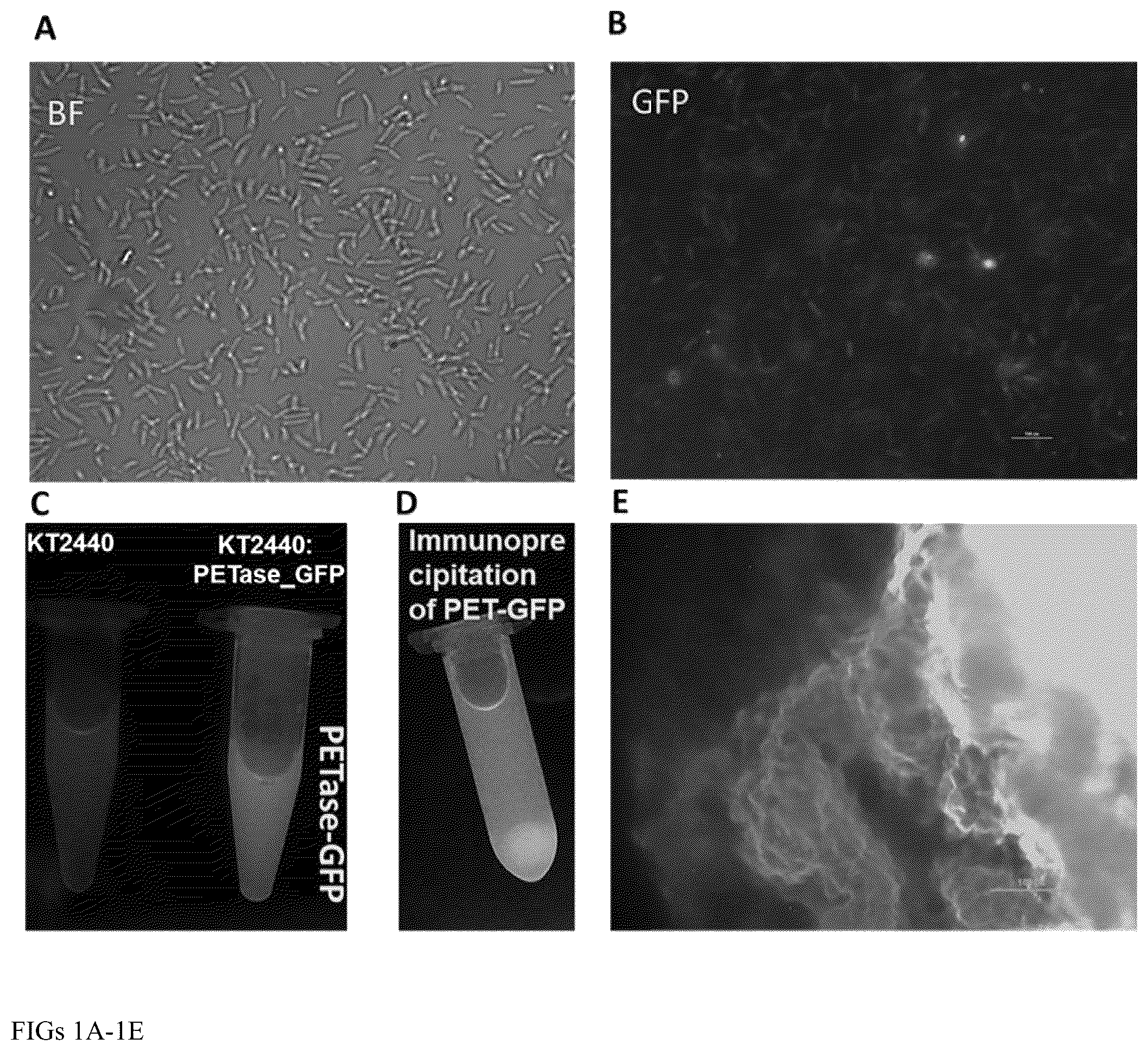
depicts: Panel 1A illustrates bright field microscopic observation of the strain expressing PETase with GFP tag; Panel 1B illustrates microscopic observation of GFP signal of the strain expressing PETase with GFP tag; Panel 1C illustrates GFP signal of the supernatant of wild-type strain and the strain expressing GFP tagged PETase; Panel 1D illustrates immunoprecipitation of GFP tagged PETase with GFP specific GFP-Trap® (ChromoTek GmbH, Planegg-Martinsried, Germany); and Panel 1E illustrates a microscopic image of PET particle incubated with the strain expressing GFP tagged PETase.
depicts degradation results of PET by LJ041 (Panel 2A) integrated gene cassette (Panel 2B) visual observation of biofilm of LJ41 on PET film (arrow) (Panel 2C) fragmenting PET by LJ041 (Panel 2D) SEM observation of PET particles cultured with KT2440, after 5 days of incubation (Panel 2E) SEM observation of PET cultured with LJ041, and arrow indicates the biofilm on PET (Panel 2F) SEM image revealed that KT2440 does not form biofilm on PET (Panel 2G) SEM observation of LJ041 biofilm forming cells on PET (Panel 2H) SEM observation of fragmenting PET film (highlighted area with arrow) by LJ041 (Panel 21) LJ041 forms holes on PET film (Panel 2J) HPLC chromatographs of PET-degraded products after 24 h and 72 h. Experiments were conducted in 5 mL M9 medium containing 20 mM glucose and about 60 mg of amorphous PET particle.
depicts strain LJ041 that was tested for selective degradation of BHET to TPA. The LJ041 strain converted BHET to TPA at 3-fold higher rate relative to wild-type P. putida KT2440 (LJ041: 12.8 mg/L/h vs KT2440: 4.7 mg/L/h).
depicts Engineered TPA catabolic pathway in P. putida KT2440, transporter TpaK and catabolic genes (TphA1, TphA2, TphA3, and TphB) are originally from R. jostii RHA1 and Comamonas sp. strain E6, respectively.
depicts Engineered P. putida KT2440 strain enables TPA utilization. (A) Growth curves of the strain (B) growth rate of the strains (C) TPA utilization of the strains. Growth of the strains was assessed in minimal medium containing either 10 mM TPA or 10 mM PCA as the sole substrate for growth, and TPA utilization was measured during growth in minimal medium with 10 mM TPA as the sole growth substrate. Concentrations of TPA were measured using high performance liquid chromatography (HPLC) by injecting culture supernatant onto a Rezex RFQ-Fast Acid H+ (8%) HPLC column. Mobile phase consisted of 5 mM H 2 SO 4 , and samples were run at 0.6 ml/min at 60° C. TPA eluted at ˜21 minutes and was detected at a wavelength of 230 nm via a UV-Vis detector. Area under the elution peak was integrated and TPA concentration was calculated against a standard.
A depicts codon optimized sequences of PETase (SEQ ID NO: 1) and MHETase (SEQ ID NO: 2) genes from Ideonella sakaiensis 201-F6 to P. putida KT2440.
depicts a plasmid map of pLJ080.
depicts the nucleotide sequence of plasmid pLJ080 (SEQ ID NO: 3).
depicts the amino acid sequences of PETase (SEQ ID NO: 4) and MHETase (SEQ ID NO: 5).
depicts a plasmid map of pLJ081.
depicts the plasmid sequence (SEQ ID NO: 6) of PETase with GFP tag (pLJ081).
depicts (SEQ ID NO: 7) the nucleotide sequence of synthetic tphCi gene.
depicts (SEQ ID NO: 8) the nucleotide sequence of synthetic tphA2u gene.
depicts (SEQ ID NO: 9) the nucleotide sequence of synthetic tphA3u gene.
depicts (SEQ ID NO: 10) the nucleotide sequence of synthetic tphBu gene.
depicts (SEQ ID NO: 11) the nucleotide sequence of synthetic tphAlu gene.
depicts (SEQ ID NO: 12) the nucleotide sequence of synthetic tpiB gene.
depicts (SEQ ID NO: 13) the nucleotide sequence of synthetic tpiA gene.
depicts (SEQ ID NO: 14) the nucleotide sequence of the local chromosomal sequence in strain IP103. Homology arms sequences are shown in italic. Synthetic ribosome binding sites are shown in bold. Coding sequences for tph genes are underlined.
depicts (SEQ ID NO: 15) the nucleotide sequence of the local chromosomal sequence in strain IP131. Homology arms sequences are shown in italic. Synthetic ribosome binding sites are shown in bold. Coding sequences for tph, tpi and kanamycin selection marker genes are underlined.
depicts growth and TPA concentration in a medium containing an engineered Acinetobacter baylyi ADP1 strain, IP103, expressing the tphC II A2 II A3 II B II A II synthetic genes was grown in Acinetobacter minimal media in the presence of 5 mM terephthalic acid and 20 mM pyruvate.
depicts TPA consumption over time of an engineered Acinetobacter baylyi ADP1 strain, IP 131, expressing the synthetic terephthalate transporter genes, tpiAB, as well as the tphC II A2 II A3 II B II A II genes, and the parent strain, IP103, expressing only the tphC II A2 II A3 II B II A II genes, were grown in Acinetobacter minimal media supplemented with 5 mM terephthalic acid and 20 mM pyruvate. The strains were fed only at the beginning of the experiment.
DETAILED DESCRIPTION
The present disclosure may address one or more of the problems and deficiencies of the prior art discussed above. However, it is contemplated that some embodiments as disclosed herein may prove useful in addressing other problems and deficiencies in a number of technical areas. Therefore, the embodiments described herein should not necessarily be construed as limited to addressing any of the particular problems or deficiencies discussed herein.
In an embodiment, disclosed herein is an engineered P. putida KT2440 co-expressing PETase and MHETase enzymes that selectively degrades PET into monomers, ethylene glycol and terephthalate (TPA). In another embodiment, disclosed herein are methods for making and using a highly efficient EG metabolizing P. putida KT2440 strain. Given that native P. putida does not have a TPA metabolic pathway, nor the proteins to transport TPA into the cell, the next metabolic engineering challenge for developing synthetic P. putida strain to plastic upcycling was enabling TPA catabolismin P. putida KT2440. TPA transporters and catabolic pathway have been characterized in several microorganisms including Comamonas sp. strain E6 and Rhodococcus jostii RHA1.
In an embodiment, disclosed herein are engineered P. putida KT2440 strains that use TPA through heterologous expression of a TPA transporter from Rhodococcus jostii RHA1 and catabolic genes from Comamonas sp. E6 ( ). In an embodiment, the pcalJ gene was knocked out in the engineered strains, enabling the biological conversion of TPA to β-ketoadipate. Ultimately, the engineered strains disclosed herein enable the upcycling of PET-derived TPA into atom-efficient β-ketoadipic acid, a high-value chemical that can be used to produce a biodegradable plastic material with superior properties.
Disclosed herein, in an embodiment, TPA catabolism is enabled in P. putida KT2440 by heterologous expression of TPA transporters (tpaK) and catabolic genes cluster I or II from R. jostii RHAI and Comamonas sp. E6, respectively. The engineered, non-naturally occurring strains can use TPA as a sole carbon source and use TPA at about 0.05 g L-1 h-l. In an embodiment, the pcalJ gene was knocked out in an engineered TPA utilizing strain. The strain could convert TPA to β-ketoadipate. In another embodiment, TPA utilization strain can be engineered for consolidated bioprocessing of PET by enabling selective degradation of PET and ethylene glycol utilization. In an embodiment, strains could be evolved to enhance TPA catabolic rates.
The present disclosure also relates to a biological strategy for degrading PET, which can subsequently enable atom-efficient biological transformations to novel intermediates (e.g., β-ketoadipate and/or muconate), which may be converted to high strength composites. PETase hydrolyses PET to produce bis(2-hydroxyethyl) terephthalate (BHET), mono-(2-hydroxyethyl) terephthalate (MHET), terephthalate (TPA), and ethylene glycol (EG), and MHETase catalyzes MHET to TPA and EG. Hence, as shown herein, co-expression of PETase and MHETase in an engineered strain can enable PET degradation to TPA and EG. Thus, in some embodiments of the present disclosure, a biological method is provided for the selective degradation of PET into PET monomers via co-expression and secretion of PETase and MHETase in Pseudomonas putida , which can grow well in simple minimal salt medium.
Therefore, the present disclosure relates to biological methods for the selective degradation of PET into PET monomers via co-expression PETase and MHETase in Pseudomonas putida , which can grow well in simple minimal salt medium. Among other things, I. sakaiensis PETase, ISF6 4831 and MHETase, ISF6_0224 genes were codon optimized for expression in KT2440 including their secretion signal peptides, which are compatible to the P. putida chaperone SecB-dependent secretion system. In addition, the genes were integrated into the P. putida genome with the tac promoter to enable constitutive expression. In certain embodiment, the term “tac”, “Ptac” and “P-Tac” may be used interchangeable to mean a tac promoter. The developed LJ041 strain formed a biofilm on PET. LJ041 enables highly-selectively degradation of PET into monomer TPA via BHET and MHET and confirmed secretion of PETase and MHETase enzymes via the chaperone-dependent native P. putida secreting system. These innovations could lead to a P. putida strain for selective biological degradation and conversion of PET into bio-derived chemical building blocks.
I. sakaiensis PETase, ISF6_4831 and MHETase, ISF6_0224 genes were codon optimized to KT2440 including their secretion signal peptides, which are compatible to the P. putida chaperone Sec-dependent secretion system. To confirm secretion of codon optimized PETase in P. putida via the I. sakaienesis secretion signal peptide, green fluorescent protein (GFP) was genetically linked to the C-terminus of PETase and expressed in P. putida . Efficient secretion of GFP-tagged PETase was confirmed via microscopy and immunoprecipitation, see : Panel A illustrates bright field microscopic observation of the strain expressing PETase with GFP tag; Panel B illustrates microscopic observation of GFP signal of the strain expressing PETase with GFP tag; Panel C illustrates GFP signal of the supernatant of wild-type strain and the strain expressing GFP tagged PETase; Panel D illustrates immunoprecipitation of GFP tagged PETase with GFP specific GFP-Trap® (ChromoTek GmbH, Planegg-Martinsried, Germany); and Panel E illustrates a microscopic image of PET particle incubated with the strain expressing GFP tagged PETase.
Next, referring to , the codon optimized PETase and MHETase genes were successfully integrated into the P. putida genome with the tac promoter to enable constitutive expression, and obtained the LJ041 strain (see Panel A). LJ041 formed a biofilm (see , Panels B, E, and G) on amorphous PET coupon and visually observed the fragmenting PET (see , Panels C and H). HPLC analysis revealed that LJ041 enabled highly-selectively degradation of PET into monomer TPA via BHET and MHET (see , Panel J). These results indicate that the codon-optimized signal sequences (which are codon optimized to KT2440), “ATGAACTTCCCTCGCGCGTCGCGCCTGATGCAGGCGGCGGTCCTCGGTGGTCTGAT GGCAGTCAGCGCCGCGGCCACC” (SEQ ID NO: 16), which encode “MNFPRASRLMQAAVLGGLMAVSAAATA” (SEQ ID NO: 17), and “ATGCAGACCACCGTCACCACTATGCTGCTGGCATCGGTCGCCCTGGCCGCC” (SEQ ID NO: 18), which is enclosed signal peptide “MQTTVTTMLLASVALAA” (SEQ ID NO: 19), for MHETase, respectively, are sufficient for enzyme secretion. These secretion signal peptides may be used for trafficking other proteins in P. putida via the Sec-dependent native P. putida secreting system. Of note, Ideonella sakaiensis 201-F6 grows only in rich-medium but not in the minimal salt medium (data not shown). Thus, the LJ014 has an advantage over the Ideonella sakaiensis 201-F6 as an industrial biocatalyst to degrade PET and to subsequently upgrade the degradation products into high-value chemicals. In addition, we introduced PETase and MHETase encoding genes into the genome of P. putida EM42 strain via deploying pLJ080 plasmid, the genome reduced version of P. putida KT2440, and developed LJ042 strain.
illustrates degradation results of PET by LJ041 (Panel A) integrated gene cassette (Panel B) visual observation of biofilm of LJ41 on PET film (arrow) (Panel C) fragmenting PET by LJ041 (Panel D) SEM observation of PET particles cultured with KT2440, after 5 days of incubation (Panel E) SEM observation of PET cultured with LJ041, and arrow indicates the biofilm on PET (Panel F) SEM image revealed that KT2440 does not form biofilm on PET (Panel G) SEM observation of LJ041 biofilm forming cells on PET (Panel H) SEM observation of fragmenting PET film (highlighted area with arrow) by LJ041 (Panel I) LJ041 forms holes on PET film (Panel J) HPLC chromatographs of PET-degraded products after 24 h and 72 h. Experiments were conducted in 5 mL M9 medium containing 20 mM glucose and about 60 mg of amorphous PET particle.
Next, the LJ041 strain was tested for selective degradation of BHET to TPA (see ). The LJ041 strain converted BHET to TPA at 3-fold higher rate relative to wild-type P. putida KT2440 (LJ041: 12.8 mg/L/h vs KT2440: 4.7 mg/L/h). Taken together, this innovation could lead to a P. putida strain for selective biological degradation and conversion of PET into bio-derived chemical building blocks.
Materials and Methods
Plasmid construction: Q5 Hot Start High-Fidelity 2X Master Mix (New England Biolabs) and primers synthesized by Integrated DNA Technologies (IDT) were used in all PCR amplification. Plasmids were constructed using Gibson Assembly® Master Mix (New England Biolabs) according to the manufacturer's instructions. Primers used for PCR amplification and Gibson assembly are listed in Table 1. The vector, pBLT-2 (Addgene plasmid #22806) was used for plasmid-based overexpression of PETase with a green fluorescence protein (GFP) tag. Plasmids for gene integration were constructed in pK18sB, which is unable to replicate in P. putida KT2440, and contains the kanamycin-resistant marker to select for integration of the plasmid into the genome by homologous recombination and sacB to counter select for a second recombination event to subsequently remove the plasmid backbone from the genome. Detail of plasmids construction is provided in Table 2.
TABLE 1
List of Primers
Primer ID 5′-3′
oLJ227 GACATGATTACGAATTCGAGCTCGGTACCCGTGCGATTA
CTGTGGGAG (SEQ ID NO: 20)
oLJ232 CCGGAGGCTTTTGACTCGGAGGCGCGGCGCAGGC
(SEQ ID NO: 21)
oLJ228 CGGATAACAATTTCACACTGAGTATTGCCTGAACCG
(SEQ ID NO: 22)
oLJ229 TTCAGGCAATACTCAGTGTGAAATTGTTATCCGCTCACA
ATTCCACACATTATACGAGCCGATGATTAATTGTCAACA
GCTCTTCATCAAGTCAAAACACTATATAGGAACG
(SEQ ID NO: 23)
oLJ230 ATGTAATCCTTGTTATAGGCTGCAGTTCGCAGTGCG
(SEQ ID NO: 24)
oLJ231 ACTGCGAACTGCAGCCTATAACAAGGATTACATATAAGG
GTATATCAAATGCAGACCACCGTCACC
(SEQ ID NO: 25)
oLJ233 TGCGCCGCGCCTCCGAGTCAAAAGCCTCCGGTCGGAGGC
TTTTGACTTCAAAACCACCCTGCTGTCGATG
(SEQ ID NO: 26)
oLJ234 CGGCCAGTGCCAAGCTTGCATGCCTGCAGGAAATCTAAC
TGCCTTCGCCC (SEQ ID NO: 27)
oLJ406 TATGTTGTGTGGAATTGTGAGCGGATAACAATTTCACAC
TTTCATCAAGTCAAAACACTATATAGGAACGAAAC
(SEQ ID NO: 28)
oLJ407 TCCGCACTGCGAACTGCAGCGGTGGTTCTGAGGAATCTT
ACATGAGC (SEQ ID NO: 29)
oLJ408 GTAAGATTCCTCAGAACCACCGCTGCAGTTCGCAGTGCG
(SEQ ID NO: 30)
oLJ409 AGTCCAGTTACGCTGGAGTCTGAGGCTCGTCCTGAATGA
TCTACTTGTAGAGTTCGTC (SEQ ID NO: 31)
TABLE 2
Plasmid construction details
Plasmid Purpose Construction detail
pLJ080 Genome The PETase genes cassette was amplified with
integration primers oLJ229 (Fwd) and oLJ230 (Rev), and
of over- MHETase oLJ231 (Fwd) and oLJ232 (Rev) using
expressing synthesizes gBlock as a temple. The 5′ homology
cassette of region was amplified from P. putida KT2440
PETase genomic DNA with primers oLJ227(Fwd), and
and oLJ228 (Rev), and 3′ homology region was
MHETase amplified with oLJ233 (Fwd) and oLJ234 (Rev).
These products were assembled into pK18sB
digested with SmaI and SalI.
pLJ081 Over- A DNA fragment containing the PETase genewas
expressing amplified from pLJ080 with primers oLJ406
PETase-GFP (Fwd) and oLJ407 (Rev), and GFP gene fragment
was obtained with primers oLJ408 (Fwd) and
oLJ409 (Rev), amplified from GFP containing
plasmid. This product was assembled into
pBLT-2 digested with XbaI and EcoRV.
The PETase and MHETase genes from Ideonella sakaiensis 201-F6 were codon optimized to P. putida KT2440 using online program Optimizer with a random approach (http://genomes.urv.es/OPTIMIZER/), gene fragments were synthesized at Integrated DNA Technologies, Inc, and obtained the double-stranded and linear gBlock, see . The plasmid used for of integration of codon optimize PETase and MHETase to P. putida KT2440 contain the approximately 0.7 kb homology region on either side of the intergenic region immediately after PP_1642 and PP_1643 of P. putida KT2440. Features include the tac promoter to drive gene expression and a tonB terminator situated behind the fragments cloned into the plasmid backbone, which are depicted in . Synthetic ribosomal binding site (sRBS) were designed using an online program from the Salis laboratory at Penn State University, in front of genes, the designed SRBS (TCATCAAGTCAAAACACTATATAGGAACGAAACC (SEQ ID NO: 32)) of PETase was predicted to have a translation initiation rate (TIR) of 27306.09, and MHETase has a sRBS (TAACAAGGATTACATATAAGGGTATATCAA (SEQ ID NO: 33)) with TIR of 32480.74. Plasmid sequence of pLJ80 is provided in Table S5 in the Appendix. The protein sequences of PETase and MHETase are provided in . Plasmid was transformed into competent NEB 5-alpha F′I q E. coli (New England Biolabs) according to the manufacturer's instructions. Transformants were selected on LB plates containing 10 g/L tryptone, 5 g/L yeast extract, 5 g/L NaCl, and 15 g/L agar, supplemented with 50 μg/mL kanamycin grown at 37° C. The sequences of all plasmid inserts were confirmed using Sanger sequencing (GENEWIZ, Inc.).
Strain construction: P. putida KT2440 (ATCC 47054) was used as the basis of strain engineering and gene replacements were made using the antibiotic/sacB system of selection and counter-selection. In an embodiment, the properties and description of some strains disclosed herein is depicted in Table 3. To prepare electrocompetent cells of P. putida KT2440 strains, a modified sucrose-based protocol was used. The plasmid was introduced to competent cells via electroporated at 1.6 kV, 25 μF, 200 Ohms. The transformation was plated on an LB agar plate containing 50 μg/ml kanamycin antibiotics and incubated at 30° C. overnight. Initial colonies from the transformation plates were re-streaked on selective LB agar plates and grown at 30° C. overnight to obtain clonal transformants. For sucrose counter-selection, clonal transformants were streaked on YT plates containing 25% (YT+25%; w/v) sucrose (10 g/L yeast extract, 20 g/L tryptone, 250 g/L sucrose, 18 g/L agar), and incubated at 30° C. overnight. The single colony of P. putida KT2440 containing the PETase and MHETase genes were successfully isolated. The strain was analyzed for the correct gene replacement by performing a colony PCR at the site of integration. The LJ102 was constructed by transforming pLJ081 plasmid into P. putida KT2440, the plasmid map and sequence are provided in and .
TABLE 3
Strains
Strain
ID Genotype Description of strain
KT2440 P. putida KT2440 Wild-type P. putida KT2440
(ATCC 47054)
EM42 P. putida KT2440 Genome reduced strain derived from
Δprophage1-4 P. putida KT2440 obtained from
Δflagellum Victor de Lorenzo's laboratory (Centro
ΔendA-1 Nacional de Biotecnología
ΔendA-2 ΔTn7 (CNB-CSIC), Madrid, Spain)
ΔhsdRMS ΔTn4652
LJ102 KT2440 + pBTL-2- KT2440 containing the pBTL-2 plasmid
PETase_GFP with PETase and GFP
LJ041 KT2440 1642::Ptac:: KT2440 with the PETase and MHETase
PETase-MHET cassette integrated within the intergenic
region between PP_1642 and PP_1643
LJ042 EM42 PP 1642::Ptac:: EM42 with the PETase and MHETase
PETase-MHET cassette integrated within the intergenic
region between PP_1642 and PP_1643
PET and BHET degradation experiment: To assess the selective degradation of PET/BHET by the PETase and MHETase expressing strain, shake flask experiments were performed using 125 mL baffled flasks containing 25 mL modified M9 media (6.78 g/L Na 2 HPO 4 , 3.00 g/L K 2 HPO 4 , 0.50 g/L NaCl, 1.66 g/L NH 4 Cl, 0.24 g/L MgSO 4 , 0.01 g/L CaCl 2 ), and 0.002 g/L FeSO 4 ) supplemented with 20 mM of glucose and amorphous PET coupons (amorphous PET films with a crystallinity of 14.8+0.2%, synthesized at NREL) or BHET (Obtained from IBM Almaden Research Center, BHET was derived from waste PET bottles via chemical depolymerization process), and inoculated to OD 600 0.1 with pre-culture. Pre-cultures of the strains were prepared by inoculating 25 mL M9 medium supplemented with 20 mM glucose in a 125 mL baffled flask to an OD 600 of 0.05-0.1 and incubating shaking at 225 rpm, 30° C. At mid log phase (OD 600 0.5-1.0) cells were harvested by centrifugation at 13,000 rpm, and the cell pellets were washed twice and resuspended in M9 medium without a carbon source. Cultures were incubated shaking at 225 rpm, 30° C. 1 mL samples were collected periodically and subjected to HPLC analysis to detect the degraded products. After the fermentation, PET coupons were subjected to microscopic observation.
Scanning Electron Microscopy (SEM): Imaging by scanning electron microscopy (SEM) was performed using a FEI Quanta 400 FEG instrument under low vacuum (0.45 Torr) operating with the gaseous solid-state detector (GAD). Samples were prepared for imaging by fixation in 2.5% gluteraldehyde buffered in 1×PBS (EMS, Hatfield, PS), dehydration in an ethanol series, then freezing in liquid nitrogen followed by lyophilization. Dry samples were mounted on aluminum stubs using carbon tape, and sputter coated with 9 nm of Ir metal. Images were captured at a beam accelerating voltage of 24 keV.
High performance liquid chromatography (HPLC) analysis: Concentrations of TPA, MHET, and BHET were measured using HPLC by injecting 6 μL of 0.2-μm filter-sterilized culture supernatant onto an Agilent1100 series system (Agilent USA, Santa Clara, CA) equipped with a Phenomenex Rezex RFQ-Fast Fruit H+column (Phenomenex, Torrance, CA) and cation H+guard cartridge (Bio-Rad Laboratories, Hercules, CA) at 85° C. A mobile phase of 0.1N sulfuric acid was used at a flow rate of 1.0 mL/min. Diode array detectors were used for compound detection. Compounds were identified by relating the retention times and spectral profiles with standard HPLC grade pure compounds (Sigma Aldrich, St. Louis, MO, USA) and the concentration of each compound was calculated based on a calibration curves generated using pure compounds.
To enable TPA catabolismin P. putida KT2440, genes for TPA transport and for conversion of TPA into protocatechuic acid (PCA), an intermediate metabolite of β-ketoadipate pathway were introduced into the chromosome of P. putida strain KT2440. Three different operons containing genes required for TPA catabolism [two operons from Comamonas sp. E6 (operon I: tphA2I, tphA3I, tphBI, and tphAII) and (operon II: tphA2II, tphA3II, tphBII, and tphAIII), and one from R. jostii RHA1 (tpaA1, tpaA2, tpaC, and tpaB)], and two different operons containing transport genes [one from Comamonas sp. E6 (tphC, tpiA, and tpiB) and one from R. jostii RHA1 (tpaK) were tested in various combinations (Table 4). Additionally, each operon was placed under control of 3 different promoters of varying strengths (from strongest to weakest: P-Tac, P-549, P-Lac, P-3079). Those gene clusters were successfully integrated into a modified version of P. putida KT2440 that has 3 poly-attB genetic islands for DNA insertion via highly efficient phage integrase system.
TABLE 4
Generated strains of P. putida containing genes for terephthalic acid transport
and catabolism under control of promoters with varying strengths.
Catabolic Genes Transport Gene(s)
Source Source TPA
TDM# Organism Operon Promoter Organism Operon Promoter growth
56 Comamonas tphA2 I A3 I B I A1 I P-Tac Comamonas tphC- P-549 No
57 sp. E6 P-Tac sp. E6 tpiBA No
58 P-Lac No
59 Comamonas tphA2 II A3 II B II A1 II P-Tac Comamonas tphC- P-549 No
60 sp. E6 P-Tac sp. E6 tpiBA No
61 P-Lac No
62 Rhodococcus tpaA1A2CB P-Tac Comamonas tphC- P-549 No
63 jostii RHA1 P-Tac sp. E6 tpiBA No
64 P-Lac No
65 Comamonas tphA2 I A3 I B I A1 I P-Tac Comamonas tphC- P-Lac No
66 sp. E6 P-Tac sp. E6 tpiBA No
67 P-Lac No
68 Comamonas tphA2 II A3 II B II A1 II P-Tac Comamonas tphC- P-Lac No
69 sp. E6 P-Tac sp. E6 tpiBA No
70 P-Lac No
71 Rhodococcus tpaA1A2CB P-Tac Comamonas tphC- P-Lac No
72 jostii RHA1 P-Tac sp. E6 tpiBA No
73 P-Lac No
74 Comamonas tphA2 I A3 I B I A1 I P-Tac Comamonas tphC- P-3079 No
75 sp. E6 P-Tac sp. E6 tpiBA No
76 P-Lac No
77 Comamonas tphA2 II A3 II B II A1 II P-Tac Comamonas tphC- P-3079 No
78 sp. E6 P-Tac sp. E6 tpiBA No
79 P-Lac No
80 Rhodococcus tpaA1A2CB P-Tac Comamonas tphC- P-3079 No
81 jostii RHA1 P-Tac sp. E6 tpiBA No
82 P-Lac No
83 Comamonas tphA2 I A3 I B I A1 I P-Tac Rhodococcus tpaK P-549 Yes
84 sp. E6 P-Tac jostii RHA1 Yes
85 P-Lac No
86 Comamonas tphA2 II A3 II B II A1 II P-Tac Rhodococcus tpaK P-549 Yes
87 sp. E6 P-Tac jostii RHA1 Yes
88 P-Lac No
89 Rhodococcus tpaA1A2CB P-Tac Rhodococcus tpaK P-549 No
90 jostii RHA1 P-Tac jostii RHA1 No
In an embodiment, thirty-five strains were generated, of which four had substantial growth with TPA as the sole carbon source. Each of the four strains that were able to metabolize TPA contained one of the two Comamonas sp. E6 catabolic operons (I or II) in combination with the R. jostii transporter. Robust expression was a requirement for TPA utilization, as growth was only detected when catabolic and transport genes were expressed from the strongest tested promoters (P-Tac or P-549). Of note, the growth data revealed that neither Comamonas sp. E6 TPA transporter nor R. jostii RHAI catabolic genes enable TPA catabolismin P. putida KT2440. Growth in minimal media containing either 10 mM TPA or 10 mM PCA was compared for each of the TPA catabolizing strains. An extended lag phase and about a 3-fold slower growth rate for all strains indicated that TPA is not used as efficiently as PCA as a substrate ( A and 5 B , Table 5). However, quantification of TPA from late exponential phase cultures grown in minimal media with 10 mM TPA indicated that about 90% of TPA was consumed ( C ). Ongoing experiments are aimed at optimizing import and processing of TPA. Additionally, the ultimate objective of this project is to use P. putida for the valorization of TPA into other high value products, such as β-ketoadipate. To that end, the genes that facilitate β-ketoadipate consumption, pcalJ, have been deleted from the TPA utilizing strains to allow β-ketoadipate accumulation, and the strains have been confirmed by PCR.
TABLE 5
Growth characteristics of TPA utilizing strains of
P. putida in minimal medium containing either 10
mM TPA or 10 mM PCA as the sole growth substrate.
Lag Growth Doubling
Strain Substrate Phase (h) Rate (h −1 ) Time (h)
TDM083 TPA 16.4 ± 0.1 0.108 ± 0.002 6.41 ± 0.13
TDM084 TPA 16.4 ± 0.8 0.102 ± 0.003 6.81 ± 0.20
TDM086 TPA 17.4 ± 0.9 0.099 ± 0.003 7.01 ± 0.19
TDM087 TPA 17.6 ± 0.5 0.099 ± 0.001 6.98 ± 0.07
KT2440 TPA No Growth No Growth No Growth
TDM083 PCA 2.8 ± 0.0 0.395 ± 0.024 1.76 ± 0.10
TDM084 PCA 2.8 ± 0.0 0.378 ± 0.026 1.84 ± 0.13
TDM086 PCA 2.9 ± 0.1 0.327 ± 0.066 2.17 ± 0.40
TDM087 PCA 2.8 ± 0.3 0.311 ± 0.029 2.24 ± 0.22
KT2440 PCA 2.6 ± 0.3 0.300 ± 0.010 2.31 ± 0.08
Different versions of a synthetic operon coding for a terephthalic acid degradation pathway were constructed for chromosomal integration and expression in Acinetobacter baylyi ADP1. This operon includes codon-optimized versions of the genes tphC II A2 II A3 II B II A II and tpiBA from Comamonas sp. E6 under control of a constitutive promoter, with each gene being preceded by a synthetic ribosome binding site sequence. The description and accession numbers for the wild-type Comamonas sp. E6 tphC II A2 II A3 II B II A II and tpiBA genes are listed in Table 6. For the homologous recombination and insertion of the operon in the chromosome of Acinetobacter baylyi ADP1, upstream and downstream homology arms of ˜2000 bp were amplified from genomic DNA and assembled by overlap extension PCR to flank the synthetic genes. Linear DNA fragments were transformed into naturally competent Acinetobacter baylyi ADP1 cells as described in the literature.
TABLE 6
Protein
accession
Gene number Description
tphC II BAE47084.1 Periplasmic terephthalate binding receptor
tphA2 II BAE47085.1 Oxygenase large subunit of terephthalate
1,2-dioxygenase
tphA3 II BAE47086.1 Oxygenase small subunit of terephthalate
1,2-dioxygenase
tphB II BAE47087.1 1,2-dihydroxy-3,5-cyclohexadiene-1,4-
dicarboxylate dehydrogenase
tphA1 II BAE47088.1 Reductase component of terephthalate
1,2-dioxygenase
tpiB BAN66715.1 Small transmembrane protein of the aromatic
acids transporter
tpiA BAN66716.1 Large transmembrane protein of the aromatic
acids transporter
In a first shake-flask experiment, an engineered Acinetobacter baylyi ADP1 strain, IP103, expressing the tphC II A2 II A3 II B II A II synthetic genes was grown in Acinetobacter minimal media in the presence of 5 mM terephthalic acid and 20 mM pyruvate, the latter being fed every 24 hours to support cell growth. As seen in , more terephthalic acid was consumed by IP103 than by the wild-type strain. The slight decrease in TPA concentration for the wild-type strain is an effect of the dilution caused by feeding daily with 20 mM pyruvate to support cell growth.
Genes expressing the terephthalate transporter from Comamonas sp. E6, tpiBA, were then similarly codon optimized and incorporated into the genome of IP103 downstream of the tphC II A2 II A3 II B II A II genes, such that expression of all of these genes was driven as an operon by the same promoter. In a shake-flask experiment, this new strain expressing the synthetic terephthalate transporter genes, tpiAB, as well as the tphC II A2 II A3 II B II A II genes, IP131, and the parent strain expressing only the tphC II A2 II A3 II B II A II genes, IP103, were grown in Acinetobacter minimal media supplemented with 5 mM terephthalic acid and 20 mM pyruvate, fed only at the beginning of the experiment. As seen in , IP131 was able to degrade terephthalic acid more quickly, than IP103, indicating that expression of the terephthalate transporter improved the ability of this strain to metabolize this substrate.
The foregoing discussion and examples have been presented for purposes of illustration and description. The foregoing is not intended to limit the aspects, embodiments, or configurations to the form or forms disclosed herein. In the foregoing Detailed Description for example, various features of the aspects, embodiments, or configurations are grouped together in one or more embodiments, configurations, or aspects for the purpose of streamlining the disclosure. The features of the aspects, embodiments, or configurations, may be combined in alternate aspects, embodiments, or configurations other than those discussed above. This method of disclosure is not to be interpreted as reflecting an intention that the aspects, embodiments, or configurations require more features than are expressly recited in each claim. Rather, as the following claims reflect, inventive aspects lie in less than all features of a single foregoing disclosed embodiment, configuration, or aspect. While certain aspects of conventional technology have been discussed to facilitate disclosure of some embodiments of the present invention, the Applicants in no way disclaim these technical aspects, and it is contemplated that the claimed invention may encompass one or more of the conventional technical aspects discussed herein. Thus, the following claims are hereby incorporated into this Detailed Description, with each claim standing on its own as a separate aspect, embodiment, or configuration.
Figures (20)
Citations
This patent cites (3)
- US2021/0285019
- US106754600
- US107794252