Abstract
An image forming apparatus includes a driven member, a frame body, a driving source, and a drive transmission unit including a gear train including a first gear configured to rotate by the driving force from the driving source, and a gear cover configured to cover the gear train. The gear cover includes an outer surface that extends in an orthogonal direction orthogonal to a rotational axis direction of the first gear, and a first concave portion. The first gear includes a shaft portion that passes through a first hole formed on the first concave portion. A downstream end, in the second direction, of the shaft portion is arranged upstream of a virtual surface in the second direction.
Claims (27)
1. An image forming apparatus configured to form an image on a sheet, the image forming apparatus comprising: a driven member; a frame body configured to support the driven member; a driving source configured to generate a driving force; and a drive transmission unit configured to transmit the driving force of the driving source to the driven member, the drive transmission unit including a gear train including a first gear configured to rotate by the driving force from the driving source, and a gear cover configured to cover the gear train, wherein the gear cover includes an outer surface that extends in an orthogonal direction orthogonal to a rotational axis direction of the first gear, and a first concave portion that is concaved in a first direction parallel to the rotational axis direction from the outer surface, the gear cover being arranged upstream of the frame body in the first direction, wherein the first gear includes a shaft portion that passes through a first hole formed on the first concave portion and that protrudes to a second direction opposite to the first direction from the first hole, wherein the outer surface is a surface having a maximum area in the orthogonal direction among surfaces of the gear cover facing the second direction, and wherein a downstream end, in the second direction, of the shaft portion is a most downstream end of the gear train in the second direction and is arranged upstream of a virtual surface in the second direction, the virtual surface being positioned at a distance shifted to the second direction for a distance corresponding to a plate thickness of the gear cover from the outer surface, the virtual surface being extended in the orthogonal direction.
15. An image forming apparatus configured to form an image on a sheet, the image forming apparatus comprising: a driven member; a frame body configured to support the driven member; a driving source configured to generate a driving force; and a drive transmission unit configured to transmit the driving force of the driving source to the driven member, the drive transmission unit including a gear train including a gear configured to rotate by the driving force from the driving source, a gear cover configured to cover the gear train, and a bearing member configured to rotatably support a shaft portion of the gear, wherein the gear cover includes an outer surface that extends in an orthogonal direction orthogonal to a rotational axis direction of the gear, and a concave portion that is concaved in a first direction parallel to the rotational axis direction from the outer surface, the gear cover being arranged upstream of the frame body in the first direction, wherein the bearing member includes a protruded portion that passes through a hole formed on the concave portion and that protrudes to a second direction opposite to the first direction from the hole, wherein the outer surface is a surface having a maximum area in the orthogonal direction among surfaces of the gear cover facing the second direction, and wherein a downstream end, in the second direction, of the protruded portion is arranged upstream of a virtual surface in the second direction, the virtual surface being positioned at a distance shifted to the second direction for a distance corresponding to a plate thickness of the gear cover from the outer surface, the virtual surface being extended in the orthogonal direction.
Show 25 dependent claims
2. The image forming apparatus according to claim 1 , wherein the shaft portion is rotatably supported on the frame body and the gear cover, and wherein the downstream end of the shaft portion is arranged upstream of the outer surface in the second direction in a state where the shaft portion is pressed downstream in the first direction against the frame body.
3. The image forming apparatus according to claim 2 , wherein the shaft portion is movable for a predetermined distance in the rotational axis direction, and wherein the predetermined distance is smaller than the plate thickness of the gear cover.
4. The image forming apparatus according to claim 1 , wherein the gear train includes a second gear, wherein the drive transmission unit includes a bearing member that rotatably supports a shaft portion of the second gear, wherein the gear cover includes a second concave portion that is concaved in the first direction from the outer surface, wherein the bearing member includes a protruded portion that passes through a second hole formed on the second concave portion and that protrudes to the second direction from the second hole, and wherein a downstream end, in the second direction, of the protruded portion is arranged upstream of the virtual surface in the second direction.
5. The image forming apparatus according to claim 1 , wherein the gear cover is formed of a sheet metal.
6. The image forming apparatus according to claim 5 , wherein the first concave portion is formed by drawing.
7. The image forming apparatus according to claim 1 , further comprising an exterior member that is arranged downstream of the outer surface in the second direction and faces the outer surface, wherein a distance in the rotational axis direction between the outer surface of the gear cover and the exterior member is greater than the plate thickness.
8. The image forming apparatus according to claim 1 , wherein the drive transmission unit includes an actuator, a bundle wire configured to supply power to the actuator, and a bundle wire guide configured to guide the bundle wire, and wherein the actuator, the bundle wire, and the bundle wire guide are arranged upstream of the virtual surface in the second direction.
9. The image forming apparatus according to claim 1 , wherein the drive transmission unit includes a screw engaged to the gear cover, and wherein the screw is arranged upstream of the virtual surface in the second direction.
10. The image forming apparatus according to claim 1 , wherein the outer surface is a downstream end surface, in the second direction of, the gear cover.
11. The image forming apparatus according to claim 1 , further comprising a pinion gear configured to be attached to the driving source, wherein the pinion gear is arranged to be overlapped with the first gear in the rotational axis direction, and arranged upstream of the outer surface in the second direction.
12. The image forming apparatus according to claim 1 , wherein the driven member includes an image bearing member configured to bear a toner image.
13. The image forming apparatus according to claim 1 , wherein the driven member includes a roller configured to convey a sheet.
14. The image forming apparatus according to claim 1 , wherein the driving source is arranged downstream of the outer surface in the first direction.
16. The image forming apparatus according to claim 15 , wherein the drive transmission unit includes an urging member that is disposed in a contracted manner between the gear and the bearing member and is configured to urge the gear and the bearing member to be separated from each other in the rotational axis direction, and wherein the downstream end of the protruded portion is positioned between the outer surface of the gear cover and the virtual surface in a state where the bearing member is pressed downstream in the second direction against the gear cover by an urging force of the urging member.
17. The image forming apparatus according to claim 15 , wherein a second coupling portion configured to transmit drive to a first coupling portion by being engaged with the first coupling portion is disposed at a downstream end portion, in the first direction, of the gear.
18. The image forming apparatus according to claim 15 , wherein the gear cover is formed of a sheet metal.
19. The image forming apparatus according to claim 15 , wherein the concave portion is formed by drawing.
20. The image forming apparatus according to claim 15 , further comprising an exterior member that is arranged downstream of the outer surface in the second direction and faces the outer surface, and wherein a distance in the rotational axis direction between the outer surface of the gear cover and the exterior member is greater than the plate thickness.
21. The image forming apparatus according to claim 15 , wherein the drive transmission unit includes an actuator, a bundle wire configured to supply power to the actuator, and a bundle wire guide configured to guide the bundle wire, and wherein the actuator, the bundle wire, and the bundle wire guide are arranged upstream of the virtual surface in the second direction.
22. The image forming apparatus according to claim 15 , wherein the drive transmission unit includes a screw engaged to the gear cover, and wherein the screw is arranged upstream in the second direction of the virtual surface.
23. The image forming apparatus according to claim 15 , wherein the outer surface is a downstream end surface of the gear cover in the second direction.
24. The image forming apparatus according to claim 15 , further comprising a pinion gear configured to be attached to the driving source, wherein the pinion gear is arranged to be overlapped with the gear in the rotational axis direction, and arranged upstream of the outer surface in the second direction.
25. The image forming apparatus according to claim 15 , wherein the driven member includes an image bearing member configured to bear a toner image.
26. The image forming apparatus according to claim 15 , wherein the driven member includes a roller configured to convey a sheet.
27. The image forming apparatus according to claim 15 , wherein the driving source is arranged downstream of the outer surface in the first direction.
Full Description
Show full text →
BACKGROUND OF THE INVENTION
Field of the Invention
The present invention relates to image forming apparatuses for forming images on sheets.
Description of the Related Art
Japanese Patent Application Laid-Open Publication No. 2018-57146 discloses an image forming apparatus equipped with a driving device, the image forming apparatus including a side plate, a stay fixed to the side plate, a motor fixed to the stay, and an idler gear attached to a support shaft supported by the side plate and the stay.
However, according to the driving device disclosed in Japanese Patent Application Laid-Open Publication No. 2018-57146, the support shaft, the idler gear, and the stay are arranged on an outer side of the side plate, and the motor is further arranged on the outer side of the stay, in the axial direction of the idler gear. Therefore, the size of the apparatus was increased in the direction of the rotational axis.
SUMMARY OF THE INVENTION
According to a first aspect of the present invention, an image forming apparatus configured to form an image on a sheet includes a driven member, a frame body configured to support the driven member, a driving source configured to generate a driving force, and a drive transmission unit configured to transmit the driving force of the driving source to the driven member, the drive transmission unit including a gear train including a first gear configured to rotate by the driving force from the driving source, and a gear cover configured to cover the gear train. The gear cover includes an outer surface that extends in an orthogonal direction orthogonal to a rotational axis direction of the first gear, and a first concave portion that is concaved in a first direction parallel to the rotational axis direction from the outer surface, the gear cover being arranged upstream of the frame body in the first direction. The first gear includes a shaft portion that passes through a first hole formed on the first concave portion and that protrudes to a second direction opposite to the first direction from the first hole. The outer surface is a surface having a maximum area in the orthogonal direction among surfaces of the gear cover facing the second direction. A downstream end, in the second direction, of the shaft portion is a most downstream end of the gear train in the second direction and is arranged upstream of a virtual surface in the second direction, the virtual surface being positioned at a distance shifted to the second direction for a distance corresponding to a plate thickness of the gear cover from the outer surface, the virtual surface being extended in the orthogonal direction.
According to a second aspect of the present invention, an image forming apparatus configured to form an image on a sheet includes a driven member, a frame body configured to support the driven member, a driving source configured to generate a driving force, and a drive transmission unit configured to transmit the driving force of the driving source to the driven member, the drive transmission unit including a gear train including a gear configured to rotate by the driving force from the driving source, a gear cover configured to cover the gear train, and a bearing member configured to rotatably support a shaft portion of the gear. The gear cover includes an outer surface that extends in an orthogonal direction orthogonal to a rotational axis direction of the gear, and a concave portion that is concaved in a first direction parallel to the rotational axis direction from the outer surface, the gear cover being arranged upstream of the frame body in the first direction. The bearing member includes a protruded portion that passes through a hole formed on the concave portion and that protrudes to a second direction opposite to the first direction from the hole. The outer surface is a surface having a maximum area in the orthogonal direction among surfaces of the gear cover facing the second direction. A downstream end, in the second direction, of the protruded portion is arranged upstream of a virtual surface in the second direction, the virtual surface being positioned at a distance shifted to the second direction for a distance corresponding to a plate thickness of the gear cover from the outer surface, the virtual surface being extended in the orthogonal direction.
Further features of the present invention will become apparent from the following description of exemplary embodiments with reference to the attached drawings.
BRIEF DESCRIPTION OF THE DRAWINGS
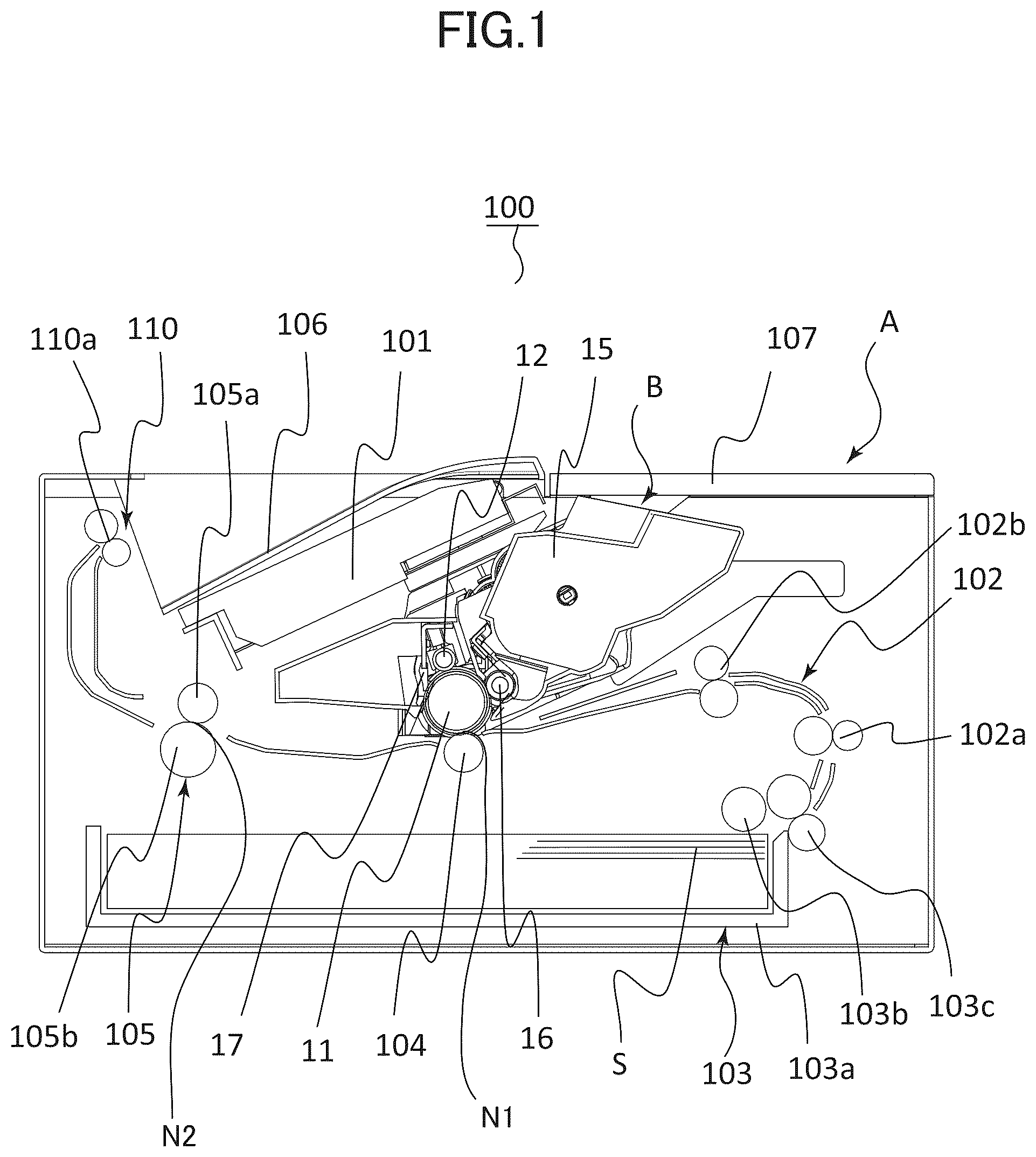
is a cross-sectional view illustrating an image forming apparatus according to a present embodiment.
is a perspective view illustrating a motor and a drive transmission unit.
A is a front view illustrating the drive transmission unit.
B is a side view illustrating the drive transmission unit.
A is a perspective view illustrating a first drive gear train and a first gear cover.
B is a cross-sectional view illustrating an X 1 -X 1 cross section of A .
A is a perspective view illustrating the first drive gear train and the first gear cover.
B is a cross-sectional view illustrating an X 2 -X 2 cross section of A .
A is a perspective view illustrating the first drive gear train and the first gear cover.
B is a cross-sectional view illustrating an X 3 -X 3 cross section of A .
A is a cross-sectional view illustrating a motor.
B is a cross-sectional view illustrating a solenoid arranged on a second drive gear train side.
A is a perspective view illustrating the first drive gear train, the first gear cover, and a bundle wire guide.
B is a cross-sectional view illustrating an X 4 -X 4 cross section of A .
is a perspective view illustrating a screw according to a modified example.
DESCRIPTION OF THE EMBODIMENTS
Entire Configuration of Image Forming Apparatus
At first, a general configuration of an image forming apparatus according to a present embodiment will be described with reference to . is a cross-sectional view of an image forming apparatus 100 . The image forming apparatus 100 according to the present embodiment is a laser printer adopting an electrophotographic system. As illustrated in , the image forming apparatus 100 includes an apparatus body A, and a cartridge B serving as an image forming unit.
The image forming apparatus refers to an apparatus for forming images on sheets serving as recording media based on image information entered from an external PC or image information read from a document, and includes printers, copying machines, facsimile machines, and multifunction machines. Further, the image forming apparatus may have additional apparatuses such as an optional feeder, an image reading apparatus, or a sheet processing apparatus connected to a main body thereof having an image forming function, and in such a case, the entire system having the additional apparatuses connected thereto is considered as one type of an image forming apparatus.
The apparatus body A has a laser scanner 101 , a sheet conveyance unit 102 , a sheet feeding unit 103 , a transfer roller 104 , a fixing unit 105 , and a sheet discharge portion 110 disposed therein. Further, a cartridge B is attached in a detachable manner to the apparatus body A. In order to do so, the apparatus body A includes a door 107 .
The cartridge B includes a photosensitive drum 11 serving as an image bearing member and a photosensitive member, a charging roller 12 serving as a charging member, a developing unit 15 , and a cleaning blade 17 serving as a cleaning member. The laser scanner 101 serving as an exposing unit is disposed above the cartridge B.
The charging roller 12 is arranged to come into contact with an outer circumference surface of the photosensitive drum 11 , and charges the photosensitive drum 11 through voltage application from the apparatus body A. Further, the charging roller 12 is driven to rotate with the photosensitive drum 11 . The developing unit 15 is equipped with a developing roller 16 that serves as a developer bearing member that bears and conveys toner serving as a developer. The developing roller 16 is arranged to face the photosensitive drum 11 .
The cleaning blade 17 is a member having elasticity that is arranged to be in contact with the outer circumference surface of the photosensitive drum 11 , and cleans the surface of the photosensitive drum 11 . A tip of the cleaning blade 17 comes into contact elastically with the photosensitive drum 11 , and removes toner that remains after a sheet S has passed through between the photosensitive drum 11 and the transfer roller 104 from the photosensitive drum 11 . Examples of the sheet S include paper such as paper sheets and envelopes, plastic films such as OHP sheets, and cloth.
The sheet feeding unit 103 includes a cassette 103 a , a pickup roller 103 b that feeds the uppermost sheet S stored in the cassette 103 a , and a separation roller pair 103 c that separates the sheets S fed by the pickup roller 103 b one by one.
The sheet conveyance unit 102 includes a conveyance roller pair 102 a that conveys the sheet S fed from the sheet feeding unit 103 , and a registration roller pair 102 b . The registration roller pair 102 b conveys the sheet S to a transfer nip N 1 formed between the photosensitive drum 11 and the transfer roller 104 at a matched timing with the toner image formed on the photosensitive drum 11 .
The fixing unit 105 includes a fixing roller 105 a heated by a heat source such as a heater, and a heating roller 105 b forming a fixing nip N 2 that nips the sheet between the heating roller 105 b and the fixing roller 105 a . The sheet S on which a toner image has been transferred at the transfer nip N 1 is conveyed to the fixing unit 105 , where the sheet S is heated and pressed at the fixing nip N 2 . Thereby, a toner image is fixed on the sheet S.
The sheet discharge portion 110 includes a sheet discharge roller pair 110 a , and the sheet S on which a toner image has been fixed is discharged by the sheet discharge roller pair 110 a onto a sheet discharge tray 106 .
Operation of Image Forming Apparatus
Next, an operation of the image forming apparatus 100 will be described with reference to . The photosensitive drum 11 driven to rotate by a drive transmission configuration described later is charged uniformly to a predetermined potential by the charging roller 12 . After being charged, the laser scanner 101 exposes the surface of the photosensitive drum 11 based on image information, by which the charge of the exposed portion is removed, and an electrostatic latent image is formed. Toner is supplied from the developing roller 16 to the electrostatic latent image on the photosensitive drum 11 , and the image is visualized as a toner image.
Meanwhile, in parallel with such operation to form a toner image, the sheet S is fed from the sheet feeding unit 103 . The sheet S fed from the sheet feeding unit 103 is conveyed to the transfer nip N 1 by the registration roller pair 102 b at a matched timing with the forming of the toner image on the photosensitive drum 11 . When the sheet S is passed through the transfer nip N 1 , voltage is applied to the transfer roller 104 from the apparatus body A, and the toner image on the photosensitive drum 11 is transferred to the sheet S as an unfixed image. Thereafter, the sheet S on which the toner image has been transferred is conveyed to the fixing unit 105 , where the unfixed image is heated, pressed, and fixed to the surface of the sheet S. The sheet S on which the toner image has been fixed is discharged to the sheet discharge tray 106 by the sheet discharge portion 110 and supported thereon.
Drive Configuration of Image Forming Apparatus
Next, with reference to , the drive configuration of the image forming apparatus 100 will be described in detail. is a perspective view illustrating a motor 131 and a drive transmission unit 120 disposed on the apparatus body A. A is a front view illustrating the drive transmission unit 120 , and B is a side view of the drive transmission unit 120 . Further, in to 3 B , the exterior member and the cartridge B of the image forming apparatus 100 are not shown.
As illustrated in to 3 B , the apparatus body A includes a left side plate 112 , a right side plate 121 serving as a frame body, a connecting frame 113 , the motor 131 serving as a driving source supported on the right side plate 121 , and the drive transmission unit 120 . The left side plate 112 , the right side plate 121 , and the connecting frame 113 constitute a frame of the apparatus body A, and the connecting frame 113 connects the left side plate 112 and the right side plate 121 . A space is formed between the left side plate 112 and the right side plate 121 , in which space are arranged the cartridge B, various rollers for conveying the sheet S, and guide members for guiding the sheet S.
The drive transmission unit 120 includes a first drive gear train 122 , a first gear cover 123 , a second drive gear train 124 , and a second gear cover 125 . Further, although not shown in to 3 B , an exterior right cover 126 (refer to B ) serving as an exterior member that covers the apparatus body A is arranged on the outer side of the drive transmission unit 120 . The exterior right cover 126 forms at least a part of the exterior of the image forming apparatus 100 . The left side plate 112 , the connecting frame 113 , the right side plate 121 , the first gear cover 123 , and the second gear cover 125 are composed of sheet metal.
The respective gears provided on the drive transmission unit 120 are formed rotatably about a shaft that extends in a rotational axis direction AD. Further, in the following description, regarding the rotational axis direction AD, the direction from the first gear cover 123 and the second gear cover 125 toward the inner side of the image forming apparatus 100 is referred to as a first direction AD 1 , and a direction opposite to the first direction AD 1 is referred to as a second direction AD 2 . Accordingly, both the first direction AD 1 and the second direction AD 2 are directions parallel to the rotational axis direction AD.
On the outer side in the rotational axis direction AD of the right side plate 121 , the first gear cover 123 and the second gear cover 125 are attached to the right side plate 121 via screws 141 and 142 . The first drive gear train 122 serving as a gear train is supported by the right side plate 121 and the first gear cover 123 , and covered by the first gear cover 123 . The second drive gear train 124 is supported by the right side plate 121 and the second gear cover 125 , and covered by the second gear cover 125 . The motor 131 is attached to an inner side of the right side plate 121 in the rotational axis direction AD. The motor 131 generates driving force. The first drive gear train 122 receives driving force of the motor 131 , and transmits the driving force toward the photosensitive drum 11 , the fixing unit 105 , and the sheet discharge portion 110 . The second drive gear train 124 receives driving force from the motor 131 via the first drive gear train 122 , and transmits the driving force toward the sheet conveyance unit 102 and the sheet feeding unit 103 . That is, the photosensitive drum 11 , the fixing unit 105 , the sheet discharge portion 110 , the sheet conveyance unit 102 , and the sheet feeding unit 103 are examples of a driven member driven by the driving force of the motor 131 . That is, the driven member includes a roller for conveying the sheets S. The first drive gear train 122 and the second drive gear train 124 include a plurality of gears.
Further, as illustrated in , the drive transmission unit 120 includes a shaft 132 and a bearing member 133 that support gears rotatably, an actuator 134 , and a bundle wire guide 135 . In the following description, the shaft 132 , the bearing member 133 , the actuator 134 , and the bundle wire guide 135 disposed on the first drive gear train 122 side are described as an example, but the same shaft, bearing member, actuator, and bundle wire guide are also disposed on the second drive gear train 124 side.
The shaft 132 is attached by caulk-joining to the first gear cover 123 serving as a gear cover, and arranged so as to support the gears of the first drive gear train 122 . The bearing member 133 is attached to the first gear cover 123 , and arranged so as to support the gear of the first drive gear train 122 .
The actuator 134 includes an electromagnetic clutch 134 a and a solenoid 134 b , and the electromagnetic clutch 134 a and the solenoid 134 b are arranged downstream of the first drive gear train 122 and the second drive gear train 124 in a drive transmission direction. When power is conducted, the actuator 134 transmits the driving force of the motor 131 to the driven members, such as the photosensitive drum 11 , and when power conduction is disconnected, operation is performed so as not to transmit the driving force of the motor 131 to the driven members. The bundle wire guide 135 is attached to the first gear cover 123 , and guides a cable 138 (refer to A ) for connecting the electromagnetic clutch 134 a and the solenoid 134 b to an electric board not shown. The actuator 134 and the bundle wire guide 135 are arranged upstream of the first gear cover 123 in the second direction AD 2 , that is, on the inner side in the rotational axis direction AD.
In the present embodiment, the right side plate 121 , the first gear cover 123 , and the second gear cover 125 are composed of sheet metal, but the present technique is not limited thereto. These members may also be made of resin.
Supporting Configuration of Gear
Next, a configuration for supporting gears 122 a , 122 b , and 122 c among the plurality of gears disposed on the first drive gear train 122 will be described. The gear 122 a is an example of a gear in which the gear 122 a itself includes a gear shaft portion 122 a 1 , that is, a gear that is not supported by the shaft 132 or the bearing member 133 . The gear 122 b is an example of a type of gear that is rotatably supported on the shaft 132 that passes through the gear 122 b . The gear 122 c is one type of gear that is rotatably supported on the bearing member 133 .
Supporting Configuration of Gear Shaft Portion
At first, with reference to A and 4 B , the configuration for supporting the gear 122 a serving as a first gear of a type including the gear shaft portion 122 a 1 will be described. A is a perspective view illustrating the first drive gear train 122 and the first gear cover 123 , and B is a cross-sectional view illustrating an X 1 -X 1 cross section of A . In A , the exterior right cover 126 is not shown, and in B , the exterior right cover 126 is illustrated on the outer side of the first gear cover 123 .
As illustrated in A and 4 B , the gear 122 a includes the gear shaft portion 122 a 1 serving as a shaft portion that extends in the rotational axis direction AD, and a gear portion 122 a 5 that extends in an orthogonal direction PD extending orthogonally to the rotational axis direction AD from the gear shaft portion 122 a 1 and on which a plurality of teeth are formed. The gear shaft portion 122 a 1 includes a first end portion 122 a 11 which is a downstream end portion in the second direction AD 2 , and a second end portion 122 a 12 which is a downstream end in the first direction AD 1 .
The first gear cover 123 includes an outer surface 123 Z that extends in the orthogonal direction PD, and a concave portion 123 a serving as a first concave portion that is concaved in the first direction AD 1 from the outer surface 123 Z and that is arranged upstream of the right side plate 121 in the first direction AD 1 . The outer surface 123 Z is a flat surface. The outer surface 123 Z is a surface whose area in the orthogonal direction PD is maximum among the surfaces of the first gear cover 123 facing the second direction AD 2 , and which is a downstream end surface of the first gear cover 123 in the second direction AD 2 . In other words, the first gear cover 123 has a plurality of surfaces that face the second direction AD 2 . The outer surface 123 Z is a surface whose area in the orthogonal direction PD is maximum among the plurality of surfaces. The outer surface 123 Z is not necessarily the surface on the downstream end of the first gear cover 123 in the second direction AD 2 . In the present embodiment, the outer surface 123 Z is a surface whose area in the orthogonal direction PD is maximum among all the surfaces of the first gear cover 123 . Further according to the present embodiment, the outer surface 123 Z is a surface whose area is maximum among all the surfaces of the first gear cover 123 . As illustrated in B , the outer surface 123 Z faces the exterior right cover 126 . Further, the exterior right cover 126 is arranged downstream of the outer surface 123 Z in the second direction AD 2 .
The concave portion 123 a is formed by drawing. The gear shaft portion 122 a 1 including the first end portion 122 a 11 and the second end portion 122 a 12 are arranged within an area AR 1 in which the concave portion 123 a is formed when viewed in the first direction AD 1 .
As illustrated in B , the first gear cover 123 includes a burred portion 123 a 1 formed by burring, and the burred portion 123 a 1 is disposed within the concave portion 123 a . Similarly, the right side plate 121 includes a burred portion 121 a 1 formed by burring, and the burred portion 121 a 1 is disposed at a position facing the burred portion 123 a 1 in the rotational axis direction AD. The first end portion 122 a 11 of the gear shaft portion 122 a 1 is supported rotatably by the burred portion 123 a 1 of the first gear cover 123 . Further, the second end portion 122 a 12 of the gear shaft portion 122 a 1 is supported rotatably by the burred portion 121 a 1 of the right side plate 121 . In other words, a hole 123 a 6 serving as a first hole formed by the burred portion 123 a 1 is disposed on the concave portion 123 a , and the hole 123 a 7 formed by the burred portion 121 a 1 is disposed on the right side plate 121 . The first end portion 122 a 11 of the gear shaft portion 122 a 1 passes through the hole 123 a 6 formed on the concave portion 123 a , and the second end portion 122 a 12 of the gear shaft portion 122 a 1 passes through the hole 123 a 7 formed on the right side plate 121 .
The first end portion 122 a 11 of the gear shaft portion 122 a 1 passes through the concave portion 123 a and protrudes in the second direction AD 2 with respect to the concave portion 123 a . More specifically, the first end portion 122 a 11 of the gear shaft portion 122 a 1 passes through the hole 123 a 6 formed on the concave portion 123 a and protrudes in the second direction AD 2 with respect to the hole 123 a 6 . Further, a downstream end 122 a E in the second direction AD 2 of the first end portion 122 a 11 is arranged upstream in the second direction AD 2 of the outer surface 123 Z. That is, the downstream end 122 a E in the second direction AD 2 of the gear shaft portion 122 a 1 is arranged on the inner side in the rotational axis direction AD of the outer surface 123 Z. Moreover, the downstream end 122 a E is a most downstream end of the first drive gear train 122 in the second direction AD 2 . That is, the plurality of gears constituting the first drive gear train 122 are present within a predetermined area in the second direction AD 2 . The most downstream end of the first drive gear train 122 in the second direction AD 2 is equivalent to the downstream end of the area where the plurality of gears are present in the second direction AD 2 . In other words, if the plurality of gears are present within the area from a first position to a second position in a second direction AD, the most downstream end of the first drive gear train 122 is equivalent to the second position.
Therefore, it becomes possible to suppress a clearance L 1 , which is a distance between the outer surface 123 Z of the first gear cover 123 and the exterior right cover 126 in the rotational axis direction AD, to a minimum, such that the image forming apparatus 100 may be downsized in the rotational axis direction AD.
Now, as illustrated in B , a virtual surface 200 set at a position shifted from the outer surface 123 Z to the second direction AD 2 for a distance corresponding to a plate thickness d 1 of the first gear cover 123 is considered. The virtual surface, i.e., virtual plane, 200 is extended in an orthogonal direction PD. As described above, the downstream end 122 a E of the gear shaft portion 122 a 1 is arranged upstream of the outer surface 123 Z in the second direction AD 2 , such that it is arranged upstream of the virtual surface 200 .
The gear 122 a has a clearance L 2 formed between the first gear cover 123 in the rotational axis direction AD. That is, the gear shaft portion 122 a 1 of the gear 122 a is configured movably in the rotational axis direction AD corresponding to the clearance L 2 serving as a predetermined distance by the burred portion 123 a 1 of the first gear cover 123 and the burred portion 121 a 1 of the right side plate 121 .
In B , the gear 122 a is in a state pressed downstream in the first direction AD 1 against the right side plate 121 . However, if the gear 122 a is pressed downstream in the second direction AD 2 against the first gear cover 123 , the downstream end 122 a E of the gear shaft portion 122 a 1 may protrude downstream in the second direction AD 2 from the outer surface 123 Z. In that case, by pressing the downstream end 122 a E of the gear shaft portion 122 a 1 in the first direction AD 1 , the gear 122 a is moved inward, such that the downstream end 122 a E may be prevented from protruding outward from the outer surface 123 Z, and the clearance L 1 may be suppressed to a minimum.
In the present embodiment, the clearance L 2 is set to be smaller than the plate thickness d 1 of the first gear cover 123 . Therefore, even if the gear 122 a is pressed downstream in the second direction AD 2 against the first gear cover 123 , the downstream end 122 a E of the gear shaft portion 122 a 1 will not protrude downstream in the second direction AD 2 from the virtual surface 200 .
As described above, according to the present embodiment, the clearance L 2 is set smaller than the plate thickness d 1 , but the present technique is not limited thereto. That is, in a state where the gear 122 a is pressed against the first gear cover 123 , as long as the downstream end 122 a E of the gear shaft portion 122 a 1 does not protrude downstream in the second direction AD 2 from the virtual surface 200 , the clearance L 2 may be greater than the plate thickness d 1 .
Further, the clearance L 1 between the outer surface 123 Z of the first gear cover 123 and the exterior right cover 126 is set equal to or greater than the plate thickness d 1 of the first gear cover 123 considering dimensional tolerance of components. Therefore, even if the gear 122 a is pressed downstream in the second direction AD 2 against the first gear cover 123 , the downstream end 122 a E of the gear shaft portion 122 a 1 will not interfere with the exterior right cover 126 .
In the present embodiment, the configuration for supporting the gear 122 a of the first drive gear train 122 has been described, but a gear 124 a of the second drive gear train 124 may have a similar supporting configuration as the gear 122 a . That is, as illustrated in A , the second gear cover 125 includes an outer surface 125 Z and a concave portion 125 a , wherein a gear shaft portion 124 a 1 of the gear 124 a passes through the concave portion 125 a and protrudes in the second direction AD 2 . The downstream end in the second direction AD 2 of the gear shaft portion 124 a 1 is arranged upstream in the second direction AD 2 of the virtual surface 200 and the outer surface 125 Z.
Support Configuration of Shaft
Next, with reference to , a configuration for rotatably supporting the shaft 132 that supports the gear 122 b will be described. A is a perspective view illustrating the first drive gear train 122 and the first gear cover 123 , and B is a cross-sectional view illustrating an X 2 -X 2 cross section of A . Further, in A , the exterior right cover 126 is not shown, whereas in B , the exterior right cover 126 is illustrated on the outer side of the first gear cover 123 .
As illustrated in A and 5 B , the gear 122 b of the first drive gear train 122 is supported rotatably on the shaft 132 that extends in the rotational axis direction AD. The shaft 132 includes a first end portion 132 a which is a downstream end portion in the second direction AD 2 , and a second end portion 132 b which is a downstream end portion in the first direction AD 1 . The second end portion 132 b of the shaft 132 is supported by a hole portion 121 b on the right side plate 121 .
The first end portion 132 a of the shaft 132 is supported on a hole portion 123 b of the first gear cover 123 , and by being caulk-joined to the first gear cover 123 , the movement thereof in the rotational axis direction AD is regulated. The first end portion 132 a is slightly protruded in the second direction AD 2 from the outer surface 123 Z of the first gear cover 123 .
Caulk-joining of the first end portion 132 a is a method in which the portion of the first end portion 132 a protruded downstream in the second direction AD 2 from the hole portion 123 b of the first gear cover 123 is pressed so that it is crushed, plastically deformed, and thereby joined to the first gear cover 123 .
Therefore, the amount of protrusion of the first end portion 132 a in the second direction AD 2 with respect to the outer surface 123 Z of the first gear cover 123 is small, and it is equal to or less than the plate thickness d 1 of the first gear cover 123 . That is, the first end portion 132 a is arranged upstream in the second direction AD 2 of the virtual surface 200 described above.
The clearance L 1 , which is the distance between the outer surface 123 Z of the first gear cover 123 and the exterior right cover 126 in the rotational axis direction AD, is greater than the plate thickness d 1 of the first gear cover 123 , such that the first end portion 132 a of the shaft 132 does not interfere with the exterior right cover 126 . Therefore, the clearance L 1 may be suppressed to a minimum, and the image forming apparatus 100 may be downsized in the rotational axis direction AD.
Support Configuration of Bearing Member
Next, with reference to , a configuration for supporting the bearing member 133 that rotatably supports the gear 122 c of the first drive gear train 122 will be described. A is a perspective view illustrating the first drive gear train 122 and the first gear cover 123 , and B is a cross-sectional view illustrating an X 3 -X 3 cross section of A . Further, in A , the exterior right cover 126 is not shown, whereas in B , the exterior right cover 126 is illustrated on the outer side of the first gear cover 123 .
As illustrated in A and 6 B , the gear 122 c serving as a second gear includes a gear shaft portion 122 c 1 that extends in the rotational axis direction AD, a coupling portion 122 c 2 that is disposed at a downstream end in the first direction AD 1 of the gear shaft portion 122 c 1 , and a gear portion 122 c 3 . The coupling portion 122 c 2 serving as a second coupling portion is engaged with a coupling portion not shown serving as a first coupling portion, such that drive is transmitted between the coupling portions. The gear portion 122 c 3 extends in the orthogonal direction PD from the gear shaft portion 122 c 1 , and a plurality of teeth are formed thereon.
The gear shaft portion 122 c 1 of the gear 122 c is rotatably supported by the bearing member 133 , and the bearing member 133 is supported by a hole portion 123 c 1 serving as a hole on the first gear cover 123 and a second hole. Further, an urging member 136 formed, for example, of a coil spring is disposed in a contracted manner between the bearing member 133 and the gear 122 c in the rotational axis direction AD. The urging member 136 urges the gear 122 c and the bearing member 133 to be separated from each other in the rotational axis direction AD. That is, the urging member 136 urges the coupling portion 122 c 2 in the first direction AD 1 so as to engage the same with another coupling portion opposed to the coupling portion 122 c 2 . The urging member 136 is not limited to a coil spring, and other elastic members such as a disk spring or a torsion bar may be applied, or materials such as sponge or elastic rubber may be applied.
The first gear cover 123 includes a concave portion 123 c serving as a second concave portion concaved in the first direction AD 1 from the outer surface 123 Z descried above. The hole portion 123 c 1 is disposed on the concave portion 123 c . The concave portion 123 c is formed through drawing. The bearing member 133 and the gear shaft portion 122 c 1 are disposed within an area AR 2 on which the concave portion 123 c is formed when viewed in the first direction AD 1 .
The bearing member 133 includes a protruded portion 133 a that passes through the concave portion 123 c and protrudes in the second direction AD 2 from the concave portion 123 c . More specifically, the protruded portion 133 a of the bearing member 133 passes through the hole portion 123 c 1 disposed on the concave portion 123 c and protrudes in the second direction AD 2 from the hole portion 123 c 1 . The downstream end 133 a E of the protruded portion 133 a in the second direction AD 2 protrudes slightly from the outer surface 123 Z of the first gear cover 123 in the second direction AD 2 . The bearing member 133 is configured movably in the first direction AD 1 against the urging force of the urging member 136 .
In B , the gear 122 c is in a state pressed downstream in the second direction AD 2 against the first gear cover 123 by urging force of the urging member 136 . In this state, the downstream end 133 a E of the protruded portion 133 a is arranged between the outer surface 123 Z of the first gear cover 123 and the virtual surface 200 in the rotational axis direction AD. That is, the downstream end 133 a E is arranged upstream in the second direction AD 2 of the virtual surface 200 . In other words, the amount of protrusion of the downstream end 133 a E in the second direction AD 2 with respect to the outer surface 123 Z of the first gear cover 123 is equal to or smaller than the plate thickness d 1 of the first gear cover 123 .
The clearance L 1 , which is the distance between the outer surface 123 Z of the first gear cover 123 and the exterior right cover 126 in the rotational axis direction AD, is greater than the plate thickness d 1 of the first gear cover 123 , such that the downstream end 133 a E of the protruded portion 133 a does not interfere with the exterior right cover 126 . Therefore, the clearance L 1 may be suppressed to a minimum, and the image forming apparatus 100 may be downsized in the rotational axis direction AD.
Further, by pressing the bearing member 133 in the first direction AD 1 against the urging force of the urging member 136 , it becomes possible to prevent the downstream end 133 a E from protruding to the outer side from the outer surface 123 Z, such that the clearance L 1 may be suppressed to a minimum.
Further according to the present embodiment, a height L 3 of the concave portion 123 c , that is, the distance from the bottom surface of the concave portion 123 c to the outer surface 123 Z, is equivalent to an amount of protrusion L 4 of the protruded portion 133 a from the concave portion 123 c . The amount of protrusion L 4 is preferably smaller than a length having added the plate thickness d 1 to the height L 3 , and by changing the height L 3 according to the amount of protrusion L 4 , the clearance L 1 may be reduced. For example, if the amount of protrusion L 4 is greater than the clearance L 1 , it is preferable for the height L 3 to also be greater than the clearance L 1 .
Configuration of Motor and Actuator
Next, with reference to A and 7 B , the configuration of the motor 131 and the actuator 134 will be described. A is a cross-sectional view illustrating the motor 131 , and B is a cross-sectional view illustrating the solenoid 134 b disposed on the second drive gear train 124 side.
As illustrated in A , the motor 131 is arranged downstream of the right side plate 121 in the first direction AD 1 , and fixed to the right side plate 121 via a screw 130 . The motor 131 includes a shaft portion 131 a which is driven to rotate, and a pinion gear 137 is attached to the shaft portion 131 a . The pinion gear 137 is arranged to be overlapped in the rotational axis direction AD with at least a portion of the gears of the first drive gear train 122 and the second drive gear train 124 . The gear being overlapped with the pinion gear 137 in the rotational axis direction AD include gears 122 a , 122 b , and 122 c . Further, the pinion gear 137 is arranged upstream of the outer surface 123 Z of the first gear cover 123 in the second direction AD 2 .
The motor 131 including the shaft portion 131 a and the pinion gear 137 illustrated in A is arranged downstream of the outer surface 123 Z of the first gear cover 123 in the first direction AD 1 . As described, the motor 131 and the pinion gear 137 do not protrude outward in the rotational axis direction AD from the outer surface 123 Z of the first gear cover 123 . Therefore, the clearance L 1 between the outer surface 123 Z and the exterior right cover 126 may be suppressed to a minimum.
As illustrated in B , the solenoid 134 b is arranged upstream of the right side plate 121 in the first direction AD 1 , and fixed to the right side plate 121 via a screw 140 . Further, the second drive gear train 124 arranged near the solenoid 134 b is supported by the second gear cover 125 . The second gear cover 125 includes the outer surface 125 Z extending in the orthogonal direction PD. The outer surface 125 Z of the second gear cover 125 is flush with the outer surface 123 Z of the first gear cover 123 . The outer surface 125 Z is a surface of the second gear cover 125 having a maximum area that extends in parallel to the orthogonal direction PD, and which is a downstream end surface in the second direction AD 2 of the second gear cover 125 . Further, the outer surface 125 Z is not necessarily the downstream end surface in the second direction AD 2 of the second gear cover 125 .
The solenoid 134 b illustrated in B is arranged on the inner side of the outer surface 125 Z. As described, the solenoid 134 b is not protruded outward in the rotational axis direction from the outer surface 125 Z of the second gear cover 125 , and the outer surface 125 Z is flush with the outer surface 123 Z. Further, the plate thickness of the second gear cover 125 is the same as the plate thickness d 1 of the first gear cover 123 . Therefore, the clearance L 1 between the exterior right cover 126 and the outer surface 125 Z of the second gear cover 125 and also the outer surface 123 Z of the first gear cover 123 may be suppressed to a minimum.
Further, in A and 7 B , the configuration and arrangement of the motor and the solenoid serving as the actuator are illustrated, but the present technique is not limited thereto. For example, the electromagnetic clutch 134 a (refer to ) is arranged so as not to protrude outward in the rotational axis direction AD from the outer surface 123 Z of the first gear cover 123 , and the same applies for other actuators.
Configuration of Bundle Wire Guide
Next, with reference to A and 8 B , the configuration of the bundle wire guide 135 will be described. A is a perspective view illustrating the first drive gear train 122 , the first gear cover 123 , and the bundle wire guide 135 , and B is a cross-sectional view illustrating an X 4 -X 4 cross section of A . In A , the exterior right cover 126 is not shown, whereas in B , the exterior right cover 126 is illustrated on the outer side of the first gear cover 123 .
The bundle wire guide 135 is attached to the first gear cover 123 as a member for guiding the cable 138 that connects the electromagnetic clutch 134 a and the solenoid 134 b to an electric board not shown, and it is arranged between gears of the first drive gear train 122 . The cable 138 serving as a bundle wire supplies power to the electromagnetic clutch 134 a and the solenoid 134 b serving as the actuator. As illustrated in A and 8 B , the bundle wire guide 135 is arranged between the right side plate 121 and the first gear cover 123 in the rotational axis direction AD, and on the inner side of the first gear cover 123 . The cable 138 is arranged to be surrounded by the bundle wire guide 135 and the first gear cover 123 , and passed through the gears of the first drive gear train 122 .
As illustrated in B , the bundle wire guide 135 is arranged on the inner side in the rotational axis direction AD from the outer surface 123 Z of the first gear cover 123 . As described, since the bundle wire guide 135 is not protruded in the rotational axis direction AD from the outer surface 123 Z of the first gear cover, the clearance L 1 between the outer surface 123 Z and the exterior right cover 126 may be suppressed to a minimum.
As described above, the motor 131 , the pinion gear 137 , the solenoid 134 b , and the bundle wire guide 135 are arranged upstream in the second direction AD 2 of the outer surface 123 Z, such that they are naturally arranged upstream of the virtual surface 200 .
Configuration of Screw
According to the present embodiment, the screws 130 , 140 , 141 , and 142 are engaged to the right side plate 121 , such that they are arranged on the inner side in the rotational axis direction AD from the outer surface 123 Z of the first gear cover 123 . Therefore, the clearance L 1 between the outer surface 123 Z and the exterior right cover 126 may be suppressed to a minimum.
Modified Example
Next, a configuration of a screw 150 serving as a modified example will be described. Depending on the drive configuration, there may be a case where the screw is preferably screwed onto the first gear cover 123 instead of the right side plate 121 . The screw 150 serving as a modified example is fastened to the first gear cover 123 .
As illustrated in the first gear cover 123 includes the outer surface 123 Z, and a concave portion 123 d that is concaved in the first direction AD 1 from the outer surface 123 Z. The concave portion 123 d is formed by drawing. The screw 150 is arranged within an area AR 3 on which the concave portion 123 d is formed when viewed in the first direction AD 1 .
That is, the screw 150 is fastened to the concave portion 123 d of the first gear cover 123 , and arranged upstream of the outer surface 123 Z in the second direction AD 2 . Further, the screw 150 is arranged upstream of the virtual surface 200 (refer to B ) in the second direction AD 2 . Thereby, the clearance L 1 , which is a distance between the outer surface 123 Z and the exterior right cover 126 , may be suppressed to a minimum, and the image forming apparatus 100 may be downsized in the rotational axis direction AD.
As described, according to the present embodiment, the gear shaft portion 122 a 1 , the shaft 132 , the bearing member 133 , the actuator 134 , the bundle wire guide 135 , and the screws are all disposed upstream in the second direction AD 2 of the virtual surface 200 . That is, the gear shaft portion 122 a 1 , the shaft 132 , the bearing member 133 , the actuator 134 , the bundle wire guide 135 , and the screws do not protrude in the rotational axis direction AD to the outer side of the virtual surface 200 . The virtual surface 200 is at a position shifted to the second direction AD 2 for a distance corresponding to the plate thickness d 1 from the outer surface 123 Z of the first gear cover 123 and the outer surface 123 Z of the second gear cover 125 .
Therefore, the clearance L 1 between the outer surface 123 Z and the exterior right cover 126 may be suppressed to a minimum, and the image forming apparatus 100 may be downsized in the rotational axis direction AD. For example, a distance corresponding to the plate thickness d 1 should be ensured as the clearance L 1 .
Other Embodiments
The present embodiment has been illustrated based on an example where the motor 131 and the drive transmission unit 120 are disposed on the right side plate 121 side, but the present technique is not limited thereto. For example, the motor 131 and the drive transmission unit 120 may be disposed on the left side plate 112 side.
While the present invention has been described with reference to exemplary embodiments, it is to be understood that the invention is not limited to the disclosed exemplary embodiments. The scope of the following claims is to be accorded the broadest interpretation so as to encompass all such modifications and equivalent structures and functions.
This application claims the benefit of Japanese Patent Application No. 2023-103430, filed Jun. 23, 2023, which is hereby incorporated by reference herein in its entirety.
Figures (9)
Citations
This patent cites (6)
- US10107362
- US10649386
- US2024/0152084
- US2008068629
- US2018025203
- US2018057146