Turbine Blade and Method for Producing a Turbine Blade
Abstract
A turbine blade having an aerofoil, wherein the aerofoil extends along a longitudinal axis, and having a blade tip, wherein, at the blade tip, a lower V limb of an element of V-shaped cross section extends transversely with respect to the longitudinal axis from a leading edge to a trailing edge, and having an upper V limb which has an outer surface, wherein the longitudinal axis is at an angle of 80° to 100°, in particular 90°, with respect to the outer surface. A method for producing such a turbine blade having a blade tip, in which method the blade tip is produced by removal of material from a wedge-shaped shroud.
Claims (9)
1. A turbine blade, comprising: a blade aerofoil, wherein the blade aerofoil extends along a longitudinal axis, and a blade tip, wherein when viewed in a cross sectional view, the blade tip comprises a V-shaped element comprising a lower V limb that extends transversely with respect to the longitudinal axis from a leading edge as far as a trailing edge, and further comprises an upper V limb comprising an outer surface that appears straight when viewed in the cross sectional view, wherein the longitudinal axis is at an angle of 80° to 100°, to the outer surface, and wherein the upper V limb extends from an end of the lower V limb that is disposed at the trailing edge toward the leading edge, and wherein the upper V limb does not reach the leading edge.
Show 8 dependent claims
2. The turbine blade as claimed in claim 1 , further comprising sealing fins disposed on the outer surface of the blade tip.
3. The turbine blade as claimed in claim 2 , wherein respective ends of the sealing fins are pointed or wedge-shaped.
4. The turbine blade as claimed in claim 2 , wherein the sealing fins have been separately attached to the outer surface of the blade tip.
5. The turbine blade as claimed in claim 2 , in which the sealing fins are formed integrally with a shroud.
6. The turbine blade as claimed in claim 1 , in which the lower V limb runs at an acute angle to the longitudinal axis.
7. A method for producing the turbine blade comprising the blade tip as claimed in claim 1 , comprising: producing the blade tip by removing material from a wedge-shaped shroud.
8. The turbine blade as claimed in claim 1 , wherein the longitudinal axis is at an angle of 90° to the outer surface.
9. The turbine blade as claimed in claim 1 , in which the upper V limb does not extend over half of an extent from the leading edge as far as the trailing edge.
Full Description
Show full text →
CROSS REFERENCE TO RELATED APPLICATIONS
This application is the US National Stage of International Application No. PCT/EP2022/087077 filed 20 Dec. 2022, and claims the benefit thereof. The International Application claims the benefit of German Application No. DE 10 2022 200 369.1 filed 2022 Jan. 14.
FIELD OF INVENTION
The invention relates to a blade tip of a turbine blade, which is lighter in weight owing to its design, and to a production method.
BACKGROUND OF INVENTION
Turbine blades in turbines, such as steam turbines or gas turbines, are subject to high mechanical centrifugal forces.
Any weight saving therefore results in huge advantages. This is the case particularly for shrouds or shroud plates of turbine blades. In particular, shrouds have a high weight at the distal end of a turbine blade.
One possibility is to use materials which are lighter in weight, but this leads to higher costs.
SUMMARY OF INVENTION
It is therefore an object of the invention to provide a solution for the above problem.
The object is achieved by a blade tip as claimed and a method as claimed.
The dependent claims list further advantageous measures which can be combined with one another as desired in order to obtain further advantages.
BRIEF DESCRIPTION OF THE DRAWINGS
In the figures
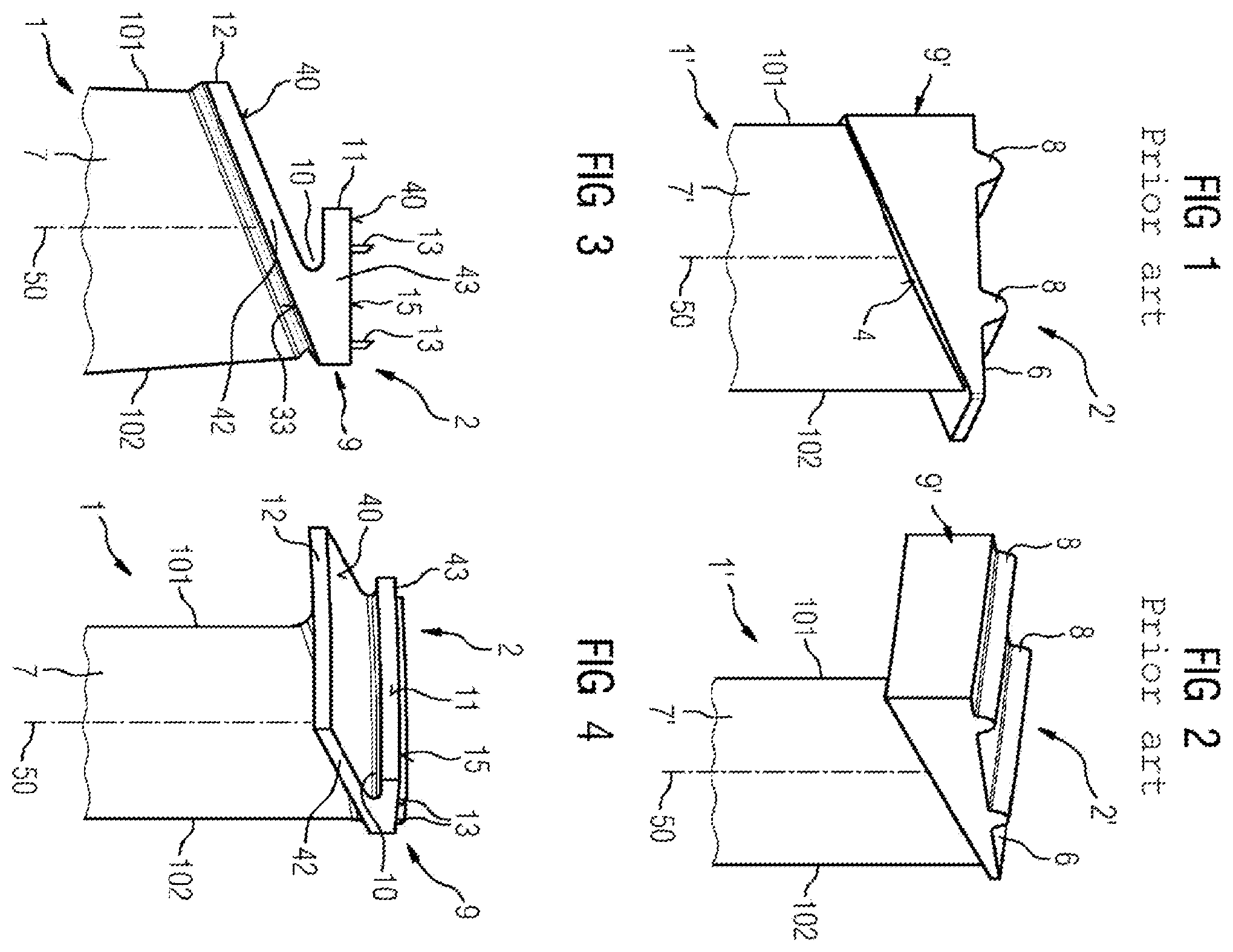
show a shroud according to the prior art, and
, 4 and 5 show a shroud according to the invention.
DETAILED DESCRIPTION OF INVENTION
The figures and the description only illustrate exemplary embodiments of the invention.
shows a shroud 2 ′ according to the prior art, which adjoins a blade aerofoil 7 ′ and constitutes a distal end of a turbine blade 1 ′.
The turbine blade 1 ′ has a longitudinal axis 50 . The longitudinal axis 50 runs perpendicularly to an outer surface 6 of the shroud 2 ′ or represents a radial direction, when the turbine blade 1 ′ is installed in a rotor.
The blade tip 9 ′ is formed at the end of the blade aerofoil 7 ′, the blade tip, as also illustrated in , being wedge-shaped and solid and extending at least over the entire width of the blade aerofoil 7 ′, i.e., from a leading edge 101 as far as a trailing edge 102 of the blade aerofoil 7 ′.
An inner surface 4 of the shroud 2 ′ runs at an acute angle to the longitudinal axis 50 , as seen from the leading edge 101 .
The inner surface 4 is a boundary to the flow path, in particular to the steam path.
The outer surface 6 of the shroud 2 ′ has sealing fins 8 .
The invention is illustrated in more detail in . The blade aerofoil 7 of a turbine blade 1 extends similarly to the blade aerofoil 7 ′ according to and also has a longitudinal axis 50 , and a leading edge 101 and a trailing edge 102 .
However, the blade tip 9 now has a V shape, with an inner surface 33 running at an acute angle to the longitudinal axis 50 , in particular at the same angle as the inner surface 4 of the shroud 2 ′ to the longitudinal axis 50 according to the prior art ( ).
The V shape has two V limbs 42 , 43 , wherein in particular a lower V limb 42 is longer than the other, upper V limb 43 .
The longer, lower V limb 42 extends at least over the entire width of the blade aerofoil 7 .
The longer V limb 42 has an end face 12 in the region of the leading edge 101 .
The plane in which the end face 12 lies is preferably at the same distance from the leading edge 101 or from a trailing edge 102 as a front end face of the shroud 2 ′ according to the prior art ( ) from the leading edge 101 or a trailing edge 102 .
The upper side 40 of the lower V limb 42 preferably runs parallel to the inner surface 33 .
The V shape forms an undercut 10 .
The longitudinal axis 50 runs perpendicularly to the outer surface 15 of the shroud 2 , which is designed according to the invention, or to the upper V limb 43 .
Sealing fins 13 are in turn present on the outer or outermost surface 15 of the shroud 2 .
However, the sealing fins 8 are cross-sectionally wedge-shaped or triangular.
The sealing fins 13 are pointed at least at the end and are preferably rectangular in cross section. This is also illustrated in more detail in .
The sealing fins 13 are in particular machined from a blank, in particular by turning, i.e., are formed integrally with the shroud, but may also be attached as thin plates or build-up welds, i.e., have been attached or fitted separately.
The turbine blade 1 , in particular for a steam turbine, is cast or forged and/or machined from a block.
An end face 11 of the upper V limb 43 does not extend here over the entire width of the blade aerofoil 7 and preferably lies approximately centrally between the leading edge 101 and trailing edge 102 ( ) but may also extend over the entire width of the turbine blade 111 , i.e., as far as the plane of the end face 12 ( ).
Also in the embodiment according to , the lower V limb 42 is longer than the upper V limb 43 , even if they both extend as far as the plane of the end face 12 . This is necessitated by the approximately asymmetrical arrangement of the V limbs 42 , 43 .
A blade from the prior art ( ) may also be formed by material machining according to the invention.
It is also possible to remove the shroud 2 ′ according to and to attach a new shroud 2 ( , 4 and 5 ), in particular by additive processes.
Figures (2)
Citations
This patent cites (12)
- US1482031
- US2265592
- US3014270
- US4767273
- US6632069
- US2016/0130965
- US2019/0360350
- US2020/0400733
- US105697068
- US19542083
- US102017205794
- USWO-9942704