Aluminum Alloy and Application Thereof
Abstract
An aluminum alloy and applications thereof are disclosed. Based on the total weight of the aluminum alloy, the aluminum alloy includes: 8-11% of Si, 2-4% of Cu, 0.6-4% of Zn, 0.65-1.1% of Mn, 0.35-0.65% of Mg, 0.001-0.05% of Cr, 0.01-0.03% of Sr, 0.08-0.12% of Ti, 0.008-0.02% of B, 0.1-0.3% of Fe, 0.01-0.02% of Ga, 0.008-0.015% of Sn, and the balance of Al and less than 0.1% of other elements.
Claims (17)
1. An aluminum alloy, based on the total weight of the aluminum alloy, the aluminum alloy consisting of: 8-11% of Si; 2-4% of Cu; 0.6-4% of Zn; 0.65-1.1% of Mn; 0.35-0.65% of Mg; 0.001-0.05% of Cr; 0.01-0.03% of Sr; 0.08-0.12% of Ti; 0.008-0.02% of B; 0.1-0.3% of Fe; 0.01-0.02% of Ga; 0.008-0.015% of Sn; and the balance of Al and less than 0.1% of other elements.
Show 16 dependent claims
2. The aluminum alloy according to claim 1 , based on the total weight of the aluminum alloy, the aluminum alloy consisting of: 9-11% of Si; 2-3% of Cu; 0.6-2% of Zn; 0.65-0.8% of Mn; 0.35-0.65% of Mg; 0.001-0.02% of Cr; 0.01-0.02% of Sr; 0.08-0.1% of Ti; 0.008-0.01% of B; 0.1-0.3% of Fe; 0.01-0.02% of Ga; 0.008-0.015% of Sn; and the balance of Al and less than 0.1% of other elements, each of the other elements being less than 0.01%.
3. The aluminum alloy according to claim 1 , wherein based on the total weight of the aluminum alloy, a content of P in the aluminum alloy is less than 0.001%.
4. The aluminum alloy according to claim 1 , wherein in the aluminum alloy, a weight ratio of Ti to B is (4-10):1.
5. The aluminum alloy according to claim 1 , wherein in the aluminum alloy, a content of Ga in percentage by weight is greater than a content of B in percentage by weight.
6. The aluminum alloy according to claim 1 , wherein in the aluminum alloy, a weight ratio of Mn to Mg is (1-2.5):1.
7. The aluminum alloy according to claim 1 , wherein in the aluminum alloy, a weight ratio of Ga to Sn is (0.8-1.5):1.
8. The aluminum alloy according to claim 1 , wherein in the aluminum alloy, Zn, Mn, and Mg satisfy the following relationship in weight: −3.979+4.9 Mn+3.991 Mg≤Zn≤8.598−5.047 Mn−3.762 Mg.
9. The aluminum alloy according to claim 1 , wherein a yield strength of the aluminum alloy is not less than 230 MPa, a tensile strength of the aluminum alloy is not less than 380 MPa, an elongation of the aluminum alloy is not less than 3%, and a thermal conductivity of the aluminum alloy is not less than 120 W/(k·m).
10. The aluminum alloy according to claim 2 , wherein based on the total weight of the aluminum alloy, a content of P in the aluminum alloy is less than 0.001%.
11. The aluminum alloy according to claim 10 , wherein in the aluminum alloy, a weight ratio of Ti to B is (4-10):1.
12. The aluminum alloy according to claim 11 , wherein in the aluminum alloy, a content of Ga in percentage by weight is greater than a content of B in percentage by weight.
13. The aluminum alloy according to claim 12 , wherein in the aluminum alloy, a weight ratio of Mn to Mg is (1-2.5):1.
14. The aluminum alloy according to claim 13 , wherein in the aluminum alloy, a weight ratio of Ga to Sn is (0.8-1.5):1.
15. The aluminum alloy according to claim 14 , wherein in the aluminum alloy, Zn, Mn, and Mg satisfy the following relationship in weight: −3.979+4.9 Mn+3.991 Mg≤Zn≤8.598−5.047 Mn−3.762 Mg.
16. The aluminum alloy according to claim 15 , wherein a yield strength of the aluminum alloy is not less than 230 MPa, a tensile strength of the aluminum alloy is not less than 380 MPa, an elongation of the aluminum alloy is not less than 3%, and a thermal conductivity of the aluminum alloy is not less than 120 W/(k·m).
17. A mobile phone, comprising the aluminum alloy according to claim 1 .
Full Description
Show full text →
CROSS-REFERENCE TO RELATED APPLICATIONS
The present disclosure is the U.S. National Stage of the PCT International Application of PCT/CN2020/080947, filed on Mar. 24, 2020, which claims priority to and benefits of Chinese Patent Application No. 201911327356.5, entitled “ALUMINUM ALLOY AND APPLICATIONS THEREOF” filed with the China National Intellectual Property Administration on Dec. 20, 2019. The entire content of the above-referenced applications is are incorporated herein by reference.
FIELD
The present disclosure relates to the technical field of alloy materials, and more specifically, to an aluminum alloy and applications thereof.
BACKGROUND
Die casting is a precision casting process that is characterized by forcing molten metal under high pressure into a metal mold cavity with a complex shape. Die castings are characterized by a very small dimensional tolerance and a high surface precision.
Die casting of aluminum alloys has high requirements on their mechanical properties, such as yield strength, elongation at break, and melt fluidity. During die casting, existing Al—Si alloy materials, such as ADC12, are highly dependent on the accuracy of control conditions for the formation process and are greatly affected by slight variation in process parameters, mainly because it is difficult to give consideration to all the yield strength, tensile strength, elongation, etc. of the Al—Si alloy materials. In different types of Al—Si alloy materials, usually the elongation will decrease correspondingly while the yield strength and tensile strength increase, and the yield strength will decrease correspondingly while the elongation increases. The yield strength, tensile strength, elongation, etc. are all factors that greatly affect the properties of die-casting materials.
SUMMARY
To resolve the problem that it is difficult to give consideration to various property requirements for existing aluminum alloys in die casting, the present disclosure provides an aluminum alloy and applications thereof.
The technical solutions adopted by the present disclosure to resolve the foregoing technical problem are as follows:
According to an aspect, the present disclosure provides an aluminum alloy. Based on the total weight of the aluminum alloy, the aluminum alloy includes: 8-11% of Si, 2-4% of Cu, 0.6-4% of Zn, 0.65-1.1% of Mn, 0.35-0.65% of Mg, 0.001-0.05% of Cr, 0.01-0.03% of Sr, 0.08-0.12% of Ti, 0.008-0.02% of B, 0.1-0.3% of Fe, 0.01-0.02% of Ga, 0.008-0.015% of Sn, and the balance of Al and less than 0.1% of other elements.
Optionally, based on the total weight of the aluminum alloy, the aluminum alloy includes: 9-11% of Si, 2-3% of Cu, 0.6-2% of Zn, 0.65-0.8% of Mn, 0.35-0.65% of Mg, 0.001-0.02% of Cr, 0.01-0.02% of Sr, 0.08-0.1% of Ti, 0.008-0.01% of B, 0.1-0.3% of Fe, 0.01-0.02% of Ga, 0.008-0.015% of Sn, and the balance of Al and less than 0.1% of other elements, each of the other elements being less than 0.01%.
Optionally, based on the total weight of the aluminum alloy, the content of P in the aluminum alloy is less than 0.001%.
Optionally, in the aluminum alloy, the weight ratio of Ti to B is (4-10): 1 .
Optionally, in the aluminum alloy, the content of Ga in percentage by weight is greater than the content of B in percentage by weight.
Optionally, in the aluminum alloy, the weight ratio of Mn to Mg is (1-2.5): 1 .
Optionally, in the aluminum alloy, the weight ratio of Ga to Sn is (0.8-1.5): 1 .
Optionally, in the aluminum alloy, Zn, Mn, and Mg satisfy the following relationship in weight: −3.979+4.9Mn+3.991Mg≤Zn≤8.598−5.047Mn−3.762Mg.
Optionally, for the aluminum alloy, the yield strength of the aluminum alloy is not less than 230 MPa, the tensile strength of the aluminum alloy is not less than 380 MPa, the elongation of the aluminum alloy is not less than 3%, and the thermal conductivity of the aluminum alloy is not less than 120 W/(k·m).
According to another aspect, the present disclosure provides applications of the foregoing aluminum alloy in die-casting materials.
The aluminum alloy provided in the present disclosure breaks through the optimal performance of medium strength and high toughness of existing Al—Si alloys by adjusting proportions of all elements in the aluminum alloy. Usually in Al—Si alloys, when the strength of the alloys is higher than 230 MPa and the elongation at break of the alloys is less than 3%, there is a good formation and no cracking of the alloys. In addition to a high thermal conductivity, the aluminum alloy provided in the present disclosure also ensures the increase of yield strength, tensile strength, and elongation at break. High elongation at break allowing the material to show excellent toughness in die-cast products, resolving the problem that it is difficult for existing Al—Si alloys to give consideration to all the yield strength, tensile strength, and elongation, in addition, the aluminum alloy material has low process requirements, and has good process adaptability in die casting.
Additional aspects and advantages of the present disclosure will be given in the following description, some of which will become apparent from the following description or may be learned from practices of the present disclosure.
BRIEF DESCRIPTION OF THE DRAWINGS
The foregoing additional aspects and advantages of the present disclosure will become apparent and comprehensible from the following descriptions of the embodiments with reference to the accompanying drawings.
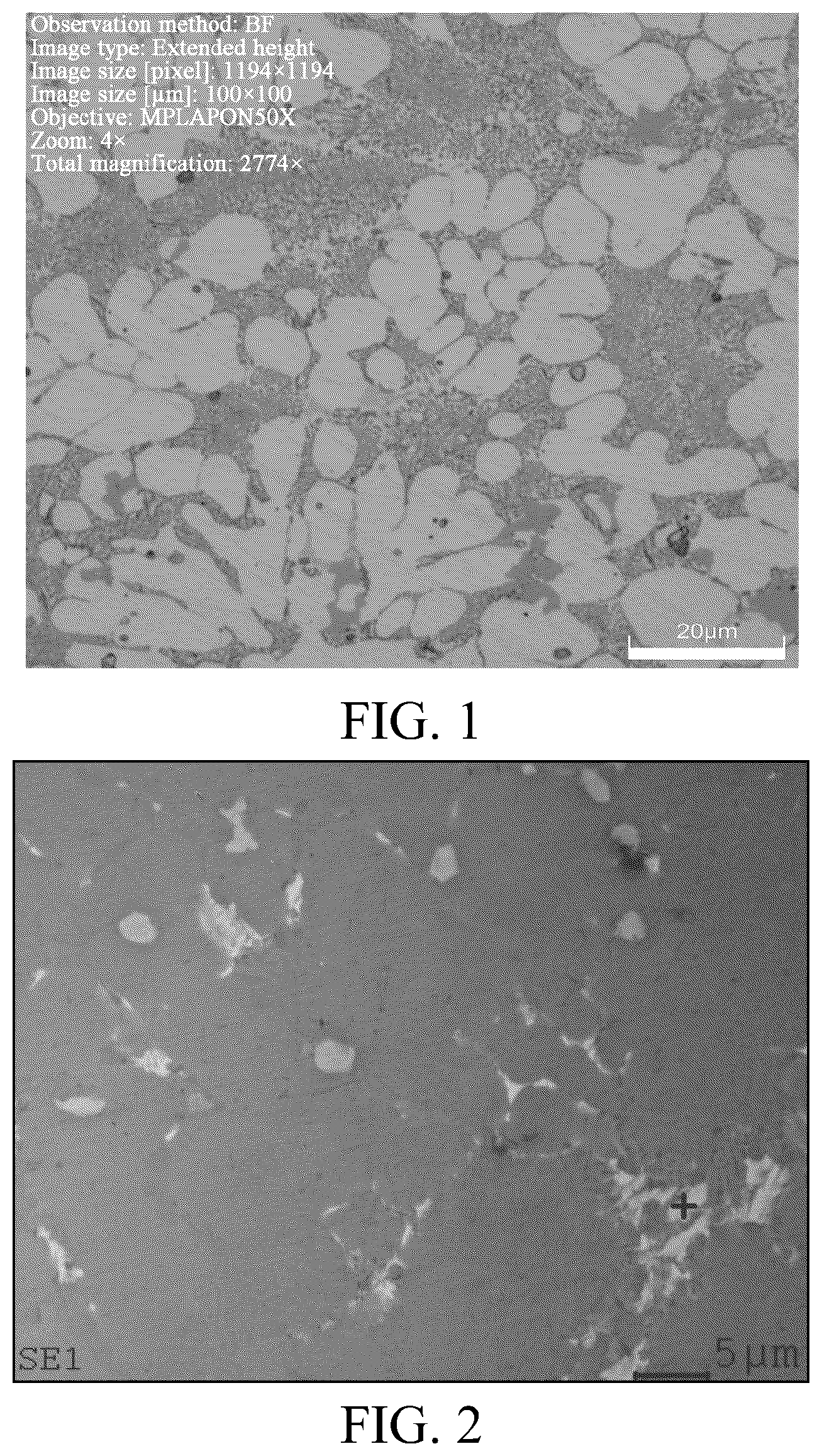
is a metallographic image of an aluminum alloy provided in Example 1 of the present disclosure;
is an SEM image of an aluminum alloy provided in Example 1 of the present disclosure;
is an EDS spectrum of the area marked with the cross in ;
is an SEM image of an aluminum alloy provided in Example 1 of the present disclosure;
is an EDS spectrum of the area marked with the cross in ;
is an SEM image of an aluminum alloy provided in Example 1 of the present disclosure;
is an EDS spectrum of the area marked with the cross in ;
is an SEM image of an aluminum alloy provided in Example 2 of the present disclosure; and
is an EDS spectrum of the area marked with the cross in .
DETAILED DESCRIPTION
The endpoints and any values of the ranges disclosed herein are not limited to the precise range or value, and such ranges or values should be understood to include values that are close to the ranges or values. For numerical ranges, the endpoint values of the various ranges, the endpoint values of the various ranges and the individual point values, and the individual point values may be combined with one another to yield one or more new numerical ranges, and these numerical ranges should be considered as specifically disclosed herein.
To make the technical problems to be resolved by the present disclosure, technical solutions, and beneficial effects more comprehensible, the following further describes the present disclosure in detail with reference to the embodiments. It should be understood that the embodiments described herein are merely used for explaining the present disclosure instead of limiting the present disclosure.
An embodiment of the present disclosure provides an aluminum alloy. Based on the total weight of the aluminum alloy, the aluminum alloy includes: 8-11% of Si, 2-4% of Cu, 0.6-4% of Zn, 0.65-1.1% of Mn, 0.35-0.65% of Mg, 0.001-0.05% of Cr, 0.01-0.03% of Sr, 0.08-0.12% of Ti, 0.008-0.02% of B, 0.1-0.3% of Fe, 0.01-0.02% of Ga, 0.008-0.015% of Sn, and the balance of Al and less than 0.1% of other elements.
The aluminum alloy provided in the present disclosure breaks through the optimal performance of medium strength and high toughness of existing Al—Si alloys by adjusting proportions of all elements in the aluminum alloy. In addition to a high thermal conductivity, the aluminum alloy provided also ensures the increase of yield strength and elongation at break, so that the material shows excellent toughness in die-cast products. In addition, the aluminum alloy material has low process requirements, and has good process adaptability in die casting.
In some embodiments, based on the total weight of the aluminum alloy, the aluminum alloy includes: 9-11% of Si, 2-3% of Cu, 0.6-2% of Zn, 0.65-0.8% of Mn, 0.35-0.65% of Mg, 0.001-0.02% of Cr, 0.01-0.02% of Sr, 0.08-0.1% of Ti, 0.008-0.01% of B, 0.1-0.3% of Fe, 0.01-0.02% of Ga, 0.008-0.015% of Sn, and the balance of Al and less than 0.1% of other elements, each of the other elements being less than 0.01%.
In some embodiments, the content of Si is 9%, 9.5%, 10%, 10.5%, or 11%, the content of Cu is 2%, 2.2%, 2.6%, 2.8%, or 3%, the content of Zn is 0.6%, 0.9%, 1.1%, 1.5%, 1.8%, or 2%, the content of Mn is 0.65%, 0.7%, 0.73%, 0.78%, or 0.8%, the content of Mg is 0.35%, 0.42%, 0.48%, 0.53%, 0.59%, or 0.65%, the content of Cr is 0.001%, 0.005%, 0.01%, 0.013%, 0.017%, or 0.02%, the content of Sr is 0.01%, 0.014%, 0.018%, or 0.02%, the content of Ti is 0.08%, 0.09%, or 0.1%, the content of B is 0.008%, 0.009%, or 0.01%, the content of Fe is 0.1%, 0.16%, 0.25%, or 0.3%, the content of Ga is 0.01%, 0.014%, or 0.02%, and the content of Sn is 0.008%, 0.01%, 0.013%, or 0.015%.
The content of Si is 8-11%, most of Si forms eutectic Si. Without sacrificing the thermal conductivity of the material, on the one hand, the addition of Si ensures the fluidity of the material and improves the formation of the material; on the other hand, modified by Sr and other elements, Si forms extremely fine (0.01-1 μm) fibrous eutectic Si, which greatly increases the grain boundary strength of the material, thereby increasing the overall strength (yield strength and tensile strength) of the material. Si may form Mg 2 Si phase and Al 12 Fe 3 Si phase with Mg and Fe respectively, thereby increasing the overall strength (yield strength and tensile strength) of the material.
Cu and Al form a solid solution phase. In addition, precipitated Al 2 Cu 2 is dispersed on the grain boundary as a strengthening phase, which may increase the strength of the material, but with an excessive amount, it will damage the toughness of the material and reduce the elongation at break.
Zn may be dissolved into the α-aluminum alloy matrix, greatly increasing the overall strength of the alloy. Also, Zn and Cu form a CuZn phase, which ensures good plasticity with high strength. In addition, Zn and Mg form a MgZn 2 strengthening phase uniformly dispersed on the grain boundary, increasing grain boundary energy, thereby increasing the yield strength and toughness of the material.
Mn and Cr may be dissolved into the aluminum alloy matrix to strengthen the performance of the matrix and inhibit the grain growth of primary Si and α-A1, so that the primary Si is dispersed among grains for dispersion strengthening, thereby increasing the strength and toughness of the material. For Mn, most of Mn segregates to the grain boundary and combines with Fe to form a needle-like AlFeMnSi phase, which may increase the overall strength of the material. When the content of Mn is too high, a large number of needle-like structures will cause the splitting of the matrix and reduce the toughness of the material.
Ti and B may form TiB agglomerates. Through the induction of Ti and Ga, the agglomerates combine with Mg and Fe at the original grain boundary to form a large number of spherical phases dispersed among the grains, so that primary Si may uniformly distribute into α-A1, which greatly inhibits the growth of α-A1 (the particle size is reduced by one-third), thereby increasing the strength and toughness of the material.
The mechanical properties, thermal conductivity, and elongation of the aluminum alloy are the result of the combined effect of the foregoing elements. Any element that deviates from the scope provided by the present disclosure deviates from the disclosure intent of the present disclosure, resulting in a reduction in mechanical properties, thermal conductivity, or elongation of the aluminum alloy, thereby detrimental to the applications of the aluminum alloy as a die-casting material.
In some embodiments, based on the total weight of the aluminum alloy, the content of P in the aluminum alloy is less than 0.001%.
It was found through further experiments that an excessively high content of P in the aluminum alloy will cause a reduction in elongation of the aluminum alloy, which is not conducive to die casting of the aluminum alloy.
In some embodiments, in the aluminum alloy, the weight ratio of Ti to B is (4-10):1. For example, the weight ratio of Ti to B is 4:1, 4.1:1, 9.9:1, or 10:1. It was found that Ti and B in this ratio ensure the high strength and thermal conductivity of the material. The reason is that Ti within this content range is uniformly distributed around the eutectic Si, increasing the strength, and the addition of B in this ratio ensures the high strength with good thermal conductivity.
In some embodiments, in the aluminum alloy, the content of Ga in percentage by weight is greater than the content of B in percentage by weight. It was found that, if the content of B in percentage by weight is greater than that of Ga, the excess B will surround Ga, hindering Ga grain refinement, so that Ga cannot uniformly distributed between the eutectic Si and α-solid solution, thereby reducing the toughness and thermal conductivity of the material.
In some embodiments, in the aluminum alloy, the weight ratio of Mn to Mg is (1-2.5):1. For example, the weight ratio of Mn to Mg is 1:1, 1.1:1, 2.4:1, or 2.5:1. It was found that the toughness of the aluminum alloy material in this ratio reaches the optimal state. When greater than this ratio, the excess Mn cannot be solutionized into the material and exists in the form of impurities, resulting in serious inclusions and black hole defects in the material. When less than this ratio, the effect of Mg increases to make the material more obvious in performance after aging and more sensitive to temperature, so that the elongation decreases rapidly and the toughness is insufficient for the material after heat treatment.
In some embodiments, in the aluminum alloy, the weight ratio of Ga to Sn is (0.8-1.5):1. For example, the weight ratio of Ga to Sn is 0.8:1, 0.9:1, 1.4:1, or 1.5:1. It was found that the addition of Ga may increase the toughness and strength of the material; Sn and Mg may form an intermediate alloy phase Mg 2 Sn, effectively inhibiting grain growth and increasing the toughness and strength of the material; and the ratio of Ga to Sn meets the foregoing requirements, which ensures the strength of the material without damaging the toughness of the material. With a ratio of Ga to Sn greater than this ratio, the Mg—Sn phase gradually decreases, even clusters together, and is still distributed at the grain boundary of the aluminum alloy in a linear shape instead of an original dendritic shape, and the formation of Ga-rich phase will capture Mg atoms from Mg 2 Sn, so that the Mg—Sn phase is reduced in its relative content, and gradually clusters to form linear-shape distribution, which will severely split the matrix, resulting in reduced toughness and reduced elongation at break of the material. With a ratio of Ga to Sn less than this ratio, the Mg 2 Sn phase will form a large amount of network and fishbone-like distribution, which is a brittle phase, reducing the toughness of the material.
In some embodiments, in the aluminum alloy, Zn, Mn, and Mg satisfy the following relationship in weight:
−3.979+4.9 Mn+3.991 Mg≤Zn≤8.598−5.047 Mn−3.762 Mg. It was found that, when all the three elements meet this condition, the material may ensure good toughness with high strength.
In some embodiments, for the aluminum alloy, the yield strength of the aluminum alloy is not less than 230 MPa, the tensile strength of the aluminum alloy is not less than 380 MPa, the elongation of the aluminum alloy is not less than 3%, and the thermal conductivity of the aluminum alloy is not less than 120 W/(km).
In some embodiments, the yield strength of the aluminum alloy is 230-260 MPa, the tensile strength of the aluminum alloy is 380-410 MPa, the elongation of the aluminum alloy is 4-7%, and the thermal conductivity of the aluminum alloy is 130-150 W/(km).
Another embodiment of the present disclosure provides applications of the foregoing aluminum alloy in die-casting materials.
The aluminum alloy has high toughness and good elongation without sacrificing the strength and fluidity of the material. The material has low process requirements and is suitable for applications as die-casting materials.
The die-cast aluminum alloy has high thermal conductivity and high toughness. The excellent fluidity and formability of the material combined with the high toughness contribute to the maximum breaking force of three-point bending during die casting of mobile phone mid plates.
The present disclosure is described with reference to the following examples. It should be noted that these examples are merely illustrative and are not intended to limit the present disclosure in any way.
TABLE 1
Si Cu Zn Mn Mg Cr Sr Ti B Fe Ga Sn P
Example 1 10 2.5 1.5 0.7 0.5 0.015 0.015 0.09 0.01 0.2 0.013 0.013 0
Example 2 9.5 2.5 1.5 0.7 0.5 0.015 0.015 0.09 0.01 0.2 0.013 0.013 0
Example 3 10.5 2.5 1.5 0.7 0.5 0.015 0.015 0.09 0.01 0.2 0.013 0.013 0
Example 4 10 2.1 1.5 0.7 0.5 0.015 0.015 0.09 0.01 0.2 0.013 0.013 0
Example 5 10 2.8 1.5 0.7 0.5 0.015 0.015 0.09 0.01 0.2 0.013 0.013 0
Example 6 10 2.5 0.7 0.7 0.5 0.015 0.015 0.09 0.01 0.2 0.013 0.013 0
Example 7 10 2.5 2 0.7 0.5 0.015 0.015 0.09 0.01 0.2 0.013 0.013 0
Example 8 10 2.5 1.5 0.65 0.5 0.015 0.015 0.09 0.01 0.2 0.013 0.013 0
Example 9 10 2.5 1.5 0.8 0.5 0.015 0.015 0.09 0.01 0.2 0.013 0.013 0
Example 10 10 2.5 1.5 0.7 0.35 0.015 0.015 0.09 0.01 0.2 0.013 0.013 0
Example 11 10 2.5 1.5 0.7 0.65 0.015 0.015 0.09 0.01 0.2 0.013 0.013 0
Example 12 10 2.5 1.5 0.7 0.5 0.01 0.015 0.09 0.01 0.2 0.013 0.013 0
Example 13 10 2.5 1.5 0.7 0.5 0.02 0.015 0.09 0.01 0.2 0.013 0.013 0
Example 14 10 2.5 1.5 0.7 0.5 0.015 0.01 0.09 0.01 0.2 0.013 0.013 0
Example 15 10 2.5 1.5 0.7 0.5 0.015 0.02 0.09 0.011 0.2 0.013 0.013 0
Example 16 10 2.5 1.5 0.7 0.5 0.015 0.015 0.08 0.011 0.2 0.013 0.013 0
Example 17 10 2.5 1.5 0.7 0.5 0.015 0.015 0.1 0.011 0.2 0.013 0.013 0
Example 18 10 2.5 1.5 0.7 0.5 0.015 0.015 0.09 0.009 0.2 0.013 0.013 0
Example 19 10 2.5 1.5 0.7 0.5 0.015 0.015 0.09 0.012 0.2 0.013 0.013 0
Example 20 10 2.5 1.5 0.7 0.5 0.015 0.015 0.09 0.011 0.1 0.013 0.013 0
Example 21 10 2.5 1.5 0.7 0.5 0.015 0.015 0.09 0.011 0.3 0.013 0.013 0
Example 22 10 2.5 1.5 0.7 0.5 0.015 0.015 0.09 0.011 0.2 0.012 0.013 0
Example 23 10 2.5 1.5 0.7 0.5 0.015 0.015 0.09 0.011 0.2 0.015 0.013 0
Example 24 10 2.5 1.5 0.7 0.5 0.015 0.015 0.09 0.011 0.2 0.013 0.011 0
Example 25 10 2.5 1.5 0.7 0.5 0.015 0.015 0.09 0.011 0.2 0.013 0.015 0
Example 26 8 2.5 1.5 0.7 0.5 0.015 0.015 0.09 0.011 0.2 0.013 0.013 0
Example 27 10 4 1.5 0.7 0.5 0.015 0.015 0.09 0.011 0.2 0.013 0.013 0
Example 28 10 2.5 3 0.7 0.5 0.015 0.015 0.09 0.011 0.2 0.013 0.013 0
Example 29 10 2.5 1.5 1.1 0.5 0.015 0.015 0.09 0.011 0.2 0.013 0.013 0
Example 30 10 2.5 1.5 0.7 0.5 0.04 0.015 0.09 0.011 0.2 0.013 0.013 0
Example 31 10 2.5 1.5 0.7 0.5 0.015 0.03 0.09 0.011 0.2 0.013 0.013 0
Example 32 10 2.5 1.5 0.7 0.5 0.015 0.015 0.11 0.011 0.2 0.013 0.013 0
Example 33 10 2.5 1.5 0.7 0.5 0.015 0.015 0.09 0.016 0.2 0.017 0.013 0
Example 34 10 2.5 1.5 0.7 0.5 0.015 0.015 0.09 0.011 0.2 0.013 0.013 0.0009
Example 35 10 2.5 1.5 0.7 0.5 0.015 0.015 0.09 0.011 0.2 0.013 0.013 0.01
Example 36 10 2.5 1.5 0.7 0.5 0.015 0.015 0.12 0.011 0.2 0.013 0.013 0
Example 37 10 2.5 1.5 0.7 0.5 0.015 0.015 0.09 0.015 0.2 0.013 0.013 0
Example 38 10 2.5 1.5 1.1 0.35 0.015 0.015 0.09 0.011 0.2 0.013 0.013 0
Example 39 10 2.5 1.5 0.7 0.5 0.015 0.015 0.09 0.011 0.2 0.01 0.015 0
Example 40 10 2.5 1.5 0.7 0.5 0.015 0.015 0.09 0.011 0.2 0.02 0.01 0
Example 41 10 2.5 1 0.7 0.5 0.015 0.015 0.09 0.01 0.2 0.013 0.013 0
Comparative 10 2.5 1.5 0.7 0.5 0.015 0.015 0.09 0.011 0.2 0.013 0.013 0.15
Example 1
Comparative 6 2.5 1.5 0.7 0.5 0.015 0.015 0.09 0.011 0.2 0.013 0.013 0
Example 2
Comparative 14 2.5 1.5 0.7 0.5 0.015 0.015 0.09 0.011 0.2 0.013 0.013 0
Example 3
Comparative 10 1 1.5 0.7 0.5 0.015 0.015 0.09 0.011 0.2 0.013 0.013 0
Example 4
Comparative 10 6 1.5 0.7 0.5 0.015 0.015 0.09 0.011 0.2 0.013 0.013 0
Example 5
Comparative 10 2.5 0.1 0.7 0.5 0.015 0.015 0.09 0.011 0.2 0.013 0.013 0
Example 6
Comparative 10 2.5 7 0.7 0.5 0.015 0.015 0.09 0.011 0.2 0.013 0.013 0
Example 7
Comparative 10 2.5 1.5 0.3 0.5 0.015 0.015 0.09 0.011 0.2 0.013 0.013 0
Example 8
Comparative 10 2.5 1.5 1.5 0.5 0.015 0.015 0.09 0.011 0.2 0.013 0.013 0
Example 9
Comparative 10 2.5 1.5 0.7 0.1 0.015 0.015 0.09 0.011 0.2 0.013 0.013 0
Example 10
Comparative 10 2.5 1.5 0.7 0.5 0 0.015 0.09 0.011 0.2 0.013 0.013 0
Example 11
Comparative 10 2.5 1.5 0.7 0.5 0.1 0.015 0.09 0.011 0.2 0.013 0.013 0
Example 12
Comparative 10 2.5 1.5 0.7 0.5 0.015 0.005 0.09 0.011 0.2 0.013 0.013 0
Example 13
Comparative 10 2.5 1.5 0.7 0.5 0.015 0.1 0.09 0.011 0.2 0.013 0.013 0
Example 14
Comparative 10 2.5 1.5 0.7 0.5 0.015 0.015 0.01 0.011 0.2 0.013 0.013 0
Example 15
Comparative 10 2.5 1.5 0.7 0.5 0.015 0.015 0.6 0.011 0.2 0.013 0.013 0
Example 16
Comparative 10 2.5 1.5 0.7 0.5 0.015 0.015 0.09 0 0.2 0.013 0.013 0
Example 17
Comparative 10 2.5 1.5 0.7 0.5 0.015 0.015 0.09 0.09 0.2 0.013 0.013 0
Example 18
Comparative 10 2.5 1.5 0.7 0.5 0.015 0.015 0.09 0.011 0.8 0.013 0.013 0
Example 19
Comparative 10 2.5 1.5 0.7 0.5 0.015 0.015 0.09 0.011 0.2 0.001 0.013 0
Example 20
Comparative 10 2.5 1.5 0.7 0.5 0.015 0.015 0.09 0.011 0.2 0.08 0.013 0
Example 21
Comparative 10 2.5 1.5 0.7 0.5 0.015 0.015 0.09 0.011 0.2 0.013 0 0
Example 22
Comparative 10 2.5 1.5 0.7 0.5 0.015 0.015 0.09 0.011 0.2 0.013 0.07 0
Example 23
Note:
Each composition in Table 1 is in percentage by weight, and the total weight of inevitable impurity elements is less than 0.1%.
Example 1
This example is used to describe the aluminum alloy and the preparation method thereof in the present disclosure, including the following steps:
As shown in Table 1, the components of the aluminum alloy in percentage by weight include: 10% of Si, 2.5% of Cu, 1.5% of Zn, 0.7% of Mn, 0.5% of Mg, 0.015% of Cr, 0.015% of Sr, 0.09% of Ti, 0.01% of B, 0.2% of Fe, 0.013% of Ga, and 0.013% of Sn. The required weight of intermediate alloys or metal elements was calculated based on the weight of the foregoing components of the aluminum alloy, and the intermediate alloys or metal elements were melted and mixed into an aluminum alloy ingot. The aluminum alloy ingot was naturally aged for 7 d to obtain an aluminum alloy.
Examples 2-41
Examples 2-41 are used to describe the aluminum alloy and the preparation method thereof in the present disclosure, including most of the steps in Example 1, and the difference is as follows:
Using the compositions of the aluminum alloy shown in Examples 2-41 in Table 1, the required weight of intermediate alloys or metal elements was calculated based on the weight of the components of the aluminum alloy, and the intermediate alloys or metal elements were melted and mixed into an aluminum alloy ingot. The aluminum alloy ingot was naturally aged for 7 d to obtain an aluminum alloy.
Comparative Example 1
This comparative example is used to comparatively describe the aluminum alloy and the preparation method thereof in the present disclosure, including the following steps:
As shown in Table 1, the components of the aluminum alloy in percentage by weight include: 10% of Si, 2.5% of Cu, 1.5% of Zn, 0.7% of Mn, 0.5% of Mg, 0.015% of Cr, 0.015% of Sr, 0.09% of Ti, 0.01% of B, 0.2% of Fe, 0.013% of Ga, 0.013% of Sn, and 0.15% of P. The required weight of intermediate alloys or metal elements was calculated based on the weight of the foregoing components of the aluminum alloy, and the intermediate alloys or metal elements were melted and mixed into an aluminum alloy ingot. The aluminum alloy ingot was naturally aged for 7 d to obtain an aluminum alloy.
Comparative Examples 2-23
Comparative Examples 2-23 are used to describe the aluminum alloy and the preparation method thereof in the present disclosure, including most of the steps in Example 1, and the difference is as follows:
Using the compositions of the aluminum alloy shown in Comparative Examples 2-23 in Table 1, the required weight of intermediate alloys or metal elements was calculated based on the weight of the components of the aluminum alloy, and the intermediate alloys or metal elements were melted and mixed into an aluminum alloy ingot. The aluminum alloy ingot was naturally aged for 7 d to obtain an aluminum alloy.
Performance Test
1. The metallographic structure of the aluminum alloy prepared in Example 1 was observed to obtain a metallographic image shown in .
In the figure, the white area is α-A1, which is spherical or rod-shaped and about 10 μm in size;
the dark gray area is primary Si, which is randomly distributed between the α-A1 grain boundaries;
the light gray area is Al 2 Cu, which is distributed between the α-A1 grain boundaries and is irregularly bone-shaped; and
the densely distributed areas in the form of particles and ovals are eutectic Si and strengthening phases, which are mainly distributed around the α-A1 grains.
The aluminum alloy prepared in Example 1 was imaged by using a scanning electron microscope (SEM) to obtain SEM images shown in , , and . The area marked with the cross in was subjected to EDS detection to obtain an EDS spectrum shown in . The EDS spectrum was analyzed to obtain the composition of the area marked with the cross in , as shown in Table 2.
TABLE 2
Element wt % at %
O 00.80 01.76
Mg 00.69 00.99
Al 53.54 69.69
Si 03.65 04.57
Mn 01.07 00.69
Fe 00.62 00.39
Cu 39.63 21.91
It can be learned from Table 2 that this area is a CuAl 2 phase, which is irregularly bone-shaped, is light pink without erosion, and is one of the main strengthening phases in the alloy. Because this phase is excessively small, and the minimum test range of the test point is 1 μm 2 , the obtained composition is slightly deviated.
The area marked with the cross in was subjected to EDS detection to obtain an EDS spectrum shown in . The EDS spectrum was analyzed to obtain the composition of the area marked with the cross in , as shown in Table 3.
TABLE 3
Element wt % at %
O 00.02 00.05
Al 62.01 71.21
Si 14.09 15.54
Mn 16.66 09.40
Fe 04.31 02.39
Cu 02.90 01.41
It can be learned from Table 3 that this area is an a (AlMnSi or Al 12 MnSi) phase, which is mostly irregular in shape and is bright gray without erosion, and Fe, Mn, Cu, and Cr may be substituted for each other.
The area marked with the cross in was subjected to EDS detection to obtain an EDS spectrum shown in . The EDS spectrum was analyzed to obtain the composition of the area marked with the cross in , as shown in Table 4.
TABLE 4
Element wt % at %
O 00.56 00.99
Zn 01.56 00.68
Mg 04.71 05.51
Al 77.42 81.50
Si 07.61 07.69
Cu 08.15 03.64
It can be learned from Table 4 that this area is a W(Al x Cu 4 Mg 5 Si 4 ) phase, which is a quaternary phase and is a bone-shaped or ice-shaped dense eutectic. Because this phase is excessively small, and the minimum test range of the test point is 1 μm 2 , the obtained composition is slightly deviated.
The aluminum alloy prepared in Example 2 was imaged by using a scanning electron microscope (SEM) to obtain an SEM image shown in . The area marked with the cross in was subjected to EDS detection to obtain an EDS spectrum shown in . The EDS spectrum was analyzed to obtain the composition of the area marked with the cross in , as shown in Table 5.
TABLE 5
Element wt % at %
O 00.25 00.43
Zn 00.39 00.16
Mg 00.31 00.35
Al 60.50 61.71
Si 37.75 36.99
Cu 00.81 00.35
It can be learned from Table 5 that this area is eutectic Si, which is mostly granular and uniformly dispersed around α-Al, and is one of the main strengthening phases in the alloy.
2. The aluminum alloys prepared in Examples 1-41 and Comparative Examples 1-23 were subjected to the following performance tests:
Tensile Test:
The yield strength, tensile strength, and elongation were tested according to GBT 228.1-2010 Metallic Materials Tensile Testing Part 1: Room Temperature Test Methods.
Comparative Analysis of Three-Point Bending Test:
The aluminum alloy was die-cast to form a mobile phone mid plate test piece with a size determined before testing. Two horizontal and parallel steel support rollers with a diameter of 6 mm were provided and adjusted to a distance between the axes of 110 mm. The test piece faced up was placed on the two support rollers. A steel indenter with a diameter of 6 mm was provided above the test piece. The center of the test piece was coincident with the position of the indenter. The force was reset to zero before the indenter contacted the test piece. The indenter moved downward at a speed of 5 mm/min. When the force of the indenter on the test piece was 3 N, the force and displacement were reset to zero, and the indenter continued to move at the same speed until the test piece broke. The maximum breaking force and breaking deflection were recorded.
Fluidity Test:
Test condition: Mosquito coil mold, die casting under atmospheric pressure
Test method: Under the same molding conditions, the length of test pieces of a to-be-tested material and a standard material ADC12 after die casting was compared, and the fluidity was calculated by dividing the length of the to-be-tested material by the length of the standard material, to evaluate the flow molding performance of the material.
Thermal Conductivity Test:
A thermally conductive ingot wafer of ϕ 12.7×3 mm was prepared as a to-be-tested piece, and graphite was evenly sprayed on both sides of the to-be-tested piece to form a coating. The coated piece was tested by using a laser thermal conductivity instrument. The laser thermal conductivity test was carried out in accordance with ASTM E1461 Standard Test Method for Thermal Diffusivity by the Flash Method.
The test results are shown in Table 6.
TABLE 6
Thermal
Yield Tensile Maximum Fluidity in conductivity
strength strength breaking Breaking mosquito of ingot
(MPa) (MPa) Elongation force deflection coil mold W/(m · k)
Example 1 238 385 4.8 408 6.05 100 138
Example 2 232 382 5 405 6.23 96 140
Example 3 240 392 4.6 417 5.81 101 135
Example 4 230 383 5.2 406 6.45 100 138
Example 5 245 398 4.3 421 5.55 99 135
Example 6 239 386 4.8 409 6.02 101 139
Example 7 241 388 4.7 411 5.91 99 134
Example 8 234 383 5 404 6.25 99 141
Example 9 240 391 4.7 414 5.95 101 135
Example 10 230 380 6 403 7.25 100 141
Example 11 246 388 4 412 5.19 100 133
Example 12 231 382 5 405 6.25 100 138
Example 13 241 390 4.3 413 5.5 100 137
Example 14 232 382 5.2 405 6.45 100 139
Example 15 245 393 4 420 5.28 100 137
Example 16 236 384 5.1 405 6.35 100 139
Example 17 242 393 4.6 416 5.83 100 138
Example 18 236 381 4.9 404 6.15 100 140
Example 19 240 388 5.2 410 6.43 100 141
Example 20 235 383 5.5 406 6.72 98 139
Example 21 244 394 4.1 417 5.35 101 137
Example 22 233 382 5.1 405 6.35 100 138
Example 23 241 390 4.7 410 5.93 100 138
Example 24 231 380 5 403 6.25 100 139
Example 25 237 389 4.4 412 5.6 100 137
Example 26 230 380 6 402 7.25 95 137
Example 27 261 420 3.3 443 4.59 96 134
Example 28 238 388 3.5 409 4.75 98 131
Example 29 249 389 4 412 5.27 99 131
Example 30 252 396 3.9 420 5.15 100 130
Example 31 255 392 3.8 415 5.01 100 134
Example 32 256 399 3.4 422 4.65 100 134
Example 33 259 397 3.2 422 4.44 99 134
Example 34 241 389 3.9 412 5.15 100 132
Example 35 244 388 3.2 411 4.49 100 133
Example 36 233 381 4.2 404 5.45 100 121
Example 37 240 393 3.5 418 4.75 100 125
Example 38 242 380 3 403 4.22 98 129
Example 39 252 396 3.1 419 4.33 100 128
Example 40 253 396 3 418 4.4 100 128
Example 41 260 400 3 423 4.22 102 127
Comparative 241 362 2.3 385 3.72 98 121
Example 1
Comparative 220 353 6.2 376 7.11 90 130
Example 2
Comparative 241 370 2.1 393 3 102 120
Example 3
Comparative 213 341 5.9 364 6.88 98 131
Example 4
Comparative 280 399 2.2 424 3.02 93 123
Example 5
Comparative 212 381 3 404 5.82 99 131
Example 6
Comparative 279 365 2.3 378 3.81 94 118
Example 7
Comparative 229 361 5.8 384 6.74 100 130
Example 8
Comparative 249 399 2.4 421 3.66 98 118
Example 9
Comparative 219 351 7 374 7.9 99 131
Example 10
Comparative 193 379 4.1 402 5.21 100 131
Example 11
Comparative 274 388 2.3 411 3.2 100 125
Example 12
Comparative 218 362 5.8 385 6.7 100 129
Example 13
Comparative 242 399 2.5 412 3.71 100 128
Example 14
Comparative 215 375 5 398 5.99 100 125
Example 15
Comparative 277 399 1.9 422 3.83 100 118
Example 16
Comparative 209 373 3.2 396 4.12 100 125
Example 17
Comparative 289 367 2.3 388 3.8 100 126
Example 18
Comparative 240 333 1.5 356 2.4 98 121
Example 19
Comparative 213 332 5 355 3.88 100 131
Example 20
Comparative 289 393 2 416 3.8 100 128
Example 21
Comparative 219 379 5.2 402 6.15 100 131
Example 22
Comparative 250 339 2.6 362 3.8 100 127
Example 23
It can be learned by comparing the test results of Examples 1-41 with the test results of Comparative Examples 1-23 that, compared with aluminum alloys without the element range provided in the present disclosure, the aluminum alloy provided in the present disclosure has good mechanical strength, may meet the requirements of the die-casting process, and has good thermal conductivity, elongation, and die-casting formability.
The implementations of the present disclosure are described in detail above, but the present disclosure is not limited to the details in the foregoing implementations. Various simple variations may be made to the technical solutions of the present disclosure within the scope of the technical idea of the present disclosure, and such simple variations shall all fall within the protection scope of the present disclosure.
It should be further noted that the technical features described in the foregoing implementations may be combined in any suitable manner without contradiction. To avoid unnecessary repetition, various possible combinations are not further described in the present disclosure.
In addition, the various embodiments of the present disclosure may be combined without departing from the idea of the present disclosure, and such combinations shall also fall within the scope of the present disclosure.
In the descriptions of this specification, descriptions using reference terms “an embodiment”, “some embodiments”, “an example”, “a specific example”, or “some examples” mean that specific characteristics, structures, materials, or features described with reference to the embodiment or example are included in at least one embodiment or example of the present disclosure. In this specification, schematic representations of the foregoing terms are not necessarily directed to the same embodiment or example. Moreover, the specific features, structures, materials, or characteristics described may be combined in any one or more embodiments or examples in a suitable manner. In addition, different embodiments or examples described in this specification, as well as features of different embodiments or examples, may be integrated and combined by a person skilled in the art without contradicting each other.
Although the embodiments of the present disclosure have been shown and described above, it can be understood that, the foregoing embodiments are exemplary and cannot be understood as limitation to the present disclosure. A person of ordinary skill in the art can make changes, modifications, replacements, or variations to the foregoing embodiments within the scope of the present disclosure.
Figures (8)
Citations
This patent cites (23)
- US6824737
- US1410572
- US1537961
- US1737176
- US102312135
- US102676885
- US103031473
- US104878250
- US105039798
- US105088033
- US106119626
- US106367638
- US106811630
- US108624788
- US109022940
- US109457146
- US110184510
- US110343918
- US110453122
- US110527871
- US102009036056
- US1645647
- US2004007834