Abstract
An object is to provide a technique capable of suppressing heat occurring in a second semiconductor switching element. A semiconductor device includes a parallel circuit in which a first semiconductor switching element and a second semiconductor switching element are parallelly connected and a gate drive circuit. When a state continuing time which is a time during which the state of the input signal continues is equal to or larger than a threshold value, the gate drive circuit turns off the second semiconductor switching element while keeping ON of the first semiconductor switching element, or reduces a power conduction capability of the second semiconductor switching element while keeping ON of the first semiconductor switching element.
Claims (8)
1. A semiconductor device, comprising: a parallel circuit in which a first semiconductor switching element and a second semiconductor switching element having a larger bandgap than the first semiconductor switching element are parallelly connected; and a gate drive circuit capable of changing a time of continuing a state of ON of the first semiconductor switching element and the second semiconductor switching element based on the state of ON or OFF of an input signal, wherein when a state continuing time which is a time during which the state of the input signal continues is equal to or larger than a threshold value, the gate drive circuit turns off the second semiconductor switching element while keeping ON of the first semiconductor switching element, or reduces a power conduction capability of the second semiconductor switching element while keeping ON of the first semiconductor switching element.
Show 7 dependent claims
2. The semiconductor device according to claim 1 , wherein the gate drive circuit turns on the second semiconductor switching element after turning on the first semiconductor switching element, and turns off the first semiconductor switching element after turning off the second semiconductor switching element.
3. The semiconductor device according to claim 1 , wherein when the state continuing time is equal to or larger than the threshold value, the gate drive circuit repeats ON and OFF of the second semiconductor switching element while keeping ON of the first semiconductor switching element.
4. The semiconductor device according to claim 1 , wherein when the state continuing time is equal to or larger than the threshold value, the gate drive circuit keeps OFF of the second semiconductor switching element or reduces the power conduction capability of the second semiconductor switching element on the state, which subsequently occurs, of the input signal.
5. The semiconductor device according to claim 1 , wherein the first semiconductor switching element is an IGBT made of silicon, and the second semiconductor switching element is a MOSFET made of silicon carbide.
6. The semiconductor device according to claim 2 , wherein when the state continuing time is equal to or larger than the threshold value, the gate drive circuit repeats ON and OFF of the second semiconductor switching element while keeping ON of the first semiconductor switching element.
7. The semiconductor device according to claim 2 , wherein when the state continuing time is equal to or larger than the threshold value, the gate drive circuit keeps OFF of the second semiconductor switching element or reduces the power conduction capability of the second semiconductor switching element on the state, which subsequently occurs, of the input signal.
8. The semiconductor device according to claim 2 , wherein the first semiconductor switching element is an IGBT made of silicon, and the second semiconductor switching element is a MOSFET made of silicon carbide.
Full Description
Show full text →
BACKGROUND OF THE INVENTION
Field of the Invention
The present disclosure relates to a semiconductor device.
Description of the Background Art
Conventionally, an insulated gate bipolar transistor (IGBT) and a metal oxide semiconductor field effect transistor (MOSFET) made of inexpensive silicon (Si) are generally used as a power element of an inverter device for driving a motor, for example. In the meanwhile, in recent years, there are increasing opportunities of using a high-efficient power element made of silicon carbide (SiC) or gallium nitride (GaN) as a wide bandgap (WBG) semiconductor.
However, the WBG semiconductor is expensive, thus does not become common in a value-oriented consumer apparatus, for example. Proposed accordingly is usage of a parallel circuit made up of a small-sized SiC-MOSFET and Si-IGBT parallelly connected to each other for long-time usage at low current in a drive motor of a compressor in a home air-conditioner, for example. Expected according to such manufactures is reduction in cost caused by downsizing of the SiC-MOSFET and improvement of efficiency (that is to say, reduction of loss) caused by favorable DC characteristics at low current in the SiC-MOSFET.
An air conditioner can be generally operated at low current when it takes a certain time after being activated and a room temperature becomes stable. In the meanwhile, when a rapid change of a room temperature is necessary at a time of starting activation of the air conditioner, for example, current in a drive motor in a compressor increases, and accordingly, current flowing in an SiC element also increases. Thus, when the DC characteristics of the SiC element is excessively improved, current flowing in the SiC element excessively increases and high heat occurs at a time of increasing current in the motor. The high heat may cause a defect in the SiC element such as the SiC-MOSFET having low heat radiation properties due to a downsized configuration.
Thus, Japanese Patent No. 6544316 proposes a technique of turning off an SiC element or reducing gate voltage of the SiC element when a temperature and current of a parallel circuit are detected and are equal to or larger than threshold values, respectively.
SUMMARY
However, there is a problem that a size and cost of a semiconductor increase when a temperature detection circuit and a current detection circuit are provided to the semiconductor device for a small-sized home electrical appliance provided with a power element with a high density.
The present disclosure is made in consideration of the above problems, and an object of the present disclosure is to provide a technique capable of suppressing heat occurring in a second semiconductor switching element such as an SiC element without providing a temperature detection circuit and a current detection circuit.
A semiconductor device according to the present disclosure includes: a parallel circuit in which a first semiconductor switching element and a second semiconductor switching element having a larger bandgap than the first semiconductor switching element are parallelly connected; and a gate drive circuit capable of changing a time of continuing a state of ON of the first semiconductor switching element and the second semiconductor switching element based on the state of ON or OFF of an input signal. When a state continuing time which is a time during which the state of the input signal continues is equal to or larger than a threshold value, the gate drive circuit turns off the second semiconductor switching element while keeping ON of the first semiconductor switching element, or reduces a power conduction capability of the second semiconductor switching element while keeping ON of the first semiconductor switching element.
Heat occurring in the second semiconductor switching element can be suppressed.
These and other objects, features, aspects and advantages of the present invention will become more apparent from the following detailed description of the present invention when taken in conjunction with the accompanying drawings.
BRIEF DESCRIPTION OF THE DRAWINGS
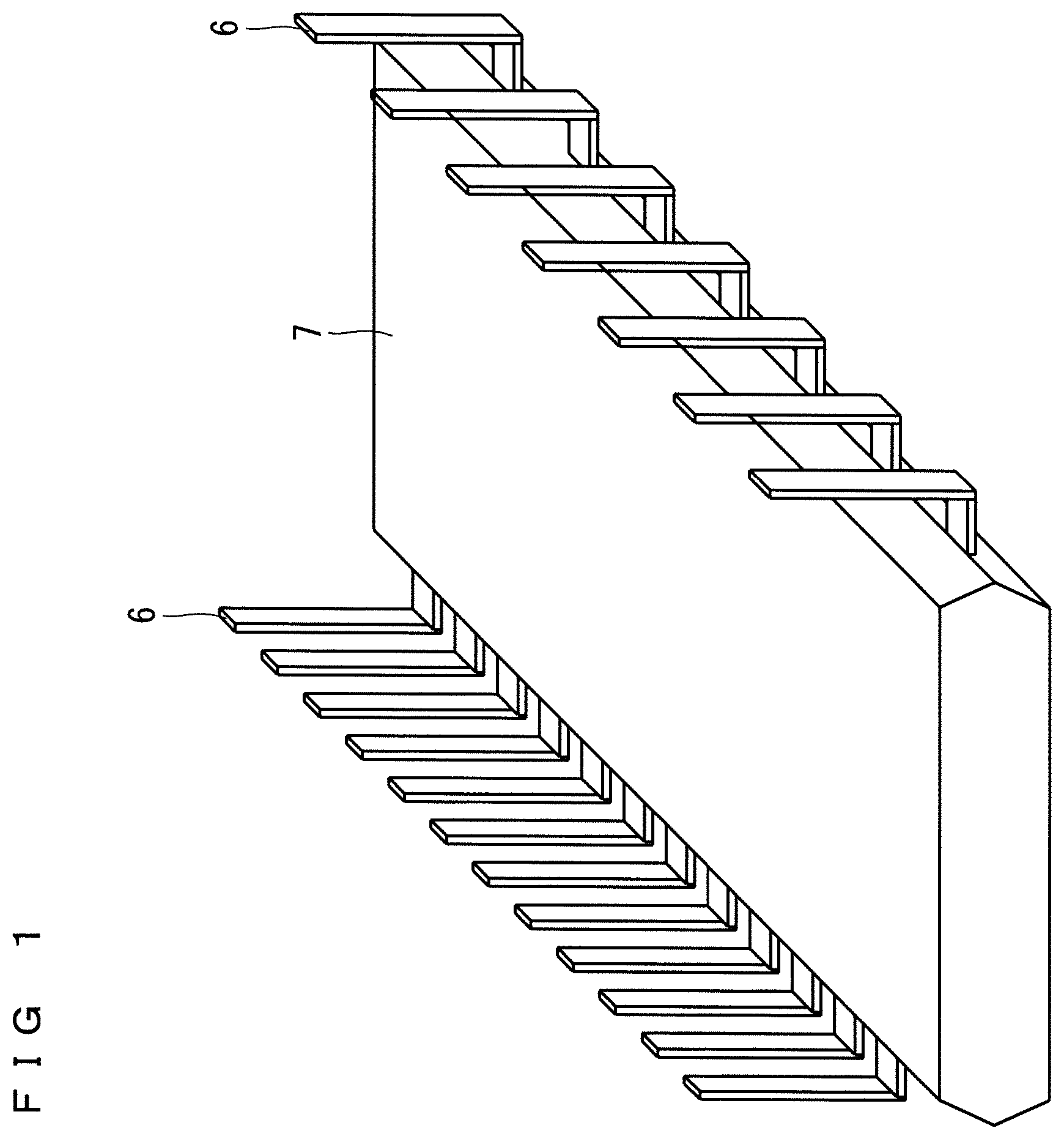
is a perspective view illustrating an outer configuration of a semiconductor device according to an embodiment 1.
is a plan view illustrating an inner configuration of the semiconductor device according to the embodiment 1.
is a diagram illustrating an application example of the semiconductor device according to the embodiment 1.
is a diagram illustrating a configuration of the semiconductor device according to the embodiment 1.
is a timing chart illustrating an operation of the semiconductor device according to the embodiment 1.
is a diagram illustrating a configuration of a semiconductor device according to an embodiment 2.
is a timing chart illustrating an operation of the semiconductor device according to the embodiment 2.
is a diagram illustrating a configuration of a semiconductor device according to an embodiment 3.
is a timing chart illustrating an operation of the semiconductor device according to the embodiment 3.
is a diagram illustrating an example of an input signal.
is a diagram illustrating a configuration of a semiconductor device according to an embodiment 4.
is a timing chart illustrating an operation of the semiconductor device according to the embodiment 4.
is a diagram illustrating a configuration of a semiconductor device according to an embodiment 5.
is a timing chart illustrating an operation of the semiconductor device according to the embodiment 5.
DESCRIPTION OF THE PREFERRED EMBODIMENTS
Embodiments are described with reference to the appended diagrams hereinafter. Features described in each embodiment described below is exemplification, thus all features are not necessarily applied. The same or similar reference numerals will be assigned to similar constituent elements in a plurality of embodiments in the description hereinafter, and the different constituent elements are mainly described hereinafter.
Embodiment 1
is a perspective view illustrating an outer configuration of a semiconductor device according to the present embodiment 1, and is a plan view illustrating an inner configuration of the semiconductor device. As illustrated in , the semiconductor device according to the present embodiment 1 includes a parallel circuit 1 , a gate drive circuit 2 , a lead frame 6 , and a sealing member 7 .
The parallel circuit 1 includes a first semiconductor switching element and a second switching element, and the first semiconductor switching element and the second semiconductor switching element are parallelly connected to each other.
In the present embodiment 1, the first semiconductor switching element is an Si element 1 a made of silicon (Si). In the description hereinafter, the Si element 1 a is an IGBT, but is not limited to the IGBT. The Si element 1 a may be a reverse conducting-IGBT (RC-IGBT) or a MOSFET.
In the present embodiment 1, the second semiconductor switching element is an SiC element 1 b made of silicon carbide (SiC). It is sufficient that the second semiconductor switching element has a larger bandgap than the first semiconductor switching element, thus the second semiconductor switching element may be an element made of a wide bandgap (WBG) semiconductor such as GaN or diamond, for example. The SiC element 1 b made of SiC can improve efficiency, that is to say, it can reduce loss.
In the description hereinafter, the SiC element 1 b is a MOSFET in which the loss is reduced particularly at low current and an effect is easily obtained, however, the configuration is not limited thereto. The SiC element 1 b may also be the IGBT, for example. A size of the SiC element 1 b is preferably smaller than that of the Si element 1 a from a viewpoint of cost of a semiconductor device.
The gate drive circuit 2 is connected to a gate terminal of the Si element 1 a and the SiC element 1 b , and controls gate voltage of the Si element 1 a and the SiC element 1 b to control ON and OFF of the Si element 1 a and the SiC element 1 b.
The number of the parallel circuits 1 in is six, and the number of the gate drive circuits 2 is two, however, the configuration is not limited thereto. For example, as illustrated in , it is applicable that six parallel circuits 1 and six gate drive circuits 2 are connected to a drive motor 8 driving a compressor of a home electrical appliance such as an air conditioner to constitute a three-phase motor drive circuit. Description hereinafter is an example of a configuration that one gate drive circuit 2 is provided to one parallel circuit 1 for convenience of description.
As illustrated in , the lead frame 6 is electrically connected to the parallel circuit 1 and the gate drive circuit 2 . As illustrated in and , the sealing member 7 covers the parallel circuit 1 , the gate drive circuit 2 , and the lead frame 6 while exposing a part of the lead frame 6 .
is a diagram illustrating a configuration of the semiconductor device according to the present embodiment 1, and is specifically a diagram illustrating configurations of the parallel circuit 1 and the gate drive circuit 2 according to the present embodiment 1 in detail.
A collector terminal and emitter terminal of the Si element 1 a and a drain terminal and source terminal of the SiC element 1 b are connected to each other, respectively, to constitute the parallel circuit 1 .
It is preferable to improve DC characteristics of the SiC element 1 b by reducing on resistance of the SiC element 1 b as much as possible, for example, to reduce the loss at a time of flowing low current to the parallel circuit 1 . A method of reducing the on resistance of the SiC element 1 b includes a method of increasing a size of the SiC element 1 b and a method of changing an element structure and a process adjustment such as changing a gate structure of the SiC element 1 b from a planar type to a trench type, for example. Manufacturing cost, for example, increases in the method of increasing the size of the SiC element 1 b , thus the method of changing the element structure and the process adjustment is preferable.
However, when the DC characteristics of the SiC element 1 b is excessively improved, high heat occurs in the SiC element 1 b at a time of starting activation of an air conditioner, for example, and a defect may occur in the SiC element 1 b . In contrast, according to the gate drive circuit 2 according to the present embodiment 1 described hereinafter, such problems can be solved.
An outline of the gate drive circuit 2 is described before the detailed description thereof. An input signal selectively having ON and OFF is inputted from an external controller not shown in the diagrams to the gate drive circuit 2 . The external controller can change a state continuing time which is a time during which the ON state or the OFF state of input signal continues. In the description hereinafter, the state continuing time is an ON continuing time which is a time during which the ON state of the input signal continues. However, it is also applicable that ON and OFF of the input signal is switched in the description hereinafter, and in such a case, the state continuing time may be an OFF continuing time which is a time during which the OFF state of the input signal continues.
The external controller may be included in the semiconductor device.
The gate drive circuit 2 basically turns on the Si element 1 a and the SiC element 1 b when the input signal is ON, and turns off the Si element 1 a and the SiC element 1 b when the input signal is OFF. The ON continuing time of the input signal can be changed, thus the gate drive circuit 2 having such a configuration can change a time of continuing ON of the Si element 1 a and the SiC element 1 b based on the ON state of the input signal. However, when the ON continuing time is equal to or larger than a threshold value, the gate drive circuit 2 turns off the SiC element 1 b while keeping ON of the Si element 1 a.
Details of the gate drive circuit 2 is described next. The gate drive circuit 2 includes a buffer circuit 2 a , a control circuit 2 b , a buffer circuit 2 c , a time detection circuit 2 d , and a comparator 2 e . Each of the buffer circuits 2 a and 2 c , the control circuit 2 b , the time detection circuit 2 d , and the comparator 2 e is a logic circuit.
The buffer circuit 2 a keeps a logical value of an input of the input signal, and outputs the input signal.
When the input signal inputted via the buffer circuit 2 a is switched to ON, the control circuit 2 b turns on the SiC element 1 b after turning on the Si element 1 a , and when the input signal is switched to OFF, the control circuit 2 b turns off the Si element 1 a after turning off the SiC element 1 b . That is to say, the control circuit 2 b makes a temporal difference between ON of the Si element 1 a and ON of the SiC element 1 b , and makes a temporal difference between OFF of the Si element 1 a and OFF of the SiC element 1 b . Accordingly, the current flowing in only the Si element 1 a which has been firstly turned on is branched to the SiC element 1 b at a ratio corresponding to a difference of the DC characteristics between the elements.
The buffer circuit 2 c controls gate voltage of the Si element 1 a and the SiC element 1 b so that the gate voltage thereof is equal to or larger than threshold value voltage of the Si element 1 a and the SiC element 1 b when the control circuit 2 b turns on the Si element 1 a and the SiC element 1 b.
The time detection circuit 2 d generates a monitor signal in which the voltage corresponds to the ON continuing time of the input signal based on the input signal inputted via the buffer circuit 2 a . An integration circuit such as an RC circuit generating the voltage corresponding to the ON continuing time, for example, is used for the time detection circuit 2 d.
The comparator 2 e compares voltage corresponding to the ON continuing time of a monitor signal and a determination value corresponding to a threshold value, thereby determining whether or not the ON continuing time is equal to or larger than the threshold value. The comparator 2 e outputs the output signal, which is different between a case where the ON continuing time is equal to or larger than the threshold value and a case where the ON continuing time is not equal to or larger than the threshold value, to the control circuit 2 b . A comparator, for example, is used for the comparator 2 e.
The control circuit 2 b keeps ON of the Si element 1 a and the SiC element 1 b when receiving the output signal in the case where the ON continuing time is not equal to or larger than the threshold value from the comparator 2 e . In the meanwhile, the control circuit 2 b turns off the SiC element 1 b while keeping ON of the Si element 1 a when receiving the output signal in the case where the ON continuing time is equal to or larger than the threshold value from the comparator 2 e . Accordingly, when the ON continuing time is equal to or larger than the threshold value, current in the Si element 1 a increases, however, current substantially does not flow in the SiC element 1 b . Thus, increase in a temperature due to a power conduction of the SiC element 1 b is suppressed, thus a defect of the SiC element 1 b due to heat can be suppressed.
is a timing chart illustrating an operation of the semiconductor device according to the present embodiment 1. illustrates input signal, a monitor signal from the time detection circuit 2 d , gate voltage of the Si element 1 a and the SiC element 1 b , current flowing in the collector terminal and the emitter terminal of the Si element 1 a , and current flowing in the drain terminal and the source terminal of the SiC element 1 b . When the semiconductor device according to the present embodiment 1 is used for an air conditioner, an operation during time t 1 to t 2 corresponds to a state mainly occurring in an operation state at low current when a room temperature is stable after an elapse of a certain period of time after an activation of the air conditioner, and an operation during time t 3 to t 5 corresponds to a state which may occur in a case where large current needs to be flowed at a time of starting activation of the air conditioner, for example.
The input signal is switched to ON at the time t 1 . Thus, the gate drive circuit 2 turns on the Si element 1 a , and subsequently turns on the SiC element 1 b after a moment. When the Si element 1 a and the SiC element 1 b are ON, the current flows in the SiC element 1 b , and the current in the Si element 1 a decreases by the amount of the current in the SiC element 1 b . Voltage of the monitor signal increases after the time t 1 .
The input signal is switched to OFF at the time t 2 . The time t 2 is a time before the voltage of the monitor signal is equal to or larger than a determination value, that is to say, before the ON continuing time is equal to or larger than a threshold value. Thus, the gate drive circuit 2 turns off the SiC element 1 b , and subsequently turns off the Si element 1 a after a moment. When the Si element 1 a is ON and the SiC element 1 b is OFF, the current is suspended in the SiC element 1 b , and the current in the Si element 1 a increases by the amount of the current in the SiC element 1 b.
The input signal is switched to ON at the time t 3 , and the operation similar to that at the time t 1 is performed. The voltage of the monitor signal increases after the time t 3 . The input signal keeps ON at the time t 4 . The time t 4 is a time at which the voltage of the monitor signal is equal to or larger than the determination value, that is to say, a time at which the ON continuing time is equal to or larger than the threshold value. Thus, the gate drive circuit 2 keeps ON of the Si element 1 a , but turns off the SiC element 1 b . When the Si element 1 a is ON and the SiC element 1 b is OFF, the current is suspended in the SiC element 1 b , and the current in the Si element 1 a increases by the amount of the current in the SiC element 1 b.
The input signal is switched to OFF at the time t 5 . Thus, the gate drive circuit 2 turns off the Si element 1 a after a moment. In this manner, when the ON continuing time is equal to or larger than the threshold value, the gate drive circuit 2 increases a time between a timing of turning off the Si element 1 a and a timing of turning off the SiC element 1 b.
Outline of Embodiment 1
According to the semiconductor device in the present embodiment 1 described above, when the ON continuing time is equal to or larger than the threshold value, the gate drive circuit 2 turns off the SiC element 1 b while keeping ON of the Si element 1 a . According to such a configuration, a power conduction time of the SiC element 1 b can be restricted, thus heat occurring by the power conduction of the SiC element 1 b can be suppressed without providing a temperature detection circuit and a current detection circuit. As a result, a defect of the SiC element 1 b due to the heat can be suppressed.
In the present embodiment 1, the gate drive circuit 2 turns on the SiC element 1 b after turning on the Si element 1 a , and turns off the Si element 1 a after turning off the SiC element 1 b . According to such a configuration, the Si element 1 a is firstly turned on at the time of turning on the parallel circuit, thus prevented is a state where the current wholly flows in the small-sized SiC element 1 b , and the defect of the SiC element 1 b due to the heat can be suppressed.
The above configuration is particularly effective when the SiC element 1 b has a small size and the SiC element 1 b has fine DC characteristics, and is particularly effective for a semiconductor device for a home electrical appliance such as a hone air-conditioner strongly requiring reduction of cost, for example.
The buffer circuit 2 a may output a signal in which the logical value of the input signal is reversed. In that case, it is sufficient to perform the operation similar to that described above by reversing the input signal by a reverse circuit not shown in the diagrams.
Embodiment 2
is a diagram illustrating a configuration of the semiconductor device according to the present embodiment 2, and is specifically a diagram illustrating configurations of the parallel circuit 1 and the gate drive circuit 2 according to the present embodiment 2 in detail. The configuration in is similar to the configuration in except that a voltage adjustment circuit 2 f as a logic circuit is added.
The comparator 2 e outputs the output signal, which is different between a case where the ON continuing time is equal to or larger than the threshold value and a case where the ON continuing time is not equal to or larger than the threshold value, to the voltage adjustment circuit 2 f.
The voltage adjustment circuit 2 f controls the buffer circuit 2 c when receiving the output signal in the case where the ON continuing time is equal to or larger than the threshold value, thereby reducing the gate voltage in the SiC element 1 b within a range equal to or larger than threshold value voltage in the SiC element 1 b . Accordingly, ON of the SiC element 1 b is kept, however, a power conduction capability of the SiC element 1 b decreases.
The control circuit 2 b keeps ON of the Si element 1 a and the SiC element 1 b as long as the input signal is not turned off regardless of the ON continuing time.
is a timing chart illustrating an operation of the semiconductor device according to the present embodiment 2. An operation during the time t 1 to t 3 in is similar to that during the time t 1 to t 3 in , thus an operation at a time t 11 and a time t 12 in is described hereinafter.
The input signal keeps ON at the time t 11 . The time t 11 is a time at which the voltage of the monitor signal is equal to or larger than a determination value, that is to say, a time at which the ON continuing time is equal to or larger than a threshold value. Thus, the gate drive circuit 2 keeps ON of the Si element 1 a and the SiC element 1 b , but reduces the power conduction capability of the SiC element 1 b . When the power conduction capability of the SiC element 1 b is low, the current flowing in the SiC element 1 b decreases, and the current in the Si element 1 a increases by the amount of the current in the SiC element 1 b.
The input signal is switched to OFF at the time t 12 . Thus, the gate drive circuit 2 turns off the SiC element 1 b , and subsequently turns off the Si element 1 a after a moment. When the Si element 1 a is ON and the SiC element 1 b is OFF, the current is suspended in the SiC element 1 b , and the current in the Si element 1 a increases by the amount of the current in the SiC element 1 b.
Outline of Embodiment 2
According to the semiconductor device in the present embodiment 2 described above, when the ON continuing time is equal to or larger than the threshold value, the gate drive circuit 2 reduces the power conduction capability of the SiC element 1 b while keeping ON of the Si element 1 a . According to such a configuration, the power conduction capability of the SiC element 1 b can be restricted, thus the heat occurring by the power conduction of the SiC element 1 b can be suppressed without providing the temperature detection circuit and the current detection circuit. As a result, a defect of the SiC element 1 b due to the heat can be suppressed. The configuration of the present embodiment 2 has a lower capacity of suppressing the defect of the SiC element 1 b due to the heat than the configuration according to the embodiment 1, but can improve efficiency (that is to say, reduction of loss).
Embodiment 3
is a diagram illustrating a configuration of a semiconductor device according to the present embodiment 3, and is specifically a diagram illustrating configurations of the parallel circuit 1 and the gate drive circuit 2 according to the present embodiment 3 in detail. The configuration in is similar to the configuration in except that a control signal generation circuit 2 g as a logic circuit is added.
The comparator 2 e outputs the output signal, which is different between a case where the ON continuing time is equal to or larger than the threshold value and a case where the ON continuing time is not equal to or larger than the threshold value, to the control signal generation circuit 2 g.
The control signal generation circuit 2 g outputs a control signal for the control circuit 2 b to repeat ON and OFF of the SiC element 1 b in a short time to the control circuit 2 b when receiving the output signal in the case where the ON continuing time is equal to or larger than the threshold value from the comparator 2 e.
The control circuit 2 b repeats ON and OFF of the SiC element 1 b in a short time while keeping ON of the Si element 1 a when receiving the control signal from the control signal generation circuit 2 g as long as the input signal is not turned off.
is a timing chart illustrating an operation of the semiconductor device according to the present embodiment 3. An operation during the time t 1 to t 3 in is similar to that during the time t 1 to t 3 in , thus an operation at a time t 21 and a time t 22 in is described hereinafter.
The input signal keeps ON at the time t 21 . The time t 21 is a time at which the voltage of the monitor signal is equal to or larger than a determination value, that is to say, a time at which the ON continuing time is equal to or larger than a threshold value. Thus, the gate drive circuit 2 repeats ON and OFF of the SiC element 1 b in a short time while keeping ON of the Si element 1 a . When the SiC element 1 b is ON, the current flows in the SiC element 1 b , and the current in the Si element 1 a decreases by the amount of the current in the SiC element 1 b . When the SiC element 1 b is OFF, the current is suspended in the SiC element 1 b , and the current in the Si element 1 a increases by the amount of the current in the SiC element 1 b.
The input signal is switched to OFF at the time t 22 . Thus, the gate drive circuit 2 turns off the SiC element 1 b , and subsequently turns off the Si element 1 a after a moment.
Outline of Embodiment 3
According to the semiconductor device in the present embodiment 3 described above, when the ON continuing time is equal to or larger than the threshold value, the gate drive circuit 2 repeats ON and OFF of the SiC element 1 b while keeping ON of the Si element 1 a . According to such a configuration, a power conduction time of the SiC element 1 b can be restricted, thus heat occurring by the power conduction of the SiC element 1 b can be suppressed without providing a temperature detection circuit and a current detection circuit. As a result, a defect of the SiC element 1 b due to the heat can be suppressed. The configuration of the present embodiment 3 has a lower capacity of suppressing the defect of the SiC element 1 b due to the heat than the configuration according to the embodiment 1, but can improve efficiency (that is to say, reduction of loss). Simplification of the circuit can be expected according to the configuration in the present embodiment 3 more than that in the embodiment 2.
Embodiment 4
When the semiconductor device is used for a motor-driving inverter device, pulse width modulation (PWM) substantially flowing sine-wave current to a motor is performed, thus the ON continuing time of the input signal is continuously variable as illustrated in . In this case, the ON continuing time of ON adjacent to each other in the input signal is substantially the same as each other, thus when a duty ratio of ON of the input signal is close to 100%, and a protection state of suppressing the heat of the SiC element 1 b occurs in a certain ON, the protection state also occurs in the next ON in many cases. Thus, as described hereinafter, a semiconductor device according to the present embodiment 4 has a configuration capable of continuing the protection state also in the next ON when the protection state occurs in the certain ON.
is a diagram illustrating a configuration of the semiconductor device according to the present embodiment 4, and is specifically a diagram illustrating configurations of the parallel circuit 1 and the gate drive circuit 2 according to the present embodiment 4 in detail. The configuration in is similar to the configuration in except that a latch circuit 2 h as a logic circuit is added.
The comparator 2 e outputs the output signal, which is different between a case where the ON continuing time is equal to or larger than the threshold value and a case where the ON continuing time is not equal to or larger than the threshold value, to the latch circuit 2 h.
When the latch circuit 2 h receives the output signal of ON from the comparator 2 e in a case where the ON continuing time is equal to or larger than the threshold value, the latch circuit 2 h outputs a latch signal of ON to the control circuit 2 b . After the latch circuit 2 h outputs the latch signal of ON to the control circuit 2 b , the latch circuit 2 h continues outputting the latch signal of ON to the control circuit 2 b until receiving switching of the input signal to OFF and the output signal of OFF from the comparator 2 e.
When the input signal is switched to ON during a period in which the control circuit 2 b receives the latch signal of ON from the latch circuit 2 h , the control circuit 2 b turns on the Si element 1 a , but does not turn on the SiC element 1 b . Other than the above configuration, the control circuit 2 b performs the operation similar to that of the control circuit 2 b according to the embodiment 1.
is a timing chart illustrating an operation example of the semiconductor device according to the present embodiment 4. An operation during the time t 1 to t 3 in is similar to that during the time t 1 to t 3 in , thus an operation at a time t 31 to t 36 in is described hereinafter.
The input signal keeps ON at the time t 31 . The time t 31 is a time at which the voltage of the monitor signal is equal to or larger than a determination value, that is to say, a time at which the ON continuing time is equal to or larger than a threshold value. Thus, the gate drive circuit 2 keeps ON of the Si element 1 a , but turns off the SiC element 1 b . The comparator 2 e outputs the output signal of ON to the latch circuit 2 h , and the latch circuit 2 h outputs the latch signal of ON to the control circuit 2 b.
The input signal is switched to OFF at the time t 32 . Thus, the gate drive circuit 2 turns off the Si element 1 a after a moment.
The input signal is switched to ON at the time t 33 . At this point of time, the latch circuit 2 h outputs the latch signal of ON to the control circuit 2 b , thus the gate drive circuit 2 does not turn on the SiC element 1 b , but turns on the Si element 1 a.
The input signal is switched to OFF at the time t 34 . Thus, the gate drive circuit 2 turns off the Si element 1 a after a moment. The time t 34 is a time before the voltage of the monitor signal is equal to or larger than a determination value, that is to say, before the ON continuing time is equal to or larger than a threshold value. Thus, the comparator 2 e outputs the output signal of OFF to the latch circuit 2 h , and the latch circuit 2 h receives switching of the input signal to OFF and the output signal of OFF from the comparator 2 e , thus the latch circuit 2 h outputs the latch signal of OFF to the control circuit 2 b.
Accordingly, a state where the latch signal from the latch circuit 2 h to the control circuit 2 b is ON is canceled, and the normal operation similar to that during the time t 1 to t 2 , that is to say, the operation of turning on the SiC element 1 b is performed during the time t 35 to t 36 . Described above is the case where the continuing time of the input signal is smaller than the threshold value during the time t 33 to t 34 . When the continuing time of the input signal is equal to or larger than the threshold value during the time t 33 to t 34 , the operation similar to that at the time t 31 and the time t 32 is performed after the time t 33 .
Outline of Embodiment 4
According to the semiconductor device in the present embodiment 4 described above, when the ON continuing time is equal to or larger than the threshold value, the gate drive circuit 2 keeps OFF of the SiC element 1 b on a next ON of the input signal. According to such a configuration, the heat of the SiC element 1 b can be effectively suppressed.
Embodiment 5
is a diagram illustrating a configuration of the semiconductor device according to the present embodiment 5, and is specifically a diagram illustrating configurations of the parallel circuit 1 and the gate drive circuit 2 according to the present embodiment 5 in detail. The configuration in is similar to that in except that the voltage adjustment circuit 2 f described in the embodiment 2 and the latch circuit 2 h described in the embodiment 4 are added.
The comparator 2 e outputs the output signal, which is different between a case where the ON continuing time is equal to or larger than the threshold value and a case where the ON continuing time is not equal to or larger than the threshold value, to the latch circuit 2 h and the voltage adjustment circuit 2 f.
When the latch circuit 2 h receives the output signal of ON from the comparator 2 e in a case where the ON continuing time is equal to or larger than the threshold value, the latch circuit 2 h outputs a latch signal of ON to the voltage adjustment circuit 2 f . After the latch circuit 2 h outputs the latch signal of ON to the voltage adjustment circuit 2 f , the latch circuit 2 h continues outputting the latch signal of ON to the voltage adjustment circuit 2 f until receiving switching of the input signal to OFF and the output signal of OFF from the comparator 2 e.
The voltage adjustment circuit 2 f controls the buffer circuit 2 c during receiving the latch signal of ON from the latch circuit 2 h , thereby reducing the gate voltage in the SiC element 1 b within a range equal to or larger than threshold value voltage in the SiC element 1 b . Other than the above configuration, the voltage adjustment circuit 2 f performs the operation similar to that of the voltage adjustment circuit 2 f according to the embodiment 2.
is a timing chart illustrating an operation example of the semiconductor device according to the present embodiment 5. An operation during the time t 1 to t 3 in is similar to that during the time t 1 to t 3 in , thus an operation at a time t 41 to t 46 in is described hereinafter.
The input signal keeps ON at the time t 41 . The time t 41 is a time at which the voltage of the monitor signal is equal to or larger than a determination value, that is to say, a time at which the ON continuing time is equal to or larger than a threshold value. Thus, the gate drive circuit 2 keeps ON of the Si element 1 a , but reduces the power conduction capability of the SiC element 1 b . The comparator 2 e outputs the output signal of ON to the latch circuit 2 h , and the latch circuit 2 h outputs the latch signal of ON to the voltage adjustment circuit 2 f.
The input signal is switched to OFF at the time t 42 . Thus, the gate drive circuit 2 turns off the SiC element 1 b , and subsequently turns off the Si element 1 a after a moment.
The input signal is switched to ON at the time t 43 . At this point of time, the latch circuit 2 h outputs the latch signal of ON to the voltage adjustment circuit 2 f , thus the gate drive circuit 2 keeps ON of the Si element 1 a and the SiC element 1 b , but reduces the power conduction capability of the SiC element 1 b.
The input signal is switched to OFF at the time t 44 . Thus, the gate drive circuit 2 turns off the SiC element 1 b , and subsequently turns off the Si element 1 a after a moment. The time t 44 is a time before the voltage of the monitor signal is equal to or larger than a determination value, that is to say, before the ON continuing time is equal to or larger than a threshold value. Thus, the comparator 2 e outputs the output signal of OFF to the latch circuit 2 h , and the latch circuit 2 h receives switching of the input signal to OFF and the output signal of OFF from the comparator 2 e , thus the latch circuit 2 h outputs the latch signal of OFF to the voltage adjustment circuit 2 f.
Accordingly, a state where the latch signal from the latch circuit 2 h to the voltage adjustment circuit 2 f is ON is canceled, and the normal operation similar to that during the time t 1 to t 2 , that is to say, the operation of the SiC element 1 b in an original power conduction capability is performed during the time t 45 to t 46 . Described above is the case where the continuing time of the input signal is smaller than the threshold value during the time t 43 to t 44 . When the continuing time of the input signal is equal to or larger than the threshold value during the time t 43 to t 44 , the operation similar to that at the time t 41 and the time t 42 is performed after the time t 43 .
Outline of Embodiment 5
According to the semiconductor device in the present embodiment 5 described above, when the ON continuing time is equal to or larger than the threshold value, the gate drive circuit 2 reduces the power conduction capability of the SiC element 1 b on a next ON of the input signal. According to such a configuration, the heat of the SiC element 1 b can be effectively suppressed.
Each embodiment and each modification example can be arbitrarily combined, or each embodiment and each modification can be appropriately varied or omitted.
The aspects of the present disclosure are collectively described hereinafter as appendixes.
(Appendix 1)
A semiconductor device, comprising:
•
• a parallel circuit in which a first semiconductor switching element and a second semiconductor switching element having a larger bandgap than the first semiconductor switching element are parallelly connected; and • a gate drive circuit capable of changing a time of continuing a state of ON of the first semiconductor switching element and the second semiconductor switching element based on the state of ON or OFF of an input signal, wherein • when a state continuing time which is a time during which the state of the input signal continues is equal to or larger than a threshold value, the gate drive circuit turns off the second semiconductor switching element while keeping ON of the first semiconductor switching element, or reduces a power conduction capability of the second semiconductor switching element while keeping ON of the first semiconductor switching element. (Appendix 2)
The semiconductor device according to Appendix 1, wherein
•
• the gate drive circuit turns on the second semiconductor switching element after turning on the first semiconductor switching element, and turns off the first semiconductor switching element after turning off the second semiconductor switching element. (Appendix 3)
The semiconductor device according to Appendix 1 or 2, wherein
•
• when the state continuing time is equal to or larger than the threshold value, the gate drive circuit repeats ON and OFF of the second semiconductor switching element while keeping ON of the first semiconductor switching element. (Appendix 4)
The semiconductor device according to Appendix 1 or 2, wherein
•
• when the state continuing time is equal to or larger than the threshold value, the gate drive circuit keeps OFF of the second semiconductor switching element or reduces the power conduction capability of the second semiconductor switching element on the state, which subsequently occurs, of the input signal. (Appendix 5)
The semiconductor device according to any one of Appendixes 1 to 4, wherein
•
• the first semiconductor switching element is an IGBT made of silicon, and • the second semiconductor switching element is a MOSFET made of silicon carbide.
While the invention has been shown and described in detail, the foregoing description is in all aspects illustrative and not restrictive. It is therefore understood that numerous modifications and variations can be devised without departing from the scope of the invention.
Figures (14)
Citations
This patent cites (7)
- US9735771
- US10644689
- US11515868
- US2013/0062626
- US2019/0386652
- US2025/0038737
- US6544316