Circuit and System for the Protection of Primary Transistors in Power Converters with Active Clamping
Abstract
An electronic system for controlling a power converter having an active clamping circuit includes a current sensor configured to sense current through a primary side of a transformer within the power converter, and a comparator sub-system. The comparator sub-system is configured to receive a transformer current signal from the current sensor and generate a trip signal based on a difference between the transformer current signal and a reference signal. The electronic system also includes a pulse width modulator configured to generate a gate input signal for the active clamping circuit based at least in part on the trip signal.
Claims (20)
1. An electronic system for controlling a power converter having an active clamping circuit, comprising: a current sensor configured to sense current through a primary side of a transformer within the power converter; a comparator sub-system configured to receive a transformer current signal from the current sensor and generate a trip signal based on a difference between the transformer current signal and a reference signal; and a pulse width modulator configured to generate a gate input signal for the active clamping circuit based at least in part on the trip signal.
10. A microcontroller unit for controlling a power converter having an active clamping circuit, comprising: a comparator sub-system configured to receive a transformer current signal from a current sensor which represents current through a primary side of a transformer within the power converter and generate a trip signal based on a difference between the transformer current signal and a reference signal; and a pulse width modulator configured to generate a gate input signal for the active clamping circuit based at least in part on the trip signal.
19. A method for using a microcontroller unit to control a power converter having an active clamping circuit, the method comprising: receiving a transformer current signal from a current sensor which represents current through a primary side of a transformer within the power converter; generating a trip signal based on a difference between the transformer current signal and a reference signal; and generating a gate input signal for the active clamping circuit based at least in part on the trip signal.
Show 17 dependent claims
2. The electronic system of claim 1 , wherein the pulse width modulator is configured to generate the gate input signal having a pulse width based at least in part on the trip signal.
3. The electronic system of claim 1 , wherein the power converter is a phase-shifted full-bridge peak current mode control power converter.
4. The electronic system of claim 1 , further comprising additional pulse width modulators configured to control one or more primary transistors within the power converter.
5. The electronic system of claim 4 , wherein the additional pulse width modulators are configured to receive the trip signal and to control the one or more primary transistors within the power converter based at least in part on the trip signal.
6. The electronic system of claim 1 , wherein the current sensor comprises signal conditioning circuitry configured to generate the transformer current signal based on the current through the primary side of the transformer within the power converter.
7. The electronic system of claim 1 , wherein the comparator sub-system comprises: a digital-to-analog converter including a ramp input configured to provide the reference signal; a comparator configured to receive the reference signal from the digital-to-analog converter and the transformer current signal from the current sensor, and to generate a comparator output signal based on a difference between the transformer current signal and a reference signal; and a filter and digital logic module configured to receive the comparator output signal from the comparator and generate the trip signal based on the comparator output signal.
8. The electronic system of claim 7 , wherein the ramp input is configured to provide digital slope compensation to the digital-to-analog converter.
9. The electronic system of claim 1 , wherein the active clamping circuit comprises: a capacitor; and a transistor coupled in series with the capacitor across an output of a secondary bridge of the power converter, the transistor having a gate input configured to receive the gate input signal from the pulse width modulator.
11. The microcontroller unit of claim 10 , wherein the pulse width modulator is configured to generate the gate input signal having a pulse width based at least in part on the trip signal.
12. The microcontroller unit of claim 10 , wherein the power converter is a phase-shifted full-bridge peak current mode control power converter.
13. The microcontroller unit of claim 10 , further comprising additional pulse width modulators configured to control one or more primary transistors within the power converter.
14. The microcontroller unit of claim 13 , wherein the additional pulse width modulators are configured to receive the trip signal and to control the one or more primary transistors within the power converter based at least in part on the trip signal.
15. The microcontroller unit of claim 10 , wherein the power converter includes a current sensor comprising signal conditioning circuitry configured to generate the transformer current signal based on the current through the primary side of the transformer within the power converter.
16. The microcontroller unit of claim 10 , wherein the comparator sub-system comprises: a digital-to-analog converter including a ramp input configured to provide the reference signal; a comparator configured to receive the reference signal from the digital-to-analog converter and the transformer current signal from the current sensor, and to generate a comparator output signal based on a difference between the transformer current signal and a reference signal; and a filter and digital logic module configured to receive the comparator output signal from the comparator and generate the trip signal based on the comparator output signal.
17. The microcontroller unit of claim 16 , wherein the ramp input is configured to provide digital slope compensation to the digital-to-analog converter.
18. The microcontroller unit of claim 10 , wherein the active clamping circuit comprises: a capacitor; and a transistor coupled in series with the capacitor across an output of a secondary bridge of the power converter, the transistor having a gate input configured to receive the gate input signal from the pulse width modulator.
20. The method of claim 19 , wherein the power converter is a full-bridge power converter.
Full Description
Show full text →
TECHNICAL BACKGROUND
Power modules are used in a large variety of applications including inverters, DC-DC converters, motor drives, power supplies, uninterruptable power supplies (UPS), and the like. Some of these power modules are constructed with power transistors such as Insulated Gate Bipolar Transistors (IGBTs) or Metal-Oxide-Semiconducting Field-Effect Transistors (MOSFETs), configured as phase-shifted full-bridge (PSFB) peak current mode control (PCMC) DC-DC power converters. For higher voltage outputs, such as 54V outputs, active clamping (ACL) circuits may be used in the output stage of the PSFB PCMC DC-DC power module to ensure safe operation of the output stage transistors while maintaining high efficiency. However, many implementations of this active clamping circuit adversely affect the peak current flowing in the PSFB module.
OVERVIEW
In an implementation, an electronic system for controlling a power converter having an active clamping circuit includes a current sensor configured to sense current through a primary side of a transformer within the power converter, and a comparator sub-system.
The comparator sub-system is configured to receive a transformer current signal from the current sensor and generate a trip signal based on a difference between the transformer current signal and a reference signal. The electronic system also includes a pulse width modulator configured to generate a gate input signal for the active clamping circuit based at least in part on the trip signal.
In another implementation, a microcontroller unit for controlling a power converter having an active clamping circuit includes a comparator sub-system configured to receive a transformer current signal from a current sensor and generate a trip signal based on a difference between the transformer current signal and a reference signal.
The microcontroller also includes a pulse width modulator configured to generate a gate input signal for the active clamping circuit based at least in part on the trip signal.
In a further embodiment, a method for using a microcontroller unit to control a power converter having an active clamping circuit includes receiving a transformer current signal from a current sensor.
The method also includes generating a trip signal based on a difference between the transformer current signal and a reference signal, and generating a gate input signal for the active clamping circuit based at least in part on the trip signal.
BRIEF DESCRIPTION OF THE DRAWINGS
Many aspects of the disclosure can be better understood with reference to the following drawings. While several implementations are described in connection with these drawings, the disclosure is not limited to the implementations disclosed herein. On the contrary, the intent is to cover all alternatives, modifications, and equivalents.
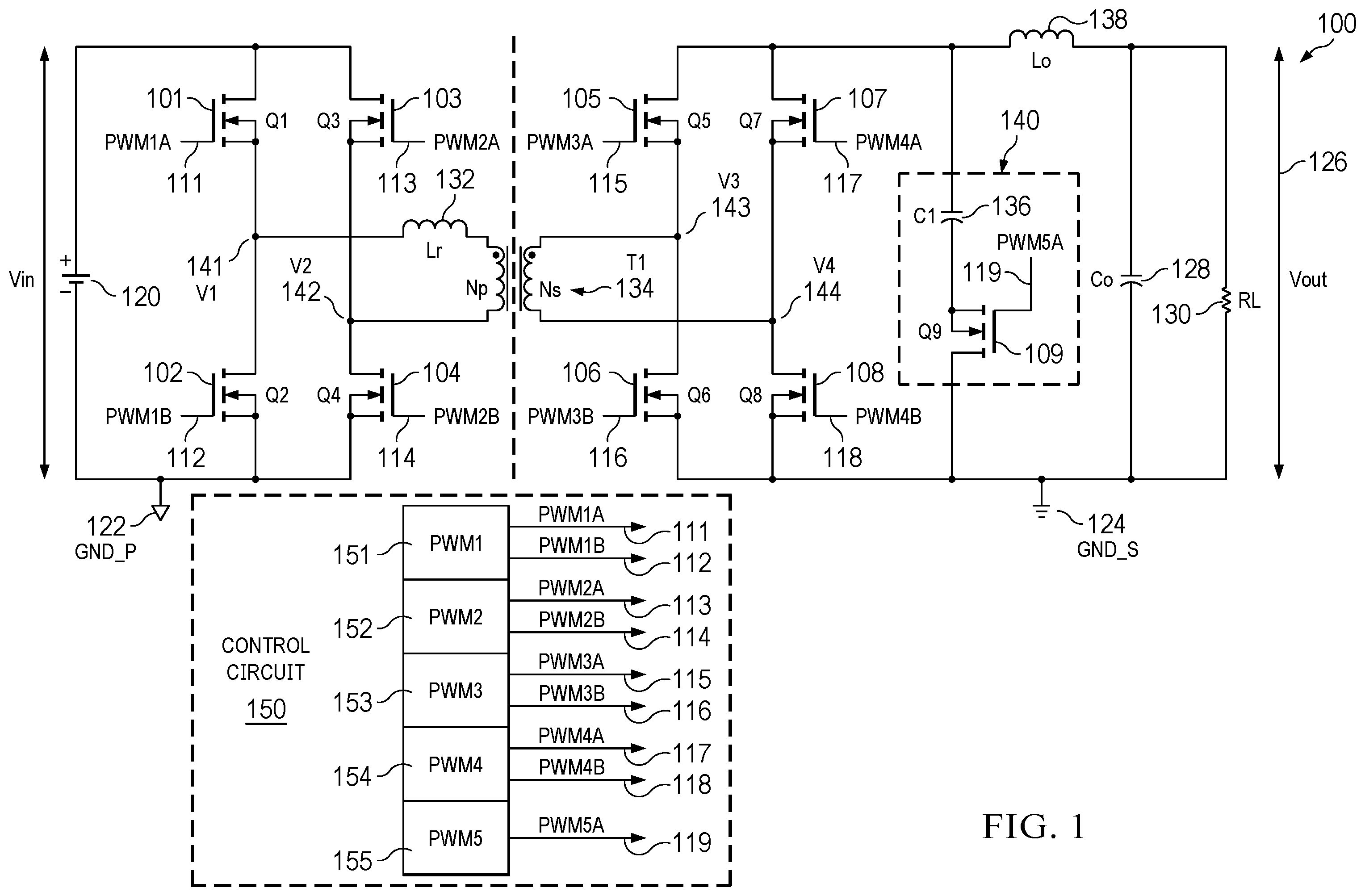
illustrates an example embodiment of a phase-shifted full-bridge power converter including an active clamping circuit.
illustrates an output of a simulation of a phase-shifted full-bridge power converter including an active clamping circuit.
illustrates an output of a simulation of a phase-shifted full-bridge power converter including an active clamping circuit.
illustrates an example embodiment of an electronic system designed to control a power converter including an active clamping circuit.
illustrates a block diagram of an example embodiment of a microcontroller unit configured to control a power converter including an active clamping circuit.
illustrates a flow chart of an example embodiment of a method for using a microcontroller unit to control a power converter including an active clamping circuit.
illustrates operation of a phase-shifted full-bridge power converter including an active clamping circuit.
DETAILED DESCRIPTION
The following descriptions of various example embodiments and implementations of an electronic system for controlling a PSFB PCMC power converter with active clamping illustrate systems and methods for protecting primary transistors within power converters. In these various examples, a pulse width modulator is configured to provide a gate input to an active clamping circuit within a power converter. The active clamping circuit limits the voltage across the secondary bridge within the phase-shifted full-bridge power converter, but distorts the peak current within the transformer. In some examples, a microcontroller unit is configured to control the primary transistors within the power converter along with the active clamping circuit.
By varying the pulse width of the signal controlling the active clamping circuit, the electronic system minimizes effects of the active clamping circuit on the output current of the power converter, providing a technical effect and technical advantage over current solutions. The electronic system controls the active clamping circuit such that it turns on only during an early part of the cycle, providing effective clamping when it is needed the most. Active clamping is turned off during a latter part of the cycle, eliminating distortion in the peak current within the transformer, and helping to retain the linear ramp wave shape towards the latter part of the waveform for effective peak current mode control. Active clamping provides higher efficiency compared to passive clamping.
The electronic system senses the current of the power converter on the primary side of the transformer, and by comparing this current to a reference current, provides the ability to continuously adjust control of the active clamping circuit, allowing for high efficiency clamping and effective peak current mode control under varying load conditions. By sensing current on the primary side of the transformer, the active clamping circuit is controlled to provide protection of transistors on the primary side of the power converter while maintaining high efficiency active clamping at the output.
illustrates an example embodiment of a phase-shifted full-bridge power converter 100 including an active clamping circuit 140 . In this embodiment, full-bridge rectifiers are provided on both the primary and secondary sides of transformer T 1 134 , which has Np primary winding turns and Ns secondary winding turns.
The primary side full-bridge rectifier includes primary transistors Q 1 101 , Q 2 102 , Q 3 103 , and Q 4 104 . In this example embodiment, these primary transistors are MOSFETs, however other embodiments may use other types of transistors, such as IGBTs, and the like. The gate of transistor Q 1 101 is driven by signal PWM 1A 111 ; the gate of transistor Q 2 102 is driven by signal PWM 1B 112 ; the gate of transistor Q 3 103 is driven by signal PWM 2A 113 ; and the gate of transistor Q 4 104 is driven by signal PWM 2B 114 . The primary side rectifier is powered by Vin 120 and is grounded at GND_P 122 . Node 141 is labeled as voltage V 1 , and node 142 is labeled as voltage V 2 . The primary side also includes inductor Lr 132 .
The secondary side full-bridge rectifier includes primary transistors Q 5 105 , Q 6 106 , Q 7 107 , and Q 8 108 . In this example embodiment, these primary transistors are MOSFETs, however other embodiments may use other types of transistors, such as IGBTs, and the like. The gate of transistor Q 5 105 is driven by signal PWM 3A 115 ; the gate of transistor Q 6 106 is driven by signal PWM 3B 116 ; the gate of transistor Q 7 107 is driven by signal PWM 4A 117 ; and the gate of transistor Q 8 108 is driven by signal PWM 4B 118 . The secondary side rectifier produces output voltage Vout 126 across resistive load RL 130 and capacitive load Co 128 , and is grounded at GND_S 124 . Node 143 is labeled as voltage V 3 , and node 144 is labeled as voltage V 4 . The secondary side also includes inductor Lo 138 .
The secondary side also includes active clamping circuit 140 . In this example embodiment, active clamping circuit 140 includes capacitor C 1 136 in series with transistor Q 9 109 across the output of the secondary side full-bridge rectifier. The gate of transistor Q 9 109 is controlled by signal PWM 5A 119 in order to provide active clamping of the output in order to ensure safe operation of the output stage transistors while maintaining high efficiency. By controlling signal PWM 5A 119 , the circuits and systems described below minimize effects of the active clamping circuit on the output current of the power converter.
Control signals PWM 1A 111 , PWM 1B 112 , PWM 2A 113 , PWM 2B 114 , PWM 3A 115 , PWM 3B 116 , PWM 4A 117 , PWM 4B 118 , and PWM 5A 119 are produced by pulse width modulators PWM 1 151 , PWM 2 152 , PWM 3 153 , PWM 4 154 , and PWM 5 155 within control circuit 150 .
Pulse width modulator modules PWM 1 151 , PWM 2 152 , PWM 3 153 , and PWM 4 154 are configured to generate signals controlling the primary transistors 101 - 108 of the phase-shifted full-bridge power converter 100 . Pulse width modulator module PWM 1 151 is configured to generate signals PWM 1A 111 and PWM 1B 112 . Pulse width modulator module PWM 2 152 is configured to generate signals PWM 2A 113 and PWM 2B 114 . Pulse width modulator module PWM 3 153 is configured to generate signals PWM 3A 115 and PWM 3B 116 . Pulse width modulator module PWM 4 154 is configured to generate signals PWM 4A 117 and PWM 4B 118 . Pulse width modulator module PWM 5 155 is configured to generate signal PWM 5A 119 , which controls active clamping circuit 140 .
illustrates an output 200 of a simulation of a phase-shifted full-bridge power converter 100 including an active clamping circuit 140 . This example simulation illustrates the waveforms of several nodes within the phase-shifted full-bridge power converter 100 of during operation of active clamping circuit 140 . Here, the current through the primary side of transformer T 1 134 (I T1 202 ), signal PWM 5A 204 , and the voltage across the primary side of transformer T 1 124 (V T1 206 ) of the phase-shifted full-bridge PCMC are illustrated.
PWM 5A 204 is generated by the MCU for the purpose of controlling the ACL MOSFET Q 9 109 . The active clamping MOSFET Q 9 109 is off between the time intervals T 1 211 to T 2 212 and between T 3 213 and T 4 214 when the PWM 5A 204 signal is low. The active clamping MOSFET Q 9 109 is on immediately before T 1 211 , between the time intervals T 2 212 to T 3 213 , and immediately after T 4 214 when the PWM 5A 204 signal is high. Larger active clamping duty cycles result in higher RMS currents within the transformer windings.
The voltage across the primary side of transformer T 1 124 (V T1 206 ), being an alternating current (AC) signal, is positive high immediately before T 1 211 and immediately after T 4 214 and negative high between times T 2 212 and T 3 213 . This is due to the action of the four primary MOSFETs Q 1 -Q 4 101 - 104 in order to transfer power from the primary side of transformer T 1 124 to the secondary side of transformer T 1 124 .
V T1 206 is zero between times T 1 211 to T 2 212 and between times T 3 213 and T 4 214 , so no power is transferred from the primary side to the secondary side of transformer T 1 124 during these two intervals of time. V T1 206 is high immediately before T 1 211 , between times T 2 212 to T 3 213 , and immediately after T 4 214 so power is transferred from the primary side to the secondary side of transformer T 1 124 during these two intervals of time.
During the time intervals when power is transferred from the primary side to the secondary side of transformer T 1 124 the active clamping MOSFET Q 9 109 remains on and clamps any voltage spike across the primary side and the secondary side of transformer T 1 124 . This clamping action limits the voltage across the four secondary MOSFETs Q 5 -Q 8 105 - 108 , and helps provide the needed protection for the secondary MOSFETs Q 5 -Q 8 105 - 108 .
During the power transfer time intervals (immediately before T 1 211 , between T 2 212 to T 3 213 , and immediately after T 4 214 ) the current through the primary side of transformer T 1 134 (I T1 202 ) gradually builds up, indicating power transfer from the primary side to the secondary side of transformer T 1 124 . The current through the primary side of transformer T 1 134 (I T1 202 ) drops to zero between times T 1 211 to T 2 212 and between times T 3 213 and T 4 214 indicating that no power is transferred to the secondary side of transformer T 1 124 .
In this example, the interval between times T 1 211 and T 2 212 and between times T 3 213 and T 4 214 when the active clamping MOSFET Q 9 109 is off, is 0.3 uS during each cycle of the output of power converter 100 .
illustrates an output 300 of a simulation of a phase-shifted full-bridge power converter 100 including an active clamping circuit 140 . This example simulation illustrates the same waveforms as in , but with a different duty cycle for the active clamping pulse width modulator. Here, the current through the primary side of transformer T 1 134 (I T1 302 ), signal PWM 5A 304 , and the voltage across the primary side of transformer T 1 124 (V T1 306 ) are illustrated.
PWM 5A 304 is generated by the MCU for the purpose of controlling the ACL MOSFET Q 9 109 . The active clamping MOSFET Q 9 109 is off between the time intervals T 1 311 to T 2 312 and between T 3 313 and T 4 314 when the PWM 5A 304 signal is low. The active clamping MOSFET Q 9 109 is on immediately before T 1 311 , between the time intervals T 2 312 to T 3 313 , and immediately after T 4 314 when the PWM 5A 304 signal is high. Larger active clamping duty cycles result in higher RMS currents within the transformer windings.
In this example, the interval between times T 1 311 and T 2 312 and between times T 3 313 and T 4 314 when the active clamping MOSFET Q 9 109 is off, is 0.5 uS during each cycle of the output of power converter 100 , thus the circuit of has a lower duty cycle than the circuit of , resulting in lower RMS currents within the transformer windings.
By controlling the duty cycle of signal PWM 5A 204 and 304 , the circuits and systems described below minimize effects of the active clamping circuit on the RMS currents within the transformer windings of power converter 100 .
illustrates an example embodiment of an electronic system 400 designed to control a power converter 100 including an active clamping circuit 140 . In this example embodiment, the primary side full-bridge rectifier 450 from the phase-shifted full-bridge power converter 100 of is illustrated along with an electronic system 400 configured to control active clamping circuit 140 and the primary transistors of the phase-shifted full-bridge power converter 100 of
In this example, the primary side full-bridge rectifier 450 includes primary transistors Q 1 101 , Q 2 102 , Q 3 103 , and Q 4 104 . The gate of transistor Q 1 101 is driven by signal PWM 1A 111 ; the gate of transistor Q 2 102 is driven by signal PWM 1B 112 ; the gate of transistor Q 3 103 is driven by signal PWM 2A 113 ; and the gate of transistor Q 4 104 is driven by signal PWM 2B 114 . The primary side rectifier is powered by Vin 120 and is grounded at GND_P 122 . The primary side also includes inductor Lr 132 .
In this example, current sensor 452 is configured to sense the current through the primary side of transformer T 1 135 . Signal conditioning circuitry 460 is configured to generate a transformer current signal 402 based on the current 401 through the primary side of the transformer T 1 135 within the power converter 100 .
In this example embodiment, microcontroller unit 410 is configured to generate a plurality of signals used to control both the primary transistors 101 - 108 and the active clamping circuit 140 of the phase-shifted full-bridge power converter 100 of . Microcontroller unit 410 includes processing circuitry 420 , pulse width modulator modules PWM 1 431 , PWM 2 432 , PWM 3 433 , PWM 4 434 , and PWM 5 435 , along with comparator sub-system 440 .
Pulse width modulator modules PWM 1 431 , PWM 2 432 , PWM 3 433 , and PWM 4 434 are configured to generate signals controlling the primary transistors 101 - 108 of the phase-shifted full-bridge power converter 100 of . Pulse width modulator module PWM 1 431 is configured to generate signals PWM 1A 111 and PWM 1B 112 . Pulse width modulator module PWM 2 432 is configured to generate signals PWM 2A 113 and PWM 2B 114 . Pulse width modulator module PWM 3 433 is configured to generate signals PWM 3A 115 and PWM 3B 116 . Pulse width modulator module PWM 4 434 is configured to generate signals PWM 4A 117 and PWM 4B 118 . Pulse width modulator module PWM 5 435 is configured to generate signal PWM 5A 119 , which controls active clamping circuit 140 . All of the pulse width modulator modules are coupled with, and controlled by processing circuitry 420 .
Comparator sub-system 440 includes digital-to-analog converter (DAC) 444 , ramp input 442 , comparator 446 and filter and digital logic module 448 . Comparator sub-system 440 receives transformer current signal 402 based on the current 401 through the primary side of the transformer T 1 135 within the power converter 100 . Comparator 446 compares the transformer current signal 402 to a reference signal 403 generated by DAC 444 . Ramp input 442 is configured to provide digital slope compensation to DAC 444 .
Comparator 446 generates comparator output signal 404 based on a difference between transformer current signal 402 and reference signal 403 . Filter and digital logic module 448 receives comparator output signal 404 from comparator 446 and generates the trip signal 405 based on the comparator output signal 404 . The trip signal 405 is provided to the pulse width modulator modules 431 - 435 and processing circuitry 420 . Processing circuitry 420 is configured to control pulse width modulator module PWM 5 435 to produce signal PWM 5A 119 having a pulse width based at least in part on the trip signal 405 in order to control active clamping circuit 140 in a manner to clamp the output voltage of power converter 100 while ensuring safe operation of the output stage transistors, and while minimizing the effects of the active clamping circuit 140 on the output current of power converter 100 .
illustrates a block diagram of an example embodiment of a microcontroller unit 410 configured to control a power converter 100 including an active clamping circuit 140 . As discussed above, microcontroller unit 410 may take on any of a wide variety of configurations. Here, a simplified example configuration is provided for microcontroller unit 410 of .
In this example embodiment, microcontroller unit 410 comprises comparator sub-system 440 , processing circuitry 420 , pulse width modulator modules PWM 1 431 , PWM 2 432 , PWM 3 433 , PWM 4 434 , and PWM 5 435 , and internal storage system 500 . Pulse width modulator modules PWM 1 431 , PWM 2 432 , PWM 3 433 , and PWM 4 434 are configured to generate signals controlling the primary transistors 101 - 108 of the phase-shifted full-bridge power converter 100 of . Pulse width modulator module PWM 1 431 is configured to generate signals PWM 1A 111 and PWM 1B 112 . Pulse width modulator module PWM 2 432 is configured to generate signals PWM 2A 113 and PWM 2B 114 . Pulse width modulator module PWM 3 433 is configured to generate signals PWM 3A 115 and PWM 3B 116 . Pulse width modulator module PWM 4 434 is configured to generate signals PWM 4A 117 and PWM 4B 118 . Pulse width modulator module PWM 5 435 is configured to generate signal PWM 5A 119 , which controls active clamping circuit 140 . All of the pulse width modulator modules are coupled with, and controlled by processing circuitry 420 through links 501 , 502 , 503 , 504 , and 505 .
Comparator sub-system 440 is configured to generate and provide trip signal 504 to processing circuitry 420 and the pulse width modulator modules 431 - 435 as described above with respect to .
Processing circuitry 420 comprises electronic circuitry configured to direct microcontroller unit 410 to control a power converter 100 having an active clamping circuit 140 as described above. Processing circuitry 420 may comprise microprocessors and other circuitry that retrieves and executes software 510 . Examples of processing circuitry 420 include general purpose central processing units, application specific processors, and logic devices, as well as any other type of processing device, combinations, or variations thereof. Processing circuitry 420 can be implemented within a single processing device but can also be distributed across multiple processing devices or sub-systems that cooperate in executing program instructions.
Internal storage system 500 can comprise any non-transitory computer readable storage media capable of storing software 510 that is executable by processing circuitry 420 . Internal storage system 500 can also include various data structures 520 which comprise one or more registers, databases, tables, lists, or other data structures. Storage system 500 can include volatile and nonvolatile, removable and non-removable media implemented in any method or technology for storage of information, such as computer readable instructions, data structures, program modules, or other data.
Storage system 500 can be implemented as a single storage device but can also be implemented across multiple storage devices or sub-systems co-located or distributed relative to each other. Storage system 500 can comprise additional elements, such as a controller, capable of communicating with processing circuitry 420 . Examples of storage media include random access memory, read only memory, magnetic disks, optical disks, flash memory, virtual memory and non-virtual memory, magnetic cassettes, magnetic tape, magnetic disk storage or other magnetic storage devices, or any other medium which can be used to store the desired information and that can be accessed by an instruction execution system, as well as any combination or variation thereof.
Software 510 can be implemented in program instructions and among other functions can, when executed by microcontroller unit 410 in general or processing circuitry 420 in particular, direct microcontroller unit 410 , or processing circuitry 420 , to operate as described herein to control a power converter 100 having an active clamping circuit 140 . Software 510 can include additional processes, programs, or components, such as operating system software, database software, or application software. Software 510 can also comprise firmware or some other form of machine-readable processing instructions executable by elements of processing circuitry 420 .
In at least one example implementation, the program instructions include various modules configured to direct processing circuitry 420 to control pulse width modulator modules PWM 1 431 , PWM 2 432 , PWM 3 433 , and PWM 4 434 to generate signals controlling the primary transistors 101 - 108 of the phase-shifted full-bridge power converter 100 of . The program instructions also include modules configured to direct processing circuitry 420 to control pulse width modulator module PWM 5 435 to generate signal PWM 5A 119 , which controls active clamping circuit 140 .
In general, software 510 can, when loaded into processing circuitry 420 and executed, transform processing circuitry 420 overall from a general-purpose computing system into a special-purpose computing system customized to operate as described herein for a microcontroller unit 410 configured to control a power converter 100 including an active clamping circuit 140 , among other operations. Encoding software 510 on internal storage system 500 can transform the physical structure of internal storage system 500 . The specific transformation of the physical structure can depend on various factors in different implementations of this description. Examples of such factors can include, but are not limited to the technology used to implement the storage media of internal storage system 500 and whether the computer-storage media are characterized as primary or secondary storage.
For example, if the computer-storage media are implemented as semiconductor-based memory, software 510 can transform the physical state of the semiconductor memory when the program is encoded therein. For example, software 510 can transform the state of transistors, capacitors, or other discrete circuit elements constituting the semiconductor memory. A similar transformation can occur with respect to magnetic or optical media. Other transformations of physical media are possible without departing from the scope of the present description, with the foregoing examples provided only to facilitate this discussion.
illustrates a flow chart of an example embodiment of a method for using a microcontroller unit 410 to control a power converter 100 including an active clamping circuit 140 .
In this example method, microcontroller unit 410 receives a transformer current signal 402 from a current sensor 452 , (operation 600 ). Comparator sub-system 440 generates a trip signal 405 based on a difference between the transformer current signal 402 and a reference signal 403 , (operation 602 ).
Microcontroller unit 410 then generates a gate input signal PWM 5A 119 for the active clamping circuit 140 based at least in part on the trip signal 405 , (operation 604 ).
illustrates a timing diagram 700 of a phase-shifted full-bridge power converter 100 including an active clamping circuit 140 . In particular, the timing diagram 700 illustrates the control signals provided by the control circuit 150 and the resulting behavior of the power converter 100 . Aspects of the operation shown in may be substantially similar to those described in and .
Immediately before time T 0 710 , the signal PWM 1A 111 is de-asserted, causing transistor Q 1 101 to be in an off (e.g., cutoff) state, and the signal PWM 1B 112 is asserted, causing transistor Q 2 102 to be in an on (e.g., saturated) state. Similarly, the signal PWM 2A 113 is de-asserted, causing transistor Q 3 103 to be in an off state, and the signal PWM 2B 114 is asserted, causing transistor Q 4 104 to be in the on state. This time immediately before T 0 110 may be considered a guardband time when, to prevent current flow through, the inductor Lr 132 and the transformer T 1 134 are only connected to ground.
Immediately before time T 0 710 , signal PWM 5A 119 is de-asserted, causing transistor Q 9 109 to be in the off state.
At time T 0 710 , the signal PWM 1A 111 transitions to being asserted, causing transistor Q 1 101 to transition to the on state, and the signal PWM 1B 112 transitions to being de-asserted, causing transistor Q 2 102 to transition to the off state. The signal PWM 2A 113 remains de-asserted, and the signal PWM 2B 114 remains asserted.
The signal PWM 3A 115 remains asserted, causing transistor Q 5 105 to be in the on state, and the signal PWM 3B 116 transitions to being de-asserted, causing transistor Q 6 106 to transition to the off state. The signal PWM 4A 117 transitions to being de-asserted, causing transistor Q 7 107 to transition to the off state, and the signal PWM 4B 118 remains asserted, causing transistor Q 8 108 to be in the on state.
The signal PWM 5A 119 remains de-asserted, causing transistor Q 9 109 to be in the off state.
As a result, the voltage between nodes V 1 141 and V 2 142 (illustrated as V 12 721 ) rises to or near Vin while the voltage between nodes V 3 143 and V 4 144 (illustrated as V 34 722 ) remains at or near zero. Hence, current through inductor Lr 132 (illustrated as iT 1 720 ) begins to rise and change direction. As the voltage V 34 722 is still zero between T 0 710 and T 1 711 , it may not be desirable to turn on Q 9 109 (controlled by PWM 5A ) to avoid the ACL capacitor 136 energy being discharged to the secondary winding.
At time T 1 711 , the current iT 1 720 has reached its peak, and voltages V 12 721 and V 34 722 and the output voltage Vout 723 have also reached their peak. The control circuit 150 waits for a selectable delay before transitioning the power converter 100 to the next state at T 2 712 .
At time T 2 712 , the signal PWM 5A 119 is asserted, causing transistor Q 9 109 to transition to the on state, thus enabling the active clamping. This active clamping time between times T 2 712 and T 3 713 may be relatively short, and in some examples, the control circuit 150 specifies an active clamping time of approximately 700 ns in a 100 kHz power converter 100 .
At time T 3 713 , the signal PWM 5A 119 is de-asserted, causing transistor Q 9 109 to transition to the off state, thus ending the active clamping time.
At time T 4 714 , the signal PWM 1A 111 remains asserted, causing transistor Q 1 101 to remain in the on state, and the signal PWM 1B 112 remains de-asserted, causing transistor Q 2 102 to remain in the off state. The signal PWM 2A 113 remains de-asserted, causing transistor Q 3 103 to remain in the off state, and the signal PWM 2B 114 transitions to being de-asserted, causing transistor Q 4 104 to transition to the off state.
The signal PWM 3A 115 remains asserted, causing transistor Q 5 105 to be in the on state, and the signal PWM 3B 116 remains de-asserted, causing transistor Q 6 106 to be in the off state. The signal PWM 4A 117 remains de-asserted, causing transistor Q 7 107 to be in the off state, and the signal PWM 4B 118 remains asserted, causing transistor Q 8 108 to be in the on state.
The signal PWM 5A 119 remains de-asserted, causing transistor Q 9 109 to be in the off state.
As a result, voltages V 12 721 and V 34 722 begin to fall to zero.
At time T 5 715 , the signal PWM 1A 111 transitions to being de-asserted, causing transistor Q 1 101 to transition to the off state, and the signal PWM 1B 112 transitions to being asserted, causing transistor Q 2 102 to transition to the on state. The signal PWM 2A 113 transitions from being de-asserted to being asserted between time T 4 714 and T 5 715 , and is asserted at time T 5 715 , causing transistor Q 3 103 to be in the on state. The signal PWM 2B 114 remains de-asserted, causing transistor Q 4 104 to be in the off state.
The signal PWM 3A 115 transitions from being asserted to being de-asserted at time T 5 715 or shortly thereafter, causing transistor Q 5 105 to be in the off state. The signal PWM 3B 116 transitions from being de-asserted to being asserted between time T 4 714 and T 5 715 , and is asserted at time T 5 715 , causing transistor Q 6 106 to be in the on state. The signal PWM 4A 117 also transitions from being de-asserted to being asserted between time T 4 714 and T 5 715 , and is asserted at time T 5 715 , causing transistor Q 7 107 to be in the on state. The signal PWM 4B 118 transitions from being asserted to being de-asserted at time T 5 715 or shortly thereafter, causing transistor Q 8 108 to be in the off state.
The signal PWM 5A 119 remains de-asserted, causing transistor Q 9 109 to be in the off state.
As a result, the voltage V 12 721 rises to or near negative Vin while the voltage V 34 722 remains at or near zero. Hence, current iT 1 720 begins to fall and change direction.
At time T 6 716 , the current iT 1 720 has reached its peak, and voltages V 12 721 and V 34 722 have also reached their peak, albeit in an opposite polarity from the peaks at time T 1 711 . The output voltage Vout 723 has also reached a peak. The control circuit 150 waits for a selectable delay before transitioning the power converter 100 to the next state at T 7 717 . This delay may be the same or different from the delay between times T 1 711 and T 2 712 .
At time T 7 717 , the signal PWM 5A 119 is asserted, causing transistor Q 9 109 to transition to the on state, thus enabling the active clamping. This active clamping time between times T 7 717 and T 8 718 may be the same or different from the active clamping time between times T 2 712 and T 3 713 .
At time T 8 718 , the signal PWM 5A 119 is de-asserted, causing transistor Q 9 109 to transition to the off state, thus ending the active clamping time.
At time T 9 719 , the signal PWM 1A 111 remains de-asserted, causing transistor Q 1 101 to remain in the off state, and the signal PWM 1B 112 remains asserted, causing transistor Q 2 102 to remain in the on state. The signal PWM 2A 113 transitions to being de-asserted, causing transistor Q 3 103 to transition to the off state, and the signal PWM 2B 114 remains de-asserted, causing transistor Q 4 104 to be in the off state.
The signal PWM 3A 115 remains de-asserted, causing transistor Q 5 105 to be in the off state, and the signal PWM 3B 116 remains asserted, causing transistor Q 6 106 to be in the on state. The signal PWM 4A 117 remains asserted, causing transistor Q 7 107 to be in the on state, and the signal PWM 4B 118 remains de-asserted, causing transistor Q 8 108 to be in the off state.
The signal PWM 5A 119 remains de-asserted, causing transistor Q 9 109 to be in the off state.
The cycle repeats, and accordingly, the state and behavior of the power converter 100 at time T 10 720 may be substantially similar to the state at time T 0 710 .
The included descriptions and figures depict specific embodiments to teach those skilled in the art how to make and use the best mode. For the purpose of teaching inventive principles, some conventional aspects have been simplified or omitted. Those skilled in the art will appreciate variations from these embodiments that fall within the scope of the invention. Those skilled in the art will also appreciate that the features described above may be combined in various ways to form multiple embodiments. As a result, the invention is not limited to the specific embodiments described above, but only by the claims and their equivalents.
Figures (7)
Citations
This patent cites (11)
- US9293999
- US10693384
- US2011/0062782
- US2011/0063760
- US2011/0299304
- US2018/0301975
- US2019/0207524
- US2022/0255448
- US2024/0006982
- US2017051045
- US20010090539