Member for Window Module and Method of Manufacturing Window Module Using the Same
Abstract
A member for a window module includes a base layer which is foldable and in which a groove defined. The base layer includes a first dam structure in which the groove is defined. The member further includes a filler filled in the groove.
Claims (11)
1. A member for window module, the member comprising: a base layer which is foldable and in which a groove defined, the base layer comprising: a first dam structure defining a first inner side of the groove and an outer side of the base layer; and a filler filled in the groove, wherein the first dam structure has a predetermined width between the first inner side of the groove and the outer side of the base layer in a first direction which is a main extension direction of the groove in a plan view.
Show 10 dependent claims
2. The member of claim 1 , wherein the filler is accommodated by the groove and the first dam structure.
3. The member of claim 1 , wherein the filler contacts the first dam structure.
4. The member of claim 1 , wherein the groove includes a plurality of first grooves arranged in a second direction crossing the first direction, and wherein the first dam structure defines first inner sides of the plurality of first grooves.
5. The member of claim 4 , further comprising: a second dam structure facing the first dam structure with the plurality of first grooves interposed therebetween.
6. The member of claim 5 , wherein the second dam structure is adjacent to the plurality of first grooves in a third direction opposite to the first direction, and wherein the second dam structure defines second inner sides of the plurality of first grooves opposite to the first inner sides of the plurality of first grooves.
7. The member of claim 4 , wherein the groove further includes a plurality of second grooves alternately arranged with the plurality of first grooves and arranged in the second direction, wherein the plurality of first grooves is defined in a first surface of the base layer, and wherein the plurality of second grooves is defined in a second surface opposite to the first surface of the base layer.
8. The member of claim 7 , wherein the first dam structure further defines inner sides of the plurality of second grooves.
9. The member of claim 1 , wherein the base layer further includes a flat portion defining a second inner side of the groove, wherein the groove extends in a first direction, wherein the first dam structure is adjacent to the groove in the first direction, and wherein the flat portion is adjacent to the groove in a second direction crossing the first direction.
10. The member of claim 9 , wherein the filler is accommodated by the groove, the first dam structure, and the flat portion.
11. The member of claim 1 , wherein a refractive index of the base layer equals to a refractive index of the filler.
Full Description
Show full text →
This application claims priority to Korean Patent Application No. 10-2021-0136441, filed on Oct. 14, 2021, and all the benefits accruing therefrom under 35 U.S.C. § 119, the content of which in its entirety is herein incorporated by reference.
BACKGROUND
1. Field
Embodiments of the invention relate generally to a member for a window module and a method of manufacturing a window module using the member.
2. Description of the Related Art
A flat panel display (e.g., an organic light-emitting display) has advantages such as a light weight and a thin thickness. By using the above advantages, a development of flexible display devices having flexible characteristics increases. The flexible display device includes a curved display device, a bent display device, a foldable display device, a rollable display device, a stretchable display device, and the like, for example. The flexible display device includes a display module and a window disposed on the display module. As grooves are defined in the window, the window may be smoothly folded.
SUMMARY
Embodiments provide a member for window module for manufacturing a window module.
Embodiments provide a method of manufacturing a window module, using the member for the window module.
In an embodiment of the invention, a member for a window module includes a base layer which is foldable and in which a groove is defined. The base layer includes a first dam structure defining a first inner side of the groove. The member further includes a filler filled in the groove.
In an embodiment, the filler may be accommodated by the groove and the first dam structure.
In an embodiment, the filler may define first inner sides of the first dam structure.
In an embodiment, the groove may extend in a first direction, and the first dam structure may be adjacent to the groove in the first direction.
In an embodiment, the groove may include a plurality of first grooves arranged in a second direction crossing the first direction, and the first dam structure may define first inner sides of the plurality of first grooves.
In an embodiment, the member may further include a second dam structure facing the first dam structure with the plurality of first grooves interposed therebetween.
In an embodiment, the second dam structure may be adjacent to the plurality of first grooves in a third direction opposite to the first direction, and the second dam structure may define second inner sides of the plurality of first grooves opposite to the first inner sides of the plurality of first grooves.
In an embodiment, the grooves may further include a plurality of second grooves alternately arranged with the plurality of first grooves and arranged in the second direction, the plurality of first grooves may be defined in a first surface of the base layer, and the plurality of second grooves may be defined in a second surface opposite to the first surface of the base layer.
In an embodiment, the first dam structure may further define inner sides of the plurality of second grooves.
In an embodiment, the base layer may further include a flat portion defining a second inner side of the groove, the groove may extend in a first direction, the first dam structure may be adjacent to the groove in the first direction, and the flat portion may be adjacent to the groove in a second direction crossing the first direction.
In an embodiment, the filler may be accommodated by the groove, the first dam structure, and the flat portion.
In an embodiment, a refractive index of the base layer may be equal to a refractive index of the filler.
In an embodiment of the invention, a method of manufacturing a window module includes defining a groove and forming a first dam structure defining an inner surface of the groove in a base layer, and filling the groove with a filler.
In an embodiment, the method may further include removing the first dam structure, after the filler is filled.
In an embodiment, the removing the first dam structure may include irradiating an intense light to a boundary between the groove and the first dam structure, and etching the first dam structure by reacting an etchant with an area irradiated with the intense light.
In an embodiment, the first dam structure may be removed by irradiating an etching intense light to a boundary between the groove and the first dam structure.
In an embodiment, the defining the groove and the first dam structure may include irradiating an intense light to the base layer, and etching the base layer by reacting an etchant with an area which is irradiated with the intense light.
In an embodiment, the groove may extend in a first direction, the first dam structure may be adjacent to the groove in the first direction, and the intense light may not be irradiated by a first width in the first direction of the first dam structure.
In an embodiment, the method may further include forming a second dam structure in the base layer, where the second dam structure faces the first dam structure with the groove interposed therebetween, and the intense light may not be irradiated by a second width in the first direction of the second dam structure.
Therefore, a member for a window module in embodiments of the invention may include a base layer including a dam structure and a filler. At least one groove may be defined in the base layer, and an accommodation space may be defined by the groove and the dam structure. The filler may not leak by the dam structure. In other words, the filler may be completely filled in the accommodating space, and an unfilled space may not occur in the accommodating space. Accordingly, the window module manufactured as the member for the window module may improve the display quality of the display device.
It is to be understood that both the foregoing general description and the following detailed description are examples and are intended to provide further explanation of the invention as claimed.
BRIEF DESCRIPTION OF THE DRAWINGS
The accompanying drawings, which are included to provide a further understanding of the invention and are incorporated in and constitute a part of this specification, illustrate embodiments of the invention together with the description.
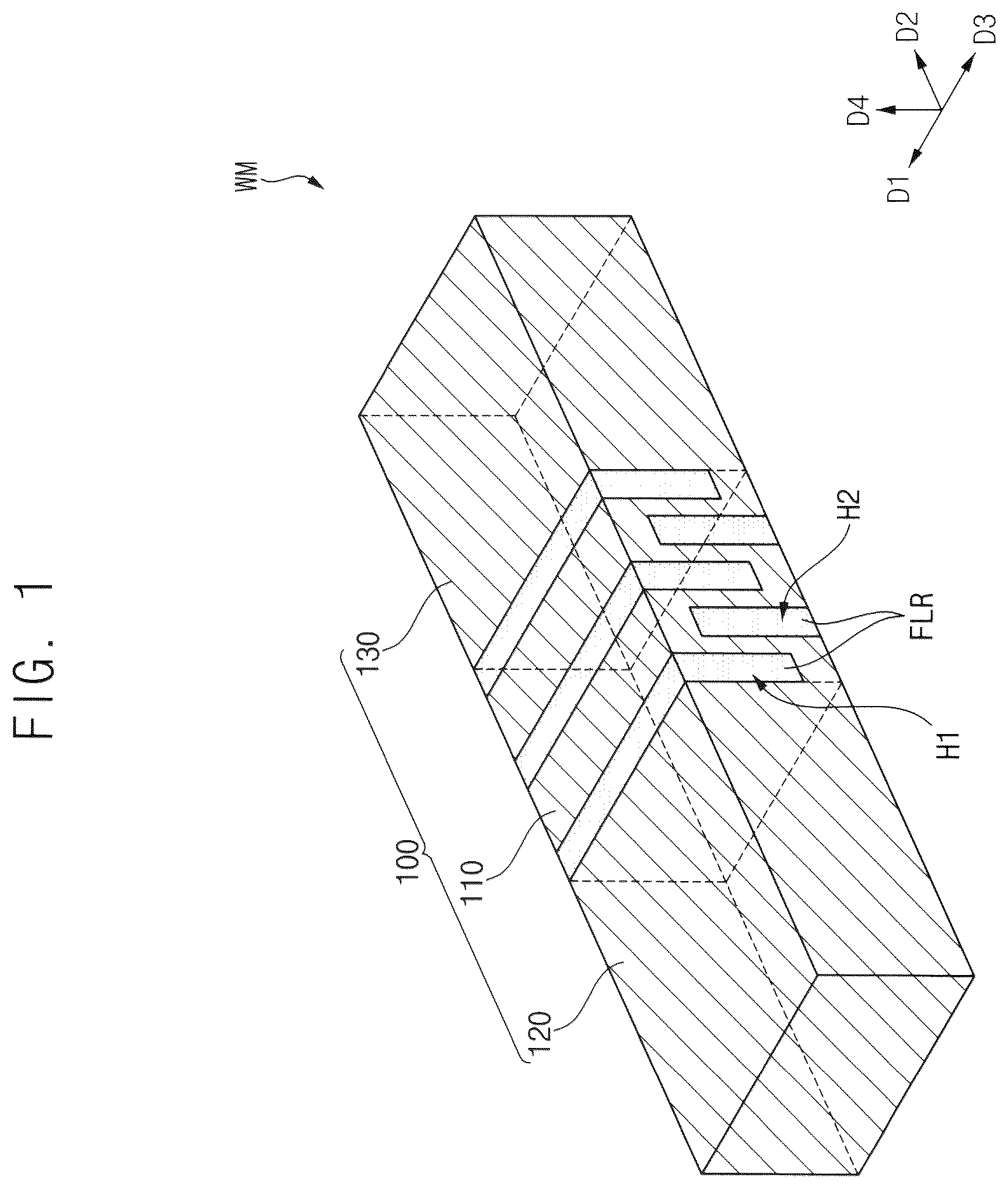
is a perspective view illustrating an embodiment of a window module manufactured using a member for a window module.
is a flowchart illustrating an embodiment of a method of manufacturing the window module of .
is a perspective view illustrating a first operation included in the method of .
is a perspective view illustrating a second operation included in the method of .
is a plan view illustrating a second operation included in the method of .
is a perspective view illustrating a third operation included in the method of .
is a rear view illustrating a third operation included in the method of .
is a perspective view illustrating a fourth operation included in the method of .
is a plan view illustrating a fourth operation included in the method of .
, 11 , and 12 are cross-sectional views illustrating a fourth operation included in the method of .
is a perspective view illustrating a fifth operation included in the method of .
are cross-sectional views illustrating a fifth operation included in the method of .
is a perspective view illustrating a sixth operation included in the method of .
is a perspective view illustrating a seventh operation included in the method of .
is a cross-sectional view illustrating a seventh operation included in the method of .
is a flowchart illustrating another embodiment of a method of manufacturing the window module of .
is a perspective view illustrating a sixth operation included in the method of .
is a cross-sectional view illustrating a display device including the window module of .
is a cross-sectional view illustrating a display module included in the display device of .
is a cross-sectional view illustrating another embodiment of a display device including a window module.
DETAILED DESCRIPTION
Illustrative, non-limiting embodiments will be more clearly understood from the following detailed description in conjunction with the accompanying drawings.
It will be understood that when an element is referred to as being “on” another element, it can be directly on the other element or intervening elements may be therebetween. In contrast, when an element is referred to as being “directly on” another element, there are no intervening elements present.
It will be understood that, although the terms “first,” “second,” “third” etc. may be used herein to describe various elements, components, regions, layers and/or sections, these elements, components, regions, layers and/or sections should not be limited by these terms. These terms are only used to distinguish one element, component, region, layer or section from another element, component, region, layer or section. Thus, “a first element,” “component,” “region,” “layer” or “section” discussed below could be termed a second element, component, region, layer or section without departing from the teachings herein.
The terminology used herein is for the purpose of describing particular embodiments only and is not intended to be limiting. As used herein, the singular forms “a,” “an,” and “the” are intended to include the plural forms, including “at least one,” unless the content clearly indicates otherwise. “Or” means “and/or.” As used herein, the term “and/or” includes any and all combinations of one or more of the associated listed items. It will be further understood that the terms “comprises” and/or “comprising,” or “includes” and/or “including” when used in this specification, specify the presence of stated features, regions, integers, steps, operations, elements, and/or components, but do not preclude the presence or addition of one or more other features, regions, integers, steps, operations, elements, components, and/or groups thereof.
Furthermore, relative terms, such as “lower” or “bottom” and “upper” or “top,” may be used herein to describe one element's relationship to another element as illustrated in the Figures. It will be understood that relative terms are intended to encompass different orientations of the device in addition to the orientation depicted in the Figures. In an embodiment, when the device in one of the figures is turned over, elements described as being on the “lower” side of other elements would then be oriented on “upper” sides of the other elements. The exemplary term “lower,” can therefore, encompasses both an orientation of “lower” and “upper,” depending on the particular orientation of the figure. Similarly, when the device in one of the figures is turned over, elements described as “below” or “beneath” other elements would then be oriented “above” the other elements. The exemplary terms “below” or “beneath” can, therefore, encompass both an orientation of above and below.
“About” or “approximately” as used herein is inclusive of the stated value and means within an acceptable range of deviation for the particular value as determined by one of ordinary skill in the art, considering the measurement in question and the error associated with measurement of the particular quantity (i.e., the limitations of the measurement system). The term “about” can mean within one or more standard deviations, or within ±30%, 20%, 10%, 5% of the stated value, for example.
Unless otherwise defined, all terms (including technical and scientific terms) used herein have the same meaning as commonly understood by one of ordinary skill in the art to which this invention belongs. It will be further understood that terms, such as those defined in commonly used dictionaries, should be interpreted as having a meaning that is consistent with their meaning in the context of the relevant art and the invention, and will not be interpreted in an idealized or overly formal sense unless expressly so defined herein.
is a perspective view illustrating an embodiment of a window module manufactured using a member for a window module.
Referring to , a window module WM manufactured using a member (e.g. a member (also referred to as a window module member) 100 M in ) for a window module in an embodiment of the invention may include a base layer 100 and a filler FLR.
The base layer 100 may include a folding portion 110 , a first flat portion 120 , and a second flat portion 130 .
In an embodiment, the base layer 100 may include a rigid material. In an embodiment, the base layer 100 may be glass or ultra-thin glass (“UTG”), for example. In embodiments, materials that may be used as the glass may include soda lime glass, alkali aluminosilicate glass, borosilicate glass, lithium alumina silicate glass, or the like. These may be used alone or in combination with each other.
In an embodiment, the base layer 100 may include a soft material. In an embodiment, the base layer 100 may be plastic, for example. In embodiments, materials that may be used as the plastic may include polyimide (“PI”), polyacrylate, polymethylmethacrylate (“PMMA”), polycarbonate (“PC”), polyethylenenaphthalate (“PEN”), polyvinylidene chloride, polyvinylidene difluoride (“PVDF”), polystyrene, ethylene vinylalcohol copolymer, polyethersulphone (“PES”), polyetherimide (“PEI”), polyphenylene sulfide (“PPS”), polyallylate, tri-acetyl cellulose (“TAC”), cellulose acetate propionate (“CAP”), or the like. These may be used alone or in combination with each other.
At least one groove may be defined in the folding portion 110 . In an embodiment, a plurality of first grooves H 1 may be defined in a top surface of the folding portion 110 , and a plurality of second grooves H 2 may be defined in a rear surface of the folding portion 110 , for example. The first grooves H 1 may extend in a predetermined direction, e.g., a first direction D 1 and/or a third direction D 3 , and may be arranged in a second direction D 2 crossing the first and third direction D 1 and D 3 . The second grooves H 2 may extend in the predetermined direction, e.g., the first direction D 1 and/or the third direction D 3 , and may be arranged in the second direction D 2 . The second grooves H 2 may be alternately arranged with the first grooves H 1 .
In an embodiment, the filler FLR may be filled in the first grooves H 1 and the second grooves H 2 . The filler FLR may include a soft material. In an embodiment, the filler FLR may be a resin, for example. In an embodiment, the filler FLR may be a resin having a small modulus, for example. In addition, in an embodiment, the filler FLR may be a resin having the same refractive index as a refractive index of the base layer 100 . Accordingly, the base layer 100 and the filler FLR may be index-matched.
As the base layer 100 includes the rigid material, hardness of the base layer 100 may increase. In addition, as the first grooves H 1 and the second grooves H 2 are defined in opposite surfaces of the folding portion 110 and the filler FLR has a low modulus, the folding portion 110 smoothly may be folded. In addition, as the refractive index of the filler FLR is the same as the refractive index of the base layer 100 , the display quality in the folding portion 110 may be improved.
is a flowchart illustrating an embodiment of a method of manufacturing the window module of .
Referring to , an embodiment of the method S 100 of manufacturing the window module WM may include first to seventh operations S 110 , S 120 , S 130 , S 140 , S 150 , S 160 , and S 170 . Hereinafter, it will be described.
is a perspective view illustrating a first operation included in the method of .
Referring to , the base layer 100 may be prepared (S 110 ). The base layer 100 may include a first surface SF 1 and a second surface SF 2 . The first surface SF 1 may correspond to the top surface of the base layer 100 . The second surface SF 2 may be opposite to the first surface SF 1 and may correspond to the rear surface of the base layer 100 .
is a perspective view illustrating a second operation included in the method of . is a plan view illustrating a second operation included in the method of .
Referring to , an intense light, e.g., a laser LB, may be irradiated to a first hole area H 1 A of the base layer 100 (S 120 ).
In an embodiment, the first hole area H 1 A may be defined in the first surface SF 1 and may be an area in which the first grooves H 1 are defined. In addition, the first hole area H 1 A may be an area including opposite sides spaced apart from opposite sides of the first surface SF 1 respectively by the first width W 1 and the second width W 2 in the first surface SF 1 in the first direction D 1 and the third direction D 3 . The first width W 1 may be a width in which a first dam structure (e.g., a first dam structure DM 1 in ) extends in the first direction D 1 . The second width W 2 may be a width in which a second dam structure (e.g., a second dam structure DM 2 in ) extends in the third direction D 3 .
In other words, the laser LB may be transmitted in the predetermined direction, e.g., the first direction D 1 and/or third direction D 3 , and may be irradiated to the first surface SF 1 except for the first width W 1 and the second width W 2 . As the laser LB is irradiated to the first hole area H 1 A, the first hole area H 1 A may have an etch selectivity different from an etch selectivity of an area to which the laser LB is not irradiated.
is a perspective view illustrating a third operation included in the method of . is a rear view illustrating a third operation included in the method of .
Referring to , the laser LB may be irradiated to a second hole area H 2 A of the base layer 100 (S 130 ).
In an embodiment, the second hole area H 2 A may be defined in the second surface SF 2 and may be an area in which the second grooves H 2 are defined. In addition, the second hole area H 2 A may be an area including opposite sides spaced apart from opposite sides of the second surface SF 2 respectively by the first width W 1 and the second width W 2 in the SF 1 in the predetermined direction, e.g., the first direction D 1 and/or the third direction D 3 . In addition, the second hole area H 2 A may be alternately arranged with the first hole area H 1 A.
In other words, the laser LB may be transmitted in the predetermined direction, e.g., the first direction D 1 and/or the third direction D 3 and may be irradiated to the second surface SF 2 except for the first width W 1 and the second width W 2 . As the laser LB is irradiated to the second hole area H 2 A, the second hole area H 2 A may have an etch selectivity different from an etch selectivity of an area to which the laser LB is not irradiated.
is a perspective view illustrating a fourth operation included in the method of . is a plan view illustrating a fourth operation included in the method of .
Referring to , the base layer 100 may be etched. Accordingly, the first grooves H 1 and the second grooves H 2 are defined, and the first dam structure DM 1 and the second dam structure DM 2 may be formed or provided (S 140 ).
The base layer 100 may be reacted with an etchant. In this case, various processes enabling the base layer 100 to contact the etchant may be used. In an embodiment, the base layer 100 may be immersed in the etchant, or the etchant may be sprayed onto the base layer 100 , for example.
As described above, each of the first hole area H 1 A and the second hole area H 2 A may have an etch selectivity different from an etch selectivity of an area to which the laser LB is not irradiated. Accordingly, the first hole area H 1 A and the second hole area H 2 A may react with the etchant and the base layer 100 overlapping the first hole area H 1 A and the second hole area H 2 A may be etched. Accordingly, the first grooves H 1 and the second grooves H 2 may be defined.
In addition, the base layer 100 corresponding to the first width W 1 and the second width W 2 to which the laser LB is not irradiated may not be etched. In other words, the base layer 100 adjacent to the first grooves H 1 and the second grooves H 2 in the first direction D 1 may remain. Accordingly, the first dam structure DM 1 may be formed or provided.
The first dam structure DM 1 may have the first width W 1 in the first direction D 1 . In addition, the first dam structure DM 1 may be adjacent to the first grooves H 1 and the second grooves H 2 in the first direction D 1 .
In addition, the base layer 100 adjacent to the first grooves H 1 and the second grooves H 2 in the third direction D 3 may remain. Accordingly, the second dam structure DM 2 may be formed or provided.
The second dam structure DM 2 may have the second width W 2 in the third direction D 3 . In addition, the second dam structure DM 2 may be adjacent to the first grooves H 1 and the second grooves H 2 in the third direction D 3 . In other words, the second dam structure DM 2 may face the first dam structure DM 1 with the first grooves H 1 and the second grooves H 2 interposed therebetween.
, 11 , and 12 are cross-sectional views illustrating a fourth operation included in the method of . is a cross-sectional view taken along line I-I′ of , is a cross-sectional view taken along line II-II′ of , and is a cross-sectional view taken along line III-III′ of
Referring to , as the first grooves H 1 , the first dam structure DM 1 , and the second dam structure DM 2 are formed or provided, an accommodating space may be defined in a first cross-section of the folding portion 110 .
Referring to , as the first grooves H 1 are defined in the first surface SF 1 and the second grooves H 2 are defined in the second surface SF 2 , the folding portion 110 may have a concave-convex shape defined in a second cross-section.
Referring to , as the second dam structure DM 2 is disposed, the first grooves H 1 and the second grooves H 2 may not be exposed in a third cross-section of the folding portion 110 .
is a perspective view illustrating a fifth operation included in the method of .
Referring to , the filler FLR may be filled in the first grooves H 1 and the second grooves H 2 . Accordingly, a member 100 M for the window module may be formed or provided (S 150 ).
In an embodiment, the member 100 M for the window module may include the folding portion 110 , the first flat portion 120 , the second flat portion 130 , the first dam structure DM 1 , the second dam structure DM 2 , the filler FLR, a first dummy portion DP 1 , a second dummy portion DP 2 , a third dummy portion DP 3 , and a fourth dummy portion DP 4 .
The filler FLR may be filled in various ways. In an embodiment, the filler FLR may be filled through an inkjet process. In another embodiment, the filler FLR may be filled through a slot coating process. In another embodiment, the filler FLR may be filled through a squeezing process. However, the process of filling the filler FLR is not limited thereto.
The first flat portion 120 may define an inner surface of one of the first grooves H 1 . For example, the first flat portion 120 may contact one of the first grooves H 1 . The first dummy portion DP 1 may be adjacent to the first flat portion 120 in the first direction D 1 . The second dummy portion DP 2 may be adjacent to the first flat portion 120 in the third direction D 3 .
The second flat portion 130 may define an inner surface of one of the first grooves H 1 . For example, the second flat portion 130 may contact one of the first grooves H 1 . The third dummy portion DP 3 may be adjacent to the second flat portion 130 in the first direction D 1 . The fourth dummy portion DP 4 may be adjacent to the second flat portion 130 in the third direction D 3 .
are cross-sectional views illustrating a fifth operation included in the method of . is a cross-sectional view taken along line IV-IV′ of , and is a cross-sectional view taken along line V-V′ of .
Referring to , the filler FLR may be filled in the first grooves H 1 . As the first dam structure DM 1 and the second dam structure DM 2 are disposed, the filler FLR may not leak in the first direction D 1 and/or the third direction D 3 . As the filler FLR does not leak, the filler FLR may be completely filled in the accommodation space. In other words, an unfilled space may not occur in the accommodation space. Thereafter, the filler FLR may be cured while being completely filled in the accommodation space.
Referring to , the filler FLR may be filled in an empty space of the concavo-convex shape. As described above, the filler FLR may be a resin having a small modulus. Accordingly, the folding portion 110 may be smoothly folded. In addition, the filler FLR may have the same refractive index as a refractive index of the base layer 100 . Accordingly, the display quality of the folding unit 110 may be improved.
is a perspective view illustrating a sixth operation included in the method of .
Referring to , the laser LB may be irradiated to a cutting line CL (S 160 ).
In an embodiment, the cutting line CL may be a line including a boundary between the first grooves H 1 and the first dam structure DM 1 , a boundary between the first flat portion 120 and the first dummy portion DP 1 , and a boundary between the second flat portion 130 and the third dummy portion DP 3 . The laser LB may be transmitted in the second direction D 2 . As the laser LB is irradiated to the cutting line CL, the cutting line CL may have an etch selectivity different from an etch selectivity of an area to which the laser LB is not irradiated.
In addition, a laser LB may be irradiated to a boundary between the first grooves H 1 and the second dam structure DM 2 , a boundary between the first flat portion 120 and the second dummy portion DP 2 , and a boundary between the second flat portion 130 and the fourth dummy portion DP 4 .
However, the process of irradiating the laser LB to the cutting line CL may be omitted in the method S 100 .
is a perspective view illustrating a seventh operation included in the method of . is a cross-sectional view illustrating a seventh operation included in the method of . is a cross-sectional view taken along line VI-VI′ of .
Referring to , the base layer 100 may be etched. Accordingly, the first dam structure DM 1 , the second dam structure DM 2 , the first dummy portion DP 1 , the second dummy portion DP 2 , the third dummy portion DP 3 , and the fourth dummy portion DP 4 may be removed (S 170 ).
In an embodiment, the base layer 100 may be reacted with an etchant. In this case, various processes enabling the base layer 100 to contact the etchant may be used. In an embodiment, the base layer 100 may be immersed in the etchant, or the etchant may be sprayed onto the base layer 100 , for example.
As described above, the cutting line CL may have an etch selectivity different from an etch selectivity of an area to which the laser LB is not irradiated. Accordingly, the cutting line CL may react with the etchant, and the base layer 100 may be etched along the cutting line CL. Therefore, the first dam structure DM 1 , the second dam structure DM 2 , the first dummy portion DP 1 , the second dummy portion DP 2 , the third dummy portion DP 3 , the third dummy portion DP 3 , and the fourth dummy portion DP 4 may be removed.
Accordingly, the window module WM including the folding portion 110 , the first flat portion 120 , the second flat portion 130 , and the filler FLR may be manufactured.
Referring to , as the base layer 100 is etched, a tip TP may be formed or provided on the folding portion 110 along the cutting line CL. The tip TP may have a shape protruding toward the filler FLR.
is a flowchart illustrating another embodiment of a method of manufacturing the window module of .
Referring to , another embodiment of the method S 200 of manufacturing the window module WM may include first to sixth operations S 110 , S 120 , S 130 , S 140 , S 150 , and S 260 . The first to fifth operations S 110 , S 120 , S 130 , S 140 , and S 150 may be substantially the same as the first to fifth operations S 110 , S 120 , S 130 , S 140 , and S 150 described with reference to .
is a perspective view illustrating a sixth operation included in the method of .
Referring to , as an etching intense light, e.g., an etching laser ELB, is irradiated to the cutting line CL, the first dam structure DM 1 , the second dam structure DM 2 , the first dummy portion DP 1 , the second dummy portion DP 2 , the third dummy portion DP 3 , and the fourth dummy portion DP 4 may be removed (S 260 ). The etching laser ELB may directly remove the base layer 100 . Accordingly, in the manufacturing method S 200 , an etching process using an etchant may not be desired.
is a cross-sectional view illustrating a display device including the window module of . is a cross-sectional view illustrating a display module included in the display device of .
Referring to , a display device 1000 including the window module WM may include a support module SM, a cushion member CM, a protective film PFL, a display module DM, an adhesive layer ADL, the window module WM, and a protective layer PL. The display device 1000 may be folded in a folding area FA.
The support module SM may be disposed under the display module DM. The support module SM may include metal, and may support the display module DM. In an embodiment, the support module SM may include at least one of invar, which is an alloy of nickel (Ni) and iron (Fe), stainless steel (“SUS”), titanium (Ti), and copper (Cu), for example. These may be used alone or in combination with each other.
A lattice LT may be formed or provided on the support module SM. In an embodiment, the lattice LT may overlap the folding portion 110 . As the lattice LT passes through the support module SM, the support module SM may be smoothly folded in the folding area FA.
The cushion member CM may be disposed between the support module SM and the display module DM. The cushion member CM may buffer an external shock which is applied to the display module DM and may protect the display module DM. In an embodiment, the cushion member CM may include a material capable of buffering by including air, such as a cushion or a sponge. In addition, in order to facilitate folding and unfolding of the display module DM, the cushion member CM may include a flexible material. In an embodiment, the cushion member CM may include polyacrylates resin, polyurethane, thermoplastic polyurethane (“TPU”), latex, polyurethane foam, polystyrene foam, or the like, for example. These may be used alone or in combination with each other.
The protective film PFL may be disposed between the cushion member CM and the display module DM. The protective film PFL may prevent penetration of moisture and oxygen from the outside and may absorb external impact. In order to realize a flexible display device, the display module DM may include a flexible plastic substrate, and the protective film PFL may support the flexible plastic substrate.
In an embodiment, the protective film PFL may be a plastic film, for example. In an embodiment, the protective film PFL may include polyethersulfone (“PS”), polyacrylate (“PAR”), polyetherimide (“PEI”), polyethylenenaphthalate (“PEN”), polyphenylene sulfide (“PPS”), polyarylate (“PA”), polycarbonate (“PC”), poly(arylene ethersulfone), polyethylene terephthalate (“PET”), polyimide (“PI”) or the like, for example. These may be used alone or in combination with each other.
The display module DM may be disposed between the protective film PFL and the window module WM. An image may be displayed on the display module DM. A detailed structure of the display module DM will be described with reference to .
The adhesive layer ADL may be disposed on the display module DM. The adhesive layer ADL may adhere the window module WM to the display module DM. In an embodiment, the adhesive layer ADL may include a pressure sensitive adhesive (“PSA”), an optically clear adhesive (“OCA”), an optically clear resin (“OCR”), or the like. These may be used alone or in combination with each other.
The window module WM may be disposed on the adhesive layer ADL. In an embodiment, the second surface SF 2 may contact the adhesive layer ADL, and the first surface SF 1 may face the front of the display device 1000 . In addition, the first grooves H 1 and the second grooves H 2 may overlap the folding area FA, and the filler FLR may be disposed in the first grooves H 1 and the second grooves H 2 .
The window module WM may buffer an external shock that may be applied to the display module DM, and may protect the display module DM. In addition, as the filler FLR has a low modulus, the window module WM may be smoothly folded in the folding area FA. In addition, as a refractive index of the filler FLR is the same as a refractive index of the folding portion 110 , the display quality of the folding portion 110 may be improved.
In addition, as described above, as the window module member 100 M includes the first and second dam structures DM 1 and DM 2 , the filler FLR may be completely filled in the accommodation space. In other words, an unfilled space may not occur in the first grooves H 1 and the second grooves H 2 . Accordingly, the display quality of the folding portion 110 may be improved.
The protective layer PL may be disposed on the window module WM. The protective layer PL may be a plastic film. In an embodiment, the protective layer PL may include PS, PAR, PEI, PEN, PPS, PA, PC, poly(arylene ethersulfone), PET, PI, or the like, for example. These may be used alone or in combination with each other. The protective layer PL may prevent a foreign body feeling caused by the filler FLR and may improve the impact resistance of the window module WM.
Referring to , the display module DM may include a substrate SUB, a buffer layer BFR, an active pattern ACT, a gate insulating layer GI, a gate electrode GAT, an inter-insulating layer ILD, a source electrode SE, a drain electrode DE, a via-insulating layer VIA, a first electrode ADE, a pixel defining layer PDL, an emission layer EL, a second electrode CTE, a first inorganic layer IL 1 , an organic layer OL, and a second inorganic layer IL 2 .
The substrate SUB may include a transparent or opaque material. In an embodiment, embodiments of the material that may be used as the substrate SUB may be glass, quartz, plastic, or the like. These may be used alone or in combination with each other. In addition, the substrate SUB may be configured as a single layer or as a multi-layer in combination with each other.
The buffer layer BFR may be disposed on the substrate SUB. The buffer layer BFR may prevent metal atoms, atoms, or impurities from diffusing from the substrate SUB into the active pattern ACT. In addition, the buffer layer BFR may control a heat supply rate during a crystallization process for forming the active pattern ACT.
The active pattern ACT may be disposed on the buffer layer BFR. The active pattern ACT may include a silicon semiconductor material or an oxide semiconductor material. In embodiments, the silicon semiconductor material that may be used as the active pattern ACT may include amorphous silicon, polycrystalline silicon, or the like. In embodiments, the oxide semiconductor material that may be used as the active pattern ACT may include indium gallium zinc oxide (“IGZO”) (InGaZnO), indium tin zinc oxide (“ITZO”) (InSnZnO), or the like. In addition, the oxide semiconductor material may further include indium (In), gallium (Ga), tin (Sn), zirconium (Zr), vanadium (V), hafnium (Hf), cadmium (Cd), germanium (Ge), chromium (Cr), titanium (Ti), and zinc (Zn). These may be used alone or in combination with each other.
The gate insulating layer GI may be disposed on the active pattern ACT and may cover the active pattern ACT. In an embodiment, the gate insulating layer GI may include an insulating material. In embodiments, the insulating material that may be used as the gate insulating layer GI may include silicon oxide, silicon nitride, silicon oxynitride, or the like. These may be used alone or in combination with each other.
The gate electrode GAT may be disposed on the gate insulating layer GI and may overlap the active pattern ACT. In an embodiment, the gate electrode GAT may include a metal, an alloy, a conductive metal oxide, a transparent conductive material, or the like. In embodiments, the material that may be used as the gate electrode GAT may include silver (“Ag”), an alloy including silver, molybdenum (“Mo”), an alloy including molybdenum, aluminum (“Al”), an alloy including aluminum, aluminum nitride (“AN”), tungsten (“W”), tungsten nitride (“WN”), copper (“Cu”), nickel (“Ni”), chromium (“Cr”), tantalum (“Ta”), platinum (“Pt”), scandium (“Sc”), indium tin oxide (“ITO”), indium zinc oxide (“IZO”), or the like. These may be used alone or in combination with each other. In addition, the gate electrode GAT may be configured as a single layer or as a multilayer in combination with each other.
The inter-insulating layer ILD may be disposed on the gate electrode GAT and may cover the gate electrode GAT. In an embodiment, the inter-insulating layer ILD may include an insulating material. In embodiments, the insulating material that may be used as the inter-insulating layer ILD may include silicon oxide, silicon nitride, silicon oxynitride, or the like. These may be used alone or in combination with each other. In addition, the inter-insulating layer ILD may be configured as a single layer or as a multilayer in combination with each other.
The source electrode SE and the drain electrode DE may be disposed on the inter-insulating layer ILD. Each of the source electrode SE and the drain electrode DE may contact the active pattern ACT. In an embodiment, the source electrode SE and the drain electrode DE may include a metal, an alloy, a conductive metal oxide, a transparent conductive material, or the like.
The via-insulating layer VIA may be disposed on the source electrode SE and the drain electrode DE, and may cover the source electrode SE and the drain electrode DE. The via-insulating layer VIA may include an insulating material. In embodiments, the insulating material that may be used as the via-insulating layer VIA may include photoresist, polyacrylic resin, polyimide resin, acrylic resin, or the like. These may be used alone or in combination with each other.
The first electrode ADE may be disposed on the via-insulating layer VIA. In an embodiment, the first electrode ADE may be electrically connected to the drain electrode DE. The first electrode ADE may include a metal, an alloy, a conductive metal oxide, a transparent conductive material, or the like.
The pixel defining layer PDL may be disposed on the via-insulating layer VIA, and an opening exposing the first electrode ADE may be formed or provided in the pixel defining layer PDL. The pixel defining layer PDL may include an insulating material. In embodiment, the insulating material that may be used as the pixel defining layer PDL may include photoresist, polyacrylic resin, polyimide resin, acrylic resin, or the like. These may be used alone or in combination with each other.
The emission layer EL may be disposed on the first electrode ADE. In an embodiment, the emission layer EL may be disposed in the opening, for example. The emission layer EL may generate light based on a potential difference between the first electrode ADE and the second electrode CTE.
The second electrode CTE may be disposed on the emission layer EL. The second electrode CTE may be implemented as a plate electrode, and may include a metal, an alloy, a conductive metal oxide, a transparent conductive material, or the like.
The first inorganic layer IL 1 may be disposed on the second electrode CTE and may include an inorganic material. The organic layer OL may be disposed on the first inorganic layer IL 1 and may include an organic material. The second inorganic layer IL 2 may be disposed on the organic layer OL and may include an inorganic material. The first inorganic layer ILL the organic layer OL, and the second inorganic layer IL 2 may prevent foreign substances from penetrating into the emission layer EL.
is a cross-sectional view illustrating another embodiment of a display device including a window module.
Referring to , a display device 1000 ′ may include a support module SM′, the cushion member CM, the protective film PFL, the display module DM, the adhesive layer PSA, a window module WM′, and the protective layer PL. However, the cushion member CM, the protective film PFL, the display module DM, the adhesive layer PSA, the protective layer PL. However, the cushion member CM, the protective film PFL, the display module DM, the adhesive layer PSA, and the protective layer PL may be substantially the same as the cushion member CM, the protective film PFL, the display module DM, the adhesive layer PSA, and the protective layer PL described with reference to .
The display device 1000 ′ may be folded in a first folding area FA 1 , a second folding area FA 2 , and a third folding area FA 3 . In an embodiment, the first folding area FA 1 may be disposed between the second folding area FA 2 and the third folding area FA 3 , for example. In an embodiment, the display device 1000 ′ may be in-folded in the first folding area FA 1 and may be out-folded in the second and third folding areas FA 2 and FA 3 . However, the invention is not limited thereto, and the display device 1000 ′ may be folded in various other ways.
A first lattice LT 1 , a second lattice LT 2 , and a third lattice LT 3 may be formed or provided in the support module SM′. As the first to third lattices LT 1 , LT 2 , and LT 3 pass through the supporting module SM′, the supporting module SM′ may be folded smoothly in the first to third folding areas FA 1 , FA 2 , and FA 3 .
The window module WM′ may be disposed on the adhesive layer PSA. The window module WM′ may include a first folding portion 111 , a second folding portion 112 , a third folding portion 113 , a first flat portion 120 , and a second flat portion 130 . The first folding portion 111 may be disposed between the second folding portion 112 and the third folding portion 113 . The first to third folding portions 111 , 112 , and 113 may be disposed between the first flat portion 120 and the second flat portion 130 .
The first grooves H 1 and the second grooves H 2 may be defined in each of the first to third folding portions 111 , 112 , and 113 . The filler FLR may be filled in the first grooves H 1 and the second grooves H 2 .
Although illustrative embodiments and implementations have been described herein, other embodiments and modifications will be apparent from this description. Accordingly, the invention is not limited to such embodiments, but rather to the broader scope of the appended claims and various obvious modifications and equivalent arrangements as would be apparent to a person of ordinary skill in the art.
Figures (20)
Citations
This patent cites (11)
- US9354476
- US10020462
- US2015/0043174
- US2017/0135239
- US2019/0181068
- US2019/0302850
- US2020/0328375
- US1020150017819
- US1020180079093
- US102068685
- US102146730