Abstract
A mounting apparatus comprises a base frame assembly comprising a first fixed length support beam and a second fixed length support beam positioned parallel to one another, separated by a first distance, a first adjustable support beam and a second adjustable support beam positioned perpendicular to the first fixed length support beam, and a third adjustable support beam and a fourth adjustable support beam positioned perpendicular to the second fixed length support beam, wherein the first adjustable support beam and the fourth adjustable support beam are separated by a second distance to the second adjustable support beam and the third adjustable support beam, The first adjustable support beam comprises a first sliding extension assembly, the second adjustable support beam comprises a second sliding extension assembly, the third adjustable support beam comprises a third sliding extension assembly, and the fourth adjustable support beam comprises a fourth sliding extension assembly, wherein each of the first sliding extension the second sliding extension assembly, the third sliding extension assembly, and the fourth sliding extension assembly is extendable to a maximum extension length and to a minimum extension length. The base frame also comprises at least four leveling indicators, wherein a first leveling indicator of the at least four leveling indicators is attached to the first fixed length support beam, a second levelling indicator is attached to the second fixed length support beam, a third levelling indicator is attached to the first adjustable support beam, and a fourth levelling indicator is attached to the third adjustable support beam. The mounting apparatus also comprises a drain pan hanger assembly comprising a first drain pan hanger attached to the first fixed length support beam, a second drain pan hanger attached to the second fixed length support beam, and a third drain pan hanger attached to the adjustable support beams, wherein each of the first drain pan hanger, the second drain pan hanger, the third drain pan hanger, and the fourth drain pan hanger is configured to support a sliding drain pan structure. The mounting apparatus also comprises an asymmetrical folding mechanism comprising a first folding assembly positioned along the first and the fourth adjustable support beams and a second folding assembly positioned along the second and the third adjustable support beams, wherein that the first folding assembly is located proximate to the second fixed length support beam, and the second folding assembly is located proximate to the first fixed length support beam.
Claims (6)
1. An apparatus for supporting an air handler system, the apparatus comprising: a base frame assembly comprising: a first fixed length support beam and a second fixed length support beam positioned parallel to one another, separated by a first distance, a first adjustable support beam and a second adjustable support beam positioned perpendicular to the first fixed length support beam, a third adjustable support beam and a fourth adjustable support beam positioned perpendicular to the second fixed length support beam, wherein the first adjustable support beam and the fourth adjustable support beam are separated by a second distance to the second adjustable support beam and the third adjustable support beam, wherein the first adjustable support beam comprises a first sliding extension assembly, the second adjustable support beam comprises a second sliding extension assembly, the third adjustable support beam comprises a third sliding extension assembly, and the fourth adjustable support beam comprises a fourth sliding extension assembly, wherein each of the first sliding extension assembly, the second sliding extension assembly, the third sliding extension assembly, and the fourth sliding extension assembly is extendable to a maximum extension length and to a minimum extension length, and at least four leveling indicators, wherein a first leveling indicator of the at least four leveling indicators is attached to the first fixed length support beam, a second levelling indicator is attached to the second fixed length support beam, a third levelling indicator is attached to the first adjustable support beam, and a fourth levelling indicator is attached to the third adjustable support beam, a drain pan hanger assembly comprising: a first drain pan hanger attached to the first fixed length support beam, a second drain pan hanger attached to the second fixed length support beam, and a third drain pan hanger attached to the first adjustable support beam and the third adjustable support beam, wherein each of the first drain pan hanger, the second drain pan hanger, and the third drain pan hanger is configured to support a sliding drain pan structure, and an asymmetrical folding mechanism comprising: a first folding assembly positioned along the first and the fourth adjustable support beams and a second folding assembly positioned along the second and the third adjustable support beams, wherein that the first folding assembly is located proximate to the second fixed length support beam, and the second folding assembly is located proximate to the first fixed length support beam.
Show 5 dependent claims
2. The apparatus of claim 1 , further comprising one or more sensor hangers.
3. The apparatus of claim 2 , wherein one of the one or more sensor hangers comprises a clip end to position a sensor above the sliding drain pan structure.
4. The apparatus of claim 2 , wherein one of the one or more sensor hangers comprises a hook end to position a sensor above the sliding drain pan structure.
5. The apparatus of claim 1 , wherein the first adjustable support beam is extendable to one or more selectable lengths.
6. The apparatus of claim 1 , further comprising the sliding drain pan structure, insertable into the first, second, and third drain pan hanger.
Full Description
Show full text →
CLAIM OF PRIORITY
This application claims priority under 35 USC § 119 (e) to U.S. patent application Ser. No. 63/691,921, filed on Sep. 6, 2024, the entire contents of which are hereby incorporated by reference.
BACKGROUND
Air conditioner systems are used to deliver cool air and adjust the temperature within an enclosed space. Such systems are placed in a variety of locations. For example, they are often placed in rooms or locations distanced from the air-conditioned space such as attics, outside a building, or on a building roof. Additionally, they can be placed in a basement, or installed in a window.
SUMMARY
The system described improves the storage, shipping, installation, and maintenance process of air handler systems. By providing an adjustable and foldable mounting frame, the air handler installation process is streamlined because the frame is easily storable and can further be configured to fit a variety of heating, ventilation, and air conditioning (HVAC) unit sizes. The system is also easily shipped, as the foldable design and attachable parts of the system allow for simple packaging and transport. In addition to the adjustable frame, the design might include numerous leveling indicators, which aids installers in easily leveling the equipment during installation. The mounting frame provides flexibility in the installation process, as it can be placed on the ground or suspended from an overhead structure. Furthermore, the frame design provides ample support for heavy HVAC units, thereby preventing bowing or deformation of the HVAC unit. Finally, the apparatus design covers limited space on the unit, as it leaves the sides, top, and most of the bottom of the unit unobstructed, which simplifies any future maintenance work required on the unit.
In one aspect, a mounting apparatus comprising a base frame assembly that comprises a first fixed length support beam and a second fixed length support beam located parallel to one another, separated by a first distance, a first adjustable support beam and a second adjustable support beam fixed perpendicular to the first fixed length support beam, a third adjustable support beam and a fourth adjustable support beam fixed perpendicular to the second fixed length support beam, wherein the first adjustable support beam and the fourth adjustable support beam are separated by a second distance to the second adjustable support beam and the third adjustable support beam. The first adjustable support beam comprises a sliding extension assembly, the second adjustable support beam comprises a sliding extension assembly, the third adjustable support beam comprises a sliding extension assembly, and the fourth adjustable support beam comprises a sliding extension assembly, wherein each sliding extension assembly is configured with a maximum and a minimum extension length. The base frame assembly comprises at least four leveling indicators, wherein a first leveling indicator of the at least four leveling indicators is fixed to the first fixed length support beam, a second levelling indicator is fixed to the second fixed length support beam, a third levelling indicator is fixed to the first adjustable support beam, and a fourth levelling indicator is fixed to the third adjustable support beam. The mount apparatus comprises a drain pan hanger assembly that comprises a first drain pan hanger fixed to the first fixed length support beam, a second drain pan hanger fixed to the second fixed length support beam, and a third drain pan hanger fixed to the adjustable support beams, each drain pan hanger configured to support a sliding drain pan structure. The mount apparatus comprises an asymmetrical folding mechanism comprising a first folding assembly positioned along the first and fourth adjustable support beams and a second folding assembly positioned along the second and third adjustable support beams, such that the first folding assembly is located at a length closer to the second fixed length support beam, and the second folding assembly is located at a length closer to the first fixed length support beam.
The foregoing and other embodiments can each optionally include one or more of the following features, alone or in combination. For example, one embodiment includes all the following features in combination.
In some implementations the apparatus further comprises one or more sensor hangers.
In some implementations, the one or more sensor hangers comprise a clip end to position a sensor above the drain pan.
In some implementations, the one or more sensor hangers comprise a hook end to position a sensor above the drain pan.
In some implementations, the first adjustable support beam of the apparatus is extendable to one or more selectable lengths.
In some implementations, the apparatus further comprises a drain pan, insertable into the first, second, and third drain pan hanger.
In another aspect, a mounting apparatus comprises a base frame assembly that comprises a first fixed length support beam and a second fixed length support beam, wherein the first fixed length support beam is positioned approximately parallel to the second fixed length support beam. The mounting apparatus also comprises a first adjustable support beam and a second adjustable support beam, where the first adjustable support beam and the second adjustable support beam are positioned approximately perpendicular to the first fixed length support beam, and a third adjustable support beam and a fourth adjustable support beam, where the third adjustable support beam and the fourth adjustable support beam are positioned approximately perpendicular to the second fixed length support beam. The first adjustable support beam comprises a first sliding extension assembly, the second adjustable support beam comprises a second sliding extension assembly, the third adjustable support beam comprises a third sliding extension assembly, and the fourth adjustable support beam comprises a fourth sliding extension assembly, wherein each of the first sliding extension the second sliding extension assembly, the third sliding extension assembly, and the fourth sliding extension assembly is extendable to a maximum extension length and to a minimum extension length. The mounting apparatus comprises an asymmetrical folding mechanism comprising a first folding assembly positioned along the first and the fourth adjustable support beams and a second folding assembly positioned along the second and the third adjustable support beams, wherein the first folding assembly is located at a first position along the first and the fourth adjustable support beams and the second folding assembly is located at a second position, different from the first position, along the second and third adjustable support beams, and wherein the first folding assembly and the second folding assembly are configured to position the mounting apparatus in a stowed or a deployed position.
In some implementations, the apparatus further comprises a first support hole and a second support hole spaced out on the first and second fixed length support beams.
In some implementations, the apparatus further comprises a cable to suspend the apparatus from the support holes.
In some implementations, the extension assemblies of the apparatus further comprise a channel configured to the adjustable support beams, enabling them to slide over the fixed length support beams to a selectable length.
In another aspect, a mounting apparatus comprises a base frame assembly comprising a frame in a stowed position, the frame comprising a first and a second fixed length support beams and a first, a second, a third, and a fourth adjustable support beams. The apparatus comprises an asymmetrical folding mechanism comprising a first folding assembly positioned along the first and fourth adjustable support beams and a second folding assembly positioned along the second and third adjustable support beams, wherein the first folding assembly is located at a length closer to the second fixed length support beam, and the second folding assembly is located at a length closer to the first fixed length support beam, such that the first folding assembly and the second folding assembly are configured to place the mounting apparatus in a stowed position or a deployed position.
In some implementations, the first adjustable support beam of the apparatus is longer than the fourth adjustable support beam of the apparatus, and the third adjustable support beam of the apparatus is longer than the second adjustable support beam of the apparatus.
In some implementations, the first folding assembly of the apparatus becomes level with the second folding assembly of the mounting apparatus when the system is folded.
In some implementations, the fixed length support beams of the apparatus pivot around the adjustable support beams of the mounting apparatus to fold the system into a compact position.
Other features and advantages will be apparent from the description and the claims.
DESCRIPTION OF DRAWINGS
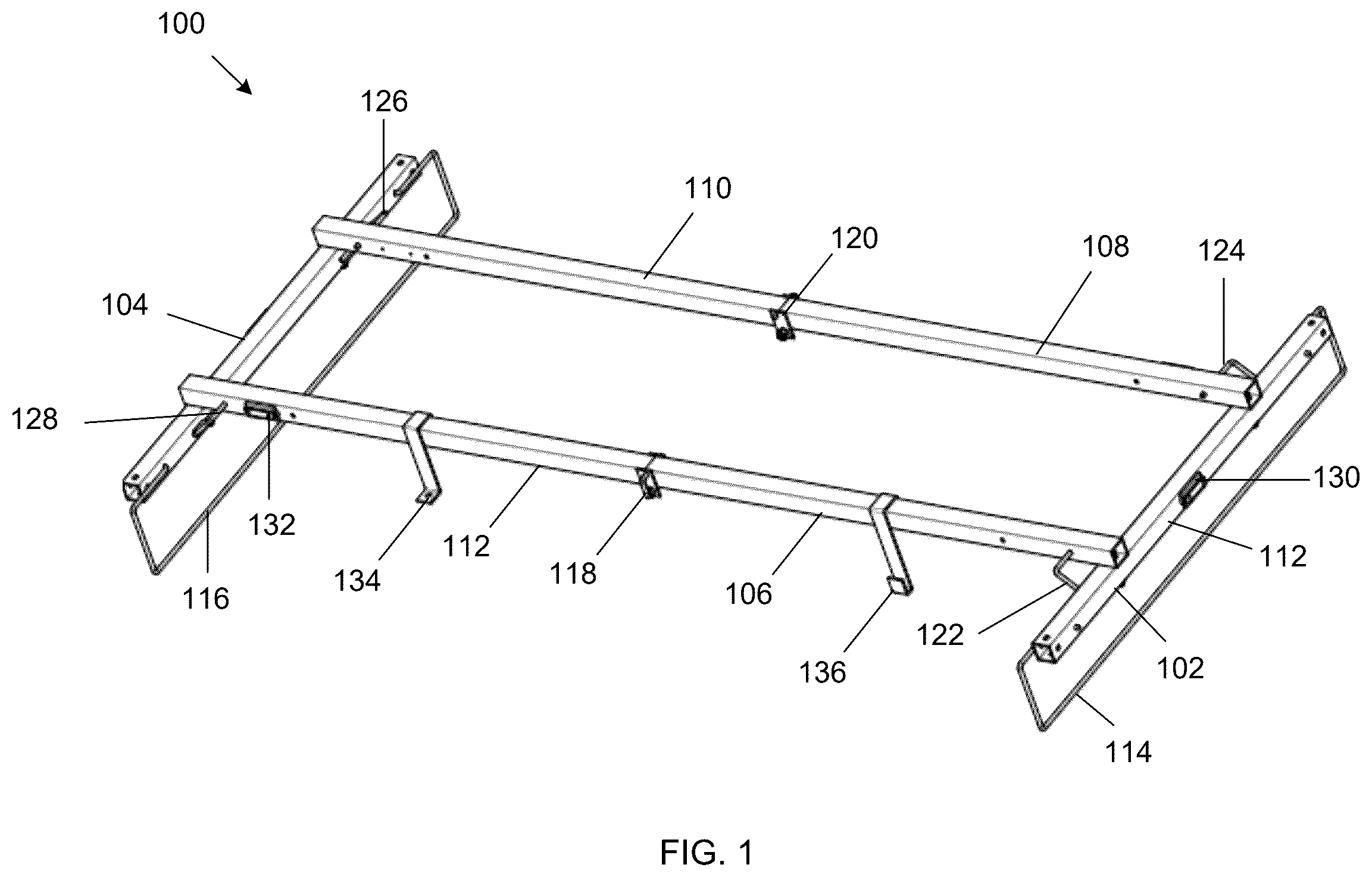
is a perspective view of a mounting apparatus, depicting pins, drain pan hangers, sensor hangers, and leveling indicators.
is a top view of the mounting apparatus of .
is a bottom view of the mounting apparatus of .
is a front view of the mounting apparatus of .
is a back view of the mounting apparatus of .
is a left view of the mounting apparatus of .
is a right view of the mounting apparatus of .
is a perspective view of a mounting apparatus, depicting the base frame without pins, drain pan hangers, and leveling indicators.
is a top view of the mounting apparatus of .
is a bottom view of the mounting apparatus of .
is a front view of the mounting apparatus of .
is a back view of the mounting apparatus of .
is a left view of the mounting apparatus of .
is a right view of the mounting apparatus of .
is a perspective view of a mounting apparatus, depicting the base frame without pins, sensors, and drain pan hangers, while including leveling indicators.
is a top view of the mounting apparatus of .
is a bottom view of the mounting apparatus of .
is a front view of the mounting apparatus of .
is a back view of the mounting apparatus of .
is a left view of the mounting apparatus of .
is a right view of the mounting apparatus of .
is a perspective view of a mounting apparatus, depicting the base frame without pins and sensors while including drain pan hangers and leveling indicators.
is a top view of the mounting apparatus of .
is a bottom view of the mounting apparatus of .
is a front view of the mounting apparatus of .
is a back view of the mounting apparatus of .
is a left view of the mounting apparatus of .
is a right view of the mounting apparatus of .
is a perspective view of a mounting apparatus, depicting the base frame without pins and drain pan hangers, while including a hook variant sensor hanger and leveling indicators.
is a top view of the mounting apparatus of .
is a bottom view of the mounting apparatus of .
is a front view of the mounting apparatus of .
is a back view of the mounting apparatus of .
is a left view of the mounting apparatus of .
is a right view of the mounting apparatus of .
is a perspective view of an HVAC mounting apparatus, depicting the base frame without pins and drain pan hangers, while including a clip variant sensor hanger and leveling indicators.
is a top view of the mounting apparatus of .
is a bottom view of the mounting apparatus of .
is a front view of the mounting apparatus of .
is a back view of the mounting apparatus of .
is a left view of the mounting apparatus of .
is a right view of the mounting apparatus of .
is a perspective view of an HVAC mounting apparatus, depicting the base frame without pan hangers present, while including pins and bubble leveling indicators.
is a top view of the mounting apparatus of .
is a bottom view of the mounting apparatus of .
is a front view of the mounting apparatus of .
is a back view of the mounting apparatus of .
is a left view of the mounting apparatus of .
is a right view of the mounting apparatus of .
is a perspective view of a folded HVAC mounting apparatus.
is a top view of the mounting apparatus of .
is a bottom view of the mounting apparatus of .
is a front view of the mounting apparatus of .
is a back view of the mounting apparatus of .
is a left view of the mounting apparatus of .
is a right view of the mounting apparatus of .
is a perspective view of an extended HVAC mounting apparatus, depicting the base frame extended to minimum length, with pan hangers, leveling indicators, and pins present.
is a top view of the mounting apparatus of .
is a bottom view of the mounting apparatus of .
is a front view of the mounting apparatus of .
is a back view of the mounting apparatus of .
is a left view of the mounting apparatus of .
is a right view of the mounting apparatus of .
is a perspective view of an HVAC mounting apparatus, depicting a base frame without leveling indicators while including pins, drain pan hangers, and a hook variant sensor hanger.
is a top view of the mounting apparatus of .
is a bottom view of the mounting apparatus of .
is a front view of the mounting apparatus of .
is a back view of the mounting apparatus of .
is a left view of the mounting apparatus of .
is a right view of the mounting apparatus of .
is a perspective view of an HVAC mounting apparatus, depicting a base frame without leveling indicators while including pins, drain pan hangers, and a clip variant sensor hanger;
is a top view of the mounting apparatus of .
is a bottom view of the mounting apparatus of .
is a front view of the mounting apparatus of .
is a back view of the mounting apparatus of .
is a left view of the mounting apparatus of .
is a right view of the mounting apparatus of .
is a perspective view of an HVAC mounting apparatus, depicting a base frame without leveling indicators and sensor hangers while including pins and drain pan hangers.
is a top view of the mounting apparatus of .
is a bottom view of the mounting apparatus of .
is a front view of the mounting apparatus of .
is a back view of the mounting apparatus of .
is a left view of the mounting apparatus of .
is a right view of the mounting apparatus of .
is a perspective view of an HVAC mounting apparatus, depicting a base frame without drain pan hangers, while including leveling indicators, pins and a hook variant sensor hanger.
is a top view of the mounting apparatus of .
is a bottom view of the mounting apparatus of .
is a front view of the mounting apparatus of .
is a back view of the mounting apparatus of .
is a left view of the mounting apparatus of .
is a right view of the mounting apparatus of .
is a perspective view of an HVAC mounting apparatus, depicting a base frame without drain pan hangers, while including leveling indicators, pins and a clip variant sensor hanger.
is a top view of the mounting apparatus of .
is a bottom view of the mounting apparatus of .
is a front view of the mounting apparatus of .
is a back view of the mounting apparatus of .
is a left view of the mounting apparatus of .
is a right view of the mounting apparatus of .
is a perspective view of an HVAC mounting apparatus, depicting a base frame with drain pan hangers, leveling indicators, pins, and a hook variant sensor hanger.
is a top view of the mounting apparatus of .
is a bottom view of the mounting apparatus of .
is a front view of the mounting apparatus of .
is a back view of the mounting apparatus of .
is a left view of the mounting apparatus of .
is a right view of the mounting apparatus of .
is a perspective view of an HVAC mounting apparatus, depicting a base frame with drain pan hangers, leveling indicators, pins, and a clip variant sensor hanger.
is a top view of the mounting apparatus of .
is a bottom view of the mounting apparatus of .
is a front view of the mounting apparatus of .
is a back view of the mounting apparatus of .
is a left view of the mounting apparatus of .
is a right view of the mounting apparatus of .
is a perspective view of a bubble level, which may be configured to the fixed and adjustable support beams.
is a top view of the bubble level of .
is a bottom view of the bubble level of .
is a front view of the bubble level of .
is a back view of the bubble level of .
is a left view of the bubble level of .
is a right view of the bubble level of .
is a perspective view of an adjustable support beam.
is a side view of the adjustable support beam of .
is a perspective view of a fixed length support beam.
is a left view of the fixed length support beam of .
is a top view of the fixed length support beam of .
is a perspective view of a hinge member, which may function as a folding mechanism.
is a left view of the hinge member of .
is a side view of the hinge member of .
is a perspective view of a hinge tube, which may be configured with the hinge member to function as a folding member.
is a cross-sectional view of the hinge tube of .
is a top view of the hinge tube of .
is a perspective view of a drain pan hanger, which may be fixed to the first and second fixed length support beams.
is a side view of the drain pan hanger of .
is a top view of the drain pan hanger of .
is a perspective view of a hinge pin, which may be fixed between the first and second fixed length support beams and the adjustable support beams to fix the length of the system.
is a side view of the hinge pin of .
is a bottom view of the hinge pin of .
is a perspective view of a slide lock pin, which may be fixed between the first and second fixed length support beams and the adjustable support beams to fix the length of the system.
is a side view of the slide lock pin of .
is a bottom view of the slide lock pin of .
is a perspective view of a slide lock tube, which may be configured within the frame to guide the slide lock and fix the length of the system.
is a cross-sectional view of the slide lock tube of .
is a top view of the slide lock tube of .
is a perspective view of a hook sensor hanger, which may be configured to the support frame and suspended above the drain pan level.
is a side view of the hook sensor hanger of .
depicts detail A of , located near the bottom of the hanger portion configured to hook onto the dimensions of the support frame.
is a bottom view of the hook sensor hanger of .
is a perspective view of a clip sensor hanger, which may be configured to the support frame and suspended above the drain pan level.
is a side view of the clip sensor hanger of .
depicts detail B of , located near the bottom of the hanger portion configured to hook onto the dimensions of the support frame.
is a bottom view of the clip sensor hanger of ;
is a perspective view of another mounting apparatus, depicting a base frame with drain pan hangers, sliding pins, and leveling indicators, wherein the left side of the base frame length is shortened.
is a top view of the mounting apparatus of .
is a bottom view of the mounting apparatus of .
is a front view of the mounting apparatus of .
is a back view of the mounting apparatus of .
is a left view of the mounting apparatus of .
is a right view of the mounting apparatus of .
is a perspective view of the folded HVAC mounting apparatus of .
is a top view of the mounting apparatus of .
is a bottom view of the mounting apparatus of .
is a front view of the mounting apparatus of .
is a back view of the mounting apparatus of .
is a left view of the mounting apparatus of .
is a right view of the mounting apparatus of .
is a perspective view of the mounting apparatus of , depicting the base frame without drain pan hangers and leveling indicators, while including sliding pins.
is a top view of the mounting apparatus of .
is a bottom view of the mounting apparatus of .
is a front view of the mounting apparatus of .
is a back view of the mounting apparatus of .
is a left view of the mounting apparatus of .
is a right view of the mounting apparatus of .
is a perspective view of the mounting apparatus of , depicting the base frame without pins, drain pan hangers, and leveling indicators, while including a hook variant sensor hanger and sliding pins.
is a top view of the mounting apparatus of .
is a bottom view of the mounting apparatus of .
is a front view of the mounting apparatus of .
is a back view of the mounting apparatus of .
is a left view of the mounting apparatus of .
is a right view of the mounting apparatus of .
is a perspective view of the mounting apparatus of , depicting the base frame without pins, drain pan hangers, and leveling indicators, while including a clip variant sensor hanger and sliding pins.
is a top view of the mounting apparatus of .
is a bottom view of the mounting apparatus of .
is a front view of the mounting apparatus of .
is a back view of the mounting apparatus of .
is a left view of the mounting apparatus of .
is a right view of the mounting apparatus of .
is a perspective view of another mounting apparatus variant according to the invention herein, depicting a base frame with drain pan hangers and sliding pins, while excluding leveling indicators.
is a top view of the mounting apparatus of .
is a bottom view of the mounting apparatus of .
is a front view of the mounting apparatus of .
is a back view of the mounting apparatus of .
is a left view of the mounting apparatus of .
is a right view of the mounting apparatus of .
is a perspective view of another mounting apparatus variant, depicting a base frame with drain pan hangers and sliding pins, while excluding leveling indicators.
is a top view of the mounting apparatus of .
is a bottom view of the mounting apparatus of .
is a front view of the mounting apparatus of .
is a back view of the mounting apparatus of .
is a left view of the mounting apparatus of .
is a right view of the mounting apparatus of .
is a perspective view of another mounting apparatus variant, depicting a base frame with drain pan hangers, sliding pins, and a hook variant sensor hanger, while excluding leveling indicators.
is a top view of the mounting apparatus of .
is a bottom view of the mounting apparatus of .
is a front view of the mounting apparatus of .
is a back view of the mounting apparatus of .
is a left view of the mounting apparatus of .
is a right view of the mounting apparatus of .
is a perspective view of another mounting apparatus variant, depicting a base frame with drain pan hangers, sliding pins, and a hook variant sensor hanger, while excluding leveling indicators.
is a top view of the mounting apparatus of .
is a bottom view of the mounting apparatus of .
is a front view of the mounting apparatus of .
is a back view of the mounting apparatus of .
is a left view of the mounting apparatus of .
is a right view of the mounting apparatus of .
is a perspective view of a sliding pin.
is a top view of the sliding pin of .
is a bottom view of the sliding pin of .
is a front view of the sliding pin of .
is a back view of the sliding pin of .
is a left view of the sliding pin of .
is a right view of the sliding pin of .
is a disassembled view of the sliding pin of .
is a perspective view of a hinge.
is a top view of the hinge of .
is a bottom view of the hinge of .
is a front view of the hinge of .
is a back view of the hinge of .
is a left view of the hinge of .
is a right view of the hinge of .
is a disassembled view of the hinge of .
is a perspective view of the folded mounting apparatus.
is a perspective view of the first step in unfolding the folded mounting apparatus of .
is a perspective view of the second step in unfolding the folded mounting apparatus of .
is a perspective view of the third step in unfolding the folded mounting apparatus of .
is a perspective view of the fourth step in unfolding the folded mounting apparatus of .
DETAILED DESCRIPTION
An air handler mounting system is shown in , as well as in other figures described below. The mounting system allows users to fold, stow (e.g., store), and extend the system, and enables users to install a variety of Heating, Ventilation, and Air Conditioning (HVAC) systems. Referring to , the presented air handler mounting system (e.g., mounting system 100 ) includes a first fixed length support beam ( 102 ) and a second fixed length support beam ( 104 ) located parallel to one another, separated by a first distance. The apparatus further includes a first adjustable support beam ( 106 ) and a second adjustable support beam ( 108 ) fixed perpendicular to the first fixed length support beam, and a third adjustable support beam ( 110 ) and a fourth adjustable support beam ( 112 ) fixed perpendicular to the second fixed length support beam ( 104 ), wherein the first adjustable support beam and the fourth adjustable support beam are separated by a second distance to the second adjustable support beam and the third adjustable support beam. In some implementations, the first fixed length support beam ( 102 ) and a second fixed length support beam ( 104 ) are located approximately parallel to one another. Furthermore, the first adjustable support beam ( 106 ) and the second adjustable support beam ( 108 ) may be fixed approximately perpendicular to the first fixed length support beam, and the third adjustable support beam ( 110 ) and fourth adjustable support beam ( 112 ) may be fixed approximately perpendicular to the second fixed length support beam ( 104 ).
The apparatus may also include a drain pan hanger assembly with a first drain pan hanger ( 114 ) fixed to the first fixed length support beam and a second drain pan hanger ( 116 ) fixed to the second fixed length support beam, each configured to support a sliding drain pan structure. The system may further include a folding mechanism with a first folding assembly ( 118 ) positioned between the first and fourth adjustable support beams, and a second folding assembly ( 120 ) positioned between the second and third adjustable support beams. Finally, the system may include a locking mechanism, which may employ a first pin ( 122 ) configured between the first adjustable support beam and the first fixed length support beam, a second pin ( 124 ) configured between the second adjustable support beam and the first fixed length support beam, a third pin ( 126 ) configured between the third adjustable support beam and the second fixed length support beam, and a fourth pin ( 128 ) configured between the fourth adjustable support beam and the second fixed length support beam.
The system also has four leveling indicators, two of which are shown in the perspective view ( 130 )( 132 ). Finally, the system might be configured with two types of sensor hanger variants, the first one being a clip variant ( 134 ), and the second being a hanger variant ( 136 ). Alternative views of system 100 are presented in . presents a top view ( 200 ) of system 100 . presents a bottom view ( 300 ) of system 100 . presents a front view ( 400 ) of system 100 . presents a back view ( 500 ) of system 100 . presents a left view ( 600 ) of system 100 . presents a right view ( 700 ) of system 100 .
Referring to , the presented air handler mounting frame (e.g., mounting frame 800 ) includes a first fixed length support beam ( 802 ) and a second fixed length support beam ( 804 ) located parallel to one another, separated by a first distance. The apparatus further includes a first adjustable support beam ( 806 ) and a second adjustable support beam ( 808 ) fixed perpendicular to the first fixed length support beam, and a third adjustable support beam ( 810 ) and a fourth adjustable support beam ( 812 ) fixed perpendicular to the second fixed length support beam, wherein the first adjustable support beam and the fourth adjustable support beam are separated by a second distance to the second adjustable support beam and the third adjustable support beam.
Furthermore, the first, second, third, and fourth adjustable support beams are configured with a set of extension points ( 814 )( 816 )( 818 )( 820 ), which can be used to extend and/or secure the frame length. The apparatus further includes a first set of support holes spaced out on the first fixed length support beam ( 822 )( 824 ) and a second set of support holes spaced out on the second fixed length support beam ( 826 )( 828 ). These holes may enable the first and second fixed length support beams to engage a support mechanism such as a cable, wire, or hanger, which can suspend the system frame and adjust its height. Alternative views of system 800 are presented in . presents a top view ( 900 ) of system 800 . presents a bottom view ( 1000 ) of system 800 . presents a front view ( 1100 ) of system 800 . presents a back view ( 1200 ) of system 800 . presents a left view ( 1300 ) of system 800 . presents a right view ( 1400 ) of system 800 .
The system frame may have a variety of geometries. In one aspect, the adjustable support beams are positioned below and/or above the fixed length support beams. In another aspect, adjustable support beams are positioned in the same plane as the fixed length support beams. In some aspects, the cross section of the tube is square or rectangular. In other aspects, the cross-section might be elliptical. In other aspects, the system frame might be made of metal structural tubing, fiber-reinforced polymer, resin filling, or pultruded FRP Composites.
Additionally, the frame might be configured to be suspended from an existing overhead structure at varying heights, from either a level or uneven surface. In one arrangement, the fixed length support beams are configured to connect to an overhead structure by passing a cable through holes in the support beams and adjusting the frame suspension height through cable locks, cable crimp connectors, or the like. Another suspension method may employ a 3/8-16 all threaded rod. In another aspect, a combination of the first, second, third, and fourth adjustable support beams are configured to suspend the frame system by passing a cable through support holes. In an alternative aspect, the first, second, third, and fourth adjustable support beams or the fixed beams might contain an additional or alternative support structure (for example, a cable track) to loop cable through or around any members of the supporting frame. In another aspect, the cable is configured with threaded rod, which may be used to drill into an overhead structure to secure the unit.
Alternatively, the system might be configured to rest on the ground. In some embodiments, the frame is configured to sit over a supporting drain pan structure on the floor. In alternative aspects, the frame might support the HVAC unit on the floor while the HVAC unit is drained to a drain pan on the floor nearby. In another aspect, the frame separates the HVAC unit from the ground at varying heights with additional support members extending from the floor. Alternatively, the frame might have a larger height configured to separate the HVAC unit from the floor, allowing for a drain pan to be placed under the unit on the floor.
Referring to , the presented air handler mounting frame ( 1500 ) may include four leveling indicators attached to the frame, which indicate whether the system is leveled during mounting. depicts a perspective view of the system, showing a first leveling indicator ( 1502 ) attached to the first fixed length support beam and another leveling indicator ( 1504 ) attached to the fourth adjustable support beam. The leveling indicator placement is further shown in , which highlights a top view of the frame apparatus 1600 . Four leveling indicators are depicted, wherein a first leveling indicator ( 1602 ) of the at least four leveling indicators is fixed to the second adjustable support beam, a second leveling indicator ( 1604 ) is fixed to the fourth adjustable support beam, a third leveling indicator ( 1606 ) is fixed to the first fixed length support beam, and a fourth leveling indicator ( 1608 ) is fixed to the second fixed length support beam.
This leveling indicator placement may provide an improved leveling system over alternative mounting structures. Each leveling indicator corresponds to one edge of the frame structure and can determine whether individual support beams are leveled. This improves leveling because, while the four adjustable support beams are level to one another, they may not be level to the first and second fixed length support beams if the system is tilted. Leveling indicators on each edge can ensure that the adjustable support beams are level to one another and the fixed length support beams. Alternative views of system 1500 are presented in . presents a bottom view ( 1700 ) of system 1500 . presents a front view ( 1800 ) of system 1500 . presents a back view ( 1900 ) of system 1500 . presents a left view ( 2000 ) of system 1500 . presents a right view ( 2100 ) of system 1500 . The system might employ one or more, or a combination of leveling indicators, which may include bubble levels, a digital readout, torpedo levels, laser levels, plumb lines, or a software leveling application to indicate the system is leveled during mounting. Additionally, the leveling indicators might be distributed in a different manner than depicted, as the leveling indicators can be placed in a plurality of locations on the fixed or adjustable support beams.
Turning to , (e.g., mounting system 2200 ) another implementation of the system may include drain pan hangers fixed orthogonally to the plane of the first and second fixed length support beams, wherein the drain pan hangers may support an insertable drain pan. The mounting system 2200 depicts this system, as the frame may include a first drain pan hanger ( 2202 ) fixed to the first fixed length support beam, and a second drain pan hanger ( 2204 ) fixed to the second fixed length support beam. In other embodiments the drain pan hangers might be attached to the adjustable support beams, or a combination of the adjustable or fixed length support beams. As depicted, the drain pan hanger may be fixed to the fixed length support beams through holes in the fixed length support beams. However, the drain pan hangers may be fixed to the fixed length support beams with alternative securement methods. For example, the drain pan hangers may be hung from or welded to the support frame.
The drain pan hangers may be made of a variety of materials. For example, they may be made of metal, molded plastic, hard plaster, or resin filling, among other materials, combinations of materials, etc. Alternative views of system 2200 are presented in . presents a top view ( 2300 ) of system 2200 . presents a bottom view ( 2400 ) of system 2200 . presents a front view ( 2500 ) of system 2200 . presents a back view ( 2600 ) of system 2200 . presents a left view ( 2700 ) of system 2200 . presents a right view ( 2800 ) of system 2200 .
In further arrangements, a drain pan is included, configured to slide into the drain pan hangers described above. The drain pan may have various dimensions configured to match the plurality of dimensions of the adjustable support members. In one embodiment, the drain pan might be extendable to the maximum length of the support members. In another aspect, the drain pan might include a hose attachment or water drainage system. The drain pan might be made of molded plastic, or it can alternatively be made using slush latex, metal, hard plaster, resin filling, or silicon, among other materials. The drain pan might alternatively be configured to sit on the floor and support the frame and HVAC unit above it. In another aspect, it can be hung under the frame using hooks or metal cable attached to the fixed length support beams or one or a combination of the first, second, third, and fourth support beams.
In some arrangements, the system might employ sensors to determine liquid dispensed from the HVAC unit. For example, the system might use one or a combination of float sensors, capacitance sensors, ultrasonic sensors, pressure sensors, humidity sensors, electromagnetic (e.g., radar) sensors, combinations of sensors, etc. to measure a water level dispensed from an HVAC unit. Additionally, the apparatus may contain one or a plurality of sensor hangers configured to suspend liquid detection sensors at a fixed height above the drain pan. In one embodiment, the apparatus has two sensor hangers attached to one or a combination of the first and fourth adjustable support beams. The sensor hangers might employ a hook variant, clip variant, or an alternative securement variant to suspend a sensor. In another embodiment, the sensor hangers might be attached to one or a combination of the fixed length support beams or the first, second, third or fourth adjustable support beams. In another embodiment, one sensor may be suspended at a lower height than the other sensor to indicate a low water level or a high-water level warning. In another embodiment, only one sensor hanger is used. In some embodiments, one or more of the sensor hangers might be suspended (e.g., two inches, one inch, three inches, etc.) above the drain pan to sense when the water depth reaches this height. For both hanger variants, the upper hook portion is enabled to be fixed to the first, second, third, or fourth support beam.
depicts an example mounting system 2900 with a hook sensor hanger ( 2902 ) described above. Alternative views of are presented in - . presents a top view ( 3000 ) of system 2900 . presents a bottom view ( 3100 ) of system 2900 . presents a front view ( 3200 ) of system 2900 . presents a back view ( 3300 ) of system 2900 . presents a left view ( 3400 ) of system 2900 . presents a right view ( 3500 ) of system 2900 .
depicts an example mounting system ( 3600 ) with a clip sensor hanger ( 3602 ) described above. Alternative views of are presented in - . presents a top view ( 3700 ) of system 3600 . presents a bottom view ( 3800 ) of system 3600 . presents a front view ( 3900 ) of system 3600 . presents a back view ( 4000 ) of system 3600 . presents a left view ( 4100 ) of system 3600 . presents a right view ( 4200 ) of system 3600 .
Turning to , the system 4300 might employ one or more pins to secure the frame length into place. As depicted, four pins ( 4302 )( 4304 )( 4306 )( 4308 ) might be configured on the outside of the first, second, third, and fourth adjustable support beams to fix the adjustable support beams to the fixed length support beams. While the pins are depicted on the outside of the adjustable support beams, they may be configured on the inside of the frame components. In other arrangements, the system might employ one or a combination of locking pins, hinge pins, slide lock pins, locking nuts, click-lock technology, thread lockers, retaining mechanisms, extended rods, etc. placed through extension points on the frame to secure the frame length. Furthermore, the system may employ tubes configured to the inside of the frame (for example, a slide lock tube) to guide the pins through the adjustable support beam and lock the frame into place. These slide lock tubes may be fixed to the inside of the adjustable support beams, wherein their tube hole may line up with a hole in the adjustable support beams. Alternative views of system 4300 are presented in . presents a top view ( 4400 ) of system 4300 . presents a bottom view ( 4500 ) of system 4300 . presents a front view ( 4600 ) of system 4300 . presents a back view ( 4700 ) of system 4300 . presents a left view ( 4800 ) of system 4300 . presents a right view ( 4900 ) of system 4300 .
Turning to , a frame ( 5000 ) might be configured with one or more folding mechanisms, which may include a first folding assembly positioned between the first and fourth adjustable support beams and a second folding assembly positioned between the second and third adjustable support beams. Each folding assembly may employ a hinge ( 5002 )( 5004 ). Each hinge has a front hinge member ( 5006 )( 5008 ) fixed to the front side of the adjustable support beams, either between the first and fourth or the second and third adjustable support beams. Each hinge also has a back hinge member ( 5010 )( 5012 ) fixed to the back side of the adjustable support beams, either between the first and fourth or the second and third adjustable support beams. The front and back hinge members may engage a first hinge tube ( 5014 ), fixed within the frame between the first and fourth adjustable support beams, and a second hinge tube ( 5016 ), fixed within the frame between the second and third adjustable support beams. The hinge tube ( 5014 , 5016 ) may have an inner diameter and an outer diameter, wherein the inner diameter may line up with holes in the adjustable support beam. The inner diameter may serve as a guiding tube for a pin, which may be used to secure the folding assemblies and fold the system, wherein the adjustable support beams may pivot around the hinge tube to fold the system. The folding mechanism can be configured in a variety of ways. For example, the folding mechanism one or more components with various properties. For example, components can be flexible and produced with flexible materials (e.g., rubber, plastic, etc.), produced with rigid or semi rigid materials, such as metal, epoxy resin, carbon fiber, etc., produced with a combination of flexible and rigid components, etc. In some implementations, the folding mechanism may use one hinge and pin, or it may employ multiple hinges and pins to fold the system into a stowable position.
The system may fold in a variety of geometries. In some embodiments, the first fixed beam is positioned above or below the second fixed beam, the first adjustable beam is positioned above or below the fourth adjustable beam, and the second adjustable beam is positioned above or below the third adjustable beam, wherein each beam may form an approximate 30-degree angle at the folding point. In other embodiments, the frame may fold flat, wherein the fixed beams may fold to lay side by side in the same plane and the first and fourth adjustable support beams and the second and third adjustable support beams may fold directly on top of one another.
In other aspects, the first and second support beams might have a plurality of folding members, allowing the system to fold at numerous points and in numerous directions, such as downwards or sideways. In yet another aspect, the third and fourth support beams might include a folding member. Overall, the folded configuration may preserve the integrity of the system, as it can remain folded or stowed (e.g., stored in a box) for long periods of time. In the folded configuration, the system might have an approximate dimension of 33 in. by 30 in., with an approximate height of 3 in., wherein the folded system can be stored in a box with an approximate dimension of 34 in. by 31 in. by 4 in. While the system may fold according to the values described, the length, width, and height of the system may be higher or lower than what is described. Furthermore, the system may utilize alternative folding mechanisms, such as tube hinge, ladder hinge, PVC couplers, or a self-locking folding hinge. Alternative views of the folded system 5000 are presented in . presents a top view ( 5100 ) of system 5000 . presents a bottom view ( 5200 ) of system 5000 . presents a front view ( 5300 ) of system 5000 . presents a back view ( 5400 ) of system 5000 . presents a left view ( 5500 ) of system 5000 . presents a right view ( 5600 ) of system 5000 .
In some respects, the mounting frame can be adjusted in length. The previous figures depict the mount extended to a particular length (e.g., a maximum length). presents the air handler mounting system 5700 (e.g., a mounting frame) with a shortened adjustable length, which includes a first fixed length support beam ( 5702 ) and a second fixed length support beam ( 5704 ) located parallel to one another, separated by a first distance. The apparatus further includes a first adjustable support beam ( 5706 ) and a second adjustable support beam ( 5708 ) fixed perpendicular to the first fixed length support beam, and a third adjustable support beam ( 5710 ) and a fourth adjustable support beam ( 5712 ) fixed perpendicular to the second fixed length support beam, wherein the first adjustable support beam and the fourth adjustable support beam are separated by a second distance to the second adjustable support beam and the third adjustable support beam. The system 5700 also includes: a first extension point ( 5714 ) and a second extension point ( 5716 ) spaced apart on the first adjustable support beam, a first extension point ( 5718 ) and a second extension point ( 5720 ) spaced apart on the second adjustable support beam, a first extension point ( 5722 ) and a second extension point ( 5724 ) spaced apart on the third adjustable support beam, and a first extension point ( 5726 ) and a second extension point ( 5728 ) spaced apart on the fourth adjustable support beam. The first and second extension points allow the system to be adjustable between two lengths, wherein the adjustable support beams may slide over the fixed length support beams to the desired length before being fixed to the fixed length support beams. While two extension points are depicted, the system may be extendable to more lengths.
To adjust the length of the system, a pin may be secured into the second extension point instead of the first extension point, which shortens the frame length. As depicted in the shortened configuration, a first of four pins ( 5730 ) are fixed to the second extension point of the first adjustable support beam and the first fixed length support beam. A second pin ( 5732 ) is fixed to the second extension point of the second adjustable support beam and the first fixed length support beam. A third pin ( 5734 ) is fixed to the second extension point of the third adjustable support beam and the second fixed length support beam. A fourth pin ( 5736 ) is fixed to the second extension point of the fourth adjustable support beam and the second fixed length support beam. While the system may range in extension length, the fixed length support beams may be separated by about 52 in. in the depicted shortened configuration, wherein this length may extend from 52 in. to 66 in., depending on the length needed for a drain pan or for HVAC unit mounting.
The system 5700 may be extendable in multiple geometries and might employ multiple adjustable components to match the dimensions of a variety of air handler systems. In one aspect, the adjustable support beams might be configured to telescopically extend to a variety of lengths. Furthermore, while the mounting system is depicted with two extension points, the system may employ a plurality of extension points to further adjust the system length. In some embodiments, these extension points are secured with pins fixed to the first and second fixed length support beams. In other aspects, the length of the system 5700 might be fixed, and the width of the frame might be adjusted through similar methods to those described above. In a further aspect, a combination of the fixed and adjustable supporting beams might be configured with numerous extension points, allowing the system 5700 to be adjusted for width and length. Alternative views of the system 5700 are presented in . presents a top view ( 5800 ) of the system 5700 . presents a bottom view ( 5900 ) of the system 5700 . presents a front view ( 6000 ) of the system 5700 . presents a back view ( 6100 ) of the system 5700 . presents a left view ( 6200 ) of the system 5700 . presents a right view ( 6300 ) of the system 5700 .
In addition to the components and examples described above, the mounting system might have a variety of implementations. For example, turning to , a mounting system ( 6400 ) might not include leveling indicators, while it may employ a left drain pan hanger ( 6402 ), a right drain pan hanger ( 6404 ), four pins ( 6406 )( 6408 )( 6410 )( 6412 ), and a hook sensor variant ( 6414 ). Alternative views of the system 6400 are presented in . presents a top view ( 6500 ) of system 6400 . presents a bottom view ( 6600 ) of system 6400 . presents a front view ( 6700 ) of the system 6400 . presents a back view ( 6800 ) of system 6400 . presents a left view ( 6900 ) of system 6400 . presents a right view ( 7000 ) of the system 6400 .
depicts an alternative arrangement, as a mounting system ( 7100 ) has a clip variant sensor ( 7102 ). Alternative views of the system 7100 are presented in . presents a top view ( 7200 ) of the system 7100 . presents a bottom view ( 7300 ) of system 7100 . presents a front view ( 7400 ) of the system 7100 . presents a back view ( 7500 ) of the system 7100 . presents a left view ( 7600 ) of the system 7100 . presents a right view ( 7700 ) of the system 7100 .
Turning to , another implementation of a mounting system ( 7800 ) might not include leveling indicators or sensor hangers, while it may include a left drain pan hanger ( 7802 ), a right drain pan hanger ( 7804 ), and four pins ( 7806 )( 7808 )( 7810 )( 7812 ). Alternative views of the system 7800 are presented in . presents a top view ( 7900 ) of the system 7800 . presents a bottom view ( 8000 ) of the system 7800 . presents a front view ( 8100 ) of the system 7800 . presents a back view ( 8200 ) of the system 7800 . presents a left view ( 8300 ) of the system 7800 . presents a right view ( 8400 ) of the system 7800 .
Turning to , another implementation of a mounting system ( 8500 ) might include leveling indicators, four pins, and a hook variant sensor hanger, while excluding drain pan hangers. depicts a perspective view of the system ( 8500 ), showing two leveling indicators ( 8502 ) ( 8504 ), pins ( 8506 )( 8508 )( 8510 )( 8512 ), and a hook variant sensor ( 8514 ). represents a top view ( 8600 ) of the system, which depicts the placement of the four leveling indicators ( 8602 ) ( 8604 )( 8606 )( 8608 ). Alternative views of the system 8500 are presented in . presents a bottom view ( 8700 ) of system 8500 . presents a front view ( 8800 ) of the system 8500 . presents a back view ( 8900 ) of the system 8500 . presents a left view ( 9000 ) of the system 8500 . presents a right view ( 9100 ) of the system 8500 .
presents a mounting system ( 9200 ) that includes a clip variant sensor ( 9202 ) instead of a hook variant sensor (as shown in ). Alternative views of system 9200 are presented in . presents a top view ( 9300 ) of system 9200 . presents a bottom view ( 9400 ) of system 9200 . presents a front view ( 9500 ) of system 9200 . presents a back view ( 9600 ) of system 9200 . presents a left view ( 9700 ) of system 9200 . presents a right view ( 9800 ) of system 9200 .
Turning to , another embodiment of a mounting system ( 9900 ) includes components of the mounting system ( 100 ) presented in , while employing only one hook sensor hanger ( 9902 ). Alternative views of system 9900 are presented in . presents a top view ( 10000 ) of system 9900 . presents a bottom view ( 10100 ) of system 9900 . presents a front view ( 10200 ) of system 9900 . presents a back view ( 10300 ) of system 9900 . presents a left view ( 10400 ) of system 9900 . presents a right view ( 10500 ) of system 9900 .
Similarly, in another implementation a mounting system ( 10600 ) presented in might employ a clip variant sensor hanger ( 10602 ). Alternative views of system 10600 are presented in . presents a top view ( 10700 ) of system 10600 . presents a bottom view ( 10800 ) of system 10600 . presents a front view ( 10900 ) of system 10600 . presents a back view ( 11000 ) of system 10600 . presents a left view ( 11100 ) of system 10600 . presents a right view ( 11200 ) of system 10600 .
As described above, a mounting system may employ a bubble level as a leveling device. presents a perspective view of one such bubble level ( 11300 ), which may be configured to the fixed and adjustable support beams. Alternative views of the bubble level ( 11300 ) are presented in . is a top view ( 11400 ) of the bubble level of . is a bottom view ( 11500 ) of the bubble level of ; is a front view ( 11600 ) of the bubble level of . is a back view ( 11700 ) of the bubble level of . is a left view ( 11800 ) of the bubble level of . is a right view ( 11900 ) of the bubble level of . As depicted in , the bubble levels may have a rough rectangular shape with a specified width (w), length (l), and height (h). The width may range up to 1 in., the length may range approximately between 2 in. to 5 in., and the height may range approximately between 0.5 in. to 3 in. While the figures depict a preferable dimension of 0.198 in. by 2.352 in. by 0.984 in. for the width, length, and height of the system (among other preferable dimensions), one skilled in the art would recognize that the dimensions and shape of the bubble level or other leveling indicators may differ from those described. In some arrangements, other types of leveling technology may be employed; for example, one or more types of sensors (e.g., acceleration sensors such as accelerometers) may be used for leveling operations. Sensors may be used in concert with one or more bubble levels in some implementations. In some arrangements, data communication techniques (e.g., wireless data transmission techniques) can be employed to send level information to a computing device (e.g., a smart phone, laptop computer, etc.) for collecting, processing, storing, etc. the level information.
As described above, a mounting system can employ an adjustable support beam. presents a perspective view of one such adjustable support beam ( 12000 ). As depicted, each adjustable support beam may have a rectangular cross-section (or nearly rectangular cross-section) with a specified width (w), length (l), and height (h). The width may range between 1 in. to 3 in., the length may range from 30 in. to 50 in., and the height may range from 1 in. to 20 in. Other width, length, and/or height may be achievable. As is further depicted , which presents a side view ( 12100 ) of , the adjustable support beam may be fixed with a first ( 12102 ) and a second ( 12104 ) extension point, located near the edge of the beam that is fixed to the fixed length support beam. These points enable the system to extend to a first and a second length, as the points may be configured to a pin to lock the system length into place. While the extension points may range in size and shape, they may have a circular shape with an approximate diameter ranging between 0.2 in. to 0.7 in. in a preferred embodiment. While the figures depict dimensions of 1.125 in. by 33 in. by 1.125 in. for the width, length, and height of the beam and 0.265 in. for the diameter of the extension points (among other preferable dimensions) one skilled in the art would recognize that the dimensions and shape of the adjustable support beam may differ from those described or depicted.
As described above, a mounting system can also employ a fixed length support beam. presents a perspective view of one such fixed length support beam ( 12200 ). Alternative views of the fixed length support beam ( 12200 ) are presented in . is a left view ( 12300 ) of the fixed length support beam of . is a top view ( 12400 ) of the fixed length support beam of . As depicted in , each fixed length support beam may have a rectangular cross-section (or nearly rectangular cross-section) with a specified width (w), length (l), and height (h). The width may range between 1 in. to 3 in., the length may range from 25 in. to 50 in., and the height may range from 1 in. to 8 in. As depicted in , the fixed length support beam may be configured with a first ( 12302 ) and a second ( 12304 ) set of support holes, spaced out on the beam. While these support holes may range in size and shape, they may have a circular shape with an approximate diameter ranging between 0.3 in. to 0.5 in. The fixed length support beam may also be configured with a first ( 12306 ) and a second ( 12308 ) set of drain pan hanger holes, spaced out on the beam. While the drain pan hanger holes may range in size and shape, they may have a circular shape with an approximate diameter ranging between 0.2 in. to 0.5. While the figures depict dimensions of 1.125 in. by 30 in. by 1.125 in. for the width, length, and height dimensions of the beam, 0.375 in. for the diameter of the support holes, and 0.265 in. for the diameter of the drain pan holes (among other preferable dimensions) one skilled in the art would recognize that the dimensions and shape of the fixed length support beam and holes may differ from those described or depicted.
As described above, a mounting system can also employ one or more hinge members and a hinge tube to serve as a folding assembly between the adjustable support beams. presents a perspective view of one such hinge member ( 12500 ), and alternative views of the hinge are presented in . is a left view ( 12600 ) of the hinge of . is a top view ( 12700 ) of the hinge of . As depicted in , the hinge member may have a rectangular shape (or nearly rectangular cross-section) with a specified width (w), length (l), and height (h). The width may range between 0.1 in. to 0.5 in., the length may range from 0.5 in. to 3 in., and the height may range from 1 in. to 5 in. The hinge member may be configured with a hole to engage a pin, which may have an approximate diameter ranging between 0.2 in. to 0.5 in. While the figures depict dimensions of 0.125 in. by 1 in. by 1.875 in. for the w, 1 , and h of the hinge member and a 0.375 in. diameter hole within the hinge member (among other preferable dimensions) one skilled in the art would recognize that the dimensions and shape of the hinge member and hinge member hole may differ from those described or depicted.
Turning to , a hinge member may be configured to a hinge tube to form the hinge. presents a perspective view of one such hinge tube ( 12800 ). Alternative views of are presented in . is a cross-sectional view ( 12900 ) of the hinge tube of . is a top view ( 13000 ) of the hinge tube of . As depicted in , the hinge tube may have a rough circular cross-section with an inner diameter (D 1 ), an outer diameter (D 2 ), and a length (l). The inner diameter may range between 0.3 in. to 0.5 in. The outer diameter may range between 0.4 in. to 0.9 in. The length may range between 1 in. to 4 in. While the figures depict an inner diameter of 0.375 in., an outer diameter of 0.5 in., and a length of 1.260 in. (among other preferable dimensions) one skilled in the art would recognize that the dimensions and shape of the hinge tube may differ from those described or depicted.
As described above, a mounting system may additionally employ a drain pan hanger, which may be fixed to the fixed length support beams. presents a perspective view of one drain pan hanger ( 13100 ). Alternative views of the drain pan hanger ( 13100 ) are presented in . is a side view ( 13200 ) of the drain pan hanger of . is a top view ( 13300 ) of the drain pan hanger of . As depicted in , the hinge member may have a rectangular shape (or nearly rectangular cross-section) with a specified length (l), and height (h). The drain pan hanger may be configured with a first hanging point ( 13102 ) and a second hanging point ( 13104 ) to fix the drain pan hanger to the fixed length support beam. The length of the drain pan hanger may range between 30 in. to 40 in., and the height may range between 4 in. to 10 in. As is further depicted in , the drain pan hangers may have a rough circular cross-section, wherein the diameter ray range between 0.2 in. to 0.5 in. While the figures depict a length of 33 in., a height of 5 in., and a circular cross-section diameter of 0.250 in. (among other preferable dimensions) one skilled in the art would recognize that the dimensions and shape of the drain pan hanger may differ from those described or depicted.
As described above, a mounting system may employ a hinge pin, which may be fixed between the first and second fixed length support beams and the adjustable support beams to fix the length of the system. presents a perspective view of a hinge pin ( 13400 ). Alternative views of are presented in . is a side view ( 13500 ) of the hinge pin of . is a bottom view ( 13600 ) of the hinge pin of . As depicted in , the hinge pin may be configured in a rough L-shape, with a first length (L 1 ) and a second length (L 2 ) positioned approximately perpendicular to one another. The first length may range between 2 in. to 5 in. and the second length may range between 1 in. to 3 in. As is further depicted in , the hinge pin may have a rough circular cross-section, with a diameter ranging between 0.2 in. to 0.5 in. While the figures depict a first length of 2.375 in., a second length of 1.375 in., and a circular cross-section of 0.250 in. (among other preferable dimensions) one skilled in the art would recognize that the dimensions and shape of the hinge pin may differ from those described or depicted.
As described above, a mounting system may alternatively employ a slide lock pin, which may be fixed between the first and second fixed length support beams and the adjustable support beams to fix the length of the system. presents a perspective view of a slide lock pin ( 13700 ). Alternative views of the slide lock pin ( 13700 ) are presented in . is a side view ( 13800 ) of the slide lock pin of . is a bottom view ( 13900 ) of the slide lock pin of . As depicted in , the slide lock may have a U shape with a bottom length (L 3 ) and a vertical length (L 4 ). The bottom length may range between 1.5 in. to 2.5 in. and the vertical length may range between 3 in. to 5 in. As is further depicted in , the slide lock pin may have a circular cross-section diameter ranging between 0.2 in. to 0.5 in. While the figures depict a bottom length of 2.204 in., and vertical length of 3.375 in., and a circular cross-section with a diameter of 0.250 in. (among other preferable dimensions), one skilled in the art would recognize that the dimensions and shape of the slide lock pin may differ from those described or depicted.
As described above, a slide lock may be configured to slide into a slide lock tube, which can be fixed inside the base frame of the system. The slide lock tube may guide the slide lock through the extension points on the system. presents a perspective view of a slide lock tube ( 14000 ). Alternative views of the slide lock tube ( 14000 ) are presented in . is a cross-sectional view ( 14100 ) of the slide lock tube of . is a top view ( 14200 ) of the slide lock tube of . As depicted in , the slide lock tube may have a rough circular cross-section with an inner diameter (D 1 ), an outer diameter (D 2 ), and a length (l). The inner diameter may range between 0.2 in. to 0.5 in. The outer diameter may range between 0.3 in. to 0.6 in. The length may range between 0.5 in. to 4 in. While the figures depict an inner diameter of 0.250 in., an outer diameter of 0.375 in., and a length of 1 in. (among other preferable dimensions) one skilled in the art would recognize that the dimensions and shape of the slide lock tube may differ from those described or depicted.
As described above, a mounting system may employ a hook sensor hanger, which may be configured to the support frame and suspended above the drain pan level. presents a perspective view of the hook sensor hanger ( 14300 ). Alternative views of the hook sensor hanger ( 14300 ) are presented in , 145 , and 146 . is a side view ( 14400 ) of the hook sensor hanger of . depicts details of a portion of the hook sensor hanger (i.e., detail A ( 14500 )) shown in , located near the bottom of the hanger portion configured to hook onto the dimensions of the support frame. is a bottom view ( 14600 ) of the hook sensor hanger of . As depicted in , the hook sensor hanger may have a hook length (L 1 ), a hook width (L 2 ), a hanging length (L 3 ), a hanger width (L 4 ), and a hanger height (L 5 ). L 1 and L 2 may vary between 1.3 in. to 2 in., L 3 may vary between 5 in. to 8 in., L 4 may vary between 5 in. to 1 in., and L 5 may vary between 0.5 in. to 2 in. While the figures depict an L 1 and L 2 of 1.650 in., an L 3 of 5.875 in., an L 4 of 0.625 in., and an L 5 of 1.125 in. (among other preferable dimensions) one skilled in the art would recognize that the dimensions and shape of the hook sensor hanger may differ from those described or depicted.
As described above, a mounting system can employ a clip sensor hanger, which may be configured to the support frame and suspended above the drain pan level. presents a perspective view of the clip sensor hanger ( 14700 ). Alternative views of the clip sensor hanger ( 14700 ) are presented in . is a side view ( 14800 ) of the clip sensor hanger of . depicts details of a portion of the clip sensor hanger (i.e., detail B (14900)) shown in , located near the bottom of the hanger portion configured to hook onto the dimensions of the support frame. is a bottom view ( 15000 ) of the clip sensor hanger of . As depicted in , the clip sensor hanger may have a hook length (L 1 ), a hook width (L 2 ), and a hanging length (L 3 ). The clip sensor hanger may include a roughly square bottom clip portion with a length and width (L 4 ). This square clip portion may further be configured with a centered clip hole, with an approximate diameter of D 1 . L 1 and L 2 may vary between 1.3 in. to 2 in., L 3 may vary between 4 in. to 8 in., L 4 may vary between 0.5 in. to 3 in., and D 1 may vary between 0.3 in. to 0.6 in. While the figures depict an L 1 of 1.6 in., an L 2 of 1.510 in., an L 3 of 4.750 in., an L 4 of 1.125 in., and a D 1 of 0.375 in. (among other preferable dimensions) one skilled in the art would recognize that the dimensions and shape of the clip sensor hanger may differ from those described or depicted.
As shown in , another implementation of a mounting frame may include three drain pan hangers, levelling indicators, a sliding extension assembly, and an asymmetrical folding assembly. Referring to , a presented air handler mounting system (e.g., mounting system 15100 ) includes a first fixed length support beam ( 15102 ) and a second fixed length support beam ( 15104 ) located parallel to one another, separated by a first distance. The apparatus further includes a first adjustable support beam ( 15106 ) and a second adjustable support beam ( 15108 ) fixed perpendicular to the first fixed length support beam, and a third adjustable support beam ( 15110 ) and a fourth adjustable support beam ( 15112 ) fixed perpendicular to the second fixed length support beam, wherein the first adjustable support beam and the fourth adjustable support beam are separated by a second distance to the second adjustable support beam and the third adjustable support beam.
The apparatus may include a drain pan hanger assembly with a first drain pan hanger ( 15114 ) fixed to the first fixed length support beam, a second drain pan hanger ( 15116 ) fixed to the second fixed length support beam, and a third drain pan hanger ( 15118 ) fixed to the first and third adjustable support beams, each configured to support an insertable sliding drain pan structure. While the third drain pan hanger ( 15118 ) is depicted fixed to the first and third adjustable support beams, it may be configured to any combination of the adjustable support beams. The third drain pan hanger ( 15118 ) may be bendable, flexible, or extendable so it can be fixed to the adjustable support beams. The third drain pan hanger ( 15118 ) may be made of copper, iron, or aluminum, molded plastic, hard plaster, resin filling, among other materials which may allow the rod to bend or be fixed to the adjustable support beams. In some implementations, the third drain pan hanger ( 15118 ) may be attached to the adjustable support beams through two provided holes offset from the center of the frame, with approximately three inches of separation. The first and second drain pan hangers ( 15114 , 15116 ) may have a protruded rod that enables them to be fixed to the fixed length support beams. The mounting system 15100 may further include an asymmetrical folding assembly with a first folding assembly ( 15120 ) positioned between the first and fourth adjustable support beams, and a second folding assembly ( 15122 ) positioned between the second and third adjustable support beams, such that the first folding assembly is located at a different location along the adjustable support beams than the second folding assembly.
In further implementations, a drain pan is included, configured to slide into the drain pan hangers described above. The drain pan may have various dimensions configured to match the plurality of dimensions of the adjustable support members. In one implementation, the drain pan might be extendable to the maximum length of the support members. In another aspect, the drain pan might include a hose attachment or water drainage system. The drain pan might be made of molded plastic, or it can alternatively be made using slush latex, metal, hard plaster, resin filling, or silicon, among other materials. The drain pan might alternatively be configured to sit on the floor and support the frame and HVAC unit above it. In another aspect, it can be hung under the frame using hooks or metal cable attached to the fixed length support beams or one or a combination of the first, second, third, and fourth support beams. The drain pan may also slide into the drain pan hangers from the left or right side of the system.
Finally, the system may include a sliding extension assembly with a sliding extension mechanism configured to the adjustable support beams to extend and lock the system length into place. The sliding extension assemblies may employ a first of four sliding pins ( 15124 ) configured to the first adjustable support beam and the first fixed length support beam, a second sliding pin ( 15126 ) configured to the second adjustable support beam and the first fixed length support beam, a third sliding pin ( 15128 ) configured to the third adjustable support beam and the second fixed length support beam, and a fourth sliding pin ( 15130 ) configured to the fourth adjustable support beam and the second fixed length support beam. Sliding pins 15128 and 15130 depict the extension mechanism. The sliding pins may be used to extend, shorten, and secure the length of the system by sliding the fixed length support beams under the adjustable support beams through a channel in the adjustable support beams. As shown in the left-hand side of the figure, sliding pins 15128 and 15130 secured the length of the second fixed length support beam 15103 to a shortened length. While only depicts this shortened length using the second fixed length support beam, both sides of the system may extend or shorten using similar methods.
The system also has four leveling indicators, two of which are shown in the perspective view ( 15132 )( 15134 ). Alternative views of system 15100 are presented in . presents a top view ( 15200 ) of system 15100 . presents a bottom view ( 15300 ) of system 15100 . presents a front view ( 15400 ) of system 15100 . presents a back view ( 15500 ) of system 15100 . presents a left view ( 15600 ) of system 15100 . presents a right view ( 15700 ) of system 15100 . The placement of the levelling indicators is better shown in , wherein a first of four levelling indicators ( 15202 ) may be fixed to the first fixed length support beam, a second levelling indicator ( 15204 ) may be fixed to the second fixed length support beam, a third levelling indicator ( 15206 ) may be fixed to the first adjustable support beam, and a fourth levelling indicator ( 15208 ) may be fixed to the third adjustable support beam.
The placement of the sliding pins and sliding pin channels is better shown in , wherein a first of four channels ( 15302 ) is configured to the bottom of the first adjustable support beam, a second channel ( 15304 ) is configured to the bottom of the second adjustable support beam, a third channel ( 15306 ) is configured to the bottom of the third adjustable support beam, and a fourth channel ( 15308 ) is configured to the bottom of the fourth adjustable support beam. A first of four sliding pins ( 15310 ) secures the first adjustable support beam to the first fixed length support beam. A second sliding pin ( 15312 ) secures the second adjustable support beam to the first fixed length support beam. A third sliding pin ( 15314 ) secures the third adjustable support beam to the second fixed length support beam. A fourth sliding pin ( 15316 ) secures the fourth adjustable support beam to the second fixed length support beam. As depicted, the pins may be used to extend, shorten, and secure the length of the system. The adjustable support beams are each configured with a maximum extension length (L 1 ) and a minimum extension length (L 2 ). As depicted, the first and second sliding pins 15310 and 15312 are extended to a maximum length (L 1 ). The third and fourth sliding pins 15314 and 15316 are extended to a minimum length (L 2 ). While the figure depicts one set of pins extended to a minimum length and one set of pins extended to a maximum length, it should be understood that either side of the system may extend to L 1 or L 2 , or to any length between L 1 and L 2 .
Turning to , the frame ( 15800 ) might be configured with an asymmetrical folding assembly, which may include a first folding assembly positioned between the first and fourth adjustable support beams and a second folding assembly positioned between the second and third adjustable support beams, wherein the first folding assembly is located at a different position along the adjustable support beams than the second folding assembly. As depicted in , the folding assemblies may be located asymmetrically on the apparatus frame in the unfolded configuration, such that the first folding assembly ( 15120 ) may be positioned along the first and fourth adjustable support beams at a length closer to the second fixed length support beam 15104 than the first fixed length support beam 15102 . The second folding assembly ( 15122 ) may be positioned along the second and third adjustable support beams at a length closer to the first fixed length support beam 15102 than the second fixed length support beam 15104 . As depicted in , the system may fold such that the first folding assembly ( 15802 ) becomes level with the second folding assembly ( 15804 ).
Each folding assembly may employ a hinge. Each hinge has a front hinge member ( 15806 ) ( 15808 ) fixed to the front side of the adjustable support beams, either between the first and fourth or the second and third adjustable support beams. Each hinge also has a back hinge member ( 15810 )( 15812 ) fixed to the back side of the adjustable support beams, either between the first and fourth or the second and third adjustable support beams. The front and back hinge members may engage a first hinge tube ( 15814 ), fixed within the frame between the first and fourth adjustable support beams, and a second hinge tube ( 15816 ), fixed within the frame between the second and third adjustable support beams. The hinge tube may have an inner diameter and an outer diameter, wherein the inner diameter may line up with holes in the adjustable support beam. The inner diameter may serve as a guiding tube for a pin, which may be used to secure the folding assemblies and fold the system, wherein the adjustable support beams may pivot around the hinge tube to fold the system. The system is folded at the first ( 15802 ) and second ( 15804 ) folding assembly, such that the first and second adjustable support beams ( 15818 )( 15824 ) have a folding angle range to fold to an angle (δ) with the third and fourth adjustable support beams ( 15830 ) ( 15828 ).
The asymmetrical hinges may allow the system to fold into a more compact configuration. In one aspect, some of the sliding pins may slide to a shortened configuration while other sliding pins may be removed, allowing the system to fold into a storable position. In some embodiments, the sliding pin connecting the first adjustable support beam ( 15818 ) to the first fixed length support beam ( 15820 ) is removed, allowing the first adjustable support beam to swivel around the second adjustable support beam ( 15824 ) into a more storable position. Similarly, the sliding pin connecting the third adjustable support beam to the second fixed length support beam ( 15826 ) may be removed, allowing for the second fixed length support beam to swivel around the fourth adjustable support beam ( 15828 ) into a more storable position. Both fixed length support beams may have a swivel angle range, wherein the adjustable support beam may from a swivel angle ( 7 ) with the fixed length support beam. In other embodiments, the sliding pins connecting the second adjustable support beam to the first fixed length support beam and the sliding pin connecting the fourth adjustable support beam to the second fixed length support beam may be removed while the remaining pins are secured to a shortened length, allowing the system to fold into a storable position.
Alternative views of the folded system 15800 are presented in . presents a top view ( 15900 ) of system 15800 . presents a bottom view ( 16000 ) of system 15800 . presents a front view ( 16100 ) of system 15800 . presents a back view ( 16200 ) of system 15800 . presents a left view ( 16300 ) of system 15800 . presents a right view ( 16400 ) of system 15800 . The swivel range and angle ( 75 ) described above are best depicted in , which displays how the fixed length support beam ( 15902 ) may swivel inwards 78° to help fold the system into a stowed position. In an unfolded configuration, the fixed length support beam ( 15902 ) may form an approximate 90° angle with the adjustable support beam ( 15904 ), and it may swivel to form an approximate 168° swivel angle ( 75 ). Although a 78° swivel range is a preferred dimension of this folding system, one skilled in the art would recognize that the swivel range may be higher or lower than described. The folding range and angle ( 8 ) described above are best depicted in , which displays how the first adjustable support beam ( 16102 ) may fold 175° to help fold the system into a stowed position. In an unfolded configuration, the first adjustable support beam ( 16102 ) may form an approximate 180° angle with the fourth adjustable support beam ( 16104 ), and it may fold to form an approximate 5° angle (δ) with the fourth adjustable support beam. Although a 175° folding range is a preferred dimension of this folding system, one skilled in the art would recognize that the folding range may be higher or lower than described. While not depicted in , the system may include detent or sliding pins, which allow the system to slide into a more foldable position. Such sliding or detent pins are depicted integrated with the system in , wherein the four sliding pins are labelled ( 18602 ), ( 18604 ), ( 18606 ), and ( 18608 ). depict the isolated sliding pin components. The system folding process and the function of the sliding or detent pins are described in further detail below.
Referring to , the presented air handler mounting frame (e.g., mounting frame 16500 ) includes a first fixed length support beam ( 16502 ) and a second fixed length support beam ( 16504 ) located parallel to one another, separated by a first distance. The apparatus further includes a first adjustable support beam ( 16506 ) and a second adjustable support beam ( 16508 ) fixed perpendicular to the first fixed length support beam, and a third adjustable support beam ( 16510 ) and a fourth adjustable support beam ( 16512 ) fixed perpendicular to the second fixed length support beam, wherein the first adjustable support beam and the fourth adjustable support beam are separated by a second distance to the second adjustable support beam and the third adjustable support beam. As depicted in this configuration, the system is extended to a maximum length. Alternative views of the frame 16500 are presented in . presents a top view ( 16600 ) of system 16500 . presents a bottom view ( 16700 ) of system 16500 . presents a front view ( 16800 ) of system 16500 . presents a back view ( 16900 ) of system 16500 . presents a left view ( 17000 ) of system 16500 . presents a right view ( 17100 ) of system 16500 .
As described in more detail above, the system may employ sensor hangers to suspend a sensor above the drain pan level. depicts an air hander mounting frame (e.g., system 17200 ) with a base frame assembly and a hook variant sensor hanger ( 17202 ). Alternative views of the frame and hook variant sensor hanger 17202 are presented in . presents a top view ( 17300 ) of system 17200 . presents a bottom view ( 17400 ) of system 17200 . presents a front view ( 17500 ) of system 17200 . presents a back view ( 17600 ) of system 17200 . presents a left view ( 17700 ) of system 17200 . presents a right view ( 17800 ) of system 17200 .
As described in more detail above, the system may alternatively employ a clip sensor hanger to suspend a sensor above a drain pan level. depicts an air handler mounting frame (e.g., system 17900 ) with a base frame assembly and a clip variant sensor hanger ( 17902 ). Alternative views of the frame and clip variant sensor hanger 17900 are presented in . presents a top view ( 18000 ) of system 17900 . presents a bottom view ( 18100 ) of system 17200 . presents a front view ( 18200 ) of system 17900 . presents a back view ( 18300 ) of system 17900 . presents a left view ( 18400 ) of system 17900 . presents a right view ( 18500 ) of system 17900 .
In some embodiments, the system depicted in may not include levelling indicators and locking pins, while it may include drain pan hangers and sliding or detent pins. This embodiment is depicted in (e.g., system 18600 ). As shown, the system may include four detent or sliding pins ( 18602 )( 18604 )( 18606 )( 18608 ), which allow a user to adjust the length of the support frame. The pins also enable the system to slide and fold into a more storable configuration. Alternative views of system 18600 are presented in . presents a top view ( 18700 ) of system 18600 . presents a bottom view ( 18800 ) of system 18600 . presents a front view ( 18900 ) of system 18600 . presents a back view ( 19000 ) of system 18600 . presents a left view ( 19100 ) of system 18600 . presents a right view ( 19200 ) of system 18600 .
In some embodiments, the system depicted in may not include levelling indicators, while it may include drain pan hangers and locking pins. This embodiment is depicted in (e.g., system 19300 ). Alternative views of system 19300 are presented in . presents a top view ( 19400 ) of system 19300 . presents a bottom view ( 19500 ) of system 19300 . presents a front view ( 19600 ) of system 19300 . presents a back view ( 19700 ) of system 19300 . presents a left view ( 19800 ) of system 19300 . presents a right view ( 19900 ) of system 19300 . The locking pins are best depicted in the front view ( 19600 ) of , which shows a locking pin ( 19602 ) configured to the folding assembly ( 19604 ).
In some embodiments, the system depicted in may not include levelling indicators, while it may include drain pan hangers, locking pins, and a hook variant sensor hanger. This embodiment is depicted in (e.g., system 20000 ). Alternative views of system 20000 are presented in . presents a top view ( 20100 ) of system 20000 . presents a bottom view ( 20200 ) of system 20000 . presents a front view ( 20300 ) of system 20000 . presents a back view ( 20400 ) of system 20000 . presents a left view ( 20500 ) of system 20000 . presents a right view ( 20600 ) of system 20000 .
In some embodiments, the system depicted in may not include levelling indicators, while it may include drain pan hangers, locking pins, and a clip variant sensor hanger. This embodiment is depicted in (e.g., system 20700 ). Alternative views of system 20700 are presented in . presents a top view ( 20800 ) of system 20700 . presents a bottom view ( 20900 ) of system 20700 . presents a front view ( 21000 ) of system 20700 . presents a back view ( 21100 ) of system 20700 . presents a left view ( 21200 ) of system 20700 . presents a right view ( 21300 ) of system 20700 .
As described in further detail above, the system may employ a sliding or detent pin configured to slide through a channel in the first, second, third, or fourth adjustable support beam in the system. depicts an example of a sliding pin ( 21400 ). Alternative views of system 21400 are presented in . presents a top view ( 21500 ) of slide pin 21400 . presents a bottom view ( 21600 ) of slide pin 21400 . presents a front view ( 21700 ) of slide pin 21400 . presents a back view ( 21800 ) of slide pin 21400 . presents a left view ( 21900 ) of system 21400 . presents a right view ( 22000 ) of slide pin 21400 . Finally, presents a disassembled view ( 22100 ) of slide pin 21400 . As depicted in the disassembled view, a threaded rod ( 22102 ) is threaded through the bottom of a fixed length support beam in the system to an adjustable support beam. This threaded rod is then secured to a sliding member ( 22104 ) which is secured within the channel of the adjustable support beam. This sliding member allows the threaded rod to slide along the length of the channel, which enables the adjustment of the system length, wherein the separation length between the fixed length support beams may be increased or decreased. The threaded rod may be configured to the sliding member, adjustable support beams, and fixed length support beams with bolts, washers, springs, or other securing mechanisms.
As described in further detail above, the system may employ a hinge to fold the system. depicts a perspective view of a hinge embodiment ( 22200 ). Alternative views of the hinge 22200 are presented in . presents a top view ( 22300 ) of hinge embodiment 22200 . presents a bottom view ( 22400 ) of hinge embodiment 22200 . presents a front view ( 22500 ) of hinge embodiment 22200 . presents a back view ( 22600 ) of hinge embodiment 22200 . presents a left view ( 22700 ) of hinge embodiment 22200 . presents a right view ( 22800 ) of hinge embodiment 22200 . Finally, presents a disassembled view ( 22900 ) of hinge embodiment 22200 . As shown in , while the hinge member described above in may just employ one hole to engage the hinge tube, this hinge member embodiment may employ an additional hole ( 22202 ) to engage a safety detent or sliding pin to further assist the system in folding to a storable configuration.
- represent a series of unfolding steps when unfolding the folded system to an unfolded configuration. The folded system is depicted in (e.g., system 23000 ), which may have a folding angle (a) ranging between 4.7 degrees to 10 degrees. A view of the first unfolding step ( 23100 ) is represented in , which shows how the swiveled first fixed length support beam ( 23102 ), the first adjustable support beam ( 23104 ), and the second adjustable support beam ( 23106 ) swing away from the swiveled second fixed length support beam ( 23108 ), the third adjustable support beam ( 23110 ), and the fourth adjustable support beam ( 23112 ). This figure also depicts how the swiveled first and second fixed length support beams allow the first folding assembly ( 23114 ) and the second folding assembly ( 23116 ) to be level to one another in a folded configuration. The second unfolding step ( 23200 ) is represented in , which shows how the first and second folding assemblies are located asymmetrically to one another when the adjustable support beams are in an unfolded position.
The third unfolding step ( 23300 ) is represented in , which shows how the first adjustable support beam ( 23302 ) is secured to the first fixed length support beam ( 23304 ) at a fully extended length. The third adjustable support beam ( 23306 ) is secured to the second fixed length support beam ( 23308 ) at a fully extended length. The second adjustable support beam ( 23310 ) is secured to the first fixed length support beam ( 23304 ) at a length smaller than a fully extended length. The fourth adjustable support beam ( 23312 ) is secured to the second fixed length support beam ( 23308 ) at a length smaller than a fully extended length. The adjustable support beams are fixed to the fixed length support beams with sliding or detent pins, which are described in detail above. In most embodiments, the sliding or detent pins are always integrated with the system, and they are not removed during the system folding process. In some embodiments, the sliding or detent pins may be removed before folding the system. In these embodiments, some or a portion of the sliding pins are removed from some or a portion of the fixed and adjustable length support beams. This sliding pin removal may allow the fixed length support beams to swivel around the adjustable support beams into a more storable position.
The final unfolding step ( 23400 ) is represented in , which shows how the second adjustable support beam ( 23402 ) and the fourth adjustable support beam ( 23404 ) are fixed to the first ( 23406 ) and the second ( 23408 ) fixed length support beams at a fully extended length. The figure depicts how the first ( 23410 ) and third ( 23412 ) adjustable support beams remain fixed to the fixed length support beams at a fully extended length. The figure also more clearly depicts the sliding pins, wherein a first sliding pin ( 23414 ) is configured to the first adjustable support beam and the first fixed length support beam, a second sliding pin ( 23416 ) is configured to the second adjustable support beam and the first fixed length support beam, a third sliding pin ( 23418 ) is configured to the third adjustable support beam and the second fixed length support beam, and a fourth sliding pin ( 23420 ) is configured to the fourth adjustable support beam and the second fixed length support beam.
While not depicted in the figures, the apparatus may contain measures to prevent vibration and emitted noise from the unit by employing a noise-reducing pad cover. The padding might employ a noise-reducing foam such as open or closed cell polyurethane foam or melamine foam, rubber, or soft polymer materials. The padding might be configured to sit under or over the unit, it might enclose the sides of the unit, or it may enclose the entire unit. The padding may be configured with slits and folds for simpler storage and placement over the unit in conjunction with the frame.
A number of embodiments have been described. Nevertheless, it will be understood that various modifications can be made without departing from the spirit and scope of the systems described herein. Accordingly, other embodiments are within the scope of the following claims.
Figures (20)
Citations
This patent cites (5)
- USD653064
- US8371458
- US9629455
- US11369198
- US2012/0181240