Abstract
A working machine, in which a detection device for detecting a swing position of a supported member is prevented from being damaged, includes a support member pivotally supporting the supported member via a pivot, and a cylinder telescopically moved by extension and contraction movement of its piston rod with respect to its cylinder tube by hydraulic fluid flowing through a fluid passage formed in the piston rod. The cylinder tube is pivotally supported by a first end portion of the support member, and the piston rod is pivotally supported by a second end portion of the support member. The detection device for detecting a telescopic movement state of the cylinder is provided between the cylinder and the support member.
Claims (16)
1. A working machine comprising: a machine body; a boom swingably attached to the machine body; a support member pivotally supported at a basal end portion thereof by the boom; a supported member supported by a tip end portion of the support member via a pivot, the tip end portion being an opposite side of the basal end portion; and a cylinder of which telescopic movement causes the supported member to swing around the pivot, the cylinder including a cylinder tube, and a piston rod inserted into the cylinder tube, and a linkage including a first link and a second link, the first link being pivotally supported at a first end thereof by the tip end portion of the support member, the second link being pivotally supported at a first end thereof by the supported member and pivotally connected at a second end thereof to a second end of the first link, wherein the cylinder includes a rod head provided at a tip end portion of the piston rod and having ports via which hydraulic fluid is supplied or discharged, is constituted by a hydraulic cylinder telescopically moved by extension and contraction movement of the piston rod with respect to the cylinder tube by hydraulic fluid supplied to or discharged from fluid passages formed in the piston rod via the ports, is positioned such that a length of the cylinder extends along the support member and the cylinder is opposed to the support member, and includes an attachment portion provided at a bottom side end portion of the cylinder tube, the bottom side end portion being a side opposite to a side at which the extension movement of the piston rod is performed, the attachment portion being pivotally supported by the second end of the first link and the second end of the second link, and has the rod head at the tip end portion of the piston rod pivotally supported by the basal end portion of the support member, and at a position closer to the basal end portion of the support member than the first link, a detection device for detecting a telescopic movement state of the cylinder is provided to intervene between a surface of the cylinder facing the support member and a surface of the support member facing the cylinder, the detection device includes a detected object and a detector, the detector detecting the detected object, thereby detecting the telescopic movement state, one of the detected object and the detector is attached to an outer surface of the cylinder tube facing the support member, and the other of the detected object and the detector is disposed between the cylinder tube and the support member so as to be able to face the one of the detected object and the detector, and is attached to an attachment structure joined to the rod head.
7. A working machine comprising: a machine body; a boom swingably attached to the machine body, an arm pivotally supported at a basal end portion thereof by the boom; a working tool supported by a tip end portion of the arm via a pivot, the tip end portion being an opposite side of the basal end portion; a linkage including a first link and a second link, the first link being pivotally supported at a first end thereof by the tip end portion of the arm, the second link being pivotally supported at a first end thereof by the working tool and pivotally connected at a second end thereof to a second end of the first link; a working tool cylinder including a cylinder tube and a piston rod extended and contracted with respect to the cylinder tube, the working tool cylinder having a first end in a longitudinal direction pivotally supported by the second end of the first link and the second end of the second link, and having a second end in the longitudinal direction pivotally supported by the basal end portion of the arm via a cylinder shaft, being configured to have a swing angle that, when the working tool cylinder is being extended from a fully contracted state to a fully extended state, gradually increases and becomes maximum in a halfway point, and then gradually reduces and the working tool cylinder reaches the fully extended state, the swing angle being defined as an angle of the working tool cylinder swinging around the cylinder shaft, wherein a telescopic movement of the working tool cylinder in the longitudinal direction causing the working tool to swing in a crowd direction, which is a direction approaching the arm, and to swing around the pivot in a dump direction, which is a direction opposite to the crowd direction; an angle sensor which detects the swing angle of the working tool cylinder around the cylinder shaft, the angle sensor detecting the swing angle of the working tool cylinder when the working tool is disposed on a dump side with respect to a neutral position, and detecting the swing angle of the working tool cylinder when the working tool is disposed on a crowd side with respect to the neutral position, the neutral position being a swing position of the working tool in a state where the swing angle of the working tool cylinder is at the maximum; a detection device including: a detected object provided on one of the cylinder tube and the piston rod; and a detector provided on the other of the cylinder tube and the piston rod wherein the detector detects the detected object, the detection device detecting, in response to whether the detected object is detected by the detector or not, ON and OFF signals indicating whether the working tool cylinder is extended past the state where the swing angle is at the maximum or is contracted further from the state where the swing angle is at the maximum; and a controller for determining a swing position of the working tool based on the swing angle detected by means of the angle sensor and a result of detection by means of the detection device, wherein the controller determines whether the working tool is on the dump side or the crowd side in accordance with a first detection pattern appearing in detection of the ON and OFF signals by means of the detection device when the working tool is moved in a first direction from the dump side to the crowd side, and a second detection pattern appearing in detection of the ON and OFF signals by means of the detection device when the working tool is moved in a second direction from the crowd side to the dump side, and based on a result of the determination whether the working tool is on the dump side or the crowd side and the swing angle of the working tool cylinder detected by the angle sensor, a location of the working tool in a swing range, which is a range where the working tool swings around the pivot.
Show 14 dependent claims
2. The working machine according to claim 1 , wherein the support member is an arm pivotally supported at the basal end portion thereof by the boom, wherein the supported member is a working tool pivotally supported by a tip end portion of the arm via the pivot, and wherein the cylinder is a working tool cylinder for swinging the working tool around the pivot.
3. The working machine according to claim 1 , wherein the detection device includes the detected object provided on the cylinder tube, and the detector attached to the attachment structure.
4. The working machine according to claim 3 , wherein the detected object is attached onto the outer surface of the cylinder tube facing the support member, wherein the detected object has a predetermined length in a longitudinal direction of the cylinder tube, and includes a magnet, and wherein the detector is constituted by a proximity sensor, which is attached to the piston rod between the cylinder tube and the support member so as to be able to face the detected object, and which is configured to move together with the piston rod to detect the magnet.
5. The working machine according to claim 3 , wherein the attachment structure includes a detector mount to which the detector is attached; and a connection mechanism connecting the detector mount to the piston rod, wherein the connection mechanism includes a first connection piece joined to the rod head, a second connection piece joined to the detector mount, and a connection pin passed through the first connection piece and the second connection piece so as to connect the first connection piece and the second connection piece to each other, and wherein a pin hole is formed in the first connection piece to allow the connection pin to pass therethrough, the pin hole allowing axial rotation of the piston rod.
6. The working machine according to claim 1 , further comprising: an arm serving as the support member; a working tool serving as the supported member pivotally supported by a tip end portion of the arm; a working tool cylinder serving as the cylinder pivotally supported by the arm via a cylinder shaft, a telescopic movement of the working tool cylinder causing the working tool to swing; an angle sensor which detects a swing angle of the working tool cylinder when the working tool is disposed on a dump side with respect to a neutral position where a swing angle of the working tool cylinder around the cylinder shaft becomes maximum, and which detects a swing angle of the working tool cylinder when the working tool is disposed on a crowd side with respect to the neutral position; and a controller for determining a swing position of the working tool based on the swing angle detected by means of the angle sensor and a result of detection by means of the detection device, wherein the detection device detects ON and OFF signals indicating whether the working tool cylinder is extended further from the neutral position or is contracted further from the neutral position, and wherein the controller determines whether the working tool is on the dump side or the crowd side in accordance with a first detection pattern appearing in detection of the ON and OFF signals by means of the detection device when the working tool is moved in a first direction from the dump side to the crowd side, and a second detection pattern appearing in detection of the ON and OFF signals by means of the detection device when the working tool is moved in a second direction from the crowd side to the dump side.
8. The working machine according to claim 7 , wherein, based on the first detection pattern and the second detection pattern, the controller determines, when the working tool is within a predetermined range in the vicinity of the neutral position, whether the working tool is on the dump side or the crowd side with respect to the neutral position.
9. The working machine according to claim 8 , wherein when the working tool is out of the predetermined range, the controller keeps a result of the determination performed within the predetermined range.
10. The working machine according to claim 7 , wherein either a range ranging from the neutral position to an intermediate position between the neutral position and an end position on the dump side or a range ranging from the neutral position to an intermediate position between the neutral position and an end position on the crowd side is defined as a detectable range where the detected object is detectable by means of the detector.
11. The working machine according to claim 7 , wherein each of the first detection pattern and the second detection pattern is a combination of ON-to-OFF and OFF-to-ON signal shifts, and wherein the combination as the first detection pattern and the combination as the second detection pattern are different from each other.
12. The working machine according to claim 7 , wherein when operation of the working tool is ended, the controller stores the result of determination of whether the working tool is on the dump side or the crowd side, and wherein the controller defines the position of the working tool stored on the ending of operation of the working tool as an initial position for restarting of operation of the working tool, and performs the determination when the working tool cylinder is extended or contracted from the initial position.
13. The working machine according to claim 7 , further comprising: a display unit connected to the controller, wherein the display unit displays a message for urging an operator to operate to locate the working tool on either the dump side or the crowd side.
14. The working machine according to claim 7 , wherein the controller performs the determination based on a detection value outputted from the angle sensor when an ON/OFF signal shift occurs in detection by means of the detection device.
15. The working machine according to claim 7 , wherein when operation of the working tool is ended, the controller stores information indicating whether the working tool is on the dump side or the crowd side, and wherein when operation of the working tool is restarted, the controller determines the swing position of the working tool based on the information stored on the last ending of operation of the working tool.
16. The working machine according to claim 7 , further comprising: an instruction input unit for receiving an instruction input from an operator, the instruction input indicating whether the working tool is on the dump side or the crowd side.
Full Description
Show full text →
CROSS REFERENCE TO RELATED APPLICATIONS
This application is a continuation application of International Application No. PCT/JP2019/050491, filed on Dec. 24, 2019, which claims the benefit of priority to Japanese Patent Application No. 2018/241470, filed on Dec. 25, 2018 and to Japanese Patent Application No. 2019/120305, filed on Jun. 27, 2019. The entire contents of each of these applications are hereby incorporated herein by reference.
BACKGROUND OF THE INVENTION
Field of the Invention
The present invention relates to a working machine such as a backhoe.
Description of the Related Art
The working machine disclosed in Japanese Unexamined Patent Publication No. 2011-252338 is known.
The working machine disclosed in Japanese Unexamined Patent Publication No. 2011-252338 includes a working device attached to a machine body thereof. The working device includes a boom swingably attached to the machine body, an arm swingably supported at a basal end portion thereof by the boom, and a working tool (e.g., a bucket) pivotally supported by a tip end portion of the arm via a pivot. A bucket cylinder (serving as a working tool cylinder) is pivotally supported by the arm via a cylinder shaft. The bucket is swung to a dump side and to a crowd side by telescoping the bucket cylinder.
The working machine includes a detection device for detecting the swing position of the working tool around the pivot. The detection device is provided on a pivotally supported portion of the working tool via the pivot.
SUMMARY OF THE INVENTION
In a first aspect of the present invention, a working machine comprises a support member, a supported member pivotally supported by an end portion of the support member via a pivot, and a cylinder of which telescopic movement causes the supported member to swing around the pivot. The cylinder includes a cylinder tube, and a piston rod inserted into the cylinder tube. The cylinder is constituted by a hydraulic cylinder telescopically moved by extension and contraction movement of the piston rod with respect to the cylinder tube by hydraulic fluid flowing through a fluid passage formed in the piston rod. The cylinder tube is pivotally supported by one of end portions of the support member, and the piston rod is pivotally supported by the other of the end portions of the support member. A detection device for detecting a telescopic movement state of the cylinder is provided between the cylinder and the support member.
The working machine comprises a machine body, and a boom swingably attached to the machine body. The support member is an arm pivotally supported at a basal end portion thereof by the boom. The supported member is a working tool pivotally supported by a tip end portion of the arm via the pivot. The cylinder is a working tool cylinder for swinging the working tool around the pivot.
The detection device includes a detected object provided on one of the cylinder tube and the piston rod, and a detector provided on the other of the cylinder tube and the piston rod. The detector detects the detected object for detection of the telescopic movement state of the cylinder.
The detected object is attached onto an outer surface of the cylinder tube facing the support member. The detected object has a predetermined length in the longitudinal direction of the cylinder tube, and includes a magnet. The detector is constituted by a proximity sensor, which is attached to the piston rod between the cylinder tube and the support member so as to be able to face the detected object, and which is configured to move together with the piston rod to detect the magnet.
The working machine comprises a detector mount to which the detector is attached; and a connection mechanism connecting the detector mount to the piston rod. The piston rod includes a first connection piece joined to the piston rod, a second connection piece joined to the detection attachment member, and a connection pin passed through the first connection piece and the second connection piece so as to connect the first connection piece and the second connection piece to each other. A pin hole is formed in the connection piece to allow the connection pin to pass therethrough. The pin hole is formed into a long hole shape to allow axial rotation of the piston rod.
The working machine comprises an arm serving as the support member, a working tool serving as the supported member pivotally and swingably supported by a tip end portion of the arm, a working tool cylinder serving as the cylinder pivotally supported by the arm via a cylinder shaft, the telescopic movement of the working tool cylinder causing the working tool to swing, an angle sensor which detects a swing angle of the working tool cylinder when the working tool is disposed on a dump side with respect to a neutral position where a swing angle of the working tool cylinder around the cylinder shaft becomes maximum, and which detects a swing angle of the working tool cylinder when the working tool is disposed on a crowd side with respect to the neutral position, and a controller for determining the swing position of the working tool based on the swing angle detected by the means of angle sensor and a result of detection by means of the detection device. The detection device detects ON and OFF signals indicating whether the working tool cylinder is extended further from the neutral position or is contracted further from the neutral position. The controller determines whether the working tool is on the dump side or the crowd side in accordance with a first detection pattern appearing in detection of the ON and OFF signals by means of the detection device when the working tool is moved in a first direction from the dump side to the crowd side, and a second detection pattern appearing in detection of the ON and OFF signals by means of the detection device when the working tool is moved in a second direction from the crowd side to the dump side.
In a second aspect of the invention, a working machine comprises an arm, a working tool pivotally and swingably supported by a tip end portion of the arm; a working tool cylinder pivotally supported by the arm via a cylinder shaft, the telescopic movement of the working tool cylinder causing the working tool to swing, an angle sensor which detects a swing angle of the working tool cylinder when the working tool is disposed on a dump side with respect to a neutral position where a swing angle of the working tool cylinder around the cylinder shaft becomes maximum, and which detects a swing angle of the working tool when the working tool is disposed on a crowd side with respect to the neutral position, a detection device which detects ON and OFF signals indicating whether the working tool cylinder is extended further from the neutral position or is contracted further from the neutral position, and a controller for determining the swing position of the working tool based on the swing angle detected by means of the angle sensor and a result of detection by means of the detection device. The controller determines whether the working tool is on the dump side or the crowd side in accordance with a first detection pattern appearing in detection of the ON and OFF signals by means of the detection device when the working tool is moved in a first direction from the dump side to the crowd side, and a second detection pattern appearing in detection of the ON and OFF signals by means of the detection device when the working tool is moved in a second direction from the crowd side to the dump side.
Based on the first detection pattern and the second detection pattern, the controller determines whether the working tool, when in a predetermined range as the vicinity of the neutral position, is on the dump side or the crowd side.
While the working tool is disposed out of the predetermined range, the controller keeps a result of the determination regarding the position of the working tool when in the predetermined range.
The working tool cylinder includes a cylinder tube, and a piston rod extended and contracted with respect to the cylinder tube. The detection device includes a detected object provided on one of the cylinder tube and the piston rod, and a detector provided on the other of the cylinder tube and the piston rod. The detector outputs the on or off signal in response to whether the detected object is detected or not.
Either a range ranging from the neutral position to an intermediate position between the neutral position and an end position on the dump side or a range ranging from the neutral position to an intermediate position between the neutral position and an end position on the crowd side is defined as a detectable range where the detected object is detectable by means of the detector.
Each of the first detection pattern and the second detection pattern is a combination of ON-to-OFF and OFF-to-ON signal shifts. The combination as the first detection pattern and the combination as the second detection pattern are different from each other.
When operation of the working tool is ended, the controller stores the result of determination of whether the working tool is on the dump side or the crowd side. The controller defines the position of the working tool stored on the ending of operation of the working tool as an initial position for restarting of operation of the working tool, and performs the determination when the working tool cylinder is extended or contracted from the initial position.
The working machine comprises a display unit connected to the controller. The display unit displays a message for urging an operator to operate to locate the working tool on either the dump side or the crowd side.
The controller performs the determination based on a detection value outputted from the angle sensor when an ON/OFF signal shift occurs in detection by means of the detection device.
When operation of the working tool is ended, the controller stores information indicating whether the working tool is on the dump side or the crowd side. When operation of the working tool is restarted, the controller determines the swing position of the working tool based on the information stored on the last ending of operation of the working tool.
The working machine comprises an instruction input unit for receiving an instruction input from an operator, the instruction input indicating whether the working tool is on the dump side or the crowd side.
The above and other elements, features, steps, characteristics and advantages of the present invention will become more apparent from the following detailed description of the preferred embodiments with reference to the attached drawings.
BRIEF DESCRIPTION OF THE DRAWINGS
A more complete appreciation of preferred embodiments of the present invention and many of the attendant advantages thereof will be readily obtained as the same becomes better understood by reference to the following detailed description when considered in connection with the accompanying drawings described below.
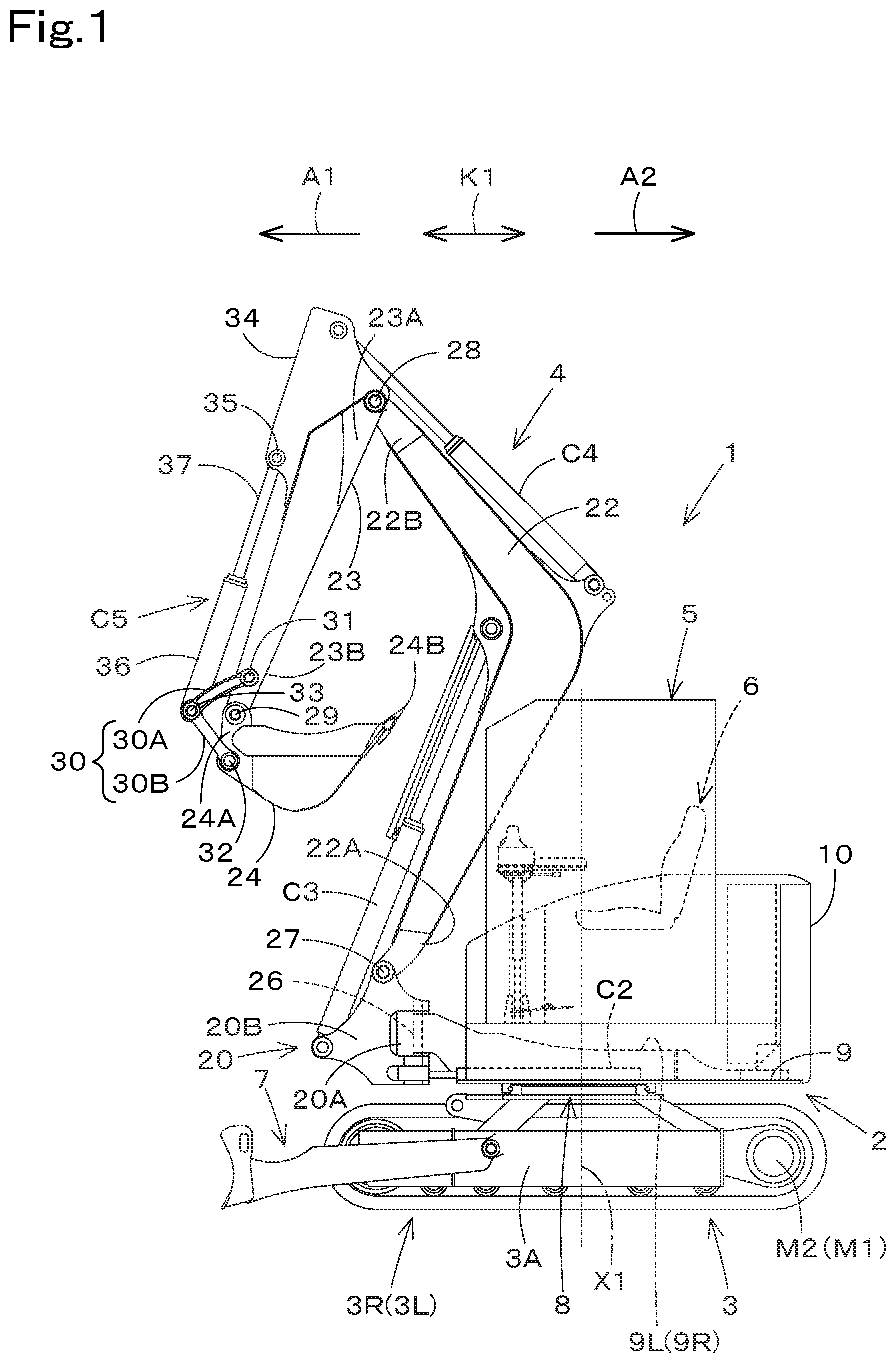
is a side view of a working machine.
is a side view of a working tool cylinder.
is a side view of a working tool in operation.
is a view of a rod head of a piston rod when viewed axially.
is a sectional side view of a detection device.
is a view of the detection device when viewed from an arm side.
is a cross sectional view taken along Z 1 -Z 1 line of .
is a cross sectional view taken along Z 2 -Z 2 line of .
is a side view of the working tool cylinder in telescoping movement.
is a cross sectional view taken along Z 3 -Z 3 line of .
is a side view of a working tool in operation according to an alternative embodiment.
is a sectional side view of a detection device arranged according to the alternative embodiment.
is a sectional side view of the detection device arranged according to the alternative embodiment.
illustrates side views of a working cylinder according to the alternative embodiment in different telescopic movement states.
is a side view of the working tool cylinder.
is a side view of the working tool in operation.
is a schematic diagram of a control system.
illustrates side views of the working cylinder in different swing states.
illustrates side views of the working cylinder in different telescopic movement states.
is a diagram describing detection patterns.
is a diagram describing detection patterns according to an alternative embodiment.
is a diagram describing detection patterns according to a further alternative embodiment.
is a diagram describing combinations as respective detection patterns.
DETAILED DESCRIPTION OF THE PREFERRED EMBODIMENTS
Preferred embodiments will now be described with reference to the accompanying drawings, wherein like reference numerals designate corresponding or identical elements throughout the various drawings. The drawings are to be viewed in an orientation in which the reference numerals are viewed correctly.
An embodiment of the present invention will be described with reference to the drawings.
is a schematic overall side view of a working machine 1 according to the present embodiment. In this embodiment, the working machine 1 is exemplified by a backhoe serving as a kind of swivel working machine.
Referring to , the working machine 1 includes a machine body (or a swivel base) 2 , a traveling device 3 and a working device 4 . A cabin 5 is mounted on the machine body 2 . An operator seat (or a seat) 6 on which a driver (or an operator) sits is provided in the cabin 5 .
In the present embodiment, description will be given on the assumption that a forward direction corresponds to the forward direction (a direction designated by an arrow A 1 in ) from an operator sitting on the operator seat 6 in the working machine 1 , a rearward direction corresponds to the rearward direction (a direction designated by an arrow A 2 in ) from the operator, a leftward direction corresponds to the leftward direction from the operator, and a rightward direction corresponds to the rightward direction from the operator. A fore-and-aft direction K 1 is illustrated as the machine fore-and-aft direction, and a horizontal direction perpendicular to the fore-and-aft direction K 1 is defined as a machine-width direction or a width direction of the machine body 2 .
A machine-width distal direction or a distal direction in the machine-width direction corresponds to rightward or leftward direction from the central portion of the machine body 2 . In other words, the machine-width distal direction is defined as the machine-width direction separating from the central portion of the machine body 2 . A machine-width proximal direction or a proximal direction in the machine-width direction corresponds to the direction opposite to the machine-width distal direction. In other words, the machine-width proximal direction is defined as the machine-width direction approaching the central portion of the machine body 2 .
Referring to , the traveling device 3 supports the machine body 2 travelably. The traveling device 3 includes a traveling frame 3 A, a first traveling unit 3 L provided on the left side of the traveling frame 3 A, and a second traveling unit 3 R provided on the right side of the traveling frame 3 A. The first and second traveling units 3 L and 3 R are crawler traveling units. The first traveling unit 3 L is driven by a first traveling motor M 1 . The second traveling unit 3 R is driven by a second traveling motor M 2 . The first and second traveling motors M 1 and M 2 are hydraulic motors (or hydraulic actuators), for example.
A dozer 7 is attached to a front portion of the traveling device 3 . The dozer 7 can be raised and lowered, i.e., a blade thereof can be moved upward and downward, by telescoping a dozer cylinder (or a hydraulic actuator).
Referring to , the machine body 2 is supported on the traveling frame 3 A via a swivel bearing 8 so as to be swivelable around a swivel axis X 1 that is a vertical center axis of the swivel bearing 8 . A prime mover is mounted on the machine body 2 . The prime mover is a diesel engine. Alternatively, it may be a gasoline engine, an LPG engine, or an electric motor. Alternatively, it may be a hybrid system including an engine and an electric motor.
Referring to , the machine body 2 includes a platform (hereinafter referred to as a swivel platform) 9 that is swivelable around the swivel axis X 1 . The swivel platform 9 is formed of a steel plate or so on such as to define a bottom of the machine body 2 . The swivel platform 9 is provided on an upper face thereof close to the central portion thereof with longitudinal ribs 9 L and 9 R serving as reinforcement members extended between front and rear ends thereof. The machine body 2 is provided at a rear portion thereof with a weight 10 erected on the swivel platform 9 .
The machine body 2 is provided on a front portion thereof with a support unit 20 for supporting the working device 4 . The support unit 20 includes a support bracket 20 A and a swing bracket 20 B. The support bracket 20 A is fixed to front portions of the longitudinal ribs 9 L and 9 R and protrudes forward from the machine body 2 . The swing bracket 20 B is attached to a front portion of the support bracket 20 A, which is the portion protruding from the machine body 2 , via a swing shaft 26 so as to be swingable around a vertical axis. Accordingly, the swing bracket 20 B is rotatable in the machine-width direction, i.e., horizontally around the swing shaft 26 .
Referring to , the working device 4 is attached to the swing bracket 20 B. The working device 4 includes a boom 22 , an arm (serving as a support member) 23 and a working tool (serving as a supported member) 24 . A base portion 22 A of the boom 22 is pivotally supported by an upper portion of the swing bracket 20 B via a boom shaft 27 . The boom shaft 27 has a horizontal axis perpendicular to the vertical direction. Accordingly, the boom 22 , when directed forward of the machine body 2 , is rotatable around a lateral axis, i.e., an axis extended in the machine-width direction. The boom 22 swings upward or downward when it rotates around the boom shaft 27 . The boom 22 is bent so as to be rearwardly convex at the longitudinally central portion thereof when it is raised at a highest position such as shown in .
A basal end portion (a second end portion other than a later-discussed first end portion) 23 A of the arm 23 is pivotally supported by a tip end portion 22 B of the boom 22 B via an arm shaft 28 . The arm shaft 28 has an axis parallel to the axis of the boom shaft 27 . Accordingly, the arm 23 is rotatable around a lateral axis when the boom 22 is directed forward of the machine body 2 . The arm 23 swings in a crowd direction defined as a direction approaching the boom 22 or in a dump direction defined as a direction away from the boom 22 when it rotates around the arm shaft 28 .
In the present embodiment, the working tool 24 is exemplified by a bucket serving as a standard attachment attached to the working device 4 . Hereinafter, the working tool 24 may be referred to as the bucket.
A base portion 24 A of the working tool 24 is pivotally supported by a tip end portion (a first end portion) 23 B of the arm 23 via a working tool shaft (serving as a pivot) 29 . The working tool shaft 29 may be referred to as a bucket shaft. The working tool shaft 29 has an axis parallel to the axis of the arm shaft 28 . Accordingly, the working tool 24 is rotatable around a lateral axis when the boom 22 is directed forward of the machine body 2 . A tip end portion 24 B of the working tool 24 swings in a crowd direction, i.e., a direction approaching the arm 23 , or in a dump direction, i.e., a direction away from the arm 23 , when it rotates around the arm shaft 28 . In other words, the bucket 24 is movable for scooping and dumping. The scooping movement means the swing of the bucket 24 in the direction approaching the boom 22 , i.e., the crowd direction, when scooping up earth or so on, for example. The dumping movement means the swing of the bucket 24 in the direction away from the boom 22 , i.e., the dump direction, when dumping or discharging the scooped earth or so on, for example.
The working tool 24 is connected to the arm 23 via a linkage 30 . The linkage 30 includes a first link 30 A and a second link 30 B. The first link 30 A is pivotally supported at a first end thereof by the arm 23 via a first link shaft 31 . The second link 30 B is pivotally supported at a first end thereof by the base portion 24 A of the working tool 24 via a second link shaft 32 . The first link 30 A and the second link 30 B are pivotally connected at second ends thereof to each other via a connection shaft 33 . The first link shaft 31 , the second link shaft 32 and the connection shaft 33 have respective axes parallel to the axis of the working tool shaft 29 .
Another working tool driven by a hydraulic actuator, i.e., a hydraulic attachment, may be attached to the working machine 1 instead of or in addition to the bucket 24 . Such another working tool is exemplified by a hydraulic breaker, a hydraulic crusher, an angle broom, an earth auger, a pallet fork, a sweeper, a mower, a snowblower or so on.
The swing bracket 20 B is swingable by telescoping a swing cylinder C 2 in the machine body 2 . The boom 22 is swingable by telescoping a boom cylinder C 3 . The arm 23 is swingable by telescoping an arm cylinder C 4 . The working tool 24 is swingable by telescoping a working tool cylinder (a bucket cylinder) C 5 . The swing cylinder C 2 , the boom cylinder C 3 , the arm cylinder C 4 and the working tool cylinder C 5 are each constituted by a double acting hydraulic cylinder (hydraulic actuator).
Referring to , the working tool cylinder C 5 is disposed forward from the arm 23 . The working tool cylinder C 5 is disposed along the arm 23 and is pivotally supported at a first end portion thereof by the basal end portion 23 A of the arm 23 . Specifically, the first end portion of the working tool cylinder C 5 is pivotally supported via a cylinder shaft 35 by a cylinder bracket 34 fixed to the basal end portion 23 A of the arm 23 . The cylinder shaft 35 has an axis parallel to the axis of the arm shaft 28 . The working tool cylinder C 5 is pivotally supported at a second end portion thereof by the tip end portion 23 B of the arm 23 . Specifically, the second end portion of the working tool cylinder C 5 is pivotally connected to the second end portions of the first and second links 30 A and 30 B via the connection shaft 33 .
Referring to , the working tool cylinder C 5 includes a cylinder tube 36 and a piston rod 37 which is extendable and contractible with respect to the cylinder tube 36 , thereby being telescopically movable. Specifically, the working tool cylinder C 5 includes a piston 38 axially movably incorporated in the cylinder tube 36 . The piston rod 37 is joined to the piston 38 so that, when the piston 38 moves, the piston rod 37 axially moves together with the piston 38 so as to cause the extension or contraction movement of the working tool cylinder C 5 .
Referring to , the piston 38 divides the interior of the cylinder tube 36 into a first pressure chamber 36 A on the bottom side and a second pressure chamber 36 B on the rod side. The bottom side of the cylinder tube 36 is defined as the side through which the piston rod 37 is not passed. The rod side of the cylinder tube 36 is defined as the side opposite to the bottom side, i.e., the side through which the piston rod 37 is passed.
The piston rod 37 is provided with a rod head 37 A at a tip end portion thereof opposite to the portion thereof joined to the piston 38 . The rod head 37 A is pivotally supported by the cylinder bracket 34 via the cylinder shaft 35 . The cylinder tube 36 is provided with an attachment portion 36 C at the bottom side end portion thereof. The attachment portion 36 C is pivotally connected to the second end portions of the first and second links 30 A and 30 B via the connection shaft 33 .
Referring to , when the working tool cylinder C 5 is telescoped, the working tool 24 swings in a dump direction Y 1 or a crowd direction Y 2 around the working tool shaft (bucket shaft) 29 . The working tool 24 swings around the working tool shaft 29 so that the tip end portion 24 B swings between a dump position (i.e., an end position on the dump side) P 1 and a crowd position (i.e., an end position on the crowd side) P 2 . The dump position P 1 is defined as the position of the working tool cylinder C 5 when it is fully contracted (when in the fully contracted state). The crowd position P 2 is defined as the position of the working tool cylinder C 5 when it is fully extended (when in the fully extended state).
Referring to , the working tool cylinder C 5 is constituted by a hydraulic cylinder telescopically moved by hydraulic fluid flowing through fluid passages, including a first fluid passage 39 A and a second fluid passage 39 B, formed in the piston rod 37 . In other words, the working tool cylinder C 5 is constituted by a pipeless hydraulic cylinder having no hydraulic fluid pipe on the outside of the cylinder tube 36 . The first fluid passage 39 A is fluidly connected to the first pressure chamber 36 A, and the second fluid passage 39 B is fluidly connected to the second pressure chamber 36 B. The rod head 37 A is formed therein with a first port 40 A joined to the first fluid passage 39 A, and with a second port 40 B joined to the second fluid passage 39 B (see ). Hydraulic fluid hoses are coupled to the first port 40 A and the second port 40 B, respectively, so that hydraulic fluid is supplied or discharged to and from each of the first and second ports 40 A and 40 B via each of the hydraulic fluid hoses. The fluid supply to the first port 40 A causes the extension movement of the working tool cylinder C 5 . The fluid supply to the second port 40 B causes the contraction movement of the working tool cylinder C 5 .
Referring to , the working tool cylinder C 5 and the arm 23 are provided therebetween with a detection device (or a position sensor) 41 for detecting a swing position of the working tool 24 . The swing position is defined as a position of the working tool 24 swinging around the working tool shaft 29 . This position may correspond to the dump position P 1 , the crowd position P 2 , or any position between the dumping position P 1 and the crowd position P 2 . Due to the pipeless hydraulic cylinder employed as the working tool cylinder C 5 , the working tool cylinder C 5 and the arm 23 have a space without a pipe or a hose therebetween. This space is useful for arrangement of the detection device 41 . Due to the arrangement of the detection device 41 between the working tool cylinder C 5 and the arm 23 , the detection device 41 is prevented from being damaged.
The detection device 41 detects a telescopic movement state (or a stroke length) of the working tool cylinder C 5 , thereby detecting the swing position of the working tool 24 . Specifically, referring to , the detection device 41 includes a detected object 42 provided on the cylinder tube 36 and a detector 43 provided on the piston rod 37 . The detector 43 , while moving together with the piston rod 37 , detects the detected object 42 , thereby detecting the telescopic movement state of the working tool cylinder C 5 . Alternatively, the detected object 42 may be provided on the piston rod 37 and the detector 43 may be provided on the cylinder tube 36 .
Referring to , the detected object 42 is attached to an outer surface of the cylinder tube 36 facing the arm 23 . Specifically, the detected object 42 is fastened with screws or so on to an attachment plate 44 fixed to the cylinder tube 36 . The attachment plate 44 is disposed on the rod-side portion of the cylinder tube 36 and is fixed to the outer surface of the cylinder tube 36 facing the arm 23 by welding or so on.
Referring to to 7 , guide members including a first guide member 45 A and a second guide member 45 B are provided on the attachment plate 44 . The attachment plate 44 has a first fitting portion 44 A which protrudes leftward and is fittingly covered with the first guide member 45 A. The attachment plate 44 has a second fitting portion 44 B which protrudes rightward and is fittingly covered with the second guide member 45 B. The first fitting portion 44 A and the second fitting portion 44 B are disposed close to a first end of the attachment plate 44 (i.e., an end of the attachment plate 44 on the rod-side of the cylinder tube 36 ).
Referring to , the detected object 42 includes a first detected object 42 A and a second detected object 42 B. The first detected object 42 A is disposed on a left portion of the attachment plate 44 , and the second detected object 42 B is disposed on a right portion of the attachment plate 44 . The first detected object 42 A has a predetermined length in the longitudinal direction of the cylinder tube 36 such as to have a first end corresponding to the first end of the attachment plate 44 and a second end corresponding to a second end of the attachment plate 44 (i.e., another end of the attachment plate 44 on the bottom-side of the cylinder tube 36 ). The first detected object 42 A includes a casing 46 A and a plurality of magnets 47 A. The casing 46 A is formed to have the length corresponding to the whole length of the attachment plate 44 between the first and second ends of the attachment plate 44 , and is fastened to the attachment plate 44 by screws or so on. The casing 46 A may be made of a single member extending from a first end thereof to a second end thereof, or may be dividable into parts in the longitudinal direction thereof.
The magnets 47 A are provided inside of the casing 46 A so that they are aligned at intervals from the first end of the casing 46 A to the second end of the casing 46 A. The magnets 47 A may be replaced with a continuously formed magnet. The second detected object 42 B is provided on a portion of the attachment plate 44 close to the first end of the attachment plate 44 . The second detected object 42 B includes a casing 46 B and a single magnet 47 B. The second detected object 42 B may be omitted. To enhance the reliability of detection device 41 , the second detected object 42 B may be formed to have the same length as that of the first detected object 42 A, and may be disposed to positionally coincide to the first detected object 42 A in the longitudinal direction of the cylinder tube 36 .
Referring to , the detector 43 includes a first sensor 43 A and a second sensor 43 B. The first sensor 43 A and the second sensor 43 B function as proximity sensors and as magnetic sensors for detecting magnetism. The first sensor 43 A and the second sensor 43 B are disposed to have a space therebetween in the machine width direction and are disposed to positionally coincide to each other in the longitudinal direction of the cylinder tube 36 .
The first sensor 43 A corresponds to the first detected object 42 A so as to detect the first detected object 42 A. Specifically, the first sensor 43 A includes a base member 48 A movable together with the piston rod 37 , and a detection element 49 A for detecting the magnets 47 A. While the base member 48 A moves together with the piston rod 37 , the detection element 49 A scans the magnets 47 A one after another, thereby detecting any portion of the first detected object 42 A between the first and second ends of the first detected object 42 A.
The second sensor 43 B corresponds to the second detected object 42 B so as to detect the second detected object 42 B. Specifically, the second sensor 43 B includes a base member 48 B movable together with the piston rod 37 , and a detection element 49 B for detecting the magnet 47 B. Due to the movement of the base member 48 B together with the piston rod 37 , the detection element 49 B detects a portion of the second detected object 42 B between first and second ends of the second detected object 42 B.
and the lowest drawing of drawings in illustrate the working tool cylinder C 5 in the fully contracted state. In this state, the working tool 24 is disposed at the dump position P 1 (see ). In the fully contracted state of the working tool cylinder C 5 , the detector 43 is disposed at a first position P 4 corresponding to the second end of the first detected object 42 A. At this time, the first sensor 43 A detects the first detected object 42 A while the second sensor 43 B does not detect the second detected object 42 B. When the working tool cylinder C 5 extends from the fully contracted state, the detector 43 moves together with the piston rod 37 . Accordingly, the detector 43 keeps detecting the first detected object 42 A until the detector 43 reaches a second position P 5 corresponding to the first end of the first detected object 42 A as illustrated by the middle drawing of . On the other hand, the second sensor 43 B detects the second detected object 42 B while the detector 43 moves from a position slightly before the second position P 5 to the second position P 5 . The position of the working tool 24 , when the detector 43 is disposed at the second position P 5 , is referred to as a first predetermined position P 3 (see ).
At the second position P 5 and in the vicinity thereof, the first sensor 43 A detects the first detected object 42 A and the second sensor 43 B detects the second detected object 42 B, thereby enhancing the reliability of the detection device 41 when at the second position P 5 and in the vicinity thereof.
After the detected object 42 passes the second position P 5 by further extension movement of the working tool cylinder C 5 from the state illustrated by the middle drawing in , the detector 43 no further detects the detected object 42 until the working tool cylinder C 5 is fully extended as illustrated by the highest drawing in .
Referring to , the first predetermined position P 3 is set between the dump position P 1 and the crowd position P 2 , and the detection device 41 detects the existence of the working tool 24 when it is in a predetermined range E 1 between the first predetermined position P 3 and the dump position P 1 . Specifically, the predetermined range E 1 ranges from the first predetermined position P 3 to the dump position P 1 .
Referring to , a reference numeral T 1 designates a movement locus of the tip end portion 24 B of the working tool 24 swinging from the dump position P 1 to the crowd position P 2 , and a reference numeral O 1 designates a middle point of the movement locus T 1 . The movement range of the tip end portion 24 B from the middle point O 1 to the dump position P 1 is defined as a dump side in the swing range of the working tool 24 , and the movement range of the tip end portion 24 B from the middle point O 1 to the crowd position P 2 is defined as a crowd side in the swing range of the working tool 24 . On this assumption, the detection device 42 detects the existence of the working tool 24 when it is in the predetermined range E 1 on the dump side in the swing range thereof.
An attachment structure 51 configured to attach the detector 43 to the piston rod 37 will now be described.
Referring to to 7 , the attachment structure 51 includes a detector mount 52 , to which the detector 43 is attached, and a connection mechanism 53 to connect the detector mount 52 to the piston rod 37 .
The detector mount 52 includes a mount main body 54 , a supporter 55 for supporting the mount main body 54 on the attachment plate 44 , and a cover plate 56 for covering the detected object 42 .
The mount main body 54 includes a base wall 54 a , a first side wall 54 b , a second side wall 54 c , a first end wall 54 d and a second end wall 54 e . The base wall 54 a is disposed between the working tool cylinder C 5 and the arm 23 . The first side wall 54 b extends from a left end of the base wall 54 a . The second side wall 54 c extends from a right end of the base wall 54 a . The first end wall 54 d is provided on a first end portion of the base wall 54 a , i.e., an end portion of the base wall 54 a on the rod-side of the cylinder tube 36 . The second end wall 54 e is provided on a second end portion of the base wall 54 a , i.e., another end portion of the base wall 54 a on the bottom-side of the cylinder tube 36 .
Referring to , the base wall 54 a faces the detected object 42 when the working tool cylinder C 5 is fully contracted. An attachment block 57 is fixed to the second end portion of the base wall 54 a . The first sensor 43 A is attached to the left side of the attachment block 57 . The second sensor 43 B is attached to the right side of the attachment block 57 .
Referring to , the supporter 55 includes a first slide member 55 A on the left side thereof, and includes a second slide member 55 B on the right side thereof. The first slide member 55 A is formed to have a rightward open groove into which the first fitting portion 44 A is fitted so that the first slide member 55 A is movable relative to the attachment plate 44 in the longitudinal direction of the cylinder tube 36 . The second slide member 55 B is formed to have a leftward open groove into which the second fitting portion 44 B is fitted so that the second slide member 55 B is movable relative to the attachment plate 44 in the longitudinal direction of the cylinder tube 36 . The first slide member 55 A is fixed to the first side wall 54 b , and the second slide member 55 B is fixed to the second side wall 54 c . Accordingly, the attachment block 57 is supported by the attachment plate 44 via the supporter 55 movably relative to the attachment plate 44 in the longitudinal direction of the cylinder tube 36 .
Referring to , the supporter 55 protrudes from the mount main body 54 to the bottom side and to the rod side. The portion of the supporter 55 protruding to the bottom side from the mount main body 54 extends from the detector mount 52 to the vicinity of a cover member 58 covering a grease nipple as shown in the lowest drawing in .
Referring to , the cover plate 56 is disposed on the side of the attachment plate 44 opposite to the working tool cylinder C 5 so as to connect the first slide member 55 A and the second slide member 55 B to each other. Referring to , the cover plate 56 is fixed at a first end thereof to the second end wall 54 e of the mount main body 54 .
Referring to , the cover plate 56 is extended to have a second end defining an end portion of the supporter 55 . When the working tool cylinder C 5 is extended, the cover plate 56 moves together with the piston rod 37 so as to cover the detected object 42 .
Referring to , the connection mechanism 53 includes a first connection piece 59 , a second connection piece 60 and a connection pin 61 . The first connection piece 59 is joined to the piston rod 37 . Specifically, the first connection piece 59 is fixed to a fixture plate 62 attached to the rod head 37 A. The second connection piece 60 is joined to the mount main body 54 (of the detector mount 52 ). Specifically, the second connection piece 60 includes a first portion 60 a and a second portion 60 b . The first portion 60 a is fixed to the first end wall 54 d of the mount main body 54 so as to connect the first slide member 55 A and the second slide member 55 B to each other. The second portion 60 b extends from the first portion 60 a toward the rod head 37 A. The connection pin 61 is passed through the first connection piece 59 and the second connection piece 60 so as to couple the first and second connection pieces 59 and 60 to each other. Specifically, referring to , the first connection piece 59 and the second portion 60 b of the second connection piece 60 face each other in the radial direction of the piston rod 37 so as to have a space 63 therebetween, and the connection pin 61 is passed through the space 63 .
Referring to , the first connection piece 59 is formed with a first pin hole 64 through which the connection pin 61 is passed. The first pin hole 64 is formed into a long hole shape such as to allow the piston rod 37 to rotate around an axis B 1 of the piston rod 37 . Specifically, an extension line L 1 of the axis of the connection pin 61 is perpendicular to the axis of the piston rod 37 . The long hole serving as the first pin hole 64 elongates parallel to a direction L 2 perpendicular to the extension line L 1 and the axis B 1 .
The second portion 60 b of the second connection piece 60 is formed with a second pin hole 65 through which the connection pin 61 is passed. The second pin hole 65 is formed into a circular hole shape.
Due to backlash of the cylinder shaft 35 in a cylinder shaft passage hole penetrating the rod head 37 A and the cylinder bracket 34 , the piston rod 37 is allowed to slightly rotate around the axis B 1 thereof so that the first connection piece 59 is allowed to swing according to the rotation of the piston rod 37 .
to 14 illustrate an alternative embodiment.
In the alternative embodiment, referring to , a second predetermined position P 7 is set between a first predetermined position P 6 and the dump position P 1 , and the detection device 41 detects the existence of the working tool 24 when it is in a predetermined range E 2 ranging from the first predetermined position P 6 to the second predetermined position P 7 . In the alternative embodiment, the first predetermined position P 6 is defined as a position where an angle D 3 between a line L 3 connecting the axial center of the cylinder shaft 35 to the axial center of the connection shaft 33 and a line L 4 connecting the axial center of the first link shaft 31 to the axial center of the connection shaft 33 becomes a substantially right angle.
Referring to and the lowest drawing of drawings in , when the working tool cylinder C 5 is fully contracted, the detector 43 is separated from the detection device 42 so that the detection device 41 does not detect the working tool 24 . While the working tool cylinder C 5 is extended from the fully contracted state, the detection device 41 does not detect the working tool 24 before the first sensor 43 A reaches a position corresponding to the second end of the first detected object 42 A.
When the first sensor 43 A located at the position corresponding to the second end of the first detected object 42 A detects the first detected object 42 A, the detection device 41 detects the existence of the working tool 24 at the second predetermined position P 7 . While the working tool cylinder C 5 is extended further from this extension state, the working tool 24 is detected until the detector 43 reaches a position corresponding to the first end of the detected object 42 . When the detector 43 reaches the position corresponding to the first end of the detected object 42 and detects the first detected object 42 A and the second detected object 42 B, the detection device 41 detects the existence of the working tool 24 at the first predetermined position P 6 . Accordingly, while the working tool 24 is in the predetermined range E 2 ranging from the first predetermined position P 6 to the second predetermined position P 7 , the detection device 41 detects the existence of the working tool 24 in the predetermined range E 2 .
In , lowest, middle and highest drawings indicate different telescopic movement states of the working tool cylinder C 5 . The lowest drawing illustrates the working tool cylinder C 5 when it is fully contracted. The middle drawing illustrates the working tool cylinder C 5 when the working tool 24 is located at the first predetermined position P 6 . The highest drawing illustrates the working tool cylinder C 5 when it is fully extended.
In the alternative embodiment, as illustrated by the highest drawing in , the detected object 42 is covered with the cover plate 56 without protruding from the cover plate 56 even when the working tool cylinder C 5 is fully extended.
All constitution elements of the alternative embodiment except for the above-mentioned elements are identical or similar to those of the foregoing embodiment shown in to 10 .
Further alternative embodiments will now be described with reference to to 23 .
In the embodiments shown in to 23 , the detection device 41 and the attachment structure 51 are identical or similar to those shown in , 8 , 12 and 13 . Illustration and description of the structures identical or similar to those of the foregoing embodiments will be omitted.
In the present embodiments, referring to , the working machine 1 includes a controller 71 for controlling the swing of the bucket (working tool) 24 , and includes a bucket control valve 72 for controlling the bucket cylinder C 5 . The controller 71 is constituted by a microcomputer including CPU (Central Processing Unit) and EEPROM (Electrically Erasable Programmable Read-Only Memory), for example.
The bucket control valve 72 is a control valve electrically controlled by the controller 71 . For example, a proportional directional solenoid valve serves as the bucket control valve 72 . The proportional directional solenoid valve is a valve in which a main spool is moved by a solenoid to control the flow of hydraulic fluid. The bucket control valve 72 is a three position shift valve shiftable among a neutral position 72 a , a first position 72 b and a second position 72 c . The bucket control valve 72 includes a first solenoid 72 d and a second solenoid 72 e . The first solenoid 72 d and the second solenoid 72 e are electrically connected to the controller 71 so that each of the first and second solenoids 72 d and 72 e is excited or unexcited according to a command signal outputted from the controller 71 . Due to the excitation or non-excitation of each of the first and second solenoids 72 d and 72 e , the bucket control valve 72 is shiftable from the neutral position 72 a to either the first position 72 b or the second position 72 c.
The bucket control valve 72 is fluidly connected to a hydraulic pump 92 via a supply fluid passage 73 A, and to a tank 74 via a drain fluid passage 73 B. The bucket control valve 72 is fluidly connected to the piston rod 37 of the bucket cylinder C 5 via a first cylinder fluid passage 73 C and a second cylinder fluid passage 73 D. Specifically, the first cylinder fluid passage 73 C is fluidly connected to the first fluid passage 39 A, and the second cylinder fluid passage 73 D is fluidly connected to the second fluid passage 39 B.
Referring to , an operation member 75 for operating the bucket 24 is electrically connected to the controller 71 . The controller 71 can obtain an operation signal (electric signal) from the operation member 75 . The operation member 75 is disposed adjacent to the operator seat 6 and includes a lever 76 which can be gripped and operated by an operator. The lever is swingable from its neutral position in first and second directions opposite to each other. For example, when the level 76 is swung in the first direction, the first solenoid 72 d is excited to shift the bucket control valve 72 to the first position 72 b . Due to the shift of the bucket control valve 72 to the first position 72 b , the bucket cylinder C 5 is contracted to swing the bucket 24 in the dump direction Y 1 . When the level 76 is swung in the second direction, the second solenoid 72 e is excited to shift the bucket control valve 72 to the second position 72 c . Due to the shift of the bucket control valve 72 to the second position 72 c , the bucket cylinder C 5 is extended to swing the bucket 24 in the crowd direction Y 2 . When the lever 76 is returned to its neutral position, the bucket control valve 72 returns to the neutral position 72 a to stop the telescopic movement of the bucket cylinder C 5 , i.e., to stop the movement of the bucket 24 .
Referring to , the bucket cylinder C 5 , when in a fully contracted state 77 , is disposed parallel and adjacent to the arm 23 . Assuming that the bucket cylinder C 5 is extended from the fully contracted state 77 to a fully extended state 78 , in a first stage of the extension movement of the bucket cylinder C 5 , the bucket cylinder C 5 swings away from the arm 23 so as to increase a swing angle G of the bucket cylinder C 5 . After passing a halfway point of the extension movement of the bucket cylinder C 5 , the swing direction of the bucket cylinder C 5 relative to the arm 23 is reversed so that the bucket cylinder C 5 approaches the arm 23 so as to gradually reduce the swing angle G of the bucket cylinder C 5 . In , a reference numeral 79 designates a turning point as the halfway point of extension or contraction movement of the bucket cylinder C 5 , where the variation direction of the swing angle G of the bucket cylinder C 5 is reversed between the increasing direction and the reducing direction, i.e., where the swing angle G becomes maximum. In , a reference numeral P 6 designates a position of the bucket 24 when the bucket cylinder C 5 is at the turning point 79 . The following description is given on an assumption that the state where the bucket cylinder C 5 is disposed at the turning point 79 and the bucket 24 is disposed at the position P 6 is referred to as a neutral position 80 . In other words, the neutral position 80 is conceptual. Referring to , the neutral position 80 corresponding to the turning point 79 of the bucket cylinder C 5 defines the border between the dump side E 3 and the crowd side E 4 in the swing range of the bucket 24 .
Referring to , an angle sensor 81 is attached to the cylinder bracket 34 so as to detect the swing angle G of the bucket cylinder C 5 around the cylinder shaft 35 . The angle sensor 81 is constituted by a potentiometer, for example. The angle sensor 81 detects a swing angle G 1 on the dump side E 3 from the neutral position 80 and a swing angle G 2 on the crowd side E 4 from the neutral position 80 . The angle sensor 81 is linked to the rod head 37 A of the bucket cylinder C 5 by a linkage 82 . Accordingly, the angle sensor 81 with the linkage 82 detects the rotation of the rod head 37 A around the cylinder shaft 35 , thereby detecting the swing angel G of the bucket cylinder C 5 around the cylinder shaft 35 . Alternatively, the angle sensor 81 may have no linkage to directly detect the rotation of the bucket cylinder C 5 around the cylinder shaft 35 .
Referring to , the angle sensor 81 is electrically connected to the controller 71 . The controller 71 can obtain a detection value (or a potentiometer resistance value) from the angle sensor 81 . The controller 71 includes a calculation unit 83 . The calculation unit 83 calculates the swing position of the bucket 24 based on the swing angle G of the bucket cylinder C 5 , i.e., the potentiometer resistance value. The swing position of the bucket 24 is defined as any position of the bucket 24 swinging around the bucket shaft 29 .
In the above-mentioned operation mechanism of the bucket 24 , because of the reversing of variation direction of the swing angle G of the bucket cylinder C 5 at the halfway point of the telescopic movement thereof, it is not clear whether the swing position of the bucket 24 corresponding to the detected swing angle G is on either the dump side E 3 or the crowd side E 4 with respect to the neutral position 80 .
Therefore, referring to , the detection device 41 is provided to detect whether the bucket 24 is on the dump side E 3 or the crowd side E 4 with respect to the neutral position 80 . In other words, the calculation unit 83 of the controller 71 calculates or determines the swing position of the bucket 24 based on the swing angle G detected by means of the angle sensor 81 and detection information as a result of detection by means of the detection device 41 .
The detection device 41 detects ON and OFF signals such as to detect the position of the piston rod 37 relative to the cylinder tube 36 during the telescopic movement of the bucket cylinder C 5 . The detector 43 , when detecting the detected object 42 , outputs a detection signal to the controller 71 . The detection signal may be either the on signal or the off signal.
and the lowest drawing of drawings in illustrate the bucket cylinder C 5 when in the fully contracted state 77 . When the bucket cylinder C 5 is in the fully contracted state 77 , the detector 43 is located at the first position P 4 corresponding to the second end of the first detected object 42 A. The detector 43 is separated away from the detected object 42 so that the first sensor 43 A does not detect the first detected object 42 A and the second sensor 43 B does not detect the second detected object 42 B.
When the bucket cylinder C 5 is extended from the fully contracted state 77 , the detector 43 moves together with the piston rod 37 . At the first stage of the movement of the detector 43 , the first sensor 43 A detects the first detected object 43 A. Referring to the middle drawing of the drawings in , when the detector 43 reaches the second position P 5 corresponding to the first end of the first detected object 42 A, the second sensor 43 B detects the second detected object 42 B. The state where the first sensor 43 A detects the first detected object 42 A and the second sensor 43 B detects the second detected object 42 B is defined as the neutral position 80 . The detector 43 detects the neutral position 80 by detecting the detectable end of the second detected object 42 B of the detected object 42 .
As illustrated, the detection of the neutral position 80 requires both the detection of the first detected object 42 A by means of the first sensor 43 A and the detection of the second detected object 42 B by means of the second sensor 43 B, thereby enhancing the reliability of the detection device 41 . Alternatively, the second detected object 42 B and the second sensor 43 B may be omitted.
While the bucket cylinder C 5 is further extended, after the detector 43 passes the second position P 5 , the detector 43 does not detect the detected object 42 until the bucket cylinder C 5 reaches a third position P 8 where it is in the fully extended state 78 as illustrated by the highest drawing of the drawings in .
Referring to , the detection device 41 is electrically connected to the controller 71 . The controller 71 can obtain detection information from the detection device 41 . The controller 71 includes a determination unit 84 such that, based on the detection information from the detection device 41 , the determinement unit 84 determines whether the bucket 24 exists on the dump side E 3 or the crowd side E 4 with respect to the neutral position 80 . The working machine 1 includes a switch 85 , serving as an instruction input unit, for receiving an instruction input from the operator, the instruction input indicating whether the bucket 24 is on the dump side E 3 or the crowd side E 4 . The switch 85 is disposed adjacent to the operator seat 6 . The switch 85 is electrically connected to the controller 71 . The controller 71 can obtain an electric signal from the switch 85 . The controller 71 includes a storage unit 86 .
Referring to , the detection device 41 is arranged so that it can find whether the bucket 24 , when existing in a detectable range that is a predetermined range as the vicinity of the neutral position 80 , is on the dump side E 3 or the crowd side E 4 . In other words, the detection device 41 serves as a sensor for judging whether the bucket 24 exists on the dump side E 3 or the crowd side E 4 with respect to the neutral position 80 . In this embodiment, while the angle sensor 81 alone is insufficient to detect the swing position of the bucket 24 in the vicinity of the neutral position 80 at which the variation direction of the potentiometer resistance value is reversed, the detection information from the detection device 41 is used to determine the swing position of the bucket 24 .
Accordingly, the determination of whether the bucket 24 is on the dump side E 3 or the crowd side E 4 is not performed when the bucket 24 is out of the predetermined range as the vicinity of the neutral position 80 . Therefore, at the start of processing to detect the swing angle of the bucket 24 , a position confirmation operation, i.e., an initial position determining operation, to determine whether the bucket 24 exists on the dump side E 3 or the crowd side E 4 is performed while the bucket 24 is out of the predetermined range as the vicinity of the neutral position 80 . For example, the position confirmation operation is performed in the following way.
First, the operator temporarily moves the bucket 24 to the dump side E 3 or the crowd side E 4 . When the bucket 24 , swung to the dump side E 3 , reaches the dump position P 1 , the operator pushes the switch 85 to inform the controller 71 that the bucket 24 is disposed at the dump position P 1 on the dump side E 3 . When the bucket 24 , swung to the crowd side E 4 , reaches the crowd position P 2 , the operator pushes the switch 85 to inform the controller 71 that the bucket 24 is disposed at the crowd position P 2 on the crowd side E 4 . The controller 71 , when informed of the position of the bucket 24 , makes the storage unit 86 store the informed position of the bucket 24 .
Alternatively, the controller 71 may automatically recognize whether the bucket 24 exists on the dump side E 3 or the crowd side E 4 . Specifically, after the bucket 24 , temporarily swung to the dump side E 3 or the crowd side E 4 , reaches the dump position P 1 or the crowd position P 2 , the resistance value of the potentiometer serving as the angle sensor 81 varies no further from that corresponding to the bucket 24 at the dump position P 1 or the crowd position P 2 . Therefore, if the state where the resistance value no further varies continues for a predetermined period, the controller 71 may automatically detect that the bucket 24 is disposed at the dump position P 1 or the crowd position P 2 . The controller 71 , when automatically recognizing the position of the bucket 24 , makes the storage unit 86 store the recognized position of the bucket 24 .
Description will now be given of the determination of whether the bucket 24 in the vicinity of the neutral position 80 exists on the dump side E 3 or the crowd side E 4 .
Referring to , in this embodiment, a detectable range 87 for the detector 43 to detect the detected object 42 ranges from the neutral position 80 to an intermediate position between the neutral position 80 and the end position on the dump side E 3 . For example, the detection device 41 , when in the detectable range 87 , is turned on, while the detection device 41 , when out of the detectable range 87 , i.e., when in a first undetectable range 88 or a second undetectable range 89 , is turned off. In other words, the neutral position 80 is defined as a border between the turn-on range and the turn-off range. The voltage of the angle sensor 81 , when detecting the swing angle of the bucket cylinder C 5 in the vicinity of the neutral position 80 , is known. Therefore, if the angle sensor 81 is turned on while the voltage of the angle sensor 81 indicates that when detecting in the vicinity of the neutral position 80 , the determination unit 84 determines the bucket 24 as being on the dump side E 3 . If the angle sensor 81 is turned off while the voltage of the angle sensor 81 indicates that when detecting in the vicinity of the neutral position 80 , the determination unit 84 determines the bucket 24 as being on the crowd side E 4 .
It is assumed that the detector 43 is disposed in the first undetectable range 88 and then the bucket 24 (or the piston rod 37 ) is moved in a first direction D 1 defined as a direction from the dump side E 3 to the crowd side E 4 . On this assumption, the detection device 41 is turned on as soon as the detector 43 enters the detectable range 87 . When the bucket 24 (or the piston rod 37 ) is further moved in the first direction D 1 and the detector 43 leaves the detectable range 87 and enters the second undetectable range 89 , the detection device 41 is turned off. Accordingly, the determination unit 84 determines the bucket 24 as being on the crowd side E 4 . In this way, a first detection pattern appearing in the ON/OFF signal detection by means of the detection device 41 during the movement of the bucket 24 (or the piston rod 37 ) in the first direction D 1 is indicated as “OFF-to-ON-to-OFF” (“Non-detection to Detection to Non-detection”). The result of determination by the determination unit 84 is stored in the storage unit 86 . After the bucket 24 in the vicinity of the neutral position 80 is determined as being on the crowd side E 4 , while the bucket 24 is swung further on the crowd side E 4 so as to move the detector 43 toward the crowd-side end position, the controller 71 keeps the determination, stored in the storage unit 86 , that the bucket 24 is on the crowd side E 4 .
It is assumed that the detector 43 is disposed in the second undetectable range 89 and then the bucket 24 (or the piston rod 37 ) is moved in a second direction D 2 defined as a direction from the crowd side E 4 to the dump side E 3 . On this assumption, the controller 71 keeps the determination, stored in the storage unit 86 , that the bucket 24 is on the crowd side E 4 until the detector 43 reaches a point immediate before the neutral position 80 . When the detector 43 passes the neutral position 80 , the detection device 41 having been turned off is turned on so that the determination unit 84 determines the bucket 24 as being on the dump side E 3 . In this way, a second detection pattern appearing in the ON/OFF signal detection by means of the detection device 41 during the movement of the bucket 24 (or the piston rod 37 ) in the second direction D 2 is indicated as “OFF-to-ON” (“Non-detection to Detection”). The controller 71 makes the storage unit 86 store the result of determination that the bucket 24 is on the dump side E 3 . Afterward, while the piston rod 37 is moved in the second direction D 2 and when the piston rod 37 is stopped with the detector 43 left in the first undetectable range 88 , the controller 71 keeps the state stored in the storage unit 86 , i.e., the state of the bucket 24 being on the dump side E 3 .
When the bucket 24 is moved again after the bucket 24 is stopped with the detector 43 left in the detectable range 87 , the detector 43 leaves the detectable range 87 and enters either the first undetectable range 88 or the second undetectable range 89 , thereby causing “ON-to-OFF” pattern. For this reason, the detection device 41 alone is insufficient to determine whether the detector 43 enters the first undetectable range 88 or the second undetectable range 89 . To solve the problem, assuming that the detectable range 87 has a first detectable range end 87 a corresponding to the neutral position 80 and a second detectable range end 87 b opposite to the first detectable range end 87 b , when the detector 43 moves from the detectable range 87 to the first undetectable range 88 according to the movement of the piston rod 37 in the second direction D 2 , a potentiometer resistance value generated at the second detectable range end 87 b is considered to determine the detector 43 as entering the first undetectable range 88 . When the detector 43 moves from the detectable range 87 to the second undetectable range 89 according to the movement of the piston rod 37 in the first direction D 1 , another potentiometer resistance value generated at the first detectable range end 87 a corresponding to the neutral position 80 is considered to determine the detector 43 as entering the second undetectable range 89 .
Alternatively, the detection device 41 , when in the detectable range 87 , may be turned off, and the detection device 41 , when out of the detectable range 87 , may be turned on. In this case, the first detection pattern realized by means of the detection device 41 when the piston rod 37 is moved in the first direction D 1 is indicated as “ON-to-OFF-to-ON” (corresponding to “Non-detection to Detection to Non-detection”). The second detection pattern realized by means of the detection device 41 when the piston rod 37 is moved in the second direction D 2 is indicated as “ON-to-OFF” (corresponding to “Non-detection to Detection”) pattern.
Alternatively, the detectable range 87 for the detector 43 to detect the detected object 42 may range from the neutral position 80 to an intermediate position between the neutral position 80 and the end position on the crowd side E 4 .
As mentioned above, in this embodiment, the detection device 41 detects ON and OFF signals indicating whether the bucket cylinder C 5 is extended or contracted from the neutral position 80 . Each of the first detection pattern and the second detection pattern is a combination of ON-to-OFF and OFF-to-ON signal shifts, and the combination as the first detection pattern and the combination as the second detection pattern are different from each other.
Referring to , the working machine 1 includes a display unit (or a meter panel) 90 . The display unit 90 is disposed adjacent to the operator seat 6 visually from the operator. The display unit 90 is electrically connected to the controller 71 . The display unit 90 may be provided with the switch 85 . The controller 71 includes a command unit 91 .
When operation of the bucket 24 is ended, the controller 71 stores the position of the bucket 24 on either the dump side E 3 or the crowd side E 4 , and defines the stored position of the bucket 24 as an initial position for restart of the operation of the bucket 24 . When the bucket cylinder C 5 is telescoped from the initial position, i.e., when the piston rod 37 is moved from the initial position in either the first direction D 1 or the second direction D 2 , the controller 71 determines whether the bucket 24 is on the dump side E 3 or the crowd side E 4 with respect to the neutral position 80 . For example, the controller 71 makes the storage unit 86 store the position of the bucket 24 at the time immediate before a key switch is turned off. After the key switch is turned on again, the controller 71 views the position of the bucket 24 stored in the storage unit 86 so as to determine whether the bucket 24 is on the dump side E 3 or the crowd side E 4 with respect to the neutral position 80 . It is greatly convenient because the operator does not have to perform the position confirmation operation after the key switch is turned on.
When the difference between the value of the angle sensor 81 before the key switch is turned off and that after the key switch is turned on is so great as to equal or exceed a hysteresis level, it is not sure that the bucket 24 exists at the same position as that before the key switch is turned off. In such a case, the controller 71 informs the operator of the uncertainness in position of the bucket, i.e., commands the display unit 90 to display a message for urging the operator to perform the position confirmation operation to determine whether the bucket 24 is on the dump side E 3 or the crowd side E 4 . Specifically, the command unit 91 commands the display unit 90 to display a message for urging the operator to move the bucket 24 to the dump side E 3 or the crowd side E 4 . Accordingly, the display unit 90 displays the message for urging the operator to locate the bucket 24 at any position on either the dump side E 3 or the crowd side E 4 and to register the position defined as the initial position. Therefore, the operator is only required to perform the position confirmation operation.
illustrates a first modification of the embodiment shown in to 20 .
In the first modification shown in , two detected objects 42 , i.e., detected objects 42 L and 42 R, are offset from each other in the longitudinal direction of the bucket cylinder C 5 so as to have a space therebetween where the neutral position 80 is set. The detected object 42 L is disposed to be detectable when the bucket 24 is on the dump side E 3 . The detected object 42 R is disposed to be detectable when the bucket 24 is on the crowd side E 4 . In other words, the neutral position 80 defines a border between two detectable ranges, i.e., a first detectable range 87 A and a second detectable range 87 B. An interval (or a distance) W 1 between the first detectable range 87 A and the neutral position 80 is different from an interval (or a distance) W 2 between the second detectable range 87 B and the neutral position 80 . The angle sensor 81 outputs a detection value (i.e., an angle sensor value) corresponding to the swing angle of the bucket cylinder C 5 . Therefore, based on the detection value of the angle sensor 81 at the time of the ON/OFF shift of the detection device 41 , the controller 71 determines whether the bucket 24 is on the dump side E 3 or the crowd side E 4 with respect to the neutral position 80 .
In the configuration shown in , the detected objects 42 L and 42 R are illustrated to have the interval therebetween, however, the configuration is not limited to the illustrated configuration. The only requirement is that the detection value of the angle sensor 81 when the bucket 24 is at a position corresponding to one ON/OFF shift point in detection by means of the detection device 41 is different from that when the bucket 24 is at another position corresponding to the other ON/OFF shift point in detection by means of the detection device 41 .
The above-mentioned determination may be performed by using times t 1 and t 2 . The first detectable range 87 A has a detectable range end 87 Aa closer to the neutral position 80 than the other end thereof, and the time t 1 is defined as a time taken for movement of the detector 43 through the first detectable range 87 A from the detectable range end 87 Aa to the neutral position 80 . The second detectable range 87 B has a detectable range end 87 Ba closer to the neutral position 80 than the other end thereof, and the time t 2 is defined as a time taken for movement of the detector 43 through the second detectable range 87 B from the detectable range end 87 Ba to the neutral position 80 . The times t 1 and t 2 are calculated based on the distances W 1 and W 2 from the neutral position 80 and the swing speed of the bucket 24 , and are inputted to the controller 71 .
In this case, for example, it is assumed that the detection device 41 is turned on when the detector 43 detects the detected object 42 L. On this assumption, the first detection pattern appearing in detection by means of the detection device 41 when the piston rod 37 is moved in the first direction D 1 is indicated as “OFF-to-ON-to-OFF” with the time t 1 . Based on this detection pattern, the bucket 24 can be determined as moving from the dump side E 3 to the crowd side E 4 and then being on the crowd side E 4 .
The second detection pattern appearing in detection by means of the detection device 41 when the piston rod 37 is moved in the second direction D 2 is indicated as “OFF-to-ON-to-OFF” with the time t 2 . Based on this detection pattern, the bucket 24 can be determined as moving from the crowd side E 4 to the dump side E 3 and then being on the dump side E 3 .
If the detected objects 42 L and 42 R have small distances from the neutral position 80 , i.e., if the times t 1 and t 2 are short, after one of the detected objects 42 L and 42 R is detected and before the other of the detected objects 42 L and 42 R is detected, the bucket 24 may be determined as being on the same side with the last detected detected object 42 L or 42 R. In the first modification, the detection device 41 may be turned off when the detector 43 detects either the detected object 42 L or 42 R.
As mentioned above, each of the first and second detection patterns may be a combination of ON-to-OFF and OFF-to-ON signal shifts with the turn-on time and the turn-off time, while the combination as the first detection pattern and the combination as the second detection pattern are different from each other.
illustrates a second modification different from the first modification of .
In the second modification shown in , the detected object 42 includes a plurality of divisional members 42 a to 42 c which are offset from one another in the longitudinal direction of the bucket cylinder C 5 so as to have intervals thereamong.
In the second modification shown in , the first detection pattern appearing in detection of ON and OFF signals by means of the detection device 41 , when the piston rod 37 is moved in the first direction D 1 from the dump side E 3 to the crowd side E 4 , is indicated as “OFF-to-ON-to-OFF-to-ON-to-OFF to-ON-to-OFF.” Based on this detection pattern, the bucket 24 can be determined as moving from the dump side E 3 to the crowd side E 4 and then being on the crowd side E 4 .
The second detection pattern appearing in detection of ON and OFF signals by means of the detection device 41 , when the piston rod 37 is moved in the second direction D 2 , is indicated as “OFF-to-ON.” Based on this detection pattern, the bucket 24 can be determined as moving from the crowd side E 4 to the dump side E 3 and then being on the dump side E 3 .
Constitution elements of the first and second modifications except for those mentioned above are identical or similar to those of the embodiment shown in to 20 .
As mentioned above, as an alternative embodiment, each of the first and second detection patterns may be a combination of the ON-to-OFF signal shift and the OFF-to-ON signal shift, while the combination as the first detection pattern and the combination as the second detection pattern are different from each other.
Alternatively, each of the first and second detection patterns may be a combination of ones selected from a group consisting of the ON-to-OFF signal shift, the OFF-to-ON signal shift, the turn-on time and the turn-off time, while the combination as the first detection pattern and the combination as the second detection pattern are different from each other. In this regard, referring to , the only requirement is that a combination of an ON-to-OFF shifts count B 1 , an OFF-to-ON shifts count B 2 , a time B 3 and a time B 4 during movement of the piston rod 37 in the first direction D 1 is different from a combination of an ON-to-OFF shifts count F 1 , an OFF-to-ON shifts count F 2 , a time F 3 and a time F 4 during movement of the piston rod 37 in the second direction D 2 .
An example of the combinations is as follows:
•
• First direction D 1 : B 1 is 2; B 2 is 2; B 3 is 2 seconds, and B 4 is 2 seconds. • Second direction D 2 : F 1 is 1; F 2 is 1; F 3 is 2 seconds, and F 4 is 4 seconds.
Another embodiment in which the bucket 24 is determined whether it is on the dump side E 3 or the crowd side E 4 and then the swing position of the bucket 24 is calculated will now be described.
As mentioned above, the bucket cylinder C 5 is hydraulically controlled by the bucket control valve 72 which is operated by an electric signal outputted from the controller 71 . Therefore, it can be grasped by means of the controller 71 whether the bucket 24 is moved to the dump side E 3 or the crowd side E 4 .
It is assumed that the voltage of the potentiometer serving as the angle sensor 81 becomes low when the bucket 24 is in the vicinity of the end of its swing range end, and the voltage becomes high when the bucket 24 is in the vicinity of the neutral position 80 . On this assumption, if the voltage of the angle sensor 81 varies in the increasing direction during the swing of the bucket 24 in the dump direction Y 1 by means of the first solenoid 72 d excited by the controller 71 , the bucket 24 is determined as being on the crowd side E 4 with respect to the neutral position 80 . If the voltage of the angle sensor 81 varies in the reducing direction during the swing of the bucket 24 in the dump direction Y 1 , the bucket 24 is determined as being on the dump side E 3 with respect to the neutral position 80 . If the voltage of the angle sensor 81 varies in the increasing direction during the swing of the bucket 24 in the crowd direction Y 2 by means of the second solenoid 72 e excited by the controller 71 , the bucket 24 is determined as being on the dump side E 3 with respect to the neutral position 80 . If the voltage of the angle sensor 81 varies in the reducing direction during the swing of the bucket 24 in the crowd direction Y 2 , the bucket 24 is determined as being on the crowd side E 4 with respect to the neutral position 80 .
As mentioned above, based on the voltage of the angle sensor 81 and the electric signal for operating the bucket control valve 72 , it can be determined whether the bucket 24 is on the dump side E 3 or the crowd side E 4 .
As a modification, the operation member 75 for operating the bucket 24 may be used. The controller 71 obtains an electric signal from the operation member 75 . Therefore, when the lever 76 is operated in one direction to swing the bucket 24 in the dump direction Y 1 , if the voltage of the angle sensor 81 varies in the increasing direction, the bucket 24 is determined as being on the crowd side E 4 with respect to the neutral position 80 , and if the voltage of the angle sensor 81 varies in the reducing direction, the bucket 24 is determined as being on the dump side E 3 . When the lever 76 is operated in another direction to swing the bucket 24 in the crowd direction Y 2 , if the voltage of the angle sensor 81 varies in the increasing direction, the bucket 24 is determined as being on the dump side E 3 with respect to the neutral position 80 , and if the voltage of the angle sensor 81 varies in the reducing direction, the bucket 24 is determined as being on the crowd side E 4 with respect to the neutral position 80 .
In this way, based on the voltage of the angle sensor 81 and the electric signal which the controller 71 obtains from the operation member 75 , it can be determined whether the bucket 24 is on the dump side E 3 or the crowd side E 4 .
These manners can be used without the detection device 41 , thereby reducing costs.
The working machine 1 according to the embodiments has the following effects:
The working machine 1 comprises the support member (or the arm 23 ), the supported member (or the working tool 24 ) pivotally supported by the first end portion of the support member (or the arm 23 ) via the pivot, and the cylinder (or the working tool cylinder C 5 ) of which telescopic movement causes the supported member (or the working tool 24 ) to swing around the pivot (or the working tool shaft 29 ). The cylinder (or the working tool cylinder C 5 ) includes the cylinder tube 36 , and the piston rod 37 inserted into the cylinder tube 36 . The cylinder (or the working tool cylinder C 5 ) is constituted by the hydraulic cylinder telescopically moved by extension and contraction movement of the piston rod 37 with respect to the cylinder tube 36 by hydraulic fluid flowing through the fluid passage formed in the piston rod 37 . The cylinder tube 36 is pivotally supported by one of the first and second end portions of the support member (or the arm 23 ), and the piston rod 37 is pivotally supported by the other of the first and second end portions of the support member (or the arm 23 ). The detection device 41 for detecting the telescopic movement state of the cylinder (or the working tool cylinder C 5 ) is provided between the cylinder (or the working tool cylinder C 5 ) and the support member (or the arm 23 ).
Due to the above configuration, the cylinder (or the working tool cylinder C 5 ) is constituted by the hydraulic cylinder telescopically moved by hydraulic fluid flowing through the fluid passage formed in the piston rod 37 so that the cylinder (or the working tool cylinder C 5 ) and the support member (or the arm 23 ) have a space therebetween without a pipe or a hose. The detection device 41 disposed in the space is advantageously prevented from being damaged in comparison with the detection device 41 when provided on a portion pivotally supporting the supported member (or the working tool 24 ). The space is effectively usable so that the detection device 41 disposed in the space is prevented or reduced from spoiling the appearance of the working machine, and from increasing the size thereof.
The working machine 1 may comprise the machine body 2 and the boom 22 swingably attached to the machine body 2 . The support member may be the arm 23 pivotally supported at the basal end portion thereof by the boom 22 . The supported member may be the working tool 24 pivotally supported by the tip end portion of the arm 22 via the pivot (or the working tool shaft 29 ). The cylinder may be the working tool cylinder C 5 for swinging the working tool 24 around the pivot.
Due to the above configuration in which the working tool cylinder C 5 is constituted by the hydraulic cylinder telescopically moved by hydraulic fluid flowing through the fluid passage in the piston rod 37 , the working tool cylinder C 5 and the arm 23 have a space therebetween without a pipe or a hose. Therefore, the detection device 41 disposed in the space is prevented or reduced from being damaged.
The detection device 41 includes the detected object 42 provided on one of the cylinder tube 36 and the piston rod 37 , and the detector 43 provided on the other of the cylinder tube 36 and the piston rod 37 . The detector 43 detects the detected object 42 for detection of the telescopic movement state of the cylinder.
Due to the above configuration, the detection device 41 can be compactly disposed between the working tool cylinder C 5 and the arm 23 .
The detected object 42 is attached onto the outer surface of the cylinder tube 36 facing the arm 23 . The detected object 42 has the predetermined length in the longitudinal direction of the cylinder tube 36 , and includes the magnets 47 A and 47 B. The detector 43 is constituted by the proximity sensor, which is attached to the piston rod 37 between the cylinder tube 36 and the arm 23 so as to be able to face the detected object 42 , and which is configured to move together with the piston rod 37 to detect the magnet 47 A or 47 B.
Due to the above configuration, the detection device 41 can be configured simply and economically.
The working machine 1 comprises the detector mount 52 to which the detector 43 is attached, and the connection mechanism 53 connecting the detector mount 52 to the piston rod 37 . The piston rod 37 includes the first connection piece 59 joined to the piston rod 37 , the second connection piece 60 joined to the detection attachment member 52 , and the connection pin 61 passed through the first connection piece 59 and the second connection piece 60 so as to connect the first connection piece 59 and the second connection piece 60 to each other. The pin hole (or the first pin hole 64 ) is formed in the connection piece 59 to allow the connection pin 61 to pass therethrough. The pin hole is formed into the long hole shape to allow axial rotation of the piston rod 37 .
Due to the above configuration, the simple connection mechanism 53 prevents the piston rod 37 from being damaged because of the axial rotation of the piston rod 37 .
The working machine 1 comprises the arm 23 , the bucket (or the working tool) 24 pivotally and swingably supported by the tip end portion of the arm 23 , the bucket cylinder (or the working tool cylinder) C 5 pivotally supported by the arm 23 via the cylinder shaft 35 , the telescopic movement of the bucket cylinder C 5 causing the bucket 24 to swing, the angle sensor 81 which detects the swing angle G 1 of the bucket cylinder C 5 when the bucket 24 is disposed on the dump side E 3 with respect to the neutral position 80 where the swing angle G of the bucket cylinder C 5 around the cylinder shaft 35 becomes maximum, and which detects the swing angle G 2 of the bucket cylinder C 5 when the bucket 24 is disposed on the crowd side E 4 with respect to the neutral position 80 , the detection device 41 which detects ON and OFF signals indicating whether the bucket cylinder C 5 is extended further from the neutral position 80 or is contracted further from the neutral position 80 , and the controller 71 for determining the swing position of the bucket 24 based on the swing angle G detected by means of the angle sensor 81 and the result of detection by means of the detection device 41 . The controller 71 determines whether the bucket 24 is on the dump side E 3 or the crowd side E 4 in accordance with the first detection pattern appearing in detection of the ON and OFF signals by means of the detection device 41 when the bucket 24 is moved in the first direction D 1 from the dump side E 3 to the crowd side E 4 , and the second detection pattern appearing in detection of the ON and OFF signals by means of the detection device 41 when the bucket 24 is moved in the second direction D 2 from the crowd side E 4 to the dump side E 3 .
Due to the above configuration, the swing position of the working tool 24 can be accurately calculated based on the swing angle of the bucket cylinder C 5 detected by means of the angle sensor 81 and the result of detection by means of the detection device 41 .
Based on the first detection pattern and the second detection pattern, the controller 71 determines whether the bucket 24 , when in the predetermined range as the vicinity of the neutral position 80 , is on the dump side E 3 or the crowd side E 4 .
Due to the above configuration, the position of the bucket 24 in the predetermined range as the vicinity of the neutral position 80 where the variation direction of the swing angle G is reversed can be determined while the angle sensor 81 alone is insufficient to determine the position.
While the bucket 24 is disposed out of the predetermined range, the controller 71 keeps the result of the determination regarding the position of the bucket 24 when in the predetermined range.
Due to this configuration, the detection device 41 can be configured to detect the bucket 24 in only the predetermined range as the vicinity of the neutral position 80 .
The bucket cylinder 24 includes the cylinder tube 36 , and the piston rod 37 extended and contracted with respect to the cylinder tube 36 . The detection device 41 includes the detected object 42 provided on one of the cylinder tube 36 and the piston rod 37 , and the detector 43 provided on the other of the cylinder tube 36 and the piston rod 37 . The detector 43 outputs the on or off signal in response to whether the detected object 42 is detected or not.
Due to the above configuration, the position of the piston rod 37 with respect to the cylinder tube 36 facilitates the determination of the position of the bucket 24 .
Either the range ranging from the neutral position 80 to the intermediate position between the neutral position 80 and the end position on the dump side E 3 or the range ranging from the neutral position 80 to the intermediate position between the neutral position 80 and the end position on the crowd side E 4 is defined as the detectable range 87 where the detected object 42 is detectable by means of the detector 43 .
Due to the above configuration, the length of the detected object 42 can be reduced, thereby minimizing the detection device 41 .
Each of the first detection pattern and the second detection pattern is a combination of ON-to-OFF and OFF-to-ON signal shifts. The combination as the first detection pattern and the combination as the second detection pattern are different from each other.
Due to the above configuration, the detection device has many variations.
When operation of the bucket 24 is ended, the controller 71 stores the result of determination of whether the bucket 24 is on the dump side E 3 or the crowd side E 4 . The controller 71 defines the position of the bucket 24 stored on the ending of operation of the bucket 24 as the initial position for restarting of operation of the working tool, and performs the determination when the bucket cylinder C 5 is extended or contracted from the initial position.
Due to the above configuration, the position of the bucket 24 does not have to be confirmed every restarting of operation of the bucket 24 after ending of the last operation of the bucket 24 , thereby enhancing the convenience in operation of the bucket 24 .
The working machine comprises the display unit 90 connected to the controller 71 . The display unit 90 displays the message for urging an operator to operate to locate the bucket 24 on either the dump side E 3 or the crowd side E 4 .
Due to the above configuration, the operator can be informed of a position change of the working tool 24 , for example.
The controller 71 performs the determination based on the detection value outputted from the angle sensor 81 when the ON/OFF signal shift occurs in detection by means of the detection device 41 .
Due to this configuration, whether the bucket 24 is on the dump side E 3 or the crowd side E 4 can be determined based on the detection value from the angle sensor 81 when the ON/OFF signal shift occurs in detection by means of the detection device 41 .
When operation of the bucket 24 is ended, the controller 71 stores information indicating whether the bucket 24 is on the dump side E 3 or the crowd side E 4 . When operation of the bucket 24 is restarted, the controller 71 determines the swing position of the bucket 24 based on the information stored on the last ending of operation of the bucket 24 .
Due to this configuration, the position of the bucket 24 does not have to be confirmed every restarting of operation of the bucket 24 after ending of the last operation of the bucket 24 , thereby enhancing the convenience in operation of the bucket 24 .
The working machine comprises the instruction input unit (or the switch 85 ) for receiving the instruction input from an operator, the instruction input indicating whether the bucket 24 is on the dump side E 3 or the crowd side E 4 .
Due to this configuration, the operator can inform the controller 71 regarding whether the bucket 24 is on the dump side E 3 or the crowd side E 4 .
While preferred embodiments of the present invention have been described above, it is to be understood that variations and modifications will be apparent to those skilled in the art without departing from the scope and spirit of the present invention. The scope of the present invention, therefore, is to be determined solely by the following claims.
Figures (20)
Citations
This patent cites (23)
- US2002/0062587
- US2013/0345939
- US2016/0138240
- US2017/0260717
- US2018/0178342
- US2019/0085875
- US2020/0040554
- US2020/0173148
- US2021/0002853
- US2021/0148082
- US2021/0230827
- US101243259
- US104583178
- US20 2013 003 314
- US1942281
- US10-121523
- US2006-220179
- US2010-168775
- US2011-252338
- US2013133913
- US2013-167099
- US2018-146726
- USWO 2015/060730