Method of Making a Metal-n/s-doped Carbon Electrocatalyst
Abstract
The method of making a metal-N/S-doped carbon electrocatalyst is a method of making an electrocatalyst for an electrolyzing electrode or the like. The carbon for the electrocatalyst comes from goat hooves as a sustainable and environmentally friendly source of carbon. At least one goat hoof is cleaned and then sonicated. The cleaned and sonicated goat hoof is then calcined at a temperature of approximately 300° C. to produce a carbonaceous precursor. The carbonaceous precursor is treated with a HCl solution, followed by drying. At least one metal salt is added to the treated carbonaceous precursor, and the at least one metal salt and the treated carbonaceous precursor are heated to form the metal-N/S-doped carbon electrocatalyst.
Claims (13)
1. A method of making a metal-N/S-doped carbon electrocatalyst, comprising: cleaning at least one goat hoof; sonicating the at least one goat hoof; calcining the at least one goat hoof at a temperature of 300° C. to produce a carbonaceous precursor; treating the carbonaceous precursor with a HCl solution; drying the treated carbonaceous precursor; adding at least one metal salt to the treated carbonaceous precursor; and heating the at least one metal salt and the treated carbonaceous precursor to form a metal-N/S-doped carbon electrocatalyst.
Show 12 dependent claims
2. The method of making a metal-N/S-doped carbon electrocatalyst as recited in claim 1 , wherein the step of sonicating the at least one goat hoof is performed for 15 minutes.
3. The method of making a metal-N/S-doped carbon electrocatalyst as recited in claim 1 , wherein the step of calcining the at least one goat hoof is performed in an argon environment at a heating rate of 5° C./min for 3 hours.
4. The method of making a metal-N/S-doped carbon electrocatalyst as recited in claim 1 , wherein the step of drying the treated carbonaceous precursor comprises drying the treated carbonaceous precursor at 80° C. for 6 hours.
5. The method of making a metal-N/S-doped carbon electrocatalyst as recited in claim 1 , wherein the at least one metal salt comprises nickel chloride.
6. The method of making a metal-N/S-doped carbon electrocatalyst as recited in claim 1 , wherein the at least one metal salt comprises nickel chloride and iron nitrate.
7. The method of making a metal-N/S-doped carbon electrocatalyst as recited in claim 1 , wherein the step of heating the at least one metal salt and the treated carbonaceous precursor is performed at 800° C. for 3 hours.
8. The method of making a metal-N/S-doped carbon electrocatalyst as recited in claim 7 , wherein the step of heating the at least one metal salt and the treated carbonaceous precursor is performed with a heating rate of 5° C./min under a helium atmosphere.
9. The method of making a metal-N/S-doped carbon electrocatalyst as recited in claim 1 , further comprising the step of washing the metal-N/S-doped carbon electrocatalyst with an aqueous HCl solution, deionized water and ethanol.
10. The method of making a metal-N/S-doped carbon electrocatalyst as recited in claim 9 , further comprising the step of drying the washed metal-N/S-doped carbon electrocatalyst at 80° C. for 24 hours.
11. A method of making an electrolyzing electrode, comprising the steps of: mixing the metal-N/S-doped carbon electrocatalyst made according to claim 1 in aqueous ethanol solution; sonicating the metal-N/S-doped carbon electrocatalyst and the aqueous ethanol solution to produce a catalyst ink; dropwise casting the catalyst ink on a glassy carbon electrode substrate to form an intermediate electrode; drying the intermediate electrode; and dropwise casting a solution of C 7 HF 13 O 5 S·C 2 F 4 on the dried intermediate electrode to form an electrolyzing electrode.
12. The method of making an electrode as recited in claim 11 , wherein the aqueous ethanol solution has an ethanol to water ratio of 1:1 (v/v).
13. The method of making an electrode as recited in claim 11 , wherein the step of sonicating the metal-N/S-doped carbon electrocatalyst and the aqueous ethanol solution is performed for 30 minutes.
Full Description
Show full text →
BACKGROUND
Field
The disclosure of the present patent application relates to electrocatalysts for the preparation of electrodes, such as those used in the electrolysis of water and the like, and particularly to a method of making an electrocatalyst of nickel-N/S-doped and nickel-iron-N/S-doped graphite carbon.
Description of Related Art
Due to environmental concerns, there is presently great interest in the use of clean-burning hydrogen as a fuel source. The hydrogen evolution reaction (HER) is of particular interest as a means for commercially producing hydrogen as a fuel source. The HER is a conversion reaction of protons to H 2 and requires reducing equivalents and, typically, a catalyst. In nature, HER is catalyzed by hydrogenase enzymes and in commercial electrolyzers, platinum is typically employed as an electrocatalyst.
In commercial electrolyzers, the HER (2H + +2e − →H 2 ) is the cathodic reaction in electrochemical water splitting. Driving the HER with renewable sources of energy can lead to a sustainable source of hydrogen fuel that can stored, transported, and used in a zero-emission fuel cell of a combustion engine, for example. Achieving high energetic efficiency for water splitting requires the use of a catalyst to minimize the overpotential necessary to drive the HER. As noted above, platinum is presently the most common catalyst for HER and requires very small overpotentials, even at high reaction rates in acidic solutions. However, the scarcity and high cost of platinum limits its widespread technological use. Further, the extraction of platinum ore and its conversion into pure platinum is not only energy and time intensive but has severe ecological impacts as well. It would be desirable to be able to replace platinum with a sustainable and environmentally-friendly electrocatalyst.
Thus, a method of making a metal-N/S-doped carbon electrocatalyst solving the aforementioned problems is desired.
SUMMARY
The method of making a metal-N/S-doped carbon electrocatalyst is a method of making an electrocatalyst for an electrolyzing electrode or the like. The carbon for the electrocatalyst can come from goat hooves as a sustainable and environmentally friendly source of carbon. At least one goat hoof can be cleaned and then sonicated for approximately 15 minutes. The cleaned and sonicated goat hoof can then be calcined at a temperature of up to approximately 300° C. to produce a carbonaceous precursor. The calcining of the at least one goat hoof may be performed in an argon environment (approximately 300 mL/min) at a heating rate of approximately 5° C./min for approximately 3 hours.
Following calcining, the carbonaceous precursor can be treated with a HCl solution (0.5 M) as an activator, followed by drying at approximately 80° C. for approximately 6 hours. At least one metal salt can be added to the treated carbonaceous precursor, and the at least one metal salt and the treated carbonaceous precursor can be heated at approximately 800° C. for approximately 3 hours to form the metal-N/S-doped carbon electrocatalyst. The heating may be performed with a heating rate of approximately 5° C./min under a helium atmosphere in a tube furnace or the like.
The at least one metal salt may be nickel chloride to form a nickel and N/S-doped graphite carbon electrocatalyst (referred to herein as “Ni—N/S@GC”) or, alternatively, the at least one metal salt may be a combination of nickel chloride and iron nitrate to form a nickel, iron and N/S-doped graphite carbon electrocatalyst (referred to herein as “NiFe—N/S@GC”). It is noted that the goat hoof is the source of the sulfur and may be at least a partial source of the nitrogen. After cooling to room temperature, the metal-N/S-doped carbon electrocatalyst may be washed several times with an aqueous HCl solution (1.0 M), deionized water and ethanol. The resultant product may then be dried at approximately 80° C. for approximately 24 hours.
In order to make an electrolyzing electrode from the metal-N/S-doped carbon electrocatalyst, the metal-N/S-doped carbon electrocatalyst is mixed in aqueous ethanol solution. The aqueous ethanol solution may have an ethanol to water ratio of 1:1 (v/v). The mixture can then be sonicated for approximately 30 minutes to produce a catalyst ink. The catalyst ink can be applied to a glassy carbon electrode substrate by dropwise casting to form an intermediate electrode. The intermediate electrode can then be dried and a solution of C 7 HF 13 O 5 S·C 2 F 4 (i.e., Nafion®) can be applied to the dried intermediate electrode by dropwise casting. Once dried, the resultant product is an electrolyzing electrode.
These and other features of the present subject matter will become readily apparent upon further review of the following specification.
BRIEF DESCRIPTION OF DRAWINGS
The patent or application file contains at least one drawing executed in color. Copies of this patent or patent application publication with color drawing(s) will be provided by the Office upon request and payment of the necessary fee.
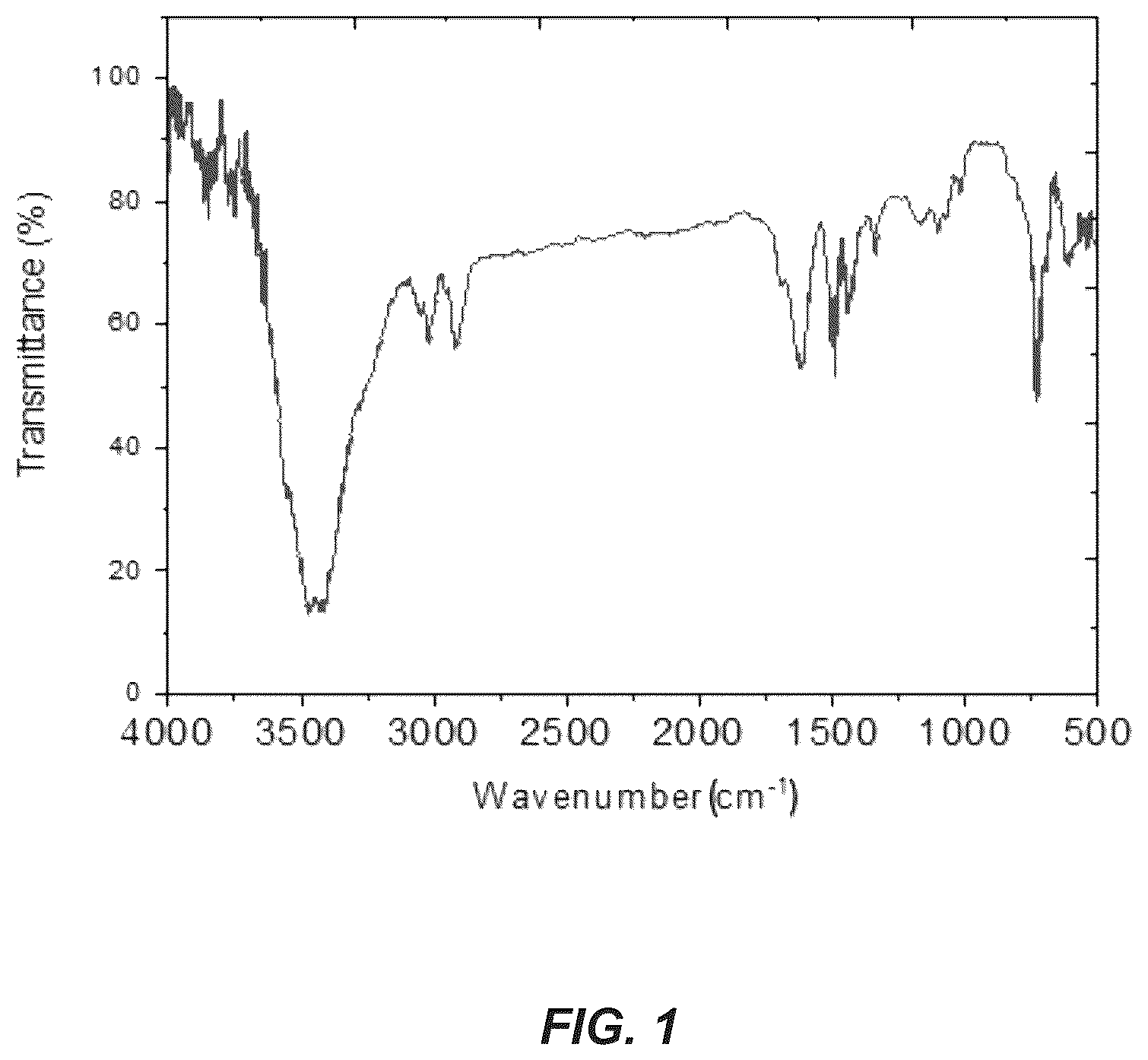
is a graph showing the Fourier transform infrared (FTIR) spectra of Ni—N/S@GC and NiFe—N/S@GC electrocatalyst samples prepared using the method of making a metal-N/S-doped carbon electrocatalyst.
is a graph showing thermogravimetric analysis (TGA) curves for the Ni—N/S@GC and NiFe—N/S@GC electrocatalyst samples prepared using the method of making a metal-N/S-doped carbon electrocatalyst.
A is a plot showing N 2 adsorption results for the Ni—N/S@GC and NiFe—N/S@GC electrocatalyst samples prepared using the method of making a metal-N/S-doped carbon electrocatalyst.
B is a plot showing N 2 desorption results for the Ni—N/S@GC and NiFe—N/S@GC electrocatalyst samples prepared using the method of making a metal-N/S-doped carbon electrocatalyst.
A shows a transmission electron microscope (TEM) image of an Ni—N/S@GC electrocatalyst sample prepared using the method of making a metal-N/S-doped carbon electrocatalyst.
B shows a transmission electron microscope (TEM) image of a NiFe—N/S@GC electrocatalyst sample prepared using the method of making a metal-N/S-doped carbon electrocatalyst.
is a graph showing the x-ray diffraction (XRD) spectra of the Ni—N/S@GC and NiFe—N/S@GC electrocatalyst samples prepared using the method of making a metal-N/S-doped carbon electrocatalyst.
is a graph showing x-ray photoelectron spectroscopy (XPS) results of the Ni—N/S@GC and NiFe—N/S@GC electrocatalyst samples prepared using the method of making a metal-N/S-doped carbon electrocatalyst.
A is a plot showing polarization curves for the Ni—N/S@GC and NiFe—N/S@GC electrocatalyst samples at a scan rate of 10 mV·s −1 with potential error (iR) correction in 0.5 M H 2 SO 4 .
B is a plot showing polarization curves for the Ni—N/S@GC and NiFe—N/S@GC electrocatalyst samples at a scan rate of 10 mV·s −1 with potential error (iR) correction in 1.0 M KOH.
C is a plot showing polarization curves for the Ni—N/S@GC and NiFe—N/S@GC electrocatalyst samples at a scan rate of 10 mV·s −1 with potential error (iR) correction in a neutral aqueous solution.
A is a Tafel plot showing the electrocatalytic HER mechanisms for the Ni—N/S@GC and NiFe—N/S@GC electrocatalyst samples in 0.5 M H 2 SO 4 .
B is a Tafel plot showing the electrocatalytic HER mechanisms for the Ni—N/S@GC and NiFe—N/S@GC electrocatalyst samples in 1.0 M KOH.
C is a Tafel plot showing the electrocatalytic HER mechanisms for the Ni—N/S@GC and NiFe—N/S@GC electrocatalyst samples in a neutral aqueous solution.
Similar reference characters denote corresponding features consistently throughout the attached drawings.
DETAILED DESCRIPTION
The method of making a metal-N/S-doped carbon electrocatalyst is a method of making an electrocatalyst for an electrolyzing electrode or the like. The carbon for the electrocatalyst can come from goat hooves as a sustainable and environmentally friendly source of carbon. At least one goat hoof can be cleaned and then sonicated for approximately 15 minutes. The cleaned and sonicated goat hoof can then be calcined at a temperature of up to approximately 300° C. to produce a carbonaceous precursor. The calcining of the at least one goat hoof may be performed in an argon environment (approximately 300 mL/min) at a heating rate of approximately 5° C./min for approximately 3 hours.
Following calcining, the carbonaceous precursor can be treated with a HCl solution (0.5 M) as an activator, followed by drying at approximately 80° C. for approximately 6 hours. At least one metal salt can be added to the treated carbonaceous precursor, and the at least one metal salt and the treated carbonaceous precursor can be heated at approximately 800° C. for approximately 3 hours to form the metal-N/S-doped carbon electrocatalyst. The heating may be performed with a heating rate of approximately 5° C./min under a helium atmosphere in a tube furnace or the like. As a non-limiting example, the at least one metal salt and the treated carbonaceous precursor may have a 1:1 weight ratio.
The at least one metal salt may be nickel chloride to form a nickel and N/S-doped graphite carbon electrocatalyst (referred to herein as “Ni—N/S@GC”) or, alternatively, the at least one metal salt may be a combination of nickel chloride and iron nitrate to form a nickel, iron and N/S-doped graphite carbon electrocatalyst (referred to herein as “NiFe—N/S@GC”). It is noted that the goat hoof is the source of the sulfur and may be at least a partial source of the nitrogen. After cooling to room temperature, the metal-N/S-doped carbon electrocatalyst may be washed several times with an aqueous HCl solution (1.0 M), deionized water and ethanol. The resultant product may then be dried at approximately 80° C. for approximately 24 hours.
In order to make an electrolyzing electrode from the metal-N/S-doped carbon electrocatalyst, the metal-N/S-doped carbon electrocatalyst can be mixed in aqueous ethanol solution. The aqueous ethanol solution may have an ethanol to water ratio of 1:1 (v/v). The mixture can then be sonicated for approximately 30 minutes to produce a catalyst ink. The catalyst ink can be applied to a glassy carbon electrode substrate by dropwise casting to form an intermediate electrode. The intermediate electrode can then be dried and a solution of C 7 HF 13 O 5 S·C 2 F 4 (i.e., Nafion®) can be applied to the dried intermediate electrode by dropwise casting. Once dried, the resultant product can be an electrolyzing electrode.
In experiments, sample electrodes were prepared as described above, with 10.0 mg of the metal-N/S-doped carbon electrocatalyst dispersed in 1.0 mL of the aqueous ethanol solution. 2.0 μL of the catalyst ink was dropwise cast on the glassy carbon working electrode, which was allowed to dry in air. 2.0 μL of the Nafion® solution (0.5 wt %) was drop cast on the glass carbon electrode and fully dried before testing. In the electrochemical hydrogen evolution reaction (HER) and oxygen evolution reaction (OER) experiments discussed below, all experiments were performed in 1.0 M KOH, 0.1 M H 2 SO 4 and water media.
shows the Fourier transform infrared (FTIR) spectra of Ni—N/S@GC and NiFe—N/S@GC prepared using the above method. The FTIR results show that the absorption bands at around 3286-3476 cm −1 and 2922-3021 cm 1 , corresponding to the stretching vibrations of O—H/N—H and C—H (symmetry/asymmetry), respectively. However, the C═O stretching vibration band is found at 1635 cm −1 (corresponding to N/S-doped carbon, or “N/S@C”) and another band at 1102 cm −1 arises for the asymmetric stretching vibrations of C—NH—C, which confirms that N atoms are properly doped onto the carbon matrix. Moreover, another two bands at 1443 and 1635 cm −1 represent the typical stretching modes of C—N and C═N, respectively. These results suggest that nitrogen atoms not only exist on the particle surface in the form of amide bonds, but also exist in the cores as polyaromatic structures. The IR bands within the range of 1000-1340 cm −1 are attributed to the stretching vibrations of C—O, C—S, C—N and C—C, respectively. The IR bands within the range of 400-490 cm −1 are attributed to the stretching vibrations of Ni—N and Fe—N, respectively.
shows the thermogravimetric analysis (TGA) curves for Ni—N/S@GC and NiFe—N/S@GC prepared using the above method, both in N 2 and O 2 . The results show that the prepared carbon decomposed in three stages. The first stage occurred within the temperature range 90-200° C. A 6.086% weight loss was observed in this stage, corresponding to the loss of H 2 O (coordinated or adsorbed). The second stage has an estimated mass loss of 57.39% within the temperature range 200-500° C. and corresponds to the loss of an organic part of the hoof-based N/S-doped graphite carbon materials. The third stage has an estimated mass loss of 17.38% within the temperature range 500-800° C., corresponding to the loss of the more stable organic part of the hoof-based N/S-doped carbon materials and leaving metal-N/S@C as a residue.
A and 3 B show N 2 adsorption and desorption measurements, respectively, to measure the porosity and surface nature of the metal-N/S@GC. The adsorption isotherms of A are type IV in the case of both types of nanoparticles and support the nonporous nature. The Brunauer-Emmett-Teller (BET) surface area of the natural adsorbent was found to be 178.4 m 2 /g and 189.32 m 2 /g for Ni—N/S@GC and NiFe—N/S@GC, respectively. It is noted that high surface area is associated with a high surface density of active sites, while the mesoporous structure ensures efficient electrolyte ions transfer.
A and 4 B show transmission electron microscopes (TEM) images of Ni—N/S@GC and NiFe—N/S@GC, respectively, and show that the particles developed in the carbon matrix with an irregular particles size of about 15-20 nm. These images show the presence of carbon species with distinguishable size distributions of the Ni species (determined by their diameters), with the average diameter being found to be ˜20 nm. Similarly, the average size of Ni—Fe bimetallic-nanoparticles was determined to be 15-20 nm.
shows the x-ray diffraction (XRD) spectra of the Ni—N/S@GC and NiFe—N/S@GC electrocatalyst samples. As shown, there are diffraction peaks at 2θ values of 25.2° and 43.9°, corresponding to the (002) and (100) planes of graphite, respectively. The broad XRD reflexes refer to the disordered stacking of the graphene matrix. Moreover, a small shift in the (002) reflection to a lower angle has occurred due to the increased interlayer spacing caused by doping. There are also three major peaks observed at 2θ values of 440 and 52°, which correspond to the metallic Ni and match exactly with the JCPDS file (No. 44-6758). The corresponding planes are indexed as (111), (200) and (220). Ni—N/S@GC and NiFe—N/S@GC show well-defined XRD patterns which can be indexed to the FCC structure of Ni. However, no peaks corresponding to Fe were observed in the XRD pattern of NiFe—N/S@GC, indicating the substitution of Fe with Ni having the FCC structure.
shows the x-ray photoelectron spectroscopy (XPS) results of the Ni—N/S@GC and NiFe—N/S@GC electrocatalyst samples. shows that the Ni—N/S@GC mainly consists of Ni, N, S, O and C elements, while the NiFe—N/S@GC mainly consists of Ni, Fe, N, S, O and C elements.
A, 7 B and 7 C are plots of the electrocatalytic performance of the Ni—N/S@GC and NiFe—N/S@GC electrocatalysts, where the performance of these catalysts for HER was investigated using a typical three-electrode system in 0.5 M H 2 SO 4 , 1 M KOH and a neutral solution. The linear sweep voltammograms of A, 7 B and 7 C illustrate that the NiFe—N/S@GC exhibits excellent performance in HER: an overpotential of 83.2 mV and 71 mV vs. reversible hydrogen electrode (RHE) at 10 mA·cm −2 , which is much lower than those of other Ni—N/S@GCs. The overpotential of NiFe—N/S@GC slightly increases to 130 mV when the current density is up to 40 mA·cm −2 , which is significantly lower than that of commercial 20 wt % Pt/C (154 mV). Linear sweep voltammetry (LSV) curves for HER were assessed between −2.00 and 0.00 V (vs. Ag/AgCl) with a sweep rate of 25, 50 and 100 mV·s −1 . Cyclic voltammetry (CV) curves at various scan rates (20, 40, 60, 80 and 100 mV·s −1 ) were carried out in the potential range of −0.10 to 0.10 V, where no faradaic current was produced.
The electrocatalytic HER mechanisms of the NiFe—N/S@GC were examined by constructing Tafel plots, as shown in A, 8 B and 8 C , where it can be seen that the plots have a smaller slope (42 mV·dec −1 ) than those of bulk Ni—N/S@GC (86.2 mV·dec −1 ) in an acidic medium. This indicates that a fast Heyrovsky step dominates the Volmer-Heyrovsky process during NiFe—N/S@GC H 2 evolution, which is attributable to the strong electronic coupling within the metal ions dispersed atoms and heterostructure N/S-doped carbon.
It is to be understood that the method of making a metal-N/S-doped carbon electrocatalyst is not limited to the specific embodiments described above, but encompasses any and all embodiments within the scope of the generic language of the following claims enabled by the embodiments described herein, or otherwise shown in the drawings or described above in terms sufficient to enable one of ordinary skill in the art to make and use the claimed subject matter.
Figures (10)
Citations
This patent cites (6)
- US112481640
- US112591747
- US113073337
- US113215594
- US202024101249
- US2004300198