Abstract
The invention generally relates to a molecular classification of disease predisposition and particularly to molecular markers for cancer predisposition and methods of use thereof.
Claims (9)
1. A method comprising: a) extracting genomic DNA from a sample comprising germline cells of a patient; b) forming a mixture by hybridizing nucleic acid probes that hybridize to the genomic DNA, wherein the genomic DNA comprises a plurality of nucleic acid molecules, wherein said plurality of nucleic acid molecules comprise the coding regions of a plurality of test genes and wherein said plurality of test genes comprise target genes: APC gene, ATM gene, BARD 1 gene, BMPRIA gene, Breast Cancer 1 (BRCA1) gene, Breast Cancer 2 (BRCA2) gene, BRIP1 gene, CDH1 gene, CDK4 gene, CDKN2A gene, CHEK2 gene, EPCAM gene, MLH1 gene, MSH2 gene, MSH6 gene, MUTYH gene, NBN1 gene, PALB2 gene, PMS2 gene, phosphatase and tensin homolog (PTEN) gene, RADSIC gene, RADS1D gene, SMAD4 gene, STK11 gene, and TP53 gene; c) performing one or more amplification reactions for amplifying said plurality of nucleic acid molecules in the DNA mixture in the presence of one or more primer pairs, wherein each of the primer pairs generates amplification products comprising a portion of each of the target genes; d) sequencing said amplification products; and e) comparing the sequences of the amplification products with one or more reference sequences of each of the target genes using an alignment software, thereby determining whether the patient has germline mutations in the target genes based on the presence of at least one insertion or deletion greater than 1,000 nucleotides in the sequences of the amplification products from the plurality of test genes.
Show 8 dependent claims
2. The method of claim 1 , wherein the one or more reference sequences comprise the sequence of each of the target genes in the following table:
3. The method of claim 1 , wherein at least one of the amplification products comprises at least a portion of an exon sequence and an intron sequence comprising at least 10 base pairs in length flanking at least one end of said exon sequence.
4. The method of claim 1 further comprising determining if the patient has at least one second level risk factors comprising personal risk factors and family risk factors.
5. The method of claim 4 , wherein the personal risk factors comprise that the patient has a history of multiple primary cancers, a positive triple negative breast cancer, a history of ovarian cancer, a history of smoking, a positive tissue biopsy for a cancer, a positive vaginal pap smear for a cancer, a history of male breast cancer, an enlarged prostate, colon polyps, and an age of the patient if a cancer is diagnosed, an age of menopause of the patient, and an age of menarche of the patient.
6. The method of claim 4 , wherein the family risk factors comprise that the patient has Ashkenazi Jewish ancestry, a relative with early onset cancer, a relative with multiple primary cancers, a relative with male breast cancer, a relative with ovarian cancer, and a relative with triple negative breast cancer.
7. The method of claim 1 , wherein the target genes comprise at least 25% of the plurality of test genes.
8. The method of claim 1 , wherein the target genes comprise at least 50% of the plurality of test genes.
9. The method of claim 1 , wherein the sample is a human sample.
Full Description
Show full text →
CROSS REFERENCE TO RELATED APPLICATIONS
This application is a divisional of U.S. application Ser. No. 14/561,938, filed Dec. 5, 2014 (issued as U.S. Pat. No. 10,995,338), which is continuation of and claims the priority benefit of Patent Cooperation Treaty International Application Number PCT/US2013/044494 (filed Jun. 6, 2013, published as WO2013184905), which in turn claims the priority benefit of U.S. Provisional Application Ser. Nos. 61/656,333 (filed on Jun. 6, 2012) and 61/814,068 (filed on Apr. 19, 2013), each of which is hereby incorporated by reference in its entirety.
FIELD OF THE INVENTION
The invention generally relates to a molecular classification of disease predisposition and particularly to molecular markers for cancer predisposition and methods of use thereof.
SEQUENCE LISTING
The instant application was filed with a formal Sequence Listing submitted electronically as a text file. This text file, which is named “131588-0695_SL.txt”, was created on Aug. 22, 2023 and is 1,524,288 bytes in size. Its contents are incorporated by reference herein in their entirety.
BACKGROUND OF THE INVENTION
Cancer is a major public health problem, accounting for roughly 25% of all deaths in the United States. American Cancer Society, F ACTS AND F IGURES 2010. For many types of cancer, up to 10% of cases can be hereditary. Knowing that a patient has an increased risk of cancer due to hereditary factors can help such a patient to take preventive actions to reduce that risk. Thus, there is a significant need for accurate ways of determining whether a particular patient has an increased risk of cancer.
SUMMARY OF THE INVENTION
The inventors have discovered panels of genes, wherein a deficiency in any of these genes in a patient's germline confers an increased risk of specific cancers. Generally speaking, these genes may be sequenced in patients to determine predisposition to these cancers.
Accordingly, in one aspect the present invention provides a method for sequencing DNA. Generally, the method includes at least the following steps: (1) isolating from a patient sample a plurality of DNA molecules, each DNA molecule consisting of between 50 and 75,000 nucleotides in length, said plurality of DNA molecules comprising one or more exons of a plurality of genes consisting of between 10 and 200 genes, and said plurality of genes comprising APC, BRCA1, BRCA2, CDKN2A, EPCAM, MLH1, MSH2, MSH6, MUTYH, PALB2, and PMS2; and (2) determining the sequence of said plurality of DNA molecules. In some embodiments, the method further comprises comparing the sequences determined in (2) with one or more reference sequences. In some embodiments, the method further comprises correlating a difference between the sequences determined in (2) and the one or more reference sequences to a mutation in one or more of the genes in the plurality of genes. In some embodiments the plurality of DNA molecule comprises at least some certain length of intron adjacent to exon (e.g., at least 1, 2, 3, 4, 5, 6, 7, 8, 9, 10, 15, 20, 25, 30, 35, 40, 45, 50, 60, 70, 80, 90, 100 or more base pairs of the intron).
In another aspect the present invention provides a method for determining whether a patient has an increased risk of cancer, which comprises: (1) determining whether the patient has a germline deficiency in any of a plurality of genes comprising APC, BRCA1, BRCA2, CDKN2A, EPCAM, MLH1, MSH2, MSH6, MUTYH, PALB2, and PMS2; and either (2) correlating a germline deficiency in any of said plurality of genes to an increased risk (e.g., increased hereditary risk) of cancer, or (3) correlating the absence of a germline deficiency in all of said plurality of genes to no increased risk (e.g., no increased hereditary risk) of cancer (or to no identified increased risk due to the tested genes). In some embodiments, the method comprises correlating a germline deficiency in any particular gene in the plurality of genes to an increased risk of a particular cancer as shown in Table 4.
In another aspect the present invention provides a kit comprising: reagents for sequencing DNA molecules comprising one or more exons of a plurality of genes comprising APC, BRCA1, BRCA2, CDKN2A, EPCAM, MLH1, MSH2, MSH6, MUTYH, PALB2, and PMS2; and instructions for using said reagents. In some embodiments the kit comprises reagents for sequencing a plurality of genes consisting of between 11 and 200 genes, and said plurality of genes comprises APC, BRCA1, BRCA2, CDKN2A, EPCAM, MLH1, MSH2, MSH6, MUTYH, PALB2, and PMS2. In some embodiments the reagents are PCR primers specific for the plurality of genes. In some embodiments, the reagents are PCR primers specific for the exons (and optionally some certain amount of adjacent intron) of the plurality of genes.
In some embodiments of the above aspects of the invention, the plurality of genes further comprises at least 1, 2, 3, 4, 5, 6, 7, 8, or 9 genes chosen from the group consisting of ATM, BARD1, BMPR1A, CDH1, CDK4, CHEK2, TP53, PTEN, RAD51D, SMAD4, and STK11. In some embodiments the plurality of genes further comprises at least 1, 2, 3, 4, 5, 6, 7, 8, 9, 10, 11, or 12 genes chosen from the group consisting of BLM, CEBPA, FLCN, MEN1, PTCH, RET, SDH5, SDHB, SDHC, SDHD, TMEM127, and VHL. In some embodiments the plurality of genes further comprises at least 1, 2, 3, 4, 5, 6, 7, 8, 9, 10, 11, 12, 13, 14, 15, 16, 17, 18, 19, or 20 genes chosen from the group consisting of BRAF, BRIP1, FANCA, FANCB, FANCC, FANCD2, FANCE, FANCF, FANCG, FANCI, FANCL, FANCM, KRAS, MLH3, MRE11, NBS1, PIK3CA, PMS1, RAD50, and RAD51C. In some embodiments the plurality of genes further comprises at least 1, 2, 3, 4, 5, 6, 7, 8, 9, 10, 11, 12, 13, 14, 15, 16, 17, 18, 19, 20, 21, 22, 23, 24, 25, 26, 27, 28, 29, 30, 31, 32, 33, 34, 35, 36, 37, 38, 39, 40, 41, 42, 43, 44, 45, 46, 47, 48, 49, 50, 51, 52, 53, or 54 genes chosen from the group consisting of APC, ATM, BARD1, BLM, BMPR1A, BRAF, BRCA1, BRCA2, BRIP1, CDH1, CDK4, CDKN2A, CEBPA, CHEK2, FANCA, FANCB, FANCC, FANCD2, FANCE, FANCF, FANCG, FANCI, FANCL, FANCM, FLCN, KRAS, MEN1, MLH1, MLH3, MRE11, MSH2, MSH6, MUTYH, NBS1, PALB2, PIK3CA, PMS1, PMS2, PTCH1, PTEN, RAD50, RAD51C, RAD51D, RET, SDHAF2, SDHB, SDHC, SDHD, SMAD4, STK11, EPCAM, TMEM127, TP53, VHL. In some embodiments the plurality of genes further comprises at least 1, 2, 3, 4, 5, 6, 7, 8, 9, 10, 11, 12, 13, 14, 15, 16, 17, 18, 19, 20, 21, 22, 23, 24, 25, 26, 27, 28, 29, 30, 31, 32, 33, 34, 35, 36, 37, 38, 39, 40, 41, 42, 43, 44, 45, 46, 47, 48, 49, 50, 51, 52, 53, or 54 genes of any of Panels A-Q.
Unless otherwise defined, all technical and scientific terms used herein have the same meaning as commonly understood by one of ordinary skill in the art to which this invention pertains. Although methods and materials similar or equivalent to those described herein can be used in the practice or testing of the present invention, suitable methods and materials are described below. In case of conflict, the present specification, including definitions, will control. In addition, the materials, methods, and examples are illustrative only and not intended to be limiting.
Other features and advantages of the invention will be apparent from the following Detailed Description, and from the Claims.
BRIEF DESCRIPTION OF THE DRAWINGS
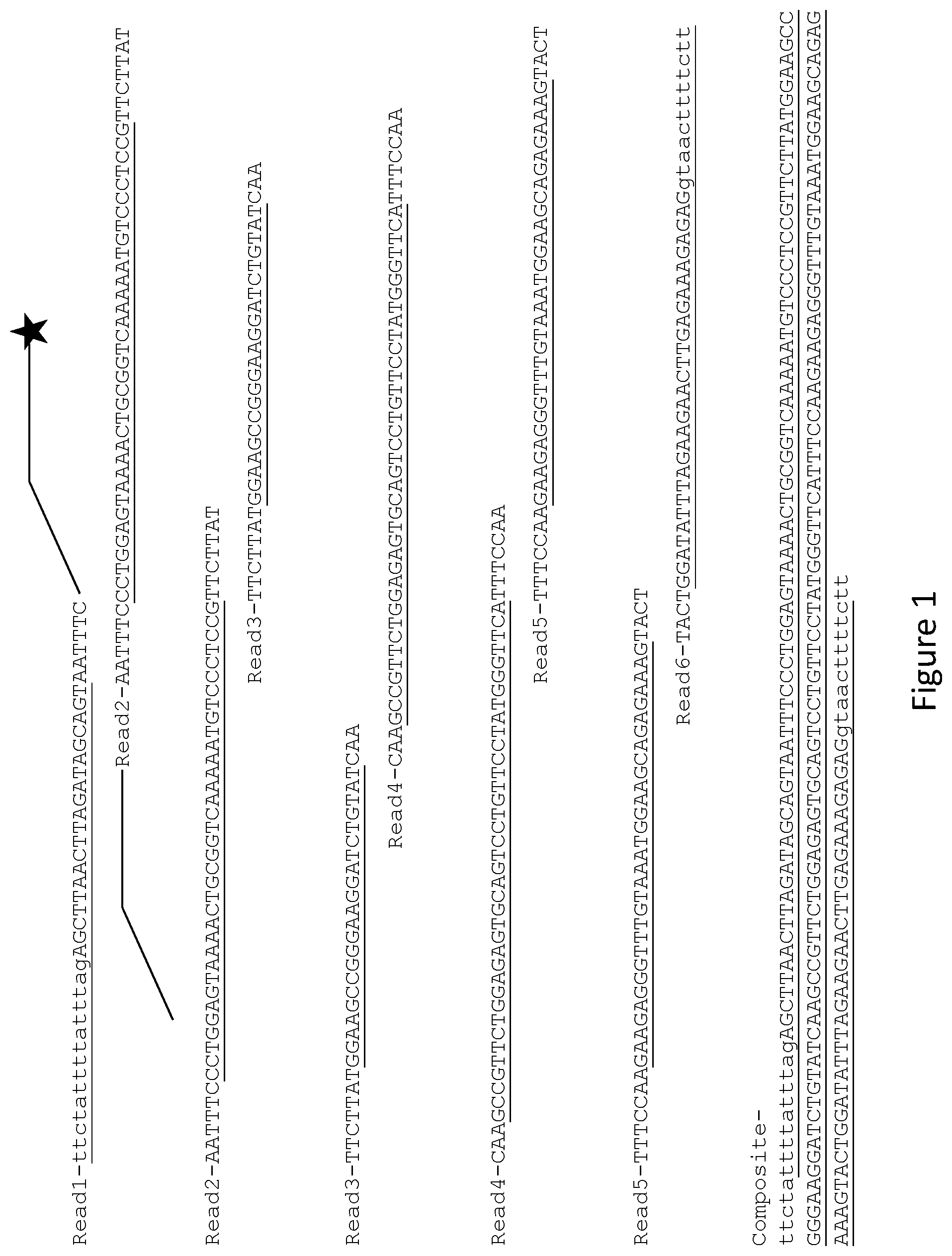
illustrates how a plurality of DNA molecules can comprise a particular DNA sequence with no single molecule comprising all of such sequence. Read 1: SEQ ID NO: 603; Read 2: SEQ ID NO: 604; Read 3: SEQ ID NO: 605; Read 4: SEQ ID NO: 606; Read 5: SEQ ID NO: 607; Read 6: SEQ ID NO: 608; Composite: 609.
is an illustration of an example of a system useful in certain aspects and embodiments of the invention.
is a flowchart illustrating an example of a computer-implemented method of the invention.
DETAILED DESCRIPTION OF THE INVENTION
The present invention is based in part on the discovery that hereditary cancer genes, and germline deficiencies in these genes, are responsible for increases in cancer risk attributable to heredity. “Hereditary cancer gene” and “HCG” herein refer to a gene wherein germline deficiency in the gene confers an increased risk for cancer. The inventors have discovered specific panels (e.g., pluralities) of HCGs that may be tested in a patient to give a comprehensive understanding of the patient's hereditary cancer risk. All of the HCGs in Table 1 below form a panel of HCGs (“Panel A”) useful in the invention.
TABLE 1
Entrez
Gene Entrez Gene Gene
# Symbol ID
1 APC 324
2 ATM 472
3 ATR 545
4 BAP1 8314
5 BARD1 580
6 BLM 641
7 BMPR1A 657
8 BRAF 673
9 BRCA1 672
10 BRCA2 675
11 BRIP1 83990
12 CDH1 999
13 CDK4 1019
14 CDKN2A (p16) 1029
15 CEBPA 1050
16 CFTR 1080
17 CHEK2 11200
18 CTRC 11330
19 EPCAM (TACSTD1) 4072
20 FANCA 2175
21 FANCB 2187
22 FANCC 2176
23 FANCD2 2177
24 FANCE 2178
25 FANCF 2188
26 FANCG 2189
27 FANCI 55215
28 FANCL 55120
29 FANCM 57697
30 FGFR2 2263
31 FH 2271
32 FLCN 201163
33 HOXB13 10481
34 HRAS 3265
35 KITLG 4254
36 KRAS 3845
37 MEN1 4221
38 MLH1 4292
39 MLH3 27030
40 MRE11 4361
41 MSH2 4436
42 MSH6 2956
43 MUTYH (MYH) 4595
44 NBS1 (NBN) 4683
45 NF1 4763
46 NF2 4771
47 PALB2 79728
48 PIK3CA 5290
49 PMS1 5378
50 PMS2 5395
51 PRSS1 5644
52 PTCH1 5727
53 PTEN 5728
54 RAD50 10111
55 RAD51C 5889
56 RAD51D 5892
57 RB1 5925
58 RET 5979
59 SDHAF2 (SDH5) 54949
60 SDHB 6390
61 SDHC 6391
62 SDHD 6392
63 SMAD4 4089
64 SPINK1 6690
65 STK11 6794
66 TGFB2 7042
67 TMEM127 55654
68 TP53 (p53) 7157
69 VHL 7428
As will be shown in detail throughout this document, subsets of Panel A can also be used in the invention. Examples of subsets useful in the present invention are shown in Tables 2A to 2D below:
TABLE 2A
Panels B to G
Gene # Panel B Panel C Panel D Panel E Panel F Panel G
1 BRCA1 BRCA1 BRCA1 MLH1 BRCA1 BRCA1
2 BRCA2 BRCA2 BRCA2 MSH2 BRCA2 BRCA2
3 MLH1 MLH1 CHEK2 MSH6 MLH1 MLH1
4 MSH2 MSH2 ATM PMS2 MSH2 MSH2
5 MSH6 MSH6 NBN BRCA1 MSH6 MSH6
6 PMS2 PMS2 PALB2 BRCA2 PMS2 PMS2
7 EPCAM EPCAM BARD1 ATM EPCAM EPCAM
8 MUTYH MUTYH BRIP1 BARD1 APC APC
9 APC APC PMS2 BRIP1 MUTYH MUTYH
10 CDKN2A CDKN2A MSH2 CHEK2 PALB2 PALB2
11 PALB2 PALB2 MSH6 MUTYH CDKN2A CHEK2
12 SMAD4 SMAD4 TP53 RAD50 CDK4 PTEN
13 BMPR1A BMPR1A MUTYH EPCAM* TP53 STK11
14 TP53 TP53 PTEN CDH1
15 PTEN PTEN CDH1 TP53
16 STK11 STK11 STK11 ATM
17 CDH1 CDH1 SMAD4 RAD51C
18 NBN1 NBN1 BMPR1A RAD51D
19 CHEK2 CHEK2 ATM BRIP1
20 RAD51C RAD51C CHEK2 BARD1
21 RAD51D RAD51D RAD51C BMPR1A
22 BRIP1 BRIP1 RAD51D SMAD4
23 BARD1 BARD1 MLH3 CDKN2A
24 ATM ATM BRIP1 CDK4
25 CDK4 CDK4 BARD1 RAD50
26 RAD50* NSB NBN
27 MRE11A* RAD50 MRE11
28 MLH3* MRE11A MLH3
29 HOXB13*
*Optional
TABLE 2B
Panels H to M
Gene # Panel H Panel I Panel J Panel K Panel L Panel M
1 APC ATM APC BLM ATR BRCA1
2 BRCA1 BMPR1A ATM CEBPA BARD1 BRCA2
3 BRCA2 CDH1 BMPR1A FLCN BRAF MLH1
4 CDKN2A CDK4 BRCA1 MEN1 BRIP1 MSH2
5 EPCAM CHEK2 BRCA2 PTCH FANCA MSH6
6 MLH1 HOXB13 CDH1 RET FANCB PMS2
7 MSH2 TP53 CDK4 SDHAF2 FANCC EPCAM
8 MSH6 PTEN CDKN2A SDHB FANCD2 MUTYH
9 MUTYH SMAD4 CHEK2 SDHC FANCE APC
10 PALB2 STK11 EPCAM SDHD FANCF CDKN2A
11 PMS2 MLH1 TMEM127 FANCG PALB2
12 MSH2 VHL FANCI SMAD4
13 MSH6 FANCL BMPR1A
14 MUTYH FANCM TP53
15 p53 KRAS PTEN
16 PALB2 MLH3 STK11
17 PMS2 MRE11 CDH1
18 PTEN NBS1 NBN1
19 SMAD4 PIK3CA CHEK2
20 STK11 PMS1 RAD51C
21 RAD50 RAD51D
22 RAD51C BRIP1
23 BARD1
24 ATM
25 CDK4
TABLE 2C
Panel N
Gene Gene
# Symbol
1 BRCA1
2 BRCA2
3 MLH1
4 MSH2
5 PMS2
6 MLH3
7 EPCAM
8 MSH6
9 APC
10 PMS1
11 PTEN
12 STK11
13 RET
14 SDHD
15 SDHC
16 SDHB
17 SDHAF2
18 CDH1
19 MUTYH
20 SMAD4
21 MEN1
22 VHL
23 BMPR1A
24 PALB2
25 TP53
26 FANCL
27 BLM
28 CDK4
29 CDKN2A
30 ATM
31 PTCH1
32 CHEK2
33 RAD51C
34 CEBPA
35 NBS1
36 FANCA
37 FANCC
38 FANCD2
39 FANCE
40 FANCG
41 FANCI
42 FANCM
43 RAD51D
44 FANCF
45 FANCB
46 BARD1
47 RAD50
48 MRE11
49 BRIP1
50 FLCN
51 TMEM127
52 PIK3CA
53 KRAS
54 BRAF
55 HOXB13
56 ATR
57 BAP1
58 CFTR
59 CTRC
60 FGFR2
61 FH
62 HRAS
63 KITLG
64 NF1
65 NF2
66 PRSS1
67 RB1
68 SPINK1
69 TGFB2
TABLE 2D
Panel O
Gene Gene
# Symbol
1 BRCA1
2 BRCA2
3 MLH1
4 MSH2
5 MSH6
6 PMS2
7 EPCAM
8 APC
9 MUTYH
10 PALB2
11 CDKN2A
12 CDK4
13 TP53
14 PTEN
15 CDH1
16 STK11
17 SMAD4
18 BMPR1A
19 ATM
20 CHEK2
21 RAD51C
22 RAD51D
23 MLH3
24 VHL
25 MEN1
26 RET
27 NF1
28 NF2
29 RB1
30 PTCH1
31 FH
32 BLM
33 CEBPA
34 FLCN
35 SDHB
36 SDHC
37 SDHD
38 SDHAF2
39 TMEM127
40 CFTR
41 PRSS1
42 CTRC
43 SPINK1
44 KRAS
45 BRIP1
46 BARD1
47 NBS1
48 RAD50
49 FANCA
50 FANCB
51 FANCC
52 FANCD2
53 FANCE
54 FANCF
55 FANCG
56 FANCI
57 FANCL
58 FANCM
59 ATR
60 HRAS
61 TGFB2
62 FGFR2
63 BAP1
64 KITLG
65 BRAF
66 MRE11
67 PIK3CA
68 PMS1
69 HOXB13
Aspects of the Invention
Accordingly, in one aspect the present invention provides a method for sequencing nucleic acids. Generally, the method includes at least the following steps: (1) isolating a plurality of nucleic acid molecules from a sample taken from a patient, each nucleic acid molecule comprising (or consisting of or consisting essentially of) between A and B nucleotides in length, said plurality of nucleic acid molecules comprising (e.g., having nucleotide sequences that together comprise) one or more exons of a plurality of genes consisting of between W and X genes, and said plurality of genes comprising at least two genes in any of Panels A-Q; and (2) determining the sequence of said plurality of nucleic acid molecules.
In another aspect the present invention provides a method for determining whether a patient has an increased risk of cancer, which comprises: (1) determining whether the patient has a germline deficiency in any of a plurality of genes consisting of between W and X genes, said plurality of genes comprising at least two genes in any of Panels A-Q; and either (2)(a) correlating a germline deficiency in any of said plurality of genes to an increased risk (e.g., increased hereditary risk) of cancer, or (2)(b) correlating the absence of a germline deficiency in all of said plurality of genes to no increased risk (e.g., no increased hereditary risk) of cancer. In some embodiments of this aspect, the method also comprises (a) isolating a plurality of nucleic acid molecules from a sample taken from a patient, each nucleic acid molecule comprising (or consisting of or consisting essentially of) between A and B nucleotides in length, and said plurality of nucleic acid molecules comprising (e.g., having nucleotide sequences that together comprise) one or more exons of said plurality of genes and (b) determining the sequence of said plurality of nucleic acid molecules. In some embodiments, the method comprises detecting a germline deficiency in a gene by comparing the sequence determined in (b) with one or more reference sequences, as discussed in more detail below.
Thus, the invention provides a method treating a patient comprising (1) determining whether the patient has a germline deficiency in any of a plurality of genes consisting of between W and X genes, said plurality of genes comprising at least two genes in any of Panels A-Q; and (2)(a) correlating a germline deficiency in any of said plurality of genes to an increased risk (e.g., increased hereditary risk) of cancer (e.g., a particular cancer), or (2)(b) correlating the absence of a germline deficiency in all of said plurality of genes to no increased risk (e.g., no increased hereditary risk) of cancer; and (3) recommending, prescribing, or administering a treatment to reduce the patient's risk of cancer. In some embodiments, the treatment comprises removing all or part of the organ in which the patient has an increased risk of cancer (e.g., mastectomy, salpingo-oophorectomy, hysterectomy, colectomy, prostatectomy, etc.). In some embodiments the treatment comprises preventive drug treatments (e.g., tamoxifen treatment in patients with increased risk of breast or ovarian cancer).
Another aspect of the present invention provides computer program products comprising a computer-usable medium having computer-readable program codes or instructions embodied thereon for enabling a processor to carry out the methods of the invention. A related aspect of the present invention provides a system for determining whether a patient has increased likelihood of response to a particular treatment regimen. Generally speaking, the system comprises (1) computer program for receiving, storing, and/or retrieving a patient's sequence data for a plurality of genes consisting of between W and X genes, said plurality of genes comprising at least two genes in any of Panels A-Q; (2) computer program for querying this patient data; (3) optionally a computer program for comparing the patient's sequence data to one or more reference sequences to determine whether there is a mutation; (4) computer program for concluding whether there is an increased likelihood of cancer based on the presence or absence of a mutation; and optionally (4) computer program for outputting/displaying this conclusion. In some embodiments this program for outputting the conclusion may comprise a computer program for informing a health care professional of the conclusion.
In another aspect the invention provides a system for sequencing genes in a sample (e.g., tumor sample), comprising: (1) a sample analyzer for sequencing a plurality of genes consisting of between W and X genes, said plurality of genes comprising at least two genes in any of Panels A-Q, wherein the sample analyzer contains (a) the sample which is from a patient, (b) genomic DNA from the sample, (c) transcript RNA from the sample, or (d) DNA synthesized from said genomic DNA; (2) a first computer program for receiving test sequence data on the plurality of genes; and (3) a second computer program for comparing the sequence data to one or more reference sequences. In some embodiments the system comprises a computer program for determining (including quantifying) the patient's degree of risk of cancer based at least in part on the comparison of the test sequence with said one or more reference sequences. Such program may also compare the patient's determined probability of a particular cancer with a reference probability to determine whether the patient has an increased risk of such cancer.
In another aspect the invention provides methods combining the genetic analysis as described above with analysis of other cancer risk factors, e.g., a patient's family and/or personal history of cancer. In some embodiments the invention provides a method for determining a patient's risk of cancer, which comprises: (1)(a) determining whether the patient has a germline deficiency in any of a plurality of genes consisting of between W and X genes, said plurality of genes comprising at least two genes in any of Panels A-Q and (1)(b) assigning a first risk level of cancer (e.g., percentage probability of developing cancer (any cancer or a specific cancer or set of cancers) by a certain age) for the patient based on the presence or absence of such germline deficiency; (2)(a) evaluating the patient's personal and family history risk factors for cancer and (2)(b) assigning a second risk level of cancer for the patient based on the risk factors identified in (2)(a); and either (3)(a) assigning (optionally communicating and/or recording) the higher of the first and second risk levels determined in (1)(b) and (2)(b) to the patient, or (3)(b) assigning (optionally communicating and/or recording) a third risk level of cancer to the patient, wherein the third risk level is a combination of the first and second risk levels determined in (1)(b) and (2)(b). In some embodiments, the first and second risk levels are given approximately the same weight (e.g., within 5% or 10%) in assigning the third risk level. In some embodiments the ratio of the weight given to the first level to the weight given to the second risk level is approximately 1:2, 1:3, 1:4, 1:5, 1:6, 1:7, 1:8, 1:9, 1:10, 2:1, 3:1, 4:1, 5:1, 6:1, 7:1, 8:1, 9:1, 10:1, 2:3, 3:4, 4:5, 5:6, 6:7, 7:8, 8:9, 9:10, 10:11, 3:2, 4:3, 5:4, 6:5, 7:6, 8:7, 9:8, 10:9, 11:10, 3:5, 5:7, 7:9, 9:11, 11:9, 9:7, 7:5, or 5:3. In some embodiments, both the first risk level and the second risk level are communicated (e.g., to the healthcare provider, to the patient, etc.). Personal risk factors may include cancer diagnosis (including age at diagnosis), multiple primary cancers, triple negative breast cancer, ovarian cancer, smoking, age of menopause, age of menarche, positive biopsy, positive pap smear, male breast cancer, enlarged prostate, colon polyps, etc. Family risk factors can include a relative (e.g., first or second degree) with early onset (e.g., before 40, 50, or 60 years of age) cancer, particular ancestries (e.g., Ashkenazi Jewish ancestry), relative with multiple primary cancers, relative with male breast cancer, relative with ovarian cancer, relative with triple negative breast cancer, etc.
In another aspect the invention provides compositions for use in the above methods. Such compositions include, but are not limited to: (a) nucleic acid probes hybridizing to a plurality of nucleic acid molecules comprising (e.g., having nucleotide sequences that together comprise) one or more exons of a plurality of genes consisting of between W and X genes, and said plurality of genes comprising at least two genes in any of Panels A-Q; (b) nucleic acid primers and primer pairs suitable for selectively amplifying nucleic acids of (a); (c) antibodies binding immunologically to polypeptides encoded by a plurality of genes consisting of between W and X genes, and said plurality of genes comprising at least two genes in any of Panels A-Q; (d) a probe set comprising (a), (b) and/or (c); (e) a microarray comprising (a), (b), (c), and/or (d).
In another aspect the present invention provides a kit comprising: reagents for sequencing nucleic acid molecules comprising one or more exons of a plurality of genes comprising a plurality of genes consisting of between W and X genes, said plurality of genes comprising at least two genes in any of Panels A-Q; and instructions for using said reagents. In some embodiments the kit comprises (a), (b), (c), (d), and/or (e) in the preceding paragraph. In some embodiments the reagents are PCR primers specific for the plurality of genes. In some embodiments, the reagents are PCR primers specific for the exons (and optionally some certain amount of adjacent intron) of the plurality of genes (optionally also including polymerase enzyme, deoxynucleotides, buffers, etc.). In some embodiments, the reagents are oligonucleotide probes specific for the exons (and optionally some certain amount of adjacent intron) of the plurality of genes. In some embodiments the reagents (e.g., the primers and/or probes) are packaged into an array (e.g., affixed to a solid support, contained within a reaction volume, etc.).
Several aspects of the invention described herein involve a step of correlating a particular assay or analysis result or output (e.g., presence or absence of a germline deficiency in one or more genes of Panel B) to some likelihood (e.g., increased, not increased, decreased, etc.) of some clinical feature (e.g., increased risk (e.g., increased hereditary risk) of cancer). Throughout this document, wherever such an aspect is described, an alternative aspect of the invention may involve, in addition to or instead of a correlating step, one or both of the following steps: (a) concluding that the patient has or does not have the clinical feature based at least in part on the assay or analysis result; or (b) communicating that the patient has or does not have the clinical feature based at least in part on the assay or analysis result.
By way of illustration, but not limitation, one aspect described in this document is a method for determining whether a patient has an increased risk of cancer, which comprises: (1) determining whether the patient has a germline deficiency in any of a plurality of genes consisting of between W and X genes, said plurality of genes comprising at least two genes in any of Panels A-Q; and either (2)(a) correlating a germline deficiency in any of said plurality of genes to an increased risk (e.g., increased hereditary risk) of cancer, or (2)(b) correlating the absence of a germline deficiency in all of said plurality of genes to no increased risk (e.g., no increased hereditary risk) of cancer (or to no identified increased risk due to the tested genes). According to the preceding paragraph, this description of this aspect is understood to include a description of two alternative related aspects. One such embodiment provides a method for determining whether a patient has an increased risk of cancer, which comprises: (1) determining whether the patient has a germline deficiency in any of a plurality of genes consisting of between W and X genes, said plurality of genes comprising at least two test genes in any of Panels A-Q; and either (2)(a) concluding the patient an increased risk (e.g., increased hereditary risk) of cancer based at least in part on the presence of a germline deficiency in any of said plurality of genes (or in any of said test genes); or (2)(b) concluding the patient does not have an increased risk (e.g., no increased hereditary risk) of cancer based at least in part on the absence of a germline deficiency in each of said plurality of genes (or in each of said test genes) (or alternatively concluding the patient has no identified increased risk due to the tested genes). Another such embodiment provides a method for determining whether a patient has an increased risk of cancer, which comprises: (1) determining whether the patient has a germline deficiency in any of a plurality of genes consisting of between W and X genes, said plurality of genes comprising at least two test genes in any of Panels A-Q; and either (2)(a) communicating (e.g., reporting) that the patient an increased risk (e.g., increased hereditary risk) of cancer based at least in part on the presence of a germline deficiency in any of said plurality of genes (or in any of said test genes); or (2)(b) communicating (e.g., reporting) that the patient does not have an increased risk (e.g., no increased hereditary risk) of cancer based at least in part on the absence of a germline deficiency in each of said plurality of genes (or in each of said test genes) (or alternatively communicating that the patient has no identified increased risk due to the tested genes).
In each embodiment described in this document involving correlating a particular assay or analysis result or output (e.g., presence or absence of a germline deficiency in one or more genes of Panel B) to some likelihood (e.g., increased, not increased, decreased, etc.) of some clinical feature (e.g., increased risk (e.g., increased hereditary risk) of cancer), or additionally or alternatively concluding or communicating such clinical feature based at least in part on such particular assay or analysis result, such correlating, concluding or communicating may comprise assigning a risk or likelihood of the clinical feature occurring based at least in part on the particular assay or analysis result. In some embodiments, such risk is a percentage probability of the event or outcome occurring. In some embodiments, the patient is assigned to a risk group (e.g., low risk, intermediate risk, high risk, etc.). In some embodiments “low risk” is any percentage probability below 5%, 10%, 15%, 20%, 25%, 30%, 35%, 40%, 45%, or 50%. In some embodiments “intermediate risk” is any percentage probability above 5%, 10%, 15%, 20%, 25%, 30%, 35%, 40%, 45%, or 50% and below 15%, 20%, 25%, 30%, 35%, 40%, 45%, 50%, 55%, 60%, 65%, 70%, or 75%. In some embodiments “high risk” is any percentage probability above 25%, 30%, 35%, 40%, 45%, 50%, 55%, 60%, 65%, 70%, 75%, 80%, 85%, 90%, 95%, or 99%.
As used herein, “communicating” a particular piece of information means to make such information known to another person or transfer such information to a thing (e.g., a computer). In some methods of the invention, a patient's qualitative or quantitative risk of cancer (e.g., a specific cancer or syndrome listed in Table 4) is communicated. In some embodiments, the information used to arrive at such a risk prediction (e.g., presence or absence of germline deficiency in one or more genes in Panel B) is communicated. This communication may be auditory (e.g., verbal), visual (e.g., written), electronic (e.g., data transferred from one computer system to another), etc. In some embodiments, communicating a cancer risk (e.g., “increased”, “not increased”, “up to X %”, etc.) comprises generating a report that communicates the risk. In some embodiments the report is a paper report, an auditory report, or an electronic record. In some embodiments the report is displayed and/or stored on a computing device (e.g., handheld device, desktop computer, smart device, website, etc.). In some embodiments the cancer risk is communicated to a physician (e.g., a report communicating the risk is provided to the physician). In some embodiments the cancer risk is communicated to a patient (e.g., a report communicating the risk is provided to the patient). Communicating a cancer risk can also be accomplished by transferring information (e.g., data) embodying the risk to a server computer and allowing an intermediary or end-user to access such information (e.g., by viewing the information as displayed from the server, by downloading the information in the form of one or more files transferred from the server to the intermediary or end-user's device, etc.).
Wherever an embodiment of the invention comprises concluding some clinical feature (e.g., increased risk of cancer, etc.), this may include in some embodiments a computer program concluding such feature, typically after performing an algorithm that applies information on germline deficiency in HCGs according to the present invention.
EMBODIMENTS OF THESE ASPECTS
Various embodiments of the preceding aspects of the invention are provided. Unless otherwise stated, the invention may apply each of these embodiments to each of the preceding aspects.
In some embodiments, the method or system comprises comparing the sequences determined in an earlier step or other computer program with one or more reference sequences. In some embodiments, the method comprises correlating a difference between the determined sequences and the one or more reference sequences to a mutation in one or more of the genes in the plurality of genes. In some embodiments the system comprises a computer program for determining whether the patient has a mutation in one or more of the genes in the plurality of genes by determining whether there is a difference between the determined sequences and the one or more reference sequences. In some embodiments the reference sequence for any given gene in the panel is any of the sequences corresponding to that gene as shown in Table 3 below:
TABLE 3
Transcript
Variant or
SEQ Entrez Exon
ID Gene RefSeq Coordinates
NO Symbol Accession # in SEQ ID
1 APC NM_001127511.2 trans-var-1
2 APC NM_001127510.2 trans-var-2
3 APC NM_000038.5 trans-var-3
4 APC
5 APC Exon 1 501-878
6 APC Exon 2 501-585
7 APC Exon 3 501-702
8 APC Exon 4 501-609
9 APC Exon 5 501-614
10 APC Exon 6 501-605
11 APC Exon 7 501-599
12 APC Exon 8 501-879
13 APC Exon 9 501-596
14 APC Exon 10 501-640
15 APC Exon 11 501-578
16 APC Exon 12 501-617
17 APC Exon 13 501-715
18 APC Exon 14 501-9187
19 APC
20 ATM NM_000051.3
21 BARD1 NM_000465.2
22 BARD1
23 BARD1 Exon 1 501-793
24 BARD1 Exon 2 501-557
25 BARD1 Exon 3 501-649
26 BARD1 Exon 4 501-1450
27 BARD1 Exon 5 501-581
28 BARD1 Exon 6 501-673
29 BARD1 Exon 7 501-609
30 BARD1 Exon 8 501-633
31 BARD1 Exon 9 501-593
32 BARD1 Exon 10 501-598
33 BARD1 Exon 11 501-958
34 BARD1
35 BLM NM_000057.2
36 BLM
37 BLM Exon 1 501-593
38 BLM Exon 2 501-602
39 BLM Exon 3 501-1201
40 BLM Exon 4 501-660
41 BLM Exon 5 501-628
42 BLM Exon 6 501-633
43 BLM Exon 7 501-1162
44 BLM Exon 8 501-692
45 BLM Exon 9 501-619
46 BLM Exon 10 501-614
47 BLM Exon 11 501-599
48 BLM Exon 12 501-649
49 BLM Exon 13 501-607
50 BLM Exon 14 501-661
51 BLM Exon 15 501-696
52 BLM Exon 16 501-691
53 BLM Exon 17 501-648
54 BLM Exon 18 501-700
55 BLM Exon 19 501-693
56 BLM Exon 20 501-623
57 BLM Exon 21 501-702
58 BLM Exon 22 501-855
59 BLM
60 BMPR1A NM_004329.2
61 BMPR1A
62 BMPR1A Exon 1 501-781
63 BMPR1A Exon 2 501-615
64 BMPR1A Exon 3 501-719
65 BMPR1A Exon 4 501-663
66 BMPR1A Exon 5 501-603
67 BMPR1A Exon 6 501-597
68 BMPR1A Exon 7 501-600
69 BMPR1A Exon 8 501-645
70 BMPR1A Exon 9 501-693
71 BMPR1A Exon 10 501-798
72 BMPR1A Exon 11 501-676
73 BMPR1A Exon 12 501-631
74 BMPR1A Exon 13 501-2095
75 BMPR1A
76 BRAF NM_004333.4
77 BRAF
78 BRAF Exon 1 501-699
79 BRAF Exon 2 501-602
80 BRAF Exon 3 501-764
81 BRAF Exon 4 501-604
82 BRAF Exon 5 501-603
83 BRAF Exon 6 501-649
84 BRAF Exon 7 501-620
85 BRAF Exon 8 501-660
86 BRAF Exon 9 501-537
87 BRAF Exon 10 501-637
88 BRAF Exon 11 501-618
89 BRAF Exon 12 501-585
90 BRAF Exon 13 501-677
91 BRAF Exon 14 501-547
92 BRAF Exon 15 501-619
93 BRAF Exon 16 501-632
94 BRAF Exon 17 501-635
95 BRAF Exon 18 501-1258
96 BRAF
97 BRCA1 NM_007294.3 trans-var-1
98 BRCA1 NM_007300.3 trans-var-2
99 BRCA1 NM_007297.3 trans-var-3
100 BRCA1 NM_007298.3 trans-var-4
101 BRCA1 NM_007299.3 trans-var-5
102 BRCA1
103 BRCA1 Exon 1 501-713
104 BRCA1 Exon 2 501-599
105 BRCA1 Exon 3 501-554
106 BRCA1 Exon 4 501-578
107 BRCA1 Exon 5 501-589
108 BRCA1 Exon 6 501-640
109 BRCA1 Exon 7 501-606
110 BRCA1 Exon 8 501-546
111 BRCA1 Exon 9 501-577
112 BRCA1 Exon 10 501-3926
113 BRCA1 Exon 11 501-589
114 BRCA1 Exon 12 501-672
115 BRCA1 Exon 13 501-566
116 BRCA1 Exon 14 501-624
117 BRCA1 Exon 15 501-691
118 BRCA1 Exon 16 501-811
119 BRCA1 Exon 17 501-588
120 BRCA1 Exon 18 501-578
121 BRCA1 Exon 19 501-541
122 BRCA1 Exon 20 501-584
123 BRCA1 Exon 21 501-555
124 BRCA1 Exon 22 501-574
125 BRCA1 Exon 23 501-561
126 BRCA1 Exon 24 501-2008
127 BRCA1
128 BRCA2 NM_000059.3
129 BRCA2
130 BRCA2 Exon 1 501-688
131 BRCA2 Exon 2 501-606
132 BRCA2 Exon 3 501-749
133 BRCA2 Exon 4 501-609
134 BRCA2 Exon 5 501-550
135 BRCA2 Exon 6 501-541
136 BRCA2 Exon 7 501-615
137 BRCA2 Exon 8 501-550
138 BRCA2 Exon 9 501-612
139 BRCA2 Exon 10 501-1616
140 BRCA2 Exon 11 501-5432
141 BRCA2 Exon 12 501-596
142 BRCA2 Exon 13 501-570
143 BRCA2 Exon 14 501-928
144 BRCA2 Exon 15 501-682
145 BRCA2 Exon 16 501-688
146 BRCA2 Exon 17 501-671
147 BRCA2 Exon 18 501-855
148 BRCA2 Exon 19 501-656
149 BRCA2 Exon 20 501-645
150 BRCA2 Exon 21 501-622
151 BRCA2 Exon 22 501-699
152 BRCA2 Exon 23 501-664
153 BRCA2 Exon 24 501-639
154 BRCA2 Exon 25 501-745
155 BRCA2 Exon 26 501-647
156 BRCA2 Exon 27 501-2011
157 BRCA2
158 BRIP1 NM_032043.2
159 BRIP1 NM_032043.2
160 BRIP1
161 BRIP1 Exon 1 501-776
162 BRIP1 Exon 2 501-623
163 BRIP1 Exon 3 501-612
164 BRIP1 Exon 4 501-674
165 BRIP1 Exon 5 501-628
166 BRIP1 Exon 6 501-620
167 BRIP1 Exon 7 501-791
168 BRIP1 Exon 8 501-722
169 BRIP1 Exon 9 501-700
170 BRIP1 Exon 10 501-633
171 BRIP1 Exon 11 501-655
172 BRIP1 Exon 12 501-666
173 BRIP1 Exon 13 501-641
174 BRIP1 Exon 14 501-662
175 BRIP1 Exon 15 501-660
176 BRIP1 Exon 16 501-622
177 BRIP1 Exon 17 501-613
178 BRIP1 Exon 18 501-583
179 BRIP1 Exon 19 501-830
180 BRIP1 Exon 20 501-5455
181 BRIP1
182 CDH1 NM_004360.3
183 CDH1
184 CDH1 Exon 1 501-672
185 CDH1 Exon 2 501-615
186 CDH1 Exon 3 501-724
187 CDH1 Exon 4 501-644
188 CDH1 Exon 5 501-656
189 CDH1 Exon 6 501-645
190 CDH1 Exon 7 501-676
191 CDH1 Exon 8 501-629
192 CDH1 Exon 9 501-683
193 CDH1 Exon 10 501-745
194 CDH1 Exon 11 501-646
195 CDH1 Exon 12 501-725
196 CDH1 Exon 13 501-728
197 CDH1 Exon 14 501-631
198 CDH1 Exon 15 501-644
199 CDH1 Exon 16 501-2752
200 CDH1
201 CDK4 NM_000075.3
202 CDK4
203 CDK4 Exon 1 501-773
204 CDK4 Exon 2 501-737
205 CDK4 Exon 3 501-636
206 CDK4 Exon 4 501-668
207 CDK4 Exon 5 501-610
208 CDK4 Exon 6 501-551
209 CDK4 Exon 7 501-636
210 CDK4 Exon 8 501-1391
211 CDK4
212 CDKN2A NM_000077.4 trans-var-1
213 CDKN2A NM_058197.4 trans-var-3
214 CDKN2A NM_058195.3 trans-var-4
215 CDKN2A NM_001195132.1 trans-var-5
216 CDKN2A
217 CDKN2A Exon 1 501-956
218 CDKN2A Exon 2 501-807
219 CDKN2A Exon 3 501-697
220 CDKN2A Exon 4 501-991
221 CDKN2A
222 CEBPA NM_004364.3
223 CHEK2 NM_007194.3 trans-var-1
224 CHEK2 NM_145862.2 trans-var-2
225 CHEK2 NM_001005735.1 trans-var-3
226 CHEK2
227 CHEK2 Exon 1 501-566
228 CHEK2 Exon 2 501-825
229 CHEK2 Exon 3 501-629
230 CHEK2 Exon 4 501-625
231 CHEK2 Exon 5 501-648
232 CHEK2 Exon 6 501-591
233 CHEK2 Exon 7 501-609
234 CHEK2 Exon 8 501-554
235 CHEK2 Exon 9 501-562
236 CHEK2 Exon 10 501-600
237 CHEK2 Exon 11 501-587
238 CHEK2 Exon 12 501-664
239 CHEK2 Exon 13 501-616
240 CHEK2 Exon 14 501-586
241 CHEK2 Exon 15 501-581
242 CHEK2 Exon 16 501-744
243 CHEK2
244 EPCAM NM_002354.2
245 EPCAM
246 EPCAM Exon 1 501-934
247 EPCAM Exon 2 501-608
248 EPCAM Exon 3 501-741
249 EPCAM Exon 4 501-566
250 EPCAM Exon 5 501-564
251 EPCAM Exon 6 501-602
252 EPCAM Exon 7 501-701
253 EPCAM Exon 8 501-545
254 EPCAM Exon 9 501-957
255 EPCAM
256 FANCA NM_000135.2 trans-var-1
257 FANCA NM_001018112.1 trans-var-2
258 FANCB NM_001018113.1 trans-var-1
259 FANCB NM_152633.2 trans-var-2
260 FANCC NM_000136.2 trans-var-1
261 FANCC NM_001243743.1 trans-var-2
262 FANCC NM_001243744.1 trans-var-3
263 FANCD2 NM_033084.3 trans-var-1
264 FANCD2 NM_001018115.1 trans-var-2
265 FANCE NM_021922.2
266 FANCF NM_022725.3
267 FANCG NM_004629.1
268 FANCI NM_001113378.1 trans-var-1
269 FANCI NM_018193.2 trans-var-2
270 FANCL NM_001114636.1 trans-var-1
271 FANCL NM_018062.3 trans-var-2
272 FANCM NM_020937.2
273 FLCN NM_144997.5 trans-var-1
274 FLCN NM_144606.5 trans-var-2
275 HOXB13 NM_006361.5
276 HOXB13
277 HOXB13 Exon 1 501-1257
278 HOXB13 Exon 2 501-2779
279 HOXB13
280 KRAS NM_033360.2 trans-var-a
281 KRAS NM_004985.3 trans-var-b
282 MEN1 NM_000244.3 trans-var-1
283 MEN1 NM_130799.2 trans-var-2
284 MEN1 NM_130800.2 trans-var-e1B
285 MEN1 NM_130801.2 trans-var-e1C
286 MEN1 NM_130802.2 trans-var-e1D
287 MEN1 NM_130803.2 trans-var-e1E
288 MEN1 NM_130804.2 trans-var-e1F1
289 MLH1 NM_000249.3 trans-var-1
290 MLH1 NM_001167617.1 trans-var-2
291 MLH1 NM_001167618.1 trans-var-3
292 MLH1 NM_001167619.1 trans-var-4
293 MLH1
294 MLH1 Exon 1 501-814
295 MLH1 Exon 2 501-591
296 MLH1 Exon 3 501-599
297 MLH1 Exon 4 501-574
298 MLH1 Exon 5 501-573
299 MLH1 Exon 6 501-592
300 MLH1 Exon 7 501-543
301 MLH1 Exon 8 501-589
302 MLH1 Exon 9 501-613
303 MLH1 Exon 10 501-594
304 MLH1 Exon 11 501-654
305 MLH1 Exon 12 501-871
306 MLH1 Exon 13 501-649
307 MLH1 Exon 14 501-609
308 MLH1 Exon 15 501-564
309 MLH1 Exon 16 501-665
310 MLH1 Exon 17 501-593
311 MLH1 Exon 18 501-614
312 MLH1 Exon 19 501-861
313 MLH1
314 MLH3 NM_001040108.1 trans-var-1
315 MLH3 NM_014381.2 trans-var-2
316 MLH3
317 MLH3 Exon 1 501-653
318 MLH3 Exon 2 501-3843
319 MLH3 Exon 3 501-599
320 MLH3 Exon 4 501-586
321 MLH3 Exon 5 501-605
322 MLH3 Exon 6 501-573
323 MLH3 Exon 7 501-572
324 MLH3 Exon 8 501-612
325 MLH3 Exon 9 501-660
326 MLH3 Exon 10 501-524
327 MLH3 Exon 11 501-579
328 MLH3 Exon 12 501-652
329 MLH3 Exon 13 501-3938
330 MLH3
331 MRE11A NM_005591.3 trans-var-1
332 MRE11A NM_005590.3 trans-var-2
333 MRE11A
334 MRE11A Exon 1 501-584
335 MRE11A Exon 2 501-625
336 MRE11A Exon 3 501-633
337 MRE11A Exon 4 501-661
338 MRE11A Exon 5 501-588
339 MRE11A Exon 6 501-642
340 MRE11A Exon 7 501-615
341 MRE11A Exon 8 501-686
342 MRE11A Exon 9 501-672
343 MRE11A Exon 10 501-581
344 MRE11A Exon 11 501-627
345 MRE11A Exon 12 501-601
346 MRE11A Exon 13 501-674
347 MRE11A Exon 14 501-563
348 MRE11A Exon 15 501-720
349 MRE11A Exon 16 501-584
350 MRE11A Exon 17 501-559
351 MRE11A Exon 18 501-568
352 MRE11A Exon 19 501-576
353 MRE11A Exon 20 501-3379
354 MRE11A
355 MSH2 NM_000251.1
356 MSH2
357 MSH2 Exon 1 501-779
358 MSH2 Exon 2 501-655
359 MSH2 Exon 3 501-779
360 MSH2 Exon 4 501-647
361 MSH2 Exon 5 501-650
362 MSH2 Exon 6 501-634
363 MSH2 Exon 7 501-700
364 MSH2 Exon 8 501-610
365 MSH2 Exon 9 501-624
366 MSH2 Exon 10 501-651
367 MSH2 Exon 11 501-598
368 MSH2 Exon 12 501-746
369 MSH2 Exon 13 501-705
370 MSH2 Exon 14 501-748
371 MSH2 Exon 15 501-676
372 MSH2 Exon 16 501-943
373 MSH2
374 MSH6 NM_000179.2
375 MSH6
376 MSH6 Exon 1 501-912
377 MSH6 Exon 2 501-697
378 MSH6 Exon 3 501-670
379 MSH6 Exon 4 501-3045
380 MSH6 Exon 5 501-766
381 MSH6 Exon 6 501-618
382 MSH6 Exon 7 501-590
383 MSH6 Exon 8 501-654
384 MSH6 Exon 9 501-700
385 MSH6 Exon 10 501-675
386 MSH6
387 MUTYH NM_012222.2 trans-var-alpha1
388 MUTYH NM_001048171.1 trans-var-alpha3
389 MUTYH NM_001128425.1 trans-var-alpha5
390 MUTYH NM_001048174.1 trans-var-beta3
391 MUTYH NM_001048172.1 trans-var-gamma2
392 MUTYH NM_001048173.1 trans-var-gamma3
393 MUTHY
394 MUTHY Exon 1 501-752
395 MUTHY Exon 2 501-621
396 MUTHY Exon 3 501-691
397 MUTHY Exon 4 501-540
398 MUTHY Exon 5 501-574
399 MUTHY Exon 6 501-542
400 MUTHY Exon 7 501-572
401 MUTHY Exon 8 501-614
402 MUTHY Exon 9 501-598
403 MUTHY Exon 10 501-645
404 MUTHY Exon 11 501-564
405 MUTHY Exon 12 501-689
406 MUTHY Exon 13 501-637
407 MUTHY Exon 14 501-653
408 MUTHY Exon 15 501-542
409 MUTHY Exon 16 501-696
410 MUTHY
411 NBN NM_002485.4
412 NBN
413 NBN Exon 1 501-647
414 NBN Exon 2 501-634
415 NBN Exon 3 501-649
416 NBN Exon 4 501-660
417 NBN Exon 5 501-604
418 NBN Exon 6 501-618
419 NBN Exon 7 501-694
420 NBN Exon 8 501-598
421 NBN Exon 9 501-630
422 NBN Exon 10 501-773
423 NBN Exon 11 501-948
424 NBN Exon 12 501-569
425 NBN Exon 13 501-656
426 NBN Exon 14 501-614
427 NBN Exon 15 501-550
428 NBN Exon 16 501-2777
429 NBN
430 PALB2 NM_024675.3
431 PALB2
432 PALB2 Exon 1 501-748
433 PALB2 Exon 2 501-560
434 PALB2 Exon 3 501-603
435 PALB2 Exon 4 501-1973
436 PALB2 Exon 5 501-1330
437 PALB2 Exon 6 501-572
438 PALB2 Exon 7 501-662
439 PALB2 Exon 8 501-586
440 PALB2 Exon 9 501-662
441 PALB2 Exon 10 501-617
442 PALB2 Exon 11 501-588
443 PALB2 Exon 12 501-649
444 PALB2 Exon 13 501-1008
445 PALB2
446 PIK3CA NM_006218.2
447 PMS1 NM_000534.4 trans-var-1
448 PMS1 NM_001128143.1 trans-var-2
449 PMS1 NM_001128144.1 trans-var-3
450 PMS2 NM_000535.5
451 PMS2
452 PMS2 Exon 1 501-610
453 PMS2 Exon 2 501-640
454 PMS2 Exon 3 501-587
455 PMS2 Exon 4 501-603
456 PMS2 Exon 5 501-684
457 PMS2 Exon 6 501-668
458 PMS2 Exon 7 501-598
459 PMS2 Exon 8 501-600
460 PMS2 Exon 9 501-585
461 PMS2 Exon 10 501-656
462 PMS2 Exon 11 501-1362
463 PMS2 Exon 12 501-668
464 PMS2 Exon 13 501-601
465 PMS2 Exon 14 501-670
466 PMS2 Exon 15 501-804
467 PMS2
468 PTCH1 NM_001083602.1 trans-var-1a
469 PTCH1 NM_001083603.1 trans-var-1a′
470 PTCH1 NM_000264.3 trans-var-1b
471 PTCH1 NM_001083604.1 trans-var-1c
472 PTCH1 NM_001083605.1 trans-var-1c′
473 PTCH1 NM_001083606.1 trans-var-1d
474 PTCH1 NM_001083607.1 trans-var-1e
475 PTEN NM_000314.4
476 PTEN
477 PTEN Exon 1 501-1611
478 PTEN Exon 2 501-585
479 PTEN Exon 3 501-545
480 PTEN Exon 4 501-544
481 PTEN Exon 5 501-739
482 PTEN Exon 6 501-642
483 PTEN Exon 7 501-667
484 PTEN Exon 8 501-725
485 PTEN Exon 9 501-3989
486 PTEN
487 RAD50 NM_005732.3
488 RAD50
489 RAD50 Exon 1 501-1030
490 RAD50 Exon 2 501-584
491 RAD50 Exon 3 501-651
492 RAD50 Exon 4 501-686
493 RAD50 Exon 5 501-705
494 RAD50 Exon 6 501-629
495 RAD50 Exon 7 501-666
496 RAD50 Exon 8 501-694
497 RAD50 Exon 9 501-707
498 RAD50 Exon 10 501-683
499 RAD50 Exon 11 501-685
500 RAD50 Exon 12 501-676
501 RAD50 Exon 13 501-738
502 RAD50 Exon 14 501-690
503 RAD50 Exon 15 501-627
504 RAD50 Exon 16 501-694
505 RAD50 Exon 17 501-611
506 RAD50 Exon 18 501-593
507 RAD50 Exon 19 501-614
508 RAD50 Exon 20 501-628
509 RAD50 Exon 21 501-725
510 RAD50 Exon 22 501-586
511 RAD50 Exon 23 501-643
512 RAD50 Exon 24 501-634
513 RAD50 Exon 25 501-2944
514 RAD50
515 RAD51C NM_058216.1 trans-var-1
516 RAD51C NM_002876.2 trans-var-2
517 RAD51C
518 RAD51C Exon 1 501-687
519 RAD51C Exon 2 501-904
520 RAD51C
521 RAD51D NM_002878.3 trans-var-1
522 RAD51D NM_133629.2 trans-var-4
523 RAD51D NM_001142571.1 trans-var-6
524 RAD51D
525 RAD51D Exon 1 501-838
526 RAD51D Exon 2 501-562
527 RAD51D Exon 3 501-679
528 RAD51D Exon 4 501-619
529 RAD51D Exon 5 501-582
530 RAD51D Exon 6 501-635
531 RAD51D Exon 7 501-596
532 RAD51D Exon 8 501-591
533 RAD51D Exon 9 501-571
534 RAD51D Exon 10 501-665
535 RAD51D Exon 11 501-1745
536 RAD51D
537 RET NM_020975.4 trans-var-2
538 RET NM_020630.4 trans-var-4
539 SDHAF2 NM_017841.2
540 SDHB NM_003000.2
541 SDHC NM_003001.3 trans-var-1
542 SDHC NM_001035511.1 trans-var-2
543 SDHC NM_001035512.1 trans-var-3
544 SDHC NM_001035513.1 trans-var-4
545 SDHD NM_003002.2
546 SMAD4 NM_005359.5
547 SMAD4
548 SMAD4 Exon 1 501-911
549 SMAD4 Exon 2 501-876
550 SMAD4 Exon 3 501-675
551 SMAD4 Exon 4 501-530
552 SMAD4 Exon 5 501-713
553 SMAD4 Exon 6 501-620
554 SMAD4 Exon 7 501-617
555 SMAD4 Exon 8 501-551
556 SMAD4 Exon 9 501-684
557 SMAD4 Exon 10 501-669
558 SMAD4 Exon 11 501-639
559 SMAD4 Exon 12 501-7286
560 SMAD4
561 STK11 NM_000455.4
562 STK11
563 STK11 Exon 1 501-1905
564 STK11 Exon 2 501-584
565 STK11 Exon 3 501-590
566 STK11 Exon 4 501-633
567 STK11 Exon 5 501-637
568 STK11 Exon 6 501-628
569 STK11 Exon 7 501-558
570 STK11 Exon 8 501-688
571 STK11 Exon 9 501-710
572 STK11 Exon 10 501-1343
573 STK11
574 TMEM127 NM_017849.3 trans-var-1
575 TMEM127 NM_001193304.2 trans-var-2
576 TP53 NM_000546.4 trans-var-1
577 TP53 NM_001126112.2 trans-var-2
578 TP53 NM_001126114.1 trans-var-3
579 TP53 NM_001126113.1 trans-var-4
580 TP53 NM_001126115.1 trans-var-5
581 TP53 NM_001126116.1 trans-var-6
582 TP53 NM_001126117.1 trans-var-7
583 TP53
584 TP53
585 TP53 Exon 1 501-674
586 TP53 Exon 2 501-602
587 TP53 Exon 3 501-741
588 TP53 Exon 4 501-522
589 TP53 Exon 5 501-779
590 TP53 Exon 6 501-684
591 TP53 Exon 7 501-613
592 TP53 Exon 8 501-941
593 TP53 Exon 9 501-610
594 TP53 Exon 10 501-637
595 TP53 Exon 11 501-574
596 TP53 Exon 12 501-607
597 TP53 Exon 13 501-560
598 TP53 Exon 14 501-633
599 TP53 Exon 15 501-1789
600 TP53
601 VHL NM_000551.3 trans-var-1
602 VHL NM_198156.2 trans-var-2
Table 3 shows how sequence identifiers (i.e., SEQ ID NOs) correspond to different reference sequences useful for the various HCGs in various aspects of the invention. As used in Table 3, “transcript variant” refers to differently spliced transcripts expressed from some genes. In cases where no transcript variant is indicated, this is because NCBI lists only one transcript for the relevant gene. The exon coordinates given in Table 3 indicate where in each relevant sequence the exons are found. The first 500 and last 500 nucleotides of each such sequence are intronic. As used herein, “exon/intron boundary” in one of these sequences means a certain number of nucleotides (e.g., 1, 2, 3, 4, 5, 10, 15, 20, 30, 40, 50, 75, 100 or more) on each side of the transition (e.g., phosphodiester bond) from exon to intron (or from intron to exon) or a portion of the nucleotide sequence of at least a certain length (e.g., 1, 2, 3, 4, 5, 10, 15, 20, 30, 40, 50, 75, 100 or more) comprising the two nucleotides on each side of the transition from exon to intron (or from intron to exon).
In some embodiments of various aspects of the invention, a nucleic acid of the invention {e.g., in a primer set, in an array, in a kit, etc.) comprises at least 5, 6, 7, 8, 9, 10, 11, 12, 13, 14, 15, 16, 17, 18, 19, 20, 25, 30, 35, 40, 45, 50, 60, 70, 80, 90, or 100 or more nucleotides on each side of such transition. Thus, an oligonucleotide {e.g., primer) according to the invention targeting Exon 3 of the APC gene “comprising 10 nucleotides on each side of the 5′ exon/intron boundary of Exon 3 of the APC gene” would comprise nucleotides 491-510 of SEQ ID NO:7, or the following sequence: 5′-ttttatttagAGCTTAACTT-3′ (SEQ ID NO: 610; with lower case letters indicating intronic sequence and capitalized letters indicating exonic sequence). In some embodiments of various aspects of the invention, a nucleic acid of the invention comprises at least 5, 6, 7, 8, 9, 10, 1 1, 12, 13, 14, 15, 16, 17, 18, 19, 20, 25, 30, 35, 40, 45, 50, 60, 70, 80, 90, or 100 or more consecutive nucleotides of a nucleotide sequence in a SEQ ID NO including the two nucleotides on each side of such transition. Thus, an oligonucleotide (e.g., primer) according to the invention targeting Exon 3 of the APC gene “comprising 18 consecutive nucleotides of SEQ ID NO: 7 including the 5 ‘exon/intron boundary of Exon 3 of the APC gene” would comprise any 18 consecutive nucleotides between (and including) positions 484 and 517 of SEQ ID NO:7, or any 5’-18 consecutive nucleotides of the following sequence: gtttctattttatttagAGCTTAACTTAGATAGC-3 ‘(SEQ ID NO: 611; with lower case letters indicating intronic sequence and capitalized letters indicating exonic sequence). At various places in this document Exon 3 of the APC gene is used as an example to illustrate various embodiments of the invention. Those skilled in the art, based on the knowledge in the art and the present disclosure (especially Table 3), can readily and unambiguously apply each example to any gene, exon, or sequence disclosed herein.
Germline deficiencies in the genes in Panels A-Q correlate to increased risk of cancer, including particular cancers as summarized in Table 4. Thus, in some embodiments the method of the invention comprises correlating a germline deficiency in any particular gene in the plurality of genes to an increased risk of a particular cancer as shown in Table 4. In some embodiments the method comprises diagnosing the patient with an increased risk of a particular cancer (or a particular syndrome) as shown in Table 4 based at least in part on a germline deficiency in any particular gene in the plurality of genes. In some embodiments the method comprises correlating no germline deficiency in any gene in the plurality of genes to no increased risk of any cancer (or to no identified increased risk due to the tested genes). In some embodiments the system of the invention comprises a computer program for determining (including quantifying) the patient's degree of risk of cancer (e.g., any particular cancer as shown in Table 4) based at least in part on the comparison of the test sequence with said one or more reference sequences.
TABLE 4
Associated Cancer (e.g.,
Gene indicator of syndrome or
Symbol hereditary cancer risk) Syndrome (if any)
APC Colon FAP
ATM Breast Ataxia Telangiectasia
BARD1 Breast
BMPR1A GI Juvenile Polyposis Syndrome
BRCA1 Breast, Ovarian Hereditary Breast and Ovarian
Cancer Syndrome (HBOC)
BRCA2 Breast, Ovarian HBOC
BRIP1 Breast,
CDH1 Breast, Gastric Hereditary Diffuse Gastric
Cancer
CDK4 Melanoma Hereditary Melonoma (aka
Multiple Nevi Syndrome)
CDKN2A Melanoma, Pancreatic Hereditary Melonoma (aka
Multiple Nevi Syndrome)
CHEK2 Breast, Colon
HOXB13 Prostate
MLH1 Colon, Endometrial, Ovarian Lynch Syndrome
(aka Hereditary
Non-Polyposis Colorectal
Cancer or HNPCC)
MLH3 Colon, Endometrial, Ovarian Lynch Syndrome
MRE11
MSH2 Colon, Endometrial, Ovarian Lynch Syndrome
MSH6 Colon, Endometrial, Ovarian Lynch Syndrome
MUTYH Colon MYH-associated polyposis
NBN Breast
PALB2 Pancreatic, Breast
PMS2 Colon, Endometrial, Ovarian Lynch Syndrome
PTEN Breast, Endometrial Cowden Syndrome
RAD50 Breast
RAD51C Breast, Ovarian HBOC
RAD51D Ovarian HBOC
SMAD4 GI Juvenile Polyposis Syndrome
STK11 GI, Breast Peutz-Jeghers Syndrome
EPCAM Colon, Endometrial, Ovarian Lynch Syndrome
TP53 Breast, Brain, Sarcoma Li-Fraumeni Syndrome
In some embodiments the panel of the invention to be assessed in a particular patient depends on the specific cancer(s) or syndrome(s) for which the patient is apparently at risk. For example, as shown in Example 2 below, a patient presenting with indicators of HBOC may be tested for a panel of test genes comprising Panel D (or Panel P) or any subpanel comprising the top 2, 3, 4, 5, 6, 7, 8, 9, 10, 11, or 12 genes of Panel D (or Panel P). Thus, in some embodiments of the methods and systems described above the patient is identified as having one or more indicators of a syndrome listed in Table 4, or otherwise having one or more indicators of an increased predisposition to one or more of the cancers listed in Table 4, and the patient is tested for a panel comprising genes whose mutations are associated with that syndrome or cancer. In some embodiments an indicator of a particular syndrome listed in Table 4 is present when the patient has one or more of the corresponding cancers listed in Table 4 (e.g., an indicator of Lynch syndrome may be endometrial cancer in the patient).
In some embodiments the genes of Panel P may be added iteratively to BRCA1 and BRCA2, which may include reflex testing later genes upon determining the patient is negative for earlier genes. In some embodiments the panel of test genes comprises BRCA1, BRCA2 and CHEK2. In some embodiments, the panel of test genes comprises BRCA1, BRCA2, CHEK2; and any one, two or three of ATM, NBN and/or PALB2. In some embodiments, the panel of test genes comprises BRCA1, BRCA2, CHEK2; any one, two or three of ATM, NBN and/or PALB2; and any one or two of BARD1 and/or BRIP1. In some embodiments, the panel of test genes comprises BRCA1, BRCA2, CHEK2; any one, two or three of ATM, NBN and/or PALB2; any one or two of BARD1 and/or BRIP1; and PMS2. In some embodiments, the panel of test genes comprises BRCA1, BRCA2, CHEK2; any one, two or three of ATM, NBN and/or PALB2; any one or two of BARD1 and/or BRIP1; PMS2; and any one, two or three of MSH2, MSH6 and/or TP53. In some embodiments, the panel of test genes comprises BRCA1, BRCA2, CHEK2; any one, two or three of ATM, NBN and/or PALB2; any one or two of BARD1 and/or BRIP1; PMS2; any one, two or three of MSH2, MSH6 and/or TP53; and MUTYH.
In some embodiments, the invention provides a method of diagnosing increased risk of breast or ovarian cancer comprising (1) identifying the patient as having at least one indicator of a genetic predisposition to breast or ovarian cancer; (2) assaying a sample from the patient to detect one or more mutations in a plurality of test genes comprising at least 3 (e.g., the top 3, 4, 5, 6, 7, 8, 9, 10, 11 or 12) genes in Panel D; and (3)(a) diagnosing the patient as having an increased risk of breast or ovarian cancer if a mutation is detected in step (2) or (3)(b) diagnosing the patient as not having an increased risk of breast or ovarian cancer if no mutation is detected in step (2).
In some embodiments, an indicator of genetic predisposition to breast or ovarian cancer is any of the following:
•
• Personal and/or family history of ovarian cancer; • Personal and/or family history of breast cancer (e.g., diagnosed before a certain age (e.g., 35, 40, 45, 50, 55, 60, 65 or 70)); • Personal and/or family history of two primary breast cancers; • Personal and/or family history of male breast cancer; • Personal and/or family history of triple negative breast cancer; • Ashkenazi Jewish descent with personal and/or family history of breast, ovarian, pancreatic, or aggressive prostate cancer (Gleason score of >7); • Personal and/or family history of three or more cancers chosen from breast, ovarian, pancreatic, or aggressive prostate cancer (Gleason score of >7); or • A previously identified mutation in any close blood relative in any of the at least 3 genes from Panel D. As used above, “breast cancer” includes both invasive cancer and ductal carcinoma in situ (DCIS) and “ovarian cancer” includes epithelial ovarian cancer, fallopian tube cancer, and primary peritoneal cancer. As used above, “personal history” of any of these indicators means patient has been identified as having the indicator (e.g., the patient has been diagnosed as having triple negative breast cancer). As used above, “family history” of any of these indicators means a close blood relative having such indicator and “close blood relative” means a 1 st , 2 nd , or 3 rd degree relative in either the maternal or paternal lineage.
In some embodiments, the invention provides a method of diagnosing increased risk of a Lynch syndrome cancer comprising (1) identifying the patient as having at least one indicator of a genetic predisposition to a Lynch syndrome cancer; (2) assaying a sample from the patient to detect one or more mutations in a plurality of test genes comprising at least 3 (e.g., the top 3, 4, 5, 6, 7, 8, 9, 10, 11 or 12) genes in Panel E; and (3)(a) diagnosing the patient as having an increased risk of the cancer if a mutation is detected in step (2) or (3)(b) diagnosing the patient as not having an increased risk of the cancer if no mutation is detected in step (2). As described in Example 3 below, the inventors have made the surprising discovery that mutations in BRCA1 and BRCA2 make a significant contribution to patients having Lynch syndrome. Thus in some embodiments the plurality of test genes comprises (a) MLHJ, BRCA1, BRCA2; (b) MLH1, MSH2, BRCA1, BRCA2; (c) MLH1, MSH2, MSH6, BRCA1, BRCA2; (d) MLH1, MSH2, PMS2, BRCA1, BRCA2; (e) MLH1, MSH2, MUTYH, BRCA1, BRCA2; (f) MLH1, MSH2, MSH6, PMS2, BRCA1, BRCA2; (g) MLH1, MSH2, MSH6, PMS2, MUTYH, BRCA1, BRCA2; or (g) MLH1, MSH2, MSH6, PMS2, MUTYH, EPCAM, BRCA1, BRCA2.
In some embodiments, an indicator of genetic predisposition to a Lynch syndrome cancer is any of the following:
•
• Personal and/or family history of colorectal or endometrial cancer (e.g., before a certain age (e.g., 35, 40, 45, 50, 55, 60, 65 or 70)); • Personal and/or family history of colorectal cancer with MSI High histology (e.g., before a certain age (e.g., 35, 40, 45, 50, 55, 60, 65 or 70)), with examples of MSI high histology including any of the following:
• Mucinous • Signet ring • Tumor infiltrating lymphocytes • Crohn's-like lymphocytic reaction • Medullary growth pattern; • Personal and/or family history of colorectal or endometrial cancer with abnormal MSPIHC tumor test result; • Personal and/or family history of two or more Lynch syndrome cancers, including cases where at least one is before a certain age (e.g., 35, 40, 45, 50, 55, 60, 65 or 70); • Personal history of Lynch syndrome cancer with family history of a Lynch syndrome cancer; • Three or more close blood relatives with a Lynch syndrome cancer; or • A previously identified mutation in any close blood relative in any of the at least 3 genes from Panel E. As used above, “Lynch syndrome cancer” may include any of the following: colorectal cancer, endometrial cancer, gastric cancer, ovarian cancer, ureter/renal pelvic cancer, biliary tract cancer, small bowel cancer, pancreatic cancer, brain cancer, or sebaceous adenomas. As used above, “personal history” of any of these indicators means patient has been identified as having the indicator (e.g., the patient has been diagnosed as having endometrial cancer). As used above, “family history” of any of these indicators means a close blood relative having such indicator and “close blood relative” means a 1 st , 2 nd , or 3 rd degree relative in either the maternal or paternal lineage.
The nucleic acids to be analyzed in the methods and systems of the invention may vary in size. Thus, in some embodiments A=10, 11, 12, 13, 14, 15, 16, 17, 18, 19, 20, 25, 30, 35, 40, 45, 50, 60, 70, 80, 90, 100, 125, 150, 175, 200, 250, 300, 350, 400, 450, 500, 600, 700, 800, 900, 1,000, 1,250, 1,500, 1,750, 2,000, 2,500, 3,000, 3,500, 4,000, 5,000, 6,000, 7,000, 8,000, 9,000, 10,000, 12,000, 14,000, 16,000, 18,000, 20,000, 25,000, 30,000, 35,000, 40,000, 45,000, 50,000, 60,000, 70,000, 80,000, or 90,000, or more and B=15, 16, 17, 18, 19, 20, 25, 30, 35, 40, 45, 50, 60, 70, 80, 90, 100, 125, 150, 175, 200, 250, 300, 350, 400, 450, 500, 600, 700, 800, 900, 1,000, 1,250, 1,500, 1,750, 2,000, 2,500, 3,000, 3,500, 4,000, 5,000, 6,000, 7,000, 8,000, 9,000, 10,000, 12,000, 14,000, 16,000, 18,000, 20,000, 25,000, 30,000, 35,000, 40,000, 45,000, 50,000, 60,000, 70,000, 80,000, 90,000, or 100,000 or more. These embodiments include every combination of A and B as set forth in the preceding sentence, where B>A. For example, the nucleic acids to be analyzed may comprise (or consist of or consist essentially of) a range of nucleotides in length from any A to any B (e.g., from 10 to 15, 10 to 20, [ . . . ] 100 to 125, 100 to 150, etc.).
In some embodiments the plurality of DNA molecules comprises at least some length of intronic sequence adjacent to some (or all) of said one or more exons. In some embodiments, the plurality of DNA molecules comprises at least 1, 2, 3, 4, 5, 6, 7, 8, 9, 10, 15, 20, 25, 30, 35, 40, 45, 50, 60, 70, 80, 90, 100, 200, 300, 400, 500 or more base pairs of the intronic sequence on one or both sides of the exon(s). This may comprise some portion of the sequences disclosed herein, using Table 3 as reference for where exons and introns begin and end. For example, in one embodiment the plurality of DNA molecules comprises the exons of, e.g., the APC gene plus at least 20 intronic nucleotides upstream and 10 intronic nucleotides downstream of each exon. For Exon 3 of APC, for example, this would mean the plurality of DNA molecules comprises Exon 3 (nucleotides 501-702 of SEQ ID NO:7) and further comprises the first 20 nucleotides of the intron upstream of Exon 3 (nucleotides 481-500 of SEQ ID NO:7) and the first 10 nucleotides of the intron downstream of Exon 3 (nucleotides 703-712 of SEQ ID NO:7). Those skilled in the art can apply this to the other genes, exons, and sequences referenced in Table 3.
As mentioned above, the nucleic acids to be analyzed in the methods and systems of the invention comprise one or more exons of a plurality of genes. As used herein, a plurality of nucleic acid molecules comprises a sequence or group of sequences if such plurality of molecules together comprises the sequence or group of sequences. Multiple molecules together comprise a single sequence when the non-redundant sequences of the multiple molecules comprise such sequence. For example, a plurality of molecules may comprise the sequence of Exon 3 of the APC gene, which is just over 200 nucleotides long, despite each molecule being no more than 60 nucleotides long. This is true if the non-redundant sequences from the plurality of molecules, when considered end to end, comprise the full sequence of Exon 3. This example is illustrated in , which shows how a plurality of DNA molecules can comprise Exon 3 of the APC gene plus 10 upstream and 10 downstream intronic nucleotides. No single molecule comprises all of Exon 3. When they are aligned, however, the non-redundant sequences of these molecules (underlined nucleotides in Read1 to Read6) “together” make up a sequence (Composite) that comprises Exon 3 of the APC gene plus 10 upstream and 10 downstream intronic nucleotides (underlined nucleotides of Composite). As illustrated in (Read1 and Read2), the molecules to be analyzed may comprise additional moieties that may include additional nucleotides and nucleotide sequences, fluorescent labels, conjugated antibodies or other proteins. Such molecules may still “together” comprise sequence of interest if the non-redundant nucleotide sequences of the molecules end-to-end comprise that sequence.
The total number of genes analyzed in the methods, systems and kits of the invention may vary depending on resource and technical constraints. Thus, in some embodiments W=2, 3, 4, 5, 6, 7, 8, 9, 10, 11, 12, 13, 14, 15, 16, 17, 18, 19, 20, 21, 22, 23, 24, 25, 26, 27, 28, 29, 30, 31, 32, 33, 34, 35, 36, 37, 38, 39, 40, 41, 42, 43, 44, 45, 46, 47, 48, 49, 50, 51, 52, 53, 54, 55, 56, 57, 58, 59, 60, 61, 62, 63, 64, 65, 66, 67, 68, or 69 or more and X=3, 4, 5, 6, 7, 8, 9, 10, 11, 12, 13, 14, 15, 16, 17, 18, 19, 20, 25, 30, 35, 40, 45, 50, 60, 70, 80, 90, 100, 125, 150, 175, 200, 250, 300, 350, 400, 450, 500, 600, 700, 800, 900, 1,000, 1,250, 1,500, 1,750, 2,000, 2,500, 3,000, 3,500, 4,000, 5,000, 6,000, 7,000, 8,000, 9,000, 10,000, 12,000, 14,000, 16,000, 18,000, or 20,000 or more. These embodiments include every combination of W and X as set forth in the preceding sentence, where X>W. For example, the plurality of genes to be analyzed may comprise (or consist of or consist essentially of) a range of genes in number from any W to any X (e.g., from 10 to 15, 10 to 20, [ . . . ] 100 to 125, 100 to 150, etc.).
The plurality of genes analyzed in the methods, systems and kits of the invention will comprise at least some of the genes listed in Panels A-Q. Thus, in some embodiments the plurality of genes comprises at least 2, 3, 4, 5, 6, 7, 8, 9, 10, 11, 12, 13, 14, 15, 16, 17, 18, 19, 20, 21, 22, 23, 24, 25, 26, 27, 28, 29, 30, 31, 32, 33, 34, 35, 36, 37, 38, 39, 40, 41, 42, 43, 44, 45, 46, 47, 48, 49, 50, 51, 52, 53, 54, 55, 56, 57, 58, 59, 60, 61, 62, 63, 64, 65, 66, 67, 68, or 69 genes listed in Panels A-Q. In some embodiments the plurality of genes comprises gene numbers between Y and Z of any of Panels A-Q. In some such embodiments, Y=1, 2, 3, 4, 5, 6, 7, 8, 9, 10, 11, 12, 13, 14, 15, 16, 17, 18, 19, 20, 21, 22, 23, 24, 25, 26, 27, 28, 29, 30, 31, 32, 33, 34, 35, 36, 37, 38, 39, 40, 41, 42, 43, 44, 45, 46, 47, 48, 49, 50, 51, 52, 53, 54, 55, 56, 57, 58, 59, 60, 61, 62, 63, 64, 65, 66, 67 or 68 and Z=2, 3, 4, 5, 6, 7, 8, 9, 10, 11, 12, 13, 14, 15, 16, 17, 18, 19, 20, 21, 22, 23, 24, 25, 26, 27, 28, 29, 30, 31, 32, 33, 34, 35, 36, 37, 38, 39, 40, 41, 42, 43, 44, 45, 46, 47, 48, 49, 50, 51, 52, 53, 54, 55, 56, 57, 58, 59, 60, 61, 62, 63, 64, 65, 66, 67, 68, or 69. In some embodiments, said plurality of genes comprises gene numbers 1 & 2, 2 & 3, 3 & 4, 4 & 5, 5 & 6, 6 & 7, 7 & 8, 8 & 9, 9 & 10, 10 & 11, 11 & 12, 12 & 13, 13 & 14, 14 & 15, 15 & 16, 16 & 17, 17 & 18, 18 & 19, 19 & 20, 20 & 21, 21 & 22, 22 & 23, 23 & 24, 24 & 25, 25 & 26, 26 & 27, 27 & 28, 28 & 29, 29 & 30, 30 & 31, 31 & 32, 32 & 33, 33 & 34, 34 & 35, 35 & 36, 36 & 37, 37 & 38, 38 & 39, 39 & 40, 40 & 41, 41 & 42, 42 & 43, 43 & 44, 44 & 45, 45 & 46, 46 & 47, 47 & 48, 48 & 49, 49 & 50, 50 & 51, 51 & 52, 52 & 53, 53 & 54, 54 & 55, 55 & 56, 56 & 57, 57 & 58, 58 & 59, 59 & 60, 60 & 61, 61 & 62, 62 & 63, 63 & 64, 64 & 65, 65 & 66, 66 & 67, 67 & 68, or 68 & 69 from any of Panels A-Q. These embodiments include every combination of Y and Z as set forth in the preceding sentences, where Y>Z. For example, the plurality of genes to be analyzed may comprise (or consist of or consist essentially of) a range of genes with a number from any Y to any Z in any of Panels A-Q (e.g., from 1 to 2, 1 to 3, 1 to 4, [ . . . ] 1 to 55, 2 to 3, 2 to 4, 2 to 5, [ . . . ] 2 to 55, etc.). In some embodiments the genes chosen from Panels A-Q comprise at least some percentage, e.g., 1%, 2%, 3%, 4%, 5%, 6%, 7%, 8%, 9%, 10%, 11%, 12%, 13%, 14%, 15%, 16%, 17%, 18%, 19%, 20%, 25%, 30%, 35%, 40%, 45%, 50%, 60%, 70%, 80%, 90%, 91%, 92%, 93%, 94%, 95%, 96%, 97%, 98%, 99%, or 100%, of the plurality of genes to be analyzed.
In some embodiments the plurality of DNA molecules comprises at least some length of intronic sequence adjacent to some (or all) of said one or more exons. In some embodiments, the plurality of DNA molecules comprises at least 1, 2, 3, 4, 5, 6, 7, 8, 9, 10, 15, 20, 25, 30, 35, 40, 45, 50, 60, 70, 80, 90, 100, 200, 300, 400, 500 or more base pairs of the intronic sequence.
In some embodiments, the plurality of genes comprises the genes in any of Panels A-Q, with the proviso that the genes do not include one or more of BRCA1, BRCA2, PTEN, PALB2, CHEK2, BRIP1, BARD1, CDH1, ATM, RAD50, MRE11A, NBN, RAD51C, TP53, or STK11. In some embodiments, the plurality of genes comprises BRCA1, BRCA2, PTEN, PALB2, CHEK2, BRIP1, BARD1, CDH1, ATM, RAD50, MRE11A, NBN, RAD51C, TP53, and STK11 together with at least 1, 2, 3, 4, 5, 6, 7, 8, 9, 10 or more additional gene(s) (including gene number(s) 1, 2, 3, 4, 5, 6, 7, 8, 9, or 10) from any of Panels A-Q.
In some embodiments, the plurality of genes comprises the genes in any of Panels A-Q, with the proviso that the genes do not include one or more of MLH1, MSH2, MSH6, PMS2, EPCAM, APC or MUTYH. In some embodiments, the plurality of genes comprises MLH1, MSH2, MSH6, PMS2, EPCAM, APC and MUTYH together with at least 1, 2, 3, 4, 5, 6, 7, 8, 9, 10 or more additional gene(s) (including gene number(s) 1, 2, 3, 4, 5, 6, 7, 8, 9, or 10) from any of Panels A-Q.
In some embodiments, the plurality of genes comprises the genes in any of Panels A-Q, with the proviso that the genes do not include one or more of BRCA1, BRCA2, BRIP1, BARD1, CHEK2, MRE11A, NBN, RAD50, RAD51C, PALB2, TP53, PTEN, STK11, CDH1, ATM, MLH1, MSH2, MSH6, PMS1, PMS2 or MUTYH. In some embodiments, the plurality of genes comprises BRCA1, BRCA2, BRIP1, BARD1, CHEK2, MRE11A, NBN, RAD50, RAD51C, PALB2, TP53, PTEN, STK11, CDH1, ATM, MLH1, MSH2, MSH6, PMS1, PMS2 and MUTYH together with at least 1, 2, 3, 4, 5, 6, 7, 8, 9, 10 or more additional gene(s) (including gene number(s) 1, 2, 3, 4, 5, 6, 7, 8, 9, or 10) from any of Panels A-Q.
In some embodiments, the plurality of genes comprises the genes in any of Panels A-Q, with the proviso that the genes do not include one or more of PTEN, PALB2, STK11, CHEK2, ATM or TP53. In some embodiments, the plurality of genes comprises PTEN, PALB2, STK11, CHEK2, ATM and TP53 together with at least 1, 2, 3, 4, 5, 6, 7, 8, 9, 10 or more additional gene(s) (including gene number(s) 1, 2, 3, 4, 5, 6, 7, 8, 9, or 10) from any of Panels A-Q.
In some embodiments, the plurality of genes comprises the genes in any of Panels A-Q, with the proviso that the genes do not include one or more of MLH1, MSH2, MSH6, PMS2 or EPCAM. In some embodiments, the plurality of genes comprises MLH1, MSH2, MSH6, PMS2 and EPCAM together with at least 1, 2, 3, 4, 5, 6, 7, 8, 9, 10 or more additional gene(s) (including gene number(s) 1, 2, 3, 4, 5, 6, 7, 8, 9, or 10) from any of Panels A-Q.
In some embodiments, the plurality of genes comprises the genes in any of Panels A-Q, with the proviso that the genes do not include one or more of MLH1, MSH2, MSH6, or PMS2. In some embodiments, the plurality of genes comprises MLH1, MSH2, MSH6, and PMS2 together with at least 1, 2, 3, 4, 5, 6, 7, 8, 9, 10 or more additional gene(s) (including gene number(s) 1, 2, 3, 4, 5, 6, 7, 8, 9, or 10) from any of Panels A-Q.
In some embodiments, the plurality of genes comprises the genes in any of Panels A-Q, with the proviso that the genes do not include one or more of ACCA, COMT, CYP11B2, CYP 19, CYP1A1, CYP1B1, EPHX, ERA, FASL, IGF2, INS, KLK10, MSH6, RAD51L3, SOD2, VDR, XPG, or XRCC2. In some embodiments, the plurality of genes comprises ACCA, COMT, CYP11B2, CYP 19, CYP1A1, CYP1B1, EPHX, ERA, FASL, IGF2, INS, KLK10, MSH6, RAD51L3, SOD2, VDR, XPG, and XRCC2 together with at least 1, 2, 3, 4, 5, 6, 7, 8, 9, 10 or more additional gene(s) (including gene number(s) 1, 2, 3, 4, 5, 6, 7, 8, 9, or 10) from any of Panels A-Q.
In some embodiments, the plurality of genes comprises the genes in any of Panels A-Q, with the proviso that the genes do not include one or more of BRCA1, BRCA2, CHEK2, RAD51, or NBN. In some embodiments, the plurality of genes comprises BRCA1, BRCA2, CHEK2, RAD51, and NBN together with at least 1, 2, 3, 4, 5, 6, 7, 8, 9, 10 or more additional gene(s) (including gene number(s) 1, 2, 3, 4, 5, 6, 7, 8, 9, or 10) from any of Panels A-Q.
In some embodiments, the plurality of genes comprises the genes in any of Panels A-Q, with the proviso that the genes do not include one or more of ABL1, AKT1, ALK, APC, ATM, BRAF, CDH1, CDKN2A, CSF1R, CTNNB1, EGFR, ERBB2, ERBB4, FBXW7, FGFR1, FGFR2, FGFR3, FLT3, GNAS, HNF1A, HRAS, IDH1, JAK2, JAK3, KDR, KIT, KRAS, MET, MLH1, MPL, NOTCH1, NPM1, NRAS, PDGFRA, PIK3CA, PTEN, PTPN11, RB1, RET, SMAD4, SMARCB1, SMO, SRC, STK11, TP53, or VHL. In some embodiments, the plurality of genes comprises ABL1, AKT1, ALK, APC, ATM, BRAF, CDH1, CDKN2A, CSF1R, CTNNB1, EGFR, ERBB2, ERBB4, FBXW7, FGFR1, FGFR2, FGFR3, FLT3, GNAS, HNF1A, HRAS, IDH1, JAK2, JAK3, KDR, KIT, KRAS, MET, MLH1, MPL, NOTCH1, NPM1, NRAS, PDGFRA, PIK3CA, PTEN, PTPN11, RB1, RET, SMAD4, SMARCB1, SMO, SRC, STK11, TP53, and VHL together with at least one additional gene from any of Panels A-Q.
As used herein, a “deficiency” in a gene means the presence of some sequence, copy number, expression or epigenetic variation from wild-type in the gene that leads to a deleterious change in function. Sequence variations include point mutations, small (e.g., less than 1,000 nucleotides) deletions and insertions (including frameshift mutations), large (e.g., greater than 1,000 nucleotides) deletions and insertions, and transversions (e.g., reversal of direction in a region of the gene). Copy number variations include amplifications and deletions of substantially an entire gene. Epigenetic variations include variations in methylation, acetylation, etc. In the case of tumor suppressors, a deleterious change in function will generally be attenuated function. Examples include lowered or abolished transcription, lowered or abolished protein expression, and lowered or abolished protein function. Many variations that will lead to such changes may be recognized by those skilled in the art based on the present disclosure, including frameshift or nonsense (premature stop) mutations; deletions, amplifications or transversions in large regions of the gene; missense mutations in critical interaction, structural or enzymatic regions; etc. In the case of oncogenes, a deleterious change in function will generally be heightened function. Examples include heightened transcription, heightened protein expression, and heightened protein function. Many variations that will lead to such changes may be recognized by those skilled in the art based on the present disclosure, including amplification of the gene and activating mutations in enzymatic regions.
As used herein, a “germline” deficiency is any deficiency that is found in the germline of the individual as opposed to deficiencies found only in somatic tissues. For example, a deficiency found in a tumor tissue may either have originated in the germline or arisen somatically. Germline deficiencies may be detected by analyzing various types of samples. Generally, these samples will contain or be derived from cells expected to represent the germline. Examples include white blood cells, germ cells, etc. In some embodiments the nucleic acid analyzed is genomic DNA from such a cell (or DNA (e.g., PCR amplified DNA) derived therefrom). In other embodiments, the nucleic acid analyzed is transcript RNA (or complementary DNA transcribed therefrom) from such a cell. In some embodiments, protein derived from such a cell is analyzed for structural (e.g., amino acid sequence) and functional deficiencies.
Those skilled in the art are familiar with various techniques for sequencing nucleic acids in a sample. Useful techniques include, but are not limited to, Sanger sequencing, sequencing by synthesis (e.g., as described in U.S. Pat. Nos. 6,828,100, 7,276,720, and 7,283,337 and U.S. application publication nos. US20110212437, US20110229877, US20110177498, US20120064599, and US20120058468), single-molecule sequencing (e.g., as described in U.S. Pat. Nos. 8,148,516 and 8,137,569 and U.S. application publication nos. US20110212437, US20110229877, US20110177498, US20120064599, and US20120058468), etc. Examples include techniques developed by Applied Biosystems™ (SOLiD™), Illumina™ (HiSeq™), 454™, Pacific Biosciences™ (SMRT™), and Oxford Nanopore™ (GridION™ and MinION™), each of which is well-known to those skilled in the art.
As discussed above, the methods of the invention generally involve sequencing a panel of genes described herein. With modern techniques, it is often possible to sequence tens, hundreds or thousands of genes. Indeed, it is possible to sequence the entire genome. Once such a global assay has been performed, one may then informatically analyze one or more subsets of genes (i.e., panels or, as often used herein, pluralities of test genes). After sequencing hundreds or thousands of genes in a sample, for example, one may analyze (e.g., informatically) the sequences of a panel or plurality of test genes comprising primarily genes in any of Panels A-Q according to the present invention (e.g., to determine whether a patient has an increased risk of a particular cancer).
As used herein, a patient has an “increased risk” of a particular cancer if the probability of the patient developing that cancer (e.g., over the patient's lifetime, over some defined period of time (e.g., within 10 years), etc.) exceeds some reference probability or value. The reference probability may be the probability (i.e., prevalence) of the cancer across the general relevant patient population (e.g., all patients; all patients of a particular age, gender, ethnicity; patients having a particular cancer (and thus looking at the risk of a different cancer or an independent second primary of the same type as the first cancer); etc.). For example, if the lifetime probability of a particular cancer in the general population (or some specific subpopulation) is X % and a particular patient has been determined by the methods, systems or kits of the present invention to have a lifetime probability of that cancer of Y %, and if Y>X, then the patient has an “increased risk” of that cancer. Alternatively, the tested patient's probability may only be considered “increased” when it exceeds the reference probability by some threshold amount (e.g., at least 0.5, 0.75, 0.85, 0.90, 0.95, 1, 2, 3, 4, 5, 6, 7, 8, 9, or 10 or more fold or standard deviations greater than the reference probability; at least 1%, 2%, 3%, 4%, 5%, 6%, 7%, 8%, 9%, 10%, 11%, 12%, 13%, 14%, 15%, 16%, 17%, 18%, 19%, 20%, 25%, 30%, 35%, 40%, 45%, 50%, 60%, 70%, 80%, 90%, 91%, 92%, 93%, 94%, 95%, 96%, 97%, 98%, or 99% greater than the reference probability).
The results of any analyses according to the invention will often be communicated to physicians, genetic counselors and/or patients (or other interested parties such as researchers) in a transmittable form that can be communicated or transmitted to any of the above parties. Such a form can vary and can be tangible or intangible. The results can be embodied in descriptive statements, diagrams, photographs, charts, images or any other visual forms. For example, graphs showing expression or activity level or sequence variation information for various genes can be used in explaining the results. Diagrams showing such information for additional target gene(s) are also useful in indicating some testing results. The statements and visual forms can be recorded on a tangible medium such as papers, computer readable media such as floppy disks, compact disks, etc., or on an intangible medium, e.g., an electronic medium in the form of email or website on internet or intranet. In addition, results can also be recorded in a sound form and transmitted through any suitable medium, e.g., analog or digital cable lines, fiber optic cables, etc., via telephone, facsimile, wireless mobile phone, internet phone and the like.
Thus, the information and data on a test result can be produced anywhere in the world and transmitted to a different location. As an illustrative example, when a sequencing (or genotyping) assay is conducted outside the United States, the information and data on a test result may be generated, cast in a transmittable form as described above, and then imported into the United States. Accordingly, the present invention also encompasses methods and systems for producing a transmittable form of sequence information for at least one patient sample. The method comprises the steps of (1) sequencing nucleic acids in a sample according to methods of the present invention; and (2) embodying the result of the sequencing step in a transmittable form. The transmittable form is a product of such a method.
Techniques for analyzing sequence data (indeed any data obtained according to the invention) will often be implemented using hardware, software or a combination thereof in one or more computer systems or other processing systems capable of effectuating such analysis.
The sample analyzer in the systems of the invention can be any instrument useful in sequencing nucleic acids, including but not limited to, Illumina HiSeg™, Ion Torrent PGM, ABI SOLiD™ sequencer, PacBio RS, Helicos Heliscope™, or any instrument utilizing a sequencing system discussed above.
The computer-based analysis function can be implemented in any suitable language and/or browsers. For example, it may be implemented with C language and preferably using object-oriented high-level programming languages such as Visual Basic, SmallTalk, C++, and the like. The application can be written to suit environments such as the Microsoft Windows' environment including Windows™ 98, Windows™ 2000, Windows™ NT, and the like. In addition, the application can also be written for the MacIntosh™, SUN™, UNIX or LINUX environment. In addition, the functional steps can also be implemented using a universal or platform-independent programming language. Examples of such multi-platform programming languages include, but are not limited to, hypertext markup language (HTML), JAVA™, JavaScript™, Flash programming language, common gateway interface/structured query language (CGI/SQL), practical extraction report language (PERL), AppleScript' and other system script languages, programming language/structured query language (PL/SQL), and the like. Java™- or JavaScript™-enabled browsers such as HotJava™, Microsoft™ Explorer™, or Netscape™ can be used. When active content web pages are used, they may include Java™ applets or ActiveX™ controls or other active content technologies.
The analysis function can also be embodied in computer program products and used in the systems described above or other computer- or internet-based systems. Accordingly, another aspect of the present invention relates to a computer program product comprising a computer-usable medium having computer-readable program codes or instructions embodied thereon for enabling a processor to carry out gene status analysis. These computer program instructions may be loaded onto a computer or other programmable apparatus to produce a machine, such that the instructions which execute on the computer or other programmable apparatus create means for implementing the functions or steps described above. These computer program instructions may also be stored in a computer-readable memory or medium that can direct a computer or other programmable apparatus to function in a particular manner, such that the instructions stored in the computer-readable memory or medium produce an article of manufacture including instruction means which implement the analysis. The computer program instructions may also be loaded onto a computer or other programmable apparatus to cause a series of operational steps to be performed on the computer or other programmable apparatus to produce a computer implemented process such that the instructions which execute on the computer or other programmable apparatus provide steps for implementing the functions or steps described above.
One example of a computer system of the invention is the computer system [ 200 ] illustrated in . Computer system [ 200 ] may include at least one input module [ 230 ] for entering patient data into the computer system [ 200 ]. The computer system [ 200 ] may include at least one output module [ 224 ] for indicating whether a patient has an increased or decreased likelihood of response and/or indicating suggested treatments determined by the computer system [ 200 ]. Computer system [ 200 ] may include at least one memory module [ 206 ] in communication with the at least one input module [ 230 ] and the at least one output module [ 224 ].
The at least one memory module [ 206 ] may include, e.g., a removable storage drive [ 208 ], which can be in various forms, including but not limited to, a magnetic tape drive, a floppy disk drive, a VCD drive, a DVD drive, an optical disk drive, etc. The removable storage drive [ 208 ] may be compatible with a removable storage unit [ 210 ] such that it can read from and/or write to the removable storage unit [ 210 ]. Removable storage unit [ 210 ] may include a computer usable storage medium having stored therein computer-readable program codes or instructions and/or computer readable data. For example, removable storage unit [ 210 ] may store patient data. Example of removable storage unit [ 210 ] are well known in the art, including, but not limited to, floppy disks, magnetic tapes, optical disks, and the like. The at least one memory module [ 206 ] may also include a hard disk drive [ 212 ], which can be used to store computer readable program codes or instructions, and/or computer readable data.
In addition, as shown in , the at least one memory module [ 206 ] may further include an interface [ 214 ] and a removable storage unit [ 216 ] that is compatible with interface [ 214 ] such that software, computer readable codes or instructions can be transferred from the removable storage unit [ 216 ] into computer system [ 200 ]. Examples of interface [ 214 ] and removable storage unit [ 216 ] pairs include, e.g., removable memory chips (e.g., EPROMs or PROMs) and sockets associated therewith, program cartridges and cartridge interface, and the like. Computer system [ 200 ] may also include a secondary memory module [ 218 ], such as random access memory (RAM).
Computer system [ 200 ] may include at least one processor module [ 202 ]. It should be understood that the at least one processor module [ 202 ] may consist of any number of devices. The at least one processor module [ 202 ] may include a data processing device, such as a microprocessor or microcontroller or a central processing unit. The at least one processor module [ 202 ] may include another logic device such as a DMA (Direct Memory Access) processor, an integrated communication processor device, a custom VLSI (Very Large Scale Integration) device or an ASIC (Application Specific Integrated Circuit) device. In addition, the at least one processor module [ 202 ] may include any other type of analog or digital circuitry that is designed to perform the processing functions described herein.
As shown in , in computer system [ 200 ], the at least one memory module [ 204 ], the at least one processor module [ 202 ], and secondary memory module [ 218 ] are all operably linked together through communication infrastructure [ 220 ], which may be a communications bus, system board, cross-bar, etc.). Through the communication infrastructure [ 220 ], computer program codes or instructions or computer readable data can be transferred and exchanged. Input interface may operably connect the at least one input module [ 226 ] to the communication infrastructure [ 220 ]. Likewise, output interface [ 222 ] may operably connect the at least one output module [ 224 ] to the communication infrastructure [ 220 ].
The at least one input module [ 230 ] may include, for example, a keyboard, mouse, touch screen, scanner, and other input devices known in the art. The at least one output module [ 224 ] may include, for example, a display screen, such as a computer monitor, TV monitor, or the touch screen of the at least one input module [ 230 ]; a printer; and audio speakers. Computer system [ 200 ] may also include, modems, communication ports, network cards such as Ethernet cards, and newly developed devices for accessing intranets or the internet.
The at least one memory module [ 206 ] may be configured for storing patient data entered via the at least one input module [ 230 ] and processed via the at least one processor module [ 202 ]. Patient data relevant to the present invention may include sequence information for one or more of the genes in any of Panels A-Q. Patient data relevant to the present invention may also include clinical parameters relevant to the patient (e.g., age, lifestyle and environmental risk factors for cancer, previously diagnosed diseases (including previously diagnosed cancers), tumor size, node status, tumor stage). Any patient data a physician might find useful in making treatment decisions/recommendations may also be entered into the system, including but not limited to age, gender, and race/ethnicity and lifestyle data such as diet information. Other possible types of patient data include symptoms currently or previously experienced, patient's history of illnesses, medications, and medical procedures.
The at least one memory module [ 206 ] may include a computer-implemented method stored therein. The at least one processor module [ 202 ] may be used to execute software or computer-readable instruction codes of the computer-implemented method. The computer-implemented method may be configured to, based upon the patient data, indicate whether the patient has an increased likelihood of recurrence, progression or response to any particular treatment, generate a list of possible treatments, etc.
In certain embodiments, the computer-implemented method may be configured to identify a patient as having or not having an increased risk of a particular cancer. For example, the computer-implemented method may be configured to inform a physician that a particular patient has an increased risk of a particular cancer. Alternatively or additionally, the computer-implemented method may be configured to actually suggest a particular course of treatment based on the answers to/results for various queries.
illustrates one embodiment of a computer-implemented method [ 300 ] of the invention that may be implemented with the computer system [ 200 ] of the invention. The method begins with one of multiple queries ([ 310 ], [ 311 ], [ 312 ]), either sequentially or substantially simultaneously. If the answer to/result for any of these queries is “Yes” [ 320 ], the method concludes that the patient has an increased risk of a particular cancer (e.g., breast cancer if there is a germline deficiency in BRCA1). If the answer to/result for all of these queries is “No” [ 321 ], the method concludes [ 331 ] that the patient does not have, at least based on germline status of the tested genes, an increased risk of cancer. The method [ 300 ] may then proceed with more queries, make a particular treatment recommendation ([ 340 ], [ 341 ]), or simply end.
When the queries are performed sequentially, they may be made in the order suggested by or in any other order. Whether subsequent queries are made can also be dependent on the results/answers for preceding queries. In some embodiments of the method illustrated in , for example, the method asks about BRCA1 [ 311 ] first and, if the patient has a germline deficiency then the method concludes [ 330 ] or optionally confirms by BRCA2 status [ 311 ], and/or other HCG status [ 312 ]. Optionally, the method may query clinical parameters (e.g., tumor size, age, tumor stage) before or after querying any of the molecular characteristics of HCGs as shown. As mentioned above, the preceding order of queries may be modified. In some embodiments an answer of “yes” to one query (e.g., [ 310 ]) prompts one or more of the remaining queries to confirm that the patient has, e.g., increased risk of recurrence.
In some embodiments, the computer-implemented method of the invention [ 300 ] is open-ended. In other words, the apparent first step [ 310 ] in may actually form part of a larger process and, within this larger process, need not be the first step/query. Additional steps may also be added onto the core methods discussed above. These additional steps include, but are not limited to, informing a health care professional (or the patient itself) of the conclusion reached; combining the conclusion reached by the illustrated method [ 300 ] with other facts or conclusions to reach some additional or refined conclusion regarding the patient's diagnosis, prognosis, treatment, etc.; making a recommendation for treatment (e.g., “patient should/should not undergo prophylactic mastectomy”); additional queries about additional biomarkers, clinical parameters (e.g., age, tumor size, node status, tumor stage), or other useful patient information (e.g., age at diagnosis, general patient health, etc.).
Regarding the above computer-implemented method [ 300 ], the answers to the queries may be determined by the method instituting a search of patient data for the answer. For example, to answer the respective queries ([ 310 ], [ 311 ], [ 312 ]), patient data may be searched for germline sequence data for the HCGs to be analyzed (e.g., the genes in Panel B). The queries may be performed in no particular order or according to some desired order (e.g., in order of gene number in Panel B). If such a comparison has not already been performed, the method may compare these data to some reference in order to determine if the patient has a germline deficiency in any of the HCGs being analyzed. Additionally or alternatively, the method may present one or more of the queries ([ 310 ], [ 311 ], [ 312 ]) to a user (e.g., a physician) of the computer system [ 200 ]. For example, the questions ([ 310 ], [ 311 ], [ 312 ]) may be presented via an output module [ 224 ]. The user may then answer “Yes” or “No” or provide some other value (e.g., numerical or qualitative value representing germline HCG status) via an input module [ 230 ]. The method may then proceed based upon the answer received. Likewise, the conclusions [ 330 , 331 ] may be presented to a user of the computer-implemented method via an output module [ 224 ].
The practice of the present invention may also employ conventional biology methods, software and systems. Computer software products of the invention typically include computer readable media having computer-executable instructions for performing the logic steps of the method of the invention. Suitable computer readable medium include floppy disk, CD-ROM/DVD/DVD-ROM, hard-disk drive, flash memory, ROM/RAM, magnetic tapes and etc. Basic computational biology methods are described in, for example, Setubal et al., I NTRODUCTION TO C OMPUTATIONAL B IOLOGY M ETHODS (PWS Publishing Company, Boston, 1997); Salzberg et al. (Ed.), C OMPUTATIONAL M ETHODS IN M OLECULAR B IOLOGY , (Elsevier, Amsterdam, 1998); Rashidi & Buehler, B IOINFORMATICS B ASICS : A PPLICATION IN B IOLOGICAL S CIENCE AND M EDICINE (CRC Press, London, 2000); and Ouelette & Bzevanis, B IOINFORMATICS : A P RACTICAL G UIDE FOR A NALYSIS OF G ENE AND P ROTEINS (Wiley & Sons, Inc., 2 nd ed., 2001); see also, U.S. Pat. No. 6,420,108.
The present invention may also make use of various computer program products and software for a variety of purposes, such as probe design, management of data, analysis, and instrument operation. See U.S. Pat. Nos. 5,593,839; 5,795,716; 5,733,729; 5,974,164; 6,066,454; 6,090,555; 6,185,561; 6,188,783; 6,223,127; 6,229,911 and 6,308,170. Additionally, the present invention may have embodiments that include methods for providing genetic information over networks such as the Internet as shown in U.S. Ser. No. 10/197,621 (U.S. Pub. No. 20030097222); U.S. Ser. No. 10/063,559 (U.S. Pub. No. 20020183936), U.S. Ser. No. 10/065,856 (U.S. Pub. No. 20030100995);U.S. Ser. No. 10/065,868 (U.S. Pub. No. 20030120432); U.S. Ser. No. 10/423,403 (U.S. Pub. No. 20040049354).
The terms “probe” and “oligonucleotide” (also “oligo”), when used in the context of nucleic acids, interchangeably refer to a relatively short nucleic acid fragment or sequence. The invention also provides primers useful in the methods of the invention. “Primers” are oligonucleotides capable, under the right conditions and with the right companion reagents, of selectively amplifying a target nucleic acid (e.g., a target exon or gene). In the context of nucleic acids, “probe” is used herein to encompass “primer” since primers can generally also serve as probes.
The probe can generally be of any suitable size/length. In some embodiments the probe is between A and B nucleotides in length. In some embodiments A=10, 11, 12, 13, 14, 15, 16, 17, 18, 19, 20, 25, 30, 35, 40, 45, 50, 60, 70, 80, 90, 100, 125, 150, 175, 200, 250, 300, 350, 400, 450, 500, 600, 700, 800, 900, 1,000, 1,250, 1,500, 1,750, 2,000, 2,500, 3,000, 3,500, 4,000, 5,000, 6,000, 7,000, 8,000, 9,000, 10,000, 12,000, 14,000, 16,000, 18,000, 20,000, 25,000, 30,000, 35,000, 40,000, 45,000, 50,000, 60,000, 70,000, 80,000, or 90,000, or more and B=15, 16, 17, 18, 19, 20, 25, 30, 35, 40, 45, 50, 60, 70, 80, 90, 100, 125, 150, 175, 200, 250, 300, 350, 400, 450, 500, 600, 700, 800, 900, 1,000, 1,250, 1,500, 1,750, 2,000, 2,500, 3,000, 3,500, 4,000, 5,000, 6,000, 7,000, 8,000, 9,000, 10,000, 12,000, 14,000, 16,000, 18,000, 20,000, 25,000, 30,000, 35,000, 40,000, 45,000, 50,000, 60,000, 70,000, 80,000, 90,000, or 100,000 or more. These embodiments include every combination of A and B as set forth in the preceding sentence, where B>A. For example, the probe may comprise (or consist of or consist essentially of) a range of nucleotides in length from any A to any B (e.g., from 10 to 15, 10 to 20, [ . . . ] 100 to 125, 100 to 150, etc.). In some embodiments the probe has a length from about 8 to 200, 15 to 150, 15 to 100, 15 to 75, 15 to 60, or 20 to 55 bases in length. They can be labeled with detectable markers with any suitable detection marker including but not limited to, radioactive isotopes, fluorophores, biotin, enzymes (e.g., alkaline phosphatase), enzyme substrates, ligands and antibodies, etc. See Jablonski et al., N UCLEIC A CIDS R ES . (1986) 14:6115-6128; Nguyen et al., B IOTECHNIQUES (1992) 13:116-123; Rigby et al., J. M OL . B IOL . (1977) 113:237-251. Indeed, probes may be modified in any conventional manner for various molecular biological applications. Techniques for producing and using such oligonucleotide probes are conventional in the art.
Probes according to the invention can be used in the hybridization, amplification, detection or sequencing techniques discussed above. Thus, some embodiments of the invention comprise probe sets (including primer sets) suitable for use in detecting, amplifying, quantitating, and/or sequencing HCGs of the invention. In some embodiments the probe sets have a certain proportion of their probes directed to HCGs (e.g., HCGs in any of Panels A-Q)—e.g., a probe set consisting of 1%, 2%, 3%, 4%, 5%, 6%, 7%, 8%, 9%, 10%, 11%, 12%, 13%, 14%, 15%, 16%, 17%, 18%, 19%, 20%, 25%, 30%, 35%, 40%, 45%, 50%, 60%, 70%, 80%, 90%, 91%, 92%, 93%, 94%, 95%, 96%, 97%, 98%, 99%, or 100% probes specific for HCGs.
The total number of genes to which the probes in the probe set are directed may vary depending on resource and technical constraints. In some embodiments the probe set comprises (or consists of or consists essentially of) probes directed to between W and X genes, where W=2, 3, 4, 5, 6, 7, 8, 9, 10, 11, 12, 13, 14, 15, 16, 17, 18, 19, 20, 21, 22, 23, 24, 25, 26, 27, 28, 29, 30, 31, 32, 33, 34, 35, 36, 37, 38, 39, 40, 41, 42, 43, 44, 45, 46, 47, 48, 49, 50, 51, 52, 53, 54, or 55 or more and X=3, 4, 5, 6, 7, 8, 9, 10, 11, 12, 13, 14, 15, 16, 17, 18, 19, 20, 25, 30, 35, 40, 45, 50, 60, 70, 80, 90, 100, 125, 150, 175, 200, 250, 300, 350, 400, 450, 500, 600, 700, 800, 900, 1,000, 1,250, 1,500, 1,750, 2,000, 2,500, 3,000, 3,500, 4,000, 5,000, 6,000, 7,000, 8,000, 9,000, 10,000, 12,000, 14,000, 16,000, 18,000, or 20,000 or more. These embodiments include every combination of W and X as set forth in the preceding sentence, where X>W. For example, the plurality of genes to which probes in the probes set are directed may comprise (or consist of or consist essentially of) a range of genes in number from any W to any X (e.g., from 10 to 15, 10 to 20, [ . . . ] 100 to 125, 100 to 150, etc.).
In some embodiments the genes to which probes in the probe set are directed will comprise at least some of the genes listed in Panels A-Q. Thus, in some embodiments the probe set comprises probes directed to at least 2, 3, 4, 5, 6, 7, 8, 9, 10, 11, 12, 13, 14, 15, 16, 17, 18, 19, 20, 21, 22, 23, 24, 25, 26, 27, 28, 29, 30, 31, 32, 33, 34, 35, 36, 37, 38, 39, 40, 41, 42, 43, 44, 45, 46, 47, 48, 49, 50, 51, 52, 53, 54, or 55 genes listed in Panels A-Q. In some embodiments the probe set comprises probes directed to between Y and Z gene of any of Panels A-Q, wherein Y=1, 2, 3, 4, 5, 6, 7, 8, 9, 10, 11, 12, 13, 14, 15, 16, 17, 18, 19, 20, 21, 22, 23, 24, 25, 26, 27, 28, 29, 30, 31, 32, 33, 34, 35, 36, 37, 38, 39, 40, 41, 42, 43, 44, 45, 46, 47, 48, 49, 50, 51, 52, 53, or 54 and Z=2, 3, 4, 5, 6, 7, 8, 9, 10, 11, 12, 13, 14, 15, 16, 17, 18, 19, 20, 21, 22, 23, 24, 25, 26, 27, 28, 29, 30, 31, 32, 33, 34, 35, 36, 37, 38, 39, 40, 41, 42, 43, 44, 45, 46, 47, 48, 49, 50, 51, 52, 53, 54, 55. In some embodiments, said plurality of genes comprises gene numbers 1 & 2, 2 & 3, 3 & 4, 4 & 5, 5 & 6, 6 & 7, 7 & 8, 8 & 9, 9 & 10, 10 & 11, 11 & 12, 12 & 13, 13 & 14, 14 & 15, 15 & 16, 16 & 17, 17 & 18, 18 & 19, 19 & 20, 20 & 21, 21 & 22, 22 & 23, 23 & 24, 24 & 25, 25 & 26, 26 & 27, 27 & 28, 28 & 29, 29 & 30, 30 & 31, 31 & 32, 32 & 33, 33 & 34, 34 & 35, 35 & 36, 36 & 37, 37 & 38, 38 & 39, 39 & 40, 40 & 41, 41 & 42, 42 & 43, 43 & 44, 44 & 45, 45 & 46, 46 & 47, 47 & 48, 48 & 49, 49 & 50, 50 & 51, 51 & 52, 52 & 53, 53 & 54, or 54 & 55 from any of Panels A-Q. These embodiments include every combination of Y and Z as set forth in the preceding sentences, where Y>Z. For example, the probe set comprises (or consists of or consists essentially of) probes directed to a range of genes with a number from any Y to any Z in any of Panels A-Q (e.g., from 1 to 2, 1 to 3, 1 to 4, [ . . . ] 1 to 55, 2 to 3, 2 to 4, 2 to 5, [ . . . ] 2 to 55, etc.).
As used herein, a probe (or primer) is “directed to” a gene when such probe hybridizes under some minimal stringency conditions (e.g., high stringency conditions) to a nucleic acid comprising a nucleotide sequence specific for such gene (e.g., in the genome essentially only found in that gene).
In another aspect of the present invention, a kit is provided for practicing the prognosis of the present invention. The kit may include a carrier for the various components of the kit. The carrier can be a container or support, in the form of, e.g., bag, box, tube, rack, and is optionally compartmentalized. The carrier may define an enclosed confinement for safety purposes during shipment and storage. The kit many include oligonucleotides directed to (e.g., specifically hybridizing under high stringency to) mRNA or cDNA of a plurality of genes in any of Panels A-Q. Such oligonucleotides can be used as PCR primers in RT-PCR reactions, or hybridization probes. In some embodiments the kit comprises reagents (e.g., probes, primers, and or antibodies) for determining the sequence of a panel of genes, where said panel comprises at least 25%, 30%, 40%, 50%, 60%, 75%, 80%, 90%, 95%, 99%, or 100% HCGs (e.g., HCGs in any of Panels A-Q). In some embodiments the kit consists of reagents (e.g., probes, primers, and or antibodies) for determining the expression level of no more than 2500 genes, wherein at least 5, 10, 15, 20, 30, 40, 50, 60, 70, 80, 90, 100, 120, 150, 200, 250, or more of these genes are HCGs (e.g., HCGs in any of Panels A-Q).
The oligonucleotides in the detection kit can be labeled with any suitable detection marker including but not limited to, radioactive isotopes, fluorephores, biotin, enzymes (e.g., alkaline phosphatase), enzyme substrates, ligands and antibodies, etc. See Jablonski et al., N UCLEIC A CIDS R ES ., 14:6115-6128 (1986); Nguyen et al., B IOTECHNIQUES , 13:116-123 (1992); Rigby et al., J. M OL . B IOL., 113:237-251 (1977). Alternatively, the oligonucleotides included in the kit are not labeled, and instead, one or more markers are provided in the kit so that users may label the oligonucleotides at the time of use.
Various other components useful in the detection techniques may also be included in the detection kit of this invention. Examples of such components include, but are not limited to, Taq polymerase, deoxyribonucleotides, dideoxyribonucleotides, other primers suitable for the amplification of a target DNA sequence, RNase A, and the like. In addition, the detection kit preferably includes instructions on using the kit for practice the prognosis method of the present invention using human samples.
EXAMPLE 1
Biological samples from patients that can yield germline DNA are obtained. Genomic DNA is extracted from biological samples, purified, and quantitated. Genomic regions of interest (i.e., exons of the genes of interest plus on average 10 flanking intronic nucleotides on each side of each exon) are enriched by amplification using primers specific for these regions. Genes analyzed in this example are those of Panel F.
Genomic DNA is fragmented and subjected to a merge on a RainDance instrument with a target enrichment PCR primer library. The library is designed to amplify approximately 1,200 targets covering all coding regions (plus on average 10 flanking intronic nucleotides on each side of each exon) of the genes in Panel F. Specifically, one micro-droplet at a time, the merging process melds together in an oil phase a micro-droplet containing one or more DNA fragments from the patient sample (or derived, e.g., amplified, therefrom) with a micro-droplet containing thousands of copies of one or more primer pairs targeting widely-spaced unique positions of interest (this example involves 5 primer pairs as one preferred embodiment, but 1, 2, 3, 4, 5, 6, 7, 8, 9, 10, 15, 20, 25, 30, 35, 40, 45, 50, 60, 70, 80, 90, 100 or more primer pairs may be used within a droplet). The process is repeated approximately from 1 to 2 million times. The collection of merged droplets is subjected to emulsion PCR amplification. The emulsion is disrupted, cleaned up, and subjected to secondary PCR that tails the primary PCR products with sequencing primers, anchors and an indexing barcode for the Illumina sequencing process. Samples from one or more patients are pooled together for sequencing (this example involves pooling of samples from 96 patients, but samples from 2, 3, 4, 5, 6, 7, 8, 9, 10, 15, 20, 25, 30, 35, 40, 45, 50, 60, 70, 80, 90, 100, 110, 120, 130, 140, 150, 160, 170, 180, 190, 192, 200, 225, 250, 275, 300 or more patients may be pooled).
Some genes (e.g., PMS2, CHEK2) encompass genomic areas with pseudogenes. Pseudogenes may interfere with normal sequencing. For those genes, genomic DNA is also amplified with gene-specific primers to produce long range PCR products. The long range PCR products are used as surrogate gene targets for sequencing. Specifically, the long range products are amplified with a 4-primer PCR mix containing Illumina adapter-tailed primary nested primer sets specific to the genes, as well as secondary primers containing sequencing chip anchor sequences, indexing barcodes and designed to prime off the Illumina adapter tails of the primary primers.
Amplified DNA is sequenced using the Illumina MiSeg™ (or analogous Hi See™) system according to the manufacturer's protocol. This system yields high quality sequence data for each exon amplified.
Sequence data are compared to reference sequences using alignment software to determine whether each patient has a germline variation in any of the genes of interest. Further analysis is performed to determine whether any such variation is deleterious, including looking for nonsense and frame-shift variants or large rearrangements.
EXAMPLE 2
This Example 2 describes a study performed to assess a panel of the invention in a large population of patients suspected of having hereditary breast and ovarian cancer syndrome (HBOC), e.g., patients suspected of having a BRCA1 and/or BRCA2 mutation. The details of DNA preparation and sequencing were as described in Example 1 above, except Panel B was assessed instead of Panel F. DNA from 1955 prospectively accrued cases was anonymized for this study. Patients with Ashkenazi Jewish heritage were excluded in order to determine the relative prevalence of mutations in a generalizable population. Extracted genomic DNA from blood was hybridized with a custom amplicon library on a Raindance™ ThunderStorm™ instrument. DNA was sequenced on an Illumina™ HiSeg2500™ system. Sequence variations, large rearrangements and large deletions among the 25 genes of Panel B were detected.
A total of 275/1955 (14.07%) patients were found to be mutation carriers in at least one of the genes of Panel B. 182/1955 (9.31%) patients had a mutation in BRCA1 or BRCA2. 96/1955 (4.91%) patients had a mutation in other genes. The distribution by gene of 96 probands with other gene mutations is shown in Table A below. The genes of Table A form yet another panel of the invention (Panel P) and these genes, together with the BRCA1 and BRCA2 genes, form Panel D.
TABLE A
Panel P
Gene Gene # patients with
# Symbol mutation (%)
1 CHEK2 30 31.25%
2 ATM 14 14.58%
3 NBN 14 14.58%
4 PALB2 13 13.54%
5 BARD1 7 7.29%
6 BRIP1 7 7.29%
7 PMS2 4 4.17%
8 MSH2 2 2.08%
9 MSH6 2 2.08%
10 TP53 2 2.08%
11 MUTYH 1 1.04%
1738/1955 patients had a personal history of breast cancer. In 1091/1738 the incidence of breast cancer occurred prior to age 50, in 647/1738 the incidence of breast cancer occurred at or after age 50. Mutation prevalence for patients with breast cancer only, ovarian cancer only, breast and ovarian cancer or other HBOC cancers is shown in Table B below. 1902 of 1955 (97.29%) patients had a variant of uncertain clinical significance (VUS) in at least one of the genes tested with a median of three VUSs per patient.
TABLE B
Other
Patient Cancer Patients Mutation BRCA1/ Panel B
History (n) Carriers BRCA2 Gene
Breast CA < 50 1091 167 (15.31%) 116* (10.63%) 51 (4.67%)
years
Breast CA ≥ 50 647 70 (10.82%) 40** (6.18%) 30 (4.64%)
years
Ovarian CA 162 23 (14.20%) 17 (10.49%) 6 (3.70%)
Breast and 40 12 (30.00%) 8 (20.00%) 4 (10.00%)
Ovarian CA
Other HBOC 15 3 (20.00%) 1 (6.67%) 2 (13.33%)
Cancer
*2 and **1 patients had an additional mutation in a non-BRCA1/2 gene.
Panel B (more specifically Panel D) increased clinical sensitivity by 4.76% (95% C.I., 2.71-6.81%) in this study sample of 1955 patients as compared to BRCA1/BRCA2 testing alone. The observed improvement in clinical sensitivity achieved over BRCA1/BRCA2 testing alone is 51.1%. Thus, among cancer patients at risk for HBOC, Panel B (more specifically Panel D) results in a greater than 50% increase in mutation detection over current BRCA1/BRCA2 clinical testing. Panel P and preferably Panel D (or subpanels comprising the top 2, 3, 4, 5, 6, 7, 8, 9, 10, 11, or 12 genes thereof) can therefore be particularly useful in targeted assessment of cancer risk in patients at risk of having HBOC.
EXAMPLE 3
This Example 3 describes a study performed to assess a panel of the invention in a population of patients suspected of having Lynch syndrome, e.g., patients submitted for testing of mismatch repair (MMR) genes (MLH1, MSH2, MSH6, PMS2, and EPCAM) based on having an indicator of Lynch syndrome. The details of DNA preparation and sequencing were as described in Example 1 above, except Panel B was assessed instead of Panel F. DNA from 343 prospectively accrued cases was anonymized for this study. Extracted genomic DNA from blood was hybridized with a custom amplicon library on a Raindance™ ThunderStorm™ instrument. DNA was sequenced on an Illumina™ Hi Seq2500™ system. Sequence variations, large rearrangements and large deletions among the 25 genes of Panel B were detected.
Out of 343 cases, 45 (13%) had a mutation in MLH1, MSH2, MSH6 or PMS2. Out of 298 cases negative for these genes, other deleterious mutations were found as shown in Table C. The genes of Panel Q can be added to the MMR genes to form Panel E of the invention.
TABLE C
Panel Q
MMR mutation
negative cases with
Cases w/ other gene mutation
Gene deleterious % of total
# Gene Symbol mutation # patients
1 BRCA2 6 6 1.75%
2 BRCA1 3 3 0.87%
3 RAD50 3 2 0.58%
4 BRIP1 2 2 0.58%
5 CHEK2 2 2 0.58%
6 ATM 2 1 0.29%
7 BARD1 1 1 0.29%
8 MUTYH Bi-Allelic 1 1 0.29%
MUTYH Mono-Allelic 7 5 1.46%
Total excluding MYH 20 18 5.25%
mono-allelic
Panel E increased clinical sensitivity by 5.25% in this study sample of 343 patients as compared to MMR gene testing alone. The observed improvement in clinical sensitivity achieved over MMR gene testing alone is 40.4%. To better understand the contribution of BRCA1 and BRCA2 to these suspected Lynch syndrome patients, the type of cancer that was the indicator for Lynch syndrome testing in the nine BRCA1- or BRCA2-positive patients was analyzed. All nine patients had at least on indicator of Lynch syndrome. In four cases, distinct indicators for both Lynch syndrome and HBOC (i.e., indicators not shared between the syndromes) were present. In four other cases, only indicators for Lynch syndrome were present. In one case, only a shared indicator for both Lynch syndrome and HBOC (i.e., ovarian cancer) was present. Even excluding this ovarian cancer case, BRCA2 and BRCA1 alone out of Panel E increased sensitivity by 2.33% over testing only the MMR genes. This translates to an observed improvement in clinical sensitivity over MMR gene testing alone of 17.9%. Thus, among cancer patients at risk for Lynch syndrome, Panel E results in a 40% increase in mutation detection over current MMR gene testing alone. Panel Q and preferably Panel E (or subpanels comprising the top 2, 3, 4, 5, 6, 7, 8, 9, 10, or 11 genes thereof) can therefore be particularly useful in targeted assessment of cancer risk in patients at risk of having Lynch syndrome.
Additional Embodiments
Embodiment 1. A method for sequencing nucleic acids comprising: (1) isolating a plurality of nucleic acid molecules from a sample taken from a patient, each nucleic acid molecule comprising between A and B nucleotides in length, said plurality of nucleic acid molecules comprising one or more exons of a plurality of genes consisting of between W and X genes, and said plurality of genes comprising at least two genes in any of Panels A-Q; and (2) determining the sequence of said plurality of nucleic acid molecules.
Embodiment 2. A method for determining whether a patient has an increased risk of cancer, which comprises: (1) determining for a plurality of genes consisting of between W and X genes, said plurality of genes comprising at least two genes in any of Panels A-Q, whether the patient has a germline deficiency in any genes in said plurality of genes; and either (2) correlating a germline deficiency in any of said plurality of genes to an increased risk of cancer, or (3) correlating the absence of a germline deficiency in all of said plurality of genes to no increased risk of cancer.
Embodiment 3. The method of Embodiment 2 further comprising (a) isolating a plurality of nucleic acid molecules from a sample taken from a patient, each nucleic acid molecule comprising between A and B nucleotides in length, and said plurality of nucleic acid molecules comprising one or more exons of said plurality of genes and (b) determining the sequence of said plurality of nucleic acid molecules.
Embodiment 4. The method of Embodiment 3, further comprising detecting a germline deficiency in a gene by comparing the sequence determined in (b) with one or more reference sequences.
Embodiment 5. A method for treating a patient comprising (1) determining for a plurality of genes consisting of between W and X genes, said plurality of genes comprising at least two genes in any of Panels A-Q, whether the patient has a germline deficiency in any genes in said plurality of genes; and (2)(a) correlating a germline deficiency in any of said plurality of genes to an increased risk of cancer, or (2)(b) correlating the absence of a germline deficiency in all of said plurality of genes to no increased risk of cancer; and (3) recommending, prescribing, or administering a treatment to reduce the patient's risk of cancer.
Embodiment 6. The method of Embodiment 5, wherein said treatment comprises surgery to remove all or part of the organ in which the patient has an increased risk of cancer.
Embodiment 7. The method of Embodiment 6, wherein said surgery is chosen from the group consisting of mastectomy, salpingo-oophorectomy, hysterectomy, colectomy, and prostatectomy.
Embodiment 8. The method of Embodiment 5, wherein said treatment comprises preventive drug treatment.
Embodiment 9. The method of Embodiment 8, wherein said preventive drug treatment comprises tamoxifen treatment.
Embodiment 10. A system comprising (1) computer program for receiving, storing, and/or retrieving a patient's sequence data for a plurality of genes consisting of between W and X genes, said plurality of genes comprising at least two genes in any of Panels A-Q; (2) computer program for querying this patient data; (3) optionally a computer program for comparing the patient's sequence data to one or more reference sequences to determine whether there is a mutation; (4) computer program for concluding whether there is an increased likelihood of cancer based on the presence or absence of a mutation; and optionally (4) computer program for outputting/displaying this conclusion.
Embodiment 11. A system for sequencing genes in a sample, comprising: (1) a sample analyzer for sequencing a plurality of genes consisting of between W and X genes, said plurality of genes comprising at least two genes in any of Panels A-Q, wherein the sample analyzer contains (a) the sample which is from a patient, (b) genomic DNA from the sample, (c) transcript RNA from the sample, or (d) DNA synthesized from said genomic DNA; (2) a first computer program for receiving test sequence data on the plurality of genes; and (3) a second computer program for comparing the sequence data to one or more reference sequences.
Embodiment 12. The system of Embodiment 11, comprising a computer program for determining the patient's degree of risk of cancer based at least in part on the comparison of the test sequence with said one or more reference sequences.
Embodiment 13. The system of Embodiment 12, wherein said computer program for determining the patient's degree of risk of cancer compares the patient's determined probability of a particular cancer with a reference probability to determine whether the patient has an increased risk of such cancer.
Embodiment 14. A composition comprising:
•
• (a) nucleic acid probes hybridizing to a plurality of nucleic acid molecules comprising one or more exons of a plurality of genes consisting of between W and X genes, and said plurality of genes comprising at least two genes in any of Panels A-Q; • (b) nucleic acid primers and primer pairs suitable for selectively amplifying nucleic acids of (a); • (c) antibodies binding immunologically to polypeptides encoded by a plurality of genes consisting of between W and X genes, and said plurality of genes comprising at least two genes in any of Panels A-Q; • (d) a probe set comprising (a), (b) and/or (c); or • (e) a microarray comprising (a), (b), (c), and/or (d).
Embodiment 15. A kit comprising: reagents for sequencing nucleic acid molecules comprising one or more exons of a plurality of genes comprising a plurality of genes consisting of between W and X genes, said plurality of genes comprising at least two genes in any of Panels A-Q; and instructions for using said reagents.
Embodiment 16. The kit of Embodiment 15, comprising a composition of claim 14 .
Embodiment 17. The kit of Embodiment 15, wherein said reagents are PCR primers specific for the plurality of genes.
Embodiment 18. The kit of Embodiment 15, wherein said reagents are PCR primers specific for the exons of the plurality of genes.
Embodiment 19. The kit of Embodiment 15, wherein said reagents are oligonucleotide probes specific for the exons of the plurality of genes.
Embodiment 20. The kit of Embodiment 15, wherein said reagents are packaged into an array.
Embodiment 21. The method of any one of Embodiments 1, 3, or 4, comprising comparing the sequences determined in an earlier step with one or more reference sequences.
Embodiment 22. The method of Embodiment 21, comprising correlating a difference between the determined sequences and the one or more reference sequences to a mutation in one or more of the genes in the plurality of genes.
Embodiment 23. The method of Embodiment 21 or Embodiment 22, wherein the reference sequence for any given gene in the plurality is any of the sequences corresponding to that gene as shown in Table 3.
Embodiment 24. The system of any one of Embodiments 10-13, comprising a computer program for determining whether the patient has a mutation in one or more of the genes in the plurality of genes by determining whether there is a difference between the determined sequences and the one or more reference sequences.
Embodiment 25. The system of Embodiment 24, wherein the reference sequence for any given gene in the panel is any of the sequences corresponding to that gene as shown in Table 3.
Embodiment 26. The method of any one of Embodiments 1-9, or 21-23, comprising correlating a germline deficiency in any particular gene in the plurality of genes to an increased risk of a particular cancer as shown in Table 4.
Embodiment 27. The method of any one of Embodiments 1-9, 21-23, or 26, comprising diagnosing the patient with an increased risk of a particular cancer as shown in Table 4 based at least in part on a germline deficiency in any particular gene in the plurality of genes.
Embodiment 28. The method of any one of Embodiments 1-9, 21-23, comprising correlating no germline deficiency in any gene in the plurality of genes with no increased risk of any cancer.
Embodiment 29. The system of any one of Embodiments 10-13, comprising a computer program for determining the patient's degree of risk of any particular cancer as shown in Table 4 based at least in part on the comparison of the test sequence with said one or more reference sequences.
Embodiment 30. The method of any of Embodiments 1, 3 or 4, wherein A=10, 11, 12, 13, 14, 15, 16, 17, 18, 19, 20, 25, 30, 35, 40, 45, 50, 60, 70, 80, 90, 100, 125, 150, 175, 200, 250, 300, 350, 400, 450, 500, 600, 700, 800, 900, 1,000, 1,250, 1,500, 1,750, 2,000, 2,500, 3,000, 3,500, 4,000, 5,000, 6,000, 7,000, 8,000, 9,000, 10,000, 12,000, 14,000, 16,000, 18,000, 20,000, 25,000, 30,000, 35,000, 40,000, 45,000, 50,000, 60,000, 70,000, 80,000, or 90,000, or more; and B=15, 16, 17, 18, 19, 20, 25, 30, 35, 40, 45, 50, 60, 70, 80, 90, 100, 125, 150, 175, 200, 250, 300, 350, 400, 450, 500, 600, 700, 800, 900, 1,000, 1,250, 1,500, 1,750, 2,000, 2,500, 3,000, 3,500, 4,000, 5,000, 6,000, 7,000, 8,000, 9,000, 10,000, 12,000, 14,000, 16,000, 18,000, 20,000, 25,000, 30,000, 35,000, 40,000, 45,000, 50,000, 60,000, 70,000, 80,000, 90,000, or 100,000 or more.
Embodiment 31. The method of any of Embodiments 1, 3 or 4, wherein said plurality of DNA molecules comprises at least some length of intronic sequence adjacent to at least one of said one or more exons.
Embodiment 32. The method of Embodiment 31, wherein said plurality of DNA molecules comprises at least 1, 2, 3, 4, 5, 6, 7, 8, 9, 10, 15, 20, 25, 30, 35, 40, 45, 50, 60, 70, 80, 90, 100, 200, 300, 400, 500 or more base pairs of the intronic sequence on one or both sides of the at least one exon.
Embodiment 33. The method of any one of Embodiments 1-10, 21-23, 26-28, or 30-32, wherein W=2, 3, 4, 5, 6, 7, 8, 9, 10, 11, 12, 13, 14, 15, 16, 17, 18, 19, 20, 21, 22, 23, 24, 25, 26, 27, 28, 29, 30, 31, 32, 33, 34, 35, 36, 37, 38, 39, 40, 41, 42, 43, 44, 45, 46, 47, 48, 49, 50, 51, 52, 53, 54, 55, 56, 57, 58, 59, 60, 61, 62, 63, 64, 65, 66, 67, 68, or 69 or more; and X=3, 4, 5, 6, 7, 8, 9, 10, 11, 12, 13, 14, 15, 16, 17, 18, 19, 20, 25, 30, 35, 40, 45, 50, 60, 70, 80, 90, 100, 125, 150, 175, 200, 250, 300, 350, 400, 450, 500, 600, 700, 800, 900, 1,000, 1,250, 1,500, 1,750, 2,000, 2,500, 3,000, 3,500, 4,000, 5,000, 6,000, 7,000, 8,000, 9,000, 10,000, 12,000, 14,000, 16,000, 18,000, or 20,000 or more.
Embodiment 34. The system of any one of Embodiments 10-13, 24, 25, or 29, wherein W=2, 3, 4, 5, 6, 7, 8, 9, 10, 11, 12, 13, 14, 15, 16, 17, 18, 19, 20, 21, 22, 23, 24, 25, 26, 27, 28, 29, 30, 31, 32, 33, 34, 35, 36, 37, 38, 39, 40, 41, 42, 43, 44, 45, 46, 47, 48, 49, 50, 51, 52, 53, 54, 55, 56, 57, 58, 59, 60, 61, 62, 63, 64, 65, 66, 67, 68, or 69 or more; and X=3, 4, 5, 6, 7, 8, 9, 10, 11, 12, 13, 14, 15, 16, 17, 18, 19, 20, 25, 30, 35, 40, 45, 50, 60, 70, 80, 90, 100, 125, 150, 175, 200, 250, 300, 350, 400, 450, 500, 600, 700, 800, 900, 1,000, 1,250, 1,500, 1,750, 2,000, 2,500, 3,000, 3,500, 4,000, 5,000, 6,000, 7,000, 8,000, 9,000, 10,000, 12,000, 14,000, 16,000, 18,000, or 20,000 or more.
Embodiment 35. The method of any one of Embodiments 1-10, 21-23, 26-28, or 30-33, wherein said plurality of genes comprises at least 2, 3, 4, 5, 6, 7, 8, 9, 10, 11, 12, 13, 14, 15, 16, 17, 18, 19, 20, 21, 22, 23, 24, 25, 26, 27, 28, 29, 30, 31, 32, 33, 34, 35, 36, 37, 38, 39, 40, 41, 42, 43, 44, 45, 46, 47, 48, 49, 50, 51, 52, 53, 54, 55, 56, 57, 58, 59, 60, 61, 62, 63, 64, 65, 66, 67, 68, or 69 genes listed in any of Panels A-Q.
Embodiment 36. The system of any one of Embodiments 10-13, 24, 25, 29, or 34, wherein said plurality of genes comprises at least 2, 3, 4, 5, 6, 7, 8, 9, 10, 11, 12, 13, 14, 15, 16, 17, 18, 19, 20, 21, 22, 23, 24, 25, 26, 27, 28, 29, 30, 31, 32, 33, 34, 35, 36, 37, 38, 39, 40, 41, 42, 43, 44, 45, 46, 47, 48, 49, 50, 51, 52, 53, 54, 55, 56, 57, 58, 59, 60, 61, 62, 63, 64, 65, 66, 67, 68, or 69 genes listed in any of Panels A-Q.
Embodiment 37. The method of any one of Embodiments 1-10, 21-23, 26-28, 30-33, or 35, wherein the plurality of genes comprises gene numbers between Y and Z of any of Panels A-Q and Y=1, 2, 3, 4, 5, 6, 7, 8, 9, 10, 11, 12, 13, 14, 15, 16, 17, 18, 19, 20, 21, 22, 23, 24, 25, 26, 27, 28, 29, 30, 31, 32, 33, 34, 35, 36, 37, 38, 39, 40, 41, 42, 43, 44, 45, 46, 47, 48, 49, 50, 51, 52, 53, 54, 55, 56, 57, 58, 59, 60, 61, 62, 63, 64, 65, 66, 67 or 68 and Z=2, 3, 4, 5, 6, 7, 8, 9, 10, 11, 12, 13, 14, 15, 16, 17, 18, 19, 20, 21, 22, 23, 24, 25, 26, 27, 28, 29, 30, 31, 32, 33, 34, 35, 36, 37, 38, 39, 40, 41, 42, 43, 44, 45, 46, 47, 48, 49, 50, 51, 52, 53, 54, 55, 56, 57, 58, 59, 60, 61, 62, 63, 64, 65, 66, 67, 68, or 69.
Embodiment 38. The method of any one of Embodiments 1-10, 21-23, 26-28, 30-33, 35, or 37, wherein said plurality of genes comprises gene numbers 1 & 2, 2 & 3, 3 & 4, 4 & 5, 5 & 6, 6 & 7, 7 & 8, 8 & 9, 9 & 10, 10 & 11, 11 & 12, 12 & 13, 13 & 14, 14 & 15, 15 & 16, 16 & 17, 17 & 18, 18 & 19, 19 & 20, 20 & 21, 21 & 22, 22 & 23, 23 & 24, 24 & 25, 25 & 26, 26 & 27, 27 & 28, 28 & 29, 29 & 30, 30 & 31, 31 & 32, 32 & 33, 33 & 34, 34 & 35, 35 & 36, 36 & 37, 37 & 38, 38 & 39, 39 & 40, 40 & 41, 41 & 42, 42 & 43, 43 & 44, 44 & 45, 45 & 46, 46 & 47, 47 & 48, 48 & 49, 49 & 50, 50 & 51, 51 & 52, 52 & 53, 53 & 54, 54 & 55, 55 & 56, 56 & 57, 57 & 58, 58 & 59, 59 & 60, 60 & 61, 61 & 62, 62 & 63, 63 & 64, 64 & 65, 65 & 66, 66 & 67, 67 & 68, or 68 & 69 of any of Panels A-Q.
Embodiment 39. The method of any one of Embodiments 1-10, 21-23, 26-28, 30-33, 35, or 37-38, wherein the genes chosen from Panels A-Q comprise at least 1%, 2%, 3%, 4%, 5%, 6%, 7%, 8%, 9%, 10%, 11%, 12%, 13%, 14%, 15%, 16%, 17%, 18%, 19%, 20%, 25%, 30%, 35%, 40%, 45%, 50%, 60%, 70%, 80%, 90%, 91%, 92%, 93%, 94%, 95%, 96%, 97%, 98%, 99%, or 100%, of the plurality of genes to be analyzed.
Embodiment 40. The system of any one of Embodiments 10-13, 24, 25, 29, 34, or 36, wherein said plurality of genes comprises at least 2, 3, 4, 5, 6, 7, 8, 9, 10, 11, 12, 13, 14, 15, 16, 17, 18, 19, 20, 21, 22, 23, 24, 25, 26, 27, 28, 29, 30, 31, 32, 33, 34, 35, 36, 37, 38, 39, 40, 41, 42, 43, 44, 45, 46, 47, 48, 49, 50, 51, 52, 53, 54, 55, 56, 57, 58, 59, 60, 61, 62, 63, 64, 65, 66, 67, 68, or 69 genes listed in any of Panels A-Q.
Embodiment 41. The system of any one of Embodiments 10-13, 24, 25, 29, 34, 36, or 40, wherein the plurality of genes comprises gene numbers between Y and Z of any of Panels A-Q and Y=1, 2, 3, 4, 5, 6, 7, 8, 9, 10, 11, 12, 13, 14, 15, 16, 17, 18, 19, 20, 21, 22, 23, 24, 25, 26, 27, 28, 29, 30, 31, 32, 33, 34, 35, 36, 37, 38, 39, 40, 41, 42, 43, 44, 45, 46, 47, 48, 49, 50, 51, 52, 53, 54, 55, 56, 57, 58, 59, 60, 61, 62, 63, 64, 65, 66, 67 or 68 and Z=2, 3, 4, 5, 6, 7, 8, 9, 10, 11, 12, 13, 14, 15, 16, 17, 18, 19, 20, 21, 22, 23, 24, 25, 26, 27, 28, 29, 30, 31, 32, 33, 34, 35, 36, 37, 38, 39, 40, 41, 42, 43, 44, 45, 46, 47, 48, 49, 50, 51, 52, 53, 54, 55, 56, 57, 58, 59, 60, 61, 62, 63, 64, 65, 66, 67, 68, or 69.
Embodiment 42. The system of any one of Embodiments 10-13, 24, 25, 29, 34, 36, or 40-41, wherein said plurality of genes comprises gene numbers 1 & 2, 2 & 3, 3 & 4, 4 & 5, 5 & 6, 6 & 7, 7 & 8, 8 & 9, 9 & 10, 10 & 11, 11 & 12, 12 & 13, 13 & 14, 14 & 15, 15 & 16, 16 & 17, 17 & 18, 18& 19, 19 & 20, 20 & 21, 21 & 22, 22 & 23, 23 & 24, 24 & 25, 25 & 26, 26 & 27, 27 & 28, 28 & 29, 29 & 30, 30 & 31, 31 & 32, 32 & 33, 33 & 34, 34 & 35, 35 & 36, 36 & 37, 37 & 38, 38 & 39, 39 & 40, 40 & 41, 41 & 42, 42 & 43, 43 & 44, 44 & 45, 45 & 46, 46 & 47, 47 & 48, 48 & 49, 49 & 50, 50 & 51, 51 & 52, 52 & 53, 53 & 54, 54 & 55, 55 & 56, 56 & 57, 57 & 58, 58 & 59, 59 & 60, 60 & 61, 61 & 62, 62 & 63, 63 & 64, 64 & 65, 65 & 66, 66 & 67, 67 & 68, or 68 & 69 of any of Panels A-Q.
Embodiment 43. The system of any one of Embodiments 10-13, 24, 25, 29, 34, 36, or 40-42, wherein the genes chosen from Panels A-Q comprise at least 1%, 2%, 3%, 4%, 5%, 6%, 7%, 8%, 9%, 10%, 11%, 12%, 13%, 14%, 15%, 16%, 17%, 18%, 19%, 20%, 25%, 30%, 35%, 40%, 45%, 50%, 60%, 70%, 80%, 90%, 91%, 92%, 93%, 94%, 95%, 96%, 97%, 98%, 99%, or 100%, of the plurality of genes to be analyzed.
All publications and patent applications mentioned in the specification are indicative of the level of those skilled in the art to which this invention pertains. All publications and patent applications are herein incorporated by reference to the same extent as if each individual publication or patent application was specifically and individually indicated to be incorporated by reference. The mere mentioning of the publications and patent applications does not necessarily constitute an admission that they are prior art to the instant application.
Although the foregoing invention has been described in some detail by way of illustration and example for purposes of clarity of understanding, it will be obvious that certain changes and modifications may be practiced within the scope of the appended claims.
Figures (3)
Citations
This patent cites (39)
- US5593839
- US5733729
- US5795716
- US5974164
- US6066454
- US6090555
- US6185561
- US6188783
- US6223127
- US6229911
- US6308170
- US6420108
- US6828100
- US7276720
- US7283337
- US8137569
- US8148516
- US2002/0183936
- US2003/0092019
- US2003/0096236
- US2003/0097222
- US2003/0100995
- US2003/0120432
- US2004/0049354
- US2005/0158718
- US2009/0062196
- US2010/0112551
- US2011/0053157
- US2011/0177498
- US2011/0212437
- US2011/0229877
- US2012/0058468
- US2012/0064599
- US2012/0252904
- USWO-01/55450
- USWO-2005/053512
- USWO-2007/148997
- USWO-2008/047128
- USWO-2011/083253