Abstract
A system and a bone fixation plate for preventing a fastener from rotating so as to prevent the fastener from backing out is provided. The system includes a plate having an opening. A retention member having an arm extending into the opening is configured to engage the head of the fastener so as to prevent the fastener from rotating after the fastener is seated within a vertebral body or implant. In one embodiment, the retention member engages a top surface of the head of the fastener. In another embodiment, the retention member engages a side wall of the head of the fastener.
Claims (8)
1. A bone fixation system comprising: first and second fasteners, each fastener comprising a shank portion and a head portion; a plate having first and second sides, the plate comprising: a body portion having a length extending from a caudal end to a cephalad end, a first opening for receiving the first fastener, a second opening for receiving the second fastener, the first and second openings positioned next to each other, but not in communication with each other, along a line that is normal to the length of the body portion, a third opening extending from the first side to the second side, the third opening defined by a first pair of sidewalls substantially defining a line tangential to the first opening, a first retention member positioned between the first pair of sidewalls, the first retention member comprising a substantially straight stem portion extending from the body portion and an extension portion that extends from the stem portion in the third opening into the first opening, the stem portion being elastically deformable so that, at rest, the first retention member occupies a first position and, when deformed, occupies a second position, a fourth opening extending from the first side to the second side, the fourth opening defined by a second pair of sidewalls substantially defining a line tangential to the second opening, and a second retention member positioned between the second pair of sidewalls, the second retention member comprising a substantially straight stem portion extending from the body portion and an extension portion that extends from the stem portion in the fourth opening into the second opening, the stem portion being elastically deformable so that, at rest, the second retention member occupies a first position and, when deformed, occupies a second position, wherein the first and third openings are in communication, the second and fourth openings are in communication, and the third and fourth openings are not in communication; wherein insertion of the first fastener through the first opening causes the stem of the first retention member to at least partially deform when the head of the first fastener presses against the extension of the first retention member causing the first retention member to occupy the second position thereby allowing the head to pass and, when the head of the first fastener is advanced past the extension portion of the first retention member, the first retention member returns to the first position with at least a portion of the extension portion covering at least a portion of the head of the first fastener; wherein insertion of the second fastener through the second opening causes the stem of the second retention member to at least partially deform when the head of the second fastener presses against the head of the second retention member causing the second retention member to occupy the second position thereby allowing the head to pass and, when the head of the second fastener is advanced past the extension portion of the second retention member, the second retention member returns to the first position with at least a portion of the extension portion covering at least a portion of the head of the second fastener; and a fifth opening positioned next to, but not in communication with, the first opening along the length of the body portion.
8. A bone fixation system comprising: first and second fasteners, each fastener comprising a shank portion and a head portion; a plate having first and second sides, the plate comprising: a body portion having a length extending from a caudal end to a cephalad end, a first opening for receiving the first fastener, a second opening for receiving the second fastener, the first and second openings positioned along a line that is normal to the length of the body portion, a third opening extending from the first side to the second side, the third opening defined by a first pair of sidewalls substantially defining a line tangential to the first opening, a first retention member positioned between the first pair of sidewalls, the first retention member comprising a substantially straight stem portion extending from the body portion and an extension portion that extends from the stem portion in the third opening into the first opening, the stem portion being elastically deformable so that, at rest, the first retention member occupies a first position and, when deformed, occupies a second position, a fourth opening extending from the first side to the second side, the fourth opening defined by a second pair of sidewalls substantially defining a line tangential to the second opening, and a second retention member positioned between the second pair of sidewalls, the second retention member comprising a substantially straight stem portion extending from the body portion and an extension portion that extends from the stem portion in the fourth opening into the second opening, the stem portion being elastically deformable so that, at rest, the second retention member occupies a first position and, when deformed, occupies a second position, wherein the first and third openings are in communication, the second and fourth openings are in communication, and the third and fourth openings are not in communication; wherein insertion of the first fastener through the first opening causes the stem of the first retention member to at least partially deform when the head of the first fastener presses against the extension of the first retention member causing the first retention member to occupy the second position thereby allowing the head to pass and, when the head of the first fastener is advanced past the extension portion of the first retention member, the first retention member returns to the first position with at least a portion of the extension portion covering at least a portion of the head of the first fastener; wherein insertion of the second fastener through the second opening causes the stem of the second retention member to at least partially deform when the head of the second fastener presses against the head of the second retention member causing the second retention member to occupy the second position thereby allowing the head to pass and, when the head of the second fastener is advanced past the extension portion of the second retention member, the second retention member returns to the first position with at least a portion of the extension portion covering at least a portion of the head of the second fastener; wherein the plate further comprises a fifth opening centrally located on the plate, the fifth opening not in communication with any of the first, second, third, or fourth openings; and wherein the first, second, third, and fourth openings are positioned between the fifth opening and either the caudal or cephalad ends of the body portion.
Show 6 dependent claims
2. The bone fixation system of claim 1 , wherein the plate further comprises a sixth opening centrally located on the plate, the sixth opening not in communication with any of the first, second, third, or fourth openings.
3. The bone fixation system of claim 2 , wherein the first, second, third, and fourth openings are positioned between the sixth opening and either the caudal or cephalad ends of the body portion.
4. The bone fixation system of claim 1 , wherein the extension portion of each retention member defines a radius of curvature.
5. The bone fixation system of claim 4 , wherein the radius of curvature is substantially normal to the stem portion of each retention member.
6. The bone fixation system of claim 1 , wherein each extension portion comprises a proximal end connected to the stem portion, a distal end opposite the proximal end, and a ledge at the distal end, the ledge having a thickness that is less than a thickness of the rest of the extension portion.
7. The bone fixation system of claim 6 , wherein the thickness of the rest of the extension portion is substantially the same as a thickness of the body portion of the plate.
Full Description
Show full text →
CROSS-REFERENCE TO RELATED APPLICATIONS
This application is a continuation of U.S. patent application Ser. No. 15/459,068, filed Mar. 15, 2017, which is a continuation-in-part of U.S. patent application Ser. No. 15/056,177, filed Feb. 29, 2016 (now U.S. Pat. No. 9,877,756), which is a divisional application of U.S. patent application Ser. No. 13/010,392, filed Jan. 20, 2011 (now U.S. Pat. No. 9,271,770), all of which are incorporated herein in their entireties by reference.
FIELD OF THE TECHNOLOGY
The present disclosure generally relates to the field of spinal orthopedics, and more particularly to methods and systems for bone fixation plates for vertebrae.
BACKGROUND
The spine is a flexible column formed of a plurality of bones called vertebrae. The vertebrae include a hollow cavity and essentially stack one upon the other, forming a strong column for support of the cranium and trunk of the body. The hollow core of the spine houses and protects the nerves of the spinal cord. The different vertebrae are connected to one another by means of articular processes and intervertebral, fibrocartilaginous bodies. The intervertebral bodies are also known as intervertebral disks and are made of a fibrous ring filled with pulpy material. The disks function as spinal shock absorbers and also cooperate with synovial joints to facilitate movement and maintain flexibility of the spine. When one or more disks degenerate through accident or disease, nerves passing near the affected area may be compressed and consequently irritated. The result may be chronic and/or debilitating back pain due to these spinal disorders.
One procedure for treating spinal disorders involves using substantially rigid plates to hold vertebrae in desired spatial relationships and orientations relative to each other. During the procedure, the spine can be approached anteriorly or posteriorly. In either case, holes are drilled and tapped in at least two of the vertebrae, to receive screws or other fasteners used to secure the plate. The holes are accurately positioned with reference to openings formed through the plate. In some cases, the screws may be self-tapping. Typically, the plate is curved about its longitudinal axis to facilitate contiguous surface engagement of the plate with the vertebrae. With the plate maintained against the vertebrae, the fasteners are secured within the holes. As a result, the plate maintains the attached vertebrae in a desired spacing and orientation with respect to each other.
One of the problems associated with bone fixation systems and methods is the tendency of screws or other fasteners to gradually work loose from the vertebrae after fixation of the bone plate. Slight shock or vibration of the vertebrae, due to walking, climbing stairs, or more vigorous activity by the patient following treatment increases this tendency, jeopardizing the integrity of fixation. Moreover, as the fasteners work loose, the outward protrusion of the heads over other components of the system can be a source of discomfort and present the risk of trauma to adjacent and surrounding soft tissue.
SUMMARY
A bone fixation plate includes at least one opening formed in a plate that is configured to receive a fastener so as to secure the plate to a vertebral body and another opening configured to receive a fastener so as to secure the plate to an implant. A retention member extends into at least one of the openings and is configured to engage the fastener so as to prevent the fastener from rotating and becoming loose.
In one embodiment, the retention member is configured to engage a top surface of the head of the fastener. In another embodiment, the retention member is configured to engage a side wall of the head of the fastener.
In one embodiment, the plate includes a first opening spaced apart from a second opening, the first and second openings are configured to provide access for securing a fastener into a vertebral body. The plate further includes a third opening disposed between the first and second openings so as to provide access for securing a fastener to an implant.
A system for bone fixation includes a plate including a first opening, a second opening, and an opening between the first and the second openings; a retention member extending into the opening of the plate that is elastically deformable from a rest position to first and second toggled positions; a first screw including a head configured to elastically deform the retention member to the first toggled position; and a second screw including a head configured to elastically deform the retention member to the second toggled position.
In other features, the retention member further includes an arm extending from the plate into the opening and a first projection extending from the arm into the first opening. A second projection extends from the arm into the second opening.
In yet other features, the first projection blocks a portion of the first opening and the second projection blocks a portion of the second opening when the retention member is in the rest position. The first projection is inside the opening of the plate when the retention member is in the first toggled position. The second projection is inside the opening of the plate when the retention member is in the second toggled position. The first screw forces the first projection away from the first opening in the first toggled position. The second screw forces the second projection away from the second opening in the second toggled position.
A method for bone fixation includes the steps of inserting a first screw into a first opening of a plate to secure the plate to a vertebra, advancing the first screw to elastically deform a retention member formed in an opening of the plate, wherein the opening is in communication with the first opening, elastically deforming the retention member from a rest position to a first toggled position; and advancing the first screw until the retention member elastically returns to the rest position.
In other features, elastically deforming the retention member from the rest position to the first toggled position includes flexing an arm of the retention member. Advancing the first screw to elastically deform the retention member includes contacting a projection of the retention member with a head of the first screw.
In yet other features, the method further includes the steps of inserting a second screw into a second opening of the plate, advancing the second screw to elastically deform the retention member formed in the opening of the plate, wherein the opening is in communication with the second opening, elastically deforming the retention member from the rest position to a second toggled position; and advancing the second screw until the retention member elastically returns to the rest position. The first opening and the second opening are partially blocked when the retention member is in the rest position and one of the first and second openings is partially blocked when the retention member is in one of the first toggled position and the second toggled position.
BRIEF DESCRIPTION OF THE DRAWINGS
is an elevation view of a bone fixation system attached to adjacent vertebrae according to the principles of the present disclosure.
is an exploded perspective view of the bone fixation system according to the principles of the present disclosure.
is a top elevation view of the bone fixation plate according the principles of the present disclosure.
is a bottom elevation view of the bone fixation plate according to the principles of the present disclosure.
is a partial perspective view of a retention mechanism in the bone fixation plate of according to the principles of the present disclosure.
A- 6 D are partial cross-sectional views of a portion of the bone fixation plate along line VI of and a bone screw according to the principles of the present disclosure.
A- 7 E are partial top elevation views of one end of the bone fixation system as the end is attached to one of the vertebrae.
is a perspective view of another bone fixation plate according to the principles of the present disclosure.
is a top view of another bone fixation plate according to the principles of the present disclosure.
is a perspective view of another embodiment of a fixation plate having a retention member configured to engage a top surface of a fastener.
is a top down view of the fixation plate shown in showing the fastener engaged with the retention members.
is top down view of the fixation plate shown in in isolation.
A is a cross-sectional view of showing the head of the fastener pushing down on the retention member.
B is a view of A showing the fastener advancing.
C is a view of B showing the retention member engaging the top surface of the fastener.
is a perspective view of another embodiment of the fixation plate with a retention member configured to prevent the fastener from rotating.
is a top down view of showing the retention member biased radially by the head of the fastener.
is a top down view of showing the retention member engaged with the fastener.
DETAILED DESCRIPTION
Some fasteners and bone fixation plates may include retention mechanisms that may prevent the screws from working loose from the plate and vertebra. However, many retention mechanisms are cumbersome and difficult to operate during surgical procedures. For example, some plates may have retention mechanisms that include additional hardware and features such as sliding tabs or projections, springs, and the like. The additional hardware adds weight and complexity to the plates and presents potential failure modes such as jammed tabs, broken springs, or other failures from the separate moving parts. The additional hardware may also require activation by the surgeon. That is, the surgeon may be required to find the activation point and twist or press a feature on the screw or plate to activate the retention mechanism. These additional steps require additional time and effort by the surgeon who is already under difficult working conditions such as low light and a confined surgical area.
Accordingly, a bone fixation system and method are provided to decrease weight and complexity while reducing the duration of the surgical procedure. The bone fixation plate of the present disclosure includes an integrated retention mechanism that is formed in the bone fixation plate itself. The retention mechanism includes geometry introduced into the bone fixation plate during the manufacturing process. For example, the geometry may be introduced by forming the retention mechanism out of a mold or cutting with a laser or plasma cutting technique. Thus, the retention mechanism requires no additional hardware on the bone fixation plate. The bone fixation plate of the present disclosure further includes a self-activating retention mechanism that automatically locks when a fastener is inserted to attach the plate to a vertebra.
Embodiments of the invention will now be described with reference to the Figures, wherein like numerals reflect like elements throughout. The terminology used in the description presented herein is not intended to be interpreted in any limited or restrictive way, simply because it is being utilized in conjunction with detailed description of certain specific embodiments of the invention. Furthermore, embodiments of the invention may include several novel features, no single one of which is solely responsible for its desirable attributes or which is essential to practicing the invention described herein.
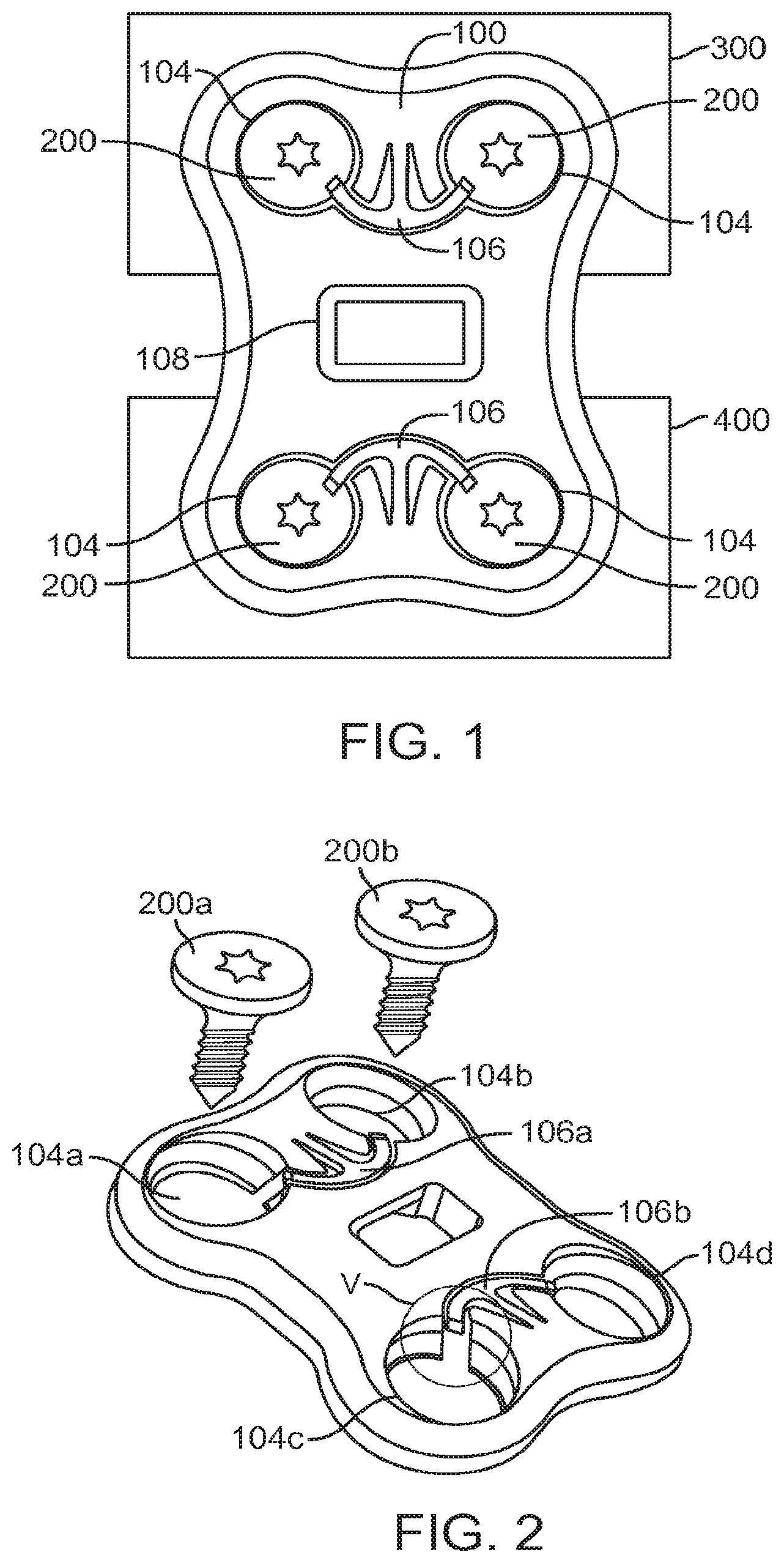
Referring now to , a bone fixation plate 100 , hereinafter referred to as the “plate,” is configured to be attached to a first vertebra (not shown) and a second vertebra (not shown) using a fastener, illustratively shown as bone screws 200 . The plate 100 may be substantially rectangular and include rounded sides and/or contoured surfaces to facilitate movement of tissue relative to the plate 100 after implantation in a patient. The plate 100 includes openings 104 formed in corners of the plate 100 . The screws 200 pass through the openings 104 to attach to the first and second vertebrae. Retention mechanisms 106 , formed between the openings 104 in the plate 100 , keep the screws 200 from backing out of the respective first and second vertebrae after fixation. A window 108 may also be formed in the plate 100 to provide access to the space between the first vertebra and the second vertebra. Although the system and method shown herein may be used to fix together two vertebrae, it is understood that the system and method may be applicable to multiple vertebrae in excess of two. For example, the plate 100 may extend beyond the first and/or second vertebra to attach to other adjacent vertebrae and may include additional retention mechanisms disposed between additional pairs of openings and screws.
Referring now to , a first screw 200 a may be inserted through a first opening 104 a and a second screw 200 b may be inserted through a second opening 104 b . A first retention mechanism 106 a is disposed between the first and second openings 104 a and 104 b and is configured to prevent both the first screw 200 a and the second screw 200 b from backing out of the plate 100 after fixation to the first vertebra. In one embodiment, the first retention mechanism 106 a may be molded or machined from the material of the plate 100 . Thus, the first retention mechanism 106 a may be integral and continuous with the plate 100 . In other embodiments, the first retention mechanism 106 a may be attached to the plate 100 between the openings 104 a and 104 b . The first retention mechanism 106 a may be attached by welding, snap fit, friction welding, or other forms of attachment.
For simplicity, one retention mechanism and one pair of adjacent openings are discussed in detail herein. However, it is understood by one in the art that the plate 100 of the present disclosure may include one or more retention mechanisms disposed between any pair of openings. For example, third and fourth openings 104 c and 104 d may be mirror images of the first and second openings 104 a and 104 b and configured to receive third and fourth screws, respectively. Similarly, a second retention mechanism 106 b may be disposed between the third and fourth openings 104 c and 104 d . It may be readily understood by one in the art that the second retention mechanism 106 b functions the same as the first retention mechanism 106 a with respect to the third and fourth openings 104 c and 104 d . Thus, each of the retention mechanisms 106 a and 106 b may be referred to hereinafter as simply retention mechanism 106 . Likewise, each pair of openings may be referred to hereinafter as simply first and second openings 104 a and 104 b.
Referring now to , a top view of the plate 100 illustrates additional features of the retention mechanism 106 and openings 104 a and 104 b . The first opening 104 a and the second opening 104 b are formed in one end of the plate 100 . The first and second openings 104 a and 104 b may be substantially circular and configured to receive the bone screws 200 a and 200 b respectively as shown in . The retention mechanism 106 is disposed in an opening 110 formed between the first and second openings 104 a and 104 b . The opening 110 may be irregular-shaped to conform to the geometry of the retention mechanism 106 . In one embodiment, the opening 110 may be in communication with both the first opening 104 a and the second opening 104 b . That is, a continuous wall is shared between the first opening 104 a , the second opening 104 b , and the opening 110 .
The retention mechanism 106 extends from the plate 100 into the opening 110 and is configured to lock the bone screws 200 a and 200 b to the plate 100 . For example, the retention mechanism 106 may include a flexible arm 112 extending from the plate 100 into the opening 110 . The flexible arm 112 may be attached to the plate at a proximal end 114 and include a distal end 116 cantilevered in the opening 110 . A first projection 118 a extends from the distal end 116 through the opening 110 and towards the first opening 104 a . A second projection 118 b extends from the distal end 116 through the opening 110 towards the second opening 104 b . Thus, the retention mechanism 106 may resemble an inverted “T” shaped geometry or a nautical anchor. For example, the first and second projections 118 a and 118 b (collectively projections 118 ) may include curvature having a radius approximately equivalent to the length of the arm 112 from the proximal end 114 to the distal end 116 .
Referring now to , a bottom view of the plate 100 illustrates additional features that enable retention of two bone screws with one retention mechanism 106 . Each of the projections 118 a and 118 b includes a notch 120 a and 120 b respectively (collectively notches 120 ), formed at the ends of the projections 118 . The notches 120 permit the projections 118 to slide over heads of the screws 200 after fixation to the vertebra as described below with reference to A- 6 D and 7 A- 7 E . The notches 120 may be configured to adjust the strength of the retention mechanism 106 by varying the thickness of the projections 118 and/or the arms 112 . For example, the notches 120 may decrease the thickness of the retention mechanism 106 and thus increase flexibility. Alternatively, the retention mechanism 106 may be of a uniform thickness that permits the projections 118 to slide over heads of the screws 200 .
The retention mechanism 106 is capable of elastically moving, bending, or toggling between at least three distinct positions. In a rest position, as shown in , the arm 112 “rests” substantially equidistant from the first and second openings 104 a and 104 b . Both the first projection 118 a and the second projection 118 b extend partially into the first and second openings 104 a and 104 b respectively to retain first and second screws 200 a and 200 b within the openings 104 a and 104 b . From the rest position, the retention mechanism 106 may be toggled to a first toggled position and a second toggled position as discussed below.
Referring now to , a portion of the retention mechanism 106 b of , and more particularly the first projection 118 a is shown in greater detail. The first projection 118 a extends through a mouth 120 in the opening 110 and into the first opening 104 a . The mouth 120 provides communication between the opening 110 and the opening 104 a . The first projection 118 a may include a top surface 122 that substantially conforms to a top surface 123 of the plate 100 . The first projection 118 a may include a taper 124 that decreases in thickness from the top surface 122 to a tip 126 on the distal end of the first projection 118 a . The taper 124 may facilitate engagement with the screw 200 as illustrated in A- 6 D .
Referring now to A- 6 D , engagement between the screw 200 and the retention mechanism 106 are shown in greater detail. The screw 200 includes a head 202 and a threaded shaft 204 . The head 202 may be driven by a screwdriver such that the shaft 204 penetrates the vertebra (not shown) to secure the plate 100 . In A , the screw 200 is inserted into the first opening 104 a . As the screw 200 advances through the first opening 104 a , a bottom surface 206 of the head 202 moves towards the retention mechanism 106 . As the head 202 is driven, the shaft 204 engages more of the vertebra, and the bottom surface 206 begins to contact the taper 124 of the first projection 118 a as shown in B . The bottom surface 206 exerts a downward force on the retention mechanism 106 . The downward force pushes against the taper 124 which transfers a portion of the downward force to the retention mechanism 106 . The flexible arm 112 (not shown) bends due to the force, and the projection 118 a begins to move away from the first opening 104 a , as illustrated in detail in B .
Continuing now with C , as the screw 200 continues to be driven into the vertebra, the bottom surface 206 passes by the taper 124 and a side wall 208 of the head 202 contacts the tip 126 of the projection 118 a . At this point, the retention mechanism 106 is in the first toggled position. In a toggled position, the arm 112 of the retention mechanism 106 may be fully bent towards the opposing opening as will be discussed in detail below. The screw 200 continues to be driven into the vertebra until fully seated in D . Once the screw 200 is fully seated, the retention mechanism 106 returns to the rest position. Now, the tip 126 of the projection 118 a extends over a top surface 210 of the head 202 of the screw 200 and the bottom surface 206 may contact a lip 127 in the opening 104 a . Thus, the retention mechanism 106 prevents the screw 200 from backing out from the plate 100 . Although the top surface 210 of the screw 200 contacts the projection 118 a in D , a gap may remain after the screw 200 attaches to a vertebra. As can be seen in D , a gap 128 may remain between the projection 118 a and the side wall 208 of the screw 200 once the retention mechanism 106 has returned to the rest position. The gap 128 permits the retention mechanism 106 to bend towards the first opening 104 a when the second screw 200 b is inserted into the second opening 104 b as discussed below with reference to A- 7 E .
Referring now to A- 7 E , the bone fixation system and method are shown in greater detail by a series of partial top views. In A , a first half of the plate 100 is shown positioned over the first vertebra. The retention mechanism 106 is in the rest position with no screws in place. In B , the first screw 200 a is inserted into the first opening 104 a and driven into the vertebra. As described with respect to B-C , the bottom surface 206 of the screw 200 a contacts the taper 124 causing the retention mechanism 106 to bend about the proximal end 114 of the arm 112 . The arm 112 elastically bends to the first toggled position before the first screw 200 a is fully seated in the first opening 104 a . In C , the first screw 200 a is fully seated in the first opening 104 a . The retention mechanism 106 returns to the rest position to prevent the first screw 200 a from backing away from the plate 100 . The tip 126 of the projection 118 a extends over the top surface 210 of the screw head 202 , as shown in D . Thus, the screw head 202 is locked between the projection 118 a and the lip 127 .
Referring now to D , the second screw 200 b is inserted into the second opening 104 b and driven into the vertebra. As described with respect to B-C , the bottom surface 206 of the screw 200 b contacts the taper 124 on the distal end of the projection 118 b causing the retention mechanism 106 to bend about the proximal end 114 of the arm 112 . The arm 112 elastically bends to the second toggled position before the second screw 200 b is fully seated in the second opening 104 b . In E , the second screw 200 a is fully seated in the second opening 104 b . The retention mechanism 106 returns to the rest position to prevent the second screw 200 b from backing away from the plate 100 . The tip 126 of the projection 118 b extends over the top surface 210 of the screw head 202 of the second screw 202 b . Thus, the screw head 202 is locked between the projection 118 b and a corresponding lip 127 of the second opening 104 b.
illustrate another embodiment of a bone fixation plate 800 that includes separate retention mechanisms 806 a - d (collectively retention mechanisms 806 ) for each opening 804 a - d (collectively openings 804 ). For example, a first retention mechanism 806 a is disposed between first and second openings 804 a and 804 b and is configured to prevent a first screw (not shown) in the first opening 804 a from backing out of the plate 800 after fixation to a vertebra. The first retention mechanism 806 a may be molded or machined from the material of the plate 800 . Thus, the first retention mechanism 806 a may be integral and continuous with the plate 800 . In other embodiments, the first retention mechanism 806 a may be attached to the plate 100 between the openings 804 a and 804 b . The first retention mechanism 806 a may be attached by welding, snap fit, friction welding, or other forms of attachment. A second retention mechanism 806 b is disposed between the second opening 804 b and the first retention mechanism 806 a and is configured to prevent a second screw (not shown) in the second opening 804 b from backing out of the plate 800 after fixation to the vertebra.
For simplicity, two retention mechanisms and one pair of adjacent openings are discussed in detail herein. However, it is understood by one in the art that the plate 800 of the present disclosure may include two retention mechanisms disposed between any pair of openings. For example, third and fourth openings 804 c and 804 d may be mirror images of the first and second openings 804 a and 804 b and configured to receive third and fourth screws, respectively. Similarly, a third retention mechanism 806 c , may be disposed between the third and fourth openings 804 c and 804 d and a fourth retention mechanism 806 d may be disposed between the fourth opening 804 d and the third retention mechanism 806 c.
Referring now to , a top view of the plate 800 illustrates additional features of the retention mechanism 806 and openings 804 a and 804 b . The first opening 804 a and the second opening 804 b are formed in one end of the plate 100 . The first and second openings 804 a and 804 b may be substantially circular and configured to receive the bone screws 200 a and 200 b respectively (not shown), similar to openings 104 a and 104 b as shown in . Each retention mechanism 806 is disposed in a separate opening 810 formed around each retention mechanism 806 . The openings 810 may be irregular-shaped to conform to the geometry of the retention mechanism 806 . In one embodiment, each opening 810 may be in communication with a neighboring opening 804 . That is, a continuous wall is shared between one opening, such as opening 804 a and one opening 810 .
Each retention mechanism 806 extends from the plate 800 into the opening 810 and is configured to lock one bone screw to the plate 800 . The retention mechanism 806 includes a flexible arm 812 extending from the plate 800 into the opening 810 . The flexible arm 812 may be attached to the plate at a proximal end 814 and include a distal end 816 cantilevered in the opening 810 . A projection 818 extends from the distal end 816 through the opening 808 and towards the opening 804 . Thus in the present embodiment, the retention mechanism 806 may resemble a “J” shaped geometry or a cane. For example, the projection 818 may include curvature having a radius equivalent to the length of the arm 812 from the proximal end 814 to the distal end 816 .
The retention mechanisms 806 function similar to the retention mechanism 106 as depicted in A- 6 D . That is, each retention mechanism 806 includes a taper on the projection 818 that comes in contact with a bottom surface of a screw when the screw is driven into a vertebra. As the screw is driven further into the vertebra, the retention mechanism 806 contacts an outer wall of the head of the screw and moves from a rest position to a toggled position. However, in the present embodiment, each retention mechanism 806 locks one screw rather than two screws as retention mechanism 106 . Thus, the retention mechanism 806 in the present example may be toggled between the rest position as depicted in and one toggled position similar to the first toggled position of the retention mechanism 106 .
With reference now to an aspect of the fixation plate is provided wherein the retention member is configured to engage the fastener so as to prevent the fastener from rotating. With reference first to the fixation plate 300 is configured to be attached to a first vertebra (not shown) and a second vertebra (not shown) using a fastener, for example, and without limitation, bone screws 200 depicted in . The fixation plate 300 may be substantially rectangular and include rounded sides and/or contoured surfaces to facilitate movement of tissue relative to the plate 300 after implantation in a patient.
The plate 300 is illustratively shown having a pair of vertebral openings 304 formed opposite ends of the plate 300 . The vertebral openings 304 are configured to allow the screws 200 to find purchase in a vertebral body. A central opening 306 is disposed between the vertebral openings 304 . The central opening 306 is configured to allow a screw 200 to find purchase in an implant 1000 .
The plate 300 includes at least one retention member 308 . For illustrative purposes, the plate 300 includes a pair of retention members 308 . The retention members 308 are formed between the vertebral openings 304 and the central opening 306 . The retention members 308 are configured to engage the screws 200 so as to prevent the screws 200 from rotating and backing out of the respective vertebral openings 304 and the central opening 306 .
, shows a screw 200 being introduced into the central opening 306 , it should be appreciated that the screw 200 shown in may be modified for use to find purchase in vertebral bodies. In particular, the screws illustratively shown in all have the same head 202 but the shafts 204 of the screws may differ to accommodate the intended use. For instance, the thread pitch and shape of the screw shown in is intended to couple with an implant. However, the thread pitch and shape of screws intended to find purchase in a vertebral body may differ.
In one embodiment, the retention members 308 may be molded or machined from the material of the plate 300 . Thus, the retention members 308 may be integral and continuous with the plate 300 . In other embodiments, the retention members 308 may be formed separately from the plate 300 and attached to the plate 300 between the vertebral openings 304 and the central opening 306 . For instance, the retentions members 308 may be attached by welding, snap fit, friction welding, or other forms of attachment.
For simplicity, the operation and structure of one retention member 308 and the central opening 306 and one vertebral opening 304 is discussed in detail herein. However, it should be appreciated by those skilled in the art that the discussion of one retention member 308 is sufficient to describe and enable the construction of the other retention members. It should be further appreciated that the embodiments described herein show two vertebral openings 304 and one central opening 306 , but the plate 300 may be modified to include additional openings without deviating from the scope of the appended claims. For instance, the plate 300 may have four openings as shown in .
Referring again to and also to , a perspective view and a top down view, respectively, of the plate 100 illustrates additional features of the retention member 300 . The retention member 308 is a resilient material having a stem 308 a and an arm 308 b . The arm 308 b is generally orthogonal to the stem 308 a . The opposing sides of the stem 308 a is spaced apart from the body of the plate 300 so as to form two slots 300 a on each side of the stem 308 a . The slots 308 a allow the stem 308 a to flex. The arm 308 b extends into a respective opening. For illustrative purposes, the retention member 308 is shown as having two arms 308 b extending outwardly and opposite each other into a respective vertebral opening 304 and central opening 306 so as to form the general shape of a “T”.
The screw 200 includes a head 202 having a top surface 202 a configured to engage an arm 308 b of the retention member 308 . In one embodiment top surface 202 a includes a plurality of nubs 202 b spaced apart from each other so as to form detents 202 c . The arms 308 b may include a taper 308 c . The taper 308 c may facilitate the introduction of the screw 200 into the vertebral body or the implant, as the case may be, by facilitating the biasing of the retention member 308 about the stem 308 a . The screws include a shaft 204 with a thread 204 a . As described above, the thread 204 a is shown configured to couple with an implant, but may be modified to find purchase with a vertebral body.
shows each of the openings 304 , 306 with screws 200 disposed therein. In particular, each arm 308 b is seated in a respective detent 202 c and held therein by surrounding nubs 202 . Accordingly, the arms 308 b are engaged with a top surface 202 a of a respective screw 200 so as to prevent the screw from rotating and thus backing out of the implant or vertebral body as the case may be.
With reference now to A- 13 C , an operation of the plate 300 is provided. Each end of the plate 300 may be mounted over adjacent vertebral bodies (not shown). As the operation of the retention members 308 is the same for the screws 200 in the vertebral openings 304 as the central opening 306 an illustration describing the central opening 306 is sufficient. A shows the head 202 of the screw 200 biasing the retention member 308 as the screw 200 advances into the central opening 306 . As shown, both retention members 308 are biased away from the head 202 . B shows the screw 200 advanced further. It should be appreciated that advancement of the screw 200 is done by turning the screw 200 so as to threadingly engage a reciprocating bore of an implant 1000 . C shows the head 202 of the screw 200 seated against the implant 1000 . As the head 202 is turned, the arms 308 b of opposing retention members 308 are seated in a corresponding detent 202 c so as to engage the head 202 of the screw 200 to prevent the screw 200 from rotating.
A- 13 C also show how the depth of the openings 304 , 306 are dimensioned so as to accommodate the head 202 of the screw 200 . Thus, the head 202 of the screw 200 may be advanced past the arm 308 b of the respective retention member 300 . Though A- 13 C show the central opening 306 registered to a threaded bore of an implant, the spatial dimensions illustrated may be applied to the vertebral openings 304 with respect to a vertebral body.
With reference now to another aspect of the fixation plate 300 and the retention member 408 as a resilient member disposed within an opening of the plate 300 is shown. It is understood that a cut-away view of the plate 300 is shown in . provide isolated views of the opening 306 and the screw 200 to illustrate the operation of another aspect of the fixation plate 300 described above. As seen, a retention member 400 is illustratively shown as a curved arm having a flattened head. The proximal end of the curved arm is illustratively shown integrally formed to the body of the plate surrounding a respective opening. For illustrative purposes, the opening is shown as a central opening 406 , however, the retention member 400 may also be used in a vertebral opening 406 .
With reference first to , the retention member 400 includes an arm 400 a which is curved so as to generally follow a portion of the central opening 406 . A relief opening 404 is disposed adjacent the proximal end of the arm 400 a so as to provide tolerance for biasing the arm 400 a . In one embodiment, the relief opening 404 is a cylindrical bore extending between a top surface and bottom surface of the plate 300 . The arm 400 a includes an interior surface directly opposite the body of the plate 300 so as to be spaced apart from the body of the plate 300 . The interior surface of the arm 400 a is exposed to the central opening 406 .
also provides an illustrative embodiment of a screw 200 for engagement with the retention member 400 . The screw 200 includes a head 202 having a side wall 202 a . A portion of the side wall 202 a includes a detent 202 b . The detent 202 b includes a flattened planar surface which is recessed with respect to the side wall 202 a so as to define an upper lip 202 c spaced apart from a lower lip 202 d . The detent 202 b is configured to engage a flattened head 400 b of the arm 400 a of the retention member 400 .
shows the retention member 400 in a natural state. shows the retention member 400 biased against the inner wall of the plate 300 defining the central opening 306 . In particular, as the screw 200 is advanced into the central opening 306 by rotation and engagement with a threaded bore of an implant (such as is generally shown in A- 13 C ), the head 202 of the screw 200 pushes the retention member 400 against the inner wall of the plate 300 . shows the detent 202 b of the screw 200 offset from the flattened head 400 b of the retention member 400 . shows the screw being advance further, wherein upon further rotation the flattened head 400 b of the retention member 400 is engaged with the detent 202 b of the screw 200 . The plate 300 may have a central opening 306 with a depth similar to that shown in A- 13 C so as to register the flattened head 400 b of the retention member 400 with the detent 202 b of the screw 200 when the screw 200 is seated against the implant.
With reference again to a system 2000 for use in a spinal procedure is provided. The system 2000 configured to prevent a fastener from backing out. The system 2000 includes a fixation plate having a retention member configured to engage the fastener, illustratively shown as a screw, so as to prevent the fastener from rotating and backing out.
C illustrate one embodiment of the system 2000 wherein the fixation plate 300 is configured to be attached to a first vertebra (not shown) and a second vertebra (not shown) using a fastener, illustratively shown as bone screws 200 . The fixation plate 300 may be substantially rectangular and include rounded sides and/or contoured surfaces to facilitate movement of tissue relative to the plate 300 after implantation in a patient.
The plate 300 is illustratively shown having a pair of vertebral openings 304 formed opposite ends of the plate 300 . The vertebral openings 304 are configured to allow the screw 200 to find purchase in a vertebral body. A central opening 306 is disposed between the vertebral openings 304 . The central opening 306 is configured to allow a screw 200 to find purchase in an implant 1000 .
The plate 300 includes at least one retention member 308 . For illustrative purposes, the plate 300 includes a pair of retention members 308 . The retention members 308 are formed between the vertebral openings 304 and the central opening 306 . The retention members 308 are configured to engage the screws 200 so as to prevent the screws 200 from rotating and backing out of the respective vertebral openings 304 and the central opening 306 .
shows a screw 200 being introduced into the central opening 306 . It should be appreciated that the screw 200 shown in may be modified for use to find purchase in vertebral bodies. In particular, the screws illustratively shown in all have the same head 202 but the shafts 204 of the screws may differ to accommodate the intended use. For instance, the thread pitch and shape of the screw shown in is intended to couple with an implant. However, the thread pitch and shape of screws intended to find purchase in a vertebral body may differ.
Referring again to and also to , a perspective view and a top down view, respectively, of the plate 100 illustrates additional features of the retention member 300 . The retention member 308 is a resilient material having a stem 308 a and an arm 308 b . The opposing sides of the stem 308 a is spaced apart from the body of the plate 300 so as to form two slots 300 a on each side of the stem 308 a . The slots 308 a allow the stem 308 a to flex. The arm 308 b extends into a respective opening. For illustrative purposes, the retention member 308 is shown as having two arms 308 b extend into a respective vertebral opening 304 and central opening 306 so as to form the general shape of a “T”.
The screw 200 includes a head 202 having a top surface 202 a configured to engage an arm 308 b of the retention member 308 . In one embodiment top surface 202 a includes a plurality of nubs 202 b spaced apart from each other so as to form detents 202 c . The arms 308 b may include a taper 308 c . The taper 308 c may facilitate the introduction of the screw 200 into the vertebral body or the implant, as the case may be, by facilitating the biasing of the retention member 308 about the stem 308 a . The screws include a shaft 304 with a thread 304 a . As described above, the thread 304 a is shown configured to couple with an implant, but may be modified to find purchase with a vertebral body.
The retention members 308 are configured to engage the top surface 202 a of the screw 200 so as to prevent the screw 200 from rotating. In one embodiment, the arm 308 b of the retention member 308 is configured to be seated in a detent 202 c so as to be nestled between adjacent nubs 202 b wherein the rotation of the screw 200 is prevented by the nubs 202 b restricting the movement of the arm 308 b.
Another embodiment of the system 2000 is illustratively shown in , wherein the retention member 400 is illustratively shown as a curved arm having a flattened head. The proximal end of the curved arm is illustratively shown integrally formed to the body of the plate surrounding a respective opening. For illustrative purposes, the opening is shown as a central opening 406 , however, the retention member 400 may also be used in a vertebral opening 406 .
With reference first to , the retention member 400 includes an arm 400 a which is curved so as to generally follow a portion of the central opening 406 . A relief opening 404 is disposed adjacent the proximal end of the arm 400 a so as to provide tolerance for biasing the arm 400 a . In one embodiment, the relief opening 404 is a cylindrical bore extending between a top surface and bottom surface of the plate 300 . The arm 400 a includes an interior surface directly opposite the body of the plate 300 so as to be spaced apart from the body of the plate 300 . The interior surface of the arm 400 a is exposed to the central opening 406 .
also provides an illustrative embodiment of a screw 200 for engagement with the retention member 400 . The screw 200 includes a head 202 having a side wall 202 a . A portion of the side wall 202 a includes a detent 202 b . The detent 202 b includes a flattened planar surface which is recessed with respect to the side wall 202 a so as to define an upper lip 202 c and lower lip 202 d . The detent 202 b is configured to engage a flattened head 400 b of the arm 400 a of the retention member 400 .
shows the retention member 400 in a natural state. shows the retention member 400 biased against the inner wall of the plate 300 defining the central opening 306 . In particular, as the screw 200 is advanced into the central opening 306 by rotation and engagement with a threaded bore of an implant (such as is generally shown in A- 13 C ), the head 202 of the screw 200 pushes the retention member 400 against the inner wall of the plate 300 . shows the detent 202 b of the screw 200 offset from the flattened head 400 b of the retention member 400 . shows the screw being advance further, wherein upon further rotation the flattened head 400 b of the retention member 400 is engaged with the detent 202 b of the screw 200 . The plate 300 may have a central opening 306 with a depth similar to that shown in A- 13 C so as to register the flattened head 400 b of the retention member 400 with the detent 202 b of the screw 200 when the screw 200 is seated against the implant.
Example embodiments of the methods and systems of the present invention have been described herein. As noted elsewhere, these example embodiments have been described for illustrative purposes only, and are not limiting. Other embodiments are possible and are covered by the invention. Such embodiments will be apparent to persons skilled in the relevant art(s) based on the teachings contained herein. Thus, the breadth and scope of the present invention should not be limited by any of the above-described exemplary embodiments, but should be defined only in accordance with the following claims and their equivalents.
Figures (12)
Citations
This patent cites (3)
- US8821553
- US2006/0195100
- US2011/0022097