Compositions and Methods for Nucleic Acid Transfer
Abstract
Disclosed are methods for the enhancement of nucleic acid delivery systems. The methods may employ treatment with a compound and/or an RNAi molecule in combination with a nucleic acid to improve nucleic acid uptake into a cell. In particular, the disclosed methods may be useful for improved gene therapy techniques.
Claims (16)
1. A method for transferring a nucleic acid comprising a gene of interest into a eukaryotic cell, comprising a. contacting said eukaryotic cell with an active agent selected from one or more of geldanamycin, alvespimycin, androstanolone, spermine, cortisone, quercetin, acetohexamide, resveratrol, doxorubicin, ruxolitinib, roscovitine, sildenafil, entasobulin, memantine, teniposide, etoposide, 3-aminobenzamide (INO 1001), diazoxide, tedisamil, glimepiride, epirubicin, annamycin, As 2 O 3 , (R/S)-repaglinide, 4β-aminoalkyl-4′-O-demethyl-4-desoxypodophyllotoxin (TOP53), acetohexamide, elasmitrucin, ketamine, NK109, tifenazoxide, olaparib, and intoplicine, in an amount sufficient to inhibit synthesis of one or more proteins that inhibit nucleic acid delivery vehicle uptake; and b. contacting said eukaryotic cell with a nucleic acid nanoparticle; said nucleic acid nanoparticle comprising a polymer of lysine conjugated to PEG and complexed with said nucleic acid.
11. A method of treating an individual, comprising a. administering a compound selected from geldanamycin, alvespimycin, androstanolone, spermine, cortisone, quercetin, acetohexamide, resveratrol, doxorubicin, ruxolitinib, roscovitine, sildenafil, entasobulin, memantine, teniposide, etoposide, 3-aminobenzamide (INO 1001), diazoxide, tedisamil, glimepiride, epirubicin, annamycin, As 2 O 3 , (R/S)-repaglinide, 4β-aminoalkyl-4′-O-demethyl-4-desoxypodophyllotoxin (TOP53), acetohexamide, elasmitrucin, ketamine, NK109, tifenazoxide, olaparib, intoplicine, geldanamycin, alvespimycin, entasobulin, androstanolone/dihydrotestosterone, spermine, cortisone, quercetin, acetohexamide, resveratrol, doxorubicin, ruxolitinib, roscovitine/seliciclib, sildenafil, and teniposide/vumon to said individual; and b. administering, to said individual, a nucleic acid nanoparticle comprising a polymer of lysine conjugated to polyethylene glycol (PEG) and complexed with a nucleic acid encoding a gene, or portion of a gene that encodes an active portion of a protein, that is expressed in said individual to provide a functional protein or functional protein fragment.
Show 14 dependent claims
2. The method of claim 1 , further comprising contacting said eukaryotic cell with an RNAi molecule that inhibits expression of a gene encoding a protein selected from Apolipoprotein B-100 (Apo B-100), Leiomodin-1, Elongation factor 1-alpha 1, Pot. HLA-DP-alpha 1, Utrophin, Myosin light chain 3, Cytochrome b-c1 complex subunit 2, Ubiquitin-conjugating enzyme E2 S, Coagulation factor VIII, Heterogeneous nuclear ribonucleoprotein M, Myosin light polypeptide 6, Adenomatous polyposis coli protein, Tyrosine-protein kinase JAK1, Myosin-6, 40S ribosomal protein S3a, Golgin subfamily A member 2, Peripherin (Neurofilament 4), Heterogeneous nuclear ribonucleoprotein A/B, Spectrin beta chain, erythrocytic, Dual specificity protein kinase TTK, 78 kDa glucose-regulated protein, CACCC box-binding protein, 60S ribosomal protein L11, Eukaryotic initiation factor 4A-III, Interleukin enhancer-binding factor 2, Nucleolar and coiled-body phosphoprotein 1, Nebulin, Microtubule-associated protein, DNA replication licensing factor MCM4, Centromere protein F (CENP-F), Cytoskeleton-associated protein 5, Chromodomain-helicase-DNA-binding protein 4, Solute carrier family 12 member 3, Phosphatidylinositol 3,4,5-trisphosphate 5-phosphatase 1, Periodic tryptophan protein 2 homolog, DNA mismatch repair protein Msh3, Ubiquitin-protein ligase E3A, SWI/SNF complex subunit SMARCC1, Histone H2B type 1-C/E/F/G/I, Histone-lysine N-methyltransferase EZH1, Endonuclease III-like protein 1, General transcription factor 3C polypeptide 1, Histone-lysine N-methyltransferase 2D (Lysine N-methyltransferase 2D), Uracil nucleotide/cysteinyl leukotriene receptor, Catenin delta-2, Heme oxygenase 2, Periplakin, Ryanodine receptor 3, Cullin-3, Small subunit processome component 20 homolog, T13D8.9 protein, RNA-binding motif protein, X chromosome, Protein CBFA2T3, Peripheral-type benzodiazepine receptor-associated protein 1, Actin, gamma-enteric smooth muscle, Regulator of chromosome condensation, CHC1 protein, Elongation factor 2, Histone H3.1t, Prohibitin, isoform CRA_a, Prohibitin, Prohibitin variant, 60S ribosomal protein L24, Epididymis secretory protein Li 310, Ribosomal protein, large, P2, 60S acidic ribosomal protein P2, 40S ribosomal protein S10, 40S ribosomal protein S11, 40S ribosomal protein S13, 40S ribosomal protein S17, Ribosomal protein S23, isoform CRA_a, 40S ribosomal protein S23, 40S ribosomal protein S25, 40S ribosomal protein S4, 40S ribosomal protein S4, X isoform, 40S ribosomal protein S8, Ski oncogene (Proto-oncogene c-Ski), Sperm binding protein 1a, a protein encoded by cDNA FLJ38670 fis, clone HSYRA2000190, highly similar to Voltage-dependent anion-selective channel protein 1, Voltage-dependent anion-selective channel protein 1 (VDAC-1), Transcriptional repressor protein YY1, A-kinase anchor protein 9, Histone H1.3, Zinc finger C2HC domain-containing protein 1A, Prelamin-A/C, Lamin-B1, Alcohol dehydrogenase, Epididymis secretory protein Li 6, ATP5H protein, ATP synthase subunit d, mitochondrial, Myosin regulatory light chain 12A, Uncharacterized protein, Gag-Pro-Pol-Env protein, High mobility group protein HMG-I/HMG-Y, Cytochrome c oxidase subunit 4 isoform 1, mitochondrial, Tyrosine-protein kinase BAZ1B, Septin-9, 40S ribosomal protein S18, MCG23000, isoform CRA_b, Required for meiotic nuclear division protein 1 homolog, Heterogeneous nuclear ribonucleoprotein H3, Low-density lipoprotein receptor-related protein 1B, MICOS complex subunit MIC60, MICOS complex subunit, MICOS complex subunit MIC19, Rhomboid domain-containing protein 2, Armadillo repeat-containing X-linked protein 5, ATP-dependent RNA helicase DDX39A, Leucine-rich repeat-containing protein 31, Coiled-coil domain-containing protein 170, ABC50 protein, ATP-binding cassette sub-family F member 1, Cell division cycle 5-like protein, Myosin-10, 60S ribosomal protein L14, Sperm flagellar protein 2, Keratin, type II cytoskeletal 7, Similar to ribosomal protein L23, Gamma-tubulin complex component 6, Ribosomal protein L15, 60S ribosomal protein L15, KLHL20 protein, High mobility group nucleosome-binding domain-containing protein 5, Nucleolar protein 7, 60S ribosomal protein L10a, DNA-dependent protein kinase catalytic subunit, a protein encoded by cDNA FLJ51732, highly similar to Peroxisomal NADH pyrophosphatase NUDT12 (EC 3.6.1.22), Peroxisomal NADH pyrophosphatase NUDT12, 60S ribosomal protein L28, Heterogeneous nuclear ribonucleoproteins A2/B1, Serine/threonine-protein kinase SMG1, 40S ribosomal protein S9, Remodeling and spacing factor 1 (Rsf-1), Actin, cytoplasmic 1, BRCA1-A complex subunit RAP80, Galactose-3-O-sulfotransferase 3, 40S ribosomal protein S24, Bromodomain and WD repeat-containing protein 1, Junction plakoglobin, isoform CRA_a, Membrane-associated guanylate kinase, WW and PDZ domain-containing protein 1, 60S ribosomal protein L13, Phosphorylase b kinase regulatory subunit alpha, Heterogeneous nuclear ribonucleoprotein Q, Alsin, Synaptotagmin-like protein 1, Ribosomal protein L34, 60S ribosomal protein L34, Cingulin, Centromere protein T, Cingulin-like protein 1, Coiled-coil domain-containing protein 42, Heterogeneous nuclear ribonucleoprotein F, Mitochondrial import receptor subunit TOM40 homolog, FBL protein, ESF1 homolog, Calcium/calmodulin-dependent protein kinase type II subunit delta, 60S ribosomal protein L18, Protein Shroom3, Dynein heavy chain 5, axonemal, PC4 and SFRS1-interacting protein, Epididymis tissue sperm binding protein Li 14m, Trifunctional enzyme subunit alpha, mitochondrial, Bcl-2-like protein 12, Core histone macro-H2A.1, MTRF1 protein, Alstrom syndrome protein 1, UHRF1-binding protein 1-like, U5 small nuclear ribonucleoprotein 200 kDa helicase, SWI/SNF related, matrix associated, actin dependent regulator of chromatin, subfamily a, member 4, Transcription activator BRG1, Eukaryotic elongation factor 2 kinase, EVI5-like protein, Protein ECT2, CSC1-like protein 2, a protein encoded by cDNA FLJ35251 fis, clone PROST2003635, Nesprin-1, Nesprin-1, Chromodomain-helicase-DNA-binding protein 5, Midasin, Nesprin-2, Voltage-dependent anion-selective channel protein 3, ATPase family AAA domain-containing protein 5, N-alpha-acetyltransferase 15, NatA auxiliary subunit, Histone H2A type 2-B, Rootletin, Histone H2A, Histone H2A.J, PDZ domain-containing protein 8, Structural maintenance of chromosomes protein 1A, SMC1A protein, Vacuolar protein sorting-associated protein 13B, Centriolin, Pericentrin, Testicular secretory protein Li 14, Glutamate dehydrogenase 2, Myomesin-3, Acidic ribosomal phosphoprotein P1, Nucleolar protein 56, Nucleolar protein 58, Uncharacterized protein, FLJ00279 protein, a protein encoded by cDNA FLJ16045 fis, clone CTONG2000042, Probable C-mannosyltransferase DPY19L4, Coiled-coil domain-containing protein 18, FYVE, RhoGEF and PH domain-containing protein 6, ATP synthase subunit alpha, mitochondrial, Superkiller viralicidic activity 2-like 2, Phosphate carrier protein, mitochondrial, 40S ribosomal protein S6, EEF1D protein (Fragment), Sterile alpha motif domain-containing protein 9, Antigen MLAA-44, Coiled-coil and C2 domain-containing protein 1B, Elongation factor 1-gamma, Heterogeneous nuclear ribonucleoprotein U, Malignant fibrous histiocytoma-amplified sequence 1, Arachidonate 15-lipoxygenase, GC-rich sequence DNA-binding factor 2, 60S ribosomal protein L4, Regulator of G-protein signaling 20, Harmonin, Plectin, Kinesin-like protein KIF1B (Klp), Neuropilin-2, Neuropilin, Vacuolar protein sorting-associated protein 13D, Lymphoid-specific helicase, Histone H2B type 1-A, Ankyrin repeat domain-containing protein 11, Histone H2B (Fragment), Keratin, type II cytoskeletal 6A, Nipped-B-like protein (Delangin) (SCC2 homolog), ATPase family AAA domain-containing protein 1, Mitochondrial dynamin-like 120 kDa protein, Striated muscle preferentially expressed protein kinase, Disks large-associated protein 1, Dedicator of cytokinesis protein 11, Myomegalin, Putative uncharacterized protein DKFZp666F1010, Putative uncharacterized protein DKFZp666M0710, Putative uncharacterized protein DKFZp686P17171, Activation-dependent, raft-recruited ADAP-like phosphoprotein, Unconventional myosin-XVIIIa, Nucleolin, isoform CRA_b, Nucleolin, isoform CRA_c, Nucleolin (Protein C23), Keratin, type I cytoskeletal 9, Cilia-and flagella-associated protein 58, Terminal uridylyltransferase 4, WD repeat and SOCS box-containing protein 1, Centromere protein J, FRAS1-related extracellular matrix protein 1, Macoilin, NARGI protein (Fragment), Calpastatin isoform a variant (Fragment), Ribosomal protein L5 variant (Fragment), Insulin-like growth factor binding protein 2 variant (Fragment), Rho-associated protein kinase 2, 60S acidic ribosomal protein P0 (Fragment), Elongation factor 1-alpha (Fragment), Glial fibrillary acidic protein, Beta-actin-like protein 2, Fanconi anemia, complementation group D2, isoform CRA_b, Fanconi anemia group D2 protein, IQ and AAA domain-containing protein 1, Protein FAM92A, Teneurin-3, Coiled-coil and C2 domain-containing protein 2A, Putative uncharacterized protein C3orf49, Heterogeneous nuclear ribonucleoprotein A1, Dynein heavy chain 2, axonemal, Ribosomal protein (Fragment), RSLID1 protein (Fragment), ATP-dependent DNA helicase PIF1, Keratin, type II cytoskeletal 73, ATP synthase subunit beta, a protein encoded by cDNA FLJ39263 fis, clone OCBBF2009571, ATP-dependent RNA helicase A, Centrosomal protein of 290 kDa, CEP290 protein, Golgi-specific brefeldin A-resistance guanine nucleotide exchange factor 1, La-related protein 7 , Pumilio homolog 3, Ovochymase-1, INO80 complex subunit, RWD domain-containing protein 3, Dual 3′, 5′-cyclic-AMP and -GMP phosphodiesterase 11A, Histone-lysine N-methyltransferase ASHIL, ATP-binding cassette sub-family C member 8, Cilia-and flagella-associated protein 157, M-phase phosphoprotein 1, isoform CRA_a, 60S ribosomal protein L3, A kinase (PRKA) anchor protein 6, isoform CRA_b, Lamin B2, isoform CRA_b, Nuclear mitotic apparatus protein 1, isoform CRA_a, Coiled-coil domain-containing protein 40, TBK1 binding protein 1, isoform CRA_a, Lamina-associated polypeptide 2, isoforms beta/gamma, KIAA1212, isoform CRA_a, Histone H2B, Septin 11, isoform CRA_b, Heterogeneous nuclear ribonucleoprotein A3, isoform CRA_a, MORC family CW-type zinc finger protein 4, Cytoplasmic dynein 2 heavy chain 1, Unconventional myosin-VIIb, Protein unc-13 homolog C, HSPA1L, Heat shock 70 kDa protein 1-like, Laminin subunit beta-4, Leucine-rich repeat-containing protein 43, Protocadherin Fat 3, Death-associated protein kinase, ADP/ATP translocase 2, SLC25A5 protein (Fragment), ADP/ATP translocase 3, SLC25A6 protein, HNRPR protein (Fragment), Poly [ADP-ribose] polymerase, Poly [ADP-ribose] polymerase 1, Protein AHNAK2, Myb-binding protein 1A, Leucine-rich repeat and IQ domain-containing protein 3, a protein encoded by cDNA FLJ76880, a protein encoded by cDNA FLJ76071, highly similar to Homo sapiens filamin A interacting protein 1 (FILIP1), mRNA, Structural maintenance of chromosomes protein, Coiled-coil domain-containing protein 180, Dynein heavy chain 17, axonemal, Histone H2A, a protein encoded by cDNA, FLJ95007, highly similar to Homo sapiens BRCA1 associated RING domain 1 (BARD1), mRNA, Protein fantom, Mpv17-like protein, Protein CASP, a protein encoded by cDNA FLJ44920 fis, clone BRAMY3011501, highly similar to Heterogeneous nuclear ribonucleoprotein U, ATPase family AAA domain-containing protein 3A, a protein encoded by cDNA FLJ35376 fis, clone SKMUS2004044, highly similar to Homo sapiens ribosomal protein L3 (RPL3), transcript variant 2, mRNA, SNF2LT, Dynein heavy chain 6, axonemal, Nuclear export mediator factor NEMF, a protein encoded by cDNA FLJ51361, highly similar to Keratin, type II cytoskeletal 6A, a protein encoded by cDNA FLJ57651, highly similar to Ketosamine-3-kinase, a protein encoded by cDNA FLJ50007, a protein encoded by cDNA FLJ52940, highly similar to Mortality factor 4-like protein 2, Protein RUFY3, Leucine-rich repeat and coiled-coil domain-containing protein 1, a protein encoded by CDNA FLJ60374, G-protein coupled receptor 176, a protein encoded by cDNA FLJ61500, highly similar to NNP-1 protein, Small nuclear ribonucleoprotein Sm D3, a protein encoded by cDNA FLJ54081, highly similar to Keratin, type II cytoskeletal 5, a protein encoded by cDNA FLJ58017, moderately similar to Treacle protein, Piwi-like protein 2, Serine/threonine-protein kinase N2, Dysferlin, Putative uncharacterized protein DKFZp469P0721, Short transient receptor potential channel 4, GTP-binding nuclear protein Ran, HNRNPL protein (Fragment), a protein encoded by cDNA FLJ52713, moderately similar to Mus musculus leucine rich repeat (in FLII) interacting protein 1 (Lrrfip1), mRNA, a protein encoded by cDNA FLJ50492, highly similar to Cyclin-dependent kinase-like 3 (EC 2.7.11.22), TBC1 domain family member 1, Non-POU domain-containing octamer-binding, 60S ribosomal protein L31, a protein encoded by CDNA FLJ51382, Protein Jumonji, von Willebrand factor A domain-containing protein 5B2, VWA5B2 protein (Fragment), Centrosomal protein of 128 kDa (Cep128), Proliferation marker protein Ki-67, Ribosomal protein L19, RPL27/NME2 fusion protein (Fragment), TPR and ankyrin repeat-containing protein 1, a protein encoded by cDNA FLJ90678 fis, clone PLACE1005736, highly similar to Pleckstrin homology domain-containing family A member 1, Pleckstrin homology domain-containing family A member 1, SWI/SNF-related matrix-associated actin-dependent regulator of chromatin subfamily A member 5, Golgin subfamily B member 1, Heterogeneous nuclear ribonucleoprotein D-like, and combinations thereof.
3. The method of claim 1 , wherein said active agent is selected from geldanamycin, alvespimycin, entasobulin, androstanolone, spermine, cortisone, quercetin, acetohexamide, resveratrol, doxorubicin, ruxolitinib, roscovitine, sildenafil, teniposide, and combinations thereof.
4. The method of claim 1 , wherein said active agent is selected from roscovitine, geldanamycin, acetohexamide, ruxolitinib, and combinations thereof.
5. The method of claim 2 , wherein said one or more proteins that inhibit nucleic acid delivery vehicle uptake are selected from keratin 13, APC protein, protocadherin 17, spectrin alph (non-erythrocytic 1), and combinations thereof.
6. The method of claim 1 , wherein a period of time exists between step a and step b.
7. The method of claim 1 , wherein said nucleic acid is single stranded.
8. The method of claim 1 , wherein said nucleic acid is double stranded.
9. The method of claim 1 , wherein said method is carried out in vitro.
10. The method of claim 1 , wherein said method is carried out ex vivo.
12. The method of claim 11 , wherein said compound is administered concurrently, before, or after administration of said nucleic acid nanoparticle.
13. The method of claim 11 , further comprising administering an RNAi that inhibits expression of a gene of claim 2 .
14. The method of claim 1 , wherein said method is carried out in vivo.
15. The method of claim 1 , wherein said nucleic acid is DNA.
16. The method of claim 1 , wherein said gene of interest encodes an active portion of a protein that can be expressed to provide a functional protein or protein fragment.
Full Description
Show full text →
CROSS REFERENCE TO RELATED APPLICATION
This application claims priority to and benefit of U.S. patent application Ser. No. 15/690,526, filed Aug. 30, 2017, entitled “Compositions and Methods for Nucleic Acid Transfer.” which claims priority to and benefit of U.S. Provisional Patent Application Ser. No. 62/381,237, filed Aug. 30, 2016, entitled “Method for Enhancing Nucleic Acid Transfer,” the contents of which are incorporated by reference in their entirety for all purposes.
STATEMENT REGARDING FEDERALLY-SPONSORED RESEARCH
This invention was made with government support under EB023800 awarded by the National Institutes of Health. The government has certain rights in the invention.
BACKGROUND
Transfer of nucleic acids, including double and single stranded DNA as well as RNA, into eukaryotic cells is the most essential step of any gene transfer, repair, or editing technology. Transfer of nucleic acids may be accomplished using many types of delivery vehicles, including cationic lipids, viral vectors and nucleic acid nanoparticles condensed with cationic polymers such as poly lysine or polyethyleneimine. However, significant costs involved in the preparation of these materials present a significant limitation in their usage as both research tools and translational applications such as gene therapy. Further, efficacy of nucleic acid transfer with or without modification of the vector remains an area in need of improvement. The instant disclosure seeks to address one or more of the aforementioned needs in the art.
BRIEF SUMMARY
Disclosed are methods for the enhancement of nucleic acid delivery systems. The methods may employ treatment with a compound and/or an RNAi molecule in combination with, for example, prior to or concurrent with, administration of a nucleic acid to improve nucleic acid uptake into a cell. In particular, the disclosed methods may be useful for improved gene therapy techniques in which a disclosed RNAi and/or a disclosed compound may be administered prior to or concurrently with the gene therapy delivery vehicle containing a nucleic acid.
BRIEF DESCRIPTION OF THE DRAWINGS
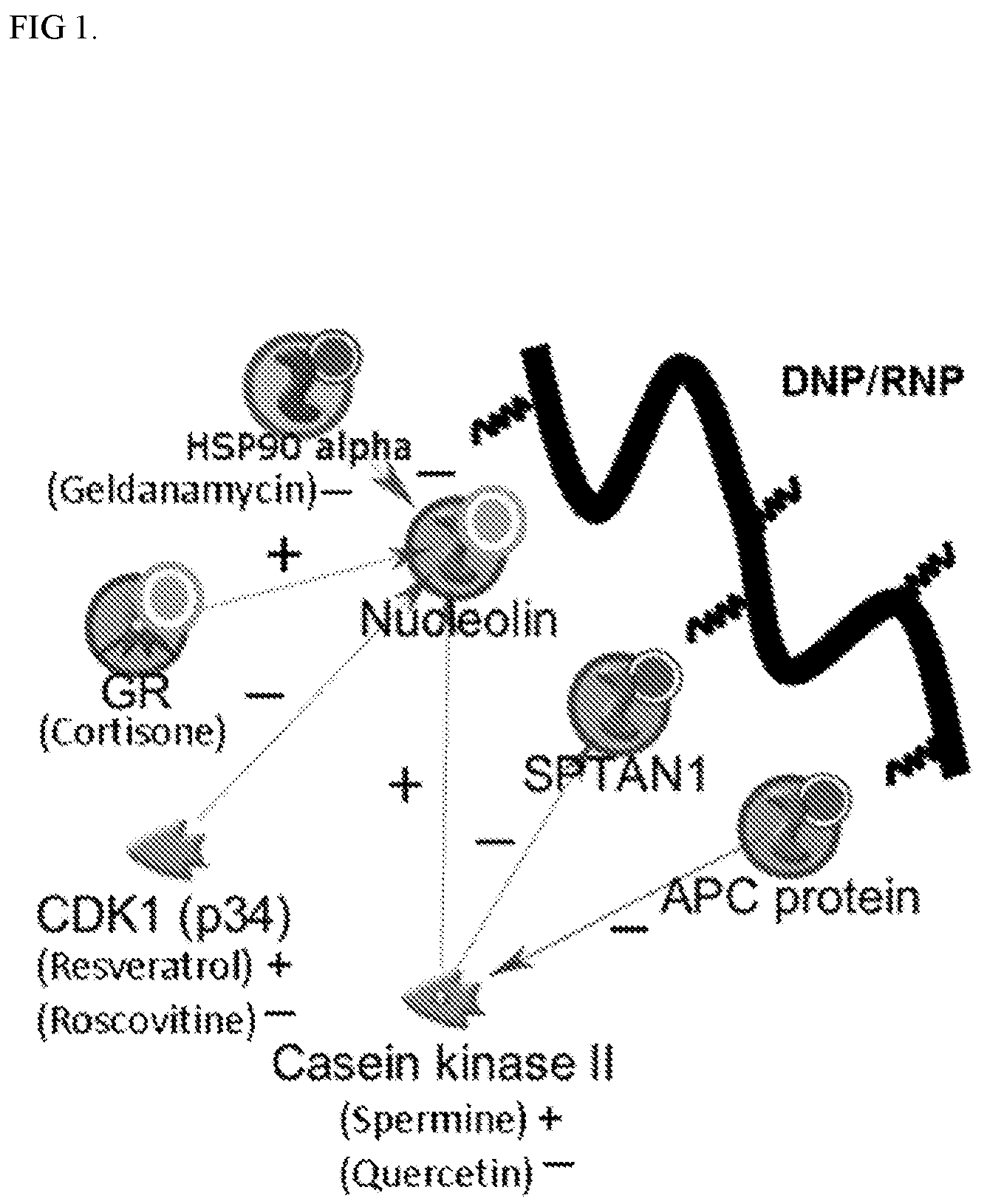
is a schematic of partial NNP (DNP and RNP) interactome including nucleoin, APC, and SPTAN1, which were identified by MS analysis of 2 gel bands from DNP and RNP pull downs not present in bead alone control. Lighter color circles connote interactions that enhance NNP-mediated gene transfer, while darker circles connote interactions that inhibit. (+) or (−) along arrows connote impact on interactions with DNP. (+) or (−) by pharmacological agents reflect impact on the activation of GR, CDK1, or CMI. For example, while cortisone would increase nucleolin at the membrane via GR (10), spermine would increase it through stimulation of CMI mediated phosphorylation of nucleolin. Pull downs initially conducted in primary hepatocytes and repeated three times in wd-AECs for 2 non-CF and 3 CF subjects. This DNP interactome was observed in all the hepatocyte and CF and non-CF wd-AEC studies.
depicts immunoprecipitation of protein interactors of DNA nanoparticles in HeLa cells.
depicts enhanced DNA nanoparticle transfection through siRNA expression.
depicts transfection of human primary airway epithelia either following prior treatment with scrambled shRNA, shRNA specific for APC, or shRNA specific for SPTAN1 for 48 hours. Luciferase expression was measured two days post transfection. * connotes different from saline pretreatment (triplicates in three experiments p<0.01).
depicts primary cell cultures of airway epithelia transfected with DNPs containing a plasmid coding for luciferase driven by the ubiquitin B promoter (5.4 kb). shRNA lentivirus infection was 48 hours prior to transfection while spermine (CK11 inducer) roscovitine (CDK1 inhibitor), resveratrol (CDK1 agonist), or cortisone (GR agonist) were added four hours prior to transfection. Treatments were saline (S), APC shRNA (-APC), SPTAN1 shRNA (-SPTAN1), hydrocortisone ©, spermine (Sper), roscovitine (Ros), or resveratrol (RES). Luciferase expression was measured two days post transfection. * connotes different from saline (p<0.01).
DETAILED DESCRIPTION OF THE INVENTION
Definitions
Unless otherwise defined, all technical and scientific terms used herein have the same meaning as commonly understood by one of ordinary skill in the art. In case of conflict, the present document, including definitions, will control. Preferred methods and materials are described below, although methods and materials similar or equivalent to those described herein can be used in practice or testing of the present invention. All publications, patent applications, patents and other references mentioned herein are incorporated by reference in their entirety. The materials, methods, and examples disclosed herein are illustrative only and not intended to be limiting.
The terms and expressions used herein have the ordinary meaning as is accorded to such terms and expressions with respect to their corresponding respective areas of inquiry and study except where specific meanings have otherwise been set forth herein.
As used herein and in the appended claims, the singular forms “a,” “and,” and “the” include plural referents unless the context clearly dictates otherwise. Thus, for example, reference to “a method” includes a plurality of such methods and reference to “a dose” includes reference to one or more doses and equivalents thereof known to those skilled in the art, and so forth.
The term “about” or “approximately” means within an acceptable error range for the particular value as determined by one of ordinary skill in the art, which will depend in part on how the value is measured or determined, e.g., the limitations of the measurement system. For example, “about” can mean within 1 or more than 1 standard deviation, per the practice in the art. Alternatively, “about” can mean a range of up to 20%, or up to 10%, or up to 5%, or up to 1% of a given value. Alternatively, particularly with respect to biological systems or processes, the term can mean within an order of magnitude, for example, within 5-fold, and or for example, within 2-fold, of a value. Where particular values are described in the application and claims, unless otherwise stated the term “about” meaning within an acceptable error range for the particular value should be assumed.
The terms “individual,” “host,” “subject,” and “patient” are used interchangeably to refer to an animal that is the object of treatment, observation and/or experiment. Generally, the term refers to a human patient, but the methods and compositions may be equally applicable to non-human subjects such as other mammals. In some embodiments, the terms refer to humans. In further embodiments, the terms may refer to children.
The terms “treat,” “treating” or “treatment,” as used herein, refers to methods of alleviating, abating or ameliorating a disease or condition symptoms, preventing additional symptoms, ameliorating or preventing the underlying metabolic causes of symptoms, inhibiting the disease or condition, arresting the development of the disease or condition, relieving the disease or condition, causing regression of the disease or condition, relieving a condition caused by the disease or condition, or stopping the symptoms of the disease or condition either prophylactically and/or therapeutically.
The term “pharmaceutically acceptable,” as used herein, refers a material, such as a carrier or diluent, which does not abrogate the biological activity or properties of the compounds described herein. Such materials are administered to an individual without causing undesirable biological effects or interacting in a deleterious manner with any of the components of the composition in which it is contained.
The term “pharmaceutically acceptable salt,” as used herein, refers to a formulation of a compound that does not cause significant irritation to an organism to which it is administered and does not abrogate the biological activity and properties of the compounds described herein. As used herein, the disclosed compounds also include pharmaceutically acceptable salts thereof.
The terms “composition” or “pharmaceutical composition,” as used herein, refers to a mixture of at least one compound or RNAi as disclosed herein, with at least one and optionally more than one other pharmaceutically acceptable chemical components, such as carriers, stabilizers, diluents, dispersing agents, suspending agents, thickening agents, and/or excipients.
The term “carrier” applied to pharmaceutical compositions of the disclosure refers to a diluent, excipient, or vehicle with which an active compound (e.g., dextromethorphan) is administered. Such pharmaceutical carriers can be sterile liquids, such as water, saline solutions, aqueous dextrose solutions, aqueous glycerol solutions, and oils, including those of petroleum, animal, vegetable, or synthetic origin, such as peanut oil, soybean oil, mineral oil, sesame oil and the like.
The term “NNP” refers to a Nucleic acid Nano Particle: a complex of DNA or RNA with polymers of lysines (15-45 lysines long)
The term “DNP” refers to a DNA Nanoparticle
The term “RNP” refers to a RNA Nanoparticle
The term “Interactome” refers to the whole set of molecular interactions in a particular cell. The term specifically refers to physical interactions among molecules (such as those among proteins, also known as protein-protein interactions) but can also describe sets of indirect interactions among genes (genetic interactions).
The term “APC” refers to an adenomatous polyposis coli protein
The term “wd-AECs” refer to well-differentiated airway epithelial cells.
The term “SPTAN1” refers to Alpha II-spectrin, also known as Spectrin alpha chain, a protein that in humans is encoded by the SPTAN1 gene. Alpha II-spectrin is expressed in a variety of tissues, and is highly expressed in cardiac muscle at Z-disc structures, costameres and at the sarcolemma membrane.
The term “GR” refers to a glucocorticoid receptor
The term “CDK1” refers to cyclin dependent kinase 1
The term “CKII” refers to casein kinase II
The term “Spermine” refers to a polyamine involved in cellular metabolism found in all eukaryotic cells.
The term “shRNA” refers to a small hairpin RNA or short hairpin RNA (shRNA) is an artificial RNA molecule with a tight hairpin turn that can be used to silence target gene expression via RNA interference (RNAi)
Disclosed herein are methods for the enhancement of nucleic acid delivery systems by combination treatment with one or more compounds as disclosed herein and/or one or more RNAi molecules as disclosed herein. For example, the disclosed methods may be used with delivery of a nucleic acid such as a gene, a gene fragment, a fragment containing an active portion of a protein encoded by a gene, or the like. Further examples of nucleic acids that may be delivered include nucleic acid components of the CRISPR/CAS9, or short nucleic acids, such as microRNA or DNA or RNA oligonucleotides. The disclosed RNAi molecules and/or compounds may be administered to an individual in need of administration of a nucleic acid prior to administration of a nucleic acid delivery system, or concurrently with the administration of a nucleic acid delivery system.
The method, in certain aspects, may comprise the steps of
•
• contacting a cell with an RNAi molecule or an active agent. The RNAi molecule or active agent may be in an amount sufficient to inhibit synthesis of one or more proteins that inhibit nucleic acid delivery vehicle uptake; and • contacting the eukaryotic cell with a nucleic acid delivery vehicle.
The cell may be, for example, a eukaryotic cell, derived from a human being.
In one aspect, a method of treating an individual is disclosed. The individual may be one in which administration a therapeutically effective amount of a protein may be advantageous to reversal, prevention, or amelioration of a disease state. The delivery of a protein may be achieved via administration of a gene, or portion of a gene that encodes an active portion of a protein, that may be subsequently expressed in the individual to provide a functional protein or functional protein fragment in a therapeutically effective amount. In this aspect, the method may comprise the steps of administering an RNAi that inhibits expression of a gene encoding a protein selected from a protein of Table 1 and/or a compound selected from Table 2 or 3, concurrently, before, or after administration of a drug delivery vehicle containing the nucleic acid that encodes the gene, or in some instances, the active portion of a gene, of interest.
The amount of compound and/or RNAi necessary to effect the methods of the instant disclosure may be determined by one of ordinary skill in the art. The dose administered to a subject, particularly a human, may be sufficient to effect the desired response in the subject over a reasonable period of time. The dose may be determined by the strength of the particular compound employed and the condition of the subject, as well as the body weight of the subject to be treated. The existence, nature, and extent of any adverse side effects that might accompany the administration of a particular compound also will determine the size of the dose and the particular route of administration employed with a particular patient. For example, the compounds may be therapeutically effective at low doses. Exemplary dosage ranges may be from about 0.001 mM, or less, to about 100 mM, or more, or from about 0.01, 0.05, 0.1, 0.5, 0.6, 0.7, 0.8, or 0.9 mM, to about 1, 2, 3, 4, 5, 6, 7, 8, 9, 10, 20, 30, 40 50, 60, 70, 80, 90 or 100 mM. Accordingly, the compounds may be generally administered in low doses.
In one aspect, the gene is the CF gene, and the individual in need of treatment is an individual having cystic fibrosis.
In one aspect, the RNAi molecule may be one that inhibits expression of a gene encoding a protein selected from a protein of Table 1.
TABLE 1
Genes encoding proteins that modulate nucleic acid delivery vehicle uptake. The RNAi molecules of
the instant disclosure may inhibit expression of one or more of the genes listed in the table.
Gene
Uniprot ID names Protein names
P04114 APOB Apolipoprotein B-100 (Apo B-100) [Cleaved into:
Apolipoprotein B-48 (Apo B-48)]
P29536 LMOD1 Leiomodin-1 (64 kDa autoantigen 1D) (64 kDa
autoantigen 1D3) (64 kDa autoantigen D1) (Leiomodin,
muscle form) (Smooth muscle leiomodin) (SM-Lmod)
(Thyroid-associated ophthalmopathy autoantigen)
P68104 EEF1A1 Elongation factor 1-alpha 1 (EF-1-alpha-1) (Elongation
EEF1A factor Tu) (EF-Tu) (Eukaryotic elongation factor 1 A-1)
EF1A (eEF1A-1) (Leukocyte receptor cluster member 7)
LENG7
O19680 Pot. HLA-DP-alpha 1 (Aa −31 to +2) (441 is 1st base in
codon) (Fragment)
P46939 UTRN Utrophin (Dystrophin-related protein 1) (DRP-1)
DMDL
DRP1
P08590 MYL3 Myosin light chain 3 (Cardiac myosin light chain 1)
(CMLC1) (Myosin light chain 1, slow-twitch muscle
B/ventricular isoform) (MLC1SB) (Ventricular myosin
alkali light chain) (Ventricular myosin light chain 1)
(VLCl) (Ventricular/slow twitch myosin alkali light
chain) (MLC-lV/sb)
P22695 UQCRC2 Cytochrome b-c1 complex subunit 2, mitochondrial
(Complex III subunit 2) (Core protein II) (Ubiquinol-
cytochrome-c reductase complex core protein 2)
Q16763 UBE2S Ubiquitin-conjugating enzyme E2 S (EC 2.3.2.23) (E2
E2EPF ubiquitin-conjugating enzyme S) (E2-EPF) (Ubiquitin
OK/SW- carrier protein S) (Ubiquitin-conjugating enzyme E2-24
cl.73 kDa) (Ubiquitin-conjugating enzyme E2-EPF5)
(Ubiquitin-protein ligase S)
P00451 F8 F8C Coagulation factor VIII (Antihemophilic factor) (AHF)
(Procoagulant component) [Cleaved into: Factor VIIIa
heavy chain, 200 kDa isoform; Factor VIIIa heavy chain,
92 kDa isoform; Factor VIII B chain; Factor VIIIa light
chain]
P52272 HNRNPM Heterogeneous nuclear ribonucleoprotein M (hnRNP M)
HNRPM
NAGR1
P60660 MYL6 Myosin light polypeptide 6 (17 kDa myosin light chain)
(LC17) (Myosin light chain 3) (MLC-3) (Myosin light
chain alkali 3) (Myosin light chain A3) (Smooth muscle
and nonmuscle myosin light chain alkali 6)
P25054 APC DP2.5 Adenomatous polyposis coli protein (Protein APC)
(Deleted in polyposis 2.5)
P23458 JAK1 Tyrosine-protein kinase JAK1 (EC 2.7.10.2) (Janus
JAK1A kinase 1) (JAK-1)
JAK1B
P13533 MYH6 Myosin-6 (Myosin heavy chain 6) (Myosin heavy chain,
MYHCA cardiac muscle alpha isoform) (MyHC-alpha)
P61247 RPS3A 40S ribosomal protein S3a (Small ribosomal subunit
FTE1 protein eS1) (v-fos transformation effector protein) (Fte-
MFTL 1)
Q08379 GOLGA2 Golgin subfamily A member 2 (130 kDa cis-Golgi
matrix protein) (GM130) (GM130 autoantigen) (Golgin-
95)
P41219 PRPH Peripherin (Neurofilament 4)
NEF4
PRPH1
Q99729 HNRNPAB Heterogeneous nuclear ribonucleoprotein A/B (hnRNP
ABBP1 A/B) (APOBEC1-binding protein 1) (ABBP-1)
HNRPAB
P11277 SPTB Spectrin beta chain, erythrocytic (Beta-I spectrin)
SPTB1
P33981 TTK MPS1 Dual specificity protein kinase TTK (EC 2.7.12.1)
MPS1L1 (Phosphotyrosine picked threonine-protein kinase) (PYT)
P11021 HSPA5 78 kDa glucose-regulated protein (GRP-78)
GRP78 (Endoplasmic reticulum lumenal Ca(2+)-binding protein
grp78) (Heat shock 70 kDa protein 5) (Immunoglobulin
heavy chain-binding protein) (BiP)
Q15552 tb protein CACCC box-binding protein
P62913 RPL11 60S ribosomal protein L11 (CLL-associated antigen
KW-12) (Large ribosomal subunit protein uL5)
P38919 EIF4A3 Eukaryotic initiation factor 4A-III (eIF-4A-III) (eIF4A-
DDX48 III) (EC 3.6.4.13) (ATP-dependent RNA helicase
KIAA0111 DDX48) (ATP-dependent RNA helicase eIF4A-3)
(DEAD box protein 48) (Eukaryotic initiation factor 4A-
like NUK-34) (Eukaryotic translation initiation factor 4A
isoform 3) (Nuclear matrix protein 265) (NMP 265)
(hNMP 265) [Cleaved into: Eukaryotic initiation factor
4A-III, N-terminally processed]
Q12905 ILF2 NF45 Interleukin enhancer-binding factor 2 (Nuclear factor of
PRO3063 activated T-cells 45 kDa)
Q14978 NOLC1 Nucleolar and coiled-body phosphoprotein 1 (140 kDa
KIAA0035 nucleolar phosphoprotein) (Nopp140) (Hepatitis C virus
NS5ATP13 NS5A-transactivated protein 13) (HCV NS5A-
transactivated protein 13) (Nucleolar 130 kDa protein)
(Nucleolar phosphoprotein p130)
P20929 NEB Nebulin
Q16296 4R-MAP2 Microtubule-associated protein (Fragment)
P33991 MCM4 DNA replication licensing factor MCM4 (EC 3.6.4.12)
CDC21 (CDC21 homolog) (P1-CDC21)
P49454 CENPF Centromere protein F (CENP-F) (AH antigen)
(Kinetochore protein CENPF) (Mitosin)
Q14008 CKAP5 Cytoskeleton-associated protein 5 (Colonic and hepatic
KIAA0097 tumor overexpressed gene protein) (Ch-TOG)
Q14839 CHD4 Chromodomain-helicase-DNA-binding protein 4 (CHD-
4) (EC 3.6.4.12) (ATP-dependent helicase CHD4) (Mi-2
autoantigen 218 kDa protein) (Mi2-beta)
P55017 SLC12A3 Solute carrier family 12 member 3 (Na—Cl cotransporter)
NCC TSC (NCC) (Na—Cl symporter) (Thiazide-sensitive sodium-
chloride cotransporter)
Q92835 INPP5D Phosphatidylinositol 3,4,5-trisphosphate 5-phosphatase 1
SHIP SHIP1 (EC 3.1.3.86) (Inositol polyphosphate-5-phosphatase of
145 kDa) (SIP-145) (SH2 domain-containing inositol 5′-
phosphatase 1) (SH2 domain-containing inositol
phosphatase 1) (SHIP-1) (p150Ship) (hp51CN)
Q15269 PWP2 Periodic tryptophan protein 2 homolog
PWP2H
P20585 MSH3 DNA mismatch repair protein Msh3 (hMSH3)
DUC1 DUG (Divergent upstream protein) (DUP) (Mismatch repair
protein 1) (MRP1)
Q05086 UBE3A Ubiquitin-protein ligase E3A (EC 2.3.2.26) (E6AP
E6AP ubiquitin-protein ligase) (HECT-type ubiquitin
EPVE6AP transferase E3A) (Human papillomavirus E6-associated
HPVE6A protein) (Oncogenic protein-associated protein E6-AP)
(Renal carcinoma antigen NY-REN-54)
Q92922 SMARCC1 SWI/SNF complex subunit SMARCC1 (BRG1-
BAF155 associated factor 155) (BAF155) (SWI/SNF complex
155 kDa subunit) (SWI/SNF-related matrix-associated
actin-dependent regulator of chromatin subfamily C
member 1)
P62807 HIST1H2B Histone H2B type 1-C/E/F/G/I (Histone H2B.1 A)
C H2BFL; (Histone H2B.a) (H2B/a) (Histone H2B.g) (H2B/g)
HIST1H2B (Histone H2B.h) (H2B/h) (Histone H2B.k) (H2B/k)
E H2BFH; (Histone H2B.l) (H2B/l)
HIST1H2B
F H2BFG;
HIST1H2B
G H2BFA;
HIST1H2BI
H2BFK
Q92800 EZH1 Histone-lysine N-methyltransferase EZH1 (EC 2.1.1.43)
KIAA0388 (ENX-2) (Enhancer of zeste homolog 1)
P78549 NTHL1 Endonuclease III-like protein 1 (hNTH1) (EC 3.2.2.—)
NTH1 (EC 4.2.99.18) (Bifunctional DNA N-glycosylase/DNA-
OCTS3 (apurinic or apyrimidinic site) lyase) (DNA
glycosylase/AP lyase)
Q12789 GTF3C1 General transcription factor 3C polypeptide 1 (TF3C-
alpha) (TFIIIC box B-binding subunit) (Transcription
factor IIIC 220 kDa subunit) (TFIIIC 220 kDa subunit)
(TFIIIC220) (Transcription factor IIIC subunit alpha)
O14686 KMT2D Histone-lysine N-methyltransferase 2D (Lysine N-
ALR MLL2 methyltransferase 2D) (EC 2.1.1.43) (ALL1-related
MLL4 protein) (Myeloid/lymphoid or mixed-lineage leukemia
protein 2)
Q13304 GPR17 Uracil nucleotide/cysteinyl leukotriene receptor
(UDP/CysLT receptor) (G-protein coupled receptor 17)
(P2Y-like receptor) (R12)
Q9UQB3 CTNND2 Catenin delta-2 (Delta-catenin) (GT24) (Neural
NPRAP plakophilin-related ARM-repeat protein) (NPRAP)
(Neurojungin)
P30519 HMOX2 Heme oxygenase 2 (HO-2) (EC 1.14.14.18)
HO2
O60437 PPL Periplakin (190 kDa paraneoplastic pemphigus antigen)
KIAA0568 (195 kDa cornified envelope precursor protein)
Q15413 RYR3 Ryanodine receptor 3 (RYR-3) (RyR3) (Brain ryanodine
HBRR receptor-calcium release channel) (Brain-type ryanodine
receptor) (Type 3 ryanodine receptor)
Q13618 CUL3 Cullin-3 (CUL-3)
KIAA0617
O75691 UTP20 Small subunit processome component 20 homolog
DRIM (Down-regulated in metastasis protein) (Novel nucleolar
protein 73) (NNP73) (Protein Key-1A6)
O80743 T13D8.9 T13D8.9 protein
P38159 RBMX RNA-binding motif protein, X chromosome
HNRPG (Glycoprotein p43) (Heterogeneous nuclear
RBMXP1 ribonucleoprotein G) (hnRNP G) [Cleaved into: RNA-
binding motif protein, X chromosome, N-terminally
processed]
O75081 CBFA2T3 Protein CBFA2T3 (MTG8-related protein 2) (Myeloid
MTG16 translocation gene on chromosome 16 protein)
MTGR2 (hMTG16) (Zinc finger MYND domain-containing
ZMYND4 protein 4)
O95153 TSPOAP1 Peripheral-type benzodiazepine receptor-associated
BZRAP1 protein 1 (PRAX-1) (Peripheral benzodiazepine receptor-
KIAA0612 interacting protein) (PBR-IP) (RIMS-binding protein 1)
RBP1 (RIM-BP1) (TSPO-associated protein 1)
RIMBP1
P63267 ACTG2 Actin, gamma-enteric smooth muscle (Alpha-actin-3)
ACTA3 (Gamma-2-actin) (Smooth muscle gamma-actin)
ACTL3
ACTSG
P18754 RCC1 Regulator of chromosome condensation (Cell cycle
CHC1 regulatory protein) (Chromosome condensation protein
1)
Q5T081 RCC1 CHC1 protein (Regulator of chromosome condensation 1
CHC1 isoform 1) (Regulator of chromosome condensation 1,
hCG_27809 isoform CRA_b)
P13639 EEF2 EF2 Elongation factor 2 (EF-2)
Q16695 HIST3H3 Histone H3.1t (H3/t) (H3t) (H3/g)
H3FT
A8K401 PHB Prohibitin, isoform CRA_a (cDNA FLJ78511, highly
hCG_29613 similar to Homo sapiens prohibitin (PHB), mRNA)
(cDNA, FLJ93035, Homo sapiens prohibitin (PHB),
mRNA)
P35232 PHB Prohibitin
Q53FV0 Prohibitin variant (Fragment)
P83731 RPL24 60S ribosomal protein L24 (60S ribosomal protein L30)
(Large ribosomal subunit protein eL24)
V9HW01 HEL-S-310 Epididymis secretory protein Li 310
A0A024RCA7 RPLP2 Ribosomal protein, large, P2, isoform CRA_a
hCG_1778304
P05387 RPLP2 60S acidic ribosomal protein P2 (Large ribosomal
D11S2243E subunit protein P2) (Renal carcinoma antigen NY-REN-
RPP2 44)
P46783 RPS10 40S ribosomal protein S10 (Small ribosomal subunit
protein eS10)
P62280 RPS11 40S ribosomal protein S11 (Small ribosomal subunit
protein uS17)
P62277 RPS13 40S ribosomal protein S13 (Small ribosomal subunit
protein uS15)
P08708 RPS17 40S ribosomal protein S17 (Small ribosomal subunit
RPS17L protein eS17)
A8K517 RPS23 Ribosomal protein S23, isoform CRA_a (cDNA
hCG_38189 FLJ77921, highly similar to Homo sapiens ribosomal
protein S23 (RPS23), mRNA) (cDNA, FLJ92033, Homo sapiens
ribosomal protein S23 (RPS23), mRNA)
P62266 RPS23 40S ribosomal protein S23 (Small ribosomal subunit
protein uS12)
P62851 RPS25 40S ribosomal protein S25 (Small ribosomal subunit
protein eS25)
B2R491 RPS4X 40S ribosomal protein S4
hCG_18634
P62701 RPS4X 40S ribosomal protein S4, X isoform (SCR10) (Single
CCG2 RPS4 copy abundant mRNA protein) (Small ribosomal subunit
SCAR protein eS4)
P62241 RPS8 40S ribosomal protein S8 (Small ribosomal subunit
OK/SW- protein eS8)
cl.83
Q5JR94 RPS8 40S ribosomal protein S8
hCG_2031852
P12755 SKI Ski oncogene (Proto-oncogene c-Ski)
A0A1L1UHR1 Sperm binding protein 1a
B3KTS5 cDNA FLJ38670 fis, clone HSYRA2000190, highly
similar to Voltage-dependent anion-selective channel
protein 1
P21796 VDAC1 Voltage-dependent anion-selective channel protein 1
VDAC (VDAC-1) (hVDAC1) (Outer mitochondrial membrane
protein porin 1) (Plasmalemmal porin) (Porin 31HL)
(Porin 31HM)
P25490 YY1 Transcriptional represser protein YY1 (Delta
INO80S transcription factor) (INO80 complex subunit S) (NF-E1)
(Yin and yang 1) (YY-1)
Q99996 AKAP9 A-kinase anchor protein 9 (AKAP-9) (A-kinase anchor
AKAP350 protein 350 kDa) (AKAP 350) (hgAKAP 350) (A-kinase
AKAP450 anchor protein 450 kDa) (AKAP 450) (AKAP 120-like
KIAA0803 protein) (Centrosome- and Golgi-localized PKN-
associated protein) (CG-NAP) (Protein hyperion)
(Protein kinase A-anchoring protein 9) (PRKA9) (Protein
yotiao)
P16402 HIST1H1D Histone H1.3 (Histone H1c) (Histone H1s-2)
H1F3
Q96GY0 ZC2HC1A Zinc finger C2HC domain-containing protein 1A
C8orf70
FAM164A
CGI-62
P02545 LMNA Prelamin-A/C [Cleaved into: Lamin-A/C (70 kDa lamin)
LMN1 (Renal carcinoma antigen NY-REN-32)]
P20700 LMNB1 Lamin-B1
LMN2
LMNB
P14550 AKR1A1 Alcohol dehydrogenase [NADP(+)] (EC 1.1.1.2)
ALDR1 (Aldehyde reductase) (Aldo-keto reductase family 1
ALR member A1)
V9HWI0 HEL-S- Epididymis secretory protein Li 6 (Epididymis secretory
165mP sperm binding protein Li 165 mP)
HEL-S-6
A0PJH2 ATP5H ATP5H protein (Fragment)
O75947 ATP5H ATP synthase subunit d, mitochondrial (ATPase subunit
My032 d)
P19105 MYL12A Myosin regulatory light chain 12A (Epididymis secretory
MLCB protein Li 24) (HEL-S-24) (MLC-2B) (Myosin RLC)
MRLC3 (Myosin regulatory light chain 2, nonsarcomeric)
RLC (Myosin regulatory light chain MRLC3)
A0A0G2JS52 Uncharacterized protein (Fragment)
V9H0H3 Gag-Pro-Pol-Env protein
P17096 HMGA1 High mobility group protein HMG-I/HMG-Y (HMG-
HMGIY I(Y)) (High mobility group AT-hook protein 1) (High
mobility group protein A1) (High mobility group protein
R)
O46577 COX4I1 Cytochrome c oxidase subunit 4 isoform 1,
COX4 mitochondrial (Cytochrome c oxidase polypeptide IV)
(Cytochrome c oxidase subunit IV isoform 1) (COX IV-
1) (Fragment)
Q9UIG0 BAZ1B Tyrosine-protein kinase BAZ1B (EC 2.7.10.2)
WBSC10 (Bromodomain adjacent to zinc finger domain protein
WBSCR10 1B) (Williams syndrome transcription factor) (Williams-
WBSCR9 Beuren syndrome chromosomal region 10 protein)
WSTF (Williams-Beuren syndrome chromosomal region 9
protein) (hWALp2)
Q9UHD8 SEPT9 Septin-9 (MLL septin-like fusion protein MSF-A) (MLL
KIAA0991 septin-like fusion protein) (Ovarian/Breast septin) (Ov/Br
MSF septin) (Septin D1)
P62270 Rps18 40S ribosomal protein S18 (Ke-3) (Ke3)
Q561N5 Rps18 MCG23000, isoform CRA_b (Putative uncharacterized
mCG_23000 protein) (Ribosomal protein S18)
Q9NWS8 RMND1 Required for meiotic nuclear division protein 1 homolog
C6orf96
P31942 HNRNPH3 Heterogeneous nuclear ribonucleoprotein H3 (hnRNP
HNRPH3 H3) (Heterogeneous nuclear ribonucleoprotein 2H9)
(hnRNP 2H9)
Q9NZR2 LRP1B Low-density lipoprotein receptor-related protein 1B
LRPDIT (LRP-1B) (Low-density lipoprotein receptor-related
protein-deleted in tumor) (LRP-DIT)
Q16891 IMMT MICOS complex subunit MIC60 (Cell proliferation-
HMP inducing gene 4/52 protein) (Mitochondrial inner
MIC60 membrane protein) (Mitofilin) (p87/89)
MINOS2
PIG4 PIG52
A4D1N4 CHCHD3 MICOS complex subunit
hCG_2014841
tcag7.1158
Q9NX63 CHCHD3 MICOS complex subunit MIC19 (Coiled-coil-helix-
MIC19 coiled-coil-helix domain-containing protein 3)
MINOS3
Q6NTF9 RHBDD2 Rhomboid domain-containing protein 2
RHBDL7
Q6P1M9 ARMCX5 Armadillo repeat-containing X-linked protein 5
O00148 DDX39A ATP-dependent RNA helicase DDX39A (EC 3.6.4.13)
DDX39 (DEAD box protein 39) (Nuclear RNA helicase URH49)
Q6UY01 LRRC31 Leucine-rich repeat-containing protein 31
UNQ9367/
PRO34156
Q8IYT3 CCDC170 Coiled-coil domain-containing protein 170
C6orf97
Q2L6I2 ABCF1 ABC50 protein (ATP-binding cassette, sub-family F
ABC50 (GCN20), member 1) (ATP-binding cassette, sub-family
hCG_26012 F (GCN20), member 1, isoform CRA_a)
Q8NE71 ABCF1 ATP-binding cassette sub-family F member 1 (ATP-
ABC50 binding cassette 50) (TNF-alpha-stimulated ABC
protein)
Q99459 CDC5L Cell division cycle 5-like protein (Cdc5-like protein)
KIAA0432 (Pombe cdc5-related protein)
PCDC5RP
P35580 MYH10 Myosin-10 (Cellular myosin heavy chain, type B)
(Myosin heavy chain 10) (Myosin heavy chain, non-
muscle IIb) (Non-muscle myosin heavy chain B)
(NMMHC-B) (Non-muscle myosin heavy chain IIb)
(NMMHC II-b) (NMMHC-IIB)
P50914 RPL14 60S ribosomal protein L14 (CAG-ISL 7) (Large
ribosomal subunit protein eL14)
Q9C093 SPEF2 Sperm flagellar protein 2 (Protein KPL2)
KIAA1770
KPL2
P08729 KRT7 SCL Keratin, type II cytoskeletal 7 (Cytokeratin-7) (CK-7)
(Keratin-7) (K7) (Sarcolectin) (Type-II keratin Kb7)
Q9BTQ7 Similar to ribosomal protein L23 (Fragment)
Q96RT7 TUBGCP6 Gamma-tubulin complex component 6 (GCP-6)
GCP6
KIAA1669
Q5M8Q0 Rpl15 Ribosomal protein L15
mCG_10029
Q9CZM2 Rpl15 60S ribosomal protein L15
Q9BS75 KLHL20 KLHL20 protein (Kelch-like 20 ( Drosophila ), isoform
hCG_23698 CRA_a)
P82970 HMGN5 High mobility group nucleosome-binding domain-
NSBP1 containing protein 5 (Nucleosome-binding protein 1)
A0A024QZW2 NOL7 Nucleolar protein 7, 27 kDa, isoform CRA_a
hCG_37417
Q9UMY1 NOL7 Nucleolar protein 7 (Nucleolar protein of 27 kDa)
C6orf90
NOP27
P62907 Rpl10a 60S ribosomal protein L10a
P78527 PRKDC DNA-dependent protein kinase catalytic subunit (DNA-
HYRC PK catalytic subunit) (DNA-PKcs) (EC 2.7.11.1)
HYRC1 (DNPK1) (p460)
B4E1W3 cDNA FLJ51732, highly similar to Peroxisomal NADH
pyrophosphatase NUDT12 (EC 3.6.1.22)
Q9BQG2 NUDT12 Peroxisomal NADH pyrophosphatase NUDT12 (EC
3.6.1.22) (Nucleoside diphosphate-linked moiety X motif
12) (Nudix motif 12)
P46779 RPL28 60S ribosomal protein L28 (Large ribosomal subunit
protein eL28)
P22626 HNRNPA2B1 Heterogeneous nuclear ribonucleoproteins A2/B1
HNRPA2B1 (hnRNP A2/B1)
Q96Q15 SMG1 ATX Serine/threonine-protein kinase SMG1 (SMG-1) (hSMG-
KIAA0421 1) (EC 2.7.11.1) (61E3.4) (Lambda/iota protein kinase C-
LIP interacting protein) (Lambda-interacting protein)
A0A024R4M0 RPS9 40S ribosomal protein S9 (Ribosomal protein S9,
hCG_2009111 isoform CRA_a)
P46781 RPS9 40S ribosomal protein S9 (Small ribosomal subunit
protein uS4)
Q96T23 RSF1 Remodeling and spacing factor 1 (Rsf-1) (HBV pX-
HBXAP associated protein 8) (Hepatitis B virus X-associated
XAP8 protein) (p325 subunit of RSF chromatin-remodeling
complex)
P60709 ACTB Actin, cytoplasmic 1 (Beta-actin) [Cleaved into: Actin,
cytoplasmic 1,N-terminally processed]
Q96RL1 UIMC1 BRCA1-A complex subunit RAP80 (Receptor-associated
RAP80 protein 80) (Retinoid X receptor-interacting protein 110)
RXRIP110 (Ubiquitin interaction motif-containing protein 1)
Q96A11 GAL3ST3 Galactose-3-O-sulfotransferase 3 (Gal3ST-3) (EC 2.8.2.—)
(Beta-galactose-3-O-sulfotransferase 3) (Gal3ST3)
(Gal-beta-1, 3-GalNAc 3′-sulfotransferase 3)
P62847 RPS24 40S ribosomal protein S24 (Small ribosomal subunit
protein eS24)
Q9NSI6 BRWD1 Bromodomain and WD repeat-containing protein 1 (WD
C21orf107 repeat-containing protein 9)
WDR9
A0A024R1X8 JUP Junction plakoglobin, isoform CRA_a
hCG_1771506
Q96QZ7 MAGI1 Membrane-associated guanylate kinase, WW and PDZ
AIP3 domain-containing protein 1 (Atrophin-1-interacting
BAIAP1 protein 3) (AIP-3) (BAI1-associated protein 1) (BAP-1)
BAP1 (Membrane-associated guanylate kinase inverted 1)
TNRC19 (MAGI-1) (Trinucleotide repeat-containing gene 19
protein) (WW domain-containing protein 3) (WWP3)
A8K4C8 RPL13 60S ribosomal protein L13
hCG_1723872
P26373 RPL13 60S ribosomal protein L13 (Breast basic conserved
BBC1 protein 1) (Large ribosomal subunit protein eL13)
OK/SW-
cl.46
P46019 PHKA2 Phosphorylase b kinase regulatory subunit alpha, liver
PHKLA isoform (Phosphorylase kinase alpha L subunit)
PYK
O60506 SYNCRIP Heterogeneous nuclear ribonucleoprotein Q (hnRNP Q)
HNRPQ (Glycine- and tyrosine-rich RNA-binding protein) (GRY-
NSAP1 RBP) (NS1-associated protein 1) (Synaptotagmin-
binding, cytoplasmic RNA-interacting protein)
Q96Q42 ALS2 Alsin (Amyotrophic lateral sclerosis 2 chromosomal
ALS2CR6 region candidate gene 6 protein) (Amyotrophic lateral
KIAA1563 sclerosis 2 protein)
Q8IYJ3 SYTL1 Synaptotagmin-like protein 1 (Exophilin-7) (Protein
SLP1 JFC1)
SB146
A0A024RDH8 RPL34 Ribosomal protein L34, isoform CRA_a
hCG_2027853
P49207 RPL34 60S ribosomal protein L34 (Large ribosomal subunit
protein eL34)
Q9P2M7 CGN Cingulin
KIAA1319
Q96BT3 CENPT Centromere protein T (CENP-T) (Interphase centromere
C16orf56 complex protein 22)
ICEN22
Q0VF96 CGNL1 Cingulin-like protein 1 (Junction-associated coiled-coil
JACOP protein) (Paracingulin)
KIAA1749
Q96M95 CCDC42 Coiled-coil domain-containing protein 42
CCDC42A
P52597 HNRNPF Heterogeneous nuclear ribonucleoprotein F (hnRNP F)
HNRPF (Nucleolin-like protein mcs94-1) [Cleaved into:
Heterogeneous nuclear ribonucleoprotein F, N-terminally
processed]
O96008 TOMM40 Mitochondrial import receptor subunit TOM40 homolog
C19orf1 (Protein Haymaker) (Translocase of outer membrane 40
PEREC1 kDa subunit homolog) (p38.5)
TOM40
Q96BS4 FBL FBL protein (Putative uncharacterized protein)
(Fragment)
Q9H501 ESF1 ESF1 homolog (ABT1-associated protein)
ABTAP
C20orf6
HDCMC28P
Q6PHZ2 Camk2d Calcium/calmodulin-dependent protein kinase type II
Kiaa4163 subunit delta (CaM kinase II subunit delta) (CaMK-II
subunit delta) (EC 2.7.11.17)
Q07020 RPL18 60S ribosomal protein L18 (Large ribosomal subunit
protein eL18)
Q8TF72 SHROOM3 Protein Shroom3 (Shroom-related protein) (hShrmL)
KIAA1481
SHRML
MSTP013
Q8TE73 DNAH5 Dynein heavy chain 5, axonemal (Axonemal beta dynein
DNAHC5 heavy chain 5) (Ciliary dynein heavy chain 5)
HL1
KIAA1603
O75475 PSIP1 PC4 and SFRS1-interacting protein (CLL-associated
DFS70 antigen KW-7) (Dense fine speckles 70 kDa protein)
LEDGF (DPS 70) (Lens epithelium-derived growth factor)
PSIP2 (Transcriptional coactivator p75/p52)
E9KL44 Epididymis tissue sperm binding protein Li 14m
P40939 HADHA Trifunctional enzyme subunit alpha, mitochondrial (78
HADH kDa gastrin-binding protein) (TP-alpha) [Includes: Long-
chain enoyl-CoA hydratase (EC 4.2.1.17); Long chain 3-
hydroxyacyl-CoA dehydrogenase (EC 1.1.1.211)]
Q9HB09 BCL2L12 Bcl-2-like protein 12 (Bcl2-L-12) (Bcl-2-related proline-
BPR rich protein)
O75367 H2AFY Core histone macro-H2A.1 (Histone macroH2A1)
MACROH2A1 (mH2A1) (Histone H2A.y) (H2A/y) (Medulloblastoma
antigen MU-MB-50.205)
Q8N6Z2 MTRF1 MTRF1 protein (Mitochondrial translational release
hCG_32761 factor 1, isoform CRA_b) (Peptide chain release factor 1,
mitochondrial)
Q8TCU4 ALMS1 Alstrom syndrome protein 1
KIAA0328
A0JNW5 UHRF1BP1L UHRF1-binding protein 1-like
KIAA0701
O75643 SNRNP200 U5 small nuclear ribonucleoprotein 200 kDa helicase
ASCC3L1 (EC 3.6.4.13) (Activating signal cointegrator 1 complex
HELIC2 subunit 3-like 1) (BRR2 homolog) (U5 snRNP-specific
KIAA0788 200 kDa protein) (U5-200KD)
A7E2E1 SMARCA4 SWI/SNF related, matrix associated, actin dependent
hCG_29955 regulator of chromatin, subfamily a, member 4
(SWI/SNF related, matrix associated, actin dependent
regulator of chromatin, subfamily a, member 4, isoform
CRA_a) (cDNA FLJ77531, highly similar to Homo sapiens
SWI/SNF related, matrix associated, actin
dependent regulator of chromatin, subfamily a, member 4
(SMARCA4), mRNA)
P51532 SMARCA4 Transcription activator BRG1 (EC 3.6.4.—) (ATP-
BAF190A dependent helicase SMARCA4) (BRG1-associated factor
BRG1 190A) (BAF190A) (Mitotic growth and transcription
SNF2B activator) (Protein BRG-1) (Protein brahma homolog 1)
SNF2L4 (SNF2-beta) (SWI/SNF-related matrix-associated actin-
dependent regulator of chromatin subfamily A member
4)
O00418 EEF2K Eukaryotic elongation factor 2 kinase (eEF-2 kinase)
(eEF-2K) (EC 2.7.11.20) (Calcium/calmodulin-
dependent eukaryotic elongation factor 2 kinase)
Q96CN4 EVI5L EVI5-like protein (Ecotropic viral integration site 5-like
protein)
Q9H8V3 ECT2 Protein ECT2 (Epithelial cell-transforming sequence 2
oncogene)
Q5T3F8 TMEM63B CSC1-like protein 2 (Transmembrane protein 63B)
C6orf110
Q8NAJ6 cDNA FLJ35251 fis, clone PROST2003635, weakly
similar to MULTIFUNCTIONAL AMINOACYL-TRNA
SYNTHETASE
A0A0C4DG40 SYNE1 Nesprin-1
Q8NF91 SYNE1 Nesprin-1 (Enaptin) (KASH domain-containing protein
C6orf98 1) (KASH1) (Myocyte nuclear envelope protein 1)
KIAA0796 (Myne-1) (Nuclear envelope spectrin repeat protein 1)
KIAA1262 (Synaptic nuclear envelope protein 1) (Syne-1)
KIAA1756
MYNE1
Q8TDI0 CHD5 Chromodomain-helicase-DNA-binding protein 5 (CHD-
KIAA0444 5) (EC 3.6.4.12) (ATP-dependent helicase CHD5)
Q9NU22 MDN1 Midasin (MIDAS-containing protein)
KIAA0301
Q8WXH0 SYNE2 Nesprin-2 (KASH domain-containing protein 2)
KIAA1011 (KASH2) (Nuclear envelope spectrin repeat protein 2)
NUA (Nucleus and actin connecting element protein) (Protein
NUANCE) (Synaptic nuclear envelope protein 2) (Syne-
2)
Q9Y277 VDAC3 Voltage-dependent anion-selective channel protein 3
(VDAC-3) (hVDAC3) (Outer mitochondrial membrane
protein porin 3)
Q96QE3 ATAD5 ATPase family AAA domain-containing protein 5
C17orf41 (Chromosome fragility-associated gene 1 protein)
FRAG1
Q9BXJ9 NAA15 N-alpha-acetyltransferase 15, NatA auxiliary subunit
GA19 (Gastric cancer antigen Ga19) (N-terminal
NARG1 acetyltransferase) (NMDA receptor-regulated protein 1)
NATH (Protein tubedown-1) (Tbdn100)
TBDN100
Q8IUE6 HIST2H2AB Histone H2A type 2-B
Q5TZA2 CROCC Rootletin (Ciliary rootlet coiled-coil protein)
KIAA0445
A0A024RAS2 H2AFJ Histone H2A
hCG_1639762
Q9BTM1 H2AFJ Histone H2A.J (H2a/j)
Q8NEN9 PDZD8 PDZ domain-containing protein 8 (Sarcoma antigen NY-
PDZK8 SAR-84/NY-SAR-104)
Q14683 SMC1A Structural maintenance of chromosomes protein 1A
DXS423E (SMC protein 1A) (SMC-1-alpha) (SMC-1A) (Sb1.8)
KIAA0178
SB1.8
SMC1
SMC1L1
Q68EN4 SMC1A SMC1A protein (Fragment)
Q7Z7G8 VPS13B Vacuolar protein sorting-associated protein 13B (Cohen
CHS1 syndrome protein 1)
COH1
KIAA0532
Q7Z7A1 CNTRL Centriolin (Centrosomal protein 1) (Centrosomal protein
CEP1 of 110 kDa) (Cep110)
CEP110
O95613 PCNT Pericentrin (Kendrin) (Pericentrin-B)
KIAA0402
PCNT2
A0A140VK14 Testicular secretory protein Li 14
P49448 GLUD2 Glutamate dehydrogenase 2, mitochondrial (GDH 2) (EC
GLUDP1 1.4.1.3)
Q5VTT5 MYOM3 Myomesin-3 (Myomesin family member 3)
Q7Z612 Acidic ribosomal phosphoprotein P1
O00567 NOP56 Nucleolar protein 56 (Nucleolar protein 5A)
NOL5A
Q9Y2X3 NOP58 Nucleolar protein 58 (Nucleolar protein 5)
NOL5
NOP5
HSPC120
A0A0C4DFX4 Uncharacterized protein (Fragment)
Q6ZNL4 FLJ00279 FLJ00279 protein (Fragment)
Q6ZWK7 cDNA FLJ16045 fis, clone CTONG2000042, weakly
similar to ALPHA-2-MACROGLOBULIN
Q7Z388 DPY19L4 Probable C-mannosyltransferase DPY19L4 (EC 2.4.1.—)
(Dpy-19-like protein 4) (Protein dpy-19 homolog 4)
Q5T9S5 CCDC18 Coiled-coil domain-containing protein 18 (Sarcoma
antigen NY-SAR-24)
Q6ZV73 FGD6 FYVE, RhoGEF and PH domain-containing protein 6
KIAA1362 (Zinc finger FYVE domain-containing protein 24)
ZFYVE24
P25705 ATP5A1 ATP synthase subunit alpha, mitochondrial
ATP5A
ATP5AL2
ATPM
P42285 SKIV2L2 Superkiller viralicidic activity 2-like 2 (EC 3.6.4.13)
DOB1 (ATP-dependent RNA helicase DOB1) (ATP-dependent
KIAA0052 RNA helicase SKIV2L2) (TRAMP-like complex
Mtr4 helicase)
Q00325 SLC25A3 Phosphate carrier protein, mitochondrial (Phosphate
PHC transport protein) (PTP) (Solute carrier family 25
OK/SW- member 3)
cl.48
P62753 RPS6 40S ribosomal protein S6 (Phosphoprotein NP33) (Small
OK/SW-cl.2 ribosomal subunit protein eS6)
Q9BW34 EEF1D EEF1D protein (Fragment)
Q5K651 SAMD9 Sterile alpha motif domain-containing protein 9 (SAM
C7orf5 domain-containing protein 9)
DRIF1
KIAA2004
OEF1
Q6W6M6 Antigen MLAA-44
Q5T0F9 CC2D1B Coiled-coil and C2 domain-containing protein 1B (Five
KIAA1836 prime represser element under dual repression-binding
protein 2) (FRE under dual repression-binding protein 2)
(Freud-2)
P26641 EEF1G Elongation factor 1-gamma (EF-1-gamma) (eEF-1B
EF1G gamma)
PRO1608
Q00839 HNRNPU Heterogeneous nuclear ribonucleoprotein U (hnRNP U)
HNRPU (Scaffold attachment factor A) (SAF-A) (p120) (pp120)
SAFA
U21.1
Q9Y4C4 MFHAS1 Malignant fibrous histiocytoma-amplified sequence 1
MASL1 (Malignant fibrous histiocytoma-amplified sequence with
leucine-rich tandem repeats 1)
P16050 ALOX15 Arachidonate 15-lipoxygenase (15-LOX) (15-LOX-1)
LOG15 (EC 1.13.11.33) (12/15-lipoxygenase) (Arachidonate 12-
lipoxygenase, leukocyte-type) (12-LOX) (EC 1.13.11.31)
(Arachidonate omega-6 lipoxygenase)
P16383 GCFC2 GC-rich sequence DNA-binding factor 2 (GC-rich
C2orf3 GCF sequence DNA-binding factor) (Transcription factor 9)
TCF9 (TCF-9)
P36578 RPL4 RPL1 60S ribosomal protein L4 (60S ribosomal protein L1)
(Large ribosomal subunit protein uL4)
O76081 RGS20 Regulator of G-protein signaling 20 (RGS20) (Gz-
RGSZ1 selective GTPase-activating protein) (G(z)GAP) (Gz-
ZGAP1 GAP) (Regulator of G-protein signaling Z1) (Regulator
of Gz-selective protein signaling 1)
Q9Y6N9 USH1C Harmonin (Antigen NY-CO-38/NY-CO-37)
AIE75 (Autoimmune enteropathy-related antigen AIE-75)
(Protein PDZ-73) (Renal carcinoma antigen NY-REN-3)
(Usher syndrome type-1C protein)
Q15149 PLEC Plectin (PCN) (PLTN) (Hemidesmosomal protein 1)
PLEC1 (HD1) (Plectin-1)
O60333 KIF1B Kinesin-like protein KIF1B (Klp)
KIAA0591
KIAA1448
O60462 NRP2 Neuropilin-2 (Vascular endothelial cell growth factor
VEGF165R2 165 receptor 2)
Q7Z3T9 DKFZp686J Neuropilin
1169
Q5THJ4 VPS13D Vacuolar protein sorting-associated protein 13D
KIAA0453
Q9NRZ9 HELLS Lymphoid-specific helicase (EC 3.6.4.—) (Proliferation-
PASG associated SNF2-like protein) (SWI/SNF2-related
SMARCA6 matrix-associated actin-dependent regulator of chromatin
Nbla10143 subfamily A member 6)
Q96A08 HIST1H2B Histone H2B type 1-A (Histone H2B, testis) (TSH2B.1)
A TSH2B (hTSH2B) (Testis-specific histone H2B)
Q6UB99 ANKRD11 Ankyrin repeat domain-containing protein 11 (Ankyrin
ANCO1 repeat-containing cofactor 1)
I6L9F7 HIST1H2BM Histone H2B (Fragment)
P02538 KRT6A Keratin, type II cytoskeletal 6A (Cytokeratin-6A) (CK-
K6A 6A) (Cytokeratin-6D) (CK-6D) (Keratin-6A) (K6A)
KRT6D (Type-II keratin Kb6) (allergen Horn s 5)
Q6KC79 NIPBL Nipped-B-like protein (Delangin) (SCC2 homolog)
IDN3
Q8NBU5 ATAD1 ATPase family AAA domain-containing protein 1 (EC
FNP001 3.6.1.3) (Thorase)
E5KLM2 Mitochondrial dynamin-like 120 kDa protein
Q15772 SPEG Striated muscle preferentially expressed protein kinase
APEG1 (EC 2.7.11.1) (Aortic preferentially expressed protein 1)
KIAA1297 (APEG-1)
O14490 DLGAP1 Disks large-associated protein 1 (DAP-1) (Guanylate
DAP1 kinase-associated protein) (hGKAP) (PSD-95/SAP90-
GKAP binding protein 1) (SAP90/PSD-95-associated protein 1)
(SAPAP1)
Q5JSL3 DOCK11 Dedicator of cytokinesis protein 11 (Activated Cdc42-
ZIZ2 associated guanine nucleotide exchange factor) (ACG)
(Zizimin-2)
Q5VU43 PDE4DIP Myomegalin (Cardiomyopathy-associated protein 2)
CMYA2 (Phosphodiesterase 4D-interacting protein)
KIAA0454
KIAA0477
MMGL
Q658X5 DKFZp666F1010 Putative uncharacterized protein DKFZp666F1010
(Fragment)
Q658W4 DKFZp666M0710 Putative uncharacterized protein DKFZp666M0710
(Fragment)
Q63HR1 DKFZp686P17171 Putative uncharacterized protein DKFZp686P17171
Q5VWT5 ARAP Activation-dependent, raft-recruited ADAP-like
C1orf168 phosphoprotein
Q92614 MYO18A Unconventional myosin-XVIIIa (Molecule associated
CD245 with JAK3 N-terminus) (MAJN) (Myosin containing a
KIAA0216 PDZ domain) (Surfactant protein receptor SP-R210) (SP-
MYSPDZ R210)
A0A024R4A0 NCL Nucleolin, isoform CRA_b
hCG_33980
B3KM80 NCL Nucleolin, isoform CRA_c (cDNA FLJ10452 fis, clone
hCG_33980 NT2RP1000966, highly similar to NUCLEOLIN)
P19338 NCL Nucleolin (Protein C23)
P35527 KRT9 Keratin, type I cytoskeletal 9 (Cytokeratin-9) (CK-9)
(Keratin-9) (K9)
Q5T655 CFAP58 Cilia- and flagella-associated protein 58 (Coiled-coil
C10orf80 domain-containing protein 147)
CCDC147
Q5TAX3 ZCCHC11 Terminal uridylyltransferase 4 (TUTase 4) (EC 2.7.7.52)
KIAA0191 (Zinc finger CCHC domain-containing protein 11)
TUT4
Q9Y6I7 WSB1 WD repeat and SOCS box-containing protein 1 (WSB-1)
SWIP1 (SOCS box-containing WD protein SWiP-1)
Q9HC77 CENPJ Centromere protein J (CENP-J) (Centrosomal P4.1-
CPAP LAP associated protein) (LAG-3-associated protein) (LYST-
LIP1 interacting protein 1)
Q5H8C1 FREM1 FRAS1-related extracellular matrix protein 1 (Protein
C9orf143 QBRICK)
C9orf145
C9orf154
Q8N5G2 TMEM57 Macoilin (Transmembrane protein 57)
Q58F05 NARG1 NARG1 protein (Fragment)
Q59HE3 Calpastatin isoform a variant (Fragment)
Q59GX9 Ribosomal protein L5 variant (Fragment)
Q59FF1 Insulin-like growth factor binding protein 2 variant
(Fragment)
O75116 ROCK2 Rho-associated protein kinase 2 (EC 2.7.11.1) (Rho
KIAA0619 kinase 2) (Rho-associated, coiled-coil-containing protein
kinase 2) (Rho-associated, coiled-coil-containing protein
kinase II) (ROCK-II) (p164 ROCK-2)
Q53HW2 60S acidic ribosomal protein P0 (Fragment)
Q53HR5 Elongation factor 1-alpha (Fragment)
P14136 GFAP Glial fibrillary acidic protein (GFAP)
Q562R1 ACTBL2 Beta-actin-like protein 2 (Kappa-actin)
A0A024R2G2 FANCD2 Fanconi anemia, complementation group D2, isoform
hCG_1811443 CRA_b
Q9BXW9 FANCD2 Fanconi anemia group D2 protein (Protein FACD2)
FACD
Q86XH1 IQCA1 IQ and AAA domain-containing protein 1
IQCA
A1XBS5 FAM92A Protein FAM92A
FAM92A1
Q9P273 TENM3 Teneurin-3 (Ten-3) (Protein Odd Oz/ten-m homolog 3)
KIAA1455 (Tenascin-M3) (Ten-m3) (Teneurin transmembrane
ODZ3 protein 3)
TNM3
Q9P2K1 CC2D2A Coiled-coil and C2 domain-containing protein 2A
KIAA1345
Q96BT1 C3orf49 Putative uncharacterized protein C3orf49
P09651 HNRNPA1 Heterogeneous nuclear ribonucleoprotein A1 (hnRNP
HNRPA1 A1) (Helix-destabilizing protein) (Single-strand RNA-
binding protein) (hnRNP core protein A1) [Cleaved into:
Heterogeneous nuclear ribonucleoprotein A1, N-
terminally processed]
Q9P225 DNAH2 Dynein heavy chain 2, axonemal (Axonemal beta dynein
DNAHC2 heavy chain 2) (Ciliary dynein heavy chain 2) (Dynein
DNHD3 heavy chain domain-containing protein 3)
KIAA1503
Q4KM60 Rpl10a Ribosomal protein (Fragment)
Serpina6
Q32Q62 RSL1D1 RSL1D1 protein (Fragment)
Q9H611 PIF1 ATP-dependent DNA helicase PIF1 (EC 3.6.4.12) (DNA
C15orf20 repair and recombination helicase PIF1) (PIF1/RRM3
DNA helicase-like protein)
Q86Y46 KRT73 Keratin, type II cytoskeletal 73 (Cytokeratin-73) (CK-73)
K6IRS3 (Keratin-73) (K73) (Type II inner root sheath-specific
KB36 keratin-K6irs3) (Type-II keratin Kb36)
KRT6IRS3
Q0QEN7 ATP5B ATP synthase subunit beta (EC 3.6.3.14) (Fragment)
B3KU66 cDNA FLJ39263 fis, clone OCBBF2009571, highly
similar to ATP-dependent RNA helicase A (EC 3.6.1.—)
Q08211 DHX9 ATP-dependent RNA helicase A (RHA) (EC 3.6.4.13)
DDX9 LKP (DEAH box protein 9) (Leukophysin) (LKP) (Nuclear
NDH2 DNA helicase II) (NDH II)
O15078 CEP290 Centrosomal protein of 290 kDa (Cep290) (Bardet-Biedl
BBS14 syndrome 14 protein) (Cancer/testis antigen 87) (CT87)
KIAA0373 (Nephrocystin-6) (Tumor antigen se2-2)
NPHP6
Q05BJ6 CEP290 CEP290 protein
Q92538 GBF1 Golgi-specific brefeldin A-resistance guanine nucleotide
KIAA0248 exchange factor 1 (BFA-resistant GEF 1)
Q4G0J3 LARP7 La-related protein 7 (La ribonucleoprotein domain family
HDCMA18P member 7) (P-TEFb-interaction protein for 7SK stability)
(PIP7S)
Q15397 PUM3 Pumilio homolog 3 (HBV X-transactivated gene 5
cPERP-C protein) (HBV XAg-transactivated protein 5) (Minor
KIAA0020 histocompatibility antigen HA-8) (HLA-HA8)
PUF-A
XTP5
Q7RTY7 OVCH1 Ovochymase-1 (EC 3.4.21.—)
Q5SPB7 ino80 INO80 complex subunit
si:ch211-
244p18.3
Q9Y3V2 RWDD3 RWD domain-containing protein 3 (RWD domain-
RSUME containing sumoylation enhancer) (RSUME)
Q9HCR9 PDE11A Dual 3′,5′-cyclic-AMP and -GMP phosphodiesterase 11A
(EC 3.1.4.35) (EC 3.1.4.53) (cAMP and cGMP
phosphodiesterase 11A)
Q9NR48 ASH1L Histone-lysine N-methyltransferase ASH1L (EC
KIAA1420 2.1.1.43) (ASH1-like protein) (huASH1) (Absent small
KMT2H and homeotic disks protein 1 homolog) (Lysine N-
methyltransferase 2H)
Q09428 ABCC8 ATP-binding cassette sub-family C member 8
HRINS (Sulfonylurea receptor 1)
SUR SUR1
Q5JU67 CFAP157 Cilia- and flagella-associated protein 157
C9orf117
D3DR32 MPHOSPH1 M-phase phosphoprotein 1, isoform CRA_a
hCG_23744
G5E9G0 RPL3 ASC-1 60S ribosomal protein L3 (Ribosomal protein L3,
hCG_2015191 isoform CRA_e)
D3DS91 AKAP6 A kinase (PRKA) anchor protein 6, isoform CRA_b
hCG_1812123
A0A0A7M1X5 LMNB2 Lamin B2, isoform CRA_b (Lamin B3)
hCG_2004338
A0A024R5M9 NUMA1 Nuclear mitotic apparatus protein 1, isoform CRA_a
hCG_2017131
Q4G0X9 CCDC40 Coiled-coil domain-containing protein 40
KIAA1640
D3DTT5 TBKBP1 TBK1 binding protein 1, isoform CRA_a
hCG_1813987
G5E972 TMPO Lamina-associated polypeptide 2, isoforms beta/gamma
hCG_2015322 (Thymopoietin, isoform CRA_d)
D6W5D1 KIAA1212 KIAA1212, isoform CRA_a
hCG_1817741
U3KQK0 HIST1H2BN Histone H2B
hCG_1743059
D6RGI3 SEPT11 Septin 11, isoform CRA_b (Septin-11)
hCG_24410
B4DDB6 HNRPA3 Heterogeneous nuclear ribonucleoprotein A3, isoform
hCG_2005824 CRA_a (cDNA FLJ52659, highly similar to
Heterogeneous nuclear ribonucleoprotein A3) (cDNA,
FLJ79333, highly similar to Heterogeneous nuclear
ribonucleoprotein A3)
Q8TE76 MORC4 MORC family CW-type zinc finger protein 4 (Zinc
ZCW4 finger CW-type coiled-coil domain protein 2) (Zinc
ZCWCC2 finger CW-type domain protein 4)
Q8NCM8 DYNC2H1 Cytoplasmic dynein 2 heavy chain 1 (Cytoplasmic
DHC1B dynein 2 heavy chain) (Dynein Cytoplasmic heavy chain
DHC2 2) (Dynein heavy chain 11) (hDHC11) (Dynein heavy
DNCH2 chain isotype 1B)
DYH1B
KIAA1997
Q6PIF6 MYO7B Unconventional myosin-VIIb
Q8NB66 UNC13C Protein unc-13 homolog C (Munc13-3)
A0A1U9X7W7 HSPA1L
P34931 HSPA1L Heat shock 70 kDa protein 1-like (Heat shock 70 kDa
protein 1L) (Heat shock 70 kDa protein 1-Hom) (HSP70-
Hom)
A4D0S4 LAMB4 Laminin subunit beta-4 (Laminin beta-1-related protein)
Q8N309 LRRC43 Leucine-rich repeat-containing protein 43
Q8TDW7 FAT3 Protocadherin Fat 3 (hFat3) (Cadherin family member
CDHF15 15) (FAT tumor suppressor homolog 3)
KIAA1989
A5WVL9 dapk1 Death-associated protein kinase (Death-associated
si:ch211- protein kinase 1)
66i11.1
P05141 SLC25A5 ADP/ATP translocase 2 (ADP, ATP carrier protein 2)
ANT2 (ADP, ATP carrier protein, fibroblast isoform) (Adenine
nucleotide translocate 2) (ANT 2) (Solute carrier family
25 member 5) [Cleaved into: ADP/ATP translocase 2, N-
terminally processed]
Q6NVC0 SLC25A5 SLC25A5 protein (Fragment)
P12236 SLC25A6 ADP/ATP translocase 3 (ADP, ATP carrier protein 3)
ANT3 (ADP, ATP carrier protein, isoform T2) (ANT 2)
CDABP0051 (Adenine nucleotide translocator 3) (ANT 3) (Solute
carrier family 25 member 6) [Cleaved into: ADP/ATP
translocase 3, N-terminally processed]
Q6I9V5 SLC25A6 SLC25A6 protein (Solute carrier family 25
hCG_1746794 (Mitochondrial carrier adenine nucleotide translocator),
member 6) (cDNA, FLJ92654, highly similar to Homo sapiens
solute carrier family 25 (mitochondrial carrier;
adenine nucleotide translocator), member 6 (SLC25A6),
mRNA)
Q0VGD6 HNRPR HNRPR protein (Fragment)
A0A024R3T8 PARP1 Poly [ADP-ribose] polymerase (PARP) (EC 2.4.2.30)
hCG_14746
P09874 PARP1 Poly [ADP-ribose] polymerase 1 (PARP-1) (EC 2.4.2.30)
ADPRT (ADP-ribosyltransferase diphtheria toxin-like 1)
PPOL (ARTD1) (NAD(+) ADP-ribosyltransferase 1) (ADPRT
1) (Poly[ADP-ribose] synthase 1)
Q8IVF2 AHNAK2 Protein AHNAK2
C14orf78
KIAA2019
Q9BQG0 MYBBP1A Myb-binding protein 1A
P160
A6PVS8 LRRIQ3 Leucine-rich repeat and IQ domain-containing protein 3
LRRC44 (Leucine-rich repeat-containing protein 44)
A8K6K6 cDNA FLJ76880
A8K2G7 cDNA FLJ76071, highly similar to Homo sapiens
filamin A interacting protein 1 (FILIP1), mRNA
B0AZQ4 Structural maintenance of chromosomes protein
Q9P1Z9 CCDC180 Coiled-coil domain-containing protein 180
C9orf174
KIAA1529
Q9UFH2 DNAH17 Dynein heavy chain 17, axonemal (Axonemal beta
DNAHL1 dynein heavy chain 17) (Axonemal dynein heavy chain-
DNEL2 like protein 1) (Ciliary dynein heavy chain 17) (Ciliary
dynein heavy chain-like protein 1) (Dynein light chain 2,
axonemal)
B2R5B3 Histone H2A
B2RAM8 cDNA, FLJ95007, highly similar to Homo sapiens
BRCA1 associated RING domain 1 (BARD1), mRNA
Q68CZ1 RPGRIP1L Protein fantom (Nephrocystin-8) (RPGR-interacting
FTM protein 1-like protein) (RPGRIP1-like protein)
KIAA1005
NPHP8
Q2QL34 MPV17L Mpv17-like protein (M-LP homolog) (M-LPH)
Q13948 CUX1 Protein CASP
CUTL1
B3KX72 cDNA FLJ44920 fis, clone BRAMY3011501, highly
similar to Heterogeneous nuclear ribonucleoprotein U
Q9NVI7 ATAD3A ATPase family AAA domain-containing protein 3A
B3KS36 cDNA FLJ35376 fis, clone SKMUS2004044, highly
similar to Homo sapiens ribosomal protein L3 (RPL3),
transcript variant 2, mRNA
D7EZH4 SNF2LT
Q9C0G6 DNAH6 Dynein heavy chain 6, axonemal (Axonemal beta dynein
DNAHC6 heavy chain 6) (Ciliary dynein heavy chain 6)
DNHL1
HL2
KIAA1697
O60524 NEMF Nuclear export mediator factor NEMF (Antigen NY-CO-
SDCCAG1 1) (Serologically defined colon cancer antigen 1)
B4DWU6 cDNA FLJ51361, highly similar to Keratin, type II
cytoskeletal 6A
B4DXG0 cDNA FLJ57651, highly similar to Ketosamine-3-kinase
(EC 2.7.1.—)
B4DGN6 cDNA FLJ50007
B4DXQ8 cDNA FLJ52940, highly similar to Mortality factor 4-
like protein 2
Q7L099 RUFY3 Protein RUFY3 (RUN and FYVE domain-containing
KIAA0871 protein 3) (Rap2-interacting protein x) (RIPx) (Single
axon-regulated protein) (Singar)
Q9C099 LRRCC1 Leucine-rich repeat and coiled-coil domain-containing
CLERC protein 1 (Centrosomal leucine-rich repeat and coiled-
KIAA1764 coil domain-containing protein)
B4DYY8 cDNA FLJ60374
Q14439 GPR176 G-protein coupled receptor 176 (HB-954)
B4DZM3 cDNA FLJ61500, highly similar to NNP-1 protein
P62318 SNRPD3 Small nuclear ribonucleoprotein Sm D3 (Sm-D3)
(snRNP core protein D3)
B4E1T1 cDNA FLJ54081, highly similar to Keratin, type II
cytoskeletal 5
B4DLB1 cDNA FLJ58017, moderately similar to Treacle protein
Q8TC59 PIWIL2 Piwi-like protein 2 (EC 3.1.26.—) (Cancer/testis antigen
HILI 80) (CT80)
Q16513 PKN2 Serine/threonine-protein kinase N2 (EC 2.7.11.13) (PKN
PRK2 gamma) (Protein kinase C-like 2) (Protein-kinase C-
PRKCL2 related kinase 2)
O75923 DYSF Dysferlin (Dystrophy-associated fer-1-like protein) (Fer-
FER1L1 1-like protein 1)
Q5RF89 DKFZp469 Putative uncharacterized protein DKFZp469P0721
P0721
Q9UBN4 TRPC4 Short transient receptor potential channel 4 (TrpC4)
(Trp-related protein 4) (hTrp-4) (hTrp4)
P62826 RAN GTP-binding nuclear protein Ran (Androgen receptor-
ARA24 associated protein 24) (GTPase Ran) (Ras-like protein
OK/SW- TC4) (Ras-related nuclear protein)
cl.81
Q6NTA2 HNRNPL HNRNPL protein (Fragment)
B4DPC0 cDNA FLJ52713, moderately similar to Mus musculus
leucine rich repeat (in FLII) interacting protein 1
(Lrrfip1), mRNA
B7Z2C5 cDNA FLJ50492, highly similar to Cyclin-dependent
kinase-like 3 (EC 2.7.11.22)
Q86TI0 TBC1D1 TBC1 domain family member 1
KIAA1108
Q15233 NONO Non-POU domain-containing octamer-binding protein
NRB54 (NonO protein) (54 kDa nuclear RNA- and DNA-binding
protein) (55 kDa nuclear protein) (DNA-binding
p52/p100 complex, 52 kDa subunit) (NMT55) (p54(nrb))
(p54nrb)
B7Z4E3 RPL31 60S ribosomal protein L31 (cDNA FLJ58908, highly
similar to 60S ribosomal protein L31)
B7Z7K9 CDNA FLJ51382
Q92833 JARID2 Protein Jumonji (Jumonji/ARID domain-containing
JMJ protein 2)
Q8N398 VWA5B2 von Willebrand factor A domain-containing protein 5B2
Q9BVH8 VWA5B2 VWA5B2 protein (Fragment)
Q6ZU80 CEP128 Centrosomal protein of 128 kDa (Cep128)
C14orf145
C14orf61
P46013 MKI67 Proliferation marker protein Ki-67 (Antigen identified by
monoclonal antibody Ki-67) (Antigen KI-67) (Antigen
Ki67)
A2A547 Rpl19 Ribosomal protein L19
E4W6B6 RPL27 RPL27/NME2 fusion protein (Fragment)
O15050 TRANK1 TPR and ankyrin repeat-containing protein 1 (Lupus
KIAA0342 brain antigen 1 homolog)
LBA1
B3KQL5 cDNA FLJ90678 fis, clone PLACE1005736, highly
similar to Pleckstrin homology domain-containing family
A member 1
Q9HB21 PLEKHA1 Pleckstrin homology domain-containing family A
TAPP1 member 1 (PH domain-containing family A member 1)
(Tandem PH domain-containing protein 1) (TAPP-1)
O60264 SMARCA5 SWI/SNF-related matrix-associated actin-dependent
SNF2H regulator of chromatin subfamily A member 5
WCRF135 (SWI/SNF-related matrix-associated actin-dependent
regulator of chromatin A5) (EC 3.6.4.—) (Sucrose
nonfermenting protein 2 homolog) (hSNF2H)
Q14789 GOLGB1 Golgin subfamily B member 1 (372 kDa Golgi complex-
associated protein) (GCP372) (Giantin) (Macrogolgin)
A0A087WUK2 HNRNPDL Heterogeneous nuclear ribonucleoprotein D-like
HNRPDL (Heterogeneous nuclear ribonucleoprotein D-like,
hCG_22986 isoform CRA_b)
O14979 HNRNPDL Heterogeneous nuclear ribonucleoprotein D-like (hnRNP
HNRPDL D-like) (hnRNP DL) (AU-rich element RNA-binding
JKTBP factor) (JKT41-binding protein) (Protein laAUF1)
In one aspect, the active agent may be selected from one or more compounds as listed in Table 2.
TABLE 2
Compounds that inhibit proteins that inhibit nucleic acid
delivery vehicle uptake.
Compound CAS Pubchem
name Structure Source registry ID PMID
Geldanamycin and derivative Alvespimycin Multiple, Wutech Acorn PharmaTech Procuct List ZINC OWNED by, Novartis 30562-34- 6 5288382 1551101 2656616
Entasobulin Multiple ZINC MedChem express MCE ChemScene 501921-61-5 10203597
Androstanolone/ Dihydrotestosterone Multiple, Sigma- Aldrich Key Organics/ BIONET 1717 CheMall Corporation OWNED by, 12040-51- 6, 28801- 96-9, 29873-50- 5, 521-18- 6, 571-22- 2 10635, 15 106604538 20035615 20427476
Spermine Multiple, Finetech Industry Limited 77-44-3 1103 26962873 6534776 20427476 3878
AK
Scientific,
Inc.
(AKSCI)
Sigma-
Aldich
Cortisone Multiple, Ambinter LGC Standards AKos Consulting & Solutions 53-06-5 222786 2427856655
Qercetin Multiple, BePharm Ltd. Ambinter TimTec 177-39-5, 6151-25- 3, 7255- 55-2, 73123-10- 1, 74893- 81-5 5280343 28574574
Acetohexamide Multiple, TargetMol Boc Sciences Angene Chemical OWNED by, Watson Lilly 8054-32- 8, 968-81- 0 1989 21249 22645689
Resveratrol Multiple, 1717 CheMall Corporation ApexBio Technology Sellckchem OWNED by, Home 501-36-0 445154 7497631 28499732 28406974
Aide
Diagnostics,
Inc.
Doxorubicin Multiple, AbocChem LLC Alsachim ABBLIS Chemicals OWNED by, Pfizer 23214-92- 8, 25316- 40-9 31703 3405 14644 28657372 28718370
Ruxolitinib Multiple, BePharm Ltd. AvaChem Scientific Active Biopharma OWNED by, Novartis 1092939- 17-7 25126798 19385672 19468275 28520871
Roscovitine/ Seliciclib Multiple, Tocris Bioscience abcr GmbH Boc Sciences OWNED by, Cyclacel Pharmaceuticals Inc. 186692- 44-4 5097 26962873 9046330 20692737
Sildenafil Multiple, OXCHEM CORPOR- ATION MolPort Vitas-M Laboratory OWNED by, Pfizer Actavis Pharma Company 139755- 83-2, 171599- 83-0 5212 28652262 28535536 28640077
Teniposide/ Vumon Multiple, AK Scientific, Inc. AboveChem LLC BocSciences 23362-13- 2, 29767- 20-2, 31514-29- 1, 35317- 44-3 34698 26916150 26583611 22771706
Description of Agents in Table 2.
Geldanamycin is a benzoquinone ansamycin that binds to the heat shock protein Hsp90 and activates a heat shock response in mammalian cells.
Entasobulin is the first anticancer drug in development involving two mechanisms of action, tubulin and topoisomerase II inhibition. Entasobulin expresses different modes of action such as, pro-apoptotic and anti-angiogenic properties.
Dihydrotestosterone (DHT) (INN: androstanolone) is a biologically active metabolite of the hormone testosterone, formed primarily in the prostate gland, testes, hair follicles, and adrenal glands by the enzyme 5-alpha-reductase by means of reducing the alpha 4, 5 double-bond. Dihydrotestosterone belongs to the class of compounds called androgens, also commonly called androgenic hormones or testoids. DHT is thought to be approximately 30 times more potent than testosterone because of increased affinity to the androgen receptor.
Spermine is a polyamine involved in cellular metabolism found in all eukaryotic cells. The precursor for synthesis of spermine is the amino acid ornithine. It is found in a wide variety of organisms and tissues and is an essential growth factor in some bacteria. It is found as a polycation at physiological pH. Spermine is associated with nucleic acids and is thought to stabilize helical structure, particularly in viruses.
Cortisone is a Corticosteroid. The mechanism of action of cortisone is as a Corticosteroid Hormone Receptor Agonist.
Quercetin is a flavonoid and more specifically a flavonol and represents 60% of the total dietary flavonols intake. The term flavonoid comprises several thousand plant derived compounds sharing a common skeleton of phenyl-chromane. This basic structure allows a multitude of substitution patterns leading to several flavonoid subclasses such as flavonols, flavones, flavanones, catechins, anthocyanidins, isoflavones, dihydroflavonols and chalcones.
The first generation sulfonylureas include acetohexamide, chlorpropamide, tolazamide and tolbutamide, oral hypoglycemic agents that are used in therapy of type 2 diabetes.
Resveratrol (3,5,4′-trihydroxystilbene) is a polyphenolic phytoalexin. It is a stilbenoid, a derivate of stilbene, and is produced in plants with the help of the enzyme stilbene synthase. It exists as two structural isomers: cis-(Z) and trans-(E), with the trans-isomer shown in the top image. The trans-form can undergo isomerization to the cis-form when heated or exposed to ultraviolet irradiation. In a 2004 issue of Science, Dr. Sinclair of Harvard University said resveratrol is not an easy molecule to protect from oxidation. It has been claimed that it is readily degraded by exposure to light, heat, and oxygen. However, studies find that Trans-resveratrol undergoes negligible oxidation in normal atmosphere at room temperature.
Doxorubicin is a drug used in cancer chemotherapy. It is an anthracycline antibiotic, closely related to the natural product daunomycin, and like all anthracyclines it intercalates DNA. It is commonly used in the treatment of a wide range of cancers, including hematological malignancies, many types of carcinoma, and soft tissue sarcomas. The drug is administered in the form of hydrochloride salt intravenously. It may be sold under the brand names Adriamycin PFS, Adriamycin RDF, or Rubex. It is photosensitive and it is often covered by an aluminum bag to prevent light from affecting it.
Ruxolitinib (INCB018424) is a selective oral JAK1/JAK2 inhibitor. This agent has the potential to modulate two important kinases that may play a role in myeloproliferative neoplasms, including primary myelofibrosis.
Roscovitine is a Potent and Selective Inhibitor of the Cyclin-Dependent Kinases cdc2, cdk2 and cdk5.
Sildenafil is a selective PDE5 inhibitor that is used to treat erectile dysfunction and pulmonary arterial hypertension.
Teniposide/Vumon is a semisynthetic derivative of podophyllotoxin with antineoplastic activity. Teniposide forms a ternary complex with the enzyme topoisomerase II and DNA, resulting in dose-dependent single- and double-stranded breaks in DNA, DNA: protein cross-links, inhibition of DNA strand religation, and cytotoxicity. This agent acts in the late S or early G phase of the cell cycle.
TABLE 3
Compounds that inhibit proteins that inhibit nucleic acid delivery vehicle uptake
# Drug Gene Symbol Target Effect Pubmed
1 Entasobulin TOP2B TOP2 Inhibition
intracellular beta
2 Memantine GRIN3A NR3A Inhibition 17157509
extracellular
region
3 Teniposide TOP2B TOP2 Inhibition 8967966
intracellular beta
4 Etoposide TOP2B TOP2 Inhibition 1312600, 1312601,
intracellular beta 1662724, 2158562,
2167985, 2537424,
2550587, 2849640,
7473578, 7922123,
8120864, 8295216,
8410993, 9211397,
10395485, 10809021,
11754608, 12877556,
15008514, 15084135,
15158802, 15177438,
16242334, 16903072,
17035025, 17580961,
14504921
5 INO 1001 PARP1 PARP-1 Inhibition 15523000, 18535785,
intracellular 20364863, 14523042
6 Diazoxide ABCC8 SUR1 Activation 10419549, 11073882,
intracellular 11121575, 12023875,
12565699, 14741296,
15561900
7 Tedisamil ABCC8 SUR1 Inhibition 10445672, 10684468,
extracellular 10829253
region
8 Glimepiride ABCC8 SUR1 Inhibition 9779817, 10773014,
intracellular 11078468, 12819907,
20055691, 11325810
9 Epirubicin TOP2B TOP2 Inhibition 16322310
intracellular beta
10 Annamycin TOP2B TOP2 Inhibition 15542779
intracellular beta
11 As(,2)O(,3) PARP1 PARP-1 Inhibition 12883267
intracellular
12 (R/S)- ABCC8 SUR1 Inhibition 10773014, 11440368,
Repaglinide 11716850, 12196472,
extracellular 12623163, 12819907,
region 15200348, 15219283,
15380228, 15678092
13 TOP53 TOP2B TOP2 Inhibition 11170388
intracellular beta
14 Acetohexamide ABCC8 SUR1 Activation 15200348, 15561903
extracellular
region
15 Elsamitrucin TOP2B TOP2 Inhibition 8280493
intracellular beta
16 Ketamine GRIN3A NR3A Inhibition 17084865, 8336337,
extracellular 8941398, 9719604,
region 11937336
17 NK109 TOP2B TOP2 Inhibition 9303354
intracellular beta
18 Tifenazoxide ABCC8 SUR1 Activation 12213059, 12961066,
extracellular 14514634, 14764798,
region 15220194
19 Olaparib PARP1 PARP-1 Inhibition 18800822, 22343925,
intracellular 23049934
20 Intoplicine TOP2B TOP2 Inhibition 8043587
intracellular beta
The gene transfer may occur in the context of administration to a cell in a human, i.e., administration of a vector containing a nucleic acid to a mammal, particularly a human. For example, an individual may be administered a compound and/or RNAi as disclosed herein prior to administration of a nucleic acid delivery system as known in the art (exemplary nucleic acid delivery systems are known in the art and disclosed in References 11-16). The nucleic acid may be single stranded or double stranded, or may, in certain instances, utilize multiple delivery vehicles which may employ one or the other or both.
The nanoparticle delivery vehicle may take a variety of forms. For example, in one aspect, the nucleic acid delivery vehicle may be a nanoparticle comprising said gene. In one aspect, the nucleic acid delivery vehicle may be a nanoparticle comprising a lysine polymer conjugated to PEG and complexed with a nucleic acid comprising the gene.
In one aspect, the proteins that inhibit the nucleic acid delivery vehicle uptake may be selected from keratin 13, APC protein, protocadherin 17, spectrin alph (non-erythrocytic 1), or a combination thereof.
In one aspect, a period of time exists between step a and step b. In aspects in which the nucleic acid delivery vehicle is administered following delivery of an RNAi and/or compound as disclosed herein, the nucleic acid delivery vehicle may be administered to an individual in need thereof, for example, 30 minutes, or 60 minutes, or 90 minutes, or 120 minutes following the administration of a compound and/or RNAi as disclosed herein. In the case of RNAi, in some aspects, the RNAi may be administered about 12 hours in advance of a nucleic acid delivery vehicle, about 20 hours in advance of a nucleic acid delivery vehicle, about 24 hours in advance of a nucleic acid delivery vehicle, or about 30 hours in advance of administration of the delivery vehicle.
For example, for RNAi application, patient stem cells or patient derived iPSCs are harvested and cultured and treated with RNAi against a gene in Table 1 for 24 hr. NNPs formulated to contain an expression cassette for the therapeutic gene are then added to the cells for 72 hr. Reagents and delivery vector are replaced daily. An example of the time involved for the active agent application method is; patients are treated with one or more of the compounds claimed Tables 2 and 3 about 30 to about 60 minutes prior to gene delivery vector administration. Agent treatment may be conducted one or more times before gene therapy. NNPs containing an expression cassette for the therapeutic gene may then be administered to the airways of the patient, for example, via nebulization.
In one aspect, the method may include the step of providing a reagent that facilitates transfection. In one aspect, said agent may be a cationic lipid transfection reagent (e.g. Lipofectamine or GL67), which may be mixed with a nucleic acid under a given formulation to produce a nucleic acid/lipid complex. For lipid (or protein) nucleic acid complexes, any formulation that produces lipid/nucleic acid or protein/nucleic acid complexes (of which there are 1000s) can be combined with the methods herein. This may similarly apply to protein polymers such PEGylated poly L lysine or PEI. For viral vectors, the vector may be produced in cell lines, purified and used for therapy in accordance with the disclosed methods.
Compositions comprising RNAi and/or the compounds of Tables 2 and/or 3 may be administered intranasally. In such aspect, the compositions may further comprise other agents suited for improved delivery across nasal mucosa. For example, in certain aspects, agents such as a permeation enhancer, a polymer capable of increasing mucosal adhesion of the composition, or a combination thereof may be included in the composition.
It will be appreciated by those skilled in the art that the particular method of administration will depend on a variety of factors, all of which are considered routinely when administering therapeutics, particularly in the context of gene transfer. It will also be understood, however, that the specific dose level for any given patient will depend upon a variety of factors, including, the activity of the specific compound employed, the age of the patient, the body weight of the patient, the general health of the patient, the gender of the patient, the diet of the patient, time of administration, route of administration, rate of excretion, drug combinations, and the severity of the condition undergoing therapy. It will be further appreciated by one skilled in the art that the optimal course of treatment, i.e., the mode of treatment and the daily number of doses o given for a defined number of days, can be ascertained by those skilled in the art using conventional treatment tests.
Kits
Kits are also provided. In one aspect, a kit may comprise or consist essentially of agents or compositions described herein. The kit may be a package that houses a container which may contain one or more compounds or solutions containing an RNAi as disclosed herein, and also houses instructions for administering the agent or composition to a subject. In one aspect, a pharmaceutical pack or kit is provided comprising one or more containers filled with one or more composition as disclosed herein. Associated with such container(s) can be various written materials such as instructions for use, or a notice in the form prescribed by a governmental agency regulating the manufacture, use or sale of pharmaceuticals or biological products, which notice reflects approval by the agency of manufacture, use, or sale for human administration.
As there may be advantages to mixing a component of a composition described herein and a pharmaceutically acceptable carrier, excipient or vehicle near the time of use, kits in which components of the compositions are packaged separately are disclosed. For example, the kit can contain an active ingredient in a powdered or other dry form in, for example, a sterile vial or ampule and, in a separate container within the kit, a carrier, excipient, or vehicle, or a component of a carrier, excipient, or vehicle (in liquid or dry form). In one aspect, the kit can contain a component in a dry form, typically as a powder, often in a lyophilized form in, for example, a sterile vial or ampule and, in a separate container within the kit, a carrier, excipient, or vehicle, or a component of a carrier, excipient, or vehicle. Alternatively, the kit may contain a component in the form of a concentrated solution that is diluted prior to administration. Any of the components described herein, any of the carriers, excipients or vehicles described herein, and any combination of components and carriers, excipients or vehicles can be included in a kit.
Optionally, a kit may also contain instructions for preparation or use (e.g., written instructions printed on the outer container or on a leaflet placed therein) and one or more devices to aid the preparation of the solution and/or its administration to a patient (e.g., one or a plurality of syringes, needles, filters, tape, tubing (e.g., tubing to facilitate intravenous administration) alcohol swabs and/or the Band-Aid® applicator). Compositions which are more concentrated than those administered to a subject can be prepared. Accordingly, such compositions can be included in the kits with, optionally, suitable materials (e.g., water, saline, or other physiologically acceptable solutions) for dilution. Instructions included with the kit can include, where appropriate, instructions for dilution.
In other embodiments, the kits can include pre-mixed compositions and instructions for solubilizing any precipitate that may have formed during shipping or storage. Kits containing solutions of one or more of the aforementioned active agents, or pharmaceutically acceptable salts thereof, and one or more carriers, excipients or vehicles may also contain any of the materials mentioned above (e.g., any device to aid in preparing the composition for administration or in the administration per se). The instructions in these kits may describe suitable indications (e.g., a description of patients amenable to treatment) and instructions for administering the solution to a patient.
EXAMPLES
Method for Enhancing Nucleic Acid Transfer
Applicant has discovered methods for enhancing the efficiency of gene transfer through the use of interference RNA (RNAi) technology or pharmacological agents that modulate the interactome ( ) of nucleic acid nanoparticles consisting of polymers of lysine conjugated to PEG and complexed with nucleic acids. Both of these approaches have been reduced to practice and achieve significantly higher levels of gene transfer in the context of condensed DNA nanoparticle vectors, resulting in as much as 50-fold greater gene transfer efficiency. These technologies represent a significant enhancement to gene transfer technologies.
By using a novel immunocapture procedure ( ), Applicant identified protein interactors of polyethylene glycol conjugated DNA nanoparticles. This investigation revealed 474 unique proteins that interact with the nanoparticles as listed in Table 3. Many of these proteins represent a nanoparticle specific transfection interactome, but a number of proteins such as Prohibitin 1 and 2 are also involved in viral as well as liposomal gene delivery. Some of these protein interactors may be inhibiting the cellular uptake of DNA nanoparticles as well as other vectors for the delivery of nucleic acids. The interactome segregated into sites in the cell where nucleic acid particles are delivered (Table 4). In this method, Applicant used RNAi and/or pharmacological agents to modulate the particle interactome and enhance nucleic acid delivery to the nucleus (DNA) or the ribosome (RNA).
TABLE 4
Characteristics of the nucleic acid nanoparticle cellular protein interactome
False Percent of
Cellular Cellular Discovery Dataset
Rank Processes Class Localization P Value Rate (%)
1 Intermediate Cytoskeleton Cytosol 1.99E−14 8.68E−13 21.75
filaments
2 Translation Translation Ribosome 1.05E−16 1.37E−14 15.45
initiation
3 Elongation- Translation Ribosome 1.99E−15 1.30E−13 12.47
Termination
4 Actin filaments Cytoskeleton Cytosol 4.84E−08 1.58E−06 10.01
5 Chromatin Transcription Nucleus 7.80E−06 2.04E−04 9.71
modification
6 Spindle Cytoskeleton Cytosol 7.16E−04 8.53E−03 8.08
microtubules
7 mRNA Transcription Nucleus 1.06E−04 1.83E−03 7.71
processing
8 Cell junctions Cell adhesion Cell 1.21E−04 1.83E−03 7.61
membrane
9 Regulation of Cytoskeleton Cytosol 1.25E−04 1.83E−03 7.22
cytoskeleton
rearrangement
For RNAi application, RNAi molecules may be delivered to the cells, or in the case of delivery to an individual, to the individual, prior to the desired nucleic acid delivery vehicle. The RNAi molecules are administered in an amount sufficient to target and knock down specific cellular proteins that negatively impact the uptake of the nucleic acid delivery vehicle. RNAi decreases the cellular levels of these proteins, reducing their deleterious impact on the downstream transfer of nucleic acids. RNAi mediated knockdown of four of these proteins has been tested by Applicant, which resulted in significant enhancement of gene transfer in ¾ constructs tested. RNAi targeted to interfere with the synthesis of the 4 proteins; keratin 13 (GI: 81891678), APC protein (GI: 97535708), protocadherin 17 (GI:94538350), and spectrin alpha (non-erythrocytic 1, GI:119608216) that are deleterious to gene transfer with the DNA nanoparticles improved gene delivery ( ).
In addition or separately, pharmacological agents that modulate the DNP interactome can enhance nucleic acid transfer to the nucleus or the ribosome (in the case of RNA delivery). Applicant found 13 compounds and their derivatives that modulate 71 interactors (see Table 2) that can be administered to patients about 30 to about 60 minutes prior to dosing with DNPs. These are classified by cellular site of action. For example, Doxorubicin and Sildenafil will act to inhibit or promote interactions in the cytosol. Androstanolone will modulate interactions at the ribosome. Acetohexamide will promote non-nucleolin mediated interactions at the cell membrane. Ruxolitinib and Teniposide may be used to modulate nuclear interactions. Applicant's data also points to the importance to the interaction with nucleolin and how modulation of this interaction at the plasma membrane greatly impacts gene transfer with DNPs ( ). Modulation of these cellular interactions is expected to have different impacts on RNPs vs. DNPs, as the cellular compartment targets for these formulations of NNPs vary (ribosome vs. nucleus, respectively). For example, drugs that promote cellular entry may benefit both DNPs and RNPs. However, drugs that diminish interactions at the ribosome would be expected to only benefit DNPs. Conversely, drugs that diminish nuclear interactions should benefit RNPs.
Table 2 and 3 outlines compounds may be used to modulate nucleolin associated nucleic acid nanoparticle (NNP) uptake. Nucleolin translocation to the cell surface may be promoted by IP injections of roscovitine (inhibits CDK1 at 10 mg/kg), spermine (induces CMI at 50 mg/kg), geldanamycin (inhibits HSP90 interaction with nucleolin at 15 mg/kg), or hydrocortisone (increases GR shuttling of nucleolin to the cell surface at 7.5 mg/kg) into animals 60 min prior to a 25 μl intranasal (IN) administration of 5 μg (with respect to DNA) NNPs containing the CFTR gene, as has been previously reported(1). Control groups injected with either DMSO instead of pharmacological agents, and NNPs containing the transgene with no drug may be used. CF mice may receive NPD measurements 1 week before treatment (a background/baseline measurement) and then 4, 7, and 14 days after transfection with CFTR-containing NNPs applied to the nose, as previously reported (1). Two weeks following transfection mice will be sacrificed, and the lungs may be harvested, paraffin imbeded, and sectioned for immunohistochemistry, and sections probed with the CF3 or 24:1 anti-CFTR Ab that does not cross react with mouse cftr, as previously reported (1). Studies can be duplicated in F508del and S489X homozygote mice.
Use in Research
The RNAi and/or pharmacological approaches to enhancing gene transfer may be developed as an additive to current gene transfer and transfection vectors. For example, it may be used as a supplemental additive to the cationic lipid transfection reagent Lipofectamine, enabling either greater gene transfer or decreased amounts of transfection reagent used, resulting in either reduced costs or enhanced efficiency. Alternatively, pharmacological and RNAi treatment may be employed prior to or concurrent with the delivery of viral vectors in in vitro or ex vivo gene transfer applications. This may allow more cellular gene modification and higher expression of therapeutic transgenes within these cells, or decreased viral titer needed to provide curative levels of cell modification. This may increase the efficacy of these genes or reduce the associated costs with producing sufficient amount of virus, which is currently a significant obstacle in gene therapy protocols.
Use in Human Therapy
CF is the most common inherited recessive disorders in Caucasians, and advances in small molecule therapy have not significantly benefitted a large majority of the patients. Gene therapy (repair or replacement) offers a potential of corrective therapy for the disease regardless of mutation type. The disclosed methods may be useful for enhancing corrective DNA and/or RNA delivery with a synthetic vector to airway epithelial cells, the most affected cells in CF. The present example relates to the biology of NNPs, a vector that has been shown to have partial efficacy in correcting CFTR in CF patients (2). Applicant has found 71 specific protein interactors (for example, some of the interactors and associated regulation are shown in , others are listed in Table 1) that help define the biology of the particles in cells and can be targeted with 13 FDA approved drugs (Table 2). Other compounds are listed in Table 3.
Applicant has demonstrated that modulating the NNP interactome can enhance gene transfer by 10-50 fold, the highest levels of enhancement ever achieved in two decades of modifying and examining DNP-based vectors (see ). Based on this result and given the fact that DNPs have achieved partial clinical correction in a Phase 1 trial in CF patients (2), the methods of the instant disclosure have the potential to provide pharmacological agents that can enhance gene transfer to fully therapeutic levels in humans. While airway epithelial cells are the primary site of disease and the most important gene therapy target in CF, a better understanding of the determinants of successful gene transfer into these cells will significantly benefit gene delivery for a number of other diseases, including chronic obstructive pulmonary disease (COPD; ˜12,000,000 patients in the USA), and epithelial lung cancers (˜200,000 patients in the USA). The instant disclosure provides a novel approach to implementation of NNP biology. Findings in airway epithelia will likely be relevant to other cell targets where NNPs have succeeded, including cells in the brain (3-6) and retina (7-10), and may be relevant to the cellular uptake of other non-viral polyplex-based vectors as well as viral and liposomal vectors.
In a therapeutic context, siRNA can be applied to human cells ex vivo or pharmacological agents to humans directly before or during gene delivery to optimize gene transfer obtained with DNA/RNA nanoparticles, and potential with liposomal and viral vectors as well.
Example of Application in Cystic Fibrosis
For RNAi application, patient stem cells or patient derived iPSCs are harvested and cultured and treated with RNAi against keratin 13 (GI: 81891678), APC protein (GI: 97535708), protocadherin 17 (GI:94538350), and spectrin alpha (non-erythrocytic 1, GI:119608216) for 24 hr. NNPs formulated to contain an expression cassette for the cystic fibrosis transmembrane conductance regulator (CFTR), the protein mutated in cystic fibrosis, are added to cells for 72 hr. A fraction of cells is tested for CFTR expression, any integration events, and health and morphology, and the remainder of the cells is transferred to the patient.
For pharmacological application, patients may be treated with one or more of the compounds claimed about 30 to about 60 minutes prior to NNP administration. Agent treatment may be conducted once before gene therapy. NNPs contacting an expression cassette for the CFTR gene may be administered to the airways of the patient by nebulization, and gene transfer may be monitored in follow up examinations. The claimed agents may also enhance the delivery of other gene transfer vectors such as liposomal and viral vectors. Pharmacological application may be carried out in combination with RNAi treatment of cells harvested or derived from patients.
REFERENCE LIST
• 1. Ziady A G, Kelley T J, Milliken E, Ferkol T, Davis P B. Functional evidence of CFTR gene transfer in nasal epithelium of cystic fibrosis mice in vivo following luminal application of DNA complexes targeted to the serpin-enzyme complex receptor. Mol.Ther. 2002 April; 5(4):413-9 • 2. Konstan M W, Davis P B, Wagener J S, Hilliard K A, Stern R C, Milgram U, Kowalczyk T H, Hyatt S L, Fink T L, Gedeon C R, et al. Compacted DNA nanoparticles administered to the nasal mucosa of cystic fibrosis subjects are safe and demonstrate partial to complete cystic fibrosis transmembrane regulator reconstitution. Hum.Gene Ther. 2004 December; 15(12):1255-69 • 3. Yurek D M, Fletcher A M, Smith G M, Seroogy K B, Ziady A G, Molter J, Kowalczyk T H, Padegimas L, Cooper M J. Long-term transgene expression in the central nervous system using DNA nanoparticles. Mol.Ther. 2009 April; 17(4):641-50 • 4. Yurek D M, Flectcher A M, Kowalczyk T H, Padegimas L, Cooper M J. Compacted DNA nanoparticle gene transfer of GDNF to the rat striatum enhances the survival of grafted fetal dopamine neurons. Cell Transplant. 2009; 18(10):1183-96. PMCID:PMC3031110 • 5. Yurek D M, Fletcher A M, McShane M, Kowalczyk T H, Padegimas L, Weatherspoon M R, Kaytor M D, Cooper M J, Ziady A G. DNA Nanoparticles: Detection Of Long-term Transgene Activity In Brain Using Bioluminescence Imaging. Mol.Imaging 2011 Apr. 26; • 6. Fletcher A M, Kowalczyk T H, Padegimas L, Cooper M J, Yurek D M. Transgene expression in the striatum following intracerebral injections of DNA nanoparticles encoding for human glial cell line-derived neurotrophic factor. Neuroscience 2011 Oct. 27; 194:220-6. PMCID:PMC3408714 • 7. Farjo R, Skaggs J, Quiambao A B, Cooper M J, Naash M I. Efficient non-viral ocular gene transfer with compacted DNA nanoparticles. PLoS.One. 2006; 1: e38. PMCID:PMC1762345 • 8. Ding X Q, Quiambao A B, Fitzgerald J B, Cooper M J, Conley S M, Naash M I. Ocular delivery of compacted DNA-nanoparticles does not elicit toxicity in the mouse retina. PLoS.One. 2009; 4(10):e7410. PMCID:PMC2756629 • 9. Cai X, Conley S M, Nash Z, Fliesler S J, Cooper M J, Naash M I. Gene delivery to mitotic and postmitotic photoreceptors via compacted DNA nanoparticles results in improved phenotype in a mouse model of retinitis pigmentosa. FASEB J. 2010 April; 24(4):1178-91. PMCID:PMC2845431 • 10. Koirala A, Makkia R S, Conley S M, Cooper M J, Naash M I. S/MAR-containing DNA nanoparticles promote persistent RPE gene expression and improvement in RPE65-associated LCA. Hum.Mol.Genet. 2013 Apr. 15; 22(8):1632-42. PMCID:PMC3605833 • 11. Ziady A G, Davis P B, Konstan M W. Non-viral gene transfer therapy for cystic fibrosis. Expert.Opin.Biol.Ther. 2003 June; 3(3):449-58 • 12. Ziady A G, Davis P B. Current prospects for gene therapy of cystic fibrosis. Curr. Opin.Pharmacol. 2006 October; 6(5):515-21 • 13. Ahmed H, Shubina-Oleinik O, Holt J R. Emerging Gene Therapies for Genetic Hearing Loss. J.Assoc.Res.Otolaryngol. 2017 Aug. 16; • 14. Naso M F, Tomkowicz B, Perry W L, III, Strohl W R. Adeno-Associated Virus (AAV) as a Vector for Gene Therapy. BioDrugs. 2017 Jul. 1. PMCID:PMC5548848 • 15. Huang J, Wang Y, Zhao J. CRISPR Editing in Biological and Biomedical Investigation. J.Cell Physiol 2017 Aug. 8; • 16. Zhang X, Wang L, Liu M, Li D. CRISPR/Cas9 system: a powerful technology for in vivo and ex vivo gene therapy. Sci.China Life Sci. 2017 May; 60(5):468-75
All percentages and ratios are calculated by weight unless otherwise indicated.
All percentages and ratios are calculated based on the total composition unless otherwise indicated.
It should be understood that every maximum numerical limitation given throughout this specification includes every lower numerical limitation, as if such lower numerical limitations were expressly written herein. Every minimum numerical limitation given throughout this specification will include every higher numerical limitation, as if such higher numerical limitations were expressly written herein. Every numerical range given throughout this specification will include every narrower numerical range that falls within such broader numerical range, as if such narrower numerical ranges were all expressly written herein.
The dimensions and values disclosed herein are not to be understood as being strictly limited to the exact numerical values recited. Instead, unless otherwise specified, each such dimension is intended to mean both the recited value and a functionally equivalent range surrounding that value. For example, a dimension disclosed as “20 mm” is intended to mean “about 20 mm.”
Every document cited herein, including any cross referenced or related patent or application, is hereby incorporated herein by reference in its entirety unless expressly excluded or otherwise limited. The citation of any document is not an admission that it is prior art with respect to any invention disclosed or claimed herein or that it alone, or in any combination with any other reference or references, teaches, suggests or discloses any such invention. Further, to the extent that any meaning or definition of a term in this document conflicts with any meaning or definition of the same term in a document incorporated by reference, the meaning or definition assigned to that term in this document shall govern.
While particular embodiments of the present invention have been illustrated and described, it would be obvious to those skilled in the art that various other changes and modifications can be made without departing from the spirit and scope of the invention. It is therefore intended to cover in the appended claims all such changes and modifications that are within the scope of this invention.
Figures (5)
Citations
This patent cites (37)
- US4208479
- US7741038
- US8017577
- US8911786
- US9018179
- US9993494
- US10126295
- US10300143
- US10654910
- US10761099
- US10894960
- US2006/0142225
- US2006/0148828
- US2006/0153808
- US2006/0292562
- US2008/0133141
- US2012/0128782
- US2013/0143752
- US2017/0042819
- US2017/0314074
- US2017/0360749
- US2018/0009873
- US2019/0128901
- US2020/0341009
- US2022/0202902
- US2023/0330121
- US2023/0416782
- US2024/0066021
- US2024/0103017
- US2013270447
- US2009/038913
- US2009/055671
- US2011/038901
- US2015/157546
- US2018/208849
- US2021/053058
- US2022/031877