Chimeric Protein Toxins for Expression by Therapeutic Bacteria
Abstract
Bacteria with tumor-targeting capability express, surface displayed, secreted and/or released modified chimeric therapeutic proteins with enhanced therapeutic activity against a neoplastic tissue including solid tumors, lymphomas and leukemias. The bacteria may be attenuated, non-pathogenic, low pathogenic or a probiotic. The chimeric proteins may be protease sensitive and may optionally be further accompanied by co-expression of a secreted protease inhibitor as a separate molecule or as a fusion.
Claims (15)
1. A chimeric protease inhibitor comprising: a bacterial secretion signal peptide comprising YebF; and a serine protease inhibitor peptide comprising sunflower trypsin inhibitor; wherein the bacterial secretion signal peptide and the serine protease inhibitor peptide are fused to form a chimeric peptide.
9. A chimeric protease inhibitor comprising a bacterial secretion signal comprising YebF, linked through at least one amino acid to a serine protease inhibitor peptide sequence comprising sunflower trypsin inhibitor.
Show 13 dependent claims
2. The chimeric protease inhibitor according to claim 1 , wherein the chimeric peptide has a sequence that encodes the nucleotide sequence of SEQ ID NO: 017.
3. The chimeric protease inhibitor according to claim 1 , in a purified form.
4. The chimeric protease inhibitor according to claim 1 , in combination with a live genetically engineered bacterium comprising a genetic sequence encoding the chimeric peptide and an inducible promoter adapted to promote transcription of the chimeric protease inhibitor within the genetically engineered bacterium.
5. The chimeric protease inhibitor according to claim 4 , wherein the genetically engineered bacterium is alive within a pharmaceutically acceptable dosage form.
6. The chimeric protease inhibitor according to claim 1 , in a pharmaceutically acceptable formulation further comprising a cytotoxic peptide comprising a chimeric cytolethal distending toxin:apoptin peptide degradable by a protease inhibited by the serine protease inhibitor.
7. The chimeric protease inhibitor according to claim 1 , further comprising a chimeric Pseudomonas ToxA therapeutic molecule peptide degradable by a protease inhibited by the serine protease inhibitor.
8. The chimeric protease inhibitor according to claim 1 , in a pharmaceutically effective dosage form comprising at least 10 9 live genetically engineered bacteria that produce and secrete the chimeric protease inhibitor.
10. The chimeric protease inhibitor according to claim 9 , transcribed from a nucleic acid comprising the nucleotide sequence of SEQ ID NO: 017.
11. The chimeric protease inhibitor according to claim 9 , in combination with a live genetically engineered bacterium in a pharmaceutically acceptable formulation, the live genetically engineered bacterium comprising an inducible promoter for inducing production of the chimeric protease inhibitor by the live genetically engineered bacterium.
12. The chimeric protease inhibitor according to claim 9 , in combination with a live genetically engineered bacterium in a pharmaceutically acceptable formulation, the live genetically engineered bacterium comprising a nucleic acid which encodes a reorganized polycistronic cytolethal distending toxin fusion expressed or secreted in an absence of sty and ttsa.
13. The chimeric protease inhibitor according to claim 9 , in combination with a live genetically engineered bacterium in a pharmaceutically acceptable formulation, the live genetically engineered bacterium comprising a nucleic acid which encodes a modified chimeric cytolethal distending toxin:apoptin fusion expressed or secreted in an absence of in an absence of sty and ttsa.
14. The chimeric protease inhibitor according to claim 9 , in combination with a live genetically engineered bacterium in a pharmaceutically acceptable formulation, the live genetically engineered bacterium comprising a nucleic acid which encodes a functionally active modified chimeric Pseudomonas ToxA therapeutic molecule.
15. The chimeric protease inhibitor according to claim 9 , in combination with a live genetically engineered bacterium in a pharmaceutically acceptable formulation, the live genetically engineered bacterium being a tumor targeting bacterium.
Full Description
Show full text →
CROSS REFERENCE TO RELATED APPLICATIONS
The present application is a Divisional of U.S. patent application Ser. No. 15/151,194, filed May 10, 2016, now U.S. Pat. No. 10,676,723, issued Jun. 9, 2020, which is a non-provisional of U.S. Provisional Patent Application 62/159,645, filed May 11, 2015, entitled “IMPROVED CHIMERIC PROTEIN TOXINS FOR EXPRESSION BY THERAPEUTIC BACTERIA”, naming Dr. David Bermudes and Mr. David Quintero as inventors, the entirety of which are expressly incorporated herein by reference in its entirety.
This specification incorporates by reference the sequence listing dated Jul. 24, 2023, named “Magna-212-1-rev1_ST25.txt” and comprising 82,005 bytes.
STATEMENT OF GOVERNMENT RIGHTS
This invention was made with government support under 1SC3GM098207 awarded by The National Institutes of Health. The government has certain rights in the invention.
BACKGROUND
Field of the Invention
This invention is generally in the field of therapeutic delivery systems including bacteria, and systems and methods for providing chimeric proteins efficiently targeted to cancer cells.
Description of the Prior Art
Citation or identification of any reference herein, or any section of this application shall not be construed as an admission that such reference is available as prior art to the present application. The disclosures of each of these publications and patents are hereby incorporated by reference in their entirety in this application, and shall be treated as if the entirety thereof forms a part of this application.
Tumor-targeted bacteria offer tremendous potential advantages for the treatment of solid tumors, including the targeting from a distant inoculation site and the ability to express therapeutic agents directly within the tumor (Pawelek et al., 1997, Tumor-targeted Salmonella as a novel anticancer agent, Cancer Research 57:4537-4544; Low et al., 1999, Lipid A mutant salmonella with suppressed virulence and TNF-alpha induction retain tumor-targeting in vivo, Nature Biotechnol. 17:37-41). However, the primary shortcoming of tumor-targeted bacteria investigated in the human clinical trials ( Salmonella strain VNP20009 and its derivative TAPET-CD; Toso et al., 2002, Phase I study of the intravenous administration of attenuated Salmonella typhimurium to patients with metastatic melanoma, J. Clin, Oncol. 20:142-152; Meir et al., 2001, Phase 1 trial of a live, attenuated Salmonella typhimurium (VNP20009) administered by direct Intra-tumoral (IT) injection, Proc Am Soc Clin Oncol 20: abstr 1043); Nemunaitis et al., 2003, Pilot trial of genetically modified, attenuated Salmonella expressing the E. coli cytosine deaminase gene in refractory cancer patients, Cancer Gene Therapy 10:737-744) is that no significant antitumor activity has been observed, even in patients where the bacteria was documented to target the tumor. One method of increasing the ability of the bacteria to kill tumor cells is to engineer the bacteria to express conventional bacterial toxins (e.g., WO 2009/126189, WO 03/014380, WO/2005/018332, WO/2008/073148, US 2003/0059400 U.S. Pat. Nos. 7,452,531, 7,354,592, 6,962,696, 6,923,972, 6,863,894, 6,685,935, 6,475,482, 6,447,784, 6,190,657 and 6,080,849, 8,241,623, 8,524,220 8,771,669, 8,524,220, each of which is expressly incorporated herein by reference).
Use of protein toxins for treatment of various disorders including inflammation, autoimmunity, neurological disorders and cancer has long-suffered from off-target toxicity. Enhancing toxin specificity, which offers the potential to eliminate side effect, has been achieved by several different means, such as attachment of a specific antibodies or peptide ligand (e.g., Pseudomonas exotoxin A (PE-ToxA) antibody conjugate, known as an immunotoxin), or a ligand targeted to a surface molecule of the target cell. Based upon the binding specificity of the attached antibody or ligand moiety for a specific target, enhanced specificity of the target is achieved.
Other toxins have been engineered to achieve specificity based upon their sight of activation. For example, proaerolysin requires proteolytic activation to become the cytotoxic protein aerolysin. Substitution of the natural protease cleavage site for a tumor-specific protease cleavage site (e.g., that of the prostate specific antigen (PSA) protease or urokinase) results in a toxin selectively activated within tumors (Denmeade et al. WO 03/018611 and Denmeade et al. U.S. Pat. No. 7,635,682), specifically incorporated by reference herein. Another similar activation system has utilized ubiquitin fusion, coupled with a hydrolysable tumor protease (e.g., PSA) sequence and a toxin (e.g., saporin), as described by Tschrniuk et al. 2005 (Construction of tumor-specific toxins using ubiquitin fusion technique, Molecular Therapy 11:196-204), also specifically incorporated by reference herein. However, while some specificity is engendered and thus these activated protein types are useful in the present technology as modified herein, in these types of engineered toxins, off-target toxicity can occur. In the case of the Pseudomonas immunotoxin, several dose-limiting toxicities have been identified. Vascular leakage syndrome (VLS) is associated with hypoalbuminemia, edema, weight gain, hypotension and occasional dyspnea, which is suggested to occur by immunotoxin-mediated endothelial cell injury (Baluna et al., 2000, Exp. Cell Res. 258:417-424), resulting in a dose-limiting toxicity. Renal injury has occurred in some patients treated with immunotoxins, which may be due to micro-aggregates of the immunotoxin (Frankel et al., 2001, Blood 98: 722a). Liver damage from immunotoxins is a frequent occurrence that is believed to be multifactorial (Frankel, 2002, Clinical Cancer Research 8:942-944). To date, antibodies linked to proteinaceous toxins have limited success clinically.
Recently developed approaches to delivery of therapeutic molecules (U.S. Pat. Nos. 8,241,623; 8,524,220; 8,771,669; and 8,524,220) have coupled a protease sensitive therapeutic molecule with co-expression of protease inhibitors, expressly incorporated by reference herein.
Use of secreted proteins in live bacterial vectors has been demonstrated by several authors. Holland et al. (U.S. Pat. No. 5,143,830) have illustrated the use of fusions with the C-terminal portion of the hemolysin A (hlyA) gene, a member of the type I secretion system. When co-expressed in the presence of the hemolysin protein secretion channel (hlyBD) and a functional TolC, heterologous fusions are readily secreted from the bacteria. The type I secretion system that has been utilized most widely, and although it is currently considered the best system available, is thought to have limitations for delivery by attenuated bacteria (Hahn and Specht, 2003, FEMS Immunology and Medical Microbiology, 37:87-98). Those limitations include the amount of protein secreted and the ability of the protein fused to it to interfere with secretion. Improvements of the type I secretion system have been demonstrated by Sugamata and Shiba (2005 Applied and Environmental Micobiology 71:656-662) using a modified hlyB, and by Gupta and Lee (2008 Biotechnology and Bioengineering, 101:967-974) by addition of rare codons to the hlyA gene, each of which is expressly incorporated by reference in their entirety herein. Fusion to the gene ClyA (Galen et al., 2004, Infection and Immunity, 72:7096-7106 and Type III secretion proteins have also been used. Surface display has been used to export proteins outside of the bacteria. For example, fusion of the Lpp protein amino acids 1-9 with the transmembrane region B3-B7 of OmpA has been used for surface display (Samuelson et al., 2002, Display of proteins on bacteria, J. Biotechnology 96:129-154, expressly incorporated by reference in its entirety herein). The autotransporter surface display has been described by Berthet et al., WO/2002/070645, expressly incorporated by reference herein. Other heterologous protein secretion systems utilizing the autotransporter family can be modulated to result in either surface display or complete release into the medium (see Henderson et al., 2004, Type V secretion pathway: the autotransporter story, Microbiology and Molecular Biology Reviews 68:692-744; Jose, 2006 Applied Microbiol. Biotechnol. 69:607-614; Jose J, Zangen D (2005) Autodisplay of the protease inhibitor aprotinin in Escherichia coli . Biochem Biophys Res Commun 333:1218-1226 and Rutherford and Mourez 2006 Microbial Cell Factories 5:22). For example, Veiga et al. (2003 Journal of Bacteriology 185:5585-5590 and Klauser et al., 1990 EMBO Journal 9:1991-1999) demonstrated hybrid proteins containing the β-autotransporter domain of the immunoglobulin A (IgA) protease of Nisseria gonorrhea. Fusions to flagellar proteins have been demonstrated. The peptide, usually of 15 to 36 amino acids in length, is inserted into the central, hypervariable region of the FliC gene such as that from Salmonella muenchen (Verma et al. 1995 Vaccine 13:235-24; Wu et al., 1989 Proc. Natl. Acad. Sci. USA 86:4726-4730; Cuadro et al., 2004 Infect. Immun. 72:2810-2816; Newton et al., 1995, Res. Microbiol. 146:203-216, expressly incorporated by reference in their entirety herein). Multihybrid FliC insertions of up to 302 amino acids have also been prepared (Tanskanen et al. 2000, Appl. Env. Microbiol. 66:4152-4156, expressly incorporated by reference in its entirety herein). Trimerization of antigens can be achieved using the T4 fibritin foldon trimerization sequence (Wei et al. 2008 J. Virology 82:6200-6208) and VASP tetramerization domains (Kühnel et al., 2004 PNAS 101:17027-17032), expressly incorporated by reference in their entirety herein. The multimerization domains are used to create, bi-specific, tri-specific, and quatra-specific targeting agents, whereby each individual agent is expressed with a multimerization tag, each of which may have the same or separate targeting peptide, such that following expression, surface display, secretion and/or release, they form multimers with multiple targeting domains.
SUMMARY OF THE INVENTION
Modified Therapeutic Molecules
The present technology, according to various embodiments, consists of known and/or novel chimeric proteins, or combinations of proteins, that are expressed, secreted, surface displayed and/or released by bacteria and result in anticancer activity or have direct inhibitory or cytotoxic anti-neoplastic activity, including activity against cancer stem cells and/or cancer mesenchymal stromal cells, and may optionally include the combination with secreted protease inhibitors. The bacterial delivery vector may be attenuated, non-pathogenic, low pathogenic (including wild type), or a probiotic bacterium. The bacteria are introduced either systemically (e.g., parenteral, intravenous (IV), intramuscular (IM), intralymphatic (IL), intradermal (ID), subcutaneously (sub-q), local-regionally (e.g., intralesionally, intratumorally (IT), intraperitoneally (IP), topically, intrathecally (intrathecal), by inhaler or nasal spray) or to the mucosal system through oral, nasal, pulmonary intravessically, enema or suppository administration where they are able to undergo limited replication, express, surface display, secrete and/or release the anti-cancer inhibitory proteins or a combination thereof, and thereby provide a therapeutic benefit by reducing or eliminating the disease, malignancy and/or neoplasia.
The present technology, according to various embodiments, further consists of modified forms of toxins with improved secretion, surface display and/or release by the bacteria, and/or modifications that improve the overall activity and/or specificity of the toxin. Such toxins may be further co-expressed with protease inhibitors as previously described (See, U.S. Pat. Nos. 8,241,623; 8,524,220; 8,771,669; 8,524,220).
Toxins, therapeutic cytokines and other molecules, homologues or fragments thereof useful in conjunction with the present technology, according to various embodiments, includes small lytic peptides, larger lytic peptides, pore-forming toxins, protein inhibitors, extracellular DNases, intracellular DNases, apoptosis inducing peptides, cytokines, prodrug converting enzymes, metabolite destroying enzymes, ribonucleases, antibody inactivating toxins and other anticancer peptides. In a preferred embodiment, the toxins include those that are naturally secreted, released and/or surface displayed, or heterologously secreted, released and/or surface displayed, and that can be modified uniquely to suit the delivery by a bacterium and may be further engineered to have the tumor, lymphoma, leukemic bone marrow or proximity-selective targeting system described herein, including but not limited to the proteins azurin, carboxyesterase Est55 (a prodrug-converting enzyme from Geobacillus that activates CPT-11 to SN-38), thiaminase (e.g., from Bacillus ), methionase (methioninase), asparaginase, tryptophanase, apoptin, Torquetnovirus (TTV) derived apoptosis-inducing protein TAIP and with gyrovirus VP3 bax, bim, p53, BAK, BH3 peptide (BCL2 homology domain 3), cytochrome C, thrombospondin, platlet factor 4 (PF4) peptide, Bacillus sp. cytolysins, Bacillus sp. nheABC toxins, cytolethal distending toxins (cldt) including those cldts from Haemophilus, Aggregatibacter, Salmonella, Escherichia, Shigella, Campylobacter, Helicobacter , Hahella and Yersinia , typhoid toxins (pertussis like toxin) (pltAB), pertussis toxin, cldt: plt hybrids, actAB, cytotoxic nectrotic factor (cnf), dermonecrotic factor (dnf), shiga toxins and shiga-like toxins, bacteriocins, (colicins and microcins; Hen and Jack, Chapter 13 Microcins, in Kastin (ed), 2006, Handbook of Biologically Active Peptides, Academic Press; Nes et al., Chapter 17, The nonlantibiotic heat-stable bacteriocins in gram-positive bacteria, in Kastin (ed), 2006, Handbook of Biologically Active Peptides, Academic Press; Sharma et al., Chapter 18 in Kastin (ed), 2006, Handbook of Biologically Active Peptides, Academic Press) including membrane depolarizing (or pore-forming), DNases (including colicin DNase, Staphylococcal Nuclease A: OmpA fusions (Takahara et al., 1985 J. Biol. Chem 260:2670-2674), Serratia marcescens DNase (Clegg and Allen, 1985, FEMS Microbiology Letters 27:257-262; Vibrio DNase Newland et al., 1985 Infect Immun 47:691-696) or other bacterial DNase), RNAases RNases, and tRNases, including but not limited colicin A, colicin D, colicin E5, colicin E492, microcin M24, colE1, colE2, colE3, colE5 colE7, coleE8, colE9, col-Ia, colicin N and colicin B, membrane lytic peptides from Staphylococcus (listed below) and sea anemones, P15 peptide and other TGF-beta mimics, repeat in toxin (RTX) family members (together with the necessary acylation and secretion genes) including Actinobacillus leukotoxins, a leukotoxin: E. coli HlyA hybrid, E. coli HlyA hemolysin, Bordetella adenylate cyclase toxin, heat stable enterotoxins from E. coli and Vibrio sp. (Dubreuil 2006, Chapter 48 , Escherichia coli, Vibrio and Yersinia species heat stable enterotoxins, Alouf and Popoff (eds), 2006, Comprehensive Sourcebook of Bacterial Protein Toxins, Third Edition, Academic Press), autotransporter toxins including but not limited to IgA protease, picU espC, and sat, Staphylococcus protein A, Clostridium enterotoxin, Clostridium difficile toxin A, scorpion chlorotoxin, aerolysin, subtilase, cereolysin, Staphylococcus leukotoxins (e.g. LukF-PV, LukF-R, LukF-I, LukM, HlgB) and the other, to class S (e.g. LukS-PV, LukS-R, LukS-I, HlgA, HlgC). Best known are the toxins produced by S. aureus : γ-haemolysins, HlgA/HlgB and HlgC/HlgB and leukocidin Panton-Valentine, LukS-PV/LukF-PV (Luk-PV, PVL)) TRAIL, fasL, IL-18, CCL-21, human cytokine LIGHT, agglutinins ( Maackia amurensis , wheat germ, Datura stramonium, Lycopersicon (tomato) plant lectin, leukoagglutinin (L-PHA, Helix pomatia ) saporin, ricin, pertussus toxin, and porB, as well as other toxins and peptides (Kastin (ed), 2006, Handbook of Biologically Active Peptides, Academic Press; Alouf and Popoff (eds), 2006, Comprehensive Sourcebook of Bacterial Protein Toxins, Third Edition, Academic Press; each of which is expressly incorporated by reference in their entirety herein). Metabolite toxins such as the Chromobacterium violacium dipsepeptides (Shigeatsu et al., 1994, FR901228, a novel antitumor bicyclic depsipeptide produced by Chromobacterium violaceum No. 968. II. Structure determination. J Antibiot (Tokyo) 47 (3): 311-4) or those from Serratia are also of use in the present technology.
The chimeras may be further modified by addition of one or more multimerization domains, such as the T4 foldon trimerization domain (Meier et al., 2004, Journal of Molecular Biology, 344:1051-1069; Bhardwaj et al., Protein Sci. 2008 17:1475-1485) or tetramerization domains such as VASP (Kühnel et al., 2004 PNAS 101:17027-17032). Chimeric toxins may be further modified by the addition of known cell penetrating (ferry) peptide which further improves their entry into target cells. Cell penetrating peptides include those derived from the human immunodeficiency virus (HIV) TAT protein amino acids 47-57 (YGRKKRRQRRR SEQ ID NO.: 020) and used in fusion proteins (e.g., TAT-apoptin, TAT-bim, TAT-p53), the antennapedia homeodomain (penetraxin), Kaposi fibroblast growth factor (FGF) membrane-translocating sequence (MTS), herpes simplex virus VP22, hexahistidine, hexalysine, hexaarginine or “Chariot” (Active Motif, Carlsbad, Calif.; U.S. Pat. No. 6,841,535). Nuclear localization signals (NLSs) may also be added, including but not limited to that from herpes simplex virus thymidine kinase, the SV40 large T antigen monopartite NLS, or the nucleoplamin bipartite NLS or more preferably, the NLS from apoptin, a tumor associated (tumor-selective) NLS. The tumor-selective nuclear export signal from apoptin may be used alone or together with NLS from apoptin (Heckl et al., 2008, Value of apoptin's 40-amino-acid C-terminal fragment for the differentiation between human tumor and non-tumor cells, Apoptosis 13:495-508; Backendor et al., 2008, Apoptin: Therapeutic potential of an early sensor of carcinogenic transformation, Ann Rev Pharmacol Toxicol 48:143-69).
Expression of wild type Pseudomonas exotoxin A has been previously described (U.S. Pat. Nos. 6,962,696; 7,452,531; 8,241,623; Swofford C A et al. 2014. Identification of Staphylococcus aureus α-hemolysin as a protein drug that is secreted by anticancer bacteria and rapidly kills cancer cells. Biotechnol Bioeng. 111:1233-45). Regarding chimeric Pseudomonas exotoxin A (ToxA), numerous forms have been generated and shown to be effective at killing tumor cells in vitro and in murine cancer models (TGF-α-GIII-KDEL (Kihara and I. Pastan 1994 Small Chimeric Toxins Containing Only Transforming Growth Factor α and Domain III of Pseudomonas Exotoxin with Good Antitumor Activity in Mice. Cancer Res 1994:54:5154-5159; TGF α-PE38; Kreitman et al., 1992, Properties of Chimeric Toxins with Two Recognition Domains: Interleukin 6 and Transforming Growth Factor α at Different Locations in Pseudomonas Exotoxin. Bioconjugate Chem. 1992, 3, 63-68; Kreitman et al., Recombinant immunotoxins containing anti-Tac (Fv) and derivatives of Pseudomonas exotoxin produce complete regression in mice of an interleukin 2 receptor-expressing human carcinoma. Blood 1994, 83, 426-434; Zielenski 2009, Affitoxin-A Novel Recombinant, HER2-Specific, Anti-Cancer Agent for Targeted Therapy of HER2-Positive Tumors. J Immunother. 32:817-825). However, these investigators did not use a live bacterial vector to deliver the chimeric agent, and purified the agent from bacteria that were killed and lysed, generally requiring the biochemical manipulation of “refolding” of an inactively produced agent in the form of an inclusion body to produce the active form. The process of refolding an inactive inclusion body is not facilitated by live bacteria, and thus cannot be effective when delivered by a live bacterium expressing such a cancer therapeutic protein. Proteins produced in a “soluble” form, while not requiring refolding, likewise are ineffective because they do not get out of the cell. The present technology, according to various embodiments, uses, alone or in combination, ToxA domain Ib containing at least 2 available cysteines for cysteine bonds, flexible linkers, colicin lysis protein and/or signal sequences that result in functional ToxA chimeric proteins that are expressed, secreted, surface displayed and/or released by the bacteria and have the ability to kill cancer cells in the absence of biochemical manipulation.
Regarding use of tumor-targeted bacteria expressing wild type cytolethal distending toxin and chimeras including those with apoptin, there have been several earlier descriptions (U.S. Pat. Nos. 6,962,696; 7,452,531; 8,241,623; 8,524,220; 8,623,350; 8,771,669). Cytolethal distending toxins (CLDTs) comprise a family of heterotrimeric holotoxins produced by bacteria that are internalized into mammalian cells and translocated into the nucleus. CLDTs are known to occur in a number of bacterial genera including Haemophilus, Aggregatibacter, Salmonella, Escherichia, Shigella, Campylobacter, Helicobacter , Hahella and Yersinia (Gargi et al., 2012 Bacterial toxin modulation of the eukaryotic cell cycle: are all cytolethal distending toxins created equally? Frontiers in Cellular and Infection Microbiol. 2:124. doi: 10.3389/fcimb.2012.00124), however CLDT does not exist in the VNP20009 strain of Salmonella used in human clinical studies (Toso et al. 2002. Phase I Study of the Intravenous Administration of Attenuated Salmonella typhimurium to Patients With Metastatic Melanoma. J. Clin. Oncol. 20, 142-152; Low et al., 2004, Construction of VNP20009, a novel, genetically stable antibiotic sensitive strain of tumor-targeting Salmonella for parentral administration in humans. Methods Mol Med 90:47-60).
Depending upon both the specific CLDT and the mammalian cells type, different effects have been documented. All CLDTs have homology to exonuclease III and several have been directly shown to exhibit DNase activity in vitro (Ewell and Dreyfus 2000 DNase I homologous residues in CdtB are critical for cytolethal distending toxin-mediated cell cycle arrest. Mol Microbiol 37, 952-963; Lara-Tejero and Galán, 2000 A bacterial toxin that controls cell cycle progression as a deoxyribonuclease I-like protein. Science 290, 354-357), which is believed to be the primary effect of the toxin. The DNase activity results in double-stranded DNA breaks that activates the cell's DNA damage response and interrupts the cell cycle at G2M. Non hematopoietic cells tend to enlarge, hence part of the toxin name distending, and in many cases the cells subsequently undergo apoptosis. In hematopoietic cells apoptosis is more rapidly produced (Jinadasa et al., 2011, Cytolethal distending toxin: a conserved bacterial genotoxin that blocks cell cycle progression, leading to apoptosis of a broad range of mammalian cell lineages. Microbiology 157:1851-1875; Gargi et al., 2012).
Most of the CLDTs are organized in a unidirectional operon of cldtA, cldtB and cldtC genes, where the cldtB encodes the active subcomponent, and cldtA and cldtC encode peptides that are involved in cell binding and translocation. In Salmonella however, the genes exist as a bidirectional operon consisting of cldtB together with a two pertussis like toxin subunits oriented in the opposite direction, pltA and pltB, as well as sty and ttsA, also in opposing directions, that are reported to be required for secretion of the toxin (Hodak and Galan 2013 A Salmonella Typhi homologue of bacteriophage muramidase controls typhoid toxin secretion. EMBO Reports 14:95-102). However, in the present technology, according to various embodiments, the presence of sty and ttsA are not required for secretion of the active toxin when the operon is reorganized into a unidirectional operon of cldtB, pltB and pltA.
Translocation of E. coli CLDTs to the nucleus, which constitutes the target location for the endonuclease activity, requires the presence of a nuclear localization signal (NLS). In Escherichia coli CLDT-II for example, the NLS is bipartite and located at the C-terminus (McSweeney and Dreyfus, 2004). Nishikubo et al., 2003 identified an NLS occurring in the 48-124 amino acid region in Actinobacillus actinomycetemcomitans.
Apoptins are a family of viral genes that were first discovered in chicken anemia virus. Apoptin is the product of the VP3 gene that is involved in lymphoidal atrophy and anemia in infected chickens (Peñaloza et al., 2014 Apoptins: selective anticancer agents, Trends in Molecular Medicine 20:519-528; Los et al., 2009 Apoptin, a tumor selective killer, Biochimica et Biophysica Acta 1793:1335-1342). Apoptin was subsequently found to selectively induce apoptosis in cancer cells (Danen-Van Oorschot et al., 1997 Apoptin induces apoptosis in human transformed and malignant cells but not in normal cells. Proc. Natl. Acad. Sci. USA 94:5843-5847). Apoptin shares similarity with Torquetnovirus (TTV) derived apoptosis-inducing protein TAIP and with gyrovirus VP3. Apoptin consists of several different domains including a leucine rich sequence (LRS) which is involved in binding to the promyelocytic leukemia (PML) protein of nuclei and in apoptin multimerization, an SRC homology 3 (SH3) binding domain with is part of a bipartite nuclear localization signal (NLS), a nuclear export sequence (NES) that promotes egress of apoptin from normal cell nuclei, a set of threonines of which T108 must be phosphorylated for full apoptin activity, the C-terminal portion of the bipartite NLS and an anaphase promoting complex/cyclosome 1 (APC/C1) binding domain that consists of approximately one third of the C-terminus.
The present technology, according to various embodiments, consists of a modified Salmonella CLDT operon and forms of cytolethal distending toxins that are chimeric with apoptin and other peptide moieties including peptide linkers that improve activity and peptide blocking moieties that must be specifically cleaved to activate the protein. The present technology, according to various embodiments, uses deletions in the CLDT nuclear localization signals which are then complemented by N- or C-terminal fusions with apoptin, or apoptin fragments, which supply its nuclear localization signal in trans as a fusion peptide.
The types of cancers or neoplasias to which the present technology is directed include all neoplastic malignancies, including solid tumors such as those of colon, lung, breast, prostate, sarcomas, carcinomas, head and neck tumors, melanoma, as well as hematological, non-solid or diffuse cancers such as leukemia and lymphomas, myelodysplastic cells, plasma cell myeloma, plasmacytomas, and multiple myelomas. Specific types of cancers include acute lymphoblastic leukemia, acute myeloid leukemia, adrenocortical carcinoma adrenocortical carcinoma, adult (primary) liver cancer, adult acute myeloid leukemia, AIDS-related cancers, AIDS-related lymphoma, anal cancer, appendix cancer, astrocytomas, astrocytomas (childhood), basal cell carcinoma, bile duct cancer, bladder cancer, bone cancer, brain stem glioma, brain tumor, breast cancer (female), breast cancer (male), bronchial tumors, Burkitt's lymphoma, carcinoid tumor, carcinoma of unknown primary site, central nervous system atypical teratoid/rhabdoid tumor, central nervous system embryonal tumors, central nervous system lymphoma, central nervous system tumors, cervical cancer, childhood acute myeloma, childhood multiple myeloma/plasma cell neoplasm, chordoma, chronic lymphocytic leukemia, chronic myelogenous leukemia, chronic myeloid leukemia, chronic myeloproliferative disorders, colon cancer, colorectal cancer, craniopharyngioma, cutaneous T-cell lymphoma, embryonal tumors, endometrial cancer, endometrial uterine sarcoma, ependymoblastoma, ependymoma, esophageal cancer, Ewing sarcoma family of tumors, extracranial germ cell tumor, extragonadal germ cell tumor, extrahepatic bile duct cancer, extrahepatic gallbladder cancer, eye cancer, gallbladder cancer, gastric (stomach) cancer, gastrointestinal carcinoma, gastrointestinal carcinoid tumor, gastrointestinal stromal cell tumor, gastrointestinal stromal tumor (gist), germ cell tumor, glioma, hairy cell leukemia, head and neck cancer, hepatocellular (liver) cancer, histiocytosis, Hodgkin lymphoma, hypopharyngeal cancer, intraocular (eye) melanoma, intraocular melanoma, islet cell tumors, Kaposi sarcoma, kidney (renal cell) cancer, kidney cancer, Langerhans cell, Langerhans cell histiocytosis, laryngeal cancer, leukemia, lip and oral cavity cancer, lip and oropharyngeal cancer, liver cancer (metastatic), lung cancer (primary), macroglobulinemia, medulloblastoma, medulloepithelioma, melanoma, Merkel cell carcinoma, mesothelioma, metastatic squamous neck cancer with occult primary, metastatic stomach (gastric) cancer, mouth cancer, multiple endocrine neoplasia syndrome, multiple myeloproliferative disorders, mycosis fungoides, myelodysplastic syndromes, myelodysplastic/myeloproliferative diseases, myelogenous leukemia, nasal cavity and paranasal sinus cancer, nasopharyngeal cancer, nervous system atypical teratoid/rhabdoid tumor, neuroblastoma, non-Hodgkin lymphoma, non-small cell lung cancer, oral cancer, oral cavity cancer, osteosarcoma and malignant fibrous histiocytoma, osteosarcoma and malignant fibrous histiocytoma of bone, ovarian cancer, ovarian epithelial cancer, ovarian germ cell tumor, ovarian gestational trophoblastic tumor, ovarian low malignant potential tumor, pancreatic cancer, papillomatosis, paranasal sinus and nasal cavity cancer, parathyroid cancer, penile cancer, pharyngeal cancer, pineal parenchymal tumors, pineal parenchymal tumors of intermediate differentiation, pineoblastoma and supratentorial primitive neuroectodermal tumors, pituitary tumor, plasma cell neoplasm/multiple myeloma, pleuropulmonary blastoma, primary central nervous system lymphoma, primary cervical cancer, primary hepatocellular (liver) cancer, prostate cancer, rectal cancer, renal cell (kidney) cancer, renal pelvis and ureter, respiratory tract carcinoma involving the nut gene on chromosome 15, retinoblastoma, rhabdomyosarcoma, salivary gland cancer, sarcoma, skin cancer (Basal cell carcinoma), Sézary syndrome, skin cancer (nonmelanoma), skin carcinoma, small cell lung cancer, small cell lymphoma, small intestine cancer, soft tissue sarcoma, spinal cord tumors, squamous cell carcinoma, squamous neck cancer with occult primary, stomach (gastric) cancer, supratentorial primitive neuroectodermal tumors and pineoblastoma, T-cell lymphoma, teratoid/rhabdoid tumor (childhood), testicular cancer, throat cancer, thymoma and thymic carcinoma, thyroid cancer, transitional cell cancer, transitional cell cancer of the renal pelvis and ureter, trophoblastic tumor (gestational), unknown primary site, ureter and renal pelvis, urethral cancer, uterine cancer, uterine sarcoma, vaginal cancer, vulvar cancer, Waldenström macroglobulinemia, Waldenström malignant fibrous histiocytoma of bone and osteosarcoma, and Wilms tumor.
The therapeutic agent can be a chimera consisting of a peptide or protein, toxin, chimeric toxin, cytokine, antibody, bispecific antibody including single chain antibodies, camel antibodies and nanobodies chemokine, prodrug converting enzyme or metabolite-degrading enzyme such as thiaminase, methionase (methioninase, L-methionine γ-lyase) or asperaginase. In a preferred embodiment the therapeutic agent is a toxin, or modified toxin.
The chimeras may be further modified by addition of one or more multimerization domains, such as the T4 foldon trimerization domain (Meier et al., 2004, Journal of Molecular Biology, 344:1051-1069; Bhardwaj et al., Protein Sci. 2008 17:1475-1485) or tetramerization domains such as VASP (Kühnel et al., 2004 PNAS 101:17027-17032). Chimeric toxins may be further modified by the addition of known cell penetrating (ferry) peptide which further improves their entry into target cells. Cell penetrating peptides include those derived from the HIV TAT protein (e.g., TAT-apoptin, TAT-bim, TAT-p53), the antennapedia homeodomain (penetraxin), Kaposi fibroblast growth factor (FGF) membrane-translocating sequence (MTS), herpes simplex virus VP22, hexahistidine, hexalysine, hexaarginine or “Chariot” (Active Motif, Carlsbad, CA; U.S. Pat. No. 6,841,535). Nuclear localization signals (NLSs) may also be added, including but not limited to that from herpes simplex virus thymidine kinase, the SV40 large T antigen monopartite NLS, or the nucleoplasmin bipartite NLS or more preferably, the NLS from apoptin, a tumor associated (tumor-selective) NLS. The tumor-selective nuclear export signal from apoptin may be used alone or together with NLS from apoptin (Heckl et al., 2008, Value of apoptin's 40-amino-acid C-terminal fragment for the differentiation between human tumor and non-tumor cells, Apoptosis 13:495-508; Backendor et al., 2008, Apoptin: Therapeutic potential of an early sensor of carcinogenic transformation, Ann Rev Pharmacol Toxicol 48:143-69).
The chimeric proteins may have one or more additional features or protein domains known to those skilled in the art which are designed to be active or catalytic domains that result in the death of the cell, allow or facilitate them being secreted or released by autolytic peptides such as those associated with colicins or bacteriophage release peptides have targeting peptides that direct them to the target cells, and protease cleavage sites for activation (e.g., release from parent peptide), and thioredoxin or glutathione S-transferase (GST) fusions that improve solubility.
The present technology also provides in accordance with some embodiments, unique chimeric modifications of the above listed toxins that contain specific combinations of components resulting in secretion by selective anti-tumor activity. The technology also provides extracellular protease sensitivity (deactivation) that may include the addition of protease cleavage sites and may be co-expressed with a protease inhibitor. The chimeric proteins may have one or more additional features or protein domains known to those skilled in the art which are designed to 1) be active or catalytic domains that result in the death of the cell or make them susceptible to other known anticancer agents, 2) allow or facilitate them being secreted or released by autolytic peptides such as colicin release peptides, 3) membrane protein transduction (ferry) peptides, 4) autotransporter domains, 5) have targeting peptides that direct them to the target cells, and 6) protease cleavage sites for activation (e.g., release from parent peptide). However, the specific organization and combination of these domains is unique and specific to the technology.
Small lytic peptides (less than 50 amino acids) are used to construct chimeric proteins for more than one purpose. The chimeric proteins containing lytic peptides may be directly cytotoxic for the cancer cells, and/or other cells of the tumor including the tumor matrix cells and immune cells which may diminish the effects of the bacteria by eliminating them. Furthermore, the lytic peptides are useful in chimeric proteins for affecting release from the endosome. Small lytic peptides have been used in the experimental treatment of cancer. However, it is evident that most, if not all, of the commonly used antitumor small lytic peptides have strong antibacterial activity, and thus are not compatible with delivery by a bacterium (see Table 1 of Leschner and Hansel, 2004 Current Pharmaceutical Design 10:2299-2310, the entirety of which is expressly incorporated herein by reference). Small lytic peptides useful in the technology, according to various embodiments, are those derived from Staphaloccus aureus, S. epidermidis and related species, including the phenol-soluble modulin (PSM) peptides and delta-lysin (Wang et al., 2007 Nature Medicine 13:1510-1514, expressly incorporated herein by reference). Larger lytic peptides that may be used includes the actinoporins from sea anemones or other coelenterates, such as SrcI, FraC equinatoxin-II and sticholysin-II (Anderluh and Macek 2002, Toxicon 40:111-124). The selection of the lytic peptide depends upon the primary purpose of the construct, which may be used in combination with other constructs providing other anticancer features. Construct designed to be directly cytotoxic to cells employ the more cytotoxic peptides, particularly PSM-α-3 and actinoporins. Constructs which are designed to use the lytic peptide to affect escape from the endosome use the peptides with the lower level of cytotoxicity, such as PSM-alpha-1, PSM-α- 2 or delta-lysin.
Promoters, i.e., genetic regulatory elements that control the expression of the genes encoding the therapeutic molecules described above that are useful in the present technology, according to various embodiments, include constitutive and inducible promoters. A preferred constitutive promoter is that from the vector pTrc99a (Promega). Preferred inducible promoters include the tetracycline inducible promoter (TET promoter), SOS-response promoters responsive to DNA damaging agents such as mitomycin, alkylating agents, X-rays and ultraviolet (UV) light such as the recA promoter, colicin promoters, sulA promoters and hypoxic-inducible promoters including but not limited to the PepT promoter (Bermudes et al., WO 01/25397), the arabinose inducible promoter (AraBAD) (Lossner et al., 2007, Cell Microbiol. 9:1529-1537; WO/2006/048344) the salicylate (aspirin) derivatives inducible promoter (Royo et al., 2007, Nature Methods 4:937-942; WO/2005/054477), a tumor-specific promoter (Arrach et al., 2008, Cancer Research 68:4827-4832; WO/2009/152480) or a quorum-sensing (autoinduction) promoter Anerson et al., 2006 Environmentally controlled invasion of cancer cells by engineered bacteria, J. Mol. Biol. 355:619-627.
A single promoter may be used to drive the expression of more than one gene, such as a protease sensitive toxin and a protease inhibitor. The genes may be part of a single synthetic operon (polycistronic), or may be separate, monocystronic constructs, with separate individual promoters of the same type used to drive the expression of their respective genes. The promoters may also be of different types, with different genes expressed by different constitutive or inducible promoters. Use of two separate inducible promoter for more than one cytotoxin or other effector type peptide allows, when sufficient X-ray, tetracycline, arabinose or salicylic acid is administered following administration of the bacterial vector, their expression to occur simultaneously, sequentially, or alternatingly (i.e., repeated).
OBJECTS OF THE INVENTION
The present technology provides, according to one embodiment, live attenuated therapeutic bacterial strains that express one or more therapeutic molecules. The technology, according to various embodiments, relates specifically to certain modified forms of chimeric toxins especially suitable for expression by tumor-targeted bacteria. In a preferred embodiment, the modified toxin is derived from Pseudomonas exotoxin A (ToxA). In another preferred embodiment, the toxin is derived from cytolethal distending toxin. In a more preferred embodiment, the cytolethal distending toxin is derived from Salmonella paratyphi A, Salmonella typhi or Salmonella bongori . In particular, the technology, according to various embodiments, relates to live attenuated tumor-targeted bacterial strains that may include Salmonella sp., group B Streptococcus or Listeria vectoring chimeric anti-tumor toxins to an individual to elicit a therapeutic response against cancer. Another aspect of the technology relates to live attenuated tumor-targeted bacterial strains that may include Salmonella , group B Streptococcus or Listeria vectoring chimeric anti-tumor toxin molecules to an individual to elicit a therapeutic response against cancer including cancer stem cells. The toxins may also be targeted to tumor matrix cells, and/or immune cells. In another embodiment of the technology, Salmonella strains including Salmonella paratyphi A, Salmonella typhi or Salmonella bongori which contain endogenous cytolethal distending toxins may, when suitably attenuated, be used as vectors for delivery of cytolethal distending toxin. In order to achieve inducible control, the endogenous reporter is replaced with an inducible promoter by homologous recombination. In another embodiment, a chimeric secreted protease inhibitor is used alone or in combination with the chimeric toxins.
Whereas the prior strains of Salmonella studied in human clinical trials used either no heterologous antitumor protein (i.e., VNP20009) or an antitumor protein located within the cytoplasm of the bacterium (i.e., cytosine deaminase expressed by TAPET-CD), or secreted proteins (Bermudes et al., WO 2001/025397) the technology, according to various embodiments, provides, according to some embodiments, methods and compositions comprising bacterial vectors that express, secrete, surface display and/or release protease inhibitors that protect co-expressed protease sensitive antitumor molecules that are also secreted, surface displayed and/or released into the tumor, lymphoma-containing lymph node, leukemic bone lumen, or proximally or topically on a carcinoma or precancerous lesion for the treatment of the neoplasia.
The primary characteristic of the bacteria of the technology, according to various embodiments, is the enhanced effect of the effector molecule such as a toxin, lytic peptide etc. relative to the parental strain of bacteria. In one embodiment, the percent increase in effect is approximately 2% to approximately 95%, approximately 2% to approximately 75%, approximately 2% to approximately 50%, approximately 2% to about 40%, approximately 2% to about 30%, approximately 2% to about 25%, approximately 2% to about 20% or about 2% to approximately 10% greater than the parental strain of bacteria without expressing one or more protease inhibitors under the same conditions. A second characteristic of the bacteria of the technology, according to various embodiments, is that they carry novel chimeric proteins that improve their function compared to other chimeric protein expression systems. In one embodiment, the percent improvement is approximately 2% to approximately 95%, approximately 2% to approximately 75%, approximately 2% to approximately 50%, approximately 2% to about 40%, approximately 2% to about 30%, approximately 2% to about 25%, approximately 2% to about 20% or about 2% to approximately 10% that of another expression system under the same conditions.
The bacteria according to a preferred embodiment of the present technology, according to various embodiments, include those modified to have little or no ability to undergo bacterial conjugation, limiting incoming and outgoing exchange of genetic material, whereas the prior art fails to limit exchange of genetic material. In addition, certain of the therapeutic molecules have co-transmission requirements (e.g., colicin proteins and colicin immunity) that are distal (i.e., genetically dissected and separated) to the therapeutic molecule location further limiting known forms of genetic exchange.
Aspects of the present technology also provide novel chimeric bacterial toxins particularly suited for expression by gram-negative bacteria. The toxins may have added targeting ligands that render them selectively cytotoxic for tumor cells, tumor stem cells and/or matrix and tumor-infiltrating immune cells. The technology also provides means to determine optimal toxin combinations which are preferably additive or more preferably synergistic. The technology also provides means to determine the optimal combination of protein toxin with conventional cancer chemotherapeutics, liposomal agents or biologics, including immunosuppressive anti-complement agents (e.g., anti-C5B). Accordingly, administration to an individual, of a live Salmonella bacterial vector, in accordance with an aspect of the present technology, that is genetically engineered to express one or more protease inhibitors as described herein co-expressed with one or more cytotoxic proteins has the ability to establish a population in the tumor, kill tumor cells, tumor stem cells as well as tumor matrix and immune infiltrating cells, resulting in a therapeutic benefit.
A preferred composition will contain, for example, a sufficient amount of live bacteria expressing the targeted cytotoxin(s) or effector proteins/peptides to produce a therapeutic response in the patient. Accordingly, the attenuated Salmonella strains described herein are both safe and useful as live bacterial vectors that can be systemically or orally administered to an individual to provide therapeutic benefit for the treatment of cancer.
Although not wishing to be bound by any particular mechanism, an effective antitumor response in humans by administration of genetically engineered, attenuated strains of Salmonella strains as described herein may be due to the ability of such mutant strains to persist within the tumor, lymphoma or leukemic bone marrow and to supply their own nutrient needs by killing tumor cells, tumor matrix and or immune infiltrating cells and further expanding the zone of the tumor that they occupy. Bacterial strains useful in accordance with a preferred aspect of the technology may carry the ability to produce a therapeutic molecule expressing plasmid or chromosomally integrated cassette that encodes and directs expression of one or more therapeutic molecules together with optionally one or more protease inhibitors, as described herein. The protease inhibitors serve to prevent the destruction of the therapeutic molecule while within the tumor. The protease inhibitor may also have an anticlotting effect, wherein a blood clot may prevent spread of the bacteria throughout the tumor. The protease inhibitor may also have direct or indirect anticancer effects through the inhibition of proteases that participate in the spread of cancerous cells. If the cytotoxin and protease inhibitor diffuse outside of the tumor, lymph node, bone lumen, proximity to a carcinoma or other neoplasia-localized distribution, they fall below the protease inhibitory concentration, no longer inhibit proteolysis of the cytotoxins or effector genes, and are then inactivated. Thus the protease inhibitor system both increases activity and provides tumor specificity.
The serovars of S. enterica that may be used as the attenuated bacterium of the live compositions described in accordance with various embodiments herein include, without limitation, Salmonella enterica serovar Typhimurium (“ S. typhimurium ”), Salmonella montevideo, Salmonella enterica serovar Typhi (“ S. typhi ”), Salmonella enterica serovar Paratyphi A (“S. paratyphi A”), Salmonella enterica serovar Paratyphi B (“S. paratyphi B”), Salmonella enterica serovar Paratyphi C (“S. paratyphi C”), Salmonella enterica serovar Hadar (“S. hadar”), Salmonella enterica serovar Enteriditis (“ S. enteriditis ”), Salmonella enterica serovar Kentucky (“S. kentucky”), Salmonella enterica serovar Infantis (“ S. infantis ”), Salmonella enterica serovar Pullorurn (“ S. pullorum ”), Salmonella enterica serovar Gallinarum (“ S. gallinarum ”), Salmonella enterica serovar Muenchen (“S. muenchen”), Salmonella enterica serovar Anaturn (“S. anatum”), Salmonella enterica serovar Dublin (“S. dublin”), Salmonella enterica serovar Derby (“S. derby”), Salmonella enterica serovar Choleraesuis var. Kunzendorf (“ S. cholerae kunzendorf), and Salmonella enterica serovar Minnesota ( S. minnesota ). A preferred serotype for the treatment of bone marrow related diseases is S. dublin. In another embodiment of the technology, Salmonella strains including Salmonella paratyphi A, Salmonella typhi or Salmonella bongori which contain endogenous cytolethal distending toxins, may, when suitably attenuated, be used as vectors for delivery of cytolethal distending toxin. In order to achieve inducible control, the endogenous reporter is replaced with an inducible promoter by homologous recombination.
By way of example, live bacteria in accordance with aspects of the technology include known strains of S. enterica serovar Typhimurium ( S. typhimurium ) and S. enterica serovar Typhi ( S. typhi ) which are further modified as provided by the technology to form vectors for the prevention and/or treatment of neoplasia. Such Strains include Ty21a, CMV906, CMV908, CMV906-htr, CMV908-htr, Ty800, aroA-/serC-, holavax, M01ZH09, VNP20009. These strains contain defined mutations within specific serotypes of bacteria. The technology also includes the use of these same mutational combinations contained within alternate serotypes or strains in order to avoid immune reactions which may occur in subsequent administrations. In a preferred embodiment, S. Typhimurium , S. montevideo, and S. typhi which have non-overlapping O-antigen presentation (e.g., S. typhimurium is O-1, 4, 5, 12 and S. typhi is Vi, S. montevideo is O-6, 7) may be used. Thus, for example, S. typhimurium is a suitable serotype for a first injection and another serotype such as S. typhi or S. montevideo are used for a second injection and third injections. Likewise, the flagellar antigens are also selected for non-overlapping antigenicity between different injections. The flagellar antigen may be H1 or H2 or no flagellar antigen, which, when combined with the three different O-antigen serotypes, provides three completely different antigenic profiles.
Novel strains of Salmonella are also encompassed that are, for example, attenuated in virulence by mutations in a variety of metabolic and structural genes. The technology therefore may provide a live composition for treating cancer comprising a live attenuated bacterium that is a serovar of Salmonella enterica comprising an attenuating mutation in a genetic locus of the chromosome of said bacterium that attenuates virulence of said bacterium and wherein said attenuating mutation is a combinations of other known attenuating mutations. Other attenuating mutation useful in the Salmonella bacterial strains described herein may be in a genetic locus selected from the group consisting of phoP, phoQ, edt, cya, crp, poxA, rpoS, htrA, nuoG, pmi, pabA, pts, damA, met, cys, pur, purA, purB, purI, purF, leu, ilv, arg, lys, zwf, aroA, aroB, aroC, aroD, serC, gua, cadA, rfc, rjb, rfa, ompR, msbB, pfkAB, crr, glk, ptsG, ptsHI, manXYZ and combinations thereof. The strain may also contain a mutation known as “Suwwan”, which is an approximately 100 kB deletion between two IS200 elements. The strain may also carry a defective thioredoxin gene (trxA-; which may be used in combination with a TrxA fusion), a defective glutathione oxidoreductase (gor-) and optionally, overexpress a protein disulfide bond isomerase (DsbA). The strain may also be engineered to express invasion and/or escape genes tlyA, tlyC patI and pld from Rickettsia , whereby the bacteria exhibit enhanced invasion and/or escape from the phagolysosome (Witworth et al., 2005, Infect. Immun. 73:6668-6673), thereby enhancing the activity of the effector genes described below. The strain may also be engineered to be deleted in an avirulence (anti-virulence) gene, such as zirTS, grvA and/or pcgL, or express the E. coli lac repressor, which is also an avirulence gene in order to compensate for over-attenuation. The strain may also express SlyA, a known transcriptional activator. In a preferred embodiment, the Salmonella strains are msbB mutants (msbB-). In a more preferred embodiment, the strains are msbB- and Suwwan. In a more preferred embodiment the strains are msbB-, Suwwan and zwf-. Zwf has recently been shown to provide resistance to CO2, acidic pH and osmolarity (Karsten et al., 2009, BMC Microbiology August 18; 9:170). Use of the msbB zwf genetic combination is also particularly preferred for use in combination with administered carbogen (an oxygen carbon dioxide mixture that may enhance delivery of therapeutic agents to a tumor). In a more preferred embodiment, the strains are msbB-, Suwwan, zwf- and trxA-. In a most preferred embodiment, the strains are msbB-, Suwwan, zwf-, trxA- and gor-.
The technology also encompasses according to a preferred embodiment, gram-positive bacteria. Preferred bacteria of the technology are group B Streptococcus including S. agalaciae, and Listeria species including L. monocytogenes . It is known to those skilled in the art that minor variations in molecular biology techniques such as use of gram-positive origins of replication, gram-positive signal sequences gram-positive promoters (e.g., Lactococcus expression, Mohamadzadeh et al., PNAS Mar. 17, 2009 vol. 106 no. 11 4331-4336; Geertsma and Poolman, 2007, High-throughput cloning and expression in recalcitrant bacteria, Nature Methods 4:705-707; Prudhomme et al., 2006, Antibiotic stress induces genetic transformability in the human pathogen Streptococcus pneumoniae , Science 313:89-92; WO/2009/139985 Methods and materials for gastrointestinal delivery of a pathogen toxin binding agent; van Asseldonk, M et al. 1990, Cloning of usp45, a gene encoding a secreted protein from Lactococcus lactis subsp. lactis MG1363 Gene 95, 15-160; Kim et al., J Appl Microbiol. 2008 June; 104 (6): 1636-43. Epub 2008 Feb. 19. Display of heterologous proteins on the surface of Lactococcus lactis using the H and W domain of PrtB from Lactobacillus delburueckii subsp. bulgaricus as an anchoring matrix; Lee et al., 1999, Characterization of Enterococcus faecalis alkaline phosphatase and use in identifying Streptococcus agalactiae secreted proteins, J. Bacteriol 181 (18): 5790-9.) are required and substituted as needed.
Mutational backgrounds of Listeria vectors include those previously isolated, including the delta-actA strain 142 (Wallecha et al., 2009, Construction and characterization of an attenuated Listera monocytogenes strain for clinical use in cancer immunotherapy, Clin Vaccine Immunol 16:96-103), the double D-alanine (D-ala) strain described by Jiang et al., 2007, Vaccine 16:7470-7479, Yoshimura et al., 2006, Cancer Research 66:1096-1104, Lenz et al., 2008, Clinical and Vaccine Immunology 15:1414-1419, Roberts et al., 2005, Definition of genetically distinct attenuation mechanisms in naturally virulent Listeria moncyogenes by comparative cell culture and molecular characterization, Appl. Environ. Microbiol 71:3900-3910, the actA, prfA strain by Yan et al., Infect Immun 76:3439-3450, and those described by Portnoy et al., EP1513924 and Portnoy et al., WO/2003/102168.
Mutational backgrounds of the group B Streptococcus, S. agalactiae , include wild type (no mutations), of any of the nine serotypes that depend on the immunologic reactivity of the polysaccharide capsule and among nine serotypes, preferably types Ia, Ib, II, III, and V capable of being invasive in humans. The strain may be deleted in the beta-hemolysin/cytolysin (beta-H/C), including any member of the cly operon, preferably the clyE gene, or the CspA protease associated with virulence (Shelver and Bryan, 2008, J Bacteriol. 136:129-134), or the hyaluronate lyse C5a peptidase CAMP factor, oligopeptidase (Liu and Nizet 2004, Frontiers in Biosci 9:1794-1802; Doran and Nizet 2004, Mol Microbiol 54:23-31; Herbert et al., 2004, Curr Opin Infect Dis 17:225-229). The strains may further have mutations in metabolic genes pur, purA , aroA, aroB, aroC, aroD, pgi (glucose-6-phosphate isomerase), fructose-1,6-bisphosphatase, ptsH, ptsI, and/or one or more amino acid transporters and/or amino acid permeases. In a preferred embodiment, the strain is clyE deficient.
Other bacterial strains are also encompassed, including non-pathogenic bacteria of the gut such as E. coli strains, Bacteroides, Bifidobacterium and Bacillus , attenuated pathogenic strains of E. coli including enteropathogenic and uropathogenic isolates, Enterococcus sp. and Serratia sp. as well as attenuated Shigella sp., Yersinia sp., Streptococcus sp. and Listeria sp.
Bacteria of low pathogenic potential to humans such as Clostridium spp. and attenuated Clostridium spp., Proteus mirabilis , insect pathogenic Xenorhabdus sp., Photorhabdus sp. and human wound Photorhabdus (Xenorhabdus) are also encompassed. Probiotic strains of bacteria are also encompassed, including Lactobacillus sp., Lactococcus sp., Leuconostoc sp., Pediococcus sp., Streptococcus sp., Streptococcus agalactiae, Lactococcus sp., Bacillus sp., Bacillus natto, Bifidobacterium sp., Bacteroides sp., and Escherichia coli such as the 1917 Nissel strain.
The technology also provides, according to one embodiment, a process for preparing genetically stable therapeutic bacterial strains comprising genetically engineering the therapeutic genes of interest into a bacterially codon optimized expression sequence within a bacterial plasmid expression vector, endogenous virulence (VIR) plasmid (of Salmonella sp.), or chromosomal localization expression vector for any of the deleted genes or IS200 genes, defective phage or intergenic regions within the strain and further containing engineered restriction endonuclease sites such that the bacterially codon optimized expression gene contains subcomponents which are easily and rapidly exchangeable, and the bacterial strains so produced. Administration of the strain to the patient is therapeutic for the treatment of cancer.
The present technology provides, for example, and without limitation, live bacterial compositions that are genetically engineered to express one or more protease inhibitors combined with antitumor effector molecules for the treatment of cancers or neoplasias.
According to various embodiments, the technology provides pharmaceutical compositions comprising pharmaceutically acceptable carriers and one or more bacterial mutants. The technology also provides pharmaceutical compositions comprising pharmaceutically acceptable carriers and one or more bacterial mutants comprising nucleotide sequences encoding one or more therapeutic molecules. The pharmaceutical compositions of the technology may be used in accordance with the methods of the technology for the prophylaxis or treatment of neoplastic disease. Preferably, the bacterial mutants are attenuated by introducing one or more mutations in one or more genes in the lipopolysaccharide (LPS) biosynthetic pathway (for gram-negative bacteria), and optionally one or more mutations to auxotrophy for one or more nutrients or metabolites.
In one embodiment, a pharmaceutical composition comprises a pharmaceutically acceptable carrier and one or more bacterial mutants, wherein said attenuated bacterial mutants are facultative anaerobes or facultative aerobes. In another embodiment, a pharmaceutical composition comprises a pharmaceutically acceptable carrier and one or more attenuated bacterial mutants, wherein said attenuated bacterial mutants are facultative anaerobes or facultative aerobes and comprise one or more nucleic acid molecules encoding one or more therapeutic molecules where the therapeutic molecule is chimeric toxin.
In one embodiment, a pharmaceutical composition comprises a pharmaceutically acceptable carrier and one or more bacterial mutants, wherein said attenuated bacterial mutants are facultative anaerobes or facultative aerobes. In another embodiment, a pharmaceutical composition comprises a pharmaceutically acceptable carrier and one or more attenuated bacterial mutants, wherein said attenuated bacterial mutants are facultative anaerobes or facultative aerobes and comprise one or more nucleic acid molecules encoding one or more therapeutic molecules where the therapeutic molecule is a molecule with direct anti-cancer lytic capability.
In one embodiment, a pharmaceutical composition comprises a pharmaceutically acceptable carrier and one or more bacterial mutants, wherein said attenuated bacterial mutants are facultative anaerobes or facultative aerobes. In another embodiment, a pharmaceutical composition comprises a pharmaceutically acceptable carrier and one or more attenuated bacterial mutants, wherein said attenuated bacterial mutants are facultative anaerobes or facultative aerobes and comprise one or more nucleic acid molecules encoding one or more therapeutic molecules where the therapeutic molecule has direct anti-cancer cytotoxic or inhibitory ability.
In one embodiment, a pharmaceutical composition comprises a pharmaceutically acceptable carrier and one or more bacterial mutants, wherein said attenuated bacterial mutants are facultative anaerobes or facultative aerobes. In another embodiment, a pharmaceutical composition comprises a pharmaceutically acceptable carrier and one or more attenuated bacterial mutants, wherein said attenuated bacterial mutants are facultative anaerobes or facultative aerobes and comprise one or more nucleic acid molecules encoding one or more therapeutic molecules where the therapeutic molecule has direct anti-cellular activity against other cells of a tumor, including neutrophils, macrophages, T-cells, stromal cells, endothelial cells (tumor vasculature) and/or cancer stem cells.
In one embodiment, a pharmaceutical composition comprises a pharmaceutically acceptable carrier and one or more bacterial mutants, wherein said attenuated bacterial mutants are facultative anaerobes or facultative aerobes. In another embodiment, a pharmaceutical composition comprises a pharmaceutically acceptable carrier and one or more attenuated bacterial mutants, wherein said attenuated bacterial mutants are facultative anaerobes or facultative aerobes and comprise one or more nucleic acid molecules encoding one or more therapeutic molecules co-expressed with a protease inhibitor.
In a specific embodiment, a pharmaceutical composition comprises a pharmaceutically acceptable carrier and one or more attenuated bacterial mutants, wherein the bacterial mutants are a Salmonella sp. In another specific embodiment, a pharmaceutical composition comprises a pharmaceutically acceptable carrier and one or more attenuated stress-resistant gram-negative bacterial mutants, wherein the attenuated stress-resistant gram-negative bacterial mutants are a Salmonella sp., and the attenuated stress-resistant gram-negative bacterial mutants comprise one or more nucleic acid molecules encoding one or more therapeutic molecules, prodrug converting enzymes, metabolite degrading enzymes, lytic peptides, DNases or anti-cancer peptides.
In another specific embodiment, a pharmaceutical composition comprises a pharmaceutically acceptable carrier and one or more attenuated gram-positive bacterial mutants, wherein the attenuated gram-positive bacterial mutants are a Streptococcus sp., and the attenuated gram-positive bacterial mutants comprise one or more nucleic acid molecules encoding one or more therapeutic molecules, prodrug converting enzymes, metabolite degrading enzyme, lytic peptides, DNases or anti-cancer peptides.
In a specific embodiment, a pharmaceutical composition comprises a pharmaceutically acceptable carrier and one or more attenuated bacterial mutants, wherein the bacterial mutants are a Listeria sp. In another specific embodiment, a pharmaceutical composition comprises a pharmaceutically acceptable carrier and one or more attenuated bacterial mutants, wherein the attenuated gram-positive bacterial mutants are a Listeria sp., and the attenuated gram-positive bacterial mutants comprise one or more nucleic acid molecules encoding one or more therapeutic molecules, prodrug converting enzymes, metabolite degrading enzyme, lytic peptides, DNases or anti-cancer peptides.
The present technology, according to various embodiments, encompasses treatment protocols that provide a better therapeutic effect than current existing anticancer therapies. In particular, the present technology provides methods for prophylaxis or treatment of neoplastic diseases in a subject comprising administering to said subject and one or more bacterial mutants. The present technology also provides methods for the prophylaxis or treatment of neoplastic diseases in a subject comprising administering to said subject one or more bacterial mutants, wherein said bacterial mutants comprise one or more nucleic acid molecules encoding one or more therapeutic molecules together with one or more protease inhibitors.
The methods of the present technology, according to various embodiments, permit lower dosages and/or less frequent dosing of the bacterial mutants to be administered to a subject for prophylaxis or treatment of neoplastic disease to achieve a therapeutically effective amount of one or more therapeutic molecules. In a preferred embodiment, the genetically modified bacteria are used in animals, including humans, dogs, cats, and/or horses for protection or treatment against neoplastic diseases.
Accordingly, when administered to an individual, a live Salmonella, Listeria or Streptococcus bacterial vector or therapeutic, in accordance with the present technology, that is genetically engineered to express one or more anti-neoplastic molecules or molecules against other cells within the neoplastic milieu, optionally in combination with a protease inhibitor, and have improved efficacy due to improved surface display, secretion and/or released of the modified chimeric therapeutic proteins and/or enhanced binding to the target receptor resulting enhanced therapeutic activity against a neoplastic tissue including solid tumors, lymphomas and leukemias.
It is therefore an object to provide a genetic construct which causes a live host bacterium to express a peptide selected from the group consisting of at least one of: (a) a reorganized polycistronic cytolethal distending toxin fusion expressed or secreted in an absence of sty and ttsa, (b) a modified chimeric cytolethal distending toxin:apoptin fusion expressed or secreted in an absence of in an absence of sty and ttsa, and (c) a functionally active modified chimeric Pseudomonas ToxA therapeutic molecule. The genetic construct or bacterium may be provided in a pharmaceutically acceptable dosage form, suitable for administration to a human or animal, without causing significant morbidity. The peptide may act as an antineoplastic agent, and the bacterium may be trophic for diseased or malignant growths. The dosage form may be oral, enteral, parenteral, intravenous, per anus, topical, or inhaled, for example. The peptide may comprise a combination of at least one secretion signal, a linker, and domain Ib.
A pharmaceutically effective dosage form may comprise between about 10 5 to 10 12 live bacteria, within a lyophilized medium for oral administration. In some embodiments, about 10 9 live bacteria are administered.
The live host bacterium may have antineoplastic activity against lymphoma, or solid tumors.
The peptide may be, for example, the modified chimeric cytolethal distending toxin:apoptin fusion with antineoplastic activity, having deletions of at least one cytolethal distending toxin nuclear localization signal. The peptide may also comprise an N-terminal fusion, e.g., of the modified chimeric cytolethal distending toxin:apoptin fusion.
Another object of the technology provides a chimeric protease inhibitor comprising YebF fused to sunflower trypsin inhibitor, adapted to inhibit at least one serine protease. The chimeric protease inhibitor may be formed by genetically engineered bacteria, wherein the genetically engineered bacteria secretes the YebF fused to sunflower trypsin inhibitor. The chimeric protease inhibitor may be provided in combination with a host bacteria and a genetically engineered construct which encodes the chimeric protease inhibitor, wherein the host bacteria secretes the chimeric protease inhibitor and the chimeric protease inhibitor inhibits at least one serine protease.
A further object provides a method for treating neoplastic tumor cells within a living organism, comprising: administering to a human or animal a live genetically engineered bacterium expressing peptide selected from the group consisting of at least one of: (a) a reorganized polycistronic cytolethal distending toxin fusion with antineoplastic activity expressed or secreted in an absence of sty and ttsa, (b) a modified chimeric cytolethal distending toxin:apoptin fusion with antineoplastic activity expressed or secreted in an absence of in an absence of sty and ttsa, and (c) a functionally active modified chimeric Pseudomonas ToxA therapeutic molecule with antineoplastic activity, wherein said peptide is secreted or released by said bacterium in a functionally active form. According to one embodiment of the method, the live genetically bacterium is allowed to colonize at least one tissue of the human or animal after administration, and the human or animal is treated with at least one systemic antibiotic to which the live genetically engineered bacterium is sensitive. The antibiotic may be narrow spectrum, and indeed, may comprise a composition not generally toxic to other bacteria or animal cells.
BRIEF DESCRIPTION OF THE DRAWINGS
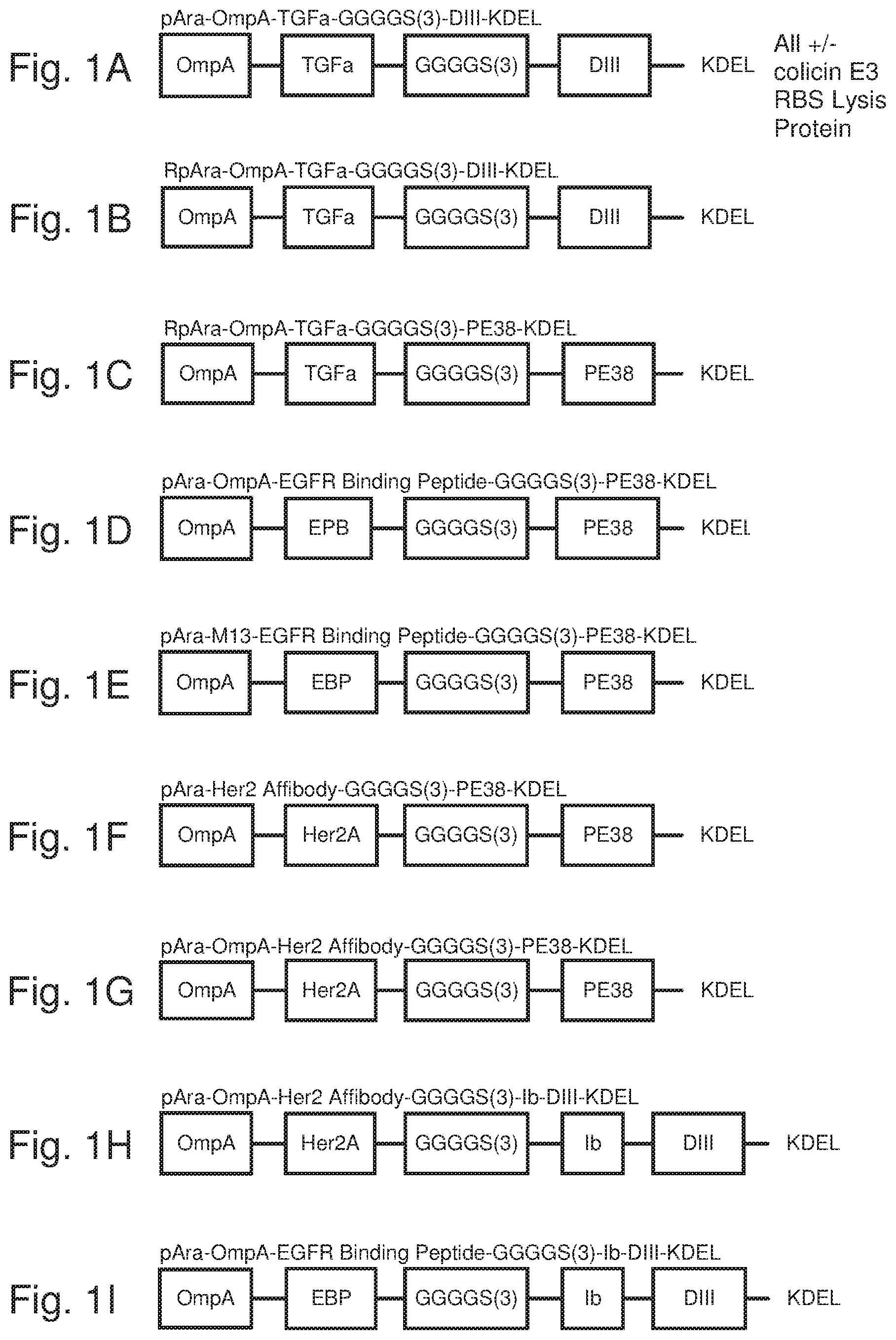
A- 1 I shows a comparison of modified ToxA chimeras.
A- 2 E show C-terminal modified cldt from Salmonella paratyphi A.
A- 3 D show N-terminal modified cldt from Salmonella paratyphi A.
A- 4 D show nuclear localization signal (NLS) modified cldt from Salmonella paratyphi A.
A- 5 D show a secreted protease inhibition assay.
shows a pAra-Txa10 4,678 bp plasmid.
A and 7 B show results of MTT cytotoxicity (anticancer cell killing) assay of protease challenge/protease inhibitors.
A and 8 B show results of a cytotoxicity (anticancer cell killing) assay of cytolethal distending toxin and cytolethal distending toxin:apoptin fusions.
shows results of an Azocoll protease inhibition assay.
A and 10 B show a cytotoxicity (anticancer cell killing) assay of Exotoxin A (ToxA) and chimeric TGFα-ToxA fusions.
A and 11 B shows a pTet-1 3,156 plasmid, and pTet-1 under tetracycline controlled transcriptional activation.
shows a flowchart of a method for detection of protease inhibitory activity on protein based plates.
shows Dinitrosalicylic Acid (DNS) assay for the detection of reducing sugars produced by active amylase under a trypsin challenge.
DETAILED DESCRIPTION OF THE INVENTION
The present technology provides, according to various embodiments, live attenuated therapeutic bacterial strains that express one or more therapeutic with improved expression, secretion, surface display and/or release and/or have improved binding and anticancer cell activity that results in improved therapeutic efficacy. In particular, one aspect of the technology relates to live attenuated tumor-targeted bacterial strains that may include Salmonella, Streptococcus or Listeria vectoring novel chimeric anti-tumor toxins to an individual to elicit a therapeutic response against cancer. The types of cancer may generally include solid tumors, carcinomas, leukemias, lymphomas and multiple myelomas. Another aspect of the technology relates to live attenuated tumor-targeted bacterial strains that may include Salmonella, Streptococcus, Clostridium and Listeria that encode anti-neoplastic molecules to an individual to elicit a therapeutic response against cancers including cancer stem cells, immune infiltrating cells and or tumor matrix cells.
For reasons of clarity, the detailed description is divided into the following subsections: targeting ligands; chimeric bacterial toxins; and secreted protease inhibitors.
Targeting Ligands
Targeting ligands have specificity for the target cell and are used to both confer specificity to chimeric proteins, and to direct attachment and/or internalization into the target cell. The ligands are known ligands or may be novel ligands isolated through standard means such as phage display (Barbass III et al., 2004, Phage Display, A Laboratory Manual, Cold Spring Harbor Press) including the use of commercially available kits (Ph.D-7 Phage Display Library Kit, New England Biolabs, Ipswich, MA; Li et al., 2006. Molecular addresses of tumors: selection by in vivo phage display. Arch Immunol Ther Exp 54:177-181,). The ligands of various aspects of the present technology are peptides that can be expressed as fusions with other bacterially-expressed proteins. The peptides may be further modified, as for gastrin and bombesin, in being amidated by a peptidylglycine-alpha-amidating monoxygenase or C-terminal amidating enzyme, which is co-expressed in the bacteria that use these peptides using standard molecular genetic techniques. Examples of targeting peptides are shown in Bermudes U.S. Pat. No. 8,524,220 Table 4, incorporated by reference herein. These ligands and their targets include TGF-α (EGFR), HAVDI and INPISGQ and dimeric versions (N-cadherin of prostate), DUP-1 peptide (prostate cancer), laminin-411 binding peptides (brain neovasculature), pertussis toxin S3 subunit (cancer cells), DARPINS (e.g., H10, HER2), affibody against Her2 (Zielenski, R., Lyakhov, I., Jacobs, A., Chertov, O., Kramer-Marek, G., Francella, N., Stephen, A., Fisher, R., Blumenthal, R., and Capala, J. Affitoxin-A Novel Recombinant, HER2-Specific, Anti-Cancer Agent for Targeted Therapy of HER2-Positive Tumors. J Immunother. 2009 October; 32 (8): 817-825) luteinizing hormone-releasing hormone (LHRH receptor), IL2 (IL2R), EGF and EGF receptor related peptide (EGFR), tissue factor (TfR), IL4 (IL4R), IL134 (IL13R), GM-CSF (GM-CSFR), CAYHRLRRC SEQ ID NO.: 021 (lymphoid tissue; AML), A33 antigen binding peptide (A33) CLTA-4/CD152 melanoma, CD19 binding peptides/Bpep (alpha (v) beta (6) integrin (αvβ6), non-Hodgkin lymphoma, chronic lymphocytic leukemia (CLL) and acute lymphocytic leukemia (ALL)), CD20 binding peptides (CD20, B-cell malignancies), CD22 binding peptides (B lymphocytes, hairy cell leukemia), CD25 binding peptides (chemotherapy-resistant human leukemia stem cells), TRU-015 (CD-20), CD30 binding peptides (CD-30 Hodgkin's lymphoma), CD32 binding peptides (chemotherapy resistant human leukemia stem cells), CD33 binding peptides (CD-33 AML myleodysplastic cells MDS)), CD37 binding peptides (leukemia and lymphoma), CD40 binding peptides (CD40 multiple myeloma, non-Hodgkin lymphoma, chronic lymphocytic leukemia (CLL), Hodgkin lymphoma and acute lymphoblastic leukemia (ALL), diffuse large B-cell lymphoma, refractory non-Hodgkin lymphoma, including follicular lymphoma), CD52 (CLL), CD55 (CD55R), CD70 (hematological malignancies, non-Hodgkin's lymphoma), CD123 binding peptides (AML), RGD peptides (tumor cells and tumor endothelium), nanobodies derived from camels and llamas (camelids), including humanized nanobodies and VHH recognition domains (cancer), bombesin (gastrin releasing peptide receptor), gastrin releasing peptide (gastrin releasing peptide receptor), somatostatin octapeptide RC-121 (colon cancer), vasoactive intestinal peptide (tumor cell membranes), PTHrP (parathyroid hormone receptor G-protein coupled receptor), mesothelin binding peptides (mesothelin), CA125/MUC16 (mesothelin), heat stable enterotoxin (HST) (guanylyl cyclase C), GM-CSF (AML), vitronectin (Alfa (V) Beta (3) integrin), gastrin (gastrin receptor), CQTIDGKKYYFN SEQ ID NO.: 022 peptide from Clostridium , affibody against HER3, DARPIN against HER2, TGFα, EGF, EGFR-binding peptides and other, non-limiting, peptides. In preferred embodiments, the peptides are affibody against HER2, H10 DARPIN against HER2, TGFα, EGF, EGFR-binding peptides.
A- 1 I show a comparison of modified ToxA chimeras. Optionally, the colicin E3 lysis protein with a separate ribosomal binding site may be added to any of the constructs.
A shows a chimera containing an OmpA secretion signal, TGF α targeting domain, a GGGGS (x3) (i.e., GGGGSGGGGSGGGGS, SEQ ID NO.: 008 linker, ToxA domain Ib (containing cysteine bonding), ToxA domain III, followed optionally by KDEL retrograde trafficking signal; without KDEL the native signal REDLK SEQ ID NO.: 023).
B shows a chimera containing an OmpA secretion signal, TGFα targeting domain, a GGGGS (x3), SEQ ID NO.: 008 linker), ToxA domain III followed optionally by KDEL retrograde trafficking signal; without KDEL the native signal REDLK SEQ ID NO.: 023. Optionally, the colicin E3 lysis protein with a separate ribosomal binding site may be added.
C shows a chimera containing an OmpA secretion signal, TGFα targeting domain, a GGGGS (x3), SEQ ID NO.: 008 linker, ToxA PE38 (contains Domain II, partial Ib (A365-380 amino acids) domain III followed optionally by KDEL retrograde trafficking signal; without KDEL the native signal REDLK SEQ ID NO.: 023. Optionally, the colicin E3 lysis protein with a separate ribosomal binding site may be added.
D shows a chimera containing an OmpA secretion signal, EGF binding peptide (EGB), a GGGGS (x3), SEQ ID NO.: 008 linker, ToxA PE38 (contains Domain II, partial Ib (A365-380 amino acids) domain III followed optionally by KDEL retrograde trafficking signal; without KDEL the native signal REDLK SEQ ID NO.: 023. Optionally, the colicin E3 lysis protein with a separate ribosomal binding site may be added.
E shows a chimera containing an M13 pIII secretion signal, EGF binding peptide (EGB), a GGGGS (x3), SEQ ID NO.: 008 linker, ToxA PE38 (contains Domain II, partial Ib (4365-380 amino acids) domain III followed optionally by KDEL retrograde trafficking signal; without KDEL the native signal REDLK SEQ ID NO.: 023. Optionally, the colicin E3 lysis protein with a separate ribosomal binding site may be added.
F shows a chimera containing an OmpA secretion signal, Her2 affibody binding, a GGGGS SEQ ID NO.: 024 linker, ToxA PE38 (contains Domain II, partial Ib (Δ365-380 amino acids) domain III followed optionally by KDEL retrograde trafficking signal; without KDEL the native signal REDLK SEQ ID NO.: 023.
G shows a chimera containing an OmpA secretion signal, Her2 affibody binding, a GGGGS (x3), SEQ ID NO.: 008 linker, ToxA PE38 (contains Domain II, partial Ib (A365-380 amino acids) domain III followed optionally by KDEL retrograde trafficking signal; without KDEL the native signal REDLK SEQ ID NO.: 023.
H shows a chimera containing an OmpA secretion signal, Her2 affibody, a GGGGS (x3) linker, ToxA domain Ib (containing cysteine bonding), ToxA domain III followed optionally by KDEL retrograde trafficking signal; without KDEL the native signal REDLK SEQ ID NO.: 023.
I shows a chimera containing an OmpA secretion signal, EGFR binding peptide, a GGGGS (x3), SEQ ID NO.: 008 linker, ToxA domain Ib (containing cysteine bonding), ToxA domain III followed optionally by KDEL retrograde trafficking signal; without KDEL the native signal REDLK SEQ ID NO.: 023.
Chimeric Bacterial Toxins
Chimeric toxins are toxins that may contain combinations of elements including targeting peptides, flexible linkers, disulfide bonding, lytic peptides, nuclear localization signals, blocking peptides, protease cleavage (deactivation or activation) sites, N- or C-terminal secretion signals, autotransporter constructs, used to adapt the proteins to be expressed, secreted, surface displayed and/or released by bacteria to provide therapeutic molecules that are effective in treating neoplastic cells, stromal cells, neoplastic stem cells as well as immune infiltrating cells. Targeting to a particular cell type uses the appropriate ligand described above or from other known sources. Toxin activity is determined using standard methods known to those skilled in the art such as Aktories (ed) 1997 (Bacterial Toxins, Tools In Cell Biology and Pharmacology, Laboratory Companion, Chapman & Hall).
A- 2 D show C-terminal fusions of modified cldt from Salmonella paratyphi A.
A shows the Salmonella typhoid toxin cytolethal distending toxin subunit B (cldtB) together with sty, ttsA, pltA and pltB. The entire operon is with cldtB and sty under control of an inducible promoter such as the arabinose inducible promoter, with pltB, pltA and ttsA under control of their upstream region.
B shows the Salmonella typhoid toxin cytolethal distending toxin subunit B (cldtB) together with pltB and pltA as a single artificial operon under control of an inducible promoter, and the genes sty and ttsA removed.
C shows the cldtB, pltB and pltA artificial operon with an in frame fusion of the restriction enzymes SexAl, HindIII and Xbal followed by a stop codon.
D shows the cldtB, pltB and pltA artificial operon with SexAl, HindIII and Xbal with the FLAG epitope and a GGGGS (x3), SEQ ID NO.: 008 linker inserted in the SexAl and HindIII sites.
E shows the cldtB, pltB and pltA artificial operon with SexAl, HindIII and Xbal with the FLAG epitope and a GGGGS (x3), SEQ ID NO.: 008 linker inserted in the SexAl and HindIII sites and apoptin fragments inserted in-frame into the HindIII and Xbal sites. The apoptin and/or apoptin fragments can consist of 1) apoptin 1-121, 2) apoptin 33-121, 3) apoptin 82-121, 4) apoptin 97-121, 5) apoptin 106-121, 6) apoptin 111-121 or 7) apoptin 1-31 linked ot 83-121 or 8) TAT-apoptin.
Chimeric ToxA Forms Secreted by Bacteria.
Cytotoxic forms of ToxA that can be secreted by bacteria have targeting ligands. Previous ToxA conjugates were not adapted for secretion by bacteria in an active form. For example, TGFα-GIII-KDEL (Kihara and Pastan 1994, Small Chimeric Toxins Containing Only Transforming Growth Factor α and Domain III of Pseudomonas Exotoxin with Good Antitumor Activity in Mice. Cancer Res 1994:54:5154-5159) had a TGFα α-PE38 which has a deletion of amino acids 365-380 of domain I (Kreitman et al., 1992, Properties of Chimeric Toxins with Two Recognition Domains: Interleukin 6 and Transforming Growth Factor α at Different Locations in Pseudomonas Exotoxin. Bioconjugate Chem. 3, 63-68) have no signal peptide, only a single GGGGS SEQ ID NO.: 024 linker with 10 amino acids upstream of DIII, compared to the present version ( A- 1 I ). PE38-KDEL (Kreitman et al., 1994, Recombinant immunotoxins containing anti-Tac (Fv) and derivatives of Pseudomonas exotoxin produce complete regression in mice of an interleukin 2 receptor-expressing human carcinoma. Blood 1994, 83, 426-434) uses anti-Tac (Fv) as binding ligand rather than those we describe here. Similarly, the Affitoxin (Zielenski et al., 2009, Affitoxin-A Novel Recombinant, HER2-Specific, Anti-Cancer Agent for Targeted Therapy of HER2-Positive Tumors. J Immunother 32:817-825) has no signal peptide and only a short flexible linker. The forms of ToxA shown in A- 1 I and described in the examples with targeting moieties supply the necessary components for secreted by bacteria and are cytotoxic for cancer cells.
A- 3 D show N-terminal fusions of modified cldt from Salmonella paratyphi A.
A shows the Salmonella typhoid toxin cytolethal distending toxin subunit B (cldtB) together with pltB and pltA as a single artificial operon under control of an inducible promoter, and the genes sty and ttsA removed. The presence and relative location of an N-terminal signal sequence (SS) is shown.
B shows the cldtB, pltB and pltA artificial operon with an in frame fusion of the restriction enzymes HindIII, Xbal and Clal inserted after the signal sequence.
C shows the cldtB, pltB and pltA artificial operon with HindIII, Xbal and Clal with the FLAG epitope and a GGGGS (x3), SEQ ID NO.: 008 linker inserted in the Xbal and Clal sites.
D shows the cldtB, pltB and pltA artificial operon with the FLAG epitope and a GGGGS (x3), SEQ ID NO.: 008 linker inserted in the Xbal and Clal sites and apoptin fragments inserted in-frame into the HindIII and Xbal sites. The apoptin and/or apoptin fragments can consist of 1) apoptin 1-121, 2) apoptin 33-121, 3) apoptin 82-121, 4) apoptin 97-121, 5) apoptin 106-121, 6) apoptin 111-121 or 7) apoptin 1-31 linked to 83-121 or 8) TAT-apoptin.
Chimeric Cvtolethal Distending Toxins.
Cytolethal distending toxins (cldt) including those cldts from Haemophilus, Aggregatibacter, Salmonella, Escherichia, Shigella, Campylobacter, Helicobacter , Hahella and Yersinia , typhoid toxins (pertussis like toxin) (pltAB), pertussis toxin, cldt: plt hybrids are three component toxins of these bacteria. Cldt is an endonuclease toxin and has a nuclear localization signal on the B subunit. Chimeric toxins are provided that utilize N-terminal or C-terminal fusions to apoptin, a canary virus protein that has a tumor-specific nuclear localization signal, and a normal (non-transformed) cell nuclear export signal ( A- 4 D ). The present technology, according to one embodiment, consists of a modified Salmonella CLDT operon and forms of cytolethal distending toxins that are chimeric with apoptin and other peptide moieties including peptide linkers that improve activity and peptide blocking moieties that must be specifically cleaved to activate the protein.
The present technology, according to one embodiment. uses deletions in the CLDT nuclear localization signals which are then complemented by N- or C-terminal fusions with apoptin, or apoptin fragments, which supply its nuclear localization signal in trans as a fusion peptide.
The cytolethal distending toxin B and chimeric cltdB may be expressed as a polycistronic construct consisting of cldtABC. The cytolethal distending toxin B and chimeric cltdB may be expressed as a polycistronic construct consisting containing the typhoid pertussis-like toxin (plt) AB genes. However, in the present technology, according to one embodiment, the presence of sty and ttsA are not required for secretion of the active toxin when the operon is reorganized into a unidirectional operon of cldtB, pltB and pltA.
Overall improvement is defined as an increase in effect, such as the ability to kill neoplastic cells in vitro by the bacteria, or inhibit or reduce the volume or cell number of a solid tumor, carcinoma, lymphoma or leukemia in vivo following administration with the bacteria expressing a therapeutic molecule, with and without the protease inhibitor. The effect of the protein therapeutic activity is determined using standard techniques and assays known to those skilled in the art. The contribution of the therapeutic protein and protease inhibitors is determined individually and in combination. Additivity, synergy or antagonism may be determined using the median effect analysis (Chou and Talaly 1981 Eur. J. Biochem. 115:207-216) or other standard methods.
A- 4 D show nuclear localization signal (NLS) modified partially or completely cldt from Salmonella paratyphi A.
A shows inactivated Salmonella paratyphi A typhoid toxin as a delivery mechanism for peptide fusions. The Salmonella typhoid toxin cldtB is inactivated by site-directed mutagenesis of the known active sites such as H160Q and/or H259Q. Fusions to the inactivated form retain the secretion and delivery to the cytosol and allow transport to the nucleus.
B shows inactivated Salmonella paratyphi A typhoid toxin nuclear localization signals (NLS1) enhancing dependence on apoptin NLSs and/or nuclear export as a mode of tumor cell-specific delivery of an active cldtB.
C shows inactivation of NLS2 and
D shows both portions of the cldtB bipartite nuclear localization signals can be altered from charged (basic) e.g., arginines and/or histidines to polar serines or threonines.
Secreted Protease Inhibitors
A chimeric protease inhibitor secreted by Escherichia coli with the potential for use in biofuel fermentations and therapeutic bacteria is provided.
There is growing interest in the use of live bacteria targeting solid tumors as an alternative to or in conjunction with standard chemotherapy and radiation treatment. These bacteria can be engineered to secrete bacterial derived cytotoxins, such as Pseudomonas aeruginosa exotoxin A, directly to the site of the tumor (Forbes, 2010 and Swofford et al, 2014). Therapeutic bacteria expressing and secreting cytotoxins that are tumor cell specific may enhance tumor destruction and spare healthy adjacent tissues (Siegal et al, 1989). Bacteria expressing protease inhibitors specific for proteases associated with metastasis is an innovative approach to cancer therapeutics. Co-expression of a tumor specific cytotoxin and a protease inhibitor may enhance the stability of the toxin by protecting it in the highly proteolytic environment of the tumor while confining the cancer.
From a bio-industrial standpoint, fermentations which are sensitive to bacterial contaminations, especially those due to proteolytic strains such as Lactobacillus sp., may benefit from protease inhibition. Bacteria and fungi secreting protease inhibitors offer a potential augmentation to extracellular fermentations such as cellulosic ones used in the production of biofuels where microbial contaminations reduce production efficiency.
Protease inhibitor-secreting bacteria have an ability to protect extracellular proteins from proteolytic destruction by trypsin, utilizing exotoxin A in cytotoxicity studies and α-amylase as a model industrial extracellular fermentation enzyme.
A- 5 D show results of a secreted protease inhibition assay for detection of bacterial secreted protease inhibitors, using the method of Quintero and Bermudes (2014. A culture-based method for determining the production of secreted protease inhibitors. J. Micro. Methods. 100, 105-110).
A shows growth pattern of E. coli harboring 1) pTet-1 (EV), 2) pTetOmpA-SFTI, 3) pTetTxA-SFTI, 4) pTetOmpA-SFTI-RBS Lys, 5) pTetTxA-SFTI-RBS Lys on BCG 0.5% Casein induced with 1 μg/mL anhydrotetraclyine HCl after 24 hours at 37° C.
B shows staining pattern of protected protein, using the method of Quintero and Bermudes (2014. A culture-based method for determining the production of secreted protease inhibitors. J. Micro. Methods. 100, 105-110).
C shows growth of E. coli harboring 1) pTet-1 (EV), 2) pTetYebF, 3) pTetYebF-SFTI, on BCG 0.5% Casein with 1 mg/mL anhydrotetraclyine HCl after 24 hours at 37° C.
D shows a staining pattern of protected protein.
shows the gene encoding exotoxin A, which was amplified from Pseudomonas aeruginosa str. PA103 in a colony PCR and ligated to pAra-1 to create pAra-Txa10. The plasmids were electroporated into Salmonella typhimurium str. JR501 and induced with 0.1% arabinose. Filter sterile supernatant was diluted 2-fold in PBS. MDA-MB-468 breast cancer cells were plated at 2.5×10³ cells in DMEM with 10% FBS and allowed to adhere to a 96-well plate for 24 hours. Bacterial supernatant or PBS was delivered to the cell culture to 10% and allowed to incubate for an additional 72 hours.
The sunflower trypsin inhibitor (SFTI), a 14 amino acid cyclic peptide was chosen for its small size and ability to inhibit matriptase, a tumor associated protease over-expressed in cancers of the breast, ovaries, prostate and liver. (Cai et al, 2011). SFTI was fused to the secretion signal peptides derived from the outer membrane protein OmpA and the secreted cytotoxin exotoxin A and evaluated for its ability to be secreted extracellularly and to inhibit degradation of a protein substrate. These constructs were coupled with the pColE3 lysis protein, which activates phospholipase and outer-membrane porins to facilitate secretion. SFTI was also fused to YebF, which is known to accumulate in the extracellular milieu of select proteobacteria.
Therefore, it can be seen that SFTI can be secreted in low amounts when fused to a type II secretion signal peptide. Co-expression of pColE3 lysis protein with the fusions enhances secretion when the OmpA signal is utilized, but not the Exotoxin A signal. This may be due to ineffective cleavage of the latter in the periplasm. Fusion of SFTI to YebF demonstrated high protease inhibition both in solid and liquid culture media. The protective effect of YebF-SFTI is shown by conducting an in vitro digest of Exotoxin A followed by a cytotoxity assay, which demonstrated sustained toxin activity. An in vitro digest of amylase followed by DNS assay showed only slight inhibition of trypsin by YebF-SFTI for unknown reasons.
A shows cytotoxicity (anticancer cell killing) protease challenge/protease inhibitor assay results, in in particular protection of extracellular ToxA from trypsin by YebF-SFTI assessed by cell killing. MDA-MB-468 breast cancer cells assessed by MTT after supernatants from S. typhimurium harboring pAra-1 was mixed with supernatants from E. coli harboring pTet-1 (EV), pTetYebF, or pTetYebf-SFTI then delivered to the cell culture. A 1:4 (vol:vol) mixture of supernatant containing exotoxin A and either YebF or YebF-SFTI was prepared and delivered to the cell culture. A seven hour in vitro digest (IVD) at 37° C. utilizing trypsin at a final concentration of 0.1 mg/ml containing exotoxin A and either YebF or YebF-SFTI (1:4) was conducted to test if the secreted protein maintained measurable activity.
B shows protection of extracellular ToxA from trypsin by YebF-SFTI assessed by cell killing. MDA-MB-468 breast cancer cells were plated as above, and assessed by MTT after Supernatants from S. typhimurium harboring pAra-1 was mixed with supernatants from E. coli harboring pTet-1 (EV), pTetYebF, or pTetYebf-SFTI then delivered to the cell culture. A 1:4 (vol:vol) mixture of supernatant containing exotoxin A and either YebF or YebF-SFTI was prepared and delivered to the cell culture. A seven hour in vitro digest (IVD) at 37° C. utilizing trypsin at a final concentration of 0.1 mg/ml containing exotoxin A and either YebF or YebF-SFTI (1:4) was conducted to test if the secreted protein maintained measurable activity.
See: Forbes, N. S., 2010. Engineering the perfect (bacterial) cancer therapy. Nature Reviews Cancer 10, 785-794; Swofford, C., St. Jean, A. T., Panteli, J. T., Brentzel, Z. J., Forbes, N. S. 2014. Identification of Staphylococcus aureus α-hemolysin as a Protein Drug that is Secreted by Anticancer Bacteria and Rapidly kills Cancer Cells. Biotech. Bioeng. 111, 1233-1245; Siegall, C., Yong-Hua, X., Vijay, K. C., Sankar, A., Fitzgerald, D., and Pastin, I. 1989. Cytotoxic activities of a fusion protein comprised of TGFα and Pseudomonas exotoxin. FASEB. J. 3, 2547-2652; Quintero, D. and Bermudes, D. 2014. A culture-based method for determining the production of secreted protease inhibitors. J. Micro. Methods. 100, 105-110.
See also Examples 12-14.
A and 8 B show results of a cytotoxicity (anticancer cell killing) assay of Salmonella paratyphi A cytolethal distending toxin and cytolethal distending toxin:apoptin fusions toward MDA-MB-468 breast cancer cells.
NT: no treatment.
PBS: phosphate buffered saline.
1: treatment with 10 μL of a bacterial culture supernatant carrying an empty vector plasmid into a 100 μL tissue culture wells, with dilutions of 1, 1/2, 1/4, 1/8 and 1/16.
2: the cloned wild type S. paratyphi A cytolethal distending operon (as shown in A- 2 E ), with dilutions of 1/2, 1/4, 1/8 and 1/16.
3: the reorganized polycistronic S. paratyphi A cytolethal distending operon containing a polylinker in cldtB C-terminus with dilutions of 1/2, 1/4, 1/8, and 1/16.
4: the reorganized polycistronic S. paratyphi A cytolethal distending operon without a polylinker in cldtB C-terminus with dilutions of 1/2 1/4 1/8 and 1/16. Absorbance at 570 nm indicates the relative number of live cells.
5: the reorganized polycistronic S. paratyphi A cytolethal distending operon containing a polylinker in cldtB C-terminus and a flexible linker GGGGS (3) SEQ ID NO.: 008 with dilutions of 1/2, 1/4, 1/8, and 1/16.
6: the reorganized polycistronic S. paratyphi A cytolethal distending operon containing a polylinker in cldtB C-terminus and a fusion of apoptin 1-121 with dilutions of 1/2, 1/4, 1/8, and 1/16.
7: the reorganized polycistronic S. paratyphi A cytolethal distending operon containing a polylinker in cldtB C-terminus and a fusion of apoptin 82-121 with dilutions of 1/2, 1/4, 1/8 and 1/16.
8: the reorganized polycistronic S. paratyphi A cytolethal distending operon containing a polylinker in cldtB C-terminus and a fusion of apoptin 111-121 with dilutions of 1/2, 1/4, 1/8 and 1/16.
9: the reorganized polycistronic S. paratyphi A cytolethal distending operon containing a polylinker in cldtB C-terminus and a fusion of apoptin 97-121 with dilutions of 1/2, 1/4, 1/8 and 1/16.
10: the reorganized polycistronic S. paratyphi A cytolethal distending operon containing a polylinker in cldtB C-terminus and a fusion of apoptin 33-121 with dilutions of 1/2, 1/4, 1/8 and 1/16.
11: the reorganized polycistronic S. paratyphi A cytolethal distending operon containing a polylinker in cldtB C-terminus and a fusion of TAT: apoptin 1-121 with dilutions of 1/2, 1/4, 1/8 and 1/16.
shows results of an assay using Azo dye impregnated collagen (Azocoll) protease substrate. E. coli harboring pTet-1 (EV), pTetYebF, or pTetYebF-SFTI, were induced overnight. 500 μL of filter sterile supernatant was incubated with 10 mL of 6.25 mg/mL trypsin solution for 1 hour at room temperature to allow binding. Soybean inhibitor (SBI) and LB served as controls. After equilibration, 400 mL of a 1.5 mg/mL Azocoll suspension was mixed with each sample and incubated at 37° C. for a 2 hour digestion. Proteolytic degradation of Azocoll was measured with a spectrophotometer at Abs 550 nm. After subtracting background, the absorbance values were plotted using Prism version 6.
A and 10 B show the cytotoxicity of Pseudomonas aeruginosa Exotoxin A (ToxA) and chimeric derivatives toward MDA-MB-468 breast cancer cells.
A :
NT: no treatment. PBS, phosphate buffered saline.
EV 1: treatment with 10 μL of a bacterial culture supernatant carrying an empty vector plasmid into a 100 μL tissue culture wells.
1: the cloned wild type Pseudomonas aeruginosa Exotoxin A (ToxA) with dilutions of 1, 1/2, 1/4, 1/8, 1/16, 1/32, 1/64.
2: A chimeric toxin composed of N-terminal TGFα fused to domains Ib and III of ToxA with a C-terminal KDEL sequence with dilutions of 1, 1/2, 1/4, 1/8, 1/16, 1/32, 1/64.
3: A chimeric toxin composed of N-terminal TGFα fused to domains Ib and III of ToxA with a C-terminal KDEL sequence co-expressed with the RBS E3 Lysis protein with dilutions of 1, 1/2, 1/4, 1/8, 1/16, 1/32, 1/64.
4: A chimeric toxin composed of N-terminal TGFα fused to domains Ib and III of ToxA with the native C-terminal REDLK SEQ ID NO.: 023 ToxA sequence with dilutions of 1, 1/2, 1/4, 1/8, 1/16, 1/32, 1/64.
EV 2: empty vector plasmid.
B :
NT: no treatment. PBS, phosphate buffered saline.
EV 1: treatment with 10 μL of a bacterial culture supernatant carrying an empty vector plasmid into a 100 μL tissue culture wells.
1: the cloned wild type Pseudomonas aeruginosa Exotoxin A (ToxA) with dilutions of 1, 1/2, 1/4, 1/8, 1/16, 1/32, 1/64.
2: A chimeric toxin composed of N-terminal TGFα fused to domain III of ToxA with a C-terminal KDEL sequence with dilutions of 1, 1/2, 1/4, 1/8, 1/16, 1/32, 1/64.
3: A chimeric toxin composed of N-terminal TGFα fused to domain III of ToxA with a C-terminal KDEL sequence co-expressed with the RBS E3 Lysis protein with dilutions of 1, 1/2, 1/4, 1/8, 1/16, 1/32, 1/64.
4: A chimeric toxin composed of N-terminal TGFα fused to domains Ib and III of ToxA with the native C-terminal REDLK SEQ ID NO.: 023 ToxA sequence with dilutions of 1, 1/2, 1/4, 1/8, 1/16, 1/32, 1/64.
EV 2: empty vector plasmid.
A and 11 B show pTet-1 under tetracycline controlled transcriptional activation ( A ), and insertion sequences downstream from the tetracycline repressor sequence ( B ). The sunflower trypsin inhibitor DNA sequence was fused to the signal peptide sequences derived from OmpA and Exotoxin A and ligated to pTet-1. The pColE3 lysis sequence, including its Shine-Delgarno sequence was cloned into pTetOmpA-SFTI and pTetTxA-SFTI. The YebF sequence was cloned into pTet-1 to create pTet-YebF. The SFTI sequence was fused in frame with YebF to produce pTetYebF-SFTI. All constructs were verified by sequencing then transformed into electrocompetent E. coli str. JW2197-1 lacking the periplasmic trypsin inhibitor, ecotin.
shows a flowchart of a method for detection of protease inhibitory activity on protein based plates.
shows Dinitrosalicylic Acid (DNS) assay for the detection of reducing sugars produced by active amylase under a trypsin challenge. 200 mL of the YebF and YebF-SFTI supernatants or LB was mixed with 10 mL of a 1.25 mg/mL trypsin solution and allowed to equilibrate for 30 minutes. Heat inactivated trypsin served as a control. 10 mL amylase at 1 mg/mL was considered a 1× concentration and two-fold dilutions to 1/16× were conducted. The amylase was then added to the mixtures and incubated at 37° C. for five hours to allow digestion. 100 mL of 1% starch solution was then added and the reaction allowed to proceed for fifteen minutes. DNS was added and the mixture was boiled for 5 minutes, diluted with 500 mL H2O, and absorbance was read at 515 nm.
EXAMPLES
In order to more fully illustrate the technology, the following examples are provided.
Example 1
A Salmonella expression vector.
Inducible expression vectors for E. coli and Salmonella , such as arabinose inducible expression vectors, are widely available and known to those skilled in the art. By way of example, an expression vector typically contains a promoter which functions to generate an mRNA from the DNA, such as an inducible arabinose promoter with a functional ribosomal binding site (RBS) an initiation codon (ATG) and suitable cloning sites for operable insertion of the functional DNA encoding the effector proteins described below into the vector, followed by a transcriptional termination site, plasmid origin of replication, and an antibiotic resistance factor that allows selection for the plasmid. Vectors that lack antibiotic resistance such as asd (-) balanced lethal vectors (Galan et al., 1990 cloning and characterization of the asd gene of Salmonella Typhimurium : use in stable maintenance of recombinant Salmonella vaccine strains, Gene 94:29-35) may also be used, or insertion into the chromosome.
Example 2
Modified TGFα-GIII-KDEL (A. Kihara and I. Pastan. Small Chimeric Toxins Containing Only Transforming Growth Factor α and Domain III of Pseudomonas Exotoxin with Good Antitumor Activity in Mice. Cancer Res 1994:54:5154-5159). A modified form with an added OmpA signal sequence, extended flexible linker and presence of domain lb with enhanced activity functionally expressed, secreted, surface displayed and/or released is shown in A . The construct contains an OmpA secretion signal, TGFα targeting domain, a GGGGS (x3) SEQ ID NO.: 008 linker, ToxA domain Ib (containing cysteine bonding), ToxA domain III followed by, optionally KDEL retrograde trafficking signal; without KDEL the native signal REDLK SEQ ID NO.: 023 is used. The complete sequence of the arabinose inducible plasmid capable of expressing the construct with a start codon at 351 and a stop codon at 1364 is:
SEQ ID NO.: 001
gggGGCGGCCGCaagaaaccaattgtccatattgcatcagacattgccgt
cactgcgtcttttactggctcttctcgctaaccaaaccggtaaccccgct
tattaaaagcattctgtaacaaagcgggaccaaagccatgacaaaaacgc
gtaacaaaagtgtctataatcacggcagaaaagtccacattgattatttg
cacggcgtcacactttgctatgccatagcatttttatccataagattagc
ggatcctacctgacgctttttatcgcaactctctactgtttctccatacc
cgtttttttgggctagcgaattcgagctCGGTACCCAGGAGGAATTCACC
ATGGCTAAAAAGACAGCTATCGCGATTGCAGTGGCACTGGCTGGTTTCGC
TACCGTAGCGCAGGCAGctGTGGTGAGCCATTTTAACGATTGCCCGGATA
GCCATACCCAGTTTTGCTTTCATGGCACCTGCCGCTTTCTGGTGCAGGAA
GATAAACCGGCGTGCGTGTGCCATAGCGGTTATGTGGGCGCTCGCTGCGA
ACATGCGGATCTGCTGGCCCATCAACTAGTGGGCGGTGGTGGCAGTGGTG
GCGGCGGCTCTGGTGGTGGCGGGTCCCGGGGTctgacctgcccggtcgcc
gccggtgaatgcgcgggcccggcggacagcggcgacgccctgctggagcg
caactatcccactggcgcggagttcctcggcgacggcggcgacgtcagct
tcagcacccgcggcacgcagaactggacggtggagcggctgctccaggcg
caccgccaactggaggagcgcggctatgtgttcgtcggctaccacggcac
cttcctcgaagcggcgcaaagcatcgtcttcggcggggtgcgcgcgcgca
gccaggacctcgacgcgatctggcgcggtttctatatcgccggcgatccg
gcgctggcctacggctacgcccaggaccaggaacccgacgcacgcggccg
gatccgcaacggtgccctgctgcgggtctatgtgccgcgctcgagcctgc
cgggcttctaccgcaccagcctgaccctggccgcgccggaggcggcgggc
gaggtcgaacggctgatcggccatccgctgccgctgcgcctggacgccat
caccggccccgaggaggaaggcgggcgcctggagaccattctcggctggc
cgctggccgagcgcaccgtggtgattccctcggcgatccccaccgacccg
cgcaacgtcggcggcgacctcgacccgtccagcatccccgacaaggaaca
ggcgatcagcgccctgccggactacgccagccagcccggcaaaccgccga
aagatgaactgtaaCTCGAGTagatctgtactCTAGAGTCGACCTGCAGG
CATGCAAGCTTGGCTGTTTTGGCGGATGAGAGAAGATTTTCAGCCTGATA
CAGATTAAATCAGAACGCAGAAGCGGTCTGATAAAACAGAATTTGCCTGG
CGGCAGTAGCGCGGTGGTCCCACCTGACCCCATGCCGAACTCAGAAGTGA
AACGCCGTAGCGCCGATGGTAGTGTGGGGTCTCCCCATGCGAGAGTAGGG
AACTGCCAGGCATCAAATAAAACGAAAGGCTCAGTCGAAAGACTGGGCCT
TTCGTTTTATCTGTTGTTTGTCGGTGAACGCTCTCCTGAGTAGGACAAAT
CCGCCGGGAGCGGATTTGAACGTTGCGAAGCAACGGCCCGGAGGGTGGCG
GGCAGGACGCCCGCCATAAACTGCCAGGCATCAAATTAAGCAGAAGGCCA
TCCTGACGGATGGCCTTTTTGCGTTTCTACAAACTCTTTTTGTTTATTTT
TCTAAATACATTCAAATATGTATCCGCTCATGAGACAATAACCCTGATAA
ATGCTTCAATAATATTGAAAAAGGAAGAGTATGAGTATTCAACATTTCCG
TGTCGCCCTTATTCCCTTTTTTGCGGCATTTTGCCTTCCTGTTTTTGCTC
ACCCAGAAACGCTGGTGAAAGTAAAAGATGCTGAAGATCAGTTGGGTGCA
CGAGTGGGTTACATCGAACTGGATCTCAACAGCGGTAAGATCCTTGAGAG
TTTTCGCCCCGAAGAACGTTTTCCAATGATGAGCACTTTTAAAGTTCTGC
TATGTGGCGCGGTATTATCCCGTGTTGACGCCGGGCAAGAGCAACTCGGT
CGCCGCATACACTATTCTCAGAATGACTTGGTTGAGTACTCACCAGTCAC
AGAAAAGCATCTTACGGATGGCATGACAGTAAGAGAATTATGCAGTGCTG
CCATAACCATGAGTGATAACACTGCGGCCAACTTACTTCTGACAACGATC
GGAGGACCGAAGGAGCTAACCGCTTTTTTGCACAACATGGGGGATCATGT
AACTCGCCTTGATCGTTGGGAACCGGAGCTGAATGAAGCCATACCAAACG
ACGAGCGTGACACCACGATGCCTACAGCAATGGCAACAACGTTGCGCAAA
CTATTAACTGGCGAACTACTTACTCTAGCTTCCCGGCAACAATTAATAGA
CTGGATGGAGGCGGATAAAGTTGCAGGACCACTTCTGCGCTCGGCCCTTC
CGGCTGGCTGGTTTATTGCTGATAAATCTGGAGCCGGTGAGCGTGGGTCT
CGCGGTATCATTGCAGCACTGGGGCCAGATGGTAAGCCCTCCCGTATCGT
AGTTATCTACACGACGGGGAGTCAGGCAACTATGGATGAACGAAATAGAC
AGATCGCTGAGATAGGTGCCTCACTGATTAAGCATTGGTAACTGTCAGAC
CAAGTTTACTCATATATACTTTAGATTGATTTAAAACTTCATTTTTAATT
TAAAAGGATCTAGGTGAAGATCCTTTTTGATAATCTCATGACCAAAATCC
CTTAACGTGAGTTTTCGTTCCACTGAGCGTCAGACCCCGTAGAAAAGATC
AAAGGATCTTCTTGAGATCCTTTTTTTCTGCGCGTAATCTGCTGCTTGCA
AACAAAAAAACCACCGCTACCAGCGGTGGTTTGTTTGCCGGATCAAGAGC
TACCAACTCTTTTTCCGAAGGTAACTGGCTTCAGCAGAGCGCAGATACCA
AATACTGTCCTTCTAGTGTAGCCGTAGTTAGGCCACCACTTCAAGAACTC
TGTAGCACCGCCTACATACCTCGCTCTGCTAATCCTGTTACCAGTGGCTG
CTGCCAGTGGCGATAAGTCGTGTCTTACCGGGTTGGACTCAAGACGATAG
TTACCGGATAAGGCGCAGCGGTCGGGCTGAACGGGGGGTTCGTGCACACA
GCCCAGCTTGGAGCGAACGACCTACACCGAACTGAGATACCTACAGCGTG
AGCTATGAGAAAGCGCCACGCTTCCCGAAGGGAGAAAGGCGGACAGGTAT
CCGGTAAGCGGCAGGGTCGGAACAGGAGAGCGCACGAGGGAGCTTCCAGG
GGGAAACGCCTGGTATCTTTATAGTCCTGTCGGGTTTCGCCACCTCTGAC
TTGAGCGTCGATTTTTGTGATGCTCGTCAGGGGGGCGGAGCCTATGGAAA
AACGCCAGCAACGCGGCCTTTTTACGGTTCCTGGCCTTTTGCTGGCCTTT
TGCTCACATGTTCTTTCCTGCGTTATCCCCTGATTCTGTGGATAACCGTA
TTACCGCCTTTGAGTGAGCTGATACCGCTCGCCGCAGCCGAACGACCGAG
CGCAGCGAGTCAGTGAGCGAGGAAGCGGAAGAGCGCCTGATGCGGTATTT
TCTCCTTACGCATCTGTGCGGTATTTCACACCGCATATG
The complete sequence of the arabinose inducible plasmid capable of expressing the construct with a start codon at 351 and a stop codon at 1364 together with the colicin E3 lysis protein from 1399 to 1542 is:
SEQ ID NO.: 002
gggGGCGGCCGCaagaaaccaattgtccatattgcatcagacattgccgt
cactgcgtcttttactggctcttctcgctaaccaaaccggtaaccccgct
tattaaaagcattctgtaacaaagcgggaccaaagccatgacaaaaacgc
gtaacaaaagtgtctataatcacggcagaaaagtccacattgattatttg
cacggcgtcacactttgctatgccatagcatttttatccataagattagc
ggatcctacctgacgctttttatcgcaactctctactgtttctccatacc
cgtttttttgggctagcgaattcgagctCGGTACCCAGGAGGAATTCACC
ATGGCTAAAAAGACAGCTATCGCGATTGCAGTGGCACTGGCTGGTTTCGC
TACCGTAGCGCAGGCAGctGTGGTGAGCCATTTTAACGATTGCCCGGATA
GCCATACCCAGTTTTGCTTTCATGGCACCTGCCGCTTTCTGGTGCAGGAA
GATAAACCGGCGTGCGTGTGCCATAGCGGTTATGTGGGCGCTCGCTGCGA
ACATGCGGATCTGCTGGCCCATCAACTAGTGGGCGGTGGTGGCAGTGGTG
GCGGCGGCTCTGGTGGTGGCGGGTCCCGGGGTctgacctgcccggtcgcc
gccggtgaatgcgcgggcccggcggacagcggcgacgccctgctggagcg
caactatcccactggcgcggagttcctcggcgacggcggcgacgtcagct
tcagcacccgcggcacgcagaactggacggtggagcggctgctccaggcg
caccgccaactggaggagcgcggctatgtgttcgtcggctaccacggcac
cttcctcgaagcggcgcaaagcatcgtcttcggcggggtgcgcgcgcgca
gccaggacctcgacgcgatctggcgcggtttctatatcgccggcgatccg
gcgctggcctacggctacgcccaggaccaggaacccgacgcacgcggccg
gatccgcaacggtgccctgctgcgggtctatgtgccgcgctcgagcctgc
cgggcttctaccgcaccagcctgaccctggccgcgccggaggcggcgggc
gaggtcgaacggctgatcggccatccgctgccgctgcgcctggacgccat
caccggccccgaggaggaaggcgggcgcctggagaccattctcggctggc
cgctggccgagcgcaccgtggtgattccctcggcgatccccaccgacccg
cgcaacgtcggcggcgacctcgacccgtccagcatccccgacaaggaaca
ggcgatcagcgccctgccggactacgccagccagcccggcaaaccgccga
aagatgaactgtaaCTCGAGTagatctgtactCTAGAAAGGAGTCGTTAT
GAAAAAAATAACAGGGATTATTTTATTGCTTCTTGCAGTCATTATTCTGT
CTGCATGTCAGGCAAACTATATCCGGGATGTTCAGGGCGGGACCGTATCT
CCGTCATCAACAGCTGAAGTGACCGGATTAGCAACGCAGTAACTGCAGGC
ATGCAAGCTTGGCTGTTTTGGCGGATGAGAGAAGATTTTCAGCCTGATAC
AGATTAAATCAGAACGCAGAAGCGGTCTGATAAAACAGAATTTGCCTGGC
GGCAGTAGCGCGGTGGTCCCACCTGACCCCATGCCGAACTCAGAAGTGAA
ACGCCGTAGCGCCGATGGTAGTGTGGGGTCTCCCCATGCGAGAGTAGGGA
ACTGCCAGGCATCAAATAAAACGAAAGGCTCAGTCGAAAGACTGGGCCTT
TCGTTTTATCTGTTGTTTGTCGGTGAACGCTCTCCTGAGTAGGACAAATC
CGCCGGGAGCGGATTTGAACGTTGCGAAGCAACGGCCCGGAGGGTGGCGG
GCAGGACGCCCGCCATAAACTGCCAGGCATCAAATTAAGCAGAAGGCCAT
CCTGACGGATGGCCTTTTTGCGTTTCTACAAACTCTTTTTGTTTATTTTT
CTAAATACATTCAAATATGTATCCGCTCATGAGACAATAACCCTGATAAA
TGCTTCAATAATATTGAAAAAGGAAGAGTATGAGTATTCAACATTTCCGT
GTCGCCCTTATTCCCTTTTTTGCGGCATTTTGCCTTCCTGTTTTTGCTCA
CCCAGAAACGCTGGTGAAAGTAAAAGATGCTGAAGATCAGTTGGGTGCAC
GAGTGGGTTACATCGAACTGGATCTCAACAGCGGTAAGATCCTTGAGAGT
TTTCGCCCCGAAGAACGTTTTCCAATGATGAGCACTTTTAAAGTTCTGCT
ATGTGGCGCGGTATTATCCCGTGTTGACGCCGGGCAAGAGCAACTCGGTC
GCCGCATACACTATTCTCAGAATGACTTGGTTGAGTACTCACCAGTCACA
GAAAAGCATCTTACGGATGGCATGACAGTAAGAGAATTATGCAGTGCTGC
CATAACCATGAGTGATAACACTGCGGCCAACTTACTTCTGACAACGATCG
GAGGACCGAAGGAGCTAACCGCTTTTTTGCACAACATGGGGGATCATGTA
ACTCGCCTTGATCGTTGGGAACCGGAGCTGAATGAAGCCATACCAAACGA
CGAGCGTGACACCACGATGCCTACAGCAATGGCAACAACGTTGCGCAAAC
TATTAACTGGCGAACTACTTACTCTAGCTTCCCGGCAACAATTAATAGAC
TGGATGGAGGCGGATAAAGTTGCAGGACCACTTCTGCGCTCGGCCCTTCC
GGCTGGCTGGTTTATTGCTGATAAATCTGGAGCCGGTGAGCGTGGGTCTC
GCGGTATCATTGCAGCACTGGGGCCAGATGGTAAGCCCTCCCGTATCGTA
GTTATCTACACGACGGGGAGTCAGGCAACTATGGATGAACGAAATAGACA
GATCGCTGAGATAGGTGCCTCACTGATTAAGCATTGGTAACTGTCAGACC
AAGTTTACTCATATATACTTTAGATTGATTTAAAACTTCATTTTTAATTT
AAAAGGATCTAGGTGAAGATCCTTTTTGATAATCTCATGACCAAAATCCC
TTAACGTGAGTTTTCGTTCCACTGAGCGTCAGACCCCGTAGAAAAGATCA
AAGGATCTTCTTGAGATCCTTTTTTTCTGCGCGTAATCTGCTGCTTGCAA
ACAAAAAAACCACCGCTACCAGCGGTGGTTTGTTTGCCGGATCAAGAGCT
ACCAACTCTTTTTCCGAAGGTAACTGGCTTCAGCAGAGCGCAGATACCAA
ATACTGTCCTTCTAGTGTAGCCGTAGTTAGGCCACCACTTCAAGAACTCT
GTAGCACCGCCTACATACCTCGCTCTGCTAATCCTGTTACCAGTGGCTGC
TGCCAGTGGCGATAAGTCGTGTCTTACCGGGTTGGACTCAAGACGATAGT
TACCGGATAAGGCGCAGCGGTCGGGCTGAACGGGGGGTTCGTGCACACAG
CCCAGCTTGGAGCGAACGACCTACACCGAACTGAGATACCTACAGCGTGA
GCTATGAGAAAGCGCCACGCTTCCCGAAGGGAGAAAGGCGGACAGGTATC
CGGTAAGCGGCAGGGTCGGAACAGGAGAGCGCACGAGGGAGCTTCCAGGG
GGAAACGCCTGGTATCTTTATAGTCCTGTCGGGTTTCGCCACCTCTGACT
TGAGCGTCGATTTTTGTGATGCTCGTCAGGGGGGCGGAGCCTATGGAAAA
ACGCCAGCAACGCGGCCTTTTTACGGTTCCTGGCCTTTTGCTGGCCTTTT
GCTCACATGTTCTTTCCTGCGTTATCCCCTGATTCTGTGGATAACCGTAT
TACCGCCTTTGAGTGAGCTGATACCGCTCGCCGCAGCCGAACGACCGAGC
GCAGCGAGTCAGTGAGCGAGGAAGCGGAAGAGCGCCTGATGCGGTATTTT
CTCCTTACGCATCTGTGCGGTATTTCACACCGCATATG
Example 3
Modified TGFα-GIII-KDEL (A. Kihara and I. Pastan. Small Chimeric Toxins Containing Only Transforming Growth Factor o and Domain III of Pseudomonas Exotoxin with Good Antitumor Activity in Mice. Cancer Res 1994:54:5154-5159). A modified form with an added OmpA signal sequence and extended flexible linker with enhanced activity functionally expressed, secreted, surface displayed and/or released is shown in B . The construct contains an OmpA secretion signal, TGFα targeting domain, a GGGGS (x3), SEQ ID NO.: 008 linker, ToxA domain III followed by, optionally KDEL retrograde trafficking signal; without KDEL the native signal REDLK SEQ ID NO.: 023 is used. The complete sequence of the arabinose inducible plasmid capable of expressing the construct with a start codon at 351 and a stop codon at 1286 is:
SEQ ID NO.: 003
gggGGCGGCCGCaagaaaccaattgtccatattgcatcagacattgccg
tcactgcgtcttttactggctcttctcgctaaccaaaccggtaaccccg
cttattaaaagcattctgtaacaaagcgggaccaaagccatgacaaaaa
cgcgtaacaaaagtgtctataatcacggcagaaaagtccacattgatta
tttgcacggcgtcacactttgctatgccatagcatttttatccataaga
ttagcggatcctacctgacgctttttatcgcaactctctactgtttctc
catacccgtttttttgggctagcgaattcgagctCGGTACCCAGGAGGA
ATTCACCATGGCTAAAAAGACAGCTATCGCGATTGCAGTGGCACTGGCT
GGTTTCGCTACCGTAGCGCAGGCAGctGTGGTGAGCCATTTTAACGATT
GCCCGGATAGCCATACCCAGTTTTGCTTTCATGGCACCTGCCGCTTTCT
GGTGCAGGAAGATAAACCGGCGTGCGTGTGCCATAGCGGTTATGTGGGC
GCTCGCTGCGAACATGCGGATCTGCTGGCCCATCAACTAGTGGGCGGTG
GTGGCAGTGGTGGCGGCGGCTCTGGTGGTGGCGGGTCCCGGGGTactgg
cgcggagttcctcggcgacggcggcgacgtcagcttcagcacccgcggc
acgcagaactggacggtggagcggctgctccaggcgcaccgccaactgg
aggagcgcggctatgtgttcgtcggctaccacggcaccttcctcgaagc
ggcgcaaagcatcgtcttcggcggggtgcgcgcgcgcagccaggacctc
gacgcgatctggcgcggtttctatatcgccggcgatccggcgctggcct
acggctacgcccaggaccaggaacccgacgcacgcggccggatccgcaa
cggtgccctgctgcgggtctatgtgccgcgctcgagcctgccgggcttc
taccgcaccagcctgaccctggccgcgccggaggcggcgggcgaggtcg
aacggctgatcggccatccgctgccgctgcgcctggacgccatcaccgg
ccccgaggaggaaggcgggcgcctggagaccattctcggctggccgctg
gccgagcgcaccgtggtgattccctcggcgatccccaccgacccgcgca
acgtcggcggcgacctcgacccgtccagcatccccgacaaggaacaggc
gatcagcgccctgccggactacgccagccagcccggcaaaccgccgaaa
gatgaactgtaaCTCGAGTagatctgtactCTAGAGTCGACCTGCAGGC
ATGCAAGCTTGGCTGTTTTGGCGGATGAGAGAAGATTTTCAGCCTGATA
CAGATTAAATCAGAACGCAGAAGCGGTCTGATAAAACAGAATTTGCCTG
GCGGCAGTAGCGCGGTGGTCCCACCTGACCCCATGCCGAACTCAGAAGT
GAAACGCCGTAGCGCCGATGGTAGTGTGGGGTCTCCCCATGCGAGAGTA
GGGAACTGCCAGGCATCAAATAAAACGAAAGGCTCAGTCGAAAGACTGG
GCCTTTCGTTTTATCTGTTGTTTGTCGGTGAACGCTCTCCTGAGTAGGA
CAAATCCGCCGGGAGCGGATTTGAACGTTGCGAAGCAACGGCCCGGAGG
GTGGCGGGCAGGACGCCCGCCATAAACTGCCAGGCATCAAATTAAGCAG
AAGGCCATCCTGACGGATGGCCTTTTTGCGTTTCTACAAACTCTTTTTG
TTTATTTTTCTAAATACATTCAAATATGTATCCGCTCATGAGACAATAA
CCCTGATAAATGCTTCAATAATATTGAAAAAGGAAGAGTATGAGTATTC
AACATTTCCGTGTCGCCCTTATTCCCTTTTTTGCGGCATTTTGCCTTCC
TGTTTTTGCTCACCCAGAAACGCTGGTGAAAGTAAAAGATGCTGAAGAT
CAGTTGGGTGCACGAGTGGGTTACATCGAACTGGATCTCAACAGCGGTA
AGATCCTTGAGAGTTTTCGCCCCGAAGAACGTTTTCCAATGATGAGCAC
TTTTAAAGTTCTGCTATGTGGCGCGGTATTATCCCGTGTTGACGCCGGG
CAAGAGCAACTCGGTCGCCGCATACACTATTCTCAGAATGACTTGGTTG
AGTACTCACCAGTCACAGAAAAGCATCTTACGGATGGCATGACAGTAAG
AGAATTATGCAGTGCTGCCATAACCATGAGTGATAACACTGCGGCCAAC
TTACTTCTGACAACGATCGGAGGACCGAAGGAGCTAACCGCTTTTTTGC
ACAACATGGGGGATCATGTAACTCGCCTTGATCGTTGGGAACCGGAGCT
GAATGAAGCCATACCAAACGACGAGCGTGACACCACGATGCCTACAGCA
ATGGCAACAACGTTGCGCAAACTATTAACTGGCGAACTACTTACTCTAGC
TTCCCGGCAACAATTAATAGACTGGATGGAGGCGGATAAAGTTGCAGGAC
CACTTCTGCGCTCGGCCCTTCCGGCTGGCTGGTTTATTGCTGATAAATCT
GGAGCCGGTGAGCGTGGGTCTCGCGGTATCATTGCAGCACTGGGGCCAGA
TGGTAAGCCCTCCCGTATCGTAGTTATCTACACGACGGGGAGTCAGGCAA
CTATGGATGAACGAAATAGACAGATCGCTGAGATAGGTGCCTCACTGATT
AAGCATTGGTAACTGTCAGACCAAGTTTACTCATATATACTTTAGATTGA
TTTAAAACTTCATTTTTAATTTAAAAGGATCTAGGTGAAGATCCTTTTTG
ATAATCTCATGACCAAAATCCCTTAACGTGAGTTTTCGTTCCACTGAGCG
TCAGACCCCGTAGAAAAGATCAAAGGATCTTCTTGAGATCCTTTTTTTCT
GCGCGTAATCTGCTGCTTGCAAACAAAAAAACCACCGCTACCAGCGGTGG
TTTGTTTGCCGGATCAAGAGCTACCAACTCTTTTTCCGAAGGTAACTGGC
TTCAGCAGAGCGCAGATACCAAATACTGTCCTTCTAGTGTAGCCGTAGTT
AGGCCACCACTTCAAGAACTCTGTAGCACCGCCTACATACCTCGCTCTGC
TAATCCTGTTACCAGTGGCTGCTGCCAGTGGCGATAAGTCGTGTCTTACC
GGGTTGGACTCAAGACGATAGTTACCGGATAAGGCGCAGCGGTCGGGCTG
AACGGGGGGTTCGTGCACACAGCCCAGCTTGGAGCGAACGACCTACACCG
AACTGAGATACCTACAGCGTGAGCTATGAGAAAGCGCCACGCTTCCCGAA
GGGAGAAAGGCGGACAGGTATCCGGTAAGCGGCAGGGTCGGAACAGGAGA
GCGCACGAGGGAGCTTCCAGGGGGAAACGCCTGGTATCTTTATAGTCCTG
TCGGGTTTCGCCACCTCTGACTTGAGCGTCGATTTTTGTGATGCTCGTCA
GGGGGGCGGAGCCTATGGAAAAACGCCAGCAACGCGGCCTTTTTACGGTT
CCTGGCCTTTTGCTGGCCTTTTGCTCACATGTTCTTTCCTGCGTTATCCC
CTGATTCTGTGGATAACCGTATTACCGCCTTTGAGTGAGCTGATACCGCT
CGCCGCAGCCGAACGACCGAGCGCAGCGAGTCAGTGAGCGAGGAAGCGGA
AGAGCGCCTGATGCGGTATTTTCTCCTTACGCATCTGTGCGGTATTTCAC
ACCGCATATG
The complete sequence of the arabinose inducible plasmid capable of expressing the construct with a start codon at 351 and a stop codon at 1286 together with the colicin E3 lysis protein from 1321 to 1464 is:
SEQ ID NO.: 004
gggGGCGGCCGCaagaaaccaattgtccatattgcatcagacattgccg
tcactgcgtcttttactggctcttctcgctaaccaaaccggtaaccccg
cttattaaaagcattctgtaacaaagcgggaccaaagccatgacaaaaa
cgcgtaacaaaagtgtctataatcacggcagaaaagtccacattgatta
tttgcacggcgtcacactttgctatgccatagcatttttatccataaga
ttagcggatcctacctgacgctttttatcgcaactctctactgtttctc
catacccgtttttttgggctagcgaattcgagctCGGTACCCAGGAGGA
ATTCACCATGGCTAAAAAGACAGCTATCGCGATTGCAGTGGCACTGGCT
GGTTTCGCTACCGTAGCGCAGGCAGctGTGGTGAGCCATTTTAACGATT
GCCCGGATAGCCATACCCAGTTTTGCTTTCATGGCACCTGCCGCTTTCT
GGTGCAGGAAGATAAACCGGCGTGCGTGTGCCATAGCGGTTATGTGGGC
GCTCGCTGCGAACATGCGGATCTGCTGGCCCATCAACTAGTGGGCGGTG
GTGGCAGTGGTGGCGGCGGCTCTGGTGGTGGCGGGTCCCGGGGTctgac
ctgcccggtcgccgccggtgaatgcgcgggcccggcggacagcggcgac
gccctgctggagcgcaactatcccactggcgcggagttcctcggcgacg
gcggcgacgtcagcttcagcacccgcggcacgcagaactggacggtgga
gcggctgctccaggcgcaccgccaactggaggagcgcggctatgtgttc
gtcggctaccacggcaccttcctcgaagcggcgcaaagcatcgtcttcg
gcggggtgcgcgcgcgcagccaggacctcgacgcgatctggcgcggttt
ctatatcgccggcgatccggcgctggcctacggctacgcccaggaccag
gaacccgacgcacgcggccggatccgcaacggtgccctgctgcgggtct
atgtgccgcgctcgagcctgccgggcttctaccgcaccagcctgaccct
ggccgcgccggaggcggcgggcgaggtcgaacggctgatcggccatccg
ctgccgctgcgcctggacgccatcaccggccccgaggaggaaggcgggc
gcctggagaccattctcggctggccgctggccgagcgcaccgtggtgat
tccctcggcgatccccaccgacccgcgcaacgtcggcggcgacctcgac
ccgtccagcatccccgacaaggaacaggcgatcagcgccctgccggact
acgccagccagcccggcaaaccgccgaaagatgaactgtaaCTCGAGTa
gatctgtactCTAGAAAGGAGTCGTTATGAAAAAAATAACAGGGATTAT
TTTATTGCTTCTTGCAGTCATTATTCTGTCTGCATGTCAGGCAAACTAT
ATCCGGGATGTTCAGGGCGGGACCGTATCTCCGTCATCAACAGCTGAAG
TGACCGGATTAGCAACGCAGTAACTGCAGGCATGCAAGCTTGGCTGTTT
TGGCGGATGAGAGAAGATTTTCAGCCTGATACAGATTAAATCAGAACGC
AGAAGCGGTCTGATAAAACAGAATTTGCCTGGCGGCAGTAGCGCGGTGG
TCCCACCTGACCCCATGCCGAACTCAGAAGTGAAACGCCGTAGCGCCGA
TGGTAGTGTGGGGTCTCCCCATGCGAGAGTAGGGAACTGCCAGGCATCA
AATAAAACGAAAGGCTCAGTCGAAAGACTGGGCCTTTCGTTTTATCTGT
TGTTTGTCGGTGAACGCTCTCCTGAGTAGGACAAATCCGCCGGGAGCGG
ATTTGAACGTTGCGAAGCAACGGCCCGGAGGGTGGCGGGCAGGACGCCC
GCCATAAACTGCCAGGCATCAAATTAAGCAGAAGGCCATCCTGACGGAT
GGCCTTTTTGCGTTTCTACAAACTCTTTTTGTTTATTTTTCTAAATACA
TTCAAATATGTATCCGCTCATGAGACAATAACCCTGATAAATGCTTCAA
TAATATTGAAAAAGGAAGAGTATGAGTATTCAACATTTCCGTGTCGCCC
TTATTCCCTTTTTTGCGGCATTTTGCCTTCCTGTTTTTGCTCACCCAGA
AACGCTGGTGAAAGTAAAAGATGCTGAAGATCAGTTGGGTGCACGAGTG
GGTTACATCGAACTGGATCTCAACAGCGGTAAGATCCTTGAGAGTTTTC
GCCCCGAAGAACGTTTTCCAATGATGAGCACTTTTAAAGTTCTGCTAT
GTGGCGCGGTATTATCCCGTGTTGACGCCGGGCAAGAGCAACTCGGTCGC
CGCATACACTATTCTCAGAATGACTTGGTTGAGTACTCACCAGTCACAGA
AAAGCATCTTACGGATGGCATGACAGTAAGAGAATTATGCAGTGCTGCCA
TAACCATGAGTGATAACACTGCGGCCAACTTACTTCTGACAACGATCGGA
GGACCGAAGGAGCTAACCGCTTTTTTGCACAACATGGGGGATCATGTAAC
TCGCCTTGATCGTTGGGAACCGGAGCTGAATGAAGCCATACCAAACGACG
AGCGTGACACCACGATGCCTACAGCAATGGCAACAACGTTGCGCAAACTA
TTAACTGGCGAACTACTTACTCTAGCTTCCCGGCAACAATTAATAGACTG
GATGGAGGCGGATAAAGTTGCAGGACCACTTCTGCGCTCGGCCCTTCCGG
CTGGCTGGTTTATTGCTGATAAATCTGGAGCCGGTGAGCGTGGGTCTCGC
GGTATCATTGCAGCACTGGGGCCAGATGGTAAGCCCTCCCGTATCGTAGT
TATCTACACGACGGGGAGTCAGGCAACTATGGATGAACGAAATAGACAGA
TCGCTGAGATAGGTGCCTCACTGATTAAGCATTGGTAACTGTCAGACCAA
GTTTACTCATATATACTTTAGATTGATTTAAAACTTCATTTTTAATTTAA
AAGGATCTAGGTGAAGATCCTTTTTGATAATCTCATGACCAAAATCCCTT
AACGTGAGTTTTCGTTCCACTGAGCGTCAGACCCCGTAGAAAAGATCAAA
GGATCTTCTTGAGATCCTTTTTTTCTGCGCGTAATCTGCTGCTTGCAAAC
AAAAAAACCACCGCTACCAGCGGTGGTTTGTTTGCCGGATCAAGAGCTAC
CAACTCTTTTTCCGAAGGTAACTGGCTTCAGCAGAGCGCAGATACCAAAT
ACTGTCCTTCTAGTGTAGCCGTAGTTAGGCCACCACTTCAAGAACTCTGT
AGCACCGCCTACATACCTCGCTCTGCTAATCCTGTTACCAGTGGCTGCTG
CCAGTGGCGATAAGTCGTGTCTTACCGGGTTGGACTCAAGACGATAGTTA
CCGGATAAGGCGCAGCGGTCGGGCTGAACGGGGGGTTCGTGCACACAGCC
CAGCTTGGAGCGAACGACCTACACCGAACTGAGATACCTACAGCGTGAGC
TATGAGAAAGCGCCACGCTTCCCGAAGGGAGAAAGGCGGACAGGTATCCG
GTAAGCGGCAGGGTCGGAACAGGAGAGCGCACGAGGGAGCTTCCAGGGGG
AAACGCCTGGTATCTTTATAGTCCTGTCGGGTTTCGCCACCTCTGACTTG
AGCGTCGATTTTTGTGATGCTCGTCAGGGGGGCGGAGCCTATGGAAAAAC
GCCAGCAACGCGGCCTTTTTACGGTTCCTGGCCTTTTGCTGGCCTTTTGC
TCACATGTTCTTTCCTGCGTTATCCCCTGATTCTGTGGATAACCGTATTA
CCGCCTTTGAGTGAGCTGATACCGCTCGCCGCAGCCGAACGACCGAGCGC
AGCGAGTCAGTGAGCGAGGAAGCGGAAGAGCGCCTGATGCGGTATTTTCT
CCTTACGCATCTGTGCGGTATTTCACACCGCATATG
Example 4
Modified TGFα-PE38 (Kreitman, R. J., Siegall, C. B., Chaudhary, V. K, Fitzgerald, D. J., and Pastan. I. Properties of Chimeric Toxins with Two Recognition Domains: Interleukin 6 and Transforming Growth Factor α at Different Locations in Pseudomonas Exotoxin. Bioconjugate Chem. 1992, 3, 63-68.)
The original form of this product represents a deletion of amino acids 365-380 of ToxA domain I. The modified form is a chimera containing an OmpA secretion signal, TGFα targeting domain, a GGGGS (x3), SEQ ID NO.: 008 linker, ToxA PE38 (contains Domain II, partial Ib (A365-380 amino acids) domain III followed by, optionally KDEL retrograde trafficking signal; without KDEL the native signal REDLK SEQ ID NO.: 023 is used. Optionally, the colicin E3 lysis protein with a separate ribosomal binding site may be added. The modified form with an added extended flexible linker with enhanced activity functionally expressed, secreted, surface displayed and/or released is shown in C . The complete sequence of the arabinose inducible plasmid capable of expressing the construct with a start codon at 351 and a stop codon at 1664 is:
SEQ ID NO.: 005
gggGGCGGCCGCaagaaaccaattgtccatattgcatcagacattgccg
tcactgcgtcttttactggctcttctcgctaaccaaaccggtaaccccg
cttattaaaagcattctgtaacaaagcgggaccaaagccatgacaaaaa
cgcgtaacaaaagtgtctataatcacggcagaaaagtccacattgatta
tttgcacggcgtcacactttgctatgccatagcatttttatccataaga
ttagcggatcctacctgacgctttttatcgcaactctctactgtttctc
catacccgtttttttgggctagcgaattcgagctCGGTACCCAGGAGGA
ATTCACCATGGCTAAAAAGACAGCTATCGCGATTGCAGTGGCACTGGCT
GGTTTCGCTACCGTAGCGCAGGCAGctGTGGTGAGCCATTTTAACGATT
GCCCGGATAGCCATACCCAGTTTTGCTTTCATGGCACCTGCCGCTTTCT
GGTGCAGGAAGATAAACCGGCGTGCGTGTGCCATAGCGGTTATGTGGGC
GCTCGCTGCGAACATGCGGATCTGCTGGCCCATCAACTAGTGGGCGGTG
GTGGCAGTGGTGGCGGCGGCTCTGGTGGTGGCGGGTCCCggggtggcag
cctggccgcgctgaccgcgcaccaggcttgccacctgccgctggagact
ttcacccgtcatcgccagccgcgcggctgggaacaactggagcagtgcg
gctatccggtgcagcggctggtcgccctctacctggcggcgcggctgtc
gtggaaccaggtcgaccaggtgatccgcaacgccctggccagccccggc
agcggcggcgacctgggcgaagcgatccgcgagcagccggagcaggccc
gtctggccctgaccctggccgccgccgagagcgagcgcttcgtccggca
gggcaccggcaacgacgaggccggcgcggccaacgccccggcggacagc
ggcgacgccctgctggagcgcaactatcccactggcgcggagttcctcg
gcgacggcggcgacgtcagcttcagcacccgcggcacgcagaactggac
ggtggagcggctgctccaggcgcaccgccaactggaggagcgcggctat
gtgttcgtcggctaccacggcaccttcctcgaagcggcgcaaagcatcg
tcttcggcggggtgcgcgcgcgcagccaggacctcgacgcgatctggcg
cggtttctatatcgccggcgatccggcgctggcctacggctacgcccag
gaccaggaacccgacgcacgcggccggatccgcaacggtgccctgctgc
gggtctatgtgccgcgctcgagcctgccgggcttctaccgcaccagcct
gaccctggccgcgccggaggcggcgggcgaggtcgaacggctgatcggc
catccgctgccgctgcgcctggacgccatcaccggccccgaggaggaag
gcgggcgcctggagaccattctcggctggccgctggccgagcgcaccgt
ggtgattccctcggcgatccccaccgacccgcgcaacgtcggcggcgac
ctcgacccgtccagcatccccgacaaggaacaggcgatcagcgccctgc
cggactacgccagccagcccggcaaaccgccgaaagatgaactgtaaCT
CGAGTagatctgtactCTAGAGTCGACCTGCAGGCATGCAAGCTTGGCT
GTTTTGGCGGATGAGAGAAGATTTTCAGCCTGATACAGATTAAATCAGA
ACGCAGAAGCGGTCTGATAAAACAGAATTTGCCTGGCGGCAGTAGCGCG
GTGGTCCCACCTGACCCCATGCCGAACTCAGAAGTGAAACGCCGTAGCG
CCGATGGTAGTGTGGGGTCTCCCCATGCGAGAGTAGGGAACTGCCAGGC
ATCAAATAAAACGAAAGGCTCAGTCGAAAGACTGGGCCTTTCGTTTTAT
CTGTTGTTTGTCGGTGAACGCTCTCCTGAGTAGGACAAATCCGCCGGGA
GCGGATTTGAACGTTGCGAAGCAACGGCCCGGAGGGTGGCGGGCAGGAC
GCCCGCCATAAACTGCCAGGCATCAAATTAAGCAGAAGGCCATCCTGAC
GGATGGCCTTTTTGCGTTTCTACAAACTCTTTTTGTTTATTTTTCTAAA
TACATTCAAATATGTATCCGCTCATGAGACAATAACCCTGATAAATGCT
TCAATAATATTGAAAAAGGAAGAGTATGAGTATTCAACATTTCCGTGTC
GCCCTTATTCCCTTTTTTGCGGCATTTTGCCTTCCTGTTTTTGCTCACC
CAGAAACGCTGGTGAAAGTAAAAGATGCTGAAGATCAGTTGGGTGCACGA
GTGGGTTACATCGAACTGGATCTCAACAGCGGTAAGATCCTTGAGAGTTT
TCGCCCCGAAGAACGTTTTCCAATGATGAGCACTTTTAAAGTTCTGCTAT
GTGGCGCGGTATTATCCCGTGTTGACGCCGGGCAAGAGCAACTCGGTCGC
CGCATACACTATTCTCAGAATGACTTGGTTGAGTACTCACCAGTCACAGA
AAAGCATCTTACGGATGGCATGACAGTAAGAGAATTATGCAGTGCTGCCA
TAACCATGAGTGATAACACTGCGGCCAACTTACTTCTGACAACGATCGGA
GGACCGAAGGAGCTAACCGCTTTTTTGCACAACATGGGGGATCATGTAAC
TCGCCTTGATCGTTGGGAACCGGAGCTGAATGAAGCCATACCAAACGACG
AGCGTGACACCACGATGCCTACAGCAATGGCAACAACGTTGCGCAAACTA
TTAACTGGCGAACTACTTACTCTAGCTTCCCGGCAACAATTAATAGACTG
GATGGAGGCGGATAAAGTTGCAGGACCACTTCTGCGCTCGGCCCTTCCGG
CTGGCTGGTTTATTGCTGATAAATCTGGAGCCGGTGAGCGTGGGTCTCGC
GGTATCATTGCAGCACTGGGGCCAGATGGTAAGCCCTCCCGTATCGTAGT
TATCTACACGACGGGGAGTCAGGCAACTATGGATGAACGAAATAGACAGA
TCGCTGAGATAGGTGCCTCACTGATTAAGCATTGGTAACTGTCAGACCAA
GTTTACTCATATATACTTTAGATTGATTTAAAACTTCATTTTTAATTTAA
AAGGATCTAGGTGAAGATCCTTTTTGATAATCTCATGACCAAAATCCCTT
AACGTGAGTTTTCGTTCCACTGAGCGTCAGACCCCGTAGAAAAGATCAAA
GGATCTTCTTGAGATCCTTTTTTTCTGCGCGTAATCTGCTGCTTGCAAAC
AAAAAAACCACCGCTACCAGCGGTGGTTTGTTTGCCGGATCAAGAGCTAC
CAACTCTTTTTCCGAAGGTAACTGGCTTCAGCAGAGCGCAGATACCAAAT
ACTGTCCTTCTAGTGTAGCCGTAGTTAGGCCACCACTTCAAGAACTCTGT
AGCACCGCCTACATACCTCGCTCTGCTAATCCTGTTACCAGTGGCTGCTG
CCAGTGGCGATAAGTCGTGTCTTACCGGGTTGGACTCAAGACGATAGTTA
CCGGATAAGGCGCAGCGGTCGGGCTGAACGGGGGGTTCGTGCACACAGCC
CAGCTTGGAGCGAACGACCTACACCGAACTGAGATACCTACAGCGTGAGC
TATGAGAAAGCGCCACGCTTCCCGAAGGGAGAAAGGCGGACAGGTATCCG
GTAAGCGGCAGGGTCGGAACAGGAGAGCGCACGAGGGAGCTTCCAGGGGG
AAACGCCTGGTATCTTTATAGTCCTGTCGGGTTTCGCCACCTCTGACTTG
AGCGTCGATTTTTGTGATGCTCGTCAGGGGGGGGAGCCTATGGAAAAAC
GCCAGCAACGCGGCCTTTTTACGGTTCCTGGCCTTTTGCTGGCCTTTTGC
TCACATGTTCTTTCCTGCGTTATCCCCTGATTCTGTGGATAACCGTATTA
CCGCCTTTGAGTGAGCTGATACCGCTCGCCGCAGCCGAACGACCGAGCGC
AGCGAGTCAGTGAGCGAGGAAGCGGAAGAGCGCCTGATGCGGTATTTTCT
CCTTACGCATCTGTGCGGTATTTCACACCGCATATG
The complete sequence of the arabinose inducible plasmid capable of expressing the construct with a start codon at 351 and a stop codon at 1664 together with the colicin E3 lysis protein from 1699 to 1842 is:
SEQ ID NO.: 006
gggGGCGGCCGCaagaaaccaattgtccatattgcatcagacattgccg
tcactgcgtcttttactggctcttctcgctaaccaaaccggtaaccccg
cttattaaaagcattctgtaacaaagcgggaccaaagccatgacaaaaa
cgcgtaacaaaagtgtctataatcacggcagaaaagtccacattgatta
tttgcacggcgtcacactttgctatgccatagcatttttatccataaga
ttagcggatcctacctgacgctttttatcgcaactctctactgtttctc
catacccgtttttttgggctagcgaattcgagctCGGTACCCAGGAGGA
ATTCACCATGGCTAAAAAGACAGCTATCGCGATTGCAGTGGCACTGGCT
GGTTTCGCTACCGTAGCGCAGGCAGctGTGGTGAGCCATTTTAACGATT
GCCCGGATAGCCATACCCAGTTTTGCTTTCATGGCACCTGCCGCTTTCT
GGTGCAGGAAGATAAACCGGCGTGCGTGTGCCATAGCGGTTATGTGGGC
GCTCGCTGCGAACATGCGGATCTGCTGGCCCATCAACTAGTGGGCGGTG
GTGGCAGTGGTGGCGGCGGCTCTGGTGGTGGCGGGTCCCggggggcagc
ctggccgcgctgaccgcgcaccaggcttgccacctgccgctggagactt
tcacccgtcatcgccagccgcgcggctgggaacaactggagcagtgcgg
ctatccggtgcagcggctggtcgccctctacctggcggcgcggctgtcg
tggaaccaggtcgaccaggtgatccgcaacgccctggccagccccggca
gcggcggcgacctgggcgaagcgatccgcgagcagccggagcaggcccg
tctggccctgaccctggccgccgccgagagcgagcgcttcgtccggcag
ggcaccggcaacgacgaggccggcgcggccaacgccccggcggacagcg
gcgacgccctgctggagcgcaactatcccactggcgcggagttcctcgg
cgacggcggcgacgtcagcttcagcacccgcggcacgcagaactggacg
gtggagcggctgctccaggcgcaccgccaactggaggagcgcggctatg
tgttcgtcggctaccacggcaccttcctcgaagcggcgcaaagcatcgt
cttcggcggggtgcgcgcgcgcagccaggacctcgacgcgatctggcgc
ggtttctatatcgccggcgatccggcgctggcctacggctacgcccagg
accaggaacccgacgcacgcggccggatccgcaacggtgccctgctgcg
ggtctatgtgccgcgctcgagcctgccgggcttctaccgcaccagcctg
accctggccgcgccggaggcggcgggcgaggtcgaacggctgatcggcc
atccgctgccgctgcgcctggacgccatcaccggccccgaggaggaagg
cgggcgcctggagaccattctcggctggccgctggccgagcgcaccgtg
gtgattccctcggcgatccccaccgacccgcgcaacgtcggcggcgacc
tcgacccgtccagcatccccgacaaggaacaggcgatcagcgccctgcc
ggactacgccagccagcccggcaaaccgccgaaagatgaactgtaaCTC
GAGTagatctgtactCTAGAAAGGAGTCGTTATGAAAAAAATAACAGGG
ATTATTTTATTGCTTCTTGCAGTCATTATTCTGTCTGCATGTCAGGCAA
ACTATATCCGGGATGTTCAGGGCGGGACCGTATCTCCGTCATCAACAGC
TGAAGTGACCGGATTAGCAACGCAGTAACTGCAGGCATGCAAGCTTGGC
TGTTTTGGCGGATGAGAGAAGATTTTCAGCCTGATACAGATTAAATCAG
AACGCAGAAGCGGTCTGATAAAACAGAATTTGCCTGGCGGCAGTAGCGC
GGTGGTCCCACCTGACCCCATGCCGAACTCAGAAGTGAAACGCCGTAGC
GCCGATGGTAGTGTGGGGTCTCCCCATGCGAGAGTAGGGAACTGCCAGG
CATCAAATAAAACGAAAGGCTCAGTCGAAAGACTGGGCCTTTCGTTTTA
TCTGTTGTTTGTCGGTGAACGCTCTCCTGAGTAGGACAAATCCGCCGGG
AGCGGATTTGAACGTTGCGAAGCAACGGCCCGGAGGGTGGCGGGCAGGA
CGCCCGCCATAAACTGCCAGGCATCAAATTAAGCAGAAGGCCATCCTGA
CGGATGGCCTTTTTGCGTTTCTACAAACTCTTTTTGTTTATTTTTCTAA
ATACATTCAAATATGTATCCGCTCATGAGACAATAACCCTGATAAATGC
TTCAATAATATTGAAAAAGGAAGAGTATGAGTATTCAACATTTCCGTGT
CGCCCTTATTCCCTTTTTTGCGGCATTTTGCCTTCCTGTTTTTGCTCAC
CCAGAAACGCTGGTGAAAGTAAAAGATGCTGAAGATCAGTTGGGTGCACG
AGTGGGTTACATCGAACTGGATCTCAACAGCGGTAAGATCCTTGAGAGTT
TTCGCCCCGAAGAACGTTTTCCAATGATGAGCACTTTTAAAGTTCTGCTA
TGTGGCGCGGTATTATCCCGTGTTGACGCCGGGCAAGAGCAACTCGGTCG
CCGCATACACTATTCTCAGAATGACTTGGTTGAGTACTCACCAGTCACAG
AAAAGCATCTTACGGATGGCATGACAGTAAGAGAATTATGCAGTGCTGCC
ATAACCATGAGTGATAACACTGCGGCCAACTTACTTCTGACAACGATCGG
AGGACCGAAGGAGCTAACCGCTTTTTTGCACAACATGGGGGATCATGTAA
CTCGCCTTGATCGTTGGGAACCGGAGCTGAATGAAGCCATACCAAACGAC
GAGCGTGACACCACGATGCCTACAGCAATGGCAACAACGTTGCGCAAACT
ATTAACTGGCGAACTACTTACTCTAGCTTCCCGGCAACAATTAATAGACT
GGATGGAGGCGGATAAAGTTGCAGGACCACTTCTGCGCTCGGCCCTTCCG
GCTGGCTGGTTTATTGCTGATAAATCTGGAGCCGGTGAGCGTGGGTCTCG
CGGTATCATTGCAGCACTGGGGCCAGATGGTAAGCCCTCCCGTATCGTAG
TTATCTACACGACGGGGAGTCAGGCAACTATGGATGAACGAAATAGACAG
ATCGCTGAGATAGGTGCCTCACTGATTAAGCATTGGTAACTGTCAGACCA
AGTTTACTCATATATACTTTAGATTGATTTAAAACTTCATTTTTAATTTA
AAAGGATCTAGGTGAAGATCCTTTTTGATAATCTCATGACCAAAATCCCT
TAACGTGAGTTTTCGTTCCACTGAGCGTCAGACCCCGTAGAAAAGATCAA
AGGATCTTCTTGAGATCCTTTTTTTCTGCGCGTAATCTGCTGCTTGCAAA
CAAAAAAACCACCGCTACCAGCGGTGGTTTGTTTGCCGGATCAAGAGCTA
CCAACTCTTTTTCCGAAGGTAACTGGCTTCAGCAGAGCGCAGATACCAAA
TACTGTCCTTCTAGTGTAGCCGTAGTTAGGCCACCACTTCAAGAACTCTG
TAGCACCGCCTACATACCTCGCTCTGCTAATCCTGTTACCAGTGGCTGCT
GCCAGTGGCGATAAGTCGTGTCTTACCGGGTTGGACTCAAGACGATAGTT
ACCGGATAAGGCGCAGCGGTCGGGCTGAACGGGGGGTTCGTGCACACAGC
CCAGCTTGGAGCGAACGACCTACACCGAACTGAGATACCTACAGCGTGAG
CTATGAGAAAGCGCCACGCTTCCCGAAGGGAGAAAGGCGGACAGGTATCC
GGTAAGCGGCAGGGTCGGAACAGGAGAGCGCACGAGGGAGCTTCCAGGGG
GAAACGCCTGGTATCTTTATAGTCCTGTCGGGTTTCGCCACCTCTGACTT
GAGCGTCGATTTTTGTGATGCTCGTCAGGGGGGCGGAGCCTATGGAAAAA
CGCCAGCAACGCGGCCTTTTTACGGTTCCTGGCCTTTTGCTGGCCTTTTG
CTCACATGTTCTTTCCTGCGTTATCCCCTGATTCTGTGGATAACCGTATT
ACCGCCTTTGAGTGAGCTGATACCGCTCGCCGCAGCCGAACGACCGAGCG
CAGCGAGTCAGTGAGCGAGGAAGCGGAAGAGCGCCTGATGCGGTATTTTC
TCCTTACGCATCTGTGCGGTATTTCACACCGCATATG
Example 5
An artificial typhoid toxin operon lacking sty and ttsA.
An artificial, inducible typhoid toxin operon lacking sty and ttsA as shown in B , is generated by multiple PCR and restriction endonuclease cloning steps known to those skilled in the art. The operon is capable of being induced with an inducing agent, in the present instance, arabinose. As compared with B , the artificial operon lacks the sty and ttsA genes. The complete sequence of the arabinose inducible plasmid capable of expressing the construct with a cldtB start codon at 351 and a stop codon at 1163, pltB start at 1197 and stop at 1610 and pltA 1627-2355:
SEQ ID NO.: 007
gggGGCGGCCGCaagaaaccaattgtccatattgcatcagacattgccg
tcactgcgtcttttactggctcttctcgctaaccaaaccggtaaccccg
cttattaaaagcattctgtaacaaagcgggaccaaagccatgacaaaaa
cgcgtaacaaaagtgtctataatcacggcagaaaagtccacattgatta
tttgcacggcgtcacactttgctatgccatagcatttttatccataaga
ttagcggatcctacctgacgctttttatcgcaactctctactgtttctc
catacccgtttttttgggctagcgaattcgagctcggtacccaggagga
attcaCCATGGTCAAAAAACCTGTTTTTTTCCTTCTGACCATGATCATC
TGCAGCTATATTTCTTTTGCCTGCGCTAATATCAGTGACTACAAAGTTA
TGACCTGGAATCTTCAGGGCTCTTCAGCATCTACAGAAAGTAAATGGAA
TGTCAATGTCAGACAGCTTTTAAGCGGTACTGCCGGTGTGGATATTCTT
ATGGTACAGGAGGCCGGTGCTGTTCCCACCTCAGCGGTTCCTACCGGAC
GACATATTCAGCCTTTTGGAGTGGGTATTCCCATTGATGAATACACCTG
GAATCTCGGAACCACCAGCCGTCAGGATATAAGATATATCTACTACTCG
GCTATTGATGTTGGAGCACGCCGTGTTAATCTGGCAATAGTTTCCAGAC
AAAGAGCGGATAATGTTTATGTCTTGCGTCCGACAACTGTCGCATCTCG
CCCCGTCATTGGCATCGGACTGGGTAATGATGTTTTTCTGACAGCGCAC
GCACTGGCTAGTGGAGGTCCGGATGCTGCAGCTATTGTCAGGGTTACCA
TTAATTTTTTTAGACAACCTCAGATGCGGCATTTATCCTGGTTTCTTGC
CGGGGATTTTAATCGCAGCCCAGACAGACTTGAAAATGACCTGATGACT
GAGCATCTGGAACGAGTTGTAGCCGTACTCGCACCTACAGAACCCACGC
AAATTAGCGGTGGTATTTTAGATTATGGGGTCATTGTCGATCGAGCACC
TTATTCACAAAGGGTCGAAGCATTACGTAATCCACAACTCGCTTCTGAT
CATTATCCCGTAGCCTTTTTGGCACGAAGCTGTTAAtgaTCTAGATAAG
TCGACgtacAGGAgagtagtATGTATATAAATAAGTTTGTGCCTGTTTA
TACATTATTAATTCTCATTTATTCTTTTAATGCCAGCGCTGAGTGGACA
GGAGATAATACGAACGCCTATTACTCAGACGAAGTTATCAGTGAATTAC
ATGTTGGTCAGATAGATACTAGTCCTTATTTTTGCATAAAAACGGTTAA
AGCTAACGGTAGTGGTACACCAGTTGTTGCATGTGCGGTATCAAAGCAG
AGCATATGGGCGCCCTCCTTTAAAGAACTTCTTGATCAGGCAAGATATT
TTTACAGTACAGGGCAATCCGTAAGGATTCATGTTCAAAAAAATATCTG
GACCTATCCGCTTTTTGTTAATACCTTTTCAGCAAATGCTCTTGTGGGA
CTATCATCGTGCAGTGCGACACAATGCTTTGGACCCAAGTAAgagggga
gaagaaataATGAAAAAGTTAATATTCTTAACCTTATCTATAGTTAGCT
TTAATAACTATGCTGTAGATTTTGTGTATCGTGTGGACTCAACCCCGCC
GGACGTTATTTTTCGCGATGGGTTTTCACTACTTGGGTATAACCGTAAC
TTTCAGCAATTTATTAGTGGAAGGTCATGTAGTGGTGGAAGTAGTGACA
GTCGCTATATTGCAACAACCTCAAGTGTTAATCAAACATATGCTATAGC
CAGAGCGTACTATTCTCGCTCAACATTCAAAGGTAATTTATACAGATAT
CAGATTCGTGCAGATAATAATTTCTACAGCTTGCTCCCATCCATCACCT
ATCTGGAAACGCAAGGTGGTCACTTTAATGCTTATGAAAAAACGATGAT
GCGATTGCAAAGAGAGTATGTTTCCACATTATCTATTTTACCCGAGAAT
ATTCAAAAGGCCGTGGCGCTAGTTTATGATAGCGCAACCGGTCTGGTAA
AGGATGGTGTAAGCACAATGAATGCCAGTTATTTAGGTTTAAGCACTAC
GTCTAATCCTGGTGTGATACCTTTTCTTCCGGAACCGCAGACGTATACC
CAACAACGAATTGATGCATTCGGCCCATTAATAAGTTCATGCTTTTCAA
TAGGTAGCGTATGTCAGTCACATCGAGGGCAAAGAGCTGACGTATACAA
CATGTCTTTTTATGATGCAAGACCTGTAATAGAACTTATACTTTCTAAA
TAAatgaaacttacctatgttgccGCATGCAAGCTAGCTTGGCTGTTTTG
GCGGATGAGAGAAGATTTTCAGCCTGATACAGATTAAATCAGAACGCAGA
AGCGGTCTGATAAAACAGAATTTGCCTGGCGGCAGTAGCGCGGTGGTCCC
ACCTGACCCCATGCCGAACTCAGAAGTGAAACGCCGTAGCGCCGATGGTA
GTGTGGGGTCTCCCCATGCGAGAGTAGGGAACTGCCAGGCATCAAATAAA
ACGAAAGGCTCAGTCGAAAGACTGGGCCTTTCGTTTTATCTGTTGTTTGT
CGGTGAACGCTCTCCTGAGTAGGACAAATCCGCCGGGAGCGGATTTGAAC
GTTGCGAAGCAACGGCCCGGAGGGTGGCGGGCAGGACGCCCGCCATAAAC
TGCCAGGCATCAAATTAAGCAGAAGGCCATCCTGACGGATGGCCTTTTTG
CGTTTCTACAAACTCTTTTTGTTTATTTTTCTAAATACATTCAAATATGT
ATCCGCTCATGAGACAATAACCCTGATAAATGCTTCAATAATATTGAAAA
AGGAAGAGTATGAGTATTCAACATTTCCGTGTCGCCCTTATTCCCTTTTT
TGCGGCATTTTGCCTTCCTGTTTTTGCTCACCCAGAAACGCTGGTGAAAG
TAAAAGATGCTGAAGATCAGTTGGGTGCACGAGTGGGTTACATCGAACTG
GATCTCAACAGCGGTAAGATCCTTGAGAGTTTTCGCCCCGAAGAACGTTT
TCCAATGATGAGCACTTTTAAAGTTCTGCTATGTGGCGCGGTATTATCCC
GTGTTGACGCCGGGCAAGAGCAACTCGGTCGCCGCATACACTATTCTCAG
AATGACTTGGTTGAGTACTCACCAGTCACAGAAAAGCATCTTACGGATGG
CATGACAGTAAGAGAATTATGCAGTGCTGCCATAACCATGAGTGATAACA
CTGCGGCCAACTTACTTCTGACAACGATCGGAGGACCGAAGGAGCTAACC
GCTTTTTTGCACAACATGGGGGATCATGTAACTCGCCTTGATCGTTGGGA
ACCGGAGCTGAATGAAGCCATACCAAACGACGAGCGTGACACCACGATGC
CTACAGCAATGGCAACAACGTTGCGCAAACTATTAACTGGCGAACTACTT
ACTCTAGCTTCCCGGCAACAATTAATAGACTGGATGGAGGCGGATAAAGT
TGCAGGACCACTTCTGCGCTCGGCCCTTCCGGCTGGCTGGTTTATTGCTG
ATAAATCTGGAGCCGGTGAGCGTGGGTCTCGCGGTATCATTGCAGCACTG
GGGCCAGATGGTAAGCCCTCCCGTATCGTAGTTATCTACACGACGGGGAG
TCAGGCAACTATGGATGAACGAAATAGACAGATCGCTGAGATAGGTGCCT
CACTGATTAAGCATTGGTAACTGTCAGACCAAGTTTACTCATATATACTT
TAGATTGATTTAAAACTTCATTTTTAATTTAAAAGGATCTAGGTGAAGAT
CCTTTTTGATAATCTCATGACCAAAATCCCTTAACGTGAGTTTTCGTTCC
ACTGAGCGTCAGACCCCGTAGAAAAGATCAAAGGATCTTCTTGAGATCCT
TTTTTTCTGCGCGTAATCTGCTGCTTGCAAACAAAAAAACCACCGCTACC
AGCGGTGGTTTGTTTGCCGGATCAAGAGCTACCAACTCTTTTTCCGAAGG
TAACTGGCTTCAGCAGAGCGCAGATACCAAATACTGTCCTTCTAGTGTAG
CCGTAGTTAGGCCACCACTTCAAGAACTCTGTAGCACCGCCTACATACCT
CGCTCTGCTAATCCTGTTACCAGTGGCTGCTGCCAGTGGCGATAAGTCGT
GTCTTACCGGGTTGGACTCAAGACGATAGTTACCGGATAAGGCGCAGCGG
TCGGGCTGAACGGGGGGTTCGTGCACACAGCCCAGCTTGGAGCGAACGAC
CTACACCGAACTGAGATACCTACAGCGTGAGCTATGAGAAAGCGCCACGC
TTCCCGAAGGGAGAAAGGCGGACAGGTATCCGGTAAGCGGCAGGGTCGGA
ACAGGAGAGCGCACGAGGGAGCTTCCAGGGGGAAACGCCTGGTATCTTTA
TAGTCCTGTCGGGTTTCGCCACCTCTGACTTGAGCGTCGATTTTTGTGAT
GCTCGTCAGGGGGGCGGAGCCTATGGAAAAACGCCAGCAACGCGGCCTTT
TTACGGTTCCTGGCCTTTTGCTGGCCTTTTGCTCACATGTTCTTTCCTGC
GTTATCCCCTGATTCTGTGGATAACCGTATTACCGCCTTTGAGTGAGCTG
ATACCGCTCGCCGCAGCCGAACGACCGAGCGCAGCGAGTCAGTGAGCGAG
GAAGCGGAAGAGCGCCTGATGCGGTATTTTCTCCTTACGCATCTGTGCGG
TATTTCACACCGCATATG
Example 6
An artificial typhoid toxin operon lacking sty and ttsA with introduced cloning sites FLAG epitope and GGGGS (x3) SEQ ID NO.: 008 linker at the C-terminus of cldtB.
An artificial, inducible typhoid toxin operon lacking sty and ttsA and containing introduced cloning sites FLAG epitope and GGGGS (x3) SEQ ID NO.: 008 linker at the C-terminus as shown in D , is generated by multiple overlapping PCR and restriction endonuclease cloning steps and synthetic biology known to those skilled in the art. The operon is capable of being induced with an inducing agent, in the present instance, arabinose. As compared with B , the artificial operon now contains an artificial, in-frame restriction endonuclease linker containing SexAl, HindIII and Xbal the FLAG epitope and a GGGGS (x3) SEQ ID NO.: 008 flexible linker. The complete sequence of the arabinose inducible plasmid capable of expressing the construct with a cldtB start codon at 351 through codon at 1160 (without a stop), FLAG from 1170-1193, and GGGGS (x3) SEQ ID NO.: 008 from 1194-1238, pltB start at 1278 and stop at 1691 and pltA 1708-2436:
SEQ ID NO.: 009
gggGGCGGCCGCaagaaaccaattgtccatattgcatcagacattgccgt
cactgcgtcttttactggctcttctcgctaaccaaaccggtaaccccgct
tattaaaagcattctgtaacaaagcgggaccaaagccatgacaaaaacgc
gtaacaaaagtgtctataatcacggcagaaaagtccacattgattatttg
cacggcgtcacactttgctatgccatagcatttttatccataagattagc
ggatcctacctgacgctttttatcgcaactctctactgtttctccatacc
cgtttttttgggctagcgaattcgagctcggtacccaggaggaattcaCC
atgGTCaaaaaacctgtttttttccttctgaccatgatcatctgcagcta
tatttcttttgcctgcgctaatatcagtgactacaaagttatgacctgga
atcttcagggctcttcagcatctacagaaagtaaatggaatgtcaatgtc
agacagcttttaagcggtactgccggtgtggatattcttatggtacagga
ggccggtgctgttcccacctcagcggttcctaccggacgacatattcagc
cttttggagtgggtattcccattgatgaatacacctggaatctcggaacc
accagccgtcaggatataagatatatctactactcggctattgatgttgg
agcacgccgtgttaatctggcaatagtttccagacaaagagcggataatg
tttatgtcttgcgtccgacaactgtcgcatctcgccccgtcattggcatc
ggactgggtaatgatgtttttctgacagcgcacgcactggctagtggagg
tccggatgctgcagctattgtcagggttaccattaatttttttagacaac
ctcagatgcggcatttatcctggtttcttgccggggattttaatcgcagc
ccagacagacttgaaaatgacctgatgactgagcatctggaacgagttgt
agccgtactcgcacctacagaacccacgcaaattagcggtggtattttag
attatggggtcattgtcgatcgagcaccttattcacaaagggtcgaagca
ttacgtaatccacaactcgcttctgatcattatcccgtagcctttttggc
acgaagctgtaTAccaggtgattataaagatgacgatgacaaaggcggtg
gcggtagcggcggtggcggttctggcggtggcggtagtaagcttGGGtct
agaTAGgtcgacgtacAGGAgagtagtATGTATATAAATAAGTTTGTGCC
TGTTTATACATTATTAATTCTCATTTATTCTTTTAATGCCAGCGCTGAGT
GGACAGGAGATAATACGAACGCCTATTACTCAGACGAAGTTATCAGTGAA
TTACATGTTGGTCAGATAGATACTAGTCCTTATTTTTGCATAAAAACGGT
TAAAGCTAACGGTAGTGGTACACCAGTTGTTGCATGTGCGGTATCAAAGC
AGAGCATATGGGCGCCCTCCTTTAAAGAACTTCTTGATCAGGCAAGATAT
TTTTACAGTACAGGGCAATCCGTAAGGATTCATGTTCAAAAAAATATCTG
GACCTATCCGCTTTTTGTTAATACCTTTTCAGCAAATGCTCTTGTGGGAC
TATCATCGTGCAGTGCGACACAATGCTTTGGACCCAAGTAAgaggggaga
agaaataATGAAAAAGTTAATATTCTTAACCTTATCTATAGTTAGCTTTA
ATAACTATGCTGTAGATTTTGTGTATCGTGTGGACTCAACCCCGCCGGAC
GTTATTTTTCGCGATGGGTTTTCACTACTTGGGTATAACCGTAACTTTCA
GCAATTTATTAGTGGAAGGTCATGTAGTGGTGGAAGTAGTGACAGTCGCT
ATATTGCAACAACCTCAAGTGTTAATCAAACATATGCTATAGCCAGAGCG
TACTATTCTCGCTCAACATTCAAAGGTAATTTATACAGATATCAGATTCG
TGCAGATAATAATTTCTACAGCTTGCTCCCATCCATCACCTATCTGGAAA
CGCAAGGTGGTCACTTTAATGCTTATGAAAAAACGATGATGCGATTGCAA
AGAGAGTATGTTTCCACATTATCTATTTTACCCGAGAATATTCAAAAGGC
CGTGGCGCTAGTTTATGATAGCGCAACCGGTCTGGTAAAGGATGGTGTAA
GCACAATGAATGCCAGTTATTTAGGTTTAAGCACTACGTCTAATCCTGGT
GTGATACCTTTTCTTCCGGAACCGCAGACGTATACCCAACAACGAATTGA
TGCATTCGGCCCATTAATAAGTTCATGCTTTTCAATAGGTAGCGTATGTC
AGTCACATCGAGGGCAAAGAGCTGACGTATACAACATGTCTTTTTATGAT
GCAAGACCTGTAATAGAACTTATACTTTCTAAATAAatgaaacttaccta
tgttgccGCATGCAAGCTAGCTTGGCTGTTTTGGCGGATGAGAGAAGATT
TTCAGCCTGATACAGATTAAATCAGAACGCAGAAGCGGTCTGATAAAACA
GAATTTGCCTGGCGGCAGTAGCGCGGTGGTCCCACCTGACCCCATGCCGA
ACTCAGAAGTGAAACGCCGTAGCGCCGATGGTAGTGTGGGGTCTCCCCAT
GCGAGAGTAGGGAACTGCCAGGCATCAAATAAAACGAAAGGCTCAGTCGA
AAGACTGGGCCTTTCGTTTTATCTGTTGTTTGTCGGTGAACGCTCTCCTG
AGTAGGACAAATCCGCCGGGAGCGGATTTGAACGTTGCGAAGCAACGGCC
CGGAGGGTGGCGGGCAGGACGCCCGCCATAAACTGCCAGGCATCAAATTA
AGCAGAAGGCCATCCTGACGGATGGCCTTTTTGCGTTTCTACAAACTCTT
TTTGTTTATTTTTCTAAATACATTCAAATATGTATCCGCTCATGAGACAA
TAACCCTGATAAATGCTTCAATAATATTGAAAAAGGAAGAGTATGAGTAT
TCAACATTTCCGTGTCGCCCTTATTCCCTTTTTTGCGGCATTTTGCCTTC
CTGTTTTTGCTCACCCAGAAACGCTGGTGAAAGTAAAAGATGCTGAAGAT
CAGTTGGGTGCACGAGTGGGTTACATCGAACTGGATCTCAACAGCGGTAA
GATCCTTGAGAGTTTTCGCCCCGAAGAACGTTTTCCAATGATGAGCACTT
TTAAAGTTCTGCTATGTGGCGCGGTATTATCCCGTGTTGACGCCGGGCAA
GAGCAACTCGGTCGCCGCATACACTATTCTCAGAATGACTTGGTTGAGTA
CTCACCAGTCACAGAAAAGCATCTTACGGATGGCATGACAGTAAGAGAAT
TATGCAGTGCTGCCATAACCATGAGTGATAACACTGCGGCCAACTTACTT
CTGACAACGATCGGAGGACCGAAGGAGCTAACCGCTTTTTTGCACAACAT
GGGGGATCATGTAACTCGCCTTGATCGTTGGGAACCGGAGCTGAATGAAG
CCATACCAAACGACGAGCGTGACACCACGATGCCTACAGCAATGGCAACA
ACGTTGCGCAAACTATTAACTGGCGAACTACTTACTCTAGCTTCCCGGCA
ACAATTAATAGACTGGATGGAGGCGGATAAAGTTGCAGGACCACTTCTGC
GCTCGGCCCTTCCGGCTGGCTGGTTTATTGCTGATAAATCTGGAGCCGGT
GAGCGTGGGTCTCGCGGTATCATTGCAGCACTGGGGCCAGATGGTAAGCC
CTCCCGTATCGTAGTTATCTACACGACGGGGAGTCAGGCAACTATGGATG
AACGAAATAGACAGATCGCTGAGATAGGTGCCTCACTGATTAAGCATTGG
TAACTGTCAGACCAAGTTTACTCATATATACTTTAGATTGATTTAAAACT
TCATTTTTAATTTAAAAGGATCTAGGTGAAGATCCTTTTTGATAATCTCA
TGACCAAAATCCCTTAACGTGAGTTTTCGTTCCACTGAGCGTCAGACCCC
GTAGAAAAGATCAAAGGATCTTCTTGAGATCCTTTTTTTCTGCGCGTAAT
CTGCTGCTTGCAAACAAAAAAACCACCGCTACCAGCGGTGGTTTGTTTGC
CGGATCAAGAGCTACCAACTCTTTTTCCGAAGGTAACTGGCTTCAGCAGA
GCGCAGATACCAAATACTGTCCTTCTAGTGTAGCCGTAGTTAGGCCACCA
CTTCAAGAACTCTGTAGCACCGCCTACATACCTCGCTCTGCTAATCCTGT
TACCAGTGGCTGCTGCCAGTGGCGATAAGTCGTGTCTTACCGGGTTGGAC
TCAAGACGATAGTTACCGGATAAGGCGCAGCGGTCGGGCTGAACGGGGGG
TTCGTGCACACAGCCCAGCTTGGAGCGAACGACCTACACCGAACTGAGAT
ACCTACAGCGTGAGCTATGAGAAAGCGCCACGCTTCCCGAAGGGAGAAAG
GCGGACAGGTATCCGGTAAGCGGCAGGGTCGGAACAGGAGAGCGCACGAG
GGAGCTTCCAGGGGGAAACGCCTGGTATCTTTATAGTCCTGTCGGGTTTC
GCCACCTCTGACTTGAGCGTCGATTTTTGTGATGCTCGTCAGGGGGGCGG
AGCCTATGGAAAAACGCCAGCAACGCGGCCTTTTTACGGTTCCTGGCCTT
TTGCTGGCCTTTTGCTCACATGTTCTTTCCTGCGTTATCCCCTGATTCTG
TGGATAACCGTATTACCGCCTTTGAGTGAGCTGATACCGCTCGCCGCAGC
CGAACGACCGAGCGCAGCGAGTCAGTGAGCGAGGAAGCGGAAGAGCGCCT
GATGCGGTATTTTCTCCTTACGCATCTGTGCGGTATTTCACACCGCATAT
G
Example 7
Apoptin C-terminal fusions with typhoid toxin cldtB.
An artificial, inducible typhoid toxin operon lacking sty and ttsA and containing introduced FLAG epitope, GGGGS (x3) SEQ ID NO.: 008 linker and HindIII and Xbal is used to insert apoptin, TAT-apoptin, and apoptin fragments as shown in E as generated by PCR and restriction endonuclease-based cloning methods and synthetic biology known to those skilled in the art. Fragments consisting of either 1) apoptin 1-121, 2) apoptin 33-121, 3) apoptin 82-121, 4) apoptin 97-121, 5) apoptin 106-121, 6) apoptin 111-121 or 7) apoptin 1-31 linked to 83-121. By way of example complete sequence of the arabinose inducible plasmid capable of expressing the TAT-apoptin construct as a cldtB fusion, with TAT-apoptin inserted in-frame within the HindIII and Xbal sites introduced into typhoid toxin cldtB, with the TAT-apoptin coding sequence from 1245-1646:
SEQ ID NO.: 010
gggGGCGGCCGCaagaaaccaattgtccatattgcatcagacattgccgtc
actgcgtcttttactggctcttctcgctaaccaaaccggtaaccccgctt
attaaaagcattctgtaacaaagcgggaccaaagccatgacaaaaacgcg
taacaaaagtgtctataatcacggcagaaaagtccacattgattatttgc
acggcgtcacactttgctatgccatagcatttttatccataagattagcg
gatcctacctgacgctttttatcgcaactctctactgtttctccataccc
gtttttttgggctagcgaattcgagctcggtacccaggaggaattcaCCa
tgGTCaaaaaacctgtttttttccttctgaccatgatcatctgcagctat
atttcttttgcctgcgctaatatcagtgactacaaagttatgacctggaa
tcttcagggctcttcagcatctacagaaagtaaatggaatgtcaatgtca
gacagcttttaagcggtactgccggtgtggatattcttatggtacaggag
gccggtgctgttcccacctcagcggttcctaccggacgacatattcagcc
ttttggagtgggtattcccattgatgaatacacctggaatctcggaacca
ccagccgtcaggatataagatatatctactactcggctattgatgttgga
gcacgccgtgttaatctggcaatagtttccagacaaagagcggataatgt
ttatgtcttgcgtccgacaactgtcgcatctcgccccgtcattggcatcg
gactgggtaatgatgtttttctgacagcgcacgcactggctagtggaggt
ccggatgctgcagctattgtcagggttaccattaatttttttagacaacc
tcagatgcggcatttatcctggtttcttgccggggattttaatcgcagcc
cagacagacttgaaaatgacctgatgactgagcatctggaacgagttgta
gccgtactcgcacctacagaacccacgcaaattagcggtggtattttaga
ttatggggtcattgtcgatcgagcaccttattcacaaagggtcgaagcat
tacgtaatccacaactcgcttctgatcattatcccgtagcctttttggca
cgaagctgtaTAccaggtgattataaagatgacgatgacaaaggcggtgg
cggtagcggcggtggcggttctggcggtggcggtagtaagcttATGGCAT
ACGGTCGCAAGAAACGTCGTCAACGCCGCCGCATGAACGCCCTGCAAGAA
GACACGCCGCCGGGTCCGAGCACGGTTTTTCGTCCGCCGACCAGCTCTCG
CCCGCTGGAAACGCCGCATTGCCGTGAAATTCGCATCGGCATTGCAGGTA
TCACCATTACGCTGTCTCTGTGCGGCTGTGCAAACGCACGTGCACCGACC
CTGCGCTCCGCTACGGCGGATAACAGTGAATCCACCGGTTTTAAAAATGT
GCCGGATCTGCGTACGGACCAGCCGAAGCCGCCGTCAAAAAAGCGTTCGT
GTGACCCGAGCGAATATCGCGTTAGCGAACTGAAAGAATCTCTGATTACC
ACGACCCCGTCCCGTCCGCGCACCGCaaaACGCCGCATCCGTCTGTCTAG
ATAGgtcgacgtacAGGAgagtagtATGTATATAAATAAGTTTGTGCCTG
TTTATACATTATTAATTCTCATTTATTCTTTTAATGCCAGCGCTGAGTGG
ACAGGAGATAATACGAACGCCTATTACTCAGACGAAGTTATCAGTGAATT
ACATGTTGGTCAGATAGATACTAGTCCTTATTTTTGCATAAAAACGGTTA
AAGCTAACGGTAGTGGTACACCAGTTGTTGCATGTGCGGTATCAAAGCAG
AGCATATGGGCGCCCTCCTTTAAAGAACTTCTTGATCAGGCAAGATATTT
TTACAGTACAGGGCAATCCGTAAGGATTCATGTTCAAAAAAATATCTGGA
CCTATCCGCTTTTTGTTAATACCTTTTCAGCAAATGCTCTTGTGGGACTA
TCATCGTGCAGTGCGACACAATGCTTTGGACCCAAGTAAgaggggagaag
aaataATGAAAAAGTTAATATTCTTAACCTTATCTATAGTTAGCTTTAAT
AACTATGCTGTAGATTTTGTGTATCGTGTGGACTCAACCCCGCCGGACGT
TATTTTTCGCGATGGGTTTTCACTACTTGGGTATAACCGTAACTTTCAGC
AATTTATTAGTGGAAGGTCATGTAGTGGTGGAAGTAGTGACAGTCGCTAT
ATTGCAACAACCTCAAGTGTTAATCAAACATATGCTATAGCCAGAGCGTA
CTATTCTCGCTCAACATTCAAAGGTAATTTATACAGATATCAGATTCGTG
CAGATAATAATTTCTACAGCTTGCTCCCATCCATCACCTATCTGGAAACG
CAAGGTGGTCACTTTAATGCTTATGAAAAAACGATGATGCGATTGCAAAG
AGAGTATGTTTCCACATTATCTATTTTACCCGAGAATATTCAAAAGGCCG
TGGCGCTAGTTTATGATAGCGCAACCGGTCTGGTAAAGGATGGTGTAAGC
ACAATGAATGCCAGTTATTTAGGTTTAAGCACTACGTCTAATCCTGGTGT
GATACCTTTTCTTCCGGAACCGCAGACGTATACCCAACAACGAATTGATG
CATTCGGCCCATTAATAAGTTCATGCTTTTCAATAGGTAGCGTATGTCAG
TCACATCGAGGGCAAAGAGCTGACGTATACAACATGTCTTTTTATGATGC
AAGACCTGTAATAGAACTTATACTTTCTAAATAAatgaaacttacctatg
ttgccGCATGCAAGCTAGCTTGGCTGTTTTGGCGGATGAGAGAAGATTTT
CAGCCTGATACAGATTAAATCAGAACGCAGAAGCGGTCTGATAAAACAGA
ATTTGCCTGGCGGCAGTAGCGCGGTGGTCCCACCTGACCCCATGCCGAAC
TCAGAAGTGAAACGCCGTAGCGCCGATGGTAGTGTGGGGTCTCCCCATGC
GAGAGTAGGGAACTGCCAGGCATCAAATAAAACGAAAGGCTCAGTCGAAA
GACTGGGCCTTTCGTTTTATCTGTTGTTTGTCGGTGAACGCTCTCCTGAG
TAGGACAAATCCGCCGGGAGCGGATTTGAACGTTGCGAAGCAACGGCCCG
GAGGGTGGCGGGCAGGACGCCCGCCATAAACTGCCAGGCATCAAATTAAG
CAGAAGGCCATCCTGACGGATGGCCTTTTTGCGTTTCTACAAACTCTTTT
TGTTTATTTTTCTAAATACATTCAAATATGTATCCGCTCATGAGACAATA
ACCCTGATAAATGCTTCAATAATATTGAAAAAGGAAGAGTATGAGTATTC
AACATTTCCGTGTCGCCCTTATTCCCTTTTTTGCGGCATTTTGCCTTCCT
GTTTTTGCTCACCCAGAAACGCTGGTGAAAGTAAAAGATGCTGAAGATCA
GTTGGGTGCACGAGTGGGTTACATCGAACTGGATCTCAACAGCGGTAAGA
TCCTTGAGAGTTTTCGCCCCGAAGAACGTTTTCCAATGATGAGCACTTTT
AAAGTTCTGCTATGTGGCGCGGTATTATCCCGTGTTGACGCCGGGCAAGA
GCAACTCGGTCGCCGCATACACTATTCTCAGAATGACTTGGTTGAGTACT
CACCAGTCACAGAAAAGCATCTTACGGATGGCATGACAGTAAGAGAATTA
TGCAGTGCTGCCATAACCATGAGTGATAACACTGCGGCCAACTTACTTCT
GACAACGATCGGAGGACCGAAGGAGCTAACCGCTTTTTTGCACAACATGG
GGGATCATGTAACTCGCCTTGATCGTTGGGAACCGGAGCTGAATGAAGCC
ATACCAAACGACGAGCGTGACACCACGATGCCTACAGCAATGGCAACAAC
GTTGCGCAAACTATTAACTGGCGAACTACTTACTCTAGCTTCCCGGCAAC
AATTAATAGACTGGATGGAGGCGGATAAAGTTGCAGGACCACTTCTGCGC
TCGGCCCTTCCGGCTGGCTGGTTTATTGCTGATAAATCTGGAGCCGGTGA
GCGTGGGTCTCGCGGTATCATTGCAGCACTGGGGCCAGATGGTAAGCCCT
CCCGTATCGTAGTTATCTACACGACGGGGAGTCAGGCAACTATGGATGAA
CGAAATAGACAGATCGCTGAGATAGGTGCCTCACTGATTAAGCATTGGTA
ACTGTCAGACCAAGTTTACTCATATATACTTTAGATTGATTTAAAACTTC
ATTTTTAATTTAAAAGGATCTAGGTGAAGATCCTTTTTGATAATCTCATG
ACCAAAATCCCTTAACGTGAGTTTTCGTTCCACTGAGCGTCAGACCCCGT
AGAAAAGATCAAAGGATCTTCTTGAGATCCTTTTTTTCTGCGCGTAATCT
GCTGCTTGCAAACAAAAAAACCACCGCTACCAGCGGTGGTTTGTTTGCCG
GATCAAGAGCTACCAACTCTTTTTCCGAAGGTAACTGGCTTCAGCAGAGC
GCAGATACCAAATACTGTCCTTCTAGTGTAGCCGTAGTTAGGCCACCACT
TCAAGAACTCTGTAGCACCGCCTACATACCTCGCTCTGCTAATCCTGTTA
CCAGTGGCTGCTGCCAGTGGCGATAAGTCGTGTCTTACCGGGTTGGACTC
AAGACGATAGTTACCGGATAAGGCGCAGCGGTCGGGCTGAACGGGGGGTT
CGTGCACACAGCCCAGCTTGGAGCGAACGACCTACACCGAACTGAGATAC
CTACAGCGTGAGCTATGAGAAAGCGCCACGCTTCCCGAAGGGAGAAAGGC
GGACAGGTATCCGGTAAGCGGCAGGGTCGGAACAGGAGAGCGCACGAGGG
AGCTTCCAGGGGGAAACGCCTGGTATCTTTATAGTCCTGTCGGGTTTCGC
CACCTCTGACTTGAGCGTCGATTTTTGTGATGCTCGTCAGGGGGGCGGAG
CCTATGGAAAAACGCCAGCAACGCGGCCTTTTTACGGTTCCTGGCCTTTT
GCTGGCCTTTTGCTCACATGTTCTTTCCTGCGTTATCCCCTGATTCTGTG
GATAACCGTATTACCGCCTTTGAGTGAGCTGATACCGCTCGCCGCAGCCG
AACGACCGAGCGCAGCGAGTCAGTGAGCGAGGAAGCGGAAGAGCGCCTGA
TGCGGTATTTTCTCCTTACGCATCTGTGCGGTATTTCACACCGCATATG
Example 8
N-terminal fusions with typhoid toxin cldtB.
An artificial, inducible typhoid toxin operon lacking sty and ttsA and containing introduced FLAG epitope, GGGGS (x3) SEQ ID NO.: 008 linker and HindIII and Xbal is used to insert functional peptides in frame (e.g., apoptin, TAT-apoptin, and apoptin fragments) as shown in B as generated by PCR and restriction endonuclease-based cloning methods and synthetic biology known to those skilled in the art. For example, two separate PCR primer sets that generate N-terminal restriction sites (HindIII (H3) Xbal and Clal) for cloning typhoid/paratyphoid cldtB are
•
• paratyphi A Ncol_F1: • 5′-TACGCCATGGTCAAAAAACCTGTTTTTTTCCTTCTGACC-3′ • SEQ ID NO.: 011 and • HindIII_Xbal Clal-R1: • 5′-CGATCCCTCTAGACCCAAGCTTGTCACTGATATTAGCGCAGGC-3′ • SEQ ID NO.: 012 (set 1) and • HindIII_Xbal_Clal-F1: • 5′-GCTTGGGTCTAGAGGGATCGATTACAAAGTTATGACCTGGAATCTTCAG-3′ • SEQ ID NO.: 013 and • cldtB_stop_Xbal_Sall-R1: • 5′-GATCGTCGACTTATCTAGATCATTAACAGCTTCGTGCCA-3′ • SEQ ID NO.: 014 (set 2).
The two sets are used for separate PCRs (for example, using the DNA of B as a template) followed by overlapping PCR and cloning into the Ncol and Xbal restriction endonuclease sites (13-350=arabinose promoter; 351-1187=cldtB; 1210-1213=RBS pltB; 1221-1634=pltB; 1651-2379=pltA).
SEQ ID NO.: 015
gggGGCGGCCGCaagaaaccaattgtccatattgcatcagacattgccgt
cactgcgtcttttactggctcttctcgctaaccaaaccggtaaccccgct
tattaaaagcattctgtaacaaagcgggaccaaagccatgacaaaaacgc
gtaacaaaagtgtctataatcacggcagaaaagtccacattgattatttg
cacggcgtcacactttgctatgccatagcatttttatccataagattagc
ggatcctacctgacgctttttatcgcaactctctactgtttctccatacc
cgtttttttgggctagcgaattcgagctcggtacccaggaggaattcaCC
ATGGTCAAAAAACCTGTTTTTTTCCTTCTGACCATGATCATCTGCAGCTA
TATTTCTTTTGCCTGCGCTAATATCAGTGACaagcttgggtctagaggga
tcgatTACAAAGTTATGACCTGGAATCTTCAGGGCTCTTCAGCATCTACA
GAAAGTAAATGGAATGTCAATGTCAGACAGCTTTTAAGCGGTACTGCCGG
TGTGGATATTCTTATGGTACAGGAGGCCGGTGCTGTTCCCACCTCAGCGG
TTCCTACCGGACGACATATTCAGCCTTTTGGAGTGGGTATTCCCATTGAT
GAATACACCTGGAATCTCGGAACCACCAGCCGTCAGGATATAAGATATAT
CTACTACTCGGCTATTGATGTTGGAGCACGCCGTGTTAATCTGGCAATAG
TTTCCAGACAAAGAGCGGATAATGTTTATGTCTTGCGTCCGACAACTGTC
GCATCTCGCCCCGTCATTGGCATCGGACTGGGTAATGATGTTTTTCTGAC
AGCGCACGCACTGGCTAGTGGAGGTCCGGATGCTGCAGCTATTGTCAGGG
TTACCATTAATTTTTTTAGACAACCTCAGATGCGGCATTTATCCTGGTTT
CTTGCCGGGGATTTTAATCGCAGCCCAGACAGACTTGAAAATGACCTGAT
GACTGAGCATCTGGAACGAGTTGTAGCCGTACTCGCACCTACAGAACCCA
CGCAAATTAGCGGTGGTATTTTAGATTATGGGGTCATTGTCGATCGAGCA
CCTTATTCACAAAGGGTCGAAGCATTACGTAATCCACAACTCGCTTCTGA
TCATTATCCCGTAGCCTTTTTGGCACGAAGCTGTTAAtgaTCTAGATAAG
TCGACgtacAGGAgagtagtATGTATATAAATAAGTTTGTGCCTGTTTAT
ACATTATTAATTCTCATTTATTCTTTTAATGCCAGCGCTGAGTGGACAGG
AGATAATACGAACGCCTATTACTCAGACGAAGTTATCAGTGAATTACATG
TTGGTCAGATAGATACTAGTCCTTATTTTTGCATAAAAACGGTTAAAGCT
AACGGTAGTGGTACACCAGTTGTTGCATGTGCGGTATCAAAGCAGAGCAT
ATGGGCGCCCTCCTTTAAAGAACTTCTTGATCAGGCAAGATATTTTTACA
GTACAGGGCAATCCGTAAGGATTCATGTTCAAAAAAATATCTGGACCTAT
CCGCTTTTTGTTAATACCTTTTCAGCAAATGCTCTTGTGGGACTATCATC
GTGCAGTGCGACACAATGCTTTGGACCCAAGTAAgaggggagaagaaata
ATGAAAAAGTTAATATTCTTAACCTTATCTATAGTTAGCTTTAATAACTA
TGCTGTAGATTTTGTGTATCGTGTGGACTCAACCCCGCCGGACGTTATTT
TTCGCGATGGGTTTTCACTACTTGGGTATAACCGTAACTTTCAGCAATTT
ATTAGTGGAAGGTCATGTAGTGGTGGAAGTAGTGACAGTCGCTATATTGC
AACAACCTCAAGTGTTAATCAAACATATGCTATAGCCAGAGCGTACTATT
CTCGCTCAACATTCAAAGGTAATTTATACAGATATCAGATTCGTGCAGAT
AATAATTTCTACAGCTTGCTCCCATCCATCACCTATCTGGAAACGCAAGG
TGGTCACTTTAATGCTTATGAAAAAACGATGATGCGATTGCAAAGAGAGT
ATGTTTCCACATTATCTATTTTACCCGAGAATATTCAAAAGGCCGTGGCG
CTAGTTTATGATAGCGCAACCGGTCTGGTAAAGGATGGTGTAAGCACAAT
GAATGCCAGTTATTTAGGTTTAAGCACTACGTCTAATCCTGGTGTGATAC
CTTTTCTTCCGGAACCGCAGACGTATACCCAACAACGAATTGATGCATTC
GGCCCATTAATAAGTTCATGCTTTTCAATAGGTAGCGTATGTCAGTCACA
TCGAGGGCAAAGAGCTGACGTATACAACATGTCTTTTTATGATGCAAGAC
CTGTAATAGAACTTATACTTTCTAAATAAatgaaacttacctatgttgcc
GCATGCAAGCTAGCTTGGCTGTTTTGGCGGATGAGAGAAGATTTTCAGCC
TGATACAGATTAAATCAGAACGCAGAAGCGGTCTGATAAAACAGAATTTG
CCTGGCGGCAGTAGCGCGGTGGTCCCACCTGACCCCATGCCGAACTCAGA
AGTGAAACGCCGTAGCGCCGATGGTAGTGTGGGGTCTCCCCATGCGAGAG
TAGGGAACTGCCAGGCATCAAATAAAACGAAAGGCTCAGTCGAAAGACTG
GGCCTTTCGTTTTATCTGTTGTTTGTCGGTGAACGCTCTCCTGAGTAGGA
CAAATCCGCCGGGAGCGGATTTGAACGTTGCGAAGCAACGGCCCGGAGGG
TGGCGGGCAGGACGCCCGCCATAAACTGCCAGGCATCAAATTAAGCAGAA
GGCCATCCTGACGGATGGCCTTTTTGCGTTTCTACAAACTCTTTTTGTTT
ATTTTTCTAAATACATTCAAATATGTATCCGCTCATGAGACAATAACCCT
GATAAATGCTTCAATAATATTGAAAAAGGAAGAGTATGAGTATTCAACAT
TTCCGTGTCGCCCTTATTCCCTTTTTTGCGGCATTTTGCCTTCCTGTTTT
TGCTCACCCAGAAACGCTGGTGAAAGTAAAAGATGCTGAAGATCAGTTGG
GTGCACGAGTGGGTTACATCGAACTGGATCTCAACAGCGGTAAGATCCTT
GAGAGTTTTCGCCCCGAAGAACGTTTTCCAATGATGAGCACTTTTAAAGT
TCTGCTATGTGGCGCGGTATTATCCCGTGTTGACGCCGGGCAAGAGCAAC
TCGGTCGCCGCATACACTATTCTCAGAATGACTTGGTTGAGTACTCACCA
GTCACAGAAAAGCATCTTACGGATGGCATGACAGTAAGAGAATTATGCAG
TGCTGCCATAACCATGAGTGATAACACTGCGGCCAACTTACTTCTGACAA
CGATCGGAGGACCGAAGGAGCTAACCGCTTTTTTGCACAACATGGGGGAT
CATGTAACTCGCCTTGATCGTTGGGAACCGGAGCTGAATGAAGCCATACC
AAACGACGAGCGTGACACCACGATGCCTACAGCAATGGCAACAACGTTGC
GCAAACTATTAACTGGCGAACTACTTACTCTAGCTTCCCGGCAACAATTA
ATAGACTGGATGGAGGCGGATAAAGTTGCAGGACCACTTCTGCGCTCGGC
CCTTCCGGCTGGCTGGTTTATTGCTGATAAATCTGGAGCCGGTGAGCGTG
GGTCTCGCGGTATCATTGCAGCACTGGGGCCAGATGGTAAGCCCTCCCGT
ATCGTAGTTATCTACACGACGGGGAGTCAGGCAACTATGGATGAACGAAA
TAGACAGATCGCTGAGATAGGTGCCTCACTGATTAAGCATTGGTAACTGT
CAGACCAAGTTTACTCATATATACTTTAGATTGATTTAAAACTTCATTTT
TAATTTAAAAGGATCTAGGTGAAGATCCTTTTTGATAATCTCATGACCAA
AATCCCTTAACGTGAGTTTTCGTTCCACTGAGCGTCAGACCCCGTAGAAA
AGATCAAAGGATCTTCTTGAGATCCTTTTTTTCTGCGCGTAATCTGCTGC
TTGCAAACAAAAAAACCACCGCTACCAGCGGTGGTTTGTTTGCCGGATCA
AGAGCTACCAACTCTTTTTCCGAAGGTAACTGGCTTCAGCAGAGCGCAGA
TACCAAATACTGTCCTTCTAGTGTAGCCGTAGTTAGGCCACCACTTCAAG
AACTCTGTAGCACCGCCTACATACCTCGCTCTGCTAATCCTGTTACCAGT
GGCTGCTGCCAGTGGCGATAAGTCGTGTCTTACCGGGTTGGACTCAAGAC
GATAGTTACCGGATAAGGCGCAGCGGTCGGGCTGAACGGGGGGTTCGTGC
ACACAGCCCAGCTTGGAGCGAACGACCTACACCGAACTGAGATACCTACA
GCGTGAGCTATGAGAAAGCGCCACGCTTCCCGAAGGGAGAAAGGCGGACA
GGTATCCGGTAAGCGGCAGGGTCGGAACAGGAGAGCGCACGAGGGAGCTT
CCAGGGGGAAACGCCTGGTATCTTTATAGTCCTGTCGGGTTTCGCCACCT
CTGACTTGAGCGTCGATTTTTGTGATGCTCGTCAGGGGGGCGGAGCCTAT
GGAAAAACGCCAGCAACGCGGCCTTTTTACGGTTCCTGGCCTTTTGCTGG
CCTTTTGCTCACATGTTCTTTCCTGCGTTATCCCCTGATTCTGTGGATAA
CCGTATTACCGCCTTTGAGTGAGCTGATACCGCTCGCCGCAGCCGAACGA
CCGAGCGCAGCGAGTCAGTGAGCGAGGAAGCGGAAGAGCGCCTGATGCGG
TATTTTCTCCTTACGCATCTGTGCGGTATTTCACACCGCATATG
Example 9
N-terminal fusions with typhoid toxin cldtB containing a 3XFLAG epitope and a flexible linker.
The artificial, inducible typhoid toxin operon lacking sty and ttsA and containing introduced HindIII (H3) Xbal and Clal of Example 8 is used to insert an in-frame 3XFLAG epitope (for immune identification and/or purification) and a flexible linker (GGGGS (x3), SEQ ID NO.: 008 as shown in C as generated by PCR and restriction endonuclease-based cloning methods and synthetic biology known to those skilled in the art (13-350=arabinose promoter; 351-1295=cldtB; 1318-1321=RBS pltB; 1329-1742=pltB; 1759-2487=pltA).
SEQ ID NO.: 016
gggGGCGGCCGCaagaaaccaattgtccatattgcatcagacattgccgt
cactgcgtcttttactggctcttctcgctaaccaaaccggtaaccccgct
tattaaaagcattctgtaacaaagcgggaccaaagccatgacaaaaacgc
gtaacaaaagtgtctataatcacggcagaaaagtccacattgattatttg
cacggcgtcacactttgctatgccatagcatttttatccataagattagc
ggatcctacctgacgctttttatcgcaactctctactgtttctccatacc
cgtttttttgggctagcgaattcgagctcggtacccaggaggaattcaCC
ATGGTCAAAAAACCTGTTTTTTTCCTTCTGACCATGATCATCTGCAGCTA
TATTTCTTTTGCCTGCGCTAATATCAGTGACaagcttgggtctagagact
acaaagaccatgacggtgattataaagatcatgatatcgactacaaagat
gacgacgataaaGGCGGTGGCGGATCCGGCGGTGGCGGTTCTGGCGGTGG
CGGTAGTatcgatTACAAAGTTATGACCTGGAATCTTCAGGGCTCTTCAG
CATCTACAGAAAGTAAATGGAATGTCAATGTCAGACAGCTTTTAAGCGGT
ACTGCCGGTGTGGATATTCTTATGGTACAGGAGGCCGGTGCTGTTCCCAC
CTCAGCGGTTCCTACCGGACGACATATTCAGCCTTTTGGAGTGGGTATTC
CCATTGATGAATACACCTGGAATCTCGGAACCACCAGCCGTCAGGATATA
AGATATATCTACTACTCGGCTATTGATGTTGGAGCACGCCGTGTTAATCT
GGCAATAGTTTCCAGACAAAGAGCGGATAATGTTTATGTCTTGCGTCCGA
CAACTGTCGCATCTCGCCCCGTCATTGGCATCGGACTGGGTAATGATGTT
TTTCTGACAGCGCACGCACTGGCTAGTGGAGGTCCGGATGCTGCAGCTAT
TGTCAGGGTTACCATTAATTTTTTTAGACAACCTCAGATGCGGCATTTAT
CCTGGTTTCTTGCCGGGGATTTTAATCGCAGCCCAGACAGACTTGAAAAT
GACCTGATGACTGAGCATCTGGAACGAGTTGTAGCCGTACTCGCACCTAC
AGAACCCACGCAAATTAGCGGTGGTATTTTAGATTATGGGGTCATTGTCG
ATCGAGCACCTTATTCACAAAGGGTCGAAGCATTACGTAATCCACAACTC
GCTTCTGATCATTATCCCGTAGCCTTTTTGGCACGAAGCTGTTAAtgaTC
TAGATAAGTCGACgtacAGGAgagtagtATGTATATAAATAAGTTTGTGC
CTGTTTATACATTATTAATTCTCATTTATTCTTTTAATGCCAGCGCTGAG
TGGACAGGAGATAATACGAACGCCTATTACTCAGACGAAGTTATCAGTGA
ATTACATGTTGGTCAGATAGATACTAGTCCTTATTTTTGCATAAAAACGG
TTAAAGCTAACGGTAGTGGTACACCAGTTGTTGCATGTGCGGTATCAAAG
CAGAGCATATGGGCGCCCTCCTTTAAAGAACTTCTTGATCAGGCAAGATA
TTTTTACAGTACAGGGCAATCCGTAAGGATTCATGTTCAAAAAAATATCT
GGACCTATCCGCTTTTTGTTAATACCTTTTCAGCAAATGCTCTTGTGGGA
CTATCATCGTGCAGTGCGACACAATGCTTTGGACCCAAGTAAgaggggag
aagaaataATGAAAAAGTTAATATTCTTAACCTTATCTATAGTTAGCTTT
AATAACTATGCTGTAGATTTTGTGTATCGTGTGGACTCAACCCCGCCGGA
CGTTATTTTTCGCGATGGGTTTTCACTACTTGGGTATAACCGTAACTTTC
AGCAATTTATTAGTGGAAGGTCATGTAGTGGTGGAAGTAGTGACAGTCGC
TATATTGCAACAACCTCAAGTGTTAATCAAACATATGCTATAGCCAGAGC
GTACTATTCTCGCTCAACATTCAAAGGTAATTTATACAGATATCAGATTC
GTGCAGATAATAATTTCTACAGCTTGCTCCCATCCATCACCTATCTGGAA
ACGCAAGGTGGTCACTTTAATGCTTATGAAAAAACGATGATGCGATTGCA
AAGAGAGTATGTTTCCACATTATCTATTTTACCCGAGAATATTCAAAAGG
CCGTGGCGCTAGTTTATGATAGCGCAACCGGTCTGGTAAAGGATGGTGTA
AGCACAATGAATGCCAGTTATTTAGGTTTAAGCACTACGTCTAATCCTGG
TGTGATACCTTTTCTTCCGGAACCGCAGACGTATACCCAACAACGAATTG
ATGCATTCGGCCCATTAATAAGTTCATGCTTTTCAATAGGTAGCGTATGT
CAGTCACATCGAGGGCAAAGAGCTGACGTATACAACATGTCTTTTTATGA
TGCAAGACCTGTAATAGAACTTATACTTTCTAAATAAatgaaacttacct
atgttgccGCATGCAAGCTAGCTTGGCTGTTTTGGCGGATGAGAGAAGAT
TTTCAGCCTGATACAGATTAAATCAGAACGCAGAAGCGGTCTGATAAAAC
AGAATTTGCCTGGCGGCAGTAGCGCGGTGGTCCCACCTGACCCCATGCCG
AACTCAGAAGTGAAACGCCGTAGCGCCGATGGTAGTGTGGGGTCTCCCCA
TGCGAGAGTAGGGAACTGCCAGGCATCAAATAAAACGAAAGGCTCAGTCG
AAAGACTGGGCCTTTCGTTTTATCTGTTGTTTGTCGGTGAACGCTCTCCT
GAGTAGGACAAATCCGCCGGGAGCGGATTTGAACGTTGCGAAGCAACGGC
CCGGAGGGTGGCGGGCAGGACGCCCGCCATAAACTGCCAGGCATCAAATT
AAGCAGAAGGCCATCCTGACGGATGGCCTTTTTGCGTTTCTACAAACTCT
TTTTGTTTATTTTTCTAAATACATTCAAATATGTATCCGCTCATGAGACA
ATAACCCTGATAAATGCTTCAATAATATTGAAAAAGGAAGAGTATGAGTA
TTCAACATTTCCGTGTCGCCCTTATTCCCTTTTTTGCGGCATTTTGCCTT
CCTGTTTTTGCTCACCCAGAAACGCTGGTGAAAGTAAAAGATGCTGAAGA
TCAGTTGGGTGCACGAGTGGGTTACATCGAACTGGATCTCAACAGCGGTA
AGATCCTTGAGAGTTTTCGCCCCGAAGAACGTTTTCCAATGATGAGCACT
TTTAAAGTTCTGCTATGTGGCGCGGTATTATCCCGTGTTGACGCCGGGCA
AGAGCAACTCGGTCGCCGCATACACTATTCTCAGAATGACTTGGTTGAGT
ACTCACCAGTCACAGAAAAGCATCTTACGGATGGCATGACAGTAAGAGAA
TTATGCAGTGCTGCCATAACCATGAGTGATAACACTGCGGCCAACTTACT
TCTGACAACGATCGGAGGACCGAAGGAGCTAACCGCTTTTTTGCACAACA
TGGGGGATCATGTAACTCGCCTTGATCGTTGGGAACCGGAGCTGAATGAA
GCCATACCAAACGACGAGCGTGACACCACGATGCCTACAGCAATGGCAAC
AACGTTGCGCAAACTATTAACTGGCGAACTACTTACTCTAGCTTCCCGGC
AACAATTAATAGACTGGATGGAGGCGGATAAAGTTGCAGGACCACTTCTG
CGCTCGGCCCTTCCGGCTGGCTGGTTTATTGCTGATAAATCTGGAGCCGG
TGAGCGTGGGTCTCGCGGTATCATTGCAGCACTGGGGCCAGATGGTAAGC
CCTCCCGTATCGTAGTTATCTACACGACGGGGAGTCAGGCAACTATGGAT
GAACGAAATAGACAGATCGCTGAGATAGGTGCCTCACTGATTAAGCATTG
GTAACTGTCAGACCAAGTTTACTCATATATACTTTAGATTGATTTAAAAC
TTCATTTTTAATTTAAAAGGATCTAGGTGAAGATCCTTTTTGATAATCTC
ATGACCAAAATCCCTTAACGTGAGTTTTCGTTCCACTGAGCGTCAGACCC
CGTAGAAAAGATCAAAGGATCTTCTTGAGATCCTTTTTTTCTGCGCGTAA
TCTGCTGCTTGCAAACAAAAAAACCACCGCTACCAGCGGTGGTTTGTTTG
CCGGATCAAGAGCTACCAACTCTTTTTCCGAAGGTAACTGGCTTCAGCAG
AGCGCAGATACCAAATACTGTCCTTCTAGTGTAGCCGTAGTTAGGCCACC
ACTTCAAGAACTCTGTAGCACCGCCTACATACCTCGCTCTGCTAATCCTG
TTACCAGTGGCTGCTGCCAGTGGCGATAAGTCGTGTCTTACCGGGTTGGA
CTCAAGACGATAGTTACCGGATAAGGCGCAGCGGTCGGGCTGAACGGGGG
GTTCGTGCACACAGCCCAGCTTGGAGCGAACGACCTACACCGAACTGAGA
TACCTACAGCGTGAGCTATGAGAAAGCGCCACGCTTCCCGAAGGGAGAAA
GGCGGACAGGTATCCGGTAAGCGGCAGGGTCGGAACAGGAGAGCGCACGA
GGGAGCTTCCAGGGGGAAACGCCTGGTATCTTTATAGTCCTGTCGGGTTT
CGCCACCTCTGACTTGAGCGTCGATTTTTGTGATGCTCGTCAGGGGGGCG
GAGCCTATGGAAAAACGCCAGCAACGCGGCCTTTTTACGGTTCCTGGCCT
TTTGCTGGCCTTTTGCTCACATGTTCTTTCCTGCGTTATCCCCTGATTCT
GTGGATAACCGTATTACCGCCTTTGAGTGAGCTGATACCGCTCGCCGCAG
CCGAACGACCGAGCGCAGCGAGTCAGTGAGCGAGGAAGCGGAAGAGCGCC
TGATGCGGTATTTTCTCCTTACGCATCTGTGCGGTATTTCACACCGCATA
TG
Functional in-frame peptide fragments such as those consisting of either 1) apoptin 1-121, 2) apoptin 33-121, 3) apoptin 82-121, 4) apoptin 97-121, 5) apoptin 106-121, 6) apoptin 111-121 or 7) apoptin 1-31 linked to 83-121 are further constructed by PCR and restriction endonuclease-based cloning methods and synthetic biology known to those skilled in the art as shown in D .
Example 10
Cytotoxicity of the cloned S. paratyphi cytolethal distending toxin wild type and reorganized operon with an inserted polylinker, and apoptin fusions. Cytotoxicity of Salmonella paratyphi A Cytolethal distending toxin toward MDA-MB-468 breast cancer cells is conducted using methods known to those skilled in the art and is measured by the MTT assay where absorbance at 570 nm indicates the relative number of live cells. ( A and 8 B ). By comparing no treatment control and a bacterial culture supernatant carrying an empty vector plasmid into a 100 μL tissue culture well control with a the reorganized polycistronic S. paratyphi A cytolethal distending operon containing a polylinker in cldtB C-terminus with dilutions of 1/2, 1/4, 1/8, and 1/16 and the reorganized polycistronic S. paratyphi A cytolethal distending operon without a polylinker in cldtB C-terminus, the ability of the CLDT is demonstrated, and the ability to secrete CLDT from the reorganized operon lacking sty and ttsA is demonstrated, as well as the ability to accommodate a polylinker.
Example 11
C-terminal fusions with typhoid toxin cldtB and a modified apoptin wherein the phosphorylation site T108 and the two adjacent threonines 106 and 107 are mutated to alanines does not alter cytotoxicity. The mutations are made by methods known to those skilled in the art. Modification of the phosphorylation sites abrogates the activity of apoptin. The resulting cytotoxicity test shows that there was no change in cytotoxicity, therefore, the cldtB: apoptin fusion does not acquire cell killing ability from the apoptin.
Example 12
A chimeric YebF: SFTI. The chimeric sunflower trypsin inhibitor: YebF fusion is made by methods known to those skilled in the art. The complete sequence of a tetracycline-inducible YebF: SFTI the start codon begins at 724 and the stop codon ends at 1158 is given by:
SEQ ID NO.: 017
ATATGGGGGCGGCCGCCTAAGACCCACTTTCACATTTAAGTTGTTTTTCT
AATCCGCATATAATCAATTCAAGGCCGAATAAGAAGGCTGGCTCTGCACC
TTGGTGTTCAAATAATTCGATAGCTTGTCGTAATAATGCCGGCATACTAT
CAGTAGTAGGTGTTTCCCTTTCTTCTTTAGCGACTTGATGCTCTTGATCT
TCCAATACGCAACCTAAAGTAAAATGCCCCACAGCGCTGAGTGCATATAA
TGCATTCTCTAGTGAAAAACCTTGTTGGCATAAAAAGGCTAATTGATTTT
CGAGAGTTTCATACTGTTTTTCTGTAGGCCGTGTACCTAAATGTACTTTT
GCTCCATCGCGATGACTTAGTAAAGCACATCTAAAACTTTTAGCGTTATT
ACGTAAAAAATCTTGCCAGCTTTCCCCTTCTAAAGGGCAAAAGTGAGTAT
GGTGCCTATCTAACATCTCAATGGCTAAGGCGTCGAGCAAAGCCCGCTTA
TTTTTTACATGCCAATACAATGTAGGCTGCTCTACACCCAGTTTCTGGGC
GAGTTTACGGGTTTTTAAACCTTCGATTCCGACCTCATTAAGCAGCTCTA
ATGCGCTGTTAATCACTTTACTTTTATCTAATCTGGACATCATAAATTCC
TAATTTTTGTTGACACTCTATCATTGATAGAGTTATTTTACCACTCCCTA
TCAGTGATAGAGAAAAGTGAACCatggctaaaaaaagaggggcgttttta
gggctgttgttggtttctgcctgcgcatcagttttcgctgccaataatga
aaccagcaagtcggtcactttcccaaagtgtgaagatctggatgctgccg
gaattgccgcgagcgtaaaacgtgattatcaacaaaatcgcgtggcgcgt
tgggcagatgatcaaaaaattgtcggtcaggccgatcccgtggcttgggt
cagtttgcaggacattcagggtaaagatgataaatggtcagtaccgctaa
ccgtgcgtggtaaaagtgccgatattcattaccaggtcagcgtggactgc
aaagcgggaatggcggaatatcagcggcgtCTCGAGGACGATGACGATAA
GGGTACCCTGAAAGGCCGCTGCACCAAAAGCATTCCGCCGATTTGCTTTC
CGGATTAGTCTAGAGTCGACCTGCAGGCATGCAAGCTTGGCTGTTTTGGC
GGATGAGAGAAGATTTTCAGCCTGATACAGATTAAATCAGAACGCAGAAG
CGGTCTGATAAAACAGAATTTGCCTGGCGGCAGTAGCGCGGTGGTCCCAC
CTGACCCCATGCCGAACTCAGAAGTGAAACGCCGTAGCGCCGATGGTAGT
GTGGGGTCTCCCCATGCGAGAGTAGGGAACTGCCAGGCATCAAATAAAAC
GAAAGGCTCAGTCGAAAGACTGGGCCTTTCGTTTTATCTGTTGTTTGTCG
GTGAACGCTCTCCTGAGTAGGACAAATCCGCCGGGAGCGGATTTGAACGT
TGCGAAGCAACGGCCCGGAGGGTGGCGGGCAGGACGCCCGCCATAAACTG
CCAGGCATCAAATTAAGCAGAAGGCCATCCTGACGGATGGCCTTTTTGCG
TTTCTACAAACTCTTTTTGTTTATTTTTCTAAATACATTCAAATATGTAT
CCGCTCATGAGACAATAACCCTGATAAATGCTTCAATAATATTGAAAAAG
GAAGAGTATGAGTATTCAACATTTCCGTGTCGCCCTTATTCCCTTTTTTG
CGGCATTTTGCCTTCCTGTTTTTGCTCACCCAGAAACGCTGGTGAAAGTA
AAAGATGCTGAAGATCAGTTGGGTGCACGAGTGGGTTACATCGAACTGGA
TCTCAACAGCGGTAAGATCCTTGAGAGTTTTCGCCCCGAAGAACGTTTTC
CAATGATGAGCACTTTTAAAGTTCTGCTATGTGGCGCGGTATTATCCCGT
GTTGACGCCGGGCAAGAGCAACTCGGTCGCCGCATACACTATTCTCAGAA
TGACTTGGTTGAGTACTCACCAGTCACAGAAAAGCATCTTACGGATGGCA
TGACAGTAAGAGAATTATGCAGTGCTGCCATAACCATGAGTGATAACACT
GCGGCCAACTTACTTCTGACAACGATCGGAGGACCGAAGGAGCTAACCGC
TTTTTTGCACAACATGGGGGATCATGTAACTCGCCTTGATCGTTGGGAAC
CGGAGCTGAATGAAGCCATACCAAACGACGAGCGTGACACCACGATGCCT
ACAGCAATGGCAACAACGTTGCGCAAACTATTAACTGGCGAACTACTTAC
TCTAGCTTCCCGGCAACAATTAATAGACTGGATGGAGGCGGATAAAGTTG
CAGGACCACTTCTGCGCTCGGCCCTTCCGGCTGGCTGGTTTATTGCTGAT
AAATCTGGAGCCGGTGAGCGTGGGTCTCGCGGTATCATTGCAGCACTGGG
GCCAGATGGTAAGCCCTCCCGTATCGTAGTTATCTACACGACGGGGAGTC
AGGCAACTATGGATGAACGAAATAGACAGATCGCTGAGATAGGTGCCTCA
CTGATTAAGCATTGGTAACTGTCAGACCAAGTTTACTCATATATACTTTA
GATTGATTTAAAACTTCATTTTTAATTTAAAAGGATCTAGGTGAAGATCC
TTTTTGATAATCTCATGACCAAAATCCCTTAACGTGAGTTTTCGTTCCAC
TGAGCGTCAGACCCCGTAGAAAAGATCAAAGGATCTTCTTGAGATCCTTT
TTTTCTGCGCGTAATCTGCTGCTTGCAAACAAAAAAACCACCGCTACCAG
CGGTGGTTTGTTTGCCGGATCAAGAGCTACCAACTCTTTTTCCGAAGGTA
ACTGGCTTCAGCAGAGCGCAGATACCAAATACTGTCCTTCTAGTGTAGCC
GTAGTTAGGCCACCACTTCAAGAACTCTGTAGCACCGCCTACATACCTCG
CTCTGCTAATCCTGTTACCAGTGGCTGCTGCCAGTGGCGATAAGTCGTGT
CTTACCGGGTTGGACTCAAGACGATAGTTACCGGATAAGGCGCAGCGGTC
GGGCTGAACGGGGGGTTCGTGCACACAGCCCAGCTTGGAGCGAACGACCT
ACACCGAACTGAGATACCTACAGCGTGAGCTATGAGAAAGCGCCACGCTT
CCCGAAGGGAGAAAGGCGGACAGGTATCCGGTAAGCGGCAGGGTCGGAAC
AGGAGAGCGCACGAGGGAGCTTCCAGGGGGAAACGCCTGGTATCTTTATA
GTCCTGTCGGGTTTCGCCACCTCTGACTTGAGCGTCGATTTTTGTGATGC
TCGTCAGGGGGGCGGAGCCTATGGAAAAACGCCAGCAACGCGGCCTTTTT
ACGGTTCCTGGCCTTTTGCTGGCCTTTTGCTCACATGTTCTTTCCTGCGT
TATCCCCTGATTCTGTGGATAACCGTATTACCGCCTTTGAGTGAGCTGAT
ACCGCTCGCCGCAGCCGAACGACCGAGCGCAGCGAGTCAGTGAGCGAGGA
AGCGGAAGAGCGCCTGATGCGGTATTTTCTCCTTACGCATCTGTGCGGTA
TTTCACACCG
Example 13
A chimeric OmpA: SFTI. The chimeric sunflower trypsin inhibitor: OmpA fusion is made by methods known to those skilled in the art. The complete sequence of a tetracycline inducible OmpA: SFTI fusion of which the coding sequence begins with an ATG start codon begins at 725 and the TAG stop codon ends at 1008 that can be inserted into an expression vector is given by:
SEQ ID NO.: 018
CATATGGGGGCGGCCGCCTAAGACCCACTTTCACATTTAAGTTGTTTTTC
TAATCCGCATATAATCAATTCAAGGCCGAATAAGAAGGCTGGCTCTGCAC
CTTGGTGTTCAAATAATTCGATAGCTTGTCGTAATAATGCCGGCATACTA
TCAGTAGTAGGTGTTTCCCTTTCTTCTTTAGCGACTTGATGCTCTTGATC
TTCCAATACGCAACCTAAAGTAAAATGCCCCACAGCGCTGAGTGCATATA
ATGCATTCTCTAGTGAAAAACCTTGTTGGCATAAAAAGGCTAATTGATTT
TCGAGAGTTTCATACTGTTTTTCTGTAGGCCGTGTACCTAAATGTACTTT
TGCTCCATCGCGATGACTTAGTAAAGCACATCTAAAACTTTTAGCGTTAT
TACGTAAAAAATCTTGCCAGCTTTCCCCTTCTAAAGGGCAAAAGTGAGTA
TGGTGCCTATCTAACATCTCAATGGCTAAGGCGTCGAGCAAAGCCCGCTT
ATTTTTTACATGCCAATACAATGTAGGCTGCTCTACACCCAGTTTCTGGG
CGAGTTTACGGGTTTTTAAACCTTCGATTCCGACCTCATTAAGCAGCTCT
AATGCGCTGTTAATCACTTTACTTTTATCTAATCTGGACATCATAAATTC
CTAATTTTTGTTGACACTCTATCATTGATAGAGTTATTTTACCACTCCCT
ATCAGTGATAGAGAAAAGTGAACCATGGCTAAAAAGACAGCTATCGCGAT
TGCAGTGGCACTGGCTGGTTTCGCTACCGTAGCGCAGGCCGCTCCGAAAG
ATGGCCGCTGCACCAAAAGCATTCCGCCGATTTGCTTTCCGGATTAGTCT
AGAGTCGACCTGCAGGCATGCAAGCTTGGCTGTTTTGGCGGATGAGAGAA
GATTTTCAGCCTGATACAGATTAAATCAGAACGCAGAAGCGGTCTGATAA
AACAGAATTTGCCTGGCGGCAGTAGCGCGGTGGTCCCACCTGACCCCATG
CCGAACTCAGAAGTGAAACGCCGTAGCGCCGATGGTAGTGTGGGGTCTCC
CCATGCGAGAGTAGGGAACTGCCAGGCATCAAATAAAACGAAAGGCTCAG
TCGAAAGACTGGGCCTTTCGTTTTATCTGTTGTTTGTCGGTGAACGCTCT
CCTGAGTAGGACAAATCCGCCGGGAGCGGATTTGAACGTTGCGAAGCAAC
GGCCCGGAGGGTGGCGGGCAGGACGCCCGCCATAAACTGCCAGGCATCAA
ATTAAGCAGAAGGCCATCCTGACGGATGGCCTTTTTGCGTTTCTACAAAC
TCTTTTTGTTTATTTTTCTAAATACATTCAAATATGTATCCGCTCATGAG
ACAATAACCCTGATAAATGCTTCAATAATATTGAAAAAGGAAGAGTATGA
GTATTCAACATTTCCGTGTCGCCCTTATTCCCTTTTTTGCGGCATTTTGC
CTTCCTGTTTTTGCTCACCCAGAAACGCTGGTGAAAGTAAAAGATGCTGA
AGATCAGTTGGGTGCACGAGTGGGTTACATCGAACTGGATCTCAACAGCG
GTAAGATCCTTGAGAGTTTTCGCCCCGAAGAACGTTTTCCAATGATGAGC
ACTTTTAAAGTTCTGCTATGTGGCGCGGTATTATCCCGTGTTGACGCCGG
GCAAGAGCAACTCGGTCGCCGCATACACTATTCTCAGAATGACTTGGTTG
AGTACTCACCAGTCACAGAAAAGCATCTTACGGATGGCATGACAGTAAGA
GAATTATGCAGTGCTGCCATAACCATGAGTGATAACACTGCGGCCAACTT
ACTTCTGACAACGATCGGAGGACCGAAGGAGCTAACCGCTTTTTTGCACA
ACATGGGGGATCATGTAACTCGCCTTGATCGTTGGGAACCGGAGCTGAAT
GAAGCCATACCAAACGACGAGCGTGACACCACGATGCCTACAGCAATGGC
AACAACGTTGCGCAAACTATTAACTGGCGAACTACTTACTCTAGCTTCCC
GGCAACAATTAATAGACTGGATGGAGGCGGATAAAGTTGCAGGACCACTT
CTGCGCTCGGCCCTTCCGGCTGGCTGGTTTATTGCTGATAAATCTGGAGC
CGGTGAGCGTGGGTCTCGCGGTATCATTGCAGCACTGGGGCCAGATGGTA
AGCCCTCCCGTATCGTAGTTATCTACACGACGGGGAGTCAGGCAACTATG
GATGAACGAAATAGACAGATCGCTGAGATAGGTGCCTCACTGATTAAGCA
TTGGTAACTGTCAGACCAAGTTTACTCATATATACTTTAGATTGATTTAA
AACTTCATTTTTAATTTAAAAGGATCTAGGTGAAGATCCTTTTTGATAAT
CTCATGACCAAAATCCCTTAACGTGAGTTTTCGTTCCACTGAGCGTCAGA
CCCCGTAGAAAAGATCAAAGGATCTTCTTGAGATCCTTTTTTTCTGCGCG
TAATCTGCTGCTTGCAAACAAAAAAACCACCGCTACCAGCGGTGGTTTGT
TTGCCGGATCAAGAGCTACCAACTCTTTTTCCGAAGGTAACTGGCTTCAG
CAGAGCGCAGATACCAAATACTGTCCTTCTAGTGTAGCCGTAGTTAGGCC
ACCACTTCAAGAACTCTGTAGCACCGCCTACATACCTCGCTCTGCTAATC
CTGTTACCAGTGGCTGCTGCCAGTGGCGATAAGTCGTGTCTTACCGGGTT
GGACTCAAGACGATAGTTACCGGATAAGGCGCAGCGGTCGGGCTGAACGG
GGGGTTCGTGCACACAGCCCAGCTTGGAGCGAACGACCTACACCGAACTG
AGATACCTACAGCGTGAGCTATGAGAAAGCGCCACGCTTCCCGAAGGGAG
AAAGGCGGACAGGTATCCGGTAAGCGGCAGGGTCGGAACAGGAGAGCGCA
CGAGGGAGCTTCCAGGGGGAAACGCCTGGTATCTTTATAGTCCTGTCGGG
TTTCGCCACCTCTGACTTGAGCGTCGATTTTTGTGATGCTCGTCAGGGGG
GCGGAGCCTATGGAAAAACGCCAGCAACGCGGCCTTTTTACGGTTCCTGG
CCTTTTGCTGGCCTTTTGCTCACATGTTCTTTCCTGCGTTATCCCCTGAT
TCTGTGGATAACCGTATTACCGCCTTTGAGTGAGCTGATACCGCTCGCCG
CAGCCGAACGACCGAGCGCAGCGAGTCAGTGAGCGAGGAAGCGGAAGAGC
GCCTGATGCGGTATTTTCTCCTTACGCATCTGTGCGGTATTTCACACCG
Example 14
A chimeric OmpA: SFTI RBS E3 Lysis. The chimeric sunflower trypsin inhibitor: OmpA fusion is made by methods known to those skilled in the art. The complete sequence of a tetracycline inducible OmpA: SFTI fusion of which the coding sequence begins with an ATG start codon that begins at 725 and the TAG stop codon ends at 1008 followed by a Shine Delgarno sequence (RBS) and coding sequence for the E3 Lysis sequence of which begins with an ATG start codon that begins at 865 and ends with a TAA stop codon at 1008 that can be inserted into an expression vector is given by:
SEQ ID NO.: 019
CATATGGGGGCGGCCGCCTAAGACCCACTTTCACATTTAAGTIGTTTTTC
TAATCCGCATATAATCAATTCAAGGCCGAATAAGAAGGCTGGCTCTGCAC
CTTGGTGTTCAAATAATTCGATAGCTTGTCGTAATAATGCCGGCATACTA
TCAGTAGTAGGTGTTTCCCTTTCTTCTTTAGCGACTTGATGCTCTTGATC
TTCCAATACGCAACCTAAAGTAAAATGCCCCACAGCGCTGAGTGCATATA
ATGCATTCTCTAGTGAAAAACCTTGTTGGCATAAAAAGGCTAATTGATTT
TCGAGAGTTTCATACTGTTTTTCTGTAGGCCGTGTACCTAAATGTACTTT
TGCTCCATCGCGATGACTTAGTAAAGCACATCTAAAACTTTTAGCGTTAT
TACGTAAAAAATCTTGCCAGCTTTCCCCTTCTAAAGGGCAAAAGTGAGTA
TGGTGCCTATCTAACATCTCAATGGCTAAGGCGTCGAGCAAAGCCCGCTT
ATTTTTTACATGCCAATACAATGTAGGCTGCTCTACACCCAGTTTCTGGG
CGAGTTTACGGGTTTTTAAACCTTCGATTCCGACCTCATTAAGCAGCTCT
AATGCGCTGTTAATCACTTTACTTTTATCTAATCTGGACATCATAAATTC
CTAATTTTTGTTGACACTCTATCATTGATAGAGTTATTTTACCACTCCCT
ATCAGTGATAGAGAAAAGTGAACCATGGCTAAAAAGACAGCTATCGCGAT
TGCAGTGGCACTGGCTGGTTTCGCTACCGTAGCGCAGGCCGCTCCGAAAG
ATGGCCGCTGCACCAAAAGCATTCCGCCGATTTGCTTTCCGGATTAGTCT
AGAAAGGAGTCGTTATGAAAAAAATAACAGGGATTATTTTATTGCTTCTT
GCAGTCATTATTCTGTCTGCATGTCAGGCAAACTATATCCGGGATGTTCA
GGGCGGGACCGTATCTCCGTCATCAACAGCTGAAGTGACCGGATTAGCAA
CGCAGTAACTGCAGGCATGCAAGCTTGGCTGTTTTGGCGGATGAGAGAAG
ATTTTCAGCCTGATACAGATTAAATCAGAACGCAGAAGCGGTCTGATAAA
ACAGAATTTGCCTGGCGGCAGTAGCGCGGTGGTCCCACCTGACCCCATGC
CGAACTCAGAAGTGAAACGCCGTAGCGCCGATGGTAGTGTGGGGTCTCCC
CATGCGAGAGTAGGGAACTGCCAGGCATCAAATAAAACGAAAGGCTCAGT
CGAAAGACTGGGCCTTTCGTTTTATCTGTTGTTTGTCGGTGAACGCTCTC
CTGAGTAGGACAAATCCGCCGGGAGCGGATTTGAACGTTGCGAAGCAACG
GCCCGGAGGGTGGCGGGCAGGACGCCCGCCATAAACTGCCAGGCATCAAA
TTAAGCAGAAGGCCATCCTGACGGATGGCCTTTTTGCGTTTCTACAAACT
CTTTTTGTTTATTTTTCTAAATACATTCAAATATGTATCCGCTCATGAGA
CAATAACCCTGATAAATGCTTCAATAATATTGAAAAAGGAAGAGTATGAG
TATTCAACATTTCCGTGTCGCCCTTATTCCCTTTTTTGCGGCATTTTGCC
TTCCTGTTTTTGCTCACCCAGAAACGCTGGTGAAAGTAAAAGATGCTGAA
GATCAGTTGGGTGCACGAGTGGGTTACATCGAACTGGATCTCAACAGCGG
TAAGATCCTTGAGAGTTTTCGCCCCGAAGAACGTTTTCCAATGATGAGCA
CTTTTAAAGTTCTGCTATGTGGCGCGGTATTATCCCGTGTTGACGCCGGG
CAAGAGCAACTCGGTCGCCGCATACACTATTCTCAGAATGACTTGGTTGA
GTACTCACCAGTCACAGAAAAGCATCTTACGGATGGCATGACAGTAAGAG
AATTATGCAGTGCTGCCATAACCATGAGTGATAACACTGCGGCCAACTTA
CTTCTGACAACGATCGGAGGACCGAAGGAGCTAACCGCTTTTTTGCACAA
CATGGGGGATCATGTAACTCGCCTTGATCGTTGGGAACCGGAGCTGAATG
AAGCCATACCAAACGACGAGCGTGACACCACGATGCCTACAGCAATGGCA
ACAACGTTGCGCAAACTATTAACTGGCGAACTACTTACTCTAGCTTCCCG
GCAACAATTAATAGACTGGATGGAGGCGGATAAAGTTGCAGGACCACTTC
TGCGCTCGGCCCTTCCGGCTGGCTGGTTTATTGCTGATAAATCTGGAGCC
GGTGAGCGTGGGTCTCGCGGTATCATTGCAGCACTGGGGCCAGATGGTAA
GCCCTCCCGTATCGTAGTTATCTACACGACGGGGAGTCAGGCAACTATGG
ATGAACGAAATAGACAGATCGCTGAGATAGGTGCCTCACTGATTAAGCAT
TGGTAACTGTCAGACCAAGTTTACTCATATATACTTTAGATTGATTTAAA
ACTTCATTTTTAATTTAAAAGGATCTAGGTGAAGATCCTTTTTGATAATC
TCATGACCAAAATCCCTTAACGTGAGTTTTCGTTCCACTGAGCGTCAGAC
CCCGTAGAAAAGATCAAAGGATCTTCTTGAGATCCTTTTTTTCTGCGCGT
AATCTGCTGCTTGCAAACAAAAAAACCACCGCTACCAGCGGTGGTTTGTT
TGCCGGATCAAGAGCTACCAACTCTTTTTCCGAAGGTAACTGGCTTCAGC
AGAGCGCAGATACCAAATACTGTCCTTCTAGTGTAGCCGTAGTTAGGCCA
CCACTTCAAGAACTCTGTAGCACCGCCTACATACCTCGCTCTGCTAATCC
TGTTACCAGTGGCTGCTGCCAGTGGCGATAAGTCGTGTCTTACCGGGTTG
GACTCAAGACGATAGTTACCGGATAAGGCGCAGCGGTCGGGCTGAACGGG
GGGTTCGTGCACACAGCCCAGCTTGGAGCGAACGACCTACACCGAACTGA
GATACCTACAGCGTGAGCTATGAGAAAGCGCCACGCTTCCCGAAGGGAGA
AAGGCGGACAGGTATCCGGTAAGCGGCAGGGTCGGAACAGGAGAGCGCAC
GAGGGAGCTTCCAGGGGGAAACGCCTGGTATCTTTATAGTCCTGTCGGGT
TTCGCCACCTCTGACTTGAGCGTCGATTTTTGTGATGCTCGTCAGGGGGG
CGGAGCCTATGGAAAAACGCCAGCAACGCGGCCTTTTTACGGTTCCTGGC
CTTTTGCTGGCCTTTTGCTCACATGTTCTTTCCTGCGTTATCCCCTGATT
CTGTGGATAACCGTATTACCGCCTTTGAGTGAGCTGATACCGCTCGCCGC
AGCCGAACGACCGAGCGCAGCGAGTCAGTGAGCGAGGAAGCGGAAGAGCG
CCTGATGCGGTATTTTCTCCTTACGCATCTGTGCGGTATTTCACACCG
While the invention is shown by way of various examples and explanations, it should be understood that this specification and the drawings are intended to encompass the various combinations, sub-combinations, and permutations of the various features disclosed, and not limited by the particular combinations and sequences presented by way of example.
Figures (15)
Citations
This patent cites (3158)
- US3939558
- US4436727
- US4703008
- US4906567
- US5021234
- USD320325
- US5055294
- US5057417
- US5082927
- US5087569
- US5098833
- US5116964
- US5126257
- US5143830
- US5143905
- US5152980
- US5169764
- US5177308
- US5187153
- US5202422
- US5206353
- US5223409
- US5238839
- US5250515
- US5254799
- US5278049
- US5281530
- US5290914
- US5306628
- US5306631
- US5316933
- US5317096
- US5318900
- US5328984
- US5328985
- US5338724
- US5344762
- US5349124
- US5354675
- US5356795
- US5356804
- US5366874
- US5376567
- US5380831
- US5382524
- US5387676
- US5387744
- US5389368
- US5399490
- US5403484
- US5424065
- US5428143
- US5439808
- US5455165
- US5458878
- US5460961
- US5466463
- US5466672
- US5468485
- US5470719
- US5491075
- US5492702
- US5495001
- US5506139
- US5508192
- US5508264
- US5512658
- US5512661
- US5514582
- US5525502
- US5527883
- US5529932
- US5543312
- US5545553
- US5545565
- US5562907
- US5567600
- US5567862
- US5569597
- US5571544
- US5571698
- US5583010
- US5585232
- US5585269
- US5587455
- US5589337
- US5591641
- US5593881
- US5593882
- US5602030
- US5602095
- US5604115
- US5604201
- US5614191
- US5616482
- US5624816
- US5624832
- US5631150
- US5631156
- US5631228
- US5635484
- US5635599
- US5651965
- US5652122
- US5656436
- US5665353
- US5665357
- US5670617
- US5674980
- US5677148
- US5683868
- US5686600
- US5703039
- US5705151
- US5705156
- US5705163
- US5712369
- US5726037
- US5731163
- US5733543
- US5733760
- US5747287
- US5747326
- US5747641
- US5747659
- US5760181
- US5763250
- US5767241
- US5767372
- US5770420
- US5776755
- US5783431
- US5786179
- US5786186
- US5804604
- US5821081
- US5821238
- US5824485
- US5824502
- US5824509
- US5824538
- US5827514
- US5830702
- US5837488
- US5837500
- US5840554
- US5840840
- US5843707
- US5843882
- US5843898
- US5849702
- US5854044
- US5863745
- US5863758
- US5863891
- US5869045
- US5869302
- US5877012
- US5877159
- US5879686
- US5902742
- US5912141
- US5912230
- US5919456
- US5925521
- US5928892
- US5932209
- US5932471
- US5935573
- US5939297
- US5945102
- US5945322
- US5955073
- US5955347
- US5958406
- US5962430
- US5962653
- US5965382
- US5965385
- US5965415
- US5965428
- US5976852
- US5977304
- US5980896
- US5981503
- US5989868
- US5993827
- US5994625
- US5997881
- US5998587
- US6004562
- US6005089
- US6011002
- US6013523
- US6015876
- US6015891
- US6015897
- US6017743
- US6018022
- US6020145
- US6020183
- US6022729
- US6022855
- US6025183
- US6025342
- US6030612
- US6030624
- US6030780
- US6033663
- US6033890
- US6037123
- US6037159
- US6037526
- US6040156
- US6051237
- US6051405
- US6054309
- US6054312
- US6069127
- US6069301
- US6074840
- US6080849
- US6083688
- US6086900
- US6090567
- US6090582
- US6090931
- US6093539
- US6096529
- US6107279
- US6107546
- US6110899
- US6111089
- US6114125
- US6117651
- US6117977
- US6124446
- US6137033
- US6140066
- US6143551
- US6146845
- US6146849
- US6147057
- US6150170
- US6153580
- US6166290
- US6172281
- US6177083
- US6187541
- US6190657
- US6193982
- US6200779
- US6207156
- US6207417
- US6207427
- US6207648
- US6217869
- US6218148
- US6228588
- US6232110
- US6238914
- US6242210
- US6242211
- US6245737
- US6245892
- US6248329
- US6251406
- US6261800
- US6268193
- US6271011
- US6271368
- US6274339
- US6277379
- US6277574
- US6280989
- US6284493
- US6291156
- US6296843
- US6302685
- US6303571
- US6310046
- US6312907
- US6316003
- US6316609
- US6323003
- US6329002
- US6331413
- US6333182
- US6333396
- US6338953
- US6338955
- US6342382
- US6348344
- US6355790
- US6358724
- US6365381
- US6369213
- US6375947
- US6376234
- US6379913
- US6383496
- US6387648
- US6387702
- US6395513
- US6399326
- US6399336
- US6410012
- US6410687
- US6416988
- US6420135
- US6420149
- US6420336
- US6420527
- US6423525
- US6428788
- US6428790
- US6428999
- US6429304
- US6429360
- US6436687
- US6447777
- US6447784
- US6451312
- US6455288
- US6458573
- US6472518
- US6475482
- US6475763
- US6482647
- US6492152
- US6500419
- US6503744
- US6506550
- US6514724
- US6518061
- US6521439
- US6524792
- US6524820
- US6531133
- US6531306
- US6534311
- US6537558
- US6545126
- US6548287
- US6551618
- US6551795
- US6555343
- US6558953
- US6570000
- US6570005
- US6573082
- US6576232
- US6582948
- US6582950
- US6585975
- US6586392
- US6596849
- US6599912
- US6605286
- US6605592
- US6605697
- US6607897
- US6617118
- US6630303
- US6632935
- US6635246
- US6635468
- US6635740
- US6638718
- US6638912
- US6642041
- US6645490
- US6646113
- US6673915
- US6680058
- US6680187
- US6680374
- US6682728
- US6682729
- US6682910
- US6685935
- US6689586
- US6689604
- US6692942
- US6693183
- US6696411
- US6699705
- US6699969
- US6703223
- US6703233
- US6709656
- US6709830
- US6709834
- US6713277
- US6716582
- US6720410
- US6723540
- US6727086
- US6734002
- US6743577
- US6743893
- US6746671
- US6746854
- US6752992
- US6753164
- US6759215
- US6759224
- US6759230
- US6764853
- US6770466
- US6770632
- US6777206
- US6780405
- US6780624
- US6780847
- US6783966
- US6783967
- US6783971
- US6784164
- US6787643
- US6797509
- US6803192
- US6811788
- US6812006
- US6818449
- US6822071
- US6822085
- US6824782
- US6825019
- US6825029
- US6825030
- US6828121
- US6828146
- US6828419
- US6831060
- US6833130
- US6833253
- US6833255
- US6838267
- US6841535
- US6841718
- US6844176
- US6844178
- US6846484
- US6846667
- US6855688
- US6858407
- US6858415
- US6861231
- US6863894
- US6872393
- US6872526
- US6872537
- US6875586
- US6884603
- US6884770
- US6887663
- US6890744
- US6902916
- US6902932
- US6905867
- US6911337
- US6913906
- US6913908
- US6913919
- US6916636
- US6916648
- US6916918
- US6919079
- US6921651
- US6921659
- US6923972
- US6924134
- US6927052
- US6929930
- US6933271
- US6936448
- US6939692
- US6939694
- US6939695
- US6943001
- US6943241
- US6946262
- US6946271
- US6949372
- US6951737
- US6951738
- US6953835
- US6955953
- US6962696
- US6962703
- US6962800
- US6969517
- US6972185
- US6972186
- US6974689
- US6974696
- US6974893
- US6979538
- US6979556
- US6979733
- US6987096
- US6987176
- US6992174
- US6995000
- US6995002
- US7001884
- US7015027
- US7018811
- US7019124
- US7022498
- US7026158
- US7026449
- US7029875
- US7029904
- US7033785
- US7033786
- US7033825
- US7033991
- US7034136
- US7037679
- US7037689
- US7037710
- US7038034
- US7041441
- US7041814
- US7045122
- US7048935
- US7049096
- US7049106
- US7052702
- US7052889
- US7052903
- US7053266
- US7056510
- US7056700
- US7056721
- US7056736
- US7056737
- US7060475
- US7060479
- US7060812
- US7067110
- US7067288
- US7067306
- US7070979
- US7074589
- US7074592
- US7078185
- US7078186
- US7078204
- US7078207
- US7078502
- US7083791
- US7083794
- US7083942
- US7083946
- US7083978
- US7084105
- US7087404
- US7087738
- US7090835
- US7091315
- US7091321
- US7094563
- US7094567
- US7094572
- US7101690
- US7101977
- US7105169
- US7105302
- US7105321
- US7109033
- US7109315
- US7112317
- US7115402
- US7118879
- US7119193
- US7122185
- US7122358
- US7122367
- US7122375
- US7125541
- US7125548
- US7125718
- US7129066
- US7129085
- US7129212
- US7132283
- US7135313
- US7138252
- US7138258
- US7138259
- US7141418
- US7144724
- US7148321
- US7150872
- US7153678
- US7157418
- US7160703
- US7160711
- US7163797
- US7166702
- US7169565
- US7169904
- US7169912
- US7173105
- US7183066
- US7183379
- US7186564
- US7186804
- US7189529
- US7189530
- US7189539
- US7189836
- US7192736
- US7192933
- US7195754
- US7195757
- US7198912
- US7202056
- US7202059
- US7202061
- US7202353
- US7205144
- US7208285
- US7208293
- US7208304
- US7208312
- US7208313
- US7208466
- US7211253
- US7211657
- US7214526
- US7214792
- US7217548
- US7217549
- US7217809
- US7220555
- US7220848
- US7223557
- US7223586
- US7226761
- US7226763
- US7226791
- US7229791
- US7229802
- US7232672
- US7235234
- US7238509
- US7244601
- US7244833
- US7247296
- US7247717
- US7252977
- US7256267
- US7258863
- US7259296
- US7262039
- US7262040
- US7267973
- US7270815
- US7270984
- US7271243
- US7273706
- US7276354
- US7279310
- US7285635
- US7288255
- US7291491
- US7297340
- US7303905
- US7306932
- US7307159
- US7309600
- US7318927
- US7318928
- US7320791
- US7320887
- US7323549
- US7326546
- US7326557
- US7332304
- US7332310
- US7332316
- US7332567
- US7335361
- US7338790
- US7338799
- US7339037
- US7344710
- US7344882
- US7345148
- US7348161
- US7351568
- US7354592
- US7357934
- US7358074
- US7358084
- US7364787
- US7365159
- US7368108
- US7368284
- US7371559
- US7371723
- US7371838
- US7374896
- US7378258
- US7378514
- US7381544
- US7390633
- US7390646
- US7393525
- US7393675
- US7396824
- US7399607
- US7404963
- US7405081
- US7405235
- US7407787
- US7410791
- US7413877
- US7414119
- US7416863
- US7420030
- US7429474
- US7432085
- US7432357
- US7435808
- US7439059
- US7442523
- US7452531
- US7452543
- US7459309
- US7459538
- US7462350
- US7462482
- US7465447
- US7470667
- US7485439
- US7491529
- US7491799
- US7494798
- US7494801
- US7495069
- US7504242
- US7504247
- US7507406
- US7510859
- US7514089
- US7514538
- US7517526
- US7517667
- US7524657
- US7544486
- US7557186
- US7563602
- US7566777
- US7569226
- US7569376
- US7569384
- US7569386
- US7569547
- US7572618
- US7582445
- US7585650
- US7588767
- US7588771
- US7589179
- US7595054
- US7598027
- US7598058
- US7598067
- US7601341
- US7601814
- US7611712
- US7611883
- US7615223
- US7618635
- US7618798
- US7622564
- US7626000
- US7629150
- US7632504
- US7632655
- US7632924
- US7635574
- US7635598
- US7635682
- US7635765
- US7638282
- US7638294
- US7638299
- US7645570
- US7645577
- US7655770
- US7655774
- US7655781
- US7658933
- US7662398
- US7662933
- US7666419
- US7666627
- US7667018
- US7670595
- US7670835
- US7674601
- US7678550
- US7687474
- US7691383
- US7691599
- US7691983
- US7693664
- US7695711
- US7696173
- US7700104
- US7700313
- US7700317
- US7700349
- US7700557
- US7700830
- US7704506
- US7705195
- US7709608
- US7718180
- US7718363
- US7718618
- US7718766
- US7722867
- US7723069
- US7723472
- US7727538
- US7727741
- US7734420
- US7736872
- US7736898
- US7740835
- US7740853
- US7741091
- US7741278
- US7749518
- US7749746
- US7749759
- US7754221
- US7754420
- US7754446
- US7758855
- US7759091
- US7763250
- US7763420
- US7767405
- US7767643
- US7771981
- US7776323
- US7776823
- US7785779
- US7785840
- US7785861
- US7786288
- US7790177
- US7790415
- US7790860
- US7803531
- US7803604
- US7803618
- US7803769
- US7803918
- US7803923
- US7807434
- US7807441
- US7807620
- US7811799
- US7816086
- US7816320
- US7820184
- US7820623
- US7824894
- US7824895
- US7825093
- US7829310
- US7833979
- US7834164
- US7834166
- US7838260
- US7838265
- US7842290
- US7842492
- US7846678
- US7846689
- US7846706
- US7846722
- US7847079
- US7850970
- US7858344
- US7863032
- US7867484
- US7867732
- US7869957
- US7883866
- US7887794
- US7887810
- US7887816
- US7888071
- US7888321
- US7892560
- US7892803
- US7892825
- US7893007
- US7893033
- US7893230
- US7893231
- US7893238
- US7901691
- US7901913
- US7906628
- US7910102
- US7910715
- US7915218
- US7915394
- US7919311
- US7919591
- US7923221
- US7927612
- US7939319
- US7939496
- US7943571
- US7943754
- US7947473
- US7947822
- US7951557
- US7951560
- US7955590
- US7955600
- US7959926
- US7960514
- US7964362
- US7968684
- US7968699
- US7973150
- US7977080
- US7977084
- US7981659
- US7989202
- US7993905
- US7998461
- US8003753
- US8007781
- US8008047
- US8008283
- US8008465
- US8012733
- US8012931
- US8013113
- US8017741
- US8021662
- US8021859
- US8022172
- US8022186
- US8026386
- US8029789
- US8030023
- US8030447
- US8030542
- US8034997
- US8043608
- US8043829
- US8043831
- US8043839
- US8044191
- US8048643
- US8048646
- US8048651
- US8053208
- US8053209
- US8053560
- US8062885
- US8066987
- US8066994
- US8067179
- US8067231
- US8067377
- US8067530
- US8071365
- US8080391
- US8080395
- US8088620
- US8093032
- US8093037
- US8093356
- US8097436
- US8097440
- US8097702
- US8101168
- US8101349
- US8101396
- US8101826
- US8105602
- US8105603
- US8105608
- US8105804
- US8114630
- US8114974
- US8119354
- US8119372
- US8119377
- US8119603
- US8124098
- US8124357
- US8124381
- US8124729
- US8128922
- US8128940
- US8129166
- US8133493
- US8137904
- US8137928
- US8138311
- US8143216
- US8153404
- US8153414
- US8158132
- US8163532
- US8163695
- US8168417
- US8173397
- US8178108
- US8178319
- US8178339
- US8178494
- US8183354
- US8187834
- US8198045
- US8198430
- US8202706
- US8206700
- US8221769
- US8227217
- US8227230
- US8227236
- US8231878
- US8232371
- US8236315
- US8236494
- US8236531
- US8241623
- US8244484
- US8246945
- US8247225
- US8252579
- US8257914
- US8257949
- US8258100
- US8258262
- US8278065
- US8278418
- US8282919
- US8283114
- US8283152
- US8283319
- US8283456
- US8293503
- US8293514
- US8298791
- US8298807
- US8304604
- US8304605
- US8323959
- US8323961
- US8324362
- US8329886
- US8338575
- US8343509
- US8343752
- US8344207
- US8349570
- US8354264
- US8357486
- US8362207
- US8367403
- US8367621
- US8372601
- US8372620
- US8372625
- US8383365
- US8383388
- US8394607
- US8394610
- US8404226
- US8409563
- US8409825
- US8415118
- US8420350
- US8420779
- US8420792
- US8426187
- US8426571
- US8431373
- US8435506
- US8436031
- US8440207
- US8445227
- US8445241
- US8445254
- US8445650
- US8449876
- US8455683
- US8461422
- US8465755
- US8470991
- US8475807
- US8492109
- US8497081
- US8501190
- US8506947
- US8507227
- US8507235
- US8507249
- US8507250
- US8512984
- US8513396
- US8513493
- US8518417
- US8524220
- US8524241
- US8524484
- US8530225
- US8535909
- US8535941
- US8540992
- US8541201
- US8551471
- US8557232
- US8568707
- US8569016
- US8575316
- US8586022
- US8586332
- US8591862
- US8592187
- US8603779
- US8603824
- US8604004
- US8604178
- US8606553
- US8609358
- US8623350
- US8623622
- US8623999
- US8628782
- US8628917
- US8629246
- US8632995
- US8633305
- US8635031
- US8637295
- US8642257
- US8642292
- US8647642
- US8652773
- US8652808
- US8652838
- US8663634
- US8663962
- US8673601
- US8674062
- US8674083
- US8680236
- US8685392
- US8685718
- US8685939
- US8686218
- US8691952
- US8697398
- US8697414
- US8697642
- US8703153
- US8703471
- US8709813
- US8715641
- US8716450
- US8722584
- US8722618
- US8722668
- US8722855
- US8722869
- US8728795
- US8728798
- US8734779
- US8734814
- US8735159
- US8735539
- US8735546
- US8735560
- US8741313
- US8741608
- US8741620
- US8741623
- US8748373
- US8753604
- US8758741
- US8758764
- US8758771
- US8759086
- US8759494
- US8765407
- US8771669
- US8771671
- US8771707
- US8771708
- US8771991
- US8778634
- US8778652
- US8778880
- US8784836
- US8790641
- US8791237
- US8795730
- US8809027
- US8815251
- US8815558
- USRE45170
- US8821893
- US8822194
- US8822645
- US8822664
- US8828681
- US8835107
- US8835162
- US8835606
- US8841253
- US8846363
- US8852603
- US8852890
- US8852927
- US8853154
- US8853362
- US8865153
- US8865442
- US8871491
- US8871906
- US8883464
- US8889121
- US8889383
- US8889842
- US8895277
- US8906653
- US8906662
- US8906676
- US8907064
- US8907066
- US8907071
- US8912313
- US8920798
- US8920809
- US8926973
- US8926993
- US8932598
- US8946148
- US8951759
- US8951992
- US8956849
- US8956859
- US8957195
- US8961990
- US8962275
- US8962816
- US8969529
- US8969538
- US8969542
- US8975040
- US8975051
- US8981061
- US8993265
- US8993295
- US8993297
- US8993305
- US8999949
- US9000036
- US9005600
- US9005949
- US9006520
- US9011866
- US9012152
- US9012186
- US9012195
- US9012226
- US9017966
- US9017986
- US9018014
- US9023635
- US9029104
- US9029136
- US9029508
- US9034642
- US9037445
- US9040059
- US9045742
- US9045745
- US9045762
- US9045766
- US9050285
- US9051565
- US9051588
- US9062297
- US9068187
- US9072736
- US9074229
- US9079971
- US9085638
- US9085765
- US9090889
- US9090928
- US9096651
- US9102729
- US9102958
- US9102960
- US9109229
- US9121024
- US9121025
- US9121038
- US9125854
- US9125855
- US9139635
- US9139844
- US9150827
- US9150868
- US9150885
- US9155798
- US9156899
- US9161974
- US9163219
- US9163263
- US9169468
- US9169502
- US9175083
- US9187523
- US9187762
- US9198960
- US9200251
- US9200289
- US9206456
- US9221877
- US9226957
- US9228017
- US9233137
- US9234208
- US9243301
- US9248177
- US9249430
- US9260472
- US9260729
- US9267156
- US9284573
- US9297015
- US9303264
- US9309327
- US9315817
- US9315831
- US9321847
- US9328148
- US9334313
- US9334508
- US9340615
- US9340793
- US9365625
- US9365874
- US9371531
- US9388394
- US9388397
- US9388417
- US9388419
- US9388431
- US9399058
- US9421252
- US9422578
- US9422580
- US9428778
- US9434778
- US9434966
- US9441251
- US9447405
- US9449144
- US9452205
- US9452222
- US9464129
- US9464288
- US9469857
- US9474807
- US9486513
- US9487798
- US9488660
- US9492534
- US9499835
- US9504735
- US9517273
- US9567386
- US9567594
- US9567602
- US9580716
- US9593339
- US9597379
- US9598685
- US9616114
- US9617349
- US9631004
- US9644014
- US9657085
- US9663795
- US9670269
- US9694063
- US9694064
- US9701725
- US9718850
- US9730994
- US9737592
- US9739773
- US9758551
- US9764006
- US9771404
- US9796982
- US9801931
- US9828429
- US9828438
- US9868948
- US9878023
- US9890377
- US9937260
- US9938333
- US9962450
- US9975936
- US11180535
- US2001/0006642
- US2001/0009957
- US2001/0028881
- US2001/0029024
- US2001/0029043
- US2001/0031485
- US2001/0041333
- US2001/0046498
- US2001/0053371
- US2002/0006645
- US2002/0012939
- US2002/0015940
- US2002/0016982
- US2002/0026655
- US2002/0028914
- US2002/0031809
- US2002/0031810
- US2002/0032323
- US2002/0037568
- US2002/0039766
- US2002/0042105
- US2002/0042382
- US2002/0044919
- US2002/0045224
- US2002/0048795
- US2002/0051993
- US2002/0052486
- US2002/0055114
- US2002/0055115
- US2002/0055152
- US2002/0058277
- US2002/0061545
- US2002/0064839
- US2002/0068336
- US2002/0072104
- US2002/0078473
- US2002/0081672
- US2002/0081674
- US2002/0082236
- US2002/0086372
- US2002/0086373
- US2002/0086374
- US2002/0086404
- US2002/0090685
- US2002/0098554
- US2002/0102242
- US2002/0102663
- US2002/0102668
- US2002/0102669
- US2002/0103338
- US2002/0103356
- US2002/0103357
- US2002/0106380
- US2002/0106672
- US2002/0106749
- US2002/0106750
- US2002/0106751
- US2002/0106755
- US2002/0106756
- US2002/0106757
- US2002/0106758
- US2002/0106759
- US2002/0106760
- US2002/0107374
- US2002/0107377
- US2002/0107379
- US2002/0110879
- US2002/0111468
- US2002/0115159
- US2002/0115160
- US2002/0115161
- US2002/0115162
- US2002/0119537
- US2002/0119549
- US2002/0120116
- US2002/0123053
- US2002/0127661
- US2002/0127687
- US2002/0127702
- US2002/0132323
- US2002/0137065
- US2002/0137073
- US2002/0142006
- US2002/0142404
- US2002/0146430
- US2002/0146782
- US2002/0150881
- US2002/0151001
- US2002/0151063
- US2002/0151700
- US2002/0155519
- US2002/0155554
- US2002/0155557
- US2002/0159972
- US2002/0168732
- US2002/0176848
- US2002/0177551
- US2002/0182689
- US2002/0192223
- US2002/0192674
- US2002/0197276
- US2002/0197605
- US2003/0008839
- US2003/0009015
- US2003/0022835
- US2003/0031628
- US2003/0031666
- US2003/0031681
- US2003/0031683
- US2003/0036644
- US2003/0040619
- US2003/0044943
- US2003/0045492
- US2003/0049264
- US2003/0049648
- US2003/0059400
- US2003/0059792
- US2003/0059923
- US2003/0068328
- US2003/0068611
- US2003/0068791
- US2003/0072737
- US2003/0073217
- US2003/0077677
- US2003/0082219
- US2003/0086919
- US2003/0087827
- US2003/0092026
- US2003/0092066
- US2003/0092137
- US2003/0092139
- US2003/0092164
- US2003/0100054
- US2003/0100071
- US2003/0100080
- US2003/0100099
- US2003/0100108
- US2003/0100488
- US2003/0103958
- US2003/0104988
- US2003/0105319
- US2003/0106096
- US2003/0109014
- US2003/0109026
- US2003/0113293
- US2003/0113343
- US2003/0113717
- US2003/0113879
- US2003/0115630
- US2003/0119154
- US2003/0124561
- US2003/0125278
- US2003/0129132
- US2003/0129193
- US2003/0131372
- US2003/0131376
- US2003/0138917
- US2003/0143558
- US2003/0143650
- US2003/0143651
- US2003/0143676
- US2003/0144490
- US2003/0153527
- US2003/0157113
- US2003/0157551
- US2003/0157666
- US2003/0158390
- US2003/0165875
- US2003/0166140
- US2003/0166541
- US2003/0166884
- US2003/0170211
- US2003/0170276
- US2003/0170780
- US2003/0170897
- US2003/0175911
- US2003/0180289
- US2003/0186416
- US2003/0188335
- US2003/0188336
- US2003/0194798
- US2003/0198991
- US2003/0199045
- US2003/0202990
- US2003/0203377
- US2003/0207271
- US2003/0211476
- US2003/0211599
- US2003/0219462
- US2003/0219722
- US2003/0219736
- US2003/0219881
- US2003/0219886
- US2003/0224363
- US2003/0228678
- US2003/0229065
- US2004/0005539
- US2004/0005695
- US2004/0005700
- US2004/0009485
- US2004/0009490
- US2004/0009578
- US2004/0009936
- US2004/0013658
- US2004/0014156
- US2004/0014177
- US2004/0018203
- US2004/0018967
- US2004/0022805
- US2004/0023205
- US2004/0023266
- US2004/0023282
- US2004/0033549
- US2004/0038307
- US2004/0038372
- US2004/0043029
- US2004/0043458
- US2004/0052802
- US2004/0054142
- US2004/0058849
- US2004/0063181
- US2004/0067561
- US2004/0067562
- US2004/0071729
- US2004/0072218
- US2004/0072270
- US2004/0072723
- US2004/0072755
- US2004/0073008
- US2004/0077540
- US2004/0082002
- US2004/0091505
- US2004/0091969
- US2004/0091976
- US2004/0096426
- US2004/0101531
- US2004/0101932
- US2004/0106185
- US2004/0106553
- US2004/0110939
- US2004/0115174
- US2004/0115788
- US2004/0117863
- US2004/0122216
- US2004/0128716
- US2004/0133930
- US2004/0136959
- US2004/0142373
- US2004/0142454
- US2004/0146922
- US2004/0166565
- US2004/0170987
- US2004/0171123
- US2004/0171130
- US2004/0180359
- US2004/0180371
- US2004/0180380
- US2004/0191787
- US2004/0202648
- US2004/0202663
- US2004/0208897
- US2004/0209285
- US2004/0210398
- US2004/0214219
- US2004/0214236
- US2004/0214783
- US2004/0219169
- US2004/0220386
- US2004/0229243
- US2004/0229255
- US2004/0229338
- US2004/0234455
- US2004/0234956
- US2004/0234998
- US2004/0247611
- US2004/0247617
- US2004/0253628
- US2004/0258688
- US2004/0266003
- US2004/0266674
- US2005/0003400
- US2005/0003423
- US2005/0008618
- US2005/0008649
- US2005/0009750
- US2005/0013822
- US2005/0019335
- US2005/0026866
- US2005/0031643
- US2005/0032157
- US2005/0032179
- US2005/0036987
- US2005/0042216
- US2005/0042229
- US2005/0043526
- US2005/0053589
- US2005/0053958
- US2005/0055746
- US2005/0059122
- US2005/0059592
- US2005/0063994
- US2005/0064526
- US2005/0064527
- US2005/0064562
- US2005/0069491
- US2005/0069532
- US2005/0069894
- US2005/0069911
- US2005/0070005
- US2005/0070007
- US2005/0074463
- US2005/0074802
- US2005/0079573
- US2005/0079588
- US2005/0084972
- US2005/0089552
- US2005/0089976
- US2005/0089986
- US2005/0100973
- US2005/0106151
- US2005/0106597
- US2005/0112139
- US2005/0112140
- US2005/0112141
- US2005/0112642
- US2005/0112664
- US2005/0112730
- US2005/0112732
- US2005/0112733
- US2005/0112751
- US2005/0118187
- US2005/0118193
- US2005/0124678
- US2005/0130264
- US2005/0130277
- US2005/0136404
- US2005/0147590
- US2005/0148504
- US2005/0158295
- US2005/0166274
- US2005/0180963
- US2005/0180985
- US2005/0181439
- US2005/0181464
- US2005/0181488
- US2005/0191684
- US2005/0202409
- US2005/0202535
- US2005/0203007
- US2005/0208033
- US2005/0214317
- US2005/0214318
- US2005/0221439
- US2005/0221450
- US2005/0221454
- US2005/0227917
- US2005/0233424
- US2005/0241015
- US2005/0241016
- US2005/0249706
- US2005/0249748
- US2005/0250196
- US2005/0251885
- US2005/0255088
- US2005/0255566
- US2005/0256049
- US2005/0257282
- US2005/0260225
- US2005/0260670
- US2005/0266536
- US2005/0266560
- US2005/0267103
- US2005/0268359
- US2005/0272060
- US2005/0273882
- US2005/0281828
- US2005/0282239
- US2005/0282259
- US2005/0287639
- US2006/0008465
- US2006/0009633
- US2006/0014212
- US2006/0014259
- US2006/0015969
- US2006/0018914
- US2006/0019356
- US2006/0019357
- US2006/0024668
- US2006/0025387
- US2006/0026695
- US2006/0030010
- US2006/0034799
- US2006/0035270
- US2006/0035320
- US2006/0035371
- US2006/0035813
- US2006/0039929
- US2006/0040317
- US2006/0051356
- US2006/0051370
- US2006/0051839
- US2006/0057152
- US2006/0063221
- US2006/0063222
- US2006/0073168
- US2006/0083716
- US2006/0084113
- US2006/0088910
- US2006/0089350
- US2006/0094672
- US2006/0104955
- US2006/0110747
- US2006/0112447
- US2006/0115483
- US2006/0121056
- US2006/0127408
- US2006/0134761
- US2006/0134791
- US2006/0135754
- US2006/0140975
- US2006/0153876
- US2006/0154314
- US2006/0156440
- US2006/0160152
- US2006/0160799
- US2006/0166338
- US2006/0167229
- US2006/0174357
- US2006/0177912
- US2006/0182685
- US2006/0182762
- US2006/0216283
- US2006/0216757
- US2006/0222633
- US2006/0223142
- US2006/0228712
- US2006/0229336
- US2006/0233829
- US2006/0234331
- US2006/0234358
- US2006/0234943
- US2006/0239968
- US2006/0241050
- US2006/0246554
- US2006/0263368
- US2006/0269540
- US2006/0269561
- US2006/0270043
- US2006/0275823
- US2006/0275874
- US2006/0275897
- US2006/0280749
- US2006/0281908
- US2006/0286639
- US2007/0004666
- US2007/0006340
- US2007/0009489
- US2007/0009900
- US2007/0009901
- US2007/0009902
- US2007/0009903
- US2007/0009904
- US2007/0009905
- US2007/0009906
- US2007/0009932
- US2007/0015271
- US2007/0020327
- US2007/0025981
- US2007/0026507
- US2007/0028324
- US2007/0031382
- US2007/0031852
- US2007/0032639
- US2007/0037744
- US2007/0038419
- US2007/0041997
- US2007/0059709
- US2007/0059799
- US2007/0059801
- US2007/0059802
- US2007/0059807
- US2007/0059836
- US2007/0065820
- US2007/0065908
- US2007/0071675
- US2007/0071773
- US2007/0072279
- US2007/0087403
- US2007/0092951
- US2007/0104689
- US2007/0110721
- US2007/0110752
- US2007/0111291
- US2007/0116671
- US2007/0116725
- US2007/0118934
- US2007/0122832
- US2007/0122858
- US2007/0122881
- US2007/0134264
- US2007/0134768
- US2007/0141680
- US2007/0143871
- US2007/0154458
- US2007/0154986
- US2007/0178116
- US2007/0178492
- US2007/0178505
- US2007/0184048
- US2007/0184517
- US2007/0184528
- US2007/0184543
- US2007/0191262
- US2007/0192905
- US2007/0202572
- US2007/0202578
- US2007/0202591
- US2007/0212311
- US2007/0212711
- US2007/0212727
- US2007/0224666
- US2007/0231820
- US2007/0231867
- US2007/0243303
- US2007/0243565
- US2007/0243616
- US2007/0244047
- US2007/0254329
- US2007/0254846
- US2007/0254850
- US2007/0258889
- US2007/0259408
- US2007/0259417
- US2007/0264689
- US2007/0269369
- US2007/0269414
- US2007/0269871
- US2007/0275423
- US2007/0281342
- US2007/0287171
- US2007/0298012
- US2007/0299008
- US2008/0003240
- US2008/0004206
- US2008/0009041
- US2008/0009446
- US2008/0014618
- US2008/0019994
- US2008/0031877
- US2008/0032318
- US2008/0032374
- US2008/0038274
- US2008/0038296
- US2008/0038756
- US2008/0038779
- US2008/0038787
- US2008/0050774
- US2008/0050786
- US2008/0063666
- US2008/0064054
- US2008/0064062
- US2008/0064762
- US2008/0070255
- US2008/0070840
- US2008/0076157
- US2008/0089862
- US2008/0090770
- US2008/0095806
- US2008/0102115
- US2008/0118948
- US2008/0124355
- US2008/0131903
- US2008/0131927
- US2008/0146786
- US2008/0160121
- US2008/0160561
- US2008/0160585
- US2008/0166739
- US2008/0166757
- US2008/0166764
- US2008/0166775
- US2008/0171014
- US2008/0171348
- US2008/0176249
- US2008/0176295
- US2008/0176336
- US2008/0181892
- US2008/0182295
- US2008/0182799
- US2008/0187520
- US2008/0187960
- US2008/0193373
- US2008/0193470
- US2008/0193974
- US2008/0194481
- US2008/0199926
- US2008/0206271
- US2008/0206284
- US2008/0206814
- US2008/0206818
- US2008/0213316
- US2008/0213796
- US2008/0214469
- US2008/0220456
- US2008/0226551
- US2008/0227704
- US2008/0233623
- US2008/0242620
- US2008/0249013
- US2008/0254511
- US2008/0260769
- US2008/0261269
- US2008/0261869
- US2008/0267966
- US2008/0268502
- US2008/0269070
- US2008/0270096
- US2008/0274155
- US2008/0274265
- US2008/0274516
- US2008/0280346
- US2008/0280354
- US2008/0286290
- US2008/0286306
- US2008/0286841
- US2008/0288264
- US2008/0293084
- US2008/0293085
- US2008/0293100
- US2008/0305119
- US2008/0305509
- US2008/0305510
- US2008/0305533
- US2008/0311081
- US2008/0311096
- US2008/0311125
- US2008/0317731
- US2008/0318286
- US2008/0319167
- US2009/0004215
- US2009/0004705
- US2009/0004744
- US2009/0004745
- US2009/0010917
- US2009/0010956
- US2009/0011490
- US2009/0011974
- US2009/0011995
- US2009/0019609
- US2009/0023157
- US2009/0023182
- US2009/0023649
- US2009/0028890
- US2009/0029425
- US2009/0035827
- US2009/0042231
- US2009/0042248
- US2009/0042278
- US2009/0042785
- US2009/0053186
- US2009/0053746
- US2009/0053794
- US2009/0054323
- US2009/0061006
- US2009/0061445
- US2009/0062139
- US2009/0068226
- US2009/0069241
- US2009/0069248
- US2009/0075333
- US2009/0081193
- US2009/0081199
- US2009/0081673
- US2009/0082549
- US2009/0092632
- US2009/0098049
- US2009/0111160
- US2009/0117047
- US2009/0117048
- US2009/0117049
- US2009/0117572
- US2009/0118475
- US2009/0123382
- US2009/0123426
- US2009/0123921
- US2009/0130709
- US2009/0131401
- US2009/0131645
- US2009/0136519
- US2009/0136542
- US2009/0142343
- US2009/0155238
- US2009/0155866
- US2009/0156794
- US2009/0162341
- US2009/0162356
- US2009/0162933
- US2009/0169517
- US2009/0169566
- US2009/0170155
- US2009/0170170
- US2009/0170812
- US2009/0175829
- US2009/0175897
- US2009/0180955
- US2009/0180987
- US2009/0181894
- US2009/0186377
- US2009/0186384
- US2009/0191583
- US2009/0191599
- US2009/0203070
- US2009/0203103
- US2009/0208534
- US2009/0209749
- US2009/0214506
- US2009/0215130
- US2009/0215133
- US2009/0215754
- US2009/0217396
- US2009/0220480
- US2009/0220540
- US2009/0221055
- US2009/0226372
- US2009/0226919
- US2009/0232801
- US2009/0232804
- US2009/0233844
- US2009/0234101
- US2009/0238789
- US2009/0238798
- US2009/0239797
- US2009/0240073
- US2009/0246220
- US2009/0246832
- US2009/0246836
- US2009/0246838
- US2009/0253164
- US2009/0258401
- US2009/0258935
- US2009/0263836
- US2009/0271894
- US2009/0275097
- US2009/0275104
- US2009/0280542
- US2009/0291457
- US2009/0294288
- US2009/0297560
- US2009/0298136
- US2009/0299044
- US2009/0300779
- US2009/0304693
- US2009/0305296
- US2009/0311253
- US2009/0311744
- US2009/0311756
- US2009/0317404
- US2009/0317418
- US2009/0317839
- US2009/0324576
- US2009/0324651
- US2009/0325242
- US2009/0325298
- US2009/0325866
- US2010/0003727
- US2010/0008851
- US2010/0008946
- US2010/0011456
- US2010/0015672
- US2010/0015674
- US2010/0016227
- US2010/0021510
- US2010/0021978
- US2010/0022584
- US2010/0028340
- US2010/0034822
- US2010/0040537
- US2010/0040640
- US2010/0041107
- US2010/0047239
- US2010/0047245
- US2010/0055727
- US2010/0055761
- US2010/0062016
- US2010/0062438
- US2010/0062535
- US2010/0064393
- US2010/0068173
- US2010/0069610
- US2010/0074900
- US2010/0074933
- US2010/0075346
- US2010/0075357
- US2010/0075358
- US2010/0080815
- US2010/0081155
- US2010/0081156
- US2010/0081157
- US2010/0081158
- US2010/0086546
- US2010/0092438
- US2010/0093639
- US2010/0095398
- US2010/0104560
- US2010/0104607
- US2010/0105106
- US2010/0111998
- US2010/0112670
- US2010/0119550
- US2010/0119588
- US2010/0120105
- US2010/0121042
- US2010/0124558
- US2010/0135961
- US2010/0135973
- US2010/0136027
- US2010/0136048
- US2010/0136657
- US2010/0137162
- US2010/0137192
- US2010/0143997
- US2010/0144543
- US2010/0150965
- US2010/0151494
- US2010/0158952
- US2010/0159523
- US2010/0160609
- US2010/0160612
- US2010/0166802
- US2010/0168387
- US2010/0169988
- US2010/0172976
- US2010/0183516
- US2010/0184157
- US2010/0184613
- US2010/0189686
- US2010/0189691
- US2010/0189740
- US2010/0189774
- US2010/0196315
- US2010/0196959
- US2010/0197563
- US2010/0209405
- US2010/0209955
- US2010/0215679
- US2010/0215682
- US2010/0216720
- US2010/0221179
- US2010/0221779
- US2010/0227850
- US2010/0233079
- US2010/0233195
- US2010/0233814
- US2010/0239546
- US2010/0247544
- US2010/0247560
- US2010/0249026
- US2010/0255022
- US2010/0255036
- US2010/0255544
- US2010/0255553
- US2010/0260668
- US2010/0261201
- US2010/0261257
- US2010/0269223
- US2010/0272750
- US2010/0278819
- US2010/0279923
- US2010/0280222
- US2010/0281577
- US2010/0285547
- US2010/0285564
- US2010/0286060
- US2010/0286251
- US2010/0290996
- US2010/0291033
- US2010/0291088
- US2010/0292091
- US2010/0292429
- US2010/0303822
- US2010/0305306
- US2010/0310560
- US2010/0310593
- US2010/0311147
- US2010/0317007
- US2010/0317569
- US2010/0319087
- US2010/0319092
- US2010/0319093
- US2010/0333235
- US2011/0002910
- US2011/0003963
- US2011/0008392
- US2011/0008828
- US2011/0014666
- US2011/0014672
- US2011/0014701
- US2011/0021416
- US2011/0027309
- US2011/0027349
- US2011/0028397
- US2011/0033501
- US2011/0038865
- US2011/0038917
- US2011/0039313
- US2011/0044980
- US2011/0045587
- US2011/0053253
- US2011/0054442
- US2011/0065091
- US2011/0086407
- US2011/0091372
- US2011/0091463
- US2011/0091493
- US2011/0093965
- US2011/0104146
- US2011/0104163
- US2011/0104196
- US2011/0104240
- US2011/0104789
- US2011/0106000
- US2011/0111015
- US2011/0111458
- US2011/0111481
- US2011/0111496
- US2011/0117079
- US2011/0117611
- US2011/0117617
- US2011/0124073
- US2011/0125118
- US2011/0135646
- US2011/0136759
- US2011/0142761
- US2011/0152174
- US2011/0152176
- US2011/0159026
- US2011/0165063
- US2011/0165066
- US2011/0165660
- US2011/0165661
- US2011/0165680
- US2011/0166336
- US2011/0171695
- US2011/0171727
- US2011/0177053
- US2011/0189773
- US2011/0189774
- US2011/0190234
- US2011/0195090
- US2011/0195423
- US2011/0201070
- US2011/0201109
- US2011/0206616
- US2011/0207183
- US2011/0207187
- US2011/0212094
- US2011/0217237
- US2011/0223241
- US2011/0224416
- US2011/0225663
- US2011/0229959
- US2011/0230523
- US2011/0243980
- US2011/0243992
- US2011/0244529
- US2011/0244575
- US2011/0245169
- US2011/0250199
- US2011/0251095
- US2011/0257080
- US2011/0262347
- US2011/0262474
- US2011/0262980
- US2011/0263500
- US2011/0268661
- US2011/0268760
- US2011/0269201
- US2011/0274719
- US2011/0274721
- US2011/0275122
- US2011/0275585
- US2011/0277180
- US2011/0280800
- US2011/0280830
- US2011/0281330
- US2011/0286916
- US2011/0287037
- US2011/0293608
- US2011/0294170
- US2011/0300099
- US2011/0300176
- US2011/0300177
- US2011/0305724
- US2011/0306611
- US2011/0307978
- US2011/0318308
- US2011/0318316
- US2011/0318317
- US2011/0318349
- US2011/0318357
- US2012/0009194
- US2012/0009196
- US2012/0009205
- US2012/0009627
- US2012/0014941
- US2012/0014957
- US2012/0020883
- US2012/0021517
- US2012/0021985
- US2012/0027785
- US2012/0028324
- US2012/0034160
- US2012/0039985
- US2012/0040414
- US2012/0040426
- US2012/0042413
- US2012/0045474
- US2012/0058098
- US2012/0058532
- US2012/0064062
- US2012/0064568
- US2012/0064572
- US2012/0070870
- US2012/0070881
- US2012/0071545
- US2012/0076758
- US2012/0076803
- US2012/0077237
- US2012/0077252
- US2012/0083587
- US2012/0087858
- US2012/0087946
- US2012/0088314
- US2012/0093773
- US2012/0093805
- US2012/0093868
- US2012/0094341
- US2012/0094906
- US2012/0100140
- US2012/0100581
- US2012/0101027
- US2012/0107360
- US2012/0108521
- US2012/0108640
- US2012/0114652
- US2012/0121637
- US2012/0122762
- US2012/0122962
- US2012/0128594
- US2012/0128624
- US2012/0128718
- US2012/0135503
- US2012/0141415
- US2012/0141511
- US2012/0142079
- US2012/0142080
- US2012/0142589
- US2012/0142623
- US2012/0144509
- US2012/0148601
- US2012/0148615
- US2012/0149095
- US2012/0156186
- US2012/0156803
- US2012/0159674
- US2012/0164687
- US2012/0164703
- US2012/0171234
- US2012/0177682
- US2012/0184007
- US2012/0184020
- US2012/0189541
- US2012/0189572
- US2012/0190011
- US2012/0190089
- US2012/0195900
- US2012/0195922
- US2012/0207735
- US2012/0208181
- US2012/0210467
- US2012/0213767
- US2012/0219545
- US2012/0220757
- US2012/0225453
- US2012/0225454
- US2012/0230976
- US2012/0231538
- US2012/0232012
- US2012/0237491
- US2012/0244600
- US2012/0244621
- US2012/0252074
- US2012/0252097
- US2012/0252099
- US2012/0253009
- US2012/0258108
- US2012/0258521
- US2012/0263722
- US2012/0264686
- US2012/0264902
- US2012/0266328
- US2012/0266329
- US2012/0271036
- US2012/0275996
- US2012/0276010
- US2012/0276132
- US2012/0276587
- US2012/0276603
- US2012/0277143
- US2012/0282700
- US2012/0282701
- US2012/0288901
- US2012/0301493
- US2012/0301497
- US2012/0308484
- US2012/0308575
- US2012/0308594
- US2012/0311745
- US2012/0317681
- US2012/0317682
- US2012/0324606
- US2012/0329150
- US2012/0331589
- US2012/0331590
- US2013/0004416
- US2013/0004537
- US2013/0004998
- US2013/0004999
- US2013/0007923
- US2013/0011409
- US2013/0011421
- US2013/0011874
- US2013/0017173
- US2013/0022539
- US2013/0022578
- US2013/0023472
- US2013/0025006
- US2013/0028901
- US2013/0028924
- US2013/0036520
- US2013/0042374
- US2013/0045184
- US2013/0052227
- US2013/0059318
- US2013/0065274
- US2013/0066035
- US2013/0071893
- US2013/0078254
- US2013/0078275
- US2013/0084304
- US2013/0089906
- US2013/0095488
- US2013/0095566
- US2013/0097729
- US2013/0101577
- US2013/0102017
- US2013/0102530
- US2013/0122043
- US2013/0122526
- US2013/0122541
- US2013/0122553
- US2013/0122565
- US2013/0129713
- US2013/0129737
- US2013/0129761
- US2013/0130292
- US2013/0142937
- US2013/0149313
- US2013/0150559
- US2013/0164257
- US2013/0164307
- US2013/0164317
- US2013/0164329
- US2013/0164380
- US2013/0164808
- US2013/0164809
- US2013/0171096
- US2013/0171109
- US2013/0171182
- US2013/0171190
- US2013/0177555
- US2013/0183728
- US2013/0189753
- US2013/0190241
- US2013/0190255
- US2013/0196432
- US2013/0197194
- US2013/0197203
- US2013/0202557
- US2013/0202598
- US2013/0202623
- US2013/0203130
- US2013/0203164
- US2013/0203657
- US2013/0205416
- US2013/0209405
- US2013/0209407
- US2013/0209499
- US2013/0210073
- US2013/0210077
- US2013/0210121
- US2013/0210149
- US2013/0210747
- US2013/0211170
- US2013/0216555
- US2013/0216568
- US2013/0217068
- US2013/0217145
- US2013/0219570
- US2013/0224804
- US2013/0227741
- US2013/0243747
- US2013/0247254
- US2013/0266585
- US2013/0269057
- US2013/0273590
- US2013/0273613
- US2013/0274187
- US2013/0276168
- US2013/0280774
- US2013/0287810
- US2013/0295054
- US2013/0295072
- US2013/0295127
- US2013/0295616
- US2013/0295643
- US2013/0310458
- US2013/0316397
- US2013/0316426
- US2013/0318640
- US2013/0323801
- US2013/0330350
- US2013/0330709
- US2013/0330796
- US2013/0330824
- US2013/0337516
- US2013/0337545
- US2013/0344033
- US2013/0345114
- US2014/0004598
- US2014/0005108
- US2014/0010811
- US2014/0010829
- US2014/0017765
- US2014/0024050
- US2014/0024820
- US2014/0031541
- US2014/0037695
- US2014/0044748
- US2014/0045231
- US2014/0045261
- US2014/0050693
- US2014/0051132
- US2014/0051136
- US2014/0056841
- US2014/0057940
- US2014/0072595
- US2014/0073683
- US2014/0079701
- US2014/0080201
- US2014/0086950
- US2014/0093521
- US2014/0093528
- US2014/0093534
- US2014/0093540
- US2014/0093885
- US2014/0093925
- US2014/0094404
- US2014/0099670
- US2014/0099671
- US2014/0105863
- US2014/0112951
- US2014/0113376
- US2014/0127216
- US2014/0127221
- US2014/0127765
- US2014/0127780
- US2014/0134171
- US2014/0134682
- US2014/0134690
- US2014/0141482
- US2014/0148582
- US2014/0150134
- US2014/0154250
- US2014/0154252
- US2014/0154256
- US2014/0154762
- US2014/0155343
- US2014/0155581
- US2014/0161767
- US2014/0161800
- US2014/0162279
- US2014/0162337
- US2014/0162952
- US2014/0173774
- US2014/0173780
- US2014/0178341
- US2014/0182018
- US2014/0186377
- US2014/0186401
- US2014/0186884
- US2014/0186902
- US2014/0186904
- US2014/0186913
- US2014/0187491
- US2014/0189896
- US2014/0193861
- US2014/0193865
- US2014/0194346
- US2014/0199306
- US2014/0199737
- US2014/0199742
- US2014/0205538
- US2014/0206064
- US2014/0206068
- US2014/0206599
- US2014/0212396
- US2014/0212454
- US2014/0212925
- US2014/0219912
- US2014/0220019
- US2014/0220661
- US2014/0227286
- US2014/0227291
- US2014/0227294
- US2014/0227750
- US2014/0234208
- US2014/0234310
- US2014/0234363
- US2014/0242674
- US2014/0242704
- US2014/0248309
- US2014/0248669
- US2014/0248673
- US2014/0255345
- US2014/0255376
- US2014/0256922
- US2014/0256960
- US2014/0271640
- US2014/0273164
- US2014/0273165
- US2014/0287419
- US2014/0289906
- US2014/0294797
- US2014/0294891
- US2014/0296480
- US2014/0298499
- US2014/0302078
- US2014/0302094
- US2014/0308286
- US2014/0322730
- US2014/0322779
- US2014/0322790
- US2014/0328794
- US2014/0328849
- US2014/0328875
- US2014/0330032
- US2014/0335014
- US2014/0335087
- US2014/0335564
- US2014/0341943
- US2014/0342405
- US2014/0342451
- US2014/0343267
- US2014/0348817
- US2014/0348828
- US2014/0356389
- US2014/0356916
- US2014/0363847
- US2014/0369986
- US2014/0370036
- US2014/0371194
- US2014/0377752
- US2014/0377858
- US2014/0377860
- US2014/0378372
- US2015/0004665
- US2015/0004705
- US2015/0010592
- US2015/0017095
- US2015/0017138
- US2015/0017204
- US2015/0018522
- US2015/0030573
- US2015/0030584
- US2015/0030624
- US2015/0031658
- US2015/0037860
- US2015/0037861
- US2015/0044243
- US2015/0044256
- US2015/0044722
- US2015/0044755
- US2015/0045535
- US2015/0050215
- US2015/0050308
- US2015/0056232
- US2015/0056651
- US2015/0056666
- US2015/0056684
- US2015/0057191
- US2015/0071904
- US2015/0071957
- US2015/0072384
- US2015/0079063
- US2015/0079654
- US2015/0086585
- US2015/0087035
- US2015/0093358
- US2015/0093387
- US2015/0098900
- US2015/0099707
- US2015/0104452
- US2015/0104514
- US2015/0110720
- US2015/0110836
- US2015/0111262
- US2015/0112652
- US2015/0119354
- US2015/0125849
- US2015/0126445
- US2015/0132218
- US2015/0132330
- US2015/0132368
- US2015/0133375
- US2015/0139940
- US2015/0140614
- US2015/0141331
- US2015/0141622
- US2015/0147343
- US2015/0148291
- US2015/0150959
- US2015/0152161
- US2015/0153325
- US2015/0153358
- US2015/0166594
- US2015/0166661
- US2015/0166972
- US2015/0166975
- US2015/0183867
- US2015/0184220
- US2015/0190496
- US2015/0191691
- US2015/0197748
- US2015/0197775
- US2015/0202284
- US2015/0203557
- US2015/0203578
- US2015/0203835
- US2015/0203854
- US2015/0211031
- US2015/0216954
- US2015/0216965
- US2015/0218231
- US2015/0218254
- US2015/0218261
- US2015/0218544
- US2015/0218590
- US2015/0225692
- US2015/0225732
- US2015/0225744
- US2015/0231207
- US2015/0232550
- US2015/0232557
- US2015/0232861
- US2015/0232903
- US2015/0240226
- US2015/0246137
- US2015/0247172
- US2015/0252097
- US2015/0258209
- US2015/0259389
- US2015/0259418
- US2015/0266939
- US2015/0266977
- US2015/0267211
- US2015/0273045
- US2015/0273048
- US2015/0275241
- US2015/0275242
- US2015/0284467
- US2015/0284760
- US2015/0291667
- US2015/0307560
- US2015/0307576
- US2015/0307854
- US2015/0315283
- US2015/0329619
- US2015/0329644
- US2015/0329882
- US2015/0335729
- US2015/0337053
- US2015/0337320
- US2015/0337321
- US2015/0337340
- US2015/0344529
- US2015/0344838
- US2015/0344862
- US2015/0344894
- US2015/0344916
- US2015/0351390
- US2015/0353911
- US2015/0355172
- US2015/0361141
- US2015/0361458
- US2015/0361459
- US2015/0361460
- US2015/0361462
- US2015/0361463
- US2015/0361464
- US2015/0361465
- US2015/0361466
- US2015/0361467
- US2015/0361468
- US2015/0362482
- US2015/0366889
- US2015/0368630
- US2016/0002672
- US2016/0010132
- US2016/0017310
- US2016/0017339
- US2016/0024157
- US2016/0032323
- US2016/0038581
- US2016/0040139
- US2016/0046675
- US2016/0058017
- US2016/0060306
- US2016/0060635
- US2016/0060663
- US2016/0068831
- US2016/0068882
- US2016/0097064
- US2016/0101168
- US2016/0106853
- US2016/0114025
- US2016/0122399
- US2016/0130618
- US2016/0138052
- US2016/0145657
- US2016/0152957
- US2016/0153012
- US2016/0160245
- US2016/0160255
- US2016/0168610
- US2016/0199328
- US2016/0201097
- US2016/0222362
- US2016/0222393
- US2016/0222420
- US2016/0222425
- US2016/0237452
- US2016/0243210
- US2016/0244489
- US2016/0244769
- US2016/0251633
- US2016/0257975
- US2016/0272950
- US2016/0289278
- US2016/0289632
- US2016/0289776
- US2016/0333053
- US2016/0355803
- US2016/0361429
- US2016/0369257
- US2017/0029844
- US2017/0049866
- US2017/0051260
- US2017/0151307
- US2017/0157239
- US2017/0204407
- US2017/0226496
- US2017/0283450
- US2017/0298381
- US2017/0369538
- US2017/0369539
- US2018/0002394
- US2018/0127734
- US2018/0127771
- US2018/0208631
- US2018/0244760
- US2018/0271787
- US2018/0291395
- US2018/0319872
- US2018/0362951
- US2019/0017057
- US2019/0136216
- US2019/0153057
- US2019/0153418
- US2019/0183986
- US2019/0239513
- US2019/0256834
- US2019/0300869
- US2019/0376079
- US2007216854
- US2002225265
- US2224075
- US2302866
- US2386465
- US2388045
- US2456055
- US2652538
- US0322237
- US0338679
- US0357208
- US0400958
- US0564121
- US0833660
- US1012232
- US1068339
- US1270730
- US1402036
- US1407052
- US1644048
- US1655370
- US1689432
- US1786838
- US0873363
- US2611823
- US2143437
- US2370107
- US2004536020
- US2006516089
- US2006516192
- US2013022091
- US2016533174
- US20030029847
- US20040014392
- US20050004914
- US20050042082
- US20050103314
- US20060130038
- US101092730
- US20140089341
- US2319709
- US201708536
- USWO1991000014
- USWO1991006317
- USWO 91/18099
- USWO1992011361
- USWO1992015689
- USWO1995002048
- USWO1995005832
- USWO1995005835
- USWO1995009655
- USWO1996011277
- USWO1996014087
- USWO1996034631
- USWO1996038159
- USWO1996040238
- USWO1997008955
- USWO1997014782
- USWO1997018225
- USWO1997018837
- USWO1997019688
- USWO1997025061
- USWO1998033923
- USWO1998053854
- USWO1999010014
- USWO1999010485
- USWO1999013003
- USWO1999013053
- USWO1999052563
- USWO2000004919
- USWO2000009733
- USWO2000022110
- USWO2000047222
- USWO2001014579
- USWO2001025397
- USWO2001025399
- USWO2002020809
- USWO2002061113
- USWO2002067983
- USWO2002070645
- USWO2002074336
- USWO2002083149
- USWO2002083214
- USWO2002087494
- USWO 03014141
- USWO2003014380
- USWO2003063593
- USWO2004016281
- USWO2004016281
- USWO2004043232
- USWO2004076484
- USWO2004103404
- USWO2005005630
- USWO2005014618
- USWO2005018332
- USWO2005054477
- USWO2005065418
- USWO2006010070
- USWO2006013441
- USWO2006017929
- USWO2006048344
- USWO2006073970
- USWO2006103118
- USWO2006116545
- USWO2007048022
- USWO2007083193
- USWO2008073148
- USWO2008089132
- USWO2008091375
- USWO2008156702
- USWO2009006453
- USWO2009014650
- USWO2009021548
- USWO2009086116
- USWO2009111177
- USWO2009126189
- USWO2009139985
- USWO2009145956
- USWO2009150433
- USWO2009152480
- USWO2010027423
- USWO2010036391
- USWO2010057009
- USWO2010091294
- USWO2011017137
- USWO2011086172
- USWO2012072806
- USWO2012104025
- USWO2012150269
- USWO2013022091
- USWO2013067185
- USWO 2013135748
- US0195672