Abstract
A camera system including an imaging device; and a signal processor. The imaging device includes; a first imaging cell having a first photoelectric converter generating a first signal; and a second imaging cell having a second photoelectric converter generating a second signal; and a capacitor having a first and second terminal, the first terminal electrically coupled to second photoelectric converter. An area of the first photoelectric converter is greater than an area of the second photoelectric converter in a plan view, the first imaging cell has a first number of saturation charges, and the second imaging cell has a second number of saturation charges, the number of saturation charges by the first photoelectric converter is greater than the number of saturation charges by the second photoelectric converter. The capacitor causes the second number of saturation charges to become greater than the first number of saturation charges.
Claims (16)
1. A camera system comprising: an imaging device; and a signal processor, wherein the imaging device including: a first imaging cell including: a first photoelectric converter that generates a first signal by photoelectric conversion; and a second imaging cell including: a second photoelectric converter that generates a second signal by photoelectric conversion; and a capacitor having a first terminal and a second terminal, the first terminal being configured to be electrically coupled to second photoelectric converter, an area of the first photoelectric converter is greater than an area of the second photoelectric converter in a plan view, the first imaging cell has a first number of saturation charges, and the second imaging cell has a second number of saturation charges, a number of saturation charges by the first photoelectric converter in the first number of saturation charges is greater than a number of saturation charges by the second photoelectric converter in the second number of saturation charges, the capacitor has capacitance that causes the second number of saturation charges of the second imaging cell to become greater than the first number of saturation charges of the first imaging cell, and the signal processor is configured to process a signal from the imaging device.
9. A camera system comprising: an imaging device; and a signal processor, wherein the imaging device including: a first imaging cell including: a first photoelectric converter that generates a first signal by photoelectric conversion; and a second imaging cell including: a second photoelectric converter that generates a second signal by photoelectric conversion; a node that receives the second signal; and a capacitor having a first terminal and a second terminal, the first terminal being electrically coupled to the node, wherein an area of the first photoelectric converter is greater than an area of the second photoelectric converter in a plan view, the first imaging cell has a first number of saturation charges, and the second imaging cell has a second number of saturation charges, a number of saturation charges by the first photoelectric converter in the first number of saturation charges is greater than a number of saturation charges by the second photoelectric converter in the second number of saturation charges, and the capacitor has capacitance that causes the second number of saturation charges of the second imaging cell to become greater than the first number of saturation charges of the first imaging cell, and the signal processor is configured to process a signal from the imaging device.
Show 14 dependent claims
2. The camera system according to claim 1 , further comprising a lens configured to collect light onto the imaging device.
3. The camera system according to claim 1 , wherein the first imaging cell includes a first transistor having a gate configured to be electrically coupled to the first photoelectric converter.
4. The camera system according to claim 3 , wherein the second imaging cell includes a second transistor having a gate configured to be electrically coupled to the second photoelectric converter.
5. The camera system according to claim 1 , wherein, a first potential is applied to the second terminal of the capacitor.
6. The camera system according to claim 1 , wherein a sensitivity of the first imaging cell is greater than a sensitivity of the second imaging cell.
7. The camera system according to claim 1 , wherein the first photoelectric converter includes a first electrode and a first photoelectric conversion region on the first electrode, and the second photoelectric converter includes a second electrode and a second photoelectric conversion region on the second electrode.
8. The camera system according to claim 1 , wherein the first terminal of the capacitor is directly coupled to second photoelectric converter.
10. The camera system according to claim 9 , further comprising a lens configured to collect light onto the imaging device.
11. The camera system according to claim 9 , wherein the first imaging cell includes a first transistor having a gate configured to be electrically coupled to the first photoelectric converter.
12. The camera system according to claim 11 , wherein the second imaging cell includes a second transistor having a gate configured to be electrically coupled to the second photoelectric converter.
13. The camera system according to claim 9 , wherein, a first potential is applied to the second terminal of the capacitor.
14. The camera system according to claim 9 , wherein a sensitivity of the first imaging cell is greater than a sensitivity of the second imaging cell.
15. The camera system according to claim 9 , wherein the first photoelectric converter includes a first electrode and a first photoelectric conversion region on the first electrode, and the second photoelectric converter includes a second electrode and a second photoelectric conversion region on the second electrode.
16. The camera system according to claim 9 , wherein the first terminal of the capacitor is directly coupled to second photoelectric converter.
Full Description
Show full text →
CROSS-REFERENCE OF RELATED APPLICATIONS
This application is a Continuation of U.S. patent application Ser. No. 18/180,708, filed Mar. 8, 2023, which is a Continuation of U.S. patent application Ser. No. 17/124,278, filed Dec. 16, 2020, now U.S. Pat. No. 11,637,976, which is a Continuation of U.S. patent application Ser. No. 16/447,148, filed Jun. 20, 2019, now U.S. Pat. No. 10,904,464, which is a Continuation of U.S. patent application Ser. No. 15/406,822, filed on Jan. 16, 2017, now U.S. Pat. No. 10,375,332, which in turn claims the benefit of Japanese Application No. 2016-010727, filed on Jan. 22, 2016, the entire disclosures of which Applications are incorporated by reference herein.
BACKGROUND
Technical Field
The present disclosure relates to an imaging device.
Description of the Related Art
A dynamic range of a subject existing in nature is wide. For example, an on-board imaging device is required to image a bright subject and a dark subject concurrently (wide dynamic range) since the brightness of a subject changes from moment to moment. For example, the following methods have been proposed in order to achieve a wide dynamic range.
A silicon photo diode is used in imaging devices disclosed in Japanese Unexamined Patent Application Publication No. 62-108678 and Japanese Unexamined Patent Application Publication No. 2008-99073. In Japanese Unexamined Patent Application Publication No. 62-108678, a wide dynamic range can be obtained by synthesizing images that are different in terms of an exposure period (hereinafter sometimes referred to as an “accumulation period”). This method has been already put into practical use. In Japanese Unexamined Patent Application Publication No. 2008-99073, a dynamic range is widened by synthesizing images obtained from a plurality of pixel cells having different degrees of sensitivity that are disposed in each pixel.
Japanese Unexamined Patent Application Publication No. 2007-59465 proposes a stacked sensor having a photoelectric conversion film instead of a silicon photo diode that hinders a wide dynamic range.
The aforementioned conventional imaging devices are required to be further improved in imaging in a wide dynamic range.
SUMMARY
One non-limiting and exemplary embodiment provides an imaging device and a camera system that allow wide dynamic range imaging.
In one general aspect, the techniques disclosed here feature a camera system comprising: an imaging device; and a signal processor, wherein the imaging device includes: a first imaging cell including: a first photoelectric converter that generates a first signal by photoelectric conversion; and a second imaging cell including: a second photoelectric converter that generates a second signal by photoelectric conversion; and a capacitor having a first terminal and a second terminal. The first terminal being configured to be electrically coupled to second photoelectric converter. An area of the first photoelectric converter is greater than an area of the second photoelectric converter in a plan view. The first imaging cell has a first number of saturation charges, and the second imaging cell has a second number of saturation charges, a number of saturation charges by the first photoelectric converter in the first number of saturation charges is greater than a number of saturation charges by the second photoelectric converter in the second number of saturation charges, the capacitor has capacitance that causes the second number of saturation charges of the second imaging cell to become greater than the first number of saturation charges of the first imaging cell, and the signal processor is configured to process a signal from the imaging device.
It should be noted that general or specific embodiments may be implemented as an element, a device, an apparatus, a system, an integrated circuit, a method, or any selective combination thereof.
Additional benefits and advantages of the disclosed embodiments will become apparent from the specification and drawings. The benefits and/or advantages may be individually obtained by the various embodiments and features of the specification and drawings, which need not all be provided in order to obtain one or more of such benefits and/or advantages.
BRIEF DESCRIPTION OF THE DRAWINGS
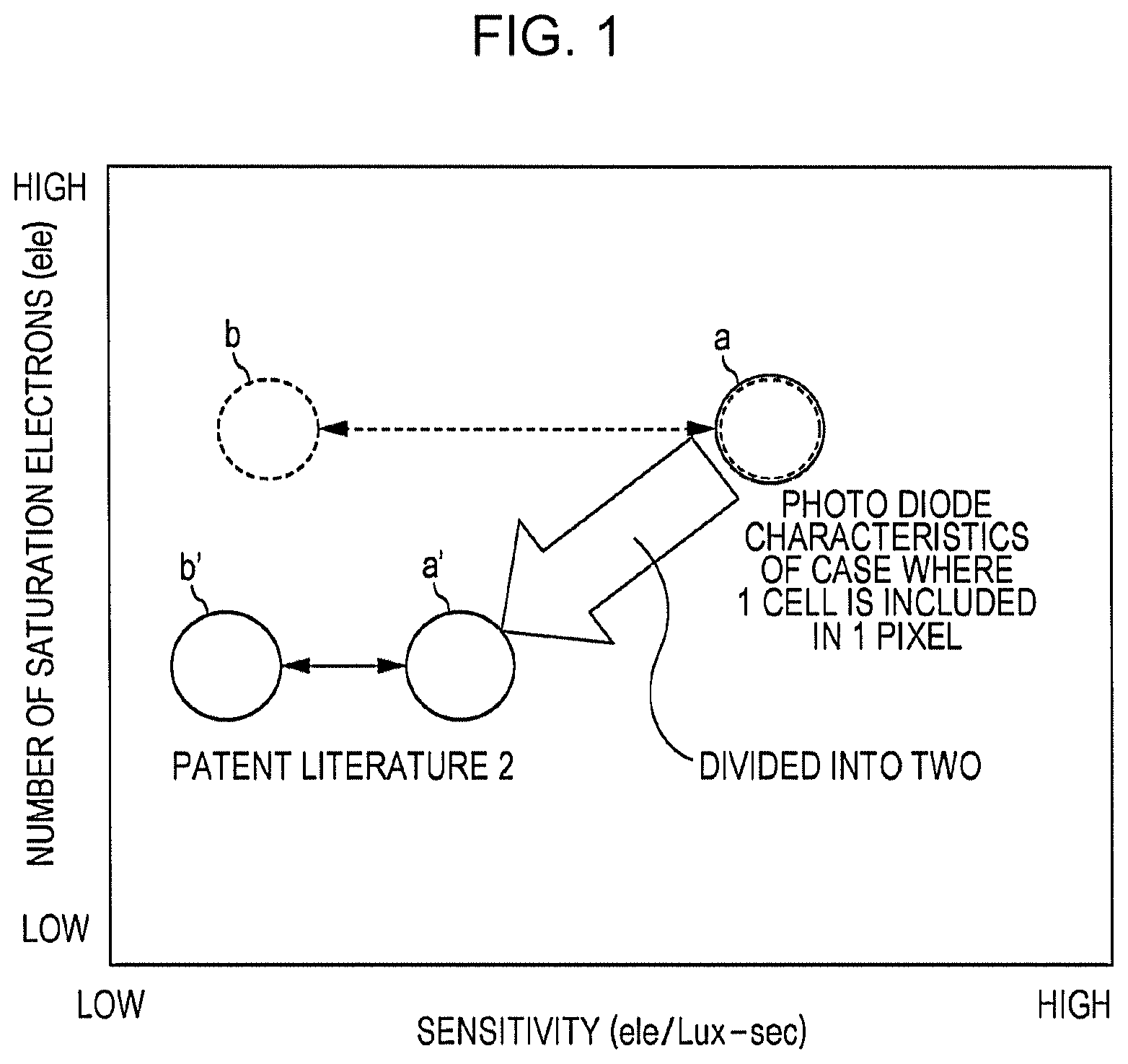
is a diagram illustrating conventional pixel cell characteristics and desired pixel cell characteristics;
is a diagram illustrating conventional pixel cell characteristics and more desired pixel cell characteristics;
is a diagram schematically illustrating a relationship among the capacitance of an electric charge storage node, the number of saturation electrons (ele), and random noise (ele);
is a block diagram schematically illustrating an example of a structure of an imaging device;
is a schematic view illustrating a first signal processing circuit and a second signal processing circuit in a unit pixel;
A is a schematic view illustrating a circuit configuration of a unit pixel according to exemplary First Embodiment;
B is a schematic view illustrating another circuit configuration of the unit pixel according to exemplary First Embodiment;
is a schematic view illustrating a circuit configuration of a unit pixel according to exemplary Second Embodiment;
is a schematic view illustrating another circuit configuration of the unit pixel according to exemplary Second Embodiment;
A is a schematic view illustrating still another circuit configuration of the unit pixel according to exemplary Second Embodiment;
B is a schematic view illustrating still another circuit configuration of the unit pixel according to exemplary Second Embodiment;
C is a schematic view illustrating still another circuit configuration of the unit pixel according to exemplary Second Embodiment;
D is a schematic view illustrating still another circuit configuration of the unit pixel according to exemplary Second Embodiment;
E is a schematic view illustrating still another circuit configuration of the unit pixel according to exemplary Second Embodiment;
F is a schematic view illustrating still another circuit configuration of the unit pixel according to exemplary Second Embodiment;
G is a schematic view illustrating still another circuit configuration of the unit pixel according to exemplary Second Embodiment;
H is a schematic view illustrating still another circuit configuration of the unit pixel according to exemplary Second Embodiment;
I is a schematic view illustrating still another circuit configuration of the unit pixel according to exemplary Second Embodiment;
J is a schematic view illustrating still another circuit configuration of the unit pixel according to exemplary Second Embodiment;
K is a schematic view illustrating still another circuit configuration of the unit pixel according to exemplary Second Embodiment;
L is a schematic view illustrating still another circuit configuration of the unit pixel according to exemplary Second Embodiment;
M is a schematic view illustrating still another circuit configuration of the unit pixel according to exemplary Second Embodiment;
N is a schematic view illustrating still another circuit configuration of the unit pixel according to exemplary Second Embodiment;
is a timing chart illustrating an example of operation timings of a first pixel cell according to exemplary Second Embodiment;
illustrates a circuit configuration of a unit pixel according to exemplary Third Embodiment;
illustrates another circuit configuration of the unit pixel according to exemplary Third Embodiment;
illustrates another circuit configuration of the unit pixel according to exemplary Third Embodiment;
A is a schematic view illustrating still another circuit configuration of the unit pixel according to exemplary Third Embodiment;
B is a schematic view illustrating still another circuit configuration of the unit pixel according to exemplary Third Embodiment;
C is a schematic view illustrating still another circuit configuration of the unit pixel according to exemplary Third Embodiment;
D is a schematic view illustrating still another circuit configuration of the unit pixel according to exemplary Third Embodiment;
E is a schematic view illustrating still another circuit configuration of the unit pixel according to exemplary Third Embodiment;
F is a schematic view illustrating still another circuit configuration of the unit pixel according to exemplary Third Embodiment;
G is a schematic view illustrating still another circuit configuration of the unit pixel according to exemplary Third Embodiment;
H is a schematic view illustrating still another circuit configuration of the unit pixel according to exemplary Third Embodiment;
I is a schematic view illustrating still another circuit configuration of the unit pixel according to exemplary Third Embodiment;
is a schematic view illustrating part of a first signal processing circuit of a first pixel cell;
is a timing diagram illustrating an example of operation timings of the first pixel cell according to exemplary Third Embodiment;
is a schematic view illustrating a circuit configuration of a unit pixel according to exemplary Fourth Embodiment;
is a schematic view illustrating another circuit configuration of the unit pixel according to exemplary Fourth Embodiment;
is a schematic view illustrating another circuit configuration of the unit pixel according to exemplary Fourth Embodiment;
A is a schematic view illustrating still another circuit configuration of the unit pixel according to exemplary Fourth Embodiment;
B is a schematic view illustrating still another circuit configuration of the unit pixel according to exemplary Fourth Embodiment;
C is a schematic view illustrating still another circuit configuration of the unit pixel according to exemplary Fourth Embodiment;
D is a schematic view illustrating still another circuit configuration of the unit pixel according to exemplary Fourth Embodiment;
E is a schematic view illustrating still another circuit configuration of the unit pixel according to exemplary Fourth Embodiment;
F is a schematic view illustrating still another circuit configuration of the unit pixel according to exemplary Fourth Embodiment;
G is a schematic view illustrating still another circuit configuration of the unit pixel according to exemplary Fourth Embodiment;
H is a schematic view illustrating still another circuit configuration of the unit pixel according to exemplary Fourth Embodiment;
I is a schematic view illustrating still another circuit configuration of the unit pixel according to exemplary Fourth Embodiment;
is a schematic view illustrating a circuit configuration of a unit pixel according to exemplary Fifth Embodiment;
is a schematic view illustrating another circuit configuration of the unit pixel according to exemplary Fifth Embodiment;
is a schematic view illustrating another circuit configuration of the unit pixel according to exemplary Fifth Embodiment;
A is a schematic view illustrating still another circuit configuration of the unit pixel according to exemplary Fifth Embodiment;
B is a schematic view illustrating still another circuit configuration of the unit pixel according to exemplary Fifth Embodiment;
C is a schematic view illustrating still another circuit configuration of the unit pixel according to exemplary Fifth Embodiment;
D is a schematic view illustrating still another circuit configuration of the unit pixel according to exemplary Fifth Embodiment;
E is a schematic view illustrating still another circuit configuration of the unit pixel according to exemplary Fifth Embodiment;
F is a schematic view illustrating still another circuit configuration of the unit pixel according to exemplary Fifth Embodiment;
G is a schematic view illustrating still another circuit configuration of the unit pixel according to exemplary Fifth Embodiment;
H is a schematic view illustrating still another circuit configuration of the unit pixel according to exemplary Fifth Embodiment;
I is a schematic view illustrating still another circuit configuration of the unit pixel according to exemplary Fifth Embodiment;
is a schematic view illustrating a circuit configuration according to exemplary Sixth Embodiment;
A is a schematic view illustrating a variation of the circuit configuration according to exemplary Sixth Embodiment;
B is a schematic view illustrating a variation of the circuit configuration according to exemplary Sixth Embodiment;
C is a schematic view illustrating a variation of the circuit configuration according to exemplary Sixth Embodiment;
D is a schematic view illustrating a variation of the circuit configuration according to exemplary Sixth Embodiment;
E is a schematic view illustrating a variation of the circuit configuration according to exemplary Sixth Embodiment;
F is a schematic view illustrating a variation of the circuit configuration according to exemplary Sixth Embodiment;
G is a schematic view illustrating a variation of the circuit configuration according to exemplary Sixth Embodiment;
H is a schematic view illustrating a variation of the circuit configuration according to exemplary Sixth Embodiment;
I is a schematic view illustrating a variation of the circuit configuration according to exemplary Sixth Embodiment;
is a timing chart illustrating an example of timings of driving in a case where a first band control transistor is provided according to exemplary Sixth Embodiment;
is a timing diagram illustrating an example of timings of driving in a case where the first band control transistor is not provided according to exemplary Sixth Embodiment; and
is a diagram illustrating a system configuration of a camera system according to exemplary Seventh Embodiment.
DETAILED DESCRIPTION
First, problems of the conventional arts found by the inventor of the present invention are described below.
In image synthesis disclosed in Japanese Unexamined Patent Application Publication No. 62-108678, a plurality of image data are sequentially acquired. This requires a period that is several times longer than a general imaging period in order to obtain a single synthetic image. Furthermore, since images that are acquired at different times are synthesized, concurrency of the images is impaired. This distorts an image of a moving subject.
In Japanese Unexamined Patent Application Publication No. 2008-99073, a plurality of photo diodes that are the same in terms of sensitivity, the number of saturation electrons, and size are used. An on-chip structure having an on-chip top lens, which separates amounts of light entering the respective photo diodes into large and small ones, is employed. According to this configuration, the plurality of pixel cells appear to have different degrees of effective sensitivity. Since two cells are mounted in each pixel, images can be taken concurrently, and therefore concurrency of the images is secured.
However, since two cells need be disposed in each pixel, the area of each photo diode need be equal to or smaller than ½ of that of a conventional art. The area of a photo diode is proportional to sensitivity or the number of saturation electrons. Accordingly, in a case where the area of a photo diode is ½ or smaller, the sensitivity and the number of saturation electrons are also equal to or smaller than ½ of those of a conventional art.
schematically illustrates conventional pixel cell characteristics and desirable pixel cell characteristics. In , the horizontal axis represents sensitivity, and the vertical axis represents the number of saturation electrons. The “sensitivity” as used herein is one of indices indicative of characteristics of an imaging device (specifically, an image sensor) and refers to the number of electric charges (electron-hole pairs) generated in a pixel cell in response to incident light. The sensitivity is generally expressed in a unit “ele/Lux-sec”. The “number of saturation electrons” as used herein refers to an allowable number of electrons accumulated in a pixel cell and is expressed in a unit “ele”. In principle, the sensitivity and the number of saturation electrons are proportional to an effective area of a photoelectric conversion element. The sensitivity also depends on design of a microlens.
A cell having a single pixel cell within a single pixel is hereinafter referred to as a “general cell”. In wide dynamic range imaging, it is desirable that two pixel cells within a single pixel have (a) pixel cell characteristics that are in the same level in terms of sensitivity and the number of saturation electrons as the general cell and (b) pixel cell characteristics that are in the same level in terms of the number of saturation electrons as the general cell and are lower in terms of sensitivity than the general cell. The combination of a and b in is a desirable combination of two pixel cells.
The combination of a′ and b′ in is a combination of two pixel cells in Japanese Unexamined Patent Application Publication No. 2008-99073. As described above, the area of each pixel cell (photo diode) is equal to or smaller than ½ of that of the general cell. Accordingly, the sensitivity of each pixel cell decreases, and the number of saturation electrons also decreases. This means that the pixel cell characteristics are deviated from desirable ones. That is, the pixel cell characteristics in Japanese Unexamined Patent Application Publication No. 2008-99073 are much inferior to requested ones.
schematically illustrates conventional pixel cell characteristics and more desirable pixel cell characteristics. Saturation that can occur in a case where an amount of incident light is large is mitigated by lowering sensitivity. In addition, if the number of saturation electrons can be increased, a dynamic range is further widened.
Table 1 illustrates factors determining element functions and sensor performance while comparing a conventional Si sensor having a photodiode and a stacked sensor having a photoelectric conversion film disclosed in Japanese Unexamined Patent Application Publication No. 2007-59465. As is clear from Table 1, in the conventional Si sensor, both of the sensitivity and the number of saturation electrons are determined by performance of the photodiode. Meanwhile, in the stacked sensor having a photoelectric conversion film, the sensitivity depends on the area of the photoelectric conversion film and quantum efficiency thereof, and the number of saturation electrons depends on the capacity of an electric charge storage node. Accordingly, as the capacity of the electric charge storage node increases, the number of saturation electrons increases. However, an increase in capacity of the electric charge storage node has a large side effect.
TABLE 1
Photoelectric
Conventional Si conversion film
sensor sensor
Element Photoelectric Photo diode Photoelectric
functions conversion conversion film
Electric charge Photo diode Electric charge
storage storage node
Signal readout Floating diffusion Electric charge
(gate voltage of storage node
amplifier Tr)
Sensor Sensitivity Depend on Depend on
performance quantum efficiency quantum efficiency
of photo diode of photoelectric
conversion film
Number of Depend on Depend on
saturation capacity of photo capacity of electric
electrons diode charge storage
node
schematically illustrates a relationship among the capacity of an electric charge storage node, the number of saturation electrons (ele), and random noise (ele). In , the horizontal axis represents the capacity of an electric charge storage node, and the vertical axis represents the number of saturation electrons and random noise. It is possible to increase the number of saturation electrons by increasing the capacity of an electric charge storage node, but random noise also undesirably increases.
The random noise includes noise that occurs when an electric charge stored in an electric charge storage node is read out (i.e., transferred) by an electric charge sensing circuit and noise (hereinafter referred to as “kTC noise”) that occurs when an electric charge stored in the electric charge storage node is reset by the electric charge sensing circuit. In a case where the capacity of the electric charge storage node is increased, the number of saturation electrons can be increased, but a ratio of the amount of change of the voltage of the electric charge storage node to the amount of change of the number of stored electric charges per unit volume decreases. Noise that occurs in the electric charge sensing circuit is voltage noise, and as a result, noise converted into the number of electric charges undesirably increases.
In a sensor using a silicon photo diode for photoelectric conversion, complete electric charge transfer is achieved, correlated double sampling (CDS) is effective for suppression of kTC noise. Meanwhile, in the stacked sensor using a photoelectric conversion film, complete electric charge transfer cannot be achieved, and therefore kTC noise cannot be cancelled by using CDS. This requires noise cancelling using feedback proposed, for example, in Japanese Unexamined Patent Application Publication No. 2012-19167. However, since a ratio of the amount of change of the voltage of the electric charge storage node to the amount of change of the number of stored electric charges per unit volume decreases in a case where the capacity of the electric charge storage node is increased as described above, an effect of sufficiently suppressing kTC noise by using feedback cannot be obtained.
In view of such problems, the inventor of the present invention attained an imaging device having a novel structure. One aspect of the present disclosure is outlined as the following items.
[Item 1]
An imaging device including:
•
• a first pixel cell including
• a first photoelectric converter, and • a first signal processing circuit that is electrically connected to the first photoelectric converter; and • a second pixel cell including
• a second photoelectric converter, and • a second signal processing circuit that is electrically connected to the second photoelectric converter, • the first signal processing circuit including a first signal detection circuit that detects an electric signal generated in the first photoelectric converter, a capacitance circuit in which a first capacitive element and a second capacitive element having a larger capacitance value than the first capacitive element are connected in series with each other, and a first feedback circuit that forms a first feedback path for negatively feeding back the electric signal generated in the first photoelectric converter, • the first photoelectric converter including a first pixel electrode and a first photoelectric conversion region that is in contact with the first pixel electrode, • the first signal detection circuit including a first transistor that amplifies and outputs a signal voltage corresponding to the voltage of the first pixel electrode and a second transistor, a gate of the first transistor being connected to the first pixel electrode, and one of a source and a drain of the second transistor being connected to the first pixel electrode, • the first feedback circuit negatively feeding back the electric signal generated in the first photoelectric converter to the other one of the source and the drain of the second transistor, • the capacitance circuit being provided between the first pixel electrode and a reference voltage, • the second signal processing circuit including a second signal detection circuit that detects an electric signal generated in the second photoelectric converter, a third capacitive element one end of which is electrically connected to the second photoelectric converter, and a second feedback circuit that forms a second feedback path for negatively feeding back the electric signal, • the second photoelectric converter including a second pixel electrode and a second photoelectric conversion region that is in contact with the second pixel electrode, • the second signal detection circuit including a third transistor that amplifies and outputs a signal voltage corresponding to the voltage of the second pixel electrode and a fourth transistor, a gate of the third transistor being connected to the second pixel electrode, and one of a source and a drain of the fourth transistor being connected to the second pixel electrode, and • the second feedback circuit negatively feeding back the electric signal generated in the second photoelectric converter to the other one of the source and the drain of the fourth transistor.
According to the imaging device of Item 1, high-saturation and low-sensitivity imaging is achieved by using two pixel cells within each pixel.
[Item 2]
An imaging device including:
•
• a first pixel cell including
• a first photoelectric converter, and • a first signal processing circuit that is electrically connected to the first photoelectric converter; and • a second pixel cell including
• a second photoelectric converter, and • a second signal processing circuit that is electrically connected to the second photoelectric converter, • the first signal processing circuit including a first signal detection circuit that detects an electric signal generated in the first photoelectric converter, a capacitance circuit in which a first capacitive element and a second capacitive element having a larger capacitance value than the first capacitive element are connected in series with each other, and a first feedback circuit that forms a first feedback path for negatively feeding back the electric signal generated in the first photoelectric converter, • the first photoelectric converter including a first pixel electrode and a first photoelectric conversion region that is in contact with the first pixel electrode, • the first signal detection circuit including a first transistor that amplifies and outputs a signal voltage corresponding to the voltage of the first pixel electrode, a second transistor, and a fifth transistor, a gate of the first transistor being connected to the first pixel electrode, one of a source and a drain of the second transistor being connected to the first pixel electrode, and one of a source and a drain of the fifth transistor being connected to the other one of the drain and the source of the second transistor, • the first feedback circuit negatively feeding back the electric signal generated in the first photoelectric converter to the other one of the source and the drain of the fifth transistor, • the capacitance circuit being provided between the first pixel electrode and a reference voltage, • the second signal processing circuit including a second signal detection circuit that detects an electric signal generated in the second photoelectric converter, a third capacitive element one end of which is electrically connected to the second photoelectric converter, and a second feedback circuit that forms a second feedback path for negatively feeding back the electric signal, • the second photoelectric converter including a second pixel electrode and a second photoelectric conversion region that is in contact with the second pixel electrode, • the second signal detection circuit including a third transistor that amplifies and outputs a signal voltage corresponding to the voltage of the second pixel electrode and a fourth transistor, a gate of the third transistor being connected to the second pixel electrode, and one of a source and a drain of the fourth transistor being connected to the second pixel electrode, and • the second feedback circuit negatively feeding back the electric signal generated in the second photoelectric converter to the other one of the source and the drain of the fourth transistor.
According to the imaging device of Item 2, high-saturation and low-sensitivity imaging is achieved by using two pixel cells within each pixel.
[Item 3]
The imaging device according to Item 1 or 2, wherein
•
• the first capacitive element is connected between the source and the drain of the second transistor.
According to the imaging device of Item 3, it is possible to improve noise suppression performance of the first pixel cell.
[Item 4]
The imaging device according to any one of Items 1 through 3, wherein
•
• the first feedback circuit includes, as part of the first feedback path, the first transistor and a first inverting amplifier and negatively feeds back the electric signal generated in the first photoelectric converter to the other one of the source and the drain of the second transistor via the first transistor and the first inverting amplifier; and • the second feedback circuit includes, as part of the second feedback path, the third transistor and a second inverting amplifier and negatively feeds back the electric signal generated in the second photoelectric converter to the other one of the source and the drain of the fourth transistor via the third transistor and the second inverting amplifier.
According to the imaging device of Item 4, it is possible to suppress random noise in each pixel cell.
[Item 5]
The imaging device according to any one of Items 1 through 4, wherein
•
• the second capacitive element is connected to the source or the drain of the second transistor.
According to the imaging device of Item 5, it is possible to improve noise suppression performance of the first pixel cell.
[Item 6]
The imaging device according to any one of Items 1 through 5, wherein
•
• the first pixel cell includes a plurality of first pixel cells and the second pixel cell includes a plurality of second pixel cells, and the plurality of first pixel cells and the plurality of second pixel cells are one-dimensionally or two-dimensionally arranged.
According to the imaging device of Item 6, it is possible to provide an imaging device that can image a subject of a wide dynamic range without a time lag and without blown out highlights and blocked up shadows.
[Item 7]
The imaging device according to Item 6, wherein
•
• each of the plurality of first pixel cells and a corresponding one of the plurality of second pixel cells are adjacent to each other.
According to the imaging device of Item 7, high-saturation imaging and low-noise imaging are achieved by the same resolution.
[Item 8]
An imaging device including a plurality of pixels,
•
• each of the plurality of pixels including • a first pixel cell including a first photoelectric converter and a first signal processing circuit that is electrically connected to the first photoelectric converter via a connection part, and • a second pixel cell including a second photoelectric converter and a second signal processing circuit that is electrically connected to the second photoelectric converter via a connection part, • the first photoelectric converter including a first pixel electrode and a first photoelectric conversion region that is in contact with the first pixel electrode, and the second photoelectric converter including a second pixel electrode and a second photoelectric conversion region that is in contact with the second pixel electrode, and • the first signal processing circuit and the second signal processing circuit having different circuit configurations, and the first signal processing circuit having a configuration that reduces noise. [Item 9]
The imaging device according to Item 8, wherein
•
• the first signal processing circuit includes a first signal detection circuit that detects an electric signal generated in the first photoelectric converter; • the first signal detection circuit includes a first transistor that amplifies and outputs a signal voltage corresponding to a voltage of the first pixel electrode and a second transistor, a gate of the first transistor being connected to the first pixel electrode, and one of a source and a drain of the second transistor being connected to the first pixel electrode; • the second signal processing circuit includes a second signal detection circuit that detects an electric signal generated in the second photoelectric converter; • the second signal detection circuit includes a third transistor that amplifies and outputs a signal voltage corresponding to a voltage of the second pixel electrode and a fourth transistor, a gate of the third transistor being connected to the second pixel electrode, and one of a source and a drain of the fourth transistor being connected to the second pixel electrode; and • the first transistor and the third transistor or the second transistor and the fourth transistor have different sizes. [Item 10]
The imaging device according to Item 8, wherein
•
• the first signal processing circuit includes a first signal detection circuit that detects an electric signal generated in the first photoelectric converter and a first feedback circuit that forms a first feedback path for negatively feeding back the electric signal generated in the first photoelectric converter; • the first signal detection circuit includes a first transistor that amplifies and outputs a signal voltage corresponding to a voltage of the first pixel electrode and a second transistor, a gate of the first transistor being connected to the first pixel electrode, and one of a source and a drain of the second transistor being connected to the first pixel electrode; • the second signal processing circuit includes a second signal detection circuit that detects an electric signal generated in the second photoelectric converter; and • the second signal detection circuit includes a third transistor that amplifies and outputs a signal voltage corresponding to a voltage of the second pixel electrode and a fourth transistor, a gate of the third transistor being connected to the second pixel electrode, and one of a source and a drain of the fourth transistor being connected to the second pixel electrode. [Item 11]
The imaging device according to Item 8, wherein
•
• the first signal processing circuit includes a first signal detection circuit that detects an electric signal generated in the first photoelectric converter and a first feedback circuit that forms a first feedback path for negatively feeding back the electric signal generated in the first photoelectric converter; • the first signal detection circuit includes a first transistor that amplifies and outputs a signal voltage corresponding to a voltage of the first pixel electrode and a second transistor, a gate of the first transistor being connected to the first pixel electrode, and one of a source and a drain of the second transistor being connected to the first pixel electrode; • the second signal processing circuit includes a second signal detection circuit that detects an electric signal generated in the second photoelectric converter and a second feedback circuit that forms a second feedback path for negatively feeding back the electric signal generated in the second photoelectric converter; • the second signal detection circuit includes a third transistor that amplifies and outputs a signal voltage corresponding to a voltage of the second pixel electrode and a fourth transistor, a gate of the third transistor being connected to the second pixel electrode, and one of a source and a drain of the fourth transistor being connected to the second pixel electrode; and • sizes of the first transistor and the third transistor, sizes of the second transistor and the fourth transistor, or the first feedback circuit and the second feedback circuit are different from each other. [Item 12]
The imaging device according to Item 8, wherein
•
• the first signal processing circuit includes a first signal detection circuit that detects an electric signal generated in the first photoelectric converter, a capacitance circuit in which a first capacitive element one end of which is electrically connected to the connection part and a second capacitive element having a larger capacitance value than the first capacitive element are connected in series with each other, and a first feedback circuit that forms a first feedback path for negatively feeding back the electric signal generated in the first photoelectric converter; • the first signal detection circuit includes a first transistor that amplifies and outputs a signal voltage corresponding to a voltage of the first pixel electrode and a second transistor, a gate of the first transistor being connected to the first pixel electrode, and one of a source and a drain of the second transistor being connected to the first pixel electrode; • the second signal processing circuit includes a second signal detection circuit that detects an electric signal generated in the second photoelectric converter; and • the second signal detection circuit includes a third transistor that amplifies and outputs a signal voltage corresponding to a voltage of the second pixel electrode and a fourth transistor, a gate of the third transistor being connected to the second pixel electrode, and one of a source and a drain of the fourth transistor being connected to the second pixel electrode. [Item 13]
The imaging device according to Item 8, wherein
•
• the first signal processing circuit includes a first signal detection circuit that detects an electric signal generated in the first photoelectric converter, a capacitance circuit in which a first capacitive element one end of which is electrically connected to the connection part and a second capacitive element having a larger capacitance value than the first capacitive element are connected in series with each other, and a first feedback circuit that forms a first feedback path for negatively feeding back the electric signal generated in the first photoelectric converter; • the first signal detection circuit includes a first transistor that amplifies and outputs a signal voltage corresponding to a voltage of the first pixel electrode and a second transistor, a gate of the first transistor being connected to the first pixel electrode, and one of a source and a drain of the second transistor being connected to the first pixel electrode; • the second signal processing circuit includes a second signal detection circuit that detects an electric signal generated in the second photoelectric converter and a second feedback circuit that forms a second feedback path for negatively feeding back the electric signal generated in the second photoelectric converter; and • the second signal detection circuit includes a third transistor that amplifies and outputs a signal voltage corresponding to a voltage of the second pixel electrode and a fourth transistor, a gate of the third transistor being connected to the second pixel electrode, and one of a source and a drain of the fourth transistor being connected to the second pixel electrode. [Item 14]
The imaging device according to Item 8, wherein
•
• the first signal processing circuit includes a first signal detection circuit that detects an electric signal generated in the first photoelectric converter, a capacitance circuit in which a first capacitive element one end of which is electrically connected to the connection part and a second capacitive element having a larger capacitance value than the first capacitive element are connected in series with each other, and a first feedback circuit that forms a first feedback path for negatively feeding back the electric signal generated in the first photoelectric converter; • the first signal detection circuit includes a first transistor that amplifies and outputs a signal voltage corresponding to a voltage of the first pixel electrode and a second transistor, a gate of the first transistor being connected to the first pixel electrode, and one of a source and a drain of the second transistor being connected to the first pixel electrode; • the second signal processing circuit includes a second signal detection circuit that detects an electric signal generated in the second photoelectric converter, a capacitance circuit in which a third capacitive element one end of which is electrically connected to the connection part and a fourth capacitive element having a larger capacitance value than the third capacitive element are connected in series with each other, and a second feedback circuit that forms a second feedback path for negatively feeding back the electric signal generated in the second photoelectric converter; • the second signal detection circuit includes a third transistor that amplifies and outputs a signal voltage corresponding to a voltage of the second pixel electrode and a fourth transistor, a gate of the third transistor being connected to the second pixel electrode, and one of a source and a drain of the fourth transistor being connected to the second pixel electrode; and • sizes of the first transistor and the third transistor, sizes of the second transistor and the fourth transistor, the first feedback circuit and the second feedback circuit, the first capacitive element and the third capacitive element, or the second capacitive element and the fourth capacitive element are different from each other. [Item 15]
The imaging device according to any one of Items 8 through 14, wherein
•
• the second signal processing circuit includes a fifth capacitive element one end of which is electrically connected to the second photoelectric converter. [Item 16]
The imaging device according to any one of Items 12 through 15, wherein
•
• the first capacitive element is connected between the source and the drain of the second transistor. [Item 17]
The imaging device according to any one of Items 12 through 16, wherein
•
• the second capacitive element is connected between the one of the source and the drain of the second transistor and a reference voltage. [Item 18]
The imaging device according to Item 14, wherein
•
• the third capacitive element is connected between the source and the drain of the fourth transistor. [Item 19]
The imaging device according to any one of Items 14 and 16 through 18, wherein
•
• the fourth capacitive element is connected between the one of the source and the drain of the fourth transistor and a reference voltage. [Item 20]
The imaging device according to any one of Items 8 through 19, wherein
•
• the first feedback circuit includes, as part of the first feedback path, the first transistor and a first inverting amplifier and negatively feeds back the electric signal generated in the first photoelectric converter to the other one of the source and the drain of the second transistor via the first transistor and the first inverting amplifier; and • the second feedback circuit includes, as part of the second feedback path, the third transistor and a second inverting amplifier and negatively feeds back the electric signal generated in the second photoelectric converter to the other one of the source and the drain of the fourth transistor via the third transistor and the second inverting amplifier. [Item 21]
The imaging device according to any one of Items 8 through 20, wherein
•
• the first feedback circuit includes, as part of the first feedback path, the first transistor and negatively feeds back the electric signal generated in the first photoelectric converter to the other one of the source and the drain of the second transistor; and • the second feedback circuit includes, as part of the second feedback path, the third transistor and negatively feeds back the electric signal generated in the second photoelectric converter to the other one of the source and the drain of a fourth transistor via the third transistor. [Item 22]
The imaging device according to any one of Items 8 through 19, wherein
•
• the first feedback circuit includes, as part of the first feedback path, a seventh transistor that determines selection or non-selection of output of the first transistor in addition to the first transistor and negatively feeds back the electric signal generated in the first photoelectric converter to the other one of a source and a drain of a fifth transistor that limits a bandwidth of the first feedback circuit via the first transistor and the seventh transistor; and • the second feedback circuit includes, as part of the second feedback path, an eighth transistor that determines selection or non-selection of output of the third transistor in addition to the third transistor and negatively feeds back the electric signal generated in the second photoelectric converter to the other one of a source and a drain of a sixth transistor that limits a bandwidth of the second feedback circuit via the third transistor and the eighth transistor. [Item 23]
The imaging device according to any one of Items 8 through 19, wherein
•
• the first feedback circuit does not include the first transistor as part of the first feedback path and negatively feeds back the electric signal generated in the first photoelectric converter via the one of the source and the drain of the second transistor and the gate of the second transistor; and • the second feedback circuit includes, as part of the second feedback path, the third transistor and negatively feeds back the electric signal generated in the second photoelectric converter to the other one of a source and a drain of a sixth transistor via the third transistor. [Item 24]
The imaging device according to Item 8, wherein
•
• the second signal processing circuit includes a second signal detection circuit that detects an electric signal generated in the second photoelectric converter; and • the second signal detection circuit includes a fourteenth transistor that is connected between the second pixel electrode and an output of the first photoelectric converter. [Item 25]
The imaging device according to any one of Items 8 through 24, wherein
•
• the second signal processing circuit includes a fifth capacitive element connected to the second pixel electrode. [Item 26]
The imaging device according to any one of Items 8 through 25, wherein
•
• a gate width of the first transistor is larger than that of the third transistor or a gate length of the second transistor is longer than that of the fourth transistor. [Item 27]
The imaging device according to any one of Items 8 through 26, wherein
•
• the first pixel cell includes a plurality of first pixel cells and the second pixel cell includes a plurality of second pixel cells, and the plurality of first pixel cells and the plurality of second pixel cells are one-dimensionally or two-dimensionally arranged. [Item 28]
The imaging device according to Item 27, wherein
•
• each of the first pixel cells and a corresponding one of the second pixel cells are adjacent to each other. [Item 29]
The imaging device according to any one of Items 8 through 28, wherein
•
• the first pixel cell accumulates therein a first electric charge generated in the first photoelectric converter; • the second pixel cell accumulates therein a second electric charge generated in the second photoelectric converter; and • a period of accumulation of the second electric charge in the second pixel cell is longer than that of the first electric charge in the first pixel cell. [Item 30]
A camera system including:
•
• the imaging device according to any one of Items 1 through 29; • an optical system that forms an image of a subject on the imaging device; and • a signal processing unit that performs signal processing. [Item 31]
An imaging device including:
•
• a first pixel cell including
• a first photoelectric converter that generates a first signal by photoelectric conversion, and • a first signal detection circuit that is electrically connected to the first photoelectric converter and detects the first signal; and • a second pixel cell including
• a second photoelectric converter that generates a second signal by photoelectric conversion, • a second reset transistor one of a source and a drain of which is electrically connected to the second photoelectric converter, the other of the source and the drain of the second reset transistor being electrically connected to the first photoelectric converter, and • a first capacitive element one end of which is electrically connected to the second photoelectric converter, the other end of the first capacitive element being set to a reference voltage. [Item 32]
The imaging device according to Item 31, further including a first feedback circuit including an inverting amplifier, wherein
•
• the first photoelectric converter includes a first pixel electrode and a first photoelectric conversion region that is in contact with the first pixel electrode, • the first signal detection circuit includes a first amplifier transistor that detects the first signal and a first reset transistor that resets the first signal, a gate of the first amplifier transistor being electrically connected to the first pixel electrode, one of a source and a drain of the first reset transistor being electrically connected to the first pixel electrode, and • the first feedback circuit forms a feedback path for negatively feeding back a voltage of the first pixel electrode via the first amplifier transistor, the inverting amplifier, and the first reset transistor. [Item 33]
The imaging device according to Item 32, wherein
•
• the first signal detection circuit further includes a first capacitive element, a second capacitive element having a larger capacitance value than the first capacitive element, and a first band control transistor; • one end of the first capacitive element is electrically connected to the first pixel electrode; • one end of the second capacitive element is electrically connected to the other end of the first capacitive element, • the other end of the second capacitive element is set to a reference voltage; • one of a source and a drain of the first band control transistor is connected to the other end of the first capacitive element; and • the first feedback circuit forms a feedback path for negatively feeding back a voltage of the first pixel electrode via the first amplifier transistor, the inverting amplifier, the first band control transistor, and the first capacitive element. [Item 34]
The imaging device according to Item 33, wherein
•
• the other one of the source and the drain of the first reset transistor is electrically connected to the one of the source and the drain of the first band control transistor. [Item 35]
The imaging device according to Item 33, wherein
•
• the other one of the source and the drain of the first reset transistor is electrically connected to the other one of the source and the drain of the first band control transistor. [Item 36]
The imaging device according to Item 31, further including a first feedback circuit, wherein
•
• the first photoelectric converter includes a first pixel electrode and a first photoelectric conversion region that is in contact with the first pixel electrode, • the first signal detection circuit includes a first amplifier transistor that detects the first signal, a first reset transistor that resets the first signal, a first capacitive element, a second capacitive element having a larger capacitance value than the first capacitive element, and a first band control transistor; • a gate of the first amplifier transistor is electrically connected to the first pixel electrode; • one of a source and a drain of the first reset transistor is electrically connected to the first pixel electrode; • one end of the first capacitive element is electrically connected to the first pixel electrode; • one of the second capacitive element is electrically connected to the other end of the first capacitive element, • the other end of the second capacitive element is set to a reference voltage; • one of a source and a drain of the first band control transistor is connected to the other end of the first capacitive element; • one of a source and a drain of the first amplifier transistor is electrically connected to the other one of the source and the drain of the first band control transistor, and • the first feedback circuit forms a feedback path for negatively feeding back a voltage of the first pixel electrode via the first amplifier transistor, the first band control transistor, and the first capacitive element. [Item 37]
The imaging device according to Item 36, wherein
•
• the other one of the source and the drain of the first reset transistor is electrically connected to the one of the source and the drain of the first band control transistor. [Item 38]
The imaging device according to Item 36, wherein
•
• the other one of the source and the drain of the first reset transistor is electrically connected to the other one of the source and the drain of the first band control transistor. [Item 39]
The imaging device according to Item 31, further including a first feedback circuit, wherein
•
• the first photoelectric converter includes a first pixel electrode and a first photoelectric conversion region that is in contact with the first pixel electrode, • the first signal detection circuit includes a first amplifier transistor that detects the first signal, a first reset transistor that resets the first signal, a first capacitive element, a second capacitive element having a larger capacitance value than the first capacitive element, a first band control transistor, and a first selection transistor; • a gate of the first amplifier transistor is electrically connected to the first pixel electrode; • one of a source and a drain of the first reset transistor is electrically connected to the first pixel electrode; • one end of the first capacitive element is electrically connected to the first pixel electrode; • one of the second capacitive element is electrically connected to the other end of the first capacitive element, • the other end of the second capacitive element is set to a reference voltage; • one of a source and a drain of the first band control transistor is connected to the other end of the first capacitive element; • one of a source and a drain of the first selection transistor is electrically connected to one of a source and a drain of the first amplifier transistor; • the other one of the source and the drain of the first selection transistor is electrically connected to the other one of the source and the drain of the first band control transistor, and • the first feedback circuit forms a feedback path for negatively feeding back a voltage of the first pixel electrode via the first amplifier transistor, the first selection transistor, the first band control transistor, and the first capacitive element. [Item 40]
The imaging device according to Item 30, wherein
•
• the other one of the source and the drain of the first reset transistor is electrically connected to the one of the source and the drain of the first band control transistor. [Item 41]
The imaging device according to Item 39, wherein
•
• the other one of the source and the drain of the first reset transistor is electrically connected to the other one of the source and the drain of the first band control transistor. [Item 42]
The imaging device according to Item 31, wherein
•
• the first photoelectric converter includes a first pixel electrode and a first photoelectric conversion region that is in contact with the first pixel electrode; • the first signal detection circuit includes a first amplifier transistor that detects the first signal, a first reset transistor that resets the first signal, a first capacitive element, a second capacitive element having a larger capacitance value than the first capacitive element, a first band control transistor, and a first feedback circuit; • a gate of the first amplifier transistor is electrically connected to the first pixel electrode; • one of a source and a drain of the first reset transistor is electrically connected to the first pixel electrode; • one end of the first capacitive element is electrically connected to the first pixel electrode; • one of the second capacitive element is electrically connected to the other end of the first capacitive element, • the other end of the second capacitive element is set to a reference voltage; • one of a source and a drain of the first band control transistor is connected to the other end of the first capacitive element; • a gate of the first band control transistor is electrically connected to the first pixel electrode, and • the first feedback circuit forms a feedback path for negatively feeding back a voltage of the first pixel electrode via the first band control transistor and the first capacitive element. [Item 43]
The imaging device according to Item 42, wherein
•
• the other one of the source and the drain of the first reset transistor is electrically connected to the one of the source and the drain of the first band control transistor. [Item 44]
The imaging device according to Item 42, wherein
•
• the other one of the source and the drain of the first reset transistor is electrically connected to the other one of the source and the drain of the first band control transistor.
According to one aspect of the present disclosure, two pixel cells having different configurations can be provided in each pixel. A first pixel cell requires low-noise characteristics, but does not require high-saturation characteristics. “Low-noise high-sensitivity imaging” is achieved by the first pixel cell. The second pixel cell requires high-saturation characteristics, but does not require low-noise characteristics since the second pixel cell is in charge of imaging of a bright scene where a light amount is large and the influence of shot noise is large. “High-saturation low-sensitivity imaging” is achieved by the second pixel cell. It is therefore possible to image even a subject having a larger difference in brightness without blown out highlights and blocked up shadows than a conventional art. That is, more desirable pixel cell characteristics as illustrated in can be achieved. Furthermore, according to the present configuration, high-sensitivity imaging and low-sensitivity imaging are concurrently achieved by two pixel cells. It is therefore possible to prevent a time lag between the high-sensitivity imaging and the low-sensitivity imaging.
Embodiments of the present disclosure are described below in detail with reference to the drawings. Each of the embodiments described below illustrates a general or specific example. Numerical values, shapes, materials, constituent elements, ways in which the constituent elements are arranged and connected, steps, the order of steps, and the like in the embodiments below are examples and do not limit the present disclosure. Various aspects described herein can be combined as long as no contradiction occurs. Among constituent elements in the embodiments described below, constituent elements that are not described in independent claims that indicate the highest concepts are described as optional constituent elements. In the following description, constituent elements having substantially the same functions are given identical reference signs, and description thereof is sometimes omitted.
First Embodiment
A structure of an imaging device 100 according to the present embodiment is described below with reference to through 6 B . The following describes an example of a structure using a p-type silicon substrate as a semiconductor substrate. An example in which a hole is used as a signal electric charge is illustrated below. Note that an electron may be used as a signal electric charge.
Structure of Imaging Device 100
schematically illustrates an example of the structure of the imaging device 100 . The imaging device 100 includes a plurality of unit pixels 1 that are two-dimensionally arranged. Millions of unit pixels 1 can be two-dimensionally arranged actually, but illustrates only unit pixels 1 that are arranged in a 2×2 matrix. The imaging device 100 may be a line sensor. In this case, the plurality of unit pixels 1 may be arranged one-dimensionally (in a row direction or a column direction).
Each of the unit pixels 1 includes a first pixel cell 1 a and a second pixel cell 1 a ′. The first pixel cell 1 a is an pixel cell that copes with low noise, and the second pixel cell 1 a ′ is an pixel cell that copes with high saturation. Typically, the first pixel cell 1 a functions as an pixel cell for high sensitivity, and the second pixel cell 1 a ′ functions as an pixel cell for low sensitivity. The imaging device 100 includes, for the first pixel cell 1 a , a plurality of reset signal lines 6 and a plurality of address signal lines 7 that are disposed in respective rows and a plurality of vertical signal lines 9 , a power source wire 8 , and a plurality of feedback signal lines 10 that are disposed in respective columns. Furthermore, the imaging device 100 includes, for the second pixel cell 1 a ′, a plurality of reset signal lines 6 ′ and a plurality of address signal lines 7 ′ that are disposed in the respective rows and a plurality of vertical signal lines 9 ′, a power source wire 8 ′, and a plurality of feedback signal lines 10 ′ that are disposed in the respective columns.
In the imaging device 100 , a first peripheral circuit that processes a signal from the first pixel cell 1 a and a second peripheral circuit that processes a signal from the second pixel cell 1 a ′ are separately provided. The first peripheral circuit includes a first vertical scanning circuit 2 , a first horizontal scanning circuit 3 , a first inverting amplifier 11 , a first column AD conversion circuit 4 , and an electric current source 5 , and the second peripheral circuit includes a second vertical scanning circuit 2 ′, a second horizontal scanning circuit 3 ′, a second inverting amplifier 11 ′, a second column AD conversion circuit 4 ′, and a second electric current source 5 ′.
As to the first pixel cell 1 a , the first vertical scanning circuit 2 controls the plurality of reset signal lines 6 and the plurality of address signal lines 7 . The vertical signal lines 9 are connected to the first horizontal scanning circuit 3 and transmit a pixel signal to the first horizontal scanning circuit 3 . The power source wire 8 supplies a power source voltage (e.g., VDD) to all of the unit pixels 1 a . The feedback signal lines 10 transmit a feedback signal from the inverting amplifier 11 that will be described later to the first pixel cells 1 a of the unit pixels 1 . As for the second pixel cell 1 a ′, various signal lines are arranged and controlled by the circuits in a manner similar to the first pixel cell 1 a . Note, however, that the reset signal lines 6 and 6 ′ and the address signal lines 7 and 7 ′ of the first pixel cell 1 a and the second pixel cell 1 a ′ can be replaced with a reset signal line and an address signal line that are shared by the first pixel cell 1 a and the second pixel cell 1 a ′ depending on the pixel configuration. Furthermore, the feedback signal lines 10 and 10 ′ and the first inverting amplifier 11 and the second inverting amplifier 11 ′ can be replaced with a feedback signal line and an inverting amplifier that are shared by the first pixel cell 1 a and the second pixel cell 1 a ′ or can be omitted depending on the pixel configuration. Furthermore, the first vertical scanning circuit 2 and the second vertical scanning circuit 2 ′ and the first horizontal scanning circuit 3 and the second horizontal scanning circuit 3 ′ can also be replaced with a vertical scanning circuit and a horizontal scanning circuit that are shared by the first pixel cell 1 a and the second pixel cell 1 a ′ accordingly depending on the pixel configuration.
Circuit Configuration of First and Second Pixel Cells 1 a and 1 a′
Next, an example of a circuit configuration of the first and second pixel cells 1 a and 1 a ′ (the unit pixel 1 ) is described with reference to A .
illustrates first and second signal processing circuits P 1 and P 2 in the unit pixel 1 . A illustrates an example of a circuit configuration of the unit pixel 1 according to the present embodiment.
The unit pixel 1 includes the first pixel cell 1 a and the second pixel cell 1 a ′. The first pixel cell 1 a functions as a low-noise cell. The first pixel cell 1 a includes a first photoelectric converter PC 1 that converts light into an electric signal and the first signal processing circuit P 1 that is electrically connected to the first photoelectric converter PC 1 and reads out the electric signal generated in the first photoelectric converter PC 1 . The first photoelectric converter PC 1 includes a first pixel electrode E 1 and a first photoelectric conversion region D 1 that is in contact with the first pixel electrode E 1 .
The first signal processing circuit P 1 includes a first signal detection circuit that detects the electric signal generated in the first photoelectric converter PC 1 . The first signal detection circuit includes a first amplifier transistor M 10 , a first selection transistor M 11 , and a first reset transistor M 12 . A gate of the first amplifier transistor M 10 is connected to the first photoelectric converter PC 1 . The first amplifier transistor M 10 amplifies the electric signal generated in the first photoelectric converter PC 1 . One of a source and a drain of the first selection transistor M 11 is connected to one of a source and a drain of the first amplifier transistor M 10 . The first selection transistor M 11 selectively outputs the signal amplified by the first amplifier transistor M 10 . One of a source and a drain of the first reset transistor M 12 is connected to a readout node FD 1 . The first reset transistor M 12 resets (initializes) the readout node FD 1 connected to the first pixel electrode E 1 of the first photoelectric converter PC 1 .
The second pixel cell 1 a ′ functions as a high-saturation cell. The second pixel cell 1 a ′ includes a second photoelectric converter PC 2 that converts light into an electric signal and the second signal processing circuit P 2 that is electrically connected to the second photoelectric converter PC 2 and reads out the electric signal generated in the second photoelectric converter PC 2 . The second photoelectric converter PC 2 includes a second pixel electrode E 2 and a second photoelectric conversion region D 2 that is in contact with the second pixel electrode E 2 .
The second signal processing circuit P 2 includes a second signal detection circuit that detects the electric signal generated in the second photoelectric converter PC 2 . The second signal detection circuit includes a second amplifier transistor M 20 , a second selection transistor M 21 , and a second reset transistor M 22 . A gate of the second amplifier transistor M 20 is connected to the second photoelectric converter PC 2 . The second amplifier transistor M 20 amplifies the electric signal generated in the second photoelectric converter PC 2 . One of a source and a drain of the second selection transistor M 21 is connected to one of a source and a drain of the second amplifier transistor M 20 . The second selection transistor M 20 selectively outputs the signal amplified by the second amplifier transistor M 20 . One of a source and a drain of the second reset transistor M 22 is connected to a readout node FD 2 . The second reset transistor M 22 resets (initializes) the readout node FD 2 connected to the second pixel electrode E 2 of the second photoelectric converter PC 2 .
The first photoelectric converter PC 1 of the first pixel cell 1 a is configured to take in a larger amount of light per unit time than the second photoelectric converter PC 2 of the second pixel cell 1 a ′. For example, the first photoelectric converter PC 1 of the first pixel cell 1 a may be disposed on an optical axis of a light collecting lens. Furthermore, for example, the first photoelectric converter PC 1 of the first pixel cell 1 a may be larger in area in a plan view than the second photoelectric converter PC 2 of the second pixel cell 1 a′.
The first pixel cell 1 a , which is in charge of imaging of a dark scene, requires low-noise characteristics but does not require high-saturation characteristics. Meanwhile, the second pixel cell 1 a ′, which is in charge of imaging of a bright scene, requires high-saturation characteristics. However, the second pixel cell 1 a ′ does not require low-noise characteristics since a light amount is large and the characteristics are determined by shot noise at a bright scene.
In the present embodiment, a gate width of the first amplifier transistor M 10 is larger than that of the second amplifier transistor M 20 . This makes it possible to set gm of the first amplifier transistor M 10 large. As a result, it is possible to reduce readout noise of the first pixel cell 1 a . Meanwhile, low-noise characteristics of the second pixel cell 1 a ′ do not pose a problem even in a case where the low-noise characteristics are equivalent to conventional ones. A gate length of the first reset transistor M 12 is longer than that of the second reset transistor M 22 . This improves the noise reducing effect of the first pixel cell 1 a . Meanwhile, low-noise characteristics of the second pixel cell 1 a ′ do not pose a problem even in a case where the low-noise characteristics are equivalent to conventional ones.
B illustrates another example of a circuit configuration of the unit pixel 1 according to the present embodiment. As illustrated in B , a fifth capacitive element CW that is electrically connected between the second photoelectric converter PC 2 and a reference voltage VBW is provided. This makes it possible to improve the high-saturation characteristics of the second pixel cell 1 a ′ by a degree corresponding to a capacitance ratio. As a result, it is possible to further widen a dynamic range. The reference sign “P 1 ” of the first signal processing circuit and the reference sign “P 2 ” of the second signal processing circuit are omitted in B and the subsequent drawings and are used only in the specification.
According to the present embodiment, it is possible to prevent an unnecessary increase in pixel size. Furthermore, according to the present embodiment, it is possible to provide a small imaging device in which low-noise high-sensitivity imaging is achieved by the first pixel cell 1 a and high-saturation low-sensitivity imaging is achieved by the second pixel cell 1 a ′. Furthermore, according to the present embodiment, a subject having a large difference in brightness can be imaged without a time lag and without blown out highlights and blocked up shadows.
Second Embodiment
An example of a circuit configuration of a unit pixel 1 according to Second Embodiment is described with reference to through 10 .
illustrates an example of a circuit configuration of the unit pixel 1 according to the present embodiment. The unit pixel 1 includes a first pixel cell 1 a and a second pixel cell 1 a ′. The first pixel cell 1 a functions as a low-noise cell. The first pixel cell 1 a includes a first photoelectric converter PC 1 that converts light into an electric signal and a first signal processing circuit P 1 that is electrically connected to the first photoelectric converter PC 1 and reads out the electric signal generated in the first photoelectric converter PC 1 .
The first signal processing circuit P 1 includes a first signal detection circuit that detects the electric signal generated in the first photoelectric converter PC 1 . The first signal detection circuit includes a first amplifier transistor M 10 , a first selection transistor M 11 , a first reset transistor M 13 , and a first feedback circuit. A gate of the first amplifier transistor M 10 is connected to the first photoelectric converter PC 1 . The first amplifier transistor M 10 amplifies the electric signal generated in the first photoelectric converter PC 1 . One of a source and a drain of the first selection transistor M 11 is connected to a source and a drain of the first amplifier transistor M 10 . The first amplifier transistor M 10 selectively outputs the signal amplified by the first amplifier transistor M 10 . One of a source and a drain of the first reset transistor M 13 is connected to a readout node FD 1 . The first reset transistor M 13 resets (initializes) the readout node FD 1 connected to a first pixel electrode of the first photoelectric converter PC 1 .
The first feedback circuit has a first inverting amplifier FBAMP 1 and forms a first feedback path for negative feedback of kTC noise that occurs when the first reset transistor M 13 is turned off. Gain of the first feedback path can be increased and a noise suppressing effect can be improved by the first inverting amplifier FBAMP 1 . The first inverting amplifier FBAMP 1 corresponds to the first inverting amplifier 11 in .
The second pixel cell 1 a ′ functions as a high-saturation cell. The second pixel cell 1 a ′ includes a second photoelectric converter PC 2 that converts light into an electric signal and a second signal processing circuit P 2 that is electrically connected to the second photoelectric converter PC 2 and reads out the electric signal generated in the second photoelectric converter PC 2 .
The second signal processing circuit P 2 includes a second signal detection circuit that detects the electric signal generated in the second photoelectric converter PC 2 . The second signal detection circuit includes a second amplifier transistor M 20 , a second selection transistor M 21 , and a second reset transistor M 22 . A gate of the second amplifier transistor M 20 is connected to the second photoelectric converter PC 2 . The second amplifier transistor M 20 amplifies the electric signal generated in the second photoelectric converter PC 2 . One of a source and a drain of the second selection transistor M 21 is connected to one of a source and a drain of the second amplifier transistor M 20 . The second selection transistor M 21 selectively outputs the signal amplified by the second amplifier transistor M 20 . The second reset transistor M 22 is connected to a readout node FD 2 and resets (initializes) the readout node FD 2 connected to a second pixel electrode of the second photoelectric converter PC 2 .
The first pixel cell 1 a , which is in charge of imaging of a dark scene, requires low-noise characteristics but does not require high-saturation characteristics. Meanwhile, the second pixel cell 1 a ′, which is in charge of imaging of a bright scene, requires high-saturation characteristics. However, the second pixel cell 1 a ′ does not require low-noise characteristics since a light amount is large and the characteristics are determined by shot noise at a bright scene.
Since the first pixel cell 1 a includes the first feedback circuit, the first pixel cell 1 a can markedly suppress noise that occurs when the first reset transistor M 13 is turned off. Meanwhile, noise characteristics of the second pixel cell 1 a ′ do not pose a problem even in a case where the noise characteristics are equivalent to conventional ones. Note that a method for suppressing noise will be described later. A gate width of the first amplifier transistor M 10 may be larger than that of the second amplifier transistor M 20 . This makes it possible to set gm of the first amplifier transistor M 10 large. As a result, it is possible to reduce readout noise of the first pixel cell 1 a . Meanwhile, noise characteristics of the second pixel cell 1 a ′ do not pose a problem even in a case where the noise characteristics are equivalent to conventional ones. A gate length of the first reset transistor M 13 may be longer than that of the second reset transistor M 22 . This further improves the noise reducing effect of the first pixel cell 1 a . The noise characteristics of the second pixel cell 1 a ′ do not pose a problem even in a case where the noise characteristics are equivalent to conventional ones.
illustrates another example of a circuit configuration of the unit pixel 1 according to the present embodiment. As illustrated in , a fifth capacitive element CW that is electrically connected between the second photoelectric converter PC 2 and a reference voltage VBW is provided. This makes it possible to improve the high-saturation characteristics of the second pixel cell 1 a ′ by a degree corresponding to a capacitance ratio. As a result, it is possible to further widen a dynamic range.
According to the present embodiment, it is possible to suppress an unnecessary increase in pixel size. Furthermore, according to the present embodiment, it is possible to provide a small imaging device in which low-noise high-sensitivity imaging is achieved by the first pixel cell 1 a and high-saturation low-sensitivity imaging is achieved by the second pixel cell 1 a ′. Furthermore, according to the present embodiment, a subject having a large difference in brightness can be imaged without a time lag and without blown out highlights and blocked up shadows.
Still other examples of a circuit configuration of the unit pixel 1 according to the present embodiment are described with reference to A through 9 N . The same effects as those described above can be obtained by using any of the circuit configurations.
A through 9 N illustrate still other examples of the circuit configuration of the unit pixel 1 according to the present embodiment. The following mainly describes representative ones of the examples of the circuit configuration.
The unit pixel 1 illustrated in A has a configuration obtained by adding a second feedback circuit that forms a second feedback path for negative feedback of kTC noise that occurs when the second reset transistor M 23 is turned off to the second pixel cell 1 a ′ of the unit pixel 1 illustrated in . The second feedback circuit includes a second inverting amplifier FBAMP 2 . According to this configuration, low-noise imaging is achieved by using the first pixel cell 1 a , and low-noise and high-saturation imaging is achieved by using the second pixel cell 1 a ′. As a result, it is possible to suppress noise throughout imaging data. Especially in imaging of a subject of an intermediate amount of light, noise can be effectively suppressed, and a higher-definition image can be obtained. The second inverting amplifier FBAMP 2 corresponds to the first inverting amplifier 11 ′ in .
As described above, a gate width of the first amplifier transistor M 10 may be larger than that of the second amplifier transistor M 20 . This makes it possible to set gm of the first amplifier transistor M 10 large. As a result, it is possible to reduce readout noise of the first pixel cell 1 a . Meanwhile, noise characteristics of the second pixel cell 1 a ′ do not pose a problem even in a case where the noise characteristics are equivalent to conventional ones. A gate length of the first reset transistor M 13 may be longer than that of the second reset transistor M 22 . This further improves the noise reducing effect of the first pixel cell 1 a . Noise characteristics of the second pixel cell 1 a ′ do not pose a problem even in a case where the noise characteristics are equivalent to conventional ones. Furthermore, gain of the first feedback circuit may be set larger than that of the second feedback circuit. This further improves the noise reducing effect of the first pixel cell 1 a . Noise characteristics of the second pixel cell 1 a ′ do not pose a problem even in a case where the noise characteristics are equivalent to conventional ones.
The unit pixel 1 illustrated in C has a configuration including a first reset transistor M 12 , a first band control transistor M 13 , a first capacitive element Cc 1 , and a second capacitive element Cs 1 in contrast with the configuration illustrated in . The first band control transistor M 13 performs band control of the first feedback circuit. The first band control transistor M 13 is disposed on the feedback path and is connected to an output of the first inverting amplifier FBAMP 1 . The first capacitive element Cc 1 is electrically connected between the readout node FD 1 and a source or a drain of the first band control transistor M 13 . The second capacitive element Cs 1 has a larger capacitance value than the first capacitive element Cc 1 and is connected between the first capacitive element Cc 1 and a reference voltage VB 1 . According to this configuration, it is possible to improve noise suppression performance of the first pixel cell 1 a.
As described above, a gate width of the first amplifier transistor M 10 may be larger than that of the second amplifier transistor M 20 . This makes it possible to set gm of the first amplifier transistor M 10 large. As a result, it is possible to reduce readout noise of the first pixel cell 1 a . Noise characteristics of the second pixel cell 1 a ′ do not pose a problem even in a case where the noise characteristics are equivalent to conventional ones. A gate length of the first reset transistor M 12 may be longer than that of the second reset transistor M 22 . This further improves the noise reducing effect of the first pixel cell 1 a . Noise characteristics of the second pixel cell 1 a ′ do not pose a problem even in a case where the noise characteristics are equivalent to conventional ones.
It is desirable that the first reset transistor M 12 be connected between the readout node FD 1 connected to the first photoelectric converter PC 1 and a connection node (hereinafter sometimes referred to as a “connection part”) RD 1 between the first capacitive element Cc 1 and the second capacitive element Cs 1 , as illustrated in C . Alternatively, it is desirable that the first reset transistor M 12 be connected between the readout node FD 1 connected to the first photoelectric converter PC 1 and one of a source and a drain of the first band control transistor M 13 that is not connected to the connection node RD 1 , as illustrated in E . According to such a configuration, it is unnecessary to additionally provide a reset voltage Vret (=VRST). Furthermore, since convergence into a value close to a reset value can be achieved by feedback, the speed of noise cancelling can be increased.
The unit pixel 1 illustrated in G has a configuration including a second reset transistor M 23 and a second feedback circuit that forms a second feedback path for negative feedback of kTC noise that occurs when the second reset transistor M 23 is turned off in contrast with the configuration illustrated in C . According to this configuration, low-noise imaging is achieved by using the first pixel cell 1 a , and low-noise and high-saturation imaging is achieved by using the second pixel cell 1 a ′. As a result, it is possible to suppress noise throughout imaging data. Especially in imaging of a subject of an intermediate amount of light, noise can be effectively suppressed, and a higher-definition image can be obtained.
As described above, a gate width of the first amplifier transistor M 10 may be larger than that of the second amplifier transistor M 20 . This makes it possible to set gm of the first amplifier transistor M 10 large. As a result, it is possible to reduce readout noise of the first pixel cell 1 a . Noise characteristics of the second pixel cell 1 a ′ do not pose a problem even in a case where the noise characteristics are equivalent to conventional ones. A gate length of the first reset transistor M 12 may be longer than that of the second reset transistor M 22 . This further improves the noise reducing effect of the first pixel cell 1 a . Noise characteristics of the second pixel cell 1 a ′ do not pose a problem even in a case where the noise characteristics are equivalent to conventional ones. Furthermore, gain of the first feedback circuit may be set larger than that of the second feedback circuit. This further improves the noise reducing effect of the first pixel cell 1 a . Noise characteristics of the second pixel cell 1 a ′ do not pose a problem even in a case where the noise characteristics are equivalent to conventional ones.
It is desirable that the first reset transistor M 12 be connected between the readout node FD 1 connected to the first photoelectric converter PC 1 and the connection node RD 1 between the first capacitive element Cc 1 and the second capacitive element Cs 1 , as illustrated in G . Alternatively, it is desirable that the first reset transistor M 12 be connected between the readout node FD 1 connected to the first photoelectric converter PC 1 and one of a source and a drain of the first band control transistor M 13 that is not connected to the connection node RD 1 , as illustrated in I . According to such a configuration, it is unnecessary to additionally provide a reset voltage Vret (=VRST). Furthermore, since convergence into a value close to a reset value can be achieved by feedback, the speed of noise cancelling can be increased.
Each of the unit pixels 1 illustrated in K and 9 M has a configuration including a second reset transistor M 22 , a second band control transistor M 23 and a capacitance circuit including a third capacitive element Cc 2 and a fourth capacitive element Cs 2 in contrast with the configuration illustrated in G . The second band control transistor M 23 performs band control of the second feedback circuit. The second band control transistor M 23 is disposed on the feedback path and is connected between an output of the second inverting amplifier FBAMP 2 and a connection node RD 2 between the third capacitive element Cc 2 and the fourth capacitive element Cs 2 . The third capacitive element Cc 2 is electrically connected between the readout node FD 2 and a source or a drain of the second band control transistor M 23 . The fourth capacitive element Cs 2 has a larger capacitance value than the third capacitive element Cc 2 and is connected between the third capacitive element Cc 2 and a reference voltage VB 2 . The third capacitive element Cc 2 is connected in series with the fourth capacitive element Cs 2 . According to this configuration, low-noise imaging is achieved by using the first pixel cell 1 a , and low-noise and high-saturation imaging is achieved by using the second pixel cell 1 a ′. As a result, it is possible to suppress noise throughout imaging data. Especially in imaging of a subject of an intermediate amount of light, noise can be effectively suppressed, and a higher-definition image can be obtained.
As described above, a gate width of the first amplifier transistor M 10 may be larger than that of the second amplifier transistor M 20 . This makes it possible to set gm of the first amplifier transistor M 10 large. As a result, it is possible to reduce readout noise of the first pixel cell 1 a . Noise characteristics of the second pixel cell 1 a ′ do not pose a problem even in a case where the noise characteristics are equivalent to conventional ones. A gate length of the first reset transistor M 12 may be longer than that of the second reset transistor M 22 . This further improves the noise reducing effect of the first pixel cell 1 a . Noise characteristics of the second pixel cell 1 a ′ do not pose a problem even in a case where the noise characteristics are equivalent to conventional ones. Furthermore, gain of the first feedback circuit may be set larger than that of the second feedback circuit. This further improves the noise reducing effect of the first pixel cell 1 a . Noise characteristics of the second pixel cell 1 a ′ do not pose a problem even in a case where the noise characteristics are equivalent to conventional ones.
It is desirable that the first reset transistor M 12 be connected between the readout node FD 1 connected to the first photoelectric converter PC 1 and the connection node RD 1 between the first capacitive element Cc 1 and the second capacitive element Cs 1 , as illustrated in K . Alternatively, it is desirable that the first reset transistor M 12 be connected between the readout node FD 1 connected to the first photoelectric converter PC 1 and one of a source and a drain of the first band control transistor M 13 that is not connected to the connection node RD 1 , as illustrated in M . According to such a configuration, it is unnecessary to additionally provide a reset voltage Vret (=VRST). Furthermore, since convergence into a value close to a reset value can be achieved by feedback, the speed of noise cancelling can be increased.
According to the circuit configurations illustrated in A through 9 N , it is possible to suppress an unnecessary increase in pixel size. Furthermore, it is possible to provide a small imaging device in which low-noise high-sensitivity imaging is achieved by the first pixel cell 1 a and high-saturation low-sensitivity imaging is achieved by the second pixel cell 1 a ′. Furthermore, a subject having a large difference in brightness can be imaged without a time lag and without blown out highlights and blocked up shadows.
As in the unit pixel 1 illustrated in , a fifth capacitive element CW that is electrically connected between the second photoelectric converter PC 2 and the reference voltage VBW may be provided as illustrated in B, 9 D, 9 F, 9 H, 9 J, 9 L , and 9 N. This makes it possible to improve the high-saturation characteristics of the second pixel cell 1 a ′ by a degree corresponding to a capacitance ratio. As a result, it is possible to further widen a dynamic range.
A specific example of a noise suppression and data readout operation using a feedback circuit is described below.
Readout and Noise Suppression
A noise suppression and data readout operation using the first pixel cell 1 a of the unit pixel 1 illustrated in C is described below as a specific example.
In the first signal processing circuit P 1 , one end of the second capacitive element Cs 1 is connected to one of a source and a drain of the first band control transistor M 13 . The first band control transistor M 13 and the second capacitive element Cs 1 form an RC filter circuit. Furthermore, one end of the first capacitive element Cc 1 is also connected to the one of the source and the drain of the first band control transistor M 13 . The other end of the first capacitive element Cc 1 is connected to the first readout node FD 1 .
A gate of the first band control transistor M 13 receives a first band control signal Vrs 3 , and the state of the first band control transistor M 13 is determined by the voltage of the first band control signal Vrs 3 . For example, in a case where the first band control signal Vrs 3 is at a high level, the first band control transistor M 13 is on, and the readout node FD 1 , the first amplifier transistor M 10 , the first selection transistor M 11 , the first inverting amplifier FBAMP 1 , the first band control transistor M 13 , and the first capacitive element Cc 1 form a feedback path. When the voltage of the first band control signal Vrs 3 decreases, a resistance component of the first band control transistor M 13 increases. This narrows the bandwidth of the first band control transistor M 13 and narrows a frequency region of a signal that is fed back. While feedback is being formed, a signal that is output by the first band control transistor M 13 is attenuated by an attenuation circuit formed by the first capacitive element Cc 1 and parasitic capacitance of the readout node FD 1 and is fed back to the readout node FD 1 . An attenuation rate B is expressed by B=Cc/(Cc+CFD) where Cc is the capacitance value of the first capacitive element Cc 1 and CFD is the parasitic capacitance of the readout node FD 1 . When the voltage of the first band control signal Vrs 3 decreases to a low level, the first band control transistor M 13 is turned off, and no feedback is formed. The readout node FD 1 is further connected to one of a source and a drain of the first reset transistor M 12 . The other one of the source and the drain of the first reset transistor M 12 is connected to the connection node RD 1 .
A gate of the first reset transistor M 12 receives a first reset control signal Vrs 1 , and the state of the first reset transistor M 12 is determined by the voltage of the first reset control signal Vrs 1 . For example, in a case where the first reset control signal Vrs 1 is at a high level, the first reset transistor M 12 is on, and the readout node FD 1 has the same voltage as the connection node RD 1 . In this case, in a case where the first band control signal Vrs 3 is also at a high level, both of the first reset transistor M 12 and the first band control transistor 13 M are on, and both of the readout node FD 1 and the connection node RD 1 have a desired reset voltage VRST. This reset voltage VRST is a value obtained by subtracting a voltage between a gate of the first amplifier transistor M 10 and one of a source and a drain of the first amplifier transistor M 10 that is not connected to VDD, from the reference voltage Vref 1 of the first inverting amplifier FBAMP 1 . One of a source and a drain of the first selection transistor M 11 is connected to the vertical signal line 9 . A gate of the first selection transistor M 11 receives a first selection control signal Vsel 1 , and the state of the first selection transistor M 11 is determined by the voltage of the first selection control signal Vsel 1 . For example, in a case where the first selection control signal Vsel 1 is at a high level, the first selection transistor M 11 is on, and the first amplifier transistor M 10 and the vertical signal line 9 are electrically connected. In a case where the first selection control signal Vsel 1 is at a low level, the first selection transistor M 11 is off, and the first amplifier transistor M 10 and the vertical signal line 9 are electrically separated.
Operation of First Pixel Cell 1 a
illustrates an example of operation timings of the first pixel cell 1 a according to the present embodiment.
Reset Period
First, the first selection control signal Vsel 1 is brought into a high level (time t 1 ). Next, the voltage of the first band control signal Vrs 3 is brought into a high level so that the first band control transistor M 13 is turned on. At the same timing, the first reset control signal Vrs 1 is brought into a high level so that the first reset transistor M 12 is turned on (time t 2 ). This makes the voltage of the readout node FD 1 equal to the reset voltage VRST.
Noise Suppression Period
Next, the first reset control signal Vrs 1 is brought into a low level so that the first reset transistor M 12 is turned off (time t 3 ). In this state, the first feedback circuit forms a feedback path at an amplification factor (=−A×B), and therefore the kTC noise of the readout node FD 1 that occurs when the first reset transistor M 12 is turned off is suppressed to 1/(1+A×B). Furthermore, noise is suppressed at high speed by setting the voltage of the first band control signal Vrs 3 so that the operation bandwidth of the first band control transistor M 13 is a first bandwidth that is a broad bandwidth.
At the same timing, the first band control signal Vrs 3 is set to an intermediate voltage between the high level and the low level (time t 3 ). Note that this timing may be slightly later than the time t 3 . At this point in time, the operation bandwidth of the first band control transistor M 13 is a second bandwidth that is lower than the first bandwidth. The noise suppressing effect is increased by making the second bandwidth sufficiently lower than the operation bandwidth of the first amplifier transistor M 10 . However, trade-off for this is extension of a period necessary for noise suppression. A noise suppression effect is obtained even in a case where the second bandwidth is higher than the operation bandwidth of the first amplifier transistor M 10 . A designer can design the second bandwidth to any value in accordance with a period for noise suppression. In the present embodiment, it is assumed that the second bandwidth is sufficiently lower than the operation bandwidth of the first amplifier transistor M 10 .
In a state where the second bandwidth is lower than the operation bandwidth of the first amplifier transistor M 10 , thermal noise that occurs in the first band control transistor M 13 is suppressed to be 1/(1+A×B) 1/2 times by the first feedback circuit. In this state, the first band control signal Vrs 3 is set to a low level so that the first band control transistor M 13 is turned off (time t 4 ). At this point in time, kTC noise that remains in the readout node FD 1 is the sum of squares of kTC noise resulting from the first reset transistor M 12 and kTC noise resulting from the first band control transistor M 13 . When Cs is the capacitance value of the second capacitive element Cs 1 , the kTC noise of the first band control transistor M 13 that occurs in a state where there is no suppression by feedback is (CFD/Cs) 1/2 times the kTC noise of the first reset transistor M 12 that occurs in a state where there is no suppression by feedback. When this is taken into consideration, the kTC noise is suppressed to be [1+(1+A×B)×CFD/Cs] 1/2 /(1+A×B) times as compared with a case where there is no feedback.
Note that the first band control signal Vrs 3 may be controlled to a voltage that changes across a threshold voltage of the first band control transistor M 13 so that the first band control transistor M 13 gradually changes from an ON state to an OFF state. This makes it possible to suppress noise of all of the unit pixels 1 even in a case where there are variations in threshold voltage of the first band control transistor M 13 among the plurality of unit pixels 1 that constitute the imaging device 100 . Furthermore, a voltage range in which the first band control signal Vrs 3 is changed may be limited to a range of the variations of the unit pixels 1 . This makes it possible to shorten a period for the change and achieve high speed noise suppression.
Exposure/Readout Period
Next, the voltage of the vertical signal line 9 shifts to a level corresponding to the voltage of the readout node FD 1 , but an amplification factor of a source follower circuit formed by the first amplifier transistor M 10 , the first selection transistor M 11 , and the electric current source 5 (see ) is approximately 1. At this point in time, a voltage signal that has changed by a degree corresponding to the electric signal generated in the first photoelectric converter PC 1 from the time of completion of noise suppression (time t 4 ) to readout is accumulated in the readout node FD 1 . The voltage signal of the readout node FD 1 is output to the vertical signal line 9 at an amplification factor of approximately 1 by the source follower circuit. Random noise is a fluctuation of output (i.e., kTC noise) obtained when the electric signal generated in the first photoelectric converter PC 1 is 0. The kTC noise is suppressed to be [1+(1+A×B)×CFD/Cs] 1/2 /(1+A×B) times during the noise suppression period. Furthermore, during the exposure/readout period, the voltage signal of the readout node FD 1 is output to the vertical signal line 9 at an amplification factor of approximately 1. Therefore, according to the present embodiment, it is possible to acquire good image data in which random noise is suppressed.
The random noise is suppressed by increasing the second capacitive element Cs 1 as much as the area permits. In general, random noise is reduced by increasing capacitance. However, when the electric charge signal is converted into a voltage signal in the readout node FD 1 , the signal itself decreases. As a result, S/N is not improved.
In the present embodiment, since the readout node FD 1 and the connection part node RD 1 are separated by the first capacitive element Cc 1 , the signal decrease does not occur even in a case where the capacitance of the second capacitive element Cs 1 is increased. Since only the random noise is suppressed, the S/N ratio can be improved. Therefore, the present embodiment is effective in an imaging device in which the area of each unit pixel 1 can be made large.
A post-stage circuit for detecting a signal of the vertical signal line 9 may be connected, for example, as illustrated in . The post-stage circuit is, for example, constituted by a first vertical scanning circuit 2 , a second vertical scanning circuit 2 ′, a first column AD conversion circuit 4 , and a second column AD conversion circuit 4 ′. However, the present disclosure is not limited to such a circuit configuration.
In the imaging device 100 , CDS for cancelling a variation of the post-stage circuit may be performed. Specifically, the aforementioned reset operation is performed again after readout of a signal voltage. After completion of the reset operation, the readout operation described in Exposure/Readout Period is performed before light detection by the first photoelectric converter PC 1 . In this way, a reference voltage can be read out. A signal excluding fixed noise can be obtained by finding a difference between the signal voltage and the reference voltage.
In the present embodiment, a signal of the readout node FD 1 is read out by the source follower circuit at an amplification factor of approximately 1 during the exposure/readout period. However, the present disclosure is not limited to this. The amplification factor may be changed by a designer in accordance with an S/N ratio and a circuit range necessary for a system.
In the present embodiment, the noise suppressing effect can be increased by increasing the capacitance value of a capacitive element disposed in the first pixel cell 1 a.
Furthermore, the reset voltage of the readout node FD 1 in the reset period may be supplied via the connection node RD 1 as illustrated in C or may be directly supplied from the first inverting amplifier FBAMP 1 as illustrated in F . Alternatively, it is also possible to employ a configuration in which a desired voltage is supplied from an outside. According to these examples of the configuration, wires that connect nodes can be optimized in a pixel layout having a small area, and thus a pixel area can be reduced.
Although an example of operation of the first pixel cell 1 a has been described above, the second pixel cell 1 a ′ can be also operated in a manner similar to the first pixel cell 1 a . Furthermore, an example of operation of the first pixel cell 1 a having the highest noise suppression performance illustrated in C has been described above. However, a configuration in which the first band control transistor M 13 is not provided (e.g., the first pixel cell 1 a illustrated in ) may be selected in accordance with required noise level and pixel area. In this case, bandwidth limitation may be placed while performing a reset operation by supplying an intermediate voltage (e.g., Vrs 3 in ) to the first reset transistor M 13 in . Alternatively, only a reset operation may be performed by supplying only a low level and a high level without supplying an intermediate voltage. Operations of the other transistors are similar to those described above. Furthermore, it is also possible to employ a configuration in which the first band control transistor M 23 and the second feedback circuit are not provided (e.g., the second pixel cell 1 a ′ of ). Operations of the other transistors are similar to those described above.
Third Embodiment
An example of a circuit configuration of a unit pixel 1 according to Third Embodiment is described below with reference to to 14 I .
illustrates an example of a circuit configuration of the unit pixel 1 according to the present embodiment. The unit pixel 1 includes a first pixel cell 1 a and a second pixel cell 1 a ′. The first pixel cell 1 a functions as a low-noise cell. The first pixel cell 1 a includes a first photoelectric converter PC 1 that converts light into an electric signal and a first signal processing circuit P 1 that is electrically connected to the first photoelectric converter PC 1 and reads out the electric signal generated in the first photoelectric converter PC 1 .
The first signal processing circuit P 1 includes a first signal detection circuit that detects the electric signal generated in the first photoelectric converter PC 1 . The first signal detection circuit includes a first amplifier transistor M 10 , a first selection transistor M 11 , a first reset transistor M 12 , a capacitance circuit, and a first band control transistor M 13 . A gate of the first amplifier transistor M 10 is connected to the first photoelectric converter PC 1 . The first amplifier transistor M 10 amplifies the electric signal generated in the first photoelectric converter PC 1 . One of a source and a drain of the first selection transistor M 11 is connected to one of a source and a drain of the first amplifier transistor M 10 . The first selection transistor M 11 selectively outputs the signal amplified by the first amplifier transistor M 10 . One of a source and a drain of the first reset transistor M 12 is connected to a readout node FD 1 . The first reset transistor M 12 resets (initializes) the readout node FD 1 connected to the first photoelectric converter PC 1 . The capacitance circuit includes a first capacitive element Cc 1 one end of which is electrically connected to the readout node FD 1 and a second capacitive element Cs 1 having a larger capacitance value than the first capacitive element Cc 1 . The first capacitive element Cc 1 is connected in series with the second capacitive element Cs 1 . One of a source and a drain of the first band control transistor M 13 is connected to a connection node RD 1 between the first capacitive element Cc 1 and the second capacitive element Cs 1 and performs band control of a first feedback circuit.
The first signal processing circuit P 1 further includes the first feedback circuit that forms a first feedback path for negative feedback and suppression of noise that occurs when the first reset transistor M 12 is turned off. The first feedback circuit performs negative feedback via the first amplifier transistor M 10 , the first band control transistor M 13 , and the first capacitive element Cc 1 .
The second pixel cell 1 a ′ functions as a high-saturation cell. The second pixel cell 1 a ′ includes a second photoelectric converter PC 2 that converts light into an electric signal and a second signal processing circuit P 2 that is electrically connected to the second photoelectric converter PC 2 and reads out the electric signal generated in the second photoelectric converter PC 2 .
The second signal processing circuit P 2 includes a second signal detection circuit that detects the electric signal generated in the second photoelectric converter PC 2 . The second signal detection circuit includes a second amplifier transistor M 20 , a second selection transistor M 21 , and a second reset transistor M 22 . A gate of the second amplifier transistor M 20 is connected to the second photoelectric converter PC 2 . The second amplifier transistor M 20 amplifies the electric signal generated in the second photoelectric converter PC 2 . One of a source and a drain of the second selection transistor M 21 is connected to one of a source and a drain of the second amplifier transistor M 20 . The second selection transistor M 21 selectively outputs the signal amplified by the second amplifier transistor M 20 . The second reset transistor M 22 is connected to a readout node FD 2 and resets (initializes) the readout node FD 2 connected to the second photoelectric converter PC 2 .
The first pixel cell 1 a , which is in charge of imaging of a dark scene, requires low-noise characteristics but does not require high-saturation characteristics. Meanwhile, the second pixel cell 1 a ′, which is in charge of imaging of a bright scene, requires high-saturation characteristics. However, the second pixel cell 1 a ′ does not require low-noise characteristics since a light amount is large and the characteristics are determined by shot noise at a bright scene.
Since the first pixel cell 1 a includes the first feedback circuit, the first pixel cell 1 a can markedly suppress noise that occurs when the first reset transistor M 12 is turned off. Meanwhile, noise characteristics of the second pixel cell 1 a ′ do not pose a problem even in a case where the noise characteristics are equivalent to conventional ones. A gate width of the first amplifier transistor M 10 may be larger than that of the second amplifier transistor M 20 . This makes it possible to set gm of the first amplifier transistor M 10 large. As a result, it is possible to reduce readout noise of the first pixel cell 1 a . Meanwhile, noise characteristics of the second pixel cell 1 a ′ do not pose a problem even in a case where the noise characteristics are equivalent to conventional ones. A gate length of the first reset transistor M 12 may be longer than that of the second reset transistor M 22 . This further improves the noise reducing effect of the first pixel cell 1 a . Noise characteristics of the second pixel cell 1 a ′ do not pose a problem even in a case where the noise characteristics are equivalent to conventional ones.
illustrate other examples of a circuit configuration of the unit pixel 1 according to the present embodiment. As illustrated in , a fifth capacitive element CW that is electrically connected between the second photoelectric converter PC 2 and a reference voltage VBW is provided. This makes it possible to improve the high-saturation characteristics of the second pixel cell 1 a ′ by a degree corresponding to a capacitance ratio. As a result, it is possible to further widen a dynamic range. A method for setting a reset voltage can be changed by changing a method of connection of the first reset transistor M 12 . As a result, it is possible to shorten a period for convergence to a reset voltage.
According to the present embodiment, it is possible to suppress an unnecessary increase in pixel size. Furthermore, according to the present embodiment, it is possible to provide a small imaging device in which low-noise high-sensitivity imaging is achieved by the first pixel cell 1 a and high-saturation low-sensitivity imaging is achieved by the second pixel cell 1 a ′. Furthermore, according to the present embodiment, a subject having a large difference in brightness can be imaged without a time lag and without blown out highlights and blocked up shadows.
It is desirable that the first reset transistor M 12 be connected between the readout node FD 1 connected to the first photoelectric converter PC 1 and the connection node RD 1 between the first capacitive element Cc 1 and the second capacitive element Cs 1 , as illustrated in . Alternatively, it is desirable that the first reset transistor M 12 be connected between the readout node FD 1 connected to the first photoelectric converter PC 1 and one of a source and a drain of the first band control transistor M 13 that is not connected to the connection node RD 1 , as illustrated in . According to such a configuration, it is unnecessary to additionally provide a reset voltage Vret (=VRST). Furthermore, since convergence into a value close to a reset value can be achieved by feedback, the speed of noise cancelling can be increased.
Still other examples of a circuit configuration of the first and second pixel cells 1 a and 1 a ′ according to the present embodiment are described below.
A through 14 I illustrate still other examples of a circuit configuration of the unit pixel 1 according to the present embodiment. The configurations illustrated in , 12 , 13 , and 14 A through 14 I correspond to the configurations illustrated in C through 9 N of Second Embodiment. The configurations illustrated in , 12 , 13 , and 14 A through 14 I and the configurations illustrated in C through 9 N of Second Embodiment are different in configuration and operation of the first feedback circuit for noise suppression in the first pixel cell 1 a and are the same in other configurations and operations.
An operation of the first pixel cell 1 a according to the present embodiment is described below.
Readout and Noise Suppression illustrated in is described below as a specific example.
In the first signal processing circuit P 1 , one end of the second capacitive element Cs 1 is connected to one of a source and a drain of the first band control transistor M 13 . The first band control transistor M 13 and the second capacitive element Cs 1 form an RC filter circuit. Furthermore, one end of the first capacitive element Cc 1 is also connected to the one of the source and the drain of the first band control transistor M 13 . The other end of the first capacitive element Cc 1 is connected to the first readout node FD 1 .
A gate of the first band control transistor M 13 receives a first band control signal Vrs 3 , and the state of the first band control transistor M 13 is determined by the voltage of the first band control signal Vrs 3 . For example, in a case where the first band control signal Vrs 3 is at a high level, the first band control transistor M 13 is on, and the readout node FD 1 , the first amplifier transistor M 10 , the first band control transistor M 13 , and the first capacitive element Cc 1 form a feedback path. A resistance component of the first band control transistor M 13 increases when the voltage of the first band control signal Vrs 3 decreases. This narrows the bandwidth of the first band control transistor M 13 and narrows a frequency region of a signal that is fed back. While a feedback path is being formed, a signal that is output by the first band control transistor M 13 is attenuated by an attenuation circuit formed by the first capacitive element Cc 1 and parasitic capacitance of the readout node FD 1 and is fed back to the readout node FD 1 . An attenuation rate B is expressed by B=Cc/(Cc+CFD) where Cc is the capacitance value of the first capacitive element Cc 1 and CFD is the parasitic capacitance of the readout node FD 1 . Furthermore, when the voltage of the first band control signal Vrs 3 decreases to a low level, the first band control transistor M 13 is turned off, and no feedback path is formed. The readout node FD 1 is further connected to one of a source and a drain of the first reset transistor M 12 . The other one of the source and the drain of the first reset transistor M 12 is connected to the connection node RD 1 .
A gate of the first reset transistor M 12 receives a first reset control signal Vrs 1 , and the state of the first reset transistor M 12 is determined by the voltage of the first reset control signal Vrs 1 . For example, in a case where the first reset control signal Vrs 1 is at a high level, the first reset transistor M 12 is on, and the readout node FD 1 has the same voltage as the connection node RD 1 . In this case, in a case where the first band control signal Vrs 3 is also at a high level, both of the first reset transistor M 12 and the first band control transistor 13 M are on, and both of the readout node FD 1 and the connection node RD 1 have a desired reset voltage VRST. One of a source and a drain of the first selection transistor M 11 is connected to the vertical signal line 9 . A gate of the first selection transistor M 11 receives a first selection control signal Vsel 1 , and the state of the first selection transistor M 11 is determined by the voltage of the first selection control signal Vsel 1 . For example, in a case where the first selection control signal Vsel 1 is at a high level, the first selection transistor M 11 is on, and the first amplifier transistor M 10 and the vertical signal line 9 are electrically connected. In a case where the first selection control signal Vsel 1 is at a low level, the first selection transistor M 11 is off, and the first amplifier transistor M 10 and the vertical signal line 9 are electrically separated.
illustrates part of the first signal processing circuit P 1 of the first pixel cell 1 a . A first switching circuit SWC 1 is connected to one of a source and a drain of the first amplifier transistor M 10 . The first switching circuit SWC 1 includes switch elements SW 10 A and SW 10 B. The switch elements SW 10 A and SW 10 B are connected to reference voltages VB 10 A and VB 10 B, respectively. The reference voltage VB 10 A can be input to the one of the source and the drain of the first amplifier transistor M 10 via the switch element SW 10 A, and the reference voltage VB 10 B can be input to the one of the source and the drain of the first amplifier transistor M 10 via the switch element SW 10 B. The voltage of the one of the source and the drain of the first amplifier transistor M 10 can be switched by a control signal. The reference voltage VB 10 A is, for example, GND, and the reference voltage VB 10 B is, for example, VDD. Note that the first switching circuit SWC 1 may be provided for each unit pixel or may be shared by a plurality of unit pixels in order to reduce the number of elements per unit pixel.
A second switching circuit SWC 2 is connected to the vertical signal line 9 . The second switching circuit SWC 2 includes switch elements SW 11 A and SW 11 B. The switch elements SW 11 A and SW 11 B are connected to reference voltages VB 11 A and VB 11 B via constant electric current sources IB 11 A and IB 11 B, respectively. The reference voltage VB 11 A is, for example, VDD, and the reference voltage VB 11 B is, for example, GND.
Assume that the switch elements SW 10 A and SW 11 A are selectively turned on. In this case, in a case where the voltage of the first selection control signal Vsel 1 is at a high level, the first selection transistor M 11 is on, and the constant electric current source IB 11 A and the first amplifier transistor M 10 form an inverting amplifier circuit. As a result, the readout node FD 1 , the first amplifier transistor M 10 , the first band control transistor M 13 , and the first capacitive element Cc 1 form a feedback path.
Assume that the switch elements SW 10 B and SW 11 B are selectively turned on. In this case, in a case where the voltage of the first selection control signal Vsel 1 is at a high level, the first selection transistor M 11 is on, and the first amplifier transistor M 10 and the constant electric current source IB 11 B form a source follower circuit. As a result, a signal of the readout node FD 1 is output to the vertical signal line 9 .
Operation of First Pixel Cell 1 a
illustrates an example of operation timings of the first pixel cell 1 a according to the present embodiment.
Reset Period
First, the first selection control signal Vsel 1 is brought into a high level. Furthermore, the constant electric current source IB 11 A is connected to the vertical signal line 9 , and one of the source and the drain of the first amplifier transistor M 10 is set to the reference voltage VB 10 A by controlling the first and second switching circuits SWC 1 and SWC 2 (time t 1 ). Next, the voltage of the first band control signal Vrs 3 is brought into a high level so that the first band control transistor M 13 is turned on. Furthermore, the first reset control signal Vrs 1 is brought into a high level so that the first reset transistor M 12 is turned on (time t 2 ). This makes the voltage of the readout node FD 1 equal to the reset voltage VRST.
Noise Suppression Period
Next, the first reset control signal Vrs 1 is brought into a low level so that the first reset transistor M 12 is turned off (time t 3 ). In this state, the first signal detection circuit forms a feedback path at an amplification factor (=−A×B), the kTC noise of the readout node FD 1 that occurs when the first reset transistor M 12 is turned off is suppressed to 1/(1+A×B). Furthermore, noise is suppressed at high speed by setting the voltage of the first band control signal Vrs 3 so that the operation bandwidth of the first band control transistor M 13 is a first bandwidth that is a broad bandwidth.
At the same timing, the first band control signal Vrs 3 is set to an intermediate voltage between the high level and the low level (time t 3 ). Note that this timing may be slightly later than the time t 3 . At this point in time, the operation bandwidth of the first band control transistor M 13 is a second bandwidth that is lower than the first bandwidth. The noise suppressing effect is increased by making the second bandwidth sufficiently lower than the operation bandwidth of the first amplifier transistor M 10 . However, trade-off for this is extension of a period necessary for noise suppression. The noise suppression effect is obtained even in a case where the second bandwidth is higher than the operation bandwidth of the first amplifier transistor M 10 . A designer can design the second bandwidth to any value in accordance with a period for noise suppression. In the present embodiment, it is assumed that the second bandwidth is sufficiently lower than the operation bandwidth of the first amplifier transistor M 10 .
In a state where the second bandwidth is lower than the operation bandwidth of the first amplifier transistor M 10 , thermal noise that occurs in the first band control transistor M 13 is suppressed to be 1/(1+A×B) 1/2 times by a feedback circuit. In this state, the first band control signal Vrs 3 is set to a low level so that the first band control transistor M 13 is turned off (time t 4 ). At this point in time, kTC noise that remains in the readout node FD 1 is the sum of squares of kTC noise resulting from the first reset transistor M 12 and kTC noise resulting from the first band control transistor M 13 . When Cs is the capacitance value of the second capacitive element Cs 1 , the kTC noise of the first band control transistor M 13 that occurs in a state where there is no suppression by feedback is (CFD/Cs) 1/2 times the kTC noise of the first reset transistor M 12 that occurs in a state where there is no suppression by feedback. When this is taken into consideration, the kTC noise is suppressed to be [1+(1+A×B)×CFD/Cs] 1/2 /(1+A×B) times as compared with a case where there is no feedback.
Note that the first band control signal Vrs 3 may be controlled to a voltage that changes across a threshold voltage of the first band control transistor M 13 so that the first band control transistor M 13 gradually changes from an ON state to an OFF state. This makes it possible to suppress noise of all of the unit pixels 1 even in a case where there are variations in threshold voltage of the first band control transistor M 13 among the plurality of unit pixels 1 that constitute the imaging device 100 . Furthermore, a voltage range in which the first band control signal Vrs 3 is changed may be limited to a range of the variations of the unit pixels 1 . This makes it possible to shorten a period for the change and achieve high speed noise suppression.
Exposure/Readout Period
Next, the constant electric current source IB 11 B is connected to the vertical signal line 9 , and the voltage of one of the source and the drain of the first amplifier transistor M 10 is set to the reference voltage VB 10 B by controlling the first and second switching circuits SWC 1 and SWC 2 . In this state, the first amplifier transistor M 10 and the constant electric current source IB 11 B constitute a source follower circuit, and the voltage of the vertical signal line 9 has a level corresponding to the voltage of the readout node FD 1 . However, an amplification factor of the source follower circuit is approximately 1. At this point in time, a voltage signal that has changed by a degree corresponding to the electric signal generated in the first photoelectric converter PC 1 from the time of completion of noise suppression (time t 4 ) to readout is accumulated in the readout node FD 1 . The voltage signal of the readout node FD 1 is output to the vertical signal line 9 at an amplification factor of approximately 1 by the source follower circuit. Random noise is a fluctuation of output (i.e., kTC noise) obtained when the electric signal generated in the first photoelectric converter PC 1 is 0. The kTC noise is suppressed to be [1+(1+A×B)×CFD/Cs] 1/2 /(1+A×B) times during the noise suppression period. Furthermore, during the exposure/readout period, the voltage signal of the readout node FD 1 is output to the vertical signal line 9 at an amplification factor of approximately 1. Therefore, according to the present embodiment, it is possible to acquire good image data in which random noise is suppressed.
The random noise is suppressed by increasing the second capacitive element Cs 1 as much as the area permits. In general, the random noise is reduced by increasing capacitance. However, when the electric charge signal is converted into a voltage signal in the readout node FD 1 , the signal itself decreases. As a result, S/N is not improved.
In the present embodiment, since the readout node FD 1 and the connection node RD 1 are separated by the first capacitive element Cc 1 , the signal decrease does not occur even in a case where the capacitance of the second capacitive element Cs 1 is increased. Since only the random noise is suppressed, the S/N ratio can be improved. Therefore, the present embodiment is effective in an imaging device in which the area of each unit pixel 1 can be made large.
A post-stage circuit for detecting a signal of the vertical signal line 9 may be connected, for example, as illustrated in . The post-stage circuit is, for example, constituted by a first vertical scanning circuit 2 , a second vertical scanning circuit 2 ′, a first column AD conversion circuit 4 , and a second column AD conversion circuit 4 ′. However, the present disclosure is not limited to such a circuit configuration.
In the imaging device 100 , CDS for cancelling a variation of the post-stage circuit may be performed. Specifically, the aforementioned reset operation is performed again after readout of a signal voltage. After completion of the reset operation, the readout operation described in Exposure/Readout Period is performed before light detection by the first photoelectric converter PC 1 . In this way, a reference voltage can be read out. A signal excluding fixed noise can be obtained by finding a difference between the signal voltage and the reference voltage.
In the present embodiment, a signal of the readout node FD 1 is read out by the source follower circuit at an amplification factor of approximately 1 during the exposure/readout period. However, the present disclosure is not limited to this. The amplification factor may be changed by a designer in accordance with an S/N ratio and a circuit range necessary for a system. Furthermore, the reset voltage of the readout node FD 1 in the reset period may be supplied via the connection node RD 1 as illustrated in or may be directly supplied from the first amplifier transistor M 10 as illustrated in . Alternatively, it is also possible to employ a configuration in which a desired voltage value is supplied from an outside. According to these examples of the configuration, wires that connect nodes can be optimized in a pixel layout having a small area, and thus a pixel area can be reduced.
According to the present embodiment, feedback for noise cancelling can be performed within a pixel excluding an electric current source. This makes it possible to reduce the influence of a time constant of the vertical signal line 9 , thereby allowing high-speed noise cancelling. Furthermore, a noise suppression effect can be increased by increasing the capacitance value of a capacitive element disposed in the unit pixel 1 .
Fourth Embodiment
An example of a circuit configuration of a unit pixel 1 according to Fourth Embodiment is described below with reference to to 20 I .
illustrates an example of a circuit configuration of the unit pixel 1 according to the present embodiment. The unit pixel 1 includes a first pixel cell 1 a and a second pixel cell 1 a ′. The first pixel cell 1 a functions as a low-noise cell. The first pixel cell 1 a includes a first photoelectric converter PC 1 that converts light into an electric signal and a first signal processing circuit P 1 that is electrically connected to the first photoelectric converter PC 1 and reads out the electric signal generated in the first photoelectric converter PC 1 .
The first signal processing circuit P 1 includes a first signal detection circuit that detects the electric signal generated in the first photoelectric converter PC 1 . The first signal detection circuit includes a first amplifier transistor M 10 , a first selection transistor M 11 , a first reset transistor M 12 , a capacitance circuit, and a first band control transistor M 13 . A gate of the first amplifier transistor M 10 is connected to the first photoelectric converter PC 1 . The first amplifier transistor M 10 amplifies the electric signal generated in the first photoelectric converter PC 1 . One of a source and a drain of the first selection transistor M 11 is connected to one of a source and a drain of the first amplifier transistor M 10 . The first selection transistor M 11 selectively outputs the signal amplified by the first amplifier transistor M 10 . The first amplifier transistor M 10 and the first selection transistor M 11 constitute cascode connection during a feedback operation of the feedback circuit. One of a source and a drain of the first reset transistor M 12 is connected to a readout node FD 1 . The first reset transistor M 12 resets (initializes) the readout node FD 1 connected to the first photoelectric converter PC 1 . The capacitance circuit includes a first capacitive element Cc 1 one end of which is electrically connected to the readout node FD 1 and a second capacitive element Cs 1 having a larger capacitance value than the first capacitive element Cc 1 . The first capacitive element Cc 1 is connected in series with the second capacitive element Cs 1 . One of a source and a drain of the first band control transistor M 13 is connected to a connection node RD 1 between the first capacitive element Cc 1 and the second capacitive element Cs 1 and performs band control of a first feedback circuit.
The first signal processing circuit includes the first feedback circuit that forms a first feedback path for negative feedback and suppression of noise that occurs when the first reset transistor M 12 is turned off. The first feedback circuit performs negative feedback via the first amplifier transistor M 10 , the first selection transistor M 11 , the first band control transistor M 13 , and the first capacitive element Cc 1 .
The second pixel cell 1 a ′ functions as a high-saturation cell. The second pixel cell 1 a ′ includes a second photoelectric converter PC 2 that converts light into an electric signal and a second signal processing circuit P 2 that is electrically connected to the second photoelectric converter PC 2 and reads out the electric signal generated in the second photoelectric converter PC 2 .
The second signal processing circuit P 2 includes a second signal detection circuit that detects the electric signal generated in the second photoelectric converter PC 2 . The second signal detection circuit includes a second amplifier transistor M 20 , a second selection transistor M 21 , and a second reset transistor M 22 . A gate of the second amplifier transistor M 20 is connected to the second photoelectric converter PC 2 . The second amplifier transistor M 20 amplifies the electric signal generated in the second photoelectric converter PC 2 . One of a source and a drain of the second selection transistor M 21 is connected to one of a source and a drain of the second amplifier transistor M 20 . The second selection transistor M 21 selectively outputs the signal amplified by the second amplifier transistor M 20 . The second reset transistor M 22 is connected to a readout node FD 2 and resets (initializes) the readout node FD 2 connected to the second photoelectric converter PC 2 .
The first pixel cell 1 a , which is in charge of imaging of a dark scene, requires low-noise characteristics but does not require high-saturation characteristics. Meanwhile, the second pixel cell 1 a ′, which is in charge of imaging of a bright scene, requires high-saturation characteristics. However, the second pixel cell 1 a ′ does not require low-noise characteristics since a light amount is large and the characteristics are determined by shot noise at a bright scene.
Since the first pixel cell 1 a includes the first feedback circuit, the first pixel cell 1 a can markedly suppress noise that occurs when the first reset transistor M 12 is turned off. Meanwhile, noise characteristics of the second pixel cell 1 a ′ do not pose a problem even in a case where the noise characteristics are equivalent to conventional ones. A gate width of the first amplifier transistor M 10 may be larger than that of the second amplifier transistor M 20 . This makes it possible to set gm of the first amplifier transistor M 10 large. As a result, it is possible to reduce readout noise of the first pixel cell 1 a . Meanwhile, noise characteristics of the second pixel cell 1 a ′ do not pose a problem even in a case where the noise characteristics are equivalent to conventional ones. A gate length of the first reset transistor M 12 may be longer than that of the second reset transistor M 22 . This further improves the noise reducing effect of the first pixel cell 1 a . Noise characteristics of the second pixel cell 1 a ′ do not pose a problem even in a case where the noise characteristics are equivalent to conventional ones.
illustrate other examples of a circuit configuration of the unit pixel 1 according to the present embodiment. As illustrated in , a fifth capacitive element CW that is electrically connected between the second photoelectric converter PC 2 and a reference voltage VBW is provided. This makes it possible to improve the high-saturation characteristics of the second pixel cell 1 a ′ by a degree corresponding to a capacitance ratio. As a result, it is possible to further widen a dynamic range. A method for setting a reset voltage can be changed by changing a method of connection of the first reset transistor M 12 . As a result, it is possible to shorten a period for convergence to a reset voltage.
According to the present embodiment, it is possible to suppress an unnecessary increase in pixel size. Furthermore, according to the present embodiment, it is possible to provide a small imaging device in which low-noise high-sensitivity imaging is achieved by the first pixel cell 1 a and high-saturation low-sensitivity imaging is achieved by the second pixel cell 1 a ′. Furthermore, according to the present embodiment, a subject having a large difference in brightness can be imaged without a time lag and without blown out highlights and blocked up shadows.
It is desirable that the first reset transistor M 12 be connected between the readout node FD 1 connected to the first photoelectric converter PC 1 and the connection node RD 1 between the first capacitive element Cc 1 and the second capacitive element Cs 1 , as illustrated in . Alternatively, it is desirable that the first reset transistor M 12 be connected between the readout node FD 1 connected to the first photoelectric converter PC 1 and one of a source and a drain of the first band control transistor M 13 that is not connected to the connection node RD 1 , as illustrated in . According to such a configuration, it is unnecessary to additionally provide a reset voltage Vret (=VRST). Furthermore, since convergence into a value close to a reset value can be achieved by feedback, the speed of noise cancelling can be increased.
Still other examples of a circuit configuration of the first and second pixel cells 1 a and 1 a ′ according to the present embodiment are described below.
A and 20 I illustrate still other examples of a circuit configuration of the first and second pixel cells 1 a and 1 a ′. The configurations illustrated in , 18 , 19 , and 20 A through 20 I correspond to the configurations illustrated in , 12 , 13 , and 14 A through 14 I of Third Embodiment. The configurations illustrated in , 18 , 19 , and 20 A through 20 I and the configurations illustrated in , 12 , 13 , and 14 A through 14 I of Third Embodiment are different in configuration and operation of the first feedback circuit for noise suppression in the first pixel cell 1 a and are the same in other configurations and operations.
An operation of the first pixel cell 1 a according to the present embodiment is described below.
Readout and Noise Suppression
A noise suppression and data readout operation using the first pixel cell 1 a illustrated in is described below as a specific example.
In Third Embodiment, a feedback path is formed by connection between one of the source and the drain of the first amplifier transistor M 10 and one of the source and the drain of the first band control transistor M 13 . In Fourth Embodiment, feedback is formed by connection between one of the source and the drain of the first selection transistor M 11 that is not connected to the first amplifier transistor M 10 and one of the source and the drain of the first band control transistor M 13 . In other words, in Third Embodiment, a feedback path is formed by the readout node FD 1 , the first amplifier transistor M 10 , the first band control transistor M 13 , and the first capacitive element Cc 1 . Meanwhile, in Fourth Embodiment, a feedback path is formed by the readout node FD 1 , the first amplifier transistor M 10 , the first selection transistor M 11 , the first band control transistor M 13 , and the first capacitive element Cc 1 .
In Third Embodiment, the first selection transistor M 11 has only a function of switching a state of connection with the vertical signal line 9 . Meanwhile, in Fourth Embodiment, the first selection transistor M 11 also forms a feedback path in addition to the aforementioned function. Specifically, during noise suppression, a bias control signal VB 30 that is supplied to the first selection transistor M 11 is set to an intermediate voltage between a high level and a low level. In this state, the first amplifier transistor M 10 , the first selection transistor M 11 , and an electric current source IB 11 A constitute an inverting amplifier that forms cascode connection. This makes it possible to markedly improve the gain of the inverting amplifier. As a result, noise of the first pixel cell 1 a can be reduced by a degree corresponding to the improvement of the gain.
Fifth Embodiment
An example of a circuit configuration of a unit pixel 1 according to Fifth Embodiment is described below with reference to to 24 I .
illustrates an example of a circuit configuration of the unit pixel 1 according to the present embodiment. The unit pixel 1 includes a first pixel cell 1 a and a second pixel cell 1 a ′. The first pixel cell 1 a functions as a low-noise cell. The first pixel cell 1 a includes a first photoelectric converter PC 1 that converts light into an electric signal and a first signal processing circuit P 1 that is electrically connected to the first photoelectric converter PC 1 and reads out the electric signal generated in the first photoelectric converter PC 1 .
The first signal processing circuit P 1 includes a first signal detection circuit that detects the electric signal generated in the first photoelectric converter PC 1 . The first signal detection circuit includes a first amplifier transistor M 10 , a first selection transistor M 11 , a first reset transistor M 12 , a capacitance circuit, and a first band control transistor M 13 . A gate of the first amplifier transistor M 10 is connected to the first photoelectric converter PC 1 . The first amplifier transistor M 10 amplifies the electric signal generated in the first photoelectric converter PC 1 . One of a source and a drain of the first selection transistor M 11 is connected to one of a source and a drain of the first amplifier transistor M 10 . The first selection transistor M 11 selectively outputs the signal amplified by the first amplifier transistor M 10 . One of a source and a drain of the first reset transistor M 12 is connected to a readout node FD 1 . The first reset transistor M 12 resets (initializes) the readout node FD 1 connected to the first photoelectric converter PC 1 . The capacitance circuit includes a first capacitive element Cc 1 one end of which is electrically connected to the readout node FD 1 and a second capacitive element Cs 1 having a larger capacitance value than the first capacitive element Cc 1 . The first capacitive element Cc 1 is connected in series with the second capacitive element Cs 1 . One of a source and a drain of the first band control transistor M 13 is connected to a connection node RD 1 between the first capacitive element Cc 1 and the second capacitive element Cs 1 and performs band control of a first feedback circuit.
The first signal processing circuit P 1 further includes the first feedback circuit that forms a first feedback path for negative feedback and suppression of noise that occurs when the first reset transistor M 12 is turned off. The first feedback circuit performs negative feedback via the first band control transistor M 13 and the first capacitive element Cc 1 . During the negative feedback, a gate of the first band control transistor M 13 serves as an input terminal of an inverting amplifier and one of a source and a drain of the first band control transistor M 13 serves as an output terminal of the inverting amplifier.
The second pixel cell 1 a ′ functions as a high-saturation cell. The second pixel cell 1 a ′ includes a second photoelectric converter PC 2 that converts light into an electric signal and a second signal processing circuit P 2 that is electrically connected to the second photoelectric converter PC 2 and reads out the electric signal generated in the second photoelectric converter PC 2 .
The second signal processing circuit P 2 includes a second signal detection circuit that detects the electric signal generated in the second photoelectric converter PC 2 . The second signal detection circuit includes a second amplifier transistor M 20 , a second selection transistor M 21 , and a second reset transistor M 22 . A gate of the second amplifier transistor M 20 is connected to the second photoelectric converter PC 2 . The second amplifier transistor M 20 amplifies the electric signal generated in the second photoelectric converter PC 2 . One of a source and a drain of the second selection transistor M 21 is connected to one of a source and a drain of the second amplifier transistor M 20 . The second selection transistor M 21 selectively outputs the signal amplified by the second amplifier transistor M 20 . One of a source and a drain of the second reset transistor M 22 is connected to a readout node FD 2 . The second reset transistor M 22 resets (initializes) the readout node FD 2 connected to the second photoelectric converter PC 2 .
The first pixel cell 1 a , which is in charge of imaging of a dark scene, requires low-noise characteristics but does not require high-saturation characteristics. Meanwhile, the second pixel cell 1 a ′, which is in charge of imaging of a bright scene, requires high-saturation characteristics. However, the second pixel cell 1 a ′ does not require low-noise characteristics since a light amount is large and the characteristics are determined by shot noise at a bright scene.
Since the first pixel cell 1 a includes the first feedback circuit, the first pixel cell 1 a can markedly suppress noise that occurs when the first reset transistor M 12 is turned off. Meanwhile, noise characteristics of the second pixel cell 1 a ′ do not pose a problem even in a case where the noise characteristics are equivalent to conventional ones. A gate width of the first amplifier transistor M 10 may be larger than that of the second amplifier transistor M 20 . This makes it possible to set gm of the first amplifier transistor M 10 large. As a result, it is possible to reduce readout noise of the first pixel cell 1 a . Meanwhile, noise characteristics of the second pixel cell 1 a ′ do not pose a problem even in a case where the noise characteristics are equivalent to conventional ones. A gate length of the first reset transistor M 12 may be longer than that of the second reset transistor M 22 . This further improves the noise reducing effect of the first pixel cell 1 a . Noise characteristics of the second pixel cell 1 a ′ do not pose a problem even in a case where the noise characteristics are equivalent to conventional ones.
illustrate other examples of a circuit configuration of the unit pixel 1 according to the present embodiment. As illustrated in , a fifth capacitive element CW that is electrically connected between the second photoelectric converter PC 2 and a reference voltage VBW is provided. This makes it possible to improve the high-saturation characteristics of the second pixel cell 1 a ′ by a degree corresponding to a capacitance ratio. As a result, it is possible to further widen a dynamic range.
According to the present embodiment, it is possible to suppress an unnecessary increase in pixel size. Furthermore, according to the present embodiment, it is possible to provide a small imaging device in which low-noise high-sensitivity imaging is achieved by the first pixel cell 1 a and high-saturation low-sensitivity imaging is achieved by the second pixel cell 1 a ′. Furthermore, according to the present embodiment, a subject having a large difference in brightness can be imaged without a time lag and without blown out highlights and blocked up shadows.
It is desirable that the first reset transistor M 12 be connected between the readout node FD 1 connected to the first photoelectric converter PC 1 and the connection node RD 1 between the first capacitive element Cc 1 and the second capacitive element Cs 1 , as illustrated in . Alternatively, it is desirable that the first reset transistor M 12 be connected between the readout node FD 1 connected to the first photoelectric converter PC 1 and one of a source and a drain of the first band control transistor M 13 that is not connected to the connection node RD 1 , as illustrated in . According to such a configuration, it is unnecessary to additionally provide a reset voltage Vret (=VRST). Furthermore, since convergence into a value close to a reset value can be achieved by feedback, the speed of noise cancelling can be increased.
Still other examples of a circuit configuration of the first and second pixel cells 1 a and 1 a ′ according to the present embodiment are described below.
A through 24 I illustrate still other examples of a circuit configuration of the first and second pixel cells 1 a and 1 a ′. The configurations illustrated in , 22 , 23 , and 24 A through 24 I correspond to the configurations illustrated in , 12 , 13 , and 14 A through 14 I of Third Embodiment. The configurations illustrated in , 22 , 23 , and 24 A through 24 I and the configurations illustrated in , 12 , 13 , and 14 A through 14 I of Third Embodiment are different in configuration and operation of the first feedback circuit for noise suppression in the first pixel cell 1 a and are the same in other configurations and operations.
An operation of the first pixel cell 1 a according to the present embodiment is described below.
Readout and Noise Suppression illustrated in is described below as a specific example. Noteworthy points of the present configuration are as follows.
(A) Unlike First through Fourth Embodiments, the first band control transistor M 13 has both an amplification function and a band control function within a single circuit. One of the source and the drain of the first band control transistor M 13 is connected to the gate of the first band control transistor M 13 so that self-bias occurs. In this way, the first band control transistor M 13 suppresses kTC noise to 1/(1+A) 1/2 by performing negative feedback by the amplification function thereof (=−A) while performing band control by itself.
(B) In a period other than a readout period, noise can be suppressed while electrically separating the first pixel cell 1 a from the vertical signal line 9 by bringing the first selection control signal Vsel 1 into a low level so that the first selection transistor M 11 is turned off. Accordingly, even in a case where a parasitic component of the vertical signal line 9 is large, for example, in a configuration in which the size of each unit pixel is large or in a configuration in which the number of unit pixels is large, the influence of the parasitic component is small. This is a great advantage.
(C) Since noise can be suppressed while electrically separating the first pixel cell 1 a from the vertical signal line 9 , no feedback line is needed. This is advantageous in terms of area. Furthermore, a coupling capacitance with the vertical signal line 9 is less likely to occur.
(D) In First through Fourth Embodiment, band control of the first band control transistor M 13 is performed by using the first band control signal Vrst 3 . However, in the present embodiment, band control of the first band control transistor M 13 can be performed by using a reference voltage VB 50 .
Structures and operations of the first pixel cells 1 a and the second pixel cells 1 a ′ according to First through Fifth Embodiments are described in detail in Japanese Patent Application No. 2015-207381 and Japanese Patent Application No. 2015-207303, which are unpublished patent applications filed by the applicant of the subject application. The entire contents disclosed in these patent applications are hereby incorporated for reference.
Sixth Embodiment
An example of a circuit configuration of a unit pixel 1 according to Sixth Embodiment is described below with reference to through 26 I .
illustrates an example of a circuit configuration of the unit pixel 1 according to the present embodiment. The unit pixel 1 includes a first pixel cell 1 a and a second pixel cell 1 a ′. The first pixel cell 1 a functions as a low-noise cell. The first pixel cell 1 a includes a first photoelectric converter PC 1 that converts light into an electric signal and a first signal processing circuit P 1 that is electrically connected to the first photoelectric converter PC 1 and reads out the electric signal generated in the first photoelectric converter PC 1 .
The first signal processing circuit P 1 includes a first signal detection circuit that detects the electric signal generated in the first photoelectric converter PC 1 . The first signal detection circuit includes a first amplifier transistor M 10 , a first selection transistor M 11 , and a first reset transistor M 12 . A gate of the first amplifier transistor M 10 is connected to the first photoelectric converter PC 1 . The first amplifier transistor M 10 amplifies the electric signal generated in the first photoelectric converter PC 1 . One of a source and a drain of the first selection transistor M 11 is connected to one of a source and a drain of the first amplifier transistor M 10 . The first selection transistor M 11 selectively outputs the signal amplified by the first amplifier transistor M 10 . One of a source and a drain of the first reset transistor M 12 is connected to a readout node FD 1 . The first reset transistor M 12 resets (initializes) the readout node FD 1 connected to the first photoelectric converter PC 1 .
The second pixel cell 1 a ′ functions as a high-saturation cell. The second pixel cell 1 a ′ includes a second photoelectric converter PC 2 that converts light into an electric signal and a second signal processing circuit P 2 that is electrically connected to the second photoelectric converter PC 2 and reads out the electric signal generated in the second photoelectric converter PC 2 .
Unlike the other embodiments, the second signal processing circuit P 2 according to the present embodiment includes only a third reset transistor M 24 and a fifth capacitive element CW. The electric signal generated in the second photoelectric converter PC 2 is read out from the first amplifier transistor M 10 .
The first pixel cell 1 a , which is in charge of imaging of a dark scene, requires low-noise characteristics but does not require high-saturation characteristics. Meanwhile, the second pixel cell 1 a ′, which is in charge of imaging of a bright scene, requires high-saturation characteristics. However, the second pixel cell 1 a ′ does not require low-noise characteristics since a light amount is large and the characteristics are determined by shot noise at a bright scene. Therefore, in the present embodiment, the size of the unit pixel 1 is reduced assuming that an increase of kTC noise of the third reset transistor M 24 does not pose a problem.
A through 26 I illustrate various variations of the circuit configuration of the unit pixel 1 according to the present embodiment. As illustrated in A through 26 I , the configurations described in First through Fifth Embodiments may be applied to the configuration illustrated in . For example, the first pixel cell 1 a that functions as a low-noise cell may include an inverting amplifier FBAMP 1 , a first band control transistor M 13 , and a capacitance circuit. According to any one of the variations, it is possible to provide a small imaging device in which high-saturation low-sensitivity imaging is achieved by the second pixel cell 1 a′.
Next, an operation of the first pixel cell 1 a and the second pixel cell 1 a ′ according to the present embodiment is described.
Readout Driving for Achieving Reduction in Size
In the present embodiment, the first pixel cell 1 a includes an amplifier transistor and a selection transistor, but the second pixel cell 1 a ′ does not include an amplifier transistor and a selection transistor. The present embodiment is different from the other embodiments on this point. An example of driving of the unit pixel 1 having, for example, the configuration illustrated in B is described in detail with reference to .
illustrates an example of timings of driving in a case where the first band control transistor M 13 is provided.
First, at the time of reset (electronic shutter) before signal accumulation (electric charge accumulation), all of the first reset transistor M 12 , the first band control transistor M 13 , and the third reset transistor M 24 are turned on, and thus the readout node FD 1 connected to the first photoelectric converter PC 1 of the first pixel cell 1 a is reset. At the same timing, the readout node FD 2 connected to the second photoelectric converter PC 2 of the second pixel cell 1 a ′ is reset.
Next, the second pixel cell 1 a ′ is separated by turning off the third reset transistor M 24 before the first reset transistor M 12 and the first band control transistor M 13 are turned off. At this timing, kTC noise of the third reset transistor M 24 is superimposed on the readout node FD 2 connected to the second photoelectric converter PC 2 . However, since shot noise is dominant in a light amount which the second pixel cell 1 a ′ copes with, the kTC noise is left as it is. Then, the first reset transistor M 12 and the first band control transistor M 13 are sequentially turned off.
In the first pixel cell 1 a , noise characteristics are important, and therefore kTC noise of the first reset transistor M 12 and the first band control transistor M 13 is cancelled by using the first feedback circuit. This noise suppression operation is similar to the operation of the first pixel cell 1 a according to Third Embodiment.
After signal accumulation, a signal value of the readout node FD 1 connected to the first photoelectric converter PC 1 is read out. In this readout, only a signal is read out from the first pixel cell 1 a . Then, both of the first reset transistor M 12 and the first band control transistor M 13 are turned on again, and thus the readout node FD 1 connected to the first photoelectric converter PC 1 is reset in the first pixel cell 1 a . Then, a reference value for the first pixel cell 1 a is read out.
Next, the third reset transistor M 24 is turned on, and a signal value is read out from a combined readout node including the readout node FD 1 of the first photoelectric converter PC 1 and the readout node FD 2 of the second photoelectric converter PC 2 . A signal read out from the second pixel cell 1 a ′ includes kTC noise of a fourth reset transistor M 24 . Then, both of the first reset transistor M 12 and the first band control transistor M 13 are turned on again, and thus the combined readout node is reset in the second pixel cell 1 a ′. Then, a reference value is read out. A signal value of the second pixel cell 1 a ′ need be converted as a value accumulated in both of the readout nodes of the first photoelectric converter PC 1 and the second photoelectric converter PC 2 since both of the readout nodes of the first photoelectric converter PC 1 and the second photoelectric converter PC 2 are connected by turning on the third reset transistor M 24 .
illustrates an example of timings of driving in a case where the first band control transistor M 13 is not provided. Operations of the other transistors are similar to those in . Although illustrate an example of timings of driving of the unit pixel 1 according to the present embodiment, driving timings are not limited to those in as long as a driving method that achieves the aforementioned noise suppression and readout is employed.
Seventh Embodiment
A camera system 204 according to the present embodiment is described with reference to .
illustrates a system configuration of the camera system 204 according to the present embodiment. The camera system 204 includes a lens optical system 201 , an imaging device 200 , a system controller 203 , and a camera signal processing unit 202 .
The lens optical system 201 includes, for example, an autofocus lens, a zoom lens, and a diaphragm. The lens optical system 201 collects light onto an imaging surface of the imaging device 200 . The imaging device 100 according to any one of First through Sixth Embodiments and modifications thereof can be widely used as the imaging device 200 .
The system controller 203 controls the whole camera system 204 . The system controller 203 can be, for example, realized by a microcomputer.
The camera signal processing unit 202 functions as a signal processing circuit that processes an output signal from the imaging device 200 . The camera signal processing unit 202 performs processes such as gamma correction, color interpolation, spatial interpolation, and auto white balance. The camera signal processing unit 202 can be realized, for example, by a digital signal processor (DSP).
According to the camera system according to the present embodiment, reset noise (kTC noise) during readout can be properly suppressed by using the imaging device 100 according to any one of First through Sixth Embodiment. This makes it possible to accurately read out an electric charge, thereby obtaining a good-quality image.
An imaging device according to the present disclosure is applicable to various camera systems and sensor systems such as a digital still camera, a camera for medical use, a monitoring camera, an on-board camera, a digital single-lens reflex camera, and a digital mirrorless interchangeable lens camera.
Figures (20)
Citations
This patent cites (114)
- US4647975
- US6777660
- US7026596
- US8106981
- US8890991
- US8917342
- US9871985
- US9967501
- US10062718
- US10362246
- US10375332
- US10498983
- US10707248
- US10904464
- US11172155
- US11637976
- US12022215
- US2003/0038890
- US2004/0169125
- US2005/0035271
- US2005/0040320
- US2005/0092894
- US2005/0151873
- US2005/0225655
- US2006/0119720
- US2006/0274176
- US2007/0290238
- US2008/0030605
- US2008/0192134
- US2008/0211954
- US2008/0297609
- US2009/0026563
- US2009/0045319
- US2010/0002110
- US2011/0001861
- US2011/0036969
- US2011/0049591
- US2011/0049661
- US2011/0049665
- US2011/0074995
- US2011/0109776
- US2011/0121162
- US2011/0181747
- US2011/0199106
- US2011/0242381
- US2012/0188424
- US2013/0033631
- US2013/0043399
- US2013/0076953
- US2013/0107094
- US2013/0182173
- US2013/0242087
- US2013/0258149
- US2013/0313410
- US2013/0314574
- US2013/0341491
- US2014/0027618
- US2014/0043510
- US2014/0145068
- US2014/0151531
- US2014/0219422
- US2014/0246561
- US2014/0346321
- US2015/0054997
- US2015/0222833
- US2015/0358570
- US2016/0035920
- US2016/0105622
- US2016/0156862
- US2016/0190187
- US2016/0190188
- US2016/0191825
- US2016/0219233
- US2016/0261814
- US2016/0293654
- US2016/0360131
- US2017/0150017
- US2017/0214871
- US2017/0221947
- US2017/0324916
- US2018/0124335
- US2018/0191973
- US2019/0260954
- USS52-108678
- USS62-108678
- USS63-266875
- US2004-320119
- US2005-086083
- US2005-197379
- US2005-286104
- US2006-509353
- US2006-216907
- US2007-059465
- US2007-116437
- US2007-324405
- US2008-099073
- US2008-113029
- US2008-546313
- US2011-015219
- US2011-054746
- US2011-166792
- US2012-019167
- US2012-239077
- US2013-030820
- US2013-034045
- US2013-530582
- US2014-230212
- US2015-146650
- US2015-231095
- US2004/051980
- US2012/147302
- US2013/065515
- US2013/065645
- US2015/012098