Distributed Dynamic Load Balancing in Network Systems
Abstract
A source switching device in a switching system receives information measured by a target switching device in the switching system. The information is indicative of an amount of data received in a given amount of time by the target switching device via each of two or more first links coupled to the target switching device. The source switching device determines, based at least in part on the information received from the target device, a path, from among multiple paths from the source switching device to the target switching device, for transmission of a packet flow directed to the target switching device. The source switching device transmits, via the determined path for transmission of the packet flow to the target device, one or more packets belonging to the packet flow.
Claims (20)
1. A method for balancing traffic load in a network system that includes at least a first leaf switch device communicatively coupled to one or more second leaf switch devices via one or more spine switch devices, the method comprising: for each of a plurality of paths through the network system, determining, at the first leaf switch device, a respective traffic share metric for a particular packet flow being transmitted by the first leaf switch device during a first time interval, the respective traffic share metric indicating a comparison of an amount of data in the particular packet flow during the first time interval versus an amount of data on the respective path during the first time interval; determining, by the first leaf switch device, a path from among multiple paths for transmitting the particular packet flow during a second time interval using the traffic share metrics for the plurality of paths; and transmitting, by the first leaf switch device, one or more packets belonging to the particular packet flow via the determined path during the second time interval.
11. A first leaf switch device for operation in a network system, the network system further including one or more second leaf switch devices and one or more spine switch devices that communicatively couple the first leaf switch device with the one or more second leaf switch devices, the first leaf switch device comprising: a plurality of ports to couple the first leaf switch device to respective links in the network system; a packet processor device coupled to the plurality of ports, the packet processor configured to forward packets to the plurality of ports for transmission via the respective links, wherein the packet processor device comprises a load balancer device configured to: for each of a plurality of paths through the network system, determine a respective traffic share metric for a particular packet flow being transmitted by the first leaf switch device during a first time interval, the respective traffic share metric indicating a comparison of an amount of data in the particular packet flow during the first time interval versus an amount of data on the respective path during the first time interval, determine a path from among multiple paths for transmitting the particular packet flow during a second time interval using the traffic share metrics for the plurality of paths, and forward one or more packets belonging to the particular packet flow via the determined path during the second time interval.
Show 18 dependent claims
2. The method for balancing traffic load of claim 1 , wherein the multiple paths include a first path and one or more second paths, and wherein the method further comprises: for each of the one or more second paths, determining, by the first leaf switch device, a respective comparison metric that indicates a respective comparison of a first traffic share metric corresponding to the first path with a respective second traffic share metric corresponding to the second path; wherein determining the path from among the multiple paths comprises determining the path using at least the one or more comparison metrics.
3. The method for balancing traffic load of claim 2 , wherein: determining, for each of the one or more second paths, the respective comparison metric comprises determining, for each of the one or more second paths and using the traffic share metrics corresponding to the first path and the one or more second paths, a respective gain metric that indicates a respective potential gain in a share of traffic corresponding to the particular packet flow if the particular packet flow is redirected (i) from the first path to (ii) a respective second path; and wherein determining the path from among the multiple paths comprises determining the path using at least the one or more gain metrics.
4. The method for balancing traffic load of claim 1 , wherein the plurality of paths includes a first path and one or more second paths, wherein the particular packet flow is actually transmitted by the first leaf switch device via the first path during the first time interval, and wherein determining, for each of the plurality of paths, the respective traffic share metric comprises: determining a first traffic share metric corresponding to the first path using received traffic quantity information that is indicative of a first amount of data received at a first port of the one or more second leaf switch devices during the first time interval, the first port corresponding to the first path, the first amount of data corresponding to a first plurality of packet flows received at the first port; and determining one or more respective second traffic share metrics corresponding to the one or more second paths using received respective traffic quantity information that are indicative of one or more respective second amounts of data received at one or more second ports of the one or more second leaf switches during the first time interval, the one or more second ports respectively corresponding to the one or more second paths, the one or more second amounts of data corresponding to one or more respective second pluralities of packet flows respectively received at the one or more second ports.
5. The method for balancing traffic load of claim 4 , further comprising: receiving, at the first leaf switch device, one or more control messages from the one or more second leaf switch devices, the one or more control messages including i) the traffic quantity information that is indicative of the first amount of data received at the first port, and ii) the respective traffic quantity information that are indicative of the one or more respective second amounts of data received at the one or more second ports.
6. The method for balancing traffic load of claim 5 , wherein receiving the one or more control messages comprises receiving the one or more control messages via the one or more spine switch devices.
7. The method for balancing traffic load of claim 4 , further comprising: determining, at the first leaf switch device, one or more respective comparison metrics that indicates respective comparisons of the first traffic share metric with the one or more second traffic share metrics; and wherein determining the path from among the multiple paths comprises determining the path using at least the one or more comparison metrics.
8. The method for balancing traffic load of claim 1 , further comprising: measuring, at the first leaf switch device, transmitted traffic quantity information that corresponds to the first leaf switch device transmitting the particular traffic flow during the first time interval; wherein determining, for each of the plurality of paths, the respective traffic share metric for the particular packet flow comprises determining, for each of the plurality of paths, the respective traffic share metric for the particular packet flow using the transmitted traffic quantity information corresponding to the first leaf switch device transmitting the particular traffic flow.
9. The method for balancing traffic load of claim 1 , wherein determining, for each of the plurality of paths, the respective traffic share metric comprises: determining, for each of the plurality of paths, the respective traffic share metric using a data rate of the particular packet flow.
10. The method for balancing traffic load of claim 1 , wherein transmitting the one or more packets via the determined path comprises transmitting the one or more packets to one of the second leaf target devices via one of the spine switch devices included in the determined path.
12. The first leaf switch device of claim 11 , wherein the multiple paths include a first path and one or more second paths, and wherein the load balancer device is further configured to: for each of the one or more second paths, determine a respective comparison metric that indicates a respective comparison of a first traffic share metric corresponding to the first path with a respective second traffic share metric corresponding to the second path; and determine the path using at least the one or more comparison metrics.
13. The first leaf switch device of claim 12 , wherein the load balancer device is further configured to: determine, for each of the one or more second paths and using the traffic share metrics corresponding to the first path and the one or more second paths, a respective gain metric that indicates a respective potential gain in a share of traffic corresponding to the particular packet flow if the particular packet flow is redirected (i) from the first path to (ii) a respective second path; and determine the path using at least the one or more gain metrics.
14. The first leaf switch device of claim 11 , wherein the plurality of paths includes a first path and one or more second paths, wherein the particular packet flow is actually transmitted by the first leaf switch device via the first path during the first time interval, and wherein the load balancer device is further configured to: determine a first traffic share metric corresponding to the first path using received traffic quantity information that is indicative of a first amount of data received at a first port of the one or more second leaf switch devices during the first time interval, the first port corresponding to the first path, the first amount of data corresponding to a first plurality of packet flows received at the first port; and determine one or more respective second traffic share metrics corresponding to the one or more second paths using received respective traffic quantity information that are indicative of one or more respective second amounts of data received at one or more second ports of the one or more second leaf switches during the first time interval, the one or more second ports respectively corresponding to the one or more second paths, the one or more second amounts of data corresponding to one or more respective second pluralities of packet flows respectively received at the one or more second ports.
15. The first leaf switch device of claim 14 , wherein the load balancer device is further configured to: receive one or more control messages from the one or more second leaf switch devices, the one or more control messages including i) the traffic quantity information that is indicative of the first amount of data received at the first port, and ii) the respective traffic quantity information that are indicative of the one or more respective second amounts of data received at the one or more second ports.
16. The first leaf switch device of claim 15 , wherein the load balancer device is configured to receive the one or more control messages via the one or more spine switch devices.
17. The first leaf switch device of claim 14 , wherein the load balancer device is further configured to: determine one or more respective comparison metrics that indicates respective comparisons of the first traffic share metric with the one or more second traffic share metrics; and determine the path using at least the one or more comparison metrics.
18. The first leaf switch device of claim 11 , wherein: the packet processor is further configured to measure transmitted traffic quantity information that corresponds to the first leaf switch device transmitting the particular traffic flow during the first time interval; and the load balancer device is further configured to determine, for each of the plurality of paths, the respective traffic share metric for the particular packet flow using the transmitted traffic quantity information corresponding to the first leaf switch device transmitting the particular traffic flow.
19. The first leaf switch device of claim 11 , wherein the load balancer device is further configured to: determine the respective traffic share metric using a data rate of the particular packet flow.
20. The first leaf switch device of claim 11 , wherein the packet processor is configured to forward the one or more packets to one of the second leaf target devices via one of the spine switch devices included in the determined path.
Full Description
Show full text →
CROSS-REFERENCE TO RELATED APPLICATION
The present application is a continuation application of U.S. patent application Ser. No. 17/158,939, entitled “Distributed Dynamic Load Balancing in Network Systems,” filed on Jan. 26, 2021, which is a continuation of U.S. patent application Ser. No. 15/423,389, entitled “Distributed Dynamic Load Balancing in Network Systems,” filed on Feb. 2, 2017, now U.S. Pat. No. 10,904,150, which claims the benefit of U.S. Provisional Patent Application No. 62/290,013, entitled “Distributed Dynamic Load Balancing in Network Systems,” which was filed on Feb. 2, 2016. All of the applications referenced above are hereby incorporated by reference in their entireties.
FIELD OF THE DISCLOSURE
The present disclosure relates generally to communication networks and, more particularly, to load balancing in network systems.
BACKGROUND
The background description provided herein is for the purpose of generally presenting the context of the disclosure. Work of the presently named inventors, to the extent it is described in this background section, as well as aspects of the description that may not otherwise qualify as prior art at the time of filing, are neither expressly nor impliedly admitted as prior art against the present disclosure.
Some networking applications require switching between a high number of ports. For example, a typical data center includes a large number of servers, and switches to interconnect the servers and to communicatively couple the servers to outside network connections, such as backbone network links. In such applications, switching systems capable of switching between a high number of ports are utilized so that traffic can be forwarded between a backbone network line and a large number of servers and/or between each server and a large number of other servers. Such switching systems can include a large number of switches, and each switch typically is capable of switching between several ports. In data centers and server farms, multiple layers of switches are often utilized to enable forwarding packets between each server and a backbone network link and/or between each server and a large number of other servers. For example, a first layer of switches typically provides ports to which servers and network links are connected. A second layer of switches typically interconnects the first layer of switches. In such switching systems it is important to balance traffic load among multiple links that are available between switches in the first layer.
SUMMARY
In an embodiment, a method for balancing traffic load in a switching system includes receiving, at a source switching device, information measured by a target switching device, the information indicative of an amount of data received in a given amount of time by the target switching device via each of two or more first links coupled to the target switching device. The method also includes determining, by the source switching device, a path from among multiple paths from the source switching device to the target switching device, the path for transmission of a packet flow directed to the target switching device, including determining the path based at least in part on the information that is indicative of an amount of data received by the target switching device, the information being received from the target switching device. The method additionally includes transmitting, by the source switching device, one or more packets belonging to the packet flow, the packet being transmitted via the determined path for transmission of the packet flow to the target device.
In another embodiment, a source switching device comprises a plurality of ports to couple the source switching device to respective links in a switching system. The source switching device also comprises a load balancer device configured to receive information measured by a target switching device, the information indicative of an amount of data received in a given amount of time by the target switching device via each of two or more first links coupled to the target switching device, and determine a path from among multiple paths from the source switching device to the target switching device, the path for transmission of a packet flow directed to the target switching device, including determining the path based at least in part on the information received from the target switching device. The source device additionally includes a packet processor device configured to transmit one or more packets belonging to the packet flow, the packet being transmitted via a port of the plurality of ports, the port corresponding to the determined path for transmission of the packet flow to the target device.
BRIEF DESCRIPTION OF THE DRAWINGS
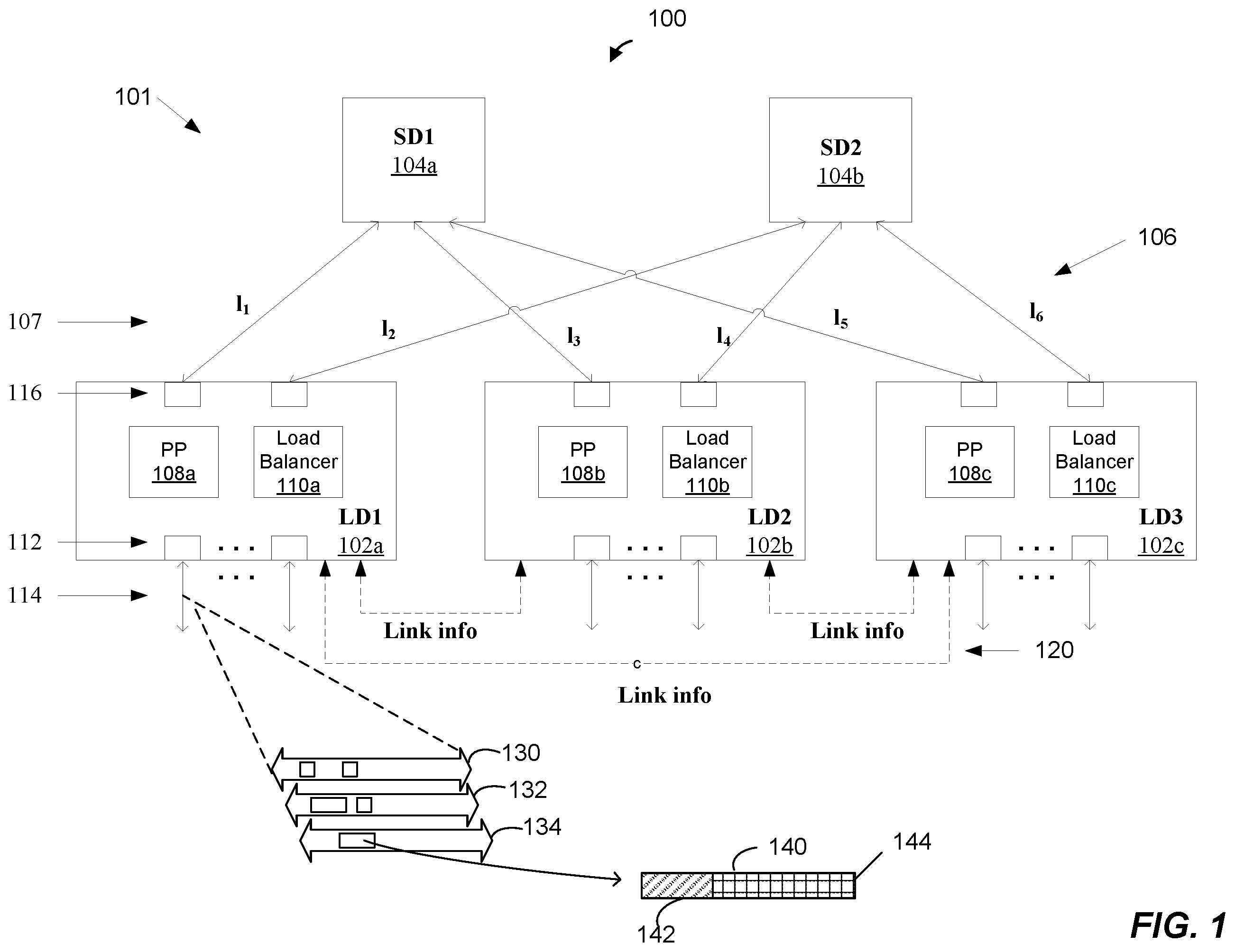
is a block diagram of an example switching system in which switching devices apply load balancing techniques to efficiently forward traffic over multiple available paths, according to an embodiment;
is block diagram of an example switching device configured to operate in the switching system of , according to an embodiment; and
is a flow diagram of an example method for balancing traffic load, the method implemented by one or more switching device of and/or the switching device of , according to an embodiment.
DETAILED DESCRIPTION
Embodiments are described herein in the context of load balancing traffic in a multi-rooted tree topology of switching or routing devices in a data center. It is noted however, in light of the disclosure and teachings herein, that similar methods and apparatus for load balancing can be employed in other suitable systems in which multiple links or paths are available for forwarding traffic in a network. The described load balancing methodologies are not limited to use in multi-rooted data center topologies, but rather may be utilized in other suitable contexts as well.
is a block diagram of an example network system 100 that utilizes load balancing techniques to efficiently forward traffic over multiple available paths between network devices, according to an embodiment. The network system 100 is suitable for use in data centers, server farms, or any systems that require switching or routing between a large number of ports, in an embodiment. The network system 100 includes a plurality of network devices 101 . In the embodiment of , the network devices 101 are arranged in a multi-rooted tree topology. In this topology, the network devices 101 include a plurality of first-stage switching devices 102 , also referred to herein as “leaf devices or LD” and a plurality of second stage switching devices 104 , also referred to herein as “spine devices of SD.” The leaf devices 102 and the spine devices 104 are interconnected via an interconnect network 106 having a plurality of links 107 l 1 -l 6 . In an embodiment, the interconnect network 106 connects each leaf device 102 to each spine device 104 . In an embodiment, the interconnect network 106 is a CLOS network. In another embodiment, the interconnect network 106 is a suitable type of network different from a CLOS network. In an embodiment, the network 106 connects each leaf device 102 to each spine device 104 via a respective one of links 107 . Similarly, the network 106 connects each spine device 104 to each leaf device 102 via a respective one of links 107 , in an embodiment.
In an embodiment, each leaf device 102 includes a plurality of downlink ports 112 for coupling the leaf device 102 to networks, devices in the networks, servers, storage device, or other host systems or devices between which network packets are forwarded in the network system 100 . Each leaf device 102 also includes a plurality of uplink ports 116 for coupling the leaf device 102 to spine devices 104 via the links 107 . Although in the embodiment of , merely for explanatory purposes, the network system 100 includes three leaf devices 102 and two spine devices 104 , in other embodiment, the network system 100 includes other suitable numbers of leaf devices 102 and/or other suitable numbers of spine devices 104 . In an embodiment, the number of leaf devices 102 and the number of spine devices 104 are generally determined by system requirements. For example, generally, the number of paths available for transmission of data between any two leaf devices 102 is equal to the number of spine devices 104 , in an embodiment. Accordingly, the number of spine device 104 in the network 100 may be selected according to bandwidth requirements for transmission of data between the leaf devices 102 , in an embodiment. The number of leaf devices 102 in the network 100 , on the other hand, is determined by a number of downlink ports needed by the network system 100 for connecting to networks, devices in the networks, servers, storage device, or other host systems or devices, etc., in an embodiment.
With continued reference to , ones of leaf devices 102 respectively include a packet processor 108 and a load balancer 110 , in an embodiment. In operation, when a data unit such as a packet or a frame (hereinafter referred to as “packet” merely for ease of explanation and brevity) is received at a leaf device 102 (also referred to herein as a source leaf device), the packet processor 108 of the leaf device 102 forwards the packet to one of the spine devices 104 . Then, the spine device 104 forwards the packet to a destination leaf device 102 (also referred to herein as a target leaf device) to which the packet is directed. Each leaf device 102 can be a source leaf device in some situations and a target leaf device in other situations, in an embodiment. The packet is then transmitted towards its destination by the destination leaf device 102 . Because each leaf device 102 is connected to each of the spine devices 104 , and each spine device 104 is connected to each of the leaf devices 102 , a packet received at a source leaf device 102 can reach its destination leaf device 102 by egressing the source leaf device 102 via any uplink port 116 of the source leaf device 102 , and accordingly, by traveling to the destination leaf device 102 via any of the spine devices 104 . Thus, multiple paths are available for transmission of a packet from a source leaf device 102 to a destination leaf device 102 . As just an example, a packet received at the leaf device LD 1 102 a that is directed to the leaf device LD 2 102 b (or, ultimately, to a device or a network coupled to a downlink port 112 of the leaf device LD 2 102 b ) can reach the leaf device LD 2 102 b by either (i) traveling from the leaf device LD 1 102 a via the link l 1 to the spine device SD 1 104 a , and then from the spine device SD 1 104 a via the link l 3 to the leaf device LD 2 102 b or (ii) traveling from the leaf device LD 1 102 a via the link 12 to the spine device SD 2 104 b , and then from the spine device SD 2 104 b via the link 14 to the leaf device LD 2 102 b.
In an embodiment, leaf devices 102 are configured to process data flows (also referred to herein as “packet flows” or simply “flows”), such as a data flow of packets received from a source device (e.g., a host device such as a server) coupled to a source leaf device 102 and transmitted to a destination device (e.g., another host device such as another server) coupled to a destination leaf device 102 . Several example data flows 130 - 134 processed by the leaf devices 102 in some embodiments are described in more detain below. Generally, packets belonging to a data flow should be transmitted via a same path between the source leaf device 102 and the destination leaf device 102 to ensure than the order of packets in the data flow is maintained in transmission of the packets from the source and destination leaf devices 102 , in an embodiment. [Thus, in an embodiment, a packet processor 108 of a leaf device 102 generally forwards packets that belong to a same data flow via a same link 107 such that the packets are transmitted to their destination leaf device 102 via a same spine device 104 . For example, the packet processor 108 of respective leaf devices 102 forwards packets using a forwarding table or a flow table (not shown in ) that associates data flows with ports, links and/or paths via which packets should be transmitted from the leaf device 102 . In an embodiment, when the leaf device 102 receives a packet, the packet processor 108 accesses the flow table using information that identifies a data flow of the packet to identify the port, link or path via which to transmit the packet. In an embodiment, the packet processors 108 are implemented in hardware and operate in a data plane at a sufficiently high data rate such that packets are transmitted from the leaf devices 102 with little or no delay experienced by the packets in the leaf devices 102 .
In an embodiment, the load balancer 110 of each leaf device 102 utilizes global congestion-aware load balancing techniques described herein to efficiently load-balance data flows being processed by the leaf device 102 among multiple paths available for transmission of the data flows from the leaf devices 102 . To this end, in an embodiment, each leaf device 102 maintains information indicative of an amount of data received via each link 107 coupled to the leaf device 102 . In an embodiment, the information indicative of the amount of data received via a link 107 by a leaf device 102 indicates a number of packets or a number of bytes received via the link 107 in a given amount of time, for example. A respective leaf device 102 periodically provides information indicative of the amount of data received via a respective link 107 coupled to the leaf device 102 , in an embodiment. In an embodiment, a leaf device 102 provides the information indicative of the measured amount of data received via each link 107 coupled to the leaf device 102 by periodically transmitting a respective control message 120 to each other leaf device 102 , where the control messages include the information indicative of the measured amount of received data by the leaf device 102 . In an embodiment, a respective leaf device 102 periodically transmits a respective control message 120 directly to other leaf devices 102 . In another embodiment, leaf devices 102 periodically transmit respective control messages 120 to other leaf devices 102 via links 107 and spine devices 104 .
Based at least in part on the information indicative of the amount of data received via respective links 107 by other leaf devices 102 , the load balancer 110 of each leaf device 102 periodically determines whether data flows currently being processed by the leaf device 102 should be rebalanced by redirecting one or more data flows from paths currently used for transmission of the data flows to the alternative paths available for transmission of the data flows. As will be explained in more detail below, in an embodiment, the traffic balancer 110 of a leaf device 102 (e.g., leaf device 102 a ) determines, based on (i) the information indicative of amount of data received by the other leaf devices 102 (e.g., 102 b and 102 c ) via respective links 107 coupled to the other leaf devices 102 , (ii) information indicative of amount of data transmitted by the leaf device 102 a on respective links 107 coupled to the leaf device 102 , and (iii) sizes (e.g., bandwidths of flows as measured by amount of data corresponding to the flow received in a given amount of time such as packets per second, bytes per second, etc.) of flows being processed by the leaf device 102 a , whether one or more data flows should be moved to other links 107 . For example, in an embodiment, the load balancer 110 calculates, based on (i)-(iii), a set of share metrics with respective ones of the share metrics indicating shares of data flows on respective paths available for transmission of the data flows with respect to all data flows being transmitted using links 107 included in the respective paths. The load balancer 100 then determines based on the set of share metrics that one or more data flows should be redirected from paths currently being used for transmission of the one or more data flows to new paths on which the one or more data flows will have greater shares as compared to shares of the data flows on the paths currently being used for transmission of the data flows. When the load balancer 110 determines that one or more data flows should be redirected from paths currently used for transmission of the data flows, the load balancer 110 causes the packet processor 108 of the leaf device 102 to begin routing packets belonging to the one or more data flows via the new paths. For example, the load balancer 110 updates the flow table used by the packet processor 108 to associate the one or more data flows with the corresponding new ports, links and/or paths via which packets belonging to the one or more data flows should now be transmitted from the leaf device 102 .
In an embodiment, such distribution of data flows among available links 107 achieves or at least approaches a min-max fair solution (at least when the distribution is at an equilibrium), in which a data flow is redirected to a new path if and only if moving of the data flow to the new path would increase share of the flow in the path at a cost of a decrease of another, larger flow, in the path. A min-max fair solution leads to a more stable equilibrium, in an embodiment, as compared to systems that utilize other methods for rebalancing data flows among multiple available links, such as systems that rebalance based on measures of link capacity. Moreover, convergence to equilibrium is achieved more quickly as compared, for example, to systems in which link capacity measures are used.
In an embodiment, to ensure that packets in a flow do not get reordered due to the flow being redirected to a new path, the packet processor 108 detects gaps in packets of flows, and redirects a flow only when a sufficiently large gap is detected in the flow. That is, in an embodiment, when the packet processor 108 makes a determination to redirect a flow, the flow is actually redirected only if and when a sufficiently large gap is detected between consecutive packets in the flow, in this embodiment. A burst of packets with a sufficiently large gap between a last packet of the burst and a first packet of the next burst is sometimes referred to herein as flowlet. In an embodiment, when the packet processor 108 redirects a flow to a new path, the packet processor 108 begins transmission of the flow on the new path with the first packet of a flowlet following a detected gap in the packet flow.
In an embodiment, the packet processor 108 of a leaf device 102 is implemented in hardware (e.g., using one or more integrated circuits) and operate at a suitable high rate to forward packets while introducing no or minimal delay in transmission of the packets. The load balancer 110 of the leaf device 102 , on the other hand, is implemented in firmware and/or software and generally operates at a slower rate to rebalance data flows being transmitted by the leaf device 102 , in an embodiment.
Referring still to , a link 114 coupled to a downlink port 112 of a leaf device 102 carries one or more data flows 130 , 132 , 134 . Typically but not necessarily, each of the data flows 130 , 132 , 134 is a bidirectional flow including data traveling to the leaf device 102 , or inbound data, and data traveling from the leaf device 102 , or outbound data. The other links 114 also carry one or several data flows, such as data flows 130 , 132 , 134 , in an embodiment. Some of the data flows 130 , 132 , 134 are associated with more than one of the links 114 , in an embodiment. In some embodiments and/or scenarios, the data flows 130 , 132 , 134 are associated with different communication protocols such as Transmission Control Protocol (TCP) layered over Internet Protocol (IP) (hereinafter, “TCP/IP”), User Datagram Protocol (UDP) layered over IP (hereinafter, “UDP/IP”), File Transfer Protocol (FTP), Hypertext Transfer Protocol (HTTP), etc. For example, the data flow 130 corresponds to FTP, the data flow 132 corresponds to Telnet, and the data flow 134 corresponds to HTTP, in one scenario. Further, some of the data flows 130 - 314 correspond to different sessions associated with the same communication protocol, in some scenarios. A typical network link also includes Simple Mail Transfer Protocol (SMTP), Structured Query Language (SQL), and several additional data flows associated with e-mailing, web browsing, database applications, remote login, and other application types.
In some scenarios, the data flows 130 , 132 , 134 respectively define a flow aggregate (FA) that includes multiple streams, sessions, or connections corresponding to various communication protocol layers. For ease of explanation, the term “flow” is used herein interchangeably to mean either a flow that includes a single stream, session or connection or a flow aggregate that includes multiple streams, sessions, or connections. The data flows 130 , 132 , 134 vary in bandwidth, in some embodiments and scenarios. For example, the data flow 130 is a relatively small bandwidth short-lived flow, such as a flow associated with transmission of an email message or flow associated with a web browser search, in an embodiment. On the other hand, the data flow 132 is a relatively large bandwidth long-lived flow, such as a flow associated with transfer of data, in an example embodiment and scenario. The relatively short-lived flows are sometimes referred to herein as “mouse flows,” and the relatively long-lived flows are sometimes referred to herein as “elephant flows.”
It is noted that some protocols, such as TCP, are connection-oriented while others, such as UDP, are connectionless. In one example scenario, a first host device (e.g., a first server coupled to a first downlink port 112 ) connects to a second host device (e.g., a second server coupled to a second downlink port 112 ) by establishing a TCP connection having a particular address and port combination on both ends. This connection is identifiable by the TCP header specifying, in part, the address of the outside host, the address of the local host, the port on the outside host, and the port on the local host. An individual TCP/IP packet carries a certain quantum or chunk of information associated with the same connection, or communication session. On the other hand, in another example scenario, a pair of hosts uses the UDP protocol to exchange individual messages, or datagrams, without establishing a connection. Thus, in some scenarios, each of the data flows 130 , 132 , 134 includes one or more streams such as TCP streams including multiple packets associated with a single data exchange or single packets conveying individual messages in their entirety. In the examples discussed below, a data stream generally refers to a unidirectional or bidirectional data exchange between two or more hosts including one or more packets such as data packets or frames.
With continued reference to , an example data packet 140 in the flow 134 includes a header 142 and a payload 144 . In general, the header 142 corresponds to one or more layers of a protocol stack. A forwarding engine (not shown in ) of the packet processor 108 a is configured to analyze the header 142 to determine via which port or ports the packet 140 should be egressed. For example, in some embodiments, the forwarding engine of the packet processor 108 a uses a portion of the header 142 , such as a destination address, to look up in a forwarding database (not shown in ) an indication of a port or ports via which the packet 140 is to be egressed.
is block diagram of the example leaf device 102 a of in more detail, according to an embodiment. In an embodiment, each of the leaf devices 102 b , 102 c is the same as or similar to the leaf device 102 a and operates in the manner the same as or similar to the manner described with respect to the leaf device 102 . In the embodiment of , the leaf device 102 a receives a packet 148 via a downlink port 112 a . The packet 148 is the same as or similar to the packet 140 of , in an embodiment. The packet processor 108 a of the leaf device 102 a determines that the packet 148 is to be transmitted via an uplink port 116 to another leaf device 102 (e.g., the leaf device 102 b ). In an embodiment, the packet processor 108 a determines via which uplink port 116 the packet 148 should be transmitted by accessing a flow table 150 . In an embodiment, the packet processor 108 a determines via which port 116 the packet 148 should be transmitted towards the leaf device 102 b . In an embodiment, the packet processor 108 a determines via which port 116 the packet 148 should be transmitted based on a data flow of the packet 148 by accessing a flow table 150 . The flow table 150 stores associations between flows of packets and uplink ports 116 that are to be used for transmission of the packets, in an embodiment. The packet processor 108 a accesses the flow table 150 using an identifier of the flow of the packet 148 as an index into the flow table 150 , in an embodiment. If the flow table 150 includes an entry corresponding to the flow of the packet 148 , then the packet processor 108 a retrieves, from the entry in the flow table 150 associated with the flow of the packet, an indication of the uplink port 116 via which the packet 148 is to be transmitted. The packet processor 108 a then sends the packet 148 to the uplink port 116 , identified in the flow table 150 , for transmission of the packet 148 via the uplink port 116 .
On the other hand, if the flow table 150 does not include an entry corresponding to the flow of the packet 148 , this indicates that the packet 148 belongs to a new flow not currently being processed by the leaf device 102 a . In this case, the packet processor 108 a utilizes a load balancing technique to determine via which uplink port 116 to transmit the packet 148 . For example, the packet processor 108 a utilizes an equal multi path cost (EMPC) technique to determine via which uplink port 116 to transmit the packet 148 , in an embodiment. In this embodiment, the packet processor 108 a applies a hash function to one or more fields of a header of the packet 148 and utilizes the result of the hash function to determine the uplink port 116 via which the packet 148 is to be transmitted. In other embodiments, the packet processor 108 a uses other suitable load balancing techniques to select an uplink port 116 via which the packet 148 belonging to a new flow is to be transmitted. The packet processor 108 a then sends the packet 148 to the determined uplink port 116 for transmission of the packet 148 via the determined port 116 . Additionally, the packet processor 108 a inserts a new entry into the flow table 150 , wherein the new entry associates the flow of the packet 148 with the port 116 determined for the packet 148 , to cause transmission of subsequent packets that belong to the same flow to be transmitted via the same port 116 , in an embodiment.
With continued reference to , the packet processor 108 a is configured to maintain various statistics of packet flows being processed by the leaf device 102 a and packets that travel on the links 107 coupled to the ports 116 of the leaf device 102 a , in an embodiment. The leaf device 102 a includes a links state table 160 , in an embodiment. The link state table 160 includes a plurality of entries respectively corresponding to the links 107 l 1 -l 6 used for recording information indicative on amounts of data traveling on the links 107 l 1 -l 6 , as described in more detail below, in an embodiment.
In an embodiment, the packet processor 108 a is configured to maintain a set of flow counters 153 for assessing bandwidths of flows being processed by the leaf device 102 a . In an embodiment, the set flow counters 153 includes respective flow counters associated with packet flows being processed by the leaf device 102 a . When the leaf device 102 a receives a packet via a port 112 a and the packet processor 108 a determines a flow of the packet, the packet processor 108 a determine whether a counter 153 in the set of flow counters 153 is associated with the flow of the packet. If the packet processor 108 a determines that a counter 153 in the set of flow counters 153 is associated with the flow of the packet, the packet processor 108 a increments the counter 153 associated with the flow of the packet to account for the packet. On the other hand, if the packet processor 108 a determines that no counter 153 in the set of flow counters 153 is associated with the flow of the packet (e.g., if the packet is a first packet of the flow), then the packet processor 108 a associates an available flow counter 153 with the flow of the packet and then increments the counter 153 associated with the flow of the packet to account for the packet. In an embodiment, the packet processor 108 a increments the counter 153 by an amount corresponding to a length (e.g., a number of bits, a number of bytes, etc.) of the packet. In an alternative embodiment, the packet processor 108 a updates flow counter fields in entries of the flow table 150 associated with flows of packets, instead of incrementing flow counters 153 , to account for the corresponding packets. The leaf device 102 a omits the flow counters 153 , in this embodiment.
The packet processor 108 a is configured to maintain the flow counts for each given sampling time interval sampling time interval T sam , in an embodiment. Upon expiration of the sampling time interval T sam , values of the flow counters 153 are recorded in the flow table 150 , for example, in an embodiment. For example, the packet processor 108 a causes the values of the flow counters 153 to be written in corresponding entries in the flow table 150 , in an embodiment. Also upon expiration of each sampling time interval T sam , the packet processor 108 a flushes (e.g., zeros out) the flow counters 153 or applies a moving average function, such as an exponential moving average (EMA) function to the flow counters 153 , and initiates count for the next time interval T sam , in various embodiments.
The packet processor 108 a is also configured to maintain a set of receive (Rx) counters 154 with respective Rx counters 154 corresponding to respective links 107 , or an Rx table with respective entries corresponding to respective links 107 , in various embodiments. Thus, for example, with reference to , the Rx counters 154 include two Rx counters 154 including a first Rx counter 154 corresponding to the link l 1 and a second Rx counter 154 corresponding to the link 12 , in an embodiment. Although Rx counters 154 include two Rx counters 154 corresponding to two links 107 coupled to the leaf device 102 a in this example embodiment, the Rx counters 154 include other numbers of Rx counters 154 corresponding to other numbers of links 107 coupled to the leaf device 102 a in other embodiments. In operation, each Rx counter 154 maintains a count of data (e.g., number of packets, number of bytes, etc.) received by the leaf device 102 a via a corresponding link l 1 , l 2 during a given amount of time corresponding to a sampling interval T sam , in an embodiment. For example, the packet processor 108 a is configured to update an Rx counter 154 associated with a link 107 each time the leaf device 102 a receives a packet via a corresponding uplink port 116 coupled to the link 102 , in an embodiment. In an embodiment, the packet processor 108 a increments the Rx counter 154 associated with the link l 07 by a length (e.g., a number of bits, a number of bytes, etc.) of each packet received by the leaf device 102 a via a corresponding port 116 coupled to the link 107 , in an embodiment. Upon expiration of the sampling time interval T sam , values of the Rx counters 154 are transmitted by the leaf device 102 a to another leaf device 102 in the network system 100 , in an embodiment. For example, the packet processor 108 a of the leaf device 102 a causes the control message 120 to be transmitted to another switching device 102 , in an embodiment. Also upon expiration of each sampling time interval T sam , the packet processor 108 a flushes (e.g., zeros out) the Rx counters 154 or applies a moving average function, such as an EMA function to the Rx counters 154 , and initiates count for the next time interval T sam , in various embodiments.
In an embodiment, the packet processor 108 a is configured to send a control message 120 that contains the values of the Rx counters 154 to the other link device 102 in the network system 100 . In an embodiment, the packet processor 108 a sends such control message 120 to one of the other leaf devices 102 upon expiration of each sampling time interval T sam . In an embodiment, the packet processor 108 a selects the one other leaf device 102 to which to send a control message 120 upon expiration of a particular sampling interval T sam according to a suitable arbitration scheme, a round robin arbitration scheme. In an embodiment, the control messages 120 are transmitted by the leaf device 102 a directly (e.g., via respective direct control links) to the other leaf devices 102 . In another embodiment, the control messages 120 are transmitted to the leaf device 102 a to the other leaf devices 102 via the network 107 and the spine devices 104 .
In an embodiment, the leaf device 102 a also receives control messages 120 transmitted, in the same manner, by other leaf devices 102 . The control messages 120 that the leaf device 102 a receives from the other leaf devices 102 include information measured by the other leaf device 102 , in an embodiment. Thus, for example, a control message 120 that the leaf device 102 a receives from the leaf device 102 b includes information, measured by the leaf device 102 b , the information indicative of an amount of data received, in an time period corresponding to the time interval T sam , by the leaf device 102 b via each of the links 13 , 14 coupled to the leaf device 102 b . In an embodiment, the information includes values of Rx counters, such as the Rx counters 154 , maintained by the leaf device 102 b in the manner described above. Similarly, a control message 120 that the leaf device 102 a receives from the leaf device 102 c includes information, measured by the leaf device 102 c , the information indicative of an amount of data received, in an time period corresponding to the time interval T sam , by the leaf device 102 c via each of the links 15 , 16 coupled to the leaf device 102 c . The leaf device 102 a records the information received in the control messages 120 in a link state table 160 , in an embodiment. The arbitration scheme (e.g.,) used by the leaf devices 102 for transmission of the control messages to the other leaf devices 102 ensures coordination among the leaf devices 102 by ensuring that each leaf device 102 obtains the link state information periodically as determined by the arbitration scheme, in an embodiment.
With continued reference to , the packet processor 108 a is further configured to maintain a set of transmit (Tx) counters 156 , with respective Tx counters 156 corresponding to respective links 107 , or a Tx table with respective entries corresponding to respective links 107 , in various embodiments. The packet processor 108 a is configured to update a Tx counter 156 associated with a link 107 each time the leaf device 102 a transmits a packet via a corresponding uplink port 116 coupled to the link 107 , in an embodiment. For example, the packet processor 108 a is configured to increment the Tx counter 156 associated with the link 107 by a length (e.g., a number of bits, a number of bytes, etc.) of each packet transmitted by the leaf device 102 a via a corresponding port 116 coupled to the link 102 , in an embodiment. Upon expiration of a sampling time interval T sam , values of the Tx counters 156 are recorded in corresponding entries in the link state table 160 , in an embodiment. For example, the packet processor 108 a of the leaf device 102 a causes the values of the Tx counters 156 to be written in corresponding entries in the link state table 160 , in an embodiment. Also upon expiration of each sampling time interval T sam , the packet processor 108 a flushes (e.g., zeros out) the Tx counters 156 or applies a moving average function, such as an EMA function to the TX counters 156 , and initiates count for the next time interval T sam , in various embodiments.
The load balancer 110 a of the leaf device 102 a is configured to periodically determine that one or more flows that are currently being transmitted via certain ones of the uplink ports 114 and corresponding links 107 should be moved to other ones of the uplink ports 114 and corresponding other links 107 to improve balancing of flows among the links 107 , in an embodiment. When the load balancer 110 a determines that one or more flows should be redirected, the load balancer 110 a updates corresponding entries in the flow table 150 such that these entries indicate the new ports 114 . As a result, subsequent packets corresponding to the flows are sent by the packet processor 108 a to the new ports 114 for transmission of the packets via the new ports 114 . In an embodiment, the decisions by the dynamic balancer 112 a involve calculations using link state information obtained by the leaf device 102 a from the other leaf devices 102 (e.g., the leaf device 102 b and the leaf device 102 c ) in the network 100 and, additionally, based on link information maintained locally by the leaf device 102 a . In an embodiment, the load balancer 110 a performs the following calculation for each data flow being processed by the leaf device 102 a and for each of k paths between the leaf device 102 a and the target leaf device 102 b , 102 c to which the data flow is directed:
F share L i → { via k } → L j = F size max ( Rx L j ( k ) , Tx L i ( k ) ) Equation 1 where F share L i →{via k}→L j is a measure of share of the flow on the path k that includes the links L; and L;, F size is a size or bandwidth of the flow (e.g., as indicated in the entry in the flow table 150 associated with the flow), Tx L i (k) is the amount of traffic transmitted by the source leaf device LD 1 102 a on the link L i (e.g., as indicated in the entry in the link state table 160 associated with the link L i ), and Rx L j(k) is amount of traffic received by the target leaf device via the link L j (e.g., as indicated in the entry in the link state table 160 associated with the link L j ). Thus, for example, referring to , for a flow that is directed from the leaf device LD 1 102 a to the leaf device LD 2 102 b and is currently transmitted to the leaf device LD 2 102 b via the path that includes the link l 1 from the leaf device LD 1 102 a to the spine device SD 1 104 a and the link l 3 from the spine device SD 1 104 a to the leaf device LD 2 102 b (l 1 -SD 1 - l 3 path), the load balancer 110 a of the leaf device LD 1 102 a calculates the share of the flow via the path l 1 -SD 1 - l 3 by dividing size of the flow (e.g., amount of data corresponding to the flow received in a given amount of time such as packets per second, bytes per second, etc.) by a maximum of (i) the amount of traffic transmitted by the leaf device LD 1 102 a on the path l and (ii) the amount of traffic received by the leaf device 102 b via the path 13 . Additionally, the load balancer 110 a of the leaf device LD 1 102 a calculates potential share of the flow if the flow were transmitted from the leaf device LD 1 102 a to the leaf device 102 b via the path 12 -SD 2 - l 4 by dividing size of the flow by a maximum of (i) the amount of traffic transmitted by the leaf device LD 1 102 a on the path 12 and (ii) the amount of traffic received by the leaf device 102 b via the path 14 . The load balancer 110 a then calculates a set of gain metrics with respective gain metrics indicating gains in share that the flow would achieve if the flow were redirected from the currently used path (l 1 -SD 1 - l 3 ) to the alternative path (l 2 -SD 2 - l 4 ), in an embodiment. For example, the load balancer 110 a calculates the gain by subtracting the calculated share of the flow on the currently used path (l 1 -SD 1 - l 3 ) from the calculated potential share of the flow if the flow were transmitted via the path 12 -SD 2 - l 4 , in an embodiment.
The load balancer 110 a performs such flow share gain calculations for each flow currently being processed by the leaf device LD 1 102 a , in an embodiment. Accordingly, the load balancer 110 a calculates, for each flow being processed by the leaf device LD 1 102 a , (i) share of the flow on the path that is currently being used for transmission of the flow to its destination lead device 102 , (ii) potential share of the flow on each other path available for transmission of the flow to its destination lead device 102 , and (iii) for each of the other paths available for transmission of the flow to its destination lead device 102 , gain that the flow would achieve of the flow were moved to the other path available for transmission of the flow to its destination lead device 102 . In another embodiment, the load balancer 110 a performs such flow share calculations for only a subset of the flows currently being processed by the leaf device LD 1 102 a , where the subset does not necessarily include all of the flows currently being processed by the leaf device LD 1 102 a . For example, the load balancer 110 a performs flow share gain calculations for relatively larger flows, such as for each flow having a size that exceeds a predetermined threshold, in an embodiment. In any event, once the load balancer 110 a has completed the flow share gain calculations, the load balancer 110 a identifies m flows having largest flow share gains, where m is an integer, and causes the identified one or more flows to be moved to the paths on which these gains are achieved, in an embodiment. For example, in an embodiment, the load balancer 110 a updates one or more flow entries, in the flow table 150 , corresponding to the identified one or more flows to indicate the alternative paths for the one or more flow to cause subsequent packets that belong to the one or more flow are transmitted via the corresponding alternative paths.
In an embodiment, respective entries in the flow table 150 include respective valid flow indication (e.g., one bit) fields and respective age indication (e.g., one bit) fields. In an embodiment, a valid flow indication in an entry indicates whether the entry is currently valid and should be used for forwarding packets of the corresponding flow. An age field in an entry is used to detect a flowlet or a gap in the corresponding flow, in an embodiment. The age field indicates an amount of time that the entry has not been accessed, in an embodiment. For example, the age field of an entry is reset to zero every time the entry is accessed and is incremented by one on each clock cycle until the next time the entry is accessed, in an embodiment. In an embodiment, when the packet processor 108 determines that a flow should be redirected onto a new path, the packet processor 108 detects a sufficiently large gap in the flow based on the age indication in the entry, in the flow table 150 , corresponding to the flow. For example, the packet processor 108 detects a sufficiently large gap if the value of the age fiend exceeds a predetermined threshold, in an embodiment. Upon detecting the gap, the packet processor 150 creates a new entry corresponding to the flow, and indicates the new path (e.g., the port 116 corresponding to the new path) in the new entry such as subsequent packets of the flow are forwarded on the new path, in an embodiment. In an embodiment, the packet processor 108 creates the new entry when the packet processor 108 receives a first packet of a next flowlet of the flow.
In some embodiments, the load balancer 110 a calculates metrics other than gain metrics and determines paths for flows based on the metrics other than the gain metrics. For example, in an embodiment, the load balancer 110 a identifies one or more flows that are of relatively large sizes (e.g., largest bandwidth flows), and ensures that these flows are forwarded on paths that are least utilized as indicated by information in the link state table 160 , in an embodiment. In some embodiments, the load balancer 110 a performs the flow share and flow gain calculations only when link utilization, for example as indicated by information in the link state table 160 , exceeds a threshold and does not perform these calculations otherwise. In such embodiments, the dynamic balancing of the packet flows is performed by the leaf device 102 a only when link utilization is relatively high and is not performed otherwise.
is a flow diagram illustrating an example method 300 for balancing traffic load in a network system, according to an embodiment. In an embodiment, each leaf device 102 of is configured to implement the method 300 . The method 300 is described with reference to the network system 100 and the leaf device 102 a of merely for explanatory purposes. In other embodiments, the method 300 is implemented by suitable network devices different from the leaf device 102 of and/or is implemented by suitable network devices operating in network systems different from the network system 100 of .
At block 302 , the leaf device 102 a receives information measured by a target leaf device (e.g., the leaf device 102 b ). The information is indicative of an amount of data received in a given amount of time by the target leaf device 102 b via each of two or more first links coupled to the target switching device 102 b . In an embodiment, the information indicative of the amount of data received by the target leaf device 102 b via each of the two or more first links (e.g., each of links l 3 and l 4 ) coupled to the target leaf device 102 b is measured by the target leaf device 102 b by counting bits or bytes of data received by the target switching device via each of the links 13 and 14 coupled to the target leaf device 102 b . In an embodiment, the information is indicative of total amount of data received by the target leaf device 102 b in the given amount of time via each of the links l 3 and l 4 , where the data includes data transmitted by multiple leaf devices (e.g., the leaf device 102 a and the leaf device 102 c ). In an embodiment, the information is included in a control message (e.g., a control message 120 ) transmitted by the target leaf device 102 b to the source leaf device 102 a.
At block 304 , the source leaf device 102 a determines a path from among multiple paths from the source switching device 102 a to the target switching device 102 b for transmission of a packet flow directed to the target switching device 102 b . In an embodiment, the source switching device 102 a determines the path at block 304 based at least in part on the information received from the target leaf device 102 b at block 302 . In an embodiment, the source leaf device 102 a determines the path by calculating, based at least in part on information received at block 302 , respective flow share metrics for one or more packet flows being processed by the source leaf device 102 a , and determines the path based on the flow share metrics. In an embodiment, the leaf device 102 a calculates the flow share metrics according to Equation 1 as described above. In another embodiment, the source leaf device 102 a calculates the flow share metrics in another suitable manner. In an embodiment, the source leaf device 102 a determines the path based on the determining the path based on the flow share metrics such that share of the packet flow on the determined path is greater than share of the packet flow on a path that is currently being used by the source leaf device 102 a for transmission of the packet flow.
At block 306 , the source switching device 102 a transmits one or more packets belonging to the packet flow. In an embodiment, the source switching device 102 a transmits the packet at block 306 via the path determined at block 304 . In an embodiment, the source switching device 102 a determines a link associated with the determined path and transmits the packet via a port coupled to the link such that the packet is transmitted via the determined path.
At least some of the various blocks, operations, and techniques described above may be implemented utilizing hardware, a processor executing firmware instructions, a processor executing software instructions, or any combination thereof.
When implemented in hardware, the hardware may comprise one or more of discrete components, an integrated circuit, an application-specific integrated circuit (ASIC), a programmable logic device (PLD), etc.
When implemented utilizing a processor executing software or firmware instructions, the software or firmware instructions may be stored in any computer readable memory such as on a magnetic disk, an optical disk, or other storage medium, in a RAM or ROM or flash memory, processor, hard disk drive, optical disk drive, tape drive, etc. The software or firmware instructions may include machine readable instructions that, when executed by one or more processors, cause the one or more processors to perform various acts.
While the present invention has been described with reference to specific examples, which are intended to be illustrative only and not to be limiting of the invention, changes, additions and/or deletions may be made to the disclosed embodiments without departing from the scope of the invention. For example, one or more portions of methods or techniques described above may be performed in a different order (or concurrently) and still achieve desirable results.
Figures (3)
Citations
This patent cites (148)
- US5032987
- US5896380
- US6035107
- US6249521
- US6363396
- US6426947
- US6430170
- US6535530
- US6614758
- US6735670
- US6757742
- US6807179
- US6813268
- US6874039
- US6973082
- US7111162
- US7190696
- US7224845
- US7280527
- US7346706
- US7362750
- US7424016
- US7424019
- US7443790
- US7496033
- US7539750
- US7554914
- US7567567
- US7580417
- US7613209
- US7623455
- US7636319
- US7639614
- US7643427
- US7796594
- US7817627
- US7821925
- US7821931
- US7881221
- US7898959
- US7924860
- US7941637
- US7969880
- US7970961
- US7979671
- US8004990
- US8090913
- US8130754
- US8213420
- US8218553
- US8238250
- US8243594
- US8244909
- US8250399
- US8274971
- US8279871
- US8339951
- US8355328
- US8358651
- US8364711
- US8401043
- US8422508
- US8503456
- US8532099
- US8547971
- US8553582
- US8578097
- US8587674
- US8614950
- US8625594
- US8660005
- US8683061
- US8756424
- US8792497
- US8848728
- US8948193
- US9154444
- US9166916
- US9455967
- US9923828
- US10904150
- US11962505
- US2002/0087716
- US2002/0093952
- US2003/0043825
- US2003/0081599
- US2003/0147385
- US2003/0210688
- US2003/0235168
- US2004/0015582
- US2004/0073640
- US2005/0083936
- US2005/0213582
- US2006/0147208
- US2006/0245423
- US2006/0251109
- US2006/0291392
- US2007/0168531
- US2007/0280258
- US2008/0031263
- US2008/0037531
- US2008/0037544
- US2008/0049774
- US2008/0052488
- US2008/0084881
- US2008/0114887
- US2008/0123525
- US2008/0159309
- US2008/0181103
- US2008/0205655
- US2008/0225853
- US2008/0315985
- US2009/0003204
- US2009/0196303
- US2009/0259825
- US2009/0274154
- US2010/0023726
- US2010/0046537
- US2010/0098104
- US2010/0142398
- US2010/0142410
- US2010/0149979
- US2010/0214913
- US2011/0007741
- US2011/0013627
- US2011/0013638
- US2011/0013639
- US2011/0026541
- US2011/0093660
- US2011/0102612
- US2011/0134925
- US2011/0164616
- US2011/0295894
- US2011/0296411
- US2012/0042121
- US2012/0136846
- US2013/0013880
- US2014/0016470
- US2014/0093073
- US2014/0115167
- US2014/0160934
- US2014/0301394
- US2014/0325228
- US2016/0142269
- US2017/0032011
- US2017/0085485
- US2017/0093723
- US9907180