Multi-cluster System and Multi-cluster System Control Method
Abstract
A multi-cluster system, comprising: a first cluster, comprising a first processor and a second processor; a second cluster, comprising a third processor and a fourth processor; and a storage system, comprising a first storage device comprising a first port and a second port. The first processor is coupled to the first port of the first storage device and the third processor is coupled to the second port of the first storage device, wherein the first processor and the third processor can read information stored in an identical address of the first storage device.
Claims (13)
1. A multi-cluster system, comprising: a first cluster, comprising a first processor and a second processor; a second cluster, comprising a third processor and a fourth processor; and a storage system, comprising a first storage device comprising a first port and a second port; wherein the first processor is coupled to the first port of the first storage device and the third processor is coupled to the second port of the first storage device, wherein the first processor and the third processor can read information stored in an identical address of the first storage device; wherein the storage system further comprises a second storage device comprising a first port and a second port, wherein the first processor is coupled to the first port of the second storage device and the third processor is coupled to the second port of the second storage device, wherein the first processor and the third processor can read information stored in an identical address of the second storage device; wherein the first storage device comprises first confirming information and the second storage device comprises first firmware, wherein the first processor and the third processor can read the first confirming information to check if the first firmware corresponds to the first processor or the third processor.
7. A multi-cluster system control method, applied to a multi-cluster system comprising a first cluster and a second cluster, the first cluster comprising a first processor and a second processor and the second cluster comprising a third processor and a fourth processor, the multi-cluster system control method comprising: (a) coupling the first processor to a first port of a first storage device; (b) coupling the third processor to a second port of the first storage device; and (c) reading information stored in an identical address of the first storage device by the first processor and the third processor; wherein the first storage device comprises first confirming information and first firmware, wherein the step (c) uses the first processor and the third processor to read the first confirming information to check if the first firmware corresponds to the first processor or the third processor.
Show 11 dependent claims
2. The multi-cluster system of claim 1 , wherein the first storage device comprises a booting program, wherein the first processor and the third processor can read the booting program to perform a booting operation.
3. The multi-cluster system of claim 1 , wherein the first storage device comprises compressed data and non-compressed data, wherein the non-compressed data is data acquired by decompressing the compressed data, wherein the first processor and the third processor can read and decompress the compressed data to generate de-compressed data, wherein the first processor and the third processor further respectively check if the de-compressed data corresponds to the second processor and the fourth processor, to respectively control the second processor and the fourth processor to read the non-compressed data.
4. The multi-cluster system of claim 1 , wherein the first storage device comprises initiating codes of a booting program and the second storage device comprises booting data which a booting operation needs, wherein the first processor and the third processor can read the initiating code and the booting data to perform a booting operation.
5. The multi-cluster system of claim 1 , wherein the storage device is a SRAM.
6. The multi-cluster system of claim 1 , wherein time of the first processor reading the information stored in the identical address of the first storage device and the time of the third processor reading the information stored in the identical address of the first storage device partially overlap or are totally identical.
8. The multi-cluster system control method of claim 7 , wherein the first storage device comprises a booting program, wherein the step (c) uses the first processor and the third processor to read the booting program to perform a booting operation.
9. The multi-cluster system control method of claim 7 , wherein the first storage device comprises compressed data and non-compressed data, wherein the non-compressed data is data acquired by decompressing the compressed data, wherein the step (c) comprises: using the first processor and the third processor to read and decompress the compressed data to generate de-compressed data; and using the first processor and the third processor to respectively check if the de-compressed data corresponds to the second processor and the fourth processor, to respectively control the second processor and the fourth processor to read the non-compressed data.
10. The multi-cluster system control method of claim 7 , further comprising: coupling the first processor to a first port of a second storage device; coupling the third processor to a second port of the second storage device; and reading information stored in an identical address of the second storage device by the first processor and the third processor.
11. The multi-cluster system control method of claim 10 , wherein the first storage device comprises initiating codes of a booting program and the second storage device comprises booting data which a booting operation needs, wherein the step (c) uses the first processor and the third processor to read the initiating code and the booting data to perform a booting operation.
12. The multi-cluster system control method of claim 7 , wherein the storage device is a SRAM.
13. The multi-cluster system control method of claim 7 , wherein time of the first processor reading the information stored in the identical address of the first storage device and the time of the third processor reading the information stored in the identical address of the first storage device partially overlap or are totally identical.
Full Description
Show full text →
BACKGROUND OF THE INVENTION
1. Field of the Invention
The present invention relates to a multi-cluster system and a multi-cluster system control method, and particularly relates to a multi-cluster system and a multi-cluster system control method which allow processors in different clusters to read an identical storage device to save waiting time.
2. Description of the Prior Art
For a conventional computer, clusters are often used to speed up data processing. A cluster usually comprises at least one bus and a plurality of processors, so that different processors can simultaneously process different tasks to increase the overall processing speed of the computer. In a multi-cluster system, when a booting action is to be performed, different processors are sued to perform their booting operations sequentially, thus requires a longer boot time. Further, if firmware of different processors needs to be updated, the different processors perform their updating operations sequentially, thus requires a longer firmware update time. With the progress and complexity of the operating system used by the computer, more firmware needs to be updated, and therefore a longer firmware update time is also required. In such case, the computer lag issue becomes more serious.
SUMMARY OF THE INVENTION
One embodiment of the present invention is to provide a multi-cluster system which can improve delay problems.
Another embodiment of the present invention is to provide a multi-cluster system control method which can improve delay problems.
One embodiment of the present invention discloses a multi-cluster system, comprising: a first cluster, comprising a first processor and a second processor; a second cluster, comprising a third processor and a fourth processor; and a storage system, comprising a first storage device comprising a first port and a second port. The first processor is coupled to the first port of the first storage device and the third processor is coupled to the second port of the first storage device, wherein the first processor and the third processor can read information stored in an identical address of the first storage device.
Another embodiment of the present invention discloses a multi-cluster system control method, applied to a multi-cluster system comprising a first cluster and a second cluster, the first cluster comprising a first processor and a second processor and the second cluster comprising a third processor and a fourth processor, the multi-cluster system control method comprising: (a) coupling the first processor to a first port of a first storage device; (b) coupling the third processor to a second port of the first storage device; and (c) reading information stored in an identical address of the first storage device by the first processor and the third processor.
In view of above-mentioned embodiments, different processors in different clusters can read the same information in the same storage device at the same time, so that the delay problem of reading in turn in the prior art can be improved.
These and other objectives of the present invention will no doubt become obvious to those of ordinary skill in the art after reading the following detailed description of the preferred embodiment that is illustrated in the various figures and drawings.
BRIEF DESCRIPTION OF THE DRAWINGS
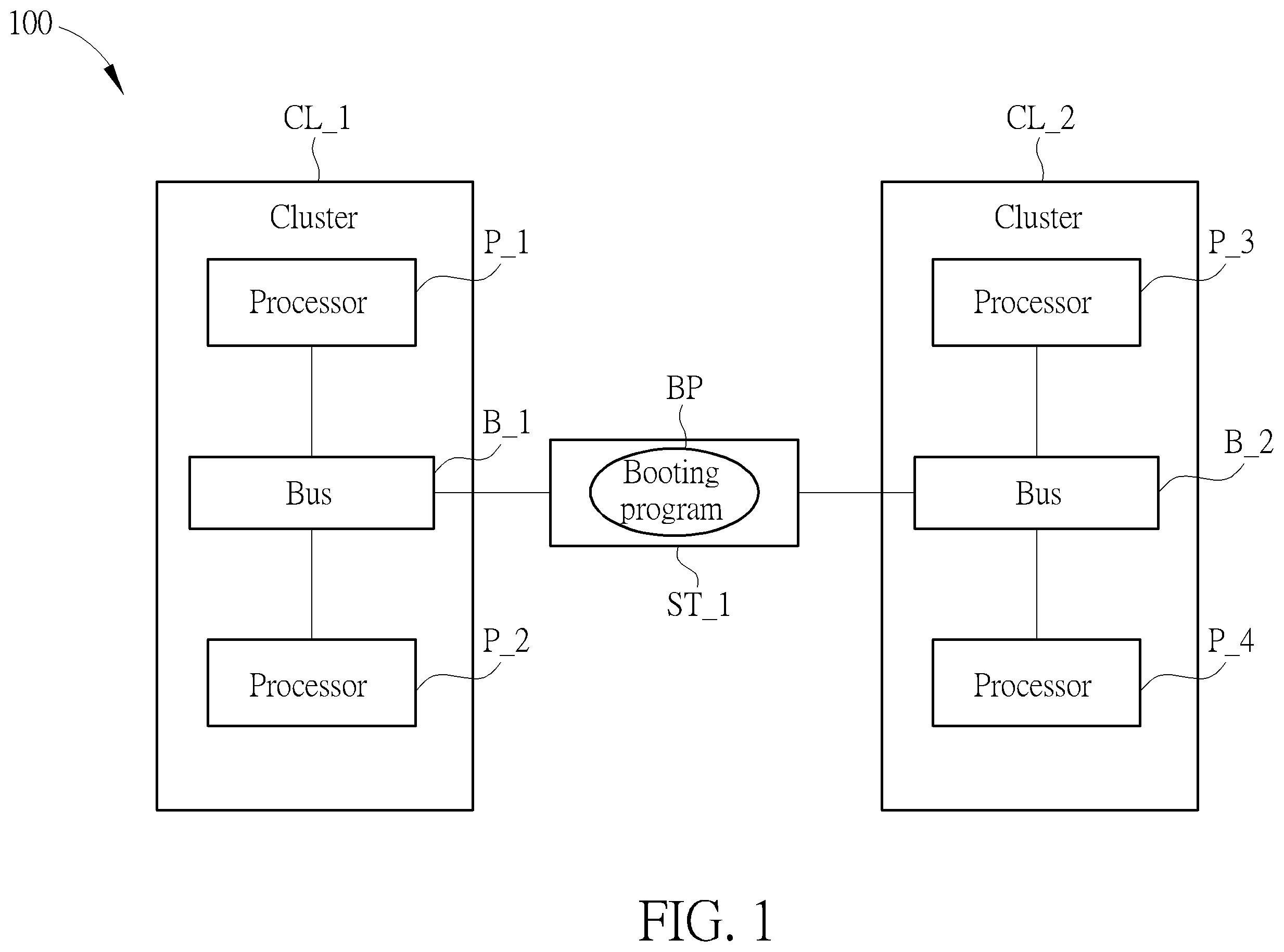
is a block diagram illustrating a cluster system according to one embodiment of the present invention.
is a block diagram illustrating detail structures of the storage device in , according to one embodiment of the present invention.
, are block diagrams illustrating multi-cluster systems according to different embodiments of the present invention.
, and are block diagrams illustrating multi-cluster systems which comprises a plurality of storage devices, according to different embodiments of the present invention.
is a flow chart illustrating a multi-cluster system control method according to one embodiment of the present invention.
DETAILED DESCRIPTION
Several embodiments are provided in following descriptions to explain the concepts of the present invention. Please also note that in the following embodiments, two clusters that respectively comprise two processors are used for illustration. Also, a storage system comprising one or two storage devices is also used for illustration. However, the multi-cluster system provided by the present invention may comprise other numbers of clusters, processors or storage devices. Additionally, the term “first”, “second”, “third” in following descriptions are only for the purpose of distinguishing different one elements, and do not mean the sequence of the elements. For example, a first device and a second device only mean these devices can have the same structure but are different devices.
is a block diagram illustrating a cluster system 100 according to one embodiment of the present invention. As shown in , the multi-cluster system comprises a first cluster CL_ 1 and a second cluster CL_ 2 . The first cluster CL_ 1 comprises a first processor P_ 1 , a second processor P_ 2 and a bus B_ 1 . The second cluster CL_ 2 comprises a third processor P_ 3 , a fourth processor P_ 4 and a bus B_ 2 . In one embodiment, the first processor P_ 1 , the second processor P_ 2 , the third processor P_ 3 and the fourth processor P_ 4 are CPU (central processing unit), but may also be other processors. In one embodiment, the first processor P_ 1 and the third processor P_ 3 are primary processors for assigning tasks to the second processor P_ 2 and the fourth processor P_ 4 respectively.
The multi-cluster system 100 further comprises a storage system comprising at least one storage device. In the embodiment in , the storage system only comprises a first storage device ST_ 1 , which can be an SRAM or any other memory. The first storage device comprises a first port and a second port. The first processor P_ 1 is coupled to the first port of the first storage device ST_ 1 through the bus B_ 1 , and the third processor P_ 3 is coupled to the second port of the storage device ST_ 1 through the bus B_ 2 . Also, the first processor P_ 1 and the third processor P_ 3 can read the information stored in an identical address in the first storage device ST_ 1 . In other words, the first processor P_ 1 and the third processor P_ 3 can read the same piece of information in the first storage device ST_ 1 . In one embodiment, the first processor P_ 1 and the third processor P_ 3 do not read the same piece of information in the storage device ST_ 1 at the same time. In another embodiment, time of the first processor P_ 1 reading the information stored in the identical address of the first storage device and the time of the third processor P_ 3 reading the information stored in the identical address of the first storage device are partially identical (that is, partial reading operations overlap) or totally identical (that is, simultaneously read). The information in the first storage device ST_ 1 read by the first processor P_ 1 and the third processor P_ 3 can be various types of information. In the embodiment of , the first storage device ST_ 1 stores a booting program BP. The first processor P_ 1 and the third processor P_ 3 can read the booting program BP stored in the first storage device ST_ 1 to perform the booting operation of the multi-cluster system 100 . In the embodiment in and the embodiments below, other processors other than the first processor P_ 1 and the third processor P_ 3 can also perform the same operations as the first processor P_ 1 and the third processor P_ 3 .
is a block diagram illustrating detail structures of the first storage device ST_ 1 in , according to one embodiment of the present invention. As shown in , the first storage device ST_ 1 comprises a first port Por_ 1 and a second port Por_ 2 . The first port Por_ 1 can receive the clock signal CLK_ 1 , the write address WR_A 1 , the read address RD_A 1 , and the data WRD_ 1 to be written from the first processor P_ 1 . In addition, the first port Por_ 1 can output the data RDD_ 1 to be read of the first processor P_ 1 . The second port Por_ 2 can receive the clock signal CLK_ 2 , the write address WR_A 2 , the read address RD_A 2 , and the data WRD_ 2 to be written from the third processor P_ 3 . In addition, the second port Por_ 2 can output the data RDD_ 2 to be read of the third processor P_ 3 .
As mentioned above, the first processor P_ 1 and the third processor P_ 3 can read information at an identical address in the first storage device ST_ 1 . Therefore, the read addresses RD_A 1 and RD_A 2 may be the same or different, and the data RDD_ 1 and RDD_ 2 may be the same or different. Further, in one embodiment, the first processor P_ 1 and the third processor P_ 3 can write information at an identical address in the first storage device ST_ 1 . Therefore, the write addresses WR_A 1 and WR_A 2 may be the same or different, and the data WRD_ 1 and WRD_ 2 may be the same or different.
As mentioned above, the information stored in the first storage device ST_ 1 can be various kinds of information. , are block diagrams illustrating multi-cluster systems according to different embodiments of the present invention. In the embodiment of , the first storage device ST_ 1 comprises the first confirming information Che_ 1 and the first firmware Fir_ 1 . The first processor P_ 1 and the third processor P_ 3 can read the first confirming information Che_ 1 to check if the first firmware Fir_ 1 corresponds to the first processor P_ 1 or the third processor P_ 3 . For example, the first processor P_ 1 can check whether the first firmware Fir_ 1 is the firmware to be updated by the first processor P_ 1 according to the first confirming information Che_ 1 . If yes, the first processor P_ 1 reads and updates the first firmware Fir_ 1 , otherwise the first processor P_ 1 does not read the first firmware Fir_ 1 . In one embodiment, the first processor P_ 1 is a primary processor and the first processor P_ 1 determines the first firmware Fir_ 1 is the firmware to be updated by the second processor P_ 2 according to the first confirming information Che_ 1 , then the first processor P_ 1 notifies the second processor P_ 2 to read and update the first firmware Fir_ 1 . The operations of the third processor P_ 3 may be the same as those of the first processor P_ 1 , thus detail descriptions thereof are omitted for brevity here.
In the embodiment of , the first storage device ST_ 1 comprises compressed data D_CP and non-compressed data D_NCP. The non-compressed data D_NCP is the decompressed data of the compressed data D_CP. That is to say, the compressed data D_CP is generated after the non-compressed data D_NCP is compressed. Therefore, in the embodiment shown in , a compressor can compress the non-compressed data D_NCP to generate the compressed data D_CP, and then store the compressed data D_CP and the non-compressed data D_NCP in the first storage device ST_ 1 . The first processor P_ 1 and the third processor P_ 3 can read the compressed data D_CP and decompress it to generate decompressed data. The content of the decompressed data here can be the same as that of the non-compressed data D_NCP, but some content may be different due to the compression/decompression algorithm.
The first processor P_ 1 and the third processor P_ 3 can respectively check if the decompressed data corresponds to the second processor P_ 2 and the fourth processor P_ 4 , so as to respectively control the second processor P_ 2 and the fourth processor P_ 4 to read the non-compressed data D_NCP in the first storage device ST_ 1 . For example, after the first processor P_ 1 reads the compressed data D_CP and decompresses it to generate decompressed data, the first processor P_ 1 determines whether the decompressed data is the data that the second processor P_ 2 can read or want to read. If yes, the first processor P_ 1 notifies the second processor P_ 2 to read the non-compressed data D_NCP, otherwise the second processor P_ 2 does not read the non-compressed data D_NCP. Similarly, after the third processor P_ 3 can read the compressed data D_CP and decompress it to generate decompressed data, the third processor P_ 3 determines whether the decompressed data is the data that the fourth processor P_ 4 can read or want to read. If yes, the third processor P_ 3 notifies the fourth processor P_ 4 to read the non-compressed data D_NCP, otherwise the fourth processor P_ 4 does not read the non-compressed data D_NCP. By this way, some processors can be allowed to read the compressed data D_CP with a small amount of data, and other processors can be prevented from reading unnecessary non-compressed data D_NCP. Thus, the bandwidth used by the multi-cluster system 100 for accessing data can be reduced, and the processing speed of the multi-cluster system 100 can also be increased.
In the foregoing embodiments, the multi-cluster system 100 comprises only one storage device, however, the multi-cluster system provided by the present invention may also comprise multiple storage devices. , and are block diagrams illustrating multi-cluster systems which comprises a plurality of storage devices, according to different embodiments of the present invention. In the embodiments of , and , in addition to the first storage device ST_ 1 , the storage system further comprises a second storage device ST_ 2 . The second storage device ST_ 2 comprises a first port and a second port. The first processor is coupled to the first port of the second storage device ST_ 2 and the third processor P_ 3 is coupled to the second port of the second storage device ST_ 2 . Also, the first processor P_ 1 and the third processor P_ 3 can read the information stored in an identical address in the second storage device ST_ 2 . That is, the second storage device ST_ 2 may have the structure and operations of the first storage device ST_ 1 .
In the embodiments of , and , the information stored in the first storage device ST_ 1 in the above embodiments can be dispersed in the first storage device ST_ 1 and the second storage device ST_ 2 . The embodiment in corresponds to the embodiment in . In the embodiment in , the first storage device ST_ 1 stores the booting program BP. In the embodiment shown in , the first storage device ST_ 1 comprises the initiating codes BC of a booting program BP and the second storage device ST_ 2 comprises the booting data BD which the booting operation needs. The first processor P_ 1 and the third processor P_ 3 can read the initiating codes BC in the first storage device ST_ 1 and the corresponding booting data BD in the second storage device ST_ 2 to perform the booting operation.
The embodiment of corresponds to the embodiment of . In the embodiment of , the first storage device ST_ 1 stores the first confirming information Che_ 1 and the first firmware Fir_ 1 . In the embodiment shown in , the first confirming information Che_ 1 and the first firmware Fir_ 1 are dispersed in the first storage device ST_ 1 and the second storage device ST_ 2 . Similar to the embodiment in , in the embodiment in , the first processor P_ 1 and the third processor P_ 3 can read the first confirming information Che_ 1 in the first storage device ST_ 1 to check if the first firmware Fir_ 1 in ST_ 2 in the second storage device corresponds to the first processor P_ 1 or the third processor P_ 3 . For example, the first processor P_ 1 can check whether the first firmware Fir_ 1 is the firmware to be updated by the first processor P_ 1 according to the first confirming information Che_ 1 . If yes, the first processor P_ 1 reads and updates the first firmware Fir_ 1 , otherwise the first processor P_ 1 does not read the first firmware Fir_ 1 . In one embodiment, if the first processor P_ 1 is the primary processor and the first processor P_ 1 determines that the first firmware Fir_ 1 is the firmware to be updated by the second processor P_ 2 according to the first confirming information Che_ 1 , the first processor P_ 1 notifies the second processor P_ 2 to read and update the first firmware Fir_ 1 . The operations of the third processor P_ 3 may be the same as those of the first processor P_ 1 , thus detail descriptions thereof are omitted for brevity here.
In the embodiment shown in , the first storage device ST_ 1 and the second storage device ST_ 2 store different sets of confirming information and firmware. For more detail, the first storage device ST_ 1 stores the first confirming information Che_ 1 and the first firmware Fir_ 1 , and the second storage device ST_ 2 stores the second confirming information Che_ 2 and the second firmware Fir 2 . The operations of determining the firmware based on the confirming information in the first storage device ST_ 1 and the second storage device ST_ 2 in is the same as the operation of determining the firmware according to the confirming information in the first storage device ST_ 1 in , thus are not repeated here. Different sets of confirming information and firmware may correspond to different devices coupled to the processor, or correspond to different operations of the same device coupled to the processor. For example, if the multi-cluster system 500 shown in is used in a vehicle, different sets of confirming information and firmware can correspond to the lights and air conditioners, or correspond to the acceleration mechanism and deceleration mechanism of the speed control system.
According to above-mentioned embodiments, a multi-cluster system control method can be obtained, which is used in a multi-cluster system comprising a first cluster and a second cluster (such as the first cluster CL_ 1 and the second cluster CL_ 2 in the above-mentioned embodiments). The first cluster comprises a first processor and a second processor (for example, the first processor P_ 1 and the second processor P_ 2 ), and the second cluster comprises a third processor and a fourth processor (for example, the third processor P_ 3 and the fourth processor P_ 4 ).
is a flow chart illustrating a multi-cluster system control method according to one embodiment of the present invention, which comprises the following steps:
Step 801
Couple the first processor to a first port of a first storage device (e.g., the first storage device ST_ 1 ).
Step 803
Couple the third processor to a second port of the first storage device
Step 805
Read information stored in an identical address of the first storage device by the first processor and the third processor.
Detail steps are described in above-mentioned embodiments, thus are omitted for brevity here.
In view of above-mentioned embodiments, different processors in different clusters can read the same information in the same storage device at the same time, so that the delay problem of reading in turn in the prior art can be improved.
Those skilled in the art will readily observe that numerous modifications and alterations of the device and method may be made while retaining the teachings of the invention. Accordingly, the above disclosure should be construed as limited only by the metes and bounds of the appended claims.
Figures (8)
Citations
This patent cites (10)
- US7908470
- US9411646
- US2010/0095089
- US2010/0262971
- US2014/0006714
- US2017/0031619
- US2019/0108144
- US2023/0068214
- US2023/0334148
- US2023/0401340