Display Apparatus for Providing an Enlarged Display Area
Abstract
A display apparatus for displaying a virtual image (VIMG 1 ) includes a rotating expander device (EPE 1 ) to form light beams (B 3 P0,R ,B 3 P1,R ) of output light (OUT 1 ) by expanding light beams (B 0 P0,R ,B 0 P1,R ) of input light (IN 1 ), the expander device (EPE 1 ) includes: a waveguide plate (SUB 1 ), an in-coupling element (DOE 1 ) to form first guided light (B 1 a ) and second guided light (B 1 c ) by coupling input light (IN 1 ) into the waveguide plate (SUB 1 ), a first out-coupling element (DOE 3 a ) to form output light (OUT 1 ) by coupling the first guided light (B 1 a ) out of the waveguide plate (SUB 1 ), and a second out-coupling element (DOE 3 c ) to form output light (OUT 1 ) by coupling the second guided light (B 1 c ) out of the waveguide plate (SUB 1 ). The in-coupling element (DOE 1 ) has a first input grating vector (V 1a ) and a second input grating vector (V 1c ), and an angle (α 1ac ) between the first and second input grating vectors is between 60° and 120°.
Claims (12)
1. A display apparatus ( 500 ) for displaying a virtual image (VIMG 1 ), the display apparatus ( 500 ) comprising an expander device (EPE 1 ) to form light beams (B 3 P0,R ,B 3 P1,R ) of output light (OUT 1 ) by expanding light beams (B 0 P0,R ,B 0 P1,R ) of input light (IN 1 ), the expander device (EPE 1 ) comprising: a waveguide plate (SUB 1 ), an in-coupling element (DOE 1 ) to form first guided light (B 1 a ) and second guided light (B 1 c ) by coupling input light (IN 1 ) into the waveguide plate (SUB 1 ), a first main out-coupling element (DOE 3 a ) to form output light (OUT 1 ) by coupling the first guided light (B 1 a ) out of the waveguide plate (SUB 1 ), and a second main out-coupling element (DOE 3 c ) to form output light (OUT 1 ) by coupling the second guided light (B 1 c ) out of the waveguide plate (SUB 1 ), wherein the in-coupling element (DOE 1 ) has a first input grating vector (V 1a ) and a second input grating vector (V 1c ), wherein the first main out-coupling element (DOE 3 a ) has a first output grating vector (V 3a ), wherein the second main out-coupling element (DOE 3 c ) has a second output grating vector (V 3c ), wherein the sum of the first input grating vector (V 1a ) and the first output grating vector (V 3a ) is equal to zero, wherein the sum of the second input grating vector (V 1c ) and the second output grating vector (V 3c ) is equal to zero, wherein positions of diffractive features (F 1 ,F 1 a ,F 1 c ) of the in-coupling element (DOE 1 ) are selected such that an angle (α 1ac ) between the first input grating vector (V 1a ) and the second input grating vector (V 1c ) is in the range of 60° to 120°, and wherein the display apparatus ( 500 ) comprises a base (BASE 1 ) and an actuating mechanism (MOTOR 1 ) to cause rotary motion of the waveguide plate (SUB 1 ) with respect to the base (BASE 1 ).
11. A method for displaying a virtual image (VIMG 1 ), the method comprising: providing a plurality of input light beams (B 0 P0,R ,B 0 P1,R ) of input light (IN 1 ) such that the input light beams (B 0 P0,R ,B 0 P1,R ) correspond to image points (P 0 , P 1 ) of an input image (IMG 0 ), forming output light beams (B 3 P0,R ,B 3 P1,R ) of output light (OUT 1 ) by using an expander device (EPE 1 ) to expand the input light beams (B 0 P0,R ,B 0 P1,R ) of the input light (IN 1 ), and causing a rotary motion of the expander device (EPE 1 ), the expander device (EPE 1 ) comprising: a waveguide plate (SUB 1 ), an in-coupling element (DOE 1 ) to form first guided light (B 1 a ) and second guided light (B 1 c ) by coupling input light (IN 1 ) into the waveguide plate (SUB 1 ), a first main out-coupling element (DOE 3 a ) to form output light (OUT 1 ) by coupling the first guided light (B 1 a ) out of the waveguide plate (SUB 1 ), and a second main out-coupling element (DOE 3 c ) to form output light (OUT 1 ) by coupling the second guided light (B 1 c ) out of the waveguide plate (SUB 1 ), wherein the in-coupling element (DOE 1 ) has a first input grating vector (V 1a ) and a second input grating vector (V 1c ), wherein the first main out-coupling element (DOE 3 a ) has a first output grating vector (V 3a ), wherein the second main out-coupling element (DOE 3 c ) has a second output grating vector (V 3c ), wherein the sum of the first input grating vector (V 1a ) and the first output grating vector (V 3a ) is equal to zero, wherein the sum of the second input grating vector (V 1c ) and the second output grating vector (V 3c ) is equal to zero, wherein positions of diffractive features (F 1 ,F 1 a ,F 1 c ) of the in-coupling element (DOE 1 ) are selected such that an angle (α 1ac ) between the first input grating vector (V 1a ) and the second input grating vector (V 1c ) is in the range of 60° to 120°.
Show 10 dependent claims
2. The display apparatus ( 500 ) of claim 1 , wherein the magnitude of the first input grating vector (V 1a ) is different from the magnitude of the second input grating vector (V 1c ).
3. The display apparatus ( 500 ) of claim 1 , wherein the expander device (EPE 1 ) comprises a third main out-coupling element (DOE 3 b ) to couple guided light (B 1 b ) out of the waveguide plate (SUB 1 ), wherein the in-coupling element (DOE 1 ) is located between the first main out-coupling element (DOE 3 a ) and the third main out-coupling element (DOE 3 b ), wherein the third main out-coupling element (DOE 3 b ) has a third output grating vector (V 3b ), wherein the sum of the third input grating vector (V 1b ) and the third output grating vector (V 3b ) is equal to zero.
4. The display apparatus ( 500 ) of claim 3 , wherein the expander device (EPE 1 ) comprises a fourth main out-coupling element (DOE 3 d ) to couple guided light (B 1 d ) out of the waveguide plate (SUB 1 ), wherein the in-coupling element (DOE 1 ) is located between the second main out-coupling element (DOE 3 c ) and the fourth main out-coupling element (DOE 3 d ), wherein the fourth main out-coupling element (DOE 3 d ) has a fourth output grating vector (V 3d ), wherein the sum of the fourth input grating vector (V 1d ) and the fourth output grating vector (V 3d ) is equal to zero.
5. The display apparatus ( 500 ) of claim 1 , wherein the in-coupling element (DOE 1 ) is arranged to form first intermediate guided light (B 1 e ) by coupling input light (IN 1 ) into the waveguide plate (SUB 1 ), wherein the expander device (EPE 1 ) comprises a first intermediate output element (DOE 3 e ) to couple the first intermediate guided light (B 1 e ) out of the waveguide plate (SUB 1 ), wherein the first intermediate output element (DOE 3 e ) is located between the first out-coupling element (DOE 3 a ) and the second out-coupling element (DOE 3 c ), wherein the first intermediate output element (DOE 3 e ) has a first intermediate output grating vector (V 1e ), wherein positions of diffractive features (F 3 e ) of the first intermediate output element (DOE 3 e ) are selected such that the sum of the first input grating vector (V 1a ), the second input grating vector (V 1c ), and the first intermediate output grating vector (V 1e ) is equal to zero.
6. The display apparatus ( 500 ) of claim 1 , wherein the actuating mechanism (MOTOR 1 ) is arranged to rotate the waveguide plate (SUB 1 ) about an axis (AX 1 ) of rotation, wherein a distance (e 1 ) between the in-coupling element (DOE 1 ) and the axis (AX 1 ) of rotation is smaller than 5% of the width (w EPE1 ) of the waveguide plate (SUB 1 ).
7. The display apparatus ( 500 ) of claim 1 , comprising an optical engine (ENG 1 ) to form an input image (IMG 0 ) and to convert the input image (IMG 0 ) into a plurality of input light beams (B 0 P0,R ,B 0 P1,R ) of the input light (IN 1 ), wherein the expander device (EPE 1 ) is arranged to form light beams (B 3 P0,R ,B 3 P1,R ) of output light (OUT 1 ) by expanding the input light beams (B 0 P0,R ,B 0 P1,R ) of the input light (IN 1 ).
8. The display apparatus ( 500 ) of claim 1 , wherein the in-coupling element (DOE 1 ) comprises a crossed diffraction grating (G 1 ).
9. The display apparatus ( 500 ) of claim 1 , wherein the in-coupling element (DOE 1 ) comprises two or more grating regions (G 1 a , G 1 c ) having different diffractive properties.
10. A vehicle ( 1000 ), comprising the display apparatus ( 500 ) according to claim 1 .
12. The method of claim 11 , wherein the magnitude of the first input grating vector (V 1a ) is different from the magnitude of the second input grating vector (V 1c ).
Full Description
Show full text →
FIELD OF TECHNOLOGY
The present invention relates to a display apparatus for displaying an image.
BACKGROUND TECHNOLOGY
A known virtual display device comprises an optical engine and a diffractive beam expander. The optical engine forms input light beams, which correspond to a primary image displayed on a miniature display. Each input light beam propagates to a different direction, which corresponds to a different display pixel of the miniature display. The diffractive beam expander forms expanded light beams from the input light beams. The user may observe the displayed virtual image when the expanded light beams impinge on his eye.
The virtual display device has an eye box, which refers to the space where the eye can be positioned to view the displayed virtual image. If the eye is outside the eye box, then the expanded light beams do not impinge on the eye, and the eye cannot see the displayed virtual image.
It is known that the size of eye box can be enlarged by increasing the size of an out-coupling element the diffractive beam expander. However, manufacturing of a large out-coupling element may be difficult and/or expensive.
SUMMARY
An object is to provide a display apparatus. An object is to provide a method for displaying an image. An object is to provide an expander device. An object is to provide a method for expanding a light beam. An object is to provide a vehicle, which comprises the display apparatus.
According to an aspect, there is provided an apparatus according to claim 1 .
Further aspects are defined in the other claims.
The scope of protection sought for various embodiments of the invention is set out by the independent claims. The embodiments, if any, described in this specification that do not fall under the scope of the independent claims are to be interpreted as examples useful for understanding various embodiments of the invention.
The display apparatus may comprise an optical engine to form an input image, a diffractive expander device to extend exit pupil of the optical engine, and a motor to rotate the expander device.
The rotation of the expander device may provide a large light-emitting display region, which is equivalent to a large hypothetical out-coupling element. The area of the display region may be substantially greater than the area of the actual out-coupling elements of the expander device.
The rotating expander device may enlarge the imaging area of the optical engine so that the display apparatus may emit output light from the entire region swept by the out-coupling elements. In this way, a large eye box display effect can be achieved through a small-area exit pupil. The display apparatus may provide a large eye box by using small out-coupling elements.
The optical engine may provide input light, which corresponds to the input image. The expander device comprises a waveguide plate, an in-coupling element to form first guided light and second guided light by diffracting the input light into the waveguide plate, a first out-coupling element to form output light by diffracting the first guided light out of the waveguide plate, and a second out-coupling element to form output light by diffracting the second guided light out of the waveguide plate. The user may observe the displayed virtual image when the output light impinges on the eye of the user.
The input light may comprise a plurality of input light beams. The output light may comprise a plurality of output light beams. The grating vectors of the in-coupling element and grating vectors of the diffractive out-coupling elements may be selected such that the directions of the output light beams correspond to the directions of the input light beams. The diffractive elements may e.g. facilitate mass production of the expander devices.
The grating periods of the diffractive elements may be selected such that a first output light beam formed by the first out-coupling element may be parallel with a second output light beam formed by the second out-coupling element, in a situation where said output light beams correspond to the same image point of the displayed image.
The rotating expander device may comprise several out-coupling elements to reduce a visually detectable flickering effect and/or to facilitate displaying multi-color images. For example, the number N OUT of the out-coupling elements may be equal to 4, 5, 6, 7, or 8. The flickering frequency of the displayed image may be equal to N OUT times the rotation speed f RPM of the expander device. Increasing the number N OUT of the out-coupling elements may reduce the visually detectable flickering by increasing the flickering frequency beyond the resolution of the human eye. Alternatively, or in addition, increasing the number N OUT of the out-coupling elements may allow reducing the rotation speed f RPM of the expander device. Reducing the rotation speed f RPM may e.g. improve operating reliability and/or may reduce audible noise generated by the rotating expander device.
When the flickering frequency exceeds the time resolution of the human eye, then the entire display region defined by the rotating expander device may be regarded as a visually uniform display surface.
The in-coupling element may comprise two diffraction gratings or a crossed diffraction grating in order to diffract light in a first direction and also in a second transverse direction. A diffraction grating has a grating period and a grating vector, which corresponds to the grating period. The magnitude of the grating vector is inversely proportional to the grating period. The crossed grating may have two grating periods. The crossed grating may have a first grating vector and a second transverse grating vector, respectively.
The in-coupling element of the expander device may be arranged to form first guided light B 1 a in a first direction, and to form second guided light B 1 c in a second direction, which is transverse with respect to the first direction. For example, the in-coupling element may form a first guided light beam in the direction of a first grating vector V 1a of the in-coupling element, and the in-coupling element may form a second guided light beam in the direction of a second grating vector V 1c of the in-coupling element. The magnitude of the second grating vector V 1c may be equal to or different from the magnitude of the first grating vector V 1a .
In an embodiment, the magnitude of the second grating vector V 1c may be equal to the magnitude of the first grating vector V 1a . In this case the device may comprise several out-coupling elements to reduce the visually detectable flickering effect, and/or to allow reducing the rotation speed.
In an embodiment, the in-coupling element may provide guided light to four directions, i.e. to a first direction, to a second direction, which is transverse with respect to the first direction, to a third direction which is opposite to the first direction, and to a fourth (transverse) direction, which is opposite to the second direction. The expander device may comprise four main out-coupling elements to diffract the guided light out of the waveguide plate. The expander device may comprise four main out-coupling elements so that the grating vector of each main out-coupling element may be anti-parallel with a grating vector of the in-coupling element. The out-coupling elements may be arranged around the in-coupling element.
The capability of an in-coupling grating to diffract input light into the waveguide plate may depend on the direction of an input light beam, on the wavelength of the input light beam, on the grating period of the in-coupling grating, and on the refractive index of the waveguide plate. The capability of the in-coupling grating to diffract input light into the waveguide plate may limit the angular width of the displayed virtual image.
In an embodiment, the in-coupling element may have two different grating periods to optimize operation with multi-color light. A first grating period may allow displaying a first color component of a wide image (e.g. green). A second different grating period may allow displaying a second color component of the wide image (e.g. red). The first grating period may be selected to optimize in-coupling, light-guiding and/or out-coupling at a first wavelength. The second different grating period may be selected to optimize in-coupling, light-guiding and/or out-coupling at a second different wavelength.
The magnitude of the second grating vector V 1c may be different from the magnitude of the first grating vector V 1a . The magnitude of the second transverse grating vector V 1c may be different from the magnitude of the first grating vector V 1a , so as to facilitate displaying multi-color images.
In an embodiment, the optical engine and the display apparatus may be delivered separately, wherein the optical engine may be combined with the display apparatus e.g. by a retailer or by an end user. In an embodiment, the optical engine may be a replaceable part of the display apparatus.
In an embodiment, the display apparatus may be a vehicle-mounted head-up display. The display apparatus may be used as a vehicle-mounted head-up display. The large eye box of the display apparatus may facilitate viewing the displayed virtual image e.g. in a situation where the vehicle is driven on a road and the head of the user moves according to the movements of the vehicle.
In an embodiment, the diffractive elements may be produced by using lithographic techniques. For example, an embossing tool may be produced by e-beam lithography, and the diffraction gratings of the out-coupling elements may be formed by using the embossing tool. Increasing the size of the micro-structured area of the embossing tool may significantly increase production costs of the embossing tool. The rotating expander device may provide an enlarged display area without the need to increase the size of the micro-structured area of the embossing tool.
BRIEF DESCRIPTION OF THE DRAWINGS
In the following examples, several variations will be described in more detail with reference to the appended drawings, in which
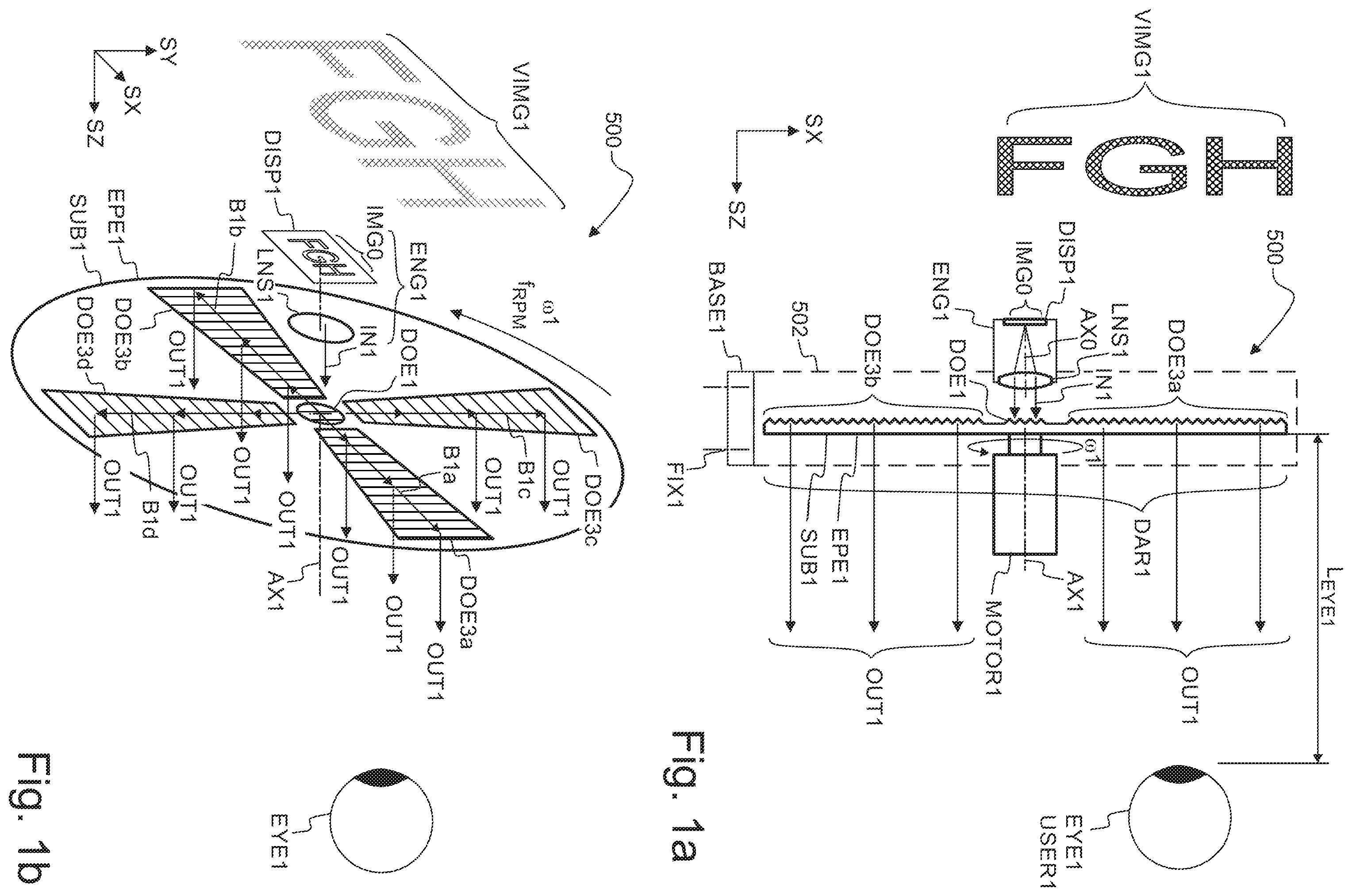
a shows, by way of example, in a side view, a display apparatus;
b shows, by way of example, in a three-dimensional view, the display apparatus;
c shows, by way of example, in an axial view, the display apparatus;
d shows, by way of example, in an axial view, an effective display region formed by rotating out-coupling elements;
shows, by way of example, a timing diagram for light emission from a predetermined point of the display region;
a shows, by way of example, in a side view, observing an external object through a window of a vehicle;
b shows, by way of example, in a side view, receiving external light from the external object through the window of the vehicle;
c shows, by way of example, in a side view, observing an external object through a window of a vehicle, wherein the window is also arranged to reflect output light towards the eye of a user;
a to 4 e show, by way of example, in a three-dimensional view, forming input light beams by using an optical engine;
f shows, by way of example, in a three-dimensional view, viewing a displayed virtual image;
g shows, by way of example, angular width of the displayed virtual image;
h shows, by way of example, angular height of the displayed virtual image;
i shows, by way of example, wave vectors of input light beams;
shows, by way of example, in a cross-sectional side view, propagation of guided light in the waveguide plate;
shows, by way of example, in an axial view, dimensions of diffractive elements;
shows, by way of example, in an axial view, a pair of out-coupling elements;
a shows, by way of example, in an axial view, an effective display region formed in a situation where also the in-coupling element provides output light in addition to the out-coupling elements;
b shows, by way of example, in a side view, the display apparatus, wherein the motor and the optical engine are on the same side of the expander device;
c shows, by way of example, in a side view, the display apparatus, wherein the motor and the optical engine are on the same side of the expander device;
a shows, by way of example, in an axial view, an expander device, which comprises four main out-coupling elements, wherein a first main out-coupling element couples first guided light out of the waveguide plate, and a second main out-coupling element couples second guided light out of the waveguide plate;
b shows, by way of example, in an axial view, an expander device, which comprises four main out-coupling elements, and four intermediate out-coupling elements, wherein a first main out-coupling element is arranged to couple first guided light out of the waveguide plate, a second main out-coupling element is arranged to couple second guided light out of the waveguide plate, and a first intermediate out-coupling element is arranged to couple first intermediate guided light out of the waveguide plate;
c shows, by way of example, in a three-dimensional view, the expander device of b;
d shows, by way of example, forming mutually parallel output light beams, which correspond to the same image point;
a shows, by way of example, in an axial view, a first main grating vector and a second main grating vector of the in-coupling element;
b shows, by way of example, in an axial view, four main grating vectors of the in-coupling element;
c shows, by way of example, in an axial view, the angle between the first main grating vector and the second main grating vector of the in-coupling element;
a shows, by way of example, in an axial view, forming four intermediate grating vectors, wherein a first intermediate grating vector is formed as vector sum of the first main grating vector and the second main grating vector;
b shows, by way of example, in an axial view, orientations of the grating vectors of four main out-coupling elements, and orientations of the grating vectors of four intermediate out-coupling elements;
a shows, by way of example, in a three-dimensional view, an in-coupling element, which comprises a crossed grating;
b shows, by way of example, in a three-dimensional view, an in-coupling element, which comprises a first grating region and a second grating region;
c shows, by way of example, in an axial view, an in-coupling element, which comprises several grating regions; and
d shows, by way of example, in an axial view, an in-coupling element, which comprises several grating regions.
DETAILED DESCRIPTION OF THE EMBODIMENTS
Referring to a and 1 b , the display apparatus 500 may comprise an optical engine ENG 1 to form input light IN 1 , an expander device EPE 1 to form output light OUT 1 by expanding input light IN 1 , and a motor MOTOR 1 to provide an enlarged display region DAR 1 by rotating the expander device EPE 1 .
A user USER 1 of the display apparatus 500 may observe a displayed virtual image VIMG 1 when the output light OUT 1 impinges on the eye EYE 1 of the user.
The input light IN 1 may comprise a plurality of light beams propagating in different directions. Each light beam of the input light IN 1 may correspond to a different point of the input image IMG 0 . The input light beams may together constitute input light IN 1 .
The output light OUT 1 may comprise a plurality of light beams propagating in different directions. The output light OUT 1 may comprise a plurality of output light beams corresponding to different points of the virtual image VIMG 1 . The expander device EPE 1 may form the output light OUT 1 from the input light IN 1 such that the directions and the intensities of the light beams of the output light OUT 1 correspond to the points of the input image IMG 0 . The expander device may expand light of the input light beams. The expander device EPE 1 may form the output light beams by expanding the input light beams of the input light IN 1 . In particular, the expander device EPE 1 may form the output light beams by diffractively expanding the input light beams. Each output light beam may propagate in the same direction as the corresponding input light beam. Consequently, the displayed virtual image VIMG 1 may represent the input image IMG 0 .
A light beam of the input light IN 1 may correspond to a single image point (P 0 ) of a displayed image. The expander device EPE 1 may form an output light beam from a light beam of the input light IN 1 such that the direction (k 3 ,P0,R ) of the output light beam is parallel with the direction (k 0 ,P0,R ) of the corresponding light beam of the input light IN 1 . A light beam corresponding to a different image point may propagate in a different direction. Directions and image points are shown e.g. in a to 4 i.
The optical engine ENG 1 may form input light IN 1 , which corresponds to an input image IMG 0 . The optical engine ENG 1 may form input light IN 1 , which represents an input image IMG 0 . The input light IN 1 may comprise a plurality of input light beams propagating in different directions corresponding to different image points of the input image IMG 0 . The optical engine ENG 1 may comprise a display DISP 1 and collimating optics LNS 1 to form the input light beams. The optical engine ENG 1 may project the input light IN 1 to the in-coupling element DOE 1 . The optical engine ENG 1 may also be called e.g. as a projector.
The expander device EPE 1 may comprise a waveguide plate SUB 1 , which in turn may comprise an in-coupling element DOE 1 , and several out-coupling elements DOE 3 a , DOE 3 b , DOE 3 c , DOE 3 d . The in-coupling element DOE 1 may couple the input light IN 1 into the waveguide plate SUB 1 . The input light IN 1 may impinge on the in-coupling element DOE 1 . The input light IN 1 may overlap the in-coupling element DOE 1 . The axis AX 1 of rotation may intersect the in-coupling element DOE 1 . The in-coupling element DOE 1 may be concentric with the axis AX 1 of rotation.
Each element DOE 1 , DOE 3 a , DOE 3 b , DOE 3 c , DOE 3 d may comprise one or more diffraction gratings. The gratings may be e.g. on the first and/or on the second surface of the waveguide plate SUB 1 . The elements DOE 1 , DOE 3 a , DOE 3 b , DOE 3 c , DOE 3 d may be diffractive elements. The in-coupling element DOE 1 may form guided light B 1 a , B 1 b by diffracting the input light IN 1 . The guided light B 1 a , B 1 b may propagate as waveguided light in the waveguide plate SUB 1 .
The out-coupling elements DOE 3 a , DOE 3 b may form output light OUT 1 by diffracting the guided light B 1 a , B 1 b out of the waveguide plate SUB 1 . The out-coupling elements DOE 3 a , DOE 3 b may operate as a first pair of elements. The out-coupling elements DOE 3 a , DOE 3 b may be on opposite sides of the in-coupling element DOE 1 .
The out-coupling elements DOE 3 c , DOE 3 d may form output light OUT 1 by diffracting guided light B 1 c , B 1 d out of the waveguide plate SUB 1 (see c ). The out-coupling elements DOE 3 c , DOE 3 d may operate as a second pair of elements. The out-coupling elements DOE 3 c , DOE 3 d may be on opposite sides of the in-coupling element DOE 1 .
In an embodiment, the first pair of elements DOE 3 a , DOE 3 b may be optimized for displaying a first color component of a displayed image, and the second pair of elements DOE 3 c , DOE 3 d may be optimized for displaying a second color component of the displayed image.
The expander device EPE 1 may be arranged to expand a viewing pupil of the display apparatus 500 , so as to facilitate keeping the eye in a suitable transverse position with respect to the display apparatus 500 .
The expander device EPE 1 may be arranged to rotate with respect to a stationary base BASE 1 . The display apparatus 500 may be mounted e.g. to a vehicle 1000 via the base BASE 1 . The display apparatus 500 may be mounted to a vehicle 1000 e.g. via one or more joints FIX 1 . The joints may be e.g. adhesive joints and/or screw joints.
The optical engine ENG 1 may have a fixed position with respect to the base BASE 1 . The optical engine ENG 1 may be fixedly mounted to the base BASE 1 . The optical engine ENG 1 may be stationary with respect to the base BASE 1 . The expander device EPE 1 may be arranged to move with respect to the stationary base BASE 1 . The expander device EPE 1 may be rotatable with respect to the stationary base BASE 1 . The expander device EPE 1 may be arranged to rotate and/or oscillate with respect to the stationary base BASE 1 .
The display apparatus 500 may comprise an actuating mechanism MOTOR 1 to cause rotary and/or oscillatory motion of the expander device EPE 1 with respect to the stationary base BASE 1 . The actuating mechanism MOTOR 1 may be directly or indirectly connected to the base BASE 1 . The actuating mechanism MOTOR 1 may be connected to the base BASE 1 e.g. via a protective cover 502 and/or via a frame. The actuating mechanism MOTOR 1 may be e.g. a motor. The actuating mechanism MOTOR 1 may be e.g. an electric motor or a pneumatic turbine. The motor MOTOR 1 may rotate the expander device EPE 1 about an axis AX 1 of rotation. The expander device EPE 1 may rotate at an angular velocity ω 1 , which corresponds to a speed of rotation f RPM .
The optical engine ENG 1 may be mechanically connected to the base BASE 1 e.g. via a protective cover 502 . The protective cover may be transparent or semi-transparent. For example, a transparent cover 502 may comprise clear glass or plastic. For example, semi-transparent cover 502 may comprise mesh, which has a see-through property. The protective cover 502 may also prevent the user from accidentally touching the rotating expander device EPE 1 .
The optical engine ENG 1 may be mechanically connected to the base BASE 1 also via a connecting structure. In an embodiment, the connecting structure may be an open structure. It is not always necessary to protect the rear side of the rotating expander device EPE 1 .
The symbol L EYE1 denotes the distance between the expander device EPE 1 and the eye EYE 1 of the user. When using the display apparatus 500 as a head-up display of a vehicle 1000 , the distance L EYE1 may be e.g. in the range of 0.1 m to 1.0 m.
SX, SY and SZ denote orthogonal directions. The waveguide plate SUB 1 may be parallel with a plane defined by the directions SX and SY.
The in-coupling element DOE 1 may receive input light IN 1 , and the out-coupling elements may provide output light OUT 1 . The input light IN 1 may comprise a plurality of light beams propagating in different directions. The output light OUT 1 may comprise a plurality of expanded light beams (B 3 ) formed from the light beams (B 0 ) of the input light IN 1 .
The expander device EPE 1 forms an output light OUT 1 by expanding input light IN 1 . The width w OUT1 of the light beams of the output light OUT 1 may be greater than the width w IN1 of the light beams of the input light IN 1 . The expander device EPE 1 may expand the input light IN 1 at least in the direction of a grating vector (V 1 ) of the in-coupling element DOE 1 . The expander device EPE 1 , when the grating vector (V 1 ) is parallel with the horizontal direction (SX), may expand the input light IN 1 in the horizontal direction (SX). The expander device EPE 1 , when the grating vector (V 1 ) is parallel with the vertical direction (SY), may expand the input light IN 1 in the vertical direction (SY).
When rotating, the expander device EPE 1 may sequentially increase the horizontal cross-sectional dimension w OUT1 and the vertical cross-sectional dimension h OUT1 of the output light beams (B 3 ) of the output light OUT 1 . When rotating, the expander device EPE 1 may effectively expand the input light IN 1 in two dimensions (e.g. in the direction SX and in the direction SY). The expansion process may also be called as exit pupil expansion. The expander device EPE 1 may be called as a beam expander device or as an exit pupil expander.
The in-coupling element DOE 1 may form guided light B 1 by coupling input light IN 1 into the waveguide plate SUB 1 . The in-coupling element DOE 1 may form guided light B 1 a , B 1 b by coupling input light IN 1 into the waveguide plate SUB 1 . The guided light B 1 , B 1 a , B 1 b may be waveguided within the planar waveguide plate SUB 1 . The B 1 , B 1 a , B 1 b may be confined to the plate SUB 1 by total internal reflection. The term “guided” may mean that the light propagates within the planar waveguide plate SUB 1 so that the light is confined to the plate by total internal reflection (TIR). The waveguide plate SUB 1 operates as a light guide. The term “guided” may mean the same as the term “waveguided”.
Referring to c and 1 d , the out-coupling elements DOE 3 a , DOE 3 b , DOE 3 c , DOE 3 d may generate a large display region DAR 1 by sweeping along a circular path PATH 1 around the axis AX 1 of rotation. An arbitrary point (e.g. POINT 1 ) of the display region DAR 1 may have a fixed position (x 1 ,y 1 ) with respect to the base BASE 1 . (x 1 ,y 1 ) may denote e.g. the position coordinates with respect to the stationary base BASE 1 . The arbitrary point (POINT 1 ) may emit output light OUT 1 in a pulsed manner when the expander device EPE 1 rotates so that said point (POINT 1 ) is within the area of an out-coupling element (e.g. DOE 3 a ). The emission of output light OUT 1 from said point (POINT 1 ) may be periodically stopped when the out-coupling element (e.g. DOE 3 a ) moves so that the point (POINT 1 ) is outside the area of the out-coupling elements (DOE 3 a , DOE 3 b , DOE 3 c , DOE 3 d ). The speed of rotation (f RPM ) may be selected to be high enough so as to reduce or avoid visually detectable flickering of said point (POINT 1 ) of the display region (DAR 1 ).
Each point of the display region DAR 1 may sequentially emit output light OUT 1 in a pulsed manner when the out-coupling elements DOE 3 a , DOE 3 b , DOE 3 c , DOE 3 d sweep over said point. The out-coupling elements DOE 3 a , DOE 3 b , DOE 3 c , DOE 3 d may form an annular display region DAR 1 by sweeping along the circular path PATH 1 . The whole display region DAR 1 may emit output light OUT 1 in a pulsed manner.
The symbol w EPE1 denotes the width of the expander device EPE 1 in the horizontal direction SX (in a situation where rotation of the expander device EPE 1 is stopped and the first element DOE 3 a aligned with the horizontal direction SX). h EPE1 denotes the height of the expander device EPE 1 in the vertical direction SY. The expander device EPE 1 may also be substantially circular, and the diameter of the expander device EPE 1 may be equal to the width w EPE1 .
w DAR1 denotes the width of the display region DAR 1 . h DAR1 denotes the height of the display region DAR 1 . A DAR1 denotes the effective surface area of the display region DAR 1 . A DOE3 denotes the surface area of an out-coupling element DOE 3 (or DOE 3 a ). The effective surface area A DAR1 of the display region DAR 1 may be greater than the surface area A DOE3 of the out-coupling element DOE 3 (or DOE 3 a ).
In an embodiment, the expander device EPE 1 and/or the motor MOTOR 1 may block a central region of the display region DAR 1 , so that the display region DAR 1 has a dark center. The display region DAR 1 may be e.g. an annular region, which is defined by an inner boundary BND 2 and by an outer boundary BND 1 . The inner boundary BND 2 may have a radius r 2 DAR1 . The outer boundary BND 1 may have a radius r 1 DAR1 . The boundaries BND 1 , BND 2 may be concentric with the axis AX 1 of rotation.
In an embodiment, also the center region of the expander device EPE 1 may be arranged to provide output light OUT 1 so that the circular display region DAR 1 does not have a dark center ( a ).
The radius r 1 DAR1 of the outer boundary BND 1 may be e.g. in the range of 4 cm to 25 cm. The width w EPE1 of the expander device EPE 1 may be e.g. in the range of 8 cm to 50 cm. The surface area A DAR1 of the display region DAR 1 may be e.g. in the range of 100 cm 2 to 2000 cm 2 .
w 1 denotes the width of the in-coupling element DOE 1 . h 1 denotes the height of the in-coupling element DOE 1 . w IN1 denotes the cross-sectional width of the input light beams (IN 1 ). h IN1 denotes the cross-sectional height of the input light beams (IN 1 ). w 3 denotes the width of the out-coupling element DOE 3 a . h 3 denotes the height of the out-coupling element DOE 3 a . w OUT1 denotes the cross-sectional width of the output light beams (OUT 1 ). h OUT1 denotes the cross-sectional height of the output light beams (OUT 1 ). In an embodiment, the cross-sectional dimensions of the output light OUT 1 may be defined by the dimensions of the out-coupling element DOE 3 a . The width W OUT1 may be substantially equal to the width w 3 and/or the height h OUT1 may be substantially equal to the height h 3 .
The expander device EPE 1 may be rotatable relative to the base BASE 1 . The optical axis AX 0 of the optical engine ENG 1 may coincide with the axis AX 1 of rotation of the expander device EPE 1 . The optical axis AX 0 may be coaxial with the axis AX 1 of rotation. The in-coupling element DOE 1 may be concentric with the axis AX 1 of rotation.
The actuating mechanism MOTOR 1 may be arranged to rotate the waveguide plate SUB 1 at a rotation speed f RPM , which is e.g. in the range of 5 to 200 revolutions per second.
For example, the motor MOTOR 1 may be arranged to rotate the expander device EPE 1 so that the rotation speed f RPM of the expander device EPE 1 is greater than or equal to 30 revolutions per second. Consequently, it may be difficult to visually detect flickering of the displayed image VIMG 1 .
For example, the motor MOTOR 1 may be arranged to rotate the expander device EPE 1 so that the rotation speed f RPM of the expander device EPE 1 is greater than or equal to 60 revolutions per second. Consequently, it may be more difficult to visually detect flickering of the displayed image VIMG 1 .
In an embodiment, the expander device EPE 1 may be rotatably supported by the one or more bearings of the motor MOTOR 1 .
The motor MOTOR 1 and the optical engine ENG 1 may be on different sides of the expander device EPE 1 ( a ) or on the same side of the expander device EPE 1 ( b , 8 c ). For example, the motor MOTOR 1 may have a central opening (HOL 1 ), so as to allow positioning the motor MOTOR 1 and the optical engine ENG 1 on the same side of the expander device EPE 1 .
In an embodiment, the expander device EPE 1 may operate as a rotating part of the MOTOR 1 . For example, the expander device EPE 1 may comprise magnets or coils to cause a rotating force. The expander device EPE 1 may also be rotatably supported by a bearing located at the rim or by a needle bearing located at the axis of rotation AX 1 .
shows, by way of example, a timing diagram for the local intensity I POINT1 of an arbitrary stationary point (e.g. POINT 1 ) of the display region DAR 1 , when displaying a virtual image VIMG 1 . The point POINT 1 appears to emit light to the eye EYE 1 in a pulsed manner when the expander device EPE 1 rotates. In this example, the expander device EPE 1 comprises four out-coupling elements DOE 3 a , DOE 3 b , DOE 3 c , DOE 3 d . The intensity of the point POINT 1 reaches a maximum value I MAX when the point POINT 1 overlaps an out-coupling element DOE 3 a , DOE 3 b , DOE 3 c , or DOE 3 d . The intensity of the point POINT 1 is zero when the point POINT 1 does not overlap any of the out-coupling elements. T ROT denotes a time period for one full rotation of the expander device EPE 1 . The time period T ROT is equal to 1/f RPM . T ON denotes a time period during which the point POINT 1 is within the area of a moving out-coupling element. The symbol T ON also denotes the duration of a light pulse emitted from the point POINT 1 when an out-coupling element sweeps over said point POINT 1 . T BLANK denotes a time period during which the point POINT 1 is outside the area of the out-coupling elements. The point POINT 1 is within the area of the out-coupling element DOE 3 a between times t 1a ,t′ 1a , between times t 2a ,t′ 2a , between times t 3a ,t′ 3a , and between times t 4a ,t′ 4a . The point POINT 1 is within the area of the out-coupling element DOE 3 b between times t 1b ,t′ 1b , between times t 2b ,t′ 2b , and between times t 3b ,t′ 3b . The point POINT 1 is within the area of the out-coupling element DOE 3 c between times t 1c ,t′ 1c , between times t 2c ,t′ 2c , and between times t 3c ,t′ 3c . The point POINT 1 is within the area of the out-coupling element DOE 3 d between times t 1d ,t′ 1d , between times t 2d ,t′ 2d , and between times t 3d ,t′ 3d .
The expander device EPE 1 may rotate e.g. in the direction shown in , wherein said stationary point POINT 1 of the display area DAR 1 may overlap the out-coupling elements e.g. in the following order: DOE 3 a , DOE 3 d , DOE 3 b , DOE 3 c , DOE 3 a , DOE 3 d , DOE 3 b , DOE 3 c, . . . .
The optical engine ENG 1 may be arranged to simultaneously project red light, green light, and blue light, so as to display a multi-color image VIMG 1 .
The optical engine ENG 1 may be arranged to project only one color (e.g. red, green or blue). The expander device may be arranged to display a single-color image VIMG 1 .
Referring to a to 3 c , the display apparatus 500 may be a vehicle-mounted head-up display. A vehicle 1000 may comprise the display apparatus 500 . The vehicle may be e.g. an electric car propelled by an electric motor. The vehicle may be e.g. a car propelled by an internal combustion engine. The vehicle may be e.g. a motorcycle. The vehicle may be e.g. a tram. The vehicle may be e.g. a train.
When driving a vehicle, a driver USER 1 may need to observe information related to the driving. The display apparatus 500 of the vehicle may be arranged to display information about the speed of the vehicle, status of a battery, status of a motor of the vehicle, and/or navigation instructions, for example. The user USER 1 of the display apparatus 500 may be the driver or a passenger of the vehicle. The user USER 1 may see real objects OBJ 1 and/or environment through the display region DAR 1 , in addition to the displayed virtual images VIMG 1 . When using the display apparatus 500 , the driver USER 1 does not need to look down at the dashboard in order to observe the displayed information. When using the display apparatus 500 , the driver USER 1 may continuously observe the environment through the windscreen of the vehicle, without a need to look down. Avoiding the need to look down may improve driving safety. The displayed virtual image VIMG 1 may represent the information, which is related to the driving. The virtual image VIMG 1 formed by the display apparatus 500 may fall in front of the driver's line of sight LIN 1 , so that driver USER 1 can observe displayed information and external objects at the same time. The driver's line of sight LIN 1 may intersect the effective display area DAR 1 of the display apparatus 500 .
Rotation of the expander device EPE 1 may provide a larger display region DAR 1 by using smaller out-coupling elements. This may provide a large eye box BOX 1 for the user USER 1 . The user may observe the displayed virtual image VIMG 1 as long as the eye EYE 1 of the user remains within the eye BOX 1 of the display apparatus 500 . The rotating expander device EPE 1 may provide a uniform spatial intensity distribution for the output light OUT 1 . The rotating expander device EPE 1 may provide a high image quality. The smaller out-coupling elements may be easier and/or cheaper to produce than large out-coupling elements.
The large display region DAR 1 may also facilitate displaying a virtual image VIMG 1 , which has a large angular width Δφ and/or a large angular height Δθ. Thanks to the large display region, the user may see the whole virtual image VIMG 1 , or at least a large part of the virtual image VIMG 1 also when the distance between the eye EYE 1 and the expander device EPE 1 is large. The virtual image VIMG 1 may cover a large field of view. The virtual image VIMG 1 may comprise e.g. vehicle information and/or navigation information.
The display apparatus 500 may be mounted to the vehicle 1000 via the base BASE 1 . For example, the base BASE 1 may be mounted to the window WIN 1 , to a dashboard, or to a ceiling of a vehicle 1000 .
The eye EYE 1 of the user USER 1 may receive external light EX 1 from an external object OBJ 1 . The user USER 1 may observe the external object OBJ 1 when the external light EX 1 impinges on the eye EYE 1 . The external light EX 1 may propagate through the window WIN 1 and through the display area DAR 1 of the apparatus 500 to the eye EYE 1 of the user USER 1 . The user USER 1 may simultaneously observe the external object OBJ 1 and the displayed virtual image VIMG 1 .
Referring to c , the window WIN 1 may be arranged to operate as a part of the display apparatus 500 . The window WIN 1 may be e.g. the windscreen of the vehicle 1000 . The window WIN 1 may reflect the output light OUT 1 towards the user EYE 1 so that the user may view the displayed virtual image VIMG 1 , wherein the user EYE 1 may simultaneously observe the environment of the vehicle 1000 through the window WIN 1 . For example, the line of sight LIN 1 from the external object OBJ 1 to the eye EYE 1 may intersect the display area DAR 1 . For example, the user may observe an external object OBJ 1 through the window WIN 1 so that the displayed virtual image VIMG 1 may visually overlap the external object OBJ 1 . The driver may be visually immersed in the environment of the vehicle while viewing the displayed virtual image so that the driver does not need to look down.
The window WIN 1 may be a planar (flat) transparent window or a curved transparent window. The planar window may reflect the output light OUT 1 without deforming the displayed virtual image VIMG 1 .
A curved window may deform the displayed virtual image VIMG 1 . The display apparatus 500 may be arranged to at least partly compensate deformation of the virtual image VIMG 1 .
The window WIN 1 may simultaneously transmit external light EX 1 and reflect output light OUT 1 to the eye EYE 1 of the user USER 1 . The window WIN 1 may operate as a semi-transparent reflector, which may simultaneously transmit external light EX 1 and reflect output light OUT 1 . The external light EX 1 may propagate through the window WIN 1 to the eye EYE 1 .
In an embodiment, the window WIN 1 may be coated with a semi-transparent reflective coating, e.g. in order to increase the intensity of the reflected output light. The coating may be e.g. a dielectric or metallic coating.
In an embodiment, the semi-transparent reflective window WIN 1 may also operate based on Fresnel reflection caused by the difference between the refractive index of the window and the refractive index of air. The semi-transparent reflective window WIN 1 does not need to comprise a reflective coating.
Referring to a to 4 e , the expander device EPE 1 may form output light OUT 1 by expanding input light IN 1 formed by the optical engine ENG 1 .
The optical engine ENG 1 may comprise a display DISP 1 and collimating optics LNS 1 . The display DISP 1 may be arranged to display an input image IMG 0 . The display DISP 1 may also be called e.g. as a micro display. The display DISP 1 may also be called e.g. as a spatial intensity modulator. The input image IMG 0 may also be called e.g. as a primary image.
The input image IMG 0 may comprise a center point P 0 and four corner points P 1 , P 2 , P 3 , P 4 . P 1 may denote an upper left corner point. P 2 may denote an upper right corner point. P 3 may denote a lower left corner point. P 4 may denote a lower right corner point. The input image IMG 0 may comprise e.g. the graphical characters “F”, “G”, and “H”. The input image IMG 0 may represent displayed information.
The input image IMG 0 may be e.g. a single-color image. A single-color image IMG 0 may be formed e.g. by modulating laser light or by modulating light obtained from one or more light emitting diodes.
The input image IMG 0 may also be a multi-color image. The input image IMG 0 may be e.g. an RGB image, which may comprise a red partial image, a green partial image, and a blue partial image. Each image point may provide e.g. red light, green light and/or blue light.
The optical engine ENG 1 may provide input light IN 1 , which may comprise a plurality of substantially collimated light beams (B 0 ). For example, each red light beam may propagate in a different direction and may correspond to a different point of the input image IMG 0 . Each light beam may have a color. For example, the subscript “R” may refer to the red color. For example, a red light beam B 0 P1,R may correspond to an image point P 1 , and may propagate in the direction of a wave vector k 0 P1,R . The red light beam corresponding to the image point P 1 may propagate in the direction specified by the wave vector k 0 P1,R .
A red light beam B 0 P2,R may correspond to an image point P 2 , and may propagate in the direction of a wave vector k 0 P2,R . A red light beam B 0 P3,R may correspond to an image point P 3 , and may propagate in the direction of a wave vector k 0 P3,R . A red light beam B 0 P4,R may correspond to an image point P 4 , and may propagate in the direction of a wave vector k 0 P4,R .
A red light beam B 0 P0,R may correspond to a central image point P 0 , and may propagate in the direction of a wave vector k 0 P0,R .
Also a blue light beam (B 0 P1,B ) may correspond to the image point P 1 , and may propagate in the direction of a wave vector (k 0 P1,B ).
The input light IN 1 may be formed e.g. such that the direction (k 0 P1,B ) of propagation of the blue light beam (B 0 P1,B ) corresponding to a first corner point P 1 of the input image IMG 0 may be parallel with the direction k 0 P1,R of propagation of the red light beam B 0 P1,R .
The input light IN 1 may be formed e.g. such that the direction (k 0 P2,B ) of propagation of a blue light beam (B 0 P2,B ) corresponding to a second corner point P 2 of the input image IMG 0 may be parallel with the direction (k 0 P2,R ) of propagation of a red light beam (B 0 P2,R ), which corresponds to said second corner point P 2 .
The wave vector (k) of light may be defined as the vector having a direction of propagation of said light, and a magnitude given by 2π/λ, where λ is the wavelength of said light.
The light B 0 P0,R of the center point P 0 may propagate in an axial direction (k 0 P0,R ). The axial direction (k 0 P0,R ) may be parallel with an optical axis (AX 0 ) of the optical engine ENG 1 .
Referring to f , the output light OUT 1 may comprise a plurality of output light beams B 3 P1,R , B 3 P2,R , . . . , which may correspond to a displayed virtual image VIMG 1 . Each output beam B 3 P1,R , B 3 P2,R , . . . may correspond to a point P 1 ′, P 2 ′, . . . of the image. For example, a red light beam B 3 P0,R propagating in a direction of a wave vector k 3 P0,R may correspond to a point P 0 ′ of the image VIMG 1 . A red light beam B 3 P1,R propagating in a direction of a wave vector k 3 P1,R may correspond to a point P 1 ′ of the image VIMG 1 . A red light beam B 3 P2,R propagating in a direction of a wave vector k 3 P2,R may correspond to a point P 2 ′ of the image VIMG 1 . A red light beam B 3 P3,R propagating in a direction of a wave vector k 3 P3,R may correspond to a point P 3 ′. A red light beam B 3 P4,R propagating in a direction of a wave vector k 3 P4,R may correspond to a point P 4 ′.
The expander device EPE 1 may form the output light OUT 1 by expanding the exit pupil of the optical engine ENG 1 . The output light OUT 1 may comprise a plurality of output light beams, which correspond to the displayed virtual image VIMG 1 . The output light OUT 1 may impinge on the eye EYE 1 of an observer such that the observer may see the displayed virtual image VIMG 1 .
The displayed virtual image VIMG 1 may have a center point P 0 ′ and four corner points P 1 ′, P 2 ′, P 3 ′, P 4 ′. The input light IN 1 may comprise a plurality of partial light beams corresponding to the points P 0 , P 1 , P 2 , P 3 , P 4 of the input image IMG 0 . The expander device EPE 1 may form the point P 0 ′ of the displayed virtual image VIMG 1 e.g. by diffracting and guiding light of the point P 0 of the input image IMG 0 . The in-coupling element DOE 1 may be arranged to diffract input light IN 1 such that the guided light B 1 , B 1 a , B 1 b comprises light of a center point P 0 of an input image IMG 0 . The out-coupling element DOE 3 , DOE 3 a , DOE 3 b may be arranged to diffract guided light B 1 , B 1 a , B 1 b received from the in-coupling element DOE 1 such that the output light OUT 1 comprises light of the center point P 0 .
The expander device EPE 1 may form the points P 1 ′, P 2 ′, P 3 ′, P 4 ′ e.g. by diffracting and guiding light of the points P 1 , P 2 , P 3 , P 4 , respectively.
The expander device EPE 1 may form output light OUT 1 , which comprises a plurality of light beams B 3 P0,R , B 3 P1,R , B 3 P2,R , B 3 P3,R , B 3 P4,R propagating in different directions specified by the wave vectors k 3 P0,R , k 3 P1,R , k 3 P2,R , k 3 P4,R .
A red light beam corresponding to the point P 0 ′ of the displayed virtual image VIMG 1 has a wave vector k 3 P0,R . A red light beam corresponding to the point P 1 ′ has a wave vector k 3 P1,R . A red light beam corresponding to the point P 2 ′ has a wave vector k 3 P2,R . A red light beam corresponding to the point P 3 ′ has a wave vector k 3 P3,R . A red light beam corresponding to the point P 4 ′ has a wave vector k 3 P4,R .
The expander device EPE 1 may expand input light IN 1 such that each output light beam B 3 P1,R , B 3 P2,R , B 3 P3,R , . . . may propagate in the same direction as the corresponding input light beam B 0 P1,R , B 0 P2,R , B 0 P3,R , . . . . For example, the expander device EPE 1 may form an output light beam B 3 P1,R from light of an input light beam B 0 P1,R such that the output light beam B 3 P1,R propagates in the same direction as the input light beam B 0 P1,R . The light beams B 0 P1,R , B 3 P1,R may correspond to the same point P 1 of the input image IMG 0 . For example, the expander device EPE 1 may form an output light beam B 3 P2,R from light of an input light beam B 0 P2,R such that the output light beam B 3 P2,R propagates in the same direction as the input light beam B 0 P2,R . The light beams B 0 P2,R , B 3 P2,R may correspond to the same point P 2 of the input image IMG 0 .
The expander device EPE 1 may be arranged to operate such that the wave vector k 3 P1,R is parallel with the wave vector k 0 P1,R of red light of the point P 1 in the input light IN 1 . The wave vector k 3 P2,R may be parallel with the wave vector k 0 P0,R of the point P 0 . The wave vector k 3 P2,R may be parallel with the wave vector k 0 P2,R of the point P 2 . The wave vector k 3 P3,R may be parallel with the wave vector k 0 P3,R of the point P 3 . The wave vector k 3 P4,R may be parallel with the wave vector k 0 P4,R of the point P 4 .
Referring to g and 4 h , the displayed virtual image VIMG 1 has an angular width Δφ and an angular height Δθ.
The displayed virtual image VIMG 1 may have a first corner point P 1 ′ e.g. at the left-hand side of the image VIMG 1 , and a second corner point P 2 ′ e.g. at the right-hand side of the image VIMG 1 . The angular width Δφ of the virtual image VIMG 1 may be equal to the horizontal angle between the wave vectors k 3 P1,R , k 3 P2,R of the corner points P 1 ′, P 2 ′.
The displayed virtual image VIMG 1 may have an upper corner point P 1 ′ and a lower corner point P 3 ′. The angular height Δθ of the virtual image VIMG 1 may be equal to the vertical angle between the wave vectors k 3 P1,R , k 3 P3,R of the corner points P 1 ′, P 3 ′.
The direction of a wave vector may be specified e.g. by orientation angles φ and θ. The angle φ may denote an angle between the wave vector and a reference plane REF 1 . The reference plane REF 1 may be defined e.g. by the directions SZ and SY. The angle θ may denote an angle between the wave vector and a reference plane REF 2 . The reference plane REF 2 may be defined e.g. by the directions SZ and SX.
Referring to i , the input light IN 1 may comprise red light (R), green light (G) and/or blue light (B). For example, the input light IN 1 may comprise blue input light beams, which have wave vectors k 0 P0,B , k 0 P1,B , k 0 P2,B , k 0 P3,B , k 0 P4,B , corresponding to blue points P 0 , P 1 , P 2 , P 3 , P 4 of the image IMG 0 . The notation k 0 P2,B may refer to the wave vector of an input light beam B 0 , which has blue color (B), and which corresponds to an image point P 2 . The expander device EPE 1 may form blue output light beams from the blue input light beams such that the wave vector of each blue output light beams is parallel with the wave vector of the corresponding blue input light beam.
Referring to , the optical engine ENG 1 may form an input image IMG 0 and may convert the input image IMG 0 into a plurality of light beams of the input light IN 1 . The engine ENG 1 may be optically coupled to the in-coupling element DOE 1 of the expander EPE 1 . The one or more light beams provided by the engine ENG 1 may be coupled to the expander EPE 1 as input light IN 1 . The input light IN 1 may be optically coupled to the in-coupling element DOE 1 of the expander device EPE 1 .
The input image IMG 0 may be represent displayed information. The input image IMG 0 may be represent e.g. graphics and/or text. The input image IMG 0 may be represent e.g. video. The engine ENG 1 may be arranged to generate still images and/or video. The engine ENG 1 may generate a real primary image IMG 0 from a digital image. The engine ENG 1 may receive one or more digital images e.g. from an internet server or from a smartphone.
The expander device EPE 1 may carry virtual image content from the light engine ENG 1 to the front of a user's eye EYE 1 . The expander device EPE 1 may expand the viewing pupil, thus enlarging the eye box.
The engine ENG 1 may comprise a micro-display DISP 1 to generate an input image IMG 0 . The micro-display DISP 1 may comprise a two-dimensional array of light-emitting pixels. The engine ENG 1 may comprise e.g. one or more light emitting diodes (LED). The display DISP 1 may comprise e.g. one or more micro display imagers, such as liquid crystal on silicon (LCOS), liquid crystal display (LCD), digital micromirror device (DMD). The display DISP 1 may generate an input image IMG 0 e.g. at a resolution of 1280×720 (HD). The display DISP 1 may generate an input image IMG 0 e.g. at a resolution of 1920×1080 (Full HD). The display DISP 1 may generate an input image IMG 0 e.g. at a resolution of 3840×2160 (4K UHD). The input image IMG 0 may comprise a plurality of image points P 0 , P 1 , P 2 , . . . . The engine ENG 1 may comprise collimating optics LNS 1 to form a different light beam from each image pixel. The engine ENG 1 may comprise collimating optics LNS 1 to form a substantially collimated light beam from light of an image point P 0 . The center of the display DISP 1 and the center of the optics LNS 1 may together define an optical axis AX 0 of the engine ENG 1 . The center point P 0 and the center of the optics LNS 1 may define the optical axis AX 0 .
The plate SUB 1 may have a first major surface SRF 1 and a second major surface SRF 2 . The surfaces SRF 1 , SRF 2 may be substantially parallel with the plane defined by the directions SX and SY.
The waveguide plate SUB 1 may comprise or consist essentially of transparent solid material. The plate SUB 1 may comprise e.g. glass, polycarbonate or polymethyl methacrylate (PMMA). The diffractive optical elements DOE 1 , DOE 3 a , DOE 3 b , DOE 3 c , DOE 3 d may be formed e.g. by molding, embossing, and/or etching. The diffractive optical elements may be implemented e.g. by one or more surface diffraction gratings or by one or more volume diffraction gratings.
The waveguide plate may have a thickness t SUB1 . The waveguide plate comprises a planar waveguiding core. In an embodiment, the plate SUB 1 may optionally comprise e.g. one or more cladding layers, one or more protective layers, and/or one or more mechanically supporting layers. The thickness t SUB1 may refer to the thickness of a planar waveguiding core of the plate SUB 1 .
Referring to , each element DOE 1 , DOE 3 a , DOE 3 b , DOE 3 c , DOE 3 d may comprise one or more diffraction gratings to diffract light.
For example, the in-coupling element DOE 1 may comprise one or more gratings G 1 a . For example, the out-coupling element DOE 3 a may comprise a grating G 3 a . For example, the out-coupling element DOE 3 b may comprise a grating G 3 b.
A grating period (d) of a diffraction grating and the orientation (β) of the diffractive features of the diffraction grating may be specified by a grating vector V of said diffraction grating. The diffraction grating comprises a plurality of diffractive features (F 1 a , F 3 a ) which may operate as diffractive lines. The diffractive features may be e.g. microscopic ridges or grooves. The diffractive features may also be e.g. microscopic protrusions (or recesses), wherein adjacent rows of protrusions (or recesses) may operate as diffractive lines. The grating vector V may be defined as a vector having a direction perpendicular to diffractive lines of the diffraction grating and a magnitude given by 2π/d, where d is the grating period. The grating period means the same as the grating period length. The grating period may be the length between consecutive diffractive features of the grating. The grating period may be equal to a unit length divided by the number of diffractive features located within said unit length. The grating periods d 1a of the in-coupling element DOE 1 may be e.g. in the range of 330 nm to 450 nm. The optimum value of a grating period d may depend e.g. on the refractive index of the plate SUB 1 and on the wavelength λ of the diffracted light.
The in-coupling element DOE 1 may have a grating vector V 1a to form the first guided light B 1 a . The first element DOE 1 may have first diffractive features F 1 a to provide a grating G 1 a which has a grating period d 1a and an orientation β 1a with respect to a reference direction SX. The diffractive features may be e.g. microscopic ridges or microscopic protrusions.
The out-coupling element DOE 3 a may have a grating vector V 3a to couple the guided light B 1 a out of the plate SUB 1 . The out-coupling element DOE 3 a may have diffractive features F 3 a to provide a grating G 3 a which has a grating period d 3a and an orientation β 3a with respect to the reference direction SX.
The grating vector V 1a has a direction β 1a and a magnitude 2π/d 1a . The grating vector V 3a has a direction β 3a and a magnitude 2π/d 3a . The direction (β) of a grating vector may be specified e.g. by the angle between said vector and a reference direction (e.g. direction SX).
The grating periods (d) and the orientations (β) of the diffraction gratings of the optical elements may be selected such that the direction (k 3 P0,R ) of propagation of light of the center point P 0 in the output light OUT 1 is parallel with the direction (k 0 P0,R ) of propagation of light of the center point P 0 in the input light IN 1 .
The grating periods (d) and the orientations (β) of the diffraction gratings of the optical elements DOE 1 , DOE 3 a , DOE 3 b , DOE 3 c , DOE 3 d may be selected such that the direction of each light beam of the output light OUT 1 may be parallel with the direction of the corresponding light beam of the input light IN 1 .
Referring to , the out-coupling elements DOE 3 a , DOE 3 b may together constitute a first pair of out-coupling elements. The out-coupling elements DOE 3 c , DOE 3 d may together constitute a second pair of out-coupling elements.
The expander device EPE 1 may be mechanically balanced with respect to the axis AX 1 of rotation, so as to minimize or eliminate mechanical vibration caused by the rotation of the expander device EPE 1 .
The expander device EPE 1 may be statically balanced so that the center of gravity of the expander device EPE 1 may be on the axis AX 1 of rotation.
The expander device EPE 1 may be dynamically balanced so that rotation about the axis AX 1 does not generate any resultant centrifugal force. The expander device EPE 1 may be dynamically balanced so that rotation about the axis AX 1 does not generate any significant resultant centrifugal force.
Referring to a to 8 c , also the in-coupling element DOE 1 may be arranged to provide output light OUT 1 , in addition to the out-coupling elements dOE 3 qa , DOE 3 b , DOE 3 c , DOE 3 d . For example, a part of the input light IN 1 may be transmitted through the expander device EPE 1 in the axial direction AX 1 . The in-coupling element DOE 1 may form a central portion OUT 1 C of the output light OUT 1 by diffracting guided light B 1 out of the waveguide plate SUB 1 and/or by allowing a part of the input light IN 1 to pass through the expander device EPE 1 . Consequently, the display apparatus 500 may provide a continuous circular display region DAR 1 so that the display region DAR 1 does not have a dark center.
The transmitted input light IN 1 may have a high intensity and the transmitted input light IN 1 could cause a disturbing dazzling effect to the eye EYE 1 of the user. The display apparatus 500 may be arranged to operate such that the intensity of output light OUT 1 C provided by the in-coupling element DOE 1 is substantially equal to the effective intensity of output light OUT 1 provided by the out-coupling element DOE 3 a , DOE 3 b . The display apparatus 500 may optionally comprise a filter FIL 1 to attenuate the intensity of the output light OUT 1 C provided by the in-coupling element DOE 1 . The filter FIL 1 may be implemented e.g. by depositing a semi-reflective layer and/or an absorbing layer on the major surface SRF 2 of the expander device EPE 1 .
The actuating mechanism MOTOR 1 may be a motor. The motor MOTOR 1 and the optical engine ENG 1 may be on the same side of the expander device EPE 1 . The display apparatus 500 may comprise a data transmission line BUS 1 , which is arranged to transmit image data DATA 1 to the optical engine ENG 1 through the motor MOTOR 1 .
Referring to b , the actuator MOTOR 1 may be a motor MOTOR 1 , which has an inner rotating rotor ROTO 1 and an outer stationary stator STAT 1 . The stator STAT 1 may be stationary with respect to the base BASE 1 . The rotor ROTO 1 may rotate with respect to the base BASE 1 . The motor MOTOR 1 and the optical engine ENG 1 may be positioned on the rear side of the expander device EPE 1 , so that the motor MOTOR 1 does not block the central region of the display region DAR 1 . The motor MOTOR 1 may be arranged to rotate the expander device EPE 1 so that the motor MOTOR 1 does not block the central region of the display region DAR 1 .
The display apparatus 500 may comprise a data transmission line BUS 1 , which is arranged to transmit image data DATA 1 through the motor MOTOR 1 to the display DISP 1 of the optical engine ENG 1 . The display apparatus 500 may comprise a feedthrough FEED 1 for transmitting image data DATA 1 . The feedthrough FEED 1 may comprise a data transmission line BUS 1 , which passes through a central opening HOL 1 of the motor MOTOR 1 . The central opening HOL 1 may also accommodate a stationary supporting element CE 1 for mechanically supporting the optical engine ENG 1 . For example, the rotor ROTO 1 may have a hollow rotating shaft, which has the central opening HOL 1 . The stationary supporting element CE 1 may pass through the central opening HOL 1 .
The stator STAT 1 may be directly or indirectly fixed to the base BASE 1 . The display DISP 1 may be supported such that the display DISP 1 is stationary with respect to the base BASE 1 . The stationary supporting element CE 1 may mechanically connect the optical engine ENG 1 to the base BASE 1 via the central opening HOL 1 of the motor MOTOR 1 . The connecting element CE 1 may be directly or indirectly connected to the base BASE 1 . The supporting element CE 1 may keep the display DISP 1 stationary with respect to the base BASE 1 . For example, the supporting element CE 1 may be a shaft, which connects the optical engine ENG 1 to the base BASE 1 . The central opening HOL 1 may also accommodate a signal transmission line BUS 1 for transmitting image data DATA 1 to the display DISP 1 . The transmission line BUS 1 may be an electrical and/or optical data transmission line. A second supporting element CE 2 may transmit the rotating movement of the rotor ROT 1 to the expander device EPE 1 . The second rotating supporting element CE 2 may mechanically connect the rotating rotor ROTO 1 to the rotating expander device EPE 1 . The supporting element CE 2 may partly or completely surround the optical engine ENG 1 .
Referring to c , the actuator MOTO 1 may be a motor MOTOR 1 , which has an outer rotating rotor ROTO 1 and an inner stationary stator STAT 1 . The stator STAT 1 may be stationary with respect to the base BASE 1 . The rotor ROTO 1 may rotate with respect to the base BASE 1 . The motor MOTOR 1 and the optical engine ENG 1 may be positioned on the rear side of the expander device EPE 1 , so that the motor MOTOR 1 does not block the central region of the display region DAR 1 . The motor MOTOR 1 may be arranged to rotate the expander device EPE 1 so that the motor MOTOR 1 does not block the central region of the display region DAR 1 .
The display apparatus 500 may comprise a data transmission line BUS 1 , which is arranged to transmit image data DATA 1 through the motor MOTOR 1 to the display DISP 1 of the optical engine ENG 1 . The transmission line BUS 1 may be an electrical and/or optical data transmission line. The display apparatus 500 may comprise a feedthrough FEED 1 for transmitting image data DATA 1 . For example, the feedthrough FEED 1 may be implemented by arranging the signal transmission line BUS 1 to pass through the inner stationary stator STAT 1 of the motor MOTOR 1 . The transmission line BUS 1 may pass e.g. through an opening HOL 1 of the stator STAT 1 .
The display DISP 1 may be supported such that the display DISP 1 is stationary with respect to the base BASE 1 . The stator STAT 1 may be directly or indirectly fixed to the base BASE 1 . A stationary supporting element CE 1 may mechanically connect the optical engine ENG 1 to the base BASE 1 directly or via the stator STAT 1 . The connecting element CE 1 may be directly or indirectly connected to the base BASE 1 . The supporting element CE 1 may keep the display DISP 1 stationary with respect to the base BASE 1 .
A second supporting element CE 2 may transmit the rotating movement of the outer rotor ROT 1 to the expander device EPE 1 . The second rotating supporting element CE 2 may mechanically connect the rotating rotor ROTO 1 to the rotating expander device EPE 1 . The supporting element CE 2 may partly or completely surround the optical engine ENG 1 .
Referring to a , the expander device EPE 1 may comprise four main out-coupling elements DOE 3 a , DOE 3 b , DOE 3 c , DOE 3 d . The in-coupling element DOE 1 may be located between a first main out-coupling element DOE 3 a and a third out-coupling element DOE 3 b , and the in-coupling element DOE 1 may be located between a second main out-coupling element DOE 3 c and a fourth out-coupling element DOE 3 d.
The in-coupling element DOE 1 may provide guided light B 1 a , B 1 b , B 1 c , B 1 d to four directions, i.e. to a first direction, to the opposite direction, and to two transverse directions.
The first main out-coupling element DOE 3 a may diffract first guided light B 1 a out of the substrate plate SUB 1 . The second main out-coupling element DOE 3 c may diffract second guided light B 1 c out of the substrate plate SUB 1 . The third main out-coupling element DOE 3 b may diffract third guided light B 1 b out of the substrate plate SUB 1 . The fourth main out-coupling element DOE 3 d may diffract fourth guided light B 1 d out of the substrate plate SUB 1 .
Referring to b , the expander device EPE 1 may comprise one or more intermediate out-coupling elements DOE 3 e , DOE 3 f , DOE 3 g , DOE 3 h . The expander device EPE 1 may comprise one or more intermediate out-coupling elements DOE 3 e , DOE 3 f , DOE 3 g , DOE 3 h instead of, or in addition to one or more main out-coupling elements DOE 3 a , DOE 3 b , DOE 3 c , DOE 3 d.
The in-coupling element DOE 1 may form guided light B 1 a , B 1 b , B 1 c , B 1 d in the main directions specified by the grating vectors V 1a , V 1b , V 1c , V 1d of the in-coupling element DOE 1 . In addition, the in-coupling element DOE 1 may form intermediate guided light B 1 e , B 1 f , B 1 g , B 1 h in intermediate directions specified by the vector sum of grating vectors of the in-coupling element DOE 1 .
The intermediate out-coupling elements DOE 3 e , DOE 3 f , DOE 3 g , DOE 3 h may couple intermediate guided light B 1 e , B 1 f , B 1 g , B 1 h out of the waveguide plate SUB 1 .
The main out-coupling elements DOE 3 a , DOE 3 b , DOE 3 c , DOE 3 d and the intermediate out-coupling elements DOE 3 e , DOE 3 f , DOE 3 g , DOE 3 h may be positioned around the in-coupling element DOE 1 .
An intermediate out-coupling element DOE 3 e may be located between the main out-coupling elements DOE 3 a , DOE 3 c . An intermediate out-coupling element DOE 3 f may be located between the main out-coupling elements DOE 3 b , DOE 3 d . An intermediate out-coupling element DOE 3 g may be located between the main out-coupling elements DOE 3 b , DOE 3 c . An intermediate out-coupling element DOE 3 h may be located between the main out-coupling elements DOE 3 a , DOE 3 d.
The in-coupling element DOE 1 may be located between intermediate out-coupling elements DOE 3 e , DOE 3 f . The in-coupling element DOE 1 may be located between intermediate out-coupling elements DOE 3 g , DOE 3 h.
Referring to c , each out-coupling element may form a portion of the output light OUT 1 . The out-coupling element DOE 3 a may form a portion B 3 a of output light OUT 1 by diffracting guided light B 1 a out of the substrate plate SUB 1 . The out-coupling element DOE 3 b may form a portion B 3 b by diffracting guided light B 1 b . The out-coupling element DOE 3 c may form a portion B 3 c by diffracting guided light B 1 c . The out-coupling element DOE 3 d may form a portion B 3 d by diffracting guided light B 1 d.
The out-coupling element DOE 3 e may form a portion B 3 e by diffracting guided light B 1 e . The out-coupling element DOE 3 f may form a portion B 3 f by diffracting guided light B 1 f . The out-coupling element DOE 3 g may form a portion B 3 g by diffracting guided light B 1 g . The out-coupling element DOE 3 h may form a portion B 3 h by diffracting guided light B 1 h.
The grating vectors of the out-coupling elements are selected such that light beams of the different portions B 3 a , B 3 b , B 3 c , B 3 d , B 3 e , B 3 f , B 3 g , B 3 h of the output light are parallel with each other, in a situation where said light beams correspond to the same image point of the displayed image.
Referring to d , the out-coupling elements may form output light beams such that the direction and the intensity of each output light beam may correspond to the position and the brightness of the corresponding image point of the displayed image VIMG 1 .
For example, each out-coupling element DOE 3 a , DOE 3 b , DOE 3 c , DOE 3 d , DOE 3 e , DOE 3 f , DOE 3 g , DOE 3 h may form an output light beam such that the output light beams (B 3 a P0,R , B 3 b P0,R , B 3 c P0,R , B 3 d P0,R , B 3 e P0,R , B 3 f P0,R , B 3 g P0,R , B 3 h P0,R ) formed by the different out-coupling elements are parallel with each other, in a situation where the output light beams correspond to the same image point (P 0 ) of the displayed image VIMG 1 . The subscript “R” may refer to red color.
The parallel output light beams may ensure that the displayed image point (P 0 ) visually appears as a single point, and the parallel output light beams may also ensure that rotation of the expander device EPE 1 does not cause visually detectable shifting of the displayed image point (P 0 ).
Referring to a , the in-coupling element DOE 1 may have a first grating vector V 1a and a second grating vector V 1c . The magnitude of the first grating vector V 1a may be determined by a grating period d 1a of a diffraction grating G 1 a of the in-coupling element DOE 1 . The orientation of the first grating vector V 1a may be specified by an angle β 1a with respect to a reference direction.
The reference direction may be e.g. the direction of the first grating vector V 1a , in which case the orientation angle β 1a is equal to zero (i.e. β 1a =0°).
The reference direction may also be e.g. the direction SX in a situation where rotation of the expander device EPE 1 is stopped. The expander device EPE 1 may be rotated and stopped such that the first grating vector V 1a is parallel with the direction SX.
The magnitude of the second grating vector V 1c may be determined by a grating period d 1c of a diffraction grating G 1 c of the in-coupling element DOE 1 . The orientation of the second grating vector V 1c may be specified by an angle β 1c with respect to the reference direction (e.g. SX).
The diffraction grating G 1 a may comprise diffractive features F 1 a . The diffraction grating G 1 c may comprise diffractive features F 1 c . The diffractive features F 1 a , Fic may be e.g. microscopic ridges or grooves (see a ).
The in-coupling element DOE 1 may also comprise a crossed grating G 1 implemented by a two-dimensional array of diffractive features F 1 (see b ).
In an embodiment, the in-coupling element DOE 1 may have two different grating periods d 1a , d 1c to optimize operation with multi-color light. A first grating period d 1a may allow displaying a first color component of a wide image (e.g. green, G). A second different grating period d 1c may allow displaying a second color component of the wide image (e.g. red, R). The magnitude of the transverse grating vector V 1c may be different from the magnitude of the grating vector V 1a , so as to facilitate displaying multi-color images.
In an embodiment, the first grating period d 1a of the in-coupling element DOE 1 may be equal to the second grating period d 1c of the in-coupling element DOE 1 . The magnitude of the first grating vector V 1a of the in-coupling element DOE 1 may be equal to the magnitude of the second grating vector V 1c of the in-coupling element DOE 1 . In that case the rotating expander device EPE 1 may comprise e.g. four or more out-coupling elements DOE 3 a , DOE 3 b , DOE 3 c , DOE 3 d to reduce visually detectable flickering and/or to allow using a reduced rotation speed of the expander device EPE 1 .
Referring to b , the in-coupling element DOE 1 may also have a third grating vector V 1b and a fourth grating vector V 1d . The magnitude of the third grating vector V 1b may be equal to the magnitude of the first grating vector V 1a , and the direction of the third grating vector V 1b may be opposite to the direction of the first grating vector V 1a . The magnitude of the fourth grating vector V 1d may be equal to the magnitude of the second grating vector V 1c , and the direction of the fourth grating vector V 1d may be opposite to the direction of the second grating vector V 1b .
The magnitude of the third grating vector V 1b may be determined by the grating period d 1a . The orientation of the third grating vector V 1b may be specified by an angle β 1b with respect to the reference direction (e.g. SX).
The magnitude of the fourth grating vector V 1d may be determined by the grating period d 1c . The orientation of the fourth grating vector V 1d may be specified by an angle β 1d with respect to the reference direction (e.g. SX).
Referring to c , the angle α 1ac between the grating vectors V 1a , V 1c may be e.g. in the range of 600 to 120°. In particular, the angle α 1ac may substantially equal to 90°. In particular, the angle α 1ac may equal to 90°.
Referring to a , the in-coupling element DOE 1 may also provide intermediate guided light to intermediate directions specified by the vector sum of the grating vectors of the in-coupling element DOE 1 . In particular, the in-coupling element DOE 1 may provide first intermediate guided light B 1 e to an intermediate direction specified by the vector sum V 1a +V 1b . The in-coupling element DOE 1 may provide second intermediate guided light B 1 f to an intermediate direction specified by the vector sum V 1b +V 1d . The in-coupling element DOE 1 may provide third intermediate guided light B 1 g to an intermediate direction specified by the vector sum V 1b +V 1c . The in-coupling element DOE 1 may provide fourth intermediate guided light B 1 h to an intermediate direction specified by the vector sum V 1a +V 1d .
The magnitude of the first grating vector V 1a may be equal to or different from the magnitude of the first grating vector V 1c . The orientation angle β 1e of the first intermediate direction may also be different from 45°.
Referring to b , the positions and the orientation of the diffractive features of the out-coupling elements may be selected such that output light beams formed by the different out-coupling elements are parallel with each other, in a situation where said output light beams correspond to the same image point of the displayed image.
A main out-coupling element DOE 3 a may have diffraction grating G 3 a , which comprises diffractive features F 3 a , and which has a grating period d 3a . The direction of the grating vector V 3a of the out-coupling element DOE 3 a is specified by the orientation angle β 3a .
A main out-coupling element DOE 3 b may have diffraction grating G 3 b , which comprises diffractive features F 3 b , and which has a grating period d 3b . The direction of the grating vector V 3b of the out-coupling element DOE 3 b is specified by the orientation angle β 3b .
A main out-coupling element DOE 3 c may have diffraction grating G 3 c , which comprises diffractive features F 3 c , and which has a grating period d 3c . The direction of the grating vector V 3c of the out-coupling element DOE 3 c is specified by the orientation angle β 3c .
A main out-coupling element DOE 3 d may have diffraction grating G 3 d , which comprises diffractive features F 3 d , and which has a grating period d 3d . The direction of the grating vector V 3d of the out-coupling element DOE 3 d is specified by the orientation angle β 3d .
An intermediate out-coupling element DOE 3 e may have diffraction grating G 3 e , which comprises diffractive features F 3 e , and which has a grating period d 3e . The direction of the grating vector V 3e of the out-coupling element DOE 3 e is specified by the orientation angle β 3e .
An intermediate out-coupling element DOE 3 f may have diffraction grating G 3 f , which comprises diffractive features F 3 f , and which has a grating period d 3f . The direction of the grating vector V 3f of the out-coupling element DOE 3 f is specified by the orientation angle β 3f .
An intermediate out-coupling element DOE 3 g may have diffraction grating G 3 g , which comprises diffractive features F 3 g , and which has a grating period d 3g . The direction of the grating vector V 3g of the out-coupling element DOE 3 g is specified by the orientation angle β 3g .
An intermediate out-coupling element DOE 3 h may have diffraction grating G 3 h , which comprises diffractive features F 3 h , and which has a grating period d 3h . The direction of the grating vector V 3h of the out-coupling element DOE 3 h is specified by the orientation angle β 3h .
The in-coupling element DOE 1 may have four grating vectors, which fulfill the following conditions: V 1a +V 1b =0 (1a) V 1c +V 1d =0 (1b)
The magnitude of the grating vector V 1b is equal to the magnitude of the grating vector V 1a , wherein direction of the grating vector V 1b is opposite to the direction of the grating vector V 1a . The magnitude of the grating vector V 1c is equal to the magnitude of the grating vector V 1d , wherein direction of the grating vector V 1d is opposite to the direction of the grating vector V 1c .
The angle α 1ac between the grating vector V 1a and the grating vector V 1c may be e.g. in the range of 600 to 120°. In particular, the angle α 1ac may be equal to 90°. Consequently, each out-coupling element may selectively diffract guided light so as to provide optimum image quality. In other words, formation of ghost images may be reduced or avoided.
The in-coupling element DOE 1 may comprise a first grating region G 1 a to provide the grating vectors V 1a and V 1b , and the in-coupling element DOE 1 may comprise a second grating region G 1 a to provide the grating vectors V 1c and V 1d . Alternatively or in addition, the in-coupling element DOE 1 may comprise a crossed grating to provide the four grating vectors V 1a , V 1b , V 1c , V 1d . A crossed grating may comprise e.g. a two-dimensional array of microscopic diffractive protrusions or depressions.
The expander device may comprise four main out-coupling elements to diffract the guided light out of the waveguide plate. The expander device may comprise four main out-coupling elements so that the grating vector of each main out-coupling element may be anti-parallel with a grating vector of the in-coupling element.
The grating periods (d) and the directions (β) of the grating vectors of the main out-coupling elements (DOE 3 a , DOE 3 b , DOE 3 c , DOE 3 d ) may be selected such that the following conditions are fulfilled. Consequently, output beams provided by the different out-coupling elements may be parallel with each other, said output beams corresponding to an image point of the displayed image. V 1a +V 3a =0 (2a) V 1b +V 3b =0 (2b) V 1c +V 3c =0 (2c) V 1d +V 3d =0 (2d)
The positions of diffractive features F 3 a of the first main out-coupling element DOE 3 a may be selected such that the sum of the first input grating vector v 1a and the first output grating vector V 3a is equal to zero.
The positions of diffractive features F 3 c of the second main out-coupling element DOE 3 c may be selected such that the sum of the second input grating vector v 1c and the second output grating vector V 3c is equal to zero.
The sum of the input grating vector V 1b and output grating vector V 3b may be equal to zero. The sum of the input grating vector V 1d and output grating vector V 3d may be equal to zero.
The expander device may further comprise one, two, three, or four intermediate out-coupling elements to diffract the guided light out of the waveguide plate. The expander device may comprise four intermediate out-coupling elements so that the grating vector of each intermediate out-coupling element may be anti-parallel with a vector sum of two grating vectors of the in-coupling element.
The grating periods (d) and the directions (β) of the grating vectors of the main out-coupling elements (DOE 3 e , DOE 3 e , DOE 3 f , DOE 3 g ) may be selected such that the following conditions are fulfilled. Consequently, output beams provided by the different out-coupling elements may be parallel with each other, said output beams corresponding to an image point of the displayed image. V 1a +V 1c +V 3e =0 (3a) V 1b +V 1d +V 3f =0 (3b) V 1b +V 1c +V 3g =0 (3c) V 1a +V 1d +V 3h =0 (3d)
Equations (1a) to (3d) specify conditions for the vector sum of the grating vectors. Each term on the left-hand side of equations (1a) to (3d) is vector, which has a magnitude and a direction.
In particular, positions of diffractive features F 3 e of the first intermediate output element DOE 3 e may be selected such that the sum of the first input grating vector V 1a , the second input grating vector V 1c , and the first intermediate output grating vector V 1e is equal to zero.
Referring to a , the in-coupling element DOE 1 may comprise a first grating region G 1 a , which has a grating period d 1a and a grating vector V 1a . The in-coupling element DOE 1 may comprise a second grating region G 1 c , which has a grating period d 1c and a grating vector V 1c . The grating region G 1 a has diffractive features F 1 a . The grating region G 1 c has diffractive features F 1 c . The diffractive features F 1 a , F 1 c may be e.g. microscopic ridges or grooves. The first grating region G 1 a may be implemented e.g. on a first major surface SRF 1 of the waveguide plate SUB 1 , and the second grating region G 1 c may be implemented e.g. on a second major surface SRF 2 of the waveguide plate SUB 1 . The first grating region G 1 a may partly or completely overlap the second grating region G 1 c , when viewed in the axial direction (AX 1 , SZ) of the waveguide plate SUB 1 .
Referring to b , the in-coupling element DOE 1 may comprise a crossed grating G 1 , which has the first grating vector V 1a and the second grating vector V 1c . The crossed grating G 1 may have a first grating period d 1a and a second grating period d 1c . The crossed grating G 1 may have a two-dimensional array of diffractive features F 1 . The diffractive features F 1 may be e.g. microscopic protrusions or depressions.
Referring to c and 12 d , the in-coupling element DOE 1 may comprise two or more spatially separate grating regions G 1 a , G 1 b , G 1 c , G 1 d such that the in-coupling element DOE 1 may have the grating vectors V 1a , V 1c .
Each formed guided light may be coupled out by only one out-coupling element. Diffraction by a wrong out-coupling element may cause forming of a visually disturbing ghost image. The positions of the diffractive features of the elements may be selected such that the expander device does not form ghost images. The positions of the diffractive features of the elements may be selected such that forming of ghost images is reduced or avoided.
The positions of the diffractive features of the elements may be selected such that the directions of any pair of grating vectors are either equal or sufficiently different from each other, so as to reduce or avoid forming ghost images.
The positions of the diffractive features of the elements may be selected such that the magnitudes of parallel grating vectors are equal, so as to reduce or avoid forming ghost images.
If the directions of grating vectors of two adjacent out-coupling elements (e.g. DOE 1 a and DOE 1 e ) are different, then the minimum angular separation between the directions of the grating vectors the adjacent out-coupling elements may be e.g. greater than 30°, so as to reduce or avoid forming ghost images.
In general, the optical engine ENG 1 may also be provided separate from the display apparatus 500 . The optical engine ENG 1 may be a replaceable part of the display apparatus 500 . The display apparatus 500 may also be delivered without an optical engine ENG 1 . The display apparatus 500 may comprise an expander device EPE 1 and a rotating mechanism also without the optical engine ENG 1 . The optical engine ENG 1 may be mounted to the display apparatus 500 e.g. at a service site or by the user USER 1 . In an embodiment, a first optical engine ENG 1 may be replaced with a second optical engine. A vehicle-mounted display apparatus 500 may also be delivered without an optical engine ENG 1 . The optical engine ENG 1 may be mounted to the display apparatus 500 e.g. at a service site or by the user USER 1 .
In an embodiment, the waveguide plate SUB 1 of the expander device EPE 1 may be transparent so that external light EX 1 may propagate through the waveguide plate SUB 1 in the axial direction (AX 1 , SZ). For example, a user USER 1 may observe an external object OBJ 1 through the waveguide plate SUB 1 simultaneously when viewing the displayed virtual image VIMG 1 . The external light EX 1 may be propagate from an external object OBJ 1 through the waveguide plate SUB 1 to the eye EYE 1 of the user USER 1 .
In an embodiment, the waveguide plate SUB 1 may comprise cut-outs or openings so that external light EX 1 may propagate via the cut-outs or openings in the axial direction (AX 1 , SZ). The external light EX 1 may be propagate from an external object OBJ 1 via the cut-outs or openings to the eye EYE 1 of the user USER 1 .
For the person skilled in the art, it will be clear that modifications and variations of the devices and methods according to the present invention are perceivable. The figures are schematic. The particular embodiments described above with reference to the accompanying drawings are illustrative only and not meant to limit the scope of the invention, which is defined by the appended claims.
Figures (18)
Citations
This patent cites (5)
- US2021/0063627
- US113741036
- US114217436
- US114415377
- US114966947