Semiconductor Device and Method for Performing Crack Detection Operation
Abstract
A semiconductor device includes a first crack detection circuit configured to receive a first external detection signal and output the first external detection signal as a first internal detection signal through a first metal line or configured to receive the first internal detection signal through the first metal line and output the first internal detection signal as the first external detection signal, and a second crack detection circuit configured to receive the first internal detection signal and output the first internal detection signal as a second internal detection signal through a second metal line or configured to receive the second internal detection signal through the second metal line and output the second internal detection signal as the first internal detection signal.
Claims (20)
1. A semiconductor device comprising: a first crack detection circuit configured to receive a first external detection signal and output the first external detection signal as a first internal detection signal through a first metal line or configured to receive the first internal detection signal through the first metal line and output the first internal detection signal as the first external detection signal; and a second crack detection circuit configured to receive the first internal detection signal and output the first internal detection signal as a second internal detection signal through a second metal line or configured to receive the second internal detection signal through the second metal line and output the second internal detection signal as the first internal detection signal, wherein the second crack detection circuit is configured to set a logic level of one of the first internal detection signal and the second internal detection signal based on one of a first high setting signal and a first low setting signal.
18. A method of performing a crack detection operation, comprising: setting, as a preset logic level, a logic level of a first internal detection signal that is transmitted through a first metal line when a forward signal has been activated, outputting the first internal detection signal as a second internal detection signal that is transmitted through a second metal line, and outputting the second internal detection signal as a first external detection signal; and setting a logic level of the second internal detection signal as the preset logic level when the forward signal has been activated and outputting the second internal detection signal as the first external detection signal.
Show 18 dependent claims
2. The semiconductor device of claim 1 , wherein the first external detection signal is received from an external device.
3. The semiconductor device of claim 1 , wherein the first crack detection circuit is configured to receive a forward signal and a backward signal.
4. The semiconductor device of claim 3 , wherein the first crack detection circuit is configured to: output the first external detection signal as the first internal detection signal through the first metal line based on the forward signal, and output the first internal detection signal that has been received through the first metal line as the first external detection signal based on the backward signal.
5. The semiconductor device of claim 3 , wherein the first crack detection circuit comprises: a first logic element configured to buffer the first external detection signal; and a second logic element configured to generate the first internal detection signal by buffering an output signal of the first logic element based on the forward signal.
6. The semiconductor device of claim 5 , wherein the first crack detection circuit comprises: a third logic element configured to buffer the first internal detection signal; and a fourth logic element configured to generate the first external detection signal by buffering an output signal of the third logic element based on the backward signal.
7. The semiconductor device of claim 1 , wherein the second crack detection circuit is configured to receive a forward signal, a backward signal, the first high setting signal, and the first low setting signal.
8. The semiconductor device of claim 7 , wherein the second crack detection circuit is configured to: output the first internal detection signal that has been received through the first metal line as the second internal detection signal through the second metal line based on the forward signal; and output the second internal detection signal that has been received through the second metal line as the first internal detection signal through the first metal line based on the backward signal.
9. The semiconductor device of claim 7 , wherein the second crack detection circuit is configured to: set the logic level of the second internal detection signal as a first logic level based on the forward signal and the first high setting signal; and set the logic level of the second internal detection signal as a second logic level based on the forward signal and the first low setting signal.
10. The semiconductor device of claim 7 , wherein the second crack detection circuit is configured to: set the logic level of the first internal detection signal as a first logic level based on the backward signal and the first high setting signal; and set the logic level of the first internal detection signal as a second logic level based on the backward signal and the first low setting signal.
11. The semiconductor device of claim 7 , wherein the second crack detection circuit comprises: a first logic element configured to perform a logic operation based on the first internal detection signal and the first low setting signal; a second logic element configured to perform a logic operation based on an output signal of the first logic element and the first high setting signal; a third logic element configured to invert and buffer an output signal of the second logic element; and a fourth logic element configured to generate the second internal detection signal by inverting and buffering an output signal of the third logic element based on the forward signal.
12. The semiconductor device of claim 11 , wherein the second crack detection circuit comprises: a fifth logic element configured to perform the logic operation based on the second internal detection signal and the first low setting signal; a sixth logic element configured to perform the logic operation based on an output signal of the fifth logic element and the first high setting signal; a seventh logic element configured to invert and buffer an output signal of the sixth logic element; and an eighth logic element configured to generate the first internal detection signal by inverting and buffering an output signal of the seventh logic element based on the backward signal.
13. The semiconductor device of claim 1 , further comprising a third crack detection circuit configured to receive the second internal detection signal that has been received through the second metal line and output the second internal detection signal as a second external detection signal or configured to receive the second external detection signal and output the second external detection signal as the second internal detection signal through the second metal line.
14. The semiconductor device of claim 13 , wherein the third crack detection circuit is configured to: output the second internal detection signal that has been received through the second metal line as the second external detection signal based on the forward signal; and output the second external detection signal as the second internal detection signal based on the backward signal.
15. The semiconductor device of claim 13 , wherein the third crack detection circuit is configured to set a logic level of one of a third internal detection signal and the second external detection signal based on one of a second high setting signal and a second low setting signal.
16. The semiconductor device of claim 15 , wherein the third crack detection circuit is configured to: set the logic level of the second external detection signal as a first logic level based on a forward signal and the first high setting signal; and set the logic level of the second external detection signal as a second logic level based on the forward signal and the first low setting signal.
17. The semiconductor device of claim 15 , wherein the third crack detection circuit is configured to: set the logic level of the second internal detection signal as a first logic level based on a backward signal and the first high setting signal; and set the logic level of the second internal detection signal as a second logic level based on the backward signal and the first low setting signal.
19. The method of claim 18 , wherein: the logic level of each of the first internal detection signal and the second internal detection signal is set as a first logic level based on a first high setting signal, and the logic level of each of the first internal detection signal and the second internal detection signal is set as a second logic level based on a first low setting signal.
20. The method of claim 18 , further comprising: setting, as the preset logic level, a second internal detection signal that is transmitted through a second metal line when a backward signal has been activated, outputting the second internal detection signal as the first internal detection signal that is transmitted through the first metal line, and outputting the first internal detection signal as a second external detection signal; and setting the first internal detection signal as the preset logic level when the backward signal has been activated and outputting the first internal detection signal as the second external detection signal.
Full Description
Show full text →
CROSS-REFERENCE TO RELATED APPLICATION
The present application claims priority under 35 U.S.C. § 119(a) to Korean application number 10-2022-0167133, filed in the Korean Intellectual Property Office on Dec. 2, 2022, the entire disclosure of which is incorporated herein by reference.
BACKGROUND
Recently, as the production and supply of mobile devices are increased, the thickness of a semiconductor device which is used as a part of an electronic device also continues to be reduced. In order to fabricate a semiconductor device having a thin thickness, a method of grating the back of a wafer and reducing the thickness of an individual die is also used. In this case, if the die having a reduced thickness is diced, an unwanted crack may occur around the boundary line of the diced die. The crack may hinder a normal operation of the semiconductor device because the crack may cause damage to circuits or electrodes that are disposed in the circumference of the die. Such a crack may be detected based on characteristic or physical analysis of the semiconductor device.
SUMMARY
In an embodiment, a semiconductor device may include a first crack detection circuit configured to receive a first external detection signal and output the first external detection signal as a first internal detection signal through a first metal line or configured to receive the first internal detection signal through the first metal line and output the first internal detection signal as the first external detection signal, and a second crack detection circuit configured to receive the first internal detection signal and output the first internal detection signal as a second internal detection signal through a second metal line or configured to receive the second internal detection signal through the second metal line and output the second internal detection signal as the first internal detection signal. In the present disclosure, it may be preferred that the second crack detection circuit is configured to set the logic level of one of the first internal detection signal and the second internal detection signal based on one of a first high setting signal and a first low setting signal.
Furthermore, in an embodiment, a method of performing a crack detection operation may include setting, as a preset logic level, a logic level of a first internal detection signal that is transmitted through a first metal line when a forward signal has been activated, outputting the first internal detection signal as a second internal detection signal that is transmitted through a second metal line, and outputting the second internal detection signal as a first external detection signal, and setting a logic level of the second internal detection signal as the preset logic level when the forward signal has been activated and outputting the second internal detection signal as the first external detection signal.
BRIEF DESCRIPTION OF THE DRAWINGS
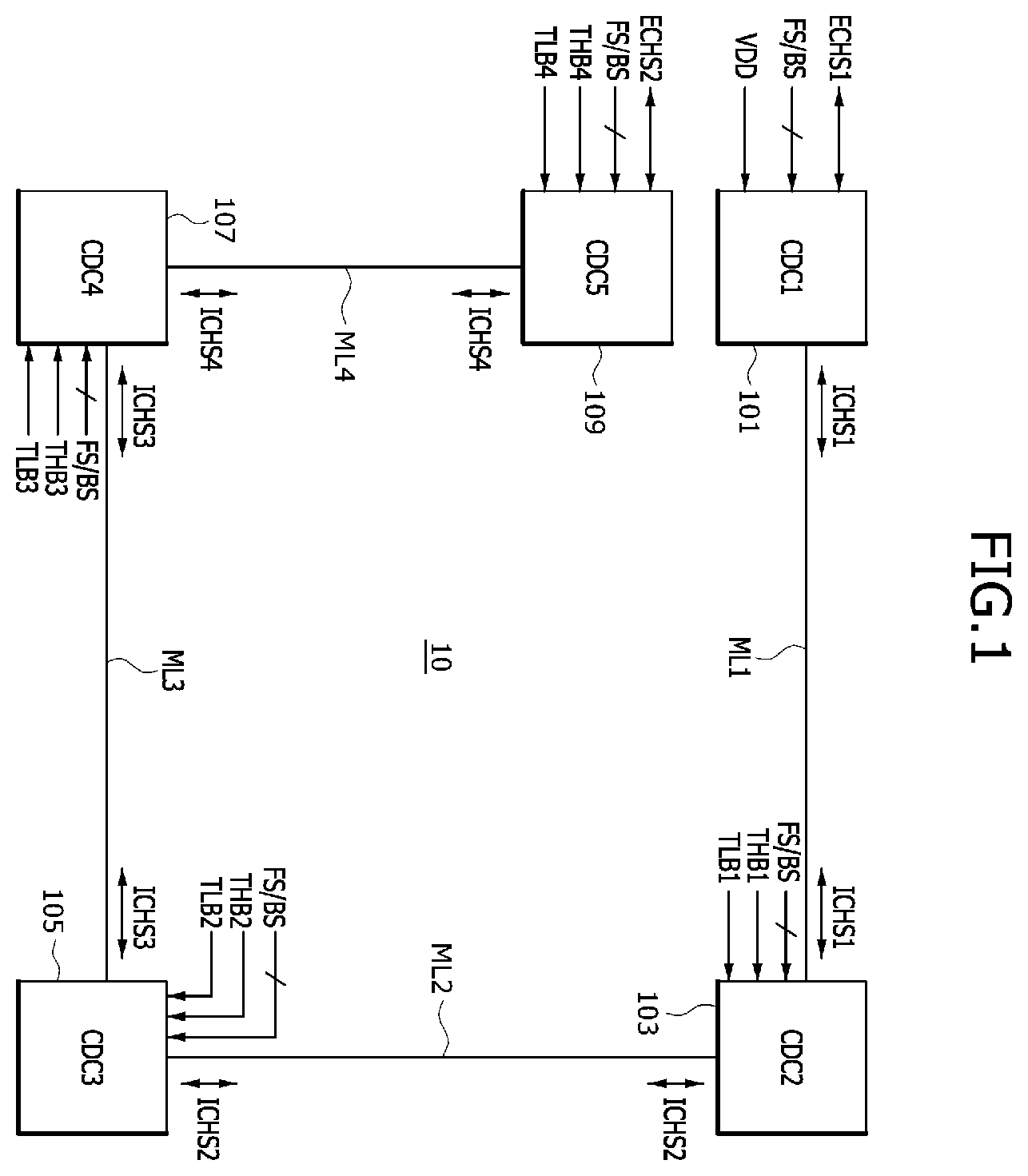
is a block diagram illustrating a construction of a semiconductor device according to an example of the present disclosure.
is a circuit diagram of a first crack detection circuit according to an example of the present disclosure.
is a circuit diagram of a second crack detection circuit according to an example of the present disclosure.
is a table for describing an operation of the second crack detection circuit according to an example of the present disclosure.
to 18 are timing diagrams for describing a crack detection operation that is performed in the semiconductor device according to an example of the present disclosure.
is a flowchart for describing an example of a method of a crack detection operation being performed in the semiconductor device according to an example of the present disclosure.
is a flowchart for describing another example of a method of a crack detection operation being performed in the semiconductor device according to an example of the present disclosure.
is a block diagram illustrating a construction of an electronic system according to an example of the present disclosure.
is a block diagram illustrating a construction of an electronic system according to another example of the present disclosure.
DETAILED DESCRIPTION
In the descriptions of the following embodiments, the term “preset” indicates that the numerical value of a parameter is previously decided, when the parameter is used in a process or algorithm. According to an embodiment, the numerical value of the parameter may be set when the process or algorithm is started or while the process or algorithm is performed.
Terms such as “first” and “second,” which are used to distinguish among various components, are not limited by the components. For example, a first component may be referred to as a second component, and vice versa.
When one component is referred to as being “coupled” or “connected” to another component, it should be understood that the components may be directly coupled or connected to each other or coupled or connected to each other through another component interposed therebetween. On the other hand, when one component is referred to as being “directly coupled” or “directly connected” to another component, it should be understood that the components are directly coupled or connected to each other without another component interposed therebetween.
A “logic high level” and a “logic low level” are used to describe the logic levels of signals. A signal having a “logic high level” is distinguished from a signal having a “logic low level.” For example, when a signal having a first voltage corresponds to a signal having a “logic high level,” a signal having a second voltage may correspond to a signal having a “logic low level.” According to an embodiment, a “logic high level” may be set to a voltage higher than a “logic low level.” According to an embodiment, the logic levels of signals may be set to different logic levels or opposite logic levels. For example, a signal having a logic high level may be set to have a logic low level in some embodiments, and a signal having a logic low level may be set to have a logic high level in some embodiments.
A “logic bit set” may mean a combination of logic levels of bits included in a signal. When a logic level of each of the bits included in the signal is changed, a logic bit set of the signal may be differently set. For example, if two bits are included in a signal, a logic bit set of the signal may be set as a first logic bit set when logic levels of the two bits included in the signal are a “logic low level” and a “logic low level” and may be set as a second logic bit set when logic levels of the two bits included in the signal are a “logic low level”, and a “logic high level.”
Hereafter, the present disclosure will be described in more detail through embodiments. The embodiments are only used to exemplify the present disclosure, and the scope of the present disclosure is not limited by the embodiments.
is a block diagram illustrating a construction of a semiconductor device 10 according to an example of the present disclosure. As illustrated in , the semiconductor device 10 may include a first crack detection circuit (CDC 1 ) 101 , a second crack detection circuit (CDC 2 ) 103 , a third crack detection circuit (CDC 3 ) 105 , a fourth crack detection circuit (CDC 4 ) 107 , a fifth crack detection circuit (CDC 5 ) 109 , a first metal line ML 1 , a second metal line ML 2 , a third metal line ML 3 , and a fourth metal line ML 4 .
The first crack detection circuit 101 may be connected to the first metal line ML 1 . The first crack detection circuit 101 may receive a forward signal FS, a backward signal BS, and a source voltage VDD from an external device (not illustrated). The external device (not illustrated) may be a controller ( 1002 in or 2300 in ), a test device (not illustrated), or the like. The first crack detection circuit 101 may output a first external detection signal ECHS 1 as a first internal detection signal ICHS 1 based on the forward signal FS or may output the first internal detection signal ICHS 1 as the first external detection signal ECHS 1 based on the backward signal BS. Through the first metal line ML 1 , the first crack detection circuit 101 may output, as the first internal detection signal ICHS 1 , the first external detection signal ECHS 1 that has been received through the external device (not illustrated) when the forward signal FS is activated. The first crack detection circuit 101 may output, as the first external detection signal ECHS 1 , the first internal detection signal ICHS 1 that has been received through the first metal line ML 1 when the backward signal BS is activated. The first crack detection circuit 101 may apply, to the external device (not illustrated), the first external detection signal ECHS 1 that is output when the backward signal BS is activated. When a crack occurs in the first metal line ML 1 , the first crack detection circuit 101 cannot perform an operation of outputting the first external detection signal ECHS 1 as the first internal detection signal ICHS 1 or outputting the first internal detection signal ICHS 1 as the first external detection signal ECHS 1 properly based on the forward signal FS and the backward signal BS. The levels of the forward signal FS and the backward signal BS may be activated to a logic high level, but this is merely an embodiment and the present disclosure is not limited thereto. The first crack detection circuit 101 may be disposed in an upper left area of the semiconductor device 10 , but this is merely an embodiment and the present disclosure is not limited thereto.
The second crack detection circuit 103 may be connected to the first metal line ML 1 and the second metal line ML 2 . The second crack detection circuit 103 may receive the forward signal FS, the backward signal BS, a first high setting signal THB 1 , and a first low setting signal TLB 1 . Based on the forward signal FS, the backward signal BS, the first high setting signal THB 1 , and the first low setting signal TLB 1 , the second crack detection circuit 103 may transfer the first internal detection signal ICHS 1 as a second internal detection signal ICHS 2 or may transfer the second internal detection signal ICHS 2 as the first internal detection signal ICHS 1 . Through the second metal line ML 2 , the second crack detection circuit 103 may output, as the second internal detection signal ICHS 2 , the first internal detection signal ICHS 1 that has been received through the first metal line ML 1 when the forward signal FS is activated when the first high setting signal THB 1 and the first low setting signal TLB 1 have been inactivated. When the first high setting signal THB 1 and the forward signal FS are activated, the second crack detection circuit 103 may set the second internal detection signal ICHS 2 that is output through the second metal line ML 2 at a logic high level. When the first low setting signal TLB 1 and the forward signal FS are activated, the second crack detection circuit 103 may set the second internal detection signal ICHS 2 that is output through the second metal line ML 2 at a logic low level. Through the first metal line ML 1 , the second crack detection circuit 103 may output, as the first internal detection signal ICHS 1 , the second internal detection signal ICHS 2 that has been received through the second metal line ML 2 when the backward signal BS is activated based on the first high setting signal THB 1 and the first low setting signal TLB 1 having been inactivated. When the first high setting signal THB 1 and the backward signal BS are activated, the second crack detection circuit 103 may set the first internal detection signal ICHS 1 that is output through the first metal line ML 1 at a logic high level. When the first low setting signal TLB 1 and the backward signal BS are activated, the second crack detection circuit 103 may set the first internal detection signal ICHS 1 that is output through the first metal line ML 1 at a logic low level. When a crack occurs in at least one of the first metal line ML 1 and the second metal line ML 2 , the second crack detection circuit 103 cannot perform an operation of outputting the first internal detection signal ICHS 1 as the second internal detection signal ICHS 2 or outputting the second internal detection signal ICHS 2 as the first internal detection signal ICHS 1 properly based on the forward signal FS and the backward signal BS. Furthermore, when a crack occurs in at least one of the first metal line ML 1 and the second metal line ML 2 , the second crack detection circuit 103 cannot set the logic levels of the first internal detection signal ICHS 1 and the second internal detection signal ICHS 2 properly based on the first high setting signal THB 1 and the first low setting signal TLB 1 . The levels of the first high setting signal THB 1 and the first low setting signal TLB 1 may be activated to a logic low level, but this is merely an embodiment and the present disclosure is not limited thereto. The second crack detection circuit 103 may be disposed in an upper right area of the semiconductor device 10 , but this is merely an embodiment and the present disclosure is not limited thereto.
The third crack detection circuit 105 may be connected to the second metal line ML 2 and the third metal line ML 3 . The third crack detection circuit 105 may receive the forward signal FS, the backward signal BS, a second high setting signal THB 2 , and a second low setting signal TLB 2 . Based on the forward signal FS, the backward signal BS, the second high setting signal THB 2 and the second low setting signal TLB 2 , the third crack detection circuit 105 may transfer the second internal detection signal ICHS 2 as a third internal detection signal ICHS 3 or may transfer the third internal detection signal ICHS 3 as the second internal detection signal ICHS 2 . Through the third metal line ML 3 , the third crack detection circuit 105 may output, as the third internal detection signal ICHS 3 , the second internal detection signal ICHS 2 that has been received through the second metal line ML 2 when the forward signal FS is activated based on the second high setting signal THB 2 and the second low setting signal TLB 2 having been inactivated. When the second high setting signal THB 2 and the forward signal FS are activated, the third crack detection circuit 105 may set the third internal detection signal ICHS 3 that is output through the third metal line ML 3 at a logic high level. When the second low setting signal TLB 2 and the forward signal FS are activated, the third crack detection circuit 105 may set the third internal detection signal ICHS 3 that is output through the third metal line ML 3 at a logic low level. Through the second metal line ML 2 , the third crack detection circuit 105 may output, as the second internal detection signal ICHS 2 , the third internal detection signal ICHS 3 that has been received through the third metal line ML 3 when the backward signal BS is activated based on the second high setting signal THB 2 and the second low setting signal TLB 2 having been inactivated. When the second high setting signal THB 2 and the backward signal BS are activated, the third crack detection circuit 105 may set the second internal detection signal ICHS 2 that is output through the second metal line ML 2 at a logic high level. When the second low setting signal TLB 2 and the backward signal BS are activated, the third crack detection circuit 105 may set the second internal detection signal ICHS 2 that is output through the second metal line ML 2 at a logic low level. When a crack occurs in at least one of the second metal line ML 2 and the third metal line ML 3 , the third crack detection circuit 105 cannot perform an operation of outputting the second internal detection signal ICHS 2 as the third internal detection signal ICHS 3 or outputting the third internal detection signal ICHS 3 as the second internal detection signal ICHS 2 properly based on the forward signal FS and the backward signal BS. Furthermore, when a crack occurs in at least one of the second metal line ML 2 and the third metal line ML 3 , the third crack detection circuit 105 cannot set the logic levels of the second internal detection signal ICHS 2 and the third internal detection signal ICHS 3 properly based on the second high setting signal THB 2 and the second low setting signal TLB 2 . The levels of the second high setting signal THB 2 and the second low setting signal TLB 2 may be activated to a logic low level, but this is merely an embodiment and the present disclosure is not limited thereto. The third crack detection circuit 105 may be disposed in a lower right area of the semiconductor device 10 , but this is merely an embodiment and the present disclosure is not limited thereto.
The fourth crack detection circuit 107 may be connected to the third metal line ML 3 and the fourth metal line ML 4 . The fourth crack detection circuit 107 may receive the forward signal FS, the backward signal BS, a third high setting signal THB 3 , and a third low setting signal TLB 3 . The fourth crack detection circuit 107 may transfer the third internal detection signal ICHS 3 as a fourth internal detection signal ICHS 4 or may transfer the fourth internal detection signal ICHS 4 as the third internal detection signal ICHS 3 based on the forward signal FS, the backward signal BS, the third high setting signal THB 3 , and the third low setting signal TLB 3 . Through the fourth metal line ML 4 , the fourth crack detection circuit 107 may output, as the fourth internal detection signal ICHS 4 , the third internal detection signal ICHS 3 that has been received through the third metal line ML 3 when the forward signal FS is activated based on the third high setting signal THB 3 and the third low setting signal TLB 3 having been inactivated. When the third high setting signal THB 3 and the forward signal FS are activated, the fourth crack detection circuit 107 may set the fourth internal detection signal ICHS 4 that is output through the fourth metal line ML 4 at a logic high level. When the third low setting signal TLB 3 and the forward signal FS are activated, the fourth crack detection circuit 107 may set the fourth internal detection signal ICHS 4 that is output through the fourth metal line ML 4 at a logic low level. Through the third metal line ML 3 , the fourth crack detection circuit 107 may output, as the third internal detection signal ICHS 3 , the fourth internal detection signal ICHS 4 that has been received through the fourth metal line ML 4 when the backward signal BS is activated based on the third high setting signal THB 3 and the third low setting signal TLB 3 having been inactivated. When the third high setting signal THB 3 and the backward signal BS are activated, the fourth crack detection circuit 107 may set the third internal detection signal ICHS 3 that is output through the third metal line ML 3 . When the third low setting signal TLB 3 and the backward signal BS are activated, the fourth crack detection circuit 107 may set the third internal detection signal ICHS 3 that is output through the third metal line ML 3 at a logic low level. When a crack occurs in at least one of the third metal line ML 3 and the fourth metal line ML 4 , the fourth crack detection circuit 107 cannot perform an operation of outputting the third internal detection signal ICHS 3 as the fourth internal detection signal ICHS 4 or outputting the fourth internal detection signal ICHS 4 as the third internal detection signal ICHS 3 properly based on the forward signal FS and the backward signal BS. Furthermore, when a crack occurs in at least one of the third metal line ML 3 and the fourth metal line ML 4 , the fourth crack detection circuit 107 cannot set the logic levels of the third internal detection signal ICHS 3 and the fourth internal detection signal ICHS 4 properly based on the third high setting signal THB 3 and the third low setting signal TLB 3 . The levels of the third high setting signal THB 3 and the third low setting signal TLB 3 may be activated to a logic low level, but this is merely an embodiment and the present disclosure is not limited thereto. The fourth crack detection circuit 107 may be disposed in a lower left area of the semiconductor device 10 , but this is merely an embodiment and the present disclosure is not limited thereto.
The fifth crack detection circuit 109 may be connected to the fourth metal line ML 4 . The fifth crack detection circuit 109 may receive the forward signal FS, the backward signal BS, a fourth high setting signal THB 4 , and a fourth low setting signal TLB 4 . Based on the forward signal FS, the backward signal BS, the fourth high setting signal THB 4 , and the fourth low setting signal TLB 4 , the fifth crack detection circuit 109 may transfer the fourth internal detection signal ICHS 4 as a second external detection signal ECHS 2 or transfer the second external detection signal ECHS 2 as the fourth internal detection signal ICHS 4 . The fifth crack detection circuit 109 may output the fourth internal detection signal ICHS 4 that has been received through the fourth metal line ML 4 as the second external detection signal ECHS 2 when the forward signal FS is activated based on the fourth high setting signal THB 4 and the fourth low setting signal TLB 4 having been inactivated and may apply the second external detection signal ECHS 2 to the external device (not illustrated). When the fourth high setting signal THB 4 and the forward signal FS are activated, the fifth crack detection circuit 109 may set the second external detection signal ECHS 2 that is applied to the external device (not illustrated) at a logic high level. When the fourth low setting signal TLB 4 and the forward signal FS are activated, the fifth crack detection circuit 109 may set the second external detection signal ECHS 2 that is applied to the external device (not illustrated) at a logic low level. Through the fourth metal line ML 4 , the fifth crack detection circuit 109 may output, as the fourth internal detection signal ICHS 4 , the second external detection signal ECHS 2 that has been received from the external device (not illustrated) when the backward signal BS is activated based on the fourth high setting signal THB 4 and the fourth low setting signal TLB 4 having been inactivated. When the fourth high setting signal THB 4 and the backward signal BS are activated, the fifth crack detection circuit 109 may set the fourth internal detection signal ICHS 4 that is output through the fourth metal line ML 4 at a logic high level. When the fourth low setting signal TLB 4 and the backward signal BS are activated, the fifth crack detection circuit 109 may set the fourth internal detection signal ICHS 4 that is output through the fourth metal line ML 4 at a logic low level. When a crack occurs in the fourth metal line ML 4 , the fifth crack detection circuit 109 cannot perform an operation of outputting the fourth internal detection signal ICHS 4 as the second external detection signal ECHS 2 or outputting the second external detection signal ECHS 2 as the fourth internal detection signal ICHS 4 properly based on the forward signal FS and the backward signal BS. Furthermore, when a crack occurs in the fourth metal line ML 4 , the fifth crack detection circuit 109 cannot set the logic levels of the third internal detection signal ICHS 3 and the fourth internal detection signal ICHS 4 properly based on the fourth high setting signal THB 4 and the fourth low setting signal TLB 4 . The levels of the fourth high setting signal THB 4 and the fourth low setting signal TLB 4 may be activated to a logic low level, but this is merely an embodiment and the present disclosure is not limited thereto. The fifth crack detection circuit 109 may be disposed in a lower area of the first crack detection circuit 101 , but this is merely an embodiment and the present disclosure is not limited thereto.
is a circuit diagram of a first crack detection circuit 101 A according to an example of the first crack detection circuit 101 . As illustrated in , the first crack detection circuit 101 A may include NAND gates 201 _ 1 to 201 _ 4 and inverters 203 _ 1 to 203 _ 6 . The NAND gate 201 _ 1 may perform a NAND operation by receiving the first external detection signal ECHS 1 and the source voltage VDD. The NAND gate 201 _ 1 may output the first external detection signal ECHS 1 by inverting and buffering the first external detection signal ECHS 1 . The NAND gate 201 _ 2 may perform a NAND operation by receiving the output signal of the NAND gate 201 _ 1 and the source voltage VDD. The NAND gate 201 _ 2 may output the output signal of the NAND gate 201 _ 1 by inverting and buffering the output signal of the NAND gate 201 _ 1 . The inverter 203 _ 1 may output the output signal of the NAND gate 201 _ 2 by inverting and buffering the output signal of the NAND gate 201 _ 2 . The inverter 203 _ 2 may output the forward signal FS by inverting and buffering the forward signal FS. The inverter 203 _ 2 may output the output signal of the inverter 203 _ 1 as the first internal detection signal ICHS 1 by inverting and buffering the output signal of the inverter 203 _ 1 when the logic level of the forward signal FS is activated to a logic high level. The NAND gate 201 _ 3 may perform a NAND operation by receiving the first internal detection signal ICHS 1 and the source voltage VDD. The NAND gate 201 _ 3 may output the first internal detection signal ICHS 1 by inverting and buffering the first internal detection signal ICHS 1 . The NAND gate 201 _ 4 may perform a NAND operation by receiving the output signal of the NAND gate 201 _ 3 and the source voltage VDD. The NAND gate 201 _ 4 may output the output signal of the NAND gate 201 _ 3 by inverting and buffering the output signal of the NAND gate 201 _ 3 . The inverter 203 _ 4 may output the output signal of the NAND gate 201 _ 4 by inverting and buffering the output signal of the NAND gate 201 _ 4 . The inverter 203 _ 5 may output the backward signal BS by inverting and buffering the backward signal BS. The inverter 203 _ 6 may output the output signal of the inverter 203 _ 4 as the first external detection signal ECHS 1 by inverting and buffering the output signal of the inverter 203 _ 4 when the logic level of the backward signal BS is activated to a logic high level.
The first crack detection circuit 101 A that is constructed as described above may output the first external detection signal ECHS 1 as the first internal detection signal ICHS 1 by buffering the first external detection signal ECHS 1 through the NAND gates 201 _ 1 and 201 _ 2 and the inverters 203 _ 1 and 203 _ 3 when the logic level of the forward signal FS is activated to a logic high level. Furthermore, the first crack detection circuit 101 may output the first internal detection signal ICHS 1 as the first external detection signal ECHS 1 by buffering the first internal detection signal ICHS 1 through the NAND gates 201 _ 3 and 201 _ 4 and the inverters 203 _ 4 and 203 _ 6 when the logic level of the backward signal BS is activated to a logic high level.
is a circuit diagram of a second crack detection circuit 103 A according to an example of the second crack detection circuit 103 . As illustrated in , the second crack detection circuit 103 A may include NAND gates 211 _ 1 to 211 _ 4 and inverters 213 _ 1 to 213 _ 6 . The NAND gate 211 _ 1 may perform a NAND operation by receiving the first internal detection signal ICHS 1 and the first low setting signal TLB 1 . The NAND gate 211 _ 1 may output a logic high level when the logic level of the first low setting signal TLB 1 is activated to a logic low level and may output the first internal detection signal ICHS 1 by inverting and buffering the first internal detection signal ICHS 1 when the logic level of the first low setting signal TLB 1 is inactivated to a logic high level. The NAND gate 211 _ 2 may perform a NAND operation by receiving the output signal of the NAND gate 211 _ 1 and the first high setting signal THB 1 . The NAND gate 211 _ 2 may output a logic high level when the logic level of the first high setting signal THB 1 is activated to a logic low level and may output the output signal of the NAND gate 211 _ 1 by inverting and buffering the output signal of the NAND gate 211 _ 1 when the logic level of the first high setting signal THB 1 is inactivated to a logic high level. The inverter 213 _ 1 may output the output signal of the NAND gate 211 _ 2 by inverting and buffering the output signal of the NAND gate 211 _ 2 . The inverter 213 _ 2 may output the forward signal FS by inverting and buffering the forward signal FS. The inverter 213 _ 2 may output the output signal of the inverter 213 _ 1 as the second internal detection signal ICHS 2 by inverting and buffering the output signal of the inverter 213 _ 1 when the logic level of the forward signal FS is activated to a logic high level. The NAND gate 211 _ 3 may perform a NAND operation by receiving the second internal detection signal ICHS 2 and the first low setting signal TLB 1 . The NAND gate 211 _ 3 may output a logic high level when the logic level of the first low setting signal TLB 1 is activated to a logic low level and may output the second internal detection signal ICHS 2 by inverting and buffering the second internal detection signal ICHS 2 when the logic level of the first low setting signal TLB 1 is inactivated to a logic high level. The NAND gate 211 _ 4 may perform a NAND operation by receiving the output signal of the NAND gate 211 _ 3 and the first high setting signal THB 1 . The NAND gate 211 _ 4 may output a logic high level when the logic level of the first high setting signal THB 1 is activated to a logic low level and may output the output signal of the NAND gate 211 _ 3 by inverting and buffering the output signal of the NAND gate 211 _ 3 when the logic level of the first high setting signal THB 1 is inactivated to a logic high level. The inverter 213 _ 4 may output the output signal of the NAND gate 211 _ 4 by inverting and buffering the output signal of the NAND gate 211 _ 4 . The inverter 213 _ 5 may output the backward signal BS by inverting and buffering the backward signal BS. The inverter 213 _ 6 may output the output signal of the inverter 213 _ 4 as the first internal detection signal ICHS 1 by inverting and buffering the output signal of the inverter 213 _ 4 when the logic level of the backward signal BS is activated to a logic high level.
The second crack detection circuit 103 A, illustrated in , may output the first internal detection signal ICHS 1 as the second internal detection signal ICHS 2 by buffering the first internal detection signal ICHS 1 through the NAND gates 211 _ 1 and 211 _ 2 and the inverters 213 _ 1 and 213 _ 3 when the logic level of the forward signal FS is activated to a logic high level based on the logic levels of the first high setting signal THB 1 and the first low setting signal TLB 1 having been inactivated to a logic high level. Furthermore, in the second crack detection circuit 103 A, when the logic level of the first high setting signal THB 1 is activated to a logic low level and the logic level of the forward signal FS is activated to a logic high level, the output signal of the NAND gate 211 _ 2 that outputs a logic high level may be buffered through the inverters 213 _ 1 and 213 _ 3 , and the logic level of the second internal detection signal ICHS 2 may be set to a logic high level. Furthermore, in the second crack detection circuit 103 A, when the logic level of the first low setting signal TLB 1 is activated to a logic low level and the logic level of the forward signal FS is activated to a logic high level, the output signal of the NAND gate 211 _ 1 that outputs a logic high level may be inverted and buffered through the NAND gate 211 _ 2 and the inverters 213 _ 1 and 213 _ 3 , and the logic level of the second internal detection signal ICHS 2 may be set to a logic low level. Furthermore, when the logic level of the backward signal BS is activated to a logic high level based on the logic levels of the first high setting signal THB 1 and the first low setting signal TLB 1 having been inactivated to a logic high level, the second crack detection circuit 103 A may output the second internal detection signal ICHS 2 as the first internal detection signal ICHS 1 by buffering the second internal detection signal ICHS 2 through the NAND gates 211 _ 3 and 211 _ 4 and the inverters 213 _ 4 and 213 _ 6 . Furthermore, in the second crack detection circuit 103 A, when the logic level of the first high setting signal THB 1 is activated to a logic low level and the logic level of the backward signal BS is activated to a logic high level, the output signal of the NAND gate 211 _ 4 that outputs a logic high level may be buffered through the inverters 213 _ 4 and 213 _ 6 , and the logic level of the first internal detection signal ICHS 1 may be set to a logic high level. Furthermore, in the second crack detection circuit 103 A, when the logic level of the first low setting signal TLB 1 is activated to a logic low level and the logic level of the backward signal BS is activated to a logic high level, the output signal of the NAND gate 211 _ 3 that outputs a logic high level may be inverted and buffered through the NAND gate 211 _ 4 and the inverters 213 _ 4 and 213 _ 6 , and the logic level of the first internal detection signal ICHS 1 may be set to a logic low level.
Operations of the first internal detection signal ICHS 1 and the second internal detection signal ICHS 2 in the second crack detection circuit 103 A are described more specifically with reference to . As illustrated in , when the logic level of the first high setting signal THB 1 is activated to a logic low level “L” based on the logic level of the forward signal FS having been activated to a logic high level “H” and the logic level of the backward signal BS having been inactivated to a logic low level “L”, the NAND gate 211 _ 2 may output a logic high level “H” regardless of a logic level of the first low setting signal TLB 1 . Accordingly, the logic level of the second internal detection signal ICHS 2 may be set as a logic high level “H” regardless of the first internal detection signal ICHS 1 . Furthermore, when the logic level of the first low setting signal TLB 1 is activated to a logic low level “L” and the logic level of the first high setting signal THB 1 is inactivated to a logic high level “H” based on the logic level of the forward signal FS having been activated to a logic high level “H” and the logic level of the backward signal BS having been inactivated to a logic low level “L”, the NAND gate 211 _ 1 may output a logic high level “H” and the NAND gate 211 _ 1 may output a logic low level “L”. Accordingly, the logic level of the second internal detection signal ICHS 2 may be set as a logic low level “L” regardless of the first internal detection signal ICHS 1 . Furthermore, when the logic level of the first high setting signal THB 1 is activated to a logic low level “L” based on the logic level of the backward signal BS having been activated to a logic high level “H” and the logic level of the forward signal FS having been inactivated to a logic low level “L”, the NAND gate 211 _ 4 may output a logic high level “H” regardless of a logic level of the first low setting signal TLB 1 . Accordingly, the logic level of the first internal detection signal ICHS 1 may be set as a logic high level “H” regardless of the second internal detection signal ICHS 2 . Furthermore, when the logic level of the first low setting signal TLB 1 is activated to a logic low level “L” and the logic level of the first high setting signal THB 1 is inactivated to a logic high level “H” based on the logic level of the backward signal BS having been activated to a logic high level “H” and the logic level of the forward signal FS having been inactivated to a logic low level “L”, the NAND gate 211 _ 3 may output a logic high level “H”, and the NAND gate 211 _ 4 may output a logic low level “L”. Accordingly, the logic level of the first internal detection signal ICHS 1 may be set as a logic low level “L” regardless of the second internal detection signal ICHS 2 .
to 18 are timing diagrams for describing a crack detection operation that is performed in the semiconductor device 10 .
As illustrated in , a crack detection operation according to an example may be performed in a way that a pulse of the first external detection signal ECHS 1 that is applied by the external device (not illustrated) is transmitted through the first metal line ML 1 , the second metal line ML 2 , the third metal line ML 3 , and the fourth metal line ML 4 and the external device (not illustrated) receives the second external detection signal ECHS 2 when the logic levels of all of the first to fourth high setting signals THB 1 to THB 4 and the first to fourth low setting signals TLB 1 to TLB 4 have been inactivated to a logic high level “H” when the logic level of the forward signal FS has been activated to a logic high level “H” and the logic level of the backward signal BS has been inactivated to a logic low level “L”. As illustrated in , it may be seen that when a pulse of the first external detection signal ECHS 1 is transferred to the second external detection signal ECHS 2 that has been received from the external device (not illustrated), a crack is not present in the first metal line ML 1 , the second metal line ML 2 , the third metal line ML 3 , and the fourth metal line ML 4 . As illustrated in , it may be seen that when a pulse of the first external detection signal ECHS 1 is not transferred to the second external detection signal ECHS 2 that has been received from the external device (not illustrated) and the logic level of the second external detection signal ECHS 2 is maintained to a logic low level “L”, a crack is present in at least one of the first metal line ML 1 , the second metal line ML 2 , the third metal line ML 3 , and the fourth metal line ML 4 .
As illustrated in , a crack detection operation according to another example may be performed in a way to check the logic level of the second external detection signal ECHS 2 while sequentially activating the logic levels of the first high setting signal THB 1 , the second high setting signal THB 2 , the third high setting signal THB 3 , and the fourth high setting signal THB 4 to a logic low level “L” when the logic level of the forward signal FS has been activated to a logic high level “H” and the logic level of the backward signal BS has been inactivated to a logic low level “L” and then to check the logic level of the first external detection signal ECHS 1 while sequentially activating the logic levels of the fourth high setting signal THB 4 , the third high setting signal THB 3 , the second high setting signal THB 2 , and the first high setting signal THB 1 to a logic low level “L” when the logic level of the backward signal BS has been activated to a logic high level “H” and the logic level of the forward signal FS has been inactivated to a logic low level “L”. As illustrated in , it may be seen that when the logic level of the second high setting signal THB 2 is activated to a logic low level “L” based on the logic level of the forward signal FS having been activated to a logic high level “H” and the logic level of the backward signal BS having been inactivated to a logic low level “L”, a crack is not present in the third metal line ML 3 and the fourth metal line ML 4 because the logic level of the second external detection signal ECHS 2 is activated to a logic high level “H”. Furthermore, as illustrated in , it may be seen that when the logic level of the first high setting signal THB 1 is activated to a logic low level “L” based on the logic level of the backward signal BS having been activated to a logic high level “H” and the logic level of the forward signal FS having been inactivated to a logic low level “L”, a crack is not present in the first metal line ML 1 because the logic level of the first external detection signal ECHS 1 is activated to a logic high level “H”. Accordingly, it may be checked that a crack is present in the second metal line ML 2 by the crack detection operation, illustrated in .
As illustrated in , a crack detection operation according to still another example may be performed in a way to check the logic level of the second external detection signal ECHS 2 while sequentially activating the logic levels of the first low setting signal TLB 1 , the second low setting signal TLB 2 , the third low setting signal TLB 3 , and the fourth low setting signal TLB 4 to a logic low level “L” when the logic level of the forward signal FS has been activated to a logic high level “H” and the logic level of the backward signal BS has been inactivated to a logic low level “L” and then to check the logic level of the first external detection signal ECHS 1 while sequentially activating the logic levels of the fourth low setting signal TLB 4 , the third low setting signal TLB 3 , the second low setting signal TLB 2 , and the first low setting signal TLB 1 to a logic low level “L” when the logic level of the backward signal BS has been activated to a logic high level “H” and the logic level of the forward signal FS has been inactivated to a logic low level “L”. As illustrated in , it may be seen that when the logic level of the second low setting signal TLB 2 is activated to a logic low level “L” based on the logic level of the forward signal FS having been activated to a logic high level “H” and the logic level of the backward signal BS having been inactivated to a logic low level “L”, a crack is not present in the third metal line ML 3 and the fourth metal line ML 4 because the logic level of the second external detection signal ECHS 2 is activated to a logic low level “L”. Furthermore, as illustrated in , it may be seen that when the logic level of the first low setting signal TLB 1 is activated to a logic low level “L” based on the logic level of the backward signal BS having been activated to a logic high level “H” and the logic level of the forward signal FS having been inactivated to a logic low level “L”, a crack is not present in the first metal line ML 1 because the logic level of the first external detection signal ECHS 1 is activated to a logic low level “L”. Accordingly, it may be checked that a crack is present in the second metal line ML 2 by the crack detection operation, illustrated in .
As illustrated in , a crack detection operation according to still another example may be performed in a way to check the logic level of the second external detection signal ECHS 2 while sequentially activating the logic levels of the first high setting signal THB 1 , the second high setting signal THB 2 , the third high setting signal THB 3 , and the fourth high setting signal THB 4 to a logic low level “L” when the logic level of the forward signal FS has been activated to a logic high level “H” and the logic level of the backward signal BS has been inactivated to a logic low level “L” and then to check the logic level of the first external detection signal ECHS 1 while sequentially activating the logic levels of the fourth high setting signal THB 4 , the third high setting signal THB 3 , the second high setting signal THB 2 , and the first high setting signal THB 1 to a logic low level “L” based on the logic level of the backward signal BS having been activated to a logic high level “H” and the logic level of the forward signal FS having been inactivated to a logic low level “L”. As illustrated in , it may be seen that when the logic level of the third high setting signal THB 3 is activated to a logic low level “L” based on the logic level of the forward signal FS having been activated to a logic high level “H” and the logic level of the backward signal BS having been inactivated to a logic low level “L”, a crack is not present in the fourth metal line ML 4 because the logic level of the second external detection signal ECHS 2 is activated to a logic high level “H”. Furthermore, as illustrated in , it may be seen that when the logic level of the first high setting signal THB 1 is activated to a logic low level “L” based on the logic level of the backward signal BS having been activated to a logic high level “H” and the logic level of the forward signal FS having been inactivated to a logic low level “L”, a crack is not present in the first metal line ML 1 because the logic level of the first external detection signal ECHS 1 is activated to a logic high level “H”. Accordingly, it may be checked that a crack is present in the second metal line ML 2 and the third metal line ML 3 by the crack detection operation, illustrated in .
As illustrated in , a crack detection operation according to another example may be performed in a way to check the logic level of the second external detection signal ECHS 2 while sequentially activating the logic levels of the first low setting signal TLB 1 , the second low setting signal TLB 2 , the third low setting signal TLB 3 , and the fourth low setting signal TLB 4 to a logic low level “L” when the logic level of the forward signal FS has been activated to a logic high level “H” and the logic level of the backward signal BS has been inactivated to a logic low level “L” and then to check the logic level of the first external detection signal ECHS 1 while sequentially activating the logic levels of the fourth low setting signal TLB 4 , the third low setting signal TLB 3 , the second low setting signal TLB 2 , and the first low setting signal TLB 1 to a logic low level “L” when the logic level of the backward signal BS has been activated to a logic high level “H” and the logic level of the forward signal FS has been inactivated to a logic low level “L”. As illustrated in , it may be seen that when the logic level of the third low setting signal TLB 3 is activated to a logic low level “L” based on the logic level of the forward signal FS having been activated to a logic high level “H” and the logic level of the backward signal BS having been inactivated to a logic low level “L”, a crack is not present in the fourth metal line ML 4 because the logic level of the second external detection signal ECHS 2 is activated to a logic low level “L”. Furthermore, as illustrated in , it may be seen that when the logic level of the first low setting signal TLB 1 is activated to a logic low level “L” based on the logic level of the backward signal BS having been activated to a logic high level “H” and the logic level of the forward signal FS having been inactivated to a logic low level “L”, a crack is not present in the first metal line ML 1 because the logic level of the first external detection signal ECHS 1 is activated to a logic low level “L”. Accordingly, it may be checked that a crack is present in the second metal line ML 2 and the third metal line ML 3 by the crack detection operation, illustrated in .
As illustrated in , a crack detection operation according to still another example may be performed in a way to check the logic level of the second external detection signal ECHS 2 while sequentially activating the logic levels of the first high setting signal THB 1 , the second high setting signal THB 2 , the third high setting signal THB 3 , and the fourth high setting signal THB 4 to a logic low level “L” when the logic level of the forward signal FS has been activated to a logic high level “H” and the logic level of the backward signal BS has been inactivated to a logic low level “L” and then to check the logic level of the first external detection signal ECHS 1 while sequentially activating the logic levels of the fourth high setting signal THB 4 , the third high setting signal THB 3 , the second high setting signal THB 2 , and the first high setting signal THB 1 to a logic low level “L” when the logic level of the backward signal BS has been activated to a logic high level “H” and the logic level of the forward signal FS has been inactivated to a logic low level “L”. As illustrated in , it may be seen that when the logic level of the fourth high setting signal THB 4 is activated to a logic low level “L” based on the logic level of the forward signal FS having been activated to a logic high level “H” and the logic level of the backward signal BS having been inactivated to a logic low level “L”, a crack is present in the fourth metal line ML 4 because the logic level of the second external detection signal ECHS 2 is activated to a logic high level “H”. Furthermore, as illustrated in , it may be seen that when the logic level of the first high setting signal THB 1 is activated to a logic low level “L” based on the logic level of the backward signal BS having been activated to a logic high level “H” and the logic level of the forward signal FS having been inactivated to a logic low level “L”, a crack is not present in the first metal line ML 1 because the logic level of the first external detection signal ECHS 1 is activated to a logic high level “H”. Accordingly, it may be checked that a crack is present in the second metal line ML 2 and the fourth metal line ML 4 by the crack detection operation, illustrated in .
As illustrated in , a crack detection operation according to still another example may be performed in a way to check the logic level of the second external detection signal ECHS 2 while sequentially activating the logic levels of the first low setting signal TLB 1 , the second low setting signal TLB 2 , the third low setting signal TLB 3 , and the fourth low setting signal TLB 4 to a logic low level) “L” when the logic level of the forward signal FS has been activated to a logic high level “H” and the logic level of the backward signal BS has been inactivated to a logic low level “L” and then to check the logic level of the first external detection signal ECHS 1 while sequentially activating the logic levels of the fourth low setting signal TLB 4 , the third low setting signal TLB 3 , the second low setting signal TLB 2 , and the first low setting signal TLB 1 to a logic low level “L” when the logic level of the backward signal BS has been activated to a logic high level “H” and the logic level of the forward signal FS has been inactivated to a logic low level “L”. As illustrated in , it may be seen that when the logic level of the fourth low setting signal TLB 4 is activated to a logic low level “L” based on the logic level of the forward signal FS having been activated to a logic high level “H” and the logic level of the backward signal BS having been inactivated to a logic low level “L”, a crack is present in the fourth metal line ML 4 because the logic level of the second external detection signal ECHS 2 is activated to a logic low level “L”. Furthermore, as illustrated in , it may be seen that when the logic level of the first low setting signal TLB 1 is activated to a logic low level “L” based on the logic level of the backward signal BS having been activated to a logic high level “H” and the logic level of the forward signal FS having been inactivated to a logic low level “L”, a crack is not present in the first metal line ML 1 because the logic level of the first external detection signal ECHS 1 is activated to a logic low level “L”. Accordingly, it may be checked that a crack is present in the second metal line ML 2 and the fourth metal line ML 4 by the crack detection operation, illustrated in .
An example of a method of a crack detection operation being performed in the semiconductor device 10 is described as follows with reference to a flowchart, illustrated in .
First, by activating the first high setting signal THB 1 (S 103 ) when the forward signal FS has been activated and the backward signal BS has been inactivated (S 101 ), the logic level of the second internal detection signal ICHS 2 may be activated to a logic high level, and whether the second internal detection signal ICHS 2 is transferred as the second external detection signal ECHS 2 through the third internal detection signal ICHS 3 and the fourth internal detection signal ICHS 4 may be checked (S 105 ). It may be checked that when the second external detection signal ECHS 2 is output at the same logic level as the second internal detection signal ICHS 2 , a crack is not present in the second metal line ML 2 , the third metal line ML 3 , and the fourth metal line ML 4 . It may be checked that when the second external detection signal ECHS 2 is output at a logic level that is different from the logic level of the second internal detection signal ICHS 2 , a crack is present in one of the second metal line ML 2 , the third metal line ML 3 , and the fourth metal line ML 4 .
Next, by activating the second high setting signal THB 2 (S 107 ) when the forward signal FS has been activated and the backward signal BS has been inactivated (S 101 ), the logic level of the third internal detection signal ICHS 3 may be activated to a logic high level, and whether the third internal detection signal ICHS 3 is transferred as the second external detection signal ECHS 2 through the fourth internal detection signal ICHS 4 may be checked (S 109 ). It may be checked that when the second external detection signal ECHS 2 is output at the same logic level as the third internal detection signal ICHS 3 , a crack is not present in the third metal line ML 3 and the fourth metal line ML 4 . It may be checked that when the second external detection signal ECHS 2 is output at a logic level that is different from the logic level of the third internal detection signal ICHS 3 , a crack is present in one of the third metal line ML 3 and the fourth metal line ML 4 .
Next, by activating the third high setting signal THB 3 (S 111 ) when the forward signal FS has been activated and the backward signal BS has been inactivated (S 101 ), the logic level of the fourth internal detection signal ICHS 4 may be activated to a logic high level, and whether the fourth internal detection signal ICHS 4 is transferred as the second external detection signal ECHS 2 may be checked (S 113 ). It may be checked that when the second external detection signal ECHS 2 is output at the same logic level as the fourth internal detection signal ICHS 4 , a crack is not present in the fourth metal line ML 4 . It may be checked that when the second external detection signal ECHS 2 is output at a logic level that is different from the logic level of the fourth internal detection signal ICHS 4 , a crack is present in the fourth metal line ML 4 .
Next, by activating the fourth high setting signal THB 4 (S 123 ) when the backward signal BS has been activated and the forward signal FS has been inactivated (S 121 ), the logic level of the fourth internal detection signal ICHS 4 may be activated to a logic high level, and whether the fourth internal detection signal ICHS 4 is transferred as the first external detection signal ECHS 1 through the third internal detection signal ICHS 3 , the second internal detection signal ICHS 2 , and the first internal detection signal ICHS 1 may be checked (S 125 ). It may be checked that when the first external detection signal ECHS 1 is output at the same logic level as the fourth internal detection signal ICHS 4 , a crack is not present in the first metal line ML 1 , the second metal line ML 2 , the third metal line ML 3 , and the fourth metal line ML 4 . It may be checked that when the first external detection signal ECHS 1 is output at a logic level that is different from the logic level of the fourth internal detection signal ICHS 4 , a crack is present in one of the first metal line ML 1 , the second metal line ML 2 , the third metal line ML 3 , and the fourth metal line ML 4 .
Next, by activating the third high setting signal THB 3 (S 127 ) when the backward signal BS has been activated and the forward signal FS has been inactivated (S 121 ), the logic level of the third internal detection signal ICHS 3 may be activated to a logic high level, and whether the third internal detection signal ICHS 3 is transferred as the first external detection signal ECHS 1 through the second internal detection signal ICHS 2 and the first internal detection signal ICHS 1 may be checked (S 129 ). It may be checked that when the first external detection signal ECHS 1 is output at the same logic level as the third internal detection signal ICHS 3 , a crack is not present in the first metal line ML 1 , the second metal line ML 2 , and the third metal line ML 3 . It may be checked that when the first external detection signal ECHS 1 is output at a logic level that is different from the logic level of the third internal detection signal ICHS 3 , a crack is present in one of the first metal line ML 1 , the second metal line ML 2 , and the third metal line ML 3 .
Next, by activating the second high setting signal THB 2 (S 131 ) when the backward signal BS has been activated and the forward signal FS has been inactivated (S 121 ), the logic level of the second internal detection signal ICHS 2 may be activated to a logic high level, and whether the second internal detection signal ICHS 2 is transferred as the first external detection signal ECHS 1 through the first internal detection signal ICHS 1 may be checked (S 133 ). It may be checked that when the first external detection signal ECHS 1 is output at the same logic level as the second internal detection signal ICHS 2 , a crack is not present in the first metal line ML 1 and the second metal line ML 2 . It may be checked that when the first external detection signal ECHS 1 is output at a logic level that is different from the logic level of the second internal detection signal ICHS 2 , a crack is present in one of the first metal line ML 1 and the second metal line ML 2 .
Finally, by activating the first high setting signal THB 1 (S 135 ) when the backward signal BS has been activated and the forward signal FS has been inactivated (S 121 ), the logic level of the first internal detection signal ICHS 1 may be set to a logic high level, and whether the first internal detection signal ICHS 1 is transferred as the first external detection signal ECHS 1 may be checked (S 137 ). It may be checked that when the first external detection signal ECHS 1 is output at the same logic level as the first internal detection signal ICHS 1 , a crack is not present in the first metal line ML 1 . It may be checked that when the first external detection signal ECHS 1 is output at a logic level that is different from the logic level of the first internal detection signal ICHS 1 , a crack is present in the first metal line ML 1 .
Another example of a method of a crack detection operation being performed in the semiconductor device 10 is described as follows with reference to a flowchart, illustrated in .
First, by activating the first low setting signal TLB 1 (S 203 ) when the forward signal FS has been activated and the backward signal BS has been inactivated (S 201 ), the logic level of the second internal detection signal ICHS 2 may be set as a logic low level, and whether the second internal detection signal ICHS 2 is transferred as the second external detection signal ECHS 2 through the third internal detection signal ICHS 3 and the fourth internal detection signal ICHS 4 may be checked (S 205 ). It may be checked that when the second external detection signal ECHS 2 is output at the same logic level as the second internal detection signal ICHS 2 , a crack is not present in the second metal line ML 2 , the third metal line ML 3 , and the fourth metal line ML 4 . It may be checked that when the second external detection signal ECHS 2 is output at a logic level that is different from the logic level of the second internal detection signal ICHS 2 , a crack is present in one of the second metal line ML 2 , the third metal line ML 3 , and the fourth metal line ML 4 .
Next, by activating the second low setting signal TLB 2 (S 207 ) when the forward signal FS has been activated and the backward signal BS has been inactivated (S 201 ), the logic level of the third internal detection signal ICHS 3 may be set as a logic low level, and whether the third internal detection signal ICHS 3 is transferred as the second external detection signal ECHS 2 through the fourth internal detection signal ICHS 4 may be checked (S 209 ). It may be checked that when the second external detection signal ECHS 2 is output at the same logic level as the third internal detection signal ICHS 3 , a crack is not present in the third metal line ML 3 and the fourth metal line ML 4 . It may be checked that when the second external detection signal ECHS 2 is output at a logic level that is different from the logic level of the third internal detection signal ICHS 3 , a crack is present in one of the third metal line ML 3 and the fourth metal line ML 4 .
Next, by activating the third low setting signal TLB 3 (S 211 ) when the forward signal FS has been activated and the backward signal BS has been inactivated (S 201 ), the logic level of the fourth internal detection signal ICHS 4 may be set as a logic low level, and whether the fourth internal detection signal ICHS 4 is transferred as the second external detection signal ECHS 2 may be checked (S 213 ). It may be checked that when the second external detection signal ECHS 2 is output at the same logic level as the fourth internal detection signal ICHS 4 , a crack is not present in the fourth metal line ML 4 . It may be checked that when the second external detection signal ECHS 2 is output at a logic level that is different from the logic level of the fourth internal detection signal ICHS 4 , a crack is present in the fourth metal line ML 4 .
Next, by activating the fourth low setting signal TLB 4 (S 223 ) when the backward signal BS has been activated and the forward signal FS has been inactivated (S 221 ), the logic level of the fourth internal detection signal ICHS 4 may be set as a logic low level, and whether the fourth internal detection signal ICHS 4 is transferred as the first external detection signal ECHS 1 through the third internal detection signal ICHS 3 , the second internal detection signal ICHS 2 , and the first internal detection signal ICHS 1 may be checked (S 225 ). It may be checked that when the first external detection signal ECHS 1 is output at the same logic level as the fourth internal detection signal ICHS 4 , a crack is not present in the first metal line ML 1 , the second metal line ML 2 , the third metal line ML 3 , and the fourth metal line ML 4 . It may be checked that when the first external detection signal ECHS 1 is output at a logic level that is different from the logic level of the fourth internal detection signal ICHS 4 , a crack is present in one of the first metal line ML 1 , the second metal line ML 2 , the third metal line ML 3 , and the fourth metal line ML 4 .
Next, by activating the third low setting signal TLB 3 (S 227 ) when the backward signal BS has been activated and the forward signal FS has been inactivated (S 221 ), the logic level of the third internal detection signal ICHS 3 may be set as a logic low level, and whether the third internal detection signal ICHS 3 is transferred as the first external detection signal ECHS 1 through the second internal detection signal ICHS 2 and the first internal detection signal ICHS 1 may be checked (S 229 ). It may be checked that when the first external detection signal ECHS 1 is output at the same logic level as the third internal detection signal ICHS 3 , a crack is not present in the first metal line ML 1 , the second metal line ML 2 , and the third metal line ML 3 . It may be checked that when the first external detection signal ECHS 1 is output at a logic level that is different from the logic level of the third internal detection signal ICHS 3 , a crack is present in one of the first metal line ML 1 , the second metal line ML 2 , and the third metal line ML 3 .
Next, by activating the second low setting signal TLB 2 (S 231 ) when the backward signal BS has been activated and the forward signal FS has been inactivated (S 221 ), the logic level of the second internal detection signal ICHS 2 may be set as a logic low level, and whether the second internal detection signal ICHS 2 is transferred as the first external detection signal ECHS 1 through the first internal detection signal ICHS 1 may be checked (S 233 ). It may be checked that when the first external detection signal ECHS 1 is output at the same logic level as the second internal detection signal ICHS 2 , a crack is not present in the first metal line ML 1 and the second metal line ML 2 . It may be checked that when the first external detection signal ECHS 1 is output at a logic level that is different from the logic level of the second internal detection signal ICHS 2 , a crack is present in one of the first metal line ML 1 and the second metal line ML 2 .
Finally, by activating the first low setting signal TLB 1 (S 235 ) when the backward signal BS has been activated and the forward signal FS has been inactivated (S 221 ), the logic level of the first internal detection signal ICHS 1 may be set as a logic low level, and whether the first internal detection signal ICHS 1 is transferred as the first external detection signal ECHS 1 may be checked (S 237 ). It may be checked that when the first external detection signal ECHS 1 is output at the same logic level as the first internal detection signal ICHS 1 , a crack is not present in the first metal line ML 1 . It may be checked that when the first external detection signal ECHS 1 is output at a logic level that is different from the logic level of the first internal detection signal ICHS 1 , a crack is present in the first metal line ML 1 .
The semiconductor device 10 that has been described with reference to may be applied to electronic systems which may include a memory system, a graphic system, a computing system, and a mobile system. For example, referring to , an electronic system 1000 according to an embodiment of the present disclosure may include a data storage unit 1001 , a memory controller 1002 , buffer memory 1003 , and an input and output (I/O) interface 1004 .
The data storage unit 1001 may store data (not illustrated) that is applied by the memory controller 1002 in response to a control signal from the memory controller 1002 , may read data (not illustrated) that has been stored in the data storage unit 1001 and may output the read data to the memory controller 1002 . The data storage unit 1001 may include nonvolatile memory capable of continuously storing data without losing the data although power is blocked. The nonvolatile memory may be implemented as flash memory (e.g., NOR flash memory or NAND flash memory), phase change random access memory (PRAM), resistive random access memory (RRAM), spin transfer torque random access memory (STTRAM), or magnetic random access memory (MRAM).
The memory controller 1002 may decode an instruction that is applied by an external device (or a host device) through the I/O interface 1004 and may control the input and output of data to and from the data storage unit 1001 and the buffer memory 1003 based on a result of the decoding. In , the memory controller 1002 has been indicated as one block, but the memory controller 1002 may include a controller for controlling the data storage unit 1001 and a controller for controlling the buffer memory 1003 , that is, volatile memory, which are independently constructed.
The buffer memory 1003 may temporarily store data to be processed by the memory controller 1002 , that is, data (not illustrated) that is input to and output from the data storage unit 1001 . The buffer memory 1003 may store data (not illustrated) that is applied by the memory controller 1002 in response to a control signal from the memory controller 1002 . The buffer memory 1003 may include the semiconductor device 10 described with reference to . The buffer memory 1003 may read data that has been stored in the buffer memory 1003 and may output the read data to the memory controller 1002 . The buffer memory 1003 may include volatile memory, such as dynamic random access memory (DRAM), mobile DRAM, and static random access memory (SRAM).
The I/O interface 1004 may provide a physical connection between the memory controller 1002 and an external device (or a host) so that the memory controller 1002 may receive a control signal for the input and output of data from the external device and exchange data with the external device. The I/O interface 1004 may include one of various interface protocols, such as a USB, an MMC, PCI-E, an SAS, SATA, PATA, an SCSI, an ESDI, and IDE.
The electronic system 1000 may be used as an auxiliary memory device or external storage device of a host device. The electronic system 1000 may include a solid state disk (SSD), universal serial bus (USB) memory, a secure digital (SD) card, a mini secure digital (mSD) card, a micro SD card, a secure digital high capacity (SDHC) card, a memory stick card, a smart media (SM) card, a multi-media card (MMC), an embedded MMC (eMMC), and a compact flash (CF) card.
is a block diagram illustrating a construction according to an embodiment of an electronic system 2000 according to another embodiment of the present disclosure. As illustrated in , the electronic system 2000 may include a host 2100 and a semiconductor system 2200 .
The host 2100 and the semiconductor system 2200 may mutually transmit signals by using an interface protocol. The interface protocol that is used between the host 2100 and the semiconductor system 2200 may include a multi-media card (MMC), an enhanced small disk interface (ESDI), integrated drive electronics (IDE), peripheral component interconnect—express (PCI-E), advanced technology attachment (ATA), serial ATA (SATA), parallel ATA (PATA), a serial attached SCSI (SAS), and a universal serial bus (USB).
The semiconductor system 2200 may include a controller 2300 and semiconductor devices 2400 (1:K). The controller 2300 may apply a voltage code, a code input control signal, and a fuse selection address to each of the semiconductor devices 2400 (1:K). Each of the semiconductor devices 2400 (1:K) may adjust a voltage level of an internal voltage by receiving the voltage code, the code input control signal, and the fuse selection address.
Each of the semiconductor devices 2400 (1:K) may include the semiconductor device 10 described with reference to . Each of the semiconductor devices 2400 (1:K) may be implemented as one of dynamic random access memory (DRAM), phase change random access memory (PRAM), resistive random access memory (RRAM), magnetic random access memory (MRAM), and ferroelectric random access memory (FRAM).
The embodiments of the present disclosure have been described so far. A person having ordinary knowledge in the art to which the present invention pertains will understand that the present invention may be implemented in a modified form without departing from an intrinsic characteristic of the present disclosure. Accordingly, the disclosed embodiments should be considered from a descriptive viewpoint, not from a limitative viewpoint. The range of the present disclosure is described in the claims not the aforementioned description, and all differences within an equivalent range thereof should be construed as being included in the present disclosure.
Figures (20)
Citations
This patent cites (4)
- US2018/0040361
- US2020/0125522
- US2021/0190854
- US1020150072483