Gate Driver and Display Device Comprising Same
Abstract
A display device according to the present invention comprises: a display panel in which a plurality of unit pixels are arranged; and a gate driver which is disposed at the upper surface of the display panel and is embedded in the plurality of unit pixels, wherein each of the plurality of unit pixels comprises a main pixel and a sub-pixel, and the gate driver supplies a gate voltage to the main pixel and the sub-pixel. Accordingly, in the present invention, even when the main pixel is defective, the sub-pixel can emit light in place of the main pixel, and thus the display device has enhanced reliability against defects.
Claims (18)
1. A display device comprising: a display panel including a plurality of unit pixels; a gate driver on an upper surface of the display panel and integrated in each of the plurality of unit pixels, and a data driver on a lower surface of the display panel, the data driver configured to supply a data signal to each of the plurality of unit pixels through a side line that is on a side surface of the display panel; wherein each of the plurality of unit pixels is driven independently and comprises a main pixel and a redundancy pixel which emit a same color, wherein the gate driver is configured to supply a first scan signal and a second scan signal to the main pixel and the redundancy pixel, wherein an output timing of the first scan signal supplied to the main pixel is a same as an output timing of the first scan signal supplied to the redundancy pixel, wherein an output timing of the second scan signal supplied to the main pixel is different from an output timing of the second scan signal supplied to the redundancy pixel, wherein a distance between the main pixel and the redundancy pixel disposed with a boundary of the plurality of unit pixels therebetween is different from a distance between the main pixel and the redundancy pixel disposed in each of the plurality of unit pixels, and wherein the main pixel comprises a main pixel of a first color, a main pixel of a second color, and a main pixel of a third color, wherein the redundancy pixel comprises a redundancy pixel of the first color, a redundancy pixel of the second color, and a redundancy pixel of the third color, and wherein the gate driver is between every two of the main pixel of the first color, the main pixel of the second color, and the main pixel of the third color and between every two of the redundancy pixel of the first color, the redundancy pixel of the second color, and the redundancy pixel of the third color.
16. A display panel, comprising: a plurality of unit pixels; and a gate driver integrated in each of the plurality of unit pixels, and wherein each of the plurality of unit pixels comprises a main pixel and a redundancy pixel, wherein the gate driver is configured to supply a first scan signal and a second scan signal to the main pixel and the redundancy pixel, wherein an output timing of the first scan signal supplied to the main pixel is a same as an output timing of the first scan signal supplied to the redundancy pixel, wherein an output timing of the second scan signal supplied to the main pixel is different from an output timing of the second scan signal supplied to the redundancy pixel, wherein a distance between the main pixel and the redundancy pixel disposed with a boundary of the plurality of unit pixels therebetween is different from a distance between the main pixel and the redundancy pixel disposed in each of the plurality of unit pixels, wherein the main pixel comprises a main pixel of a first color, a main pixel of a second color, and a main pixel of a third color, wherein the redundancy pixel comprises a redundancy pixel of the first color, a redundancy pixel of the second color, and a redundancy pixel of the third color, and wherein the gate driver is between every two of the main pixel of the first color, the main pixel of the second color, and the main pixel of the third color and between every two of the redundancy pixel of the first color, the redundancy pixel of the second color, and the redundancy pixel of the third color.
17. A pixel structure, comprising: a plurality of unit pixels, each of the plurality of unit pixels including a main pixel and a redundancy pixel; and a stage of a gate driver integrated in each of the plurality of unit pixels, wherein the stage of the gate driver is configured to supply a first scan signal and a second scan signal to the main pixel and the redundancy pixel, wherein an output timing of the first scan signal supplied to the main pixel is a same as an output timing of the first scan signal supplied to the redundancy pixel, wherein an output timing of the second scan signal supplied to the main pixel is different from an output timing of the second scan signal supplied to the redundancy pixel, wherein a distance between the main pixel and the redundancy pixel disposed with a boundary of the plurality of unit pixels therebetween is different from a distance between the main pixel and the redundancy pixel disposed in each of the plurality of unit pixels, wherein the main pixel comprises a main pixel of a first color, a main pixel of a second color, and a main pixel of a third color, wherein the redundancy pixel comprises a redundancy pixel of the first color, a redundancy pixel of the second color, and a redundancy pixel of the third color, and wherein the stage of the gate driver is between every two of the main pixel of the first color, the main pixel of the second color, and the main pixel of the third color and between every two of the redundancy pixel of the first color, the redundancy pixel of the second color, and the redundancy pixel of the third color.
Show 15 dependent claims
2. The display device of claim 1 , wherein the gate driver comprises a plurality of stages, and wherein an nth stage among the plurality of stages comprises: a scan driving circuit configured to output the first scan signal, the second scan signal, and a carry signal; and an emission driving circuit configured to output an emission control signal, wherein n is a natural number.
3. The display device of claim 2 , wherein the scan driving circuit comprises: a Q-node controller configured to control a voltage of a Q-node; a QB-node controller configured to control a voltage of a QB-node; a carry output unit configured to output the carry signal based on the voltage of the Q-node and the voltage of the QB-node; a first scan output unit configured to output the first scan signal based on the voltage of the Q-node and the voltage of the QB-node; and a second scan output unit configured to output the second scan signal based on the voltage of the Q-node and the voltage of the QB-node.
4. The display device of claim 3 , wherein the Q-node controller comprises a first transistor, a second transistor, and a third transistor, wherein in the first transistor, a carry signal or a gate start signal of an (n−1)th stage is applied to a gate electrode of the first transistor, a gate-low voltage is applied to a first electrode of the first transistor, and a second electrode of the first transistor is connected to the second transistor, wherein in the second transistor, the carry signal or the gate start signal of the (n−1)th stage is applied to a gate electrode of the second transistor, a first electrode of the second transistor is connected to the first transistor, and a second electrode of the second transistor is connected to the Q-node, and wherein in the third transistor, a gate electrode of the third transistor is connected to the QB-node, a gate-high voltage is applied to the first electrode of the third transistor, and a second electrode of the third transistor is connected to the Q-node.
5. The display device of claim 3 , wherein the QB-node controller comprises a fourth transistor, a fifth transistor, and an eighth transistor, wherein in the fourth transistor, a second scan signal of an (n+1)th stage is applied to a gate electrode of the fourth transistor, a gate-low voltage is applied to a first electrode of the fourth transistor, and a second electrode of the fourth transistor is connected to the QB-node, wherein in the fifth transistor, the carry signal or a gate start signal of an (n−1)th stage is applied to a gate electrode of the fifth transistor, a gate-high voltage is applied to a first electrode of the fifth transistor, and a second electrode of the fifth transistor is connected to the QB-node, and wherein in the eighth transistor, a gate electrode of the eighth transistor is connected to the Q-node, the gate-high voltage is applied to a first electrode of the eighth transistor, and a second electrode of the eighth transistor is connected to the QB-node.
6. The display device of claim 3 , wherein the QB-node controller comprises a fourth transistor, a fifth transistor and an eighth transistor, wherein in the fourth transistor, a carry signal of an (n+1)th stage is applied to a gate electrode of the fourth transistor, a gate-low voltage is applied to a first electrode of the fourth transistor, and a second electrode of the fourth transistor is connected to the QB-node, wherein in the fifth transistor, the carry signal or a gate start signal of an (n−1)th stage is applied to a gate electrode of the fifth transistor, a gate-high voltage is applied to a first electrode of the fifth transistor, and a second electrode of the fifth transistor is connected to the QB-node, and wherein in the eighth transistor, a gate electrode of the eighth transistor is connected to the Q-node, the gate-high voltage is applied to a first electrode of the eighth transistor, and a second electrode of the eighth transistor is connected to the QB-node.
7. The display device of claim 2 , wherein the emission driving circuit comprises a QE-node controller configured to control a voltage of a QE-node and an emission output configured to output the emission control signal based on the voltage of the QE-node.
8. The display device of claim 7 , wherein the QE-node controller comprises a tenth transistor, and an eleventh transistor, wherein in the tenth transistor, a second scan signal of an (n+1)th stage is applied to a gate electrode of the tenth transistor, an emission-low voltage is applied to a first electrode of the tenth transistor, and a second electrode of the tenth transistor is connected to the QE-node, and wherein in the eleventh transistor, a carry signal or a gate start signal of an (n−1)th stage is applied to a gate electrode of the eleventh transistor, an emission-high voltage is applied to a first electrode of the eleventh transistor, and a second electrode of the eleventh transistor is connected to the QE-node.
9. The display device of claim 7 , wherein the QE-node controller comprises a tenth transistor, and an eleventh transistor, wherein in the tenth transistor, a carry signal of an (n+1)th stage is applied to a gate electrode of the tenth transistor, an emission-low voltage is applied to a first electrode of the tenth transistor, and a second electrode of the tenth transistor is connected to the QE-node, and wherein in the eleventh transistor, a carry signal or a gate start signal of an (n−1)th stage is applied to a gate electrode of the eleventh transistor, an emission-high voltage is applied to a first electrode of the eleventh transistor, and a second electrode of the eleventh transistor is connected to the QE-node.
10. The display device of claim 2 , wherein the scan driving circuit of the nth stage applies the carry signal to a scan driving circuit and an emission driving circuit of an (n+1)th stage, and applies the second scan signal to a scan driving circuit and an emission driving circuit of an (n−1)th stage.
11. The display device of claim 2 , wherein the scan driving circuit of the nth stage applies the carry signal to a scan driving circuit and an emission driving circuit of an (n−1)th stage, and applies the carry signal to a scan driving circuit and an emission driving circuit of an (n+1)th stage.
12. The display device of claim 2 , wherein each of the main pixel and the redundancy pixel comprises a first input terminal, a second input terminal, and a third input terminal, wherein the scan driving circuit of the nth stage applies the first scan signal to a first input terminal of an nth main pixel and a second input terminal of an nth redundancy pixel, and applies the second scan signal to a first input terminal of an nth redundancy pixel and a second input terminal of an (n+1)th main pixel, and wherein the emission driving circuit of the nth stage applies the emission control signal to a third input terminal of the nth main pixel and a third input terminal of the nth redundancy pixel.
13. The display device of claim 12 , wherein each of the main pixel and the redundancy pixel comprises a driving transistor, a first switching transistor, a second switching transistor, an emission control transistor, a first initializing transistor and a second initializing transistor, wherein in the first switching transistor, a data voltage is input to a first electrode of the first switching transistor, a second electrode of the first switching transistor is connected to a first node, and a first input terminal is connected to a gate electrode of the first switching transistor, wherein in the driving transistor, a pixel-high voltage is applied to a first electrode of the driving transistor, a second electrode of the driving transistor is connected to a third node, and a gate electrode of the driving transistor is connected to a second node, wherein in the second switching transistor, a first electrode of the second switching transistor is connected to the third node, a second electrode of the second switching transistor is connected to the second node, and a gate electrode of the second switching transistor is connected to the first input terminal, wherein in the emission control transistor, a first electrode of the emission control transistor is connected to the third node, a second electrode of the emission control transistor is connected to a light emitting diode (LED), and a gate electrode of the emission control transistor is connected to the third input terminal, wherein in the first initializing transistor, an initializing voltage is applied to a first electrode of the first initializing transistor, a second electrode of the first initializing transistor is connected to the third node, and a gate electrode of the first initializing transistor is connected to the second input terminal, and wherein in the second initializing transistor, the initializing voltage is applied to a first electrode of the second initializing transistor, a second electrode of the second initializing transistor is connected to the first node and the third input terminal is connected to a gate electrode of the second initializing transistor.
14. The display device of claim 1 , wherein the first color, the second color, and the third color are different from each other and are selected from a red color, a green color, and a blue color.
15. The display device of claim 1 , wherein the redundancy pixel is configured to emit light simultaneously with the main pixel, or to emit light when a defect occurs in the main pixel.
18. The pixel structure of claim 17 , wherein the stage of the gate driver comprises: a scan driving circuit configured to output the first scan signal, the second scan signal and a carry signal; and an emission driving circuit configured to output an emission control signal, wherein the main pixel comprises a main pixel of a first color, a main pixel of a second color, and a main pixel of a third color, and the redundancy pixel comprises a redundancy pixel of the first color, a redundancy pixel of the second color, and a redundancy pixel of the third color, and wherein the scan driving circuit is between the main pixel of the first color and the main pixel of the second color, and between the redundancy pixel of the first color and the redundancy pixel of the second color, and wherein the emission driving circuit is between the main pixel of the second color and the main pixel of the third color and between the redundancy pixel of the second color and the redundancy pixel of the third color.
Full Description
Show full text →
CROSS-REFERENCE TO RELATED APPLICATIONS
This application is a continuation of U.S. patent application Ser. No. 17/775,569 filed on May 9, 2022, which is a 35 U.S.C. 371 Phase Patent Application of PCT Application No. PCT/KR2020/003524 filed on Mar. 13, 2020, which claims priority to Republic of Korea Patent Application No. 10-2019-0168282 filed on Dec. 16, 2019, each of which is hereby incorporated by reference in its entirety.
TECHNICAL FIELD
The present disclosure relates to a gate driver and a display device including the same, and more particularly, to a display device including a gate driver capable of driving both a main pixel and a redundancy pixel.
BACKGROUND ART
Liquid-crystal display devices (LCDs) and organic light-emitting display devices (OLEDs), which have been widely used up to now, find more and more applications.
Liquid-crystal display devices and organic light-emitting display devices are widely employed as the screen of typical electronic devices such as mobile phones and laptop computers because they can provide high resolution image and can be made thin and light.
Unfortunately, liquid-crystal display devices and organic light-emitting display devices include a bezel that is seen by a viewer and does not display image, and thus the display area is reduced by the size of the bezel. For example, a liquid-crystal display device requires a sealant used to seal the liquid-crystal molecules and to attach the upper substrate and the lower substrate together, and thus there is a limitation in decreasing the size of the bezel. In addition, an organic light-emitting display device requires an encapsulation layer to protective organic light-emitting diodes since the organic light-emitting diodes are made of an organic material and thus are very vulnerable to moisture or oxygen. Accordingly, there is a limitation in decreasing the size of the bezel. In particular, it is impossible to implement an extra-large screen with a single panel, and thus an extra-large screen is image with a plurality of liquid-crystal display panels or a plurality of organic display panels in the form of tiles. In such a screen, there may be a problem that the bezel between adjacent panels is seen by a user.
As an alternative to this, a display device including LEDs has been proposed. An LED is made of an inorganic material instead of an organic material, and therefore has excellent reliability and a longer lifetime than a liquid-crystal display device or an organic display device. In addition, the LEDs can be turned on and off quickly, consume less power, are robust to impact resistance and stable, and can display a high-brightness image. Accordingly, LEDs are advantageous for large screens.
For these reasons, LEDs are generally used in a display device for providing an extra-large screen with the reduced bezel.
DISCLOSURE
Technical Problem
The inventors of the application have appreciated that LEDs have better luminous efficiency than organic light-emitting diodes, and thus the size of a single pixel, i.e., the size of an emission area required to emit light of the same luminance in a display device including LEDs is much smaller than that of a display device including organic light-emitting elements. Accordingly, the inventors of the application have found that, in a display device implemented using LEDs, the distance between the emission areas of adjacent pixels is much greater than the distance between the emission areas of adjacent pixels in an organic display device having the same resolution. In view of the above, the inventors of the application have appreciated that in a tiling display implemented by using a plurality of display panels arranged in the form of tiles, the distance between the outermost LED of one display panel and the outermost LED of an adjacent display panel can be equal to the distance between LEDs in a single display panel, and thus it is possible to implement a zero-bezel display where substantially no bezel is formed. In order to implement such a tiling display, however, a variety of drivers, such as a gate driver and a data driver, should be located on the lower surface of the display panel instead of the upper surface.
To this end, the inventors of the application have devised a display device having a novel structure in which elements such as thin-film transistors and LEDs are disposed on the upper surface of the display panel, and drivers such as a gate driver and a data driver are disposed on the lower surface of the display panel.
Unfortunately, the inventors of the application have recognized that the defect rate of the process is increased in the display device having the above-described structure. Specifically, a process of forming a connection element for connecting the elements such as thin-film transistors and the LEDs formed on the upper surface of the display panel with the drivers such as a gate driver and a data driver formed on the lower surface of the display panel is added, thereby increasing the defect rate.
In view of the above, the inventors of the application have devised a display device having a novel structure in which the above-described additional process is simplified.
In view of the above, an object of the present disclosure is to provide a display device in which gate drivers are disposed on both sides of the upper surface of the display panel and thus no connection element is required on the both side of the display panel, to reduce the number of additional processes.
Another object of the present disclosure is to provide a display device in which a gate driver can drive a main pixel as well as a redundancy pixel.
Another object of the present disclosure is to provide a zero-bezel display device in which a gate driver is integrated in a pixel.
Objects of the present disclosure are not limited to the above-mentioned objects, and other objects, which are not mentioned above, can be clearly understood by those skilled in the art from the following descriptions.
Technical Solution
According to an aspect of the present disclosure, there is provided a display device including a display panel where a plurality of unit pixels is disposed, a gate driver disposed on an upper surface of the display panel and integrated in the plurality of pixels. Each of the plurality of unit pixels includes a main pixel and a redundancy pixel, and the gate driver supplies a gate voltage to the main pixel and the redundancy pixel.
Other matters of the exemplary embodiments are included in the detailed description and the drawings.
Advantageous Effects
According to an exemplary embodiment of the present disclosure, it is not necessary to form a side line to connecting to a gate driver, and thus the probability of a defect occurring via the process of forming the side line is significantly reduced.
According to an exemplary embodiment of the present disclosure, by disposing the main pixel and the redundancy pixel inside a unit pixel, even if the main pixel becomes defective, the redundancy pixel can emit light instead of the main pixel, so that the reliability of the display device is improved.
According to an exemplary embodiment of the present disclosure, the non-display area can be eliminated by disposing a gate driver inside the unit pixel, thereby achieving a zero-bezel display.
The effects according to the present disclosure are not limited to the contents exemplified above, and more various effects are included in the present specification.
DESCRIPTION OF DRAWINGS
is a top view showing a display device according to an exemplary embodiment.
is a block diagram of a gate driver and a plurality of unit pixels of a display device according to an exemplary embodiment.
is a circuit diagram showing a pixel circuit included in a display device according to an exemplary embodiment.
A is a circuit diagram for illustrating a first driving period of a main pixel of a display device according to an exemplary embodiment.
B is a timing diagram for illustrating the first driving period of the main pixel of the display device according to the exemplary embodiment.
A is a circuit diagram for illustrating a second driving period of the main pixel of the display device according to the exemplary embodiment.
B is a timing diagram for illustrating the second driving period of the main pixel of the display device according to the exemplary embodiment.
A is a circuit diagram for illustrating a third driving period of the main pixel of the display device according to the exemplary embodiment.
B is a timing diagram for illustrating the third driving period of the main pixel of the display device according to the exemplary embodiment.
A is a circuit diagram for illustrating a fourth driving period of the main pixel of the display device according to the exemplary embodiment.
B is a timing diagram for illustrating the fourth driving period of the main pixel of the display device according to the exemplary embodiment.
A is a circuit diagram for illustrating a fifth driving period of the main pixel of the display device according to the exemplary embodiment.
B is a timing diagram for illustrating the fifth driving period of the main pixel of the display device according to the exemplary embodiment.
is a circuit diagram showing a scan driving circuit of a display device according to an exemplary embodiment.
is a circuit diagram for illustrating an emission driving circuit of a display device according to an exemplary embodiment.
is a timing diagram showing input signals/output signals of the gate driver of the display device according to the exemplary embodiment of the present disclosure.
to 18 are circuit diagrams for illustrating a driving scheme of a gate driver of a display device according to an exemplary embodiment of the present disclosure.
is a block diagram of a gate driver and a plurality of unit pixels of a display device according to another exemplary embodiment.
is a circuit diagram for illustrating a scan driving circuit of a display device according to another exemplary embodiment.
is a circuit diagram for illustrating an emission driving circuit of a display device according to another exemplary embodiment.
is a timing diagram showing input signals/output signals of the gate driver of the display device according to another exemplary embodiment of the present disclosure.
to 29 are circuit diagrams for illustrating a driving scheme of a gate driver of a display device according to another exemplary embodiment of the present disclosure.
MODES OF THE INVENTION
Advantages and characteristics of the present disclosure and a method of achieving the advantages and characteristics will be clear by referring to exemplary embodiments described below in detail together with the accompanying drawings. However, the present disclosure is not limited to the exemplary embodiments disclosed herein but will be implemented in various forms. The exemplary embodiments are provided by way of example only so that those skilled in the art can fully understand the disclosures of the present disclosure and the scope of the present disclosure. Therefore, the present disclosure will be defined only by the scope of the appended claims.
The shapes, sizes, ratios, angles, numbers, and the like illustrated in the accompanying drawings for describing the exemplary embodiments of the present disclosure are merely examples, and the present disclosure is not limited thereto. Like reference numerals generally denote like elements throughout the specification. Further, in the following description of the present disclosure, a detailed explanation of known related technologies may be omitted to avoid unnecessarily obscuring the subject matter of the present disclosure. The terms such as “including,” “having,” and “consist of” used herein are generally intended to allow other components to be added unless the terms are used with the term “only”. Any references to singular may include plural unless expressly stated otherwise.
Components are interpreted to include an ordinary error range even if not expressly stated.
When the position relation between two parts is described using the terms such as “on”, “above”, “below”, and “next”, one or more parts may be positioned between the two parts unless the terms are used with the term “immediately” or “directly”.
When an element or layer is disposed “on” another element or layer, another layer or another element may be interposed directly on the other element or therebetween.
Although the terms “first”, “second”, and the like are used for describing various components, these components are not confined by these terms. These terms are merely used for distinguishing one component from the other components. Therefore, a first component to be mentioned below may be a second component in a technical concept of the present disclosure.
Like reference numerals generally denote like elements throughout the specification.
A size and a thickness of each component illustrated in the drawing are illustrated for convenience of description, and the present disclosure is not limited to the size and the thickness of the component illustrated.
The features of various embodiments of the present disclosure can be partially or entirely adhered to or combined with each other and can be interlocked and operated in technically various ways, and the embodiments can be carried out independently of or in association with each other.
Hereinafter, a gate driver and a display device including the same according to exemplary embodiments of the present disclosure will be described in detail with reference to accompanying drawings.
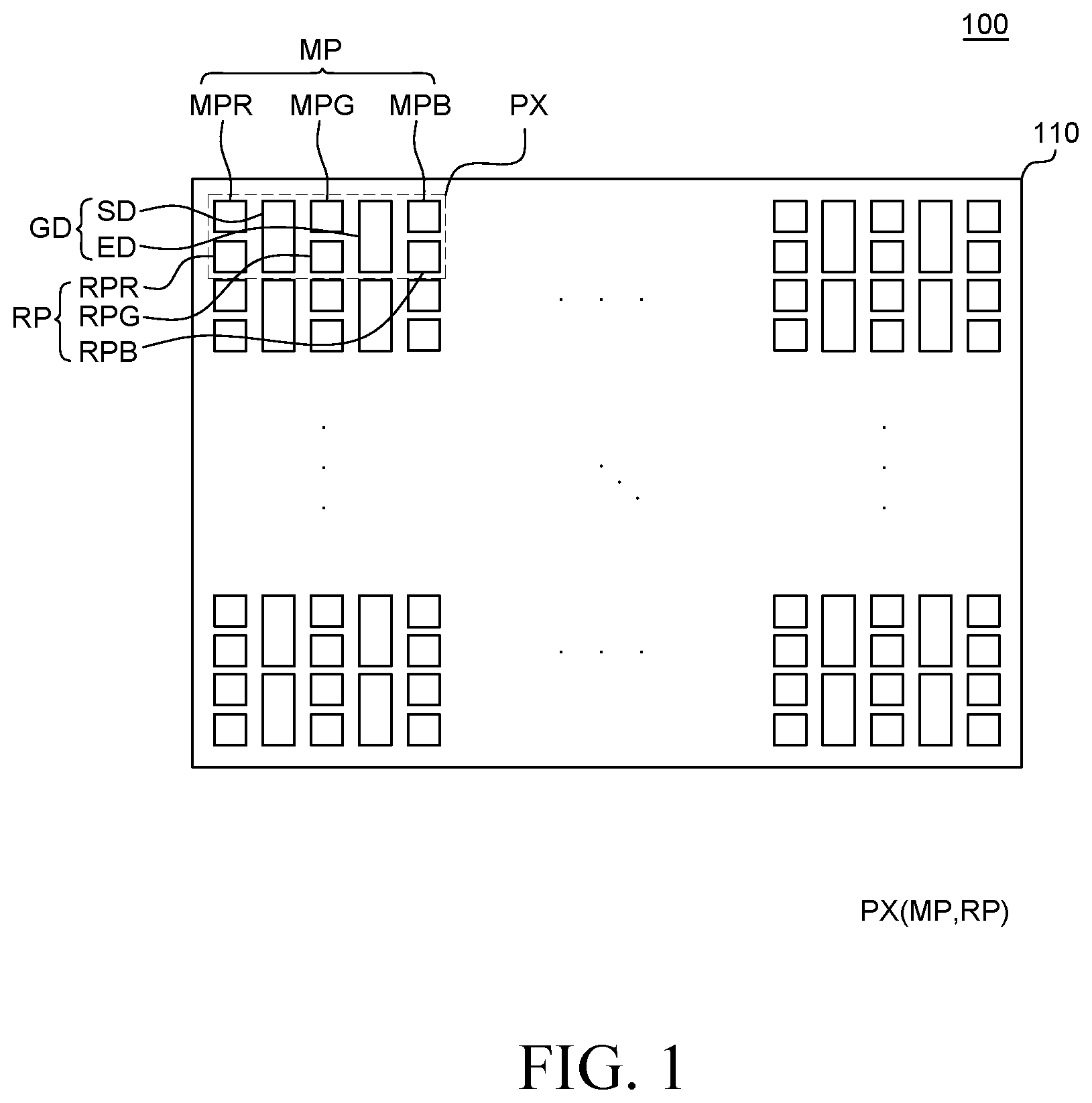
is a top view showing a display device according to an exemplary embodiment.
Referring to , a display device 100 includes a display panel 110 including a plurality of unit pixels PX connected to gate lines and data lines, a gate driver GD supplying gate signals to the gate lines, and a data driver supplying a data signal to each of the data lines.
The display panel 110 includes a plurality of unit pixels PX, and each of the unit pixels PX includes main pixels MP and redundancy pixels RP.
The main pixels MP are for representing grayscale images, and the redundancy pixels RP are for operating when a defect occurs in the main pixels MP. It should be understood, however, that the present disclosure is not limited thereto. The main pixels MP and the redundancy pixels RP of the display device 100 may simultaneously emit light. For example, when any of the main pixels MP fails to represent a desired grayscale value due to problems such as lifespan and aging, the respective redundancy pixel RP may further emit light.
In addition, the main pixels MP and the redundancy pixels RP are arranged in lines in each of the unit pixels PX of the display panel 110 , and the main pixels MP and the redundancy pixels RP are arranged adjacent to each other.
Specifically, the main pixels MP are disposed in odd-numbered rows of the unit pixel PX. In addition, the main pixels MP include elements that emit light of different colors. For example, the main pixels MP include a red main pixel MPR, a green main pixel MPG, and a blue main pixel MPB.
In addition, the redundancy pixels RP are disposed in even-numbered rows of the unit pixel PX. The redundancy pixels RP emit lights of the same colors as the respective main pixels MP. For example, the redundancy pixels RP include a red redundancy pixel RPR, a green redundancy pixel RPG, and a blue redundancy pixel RPB.
The red main pixel MPR is disposed in line with the red redundancy pixel RPR, the green main pixel MPG is disposed in line with the green redundancy pixel RPG, and the blue main pixel MPB is disposed in line with the blue redundancy pixel RPB.
It should be understood, however, that the present disclosure is not limited thereto. The main pixels MP and the redundancy pixels RP may further include a main pixel representing white and a redundancy pixel representing white, respectively. The type and number of the main pixels MP and the redundancy pixels RP may vary depending on exemplary embodiments.
The plurality of main pixels MP and the plurality of redundancy pixels RP disposed on the display panel 110 may be spaced apart from each other by different distances. For example, in , each of the plurality of unit pixels PX include a plurality of main pixels MP and a plurality of redundancy pixels RP arranged in parallel in two lines, and the main pixels MP and the redundancy pixels RP are spaced apart from each other by the same distance in each unit pixel PX. However, the distance between the main pixels MP and the redundancy pixels RP disposed with the boundary of the unit pixels PX therebetween may be different from the distance between the main pixels MP and the redundancy pixels RP disposed in the unit pixel PX. It should be understood, however, that the present disclosure is not limited thereto. The main pixels MP and the redundancy pixels RP may be arranged at the same distance from each other in the entire area of the display panel 110 .
As described above, since the main pixels MP and the redundancy pixels RP are disposed in the unit pixel PX, even if any of the main pixels MP becomes defective, the respective redundancy pixel RP may emit light in place of the main pixel MP. As a result, the reliability of the display device 100 can be improved, and the emission time of the display device 100 can be increased.
In each of the main pixels MP and the redundancy pixels RP, an LED serving as a light-emitting element and a pixel circuit for driving the light-emitting element are disposed.
Although the LED is used as the light-emitting element herein, the present disclosure is not limited thereto. An organic light-emitting element, a quantum-dot element, etc. may also be used as the light-emitting element.
Each of the plurality of main pixels MP and the plurality of redundancy pixels RP receives gate signals from the gate driver GD through the gate lines, receives data signals from the data driver through the data lines, and receives a variety of voltages through a power supply line.
Specifically, as will be described later with reference to , each of the plurality of main pixels MP and the plurality of redundancy pixels RP receives a first scan signal SCAN 1 , a second scan signal SCAN 2 and an emission control signal EM through the gate line, receives a data signal VDATA through the data line, and receives a pixel-high voltage VDD, a pixel-low voltage VSS, and an initializing voltage VREF through the power supply line.
Incidentally, when a tiling display is implemented by using the display device 100 according to an exemplary embodiment of the present disclosure, the distance between the outermost unit pixel PX of one display panel and the outermost unit pixel PX of an adjacent display panel can be equal to the distance between the unit pixels PX in a single display panel. Thus, it is possible to implement a zero-bezel where substantially no bezel is formed. Accordingly, the display device 100 may be defined as having only a display area and a non-display area may be described as not defined in the display device 100 .
The gate driver GD supplies gate signals to the plurality of unit pixels PX through the gate lines. The gate signals include the first scan signal SCAN 1 , the second scan signal SCAN 2 and the emission control signal EM.
Specifically, the gate driver GD may include a plurality of stages cascaded together, and each of the stages may include a scan driving circuit SD that outputs the first scan signal SCAN 1 , the second scan signal SCAN 2 and a carry signal CARRY, and an emission driving circuit ED that outputs an emission control signal EM.
The gate driver GD may be formed on the upper surface of the display panel 110 . Specifically, in the display device 100 according to the exemplary embodiment of the present disclosure, since the luminous efficiency of the LED, which is the light-emitting element, is excellent, the area of the unit pixel PX that is occupied by the LED may be very small. Accordingly, the gate driver GD may be disposed in one unit pixel PX in addition to the LEDs as the light-emitting elements and the pixel circuit for driving the LEDs. In other words, in the display device according to the exemplary embodiment of the present disclosure, the gate driver GD may be integrated in the unit pixel PX. That is to say, the gate driver GD may be integrated in the unit pixel PX in a GIA (Gate In Active area) fashion.
That is to say, as shown in , the gate driver GD may be disposed between the main pixels MP and between the redundancy pixels RP forming the unit pixel PX. More specifically, the scan driving circuit SD of the gate driver GD may be disposed between the red main pixel MPR and the green main pixel MPG or between the red redundancy pixel RPR and the green redundancy pixel RPG. The emission driving circuit ED of the gate driver GD may be disposed between the blue main pixel MPB and the green main pixel MPG or between the blue redundancy pixel RPB and the green redundancy pixel RPG.
The data driver converts the image data into the data signal VDATA, and supplies the converted data signal VDATA to the unit pixel PX through the data line.
In addition, the data driver may be formed on the lower surface of the display panel 110 .
Specifically, in order to connect the unit pixel PX disposed on the upper surface of the display panel 110 with the data driver disposed on the lower surface of the display panel 110 , a side line is formed on the side surface of the display panel 110 . In addition, the data driver may be disposed on one side of the lower surface of the display panel 110 and may supply the data signal VDATA to the unit pixel PX through the side line.
As described above, the gate driver may be integrated in the unit pixel PX in a GIA (Gate In Active area) fashion on the upper surface of the display panel in the display device 100 according to the exemplary embodiment of the present disclosure. On the contrary, the data driver may be disposed on the lower surface of the display panel.
In the display device 100 according to the exemplary embodiment of the present disclosure, it is not required to form such a side line in order to connecting to the gate driver GD, the probability of a defect occurring via a process of forming the side line is significantly reduced. As a result, the process yield of the display device 100 according to the exemplary embodiment of the present disclosure can be improved.
In addition, since the gate driver GD is integrated in the unit pixel PX, a non-display area is not defined, achieving a zero bezel.
Hereinafter, connection relationships and signal input/output relationships between the gate driver GD and a plurality of unit pixels PX in the display device 100 according to an exemplary embodiment will be described in detail with reference to .
is a block diagram of a gate driver and a plurality of unit pixels of a display device according to an exemplary embodiment.
Referring to , in the display device according to the exemplary embodiment of the present disclosure, the gate driver GD includes a plurality of cascaded stages ST 1 , ST 2 and ST 3 , and a plurality of unit pixels PX 1 , PX 2 and PX 3 is disposed in the plurality of stages ST 1 , ST 2 ST 3 , respectively. Although three stages ST 1 , ST 2 and ST 3 and three unit pixels PX 1 , PX 2 and PX 3 are shown in for convenience of illustration, the number of stages and the number of unit pixels are not limited thereto. More or less stages and/or unit pixels may be disposed.
That is to say, the plurality of stages ST 1 , ST 2 and ST 3 may respectively include scan driving circuits SD 1 , SD 2 and SD 3 each outputting the first scan signal SCAN 1 , the second scan signal SCAN 2 and the carry signal CARRY, and emission driving circuits ED 1 , ED 2 and ED 3 each outputting the emission control signal EM.
The first main pixel MP 1 and the first redundancy pixel RP 1 may be associated with the first stage ST 1 , the second main pixel MP 2 and the second redundancy pixel RP 2 may be associated with the second stage ST 2 , and the third main pixel MP 3 and the third redundancy pixel RP 3 may be associated with the third stage ST 3 .
Each of the plurality of scan driving circuits SD 1 SD 2 and SD 3 may include a carry output unit terminal CROUT outputting a carry signal CARRY, a first scan output unit terminal SCOUT 1 outputting a first scan signal SCAN 1 , and a second scan output unit terminal SCOUT 2 outputting a second scan signal SCAN 2 . Each of the plurality of emission driving circuits ED 1 , ED 2 and ED 3 may include an emission output terminal EMOUT outputting an emission control signal EM. In addition, each of the plurality of main pixels MP 1 , MP 2 and MP 3 and the plurality of redundancy pixels RP 1 , RP 2 and RP 3 may include a first input terminal IN 1 , a second input terminal IN 2 and a third input terminal IN 3 receiving the first scan signal SCAN 1 , the second scan signal SCAN 2 , and the emission control signal EM, respectively.
With the above configuration, the carry output unit terminal CROUT of the nth stage is connected to the scan driving circuit and the emission driving circuit of the (n+1)th stage, where n is a natural number. Accordingly, the carry signal Carry output unit from the carry output unit terminal CROUT of the nth stage is applied to the scan driving circuit and the emission driving circuit of the (n+1)th stage.
The first scan output unit terminal SCOUT 1 of the nth stage is connected to the first input terminal IN 1 of the nth main pixel and the second input terminal IN 2 of the nth redundancy pixel. Accordingly, the first scan signal SCAN 1 output from the scan driving circuit of the nth stage is applied to the first input terminal IN 1 of the nth main pixel and the second input terminal IN 2 of the nth redundancy pixel.
In addition, the second scan output unit terminal SCOUT 2 of the nth stage is connected to the first input terminal IN 1 of the nth redundancy pixel, is connected to the scan driving circuit and the emission driving circuit of the (n−1)th stage, and is connected to the second input terminal IN 2 of the (n+1)th main pixel. Accordingly, the second scan signal SCAN 2 output from the scan driving circuit of the nth stage is applied to the first input terminal IN 1 of the nth redundancy pixel, is applied to the scan driving circuit and the emission driving circuit of the (n−1)th stage, and is applied to the second input terminal IN 2 of the (n+1)th main pixel.
In addition, the emission output terminal EMOUT of the nth stage is connected to the third input terminal IN 3 of the nth main pixel and the third input terminal IN 3 of the nth redundancy pixel. Accordingly, the emission control signal EM output from the emission driving circuit of the nth stage is applied to the third input terminal IN 3 of the nth main pixel and the third input terminal IN 3 of the nth redundancy pixel.
The nth main pixel and the nth redundancy pixel will be described again. Since the first scan signal SCAN 1 output from the scan driving circuit of the nth stage is supplied to the first input terminal IN 1 of the nth main pixel and the second input terminal IN 2 of the nth redundancy pixel, the output timing of the first scan signal SCAN 1 supplied to the nth main pixel may be the same as the output timing of the first scan signal SCAN 1 supplied to the nth redundancy pixel.
On the other hand, the second scan signal SCAN 2 output from the scan driving circuit of the (n−1)th stage is supplied to the second input terminal IN 2 of the nth main pixel, and the second scan signal SCAN 2 output from the scan driving circuit of the nth stage is supplied to the first input terminal IN 1 of the nth redundancy pixel. Accordingly, the output timing of the second scan signal SCAN 2 supplied to the nth main pixel may be different from the output timing of the second scan signal SCAN 2 supplied to the nth redundancy pixel
In the example shown in , the carry output unit terminal CROUT of the second scan driving circuit SD 2 is connected to the third scan driving circuit SD 3 and the third emission driving circuit ED 3 . Accordingly, the carry signal Carry output unit from the carry output unit terminal CROUT of the second scan driving circuit SD 2 is applied to the third scan driving circuit SD 3 and the third emission driving circuit ED 3 .
The first scan output unit terminal SCOUT 1 of the second scan driving circuit SD 2 is connected to the first input terminal IN 1 of the second main pixel MP 2 and the second input terminal IN 2 of the second redundancy pixel RP 2 . Accordingly, the first scan signal SCAN 1 output from the second scan driving circuit SD 2 is applied to the first input terminal IN 1 of the second main pixel MP 2 and the second input terminal IN 2 of the second redundancy pixel RP 2 .
In addition, the second scan output unit terminal SCOUT 2 of the second scan driving circuit SD 2 is connected to the first input terminal IN 1 of the second redundancy pixel RP 2 , is connected to the first scan driving circuit SD 1 and the first emission driving circuit ED 1 , and is connected to the second input terminal IN 2 of the third main pixel MP 3 . Accordingly, the second scan signal SCAN 2 output from the second scan driving circuit SD 2 is applied to the first input terminal IN 1 of the second redundancy pixel RP 2 , applied to the first scan driving circuit SD 1 and the first emission driving circuit ED 1 , and applied to the second input terminal IN 2 of the third main pixel MP 3 .
In addition, the emission output terminal EMOUT of the second stage is connected to the third input terminal IN 3 of the second main pixel MP 2 and the third input terminal IN 3 of the second redundancy pixel RP. Accordingly, the emission control signal EM output from the second emission driving circuit ED 2 is applied to the third input terminal IN 3 of the second main pixel MP 2 and the third input terminal IN 3 of the second redundancy pixel RP.
In addition, the first scan driving circuit SD 1 and the emission driving circuit ED 1 may receive the gate start signal VST separately, and the second input terminal IN 2 of the first main pixel MP 1 may receive the start clock signal SCSI separately.
Hereinafter, an example where a display device according to an exemplary embodiment includes a 6T1C pixel circuit will be described in detail with reference to .
Transistors to be described below may be implemented as transistors having an n-type or p-type MOSFET structure. Although p-type transistors will be described in the following description, it is to be understood that the present disclosure is not limited thereto.
is a circuit diagram showing a pixel circuit included in a display device according to an exemplary embodiment.
Transistors to be described below may be implemented as transistors having an n-type or p-type MOSFET structure. Although p-type transistors will be described in the following description, it is to be understood that the present disclosure is not limited thereto.
Additionally, each of the transistors is a three-electrode device including a gate electrode, a source electrode, and a drain electrode. The source electrode is used to supply carriers to the transistor. In the transistors, carriers begin to flow from the source electrode. The carriers exit via the drain electrode of the transistor. In other words, the carriers flow from the source electrode to the drain electrode in the MOSFET. For an n-type MOSFET (NMOS) where electrons are carriers, the voltage at the source electrode is lower than the voltage at the drain electrode to allow the electrons to flow from the source electrode to the drain electrode. As the electrons flow from the source electrode to the drain electrode in the n-type MOSFET, electric current flows from the drain electrode to the source electrode. For a p-type MOSFET (PMOS) where holes are carriers, the voltage at the source electrode is higher than the voltage at the drain electrode to allow the holes to flow from the source electrode to the drain electrode. As the holes flow from the source electrode to the drain electrode in the p-type MOSFET, electric current flows from the source electrode to the drain electrode. It is to be noted that the source and drain electrodes of the MOSFET are not fixed. For example, the source electrode and the drain electrode of the MOSFET can be switched depending on the applied voltage. In the following description, the present disclosure is not limited by the source and drain electrodes of the transistor.
In the following description, the source electrode of a transistor is referred to as a first electrode, and the drain electrode of the transistor is referred to as a second electrode. It is to be noted that the source electrode of a transistor may be referred to as a second electrode, and the drain electrode of the transistor may be referred to as a first electrode depending on the type of transistor.
Referring to , the main pixel MP(n) of the display device according to an exemplary embodiment of the present disclosure includes a driving transistor TDR, a first switching transistor TSW 1 , a second switching transistor TSW 2 , an emission control transistor TEM, a first initializing transistor TIN 1 , a second initializing transistor INT 2 , and a storage capacitor CST.
The driving transistor TDR drives an LED. In the driving transistor TDR, the pixel-high voltage VDD is applied to the first electrode, the second electrode is connected to a third node N 3 , and the gate electrode is connected to a second node N 2 . Accordingly, the luminance of the LED is controlled by controlling the driving current supplied to the LED and the driving voltage according to the gate-source voltage Vgs of the driving transistor TDR.
The first switching transistor TSW 1 applies the data voltage VDATA supplied from the data line to a first node N 1 . In the first switching transistor TSW 1 , the data voltage VDATA is input to the first electrode, the second electrode is connected to the first node N 1 , and the gate electrode is connected to the first input terminal IN 1 .
Referring to , as described above, the first scan signal SCAN 1 ( n ) output from the scan driving circuit SD(n) of the nth stage is applied to the first input terminal IN 1 of the nth main pixel n.
Accordingly, the first switching transistor TSW 1 applies the data voltage VDATA supplied from the data line to the first node N 1 in response to the first scan signal SCAN 1 ( n ).
The second switching transistor TSW 2 samples the threshold voltage Vth of the driving transistor TDR. In the second switching transistor TSW 2 , the first electrode is connected to the third node N 3 , the second electrode is connected to the second node N 2 , and the gate electrode is connected to the first input terminal IN 1 .
Accordingly, the second switching transistor TSW 2 electrically connects the second node N 2 with the third node N 3 to diode-connect the gate electrode with the second electrode of the driving transistor TDR in response to the first scan signal SCAN 1 ( n ). Accordingly, by the second switching transistor TSW 2 , the voltage of the second node N 2 increases along with the voltage of the third node N 3 . As the voltage of the second node N 2 increases, the gate-source voltage difference Vgs of the driving transistor TDR gradually decreases, and the driving transistor TDR is turned off when the gate-source voltage difference of the driving transistor TDR becomes less than the threshold voltage Vth. Through the above-described process, the second switching transistor TSW 2 may sample the threshold voltage Vth of the driving transistor TDR.
The emission control transistor TEM controls the emission of the LED. In the emission control transistor TEM, the first electrode is connected to the third node N 3 , the second electrode is connected to the LED, and the gate electrode is connected to the third input terminal IN 3 .
Referring to , as described above, the emission control signal EM(n) output from the emission driving circuit ED(n) of the nth stage is applied to the third input terminal IN 3 of the nth main pixel n.
Accordingly, the emission control transistor TEM may form a current path between the third node N 3 and the LED in response to the emission control signal EM(n) to allow the LED to emit light.
The first initializing transistor TIN 1 applies the initializing voltage VREF to the third node N 3 .
In the first initializing transistor TIN 1 , the initializing voltage VREF is applied to the first electrode, the second electrode is connected to the third node N 3 , and the gate electrode is connected to the second input terminal.
Referring to , as described above, the second scan signal SCAN 2 ( n −1) output from the scan driving circuit SD(n−1) of the (n−1)th stage is applied to the second input terminal IN 2 of the nth main pixel n.
Accordingly, the first initializing transistor TIN 1 applies the initializing voltage VREF to the third node N 3 in response to the second scan signal SCAN 2 ( n −1).
The second initializing transistor INT 2 applies the initializing voltage VREF to the first node N 1 . In the second initializing transistor INT 2 , the initializing voltage VREF is applied to the first electrode, the second electrode is connected to the first node N 1 , and the third input terminal IN 3 is connected to the gate electrode.
Accordingly, the second initializing transistor INT 2 applies the initializing voltage VREF to the first node N 1 in response to the emission control signal EM(n).
The storage capacitor CST stores a voltage applied to a gate node of the driving transistor TDR.
The capacitor CST is disposed between the first node N 1 and the second node N 2 .
Accordingly, the storage capacitor CST is electrically connected to the first node N 1 and the second node N 2 to store the difference between the voltage of the gate electrode of the driving transistor TDR and the voltage supplied to the second electrode of the first switching transistor TSW 1 .
Hereinafter, a driving scheme of a main pixel of the display device according to the exemplary embodiment of the present disclosure will be described in detail with reference to a to 8 b . In A to 8 A , a turned-off transistor is indicated by a dotted line, while a turned-on transistor is indicated by a solid line.
As described above, since the transistors are p-type transistors, each of the transistors is turned on when a low-level voltage is applied to its gate electrode. Accordingly, the low-level voltage will be described as a turn-on level voltage, and the high-level voltage will be described as a turn-off level voltage. It should be understood, however, that the present disclosure is not limited thereto. When the transistors are n-type transistors, the turn-on level voltage may be a high-level voltage, while the turn-off level voltage may be a low-level voltage.
A is a circuit diagram for illustrating a first driving period of a main pixel of a display device according to an exemplary embodiment.
B is a timing diagram for illustrating the first driving period of the main pixel of the display device according to the exemplary embodiment.
As shown in B , during the first driving period P 1 , the first scan signal SCAN 1 ( n ) is at a turn-off level, the second scan signal SCAN 2 ( n −1) is at a turn-on level, and the emission control signal EM(n) is at the turn-off level.
Accordingly, as shown in A , in the first driving period P 1 , the first initializing transistor TIN 1 is turned on by the second scan signal SCAN 2 ( n −1), and the initializing voltage VREF is applied to the third node N 3 .
A is a circuit diagram for illustrating a second driving period of the main pixel of the display device according to the exemplary embodiment.
B is a timing diagram for illustrating the second driving period of the main pixel of the display device according to the exemplary embodiment.
As shown in B , during the second driving period P 2 , the first scan signal SCAN 1 ( n ) is at the turn-on level, the second scan signal SCAN 2 ( n −1) is at the turn-on level, and the emission control signal EM(n) is at the turn-off level.
Accordingly, as shown in A , the first initializing transistor TIN 1 is turned on by the second scan signal SCAN 2 ( n −1), the second switching transistor TSW 2 is turned on by the first scan signal SCAN 1 ( n ), to apply the initializing voltage VREF to the second node N 2 and the third node N 3 . In addition, the first switching transistor TSW 1 is turned on by the first scan signal SCAN 1 ( n ) and applies the data voltage VDATA supplied from the data line to the first node N 1 .
A is a circuit diagram for illustrating a third driving period of the main pixel of the display device according to the exemplary embodiment.
B is a timing diagram for illustrating the third driving period of the main pixel of the display device according to the exemplary embodiment.
As shown in B , during the third driving period P 3 , the first scan signal SCAN 1 ( n ) is at the turn-on level, the second scan signal SCAN 2 ( n −1) is at the turn-off level, and the emission control signal EM(n) is at the turn-off level.
Accordingly, as shown in A , the second switching transistor TSW 2 is turned on by the first scan signal SCAN 1 ( n ), and electrically connects the second node N 2 with the third node N 3 to diode-connect the gate electrode with the second electrode of the driving transistor TDR. Accordingly, by the second switching transistor TSW 2 , the voltage of the second node N 2 increases along with the voltage of the third node N 3 . As the voltage of the second node N 2 increases, the gate-source voltage difference Vgs of the driving transistor TDR gradually decreases, and the driving transistor TDR is turned off when the gate-source voltage difference of the driving transistor TDR becomes less than the threshold voltage Vth. Accordingly, the voltage of the second node N 2 is charged by the difference between the pixel-high voltage VDD and the threshold voltage Vth.
In addition, the first switching transistor TSW 1 is turned on by the first scan signal SCAN 1 ( n ) and applies the data voltage VDATA supplied from the data line to the first node N 1 .
Accordingly, the voltage (VDD−Vth)−VDATA is charged across the storage capacitor CST during the third driving period P 3 .
A is a circuit diagram for illustrating a fourth driving period of the main pixel of the display device according to the exemplary embodiment.
B is a timing diagram for illustrating the fourth driving period of the main pixel of the display device according to the exemplary embodiment.
As shown in B , during the fourth driving period P 4 , the first scan signal SCAN 1 ( n ), the second scan signal SCAN 2 ( n −1) and the emission control signal EM(n) are all at the turn-off level.
Accordingly, as shown in A , the first switching transistor TSW 1 , the second switching transistor TSW 2 , the emission control transistor TEM, the first initializing transistor TIN 1 and the second initializing transistor INT 2 are all turned off. Accordingly, the voltage (VDD−Vth)−VDATA is held across the storage capacitor CST during the fourth driving period P 4 .
A is a circuit diagram for illustrating a fifth driving period of the main pixel of the display device according to the exemplary embodiment.
B is a timing diagram for illustrating the fifth driving period of the main pixel of the display device according to the exemplary embodiment.
As shown in B , during the fifth driving period P 5 , the first scan signal SCAN 1 ( n ) and the second scan signal SCAN 2 ( n −1) are at the turn-off level, and the emission control signal EM(n) is at the turn-on level.
Accordingly, as shown in A , in the fifth driving period P 5 , the second initializing transistor INT 2 is turned on by the emission control signal EM(n), to apply the initializing voltage VREF. Accordingly, the voltage of the first node N 1 is changed from the data voltage VDATA to the initializing voltage VREF, and the voltage of the second node N 2 connected to the first node N 1 by the storage capacitor CST is changed to the voltage (VDD−Vth)−(VDATA−VREF) by capacitive coupling.
Then, in the fifth driving period P 5 , the emission control transistor TEM is turned on by the emission control signal EM(n) to form a current path between the third node N 3 and the LED to allow the LED to emit light.
Accordingly, the data voltage is reflected in the gate-source voltage Vgs of the driving transistor TDR connected to the second node N 2 , and thus the LED may emit light in proportion to the data voltage.
Hereinafter, a circuit structure of a gate driver of a display device according to an exemplary embodiment of the present disclosure will be described in detail with reference to .
Transistors to be described below may be implemented as transistors having an n-type or p-type MOSFET structure. Although p-type transistors will be described in the following description, it is to be understood that the present disclosure is not limited thereto.
is a circuit diagram showing a scan driving circuit of a display device according to an exemplary embodiment.
Referring to , the nth scan driving circuit SD(n) of the display device according to the exemplary embodiment includes Q-node controllers T 1 , T 2 , Tb 1 , Tb 2 , T 3 , Tb 3 , Tb 4 and T 9 , QB-node controllers T 4 , T 5 and T 8 , carry output units T 6 cr and T 7 cr , first scan output units T 6 m and T 7 m , second scan output units T 6 r and T 7 r , and a plurality of capacitors C 1 and C 2 .
The Q-node controllers T 1 , T 2 , Tb 1 , Tb 2 , T 3 , Tb 3 , Tb 4 and T 9 control the voltage of the Q-node Q. In other words, the Q-node controllers T 1 , T 2 , Tb 1 , Tb 2 , T 3 , Tb 3 , Tb 4 and T 9 determine the charging and discharging timings of the Q-node Q.
The Q-node controllers T 1 , T 2 , Tb 1 , Tb 2 , T 3 , Tb 3 , Tb 4 and T 9 include a T 1 transistor T 1 , a T 2 transistor T 2 , a Tb 1 transistor Tb 1 , a Tb 2 transistor Tb 2 , a T 3 transistor T 3 , a Tb 3 transistor Tb 3 , a Tb 4 transistor Tb 4 , and a T 9 transistor T 9 .
A gate-low voltage VGL having a turn-on level is applied to the gate electrode of each of the Tb 1 transistor Tb 1 , the Tb 2 transistor Tb 2 , the Tb 3 transistor Tb 3 and the Tb 4 transistor Tb 4 . Accordingly, the Tb 1 transistor Tb 1 , the Tb 2 transistor Tb 2 , the Tb 3 transistor Tb 3 and the Tb 4 transistor Tb 4 are always turned on. Therefore, the transistors excluding the Tb 1 transistor Tb 1 , the Tb 2 transistor Tb 2 , the Tb 3 transistor Tb 3 and the Tb 4 transistor Tb 4 will be mainly described in detail.
The T 1 transistor T 1 discharges the Q-node Q in response to the carry signal CARRY(n−1) or the gate start signal VST of the previous stage. Specifically, the carry signal CARRY(n−1) or the gate start signal VST of the previous stage is applied to the gate electrode of the T 1 transistor T 1 , the gate-low voltage VGL is applied to the first electrode of the T 1 transistor T 1 , and the second electrode of the T 1 transistor T 1 is connected to the T 2 transistor T 2 .
The T 2 transistor T 2 discharges the Q-node Q in response to the carry signal CARRY(n−1) or the gate start signal VST of the previous stage. Specifically, the carry signal CARRY(n−1) or the gate start signal VST of the previous stage is applied to the gate electrode of the T 2 transistor T 2 , the T 1 transistor T 1 is connected to the first electrode of the T 2 transistor T 2 , and the second electrode of the T 2 transistor T 2 is connected to the Tb 1 transistor Tb 1 .
Accordingly, while the carry signal CARRY(n−1) or the gate start signal VST of the previous stage is at the turn-on level, the T 1 transistor T 1 , the T 2 transistor T 2 and the Tb 1 transistor Tb 1 are all turned on, discharging the Q-node Q to the gate-low voltage VGL having the turn-on level.
The T 3 transistor T 3 charges the Q-node Q in response to the voltage of the QB-node QB. Specifically, the gate electrode of the T 3 transistor T 3 is connected to the QB-node QB, the gate-high voltage VGH having the turn-off level is applied to the first electrode of the T 3 transistor T 3 , and the second electrode of the T 3 transistor T 3 is connected to the Tb 2 transistor Tb 2 . In addition, the first electrode of the Tb 2 transistor Tb 2 is connected to the T 3 transistor T 3 , and the second electrode thereof is connected to the Q-node Q.
Accordingly, while the QB-node QB is discharged, the T 3 transistor T 3 and the Tb 2 transistor Tb 2 are both turned on and charge the Q-node Q up to the gate-high voltage VGH having the turn-off level.
The T 9 transistor T 9 charges the Q-node Q in response to a reset signal QRST. Specifically, the reset signal QRST is applied to the gate electrode of the T 9 transistor T 9 , the gate-high voltage VGH having the turn-off level is applied to the first electrode of the T 9 transistor T 9 , and the second electrode of the T 9 transistor T 9 is connected to the Tb 4 transistor Tb 4 . In addition, the first electrode of the Tb 4 transistor Tb 4 is connected to the T 9 transistor T 9 , and the second electrode thereof is connected to the Q-node Q.
Accordingly, the reset signal QRST falls to the turn-on level at the end point of one frame, and the T 9 transistor T 9 and the Tb 4 transistor Tb 4 are both turned on, to charge the Q-node Q up to the gate-high voltage VGH having the turn-off level.
The QB-node controllers T 4 , T 5 and T 8 control the voltage of the QB-node QB. In other words, the QB-node controllers T 4 , T 5 and T 8 determines the charging and discharging timing of the QB-node QB.
The QB-node controllers T 4 , T 5 and T 8 include the 14 transistor T 4 , the T 5 transistor T 5 , and the T 8 transistor T 8 .
The 14 transistor T 4 charges the QB-node QB by the second scan signal SCAN 2 ( n +1) of the subsequent stage. Specifically, the second scan signal SCAN 2 ( n +1) of the subsequent stage is applied to the gate electrode of the T 4 transistor T 4 , the gate-low voltage VGL is applied to the first electrode of the 14 transistor T 4 , and the second electrode of the T 4 transistor 14 is connected to the QB-node QB. Accordingly, while the second scan signal SCAN 2 ( n +1) of the subsequent stage is at the turn-on level, the T 4 transistor 14 is turned on, and the QB-node QB is discharged to the gate-low voltage VGL.
The T 5 transistor T 5 charges the QB-node QB in response to the carry signal CARRY(n−1) or the gate start signal VST of the previous stage. Specifically, the carry signal CARRY(n−1) or the gate start signal VST of the previous stage is applied to the gate electrode of the T 5 transistor T 5 , the gate-high voltage VGH is applied to the first electrode of the T 5 transistor T 5 , and the second electrode of the T 5 transistor T 5 is connected to the QB-node QB.
Accordingly, while the carry signal CARRY(n−1) or the gate start signal VST of the previous stage is at the turn-on level, the T 5 transistor T 5 is turned on to charge the QB-node QB to the gate-high voltage VGH having the turn-off level.
The T 8 transistor T 8 charges the QB-node QB in response to the voltage of the Q-node Q. Specifically, the gate electrode of the T 8 transistor T 8 is connected to the Tb 3 transistor Tb 3 , the gate-high voltage VGH is applied to the first electrode of the T 8 transistor T 8 , and the second electrode of the T 8 transistor T 8 is connected to the QB-node QB. In addition, the first electrode of the Tb 3 transistor Tb 3 is connected to the Q-node Q, and the second electrode of the Tb 3 transistor Tb 3 is connected to the T 8 transistor.
Accordingly, while the Q-node Q is discharged, the eighth transistor T 8 is turned on to charge the QB-node QB to the gate-high voltage VGH.
The carry output units T 6 cr and T 7 cr output the carry signal CARRY(n) by the voltage of the Q-node Q and the QB-node QB.
Specifically, the carry output units T 6 cr and T 7 cr include a T 6 cr transistor T 6 cr that pulls up the carry signal CARRY(n), and a T 7 cr transistor T 7 cr that pulls down the carry signal CARRY(n).
The gate electrode of the T 6 cr transistor T 6 cr is connected to the Q-node Q, a carry clock signal CRCLK(n) is applied to the first electrode of the T 6 cr transistor T 6 cr , and a second electrode of the T 6 cr transistor T 6 cr is connected to the carry output unit terminal CROUT(n). Accordingly, when the Q-node Q is discharged, the T 6 cr transistor T 6 cr is turned on to output the carry clock signal CRCLK(n) as the carry signal CARRY(n).
The gate electrode of the T 7 cr transistor T 7 cr is connected to the QB-node QB, the gate-high voltage VGH is applied to the first electrode of the T 7 cr transistor T 7 cr , and the second electrode of the T 7 cr transistor T 7 cr is connected to the carry output unit terminal CROUT(n). Accordingly, when the QB-node QB is discharged, the T 7 cr transistor T 7 cr is turned on and outputs the gate-high voltage VGH as the carry signal CARRY(n).
The first scan output units T 6 m and T 7 m output the first scan signal SCAN 1 ( n ) by the voltage of the Q-node Q and the QB-node QB.
Specifically, the carry output units T 6 m and T 7 m include a T 6 m transistor T 6 m that pulls up the first scan signal SCAN 1 ( n ), and a T 7 m transistor T 7 m that pulls down the first scan signal SCAN 1 ( n ).
The gate electrode of the T 6 m transistor T 6 m is connected to the Q-node Q, a scan clock signal SCCLK( 2 n −1) is applied to the first electrode of the T 6 m transistor T 6 m , and a second electrode of the T 6 m transistor T 6 m is connected to a first scan output unit terminal SCOUT 1 ( n ). Accordingly, when the Q-node Q is discharged, the T 6 m transistor T 6 m is turned on to output the scan clock signal SCCLK( 2 n −1) as the first scan signal SCAN 1 ( n ).
The gate electrode of the T 7 m transistor T 7 m is connected to the QB-node QB, the gate-high voltage VGH is applied to the first electrode of the T 7 m transistor T 7 m , and the second electrode of the T 7 m transistor T 7 m is connected to the first scan output unit terminal SCOUT 1 ( n ). Accordingly, when the QB-node QB is discharged, the T 7 m transistor T 7 m is turned on and outputs the gate-high voltage VGH as the first scan signal SCAN 1 ( n ).
The second scan output units T 6 r and T 7 r output the second scan signal SCAN 2 ( n ) by the voltage of the Q-node Q and the QB-node QB.
Specifically, the second scan output units T 6 r and T 7 r include a T 6 r transistor T 6 r that pulls up the second scan signal SCAN 2 ( n ), and a T 7 r transistor T 7 r that pulls down the second scan signal SCAN 2 ( n ).
The gate electrode of the T 6 r transistor T 6 r is connected to the Q-node Q, a scan clock signal SCCLK( 2 n ) is applied to the first electrode of the T 6 r transistor T 6 r , and a second electrode of the T 6 r transistor T 6 r is connected to a second scan output unit terminal SCOUT 2 ( n ). Accordingly, when the Q-node Q is discharged, the T 6 r transistor T 6 r is turned on to output the scan clock signal SCCLK( 2 n ) as the second scan signal SCAN 2 ( n ).
The gate electrode of the T 7 r transistor T 7 r is connected to the QB-node QB, the gate-high voltage VGH is applied to the first electrode of the T 7 r transistor T 7 r , and the second electrode of the T 7 r transistor T 7 r is connected to the second scan output unit terminal SCOUT 2 ( n ). Accordingly, when the QB-node QB is discharged, the T 7 r transistor T 7 r is turned on and outputs the gate-high voltage VGH as the second scan signal SCAN 2 ( n ).
A C 1 cr capacitor C 1 cr serves as a bootstrap capacitor that boosts the voltage at the Q-node. Specifically, one end of the C 1 cr capacitor C 1 cr is connected to the gate electrode of the T 6 cr transistor T 6 cr , and the other end of the C 1 cr capacitor C 1 cr is connected to the second electrode of the T 6 cr transistor T 6 cr , which is the carry output unit terminal CROUT(n). Accordingly, if the carry signal CRRAY(n) output from the carry output unit terminal CROUT(n), which is the second electrode of the T 6 cr transistor T 6 cr , falls to the turn-on level while the Q-node Q is discharged, the voltage at the Q-node Q may be boosted by the C 1 cr capacitor C 1 cr.
A C 1 m capacitor C 1 cr serves as a bootstrap capacitor that boosts the voltage at the Q-node. Specifically, one end of the C 1 m capacitor C 1 m is connected to the gate electrode of the T 6 m transistor T 6 m , and the other end of the C 1 m capacitor C 1 m is connected to the second electrode of the T 6 m transistor T 6 m , which is the first scan output unit terminal SCOUT 1 ( n ). Accordingly, if the first scan signal SCAN 1 ( n ) output from the first scan output unit terminal SCOUT 1 ( n ), which is the second electrode of the T 6 m transistor T 6 m , falls to the turn-on level while the Q-node Q is discharged, the voltage at the Q-node Q may be boosted by the C 1 m capacitor C 1 m.
A C 1 r capacitor C 1 r serves as a bootstrap capacitor that boosts the voltage at the Q-node. Specifically, one end of the C 1 r capacitor C 1 r is connected to the gate electrode of the T 6 r transistor T 6 r , and the other end of the C 1 r capacitor C 1 r is connected to the second electrode of the T 6 r transistor T 6 r , which is the second scan output unit terminal SCOUT 2 ( n ). Accordingly, if the second scan signal SCAN 2 ( n ) output from the second scan output unit terminal SCOUT 2 ( n ), which is the second electrode of the T 6 r transistor T 6 r , falls to the turn-on level while the Q-node Q is discharged, the voltage at the Q-node Q may be boosted by the C 1 r capacitor C 1 r.
The second capacitor C 2 stabilizes the QB-node QB. The gate-high voltage VGH is constantly applied to one end of the second capacitor C 2 , and the other end of the second capacitor C 2 is connected to the QB-node QB. Accordingly, the potential of one end of the second capacitor C 2 does not change, and thus the voltage of the QB-node QB is stabilized, so that the first scan signal SCAN 1 (N), the second scan signal SCAN 2 (N), and the carry signal CARRY(N) can be output without delay.
is a circuit diagram for illustrating an emission driving circuit of a display device according to an exemplary embodiment.
Referring to , the nth emission driving circuit ED(n) of the display device according to the exemplary embodiment includes QE-node controllers T 10 and T 11 , emission outputs T 6 e , T 7 e and T 8 e , a T 12 transistor T 12 and a third capacitor C 3 .
The QE-node controllers T 10 and T 11 control the voltage of the QE-node QE. In other words, the QE-node controllers T 10 and T 11 determine charging and discharging timings of the QE-node QE.
The QE-node controllers T 10 and T 11 include a T 10 transistor T 10 and a T 11 transistor T 11 .
The T 10 transistor T 10 discharges the QE-node QE in response to the second scan signal SCAN 2 ( n +1) of the subsequent stage. Specifically, the second scan signal SCAN 2 ( n +1) is applied to the gate electrode of the T 10 transistor T 10 , an emission-low voltage EVGL is applied to the first electrode of the T 10 transistor T 10 , and the second electrode of the T 10 transistor T 10 is connected to the QE-node QE.
Accordingly, while the second scan signal SCAN 2 ( n +1) of the subsequent stage is at the turn-on level, the T 10 transistor T 10 is turned on, such that the QE-node QE is discharged to the emission-low voltage EVGL having the turn-on level.
The T 11 transistor T 11 charges the QE-node QE in response to the carry signal CARRY(n−1) or the gate start signal VST of the previous stage. Specifically, the carry signal CARRY(n−1) or the gate start signal VST of the previous stage is applied to the gate electrode of the T 11 transistor T 11 , the emission-high voltage EVGH having the turn-off level is applied to the first electrode of the T 11 transistor T 11 , and the second electrode of the T 11 transistor T 11 is connected to the QE-node QE.
Accordingly, while the carry signal CARRY(n−1) or the gate start signal VST of the previous stage is at the turn-on level, the T 11 transistor T 11 is turned on to charge the QE-node QE to the emission-high voltage EVGH having the turn-off level.
The emission outputs T 6 e , T 7 e , and T 8 e output the emission control signal EM(n) by the voltage of the QE-node QE.
Specifically, the emission outputs T 6 e , T 7 e and T 8 e include a T 6 e transistor T 6 e that pulls up the emission control signal EM(n), and a T 7 e transistor T 7 e and a T 8 e transistor T 8 e that pull down the emission control signal EM(n).
The gate electrode of the T 6 e transistor T 6 e is connected to the QE-node QE, the emission-low voltage EVGL is applied to the first electrode of the T 6 e transistor T 6 e , and the second electrode of the T 6 e transistor T 6 e is connected to the emission output terminal EMOUT(n). Accordingly, when the QE-node QE is discharged, the T 6 e transistor T 6 e is turned on to output the emission-low voltage EVGL as the emission control signal EM(n).
The carry signal CARRY(n−1) or the gate start signal VST of the previous stage is applied to the gate electrode of the T 7 e transistor T 7 e , a fourth node N 4 is connected to the first electrode of the T 7 e transistor T 7 e , and a second electrode of the T 7 e transistor T 7 e is connected to the emission output terminal EMOUT(n).
The carry signal CARRY(n−1) or the gate start signal VST of the previous stage is applied to the gate electrode of the T 8 e transistor T 8 e , the emission-high voltage EVGH having the turn-off level is applied to the first electrode of the T 8 e transistor T 8 e , and a second electrode of the T 8 e transistor T 8 e is connected to the fourth node N 4 .
Accordingly, while the carry signal CARRY(n−1) or the gate start signal VST of the previous stage is at the turn-on level, the T 7 e transistor T 7 e and T 8 e transistor T 8 e are turned on, to output the emission-high voltage EVGH as the emission control signal EM(n).
In addition, the third capacitor C 3 serves as a bootstrap capacitor that boosts the voltage at the QE-node. Specifically, one end of the third capacitor C 3 is connected to the gate electrode of the T 6 e transistor T 6 e , and the other end of the third capacitor C 3 is connected to the second electrode of the T 6 e transistor T 6 e , which is the output terminal EMOUT(n). Accordingly, if the emission control signal EM(n) output from the emission output terminal EMOUT(n), which is the second electrode of the T 6 e transistor T 6 e , falls to the turn-on level while the QE-node QE is discharged, the voltage at the QE-node QE may be boosted by the third capacitor C 3 .
The T 12 transistor T 12 charges the fourth node N 4 in response to the voltage of the emission output terminal EMOUT(n). Specifically, the gate electrode of the T 12 transistor T 12 is connected to the emission output terminal EMOUT(n), the emission-high voltage EVGH is applied to the first electrode of the T 12 transistor T 12 , and a second electrode of the T 12 transistor T 12 is connected to the fourth node N 4 . Accordingly, while the emission control signal EM(n) output from the emission output terminal EMOUT(n) is at the turn-off level, the T 12 transistor T 12 is turned off, the emission-low voltage EVGL having the turn-on level is not charged at the fourth node N 4 .
Hereinafter, a driving scheme of the gate driver GD of the display device 100 according to the exemplary embodiment of the present disclosure will be described in detail with reference to .
is a timing diagram showing input signals/output signals of the gate driver of the display device according to the exemplary embodiment of the present disclosure.
to 18 are circuit diagrams for illustrating a driving scheme of a gate driver of a display device according to an exemplary embodiment of the present disclosure.
Specifically, is a circuit diagram for illustrating the driving scheme of the gate driver of the display device according to the exemplary embodiment of the present disclosure at a first time point of . is a circuit diagram for illustrating the driving scheme of the gate driver of the display device according to the exemplary embodiment of the present disclosure at a second time point of . is a circuit diagram for illustrating the driving scheme of the gate driver of the display device according to the exemplary embodiment of the present disclosure at a third time point of . is a circuit diagram for illustrating the driving scheme of the gate driver of the display device according to the exemplary embodiment of the present disclosure at a fourth time point of . is a circuit diagram for illustrating the driving scheme of the gate driver of the display device according to the exemplary embodiment of the present disclosure at a fifth time point of . is a circuit diagram for illustrating the driving scheme of the gate driver of the display device according to the exemplary embodiment of the present disclosure at a sixth time point of . is a circuit diagram for illustrating the driving scheme of the gate driver of the display device according to the exemplary embodiment of the present disclosure at a seventh time point of .
Referring to , at a first time point T 1 , the gate start signal VST falls to a low level that is the turn-on level.
Accordingly, in the first scan driving circuit SD( 1 ), the T 1 transistor T 1 , the T 2 transistor T 2 and the Tb 1 transistor Tb 1 are all turned on, so that the Q-node Q( 1 ) is discharged to the gate-low voltage VGL having the turn-on level, and the T 5 transistor T 5 is turned on to charge the QB-node QB( 1 ) to the gate-high voltage VGH having the turn-off level.
Since the Q-node Q( 1 ) is discharged to the gate-low voltage VGL in the second scan driving circuit SD( 1 ), the T 8 transistor T 8 is turned on, so that the QB-node QB( 1 ) is charged up to the gate-high voltage VGH.
In addition, in the first emission driving circuit ED( 1 ), the T 11 transistor T 11 is turned on, and the QE-node QE( 1 ) is charged to the emission-high voltage EVGH having the turn-off level. The T 7 e transistor T 7 e and T 8 e transistor T 8 e are turned on, and the emission output terminal EMOUT( 1 ) is charged with the emission-high voltage EVGH, so that the emission-high voltage EVGH is output as the emission control signal EM( 1 ).
Referring to , at a second time point T 2 , the first scan clock signal SCCLK( 1 ) and the first carry clock signal CRCLK( 1 ) fall to the low level that is the turn-on level.
Accordingly, in the first scan driving circuit SD( 1 ), the Q-node Q( 1 ) is discharged to the gate-low voltage VGL having the turn-on level, and thus the T 6 cr transistor T 6 cr and the T 6 m transistor T 6 m are all turned on. Accordingly, the T 6 cr transistor T 6 cr outputs the first carry clock signal CRCLK( 1 ) at the low level to the carry output unit terminal CROUT( 1 ), and outputs it as the carry signal CARRY( 1 ). In addition, the T 6 m transistor T 6 m outputs the first scan clock signal SCCLK( 1 ) at the low level to the first scan output unit terminal SCOUT 1 ( 1 ), and outputs it as the first scan signal SCAN 1 ( 1 ).
Accordingly, in the second scan driving circuit SD( 2 ), the T 1 transistor T 1 and the T 2 transistor T 2 are all turned on by the carry signal CARRY( 1 ) of the first scan driving circuit SD( 1 ) that is the turn-on level, so that the Q-node Q( 2 ) is discharged to the gate-low voltage VGL having the turn-on level, and the T 5 transistor T 5 is turned on to charge the QB-node QB( 2 ) to the gate-high voltage VGH having the turn-off level.
Since the Q-node Q( 2 ) is discharged to the gate-low voltage VGL in the second scan driving circuit SD( 2 ), the T 8 transistor T 8 is turned on, so that the QB-node QB( 2 ) is charged up to the gate-high voltage VGH.
In addition, in the second emission driving circuit ED( 2 ), the T 11 transistor T 11 is turned on by the carry signal CARRY( 1 ) of the first scan driving circuit SD( 1 ) so that the QE-node QE( 2 ) is charged to the emission-high voltage EVGH having the turn-off level. The T 7 e transistor T 7 e and T 8 e transistor T 8 e are turned on by the carry signal CARRY( 1 ) of the first scan driving circuit SD( 1 ) so that the emission output terminal EMOUT( 2 ) is charged with the emission-high voltage EVGH, and thus the emission-high voltage EVGH is output as the emission control signal EM( 2 ).
Referring to , at a third time point T 3 , the second scan clock signal SCCLK( 2 ) falls to the low level that is the turn-on level.
Accordingly, in the first scan driving circuit SD( 1 ), the Q-node Q( 1 ) is discharged to the gate-low voltage VGL having the turn-on level, and thus the Toer Tor transistor T 6 r is turned on. Accordingly, the T 6 r transistor T 6 r outputs the second scan clock signal SCCLK( 2 ) at the low level to the second scan output unit terminal SCOUT 2 ( 1 ), and outputs it as the second scan signal SCAN 2 ( 1 ).
Referring to , at a fourth time point T 4 , a third scan clock signal SCCLK( 3 ) and a second carry clock signal CRCLK( 2 ) fall to the low level that is the turn-on level.
Accordingly, in the second scan driving circuit SD( 2 ), the Q-node Q( 2 ) is discharged to the gate-low voltage VGL having the turn-on level, and thus the T 6 cr transistor T 6 cr and the T 6 m transistor T 6 m are all turned on. Accordingly, the T 6 cr transistor T 6 cr outputs the second carry clock signal CRCLK( 2 ) at the low level to the carry output unit terminal CROUT( 2 ), and outputs it as the carry signal CARRY( 2 ). In addition, the T 6 m transistor T 6 m outputs the third scan clock signal SCCLK( 3 ) at the low level to the first scan output unit terminal SCOUT 1 ( 2 ), and outputs it as the first scan signal SCAN 1 ( 2 ).
Accordingly, in the third scan driving circuit SD( 3 ), the T 1 transistor T 1 and the T 2 transistor T 2 are all turned on by the carry signal CARRY( 2 ) of the second scan driving circuit SD( 2 ) that is the turn-on level, so that the Q-node Q( 3 ) is discharged to the gate-low voltage VGL having the turn-on level, and the T 5 transistor T 5 is turned on to charge the QB-node QB( 3 ) to the gate-high voltage VGH having the turn-off level.
Since the Q-node Q( 3 ) is discharged to the gate-low voltage VGL in the third scan driving circuit SD( 3 ), the T 8 transistor T 8 is turned on, so that the QB-node QB( 3 ) is charged up to the gate-high voltage VGH.
In addition, in the third emission driving circuit ED( 3 ), the T 11 transistor T 11 is turned on by the carry signal CARRY( 2 ) of the second scan driving circuit SD( 2 ) so that the QE-node QE( 3 ) is charged to the emission-high voltage EVGH having the turn-off level. The T 7 e transistor T 7 e and T 8 e transistor T 8 e are turned on by the carry signal CARRY( 2 ) of the second scan driving circuit SD( 2 ) so that the emission output terminal EMOUT( 3 ) is charged with the emission-high voltage EVGH, and thus the emission-high voltage EVGH is output as the emission control signal EM( 3 ).
Referring to , at a fifth time point T 5 , the fourth scan clock signal SCCLK( 4 ) falls to the low level that is the turn-on level.
Accordingly, in the second scan driving circuit SD( 2 ), the Q-node Q( 2 ) is discharged to the gate-low voltage VGL having the turn-on level, and thus the T 6 r transistor T 6 r is turned on. Accordingly, the T 6 r transistor T 6 r outputs the fourth scan clock signal SCCLK( 4 ) at the low level to the second scan output unit terminal SCOUT 2 ( 2 ), and outputs it as the second scan signal SCAN 2 ( 2 ).
Accordingly, in the first scan driving circuit SD( 1 ), the T 4 transistor T 4 is turned on by the second scan signal SCAN 2 ( 2 ) of the second scan driving circuit SD( 2 ), to discharge the QB-node QB( 1 ) to the gate-low voltage VGL having the turn-on level. Since the QB-node QB( 1 ) is discharged to the gate-low voltage VGL in the first scan driving circuit SD( 1 ), the T 3 transistor T 3 is turned on, so that the Q-node Q( 1 ) is charged up to the gate-high voltage VGH.
In addition, in the first emission driving circuit ED( 1 ), the T 10 transistor T 10 is turned on by the second scan signal SCAN 2 ( 2 ) of the second scan driving circuit SD( 2 ), so that the QE-node QE( 1 ) is discharged to the emission-low voltage EVGL having the turn-on level. The T 6 e transistor T 6 e is also turned on by the second scan signal SCAN 2 ( 2 ) of the second scan driving circuit SD( 2 ), so that the emission output terminal EMOUT( 1 ) is discharged to the emission-low voltage EVGL, and thus the emission-low voltage EVGL is output as the emission control signal EM( 1 ).
Referring to , at a sixth time point T 6 , the fifth scan clock signal SCCLK( 5 ) and the third carry clock signal CRCLK( 3 ) fall to the low level that is the turn-on level.
Accordingly, in the third scan driving circuit SD( 3 ), the Q-node Q( 3 ) is discharged to the gate-low voltage VGL having the turn-on level, and thus the T 6 cr transistor T 6 cr and the T 6 m transistor T 6 m are all turned on. Accordingly, the T 6 cr transistor T 6 cr outputs the third carry clock signal CRCLK( 3 ) at the low level to the carry output unit terminal CROUT( 3 ), and outputs it as the carry signal CARRY( 3 ). In addition, the T 6 m transistor T 6 m outputs the fifth scan clock signal SCCLK( 5 ) at the low level to the first scan output unit terminal SCOUT 1 ( 3 ), and outputs it as the first scan signal SCAN 1 ( 3 ).
Referring to , at a seventh time point T 7 , a sixth scan clock signal SCCLK( 6 ) falls to the low level that is the turn-on level.
Accordingly, in the third scan driving circuit SD( 3 ), the Q-node Q( 3 ) is discharged to the gate-low voltage VGL having the turn-on level, and thus the T 6 r transistor T 6 r is turned on. Accordingly, the T 6 r transistor T 6 r outputs the sixth scan clock signal SCCLK( 6 ) at the low level to the second scan output unit terminal SCOUT 2 ( 3 ), and outputs it as the second scan signal SCAN 2 ( 3 ).
Accordingly, in the second scan driving circuit SD( 2 ), the T 4 transistor 14 is turned on by the second scan signal SCAN 2 ( 2 ) of the third scan driving circuit SD( 3 ), to discharge the QB-node QB( 2 ) to the gate-low voltage VGL having the turn-on level. Since the QB-node QB( 2 ) is discharged to the gate-low voltage VGL in the second scan driving circuit SD( 2 ), the T 3 transistor T 3 is turned on, so that the Q-node Q( 2 ) is charged up to the gate-high voltage VGH.
In addition, in the second emission driving circuit ED( 2 ), the T 10 transistor T 10 is turned on by the second scan signal SCAN 2 ( 3 ) of the third scan driving circuit SD( 3 ), so that the QE-node QE( 2 ) is discharged to the emission-low voltage EVGL having the turn-on level. The T 6 e transistor T 6 e is also turned on by the second scan signal SCAN 2 ( 3 ) of the third scan driving circuit SD( 3 ), so that the emission output terminal EMOUT( 2 ) is discharged to the emission-low voltage EVGL, and thus the emission-low voltage EVGL is output as the emission control signal EM( 2 ).
Hereinafter, a display device according to another exemplary embodiment of the present disclosure will be described with reference to to 28 . A display device according to this exemplary embodiment has substantially the identical circuit structure with the display device according to the above-described exemplary embodiment except for connection relationships and signal input relationships between a gate driver GD and of a plurality of unit pixels PX; and, therefore, the redundant descriptions will be omitted.
Referring first to , the connection relationships and signal input/output relationships between the gate driver GD and a plurality of unit pixels PX will be described in detail.
is a block diagram of a gate driver and a plurality of unit pixels of a display device according to another exemplary embodiment.
Referring to , in the display device according to another exemplary embodiment of the present disclosure, a gate driver GD includes a plurality of cascaded stages ST 1 , ST 2 and ST 3 , and a plurality of unit pixels PX 1 , PX 2 and PX 3 is disposed such that they are associated with the stages ST 1 , ST 2 ST 3 , respectively. Although three stages ST 1 , ST 2 and ST 3 and three unit pixels PX 1 , PX 2 and PX 3 are shown in for convenience of illustration, the number of the stages and the number of the unit pixels are not limited thereto. More or less stages and/or unit pixels may be disposed.
That is to say, the plurality of stages ST 1 , ST 2 and ST 3 may respectively include scan driving circuits SD 1 , SD 2 and SD 3 each outputting the first scan signal SCAN 1 , the second scan signal SCAN 2 and the carry signal CARRY, and emission driving circuits ED 1 , ED 2 and ED 3 each outputting the emission control signal EM.
The first main pixel MP 1 and the first redundancy pixel RP 1 may be associated with the first stage ST 1 , the second main pixel MP 2 and the second redundancy pixel RP 2 may be associated with the second stage ST 2 , and the third main pixel MP 3 and the third redundancy pixel RP 3 may be associated with the third stage ST 3 .
Each of the plurality of scan driving circuits SD 1 SD 2 and SD 3 may include a carry output unit terminal CROUT outputting a carry signal CARRY, a first scan output unit terminal SCOUT 1 outputting a first scan signal SCAN 1 , and a second scan output unit terminal SCOUT 2 outputting a second scan signal SCAN 2 . Each of the plurality of emission driving circuits ED 1 , ED 2 and ED 3 may include an emission output terminal EMOUT outputting an emission control signal EM. In addition, each of the plurality of main pixels MP 1 , MP 2 and MP 3 and the plurality of redundancy pixels RP 1 , RP 2 and RP 3 may include a first input terminal IN 1 , a second input terminal IN 2 and a third input terminal IN 3 receiving the first scan signal SCAN 1 , the second scan signal SCAN 2 , and the emission control signal EM, respectively.
With the above configuration, the carry output unit terminal CROUT of the nth stage is connected to the scan driving circuit and the emission driving circuit of the (n−1)th stage, and is connected to the scan driving circuit and the emission driving circuit of the (n+1)th stage, where n is a natural number. Accordingly, the carry signal Carry output unit from the carry output unit terminal CROUT of the nth stage is applied to the scan driving circuit and the emission driving circuit of the (n−1)th stage, and is applied to the scan driving circuit and the emission driving circuit of the (n+1)th stage.
The first scan output unit terminal SCOUT 1 of the nth stage is connected to the first input terminal IN 1 of the nth main pixel and the second input terminal IN 2 of the nth redundancy pixel. Accordingly, the first scan signal SCAN 1 output from the scan driving circuit of the nth stage is applied to the first input terminal IN 1 of the nth main pixel and the second input terminal IN 2 of the nth redundancy pixel.
In addition, the second scan output unit terminal SCOUT 2 of the nth stage is connected to the first input terminal IN 1 of the nth redundancy pixel and is connected to the second input terminal IN 2 of the (n+1)th main pixel. Accordingly, the second scan signal SCAN 2 output from the scan driving circuit of the nth stage is applied to the first input terminal IN 1 of the nth redundancy pixel and the second input terminal IN 2 of the (n+1)th main pixel.
In addition, the emission output terminal EMOUT of the nth stage is connected to the third input terminal IN 3 of the nth main pixel and the third input terminal IN 3 of the nth redundancy pixel. Accordingly, the emission control signal EM output from the emission driving circuit of the nth stage is applied to the third input terminal IN 3 of the nth main pixel and the third input terminal IN 3 of the nth redundancy pixel.
In the example shown in , the carry output unit terminal CROUT of the second scan driving circuit SD 2 is connected to the first scan driving circuit SD 1 and the first emission driving circuit ED 1 , and is connected to the third scan driving circuit SD 3 and the third emission driving circuit ED 3 . Accordingly, the carry signal Carry output unit from the carry output unit terminal CROUT of the second scan driving circuit SD 2 is applied to the first scan driving circuit SD 1 and the first emission driving circuit ED 1 , and is applied to the third scan driving circuit SD 3 and the third emission driving circuit ED 3 .
The first scan output unit terminal SCOUT 1 of the second scan driving circuit SD 2 is connected to the first input terminal IN 1 of the second main pixel MP 2 and the second input terminal IN 2 of the second redundancy pixel RP 2 . Accordingly, the first scan signal SCAN 1 output from the second scan driving circuit SD 2 is applied to the first input terminal IN 1 of the second main pixel MP 2 and the second input terminal IN 2 of the second redundancy pixel RP 2 .
In addition, the second scan output unit terminal SCOUT 2 of the second scan driving circuit SD 2 is connected to the first input terminal IN 1 of the second redundancy pixel RP 2 , and is connected to the second input terminal IN 2 of the third main pixel MP 3 . Accordingly, the second scan signal SCAN 2 output from the second scan driving circuit SD 2 is applied to the first input terminal IN 1 of the second redundancy pixel RP 2 and the second input terminal IN 2 of the third main pixel MP 3 .
In addition, the emission output terminal EMOUT of the second stage is connected to the third input terminal IN 3 of the second main pixel MP 2 and the third input terminal IN 3 of the second redundancy pixel RP. Accordingly, the emission control signal EM output from the second emission driving circuit ED 2 is applied to the third input terminal IN 3 of the second main pixel MP 2 and the third input terminal IN 3 of the second redundancy pixel RP.
is a circuit diagram for illustrating a scan driving circuit of a display device according to another exemplary embodiment.
Referring to , the nth scan driving circuit SD(n) of the display device according to the exemplary embodiment includes Q-node controllers T 1 , T 2 , Tb 1 , Tb 2 , T 3 , Tb 3 , Tb 4 and T 9 , QB-node controllers T 4 , T 5 and T 8 , carry output units T 6 cr and T 7 cr , first scan output units T 6 m and T 6 m , second scan output units T 6 r and T 7 r , and a plurality of capacitors C 1 and C 2 .
The Q-node controllers T 1 , T 2 , Tb 1 , Tb 2 , T 3 , Tb 3 , Tb 4 and T 9 control the voltage of the Q-node Q. In other words, the Q-node controllers T 1 , T 2 , Tb 1 , Tb 2 , T 3 , Tb 3 , Tb 4 and T 9 determine the charging and discharging timings of the Q-node Q.
The Q-node controllers T 1 , T 2 , Tb 1 , Tb 2 , T 3 , Tb 3 , Tb 4 and T 9 include a T 1 transistor T 1 , a T 2 transistor T 2 , a Tb 1 transistor Tb 1 , a Tb 2 transistor Tb 2 , a T 3 transistor T 3 , a Tb 3 transistor Tb 3 , a Tb 4 transistor Tb 4 , and a T 9 transistor T 9 .
•
• A gate-low voltage VGL having a turn-on level is applied to the gate electrode of each of the Tb 1 transistor Tb 1 , the Tb 2 transistor Tb 2 , the Tb 3 transistor Tb 3 and the Tb 4 transistor Tb 4 . Accordingly, the Tb 1 transistor Tb 1 , the Tb 2 transistor Tb 2 , the Tb 3 transistor Tb 3 and the Tb 4 transistor Tb 4 are always turned on. Therefore, the transistors excluding the Tb 1 transistor Tb 1 , the Tb 2 transistor Tb 2 , the Tb 3 transistor Tb 3 and the Tb 4 transistor Tb 4 will be mainly described in detail.
The T 1 transistor T 1 discharges the Q-node Q in response to the carry signal CARRY(n−1) or the gate start signal VST of the previous stage. Specifically, the carry signal CARRY(n−1) or the gate start signal VST of the previous stage is applied to the gate electrode of the T 1 transistor T 1 , the gate-low voltage VGL is applied to the first electrode of the T 1 transistor T 1 , and the second electrode of the T 1 transistor T 1 is connected to the T 2 transistor T 2 .
The T 2 transistor T 2 discharges the Q-node Q in response to the carry signal CARRY(n−1) or the gate start signal VST of the previous stage. Specifically, the carry signal CARRY(n−1) or the gate start signal VST of the previous stage is applied to the gate electrode of the T 2 transistor T 2 , the T 1 transistor T 1 is connected to the first electrode of the T 2 transistor T 2 , and the second electrode of the T 2 transistor T 2 is connected to the Tb 1 transistor Tb 1 .
Accordingly, while the carry signal CARRY(n−1) or the gate start signal VST of the previous stage is at the turn-on level, the T 1 transistor T 1 , the T 2 transistor T 2 and the Tb 1 transistor Tb 1 are all turned on, discharging the Q-node Q to the gate-low voltage VGL having the turn-on level.
The T 3 transistor T 3 charges the Q-node Q in response to the voltage of the QB-node QB. Specifically, the gate electrode of the T 3 transistor T 3 is connected to the QB-node QB, the gate-high voltage VGH having the turn-off level is applied to the first electrode of the T 3 transistor T 3 , and the second electrode of the T 3 transistor T 3 is connected to the Tb 2 transistor Tb 2 . In addition, the first electrode of the Tb 2 transistor Tb 2 is connected to the T 3 transistor T 3 , and the second electrode thereof is connected to the Q-node Q.
Accordingly, while the QB-node QB is discharged, the T 3 transistor T 3 and the Tb 2 transistor Tb 2 are both turned on and charge the Q-node Q up to the gate-high voltage VGH having the turn-off level.
The T 9 transistor T 9 charges the Q-node Q in response to a reset signal QRST. Specifically, the reset signal QRST is applied to the gate electrode of the T 9 transistor T 9 , the gate-high voltage VGH having the turn-off level is applied to the first electrode of the T 9 transistor T 9 , and the second electrode of the T 9 transistor T 9 is connected to the Tb 4 transistor Tb 4 . In addition, the first electrode of the Tb 4 transistor Tb 4 is connected to the T 9 transistor T 9 , and the second electrode thereof is connected to the Q-node Q.
Accordingly, the reset signal QRST falls to the turn-on level at the end point of one frame, and the T 9 transistor T 9 and the Tb 4 transistor Tb 4 are both turned on, to charge the Q-node Q up to the gate-high voltage VGH having the turn-off level.
The QB-node controllers T 4 , T 5 and T 8 control the voltage of the QB-node QB. In other words, the QB-node controllers T 4 , T 5 and T 8 determines the charging and discharging timing of the QB-node QB.
The QB-node controllers T 4 , T 5 and T 8 include the 14 transistor T 4 , the T 5 transistor T 5 , and the T 8 transistor T 8 .
The 14 transistor T 4 charges the QB-node QB by the carry signal CARRY(n+1) of the subsequent stage. Specifically, the carry signal CARRY(n+1) of the subsequent stage is applied to the gate electrode of the T 4 transistor 14 , the gate-low voltage VGL is applied to the first electrode of the T 4 transistor T 4 , and the second electrode of the T 4 transistor T 4 is connected to the QB-node QB. Accordingly, while the carry signal CARRY(n+1) of the subsequent stage is at the turn-on level, the T 4 transistor 14 is turned on, and the QB-node QB is discharged to the gate-low voltage VGL.
The T 5 transistor T 5 charges the QB-node QB in response to the carry signal CARRY(n−1) or the gate start signal VST of the previous stage. Specifically, the carry signal CARRY(n−1) or the gate start signal VST of the previous stage is applied to the gate electrode of the T 5 transistor T 5 , the gate-high voltage VGH is applied to the first electrode of the T 5 transistor T 5 , and the second electrode of the T 5 transistor T 5 is connected to the QB-node QB.
Accordingly, while the carry signal CARRY(n−1) or the gate start signal VST of the previous stage is at the turn-on level, the T 5 transistor T 5 is turned on to charge the QB-node QB to the gate-high voltage VGH having the turn-off level.
The T 8 transistor T 8 charges the QB-node QB in response to the voltage of the Q-node Q. Specifically, the gate electrode of the T 8 transistor T 8 is connected to the Tb 3 transistor Tb 3 , the gate-high voltage VGH is applied to the first electrode of the T 8 transistor T 8 , and the second electrode of the T 8 transistor T 8 is connected to the QB-node QB. In addition, the first electrode of the Tb 3 transistor Tb 3 is connected to the Q-node Q, and the second electrode of the Tb 3 transistor Tb 3 is connected to the T 8 transistor.
Accordingly, while the Q-node Q is discharged, the eighth transistor T 8 is turned on to charge the QB-node QB to the gate-high voltage VGH.
The carry output units T 6 cr and T 7 cr output the carry signal CARRY(n) by the voltage of the Q-node Q and the QB-node QB.
Specifically, the carry output units T 6 cr and T 7 cr include a T 6 cr transistor T 6 cr that pulls up the carry signal CARRY(n), and a T 7 cr transistor T 7 cr that pulls down the carry signal CARRY(n).
The gate electrode of the T 6 cr transistor T 6 cr is connected to the Q-node Q, a carry clock signal CRCLK(n) is applied to the first electrode of the T 6 cr transistor T 6 cr , and a second electrode of the T 6 cr transistor T 6 cr is connected to the carry output unit terminal CROUT(n). Accordingly, when the Q-node Q is discharged, the T 6 cr transistor T 6 cr is turned on to output the carry clock signal CRCLK(n) as the carry signal CARRY(n).
The gate electrode of the T 7 cr transistor T 7 cr is connected to the QB-node QB, the gate-high voltage VGH is applied to the first electrode of the T 7 cr transistor T 7 cr , and the second electrode of the T 7 cr transistor T 7 cr is connected to the carry output unit terminal CROUT(n). Accordingly, when the QB node QB is discharged, the T 7 cr transistor T 7 cr is turned on and outputs the gate-high voltage VGH as the carry signal CARRY(n).
The first scan output units T 6 m and T 7 m output the first scan signal SCAN 1 ( n ) by the voltage of the Q-node Q and the QB-node QB.
Specifically, the carry output units T 6 m and T 7 m include a T 6 m transistor T 6 m that pulls up the first scan signal SCAN 1 ( n ), and a T 7 m transistor T 7 m that pulls down the first scan signal SCAN 1 ( n ).
The gate electrode of the T 6 m transistor T 6 m is connected to the Q-node Q, a scan clock signal SCCLK( 2 n - 1 ) is applied to the first electrode of the T 6 m transistor T 6 m , and a second electrode of the T 6 m transistor T 6 m is connected to a first scan output unit terminal SCOUT 1 ( n ). Accordingly, when the Q-node Q is discharged, the T 6 m transistor T 6 m is turned on to output the scan clock signal SCCLK( 2 n - 1 ) as the first scan signal SCAN 1 ( n ).
The gate electrode of the T 7 m transistor T 7 m is connected to the QB-node QB, the gate-high voltage VGH is applied to the first electrode of the T 7 m transistor T 7 m , and the second electrode of the T 7 m transistor T 7 m is connected to the first scan output unit terminal SCOUT 1 ( n ). Accordingly, when the QB-node QB is discharged, the T 7 m transistor T 7 m is turned on and outputs the gate-high voltage VGH as the first scan signal SCAN 1 ( n ).
The second scan output units T 6 r and T 7 r output the second scan signal SCAN 2 ( n ) by the voltage of the Q-node Q and the QB-node QB.
Specifically, the second scan output units T 6 r and T 7 r include a T 6 r transistor T 6 r that pulls up the second scan signal SCAN 2 ( n ), and a T 7 r transistor T 7 r that pulls down the second scan signal SCAN 2 ( n ).
The gate electrode of the T 6 r transistor T 6 r is connected to the Q-node Q, a scan clock signal SCCLK( 2 n ) is applied to the first electrode of the T 6 r transistor T 6 r , and a second electrode of the T 6 r transistor T 6 r is connected to a second scan output unit terminal SCOUT 2 ( n ). Accordingly, when the Q-node Q is discharged, the T 6 r transistor T 6 r is turned on to output the scan clock signal SCCLK( 2 n ) as the second scan signal SCAN 2 ( n ).
The gate electrode of the T 7 r transistor T 7 r is connected to the QB-node QB, the gate-high voltage VGH is applied to the first electrode of the T 7 r transistor T 7 r , and the second electrode of the T 7 r transistor T 7 r is connected to the second scan output unit terminal SCOUT 2 ( n ). Accordingly, when the QB-node QB is discharged, the T 7 r transistor T 7 r is turned on and outputs the gate-high voltage VGH as the second scan signal SCAN 2 ( n ).
A C 1 cr capacitor C 1 cr serves as a bootstrap capacitor that boosts the voltage at the Q-node. Specifically, one end of the C 1 cr capacitor C 1 cr is connected to the gate electrode of the T 6 cr transistor T 6 cr , and the other end of the C 1 cr capacitor C 1 cr is connected to the second electrode of the T 6 cr transistor T 6 cr , which is the carry output unit terminal CROUT(n). Accordingly, if the carry signal CRRAY(n) output from the carry output unit terminal CROUT(n), which is the second electrode of the T 6 cr transistor T 6 cr , falls to the turn-on level while the Q node Q is discharged, the voltage at the Q-node Q may be boosted by the C 1 cr capacitor C 1 cr.
A C 1 m capacitor C 1 cr serves as a bootstrap capacitor that boosts the voltage at the Q-node. Specifically, one end of the C 1 m capacitor C 1 m is connected to the gate electrode of the T 6 m transistor T 6 m , and the other end of the C 1 m capacitor C 1 m is connected to the second electrode of the T 6 m transistor T 6 m , which is the first scan output unit terminal SCOUT 1 ( n ). Accordingly, if the first scan signal SCAN 1 ( n ) output from the first scan output unit terminal SCOUT 1 ( n ), which is the second electrode of the T 6 m transistor T 6 m , falls to the turn-on level while the Q-node Q is discharged, the voltage at the Q-node Q may be boosted by the C 1 m capacitor C 1 m.
A C 1 r capacitor C 1 r serves as a bootstrap capacitor that boosts the voltage at the Q-node. Specifically, one end of the C 1 r capacitor C 1 r is connected to the gate electrode of the T 6 r transistor T 6 r , and the other end of the C 1 r capacitor C 1 r is connected to the second electrode of the T 6 r transistor T 6 r , which is the second scan output unit terminal SCOUT 2 ( n ). Accordingly, if the second scan signal SCAN 2 ( n ) output from the second scan output unit terminal SCOUT 2 ( n ), which is the second electrode of the T 6 r transistor T 6 r , falls to the turn-on level while the Q-node Q is discharged, the voltage at the Q-node Q may be boosted by the C 1 r capacitor C 1 r.
The second capacitor C 2 stabilizes the QB-node QB. The gate-high voltage VGH is constantly applied to one end of the second capacitor C 2 , and the other end of the second capacitor C 2 is connected to the QB-node QB. Accordingly, the potential of one end of the second capacitor C 2 does not change, and thus the voltage of the QB-node QB is stabilized, so that the first scan signal SCAN 1 (N), the second scan signal SCAN 2 (N), and the carry signal CARRY(N) can be output without delay.
is a circuit diagram for illustrating an emission driving circuit of a display device according to another exemplary embodiment.
Referring to , the nth emission driving circuit ED(n) of the display device according to the exemplary embodiment includes QE-node controllers T 10 and T 11 , emission outputs T 6 e , T 7 e and T 8 e , a T 12 transistor T 12 and a third capacitor C 3 .
The QE-node controllers T 10 and T 11 control the voltage of the QE-node QE. In other words, the QE-node controllers T 10 and T 11 determine charging and discharging timings of the QE-node QE.
The QE-node controllers T 10 and T 11 include a T 10 transistor T 10 and a T 11 transistor T 11 .
The T 10 transistor T 10 discharges the QE-node QE in response to the carry signal CARRY(n+1) of the subsequent stage. Specifically, the carry signal CARRY(n+1) of the subsequent stage is applied to the gate electrode of the T 10 transistor T 10 , an emission-low voltage EVGL is applied to the first electrode of the T 10 transistor T 10 , and the second electrode of the T 10 transistor T 10 is connected to the QE-node QE.
Accordingly, while the carry signal CARRY(n+1) of the subsequent stage is at the turn-on level, the T 10 transistor T 10 is turned on, such that the QE-node QE is discharged to the emission-low voltage EVGL having the turn-on level.
The T 11 transistor T 11 charges the QE-node QE in response to the carry signal CARRY(n−1) or the gate start signal VST of the previous stage. Specifically, the carry signal CARRY(n−1) or the gate start signal VST of the previous stage is applied to the gate electrode of the T 11 transistor T 11 , the emission-high voltage EVGH having the turn-off level is applied to the first electrode of the T 11 transistor T 11 , and the second electrode of the T 11 transistor T 11 is connected to the QE-node QE.
Accordingly, while the carry signal CARRY(n−1) or the gate start signal VST of the previous stage is at the turn-on level, the T 11 transistor T 11 is turned on to charge the QE-node QE to the emission-high voltage EVGH having the turn-off level.
The emission outputs T 6 e , T 7 e , and T 8 e output the emission control signal EM(n) by the voltage of the QE-node QE.
Specifically, the emission outputs T 6 e , T 7 e and T 8 e include a T 6 e transistor T 6 e that pulls up the emission control signal EM(n), and a T 7 e transistor T 7 e and a T 8 e transistor T 8 e that pull down the emission control signal EM(n).
The gate electrode of the T 6 e transistor T 6 e is connected to the QE-node QE, the emission-low voltage EVGL is applied to the first electrode of the T 6 e transistor T 6 e , and the second electrode of the T 6 e transistor T 6 e is connected to the emission output terminal EMOUT(n). Accordingly, when the QE-node QE is discharged, the T 6 e transistor T 6 e is turned on to output the emission-low voltage EVGL as the emission control signal EM(n).
The carry signal CARRY(n−1) or the gate start signal VST of the previous stage is applied to the gate electrode of the T 7 e transistor T 7 e , a fourth node N 4 is connected to the first electrode of the T 7 e transistor T 7 e , and a second electrode of the T 7 e transistor T 7 e is connected to the emission output terminal EMOUT(n).
The carry signal CARRY(n−1) or the gate start signal VST of the previous stage is applied to the gate electrode of the T 8 e transistor T 8 e , the emission-high voltage EVGH having the turn-off level is applied to the first electrode of the T 8 e transistor T 8 e , and a second electrode of the T 8 e transistor T 8 e is connected to the fourth node N 4 .
Accordingly, while the carry signal CARRY(n−1) or the gate start signal VST of the previous stage is at the turn-on level, the T 7 e transistor T 7 e and T 8 e transistor T 8 e are turned on, to output the emission-high voltage EVGH as the emission control signal EM(n).
In addition, the third capacitor C 3 serves as a bootstrap capacitor that boosts the voltage at the QE-node. Specifically, one end of the third capacitor C 3 is connected to the gate electrode of the T 6 e transistor T 6 e , and the other end of the third capacitor C 3 is connected to the second electrode of the T 6 e transistor T 6 e , which is the output terminal EMOUT(n). Accordingly, if the emission control signal EM(n) output from the emission output terminal EMOUT(n), which is the second electrode of the T 6 e transistor T 6 e , falls to the turn-on level while the QE-node QE is discharged, the voltage at the QE-node QE may be boosted by the third capacitor C 3 .
The T 12 transistor T 12 charges the fourth node N 4 in response to the voltage of the emission output terminal EMOUT(n). Specifically, the gate electrode of the T 12 transistor T 12 is connected to the emission output terminal EMOUT(n), the emission-high voltage EVGH is applied to the first electrode of the T 12 transistor T 12 , and a second electrode of the T 12 transistor T 12 is connected to the fourth node N 4 . Accordingly, while the emission control signal EM(n) output from the emission output terminal EMOUT(n) is at the turn-off level, the T 12 transistor T 12 is turned off, the emission-low voltage EVGL having the turn-on level is not charged at the fourth node N 4 .
Hereinafter, a driving scheme of the gate driver GD of the display device 100 according to another exemplary embodiment of the present disclosure will be described in detail with reference to to 28 .
is a timing diagram showing input signals/output signals of the gate driver of the display device according to another exemplary embodiment of the present disclosure.
to 29 are circuit diagrams for illustrating a driving scheme of a gate driver of a display device according to another exemplary embodiment of the present disclosure.
Specifically, is a circuit diagram for illustrating the driving scheme of the gate driver of the display device according to the exemplary embodiment of the present disclosure at a first time point of . is a circuit diagram for illustrating the driving scheme of the gate driver of the display device according to the exemplary embodiment of the present disclosure at a second time point of . is a circuit diagram for illustrating the driving scheme of the gate driver of the display device according to the exemplary embodiment of the present disclosure at a third time point of . is a circuit diagram for illustrating the driving scheme of the gate driver of the display device according to the exemplary embodiment of the present disclosure at a fourth time point of . is a circuit diagram for illustrating the driving scheme of the gate driver of the display device according to the exemplary embodiment of the present disclosure at a fifth time point of . is a circuit diagram for illustrating the driving scheme of the gate driver of the display device according to the exemplary embodiment of the present disclosure at a sixth time point of . is a circuit diagram for illustrating the driving scheme of the gate driver of the display device according to the exemplary embodiment of the present disclosure at a seventh time point of .
Referring to , at a first time point T 1 , the gate start signal VST falls to a low level that is the turn-on level.
Accordingly, in the first scan driving circuit SD( 1 ), the T 1 transistor T 1 , the T 2 transistor T 2 and the Tb 1 transistor Tb 1 are all turned on, so that the Q-node Q( 1 ) is discharged to the gate-low voltage VGL having the turn-on level, and the T 5 transistor T 5 is turned on to charge the QB-node QB( 1 ) to the gate-high voltage VGH having the turn-off level.
Since the Q-node Q( 1 ) is discharged to the gate-low voltage VGL in the second scan driving circuit SD( 1 ), the T 8 transistor T 8 is turned on, so that the QB-node QB( 1 ) is charged up to the gate-high voltage VGH.
In addition, in the first emission driving circuit ED( 1 ), the T 11 transistor T 11 is turned on, and the QE-node QE( 1 ) is charged to the emission-high voltage EVGH having the turn-off level. The T 7 e transistor T 7 e and T 8 e transistor T 8 e are turned on, and the emission output terminal EMOUT( 1 ) is charged with the emission-high voltage EVGH, so that the emission-high voltage EVGH is output as the emission control signal EM( 1 ).
Referring to , at a second time point T 2 , the first scan clock signal SCCLK( 1 ) falls to the low level that is the turn-on level.
Accordingly, in the first scan driving circuit SD( 1 ), the Q-node Q( 1 ) is discharged to the gate-low voltage VGL having the turn-on level, and thus the T 6 m transistor T 6 m is turned on. In addition, the T 6 m transistor T 6 m outputs the first scan clock signal SCCLK( 1 ) at the low level to the first scan output unit terminal SCOUT 1 ( 1 ), and outputs it as the first scan signal SCAN 1 ( 1 ).
Referring to , at a third time point T 3 , the first scan clock signal SCCLK( 2 ) and the first carry clock signal CRCLK( 2 ) fall to the low level that is the turn-on level.
Accordingly, in the first scan driving circuit SD( 1 ), the Q-node Q( 1 ) is discharged to the gate-low voltage VGL having the turn-on level, and thus the T 6 cr transistor T 6 cr and the T 6 r transistor T 6 r are all turned on. Accordingly, the T 6 cr transistor T 6 cr outputs the first carry clock signal CRCLK( 1 ) at the low level to the carry output unit terminal CROUT 2 ( 1 ), and outputs it as the carry signal CARRY( 1 ). Accordingly, the T 6 r transistor T 6 r outputs the second scan clock signal SCCLK( 2 ) at the low level to the second scan output unit terminal SCOUT 2 ( 1 ), and outputs it as the second scan signal SCAN 2 ( 1 ).
Accordingly, in the second scan driving circuit SD( 2 ), the T 1 transistor T 1 and the T 2 transistor T 2 are all turned on by the carry signal CARRY( 1 ) of the first scan driving circuit SD( 1 ) that is the turn-on level, so that the Q-node Q( 2 ) is discharged to the gate-low voltage VGL having the turn-on level, and the T 5 transistor T 5 is turned on to charge the QB-node QB( 2 ) to the gate-high voltage VGH having the turn-off level.
Since the Q-node Q( 2 ) is discharged to the gate-low voltage VGL in the second scan driving circuit SD( 2 ), the T 8 transistor T 8 is turned on, so that the QB-node QB( 2 ) is charged up to the gate-high voltage VGH.
In addition, in the second emission driving circuit ED( 2 ), the T 11 transistor T 11 is turned on by the carry signal CARRY( 1 ) of the first scan driving circuit SD( 1 ) so that the QE-node QE( 2 ) is charged to the emission-high voltage EVGH having the turn-off level. The T 7 e transistor T 7 e and T 8 e transistor T 8 e are turned on by the carry signal CARRY( 1 ) of the first scan driving circuit SD( 1 ) so that the emission output terminal EMOUT( 2 ) is charged with the emission-high voltage EVGH, and thus the emission-high voltage EVGH is output as the emission control signal EM( 2 ).
Referring to , at a fourth time point T 4 , the third scan clock signal SCCLK( 3 ) falls to the low level that is the turn-on level.
Accordingly, in the second scan driving circuit SD( 2 ), the Q-node Q( 2 ) is discharged to the gate-low voltage VGL having the turn-on level, and thus the T 6 m transistor T 6 m is turned on. In addition, the T 6 m transistor T 6 m outputs the first scan clock signal SCCLK( 3 ) at the low level to the first scan output unit terminal SCOUT 1 ( 2 ), and outputs it as the first scan signal SCAN 1 ( 2 ).
Referring to , at a fifth time point T 5 , the second carry clock signal CRCLK( 2 ) and the fourth scan clock signal SCCLK( 4 ) fall to the low level that is the turn-on level.
Accordingly, in the second scan driving circuit SD( 2 ), the Q-node Q( 2 ) is discharged to the gate-low voltage VGL having the turn-on level, and thus the T 6 cr transistor T 6 cr and the T 6 r transistor T 6 r are all turned on. Accordingly, the T 6 cr transistor T 6 cr outputs the second carry clock signal CRCLK( 2 ) at the low level to the carry output unit terminal CROUT 2 ( 2 ), and outputs it as the carry signal CARRY( 2 ). Accordingly, the T 6 r transistor T 6 r outputs the fourth scan clock signal SCCLK( 4 ) at the low level to the second scan output unit terminal SCOUT 2 ( 2 ), and outputs it as the second scan signal SCAN 2 ( 2 ).
Accordingly, in the first scan driving circuit SD( 1 ), the 14 transistor T 4 is turned on by the carry signal CARRY( 2 ) of the second scan driving circuit SD( 2 ), to discharge the QB-node QB( 1 ) to the gate-low voltage VGL having the turn-on level. Since the QB-node QB( 1 ) is discharged to the gate-low voltage VGL in the first scan driving circuit SD( 1 ), the T 3 transistor T 3 is turned on, so that the Q-node Q( 1 ) is charged up to the gate-high voltage VGH.
In addition, in the first emission driving circuit ED( 1 ), the T 10 transistor T 10 is turned on by the carry signal CARRY( 2 ) of the second scan driving circuit SD( 2 ), so that the QE-node QE( 1 ) is discharged to the emission-low voltage EVGL having the turn-on level. The T 6 e transistor T 6 e is also turned on by the carry signal CARRY ( 2 ) of the second scan driving circuit SD( 2 ), so that the emission output terminal EMOUT( 1 ) is discharged to the emission-low voltage EVGL, and thus the emission-low voltage EVGL is output as the emission control signal EM( 1 ).
In addition, in the third scan driving circuit SD( 3 ), the T 1 transistor T 1 and the T 2 transistor T 2 are all turned on by the carry signal CARRY( 2 ) of the second scan driving circuit SD( 2 ) that is the turn-on level, so that the Q-node Q( 3 ) is discharged to the gate-low voltage VGL having the turn-on level, and the T 5 transistor T 5 is turned on to charge the QB-node QB( 3 ) to the gate-high voltage VGH having the turn-off level.
Since the Q-node Q( 3 ) is discharged to the gate-low voltage VGL in the third scan driving circuit SD( 3 ), the T 8 transistor T 8 is turned on, so that the QB-node QB( 3 ) is charged up to the gate-high voltage VGH.
In addition, in the third emission driving circuit ED( 3 ), the T 11 transistor T 11 is turned on by the carry signal CARRY( 2 ) of the second scan driving circuit SD( 2 ) so that the QE-node QE( 3 ) is charged to the emission-high voltage EVGH having the turn-off level. The T 7 e transistor T 7 e and T 8 e transistor T 8 e are turned on by the carry signal CARRY( 2 ) of the second scan driving circuit SD( 2 ) so that the emission output terminal EMOUT( 3 ) is charged with the emission-high voltage EVGH, and thus the emission-high voltage EVGH is output as the emission control signal EM( 3 ).
Referring to , at a sixth time point T 6 , the fifth scan clock signal SCCLK( 5 ) falls to the low level that is the turn-on level.
Accordingly, in the third scan driving circuit SD( 3 ), the Q-node Q( 3 ) is discharged to the gate-low voltage VGL having the turn-on level, and thus the T 6 m transistor T 6 m is turned on. In addition, the T 6 m transistor T 6 m outputs the fifth scan clock signal SCCLK( 5 ) at the low level to the first scan output unit terminal SCOUT 1 ( 3 ), and outputs it as the first scan signal SCAN 1 ( 3 ).
Referring to , at a seventh time point T 7 , the third carry clock signal CRCLK( 3 ) and the sixth scan clock signal SCCLK( 6 ) fall to the low level that is the turn-on level.
Accordingly, in the third scan driving circuit SD( 3 ), the Q-node Q( 3 ) is discharged to the gate-low voltage VGL having the turn-on level, and thus the T 6 cr transistor T 6 cr and the T 6 r transistor T 6 r are all turned on. Accordingly, the T 6 cr transistor T 6 cr outputs the second carry clock signal CRCLK( 3 ) at the low level to the carry output unit terminal CROUT 2 ( 3 ), and outputs it as the carry signal CARRY( 3 ). Accordingly, the T 6 r transistor T 6 r outputs the sixth scan clock signal SCCLK( 6 ) at the low level to the second scan output unit terminal SCOUT 2 ( 3 ), and outputs it as the second scan signal SCAN 2 ( 3 ).
Accordingly, in the second scan driving circuit SD( 2 ), the 14 transistor T 4 is turned on by the carry signal CARRY( 3 ) of the third scan driving circuit SD( 3 ), to discharge the QB-node QB( 2 ) to the gate-low voltage VGL having the turn-on level. Since the QB-node QB( 2 ) is discharged to the gate-low voltage VGL in the second scan driving circuit SD( 2 ), the T 3 transistor T 3 is turned on, so that the Q-node Q( 2 ) is charged up to the gate-high voltage VGH.
In addition, in the second emission driving circuit ED( 2 ), the T 10 transistor T 10 is turned on by the carry signal CARRY( 3 ) of the third scan driving circuit SD( 3 ), so that the QE-node QE( 2 ) is discharged to the emission-low voltage EVGL having the turn-on level. The T 6 e transistor T 6 e is also turned on by the carry signal CARRY( 3 ) of the third scan driving circuit SD( 3 ), so that the emission output terminal EMOUT( 2 ) is discharged to the emission-low voltage EVGL, and thus the emission-low voltage EVGL is output as the emission control signal EM( 2 ).
The exemplary embodiments of the present disclosure can also be described as follows:
According to an aspect of the present disclosure, there is provided a display device including a display panel where a plurality of unit pixels is disposed; and a gate driver disposed on an upper surface of the display panel and integrated in each of the plurality of unit pixels, wherein each of the plurality of unit pixels is driven independently and comprises a main pixel and a redundancy pixel which are emitting a same color, wherein the gate driver supplies a first scan signal and a second scan signal to the main pixel and the redundancy pixel, wherein an output timing of the first scan signal supplied to the main pixel is same as an output timing of the first scan signal supplied to the redundancy pixel, and wherein an output timing of the second scan signal supplied to the main pixel is different from an output timing of the second scan signal supplied to the redundancy pixel.
the gate driver may comprise a plurality of stages, and an nth stage among the plurality of stages may comprise a scan driving circuit for outputting the first scan signal, the second scan signal and a carry signal; and an emission driving circuit for outputting an emission control signal, wherein n is a natural number.
the scan driving circuit may comprise a Q-node controller for controlling a voltage of the Q-node; a QB-node controller for controlling a voltage of a QB-node; a carry output unit for outputting the carry signal by the voltage of a Q-node and the voltage of the QB-node; a first scan output unit for outputting the first scan signal by the voltage of the Q-node and the voltage of the QB node; and a second scan output unit for outputting the second scan signal by the voltage of the Q-node and the voltage of the QB node.
The Q-node controller may comprise a T 1 transistor, a T 2 transistor and a T 3 transistor, wherein in the T 1 transistor, a carry signal or a gate start signal of an (n−1)th stage may be applied to a gate electrode, a gate-low voltage may be applied to a first electrode, and a second electrode may be connected to the T 2 transistor, wherein in the T 2 transistor, the carry signal or the gate start signal of the (n−1)th stage may be applied to a gate electrode, a first electrode may be connected to the T 1 transistor, and a second electrode maybe connected to the Q-node, and wherein in the T 3 transistor, a gate electrode may be connected to the QB-node, a gate-high voltage maybe applied to the first electrode, and a second electrode may be connected to the Q-node.
The QB-node controller comprises a T 4 transistor, a T 5 transistor and a T 8 transistor, wherein in the T 4 transistor, a second scan signal of an (n+1)th stage i applied to a gate electrode, a gate-low voltage may be applied to a first electrode, and a second electrode may be connected to the QB-node, wherein in the T 5 transistor, the carry signal or the gate start signal of the (n−1)th stage may be applied to a gate electrode, a gate-high voltage may be applied to a first electrode, and a second electrode may be connected to the QB-node, and wherein in the T 8 transistor, a gate electrode may be connected to the Q-node, the gate-high voltage may be applied to the first electrode, and a second electrode may be connected to the QB-node.
A width of the plurality of second side wirings may be greater than a width of the plurality of first side wirings, and the plurality of second side wirings may be connected to the power supply wiring.
The QB-node controller may comprise a T 4 transistor, a T 5 transistor and a T 8 transistor, wherein in the 14 transistor, a carry signal of an (n+1)th stage may be applied to a gate electrode, a gate-low voltage may be applied to a first electrode, and a second electrode may be connected to the QB-node, wherein in the T 5 transistor, the carry signal or the gate start signal of the (n−1)th stage may be applied to a gate electrode, a gate-high voltage may be applied to a first electrode, and a second electrode may be connected to the QB-node, and wherein in the T 8 transistor, a gate electrode may be connected to the Q-node, the gate-high voltage may be applied to the first electrode, and a second electrode may be connected to the QB-node.
The emission driving circuit may comprise a QE-node controller for controlling a voltage of a QE-node; and an emission output for outputting the emission control signal by the voltage of the QE-node.
The QB-node controller may comprise a T 10 transistor, and a T 11 transistor, wherein in the T 10 transistor, a second scan signal of an (n+1)th stage may be applied to a gate electrode, an emission-low voltage may be applied to a first electrode, and a second electrode may be connected to the QE node, and wherein in the T 11 transistor, a carry signal or a gate start signal of an (n−1)th stage may be applied to a gate electrode, an emission-high voltage may be applied to a first electrode, and a second electrode may be connected to the QE-node.
The QB-node controller comprises a T 10 transistor, and a T 11 transistor, wherein in the T 10 transistor, a carry signal of an (n+1)th stage may be applied to a gate electrode, an emission-low voltage may be applied to a first electrode, and a second electrode may be connected to the QE node, and wherein in the T 11 transistor, a carry signal or a gate start signal of an (n−1)th stage may be applied to a gate electrode, an emission-high voltage may be applied to a first electrode, and a second electrode may be connected to the QE-node.
The scan driving circuit of the nth stage may applies the carry signal to a scan driving circuit and an emission driving circuit of an (n+1)th stage, and applies the second scan signal to a scan driving circuit and an emission driving circuit of an (n−1)th stage.
The scan driving circuit of the nth stage may apply the carry signal to a scan driving circuit and an emission driving circuit of an (n−1)th stage, and may apply the carry signal to a scan driving circuit and an emission driving circuit of an (n+1)th stage.
Each of the main pixel and the redundancy may comprise a first input terminal, a second input terminal and a third input terminal, wherein the scan driving circuit of the nth stage may apply the first scan signal to a first input terminal of an nth main pixel and a second input terminal of an nth redundancy pixel, and may apply the second scan signal to a first input terminal of an nth redundancy pixel and a second input terminal of an (n+1)th main pixel, and wherein the emission driving circuit of the nth stage may apply the emission control signal to a third input terminal of the nth main pixel and a third input terminal of the nth redundancy pixel.
Each of the main pixel and the redundancy pixel may comprise a driving transistor, a first switching transistor, a second switching transistor, an emission control transistor, a first initializing transistor and a second initializing transistor, wherein in the first switching transistor, a data voltage may be input to a first electrode, a second electrode may be connected to a first node, and a first input terminal may be connected to a gate electrode, wherein in the driving transistor, a pixel-high voltage may be applied to a first electrode, a second electrode may be connected to a third node, and a gate electrode may be connected to a second node, when in the second switching transistor, a first electrode may be connected to the third node, a second electrode may be connected to the second node, and a gate electrode may be connected to the first input terminal, wherein in the emission control transistor, a first electrode may be connected to the third node, a second electrode may be connected to an LED, and a gate electrode may be connected to the third input terminal,
•
• wherein in the first initializing transistor, an initializing voltage may be applied to a first electrode, a second electrode may be connected to the third node, and a gate electrode may be connected to the second input terminal, and wherein in the second initializing transistor, the initializing voltage may be applied to a first electrode, a second electrode may be connected to the first node, and the third input terminal may be connected to a gate electrode.
The display device may further comprise a data driver disposed on a lower surface of the display panel and supplying a data signal to each of the plurality of unit pixels.
The main pixel may comprise a red main pixel, a green main pixel and a blue main pixel, wherein the redundancy comprises a red redundancy pixel, a green redundancy pixel and a blue redundancy pixel, and wherein the gate driver may be disposed between every two of the red main pixel, the green main pixel and the blue main pixel or between every two of the red redundancy pixel, the green redundancy pixel and the blue redundancy pixel.
Although the exemplary embodiments of the present disclosure have been described in detail with reference to the accompanying drawings, the present disclosure is not limited thereto and may be embodied in many different forms without departing from the technical concept of the present disclosure. Therefore, the exemplary embodiments of the present disclosure are provided for illustrative purposes only but not intended to limit the technical concept of the present disclosure. The scope of the technical concept of the present disclosure is not limited thereto. Therefore, it should be understood that the above-described exemplary embodiments are illustrative in all aspects and do not limit the present disclosure. The protective scope of the present disclosure should be construed based on the following claims, and all the technical concepts in the equivalent scope thereof should be construed as falling within the scope of the present disclosure.
Figures (20)
Citations
This patent cites (35)
- US7777727
- US8791474
- US10535296
- US10580351
- US10672324
- US11056041
- US11568789
- US2006/0146035
- US2010/0188381
- US2010/0207852
- US2015/0293546
- US2016/0012774
- US2017/0004760
- US2018/0190197
- US2018/0211582
- US2019/0156732
- US2019/0189049
- US2020/0090574
- US2020/0159054
- US2020/0286972
- US2021/0366349
- US2023/0222955
- US1794339
- US105388675
- US109817154
- US10-2011-0090331
- US10-2017-0039051
- US10-2017-0115182
- US10-2017-0128770
- US10-2018-0004247
- US10-2018-0121292
- US10-2019-0021985
- US10-2019-0066984
- US10-2019-0074815
- US10-2019-0079141