Encoder, Calculating Device, and Encoding Method
Abstract
An encoder includes a first element part and a controller. The first element part includes a first qubit, a second qubit coupleable with the first qubit, a third qubit coupleable with the second qubit, a fourth qubit coupleable with the third qubit, a fifth qubit coupleable with the fourth qubit, a sixth qubit coupleable with the fifth qubit, a seventh qubit coupleable with the sixth qubit, an eighth qubit coupleable with the seventh qubit, and a ninth qubit coupleable with the eighth qubit. The controller is configured to perform a first control. The first control includes encoding a surface code having a code distance of 3.
Claims (14)
1. An encoder, comprising: a first element part; and a controller, the first element part including a first qubit, a second qubit coupleable with the first qubit, a third qubit coupleable with the second qubit, a fourth qubit coupleable with the third qubit, a fifth qubit coupleable with the fourth qubit, a sixth qubit coupleable with the fifth qubit, a seventh qubit coupleable with the sixth qubit, an eighth qubit coupleable with the seventh qubit, and a ninth qubit coupleable with the eighth qubit, the controller being configured to perform a first control, the first control including encoding a surface code having a code distance of 3 by performing a two-qubit gate on the second and first qubits, performing a two-qubit gate on the third and second qubits, performing a two-qubit gate on the fourth and third qubits, performing a two-qubit gate on the fourth and fifth qubits, performing a two-qubit gate on the sixth and fifth qubits, performing a two-qubit gate on the sixth and seventh qubits, performing a two-qubit gate on the seventh and eighth qubits, and performing a two-qubit gate on the eighth and ninth qubits, in the first control, the controller performing the two-qubit gate on the third and second qubits after the two-qubit gate for the second and first qubits and the two-qubit gate for the fourth and third qubits, in the first control, the controller performing the two-qubit gate on the seventh and eighth qubits after the two-qubit gate for the sixth and seventh qubits and the two-qubit gate for the eighth and ninth qubits.
7. An encoder, comprising: an encoded element part; and a controller, the encoded element part including a first encoded qubit having a code distance of N, a second encoded qubit coupleable with the first encoded qubit, the second encoded qubit having the code distance of N, a third encoded qubit coupleable with the second encoded qubit, the third encoded qubit having the code distance of N, a fourth encoded qubit coupleable with the third encoded qubit, the fourth encoded qubit having the code distance of N, a fifth encoded qubit coupleable with the fourth encoded qubit, the fifth encoded qubit having the code distance of N, a sixth encoded qubit coupleable with the fifth encoded qubit, the sixth encoded qubit having the code distance of N, a seventh encoded qubit coupleable with the sixth encoded qubit, the seventh encoded qubit having the code distance of N, an eighth encoded qubit coupleable with the seventh encoded qubit, the eighth encoded qubit having the code distance of N, and a ninth encoded qubit coupleable with the eighth encoded qubit, the ninth encoded qubit having the code distance of N, N being an integer not less than 2, the controller being configured to perform a second control and a third control, the second control including encoding a code having a code distance of 3N, the code being formed by concatenating a code having the code distance of N and a surface code having a code distance of 3, the encoding including performing an encoded two-qubit gate on the second and first encoded qubits, performing an encoded two-qubit gate on the third and second encoded qubits, performing an encoded two-qubit gate on the fourth and third encoded qubits, performing an encoded two-qubit gate on the fourth and fifth encoded qubits, performing an encoded two-qubit gate on the sixth and fifth encoded qubits, performing an encoded two-qubit gate on the sixth and seventh encoded qubits, performing an encoded two-qubit gate on the seventh and eighth encoded qubits, performing an encoded two-qubit gate on the eighth and ninth encoded qubits, in the second control, the controller performing the encoded two-qubit gate on the third and second encoded qubits after the encoded two-qubit gate for the second and first encoded qubits and the encoded two-qubit gate for the fourth and third encoded qubits, in the second control, the controller performing the encoded two-qubit gate on the seventh and eighth encoded qubits after the encoded two-qubit gate for the sixth and seventh encoded qubits and the encoded two-qubit gate for the eighth and ninth encoded qubits, the controller performing the third control after the second control, the third control including detecting an error in at least one of the second encoded qubit, the third encoded qubit, or the fourth encoded qubit and in at least one of the sixth encoded qubit, the seventh encoded qubit, or the eighth encoded qubit, the controller repeating the second and third controls until the error is not detected.
10. An encoder, comprising: an encoded element part; and a controller, the encoded element part including a first encoded qubit having a code distance of N, a second encoded qubit coupleable with the first encoded qubit, the second encoded qubit having the code distance of N, a third encoded qubit coupleable with the second encoded qubit, the third encoded qubit having the code distance of N, a fourth encoded qubit coupleable with the third encoded qubit, the fourth encoded qubit having the code distance of N, a fifth encoded qubit coupleable with the fourth encoded qubit, the fifth encoded qubit having the code distance of N, a sixth encoded qubit coupleable with the fifth encoded qubit, the sixth encoded qubit having the code distance of N, a seventh encoded qubit coupleable with the sixth encoded qubit, the seventh encoded qubit having the code distance of N, an eighth encoded qubit coupleable with the seventh encoded qubit, the eighth encoded qubit having the code distance of N, and a ninth encoded qubit coupleable with the eighth encoded qubit, the ninth encoded qubit having the code distance of N, the controller being configured to perform a second control and a third control, the second control including encoding a code having a code distance of 3N, the code being formed by concatenating a code having the code distance of N and a surface code having a code distance of 3, the encoding including performing an encoded two-qubit gate on the second and first encoded qubits, performing an encoded two-qubit gate on the third and second encoded qubits, performing an encoded two-qubit gate on the fourth and third encoded qubits, performing an encoded two-qubit gate on the fourth and fifth encoded qubits, performing an encoded two-qubit gate on the sixth and fifth encoded qubits, performing an encoded two-qubit gate on the sixth and seventh encoded qubits, performing an encoded two-qubit gate on the seventh and eighth encoded qubits, and performing an encoded two-qubit gate on the eighth and ninth encoded qubits, in the second control, the controller performing the encoded two-qubit gate on the third and second encoded qubits after the encoded two-qubit gate for the second and first encoded qubits and the encoded two-qubit gate for the fourth and third encoded qubits, in the second control, the controller performing the encoded two-qubit gate on the seventh and eighth encoded qubits after the encoded two-qubit gate for the sixth and seventh encoded qubits and the encoded two-qubit gate for the eighth and ninth encoded qubits, the controller performing the third control after the second control, the third control including detecting an error in the second, fifth, and eighth encoded qubits, the controller repeating the second and third controls until the error is not detected.
14. An encoding method, comprising: performing a first control on a first element part, the first control encoding a surface code having a code distance of 3, the first element part including a first qubit, a second qubit coupleable with the first qubit, a third qubit coupleable with the second qubit, a fourth qubit coupleable with the third qubit, a fifth qubit coupleable with the fourth qubit, a sixth qubit coupleable with the fifth qubit, a seventh qubit coupleable with the sixth qubit, an eighth qubit coupleable with the seventh qubit, and a ninth qubit coupleable with the eighth qubit, the first control including performing a two-qubit gate on the second and first qubits, performing a two-qubit gate on the third and second qubits, performing a two-qubit gate on the fourth and third qubits, performing a two-qubit gate on the fourth and fifth qubits, performing a two-qubit gate on the sixth and fifth qubits, performing a two-qubit gate on the sixth and seventh qubits, performing a two-qubit gate on the seventh and eighth qubits, and performing a two-qubit gate on the eighth and ninth qubits, in the first control, the two-qubit gate being performed on the third and second qubits after the two-qubit gate for the second and first qubits and the two-qubit gate for the fourth and third qubits, in the first control, the two-qubit gate being performed on the seventh and eighth qubits after the two-qubit gate for the sixth and seventh qubits and the two-qubit gate for the eighth and ninth qubits.
Show 10 dependent claims
2. The encoder according to claim 1 , wherein in the first control, the controller is configured to perform a first partial control and a second partial control after the first partial control, the first partial control includes: the performing of the two-qubit gate on the second and first qubits; the performing of the two-qubit gate on the fourth and third qubits; the performing of the two-qubit gate on the fourth and fifth qubits; the performing of the two-qubit gate on the sixth and fifth qubits; the performing of the two-qubit gate on the sixth and seventh qubits; and the performing of the two-qubit gate on the eighth and ninth qubits, and the second partial control includes: the performing of the two-qubit gate on the third and second qubits; and the performing of the two-qubit gate on the seventh and eighth qubits.
3. The encoder according to claim 1 , wherein in the first control, the controller is configured to perform a first partial control, a second partial control after the first partial control, and a third partial control after the second partial control, the first partial control includes: the performing of the two-qubit gate on the second and first qubits; the performing of the two-qubit gate on the fourth and third qubits; the performing of the two-qubit gate on the sixth and seventh qubits; and the performing of the two-qubit gate on the eighth and ninth qubits, the second partial control includes: the performing of the two-qubit gate on the third and second qubits; and the performing of the two-qubit gate on the fourth and fifth qubits, and the third partial control includes: the performing of the two-qubit gate on the sixth and fifth qubits; and the performing of the two-qubit gate on the seventh and eighth qubits.
4. The encoder according to claim 1 , wherein in the first control, the controller is configured to perform a first partial control, a second partial control after the first partial control, and a third partial control after the second partial control, the first partial control includes: the performing of the two-qubit gate on the second and first qubits; the performing of the two-qubit gate on the fourth and third qubits; the performing of the two-qubit gate on the sixth and fifth qubits; and the performing of the two-qubit gate on the eighth and ninth qubits, the second partial control includes: the performing of the two-qubit gate on the fourth and fifth qubits; and the performing of the two-qubit gate on the sixth and seventh qubits, and the third partial control includes: the performing of the two-qubit gate on the third and second qubits; and the performing of the two-qubit gate on the seventh and eighth qubits.
5. A calculating device, comprising: the encoder according to claim 1 .
6. The calculating device according to claim 5 , wherein states of the first to ninth qubits correspond to quantum states of atoms trapped by light.
8. The encoder according to claim 7 , wherein each of the first to ninth encoded qubits includes a first element part, the first element part includes: a first qubit; a second qubit coupleable with the first qubit; a third qubit coupleable with the second qubit; a fourth qubit coupleable with the third qubit; a fifth qubit coupleable with the fourth qubit; a sixth qubit coupleable with the fifth qubit; a seventh qubit coupleable with the sixth qubit; an eighth qubit coupleable with the seventh qubit; and a ninth qubit coupleable with the eighth qubit, the controller is configured to perform a first control, the first control includes encoding a surface code having the code distance of 3 by: performing a two-qubit gate on the second and first qubits; performing a two-qubit gate on the third and second qubits; performing a two-qubit gate on the fourth and third qubits; performing a two-qubit gate on the fourth and fifth qubits; performing a two-qubit gate on the sixth and fifth qubits; performing a two-qubit gate on the sixth and seventh qubits; performing a two-qubit gate on the seventh and eighth qubits; and performing a two-qubit gate on the eighth and ninth qubits, a code having the code distance of Nis a surface code having the code distance of 3, in the first control, the controller performs the two-qubit gate on the third and second qubits after the two-qubit gate for the second and first qubits and the two-qubit gate for the fourth and third qubits, and in the first control, the controller performs the two-qubit gate on the seventh and eighth qubits after the two-qubit gate for the sixth and seventh qubits and the two-qubit gate for the eighth and ninth qubits.
9. The encoder according to claim 7 , wherein the third control further includes detecting an error in the fifth and eighth encoded qubits.
11. The encoder according to claim 10 , wherein each of the first to ninth encoded qubits includes a first element part, the first element part includes: a first qubit; a second qubit coupleable with the first qubit; a third qubit coupleable with the second qubit; a fourth qubit coupleable with the third qubit; a fifth qubit coupleable with the fourth qubit; a sixth qubit coupleable with the fifth qubit; a seventh qubit coupleable with the sixth qubit; an eighth qubit coupleable with the seventh qubit; and a ninth qubit coupleable with the eighth qubit, the controller is configured to perform a first control, the first control includes encoding a surface code having the code distance of 3 by performing a two-qubit gate on the second and first qubits, performing a two-qubit gate on the third and second qubits, performing a two-qubit gate on the fourth and third qubits, performing a two-qubit gate on the fourth and fifth qubits, performing a two-qubit gate on the sixth and fifth qubits, performing a two-qubit gate on the sixth and seventh qubits, performing a two-qubit gate on the seventh and eighth qubits, and performing a two-qubit gate on the eighth and ninth qubits, a code having the code distance of Nis a surface code having the code distance of 3, in the first control, the controller performs the two-qubit gate on the third and second qubits after the two-qubit gate for the second and first qubits and the two-qubit gate for the fourth and third qubits, and in the first control, the controller performs the two-qubit gate on the seventh and eighth qubits after the two-qubit gate for the sixth and seventh qubits and the two-qubit gate for the eighth and ninth qubits.
12. A calculating device, comprising: the encoder according to claim 7 , an encoded qubit obtained by the second and third controls being used in a calculation.
13. The calculating device according to claim 12 , wherein states of the first to ninth encoded qubits correspond to quantum states of atoms trapped by light.
Full Description
Show full text →
CROSS-REFERENCE TO RELATED APPLICATIONS
This application is based upon and claims the benefit of priority from Japanese Patent Application No. 2023-028418, filed on Feb. 27, 2023, and Japanese Patent Application No. 2023-127494, filed on Aug. 4, 2023; the entire contents of which are incorporated herein by reference.
FIELD
Embodiments described herein relate generally to an encoder, a calculating device, and an encoding method.
BACKGROUND
For example, a qubit is encoded in a calculating device or the like. Higher efficiency of the encoding is desirable.
BRIEF DESCRIPTION OF THE DRAWINGS
is a schematic view illustrating an encoder according to a first embodiment;
is a schematic view illustrating a control in the encoder according to the first embodiment;
is a schematic view illustrating the encoder according to the first embodiment;
is a schematic view illustrating a control of the encoder according to the first embodiment;
is a schematic view illustrating a control of the encoder according to the first embodiment;
is a schematic view illustrating a control of the encoder according to the first embodiment;
is a schematic view illustrating controls of the encoder according to the first embodiment;
is a schematic view illustrating controls of the encoder according to the first embodiment;
is a schematic view illustrating an encoder according to a second embodiment;
is a schematic view illustrating the encoder according to the second embodiment;
is a flowchart illustrating a control of the encoder according to the second embodiment;
is a schematic view illustrating a portion of the control of the encoder according to the second embodiment;
A and B are schematic views illustrating the control of the encoder according to the second embodiment;
is a schematic view illustrating an encoder of a reference example;
is a graph illustrating characteristics of the encoder; and
is a schematic view illustrating a calculating device according to a third embodiment.
DETAILED DESCRIPTION
According to one embodiment, an encoder includes a first element part and a controller. The first element part includes a first qubit, a second qubit coupleable with the first qubit, a third qubit coupleable with the second qubit, a fourth qubit coupleable with the third qubit, a fifth qubit coupleable with the fourth qubit, a sixth qubit coupleable with the fifth qubit, a seventh qubit coupleable with the sixth qubit, an eighth qubit coupleable with the seventh qubit, and a ninth qubit coupleable with the eighth qubit. The controller is configured to perform a first control. The first control includes encoding a surface code having a code distance of 3 by performing a two-qubit gate on the second and first qubits, performing a two-qubit gate on the third and second qubits, performing a two-qubit gate on the fourth and third qubits, performing a two-qubit gate on the fourth and fifth qubits, performing a two-qubit gate on the sixth and fifth qubits, performing a two-qubit gate on the sixth and seventh qubits, performing a two-qubit gate on the seventh and eighth qubits, and performing a two-qubit gate on the eighth and ninth qubits. In the first control, the controller performs the two-qubit gate on the third and second qubits after the two-qubit gate for the second and first qubits and the two-qubit gate for the fourth and third qubits. In the first control, the controller performs the two-qubit gate on the seventh and eighth qubits after the two-qubit gate for the sixth and seventh qubits and the two-qubit gate for the eighth and ninth qubits.
Various embodiments are described below with reference to the accompanying drawings.
The drawings are schematic and conceptual; and the relationships between the thickness and width of portions, the proportions of sizes among portions, etc., are not necessarily the same as the actual values. The dimensions and proportions may be illustrated differently among drawings, even for identical portions.
In the specification and drawings, components similar to those described previously or illustrated in an antecedent drawing are marked with like reference numerals, and a detailed description is omitted as appropriate.
First Embodiment
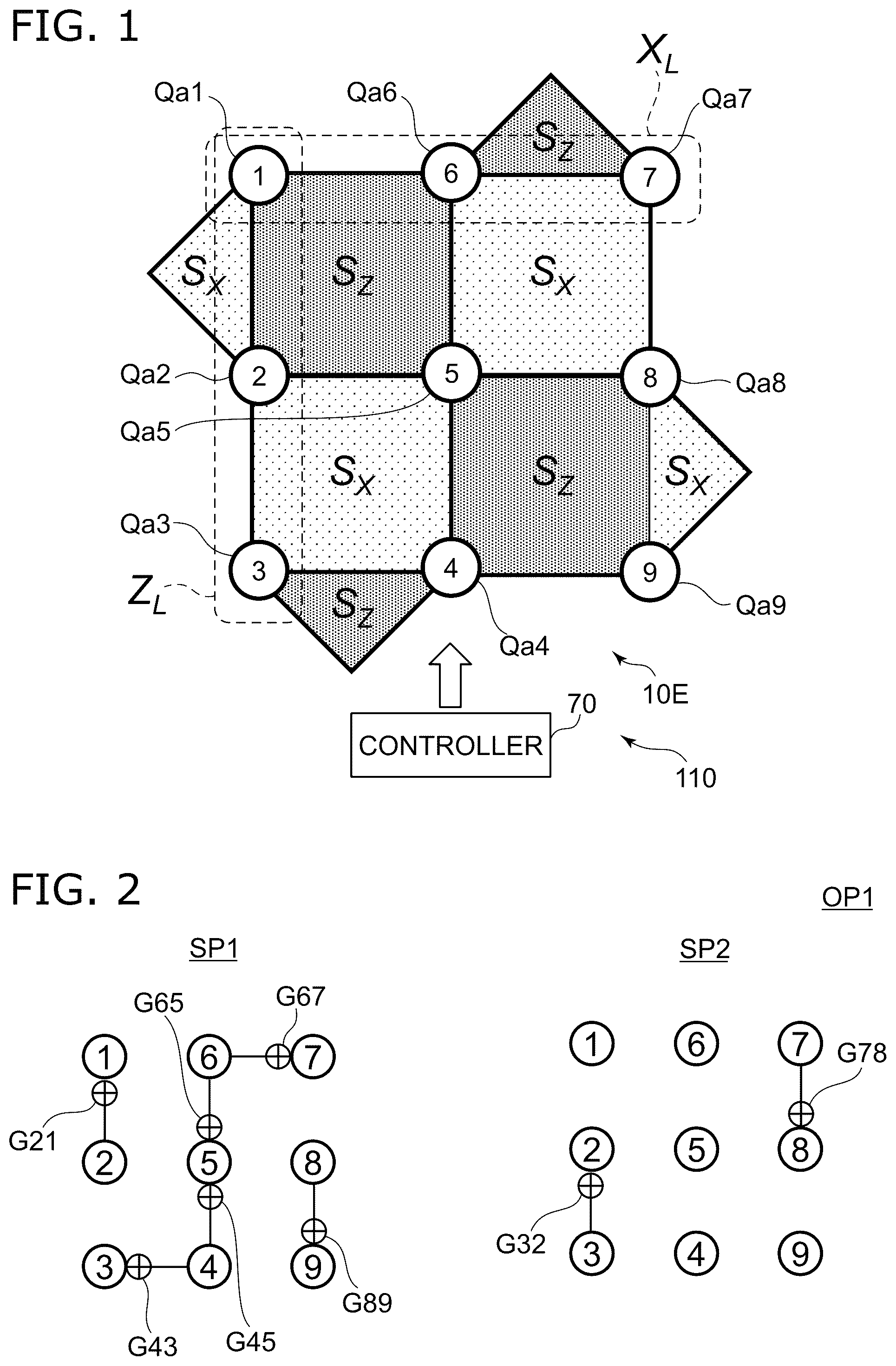
is a schematic view illustrating an encoder according to a first embodiment.
is a schematic view illustrating a control in the encoder according to the first embodiment.
illustrates a concept of a surface code having a code distance of 3.
As shown in , a first element part 10 E includes a first qubit Qa 1 , a second qubit Qa 2 , a third qubit Qa 3 , a fourth qubit Qa 4 , a fifth qubit Qa 5 , a sixth qubit Qa 6 , a seventh qubit Qa 7 , an eighth qubit Qa 8 , and a ninth qubit Qa 9 .
The second qubit Qa 2 is coupleable with the first qubit Qa 1 . The third qubit Qa 3 is coupleable with the second qubit Qa 2 . The fourth qubit Qa 4 is coupleable with the third qubit Qa 3 . The fifth qubit Qa 5 is coupleable with the fourth qubit Qa 4 . The sixth qubit Qa 6 is coupleable with the fifth qubit Qa 5 . The seventh qubit Qa 7 is coupleable with the sixth qubit Qa 6 . The eighth qubit Qa 8 is coupleable with the seventh qubit Qa 7 . The ninth qubit Qa 9 is coupleable with the eighth qubit Qa 8 .
As shown in , the encoder 110 according to the embodiment includes the first element part 10 E and a controller 70 . The controller 70 is configured to perform a first control OP 1 (see ) on the first element part 10 E. The first control OP 1 is configured to perform multiple two-qubit gates.
illustrates multiple two-qubit gates. For example, the multiple two-qubit gates include a two-qubit gate G 21 for the second and first qubits Qa 2 and Qa 1 , a two-qubit gate G 32 for the third and second qubits Qa 3 and Qa 2 , a two-qubit gate G 43 for the fourth and third qubits Qa 4 and Qa 3 , a two-qubit gate G 45 for the fourth and fifth qubits Qa 4 and Qa 5 , a two-qubit gate G 65 for the sixth and fifth qubits Qa 6 and Qa 5 , a two-qubit gate G 67 for the sixth and seventh qubits Qa 6 and Qa 7 , a two-qubit gate G 78 for the seventh and eighth qubits Qa 7 and Qa 8 , and a two-qubit gate G 89 for the eighth and ninth qubits Qa 8 and Qa 9 .
The first control OP 1 includes encoding a surface code having a code distance of 3 by performing the two-qubit gate G 21 , performing the two-qubit gate G 21 , performing the two-qubit gate G 32 , performing the two-qubit gate G 43 , performing the two-qubit gate G 45 , performing the two-qubit gate G 65 , performing the two-qubit gate G 67 , performing the two-qubit gate G 78 , and performing the two-qubit gate G 89 .
According to the embodiment, the sequence of these two-qubit gates is set as follows. According to the embodiment, in the first control OP 1 , the controller 70 performs the two-qubit gate G 32 on the third and second qubits Qa 3 and Qa 2 after the two-qubit gate G 21 for the second and first qubits Qa 2 and Qa 1 and the two-qubit gate G 43 for the fourth and third qubits Qa 4 and Qa 3 .
In the first control OP 1 , the controller 70 performs the two-qubit gate G 78 on the seventh and eighth qubits Qa 7 and Qa 8 after the two-qubit gate G 67 for the sixth and seventh qubits Qa 6 and Qa 7 and the two-qubit gate G 89 for the eighth and ninth qubits Qa 8 and Qa 9 .
For example, as shown in , the first control OP 1 includes a first partial control SP 1 and a second partial control SP 2 . These partial controls correspond to steps of the processing. The second partial control SP 2 is performed after the first partial control SP 1 . In the example, the two-qubit gate G 21 , the two-qubit gate G 43 , the two-qubit gate G 67 , and the two-qubit gate G 89 are performed in the first partial control SP 1 . The two-qubit gate G 45 and the two-qubit gate G 65 may be performed in the first partial control SP 1 .
As shown in , the two-qubit gate G 32 and the two-qubit gate G 78 are performed in the second partial control SP 2 .
Efficient encoding is possible by performing the multiple two-qubit gates in such a sequence. For example, the encoding can be performed by performing a controlled-NOT gate (hereinbelow, CNOT gate) 8 times. According to the embodiment, an encoder can be provided in which the efficiency can be increased.
An example of the encoder 110 will now be described.
is a schematic view illustrating the encoder according to the first embodiment.
is a schematic view illustrating a control of the encoder according to the first embodiment.
In the example of , the quantum states of atoms trapped by light are used as qubits (see Dolev Bluvstein et al., Nature 604, 451 (2022)).
As shown in , the first to ninth qubits Qa 1 to Qa 9 are included. These qubits each are, for example, one atom. The atoms are, for example, rubidium-87Rb.
The controller 70 irradiates an excitation light 71 (e.g., a laser) onto multiple atoms (the first to ninth qubits Qa 1 to Qa 9 ). The controller 70 can perform a controlled-Z gate (hereinbelow, a CZ-gate) by irradiating an operation light 72 (e.g., a laser) on two adjacent atoms.
In the example of , an operation on the third and fourth qubits Qa 3 and Qa 4 is illustrated. In such a case, the operation light 72 is irradiated on the third and fourth qubits Qa 3 and Qa 4 .
The CZ-gate is an example of a two-qubit gate. In the CZ-gate, the phase is inverted when both of the two qubits are in the “1 state”.
As shown in , for example, a CZ-gate interposed between two Hadamard gate Hs is the equivalent of a CNOT gate. In the CZ-gate, the operation on the two qubits is symmetric (vertically in ). Two successive Hadamard gates H are equivalent to the state before the operation, and are therefore omitted.
A CNOT gate is another example of a two-qubit gate. In the CNOT gate, nothing is performed when the controlled qubit is in the “0 state”, and the previous state is maintained; on the other hand, when the controlled qubit is in the “1 state”, the “0 state” of the target qubit is flipped to the “1 state”, or the “1 state” of the target qubit is flipped to the “0 state”. According to the embodiment, in the surface code having the code distance of 3 as shown in , nine qubits include four X-stabilizer operators S x and four Z-stabilizer operators S z . The four X-stabilizer operators S x include the X 1 X 2 operator, the X 2 X 3 X 4 X 5 operator, the X 5 X 6 X 7 X 8 operator, and the X 8 X 9 operator. The four Z-stabilizer operators S z include the Z 6 Z 7 operator, the Z 1 Z 2 Z 5 Z 6 operator, the Z 4 Z 5 Z 8 Z 9 operator, and the Z 3 Z 4 operator. In the encoded state of the surface code having the code distance of 3, the nine qubits are in simultaneous eigenstates for which the eigenvalues of the eight stabilizer operators are “1”. In the surface code having the code distance of 3, an encoded Z-operator Z L corresponds to the Z 1 Z 2 Z 3 operator. An encoded X-operator X L corresponds to the X 1 X 6 X 7 operator. In the “encoded 0 state” of the surface code having the code distance of 3, the nine qubits are in eigenstates for which the eigenvalue of the encoded Z-operator Z L is “1”.
For example, there is an encoding method of a first reference example for the nine qubits illustrated in . In the first reference example, first, the nine qubits are set to the “0 state” as a preparatory control. In the “0 state”, the qubits are in eigenstates for which the eigenvalues of the Z-operators are “1”. Subsequently, measurements for the four X-stabilizer operators S x are repeated 3 times to measure the error. Such a first reference example requires a CNOT gate performed 36 times, four ancilla qubits, and readout performed 12 times. The stabilizer measurements are, for example, syndrome measurements.
In contrast, according to the embodiment, for example, the encoding can be performed by performing a CNOT gate 8 times.
are schematic views illustrating a control of the encoder according to the first embodiment.
As shown in , the calculations of the first partial control SP 1 and the second partial control SP 2 are performed on the first qubit Qa 1 , the second qubit Qa 2 , the third qubit Qa 3 , the fourth qubit Qa 4 , the fifth qubit Qa 5 , the sixth qubit Qa 6 , the seventh qubit Qa 7 , the eighth qubit Qa 8 , and the ninth qubit Qa 9 (see ).
A pre-partial control SP 0 may be performed before the first partial control SP 1 . In the pre-partial control SP 0 , the nine qubits are set to the |0> state. In the pre-partial control SP 0 , the Hadamard gate H may be performed on the second qubit Qa 2 , the fourth qubit Qa 4 , the sixth qubit Qa 6 , and the eighth qubit Qa 8 . illustrates the changes of the stabilizers.
According to the embodiment as described above, the two-qubit gate G 32 is performed after the two-qubit gates G 43 and G 21 . The two-qubit gate G 78 is performed after the two-qubit gates G 67 and G 89 . These two-qubit gates are, for example, CNOT gates.
In the CNOT gate, for example, a two-qubit gate Gij is performed on the ith and jth qubits Qai and Qaj. “i” is an integer of 1 to 9. “j” is (i±1) and is a positive integer. Performing the two-qubit gate Gij includes causing the state of the jth qubit Qaj to transition to another state when the state of the ith qubit Qai is one of a first state or a second state (e.g., the first state), and maintaining the state of the jth qubit Qaj when the state of the ith qubit Qai is the other of the first state or the second state (e.g., the second state).
For example, performing the two-qubit gate G 43 on the fourth and third qubits Qa 4 and Qa 3 includes causing the state of the third qubit Qa 3 to transition to another state when the state of the fourth qubit Qa 4 is the one state (e.g., the first state), and maintaining the state of the third qubit Qa 3 when the state of the fourth qubit Qa 4 is the other state (e.g., the second state).
According to the embodiment, highly fault-tolerant encoding is possible. In the first partial control SP 1 , the “weights” of the stabilizers are not more than 3. Therefore, the number of errors can be considered to be not more than 1. Errors having a “weight” of 2 that occur in the CNOT gate in the second partial control SP 2 are correctable and are practically not problematic. The “weight” corresponds to the number of Pauli operators other than the identity operator.
In the example of , the first control OP 1 includes the first partial control SP 1 , and the second partial control SP 2 after the first partial control SP 1 . The first partial control SP 1 includes performing the two-qubit gate G 21 , performing the two-qubit gate G 43 , performing the two-qubit gate G 45 , performing the two-qubit gate G 65 , performing the two-qubit gate G 67 , and performing the two-qubit gate G 89 . In the example of , the second partial control SP 2 includes performing the two-qubit gate G 32 and performing the two-qubit gate G 78 .
are schematic views illustrating controls of the encoder according to the first embodiment. In these examples as shown in , the first control OP 1 includes the first partial control SP 1 , the second partial control SP 2 after the first partial control SP 1 , and a third partial control SP 3 after the second partial control SP 2 .
In the example of , the first partial control SP 1 includes performing the two-qubit gate G 21 , performing the two-qubit gate G 43 , performing the two-qubit gate G 67 , and performing the two-qubit gate G 89 . The second partial control SP 2 includes performing the two-qubit gate G 32 and performing the two-qubit gate G 45 . The third partial control SP 3 includes performing the two-qubit gate G 65 and performing the two-qubit gate G 78 . Efficient encoding is possible in the example of as well.
In the example of , the first partial control SP 1 includes performing the two-qubit gate G 21 , performing the two-qubit gate G 43 , performing the two-qubit gate G 65 , and performing the two-qubit gate G 89 . The second partial control SP 2 includes performing the two-qubit gate G 45 and performing the two-qubit gate G 67 . The third partial control SP 3 includes performing the two-qubit gate G 32 and performing the two-qubit 10 gate G 78 . Efficient encoding is possible in the example of as well.
Second Embodiment
is a schematic view illustrating an encoder according to a second embodiment.
As shown in , the encoder 120 according to the embodiment includes an encoded element part 20 E and the controller 70 . illustrates a concept of a code in which two surface codes having code distances of 3 are concatenated.
An example when the quantum states of atoms trapped by light are used as qubits will now be described.
is a schematic view illustrating the encoder according to the second embodiment.
illustrates when the code distance is 3 (i.e., the code distance N is 3). As shown in , the encoded element part 20 E includes a first encoded qubit Qc 1 having the code distance of N, a second encoded qubit Qc 2 having the code distance of N, a third encoded qubit Qc 3 having the code distance of N, a fourth encoded qubit Qc 4 having the code distance of N, a fifth encoded qubit Qc 5 having the code distance of N, a sixth encoded qubit Qc 6 having the code distance of N, a seventh encoded qubit Qc 7 having the code distance of N, an eighth encoded qubit Qc 8 having the code distance of N, and a ninth encoded qubit Qc 9 having the code distance of N.
The second encoded qubit Qc 2 is coupleable with the first encoded qubit Qc 1 . The third encoded qubit Qc 3 is coupleable with the second encoded qubit Qc 2 . The fourth encoded qubit Qc 4 is coupleable with the third encoded qubit Qc 3 . The fifth encoded qubit Qc 5 is coupleable with the fourth encoded qubit Qc 4 . The sixth encoded qubit Qc 6 is coupleable with the fifth encoded qubit Qc 5 . The seventh encoded qubit Qc 7 is coupleable with the sixth encoded qubit Qc 6 . The eighth encoded qubit Qc 8 is coupleable with the seventh encoded qubit Qc 7 . The ninth encoded qubit Qc 9 is coupleable with the eighth encoded qubit Qc 8 .
In the example, the first to ninth encoded qubits Qc 1 to Qc 9 included in the encoded element part 20 E each include the first element part 10 E (see ). The code of level 1 corresponds to the code of the first element part 10 E (the first to ninth qubits Qa 1 to Qa 9 ). The code of level 2 corresponds to the code of the encoded element part 20 E (the first to ninth encoded qubits Qc 1 to Qc 9 ).
Hereinbelow, the code of level 1 of the concatenated code is taken to be a surface code having a code distance of 3. According to the embodiment, any code having a code distance of N may be utilized. “N” is an integer not less than 2. The code of level 2 of the concatenated code is a surface code having a code distance of 3.
An example of encoding the encoder 120 will now be described.
is a flowchart illustrating a control of the encoder according to the second embodiment.
As shown in , the controller 70 is configured to perform a second control OP 2 and a third control OP 3 . The second control OP 2 corresponds to the encoding of level 2 . The third control OP 3 corresponds to an error detection control. The controller 70 is configured to perform a first level encoding control OL 1 before the second control OP 2 .
is a schematic view illustrating a portion of the control of the encoder according to the second embodiment. illustrates the first level encoding control OL 1 . illustrates the first level encoding control OL 1 on the third and fourth encoded qubits Qc 3 and Qc 4 .
As shown in , the third encoded qubit Qc 3 includes the first to ninth qubits Qa 1 to Qa 9 of the third encoded qubit Qc 3 . The fourth encoded qubit Qc 4 includes the first to ninth qubits Qa 1 to Qa 9 of the fourth encoded qubit Qc 4 . For example, the encoded CNOT gate of level 1 is performed between the first to ninth qubits Qa 1 to Qa 9 included in the third encoded qubit Qc 3 and the first to ninth qubits Qa 1 to Qa 9 included in the fourth encoded qubit Qc 4 . The encoded CNOT gate of level 1 corresponds to a “transversal CNOT”. According to the embodiment, encoded CZ-gates may be similarly performed to .
The encoding illustrated in is performed on two other encoded qubits. At this time, in the first level encoding control OL 1 , the controller 70 performs the two-qubit gate G 32 after the two-qubit gates G 21 and G 43 . In the first level encoding control OL 1 , the controller 70 performs the two-qubit gate G 78 after the two-qubit gates G 67 and G 89 . Such a first level encoding control OL 1 is performed on all nine level- 1 encoded qubits.
In the example of , the code of level 1 is a surface code having a code distance of 3. When the code of level 1 has a code distance of N, the first level encoding control OL 1 is modified and performed according to the code distance of N.
As shown in , the controller 70 performs the second control OP 2 after the first level encoding control OL 1 . A and 13 B are schematic views illustrating the control of the encoder according to the second embodiment. The second control OP 2 includes performing an encoded two-qubit gate Gc 21 on the second and first encoded qubits Qc 2 and Qc 1 (see A ). The second control OP 2 includes performing an encoded two-qubit gate Gc 32 on the third and second encoded qubits Qc 3 and Qc 2 (see B ). The second control OP 2 includes performing an encoded two-qubit gate Gc 43 on the fourth and third encoded qubits Qc 4 and Qc 3 (see A ). The second control OP 2 includes performing an encoded two-qubit gate Gc 45 on the fourth and fifth encoded qubits Qc 4 and Qc 5 (see A ). The second control OP 2 includes performing an encoded two-qubit gate Gc 65 on the sixth and fifth encoded qubits Qc 6 and Qc 5 (see A ). The second control OP 2 includes performing an encoded two-qubit gate Gc 67 on the sixth and seventh encoded qubits Qc 6 and Qc 7 (see A ). The second control OP 2 includes performing an encoded two-qubit gate Gc 78 on the seventh and eighth encoded qubits Qc 7 and Qc 8 (see B ). The second control OP 2 includes performing an encoded two-qubit gate Gc 89 on the eighth and ninth encoded qubits Qc 8 and Qc 9 (see A ).
By the multiple encoded two-qubit gates described above, the second control OP 2 includes encoding the code having the code distance of N and the surface code having the code distance of 3 into a concatenated code having a code distance of 3N.
illustrates a portion of the second control OP 2 . The controller 70 irradiates the excitation light 71 on the first to ninth qubits Qa 1 to Qa 9 (see , etc.) included in each of the first to ninth encoded qubits Qc 1 to Qc 9 . The controller 70 can perform a CZ-gate by irradiating the operation light 72 (e.g., the laser) on two adjacent atoms.
illustrates operations on the third and fourth encoded qubits Qc 3 and Qc 4 . In such a case, the operation light 72 is irradiated on the third and fourth encoded qubits Qc 3 and Qc 4 . Encoded CZ-gates are performed on the third and fourth encoded qubits Qc 3 and Qc 4 .
As shown in , in the second control OP 2 , the controller 70 performs the encoded two-qubit gate Gc 32 after the encoded two-qubit gates Gc 21 and Gc 43 . In the second control OP 2 , the controller 70 performs the encoded two-qubit gate Gc 78 after the encoded two-qubit gates Gc 67 and Gc 89 .
As shown in , the controller 70 performs the third control OP 3 after the second control OP 2 .
The third control OP 3 includes detecting an error in at least one of the second encoded qubit Qc 2 , the third encoded qubit Qc 3 , or the fourth encoded qubit Qc 4 and in at least one of the sixth encoded qubit Qc 6 , the seventh encoded qubit Qc 7 , or the eighth encoded qubit Qc 8 .
The controller 70 determines the existence or absence of an error (a fourth control OP 4 ). When an error exists, the flow returns to the first level encoding control OL 1 (or the second control OP 2 ). When no error exists, the encoding ends. The controller 70 repeats the second control OP 2 and the third control OP 3 until an error is not detected.
is a schematic view illustrating an encoder of a reference example.
In an encoder 129 of a second reference example as shown in , “N” is 3. In such a case, the code distance is 9. 9×9 (81) qubits Qax are provided. In the eighty-one qubits Qax, when the surface code having a code distance of 9 is in the “0 state”, the forty X-stabilizer operators S x , the forty Z-stabilizer operators S z , and the encoded Z-operator Z L are in simultaneous eigenstates having eigenvalues of “1”.
In the second reference example, first, the eighty-one qubits Qax are set to the “0 state” as a preparatory control. In the “0 state”, the qubits Qax are in eigenstates in which the eigenvalue of the Z-operator is “1”. Then, the measurements of the forty X-stabilizer operators S x are repeated 9 times each, and the error is estimated. The measurements of the forty X-stabilizer operators S x require a CNOT gate performed 1242 times, forty ancilla qubits, and readout performed 360 times.
In contrast, according to the embodiment, the encoding can be performed efficiently by the second and third controls OP 2 and OP 3 .
As described above, the first to ninth encoded qubits Qc 1 to Qc 9 each include the first element part 10 E (see ). As described above, the first element part 10 E includes the first qubit Qa 1 , the second qubit Qa 2 coupleable with the first qubit Qa 1 , the third qubit Qa 3 coupleable with the second qubit Qa 2 , the fourth qubit Qa 4 coupleable with the third qubit Qa 3 , the fifth qubit Qa 5 coupleable with the fourth qubit Qa 4 , the sixth qubit Qa 6 coupleable with the fifth qubit Qa 5 , the seventh qubit Qa 7 coupleable with the sixth qubit Qa 6 , the eighth qubit Qa 8 coupleable with the seventh qubit Qa 7 , and the ninth qubit Qa 9 coupleable with the eighth qubit Qa 8 (see ).
According to the second embodiment, the first level encoding control OL 1 that is performed by the controller 70 corresponds to the first control OP 1 described with reference to the first embodiment. As described with reference to the first embodiment, the first control OP 1 includes the two-qubit gate G 21 for the second and first qubits Qa 2 and Qa 1 , the two-qubit gate G 32 for the third and second qubits Qa 3 and Qa 2 , the two-qubit gate G 43 for the fourth and third qubits Qa 4 and Qa 3 , the two-qubit gate G 45 for the fourth and fifth qubits Qa 4 and Qa 5 , the two-qubit gate G 65 for the sixth and fifth qubits Qa 6 and Qa 5 , the two-qubit gate G 67 for the sixth and seventh qubits Qa 6 and Qa 7 , the two-qubit gate G 78 for the seventh and eighth qubits Qa 7 and Qa 8 , and the two-qubit gate G 89 for the eighth and ninth qubits Qa 8 and Qa 9 .
The first control OP 1 includes encoding a surface code having a code distance of 3 by performing the two-qubit gate G 21 , performing the two-qubit gate G 32 , performing the two-qubit gate G 43 , performing the two-qubit gate G 45 , performing the two-qubit gate G 65 , performing the two-qubit gate G 67 , performing the two-qubit gate G 78 , and performing the two-qubit gate G 89 . The code that has a code distance of N is a surface code having a code distance of 3.
As described above, in the first control OP 1 , the controller 70 performs the two-qubit gate G 32 after the two-qubit gates G 21 and G 43 . In the first control OP 1 , the controller 70 performs the two-qubit gate G 78 after the two-qubit gates G 67 and G 89 .
In the encoder 120 , the third control OP 3 may further include detecting an error in the fifth encoded qubit Qc 5 . More efficient encoding can be performed.
In the third control OP 3 according to the embodiment, an error detection may be performed for the second encoded qubit Qc 2 , the fifth encoded qubit Qc 5 , and the eighth encoded qubit Qc 8 . More efficient encoding can be performed. In such a case as well, the second control OP 2 includes encoding a code having a code distance of 3N formed by concatenating a code having a code distance of N and the surface code having a code distance of 3. In the second control OP 2 , the controller 70 performs the encoded two-qubit gate Gc 32 after the encoded two-qubit gates Gc 21 and Gc 43 . In the second control OP 2 , the controller 70 performs the encoded two-qubit gate Gc 78 after the encoded two-qubit gates Gc 67 and Gc 89 . The controller 70 performs the third control OP 3 after the second control OP 2 . The third control OP 3 includes detecting an error in the second encoded qubit Qc 2 , the fifth encoded qubit Qc 5 , and the eighth encoded qubit Qc 8 . In such a case as well, the controller 70 determines whether or not an error exists (the fourth control OP 4 ). When an error exists, the flow returns to the second control OP 2 . The controller 70 repeats the first level encoding control OL 1 (or the second control OP 2 ) and the third control OP 3 until an error is not detected. Efficient encoding can be performed.
is a graph illustrating characteristics of the encoder. is simulation results of an encoder corresponding to a code distance of 3 (i.e., N=3) (see ). illustrates simulation results of the decoding error probability for four types of conditions. In a first condition CD 1 , error detection is performed for the second encoded qubit Qc 2 , the fifth encoded qubit Qc 5 , and the eighth encoded qubit Qc 8 (see Error-detecting teleportation: EDT, H. Goto and H. Uchikawa, Scientific Reports 3, 2044 (2013) Fault-tolerant quantum computation with a soft-decision decoder for error correction and detection by teleportation | Scientific Reports (nature.com)). In a second condition CD 2 , error detection is performed for the second and eighth encoded qubits Qc 2 and Qc 8 . In a third condition CD 3 , error detection is performed for the fifth encoded qubit Qc 5 . In a fourth condition CD 4 , error detection is not performed. The horizontal axis of is an error probability PCNOT of the CNOT gate. The vertical axis of is a decoding error probability Pc. illustrates function formulas calculated for the four conditions.
As shown in , compared to the fourth condition CD 4 , a low decoding error probability Pc is obtained for the third condition CD 3 . For the first condition CD 1 , the exponent of the function formula is 5.3954. For the second condition CD 2 , the exponent of the function formula is 4.7145. For the third condition CD 3 , the exponent of the function formula is 3.5085. For the fourth condition CD 4 , the exponent of the function formula is 3.4921. The exponent of the second condition CD 2 is improved compared to the third condition CD 3 . The exponent of the first condition CD 1 is improved compared to the second condition CD 2 .
A lower decoding error probability Pc is obtained for the second condition CD 2 than for the third condition CD 3 . A lower decoding error probability Pc is obtained for the first condition CD 1 than for the second condition CD 2 .
According to the embodiment, it is favorable to employ the first condition CD 1 or the second condition CD 2 . A low decoding error probability Pc is obtained.
Third Embodiment
is a schematic view illustrating a calculating device according to a third embodiment.
As shown in , the calculating device 310 according to the embodiment includes the encoder (e.g., the encoder 110 ) according to the embodiment. The calculating device 310 includes, for example, the first element part 10 E.
In the calculating device 310 , for example, the states of the first to ninth qubits Qa 1 to Qa 9 correspond to quantum states of atoms trapped by light.
The calculating device 310 may include, for example, the encoded element part 20 E. For example, the encoded qubits obtained by the second and third controls OP 2 and OP 3 are used in the calculation.
Fourth Embodiment
A fourth embodiment relates to an encoding method. The encoding method according to the embodiment may include the control of the controller 70 described with reference to the first and second embodiments.
In the encoding method according to the embodiment, for example, the first control OP 1 that encodes a surface code having a code distance of 3 is performed on the first element part 10 E. As described above, the first element part 10 E includes the first to ninth qubits Qa 1 to Qa 9 . In the first control OP 1 , the two-qubit gate G 32 is performed after the two-qubit gates G 21 and G 43 (see ). In the first processing (the first control OP 1 ), the two-qubit gate G 78 is performed after the two-qubit gates G 67 and G 89 (see ).
According to the third embodiment, the control described with reference to may be performed. According to the embodiment, an encoding method can be provided in which the efficiency can be increased.
Embodiments may include the following configurations (e.g., technological proposals).
Configuration 1
An encoder, comprising:
•
• a first element part; and • a controller, • the first element part including
• a first qubit, • a second qubit coupleable with the first qubit, • a third qubit coupleable with the second qubit, • a fourth qubit coupleable with the third qubit, • a fifth qubit coupleable with the fourth qubit, • a sixth qubit coupleable with the fifth qubit, • a seventh qubit coupleable with the sixth qubit, • an eighth qubit coupleable with the seventh qubit, and • a ninth qubit coupleable with the eighth qubit, the controller being configured to perform a first control, • the first control including encoding a surface code having a code distance of 3 by
• performing a two-qubit gate on the second and first qubits, • performing a two-qubit gate on the third and second qubits, • performing a two-qubit gate on the fourth and third qubits, • performing a two-qubit gate on the fourth and fifth qubits, • performing a two-qubit gate on the sixth and fifth qubits, • performing a two-qubit gate on the sixth and seventh qubits, • performing a two-qubit gate on the seventh and eighth qubits, and • performing a two-qubit gate on the eighth and ninth qubits, • in the first control, the controller performing the two-qubit gate on the third and second qubits after the two-qubit gate for the second and first qubits and the two-qubit gate for the fourth and third qubits, • in the first control, the controller performing the two-qubit gate on the seventh and eighth qubits after the two-qubit gate for the sixth and seventh qubits and the two-qubit gate for the eighth and ninth qubits. Configuration 2
The encoder according to Configuration 1 , wherein
•
• the first control includes a first partial control, and a second partial control after the first partial control, • the first partial control includes:
• the performing of the two-qubit gate on the second and first qubits; • the performing of the two-qubit gate on the fourth and third qubits; • the performing of the two-qubit gate on the fourth and fifth qubits; • the performing of the two-qubit gate on the sixth and fifth qubits; • the performing of the two-qubit gate on the sixth and seventh qubits; and • the performing of the two-qubit gate on the eighth and ninth qubits, and • the second partial control includes:
• the performing of the two-qubit gate on the third and second qubits; and • the performing of the two-qubit gate on the seventh and eighth qubits. Configuration 3
The encoder according to Configuration 1 , wherein
•
• the first control includes a first partial control, a second partial control after the first partial control, and a third partial control after the second partial control, • the first partial control includes:
• the performing of the two-qubit gate on the second and first qubits; • the performing of the two-qubit gate on the fourth and third qubits; • the performing of the two-qubit gate on the sixth and seventh qubits; and • the performing of the two-qubit gate on the eighth and ninth qubits, • the second partial control includes:
• the performing of the two-qubit gate on the third and second qubits; and • the performing of the two-qubit gate on the fourth and fifth qubits, and • the third partial control includes:
• the performing of the two-qubit gate on the sixth and fifth qubits; and • the performing of the two-qubit gate on the seventh and eighth qubits. Configuration 4
The encoder according to Configuration 1 , wherein
•
• the first control includes a first partial control, a second partial control after the first partial control, and a third partial control after the second partial control, • the first partial control includes:
• the performing of the two-qubit gate on the second and first qubits; • the performing of the two-qubit gate on the fourth and third qubits; • the performing of the two-qubit gate on the sixth and fifth qubits; and • the performing of the two-qubit gate on the eighth and ninth qubits, • the second partial control includes:
• the performing of the two-qubit gate on the fourth and fifth qubits; and • the performing of the two-qubit gate on the sixth and seventh qubits, and • the third partial control includes:
• the performing of the two-qubit gate on the third and second qubits; and • the performing of the two-qubit gate on the seventh and eighth qubits. Configuration 5
An encoder, comprising:
•
• an encoded element part; and • a controller, • the encoded element part including
• a first encoded qubit having a code distance of N, • a second encoded qubit coupleable with the first encoded qubit, the second encoded qubit having the code distance of N, • a third encoded qubit coupleable with the second encoded qubit, the third encoded qubit having the code distance of N, • a fourth encoded qubit coupleable with the third encoded qubit, the fourth encoded qubit having the code distance of N, • a fifth encoded qubit coupleable with the fourth encoded qubit, the fifth encoded qubit having the code distance of N, • a sixth encoded qubit coupleable with the fifth encoded qubit, the sixth encoded qubit having the code distance of N, • a seventh encoded qubit coupleable with the sixth encoded qubit, the seventh encoded qubit having the code distance of N, • an eighth encoded qubit coupleable with the seventh encoded qubit, the eighth encoded qubit having the code distance of N, and • a ninth encoded qubit coupleable with the eighth encoded qubit, the ninth encoded qubit having the code distance of N, • N being an integer not less than 2, • the controller being configured to perform a second control and a third control, • the second control including encoding a code having a code distance of 3N, the code being formed by concatenating a code having the code distance of N and a surface code having a code distance of 3, the encoding including
• performing an encoded two-qubit gate on the second and first encoded qubits, • performing an encoded two-qubit gate on the third and second encoded qubits, • performing an encoded two-qubit gate on the fourth and third encoded qubits, • performing an encoded two-qubit gate on the fourth and fifth encoded qubits, • performing an encoded two-qubit gate on the sixth and fifth encoded qubits, • performing an encoded two-qubit gate on the sixth and seventh encoded qubits, • performing an encoded two-qubit gate on the seventh and eighth encoded qubits, • performing an encoded two-qubit gate on the eighth and ninth encoded qubits, • in the second control, the controller performing the encoded two-qubit gate on the third and second encoded qubits after the encoded two-qubit gate for the second and first encoded qubits and the encoded two-qubit gate for the fourth and third encoded qubits, • in the second control, the controller performing the encoded two-qubit gate on the seventh and eighth encoded qubits after the encoded two-qubit gate for the sixth and seventh encoded qubits and the encoded two-qubit gate for the eighth and ninth encoded qubits, • the controller performing the third control after the second control, • the third control including detecting an error in at least one of the second encoded qubit, the third encoded qubit, or the fourth encoded qubit and in at least one of the sixth encoded qubit, the seventh encoded qubit, or the eighth encoded qubit, • the controller repeating the second and third controls until the error is not detected. Configuration 6
The encoder according to Configuration 5 , wherein
•
• each of the first to ninth encoded qubits includes a first element part, • the first element part includes:
• a first qubit; • a second qubit coupleable with the first qubit; • a third qubit coupleable with the second qubit; • a fourth qubit coupleable with the third qubit; • a fifth qubit coupleable with the fourth qubit; • a sixth qubit coupleable with the fifth qubit; • a seventh qubit coupleable with the sixth qubit; • an eighth qubit coupleable with the seventh qubit; and • a ninth qubit coupleable with the eighth qubit, the controller is configured to perform a first control, • the first control includes encoding a surface code having the code distance of 3 by:
• performing a two-qubit gate on the second and first qubits; • performing a two-qubit gate on the third and second qubits; • performing a two-qubit gate on the fourth and third qubits; • performing a two-qubit gate on the fourth and fifth qubits; • performing a two-qubit gate on the sixth and fifth qubits; • performing a two-qubit gate on the sixth and seventh qubits; • performing a two-qubit gate on the seventh and eighth qubits; and • performing a two-qubit gate on the eighth and ninth qubits, • a code having the code distance of N is a surface code having the code distance of 3, • in the first control, the controller performs the two-qubit gate on the third and second qubits after the two-qubit gate for the second and first qubits and the two-qubit gate for the fourth and third qubits, and • in the first control, the controller performs the two-qubit gate on the seventh and eighth qubits after the two-qubit gate for the sixth and seventh qubits and the two-qubit gate for the eighth and ninth qubits. Configuration 7
The encoder according to Configuration 5 or 6 , wherein
•
• the third control further includes detecting an error in the fifth and eighth encoded qubits. Configuration 8
An encoder, comprising:
•
• an encoded element part; and • a controller, • the encoded element part including
• a first encoded qubit having a code distance of N, • a second encoded qubit coupleable with the first encoded qubit, the second encoded qubit having the code distance of N, • a third encoded qubit coupleable with the second encoded qubit, the third encoded qubit having the code distance of N, • a fourth encoded qubit coupleable with the third encoded qubit, the fourth encoded qubit having the code distance of N, • a fifth encoded qubit coupleable with the fourth encoded qubit, the fifth encoded qubit having the code distance of N, • a sixth encoded qubit coupleable with the fifth encoded qubit, the sixth encoded qubit having the code distance of N, • a seventh encoded qubit coupleable with the sixth encoded qubit, the seventh encoded qubit having the code distance of N, • an eighth encoded qubit coupleable with the seventh encoded qubit, the eighth encoded qubit having the code distance of N, and • a ninth encoded qubit coupleable with the eighth encoded qubit, the ninth encoded qubit having the code distance of N, • the controller being configured to perform a second control and a third control, • the second control including encoding a code having a code distance of 3N, the code being formed by concatenating a code having the code distance of N and a surface code having a code distance of 3, the encoding including
• performing an encoded two-qubit gate on the second and first encoded qubits, • performing an encoded two-qubit gate on the third and second encoded qubits, • performing an encoded two-qubit gate on the fourth and third encoded qubits, • performing an encoded two-qubit gate on the fourth and fifth encoded qubits, • performing an encoded two-qubit gate on the sixth and fifth encoded qubits, • performing an encoded two-qubit gate on the sixth and seventh encoded qubits, • performing an encoded two-qubit gate on the seventh and eighth encoded qubits, and • performing an encoded two-qubit gate on the eighth and ninth encoded qubits, • in the second control, the controller performing the encoded two-qubit gate on the third and second encoded qubits after the encoded two-qubit gate for the second and first encoded qubits and the encoded two-qubit gate for the fourth and third encoded qubits, • in the second control, the controller performing the encoded two-qubit gate on the seventh and eighth encoded qubits after the encoded two-qubit gate for the sixth and seventh encoded qubits and the encoded two-qubit gate for the eighth and ninth encoded qubits, • the controller performing the third control after the second control, • the third control including detecting an error in the second, fifth, and eighth encoded qubits, • the controller repeating the second and third controls until the error is not detected. Configuration 9
The encoder according to Configuration 8 , wherein
•
• each of the first to ninth encoded qubits includes a first element part, • the first element part includes:
• a first qubit; • a second qubit coupleable with the first qubit; • a third qubit coupleable with the second qubit; • a fourth qubit coupleable with the third qubit; • a fifth qubit coupleable with the fourth qubit; • a sixth qubit coupleable with the fifth qubit; • a seventh qubit coupleable with the sixth qubit; • an eighth qubit coupleable with the seventh qubit; and • a ninth qubit coupleable with the eighth qubit, the controller is configured to perform a first control, • the first control includes encoding a surface code having the code distance of 3 by
• performing a two-qubit gate on the second and first qubits, • performing a two-qubit gate on the third and second qubits, • performing a two-qubit gate on the fourth and third qubits, • performing a two-qubit gate on the fourth and fifth qubits, • performing a two-qubit gate on the sixth and fifth qubits, • performing a two-qubit gate on the sixth and seventh qubits, • performing a two-qubit gate on the seventh and eighth qubits, and • performing a two-qubit gate on the eighth and ninth qubits, • a code having the code distance of N is a surface code having the code distance of 3, • in the first control, the controller performs the two-qubit gate on the third and second qubits after the two-qubit gate for the second and first qubits and the two-qubit gate for the fourth and third qubits, and • in the first control, the controller performs the two-qubit gate on the seventh and eighth qubits after the two-qubit gate for the sixth and seventh qubits and the two-qubit gate for the eighth and ninth qubits. Configuration 10
A calculating device, comprising:
•
• the encoder according to any one of Configurations 1 to 4 . Configuration 11
The calculating device according to Configuration 10 , wherein
•
• states of the first to ninth qubits correspond to quantum states of atoms trapped by light. Configuration 12
A calculating device, comprising:
•
• the encoder according to any one of Configurations 5 to 9 , an encoded qubit obtained by the second and third controls being used in a calculation. Configuration 13
The calculating device according to Configuration 12 , wherein
•
• states of the first to ninth encoded qubits correspond to quantum states of atoms trapped by light. Configuration 14
An encoding method, comprising:
•
• performing a first control on a first element part, • the first control encoding a surface code having a code distance of 3, • the first element part including
• a first qubit, • a second qubit coupleable with the first qubit, • a third qubit coupleable with the second qubit, • a fourth qubit coupleable with the third qubit, • a fifth qubit coupleable with the fourth qubit, • a sixth qubit coupleable with the fifth qubit, • a seventh qubit coupleable with the sixth qubit, • an eighth qubit coupleable with the seventh qubit, and • a ninth qubit coupleable with the eighth qubit, the first control including • performing a two-qubit gate on the second and first qubits, • performing a two-qubit gate on the third and second qubits, • performing a two-qubit gate on the fourth and third qubits, • performing a two-qubit gate on the fourth and fifth qubits, • performing a two-qubit gate on the sixth and fifth qubits, • performing a two-qubit gate on the sixth and seventh qubits, • performing a two-qubit gate on the seventh and eighth qubits, and • performing a two-qubit gate on the eighth and ninth qubits, • in the first control, the two-qubit gate being performed on the third and second qubits after the two-qubit gate for the second and first qubits and the two-qubit gate for the fourth and third qubits, • in the first control, the two-qubit gate being performed on the seventh and eighth qubits after the two-qubit gate for the sixth and seventh qubits and the two-qubit gate for the eighth and ninth qubits.
According to embodiments, an encoder, a calculating device, and an encoding method can be provided in which the efficiency can be increased.
Hereinabove, exemplary embodiments of the invention are described with reference to specific examples. However, the embodiments of the invention are not limited to these specific examples. For example, one skilled in the art may similarly practice the invention by appropriately selecting specific configurations of components included in encoders or calculating devices, such as element parts, qubits, controllers etc., from known art. Such practice is included in the scope of the invention to the extent that similar effects thereto are obtained.
Further, any two or more components of the specific examples may be combined within the extent of technical feasibility and are included in the scope of the invention to the extent that the purport of the invention is included.
Moreover, all encoders, calculating devices, and encoding methods practicable by an appropriate design modification by one skilled in the art based on the encoders, the calculating devices, and the encoding methods described above as embodiments of the invention also are within the scope of the invention to the extent that the purport of the invention is included.
Various other variations and modifications can be conceived by those skilled in the art within the spirit of the invention, and it is understood that such variations and modifications are also encompassed within the scope of the invention.
While certain embodiments have been described, these embodiments have been presented by way of example only, and are not intended to limit the scope of the inventions. Indeed, the novel embodiments described herein may be embodied in a variety of other forms; furthermore, various omissions, substitutions and changes in the form of the embodiments described herein may be made without departing from the spirit of the inventions. The accompanying claims and their equivalents are intended to cover such forms or modifications as would fall within the scope and spirit of the invention.
Figures (10)
Citations
This patent cites (10)
- US11308252
- US11551127
- US11694104
- US11694108
- US11736122
- US11966817
- US12007835
- US2018/0269906
- US2019/0044543
- US2023/0162077