Color Filter Substrate, Display Device, and Method of Producing Color Filter Substrate
Abstract
A color filter substrate includes first and second color filters exhibiting different colors and a light blocking portion. The light blocking portion includes a first transmissive film, a first reflective film on an upper layer side of the first transmissive film, a second transmissive film on an upper layer side of the first reflective film, and a second reflective film on an upper layer side of the second transmissive film and being thicker than the first reflective film. The first transmissive film includes a first bottom surface and a first side surface being inclined at a first angle with respect to the first bottom surface. The second reflective film includes a second bottom surface extending parallel to the first bottom surface and a second side surface being inclined at a second angle with respect to the second bottom surface. The first angle and the second angle are acute angles.
Claims (9)
1. A color filter substrate comprising: a first color filter; a second color filter exhibiting a color different from a color exhibited by the first color filter; and a light blocking portion disposed on a border between the first color filter and the second color filter and on a lower layer side of the first color filter and the second color filter, the light blocking portion including a first transmissive film, a first reflective film disposed on an upper layer side of the first transmissive film, a second transmissive film disposed on an upper layer side of the first reflective film, and a second reflective film disposed on an upper layer side of the second transmissive film and having a thickness greater than a thickness of the first reflective film, wherein the first transmissive film includes a first bottom surface that is on an opposite side from the first reflective film and a first side surface that is inclined at a first angle with respect to the first bottom surface, the second reflective film includes a second bottom surface that is contacted with an upper surface of the second transmissive film and extends parallel to the first bottom surface and a second side surface that is inclined at a second angle with respect to the second bottom surface, and the first angle and the second angle are acute angles.
7. A method of producing a color filter substrate, the method comprising: depositing a first transmissive film on a substrate; depositing a first reflective film on an upper layer side of the first transmissive film; depositing a second transmissive film on an upper layer side of the first reflective film; depositing a second reflective film on an upper layer side of the second transmissive film, the second reflective film being thicker than the first reflective film; depositing a resist film having photosensitive properties on an upper layer side of the second reflective film; exposing the resist film with light to perform development; performing first etching in which at least the second reflective film is subjected to etching with using the resist film as a mask; performing second etching in which the second reflective film, the second transmissive film, the first reflective film, and the first transmissive film are subjected to etching with using the resist film as a mask at an etching speed that is lower than an etching speed of the first etching, whereby forming a light blocking portion including the first transmissive film, the first reflective film, the second transmissive film, and the second reflective film; forming a first color filter such that an edge portion of the first color filter is disposed on an upper layer side of the light blocking portion; and forming a second color filter next to the first color filter such that an edge portion of the second color filter is disposed on an upper layer side of the light blocking portion, the second color filter exhibiting a color different from a color that is exhibited by the first color filter.
Show 7 dependent claims
2. The color filter substrate according to claim 1 , wherein the first reflective film includes a third bottom surface that is contacted with an upper surface of the first transmissive film and extends parallel to the first bottom surface and a third side surface, and a third angle is formed between the third side surface and the third bottom surface, the second transmissive film includes a fourth bottom surface that is contacted with an upper surface of the first reflective film and extends parallel to the first bottom surface and a fourth side surface, and a fourth angle is formed between the fourth side surface and the fourth bottom surface, and the first reflective film is configured such that the third side surface is contacted with the upper surface of the first transmissive film without being contacted with the first side surface.
3. The color filter substrate according to claim 2 , wherein the third angle and the fourth angle are greater than the first angle.
4. The color filter substrate according to claim 2 , wherein the second reflective film includes a fifth side surface that is contacted with the second bottom surface and a fifth angle is formed between the fifth side surface and the second bottom surface, and the fifth angle is an obtuse angle.
5. The color filter substrate according to claim 1 , wherein the light blocking portion is configured such that an angle formed between the first bottom surface and a line segment that extends from an outer edge of the first transmissive film to an outer edge of the second reflective film is from 70° to 90°.
6. A display device comprising: the color filter substrate according to claim 1 ; and an array substrate disposed to opposite the color filter substrate.
8. The method according to claim 7 , wherein in the first etching, at least SF 6 gas is used, and in the second etching, at least CF 4 gas and O 2 gas are used.
9. The method according to claim 7 , wherein in the first etching and the second etching, an etching device is used, the etching device including a vacuum chamber in which the substrate is arranged, and a substrate support base arranged in the vacuum chamber and including protrusions that are arranged at intervals within a surface area of the substrate and support the substrate.
Full Description
Show full text →
CROSS REFERENCE TO RELATED APPLICATION
This application claims priority from Japanese Patent Application No. 2023-172495 filed on Oct. 4, 2023. The entire contents of the priority application are incorporated herein by reference.
TECHNICAL FIELD
The present technology described herein relates to a color filter substrate, a display device, and a method producing a color filter substrate.
BACKGROUND
A color filter substrate included in an image display panel such as a liquid crystal panel has been known. One example of such a color filter includes a photosensitive composition containing a light blocking agent. In such a photosensitive composition, an oxime ester compound with a specific structure is used as a photoinitiator, and a resin coated carbon black is used as the light blocking agent.
SUMMARY
In the above color filter substrate, resin material is used as a material of the black matrix. Therefore, with the image display panel having quite high precision and the pixel density being 1000 ppi or higher (particularly, 1200 ppi or higher), effective exposure precision cannot be obtained when the black matrix is exposed with light using an exposing device. Therefore, miniaturization of the black matrix is difficult.
The technology described herein was made in view of the above circumstances. An object is to achieve miniaturization of a light blocking portion.
•
• (1) A color filter substrate according to the technology described herein includes a first color filter, a second color filter exhibiting a color different from a color exhibited by the first color filter, and a light blocking portion disposed on a border between the first color filter and the second color filter and on a lower layer side of the first color filter and the second color filter. The light blocking portion includes a first transmissive film, a first reflective film disposed on an upper layer side of the first transmissive film, a second transmissive film disposed on an upper layer side of the first reflective film, and a second reflective film disposed on an upper layer side of the second transmissive film and having a thickness greater than a thickness of the first reflective film. The first transmissive film includes a first bottom surface that is on an opposite side from the first reflective film and a first side surface that is inclined at a first angle with respect to the first bottom surface. The second reflective film includes a second bottom surface that is contacted with an upper surface of the second transmissive film and extends parallel to the first bottom surface and a second side surface that is inclined at a second angle with respect to the second bottom surface. The first angle and the second angle are acute angles. • (2) In the color filter substrate, in addition to (1), the first reflective film may include a third bottom surface that is contacted with an upper surface of the first transmissive film and extends parallel to the first bottom surface and a third side surface, and a third angle may be formed between the third side surface and the third bottom surface. The second transmissive film may include a fourth bottom surface that is contacted with an upper surface of the first reflective film and extends parallel to the first bottom surface and a fourth side surface, and a fourth angle may be formed between the fourth side surface and the fourth bottom surface. The first reflective film may be configured such that the third side surface is contacted with the upper surface of the first transmissive film without being contacted with the first side surface. • (3) In the color filter substrate, in addition to (2), the third angle and the fourth angle may be greater than the first angle. • (4) In the color filter substrate, in addition to (2) or (3), the second reflective film may include a fifth side surface that is contacted with the second bottom surface and a fifth angle may be formed between the fifth side surface and the second bottom surface and the fifth angle may be an obtuse angle. • (5) In the color filter substrate, in addition to any one of (1) to (4), the light blocking portion may be configured such that an angle formed between the first bottom surface and a segment that extends from an outer edge of the first transmissive film to an outer edge of the second reflective film is from 70° to 90°. • (6) A display device according to the technology described herein includes the color filter substrate described any one of (1) to (5) and an array substrate disposed to opposite the color filter substrate. • (7) A method of producing a color filter substrate according to the technology described herein includes depositing a first transmissive film on a substrate, depositing a first reflective film on an upper layer side of the first transmissive film, depositing a second transmissive film on an upper layer side of the first reflective film, depositing a second reflective film on an upper layer side of the second transmissive film, the second reflective film being thicker than the first reflective film, depositing a resist film having photosensitive properties on an upper layer side of the second reflective film, exposing the resist film with light to perform development, performing first etching in which at least the second reflective film is subjected to etching with using the resist film as a mask, performing second etching in which the second reflective film, the second transmissive film, the first reflective film, and the first transmissive film are subjected to etching with using the resist film as a mask at an etching speed that is lower than an etching speed of the first etching, whereby forming a light blocking portion including the first transmissive film, the first reflective film, the second transmissive film, and the second reflective film, forming a first color filter such that an edge portion of the first color filter is disposed on an upper layer side of the light blocking portion, and forming a second color filter next to the first color filter such that an edge portion of the second color filter is disposed on an upper layer side of the light blocking portion, the second color filter exhibiting a color different from a color that is exhibited by the first color filter. • (8) In the method of producing a color filter substrate, in addition to (7), in the first etching, at least SF 6 gas may be used, and in the second etching, at least CF 4 gas and O 2 gas may be used. • (9) In the method of producing a color filter substrate, in addition to (7) or (8), in the first etching and the second etching, an etching device may be used, the etching device including a vacuum chamber in which the substrate is arranged, and a substrate support base arranged in the vacuum chamber and including protrusions that are arranged at intervals within a surface area of the substrate and support the substrate.
According to the technology described herein, miniaturization of a light blocking portion can be achieved.
BRIEF DESCRIPTION OF THE DRAWINGS
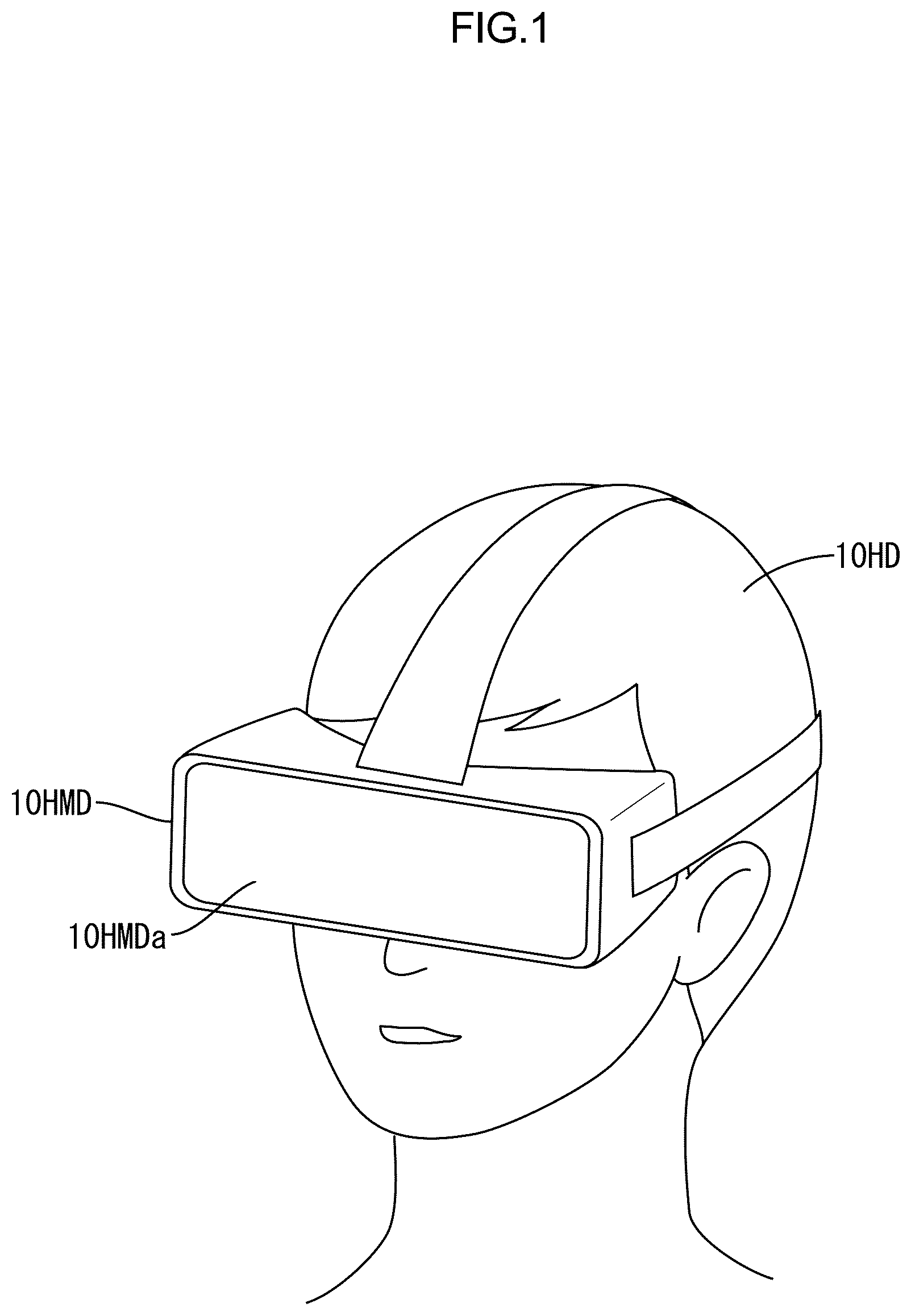
is a general perspective view illustrating a head-mounted display that is mounted on a head of a user according to one embodiment.
is a general side view illustrating an optical relation of a liquid crystal display device and a lens that are included in a head mounting device of the head-mounted display according to the embodiment and an eyeball of the user.
is a plan view illustrating a liquid crystal panel and a flexible board included in the liquid crystal display device according to the embodiment.
is a cross-sectional view of the liquid crystal panel according to the embodiment.
is a circuit diagram illustrating pixel arrangement in the display area of an array substrate included in the liquid crystal panel according to the embodiment.
is a cross-sectional view of the liquid crystal panel according to the embodiment illustrating pixel arrangement in the display area of the liquid crystal panel according to the embodiment.
is a cross-sectional view of a color filter substrate included in the liquid crystal panel according to the embodiment.
is an enlarged cross-sectional view of a light blocking portion included in the color filter substrate according to the embodiment.
is a view illustrating a general configuration of an etching device used in a first process of a color filter substrate producing process according to the embodiment.
is a cross-sectional view illustrating a glass substrate that is supported by protrusions of a substrate support base included in the etching device according to the embodiment.
is a cross-sectional view illustrating a resist film that is exposed with light to be developed in the first process of the color filter substrate producing process according to the embodiment.
is a cross-sectional view illustrating the films after the first etching of the first process of the color filter substrate producing process.
is a cross-sectional view illustrating the films after the second etching of the first process of the color filter substrate producing process.
is a table illustrating an experiment result of Comparative Example 1 of Comparative Experiment 1 according to the embodiment.
is a table illustrating an experiment result of Comparative Example 2 of Comparative Experiment 1 according to the embodiment.
is a table illustrating an experiment result of Comparative Example 3 of Comparative Experiment 1 according to the embodiment.
is a table illustrating an experiment result of Comparative Example 4 of Comparative Experiment 1 according to the embodiment.
is a table illustrating an experiment result of Example 1 of Comparative Experiment 1 according to the embodiment.
is a table illustrating an experiment result of Example 2 of Comparative Experiment 1 according to the embodiment.
is a table illustrating an experiment result of Example 3 of Comparative Experiment 1 according to the embodiment.
is a table illustrating an experiment result of Example 4 of Comparative Experiment 1 according to the embodiment.
is a table illustrating an experiment result of Example 5 of Comparative Experiment 1 according to the embodiment.
is a table illustrating an experiment result of Example 6 of Comparative Experiment according to the embodiment.
is a table illustrating an experiment result of Example 7 of Comparative Experiment 1 according to the embodiment.
DETAILED DESCRIPTION
One embodiment will be described with reference to to 24 . In this embodiment section, a goggle-type head-mounted display (HMD) 10 HMD and a liquid crystal display device 10 (a display device) used therein will be described as an example. X-axis, Y-axis and Z-axis may be present in the drawings and each of the axial directions represents a direction represented in each drawing.
An outer appearance of the goggle-type head-mounted display 10 HMD will be described with reference to . As illustrated in , the goggle-type head-mounted display 10 HMD includes a head mounting device 10 HMDa that is to be mounted on the head 10 HD of the user. The head mounting device 10 HMDa covers the eyes of the user.
A configuration of the head mounting device 10 HMDa will be described with reference to . As illustrated in , the head mounting device 10 HMDa at least includes the liquid crystal display device 10 displaying images thereon and a lens 10 RE with which the images displayed on the liquid crystal display device 10 are formed (imaging) on the eyeballs EY of the user. The liquid crystal display device 10 at least includes a liquid crystal panel 11 (a display device) and a backlight 12 (a lighting device) that supplies light to the liquid crystal panel 11 . The liquid crystal panel 11 includes a plate surface that is opposed to the lens 10 RE as a display surface 11 DS on which images are displayed. The lens 10 RE is disposed between the liquid crystal display device 10 and the eyeballs 10 EY of the user and makes the light rays transmitting therethrough to be refracted. By adjusting a focal distance of the lens 10 RE, images formed on the retina (eye) 10 EYb through the crystalline lens 10 EYa of the eyeball 10 EY can be seen by a user as if the images are displayed on a virtual display 10 VD that is present in appearance at a position away from the eyeball 10 EY by a distance L 2 . The distance L 2 is much greater than an actual distance L 1 from the eyeball 10 EY to the liquid crystal display device 10 . Accordingly, the user sees a magnified image (a virtual image) displayed on the virtual display 10 VD having a screen size (for example, from dozens of inches to several hundred inches) much greater than the screen size (for example, from several numbers of 0.1 inches to several inches) of the liquid crystal display device 10 .
One liquid crystal display device 10 may be mounted in the head mounting device 10 HMDa and images for a right eye and images for a left eye may be displayed on the liquid crystal display device 10 . Two liquid crystal display devices 10 may be mounted in the head mounting device 10 HMDa and images for a right eye may be displayed on one of the two liquid crystal display devices 10 and images for a left eye may be displayed on the other one of the two liquid crystal display devices 10 . The head mounting device 10 HMDa may include earphone that is put on user's ears and through which sounds are output.
A configuration of the liquid crystal panel 11 included in the liquid crystal display device 10 will be described with reference to . The backlight 12 has a known configuration and includes a light source such as LEDs and optical members for converting the light from the light source into planar light by adding optical effects to the light from the light source. As illustrated in , the liquid crystal panel 11 has a rectangular plan view shape as a whole. A middle section of a screen of the liquid crystal panel 11 is configured as a display area AA in which images are displayed. An outer section in a frame shape surrounding the display area AA in the screen of the liquid crystal panel 11 is configured as a non-display area NAA in which images are not displayed. In , an area defined by a long-dashed short-dashed line is the display area AA. The liquid crystal panel 11 of this embodiment, which is used for the head-mounted display 10 HMD, has quite high precision and the pixel density is about 1000 ppi or higher, and particularly, 1200 ppi or higher.
As illustrated in , the liquid crystal panel 11 includes a pair of substrates 20 , 21 that are bonded to each other. One of the substrates 20 , 21 on the front side is a color filter substrate 20 (an opposed substrate, a CF substrate) and another one on the back side is an array substrate 21 (an active matrix substrate). The color filter substrate 20 and the array substrate 21 include substantially transparent glass substrates 20 GS, 21 GS having high light transmissive properties and various films formed in layers on inner sides of the glass substrates 20 GS, 21 GS. The glass substrate 20 GS, 21 Gs includes alkali-free glass as main material. The array substrate 21 is larger than the color filter substrate 20 . A projecting portion 21 A, which is an edge portion of the array substrate 21 , projects from a corresponding edge of the color filter substrate 20 . A flexible board 13 is mounted on the projecting portion 21 A of the array substrate 21 . The flexible board 13 includes a substrate having insulating properties and flexibility and multiple traces formed on the substrate. One edge of the flexible board 13 is connected to the array substrate 21 and other edge of the flexible board 13 is connected to an external control board (a signal supply). Various kinds of signals supplied from the control board are transferred to the liquid crystal panel 11 via the flexible board 13 .
As illustrated in , a circuit 14 (a surrounding circuit) is mounted on the non-display area NAA of the liquid crystal panel 11 . The circuit 14 includes a pair of first circuits 14 A and a second circuit 14 B. The pair of first circuits 14 A are disposed to sandwich the display area AA with respect to the X-axis direction. The first circuit 14 A is disposed in a belt-shaped area extending along the Y-axis direction. The first circuits 14 A are for supplying scan signals to gate lines 25 , which will be described later, and are monolithically fabricated on the array substrate 21 . The first circuit 14 A is a gate driver monolithic (GDM) circuit. The first circuit 14 A includes a shift resistor circuit that is configured to output scan signals at predetermined timing and a buffer circuit that is configured to amplify scan signals. The second circuit 14 B is disposed in an area between the display area AA and the flexible board 13 with respect to the Y-axis direction. The second circuit 14 B is disposed in a belt-shaped area extending along the X-axis direction. The second circuit 14 B is for supplying image signals (data signals) to source lines 26 , which will be described later, and is monolithically fabricated on the array substrate 21 . The second circuit 14 B includes a source shared driving (SSD) circuit. The second circuit 14 B is configured as a switching component that distributes the image signals supplied from the flexible board 13 to the source lines 26 .
Next, a cross-sectional configuration of the liquid crystal panel 11 will be described with reference to . As illustrated in , the substrates 20 , 21 are disposed opposite each other with having a space therebetween with respect to a normal direction to main surfaces of the substrates 20 , 21 . At least a liquid crystal layer 22 and a sealing portion 23 that seals the liquid crystal layer 22 are disposed between the substrates 20 , 21 . The liquid crystal layer 22 includes liquid crystal molecules that are substances having optical characteristics that change according to application of an electric field. The sealing portion 23 has a rectangular frame plan view shape (endless loop shape) as a whole and surrounds the entire periphery of the liquid crystal layer 22 in the non-display area NAA. The sealing portion 23 keeps the gap (a cell gap) corresponding to the thickness of the liquid crystal layer 22 . Polarizing plates 24 are bonded to outer surfaces of the substrates 20 , 21 , respectively.
Pixel arrangement in the display area AA of the array substrate 21 will be described with reference to . As illustrated in , gate lines 25 (scanning lines) and source lines 26 (image lines) are routed in a grid in an area of the inner surface of the array substrate 21 in the display area AA. The gate lines 25 extend along the X-axis direction and cross the display area AA laterally. The gate lines 25 are arranged at intervals in the Y-axis direction. The gate lines 25 are supplied with the scan signals that are output from the first circuit 14 A. The source lines 26 extend along the Y-axis direction and cross the display area AA vertically. The source lines 26 and the gate lines 25 cross each other. The source lines 26 are arranged at intervals in the X-axis direction. The image signals output from the second circuit 14 B are supplied to the source lines 26 . TFTS 27 (switching components) and pixel electrodes 28 are arranged in areas near the crossing portions where the gate lines 25 and the source lines 26 cross. The TFTs 27 and the pixel electrodes 28 are arranged regularly along the X-axis direction and the Y-axis direction. The TFT 27 is connected to the gate line 25 , the source line 26 , and the pixel electrode 28 . The TFTs 27 include gate electrodes 27 A, source electrodes 27 B, drain electrodes 27 C, and semiconductor sections 27 D. The gate electrodes 27 A are connected to the gate lines 25 , respectively. The source electrodes 27 B are connected to the source lines 26 , respectively. The drain electrodes 27 C are connected to the pixel electrodes 28 , respectively. The semiconductor section 27 D is connected to the source electrode 27 B and the drain electrode 27 C. The semiconductor sections 27 D are made of semiconductor material and overlap the gate electrodes 27 A, respectively. The TFTs 27 turn on based on the scanning signals supplied to the gate electrodes 27 A via the gate lines 25 . Then, the pixel electrodes 28 are charged at potentials related to the image signals supplied to the source electrodes 27 B via the source lines 26 . The pixel electrodes 28 have a long shape elongated in the Y-axis direction.
Inner surface side configurations of the color filter substrate 20 and the array substrate 21 included in the display area AA will be described with reference to . As illustrated in , a common electrode 30 , a pixel circuit 31 , and alignment film are disposed in the display area AA on an inner surface side of the array substrate 21 . The pixel circuit 31 includes the gate lines 25 , the source lines 26 , and the TFTs 27 and is configured to supply a predefined potential to the pixel electrodes 28 at predefined timing. The common electrode 30 is included in an upper layer than the pixel electrodes 28 and spreads over substantially an entire area of the display area AA. Therefore, the common electrode 30 is disposed to overlap all the pixel electrodes 28 arranged in the display area AA. In the array substrate 21 of this embodiment, with respect to the pixel electrode 28 and the common electrode 30 , the common electrode 30 that is included in the upper layer is defined as the upper electrode and the pixel electrode 28 that is included in the lower layer is defined as the lower electrode. An insulation film 32 is disposed between the pixel electrodes 28 and the common electrode 30 . The common electrode 30 includes slits 30 A in portions overlapping the pixel electrodes 28 , respectively. The common electrode 30 is supplied with common potential signals of a common potential (a reference potential) from the pixel circuit 31 . When the pixel electrode 28 is charged at a potential based on the image signal transmitted to the source line 26 according to the driving of the TFT 27 , a potential difference occurs between the pixel electrode 28 and the common electrode 30 . Then, a fringe electric field (an oblique electric field) is created between an opening edge of the slit 30 A in the common electrode 30 and the pixel electrode 28 . The fringe electric field includes a component parallel to the plate surface of the array substrate 21 and a component normal to the plate surface of the array substrate 21 . With the fringe electric field, orientations of the liquid crystal molecules included in the liquid crystal layer 22 can be controlled and predefined display is performed based on the orientations of the liquid crystal molecules. Namely, the liquid crystal panel 11 according to this embodiment operates in fringe field switching (FFS) mode.
As illustrated in , color filters 29 , light blocking portions 40 , and an alignment film are disposed in the display area AA on an inner surface side of the color filter substrate 20 . The alignment film included in each of the color filter substrate 20 and the array substrate 21 is made of organic material such as polyimide. The alignment film is disposed on an innermost surface side (closest to the liquid crystal layer 22 ) of the color filter substrate 20 and the array substrate 21 . The upper surfaces of the alignment films that are opposite the liquid crystal layer 22 are subjected to the photo-orientation treatment and have a function of orienting the liquid crystal molecules.
As illustrated in , the color filters 29 are disposed to overlap the pixel electrodes 28 of the array substrate 21 , respectively, and the color filter 29 and the pixel electrode 28 that are overlapped are configured as a pixel, which is a display unit. The color filters 29 include multiple kinds (three kinds) of color filters that exhibit three different colors. The color filters 29 that exhibit different colors are arranged next to each other along the extending direction in which the gate lines 25 extend (in the X-axis direction). The arrangement direction in which the color filters 29 exhibiting different colors are arranged matches the X-axis direction. The color filters 29 that exhibit different colors extend along the extending direction in which the source lines 26 extend (substantially the Y-axis direction). Namely, the color filters 29 that exhibit different colors are arranged in a stripe pattern as a whole. The color filters 29 that exhibit different colors are arranged such that boundaries therebetween (a color boundary) overlap the source lines 26 . The color filters 29 include a green color filter 29 G (first color filter) that exhibits green, a blue color filter 29 B (second color filter) that exhibits blue, and a red color filter 29 R (third color filter) that exhibits red. The green color filter 29 G and the pixel electrode 28 that overlaps the green color filter 29 G are configured as a green pixel (first pixel) that exhibits green. The blue color filter 29 B and the pixel electrode 28 that overlaps the blue color filter 29 B are configured as a blue pixel (second pixel) that exhibits blue. The red color filter 29 R and the pixel electrode 28 that overlaps the red color filter 29 R are configured as a red pixel (third pixel) that exhibits red. In , the colors exhibited by the color filters 29 are represented by R (red), G (green), and B (blue).
The light blocking portions 40 are disposed on an inner surface of the glass substrate 20 GS (substrate) and included in a lower layer than the color filters 29 . The light blocking portions 40 extend along the Y-axis direction and overlap the source lines 26 of the array substrate 21 , respectively. The light blocking portions 40 are arranged at intervals in the X-axis direction and are arranged in a stripe pattern in a plan view. The light blocking portions 40 are disposed on color border sections that define each of the color filters 29 that exhibit different colors. Specifically, one of the light blocking portions 40 is disposed at the border between the green color filter 29 G and the blue color filter 29 B and another one of the light blocking portions 40 is disposed at the border between the blue color filter 29 B and the red color filter 29 R, and other one of the light blocking portions 40 is disposed at the border between the red color filter 29 R and the green color filter 29 G. The interval between the light blocking portions 40 is substantially same as the interval between the source lines 26 . This prevents light from traveling between the pixels that exhibit different colors. Accordingly, mixing of colors is less likely to occur and each color of the pixels can be displayed clearly.
A detailed configuration of the light blocking portion 40 will be described. As illustrated in , the light blocking portion 40 has a multilayer structure and includes a first transmissive film 41 , a first reflective film 42 (a reflective transmissive film), a second transmissive film 43 , and a second reflective film 44 that are disposed on top of each other in this order from a lower layer side. The first transmissive film 41 is on an inner surface of the glass substrate 20 GS. The first reflective film 42 is disposed on an upper layer side of the first transmissive film 41 . The second transmissive film 43 is disposed on an upper layer side of the first reflective film 42 . The second reflective film 44 is disposed on an upper layer side of the second transmissive film 43 .
The first transmissive film 41 is preferably made of material that is substantially transparent and has a high refractive index. The first transmissive film 41 is preferably made of light transmissive resin material (for example, SiN x (silicon nitride)) and has a refractive index of about 1.9. The first transmissive film 41 has a function of reducing reflection of external light with using the thin-film interference. The thickness of the first transmissive film 41 is preferably from 20 nm to 100 nm to exert the function of reducing external light reflection, and is preferably about 70 nm.
The first reflective film 42 is preferably made of material having high light reflection properties and high light blocking properties. The first reflective film 42 is made of metal material (such as tungsten (W)). The first reflective film 42 has a function of reducing reflection of external light and a function of reflecting again the reflected light reflected by the second reflective film 44 . The thickness of the first reflective film 42 is preferably from 3 nm to 20 nm to exert the above-described functions and is about 10 nm, for example. The thickness of the first reflective film 42 is smaller than that of the second reflective film 44 . The first reflective film 42 is higher in the light transmittance and lower in the light reflectance than the second reflective film 44 . The first reflective film 42 is lower in the light transmittance and higher in the light reflectance than the first transmissive film 41 and the second transmissive film 43 . The first reflective film 42 has light blocking properties higher than the light blocking properties of the first transmissive film 41 and the second transmissive film 43 . Specifically, the thickness of the first reflective film 42 is adjusted such that the light transmittance is about 50% and the light reflectance is about 50%.
The second transmissive film 43 is preferably made of material that is substantially transparent and has a high refractive index. The second transmissive film 43 is preferably made of light transmissive resin material (for example, SiN x ) and has a refractive index of about 1.9. The second transmissive film 43 has a function of reducing reflection of external light with using the thin-film interference. The thickness of the second transmissive film 43 is preferably from 20 nm to 100 nm to exert the function of reducing external light reflection, and is preferably about 60 nm. The thickness of the second transmissive film 43 is smaller than the thickness of the first transmissive film 41 .
The second reflective film 44 is preferably made of material having high light reflection properties and high light blocking properties. The second reflective film 44 is made of metal material (such as tungsten (W)). The second reflective film 44 has a function of blocking light supplied by the backlight 12 . Namely, the second reflective film 44 blocks the light that is to travel between the color filters 29 R, 29 G, 29 B that are adjacent to each other in the X-axis direction and exhibit different colors. The thickness of the second reflective film 44 is preferably 30 nm or more to exert the above-described light blocking function and is about 100 nm, for example. The thickness of the second reflective film 44 is greater than that of the first reflective film 42 . The second reflective film 44 is lower in the light transmittance and higher in the light reflectance and the light blocking properties than the first reflective film 42 . Specifically, the thickness of the second reflective film 44 is adjusted such that the light reflectance is about 100% and the light transmittance is about 0%.
As previously described, the second reflective film 44 has the lowest light transmittance and the highest light reflectance among the films included in the light blocking portion 40 . Among the external light rays entering the liquid crystal panel 11 from the front side, the amount of light rays reflected by the second reflective film 44 is greater than the amount of light rays reflected by the first reflective film 42 . If the light rays reflected by the second reflective film 44 directly exit the liquid crystal panel 11 , the display quality may be extremely lowered.
In this embodiment, among the films included in the light blocking portion 40 , the first transmissive film 41 , the first reflective film 42 , and the second transmissive film 43 have a function of reducing reflection of external light that enters the liquid crystal panel 11 from the front side. In detail, the external light passes through the glass substrate 20 GS of the color filter substrate 20 and enters the first transmissive film 41 . Some of the light rays that enter the first transmissive film 41 reflect off an interface (a bottom surface of the first transmissive film 41 ) between the glass substrate 20 GS and the first transmissive film 41 and the rest of the light rays pass through the first transmissive film 41 and reach the first reflective film 42 . Some (about 50%) of the light rays that reach the first reflective film 42 reflect off an interface (a bottom surface of the first reflective film 42 ) between the first transmissive film 41 and the first reflective film 42 and the rest (about 50%) of the light rays pass through the first reflective film 42 . Some of the light rays that pass through the first reflective film 42 reflect off an interface (a bottom surface of the second transmissive film 43 ) between the first reflective film 42 and the second transmissive film 43 and the rest of the light rays pass through the second transmissive film 43 and reach the second reflective film 44 . Almost all the light rays that reach the second reflective film 44 reflect off an interface (a bottom surface of the second reflective film 44 ) between the second transmissive film 43 and the second reflective film 44 . When the light rays that reflect off the interface between the second transmissive film 43 and the second reflective film 44 travel through the second transmissive film 43 and reach the first reflective film 42 , some (50%) of the light rays travel through the first reflective film 42 and the rest (50%) of the light rays reflect off the first reflective film 42 again and travel toward the second reflective film 44 . Accordingly, the reflection light that reflect off the interface between the second transmissive film 43 and the second reflective film 44 is less likely to exit the first transmissive film 41 toward the lower layer side.
The light that reflects off the interface between the first transmissive film 41 and the first reflective film 42 and the light that reflects off the interface between the second transmissive film 43 and the second reflective film 44 and passes through the first reflective film 42 cancel each other to some extent based on the conditions for interference according to the refractive index and the thickness of each of the first transmissive film 41 and the second transmissive film 43 . Namely, the refractive index and the thickness of each of the first transmissive film 41 and the second transmissive film 43 are adjusted such that the phases of the light that reflects off the interface between the first transmissive film 41 and the first reflective film 42 and the light that reflects off the interface between the second transmissive film 43 and the second reflective film 44 are opposite from each other. Specifically, in this embodiment, the thickness of the first transmissive film 41 is about 70 nm, the refractive index of the first transmissive film 41 is about 1.9, the thickness of the second transmissive film 43 is about 60 nm, and the refractive index of the second transmissive film 43 is about 1.9. With such a configuration, the phases of the light that reflects off the interface between the first transmissive film 41 and the first reflective film 42 and the light that reflects off the interface between the second transmissive film 43 and the second reflective film 44 and passes through the first reflective film 42 are opposite from each other. The two types of light rays efficiently cancel each other and external light is less likely to be reflected by the light blocking portion 40 . Furthermore, some of the light rays that reflect off the interface between the second transmissive film 43 and the second reflective film 44 reflect off the second reflective film 44 and the first reflective film 42 repeatedly and do not exit to the outside from the front side. Thus, light is less likely to reflect off the light blocking portion 40 and deterioration in display quality due to the light blocking portion 40 is effectively suppressed.
As previously described, the light blocking portion 40 has a multilayer structure including the first transmissive film 41 , the first reflective film 42 , the second transmissive film 43 , and the second reflective film 44 . Therefore, the exposure precision of the exposing device, which is used in patterning the light blocking portion 40 in the producing process, can be effectively increased compared to processing a light blocking portion made of resin material. Accordingly, the light blocking portion 40 can be preferably miniaturized.
A detailed configuration of each of the films 41 - 44 of the light blocking portion 40 will be described with reference to . As illustrated in , the first transmissive film 41 has a first bottom surface 41 A that is contacted with the glass substrate 20 GS and a first side surface 41 B that is inclined with respect to the first bottom surface 41 A. The first bottom surface 41 A is an opposite surface from an upper surface 41 C of the first transmissive film 41 and is on an opposite side from the first reflective film 42 . The first bottom surface 41 A is a plane surface that extends along the X-axis direction (a width direction of the light blocking portion 40 ) and the Y-axis direction (a longitudinal direction of the light blocking portion 40 ). The first transmissive film 41 has two first side surfaces 41 B on two side edges with respect to the X-axis direction, respectively. The first side surfaces 41 B are inclined surfaces that are inclined at a first angle θ 1 to the first bottom surface 41 A. The first angle θ 1 is an acute angle and smaller than 90°. Namely, the first side surface 41 B is a tapered surface with respect to the first bottom surface 41 A. Specifically, the first angle θ 1 is from 29° to 75°, for example, and is about 52° in . A basal end of the first side surface 41 B (a contact portion of the first side surface 41 B and an inner surface of the glass substrate 20 GS) corresponds to an outer edge 41 D of the first transmissive film 41 with respect to the X-axis direction.
As illustrated in , the second reflective film 44 has a second bottom surface 44 A that is contacted with an upper surface 43 C of the second transmissive film 43 and a second side surface 44 B that is inclined with respect to the second bottom surface 44 A. The second bottom surface 44 A is an opposite surface from an upper surface 44 C of the second reflective film 44 and extends parallel to the first bottom surface 41 A. The second reflective film 44 has two second side surfaces 44 B on two side edges with respect to the X-axis direction, respectively. The second side surfaces 44 B are inclined surfaces that are inclined at a second angle θ 2 to the second bottom surface 44 A. The second angle θ 2 is an acute angle and smaller than 90°. Namely, the second side surface 44 B is a tapered surface with respect to the second bottom surface 44 A. Specifically, the second angle θ 2 is from 50° to 65°, for example, and is about 57° in .
In this embodiment, the first side surface 41 B is inclined at the first angle θ 1 , which is an acute angle, with respect to the first bottom surface 41 A of the first transmissive film 41 and the second side surface 44 B is inclined at the second angle θ 2 , which is an acute angle, with respect to the second bottom surface 44 A of the second reflective film 44 . Therefore, compared to the configuration in which an obtuse angle is formed between the first side surface and the first bottom surface 41 A and an obtuse angle is formed between the second side surface and the second bottom surface 44 A, wettability of the material of each color filter 29 R, 29 G, 29 B around the light blocking portion 40 is improved when forming the color filters 29 R, 29 G, 29 B in the producing process. The material of the color filters 29 R, 29 G, 29 B is less likely to be repelled near the light blocking portion 40 . Therefore, a hole (a missing portion) is less likely to be unintentionally formed in the color filters 29 R, 29 G, 29 B.
As illustrated in , the first reflective film 42 has a third bottom surface 42 A that is contacted with the upper surface 41 C of the first transmissive film 41 and a third side surface 42 B that is inclined at a third angle θ 3 to the third bottom surface 42 A. The third bottom surface 42 A is an opposite surface from an upper surface 42 C of the first reflective film 42 and is on an opposite side from the second transmissive film 43 and extends parallel to the first bottom surface 41 A. The first reflective film 42 has two third side surfaces 42 B on two side edges with respect to the X-axis direction, respectively. The third angle θ 3 formed between the third side surface 42 B and the third bottom surface 42 A may be smaller than 90° but may be greater than 90° or may be 90°. Namely, the third side surface 42 B may be a tapered surface with respect to the third bottom surface 42 A or may be a reversely tapered surface or may be a vertical surface. Specifically, the third angle θ 3 is from 73° to 105°, for example, and is about 80° in . The third angle θ 3 is greater than the first angle θ 1 and the second angle θ 2 . In this embodiment, the first reflective film 42 is configured such that the third side surface 42 B is not contacted with the first side surface 41 B but is contacted with the upper surface 41 C of the first transmissive film 41 . Namely, the third side surfaces 42 B of the first reflective film 42 are disposed inward with respect to the first side surfaces 41 B of the first transmissive film 41 , respectively.
As illustrated in , the second transmissive film 43 has a fourth bottom surface 43 A that is contacted with the upper surface 42 C of the first reflective film 42 and a fourth side surface 43 B that is inclined at a fourth angle θ 4 to the fourth bottom surface 43 A. The fourth bottom surface 43 A is an opposite surface from the upper surface 43 C of the second transmissive film 43 and is on an opposite side from the second reflective film 44 and extends parallel to the first bottom surface 41 A. The second transmissive film 43 has two fourth side surfaces 43 B on two side edges with respect to the X-axis direction, respectively. The fourth angle θ 4 formed between the fourth side surface 43 B and the fourth bottom surface 43 A may be smaller than 90° but may be greater than 90° or may be 90°. Namely, the fourth side surface 43 B may be a tapered surface with respect to the fourth bottom surface 43 A or may be a reversely tapered surface or may be a vertical surface. Specifically, the fourth angle θ 4 is from 73° to 105°, for example, and is about 80° in . The fourth angle θ 4 is greater than the first angle θ 1 and the second angle θ 2 . In this embodiment, the second transmissive film 43 is configured such that the fourth side surface 43 B is on a substantially same plane as the third side surface 42 B of the first reflective film 42 . The fourth side surface 43 B and the third side surface 42 B extend planarly. The fourth side surfaces 43 B of the second transmissive film 43 are disposed inward with respect to the first side surfaces 41 B of the first transmissive film 41 , respectively.
As illustrated in , the second reflective film 44 includes fifth side surfaces 44 D in addition to the second side surfaces 44 B. The fifth side surface 44 D is inclined at a fifth angle θ 5 , which is an obtuse angle, to the second bottom surface 44 A. The fifth side surfaces 44 D are contacted with the respective second side surfaces 44 B and the second bottom surface 44 A. Namely, the fifth side surface 44 D are reversely tapered surfaces with respect to the second bottom surface 44 A. Specifically, the fifth angle θ 5 is from 97° to 137°, for example, and is about 110° in . A portion where the fifth side surface 44 D and the second side surface 44 B join is configured as an outer edge 44 E of the second reflective film 44 with respect to the X-axis direction. Namely, the second reflective film 44 is configured such that a portion thereof including the outer edge 44 E project outwardly in the X-axis direction with respect to the second transmissive film 43 . The fifth side surface 44 D and the second side surface 44 B join at the portion that is closer to the second bottom surface 44 A than the upper surface 44 C with respect to the Z-axis direction. Namely, the area of the fifth side surface 44 D is smaller than the area of the second side surface 44 B.
As illustrated in , the light blocking portion 40 is configured such that an acute angle is formed between the first bottom surface 41 A and a line segment LS extending from the outer edge 41 D of the first transmissive film 41 to the outer edge 44 E of the second reflective film 44 . Specifically, the light blocking portion 40 is configured such that a sixth angle θ 6 formed between the line segment LS and the first bottom surface 41 A is from 70° to 90°. The line segment LS is illustrated with a long-dashed short-dashed line in . The sixth angle θ 6 is greater than the first angle θ 1 and the second angle θ 2 .
The liquid crystal display device 10 according to this embodiment has the configuration described above and the method of producing the liquid crystal display device 10 will be described next. The liquid crystal panel 11 and the backlight 12 that are separately produced are joined together and the liquid crystal display device 10 is produced. The method of producing the liquid crystal panel 11 includes a color filter substrate producing process (a CF substrate producing process) in which the color filter substrate 20 is produced, an array substrate producing process in which the array substrate 21 is produced, and a bonding process in which the color filter substrate 20 and the array substrate 21 are joined together. In the following, the color filter substrate producing process will be described.
The color filter substrate producing process at least includes a first process (a light blocking portion forming process) in which the light blocking portion 40 is formed on an inner surface of the glass substrate 20 GS and a second process (a color filter forming process) in which the color filters 29 are formed in an upper layer than the light blocking portion 40 . In the following, the first process will be described in detail.
In the first process, the first transmissive film 41 , the first reflective film 42 , the second transmissive film 43 , the second reflective film 44 , and a resist film R are deposited (a film forming process), and the resist film R is exposed with light and development is performed (an exposure and development process). In the film forming process, the first transmissive film 41 is deposited on the glass substrate 20 GS (a substrate), the first reflective film 42 is deposited on an upper layer side of the first transmissive film 41 , the second transmissive film 43 is deposited on an upper layer side of the first reflective film 42 , the second reflective film 44 , which has a thickness greater than a thickness of the first reflective film 42 , is deposited on an upper layer side of the second transmissive film 43 , and the resist film R having photosensitive properties is deposited on an upper layer side of the second reflective film 44 . The resist film R may be a positive type or a negative type. In the exposure and development process, the resist film R is irradiated with light emitted by a light source of an exposing device through a photomask having a predefined exposure pattern. The resist film R is selectively exposed according to the exposure pattern of the photomask. With the exposed resist film R being developed, the exposed portions or the unexposed portions of the resist film R are selectively removed (refer to ).
In the first process, after the exposure and development process, etching is performed with using the resist film R as a mask (an etching process). In the etching process, an etching device 50 illustrated in is used. The etching device 50 will be described. The etching device 50 used in this embodiment is a dry etching device of an inductively coupled plasma (ICP) etching method. As illustrated in , the etching device 50 at least includes a vacuum chamber 51 (an etching chamber), a substrate support base 52 , an induction member 53 , and a coil 54 (an antenna). The glass substrate 20 GS can be arranged in the vacuum chamber 51 and the vacuum chamber 51 can be kept in a vacuumed state when the etching is performed. The induction member 53 is made of fused quartz, for example, and arranged in an upper section inside the vacuum chamber 51 . The coil 54 is arranged above the induction member 53 outside the vacuum chamber 51 . The coil 54 is connected to a first radio-frequency power source RF 1 (a plasma generation supply) and a radio-frequency current is supplied from the first radio-frequency power source RF 1 . According to the supply of radio-frequency current to the coil 54 from the first radio-frequency power source RF 1 , an induction field is generated in plasmas. This accelerates electrons and high density plasmas are generated. The substrate support base 52 is arranged in a lower section inside the vacuum chamber 51 and supports the glass substrate 20 GS. The substrate support base 52 is configured as a lower electrode and connected to a second radio-frequency power source RF 2 (a bias supply). The substrate support base 52 , which is the lower electrode, is supplied with a radio-frequency current from the second radio-frequency power source.
As illustrated in , the substrate support base 52 includes protrusions 52 A (embossed portions) on a surface that is opposite the glass substrate 20 GS. The protrusions 52 A are arranged at intervals in the X-axis direction and the Y-axis direction within a surface area of the glass substrate 20 GS and support the glass substrate 20 GS from a lower side. The intervals of the protrusions 52 A are about a few millimeters. The protrusions 52 A have a substantially semicircular shape and are contacted with the surface of the glass substrate 20 GS at points. With the substrate support base 52 including the protrusions 52 A, the contact area of the substrate support base 52 contacted with the glass substrate 20 GS is smaller compared to the contact area of a substrate support base that is surface-contacted with the surface of the glass substrate 20 GS. With such a configuration, even if the material of the first reflective film 42 and the second reflective film 44 scatters due to the etching and adheres to the surface of the substrate support base 52 , etching errors are less likely to be caused by the material adhering to the substrate support base 52 .
On the other hand, as illustrated in , the glass substrate 20 GS includes contact portions that are contacted with the protrusions 52 A and non-contact portions that are not contacted with the protrusions 52 A. Therefore, the glass substrate 20 GS may have difference in heat dissipation ability between the contact portions and the non-contact portions. With the contact portions and the non-contact portions of the glass substrate 20 GS having difference in the heat dissipation ability, the etching amount in the resist film R is also varied and the obtained light blocking portions 40 may have different widths (a dimension measured in the X-axis direction). With the width of the light blocking portions 40 varying depending on the portions of the glass substrate 20 GS, display unevenness corresponding to the intervals of the protrusions 52 A may be recognized.
To solve such problems, in this embodiment, the etching process includes a first etching process and a second etching process in which the etching speed is lower than that in the first etching process. More in detail, in the first etching process, at least the second reflective film 44 is subjected to etching with using the resist film R as a mask and the etching speed is higher than the etching speed in the second etching process. Specifically, in the first etching process, by using at least SF 6 gas as the etching gas (reactive gas) that is introduced into the vacuum chamber 51 , the etching speed is increased to be higher than the etching speed in the second etching process. In the second etching process, the second reflective film 44 , the second transmissive film 43 , the first reflective film 42 , and the first transmissive film 41 are subjected to etching with using the resist film R as a mask and the etching speed is lower than the etching speed in the first etching process. Specifically, in the second etching process, by using at least CF 4 gas and O 2 gas as the etching gas that is introduced into the vacuum chamber 51 , the etching speed is decreased to be lower than the etching speed in the first etching process.
In the first etching process, as illustrated in , at least the second reflective film 44 is subjected to etching through the resist film R that is patterned through the exposure and development process. With the first etching process being performed, as illustrated in , the uncovered portion of at least the second reflective film 44 that is not covered by the resist film R is removed. With the etching speed in the first etching process being higher than the etching speed in the second etching process, after the first etching process, the second reflective film 44 is processed such that the side surfaces of the second reflective film 44 extend to form a large angle that is close to 90° with respect to the bottom surface.
Next, with the second etching process being performed through the resist film R, as illustrated in , the uncovered portions of the second reflective film 44 , the second transmissive film 43 , the first reflective film 42 , and the first transmissive film 41 that are not covered by the resist film R are removed and the light blocking portion 40 is formed. The films 41 - 44 before performing the second etching process are illustrated with a long-dashed double short-dashed line in . With the etching speed in the second etching process being lower than the etching speed in the first etching process, as the etching is performed, the second reflective film 44 , the second transmissive film 43 , the first reflective film 42 , and the first transmissive film 41 are gradually etched with the resist film R being gradually etched. As a result, the second reflective film 44 , the second transmissive film 43 , the first reflective film 42 , and the first transmissive film 4 are processed such that the angles at which the side surfaces 41 B- 44 B are inclined with respect to the bottom surfaces 41 A- 41 A, respectively, are smaller than the corresponding angles with only the first etching process being performed without performing the second etching process in the etching process. After the second etching process, the ashing is performed to remove the resist film R (an ashing process).
After the first process, the second process is performed. In the second process, the material of each of the color filters 29 R, 29 G, 29 B is sequentially coated on the inner surface of the glass substrate 20 GS with using an ink jetting device. For example, with the material of the green color filter 29 G being coated on the glass substrate 20 GS, edge portions of the green color filter 29 G are disposed on an upper layer side of the light blocking portion 40 . Next, with the material of the blue color filter 29 B being coated on the glass substrate 20 GS, edge portions of the blue color filter 29 B are disposed on an upper layer side of the light blocking portion 40 and one of the edge portions is disposed next to the green color filter 29 G. Then, with the material of the red color filter 29 R being coated on the glass substrate 20 GS, edge portions of the red color filter 29 R are disposed on an upper layer side of the light blocking portion 40 and one of the edge portions of the red color filter 29 R is disposed next to the green color filter 29 G or the blue color filter 29 B. The order of coating the color filters 29 R, 29 G, 29 B may be altered from the above described one.
As previously described, in the first process of this embodiment, the second etching process is performed after performing the first etching process. Accordingly, at least the first angle θ 1 at which the first side surface 41 B is inclined with respect to the first bottom surface 41 A of the first transmissive film 41 and the second angle θ 2 at which the second side surface 44 B is inclined with respect to the second bottom surface 44 A of the second reflective film 44 can be acute angles. The first reflective film 42 and the second transmissive film 43 are configured such that the side surfaces 42 B, 43 B are disposed inward with respect to the first side surface 41 B of the first transmissive film 41 . The third side surface 42 B is not contacted with the first side surface 41 B but contacted with the upper surface 41 C of the first transmissive film 41 . The third angle 03 , which is formed between the third side surface 42 B and the third bottom surface 42 A of the first reflective film 42 , and the fourth angle θ 4 , which is formed between the fourth side surface 43 B and the fourth bottom surface 43 A of the second transmissive film 43 , are greater than the first angle θ 1 .
According to this embodiment, with the etching process including the first etching process and the second etching process, the first transmissive film 41 and the second transmissive film 43 are less likely to be etched compared to the etching process only including the first etching process. Therefore, a large undercut is less likely to occur in the light blocking portion 40 . Furthermore, according to this embodiment, the first angle θ 1 at which the first side surface 41 B is inclined with respect to the first bottom surface 41 A of the first transmissive film 41 and the second angle θ 2 at which the second side surface 44 B is inclined with respect to the second bottom surface 44 A of the second reflective film 44 can be increased to be large angles compared to those obtained through the etching process only including the second etching process. Therefore, heat dissipation ability from the second reflective film 44 to the first transmissive film 41 is lowered and this can reduce the difference in the heat dissipation ability between the contact portions of the glass substrate 20 GS that are contacted with the protrusions 52 A and the non-contact portions that are not contacted with the protrusions 52 A. Accordingly, the widths of the light blocking portions 40 can be equalized and the amounts of light rays passing through the color filters 29 R, 29 G, 29 B can be equalized. Compared to the configuration in which a first angle, which is formed between a first side surface and the first bottom surface 41 A of the first transmissive film 41 , and a second angle at which a second side surface is inclined with respect to the second bottom surface 44 A of the second reflective film 44 are obtuse angles, the wettability of the material of the color filters 29 G, 29 B near the light blocking portion 40 is improved when the color filters 29 G, 29 B are formed in the second process. Therefore, the material of the color filters 29 G, 29 B is less likely to be repelled near the light blocking portion 40 and a hole is less likely to be unintentionally formed in the color filters 29 G, 29 B.
The third side surface 42 B of the first reflective film 42 is disposed inward with respect to the first side surface 41 B. Therefore, the heat dissipation ability from the first reflective film 42 to the first transmissive film 41 is lowered compared to the heat dissipation ability with a configuration in which a third surface is contacted with the first side surface 41 B. Therefore, even with the substrate support base 52 of the etching device 50 used in the etching process including the protrusions 52 A that are arranged at intervals, the difference in the heat dissipation ability between the contact portions of the glass substrate 20 GS that are contacted with the protrusions 52 A and the non-contact portions that are not contacted with the protrusions 52 A is less likely to be caused. Accordingly, the widths of the light blocking portions 40 can be equalized and the amounts of light rays passing through the color filters 29 R, 29 G, 29 B can be equalized. Furthermore, the light blocking portion 40 is configured such that the third angle θ 3 and the fourth angle θ 4 are greater than the first angle θ 1 . Therefore, the heat dissipation ability from the first reflective film 42 to the first transmissive film 41 is lowered compared to the heat dissipation ability with a configuration in which the third angle θ 3 and the fourth angle θ 4 are same as or smaller than the first angle θ 1 . This further equalizes the obtained light blocking portions 40 . The second reflective film 44 includes the fifth side surface 44 D and the fifth side surface 44 D is inclined at the fifth angle θ 5 , which is an obtuse angle, with respect to the second bottom surface 44 A. A portion of the second reflective film 44 protrudes outward with respect to the second transmissive film 43 . With such a configuration, the heat dissipation ability from the second reflective film 44 to the second transmissive film 43 is lowered compared to the heat dissipation ability with a configuration in which the second reflective film does not include the fifth side surface 44 D. This further equalizes the obtained light blocking portions 40 .
The light blocking portion 40 is configured such that the sixth angle θ 6 formed between the line segment LS, which extends from the outer edge 41 D of the first transmissive film 41 to the outer edge 44 E of the second reflective film 44 , and the first bottom surface 41 A is from 70° to 90°. With the sixth angle θ 6 being 90° or smaller, the wettability of the material of the color filters 29 R, 29 G, 29 B near the light blocking portion 40 is improved when the color filters 29 R, 29 G, 29 B are formed in the second process compared to the configuration in which the sixth angle is greater than 90°. Accordingly, the material of the color filters 29 R, 29 G, 29 B is less likely to be repelled near the light blocking portion 40 and a hole is less likely to be unintentionally formed in the color filters 29 R, 29 G, 29 B. On the other hand, with the sixth angle θ 6 being 70° or greater, the heat dissipation ability from the second reflective film 44 to the first transmissive film 41 is lowered compared to the heat dissipation ability with a configuration in which the sixth angle is smaller than 70°. Therefore, even with the substrate support base 52 of the etching device 50 used in the etching process including the protrusions 52 A that are arranged at intervals, the difference in the heat dissipation ability between the contact portions of the glass substrate 20 GS that are contacted with the protrusions 52 A and the non-contact portions that are not contacted with the protrusions 52 A is less likely to be caused. Accordingly, the widths of the light blocking portions 40 are equalized and the amounts of light rays passing through the color filters 29 R, 29 G, 29 B can be equalized.
Next, to testify the advantageous effects of the color filter substrate 20 of this embodiment, Comparative Experiment 1 was performed. In Comparative Experiment 1, with varying the conditions in the first process included in the color filter substrate producing process as described below, the color filter substrates including the light blocking portions of Comparative Examples 1 to 4 and the color filter substrates 20 including the light blocking portions 40 of Examples 1 to 7 are obtained.
In Comparative Example 1, only the first etching process is performed in the first process and SF 6 gas and O 2 gas are used. In Comparative Examples 2 and 3, only the second etching process is performed in the first process and CF 4 gas and O 2 gas are used. In Comparative Examples 2 and 3, the process was performed under the same conditions; however, the etching was performed in different vacuum chambers 51 included in the etching device 50 . In Comparative Example 4 and Examples 1 to 7, the first etching process and the second etching process are performed in the first process and the second etching process is performed after the first etching process. In Comparative Example 4 and Examples 1 to 7, SF 6 gas and O 2 gas are used in the first etching process and CF 4 gas, O 2 gas, and Cl 2 gas are used in the second etching process.
On the other hand, in each of Comparative Example 4 and Examples 1 to 7, one of the time for performing the first etching process, the time for performing the second etching process, and the flow rate of Cl 2 gas in the second etching process is varied. The time for performing the first etching process, the time for performing the second etching process, and the flow rate of Cl 2 gas in Example 1 are used as reference parameters. Specifically, in Example 2, the time for performing the first etching process is longer than that in Example 1 by ten seconds. In Example 3, the time for performing the first etching process is shorter than that in Example 1 by ten seconds. In Example 4, the flow rate of Cl 2 gas in the second etching process in Example 1 is 1.33 times as that in Example 1. In Example 5, the flow rate of Cl 2 gas in the second etching process in Example 1 is 0.66 times as that in Example 1. In Example 6, the time for performing the second etching process is longer than that in Example 1 by fifteen seconds. In Example 7, the time for performing the second etching process is shorter than that in Example 1 by fifteen seconds. In Comparative Example 4, the time for performing the second etching process is longer than that in Example 1 by thirty seconds.
In Comparative Experiment 1, with respect to the color filter substrates of Comparative Examples 1 to 4 and Examples 1 to 7, images (SEM images) of light blocking portions were obtained with using a scanning electron microscope (SEM). With using the obtained images of the light blocking portions, the sixth angle θ 6 formed between the line segment LS that extends from the outer edge 41 D of the first transmissive film 41 to the outer edge 44 E of the second reflective film 44 and the first bottom surface 41 A was measured. Furthermore, the color filter substrate of each of Comparative Examples 1 to 4 and Examples 1 to 7 was bonded to the array substrate 21 to produce a liquid crystal panel. A lighting test of the produced liquid crystal panel was performed to determine whether display unevenness (display error) was recognized or not. Experimental results of Comparative Experiment 1 are illustrated in to 24 . In each of to 24 , the image, the sixth angle θ 6 , and a determination result are illustrated. The unit of the sixth angle θ 6 is “°”. The determination results are illustrated with “good” when display unevenness is less likely to be recognized, “failed” when display unevenness is entirely recognized, and “not good” when display unevenness is partially recognized. illustrates the experimental result of Comparative Example 1. illustrates the experimental result of Comparative Example 2. illustrates the experimental result of Comparative Example 3. illustrates the experimental result of Comparative Example 4. illustrates the experimental result of Example 1. illustrates the experimental result of Example 2. illustrates the experimental result of Example 3. illustrates the experimental result of Example 4. illustrates the experimental result of Example 5. illustrates the experimental result of Example 6. illustrates the experimental result of Example 7.
The experimental results of Comparative Experiment 1 will be described. As illustrated in to 17 , the determination results of Comparative Examples 1 to 4 are “failed” or “not good” and the sixth angle θ 6 is smaller than 70° or greater than 90°. Specifically, in Comparative Example 1, the determination result was “failed” and the sixth angle θ 6 was 99°. In Comparative Example 2, the determination result was “not good” and the sixth angle θ 6 was 50°. In Comparative Example 3, the determination result was “failed” and the sixth angle θ 6 was 47°. In Comparative Example 4, the determination result was “not good” and the sixth angle θ 6 was 64°. In Comparative Example 1, a large undercut occurred in the light blocking portion and the sixth angle θ 6 was greater than 90°. Therefore, when the color filters 29 R, 29 G, 29 B are formed, the wettability of the material of the color filters 29 R, 29 G, 29 B was deteriorated near the light blocking portion. This causes repulsion of the material and a hole (a missing portion) was unintentionally formed in the color filters 29 R, 29 G, 29 B and the determination result was presumably determined to be “failed”. In each of Comparative Examples 2 to 4, the sixth angle θ 6 was smaller than 70° and therefore, heat dissipation ability from the second reflective film 44 to the first transmissive film 41 was increased. Therefore, a large difference in the heat dissipation ability is caused between the contact portions of the glass substrate 20 GS that are contacted with the protrusions 52 A of the substrate support base 52 of the etching device 50 , which is used in the first process, and the non-contact portions that are not contacted with the protrusions 52 A. This causes a large difference in the widths of the light blocking portions. As a result, a large difference is caused in the amounts of light rays passing through the color filters 29 R, 29 G, 29 B and the determination result was presumably determined to be “not good” or “failed”. Particularly in Comparative Example 3, the sixth angle θ 6 was 47°, which is smaller than 50°, and a large difference in the widths of the light blocking portions was caused and therefore, the determination result was presumably determined to be “failed”. On the other hand, in each of Comparative Examples 2 and 4, the sixth angle θ 6 was 50° or greater and a difference in the widths of the light blocking portions was smaller than that of Comparative Example 3 and therefore, the determination result was presumably determined to be “not good”.
As illustrated in to 24 , the determination results of Examples 1 to 7 were “good” and the sixth angle θ 6 was 70° or greater and 90° or smaller. Specifically, in Example 1, the determination result was “good” and the sixth angle θ 6 was 74°. In Example 2, the determination result was “good” and the sixth angle θ 6 was 78°. In Example 3, the determination result was “good” and the sixth angle θ 6 was 70°. In Example 4, the determination result was “good” and the sixth angle θ 6 was 70°. In Example 5, the determination result was “good” and the sixth angle θ 6 was 74°. In Example 6, the determination result was “good” and the sixth angle θ 6 was 71°. In Example 7, the determination result was “good” and the sixth angle θ 6 was 81°. In each of Examples 1 to 7, the sixth angle θ 6 is 90° or smaller. Therefore, compared to Comparative Example 1 in which the sixth angle θ 6 is greater than 90°, the wettability of the material of the color filters 29 R, 29 G, 29 B was improved near the light blocking portion 40 when the color filters 29 R, 29 G, 29 B are formed. Therefore, repulsion of the material is less likely to be caused and a hole is less likely to be unintentionally formed in the color filters 29 R, 29 G, 29 B and the determination result was presumably determined to be “good”. In each of Examples 1 to 7, the sixth angle θ 6 was 70° or greater and therefore, heat dissipation ability from the second reflective film 44 to the first transmissive film 41 was lowered compared to Comparative Examples 2 to 4 in which the sixth angle θ 6 is less than 70°. Therefore, in Examples 1 to 7, a difference in the heat dissipation ability is less likely to be caused between the contact portions of the glass substrate 20 GS that are contacted with the protrusions 52 A of the substrate support base 52 of the etching device 50 , which is used in the first process, and the non-contact portions that are not contacted with the protrusions 52 A. Difference in the widths of the light blocking portions 40 is less likely to be caused. As a result, difference is less likely to be caused in the amounts of light rays passing through the color filters 29 R, 29 G, 29 B and the determination result was presumably determined to be “good”. As previously described, in Examples 1 to 7, a hole is less likely to be unintentionally formed in the color filters 29 R, 29 G, 29 B and difference in the widths of the light blocking portions 40 is less likely to be caused. Therefore, display unevenness is less likely to be recognized. In each of Examples 1, 2, 5, 7, an undercut occurs in the light blocking portion 40 ; however, the dimension of the undercut is smaller than the undercut in the light blocking portion of Comparative Example 1. Therefore, the repulsion of the material of the color filters 29 R, 29 G, 29 B is effectively suppressed and the heat dissipation ability from the second reflective film 44 to the first transmissive film 41 was effectively lowered. On the other hand, in Examples 3, 4, 6, the second reflective film 44 does not include the fifth side surface 44 D (no undercut occurs). Even in such a configuration, display unevenness is effectively suppressed.
As previously described, the color filter substrate 20 of this embodiment includes the green color filter 29 G (a first color filter), the blue color filter 29 B (a second color filter) that exhibits a color different from a color exhibited by the green color filter 29 G, and the light blocking portion 40 that is disposed at a border between the green color filter 29 G and the blue color filter 29 B and in a lower layer than the green color filter 29 G and the blue color filter 29 B. The light blocking portion 40 includes the first transmissive film 41 , the first reflective film 42 that is included in an upper layer than the first transmissive film 41 , the second transmissive film 43 that is included in an upper layer than the first reflective film 42 , and the second reflective film 44 that is included in an upper layer than the second transmissive film 43 and has a thickness greater than a thickness of the first reflective film 42 . The first transmissive film 41 includes the first bottom surface 41 A on an opposite side from the first reflective film 42 and the first side surface 41 B. The first angle θ 1 , which is an acute angle, is formed between the first side surface 41 B and the first bottom surface 41 A. The second reflective film 44 includes the second bottom surface 44 A that is contacted with the upper surface 43 C of the second transmissive film 43 and extends parallel to the first bottom surface 41 A, and the second side surface 44 B that is inclined at the second angle θ 2 , which is an acute angle, with respect to the second bottom surface 44 A.
The light that is to travel between the green color filter 29 G and the blue color filter 29 B is blocked by the light blocking portion 40 that is disposed at the border between the green color filter 29 G and the blue color filter 29 B. Accordingly, mixing of the colors is less likely to be caused.
The external light that enters the light blocking portion 40 from a lower layer side passes through the first transmissive film 41 and then reaches the first reflective film 42 . The first reflective film 42 , which has a thickness smaller than that of the second reflective film 44 , does not reflect all the light rays but reflects some of the light rays and transmits some of the light rays. The light rays that pass through the first reflective film 42 pass through the second transmissive film 43 and reach the second reflective film 44 . The second reflective film 44 , which has a thickness greater than that of the first reflective film 42 , reflects almost all the light rays that reach the second reflective film 44 . The light rays that are reflected by the first reflective film 42 and the light rays that are reflected by the second reflective film 44 cancel each other to some extent based on the conditions for interference according to the refractive index and the thickness of each of the first transmissive film 41 and the second transmissive film 43 . This suppresses reflection of external light by the light blocking portion 40 . Some of the reflected light rays reflected by the second reflective film 44 are reflected again by the first reflective film 42 to return to the second reflective film 44 . Accordingly, the light rays are less likely to exit the first transmissive film 41 toward the lower layer side.
As previously described, the light blocking portion 40 has a multilayer structure including the first transmissive film 41 , the first reflective film 42 , the second transmissive film 43 , and the second reflective film 44 . Therefore, the exposure precision of the exposing device, which is used in patterning the light blocking portion 40 in the producing process, can be effectively increased compared to processing a light blocking portion made of resin material. Accordingly, the light blocking portion 40 can be preferably miniaturized. Furthermore, the first angle θ 1 , which is an acute angle, is formed between the first side surface 41 B and the first bottom surface 41 A of the first transmissive film 41 , and the second side surface 44 B of the second reflective film 44 is inclined at the second angle θ 2 , which is an acute angle, with respect to the second bottom surface 44 A. Therefore, compared to a configuration in which an obtuse angle is formed between the first side surface and the first bottom surface 41 A and an obtuse angle is formed between the second side surface and the second bottom surface 44 A, the wettability of the material of the color filters 29 G, 29 B near the light blocking portion 40 is improved when the color filters 29 G, 29 B are formed in the producing process. Therefore, the repulsion of the material of the color filters 29 G, 29 B is less likely to be caused near the light blocking portion 40 and therefore, a hole is less likely to be unintentionally formed in the color filters 29 G, 29 B.
The first reflective film 42 includes the third bottom surface 42 A, which is contacted with the upper surface 41 C of the first transmissive film 41 and extends parallel to the first bottom surface 41 A, and the third side surface 42 B. The third angle θ 3 is formed between the third side surface 42 B and the third bottom surface 42 A. The second transmissive film 43 includes the fourth bottom surface 43 A, which is contacted with the upper surface 42 C of the first reflective film 42 and extends parallel to the first bottom surface 41 A, and the fourth side surface 43 B. The fourth angle θ 4 is formed between the fourth side surface 43 B and the fourth bottom surface 43 A. The first reflective film 42 is configured such that the third side surface 42 B is not contacted with the first side surface 41 B but is contacted with the upper surface 41 C of the first transmissive film 41 . Thus, the third side surface 42 B is disposed inward with respect to the first side surface 41 B. Therefore, the heat dissipation ability from the first reflective film 42 to the first transmissive film 41 is lowered. Therefore, with the etching device 50 being used for patterning the light blocking portion 40 and the color filter substrate 20 being supported by the substrate support base 52 including the protrusions 52 A that are arranged at intervals, difference in the heat dissipation ability is less likely to be caused between the contact portions of the color filter substrate 20 that are contacted with the protrusions 52 A and the non-contact portions that are not contacted with the protrusions 52 A. Accordingly, the obtained light blocking portions 40 can be equalized and the amounts of light rays passing through the color filters 29 G, 29 B can be equalized.
The light blocking portion 40 is configured such that the third angle θ 3 and the fourth angle θ 4 are greater than the first angle θ 1 . With such a configuration, the heat dissipation ability from the first reflective film 42 to the first transmissive film 41 is further lowered compared to a configuration in which the third angle and the fourth angle are same as or smaller than the first angle θ 1 . Accordingly, the obtained light blocking portions 40 are equalized.
The second reflective film 44 includes the fifth side surface 44 D. The fifth angle θ 5 , which is an obtuse angle, is formed between the fifth side surface 44 D and the second bottom surface 44 A. The fifth side surface 44 D is contacted with (continuous to) the second bottom surface 44 A. A portion of the second reflective film 44 , which includes the fifth side surface 44 D, protrudes outward with respect to the second transmissive film 43 . The heat dissipation ability from the second reflective film 44 to the second transmissive film 43 is lowered compared to the heat dissipation ability with a configuration in which the second reflective film does not include the fifth side surface 44 D. This further equalizes the obtained light blocking portions 40 .
The light blocking portion 40 is configured such that the sixth angle θ 6 is formed between the line segment LS, which extends from the outer edge 41 D of the first transmissive film 41 to the outer edge 44 E of the second reflective film 44 , and the first bottom surface 41 A and the sixth angle θ 6 is from 70° to 90°. The sixth angle θ 6 that is formed between the line segment LS and the first bottom surface 41 A is 90° or smaller. Therefore, compared to the configuration in which the sixth angle is greater than 90°, the wettability of the material of the color filters 29 G, 29 B is improved near the light blocking portion 40 when forming the color filters 29 G, 29 B in the producing process. With such a configuration, repulsion of the material of the color filters 29 G, 29 B is less likely to be caused near the light blocking portion 40 . Therefore, a hole is further less likely to be formed unintentionally in the color filters 29 G, 29 B. On the other hand, the sixth angle θ 6 that is formed between the line segment LS and the first bottom surface 41 A is 70° or greater. Therefore, compared to the configuration in which the sixth angle is smaller than 70°, the heat dissipation ability from the second reflective film 44 to the first transmissive film 41 is lowered. Therefore, in the producing process, with the etching device 50 being used for patterning the light blocking portion 40 and the color filter substrate 20 being supported by the substrate support base 52 including the protrusions 52 A that are arranged at intervals, difference in the heat dissipation ability is less likely to be caused between the contact portions of the color filter substrate 20 that are contacted with the protrusions 52 A and the non-contact portions that are not contacted with the protrusions 52 A. Accordingly, the obtained light blocking portions 40 can be equalized and the amounts of light rays passing through the color filters 29 G, 29 B can be equalized.
The liquid crystal display device 10 (the display device) of this embodiment includes the color filter substrate 20 described above and the array substrate 21 that is disposed opposite the color filter substrate 20 . According to such a liquid crystal display device 10 , miniaturization of the light blocking portions 40 included in the color filter substrate 20 are achieved and high precision of the display image can be preferably achieved.
The method of producing the color filter substrate 20 of this embodiment includes depositing the first transmissive film 41 on the glass substrate 20 GS (the substrate), depositing the first reflective film 42 on an upper layer side of the first transmissive film 41 , depositing the second transmissive film 43 on an upper layer side of the first reflective film 42 , depositing the second reflective film 44 , which has a thickness greater than a thickness of the first reflective film 42 , on an upper layer side of the second transmissive film 43 , depositing the resist film R having photosensitive properties on an upper layer side of the second reflective film 44 , exposing the resist film R with light and performing development. The method further includes performing the first etching in which at least the second reflective film 44 is subjected to etching with using the resist film R as a mask, and performing the second etching in which the second reflective film 44 , the second transmissive film 43 , the first reflective film 42 , and the first transmissive film 41 are subjected to etching with using the resist film R as a mask at the etching speed that is lower than the etching speed of the first etching. By performing the first etching and the second etching, the light blocking portion 40 including the first transmissive film 41 , the first reflective film 42 , the second transmissive film 43 , and the second reflective film 44 is formed. The method further includes forming the green color filter 29 G edge portions of which are disposed on an upper layer side of the light blocking portion 40 , and forming the blue color filter 29 B that exhibits a color different from a color exhibited by the green color filter 29 G and is disposed next to the green color filter 29 G and edge portions of which are disposed on an upper layer side of the light blocking portion 40 .
After sequentially depositing the first transmissive film 41 , the first reflective film 42 , the second transmissive film 43 , the second reflective film 44 , and the resist film R, the resist film R is exposed with light and development is performed. After performing the first etching through the patterned resist film R, the uncovered portion of at least the second reflective film 44 that is not covered by the resist film R is removed. Subsequently, after performing the second etching through the resist film R, the uncovered portions of the second reflective film 44 , the second transmissive film 43 , the first reflective film 42 , and the first transmissive film 41 that are not covered by the resist film R are removed and the light blocking portion 40 is formed. Thereafter, after the green color filter 29 G and the blue color filter 29 B are formed, the light blocking portion 40 is disposed at the border between the green color filter 29 G and the blue color filter 29 B.
The first etching and the second etching will be described in detail. With the first etching, in which the etching speed is higher than the etching speed in the second etching, being performed first, the second reflective film 44 is processed such that the side surfaces of the second reflective film 44 extend to form a large angle that is close to 90° with respect to the bottom surface. Subsequently, with the second etching in which the etching speed is lower than the etching speed in the first etching being performed, the second reflective film 44 , the second transmissive film 43 , the first reflective film 42 , and the first transmissive film 41 are etched with the resist film R being gradually etched. As a result, the second reflective film 44 , the second transmissive film 43 , the first reflective film 42 , and the first transmissive film 41 are processed such that the angles formed between the side surfaces 41 B- 44 B and the bottom surfaces 41 A- 41 A, respectively, are smaller than the corresponding angles formed with only the first etching being performed and without performing the second etching. Accordingly, at least the first angle θ 1 , at which the first side surface 41 B (a side surface) of the first transmissive film 41 is inclined with respect to the first bottom surface 41 A (a bottom surface), and the second angle θ 2 , at which the second side surface 44 B (a side surface) of the second reflective film 44 is inclined with respect to the second bottom surface 44 A (a bottom angle), are acute angles. Compared to the configuration obtained by performing only the first etching, the first transmissive film 41 and the second transmissive film 43 are less likely to be etched and a large undercut is less likely to occur in the light blocking portion 40 .
The light blocking portion 40 , which is formed as previously described, has a multilayer structure including the first transmissive film 41 , the first reflective film 42 , the second transmissive film 43 , and the second reflective film 44 . Therefore, the exposure precision of the exposing device, which is used in patterning the light blocking portion 40 in the producing process, can be effectively increased compared to processing a light blocking portion made of resin material. Accordingly, the light blocking portion 40 can be preferably miniaturized. Furthermore, at least the first angle θ 1 , which is formed between the first side surface 41 B (the side surface) and the first bottom surface 41 A (the bottom surface) of the first transmissive film 41 , and the second angle θ 2 at which the second side surface 44 B (the side surface) of the second reflective film 44 is inclined with respect to the second bottom surface 44 A (the bottom surface) are acute angles. Compared to the configuration in which a first angle, which is formed between a first side surface and the first bottom surface 41 A of the first transmissive film 41 , and a second angle at which a second side surface is inclined with respect to the second bottom surface 44 A of the second reflective film 44 are obtuse angles, the wettability of the material of the color filters 29 G, 29 B near the light blocking portion 40 is improved when the color filters 29 G, 29 B are formed in the producing process. Therefore, the material of the color filters 29 G, 29 B is less likely to be repelled near the light blocking portion 40 and a hole is less likely to be unintentionally formed in the color filters 29 G, 29 B.
At least SF 6 gas is used in the first etching and at least CF 4 gas and O 2 gas are used in the second etching. By using at least SF 6 gas in the first etching and using at least CF 4 gas and O 2 gas in the second etching, the etching speed in the first etching is increased and the etching speed in the second etching is decreased.
The etching device 50 is used in the first etching and the second etching. The etching device 50 includes the vacuum chamber 51 in which the glass substrate 20 GS is arranged and the substrate support base 52 that is arranged in the vacuum chamber 51 . The substrate support base 52 includes the protrusions 52 A that are arranged at intervals within a surface area of the glass substrate 20 GS and support the glass substrate 20 GS. In performing the first etching and the second etching, the glass substrate 20 GS arranged in the vacuum chamber 51 of the etching device 50 is supported by the protrusions 52 A of the substrate support base 52 . The contact area of the substrate support base 52 contacted with the glass substrate 20 GS is smaller compared to the contact area of a substrate support base that is surface-contacted with the surface of the glass substrate 20 GS. With such a configuration, even if the material of the first reflective film 42 and the second reflective film 44 scatters due to performing of the first etching and the second etching and adheres to the surface of the substrate support base 52 , etching errors are less likely to be caused by the material adhering to the substrate support base 52 . On the other hand, the glass substrate 20 GS includes contact portions that are contacted with the protrusions 52 A and non-contact portions that are not contacted with the protrusions 52 A. Therefore, the glass substrate 20 GS may have different heat dissipation ability in the contact portions and the non-contact portions. In this respect, the second etching in which the etching speed is lower than that in the first etching is performed after the first etching in which the etching speed is higher than that in the second etching is performed. Therefore, the angle that is formed between the side surface and the bottom surface of the first transmissive film 41 , and the angle that is formed between the side surface and the bottom surface of the second reflective film 44 are increased compared to those obtained by performing only the second etching. Therefore, heat dissipation ability from the second reflective film 44 to the first transmissive film 41 is lowered and this can reduce the difference in the heat dissipation ability between the contact portions of the glass substrate 20 GS that are contacted with the protrusions 52 A and the non-contact portions that are not contacted with the protrusions 52 A. Accordingly, the obtained light blocking portions 40 can be equalized and the amounts of light rays passing through the color filters 29 G, 29 B can be equalized.
Other Embodiments
The technology described herein is not limited to the embodiments described above and illustrated by the drawings. For example, the following embodiments will be included in the technical scope of the present technology.
•
• (1) The specific angles of the first angle θ 1 to the sixth angle θ 6 of the light blocking portion 40 may be altered from those described above. The sixth angle θ 6 is preferably from 70° to 90° but may not be limited thereto. • (2) Other than the configurations illustrated in , the light blocking portion 40 may be configured such that the second reflective film 44 does not have the fifth side surface 44 D (no undercut) like Examples 3, 4, 6 of Comparative Experiment 1. Namely, the first reflective film 42 may be configured such that the third side surface 42 B is contacted with the first side surface 41 B. • (3) Other than the configurations illustrated in , the light blocking portion 40 may be configured such that the third angle θ 3 and the fourth angle θ 4 may be 90° or greater. In such a configuration, the third side surface 42 B of the first reflective film 42 and the fourth side surface 43 B of the second transmissive film 43 may extend parallel to the fifth side surface 44 D but may cross the fifth side surface 44 D. • (4) The material of the reflective films 42 , 44 of the light blocking portion 40 may be molybdenum (Mo), molybdenum tungsten (MoW) which is an alloy of Mo and W, aluminum (Al), and copper (Cu). • (5) The light transmissive resin material of the transmissive films 41 , 43 of the light blocking portion 40 may be SiO 2 (silicon dioxide). • (6) The material of the transmissive films 41 , 43 of the light blocking portion 40 may not be insulating material and may be transparent electrode material such as indium tin oxide (ITO). • (7) The specific thickness of each of the films 41 to 44 of the light blocking portion 40 may be altered as appropriate. • (8) The specific refractive index of the material of each of the transmissive films 41 , 43 may be altered as appropriate. • (9) The first transmissive film 41 of the light blocking portion 40 may be thinner than the second transmissive film 43 . The first transmissive film 41 and the second transmissive film 43 may have a same thickness with having different refractive indexes. • (10) An additional layer may be disposed between the glass substrate 20 GS of the color filter substrate 20 and the first transmissive film 41 of the light blocking portion 40 . Namely, the first bottom surface 41 A of the first transmissive film 41 may not be directly contacted with the inner surface of the glass substrate 20 GS. • (11) The specific etching gas used in the first etching and the second etching may be altered from the above described ones as appropriate. • (12) The substrate support base 52 of the etching device 50 may not include the protrusions 52 A but may have a flat surface that is opposite the glass substrate 20 GS. In such a configuration, if some obstacle adheres to the surface of the substrate support base 52 , the glass substrate 20 GS includes a contact portion that is contacted with the obstacle and a non-contact portion that is not contacted with the obstacle. This causes difference in the heat dissipation ability. Therefore, difference in the widths of the light blocking portions 40 is caused and display unevenness corresponding to the obstacle may be recognized. However, such a problem is less likely to be caused. The substrate support base 52 may have slits (grooves) formed in a grid on the surface that is opposite the glass substrate 20 GS. The slits are to be filled with cooling gas (helium (He) gas, for example). In such a configuration, the glass substrate 20 GS may include contact portions that are contacted with the surface of the substrate support base 52 and non-contact portions that are not contacted with the surface of the substrate support base 52 . This causes difference in the heat dissipation ability. Therefore, difference in the widths of the light blocking portions 40 is caused and display unevenness corresponding to the slits may be recognized. However, such a problem is less likely to be caused. • (13) The etching device 50 may be a dry etching device of an etching method other than the inductively coupled plasma (ICP) etching method. • (14) The light blocking portion 40 may be formed in a grid in a plan view so as to overlap both of the gate line 25 and the source line 26 . • (15) The color filter substrate 20 may include an overcoat film for planarization. • (16) The number of colors of the color filters 29 may be four or more. A yellow filter that exhibits yellow or a transparent color filter through which light in all wavelength region can pass may be additionally included. • (17) A source driver may be disposed on the array substrate 21 instead of the first circuit 14 A. • (18) A source driver may be disposed on the flexible board 13 instead of the first circuit 14 A. • (19) A gate driver may be disposed on the array substrate 21 instead of the second circuit 14 B. • (20) With respect to the pixel electrodes 28 and the common electrode 30 , the pixel electrodes 28 may be defined as the upper electrode that is included in an upper layer and the common electrode 30 may be defined as the lower electrode that is included in a lower layer. In such a configuration, the pixel electrodes 28 , which are defined as the upper electrode, include slits. • (21) The operation mode of the liquid crystal panel 11 may not be the FFS mode but may be the VA mode or the IPS mode. • (22) The liquid crystal panel 11 may not be a transmissive type but may be a reflective type or a semi-transmissive type. With the liquid crystal panel 11 being a reflective type, the backlight 12 is not necessary. • (23) Other than the head-mounted display 10 HMD, a head-up display or a projector may be used as a device for magnifying images displayed on the liquid crystal panel 11 using a lens. The present technology may be applied to a display device without having a magnifying display function (such as television devices, tablet-type terminals, and smartphones).
Figures (17)
Citations
This patent cites (6)
- US2017/0090245
- USH10-153704
- US2008-066339
- US2009-237322
- US2019-120768
- US2019-179111