Display Device Including a Conductive Portion Covering an Area in Which Clock Signal Lines and Touch Signal Lines Overlap
Abstract
A display device including a circuit layer having a driving circuit layer with a plurality of clock signal lines, a touch detection unit having a touch detection part and a plurality of touch signal lines electrically connected to the touch detection unit, and a conductive portion disposed between the plurality of clock signal lines and the plurality of touch signal lines and configured to cover an overlapping area where the plurality of clock signal lines and the plurality of touch signal lines overlap.
Claims (18)
1. A display device comprising: a display panel comprising a base layer, a light emitting element layer disposed on the base layer, first signal lines disposed on the base layer, a power supply line disposed on the base layer, first and second conductive layers overlapping each other and overlapping the first signal lines, and an encapsulation layer disposed on the light emitting element layer; an insulation layer disposed on the encapsulation layer; sensing electrodes disposed on the insulation layer; and second signal lines disposed on the insulation layer and electrically connected to the sensing electrodes, respectively, wherein: the first and second conductive layers are disposed between the first signal lines and the second signal lines and are both electrically connected to the power supply line; each of an upper surface of the encapsulation layer and a bottom surface of the insulation layer includes an uneven-shaped portion having a peak and a valley; an upper surface of the insulation layer includes an uneven-shaped portion having a peak and a valley and a flat portion; the sensing electrodes and the second signal lines are directly disposed on the flat portion of the upper surface of the insulation layer; and the power supply line is disposed below the uneven-shaped portion of the bottom surface of the insulation layer.
17. An electronic device comprising: a display panel comprising a base layer, a light emitting element layer disposed on the base layer, first signal lines disposed on the base layer, a power supply line disposed on the base layer, first and second conductive layers overlapping each other and overlapping the first signal lines, and an encapsulation layer disposed on the light emitting element layer; a window disposed on the display panel; an insulation layer disposed between the encapsulation layer and the window; sensing electrodes disposed between the insulation layer and the window; and second signal lines disposed between the insulation layer and the window and electrically connected to the sensing electrodes, respectively, wherein: the first and second conductive layers are disposed between the first signal lines and the second signal lines and are both electrically connected to the power supply line; each of an upper surface of the encapsulation layer and a bottom surface of the insulation layer includes an uneven-shaped portion having a peak and a valley; an upper surface of the insulation layer includes an uneven-shaped portion having a peak and a valley and a flat portion; the sensing electrodes and the second signal lines are directly disposed on the flat portion of the upper surface of the insulation layer; and the power supply line is disposed below the uneven-shaped portion of the bottom surface of the insulation layer.
Show 16 dependent claims
2. The display device of claim 1 , wherein the bottom surface of the insulation layer and the upper surface of the encapsulation layer directly contact each other.
3. The display device of claim 1 , wherein: the light emitting element layer comprises a first electrode, an organic light emitting layer disposed on the first electrode, and a second electrode disposed on the organic light emitting layer; the second conductive layer is disposed on a same layer as the second electrode; and the first conductive layer is disposed on a same layer as the first electrode.
4. The display device of claim 3 , wherein the second electrode extends toward the second conductive layer, and the second electrode and the second conductive layer are connected to each other.
5. The display device of claim 1 , wherein the first signal lines are clock signal lines to which clock signals are applied.
6. The display device of claim 1 , wherein the display panel further includes a gate driving circuit, and each of the first signal lines provides clock signals to the gate driving circuit.
7. The display device of claim 1 , wherein the encapsulation layer includes at least one inorganic layer and at least one organic layer.
8. The display device of claim 1 , wherein: a plurality of through holes are defined in the first conductive layer; and the plurality of through holes are non-overlapping with the first signal lines or the second signal lines.
9. The display device of claim 8 , wherein the first conductive layer comprises: a first area, where the plurality of through holes are not defined, overlapping at least one of the first signal lines and at least one of the second signal lines; a second area comprising an area exposed by the plurality of through holes having a first area density of holes; and a third area comprising an area exposed by the plurality of through holes having a second area density of holes lower than the first area density.
10. The display device of claim 9 , wherein a number of first through holes defined in the second area per a first surface area is greater than a number of second through holes defined in the third area per the first surface area.
11. The display device of claim 9 , wherein a size of a first through hole defined in the second area is greater than a size of a second through hole defined in the third area.
12. The display device of claim 1 , further comprising sensing pads electrically connected to the second signal lines, respectively.
13. The display device of claim 1 , wherein the display panel includes a display area and a non-display area adjacent to the display area, and an upper surface of the display panel overlapping the non-display area includes an uneven-shaped portion.
14. The display device of claim 13 , wherein the insulation layer is directly disposed on the upper surface of the display panel.
15. The display device of claim 13 , wherein the first signal lines and the second signal lines are disposed in the non-display area.
16. The display device of claim 13 , wherein at least a portion of the first and second conductive layers are disposed in the non-display area.
18. The electronic device of claim 17 , wherein the electronic device is one of a mobile phone, a tablet, a car navigation, a game console, a smart watch, a television, or a monitor.
Full Description
Show full text →
CROSS-REFERENCE TO RELATED APPLICATION
This application is a Continuation of U.S. patent application Ser. No. 16/865,907, filed on May 4, 2020, which is a Continuation of U.S. patent application Ser. No. 15/658,351, filed Jul. 24, 2017, issued as U.S. Pat. No. 10,642,390, which claims priority from and the benefit of Korean Patent Application No. 10-2016-0097497, filed on Jul. 29, 2016, which are hereby incorporated by reference for all purposes as if fully set forth herein.
BACKGROUND
Field
The invention relates generally to a display device, and, more particularly, to a display device capable of providing substantially uniform touch sensitivity.
Discussion of the Background
Various display devices used for multi-media devices such as televisions, mobile phones, tablet computers, navigations, and game consoles are being developed. A keyboard or a mouse is included as an input device of a display device. Additionally, recent display devices include touch detection units as input devices.
Touch detection units may be extremely sensitive, e.g., in order to detect very light touches or the difference between a valley and a ridge of a fingerprint for identification applications. Sensitive touch detection units can be compromised and produce false or inaccurate results when in close proximity to signals emanating from the display devices.
The above information disclosed in this Background section is only for enhancement of understanding of the background of the inventive concepts, and, therefore, it may contain information that does not form the prior art that is already known in this country to a person of ordinary skill in the art.
SUMMARY
One or more exemplary embodiments of the invention provide a display device including a touch detection unit with a uniform, or more uniform, touch sensitivity unaffected, or less affected, by noise in touch sensor lines, e.g., noise emanating from signals in clock lines in the display device.
Additional aspects will be set forth in the detailed description which follows, and, in part, will be apparent from the disclosure, or may be learned by practice of the inventive concepts.
According to one aspect of the invention, a display device includes a base layer, a circuit layer disposed on the base layer including a pixel circuit layer and a driving circuit layer configured to provide a signal for driving the pixel circuit layer and including a plurality of clock signal lines, an organic light emitting diode disposed on the circuit layer and including a first electrode electrically connected to the pixel circuit layer, an organic light emitting layer disposed on the first electrode, and a second electrode disposed on the organic light emitting layer, a thin film sealing layer disposed on the organic light emitting diode, a touch detection unit disposed on the thin film sealing layer and including a touch detection part and a plurality of touch signal lines electrically connected to the touch detection part and a conductive portion disposed between the plurality of clock signal lines and the plurality of touch signal lines and extending through an overlapping area where the plurality of clock signal lines and at least some of the touch signal lines overlap each other.
In an embodiment, the conductive portion may be disposed on the same layer as the second electrode.
In an embodiment, the second electrode may extend toward the conductive portion and the second electrode and the conductive portion may be connected to each other.
In an embodiment, the second electrode may be spaced apart from the conductive portion.
In an embodiment, the display device may further include a non-overlapping area where at least one of the clock signal lines and at least one of the touch signal lines to not overlap each other.
In an embodiment, a plurality of through holes may be defined in the conductive portion and might not overlap the overlapping area.
In an embodiment, the conductive portion may be disposed on the same layer as one of the first electrode and the second electrode.
In an embodiment, the plurality of through holes may not overlap the plurality of clock signal lines.
In an embodiment, the plurality of through holes may not overlap the plurality of touch signal lines.
In an embodiment, the conductive portion may include a first area, where the plurality of through holes are not defined, overlapping at least one of the clock signal lines and at least one of the touch signal lines, a second area where an area exposed by the plurality of through holes has a first area density of holes, and a third area where an area exposed by the plurality of through holes has a second area density of holes lower than the first area density.
In an embodiment, a number of first through holes defined in the second area per a first surface area may be greater than a number of second through holes defined in the third area per the first surface area.
In an embodiment, a size of first through holes defined in the second area may be greater than a size of second through holes defined in the third area.
In an embodiment, the conductive portion may include a first conductive layer disposed on the same layer as the first electrode and having a plurality of first through holes defined therethrough and a second conductive layer disposed on the same layer as the second electrode.
In an embodiment, the second conductive layer may overlap the plurality of first through holes.
In an embodiment, a plurality of second through holes may be defined in the second conductive layer and the plurality of first through holes and the plurality of second through holes may not overlap each other.
In an embodiment, a plurality of second through holes may be provided in the second conductive layer and the plurality of second through holes are not overlapped with the plurality of touch signal lines or the plurality of clock signal lines.
In an embodiment, the plurality of first through holes may not overlap the plurality of clock signal lines.
In an embodiment, the plurality of first through holes may not overlap the plurality of touch signal lines.
In an embodiment, the second electrode may extend toward the second conductive layer and the second electrode and the second conductive layer may be connected to each other.
In an embodiment, the second electrode may be spaced apart from the second conductive layer.
In an embodiment, a constant voltage may be provided to the conductive portion.
According to another aspect of the invention, a display device includes a base layer, a circuit layer disposed on the base layer including a pixel circuit layer and a driving circuit layer configured to provide a signal for driving the pixel circuit layer and including a plurality of clock signal lines, an organic light emitting diodes disposed on the circuit layer and including a first electrode electrically connected to the pixel circuit layer, an organic light emitting layer disposed on the first electrode, and a second electrode disposed on the organic light emitting layer; a thin film sealing layer disposed on the organic light emitting diode, a touch detection unit directly disposed on the thin film sealing layer and including a touch detection part and a plurality of touch signal lines electrically connected to the touch detection part, and a conductive portion disposed between the plurality of clock signal lines and the plurality of touch signal lines.
In an embodiment, the conductive portion may include a first conductive layer disposed on the same layer as the first electrode and having a plurality of first through holes defined therethrough and a second conductive layer disposed on the same layer as the second electrode.
In an embodiment, the second conductive layer may overlap the plurality of first through holes.
In an embodiment, the plurality of first through holes may not overlap the plurality of clock signal lines.
In an embodiment, the plurality of first through holes may not overlap the plurality of touch signal lines.
BRIEF DESCRIPTION OF THE DRAWINGS
The accompanying drawings, which are included to provide a further understanding of the inventive concepts, and are incorporated in and constitute a part of this specification, illustrate exemplary embodiments of the inventive concepts, and, together with the description, serve to explain principles of the inventive concepts.
A is a perspective view of a first position of a first embodiment of a display device DD constructed according to the principles of the invention;
B is a perspective view of a second position of the display device of A ;
C is a perspective view of a third position of the display device of A ;
is a cross-sectional side view of the display device of A ;
A and 3 B are perspective views of a second embodiment of a display device DD- 1 constructed according to the principles of the invention;
A is a perspective view of a third embodiment of a display device DD- 2 constructed according to the principles of the invention;
B is a perspective view of a fourth embodiment of a display device DD- 3 constructed according to the principles of the invention;
A is a plan view of an embodiment of an organic light emitting display panel that may be employed in display devices of the invention;
B is a block diagram of an embodiment of a driving stage of a gate driving circuit that may be employed in display devices of the invention;
C is a schematic cross-sectional side view of an embodiment of a display module that may be employed in display devices of the invention;
A is an equivalent circuit diagram of an embodiment of a pixel that may be employed in display devices of the invention;
B is a fragmented cross-sectional side view of an embodiment of an organic light emitting display panel that may be employed in display devices of the invention;
C is a fragmented cross-sectional side view of an embodiment of an organic light emitting display panel that may be employed in display devices of the invention;
A to 7 C are cross-sectional side views of embodiments of thin film sealing layers that may be employed in display devices of the invention;
A is a broken cross-sectional side view of an embodiment of a touch detection unit that may be employed in display devices of the invention;
B to 8 E are partially top sectional views of the touch detection unit of A at various layers;
F is an enlarged view of area BB of E ;
A is an enlarged, fragmented sectional view of an embodiment of area AA of C ;
B is an enlarged, fragmented sectional view of area WW of A ;
C is similar to A with the dotted outline of area WW removed;
D is an enlarged, fragmented sectional view of another embodiment of area AA of C ;
A is an enlarged, fragmented sectional view of another embodiment of area AA of C ;
B is an enlarged, fragmented sectional view of area XX of A ;
C is an enlarged, fragmented sectional view of another embodiment of area AA of C ;
D is an enlarged, fragmented sectional view of area YY of C ;
A is an enlarged, fragmented sectional view of another embodiment of area AA of C ;
B is an enlarged, fragmented sectional view of area ZZ of A ;
C is an enlarged, fragmented sectional view of another embodiment of area AA of C ;
A is an enlarged, fragmented sectional view of another embodiment of area AA of C ;
B is an enlarged, fragmented plan view of a portion of the embodiment of A ;
C is an enlarged, fragmented plan view of another embodiment of a portion of display device of A ;
A is an enlarged, fragmented sectional view of another embodiment of area AA of C ;
B is an enlarged, fragmented plan view of a portion of the embodiment of A ;
A is an enlarged, fragmented sectional view of yet another embodiment of area AA of C ; and
B is an enlarged, fragmented plan view of the embodiment of A.
DETAILED DESCRIPTION OF THE ILLUSTRATED EMBODIMENTS
In the following description, for the purposes of explanation, numerous specific details are set forth in order to provide a thorough understanding of various exemplary embodiments. It is apparent, however, that various exemplary embodiments may be practiced without these specific details or with one or more equivalent arrangements. In other instances, well-known structures and devices are shown in block diagram form in order to avoid unnecessarily obscuring various exemplary embodiments.
In the accompanying figures, the size and relative sizes of layers, films, panels, regions, etc., may be exaggerated for clarity and descriptive purposes. Also, like reference numerals denote like elements.
When an element or layer is referred to as being “on,” “connected to,” or “coupled to” another element or layer, it may be directly on, connected to, or coupled to the other element or layer or intervening elements or layers may be present. When, however, an element or layer is referred to as being “directly on,” “directly connected to,” or “directly coupled to” another element or layer, there are no intervening elements or layers present. For the purposes of this disclosure, “at least one of X, Y, and Z” and “at least one selected from the group consisting of X, Y, and Z” may be construed as X only, Y only, Z only, or any combination of two or more of X, Y, and Z, such as, for instance, XYZ, XYY, YZ, and ZZ. Like numbers refer to like elements throughout. As used herein, the term “and/or” includes any and all combinations of one or more of the associated listed items.
Although the terms first, second, etc. may be used herein to describe various elements, components, regions, layers, and/or sections, these elements, components, regions, layers, and/or sections should not be limited by these terms. These terms are used to distinguish one element, component, region, layer, and/or section from another element, component, region, layer, and/or section. Thus, a first element, component, region, layer, and/or section discussed below could be termed a second element, component, region, layer, and/or section without departing from the teachings of the disclosure.
Spatially relative terms, such as “beneath,” “below,” “lower,” “above,” “upper,” and the like, may be used herein for descriptive purposes, and, thereby, to describe one element or feature's relationship to another element(s) or feature(s) as illustrated in the drawings. Spatially relative terms are intended to encompass different orientations of an apparatus in use, operation, and/or manufacture in addition to the orientation depicted in the drawings. For example, if the apparatus in the drawings is turned over, elements described as “below” or “beneath” other elements or features would then be oriented “above” the other elements or features. Thus, the exemplary term “below” can encompass both an orientation of above and below. Furthermore, the apparatus may be otherwise oriented (e.g., rotated 90 degrees or at other orientations), and, as such, the spatially relative descriptors used herein interpreted accordingly.
The terminology used herein is for the purpose of describing particular embodiments and is not intended to be limiting. As used herein, the singular forms, “a,” “an,” and “the” are intended to include the plural forms as well, unless the context clearly indicates otherwise. Moreover, the terms “comprises,” “comprising,” “includes,” and/or “including,” when used in this specification, specify the presence of stated features, integers, steps, operations, elements, components, and/or groups thereof, but do not preclude the presence or addition of one or more other features, integers, steps, operations, elements, components, and/or groups thereof.
Various exemplary embodiments are described herein with reference to sectional illustrations that are schematic illustrations of idealized exemplary embodiments and/or intermediate structures. As such, variations from the shapes of the illustrations as a result, for example, of manufacturing techniques and/or tolerances, are to be expected. Thus, exemplary embodiments disclosed herein should not be construed as limited to the particular illustrated shapes of regions, but are to include deviations in shapes that result from, for instance, manufacturing. For example, an implanted region illustrated as a rectangle will, typically, have rounded or curved features and/or a gradient of implant concentration at its edges rather than a binary change from implanted to non-implanted region. Likewise, a buried region formed by implantation may result in some implantation in the region between the buried region and the surface through which the implantation takes place. Thus, the regions illustrated in the drawings are schematic in nature and their shapes are not intended to illustrate the actual shape of a region of a device and are not intended to be limiting.
Unless otherwise defined, all terms (including technical and scientific terms) used herein have the same meaning as commonly understood by one of ordinary skill in the art to which this disclosure is a part. Terms, such as those defined in commonly used dictionaries, should be interpreted as having a meaning that is consistent with their meaning in the context of the relevant art and will not be interpreted in an idealized or overly formal sense, unless expressly so defined herein.
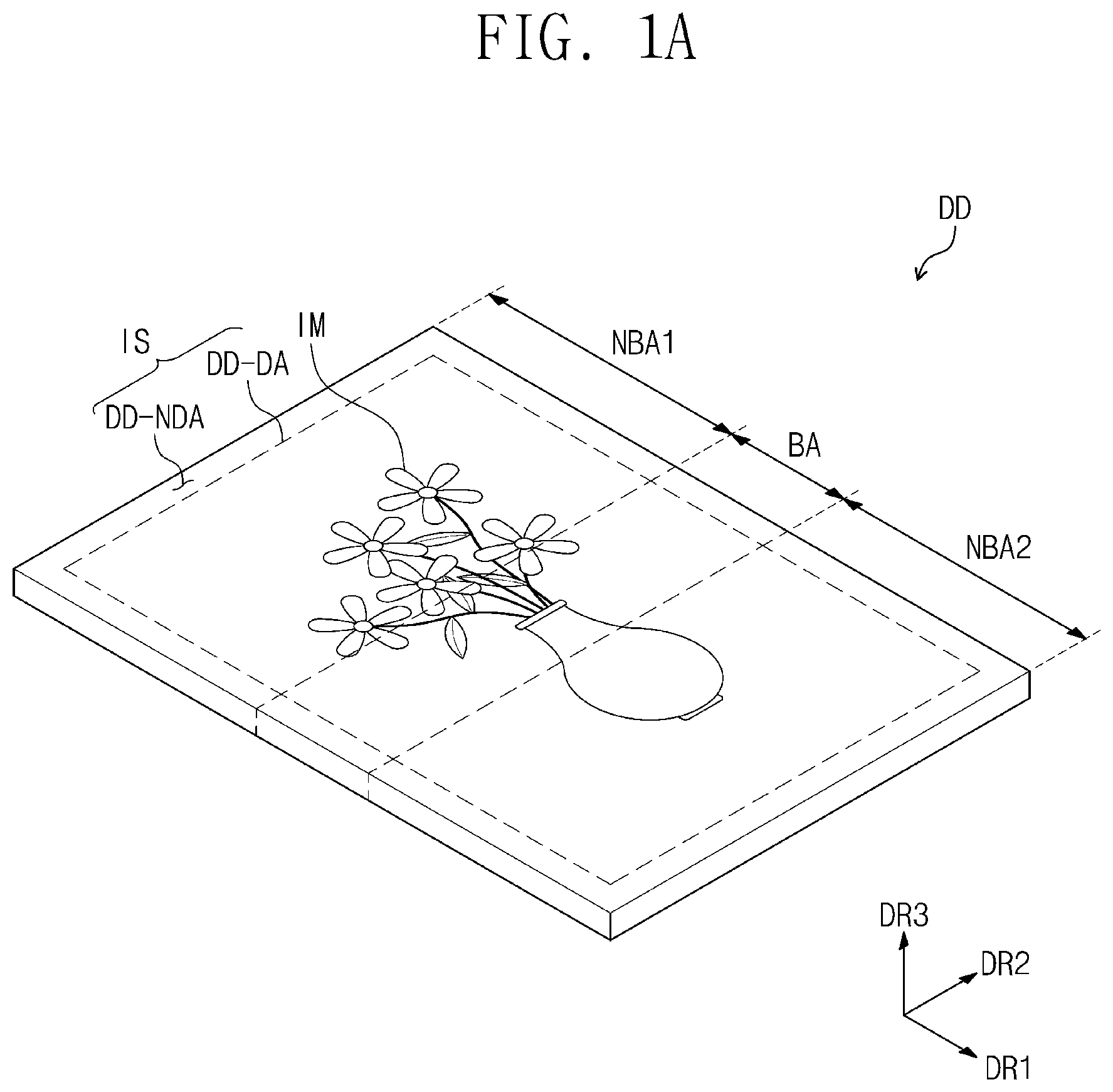
As shown in A , in a first operating mode of display device DD, a display surface IS where an image IM is displayed is a surface extending in a first direction DR 1 and a second direction DR 2 . The display surface IS has a thickness in a third direction DR 3 normal to the first two directions. The front surface (or an upper surface) and the rear surface (or a lower surface) of each member are separated in the third direction DR 3 . However, the directions that the first to third directions DR 1 , DR 2 , and DR 3 indicate may be rearranged or redefined as they are relative. Hereinafter, first to third directions as directions that the respective first to third directions DR 1 , DR 2 , and DR 3 indicate will be referred to by the same reference numerals.
A to 1 C and 3 A to 4 B illustrate a flexible foldable display device as one example of the display device DD. However, the inventive concepts may relate to a rollable display device or a bended display device and are not particularly limited. Additionally, although a flexible display device is shown in these embodiments, the inventive concepts are not limited thereto. The display device DD may be a flat rigid display device or a bent rigid display device. The display device DD may be used for small and medium-sized electronic devices such as mobile phones, tablets, car navigations, game consoles, and smart watches in addition to large-sized electronic devices such as televisions and monitors.
As shown in A , the display surface IS of the display device DD may include a plurality of areas. The display device DD may include a display area DD-DA where an image IM is displayed and a non-display area DD-NDA adjacent to the display area DD-DA. The non-display area DD-NDA may be an area where no image is displayed. A illustrates a vase as one example of the image IM. The display area DD-DA may have a rectangular form as shown. The non-display area DD-NDA may surround the display area DD-DA. However, the inventive concepts are not limited thereto, and a form or shape of the display area DD-DA and the non-display area DD-NDA may vary in other embodiments.
As shown in A to 1 C , the display device DD may include a plurality of areas defined according to an operation form. The display device DD may include a bending area BA that bends around a bending axis BX, a first non-bending area NBA 1 , and a second non-bending area NBA 2 .
As shown in B , the display device DD may bend inwardly to allow a display surface IS of the first non-bending area NBA 1 and a display surface IS of the second non-bending area NBA 2 to face each other. As shown in C , the display device DD may bend outwardly to allow the display surface IS to be exposed to the outside.
Although only one bending area BA is shown in A to 1 C , the inventive concepts are not limited thereto. For example, according to an embodiment of the inventive concept, the display device DD may include a plurality of bending areas BA.
According to an embodiment of the inventive concepts, the display device DD may be configured to repeat only the operating mode shown in A and 1 B . However, the inventive concepts are not limited thereto, and the bending area BA may be defined as being where a user manipulates the display device DD. For example, unlike B and 1 C , the bending area BA may be defined parallel to the first direction DR 1 and may be defined in a diagonal direction. An area of the bending area BA is not fixed and may be determined according to the radius of curvature.
shows a sectional view of a cross-section taken in a plane of the second direction DR 2 and the third direction DR 3 .
As shown in , the display device DD includes a protective film PM, a display module DM, an optical member LM, a window WM, a first adhesive member AM 1 , a second adhesive member AM 2 , and a third adhesive member AM 3 . The display module DM is disposed between the protective film PM and the optical member LM. The optical member LM is disposed between the display module DM and the window WM. The first adhesive member AM 1 bonds the display module DM and the protective film PM; the second adhesive member AM 2 bonds the display module DM and the optical member LM; and, the third adhesive member AM 3 bonds the optical member LM and the window WM.
The protective film PM protects the display module DM. The protective film PM provides a first outer surface OS-L exposed to the outside and provides an adhesive surface adhering to the first adhesive member AM 1 . The protective film PM prevents external moisture from penetrating the display module DM and absorbs forces from an external impact.
The protective film PM may include a plastic film as a base substrate. The protective film PM may include a plastic film including one selected from the group consisting of polyethersulfone (PES), polyacrylate, polyetherimide (PEI), polyethylenenaphthalate (PEN), polyethyleneterephthalate (PET), polyphenylene sulfide (PPS), polyarylate, polyimide (PI), polycarbonate (PC), poly(arylene ethersulfone), and a combination thereof.
The material constituting the protective film PM is not limited to plastic resins and may include an organic/inorganic composite material. The protective film PM may include an inorganic material filled in the pores of a porous organic layer and the organic layer. The protective film PM may further include a functional layer formed at a plastic film. The functional layer may include a resin layer. The functional layer may be formed through a coating method. The protective film PM may also be omitted.
The window WM may protect the display module DM from damage caused by an external impact and provide an input surface to a user. The window WM provides a second outer surface OS-U exposed to the outside and provides an adhesive surface adhering to the second adhesive member AM 2 . The display surface IS shown in A to 1 C may be the second outer surface OS-U.
The window WM may include a plastic film. The window WM may have a multilayer structure. The window WM may have a multilayer structure selected from a glass substrate, a plastic film, and a plastic substrate. The window WM may further include a bezel pattern. The multilayer structure may be formed through a continuous process or an adhering process using an adhesive layer.
The optical member LM reduces an external light reflectance. The optical member LM may include at least a polarizing film. The optical member LM may further include a phase difference film. According to an embodiment of the inventive concept, the optical member LM may be omitted.
The display module DM may include an organic light emitting display panel (or a display panel) DP and a touch detection unit TS. The touch detection unit TS may be directly disposed on the organic light emitting display panel DP. In this specification, “directly disposed” means “being formed” through a continuous process, excluding “attached” through an additional adhesive layer.
The organic light emitting display panel DP generates the image IM (see A ) corresponding to inputted image data. The organic light emitting display panel DP provides a first display panel surface BS 1 -L and a second display panel surface BS 1 -U facing in third direction DR 3 . In this embodiment, although an organic light emitting display panel DP is described exemplarily, the display panel is not limited thereto.
The touch detection unit TS obtains coordinate information of an external input. The touch detection unit TS may detect an external input through a capacitance method.
The display module DM according to an embodiment of the inventive concept may further include an anti-reflective layer (not shown). The anti-reflective layer may include a color filter or a layer-stacked structure of conductive layer/insulation layer/conductive layer. The anti-reflective layer may reduce an external light reflectance by absorbing, destructive-interfering, or polarizing the light incident from the outside. The anti-reflective layer may replace a function of the optical member LM.
Each of the first adhesive member AM 1 , the second adhesive member AM 2 , and the third adhesive member AM 3 may be an organic adhesive layer such as an Optically Clear Adhesive (OCA) film, Optically Clear Resin (OCR), or a Pressure Sensitive Adhesive (PSA) film. The organic adhesive layer may include an adhesive material such as a polyurethane, polyacrylic, polyester, polyepoxy, and polyvinyl acetate.
The display device DD may further include a frame structure (not shown) for supporting the functional layers in order to maintain the positions shown in A to 1 C . The frame structure may include an articulated structure or a hinge structure.
A shows the display device DD- 1 in an unfolded state and B shows the display device DD- 1 in a bent state.
The display device DD- 1 may include one bending area BA and one non-bending area NBA. The non-display area DD-NDA of the display device DD- 1 may be bendable. The bending area of the display device DD- 1 may be different in other embodiments.
Unlike the display device DD shown in A to 1 C , the display device DD- 1 may be fixed in one shape and operate. As shown in B , the display device DD- 1 may operate in a bended state. The display device DD- 1 may be fixed at a frame in a bended state and the frame may be bonded to the housing of an electronic device.
The display device DD- 1 may have the same sectional structure as that shown in . However, the non-bending area NBA and the bending area BA may have a different layer-stacked structure. The non-bending area NBA may have the same sectional structure as that shown in and the bending area BA may have a different sectional structure than that shown in . The optical member LM and the window WM might not be disposed in the bending area BA. For example, the optical member LM and the window WM might be disposed only in the non-bending area NBA. Similarly, the second adhesive member AM 2 and the third adhesive member AM 3 might also not be disposed in the bending area BA.
Referring now to A , the display device DD- 2 includes a non-bending area (or a flat area) NBA where a main image is displayed on the front surface and a bending area (or a side area) BA where a sub image is displayed on a side surface. Although not shown in the drawing, the sub image may include an icon for providing predetermined information. In this embodiment, the terms “non-bending area NBA” and “bending area BA” define the display device DD- 2 by using a plurality of areas divided by form or status of bending.
The bending area BA bent from the non-bending area NBA displays a sub image in a fourth direction DR 4 intersecting the first direction DR 1 , the second direction DR 2 , and the third direction DR 3 . However, other relative directions may also be used,
Referring now to B , the display device DD- 3 includes a non-bending area NBA where a main image is displayed on the front surface, and a first bending area BA 1 and a second bending area BA 2 where a sub image is displayed on side surfaces. The first bending area BA 1 and the second bending area BA 2 may be bent from opposing sides of the non-bending area NBA.
As shown in A , the organic light emitting display panel DP includes a display area DA and a non-display area NDA in a plane. The display area DA and the non-display area NDA of the organic light emitting display panel DP may correspond to the display area DD-DA (see A ) and the non-display area DD-NDA (see A ) of the display area DD (see A ), respectively. The display area DA and the non-display area NDA of the organic light emitting display panel DP may not be necessarily identical to the display device DD-DA (see A ) and the non-display area DD-NDA (see A ) of the display device DD (see A ), and may vary according to a structure/design of the organic light emitting display panel DP.
The organic light emitting display panel DP includes a plurality of pixels PX. An area where the plurality of pixels PX are disposed may be defined as the display area DA. In this embodiment, the non-display area NDA may be defined along the outline surrounding the display area DA.
The organic light emitting display panel DP includes gate lines GL, data lines DL, light emitting lines EL, a control signal line SL-D, an initialization voltage line SL-Vint, a voltage line SL-VDD, a power supply line E-VSS, and a pad part PD.
The gate lines GL are respectively connected to corresponding pixels PX among the plurality of pixels PX, and the data lines DL are respectively connected to corresponding pixels PX among the plurality of pixels PX. Each of the light emitting lines EL may be arranged parallel to a corresponding gate line GL among the gate lines GL. The control signal line SL-D may provide control signals to the gate driving circuit GDC. The initialization voltage line SL-Vint may provide initialization voltage to the plurality of pixels PX. The voltage line SL-VDD may be connected to the plurality of pixels PX and provide a first voltage to the plurality of pixels PX. The voltage line SL-VDD may include a plurality of lines extending in the first direction DR 1 and a plurality of lines extending in the second direction DR 2 . The power supply line E-VSS may surround three sides of the display area DA and may be disposed in the non-display area NDA. A common voltage (for example, a second voltage) may be provided to a plurality of pixels PX of the power supply line E-VSS. The common voltage may have a lower level voltage than the first voltage.
The gate driving circuit GDC where the gate lines GL and the light emitting lines EL are connected may be disposed at one side of the non-display area NDA. Some of the gate lines GL, the data lines DL, the light emitting lines EL, the control signal line SL-D, the initialization voltage line SL-Vint, the voltage line SL-VDD, and the power supply line E-VSS are disposed at the same layer and some of them are disposed at another layer.
The pad part PD may be connected to the ends of the data lines DL, the control signal line SL-D, the initialization voltage line SL-Vint, and the voltage line SL-VDD.
B shows an example of a driving stage GDSi connected to an ith gate line GLi and an ith light emitting line ELi among driving stages of a plurality of gate driving circuits GDC.
The driving stage GDSi may include a light emitting control stage EC-Ci and a gate driving stage GC-Ci. Light emitting control signals CLK 1 , CLK 2 , VGL, VGH, and EMFLM may be provided to the light emitting control stage EC-Ci of the driving stage GDSi through a first clock signal line CL 1 , a second clock signal line CL 2 , a first voltage line VL 1 , a second voltage line VH 1 , and a first start signal line EF 1 . Gate control signals CLK 3 , CLK 4 , VGH 1 , VGL 1 , and FLM may be provided to the gate driving stage GC-Ci through a third clock signal line CL 3 , a fourth clock signal line CL 4 , a third voltage line VL 2 , a fourth voltage line VH 2 , and a second start signal line EF 2 .
Although the light emitting control stage EC-Ci and the gate driving stage GC-Ci are included in one driving stage GDSi as depicted, the inventive concepts are not limited thereto. For example, the light emitting control stage EC-Ci and the gate driving stage GC-Ci may be included in another driving stage.
The light emitting control stage EC-Ci may include a first clock terminal CK 1 , a second clock terminal CK 2 , a first voltage input terminal VPL 1 , a second voltage input terminal VPH 1 , an input terminal IN, a carry terminal CR, and an output terminal OUT 1 .
The first clock terminal CK 1 receives a first clock signal CLK 1 and the second clock terminal CK 2 receives a second clock signal CLK 2 . The first clock signal CLK 1 and the second clock signal CLK 2 may have different phases. The second clock signal CLK 2 may be a signal obtained by inverting or delaying a phase of the first clock signal CLK 1 .
The first voltage input terminal VPL 1 receives the first voltage VGL and the second voltage input terminal VPH 1 receives a second voltage VGH. A voltage level of the first voltage VGL may be lower than a voltage level of the second voltage VGH.
The input terminal IN may receive a carry signal of a previous light emitting control stage EC-Ci−1 (not shown) and the carry terminal CR may output a carry signal of the next light emitting control stage EC-Ci+1 (not shown). The output terminal OUT 1 may provide a light emitting control signal, which is generated from the light emitting control stage EC-Ci, to the light emitting line ELi.
The start signal EMFLM may be inputted to the input terminal IN of the first light emitting control stage EC-C 1 (not shown) among the light emitting control stages.
The gate driving stage GC-Ci may include a third clock terminal CK 3 , a fourth clock terminal CK 4 , a third voltage input terminal VPL 2 , a fourth voltage input terminal VPH 2 , an input terminal IN, a carry terminal CR, and an output terminal OUT 2 .
The third clock terminal CK 3 receives a third clock signal CLK 3 and the fourth clock terminal CK 4 receives a fourth clock signal CLK 4 . The third clock signal CLK 3 and the fourth clock signal CLK 4 may have different phases. The fourth clock signal CLK 4 may be a signal obtained by inverting or delaying a phase of the third clock signal CLK 3 .
The third voltage input terminal VPL 2 receives the third voltage VGL 1 and the fourth voltage input terminal VPH 2 receives a fourth voltage VGH 1 . A voltage level of the third voltage VGL 1 may be lower than a voltage level of the fourth voltage VGH 1 .
The input terminal IN may receive a carry signal of a previous gate driving stage GC-Ci−1 (not shown) and the carry terminal CR may output a carry signal of the next gate driving stage GC-Ci+1 (not shown). The output terminal OUT 2 may provide a gate signal, which is generated from the gate driving stage GC-Ci, to the gate line GLi.
The start signal FLM may be inputted to the input terminal IN of the first gate driving stage GC-C 1 (not shown) among the gate driving stages.
According to an embodiment of the inventive concepts, one of the first clock terminal CK 1 , the second clock terminal CK 2 , the first voltage input terminal VPL 1 , the second voltage input terminal VPH 1 , the input terminal IN, the carry terminal CR, and the output terminal OUT 1 of the light emitting control stage EC-Ci may be omitted or other terminals may be further included. For example, the carry terminal CR may be omitted.
According to an embodiment of the inventive concepts, one of the third clock terminal CK 3 , the fourth clock terminal CK 4 , the third voltage input terminal VPL 2 , the fourth voltage input terminal VPH 2 , the input terminal IN, the carry terminal CR, and the output terminal OUT 2 of the gate driving stage GC-Ci may be omitted or other terminals may be further included. For example, the carry terminal CR may be omitted.
Additionally, although it is exemplarily shown that the input terminal IN of the light emitting control stage EC-Ci and the input terminal IN of the gate driving stage GC-Ci are respectively connected to the carry terminals of a previous stage, the inventive concepts are not limited thereto. The connection between driving stages may be changed variously in other embodiments.
As shown in C , the organic light emitting display panel DP includes a base layer SUB, a circuit layer DP-CL disposed on the base layer SUB, a light emitting element layer DP-OLED, and a thin film sealing layer TFE.
The base layer SUB may include a plastic substrate as a flexible substrate, a glass substrate, a metal substrate, or an organic/inorganic composite material substrate. The plastic substrate may include at least one of acrylic resin, methacrylic resin, polyisoprene, vinyl resin, epoxy resin, urethane resin, cellulose resin, siloxane-based resin, polyimide-based resin, polyamide-based resin, and perylene resin.
The circuit layer DP-CL may include a plurality of insulation layers, a plurality of conductive layers, and a semiconductor layer. The plurality of conductive layers of the circuit layer DP-CL may constitute signal lines or a control circuit of a pixel. The circuit layer DP-CL may include a pixel circuit layer DP-PCL disposed in the display area DA and a driving circuit layer DP-DCL disposed in the non-display area NDA. The pixel circuit layer DP-PCL may include circuits having the gate lines GL, the data lines DL, the light emitting lines EL, the initialization voltage line SL-Vint, the voltage line SL-VDD, and the pixels PX described above with reference to A .
The driving circuit layer DP-DCL may include the gate driving circuit GDC and the control signal line SL-D described above with reference to A . The control signal line SL-D may include the first clock signal line CL 1 , the second clock signal line CL 2 , the third clock signal line CL 3 , the fourth clock signal line CL 4 , the first voltage line VL 1 , the second voltage line VH 1 , the third voltage line VL 2 , the fourth voltage line VH 2 , the first start signal line EF 1 , and the second start signal line EF 2 shown in B . The first clock signal line CL 1 , the second clock signal line CL 2 , the third clock signal line CL 3 , and the fourth clock signal line CL 4 may be collectively referred to as clock signal lines.
The light emitting element layer DP-OLED includes organic light emitting diodes and a pixel definition layer.
The thin film sealing layer TFE seals the light emitting element layer DP-OLED. The thin film sealing layer TFE may include at least two inorganic layers and an organic layer therebetween. The inorganic layers protect the light emitting element layer DP-OLED from moisture and oxygen and the organic thin film protects the light emitting element layer DP-OLED from a foreign material such as dust particles.
The touch detection unit TS is disposed on the thin film sealing layer TFE. The touch detection unit TS may be directly disposed on the thin film sealing layer TFE. However, the inventive concepts are not limited thereto, and a buffer layer may be disposed on the thin film sealing layer TFE and the touch detection unit TS may be directly disposed on the buffer layer. The buffer layer may be an inorganic layer or an organic layer. The inorganic layer may include at least one of a silicon nitride, a silicon oxynitride, a silicon oxide, a titanium oxide, or an aluminum oxide. The organic layer may include a polymer (for example, acrylic-based) organic layer. However, this is exemplary and the inventive concepts are not limited thereto. Although it is described that the buffer layer is a separate component, the buffer layer may be a component included in the thin film sealing layer TFE.
The touch detection unit TS includes a touch detection part TSP and touch signal lines TSL. The touch detection part TSP and the touch signal lines TSL may have a single or multi-layer structure. The touch detection part TSP and the touch signal lines TSL may include indium tin oxide (ITO), indium zinc oxide (IZO), zinc oxide (ZnO), indium tin zinc oxide (ITZO), PEDOT, metal nano wire, and graphene. The touch detection part TSP and the touch signal lines TSL may include a metal layer, for example, molybdenum, silver, titanium, copper, aluminum, or alloys thereof. The touch detection part TSP and the touch signal lines TSL may have the same or different layer structure. Specific contents on the touch detection unit TS will be described later.
A shows an example of how the ith pixel PXi may be connected to the kth data line DLk among the plurality of data lines DL (see A ).
The ith pixel PXi includes an organic light emitting diode OLED and a pixel driving circuit for controlling the organic light emitting diode. The pixel driving circuit may include seven thin film transistors T 1 to T 7 and one capacitor Cst.
The driving transistor controls a driving current supplied to the organic light emitting diode OLED. The output electrode of the second transistor T 2 is electrically connected to the organic light emitting diode OLED. The output electrode of the second transistor T 2 may directly contact the first electrode of the organic light emitting diode OLED or may be connected to it through another transistor (for example, the sixth transistor T 6 in this embodiment).
The control electrode of the control transistor may receive a control signal. A control signal applied to the ith pixel PXi may include the i−1th gate signal Si−1, the ith gate signal Si, the i+1th gate signal Si+1, a data signal DK, and the ith light emitting control signal Ei. According to an embodiment of the inventive concept, the control transistor may include the first transistor T 1 and the third to seventh transistors T 3 to T 7 .
The first transistor T 1 includes an input electrode connected to the kth gate line DLk, a control electrode connected to the ith gate line GLi, and an output electrode connected to the output electrode of the second transistor T 2 . The first transistor T 1 is turned on by the gate signal Si (hereinafter referred to as the ith gate signal) applied to the ith gate line GLi, and provides a data signal Dk applied to the kth data line DLk to the capacitor Cst.
B is a sectional view of the first transistor T 1 of the equivalent circuit shown in A . C is a sectional view of the second transistor T 2 , the sixth transistor T 6 , and the organic light emitting diode OLED of the equivalent circuit shown in A .
Referring to B and 6 C , a buffer layer BFL may be disposed on the base layer SUB. The buffer layer BFL improves the bonding strength of the base layer SUB and conductive patterns or semiconductor patterns. The buffer layer BFL may include an inorganic layer. Although not shown in the drawing, a barrier layer for preventing a foreign material from entering may be further disposed on an upper surface of the base layer SUB. The buffer layer BFL and the barrier layer may be selectively included or omitted in various exemplary embodiments.
A semiconductor pattern OSP 1 (hereinafter referred to as a first semiconductor pattern) of the first transistor T 1 , a semiconductor pattern OSP 2 (hereinafter referred to as a second semiconductor pattern) of the second transistor T 2 , and a semiconductor pattern OSP 6 (hereinafter referred to as a sixth semiconductor pattern) of the sixth transistor T 6 are disposed on the buffer layer BFL. The first semiconductor pattern OSP 1 , the second semiconductor pattern OSP 2 , and the sixth semiconductor pattern OSP 6 may be fabricated of a material selected from amorphous silicon, polysilicon, and metal oxide semiconductors.
A first insulation layer 10 may be disposed on the first semiconductor pattern OSP 1 , the second semiconductor pattern OSP 2 , and the sixth semiconductor pattern OSP 6 . Although it is shown in B and 6 C that the first insulation layer 10 is provided as an unpatterned layer for covering the first semiconductor pattern OSP 1 , the second semiconductor pattern OSP 2 , and the sixth semiconductor pattern OSP 6 , the first insulation layer 10 may be provided as a patterned layer corresponding to the first semiconductor pattern OSP 1 , the second semiconductor pattern OSP 2 , and the sixth semiconductor pattern OSP 6 .
The first insulation layer 10 may include a plurality of inorganic thin films. The plurality of inorganic thin films may include a silicon nitride layer, a silicon oxynitride layer, and a silicon oxide layer.
A control electrode GE 1 (hereinafter referred to as a first control electrode) of the first transistor T 1 , a control electrode GE 2 (hereinafter referred to as a second control electrode) of the second transistor T 2 , and a control electrode GE 6 (hereinafter referred to as a sixth control electrode) of the sixth transistor T 6 are disposed on the first insulation layer 10 . The first control electrode GE 1 , the second control electrode GE 2 , and the sixth control electrode GE 6 may be fabricated according to the same photolithography process as the gate lines GL (see A ).
A second insulation layer 20 for covering the first control electrode GE 1 , the second control electrode GE 2 , and the sixth control electrode GE 6 may be disposed on the first insulation layer 10 . The second insulation layer 20 may provide a flat upper surface. The second insulation layer 20 may include an organic material and/or an inorganic material.
An input electrode SE 1 (hereinafter referred to as a first input electrode) and an output electrode DE 1 (hereinafter referred to as a first output electrode) of the first transistor T 1 , an input electrode SE 2 (hereinafter referred to as a second input electrode) and an output electrode DE 2 (hereinafter referred to as a second output electrode) of the second transistor T 2 , and an input electrode SE 6 (hereinafter referred to as a sixth input electrode) and an output electrode DE 6 (hereinafter referred to as a sixth output electrode) of the sixth transistor T 6 are disposed on the second insulation layer 20 .
Each of the first output electrode DE 1 and the first input electrode SE 1 is connected to the first semiconductor pattern OSP 1 through a first through hole CH 1 and a second through hole CH 2 penetrating the first insulation layer 10 and the second insulation layer 20 . Each of the second input electrode SE 2 and the second output electrode DE 2 is connected to the second semiconductor pattern OSP 2 through a third through hole CH 3 and a fourth through hole CH 4 penetrating the first insulation layer 10 and the second insulation layer 20 . Each of the sixth input electrode SE 6 and the sixth output electrode DE 6 is connected to the sixth semiconductor pattern OSP 6 through a fifth through hole CH 5 and a sixth through hole CH 6 penetrating the first insulation layer 10 and the second insulation layer 20 . On the other hand, according to other embodiments of the inventive concept, some of the first transistor T 1 , the second transistor T 2 , and/or the sixth transistor T 6 may be modified and implemented as a bottom gate structure.
A third insulation layer 30 for covering the first input electrode SE 1 , the second input electrode SE 2 , the sixth input electrode SE 6 , the first output electrode DE 1 , the second output electrode DE 2 , and the sixth output electrode DE 6 is disposed on the second insulation layer 20 . The third insulation layer 30 may include an organic layer and/or an inorganic layer. The third insulation layer 30 may include an organic material for providing a flat surface.
In various exemplary embodiments, one or more of the first insulation layer 10 , the second insulation layer 20 , and the third insulation layer 30 may be omitted. Each of the second insulation layer 20 and the third insulation layer 30 may be defined as an interlayer insulation layer. The interlayer insulation layer is disposed between a conductive pattern disposed at a lower part and a conductive pattern disposed at an upper part to insulate the conductive patterns from each other.
A pixel definition layer PDL and an organic light emitting diode OLED are disposed on the third insulation layer 30 . Referring to C , each of the organic light emitting diodes OLED may include a first electrode AE, a second electrode CE, a hole control layer HCL, an organic light emitting layer EML and an electron control layer ECL. Particularly, the first electrode AE may be disposed on the circuit layer DP-CL (see C ). The organic light emitting layer EML may be disposed on the first electrode AE. The second electrode CE may be disposed on the organic light emitting layer EML.
A first electrode AE is disposed on the third insulation layer 30 . Here, the first electrode AE may be provided as an anode or a cathode. Hereinafter, the first electrode AE is described as an anode. The first electrode AE is connected to the sixth output electrode DE 6 through a seventh through hole CH 7 penetrating the third insulation layer 30 . An opening part OP is defined in the pixel definition layer PDL. The opening part OP of the pixel definition layer PDL exposes at least a part of the first electrode AE.
The pixel PX may be disposed in a pixel area of a plane. The pixel area may include a light emitting area PXA and a non-light emitting area NPXA adjacent to the light emitting area PXA. The non-light emitting area NPXA may surround the light emitting area PXA. According to this embodiment, the light emitting area PXA corresponds to a partial area of the first electrode AE exposed by the opening part OP.
A hole control layer HCL may be disposed in the light emitting area PXA and the non-light emitting area NPXA. Although not shown in the drawing, a common layer such as the hole control layer HCL may be formed in the plurality of pixels PX (see A ).
An organic light emitting layer EML is disposed on the hole control layer HCL. The organic light emitting layer EML may be disposed in an area corresponding to the opening part OP. That is, the organic light emitting layer EML may be divided and formed at each of the plurality of pixels PX. With such a patterned organic light emitting layer EML as is shown in this embodiment, the organic light emitting layer EML may be disposed at the plurality of pixels PX where the organic light emitting layer EML may generate white light. Additionally, the organic light emitting layer EML may have a multilayer structure.
An electron control layer ECL is disposed on the organic light emitting layer EML. Although not shown in the drawing, the electron control layer ECL may be formed at the plurality of pixels PX (see A ).
The second electrode CE is disposed on the electron control layer ECL at the plurality of pixels PX. Here, the second electrode CE may be provided as an anode or a cathode. Hereinafter, the second electrode CE is described as a cathode. That is, when the first electrode AE may be provided as an anode, the second electrode CE may be provided as a cathode. Also, when the first electrode AE may be provided as a cathode, the second electrode CE may be provided as an anode.
A thin film sealing layer TFE is disposed on the second electrode CE. The thin film sealing layer TFE is disposed at the plurality of pixels PX. The thin film sealing layer TFE includes at least one inorganic layer and at least one organic layer. The thin film sealing layer TFE may include a plurality of inorganic layers and a plurality of organic layers, which are stacked alternately.
In the exemplary embodiment shown, the thin film sealing layer TFE directly covers the second electrode CE. A capping layer for covering the second electrode CE may be further disposed between the thin film sealing layer TFE and the second electrode CE. The thin film sealing layer TFE may directly cover the capping layer.
Hereinafter, the thin film sealing layers TFE 1 , TFE 2 , and TFE 3 are described with reference to A to 7 C .
As shown in A , the thin film sealing layer TFE 1 may include n inorganic thin film layers IOL 1 to IOLn as the first inorganic thin film IOL 1 contacting the second electrode CE (see C ). The first inorganic thin film IOL 1 may be defined as a lower inorganic thin film and inorganic thin films other than the first inorganic thin film IOL 1 among the n inorganic thin films IOL 1 to IOLn may be defined as upper inorganic thin films.
The thin film sealing layer TFE 1 may include n−1 organic thin films OL 1 to OLn−1 and the n−1 organic thin films OL 1 to OLn−1 and the n inorganic thin films IOL 1 to IOLn may be disposed alternately. The n−1 organic thin films OL 1 to OLn−1 may have a greater thickness than the n inorganic thin films IOL 1 to IOLn on average.
Each of the n inorganic thin films IOL 1 to IOLn may be a single layer including one material or a multilayer including each different material. Each of the n−1 organic thin films OL 1 to OLn−1 may be formed by depositing or printing organic monomers. For example, each of the n−1 organic thin films OL 1 to OLn−1 may be formed using an inkjet printing method or may be formed by coating a composition containing an acrylic monomer. According to an embodiment of the inventive concept, the thin film sealing layer TFE 1 may further include an nth organic thin film.
As shown in B and 7 C , inorganic thin films included in each of the thin film sealing layers TFE 2 and TFE 3 may have the same or different inorganic materials, and may have the same or different thicknesses. Organic thin films included in each of the thin film sealing layers TFE 2 and TFE 3 may have the same or different organic materials, and may have the same or different thicknesses.
As shown in B , the thin film sealing layer TFE 2 may include a first inorganic thin film IOL 1 , a first organic thin film OL 1 , a second inorganic thin film IOL 2 , a second organic thin film OL 2 , and a third inorganic thin film IOL 3 , which are sequentially stacked.
The first inorganic thin film IOL 1 may have a two-layer structure. A first sub layer S 1 and a second sub layer S 2 may include different inorganic materials.
As shown in C , the thin film sealing layer TFE 3 may include a first inorganic thin film IOL 10 , a first organic thin film OL 1 , and a second inorganic thin film IOL 20 , which are sequentially stacked. The first inorganic thin film IOL 10 may have a two-layer structure. A first sub layer S 10 and a second sub layer S 20 may include different inorganic materials. The second inorganic thin film IOL 20 may have a two-layer structure. The second inorganic thin film IOL 20 may include a first sub layer S 100 and a second sub layer S 200 , which are deposited in different deposition environments and/or stages. The first sub layer S 100 may be deposited under the low power condition and the second sub layer S 200 may be deposited under the high power condition. The first sub layer S 100 and the second sub layer S 200 may include the same inorganic material.
As shown in A , the touch detection unit TS includes a first conductive layer TS-CL 1 , a first insulation layer TS-IL 1 (hereinafter referred to as a first touch insulation layer), a second conductive layer TS-CL 2 , and a second insulation layer TS-IL 2 (hereinafter referred to as a second touch insulation layer). The first conductive layer TS-CL 1 is directly disposed on the thin film sealing layer TFE. The inventive concepts are not limited thereto, and another buffer layer (for example, an inorganic layer or an organic layer) may be further disposed between the first conductive layer TS-CL 1 and the thin film sealing layer TFE. According to another embodiment of the inventive concept, a plastic film, a glass substrate, or a plastic substrate may be disposed between the first conductive layer TS-CL 1 and the thin film sealing layer TFE.
Each of the first conductive layer TS-CL 1 and the second conductive layer TS-CL 2 may include a single layer structure or a multilayer structure stacked in the third direction DR 3 . A conductive layer of the multilayer structure may include at least two of transparent conductive layers and metal layers. A conductive layer of the multilayer structure may include metal layers with different metals. The transparent conductive layer may include indium tin oxide (ITO), indium zinc oxide (IZO), zinc oxide (ZnO), indium tin zinc oxide (ITZO), PEDOT, metal nano wire, and graphene. The metal layer may include silver, titanium, copper, aluminum, and an alloy thereof.
Each of the first conductive layer TS-CL 1 and the second conductive layer TS-CL 2 includes a plurality of patterns. Hereinafter, the first conductive layer TS-CL 1 includes first conductive patterns and the second conductive layer TS-CL 2 includes second conductive patterns. Each of the first conducive patterns and the second conducive patterns may include touch electrodes and touch signal lines.
Each of the first touch insulation layer TS-IL 1 and the second touch insulation layer TS-IL 2 may have a single layer or multilayer structure. Each of the first touch insulation layer TS-IL 1 and the second touch insulation layer TS-IL 2 may include at least one of an inorganic layer and an organic layer.
The first touch insulation layer TS-IL 1 insulates a first conductive layer TS-CL 1 and a second conductive layer TS-CL 2 , and its form is not limited to the exemplary embodiment depicted. In various exemplary embodiments, the form of the first touch insulation layer TS-IL 1 may be changed. For example, the first touch insulation layer TS-IL 1 may cover the thin film sealing layer TFE entirely and/or may include a plurality of insulation patterns. The plurality of insulation patterns may overlap first connection parts CP 1 and may overlap the second connection parts CP 2 which will be described later.
Although an exemplary embodiment of the double-layer touch detection unit is shown, the inventive concepts are not limited to this embodiment. A single-layer touch detection unit includes a conductive layer and an insulation layer for covering the conductive layer. The conductive layer includes touch sensors and touch signal lines connected to the touch sensors. The single-layer touch detection unit may obtain coordinate information through a self-cap method.
As shown in B , the touch detection unit TS may include a touch detection part TSP (see C ), touch signal lines TSL (see C ), and a pad part PDa.
The touch detection part TSP (see C ) may include first touch electrodes TE 1 - 1 to TE 1 - m and second touch electrodes TE 2 - 1 to TE 2 - n . The touch signal lines TSL (see C ) may include first touch signal lines SL 1 - 1 to SL 1 - m connected to the first touch electrodes TE 1 - 1 to TE 1 - m and second touch signal lines SL 2 - 1 to SL 2 - n connected to the second touch electrodes TE 2 - 1 to TE 2 - n . The pad part PDa may be electrically connected to the first touch signal lines SL 1 - 1 to SL 1 - m and the second touch signal lines SL 2 - 1 to SL 2 - n.
Connection electrodes TSD may be disposed between the first touch electrodes TE 1 - 1 to TE 1 - m and the first touch signal lines SL 1 - 1 to SL 1 - m and between the second touch electrodes TE 2 - 1 to TE 2 - n and the second touch signal lines SL 2 - 1 to SL 2 - n . The connection electrodes TSD may be respectively connected to the ends of the first touch electrodes TE 1 - 1 to TE 1 - m and the second touch electrodes TE 2 - 1 to TE 2 - n in order to deliver signals. In various exemplary embodiments, the connection electrodes TSD may be omitted.
Each of the first touch electrodes TE 1 - 1 to TE 1 - m may have a mesh form where a plurality of touch opening parts are defined. Each of the first touch electrodes TE 1 - 1 to TE 1 - m includes a plurality of first touch sensor parts SP 1 and a plurality of first connection parts CP 1 . The first touch sensor parts SP 1 are arranged in the first direction DR 1 . Each of the first connection parts CP 1 connects two adjacent first touch sensor parts SP 1 . Although not shown in the drawing, the first touch signal lines SL 1 - 1 to SL 1 - m may also have a mesh form.
The second touch electrodes TE 2 - 1 to TE 2 - n intersect the first touch electrodes TE 1 - 1 to TE 1 - m with an insulating gap therebetween. Each of the second touch electrodes TE 2 - 1 to TE 2 - n may have a mesh form where a plurality of touch opening parts are defined. Each of the second touch electrodes TE 2 - 1 to TE 2 - n includes a plurality of second touch sensor parts SP 2 and a plurality of second connection parts CP 2 . The second touch sensor parts SP 2 are arranged along the second direction DR 2 . Each of the second connection parts CP 2 connects two adjacent second touch sensor parts SP 2 . The second touch signal lines SL 2 - 1 to SL 2 - n may also have a mesh form.
The first touch electrodes TE 1 - 1 to TE 1 - m are electrostatically bonded to the second touch electrodes TE 2 - 1 to TE 2 - n . As touch detection signals are applied to the first touch electrodes TE 1 - 1 to TE 1 - m , capacitors are formed between the first touch sensor parts SP 1 and the second touch sensor parts SP 2 .
Parts of the plurality of first touch sensor parts SP 1 , the plurality of first connection parts CP 1 and first touch signal lines SL 1 - 1 to SL 1 - m , the plurality of second touch sensor parts SP 2 , the plurality of second connection parts CP 2 , and second touch signal lines SL 2 - 1 to SL 2 - n may be formed by patterning the first conductive layer TS-CL 1 shown in A and the other parts may be formed by patterning the second conductive layer TS-CL 2 shown in A .
In order to electrically connect conductive patterns disposed in one layer with conductive patterns disposed in another layer, a contact hole penetrating the first touch insulation layer TS-IL 1 shown in A may be formed. Hereinafter, a touch detection unit TS according to an embodiment of the inventive concepts are described with reference to C to 8 E .
As shown in C , first conductive patterns are disposed on the thin film sealing layer TFE (see A ). The first conductive patterns may include bridge patterns CP 2 . The bridge patterns CP 2 are directly disposed on the thin film sealing layer TFE. The thin film sealing layer TFE covers the display area DA in the exemplary embodiment shown. The bridge patterns CP 2 are another name for the second connection parts CP 2 shown in B .
As shown in D , a first touch insulation layer TS-IL 1 for covering the bridge patterns CP 2 is disposed on the thin film sealing layer TFE. Contact holes CH for partially exposing the bridge patterns CP 2 are defined in the first touch insulation layer TS-IL 1 . The contact holes CH may be formed through a photolithograph process.
As shown in E , second conductive patterns are disposed on the first touch insulation layer TS-IL 1 . The second conductive patterns may include the plurality of first touch sensor parts SP 1 (see B ), plurality of first connection parts CP 1 , first touch signal lines SL 1 - 1 to SL 1 - m , the plurality of second touch sensor parts SP 2 (see B ), and second touch signal lines SL 2 - 1 to SL 2 - n . Although not shown in the drawing, a second touch insulation layer TS-IL 2 for covering the second conductive patterns is disposed on the first touch insulation layer TS-IL 1 .
The first conductive patterns may include the second touch electrodes TE 1 - 1 to TE 1 - m and the first touch signal lines SL 1 - 1 to SL 1 - m . The first conductive patterns may include the second touch electrodes TE 2 - 1 to TE 2 - n and the second touch signal lines SL 2 - 1 to SL 2 - n . In various exemplary embodiments, the contact holes CH are not defined in the first touch insulation layer TS-IL 1 .
The first conductive patterns and the second conductive patterns may be interchanged. That is, the second conductive patterns may include the bridge patterns CP 2 .
As shown in F , a first touch sensor part SP 1 overlaps a non-light emitting area NPXA. The first touch sensor part SP 1 includes a plurality of first extension parts SP 1 -A extending in a fifth direction DR 5 intersecting the first direction DR 1 and the second direction DR 2 and a plurality of second extension parts SP 1 -B extending in a sixth direction DR 6 intersecting the fifth direction DR 5 . The plurality of first extension parts SP 1 -A and the plurality of second extension parts SP 1 -B may be defined by mesh lines. A line width of the mesh lines may be several micrometers.
The plurality of first extension parts SP 1 -A and the plurality of second extension parts SP 1 -B are connected to each other to form a plurality of touch opening parts TS-OP. That is, the first touch sensor part SP 1 has a mesh form including the plurality of touch opening parts TS-OP. Although it is shown that the touch opening parts TS-OP correspond to the light emitting areas PXA in a one-to-one relationship, other embodiments have other ratios of correspondence there between. Thus, in various exemplary embodiments, one touch opening part TS-OP may correspond to two or more light emitting areas PXA.
The sizes of the light emitting areas PXA may also vary. For example, the sizes of light emitting areas PXA for providing blue light and light emitting areas PXA for providing red light among the light emitting areas PXA may vary. Accordingly, the sizes of the touch opening parts TS-OP may also vary. Although it is shown in F that the sizes of the light emitting areas PXA vary, the inventive concepts are not limited thereto. The sizes of the light emitting areas PXA may be identical to each other and the sizes of the touch opening parts TS-OP may be also identical to each other.
Referring to A and 9 B , touch signal lines TSL are shown. The touch signal lines TSL may be, for example, the second touch signal lines SL 2 - 1 to SL 2 - n shown in B .
A conductive portion EP may be disposed between the touch signal lines TSL and the plurality of clock signal lines CL 1 , CL 2 , CL 3 , and CL 4 (hereinafter referred to collectively as CL). The conductive portion EP may be formed as layer and may be disposed on the same layer as the second electrode CE. For example, the conductive portion EP and the second electrode CE may both be disposed on the pixel definition layer PDL. The meaning of “disposed on the same layer” (for example, the pixel definition layer PDL) does not necessarily mean disposed only a flat surface at the same level or height. For example, where a given layer has different levels or heights such that the layer appears in the cross-sectional Figure(s) at different heights in third direction DR 3 , other elements that are both disposed “on” that layer may or may not be disposed at different levels or heights in the third direction DR 3 . “Disposed on” refers to relationships in which the layers touch each other and those in which they are separated by intervening elements or layers.
The second electrode CE may extend toward the conductive portion EP and the second electrode CE and the conductive portion EP may be connected to each other. That is, the second electrode CE and the conductive portion EP may be formed through the same process.
The conductive portion EP may be electrically connected to the power supply line E-VSS. The conductive portion EP may receive the second voltage ELVSS (see A ) from the power supply line E-VSS.
The conductive portion EP may extend over and cover all or part of an overlapping area OA where the touch signal lines TSL and the clock signal lines CL overlap in a vertical direction as indicated by the overlapping area OA in B . For example, the conductive portion EP may completely cover (traverse) the overlapping area OA such that the conductive portion EP is between the clock signal line CL and the touch signal line TSL at all portions thereof that overlap in the vertical direction, as shown in B . This vertical direction may also be referred to as the overlapping direction (indicated in A and B by the third direction DR 3 ). The conductive portion EP may conduct electrical signals laterally away from in the touch signal lines TSL, thereby reducing or preventing noise caused by a clock signal applied to the clock signal lines CL from reaching the touch signal lines TSL. Accordingly, the conductive portion EP may, in turn, reduce or prevent a change in the touch sensitivity that otherwise would be caused by noise from the clock signal lines CL.
A first dam part DM 1 and a second dam part DM 2 may be disposed in the non-display area NDA. The first dam part DM 1 and the second dam part DM 2 may be disposed surrounding the display area DA so that, when an organic monomer is printed to form the organic thin film OL 1 of the thin film sealing layer TFE, the first dam part DM 1 and the second dam part DM 2 may prevent the organic monomer from overflowing beyond the non-display area NDA surrounding the display area DA where the first dam part DM 1 and the second dam part DM 2 are disposed.
The first dam part DM 1 may be disposed on the power supply line E-VSS. The first dam part DM 1 may be formed of a single layer and may be formed at the same time as the pixel definition layer PDL.
The second dam part DM 2 may be disposed outside the first dam part DM 1 . Thus, a distance between the second dam part DM 2 and the display area DA may be greater than a distance between the first dam part DM 1 and the display area DA.
The second dam part DM 2 may cover a portion of the power supply line E-VSS. The second dam part DM 2 may be formed of a plurality of layers and include a first dam layer DM 2 - 1 and a second dam layer DM 2 - 2 . The first dam layer DM 2 - 1 may be formed at the same time as the third insulation layer 30 ; and, the second dam layer DM 2 - 2 may be formed at the same time as the pixel definition layer PDL.
Although A shows that the pixel definition layer PDL extends to overlap all of the clock signal lines CL in the third direction DR 3 , in other embodiments the pixel definition layer PDL does not overlap all of the clock signal lines CL or does not overlap them completely. Thus, in various exemplary embodiments, the pixel definition layer PDL may extend only to an area overlapping the gate driving circuit GDC, and/or may extend to an area overlapping only some of the clock signal lines CL. For example, the pixel definition layer PDL might extend only to an area overlapping a third clock signal line CL 3 , a fourth clock signal line CL 4 , a third voltage line VL 2 , a fourth voltage line VH 2 , and a second start signal line EF 2 .
Referring to C , a conductive portion EP- 1 may be disposed between the touch signal lines TSL and the plurality of clock signal lines CL (see B ). The conductive portion EP- 1 may be disposed on the same layer as the second electrode CE. For example, the conductive portion EP- 1 and the second electrode CE may both be disposed on the pixel definition layer PDL.
The conductive portion EP- 1 may be spaced from the second electrode CE. That is, the conductive portion EP- 1 and the second electrode CE might not be connected to each other physically. The conductive portion EP- 1 may be electrically connected to the power supply line E-VSS. The conductive portion EP- 1 may receive the second voltage ELVSS (see A ) from the power supply line E-VSS. In other embodiments, constant voltage may be applied to the conductive portion EP- 1 . For example, the first voltage ELVDD (see A ) may be applied to the conductive portion EP- 1 , or ground voltage may be applied to the conductive portion EP- 1 , or another constant voltage other than the voltages listed above may be applied to the conductive portion EP- 1 .
The second electrode CE may be electrically connected to the power supply line E-VSS through a pattern (not shown). Accordingly, the second electrode CE may receive the second voltage ELVSS (see A ) from the power supply line E-VSS.
The conductive portion EP- 1 may reduce or prevent the touch sensitivity of a touch detection unit from being changed due to noise created by a signal applied to the clock signal lines CL.
Referring to D , a conductive portion EP- 2 may be disposed between the touch signal lines TSL and the plurality of clock signal lines CL (see B ). The conductive portion EP- 2 may be disposed on the same layer as the second electrode CE.
A plurality of through holes HL may be defined in the conductive portion EP- 2 . The plurality of through holes HL may serve to discharge gases occurring from layers including an organic layer. The plurality of through holes HL might not overlap the overlapping area OA (see B ) where the touch signal lines TSL and the clock signal lines CL overlap. In D the through holes HL are not defined in an area overlapping the clock signal lines CL (see B ) in the third direction DR 3 . According to another embodiment of the inventive concept, the through holes HL may not be defined in an area overlapping the touch signal lines TSL in the third direction DR 3 .
Because the through holes HL are not defined in the overlapping area OA (see B ), even if the through holes HL are provided to the conductive portion EP- 2 , the phenomenon where a touch sensitivity of a touch detection unit is changed in response to noise created by a signal applied to the clock signal lines CL may nevertheless be prevented despite the presence of the through holes in other locations.
Referring to A and 10 B , a conductive portion EP- 3 may be disposed between the touch signal lines TSL and the plurality of clock signal lines CL. The conductive portion EP- 3 may be disposed on the same layer as the first electrode AE. For example, the conductive portion EP- 3 and the first electrode AE may both be disposed on the third insulation layer 30 . The first electrode AE and the conductive portion EP- 3 may be formed through the same process.
The conductive portion EP- 3 may be electrically connected to the power supply line E-VSS. The conductive portion EP- 3 may receive the second voltage ELVSS (see A ) from the power supply line E-VSS. Alternatively, a constant voltage may be applied to the conductive portion EP- 3 . For example, the first voltage ELVDD (see A ) may be applied to the conductive portion EP- 3 , or ground voltage may be applied to the conductive portion EP- 3 , or another constant voltage other than the voltages listed above may be applied to the conductive portion EP- 3 .
A plurality of through holes HL- 1 may be defined in the conductive portion EP- 3 . The through holes HL- 1 may serve to discharge gases occurring from layers including an organic layer. The through holes HL- 1 might not overlap an overlapping area OA where the touch signal lines TSL and the clock signal lines CL overlap in the third direction DR 3 . In more detail, referring to A , the through holes HL- 1 might not be defined in an area overlapping the clock signal lines CL in the third direction. Accordingly, the conductive portion EP- 3 may completely cover the overlapping area OA where the touch signal lines TSL and the clock signal lines CL overlap in the third direction DR 3 . The conductive portion EP- 3 may prevent noise generated on the touch signal lines TSL by a signal applied to the clock signal lines CL. That is, a change of a touch sensitivity may be reduced or even eliminated by the presence of the conductive portion EP- 3 and a touch detection unit having a uniform touch sensitivity may thereby be provided.
Referring now to C and 10 D , a conductive portion EP- 4 may be disposed between the touch signal lines TSL and the plurality of clock signal lines CL. A plurality of through holes HL- 2 may be defined in the conductive portion EP- 4 .
The through holes HL- 2 might not overlap an overlapping area OA where the touch signal lines TSL and the clock signal lines CL overlap in the third direction DR 3 . In more detail, referring to C , the through holes HL- 2 might not be defined in an area overlapping the touch signal lines TSL in the third direction DR 3 .
A conductive portion EP- 4 below the touch signal lines TSL may block a signal applied to the clock signal lines CL from interfering with signals passing through the touch signal lines TSL. That is, since the through holes HL- 2 are not defined in an area overlapping the touch signal lines TSL, noise due to the influence of a signal of each of the clock signal lines CL might not be generated in the touch signal lines TSL.
Referring to A and 11 B , a conductive portion EP- 5 may be disposed between the touch signal lines TSL and the plurality of clock signal lines CL. The conductive portion EP- 5 may include a first conductive layer EP-L 1 and a second conductive layer EP-L 2 . The first conductive layer EP-L 1 may be disposed on the same layer as the first electrode AE and the second conductive layer EP-L 2 may be disposed on the same layer as the second electrode CE. For example, the first conductive layer EP-L 1 and the first electrode AE may be disposed on the third insulation layer 30 , and the second conductive layer EP-L 2 and the second electrode CE may be disposed on the pixel definition layer PDL. The first conductive layer EP-L 1 and the first electrode AE may be formed through the same process, and the second conductive layer EP-L 2 and the second electrode CE may be formed through the same process.
Each of the first conductive layer EP-L 1 and the second conductive layer EP-L 2 may be electrically connected to the power supply line E-VSS. Each of the first conductive layer EP-L 1 and the second conductive layer EP-L 2 may receive the second voltage ELVSS (see A ) from the power supply line E-VSS. Alternatively, a constant voltage may be applied to the second conductive layer EP-L 2 . For example, the first voltage ELVDD (see A ) may be applied to the second conductive layer EP-L 2 , or ground voltage may be applied to the conductive layer EP-L 2 , or another constant voltage other than the voltages listed above may be applied to the conductive layer EP-L 2 .
A plurality of first through holes HL- 3 may be defined in a first conductive layer EP-L 1 . The plurality of first through holes HL- 3 may serve to discharge gases occurring from layers including an organic layer. Although it is shown in A that the plurality of first through holes HL- 3 are spaced at a predetermined interval from each other, in other embodiments, the spacing there between is not constant.
The second conductive layer EP-L 2 may cover all the plurality of first through holes HL- 3 such that they overlap in the third direction DR 3 . According to this embodiment, a double shield may be provided between the touch signal lines TSL and the plurality of clock signal lines CL by the first conductive layer EP-L 1 and the second conductive layer EP-L 2 . Additionally, an area not shielded by the plurality of first through holes HL- 3 in the third direction DR 3 may be shielded because the second conductive layer EP-L 2 covers the plurality of first through holes HL- 3 in the third direction DR 3 . Accordingly, even if high and low levels of voltages are applied to the plurality of clock signal lines CL alternatively, a signal applied to the plurality of clock signal lines CL is blocked by the first conductive layer EP-L 1 and the second conductive layer EP-L 2 , so that noise might not be generated therefrom on the touch signal lines TSL.
Referring now to C , a conductive portion EP- 6 may be disposed between the touch signal lines TSL and the plurality of clock signal lines CL. The conductive portion EP- 6 may include a first conductive layer EP-L 1 and a second conductive layer EP-L 2 a . When compared to the conductive portion EP- 5 described above with reference to A , the conductive portion EP- 6 of C may have a different form in the second conductive layer EP-L 2 a.
Referring to A , the second electrode CE may extend toward the second conductive layer EP-L 2 , and the second electrode CE and the second conductive layer EP-L 2 may be connected to each other physically. However, referring to C , the second conductive layer EP-L 2 a may be spaced apart from the second electrode CE. That is, as in C, the second conductive portion EP-L 2 a and the second electrode CE might not be connected to each other physically.
Referring now to A , a conductive portion EP- 6 a may be disposed between the touch signal lines TSL and the plurality of clock signal lines CL. The conductive portion EP- 6 a may include a first conductive layer EP-Lla and a second conductive layer EP-L 2 . The first conductive layer EP-L 1 a may be disposed on the same layer as the first electrode AE and the second conductive layer EP-L 2 may be disposed on the same layer as the second electrode CE. For example, the first conductive layer EP-L 1 a and the first electrode AE may be disposed on the third insulation layer 30 , and the second conductive layer EP-L 2 and the second electrode CE may be disposed on the pixel definition layer PDL. The first conductive layer EP-L 1 a and the first electrode AE may be formed through the same process, and the second conductive layer EP-L 2 and the second electrode CE may be formed through the same process.
A plurality of first through holes HL- 4 may be defined in the first conductive layer EP-L 1 a . The plurality of first through holes HL- 4 may serve to discharge gases occurring from layers including an organic layer. The plurality of first through holes HL- 4 might not be defined in an area overlapping the clock signal lines CL in the third direction DR 3 .
B shows a third clock signal line CL 3 , a fourth clock signal line CL 4 , a third voltage line VL 2 , a fourth voltage line VH 2 , and a second start signal line EF 2 . The plurality of first through holes HL- 4 might not be defined in an area overlapping the third clock signal line CL 3 and the fourth clock signal line CL 4 .
A signal whose level is changed continuously while an image of one frame is displayed may be applied to the third clock signal line CL 3 and the fourth clock signal line CL 4 . Accordingly, if upper parts of the third clock signal line CL 3 and the fourth clock signal line CL 4 are not shielded, noise may occur from the touch signal lines TSL as a result of that signal. However, referring back to A as well, because the plurality of first through holes HL- 4 are not defined in the portion of the first conductive layer EP-L 1 a that overlaps the third clock signal line CL 3 and the fourth clock signal line CL 4 in the third direction DR 3 , the upper parts of the third clock signal line CL 3 and the fourth clock signal line CL 4 are completely shielded. Accordingly, noise on the touch signal lines TSL might not result from a signal applied to the third clock signal line CL 3 and the fourth clock signal line CL 4 .
The first conductive layer EP-Lla may include a first area AR 1 , a second area AR 2 , and a third area AR 3 . The first area AR 1 , the second area AR 2 , and the third area AR 3 are shown in B .
The first area AR 1 may be an area, which overlaps the clock signal lines CL and where the plurality of first through holes HL- 4 are not defined. B shows the first area AR 1 overlapping the third and fourth clock signal lines CL 3 and CL 4 . The second area AR 2 is an area where the plurality of first through holes HL- 4 are defined, and may be an area where a portion exposed by the plurality of first through holes HL- 4 and HL- 4 a has a first area density. The third area AR 3 is an area where the plurality of first through holes HL- 4 are defined, and may be an area where a portion exposed by the plurality of first through holes HL- 4 has a second area density. The second area density may be lower than the first area density. The exposed area may be the third insulation layer 30 . For example, the number of the first through holes HL- 4 defined in the second area AR 2 per a first surface area SA 1 may be two and the number of the first through holes HL- 4 defined in the third area AR 3 per the first surface area SA 1 may be one.
Since the plurality of first through holes HL- 4 are not defined in the first area AR 1 overlapping the third clock signal line CL 3 and the fourth clock signal line CL 4 , in order to compensate for this, a plurality of first through holes HL- 4 a may be further defined in the second area AR 2 .
The form of a hole HLa is indicated by a dotted line in the first area AR 1 . This is just for convenience of description and does not mean that the hole HLa is defined in the first area AR 1 . Rather, the dotted lines represent theoretical locations where holes HLa could be, but are not actually, defined. If the plurality of first through holes HL- 4 were disposed at uniform intervals, the hole HLa should be in the first area AR 1 as indicated by the dotted lines. However, in actuality, no hole is defined in the first area AR 1 . Accordingly, the design condition that a layer (for example, the third insulation layer 30 ) below the first conductive layer EP-L 1 a should be exposed more than a predetermined area by the first through holes HL- 4 in the first conductive layer EP-Lla might not be satisfied. As a result, gases occurring from layers including an organic material might not be discharged smoothly. In order to prevent this, the first through holes HL- 4 a may be additionally defined in the second area AR 2 in correspondence to the number of holes HLa not defined in the first area AR 1 . Accordingly, the design condition that a layer (for example, the third insulation layer 30 ) below the first conductive layer EP-L 1 a should be exposed more than a predetermined area by the first through holes HL- 4 in the first conductive layer EP-L 1 a may be satisfied despite the omitted holes indicated by the dotted lines in the first area AR 1 . In order to assist with understanding this concept, an arrow is shown between a virtual hole HLa and the first through holes HL- 4 a in order to show the hole movement relationship where the holes HLa were moved. The arrow is not an actual component of the apparatus. Rather, the arrows are shown in order to help with conceptual understanding.
Referring to C , since the hole HLa should be in the first area AR 1 but no hole is defined in the first area AR 1 , in order to compensate for this, the size of the first through holes HL- 4 b disposed in the second area AR 2 is expanded in the exemplary embodiment of C .
The expanding of the size of the first through holes HL- 4 b has the same effect as described above because an exposure area of the third insulation layer 30 (see A ) below the first through holes HL- 4 b becomes enlarged. As a result, the design condition that the first through holes HL- 4 should have more than a predetermined area on the conductive portion EP- 6 (see A ) may still be satisfied despite the omission of through holes HLa in the first area AR 1 .
Although it is shown in the exemplary embodiment of C that the first through holes HL- 4 b expand a width in a vertical direction to the first through hole HL- 4 , the invention is not limited thereto. For example, in relation to the first through holes HL- 4 b , a width in a horizontal direction to the first through hole HL- 4 may expand or widths in a vertical direction and a horizontal direction may both expand.
Referring to A , a conductive portion EP- 7 may be disposed between the touch signal lines TSL and the plurality of clock signal lines CL. The conductive portion EP- 7 may include a first conductive layer EP-L 1 b and a second conductive layer EP-L 2 . The first conductive layer EP-L 1 b may be disposed on the same layer as the first electrode AE and the second conductive layer EP-L 2 may be disposed on the same layer as the second electrode CE. For example, the first conductive layer EP-L 1 b and the first electrode AE may be disposed on the third insulation layer 30 , and the second conductive layer EP-L 2 and the second electrode CE may be disposed on the pixel definition layer PDL. The first conductive layer EP-L 1 b and the first electrode AE may be formed through the same process, and the second conductive layer EP-L 2 and the second electrode CE may be formed through the same process.
A plurality of first through holes HL- 5 may be defined in the first conductive layer EP-L 1 b . The plurality of first through holes HL- 5 may serve to discharge gases occurring from layers including an organic layer. The plurality of first through holes HL- 5 might not be defined in an area overlapping the touch signal lines TSL in the third direction DR 3 .
Some touch signal lines TSL are exemplarily shown in B . The plurality of first through holes HL- 5 might not be defined in an area overlapping the touch signal lines TSL.
Where the plurality of through holes HL- 5 are not defined below the touch signal lines TSL in the third direction DR 3 , the negative influence on signals in the touch signal lines TSL from an AC signal applied to the clock signal lines CL below the touch signal lines TSL in the third direction DR 3 may be reduced. Accordingly, noise may be less likely to occur in the touch signal lines TSL and a change in touch sensitivity by noise may be reduced or prevented.
The first conductive layer EP-Llb may include a first area AR 1 , a second area AR 2 , and a third area AR 3 . The first area AR 1 , the second area AR 2 , and the third area AR 3 are shown in B .
The first area AR 1 may be an area, which overlaps the touch signal lines TSL and where the plurality of first through holes HL- 5 are not defined. The second area AR 2 may be an area where the plurality of first through holes HL- 5 and HL- 5 a are defined, and may be an area where a portion exposed by the plurality of first through holes HL- 5 and HL- 5 a has a first area density. The third area AR 3 may be an area where the plurality of first through holes HL- 5 are defined, and may be an area where a portion exposed by the plurality of first through holes HL- 5 has a second area density. The second area density may be lower than the first area density. The exposed area may be the third insulation layer 30 . The number of the first through holes HL- 5 defined in the second area AR 2 per a first surface area SA 1 may be two and the number of the first through holes HL- 5 defined in the third area AR 3 per the first surface area SA 1 may be one.
Since the plurality of first through holes HL- 5 are not defined in the first area AR 1 overlapping the touch signal lines TSL, in order to compensate for this, a plurality of first through holes HL- 5 a may be further defined in the second area AR 2 . For example, the form of a hole HLa is indicated by a dotted line in the first area AR 1 . This is just for convenience of description and does not mean that the hole HLa is actually defined in the first area AR 1 . Where the plurality of first through holes HL- 5 are disposed at uniform intervals, the hole HLa should be in the first area AR 1 as indicated by the dotted lines; but, in actuality, no hole is defined in the first area AR 1 . Accordingly, the design condition that a layer (for example, the third insulation layer 30 ) below the first conductive layer EP-L 1 b is exposed more than a predetermined area by the first through holes HL- 5 in the first conductive layer EP-Llb might not be satisfied. As a result, gases occurring from layers including an organic material might not be discharged smoothly. In order to prevent this, the first through holes HL- 5 a omitted from the first area AR 1 may be additionally defined in the second area AR 2 in correspondence to the number of holes HLa not defined in the first area AR 1 . Accordingly, the design condition that a layer (for example, the third insulation layer 30 ) below the first conductive layer EP-L 1 b should be exposed more than a predetermined area by the first through holes HL- 5 in the first conductive layer EP-L 1 b may be satisfied.
Although not shown in B , like C , in order to compensate for holes that are not defined in the first area AR 1 , rather than, or in addition to, the addition of extra through holes HL- 5 in the second area AR 2 , the size of the first through holes HL- 5 in the second area AR 2 may be enlarged as described above in connection with C .
Referring now to A , a conductive portion EP- 8 may be disposed between the touch signal lines TSL and the plurality of clock signal lines CL. The conductive portion EP- 8 may include a first conductive layer EP-L 1 c and a second conductive layer EP-L 2 b . The first conductive layer EP-L 1 c may be disposed on the same layer as the first electrode AE and the second conductive layer EP-L 2 b may be disposed on the same layer as the second electrode CE.
A plurality of first through holes HL- 6 may be defined in the first conductive layer EP-L 1 c . The plurality of first through holes HL- 6 may serve to discharge gases occurring from layers including an organic layer. A plurality of second through holes HL- 7 may be defined in the second conductive layer EP-L 2 b . The plurality of second through holes HL- 7 may serve to discharge gases occurring from layers including an organic layer.
The first through holes HL- 6 and the second through holes HL- 7 might not overlap each other in the third direction DR 3 . Accordingly, an area where the first through holes HL- 6 are formed may be covered by the second conductive layer EP-L 2 b in the third direction DR 3 , and an area where the second through holes HL- 7 are formed may be covered by the first conductive layer EP-L 1 c in the third direction DR 3 . According to this embodiment, an overlapping area between the touch signal lines TSL and the plurality of clock signal lines CL may be shielded by at least one of the first conductive layer EP-L 1 c and the second conductive layer EP-L 2 b . That is, the conductive portion EP- 8 may reduce a change of a touch sensitivity caused by noise occurring in the touch signal lines TSL by a signal in the clock signal lines CL.
Although it is shown in B that the plurality of first through holes HL- 6 and the plurality of second through holes HL- 7 are arranged in the second direction DR 2 and are disposed along the first direction DR 1 alternately, the inventive concepts are not limited thereto. The plurality of first through holes HL- 6 and the plurality of second through holes HL- 7 do not overlap each other in the third direction DR 3 and these through holes HL- 6 , HL- 7 have various other arrangements in various exemplary embodiments. For example, the plurality of first through holes HL- 6 and the plurality of second through holes HL- 7 may be disposed alternately in the first direction DR 1 and the second direction DR 2 .
A display device constructed according to the principles of the inventive concepts includes a conductive portion for covering an overlapping area where a plurality of clock signal lines and a plurality of touch signal lines overlap. The conductive portion may reduce or prevent noise from occurring on the touch signal lines by changes in levels of signals applied to the clock signal lines. That is, the conductive portion may reduce or prevent a touch sensitivity of a touch detection unit from being affected by the noise.
Although certain exemplary embodiments and implementations have been described herein, other embodiments and modifications will be apparent from this description. Accordingly, the inventive concepts are not limited to such embodiments, but rather to the broader scope of the presented claims and various obvious modifications and equivalent arrangements.
Figures (20)
Citations
This patent cites (41)
- US7057589
- US8531616
- US9046955
- US9152262
- US2005/0156179
- US2011/0090159
- US2011/0096017
- US2011/0133215
- US2012/0068994
- US2012/0268002
- US2013/0194204
- US2014/0111495
- US2014/0146254
- US2014/0217432
- US2015/0034921
- US2015/0091030
- US2015/0097802
- US2015/0144913
- US2015/0205418
- US2015/0249055
- US2016/0027808
- US2016/0048248
- US2016/0062520
- US2016/0209959
- US2016/0307971
- US2017/0090634
- US2017/0179432
- US2018/0006265
- US2018/0061918
- US2018/0348924
- US102043555
- US102478737
- US105278187
- US105807985
- US1347436
- US20000052152
- US20050020285
- US10-2014-0076850
- US10-2015-0016784
- US10-2015-0087713
- US10-2016-0038571