Manufacturing Method of an Electronic Device
Abstract
A manufacturing method of an electronic device is provided. The manufacturing method of the electronic device includes: providing a substrate; providing an adjustable element, including a liquid crystal layer; and bonding the adjustable element onto the substrate.
Claims (8)
1. A manufacturing method of an electronic device, comprising: providing a substrate, wherein the substrate comprises a first pad and a second pad; providing an adjustable element, comprising a liquid crystal layer, a third pad, and a fourth pad, wherein the adjustable element is bonded to the substrate through the third pad and the fourth pad, and the third pad and the fourth pad are separated from each other, wherein a manufacturing method of the adjustable element comprises: providing a first substrate; providing a second substrate; providing the liquid crystal layer; sealing the liquid crystal layer between the first substrate and the second substrate; and forming the third pad and the fourth pad respectively on a sidewall of the first substrate and a sidewall of the second substrate.
Show 7 dependent claims
2. The manufacturing method of the electronic device according to claim 1 , wherein the first pad is bonded onto the third pad, and the second pad is bonded onto the fourth pad.
3. The manufacturing method of the electronic device according to claim 1 , wherein the manufacturing method of the adjustable element further comprises: before providing the liquid crystal layer, sequentially providing a first conductive layer and a first alignment layer on the first substrate; and before providing the liquid crystal layer, sequentially providing a second conductive layer and a second alignment layer on the second substrate.
4. The manufacturing method of the electronic device according to claim 3 , wherein the manufacturing method of the adjustable element further comprises: before providing the liquid crystal layer, providing a sealing member on a surface of the second alignment layer away from the second substrate.
5. The manufacturing method of the electronic device according to claim 1 , wherein the manufacturing method of the adjustable element further comprises: disposing a protective layer on another sidewall of the first substrate and another sidewall of the second substrate.
6. The manufacturing method of the electronic device according to claim 1 , wherein the manufacturing method of the adjustable element further comprises: providing an insulating layer on a side of the first substrate away from the second substrate; and providing another insulating layer on a side of the second substrate away from the first substrate.
7. The manufacturing method of the electronic device according to claim 1 , wherein the adjustable element is used as a variable capacitor.
8. The manufacturing method of the electronic device according to claim 1 , further comprising: after bonding the adjustable element onto the substrate, encapsulating the adjustable element with a protective layer.
Full Description
Show full text →
CROSS-REFERENCE TO RELATED APPLICATION
This application is a divisional application of and claims the priority benefit of U.S. application Ser. No. 17/535,587, filed on Nov. 25, 2021. The prior U.S. application Ser. No. 17/535,587 claims the priority benefit of U.S. Provisional Application No. 63/129,483, filed on Dec. 22, 2020 and China Application No. 202111302513.4, filed on Nov. 4, 2021. The entirety of each of the above-mentioned patent applications is hereby incorporated by reference herein and made a part of this specification.
BACKGROUND
Technical Field
The disclosure relates to an electronic device and a manufacturing method thereof.
Description of Related Art
Adjustable elements (such as capacitors, inductors, and microelectromechanical systems (MEMS)) have been used in various types of electronic devices. There is still room for improvement in the performance of traditional adjustable elements. Therefore, an adjustable element with improved performance and a manufacturing method thereof are required.
SUMMARY
According to an embodiment of the disclosure, a manufacturing method of an electronic device includes the following steps. A substrate is provided. An adjustable element is provided. The adjustable element includes a liquid crystal layer. The adjustable element is bonded onto the substrate.
According to an embodiment of the disclosure, the electronic device includes a substrate and an adjustable element. The adjustable element is bonded onto the substrate and includes a liquid crystal layer.
BRIEF DESCRIPTION OF THE DRAWINGS
The accompanying drawings are included to provide a further understanding of the invention, and are incorporated in and constitute a part of this specification. The drawings illustrate embodiments of the invention and, together with the description, serve to explain the principles of the invention.
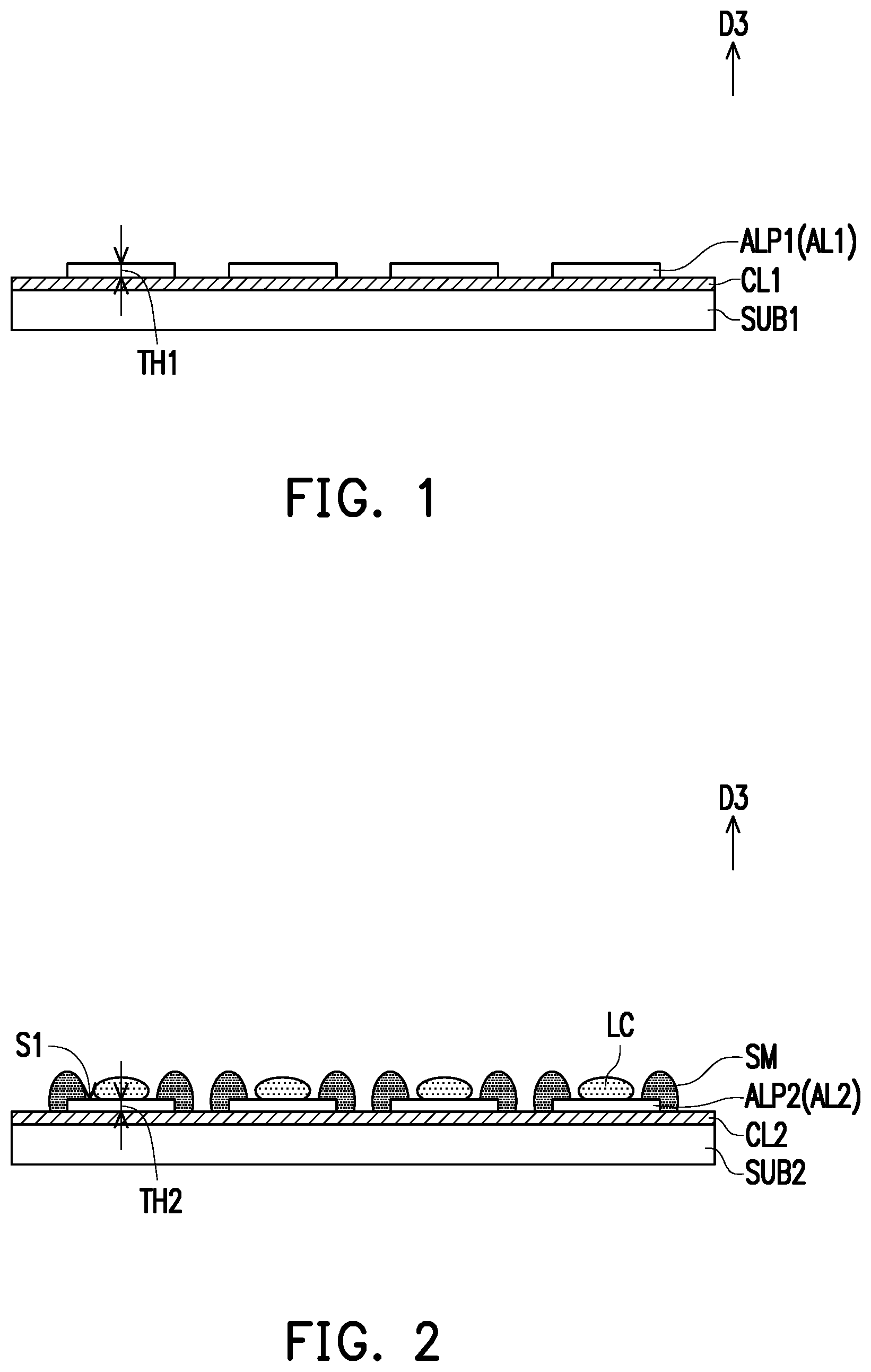
to are partial cross-sectional schematic views of a manufacturing process of an adjustable element according to an embodiment of the disclosure.
and are respectively cross-sectional schematic views of adjustable elements according to some embodiments of the disclosure.
to are partial cross-sectional schematic views of a manufacturing process of an electronic device according to an embodiment of the disclosure.
is a partial cross-sectional schematic view of an electronic device according to another embodiment of the disclosure.
is a partial cross-sectional schematic view of an adjustable element according to another embodiment of the disclosure.
DETAILED DESCRIPTION OF DISCLOSED EMBODIMENTS
Throughout the specification and the appended claims of the disclosure, certain words are used to refer to specific components. Persons skilled in the art should understand that electronic device manufacturers may refer to the same components by different names. The disclosure does not intend to distinguish the components with the same function but different names. In the following specification and claims, words such as “comprising” and “including” are open-ended words, which should be interpreted as “comprising but not limited to . . . ”.
Directional terms such as “upper”, “lower”, “front”, “rear”, “left”, and “right” mentioned in the disclosure are only directions with reference to the drawings. Therefore, the used directional terms are used to illustrate, but not to limit, the disclosure. In the drawings, each drawing depicts general features of methods, structures, and/or materials used in specific embodiments. However, the drawings should not be construed as defining or limiting the scope or nature covered by the embodiments. For example, for the sake of clarity, the relative size, thickness, and position of each film layer, region, and/or structure may be reduced or enlarged.
A structure (or layer, component, substrate) being located on/above another structure (or layer, component, substrate) described in the disclosure may mean that the two structures are adjacent and directly connected or may mean that the two structures are adjacent but not directly connected. Indirect connection means that there is at least one intermediate structure (or intermediate layer, intermediate component, intermediate substrate, intermediate interval) between the two structures, a lower surface of one structure is adjacent to or directly connected to an upper surface of the intermediate structure, and an upper surface of the other structure is adjacent to or directly connected to a lower surface of the intermediate structure. The intermediate structure may be composed of a single-layer or multi-layer physical structure or a non-physical structure, but not limited thereto. In the disclosure, when a certain structure is disposed “on” another structure, it may mean that the certain structure is “directly” on the another structure or may mean that the certain structure is “indirectly” on the another structure, that is, there is at least one structure sandwiched between the certain structure and the another structure.
The terms “approximately”, “equal to”, “equivalent”, “same”, “substantially”, or “roughly” are usually interpreted as falling within 20% of a given value range, or interpreted as falling within 10%, 5%, 3%, 2%, 1%, or 0.5% of a given value or range.
Ordinal numbers such as “first” and “second” used in the specification and the claims are used to modify elements and do not imply and represent that the element(s) has any ordinal number, and also do not represent the sequence of a certain element and another element or the sequence of a manufacturing method. The use of the ordinal numbers is only used to clearly distinguish an element with a certain name from another element with the same name. The same terms may not be used in the claims and the specification. Accordingly, a first component in the specification may be a second component in the claims.
Electrical connection or coupling described in the disclosure may refer to direct connection or indirect connection. In the case of direct connection, terminals of components on two circuits are directly connected or connected to each other by a conductor line segment. In the case of indirect connection, there is a switch, a diode, a capacitor, an inductor, a resistor, other suitable components, or a combination of the above components between the terminals of the components on the two circuits, but not limited thereto.
In the disclosure, a thickness, a length, and a width may be measured by adopting an optical microscope, and the thickness or the width may be measured by a cross-sectional image in an electron microscope, but not limited thereto. In addition, there may be a specific error in any two values or directions used for comparison. In addition, the terms “equal to”, “equivalent”, “same”, “substantially”, or “roughly” mentioned in the disclosure generally represent falling within a 10% range of a given value or range. In addition, the terms “the given range is a first value to a second value” and “the given range falls within a range of the first value to the second value” mean that the given range includes the first value, the second value, and other values in between. If a first direction is perpendicular to a second direction, an angle between the first direction and the second direction may be between 80 degrees and 100 degrees. If the first direction is parallel to the second direction, the angle between the first direction and the second direction may be between 0 degrees and 10 degrees.
It should be noted that without departing from the spirit of the disclosure, features in several different embodiments may be replaced, reorganized, and mixed to complete other embodiments in the following embodiments. The features between the embodiments may be arbitrarily mixed and matched as long as there is no violation to the spirit of the invention or conflict therebetween.
Unless otherwise defined, all terms (including technical and scientific terms) used herein have the same meaning as commonly understood by persons skilled in the art of the disclosure. It can be understood that the terms such as terms defined in commonly used dictionaries should be interpreted as having meanings consistent with the meanings in the related art and the background or the context of the disclosure, and should not be interpreted as having idealized or overly formal meanings unless explicitly defined in the embodiments of the disclosure.
In the disclosure, an electronic device may include a display device, a backlight device, an antenna device, a sensing device, or a splicing device, but not limited thereto. The electronic device may be a bendable or flexible electronic device. The display device may be a non-self-luminous display device or a self-luminous display device. The antenna device may be a liquid crystal antenna device or a non-liquid crystal antenna device, and the sensing device may be a sensing device that senses capacitance, light, heat, or ultrasound, but not limited thereto. In the disclosure, an electronic element may include a passive element and an active element, such as a capacitor, a resistor, an inductor, a diode, and a transistor. The diode may include a light emitting diode or a photodiode. The light emitting diode (LED) may include, for example, an organic LED (OLED), a mini LED, a micro LED, or a quantum dot LED, but not limited thereto. Hereinafter, the content of the disclosure will be illustrated below with the display device as the electronic device or the splicing device, but the disclosure is not limited thereto. In the disclosure, an adjustable element may be, for example, a capacitor, an inductor, a microelectromechanical system (MEMS), or other adjustable elements, but not limited thereto.
It should be noted that technical solutions provided by different embodiments below may be interchanged, combined, or mixed to form another embodiment without violating the spirit of the disclosure.
In some embodiments of the disclosure, unless specifically defined, terms related to bonding and connection, such as “connection” and “interconnection”, may mean that two structures are in direct contact or may also mean that two structures are not in direct contact, wherein there is another structure disposed between the two structures. The terms related to bonding and connection may also include the case where the two structures are both movable or the two structures are both fixed. In addition, the terms “electrical connection” and “coupling” include any direct and indirect electrical connection means.
In the embodiments below, the same or similar elements will adopt the same or similar reference numerals, and redundant descriptions thereof are omitted. In addition, features in different embodiments may be arbitrarily mixed and matched as long as there is no violation to the spirit of the invention or conflict therebetween, and simple equivalent changes and modifications made in accordance with the specification or the claims are all still within the scope of the disclosure. In addition, terms such as “first” and “second” mentioned in the specification or the claims are only used to name different elements or to distinguish different embodiments or ranges, and are not used to limit the upper limit or the lower limit of the number of elements or to limit the manufacturing sequence or configuration sequence of the elements.
to are partial cross-sectional schematic views of a manufacturing process of an adjustable element according to an embodiment of the disclosure. Please refer to . A manufacturing method of an adjustable element may include providing a first substrate SUB 1 . The first substrate SUB 1 may include a rigid substrate, a bendable substrate or a flexible substrate. In some embodiments, the first substrate SUB 1 may include a photoresist material, an organic or inorganic material, or a combination of the above, but not limited thereto. For example, the first substrate SUB 1 may include glass, ceramic, quartz, sapphire, or a combination of the above materials, but not limited thereto. In some embodiments, the material of the first substrate SUB 1 may include polyethylene terephthalate (PET), polyimide, liquid crystal polymer (LCP), cyclo olefin polymer (COP), epoxy resin, ajinomoto build-up film (ABF), bismaleimide, fluororesin, and/or other suitable materials, or a combination of the above, but not limited thereto.
In some embodiments, the manufacturing method of the adjustable element may include disposing a first conductive layer CL 1 and/or a first alignment layer AL 1 on the first substrate SUB 1 . The first conductive layer CL 1 may be disposed on the first substrate SUB 1 and located between the first substrate SUB 1 and the first alignment layer AL 1 . In other embodiments (not shown), another dielectric layer may be selectively disposed between the first conductive layer CL 1 and the first substrate SUB 1 . The dielectric layer may reduce the chance of peeling between the first substrate SUB 1 and the first conductive layer CL 1 . In some embodiments, the first conductive layer CL 1 may be a full-surface conductive layer or patterned conductive layer. In some embodiments, the first conductive layer CL 1 may include a transparent conductive layer, a non-transparent conductive layer, or a combination of the above. The material of the transparent conductive layer may include metal oxide, metal mesh, or graphene, but not limited thereto. The metal oxide may include indium tin oxide (ITO), indium zinc oxide (IZO), indium gallium zinc oxide (IGZO), aluminum zinc oxide (AZO), other suitable materials, or a combination of the above, but not limited thereto. The material of the non-transparent conductive layer may include metal or alloy, but not limited thereto. The metal may include copper, aluminum, silver, gold, titanium, molybdenum, any material with high conductivity, or a combination of the above, but not limited thereto.
In some embodiments, the first alignment layer AL 1 may be a patterned alignment layer and may include multiple first alignment patterns ALP 1 . The first alignment patterns ALP 1 may be, for example, arranged at intervals, but not limited thereto. In some embodiments, the first alignment patterns ALP 1 may be arranged in an array or other manners, but not limited thereto.
Please refer to , the manufacturing method of the adjustable element may further include providing a second substrate SUB 2 . The material of the second substrate SUB 2 may be the same as or different from the material of the first substrate SUB 1 , so the description will not be repeated.
In some embodiments, the manufacturing method of the adjustable element may further include disposing a second conductive layer CL 2 and a second alignment layer AL 2 on the second substrate SUB 2 , but not limited thereto. The second conductive layer CL 2 may be disposed on the second substrate SUB 2 and located between the second substrate SUB 2 and the second alignment layer AL 2 . In other embodiments (not shown), another dielectric layer may be selectively disposed between the second conductive layer CL 2 and the second substrate SUB 2 . The dielectric layer may reduce the chance of peeling between the second substrate SUB 2 and the second conductive layer CL 2 . In some embodiments, the second conductive layer CL 2 may be a full-surface conductive layer or patterned conductive layer. The second conductive layer CL 2 may be a transparent conductive layer or a non-transparent conductive layer. The materials of the transparent conductive layer and the non-transparent conductive layer may be referred to the above and will not be repeated here.
As shown in , in some embodiments, the second alignment layer AL 2 may be a patterned alignment layer and may include multiple second alignment patterns ALP 2 . In some embodiments, the manufacturing method of the adjustable element may include providing a liquid crystal layer LC. In some embodiments, the liquid crystal layer LC may be first disposed on the second alignment layer AL 2 , but not limited thereto. In other embodiments (not shown), the liquid crystal layer LC may be first disposed on the first alignment layer AL 1 (refer to ).
The type of the liquid crystal layer LC is not limited. For example, the liquid crystal layer LC may include nematic liquid crystal, smectic liquid crystal, cholesteric liquid crystal, etc., but not limited thereto. In other embodiments (not shown), the liquid crystal layer LC may be replaced with other materials with adjustable dielectric values, such as carbon nanotubes or other columnar anisotropic materials, according to requirements, but not limited thereto. In some embodiments, the liquid crystal layer LC may be formed on the alignment layer (such as the second alignment layer AL 2 or the first alignment layer AL 1 ) through one drop filling (ODF).
In some embodiments, before disposing the liquid crystal layer LC, a sealing member SM may be disposed on the edge of the second alignment pattern ALP 2 . The sealing member SM may selectively contact or not contact a portion of the second alignment layer AL 2 . For example, the sealing member SM may be selectively disposed on a portion of a surface S 1 of the second alignment layer AL 2 . The surface S 1 may be the surface of the second alignment layer AL 2 away from the second substrate SUB 2 . In other words, the sealing member SM may cover the edge of the second alignment pattern ALP 2 and extend to a portion of the surface S 1 of the second alignment layer AL 2 , but not limited thereto. In some embodiments, the sealing member SM may roughly frame a configuration region of the liquid crystal layer LC. From the top view, the contour of the sealing member SM may include a ring shape, such as a circular ring shape, a rectangular ring shape, a polygonal ring shape, or other suitable shapes, but not limited thereto. In some embodiments, the material of the sealing member SM may include a material with low water vapor permeability, such as a photosensitive sealant (such as an ultraviolet curable adhesive), an organic material, or other suitable materials, but not limited thereto. In some embodiments, the surface of the sealing member SM may have an arc contour.
Please refer to . The manufacturing method of the adjustable element may include sealing the liquid crystal layer LC between the first substrate SUB 1 and the second substrate SUB 2 , and the liquid crystal layer LC is disposed between the first substrate SUB 1 and the second substrate SUB 2 . For example, the first substrate SUB 1 provided with the first conductive layer CL 1 and/or the first alignment layer AL 1 may be placed upside down on the second substrate SUB 2 , so that the first conductive layer CL 1 may be disposed between the first substrate SUB 1 and the liquid crystal layer LC, the first alignment layer AL 1 may be disposed between the first conductive layer CL 1 and the liquid crystal layer LC, the second conductive layer CL 2 may be disposed between the second substrate SUB 2 and the liquid crystal layer LC, and the second alignment layer AL 2 may be disposed between the second conductive layer CL 2 and the liquid crystal layer LC. In some embodiments, the second alignment patterns ALP 2 may be respectively correspond to the first alignment patterns ALP 1 . In some embodiments, in a normal direction (refer to a direction D 3 in the drawing) of the first substrate SUB 1 , the second alignment pattern ALP 2 may overlap with the first alignment pattern ALP 1 . In some embodiments, viewed from the normal direction of the first substrate SUB 1 , a projection area of the second alignment pattern ALP 2 to the first substrate SUB 1 may be the same as or different from a projection area of the first alignment pattern ALP 1 to the first substrate SUB 1 . Through the above process, the liquid crystal layer LC may be disposed between the corresponding first alignment pattern ALP 1 , the corresponding second alignment pattern ALP 2 , and the sealing member SM, but not limited thereto. In some embodiments, in the normal direction of the first substrate SUB 1 , a thickness D of the liquid crystal layer LC may be 1 μm to 20 μm, that is, 1 μm≤D≤20 μm, but not limited thereto. In some embodiments, the thickness D of the liquid crystal layer LC may be 3 μm to 18 μm, that is, 3 μm≤D≤18 μm. In some embodiments, the thickness D of the liquid crystal layer LC may be 5 μm to 15 μm, that is, 5 μm≤D≤15 μm. The thickness D of the liquid crystal layer LC may be adjusted according to requirements. For example, the thickness D of the liquid crystal layer LC may be adjusted according to the dielectric constant of the liquid crystal layer LC or other parameters, but not limited thereto.
In some embodiments, the manufacturing method of the adjustable element may further include a singulation process. For example, the assembled first substrate SUB 1 and second substrate SUB 2 may be cut along dotted lines shown in .
Please refer to . The manufacturing method of the adjustable element may include forming a first pad on a sidewall of at least one of the first substrate SUB 1 and the second substrate SUB 2 . For example, a first pad P 11 is formed on a sidewall SW 1 of the first substrate SUB 1 , or a first pad P 12 is formed on a sidewall SW 2 of the second substrate SUB 2 , but not limited thereto. The material of the first pad P 11 and/or the first pad P 12 may include a transparent conductive material, a non-transparent conductive material (such as metal or alloy), or a combination of the above. In some embodiments, the material of the first pad P 11 and/or the first pad P 12 may include nickel-gold, nickel-palladium-gold, silver, gold, nickel, tin, organic solderability preservative (OSP), other conductive materials, or a combination of the above, but not limited thereto. Please refer to . In some embodiments, the manufacturing method of the adjustable element may include disposing a protective layer PT on another sidewall of at least one of the first substrate SUB 1 and/or the second substrate SUB 2 . For example, the protective layer PT may be disposed on a sidewall SW 1 - 1 of the first substrate SUB 1 and/or a sidewall SW 2 - 2 of the second substrate SUB 2 , but not limited thereto. In some embodiments, the protective layer PT may contact a portion of the first conductive layer CL 1 , the second conductive layer CL 2 and/or the sealing member SM, but not limited thereto. The protective layer PT may be used to reduce the chance of damage to an adjustable element 10 or reduce the intrusion of water and oxygen, which affects the liquid crystal layer LC or any conductive layer in the adjustable element 10 .
In some embodiments, the material of the protective layer PT may include silicon nitride (SiNx), silicon oxide (SiOx), silicon oxynitride (SiOxNy), epoxy resin, acrylic, solder resist, bismaleimide, polyimide, other suitable materials, or a combination of the above, but not limited thereto. In some embodiments, the protective layer PT may have an arc contour. After disposing the protective layer PT and/or the first pad (such as the first pad P 11 and/or the first pad P 12 ), the manufacture of the adjustable element 10 is completed. In other embodiments (not shown), the adjustable element 10 may selectively not include the protective layer PT. In some embodiments, the adjustable element 10 may be used as a variable capacitor or other suitable electronic elements. In detail, the dielectric change of the liquid crystal layer LC (or other dielectric materials disposed between the two conductive layers) is controlled through changing the potential difference between the first conductive layer CL 1 and the second conductive layer CL 2 of the adjustable element 10 to achieve the effect of a variable capacitor, but not limited thereto.
and are respectively cross-sectional schematic views of adjustable elements according to some embodiments of the disclosure. Please refer to . The main difference between an adjustable element 10 A and the adjustable element 10 of may include the following. In the adjustable element 10 A, the first substrate SUB 1 and/or the second substrate SUB 2 include a conductive material. For example, the first substrate SUB 1 and/or the second substrate SUB 2 may include a metal substrate or an alloy substrate, but not limited thereto. In this way, the adjustable element 10 A may selectively not include the first conductive layer CL 1 and/or the second conductive layer CL 2 . In some embodiments, the first pad P 11 may be selectively disposed on the sidewall SW 1 of the first substrate SUB 1 , or the first pad P 12 may be selectively disposed on the sidewall SW 2 of the second substrate SUB 2 , but not limited thereto. In some embodiments, the adjustable element 10 A may selectively include an insulating layer, such as an insulating layer IN 1 and/or an insulating layer IN 2 . In some embodiments, the insulating layer IN 1 may be disposed on the side of the first substrate SUB 1 away from the second substrate SUB 2 . In some embodiments, the insulating layer IN 1 and the first alignment layer AL 1 may be respectively located on opposite sides of the first substrate SUB 1 . In some embodiments, the insulating layer IN 2 may be disposed on the side of the second substrate SUB 2 away from the first substrate SUB 1 . In some embodiments, the insulating layer IN 2 and the second alignment layer AL 2 may be respectively located on opposite sides of the second substrate SUB 2 . In some embodiments, the insulating layer IN 1 and/or the insulating layer IN 2 may be respectively used to protect the first substrate SUB 1 and/or the second substrate SUB 2 , or reduce the chance of short circuit caused by other conductive materials contacting the first substrate SUB 1 or the second substrate SUB 2 . For example, the material of the insulating layer IN 1 and/or the insulating layer IN 2 may include epoxy, acrylic-based resin, silicone, polyimide polymer, or a combination of the above, but not limited thereto. In some embodiments, the protective layer PT may selectively contact a portion of the insulating layer IN 1 and/or the insulating layer IN 2 . In some embodiments, the sealing member SM may not protrude from the first substrate SUB 1 or the second substrate SUB 2 . In some embodiments, a projection area of the sealing member SM to the first substrate SUB 1 may be located within the projection area of the second substrate SUB 2 to the first substrate SUB 1 , but not limited thereto.
Please refer to . The main differences between an adjustable element 10 B and the adjustable element 10 of may include the following. In the adjustable element 10 B, the sealing member SM may be disposed on the conductive layer (such as the first conductive layer CL 1 or the second conductive layer CL 2 ) and not extend to a surface (such as a surface AS 1 and a surface AS 2 ) of the alignment layer (such as the first alignment layer AL 1 and the second alignment layer AL 2 ) adjacent to the liquid crystal layer LC. In other words, the sealing member SM may be not disposed between the first alignment layer AL 1 and the second alignment layer AL 2 . In some embodiments, the projection area of the sealing member SM to the first substrate SUB 1 and the projection area of the first alignment layer AL 1 (or the second alignment layer AL 2 ) to the first substrate SUB 1 do not overlap, but not limited thereto. In some embodiments, a sidewall SW 3 of the sealing member SM away from the liquid crystal layer LC may be roughly flush with the sidewall SW 1 of the first substrate SUB 1 and/or the sidewall SW 2 of the second substrate SUB 2 , but not limited thereto. In some embodiments, another sidewall SW 3 - 1 of the sealing member SM away from the liquid crystal layer LC may be roughly flush with another sidewall SW 1 - 1 of the first substrate SUB 1 and/or another sidewall SW 2 - 1 of the second substrate SUB 2 , but not limited thereto. In other embodiments (not shown), the sealing member SM may selectively protrude from the first substrate SUB 1 and the second substrate SUB 2 . In other embodiments (not shown), the projection area of the sealing member SM to the first substrate SUB 1 may be partially not located within the projection area of the second substrate SUB 2 to the first substrate SUB 1 , but not limited thereto.
In some embodiments, the adjustable element 10 B may not include the protective layer PT of . In other embodiments, the adjustable element 10 B may include the protective layer PT.
to are partial cross-sectional schematic views of a manufacturing process of an electronic device according to an embodiment of the disclosure. Please refer to . A manufacturing method of an electronic device may include providing a substrate SUB. The substrate SUB may include a rigid substrate, a bendable substrate, or a flexible substrate. In some embodiments, the substrate SUB may include a photoresist material, an organic or inorganic material, or a combination of the above, but not limited thereto. For example, the substrate SUB may include glass, ceramic, quartz, sapphire, or a combination of the above materials, but not limited thereto. In some embodiments, the material of the substrate SUB may include polyethylene terephthalate (PET), polyimide, liquid crystal polymer (LCP), cyclo olefin polymer (COP), epoxy resin, ajinomoto build-up film (ABF), bismaleimide, fluororesin, and/or other suitable materials, or a combination of the above, but not limited thereto.
In some embodiments, the manufacturing method of the electronic device may include disposing a conductive layer CL 3 on the substrate SUB. The conductive layer CL 3 may be a patterned conductive layer and may include a conductive pattern PP 1 and/or a conductive pattern PP 2 , but not limited thereto. The conductive layer CL 3 may include a transparent conductive layer or a non-transparent conductive layer. The materials of the transparent conductive layer and the non-transparent conductive layer may be referred to the above and will not be repeated here. In some embodiments, the conductive layer CL 3 may contact the substrate SUB, but not limited thereto. In some embodiments, a dielectric layer (not shown) may be disposed between the substrate SUB and the conductive layer CL 3 , thereby reducing the chance of peeling of the substrate SUB.
In some embodiments, the manufacturing method of the electronic device may include disposing an insulating layer IL on the substrate SUB. The insulating layer IL may be disposed on the conductive layer CL 3 . The material of the insulating layer IL may include silicon nitride, silicon oxide, silicon oxynitride, epoxy resin, acrylic, solder resist, silicon material, bismaleimide, polyimide, other materials, or a combination of the above, but not limited thereto.
In some embodiments, the manufacturing method of the electronic device may include disposing a conductive layer CL 4 and/or a conductive layer CL 5 on the insulating layer IL. In some embodiments, the insulating layer IL may be disposed between the conductive layer CL 3 and the conductive layer CL 4 , and the conductive layer CL 3 and the conductive layer CL 4 are electrically insulated through the insulating layer IL.
In some embodiments, the manufacturing method of the electronic device includes disposing a second pad on the substrate SUB. In detail, the conductive layer CL 4 may be disposed on the substrate SUB, the conductive layer CL 4 may be a patterned conductive layer, and the patterned conductive layer CL 4 may include a second pad P 21 and/or a second pad P 22 , but not limited thereto. The material of the second pad P 21 and/or the second pad P 22 may include a transparent conductive material, a non-transparent conductive material (such as metal or alloy), or a combination of the above. In some embodiments, the material of the second pad P 21 and/or the second pad P 22 may include nickel-gold, nickel-palladium-gold, silver, gold, nickel, tin, organic solderability preservative (OSP), other conductive materials, or a combination of the above, but not limited thereto.
In some embodiments, in a direction D 4 , the second pad P 21 may be located between the second pad P 22 and the conductive pattern PP 1 , or the second pad P 22 may be located between the second pad P 21 and the conductive pattern PP 2 , but not limited thereto. The direction D 4 may be perpendicular to a normal direction D 5 of the substrate SUB. In some embodiments, in the direction D 4 , a width W 1 of a gap G between the second pad P 21 and the second pad P 22 may be less than a width W 2 of a gap G 1 between the conductive pattern PP 1 and the conductive pattern PP 2 , but not limited thereto. In some embodiments, in the direction D 4 , a sum of a width W 21 of the second pad P 21 , a width W 22 of the second pad P 22 , and the width W 1 may be less than or equal to the width W 2 , but not limited thereto. In some embodiments, in the normal direction D 5 of the substrate SUB, the second pad P 21 and/or the second pad P 22 do not overlap with the conductive pattern PP 1 and/or the conductive pattern PP 2 , but not limited thereto.
In some embodiments, the conductive layer CL 4 may include a transparent conductive layer and/or a non-transparent conductive layer. The materials of the transparent conductive layer and the non-transparent conductive layer may be referred to the above and will not be repeated here.
In some embodiments, the conductive layer CL 5 may be disposed on the conductive layer CL 4 and the insulating layer IL. In some embodiments, the conductive layer CL 5 may be a patterned conductive layer, and the conductive layer CL 5 may include a conductive pattern PP 3 and/or a conductive pattern PP 4 , but not limited thereto. In some embodiments, the conductive pattern PP 3 may be disposed on a portion of the second pad P 21 and is electrically connected to the second pad P 21 . In some embodiments, the conductive pattern PP 4 may be disposed on a portion of the second pad P 22 and is electrically connected to the second pad P 22 . In some embodiments, the conductive layer CL 4 and/or the conductive layer CL 5 may include a metal layer or a transparent conductive layer.
In some embodiments, the manufacturing method of the electronic device may include disposing a switch element SW on the insulating layer IL, but not limited thereto. In some embodiments, the switch element SW may be manufactured on the insulating layer IL through a yellow light process. In some embodiments, the switch element SW may be bonded onto the insulating layer IL through a bonding process. In some embodiments, the switch element SW may include a thin film transistor (not shown) or other suitable structures. In some embodiments, in the direction D 5 , the switch element SW may partially overlap with the conductive pattern PP 4 . In some embodiments, the switch element SW may be electrically connected to the conductive pattern PP 4 .
In some embodiments, the manufacturing method of the electronic device may include providing a dielectric layer PL. The dielectric layer PL may be formed on the switch element SW and/or the conductive layer CL 5 . In some embodiments, the dielectric layer PL may have an opening A 1 exposing a portion of the second pad P 21 and an opening A 2 exposing a portion of the second pad P 22 , but not limited thereto. In some embodiments, the material of the dielectric layer PL may include silicon nitride, silicon oxide, epoxy resin, acrylic, solder resist, silicon material, bismaleimide, polyimide, other suitable materials, or a combination of the above, but not limited thereto.
In some embodiments, the manufacturing method of the electronic device may include disposing a conductive pattern in the opening of the dielectric layer PL. For example, a conductive material PP 5 and a conductive material PP 6 are respectively disposed in the opening A 1 and the opening A 2 of the dielectric layer PL. In some embodiments, the conductive material PP 5 and/or the conductive material PP 6 may be formed through electroless plating, immersion, or electrolysis, etc., but not limited thereto. In some embodiments, the conductive material PP 5 and/or the conductive material PP 6 may include nickel-gold, nickel-palladium-gold, silver, gold, nickel, tin, organic solderability preservative, other conductive materials, or a combination of the above, but not limited thereto.
In some embodiments, the conductive layer CL 3 and the conductive layer CL 4 may be connected to an external circuit (not shown) to receive signals. In detail, in some embodiments, when the electronic device is an antenna, the conductive pattern PP 1 and/or the conductive pattern PP 2 of the conductive layer CL 3 may receive a first signal. The first signal may be a radio frequency signal, but not limited thereto. In some embodiments, the second pad P 21 of the conductive layer CL 4 and the conductive pattern PP 3 of the conductive layer CL 5 may receive a second signal. The second signal may be a ground potential, but not limited thereto. There may be a potential difference between the first signal and the second signal. In some embodiments, the second pad P 22 of the conductive layer CL 4 and the conductive pattern PP 4 of the conductive layer CL 5 may be electrically connected to the switch element SW, but not limited thereto.
In other embodiments (not shown), the conductive pattern PP 1 and/or the conductive pattern PP 2 may be connected to a ground potential or a direct current bias voltage, but not limited thereto.
Please refer to . The manufacturing method of the electronic device may include providing the substrate SUB and providing the adjustable element 10 , wherein the adjustable element 10 includes the liquid crystal layer LC. In addition, the manufacturing method of the electronic device may include bonding the adjustable element 10 onto the substrate SUB. For example, a bonding member BE 1 and/or a bonding member BE 2 may be respectively disposed on the conductive material PP 5 and/or the conductive material PP 6 . In some embodiments, the bonding member BE 1 and/or the bonding member BE 2 may include a tin ball, a copper pillar, metal, or metal alloy, but not limited thereto.
In some embodiments, a conductive material PP 7 may be selectively disposed on the first pad P 11 of the adjustable element 10 , but not limited thereto. In some embodiments, a conductive material PP 8 may be selectively disposed on the first pad P 12 of the adjustable element but not limited thereto. In some embodiments, the conductive material PP 7 and/or the conductive material PP 8 may include gold or other suitable metals, but not limited thereto. In some embodiments, the first pad P 11 and the first pad P 12 of the adjustable element 10 may be respectively bonded onto the second pad P 21 and the second pad P 22 , the adjustable element 10 is bonded onto the substrate SUB. For example, the first pad P 11 and the first pad P 12 may be respectively bonded onto the second pad P 21 and the second pad P 22 through solder reflow. In some embodiments, after bonding the adjustable element 10 onto the substrate SUB, the manufacture of an electronic device 1 is initially completed.
In some embodiments, the materials of the second pad P 21 and the second pad P 22 include metallic materials or non-metallic materials, such as copper or other suitable materials. In some embodiments, when the material of the bonding member BE 1 and/or the bonding member BE 2 is tin, for example, an intermetallic compound (IMC) may be easily generated between copper and tin. The intermetallic compound, for example, grows thicker with time and as heat accumulates. When the intermetallic compound is too thick, there may be a risk of deterioration of adhesion strength. In addition, the brittleness of the intermetallic compound may easily affect electrical conduction. Therefore, in some embodiments, the conductive material PP 6 (such as a nickel-gold layer) may be disposed between the second pad P 22 and the bonding member BE 2 , or the conductive material PP 5 (such as a nickel-gold layer) may be disposed between the second pad P 21 and the bonding member BE 1 , which can improve the issue of the intermetallic compound, reduce copper oxidation, or improve reliability, but not limited thereto.
In some embodiments, the first pad P 12 of the adjustable element 10 may be electrically connected to the second pad P 22 through the conductive material PP 8 , the bonding member BE 2 , the conductive material PP 6 , and the second pad P 22 , but not limited thereto. In some embodiments, the second pad P 22 may be electrically connected to the switch element SW through the conductive pattern PP 4 , but not limited thereto. Similarly, the first pad P 11 of the adjustable element 10 may be electrically connected through the conductive material PP 7 , the bonding member BE 1 , the conductive material PP 5 , and the second pad P 21 , and the first pad P 11 may be electrically connected to an external signal (not shown) through the conductive pattern PP 3 , but not limited thereto. In other embodiments, any of the above layers may be removed from or other layers may be inserted between the first pad and the second pad according to requirements. In some embodiments, the first pad P 12 of the adjustable element 10 may receive a third potential through the switch element SW, the first pad P 11 of the adjustable element 10 may receive a fourth potential, and there is a potential difference between the third potential and the fourth potential. The dielectric change of the liquid crystal layer LC in the adjustable element 10 may be adjusted through the potential difference, the adjustable element 10 may be used as a variable capacitor or other suitable electronic elements, but not limited thereto. In some embodiments, the third potential may be a positive potential, and the magnitude of the positive potential may be adjusted according to requirements. In some embodiments, the fourth potential may be a ground potential or a negative potential, but not limited thereto.
In some embodiments, the electronic device 1 may selectively include a protective layer PT 1 . The protective layer PT 1 may encapsulate the adjustable element 10 . In some embodiments, the material of the protective layer PT 1 may include silicon nitride, silicon oxide, silicon oxynitride, epoxy resin, acrylic, solder resist, silicon material, bismaleimide, polyimide, other suitable materials, or a combination of the above, but not limited thereto.
In other embodiments, the adjustable element 10 in the electronic device 1 may be replaced with other adjustable elements of the disclosure. In some embodiments, at least one or more adjustable elements 10 may be disposed on the substrate SUB according to requirements, and the structures of different adjustable elements 10 may be the same as or different from each other. In other embodiments, the configuration position of the switch element SW or the connection relationship between the switch element SW and the adjustable element 10 may be changed according to requirements and is not limited to as shown in . In other embodiments (not shown), the switch element SW may be disposed between the conductive layer CL 3 and the conductive layer CL 4 . In other embodiments (not shown), the switch element SW and the adjustable element 10 may be respectively disposed on opposite surfaces of the substrate SUB, and the switch element SW may be electrically connected to the conductive pattern PP 4 through a circuit (such as a via) that is not shown. The following embodiments may all be changed in the same way, which will not be repeated below.
is a partial cross-sectional schematic view of an electronic device according to another embodiment of the disclosure. Please refer to . The main differences between an electronic device 1 A and the electronic device 1 of may include the following. In the electronic device 1 A, the first pad P 11 and the first pad P 12 of the adjustable element 10 may be respectively bonded to the second pad P 21 and the second pad P 22 through anisotropic conductive film ACF 1 and/or anisotropic conductive film ACF 2 , but not limited thereto. The anisotropic conductive film ACF 1 and/or the anisotropic conductive film ACF 2 may be replaced with other conductive materials according to requirements. In other embodiments, although not shown, the anisotropic conductive film (such as the anisotropic conductive film ACF 1 or the anisotropic conductive film ACF 2 ) in the electronic device 1 A may be selectively replaced with other conductive elements, such as conductive films, copper pillars, copper paste, silver paste (such as nano silver paste), but not limited thereto.
In other embodiments (not shown), the opening A 1 and the opening A 2 of the dielectric layer PL may be not separated from each other, that is, there is no other portion of the dielectric layer PL between the opening A 1 and the opening A 2 . The opening A 1 and the opening A 2 may be connected to form a common opening. The first pad P 11 and the first pad P 12 may be electrically connected to the second pad P 21 and the second pad P 22 via the anisotropic conductive film (or other replaceable conductive elements as above) disposed in the common opening. It should be noted that the first pad P 11 and the first pad P 12 are not electrically connected to each other, and the second pad P 21 and the second pad P 22 are not electrically connected to each other.
In some embodiments, the electronic device 1 A may selectively not include the bonding member BE 1 , the bonding member BE 2 , the conductive material PP 5 , the conductive material PP 6 , the conductive material PP 7 , and/or the conductive material PP 8 of , but not limited thereto.
is a partial cross-sectional schematic view of an adjustable element according to another embodiment of the disclosure. Please refer to . A manufacturing method of an adjustable element 10 C may include providing a first substrate SUB 1 A. The material of the first substrate SUB 1 A may be the same as the material of the first substrate SUB 1 , so the description will not be repeated. In some embodiments, the manufacturing method of the adjustable element may include disposing a first conductive layer CL 1 A and/or a first alignment layer AL 1 A on the first substrate SUB 1 A. The first conductive layer CL 1 may be disposed on the first substrate SUB 1 A and located between the first substrate SUB 1 A and the first alignment layer AL 1 A. In other embodiments (not shown), a dielectric layer may be selectively added between the first conductive layer CL 1 A and the first substrate SUB 1 A. The dielectric layer may reduce the chance of peeling between the first substrate SUB 1 A and the first conductive layer CL 1 A. In some embodiments, the first conductive layer CL 1 A may include a transparent conductive layer, a non-transparent conductive layer, or a combination of the above. The material of the first conductive layer CL 1 A may be the same as the material of the first conductive layer CL 1 , so the description will not be repeated. In some embodiments, a first conductive element CE 1 may be disposed on the first substrate SUB 1 A. The first conductive element CE 1 may be adjacent to the first conductive layer CL 1 A, but the first conductive element CE 1 and the first conductive layer CL 1 A may be electrically insulated from each other. In some embodiments, the first conductive element CE 1 and the first conductive layer CL 1 A may be formed of the same layer or different conductive layers. In some embodiments, the first alignment layer AL 1 A may be extend to a portion of the first conductive element CE 1 and fill the gap between the first conductive element CE 1 and the first conductive layer CL 1 A, but not limited thereto. In other embodiments (not shown), the first alignment layer AL 1 A may be not extend to a portion of the first conductive element CE 1 . In some embodiments, the manufacturing method of the adjustable element 10 C may further include providing a second substrate SUB 2 A. The material of the second substrate SUB 2 may be the same as or different from the material of the first substrate SUB 1 A, so the description will not be repeated. In some embodiments, the manufacturing method of the adjustable element 10 C may further include disposing a second conductive layer CL 2 A and a second alignment layer AL 2 A on the second substrate SUB 2 A. The second conductive layer CL 2 A may be disposed on the second substrate SUB 2 A and located between the second substrate SUB 2 A and the second alignment layer AL 2 A. In other embodiments (not shown), a dielectric layer may be selectively disposed between the second conductive layer CL 2 A and the second substrate SUB 2 A. The dielectric layer may reduce the chance of peeling between the second substrate SUB 2 A and the second conductive layer CL 2 A. The second conductive layer CL 2 A may be a transparent conductive layer or a non-transparent conductive layer. The material of the second conductive layer CL 2 A may be the same as the material of first conductive layer CL 1 A, so the description will not be repeated. In some embodiments, the manufacturing method of the adjustable element may include providing the liquid crystal layer LC, and the material thereof may be referred to the above, so the description will not be repeated.
In some embodiments, the manufacturing method of the adjustable element 10 C may include providing a sealing member SMA. The liquid crystal layer LC is sealed between the first substrate SUB 1 A and the second substrate SUB 2 A through the sealing member SMA. In some embodiments, the sealing member SMA may selectively contact a portion of the first conductive element CE 1 , but not limited thereto. In some embodiments, the liquid crystal layer LC may be disposed between the first alignment layer AL 1 A, the second alignment layer AL 2 A and the sealing member SMA. In some embodiments, the first alignment layer AL 1 A may be disposed between the liquid crystal layer LC and the first conductive layer CL 1 A, and the second alignment layer AL 2 A may be disposed between the liquid crystal layer LC and the second conductive layer CL 2 A. In some embodiments, viewed from a normal direction of the first substrate SUB 1 A, areas of the first conductive layer CL 1 A and the second conductive layer CL 2 A may be different. In some embodiments, viewed from the normal direction of the first substrate SUB 1 A, areas of the first alignment layer ALIA and the second alignment layer AL 2 A may be the same or different.
In some embodiments, the manufacturing method of the adjustable element 10 C may include forming a via CV 1 and a via CV 2 on the second substrate SUB 2 A, but not limited thereto. In some embodiments, the sizes or shapes of the via CV 1 and the via CV 2 may be the same or different. In some embodiments, the via CV 1 and the via CV 2 may be formed by forming a through hole (not labeled) in the first substrate SUB 1 A, and filling a conductive material into the through hole, but not limited thereto. The conductive material is not limited to a single or composite material. In some embodiments, the manufacturing method of the adjustable element may include disposing a second conductive element CE 2 between the first substrate SUB 1 A and the second substrate SUB 2 A. The second conductive element CE 2 may be adjacent to the sealing member SMA. In some embodiments, the second conductive element CE 2 may selectively contact or not contact the sealing member SMA. In some embodiments, the manufacturing method of the adjustable element 10 C may include disposing a first pad P 11 A and/or a first pad P 12 A on a surface S of the first substrate SUB 1 A away from the first conductive layer CL 1 A. The material of the first pad P 11 A and/or the first pad P 12 A may be the same as or different from the material of the first pad P 11 and/or the first pad P 12 , so the description will not be repeated. In some embodiments, the second conductive layer CL 2 A may be electrically connected to the first conductive element CE 1 via the second conductive element CE 2 , and the first conductive element CE 1 may be electrically connected to the first pad P 11 A via the via CV 1 , but not limited thereto. In some embodiments, the material of the second conductive element CE 2 includes a tin ball, a copper pillar, metal, or metal alloy. In some embodiments, a second conductive element CE 2 may include a single-layer or composite-layer material. In some embodiments, the thickness of the second conductive element CE 2 may be close to the thickness of the sealing member SMA, but not limited thereto.
In some embodiments (not shown), the first pad P 12 A of the adjustable element 10 C may be electrically connected to the second pad P 22 in , and the first pad P 12 A of the adjustable element 10 C may be electrically connected to the second pad P 22 , so as to bond the adjustable element 10 C onto the substrate SUB of , but not limited thereto. Regarding the bonding manner of the first pad (such as the first pad P 12 A or the first pad P 12 ) of and the second pad P 22 (as shown in ), reference may be made to the bonding manner of or , so the description will not be repeated.
In summary, in the embodiments of the disclosure, the adjustable element with better quality can be provided through using a liquid crystal adjustable element or other adjustable elements with adjustable dielectric constant. The adjustable element may be used as a variable capacitor. In the embodiments of the disclosure, the bonding manner of the first pad of the adjustable element and the second pad on the substrate includes surface mount technology (SMT) or other suitable bonding techniques, such as soldering (lead/tin welding) process, anisotropic conductive adhesive bonding, silver glue bonding, fusion bonding, metal thermal compression bonding, special eutectic bonding, and polymer adhesive bonding, but not limited thereto. It should be noted that “the first pad of the adjustable element being bonded to the second pad on the substrate” of the disclosure means that the first pad is electrically connected to the second pad, and the electrical connection manner of the first pad and the second pad may be, for example, direct connection or electrical connection through other conductive materials.
The above embodiments are only used to illustrate, but not to limit, the technical solutions of the disclosure. Although the disclosure has been described in detail with reference to the above embodiments, persons skilled in the art should understand that they may still combine or modify the technical solutions described in the above embodiments or equivalently replace some or all of the technical features. However, the combinations, modifications, or replacements do not cause the essence of the corresponding technical solution to deviate from the scope of the technical solutions of the embodiments of the disclosure.
Although the embodiments of the disclosure and the advantages thereof have been disclosed as above, it should be understood that persons skilled in the art may make changes, substitutions, and modifications without departing from the spirit and scope of the disclosure, and the features between the embodiments may be arbitrarily mixed and replaced to form other new embodiments. In addition, the protection scope of the disclosure is not limited to the processes, machines, manufacture, material composition, devices, methods, and steps in the specific embodiments described in the specification. Persons skilled in the art may understand from the content of the disclosure that the current or future-developed processes, machines, manufacture, material composition, devices, methods, and steps may all be used according to the disclosure as long as they may implement substantially the same functions or obtain substantially the same results in the embodiments described herein. Therefore, the protection scope of the disclosure includes the processes, machines, manufacture, material composition, devices, methods, and steps. In addition, each claim constitutes an individual embodiment, and the protection scope of the disclosure also includes the combination of each claim and embodiment. The protection scope of the disclosure shall be defined by the appended claims.
Figures (7)
Citations
This patent cites (8)
- US2012/0264345
- US2013/0070192
- US2014/0027612
- US2019/0304921
- US2020/0379284
- US2022/0050318
- US109119737
- US201005913